
Testimony of Patrick D. Gallagher, Ph.D. Deputy Director
|
|
|
- Abigail Joseph
- 9 years ago
- Views:
Transcription
1 Testimony of Patrick D. Gallagher, Ph.D. Deputy Director National Institute of Standards and Technology United States Department of Commerce Before the Committee on Energy and Natural Resources United States Senate March 3, 2009

2 Chairman Bingaman, Ranking Member Murkowski and Members of the Committee, thank you for the opportunity to appear before you today to discuss the National Institute of Standards and Technology s (NIST s) role to enable a resilient Smart Grid composed of secure and interoperable devices and systems. NIST carries out this work in coordination with the Department of Energy (DOE) and the Federal Energy Regulatory Commission (FERC), both represented here today. The availability of clean, reliable and affordable energy is essential to the economic welfare and security of our Nation. We can improve our energy supply through increased use of new renewable and distributed energy sources provided that we can make them widely accessible to industry, businesses and consumers through the Nation s electric power grid. This, however, is not an easy task given the current state of the electric power grid. As stated by President Obama, we need to update the way we get our electricity by starting to build a new Smart Grid that will save us money, protect our power sources from blackout or attack, and deliver clean, alternative forms of energy to every corner of our nation. 1 For this vision to succeed, utilities and others who are implementing the Smart Grid need to be able to purchase equipment in the marketplace and readily incorporate it into the Smart Grid so that it works seamlessly and interoperates with all other systems. Interoperability refers to the ability of a system or a product to work with other systems or products without special effort on the part of the customer. Achieving interoperability requires reliable standards and validated performance that is the challenge for NIST. Under the Energy Independence and Security Act (EISA) of 2007 (Title XIII, Section 1305), NIST has primary responsibility to coordinate development of a framework that includes protocols and model standards for information management to achieve interoperability of smart grid devices and systems The American Recovery and Reinvestment Act provided $10 million for NIST for this purpose. NIST is well-suited for this role. The agency has a reputation as an impartial, technically knowledgeable third party with a long history of working collaboratively with industry and other government agencies, including DOE and now the Federal Energy Regulatory Commission (FERC). NIST also has provided measurement technology and assistance to utilities, equipment manufacturers, and other power-system stakeholders. Only through collaborative efforts with all stakeholders will Smart Grid solutions to the complex and layered problems of interoperability be adopted by the many participants power generators, Independent System Operators (ISOs), Regional Transmission Operators (RTOs), electric service providers, consumers, vendors, etc 1 Gross, Grant. Obama Includes Broadband, Smart Grids in Stimulus Package. Stimulus Speech. January 8, IDG News Service.

3 The present electric power grid infrastructure is based on numerous standards, and many organizations are now assessing their applicability to the Smart Grid and determining what new standards need to be developed. NIST is working with these organizations to tie it all together so that unnecessary redundancy, conflicts, and gaps among the standards can be avoided and resolved. For there to be true interoperability, new Smart Grid devices also require testing to show that they conform with the standards. The nation s electrical grid has been called the greatest engineering achievement of the 20 th century and largest interconnected machine on Earth. Due to the complexity of the grid, we and many others believe that there can be no single standard for Smart Grid devices and systems. Rather, we expect suites of standards to be developed for different aspects, including distributed energy resources (DER), demand response (DR) devices/appliances, electric vehicles, wide area measurement systems (WAMs), and other parts of the Smart Grid vision. The Smart Grid also needs to be evolutionary beginning with the existing energy infrastructure and evolving as new innovations arise and the energy infrastructure and consumer needs and behavior change. This means that standards, conformance tests and other efforts to ensure interoperability must also continue to evolve. NIST has begun the coordinating of the interoperability framework by bringing together the many stakeholders. Working in close cooperation with the DOE and its Grid Wise Architecture Council (GWAC), domain expert working groups have been established that cover key areas of the Smart Grid, including transmission & distribution, and commercial, industrial, and residential buildings. Additional groups and task forces to address higher-level and crosscutting issues in business and policy, cyber security, and smart grid framework/architecture, to name a few have been initiated. Our goal is to bring these experts together, many of whom have not worked in close coordination before, to promote the information sharing necessary for the development of effective Smart Grid standards. We are using their expertise to support the framework development by identifying where the barriers to interoperability exist. In addition, we are identifying where relevant standards currently exist, where standards exist but are not interoperable, and where gaps exist that will need to be filled by new standards. With appropriations from the recent enactment of the American Recovery and Reinvestment Act (ARRA), NIST will make significant headway working with its team comprising of NIST staff, contractors, and staff from the Department of Energy (DOE), the Federal Energy Regulatory Commission (FERC), the Grid Wise Architecture Council (GWAC) and many other industry and standards developing organizations to more rapidly make progress in the following ways: Interoperability Framework/Architecture. An initial version of the interoperability framework will be developed one that will have the flexibility to evolve as the Smart Grid develops.
4 Smart Grid Standards Gap Analysis and Roadmap. We will develop a smart grid standards gap analysis and road map to identify critical areas and guide interoperable standards development. Publicly Accessible Interoperability Knowledge Base. NIST plans to create a publicly-accessible interoperability knowledge base that will be the repository of the information necessary to perform standards assessments. Accelerate Standards Development. With the clear picture of the standards landscape and roadmap established, NIST will work effectively with standards development organizations (SDOs), contractors, and industry experts and other stakeholders to accelerate the development of scalable, compatible and interoperable standards. I would like to caution, however, that the process of creating good consensus-based standards is not easy. To develop robust standards and ensure their use, the standards developing groups should have broad representation from all key stakeholders. Achieving consensus agreement among such a diverse group of stakeholders can take significant time, particularly if the resulting standards need to be applicable domestically and internationally. Having good standards alone does not guarantee interoperability. Conformity assessment testing is necessary to ensure that the Smart Grid devices and systems developed based on the standards are truly interoperable. The NIST laboratories have long supported the development of the reference implementations of the standards for emerging technologies and the tests that will validate their interoperability. NIST has been providing technical support for the development of Smart Grid devices for several years now. These include the Phasor Measurement Units, devices that will enable operators to get the information about grid conditions that they need to limit the effects of disruptions and instabilities in the grid and avoid large scale blackouts as occurred in the Northeast in August They also include high-megawatt power converters that will provide the flexibility to readily and reliably connect alternative and renewable resources to the grid. Under the EISA, once sufficient consensus has been achieved, FERC will begin the rulemaking process for adopting standards and protocols. NIST s goal is to support this action by working closely with stakeholders to identify and develop the standards as quickly as possible based on broad participation and expert input. NIST believes that the most effective standards will be developed through broad input from experts, including industry and other stakeholders. The proposed approach will provide expert input through a voluntary consensus standards development process, while pursuing the aggressive schedule needed to develop the Smart Grid. Finally, NIST has the important responsibility to develop Federal Cyber Security standards. Interoperability across the electric power grid infrastructure will do us no good if the grid is disabled by a cyber attack enabled by access through the Smart Grid system. Security must be integrated into the interoperability framework in order to ensure

5 the integrity and availability of the infrastructure and the privacy of Smart Grid users. The cyber security strategy for the Smart Grid must account for both domain-specific and common risks when developing interoperability solutions. Collaborative efforts will enable the development of the standards needed to reach our vision for Smart Grid interoperability. The following is a preliminary list of cross cutting security requirements for the Smart Grid that have been identified and will be addressed by NIST and its team: Identification and authentication to provide unambiguous reference to system entities. Access control to protect critical information. Integrity to ensure that the modification of data or commands is detected. Confidentiality to protect sensitive information, including personally identifiable information (PII) and business identifiable information (BII). Availability to ensure that intentional attacks, unintentional events, and natural disasters do not disrupt the entire Smart Grid or result in cascading effects. Security architecture to ensure that there is no single point of failure. Conformity Assessment Procedures for Smart Grid devices and certification criteria for the personnel and processes. Strategies for isolating and repairing compromised components of the Smart Grid. Auditing to monitor changes to the Smart Grid. Supply chain security to ensure that products and services are not compromised at any point in the life cycle. This is a defense-in-breadth strategy. NIST is proud to have been given such an important role in the EISA legislation. We have received enthusiastic support from DOE, GWAC, and many industry and other stakeholders. We believe that with the continued cooperation and collective expertise of the industry in this effort, we will be able to establish the interoperability and standards frameworks that will enable the Smart Grid vision to become a reality. Thank you for the opportunity to testify today on NIST s work on Smart Grid interoperability. I would be happy to answer any questions the committee may have.

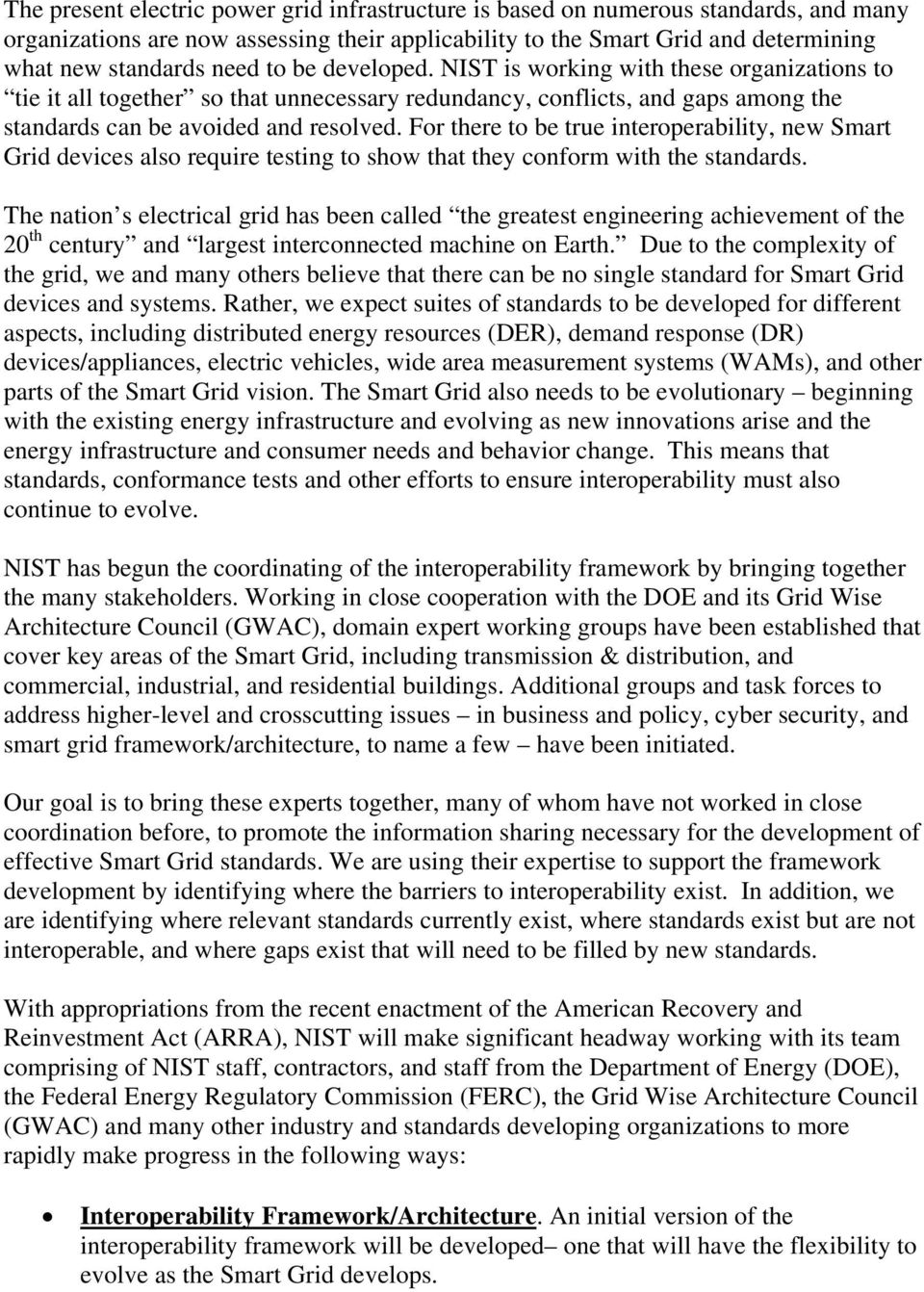
6 Dr. Patrick D. Gallagher, Deputy Director Dr. Patrick Gallagher is the Deputy Director of the U.S. Department of Commerce's National Institute of Standards and Technology (NIST). He is also carrying out the responsibilities of the Director. (The NIST Director position is vacant.) Gallagher provides high-level oversight and direction for NIST. The agency promotes U.S. innovation and industrial competitiveness by advancing measurement science, standards, and technology. NIST's FY 2008 resources total $931.5 million and the agency employs about 2,900 scientists, engineers, technicians, support staff and administrative personnel at two main locations in Gaithersburg, MD, and Boulder, CO. Prior to becoming Deputy Director, Gallagher served as Director of the NIST Center for Neutron Research (NCNR), a national user facility for neutron scattering on the NIST Gaithersburg campus, since The NCNR provides a broad range of neutron diffraction and spectroscopy capability with thermal and cold neutron beams and is presently the nation's most used facility of this type. Gallagher received his Ph.D. in Physics at the University of Pittsburgh in His research interests include neutron and X-ray instrumentation and studies of soft condensed matter systems such as liquids, polymers and gels. In 2000, Gallagher was a NIST agency representative at the National Science and Technology Council (NSTC). He has been active in the area of U.S. policy for scientific user facilities and was chair of the Interagency Working Group on neutron and light source facilities under the Office of Science and Technology Policy.
STATEMENT OF PATRICIA HOFFMAN ACTING ASSISTANT SECRETARY FOR ELECTRICITY DELIVERY AND ENERGY RELIABILITY U.S. DEPARTMENT OF ENERGY BEFORE THE
 STATEMENT OF PATRICIA HOFFMAN ACTING ASSISTANT SECRETARY FOR ELECTRICITY DELIVERY AND ENERGY RELIABILITY U.S. DEPARTMENT OF ENERGY BEFORE THE COMMITTEE ON ENERGY AND NATURAL RESOURCES UNITED STATES SENATE
National Institute of Standards and Technology Smart Grid Cybersecurity
 National Institute of Standards and Technology Smart Grid Cybersecurity Vicky Yan Pillitteri Advisor for Information Systems Security SGIP SGCC Chair [email protected] 1 The National Institute of Standards
Cybersecurity Framework: Current Status and Next Steps
 Cybersecurity Framework: Current Status and Next Steps Federal Advisory Committee on Insurance November 6, 2014 Adam Sedgewick Senior IT Policy Advisor [email protected] National Institute of Standards
Cybersecurity in the Utilities Sector Best Practices and Implementation 2014 Canadian Utilities IT & Telecom Conference September 24, 2014
 Cybersecurity in the Utilities Sector Best Practices and Implementation 2014 Canadian Utilities IT & Telecom Conference September 24, 2014 Victoria Yan Pillitteri Advisor for Information Systems Security
Executive Summary. Cybersecurity cannot be completely solved, and will remain a risk we must actively manage.
 Executive Summary Statement of Nadya Bartol Vice President, Industry Affairs and Cybersecurity Strategist Utilities Telecom Council Before the Subcommittee on Oversight and Subcommittee on Energy Committee
NIST Coordination and Acceleration of Smart Grid Standards. Tom Nelson National Institute of Standards and Technology 8 December, 2010
 NIST Coordination and Acceleration of Smart Grid Standards Tom Nelson National Institute of Standards and Technology 8 December, 2010 The Electric Grid One of the largest, most complex infrastructures
Panel Session: Lessons Learned in Smart Grid Cybersecurity
 PNNL-SA-91587 Panel Session: Lessons Learned in Smart Grid Cybersecurity TCIPG Industry Workshop Jeff Dagle, PE Chief Electrical Engineer Advanced Power and Energy Systems Pacific Northwest National Laboratory
Cyber Security and Privacy - Program 183
 Program Program Overview Cyber/physical security and data privacy have become critical priorities for electric utilities. The evolving electric sector is increasingly dependent on information technology
RESEARCH CALL TO DOE/FEDERAL LABORATORIES. Cybersecurity for Energy Delivery Systems Research Call RC-CEDS-2012-02
 RESEARCH CALL TO DOE/FEDERAL LABORATORIES Cybersecurity for Energy Delivery Systems Research Call RC-CEDS-2012-02 CONTACT: Diane Hooie, Project Manager TELEPHONE NUMBER: (304) 285-4524 FAX NUMBER: (304)
Grid Modernization and Smart Grid
 Grid Modernization and Smart Grid Paul Molitor, Assistant Vice President Origins of Smart Grid in the U.S. The Blackout of 1965 25 million people affected 80,000 square miles Congressional Hearings Cites
September 4, 2003. appearing before you today. I am here to testify about issues and challenges in providing for
 Testimony of John A. McCarthy, Director of the Critical Infrastructure Protection Project, George Mason School of Law Before a joint hearing of the House Subcommittee on Infrastructure Security and The
Framework for Improving Critical Infrastructure Cybersecurity
 Framework for Improving Critical Infrastructure Cybersecurity Implementation of Executive Order 13636 8 April 2015 [email protected] Agenda Mission of NIST Cybersecurity at NIST Cybersecurity Framework
SECURITY RISK MANAGEMENT
 SECURITY RISK MANAGEMENT ISACA Atlanta Chapter, Geek Week August 20, 2013 Scott Ritchie, Manager, HA&W Information Assurance Services Scott Ritchie CISSP, CISA, PCI QSA, ISO 27001 Auditor Manager, HA&W
Enabling the SmartGrid through Cloud Computing
 Enabling the SmartGrid through Cloud Computing April 2012 Creating Value, Delivering Results 2012 eglobaltech Incorporated. Tech, Inc. All rights reserved. 1 Overall Objective To deliver electricity from
RE: Experience with the Framework for Improving Critical Infrastructure Cybersecurity
 October 10, 2014 Ms. Diane Honeycutt National Institute of Standards and Technology 100 Bureau Drive, Stop 8930 Gaithersburg, MD 20899 RE: Experience with the Framework for Improving Critical Infrastructure
VENDOR MANAGEMENT. General Overview
 VENDOR MANAGEMENT General Overview With many organizations outsourcing services to other third-party entities, the issue of vendor management has become a noted topic in today s business world. Vendor
Introduction to NISTIR 7628 Guidelines for Smart Grid Cyber Security
 Introduction to NISTIR 7628 Guidelines for Smart Grid Cyber Security The Smart Grid Interoperability Panel Cyber Security Working Group September 2010 Table of Contents Table of Contents...2 1. Introduction
COMMUNIQUÉ ON PRINCIPLES FOR INTERNET POLICY-MAKING OECD HIGH LEVEL MEETING ON THE INTERNET ECONOMY,
 COMMUNIQUÉ ON PRINCIPLES FOR INTERNET POLICY-MAKING OECD HIGH LEVEL MEETING ON THE INTERNET ECONOMY, 28-29 JUNE 2011 The Seoul Declaration on the Future of the Internet Economy adopted at the 2008 OECD
Risk Management, Equipment Protection, Monitoring and Incidence Response, Policy/Planning, and Access/Audit
 Page 1 of 10 Events Partners Careers Contact Facebook Twitter LinkedIn Pike Research Search search... Home About Research Consulting Blog Newsroom Media My Pike Logout Overview Smart Energy Clean Transportation
RECOMMENDED CHARTER FOR THE IDENTITY ECOSYSTEM STEERING GROUP
 RECOMMENDED CHARTER FOR THE IDENTITY ECOSYSTEM STEERING GROUP 1. Identity Ecosystem Steering Group Charter The National Strategy for Trusted Identities in Cyberspace (NSTIC or Strategy), signed by President
Framework for Improving Critical Infrastructure Cybersecurity
 Framework for Improving Critical Infrastructure Cybersecurity 18 November 2015 [email protected] [email protected] National Institute of Standards and Technology About NIST NIST s mission is to develop
Diane Honeycutt National Institute of Standards and Technology (NIST) 100 Bureau Drive, Stop 8930 Gaithersburg, MD 20899
 Submitted via email: [email protected] April 8, 2013 Diane Honeycutt National Institute of Standards and Technology (NIST) 100 Bureau Drive, Stop 8930 Gaithersburg, MD 20899 Re: Developing a Framework
IEEE-Northwest Energy Systems Symposium (NWESS)
 IEEE-Northwest Energy Systems Symposium (NWESS) Paul Skare Energy & Environment Directorate Cybersecurity Program Manager Philip Craig Jr National Security Directorate Sr. Cyber Research Engineer The Pacific
Agency of Human Services Division of Health Care Reform
 State of Vermont Agency of Human Services 312 Hurricane Lane, Suite 201 [Phone] 802-879-5900 Williston, VT 05495-2807 www.hcr.vermont.gov Dr. David Blumenthal MD, MPP National Coordinator for Health Information
GAO. IT SUPPLY CHAIN Additional Efforts Needed by National Security- Related Agencies to Address Risks
 GAO For Release on Delivery Expected at 10:00 a.m. EDT Tuesday, March 27, 2012 United States Government Accountability Office Testimony Before the Subcommittee on Oversight and Investigations, Committee
Consulting International
 NIST Cyber Security Working Group (CSWG) NISTIR 7628: NIST Guidelines for Smart Grid Cyber Security Frances Cleveland Xanthus Consulting International Xanthus Consulting International [email protected]
STATE OF NEVADA Department of Administration Division of Human Resource Management CLASS SPECIFICATION
 STATE OF NEVADA Department of Administration Division of Human Resource Management CLASS SPECIFICATION TITLE GRADE EEO-4 CODE MASTER IT PROFESSIONAL II 43 B 7.909 SERIES CONCEPT Master Information Technology
NIST Cloud Computing Program
 NIST Program USG Roadmap Top 10 high priority requirements to accelerate USG adoption of the model NIST Mission: To promote U.S. innovation and industrial competitiveness by advancing measurement science,
ADVANCED DISTRIBUTION MANAGEMENT SYSTEMS OFFICE OF ELECTRICITY DELIVERY & ENERGY RELIABILITY SMART GRID R&D
 ADVANCED DISTRIBUTION MANAGEMENT SYSTEMS OFFICE OF ELECTRICITY DELIVERY & ENERGY RELIABILITY SMART GRID R&D Eric Lightner Director Federal Smart Grid Task Force July 2015 2 OE Mission The Office of Electricity
Dean C. Garfield President & CEO, Information Technology Industry Council (ITI) Committee on Energy and Commerce
 Written Testimony of Dean C. Garfield President & CEO, Information Technology Industry Council (ITI) Before the Committee on Energy and Commerce Subcommittee on Communications and Technology U.S. House
Certification and Meaningful Use: EHR Product Certification
 Certification Commission for Healthcare Information Technology Certification and Meaningful Use: EHR Product Certification Testimony before the NCVHS Executive Subcommittee Hearing on Meaningful Use Panel
NIST Cybersecurity Initiatives. ARC World Industry Forum 2014
 NIST Cybersecurity Initiatives Keith Stouffer and Vicky Pillitteri NIST ARC World Industry Forum 2014 February 10-13, 2014 Orlando, FL National Institute of Standards and Technology (NIST) NIST s mission
Cyber Security Recommendations October 29, 2002
 Cyber Security Recommendations October 29, 2002 Leading Co-Chair (Asia/Oceania) Co-Chair (Americas) Co-Chair (Europe/Africa) Dr. Hiroki Arakawa Executive Vice President NTT Data Corporation Richard Brown
Framework for Improving Critical Infrastructure Cybersecurity
 Framework for Improving Critical Infrastructure Cybersecurity Executive Order 13636 Improving Critical Infrastructure Cybersecurity 2014 ISACA Pittsburgh Information Security Awareness Day Victoria Yan
April 8, 2013. Ms. Diane Honeycutt National Institute of Standards and Technology 100 Bureau Drive, Stop 8930 Gaithersburg, MD 20899
 Salt River Project P.O. Box 52025 Mail Stop: CUN204 Phoenix, AZ 85072 2025 Phone: (602) 236 6011 Fax: (602) 629 7988 [email protected] James J. Costello Director, Enterprise IT Security April 8,
JOB ANNOUNCEMENT. Chief Security Officer, Cheniere Energy, Inc.
 JOB ANNOUNCEMENT Chief Security Officer, Cheniere Energy, Inc. Position Overview The Vice President and Chief Security Risk Officer (CSRO) reports to the Chairman, Chief Executive Officer and President
Threat Model for Software Reconfigurable Communications Systems
 Threat Model for Software Reconfigurable Communications Systems Presented to the Management Group 6 March 007 Bernard Eydt Booz Allen Hamilton Chair, SDR Security Working Group Overview Overview of the
GAO. INFORMATION SECURITY Governmentwide Guidance Needed to Assist Agencies in Implementing Cloud Computing
 GAO For Release on Delivery Expected at 10:00 a.m. EDT Thursday, July 1, 2010 United States Government Accountability Office Testimony Before the Committee on Oversight and Government Reform and Its Subcommittee
Highlights & Next Steps
 USG Cloud Computing Technology Roadmap Highlights & Next Steps NIST Mission: To promote U.S. innovation and industrial competitiveness by advancing measurement science, standards, and technology in ways
OVERVIEW. In all, this report makes recommendations in 14 areas, such as. Page iii
 The Office of the Auditor General has conducted a procedural review of the State Data Center (Data Center), a part of the Arizona Strategic Enterprise Technology (ASET) Division within the Arizona Department
CYBERSECURITY RISK MANAGEMENT
 CYBERSECURITY RISK MANAGEMENT Evan Wolff Maida Lerner Peter Miller Kate Growley 233 Roadmap Cybersecurity Risk Overview Cybersecurity Trends Selected Cybersecurity Topics Critical Infrastructure DFARS
WRITTEN TESTIMONY OF NICKLOUS COMBS CHIEF TECHNOLOGY OFFICER, EMC FEDERAL ON CLOUD COMPUTING: BENEFITS AND RISKS MOVING FEDERAL IT INTO THE CLOUD
 WRITTEN TESTIMONY OF NICKLOUS COMBS CHIEF TECHNOLOGY OFFICER, EMC FEDERAL ON CLOUD COMPUTING: BENEFITS AND RISKS MOVING FEDERAL IT INTO THE CLOUD BEFORE THE COMMITTEE ON OVERSIGHT AND GOVERNMENT REFORM
Buyer Beware: How To Be a Better Consumer of Security Maturity Models
 Buyer Beware: How To Be a Better Consumer of Security Maturity Models SESSION ID: GRC-R01 Julia Allen Software Engineering Institute Carnegie Mellon University [email protected] Nader Mehravari Software
NIST Cybersecurity Framework What It Means for Energy Companies
 Daniel E. Frank J.J. Herbert Mark Thibodeaux NIST Cybersecurity Framework What It Means for Energy Companies November 14, 2013 Your Panelists Dan Frank J.J. Herbert Mark Thibodeaux 2 Overview The Cyber
Perspectives on Cloud Computing and Standards. Peter Mell, Tim Grance NIST, Information Technology Laboratory
 Perspectives on Cloud Computing and Standards Peter Mell, Tim Grance NIST, Information Technology Laboratory Standardization and Cloud Computing Cloud computing is a convergence of many technologies Some
Solutions Master Data Governance Model and Mechanism
 www.pwc.com Solutions Master Data Governance Model and Mechanism Executive summary Organizations worldwide are rapidly adopting various Master Data Management (MDM) solutions to address and overcome business
RESEARCH CALL TO DOE/FEDERAL LABORATORIES. Cybersecurity for Energy Delivery Systems Research Call RC-CEDS-2015
 RESEARCH CALL TO DOE/FEDERAL LABORATORIES Cybersecurity for Energy Delivery Systems Research Call RC-CEDS-2015 CONTACT: James Briones TELEPHONE NUMBER: (304) 285-5229 E-MAIL: [email protected] ISSUING
Cyber Security Working Group
 Cyber Security Working Group National Institute of Standards and Technology U.S. Department of Commerce 1 Energy Independence and Security Act In the Energy Independence and Security Act (EISA) of 2007,
Cybersecurity Framework. Executive Order 13636 Improving Critical Infrastructure Cybersecurity
 Cybersecurity Framework Executive Order 13636 Improving Critical Infrastructure Cybersecurity National Institute of Standards and Technology (NIST) Mission To promote U.S. innovation and industrial competitiveness
Enterprise Data Protection
 PGP White Paper June 2007 Enterprise Data Protection Version 1.0 PGP White Paper Enterprise Data Protection 2 Table of Contents EXECUTIVE SUMMARY...3 PROTECTING DATA EVERYWHERE IT GOES...4 THE EVOLUTION
Interagency Science Working Group. National Archives and Records Administration
 Interagency Science Working Group 1 National Archives and Records Administration Establishing Trustworthy Digital Repositories: A Discussion Guide Based on the ISO Open Archival Information System (OAIS)
Cyber Security Working Group
 Cyber Security Working Group Guidelines for Smart Grid Cyber Security (NISTIR 7628) National Institute of Standards and Technology U.S. Department of Commerce 1 Today s Electric Grid Markets and Operations
Senate Committee on Commerce, Science, and Transportation March 19, 2015, Hearing Examining the Evolving Cyber Insurance Marketplace
 Senate Committee on Commerce, Science, and Transportation March 19, 2015, Hearing Examining the Evolving Cyber Insurance Marketplace Testimony of Ben Beeson Vice President, Cyber Security and Privacy Lockton
STATEMENT OF MARK A.S. HOUSE OF REPRESENTATIVES
 STATEMENT OF MARK A. FORMAN ASSOCIATE DIRECTOR FOR INFORMATION TECHNOLOGY AND ELECTRONIC GOVERNMENT OFFICE OF MANAGEMENT AND BUDGET BEFORE THE COMMITTEE ON GOVERNMENT REFORM SUBCOMMITTEE ON GOVERNMENT
An Overview of Information Security Frameworks. Presented to TIF September 25, 2013
 An Overview of Information Security Frameworks Presented to TIF September 25, 2013 What is a framework? A framework helps define an approach to implementing, maintaining, monitoring, and improving information
National Cybersecurity Challenges and NIST. Donna F. Dodson Chief Cybersecurity Advisor ITL Associate Director for Cybersecurity
 National Cybersecurity Challenges and NIST Donna F. Dodson Chief Cybersecurity Advisor ITL Associate Director for Cybersecurity Though no-one knows for sure, corporate America is believed to lose anything
Cyber Infrastructure for the Smart Grid
 Cyber Infrastructure for the Smart Grid Dr. Anurag K. Srivastava, Dr. Carl Hauser, and Dr. Dave Bakken Smart Grid Use Cases: Part 2 SGIC Xcel Energy SG Xcel Energy A public Service company of Colorado
12/4/2013. Regulatory Updates. Eric M. Wright, CPA, CITP. Schneider Downs & Co., Inc. December 5, 2013
 Regulatory Updates Eric M. Wright, CPA, CITP Schneider Downs & Co., Inc. December 5, 2013 Eric M. Wright, CPA, CITP Eric has been involved with Information Technology with Schneider Downs since 1983. He
Chairman Johnson, Ranking Member Carper, and Members of the committee:
 UNITED STATES OFFICE OF PERSONNEL MANAGEMENT STATEMENT OF THE HONORABLE KATHERINE ARCHULETA DIRECTOR U.S. OFFICE OF PERSONNEL MANAGEMENT before the COMMITTEE ON HOMELAND SECURITY AND GOVERNMENTAL AFFAIRS
future data and infrastructure
 White Paper Smart Grid Security: Preparing for the Standards-Based Future without Neglecting the Needs of Today Are you prepared for future data and infrastructure security challenges? Steve Chasko Principal
IT Governance Regulatory. P.K.Patel AGM, MoF
 IT Governance Regulatory Perspective P.K.Patel AGM, MoF Agenda What is IT Governance? Aspects of IT Governance What banks should consider before implementing these aspects? What banks should do for implementation
A NEW STRATEGIC DIRECTION FOR NTIS
 A NEW STRATEGIC DIRECTION FOR NTIS U.S. Department of Commerce November 5, 2015 Refocusing NTIS to meet a 21st Century National Need 2 Overview Following a rigorous review of NTIS operations, the Commerce
Cloud Computing and Security Risk Analysis Qing Liu Technology Architect STREAM Technology Lab [email protected]
 Cloud Computing and Security Risk Analysis Qing Liu Technology Architect STREAM Technology Lab [email protected] 1 Disclaimers This presentation provides education on Cloud Computing and its security
John Essner, CISO Office of Information Technology State of New Jersey
 John Essner, CISO Office of Information Technology State of New Jersey http://csrc.nist.gov/publications/nistpubs/800-144/sp800-144.pdf Governance Compliance Trust Architecture Identity and Access Management
BUSINESS CONTINUITY PLANNING
 Policy 8.3.2 Business Responsible Party: President s Office BUSINESS CONTINUITY PLANNING Overview The UT Health Science Center at San Antonio (Health Science Center) is committed to its employees, students,
ENISA What s On? ENISA as facilitator for enhanced Network and Information Security in Europe. CENTR General Assembly, Brussels October 4, 2012
 ENISA What s On? ENISA as facilitator for enhanced Network and Information Security in Europe CENTR General Assembly, Brussels October 4, 2012 [email protected] 1 Who we are ENISA was
Voluntary Cybersecurity Initiatives in Critical Infrastructure. Nadya Bartol, CISSP, SGEIT, [email protected]. 2014 Utilities Telecom Council
 Voluntary Cybersecurity Initiatives in Critical Infrastructure Nadya Bartol, CISSP, SGEIT, [email protected] 2014 Utilities Telecom Council Utility cybersecurity environment is full of collaborations
Capabilities for Cybersecurity Resilience
 Capabilities for Cybersecurity Resilience In the Homeland Security Enterprise May 2012 DHS Cybersecurity Strategy A cyberspace that: Is Secure and Resilient Enables Innovation Protects Public Advances