
Hazardous Waste Self Audit
|
|
|
- Gertrude Ball
- 9 years ago
- Views:
Transcription
1 Section: Waste Pharmaceuticals Hazardous Waste Self Audit Section: Waste Pharmaceuticals Self-Audit Tips, Action Steps & Resources Types of pharmaceuticals Pharmaceuticals include but are not limited to: non-prescription and prescription drugs/ medications, drug samples, patients personal medications, drugs in an emergency kit or crash cart and over the counter medications. Hazardous, infectious and dual waste pharmaceuticals This section covers pharmaceuticals from your emergency kits, pharmacy, clinic(s) and/or over-thecounter drugs. If you have a clinic, please note that infectious waste (biohazardous, sharps, red bag or regulated medical waste) is not the same as hazardous waste. Each have separate waste disposal requirements. If your clinic generates hazardous waste pharmaceuticals, you will need to keep them in separate containers from your infectious wastes. However, there are times when a waste can be both. In Minnesota this waste is called Dual Hazardous/Infectious Waste. Dual waste must be placed in a container designed for dual waste and not a red infectious waste container. Refer to the tips, action steps and resources to help you complete the audit. 1. Does your facility stock or keep pharmaceuticals? Yes. You are required to evaluated your pharmaceutical waste to determine if it is hazardous before you dispose of it. No, this facility does not stock or keep pharmaceuticals. If you have pharmaceuticals that go to reverse distribution, download and complete the Section: Pharmaceuticals for Reverse Distribution at selfaudit. Evaluating pharmaceutical waste You are required to evaluate your pharmaceutical waste to determine if it is hazardous before you dispose of it. Waste evaluation must be of the individual waste prior to any mingling or commingling with other wastes and/or prior to sewering. Ensure waste is evaluated according to Minn. R The methods used to evaluate waste pharmaceuticals can be found in the following factsheets: Step 1: Evaluate Waste at Evaluating Pharmaceutical Waste at Alternate Method to Evaluate Pharmaceutical Waste for the Lethality Characteristic Your hazardous waste disposal service company or consultant can also provide you with evaluation assistance, including testing your waste. Once you have evaluated your pharmaceutical, update your formulary spreadsheet to include columns for: The four-digit hazardous waste codes associated with each pharmaceutical if it were to become a waste. The method used to evaluate each pharmaceutical. How it will be managed once it becomes a waste or is expired. A facility may also choose not to evaluate their waste pharmaceuticals. In this case, the facility must assume that all waste pharmaceuticals are hazardous waste and they must be managed accordingly. selfaudit Hazardous waste self-audit report Return all sections 1 of 8

2 Self-Audit Tips, Action Steps & Resources P-listed hazardous pharmaceutical waste P-listed pharmaceutical wastes includes, but is not limited to: Nicotine (P075), Physostigmine (P204), Physostigmine salicylate (P188), warfarin >0.3% (P001), and their empty containers (i.e. empty bottle of warfarin, nicotine, etc.) For more information See P List of Acute Hazardous Waste at publications/w-hw2-02.pdf. See Managing Empty Containers at ww.pca.state.mn.us/ publications/w-hw4-16.pdf. 2. Are the pharmaceutical waste generated at your facility hazardous waste (select on)? This facility chooses to manage all waste pharmaceuticals as hazardous waste and/or dual waste. Fill out Waste, Expired or Unused Pharmaceuticals on page 3. Do not include acute hazardous wastes (question 3) or waste controlled substances (question 4). This facility has evaluated each individual waste pharmaceutical and is managing the waste as appropriate. Fill out Form 2 Waste, Expired or Unused Pharmaceuticals on page 3. Do not include acute hazardous wastes (question 3) or waste controlled substances (question 4). This facility does not generate hazardous waste pharmaceuticals. Your facility may be asked to submit the formulary list that includes the method of evaluation for each waste pharmaceutical and the disposal method for each waste pharmaceutical. 3. Is any of the pharmaceutical waste generated at your facility classified as acute hazardous waste (P-listed)? Yes. Fill out the Acute Hazardous Waste on page 4 No, this facility does not generate pharmaceutical wastes that is classified as acute hazardous waste. 4. How will you manage containers that held acute hazardous waste (Plisted)? Containers that held materials that are classified as acute hazardous waste when discarded are subject to the additional requirement of triple-rinsing before they are considered empty. Your facility may have difficulty ensuring they are triple-rinsed before disposal and may choose instead to manage them as hazardous wastes rather than attempt to triple-rinse them. Note that packaging, such as wrappers, adhesive backing and foil that encloses acutely toxic pharmaceuticals, are also considered acute hazardous wastes unless triple-rinsed. If you plan to triple-rinse containers, the rinsing solution (rinsate) must be managed as acute waste. This facility will managed containers that held acute hazardous waste as hazardous waste. Include this waste in Acute Hazardous Waste on page 4 This facility will triple-rinse containers. This facility does not manage containers that held acute hazardous waste. Controlled substances Seea list of DEA controlled substances at schedules 5. Do you generate any pharmaceutical wastes that are considered controlled substances by the U.S. Drug Enforcement Agency? Yes. Fill out the Waste Controlled Substances on page 5 No, this facility does not generate waste controlled substances. selfaudit Hazardous waste self-audit report Return all sections 2 of 8

3 codes for pharmaceuticals D001: Aerosols, pharmaceutical containing more than 24 percent alcohol D009: Thimerosol preserved pharmaceuticals such at flu vaccines D011: Silver-containing creams D024: Creosol preserved pharmaceuticals such as insulin MN01: All unevaluated waste pharmaceuticals Sturdy and leak-proof (will and disposer. Downloaded at Waste, Expired and Unused Pharmaceuticals A. Waste name: Waste, Expired or Unused Pharmaceuticals code: D001 D009 D011 D024 MN01 Labeled with a clear description of the waste (e.g., Waste Pharmaceuticals) Incinerate or selfaudit Hazardous waste self-audit report Return all sections 3 of 5

4 codes for acute hazardous waste P001: Warfarin > 03.% P075: Nicotine P204: Physostigmine Sturdy and leak-proof (will and disposer. The factsheet may be included with the self audit or can be downloaded at Acute Hazardous Waste A. Waste name: Acute hazardous waste code: P001 P075 P204 Other Labeled with a clear description of the waste (e.g., Waste P-listed Pharmaceuticals) Incinerate or selfaudit Hazardous waste self-audit report Return all sections 4 of 5

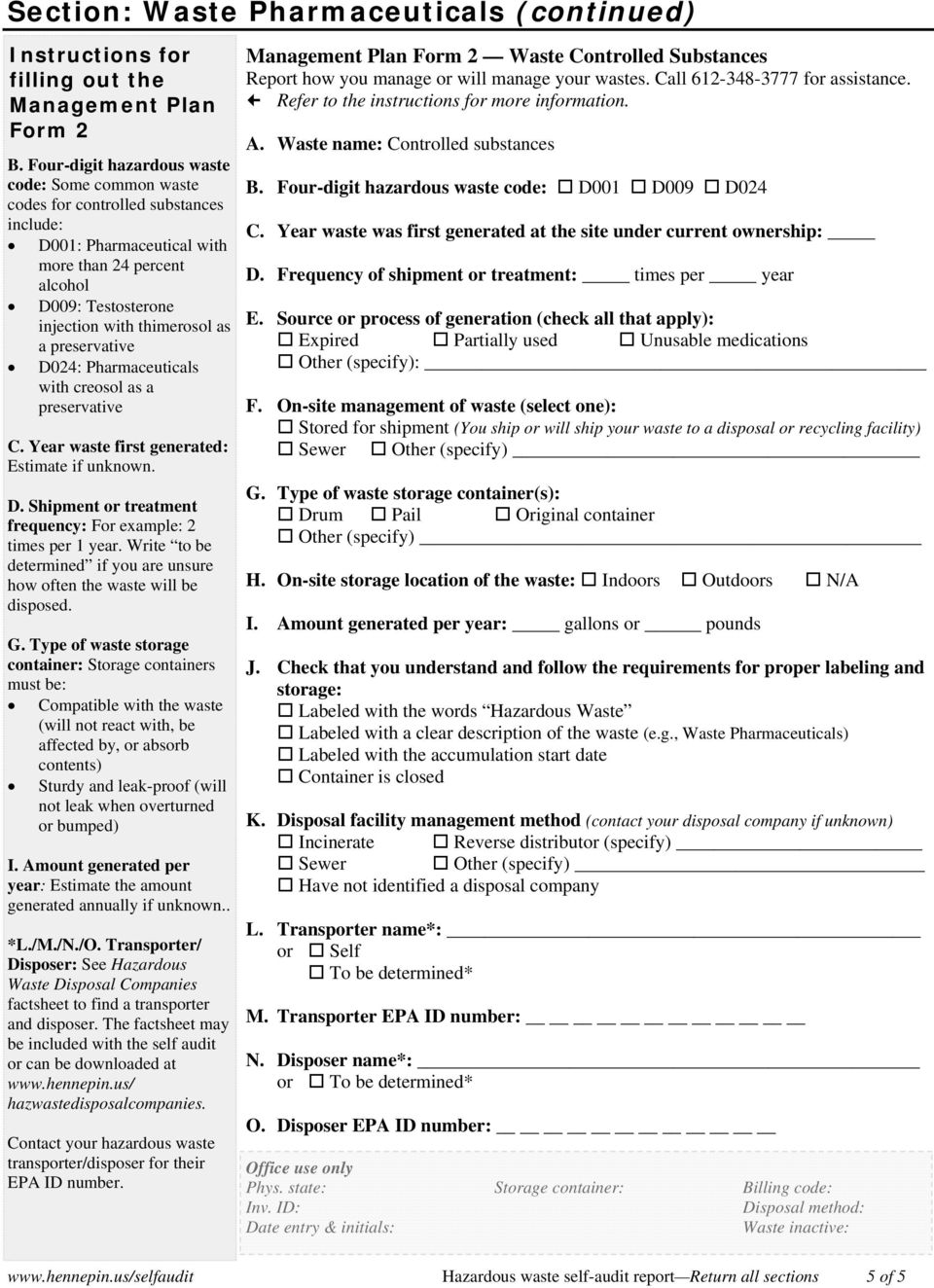
5 codes for controlled substances D001: Pharmaceutical with more than 24 percent alcohol D009: Testosterone injection with thimerosol as a preservative D024: Pharmaceuticals with creosol as a preservative Sturdy and leak-proof (will and disposer. The factsheet may be included with the self audit or can be downloaded at Waste Controlled Substances A. Waste name: Controlled substances code: D001 D009 D024 Sewer Other (specify) Labeled with a clear description of the waste (e.g., Waste Pharmaceuticals) Incinerate Reverse distributor (specify) Sewer Other (specify) or selfaudit Hazardous waste self-audit report Return all sections 5 of 5
Managing Pharmaceutical Waste at the LTC Provider Pharmacy
 Managing Pharmaceutical at the LTC Provider Pharmacy Is your pharmacy compliant with all regulations related to pharmaceutical waste? The long-term care (LTC) industry is currently faced with the simultaneous
Managing Hazardous Pharmaceutical Waste
 Managing Hazardous Pharmaceutical Waste Environmental Consequences Why the growing concern? Discovery of pharmaceuticals in surface, ground and drinking waters of the U.S. Small concentrations of endocrine
Conflicts of Interest. Disposal of Pharmaceutical Waste: What a Technician. Who is interested in proper pharmaceutical waste disposal?
 Conflicts of Interest Disposal of Pharmaceutical Waste: What a Technician Should Know Presented by Michael McEvoy Pharm.D. NorthShore University HealthSystem The speaker has nothing to disclose in relation
Disposal of Pharmaceuticals, and their empty containers, in the Workplace
 Disposal of Pharmaceuticals, and their empty containers, in the Workplace Prepared by Bio-Team Mobile LLC There is a lot of misinformation being circulated about disposal of pharmaceuticals ever since
Vanderbilt University Medical Center Pharmaceutical Waste Program USER INSERVICE
 Vanderbilt University Medical Center Pharmaceutical Waste Program USER INSERVICE Training and Education Plan This session is intended to train and provide super-users with necessary resources to effectively
Managing Pharmaceutical Wastes: Law and Regulations
 Managing Pharmaceutical Wastes: Law and Regulations James T. Price Missouri Waste Control Coalition Conference June 30, 2014 2014 WA 5625923.1 From the Missouri Department of Natural Resources Health Care:
Pharmaceutical Waste Program for Inpatient Pharmacy. Portland Service Area Pharmacy Leadership Team
 Pharmaceutical Waste Program for Inpatient Pharmacy Portland Service Area Pharmacy Leadership Team What is Pharmaceutical Waste? Pharmaceutical waste is waste generated through IV preparation, compounding,
Pharmaceutical Waste Management Program St. Joseph Mercy Oakland. Pharmacy/Patient Care
 Pharmaceutical Waste Management Program St. Joseph Mercy Oakland Pharmacy/Patient Care Objectives Understand the background and regulatory requirements Identify pharmaceutical waste and how to dispose
PHARMACEUTICAL WASTE UPDATE ON HANDLING AND DISPOSAL ASTSWMO MEETING August 11, 2011
 PHARMACEUTICAL WASTE UPDATE ON HANDLING AND DISPOSAL ASTSWMO MEETING August 11, 2011 Pharmaceutical Waste Getting the attention it deserves Are there Federal, State and Local laws & regulations to comply
Pharmaceutical Waste Compliance Program
 Pharmaceutical Waste Compliance Program Corporate Overview Stericycle Services Medical Waste Management Sharps Disposal Management Product Recalls & Retrieval OSHA Compliance Training Pharmaceutical &
Hazardous Pharmaceutical Waste Management. Written by: Matthew Teeter, Environmental Compliance Consultant
 Hazardous Pharmaceutical Waste Management Written by: Matthew Teeter, Environmental Compliance Consultant Identifying Hazardous Pharmaceuticals Certain pharmaceuticals used in hospitals, medical centers
RCRA Applied to Retail and Pharmaceutical Wastes, How to Manage a Work in Progress. Gregory W. Blount Troutman Sanders LLP Atlanta, GA
 RCRA Applied to Retail and Pharmaceutical Wastes, How to Manage a Work in Progress Gregory W. Blount Troutman Sanders LLP Atlanta, GA TABLE OF CONTENTS INTRODUCTION... 1 A. Determining Whether a Pharmaceutical
Management of Pharmaceutical Wastes from Healthcare & Households. Rudy Vingris Product Manager PharmEcology Services Waste Management, Inc.
 Management of Pharmaceutical Wastes from Healthcare & Households Rudy Vingris Product Manager PharmEcology Services Waste Management, Inc. Legal Disclaimer This presentation is solely for educational purposes
What is a hazardous drug? Hazardous Drugs: NIOSH. Pharmaceutical Waste: Hazardous pharmaceutical Waste 衛 福 部 疾 病 管 制 署
 殘 餘 藥 物 之 處 置 衛 福 部 疾 病 管 制 署 中 區 傳 染 病 防 治 醫 療 網 王 任 賢 指 揮 官 What is a hazardous drug? ASHP 2004 TAB criteria for considering a drug hazardous (adopted by OSHA): 1. Carcinogenicity 2. Teratogenicity 3.
INSTITUTIONAL POLICY AND PROCEDURE (IPP) Department: Manual: Section: EFFECTIVE DATE REVIEW DUE REPLACES NUMBER NO. OF PAGES
 HOSPITAL NAME INSTITUTIONAL POLICY AND PROCEDURE (IPP) Department: Manual: Section: TITLE/DESCRIPTION POLICY NUMBER MEDICATIONS EFFECTIVE DATE REVIEW DUE REPLACES NUMBER NO. OF PAGES APPROVED BY APPLIES
PHARMACEUTICAL WASTE MANAGEMENT DUKE UNIVERSITY HEALTH SYSTEM
 PHARMACEUTICAL WASTE MANAGEMENT DUKE UNIVERSITY HEALTH SYSTEM BLUE BIN DRUGS ONLY NO EMPTY Packages, NO Gloves NO Scissors, Syringes, Needles, IVs Scalpels, Forceps BLUE BIN PROGRAM PURPOSE AND OBJECTIVE:
Draft Guidance Document: Best Management Practices for Unused Pharmaceuticals at Health Care Facilities
 United States Environmental Protection Agency Draft Guidance Document: Best Management Practices for Unused Pharmaceuticals at Health Care Facilities EPA-821-R-10-006 26 August 2010 Disclaimer The discussion
Waste Management of Pharmaceuticals From a Health Care Perspective
 Waste Management of Pharmaceuticals From a Health Care Perspective Federation of New York Solid Waste Assn Solid Waste/Recycling Conference & Trade Show May 4, 2009 Charlotte A. Smith, R. Ph., M.S. Director,
Pharmaceuticals and the Universal Waste Rule. Connecticut DEEP Stakeholders Meeting February 5, 2014 PharmEcology Services WM Healthcare Solutions
 Pharmaceuticals and the Universal Waste Rule Connecticut DEEP Stakeholders Meeting February 5, 2014 PharmEcology Services WM Healthcare Solutions Legal Disclaimer This presentation is solely for educational
INSTITUTIONAL POLICY AND PROCEDURE (IPP) Department: Manual: Section:
 HOSPITAL NAME INSTITUTIONAL POLICY AND PROCEDURE (IPP) Department: Manual: Section: TITLE/DESCRIPTION POLICY NUMBER HANDLING OF H AZARDOUS DRUGS EFFECTIVE DATE REVIEW DUE REPLACES NUMBER NO. OF PAGES APPROVED
CHS Medical Group Hazardous Waste Management In Service
 CHS Medical Group Hazardous Waste Management In Service Objective Educate staff how to properly manage Regulated Medical Waste (RMW), Chemotherapy Waste and EPA RCRA Hazardous Waste Ensure compliance with
Pharmaceutical Waste Initiatives: What Comes Next? ACPE # 0206-0000-12-601-L05-P (0.1 CEU)
 Date: Monday, August 27, 2012 Time: 10:15 a.m. 11:15 a.m. Location: Colorado Convention Center Rooms 111-113 Title: Speaker: Pharmaceutical Waste Initiatives: What Comes Next? ACPE # 0206-0000-12-601-L05-P
Utah Division of Solid and Hazardous Waste Solid Waste Management Program
 Utah Division of Solid and Hazardous Waste Solid Waste Management Program Mailing Address Office Location Phone (801) 536-0200 P.O. Box 144880 195 North 1950 West Fax (801) 536-0222 Salt Lake City, Utah
THE SAFE DISPOSAL OF CLINICAL/DOMESTIC WASTE
 Section V THE SAFE DISPOSAL OF CLINICAL/DOMESTIC WASTE The Trust is currently reviewing the requirements of the recent guidelines Health Technical Memorandum Safe Management of Healthcare Waste (HTML 07-01).
PHARMACEUTICAL WASTE MANAGEMENT GUIDELINES
 PHARMACEUTICAL WASTE MANAGEMENT GUIDELINES Enclosure (1) GUIDELINES TABLE OF CONTENTS EXECUTIVE SUMMARY References...1 Background...1 Purpose...1 Scope...2 Action...2 Resources...4 1. PHARMACEUTICAL CATEGORIES
Managing Pharmaceutical Waste
 Managing Pharmaceutical Waste Marian M. Rhoads R.Ph, MS Director of Pharmacy Services Saint Joseph Medical Center Reading, PA [email protected] Disclaimer The information in this presentation
EPA s proposed hazardous waste pharmaceutical regulations
 EPA s proposed hazardous waste pharmaceutical regulations November 4, 2015 By J. Timothy Ramsey The United States Environmental Protection Agency ( EPA ) published proposed regulations in the Federal Register
CHAPTER 6 OUTPATIENT SURGICAL CENTERS 6. 1
 CHAPTER 6 OUTPATIENT SURGICAL CENTERS 6. 1 OUTPATIENT SURGICAL CENTERS I. LICENSURE 1. Modified II B Pharmacy license 2. DEA license II. REQUIREMENTS 1. Formulary may be any drugs needed to meet the medical
Pharmaceutical Waste Compliance For Healthcare Facilities
 Pharmaceutical Waste Compliance For Healthcare Facilities Regulations & References The information provided in this presentation is based on the referenced Code of Federal Regulations and State regulations.
ENVIRONMENTAL HEALTH DEPARTMENT SAN JOAQUIN COUNTY
 ENVIRONMENTAL HEALTH DEPARTMENT SAN JOAQUIN COUNTY 1868 East Hazelton Avenue, Stockton, CA 95205-6232 Telephone: (209) 468-3420 Fax (209) 468-3433 INFORMATION PACKET FOR MEDICAL WASTE GENERATORS This packet
CENTRAL IOWA HEALTHCARE Marshalltown, Iowa PHARMACY POLICY AND PROCEDURE
 CENTRAL IOWA HEALTHCARE Marshalltown, Iowa PHARMACY POLICY AND PROCEDURE Policy #: MM.01.01.03 Subject: High Alert and Hazardous Medications (including pharmaceutical waste management) Purpose: The hospital
RCRA and Pharmaceutical Waste Management: A Brief Federal Overview
 RCRA and Pharmaceutical Waste Management: A Brief Federal Overview Lisa Lauer (EPA) Office of Resource Conservation and Recovery [email protected]; 703-308-7418 1 What is RCRA? RCRA = Resource Conservation
INSTITUTIONAL POLICY AND PROCEDURE (IPP)
 HOSPITAL NAME INSTITUTIONAL POLICY AND PROCEDURE (IPP) Department: Manual: Section: TITLE/DESCRIPTION POLICY NUMBER HAZARDOUS WASTE: HANDLING AND DISPOSAL EFFECTIVE DATE REVIEW DUE REPLACES NUMBER NO.
How To Understand And Understand The Rules Of Hazardous Waste
 Understanding Regulated Medical Waste & Best Management Practices Regulations & References The information provided in this presentation is based on the referenced Code of Federal Regulations and State
SOLID WASTE MANAGEMENT PLAN Peoria County September 3, 2013 Medical Waste Background
 SOLID WASTE MANAGEMENT PLAN Peoria County September 3, 2013 Medical Waste Background Medical Waste The proper handling and disposal of medical wastes (syringes, medical instruments, vials, pathological
Any waste solution of 0.1% (e.g. 1mg/ml) or higher is Special Waste (including: unwanted 5mg/ml or 10mg/ml stock solutions).
 Ethidium bromide Ethidium Bromide (EtBr), commonly used in research laboratories as a stain for the visualization of nucleic acids in electrophoresis gels, is a toxic chemical and a potent mutagen. When
14.0 Hazardous Chemical Waste Management
 14.0 Hazardous Chemical Waste Management 14.1 Responsibilities. The hazardous waste management program at the UTHSCSA is designed to provide safe, effective and economical disposal of chemical waste generated
Medical Waste Management Plan
 Medical Waste Management Plan The Kern County Environmental Health Division is the local agency designated by the California Department of Public Health to implement the Medical Waste Management Act. This
Title 16. Board of Pharmacy Proposed Text
 Title 16. Board of Pharmacy Proposed Text Proposal to add new Article 9.1 of Division 17 of Title 16 of the California Code of Regulations and a new Article title as follows: Article 9.1. Prescription
To provide direction for the safe handling, administration and disposal of hazardous drugs.
 Subsection: MEDICATION Related terms: Cytotoxic Drugs, Antineoplastic Drugs Authorized by: Clinical Directors CS-04-02-01 Page 1 of 9 Date Established: October 2006 Date For Review: September 2014 Dates
2.3. The management in each HCF shall be responsible for ensuring good waste management practices in their premises.
 1. PURPOSE Health-care activities lead to production of medical waste that may lead to adverse health effects. Most of this waste is not more dangerous than regular household waste. However, some types
UCLA Henry Samueli School of Engineering and Applied Science STANDARD OPERATING PROCEDURE MEDICAL WASTE (BIOHAZARD WASTE) MANAGEMENT
 UCLA Henry Samueli School of Engineering and Applied Science STANDARD OPERATING PROCEDURE MEDICAL WASTE (BIOHAZARD WASTE) MANAGEMENT PURPOSE The purpose of this document is to specify the procedures used
Pharmaceutical Waste as Universal Waste
 Pharmaceutical Waste as Universal Waste Charlotte A. Smith, R. Ph., M.S. September 21, 2009 2009 ASHES Annual Conference September 20-24, 2009 Reno, NV Legal Disclaimer This presentation is solely for
April 2015. Chemical Waste Guide
 April 2015 Chemical Waste Guide Guides 1. Obtaining Chemical Waste Disposal Tags 2. Chemical Waste Disposal Tags 3. Lab clean Out Operations 4. Waste Containers 5. Contaminated Debris 6. Ethidium Bromide
Pharmaceutical Waste Management: Current Concepts
 Pharmaceutical Waste Management: Current Concepts ACPE UAN 0107-0000-10-004-L04-P & 0107-0000-10-004-L04-T Activity Type: Knowledge-Based 0.1 CEU/1.0 Hr. Program Objectives for Pharmacists & Technicians:
Universal Pharmaceutical Waste (UPW) Guidance/Training Module Environmental Health & Safety
 Universal Pharmaceutical Waste (UPW) Guidance/Training Module Environmental Health & Safety Pharmaceutical Waste Technical Advisory Group The Pharmaceutical Technical Advisory Group (PharmTAG) is comprised
Patient Safety. Road Map to Controlled Substance Diversion Prevention
 Patient Safety Road Map to Controlled Substance Diversion Prevention Road Map to Diversion Prevention safe S Safety Teams/ Organizational Structure A Access to information/ Accurate Reporting/ Monitoring/
DEPARTMENT OF HEALTH PO BOX 358 TRENTON, N.J. 08625-0358. www.nj.gov/health
 CHRIS CHRISTIE Governor KIM GUADAGNO Lt. Governor Dear Administrator: DEPARTMENT OF HEALTH PO BOX 358 TRENTON, N.J. 08625-0358 www.nj.gov/health January, 2013 MARY E. O DOWD, M.P.H. Commissioner Since
Infectious Waste Management Plan
 Infectious Waste Management Plan Infectious Waste Management Plan USC Health & Safety Programs Unit 777-5269 POLICY: A. In keeping with the University of South Carolina's policy of providing protection
Health Sciences Campus Biomedical Waste Management Standard Operating Procedure (SOP)
 Health Sciences Campus Biomedical Waste Management Standard Operating Procedure (SOP) NOTE: This SOP for biological waste management does not supersede the requirements for radioactive and/or hazardous
Managing Pharmaceutical Waste: A Discussion Guide for Health-System Pharmacists
 Managing Pharmaceutical Waste: A Discussion Guide for Health-System Pharmacists Overview and regulatory history The term chemical pollutants most often calls to mind pesticides and industrial sewage, yet
Managing Pharmaceutical Waste. A 10-Step Blueprint for Healthcare Facilities In the United States
 Managing Pharmaceutical Waste A 10-Step Blueprint for Healthcare Facilities In the United States Revised August, 2008 Acknowledgements The original Blueprint, published on April 15 th, 2006, was written
SHARPS COLLECTION PROGRAM PLAN FOR THE PRINCE EDWARD ISLAND MEDICAL SHARP STEWARDSHIP PROGRAM
 SHARPS COLLECTION PROGRAM PLAN FOR THE PRINCE EDWARD ISLAND MEDICAL SHARP STEWARDSHIP PROGRAM DECEMBER 2014 EXECUTIVE SUMMARY On June 10, 2014 Prince Edward Island approved the Environmental Protection
APPENDIX D INFECTIOUS WASTE MANAGEMENT GUIDE
 APPENDIX D INFECTIOUS WASTE MANAGEMENT GUIDE TABLE OF CONTENTS INTRODUCTION... PAGE 1 SUMMARY OF REGULATIONS... PAGE 1 WRIGHT STATE UNIVERSITY INFECTIOUS WASTE STRATEGY... PAGE 5 PROCEDURES FOR WSU INFECTIOUS
Connecticut Biomedical Waste (BMW) Requirements (22a-209-15) and Common Industry Practices
 Connecticut Biomedical Waste (BMW) Requirements (22a-209-15) and Common Industry Practices Mark Latham CT DEP, Waste Engineering and Enforcement Division Common Synonyms for BMW Regulated Medical Waste
Appendix H IBC Managing Biohazardous Waste SOP
 Biohazardous waste is managed under the State of Rhode Island s Regulated Medical Waste Regulations (Regulation DEM-OWM-MW-1-2009, amended July, 2010). http://www.dem.ri.gov/pubs/regs/regs/waste/medwaste10.pdf
Creating Secure Medicine Return Programs to Reduce Misuse of Medicines in King County & Washington State
 WEST VIRGINIA INTEGRATED BEHAVIORAL HEALTH CONFERENCE Creating Secure Medicine Return Programs to Reduce Misuse of Medicines in King County & Washington State Margaret Shield, PhD, Policy Liaison Local
PHARMACEUTICAL AND CHEMICAL WASTE MANAGEMENT
 Medicines and Medical Devices Agency of Serbia PHARMACEUTICAL AND CHEMICAL WASTE MANAGEMENT Ivana Bozic, MSc Health, Safety and Environment ISWA Beacon Conference, Novi Sad, 08 10 December 2010 458, Vojvode
Scott & White Institutional Biosafety Committee Compliance Program Biohazardous Material Spill Clean-Up Procedure Policy #IBC.002
 I. Purpose Biohazardous material usage on the Scott & White campus is regulated by the Scott & White Institutional Biosafety Committee (IBC). Those investigators choosing to perform research with biohazardous
THE DISPOSAL OF HEALTHCARE WASTE BY NHS GRAMPIAN FROM ACUTE HOSPITAL WARDS
 THE DISPOSAL OF HEALTHCARE WASTE BY NHS GRAMPIAN FROM ACUTE HOSPITAL WARDS Arrangements for the Collection and Disposal of Healthcare Waste NHS Grampian provides a range of healthcare waste disposal services
MEDICAL WASTE DEFINITION OF TERMS HEALTH & SAFETY CODE, PART 14; COUNTY ORDINANCE #7646
 GARY W. ERBECK DIRECTOR County of San D iego DEPARTMENT OF ENVIRONMENTAL HEALTH HAZARDOUS MATERIALS DIVISION P.O. BOX 129261, SAN DIEGO, CA 92112-9261 (619) 338-2222 FAX (619) 338-2377 1-800 - 253-9933
Health Care Alert. Disposing of Hazardous Pharmaceutical Wastes: It s Not Just for Hospitals Anymore
 December 2008 Authors: Raymond P. Pepe +1.717.231.5988 [email protected] Patricia Shea +1.717.231.5870 [email protected] Jessica Leigh Wray +1.717.231.4815 [email protected] K&L Gates
Medical Waste Disposal
 Medical Waste Disposal LOCAL HEALTH DEPARTMENT PILOT PROGRAM FOR INSPECTIONS Medical Waste Regulatory Act The MWRA is a State of Michigan Public Health Code (Part 138) that regulates the generation, storage,
Revision 5. Calvin College Medical Waste Management Plan. Date: Health and Safety
 Calvin College Medical Waste Management Plan Prepared by: Date: Environmental 6/10/1 Health and Safety Approved By: Date: Revision 1.0 Policy The following medical waste management plan has been established
Hazardous and Regulated Waste Management Plan Purpose
 Hazardous and Regulated Waste Management Plan Purpose Purpose This Hazardous and Regulated Waste Management Plan describes the chemical and biological waste management practices at Normandale Community
ENVIRONMENTAL HEALTH, SAFETY & RISK MANAGEMENT. Hazardous Materials &Waste Management Plan at
 ا السلامة و معالجة المخاطر لصحة البيي ية ENVIRONMENTAL HEALTH, SAFETY & RISK MANAGEMENT Hazardous Materials &Waste Management Plan at AUB-MC 1 Outline 1. Objectives 2. Definitions of Hazardous Waste 3.
Standard Operating Procedure
 Standard Operating Procedure Title: Waste Management of Medicines and other Pharmaceutical Products in the Community Setting Prepared by: Sam Durant Presented to: Care & Clinical Policies Date: 19 th March
The Future of Pharmaceutical Waste Regulation. Elise Paeffgen Senior Associate Alston & Bird LLP
 The Future of Pharmaceutical Waste Regulation Elise Paeffgen Senior Associate Alston & Bird LLP Issue/Problem Pharmaceuticals in municipal drinking water Sources: Human ingestion/excretion Flushed pharmaceutical
Pharmaceutical Waste Management
 Pharmaceutical Waste Management Firouzan Fred Massoomi, Pharm.D., FASHP Pharmacy Operations Coordinator Nebraska Methodist Hospital Omaha, Nebraska USA [email protected] The Pharmaceutical-Water Paradigm
Laboratory Biosafty In Molecular Biology and its levels
 Laboratory Biosafty In Molecular Biology and its levels Workshop 16-17 Oct..2012 Guidelines Does not mean optional Laboratory Biosafety The Laboratory Biosafety Manual is an important WHO publication
Risk Management of Pharmaceuticals Entering POTWs and Municipal Landfills from Routine Hospital Waste Management Practices
 Risk Management of Pharmaceuticals Entering POTWs and Municipal Landfills from Routine Hospital Waste Management Practices Charlotte A. Smith, R. Ph., M.S., President, PharmEcology Associates, LLC Abstract
Hazardous Materials Management Considerations in Healthcare
 Session No. 656 Introduction Hazardous Materials Management Considerations in Healthcare Mae Ping Grogg, MS, CSP BJC HealthCare St. Louis, MO 63110 Paul Halliburton, MS, CHMM Barnes-Jewish Hospital St.
CHAPTER 61-03-02 CONSULTING PHARMACIST REGULATIONS FOR LONG-TERM CARE FACILITIES (SKILLED, INTERMEDIATE, AND BASIC CARE)
 CHAPTER 61-03-02 CONSULTING PHARMACIST REGULATIONS FOR LONG-TERM CARE FACILITIES (SKILLED, INTERMEDIATE, AND BASIC CARE) Section 61-03-02-01 Definitions 61-03-02-02 Absence of Provider or Consulting Pharmacist
When Completed - Fax to (410) 704-2993
 Revised 2/12 Date: / / Hazardous Chemical Waste Disposal Request Page of Requestor: Phone #: Email: Department: Building & Room #: Item # Description of Waste Chemicals Quantity Container Size & Type Comments
THOMAS JEFFERSON UNIVERSITY HOSPITAL. Pharmaceutical Waste Management
 THOMAS JEFFERSON UNIVERSITY HOSPITAL Pharmaceutical Waste Management Pharmaceutical waste management is an ever-changing and challenging task that must be mastered. The damage to the environment, the potential
11. The key for waste management Waste segregation
 11. The key for waste management Waste segregation 11.1 Segregation at the place of origin The background idea Segregation means the separation of the entire waste generated in a hospital in defined, different
Appendix H Managing Biohazardous Waste SOP
 Biohazardous waste is managed under the State of Rhode Island s Regulated Medical Waste Regulations (Regulation DEM-OWM-MW-1-2009, amended July, 2010). http://www.dem.ri.gov/pubs/regs/regs/waste/medwaste10.pdf