
Pharmaceutical Waste Compliance For Healthcare Facilities
|
|
|
- Hannah Edwards
- 9 years ago
- Views:
Transcription
1 Pharmaceutical Waste Compliance For Healthcare Facilities

2 Regulations & References The information provided in this presentation is based on the referenced Code of Federal Regulations and State regulations. This data is presented only as a reference. For complete requirements or legal counsel on hazardous waste regulations and interpretations, generators should consult their legal department, the applicable Code of Federal Regulations and applicable State regulatory agencies.
3 Presentation Objectives Pharmaceutical Waste Management Issues & Concerns surrounding RX waste Federal and State Regulations Regulatory & Industry Issues Defining Pharmaceutical Waste Implementing a Pharmaceutical Waste Program

4 Hospital Regulated Waste Streams Laboratory Solvents: Xylene, Alcohol, Clear Rite PAP Smear Kits Formalin Reagents Test Kits Cleaning Supplies Hand Sanitizers ph Adjusters Picric Acid Ictotest/Clinitest/ Acetest Tablets Equipment Discharge Stains/Staining Lines Thermometers

5 Hospital Regulated Waste Streams Maintenance Paint Shop Solvent Based Paint Aerosol/Spray Paint Paint Thinners Rags Maintenance Shop Oil Related Materials Aerosols Solvents Grease/Degreaser Boiler Chemicals Batteries/Light Bulbs Woodworking Shop Varnishes Wood Stains Solvents Groundskeeping Pesticides

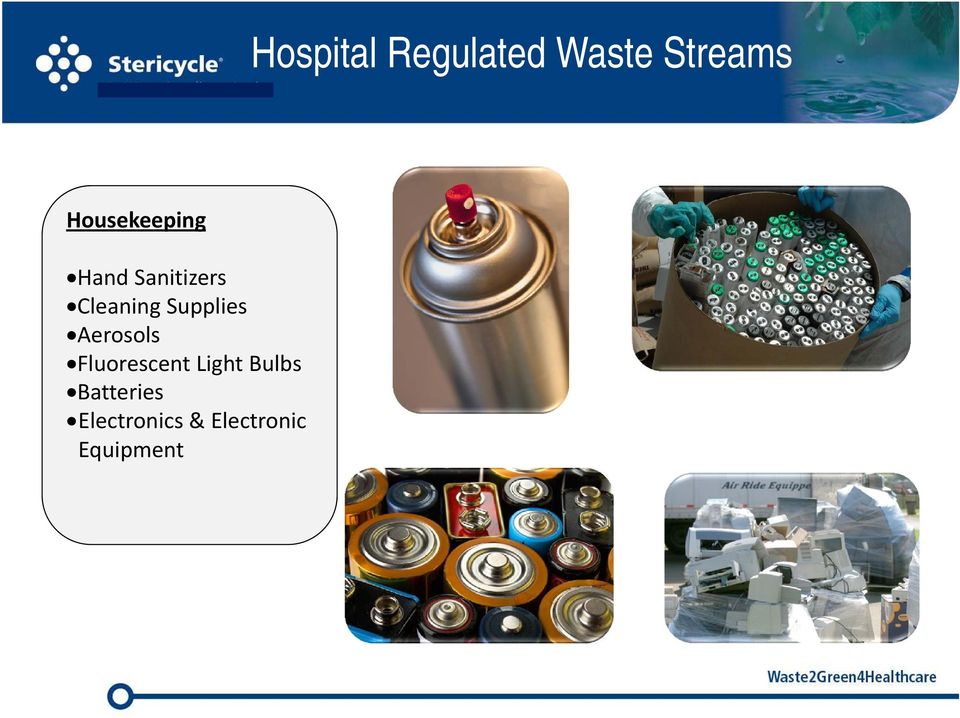
6 Hospital Regulated Waste Streams Housekeeping Hand Sanitizers Cleaning Supplies Aerosols Fluorescent Light Bulbs Batteries Electronics & Electronic Equipment
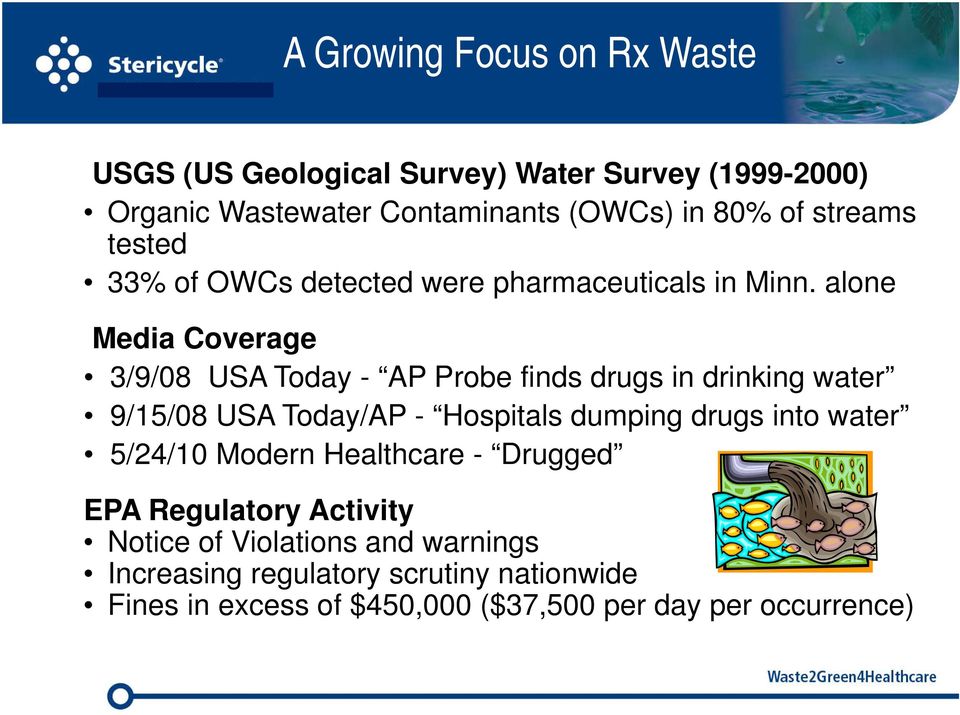
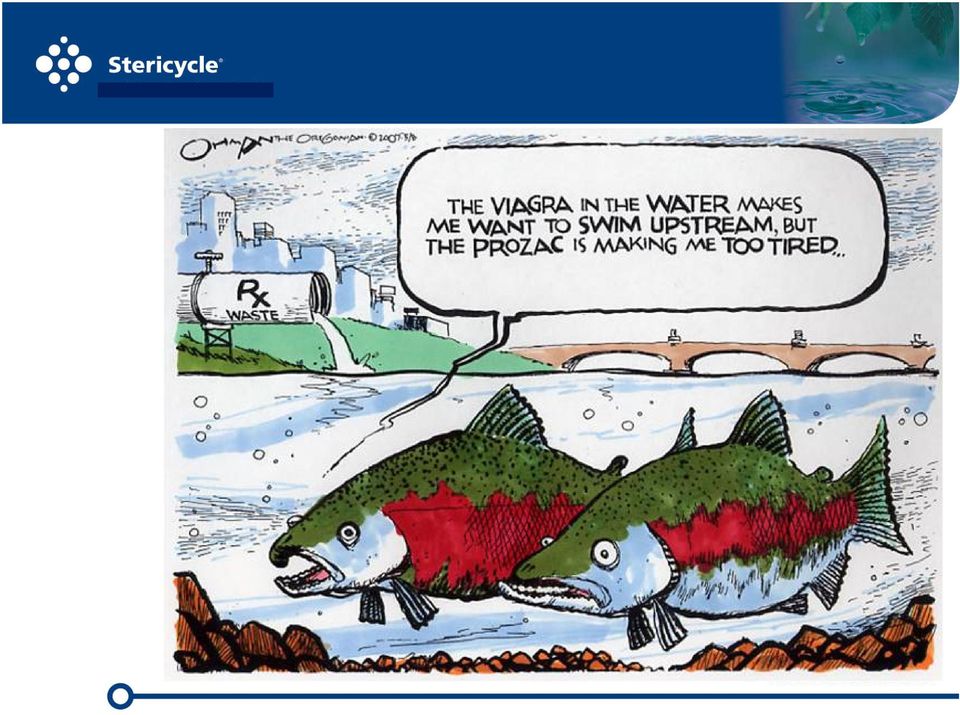
7 A Growing Focus on Rx Waste USGS (US Geological Survey) Water Survey ( ) Organic Wastewater Contaminants (OWCs) in 80% of streams tested 33% of OWCs detected were pharmaceuticals in Minn. alone Media Coverage 3/9/08 USA Today - AP Probe finds drugs in drinking water 9/15/08 USA Today/AP - Hospitals dumping drugs into water 5/24/10 Modern Healthcare - Drugged EPA Regulatory Activity Notice of Violations and warnings Increasing regulatory scrutiny nationwide Fines in excess of $450,000 ($37,500 per day per occurrence)
8
9 Understanding the Issues Do you know what is considered pharmaceutical waste? Is your facility properly identifying, segregating and disposing of pharmaceutical waste? Does your facility manage the disposal process internally or use outside resources? What laws, regulations and Joint Commission Standards apply to pharmaceutical waste?

10 Current State of Rx Programs Hospitals Without Any Program Mix of waste disposal from solid waste, collection and segregation, all hazardous waste, red bag, and flushing Capturing trace chemo; sometimes have a bulk chemo program With a Rudimentary Program Internally Managed Capturing trace and bulk chemo Capturing P listed waste in the pharmacy (disposable containers) No program outside of pharmacy While most hospitals that believe they re in compliance by capturing listed wastes, they typically are not familiar with nor collecting characteristically hazardous waste, not segregating incompatible hazardous wastes nor is the program facility wide

11 Rx Waste Disposal: Who is Involved? US Environmental Protection Agency Resource Conservation and Recovery Act of 1976 (RCRA) Clean Water Act of 1972 (CWA) US Department of Transportation (DOT) Drug Enforcement Agency (DEA) Occupational Safety & Health (OSHA) The Joint Commission (TJC) State Regulatory Agencies (EPA & DOT) Publicly Owned Treatment Works (POTW)

12 Common EPA Inspection Issues Hazardous waste determinations not done or incorrect Labeling of hazardous waste not done or incorrect Throwing hazardous waste down the drain Improper disposal of chemotherapy drugs Inadequate training for employees in HW management Not conducting proper weekly inspections of HW storage No or inadequate HW manifests Lack of emergency contingency plan Improper management of expired pharmaceuticals Identification and Management of Regulated Hazardous Waste EPA Region 2

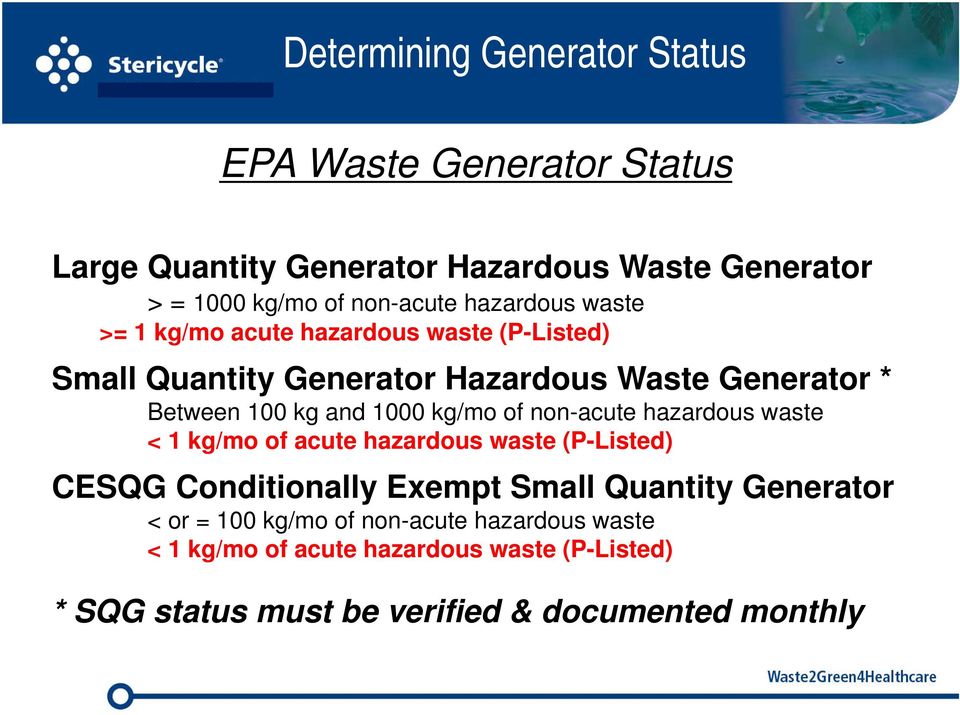
13 Determining Generator Status EPA Waste Generator Status Large Quantity Generator Hazardous Waste Generator > = 1000 kg/mo of non-acute hazardous waste >= 1 kg/mo acute hazardous waste (P-Listed) Small Quantity Generator Hazardous Waste Generator * Between 100 kg and 1000 kg/mo of non-acute hazardous waste < 1 kg/mo of acute hazardous waste (P-Listed) CESQG Conditionally Exempt Small Quantity Generator < or = 100 kg/mo of non-acute hazardous waste < 1 kg/mo of acute hazardous waste (P-Listed) * SQG status must be verified & documented monthly
14 EPA Waste Generator Requirements SQG status requires measurement and documentation that monthly acute hazardous (P Listed ) waste volume does not exceed 1 kg (2.2 lbs) REQUIREMENT SQG LQG Hazardous waste identification Yes Yes EPA ID number Yes Yes RCRA training Yes Yes Exception reporting Yes Yes Hazardous waste storage Yes Yes Weekly inspections Yes Yes Manifest use Yes Yes Emergency coordinator Yes Yes Emergency response planning Yes Yes Contingency plan No Yes Biennial reporting No Yes

15 Controlled Substances & the DEA Proper management of all pharmaceuticals which are considered controlled substances These pharmaceuticals are never considered a waste by the DEA and must be managed appropriately to avoid diversion and for final destruction Hospital/entity which is a DEA registrant must be responsible for proper inventory tracking

16 Rx Waste Sewer Disposal Clean Water Act (40 CFR Parts 122 and 403) A sewer connected to a publicly owned treatment works (POTW) is regulated by Federal, State, and POTW issued permits Pollutants include sewage, chemical wastes (i.e. pharmaceuticals) and biological materials EPA notification requirement for sewer discharge of RCRA hazardous waste

17 POTW: Publicly Owned Treatment Works Management of materials being flushed or poured down the drain Restrictions on types of chemicals (including pharmaceuticals), blood and other materials Mostly managed locally Bound by Federal EPA standards under Water Division and often further regulated by State regulatory agencies

18 U.S. DOT Regulations DOT regulations (49 CFR): 1. Classification, description, and packaging 2. Proper marking and labeling 3. Segregation into proper streams 4. Training 5. Security Hazmat Implementation Act: Fine section rewritten to raise fines Average fine is $30,000 per violation and range up to $100,000 U.S. DOT HM229 If a generator ships hazmat without proper documentation the carrier must report it or the carrier can be prosecuted with the shipper.

19 TJC Accreditation MM Medication Management The hospital safely manages high-alert and hazardous medications The hospital identifies, in writing, high-alert and hazardous medications The hospital has a process in place that addresses how outside resources, if any, are used for the destruction of pharmaceuticals. EC Environment of Care The hospital manages its hazardous materials wastes risks. The hospital minimizes risk associated with disposing of hazardous medications. LD Leadership The hospital complies with law and regulation.

20 What is Pharmaceutical Waste? Do you know what is considered pharmaceutical waste? Is all pharmaceutical waste either P- or U-listed?

21 Pharmaceutical Waste consists of any pharmaceutical that is: No longer used for its intended purpose Not returnable for credit Designated for discard The Basics of Pharmaceutical Waste Examples Partial vials (safety caps removed) Un-dispensed Pre-instilled IVs Hospital repacks Pre-filled syringes Partial syringes Discontinued meds Un-administered meds Patient prescriptions Physician RX samples
22 Waste Characterization What is Waste Characterization? Identification of hazardous waste per EPA/RCRA regulations What is characterized? Active AND inactive ingredients, including preservatives What about DOT regulations? Determine DOT hazardous material class at NDC/item level Other concerns? NIOSH and OSHA best practices re: non-epa evaluated dangerous drugs (TJC monitored) NOTE: Material Safety Data Sheets do not always provide data on inactive or preservative ingredients
23 EPA RCRA Hazardous Drug Categories Listed Waste (Commercial Chemical) P Listed (Acutely Hazardous) Coumadin/warfarin, Nicotine, Physostigmine, Arsenic Trioxide, epinephrine*, nitroglycerin* U Listed (Toxic) - Chemotherapy drugs *Federal exemptions requires state adoption of US EPA interpretations (e.g. epinephrine salts and medicinal nitroglycerin) Characteristic Waste Ignitable, Corrosive, Reactive, Toxic Incompatible Waste In addition to the two RCRA defined hazardous waste categories (Listed & Characteristic), RCRA & US DOT address incompatible waste. Incompatible drugs are those that CANNOT be placed in the same container without danger of a chemical reaction.
24 Examples of Listed RX Waste P Listed Arsenic trioxide Epinephrine (Base) Nicotine Physostigmine Warfarin U Listed Chemotherapy drugs Cytoxan Chloroform Mercury Mitomycin Phenol Saccharin Selenium Sulfide
25 Characteristic Hazardous Waste Examples Lantus Humalog Humulin N Humulin R Centrum Silver Flovent Taxol Atrovent
26 Typical Formulary Analysis
27 Training is Required RCRA Training Employees involved with or occupationally exposed to hazardous waste Completed within 6 months of hiring Annual retraining Record retention requirement Hazard Communication Training Employees involved with or occupationally exposed to hazardous chemicals must be trained in accordance with 29 CFR Completed at time of initial assignment to job DOT Training Employees involved with or occupationally exposed to hazardous materials must be trained in accordance with 49 CFR Subpart H 265 ( & ) Completed within 90 days of hiring Retraining every three years Record retention requirement
28 Satellite Accumulation Areas Satellite Accumulation: EPA 40 CFR (c)(1) Accumulate up to 55 gallons of hazardous waste or one quart of acutely hazardous (P-Listed) waste At or near the point of generation where wastes initially accumulate Under the control of the operator of the process generating the waste Container requirements Marked Hazardous Waste or words identifying contents Compatible with waste Closed except when adding or removing waste Not be handled, opened, or stored in a manner that causes it to leak
29 Satellite Accumulation Areas Identify satellite accumulation areas Locations Pharmacy Patient-care areas o Med rooms o Soiled utility rooms o Nurses stations o Under the Generator s Control
30 Rx Waste & Waste Segregation BLACK Compatible Hazardous BLACK Incompatible Hazardous Incompatible Non Hazardous Sharps/Biohazard Containers Trace Chemo Containers Bulk Chemo Containers
31 Transportation and Destruction Incinerate all Rx Waste industry best practice (ASHP, Practice Greenhealth, EPA Office of Water) NOTE: Non-RCRA hazardous RX waste can be over-classified and incinerated at a regulated medical waste incineration facility RCRA hazardous waste MUST be transported by a licensed hazardous waste hauler RCRA hazardous must be managed at an EPA-permitted hazardous waste facility Check permit limitations of RCRA hazardous waste incinerators & transporters
32 The Disposal Process Trace Chemo Disposal as regulated medical waste/incineration RCRA Hazardous/Bulk Chemo Manifested transport & disposal as RCRA hazardous waste (EPA/DOT regulations) Non RCRA Hazardous Disposal via incineration per industry best practices
33 Developing and Implementing a Pharmaceutical Waste Management Program
34 Getting Started 1. Understanding the need for a pharmaceutical waste program based on regulatory involvement and environmental concerns. 2. Evaluate how pharmaceutical waste is currently being handled in comparison to federal and state regulations. 3. Identify a group of leaders in your facility that have a passion for the environment, will champion multidepartmental cooperation and administration support.
35 Materials Management: Materials Efficiency Reusable versus Disposable Rx Waste Containers CONTAINER REUSE RATES 95% (8 gal) and 100% (17 gal) * MATERIALS COST SAVINGS $21,019 to $26,083 savings * ENVIRONMENTAL STEWARDSHIP 3.4 to 4.7 tons of plastic * * Based on a 24 month case study of RX waste container usage in a 150 licensed bed, acute-care hospital, with 30 satellite accumulation locations.
36 A Team Effort! Departments with champions that help advocate for compliant and environmentally responsible pharmaceutical waste disposal: Pharmacy Nursing Nursing Education Quality/Accreditation Safety Environmental Services Risk Management Infection Control Facilities/Materials Management Public Relations
37 Program Implementation 1. Identification and Information Systems Formulary characterization Waste codes on pharmacy labels and in dispensing cabinets (Pyxis, Omnicell, etc.) to simplify waste segregation & disposal Select locations for pharmaceutical waste containers in pharmacies and patient care areas 2. Staff education Pharmacy Nursing Environmental Services
38 Achieving Organizational Buy In Involve the Key Stakeholders Gives them the chance to understand their involvement Gives you the chance to hear their concerns and issues Allows you to identify and address road blocks ahead of time Allows you to understand their cultural issues that will affect the program development
39 Achieving Organizational Buy In COMMUNICATE, COMMUNICATE, COMMUNICATE! Internal communication Intranet Website Newsletter Communicate to staff BEFORE implementation Program announcement Who, What & Why Training dates Program start date External communication UPON implementation Press releases - "Green Initiative Assuring regulatory compliance Environmental stewardship The right thing to do Employee & community safety
40 Things to consider when determining a program for your hospital What medications are being disposed and where, in what quantities, at what cost BMP to reduce generation of unused Rx Regulatory & accreditation guidelines Options for disposal & BMP for non hazardous Rx Resources available including but not limited to containers, characterization, training, internal container exchange, packaging of waste Space for a Central Accumulation Area (CAA) that meets all EPA & state requirements
41 Typical post implementation issues Continuing education for current and new staff Container audits Container inventory management Impact on EPA generator status Taking ownership for the success of the program Focus on Knowing only what you need to know for clinical staff Improper waste segregation (e.g. RMW in Rx containers, sharps in Rx containers, empties in Rx containers, nothing in Rx containers)
42 Pharmaceutical Waste Management Summary 1. Understanding what pharmaceutical waste is and how to handle it 2. Regulatory and TJC compliance issue 3. Environmental Stewardship 4. Implementing an environmentally sustainable Rx waste program 5. Looking beyond the Pharmacy 6. What s in the future? EPA Universal Waste Rule for pharmaceutical waste EPA Office of Water BMP s
43 Enrico Vona Regional Director Stericycle, Inc. Phone: (631)
Pharmaceutical Waste Compliance Program
 Pharmaceutical Waste Compliance Program Corporate Overview Stericycle Services Medical Waste Management Sharps Disposal Management Product Recalls & Retrieval OSHA Compliance Training Pharmaceutical &
PHARMACEUTICAL WASTE UPDATE ON HANDLING AND DISPOSAL ASTSWMO MEETING August 11, 2011
 PHARMACEUTICAL WASTE UPDATE ON HANDLING AND DISPOSAL ASTSWMO MEETING August 11, 2011 Pharmaceutical Waste Getting the attention it deserves Are there Federal, State and Local laws & regulations to comply
What is a hazardous drug? Hazardous Drugs: NIOSH. Pharmaceutical Waste: Hazardous pharmaceutical Waste 衛 福 部 疾 病 管 制 署
 殘 餘 藥 物 之 處 置 衛 福 部 疾 病 管 制 署 中 區 傳 染 病 防 治 醫 療 網 王 任 賢 指 揮 官 What is a hazardous drug? ASHP 2004 TAB criteria for considering a drug hazardous (adopted by OSHA): 1. Carcinogenicity 2. Teratogenicity 3.
Disposal of Pharmaceuticals, and their empty containers, in the Workplace
 Disposal of Pharmaceuticals, and their empty containers, in the Workplace Prepared by Bio-Team Mobile LLC There is a lot of misinformation being circulated about disposal of pharmaceuticals ever since
Managing Hazardous Pharmaceutical Waste
 Managing Hazardous Pharmaceutical Waste Environmental Consequences Why the growing concern? Discovery of pharmaceuticals in surface, ground and drinking waters of the U.S. Small concentrations of endocrine
Conflicts of Interest. Disposal of Pharmaceutical Waste: What a Technician. Who is interested in proper pharmaceutical waste disposal?
 Conflicts of Interest Disposal of Pharmaceutical Waste: What a Technician Should Know Presented by Michael McEvoy Pharm.D. NorthShore University HealthSystem The speaker has nothing to disclose in relation
Managing Pharmaceutical Wastes: Law and Regulations
 Managing Pharmaceutical Wastes: Law and Regulations James T. Price Missouri Waste Control Coalition Conference June 30, 2014 2014 WA 5625923.1 From the Missouri Department of Natural Resources Health Care:
Hazardous Materials Management Considerations in Healthcare
 Session No. 656 Introduction Hazardous Materials Management Considerations in Healthcare Mae Ping Grogg, MS, CSP BJC HealthCare St. Louis, MO 63110 Paul Halliburton, MS, CHMM Barnes-Jewish Hospital St.
Waste Management of Pharmaceuticals From a Health Care Perspective
 Waste Management of Pharmaceuticals From a Health Care Perspective Federation of New York Solid Waste Assn Solid Waste/Recycling Conference & Trade Show May 4, 2009 Charlotte A. Smith, R. Ph., M.S. Director,
RCRA and Pharmaceutical Waste Management: A Brief Federal Overview
 RCRA and Pharmaceutical Waste Management: A Brief Federal Overview Lisa Lauer (EPA) Office of Resource Conservation and Recovery [email protected]; 703-308-7418 1 What is RCRA? RCRA = Resource Conservation
Pharmaceutical Waste Program for Inpatient Pharmacy. Portland Service Area Pharmacy Leadership Team
 Pharmaceutical Waste Program for Inpatient Pharmacy Portland Service Area Pharmacy Leadership Team What is Pharmaceutical Waste? Pharmaceutical waste is waste generated through IV preparation, compounding,
Online Evaluation, Self-Assessment and CE Credit
 Pharmaceutical Waste Management Faculty Speakers: Allen Brown National Accounts Director Stericycle Jerry Reed, RPh, MS, FASCP, FASHP Corporate Director, Pharmacy Services Community Health Systems 1 Online
Vanderbilt University Medical Center Pharmaceutical Waste Program USER INSERVICE
 Vanderbilt University Medical Center Pharmaceutical Waste Program USER INSERVICE Training and Education Plan This session is intended to train and provide super-users with necessary resources to effectively
Managing Pharmaceutical Waste
 Managing Pharmaceutical Waste Marian M. Rhoads R.Ph, MS Director of Pharmacy Services Saint Joseph Medical Center Reading, PA [email protected] Disclaimer The information in this presentation
Managing Pharmaceutical Waste at the LTC Provider Pharmacy
 Managing Pharmaceutical at the LTC Provider Pharmacy Is your pharmacy compliant with all regulations related to pharmaceutical waste? The long-term care (LTC) industry is currently faced with the simultaneous
Here are some hazardous wastes commonly generated by the marina industry:
 Important Note: The following text is excerpted directly from the New York State Department of Environmental Conservation s publication, Environmental Compliance, Pollution Prevention, and Self Assessment
Management of Pharmaceutical Wastes from Healthcare & Households. Rudy Vingris Product Manager PharmEcology Services Waste Management, Inc.
 Management of Pharmaceutical Wastes from Healthcare & Households Rudy Vingris Product Manager PharmEcology Services Waste Management, Inc. Legal Disclaimer This presentation is solely for educational purposes
THOMAS JEFFERSON UNIVERSITY HOSPITAL. Pharmaceutical Waste Management
 THOMAS JEFFERSON UNIVERSITY HOSPITAL Pharmaceutical Waste Management Pharmaceutical waste management is an ever-changing and challenging task that must be mastered. The damage to the environment, the potential
EPA s proposed hazardous waste pharmaceutical regulations
 EPA s proposed hazardous waste pharmaceutical regulations November 4, 2015 By J. Timothy Ramsey The United States Environmental Protection Agency ( EPA ) published proposed regulations in the Federal Register
Hazardous Pharmaceutical Waste Management. Written by: Matthew Teeter, Environmental Compliance Consultant
 Hazardous Pharmaceutical Waste Management Written by: Matthew Teeter, Environmental Compliance Consultant Identifying Hazardous Pharmaceuticals Certain pharmaceuticals used in hospitals, medical centers
Pharmaceutical Waste. Why It Matters. Who Regulates Pharmaceutical Waste Disposal? Pharmaceuticals Wastes and Their Effect on Human Health
 Why It Matters Pharmaceutical Waste What Every Pharmacy Director Needs to Know South Carolina Society of Health-System Pharmacists Annual Meeting March 14, 2010 Cynthia Reilly, B.S. Pharm. Director, ASHP
Hazardous Waste Compliance Awareness For Faculty and Staff
 Hazardous Waste Compliance Awareness For Faculty and Staff Important information for campus employees generating, handling or storing hazardous waste I. Hazardous Waste A. Materials being used for their
RCRA Applied to Retail and Pharmaceutical Wastes, How to Manage a Work in Progress. Gregory W. Blount Troutman Sanders LLP Atlanta, GA
 RCRA Applied to Retail and Pharmaceutical Wastes, How to Manage a Work in Progress Gregory W. Blount Troutman Sanders LLP Atlanta, GA TABLE OF CONTENTS INTRODUCTION... 1 A. Determining Whether a Pharmaceutical
CHS Medical Group Hazardous Waste Management In Service
 CHS Medical Group Hazardous Waste Management In Service Objective Educate staff how to properly manage Regulated Medical Waste (RMW), Chemotherapy Waste and EPA RCRA Hazardous Waste Ensure compliance with
Hazardous Waste Determination and Management Plan
 Hazardous Waste Determination and Management Plan Prepared By: Triumvirate Environmental Developed: November 2014 Updated: Program Approval Associate Vice President of Public Safety & Administrative Services
Pharmaceutical Waste Initiatives: What Comes Next? ACPE # 0206-0000-12-601-L05-P (0.1 CEU)
 Date: Monday, August 27, 2012 Time: 10:15 a.m. 11:15 a.m. Location: Colorado Convention Center Rooms 111-113 Title: Speaker: Pharmaceutical Waste Initiatives: What Comes Next? ACPE # 0206-0000-12-601-L05-P
Hazardous Waste Management Plan
 Hazardous Waste Management Plan Introduction The management of hazardous waste is governed by the Environmental Protection Agency (EPA) regulations, specifically, 40CFR260-262. These regulations are the
Generator Requirements Summary Chart
 guidance Generator Requirements Summary Chart This chart is designed to give inspectors a fairly detailed comparison of the requirements as they apply to Large Quantity Generators (LQGs), Small Quantity
Pharmaceutical Waste as Universal Waste
 Pharmaceutical Waste as Universal Waste Charlotte A. Smith, R. Ph., M.S. September 21, 2009 2009 ASHES Annual Conference September 20-24, 2009 Reno, NV Legal Disclaimer This presentation is solely for
Hazardous and Regulated Waste Management Plan Purpose
 Hazardous and Regulated Waste Management Plan Purpose Purpose This Hazardous and Regulated Waste Management Plan describes the chemical and biological waste management practices at Normandale Community
Pharmaceutical Waste Management: Current Concepts
 Pharmaceutical Waste Management: Current Concepts ACPE UAN 0107-0000-10-004-L04-P & 0107-0000-10-004-L04-T Activity Type: Knowledge-Based 0.1 CEU/1.0 Hr. Program Objectives for Pharmacists & Technicians:
Pharmaceuticals and the Universal Waste Rule. Connecticut DEEP Stakeholders Meeting February 5, 2014 PharmEcology Services WM Healthcare Solutions
 Pharmaceuticals and the Universal Waste Rule Connecticut DEEP Stakeholders Meeting February 5, 2014 PharmEcology Services WM Healthcare Solutions Legal Disclaimer This presentation is solely for educational
Waste Management Program
 SUNY Cortland Environmental Health and Safety Office Waste Management Program Inception Date: January 30, 2007 Latest Revision/Review Date October 8, 2015 Previous Revision/Review Date: April 30, 2014
HAZARDOUS WASTE MANAGEMENT PROGRAM. For OTTERBEIN UNIVERSITY. Prepared by: 140 North Otterbein Avenue Westerville, Ohio 43081
 HAZARDOUS WASTE MANAGEMENT PROGRAM For OTTERBEIN UNIVERSITY Prepared by: 140 North Otterbein Avenue Westerville, Ohio 43081 Otterbein University 0 TABLE OF CONTENTS 1.0 PURPOSE AND SCOPE... 1 2.0 ROLES
Draft Guidance Document: Best Management Practices for Unused Pharmaceuticals at Health Care Facilities
 United States Environmental Protection Agency Draft Guidance Document: Best Management Practices for Unused Pharmaceuticals at Health Care Facilities EPA-821-R-10-006 26 August 2010 Disclaimer The discussion
Hazardous Waste Self Audit
 Section: Waste Pharmaceuticals Hazardous Waste Self Audit Section: Waste Pharmaceuticals Self-Audit Tips, Action Steps & Resources Types of pharmaceuticals Pharmaceuticals include but are not limited to:
WHAT IS A HAZARDOUS WASTE? Kansas Department of Health and Environment Bureau of Waste Management
 WHAT IS A HAZARDOUS WASTE? Kansas Department of Health and Environment Bureau of Waste Management REGULATORY BACKGROUND Resource Conservation & Recovery Act (RCRA) 1976 EPA implemented hazardous waste
14.0 Hazardous Chemical Waste Management
 14.0 Hazardous Chemical Waste Management 14.1 Responsibilities. The hazardous waste management program at the UTHSCSA is designed to provide safe, effective and economical disposal of chemical waste generated
PHARMACEUTICAL WASTE MANAGEMENT DUKE UNIVERSITY HEALTH SYSTEM
 PHARMACEUTICAL WASTE MANAGEMENT DUKE UNIVERSITY HEALTH SYSTEM BLUE BIN DRUGS ONLY NO EMPTY Packages, NO Gloves NO Scissors, Syringes, Needles, IVs Scalpels, Forceps BLUE BIN PROGRAM PURPOSE AND OBJECTIVE:
HAZARDOUS WASTE MANAGEMENT PROGRAM
 HAZARDOUS WASTE MANAGEMENT PROGRAM UNIVERSITY RISK MANAGEMENT Occupational Safety and Health Programs 19 Hagood Avenue, Suite 908 Charleston, SC 29425 843-792-3604 Revised: January 2015 TABLE OF CONTENTS
The Texas A&M University System Environmental, Health & Safety Special Thanks to Koch Industries, Wichita, KS
 Universal Waste Management Training The Texas A&M University System Environmental, Health & Safety Special Thanks to Koch Industries, Wichita, KS Training Objectives In this training, you will learn: What
Health Care Alert. Disposing of Hazardous Pharmaceutical Wastes: It s Not Just for Hospitals Anymore
 December 2008 Authors: Raymond P. Pepe +1.717.231.5988 [email protected] Patricia Shea +1.717.231.5870 [email protected] Jessica Leigh Wray +1.717.231.4815 [email protected] K&L Gates
Policies and Procedures Manual Waste Management Plan Policy No. 06:04:00 Page 1 of 12
 Page 1 of 12 Revision Responsibility: Director of Facility Services and Safety Responsible Executive Officer: Vice President for Financial & Administrative Services Source / Reference: Tennessee Division
Hazardous Waste and Pharmaceutical Waste in
 Hazardous Waste and Pharmaceutical Waste in Veterinary Offices Janine Kraemer, CHMM Environmental Manager Solid and Hazardous Waste Programs Florida Department of Environmental Florida Department of Environmental
PHARMACEUTICAL WASTE MANAGEMENT GUIDELINES
 PHARMACEUTICAL WASTE MANAGEMENT GUIDELINES Enclosure (1) GUIDELINES TABLE OF CONTENTS EXECUTIVE SUMMARY References...1 Background...1 Purpose...1 Scope...2 Action...2 Resources...4 1. PHARMACEUTICAL CATEGORIES
The following sections provide hazardous waste safety guidelines and procedures. This section covers the following topics:
 13. The following sections provide hazardous waste safety guidelines and procedures. This section covers the following topics: TOPIC PAGE 13.1 Hazardous Waste and Texas State University... 13-2 13.2 Definitions...
Universal Pharmaceutical Waste (UPW) Guidance/Training Module Environmental Health & Safety
 Universal Pharmaceutical Waste (UPW) Guidance/Training Module Environmental Health & Safety Pharmaceutical Waste Technical Advisory Group The Pharmaceutical Technical Advisory Group (PharmTAG) is comprised
Standards BoosterPak for Management of Hazardous Waste in Health Care Facilities
 Standards BoosterPak for Management of Hazardous Waste in Health Care Facilities Standards BoosterPak for Management of Hazardous Waste in Health Care Facilities Contents A: Description of Standard and
Waste Hazardous? Why?
 Doc. No. 801 Hazardous Waste M anagement Auto body shops typically generate several kinds of potentially hazardous waste, including waste solvent and coatings, contaminated rags, wipes, and absorbents,
Pharmaceutical Waste Management Program St. Joseph Mercy Oakland. Pharmacy/Patient Care
 Pharmaceutical Waste Management Program St. Joseph Mercy Oakland Pharmacy/Patient Care Objectives Understand the background and regulatory requirements Identify pharmaceutical waste and how to dispose
Berea College Chemical waste/product Management Guide. October 2014
 Berea College Chemical waste/product Management Guide October 2014 Chemical Waste Chemical waste is generated in many locations across campus. Chemical waste is generated in laboratories, from painting
ENVIRONMENTAL HEALTH AND SAFETY HAZARDOUS MATERIALS MANAGEMENT PLAN
 ENVIRONMENTAL HEALTH AND SAFETY HAZARDOUS MATERIALS MANAGEMENT PLAN November 2011 University of Northern Colorado Hazardous Materials Management Plan I. General II. III. IV. Responsibilities Definition
Laboratory Hazardous Waste Disposal Guidelines
 Satellite Accumulation Area (SAA) For safety and environmental reasons, hazardous waste must be stored in a designated "Satellite Accumulation Area." These areas must be inspected weekly for container
Risk Management of Pharmaceuticals Entering POTWs and Municipal Landfills from Routine Hospital Waste Management Practices
 Risk Management of Pharmaceuticals Entering POTWs and Municipal Landfills from Routine Hospital Waste Management Practices Charlotte A. Smith, R. Ph., M.S., President, PharmEcology Associates, LLC Abstract
ST. CLOUD TECHNICAL AND COMMUNITY COLLEGE HAZARDOUS WASTE PROCEDURE
 APPLICABILITY This procedure is applicable to all St. Cloud Technical & Community College faculty, staff and students. GENERAL Federal, state and local governments impose strict regulations concerning
Hazardous Waste Generator Handbook
 Hazardous Waste Generator Handbook May 1, 2011 Revised April 16, 2014 A Guide to Complying with Kansas Hazardous Waste Generator Regulations Kansas Department of Health and Environment Division of Environment
BEST MANAGEMENT PRACTICES FOR DENTAL OFFICES CLEAN WATER INDUSTRIAL WASTE MANAGEMENT DIVISION OF THE CITY OF LOS ANGELES
 BEST MANAGEMENT PRACTICES FOR DENTAL OFFICES CLEAN M A K I N G I T H A P P E N WATER INDUSTRIAL WASTE MANAGEMENT DIVISION OF THE CITY OF LOS ANGELES B E S T M A N A G E M E N T P R A C T I C E S Dental
CENTRAL IOWA HEALTHCARE Marshalltown, Iowa PHARMACY POLICY AND PROCEDURE
 CENTRAL IOWA HEALTHCARE Marshalltown, Iowa PHARMACY POLICY AND PROCEDURE Policy #: MM.01.01.03 Subject: High Alert and Hazardous Medications (including pharmaceutical waste management) Purpose: The hospital
APPENDIX G Materials Storage and Handling Guidelines
 APPENDIX G Materials Storage and Handling Guidelines 1.0 INTRODUCTION Operations at Austin-Bergstrom International Airport (ABIA) comprise several different industrial activities including aircraft, ground
How To Understand And Understand The Rules Of Hazardous Waste
 Understanding Regulated Medical Waste & Best Management Practices Regulations & References The information provided in this presentation is based on the referenced Code of Federal Regulations and State
Pharmaceutical waste disposal Guideline. Guideline for Disposal of Pharmaceutical waste (1 st Edition, 2014)
 Guideline for Disposal of Pharmaceutical waste (1 st Edition, 2014) 1 Contents 1. Definition... 3 2. Principle and General Requirements... 3 3. Process flow chart... 4 4. Procedure... 5 5. Recording and
Recycle whatever can be recycled according to the DHMC Recycling Program! See the intranet site or the last page of this document for details.
 Environmental Programs at DHMC are more than just recycling and waste management programs, although these are cornerstones of the Program. Waste and pollution prevention means we re trying to make less
MARSHALL UNIVERSITY HAZARDOUS WASTE DISPOSAL SECTION
 MARSHALL UNIVERSITY HAZARDOUS WASTE DISPOSAL SECTION TABLE OF CONTENTS POLICY STATEMENT.2 REFERENCE PROCEDURE 3 l.0 Purpose.3 2.0 Scope 3 3.0 Definitions 4 4.0 Responsibilities 5 5.0 Procedure.7 11/16/2005
INSTITUTIONAL POLICY AND PROCEDURE (IPP) Department: Manual: Section: EFFECTIVE DATE REVIEW DUE REPLACES NUMBER NO. OF PAGES
 HOSPITAL NAME INSTITUTIONAL POLICY AND PROCEDURE (IPP) Department: Manual: Section: TITLE/DESCRIPTION POLICY NUMBER MEDICATIONS EFFECTIVE DATE REVIEW DUE REPLACES NUMBER NO. OF PAGES APPROVED BY APPLIES
UDOT SPILL PREVENTION and RESPONSE PLAN for CONSTRUCTION SITES
 UDOT SPILL PREVENTION and RESPONSE PLAN for CONSTRUCTION SITES February 2014 The plan contained in the following pages was developed in part from UDOT Construction Division s Safety and Health Manual,
Managing Hazardous Waste A HANDBOOK FOR SMALL BUSINESS
 Managing Hazardous Waste A HANDBOOK FOR SMALL BUSINESS TABLE OF CONTENTS INTRODUCTION... 4 DECIDING WHETHER HAZARDOUS WASTE REGULATIONS APPLY TO YOU... 5 Defining Hazardous Waste... 5 Identifying Your
40 CFR 262.11 Hazardous Waste Determination
 262.11 states, the following: 40 CFR 262.11 Hazardous Waste Determination [which is incorporated into 391 3 11.08(1) of the Georgia Rules for Hazardous Waste Management by reference] A person who generates
Management and Disposal of Hazardous Pharmaceutical Waste
 Management and Disposal of Hazardous Pharmaceutical Waste The Defining Regulations Federal- The Defining Regulation 40 CFR 260-265 Resource Conservation and Recovery Act (RCRA) Federal regulation of the
SPILL PREVENTION, CONTROL, AND COUNTER MEASURES PLAN (SPCC)
 SPILL PREVENTION, CONTROL, AND COUNTER MEASURES PLAN (SPCC) UNIVERSITY RISK MANAGEMENT Occupational and Health Programs 19 Hagood Avenue, Suite 908 Charleston SC 29425 843-792-3604 Revised: June 2015 Spill
Hazardous Waste Management & Waste Minimization Training
 Hazardous Waste Management & Waste Minimization Training Environmental Health and Safety Safety Training Building Inspections Accident Investigations Fire Safety Hazardous Materials Management Laboratory
Managing Pharmaceutical Waste: A Discussion Guide for Health-System Pharmacists
 Managing Pharmaceutical Waste: A Discussion Guide for Health-System Pharmacists Overview and regulatory history The term chemical pollutants most often calls to mind pesticides and industrial sewage, yet
Guidelines for the Responsible Disposal of Wastes and Containers from Polyurethane Processing
 Guidelines for the Responsible Disposal of Wastes and Containers from Polyurethane ISSUE AX151 January 2014 Table of Contents Purpose...1 Regulations... 2 What is a Hazardous Waste?... 2 Listed Wastes...3
Chemical Disposal Training
 Chemical Disposal Training Cornell University EH&S Revised Feb 2011, Brian S. 1 OBJECTIVE What EH&S wants you to learn today 1. What rules and regulations govern waste management 2. Cornell EH&S s role
Chemical Waste Policy Duke University/Medical Center October 10, 2010
 Supplement Q Chemical Waste Policy Duke University/Medical Center October 10, 2010 PUBLISHED BY Occupational Environmental Safety Office Environmental Programs Division Phone (919) 684-2794 Fax (919) 684-2422
Newport News Shipbuilding Contractor Environmental, Health and Safety Resource Manual Waste Management
 Newport News Shipbuilding Contractor Environmental, Health and Safety Resource Manual Waste Management Newport News Shipbuilding Page 1 WASTE MANAGEMENT 1. Purpose and Scope a. The purpose of this section
DREXEL UNIVERSITY HAZARDOUS WASTE MANAGEMENT PLAN DEPARTMENT OF ENVIRONMENTAL HEALTH AND SAFETY
 DREXEL UNIVERSITY HAZARDOUS WASTE MANAGEMENT PLAN DEPARTMENT OF ENVIRONMENTAL HEALTH AND SAFETY January 2010 Page 1 of 32 HAZARDOUS WASTE MANAGEMENT PLAN TABLE OF CONTENTS Hazardous Waste Management Plan...3
Statement of Mary L. Hendrickson,PharmD,MBA,RAC Director of Quality & Regulatory Affairs Capital Returns Inc., d/b/a Genco Pharmaceutical Services
 Statement of Mary L. Hendrickson,PharmD,MBA,RAC Director of Quality & Regulatory Affairs Capital Returns Inc., d/b/a Genco Pharmaceutical Services Before The Special Committee on Aging United States Senate
Hazardous Waste Recycling. The dreaded definition of solid waste table (40 CFR 261.2) and other equally confusing regulations
 Hazardous Waste Recycling The dreaded definition of solid waste table (40 CFR 261.2) and other equally confusing regulations 1 Why is hazardous waste recycling regulation so complicated? Must look in many