
Torsional Diplopia 1,2
|
|
|
- Maud Rodgers
- 9 years ago
- Views:
Transcription
1 Supplement Handout American Orthoptic Council Workshop: When the Patient Sees Double and the Doctor Sees Nothing A Guide to Double Vision AAPOS 37 th Annual Meeting San Diego, CA April 1, 2011 Torsional Diplopia 1,2 Binocular diplopia o Typically associated with vertical diplopia most commonly with 4 th Cranial Nerve Palsy o Diplopic image is often twisted or blurred o Often worse in down gaze History of head trauma Diplopia response on prism offset o Fuzzy o Twisted o Diagnol Amblyoscope Exam o Measure the amount of torsion present o Can offset torsion to test for fusional response 1 Woo SJ, Seo JM, Hwang JM; Clinical characteristics of cyclodeviation. Eye (Lond) 2005; 19 (8) : Trobe JD; Cyclodeviation in acquired vertical strabismus. Arch Ophthalmol 1984; 102(5): Page 1 of 5

2 Supplement Handout American Orthoptic Council Workshop: When the Patient Sees Double and the Doctor Sees Nothing A Guide to Double Vision AAPOS 37 th Annual Meeting San Diego, CA April 1, 2011 Retinal Diplopia 3,4 Vertical diplopia, eliminated with occlusion of either eye Worse at distance Worse under photopic conditions Monocular visual disturbances, not relieved with pinhole o Metamorphopsia o Blur o Distortion o Illusory movement of fixation target Horizontal phoria or mismatch between subjective complaints and objective findings Fair to good stereopsis Poor sensory fusion o Diplopia relieved only temporarily with prism o Eats up vertical prism over time + Lights- on, lights- off test 3 Arnoldi K, Reynolds JD: Was it Something I Said?: Finding Retinal Pathology Without Actually Examining the Retina. Am Orthopt J 2008; 58: DePoole ME, Campbell JP, Broome SO, Guyton DL: The Dragged- Fovea Diplopia Syndrome: Clinical Characteristics, Diagnosis, and Treatment. Ophthalmol 2005; 112: Page 2 of 5

3 Supplement Handout American Orthoptic Council Workshop: When the Patient Sees Double and the Doctor Sees Nothing A Guide to Double Vision AAPOS 37 th Annual Meeting San Diego, CA April 1, 2011 Paradoxical Diplopia Secondary to Anomalous Binocular Correspondence 5,6 Binocular diplopia o Typically horizontal (crossed or un- crossed) o Diplopic image is often in the direction opposite than that expected (given alignment) o Often intermittent o Often worse in dim illumination History of constant, childhood- onset strabismus Diplopia response on fovea- to- fovea sensory tests o Diplopia with prism offset of deviation on red filter, Bagolini, or Worth 4- dot tests o Diplopia response on after- image test Amblyoscope Exam o Sensory angle Motor angle o Presence of pseudo- fovea o Presence of suppression scotoma that may be in unexpected location (given alignment) 5 Castleberry C, Arnoldi K: Predicting Postoperative Paradoxical Diplopia. Am Orthopt J 2003; 53: Kushner BJ: Intractable Diplopia after Strabismus Surgery in Adults. Arch Ophthalmol 2002; 120: Page 3 of 5

4 Supplement Handout American Orthoptic Council Workshop: When the Patient Sees Double and the Doctor Sees Nothing A Guide to Double Vision AAPOS 37 th Annual Meeting San Diego, CA April 1, 2011 Central Disruption of Fusion/ Horror Fusionis 7,8 Central Disruption of Fusion o CNS basis for loss of pre- existing fusion ability o Can involve loss of sensory fusion, loss of motor fusion or loss of both sensory and motor fusion Horror Fusionois o Absence of central fusion combined with absence of central suppression usually associated with childhood strabismus or longstanding unilateral loss of vision Important to diagnose / rule out pre- operatively when considering EOM surgery to treat diplopia Who is at risk o Visually mature patients (adults/teenagers) with: Longstanding constant deviation (HF) Sensory deviation secondary to longstanding unilateral loss of vision, now with VA recovered (HF) Constant diplopia with history of head injury associated with loss of consciousness (CDF) Constant diplopia and acquired CNS lesion/mass (usually midbrain, rare) (CDF) Evaluation o Prism neutralization with red filter o Amblyoscope More sensitive Can neutralize cyclodeviations 7 Wendell ME, Mets MB, Wilson H: Horror Fusionis Revisited. Amer Orthopt J 1986;36: Pratt- Johnson JA, Tillson G: The loss of fusion in adults with intractable diplopia (central fusion disruption). Aust N Z J Ophthalmol 1988;16(2):81-5. Page 4 of 5

5 Supplement Handout American Orthoptic Council Workshop: When the Patient Sees Double and the Doctor Sees Nothing A Guide to Double Vision AAPOS 37 th Annual Meeting San Diego, CA April 1, 2011 Monocular Diplopia 9,10 Can be physiologic or pathologic o External irregularities of the eyelids or cornea o Uncorrected irregular corneal astigmatism (most common) o Early keratoconus o Lenticular changes o Macular cystoid changes o Large neurologic scotomas with bisect fixation o Intracerebral hemorrhage or tumors in or near area 19 Acquired, never congenital Complaints of second shadow image o Primary image is always darker and better defined than the secondary image o Typically images are vertically displaced, but can be horizontal o Usually worse or more noticeable in the distance Diplopia still present after one eye has been occluded Diplopia relieved with pinhole test Small to no phoria present on cover test Fair stereopsis Mildly decreased vision in the eye with the symptoms Retinoscopy is best diagnostic tool 9 Records RE: Monocular diplopia. Surv Ophthalmol 1980 Mar- Apr; 24(5): Archer SM: Monocular diplopia due to spherocylindrical refractive errors (an American Ophthalmological Society thesis), Trans Am Ophthalmol Soc 2007;105: Page 5 of 5

6 American Orthoptic Council Workshop: When the Patient Sees Double and the Doctor Sees Nothing A Guide to Double Vision AAPOS 37 th Annual Meeting San Diego, CA April 1, 2011 I. Who is at risk for double vision? a. Patients with refractive error i. Uncorrected refractive error ii. Aniseikonia b. Patients with strabismus i. Acquired strabismus 1. Secondary to trauma 2. Secondary to systemic disease 3. Decompensation of phoria ii. Loss of or change in suppression 1. Fixation Switch Diplopia due to change in refractive error or visual acuity 2. Aggressive anti-suppression exercises 3. Loss of suppression due to emotional or physical trauma iii. Sensory strabismus 1. Poor visual acuity in one eye 2. Significant visual field loss in one or both eyes c. Patients with macular or paramacular pathology i. Retinal wrinkle or pucker ii. Retinal membrane iii. Traction d. Patients with significant visual field loss in one or both eyes i. Advanced glaucoma ii. Sensory visual pathway disease e. Patients with an abnormal fusion mechanism i. Disrupted sensory fusion mechanism in the primary or secondary visual cortex 1. Central loss of fusion due to brain injury or prolonged monocular deprivation 2. Maldevelopment of sensory fusion mechanism due to infantile strabismus or visual deprivation (i.e.: congenital cataract) ii. Disrupted motor fusion mechanism (vergence system) in the tertiary cortex, motor cortex, or brainstem 1 1. Acquired (i.e.: Parkinson s Disease) 2. Congenital (i.e.: Cerebral Palsy) II. The Exam a. History i. Does the double vision disappear when you cover one eye? 1 These patients typically have strabismus, though it is often intermittent. Melinda Rainey, MD; Kyle Arnoldi, CO; Jorie Jackson, CO;

7 1. Yes: binocular diplopia 2. No: monocular diplopia ii. What event coincided the onset of your double vision? 1. Trauma to head or face a. Was there a loss of consciousness? 2. Illness a. Recent diagnosis of systemic disease? i. Diabetes ii. Multiple Sclerosis iii. Thyroid dysfunction iv. Neoplasm b. Acute illness ( flu ) 3. Change in glasses and/or optical correction a. Change in prescription strength b. New bifocals or new type of bifocal c. Glasses to contact lenses (or contacts to glasses) d. Refractive surgery 4. Change in visual activities a. Increase in frequency of night driving b. Increase in amount of near work 5. Other symptoms a. Headache b. Vertigo c. Visual confusion (two different images superimposed in the same location) d. Loss of depth perception iii. Is the double vision constantly present, intermittent, or variable? 1. Is the double image always there, but image changes location in space? 2. Does the double image appear and disappear, but remain in the same location relative to fixation? iv. Do you have a history of strabismus, lazy eye, or glasses wear as a child? 2 v. Is there a position or visual circumstance in which you do NOT see double? 1. Patient may not be aware of his/her head posture 2. Check old photos (i.e.: driver s license) for evidence of pre-existing head posture b. Visual Acuity i. Which is the dominant eye? ii. Does the dominant eye have the better acuity? c. Refractive Error i. Refractometry 2 If the patient has no history of diplopia, he/she may not associate the childhood strabismus with a new onset double vision and fail to mention it. Page 2 of 8

8 1. Patients with history of amblyopia or childhood-onset strabismus may need objective refractometry (retinoscopy) and/or cycloplegic refractometry d. Motility i. Is there a field or gaze of single vision? 1. Is the patient truly binocular in this field? ii. Determine if manifest strabismus is present in critical gaze positions using coveruncover test 1. Driving position (primary position at distance) 2. Reading position (down gaze at near) 3. Computer position (primary position at arm s length) 4. Any other gaze position that is occupationally relevant to patient e. Binocularity i. Define characteristics of diplopia 1. Test technique a. Place red filter over better-seeing eye b. Direct gaze to light source or lighted acuity chart (single letter) c. Dim room lights 2. Where is the red image, relative to the white? (If diplopia is binocular, second image should always be in the field opposite to that where the eye is pointing.) a. If eye is in towards the nose (esotropia), then image from that eye is temporally displaced. b. If eye is out towards ear (exotropia), then image from that eye is nasally displaced. c. If eye is up (hypertropia), then image is down. d. If eye is down (hypotropia), then image is up. e. Presence of pre-existing anomalous fusion mechanism is indicated if: i. Patient is diplopic, but unable to localize second image in space ii. Location of double image doesn t make sense given type of deviation ii. Assess fusion potential 1. Add increasing prism with apex toward the direction of the misalignment until images fused (good fusion potential) a. Esotropia: base-in b. Exotropia: base-out c. Hypertropia: base-down d. Hypotropia: base-up 2. If patient unable to fuse with any combination of prisms and red filter (poor fusion potential) a. Turn on room lights, remove red filter, keep prisms in place. Does the patient now see single? Page 3 of 8

9 III. b. Rule out cyclotropia with double Maddox rod test or amblyoscope c. Rule out anomalous fusion mechanism 3 i. Amblyoscope Exam ii. Bagolini Lenses iii. After Image The Clinical Characteristics of Diplopia a. Retinal Diplopia i. Vertical diplopia eliminated with occlusion of either eye ii. Worse at distance iii. Worse under photopic conditions iv. Monocular visual disturbances, not relieved with pinhole 1. Metamorphopis 2. Blur 3. Distortion 4. Illusory movement of fixation target v. Horizontal phoria or mismatch between subjective complaints and objective findings vi. Fair to good stereopsis vii. Poor sensory fusion 1. Diplopia relieved only temporarily with prism 2. Eats up vertical prism over time viii. +Lights-on, lights-off test b. Central Loss of Fusion i. CNS basis for loss of pre-existing fusion ability ii. Can involve loss of sensory fusion, loss of motor fusion, or loss of both sensory and motor fusion iii. Those at risk include Visually mature patients with: 1. Constant diplopia with history of head injury associated with loss of consciousness 2. Constant diplopia and acquired CNS lesion/mass (usually midbrain, rare) iv. Amblyoscope is best diagnostic tool c. Horror Fusionis i. Absence if central fusion combined with absence of central suppression usually associated with childhood strabismus or longstanding unilateral loss of vision ii. Those at risk include visually mature patients with: 1. Constant deviation with/without diplopia with unclear history 2. Longstanding constant deviation 3. Sensory deviation secondary to longstanding unilateral loss of vision, now with recovered vision iii. Amblyoscope is best diagnostic tool d. Torsion 3 This requires special sensory testing and equipment. Patient should be referred to an orthoptist. Page 4 of 8

10 i. May or may not have associated vertical misalignment ii. Sometimes worse when reading 1. Can be worse in down gaze iii. Complains images are blurred or shadowed 1. Relieved with either eye occluded e. Monocular i. Causes my be physiologic or pathologic and include 1. External irregularities of the eyelids or cornea 2. Uncorrected irregular corneal astigmatism 3. Early keratoconus 4. Lenticular changes 5. Macular Cystoid changes 6. Large neurologic scatomas with bisect fixation 7. Intracerebral hemorrhage or tumors in or near area nine- teen ii. Complains of second shadow image 1. Primary image is always darker and better defined than the secondary image 2. Typically images are vertically displaced, but can be horizontal 3. Usually worse or more noticeable in the distance iii. Acquired, never congenital iv. Diplopia still present with either eye occluded v. Diplopia often relieved with pinhole test vi. Small to NO phoria present on cover test vii. Fair stereopsis viii. Mildly decreased vision in eye with symptoms ix. Retinoscopy is best diagnostic tool f. Paradoxical i. Secondary to anomalous binocular correspondence ii. Binocular diplopia 1. Typically horizontal (crossed or un-crossed) 2. Diplopic image is often in the direction opposite than the expected (given alignment) 3. Often intermittent 4. Often worse in dim illumination iii. History of constant, childhood-onset strabismus iv. Diplopia response on fovea-to-fovea sensory tests 1. Diplopia with prism offset of deviation on red filter, Bagolini, or Worth-4- dot tests 2. Diplopia response on after-image test v. Amblyoscope Exam 1. Sensory angle Motor angle 2. Presence of pseudo-fovea 3. Presence of suppression scotoma that may be in unexpected location (given alignment) Page 5 of 8

11 IV. The Management a. Optical i. Best for patients with 1. Refractive error, already wearing optical correction 2. Straight eyes 3. Monocular or binocular diplopia 4. Strongly dominant eye ii. Options 1. Refractive blur of non-dominant eye a. over-plus non-dominant eye 2. Alter plane of refractive correction a. Glasses to contact lenses or reverse 3. Change bifocal type a. Progressive to D-seg, or reverse 4. Contact Lens a. Better for irregular corneal astigmatism b. Orthoptic i. Best for patients with 1. Intermittent strabismus 2. Good fusion potential 3. Good health and highly motivated ii. Options 1. Teach suppression 4 2. Improve fusional vergence amplitudes c. Occlusion i. Best for patients with 1. Double vision and straight eyes 2. Poor fusion potential 3. Strabismus, but poor candidate for other therapies ii. Options 1. For those who don t already wear glasses a. Pirate patch b. Occlusive contact lens c. Adhesive patch 2. For those who wear glasses a. Frosted adhesive tape b. Clear nail polish c. Bangerter filter d. Min lens d. Prism i. Best for patients with 4 Teaching fusion typically results in permanent diplopia and is NOT recommended. Page 6 of 8

12 1. Diplopia due to small angle strabismus (< 12 ) 2. Good fusion potential 3. Comitant deviation that is similar at distance and near fixation 4. Refractive error, already wearing glasses ii. Options 1. Fresnel temporary press-on prisms 2. Ground-in to spectacles 3. Displaced optical centers (only possible if refractive error is high) e. Surgery i. Best for patients with 1. Diplopia due to large angle strabismus or torsion 2. Incomitant deviation 3. Good fusion potential ii. Options: depend on type of strabismus Page 7 of 8

13 Further Reading 1. Castleberry C, Arnoldi K: Predicting Postoperative Paradoxical Diplopia. Am Orthopt J 2003; 53: Kushner BJ: Intractable Diplopia after Strabismus Surgery in Adults. Arch Ophthalmol 2002; 120: Pratt-Johnson JA, Tillson G: The loss of fusion in adults with intractable diplopia (central fusion disruption). Aust N Z J Ophthalmol 1988;16(2): Wendell ME, Mets MB, Wilson H: Horror Fusionis Revisited. Amer Orthopt J 1986;36: Woo SJ, Seo JM, Hwang JM; Clinical characteristics of cyclodeviation. Eye (Lond) 2005; 19 (8) : Trobe JD; Cyclodeviation in acquired vertical strabismus. Arch Ophthalmol 1984; 102(5): Records RE: Monocular diplopia. Surv Ophthalmol 1980 Mar-Apr; 24(5): Archer SM: Monocular diplopia due to spherocylindrical refractive errors (an American Ophthalmological Society thesis), Trans Am Ophthalmol Soc 2007;105: Arnoldi K, Reynolds JD: Was it Something I Said?: Finding Retinal Pathology Without Actually Examining the Retina. Am Orthopt J 2008; 58: DePoole ME, Campbell JP, Broome SO, Guyton DL: The Dragged-Fovea Diplopia Syndrome: Clinical Characteristics, Diagnosis, and Treatment. Ophthalmol 2005; 112: Page 8 of 8

Fourth Nerve Palsy (a.k.a. Superior Oblique Palsy)
 Hypertropia Hypertropia is a type of strabismus characterized by vertical misalignment of the eyes. Among the many causes of vertical strabismus, one of the most common is a fourth nerve palsy (also known
Esotropia (Crossed Eye(s))
 Esotropia (Crossed Eye(s)) Esotropia is a type of strabismus or eye misalignment in which the eyes are "crossed," that is, while one eye looks straight ahead, the other eye is turned in toward the nose.
Exotropias: A Brief Review. Leila M. Khazaeni, MD November 2, 2008
 Exotropias: A Brief Review Leila M. Khazaeni, MD November 2, 2008 Exotropia Myths Myth #1 He/she will grow out of it FALSE 75% of XTs show progression over a 3 year period Myth #2 The only treatment choice
THE EYES IN MARFAN SYNDROME
 THE EYES IN MARFAN SYNDROME Marfan syndrome and some related disorders can affect the eyes in many ways, causing dislocated lenses and other eye problems that can affect your sight. Except for dislocated
DIPLOPIA - DON T PANIC (JUST PUT ON YOUR THINKING CAP)
 DIPLOPIA - DON T PANIC (JUST PUT ON YOUR THINKING CAP) Lisa Rovick, CO, COMT This article and accompanying quiz are worth.5 JCAHPO Group A continuing education credit. CONTINUING EDUCATION CREDITS ARE
In normal vision, both eyes are precisely aligned on an object
 3 Binocular Vision and Introduction to Strabismus Kenneth W. Wright In normal vision, both eyes are precisely aligned on an object of regard, so the images from that object fall on the fovea of each eye.
Physical and Mental Conditions Guidelines VISION CONDITIONS AND ACTIONS Page 5.4
 Physical and Mental Conditions Guidelines VISION CONDITIONS AND ACTIONS Page 5.4 AMBLYOPIA (Lazy Eye) A reduction in the acuteness of vision without apparent eye disease. This condition cannot be entirely
CONGENITAL NYSTAGMUS WHEN TO RECORD HOW TO TREAT 2009
 CONGENITAL NYSTAGMUS WHEN TO RECORD HOW TO TREAT 2009 LIONEL KOWAL Royal Victorian Eye and Ear Hospital Center for Eye Research Australia Melbourne, Australia TYPES OF CONGENITAL NYSTAGMUS cn cn: any type
To: all optometrists and billing staff
 Number: Opto 27 Date: September 29, 2011 Page: 1 of 1 Subject: Schedule of Optometric Benefits amendments October 1, 2011/New explanatory code list Reference: Schedule of Optometric Benefits To: all optometrists
BINOCULARITY FOLLOWING SURGICAL CORRECTION OF STRABISMUS IN ADULTS
 17-Mets 12/11/03 12:55 PM Page 201 BINOCULARITY FOLLOWING SURGICAL CORRECTION OF STRABISMUS IN ADULTS BY Marilyn B. Mets MD,* Cynthia Beauchamp MD, AND Betty Anne Haldi CO ABSTRACT Introduction: This is
REFRACTIVE SURGERY is becoming
 Diplopia After Refractive Surgery Occurrence and Prevention Burton J. Kushner, MD; Lionel Kowal, FRANZCO CLINICAL SCIENCES Objectives: To report the occurrence of persistent diplopia manifesting after
REPORT TO THE STATEWIDE OPHTHALMOLOGY SERVICE (SOS) OF THE GREATER METROPOLITAN CLINICAL TASKFORCE (GMCT)
 REPORT TO THE STATEWIDE OPHTHALMOLOGY SERVICE (SOS) OF THE GREATER METROPOLITAN CLINICAL TASKFORCE (GMCT) The Orthoptist and the management of visual problems in inpatients with stroke: A pilot study to
Cataract Testing. What a Patient undergoes prior to surgery
 Cataract Testing What a Patient undergoes prior to surgery FINANCIAL DISCLOSURE I have no financial interest or relationships to disclose What do most Technicians find to be the most mundane yet very important
Double Vision as a Presenting Symptom in an Ophthalmic Casualty Department
 Eye (99) 5,-9 Double Vision as a Presenting Symptom in an Ophthalmic Casualty Department R. J. MORRIS London Summary All patients presenting with double vision as a principal symptom who presented to the
ORANGE COUNTY EYE INSTITUTE
 ORANGE COUNTY EYE INSTITUTE *Note: It is the patient s responsibility to file insurance claims if we are not contracted with your insurance company. *Note: Be aware that most medical insurance plans do
Information For Consent For Cataract Surgery
 Information For Consent For Cataract Surgery Your Ophthalmologist has diagnosed you with a visually significant cataract. The following handout will explain your condition and give you the information
Your one stop vision centre Our ophthalmic centre offers comprehensive eye management, which includes medical,
 sight see OLYMPIA EYE & LASER CENTRE Your one stop vision centre Our ophthalmic centre offers comprehensive eye management, which includes medical, At the Olympia Eye & Laser Centre, our vision is to improve
Care of the Patient with Strabismus: Esotropia and Exotropia
 OPTOMETRIC CLINICAL PRACTICE GUIDELINE OPTOMETRY: THE PRIMARY EYE CARE PROFESSION Doctors of optometry are independent primary health care providers who examine, diagnose, treat, and manage diseases and
Getting Ready for ICD-10. Dianna Hoskins, OCS Cincinnati Eye Institute
 Dianna Hoskins, OCS Cincinnati Eye Institute Chart Documentation: Will your documentation stand up to ICD-10? Do you always mark which eye, severity or status of the disease (chronic or acute), site, etiology
Refractive Surgery in Children Indications and Non-Indications
 Refractive Surgery in Children Indications and Non-Indications Amr ElKamshoushy, MD Lecturer of Ophthalmology University of Alexandria Anisometropia Plano -4 Plano +4 1 Anisometropia Axial Refractive In
WHAT IS A CATARACT, AND HOW IS IT TREATED?
 4089 TAMIAMI TRAIL NORTH SUITE A103 NAPLES, FL 34103 TELEPHONE (239) 262-2020 FAX (239) 435-1084 DOES THE PATIENT NEED OR WANT A TRANSLATOR, INTERPRETOR OR READER? YES NO TO THE PATIENT: You have the right,
ADJUSTABLE SQUINT SURGERY
 ADJUSTABLE SQUINT SURGERY Information Leaflet Your Health. Our Priority. Page 2 of 8 Introduction Adjustable squint surgery is an alternative to traditional squint surgery. It has a better success rate
Resolving Ocular Headaches, Dry Eyes, and Visual Discomfort
 Resolving Ocular Headaches, Dry Eyes, and Visual Discomfort As we have moved from a society of farming and manufacturing to one where technology dominates the work place, common visual deficiencies that
Pediatric and Binocular Vision Examination and Billing Protocols
 Pediatric and Binocular Vision Examination and Billing Protocols Recommended Eye Examination Frequency for the Pediatric Patient... 3 Routine Comprehensive Pediatric Eye Examination... 4 Billing for Pediatric
Marketing Samples Medical Optometry
 Marketing Samples Medical Optometry Intended Use The purpose of this marketing sample packet is to provide examples of the ways your practice can implement text for newsletters, emails or letters, on-hold
Guidelines for the Management of Amblyopia
 Guidelines for the Management of Amblyopia 1. Introduction a. Background Guidelines for the management of strabismus and amblyopia were published by the Royal College of Ophthalmologists in 2000. Since
Pediatric Eye Problems When do I refer? Hillary Onan, M.D. Eye Associates of Central Texas Dell Children s Medical Center of Central Texas
 Pediatric Eye Problems When do I refer? Hillary Onan, M.D. Eye Associates of Central Texas Dell Children s Medical Center of Central Texas Red Reflex Testing Check RR at every well child visit until child
Explanation of the Procedure
 Informed Consent Cataract Surgery with Intraocular Lens Implant Please initial below indicating that you have read and understand each section Introduction The internal lens of the eye can become cloudy
Advanced Eyecare of Orange County Kim Doan, M.D. Eye Physician & Surgeon
 Advanced Eyecare of Orange County Kim Doan, M.D. Eye Physician & Surgeon Patient Information Sheet: Cataract Surgery And/Or Implantation of an Intraocular Lens This information is given to you so that
Visual Acuity, Impairments and Vision Insurance Plan Provisions. Stuart West Specialty Sales Manager Virginia CE Forum 2009 Course # 201718
 Visual Acuity, Impairments and Vision Insurance Plan Provisions Stuart West Specialty Sales Manager Virginia CE Forum 2009 Course # 201718 How Vision Works Light passes through the cornea & lens Light
Binocular vision adds depth to life. PEDIATRIC. Eye Care. Amblyopia, Strabismus and Orthoptics
 Binocular vision adds depth to life. PEDIATRIC Eye Care Amblyopia, Strabismus and Orthoptics Amblyopia, Strabismus and Orthoptics TABLE OF CONTENTS 2 How the eyes work 3 What is strabismus? 4 How is strabismus
IntraLase and LASIK: Risks and Complications
 No surgery is without risks and possible complications and LASIK is no different in that respect. At Trusted LASIK Surgeons, we believe patients can minimize these risks by selecting a highly qualified
Refractive errors are caused by an imperfectly shaped eyeball, cornea or lens, and are of three basic types:
 Tips on Lasik Eye Surgery If you re tired of wearing glasses or contact lenses, you may be considering Lasik eye surgery one of the newest procedures to correct vision problems. Before you sign up for
Informed Consent for Cataract Surgery or Clear Lens Extraction with Implantation of an Intraocular Lens
 Informed Consent for Cataract Surgery or Clear Lens Extraction with Implantation of an Intraocular Lens Please read the following pages carefully, and initial and sign where indicated. Please do not sign
Vision Glossary of Terms
 Vision Glossary of Terms EYE EXAMINATION PROCEDURES Eyeglass Examinations: The standard examination procedure for a patient who wants to wear eyeglasses includes at least the following: Case history; reason
How To Know If You Can See Without Glasses Or Contact Lense After Lasik
 The LASIK experience I WHO CAN HAVE LASIK? To be eligible for LASIK you should be at least 21 years of age, have healthy eyes and be in good general health. Your vision should not have deteriorated significantly
Thyroid Eye Disease. Anatomy: There are 6 muscles that move your eye.
 Thyroid Eye Disease Your doctor thinks you have thyroid orbitopathy. This is an autoimmune condition where your body's immune system is producing factors that stimulate enlargement of the muscles that
Lake Oswego Eye Clinic 530 First ST, Suite A Lake Oswego, OR 97068 Office: (503) 636-9608 Fax: (503) 636-9600
 PAYMENT AGREEMENT: We accept most insurance plans as a courtesy. We encourage you to familiarize yourself with your individual plan. Insurance coverage is an agreement between patient and insurance company
BSM Connection elearning Course
 BSM Connection elearning Course Scope of the Eye Care Practice 2008, BSM Consulting All Rights Reserved. Table of Contents OVERVIEW...1 THREE O S IN EYE CARE...1 ROUTINE VS. MEDICAL EXAMS...2 CONTACT LENSES/GLASSES...2
List of diagnostic flowcharts
 List of diagnostic flowcharts Chapter 3 Visual loss Transient visual loss 43 Sudden or rapidly progressive visual loss 46 Gradual visual loss 61 Chapter 4 The red eye One red eye, decreased vision 83 One
Informed Consent For Cataract Surgery And/Or Implantation of an Intraocular Lens
 Informed Consent For Cataract Surgery And/Or Implantation of an Intraocular Lens INTRODUCTION This information is given to you so that you can make an informed decision about having eye surgery. Take as
COURSE OUTLINE. B.Sc. OPTOMETRY & ORTHOPTICS (Four Years) UNIVERSITY OF HEALTH SCIENCES LAHORE
 COURSE OUTLINE B.Sc. OPTOMETRY & ORTHOPTICS (Four Years) UNIVERSITY OF HEALTH SCIENCES LAHORE CONTENTS 1) ADMISSION REQUIREMENT 3 2) PROGRAMME OUTLINE 3 3) PROGRAMME OF STUDY 4 4) AIMS & OBJECTIVES 5 5)
Descemet s Stripping Endothelial Keratoplasty (DSEK)
 Descemet s Stripping Endothelial Keratoplasty (DSEK) Your doctor has decided that you will benefit from a corneal transplant operation. This handout will explain your options to you. It explains the differences
Thyroid Eye Disease. A Patient s Guide
 Sashank Prasad, MD www.brighamandwomens.org/neuro-ophthalmology A Patient s Guide Symptoms Diagnosis Treatment Prognosis What are the symptoms of Thyroid Eye Disease? Patients with Thyroid Eye Disease
Vision Correction Surgery Patient Information
 Vision Correction Surgery Patient Information Anatomy of the eye: The eye is a complex organ composed of many parts, and normal vision requires these parts to work together. When a person looks at an object,
ADDENDUM to the Informed Consent for Cataract Surgery with Intraocular Lens Implant
 ADDENDUM to the Informed Consent for Cataract Surgery with Intraocular Lens Implant INTRODUCTION Except for unusual situations, a cataract operation is indicated only when you cannot function satisfactorily
INFORMATION REGARDING DILATING EYE DROPS
 INFORMATION REGARDING DILATING EYE DROPS Dilating eye drops are used to dilate or enlarge the pupils of the eye to allow the doctor to get a better view of the inside of your eye. Dilating drops frequently
MODERN CLINICAL OPTOMETRY BILLING & CODING THE MEDICAL EYE EXAMINATION. Definitions of Eye Examinations. Federal Government Definition
 MODERN CLINICAL OPTOMETRY BILLING & CODING THE MEDICAL EYE EXAMINATION Craig Thomas, O.D. 3900 West Wheatland Road Dallas, Texas 75237 972-780-7199 [email protected] Definitions of Eye Examinations Optometry
Guidelines for Obtaining & Reporting CE Credits
 Guidelines for Obtaining & Reporting CE Credits It is understood that continuing education (CE) is the cornerstone of maintenance of professional excellence. All COC members must therefore be able to demonstrate
What are your options for correcting astigmatism?
 What are your options for correcting astigmatism? If you depend upon eyeglasses, you may have experienced the inconvenience of not being able to find your glasses when you really need them. Eyeglasses
Understanding Nystagmus: Diagnosis, Related Disorders, Treatment, and Research
 Understanding Nystagmus: Diagnosis, Related Disorders, Treatment, and Research Mitra Maybodi,, MD Children s National Medical Center George Washington University School of Medicine and Health Sciences
INFORMED CONSENT FOR PHOTOREFRACTIVE KERATECTOMY (PRK)
 INFORMED CONSENT FOR PHOTOREFRACTIVE KERATECTOMY (PRK) This information and the Patient Information booklet must be reviewed so you can make an informed decision regarding Photorefractive Keratectomy (PRK)
PATIENT INFORMATION BOOKLET
 (060110) VISIONCARE S IMPLANTABLE MINIATURE TELESCOPE ( BY DR. ISAAC LIPSHITZ ) AN INTRAOCULAR TELESCOPE FOR TREATING SEVERE TO PROFOUND VISION IMPAIRMENT DUE TO BILATERAL END-STAGE AGE-RELATED MACULAR
Eye Associates Custom LASIK With IntraLASIK Correction Of Nearsightedness, Farsightedness, and Astigmatism Using IntraLase TM Technology
 Eye Associates Custom LASIK With IntraLASIK Correction Of Nearsightedness, Farsightedness, and Astigmatism Using IntraLase TM Technology INDICATIONS AND PROCEDURE This information is being provided to
UNILATERAL SPATIAL NEGLECT Information for Patients and Families
 UNILATERAL SPATIAL NEGLECT Information for Patients and Families What is unilateral spatial neglect? Unilateral spatial neglect (USN) is the inability to pay attention to things on the side that is affected
Timothy D. McGarity, M.D.
 Timothy D. McGarity, M.D. Dr. McGarity received his B.S. in Microbiology, honors, at the University of Arkansas, Fayetteville, and his M.D. at the University of Arkansas for Medical Sciences, Little Rock.
Vision Care Services (Includes Ophthalmological Services)
 Vision Care Services (Includes Ophthalmological Services) Who is eligible for vision care? [WAC 388-544-0100 (1)] Clients with one of the following medical program identifiers on their DSHS Medical Identification
M.OPTOM. FIRST YEAR. Subject Code 101 Part 1. VISUAL AND CLINICAL OPTICS
 M.OPTOM. FIRST YEAR Subject Code 101 Part 1. VISUAL AND CLINICAL OPTICS Study topics for Visual Optics 1. Refractive status of the Eye a) Emetropia. b) Ametropia Myopia, Hyperopia, Astigmatism. i. Prevalence.
INFORMED CONSENT FOR LASER IN-SITU KERATOMILEUSIS (LASIK)
 Lasik Center 2445 Broadway Quincy, IL 62301 217-222-8800 INFORMED CONSENT FOR LASER IN-SITU KERATOMILEUSIS (LASIK) INTRODUCTION This information is being provided to you so that you can make an informed
BACKGROUND INFORMATION AND INFORMED CONSENT FOR CATARACT SURGERY AND IMPLANTATION OF AN INTRAOCULAR LENS
 OMNI EYE SPECIALISTS A Madison Street Company Proudly Owned by Employees Specializing in Medical and Surgical Care of the Eye 55 Madison St, Suite 355 Denver CO 80206 303-377-2020 800-GO-2-OMNI www.omnieye.com
Tucson Eye Care, PC. Informed Consent for Cataract Surgery And/Or Implantation of an Intraocular Lens
 Tucson Eye Care, PC Informed Consent for Cataract Surgery And/Or Implantation of an Intraocular Lens INTRODUCTION This information is provided so that you may make an informed decision about having eye
The Visual Cortex 0 http://www.tutis.ca/neuromd/index.htm 20 February 2013
 T he Visual Cortex 0 Chapter contents Contents Chapter 2... 0 T he Visual Cortex... 0 Chapter Contents... 1 Introduction... 2 Optic Chiasm... 2 Where do the eye's ganglion cells project to?... 3 To where
EYE AND VISION ASSESSMENT IN PRIMARY HEALTH CARE
 EYE AND VISION ASSESSMENT IN PRIMARY HEALTH CARE Primary Health Care (PHC) professionals in Aboriginal and Torres Strait Islander health services perform basic eye and vision checks as part of routine
Consent for Bilateral Simultaneous Refractive Surgery PRK
 Consent for Bilateral Simultaneous Refractive Surgery PRK Please sign and return Patient Copy While many patients choose to have both eyes treated at the same surgical setting, there may be risks associated
Advanced Amblyopia Treatment. Learning Objectives: Learn about vision training for amblyopia to: Amblyopia. September 2015
 September 2015 Advanced Amblyopia Treatment Jen Simonson, OD, FCOVD Boulder, Colorado USA Learning Objectives: Learn about vision training for amblyopia to: 1. Decrease suppression 2. Improve fixation
St. Louis Eye Care Specialists, LLC Andrew N. Blatt, MD
 St. Louis Eye Care Specialists, LLC Andrew N. Blatt, MD 675 Old Ballas Rd. Suite 220 St. Louis, MO 63141 Phone: 314-997-3937 Fax: 314997-3911 Toll Free: 866-869-3937 PEDIACTRIC CATARACT SURGERY A cataract
Vision Health: Conditions, Disorders & Treatments NEUROOPTHALMOLOGY
 Vision Health: Conditions, Disorders & Treatments NEUROOPTHALMOLOGY Neuroophthalmology focuses on conditions caused by brain or systemic abnormalities that result in visual disturbances, among other symptoms.
How To Treat Eye Problems With A Laser
 1550 Oak St., Suite 5 1515 Oak St., St Eugene, OR 97401 Eugene, OR 97401 (541) 687-2110 (541) 344-2010 INFORMED CONSENT FOR PHOTOREFRACTIVE KERATECTOMY (PRK) This information is to help you make an informed
Hearing and Vision Program. Public Health Muskegon County
 Hearing and Vision Program Public Health Muskegon County H&V Screening: Two of the Required Public Health Services in Michigan The Hearing and Vision programs are required by the Michigan Public Health
Eye and Vision Care in the Patient-Centered Medical Home
 1505 Prince Street, Alexandria, VA 22314 (703) 739-9200200 FAX: (703) 739-9497494 Eye and Vision Care in the Patient-Centered Medical Home The Patient Centered Medical Home (PCMH) is an approach to providing
OMNI EYE SPECIALISTS. The Intraocular Lens
 OMNI EYE SPECIALISTS Intraocular Lens Options In Cataract Surgery Or Refractive Lens Exchange Surgery Your decision to have vision surgery is important and the doctors at Omni Eye Specialists will explain
Robert Lingua M.D. Pediatric and Adult Strabismus Surgery www.eye.uci.edu
 Robert Lingua M.D. Pediatric and Adult Strabismus Surgery www.eye.uci.edu Augmented Sinskey Extirpation Procedure for Nystagmus. Robert W. Lingua, MD Updated 12/1/2014 The following information is being
Disclosure Statement. I have no financial interest in any of material presented today
 The eyes have it PEARLS IN EVALUATION, TREATMENT, AND REFERRAL OF PEDIATRIC OCULAR CONDITIONS AND TRAUMA MICHAEL G. HUNT, MD PEDIATRIC EYE SPECIALISTS, LLP Disclosure Statement I have no financial interest
Referral Letter Template. College of Opticians of Alberta
 Referral Letter Template College of Opticians of Alberta October 2014 This is a teaching tool to aid you in writing a Referral letter to a Colleague, Optometrist or Ophthalmologist. Below you will see:
Macular Hole. James L. Combs, M.D. Eleanore M. Ebert, M.D. Byron S. Ladd, M.D. George E. Sanborn, M.D. Jeffrey H. Slott, M.D.
 Macular Hole James L. Combs, M.D. Eleanore M. Ebert, M.D. Byron S. Ladd, M.D. George E. Sanborn, M.D. Jeffrey H. Slott, M.D. (804) 285-5300 or (804) 287-4200 www.vaeye.com Macular Hole In order to maintain
IMAGE ASSISTANT: OPHTHALMOLOGY
 IMAGE ASSISTANT: OPHTHALMOLOGY Summary: The Image Assistant has been developed to provide medical doctors with a software tool to search, display, edit and use medical illustrations of their own specialty,
Vision and Care of the Eyes in Prader-Willi Syndrome
 Vision and Care of the Eyes in Prader-Willi Syndrome The chromosome abnormality that causes Prader-Willi syndrome leads to various problems in development, including a number of ocular features. Strabismus
LASIK. What is LASIK? Eye Words to Know. Who is a good candidate for LASIK?
 2014 2015 LASIK What is LASIK? LASIK (laser in situ keratomileusis) is a type of refractive surgery. This kind of surgery uses a laser to treat vision problems caused by refractive errors. You have a refractive
ALTERNATIVES TO LASIK
 EYE PHYSICIANS OF NORTH HOUSTON 845 FM 1960 WEST, SUITE 101, Houston, TX 77090 Office: 281 893 1760 Fax: 281 893 4037 INFORMED CONSENT FOR LASER IN-SITU KERATOMILEUSIS (LASIK) INTRODUCTION This information
Consent for Bilateral Simultaneous Refractive Surgery
 Consent for Bilateral Simultaneous Refractive Surgery Please sign and return Patient Copy While many patients choose to have both eyes treated at the same surgical setting, there may be risks associated
NEURO-OPHTHALMIC QUESTIONNAIRE NAME: AGE: DATE OF EXAM: CHART #: (Office Use Only)
 PAGE 1 NEURO-OPHTHALMIC QUESTIONNAIRE NAME: AGE: DATE OF EXAM: CHART #: (Office Use Only) 1. What is the main problem that you are having? (If additional space is required, please use the back of this
Risks and Limitations of LASIK Procedure
 Drs. Fine, Hoffman & Packer, LLC 1550 Oak Street, Suite #5 Eugene, OR 97401 541-687-2110 From Drs. Fine, Hoffman, & Packer Risks and Limitations of LASIK Procedure Infection, serious injury, or even death,
Cataracts & Astigmatism? Quality Distance Vision in Just One Step
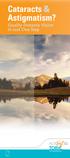 Cataracts & Astigmatism? Quality Distance Vision in Just One Step What would it be like to say goodbye to both cataracts and astigmatism at the same time? Imagine being able to see and enjoy quality distance
Assessment and Management of Visual Dysfunction Associated with Mild Traumatic Brain Injury. Clinical Recommendation Overview
 Assessment and Management of Visual Dysfunction Associated with Mild Traumatic Brain Injury Clinical Recommendation Overview Learning Objectives Describe an overview of visual dysfunction associated with
WELCOME TO COPPELL VISION CENTER
 WELCOME TO COPPELL VISION CENTER Please Print Name Address Sex: Male Female City/State/Zip Age Home Phone of Birth Alternate Phone SSN# Profession Employed By Responsible Party Address and Phone Number
Congratulations! You have just joined the thousands of people who are enjoying the benefits of laser vision correction.
 Dear Valued Patient, Thank you for choosing Shady Grove Ophthalmology for your laser vision correction procedure. Our excellent staff is committed to offering you the highest quality eye care using state
Common visual problems in older LASIK patients
 丘 子 宏 LASIK 手 術 後 的 視 覺 Visual acuity:the measurement of high contrast Snellen acuity but not other functions under different condition Quality of vision: measure the visual functions in variable condition
Anisometropia: what difference does it make?
 Optometry in Practice 2013 Volume 14 Issue 1 1 10 Anisometropia: what difference does it make? Paul McCarthy FBDO PG(cert)HE FHEA Anglia Ruskin University, Cambridge EV-10774 C-30368 1 CET point for UK
Eye Diseases. 1995-2014, The Patient Education Institute, Inc. www.x-plain.com otf30101 Last reviewed: 05/21/2014 1
 Eye Diseases Introduction Some eye problems are minor and fleeting. But some lead to a permanent loss of vision. There are many diseases that can affect the eyes. The symptoms of eye diseases vary widely,
CORONADO EYE ASSOCIATES GLENN B. COOK, M.D., PhD 801 ORANGE AVENUE, STE. 204 - CORONADO, CA 92118 619.437-4406 FAX 619.522-7983
 Dear Please allow us to welcome you to our practice. Our first priority is to provide you with the best care possible. Enclosed is your patient information sheet and medical history questionnaire. Please
Surgical Solutions for Enhancing Your Vision SURGICAL SOLUTIONS FOR ENHANCING YOUR VISION. www.silversteineyecenters.com 1
 Surgical Solutions for Enhancing Your Vision SURGICAL SOLUTIONS FOR ENHANCING YOUR VISION www.silversteineyecenters.com 1 Introduction Types and Causes of Vision Impairment Laser Surgery for Refractive
FORM A CONT. b. Courses to be Deleted From FSU Catalog: Prefix Number Title OPTM 743 Environmental Vision
 FORM A CONT. 1. Proposal Summary As part of the ongoing deliberative analysis of the MCO curriculum by the faculty, it was determined that one course, OPTM 743 Environmental Vision, included some material