
64 A.K. Shenton / Strategies for ensuring trustworthiness in qualitative research projects
|
|
|
- Warren Lee
- 9 years ago
- Views:
Transcription
1 Education for Information 22 (2004) IOS Press Strategies for ensuring trustworthiness in qualitative research projects Andrew K. Shenton Division of Information and Communication Studies, School of Informatics, Lipman Building, Northumbria University, Newcastle upon Tyne, NE1 8ST, UK Received 14 November 2003 Accepted 6 January 2004 Although many critics are reluctant to accept the trustworthiness of qualitative research, frameworks for ensuring rigour in this form of work have been in existence for many years. Guba s constructs, in particular, have won considerable favour and form the focus of this paper. Here researchers seek to satisfy four criteria. In addressing credibility, investigators attempt to demonstrate that a true picture of the phenomenon under scrutiny is being presented. To allow transferability, they provide sufficient detail of the context of the fieldwork for a reader to be able to decide whether the prevailing environment is similar to another situation with which he or she is familiar and whether the findings can justifiably be applied to the other setting. The meeting of the dependability criterion is difficult in qualitative work, although researchers should at least strive to enable a future investigator to repeat the study. Finally, to achieve confirmability, researchers must take steps to demonstrate that findings emerge from the data and not their own predispositions. The paper concludes by suggesting that it is the responsibility of research methods teachers to ensure that this or a comparable model for ensuring trustworthiness is followed by students undertaking a qualitative inquiry. Keywords: Qualitative methods, research 1. Introduction The trustworthiness of qualitative research generally is often questioned by positivists, perhaps because their concepts of validity and reliability cannot be addressed in the same way in naturalistic work. Nevertheless, several writers on research methods, notably Silverman [1], have demonstrated how qualitative researchers can incorporate measures that deal with these issues, and investigators such as Pitts [2] have attempted to respond directly to the issues of validity and reliability in their own qualitative studies. Many naturalistic investigators have, however, preferred to use different terminology to distance themselves from the positivist paradigm. One such author is Guba, who proposes four criteria that he believes should be considered Address for correspondence: 92 Claremont Road, Whitley Bay, Tyne and Wear, NE26 3TU, UK. [email protected] /04/$ IOS Press and the authors. All rights reserved

2 64 A.K. Shenton / Strategies for ensuring trustworthiness in qualitative research projects by qualitative researchers in pursuit of a trustworthy study [3]. By addressing similar issues, Guba s constructs correspond to the criteria employed by the positivist investigator: a) credibility (in preference to internal validity); b) transferability (in preference to external validity/generalisability); c) dependability (in preference to reliability); d) confirmability (in preference to objectivity). Although as recently as the mid 1990s Lincoln wrote that the whole area of qualitative inquiry was still emerging and being defined [4], Guba s constructs have been accepted by many. This paper considers the criteria in detail and suggests provisions that the qualitative researcher may employ to meet them. The strategies advocated are based on the experience gained by Shenton when undertaking a qualitative PhD study devoted to the information-seeking behaviour of school-aged children [5]. 2. Credibility One of the key criteria addressed by positivist researchers is that of internal validity, in which they seek to ensure that their study measures or tests what is actually intended. According to Merriam, the qualitative investigator s equivalent concept, i.e. credibility, deals with the question, How congruent are the findings with reality? [6] Lincoln and Guba argue that ensuring credibility is one of most important factors in establishing trustworthiness [7]. The following provisions may be made by researchers to promote confidence that they have accurately recorded the phenomena under scrutiny: a) the adoption of research methods well established both in qualitative investigation in general and in information science in particular. Yin recognises the importance of incorporating correct operational measures for the concepts being studied [8]. Thus, the specific procedures employed, such as the line of questioning pursued in the data gathering sessions and the methods of data analysis, should be derived, where possible, from those that have been successfully utilised in previous comparable projects. In terms of investigation of information-seeking behaviour, the work of Dervin has proved particularly influential in this regard. In their study of the information needs of Seattle s residents, Dervin et al. initially invited participants to reflect on situations where you needed help...where you didn t understand something...where you needed to decide what to do...or, where you were worried about something [9]. Dervin s respondents then described in detail a particular instance within one of these categories. Similar strategies have been used subsequently by Chen and Hernon [10], Poston-Anderson and Edwards [11] and Shenton [12] amongst others;

3 A.K. Shenton / Strategies for ensuring trustworthiness in qualitative research projects 65 b) the development of an early familiarity with the culture of participating organisations before the first data collection dialogues take place. This may be achieved via consultation of appropriate documents and preliminary visits to the organisations themselves. Lincoln and Guba [13] and Erlandson et al. [14] are among the many who recommend prolonged engagement between the investigator and the participants in order both for the former to gain an adequate understanding of an organisation and to establish a relationship of trust between the parties. The danger emerges, however, that if too many demands are made on staff, gatekeepers responsible for allowing the researcher access to the organisation may be deterred from cooperating. The investigator may also react with some suspicion to the notion of prolonged engagement in view of the undesirable side effects that have been noted by Lincoln and Guba [15] and Silverman [16]. The former draw particular attention to the way in which investigators may become so immersed in the culture under scrutiny that their professional judgements are influenced; c) random sampling of individuals to serve as informants. Although much qualitative research involves the use of purposive sampling, a random approach may negate charges of researcher bias in the selection of participants. As Preece notes, random sampling also helps to ensure that any unknown influences are distributed evenly within the sample [17]. Furthermore, it may be that a random method is particularly appropriate to the nature of the investigation. The work may, for example, take the form of a collective case study of the type described by Stake, in that multiple voices, exhibiting characteristics of similarity, dissimilarity, redundancy and variety, are sought in order to gain greater knowledge of a wider group [18], such as a more general population, rather than simply the individual informants who are contributing data. This form of research is also recognised by Hamel, Dufour and Fortin, who dub it a macroscopic case study, and emphasise the importance of appropriate selection tactics if the investigator is to be confident that informants are typical of members of a broader, selected society [19]. According to Bouma and Atkinson, A random sampling procedure provides the greatest assurance that those selected are a representative sample of the larger group [20]. A significant disadvantage of random method, however, stems from the fact that, since the researcher has no control over the choice of informants, it is possible that quiet, uncooperative or inarticulate individuals may be selected; d) triangulation. Triangulation may involve the use of different methods, especially observation, focus groups and individual interviews, which form the major data collection strategies for much qualitative research. Whilst focus groups and individual interviews suffer from some common methodological shortcomings since both are interviews of a kind, their distinct characteristics also result in individual strengths. According to Guba [21] and Brewer and Hunter [22], the use of different methods in concert compensates for their individual limitations and exploits their respective benefits. Where possible,
![[14] are among the many who recommend prolonged engagement between the investigator and the participants in order both for the former to gain an adequate understanding of an organisation and to](/docs-images/49/16966703/images/page_3.jpg "establish a relationship of trust between the parties.")
4 66 A.K. Shenton / Strategies for ensuring trustworthiness in qualitative research projects supporting data may be obtained from documents to provide a background to and help explain the attitudes and behaviour of those in the group under scrutiny, as well as to verify particular details that participants have supplied. Opportunities should also be seized to examine any documents referred to by informants during the actual interviews or focus groups where these can shed more light on the behaviour of the people in question. Another form of triangulation may involve the use of a wide range of informants. This is one way of triangulating via data sources. Here individual viewpoints and experiences can be verified against others and, ultimately, a rich picture of the attitudes, needs or behaviour of those under scrutiny may be constructed based on the contributions of a range of people. Van Maanen urges the exploitation of opportunities to check out bits of information across informants [23]. Such corroboration may, for example, take the form of comparing the needs and information-seeking action described by one individual with those of others in a comparable position. In addition, the investigator may draw informants from both users of an information service and the professionals who deliver it. Even in a user study, where the thrust of the work is likely to lie in analysing the ideas and experiences of users themselves, data provided by those responsible for the management and delivery of the service under scrutiny may well prove invaluable in order to check that supplied by the users, to help explain their attitudes and behaviour and to enhance the contextual data relating to the fieldwork site(s). Just as triangulation via data sources can involve the use of a diversity of informants, a range of documents may also be employed as source material. For example, documents created corporately by each participating organisation may be examined, as well as those relating to the organisation but produced externally. Further data dealing with the wider context in which the organisation is operating may be elicited from official publications. Where appropriate, site triangulation may be achieved by the participation of informants within several organisations so as to reduce the effect on the study of particular local factors peculiar to one institution. Where similar results emerge at different sites, findings may have greater credibility in the eyes of the reader. The sampling of a range of people in different organisations may be employed to provide the diversity that underpins Dervin s concept of circling reality, which she defines as the necessity of obtaining a variety of perspectives in order to get a better, more stable view of reality based on a wide spectrum of observations from a wide base of points in time-space [24]; e) tactics to help ensure honesty in informants when contributing data. In particular, each person who is approached should be given opportunities to refuse to participate in the project so as to ensure that the data collection sessions involve only those who are genuinely willing to take part and prepared to offer data freely. Participants should be encouraged to be frank from the outset of each session, with the researcher aiming to establish a rapport in the opening

5 A.K. Shenton / Strategies for ensuring trustworthiness in qualitative research projects 67 moments and indicating that there are no right answers to the questions that will be asked. Where appropriate, the independent status of the researcher should also be emphasised. Participants can, therefore, contribute ideas and talk of their experiences without fear of losing credibility in the eyes of managers of the organisation. It should be made clear to participants that they have the right to withdraw from the study at any point, and they should not even be required to disclose an explanation to the investigator. In many instances, such an unconditional right for subjects to withdraw may be a requirement that must be accepted by the researcher when seeking approval for the work; f) iterative questioning. In addition to the preventative strategies outlined above, specific ploys may be incorporated to uncover deliberate lies. These might include the use of probes to elicit detailed data and iterative questioning, in which the researcher returns to matters previously raised by an informant and extracts related data through rephrased questions. In both cases, where contradictions emerge, falsehoods can be detected and the researcher may decide to discard the suspect data. An alternative approach and one that provides greater transparency lies in drawing attention, within the final research report, to the discrepancies and offering possible explanations; g) negative case analysis, as recommended by commentators such as Lincoln and Guba [25], Miles and Huberman [26] and Silverman [27]. One form of negative case analysis may see the researcher refining a hypothesis until it addresses all cases within the data. If the study includes the production of typologies, on completing the initial categories the investigator may revisit the data in order to confirm that these constructs do indeed account for all instances of the phenomenon involved, even if some of the types embrace only one instance; h) frequent debriefing sessions between the researcher and his or her superiors, such as a project director or steering group. Through discussion, the vision of the investigator may be widened as others bring to bear their experiences and perceptions. Such collaborative sessions can be used by the researcher to discuss alternative approaches, and others who are responsible for the work in a more supervisory capacity may draw attention to flaws in the proposed course of action. The meetings also provide a sounding board for the investigator to test his or her developing ideas and interpretations, and probing from others may help the researcher to recognise his or her own biases and preferences; i) peer scrutiny of the research project. Opportunities for scrutiny of the project by colleagues, peers and academics should be welcomed, as should feedback offered to the researcher at any presentations (e.g. at conferences) that are made over the duration of the project. The fresh perspective that such individuals may be able to bring may allow them to challenge assumptions made by the investigator, whose closeness to the project frequently inhibits his or her ability to view it with real detachment. Questions and observations may well enable the researcher to refine his or her methods, develop a greater explanation of the research design and strengthen his or her arguments in the light of the comments made;

6 68 A.K. Shenton / Strategies for ensuring trustworthiness in qualitative research projects j) the researcher s reflective commentary. In addition to the outside scrutiny discussed above, the investigator should seek to evaluate the project, again as it develops. This may be done through a reflective commentary, part of which may be devoted to the effectiveness of the techniques that have been employed. The reflective commentary may also be used to record the researcher s initial impressions of each data collection session, patterns appearing to emerge in the data collected and theories generated. The commentary can play a key role in what Guba and Lincoln term progressive subjectivity, or the monitoring of the researcher s own developing constructions, which the writers consider critical in establishing credibility [28]. Ultimately, the section of the commentary dealing with emerging patterns and theories should inform that part of the research report that addresses the project s results, and any discussion in the report of the effectiveness of the study maybe based on the investigator s methods analysis within the reflective commentary; k) background, qualifications and experience of the investigator. According to Patton, the credibility of the researcher is especially important in qualitative research as it is the person who is the major instrument of data collection and analysis [29]. Alkin, Daillak and White go so far as to suggest that a scrutineer s trust in the researcher is of equal importance to the adequacy of the procedures themselves [30]. The nature of the biographical information that should be supplied in the research report is a matter of debate. Maykut and Morehouse recommend including any personal and professional information relevant to the phenomenon under study [31], and Patton adds that arrangements by which the investigator is funded should also be addressed [32]. Any approvals given to the project by those providing access to the organisation and individual participants should also be made explicit; l) member checks, which Guba and Lincoln consider the single most important provision that can be made to bolster a study s credibility [33]. Checks relating to the accuracy of the data may take place on the spot in the course, and at the end, of the data collection dialogues. Informants may also be asked to read any transcripts of dialogues in which they have participated. Here the emphasis should be on whether the informants consider that their words match what they actually intended, since, if a tape recorder has been used, the articulations themselves should at least have been accurately captured. Another element of member checking should involve verification of the investigator s emerging theories and inferences as these were formed during the dialogues. This strategy has been employed by Pitts [34] and is recommended by Brewer and Hunter [35] and Miles and Huberman [36]. Where appropriate, participants may be asked if they can offer reasons for particular patterns observed by the researcher. The importance of developing such a formative understanding is recognised by Van Maanen, who writes that

7 A.K. Shenton / Strategies for ensuring trustworthiness in qualitative research projects 69 analysis and verification...is something one brings forth with them from the field, not something which can be attended to later, after the data are collected. When making sense of field data, one cannot simply accumulate information without regard to what each bit of information represents in terms of its possible contextual meanings [37]; m) thick description of the phenomenon under scrutiny. Detailed description in this area can be an important provision for promoting credibility as it helps to convey the actual situations that have been investigated and, to an extent, the contexts that surround them. Without this insight, it is difficult for the reader of the final account to determine the extent to which the overall findings ring true. Moreover, if the researcher employs a reporting system in which he or she defines a series of types within a typology and illustrates these types using real qualitative episodes, the inclusion of the latter enables the reader to assess how far the defined types truly embrace the actual situations; n) examination of previous research findings to assess the degree to which the project s results are congruent with those of past studies. Silverman considers that the ability of the researcher to relate his or her findings to an existing body of knowledge is a key criterion for evaluating works of qualitative inquiry [38]. In this respect, reports of previous studies staged in the same or a similar organisation and addressing comparable issues may be invaluable sources. 3. Transferability Merriam writes that external validity is concerned with the extent to which the findings of one study can be applied to other situations [39]. In positivist work, the concern often lies in demonstrating that the results of the work at hand can be applied to a wider population. Since the findings of a qualitative project are specific to a small number of particular environments and individuals, it is impossible to demonstrate that the findings and conclusions are applicable to other situations and populations. Erlandson et al. note that many naturalistic inquirers believe that, in practice, even conventional generalisability is never possible as all observations are defined by the specific contexts in which they occur [40]. A contrasting view is offered by Stake [41] and Denscombe [42], who suggest that, although each case may be unique, it is also an example within a broader group and, as a result, the prospect of transferability should not be immediately rejected. Nevertheless, such an approach can be pursued only with caution since, as Gomm, Hammersley and Foster recognise, it appears to belittle the importance of the contextual factors which impinge on the case [43]. Bassey proposes that, if practitioners believe their situations to be similar to that described in the study, they may relate the findings to their own positions [44]. Lincoln and Guba [45] and Firestone [46] are among those who present a similar argument, and suggest that it is the responsibility of the investigator to ensure that sufficient contextual information about the fieldwork sites is provided to enable the
![When making sense of field data, one cannot simply accumulate information without regard to what each bit of information represents in terms of its possible contextual meanings [37]; m) thick](/docs-images/49/16966703/images/page_7.jpg "description of the phenomenon under scrutiny.")
8 70 A.K. Shenton / Strategies for ensuring trustworthiness in qualitative research projects reader to make such a transfer. They maintain that, since the researcher knows only the sending context, he or she cannot make transferability inferences. In recent years such a stance has found favour with many qualitative researchers. After perusing the description within the research report of the context in which the work was undertaken, readers must determine how far they can be confident in transferring to other situations the results and conclusions presented. It is also important that sufficient thick description of the phenomenon under investigation is provided to allow readers to have a proper understanding of it, thereby enabling them to compare the instances of the phenomenon described in the research report with those that they have seen emerge in their situations. Authors disagree on the nature and extent of background information that should be offered but few would dispute the need for a full description of all the contextual factors impinging on the inquiry, as recommended by Guba [47]. Nevertheless, the situation is complicated by the possibility, noted by Firestone, that factors considered by the researcher to be unimportant, and consequently unaddressed in the research report, may be critical in the eyes of a reader [48]. Many investigators stop short of the course of action advocated by Denscombe that the researcher should demonstrate how, in terms of the contextual data, the case study location(s) compare(s) with other environments[49]. This reluctance is based on the fact that the process would demand a considerable knowledge of the receiving contexts of other organisations, and the researcher is in no position to comment on what Merriam calls the typicality of the environment(s) in which the fieldwork took place [50]. The work of Cole and Gardner [51], Marchionini and Teague [52] and Pitts [53] highlights the importance of the researcher s conveying to the reader the boundaries of the study. This additional information must be considered before any attempts at transference are made. Thus information on the following issues should be given at the outset: a) the number of organisations taking part in the study and where they are based; b) any restrictions in the type of people who contributed data; c) the number of participants involved in the fieldwork; d) the data collection methods that were employed; e) the number and length of the data collection sessions; f) the time period over which the data was collected. It is easy for researchers to develop a preoccupation with transferability. Ultimately, the results of a qualitative study must be understood within the context of the particular characteristics of the organisation or organisations and, perhaps, geographical area in which the fieldwork was carried out. In order to assess the extent to which findings may be true of people in other settings, similar projects employing the same methods but conducted in different environments could well be of great value. As Kuhlthau [54] and Gomm, Hammersley and Foster [55] recognise, however, it is rare for such complementary work to be undertaken. Nevertheless, the accumulation of findings from studies staged in different settings might enable a more inclusive,

9 A.K. Shenton / Strategies for ensuring trustworthiness in qualitative research projects 71 overall picture to be gained. A similar point is made by Gross, in relation to her work on imposed queries in school libraries. She writes of the multiple environments in which the phenomenon of her interest takes place and believes her study to provide a baseline understanding with which the results of subsequent work should be compared [56]. As Borgman [57] and Pitts [58] have acknowledged, understanding of a phenomenon is gained gradually, through several studies, rather than one major project conducted in isolation. Even when different investigations offer results that are not entirely consistent with one another, this does not, of course, necessarily imply that one or more is untrustworthy. It may be that they simply reflect multiple realities, and, if an appreciation can be gained of the reasons behind the variations, this understanding may prove as useful to the reader as the results actually reported. Such an attitude is consistent with what Dervin considers should be key principles within information-seeking research, namely: To posit...every contradiction, every inconsistency, every diversity not as an error or extraneous but as fodder for contextual analysis. To ask and re-ask what accounts for this difference or this similarity and to anchor possible answers in time-space conceptualizings [59]. It should thus be questioned whether the notion of producing truly transferable results from a single study is a realistic aim or whether it disregards the importance of context which forms such a key factor in qualitative research. 4. Dependability In addressing the issue of reliability, the positivist employs techniques to show that, if the work were repeated, in the same context, with the same methods and with the same participants, similar results would be obtained. However, as Fidel [60] and Marshall and Rossman [61] note, the changing nature of the phenomena scrutinised by qualitative researchers renders such provisions problematic in their work. Florio-Ruane highlights how the investigator s observations are tied to the situation of the study, arguing that the published descriptions are static and frozen in the ethnographic present [62]. Lincoln and Guba stress the close ties between credibility and dependability, arguing that, in practice, a demonstration of the former goes some distance in ensuring the latter [63]. This may be achieved through the use of overlapping methods, such as the focus group and individual interview. In order to address the dependability issue more directly, the processes within the study should be reported in detail, thereby enabling a future researcher to repeat the work, if not necessarily to gain the same results. Thus, the research design may be viewed as a prototype model. Such in-depth coverage also allows the reader to assess the extent to which proper research practices have been followed. So as to enable readers of the research report to develop a thorough understanding of the methods and their effectiveness, the text should include sections devoted to a) the research design and its implementation, describing what was planned and executed on a strategic level;

10 72 A.K. Shenton / Strategies for ensuring trustworthiness in qualitative research projects b) the operational detail of data gathering, addressing the minutiae of what was done in the field; c) reflective appraisal of the project, evaluating the effectiveness of the process of inquiry undertaken. 5. Confirmability Patton associates objectivity in science with the use of instruments that are not dependent on human skill and perception. He recognises, however, the difficulty of ensuring real objectivity, since, as even tests and questionnaires are designed by humans, the intrusion of the researcher s biases is inevitable [64]. The concept of confirmability is the qualitative investigator s comparable concern to objectivity. Here steps must be taken to help ensure as far as possible that the work s findings are the result of the experiences and ideas of the informants, rather than the characteristics and preferences of the researcher. The role of triangulation in promoting such confirmability must again be emphasised, in this context to reduce the effect of investigator bias. Miles and Huberman consider that a key criterion for confirmability is the extent to which the researcher admits his or her own predispositions [65]. To this end, beliefs underpinning decisions made and methods adopted should be acknowledged within the research report, the reasons for favouring one approach when others could have been taken explained and weaknesses in the techniques actually employed admitted. In terms of results, preliminary theories that ultimately were not borne out by the data should also be discussed. Much of the content in relation to these areas may be derived from the ongoing reflective commentary. Once more, detailed methodological description enables the reader to determine how far the data and constructs emerging from it may be accepted. Critical to this process is the audit trail, which allows any observer to trace the course of the research step-by-step via the decisions made and procedures described. The audit trail may be represented diagrammatically. Two such diagrams may be constructed. One may take a data-oriented approach, showing how the data eventually leading to the formation of recommendations was gathered and processed during the course of the study. This is what is typically understood by the term, audit trail. In addition, however, the manner in which the concepts inherent in the research question gave rise to the work to follow may be tracked. This more theoretical audit trail, which should be understood in terms of the whole of the duration of the project, may be depicted in a second diagram. 6. Summary and conclusion Over the last twenty years, much has been achieved by advocates of qualitative inquiry in demonstrating the rigour and trustworthiness of their favoured form of

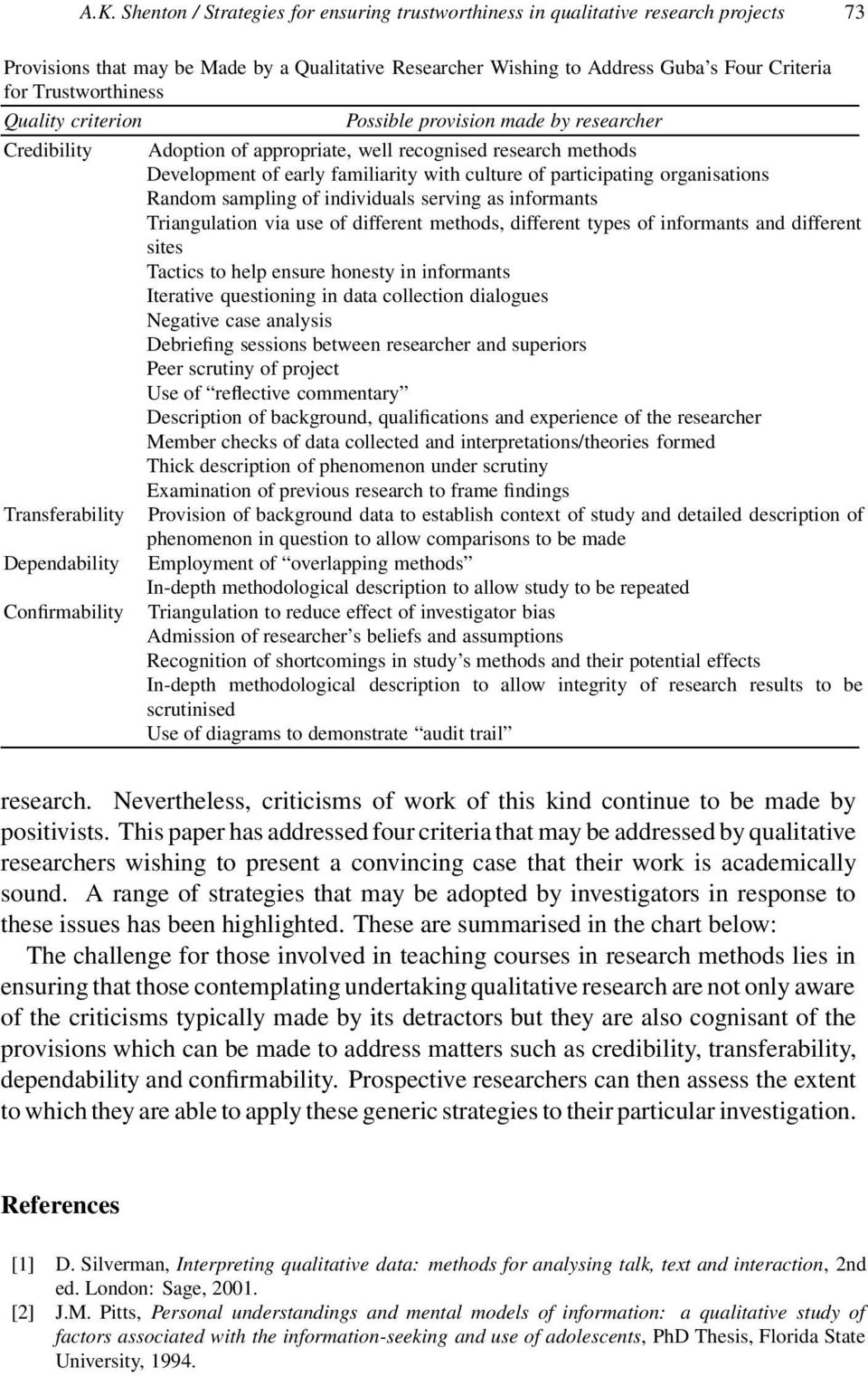
11 A.K. Shenton / Strategies for ensuring trustworthiness in qualitative research projects 73 Provisions that may be Made by a Qualitative Researcher Wishing to Address Guba s Four Criteria for Trustworthiness Quality criterion Possible provision made by researcher Credibility Adoption of appropriate, well recognised research methods Development of early familiarity with culture of participating organisations Random sampling of individuals serving as informants Triangulation via use of different methods, different types of informants and different sites Tactics to help ensure honesty in informants Iterative questioning in data collection dialogues Negative case analysis Debriefing sessions between researcher and superiors Peer scrutiny of project Use of reflective commentary Description of background, qualifications and experience of the researcher Member checks of data collected and interpretations/theories formed Thick description of phenomenon under scrutiny Examination of previous research to frame findings Transferability Provision of background data to establish context of study and detailed description of phenomenon in question to allow comparisons to be made Dependability Employment of overlapping methods In-depth methodological description to allow study to be repeated Confirmability Triangulation to reduce effect of investigator bias Admission of researcher s beliefs and assumptions Recognition of shortcomings in study s methods and their potential effects In-depth methodological description to allow integrity of research results to be scrutinised Use of diagrams to demonstrate audit trail research. Nevertheless, criticisms of work of this kind continue to be made by positivists. This paper has addressed four criteria that may be addressed by qualitative researchers wishing to present a convincing case that their work is academically sound. A range of strategies that may be adopted by investigators in response to these issues has been highlighted. These are summarised in the chart below: The challenge for those involved in teaching courses in research methods lies in ensuring that those contemplating undertaking qualitative research are not only aware of the criticisms typically made by its detractors but they are also cognisant of the provisions which can be made to address matters such as credibility, transferability, dependability and confirmability. Prospective researchers can then assess the extent to which they are able to apply these generic strategies to their particular investigation. References [1] D. Silverman, Interpreting qualitative data: methods for analysing talk, text and interaction, 2nd ed. London: Sage, [2] J.M. Pitts, Personal understandings and mental models of information: a qualitative study of factors associated with the information-seeking and use of adolescents, PhD Thesis, Florida State University, 1994.
12 74 A.K. Shenton / Strategies for ensuring trustworthiness in qualitative research projects [3] E.G. Guba, Criteria for assessing the trustworthiness of naturalistic inquiries, Educational Communication and Technology Journal 29 (1981), [4] Y.S. Lincoln, Emerging criteria for quality in qualitative and interpretive research, Qualitative Inquiry 1 (1995), [5] A.K. Shenton, The characteristics and development of young people s information universes, PhD Thesis, Northumbria University, [6] S.B. Merriam, Qualitative research and case study applications in education, San Francisco: Jossey-Bass, [7] Y.S. Lincoln and E.G. Guba, Naturalistic inquiry, Beverly Hills: Sage, [8] R.K. Yin, Case study research: design and methods, 2nd ed., Thousand Oaks: Sage, 1994, Applied Social Research Methods Series, Vol. 5. [9] B. Dervin, et al., The development of strategies for dealing with the information needs of urban residents, phase one: the citizen study, Seattle: School of Communications, University of Washington, [10] C-c. Chen and P. Hernon, Information seeking: assessing and anticipating user needs, New York: Neal Schuman, 1982 (Applications in Information Management and Technology Series). [11] B. Poston-Anderson and S. Edwards, The role of information in helping adolescent girls with their life concerns, School Library Media Quarterly 22 (1993), [12] A.K. Shenton, op. cit. [13] Y.S. Lincoln and E.G. Guba, op. cit. [14] D.A. Erlandson, et al., Doing naturalistic inquiry: a guide to methods, London: Sage, [15] Y.S. Lincoln and E.G. Guba, op. cit. [16] D. Silverman, Doing qualitative research: a practical handbook, London: Sage, [17] R. Preece, Starting research: an introduction to academic research and dissertation writing, London: Pinter, [18] R.E. Stake, Case studies, in: Handbook of qualitative research, N.K. Denzin and Y.S. Lincoln, eds, Thousand Oaks: Sage, 1994, pp [19] J. Hamel, S. Dufour and D. Fortin, Case study methods, Newbury Park: Sage, 1993, Qualitative Research Methods Series, Vol. 32. [20] G.D. Bouma and G.B.J. Atkinson, A handbook of social science research, 2nd ed., Oxford: Oxford University Press, [21] E.G. Guba, op. cit. [22] J. Brewer and A. Hunter, Multimethod research: a synthesis of styles, Newbury Park: Sage, 1989, Sage Library of Social Research Series, Vol [23] J. Van Maanen, The fact and fiction in organizational ethnography, in: Qualitative methodology, J. Van Maanen, ed., Beverly Hills: Sage, 1983, pp [24] B. Dervin, An overview of sense-making: concepts, methods, and results to date, Paper presented at the annual meeting of the International Communications Association, Dallas, TX, May 1983, URL: [25] Y.S. Lincoln and E.G. Guba, op. cit. [26] M.B. Miles and A.M. Huberman, Qualitative data analysis: an expanded sourcebook, 2nd ed. California: Sage, [27] D. Silverman, op. cit [28] E.G. Guba and Y.S. Lincoln, Fourth generation evaluation, Newbury Park: Sage, [29] M.Q. Patton, Qualitative evaluation and research methods, 2nd ed. Newbury Park: Sage, [30] M.C. Alkin, R. Daillak and P. White, Using evaluations: does evaluation make a difference? Beverly Hills: Sage, 1979 (Sage Library of Social Research Series, Vol. 76). [31] P. Maykut and R. Morehouse, Beginning qualitative research: a philosophic and practical guide, London: Falmer Press, 1994, The Falmer Press Teachers Library: 6. [32] M.Q. Patton, op. cit. [33] E.G. Guba and Y.S. Lincoln, op. cit. [34] J.M. Pitts, op. cit. [35] J. Brewer and A. Hunter, op. cit.
![Lincoln, Emerging criteria for quality in qualitative and interpretive research, Qualitative Inquiry 1 (1995), 275 289. [5] A.K.](/docs-images/49/16966703/images/page_12.jpg "Shenton, The characteristics and development of young people s information universes, PhD Thesis, Northumbria University, 2002. [6] S.B.")
13 A.K. Shenton / Strategies for ensuring trustworthiness in qualitative research projects 75 [36] M.B. Miles and A.M. Huberman, op. cit. [37] J. Van Maanan, op. cit. [38] D. Silverman, op. cit [39] S.B. Merriam, op. cit. [40] D.A. Erlandson, et al., op. cit. [41] R.E. Stake. Case studies, in: Handbook of qualitative research, N.K. Denzin and Y.S. Lincoln, eds, Thousand Oaks: Sage, 1994, pp [42] M. Denscombe, The good research guide for small-scale social research projects, Buckingham: Open University Press, [43] R. Gomm, M. Hammersley and P. Foster, Case study and generalization, in: Case study method,r. Gomm, M. Hammersley and P. Foster, eds, London: Sage, 2000, pp [44] M. Bassey, Pedagogic research: on the relative merits of search for generalisation and study of single events, Oxford Review of Education 7 (1981), [45] Y.S. Lincoln and E.G. Guba, op. cit. [46] W.A. Firestone, Alternative arguments for generalizing from data as applied to qualitative research, Educational Researcher 22 (1993), [47] E.G. Guba, op. cit. [48] W.A. Firestone, op. cit. [49] M. Denscombe, op. cit. [50] S.B. Merriam, op. cit. [51] J. Cole and K. Gardner, Topic work with first-year secondary pupils, in: The effective use of reading, E. Lunzer and K. Gardner, eds, London: Heinemann, Heinemann Educational Books for the Schools Council, 1979, pp [52] G. Marchionini and J. Teague, Elementary students use of electronic information services: an exploratory study, Journal of Research on Computing in Education 20 (1987), [53] J.M. Pitts, op. cit. [54] C.C. Kuhlthau, Investigating patterns in information seeking: concepts in context, in: Exploring the contexts of information behaviour, T.D. Wilson and D.K. Allen, eds, London: Taylor Graham, 1999, pp [55] R. Gomm, M. Hammersley and P. Foster, op. cit. [56] M.R. Gross, Imposed queries in the school library media center: a descriptive study, Doctoral Dissertation, University of California, [57] C.L. Borgman, The user s mental model of an information retrieval system: an experiment on a prototype online catalog, International Journal of Man-Machine Studies 24 (1986), [58] J.M. Pitts, op. cit. [59] B. Dervin, Given a context by any other name: methodological tools for taming the unruly beast, in: Information seeking in context, P. Vakkari, R. Savolainen and B. Dervin, eds, London: Taylor Graham, 1997, pp [60] R. Fidel, Qualitative methods in information retrieval research, Library and Information Science Research 15 (1993), [61] C. Marshall and G.B. Rossman, Designing qualitative research, 3rd ed. Newbury Park: Sage, [62] S. Florio-Ruane, Conversation and narrative in collaborative research, in: Stories lives tell: narrative and dialogue in education, C. Witherell and N. Noddings, eds, New York: Teachers College Press, 1991, pp [63] Y.S. Lincoln and E.G. Guba, op. cit. [64] M.Q. Patton, op. cit. [65] M.B. Miles and A.M. Huberman, op. cit.
![236 247. [42] M. Denscombe, The good research guide for small-scale social research projects, Buckingham: Open University Press, 1998. [43] R. Gomm, M. Hammersley and P.](/docs-images/49/16966703/images/page_13.jpg "Foster, Case study and generalization, in: Case study method,r. Gomm, M. Hammersley and P. Foster, eds, London: Sage, 2000, pp. 98 115. [44] M.")
14

Using Case Studies in Research
 Biographical Note Professor Jennifer Rowley can be contacted at the School of Management and Social Sciences, Edge Hill College of Higher Education, Ormskirk, Lancashire, England L39 4QP. by Jennifer Rowley
Appraising qualitative research articles in medicine and medical education
 Medical Teacher, Vol. 27, No. 1, 2005, pp. 71 75 Appraising qualitative research articles in medicine and medical education LUC CÔTÉ & JEAN TURGEON Department of Family Medicine, Faculty of Medicine, Laval
Doctor of Education - Higher Education
 1 Doctor of Education - Higher Education The University of Liverpool s Doctor of Education - Higher Education (EdD) is a professional doctoral programme focused on the latest practice, research, and leadership
Characteristics of Effective and Sustainable Teaching Development Programs for Quality Teaching in Higher Education
 Characteristics of Effective and Sustainable Teaching Development Programs for Quality Teaching in Higher Education This presentation will address the following conference aim/question: What are the contextual
On the attributes of a critical literature review. Saunders, Mark N. K. 1 & Rojon, Céline 2. United Kingdom.
 On the attributes of a critical literature review Saunders, Mark N. K. 1 & Rojon, Céline 2 1 School of Management, University of Surrey, Guildford, GU2 7XH, United Kingdom; 2 Department of Psychology &
Qualitative Research Methods CRIM 7316 Advanced Topics in Criminal Justice Spring 2016
 Qualitative Research Methods CRIM 7316 Advanced Topics in Criminal Justice Spring 2016 Meeting Times & Location: Wednesday 5:30-8:00 Room 301 Churchill Hall Contact Information: Office Hours: Required
SOME IMPORTANT NOTES ON QUALITATIVE RESEARCH. Prof. Dr. Andreas Budihardjo August, 2013
 SOME IMPORTANT NOTES ON QUALITATIVE RESEARCH Prof. Dr. Andreas Budihardjo August, 2013 CHECKLIST ( LOFLAND & LOFLAND, 1995) Basic organization How well is the article written or presented? Data & Methods
4. Is the study design appropriate for the research question and objectives?
 Guidelines for Critical Review of Qualitative Studies Based on Guidelines for Critical Review Form-Qualitative Studies by Law, M., Stewart, D., Letts, L., Pollock, N., Bosch, J., & Westmorland, M., 1998
University Reviews: Exploring a New and Coordinated Approach
 University Reviews: Exploring a New and Coordinated Approach Abstract Sue Leahy University of Technology Sydney The University of Technology, Sydney (UTS) has endorsed the implementation of a new model
What is Grounded Theory? Dr Lynn Calman Research Fellow School of Nursing, Midwifery and Social Work
 What is Grounded Theory? Dr Lynn Calman Research Fellow School of Nursing, Midwifery and Social Work Grounded theory The aim of grounded theory is: to generate or discover a theory (Glaser and Strauss,
Modernization of Library and Information Science Education through the Enhancement of Intercultural Communication
 Qualitative and Quantitative Methods in Libraries (QQML) 4: 359 364, 2013 Modernization of Library and Information Science Education through the Enhancement of Intercultural Communication Sirje Virkus
Analysing Qualitative Data
 Analysing Qualitative Data Workshop Professor Debra Myhill Philosophical Assumptions It is important to think about the philosophical assumptions that underpin the interpretation of all data. Your ontological
Qualitative Research. A primer. Developed by: Vicki L. Wise, Ph.D. Portland State University
 Qualitative Research A primer Developed by: Vicki L. Wise, Ph.D. Portland State University Overview In this session, we will investigate qualitative research methods. At the end, I am hopeful that you
Qualitative Interview Design: A Practical Guide for Novice Investigators
 The Qualitative Report Volume 15 Number 3 May 2010 754-760 http://www.nova.edu/ssss/qr/qr15-3/qid.pdf Qualitative Interview Design: A Practical Guide for Novice Investigators Daniel W. Turner, III Nova
CHAPTER III METHODOLOGY. The purpose of this study was to describe which aspects of course design
 CHAPTER III METHODOLOGY The purpose of this study was to describe which aspects of course design and/or instruction are more effective and successful in the online environment than in the face-to-face
Developing your Graduate Attributes: MA in Marketing
 Developing your Graduate Attributes: MA in Marketing The MA in Marketing involves studying theory and practice. The programme is distinctive in that it adopts a critical marketing and management studies
REFLECTING ON EXPERIENCES OF THE TEACHER INDUCTION SCHEME
 REFLECTING ON EXPERIENCES OF THE TEACHER INDUCTION SCHEME September 2005 Myra A Pearson, Depute Registrar (Education) Dr Dean Robson, Professional Officer First Published 2005 The General Teaching Council
PROGRAMMME SPECIFICATION FOR MA in LEADERSHIP AND MANAGEMENT (HEALTH AND SOCIAL CARE SERVICES)
 PROGRAMMME SPECIFICATION FOR MA in LEADERSHIP AND MANAGEMENT (HEALTH AND SOCIAL CARE SERVICES) MA in LEADERSHIP AND MANAGEMENT (HEALTH AND SOCIAL CARE SERVICES) 1. Award 2. Route Management (Health and
Qualitative research: An overview and general issues by Stephanie Tierney ([email protected])
 Qualitative research: An overview and general issues by Stephanie Tierney ([email protected]) Enquiry into service users opinions has been denoted as an important area to examine because
How to gather and evaluate information
 09 May 2016 How to gather and evaluate information Chartered Institute of Internal Auditors Information is central to the role of an internal auditor. Gathering and evaluating information is the basic
Interview studies. 1 Introduction... 1. 2 Applications of interview study designs... 2. 3 Outline of the design... 3
 Interview studies Contents 1 Introduction... 1 2 Applications of interview study designs... 2 3 Outline of the design... 3 4 Strengths and weaknesses of interview study designs... 6 5 References... 7 1
HND degree top-up students perceptions of their experience at the University of Worcester: how can future students experiences be improved?
 HND degree top-up students perceptions of their experience at the University of Worcester: how can future students experiences be improved? Lerverne Barber and Dr Nick Breeze University of Worcester ([email protected]
SSS 955 ADVANCED QUALITATIVE RESEARCH METHODOLOGIES
 THE CATHOLIC UNIVERSITY OF AMERICA CUA National Catholic School of Social Service Washington, DC 20064 202-319-5458 Fax 202-319-5093 SSS 955 ADVANCED QUALITATIVE RESEARCH METHODOLOGIES I. COURSE PURPOSE
Using qualitative research to explore women s responses
 Using qualitative research to explore women s responses Towards meaningful assistance - how evidence from qualitative studies can help to meet survivors needs Possible questions Why do survivors of SV
Measurement and measures. Professor Brian Oldenburg
 Measurement and measures Professor Brian Oldenburg Learning objectives 1. To identify similarities/differences between qualitative & quantitative measures 2. To identify steps involved in choosing and/or
STUDENT THESIS PROPOSAL GUIDELINES
 STUDENT THESIS PROPOSAL GUIDELINES Thesis Proposal Students must work closely with their advisor to develop the proposal. Proposal Form The research proposal is expected to be completed during the normal
Understanding challenges of information security culture: a methodological issue
 Understanding challenges of information security culture: a methodological issue Abstract Omar Zakaria Information Security Group, Royal Holloway, University of London E-mail: [email protected] Although,
Qualitative Analysis of Content
 Qualitative Analysis of Content by Yan Zhang and Barbara M. Wildemuth If there were only one truth, you couldn t paint a hundred canvases on the same theme. --Pablo Picasso, 1966 Introduction As one of
School of Advanced Studies Doctor Of Health Administration. DHA 003 Requirements
 School of Advanced Studies Doctor Of Health Administration The mission of the Doctor of Health Administration degree program is to develop healthcare leaders by educating them in the areas of active inquiry,
Teachers' Art Assessment Practices: Relationship to Expertise, Experience, Beliefs and Confidence
 Marilyn Zurmuehlen Working Papers in Art Education ISSN: 2326-7070 (Print) ISSN: 2326-7062 (Online) Volume 11 Issue 1 (1992) pps. 73-79 Teachers' Art Assessment Practices: Relationship to Expertise, Experience,
Information Technology Research in Developing Nations: Major Research Methods and Publication Outlets
 Information Technology Research in Developing Nations: Major Research Methods and Publication Outlets Franklin Wabwoba, Anselimo Peters Ikoha Masinde Muliro University of Science and Technology, Computer
School of Advanced Studies Doctor Of Management In Organizational Leadership/information Systems And Technology. DM/IST 004 Requirements
 School of Advanced Studies Doctor Of Management In Organizational Leadership/information Systems And Technology The mission of the Information Systems and Technology specialization of the Doctor of Management
G.F. Huon School of Psychology, University of New South Wales, Sydney, Australia
 INTERVIEWING AND OBSERVATION G.F. Huon School of Psychology, University of New South Wales, Sydney, Australia Keywords: Unobtrusive observation, systematic observation, ethical considerations, reactivity,
School of Advanced Studies Doctor Of Management In Organizational Leadership. DM 004 Requirements
 School of Advanced Studies Doctor Of Management In Organizational Leadership The mission of the Doctor of Management in Organizational Leadership degree program is to develop the critical and creative
Sample Qualitative Research Proposal Published by Permission of the Author. Dissertation Proposal Robert R. Maldonado.
 Sample Qualitative Research Proposal Published by Permission of the Author Dissertation Proposal Robert R. Maldonado Akamai University Title: A Phenomenological Pilot Study of Energy Healers Expertise
Teaching institution: Institute of Education, University of London
 PROGRAMME SPECIFICATION MA Geography in Education Awarding body: Institute of Education, University of London Teaching institution: Institute of Education, University of London Name of the final award:
University of Bath. Welsh Baccalaureate Qualification Internal Evaluation. Themed Report: MARKETING AND PROMOTION
 University of Bath Welsh Baccalaureate Qualification Internal Evaluation Themed Report: MARKETING AND PROMOTION [This is one of eight themed reports which draw on issues relating to particular themes that
Annotated Bibliography. Research for Nursing Practice 3. Nursing Degree B.Sc. (Cur.) - Junior Sophister
 Annotated Bibliography Research for Nursing Practice 3 Nursing Degree B.Sc. (Cur.) - Junior Sophister In order to structure the annotated bibliography, the student nurse has applied the threestage reflection
Evaluation of qualitative research
 Journal of Clinical Nursing 2003; 12: 307 312 Evaluation of qualitative research DOROTHY HORSBURGH BA,MEd,PhD,RCNT,RGN,RNT Lecturer, Napier University, School of Acute and Continuing Care Nursing, Faculty
Additional Qualification Course Guideline Special Education, Specialist
 Additional Qualification Course Guideline Special Education, Specialist Schedule D Teachers Qualifications Regulation April 2014 Ce document est disponible en français sous le titre Ligne directrice du
Qualitative Data Analysis
 Qualitative Data Analysis Module No POLS 305 Level 5 Credits 5 Pre-requisite Social Science Research Methods Student study hours Module leader Email Phone Number Office 60 hrs approx. 20 hrs lecture and
Using Evidence in the Classroom for Professional Learning
 Using Evidence in the Classroom for Professional Learning Helen Timperley University of Auckland New Zealand Paper presented to the Ontario Education Research Symposium For teachers to use evidence to
A Cross-Case Analysis of How Faculty Connect Learning in Hybrid Courses
 A Cross-Case Analysis of How Faculty Connect Learning in Hybrid Courses Karen Skibba University of Wisconsin-Milwaukee Keywords: Hybrid Courses, Dimensions of Learning, Case Studies Abstract: This qualitative,
Instructional Technology Capstone Project Standards and Guidelines
 Instructional Technology Capstone Project Standards and Guidelines The Committee recognizes the fact that each EdD program is likely to articulate some requirements that are unique. What follows are a
Principles of Qualitative Research: Designing a Qualitative Study
 Principles of Qualitative Research: Designing a Qualitative Study John W. Creswell, Ph.D. Vicki L. Plano Clark, M.S. Objectives As a group activity, to plan a qualitative study on the topic of leadership
CASE STUDIES: Research Methods
 Helpsheet Giblin Eunson Library CASE SUDIES: Research Methods Use this sheet to help you: understand the key elements of a case study write research-based case studies in eight steps develop awareness
Blog, blog, blog Online Journaling in Graduate Classes
 Blog, blog, blog Online Journaling in Graduate Classes 1 Lyubov Laroche, 2 Barbara Newman Young, 1 Dorothy Valcarcel Craig 1 Western Washington University, 2 Middle Tennessee State University (USA) Abstract
Policy Paper on Non-Formal Education: A framework for indicating and assuring quality
 Policy Paper on Non-Formal Education: A framework for indicating and assuring quality Adopted by the Council of Members/ Extraordinary General Assembly 2-3 May 2008 (Castelldefels, Catalonia - Spain) 0.
 Assessment: Getting Started with Interviewing Dave Baca, PhD University of Arizona ALA Annual 2006 Why Interview? When interpersonal contact is important When you need more in-depth data When you need
Intercoder reliability for qualitative research
 Intercoder reliability for qualitative research You win some, but do you lose some as well? TRAIL Research School, October 2012 Authors Niek Mouter, MSc and Diana Vonk Noordegraaf, MSc Faculty of Technology,
Understanding a financial statement audit
 www.pwc.com Understanding a financial statement audit December January 2013 2012 Understanding a financial statement audit 1 Preface Role of audit Since its introduction, the need for certain companies
Qualitative methods for effectiveness evaluation: When numbers are not enough
 Chapter 7 Qualitative methods for effectiveness evaluation: When numbers are not enough 7.1 Introduction 7.2 Methods of collecting qualitative information 7.2.1 Interviews and focus groups 7.2.2 Questionnaires
Grounded Theory. 1 Introduction... 1. 2 Applications of grounded theory... 1. 3 Outline of the design... 2
 Grounded Theory Contents 1 Introduction... 1 2 Applications of grounded theory... 1 3 Outline of the design... 2 4 Strengths and weaknesses of grounded theory... 6 5 References... 6 1 Introduction This
Relationship Manager (Banking) Assessment Plan
 1. Introduction and Overview Relationship Manager (Banking) Assessment Plan The Relationship Manager (Banking) is an apprenticeship that takes 3-4 years to complete and is at a Level 6. It forms a key
Procurement Programmes & Projects P3M3 v2.1 Self-Assessment Instructions and Questionnaire. P3M3 Project Management Self-Assessment
 Procurement Programmes & Projects P3M3 v2.1 Self-Assessment Instructions and Questionnaire P3M3 Project Management Self-Assessment Contents Introduction 3 User Guidance 4 P3M3 Self-Assessment Questionnaire
FCA Retirement income market study: Interim Report. A response by the National Association of Pension Funds. January 2015 www.napf.co.
 FCA Retirement income market study: Interim Report A response by the National Association of Pension Funds January 2015 www.napf.co.uk NAPF response to FCA retirement income market study Contents Overview...
REPORTING ACCOUNTANTS WORK ON FINANCIAL REPORTING PROCEDURES. Financing Change initiative
 REPORTING ACCOUNTANTS WORK ON FINANCIAL REPORTING PROCEDURES consultation PAPER Financing Change initiative inspiring CONFIdENCE icaew.com/financingchange ICAEW operates under a Royal Charter, working
14. Qualitative Field Research
 196 Qualitative Field Research 14. Qualitative Field Research Qualitative research is the method of choice when the research question requires an understanding of processes, events and relationships in
Choosing a CAQDAS Package Using Software for Qualitative Data Analysis : A step by step Guide
 A working paper by Ann Lewins & Christina Silver, 6th edition April 2009 CAQDAS Networking Project and Qualitative Innovations in CAQDAS Project. (QUIC) See also the individual software reviews available
Guidelines for Critical Review Form: Qualitative Studies (Version 2.0)
 Guidelines for Critical Review Form: Qualitative Studies (Version 2.0) Letts, L., Wilkins, S., Law, M., Stewart, D., Bosch, J., & Westmorland, M., 2007 Introduction These guidelines accompany the Critical
Guide for the Development of Results-based Management and Accountability Frameworks
 Guide for the Development of Results-based Management and Accountability Frameworks August, 2001 Treasury Board Secretariat TABLE OF CONTENTS Section 1. Introduction to the Results-based Management and
Case study research design
 Case study research design Contents 1 Introduction... 1 2 Applications of case study design... 3 3 Outline of the design... 3 4 Strengths and weaknesses of case study designs... 9 5 References... 10 1
What are research, evaluation and audit?
 1 What are research, evaluation and audit? Barbara Sen, Maria J. Grant and Hannah Spring I don t do research. I don t have the time. I am too busy with the day to day running of the library. I do evaluations
Methodological Issues for Interdisciplinary Research
 J. T. M. Miller, Department of Philosophy, University of Durham 1 Methodological Issues for Interdisciplinary Research Much of the apparent difficulty of interdisciplinary research stems from the nature
Cambridge International Certificate in Educational Leadership 6247 Cambridge International Diploma in Educational Leadership 6248
 Cambridge International Certificate in Educational Leadership 6247 Cambridge International Diploma in Educational Leadership 6248 For examination in 2015 Preface This syllabus sets out the details of the
Teacher Leaders in a Culture of Accountability - Emergent Roles for Transformative Teacher Learning or the New Dispensable Middle Managers?
 Teacher Leaders in a Culture of Accountability - Emergent Roles for Transformative Teacher Learning or the New Dispensable Middle Managers? Chair: Alex Alexandrou (Freelance Academic) Discussant: Jason
Suite Overview...2. Glossary...8. Functional Map.11. List of Standards..15. Youth Work Standards 16. Signposting to other Standards...
 LSI YW00 Youth Work National Occupational Standards Introduction Youth Work National Occupational Standards Introduction Contents: Suite Overview...2 Glossary......8 Functional Map.11 List of Standards..15
Is verbatim transcription of interview data always necessary?
 Applied Nursing Research 19 (2006) 38 42 Clinical methods Is verbatim transcription of interview data always necessary? Elizabeth J. Halcomb, RN, BN (Hons), IC Cert a, 4, Patricia M. Davidson, RN, ITC,
Australian ssociation
 Australian ssociation Practice Standards for Social Workers: Achieving Outcomes of Social Workers Australian Association of Social Workers September 2003 Contents Page Introduction... 3 Format of the Standards...
How to write your research proposal
 How to write your research proposal by Maria Joyce, Lecturer, Faculty of Health and Social Care, University of Hull June 2004 The writing of a research proposal is generally understood to be a part of
For examination in 2015
 Cambridge International Certificate in Teaching with Digital Technologies 6224 Cambridge International Diploma in Teaching with Digital Technologies 6225 For examination in 2015 Preface This syllabus sets
Chapter 3 Study Design and Methodology
 Chapter 3 Study Design and Methodology 3.1. Introduction This study conducted exploratory and descriptive research on the creation of a specific information technology standard to gain an understanding
Assessing the Role of Knowledge Management Technologies in Learning Organisations
 Assessing the Role of Knowledge Management Technologies in Learning Organisations Frank Nyame-Asiamah ID No: 0811879 Brunel Business School, Brunel University, UK Supervisors: Dr Nandish Patel Dr Maged
Vernon Park Primary School. Teaching and Learning Policy
 Vernon Park Primary School Teaching and Learning Policy The school s approach to teaching and learning is based upon the school vision: At Vernon Park Primary School we aim to provide all children, parents,
PROGRAMME SPECIFICATION MSc Speech, Language and Communication Needs in Schools: Advanced Practice
 PROGRAMME SPECIFICATION MSc Speech, Language and Communication Needs in Schools: Advanced Practice Awarding body: Institute of Education, University of London / City University London Teaching Institutions:
The Series of Discussion Papers. Conceptual Framework of Financial Accounting
 The Series of Discussion Papers Conceptual Framework of Financial Accounting Working Group on Fundamental Concepts September 2004 (Tentative translation: 28 Feb. 2005) Contents Issuance of the Series of
Nottingham Trent University Course Specification
 Nottingham Trent University Course Specification Basic Course Information 1. Awarding Institution: Nottingham Trent University 2. School/Campus: Nottingham Business School / City 3. Final Award, Course
The psychological contract
 http://www.cipd.co.uk/subjects/empreltns/psycntrct/psycontr.htm?wa_src=email&wa_pub=cipd&wa_crt=feature3_main_none&wa_cm p=cipdupdate_160610 The psychological contract Employee relations Revised May 2010
Qualitative methods for analyzing process data. How do we research processes? But then what? Process data (after Mintzberg, 1979)
 Qualitative methods for analyzing process data Ann Langley, HEC Montréal AOM PDW, Atlanta Saturday August 12th 2006 How do we research processes? Simple answer: we go out and look Observations in vivo
The Relevance of Glaserian and Straussian Grounded Theory Approaches in Researching Human Resource Development
 2011 International Conference on Financial Management and Economics IPEDR vol.11 (2011) (2011) IACSIT Press, Singapore The Relevance of Glaserian and Straussian Grounded Theory Approaches in Researching
EXECUTIVE SUMMARY SYSTEMATIC REVIEW OF THE LITERATURE ON UTILISATION OF SUPPORT WORKERS IN COMMUNITY BASED REHABILITATION
 Queensland Health Centre for Allied Health Evidence EXECUTIVE SUMMARY SYSTEMATIC REVIEW OF THE LITERATURE ON UTILISATION OF SUPPORT WORKERS IN COMMUNITY BASED REHABILITATION Prepared by Dr. Saravana Kumar
Framework and Resources for Early Childhood Education Reviews
 Framework and Resources for Early Childhood Education Reviews Education Reviews in Early Childhood Education Services Contents 1 Introduction 1 The purpose of this framework ERO s approach to early childhood
Executive summary. Today s researchers require skills beyond their core competencies
 EXECUTIVE SUMMARY 9 Executive summary Today s researchers require skills beyond their core competencies The formation and careers of researchers are important policy issues and training for transferable
Evaluating Pedagogical Quality: An Integral Part of Course Development Strategy
 1 20th Annual Conference on Distance Teaching and Learning click here -> Evaluating Pedagogical Quality: An Integral Part of Course Development Strategy L Bagley, PhD Head of Learning Research and Development
MRS Diploma in Market & Social Research Practice Full Syllabus & Assessment Guidelines
 MRS Diploma in Market & Social Research Practice Full Syllabus & Assessment Guidelines Effective from June 2012 Assessment With members in more than 60 countries, MRS is the world s leading authority on
LONDON SCHOOL OF COMMERCE. Programme Specifications for the. Cardiff Metropolitan University. MSc in International Hospitality Management
 LONDON SCHOOL OF COMMERCE Programme Specifications for the Cardiff Metropolitan University MSc in International Hospitality Management 1 Contents Programme Aims and Objectives 3 Programme Learning Outcomes
Honours Degree (top-up) Business Abbreviated Programme Specification Containing Both Core + Supplementary Information
 Honours Degree (top-up) Business Abbreviated Programme Specification Containing Both Core + Supplementary Information 1 Awarding Institution / body: Lancaster University 2a Teaching institution: University
Research Methods: Qualitative Approach
 Research Methods: Qualitative Approach Sharon E. McKenzie, PhD, MS, CTRS, CDP Assistant Professor/Research Scientist Coordinator Gerontology Certificate Program Kean University Dept. of Physical Education,
Developing an R Series Plan that Incorporates Mixed Methods Research
 Developing an R Series Plan that Incorporates Mixed Methods Research / 16 Developing an R Series Plan that Incorporates Mixed Methods Research primary mechanism for obtaining NIH grants to conduct mixed
School of Advanced Studies Doctor Of Business Administration. DBA 003 Requirements
 School of Advanced Studies Doctor Of Business Administration The mission of the Doctor of Business Administration degree program is to empower business administration practitioners to become business subject
School of Advanced Studies Doctor Of Education In Educational Leadership With A Specialization In Educational Technology. EDD/ET 003 Requirements
 School of Advanced Studies Doctor Of Education In Educational Leadership With A Specialization In Educational Technology The mission of the Doctor of Education in Educational Leadership degree program
How Good is Our Council?
 A guide to evaluating Council Services using quality indicators Securing the future... l Improving services l Enhancing quality of life l Making the best use of public resources Foreword Perth & Kinross
Evaluation of the PEFA Programme 2004 2010 & Development of Recommendations Beyond 2011 (dated July 2011)
 Evaluation of the PEFA Programme 2004 2010 & Development of Recommendations Beyond 2011 (dated July 2011) Management Response by the PEFA Steering Committee September 22 nd, 2011 1. Introduction The importance
How To Pass A Criminology Course
 Programme Specification MSc in Forensic Psychology Entry Requirements: Applicants for this course must have a good Honours degree (2:1 or better) in Psychology that confers Graduate Basis for Registration