
Borrowers Who Drop Out
|
|
|
- Nelson Fowler
- 10 years ago
- Views:
Transcription
1 A Neglected Aspect of the College Student Loan Trend By Lawrence Gladieux and Laura Perna May 2005 The National Center for Public Policy and Higher Education
2 National Center Report # by The National Center for Public Policy and Higher Education. Material may be duplicated with full attribution.

3 Contents Foreword iv Introduction Section I: Key Findings and Consequences of the Current Financing System Section II: Analysis of the Data on Dropouts Section III: Policy Implications and Recommendations Appendix I: Data Sources and Definitions Appendix II: Source Tables Endnotes About the Authors The National Center for Public Policy and Higher Education iii

4 Foreword Borrowers Who Drop Out is an important contribution to the National Center s and the nation s understanding of students who aspire to earn educational certificates and degrees, but do not achieve their goals and yet are saddled with significant debt to repay. It is the first report we know of that compares students who borrow and then drop out of postsecondary education with those who borrow and complete their degrees. The authors are Lawrence Gladieux, an independent education policy consultant, and Laura Perna, assistant professor of higher education at the University of Maryland, College Park. These researchers utilized the most recent and comprehensive data available from the U.S. Department of Education on students who first enrolled in postsecondary education in , with a snapshot of the same students in The findings are revealing, if not disturbing. Half of the students who enrolled in postsecondary education borrowed in ; more than 20% of those students dropped out of their educational programs, yet were burdened with significant debt. They had, in effect, the worst of both worlds they did not benefit from the higher income associated with education beyond high school, and they accumulated significant educational debt. Many of these students were unemployed in 2001 and defaulted on their loans, thus damaging their credit standing for the future. Most students benefit from loans and are able to repay them when they leave higher education. However, borrowing, combined with other risk factors for not completing higher education (such as working too many hours, lack of adequate preparation, and part-time attendance), puts many students, especially low-income and first-generation students, at a particular disadvantage. The authors raise important policy questions about whether the system of financing higher education is appropriate. We believe that these questions and the recommendations from the authors deserve serious attention. There are, of course, many legitimate points of view about how to best support students financially. However, requiring students to assume significant financial risks so early in their educational careers poses a barrier to educational opportunity for many low-income and first-generation students. The National Center would like to thank The Lumina Foundation for Education for its support of this project, as well as the advisory committee members who reviewed drafts of this report: Jacqueline King, John Lee, Michael iv

5 McPherson, Derek Price, Richard Wagner, and Thomas Wolanin. In addition, the National Center thanks Jerry Davis, retired program officer of the Lumina Foundation, for his support and review of this report. The contents of this publication do not necessarily represent the views of Lumina Foundation for Education, its officers or staff. Joni E. Finney Vice President The National Center for Public Policy and Higher Education v

6

7 Introduction Every investment involves an element of risk, and borrowing to pay for college expenses is no exception. Borrowing remains a sound investment for most students, but many who borrow and then drop out appear to have lost the bet. Students who borrow money for college begin postsecondary education with more academic and financial risk than other groups. Some of these students, after borrowing and then dropping out of college, beat the odds and go on to productive careers. Perhaps their courses and experience help them succeed, even without a certificate or degree. Or perhaps they come from families sufficiently well off that the accumulated debt is not burdensome. Yet, along with those who do not finish high school and those who stop with a high school diploma, many college dropouts fall into what has been called the forgotten half of our nation s young adult population. 1 The findings in this report, in providing a snapshot of students experiences, suggest that many borrowers who drop out of postsecondary education may be left behind in the nation s economy. The growing reliance on loans to finance rising college tuition has drawn widespread attention in the media and public policy debates. Much of the publicity and concern focuses on students who pursue a four-year degree and take on significant debt, averaging from $15,000 to $20,000 in debt by the time they graduate. Some college graduates have borrowed much larger amounts, and average debt burdens are especially high for low-income and minority students who complete their programs of study. 2 However, most students who achieve their degrees reap sufficient economic benefits to pay off their loans. For the first time, this study examines those who may be least well-served by our current system of financing higher education: students who invest in their own education by borrowing, but who do not complete their postsecondary programs. A recent report by the Education Trust warned that hundreds of thousands of young people leave our higher education system unsuccessfully, burdened with large student loans that must be repaid, but without the benefit of the wages a college degree provides. 3 This report examines the dimensions of this problem and identifies ways to address it. 1
8 Both individuals and society reap significant economic and other benefits from investing in higher education, and loans have become a pervasive means of financing student costs and consequently realizing these benefits. However, there are serious negative consequences of the loan trend. For example, half of entering freshmen borrow, and one-fifth of borrowers drop out. 4 In 2001, this meant that there were more than 350,000 ex-students who had begun college six years earlier, but had no certificate or degree, and a debt to repay. For students who began at four-year institutions and expected to attain a bachelor s degree, borrowers who dropped out were twice as likely to be unemployed as borrowers who received a degree, and more than ten times as likely to default on their loan. These findings provide an alert to policymakers and educational leaders, who can hardly be satisfied when so many students leave school with no credential, a debt to repay, and a high risk of defaulting on that debt or with no debt, no degree, and therefore little gain in earning power to offset the time and money invested in postsecondary education. This report suggests the need for policy and educational leaders to establish policies and programs to better prepare, support, and guide students, especially low-income students, in completing their degrees. In addition, public policymakers and educational leaders must do all they can to assist students in making appropriate decisions about the use of loans to finance the costs of their postsecondary education. This report draws from the most recent and comprehensive data available: family background, demographic, and other characteristics for the group of students who first enrolled in postsecondary education in , along with a snapshot of data about what happened to them by 2001 (for example, enrollment status, academic experience, cost of attendance, financial aid, loan obligations, and employment status). The study provides a profile of students who borrow and then drop out, and compares them with other groups, including those who borrow and do receive a certificate or degree. The principal source of data is the longitudinal Beginning Postsecondary Students (BPS) study, which the National Center for Education Statistics of the U.S. Department of Education inaugurated in 1989 and repeated in the 1990s. (For extensive information about data sources, limitations, and definitions, see Appendix I.) Since minimal changes have occurred in federal student loan programs since 2001, it is likely that the findings in this report are relevant to recent groups of students. In fact, since loan rates and debt burdens have been rising, the choices and tradeoffs highlighted in this report may be more extreme now than they were for students who first enrolled a decade ago and the need for action therefore even more vital today. 2
9 Section I Key Findings and Consequences of the Current Financing System The following findings and policy implications are drawn from the more detailed analyses in Section II of this report, and the recommendations in Section III. HOW MANY STUDENTS BORROW? Half of all entering freshmen borrow. Considering the entire population of students who started postsecondary education in (more than three million), half had borrowed to help pay for their undergraduate studies within the next six years (see figure 1). Freshmen who start at four-year colleges and expect to attain a bachelor s degree are even more likely to borrow. Of all students who first enrolled in a four-year institution in and who reported that they aspired to earn at least a bachelor s degree, two-thirds (67%) had borrowed by 2001 (see figure 1). Those who start at two-year colleges are less likely to borrow. Of those students who first enrolled in a public two-year college in , a third (33%) had borrowed by 2001 (see figure 1). A high percentage of students who start at private, for-profit, less-than-four-year institutions borrow. Of those students who first enrolled for short-term skills training in a private for-profit institution of less than four years in duration, about two-thirds (68%) had borrowed by 2001 (see figure 1). Freshmen at all institutions Freshmen at 4-year institutions who expect to attain at least a bachelor's degree Freshmen at public 2-year colleges Freshmen at private, for-profit, less-than-4-year institutions Figure 1 Half of All Entering Freshmen Borrow Borrowers Nonborrowers 33% 33% 32% 50% 50% 67% 67% 68% 0% 20% 40% 60% 80% Percentage of first-time freshmen who borrowed within 6 years of enrolling Note: Percentages are for first-time freshmen who first enrolled in , and their status in Source: Calculated from Appendix II, tables 1, 2, 3, and 4. 3

10 Freshmen at all institutions Freshmen at 4-year institutions who expect to attain a bachelor's degree Freshmen at public 2-year colleges Freshmen at private, for-profit, less-than-4-year institutions HOW MANY STUDENT BORROWERS DROP OUT? More than 20% of all borrowers drop out. Considering all students who started postsecondary education in , more than one-fifth (23%) of those who borrowed did not complete their programs and were not enrolled in 2001 (see figure 2). That is, more than 350,000 beginning freshmen were left with no certificate or degree, and a debt to repay. Of all borrowers who first enrolled in a four-year institution in and who reported that they aspired to at least a bachelor s degree, 19% had dropped out six years later. 5 Of Figure 2 those borrowers who first enrolled About One-Fifth of All Borrowers Drop Out in a public two-year college in 23% , 24% had dropped out. Of 19% those borrowers who first enrolled for short-term skills training in a 24% private for-profit institution of less 32% than four years in duration, almost 0% 10% 20% 30% 40% a third (32%) dropped out. These Percentage of borrowers who had percentages suggest that no matter dropped out 6 years after enrolling what kind of institution students enroll in, a large number of those who borrow drop out. Note: Percentages are for first-time freshmen who first enrolled in , and their status in Source: Appendix II, tables 1, 2, 3, 4. Dropped out Still enrolled certificate associate's bachelor's DOES BORROWING INFLUENCE COMPLETION RATES? The reality of higher education is that many need to borrow to complete a bachelor s degree. For first-time freshmen at public two-year institutions, a much higher percentage of Figure 3 nonborrowers (55%), compared Borrowing and Completion for Freshmen at Two-Year Colleges Borrowers Nonborrowers with borrowers (24%), drop out 24% (see figure 3). Also, a much higher 55% percentage of borrowers (21%), 23% 15% compared with nonborrowers 8% (6%), complete a bachelor s 11% 24% degree. The low completion rates 13% for bachelor s degrees (21% for 21% 6% borrowers, 6% for nonborrowers) cannot be solely traced to large Percentage of borrowers and nonborrowers who attained the identified status (along left side of chart) 6 years after enrolling numbers of students who may be enrolling in a two-year institution without plans to continue to a 0% 20% 40% 60% Note: Percentages are for first-time freshmen who first enrolled in a two-year institution in , and their status in Source: Appendix II, table 3. 4

11 four-year institution: 72% of first-time freshmen starting at public two-year institutions expect to get a bachelor s degree or higher. Within this context, the lower dropout rates and the higher rates of bachelor s degree completion for those who borrow may suggest that borrowing promotes degree attainment. It is likely, however, that the higher completion rates for those who borrow portray the financial reality of higher education today: most of those who begin at a two-year institution may need to borrow if they expect to be able to pay the costs of completing their bachelor s degree. For freshmen who start at four-year colleges and expect to receive a bachelor s degree, borrowers and nonborrowers have similar completion rates. By studying borrowing data for students who first enrolled in a four-year institution and who reported that they expected to attain at least a bachelor s degree, it is possible to control for differences associated with type of institution attended and educational expectations. Figure 4 reveals that for students who enroll in a four-year institution and expect to receive at least a bachelor s degree, bachelor s degree attainment and dropout rates are comparable. About 20% of borrowers and of nonborrowers dropped out within Borrowers Nonborrowers six years of enrolling, and about 60% Dropped out 19% of each group attained a bachelor s 20% degree within this time. This Still enrolled 16% 13% suggests that borrowing with these certificate 2% 2% two key factors being equal does associate's 3% 3% not necessarily increase or decrease bachelor's a student s chances of completion. Rather (as the previous paragraph revealed), borrowing is a reality for many students if they expect to be able to stay in college and finish their degrees. Figure 4 Borrowing and Completion for Freshmen at Four-Year Institutions Who Expect to Attain a Bachelor's Degree Known risk factors for dropping out appear to be more important than borrowing in affecting a student s chances for degree completion. Among the known risk factors for dropping out are delaying entry into postsecondary education after high school, attending college part-time, and working full-time while enrolled. Of those who borrowed and dropped out, one-fourth delayed their entry into college after high school, 12% attended college part-time, and 12% worked full-time (see figure 5). (These percentages are for students who 60% 62% 0% 10% 20% 30% 40% 50% 60% 70% Percentage of borrowers and nonborrowers who attained the identified status (along left side of chart) 6 years after enrolling Note: Percentages are for first-time freshmen who first enrolled in a four-year institution in and expected to attain a least a bachelor's degree, and their status in Source: Appendix II, table 2. 5
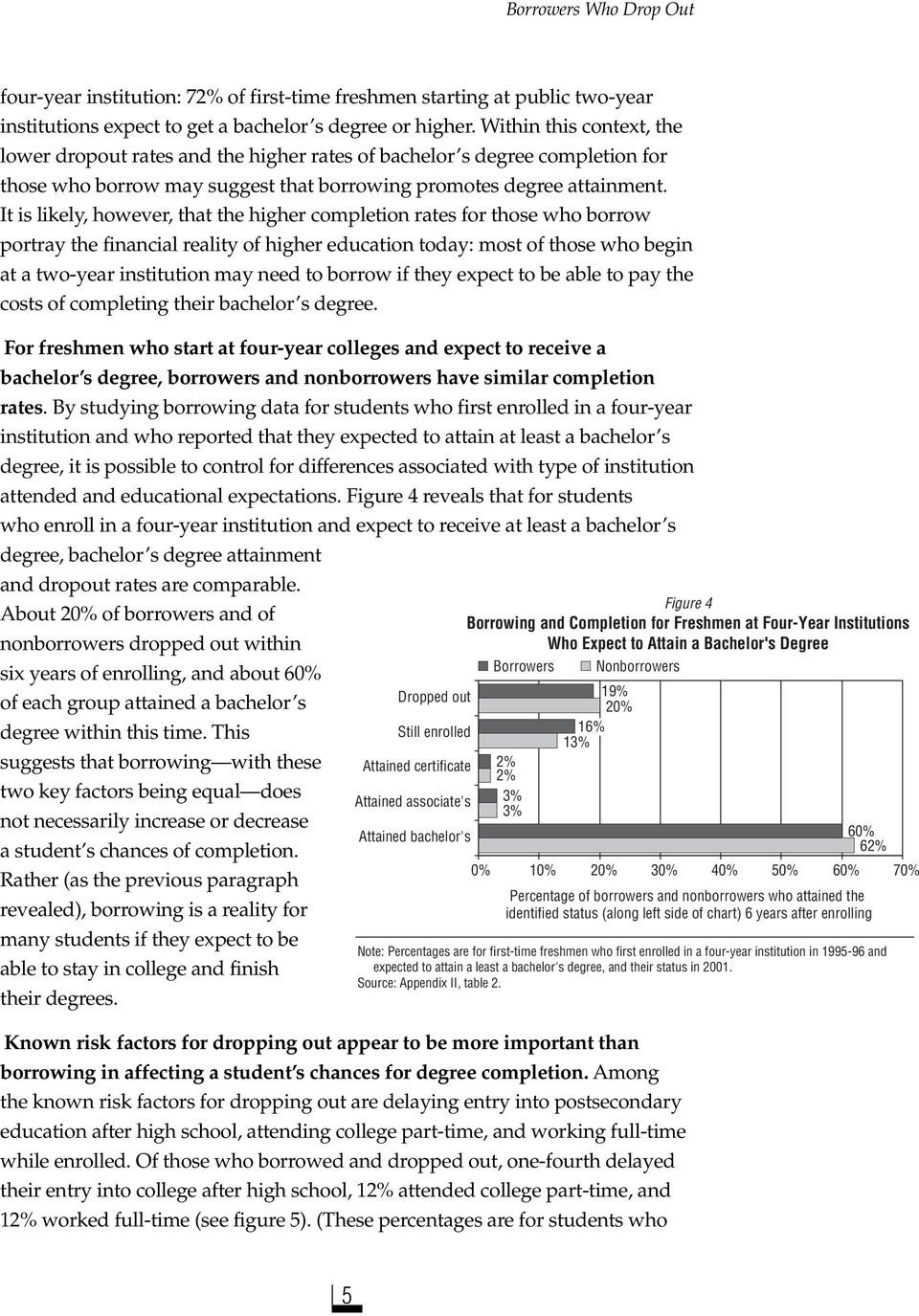
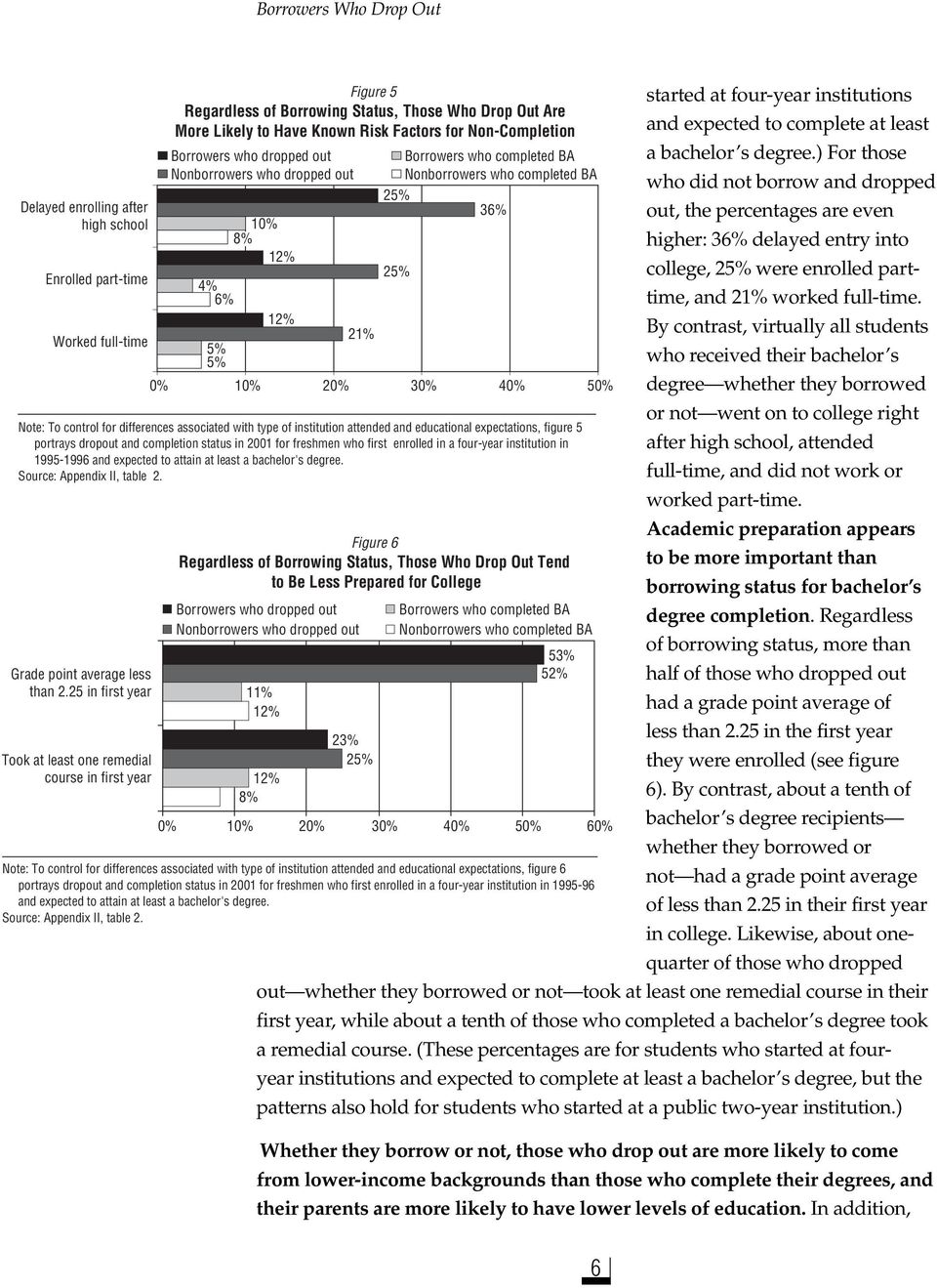
12 Delayed enrolling after high school Enrolled part-time Worked full-time Grade point average less than 2.25 in first year Took at least one remedial course in first year Figure 5 started at four-year institutions Regardless of Borrowing Status, Those Who Drop Out Are More Likely to Have Known Risk Factors for Non-Completion and expected to complete at least Borrowers who completed BA a bachelor s degree.) For those Nonborrowers who completed BA who did not borrow and dropped 25% 36% out, the percentages are even 10% 8% higher: 36% delayed entry into 12% 25% college, 25% were enrolled parttime, 4% 6% and 21% worked full-time. 12% 21% By contrast, virtually all students 5% 5% who received their bachelor s degree whether they borrowed or not went on to college right after high school, attended full-time, and did not work or worked part-time. Academic preparation appears Figure 6 Regardless of Borrowing Status, Those Who Drop Out Tend to Be Less Prepared for College to be more important than borrowing status for bachelor s Borrowers who dropped out Borrowers who completed BA degree completion. Regardless Nonborrowers who dropped out Nonborrowers who completed BA of borrowing status, more than 53% 52% half of those who dropped out 11% 12% had a grade point average of 23% 25% less than 2.25 in the first year they were enrolled (see figure 12% 8% 6). By contrast, about a tenth of bachelor s degree recipients whether they borrowed or not had a grade point average of less than 2.25 in their first year in college. Likewise, about onequarter of those who dropped out whether they borrowed or not took at least one remedial course in their first year, while about a tenth of those who completed a bachelor s degree took a remedial course. (These percentages are for students who started at fouryear institutions and expected to complete at least a bachelor s degree, but the patterns also hold for students who started at a public two-year institution.) Borrowers who dropped out Nonborrowers who dropped out 0% 10% 20% 30% 40% 50% Note: To control for differences associated with type of institution attended and educational expectations, figure 5 portrays dropout and completion status in 2001 for freshmen who first enrolled in a four-year institution in and expected to attain at least a bachelor's degree. Source: Appendix II, table 2. 0% 10% 20% 30% 40% 50% 60% Note: To control for differences associated with type of institution attended and educational expectations, figure 6 portrays dropout and completion status in 2001 for freshmen who first enrolled in a four-year institution in and expected to attain at least a bachelor's degree. Source: Appendix II, table 2. Whether they borrow or not, those who drop out are more likely to come from lower-income backgrounds than those who complete their degrees, and their parents are more likely to have lower levels of education. In addition, 6
13 compared with those who received bachelor s degrees, larger percentages of both borrowers and nonborrowers who dropped out were 20 years of age or older when they enrolled in college, and had children of their own. All of these are known risk factors for dropping out. WHAT HAPPENS TO THOSE WHO BORROW AND DROP OUT? Borrowers who drop out and nonborrowers who drop out have equivalent employment experiences six years after first enrolling, but borrowers who drop out face greater economic hardship due to their debt burden. Comparable percentages of borrowers who dropped out and nonborrowers who dropped out were unemployed in For those who were working, median annual salaries for borrowers who dropped out and nonborrowers who dropped out were identical: $24,000. However, nonborrowers did not have a student debt burden, while borrowers who dropped out had incurred a median debt of $7,000 in undergraduate loans. Moreover, by 2001, nearly one-fourth of borrowers who dropped out (about 90,000) had defaulted on at least one loan, most likely resulting in a bad credit rating and other negative consequences for the borrower. (These figures are based on all first-time freshmen enrolling in , and their employment and loan outcomes in 2001.) Borrowers who drop out after first enrolling in a four-year institution fall far short of realizing the economic rewards that are associated with earning a bachelor s degree. Corroborating much previous research on the benefits of a bachelor s degree, this finding Borrowers who dropped out is based on students who first enrolled in a four-year Unemployed 7% institution in and said In default on loans 2% that they expected to attain at least a bachelor s degree. Compared with students who borrowed and attained a bachelor s degree, those who borrowed and dropped out were more than twice as likely to be unemployed six years later (see figure 7). If they were employed, they were Median student Median salary $10,000 Figure 7 Employment Status and Loan Status for Borrowers at Four-Year Instititutions Who Expect to Attain a Bachelor's Degree Borrowers who completed BA Note: Percentages are for first-time freshmen who first enrolled in a four-year institution in and expected to attain at least a bachelor's degree. Employment status and loan status are for Source: appendix II, table 2. 15% 22% 0% 10% 20% 30% loan amount $17,000 $24,000 $30,500 $- $5,000 $10,000 $15,000 $20,000 $25,000 $30,000 $35,000 7
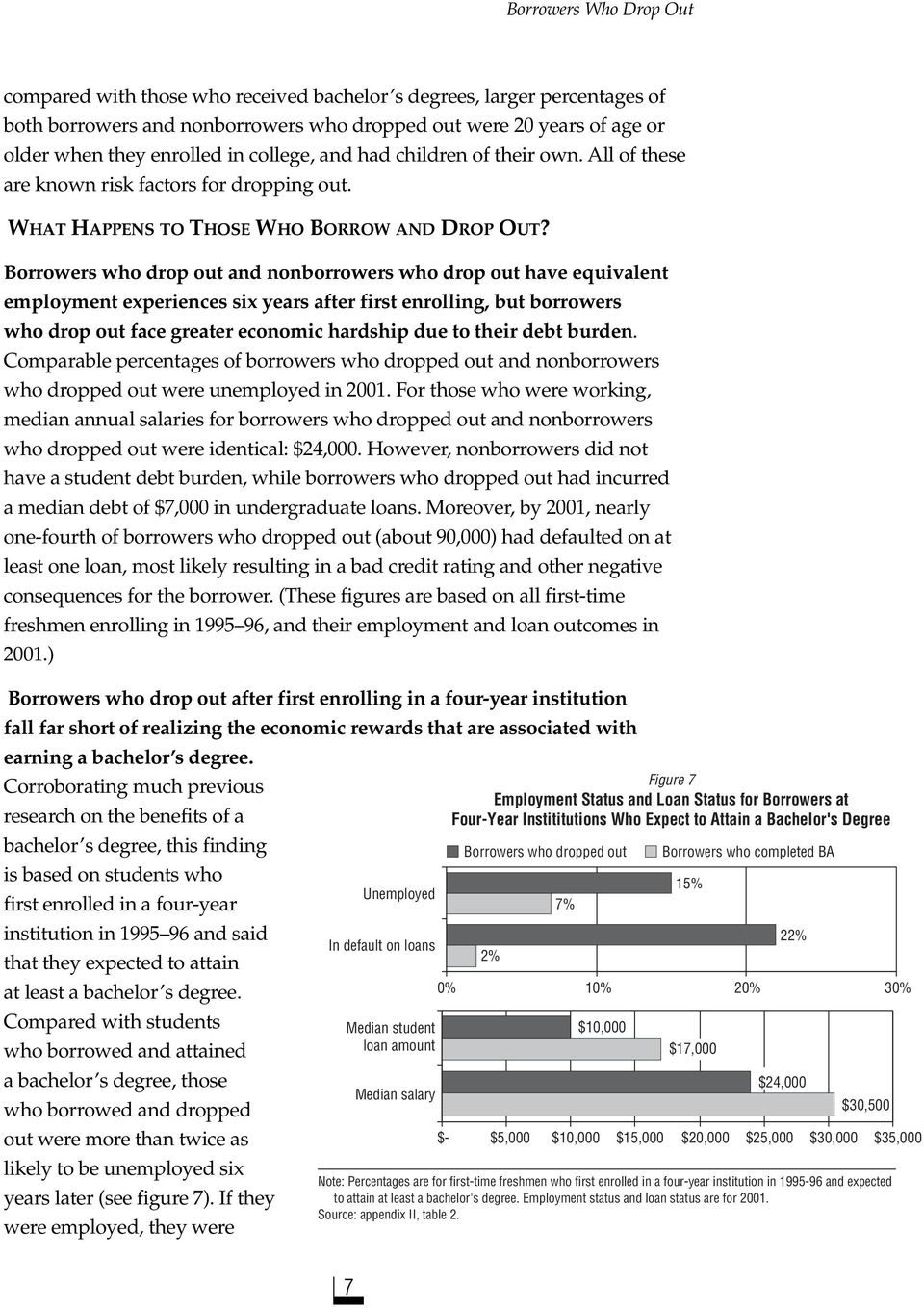
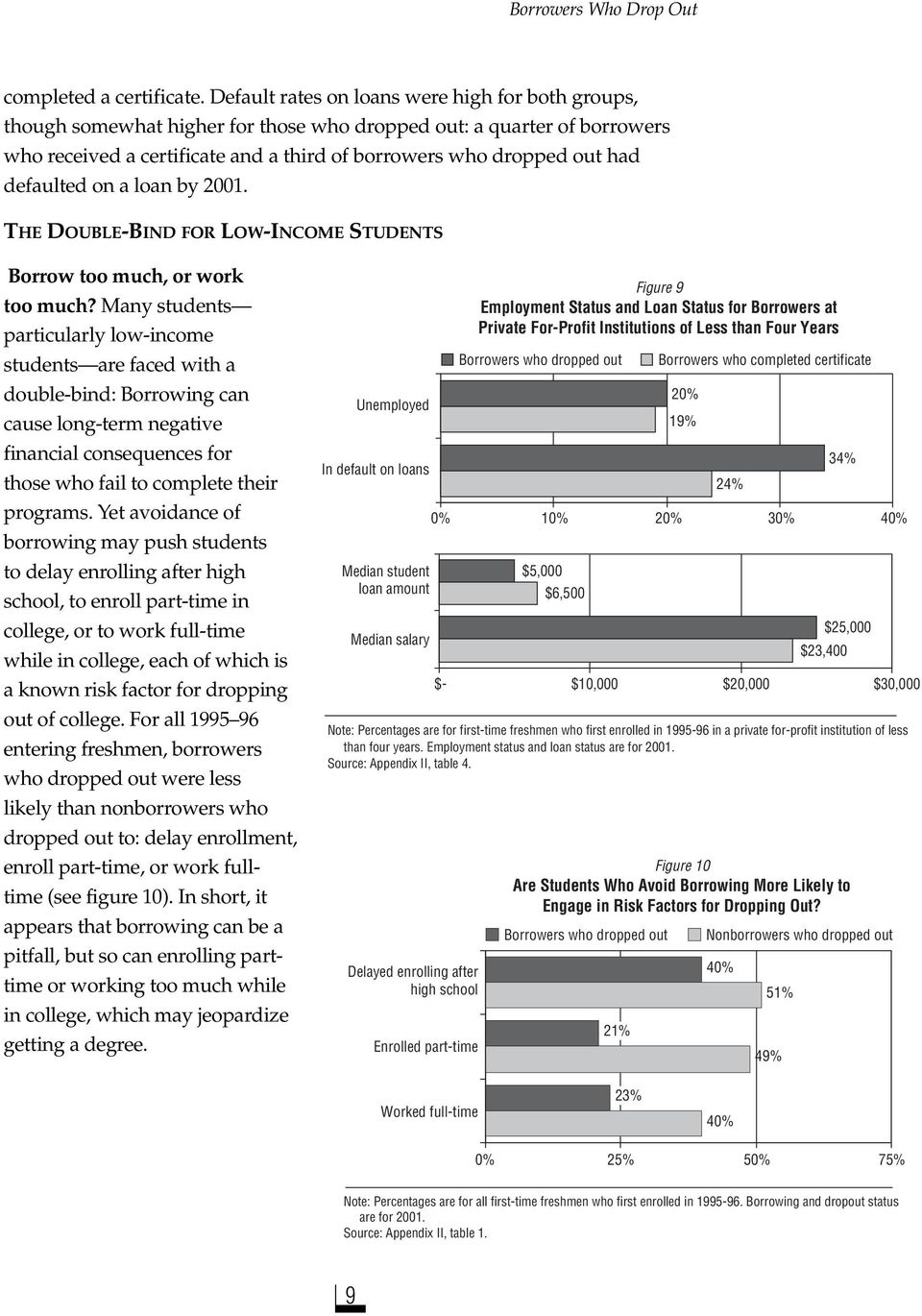
14 Unemployed In default on loans Median student loan amount Median salary much more likely to be in low-paying jobs. Those who attained a bachelor s degree borrowed more than those who dropped out, but 22% of borrowers who dropped out were in default on at least one loan in 2001, while only 2% of borrowers with bachelor s degrees were in default. Borrowers who drop out after first enrolling in a public two-year institution likewise do not realize the economic benefits of an associate s degree. Among those who first enrolled in a public two-year institution in , those who borrowed and dropped out were less likely to be unemployed in 2001 than those who borrowed and received an associate s Figure 8 degree (see figure 8). However, Employment Status and Loan Status for Borrowers at Two-Year Colleges among those who were Borrowers who completed associate's employed, median salaries were 12% higher for associate s degree 21% recipients than for borrowers 25% who had dropped out. Those 6% who borrowed and received an associate s degree averaged $6,000 slightly higher amounts of debt $9,000 and monthly loan repayments $22,000 than those who borrowed $31,200 and dropped out, but the economic hardship imposed by borrowing was greater for those who dropped out than for associate s degree holders. Borrowers who dropped out were four times as likely as associate s degree recipients to be in default on their loans. Borrowers who dropped out 0% 10% 20% 30% $- $5,000 $10,000 $15,000 $20,000 $25,000 $30,000 $35,000 Note: Percentages are for first-time freshmen who first enrolled in a two-year institution in Employment status and loan status are for Source: Appendix II, table 3. Economic outcomes are strikingly parallel for borrowers who drop out and students who earn a certificate for short-term training. Considering only students who first enrolled in a private for-profit institution of less than four years duration, students who received a certificate as a group appear to be no better off six years after first enrolling than borrowers who dropped out (see figure 9). Borrowers who received a certificate were about as likely as borrowers who dropped out to be unemployed in Neither median earnings (for those who were employed) nor median loan amounts were significantly different for borrowers who dropped out versus borrowers who 8

15 completed a certificate. Default rates on loans were high for both groups, though somewhat higher for those who dropped out: a quarter of borrowers who received a certificate and a third of borrowers who dropped out had defaulted on a loan by THE DOUBLE-BIND FOR LOW-INCOME STUDENTS Borrow too much, or work too much? Many students particularly low-income students are faced with a double-bind: Borrowing can cause long-term negative financial consequences for those who fail to complete their programs. Yet avoidance of borrowing may push students to delay enrolling after high school, to enroll part-time in college, or to work full-time while in college, each of which is a known risk factor for dropping out of college. For all entering freshmen, borrowers who dropped out were less likely than nonborrowers who dropped out to: delay enrollment, enroll part-time, or work fulltime (see figure 10). In short, it appears that borrowing can be a pitfall, but so can enrolling parttime or working too much while in college, which may jeopardize getting a degree. Unemployed In default on loans Median student loan amount Median salary Figure 9 Employment Status and Loan Status for Borrowers at Private For-Profit Institutions of Less than Four Years Borrowers who dropped out Borrowers who completed certificate 20% 19% 24% 34% 0% 10% 20% 30% 40% $5,000 $6,500 $23,400 $25,000 $- $10,000 $20,000 $30,000 Note: Percentages are for first-time freshmen who first enrolled in in a private for-profit institution of less than four years. Employment status and loan status are for Source: Appendix II, table 4. Delayed enrolling after high school Enrolled part-time Figure 10 Are Students Who Avoid Borrowing More Likely to Engage in Risk Factors for Dropping Out? Borrowers who dropped out 21% Nonborrowers who dropped out 40% 51% 49% Worked full-time 23% 40% 0% 25% 50% 75% Note: Percentages are for all first-time freshmen who first enrolled in Borrowing and dropout status are for Source: Appendix II, table 1. 9
16 CONSEQUENCES OF THE CURRENT FINANCING SYSTEM The findings in this report suggest that there are some significant, negative, and lasting consequences of the current system of financing higher education in the United States, particularly for students from lower-income and lower-middleincome families. While much of the policy and media attention concerning student debt over the past decade has focused on the increasing debt burden for students at high-priced colleges and universities, the potentially more detrimental effect concerns the debt burden of those students who borrow and do not complete their degrees, since it is the students without degrees who are more likely to face economic hardships in the future. Given the substantial public and private benefits that result from investing in higher education, the principal message of this report is the importance of providing all motivated students with a realistic chance of entering college and persisting to degree completion. This study provides no basis for limiting or discouraging loans to students who may enter postsecondary education with risk factors for dropping out. On the contrary, it appears that providing financial support for these students may improve their opportunities to stay in school and complete their degrees. Based on the findings of this study, policymakers and educational leaders can improve the opportunities for students by focusing on the following priorities: Focus on policies that prepare students better for postsecondary training and that help students understand their educational options, including the appropriate use of loan financing. The findings in this study suggest that those who drop out of college, whether they borrow or not, tend to be less academically prepared than those who receive a degree. Those who drop out also may be less knowledgeable about college (including the implications of borrowing), as suggested by their parents lower levels of education. Make college more affordable so as to reduce dependence on loan financing and student employment, especially for those with the greatest need. Regardless of the type of institution in which students first enroll or whether they borrow, those who drop out are more likely to be from low-income backgrounds than those who complete a degree. Strengthen on-campus support for financially and academically at-risk students, to ensure that all students who enter postsecondary education have the resources to help them succeed in attaining a degree. Not 10

17 surprisingly, borrowers who drop out tend to have lower salaries six years after first enrolling than those who complete an associate s or a bachelor s degree. Borrowers who drop out also tend to have much higher default rates on their loans than borrowers who attain a degree. Students who avoid borrowing by enrolling in a less than four-year institution, by attending part-time, or by working full-time may also realize lower economic attainment, as prior research suggests that students following these patterns are less likely to complete a degree. The new demography of the college-age population gives special urgency to meeting these challenges. This study focuses on the group of students who entered postsecondary education in , many of whom came from disadvantaged family backgrounds and took a nontraditional path to college. The oncoming generation of graduating high school seniors promises to be much larger than the previous group, and to be still more nontraditional and economically disadvantaged. As a society, we need a wide and deep commitment to preparing low-income students for education and training beyond high school, and assuring that price is not a barrier to their success in college. Based on the findings of this study and other pertinent research identified in this report, our increasingly loan-dependent system of financing higher education does not appear to be well suited to this task. As a next step in improving opportunities for success in college, Section III of this report provides specific recommendations for schools, colleges and universities, the states, the federal government, and communities and the private sector in striving toward the three priorities identified above. As with other lasting educational challenges, reducing students dependence on loans and increasing their opportunities for success will require substantial efforts across the educational and policy spectrum. 11

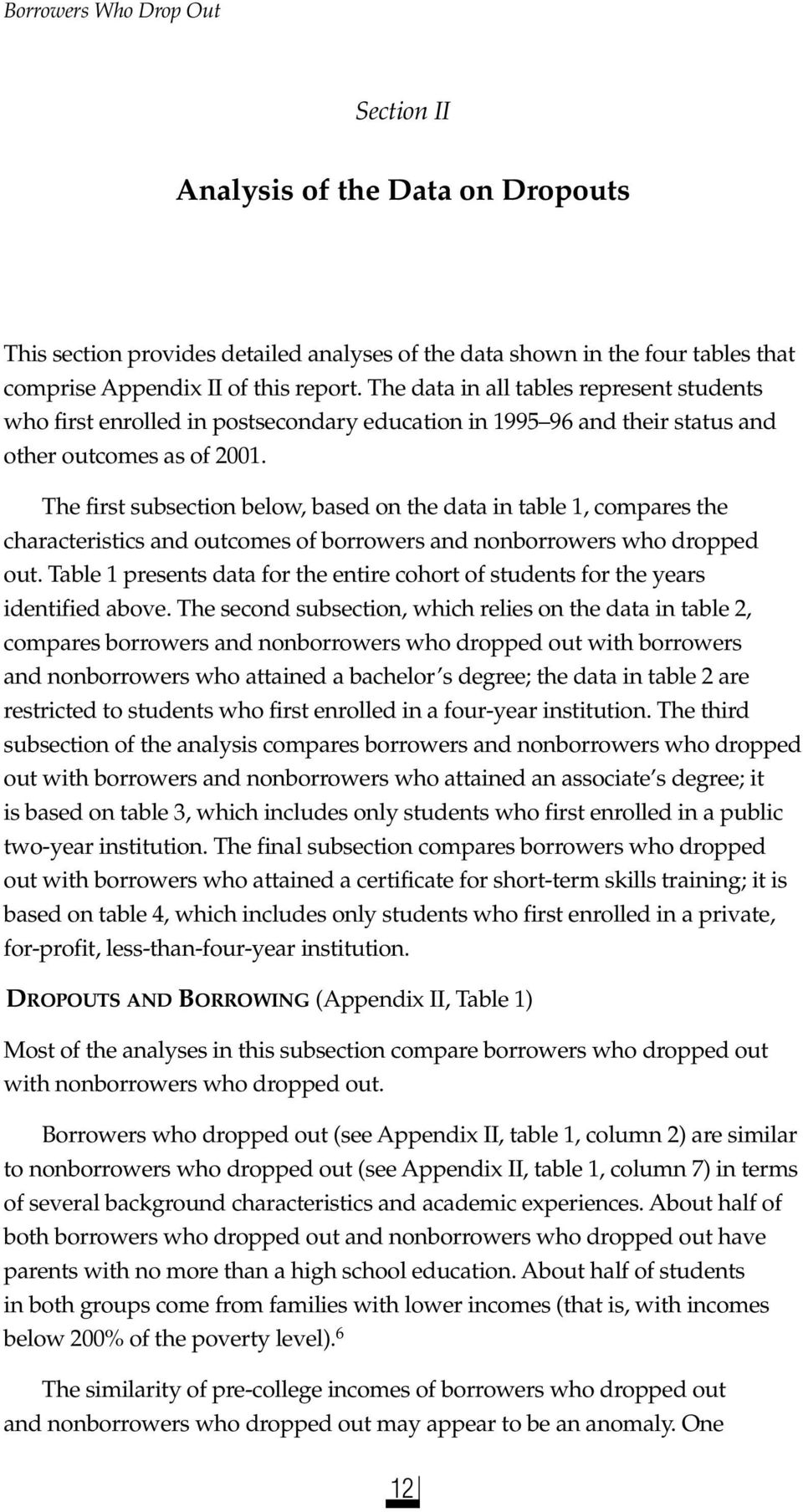
18 Section II Analysis of the Data on Dropouts This section provides detailed analyses of the data shown in the four tables that comprise Appendix II of this report. The data in all tables represent students who first enrolled in postsecondary education in and their status and other outcomes as of The first subsection below, based on the data in table 1, compares the characteristics and outcomes of borrowers and nonborrowers who dropped out. Table 1 presents data for the entire cohort of students for the years identified above. The second subsection, which relies on the data in table 2, compares borrowers and nonborrowers who dropped out with borrowers and nonborrowers who attained a bachelor s degree; the data in table 2 are restricted to students who first enrolled in a four-year institution. The third subsection of the analysis compares borrowers and nonborrowers who dropped out with borrowers and nonborrowers who attained an associate s degree; it is based on table 3, which includes only students who first enrolled in a public two-year institution. The final subsection compares borrowers who dropped out with borrowers who attained a certificate for short-term skills training; it is based on table 4, which includes only students who first enrolled in a private, for-profit, less-than-four-year institution. DROPOUTS AND BORROWING (Appendix II, Table 1) Most of the analyses in this subsection compare borrowers who dropped out with nonborrowers who dropped out. Borrowers who dropped out (see Appendix II, table 1, column 2) are similar to nonborrowers who dropped out (see Appendix II, table 1, column 7) in terms of several background characteristics and academic experiences. About half of both borrowers who dropped out and nonborrowers who dropped out have parents with no more than a high school education. About half of students in both groups come from families with lower incomes (that is, with incomes below 200% of the poverty level). 6 The similarity of pre-college incomes of borrowers who dropped out and nonborrowers who dropped out may appear to be an anomaly. One 12
19 might expect that borrowers would have lower incomes. This finding may be explained by differences between the two groups in terms of the type of institution attended and other enrollment characteristics. For example, many low-income students may choose to avoid borrowing by attending low-cost community colleges. About 75% of nonborrowers who dropped Attended public 2-year college out enrolled first in a public two-year Attended public 4-year college 11% college, compared with only 32% Attended private 15% of borrowers who dropped out (see 4-year college 4% figure 11). Substantially larger shares Attended private 21% of borrowers who dropped out compared with nonborrowers who dropped out first attended a public four-year college, a private four-year college, or a private for-profit institution. for-profit institution 6% Figure 11 Borrowing and Types of College Attended Borrowers who dropped out 32% 30% Nonborrowers who dropped out 0% 10% 20% 30% 40% 50% 60% 70% 80% Note: Percentages are for first-time freshmen who first enrolled in , and their status in Source: Appendix II, table 1. 76% Compared with nonborrowers who dropped out, borrowers who dropped out were more likely to engage in other behaviors that are generally associated with degree completion (see figure 12). Whereas 79% of borrowers who dropped out were enrolled fulltime, only 51% of nonborrowers who dropped out were enrolled full-time. Borrowers who dropped out were also less likely to work full-time while enrolled, compared with nonborrowers who dropped out (23% versus 40%). Enrolled full-time Worked full-time Figure 12 Borrowers Appear to Be More Likely to Enroll Full-Time and Less Likely to Work Full-Time Borrowers who dropped out 23% 40% Nonborrowers who dropped out 51% 79% 0% 10% 20% 30% 40% 50% 60% 70% 80% 90% Note: Percentages are for all first-time freshmen who first enrolled in Borrowing and dropout status are for Source: Appendix II, table 1. As a result of enrollment and financing patterns, the costs of attendance are substantially lower for nonborrowers who dropped out than for borrowers who dropped out. Sixty percent of nonborrowers who dropped out had an attendance-adjusted student budget below $5,000, whereas only 21% of borrowers who dropped out had a budget below this level. 7 Despite differences in enrollment and financing patterns, borrowers who dropped out and nonborrowers who dropped out had similar employment experiences six years after first enrolling. Similar percentages of both groups 13
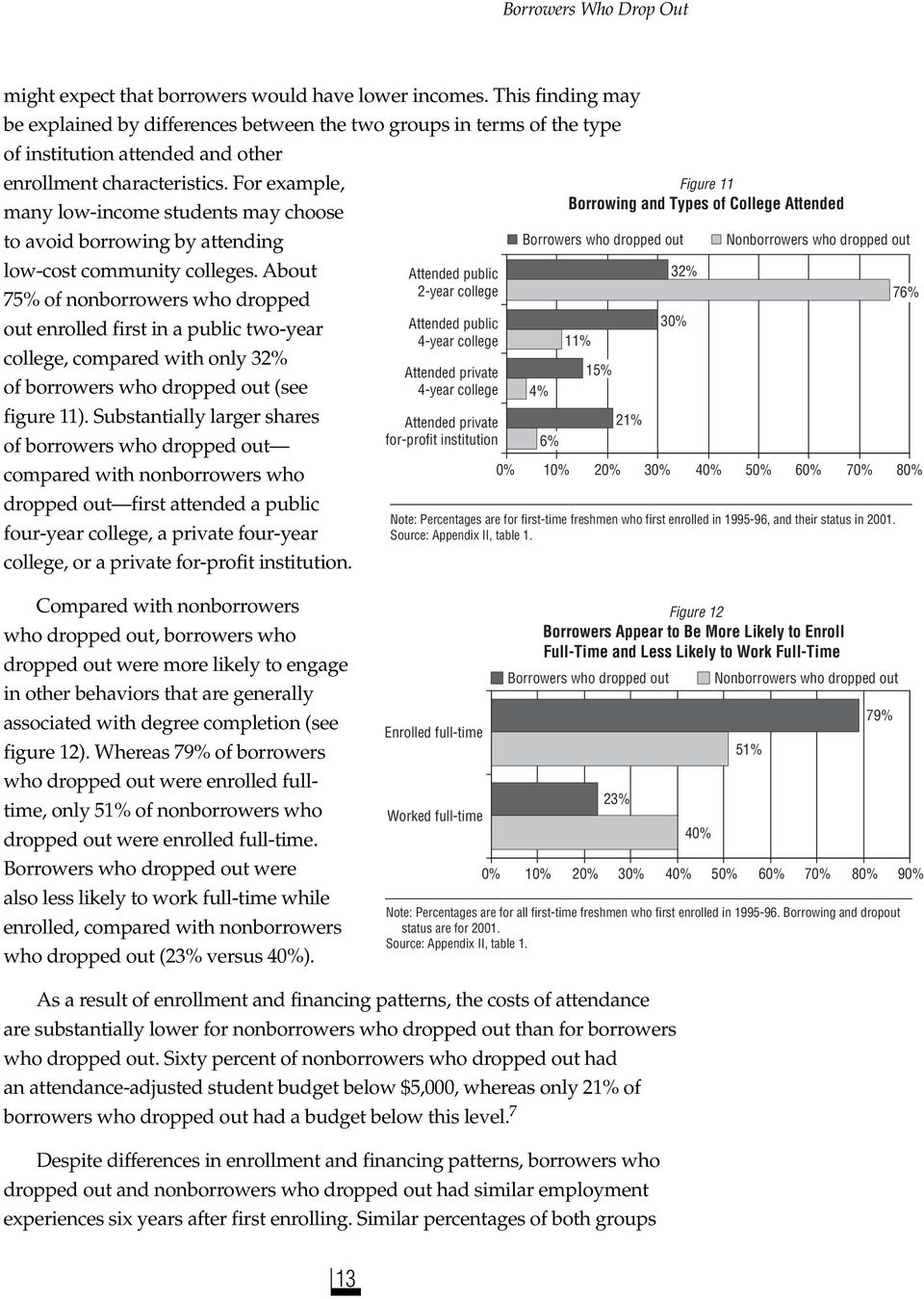
20 were unemployed, and similar percentages of both groups held a job that was closely related to their coursework. Median annual salaries for those who were working were identical: $24,000. But borrowers who dropped out faced greater economic hardship from their participation in postsecondary education than did nonborrowers who dropped out. While both groups had similar labor market experiences in 2001, borrowers who dropped out had additional costs. By 2001, borrowers who dropped out had incurred a median debt from undergraduate loans of $7,000. In addition, 25% of borrowers who dropped out had defaulted on at least one loan. For students who drop out, the economic hardship imposed by borrowing appears to vary by race/ethnicity. Blacks represented a larger share of borrowers who dropped out than of nonborrowers who dropped out (21% versus 14%). Likewise, Asians represented 5% of borrowers who dropped out, but only 2% of nonborrowers who dropped out. In contrast, whites represented a smaller share of borrowers who dropped out than of nonborrowers who dropped out; 61% of borrowers who dropped out were white, while 70% of nonborrowers who dropped out were white. Considering the costs of borrowing against the generally comparable benefits of some college attendance for both borrowers and nonborrowers, it appears that six years after first enrolling in college, borrowers who drop out, as a group, may be worse off financially than nonborrowers who drop out. On the other hand, the above data suggest that many students may avoid borrowing by enrolling at low-cost, public two-year institutions, by attending part-time rather than full-time, and by working full-time while enrolled. While borrowing may have negative financial consequences for students who fail to complete their programs, avoidance of borrowing (including working too much) may jeopardize students chances of getting a degree. DROPOUTS AND BACHELOR S DEGREE RECIPIENTS (Appendix II, Table 2) Previous research using the Beginning Postsecondary Students (BPS) survey data has identified factors associated with low persistence, particularly in relation to the goal of bachelor s degree attainment. 8 To control for differences in two of these factors type of institution attended and educational expectations this subsection is limited to students who first enrolled in a fouryear institution in and who reported in that they expected to attain at least a bachelor s degree. 14
21 Of all students who first enrolled in a four-year institution in and who reported that they aspired to at least a bachelor s degree, two-thirds (67%) had borrowed by For both borrowers and nonborrowers, dropout rates and bachelor s degree attainment rates were comparable. By 2001, about 20% of borrowers and of nonborrowers had dropped out and about 60% of both groups had attained a bachelor s degree (see figure 4, page 5). Students who began postsecondary programs in but had not received a degree and were not enrolled in 2001 (see Appendix II, table 2, columns 2 and 7) generally came from less economically advantaged family backgrounds and took a less traditional path to college than students who attained at least a bachelor s degree by 2001 (see Appendix II, table 2, columns 6 and 11). Borrowers who dropped out came from somewhat less privileged family backgrounds than nonborrowers who dropped out (see Appendix II, table 2, columns 2 and 7). Students who dropped out were more likely than those who completed a bachelor s degree to have parents with low educational attainment levels (see figure 13). Those who borrowed were also somewhat more likely than those who did not borrow to have parents with lower educational attainment levels. Likewise, students who dropped out were more likely than students who completed a degree to be below the poverty level: Among both Parents with high school diploma or less borrowers and nonborrowers who 11% dropped out, about 1 in 5 came from families below the poverty Below poverty level 12% level, compared with about 1 in 6% 10 for borrowers who attained a bachelor s degree, and 1 in 20 for nonborrowers who attained a bachelor s degree (see figure 13). Students who dropped out whether or not they borrowed were more likely to be independent of their parents when they started their postsecondary programs, compared with those who completed a bachelor s degree. Likewise, students who dropped out were also more likely to have already had children of their own when they enrolled, compared with those who completed a bachelor s degree. Figure 13 Those Who Drop Out Are More Likely to Have Parents with Lower Educational Levels and to Be Below the Poverty Level Borrowers who dropped out Nonborrowers who dropped out 19% 18% Borrowers who completed BA Nonborrowers who completed BA 25% 37% 42% 0% 5% 10% 15% 20% 25% 30% 35% 40% 45% Note: Percentages are for first-time freshmen who first enrolled in a four-year institution in and expected to attain at least a bachelor's degree. Borrowing, dropout, and completion status are for Source: Appendix II, table 2. 15
22 Took at least one remedial course in first year Grade point average less than 2.25 in first year It appears that borrowing may promote behaviors associated with degree completion, and avoidance of borrowing may promote behaviors associated with dropping out. Among the known risk factors for dropping out are delaying entry into postsecondary education after high school, attending college part-time, and working too much while enrolled. One-fourth of those who borrowed and later dropped out delayed their entry into college after high school, 12% attended college part-time, and 12% worked full-time (see figure 5, page 6). For those who did not borrow and later dropped out, the percentages are even higher: 36% delayed entry into college, 25% enrolled part-time, and 21% worked full-time. By contrast, virtually all students who received their bachelor s degree whether they borrowed or not went on to college right after high school, attended full-time, and did not work or worked part-time. The attendance-adjusted cost of attendance was higher for borrowers who dropped out than for nonborrowers who dropped out. Twenty-two percent of borrowers who dropped out had budgets of $15,000 or more, while only 8% of nonborrowers who dropped out had budgets at this level or higher. Regardless of whether or not they borrow, students who drop out appear to be less academically prepared for college, and they average lower academic performance in college than those who complete a bachelor s degree. Nearly all students who dropped out, as well as nearly all who completed a bachelor s degree, had received a regular high school diploma prior to enrolling in college. However, higher shares of those who drop out than of those who attain a bachelor s degree took at least Figure 14 one remedial course during their Regardless of Borrowing Status, Those Who Drop Out Tend to Be Less Prepared for College first year of college enrollment Borrowers who dropped out Borrowers who completed BA (see figure 14). Likewise, Nonborrowers who dropped out Nonborrowers who completed BA regardless of borrowing status, 23% more than half of those who 25% dropped out had a grade point 12% average of less than 2.25 in the 8% first year they were enrolled. 53% 52% By contrast, only about a tenth 11% of bachelor s degree recipients 12% had a grade point average of less than 2.25 in their first year of college. 0% 10% 20% 30% 40% 50% 60% Note: Percentages are for first-time freshmen who first enrolled in a four-year institution in and expected to attain at least a bachelor's degree. Borrowing, dropout, and completion status are for Source: Appendix II, table 2. 16
23 Not surprisingly, those students who completed a bachelor s degree fared better in the labor market than those who dropped out, as measured six years after initial enrollment. In 2001, 15% of borrowers who dropped out and 11% of nonborrowers who dropped out were unemployed, compared with about 7% of those who completed a bachelor s degree. Those dropouts who were employed had median incomes of $24,000 to $25,000, while bachelor s degree recipients who were employed had median incomes of $30,500 to $32,000. Likewise, borrowers who dropped out averaged lower amounts of debt and lower monthly repayments than borrowers who completed a bachelor s degree. Borrowers who dropped out had accumulated a median debt of $10,000, while borrowers who completed a bachelor s degree had accumulated $17,000 in debt. Median monthly repayments for those who were repaying their debts were $125 for borrowers who dropped out and $200 for borrowers who completed a bachelor s degree. Among borrowers with earnings, the median debt-to-earnings ratio was lower for those who dropped out than for those who attained a bachelor s degree: 5.3% versus 7.3%. Even with lower debt and repayment burdens, however, borrowers who dropped out had substantially higher default rates on their loans than borrowers who completed a bachelor s degree. In 2001, 22% of borrowers who dropped out, compared with only 2% of borrowers who completed a bachelor s degree, were in default on at least one loan. Those who dropped out whether they borrowed or not were less likely than those who completed a degree to realize the economic benefits associated with attaining a bachelor s degree. However, borrowers who dropped out, as compared with nonborrowers who dropped out, experienced greater economic hardship from their participation in postsecondary education. Median earnings and employment rates were comparable for borrowers who dropped out and nonborrowers who dropped out. But borrowers who dropped out were faced with repaying a median debt of $10,000. In addition, blacks may be disproportionately affected by these patterns, as they represented a higher share of borrowers who dropped out (18%) than of nonborrowers who dropped out (12%), borrowers who completed a bachelor s degree (11%), or nonborrowers who completed a bachelor s degree (3%). 17
24 Delayed enrolling after high school Enrolled part-time Worked full-time DROPOUTS AND ASSOCIATE S DEGREE RECIPIENTS (Appendix II, Table 3) To control for the relationship between the type of institution attended and the likelihood of receiving an associate s degree, the analysis in this subsection is limited to students who first enrolled in a public two-year institution in In contrast to the extensive pattern of borrowing at four-year institutions, only one-third of students who first enrolled in a public two-year institution in had borrowed by However, it may be that borrowing promotes degree attainment, as a higher share of borrowers than of nonborrowers who first enrolled in a public two-year institution attained an associate s degree (24% versus 13%) or a bachelor s degree (21% versus 6%) by 2001 (see figure 3, page 4). Also, a much smaller share of borrowers than of nonborrowers dropped out by 2001 (24% versus 55%). It is likely, however, that the higher completion rates for those who borrow portray the financial reality of higher education today: most of those who begin at a two-year institution need to borrow if they expect to be able to pay the costs of staying in college and completing a degree. Students who attained an associate s but not a bachelor s degree within six years (see Appendix II, table 3, columns 5 and 10) came from backgrounds fairly similar to those who dropped out and received no degree (see Appendix II, table 3, columns 2 and 7). Their parents educational attainment was likely to be low, as well as their family income level. These students were more likely to be financially independent of their parents than were students who attained an associate s degree, and they were Figure 15 more likely to have children of At Public Two-Year Colleges, Avoidance of Borrowing their own. Many delayed entry May Promote Behaviors Associated with Dropping Out into postsecondary programs Borrowers who completed associate's after high school, worked fulltime, or attended college part- 43% 52% time. Borrowers who dropped out Nonborrowers who dropped out 21% 32% 31% 37% 0% 10% 20% 30% 40% 50% 60% 70% 80% Note: Percentages are for first-time freshmen who first enrolled in a two-year institution in Borrowing, dropout, and completion status are for Source: Appendix II, table 3. 39% 45% 57% Behaviors that are known to promote degree attainment are less common among borrowers who dropped out than borrowers who completed an associate s degree, but are more common among borrowers who dropped out than nonborrowers who dropped out (see figure 15). 18
25 That is, as with borrowing among students at four-year institutions, borrowing among students at two-year institutions may promote behaviors that lead to degree completion, while avoidance of borrowing may promote behaviors associated with dropping out. Among those who first enrolled in a public two-year institution, about three-fourths of borrowers who dropped out, and about three-fourths of borrowers who received an associate s degree, said they expected to attain at least a bachelor s degree when they first enrolled. In their first year, borrowers who dropped out and borrowers who completed an associate s degree took remedial courses at nearly the same rate (33% versus 29%). As with students at fouryear institutions, however, inadequate academic achievement appears to be a barrier to degree completion for students at public two-year colleges. Grade point averages for first-year students were higher for those who went on to complete an associate s degree within six years than for those who dropped out regardless of borrowing status (see figure 16). Grade point average less than 2.25 in first year Figure 16 At Public Two-Year Colleges, Those Who Drop Out Tend to Be Less Prepared for College Borrowers who dropped out Nonborrowers who dropped out Borrowers who completed associate's Nonborrowers who completed associate's 51% 0% 10% 20% 30% 40% 50% 60% Note: Percentages are for first-time freshmen who first enrolled in a two-year institution in 1995ñ96. Borrowing, dropout, and completion status are for Source: Appendix II, table 3. 27% 29% 47% In terms of employment and other economic benefits of attending college, it appears that borrowers who drop out after first enrolling in a public twoyear college do not realize the economic benefits associated with an associate s degree (see figure 8, page 8). In 2001, smaller shares of borrowers who dropped out (12%) and nonborrowers who dropped out (15%) were unemployed, in comparison with the share of associate s degree recipients who were unemployed (21%). However, for those who were employed, median salaries appear to be higher for borrowers who attained an associate s degree ($31,200) 9 than for those who dropped out ($22,000). Median salaries appear to be comparable for borrowers who dropped out ($22,000) and nonborrowers who dropped out ($24,000). Students who borrowed and attained an associate s degree had higher 19
26 Dropped out Still enrolled certificate associate's bachelor's Borrowers 1% 0% 3% 4% 5% median debt levels than those who borrowed and dropped out ($9,000 versus $6,000); they also had higher monthly repayment obligations ($120 versus $110). Among borrowers with earnings, the median debt-to-earnings ratio was identical for those with an associate s degree and those who dropped out (4.8%). Nonetheless, default rates on loans were substantially higher for borrowers who dropped out than for borrowers with an associate s degree (25% versus 6%). Borrowers who dropped out not only faced greater risk of defaulting on their loans than borrowers who attained an associate s degree, but also experienced greater economic hardship than nonborrowers who dropped out. Unemployment rates and median salaries were comparable for borrowers and nonborrowers who dropped out, but borrowers who dropped out faced a greater cost: a median debt of $6,000. As with students at four-year institutions, blacks may be disproportionately affected by these patterns, as they represented a higher share of borrowers who dropped out (21%) than of nonborrowers who dropped out (14%), borrowers who completed an associate s degree (9%), and nonborrowers who completed an associate s degree (2%). DROPOUTS AND CERTIFICATE RECIPIENTS (Appendix II, Table 4) This subsection compares the profiles of students who borrow and drop out (see Appendix II, table 4, column 2) with the profiles of students who borrow and attain a certificate for Figure 17 short-term skills training (see Borrowing and Completion for Freshmen at Private, For-Profit, Less-Than-Four-Year Institutions Appendix II, table 4, column 4). This analysis is limited to Nonborrowers individuals who first enrolled 32% 40% in a private, for-profit, lessthan-four-year postsecondary education institution in % % 52% 0% 20% 40% 60% Percentage of borrowers and nonborrowers who attained the identified status 6 years after enrolling Note: Percentages are for first-time freshmen who first enrolled in a private, for-profit, less-than-four-year postsecondary education institution in , and their status in Source: Appendix II, table 4. Of these students, more than two-thirds (68%) had borrowed by 2001 (see figure 1, page 3). Although similar proportions of borrowers (54%) and nonborrowers (52%) attained a certificate by 2001, a somewhat smaller 20
27 share of borrowers (32%) than nonborrowers (40%) dropped out (see figure 17). Among borrowers who first entered a private, for-profit, less-than-fouryear institution in , those who dropped out and those who earned a certificate within six years shared similarly disadvantaged background characteristics (see figure 18). (In fact, these characteristics generally described all students who first enrolled in this type of institution.) Nearly half of borrowers who dropped out, nonborrowers who dropped out, and borrowers who completed certificates came from families below the poverty level. Well over a majority of borrowers who dropped out, nonborrowers who dropped out, and borrowers who completed certificates had parents with no more than a high school education. Large percentages Borrowers who dropped out of borrowers who dropped out, nonborrowers who dropped out, Below poverty level and borrowers who completed certificates were single parents, Parents with high school diploma or less age 30 or older, and financially 32% independent. The vast majority Single parents 32% of borrowers who dropped out, 22% nonborrowers who dropped out, Age 30 or older 25% 21% and borrowers who completed certificates delayed entry into Financially independent postsecondary education Delayed enrolling after after high school. Substantial high school proportions of borrowers who No regular high school dropped out, nonborrowers who 30% diploma 25% dropped out, and borrowers who completed certificates did not have a regular high school diploma when they enrolled. Labor market outcomes are generally better for borrowers who attain an associate s degree or a bachelor s degree, as compared with their counterparts who drop out. However, this does not appear to hold true for students who receive certificates, when considering the economic prospects of students six years after they first enrolled (see figure 9, page 9). Borrowers who earned a certificate were about as likely as borrowers who dropped out to be unemployed in 2001 (about 20% were unemployed). For those who were Figure 18 Similar Disadvantaged Characteristics for Those Who Dropped Out and Borrowers Who Completed a Certificate Nonborrowers who dropped out Borrowers who completed certificate 48% 44% 49% 69% 64% 71% 68% 70% 67% 72% 68% 75% 0% 10% 20% 30% 40% 50% 60% 70% 80% 90% Note: Figures are for all first-time freshmen who first enrolled in a private, for-profit, less-than-four-year postsecondary education institution in 1995ñ96. Borrowing, dropout, and completion status are for Source: Appendix II, table 4. 35% 35% 21
28 employed, median salaries were roughly comparable for borrowers who dropped out and borrowers who completed certificates ($25,000 versus $23,400). The absence of an advantage in the labor market for borrowers who completed certificates, as compared with borrowers who dropped out, may be attributable to other differences between borrowers who completed certificates and borrowers who dropped out. For example, borrowers who completed certificates, as compared with borrowers who dropped out, were more likely to be female (71% versus 59%) and Hispanic (26% versus 13%). Borrowers who completed certificates accumulated similar amounts of debt as borrowers who dropped out (median debt of $6,500 versus $5,000). Likewise, median debt-to-earning ratios were not significantly different for borrowers who completed certificates and borrowers who dropped out (5.5% versus 4.7%). High percentages of both groups defaulted on their loans: 24% of borrowers who completed certificates defaulted on at least one loan, and 34% of borrowers who dropped out did so. The generally parallel outcomes between borrower dropouts and certificate recipients are based on broad indicators in the Beginning Postsecondary Students (BPS) survey data. Examination of differences among specific types of certificate training (or over longer periods of time) is limited due to the absence of appropriate data. An exploratory analysis using the best available measures in the Beginning Postsecondary Students (BPS) study suggests that loan default rates vary by program of study. Among borrowers who first enrolled in a private, for-profit, less-than-four-year institution and who received a certificate, loan default rates ranged from about 10% in technology and mechanical fields, to 18% in cosmetology, 21% in nursing and allied health fields, and 30% in business and secretarial fields. 22
29 Section III Policy Implications and Recommendations BENEFITS OF A BACHELOR S DEGREE These analyses highlight a neglected aspect of loan financing in higher education: students who borrow and do not complete their programs. The findings also put in bold relief a compelling factor that has been well documented: attaining a bachelor s degree has significant economic benefits. Students who fall short of a bachelor s degree average significantly lower rewards in terms of employment, annual salaries, and default rates than those who persist and reach this educational goal. This is not to say that the bachelor s degree is the only ticket to success for individuals or for the national economy. Going to college means many things and produces many outcomes. Our society needs a range of subbaccalaureate opportunities, providing skills and credentials for surviving in a changing world, and our culture needs to confer more status and value on nonbaccalaureate education. 10 Yet the findings in this report show that, at least as measured six years after first enrolling, those who have a bachelor s degree have considerably more leverage in today s job market than those who do not. This finding is consistent with other data showing the persistent earnings gap over a lifetime between bachelor s degree recipients and individuals with a high school diploma or less. 11 Bureau of Labor Statistics data show, too, that our future economy will require a workforce with increasingly high levels of skills and training. Millions of new jobs are projected to require a four-year degree or more in the coming decade. 12 UNCERTAIN BENEFITS OF SHORT-TERM, FOR-PROFIT TRAINING A more cautionary word is in order regarding the economic value of short-term certificate training provided by for-profit schools. Our analyses reveal that a large number of students who enrolled in private, for-profit, less-than-four-year institutions defaulted on their loans whether they dropped out or earned their certificate. The economic returns and associated default rates appear to 23
30 vary by types of certificate training, but students who consider enrolling in and borrowing to pay for such programs should be aware of the possible risks and of the best available estimates of career earning potential. Likewise, state and federal governments have a responsibility to help insure the quality and utility of such training, and thereby to protect consumer interests. THE ONCOMING TIDAL WAVE OF STUDENTS On grounds of both equity and economics, America must fulfill its promise of opportunity through higher education. This means giving all motivated students an equal shot at realizing their potential. It means narrowing the wide socioeconomic gaps between those who do and those who do not successfully attend and graduate from our nation s colleges and universities. In particular, it means improving the chances of success for low-income, first-generation, and nontraditional students, since they face a wider array of obstacles than other students, and therefore need additional assistance. The new demography of college-age students gives special urgency to meeting this challenge. The baby boom that followed World War II produced an explosion of college enrollments in the 1960s and 1970s. Now, the children of the baby boomers are arriving at college age; this group of high school graduates will yield a somewhat smaller but still dramatic expansion in the college-age population over the next 15 years. By one estimate there will be 2.6 million more undergraduates on campus in 2015 than there are today a product of the baby boom echo, rising immigration, and more adult learners. 13 This study has focused on the cohort of students who entered postsecondary education in , many of whom came from disadvantaged family backgrounds and took a nontraditional path to college. The oncoming generation of students promises to be still more nontraditional and economically disadvantaged. According to projections from the U.S. Census, this generation will be more ethnically diverse than ever, and the fastest growth will come from groups in our society that have traditionally been poorer than the general population, and more educationally at-risk. 14 As a society, we will need a much wider and deeper commitment to reaching, motivating, and preparing low-income students for college and assuring that price is not a barrier for their persistence and success in college. Based on the findings of this study and other pertinent research, our nation s increasingly loan-dependent system of financing higher education may not be well suited to this task. 24
31 As we have seen in this study, low-income students rely more heavily on loans than do other students. Some low-income students appear to use loans to make choices that are generally associated with higher rates of bachelor s degree attainment, including: initially enrolling in a four-year institution, attending full-time, and working no more than part-time. Other low-income students make choices that are known to reduce the probability of degree completion, including: enrolling in a less-than-four-year institution, enrolling part-time, and working full-time. When students are also inadequately prepared for the academics of college, the likelihood of dropping out of college increases. As a result of being inadequately prepared, significant numbers of both groups that is, borrowers and nonborrowers wind up with no credential. All students who fail to complete their degree programs incur the costs that are associated with attending their programs, including the costs of attendance and lost earnings. But in addition to these costs, those who borrow have a student debt to repay and a risk of default. RECOMMENDATIONS The findings in this report suggest that there are some significant, negative, and lasting consequences of the current system of financing higher education in the United States, particularly for students from lower-income and lowermiddle-income families. Given the substantial public and private benefits that result from investing in higher education, the principal message of this report is the importance of providing all motivated students with a realistic chance of entering college and persisting to degree completion. This study provides no basis for limiting or discouraging loans to students who may enter postsecondary education with risk factors for dropping out. On the contrary, it appears that providing financial support for these students may improve their opportunities to stay in school and complete their degrees. The most promising approach in remedying the problems encountered by borrowers who drop out is to adopt policies and programs to help all students who are at risk for dropping out. The findings of this research suggest that policymakers and educational leaders should focus their efforts on three important priorities: Focus on policies that prepare students better for postsecondary training, and that help students understand their educational options, including the appropriate use of loan financing. The findings in this study suggest that those who drop out of college, whether they borrow or not, tend to be less academically prepared than those who receive 25
32 a degree. Those who drop out also may be less knowledgeable about college (including the implications of borrowing), as suggested by their parents lower levels of education. Make college more affordable so as to reduce dependence on loan financing and student employment, especially for those with the greatest need. Regardless of the type of institution in which students first enroll or whether they borrow, those who drop out are more likely to be from low-income backgrounds than those who complete a degree. Strengthen on-campus support for financially and academically at-risk students, to ensure that all students who enter postsecondary education have the resources to help them succeed in attaining a degree. Not surprisingly, borrowers who drop out tend to have lower salaries six years after first enrolling than those who complete an associate s or a bachelor s degree. Borrowers who drop out also tend to have much higher default rates on their loans than borrowers who attain a degree. Students who avoid borrowing by enrolling in a less-than-four-year institution, by attending part-time, or by working full-time may also realize lower economic attainment, as prior research suggests that students following these patterns are less likely to complete a degree. Schools, colleges and universities, the states, the federal government, and communities and the private sector can advance the above objectives through the following commitments: What High Schools Can Do Prepare students to succeed in college. To address the problems identified in this report concerning borrowers who drop out (and college graduation rates in general), a large part of the responsibility rests with the nation s schools: to strengthen academic preparation and reduce the wide gaps in achievement across socioeconomic groups. In turn, this challenge presents a question of political will. In this rich nation of ours, can we find the means and the will to set high standards for all students and help students meet them? Inform, motivate, and counsel students about their postsecondary options. College-bound students need to understand the risks and benefits of investing in their college education and, if necessary, financing the costs through loans and work. 26
33 What Colleges, Universities, and For-Profit Institutions Can Do Contain costs and prices. In Measuring Up 2004, the National Center for Public Policy and Higher Education concluded that higher education was less affordable for students and their families in 2004 than in 1994, at least in part because increases in the costs of attending college exceeded increases in family income. 15 Award the bulk of institutional grant and scholarship aid on the basis of need. Institutional aid should be directed to academically qualified but financially needy students, not those who can afford to pay without assistance. While some low-income students forego higher education because of inadequate financial resources, others attempt to pay the costs of their education by borrowing or making choices that reduce the probability of completing the degree (for example, enrolling in a lessthan-four-year institution, attending part-time, or working full-time). Invest more heavily in early guidance and partnerships with K 12 schools. It is in the enlightened self-interest of postsecondary institutions to expand the pool of potential applicants who are academically qualified for and knowledgeable about college. Reaching out to ensure that at-risk students are academically and financially prepared for college is a longterm investment that will pay off for higher education and for the nation. Help students from all backgrounds adjust to campus life and persist in their studies. Institutions need to allocate resources to help at-risk students, and to intervene early when students may be having academic, financial, and other problems. Where needed, schools should provide intensive basic course work, especially in the freshman year, and establish transfer policies that help students retain academic credit. For lessendowed schools, funds from state, federal, and private sources may be especially important for creating safety nets and support services on campus. 16 Help students understand the risks and benefits of their financing options. Some students arrive on campus without the necessary financial literacy or maturity to make sound choices about borrowing, credit cards, work, housing, and academic course loads and selections. Colleges should make a greater effort to link academic and financial advising, thereby helping students to choose financing strategies that support their academic goals
34 What States Can Do Emphasize need-based grant aid over no-need merit scholarships and tax-advantaged tuition financing. State merit scholarships do not, by and large, expand access or help those with the greatest need. Neither do state tuition-tax incentives. State governments should examine the purposes of state financial aid programs to ensure that financially needy students have the resources that are necessary not only to enroll, but also to persist in their degree programs. Increase need-based grant aid in step with tuition increases. Too often, tuition and fees end up as a filler or balancer in the state budget process, and too often, student financial aid is an afterthought. Policymakers need to look at these interrelated decisions and establish linkages among them in relation to state policy goals. Expand efforts to help at-risk students in middle and secondary schools prepare for postsecondary education. For example, in the wake of California s Proposition 209, which eliminated affirmative action programs in that state, California increased its investment in early guidance and outreach in an effort to pursue the same broad goals of access and campus diversity. State K 16 partnerships may also improve academic preparation for college. All states need to make deeper and wider commitments to ensure the successful transition of students from K 12 schools to postsecondary education. Increase support for Education Opportunity Programs (EOP) and other state programs that provide resources to institutions to help students stay on track to their certificate or degree. This support is especially important for institutions that do not already have built-in, multiple support services for students who may be at risk. What the Federal Government Can Do Restore the value of Pell Grants and other need-based grant assistance. This is the most direct action the federal government can take to improve the affordability of college for low- and moderate-income students and reduce their dependence on loans and work. Help students manage their debt. As the principal sponsor of student loans, the federal government should build coalitions of schools, colleges, lenders, loan guarantors, and state agencies to curb unnecessary borrowing and ease repayment burdens, especially for borrowers facing economic hardship. Students need help in evaluating how much they 28
35 should borrow based on their career interests, likely career outcomes, and potential ability to repay. Borrowers who are beginning the repayment phase should be counseled on forbearance and deferment opportunities and flexible repayment options, including income-based as well as extended and graduated repayment plans. Make borrowing less expensive by lowering or eliminating origination fees. Students who borrow under federal programs do not benefit from the entire amount borrowed, since, as authorized by federal law, the costs of administering federal loans are paid in part by student fees. Help to link financial aid with early guidance and mentoring. The most successful early college awareness and intervention programs in the private sector combine a promise to pay tuition with academic and motivational support to keep students in school and on track for college. Recent experience with the federal GEAR-UP Program suggests that making this linkage on a large scale in a government program is not an easy task. But federal policymakers should persist in supporting such efforts. Increase funding for on-campus Student Support Services. As with similar programs at the state level, this federal program provides resources to colleges to help low-income and nontraditional students persist in their studies. 18 What Communities and the Private Sector Can Do Consider directing more scholarship assistance toward students with the greatest financial need. Most private scholarships are awarded based on merit with no consideration of financial need. Scholarship sponsors should consider targeting aid on academically promising, low- and moderate-income students those who might not otherwise be able to afford higher education, rather than on students who would likely be able to finance the costs of college even without the scholarship aid. Go beyond scholarships alone. Private and community-based efforts should be comprehensive in fostering student access and success. Financial aid should be combined with support for counseling and outreach to help prepare students not only to enroll, but also to persist to degree completion. 29
36 Appendix I Data Sources and Definitions Borrowers who drop out have been overlooked, perhaps in part because data have not been available to document the extent of the problem until recently. The principal source of data for our research is the longitudinal Beginning Postsecondary Students (BPS) study, which the National Center for Education Statistics (NCES) of the U.S. Department of Education inaugurated in 1989 and repeated in the 1990s. The BPS:90/94 tracks degree attainment, enrollment status, and financing patterns among a sample of students who were firsttime freshmen in with follow-ups in 1992 and 1994 (five years after the students matriculated). Tracking a sample of students who first enrolled in some type of postsecondary education between May 1, 1995, and April 30, 1996, with follow-ups in 1998 and 2001 (six years after first enrolling), the BPS: 96/01 provides more recent and more useful information. With the application of the appropriate NCES-derived longitudinal weight, the BPS:96/01 sample is representative of the population of first-year students who first enrolled in postsecondary institutions in the United States and Puerto Rico in One improvement in the BPS:96/01 over the BPS:90/94 is the incorporation of data from the National Student Loan Data System (NSLDS), which the federal government has developed over the past decade. The NSLDS provides data on each loan transaction for each member of the BPS sample who received a loan. Although not perfect, NSLDS provides the best and most comprehensive information available on borrowing, loan status, and repayment. While NSLDS provides information on each loan transaction, we use data from the most recent transaction to determine repayment status. A strength of the BPS data sets is the inclusion of data from multiple sources, including the NSLDS as well as institutional records and student interviews. A related weakness, however, is that sometimes the data on borrowing conflict. When student-reported data conflict with NSLDS data, we used NSLDS as the source. When various student-reported data pertaining to loans conflict, we rely on the BPS-derived composite of whether a student reported ever receiving a loan. 30
37 Students start out at many different places in postsecondary education (in terms of their institution first attended, aspirations, backgrounds, and so on), and likewise leave postsecondary education with a diversity of outcomes. No database can pinpoint all the variables in this fluid process of educational opportunity. Using the BPS, our analysis presents the best available proxy indicators, at specific points in time. Two further limitations of the data used in this study should be noted. One is that the BPS includes only students who attended a postsecondary institution. A useful policy question might be whether people who borrowed and dropped out are better off than those who did not go to postsecondary education at all. Unfortunately the data do not allow us to address that question directly. Second, the data set we use has only minimal data on the pre-college academic qualifications of students in the sample. Some of our results suggest that dropping out may be correlated with pre-college qualifications, and the level of pre-college qualifications is likely correlated with other variables, such as socioeconomic status and the quality of high schools students attended. Lacking controls on school quality, however, we are unable to disentangle these effects. This is also an unavoidable limitation of the data set. DEFINITIONS Students Who Drop Out In the BPS:96/01 data set, we assume that students who drop out are those who, at the time of the second follow-up (six years after matriculating), had not obtained a degree or certificate and were not enrolled (Appendix II, columns 2 and 7 in all tables). Some individuals in these categories may only be stop outs. That is, at some point some of these students may re-enroll and complete their programs. To that extent, dropouts may be overstated. On the other hand, some students who have not achieved a degree and are still enrolled (columns 3 and 8) may never attain that goal. To that extent, dropouts may be understated. Due to lack of later follow-up data, we make the rough assumption that these two effects offset each other. 20 We refer to students who are not currently enrolled and have not attained a credential or degree by 2001 as students who have dropped out. Default Status on Loans Federal student loans are considered in default when a payment has not been made after a certain number of days (270 days for loans with monthly 31
38 payments, and 330 days for loans with less frequent payments). In this study, we present default rates based on the number of borrowers who were in default on at least one loan in 2001, six years after first enrolling. Using this marker understates defaults to the extent that borrowers may have defaulted after Whenever they default, borrowers are subject to significant consequences, including a damaged credit rating, ineligibility for additional federal student aid, payment of collection costs, wage garnishment, and legal action. At the same time, our data analysis overstates defaults to the extent that defaulted loans in 2001 may have been rehabilitated back into repayment status and eventually repaid. Under federal rules, rehabilitation requires that the borrower makes 12 on-time, full monthly payments, and rehabilitation removes the default completely from the borrower s credit record. The federal loan programs include mechanisms that are designed to help borrowers avoid default, including deferment of loan repayment for such reasons as unemployment, military service, volunteer work, teaching full-time in an area with teacher shortages, and disability. Borrowers who die or become totally and permanently disabled may have their federal loans cancelled. 32
39 Appendix II Source Tables 33
40 Characteristic Number % of total number % of borrowers % of nonborrowers Demographic characteristics Gender Male Female Race/ethnicity White, non-hispanic Black, non-hispanic Hispanic Asian/Pacific islander American Indian/Alaskan native Other Non-resident alien Age in years 19 years years 30 years or older Marital status in 1995 Single, no children (dependent) Single, no children (independent) Single with children Married, no children Married with children Parents' education High school grad or less Some postsecondary education Bachelor's degree Advanced degree Dependency status Dependent Independent Dependent family income in 1994 Less than $25,000 $25,000 - $44,999 $45,000 - $69,999 $70,000 and above Table 1 Characteristics of 1995/96 first-time freshmen by enrollment attainment and borrowing status in 2001 Borrowed by 2001 Did Not Borrow (1) (2) Dropped out* (3) No attainment, still enrolled (4) certificate (5) associate's (6) bachelor's (7) Dropped out* (8) No attainment, still enrolled 3,237, , , , , , , , (9) certificate 206, (10) associate's 147, (11) bachelor's 331,
41 Percent of poverty level 1995 Less than 100% poverty level 100% to 199% poverty level 200% to 399% poverty level 400% to 599% poverty level 600% or higher poverty level Percent of poverty level 1995 Median Mean Std. Deviation Parents paid tuition No Yes Academic and enrollment characteristics Highest degree ever expected Don't know Less than bachelor's Bachelor's degree Advanced degree Received diploma or passed GED Received a high school diploma Passed a general educational degree Received a high school completion cert. Did not complete high school First institution attended Public 4-year Private 4-year Public 2-year Private for-profit Other Transfer status Did not transfer Transferred Delayed enrollment No, did not delay Delayed Worked while enrolled Did not work Worked part-time Worked full-time (35 hrs+/wk)
42 Characteristic Enrollment intensity Full-time Part-time GPA first year enrolled Under to 3.25 Over 3.25 Remedial courses taken No Yes Cost of attendance and financial aid student budget (attendance-adjusted) Less than $5,000 $5,000 - $9,999 $10,000 - $14,999 $15,000 or more grant, None Less than $1,500 $1,500 - $2,999 $3,000 or more Cumulative UG loans, Less than $7,000 $7,000 - $14,000 $14,001 - $20,000 More than $20,000 amount UG loans, Median Mean Standard deviation Current employment status Currently employed, 2001 Not employed Employed Current job requires deg/cert 2001 No Yes Table 1 (Continued) Characteristics of 1995/96 first-time freshmen by enrollment attainment and borrowing status in 2001 Borrowed by 2001 Did Not Borrow (1) (2) Dropped out* (3) No attainment, still enrolled (4) certificate (5) associate's (6) bachelor's (7) Dropped out* (8) No attainment, still enrolled ,000 14,480 11,380 7,000 11,191 11,673 8,000 11,586 10,779 6,000 8,895 7,784 10,000 11,885 9,367 16,000 17,586 11, (9) certificate (10) associate's (11) bachelor's
43 Current job related to coursework Closely related Somewhat related Not related First job title 2001 Clerical Craftsman, repair, laborer Sales or customer service Legal, medical, education, human services Engineering, scientist, technical, computer Manager Other Annual salary for current job, 2001 (those currently employed) Less than $20,000 $20,000 - $35,000 Over $35, Annual salary for current job, 2001 (those currently employed) Median Mean Standard deviation 26,520 28,686 14,544 24,000 25,917 13,149 22,880 24,495 13,674 25,000 26,486 13,063 28,000 29,524 12,757 30,000 31,621 14,190 24,000 26,712 15,631 26,000 30,334 15,892 24,000 26,172 13,105 26,000 27,618 11,464 31,500 33,837 14,751 Repayment and Default Currently repaying loans No Yes Average monthly loan repayment Less than $75/month $75 - $149 per month $150 - $249/month $250/month or more Monthly loan repayment Median Mean Standard deviation Ratio: Debt to earnings Median Mean Standard deviation In default No Yes * Dropped out is defined as not enrolled, no attainment at the time of the survey. Source: Analyses of BPS:96/01. Notes: Analyses weighted by B01LWT2. Borrowing defined by student self-reported borrowing by 2001 and loan status from National Student Loan Data System (NSLDS) records. When self-reported and NSLDS data conflict, NSLDS data are used. When selfreported data conflict, the BPS composite reflecting whether a student received a loan by 2001 is used. Poverty level is a variable calculated by the National Center for Education Statistics (NCES) based on family size, total income, and dependency status. Table cells without a value have a sample size too small for reliable estimation. 37
44 Characteristic Number % of total number % of borrowers % of nonborrowers Demographic characteristics Gender Male Female Race/ethnicity White, non-hispanic Black, non-hispanic Hispanic Asian/Pacific islander American Indian/Alaskan native Other Non-resident alien Age in years 19 years years 30 years or older Marital status in 1995 Single, no children (dependent) Single, no children (independent) Single with children Married, no children Married with children Parents' education High school grad or less Some postsecondary education Bachelor's degree Advanced degree Dependency status Dependent Independent Dependent family income in 1994 Less than $25,000 $25,000 - $44,999 $45,000 - $69,999 $70,000 and above Table 2 Characteristics of 1995/96 first-time freshmen who first enrolled in a four-year institution and expected to attain at least a bachelor's degree by enrollment attainment and borrowing status in 2001 Borrowed by 2001 Did Not Borrow (1) (2) Dropped out* (3) No attainment, still enrolled (4) certificate (5) associate's (6) bachelor's (7) Dropped out* (8) No attainment, still enrolled 1,071, , , , , , , , (9) certificate 7, (10) associate's 10, (11) bachelor's 220,
45 Percent of poverty level 1995 Less than 100% poverty level 100% to 199% poverty level 200% to 399% poverty level 400% to 599% poverty level 600% or higher poverty level Percent of poverty level 1995 Median Mean Std. Deviation Parents paid tuition No Yes Academic and enrollment characteristics Highest degree ever expected Don't know Less than bachelor's Bachelor's degree Advanced degree Received diploma or passed GED Received a high school diploma Passed a general educational degree Received a high school completion cert. Did not complete high school First institution attended Public 4-year Private 4-year Public 2-year Private for-profit Other Transfer status Did not transfer Transferred Delayed enrollment No, did not delay Delayed Worked while enrolled Did not work Worked part-time Worked full-time (35 hrs+/wk)
46 Characteristic Enrollment intensity Full-time Part-time GPA first year enrolled Under to 3.25 Over 3.25 Remedial courses taken No Yes Cost of attendance and financial aid student budget (attendance-adjusted) Less than $5,000 $5,000 - $9,999 $10,000 - $14,999 $15,000 or more grant, None Less than $1,500 $1,500 - $2,999 $3,000 or more Cumulative UG loans, Less than $7,000 $7,000 - $14,000 $14,001 - $20,000 More than $20,000 amount UG loans, Median Mean Standard deviation Current employment status Currently employed, 2001 Not employed Employed Current job requires deg/cert 2001 No Yes Table 2 (Continued) Characteristics of 1995/96 first-time freshmen who first enrolled in a four-year institution and expected to attain at least a bachelor's degree by enrollment attainment and borrowing status in 2001 Borrowed by 2001 Did Not Borrow (1) (2) Dropped out* (3) No attainment, still enrolled (4) certificate (5) associate's (6) bachelor's (7) Dropped out* (8) No attainment, still enrolled ,000 16,905 12,163 10,000 14,301 14,607 11,000 15,230 13,383 5,250 10,026 10,571 12,000 12,162 7,828 17,000 18,103 11, (9) certificate (10) associate's (11) bachelor's
47 Current job related to coursework Closely related Somewhat related Not related First job title 2001 Clerical Craftsman, repair, laborer Sales or customer service Legal, medical, education, human services Engineering, scientist, technical, computer Manager Other Annual salary for current job, 2001 (those currently employed) Less than $20,000 $20,000 - $35,000 Over $35, Annual salary for current job, 2001 (those currently employed) Median Mean Standard deviation 30,000 31,698 15,469 24,000 26,843 13,724 25,740 27,464 12,770 25,000 26,575 9,712 25,500 29,109 12,528 30,500 32,773 14,665 25,000 28,261 17,583 24,960 32,137 22,284 27,040 35,387 19,335 27,000 29,530 14,453 32,000 35,022 16,258 Repayment and Default Currently repaying loans No Yes Average monthly loan repayment Less than $75/month $75 - $149 per month $150 - $249/month $250/month or more Monthly loan repayment Median Mean Standard deviation Ratio: Debt to earnings Median Mean Standard deviation In default No Yes * Dropped out is defined as not enrolled, no attainment at the time of the survey. Source: Analyses of BPS:96/01. Notes: Analyses weighted by B01LWT2. Borrowing defined by student self-reported borrowing by 2001 and loan status from National Student Loan Data System (NSLDS) records. When self-reported and NSLDS data conflict, NSLDS data are used. When selfreported data conflict, the BPS composite reflecting whether a student received a loan by 2001 is used. Poverty level is a variable calculated by the National Center for Education Statistics (NCES) based on family size, total income, and dependency status. Table cells without a value have a sample size too small for reliable estimation. 41
48 Table 3 Characteristics of 1995/96 first-time freshmen who first enrolled in a public two-year institution by enrollment attainment and borrowing status in 2001 Borrowed by 2001 Did Not Borrow Characteristic (1) (2) Dropped out* (3) No attainment, still enrolled (4) certificate (5) associate's (6) bachelor's (7) Dropped out* (8) No attainment, still enrolled (9) certificate (10) associate's Number % of total number % of borrowers % of nonborrowers 1,452, , , , , , , , , , Demographic characteristics Gender Male Female Race/ethnicity White, non-hispanic Black, non-hispanic Hispanic Asian/Pacific islander American Indian/Alaskan native Other Non-resident alien Age in years 19 years years 30 years or older Marital status in 1995 Single, no children (dependent) Single, no children (independent) Single with children Married, no children Married with children Parents' education High school grad or less Some postsecondary education Bachelor's degree Advanced degree Dependency status Dependent Independent Dependent family income in 1994 Less than $25,000 $25,000 - $44,999 $45,000 - $69,999 $70,000 and above (11) bachelor's 54,
49 Percent of poverty level 1995 Less than 100% poverty level 100% to 199% poverty level 200% to 399% poverty level 400% to 599% poverty level 600% or higher poverty level Percent of poverty level 1995 Median Mean Std. Deviation Parents paid tuition No Yes Academic and enrollment characteristics Highest degree ever expected Don't know Less than bachelor's Bachelor's degree Advanced degree Received diploma or passed GED Received a high school diploma Passed a general educational degree Received a high school completion cert. Did not complete high school First institution attended Public 4-year Private 4-year Public 2-year Private for-profit Other Transfer status Did not transfer Transferred Delayed enrollment No, did not delay Delayed Worked while enrolled Did not work Worked part-time Worked full-time (35 hrs+/wk)
50 Table 3 (Continued) Characteristics of 1995/96 first-time freshmen who first enrolled in a public two-year institution by enrollment attainment and borrowing status in 2001 Borrowed by 2001 Did Not Borrow Characteristic (1) (2) Dropped out* (3) No attainment, still enrolled (4) certificate (5) associate's (6) bachelor's (7) Dropped out* (8) No attainment, still enrolled (9) certificate (10) associate's Enrollment intensity Full-time Part-time GPA first year enrolled Under to 3.25 Over Remedial courses taken No Yes Cost of attendance and financial aid student budget (attendance-adjusted) Less than $5,000 $5,000 - $9,999 $10,000 - $14,999 $15,000 or more grant, None Less than $1,500 $1,500 - $2,999 $3,000 or more Cumulative UG loans, Less than $7,000 $7,000 - $14,000 $14,001 - $20,000 More than $20, amount UG loans, Median Mean Standard deviation 8,000 10,817 9,069 6,000 8,634 8,104 6,000 8,186 6,545 6,000 8,834 7,654 9,000 11,436 9,612 11,000 14,729 10,181 Current employment status Currently employed, 2001 Not employed Employed Current job requires deg/cert 2001 No Yes (11) bachelor's
51 Current job related to coursework Closely related Somewhat related Not related First job title 2001 Clerical Craftsman, repair, laborer Sales or customer service Legal, medical, education, human services Engineering, scientist, technical, computer Manager Other Annual salary for current job, 2001 (those currently employed) Less than $20,000 $20,000 - $35,000 Over $35, Annual salary for current job, 2001 (those currently employed) Median Mean Standard deviation 25,000 27,074 13,891 22,000 24,072 11,945 19,760 21,986 12,578 28,000 33,110 14,566 31,200 29,854 12,858 26,000 27,634 11,752 24,000 26,683 15,619 26,000 30,371 14,712 22,880 25,800 11,663 26,000 27,918 11,276 30,000 30,991 8,537 Repayment and Default Currently repaying loans No Yes Average monthly loan repayment Less than $75/month $75 - $149 per month $150 - $249/month $250/month or more Monthly loan repayment Median Mean Standard deviation Ratio: Debt to earnings Median Mean Standard deviation In default No Yes * Dropped out is defined as not enrolled, no attainment at the time of the survey. Source: Analyses of BPS:96/01. Notes: Analyses weighted by B01LWT2. Borrowing defined by student self-reported borrowing by 2001 and loan status from National Student Loan Data System (NSLDS) records. When self-reported and NSLDS data conflict, NSLDS data are used. When selfreported data conflict, the BPS composite reflecting whether a student received a loan by 2001 is used. Poverty level is a variable calculated by the National Center for Education Statistics (NCES) based on family size, total income, and dependency status. Table cells without a value have a sample size too small for reliable estimation. 45
52 Characteristic Number % of total number % of borrowers % of nonborrowers Demographic characteristics Gender Male Female Race/ethnicity White, non-hispanic Black, non-hispanic Hispanic Asian/Pacific islander American Indian/Alaskan native Other Non-resident alien Age in years 19 years years 30 years or older Marital status in 1995 Single, no children (dependent) Single, no children (independent) Single with children Married, no children Married with children Parents' education High school grad or less Some postsecondary education Bachelor's degree Advanced degree Dependency status Dependent Independent Dependent family income in 1994 Less than $25,000 $25,000 - $44,999 $45,000 - $69,999 $70,000 and above Table 4 Characteristics of 1995/96 first-time freshmen who first enrolled in a private, for-profit, less-than-four-year institution by enrollment attainment and borrowing status in 2001 Borrowed by 2001 Did Not Borrow (1) (2) Dropped out* (3) No attainment, still enrolled (4) certificate (5) associate's (6) bachelor's (7) Dropped out* (8) No attainment, still enrolled (9) certificate 332,900 71, , , , , , , , (10) associate's 5, (11) bachelor's 46
53 Percent of poverty level 1995 Less than 100% poverty level 100% to 199% poverty level 200% to 399% poverty level 400% to 599% poverty level 600% or higher poverty level Percent of poverty level 1995 Median Mean Std. Deviation Parents paid tuition No Yes Academic and enrollment characteristics Highest degree ever expected Don't know Less than bachelor's Bachelor's degree Advanced degree Received diploma or passed GED Received a high school diploma Passed a general educational degree Received a high school completion cert. Did not complete high school First institution attended Public 4-year Private 4-year Public 2-year Private for-profit Other Transfer status Did not transfer Transferred Delayed enrollment No, did not delay Delayed Worked while enrolled Did not work Worked part-time Worked full-time (35 hrs+/wk)
54 Table 4 (Continued) Characteristics of 1995/96 first-time freshmen who first enrolled in a private, for-profit, less-than-four-year institution by enrollment attainment and borrowing status in 2001 Borrowed by 2001 Did Not Borrow Characteristic (1) (2) Dropped out* (3) No attainment, still enrolled (4) certificate (5) associate's (6) bachelor's (7) Dropped out* (8) No attainment, still enrolled (9) certificate Enrollment intensity Full-time Part-time GPA first year enrolled Under to 3.25 Over Remedial courses taken No Yes Cost of attendance and financial aid student budget (attendance-adjusted) Less than $5,000 $5,000 - $9,999 $10,000 - $14,999 $15,000 or more grant, None Less than $1,500 $1,500 - $2,999 $3,000 or more Cumulative UG loans, Less than $7,000 $7,000 - $14,000 $14,001 - $20,000 More than $20, amount UG loans, Median Mean Standard deviation 8,000 9,968 8,024 5,000 8,491 6,905 12,500 11,451 9,599 6,500 6,668 4,284 14,000 14,817 8,476 13,000 16,921 12,209 Current employment status Currently employed, 2001 Not employed Employed Current job requires deg/cert 2001 No Yes (10) associate's (11) bachelor's 48
55 Current job related to coursework Closely related Somewhat related Not related First job title 2001 Clerical Craftsman, repair, laborer Sales or customer service Legal, medical, education, human services Engineering, scientist, technical, computer Manager Other Annual salary for current job, 2001 (those currently employed) Less than $20,000 $20,000 - $35,000 Over $35, Annual salary for current job, 2001 (those currently employed) Median Mean Standard deviation 24,000 25,128 12,283 25,000 26,059 11,413 27,040 21,772 9,606 23,400 24,470 12,044 26,288 27,744 10,246 32,000 33,409 6,801 18,000 22,782 11,628 19,344 25,087 10,458 22,000 25,663 15,093 21,000 20,561 6,265 Repayment and Default Currently repaying loans No Yes Average monthly loan repayment Less than $75/month $75 - $149 per month $150 - $249/month $250/month or more Monthly loan repayment Median Mean Standard deviation Ratio: Debt to earnings Median Mean Standard deviation In default No Yes * Dropped out is defined as not enrolled, no attainment at the time of the survey. Source: Analyses of BPS:96/01. Notes: Analyses weighted by B01LWT2. Borrowing defined by student self-reported borrowing by 2001 and loan status from National Student Loan Data System (NSLDS) records. When self-reported and NSLDS data conflict, NSLDS data are used. When selfreported data conflict, the BPS composite reflecting whether a student received a loan by 2001 is used. Poverty level is a variable calculated by the National Center for Education Statistics (NCES) based on family size, total income, and dependency status. Table cells without a value have a sample size too small for reliable estimation. 49
56 Endnotes 1 See William T. Grant Foundation, Commission on Work, Family and Citizenship, The Forgotten Half: Pathways to Success for America s Youth and Young Families (Washington, D.C.: 1988), and American Youth Policy Forum, The Forgotten Half Revisited (Washington, D.C.: 1998). 2 Although most college graduates are able to pay off their loans, minority students and students from low-income backgrounds take longer to do so, and have significantly higher debt burden than do white students and students from more affluent families. See Derek V. Price, Educational Debt Burden Among Student Borrowers, Research in Higher Education 45:7 (Nov. 2004). 3 Kevin Carey, A Matter of Degrees: Improving Graduation Rates in Four-Year Colleges and Universities (Washington, D.C.: Education Trust, 2004), p For a full definition of dropouts, see Appendix I. We define students who have dropped out as those who were no longer enrolled in 2001 and did not have a certificate or degree. 5 For a full definition of dropouts, see Appendix I. We define students who have dropped out as those who were no longer enrolled in 2001 and did not have a certificate or degree. 6 Poverty levels are derived by the National Center for Education Statistics based on family size, total income, and dependency status. For dependent students, the parent s family income is considered. For independent students, the student s own family income is considered. The following table displays poverty threshold by family size in Poverty Threshold by Family Size Family Size Poverty Threshold 1 $ 7, , , , , , , , ,280 Source: Beginning Postsecondary Students Codebook 7 The attendance-adjusted budget is adjusted to reflect intensity of enrollment (e.g., fulltime versus part-time, and length of year enrolled). 8 See Lutz Berkner, Shirley He, and Emily Forrest Cataldi, Descriptive Summary of Students: Six Years Later, National Center for Education Statistics Report
57 151 (Washington, D.C.: U.S. Department of Education, National Center for Education Statistics, 2003). 9 A t-test suggests that the mean salaries for borrowers who drop out and borrowers who complete an associate s degree are statistically equivalent. 10 See A Young Person s Guide to Learning and Earning (Washington, D.C.: Center for Education Policy, and American Youth Policy Forum, 1998). 11 Sandy Baum and Kathleen Payea, Education Pays 2004: The Benefits of Higher Education for Individuals and Society (New York: The College Board, 2004). 12 See Kevin Carey, A Matter of Degrees, p Anthony P. Carnevale and Richard A. Fry, Crossing the Great Divide: Can We Achieve Equity When Generation Y Goes to College? (Princeton, NJ: Educational Testing Service, 2000), p Samuel M. Kipp III, Demographic Trends and Their Impact on the Future of the Pell Grant Program, in Lawrence E. Gladieux, ed., Memory, Reason, Imagination: A Quarter Century of Pell Grants (New York: College Board, 1998), pp National Center for Public Policy and Higher Education, Measuring Up 2004: The National Report Card on Higher Education (San Jose, CA: 2004). 16 A recent national study on student retention found that institutions with high graduation rates had a strong commitment, shared by dedicated administrators and faculty, to helping students persist in their programs. However, the study also showed that money trumped all other factors in the ability of institutions to engage and retain students While affluent institutions can pile resource after resource to make the difference in who comes, who stays, and who completes college, many other institutions settle for what they can muster from stretched budgets. See Watson Scott Swail, Legislation to Improve Graduation Rates Could have the Opposite Effect, The Chronicle of Higher Education Review, January 23, See Jacqueline E. King, Crucial Choices: How Students Financial Decisions Affect Their Academic Success (Washington, D.C.: American Council on Education, 2002). 18 According to the Pell Institute for the Study of Opportunity in Postsecondary Education, current funding is adequate to help only a small fraction of college campuses across the country. 19 For more information on the BPS:96/01 methodology, please refer to J. Wine, R.E. Heuer, S.C. Wheeless, T.L. Francis, J.W. Franklin, and K.M. Dudley, Beginning Postsecondary Students Longitudinal Study: (BPS:1996/2001) Methodology Report, NCES Report (Washington, D.C.: U.S. Department of Education, Office of Educational Research and Improvement, 2002). 20 A study of bachelor s degree attainment within 10 years of graduating from high school among 1982 high school graduates who expected to earn at least a bachelor s degree, first enrolled in a four-year institution, and completed at least 10 credits by September 1993 shows that degree attainment rates were substantially higher for those who were continuously enrolled than for those who interrupted their enrollment (84% versus 42%). Alexander C. McCormick and C. Dennis Carroll, Credit Production and Degree Progress Toward the Bachelor s Degree: An Analysis of Postsecondary Transcripts for Beginning Students at 4-Year Institutions, NCES Report (Washington, D.C.: U.S. Department of Education, 1999). 51
58 ABOUT THE AUTHORS Lawrence Gladieux is an independent education policy consultant in northern Virginia. He has written widely on topics related to education and government, including issues of equity, access, affordability, and the impact of technology on the delivery of higher education. His publications include: co-authoring (with Arthur M. Hauptman) The College Aid Quandary: Access, Quality, and the Federal Role (Brookings Institution, 1995); co-editing Memory, Reason, Imagination: A Quarter Century of Pell Grants (College Board, 1998); and co-authoring (with Scott Swail) The Virtual University and Educational Opportunity (College Board, 1999). In addition, Gladieux has written for the popular press, including the New York Times, the Washington Post, and the Los Angeles Times; for journals such as the Chronicle of Higher Education, and Academe; and for organizations, including the Academy of Political Science, the American Council on Education, and the Institute for Educational Leadership. Gladieux served as executive director of the Washington Office of the College Board from 1981 to 1993, and as the organization s executive director for policy analysis from 1993 to He received his B.A. cum laude in government from Oberlin College, and his master s from the Woodrow Wilson School of Public and International Affairs at Princeton University. 52
59 Laura Perna is an assistant professor of higher education at the University of Maryland, College Park. Her scholarship uses an integrated theoretical approach to understand the ways in which individual characteristics, social structures, and public policies separately and together enable and restrict the ability of women, racial/ethnic minorities, and individuals of lower socioeconomic status to obtain the economic, social, and political opportunities that are associated with two aspects of higher education: access as a student and employment as a faculty member. Her research has been supported by grants from the American Education Research Association, the Association for Institutional Research, the University of Maryland General Research Board, and the Lumina Foundation for Education. For her research she received the 2003 Promising Scholar/ Early Career Achievement Award from the Association for the Study of Higher Education. She holds a B.A. in psychology and a B.S. in economics from the University of Pennsylvania, and a master s of public policy and Ph.D. in education from the University of Michigan. 53
60 THE NATIONAL CENTER FOR PUBLIC POLICY AND HIGHER EDUCATION The National Center for Public Policy and Higher Education promotes public policies that enhance Americans opportunities to pursue and achieve high-quality education and training beyond high school. As an independent, nonprofit, nonpartisan organization, the National Center prepares action-oriented analyses of pressing policy issues facing the states and the nation regarding opportunity and achievement in higher education including two- and four-year, public and private, for-profit and nonprofit institutions. The National Center communicates performance results and key findings to the public, to civic, business and higher education leaders, and to state and federal leaders who are poised to improve higher education policy. Established in 1998, the National Center is not affiliated with any institution of higher education, with any political party, or with any government agency; it receives continuing, core financial support from a consortium of national foundations that includes The Pew Charitable Trusts, The Atlantic Philanthropies, and The Ford Foundation. 152 North Third Street, Suite 705, San Jose, California Telephone: FAX: National Center Publications The National Center publishes: Reports and analyses commissioned by the National Center, Reports and analyses written by National Center staff, National Center Policy Reports that are approved by the National Center s Board of Directors, and National CrossTalk, a quarterly publication. The following National Center publications as well as a host of other information and links are available at Single copies of most of these reports are also available from the National Center. Please FAX requests to and ask for the report by publication number. Borrowers Who Drop Out: A Neglected Aspect of the College Student Loan Trend, by Lawrence Gladieux and Laura Perna (May 2005, #05-2). This report examines the experiences of students who borrow to finance their education, but do not complete their postsecondary programs. Using the latest comprehensive data, this report compares borrowers who drop out with other groups of students, and provides recommendations on policies and programs that would better prepare, support, and guide students especially low-income students in completing their degrees. Case Study of Utah Higher Education, by Kathy Reeves Bracco and Mario Martinez (April 2005, #05-1). This report examines state policies and performance in the areas of enrollment and affordability. Compared with other states, Utah has been able to maintain a system of higher education that is more affordable for students, while enrollments have almost doubled over the past 20 years. 54
61 Measuring Up 2004: The National Report Card on Higher Education (September 2004). Measuring Up 2004 consists of a national report card for higher education (report #04-5) and 50 state report cards (#04-4) The purpose of Measuring Up 2004 is to provide the public and policymakers with information to assess and improve postsecondary education in each state. For the first time, this edition of Measuring Up provides information about each state s improvement over the past decade. Visit to download Measuring Up 2004 or to make your own comparisons of state performance in higher education. Technical Guide Documenting Methodology, Indicators, and Data Sources for Measuring Up 2004 (November 2004, #04-6). Ensuring Access with Quality to California s Community Colleges, by Gerald C. Hayward, Dennis P. Jones, Aims C. McGuinness, Jr., and Allene Timar, with a postscript by Nancy Shulock (April 2004, #04-3). This report finds that enrollment growth pressures, fee increases, and recent budget cuts in the California Community Colleges are having significant detrimental effects on student access and program quality. The report also provides recommendations for creating improvements that build from the state policy context and from existing promising practices within the community colleges. Public Attitudes on Higher Education: A Trend Analysis, 1993 to 2003, by John Immerwahr (February 2004, #04-2). This public opinion survey, prepared by Public Agenda for the National Center, reveals that public attitudes about the importance of higher education have remained stable during the recent economic downturn. The survey also finds that there are some growing public concerns about the costs of higher education, especially for those groups most affected, including parents of high school students, African Americans, and Hispanics. Responding to the Crisis in College Opportunity (January 2004, #04-1). This policy statement, developed by education policy experts at Lansdowne, Virginia, proposes short-term emergency measures and long-term priorities for governors and legislators to consider for funding higher education during the current lean budget years. Responding to the Crisis suggests that in 2004 the highest priority for state higher education budgets should be to protect college access and affordability for students and families. With Diploma in Hand: Hispanic High School Seniors Talk about their Future, by John Immerwahr (June 2003, #03-2). This report by Public Agenda explores some of the primary obstacles that many Hispanic students face in seeking higher education, barriers which suggest opportunities for creative public policy to improve college attendance and completion rates among Hispanics. Purposes, Policies, Performance: Higher Education and the Fulfillment of a State s Public Agenda (February 2003, #03-1). This essay is drawn from discussions of higher education leaders and policy officials at a roundtable convened in June 2002 at New Jersey City University on the relationship between public purposes, policies, and performance of American higher education. Measuring Up 2002: The State-by-State Report Card for Higher Education (October 2002, #02-7). This report card, which updates the inaugural edition released in 2000, grades each state on its performance in five key areas of higher education. Measuring Up 2002 also evaluates each state s progress in relation to its own results from Technical Guide Documenting Methodology, Indicators, and Data Sources for Measuring Up 2002 (October 2002, #02-8). State Policy and Community College Baccalaureate Transfer, by Jane V. Wellman (July 2002, #02-6). Recommends state policies to energize and improve higher education performance regarding transfers from community colleges to four-year institutions. 55
62 Fund for the Improvement of Postsecondary Education: The Early Years (June 2002, #02-5). The Fund for the Improvement of Postsecondary Education (FIPSE) attained remarkable success in funding innovative and enduring projects during its early years. This report, prepared by FIPSE s early program officers, describes how those results were achieved. Losing Ground: A National Status Report on the Affordability of American Higher Education (May 2002, #02-3). This national status report documents the declining affordability of higher education for American families, and highlights public policies that support affordable higher education. Provides state-by-state summaries as well as national findings. The Affordability of Higher Education: A Review of Recent Survey Research, by John Immerwahr (May 2002, #02-4). This review of recent surveys by Public Agenda confirms that Americans feel that rising college prices threaten to make higher education inaccessible for many people. Coping with Recession: Public Policy, Economic Downturns, and Higher Education, by Patrick M. Callan (February 2002, #02-2). Outlines the major policy considerations that states and institutions of higher education face during economic downturns. Competition and Collaboration in California Higher Education, by Kathy Reeves Bracco and Patrick M. Callan (January 2002, #02-1). Argues that the structure of California s state higher education system limits the system s capacity for collaboration. Measuring Up 2000: The State-by-State Report Card for Higher Education (November 2000, #00-3). This first-of-its-kind report card grades each state on its performance in higher education. The report card also provides comprehensive profiles of each state and brief states-at-a-glance comparisons. Beneath the Surface: A Statistical Analysis of the Major Variables Associated with State Grades in Measuring Up 2000, by Alisa F. Cunningham and Jane V. Wellman (November 2001, #01-4). Using statistical analysis, this report explores the drivers that predict overall performance in Measuring Up Supplementary Analysis for Measuring Up 2000: An Exploratory Report, by Mario Martinez (November 2001, #01-3). Explores the relationships within and among the performance categories in Measuring Up Some Next Steps for States: A Follow-up to Measuring Up 2000, by Dennis Jones and Karen Paulson (June 2001, #01-2). Suggests a range of actions that states can take to bridge the gap between state performance identified in Measuring Up 2000 and the formulation of effective policy to improve performance in higher education. A Review of Tests Performed on the Data in Measuring Up 2000, by Peter Ewell (June 2001, #01-1). Describes the statistical testing performed on the data in Measuring Up 2000 by the National Center for Higher Education Management Systems. Recent State Policy Initiatives in Education: A Supplement to Measuring Up 2000, by Aims McGuinness, Jr. (December 2000, #00-6). Highlights education initiatives that states have adopted since Assessing Student Learning Outcomes: A Supplement to Measuring Up 2000, by Peter Ewell and Paula Ries (December 2000, #00-5). National survey of state efforts to assess student learning outcomes in higher education. Technical Guide Documenting Methodology, Indicators and Data Sources for Measuring Up 2000 (November 2000, #00-4). 56
63 A State-by-State Report Card on Higher Education: Prospectus (March 2000, #00-1). Summarizes the goals of the National Center s report card project. Great Expectations: How the Public and Parents White, African American and Hispanic View Higher Education, by John Immerwahr with Tony Foleno (May 2000, #00-2). This report by Public Agenda finds that Americans overwhelmingly see higher education as essential for success. Survey results are also available for the following states: Great Expectations: How Pennsylvanians View Higher Education (May 2000, #00-2b) Great Expectations: How Floridians View Higher Education (August 2000, #00-2c) Great Expectations: How Coloradans View Higher Education (August 2000, #00-2d) Great Expectations: How Californians View Higher Education (August 2000, #00-2e) Great Expectations: How New Yorkers View Higher Education (October 2000, #00-2f) Great Expectations: How Illinois Residents View Higher Education (October 2000, #00-2h) State Spending for Higher Education in the Next Decade: The Battle to Sustain Current Support, by Harold A. Hovey (July 1999, #99-3). This fiscal forecast of state and local spending patterns finds that the vast majority of states will face significant fiscal deficits over the next eight years, which will in turn lead to increased scrutiny of higher education in almost all states, and to curtailed spending for public higher education in many states. South Dakota: Developing Policy-Driven Change in Higher Education, by Mario Martinez (June 1999, #99-2). Describes the processes for change in higher education that government, business, and higher education leaders are creating and implementing in South Dakota. Taking Responsibility: Leaders Expectations of Higher Education, by John Immerwahr (January 1999, #99-1). Reports the views of those most involved with decision making about higher education, based on a survey and focus groups conducted by Public Agenda. The Challenges and Opportunities Facing Higher Education: An Agenda for Policy Research, by Dennis Jones, Peter Ewell, and Aims McGuinness (December 1998, #98-8). Argues that due to substantial changes in the landscape of postsecondary education, new state-level policy frameworks must be developed and implemented. Higher Education Governance: Balancing Institutional and Market Influences, by Richard C. Richardson, Jr., Kathy Reeves Bracco, Patrick M. Callan, and Joni E. Finney (November 1998, #98-7). Describes the structural relationships that affect institutional effectiveness in higher education, and argues that state policy should strive for a balance between institutional and market forces. Federal Tuition Tax Credits and State Higher Education Policy: A Guide for State Policy Makers, by Kristin D. Conklin (December 1998, #98-6). Examines the implications of the federal income tax provisions for students and their families, and makes recommendations for state higher education policy. The Challenges Facing California Higher Education: A Memorandum to the Next Governor of California, by David W. Breneman (September 1998, #98-5). Argues that California should develop a new Master Plan for Higher Education. Tidal Wave II Revisited: A Review of Earlier Enrollment Projections for California Higher Education, by Gerald C. Hayward, David W. Breneman, and Leobardo F. Estrada (September 1998, #98-4). Finds that earlier forecasts of a surge in higher education enrollments were accurate. Organizing for Learning: The View from the Governor s Office, by James B. Hunt Jr., chair of the National Center for Public Policy and Higher Education, and former governor of North Carolina (June 1998, #98-3). An address to the American Association for Higher Education concerning opportunity in higher education. 57
64 The Price of Admission: The Growing Importance of Higher Education, by John Immerwahr (Spring 1998, #98-2). A national survey of Americans views on higher education, conducted and reported by Public Agenda. Concept Paper: A National Center to Address Higher Education Policy, by Patrick M. Callan (March 1998, #98-1). Describes the purposes of the National Center for Public Policy and Higher Education. 58
WORKING THEIR WAY THROUGH COLLEGE: STUDENT EMPLOYMENT AND ITS IMPACT ON THE COLLEGE EXPERIENCE
 Issue Brief May 2006 WORKING THEIR WAY THROUGH COLLEGE: STUDENT EMPLOYMENT AND ITS IMPACT ON THE COLLEGE EXPERIENCE During the 2003 04 academic year, 78 percent of undergraduates worked while they were
Who Borrows Most? Bachelor s Degree Recipients with High Levels of Student Debt
 Who Borrows Most? Bachelor s Degree Recipients with High Levels of Student Debt By Sandy Baum & Patricia Steele Many discussions of student loan debt are clouded by a failure to distinguish between typical
Federal Student Loan Debt: 1993 to 2004
 Issue Brief June 2005 Federal Student Loan Debt: 1993 to 2004 University officials, lenders, and policy makers typically monitor annual federal student loan volume (the number of loans made and the total
Most discussions of student loans focus on the
 January 2003 The Role of Student Loans in College Access Sandy Baum, Ph.D., Professor of Economics, Skidmore College Most discussions of student loans focus on the difficulties they generate for students.
The question of whether student debt levels are excessive
 College on Credit: How Borrowers Perceive Their Education Debt By Sandy Baum and Marie O Malley Sandy Baum is professor of economics at Skidmore College in Skidmore, PA. Marie O Malley is vice president
STUDENT DEBT MYTHS AND FACTS Second Edition
 STUDENT DEBT MYTHS AND FACTS Second Edition April 2014 The Issue Student loan debt is now approximately $1 trillion, and the delinquency rate for student loans has increased to 10 percent. Critics are
NATIONAL CENTER FOR EDUCATION STATISTICS U.S. Department of Education Office of Educational Research and Improvement NCES 2001 126
 Access, Persistence, and Attainment Page 1 NATIONAL CENTER FOR EDUCATION STATISTICS U.S. Department of Education Office of Educational Research and Improvement NCES 2001 126 U.S. Department of Education
Research Report No. 06-2
 Research Report No. 06-2 Washington State Board for Community and Technical Colleges Building Pathways to Success for Low-Skill Adult Students: Lessons for Community College Policy and Practice from a
Portraits A PORTRAIT OF LOW-INCOME YOUNG ADULTS IN EDUCATION JUNE 2010
 Portraits WHAT IS THE PORTRAITS SERIES? With the support from the Bill & Melinda Gates Foundation, the INSTITUTE FOR HIGHER EDUCATION POLICY plans to regularly release short research briefs that describe
A Review on Postsecondary Education and Low-Income Young Adults
 Portraits WHAT IS THE PORTRAITS SERIES? With the support from the Bill & Melinda Gates Foundation, the INSTITUTE FOR HIGHER EDUCATION POLICY plans to regularly release short research briefs that describe
Community College Students and Federal Student Financial Aid: A Primer
 Community College Students and Federal Student Financial Aid: A Primer Jolanta Juszkiewicz April 2014 American Association of Community Colleges Washington, DC PREFERRED CITATION Juszkiewicz, J. (2014,
ASSOCIATION OF CATHOLIC COLLEGES AND UNIVERSITIES. Bachelor s Degree Attainment: Catholic Colleges and Universities Lead the Way
 ASSOCIATION OF CATHOLIC COLLEGES AND UNIVERSITIES Bachelor s Degree tainment: Catholic Colleges and Universities Lead the Way ASSOCIATION OF CATHOLIC COLLEGES AND UNIVERSITIES Bachelor s Degree tainment:
The Rise of College Student Borrowing
 1 The Rise of College Student Borrowing FOR RELEASE: NOVEMBER 23, 2010 Paul Taylor, Project Director Richard Fry, Senior Researcher Rebecca Hinze-Pifer, Intern Daniel Dockterman, Research Assistant MEDIA
Hearing of the Advisory Committee on Student Financial Assistance September 30, 2011
 Hearing of the Advisory Committee on Student Financial Assistance September 30, 2011 Written Testimony on Nontraditional Students Submitted by David L. Warren, President National Association of Independent
Some College, No Degree
 Some College, No Degree A look at those who left college early December 2015 Lexi Shankster Contents Introduction... 3 Summary of Findings:... 3 How much College without a?... 4 Race and Ethnicity... 4
College Scorecard data demonstrates that UC is a good investment not only for students and families, but the federal government and the state
 The University of California (UC) supports efforts to promote transparency as demonstrated through its annual production of the Accountability Report, a detailed report highlighting key metrics on all
The Impact of Pell Grants on Academic Outcomes for Low-Income California Community College Students
 Research Brief The Impact of Pell Grants on Academic Outcomes for Low-Income California Community College Students By Jennie H. Woo This is the fifth in a series of MPR Research Briefs published on the
First-Generation Students:
 NATIONAL CENTER FOR EDUCATION STATISTICS Statistical Analysis Report June 1998 Postsecondary Education Descriptive Analysis Reports First-Generation Students: Undergraduates Whose Parents Never Enrolled
Trends in Higher Education Series. Trends in College Pricing
 Trends in Higher Education Series Trends in College Pricing 2006 Introduction This report, based on the College Board s Annual Survey of Colleges, provides up-to-date information on tuition and other expenses
TRENDS IN MARITIME HIGHER EDUCATION
 TRENDS IN MARITIME HIGHER EDUCATION Volume 12, Number 2 April 2015 Higher Education Expectations: The View from Grade 12 Highlights Over 5,000 grade 12 students across 175 Maritime high schools responded
Testimony by. Sue McMillin, President and CEO Texas Guaranteed Student Loan Corporation. Submitted to the. Committee on Education and Labor
 Testimony by Sue McMillin, President and CEO Texas Guaranteed Student Loan Corporation Submitted to the Committee on Education and Labor Subcommittee on Higher Education, Lifelong Learning, and Competitiveness
Default Rates by Institution Level vs. Degree Program
 Student Aid Policy Analysis Default Rates by vs. Mark Kantrowitz Publisher of FinAid.org and FastWeb.com July 15, 2010 EXECUTIVE SUMMARY The US Department of Education should consider publishing cohort
Waiting to Attend College
 Waiting to Attend College Undergraduates Who Delay Their Postsecondary Enrollment U.S. Department of Education Institute of Education Sciences NCES 2005 152 Postsecondary Education Descriptive Analysis
IDAHO 2011 For a strong economy, the skills gap must be closed.
 For a strong economy, the skills gap must be closed. 63% 34% 29% By 2020, jobs requiring a career certificate or college degree Skills gap Too few students make it through college. MEMBER Idaho adults
In the past two decades, the federal government has dramatically
 Degree Attainment of Undergraduate Student Borrowers in Four-Year Institutions: A Multilevel Analysis By Dai Li Dai Li is a doctoral candidate in the Center for the Study of Higher Education at Pennsylvania
Student Loan Market Trends Is College Worth It. Presenter: Kelly Savoie, Director Business Development April 2016
 Student Loan Market Trends Is College Worth It Presenter: Kelly Savoie, Director Business Development April 2016 Agenda This presentation is an overview of trends in the industry and the value of a college
Characteristics of College Students Who Graduate with No Debt
 Student Aid Policy Analysis Characteristics of College Students Who Graduate EXECUTIVE SUMMARY Mark Kantrowitz Publisher of Fastweb.com and FinAid.org August 24, 2011 About two fifths of undergraduate
AFTER HIGH SCHOOL: A FIRST LOOK AT THE POSTSCHOOL EXPERIENCES OF YOUTH WITH DISABILITIES
 April 2005 AFTER HIGH SCHOOL: A FIRST LOOK AT THE POSTSCHOOL EXPERIENCES OF YOUTH WITH DISABILITIES A Report from the National Longitudinal Transition Study-2 (NLTS2) Executive Summary Prepared for: Office
Strategies for Promoting Gatekeeper Course Success Among Students Needing Remediation: Research Report for the Virginia Community College System
 Strategies for Promoting Gatekeeper Course Success Among Students Needing Remediation: Research Report for the Virginia Community College System Josipa Roksa Davis Jenkins Shanna Smith Jaggars Matthew
July 2014. Some College, No Degree: A National View of Students with Some College Enrollment, but No Completion
 7 July 2014 Some College, No Degree: A National View of Students with Some College Enrollment, but No Completion Some College, No Degree: A National View of Students with Some College Enrollment, but No
The Economics Of Student Debt
 ! The Economics Of Student Debt Stafford Loan Interest Rates Are A Short-Term Problem Reflective of A Long-Term Tension As Congress returns from the Fourth of July recess, one of the first pieces of unfinished
The Burden of Borrowing
 The Burden of Borrowing A report on the rising rates of student loan debt The Burden of Borrowing: A Report on the Rising Rates of Student Loan Debt March 2002 By Tracey King and Ellynne Bannon Special
Undergraduate Debt Causes Pipeline Leakage from Undergraduate School to Graduate and Professional School
 Student Aid Policy Analysis Undergraduate Debt Causes Pipeline Leakage from Undergraduate School to Graduate and Professional School Mark Kantrowitz Publisher of Fastweb.com and FinAid.org November 22,
May 2006. Minnesota Undergraduate Demographics: Characteristics of Post- Secondary Students
 May 2006 Minnesota Undergraduate Demographics: Characteristics of Post- Secondary Students Authors Tricia Grimes Policy Analyst Tel: 651-642-0589 [email protected] Shefali V. Mehta Graduate Intern
Who Graduates with Excessive Student Loan Debt?
 Student Aid Policy Analysis Papers Who Graduates with Excessive Student Loan Debt? www.studentaidpolicy.com/excessive debt/ Mark Kantrowitz President MK Consulting, Inc. December 14, 2015 Executive Summary
Examining STEM Pathways among Students Who Begin College at Four- Year Institutions
 Examining STEM Pathways among Students Who Begin College at Four- Year Institutions Kevin Eagan, Sylvia Hurtado, Tanya Figueroa, Bryce Hughes University of California, Los Angeles 1 Introduction In the
Bowen, Chingos & McPherson, Crossing the Finish Line
 1 Bowen, W. G., Chingos, M. M., and McPherson, M. S. (2009). Crossing the Finish Line: Completing College at America s Public Universities. Princeton, N.J.: Princeton University Press. The authors begin
INEQUALITY MATTERS BACHELOR S DEGREE LOSSES AMONG LOW-INCOME BLACK AND HISPANIC HIGH SCHOOL GRADUATES A POLICY BULLETIN FOR HEA REAUTHORIZATION
 INEQUALITY MATTERS BACHELOR S DEGREE LOSSES AMONG LOW-INCOME BLACK AND HISPANIC HIGH SCHOOL GRADUATES A POLICY BULLETIN FOR HEA REAUTHORIZATION JUNE 2013 ADVISORY COMMITTEE ON STUDENT FINANCIAL ASSISTANCE
Graduating to a Pay Gap
 Graduating to a Pay Gap The Earnings of Women and Men One Year after College Graduation Executive Summary and Recommendations Executive Summary Fifty years after the passage of the Equal Pay Act of 1963,
Trends in Community College Education: Enrollment, Prices, Student Aid, and Debt Levels
 Trends in Community College Education: Enrollment, Prices, Student Aid, and Debt Levels By Sandy Baum, Kathie Little, and Kathleen Payea Community colleges serve as the access point to higher education
THE EDUCATIONAL PROGRESS OF BLACK STUDENTS
 NATIONAL CENTER FOR EDUCATION STATISTICS Findings from THE CONDITION OF EDUCATION 1994 NO. 2 THE EDUCATIONAL PROGRESS OF BLACK STUDENTS U.S. Department of Education Office of Educational Research and Improvement
Big Loans Bigger Problems:
 Big Loans Bigger Problems: A Report on the Sticker Shock of Student Loans March 2001 By Tracey King and Ivan Frishberg Surveying was conducted by the State PIRG s student chapters. Thanks to the state
MORE GUIDANCE, BETTER RESULTS?
 OPENING DOORS MORE GUIDANCE, BETTER RESULTS? Three-Year Effects of an Enhanced Student Services Program at Two Community Colleges Susan Scrivener Michael J. Weiss AUGUST 2009 mdrc BUILDING KNOWLEDGE TO
Faculty Productivity and Costs at The University of Texas at Austin
 Faculty Productivity and Costs at The University of Texas at Austin A Preliminary Analysis Richard Vedder Christopher Matgouranis Jonathan Robe Center for College Affordability and Productivity A Policy
2015 Indiana College Completion Report. INDIANA College completion Report
 INDIANA College completion Report 2015 Table of Contents Introduction 2 Key Takeaways 3 Data-at-a-Glance - Four Year Colleges 5 Data-at-a-Glance - Two Year Colleges 6 Dashboard, Gaps & Trends - Four Year
A New Measure of Educational Success in Texas. Tracking the Success of 8th Graders into and through College
 A New Measure of Educational Success in Texas Tracking the Success of 8th Graders into and through College National Center for Management Systems (NCHEMS) Contents Introduction 1 The Challenge 2 Purpose
E D U C A T I O N A N D T R A I N I NG. Student Debt. Who Borrows Most? What Lies Ahead?
 E D U C A T I O N A N D T R A I N I NG RESEARCH REPORT Student Debt Who Borrows Most? What Lies Ahead? Sandy Baum April 2015 Martha Johnson ABOUT THE URBAN INSTITUTE The nonprofit Urban Institute is dedicated
Student Debt: Bigger and Bigger. By Heather Boushey. September 2005
 cepr Briefing Paper CENTER FOR ECONOMIC AND POLICY RESEARCH Student Debt: Bigger and Bigger By Heather Boushey September 2005 CENTER FOR ECONOMIC AND POLICY RESEARCH 1611 CONNECTICUT AVE., NW, SUITE 400
UNEMPLOYMENT AMONG YOUNG WORKERS
 May 2010 UNDERSTANDING THE ECONOMY : UNEMPLOYMENT AMONG YOUNG WORKERS A REPORT BY THE U.S. CONGRESS JOINT ECONOMIC COMMITTEE REPRESENTATIVE CAROLYN B. MALONEY, CHAIR Executive Summary Although the economy
Analysis Brief March 2013
 Trends in Higher Education Series College Board Advocacy & Policy Center Analysis Brief March 2013 How Students and Parents Pay for College Kathleen Payea Policy Analyst, The College Board Sandy Baum Senior
5. EMPLOYMENT OF YOUTH WITH DISABILITIES AFTER HIGH SCHOOL
 5. EMPLOYMENT OF YOUTH WITH DISABILITIES AFTER HIGH SCHOOL By Renée Cameto Employment is the norm in American society, and it often begins at an early age. Approximately half of 12- and 13-year-olds in
Higher Education Policy Brief
 Higher Education Policy Brief Indiana s Twenty-first Century Scholars Program: A Look at Impact Contents High School Completion 2 History and Overview In 199, Indiana policymakers created a program to
Iowa. Higher Educ ation Data Dashboard
 Higher Educ ation Data Dashboard Context Over the last two decades, state support for higher education has grown by $5 billion; yet, the nation has fallen from first to eighth in the world in the percentage
Trends in Higher Education Finance Enrollment Patterns, Student Financial Aid, Net Price, and Completions
 EDUCATION RESEARCH & DATA CENTER www.erdc.wa.gov ERDC Report 2014-07 June 2014 Trends in Higher Education Finance Enrollment Patterns, Student Financial Aid, Net Price, and Completions This study focuses
ETS s Addressing Achievement Gaps Symposium. Advancing Success for Black Men in College. A Statistical Profile
 ETS s Addressing Achievement Gaps Symposium Advancing Success for Black Men in College A Statistical Profile ETS s Addressing Achievement Gaps Symposium Advancing Success for Black Men in College Co-sponsored
New Report on Student-Loan Data Finds Debt Loads Burdensome for Many Graduates
 http://chronicle.com/daily/2002/03/2002030804n.htm (FULL TEXT OF REPORT BEGINS ON PAGE 5) Friday, March 8, 2002 New Report on Student-Loan Data Finds Debt Loads Burdensome for Many Graduates By ALEX P.
Which Path? A Roadmap to a Student s Best College. National College Access Network National Conference Mary Nguyen Barry September 16, 2014
 Which Path? A Roadmap to a Student s Best College National College Access Network National Conference Mary Nguyen Barry September 16, 2014 THE EDUCATION TRUST WHO WE ARE The Education Trust works for the
Bridging the Gap: Academic Preparation and Postsecondary Success of First-Generation Students Edward C. Warburton, Rosio Bugarin, and Anne-Marie Nuñez
 Postsecondary Education Bridging the Gap: Academic Preparation and Postsecondary Success of First-Generation Students Edward C. Warburton, Rosio Bugarin, and Anne-Marie Nuñez This article was originally
For-profit colleges are a growing sector
 Percent of Institutions For-profit colleges are a growing sector Number of Institutions, by Sector, 2-1 to 29-21 1% 8% 6% 4% 2% 3% 32% 38% Private, Nonprofit Public For-profit 27% 3% 44% % Note:Percentages
The High Cost of Low Graduation Rates: How Much Does Dropping Out of College Really Cost? Mark Schneider Vice President AIR
 The High Cost of Low Graduation Rates: How Much Does Dropping Out of College Really Cost? Mark Schneider Vice President AIR Lu (Michelle) Yin Researcher AIR August 2011 www.air.org Contents Executive Summary...........................................................
Wisconsin's Great Cost Shift
 Dēmos Wisconsin's Great Cost Shift HOW HIGHER EDUCATION CUTS UNDERMINE THE STATE'S FUTURE MIDDLE CLASS I n today s economy, a college education is essential for getting a good job and entering the middle
Persistence and Attainment of Beginning Students With Pell Grants
 NATIONAL CENTER FOR EDUCATION STATISTICS Statistical Analysis Report May 2002 Postsecondary Education Descriptive Analysis Reports Persistence and Attainment of Beginning Students With Pell Grants Christina
What We re Learning: Prevalence of and Responses to Financial Stress Among Undergraduates
 DATA BRIEF 16-04 What We re Learning: Prevalence of and Responses to Financial Stress Among Undergraduates A Data Update from the Wisconsin HOPE Lab April 20, 2016 Many students find it difficult to pay
Making the Case for the Importance of Student Retention. Dr. Matt Stillman Director of Enrollment Analysis Southern Oregon University
 Making the Case for the Importance of Student Retention Dr. Matt Stillman Director of Enrollment Analysis Southern Oregon University Making the Case for the Importance of Student Retention: Student retention
February 2003 Report No. 03-17
 February 2003 Report No. 03-17 Bright Futures Contributes to Improved College Preparation, Affordability, and Enrollment at a glance Since the Bright Futures program was created in 1997, Florida s high
Profile of Part-Time Undergraduates in Postsecondary Education: 1989 90
 NATIONAL CENTER FOR EDUCATION STATISTICS Statistical Analysis Report May 1995 Postsecondary Education Descriptive Analysis Reports Profile of Part-Time Undergraduates in Postsecondary Education: 1989 90
Profile of Rural Health Insurance Coverage
 Profile of Rural Health Insurance Coverage A Chartbook R H R C Rural Health Research & Policy Centers Funded by the Federal Office of Rural Health Policy www.ruralhealthresearch.org UNIVERSITY OF SOUTHERN