
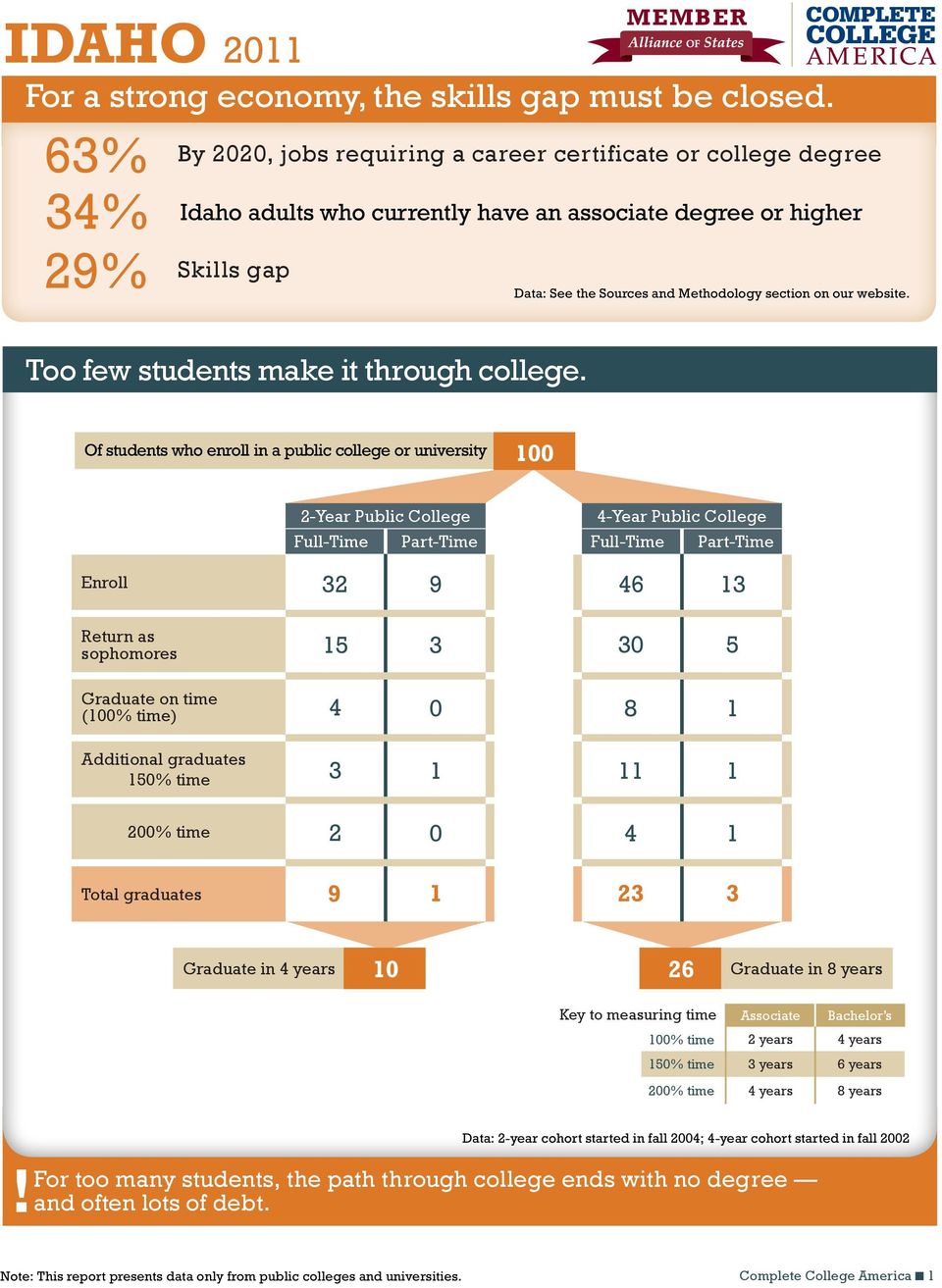
IDAHO 2011 For a strong economy, the skills gap must be closed.
|
|
|
- Lizbeth Parker
- 10 years ago
- Views:
Transcription
1 For a strong economy, the skills gap must be closed. 63% 34% 29% By 2020, jobs requiring a career certificate or college degree Skills gap Too few students make it through college. MEMBER Idaho adults who currently have an associate degree or higher Data: See the Sources and Methodology section on our website. Of students who enroll in a public college or university 00 2-Year Public College 4-Year Public College Enroll Return as sophomores Graduate on time (00% time) Additional graduates 50% time 3 200% time Total graduates Graduate in 4 years 0 26 Graduate in 8 years Key to measuring time Associate Bachelor s 00% time 2 years 4 years 50% time 3 years 6 years 200% time 4 years 8 years Data: 2-year cohort started in fall 2004; 4-year cohort started in fall 2002 For too many students, the path through college ends with no degree and often lots of debt. Note: This report presents data only from public colleges and universities. College America n
2 We re making great progress in providing access to more students. Total public college enrollment: 56,72 Attending Pursuing Degrees & Certificates 37,73 4,494 8,999 4-year 2-year colleges 4,678 colleges Total State Population, 8-24 White 83% College Enrollment White 80% College Graduation White 84% Hispanic 2% % Other races 5% Hispanic 6% % Other races 2% Data: Fall 2009 enrollment from IPEDS; population data from Census ACS PUMS 06-08; degrees by race from state submissions Now we must have more success from all students. Hispanic 5% Other races 0% For states to compete, their students must earn more degrees and certificates. Overall Credentials Awarded Science, Technology, Engineering, Math (STEM) Credentials Awarded 4,574 4,94, ,774, Certificate Associate Bachelor s Certificate Associate Bachelor s And all credentials should provide clear pathways to success. Data: College America n 2

3 Graduation rates are very low, especially if you re poor, part time,, Hispanic, or older. Certificate-Seeking Students All White Hispanic % On-time ( year) Within /2 years Within 2 years Within year Within /2 years Within 2 years 7.4% 25 and Over Directly from HS (age 7 9) Pell Grant Recipients (at entry) Remedial 25.% 26.0% DS* DS* 26.0% 26.3% 24.% 7.5% 4.0% 30.0% 3.4% DS* DS* 3.5% 30.% 29.5% 2.5% 8.0% 33.4% 34.7% 25.5% DS* 34.6% 30.8% 33.9% 27.8% 2.0% 6.2% DS* DS* DS* DS* DS* DS* DS* DS* 2.3% 0.9% DS* DS* DS* DS* DS* DS* DS* 7.4% 5.4% DS* DS* 20.5% DS* 6.9% DS* 3.3% In most states, very few students seeking certificates ever graduate. Associate Degree- Seeking Students All White Hispanic % On-time (2 years) Within 3 years Within 4 years Within 2 years Within 3 years Within 4 years 6.4% 25 and Over Directly from HS (age 7 9) Pell Grant Recipients (at entry) Remedial 8.7% 9.4% DS* DS* 7.7% 5.9% 9.6% 3.5% 2.9% 7.5% 8.8% 9.9% DS* 5.4% 3.6% 8.8% 8.6% 6.9% 2.4% 23.0% 6.4% DS* 8.9% 8.2% 22.6%.8% 9.5% DS* NP* DS* DS* DS* DS* DS* DS* DS* 5.5% 6.% DS* DS* 4.7% DS* 6.3% 5.9% DS* 9.0% 0.0% DS* DS* 9.8% DS* 9.2% 8.4% 5.2% Associate degree graduation rates are abysmal across the country for Hispanic and students, they re tragic. Bachelor s Degree- Seeking Students All White Hispanic On-time (4 years) Within 6 years Within 8 years Within 4 years Within 6 years Within 8 years 25 and Over Directly from HS (age 7 9) Pell Grant Recipients (at entry) Remedial 8.5% 9.4% 6.3% DS* 20.8% 27.7% 6.% 4.0% 4.7% 44.3% 44.% 34.6% 33.3% 33.% 45.3% 40.% 34.% 8.7% 5.0% 52.% 40.9% 36.% 39.6% 52.0% 48.5% 43.4% 28.5% 4.5% 4.7% DS* DS* 4.8% 6.7% DS* 4.7% DS*.9% 2.4% DS* DS* 2.0% 2.9% 0.5% 4.0% 6.8% 6.7% 7.4% DS* DS* 6.4% 6.8% 6.8% 9.8%.9% 33.% 40.% 2.0% Almost no one over the age of 25 graduates; students fresh out of high school are most likely to succeed. Data: Certificate cohort started in , associate cohort started in , bachelor's cohort started in Given changing demographics, our country will not have enough skilled s to compete unless many more students from all backgrounds and walks of life graduate. NP* = The state did not provide data for this metric. DS* = Fewer than 0 students, so data were suppressed. College America n 3

4 Retention rates drop from year to year. Many get discouraged and drop out Students in 2-year colleges who return to campus Start Year 2 Year 3 Year 4 Start Year 2 Year 3 Year 4 00% 00% 48.4% 25.4% 3.0% 20.6% Students in 4-year colleges who return to campus 00% 64.8% 5.4% 44.2% 00% 38.9% 28.5% 22.8% after falling off track early. Students who earn expected first-year credits (24 credits) Associate Bachelor s (2 credits) Associate Bachelor s 4.9% 53.5% 3.0% 46.3% Staying enrolled is particularly tough for part-time students, who must often balance jobs and school. Remediation. 62.0% Data: Associate cohort started in , bachelor's cohort started in ; earned credits from fall Year Colleges of freshmen require of those and associated college-level courses in two years Graduate within 3 years (projected) Current approaches almost always guarantee failure. 4-Year Colleges 57.4% 9.9% 23.5% 65.2% of freshmen require of those 42.2% 6.9% 8.7% and associated college-level courses in two years Graduate within 6 years (projected) Data: Fall 2006 College America n 4

5 Precious time and money are lost when students don t graduate on schedule. Students are taking too much time Certificate Associate Bachelor s 3.3 years 4.9 years Should take year for full-time students 5 years 5.8 years Should take 2 years for full-time students 5.4 years 6.6 years Should take 4 years for full-time students and too many credits. Certificate Associate Bachelor s 58 credits 62 credits Should take 30 credits 02 credits 93 credits Should take 60 credits 44 credits 47 credits Should take 20 credits More students must graduate on time. Data: College America n 5

6 More time isn t giving us enough success. For certificate and associate degree students, graduation rates are very low even when more time. Certificate Associate 25.% 30.0% 2.3% 33.4% 7.4% 8.7% 7.5% 5.5% 2.4% 9.0% In year In.5 years In 2 years In 2 years In 3 years In 4 years On-time graduation rates for bachelor s degree students are shockingly low. And adding time beyond six years produces little additional success. Bachelor s 44.3% 5.0% 8.5%.9% 6.7% In 4 years In 6 years In 8 years Data: Certificate cohort started in ; associate cohort started in ; bachelor's cohort started in Even modest progress provides little comfort when overall graduation rates are so low. College America n 6

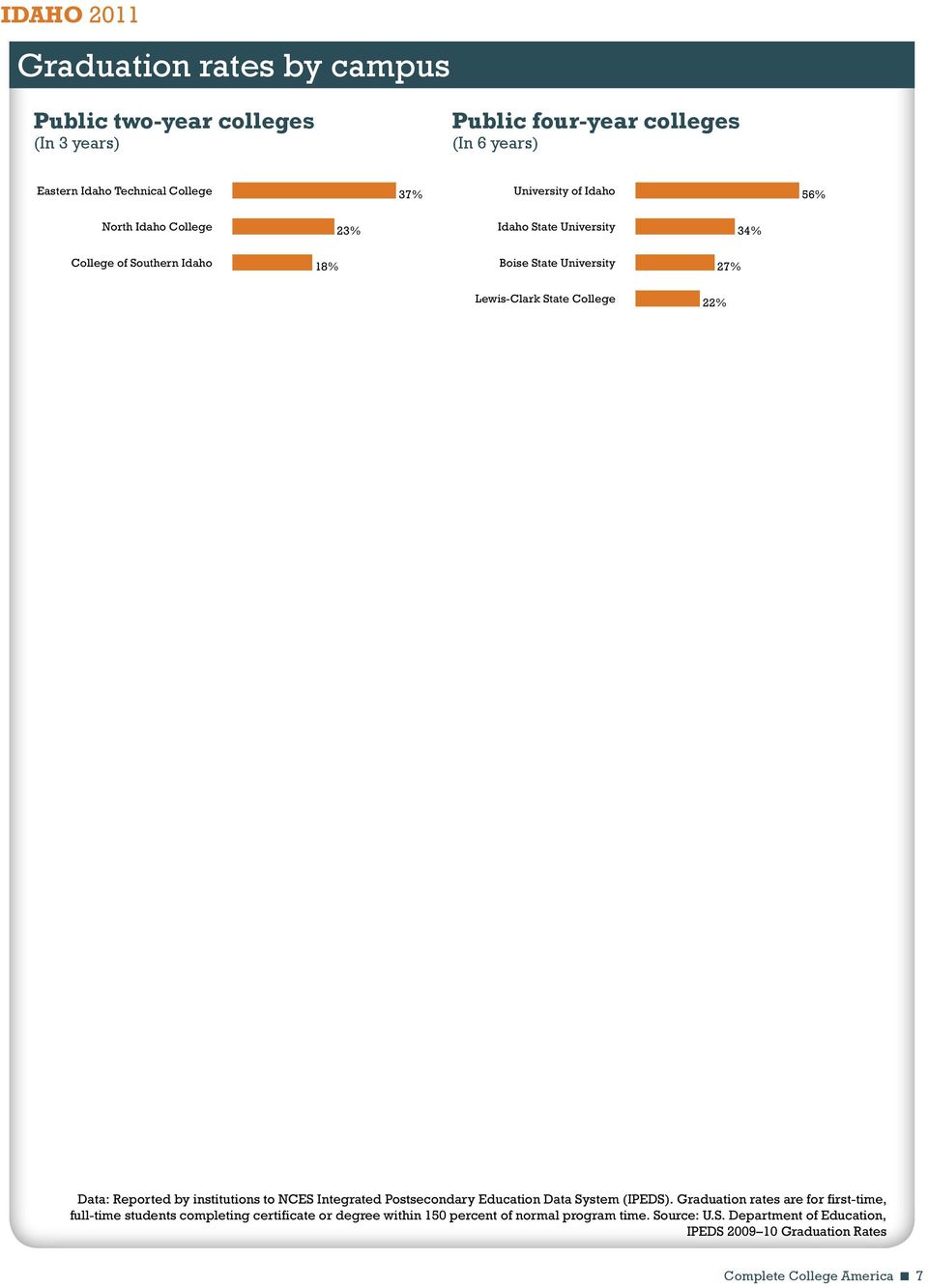
7 Graduation rates by campus Public two-year colleges (In 3 years) Public four-year colleges (In 6 years) Eastern Idaho Technical College 37% University of Idaho 56% North Idaho College 23% Idaho State University 34% College of Southern Idaho 8% Boise State University 27% Lewis-Clark State College 22% Data: Reported by institutions to NCES Integrated Postsecondary Education Data System (IPEDS). Graduation rates are for first-time, full-time students completing certificate or degree within 50 percent of normal program time. Source: U.S. Department of Education, IPEDS Graduation Rates College America n 7
NEW MEXICO 2011 For a strong economy, the skills gap must be closed.
 For a strong economy, the skills gap must be closed. 6% 29% 32% By 2020, jobs requiring a career certificate or college degree Skills gap Too few students make it through college. MEMBER New Mexico adults
KANSAS 2011 For a strong economy, the skills gap must be closed.
 For a strong economy, the skills gap must be closed. 66% 41% 25% By 2020, jobs requiring a career certificate or college degree Skills gap Too few students make it through college. MEMBER Kansas adults
OHIO 2011 For a strong economy, the skills gap must be closed.
 MEMBER OHIO 211 For a strong economy, the skills gap must be closed. 59% 36% 23% By 22, jobs requiring a career certificate or college degree Ohio adults who currently have an associate degree or higher
TEXAS 2011 For a strong economy, the skills gap must be closed.
 For a strong economy, the skills gap must be closed. 6% 3% 29% By 22, jobs requiring a career certificate or college degree Skills gap Too few students make it through college. MEMBER Texas adults who
NEW YORK 2011 For a strong economy, the skills gap must be closed.
 For a strong economy, the skills gap must be closed. 67% 48% By 2020, jobs requiring a career certificate or college degree Skills gap Too few students make it through college. MEMBER New York adults who
Which Path? A Roadmap to a Student s Best College. National College Access Network National Conference Mary Nguyen Barry September 16, 2014
 Which Path? A Roadmap to a Student s Best College National College Access Network National Conference Mary Nguyen Barry September 16, 2014 THE EDUCATION TRUST WHO WE ARE The Education Trust works for the
ETS s Addressing Achievement Gaps Symposium. Advancing Success for Black Men in College. A Statistical Profile
 ETS s Addressing Achievement Gaps Symposium Advancing Success for Black Men in College A Statistical Profile ETS s Addressing Achievement Gaps Symposium Advancing Success for Black Men in College Co-sponsored
Trends in Community College Education: Enrollment, Prices, Student Aid, and Debt Levels
 Trends in Community College Education: Enrollment, Prices, Student Aid, and Debt Levels By Sandy Baum, Kathie Little, and Kathleen Payea Community colleges serve as the access point to higher education
2015 Indiana College Completion Report. INDIANA College completion Report
 INDIANA College completion Report 2015 Table of Contents Introduction 2 Key Takeaways 3 Data-at-a-Glance - Four Year Colleges 5 Data-at-a-Glance - Two Year Colleges 6 Dashboard, Gaps & Trends - Four Year
ASSOCIATION OF CATHOLIC COLLEGES AND UNIVERSITIES. Bachelor s Degree Attainment: Catholic Colleges and Universities Lead the Way
 ASSOCIATION OF CATHOLIC COLLEGES AND UNIVERSITIES Bachelor s Degree tainment: Catholic Colleges and Universities Lead the Way ASSOCIATION OF CATHOLIC COLLEGES AND UNIVERSITIES Bachelor s Degree tainment:
Guided Pathways to Success
 Guided Pathways to Success Boosting College Completion Navigating the complicated path through college is a difficult task for far too many. All students need step-by-step roadmaps and intrusive guidance
EGREES HOPE. Redefining Access for the 21 st Century Student VIEWING GUIDE
 EGREES OF HOPE Redefining Access for the 21 st Century Student VIEWING GUIDE 2 FOR TOO MANY STUDENTS, ACCESS TO A QUALITY EDUCATION REMAINS ELUSIVE Degrees of Hope: Redefining Access for the 21 st Century
Closing the Gap 2020: A Master Plan for Arkansas Higher Education Executive Summary
 1 Closing the Gap 2020: A Master Plan for Arkansas Higher Education Executive Summary Objective This five year planning cycle is a critical component in the long-term objective to reach the 2025 goal of
For-profit colleges are a growing sector
 Percent of Institutions For-profit colleges are a growing sector Number of Institutions, by Sector, 2-1 to 29-21 1% 8% 6% 4% 2% 3% 32% 38% Private, Nonprofit Public For-profit 27% 3% 44% % Note:Percentages
Iowa. Higher Educ ation Data Dashboard
 Higher Educ ation Data Dashboard Context Over the last two decades, state support for higher education has grown by $5 billion; yet, the nation has fallen from first to eighth in the world in the percentage
Maryland Higher Education Commission Documents
 Maryland Higher Education Commission Documents 2014 Maryland Health and Higher Educational Facilities Authority Annual Report (2014) 2011 Maryland Health and Higher Educational Facilities Authority Annual
Testimony for the National Commission on Accountability in Higher Education Oklahoma State Regents for Higher Education. Pre-Collegiate Initiatives
 Testimony for the National Commission on Accountability in Higher Education Oklahoma State Regents for Higher Education Prepared by: Dr. Dolores Mize, Associate Vice Chancellor and Special Assistant to
Succeeding Calumet Conference Center, Purdue University Calumet, Hammond, IN June 17, 2010
 Post-Secondary Student Pathways in Northwest Indiana: Patterns of Enrollment Research findings from the Mobile Working Students Collaborative Desiree Zerquera & Jin Chen Project on Academic Success WORKING
Role of Transfer Students in Meeting College Completion
 Role of Transfer Students in Meeting College Completion Presentation to the Senate Education, Business, and Administration Subcommittee and the House Education and Economic Development Subcommittee Department
The University of Akron Completion Plan
 The University of Akron Purpose: To increase degree completion rates by defining and implementing universal accountability measures, which will provide an integrated accountability structure for the University
Committee on Educational Planning, Policies, and Programs October 29, 2015. 6. Transfer Student Report 2014... Kate Henz
 Committee on Educational Planning, Policies, and Programs October 29, 2015 6. Transfer Student Report 2014... Kate Henz Situation: Presentation of the Transfer Student Report Background: Information is
Policy Alert PUBLIC POLICY AND HIGHER EDUCATION THE NATIONAL CENTER FOR STATE POLICIES ON 2/4 TRANSFERS ARE KEY TO DEGREE ATTAINMENT.
 THE NATIONAL CENTER FOR PUBLIC POLICY AND HIGHER EDUCATION Policy Alert May 2004 QUICK LOOK Key Issue State policies must be assessed and updated to effectively support the success of students transferring
Shifting from. College Access to College Success 10/4/2011 THE EDUCATION TRUST. What is CRO and how does it work? How can CRO help school counselors?
 Shifting from College Access to College Success NACAC September 24, 2011 THE EDUCATION TRUST WHO WE ARE The Education Trust works for the high academic achievement of all students at all levels, prekindergarten
Joann A. Boughman, PhD Senior Vice Chancellor for Academic Affairs University System of Maryland
 Joann A. Boughman, PhD Senior Vice Chancellor for Academic Affairs University System of Maryland Testimony before the United States House of Representatives Committee on Education and Workforce April 2,
Mac Taylor Legislative Analyst 925 L Street, #1000. Sacramento, CA 95814. Sacramento, CA 95814
 Business and Finance Steve Relyea 401 Golden Shore, 5th Floor Executive Vice Chancellor Long Beach, CA 90802-4210 and Chief Financial Officer CSU Legislative Reports Website 562-951-4600 www.calstate.edu/budget/fybudget/legislative-reports/
Borrowers Who Drop Out
 A Neglected Aspect of the College Student Loan Trend By Lawrence Gladieux and Laura Perna May 2005 The National Center for Public Policy and Higher Education National Center Report #05-2 2005 by The National
REPORT. 2014-15 Undergraduate Degree Earners. First-time Graduates and Graduates with Prior Awards
 2014-15 Undergraduate First-time Graduates and Graduates with Prior Awards The total number of undergraduate degree earners has remained nearly constant over the last four years, with 2,804,133 students
Higher Education in Florida: Trends and Key Issues. 1990-2014 The LeRoy Collins Institute Dr. Carol Weissert, Director
 Higher Education in Florida: Trends and Key Issues 1990-2014 The LeRoy Collins Institute Dr. Carol Weissert, Director Key Observations Florida universities are more accessible than those in many other
Louisiana Community and Technical College System. Strategic Plan
 Louisiana Community and Technical College System Strategic Plan 2015-2019 Louisiana Community and Technical College System Strategic Plan (2015-2019) Vision: Our vision is to educate and train 220,000
ACCESS TO SUCCESS IN AMERICA
 May 28, 2015 ACCESS TO SUCCESS IN AMERICA Kati Haycock President, Education Trust Copyright 2015 The Education Trust America: Two Powerful Stories 1. Land of Opportunity: Work hard, and you can become
Selection of Student Loans and College Performance
 Selection of and College Performance Maximilian Schmeiser 1 Christiana Stoddard 2 Carly Urban 2 1 Federal Reserve Board 2 Department of Agricultural Economics and Economics Montana State University Cherry
Voluntary Accountability Report
 Mission Statement Student Characteristics TOTAL NUMBER OF STUDENTS 1,499 Voluntary Accountability Report The University of Pittsburgh at Bradford seeks to make high-quality academic programs and service
Part I: Columbus State University Metrics and Data Analysis
 Part I: Columbus State University Metrics and Data Analysis Goal: In accordance with the Columbus State University (CSU) mission to achieve academic excellence and to achieve excellence in the student
Snapshot REPORT PERSISTENCE - RETENTION. Persistence Rates Slip While Retention Holds Steady
 Persistence Rates Slip While Retention Holds Steady The overall persistence rate for first-time college students has dropped.2 percentage points since 2009, while the retention rate has remained nearly
Accelerated Learning through CUNY Student Success Initiatives City University of New York
 Accelerated Learning through CUNY Student Success Initiatives City University of New York Shayne Spaulding, Director of Workforce Development [email protected] 718-254-7262 Why a Focus on
Special Report on the Transfer Admission Process National Association for College Admission Counseling April 2010
 Special Report on the Transfer Admission Process National Association for College Admission Counseling April 2010 Each Spring, much media attention is focused on the college admission process for first-year
A. General Information
 A0 Respondent Information (Not for Publication) A0 Name: Karen Hamby A0 Title: Director of Institutional Effectiveness A0 Office: Office of Institutional Effectiveness A0 Mailing Address: 800 Lakeshore