
BUILT FOR THE FUTURE, READY NOW. Clouds. Microsoft Private Cloud: Evaluation Guide
|
|
|
- Patricia Stokes
- 10 years ago
- Views:
Transcription
1 BUILT FOR THE FUTURE, READY NOW. Clouds Microsoft Private Cloud: Evaluation Guide

2 Copyright Information 2013 Microsoft Corporation. All rights reserved. This document is provided "as-is." Information and views expressed in this document, including URL and other Internet Web site references, may change without notice. You bear the risk of using it. This document does not provide you with any legal rights to any intellectual property in any Microsoft product. You may copy and use this document for your internal, reference purposes. You may modify this document for your internal, reference purposes.

3 Evaluation Guide Contents Introduction 4 Using the evaluation guide 5 What is Microsoft s Private Cloud? 8 Components of the Private Cloud 14 Summary Setup and Deploy 17 Installing the Private Cloud 18 Installing the Private Cloud- fresh install 23 Upgrading your existing Private Cloud to SP1 26 Configuring the Private Cloud experiences Experiences 81 Manage Private Cloud resources 106 Manage Private Cloud capacity 146 Private Cloud automation 319 Manage apps in the Private Cloud 398 Reporting insights of the Private Cloud Other Info 445 Add a role or feature to Windows How to set an IPV4 address 454 How to join the domain
4 Introduction Using the Evaluation Guide This Private Cloud Evaluation Guide is built to give you the necessary information to experience the Microsoft Private Cloud built on System Center 2012 SP1 and powered by Windows Server 2012 where you will go through detailed scenarios in a proof of concept environment. This guide is designed to be consumed as you wish and each of the hands-on portions of the guide are designed as Experiences. Each of the Experiences are independent so that you may build and test each of them in any order you wish. This guide is intentionally built so that you can run it on -lower-level hardware for the purpose of evaluation. It is also possible to follow this guide and change the scenario to your own environment and parameters. Navigating the document on your terms This document is designed for you to navigate much easier and locate the information that is most relevant to you. Each of the 4 major chapters Introduction, Setup and deploy, Experiences and Other info are collapsible and expandable. You will also find that you may jump to any of the other chapters or experiences from the end of any section. The following navigation window allows you to click on the desired tile which links directly to that point in the document. Simply press ctrl+click the tile to view that section. This tile takes you back to the Evaluation Guide Contents page. Setup and Links to other areas of interest Introduction Manage Private Cloud Resources deploy your Private Cloud Manage Private Cloud Capacity Experiences Private Cloud Automation Other Info Manage Apps in the Private Cloud Reporting insights of the Private Cloud Introduction Using the Evaluation Guide 4
5 What is Microsoft s Private Cloud? The Microsoft Cloud OS Cloud computing is happening. It is being driven by the exponential growth in modern applications, data and devices. These trends require organizations to quickly scale and deliver continuous services. Simultaneously, innovation is happening across storage, network and compute technologies. With these new requirements and innovations, IT is under pressure to deliver capacity on demand, whether for short-term projects or longer-term initiatives. At the same time, organizations have higher expectations for service levels services must be always up, always on, with no planned or unplanned downtime. To meet these challenges, a new modern platform is required. In the era of cloud computing, Microsoft delivers this with the Cloud OS. The Cloud OS takes on a broader role than just managing a server. Microsoft s vision for the Cloud OS is focused on the transformation of the datacenter, enabling modern applications, unlocking insights on any data and empowering people-centric IT. Figure 1: The Cloud OS delivers on four fundamental tenets of the next generation of IT The Cloud OS requires a comprehensive execution of vision crossing a wide range of enterprise technologies, including Windows Azure, SQL Server, System Center and Windows Server. This whitepaper sets out a step on that journey by focusing on the transformation of the datacenter. Fundamental to the modern datacenter, is the ability to build private cloud infrastructures and quickly scale within the datacenter as well as agile and secure consumption of Windows Azure and service provider cloud capacity. This paper explains Windows Server 2012 as the foundation for the Private Cloud and how System Center 2012 SP1, makes the management of private and public clouds consistent and seamless. Introduction What is Microsoft s Private Cloud? 5

6 The Private Cloud in your datacenter A private cloud aims to deliver many of the characteristics of public cloud computing such as scalability and elasticity, the pooling of shared infrastructure, user self-service, and higher levels of overall application availability and reliability. However, by taking a private cloud approach, organizations can deliver on these goals while still using their own physical resources allowing them to maintain complete control over their data and processes. Figure 2: The private cloud delivers the broad benefits of cloud computing with added levels of control and customization With shared infrastructure, compute, storage and even networking assets are virtualized and pooled together. This approach is a shift from today s model in which an application owner will likely know (and probably fund) the exact hardware on which their application is physically deployed. In a private cloud environment, application owners will only care that adequate capacity to run the application has been provided from the shared pool. Once deployed, services can scale up and down based on demand. IT no longer needs to over-provision infrastructure capacity to accommodate potential spikes in load. Datacenter administrators and application owners can view resource utilization as well as the chargeback information related to their allocated capacity. By giving application owners better visibility over their resource usage organizations are able to more easily drive and deliver the right behavior to conserve capacity where possible. A self-service interface to which standardized services are published from central IT, empowers application owners and other internal customers to be able to easily provision resources when needed. Automation helps to drive efficiency in service delivery thereby freeing up IT Pros to focus on other tasks. Selfservice also frees up application owners as well. They are empowered to directly access resources; no complicated approval process; no need to wait for the overworked IT team to eventually get to the request. A private cloud deployment captures all of these characteristics, most of which are also in common with public and partner hosted clouds, but, the private cloud also allows organizations to maintain total control over their applications and data. These are common blockers for businesses looking at public cloud solutions. Ultimately, most customers will find portions of their organization that live best in a private deployment, portions that live best in a public deployment and in some cases portions that are best served by partner delivered clouds. The world will exist in a hybrid state for the foreseeable future and it is important for companies to evaluate their particular needs to determine the best combination for them. Introduction What is Microsoft s Private Cloud? 6

7 Why System Center 2012 SP1 for your Private Cloud Over the last twenty years, Microsoft has built some of the world s largest datacenters running many of the world s largest cloud hosted services. The expertise that has been built up in efficiently running these massive data centers forms the foundation for the Microsoft private cloud offering. Built on System Center 2012 SP1 and Windows Server 2012, a Microsoft private cloud allows datacenter administrators to deploy a flexible and responsive infrastructure that is designed to simplify day-to-day tasks and to enable management of applications at the service level, rather than the level of individual servers. System Center 2012 SP1 makes it easy for customers to build private clouds while taking advantage of currently deployed IT hardware and building an infrastructure for the future. This comprehensive offering was designed around the following principles. These principles are surfaced through a core set of capabilities in Windows Server 2012 and System Center 2012 SP1, allowing datacenter administrators and application owners to access and consume IT services from these private clouds. The rest of this paper will describe the private cloud capabilities provided by System Center 2012 SP1. For the datacenter administrator, this includes infrastructure management, service delivery and automation. For the application owner or business unit IT professional, this includes self-service application management, monitoring and reporting. The table in Figure 3 highlights these capabilities, how they align to industry concepts and System Center 2012 SP1 components. Figure 3: Mapping of industry cloud computing concepts to System Center 2012 SP1 products and features. Introduction What is Microsoft s Private Cloud? 7

8 Components of the Private Cloud Overview Highly virtualized computing gives you the benefits of increased utilization of your servers, power savings, and reduced server footprint. We are familiar with these as they are in datacenters today. However, this does not equal the private cloud. A private cloud provides all of those benefits plus highly integrated and automated management, scalable and elastic platforms, and self-service IT infrastructure. Through a highly automated infrastructure, an organization can reduce operational costs by automating many tasks that previously required manual intervention. Through the service catalog an organization can provide a self-service IT infrastructure to business units and departments with an SLA. This forces service-level discussion and removes the burden to procure, provision, and manage infrastructure on a per-application, ad-hoc basis. With a scalable and elastic infrastructure, an organization can enable faster delivery of capacity as resource needs change. By utilizing a Windows Server 2012 infrastructure along with System Center 2012 SP1, the Microsoft private cloud allows you to deploy a flexible and responsive infrastructure, designed to simplify day-to-day tasks and enable management of applications at the service level, rather than that of individual servers. With the release of Service Pack 1, many new features have been made available to increase scalability, elasticity and automation of the Private Cloud. Wider integration with many other products including Windows Azure means more options for IT professionals wishing to take advantage of the Public and Private cloud to future proof their business. Reference Links Download Microsoft Windows Server 2012 Download Microsoft System Center 2012 SP1 Download SC2012 Configuration Manager and Endpoint Protection SP1 What s new in System Center 2012 SP1 What s new for Orchestrator in System Center 2012 SP1 What s new for App Controller in System Center 2012 SP1 What s new for Virtual Machine Manager in System Center 2012 SP1 What s new for Operations Manager in System Center 2012 SP1 What s new for Service Manager in System Center 2012 SP1 What s new for Data Protection Manager in System Center 2012 SP1 Introduction Components of a Private Cloud 8

9 Microsoft Windows Server 2012 Microsoft Windows Server 2012 is the operating system that runs your private cloud. In this evaluation guide it will run as the host hypervisor, the OS for the different infrastructure components, and for the application that we will deploy, manage, and monitor. Hyper-V Hyper-V is the server virtualization technology within Windows Server It allows you to run virtual machines on top of the host Operating System when your hardware is capable of running virtualized loads. System Center Orchestrator System Center Orchestrator is a workflow engine that allows you to automate the creation, deployment and monitoring of resources in your private cloud. Better said, Orchestrator provides you with orchestration, integration and automation of IT processes. Orchestrator works in conjunction with all the System Center components and can also be used to automate components from 3rd party applications like HP ILO and OA, VMware vsphere and many others (for a full list of Orchestrator 2012 SP1 integration packs see Included as part of Orchestrator 2012 SP1 is the Service Provider Framework which enables service providers to offer Infrastructure as a Service (IaaS). The provider may have already provided a front-end portal for clients to interact with, and Service Provider Foundation allows those clients access to their resources on the hosting provider s system without any change to the portal. Components Management Server Runbook Server Orchestration Database Runbook Designer Runbook Tester Orchestration Console Description The management server is the communication layer between the Runbook Designer and the orchestration database A runbook server is where an instance of a runbook runs. A runbook is a collection of actions bundled together that Orchestrator will run performing various automated actions. Runbook servers communicate directly with the orchestration database. You can deploy multiple runbook servers per Orchestrator installation to increase capacity and redundancy. The database is a Microsoft SQL Server database that contains all of the deployed runbooks, the status of running runbooks, log files, and configuration data for Orchestrator. The Runbook Designer is the tool used to build, edit, and manage Orchestrator runbooks. One runbook or different runbooks together form your workflow(s). Runbook Tester is a run-time tool used to test runbooks developed in the Runbook Designer. This tool allows you to test your runbooks before taking them into production. The Orchestration console lets you start or stop runbooks and view real-time status on a web browser. This is a Silverlight-based web console. Introduction Components of a Private Cloud 9

10 Orchestrator Web Service Deployment Manager Integration pack (IP) Orchestrator Integration Toolkit The Orchestrator web service is a Representational State Transfer (REST)-based service that enables custom applications to connect to Orchestrator to start and stop runbooks, and retrieve information about operations by using custom applications or scripts. The Orchestration console uses this web service to interact with Orchestrator. Deployment Manager is a tool used to deploy integration packs (IPs), runbook servers, and Runbook Designers An integration pack is a collection of custom activities specific to a product or technology. Microsoft and other companies provide integration packs with activities to interact with their product from an Orchestrator runbook. The Orchestrator Integration Toolkit lets you extend your library of activities beyond the collection of standard activities and integration packs. The Integration Toolkit has wizard-based tools to create new activities and integration packs for Orchestrator. Developers can also use the Integration Toolkit to create integration packs from custom activities that they build by using the Orchestrator SDK. New Capabilities Exchange Administrator Integration Pack for Orchestrator in System Center 2012 SP1 Exchange Users Integration Pack for Orchestrator in System Center 2012 SP1 Representational State Transfer (REST) Integration Pack Guide for Orchestrator in System Center 2012 SP1 System Center App Controller System Center App Controller is a Silverlight web-based interface that allows you to manage, build, configure and deploy services both on the private and the public cloud. With this interface, you will have a common self-service experience through your different clouds. This interface is mainly used to provide self-service capabilities for your application owners. The ability to control and manage applications and services within the private cloud is critical. A key requirement, as organizations begin using hybrid apps, will be the ability to connect with services in other clouds and to manage them through a single management experience. Components App Controller Server Database PowerShell Module Description The App Controller Server runs the web-based Silverlight application to manage, build, configure and deploy services both on your private cloud and the public cloud. The database that contains the necessary information for the connection to your Azure subscriptions and your Virtual Machine Manager service(s). The App Controller PowerShell Module provides administrators with the ability to automate App Controller administration. Introduction Components of a Private Cloud 10
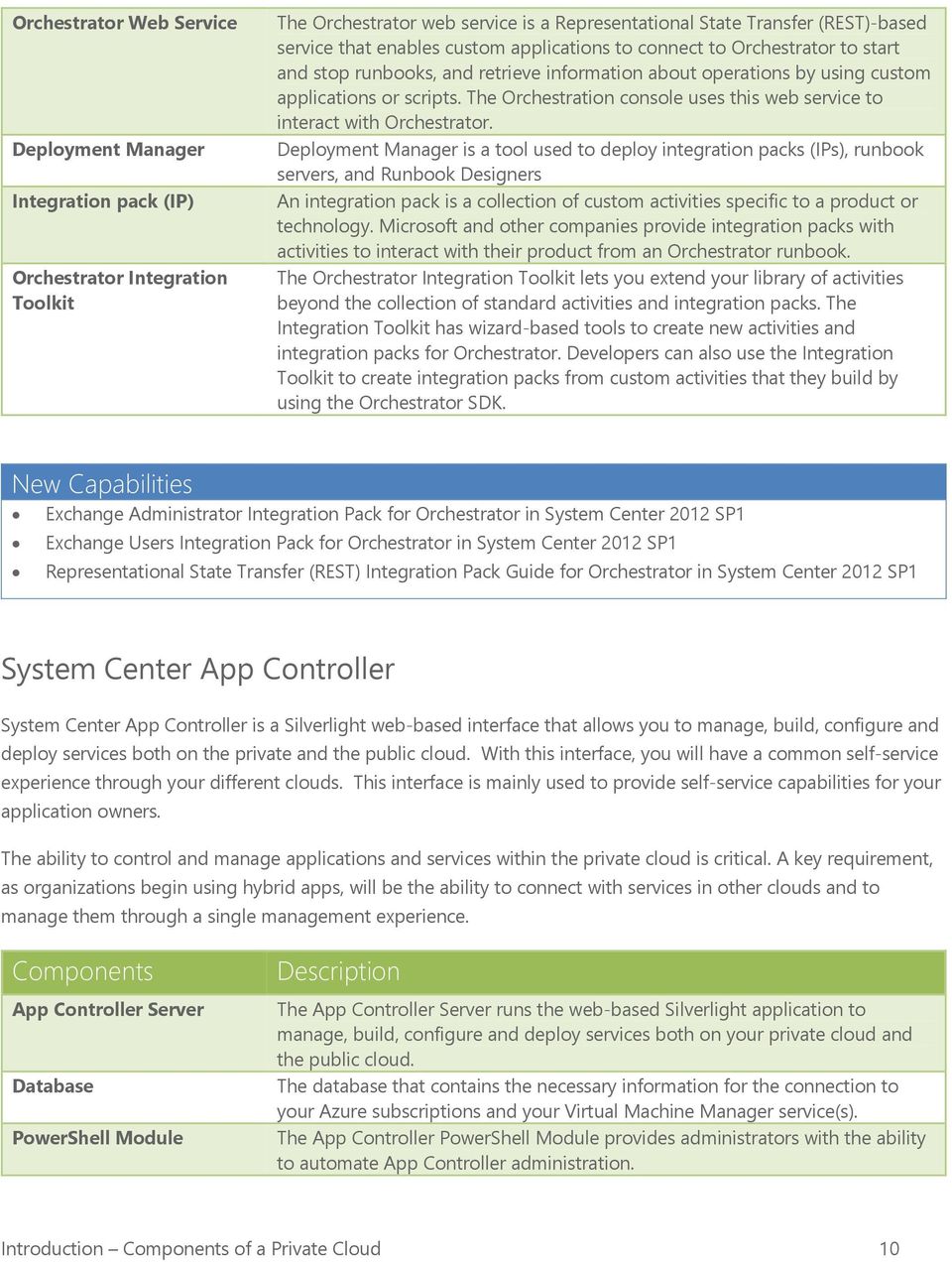
11 New Capabilities Upload a virtual hard disk or image to Windows Azure from a VMM library or network share Migrate a virtual machine from VMM to Windows Azure Add a Service Provider Framework (SPF) hosting provider connection. SPF enables service providers to offer Infrastructure as a Service (IaaS) to their clients. System Center Virtual Machine Manager System Center Virtual Machine Manager is the component that provides you with virtual machine management AND service deployment. This component comes with support for multi-hypervisor environments and is the system that allows you to define, create and manage your private cloud environment(s). Components VMM Management Server VMM Console VMM Self-Service Portal VMM Database VMM Library Server Description The computer on which the Virtual Machine Manager service runs and which processes commands and controls communications with the VMM database, the library server, and virtual machine hosts. The Virtual Machine Manager Console is the graphical user interface to your VMM environment. A website used to deploy and request virtual machines. The VMM database stores all the Virtual Machine Manager configuration and information regarding the hosts and virtual guests. The VMM Library Server is a catalog of resources containing all the ISO files, virtual hard disks, templates and profiles used to deploy virtual machines and services. New Capabilities Support for Network Virtualization with the support for using DHCP to assign customer IP addresses Support for VHDX format with functionality to convert from VHD to VHDX Support for file shares using SMB 3.0 System Center Operations Manager System Center Operations Manager provides you with deep application diagnostics and infrastructure monitoring of your private cloud components. It can offer you a thorough overview of the performance and availability of applications deployed in your datacenter, private or public cloud. Components Management Server Description The Operations Manager Management Server is the focal point for administering the management group and communicating with the database. When you open the Operations console and connect to a management group, Introduction Components of a Private Cloud 11

12 Operations Console Operations Manager Database Operations Manager Data Warehouse Operations Manager Web Console Operations Manager Advisor Gateway Server you connect to a management server for that management group. Depending on the size of your computing environment, a management group can contain a single management server or multiple management servers. The Operations Manager is the graphical user interface that will give you the single pane of glass monitoring of your private cloud. The OpsMgr database is where all the collected data like performance & event data, alerts etc. are stored. The OpsMgr data warehouse is used for long term reporting. The OpsMgr web console provides a browser-based alternative to the OpsMgr console. Browser-based console to provide deep insight in your.net applications A gateway server is used to monitor untrusted environments like a DMZ Audit Collection Server ACS is used for collecting and auditing security events. New Capabilities The diagnostic and monitoring capabilities have been expanded in System Center 2012 Operations Manager SP1. New features include: Monitoring Windows Services built on the.net Framework Automatic discovery of ASP.NET MVC3 and MVC Applications Enabled APM of SharePoint 2010 Integration with Team Foundation Server 2010 and 2012 System Center Service Manager Service Manager provides an integrated platform for automating and adapting your organization s IT service management best practices, such as those found in Microsoft Operations Framework (MOF) and Information Technology Infrastructure Library (ITIL). It provides built-in processes for incident and problem resolution, changecontrol, and release management. Components Management Server Database Data warehouse management server Description Contains the main software part of a Service Manager installation. You can use the Service Manager management server to manage incidents, changes, users, and tasks. The database that contains Service Manager configuration items (CI) from the IT Enterprise; work items, such as incidents, change requests, and the configuration for the product itself. This is the Service Manager implementation of a Configuration Management Database (CMDB). The computer that hosts the server piece of the data warehouse. Introduction Components of a Private Cloud 12

13 Data warehouse databases Service Manager console Self-Service Portal Databases that provide long-term storage of the business data that Service Manager generates. These databases are also used for reporting. The user interface (UI) piece that is used by both the help desk analyst and the help desk administrator to perform Service Manager functions, such as incidents, changes, and tasks. This part is installed automatically when you deploy a Service Manager management server. In addition, you can manually install the Service Manager console as a stand-alone part on a computer. A web-based interface into Service Manager. New Capabilities Chargeback helps you can apply cloud-based pricing to your Virtual Machine Manager fabric Improved Operations Manager Integration SQL Server 2012 Support Windows Server 2012 and Windows 8 Support System Center Data Protection Manager Data Protection Manager (DPM) enables disk-based and tape-based data protection and recovery for servers such as SQL Server, Exchange Server, SharePoint, virtual servers, file servers, and support for Windows desktops and laptops. DPM can also centrally manage system state and Bare Metal Recovery (BMR) which will allow us to protect the servers that contain our virtualized infrastructure. Components DPM server Database Central Console Storage Pool Description The DPM server contains the program files of the Data Protection Manager installation. This server will be responsible for all the protection and recovery jobs The DPM database will contain all the information of your Data Protection Manager environment. All protection group information, agent information, recovery points and so on are stored here. Operations Management is used as the platform for the central console and is used to manage your SCDPM server (or multiple DPM servers) The Storage Pool contains your storage that will be used to take disk-to-disk backups Introduction Components of a Private Cloud 13

14 New Capabilities Cluster Shared Volume (CSV) 2.0 Support for improved performance on backing up virtual machines on CSVs. Hyper-V protection over remote SMB Shares. Scale Out support for Hyper-V machines. Protection of Windows 8 de-duplicated volumes. Support for Live Migration. Integration with Windows Azure Online Backup. Support for SQL 2012 Always-On feature. Support for Resilient File System (ReFS). Summary In this first chapter, you reviewed the components that are needed to deploy a private cloud. Now you know all the building blocks to start with your evaluation of the Private Cloud. Setup and Links to other areas of interest Introduction Manage Private Cloud Resources deploy your Private Cloud Manage Private Cloud Capacity Experiences Private Cloud Automation Other Info Manage Apps in the Private Cloud Reporting insights of the Private Cloud Introduction Components of a Private Cloud 14

15 Setup and deploy your Private Cloud Architecture Here is the overview of what hardware we are going to use for our private cloud evaluation. This can be different from your environment but this is the minimum required to evaluate the Private Cloud. Setup and Deploy - Architecture 15

16 Installing the Private Cloud Implementing or upgrading your Private Cloud This document covers two situations where you may be deploying System Center 2012 SP1 into a Lab or sandbox environment for evaluation of the Private Cloud. This may be your first time evaluating System Center 2012 and Windows Server 2012, so you have an environment that is empty. Or this may be a follow up from a previous evaluation using the Private Cloud Evaluation guide that was released with the System Center 2012 RTM package. In future there will also be an option to install the full System Center 2012 Suite using the Microsoft Cloud Accelerator Toolkit. Both of these situations can be covered in the Install and Upgrade sections below. If you wish to install a Private Cloud environment from a blank environment, follow the steps outlined below in the Installing the Private Cloud section. If you wish to upgrade an existing Private Cloud evaluation environment delivered via the Unified Installer or the previous Private Cloud Evaluation guide, then follow the steps outlined in the section Upgrading the Private Cloud. If you have previously deployed the Private Cloud either using the previous Evaluation Guide or using the Unified Installer that was released with System Center 2012 RTM, you may have less hardware than the diagram above. To upgrade an RTM environment to SP1 and implement the scenarios in later sections of the document you will need 2 additional hosts, and 2 network cards per host. Each server must have Windows Server 2012 installed, and the Hyper-V role enabled. More detail on setting up the hardware can be found in the section labeled Upgrading the Private Cloud. Prerequisites Physical servers The following minimum physical servers are required: Name CPU Memory Disk NIC s Main IP Cluster IP HyperV GB 1TB 2 Physical NICs HyperV GB 1TB 2 Physical NICs HyperV GB 1TB 2 Physical NICs All servers have a subnet mask of on both network adapters. Setup and Deploy Installing the Private Cloud 16

17 Virtual servers The following virtual servers are required: Name Function CPU Memory Disk IP Orchestrator Orchestrator server 2 vcpu 4 GB 60GB VMM Virtual Machine Manager server 2 vcpu 4 GB 90GB AppController App Controller server 2 vcpu 4 GB 60GB OpsMgr Operations Manager server 2 vcpu 4 GB 60GB ServiceMgr Service Manager server 2 vcpu 4 GB 60GB ServiceMgrDW Service Manager Data Warehouse 2 vcpu 4 GB 60GB server DPM Data Protection Manager server 2 vcpu 4 GB 60GB AD Domain Controller 2 vcpu 2 GB 60GB SharePoint SharePoint 2010 Server 2 vcpu 4 GB 60GB When you are going to deploy the infrastructure and work through the different exercises, you can use your own IP addresses and better hardware. If you work with different IP ranges, you need to take into account that for some of the exercises, you will also need to change the ranges. Setup and Deploy Installing the Private Cloud 17

18 Installing the Private Cloud fresh install Requirements If you are installing the Private Cloud with Server 2012 and System Center 2012 SP1 with a blank environment you will require the following prerequisites: Item Hardware Operating Systems Software Detail 3 Hosts meeting the minimum specification as detailed in the Architecture section Windows Server Windows Server 2008 R2 SP1 System Center 2012 SP1 (BETA) SQL 2012 SP1 SQL 2008 R2 SP2 Each product within the System Center suite and SQL also have their own prerequisites. Please refer to the documentation for each product for guidance on installation. Reference Links Windows Server o Download Windows Server 2012 o Installing Windows Server 2012 o How to Install Active Directory Domain Services SQL Server o Download Microsoft SQL Server 2012 SP1 o o How to install SQL Server 2008 R2 Quick Start Installation of SQL Server 2012 SP1 System Center o Download System Center 2012 SP1 o o o o o o o o Install System Center 2012 SP1 How to Install Virtual Machine Manager Management Server Single-Server Deployment of Operations Manager Installing Service Manager on Two Computers Self-Service Portal Deployment for System Center 2012 Service Manager How to Install Orchestrator on a Single Computer Installing App Controller Installing Data Protection Manager Setup and Deploy Installing the Private Cloud Fresh Install 18

19 Installation process Once you have the prerequisites downloaded the installation process can commence. Follow each of the steps as detailed in the sequence below. Install Windows Server 2012 hosts Install Windows Server 2012 on the two physical hosts. Once the hosts are built complete the following actions on each host: Assign the IPv4 addresses as per the table in the Private Cloud Architecture section in this document Rename the hosts to match the naming convention in the Private Cloud Architecture section in this document Add the Hyper-V Role (see appendices for detailed instructions) Once these steps are complete, configure the Virtual Network on each host. It is important that each host has identical Virtual Network settings. To configure the Virtual Network, follow the instructions below on each host: 1. Open the Hyper-V Manager console 2. Click on Connect to Server in the right hand pane 3. Type localhost and click OK 4. Right click on the Host name and select Virtual Switch Manager 5. Select New Virtual Network Switch, click on External and click Create Virtual Switch 6. Set the Name to External Virtual Network 7. Ensure the physical network adapter is selected and the tick box allow management operating system to share this network adapter is ticked. 8. Click OK. Once the Hosts are configured, complete these steps: 1. Create a virtual machine for each of the servers as detailed in the Private Cloud Architecture section, ensuring the settings match the table. (See Appendices for instructions on creating a virtual machine). Ensure when you create these virtual machines that you distribute the machines across the 3 physical hosts HyperV02, HyperV03 and HyperV Install Windows Server 2012 on every virtual machine, except the SharePoint server 3. Install Windows Server 2008 R2 on the SharePoint server 4. Configure each virtual machine as per the table in the Private Cloud Architecture section in this document. Setup and Deploy Installing the Private Cloud Fresh Install 19
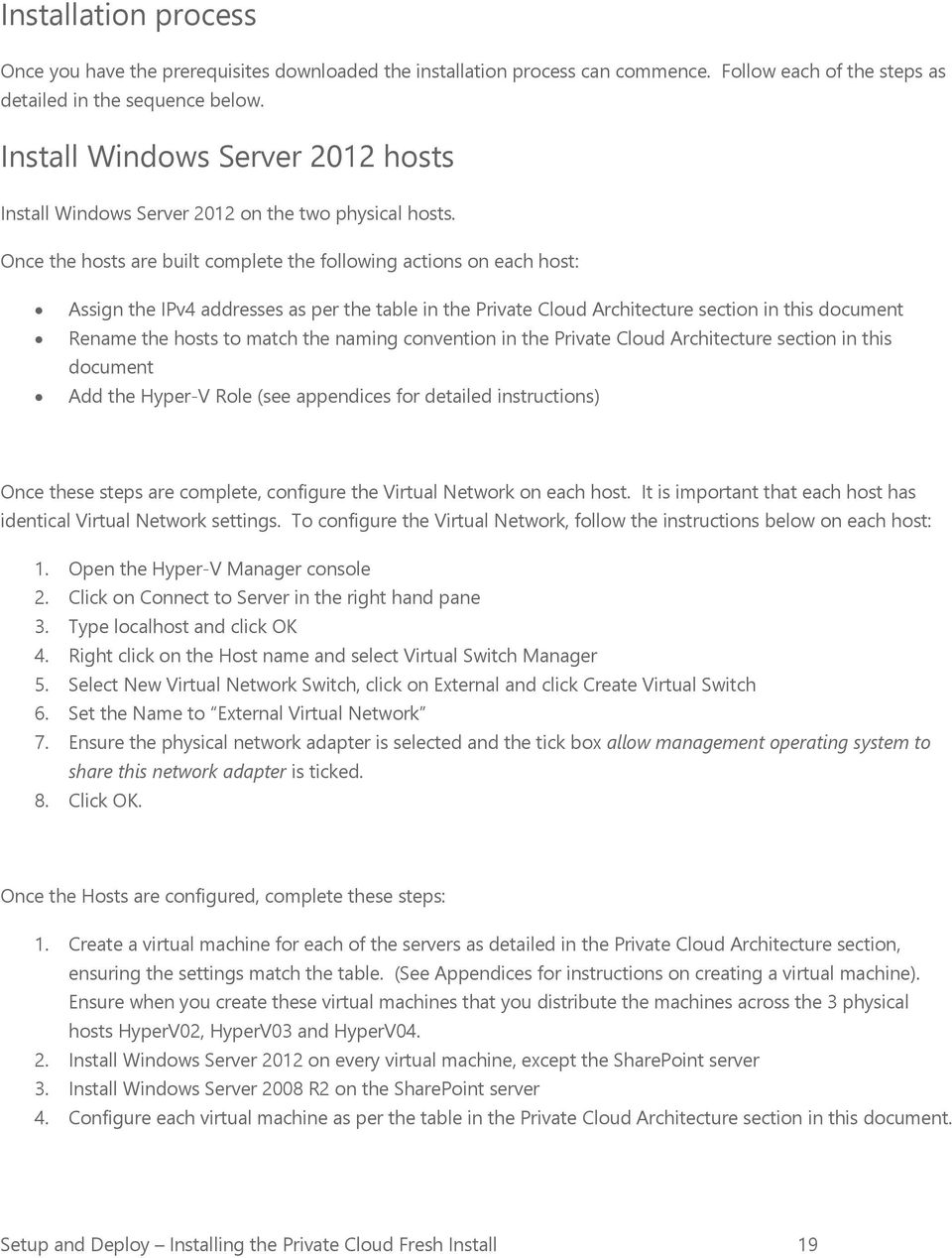
20 5. Configure the network settings on each virtual machine as per the table in the Private Cloud Architecture section. See the appendices for steps on setting the IPv4 address on a Windows 2012 server. 6. Prepare Active Directory on the server AD. 7. Add all servers to the new domain. See the appendices for steps on how to add a Windows 2012 server to the domain. Once these steps are complete, the lab you have constructed will be ready for deploying System Center Group policies To make the evaluation easier, we ve created a Group Policy on domain level to enable and disable a few settings. By default we disabled all Windows Firewalls on the server machines and enabled remote desktop for easy access. It is not necessary to disable Windows Firewall and you can review the requirements for Windows Firewall on the different TechNet pages for the components. Passwords All passwords in this evaluation guide are the same. For every account, we are using the password: pass@word1 Installing System Center 2012 SP1 Now that the lab is ready for System Center 2012, you can start deploying the different products in the suite on each of the virtual machines in the lab. Install each product in the following order: Virtual Machine Manager Operations Manager Service Manager Orchestrator App Controller Data Protection Manager You ll notice below that all items that should be installed on the virtual machine with that product have been included. If you ve already installed that product on the virtual machine, you may skip installing it again. Virtual Machine Installation Guidance 1. Install SQL 2012 SP1 on the virtual machine designated for Virtual Virtual Machine Manager Machine Manager as per the installation instructions found here 2. Install System Center 2012 Virtual Machine Manager SP1 as per the installation instructions found here Setup and Deploy Installing the Private Cloud Fresh Install 20

21 Operations Manager Service Manager Orchestrator App Controller Data Protection Manager 1. Install SQL 2012 SP1 on the virtual machine designated for Operations Manager as per the installation instructions found here 2. Install System Center 2012 Operations Manager SP1 as per the installation instructions found here 1. Install SQL 2012 SP1 on the virtual machine designated for Service Manager as per the installation instructions found here 2. Install SQL 2012 SP1 on the virtual machine designated for Service Manager Data Warehouse using the same instructions. Ensure that as well as the Database engine, that the Reporting Services and Analysis Service are also installed with SQL Install SQL 2008 R2 on the virtual machine designated for SharePoint as per the installation instructions found here 4. Install System Center 2012 Service Manager SP1 as per the installation instructions found here Use the two-computer scenario. 5. Install the Self Service Portal for System Center 2012 Service Manager SP1 using the instructions found here 1. Install SQL 2012 SP1 on the virtual machine designated for Orchestrator as per the installation instructions found here 2. Install System Center 2012 Orchestrator SP1 as per the installation instructions found here 1. Install SQL 2012 SP1 on the virtual machine designated for App Controller as per the installation instructions found here 2. Install System Center 2012 App Controller SP1 as per the installation instructions found here 1. Install System Center 2012 Data Protection Manager SP1 as per the installation instructions found here 2. DPM has SQL 2008 R2 as part of the product download and this will be installed during the install phase. Setup and Deploy Installing the Private Cloud Fresh Install 21
22 Summary Once you have completed each of the installations as documented above you will have a Private Cloud environment ready to perform the scenarios available in this document. Once you are ready to start these scenarios, please continue to the Scenario Prerequisite section. Setup and Introduction deploy your Private Experiences Other Info Links to other areas of interest Manage Private Cloud Resources Cloud Manage Private Cloud Capacity Private Cloud Automation Manage Apps in the Private Cloud Reporting insights of the Private Cloud Setup and Deploy Installing the Private Cloud Fresh Install 22
23 Upgrade your existing Private Cloud to SP1 If you have previously deployed System Center 2012, and wish to reuse that environment to re-evaluate the Private Cloud with System Center 2012 SP1, this is entirely possible. To accomplish this you will need to complete several tasks to take the environment to a state where the scenario information in the subsequent sections is possible to complete. This upgrade process presumes that the environment you are currently running is built using the previous version of the Private Cloud Evaluation Guide that was released with the RTM of System Center Before starting this process, ensure that all of the latest Windows Updates and Service Packs are applied to the environment. Specifically ensure that all System Center 2012 installations are updated to Update Rollup 2. Upgrade the hardware In the previous Evaluation Guide there was a requirement for a single physical host. This is now increased to three physical hosts with the following minimum specification: Name CPU Memory Disk Network Cards Main IP HyperV GB 1TB 1 Physical NIC HyperV GB 1TB 1 Physical NIC HyperV GB 1TB 1 Physical NIC To upgrade the hardware, add the two new physical hosts into your Evaluation Lab environment, and build them using Windows Server Install Windows Server 2012 on the two physical hosts. Important Note Note that each server requires two physical network cards to complete the scenarios detailed in the later sections of this document. Once they have been built, set the IP addresses as per the above table and add them to the domain you have currently in your lab environment. See the Appendices for details on how to edit a Windows Server 2012 server IP settings and add it to a domain. Once they are built, add the Hyper-V role to each of the Windows Server 2012 hosts and set the Virtual Network settings. It is important that each host has identical Virtual Network settings. To configure the Virtual Network, follow the instructions below on each host: 1. Open the Hyper-V Manager console 2. Click on Connect to Server in the right hand pane 3. Type localhost and click OK 4. Right click on the Host name and select Virtual Switch Manager 5. Select New Virtual Network Switch, click on External and click Create Virtual Switch 6. Set the Name to External Virtual Network Setup and deploy- Upgrading your existing Private Cloud to SP1 23
24 7. Ensure the physical network adapter is selected and the tick box allow management operating system to share this network adapter is ticked. 8. Click OK. Reference Links Description of Update Rollup 2 for System Center 2012 Installing Microsoft Windows Server 2012 Evaluating Microsoft Windows Server 2012 Upgrade System Center 2012 to SP1 Once the new Windows 2012 Hosts are in place, it s time to start upgrading the Private Cloud to System Center 2012 SP1. This must be completed in a particular sequence and this sequence is documented in the Upgrade Sequencing for System Center 2012 Service Pack 1 found The Installation Guidance below follows this sequence. Installation Guidance Orchestrator Service Manager Data Protection Manager Operations Manager Virtual Machine Manager App Controller To upgrade Orchestrator to SP1 follow the document Upgrading System Center Orchestrator to System Center 2012 SP1 which can be found US/library/jj aspx. To upgrade Service Manager to SP1 follow the document Upgrading to System Center Service Manager which can be found To upgrade Data Protection Manager to SP1 follow the document Upgrading from System Center Data Protection Manager which can be found To upgrade Operations Manager to SP1 follow the document Upgrading System Center Operations Manager to Operations Manager in System Center 2012 Service Pack 1 which can be found To upgrade Virtual Machine Manager to SP1 follow the document Upgrading to VMM in System Center 2012 SP1 which can be found To upgrade App Controller to SP1 follow the document Deploying App Controller in System Center 2012 Service Pack 1 (SP1) which can be found Setup and deploy- Upgrading your existing Private Cloud to SP1 24
25 Physical hosts Once the System Center 2012 suite has been upgraded to SP1, migrate each of the virtual machines currently running on HyperV02 to HyperV03 and HyperV04. Once these virtual machines have been removed from HyperV02, rebuild the HyperV02 host to Windows Server Summary Once these upgrades have been completed you should have the following: 3 physical hosts with Windows Server Virtual Machines with System Center 2012 SP1 Setup and Links to other areas of interest Introduction Manage Private Cloud Resources deploy your Private Cloud Manage Private Cloud Capacity Experiences Private Cloud Automation Other Info Manage Apps in the Private Cloud Reporting insights of the Private Cloud Setup and deploy- Upgrading your existing Private Cloud to SP1 25
26 Configuring the Private Cloud experiences This document follows a series of scenarios that a typical business would perform to implement and take advantage of a Server 2012 and System Center 2012 SP1-based private cloud. In these scenarios we will use the personas of Jeff and Debbie. Jeff is the Data Center admin for Contoso Electronics, a small firm that is growing rapidly beyond its current infrastructure. Increased sales and market share means the current IT infrastructure cannot cope with the requirements for the business, and Jeff needs to take advantage of many of the features of the private cloud to increase the ability of the companies infrastructure to respond to growing demand. Debbie is a Business Unit owner and leads a team of developers responsible for delivering new retail applications to the business. She maintains several environments for developing the new applications and requires the infrastructure to be made available at short notice when new projects are provisioned. She also needs to keep an eye on the cost of these environments as each project must be charged on the resources they consume. During these scenarios, these people will be involved in decision making and taking advantage of the new capabilities of System Center 2012 SP1, and Server Prerequisites The following prerequisites are required to be in place before you can start the evaluation of the Microsoft private cloud solution. All of these steps will take place on HyperV02, HyperV03 or Hyperv04. It is assumed that the Hyper-V role has already been added to these hosts, that they have been added to the Contoso.com, and they have the same IP address as outlined in the hardware recommendations in the previous chapter. Required software for scenarios The following software will be required for to complete the following stories. The software can be obtained from the Microsoft website and links are provided. Windows Server 2012 Microsoft Windows Server 2012 Evaluation VHD. This is required for the build of Guest01 and should be downloaded and extracted to the folder C:\VirtualMachines on HyperV02. SQL Server 2012 SP1 Setup and deploy- Configuring the Private Cloud experiences 26
27 Microsoft SQL Server 2012 with SP1 Evaluation. This is require for the build of Guest01 and should be downloaded and extracted to the folder C:\VirtualMachines on HyperV02. SysInternals Tools Microsoft Sys Internals VHDTool. This is required for the generation of a large VHD on Guest01. To make the file easily accessible to Guest01, the file should be stored on the SMB 3.0 share \\HyperV02\SMB3Share on HyperV02 Configuring a SMB 3.0 share Before Jeff can implement a highly available private cloud solution he is going to need a commonly accessible storage platform that can host his highly available services. There are numerous ways that this can be achieved but for the purposes of his evaluation Jeff would like to use a new feature in Microsoft Windows Server That feature is SMB 3.0 and is available as an installable feature. The following steps should be completed on the server HyperV02 Create a SMB 3.0 share 1. Open Server Manager, confirm that the Dashboard is open and select Add Roles and Features Setup and deploy- Configuring the Private Cloud experiences 27
28 1. In the Before You Begin screen, select Next 2. In the Installation Type screen, tick Role-based or feature-based installation. Then select Next Setup and deploy- Configuring the Private Cloud experiences 28
29 3. In the Server Selection screen select HyperV02 from the Server Pool, select Next 4. In the Server Roles screen, expand File and Storage Services, tick File and iscsi Services, select Next Setup and deploy- Configuring the Private Cloud experiences 29
30 5. In the Features screen select Next 6. In the Confirmation screen click on Install Setup and deploy- Configuring the Private Cloud experiences 30
31 7. On the Results screen confirm that the installation was successful. Then select Close 8. In Server Manager select File and Storage Services Setup and deploy- Configuring the Private Cloud experiences 31
32 9. Click Shares 10. Select Tasks and then New Share Setup and deploy- Configuring the Private Cloud experiences 32
33 11. On the Select Profile screen, select SMB Share Applications 12. In the Share Location screen select HyperV02, then select the drive that you would like to host your share on (ensure the drive has 100GB of free space). Then select Next Setup and deploy- Configuring the Private Cloud experiences 33
34 13. In the Share Name screen, input the share name SMB3Share. Then select Next 14. On the Other Settings screen select Next without changing any settings Setup and deploy- Configuring the Private Cloud experiences 34
35 15. On the Permissions screen page select Customize Permissions 16. In the Advanced Security Settings for SMB3Share window, select Add Setup and deploy- Configuring the Private Cloud experiences 35
36 17. Click on Select a Principal 18. Select Object Types 19. Tick Computers select OK Setup and deploy- Configuring the Private Cloud experiences 36
37 20. Fill in the name of your first Hyper-V host (in this example HyperV03), then select Check Names 21. Confirm the servers name has been found correctly then click on OK Setup and deploy- Configuring the Private Cloud experiences 37
38 22. This will return you to the permissions for SMB3Share, tick Full Control, select OK 23. Repeat above steps for HyperV Confirm that HyperV03 and HyperV04 are listed in the permissions, select OK Setup and deploy- Configuring the Private Cloud experiences 38
39 25. On the Permissions screen click on Next 26. On the Confirmation screen click on Create Setup and deploy- Configuring the Private Cloud experiences 39
40 27. Confirm that the action has been completed successfully. Select Close This now completes the creation of an SMB 3.0 share. This will be used as the storage target for the cluster which will be configured in the next step. Setup and deploy- Configuring the Private Cloud experiences 40
41 Install the Microsoft Failover Cluster 1. Load Server Manager, confirm that the Dashboard is open and then select Add roles and features 2. On the Before You Begin window click Next 3. In the Installation Type screen, tick Role-based or feature-based installation. Then select Next Setup and deploy- Configuring the Private Cloud experiences 41
42 4. On the Server Selection screen select HyperV03 from the Server Pool, then select Next 5. On the Server Roles screen, click on Next Setup and deploy- Configuring the Private Cloud experiences 42
43 6. In the Features screen tick Failover Clustering 7. The Add features that are required for Failover Clustering window will open, click on Add Features Setup and deploy- Configuring the Private Cloud experiences 43
44 8. On the Features screen select Next 9. In the Confirmation screen click Install Setup and deploy- Configuring the Private Cloud experiences 44
45 10. Review the Results to confirm that the installation was successful. Click on Close then reboot HyperV Once HyperV03 has finished its reboot, log in as administrator to finalize the install 12. Repeat steps 1-10 on HyperV04 Setup and deploy- Configuring the Private Cloud experiences 45
46 Configuring the Microsoft Failover Cluster on HyperV03 and HyperV04 1. From HyperV03 open Server Manager and confirm that the Dashboard is open. From the Tools menu items, select Failover Cluster Manager 2. Once the Failover Cluster Manager loads, Click on Create Cluster and click Next Setup and deploy- Configuring the Private Cloud experiences 46
47 3. In the Create Cluster Wizard, Type HyperV03; HyperV04 and click Add. The server names will verify and then press Next 4. On the Create Cluster Wizard click Next to run cluster validation checks against HyperV03 and HyperV04 Setup and deploy- Configuring the Private Cloud experiences 47
48 Important Note You now have the option to validate the cluster. Microsoft Support will depend on the outcome of this validation test. It is recommended to familiarize yourself with the process during this evaluation guide. 5. On the Before You Begin screen of the Validate a Configuration Wizard, click Next Setup and deploy- Configuring the Private Cloud experiences 48
49 6. On the Testing Options screen click Next to run all tests 7. On the Confirmation screen click Next Setup and deploy- Configuring the Private Cloud experiences 49
50 8. On the Summary screen make sure both nodes are validated and click Finish. (In this example warnings are expected due to hardware limitations of the environment) Setup and deploy- Configuring the Private Cloud experiences 50
51 9. On the Access Point for Administering the Cluster screen of the Create Cluster Wizard, enter the cluster name EvalCluster, enter the IP address and click Next 10. On the Confirmation screen, review the entries are correct and click Next Setup and deploy- Configuring the Private Cloud experiences 51
52 11. On the Summary screen click Finish 12. The cluster is now created, from the Failover Cluster Manager you should see the resources online At the end of this exercise we have created a Microsoft Failover Cluster. This technology will allow you to build resilient and fault redundant applications in your private cloud. Setup and deploy- Configuring the Private Cloud experiences 52
53 Configure Microsoft Hyper-V Replication As HyperV03 and HyperV04 are already part of a Failover Cluster, the standard Hyper-V replication between two hosts cannot be used. Instead a Hyper-V Replica Broker will need to be used. The Hyper-V Replica Broker is an additional role that needs to be added to the Failover Cluster: 1. From HyperV03 open Server Manager and confirm that the Dashboard is open. From the Tools menu items, select Failover Cluster Manager Setup and deploy- Configuring the Private Cloud experiences 53
54 2. In the Failover Cluster Console click on EvalCluster, then in the Actions column select Configure Role 3. In the High Availability Wizard, on the Before You Begin window, click on Next Setup and deploy- Configuring the Private Cloud experiences 54
55 4. Select Hyper-V Replica Broker, then select Next 5. In the Client Access Point screen, type in the name EvalBroker, and for the IP address input Then select Next Setup and deploy- Configuring the Private Cloud experiences 55
56 6. On the Confirmation screen click Next 7. On the Summary screen click on Finish Setup and deploy- Configuring the Private Cloud experiences 56
57 8. From HyperV03 open Server Manager and confirm that the Dashboard is open. From the Tools menu items, select Failover Cluster Manager 9. Expand EvalCluster, then click on Roles Setup and deploy- Configuring the Private Cloud experiences 57
58 10. Right click on EvalBroker then select Replication Settings 11. Tick the Enable this cluster as a Replica server, the Use Kerberos (HTTP), and the Allow replication from any authenticated server boxes. In the Specify the default location to store Replica files box input \\HyperV02\SMB3Share then select OK Setup and deploy- Configuring the Private Cloud experiences 58
59 12. Take note of the Inbound traffic needs to be allowed in the Firewall information box. As Windows Firewall has been disabled on all hosts this information can be disregarded. Select OK The next step is to configure the other end of the replication partnership. This is to be completed on HyperV Open Hyper-V Manager on HyperV02, right click on HyperV02 in the left hand column, and then select Hyper-V Settings Setup and deploy- Configuring the Private Cloud experiences 59
60 14. On the Hyper-V Settings for HyperV02 window, select Replication Configuration. Tick the boxes Enable this computer as a Replica server, then Use Kerberos (HTTP), and Allow replication from any authenticated server. In the Specify the default location to store Replica files: box input C:\VirtualMachines (create the C:\VirtualMachines folder if it does not already exist). Select OK 15. Take note of the Inbound traffic needs to be allowed in the Firewall information box. As Windows Firewall has been disabled on all hosts this information can be disregarded. Select OK This concludes the configuration of the replication partnership between EvalCluster and HyperV02. No Hyper-V guests will be replicated until it has been configured accordingly. The configuration of the guests will be covered in Story 1 Scenario 4. Setup and deploy- Configuring the Private Cloud experiences 60
61 Add EvalCluster and HyperV02 to System Center 2012 VMM SP1 1. Login to the VMM server using the Contoso\Jeff account that was previously created and start Virtual Machine Manager 2. In the Virtual Machine Manager console click on Settings in the left hand column Setup and deploy- Configuring the Private Cloud experiences 61
62 3. Click on Create Run As Account in the top ribbon (if not there, expand Security, Click on Run As Accounts, click on Create Run As Account) 4. For this Create Run As Account we will be using the previously created Domain Admin contoso\vmm_runas. For the Name and Description type VMM_RunAs_Contoso. The User name will be contoso\vmm_runas with the password set to click on OK and the account is now created Setup and deploy- Configuring the Private Cloud experiences 62
63 5. From the VMM server log in using the contoso\jeff account and start the Virtual Machine Manager console. Click on VMs and Services in the left column Setup and deploy- Configuring the Private Cloud experiences 63
64 6. Right click on All Hosts and choose the add Hyper-V Hosts and Clusters option 7. On the Add Resource Wizard ensure the Windows Server computers in a trusted Active Directory domain is chosen and click Next Setup and deploy- Configuring the Private Cloud experiences 64
65 8. On the Credentials screen ensure Use an existing Run As Account is checked and click on Browse 9. On the Select a Run As account options choose the user VMM_RunAs_Contoso and hit OK Setup and deploy- Configuring the Private Cloud experiences 65
66 10. Choose Next to ok the Run As account 11. In the Discovery scope screen add the servers HyperV02 and HyperV03 and click Next Setup and deploy- Configuring the Private Cloud experiences 66
67 12. The Virtual Machine Manager will now confirm the computer names entered. Notice in this example that although HyperV03 was selected as a single host, Virtual Machine Manager detects it as a Cluster and allows you to select it as a whole entity. Tick the boxes for both HyperV02 and EvalCluster and click Next Setup and deploy- Configuring the Private Cloud experiences 67
68 13. On the Host Settings options just click Next 14. On Migration Settings tick the Turn on incoming and outgoing live migrations. Tick Use Kerberos and click Next Setup and deploy- Configuring the Private Cloud experiences 68
69 15. Review the Summary page and click Finish 16. You will now see the jobs running and complete. In this example you will receive warnings around Multipath IO not being enabled; this is to be expected and can be ignored. Close this window Setup and deploy- Configuring the Private Cloud experiences 69
70 Create a Virtual Guest on HyperV02 Log onto HyperV02 as an administrator, copy the previously downloaded Server 2012 Evaluation VHD from Microsoft website ( to an easily accessible location. In this example we are using the folder C:\VirtualMachines 1. On HyperV02, open the Hyper-V Manager console from Server Manager 2. On the Actions column (right hand side), click on New, then select Virtual Machine Setup and deploy- Configuring the Private Cloud experiences 70
71 3. In the Before You Begin screen, select Next 4. On the Specify Name and Location window, in the Name: box input Guest01. Tick Store Virtual Machine in a different location, and in the Location: box, input C:\VirtualMachines. Select Next Setup and deploy- Configuring the Private Cloud experiences 71
72 5. On the Assign Memory window leave all settings at default (do not change default of 512MB or tick the box Use Dynamic Memory for this Virtual Machine). Select Next 6. On the Configure Networking window, select the network External Virtual Network from the drop down box. Select Next Setup and deploy- Configuring the Private Cloud experiences 72
73 7. Tick the Use an existing virtual hard disk, then select Browse 8. Browse to C:\VirtualMachines, select the Microsoft Windows server 2012 Evaluation VHD file, then select Open Setup and deploy- Configuring the Private Cloud experiences 73
74 9. Select Finish 10. Within Hyper-V Manager on HyperV02 right click Guest01 and then click on Settings Setup and deploy- Configuring the Private Cloud experiences 74
75 11. Within the Window Settings for Guest01 on HYPERV02, under the Hardware column expand Processor, select Compatibility, and tick the box Migrate to a physical computer with a different processor version. Click on OK 12. Within Hyper-V Manager on HyperV02 right click Guest01 and then click on Start Setup and deploy- Configuring the Private Cloud experiences 75
76 13. Connect to Guest01 by double clicking its name in Hyper-V Manager. Wait for OS to load and the License Agreement to be displayed, tick I accept the license terms for using Windows. Then click on Accept 14. Select the correct Regional and Language settings, select Next Setup and deploy- Configuring the Private Cloud experiences 76
77 15. Input the password twice, then click on Finish 16. Log into the Guest01, open Windows Firewall and disable the firewall for Private and Public. Click on OK 17. Log off of Guest01 Setup and deploy- Configuring the Private Cloud experiences 77
78 Install SQL 2012 SP1 All the experiences in this guide will use SQL Server 2012 SP1 in their scenarios. To install SQL Server 2012 complete the following instructions: 1. Log onto Guest01 as GUEST01\ADMINISTRATOR and the password 2. Install SQL 2012 SP1 on the Guest01 virtual machine from the media downloaded previously. For further information on the prerequisites and installing SQL Server 2012 refer to the following articles on MSDN: Reference Links SQL Server prerequisites SQL Server installation Ensure the following roles and features are installed during the SQL Server installation a. Database services b. Management Tools Complete Synopsis Jeff has now configured his infrastructure to take advantage of many of the new and exciting features of Server 2012 and System Center 2102 SP1. So far he has accomplished the following: Set up a new failover cluster which will give him the ability to create Highly Available virtual infrastructure Configured a connection broker which will allow him to configure Hyper-V Replicas of his virtual machines Configured a SMB 3.0 share for storing virtual machine operating files Configured Virtual Machine Manager to manage his virtual infrastructure Built a virtual guest to host new applications and services Setup and deploy- Configuring the Private Cloud experiences 78
79 These roles and features that Jeff has configured will allow him to start taking advantage of many of the new capabilities available when Windows Server 2012 and System Center 2012 SP1 come together. The following scenarios will walk Jeff through step by step guides of how to configure and utilize features such as: Shared Nothing Live Migration Storage Pooling using Just a Bunch Of Disks (JBOD) Business Continuity through High Availability and Hyper-V Replica Network Traffic management through Quality of Service in Hyper-V Setup and Introduction deploy your Private Experiences Other Info Links to other areas of interest Manage Private Cloud Resources Cloud Manage Private Cloud Capacity Private Cloud Automation Manage Apps in the Private Cloud Reporting insights of the Private Cloud Setup and deploy- Configuring the Private Cloud experiences 79
80 Experiences The following experiences are designed to help you experience the key features of System Center 2012 SP1 and Windows Server They highlight the most important new functionality of System Center and take you through how you might use these features in your own network. The experiences are designed to be consumed as you wish- you can go through them systematically or start with the one that intrigues you the most and try out others as you wish. They can be done in any order, at any time. You will want to ensure that you ve installed and configured your network as described in Setup and Deploy your Private Cloud. The steps included in Configuring the Private Cloud Experiences are important to be able to successfully follow the step-by-step instructions. The five experiences are: 1. Manage Private Cloud resources 2. Manage Private Cloud capacity 3. Private Cloud automation 4. Manage Apps in the Private Cloud 5. Reporting insights of the Private Cloud Inside each Experience are scenarios. Each of the scenarios will allow you to evaluate and identify how the System Center Private Cloud can assist in alleviating problems in the current environment, or provide you with the basis for a plan to take advantage of Windows Server 2012 and System Center Experiences 80
81 Experience 1: Manage Private Cloud resources This experience will take you through some of the features that are provided by the Microsoft Private Cloud. These features will be invaluable in creating a robust, low cost and resilient infrastructure, while also delivering on the core tenets of the Private Cloud: Scalable and Elastic Shared Resources Always Up, Always On Prerequisites To evaluate this experience you will require the following resources in place in your Eval Guide lab. Refer to the Scenario Prerequisites for additional information on how to configure these items: The HyperV role installed on HyperV02, HyperV03, and HyperV04 An SMB3.0 share on HyperV02 A Failover Cluster installed and configured on HyperV03 and HyperV04 The Hyper-V Cluster Broker installed and configured on the Failover Cluster Guest01 prebuilt and running on HyperV02 Scenario: Verifying VM storage infrastructure Jeff has identified that his virtual infrastructure appears to require alteration to take advantage of the new features of the private cloud he is implementing. He investigates the current configuration of his virtual infrastructure to see where he can best implement these features. In this scenario Jeff will take a look at the resources of Guest01 which is currently hosted on HyperV02. This is typical non-highly available Hyper-V installation running local, non-shared direct attached storage. In this scenario Jeff will confirm the location of the storage for Guest01 1. From HyperV02 open Server Manager and confirm that the Dashboard is open. From the Tools menu items, select Hyper-V Manager Experience 1: Manage Private Cloud resources 81
82 2. If HyperV02 is not listed under Hyper-V Manager, right click Hyper-V Manager, then select Connect to Server 3. Tick Local computer, select OK Experience 1: Manage Private Cloud resources 82
83 4. This will return you to the Hyper-V Manager. Select the Virtual Machine Guest01, and in the right hand column click on Settings Experience 1: Manage Private Cloud resources 83
84 5. Expand IDE Controller 0 in the Hardware column and select Hard Drive 6. Take note of the path under Virtual hard disk. As Jeff can see the storage for this particular virtual machine is located on the local C: drive of the server HyperV02. In the event of an interruption to service, this virtual machine would not be available, and in the case of a hardware failure, the data may well be lost. Through the following steps Jeff will migrate the storage of Guest01 to a shared storage platform and host the virtual machine on a Microsoft Failover Cluster to take advantage of the Availability and Resiliency that clustering gives. Experience 1: Manage Private Cloud resources 84
85 Scenario: Migrating VM storage with SMB 3.0 Debbie has discussed with Jeff the importance of a particular server in the Contoso environment that houses much of the code and development work her project team are preparing for release. Debbie needs to ensure that the data is always available to her project teams who work in several locations and in different time zones, so high availability is very important. She also needs to ensure that in the event of hardware fault, the server will continue operating. Jeff decides to migrate the server Guest01 to the cluster to ensure that the server is always on, even if one physical server fails, and also if he needs to shut down hosts for maintenance. He also decides to take advantage of the SMB 3.0 storage for the virtual machines, reducing the cost of implementing the highly available solution. In this scenario Jeff will migrate the server Guest01 from HyperV02, to the cluster EvalCluster. The purpose for this is to provide a stable, highly available platform that is resilient to hardware failure and loss of service. Prior to configuring this, some specific changes have to be made to the SMB 3.0 share. These changes will allow live migration to take place to and from the SMB 3.0 Share Storage of Virtual Machines on remote SMB 3.0 shares is a new feature in Hyper-V 3.0 and provides the following features: Ease of provisioning and management. You can manage file shares instead of storage fabric and logical unit numbers (LUNs). Increased flexibility. You can dynamically migrate virtual machines or databases in the data center. Ability to take advantage of existing investment in a converged network. You can use your existing converged network with no specialized storage networking hardware. Reduced capital expenditures. Capital expenses (acquisition costs) are reduced. Reduced operating expenditures. You can reduce operating costs because there is no need for specialized storage expertise. 1. Connect to the Active Directory server AD as an administrator and load Active Directory Users and Computers Experience 1: Manage Private Cloud resources 85
86 2. Click on View and tick Advanced Features 3. Next, right click the Contoso.com domain and select Find 4. Change the Find: box from Users, Contacts and Groups to Computers Experience 1: Manage Private Cloud resources 86
87 5. Type in HyperV02, then click on Find Now 6. Right click on HyperV02 then select Properties Experience 1: Manage Private Cloud resources 87
88 7. Click on the Delegation tab, tick Trust this computer for delegation to specified services only, and tick Use Kerberos only. Click Add Click Users or Computers Experience 1: Manage Private Cloud resources 88
89 9. In the object name box, type in HyperV03; HyperV04, click OK 10. Scroll down and select Microsoft Virtual System Migration Service for HyperV03 and HyperV04 (hold the ctrl key to select multiple items), click OK Experience 1: Manage Private Cloud resources 89
90 11. Click OK to close the HyperV02 properties 12. Repeat the above steps 5 11 for HyperV03 and HyperV04. The following delegation roles will need to be added to each server: 13. HyperV03 a. CIFS HyperV02 b. Microsoft Virtual System Migration Service HyperV02 c. Microsoft Virtual System Migration Service HyperV HyperV04 a. CIFS HyperV02 b. Microsoft Virtual System Migration Service HyperV02 c. Microsoft Virtual System Migration Service HyperV03 Experience 1: Manage Private Cloud resources 90
91 Next Jeff will need confirmation that Guest01 experiences no loss of service during the migration. A simple way to check this is to set up a persistent ping to Guest01 and confirm that no pings are dropped during the transfer. 1. From HyperV02 open Server Manager and confirm that the Dashboard is open. From the Tools menu items, select Hyper-V Manager 2. Click on Guest01 in the Virtual Machines pane Experience 1: Manage Private Cloud resources 91
92 3. In the Guest01 box at the bottom of the console, click on the Networking tab, and take a note of the IP address. This IP address is the network address for Guest01 and will be used in the next step. In this example the IP address is On HyperV02, load the Command Prompt, and type in the command ping <Guest01 IP> -t then press return. This will now set up a persistent ping to the Guest01. In the previous step the IP address was , so in this example the command used would be ping t 5. Leave the Command Prompt box open so you can review the results of the ping Experience 1: Manage Private Cloud resources 92
93 The next steps will make the SMB 3.0 share available to the HyperV cluster. This will be used for the shared storage of Guest01 1. Load the Virtual Machine Management Console and log in as Jeff. Click on VMs and Services 2. Expand All Hosts, right click on EvalCluster, then select Properties Experience 1: Manage Private Cloud resources 93
94 3. Click on File Share Storage, click on Add 4. On the Add file share window in the File share path, type \\Hyperv02\SMB3Share click OK Experience 1: Manage Private Cloud resources 94
95 5. Click on the Browse button next to the Run As account box, select VMM_RunAs_Contoso Click on OK 6. Confirm your settings then click on OK Experience 1: Manage Private Cloud resources 95
96 This final step will start the migration of Guest01 from HyperV02 to EvalCluster. 1. Load the Virtual Machine Management Console and log in as Jeff. Expand All Hosts, click on HyperV02 2. In the VMs pane right click on Guest01 then select Migrate Virtual Machine Experience 1: Manage Private Cloud resources 96
97 3. Wait for Virtual Machine Manager to assess your servers and provide the scores for each of your hosts. Tick the box Make this VM Highly available, and Virtual Machine Manager will now reassess the servers and score their suitability from a high availability perspective. Select HyperV03 then click on Next 4. Confirm that the SMB 3.0 share on HyperV02 is being used, don t change any other settings, click Next Experience 1: Manage Private Cloud resources 97
98 5. On the Select Networks window, leave the settings are default then click Next 6. Review your settings, then finally click Move Experience 1: Manage Private Cloud resources 98
99 While migration is taking place, look at the ping results in the command prompt on HyperV02. You should find that there are very little, if any dropped network packets during the migration. Small fluctuations in ping times and a small number of dropped packets are expected during the final handover of the migration. With the completion of this step Jeff has successfully migrated the non-highly available Guest01 to the newly created highly available failover cluster. Not only is Guest01 now highly available, but it was migrated with no downtime or loss of service. The virtual machine was also migrated with no shared storage between the two nodes an excellent example of Shared Nothing Live Migration. Virtual machines can be migrated between different Hyper-V 3.0 hosts that share no commonly accessible storage with no downtime. Scenario: Using remote SMB storage shares on a VHD Now that Jeff has performed the migration, he investigates the virtual machine settings in his recently implemented Virtual Machine Manager environment. Jeff will confirm that the storage of Guest01 is now located on the SMB 3.0 share located on HyperV02, and that the VM is running on the cluster EvalCluster. 1. Load the Virtual Machine Management console and enter the username contoso\jeff and the password pass@word1. Click on Connect 2. Click on VMs and Services Experience 1: Manage Private Cloud resources 99
100 3. Expand All Hosts and click on EvalCluster 4. Right click on Guest01 5. Left click on Guest01 and select Properties then click on Hardware Configuration Experience 1: Manage Private Cloud resources 100
101 6. Click on the Hard Drive 0 under IDE Controller 7. Confirm that the location of the drive is now \\HyperV02\SMB3Share 8. Click on OK At the end of this scenario Jeff has confirmed that Guest01 has been migrated from HyperV02 to EvalCluster and is utilizing a remote SMB Share for storage of the virtual hard disk. Experience 1: Manage Private Cloud resources 101
102 Scenario: Using replication for shared nothing failovers Now that the Guest01 server hosting the critical data is highly available, Jeff decides to implement another feature of Hyper-V in Server 2012 to ensure business continuity in event of a total site failure. Setting up a replica allows for a shared nothing failover to another Hyper-V host using Windows Server This means a quick and simple way of ensuring continuity with the virtual infrastructure, especially if the hosts are in different geographic locations. Jeff also notes that one of the features of Hyper-V Replica is the ability to change the IP address of the virtual machine when the failover occurs. This ensures the server can communicate on a different subnet with no intervention from the administrators during failover. In this scenario we will replicate Guest01 from EvalCluster back to HyperV Load the Hyper-V console on HyperV03 2. Right click Guest01 and select Enable Replication Experience 1: Manage Private Cloud resources 102
103 3. Click on Next 4. Type in the name HyperV02 5. Click on Next Experience 1: Manage Private Cloud resources 103
104 6. Click on Next 7. Click on Next 8. Leave these settings default, click on Next. (For the purposes of the evaluation guide these settings can be kept at default, although it would be good to familiarize yourself with the delivery options for your initial replication.) Experience 1: Manage Private Cloud resources 104
105 9. Click on Finish At the end of this scenario we have successfully replicated Guest01 from EvalCluster to HyperV02. Hyper-V replication is not a point-in-time snapshot and the data will be constantly replicated from EvalCluster to HyperV02. Now that the replica has been configured, Jeff has successfully implemented a robust business continuity solution without having to purchase additional hardware of software. This will ensure the cost of business continuity for Contoso Electronics is kept low. Synopsis Jeff has successfully implemented several features that will allow the Contoso Electronics company to continue to work in the event of hardware failure, or if maintenance is required. Previously, work would stop for several hours when Jeff needed to patch his servers or upgrade hardware. Now he can implement improvements and configuration changes to his infrastructure without interrupting the business. This is critical as it allows Jeff to ensure the infrastructure continues to supply the business with always on and efficient supply of computing power to continue to grow and operate. Setup and Introduction deploy your Private Experiences Other Info Links to other areas of interest Manage Private Cloud Resources Cloud Manage Private Cloud Capacity Private Cloud Automation Manage Apps in the Private Cloud Reporting insights of the Private Cloud Experience 1: Manage Private Cloud resources 105
106 Experience 2: Manage Private Cloud capacity Once Jeff has a Private Cloud in place it s time to take advantage of the features of Windows Server 2012 and System Center 2012 SP1 to increase your capacity or manage your workloads dynamically without downtime. In this Experience we ll step through three scenarios: Dynamically expand storage for workloads Modifying network resources of VM s Using dynamic memory to improve workloads Scenario: Dynamically expand storage for workloads In this scenario we can see how the Jeff can dynamically expand the storage capacity of a server utilizing the Storage Spaces features in Windows Server 2012 without interrupting service. Debbie has informed Jeff of upcoming projects that will require large amounts of disk capacity for storing SQL databases for a new Sales application that is being developed. Jeff assesses the current capacity and identifies that it will not meet the needs of the business. Jeff also realizes that he does not have enough budget this month to purchase new disk for his storage server. Jeff identifies that he has a pool of different size disks left over from previous projects and hardware upgrades that is still functional, but because they are all different sizes they cannot be included in a typical RAID volume. Jeff decides to take advantage of the Just a Bunch Of Disks (JBOD) features of Server 2012 and present these disks in a pool to the project team for storage. He will also allow for growth on the volume in case the project overruns. 1. Load the Virtual Machine Manager console, select Use current Microsoft Windows session identity and click Connect Experience 2: Manage Private Cloud capacity 106
107 2. Click on VMs and Services and click on All Hosts 3. Click on Guest01 4. Right click Guest01 and click on Properties Experience 2: Manage Private Cloud capacity 107
108 5. Click on Hardware Configuration 6. We will be adding 3 SCSI disks to Guest01 as it will allow us to hot-add storage without rebooting the guest OS. 7. Scroll down until you can see SCSI Adapter under the Bus Configuration and select SCSI Adapter 8. At the top, click on New: Disk, change the size of the disk to 10 GB and click on OK Experience 2: Manage Private Cloud capacity 108
109 9. Wait for the VM to finish updating, then repeat the above steps to add an additional 2 disks. These disks will need to be 12GB and 15GB in size. 10. At the end of this you will have three additional disks assigned to Guest01, these will be 10GB, 12GB, and 15GB in size. When we created the disks, VMM will automatically place the created disks in the same location as the current Guest01 VHDX files. If you look at the SMB3Share on HyperV02 you will notice the newly created VHDX files. 11. Connect to Guest01 and within Server Manager, click on File and Storage Services. 12. Click on Storage Pools 13. In the Physical Disks section click on Tasks and click New Storage Pool Experience 2: Manage Private Cloud capacity 109
110 14. In the Before you begin screen click Next 15. In the Storage Pool Name screen, type Pool01 into the Name field, click on Next 16. In the Physical Disks screen tick the 12 GB and 15GB disk. Do NOT select the 10GB disk. Click Next Experience 2: Manage Private Cloud capacity 110
111 17. Click Create 18. Once completed, tick the box that says Create a virtual disk when this wizard closes and then click on Close 19. The New Virtual Disk Wizard will now open. Click on Next Experience 2: Manage Private Cloud capacity 111
112 20. Select Pool01 and click Next 21. Name the virtual disk VirtualDisk01 and click Next 22. Select Simple and click Next Experience 2: Manage Private Cloud capacity 112
113 23. Ensure that Fixed is selected and click Next 24. Tick the box Maximum size and click Next 25. Click Create Experience 2: Manage Private Cloud capacity 113
114 26. Ensure that the Create a Volume when this wizard closes box is ticked, click on Close 27. The New Volume Wizard will now open. Click Next 28. Review the settings and click Next Experience 2: Manage Private Cloud capacity 114
115 29. Confirm the size of the disk as 21.9GB and click Next 30. Select the drive letter E: and click Next 31. Change the Volume Label to Data and click Next Experience 2: Manage Private Cloud capacity 115
116 32. Click on Create 33. This will now create you a new Volume. Click Close 34. Within Server Manager, click on File and Storage Services and click on Volumes Confirm that your new volume is listed there and the free space is correctly reported. If you did not give your newly created drive the drive letter of E: then take note of the Volume letter here. This information is required for the next step. 35. Copy the VHDtool.exe Application from \\HyperV02\SMB3Share to the folder C:\Tools on Guest01 Experience 2: Manage Private Cloud capacity 116
117 36. Open a command prompt by moving to the bottom left hand corner of the screen, opening the Start screen and typing CMD. Click on the Command Prompt icon. Browse to the folder that VHDtool was downloaded to by typing cd c:\tools. 37. Type in the following: VHDTOOL /Create E:\Test.VHD and press enter. If you created your new drive with a different drive letter then change the above command accordingly. 38. You will now have 21.4GB VHD file on your volume. Close the command prompt. 39. Load Server Manager, click on File and Storage Services then Volumes 40. Take note of the free space on the E: drive and the fact that the Percent Used is now in a red emergency state 41. Click on Storage Pools Experience 2: Manage Private Cloud capacity 117
118 42. Right click on Pool01 under Storage Spaces 43. Select Add Physical Disk 44. Tick the box next to the 10GB disk and click on OK 45. Right click on VirtualDisk01 under the Virtual Disks panel 46. Left click on Extend Virtual Disk Experience 2: Manage Private Cloud capacity 118
119 47. Input a new value of 28GB and click on OK 48. Click on Volumes in the left hand pane 49. Right click the E: drive and select Extend Volume 50. Input the number listed under Maximum size (i.e. 27.9GB) and click on OK 51. Once completed, confirm that the E: drive has now additional free space. Experience 2: Manage Private Cloud capacity 119
120 At the end of this scenario Jeff has created a single virtual volume that spans multiple physical drives of varying sizes. This allowed him to utilize the disparate disks and combine them into a single pool of storage for the developers to utilize. Important Note Do not delete the created VHD file as this will be used in the following scenario. He then added additional storage to the pool and extended out logical volume when they over-utilized their assigned capacity. This highlights the ability of administrators to take advantage of disparate disks they may have in different locations to create large pools of storage. JBOD can become an inexpensive way to ensure that environments can extend their disk resource with little new investment in infrastructure. Experience 2: Manage Private Cloud capacity 120
121 Scenario: Modifying network resources of VM s Jeff has noticed that a new server that has been implemented into Production that hosts the new sales application is performing at capacity. In fact it appears to be utilizing much of the network resources of the underlying physical infrastructure to the detriment of other virtual servers hosted on the same server. Jeff needs to alter the configuration of the virtual machine without interrupting the service to reduce the network throughput to allow other servers equal access to network resources. In this example, the network load is generated using a large file copy. 1. Connect to Guest01 2. Using File Explorer browser to the virtual volume file created in the previous scenario in the E:\ drive labelled Test 3. Right click on the file and select Copy 4. Browse to \\HyperV02\SMB3Share, right click and select paste Experience 2: Manage Private Cloud capacity 121
122 The Windows Copy dialogue box will now open and show you the speed at which you are transferring your file. Click on More Details as this will show you a graph that displays the current speed of the transfer. On a 100MB network this should be around 11.4MB/s on a 1000MB network this should be around 110MB/s. Confirm the current speed that the file is copying at and take a note of it. 5. With this window still open, open the HyperV Manager console on HyperV03 6. Select then Guest01 virtual machine and right click it then select Settings Experience 2: Manage Private Cloud capacity 122
123 7. Click on Network Adapter 8. Under Bandwidth Management, tick the box Enable bandwidth management Experience 2: Manage Private Cloud capacity 123
124 9. In the Maximum Bandwidth box type 10. This will reduce the network to a 1MB/s network. Click on Apply 10. Go back to Guest01 and confirm that the speed of your transfer has been reduced. It should be approximately 1MB/s 11. Once you have confirmed this, go back to the Hyper-V Manager console and remove the tick from the Enable Bandwidth Management tick box and click OK Experience 2: Manage Private Cloud capacity 124
125 12. Once Bandwidth Management has been disabled, if you monitor the file transfer of Guest01 you will notice that it will have returned to its original speed. At the end of this scenario Jeff has successfully throttled the network bandwidth of Guest01. This will ensure that one virtual machine in the infrastructure will can be prevented from impacting other virtual machines hosted on the same physical host. Important Note The minimum setting is another important feature as it can ensure that an important server can continue to receive a minimum amount of bandwidth in times when all servers hosted on the same infrastructure are under load. This can be utilized to ensure that business critical applications continue to operate at critical times of business flux. Experience 2: Manage Private Cloud capacity 125
126 Scenario: Using dynamic memory to improve workloads Jeff has noticed that at times of load the Sales application in production becomes non-responsive. During one of these periods he investigates the SQL Server and finds that it has consumed all of the available memory. Jeff decides to utilize the Dynamic Memory features of Hyper-V and SQL Server 2012 to allow the server to consume more memory resources as it requires. 1. Log onto the Hyper-V server HyperV03, open the Hyper-V Manager and Select Guest01 2. Right click and select Shutdown Experience 2: Manage Private Cloud capacity 126
127 3. Once the server has shutdown, right click and select Settings and select Memory from the hardware section 4. Set the following memory configuration and press OK Dynamic Memory Enabled Minimum RAM 512MB Maximum RAM 1024MB Memory Buffer 20% Experience 2: Manage Private Cloud capacity 127
128 Experience 2: Manage Private Cloud capacity 128
129 5. Select Guest01, right click and select Start 6. Select Guest01, right click and select Connect 7. Logon as administrator with the password Experience 2: Manage Private Cloud capacity 129
130 8. Download and extract, the Adventure Works 2012 sample database from codeplex website: 9. Copy the downloaded database files to C:\Program Files\Microsoft SQL Server\MSSQL11.MSSQLSERVER\MSSQL\DATA 10. Start SQL Server Management Studio and click Connect Experience 2: Manage Private Cloud capacity 130
131 11. Select Databases, Right click and select Attach 12. Click Add Experience 2: Manage Private Cloud capacity 131
132 13. Browse to C:\Program Files\Microsoft SQL Server\MSSQL11.MSSQLSERVER\MSSQL\DATA and click OK Experience 2: Manage Private Cloud capacity 132
133 14. Click OK to attach the AdventureWorks2012 database Experience 2: Manage Private Cloud capacity 133
134 15. Select the AdventureWorks2012 database by expanding the Databases section in Object Explorer, right click and choose New Query 16. Copy and paste the following commands into the query window: --create the table create table bigtable ( id integer not null identity(1,1), --8 bytes pad char(192) default '' not null, bytes PRIMARY KEY (id) --? bytes ); go --fill with data create procedure bootstrap_database as Experience 2: Manage Private Cloud capacity 134
135 begin integer = integer = integer = 55 * , --approx 1 GB every 5,500,000 nvarchar(max) = 'insert into bigtable (pad) values ' begin + N'(''qqqqqqqqqqwwwwwwwwwweeeeeeeeeerrrrrrrrrrttttttttttyyyyyyyyy''),' + 1 end --trim trailing, = substring(@sql, 0, len(@sql)) = 1 integer; exec output, while IDENT_CURRENT('bigtable') begin exec end exec end go exec bootstrap_database Experience 2: Manage Private Cloud capacity 135
136 17. Click Execute this will take a few minutes to complete Experience 2: Manage Private Cloud capacity 136
137 18. Once the script has completed, right click on Guest01 (SQL SERVER ) from within Object Explorer and select Properties Experience 2: Manage Private Cloud capacity 137
138 19. Note the Memory allocated to the SQL Server instance 20. Click OK Experience 2: Manage Private Cloud capacity 138
139 21. Select the AdventureWorks2012 database again, right click and choose New Query 22. Enter the text in the box below into the new Query window, then Execute Query int = 55 * ; --approx 1 GB every 5,500,000 rows int = cast(rand() as int) select * from bigtable where id and id ; Experience 2: Manage Private Cloud capacity 139
140 23. Monitor the memory usage on Guest01 with Task Manager and opening up the Performance tab 24. Notice that the memory on the server is now consumed by the SQL Server 25. Change to the Hyper-V Manager console on HyperV03 Experience 2: Manage Private Cloud capacity 140
141 26. Right click on Guest01, click Settings and change the memory values as defined below Minimum RAM Maximum RAM 512MB 4096MB 27. Click OK 28. Change back to the guest virtual machine Guest01 Experience 2: Manage Private Cloud capacity 141
142 29. Execute the previous SQL Query again still in the SQL Server Management Studio 30. Using Task Manager, check the servers memory by selecting the Performance tab, and selecting Memory Experience 2: Manage Private Cloud capacity 142
143 31. Notice that the system memory has increased dynamically Experience 2: Manage Private Cloud capacity 143
144 32. Using the SQL Server Management Studio, right click on Guest01 (SQL SERVER ) and select Properties Jeff has successfully implemented Dynamic Memory and as it was seen in the scenario, SQL 2012 automatically consumed the memory hotadded to it without stopping the background processing of transactions. This is a major advantage in the ability to respond quickly to performance problems within Server Important Note Note the Memory allocated to the SQL Server instance has also increased dynamically, allowing the SQL Server instance to consume the additional memory allocated to the operating system, without taking the server offline. environments where resources are required to be added without interrupting an application. SQL 2012 combined with Server 2012 and Hyper-V Dynamic Memory allows administrators to rectify issues of resource constraint immediately. Experience 2: Manage Private Cloud capacity 144
145 Setup and Links to other areas of interest Introduction Manage Private Cloud Resources deploy your Private Cloud Manage Private Cloud Capacity Experiences Private Cloud Automation Other Info Manage Apps in the Private Cloud Reporting insights of the Private Cloud Experience 2: Manage Private Cloud capacity 145
146 Experience 3: Private Cloud automation This experience focuses on how to gain operation efficiencies through automation, control through self-service and delegation and delivers a consistent management experience of the infrastructure. Organizations will have a perspective of both the business unit owner to make requests for cloud resources as well as the datacenter admin perspective of building extreme automation to control the environment effectively with little overhead. The key components that are leveraged in this experience will be Service Manager, Orchestrator, App Controller and Virtual Machine Manager. One of the biggest strengths of System Center 2012 is its integrated approach to workflow, knowledge and data management. System Center 2012 has connectors and integration packs that simplify communication between the components that help to provide full life-cycle management of your applications and infrastructure. In this chapter we will start with the overview of how to connect the components together. Now that Jeff has installed Microsoft System Center 2012 SP1, he is going to set up the connections between the components. Because Jeff s goal is to make sure that Emily s application is monitored, deployed, and upgradable, he needs to ensure that all of the components are working and communicating together. In this chapter, we are going to create all these connections. Bringing the System Center 2012 Components Together Experience 3: Private Cloud automation 146
147 When we look back at the model of interaction between Emily and Jeff, we see that the Orchestrator and Service Manager components are located in the middle of the model. This is not a coincidence. Service Manager and Orchestrator automate the workflows, the data management required to deliver self-service and efficiently deliver the private cloud SLAs. In this figure we see how the components work together. We will now describe the different connections and then Jeff will configure them in his environment. Orchestrator and the Integration Packs Jeff knows that Orchestrator comes with an entire set of automation activities out of the box. But Orchestrator can easily be extended by using integration packs. An integration pack is a combination of activities that can extend the functionality of Orchestrator to provide more automation capabilities and integration into other third party applications. In this evaluation, Jeff is going to use the Integration Packs for System Center 2012 SP1. Downloading Integration Packs Experience 3: Private Cloud automation 147
148 The integration packs can be downloaded from the following location: Registering Integration Packs Before we can use an integration pack in Orchestrator, we need to register it. Jeff is going to register the Microsoft Virtual Machine Manager integration pack. 1. Connect to the Orchestrator server as contoso\administrator and open Local Users and Groups 2. Open the Group OrchestratorUsersGroup and add contoso\domain Admins to allow Jeff to manage Runbooks Experience 3: Private Cloud automation 148
149 3. Open the System Center 2012 Orchestrator Deployment Manager 4. Right-click on Integration Packs and choose Register IP with the Orchestrator Management Server 5. On the Welcome to the Integration Pack Registration Wizard select Next Experience 3: Private Cloud automation 149
150 6. Select the Add button and browse to the location where you stored your Integration Packs 7. Select the System Center 2012 Virtual Machine Manager Integration Pack and the select Open Experience 3: Private Cloud automation 150
151 8. Select Next when you have added the management pack 9. On the Completing the Integration Pack page, select Finish Experience 3: Private Cloud automation 151
152 10. Accept the End-User License Agreement by selecting Accept. You will have to do this multiple times (one EULA per integration pack) Experience 3: Private Cloud automation 152
153 Deploying Integration Packs Now that Jeff has registered the Integration Packs, he also needs to deploy them to each Runbook server and to each server / workstation with a Runbook designer that will use the integration packs. In our evaluation, Jeff is going to deploy them on the Orchestrator server as this is the server that he is going to use for the evaluation. 1. Open the System Center 2012 Orchestrator Deployment Manager 2. Right-click on Integration Packs and choose Deploy IP to Runbook Server or Runbook Designer 3. On the Welcome to the Integration Deployment Wizard select Next Experience 3: Private Cloud automation 153
154 4. On the Deploy Integration Packs or Hotfixes page select the integration pack that Jeff registered and then select Next System Center Integration Pack for System Center 2012 Virtual Machine Manager Experience 3: Private Cloud automation 154
155 5. On the Computer Selection Details page, type in the name of the runbook server (in our case this is Orchestrator) and select the Add button. Then select Next Experience 3: Private Cloud automation 155
156 6. On the Installation Configuration page, Jeff is going to choose to deploy the Integration Packs now. This will stop all the running runbooks on that server. If that would be a problem, then Jeff could have chosen to schedule the installation or to install the Integration Packs without stopping the runbooks and restart the server afterwards. 7. On the Completing the Integration Pack Deployment page, select Finish Experience 3: Private Cloud automation 156
157 8. You can verify that the deployment is successful by looking at the Runbook Designers folder within the Orchestrator Deployment Manager to see that the Integration Packs are there. You can do the same by looking at the Runbook Servers and selecting Orchestrator to see if the Integration Packs are shown. Configuring the System Center 2012 Virtual Machine Manager Integration Pack Before Jeff can actually use the Integration Packs, he needs to configure them so that they have a connection to the correct server(s) and that they have a username and password to connect to these servers. In the next steps, Jeff is going to configure the four integration packs that he just registered and deployed. Before Jeff can configure an integration pack, he needs to make sure that the prerequisites are OK. In the documentation on TechNet, he finds all the information that he needs: Experience 3: Private Cloud automation 157
158 To configure the System Center 2012 Virtual Machine Manager Integration Pack, Jeff needs to have the following prerequisites: System Center 2012 Orchestrator System Center 2012 Virtual Machine Manager (VMM) Windows Management Framework (Windows PowerShell 2.0 and WinRM 2.0) Jeff has deployed the Orchestrator server and the VMM server in Chapter 3. The Orchestrator server is configured on Windows Server 2008 R2 SP1 so the Windows Management Framework is also covered. Last but not least, Jeff needs to change the execution policy of PowerShell. The execution policy in Windows PowerShell determines which scripts must be digitally signed before they will run. By default, the execution policy is set to Restricted which prohibits loading any configuration files or running any scripts. 1. Right Click on the PowerShell icon and choose Run As Administrator 2. In the PowerShell window, type set-executionpolicy remotesigned and select Enter Experience 3: Private Cloud automation 158
159 3. Type Y when asked 4. Complete steps 1-3 on the server VMM 5. Jeff is now ready to connect the Integration Pack to the Virtual Machine Manager server. Open System Center 2012 Orchestrator Runbook Designer Experience 3: Private Cloud automation 159
160 6. On the menu bar, select Options and select SC 2012 Virtual Machine Manager 7. On the Prerequisite Configuration page, select Add Experience 3: Private Cloud automation 160
161 8. On the Add Configuration page, type in the Name (VMM Connection) and click on the button to add the Type (System Center Virtual Machine Manager). Then fill in the following properties and then select OK VMM Administrator Console: vmm.contoso.com VMM Server: vmm.contoso.com User: administrator Domain: contoso Password: ********** Authentication Type (Remote only): Default Port (Remote only): 5985 Use SSL (Remote only): False Cache Session Timeout (Min.): 10 Experience 3: Private Cloud automation 161
162 9. Select Finish Jeff has now configured the Integration Pack to connect to Virtual Machine Manager in his environment. Experience 3: Private Cloud automation 162
163 Service Manager and the Connectors Jeff has created the connections in System Center 2012 Orchestrator using the Administrator account. Now he needs to configure the Connectors in System Center 2012 Service Manager. Connectors in Service Manager are used to build the configuration management database, CMDB. The CMDB is created and maintained by importing configuration items (CI s) from Active Directory Domain Services, Operations Manager, Virtual Machine manager, and Configuration Manage. There is also a connector that allows you to automatically import alerts from Operations Manager and you can import data manually as well from a CSV file. By having an accurate and easily maintained CMDB, Jeff can accurately create the organizational processes and automated responses required to maintain his private cloud SLAs. For creating the connectors in Service Manager, Jeff logs on to the Service Manager server as a Domain Administrator The Active Directory Connector The Active Directory Connector will import users, groups, printers and computers as configuration items into the Service Manager CMDB database. Those objects then can be used as objects in incidents, requests and so on. Jeff is going to configure this connector. 1. In the Service Manager console, under Administration, click on Connectors Experience 3: Private Cloud automation 163
164 I 2. In the Tasks pane, on the right, select the Create connector button 3. Choose Active Directory connector Experience 3: Private Cloud automation 164
165 4. On the Before you begin page, select Next 5. On the General page, type in the following parameters and select Next Name: Active Directory Connector Description: Connector for Active Directory Enable this connector: checked Experience 3: Private Cloud automation 165
166 6. On the Domain or organizational unit page, select the domain then select New to create a specific account for this connection or choose an already created account. In this case, we are going to create a new one. Experience 3: Private Cloud automation 166
167 7. On the Run As Account page, fill in the following parameters; after that, when back on the Domain/OU page test the connection and select Next Name: Active Directory Account Description: Account to connect to Active Directory Account: Windows Account User name: administrator Password: ****** Domain: contoso 8. On the Select objects screen, select All computers, printers, users and user groups, tick Automatically add users of AD Groups imported by this connector, and select Next Experience 3: Private Cloud automation 167
168 9. On the Confirm connector settings screen, review your settings and select Create to create the connector 10. On the Completion screen, select Close Experience 3: Private Cloud automation 168
169 11. From the Tasks column, click on Synchronize now 12. Click on OK to confirm the synchronization request Experience 3: Private Cloud automation 169
170 The Orchestrator Connector The System Center Orchestrator Connector provides the capability to synchronously invoke runbooks from within Service Manager through the use of workflows. 1. In the Service Manager console, under Administration, click on Connectors Experience 3: Private Cloud automation 170
171 2. In the Tasks pane, select the Create connector button 3. Select the Orchestrator connector button Experience 3: Private Cloud automation 171
172 4. On the Before you Begin page, select Next 5. In the General screen, enter the following parameters and select Next Name: Orchestrator Connector Description: Connector used for Orchestrator Enable the connector: checked Experience 3: Private Cloud automation 172
173 6. On the Connection page, fill in the URL for the Orchestrator Web Service URL. This is so in our environment this is For the Run As Account select Active Directory Account Experience 3: Private Cloud automation 173
174 7. For the credentials use the contoso\administrator account, then click on OK 8. Click on Test Connection to confirm the credentials, then click OK 9. On the Sync folder page, you can select which folders in Orchestrator that you want to import. If you choose the \ folder as Jeff is going to do, then you will import all the runbooks from Orchestrator. Select Next Experience 3: Private Cloud automation 174
175 10. On the Web Console URL page, enter the URL for the Web Console of Orchestrator. This is Select Next 11. On the Summary page, review your settings and select Create Experience 3: Private Cloud automation 175
176 12. On the Completion page, select Close Service Manager and the Data Warehouse Experience 3: Private Cloud automation 176
177 After you have deployed the service manager management servers and data warehouse management servers, you need to set up reporting. To do this, you run the Data Warehouse Registration Wizard. This wizard registers the service manager management group with the data warehouse management group. It also deploys management packs from the service manager management server to the data warehouse management server. Important Note This process can take several hours to complete. It is advised that you don t turn off any services during this period. You can work with Service Manager during this time without any problems. Registering with the Data Warehouse Jeff is not going to evaluate the reporting now but he sure will want to look into this in a later phase of the evaluation. For now, he is going to register the Service Manager installation with the Data Warehouse 1. In the System Center 2012 Service Manager console, go to Administration Experience 3: Private Cloud automation 177
178 2. On the Administration Overview page, click on Register with Service Manager Data Warehouse Experience 3: Private Cloud automation 178
179 3. On the Before You Begin page, select Next 4. On the Data Warehouse page, type in the Server name ServiceMgrDW and select the Test Connection button. Experience 3: Private Cloud automation 179
180 5. If the connection test succeeds, select Next 6. On the Credentials page, select the DW_ServiceManagerMG SecureReference Run As Account and select Next Experience 3: Private Cloud automation 180
181 7. The system will request you to enter the Password for these credentials. Enter the password and select OK 8. On the Summary page, review your selections and select Create Experience 3: Private Cloud automation 181
182 9. When the Report Deployment process popup appears, select OK 10. On the Completion page, select Close Experience 3: Private Cloud automation 182
183 How to determine when the Data Warehouse registration is complete Jeff knows that the synchronization process can take up to a few hours. In the meantime, he will continue with his evaluation. During this time, he also would like to check on the status of the registration process. Jeff can see if the initial synchronization process is finished by following this procedure: 1. In the System Center 2012 Service Manager console, go to Data Warehouse > Data Warehouse Jobs Experience 3: Private Cloud automation 183
184 2. In the Data Warehouse Jobs pane, double click MPSyncJob 3. On the MPSyncJob details page, go to Status and review the Job details list. The management pack deployment process is complete when the status for all of the management packs is Associated or Imported Experience 3: Private Cloud automation 184
185 4. After the management packs have been deployed (as determined in step 3), make sure that the following five data warehouse jobs appear in the Data Warehouse Jobs pane: Extract_<Service Manager management group name> Extract_<data warehouse management group name> Load.Common Transform.Common MPSyncJob Experience 3: Private Cloud automation 185
186 Adding Virtual Machine manager to App Controller Important Note Viewing the App Controller portal with Internet Explorer requires the Silverlight plugin. In this example, Jeff is running it on the App Controller server itself but you could use another Server / Workstation to connect to the portal without needing to install Silverlight on the App Controller server. 1. Open the App Controller portal by browsing to When prompted with the certificate warning, click Continue to this website and add the site to the trusted site list. Experience 3: Private Cloud automation 186
187 2. At the login screen enter the user name contoso\administrator and relevant password and click Sign In 3. On the Overview page, under the Private Clouds heading click Connect a Virtual Machine Manager server and clouds Experience 3: Private Cloud automation 187
188 4. On the Add a new VMM connection window enter the following information and click OK Connection name: VMM Description: Production VMM server Server name: vmm.contoso.com Port: 8100 Experience 3: Private Cloud automation 188
189 To confirm the VMM server connection has been created, on the Overview page under the Private Clouds heading you should now see 1 Virtual Machine Manager server. Experience 3: Private Cloud automation 189
190 Summary In this chapter, Jeff configured some of the connectors between the System Center 2012 components. He configured the Integration Packs between Orchestrator and Virtual Machine Manager, and linked Operations Manager and Virtual Machine Manager through their connector. He then created the connector between Service Manager and Active Directory, then created this Service Manager Data Warehouse association. Jeff is now ready to start configuring his Self Service Portal. Experience 3: Private Cloud automation 190
191 Scenario: Build extreme automation In this scenario we are going to explore the automation possibilities of the Microsoft Private Cloud. The primary component of System Center 2012 we will be focusing on will be System Center 2012 Orchestrator. Jeff wants to build some automation into his environment. Initially, Jeff would like to explore some of the automation capabilities available, and may later decide to re-use his new runbooks in his production environment. Creating the Create Private Cloud runbook Jeff manages a large number of private clouds that are manually created by him through requests from Emily. Because automation is a key component of the private cloud, Jeff wonders if he can automate this simple task. If he succeeds, Emily s requests will be fulfilled faster, and Jeff can continue to focus on his existing work instead of repeating this simple task. Jeff decides to try to achieve this objective utilizing System Center 2012 Orchestrator. 1. Log on to the Orchestrator server Orchestrator 2. Open the Runbook Designer 3. On the left, under connections, right-click on Runbooks and select New > Folder Experience 3: Private Cloud automation 191
192 4. Give the new folder a name, for example CloudResources 5. On the newly created CloudResources folder, right-click and choose New > Runbook Experience 3: Private Cloud automation 192
193 6. On the newly created Runbook, right-click and choose Rename from the context menu. 7. When you receive the Confirm Check out, select Yes Experience 3: Private Cloud automation 193
194 8. To assist in identifying the purpose of the new runbook, change its name to Create Private Cloud 9. From the activities pane (right side of the console), select the Runbook Control folder, to expose the contained activities. 10. Drag the Initialize Data activity object to the runbook canvas (as illustrated below) 11. Next, select the SC 2012 Virtual Machine Manager folder to present its activities Experience 3: Private Cloud automation 194
195 12. Drag the following activities to the runbook canvas as illustrated below: Run VMM PowerShell Script Create User Role Update User Role Property Update User Role Quota Update User Role Property Becomes Update User Role Property (2) 13. Next, we will create three connections in the runbook to wire up the workflow, these connections are commonly referred to as the pipeline or databus, because this is the mechanism utilized to pass information between each activity. On the runbook canvas, move your mouse to the right of the Initialize Data activity until your pointer changes to a crosshair. Then, holding down the left mouse button, draw a connection between the Initialize Data and the VMM PowerShell Script activity. Experience 3: Private Cloud automation 195
196 Repeat the process, this time from: VMM PowerShell Script activity to the Create User Role activity Create User Role activity to the Update User Role Property activity Update User Role Property activity to the Update User Role Quota activity. Update User Role Quota activity to the Update User Role Property (2). Jeff now has created his first, simple runbook. It will start with the first activity Initialize Data, then proceed to the VMM PowerShell Script, then Create User Role, then Update User Role Property, Update User Role Quota, then and finally perform the Update User Role Property activity, passing the results of the previous activity over the pipeline, and available for the following activity to utilize. 14. Jeff must now configure the activities in the runbook, as currently it has no configured task to perform. To begin, double-click on the Initialize Data activity to open the properties dialog box. Experience 3: Private Cloud automation 196
197 15. On the dialog Details page, select the Add button five times to add five parameters. 16. Next, select Parameter 1 and change that name to MemoryGB, and then repeat for Parameter 2, Parameter 3, Parameter 4 and Parameter 5, changing their respective names to StorageGB, CloudName, NoOfVMs and Username. Once complete select Finish to close the dialog Experience 3: Private Cloud automation 197
198 17. Back on the canvas, double-click the Run VMM PowerShell Script activity. 18. Select the button on the right of the Configuration Name: and then select the connection (VMM Connection) that Jeff created previously Experience 3: Private Cloud automation 198
199 19. In the text field next to PowerShell Script, right-click and choose Expand Copy and paste the following PowerShell script. $CloudName = "" $MemoryGB = $StorageGB = $NoOfVMs = If ((Get SCCloud Name "$CloudName") eq $null) { $GUID = [System.Guid]::NewGuid().ToString() Set SCCloudCapacity JobGroup "$GUID" UseCustomQuotaCountMaximum $true UseMemoryMBMaximum $false UseCPUCountMaximum $true UseStorageGBMaximum $false UseVMCountMaximum $false MemoryMB ($MemoryGB * 1024) StorageGB $StorageGB VMCount $NoOfVMs $addcapabilityprofiles Experience 3: Private Cloud automation 199
200 $addcapabilityprofiles += Get SCCapabilityProfile Name "Hyper V" Set SCCloud JobGroup "$GUID" RunAsynchronously AddCapabilityProfile $addcapabilityprofiles $hostgroup = (Get SCVMHostGroup where {$_.ParentHostGroup eq $null}) $hostgroups $hostgroups += $hostgroup $Cloud = New SCCloud JobGroup "$GUID" VMHostGroup $hostgroups Name $CloudName Description "" } 20. On the first line of the PowerShell script ($CloudName = ) between the quote marks ( ) right click and select Subscribe > Published Data from the context menu. Experience 3: Private Cloud automation 200
201 21. In the Activity drop-down, the Initialize Data activity should be presented. The pipeline or databus attributes of MemoryGB, StorageDB, CloudName and NoOfVMs which we created earlier are now available to select. Select the CloudName property and click OK Experience 3: Private Cloud automation 201
202 22. For the following PowerShell script lines, repeat the previous steps however right click after the equals sign (=) and select Subscribe > Published Data from the context menu and select the associated properties (MemoryGB, StorageGB and NoOfVMs). $MemoryGB = $StorageGB = $NoOfVMs = Experience 3: Private Cloud automation 202
203 23. Confirm that the first four lines of the PowerShell script are as below and click OK and then click Finish. Experience 3: Private Cloud automation 203
204 24. In the text field next to Output Variable 01 click in the text field and type Cloud. Click Finish. 25. Back on the canvas double-click the Create User Role activity to open the properties dialog box. Experience 3: Private Cloud automation 204
205 26. Select the button on the right of the Configuration Name: and then select the connection (VMM Connection) that Jeff created earlier. 27. In the text field next to User Role Name, right click and select Subscribe > Published Data from the context menu. Experience 3: Private Cloud automation 205
206 28. In the Activity drop-down, select Initialize Data. The pipeline or databus attributes of MemoryGB, StorageDB, CloudName and NoOfVMs which we created earlier are now available to select. Select CloudName and click OK 29. At the end of the text box add the text: _SelfServiceUser Experience 3: Private Cloud automation 206
207 30. In the text field next to Profile Type click in the text field and select the and select Self Service User from the Profile Type window. Click OK. Click Finish. Experience 3: Private Cloud automation 207
208 31. Back on the canvas double-click the Update User Role Property activity to open the properties dialog box. 32. Select the button on the right of the Configuration Name: and then select the connection (VMM Connection) that you created earlier in Chapter 4. Experience 3: Private Cloud automation 208
209 33. In the text field next to User Role Name, right click and select Subscribe > Published Data from the context menu. 34. In the Activity drop-down, the Create User Role activity should be presented. From the list of databus attributes select User Role Name and click OK Experience 3: Private Cloud automation 209
210 35. In the text field next to Action Type click in the text field and select the and select Add from the Action Type window. Click OK. Experience 3: Private Cloud automation 210
211 36. In the text field next to Property click in the text field and select the and select Clouds from the Property window. Click OK. 37. In the text field next to Value, right click and select Subscribe > Published Data from the context menu. In the Activity drop-down, select Initialize Data.. From the list of databus attributes select Experience 3: Private Cloud automation 211
212 CloudName and click OK. 38. Click Finish. Experience 3: Private Cloud automation 212
213 39. Back on the canvas double-click the Update User Role Quota activity to open the properties dialog box. 40. Select the button on the right of the Configuration Name: and then select the connection (VMM Connection) that Jeff had created earlier and then click OK. Experience 3: Private Cloud automation 213
214 41. In the text field next to User Role Name, right click and select Subscribe > Published Data from the context menu. In the Activity drop-down, select Create User Role. From the list of databus attributes select User Role Name and click OK 42. In the text field next to Cloud Name, right click and select Subscribe > Published Data from the context menu. In the Activity drop-down, select Initialize Data. From the list of databus attributes select Cloud Name and click OK Experience 3: Private Cloud automation 214
215 43. In the text field next to Level click in the text field and select the and select Member from the Level window. Click OK. 44. Click Optional Properties Experience 3: Private Cloud automation 215
216 45. From add/remove property add Max VMs, Max Storage in GBs and Max Memory in MBs and click OK 46. In the text field next to Max VMs (<0 for unlimited), right click and select Subscribe > Published Data from the context menu. In the Activity drop-down, select Initialize Data. From the list of databus attributes select NoOfVMs and click OK Experience 3: Private Cloud automation 216
217 47. In the text field next to Max Storage in GBs (<0 for unlimited), right click and select Subscribe > Published Data from the context menu. In the Activity drop-down, select Initialize Data. From the list of databus attributes select StorageGB and click OK 48. In the text field next to Max Memory in MBs (<0 for unlimited) type [Mult(, 1024)] Experience 3: Private Cloud automation 217
218 49. Right click between the left parenthesis ( ( ) and comma (,)and select Subscribe > Published Data from the context menu. 50. In the Activity drop-down, select Initialize Data. From the list of databus attributes select MemoryGB and click OK. Then click Finish Experience 3: Private Cloud automation 218
219 51. Back on the canvas double-click the Update User Role Property (2) activity to open the properties dialog box. Experience 3: Private Cloud automation 219
220 52. Select the button on the right of the Configuration Name: and then select the connection (VMM Connection) that you created earlier in Chapter In the text field next to User Role Name, right click and select Subscribe > Published Data from the context menu. In the Activity drop-down, select Create User Role. From the list of databus attributes select User Role Name and click OK Experience 3: Private Cloud automation 220
221 54. In the text field next to Action Type click in the text field and select the and select Add from the Action Type window. Click OK. 55. In the text field next to Property click in the text field and select the and select Members from the Property window. Click OK. Experience 3: Private Cloud automation 221
222 56. In the text field next to Value, right click and select Subscribe > Published Data from the context menu. In the Activity drop-down, select Initialize Data. From the list of databus attributes select Username and click OK. Click Finish Experience 3: Private Cloud automation 222
223 Testing the Runbook Jeff has now created his first runbook. The only thing he now has to do is start the runbook, provide the four parameters and his job should be automated, saving him time in the future. But before he relaxes, he must now check to see if the runbook actually works. For that, he is going to use the Runbook Tester which is integrated into the Orchestrator Runbook Designer we have already been utilizing. For his test, Jeff wants to create a new cloud called XYZ and assign the following resources: 16GB of Memory 200GB of Storage Allow a maximum of 8 virtual machines to be created in the cloud. 1. Select the Runbook Tester in the menu bar 2. The System Center 2012 Orchestrator Runbook Tester window will now be presented, select the Run button to test the runbook. Experience 3: Private Cloud automation 223
224 3. The Initialize Data Parameters dialog will be presented; here we will assign the MemoryGB as 16, StorageGB of 200, CloudName as XYZ, NoOfVMs as 8 and Username of contoso\emily. Then select OK 4. Using the Log pane, Jeff can observe the runbook activities which are currently active, or have completed. By selecting the Show Details link, or expanding the + icon, Jeff can view the results of each activity as it processes within the workflow. 5. When all activities are complete, Jeff will see that the job status now reads, success Experience 3: Private Cloud automation 224
225 6. Back in the Virtual Machine Manager Console, Jeff should now also see that the Cloud called XYZ cloud has been created. Check In the Runbook Prior to utilizing our completed runbook, it must be checked in again, using the Orchestrator Runbook Designer. If the runbook has not been checked in, it will not be replicated to Service Manager in the next chapter. 1. Open the Runbook Designer 2. Locate our Runbook which we named Create Private Cloud 3. Select the Check In button from the menu bar Scenario: Simplified Self Service Overview Experience 3: Private Cloud automation 225
226 In the previous scenario, Jeff created a runbook with the objective of optimizing his time not addressing repetitive tasks. Jeff read about the Self-Service potential of the private cloud and plans to embrace automation even further. Currently, Jeff must still start his new runbook and provide the private cloud details each time he receives a request ticket. Unfortunately, many times he simply only receives an request, eager to automate the complete process, Jeff plans to present Emily and her team a simple web page to request the change, letting Service Manager and Orchestrator do the rest. Prerequisites Before Jeff begins to create the Self-Service portal, he will need to first source all the required components for the project. For his evaluation implementation, Jeff is going to use the SharePoint server to install all the required components. As SharePoint Foundation does not support Windows Server 2012, the SharePoint server will be installed with the Windows Server 2008R2 operating system. In production, Jeff will follow the recommend guidelines, utilizing additional virtual machines to distribute the roles and service loads. The Windows Server 2008 R2 evaluation can be downloaded from The initial installation that Jeff needs is SharePoint Foundation The Self-Service portal is a collection of components that live on top of SharePoint. In production, he will embed those components on his production SharePoint farm, while for the evaluation; he is going to utilize the free SharePoint Foundation sever that he downloads from Prior to beginning the installation of SharePoint Foundation 2010, Jeff must download and install the following prerequisites specifically for SharePoint SharePoint Foundation 2010 prerequisites: Prerequisite Windows Identity Foundation: Microsoft Sync Framework Runtime v1.0 (x64): Microsoft Chart Controls for Microsoft.NET Framework 3.5: Microsoft Filter Pack 2.0: Microsoft Server Speech Platform Runtime (x64): URL Experience 3: Private Cloud automation 226
227 Microsoft Server Speech Recognition Language - TELE(en-US): SQL 2008 R2 Reporting Services SharePoint 2010 Add-in: Microsoft Sync Framework Runtime v1.0 (x64): Microsoft SQL Server 2008 R2 Native Client Microsoft SQL Server 2008 Analysis Services ADOMMD.NET Microsoft.Net Framework Next, Jeff proceeds with the installation of SharePoint Foundation 2010 as a Standalone server with the default settings After the installation, he then runs the SharePoint Configuration Wizard (default settings) Once Jeff has installed SharePoint Foundation 2010 he will need to download and install SP1 from the Microsoft website. This is to add compatibility for SQL It can be downloaded from the following location Installing the Self-Service Portal Now that all the prerequisites have installed, Jeff can start installing the System Center 2012 Service Manager web portal. 1. Still working on the SharePoint computer, Run setup.exe from the System Center Service Manager installation media 2. On the Service Manager splash screen, select Service Manager web portal Experience 3: Private Cloud automation 227
228 3. On the Portal Parts screen, select both the Web Content Server and SharePoint Web Parts and select Next Experience 3: Private Cloud automation 228
229 4. On the Product registration page, fill in a Name and Organization, select I have read, understood, and agree with the terms of the license terms and select Next 5. On the Installation location page, change the installation location or leave it default and select Next Experience 3: Private Cloud automation 229
230 6. On the System check results, when you have passed the system requirements, select Next 7. On the Configure the Service Manager Self-Service Portal name and port, uncheck the Enable SSL encryption and make sure that the Port is 81. Select Next to continue Experience 3: Private Cloud automation 230
231 8. On the Select the Service Manager database page, in the Database server text field enter servicemgr, and set the SQL Server instance dropdown to Default. Finally, in the Database dropdown select ServiceManager. Then select Next Experience 3: Private Cloud automation 231
232 9. On the Configure the account for the Self-Service Portal page, select the Domain account option; provide the User name as administrator, provide the relevant password, and then set the domain to contoso. Select Test the credentials. When the test succeeds, select Next 10. On the Configure the Service Manager SharePoint Web site, uncheck the Enable SSL encryption and set the port to 82. Set the Database server as ServiceMgr, the SQL Server instance drop down to Default, and the Database name to read SharePoint_SMPortalContent. Then select Next Experience 3: Private Cloud automation 232
233 11. On the Configure the account for Service Manager SharePoint application pool, provide the User name as administrator, provide the relevant password, and then set the domain to contoso. Select Test the credentials and when the test succeeds, select Next Experience 3: Private Cloud automation 233
234 12. On the Help improve Microsoft System Center 2012 Service Manager choose if you want to participate anonymously in the Customer Experience Improvement Program or not, then select Next 13. On the Use Microsoft Update to help keep your computer secure and up-to-date page, select if you want to use Microsoft Update, and select Next Experience 3: Private Cloud automation 234
235 14. On the Installation summary, review your settings and select Install Experience 3: Private Cloud automation 235
236 15. On the Setup completed successfully page, write down the URL ( of your newly created portal as presented in the results text. Finally you may select Close to complete the exercise. Creating a Runbook Jeff now considers the steps which he needs to repeat in order to deliver a service to his end-users, some of these will not require to be repeated each time, so the list will act as a guide for him as he proceeds to publishing his new service offerings on the portal. Pre-Work Create a Runbook in Orchestrator (already covered in this chapter) Create the Orchestrator Connector in Service Manager (already covered in this chapter ) Synchronize Orchestrator with Service Manager Create a Runbook Automation Activity template Create a Service Request template Create a Service Offering Create a Request Offering Add the Request Offering to the Service Offering Experience 3: Private Cloud automation 236
237 As this is the first time Jeff has encountered this new process, he decides that he will attempt to complete each of these steps now so he understands the process, and later when he is ready to offer additional services he can opt to exclude the optional steps if he so wishes. Pre-Work Prior to Jeff beginning the work of offering new services, he first will create a Management Pack. This management pack will be used to store all the customizations which he will create as he implements his offerings. An advantage of this approach is that he can undo his changes by deleting the management pack, but also he can export the management pack from his evaluation environment, and simply import it onto another environment, for example Production at any time in the future. This enables Jeff to have a good test first approach for delivering new services. 1. In the System Center 2012 Service Manager console, with the Administration workspace selected, expand the navigation tree to select Administration > Management Packs 2. The context of the Tasks Pane will update, and now we can choose Create Management Pack Experience 3: Private Cloud automation 237
238 3. On the Create Management Pack dialog, in the Name text box enter CONTOSO Service Requests Management Pack, and in the Description text box enter: This is a Management Pack that contains all customization Service Request offerings. Then select OK Experience 3: Private Cloud automation 238
239 Synchronize Orchestrator with Service Manager As we created a runbook in the previous chapter he must now synchronize this new information with Service Manager, otherwise the new runbook will be unavailable for us to utilize in Service Manager. 1. In the System Center 2012 Service Manager console, with the Administration workspace selected, expand the navigation tree to select Administration > Connectors. Experience 3: Private Cloud automation 239
240 2. Select the previously created Orchestrator Connector connection 3. The context of the Tasks pane will update, and now we can choose Synchronize Now Experience 3: Private Cloud automation 240
241 4. Select OK on the Synchronize Now page and then refresh the page until the synchronization has finished. Create Runbook Automation Activity Template Next, Jeff needs to prepare Service Manager to offer the runbook that he created in Chapter 9 as available for use in his templates. Once this is complete Jeff can then utilize the runbook in any of his service templates, including requests and incidents. Jeff also has the option to take advantage of the template to define some parameters now, so they do not need to be redefined every time the runbook is required. 1. In the System Center 2012 Service Manager console, with the Library workspace selected, expand the navigation tree to select Runbooks. Experience 3: Private Cloud automation 241
242 2. Select the Runbook from the Runbooks pane that you created in Chapter 9 called Create Private Cloud If you don t see the Create Private Cloud runbook in the Runbooks pane, then run the following SQL statement on the Orchestrator server: USE Orchestrator TRUNCATE TABLE [Microsoft.SystemCenter.Orchestrator.Internal].AuthorizationCache 3. The context of the Tasks pane will update, and now we can choose Create Runbook Automation Activity Template. Experience 3: Private Cloud automation 242
243 4. Fill in the following data on the Create Template page. When done, select OK to open the template editor Name: Create Private Cloud Runbook Activity Template Description: This is the template used for the Runbook Create Private Cloud Class: Runbook Automation Activity Management Pack: CONTOSO Service Requests Management Pack Experience 3: Private Cloud automation 243
244 5. Now you can change the parameters for the runbook activity. Those parameters will be automatically filled in when a new activity is created in Service Manager. Title: Create Private Cloud Description: Create Private Cloud Area: Hardware\Server Experience 3: Private Cloud automation 244
245 6. Ensure the option Is Ready for Automation box is checked; otherwise you cannot use this runbook as an automated activity. Finally close and save the dialog changes, click Apply Experience 3: Private Cloud automation 245
246 7. Click the Runbook tab, here we define the Runbook that is associated with this Activity Template. Select SELECT, make sure Create Private Cloud is highlighted then click on OK. Click on OK when returned to the Runbook Activity Template form. Create Service Request Template When the end user connects to the Self Service portal to submit a new request, Service Manager is presenting a Service Request offering; these offering are based on the Service Request Template, and can be customized to auto-populate some of the fields in the request. Additionally, the Service Request Template allows Jeff to define which workflow will be carried out when this request offering is implemented. In this example the main activity Jeff is concerned with is his recently created runbook activity. 1. In the System Center 2012 Service Manager console, with the Library workspace selected, expand the navigation tree to select Templates Experience 3: Private Cloud automation 246
247 2. The context of the Tasks pane will update, and now we can choose Create Template. 3. On the Create Template page fill in the following data: Name: Create Private Cloud Request Template Experience 3: Private Cloud automation 247
248 Description: This template will serve as the template for the Service Request Class: Service Request Our management pack called CONTOSO Service Requests should still be selected, and we can Select OK to open the Template Editor 4. Once the form is presented, we will be placed on the General tab, where we can customize the parameters which we would like to be automatically filled for each new service request created in Service Manager based on this template Title: Automated Service Request Create Private Cloud Description: Through the Self-Service Portal, users will be able to request a new Private Cloud Environment. Urgency: Medium Priority: Low Area: Hardware\Server Experience 3: Private Cloud automation 248
249 5. We can then proceed on to the Activities tab. Here we can define the workflow of activities which should be executed for this service request. Examples here may be a Review Activity when we would first prefer a manager to approve the request prior to moving on with the next step in the workflow. Jeff has decided that, for his initial validation, to add the Runbook Activity he created earlier so as to understand how this really works. He proceeds by selecting the button. Experience 3: Private Cloud automation 249
250 6. In the Select Template dialog, choose the Runbook Automation Activity that we created a little earlier and called Create Private Cloud Runbook Activity. Then select OK Experience 3: Private Cloud automation 250
251 7. As Jeff does not plan to add any additional activities for now, just select Apply and OK to complete creating the Service Request template Experience 3: Private Cloud automation 251
252 Create a Service Offering category Now that Jeff has created both his templates, he can finally proceed to create the offerings that will appear on the Self-Service portal. Jeff has browsed through some information about this process and learned that there are two types of offerings. A) Service Offering, these are really nothing more than a collection of different Request Offerings. B) Request Offerings are the actual offering which end-users are presented, and are normally customized with specific questions relevant to the request. Create a Service Offering Experience 3: Private Cloud automation 252
253 In this example Jeff will be creating the offerings called Emily s Cloud Offerings. Since a Service Offering is a collection of different Request Offerings, Jeff will add all offerings specific for Emily s Cloud under this Service Offering. 1. In the System Center 2012 Service Manager console, with the Library workspace selected, expand the navigation tree to select Service Catalog > Service Offerings. 2. The context of the Tasks pane will update, and now we can choose Create Service Offering Experience 3: Private Cloud automation 253
254 3. The Create a new service offering wizard will be presented, select Next to begin 4. On the Specify the information for this offering page fill in or select the following information: Title: Infrastructure Services Category: General Language: Leave empty! Overview: Here are all the Offerings specific for Infrastructure Services Description: On this page, you will find all the offerings for Infrastructure Services Management Pack: CONTOSO Service Requests Management Pack Select Next Experience 3: Private Cloud automation 254
255 5. The Detailed Information page enables Jeff to provide both Service level agreement (and a related URL), as well as Cost information (and a related URL), which are associated with the service offering. Currently Jeff has not figured out what these might be in his evaluation, but will review these before going into production, for now, just select Next Experience 3: Private Cloud automation 255
256 6. Click Next 7. Click Next Experience 3: Private Cloud automation 256
257 8. On the Request Offering page, we have the ability to add the request offerings that users will see grouped under this service offering. Because we have not yet created a request offering, we will leave this empty for now and select Next 9. On the Specify publishing information page, we will set the Offering status to Published and set the Offering owner to Jeff. And again we can select Next Experience 3: Private Cloud automation 257
258 10. Finally, we can review the choices from the Summary page, before we select Create 11. When the offering has been created, select Close. Please note that we will not see this service offering presented in the portal until we associate at least one request offering to the service Experience 3: Private Cloud automation 258
259 Create Request Offering Jeff just finalized his Service Offering and is now eager to publish his first Request Offering. As Jeff required just some specific information for this runbook, instead of manually extracting the information from a generic request, and transposing this into his runbook, he is instead going to customize the offering specifically prompting the user for the information which is relevant to this specific request. 1. In the System Center 2012 Service Manager console, with the Library workspace selected, expand the navigation tree to select Service Catalog > Request Offerings Experience 3: Private Cloud automation 259
260 2. The context of the Tasks Pane will update, and now we can choose Create Request Offering 3. The Create Request Offering wizard will be presented, select Next to begin Experience 3: Private Cloud automation 260
261 4. On the Specify the information page, fill in the following information: Title: Create Private Cloud Description: This request will allow you to create a private cloud Template name: Create Private Cloud Request Template Jeff now understands why he created the template earlier, as every request that will be made through the portal will be created in Service Manager utilizing this template. Contoso Service Request Management Pack Select Next Experience 3: Private Cloud automation 261
262 The User Prompts page enables Jeff to define what questions should be presented to his end users when they select this request offering, these can be marked as mandatory or optional for the user to provide. (For more information about the different prompt types: ) For Jeff s example there are four questions which he requires to be answered, so appends these to the form Private Cloud Name > Required > Text How much Memory (GB) > Required > Simple List How much Storage (GB) > Required > Simple List How many VMs > Required > Simple List Select Next Experience 3: Private Cloud automation 262
263 5. On the Configure Prompts page, we will need to configure the List user prompts Select the How much Memory (GB) prompt and click the Configure button. 6. On the Configure prompt, add the following items, these will represent the predefined units of memory (in GB) that can be configured for a new Private Cloud. Experience 3: Private Cloud automation 263
264 Click OK 7. Repeat the previous step for the How much Storage (GB) and How many VMs prompts populating the lists with the following values: How much Storage (GB) How many VMs Click Next 8. On the Map prompts page, we are going to map the user s responses to fields so that we can process them in Service Manager. Jeff plans to use all of the prompts to be passed as parameters to his runbook activity so that Orchestrator knows what we would like to take action on. To do this, we simply select the Runbook Automation Activity we created earlier called Create Private Cloud Now, we can map all of the prompt fields to the parameters of the activity by widening the Property field to see the full entry, and then mapping the matching option in the Prompt Output field. For example, for the Property that is mapped to Runbook parameter StorageGB, select the Prompt Output option How much Storage (GB). Additionally we need to pass the user name of the person creating the service request to the runbook as a parameter, to do this map the Token: Portal User Name to the Text property that is mapped to Runbook parameter Username. Proceed by selecting Next Experience 3: Private Cloud automation 264
265 9. Click Next on the Knowledge Articles 10. On the Publish page, change the Offering status to Published and change the Offering owner to Jeff. Select Next 11. On the Summary page, review your settings and then select Create Experience 3: Private Cloud automation 265
266 12. Once the Completion page is presented we can select Close Add the Request Offering to the Service Offering Experience 3: Private Cloud automation 266
267 Jeff now has to add this Request Offering to the Service Offering that we created earlier. Then we will be able to see the offering on the Self-Service portal. 1. In the System Center 2012 Service Manager console, with the Library workspace selected, expand the navigation tree to select Service Catalog > Request offerings > Published Request Offerings 2. Select the Create Private Cloud offering from the presented list Experience 3: Private Cloud automation 267
268 3. The context of the Tasks pane will update, and now we can choose Add to Service Offering 4. Choose Infrastructure Services and select Add. Then select OK Experience 3: Private Cloud automation 268
269 Create Service Catalog Groups Jeff creates a Service Catalog Group that be will used for defining role based access to specific Service Request Offerings from the Self-Service Portal. For example Jeff may wish to only show HR related Service Request Offerings to a specific HR AD group - he does this by created Service Catalog Group and selecting only those specific Service Request Offerings and create a User Role which is assigned to the Service Group Catalog and an associated AD group. This section will be broken down into two sections FYI: User Roles in Service Manager are cumulative. 1. From the System Center Service Manager console click Library Experience 3: Private Cloud automation 269
270 2. Then select Service Catalog 3. And in the right-hand side column, click Create Catalog Group Experience 3: Private Cloud automation 270
271 4. From the Create Group Wizard click Next 5. Next Jeff creates a Catalog Group called Contoso Service Catalog Group and adds all Service Offerings & Request Offerings to this group Group name Contoso Service Catalog Group Group description Provides access to the following Service Offerings: Create Private Cloud Management pack Contoso Service & Request Offerings Experience 3: Private Cloud automation 271
272 6. From the Included Members screen click on Add Experience 3: Private Cloud automation 272
273 7. Select Create Private Cloud and Infrastructure Services, click OK 8. Confirm Create Private Cloud and Infrastructure Services are shown then click Next Experience 3: Private Cloud automation 273
274 9. For Dynamic Members leave all as default and select Next Experience 3: Private Cloud automation 274
275 10. For Subgroups leave all as default and select Next 11. For Excluded Members leave all as default and select Next Experience 3: Private Cloud automation 275
276 12. On the Summary Screen click Create 13. Click Close after the group is created Experience 3: Private Cloud automation 276
277 Create User Role In System Center 2012 Service Manager SP1, the security rights that allow users to access or update information are defined in a user role profile. A user role profile is a named collection of access rights, and it usually corresponds to an employee s business responsibilities. Each user role profile controls access to such artifacts as knowledge articles, work items (incidents, change requests), authoring, administration, and other credentials. Think of user role profiles as defining what you are allowed to do. Jeff will now grant Emily access to the relevant parts of Self-Service Portal so she can submit a new service request. 1. On the System Center Service Manager console, click Library then click Create User Role Experience 3: Private Cloud automation 277
278 2. On the Before You Begin screen click on Next 3. Input the name Contoso Service Catalog Users, click Next Experience 3: Private Cloud automation 278
279 4. In the Management Packs screen check the Select All box and click Next 5. Leave the Classes as default and click Next Experience 3: Private Cloud automation 279
280 6. Tick All for the Queues followed by Next 7. Tick All for the Configuration item Groups followed by Next Experience 3: Private Cloud automation 280
281 8. On the Catalog item Groups check, Provide access to only the selected group: Contoso Service Catalog Group and click Next 9. Tick All for the Tasks followed by Next 10. Tick All for the Views followed by Next Experience 3: Private Cloud automation 281
282 11. Tick All for the Form Templates followed by Next Experience 3: Private Cloud automation 282
283 12. For Users click Add 13. Type contoso\domain users followed by OK 14. Confirm CONTOSO\Domain Users is displayed then click Next Experience 3: Private Cloud automation 283
284 15. On the Summary screen click on Create 16. Once this has been completed click on Close Experience 3: Private Cloud automation 284
285 Running through the Service Request Prior to Jeff releasing this new Service Offering to Emily, he first plans to verify the experience which will be presented to the users and that the interactions with Orchestrator and Virtual Machine Manager do indeed work as planned. For his test scenario, Jeff will create a test Private Cloud. Important Note Viewing the App Controller portal with Internet Explorer requires the Silverlight plugin. In this example, Jeff is running it on the Service Manager server itself but you could use another Server / Workstation to connect to the portal without needing to install Silverlight on the Service Manager server. Jeff decides to test this with his own account. He logs onto the Service Manager server as himself (contoso\jeff). Experience 3: Private Cloud automation 285
286 1. Opens the Service Manager portal by browsing to After a few moments the portal will be presented, select Infrastructure Services from the category General 2. As Jeff only has a single Request offering created and published, this will be presented on the Infrastructure Services page. Here Jeff will select this offering Create Private Cloud 3. On the Request offering page, select Go to request form Experience 3: Private Cloud automation 286
287 4. Our four user prompts which we created on the request form are now presented, and we can proceed to fill these out as follows. In the Private Cloud Name text box enter MyCloud, from the How much Memory (GB) list select 16, from the How much Storage (GB) list select 128, and from the How many VMs list select 8. Then we can select Next Experience 3: Private Cloud automation 287
288 5. On the Review and Submit page, we can double check our information prior to selecting Submit 6. The Confirmation page will then be presented where we now have the option to select View my requests Experience 3: Private Cloud automation 288
289 7. After Selecting the View My Requests button, we can observe that our request is currently in progress. Experience 3: Private Cloud automation 289
290 8. Switching back to the Service Manager Console, Jeff can see the newly created service request by ensuring the Work Item workspace selected, and expanding the navigation tree to select Service Request Fulfillment > All Open Service Requests Experience 3: Private Cloud automation 290
291 9. In the All Open Service Requests, the ticket created is now presented, matching the ID which was reported on the My Requests page in the portal. We can now double-click this request to open it 10. On the general page we can see that all the fields which we defined in the template are now completed as we provided Experience 3: Private Cloud automation 291
292 11. When Jeff selects the Activities tab we can see that the Runbook activity is already in progress. Experience 3: Private Cloud automation 292
293 12. Switching over to the Virtual Machine Manager console, Jeff can see a new cloud called MyCloud has been created, exploring the properties of the new cloud will show the allocated resources requested. 13. Switching back again to the Self-Service Portal, Jeff refreshes the request to see that its status is now also updated, and marked as complete. Experience 3: Private Cloud automation 293
294 14. In the Service Manager console, ensuring the Work Item workspace is selected, and expanding the navigation tree to this time select Service Request Fulfilment > Completed Service Requests 15. Jeff can now see his Service Request is indeed presented and its status updated to read Completed. Using the Service Request in Production Now that Jeff has verified that the automated service request process for creating a private cloud is working as expected he notifies Emily so that she can now create a new development environment using the Self Service Portal. Before Emily can access the Self-Service Portal Jeff will need to add the Create Private Cloud request offering, and the Infrastructure Services service offering to the Generic Incident Request Catalog Items Group. 1. On the Service manager console on ServiceMgr, Choose Library and click on Groups, select Generic Incident Request Catalog Items Group, then in the Tasks pane, click on Properties Experience 3: Private Cloud automation 294
295 2. Click Included Members, followed by Add Experience 3: Private Cloud automation 295
296 3. Add Create Private Cloud, and Infrastructure Services, then click OK, followed by OK on the Generic Incident Request Catalog Items Group properties screen. Testing the Self-Service Portal with a user Jeff is now ready for Emily to connect to the Self-Service Portal and create her own private cloud. 1. Open the App Controller portal by browsing to When prompted with the certificate warning, click Continue to this website and add the site to the trusted site list. Experience 3: Private Cloud automation 296
297 2. At the login screen enter the user name contoso\emily and relevant password and click Sign In 3. Click Clouds from the navigation pane, Emily will see that there are no Clouds available for her. Experience 3: Private Cloud automation 297
298 4. Open and login as Emily. After a few moments the portal will be presented, and Emily can select Infrastructure Services from the category General 5. Select the Create Private Cloud offering Experience 3: Private Cloud automation 298
299 6. On the Request offering page, Create Private Cloud select to Go to request form 7. Our four user prompts which we created on the request form are now presented, and we can proceed to fill these out as follows. In the Private Cloud Name text box enter BusinessApp2, from the How much Memory (GB) list select 32, from the How much Storage (GB) list select 256, and from the How many VMs list select 16. Then we can select Next Experience 3: Private Cloud automation 299
300 8. On the Review and Submit page, we can double check our information prior to selecting Submit 9. The Confirmation page will then be presented where we now have the option to select View my requests Experience 3: Private Cloud automation 300
301 10. Selecting the View My Requests button, we can observe that our request is currently in progress. 11. After a few minutes Emily refreshes the request to see that its status is now also updated, and marked as complete. Experience 3: Private Cloud automation 301
302 12. Emily returns to the App Controller portal and clicks the Refresh button from the toolbar in the Clouds pane. Emily sees the BusinessApp2 cloud, and clicking the Show items as cards from the toolbar displays the available resources for the private cloud. Experience 3: Private Cloud automation 302
303 Scenario: Provision storage to increase cloud capacity Jeff decides that he would like to implement a flexible and vendor neutral storage solution that he can use for future provisioning of private clouds. Using the SMI-S provider that is included Virtual Machine Manager, Jeff is able to connect to an iscsi target and provision his storage as and when the need arises. Install SMI-S target Server on HyperV02 Prerequisites Install the update described in Microsoft KB article : This update contains WMI-related changes to iscsi Target Server that improve VMM discovery performance. Install the SMI-S provider, using the iscsi Target SMI-S Provider Setup wizard. The SMI-S provider is included with the System Center 2012 Virtual Machine Manager SP1 installation. You can find the setup file on the installation CD under the path:\amd64\setup\msi\iscsitargetsmisprovider.msi, or alternatively on the VMM server under \Program Files\Microsoft System Center 2012\Virtual Machine Manager\setup\msi\iSCSITargetProv\iSCSITargetSMISProvider.msi. Complete the wizard to install the SMI-S provider on the iscsi Target Server computer. 1. Load the PowerShell console on HyperV02 and run the following command: Add-WindowsFeature FS-IscsiTarget-Server This will install the iscsi Target feature to HyperV02. A reboot will not be required. Experience 3: Private Cloud automation 303
304 Add a storage provider on HyperV02 Jeff has just configured HyperV02 as an iscsi target, he will use this target as the storage destination for his private cloud solution. Once the iscsi target has been configured, Virtual Machine Manager can be connected to this target via SMI-S. In this scenario the iscsi target is HyperV02, alternatively this could be any other SMI-S compatible storage solution. 1. From the server VMM, open the VMM Management Console as an administrator, and then run PowerShell from the console. 2. Type the following command into the console: $cred = Get-Credential contoso\administrator *Note that any account that is part of the Local Administrators group is sufficient. Experience 3: Private Cloud automation 304
305 3. Create a RunAs account in VMM as follows: $runas = New-SCRunAsAccount Name iscsirunas Credential $cred 4. Add the storage provider as follows: Add-SCStorageProvider -Name "Microsoft iscsi Target Provider" - RunAsAccount $Runas -ComputerName "HyperV02" AddSmisWmiProvider Experience 3: Private Cloud automation 305
306 View storage properties 1. Review the storage array attributes as follows: $array = Get-SCStorageArray Name HyperV02 $array.storagepools 2. This final command will display the list of iscsi Targets configured on HyperV02. Jeff notices that the results correlate with the logical drives on HyperV02, he takes note of an iscsi target name that maps to a logical drive with at least 50GB of space free. In this example Jeff will use the iscsi target: iscsitarget: HyperV02: D: Add pools from iscsi Target Server for VMM Management 1. Jeff will populate the following PowerShell command with the iscsi Target that he determined in the previous step: $pool = Get-SCStoragePool Name iscsitarget: HyperV02: D: 2. Jeff then creates a new storage classification called Gold : $class = New-SCStorageClassification Name Gold Experience 3: Private Cloud automation 306
307 3. He then adds the Storage Pool to VMM: Set-SCStorageArray AddStoragePoolToManagement $pool StorageArray $pool.storagearray StorageClassification $class 4. Finally he allocates the newly created storage pool to the All Hosts host group Set-SCStoragePool -StoragePool $pool -AddVMHostGroup (Get- SCVMHostGroup -Name "All Hosts") Install Multipath-IO on HyperV03 and HyperV04 Before Jeff can connect to the iscsi target on HyperV02 he will need to install the Multipath-IO feature on HyperV03 and HyperV04: 1. From HyperV03, he opens PowerShell with elevated privileges and runs the command: Add-WindowsFeature multipath-io Experience 3: Private Cloud automation 307
308 2. Jeff repeats the above step on HyperV04 3. Jeff also needs to run the iscsi initiator on both HyperV03 and HyperV04 for discovery of the iscsi target. Jeff is prompted that the service is currently not running by default and click Yes to start the required service. Create a LUN Jeff now needs to create a LUN which will be presented via the iscsi Target. 1. Run the following command from Powershell on the server VMM: $LUN = New-SCStorageLogicalUnit Name iscsi1 StoragePool $pool DiskSizeMB Experience 3: Private Cloud automation 308
309 2. He then allocates the LUN to the All Hosts host group as follows: Set-SCStorageLogicalUnit StorageLogicalUnit $LUN VMHostGroup (Get-SCVMHostGroup Name All Hosts ) 3. Jeff then goes into the Virtual Machine Manager console on VMM and clicks on the VMs and Services button and expands All Hosts and then Evalcluster. Experience 3: Private Cloud automation 309
310 4. Jeff then Right clicks on the HyperV03 server and clicks on Properties 5. Choose the Storage tab, click Add at the top and choose Add iscsi Array. Experience 3: Private Cloud automation 310
311 6. On the Create New iscsi Session page, Jeff clicks on the drop down on the array and chooses HyperV02 from the selection, and then clicks Create Experience 3: Private Cloud automation 311
312 7. Jeff now sees that HyperV03 now has an iscsi session against the configured HyperV02 iscsi Array. Click OK. 8. Jeff then Right clicks on the HyperV04 server and clicks on Properties 9. Choose the Storage tab, click Add at the top and choose Add iscsi Array. Experience 3: Private Cloud automation 312
313 10. On the Create New iscsi Session page, Jeff clicks on the drop down on the array and chooses HyperV02 from the selection, and then clicks Create Experience 3: Private Cloud automation 313
314 11. Jeff sees that HyperV04 now has an iscsi session against the configured HyperV02 iscsi Target. 12. Next Jeff needs to create a LUN for the Cluster EvalCluster $host01 = Get-SCVMHostCluster Name EvalCluster Register-SCStorageLogicalUnit StorageLogicalUnit $LUN VMHostCluster $host Jeff now runs Virtual Machine Manager console and from VMs and Services expands the All Hosts. He then right clicks on EvalCluster and chooses properties. Experience 3: Private Cloud automation 314
315 14. From the EvalCluster properties, click on Shared Volumes and then click Add Experience 3: Private Cloud automation 315
316 15. Tick on the iscsi1 target we created earlier to add the cluster shared volume and click OK. 16. We now see that the iscsi target has been added as a shared volume to the cluster, press OK now to exit. Experience 3: Private Cloud automation 316
317 17. Jeff now checks Server Manager on HyperV02. He opens File and Storage Services and checks the iscsi status. We can see the iscsi VHD we created and also the EvalCluster servers attached to the storage currently. Experience 3: Private Cloud automation 317
318 18. Jeff now navigates to either HyperV03 or HyperV04 and opens up Failover Cluster Manager. We can see that the Clustered Shared Volume is now available to all servers in the cluster. The change may not be reflected immediately and the disk may take 5 minutes to appear in Failover Cluster Manager. 19. If we navigate to C:\ClusterStorage we can access and use the iscsi shared disk created on the HyperV02 server. Summary At the end of this scenario Jeff has implemented a storage solution that he knows will grow with the business s storage requirements. Setup and Links to other areas of interest Introduction Manage Private Cloud Resources deploy your Private Cloud Manage Private Cloud Capacity Experiences Private Cloud Automation Other Info Manage Apps in the Private Cloud Reporting insights of the Private Cloud Experience 3: Private Cloud automation 318
319 Experience 4: Manage apps in the Private Cloud This experience will show how System Center 2012 SP1 improves datacenter service levels with dynamic reporting and monitoring to provide deep application insight. Ultimately, organizations will be able to improve root-cause analysis processes while reducing the mean time to service restoration. You can now leverage Operations Manager and Global Service Monitoring to deliver better application support. The scenarios to follow will visualize how Operations Manager, Visual Studio and Virtual Machine Manager provides seamless integration and simplifies IT oversight of the infrastructure and applications. Scenario: Deep application performance insight Jeff has a customer facing.net web application used for Sales called Contoso Electronics. This application has been developed internally and the development team have asked for feedback on how the application has been performing. Jeff wishes to leverage the features of System Center to closely monitor the website and associated systems, and provide detailed feedback to the developers. Jeff also notes that along with many of his other applications he spends a large amount of time delving into logs, server management consoles and performance monitor logs to try and find the reason an application is performing poorly. Most of the evidence provided by the end user is anecdotal and non-specific as they have no personal insight into the different layers of an application. Jeff decides to implement System Center 2012 Operations Manager with Application Performance Monitoring (APM) and begin collecting precise data on the activity of the application. The business has also dictated to Jeff that the Sales Application is extremely important and must be available 99% of the time. Within the terms of this Service Level Agreement it is defined that poor performance is also considered to be not meeting the terms of the SLA. Prerequisites: These prerequisite steps will deploy the Sales Application to the GUEST01 server already present in the lab environment. This will give a target for the Operations Manager agent to discover, inventory and monitor. Guest01 added to the Contoso domain. Refer to the appendix information on how to achieve this Microsoft SQL 2012 installed on Guest01 in mixed mode, with the sa account enabled and a password of pass@word1 IIS installed on Guest01 Enable the following features under.netframework 4.5 Features > WCF Services o HTTP Activation o TCP Activation Memory on Guest01 will need to be configured accordingly o Startup RAM 1024 o Dynamic RAM Enabled o Minimum RAM 1024 o Maximum RAM 2048 Experience 4: Manage apps in the Private Cloud 319
320 Guest01 will require 2 vcpu s Download the Contoso Electronics Web App source and extract to \\HyperV02\SMB3Share\SalesApp. The source is located here Disable IE Enhanced Security Configura on via the Server Manager Console Install the Contoso Electronics Web App sales application 1. After downloading the Contoso Electronics Web App from you now install it. Run the file, check I accept the terms in the License Agreement, then click Install 2. Click Finish to complete the install Experience 4: Manage apps in the Private Cloud 320
321 3. Open Internet Explorer and browse to 4. The website will now create the database, this can take approximately 2 minutes to complete. When you get an error page with the title The Operation has timed out, refresh the page. 5. Open and click on ContosoService.svc and confirm that the website displays as below Experience 4: Manage apps in the Private Cloud 321
322 6. Open and confirm that you receive the service console as displayed below Install the Operations Manager Agent to Guest01 Now that the application exists in the domain, Jeff must deploy an Operations Manager agent to the server. Log onto the server OpsMgr as contoso\administrator and load the Operations Manager console 1. Click on Administration Important Note To monitor a website using APM the server does not need to be a member of the domain. It must have the Operations Manager agent, but it may exist in a DMZ or in an untrusted domain. This is especially important when dealing with customer facing websites. For more information refer to TechNet Experience 4: Manage apps in the Private Cloud 322
323 2. Click on Agent Managed 3. Right click Agent Managed and select Discovery Wizard 4. In Computer and Device Management Wizard select Windows Computers and click Next Experience 4: Manage apps in the Private Cloud 323
324 5. Tick Automatic Computer Discovery then click Next Experience 4: Manage apps in the Private Cloud 324
325 6. Tick Use Select Management Server Action Account and click Discover. Discovery can take up to 2 minutes to complete. Experience 4: Manage apps in the Private Cloud 325
326 7. Tick the computer Guest01.contoso.com then click Next Experience 4: Manage apps in the Private Cloud 326
327 8. On the Summary Page leave the defaults and click Finish Experience 4: Manage apps in the Private Cloud 327
328 Import the Management Packs to Operations Manager Operations Manager uses specific management packs for information on how to monitor everything in the enterprise from Network Devices to specific software such as SQL 2012 or an operating system like Windows. These management packs are maintained and updated in an online repository accessible via the Operation Manager console. Many other vendors also release their own management packs to allow the Operations Manager agent to get more granular understanding of devices and applications in the enterprise. To allow Jeff to monitor the Sales Application from front end to back end database he must import specific management packs for each of the technologies involved in the process such as SQL 2012, IIS 8 and Windows Server Experience 4: Manage apps in the Private Cloud 328
329 Important Note A minimum of management packs are installed by default to allow Operations Manager administrators to only monitor and receive alerts from a small base number of services. This alerting and monitoring can be further fine-tuned through the use of Overrides to ensure only the services and applications that require monitoring are targeted, rather than receiving a storm of alerts from every device on the network. See TechNet for further information 1. Log onto the server OpsMgr as contoso\administrator and load the Operations Manager console 2. Click on Administration 3. Right click Management Packs select Import Management Packs Experience 4: Manage apps in the Private Cloud 329
330 4. Click Add, then select Add from disk Experience 4: Manage apps in the Private Cloud 330
331 5. When prompted to check the online catalog for further dependencies choose No 6. Browse to the System Center Service Manager installation media. In this example we are using C:\Sources\Management Packs. Select the following packs and then click Open Microsoft.System.Center.Apm.Web.IIS7.mp Microsoft.System.Center.Apm.Web.IIS8.mp Experience 4: Manage apps in the Private Cloud 331
332 7. The following management packs will also need to be installed. These are not located on the System Center Service Manager installation media, these have to be downloaded from the online catalog. An internet connection will be required for these packs to be downloaded: SQL Server 2008 (Discovery) SQL Server 2008 (Monitoring) SQL Server 2012 (Discovery) SQL Server 2012 (Monitoring) Windows Server 2008 Internet Information Services 7 Windows Server 2012 Internet Information Services 8 Windows Server 2008 Operating System (Discovery) Windows Server 2008 Operating System (Monitoring) Windows Server 2012 Operating System (Discovery) Windows Server 2012 Operating System (Monitoring) 8. Click on Add followed by Add from Catalog Experience 4: Manage apps in the Private Cloud 332
333 9. Wait for the following dialogue box to disappear: 10. Type SQL into the Find query and hit search. You can now expand the results in the management packs in the catalog and find the required SQL Server 2012 (Discovery) and click on Add. Experience 4: Manage apps in the Private Cloud 333
334 11. Repeat Step 10 and add the other Management packs: SQL Server 2008 (Discovery) SQL Server 2008 (Monitoring) SQL Server 2012 (Discovery) SQL Server 2012 (Monitoring) Windows Server 2008 Internet Information Services 7 Windows Server 2012 Internet Information Services 8 Windows Server 2008 Operating System (Discovery) Windows Server 2008 Operating System (Monitoring) Windows Server 2012 Operating System (Discovery) Windows Server 2012 Operating System (Monitoring) Click OK once completed 12. Once the Management Packs have been added you will be returned to the Import Wizard. Experience 4: Manage apps in the Private Cloud 334
335 13. A number of the packs will have dependency issues, click on Resolve to resolve these issues. Experience 4: Manage apps in the Private Cloud 335
336 14. Click Resolve to fix any dependency errors seen. Experience 4: Manage apps in the Private Cloud 336
337 15. Click on Install to complete the installation of the Management Packs Experience 4: Manage apps in the Private Cloud 337
338 16. Once the import has completed, click on Close Experience 4: Manage apps in the Private Cloud 338
339 Create the.net Application Monitor Now that Jeff has imported the correct management packs, these will be disseminated to the agents on the monitored servers when they next check in. If the software or application that these management packs apply to exists on the server it will be inventoried and the data returned to the management server. In this case, all IIS websites and SQL Databases will be inventoried. Once the inventory has been completed and the data returned to the Operations Manager server, Jeff will be able to select specific websites and databases to monitor. In this case he will create a specific.net application monitor that will invoke APM to delve deep into the.net code. During this set up Jeff will configure the APM agent to monitor two things the web service and the front end web site. For the front end website he will also enable the Client Side monitoring which will allow APM to inject code into the webpage and return error and performance metrics on how the client sees the final webpage. Important Note APM can be utilised to monitor Java web applications and.net based Windows Services as well as.net based web applications. 1. Once imported, click on Monitoring and browse to Application Monitoring,.Net Monitoring Experience 4: Manage apps in the Private Cloud 339
340 2. Click on IIS 8.0 ASP.NET Web Application Inventory and wait for the Sales Application to appear in this pane. This can take up to 15 minutes to appear 3. Once it has appeared, click on Authoring Experience 4: Manage apps in the Private Cloud 340
341 4. Right click Management Pack Templates and select Add Monitoring Wizard 5. Select.Net Application Performance Monitoring and click Next Experience 4: Manage apps in the Private Cloud 341
342 6. In the Name field type Sales Application Monitor Experience 4: Manage apps in the Private Cloud 342
343 7. Click on the New button next to the Destination Management Pack field 8. Enter Contoso Management in the Name field, click Next Experience 4: Manage apps in the Private Cloud 343
344 9. In Knowledge Article window that opens, click Create 10. This should now be selected in the destination management pack field. Click Next Experience 4: Manage apps in the Private Cloud 344
345 11. Click Add 12. Select Web Applications and Services and click Search 13. Click and highlight SalesFrontEnd and SalesWebService and click Add Experience 4: Manage apps in the Private Cloud 345
346 14. Click OK 15. Click Next Experience 4: Manage apps in the Private Cloud 346
347 16. Change the Performance Event threshold to 500ms and ensure the box Enable Additional Configuration Options is ticked and then click Next Important Note This threshold is purposefully set very low in this monitor to ensure alerts are generated. In a production situation this would require discussion with the business, tuning and testing to find the best fit for your environment. Experience 4: Manage apps in the Private Cloud 347
348 17. Click Next Experience 4: Manage apps in the Private Cloud 348
349 18. Tick the turn on Exception Events Alerts box, change the Page Load and Ajax thresholds to 500ms and click Remove twice to clear the IP Address filter and click Next Experience 4: Manage apps in the Private Cloud 349
350 Important Note The subnets are removed in this scenario to ensure all client web requests have APM injected code in the return. In a production implementation this would be tuned to a small percentage of web clients depending on factors such as the number of web requests, network configuration and the location of clients. 19. Tick the Enabled box next to SalesFrontEnd and click Next Experience 4: Manage apps in the Private Cloud 350
351 20. Click Create Experience 4: Manage apps in the Private Cloud 351
352 21. Back on Guest01 wait for 10 minutes then open an administrative command prompt and type the command Iisreset Experience 4: Manage apps in the Private Cloud 352
353 Important Note The IIS reset is required as the APM agent begins in a disabled state before a.net monitor is configured. When the agent detects that a.net monitor for a website hosted in the server has been enabled, it starts the APM agent, creates Application Pools and injects itself into IIS and the website. At this point IIS must be restarted to enable the new configuration to be loaded. Create a Web Application Availability Monitor Now that Jeff has created a.net Application monitor, he also needs to monitor the website to ensure it is responding within a specific timeframe. This is accomplished by creating Availability Monitors which use Operations Manager agents to run requests against specific websites. This means that any server with an Operations Manager agent can be used to monitor a website. This can allow Jeff to build up a map of how a website is responding from a perspective of any of his managed sites within the enterprise. Important Note This can also be extended to the point of view of an external source also. Using Global Service Monitor (GSM) availability monitors can be created to report on your websites from multiple countries around the globe. This gives a true 360 degree perspective of your web applications and adds even more granularity to the triage process. For more information see 1. In the Operations console on OpsMgr click on Authoring Experience 4: Manage apps in the Private Cloud 353
354 2. Right click Management Pack Templates and select Add Monitoring Wizard 3. At Select Monitoring Type click on Web Application Availability Monitoring and press Next Experience 4: Manage apps in the Private Cloud 354
355 4. In the Name field type Sales Application Availability 5. Select Contoso Management in the Management Pack drop down box and click Next Experience 4: Manage apps in the Private Cloud 355
356 6. In the Name field type Sales Application and in the URL field type and click Next Experience 4: Manage apps in the Private Cloud 356
357 7. Click Add Important Note At this point if GSM is enabled, you may select external servers in one of many global locations to run your web monitors from. 8. Type OpsMgr in the Filter area and click Search 9. Click on OpsMgr.contoso.com, click Add and then OK Experience 4: Manage apps in the Private Cloud 357
358 10. Click Next Experience 4: Manage apps in the Private Cloud 358
359 11. Click Change Configuration from the Test List 12. Change the Test Frequency to 1 minutes and click OK 13. Click Next Experience 4: Manage apps in the Private Cloud 359
360 14. On the Summary page click Create Experience 4: Manage apps in the Private Cloud 360
361 Create a Distributed Application Now that Jeff has deployed his.net Application monitor and Availability monitor he can start to draw a picture of the status of the Sales Application from front end to back end. This can be easily compiled using the Distributed Application monitor which can be utilised to create a single point of view of a service comprised of all of the individual components that the service relies upon. Experience 4: Manage apps in the Private Cloud 361
362 Important Note All devices and software that a specific service relies upon can be collected into a single monitor. For instance, a standard monitor for an application may report on database status, connector state and mail flow performance. Using a distributed application we can add in network infrastructure, internet access, other vendors mail filters, inter site connectivity and much more. This gives an overall status of the entire Service rather than a specific Mail Server status. This more closely aligns with an end user view of a service. For instance, an end user may be unable to access their , but it may be a network device preventing them from doing so. 1. In the Operations console click on Authoring 2. Right click Distributed Applications and select Create a New Distributed Application 3. In the Name field type Sales Application Distributed App Experience 4: Manage apps in the Private Cloud 362
363 4. Select the template.net 3 Tier Application 5. Select Contoso Management in the Management Pack drop down list, click Ok 6. In the designer, click on.net Application Component on the left Experience 4: Manage apps in the Private Cloud 363
364 7. Drag SalesFrontEnd to the object in the diagram labelled Sales Application Distributed App Presentation Tier 8. Drag SalesWebService to the Sales Application Distributed App Business Tier 9. Click on Database on the left Experience 4: Manage apps in the Private Cloud 364
365 10. Drag the object Contoso.Electronics on GUEST01 to the Sales Application Distributed App Data Tier 11. Click on Web Application Availability Monitoring Experience 4: Manage apps in the Private Cloud 365
366 12. Drag the object Sales Application Availability to the Sales Application Distributed App Client Perspective 13. Click the Save button in the toolbar and then once saved, close the designer Create a Service Level Tracking object Now that Jeff has created an overall picture of the Sales Application service, he can apply an SLA to that service. As decided previously, the business has decreed that the web application must be available 99% of the time so he creates an SLA that matches that requirement. 1. Expand Management Pack Objects and right click Service Level Tracking and select Create Experience 4: Manage apps in the Private Cloud 366
367 2. In the Name field type Sales Application SLA and click Next Experience 4: Manage apps in the Private Cloud 367
368 3. In the Select a Class field, click Select 4. Click on the item in the list labelled Sales Application Distributed App and click OK Experience 4: Manage apps in the Private Cloud 368
369 5. Click Next Experience 4: Manage apps in the Private Cloud 369
370 6. Click Add and select Monitor state SLO 7. In the Service level objective name field type Sales Application Monitor and click OK Experience 4: Manage apps in the Private Cloud 370
371 8. Click Add and select Collection Rule SLO 9. In the Service Level Objective name field type Sales Application Exception Events Experience 4: Manage apps in the Private Cloud 371
372 10. In the Performance Collection rule, click Select 11. Click on Collected Aggregated Average % Exception Events/Sec of Components of 3-Tier Application Instances and click OK Experience 4: Manage apps in the Private Cloud 372
373 12. Click OK Experience 4: Manage apps in the Private Cloud 373
374 13. Click Add and select Collection Rule SLO 14. In the Service Level Objective name field type Sales Application Performance Events Experience 4: Manage apps in the Private Cloud 374
375 15. In the Performance Collection rule, click Select 16. Click on Collected Aggregated Average % Performance Events/sec of Components of 3-Tier Application Instances and click OK Experience 4: Manage apps in the Private Cloud 375
376 17. Click OK Experience 4: Manage apps in the Private Cloud 376
377 18. Click Add and select Collection Rule SLO 19. In the Service Level Objective name field type Sales Application Transaction Response Experience 4: Manage apps in the Private Cloud 377
378 20. In the Performance Collection rule, click Select 21. Click on Collected Aggregated Average Transaction Response Time and click OK Experience 4: Manage apps in the Private Cloud 378
379 22. Click OK Experience 4: Manage apps in the Private Cloud 379
380 23. Click Add and select Collection Rule 24. In the Service Level Objective name field type Sales Application Availability Experience 4: Manage apps in the Private Cloud 380
381 25. In the Performance Collection rule, click Select 26. Click on Collect Availability of 3 Tier Application Instances and click OK Experience 4: Manage apps in the Private Cloud 381
382 27. Click OK Experience 4: Manage apps in the Private Cloud 382
383 28. Click Next Experience 4: Manage apps in the Private Cloud 383
384 29. Click Finish Experience 4: Manage apps in the Private Cloud 384
385 30. Click Close Experience 4: Manage apps in the Private Cloud 385
386 Create an SLA Dashboard Once the SLA has been created, Jeff can create a dashboard that can show the status of the SLA. This will allow managers and support staff to see at a glance, the status of their Service Level Agreements. Important Note Dashboards and their components can be published to SharePoint Portals in the organisation to allow for wider distribution of SLA Status information. 1. In the Operations Manager console, click on Monitoring Experience 4: Manage apps in the Private Cloud 386
387 2. Right click on Contoso Management and select New then select Dashboard View Experience 4: Manage apps in the Private Cloud 387
388 3. Select Service Level Dashboard and click Next Experience 4: Manage apps in the Private Cloud 388
389 4. In the Name field type Sales Application and click Next Experience 4: Manage apps in the Private Cloud 389
390 5. Click Add 6. In the available items click on Sales Application SLA and click Add and click OK 7. Change time period at the bottom to 1 weeks Experience 4: Manage apps in the Private Cloud 390
391 8. Click Next 9. Click Create Experience 4: Manage apps in the Private Cloud 391
392 10. Click Close Generating the load and analysing the data Experience 4: Manage apps in the Private Cloud 392
393 1. On Guest01 open Internet Explorer and browse to 2. Refresh the page several times (press the F5 key) 3. In the Operations Manager console, click on Monitoring 4. Expand Application Monitoring,.Net Monitoring and Sales Application Monitor Experience 4: Manage apps in the Private Cloud 393
394 5. Click on Active Alerts Experience 4: Manage apps in the Private Cloud 394
395 6. There should be several alerts available in the console 7. Click on one that is labelled: Name - Server Performance Exception Description - Contoso.Electronics.Web.ContosoService.IContosoService.GetWeeklyOfferProducts Experience 4: Manage apps in the Private Cloud 395
396 8. In the Alert Details pane below, in the Alert Description click on the URL beginning with IE ESC may have to be disabled to view the site correctly. With this information it is easy for Jeff to start dissecting any alerts with the web application and discover the component or components that are causing an issue. Using the alert above as an example, the WCF web service took 24 seconds to respond to the web request that came through from the front end web site. Jeff can pass that information along with all the associated data to the developers to allow them to start looking at the code. Experience 4: Manage apps in the Private Cloud 396
397 Important Note Another feature of Operations Manager is the ability to integrate with (TFS). This feature allows Operations Manager users to assign incoming alerts to Engineering. Operations Manager then transfers the data into TFS Projects ready for developers to investigate. Intellitrace logs can also be gathered and transferred in this fashion to allow for in-depth logging and investigation. Setup and Links to other areas of interest Introduction Manage Private Cloud Resources deploy your Private Cloud Manage Private Cloud Capacity Experiences Private Cloud Automation Other Info Manage Apps in the Private Cloud Reporting insights of the Private Cloud Experience 4: Manage apps in the Private Cloud 397
398 Experience 5: Reporting insights of the Private Cloud This experience walks organizations through setting up reporting to delivery virtually no downtime with better business continuity and higher SLA. IT is able to provide deep insight into infrastructure performance and utilization via Chargeback which drives lower operational costs. Operations Manager, Virtual Machine Manager and Service Manager will be used in the scenarios in this experience. Scenario: Chargeback reporting for visibility into usage Connecting System Center 2012 Virtual Machine Manager with System Center 2012 Operations Manager allows you to monitor the health and availability of the virtual machines and hosts that VMM manages. You can also monitor the VMM Management server, the VMM database server, library servers, and VMM Self-Service Portal web servers, and see diagram views of the virtualized environment through the Operations console in Operations Manager. As services are deployed in Virtual Machine Manager, a corresponding Distributed Application will be created in Operations Manager. Also, through the connections between Virtual Machine Manager and Operations Manager, you can view reports on the health and utilization of your private cloud infrastructure. Jeff wants to make sure that he has those views. Because Virtual Machine Manager will be crucial in his private cloud, he needs to make sure that every component is healthy. Before he can start connecting Virtual Machine Manager and Operations Manager he needs to verify some prerequisites: Credentials An account which is a member of the Operations Manager Administrators user role An account which is a member of the VMM Administrator user role Management Packs SQL Server Core Library version or later ( ) Windows Server Internet Information Services Library version or later Windows Server Internet Information Services 2003 version or later Windows Server 2008 Internet Information Services 7 version or later( ) Operations Manager console installed on the VMM Server Since this is an evaluation, he can use the administrator role for the credentials. Experience 5: Reporting insights of the Private Cloud 398
399 Jeff performs these procedures first and then starts with the connecting procedure. 1. From the VMM Server open up the System Center Virtual Machine Manager console and click on the Settings workspace. Jeff then clicks on System Center Settings 2. In the Settings pane, double click on Operations Manager Server 3. From the Introduction page, select Next Experience 5: Reporting insights of the Private Cloud 399
400 4. On the Connection to Operations Manager page, enter the following information and then select Next Server name: OpsMgr Use the VMM server service account: Enabled Enable Performance and Resource Optimization (PRO): unchecked Enable maintenance mode integration with Operations Manager: unchecked Note: If the VMM server service account is LocalSystem, then tick the Use a Run As account instead and select VMM_RunAs_Contoso Experience 5: Reporting insights of the Private Cloud 400
401 5. On the Connection to VMM page, fill in the following data and select Next User name: contoso\administrator Password: ****** Experience 5: Reporting insights of the Private Cloud 401
402 6. On the Summary page, review your settings and select Finish 7. A job window will open where you can see if the job succeeds or fails Experience 5: Reporting insights of the Private Cloud 402
403 Install the chargeback report files on the Operations Manager management server 1. Log on to the Operations Manager management server as contoso\administrator 2. In the Chargeback folder (located on the ServiceMgr server \\servicemgr\c$\program files\microsoft System Center 2012\Service Manager\Chargeback\ ) copy the subfolder named Dependencies from the Service Manager Management server to the Operations Manager management server. In this example Dependencies has been copied to the desktop. 3. On the Operations Manager management server, start Windows PowerShell and then navigate to the Dependencies folder. Using the same example as above, the following command will work: Experience 5: Reporting insights of the Private Cloud 403
404 cd c:\users\administrator.contoso\desktop\dependencies 1. If you have not already set execution policy to remotesigned, then type the 4. If you have not already set execution policy to remotesigned, then type the following command, and then press ENTER: Set-ExecutionPolicy force RemoteSigned 5. Type the following command, and then press ENTER to run the PowerShell script that imports chargeback management packs and that add chargeback functionality to Operations Manager:.\ImportToOM.ps1 6. After the script has completed running, type exit, and then press ENTER to close the Administrator: Windows PowerShell window. Install the chargeback reports on the Service Manager Management server 1. Log on to the Service Manager Management server as contoso\administrator. 2. If you have not already set execution policy to remotesigned, then start Windows Power shell as an administrator, type the following command, and then press ENTER: Set-ExecutionPolicy force RemoteSigned Experience 5: Reporting insights of the Private Cloud 404
405 3. Type exit and then press ENTER to close the Administrator: Windows PowerShell window. 4. Still from the ServiceMGR server, click Start, type in Service Manager Shell and then click on the Service Manager Shell icon to open the program. 5. Navigate to the Chargeback folder by typing in the command cd chargeback 6. Type the following command, and then press ENTER to run the PowerShell script that imports chargeback management packs and that add chargeback functionality to Service Manager:.\ImportToSM.ps1 After the script has completed running, type exit, and then press ENTER to close the Administrator: Windows PowerShell window. Experience 5: Reporting insights of the Private Cloud 405
406 7. In the Service Manager console, click Data Warehouse, expand the Data Warehouse node, and then click on Data Warehouse Jobs. Experience 5: Reporting insights of the Private Cloud 406
407 8. In the list of data warehouse jobs, select MPSyncJob and then from the Task list, click Resume. The next step is to configure the Operations Manager CI connecter and ensure that Service Manager has discovered the virtual machine information from Operations Manager Create the Operations Manager CI connector Experience 5: Reporting insights of the Private Cloud 407
408 1. From the ServiceMgr server open the Service Manager console and click on the Administration workspace. 2. From the Administration workspace, expand Administration, and then click Connectors. 3. In the Tasks pane, under Connectors, click Create Connector, and then select Operations Manager CI Connector. Experience 5: Reporting insights of the Private Cloud 408
409 4. Click Next on the Before you Begin page. 5. On the General page, in the Name box, type OpsMgr CI Connector for the new connector. Make sure that the Enable check box is selected, and then click Next. Experience 5: Reporting insights of the Private Cloud 409
410 6. On the Server Details page, in the Server name box, type OpsMgr leave the RunAs account as Active Directory Account. Use the contoso\administrator account. Experience 5: Reporting insights of the Private Cloud 410
411 7. Test Connection and confirm that the connection confirms correctly, click on OK and then click on Next 8. On the MP Selection page, click Select all, and then click Next 9. On the Schedule page, click Next, and then click Next again. Experience 5: Reporting insights of the Private Cloud 411
412 10. Verify your connector settings are as per the instructions and then click Create. The import process can take up to an hour to complete; you can check the status of the import by opening the Service Manager console and checking the status of the MPSync job. Once the import has completed, close the Experience 5: Reporting insights of the Private Cloud 412
413 Service Manager console and then reopen it. Under the Administration tab, expand Administration, and confirm that Chargeback is now listed. Once it is there you can proceed to create your price sheet. Important Note The Chargeback facility is reliant on the capturing of data over a period of time. Due to time constraints and the minimal pool of resources in this evaluation guide, Microsoft has provided a data generation tool that will pre-populate the Service Manager database with chargeback information. The data generation tool can be downloaded from here: The installation of this tool is not required for the completion of this scenario, although it will help visualize what real-world results may look like. To install the Chargeback Data Generation Tool follow these steps: 1. Download the data generation tool from then copy the file to the server ServiceMgr 2. Extract the file and run the installer Chargeback Data Generation Tool on the server ServiceMgr 3. Click Next Experience 5: Reporting insights of the Private Cloud 413
414 4. Check I accept the terms in the License Agreement then click Next Experience 5: Reporting insights of the Private Cloud 414
415 5. Confirm the install directory, then click Next 6. Click Install Experience 5: Reporting insights of the Private Cloud 415
416 7. Click Install Experience 5: Reporting insights of the Private Cloud 416
417 8. Browse to the folder that you installed the tool to, in this example it is C:\Program Files(x86)\ChargeBack Data Generation Tool then run the file datagenclient.exe Experience 5: Reporting insights of the Private Cloud 417
418 9. Once the data generation has completed, close the CMD prompt. This completes the installation of the data generation tool. When assigning Clouds to the price sheet created later in this scenario, ensure that you select the additional clouds created by this tool. Create a Price Sheet Price sheets in System Center 2012 Service Manager allow you to define price policies on existing private cloud objects that are discovered from the Operations Manager CI connector. You can associate one or more private clouds to a price sheet. After association, price information contained in the price sheet is shown in OLAP cubes and in a sample Excel report. You can use the OLAP cube data to create your own customized reports using various reporting solutions such as SQL Server Reporting Services, SQL Server Analysis Services tools, and Microsoft Excel. Additionally, you can modify the sample Excel report for your organization s needs. Although you can create multiple price sheets without publishing them, you must publish a price sheet before you can associate cloud objects to the price sheet. To create a price sheet 1. In the Service Manager console, select Administration Experience 5: Reporting insights of the Private Cloud 418
419 2. In the Administration pane, expand Chargeback, expand Infrastructure, expand Price Sheets and then select All Price Sheets Experience 5: Reporting insights of the Private Cloud 419
420 3. In the Tasks pane under All Price Sheets, click Create Price Sheet. Experience 5: Reporting insights of the Private Cloud 420
421 4. On the General tab, input the following values: Name: Gold Price Sheet. Description: The Gold price sheet is the top tier service for performance and cost 5. Click on the Price tab and input the following values: VM Base Price per day: Cloud Membership Price per day: VM CPU Price per Core/day: 1.20 VM Memory Price per GB/day:.30 Experience 5: Reporting insights of the Private Cloud 421
422 VM Storage Price per GB/day:.10 Highly Available VM Price per day: 1.10 Static IP Price per day:.05 Expanding VHD Price per day:.55 Click on OK Publish the Gold Price Sheet Jeff now needs to publish the price sheet he has created to make it available to assign to new or existing Clouds. Experience 5: Reporting insights of the Private Cloud 422
423 1. In the Service Manager console, select the Administration tab 2. In the Administration pane, expand Price Sheets, All Price Sheets, then select Gold Price Sheet 3. In the Tasks pane click Publish. Experience 5: Reporting insights of the Private Cloud 423
424 Assign the Gold Price Sheet to MyCloud 1. In the Service Manager console, select Administration 2. In the Administration pane, expand Chargeback, expand Clouds, and then select All Clouds Experience 5: Reporting insights of the Private Cloud 424
425 3. In the list of clouds, select MyCloud and then under Tasks, click Edit Experience 5: Reporting insights of the Private Cloud 425
426 4. In the MyCloud form under Default Cloud Pricesheet, click Set 5. In the Select objects dialog box, select the Gold Price Sheet and then click OK. Experience 5: Reporting insights of the Private Cloud 426
427 6. Click OK to close the MyCloud form. Important Note If you have used the data generation tool to generate additional chargeback data, repeat steps 2-6 to associate the additional clouds to the Gold Price Sheet. Chargeback reporting for visibility into usage In System Center, chargeback is one of the tools that help you communicate with business units about how they consume capacity. This helps you by utilizing existing investments, proportionate to your customer s requests. System Center components help you manage the following processes: Quotas Leases Approvals Chargeback or Showback The theme of chargeback is cloud based pricing, where each cloud has its own price, based on SLA. Most often, you ll have many clouds with various SLAs for the clouds for different business units or organizations. Chargeback uses a price sheet, or rate card, for each cloud. This means you can have one price represented in a price sheet that contains various clouds addressing one SLA, and you can have another price sheet for a different SLA. Experience 5: Reporting insights of the Private Cloud 427
428 Prerequisites Office Professional 2013 demo installed is installed on Guest01 as excel is required to view the Chargeback spread sheet report. Download the Microsoft Office Professional Plus 2013 demo from TechNet here 1. Firstly Jeff is required to change the properties of the MyCloud cloud settings. This is because the virtual machines we are adding to the cloud have a maximum dynamic memory allocation of just over a Terabyte of memory and will conflict with the clouds allowable RAM allocation. 2. Jeff opens up the Virtual Machine Manager console on the VMM Server. He then clicks on VMs and Services, expands Clouds, right clicks on the MyCloud cloud and clicks Properties. 3. When the MyCloud properties open, Jeff clicks on the Capacity tab and ticks all the Use Maximum boxes to allow any Virtual Machine to be added to it and clicks OK Experience 5: Reporting insights of the Private Cloud 428
429 4. From within the VMM console, Jeff then navigates to the VMs and Services tab and from the available VM list clicks on the ServiceMgr server, he then right clicks on it and chooses Properties 5. In the General section of the properties pane Jeff clicks on the drop down box next to Cloud and then adds this server to the MyCloud cloud. Experience 5: Reporting insights of the Private Cloud 429
430 6. He then creates a new cost center for this service offering called ICT100 and clicks OK Experience 5: Reporting insights of the Private Cloud 430
431 7. Jeff then chooses the ServiceMgrDW virtual machine, right clicks on this and then clicks on Properties 8. In the General section click on the drop down next to clouds and add this server to the MyCloud cloud. Jeff also adds the cost center we created earlier ICT100 and clicks OK 9. The last server he adds to this Cloud is the SharePoint server. Jeff right clicks on the this virtual machine and clicks Properties Experience 5: Reporting insights of the Private Cloud 431
432 10. He then adds it to the MyCloud cloud but this time adds this machine to the alternative ICT110 cost center and clicks OK 11. Jeff now jumps onto the ServiceMgr server and opens the Service Manager Console. From the Administration tab he now clicks on the Connectors Experience 5: Reporting insights of the Private Cloud 432
433 12. Jeff chooses the OpsMgr CI Connector we created earlier and from the available Tasks he forces a Synchronize Now from the available task list. Jeff has to wait for this synchronization to complete before carrying on; he hits F5 on the keyboard and watches the Status and Percentage columns to make sure the process finishes correctly. Experience 5: Reporting insights of the Private Cloud 433
434 13. From the same Service Manager console, Jeff now clicks on Data Warehouse and clicks on Data Warehouse Jobs. He notes the jobs that are listed are part of the Service Manager Data Warehouse process, and are configured to run at either at specific schedule, i.e. once every 24 hours, where as some are running multiple times per hour. Jeff decides to write a script to have these jobs run now and in the correct sequence 14. Jeff then clicks on the start button at the bottom left corner of the desktop and opens up the Service Manager Shell program 15. He then types in notepad RunDWJobs.ps1 and hits enter, this will now open up notepad and when prompted, he answers Yes to create the new file with that associated filename Experience 5: Reporting insights of the Private Cloud 434
435 16. Jeff copies the script below into the notepad window, he then saves the file and exits notepad. This script is designed to run all the required data warehouse jobs in the correct order # Run this script on the SCSM Management Server to run all Data Warehouse Jobs $DWComputer = "servicemgrdw" $SMExtractJobName = "Extract_ServiceManagerMG" $DWExtractJobName = "Extract_DW_ServiceManagerMG" Import-Module 'C:\Program Files\Microsoft System Center 2012\Service Manager\Microsoft.EnterpriseManagement.Warehouse.Cmdlets.psd1' function Start-Job ($JobName, $Computer) { $JobRunning = 1 while($jobrunning -eq 1) { $JobRunning = Start-Job-Internal $JobName $Computer } } function Start-Job-Internal($JobName, $Computer) { $JobStatus = Get-JobStatus $JobName if($jobstatus -eq "Not Started") { Write-Host "Starting the $JobName Job..." Start-SCDWJob -JobName $JobName -Computer $Computer Start-Sleep -s 5 } elseif($jobstatus -eq "Running") { Write-Host "$JobName Job is already running. Waiting 30 seconds and will call again." Start-Sleep -s 30 Experience 5: Reporting insights of the Private Cloud 435
436 return 1 } else { Write-Host "Exiting since the job is in an unexpected status" exit } } $JobStatus = "Running" while($jobstatus -eq "Running") { Write-Host "Waiting 30 seconds" Start-Sleep -s 30 $JobStatus = Get-JobStatus $JobName Write-Host "$JobName Job Status: $JobStatus" if($jobstatus -ne "Running" -and $JobStatus -ne "Not Started") { Write-Host "Exiting since the job is in an unexpected status" exit } } return 0 function Get-JobStatus($JobName) { $Job = Get-SCDWJob -JobName $JobName -Computer $Computer $JobStatus = $Job.Status return $JobStatus } #ETL Start-Job $SMExtractJobName $DWComputer Start-Job $DWExtractJobName $DWComputer Start-Job "Transform.Common" $DWComputer Start-Job "Load.Common" $DWComputer #Cube processing Start-Job "Process.SystemCenterServiceManagerChargebackCube" $DWComputer Experience 5: Reporting insights of the Private Cloud 436
437 17. Back in the Service Manager Shell Jeff types in.\rundwjobs.ps1 and hits enter. This script will then start each of the required Data Warehouse Jobs. This process will take some time to run and by checking on the Data Warehouse Jobs in the Service Manager console you can check they have finished and have all run correctly. 18. Jeff then connects to the Guest01 server that we have installed the Microsoft Office 2013 Demo so we can view the chargeback reports. From within Explorer, browse to \\servicemgr\c$\program Files\Microsoft System Center 2012\Service Manager\Chargeback and open the ChargebackReport.xlsx Excel spread sheet. Experience 5: Reporting insights of the Private Cloud 437
438 19. Jeff now has the chargeback report open but needs to configure the data source in the spread sheet to connect to the Service Manager Data Warehouse, as by default this report is configured to connect to localhost. From within Excel he clicks on the Data tab and then clicks on Existing Connections. 20. Jeff then clicks on the Connections in this workbook.dwasdatabase SystemCenterServiceManagerChargebackCube and clicks on Open. Experience 5: Reporting insights of the Private Cloud 438
439 21. From the Import Data dialogue box click on Properties. 22. Then Jeff changes from the default view of the Usage tab at the top to the Definition tab Experience 5: Reporting insights of the Private Cloud 439
440 23. In the available connection string section Jeff changes the localhost entry in the Source argument to ServiceMgrDW and clicks OK 24. He then clicks OK when the Import Data window appears Experience 5: Reporting insights of the Private Cloud 440
441 25. The chargeback report dashboard is now open but there is still no real world data available yet. To get an updated view of the information Jeff clicks on the Data tab within Excel and clicks on the Refresh All button. The Refresh All button will query Service Managers Analysis Services Chargeback OLAP cube and imports the information required. 26. Jeff can now see the dashboard(s) in the spread sheet have been updated with all the information updated from Service Manager, Virtual Machine Manager and Operations Manager. The information displayed is derived from the association of the VMM Cloud(s) with the Chargeback Price Sheet assigned. Experience 5: Reporting insights of the Private Cloud 441
442 27. He then changes to the Chargeable Daily Details within the Spread sheet and notes the charges for each of the clouds deployed and their cost per day as defined by their associated price sheets. Experience 5: Reporting insights of the Private Cloud 442
443 28. Finally Jeff checks out the Chargeable Monthly Details, he can drill further into the data and see exactly what cloud costs per month and how long each cloud has been deployed for. Summary Chargeback allows you to apply real world costs to both physical and virtual compute, storage and memory resources. Through these reports, Jeff is able to bill his external clients for the precise amount of resources they use, while keeping track of internal costs. Due to the granular nature of these reports, they can be applied to multiple levels of service, and across different grades of resources. Experience 5: Reporting insights of the Private Cloud 443
444 Setup and Links to other areas of interest Introduction Manage Private Cloud Resources deploy your Private Cloud Manage Private Cloud Capacity Experiences Private Cloud Automation Other Info Manage Apps in the Private Cloud Reporting insights of the Private Cloud Experience 5: Reporting insights of the Private Cloud 444
445 Other Info How to add a role or feature to Windows Open the Server Manager console 2. Click on Local Server 3. Click on Manage and select Add Roles and Features Other Info 445
446 4. Click Next 5. Select Role-based or feature based installation and click next Other Info 446
447 6. On the Server Selection step click Next 7. Select the Role you wish to install and click Next Other Info 447
448 8. Select any Features you wish to install and click Next Other Info 448
449 9. Some Roles may require extra configuration at this point. Follow the wizard through, answer all questions and click next until the Confirm Installation screen appears and click Install Other Info 449
450 How to set an IPV4 address 1. Open the Server Manager console 2. Click on Local Server Other Info 450
451 3. Click on the entry next to Ethernet (usually IPv4 Address assigned by DHCP if there is a DHCP server present). The Network Connections window will open 4. Right click the network icon labelled Ethernet and select Properties Other Info 451
452 5. Click on Internet Protocol Version 4 (TCP/IPv4) and click the Properties button 6. Enter the appropriate network information. Note that this information can be different in your environment. Click on OK Other Info 452
453 The static IP address has now been set. Other Info 453
454 How to join the domain 1. Open the Server Manager console 2. Click on Local Server, then click on WORKGROUP Other Info 454
455 3. Click on Change 4. Input the name you would like to use, click the Domain radio button, then type the name of your domain e.g. Contoso.com. Click on OK. Other Info 455
456 5. When prompted input the domain administrator credentials in the Windows Security dialog box. Click on OK 6. Click OK Other Info 456
457 7. Click OK 8. Click Close Other Info 457
458 9. Click Restart Now Other Info 458
459 10. Now the server is a member of the domain and any group policies you have created will be applied. Setup and Links to other areas of interest Introduction Manage Private Cloud Resources deploy your Private Cloud Manage Private Cloud Capacity Experiences Private Cloud Automation Other Info Manage Apps in the Private Cloud Reporting insights of the Private Cloud Other Info 459
System Center 2012 R2 Evaluation Guide
 System Center 2012 R2 Evaluation Guide Copyright Information 2013 Microsoft Corporation. All rights reserved. This document is provided "as-is." Information and views expressed in this document, including
Clouds. Microsoft Private Cloud: Evaluation Guide
 Clouds IT Microsoft Private Cloud: Evaluation Guide Table of Contents Copyright Information... 3 Introduction: The Microsoft Private Cloud... 4 Part 1 Configure and Deploy Your Private Cloud Infrastructure...
Configuring and Deploying a Private Cloud 20247C; 5 days
 Lincoln Land Community College Capital City Training Center 130 West Mason Springfield, IL 62702 217-782-7436 www.llcc.edu/cctc Configuring and Deploying a Private Cloud 20247C; 5 days Course Description
MS 20247C Configuring and Deploying a Private Cloud
 MS 20247C Configuring and Deploying a Private Cloud Description: Days: 5 Prerequisites: This course equips students with the skills they require to configure and deploy a cloud using Microsoft System Center
Configuring and Deploying a Private Cloud. Day(s): 5. Overview
 Configuring and Deploying a Private Cloud Day(s): 5 Course Code: M20247 Overview This course equips students with the skills they require to configure and deploy a cloud using Microsoft System Center 2012
Configuring and Deploying a Private Cloud
 Course 20247C: Configuring and Deploying a Private Cloud Course Details Course Outline Module 1: Planning for the Cloud Planning a hybrid cloud involves understanding these tools and technologies so that
Configuring and Deploying a Private Cloud
 Course Code: M20247 Vendor: Microsoft Course Overview Duration: 5 RRP: 2,025 Configuring and Deploying a Private Cloud Overview This course equips students with the skills they require to configure and
Configuring and Deploying a Private Cloud
 3 Riverchase Office Plaza Hoover, Alabama 35244 Phone: 205.989.4944 Fax: 855.317.2187 E-Mail: [email protected] Web: www.discoveritt.com Configuring and Deploying a Private Cloud Course: MS20247D
Virtualizing your Datacenter
 Virtualizing your Datacenter with Windows Server 2012 R2 & System Center 2012 R2 Part 2 Hands-On Lab Step-by-Step Guide For the VMs the following credentials: Username: Contoso\Administrator Password:
NE-20247D Configuring and Deploying a Private Cloud
 NE-20247D Configuring and Deploying a Summary Duration Vendor Audience 5 Days Microsoft IT Professionals Published Level Technology 10 December 2014 300 Microsoft System Center 2012 Delivery Method Instructor-led
Course 10751A: Configuring and Deploying a Private Cloud with System Center 2012
 Course 10751A: Configuring and Deploying a Private Cloud with System Center 2012 OVERVIEW About this Course This course describes private cloud configuration and deployment with Microsoft System Center
Introduction to Hyper-V High- Availability with Failover Clustering
 Introduction to Hyper-V High- Availability with Failover Clustering Lab Guide This lab is for anyone who wants to learn about Windows Server 2012 R2 Failover Clustering, focusing on configuration for Hyper-V
20247D: Configuring and Deploying a Private Cloud
 20247D: Configuring and Deploying a Private Course Details Course Code: Duration: Notes: 20247D 5 days This course syllabus should be used to determine whether the course is appropriate for the students,
MS 10751A - Configuring and Deploying a Private Cloud with System Center 2012
 MS 10751A - Configuring and Deploying a Private Cloud with System Center 2012 Description: Days: 5 Prerequisites: This course describes private cloud configuration and deployment with Microsoft System
Configuring and Deploying a Private Cloud with System Center 2012
 Course 10751A: Configuring and Deploying a Private Cloud with System Center 2012 Length: Delivery Method: 5 Days Instructor-led (classroom) About this Course This course describes private cloud configuration
Server & Cloud Management
 Technical Bootcamp: The Cloud-enabled Datacenter with Windows Server 2012 and System Center 2012 This 3-day, instructor-led course will help you understand how to evolve a traditional datacenter configuration
Windows Azure Pack Installation and Initial Configuration
 Windows Azure Pack Installation and Initial Configuration Windows Server 2012 R2 Hands-on lab In this lab, you will learn how to install and configure the components of the Windows Azure Pack. To complete
IT Service Management with System Center Service Manager
 Course 10965B: IT Service Management with System Center Service Manager Page 1 of 9 IT Service Management with System Center Service Manager Course 10965B: 3 days; Instructor-Led Introduction This Three-day
Expert Reference Series of White Papers. Microsoft Service Manager Simplified
 Expert Reference Series of White Papers Microsoft Service Manager Simplified [email protected] www.globalknowledge.net Microsoft Service Manager Simplified Randy Muller, MCT, MCT Regional Lead,
Administration Guide for the System Center Cloud Services Process Pack
 Administration Guide for the System Center Cloud Services Process Pack Microsoft Corporation Published: May 7, 2012 Author Kathy Vinatieri Applies To System Center Cloud Services Process Pack This document
Configuring and Deploying a Private Cloud with System Center 2012 MOC 10751
 Configuring and Deploying a Private Cloud with System Center 2012 MOC 10751 Course Outline Module 1: Planning for the Private Cloud This module describes the core components of a private cloud and the
IT Service Management with System Center Service Manager
 Course 10965B: IT Service Management with System Center Service Manager Course Details Course Outline Module 1: Service Management Overview Effective IT Service Management includes process driven methodologies
10751-Configuring and Deploying a Private Cloud with System Center 2012
 Course Outline 10751-Configuring and Deploying a Private Cloud with System Center 2012 Duration: 5 days (30 hours) Target Audience: This course is intended for data center administrators who will be responsible
IT Service Management with System Center Service Manager
 3 Riverchase Office Plaza Hoover, Alabama 35244 Phone: 205.989.4944 Fax: 855.317.2187 E-Mail: [email protected] Web: www.discoveritt.com IT Service Management with System Center Service Manager
How To Compare The Cost Of A Microsoft Private Cloud To A Vcloud With Vsphere And Vspheon
 A Comparative Look at Functionality, Benefits, and Economics November 2012 1 1 Copyright Information 2012 Microsoft Corporation. All rights reserved. This document is provided "as-is." Information and
Cloud Optimize Your IT
 Cloud Optimize Your IT Windows Server 2012 The information contained in this presentation relates to a pre-release product which may be substantially modified before it is commercially released. This pre-release
SHAREPOINT 2013 IN INFRASTRUCTURE AS A SERVICE
 SHAREPOINT 2013 IN INFRASTRUCTURE AS A SERVICE Contents Introduction... 3 Step 1 Create Azure Components... 5 Step 1.1 Virtual Network... 5 Step 1.1.1 Virtual Network Details... 6 Step 1.1.2 DNS Servers
MS-10751: Configuring and Deploying a Private Cloud with System Center 2012. Required Exam(s) Course Objectives. Price. Duration. Methods of Delivery
 MS-10751: Configuring and Deploying a Private Cloud with System Center 2012 This course teaches students how to design, install and configure a private cloud, including how to configure and deploy the
70-246: Monitoring and Operating a Private Cloud with System Center 2012
 70-246: Monitoring and Operating a Private Cloud with System Center 2012 Module 01 - System Center 2012 Lesson 1: What is System Center 2012? Suite of Components Operations Manager Configuration Manager
Enabling the vision of the Modern Datacenter. System Center 2012 SP2 Azure
 Enabling the vision of the Modern Datacenter System Center 2012 SP2 Azure Outline Feedback Issues Trends System Center & Azure Roadmap Business Challenges Influence Your IT Solutions Server Sprawl Dedicating
System Center 2012 Suite SYSTEM CENTER 2012 SUITE. BSD BİLGİSAYAR Adana
 2013 System Center 2012 Suite SYSTEM CENTER 2012 SUITE BSD BİLGİSAYAR Adana Configure and manage apps, services, computers, and VMs... 1 Operations Manager... 3 Configuration Manager... 4 Endpoint Protection...
RSA Authentication Manager 8.1 Virtual Appliance Getting Started
 RSA Authentication Manager 8.1 Virtual Appliance Getting Started Thank you for purchasing RSA Authentication Manager 8.1, the world s leading two-factor authentication solution. This document provides
10964C: Cloud & Datacenter Monitoring with System Center Operations Manager
 10964C: Cloud & Datacenter Monitoring with System Center Course Details Course Code: Duration: Notes: 10964C 5 days Elements of this syllabus are subject to change. About this course This course equips
Clouds. Microsoft Private Cloud- Making It Real
 Clouds IT Microsoft Private Cloud- Making It Real Contents Copyright Information... 3 Built for the Future. Ready Now.... 4 A Private Cloud: Today s Datacenter... Optimized... 4 Why Microsoft?... 5 System
Exam Ref 70-247 Configuring and Deploying a Private Cloud. Orin Thomas
 Exam Ref 70-247 Configuring and Deploying a Private Cloud Orin Thomas PUBLISHED BY Microsoft Press A Division of Microsoft Corporation One Microsoft Way Redmond, Washington 98052-6399 Copyright 2014 by
MCSE: Private Cloud Training Course (System Center 2012)
 MCSE: Private Cloud Training Course (System Center 2012) Microsoft Course 10751 (Exam 70-247) Prerequisites MCSA: Windows Server 2012 Microsoft Course 10751 Exam 70-247 At Course Completion Prerequisites
How To Create A Help Desk For A System Center System Manager
 System Center Service Manager Vision and Planned Capabilities Microsoft Corporation Published: April 2008 Executive Summary The Service Desk function is the primary point of contact between end users and
Managing your Datacenter
 Managing your Datacenter with System Center 2012 R2 Hands-On Lab Step-by-Step Guide For the VMs use the following credentials: Username: Contoso\Administrator Password: Passw0rd! Version: 1.5.5 Last updated:
MOC 10964C: Cloud and Datacenter Monitoring with System Center Operations Manager
 MOC 10964C: Cloud and Datacenter Monitoring with System Center Operations Manager Course Overview This course provides students with the knowledge and skills to deploy and configure System Center 2012
Making a Smooth Transition to a Hybrid Cloud with Microsoft Cloud OS
 Making a Smooth Transition to a Hybrid Cloud with Microsoft Cloud OS Transitioning from today s highly virtualized data center environments to a true cloud environment requires solutions that let companies
Veeam Backup Enterprise Manager. Version 7.0
 Veeam Backup Enterprise Manager Version 7.0 User Guide August, 2013 2013 Veeam Software. All rights reserved. All trademarks are the property of their respective owners. No part of this publication may
Course 20533: Implementing Microsoft Azure Infrastructure Solutions
 Course 20533: Implementing Microsoft Azure Infrastructure Solutions Overview About this course This course is aimed at experienced IT Professionals who currently administer their on-premises infrastructure.
SharePoint 2013 on Windows Azure Infrastructure David Aiken & Dan Wesley Version 1.0
 SharePoint 2013 on Windows Azure Infrastructure David Aiken & Dan Wesley Version 1.0 Overview With the Virtual Machine and Virtual Networking services of Windows Azure, it is now possible to deploy and
How To Manage A System Center 2012 R2 Operation Manager
 CÔNG TY CỔ PHẦN TRƯỜNG CNTT TÂN ĐỨC TAN DUC INFORMATION TECHNOLOGY SCHOOL JSC LEARN MORE WITH LESS! Course 10964B: Length: Cloud & Datacenter Monitoring with System Center Operations Manager Audience:
Key points: Productive Infrastructure Predictable Applications Your Cloud
 1 2 3 System Center 2012 enables delivering IT as a Service between the App Owner and DC Admin personas that we defined. We have two personas: application owner, and the data center administrator Each
How to Test Out Backup & Replication 6.5 for Hyper-V
 How to Test Out Backup & Replication 6.5 for Hyper-V Mike Resseler May, 2013 2013 Veeam Software. All rights reserved. All trademarks are the property of their respective owners. No part of this publication
Microsoft 70-247 Exam
 Volume: 132 Questions Topic 1, Trey research Scenario Trey Research is a consulting company. Trey Research has three offices. The offices are located in Seattle, Los Angeles, and Toronto. Trey Research
Implementing and Managing Microsoft Server Virtualization
 Implementing and Managing Microsoft Server At the end of the course the delegate will be able to complete the following: COMPUTER TRAINING The key to a better future WINDOWS Course No. 10215 5 Days Target
Clouds. Microsoft Private Cloud- Making It Real
 Clouds IT Microsoft Private Cloud- Making It Real Contents Copyright information... 3 The Microsoft Cloud OS... 4 The Private Cloud in your datacenter.... 5 Windows Server 2012 built from the cloud up...
Private cloud computing advances
 Building robust private cloud services infrastructures By Brian Gautreau and Gong Wang Private clouds optimize utilization and management of IT resources to heighten availability. Microsoft Private Cloud
AUTOMATED DISASTER RECOVERY SOLUTION USING AZURE SITE RECOVERY FOR FILE SHARES HOSTED ON STORSIMPLE
 AUTOMATED DISASTER RECOVERY SOLUTION USING AZURE SITE RECOVERY FOR FILE SHARES HOSTED ON STORSIMPLE Copyright This document is provided "as-is." Information and views expressed in this document, including
You need to recommend a monitoring solution to ensure that an administrator can review the availability information of Service1. What should you do?
 QUESTION 1 Your network contains the following: 20 Hyper-V hosts 100 virtual machines 2,000 client computers You need to recommend an update infrastructure design to meet the following requirements: Deploy
Configuring a Microsoft Windows Server 2012/R2 Failover Cluster with Storage Center
 Configuring a Microsoft Windows Server 2012/R2 Failover Cluster with Storage Center Dell Compellent Solution Guide Kris Piepho, Microsoft Product Specialist October, 2013 Revisions Date Description 1/4/2013
Hands on Lab: Building a Virtual Machine and Uploading VM Images to the Cloud using Windows Azure Infrastructure Services
 Hands on Lab: Building a Virtual Machine and Uploading VM Images to the Cloud using Windows Azure Infrastructure Services Windows Azure Infrastructure Services provides cloud based storage, virtual networks
Cloud & Datacenter Monitoring with System Center Operations Manager
 Page 1 of 5 Overview This course equips students with the skills they require to deploy and configure System Center 2012 R2 Operations. Using hands-on labs, students learn the following: How to architect
Monitoring and Operating a Private Cloud
 Course 20246D: Monitoring and Operating a Private Cloud Page 1 of 7 Monitoring and Operating a Private Cloud Course 20246D: 4 days; Instructor-Led Introduction This course describes how to monitor and
Cloud OS. Philip Meyer Partner Technology Specialist - Hosting
 Cloud OS Philip Meyer Partner Technology Specialist - Hosting The New Era of Hosting 52.4% 68% 62.5% Customers Cloud Applications Grow their business or realign to new company strategy Plan to adopt hybrid
Top 5 Reasons to choose Microsoft Windows Server 2008 R2 SP1 Hyper-V over VMware vsphere 5
 Top 5 Reasons to choose Microsoft Windows Server 2008 R2 SP1 Hyper-V over VMware Published: April 2012 2012 Microsoft Corporation. All rights reserved. This document is provided "as-is." Information and
Deploying Remote Desktop Connection Broker with High Availability Step-by-Step Guide
 Deploying Remote Desktop Connection Broker with High Availability Step-by-Step Guide Microsoft Corporation Published: May 2010 Abstract This guide describes the steps for configuring Remote Desktop Connection
Implementing Microsoft Azure Infrastructure Solutions
 Course Code: M20533 Vendor: Microsoft Course Overview Duration: 5 RRP: 2,025 Implementing Microsoft Azure Infrastructure Solutions Overview This course is aimed at experienced IT Professionals who currently
Automatizace Private Cloud. Petr Košec, Microsoft MVP, MCT, MCSE www.kosecsolutions.cz, @PetrKosec
 Automatizace Private Cloud Petr Košec, Microsoft MVP, MCT, MCSE www.kosecsolutions.cz, @PetrKosec Session Objectives and Takeaways Introduction to Orchestrator Introduction to Service Management Automation
Implementing and Managing Microsoft Server Virtualization
 Implementing and Managing Microsoft Server Virtualization Course Number: 10215A Course Length: 5 Days Course Overview This five-day course will provide you with the knowledge and skills to deploy and manage
Team Foundation Server 2010, Visual Studio Ultimate 2010, Team Build 2010, & Lab Management Beta 2 Installation Guide
 Page 1 of 243 Team Foundation Server 2010, Visual Studio Ultimate 2010, Team Build 2010, & Lab Management Beta 2 Installation Guide (This is an alpha version of Benjamin Day Consulting, Inc. s installation
Virtual Appliance Setup Guide
 The Virtual Appliance includes the same powerful technology and simple Web based user interface found on the Barracuda Web Application Firewall hardware appliance. It is designed for easy deployment on
10215A Implementing and Managing Microsoft Server Virtualization
 10215A Implementing and Managing Microsoft Server Virtualization About this Course This five-day course will provide you with the knowledge and skills to deploy and manage a server virtualization environment
Microsoft Private Cloud
 Software Development & Education Center Microsoft Private Cloud Exam 70-410, Course 20410B Installing and Configuring Windows Server 2012 About this Course This course is part one of a three-part series
Bosch Video Management System High Availability with Hyper-V
 Bosch Video Management System High Availability with Hyper-V en Technical Service Note Bosch Video Management System Table of contents en 3 Table of contents 1 Introduction 4 1.1 General Requirements
Microsoft Private Cloud. A comparative look at Functionality, Benefits, and Economics
 Microsoft Private Cloud A comparative look at Functionality, Benefits, and Economics Published: July 2012 Copyright Information 2012 Microsoft Corporation. All rights reserved. This document is provided
XenDesktop Implementation Guide
 Consulting Solutions WHITE PAPER Citrix XenDesktop XenDesktop Implementation Guide Pooled Desktops (Local and Remote) www.citrix.com Contents Contents... 2 Overview... 4 Initial Architecture... 5 Installation
Building disaster-recovery solution using Azure Site Recovery (ASR) for Hyper-V (Part 1)
 Building disaster-recovery solution using Azure Site Recovery (ASR) for Hyper-V (Part 1) KR Kandavel Technical Solutions Professional Asia Azure Site Recovery Specialist Team Microsoft Corporation Hybrid
Good Morning Wireless! SSID: MSFTOPEN No Username or Password Required
 Good Morning Wireless! SSID: MSFTOPEN No Username or Password Required 2 Today s Agenda - 9:00-10:30 - Windows Azure Infrastructure Services - 10:30-10:45 - Break - 10:45-12:00 - Windows Azure Infrastructure
Index C, D. Background Intelligent Transfer Service (BITS), 174, 191
 Index A Active Directory Restore Mode (DSRM), 12 Application profile, 293 Availability sets configure possible and preferred owners, 282 283 creation, 279 281 guest cluster, 279 physical cluster, 279 virtual
App Orchestration Setup Checklist
 App Orchestration Setup Checklist This checklist is a convenient tool to help you plan and document your App Orchestration deployment. Use this checklist along with the Getting Started with Citrix App
Getting Started with ESXi Embedded
 ESXi 4.1 Embedded vcenter Server 4.1 This document supports the version of each product listed and supports all subsequent versions until the document is replaced by a new edition. To check for more recent
Metalogix Replicator. Quick Start Guide. Publication Date: May 14, 2015
 Metalogix Replicator Quick Start Guide Publication Date: May 14, 2015 Copyright Metalogix International GmbH, 2002-2015. All Rights Reserved. This software is protected by copyright law and international
Deploying System Center 2012 R2 Configuration Manager
 Deploying System Center 2012 R2 Configuration Manager This document is for informational purposes only. MICROSOFT MAKES NO WARRANTIES, EXPRESS, IMPLIED, OR STATUTORY, AS TO THE INFORMATION IN THIS DOCUMENT.
Managing your HP infrastructure with Insight Control Integrations and System Center 2012
 Managing your HP infrastructure with Insight Control Integrations and System Center 2012 Doug de Werd HP Product Manager Oct. 18, 2012 Agenda SC 2007 SC 2012 Introduction Insight Control for System Center
EMC NetWorker Module for Microsoft for Windows Bare Metal Recovery Solution
 EMC NetWorker Module for Microsoft for Windows Bare Metal Recovery Solution Release 3.0 User Guide P/N 300-999-671 REV 02 Copyright 2007-2013 EMC Corporation. All rights reserved. Published in the USA.
Windows Server 2012 R2 The Essentials Experience
 Windows Server 2012 R2 The Essentials Experience Published: October 7, 2013 Contents 1 Meeting business needs 1 The small business challenge 2 Windows Server 2012 R2 Essentials 2 A cloud-enabled server
Implementing and Managing Microsoft Server Virtualization
 Course 10215A: Implementing and Managing Microsoft Server Virtualization Course Details Course Outline Module 1: Evaluating and Planning for Virtualization Describe virtualization as it relates to server,
Implementing Microsoft Azure Infrastructure Solutions 20533B; 5 Days, Instructor-led
 Implementing Microsoft Azure Infrastructure Solutions 20533B; 5 Days, Instructor-led Course Description This course is aimed at experienced IT Professionals who currently administer their on-premises infrastructure.
Course 10750A: Monitoring and Operating a Private Cloud with System Center 2012
 Course 10750A: Monitoring and Operating a Private Cloud with System Center 2012 OVERVIEW About this Course This course describes how to monitor and operate a private cloud with Microsoft System Center
Team Foundation Server 2012 Installation Guide
 Team Foundation Server 2012 Installation Guide Page 1 of 143 Team Foundation Server 2012 Installation Guide Benjamin Day [email protected] v1.0.0 November 15, 2012 Team Foundation Server 2012 Installation
System Administration Training Guide. S100 Installation and Site Management
 System Administration Training Guide S100 Installation and Site Management Table of contents System Requirements for Acumatica ERP 4.2... 5 Learning Objects:... 5 Web Browser... 5 Server Software... 5
 The power of many servers, the simplicity of one Efficiently manage infrastructure while maximizing uptime and minimizing failures and downtime Beyond virtualization Scale and secure workloads, cost-effectively
Solution Overview. 2015, Hitachi Data Systems, Inc. Page 3 of 39 pages. Figure 1
 Deploying Windows Azure Pack on Unified Compute Platform for Microsoft Private Cloud Tech Note Jason Giza/Rick Andersen Hitachi Unified Compute Platform Director is a converged platform architected to
Course 20533B: Implementing Microsoft Azure Infrastructure Solutions
 Course 20533B: Implementing Microsoft Azure Infrastructure Solutions Sales 406/256-5700 Support 406/252-4959 Fax 406/256-0201 Evergreen Center North 1501 14 th St West, Suite 201 Billings, MT 59102 Course
StarWind Virtual SAN Installation and Configuration of Hyper-Converged 2 Nodes with Hyper-V Cluster
 #1 HyperConverged Appliance for SMB and ROBO StarWind Virtual SAN Installation and Configuration of Hyper-Converged 2 Nodes with MARCH 2015 TECHNICAL PAPER Trademarks StarWind, StarWind Software and the
Interworks. Interworks Cloud Platform Installation Guide
 Interworks Interworks Cloud Platform Installation Guide Published: March, 2014 This document contains information proprietary to Interworks and its receipt or possession does not convey any rights to reproduce,
Windows Server 2012 R2 Evaluation Guide
 Windows Server 2012 R2 Evaluation Guide Copyright Information 2013 Microsoft Corporation. All rights reserved. This document is provided "as-is." Information and views expressed in this document, including
EXAM - 70-247. Configuring and Deploying a Private Cloud with System Center 2012. Buy Full Product. http://www.examskey.com/70-247.
 Microsoft EXAM - 70-247 Configuring and Deploying a Private Cloud with System Center 2012 Buy Full Product http://www.examskey.com/70-247.html Examskey Microsoft 70-247 exam demo product is here for you
Core Protection for Virtual Machines 1
 Core Protection for Virtual Machines 1 Comprehensive Threat Protection for Virtual Environments. Installation Guide e Endpoint Security Trend Micro Incorporated reserves the right to make changes to this
Learning System Center App Controller
 Fr System Center App Controller provides an integrated console that helps you manage public and private clouds, as well as cloud-based virtual machines and services. Learning System Center App Controller
File Share Navigator Online 1
 File Share Navigator Online 1 User Guide Service Pack 3 Issued November 2015 Table of Contents What s New in this Guide... 4 About File Share Navigator Online... 5 Components of File Share Navigator Online...