
A Road Map for Data Management
|
|
|
- Job Stone
- 10 years ago
- Views:
Transcription
1 A Road Map for Data Management


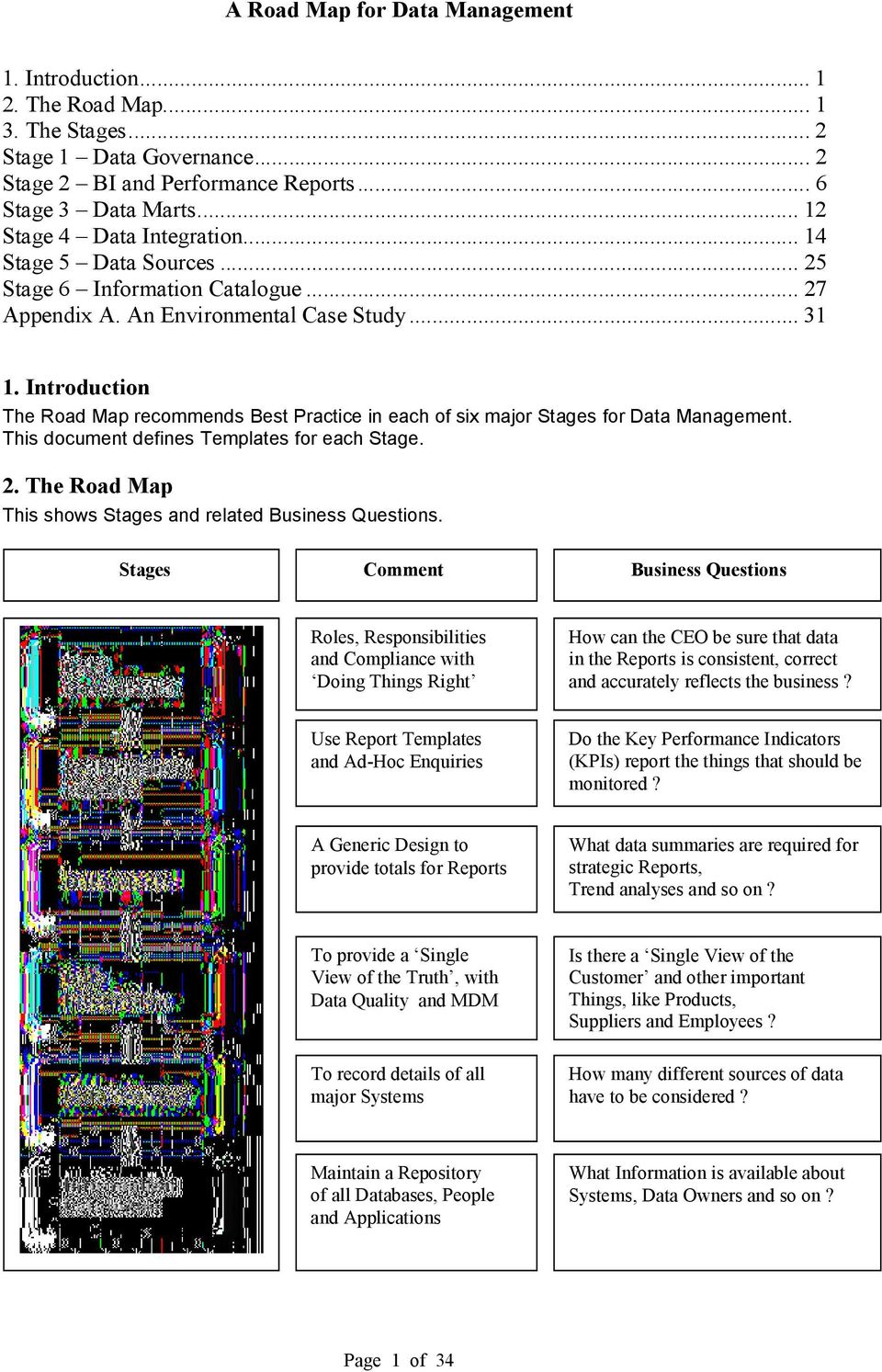
2 1. Introduction The Road Map The Stages... 2 Stage 1 Data Governance... 2 Stage 2 BI and Performance Reports... 6 Stage 3 Data Marts Stage 4 Data Integration Stage 5 Data Sources Stage 6 Information Catalogue Appendix A. An Environmental Case Study Introduction The Road Map recommends Best Practice in each of six major Stages for Data Management. This document defines Templates for each Stage. 2. The Road Map This shows Stages and related Business Questions. Stages Comment Business Questions Roles, Responsibilities and Compliance with Doing Things Right How can the CEO be sure that data in the Reports is consistent, correct and accurately reflects the business? Use Report Templates and Ad-Hoc Enquiries Do the Key Performance Indicators (KPIs) report the things that should be monitored? A Generic Design to provide totals for Reports What data summaries are required for strategic Reports, Trend analyses and so on? To provide a Single View of the Truth, with Data Quality and MDM Is there a Single View of the Customer and other important Things, like Products, Suppliers and Employees? To record details of all major Systems How many different sources of data have to be considered? Maintain a Repository of all Databases, People and Applications What Information is available about Systems, Data Owners and so on? Page 1 of 34
3 3. The Stages For each Stage, blank and partially completed Templates are provided and a series of What, Why and How Questions are answered. Stage 1 Data Governance What is Data Governance? This Stage is concerned with ensuring compliance with policies and procedures How do we get started? Tutorial Step 1. Establish Policies and Procedures Step 2. Define Roles and Responsibilities Step 3. Identify the individuals to fill the Roles Step 4. Record all the results in the Information Catalogue. 1.1 Blank Template for Data Governance TOPIC AREA NAME DESCRIPTION APPROVED 1.2 Completed Template for Data Governance TOPIC AREA NAME DESCRIPTION APPROVED People Data Models John Small Data Analyst Policies Data Integrity A Single View We will aim to provide a Single View of every major item of data, such as Customers. Procedures Data Models Models are created in Power Designer and stored in Dimensions after approval. Roles Data Models John Small Responsible for coordinating changes These questions are on this page :- What.1: What is Data Governance? Data Governance is concerned with ensuring Compliance with corporate policies and procedures for Data Management. It can be defined simply as Doing things right by complying with the appropriate rules, policies and procedures. Page 2 of 34

4 These will all be designed to make sure that data used throughout the Enterprise is good-quality data, certainly when it appears in Performance reports. It's worth checking out Wikipedia on Data Governance What.2 : What is Best Practice? Successful Data Governance requires successful completion of many Tasks, most of which are not technical and all of which are complex and challenging. The process of initially establishing Data Governance will always take much longer than anticipated. Therefore, management of expectations is very important. It is necessary to aim for collaboration and buy-in from the start. This buy-in must be top-down and bottom-up. The top-down buy-in manifests itself by, for example, a realization that Data Quality is an Enterprise Issue. The bottom-up buy-in is important because quality of Source data is critical and must be good, otherwise any Data Governance issue will fail. Auditing, for example, of database changes, is a basic requirement. What.3 : What is Data Lineage? Data Lineage can be defined as being able to the trace the derivation of all items of data that appear in any important Performance Reports and Management Information. That includes :- Who owns the original source data? What validation and transformations are applied to the data in its life cycle Why.1: Why is Data Governance important? The CEO needs to be able to put hand-on-heart and say This Data is Good It is also very important that Users have confidence in the data in their Reports. Why.2 : Why should we adopt Data Governance? The existence of a Data Governance function is a measure of the maturity of Data Management within an organization The first steps should be to establish a thin slice of Data Governance from top to bottom If you are active in this area, you should consider joining a professional organizational. This helps you to network with your peer group and will encourage you to keep up-to-date in knowledge and professional practice. Here are two organisations that are playing active roles in Data Governance :- i) The Data Governance Institute - Membership starts at $150 for individuals. ii) The Data Governance and Stewardship Community of Practice - $150/year. - It includes coverage of some very useful Case Studies. It also maintains a Data Governance Software Web Site and a Sarbanes-Oxley Web Site. Page 3 of 34

5 How.1 : How do we get started? Establish Policies, Procedures, Roles and Responsibilities Look for candidates Aim for results in 6 months and interim results in 3 months. How.2 : How do I verify Data Lineage? The derivation of the Data Lineage in Reports requires the use of an Information Catalogue that will record the source, processing steps and final delivery in a Report. The transformations in the processing Steps must be specified in both the processing language, for example SQL, and in plain, unambiguous English so that the Data Owner can sign-off on the Data Lineage. There is a 20-page PDF document describing a Road Map from the Data Governance Institute. Page 4 of 34

6 How.3 : How do I get a top-down view of Data Management? Data Management in an organisation can be considered at different levels :- Data Governance at the top-level Master Data Management at the mid-level Data Integration at the mid-level Data Owners and Sources at the lowest level Information Catalogue mandated as the central repository of all this information Appropriate procedures in place to control all of these factors. Page 5 of 34

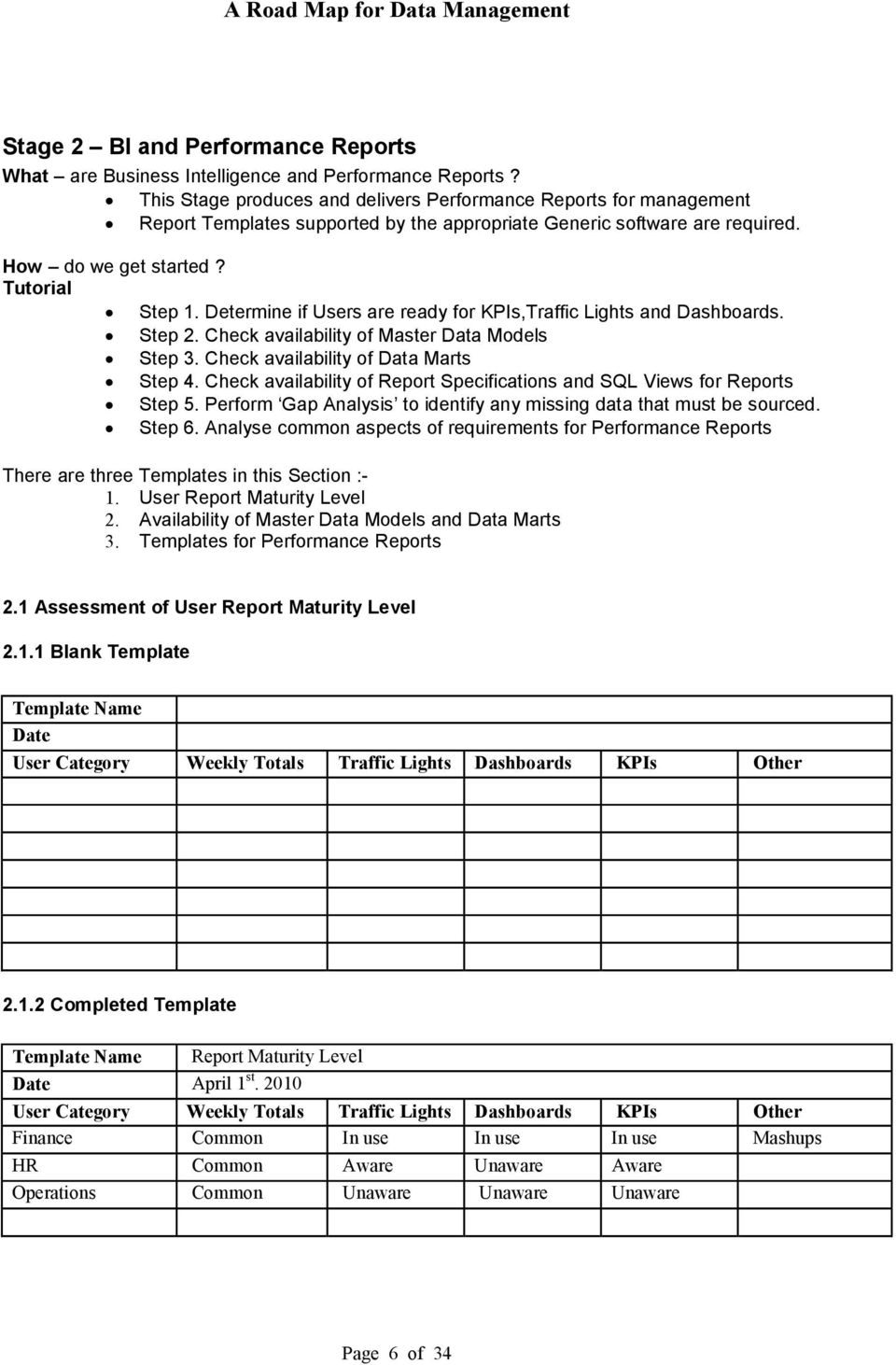
7 Stage 2 BI and Performance Reports What are Business Intelligence and Performance Reports? This Stage produces and delivers Performance Reports for management Report Templates supported by the appropriate Generic software are required. How do we get started? Tutorial Step 1. Determine if Users are ready for KPIs,Traffic Lights and Dashboards. Step 2. Check availability of Master Data Models Step 3. Check availability of Data Marts Step 4. Check availability of Report Specifications and SQL Views for Reports Step 5. Perform Gap Analysis to identify any missing data that must be sourced. Step 6. Analyse common aspects of requirements for Performance Reports There are three Templates in this Section :- 1. User Report Maturity Level 2. Availability of Master Data Models and Data Marts 3. Templates for Performance Reports 2.1 Assessment of User Report Maturity Level Blank Template Template Name Date User Category Weekly Totals Traffic Lights Dashboards KPIs Other Completed Template Template Name Report Maturity Level Date April 1 st User Category Weekly Totals Traffic Lights Dashboards KPIs Other Finance Common In use In use In use Mashups HR Common Aware Unaware Aware Operations Common Unaware Unaware Unaware Page 6 of 34
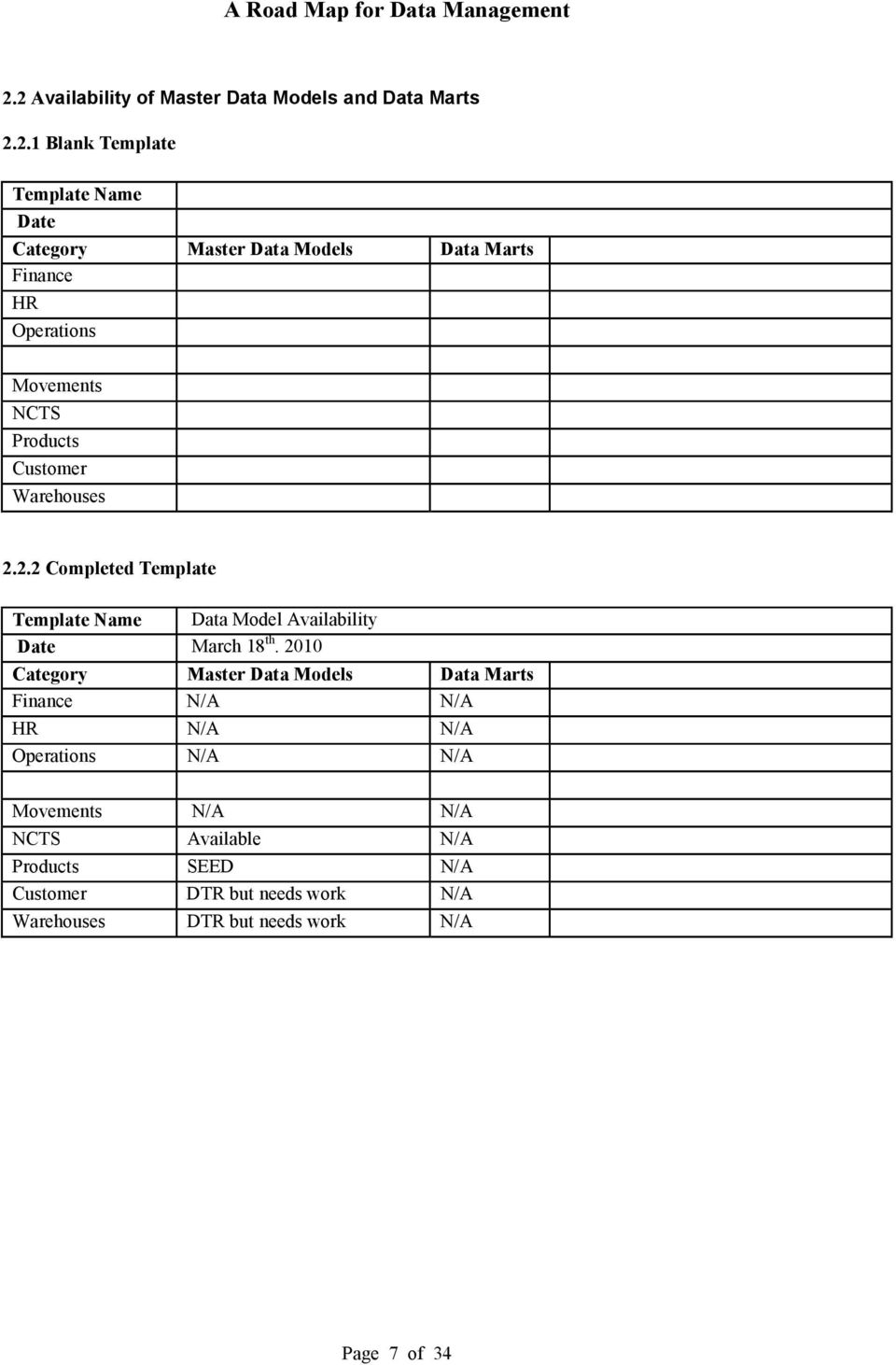
8 2.2 Availability of Master Data Models and Data Marts Blank Template Template Name Date Category Master Data Models Data Marts Finance HR Operations Movements NCTS Products Customer Warehouses Completed Template Template Name Data Model Availability Date March 18 th Category Master Data Models Data Marts Finance N/A N/A HR N/A N/A Operations N/A N/A Movements N/A N/A NCTS Available N/A Products SEED N/A Customer DTR but needs work N/A Warehouses DTR but needs work N/A Page 7 of 34
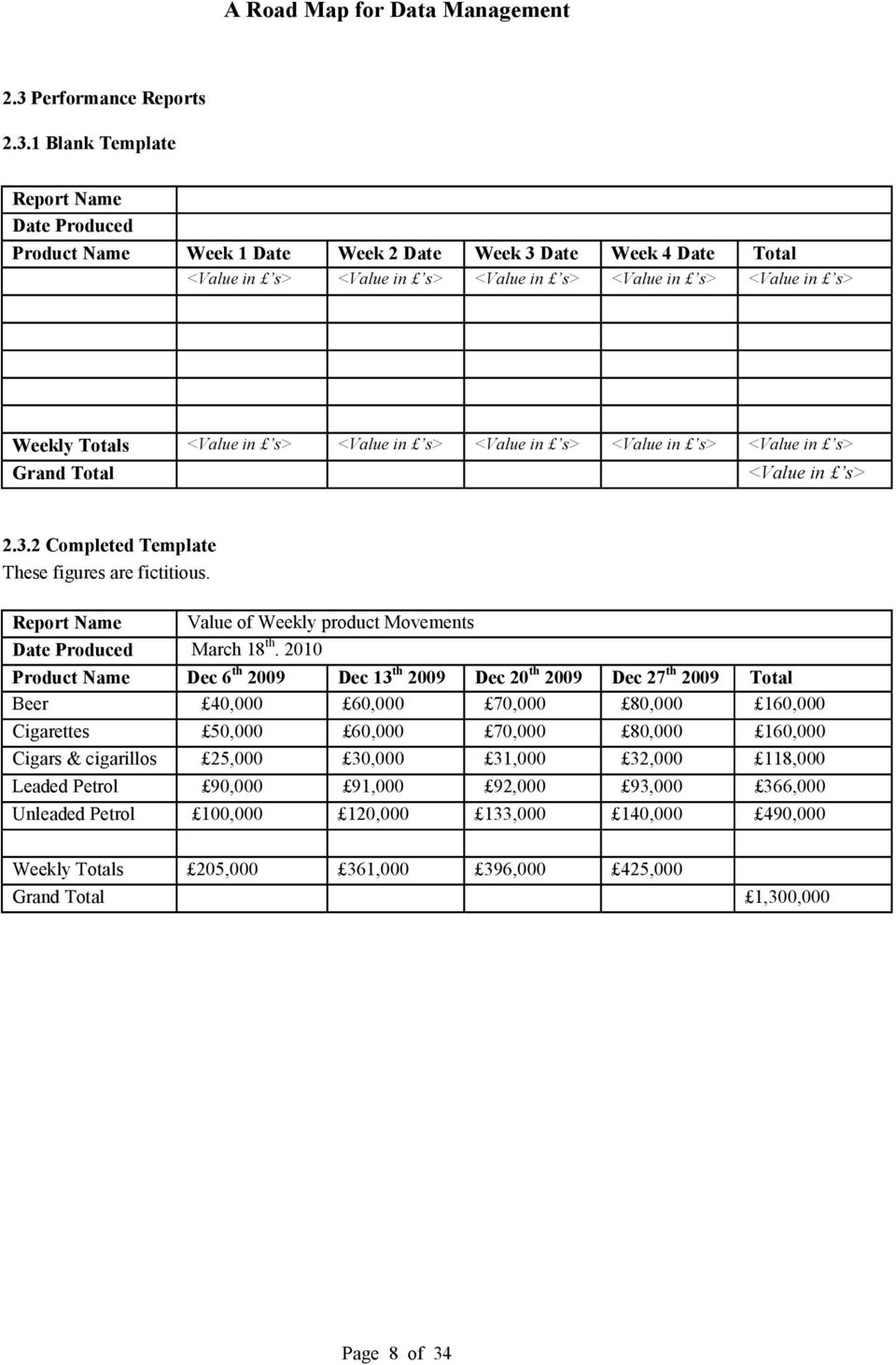
9 2.3 Performance Reports Blank Template Report Name Date Produced Product Name Week 1 Date Week 2 Date Week 3 Date Week 4 Date Total <Value in s> <Value in s> <Value in s> <Value in s> <Value in s> Weekly Totals <Value in s> <Value in s> <Value in s> <Value in s> <Value in s> Grand Total <Value in s> Completed Template These figures are fictitious. Report Name Value of Weekly product Movements Date Produced March 18 th Product Name Dec 6 th 2009 Dec 13 th 2009 Dec 20 th 2009 Dec 27 th 2009 Total Beer 40,000 60,000 70,000 80, ,000 Cigarettes 50,000 60,000 70,000 80, ,000 Cigars & cigarillos 25,000 30,000 31,000 32, ,000 Leaded Petrol 90,000 91,000 92,000 93, ,000 Unleaded Petrol 100, , , , ,000 Weekly Totals 205, , , ,000 Grand Total 1,300,000 Page 8 of 34
10 These questions are from this page :- What.1 : What are Business Intelligence? This Stage produces and delivers BI and Performance Reports to management :- It must be responsive to requests for change. Users requirements are always evolving Therefore the approach and supporting software must be flexible Report Templates supported by the appropriate Generic software are required. This Stage delivers Performance Reports that meet the requirements of all levels of management. There is a need to be responsive to requests for change. User Requirements are always evolving. Therefore the approach and reporting software tool must be flexible. A sensible approach is to develop Reporting Templates supported by the appropriate Generic Software. What.2 : What is Best Practice? Performance Reports take data from Data Marts and many of the same considerations apply when it comes to determining Best Practice. One difference is that is necessary to have a clearer understanding of the business operations and how the right kind of Performance Reports can provide insight to the business users. This leads to the need for a management education process to be in place so that the evolution of Performance Reports can be planned in a logical manner, from basic summaries, to KPIs, Dashboards and so on. Why.1 : Why is this Stage important? The value and benefits of Reports are always a major part of the justification of the cost of designing and installing a Database. How.1 : How do we get started? These questions are taken from this page :- Here's a Kick-Start Tutorial :- Step 1. Assess the level of Maturity of the Users concerning KPIs, Dashboards,etc.. Step 2. Check availability of Master Data Models and Data Marts Page 9 of 34

11 Step 3. Check availability of Report Specifications and SQL Views for Reports Step 4. Tailor the Approach accordingly Step 5. Aim for results in 6 months and interim results in 3 months If you have a Question that is not addressed here, please feel free to us your Question at [email protected]. How.2 : How do we measure progress in Business Intelligence? Check for :- a Statement of User Requirements ideally with specifications of Templates Software Design Patterns. How.3 : How do I combine Excel data in my Reports? Data in Excel Spreadsheets is structured in tabular format which corresponds exactly to the way in which data is stored in relational database. Also Spreadsheets are commonly used and the data frequently needs to be integrated with other data within an organization. Therefore we would expect to find a wide range of solutions are available to solve this problem. Here is a small sample :- An ODBC connection can be established for a spreadsheet. Informatica allows Spreadsheets to be defined as a Data Source. Microsoft s SQL Server Integrated Services also lets Excel be defined as a Source. Oracle provides a facility to define EXTERNAL table which can be Spreadsheets. Salesforce.com provides their Excel Communicator. How.4 : How do you meet your Chief Executive s Report requirements? In order to always respond to this situation appropriately, it is necessary to have an Information Catalogue, a Data Architecture and Data Lineage. The solution then involves the following Steps :- Step 1) Produce a draft Report for the Chief Execs approval Step 2) Trace the lineage and perform a gap analysis for all new data items. Step 3) Talk to the Data Owners and establish when and how the data can be made available. Step 4) Produce a Plan and timescale Step 5) Review your Plan with the Chief Exec and obtain this agreement and formal sign-off. Step 6) Deliver!!! How.5 : How do I produce Integrated Performance Reports? Reports for Senior Management fall into two categories :- Standard Reports On-demand reports Page 10 of 34

12 For Standard Reports it is possible to define Templates. For On-demand Reports, the aim is to define a flexible approach to be able to respond to changes to Requirements in a timely manner. The key action here is to establish a unified Reporting Data Platform. This will involve aspects previously discussed, including MDM, CMI and will certainly involve Data Lineage. Senior Management will want to take a view of the integrated data and not focus on details of derivation. Therefore, we have to follow the MDM approach with Data Lineage for each item in the Integrated Performance Reports. Key Performance Indicators ( KPIs ) Question : What are Key Performance Indicators ( KPIs ) Key Performance Indicators ( KPIs ) are in common use and represent one aspect of Best Practice. A variation of this approach are Key Quality Indicators,( KQIs ) which are used to monitor and manage Data Quality. Dashboards and Scorecards are often used in association with KPIs and KQIs. Page 11 of 34

13 Stage 3 Data Marts What is a Data Mart? A Repository of total and detailed data with a standard structure This structure is usually a Facts Table where all the data for analysis is held, together with a number of associated Dimension Tables. Generic software is used, support by common Report Templates How do we get Started? Step 1. Understand the User s Data Requirements Step 2. Determine the available Data Step 3. Reconcile standards, reference data Step 4. Establish a common view of the Data Platform Step 5. Choose the product or use bespoke SQL Step 6. Design the Templates and agree design with Users Step 7. Populate the Templates with sample data 3.1 Blank Template DIMENSION 1 Dimension 1 ID (PK) Dimension Details 1 DIMENSIONS 2 Dimension 2 ID (PK) Dimension Details 2 DIMENSIONS 3 Dimension 3 ID (PK) Dimension Details 3 DATA_MART_FACTS Fact ID (PK) Dimension 1 ID Dimension 2 ID Dimension 3 ID Dimension 4 ID Dimension 5 ID Dimension 6 ID Averages Counts Totals KPIs Other Derived Figures DIMENSIONS 4 Dimension 4 ID (PK) Dimension Details 4 DIMENSIONS 5 Dimension 5 ID (PK) Dimension Details 5 DIMENSIONS 6 Dimension 6 ID (PK) Dimension Details Completed Template CALENDAR Day Number (PK) Day Date PRODUCT TYPES Product Type Code Product Type Details CUSTOMER TYPES Customer Type Code Customer Type Details DATA_MART_FACTS Fact ID (PK) Date Movement ID Product ID Product Type Code Customer ID Customer Type Code Total Movements Total Movements by Value Total Movements by Month KPIs Other Derived Figures MOVEMENTS Movement ID Movement Details PRODUCTS Product ID Product Details CUSTOMERS Customer ID Customer Details Page 12 of 34

14 What.1 : What is a Data Mart? These questions are from this page :- Data Marts are a Repository of summary, total and detailed data to meet User Requirements for Reports. They always have a standard structure, called Dimensional Data Models, which means that it is possible to use Generic Software and adopt a common Approach based on Templates. Describing a Data Mart is a good way to get User buy-in because they can easily be explained in a logical manner which is very user-friendly. A Data Mart is a Repository of total and detailed data to meet User Reports requirements. It always a standard structure which means can have generic software and a common approach based on Report Templates A Data Mart design is simple and can be described to get User buy-in What.2 : What are Data Mart Templates? Data Marts have a common design of Dimension fields and Facts. Templates are important because they represent a tremendous Kick-Start approach to the design of Data Marts for a specific business area. They are produced by exploiting the common design of Dimensions and Facts. A range of Data Mart diagrams is available in the Case Studies on the Database Answers Web Site. Why.1 : Why is this Stage important? It provides a single point of reference for all the data available within the organisation for producing Reports How.1 : How do we get Started? These questions are form this page :- To get started, follow these Steps :- Get a broad understanding of User s Data Requirements Establish a common view of the Data Platform Page 13 of 34

15 Determine the available Data Reconcile standards, reference data Choose the product or use bespoke SQL Use Templates and agree design with Users Populate Templates with sample data Get sign-off on demo specs in 1 month, aim for results for champion in 3 months and final results in 6 months. Adjust timescales in light of experience How.2: How do we measure progress with Data Marts? Check the level of Users understanding. Check for existence of Templates. How.3: How do I improve the performance of my Data Mart? Every DBMS produces what is called an Execution Plan for every SELECT statement. The steps to improving the performance involve checking this Execution Plan against the Indexes that exist, and making sure that the Query Optimizer has used the appropriate Indexes to obtain the best performance. This is a specialized area where DBA s spend a lot of their time when they are looking after production databases where speed is a mission-critical factor. Data Marts are always created to support Business Intelligence, which includes Performance Reports, Balanced Scorecards, Dashboards, Key Performance Indicators and so on. Best practice always requires user involvement and a generic design to support a flexible approach to meeting changing requirements. Users will always want changes to their first specifications of their requirements. The insight that they obtain from the first Reports helps them identify more precisely what their long-term requirements will be. Therefore flexibility is important. A well-designed Data Mart will anticipate the areas where flexibility is required. The design process should always follow two steps :- Production of generic design for the Data Mart Implementation of the design with a specific Data Mart software product. Stage 4 Data Integration What is Data Integration? Data Integration provides a one view of the truth for things of importance to the organisation, such as Customers, Products and Movements. It includes Data Quality, Master Data Management and mapping specifications. Page 14 of 34

16 How do we get started? Step 1. Start with Data Profiling because it is a good starting-point for determining the quality of the data and drafting some simple validation and transformation that can be used to get started. For example, replace LTD by LIMITED (or vice versa), and & by AND. Step 2. Determine the available Data Models for major areas of the enterprise. Step 3. Determine whether Generic Data Models are available to support one view of the truth for major entities, such as Customers or Offices. This one view approach will be implemented as Master Data Management. Step 4. Establish a common view of the Data Platform Reference Data, Customers, products, Movements and so on. Step 5. Determine the available Data Step 6. Choose an MDM product or decide on in-house SQL development. Templates are defined for important activities within Data Integration, including :- Data Profiling Data Validation Mapping Specifications 4.1 Templates for Data Profiling 4.1a Blank Template DATA ITEM DESCRIPTION MIN VALUE MAX VALUE MOST COMMON VALUE COMMENTS 4.1b Completed Template for Data Profiling DATA ITEM DESCRIPTION MIN VALUE Withdrawn Date Date Customer s Dec-31- Approval withdrawn 1998 MAX VALUE Jan MOST COMMON VALUE Jun COMMENTS Page 15 of 34

17 4.2 Templates for Data Validation 4.2a Blank Template for Data Validation DATA ITEM DESCRIPTION Nullable RULES DATE % QUALITY 4.2b Completed Template for Data Validation DATA ITEM DESCRIPTION Nullable RULES DATE % QUALITY Withdrawn Date Date Customer s Approval is withdrawn Yes >Start Date 4.3 Templates for Mapping Specifications 4.3a Blank Template for Mapping Specifications ETL Transformations Project Title Known As: Development End date: Additional Comments: Trigger Source (eg Table) Data Item Data Type Target (eg XML File) Data Item Data Type Job Schedule Rule Specification Page 16 of 34

18 4.3b Completed Template for Mapping Specifications Specifications taken from migrating sample Customer data. Mapping Specifications Project Title: Creation of a Data Extract for Customers Date: April 1 st Additional Comments: These Specifications are subject to review by Stakeholders. Trigger When CUSTOMERS.DAT_VAL = SYSDATE Source (Include DB type and name) Data Type Target Field Name Data Type Transf Rule Table Column Table Column CUSTOMERS ID NVARCHAR2(8) OFFICE CUSTOMERS DAT_VALID DATE CUSTOMERS PHON_NUMBER NVARCHAR2(35) CUSTOMERS FAX_NUMBER NVARCHAR2(35) CUSTOMERS TELEX_NUMBER NVARCHAR2(35) CUSTOMERS E_MAIL_ADDRESS NVARCHAR2(70) CUSTOMERS COUNTRY_ID NVARCHAR2(2) OFFICE CUSTOMERS TRADING_ROLE NVARCHAR2(1) CUSTOMERS POST_CODE NVARCHAR2(9) CUSTOMERS REG_CODE NVARCHAR2(3) CUSTOMERS GEO_INF_CODE NVARCHAR2(8) Office Unique ID Country Code CHAR(8) CHAR(2) Copy As is Page 17 of 34

19 What.1 : What is Data Integration? Here is the Web Link :- Data Integration is concerned with combining data from various Sources into one consistent stream. It provides an essential Single View of Data, for example, a Single View of a Customer. It also provides a natural point at which Data Quality can be addressed. At this Stage, Data Quality can be assessed and a Single View of a Customer can be achieved. When Data Quality is of a uniform good quality, it can be integrated and made available as a consistent View. This will be supported using a Glossary, as described in the Information Catalog Stage. The current incarnation of Data Integration is Master Data Management,(MDM). Data Integration provides a one view of the truth for things of importance to the organisation, such as Traders, Products and Movements. It provides a natural point at which data quality can be addressed. When Data is of uniform good quality it can be integrated and made available as a consistent View. This leads naturally to Master Data Management,(MDM). Details of the Integration, such as mapping specifications, are held in a Glossary, which is described in Stage 6. Some key points :- Data Integration is concerned with combining data from various Sources into one consistent stream. It provides an essential Single View of Data, for example, a Single View of a Customer. It also provides a natural point at which Data Quality can be addressed. At this Stage, Data Quality can be assessed and a Single View of a Customer can be achieved. When Data Quality is of a uniform good quality, it can be integrated and made available as a consistent View. This will be supported using a Glossary, as described in the Information Catalog Stage. The current incarnation of Data Integration is Master Data Management,(MDM). Data Integration provides a Single View of the Truth for the things of importance to the organisation, such as Traders, Products and Movements. It provides a natural point at which data quality can be addressed. When Data is of uniform good quality it can be integrated and made available as a consistent View. This leads naturally to Master Data Management,(MDM). Page 18 of 34
20 Details of the Integration, such as mapping specifications, are held in a Glossary, which is described in Stage 6. What.2 : What is Master Data Management (MDM)? One of the major components in Master Data Management ( MDM ) is Customers. MDM can be defined a Providing a Single View of the Things of Importance within an organisation Master Data Management applies the same principles to all the Things of Interest in an organisation. This can typically include Employees, Products and Suppliers. We have discussed A Single View of the Customer and MDM involves the same kind of operations as a CMI. That is, identification and removal of duplicates, and putting in place to eliminate duplicates in any new data loaded into the Databases. There is a wide choice of software vendors offering MDM products. De-duplication and Address validation is a niche market in this area. On the Database Answers Web Site, there is a Tutorial on Getting Started in MDM There is a sister Web Site devoted to the topic of MDM-As-a-Service What.3 : What are Conceptual, Logical and Physical Data Models? Wikipedia has some useful entries on Conceptual Models, Logical Models and Data Models. Conceptual Data Models do not conventionally show Foreign Keys and are very useful for making clear the Entities and Relationships in a Data Model without any Keys or Attributes. They are very useful for discussing Requirements with Users because they show only the basics. Logical Data Models add Foreign Keys and Attributes. They are very useful for publishing a complete statement of the data involved. Physical Data Models are very close to the Database design. They are very useful for discussions between the Data Analyst, DBAs and developers. What.4 : What does ETL stand for? Wikipedia has an entry on ETL which is worth a look. ETL stands for Extract, Transform and Load. Extract means Extracting data from Data Sources. Transform covers many tasks, including O Selection of the data of interest o Validation and clean-up of the selected data o Changing the format and content of the data o Loading into the designated Target. Page 19 of 34

21 In practice, there are three options for implementing ETL:- Develop bespoke SQL Use a commercial package, such as Informatica or Microsoft s Integration Services Some combination of these two. For example, developing basic SQL to clarify the Requirements and then looking for a commercial product to meet the Requirements. What.5 : What is Data Lineage? Data Lineage can be defined as the ability to the trace the derivation of all items of data that appear in any important Performance Reports and Management Information. That includes :- Who owns the original source data What validation and transformations are applied to the data in its life cycle Why.1 : Why is this Stage important? It provides one view of the truth It offers a point at which Data Integrity can be measured and User involvement obtained to improve Quality until it meets User standards. How.1 : How do we get started? Data Profiling is a good starting-point for determining the quality of the data and drafting some simple validation and transformation that can be used to get started. For example, replace LTD by LIMITED (or vice versa), and & by AND. The Design Approach requires Data Models for the areas of the within Scope. It will also require Generic Data Models to support one view of the truth for major entities, such as Traders or Customers. This one view will be implemented as Master Data Management (MDM). Get a broad understanding of the data available Establish a common view of the Data Platform Get a broad understanding of Data Sources Determine the available Data Choose the MDM product Determine strategy for Clouds e.g. Reference Data available globally o In 1 month, produce Generic Data Models o In 3 months, confirm GDM with sample data and Facilitated Workshops and choose MDM product. o In 6 months, implement MDM and publish GDM and CMI on the Intranet. o Adjust timescales in light of experience Data Integration covers a number of Steps, each of which can have its own Templates. Examples are included here for Data Profiling and Mapping Specifications. Page 20 of 34
22 How.2 : How do we follow Best Practice These Steps define a Tutorial of Best Practice :- Step 1. Define the Target which is usually a Single View Data Model. Step 2. Define the Data Sources Step 3. Define the Mapping Specifications from the Sources to the Target. Step 4. Define the Data Platform Step 5. Identify Standards to be followed. This Tutorial is described in detail in a separate document, entitled Data_Integration_Tutorial.doc These questions come from this page :- If you have a Question that is not addressed here, please feel free to us your Question. How.3 : How do we measure progress in Data Integration? Look for the existence of the following items :- Generic Data Models An Enterprise Data Platform Identify the Data Sources Selection of a MDM Product Implementation of a Customer Master Index or appropriate alternative Page 21 of 34
23 How.4 : How do we get started? Data Profiling is a good starting-point for determining the quality of the data and drafting some simple validation and transformation that can be used to get started. For example, replace LTD by LIMITED (or vice versa), and & by AND. The Design Approach requires Data Models for the areas of the within Scope. It will also require Generic Data Models to support one view of the truth for major entities, such as Traders or Customers. This one view will be implemented as Master Data Management (MDM). Get a broad understanding of the data available Establish a common view of the Data Platform Get a broad understanding of Data Sources Determine the available Data Choose the MDM product Determine a Strategy for Clouds e.g. Reference Data available globally o In 1 month, produce Generic Data Models o In 3 months, confirm GDM with sample data and Facilitated Workshops and choose MDM product. o In 6 months, implement MDM and publish GDM and CMI on the Intranet. Adjust timescales in light of experience Data Integration covers a number of Steps, each of which can have its own Templates. Examples are included here for Data Profiling and Mapping Specifications. How.5 : How do we follow Best Practice These Steps define a Tutorial of Best Practice :- Step 1. Define the Target which is usually a Single View Data Model. Step 2. Define the Data Sources Step 3. Define the Mapping Specifications from the Sources to the Target. Step 4. Define the Data Platform Step 5. Identify Standards to be followed. This Tutorial is described in detail in a separate document, entitled Data_Integration_Tutorial.doc These questions are from this page :- If you have a Question that is not addressed here, please feel free to us your Question. Page 22 of 34
24 How.6 : How do we measure progress in Data Integration? Look for the existence and understanding of the following items :- Generic Data Models An Enterprise Data Platform Identify the Data Sources Selection of a MDM Product Implementation of a Customer Master Index or appropriate alternative How.7 : How do I establish a Strategy for Data Quality? A successful Strategy for Data Quality as an Enterprise Issue must include both organization and technical aspects. Typical Organization aspects are :- Commitment from senior management Establishing the slogan Data Quality is an Enterprise Issue as a top-down edict. Identification of the Top 20 Applications and Data Owners across the Enterprise Agree sign-off procedures with Data Owners and Users Technical aspects Establish Key Quality Indicators ( KQIs), for example Duplicate Customers records Agree target Data Quality percentage Define KQI Reports and dashboards Develop SQL to measure KQIs Define procedures to improve KQIs How.8 : How do I handle multiple types of Databases? This could include Oracle, SQL Server and DB2. The key to handling multiple types of Database is to thing of them in terms of an Integrated Data Platforms, where all types of data are presented in a common fashion. This then defines the logical requirement. There is a then a number of options to physically meet this logical requirement. The Enterprise-level option is to use an appropriate commercial product, such as Informatica Page 23 of 34
25 How.9: How do I obtain a Single View of my Customers? This requires a method of matching Customers, de-duplication and the maintenance of a Customer Master Index, ( CMI ) supports a Single View of a Customer. When there are many sources of similar data, such as Customers, there are frequently duplicate records. For example, in the US, John Doe could be also called Jon Doe, Johnny Doe, Mr.J..Doe and so on. In the UK, Joe Bloggs could also be called Joseph Bloggs, Joey Bloggs, Mr.J.Bloggs and so on. The rules for recognizing and resolving this kind of problem has led to the development of software for De-duplicating records. This process is informally referred to as de-duping, especially by people who do a great deal of it. Best Practice is to look for a commercial product, rather than to write your own bespoke software because it usually takes longer than expected and commercial products can be quite cheap. This page on the Database Answers Web Site is an excellent starting-point for reviewing "Deduping" How.10 : How do I verify Report Data? All data in all Reports must be verifiable concerning authenticity. This requires verification of Data Lineage with the use of an Information Catalogue that will record the source, processing steps and final delivery in a Report. The transformations in the processing Steps must be specified in both the processing language, for example SQL, and in plain, unambiguous English so that the Data Owner can sign-off on the Data Lineage. Page 24 of 34
26 Stage 5 Data Sources What are Data Sources? A Repository for all major Applications, Databases, Spreadsheets and so on. data and information related to each Stage in the Best Practice Road Map This includes details of People, Roles and Responsibilities, Applications, Databases How do we get started? Step 1. Define the initial content and revise at regular intervals. Step 2. Follow-up a bottom-up Approach and focus on working documents, such as Invoices or Movement Authorisations..Step 3. Follow-up a top-down Approach and focus on Reports. 5.1 Blank Template for Data Sources SOURCES CONTACT TYPE DATA ITEMS COMMENTS 5.2 Completed Template for Data Sources SOURCES CONTACT TYPE DATA ITEMS COMMENTS DTR Joe Bloggs SQL Server DB Customers Golden Source NCTS Joe Bloggs Oracle DB Offices Official Source What.1 : What are Data Sources? These questions are from this page :- Data Sources include all major places where important data is created or used, including :- Applications Databases Spreadsheets XML files, and so on It also includes Information related to each Stage in the Best Practice Road Map on People, Roles and Responsibilities. This Information is stored within an Information Catalog. Page 25 of 34
27 A Repository record Data Sources for all major Applications, Databases, Spreadsheets and so on, data and information related to each Stage in the Best Practice Road Map This includes details of People, Roles and Responsibilities, Applications, Databases Why.1 : Is this Stage important? Because it provides the starting-point How.1 : How do we get started? These are the basic Steps :- Step 1. Agree initial content and revise at regular intervals. Step 2. Identify individuals responsible for data gathering and dissemination. Step 3. Take a bottom-up Approach and focus on working documents, such as Invoices. Page 26 of 34
28 Stage 6 Information Catalogue What is an Information Catalogue? It is a common Repository for all data and information related to Data Management within the Enterprise. The design will usually reflect the Project and Enterprise and will change over time, typically from Spreadsheets to Access Database and then Oracle. Therefore a flexible design is required, perhaps based on extendable Tables. Contents will include details of People, Roles and Responsibilities, Applications, Databases It will be published over the Intranet with access privileges for CRUD to designated individuals It is updated by nominated individuals and made available to other individuals on a Publish and Subscribe basis. How - do we get started? Step 1. Agree the format, perhaps start with Spreadsheet, migrate to Access then online Database and finally In the Clouds. Step 2. Agree the initial content, distribution and responsible individuals. 6.1 Templates for the Information Catalogue The Information Catalogue contains all the repository-type information collected during the other Stages. Therefore it will contain all the Templates that are associated with the other Stages. Details are shown here in one place for convenience. 6.2 Blank Template for Data Governance TOPIC AREA NAME DESCRIPTION 6.3 Blank Template for Performance Reports Report Name : <Name up to 80 characters goes here> Date Produced : Product Name Dec 6 th 2009 Dec 13 th 2009 Dec 20 th 2009 Dec 27 th 2009 Total <Value in s> Weekly Totals Grand Total <Value in s> <Value in s> Page 27 of 34
29 6.4 Blank / Generic Template for Data Marts DIMENSION 1 Dimension 1 ID (PK) Dimension Details 1 DIMENSIONS 2 Dimension 2 ID (PK) Dimension Details 2 DIMENSIONS 3 Dimension 3 ID (PK) Dimension Details 3 DATA_MART_FACTS Fact ID (PK) Dimension 1 ID Dimension 2 ID Dimension 3 ID Dimension 4 ID Dimension 5 ID Dimension 6 ID Averages Counts Totals KPIs Other Derived Figures DIMENSIONS 4 Dimension 4 ID (PK) Dimension Details 4 DIMENSIONS 5 Dimension 5 ID (PK) Dimension Details 5 DIMENSIONS 6 Dimension 6 ID (PK) Dimension Details Blank Template for Mapping Specifications Mapping Specifications Project Title Project : Date: Additional Comments: Trigger Source (eg Table) Data Item Data Type Target (eg XML File) Data Item Data Type Job Schedule Rule Specification 6.6 Blank Template for Data Sources SOURCES CONTACT TYPE DATA ITEMS COMMENTS Page 28 of 34
30 These questions come from this page :- If you have a Question that is not addressed here, please feel free to us your Question. What.1 : What is an Information Catalog? It is a common Repository for all data and information related to Data Management within the Enterprise. The design will usually reflect the Project and Enterprise and will change over time, typically from Spreadsheets to Access Database and then Oracle. Therefore a flexible design is required, perhaps based on extendable Tables. Contents will include details of People, Roles and Responsibilities, Applications, Databases It will be published over the Intranet with access privileges for CRUD to designated individuals It is updated by nominated individuals and made available to other individuals on a Publish and Subscribe basis. An Information Catalog is a common Repository for all data and information related to Enterprise Data Management. As a result, it can play a very important role in Data Integration. The design will usually reflect the Project and the culture within the organisation and change from time-to-time. Initial format will often include Word documents and Spreadsheets, and these might migrate to a Database. Therefore a flexible approach is required, which will usually be based on Extendable Tables. The contents will include some of these things :- Applications Databases Details of People, Roles and Responsibilities Mapping Specifications for Data Integration And so on It will be published over the corporate Intranet with clearly-defined privileges for who can create, update, access and provide feedback on the content. What.2 : What other names are used? An Information Catalog can also be called a Data Dictionary or an Information Repository. Wikipedia has an entry for a Data Dictionary that is worth checking out. Wikipedia also has an entry for Information Repository which describes something different. An Information Catalogue can be used to record every activity and decision of importance relating to Data Integration at each Stage. It can play a role from the beginning, by recording Data Owners and Data Sources. Page 29 of 34
31 Then during the Data Integration Stage, it can record details of Tables, Fields, Rules for Validation, Mapping and Translation. In the Reporting Stage, it can be used to record definitions of Report Templates and specific variations of the Templates for specific Projects. In the Data Governance Stage, it can be used to record decisions and agreements reached in critical aspects of Data Management. The best use of the Information is to be deployed over an Intranet and/or in the Clouds so that individuals throughout an organization can share the Information, comment on issues and so on. Some commercial products are available, listed here alphabetically :- ASG Rochade The world s leading Metadata Repository Computer Associates Repository for Distributed Systems IBM Repository IBM SOA Repository Oracle Enterprise Repository Unisys used to market a product called Universal Repository but a search of their Web Site revealed nothing, except that Sybase acquired the rights to it back in The selection of a commercial product should include the ability to exchange data and metadata. This can be achieved by XMI or by the SQL that creates the Tables. Why.1 : Why is this Stage important? It provides a single point of access to details of all progress, objectives, milestones and so on. It contains the details necessary to support Data Lineage by tracking each data item from origin to destination. How.1 : How do we get started? Here is the Web Link :- Step 1. Agree the format for the initial Information Catalogue - e.g. start with Spreadsheet, migrate to Access then online Database and finally In the Clouds. Step 2. Agree initial content and update procedures. Step 3. Agree Publish and Subscribe procedures. Step 4. Identify the individuals responsible for data gathering and dissemination. How.2 : How do we measure progress? Progress with an Information Catalog involves identification of the following things :- Paper-based documents A Database-supported version Individuals in place to maintain the Catalog Page 30 of 34
32 Appendix A. An Environmental Case Study A.1 Summary of BMEWS This Case Study discusses how the Database Answers Road Map was used to design an Environmental Monitoring System called BMEWS in London, England. BMEWS stands for the Business Monitoring and Early Warning System. The principle was to use Traffic Light displays to apply Management by Exception to highlight problems requiring attention. Key Performance Indicators,( KPIs ) were defined as the percentage of Red, Amber and Green within specific Areas, called Wards. These KPIs were then compared against Threshold values and the appropriate colour of Red, Amber or Green was chosen to display the result for each Ward. These Observations were then transmitted to a remote Database where they were consolidated to produce totals of Red, Amber and Green for specific smaller areas within the overall area being monitored. BMEWS used State-of-the-Art technology:- 1) Smartphones were used to enter basic Observations Streets, including Photos. 2) Internet technology was used to transmit Observations to a remote Database 3) SQL was used to calculate KPIs 4) A Traffic Light display was used to show the results to senior management 5) Reports were delivered over the Internet. A.2 Data in BMEWS This diagram shows that Observations are entered using Smartphones. They are then transmitted to a remote Database using an Internet protocol. Finally, Key Performance Indicators are calculated and displayed to senior management. Key Performance Indicators ( KPIs ) DATA MART Data Layer of Totals Data Layer of Basic Monitoring Observations Page 31 of 34
33 A.3 As seen by Senior Management The mission statement was to To maintain a Clean and Green Environment. Typical Key Performance Indicators include percentage of Green for specific areas within the overall environment. Green would be all areas are rated more than 90% on the Clean and Green Meter. Amber would be between 50% and 90% and Red below 50%. Of course, these values could be changed very easily by senior management. The Director was able to see at a glance Red areas and call the responsible managers to discuss the problem with them. This often led to a visit by the Cleaning team to rectify the problems. Smartphone were then used to transmit the Rectification to the remote Database and the Director was able to see the impact in a real-time mode. This led to a greatly increased level of performance. Using the BMEWS System, the manager with operational responsibility for the Cleaning Team was able to follow the activities of his team in real-time and make sure that they were following his instructions. This is the view that all levels of management could see :- Page 32 of 34
34 A.4 As seen by the Data Architect The BMEWS Architecture was composed of three Layers :- The Top Layer provided Performance Reports The Middle Layer is the Data Services Layer The Lowest Layer is the Data Sources Web Services are used to implement data movements between these three Layers. The Top Layer included :- o Traffic Light displays o Reports o Enquiries o Feedback The Data Services Layer included :- o Web Services for Data Integration and Consolidation Data Sources included :- o Inspections from the Monitoring Team using Smartphones o Rectifications from the third-party Environmental Clean-up Contractor o Monthly Schedules input from Spreadsheets Page 33 of 34
POLAR IT SERVICES. Business Intelligence Project Methodology
 POLAR IT SERVICES Business Intelligence Project Methodology Table of Contents 1. Overview... 2 2. Visualize... 3 3. Planning and Architecture... 4 3.1 Define Requirements... 4 3.1.1 Define Attributes...
A Tutorial on Quality Assurance of Data Models 1. QA of Data Models. Barry Williams. tutorial_qa_of_models.doc Page 1 of 17 31/12/2012 00:18:36
 A Tutorial on Quality Assurance of Data Models 1 QA of Data Models Barry Williams tutorial_qa_of_models.doc Page 1 of 17 31/12/2012 00:18:36 A Tutorial on Quality Assurance of Data Models 2 List of Activities
MDM and Data Warehousing Complement Each Other
 Master Management MDM and Warehousing Complement Each Other Greater business value from both 2011 IBM Corporation Executive Summary Master Management (MDM) and Warehousing (DW) complement each other There
A WHITE PAPER By Silwood Technology Limited
 A WHITE PAPER By Silwood Technology Limited Using Safyr to facilitate metadata transparency and communication in major Enterprise Applications Executive Summary Enterprise systems packages such as SAP,
IBM AND NEXT GENERATION ARCHITECTURE FOR BIG DATA & ANALYTICS!
 The Bloor Group IBM AND NEXT GENERATION ARCHITECTURE FOR BIG DATA & ANALYTICS VENDOR PROFILE The IBM Big Data Landscape IBM can legitimately claim to have been involved in Big Data and to have a much broader
Bringing agility to Business Intelligence Metadata as key to Agile Data Warehousing. 1 P a g e. www.analytixds.com
 Bringing agility to Business Intelligence Metadata as key to Agile Data Warehousing 1 P a g e Table of Contents What is the key to agility in Data Warehousing?... 3 The need to address requirements completely....
Data Warehouse (DW) Maturity Assessment Questionnaire
 Data Warehouse (DW) Maturity Assessment Questionnaire Catalina Sacu - [email protected] Marco Spruit [email protected] Frank Habers [email protected] September, 2010 Technical Report UU-CS-2010-021
Microsoft Services Exceed your business with Microsoft SharePoint Server 2010
 Microsoft Services Exceed your business with Microsoft SharePoint Server 2010 Business Intelligence Suite Alexandre Mendeiros, SQL Server Premier Field Engineer January 2012 Agenda Microsoft Business Intelligence
Master Data Management. Zahra Mansoori
 Master Data Management Zahra Mansoori 1 1. Preference 2 A critical question arises How do you get from a thousand points of data entry to a single view of the business? We are going to answer this question
ORACLE BUSINESS INTELLIGENCE SUITE ENTERPRISE EDITION PLUS
 ORACLE BUSINESS INTELLIGENCE SUITE ENTERPRISE EDITION PLUS PRODUCT FACTS & FEATURES KEY FEATURES Comprehensive, best-of-breed capabilities 100 percent thin client interface Intelligence across multiple
Whitepaper Data Governance Roadmap for IT Executives Valeh Nazemoff
 Whitepaper Data Governance Roadmap for IT Executives Valeh Nazemoff The Challenge IT Executives are challenged with issues around data, compliancy, regulation and making confident decisions on their business
ORACLE BUSINESS INTELLIGENCE SUITE ENTERPRISE EDITION PLUS
 Oracle Fusion editions of Oracle's Hyperion performance management products are currently available only on Microsoft Windows server platforms. The following is intended to outline our general product
Establish and maintain Center of Excellence (CoE) around Data Architecture
 Senior BI Data Architect - Bensenville, IL The Company s Information Management Team is comprised of highly technical resources with diverse backgrounds in data warehouse development & support, business
Migrating Discoverer to OBIEE Lessons Learned. Presented By Presented By Naren Thota Infosemantics, Inc.
 Migrating Discoverer to OBIEE Lessons Learned Presented By Presented By Naren Thota Infosemantics, Inc. Professional Background Partner/OBIEE Architect at Infosemantics, Inc. Experience with BI solutions
Enterprise Data Governance
 Enterprise Aligning Quality With Your Program Presented by: Mark Allen Sr. Consultant, Enterprise WellPoint, Inc. ([email protected]) 1 Introduction: Mark Allen is a senior consultant and enterprise
US Department of Education Federal Student Aid Integration Leadership Support Contractor June 1, 2007
 US Department of Education Federal Student Aid Integration Leadership Support Contractor June 1, 2007 Draft Enterprise Data Management Data Policies Final i Executive Summary This document defines data
Data warehouse and Business Intelligence Collateral
 Data warehouse and Business Intelligence Collateral Page 1 of 12 DATA WAREHOUSE AND BUSINESS INTELLIGENCE COLLATERAL Brains for the corporate brawn: In the current scenario of the business world, the competition
Integrating MDM and Business Intelligence
 Integrating MDM and Business Intelligence Scott Adams Director, Microsoft Business Intelligence Hitachi Consulting UK 1 9 th September 2014 Radisson Blu Portman 22 Portman Square London W1H 7BG United
Presented By: Leah R. Smith, PMP. Ju ly, 2 011
 Presented By: Leah R. Smith, PMP Ju ly, 2 011 Business Intelligence is commonly defined as "the process of analyzing large amounts of corporate data, usually stored in large scale databases (such as a
A McKnight Associates, Inc. White Paper: Effective Data Warehouse Organizational Roles and Responsibilities
 A McKnight Associates, Inc. White Paper: Effective Data Warehouse Organizational Roles and Responsibilities Numerous roles and responsibilities will need to be acceded to in order to make data warehouse
Creating a Business Intelligence Competency Center to Accelerate Healthcare Performance Improvement
 Creating a Business Intelligence Competency Center to Accelerate Healthcare Performance Improvement Bruce Eckert, National Practice Director, Advisory Group Ramesh Sakiri, Executive Consultant, Healthcare
Compunnel. Business Intelligence, Master Data Management & Compliance (Healthcare) Largest Health Insurance Company in New Jersey.
 Compunnel Business Intelligence, Master Data Management & Compliance (Healthcare) Largest Health Insurance Company in New Jersey Business Intelligence, Master Data Management & Compliance (Healthcare)
US Department of Education Federal Student Aid Integration Leadership Support Contractor January 25, 2007
 US Department of Education Federal Student Aid Integration Leadership Support Contractor January 25, 2007 Task 18 - Enterprise Data Management 18.002 Enterprise Data Management Concept of Operations i
James Serra Data Warehouse/BI/MDM Architect [email protected] JamesSerra.com
 James Serra Data Warehouse/BI/MDM Architect [email protected] JamesSerra.com Agenda Do you need Master Data Management (MDM)? Why Master Data Management? MDM Scenarios & MDM Hub Architecture Styles
Real-time Data Replication
 Real-time Data Replication from Oracle to other databases using DataCurrents WHITEPAPER Contents Data Replication Concepts... 2 Real time Data Replication... 3 Heterogeneous Data Replication... 4 Different
OBIEE DEVELOPER RESUME
 1 of 5 05/01/2015 13:14 OBIEE DEVELOPER RESUME Java Developers/Architects Resumes Please note that this is a not a Job Board - We are an I.T Staffing Company and we provide candidates on a Contract basis.
Business Intelligence Tutorial: Introduction to the Data Warehouse Center
 IBM DB2 Universal Database Business Intelligence Tutorial: Introduction to the Data Warehouse Center Version 8 IBM DB2 Universal Database Business Intelligence Tutorial: Introduction to the Data Warehouse
JOURNAL OF OBJECT TECHNOLOGY
 JOURNAL OF OBJECT TECHNOLOGY Online at www.jot.fm. Published by ETH Zurich, Chair of Software Engineering JOT, 2008 Vol. 7, No. 8, November-December 2008 What s Your Information Agenda? Mahesh H. Dodani,
Chapter 6 Basics of Data Integration. Fundamentals of Business Analytics RN Prasad and Seema Acharya
 Chapter 6 Basics of Data Integration Fundamentals of Business Analytics Learning Objectives and Learning Outcomes Learning Objectives 1. Concepts of data integration 2. Needs and advantages of using data
Strategic Planning. Key Initiative Overview
 David Aron Research Vice President This overview provides a high-level description of the Strategic Planning Key Initiative. IT leaders can use it to create strategies that help the business win, and change
ASYST Intelligence South Africa A Decision Inc. Company
 Business Intelligence - SAP BusinessObjects BI Platform 4.0... 2 SBO BI Platform 4.0: Admin and Security (2 days)... 2 SBO BI Platform 4.0: Administering Servers (3 days)... 3 SBO BI Platform 4.0: Designing
MOC 20467B: Designing Business Intelligence Solutions with Microsoft SQL Server 2012
 MOC 20467B: Designing Business Intelligence Solutions with Microsoft SQL Server 2012 Course Overview This course provides students with the knowledge and skills to design business intelligence solutions
IPL Service Definition - Master Data Management for Cloud Related Services
 IPL Proposal April 2014 IPL Service Definition - Master Data Management for Cloud Related Services Project: Date: 10 April 2014 Issue Number: Customer: Crown Commercial Service Page 1 of 11 IPL Information
Dimodelo Solutions Data Warehousing and Business Intelligence Concepts
 Dimodelo Solutions Data Warehousing and Business Intelligence Concepts Copyright Dimodelo Solutions 2010. All Rights Reserved. No part of this document may be reproduced without written consent from the
Reduce and manage operating costs and improve efficiency. Support better business decisions based on availability of real-time information
 Data Management Solutions Horizon Software Solution s Data Management Solutions provide organisations with confidence in control of their data as they change systems and implement new solutions. Data is
WHITE PAPER. The 7 Deadly Sins of. Dashboard Design
 WHITE PAPER The 7 Deadly Sins of Dashboard Design Overview In the new world of business intelligence (BI), the front end of an executive management platform, or dashboard, is one of several critical elements
Building Views and Charts in Requests Introduction to Answers views and charts Creating and editing charts Performing common view tasks
 Oracle Business Intelligence Enterprise Edition (OBIEE) Training: Working with Oracle Business Intelligence Answers Introduction to Oracle BI Answers Working with requests in Oracle BI Answers Using advanced
Master Data Management Architecture
 Master Data Management Architecture Version Draft 1.0 TRIM file number - Short description Relevant to Authority Responsible officer Responsible office Date introduced April 2012 Date(s) modified Describes
IBM Cognos 8 Business Intelligence Reporting Meet all your reporting requirements
 Data Sheet IBM Cognos 8 Business Intelligence Reporting Meet all your reporting requirements Overview Reporting requirements have changed dramatically in organizations. Organizations today are much more
8. Enterprise Data Models
 8. Enterprise Data Models... 1 8.0 Welcome... 1 8.1 Introduction... 1 8.2 Business Intelligence (BI)... 3 8.3 Insurance... 7 8.4 Investment Banking...14 8.5 Local Government...21 8.6 Retail...29 8.7 What
Practical meta data solutions for the large data warehouse
 K N I G H T S B R I D G E Practical meta data solutions for the large data warehouse PERFORMANCE that empowers August 21, 2002 ACS Boston National Meeting Chemical Information Division www.knightsbridge.com
dxhub Denologix MDM Solution Page 1
 Most successful large organizations are organized by lines of business (LOB). This has been a very successful way to organize for the accountability of profit and loss. It gives LOB leaders autonomy to
ORACLE ENTERPRISE DATA QUALITY PRODUCT FAMILY
 ORACLE ENTERPRISE DATA QUALITY PRODUCT FAMILY The Oracle Enterprise Data Quality family of products helps organizations achieve maximum value from their business critical applications by delivering fit
Essential Elements of a Master Data Management Architecture
 Essential Elements of a Master Data Management Architecture ABSTRACT Building master data management (MDM) into an IT infrastructure is not as simple as buying a product and plugging it in. Rather, selecting
Webinar. Feb 23 2012
 An Feb 23 2012 Webinar David White Senior Product Manager [email protected] Tel: +972-54-6750323 Shir Goldberg Co-Founder & VP Biz Dev [email protected] Tel: +1 919 827 1194 This presentation
Industry Models and Information Server
 1 September 2013 Industry Models and Information Server Data Models, Metadata Management and Data Governance Gary Thompson ([email protected] ) Information Management Disclaimer. All rights reserved.
Using Master Data in Business Intelligence
 helping build the smart business Using Master Data in Business Intelligence Colin White BI Research March 2007 Sponsored by SAP TABLE OF CONTENTS THE IMPORTANCE OF MASTER DATA MANAGEMENT 1 What is Master
With business intelligence, we create a learning organization that adapts quickly to market changes and stays one step ahead of the competition.
 With business intelligence, we create a learning organization that adapts quickly to market changes and stays one step ahead of the competition. Wayne W. Eckerson TDWI New to Business Intelligence? What
Service Oriented Data Management
 Service Oriented Management Nabin Bilas Integration Architect Integration & SOA: Agenda Integration Overview 5 Reasons Why Is Critical to SOA Oracle Integration Solution Integration
QlikView Business Discovery Platform. Algol Consulting Srl
 QlikView Business Discovery Platform Algol Consulting Srl Business Discovery Applications Application vs. Platform Application Designed to help people perform an activity Platform Provides infrastructure
idashboards FOR SOLUTION PROVIDERS
 idashboards FOR SOLUTION PROVIDERS The idashboards team was very flexible, investing considerable time working with our technical staff to come up with the perfect solution for us. Scott W. Ream, President,
Data Warehouse Overview. Srini Rengarajan
 Data Warehouse Overview Srini Rengarajan Please mute Your cell! Agenda Data Warehouse Architecture Approaches to build a Data Warehouse Top Down Approach Bottom Up Approach Best Practices Case Example
Data Integration Checklist
 The need for data integration tools exists in every company, small to large. Whether it is extracting data that exists in spreadsheets, packaged applications, databases, sensor networks or social media
Five Steps to Integrate SalesForce.com with 3 rd -Party Systems and Avoid Most Common Mistakes
 Five Steps to Integrate SalesForce.com with 3 rd -Party Systems and Avoid Most Common Mistakes This white paper will help you learn how to integrate your SalesForce.com data with 3 rd -party on-demand,
UoD IT Job Description
 UoD IT Job Description Role: Projects Portfolio Manager HERA Grade: 8 Responsible to: Director of IT Accountable for: Day to day leadership of team members and assigned workload Key Relationships: Management
<Insert Picture Here> Extending Hyperion BI with the Oracle BI Server
 Extending Hyperion BI with the Oracle BI Server Mark Ostroff Sr. BI Solutions Consultant Agenda Hyperion BI versus Hyperion BI with OBI Server Benefits of using Hyperion BI with the
TRANSFORMING YOUR BUSINESS
 September, 21 2012 TRANSFORMING YOUR BUSINESS PROCESS INTO DATA MODEL Prasad Duvvuri AST Corporation Agenda First Step Analysis Data Modeling End Solution Wrap Up FIRST STEP It Starts With.. What is the
BUILDING OLAP TOOLS OVER LARGE DATABASES
 BUILDING OLAP TOOLS OVER LARGE DATABASES Rui Oliveira, Jorge Bernardino ISEC Instituto Superior de Engenharia de Coimbra, Polytechnic Institute of Coimbra Quinta da Nora, Rua Pedro Nunes, P-3030-199 Coimbra,
Business Benefits From Microsoft SQL Server Business Intelligence Solutions How Can Business Intelligence Help You? PTR Associates Limited
 Business Benefits From Microsoft SQL Server Business Intelligence Solutions How Can Business Intelligence Help You? www.ptr.co.uk Business Benefits From Microsoft SQL Server Business Intelligence (September
Introduction to Oracle Business Intelligence Standard Edition One. Mike Donohue Senior Manager, Product Management Oracle Business Intelligence
 Introduction to Oracle Business Intelligence Standard Edition One Mike Donohue Senior Manager, Product Management Oracle Business Intelligence The following is intended to outline our general product direction.
IPL Service Definition - Master Data Management Service
 IPL Proposal IPL Service Definition - Master Data Management Service Project: Date: 16th Dec 2014 Issue Number: Issue 1 Customer: Crown Commercial Service Page 1 of 7 IPL Information Processing Limited
An Oracle White Paper June 2009. Integration Technologies for Primavera Solutions
 An Oracle White Paper June 2009 Integration Technologies for Primavera Solutions Introduction... 1 The Integration Challenge... 2 Integration Methods for Primavera Solutions... 2 Integration Application
Microsoft Data Warehouse in Depth
 Microsoft Data Warehouse in Depth 1 P a g e Duration What s new Why attend Who should attend Course format and prerequisites 4 days The course materials have been refreshed to align with the second edition
Data Ownership and Enterprise Data Management: Implementing a Data Management Strategy (Part 3)
 A DataFlux White Paper Prepared by: Mike Ferguson Data Ownership and Enterprise Data Management: Implementing a Data Management Strategy (Part 3) Leader in Data Quality and Data Integration www.flux.com
uncommon thinking ORACLE BUSINESS INTELLIGENCE ENTERPRISE EDITION ONSITE TRAINING OUTLINES
 OBIEE 11G: CREATE ANALYSIS AND DASHBOARDS: 11.1.1.7 DURATION: 4 DAYS Course Description: This course provides step-by-step instructions for creating analyses and dashboards, which compose business intelligence
Business Intelligence Tutorial
 IBM DB2 Universal Database Business Intelligence Tutorial Version 7 IBM DB2 Universal Database Business Intelligence Tutorial Version 7 Before using this information and the product it supports, be sure
BUSINESSOBJECTS DATA INTEGRATOR
 PRODUCTS BUSINESSOBJECTS DATA INTEGRATOR IT Benefits Correlate and integrate data from any source Efficiently design a bulletproof data integration process Improve data quality Move data in real time and
Job Description. Working Hours Standard 35 hours per week Normally working Mon Fri 9am to 5pm with additional hours as required
 Job Description Job Title Oracle Support Technical Developer Function IT Services Applications Reporting to Applications Manager Direct Reports None Working Hours Standard 35 hours per week Normally working
ENTERPRISE EDITION ORACLE DATA SHEET KEY FEATURES AND BENEFITS ORACLE DATA INTEGRATOR
 ORACLE DATA INTEGRATOR ENTERPRISE EDITION KEY FEATURES AND BENEFITS ORACLE DATA INTEGRATOR ENTERPRISE EDITION OFFERS LEADING PERFORMANCE, IMPROVED PRODUCTIVITY, FLEXIBILITY AND LOWEST TOTAL COST OF OWNERSHIP
Fixed Scope Offering for Implementation of Sales Cloud & Sales Cloud Integration With GTS Property Extensions
 Fixed Scope Offering for Implementation of Sales Cloud & Sales Cloud Integration With GTS Property Extensions Today s Business Challenges Adopt leading CRM practices and stream line processes Take advantage
3. Provide the capacity to analyse and report on priority business questions within the scope of the master datasets;
 Business Intelligence Policy Version Information A. Introduction Purpose Business Intelligence refers to the practice of connecting facts, objects, people and processes of interest to an organisation in
<Insert Picture Here> Oracle BI Standard Edition One The Right BI Foundation for the Emerging Enterprise
 Oracle BI Standard Edition One The Right BI Foundation for the Emerging Enterprise Business Intelligence is the #1 Priority the most important technology in 2007 is business intelligence
Oracle BI 11g R1: Build Repositories
 Oracle University Contact Us: 1.800.529.0165 Oracle BI 11g R1: Build Repositories Duration: 5 Days What you will learn This Oracle BI 11g R1: Build Repositories training is based on OBI EE release 11.1.1.7.
Make the right decisions with Distribution Intelligence
 Make the right decisions with Distribution Intelligence Bengt Jensfelt, Business Product Manager, Distribution Intelligence, April 2010 Introduction It is not so very long ago that most companies made
Service Definition: MooD Cloud Application Configuration & Evolution
 Service Definition: MooD Cloud Application Configuration & Evolution MooD SaaS applications are highly configurable to enable close support for the specific needs of customer organisations and user communities.
Enabling Better Business Intelligence and Information Architecture With SAP Sybase PowerDesigner Software
 SAP Technology Enabling Better Business Intelligence and Information Architecture With SAP Sybase PowerDesigner Software Table of Contents 4 Seeing the Big Picture with a 360-Degree View Gaining Efficiencies
1. Dimensional Data Design - Data Mart Life Cycle
 1. Dimensional Data Design - Data Mart Life Cycle 1.1. Introduction A data mart is a persistent physical store of operational and aggregated data statistically processed data that supports businesspeople
Structure of the presentation
 Integration of Legacy Data (SLIMS) and Laboratory Information Management System (LIMS) through Development of a Data Warehouse Presenter N. Chikobi 2011.06.29 Structure of the presentation Background Preliminary
By Makesh Kannaiyan [email protected] 8/27/2011 1
 Integration between SAP BusinessObjects and Netweaver By Makesh Kannaiyan [email protected] 8/27/2011 1 Agenda Evolution of BO Business Intelligence suite Integration Integration after 4.0 release
Data Warehouse and Business Intelligence Testing: Challenges, Best Practices & the Solution
 Warehouse and Business Intelligence : Challenges, Best Practices & the Solution Prepared by datagaps http://www.datagaps.com http://www.youtube.com/datagaps http://www.twitter.com/datagaps Contact [email protected]
Architecting for the Internet of Things & Big Data
 Architecting for the Internet of Things & Big Data Robert Stackowiak, Oracle North America, VP Information Architecture & Big Data September 29, 2014 Safe Harbor Statement The following is intended to
Overview. Edvantage Security
 Overview West Virginia Department of Education (WVDE) is required by law to collect and store student and educator records, and takes seriously its obligations to secure information systems and protect
Data Governance Best Practices
 Data Governance Best Practices Rebecca Bolnick Chief Data Officer Maya Vidhyadharan Data Governance Manager Arizona Department of Education Key Issues 1. What is Data Governance and why is it important?
Best Practices in Enterprise Data Governance
 Best Practices in Enterprise Data Governance Scott Gidley and Nancy Rausch, SAS WHITE PAPER SAS White Paper Table of Contents Introduction.... 1 Data Governance Use Case and Challenges.... 1 Collaboration
9. Master Data Management (MDM)
 9. Master Data Management (MDM)... 2 9.0 Welcome... 2 9.1 Introduction... 2 9.2 MDM for CRM... 3 9.3 MDM for Law Enforcement... 9 9.4 MDM for Local Government... 16 9.5 What have we learned?...21 Page
HOW INTERSYSTEMS TECHNOLOGY ENABLES BUSINESS INTELLIGENCE SOLUTIONS
 HOW INTERSYSTEMS TECHNOLOGY ENABLES BUSINESS INTELLIGENCE SOLUTIONS A white paper by: Dr. Mark Massias Senior Sales Engineer InterSystems Corporation HOW INTERSYSTEMS TECHNOLOGY ENABLES BUSINESS INTELLIGENCE
JBoss Data Services. Enabling Data as a Service with. Gnanaguru Sattanathan Twitter:@gnanagurus Website: bushorn.com
 1 Enabling Data as a Service with JBoss Data Services Prajod Vettiyattil Twitter: @prajods Gnanaguru Sattanathan Twitter:@gnanagurus Website: bushorn.com 2 What this session is about v The why and what
A Service-oriented Architecture for Business Intelligence
 A Service-oriented Architecture for Business Intelligence Liya Wu 1, Gilad Barash 1, Claudio Bartolini 2 1 HP Software 2 HP Laboratories {[email protected]} Abstract Business intelligence is a business
Introduction to Glossary Business
 Introduction to Glossary Business B T O Metadata Primer Business Metadata Business rules, Definitions, Terminology, Glossaries, Algorithms and Lineage using business language Audience: Business users Technical
Master Data Management
 Master Data Management David Loshin AMSTERDAM BOSTON HEIDELBERG LONDON NEW YORK OXFORD PARIS SAN DIEGO Ик^И V^ SAN FRANCISCO SINGAPORE SYDNEY TOKYO W*m k^ MORGAN KAUFMANN PUBLISHERS IS AN IMPRINT OF ELSEVIER
Adopting the DMBOK. Mike Beauchamp Member of the TELUS team Enterprise Data World 16 March 2010
 Adopting the DMBOK Mike Beauchamp Member of the TELUS team Enterprise Data World 16 March 2010 Agenda The Birth of a DMO at TELUS TELUS DMO Functions DMO Guidance DMBOK functions and TELUS Priorities Adoption
ETL-EXTRACT, TRANSFORM & LOAD TESTING
 ETL-EXTRACT, TRANSFORM & LOAD TESTING Rajesh Popli Manager (Quality), Nagarro Software Pvt. Ltd., Gurgaon, INDIA [email protected] ABSTRACT Data is most important part in any organization. Data