
Marian University School of Nursing & Health Professions Radiologic Technology Program Student Handbook
|
|
|
- Melissa Jodie Merritt
- 10 years ago
- Views:
Transcription
1 Marian University School of Nursing & Health Professions Radiologic Technology Program Student Handbook Radiologic Technology Program School of Nursing & Health Professions Marian University 45 South National Avenue Fond du Lac, WI (920) (920) (920) (Fax)

2 Student Handbook Marian University School of Nursing & Health Professions Radiologic Technology Program School of Nursing & Health Professions Marian University 08/1/2015 Marian University Press Fond du Lac, WI ii

3 Introduction Welcome to the School of Nursing and Health Professions at Marian University! We are pleased that you have chosen to pursue your degree in Radiologic Technology with us. Since 1936, Marian University has offered both professional and liberal arts education for its students. The Radiologic Technology Program is a 22 month program offering educational facilities in a clinical setting that performs over 60,000 procedures per year. The student will be educated in basic x-ray and fluoroscopic procedures as well as many specialized areas including surgical procedures, Angiography, Computerized Tomography, and Magnetic Resonance Imaging. All didactic classes are taught at Mercy Medical Center with the clinical rotations performed at Mercy Medical Center in Oshkosh, WI, St. Elizabeth Hospital in Appleton, WI, Berlin Memorial Hospital, Berlin, WI, and St. Agnes Hospital, Fond du Lac, WI. Ancillary clinical rotations will also be conducted at various Affinity Medical Group clinics in Appleton and Oshkosh. This handbook has been created to facilitate your success along the way. Radiologic Technology policies and procedures delineate what is necessary for students to proceed through their chosen program smoothly. Should unforeseen questions arise, an academic advisor is available to assist in locating the necessary information to answer questions. Recommendations regarding items for consideration to be incorporated in subsequent editions of this handbook can be made through Academic Advisors or the Radiologic Technology faculty and staff. Radiologic Technology students are responsible for all information noted in this handbook. Students should become familiar with its contents and use it as a reference during enrollment in the Radiologic Technology program. The Radiologic Technology Program Student Handbook is designed to be used in conjunction with the Marian University Academic Bulletin and the Marian University Student Handbook. Note that where policy of a School/Program is more restrictive, students are held to the more restrictive policy. We look forward to working with you throughout your educational pursuits here at Marian University and extend our hopes that this will be a rewarding and meaningful experience. Radiologic Technology Faculty and Staff Marian University Radiologic Technology Program is accredited by the Joint Review Committee on Education in Radiologic Technology (JRCERT) 20 N. Wacker Drive, Suite 2850 Chicago, IL The JRCERT website is: All programs of radiologic technology may voluntarily seek programmatic accreditation from the JRCERT. The JRCERT promotes excellence in education of radiologic technology and enhances quality and safety of patient care through accreditation of educational programs. The JRCERT is the only agency recognized by the U.S. Department of Education for the accreditation of educational programs in radiography. Note: This handbook is accurate at the time of printing. Policies contained herein are subject to change without notice. It is the student s responsibility to keep informed of changes. The on-line Radiologic Technology Student Handbook is the most current version and supersedes the information contained in a print version. iii
4 Letter from the Dean Dear Radiologic Technology Student: What an exciting time to be entering the health care profession! Congratulations on being selected to enter into the high quality, prestigious program of radiologic technology. You are to be commended for your accomplishments that earned you admission into this program. Upon completion of the program you will join an elite alumni group who has graduated from a highly respected radiologic technology program. As a radiologic technology student, this handbook serves as one of your resources for successful completion of the radiologic technology program. The Radiologic Technology Student Handbook provides general information regarding policies and procedures for students enrolled in the program, which is offered by the School of Nursing and Health Professions. The handbook can also be accessed through the Marian University website. You will find some practical information about your program within these pages, including information about the Marian University Radiologic Technology Program goals, course requirements, and academic progression. Every effort has been made to assure accuracy at the time of publication; however, the Marian University Radiologic Technology Program Faculty, Administration, and Board of Directors retain the right to make changes as needed. As noted by the Russian playwright Anton Chekhov, knowledge is of no value unless you put it into practice. Therefore, remember that success in the radiologic technology program depends on you, and the best means to achieve that goal is to be familiar with the program policies and procedures and demonstrate responsibility and accountability by adhering to them. Best wishes, Linda Matheson, Ph.D., R.N. Dean, School of Nursing & Health Professions Marian University iv
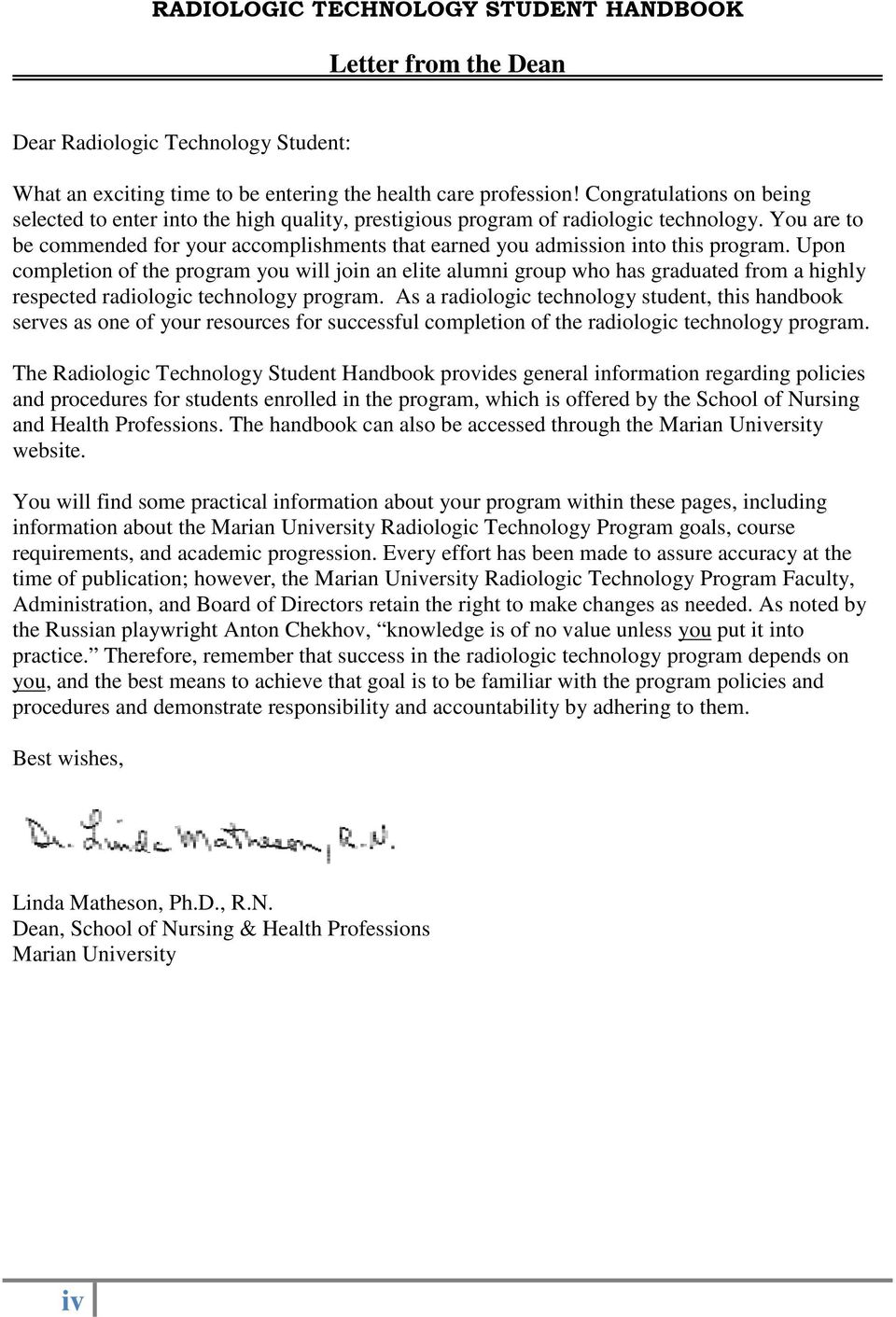
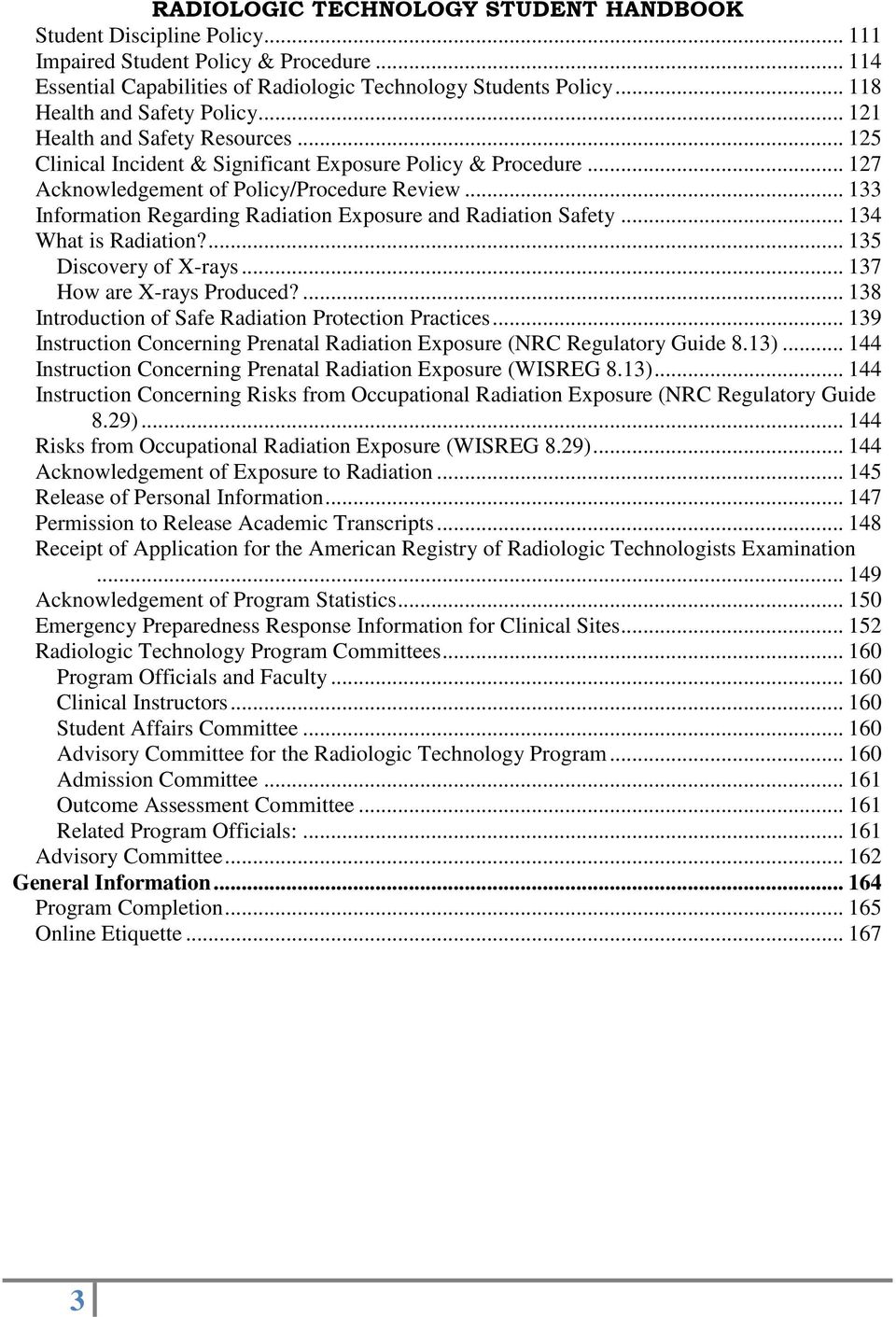
5 Table of Contents Introduction... iii Letter from the Dean... iv Table of Contents... 1 Marian University Vision, Mission, and Core Values... 4 Vision Statement... 4 Mission Statement... 4 Core Values... 4 Radiologic Technology Program Mission Statement... 5 Philosophy of Radiology... 5 Objectives of the Program... 5 Student Learning Goals and Program Effectiveness Data... 6 IMPORTANT PHONE NUMBERS... 8 Hospital Clinical Sites... 8 Clinic Rotations... 8 Koeller St. - Affinity Medical Group (AMG) University Wide Policies Compliance with Federal Regulations on Non-Discrimination Disability Services Academic Bulletin and Marian University Student Handbook Failure to Provide Required Documents Classroom and Campus Expectations Harassment Financial Aid Impact of Course Changes on Financial Aid Failure to Officially Register or Pay Fees Grades and Academic Standards In Progress Policy Grade Appeals Academic Grievances Refund/Grade Policy due to Medical Conditions Graduation and Commencement Graduation Policy Maximum Credit Load Policy Name and Address Change Information Policy for Student Papers and Assignments Policy for Withdrawal from Course University Refund Policy Policy for Withdrawal from Semester Policy for Withdrawal from University Policy: Student Absence Due to Legal Obligations Un-Enrolled Individuals in the Classroom Policy Student Evaluation of Courses Re-admission of Former Students Marian University Student Travel Policy
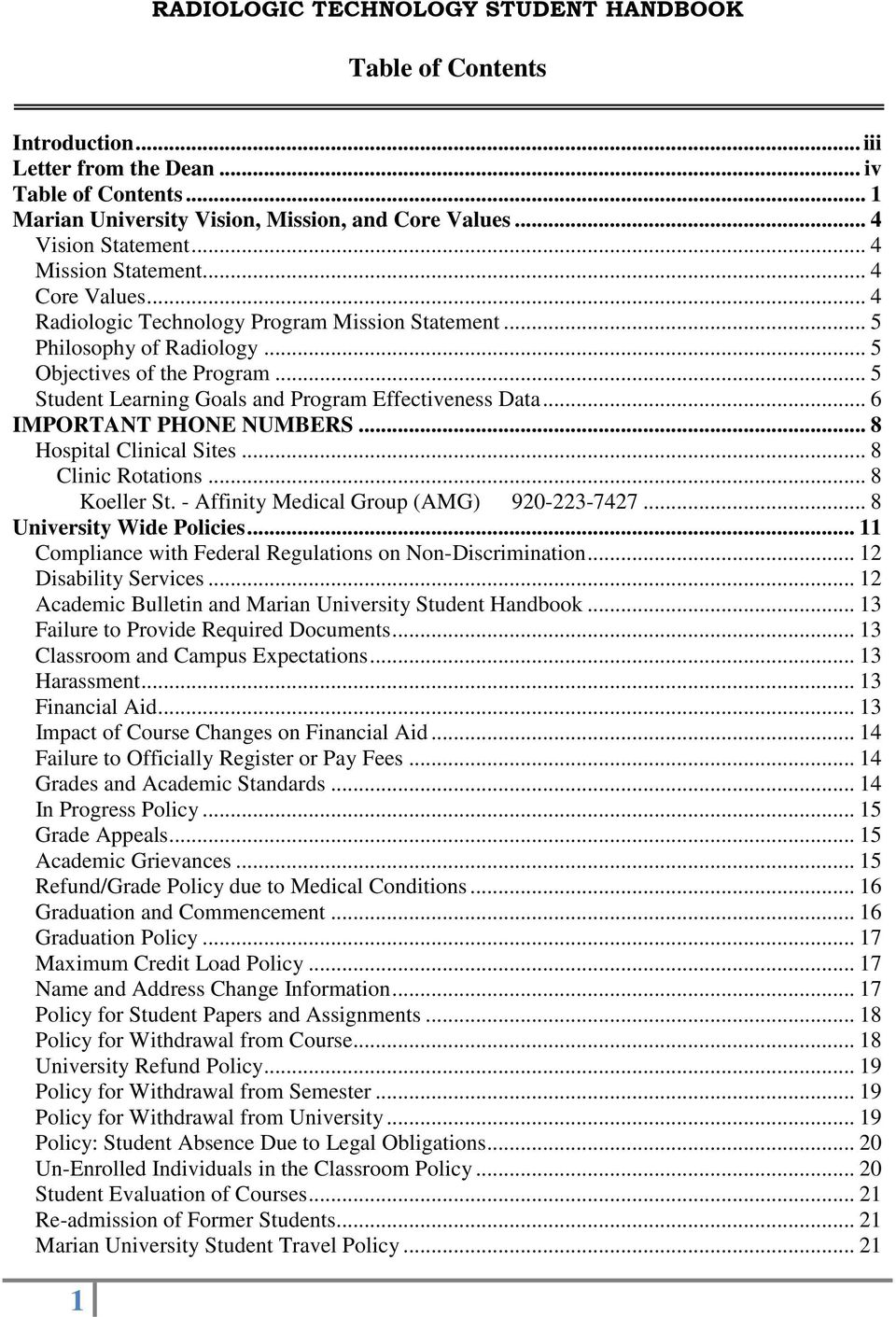
6 Marian University Transportation Manifest Off-Campus Travel Waiver and Assumption of Risk University Closures/Emergencies Policies and Procedures Joint Review Committee on Education in Radiologic Technology (JRCERT) Goals and Outcomes of the Program Outcome Assessment Plan Radiologic Technology Program Curriculum Presentation Program Curriculum Schedule Course Descriptions Out of Classroom Workload Expectations Course Fees Academic Grading System Class, Practicum and Vacation Schedule Holiday Hours Didactic/Classroom Schedule Classroom Hours Clinical Schedule Clinical Affiliation Clinical Sites Evaluation of Student Clinical Performance American Registry of Radiologic Technologists (ARRT) American Society of Radiologic Technologists (ASRT) ASRT Radiography Curriculum ACADEMIC CALENDAR/HOURS OF OPERATION ENTRANCE REQUIREMENTS OF APPLICANTS Transfer Students Policy Credit Hours Policy Scheduling of Practicum and Academic Assignments Policy Program Progression Policy STUDENTS CLINICAL SUPERVISION Academic Integrity Policy Student Affairs Committee Petition Policy Grievance and Appeal Policy Program Complaint and Resolution Policy Graduation Requirements Policy Evaluation of Program Performance by Students, Graduates, and Employers Student Records Policy Change in Clinical Site Policy Student Pregnancy Policy Radiation Safety Monitoring of Radiography Students Policy Student Radiation Protection Practices Policy Safe and Appropriate Use of Energized Laboratories Policy Attendance Policy Extra Credit Policy Personal Cell Phone Usage Policy Procedure for Student Reporting Academic Concerns Policy Uniform Policy Student Conduct Code Policy
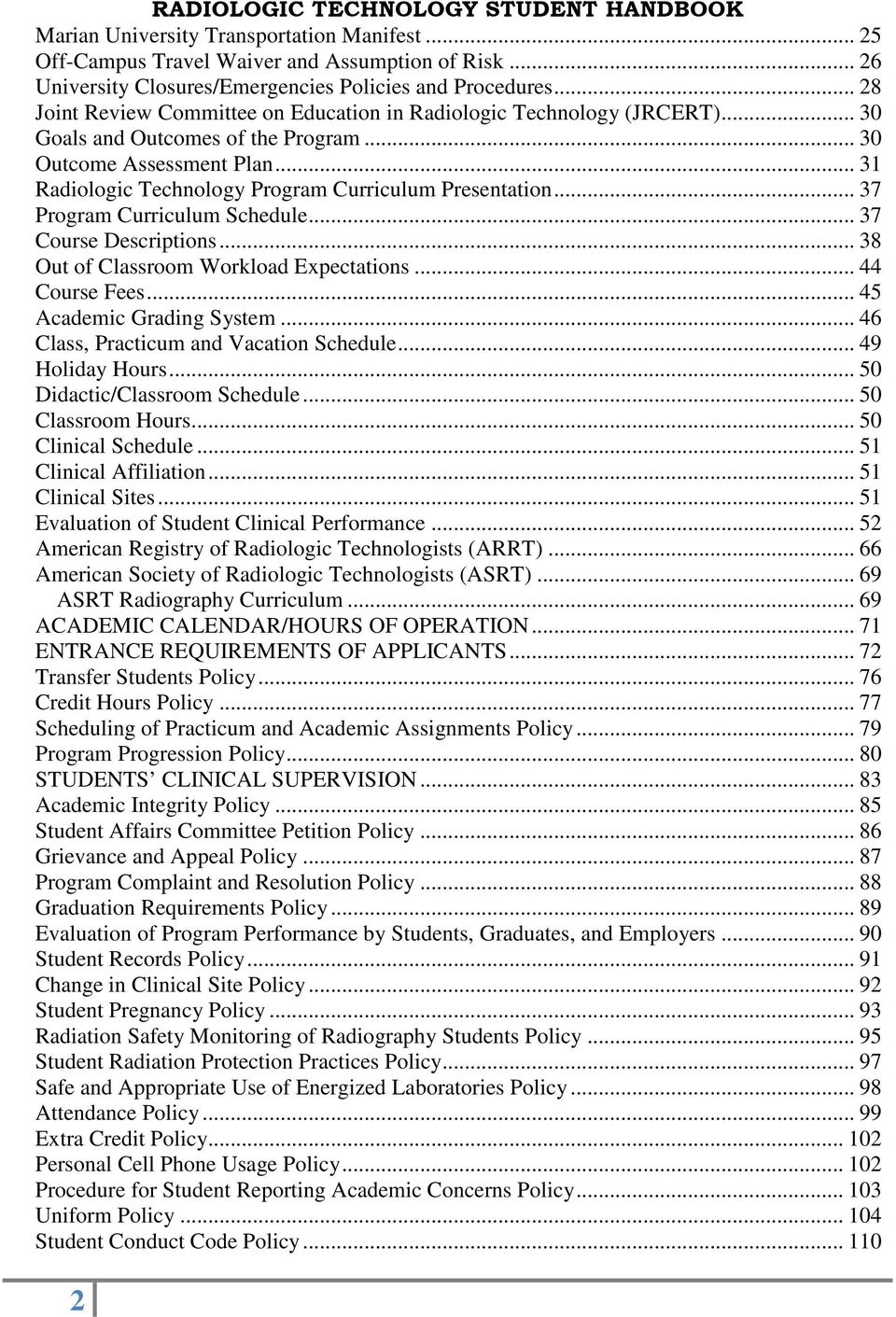
7 Student Discipline Policy Impaired Student Policy & Procedure Essential Capabilities of Radiologic Technology Students Policy Health and Safety Policy Health and Safety Resources Clinical Incident & Significant Exposure Policy & Procedure Acknowledgement of Policy/Procedure Review Information Regarding Radiation Exposure and Radiation Safety What is Radiation? Discovery of X-rays How are X-rays Produced? Introduction of Safe Radiation Protection Practices Instruction Concerning Prenatal Radiation Exposure (NRC Regulatory Guide 8.13) Instruction Concerning Prenatal Radiation Exposure (WISREG 8.13) Instruction Concerning Risks from Occupational Radiation Exposure (NRC Regulatory Guide 8.29) Risks from Occupational Radiation Exposure (WISREG 8.29) Acknowledgement of Exposure to Radiation Release of Personal Information Permission to Release Academic Transcripts Receipt of Application for the American Registry of Radiologic Technologists Examination Acknowledgement of Program Statistics Emergency Preparedness Response Information for Clinical Sites Radiologic Technology Program Committees Program Officials and Faculty Clinical Instructors Student Affairs Committee Advisory Committee for the Radiologic Technology Program Admission Committee Outcome Assessment Committee Related Program Officials: Advisory Committee General Information Program Completion Online Etiquette
8 Marian University Vision, Mission, and Core Values Vision Statement Transforming lives through academic excellence, innovation, and leadership. Mission Statement Marian University of Fond du Lac is a Catholic applied liberal arts institution of higher learning sponsored by the Congregation of Sisters of St. Agnes offering undergraduate, graduate, and continuing education programs. As a community, it welcomes diverse spiritual traditions and is committed to the transformation of the individual and the world through lifelong learning. Marian University is committed to the education of the whole person, striving to nurture intellectual, spiritual, aesthetic, psychological, social, and physical dimensions. The University s personal concern for students serves as the foundation for academic and student life as well as professional experiences. University programs integrate professional preparation with a liberal arts foundation. The University embraces justice, compassion, and service to the local and global community. Core Values COMMUNITY: Respecting our diversity as individuals, we encourage, challenge and nurture one another, joining together to accomplish our shared mission and vision. LEARNING: We engage in a collaborative lifelong process of seeking truth and appropriating knowledge and values to transform the individual, our communities and the world. SERVICE: Through active service and ministry, we support one another and seek to meet the needs of the larger community. SOCIAL JUSTICE: We work to create individual and societal change which supports the value, dignity and opportunity of every person. SPIRITUAL TRADITIONS: Valuing Marian s Catholic religious heritage, we respect each individual s freedom to explore a diversity of spiritual beliefs. 4
9 Radiologic Technology Program Mission Statement Within a faith-based university, Marian University Radiologic Technology Program prepares students at an entry level, to provide radiologic services with an emphasis on quality patient care and technical competency, leading to a degree of Bachelor of Science in Radiologic Technology. The Radiologic Technology Program provides students with the opportunities to further their education by providing clinical experience in various advanced imaging modalities. Originated 5/12; Reviewed 6/13; 6/14, Revised 6/15 Philosophy of Radiology Technical Competency The faculty believe that the radiologic technologist utilizes theoretical and clinical knowledge in the performance of procedures resulting in the acquisition of diagnostic quality images, while demonstrating expertise in minimizing the amount of ionizing radiation exposure to patients, themselves, and all members that comprise the healthcare team. To provide the highest quality care the radiologic technologist demonstrates the value of lifelong learning to maintain and improve his/her technical skills by participating continuing education along with sharing that knowledge with colleagues. Patient Care The faculty believe the radiologic technologist demonstrates ethical conduct and acts in the best interest of the patient without discrimination on the basis of sex, race, creed, religion, socioeconomic states, or nature of disease or illness, while protecting the rights of the patient to quality radiologic technology care and the respect for dignity of mankind. To provide the highest quality care the radiologic technologist demonstrates responsibility and accountability for obtaining critical patient history through observation and communication with the physician, while respecting the patient s right to privacy. The radiologic technologist also recognizes that interpretation and diagnosis of radiographic images is not part of the Scope of Practice. Objectives of the Program The program will provide the following: 1. The knowledge and practice necessary for the student radiographer to attain the program goals and outcomes. 2. A method to ensure that the above mentioned goals are met. 3. The necessary environment to have the student radiographer progressively mature as an individual in the profession and in society. 4. A means for student radiographer involvement with the program concerning its progress towards the program goals and outcomes. 5

10 Student Learning Goals and Program Effectiveness Data Student Learning Outcomes The following are the student learning goals and associated outcomes of the program: Goal: Students will graduate as a clinically competent radiographer Student Learning Outcomes: Students will apply appropriate radiation protection practices. Students will apply appropriate positioning skills. Students will select appropriate technical factors. Goal: Students will utilize critical thinking, problem solving and decision making skills Student Learning Outcomes: Students will evaluate a radiograph for diagnostic quality. Students will access the patient and have the ability to adapt to non-routine situations/ability to adjust exam for patient condition. Goal: Students will communicate effectively Student Learning Outcomes: Students will be able to orally relate/interact with patients. Students will demonstrate proper communication skills in the written form. Goal: Students will demonstrate the importance of professional growth and development Student Learning Outcomes: Students will be able to demonstrate professional values in the clinical setting Students will exhibit team player behavior Program Effectiveness Data The yearly results and five year average for the first, fourth and fifth outcome can be found under the Program Effectiveness Data link on the Programs website. Goal: The program will graduate entry-level technologists. Program Outcomes: Students will pass the ARRT Registry on the first attempt. Employer s attitude regarding rehiring the graduate if given a second chance. Alumni s satisfaction regarding being prepared with entry-level skills. Of those seeking employment, students will be gainfully employed within six months of graduation. Students that begin the program will graduate from the program. 6
11 The calculated results for the aforementioned goals and outcomes for previous graduating classes for this program can be found at the JRCERT website: JRCERT 20 N. Wacker Drive Suite 2850 Chicago, IL Telephone# (312) Education is a continuous process of self-development, affecting behavioral changes necessary in maturing and adapting to society. Learning is a self-activity, utilizing individual potential and the teacher providing stimulation and guidance. The faculty and Advisory Committee plan, coordinate, direct and evaluate the educational program on a continuing basis. Upon completion of the program, the graduate technologist is awarded a Bachelor of Science in Radiologic Technology (BSRT) degree which qualifies them to take the examination of the American Registry of Radiologic Technologists. The title of Registered Technologist in Radiography (RTR) is bestowed upon those who pass this examination. 7

12 IMPORTANT PHONE NUMBERS Brian Joachim Tabitha Miller Fax number for the School of Radiology Hospital Clinical Sites St. Elizabeth Hospital Nikki Seacotte Mercy Medical Center Jean Camp-Rothe Berlin Memorial Hospital BillieJo Herbst Ashley Getchius St. Agnes Hospital Amy Bobo Waupun Memorial Hospital Elaine Miller Clinic Rotations Koeller St. - Affinity Medical Group (AMG) Holly Flunker Richmond St. AMG Keenan Fuller St. Elizabeth s Orthopedic Clinic - AMG Kim Chapin Fond du Lac Surgery Center - Agnesian Healthcare Jodi Steffen 8
13 9 RADIOLOGIC TECHNOLOGY STUDENT HANDBOOK Teaching/Learning Beliefs about the Adult Learner Beliefs about Teaching 1. Teaching involves considering cognitive, psychomotor, and affective domains to assist learning (Bloom, B.S. (Ed.), 1956) 2. Teachers are encouraged to mentor, guide, provide support and challenge. (Taylor, Marienau & Fiddler, 2000) Principles of Learning 1. Learning is a voluntary, dynamic experience that encompasses a person s total being throughout the life span. 2. When people learn, they may change their attitudes, values, life style, and method of solving problems. 3. Learning throughout the life span begins with acquiring new knowledge, information, and skills and may result in changing one s behavior. Factors that Facilitate Learning 1. The person must be ready to learn, both physically and emotionally. 2. The person learns more if there is a genuine desire to learn. 3. People learn best in a warm, accepting atmosphere. 4. Learning is facilitated in a pleasant physical environment that is free from distractions. 5. Material is learned more easily when it is presented in a form that has meaning for the person. 6. The person is more successful in remembering and assimilating well-organized materials that proceed from the simple to complex. 7. Learning is strengthened and reinforced when positive behaviors are rewarded. 8. People learn more effectively when they are encouraged to participate in the education process. 9. Repetition of key factors and concepts reinforces learning. 10. People retain information and skills longer when they are allowed to put new information and skills into practice immediately. 11. People occasionally reach learning plateaus, which may be overcome by modifying the teaching-learning methods. Beliefs about Clinical/Practicum Teaching/Learning Students pass through five levels of proficiency; novice, advanced beginner, competent, proficient, and expert (Brenner, P., 1984). Assumptions that Characterize Adult Learning Andragogical Model 1. As individuals mature, they become increasingly self-directed regarding learning. 2. Adult learners approach new learning experiences with a lifetime of accumulated learning and experiences. 3. Adult learners define or characterize themselves in terms of their experiences, which relates to their self-concept. 4. Adult learners are characterized by a readiness to learn in order to cope with real life situations.

14 5. Learning becomes more meaningful as it relates to what the person needs to know in order to perform effectively socially, professionally, or personally. 6. Adult learning is based on solving real-life problems and the necessity for getting results immediately. 7. Adult learners have a problem-centered orientation (task centered) to learning. (Knowles, 1990) References Brenner, P. (1984). From novice to expert: Excellence and power in clinical nursing practice. Menlo Park:Addison-Wesley. Bloom, B. S. (Ed) (1956). Taxonomy of educational objectives: The classification of educational goals, Handbook I: Cognitive domain. White Plains, N.Y.: Longman. Knowles, M. (1980). The adult learner: A neglected species (4 th Ed). Houston: Gulf Publishing. Knox, A. B. (1981). Adult development and learning. San Francisco, CA: Jossey-Bass. Knox, A. B. (1986). Helping adults learn. San Francisco, CA: Jossey-Bass. Merriam, S. B. (Ed) (1993). An update on adult learning theory. San Francisco, CA: Jossey- Bass. Mezirow, J. & Associates, (1990). Fostering critical reflection in adulthood: A guide to transforming and emancipator learning. San Francisco, CA: Jossey-Bass. Mezirow, J. (1991), Transformative dimensions of adult learning. San Francisco, CA: Jossey- Bass. Penn, B.D. (2008), Mastering the teaching role: A guide for nurse educators. Philadelphia: F.A. Davis. Taylor, K., Marienau, C., Fiddler, M. (2000). Developing adult learners: Strategies for teachers and trainers. San Francisco, CA: Jossey-Bass. Whitman, N.I., Graahm, B.A., Gleet, C.J., & Brody, M.D. (1992). Teaching in nursing practice (2 nd Ed). Norwalk: Appleton & Lange. Initial: 1988; Updated: 3/10/1993, 4/29/1993, 5/2003, 4/2009, 6/
15 University Wide Policies 11

16 Compliance with Federal Regulations on Non-Discrimination Non-Discrimination Policy Marian University admits students of any race, color, creed, age, national or ethnic origin or disability to all the rights, privileges, programs and activities generally accorded and made available to students at the University. Marian University does not discriminate in the administration of its educational policies, scholarships or loans, and other school-administered programs. Rehabilitation Act of 1973 Americans with Disabilities Act of 1990 Marian University does not discriminate on the basis of disability in its educational programs or employment practices. Reasonable accommodations will be made to ensure that the University environment and academic programs are accessible to the greatest extent possible by all students and employees with disabilities. Title IX It is the policy of Marian University and the requirement of Title IX of the Education Amendments of 1972, and Part 86 of Title 45 of the Code of Federal Regulations not to discriminate on the basis of sex in educational programs or activities, including employment and admission. Inquiries concerning the application of this law and regulations may be referred to the President of Marian University. Family Education Rights and Privacy Act Marian University of Fond du Lac is in compliance with the Family Educational Rights and Privacy Act of 1974 (Buckley Amendment). Specifics of students rights under this Bill are available in printed form from the Office of the Registrar. The Family Educational Rights and Privacy Act (FERPA) afford students certain rights with respect to their education records. Rights under FERPA regulation are posted on the Registrar home page. Disability Services For information about criteria used to qualify accommodation, how to access disability services, and related links and resources, refer to the website for Disability Services. Marian University will provide reasonable accommodations to qualified individuals with disabilities. If you feel you need accommodations to fully participate in this program please contact Lisa Olig, Coordinator of Disability Services and Academic Support in the Center for Academic Support and Excellence or at

17 Academic Bulletin and Marian University Student Handbook The Marian University Academic Bulletin is a general catalog that provides information regarding university policies, procedures, and academic programs. The Academic Bulletin can be viewed in its entirety at: Students are also responsible for information provided in the Marian University Student Handbook. NOTE: Where policy of a School is more restrictive, students are held to the more restrictive policy. Failure to Provide Required Documents A student entering Marian University after having attended any post-secondary institution for any length of time must provide Marian University with all official transcripts of all prior course work by the end of the first semester attended. Failure to provide official transcripts from all institutions attended will result in a Registration Hold being placed on the student record. The Registration Hold will not allow for registration in future semesters until all required transcripts are obtained. Classroom and Campus Expectations Students are encouraged to maximize the learning experience offered through Marian University. Ideal learning takes place in environments where trust, mutual respect and active engagement are valued and observed by all participants. Students enrolled at Marian University are expected to conduct themselves in a manner appropriate to a professional setting. Students are expected to be respectful of the learning environment established by the instructor. No student has the right to be disruptive, disrespectful, or uncivil in their conduct including language in any setting at Marian University (this includes online, Facebook, and web-based venues). A student who is deemed to be inappropriate in the classroom may be asked to leave the class for a session or longer, or may be administratively withdrawn by University officials. Harassment Verbal, written, or physical conduct directed at any person or group based on color, race, nationality, ethnicity, gender, or sexual orientation where the offensive behavior is intimidating, annoying, hostile or demeaning, or which could or does result in mental, emotional, or physical discomfort, embarrassment, ridicule or harm is strictly prohibited. Financial Aid Access the following link for information regarding financial aid including application deadlines. Financial Aid, MARIAN ext or (920)

18 Impact of Course Changes on Financial Aid Each time students change their schedules, the student must notify the Financial Aid Office. Changes can affect eligibility for aid. Changes may make it necessary to return the loan and reapply for financial aid. All students who borrow from the loan programs must go through entrance counseling. Consult with the Financial Aid office directly for answers to all financial aid questions. Failure to Officially Register or Pay Fees Students who attend courses for which they have not officially registered or for which they have not paid will not be allowed to receive grades or credits for the courses. Grades and Academic Standards The University uses the following grading and grade point system: A Excellent 4.00 A B B Good 3.00 B C C 2.00 C D D 1.00 D F Failure 0 WD Withdrew 0 S Satisfactory 0 U Unsatisfactory 0 AU Audit 0 CR Credit Course 0 NC No Credit 0 WF Withdraw Failing 0 I Incomplete 0 IP In Progress 0 WF Withdrawal after the designated drop period. This grade is counted as an F in determining grade point average. I An Incomplete grade may be assigned when a student is prevented from completing course requirements because of illness or other serious circumstances outside of his or her control. Incomplete Policy: Upon the assignment of an incomplete (I), the student has twelve(12) calendar weeks after the close of the semester in which it was issued to complete the course work. An extension may be granted by the Department Chair and the Dean of Graduate Studies. 14

19 If the work is not completed by the deadline, the incomplete is changed to an F. (This does not apply to Practicum or Research Projects.) Refer to the Academic Bulletin for the entire Incomplete Policy. IP If a course has been designed to extend beyond the end of the semester so that grades cannot be submitted by the published deadline, an in-progress (IP) grade may be assigned. IP is also used for practicum and for action research courses. The IP grade carries 0 credit points and is not to be computed in the GPA. The IP grade must be made up by the end of the next semester; however, all IP grades must be completed and grades that apply toward the degree must be received in the Registrar s Office after the end of a student s last semester of attendance within the published degree completion deadline. If a grade is not received by the deadline, the IP grade is changed automatically to an F grade with both the semester and the cumulative grade point averages adjusted accordingly. An F grade may not be changed back to an IP grade. CR Indicates that the student registered for the master s thesis or master s project. The mark CR gives neither credit nor grade points toward a graduate degree. In Progress Policy Any student with an In Progress (IP) grade for any phase of their project or thesis must complete the requirements for that phase by the end of the following term; otherwise, the student will receive a No Credit (NC) grade and must register for that phase of the project or thesis action again and pay full fees and tuition. Grade Appeals Grades submitted to and recorded by the Registrar are, with the exception of I (Incomplete) or IP (In Progress), considered final. Only in extraordinary circumstances may recorded grades be changed. Extraordinary circumstances are confined to: 1. Clerical error on the part of the instructor in submitting the grade, or 2. Clear or apparent major inconsistency or injustice due to arbitrary and capricious grading on the part of the instructor in assigning the grade. For the complete policy refer to Marian University Academic Bulletin Appealing Grades not yet recorded and final (recorded) Refer to Marian University Academic Bulletin Academic Grievances Refer to Marian University Academic Bulletin 15
20 Refund/Grade Policy due to Medical Conditions When students find they are unable to attend courses due to medical conditions, students may request a withdrawal and an exception to the university refund and/or grading policy. Required Documentation from the Student s Physician, Medical or Mental Health Provider: Documentation must be typed and submitted on official letterhead from a qualified medical professional, must include the professional s medical license number, an office telephone number and address, and signature. (Although a copy may be faxed, the original must be received by the Vice President for Academic Affairs Office within the deadline before the documentation will be considered official.) Documentation must contain 1) a specific diagnosis; 2) treatment with inclusive dates; 3) should indicate how the medical condition has affected the student s ability to attend class or complete academic course work. Detailed descriptions of confidential medical data or details of diagnoses, however, are not necessary. The letter should identify the last day the student was able to attend classes and a clear statement that in the professional opinion of the medical provider the student was unable to attend classes from that date for the rest of the term because of the stated medical condition. This letter and supporting documentation will be kept as part of the student s confidential file in the Registrar s Office; it is not included in the academic record. It is the student s responsibility to make certain that the information is sent and received. The letter and documentation must be received by the last day of classes. The health care provider should submit the documentation to the following address: Vice President for Academic Affairs, Marian University 45 S. National Avenue, Fond du Lac, WI Telephone: (920) Fax: ( Graduation and Commencement All students are required to submit an application for graduation to the Registrar at the beginning of the semester in which they expect to receive the degree. A graduation fee is required. Students must be enrolled in all courses required for graduation during the semester in which they intend to graduate. Students who complete their degrees in August or December may participate in graduation exercises in May. There are three degree completion dates throughout the calendar year: May, August, and December; however, commencement is only held in May. The university wide baccalaureate and graduate commencement ceremony is available for all qualified graduates. Application for cap and gown will be announced in advance. A brief reception usually follows the graduation ceremony. All degree requirements must be completed before participation is allowed. Diplomas and transcripts will be withheld from the student until all fees are paid. 16

21 Graduation Policy All students are required to submit an application for graduation to the Registrar at the beginning of the semester in which they expect to receive the degree. A graduation fee is required. August graduates with six (6) or fewer credit-hours remaining to complete their degree requirements may participate in the May graduation ceremony if they are registered for the remaining 6 credits to be completed by the end of summer school. Students completing their course work for graduation by: January 15 will have the December graduation date stated on their diploma. June 15 will have the May graduation date stated on their diploma. August 31 will have the August graduation date stated on their diploma. Maximum Credit Load Policy Undergraduate The following student credit loads have been established for undergraduates: Maximum Student Credit Loads 2-3 week term 3 credits 4 week term 6 credits 7-8 week term 9 credits week term 18 credits (Fall or Spring Semester) In unusual circumstances, undergraduate students with a cumulative 3.0 GPA or higher may file an Overload Permission Request to exceed the maximum student credit load limits. A student may take no more than 4 credits in a 2-week term and no more than 21 credits in a semester. Final decisions on overload requests are made by the Vice President for Academic Affairs. If granted, the student is required to pay for credits taken above the maximum student credit load. Graduate For each fall/spring semester, the maximum credit load for full-time students is 12 graduate credits; the maximum credit load for part-time students is 6 credits. For summer, the maximum credit load is 12 credits. Permission from Graduate Studies is required for any student to take more than the maximum load. Graduate students who are in good academic standing and who are involved in undergraduate coursework to remediate deficiencies, or those who have exceptional circumstances resulting in special hardship, must appeal to the Dean of Graduate Studies for permission to carry more than the maximum credit load. Each individual student appeal must be submitted to Graduate Studies prior to the beginning of the semester. Deviations from this policy may be determined by the Graduate Studies Dean in conjunction with the Department Chair of a particular program. Name and Address Change Information Students must report changes in the following personal information directly to the Registrar s Office: local and home address, telephone number and legal name. To ensure accurate and proper documentation these changes cannot be made by , telephone, or by a third party. 17
22 Use the following link to access the Change of Address-Name Form eofaddress-nameform.pdf CHANGING FROM MAIDEN TO MARRIED NAME Submit a copy of your new social security card, driver s license, or marriage license to the Registrar s Office and complete the Change of Address/Name form. CHANGING FROM MARRIED TO MAIDEN NAME Submit a copy of your divorce decree, new social security card, or driver s license verifying the name change to the Registrar s Office and complete the Change of Address/Name form. LEGAL NAME CHANGE Submit a copy of court order, dissolution decree, new social security card, or driver s license to the Registrar s Office and complete the Change of Address/Name form. For non-u.s. Citizens: Current passport or official proof of identity, certified by U.S. embassy abroad or by the appropriate foreign embassy in the U.S. ADDRESS CHANGE Submit a Change of Address/Name form to the Registrar s Office or perform online edits in your personal SabreNet account. Please note that address changes will not be taken over the phone, via or by a third party. Approved by Faculty Senate March Updated 8/18/04, 8/08, 6/10 MARIAN UNIVERSITY address assigned to you will be used exclusively for all university communications and in reverse; you are expected to originate all communications with Marian University using your assigned address. Policy for Student Papers and Assignments Faculty has the right to retain copies of student written papers and assignments. This is usually done for validating course documents for accreditation, evaluating student assignment comprehensiveness in particular courses, or for monitoring originality of course work. In order to maintain anonymity when documents are displayed, students names and grades are removed when documents are used for accreditation purposes. Faculty reserve the right to keep the originals and students should make copies of their assignments before submitting them. Policy for Withdrawal from Course Students withdrawing from any course need to follow University withdrawal procedures by filing a Course Drop Form with the Registrar. If the student has formally withdrawn during the designated "drop/add period", the course will not be recorded. 18
23 University Refund Policy Drop before first class 100% refund No notation on transcript Non-attendance/no drop/no show 90% refund WD on transcript All students withdrawing from the University or changing enrollment status are issued tuition refunds based on the scale below: Length of class Amount of refund Academic Notation 14 weeks or longer: 1st or 2nd week (add/drop period) 100% No notation on transcript 3rd or 4th week 75% WD on transcript 5th or 6th week 50% WD on transcript After 6th week None WD on transcript After the 10th week None WF on transcript 7 to 13 weeks: 1st week 90% WD on transcript 2nd week 75% WD on transcript 3rd week 50% WD on transcript After 3rd week or up to 69% of course completed None WD on transcript 70% or more of course completed None WF on transcript 1 to 6 weeks or more than 2 course meeting days: 10% of course completed 90% WD on transcript 11 to 25% of course completed 75% WD on transcript 26 to 40% of course completed 50% WD on transcript 41% to 69% of course completed None WD on transcript 70% or more of course completed None WF on transcript 2-Day Courses: 1st day 50% WD on transcript 2nd day None WF on transcript If the student withdraws no later than the 10th week, the grade for that course will be recorded as "WD". If the student withdraws after the 10th week, a grade of "WF" will be recorded. This grade is counted as an F in determining the GPA. If students fail clinical within the first 7 weeks, they are no longer eligible to withdraw from the course. Policy for Withdrawal from Semester Students withdrawing from a given semester need to file the Request to Withdrawal from University Form indicating that all courses have been dropped and intent to return. For courses in progress, no grade will be recorded when formal withdrawal is made during the drop/add period. If students withdraw after that time, the grades for these courses will be recorded as "WD". However, after the withdrawal period has passed, a grade of "WF" will be recorded. Policy for Withdrawal from University Students wishing to withdraw from the university must follow withdrawal procedures and file an official Request to Withdrawal from University Form with the Registrar. An exit interview with the Registrar is required to determine why the student must drop the program and when the student plans to return to Marian University. Refunds for unused tuition will depend upon the date of exit interview. 19
24 Policy: Student Absence Due to Legal Obligations When a student must be absent from class for court-imposed legal obligations (e.g., jury duty or subpoena), the student may wish to seek a release through the procedures of the appropriate court if the obligation will jeopardize a student s academic work. If a student is unable to obtain a release, the student must present the appropriate School Dean a written verification of the obligation and inform all instructors of the anticipated absence in advance. If the student will be absent for a short period of time, the student s instructors will make arrangements to accommodate missed assignments or examinations. If an extended absence is anticipated, the student s request must go through another level of review. The student will meet with the instructors and the appropriate School Dean to determine if arrangements will be made to accommodate the student s completion of his or her academic work. If necessary, the student will be allowed to withdraw from all or part of his or her coursework without penalty. A student withdrawing for this reason will be authorized a full tuition refund and applicable fees for all credits from which the student withdraws. Students are expected to attend class if they are not required to spend the full day in meeting this obligation. After the legal obligation is satisfied, it is the responsibility of the student to contact the instructor to discuss missed class work and make arrangements to fulfill the requirements of the class. Presented: Curriculum & Education Standards Committee, April 22, Un-Enrolled Individuals in the Classroom Policy On a daily basis, the University uses measures to reasonably ensure the health, safety, and welfare of the University community -- its students, staff, and faculty. The University also is committed to ensuring the maintenance of a campus that promotes a positive and productive learning environment. As a result, it is important for the University to ensure, on a daily basis, that those who come to campus have the authority to do so. Faculty, staff, and students may not bring un-enrolled persons to class without express authorization or permission from their supervisor and/or instructor. Should a University student, staff, or faculty member 20 **Have a personal, child or family-care emergency, or **Face a personal illness that poses a risk of infection to others, they should immediately contact their supervisor(s) and/or instructor(s) to discuss the need for the use of authorized personal/release time, and/or make alternate arrangements for the completion of academic assignments. The cooperation of all within the University community is encouraged and appreciated. This policy is not intended to inhibit persons who are not members of the Marian community from visiting the campus for legitimate reasons, such as attending a sporting event, attending a meeting, or visiting the coffee house.
25 Student Evaluation of Courses At the completion of each course, students have an opportunity to evaluate the course. The evaluation will take place at one of the last scheduled class times of a course. The evaluation forms used for this process are similar to the forms used for instructor evaluation in other traditional or outreach courses at Marian University. Currently, evaluation forms are used for classroom and clinical evaluation. A secretary from Marian University disseminates the evaluation forms and returns them directly to a designated office, where summary reports will be compiled. Summary copies will be sent to the instructor of the course and the Chairperson of the Division. One copy will be retained in the Academic Affairs Office. Evaluations are an important part of the accreditation process of the University and helpful suggestions assist the instructor and the divisions to improve courses within the program. Re-admission of Former Students If a student has not maintained continuous enrollment at Marian University, formal application to the University must once again be made. If necessary, the Marian University Re-Admission Committee will review an applicant s file to determine if the student should be re-admitted to the University. This decision is based on past academic performance as well as the student s conduct while previously a student at Marian. All outstanding financial obligations must also be satisfied before re-admission is granted. Probationary status and academic standing continue upon readmission. The program requirements and academic standards that were effective upon initial enrollment in the major will be applicable only if the student is readmitted after an absence of only one semester. For non-enrollment for two or more continuous semesters (fall and spring), the program requirements and academic standards that are currently effective will be applicable. To be considered for re-admission, candidates must submit the following: 1. A completed Marian University application paper form or online form accepted No application fee is necessary. 3. An official transcript from each college or university attended since last enrolled at Marian University. 21 Marian University Student Travel Policy Policy Statement A. Purpose Marian University has requirements and procedures that must be followed in order to travel. Student organizations and organization members are obliged to adhere to these policies at all times as they are a direct reflection of Marian University s Policy and Procedures. Having the opportunity to travel, and represent Marian University are two major benefits student organizations receive through the organization s affiliation. It is the Officers responsibility to inform members that from the time they depart for a competition or event, to the time they return to campus, they are held to University standards.
26 22 This Policy does not apply to travel undertaken by individual students attending out of town athletic/recreational events as a non-participant or observer (except when traveling on behalf or with the financial support of a recognized student organization as described above), engaging in student teaching, internships, practicums, observations or research, or participating in intercollegiate athletics competitions under the sponsorships of the Department of Athletics. B. Definitions A recognized student organization is one that has been formed for educational, professional, social, recreational or other lawful purposes, derives the majority of its membership and all of its leadership from the student body of Marian University, has been approved for recognition by the Office of Student Life. A University sponsored event or activity is one that is initiated, actively managed, planned and arranged by a member of the University's faculty or staff, or by members of a recognized student organization that has been granted sponsorship by the University, and is approved by an appropriate administrator and/or an event or activity that the University actively manages, is involved with, or oversees financially, physically, or administratively. A currently enrolled student is one who is a student who is currently registered at the University, whether on a full - or part-time basis. An appropriate administrator is a Dean, Department Chair, or Director of an administrative unit, or his or her authorized designee. Checklist for Travel Read the entire Travel Policy and additional considerations for student organizations carefully. If you are in need of clarification, ask the appropriate office. Request University vehicles a minimum of 2 weeks in advance of travel. Submit Transportation Manifest in full for all trip participants including trip leader(s) to Campus Safety and Security. Obtain Off Campus Travel Waiver and Assumption of Risk Form from each participant. Weather reports for travel areas must be reviewed prior to departure. If weather reports show any advisories, alerts, warnings, etc., the trip coordinator must discuss this with the appropriate office or Dean of Students to determine if trip plans should be modified in any manner. C. Travel Guidelines Marian University, as an institution of higher education, through its various departments and offices, provides opportunities for student travel to activities that facilitate and/or enhance the learning process taking place within the University community. Participation in such activities shall be limited to members of the University community. These Guidelines do not apply to international travel, study abroad travel.
27 23 Participants in activities involving student travel are responsible for their own behavior and any resulting consequences. The University shall not be liable for any loss, damage, injury or other consequence resulting from a participant's failure to comply with University rules and regulations, the direction of University employees, or applicable law. All trip participants are required to (a) comply with the standards set forth in the Marian University Student Handbook and with applicable University policies, procedures, rules and regulations, understanding that such compliance is important to the success of the trip and to the University's willingness to permit future similar activities; and (b) conform their conduct to the standards surrounding the trip and assume responsibility for their own actions, understanding the circumstances of an off-campus activity may require a standard of dignity which may differ from that applicable on campus. Violations of the foregoing requirements may subject participants and sponsoring organizations to disciplinary action pursuant to the Marian University Policies and Procedures. Please note for University sponsored travel, it is the responsibility of the department sponsoring the program to assure compliance with these guidelines. The following additional guidelines also apply to all travel activities subject to the Marian University Travel Guidelines: A. Pre-trip Meeting: The faculty member, administrator, and/or recognized student organization in charge of the trip should hold a pre-trip planning meeting with all participants to discuss the planned itinerary, behavioral expectations, and transportation details. B. Transportation: The sponsoring University department should be prepared to arrange for transportation by official University vehicle(s), rental vehicle(s), chartered service, regularly scheduled transportation service, or, if necessary, personal vehicles. The following rules apply to the use of vehicles. I. University Vehicles - Only approved University employees or work study students can drive. Rental Vehicles - All terms of the rental contract must be complied with. II. Contract Bus Service - Adequate insurance coverage for personal injury III. and property damage must be provided by the bus company. Personal Vehicles - Personal Vehicles should only be used on a voluntary basis. The owners/drivers must provide their own insurance coverage. All student participants choosing to ride in a private automobile do so voluntarily and at their own risk. The University shall not insure or accept liability for any damage, loss or injury resulting from the use of a private vehicle. The University does not provide comprehensive or collision (physical damage) insurance for private vehicles driven on University business, and the owner is responsible for primary liability insurance. C. All University sponsored travel must be chaperoned by a faculty, staff or designee. A student officer from the recognized student organization must accompany the trip for all University sponsored travel. Marian University will
28 view this student officer as the party responsible for the trip. The faculty/staff chaperone is expected to exchange emergency contact numbers with students and obtain an indication of who each student desires to be notified in the event of an emergency. This transportation form is a requirement prior to any travel. D. Participation - Except with the permission of the appropriate administrator, friends and family of students are not eligible to participate in travel opportunities falling under the Travel Policy. All participants are required to engage in the planned activities of the trip. Unstructured time should be kept to a minimum to reduce the risks inherent in unsupervised activity. The sponsoring department or organization should keep a list of all participants involved in the trip. D. Accident and Medical Insurance The faculty member or administrators responsible for the trip shall communicate to the participants that the University does not provide medical insurance for any student's participation in trips. All student participants shall be responsible for any medical costs they incur during and/or as a result of the trip. 24
29 Marian University Transportation Manifest Trip Destination: Driver: Date: Departure Time: Return Time: Passenger List Name Phone Number Emergency Contact (Name and Number) *Remember there are a Maximum 11 passengers (large van) and 7 passengers (mini-van) for each trip. **Only university-associated people are permitted. University guest passes do not qualify. This form must be completed and return to the Campus Safety Office prior to departure. 25
30 Off-Campus Travel Waiver and Assumption of Risk Student Name: Off-Campus Activity: Dates of Off-Campus Activity: Marian University believes that organized off-campus activities by its students are an important part of the students overall learning experience. Off-campus activities do, however, involve significant risks, both to students participating in them and also to the University based upon the manner in which students conduct themselves while off campus. By signing this form, the above-named student agrees as follows: 1. To observe standards of conduct set forth in the Marian University Code of Student Conduct and all University policies and procedures (including without limitation the Marian University Student Travel Policy) applicable to the student while participating in the off-campus activity referenced above (the Activity ), understanding that such compliance is important to the success of the Activity and to the University s willingness to permit future similar activities. 2. To conform his or her conduct to the standards surrounding the Activity and assume responsibility for his or her own actions, understanding that the circumstances of an offcampus activity may require a standard of appropriateness which may differ from that applicable on campus. 3. That the student does not act as an agent or representative of Marian University and, accordingly, shall not have or hold himself or herself out as having the power or authority to bind or create liability for the University by virtue of his or her negligent or intentional acts or omissions. 4. To assume full financial responsibility for all costs and expenses incurred by the student in connection with the Activity, including without limitation financial responsibility for damage or destruction to property of third parties. 5. To obtain and maintain such health, accident, disability, hospitalization and travel insurance as he or she may deem necessary for the Activity, and to be responsible for the costs of such insurance and for any expenses not covered by insurance. 26
31 6. To immediately disclose to the University any physical or emotional conditions or problems that might impair his or her ability to complete the Activity, and that he or she hereby releases the University and its trustees, officers, employees, agents and representatives from any and all claims, demands, injuries, damages, losses, actions, causes of action, or expenses whatsoever arising out of his or her failure to disclose such conditions or problems. 7. That participation in the Activity is entirely voluntary, and that he or she is fully aware, having sought and obtained such information and advice as he or she feels are necessary and appropriate, that such participation involves risk of injury and property damage, including possibly short-term and long-term disability, and even death. These risks can come from causes which are many and varied, may not even be presently foreseeable, and may include negligent or intentional acts or omissions of others. He or she acknowledges, accepts, and assumes all such risks, whether or not presently foreseeable and whether or not caused by the negligent or intentional acts or omissions of others, and elects voluntarily to participate in the Activity. He or she releases the University and its trustees, officers, employees, agents and representatives from any and all claims he or she may have in the future, waives all such claims, and agrees not to sue the University or its trustees, officers, employees, agents and representatives for any such claims, arising out of his or her participation in the Activity, including but not limited to claims arising out of the negligent or intentional acts or omissions of others. 8. That this Agreement is to be as broad and inclusive as is permitted by the laws of the State of Wisconsin, and that if any portion of this Agreement is held invalid, the remaining terms shall continue in full force and effect. Signature: Date: 27
32 University Closures/Emergencies Policies and Procedures For specifics regarding University delays or closures, check the Marian University Home Page under Quick Links, Class and Event Cancellations. WEATHER RELATED - The decision to close the university will be made shortly after 6 a.m. for day classes or shortly after 3:00 p.m. for evening classes. Traditional classes Fond du Lac campus For specifics regarding University delays or closures, check the Marian University Home Page under Quick Links, Class and Event Cancellations. Cancellation of evening classes PACE, Grad/Ed, Doctoral, etc. The Deans of the School of Education, School of Nursing and PACE will check all sites by noon when there is concern about inclement weather. They will notify the Dean of PACE as to specific site closures and/or class cancellations. Cancellations will be updated on the necessary phone lines, as well as the Marian Web site, Class and Event Cancellations. During weekdays when inclement weather is occurring, it is the responsibility of staff at the outreach sites (e.g. Appleton Center, Milwaukee Center) to monitor the weather in their areas and notify the Dean of PACE or the PACE Director of Administration the PACE office. Cancellation of weekend classes: It is the responsibility of the Dean of PACE, the Deans of the School of Education and the School of Nursing to monitor weather conditions on Saturday mornings. If the decision is made to cancel classes or close a center the Dean of PACE would then contact the appropriate departments to begin communication. For specifics regarding University delays or closures, check the Marian University Home Page under Quick Links, Class and Event Cancellations. General Information: Closing decisions made by the Fond du Lac School District, Moraine Park Technical College, and UW Fond du Lac will be considered, but Marian University will not automatically close if they do decide to close. As always, even if Marian University does not cancel classes or close during inclement weather, students, faculty and staff should use their best judgment regarding whether they can safely get to their designated locations. Terminology: The term campus closed means that classes will not be held and staff (except for essential personnel) needs not report for work. The term classes cancelled means that classes will not be held, but staff should report for work unless they are unable to get to the campus. 28
33 Marian University Radiologic Technology Program Program Accreditation by the Joint Review Committee in Radiologic Technology (JRCERT) INCLUDES: JRCERT Contact Information Standards for and Accredited Program in Radiography Goals and Outcomes of the Program Most recent graduating class Outcome Assessment Plan results Current version of the Outcome Assessment Plan 29
34 Joint Review Committee on Education in Radiologic Technology (JRCERT) All programs of radiologic technology may voluntarily seek programmatic accreditation from the Joint Review Committee on Education in Radiologic Technology (JRCERT). The JRCERT promotes excellence in education and enhances quality and safety of patient care through the accreditation of educational program. The JRCERT is the only agency recognized by the U. S. Department of Education for the accreditation of educational programs in radiography. The JRCERT has established the Standards for an Accredited Educational Program in Radiography by which the program s educational policies and procedures must meet in order to verify compliance and be in good standing with the JRCERT. The Standards for an Accredited Educational Program in Radiography can be found at or by contacting the JRCERT at: JRCERT 20 N. Wacker Drive Suite 2850 Chicago, IL Telephone# (312) The Program Director has a copy of the Standards as well. Students have the right to submit allegations against a JRCERT accredited program if there is reason to believe that the program has acted contrary to JRCERT accreditation standards or that conditions at the program appear to jeopardize the quality of instruction or the general welfare of its students. Goals and Outcomes of the Program The JRCERT requires that an accredited program maintain an Outcome Assessment Plan yearly for each graduating cohort in order to evaluate the Program. On the following pages the Student Leaning Goals and their associated outcomes along with Program Effectiveness Data by which your class will be evaluated. The calculated results for each student learning goal, its associated outcomes and Program Effectiveness Data for previous graduating cohorts from this program can be found at the JRCERT website: JRCERT 20 N. Wacker Drive Suite 2850 Chicago, IL Telephone# (312)
35 Outcome Assessment Plan Marian University Radiologic Technology Program Class of Goal 1: Student will graduate as a clinically competent radiographer. Outcome Measurement Tool Benchmark Time Frame Responsible Party Results Clinical Competency Form: Spring I Semester: avg. Upon completion Clinical Coordinator Question #5 Radiation Protection. score of 2 or higher (3 pt. of Spring I and 1st attempted competency scale) Fall II semesters on any mandatory patient exams/ Fall II Semester: avg. score of 2.5 or higher (3 pt. scale) procedures listed on the Master Clinical Record that are performed during the identified timeframes Student will apply appropriate radiation protection practices. Student will demonstrate appropriate positioning skills. Student will select appropriate technical factors. Simulated Positioning Lab Test Form: Question #9 Radiation Protection. Random sampling of 3 simulations per student. Clinical Competency Form: Question #3 Accuracy of Positioning. 1st attempted competency on any mandatory patient exams/ procedures listed on the Master Clinical Record that are performed during the identified timeframes Simulated Positioning Lab Test Form: Question #7 Accuracy of Positioning. Random sampling of 3 simulations per student. Clinical Competency Form: Question #7 Exposure Technique Selection. 1st attempted competency on any mandatory patient exams/ procedures listed on the Master Clinical Record that are performed during the identified timeframes Average score of 2 or higher (3 pt. scale) Spring I Semester: avg. score of 3 or higher (5 pt. scale) Fall II Semester: avg. score of 4 or higher (5 pt. scale) Average score of 3 or higher (5 pt. scale) Spring I Semester: avg. score of 2.5 or higher (4 pt. scale) Fall II Semester: avg. score of 3 or higher (4 pt. scale) Upon completion of RAD 452 Radiographic Procedures and Image Analysis IV Upon completion of Spring I and Fall II semesters Upon completion of RAD 452 Radiographic Procedures and Image Analysis IV Upon completion of Spring I and Fall II semesters Clinical Coordinator Clinical Coordinator Clinical Coordinator Clinical Coordinator 31
36 Simulated Position Lab Test Form: Question #8 Exposure Technique Selection. Random sampling of 3 simulations per student. Average score of 1.5 or higher (3 pt. scale) Upon completion of RAD 452 Radiographic Procedures and Image Analysis IV Clinical Coordinator 32
37 Outcomes Assessment Plan Marian University Radiologic Technology Program Class of Goal 2: Students will utilize critical thinking, problem solving and decision making skills. Outcome Measurement Tool Benchmark Time Frame Responsible Party Results Students will evaluate a radiograph for diagnostic quality. Student will assess the patient and have the ability to adapt to nonroutine situations/ability to adjust exam for patient condition. Clinical Competency Form: Question #6 (Routine Exam) Quality of Radiographs/Image Evaluation. 1st attempted competency on any mandatory patient exams/ procedures listed on the Master Clinical Record that are performed during the identified timeframes Clinical Competency Form: Question #6 (Non-Routine/ Trauma Exam) Quality of Radiographs/Image Evaluation. Random sampling of (8) of the required nonroutine/trauma competencies per student. Number of required non-routine/trauma exams is listed in the Clinical Handbook. Clinical Competency Form: Question #4 Patient Assessment (Non-Routine/Trauma Exam). Random sampling of (8) of the required nonroutine/trauma competencies per student. Number of required non-routine/trauma exams is listed in the Clinical Handbook. Simulated Positioning Lab Test Form: Question #3 Patient Assessment (Non- Routine Exams). All non-routine simulations for each student to be sampled. Spring I Semester: avg. score of 5 or higher (8 pt. scale) Fall II Semester: avg. score of 6 or higher (8 pt. scale) Average score of 5 or higher (8 pt. scale) Average score of 2 or higher (3 point scale) Average score of 2 or higher (3 point scale) Upon completion of Spring I and Fall II semesters Upon completion of the program. Upon completion of the program. Upon completion of RAD 452 Radiographic Procedures and Image Analysis IV Clinical Coordinator Clinical Coordinator Clinical Coordinator Clinical Coordinator 33
38 Outcomes Assessment Plan Marian University Radiologic Technology Program Class of Goal 3: Students will communicate effectively. Outcome Measurement Tool Benchmark Time Frame Responsible Party Results Students will be able to orally relate/ interrelate with patients. Students will demonstrate proper communication skills in the written form. Professional Development Evaluation Form Patient Interaction and Care/Management Clinical Competency Form: Question #2 Patient Interview. 1st attempted competency on any mandatory patient exams/ procedures listed on the Master Clinical Record that are performed during the identified timeframes Pathology Class Manuscript Grading Rubric Question #3 Organization of Manuscript. Random sampling of (2) manuscripts per student. Pathology Class Manuscript Grading Rubric Question #2 Quality of Composition. Random sampling of (2) manuscripts per student. Average score of 2.5 points or higher (4 point scale) Spring I Semester: avg. score of 2 or higher (3 pt. scale) Fall II Semester: avg. score of 2.5 or higher (3 pt. scale) Average score of 3 points or higher (5 point scale) Average score of 3 points or higher (5 point scale) Upon completion of the Practicum I, III, IV, V and VIII courses Upon completion of Spring I and Fall II semesters Upon completion of RAD 471 Radiologic Pathophysiology Upon completion of RAD 471 Radiologic Pathophysiology Program Director Clinical Coordinator Program Director Program Director 34
39 Outcomes Assessment Plan Marian University Radiologic Technology Program Class of Goal 4: Students will demonstrate the importance of professional growth and development. Outcome Measurement Tool Benchmark Time Frame Responsible Party Results Students will be able to demonstrate professional values in the clinical setting. Students will exhibit team player behavior. Professional Development Evaluation Form Personal Attitude Toward Learning and Initiative Professional Development Evaluation Form Adherence to Program/Clinical Agency Dress Code Policy Professional Development Evaluation Form Interpersonal Interactions with Health Care Professionals Professional Development Evaluation Form Compliance with Code of Ethics and Program/Clinical Agency Policies Average score of 2.5 points or higher (5 point scale) Average score of 2.25 points or higher (3 point scale) Average score of 2.5 points or higher (4 point scale) Average score of 2.5 points or higher (4 point scale) Upon completion of the Practicum I, III, IV, V and VIII courses Upon completion of the Practicum I, III, IV, V and VIII courses Upon completion of the Practicum I, III, IV, V and VIII courses Upon completion of the Practicum I, III, IV, V and VIII courses Program Director Program Director Program Director Program Director 35
40 Outcomes Assessment Plan Marian University Radiologic Technology Program Class of Goal 5: The program will graduate entry-level technologists. Outcome Measurement Tool Benchmark Time Frame Responsible Party Results Students will pass the ARRT Registry exam on the 1 st attempt. Employer s attitude regarding rehiring graduate if given 2 nd opportunity. Alumni s satisfaction regarding being prepared with entrylevel skills. Of those seeing employment, students will be gainfully employed within 6 months following graduation. Students that begin the program will graduate from the program. ARRT Radiography Summary Report Employer Survey Question #15 Sample size (i.e. number of surveys returned) = Alumni Survey Question #14 Sample size (i.e. number of surveys returned) = Alumni Survey Question #2, or word of mouth. Sample size (i.e. number of surveys returned) = Spreadsheet for Student Course Average and Attrition Rates. 80% to pass on the 1 st attempt. Average score of 2.5 points or higher (4 point scale) Average score of 2.5 points or higher (4 point scale) 75% of the class to answer yes over a five-year period. 75% of students to complete the program annually. 4 months postgraduation. 6 months postgraduation. 1 year postgraduation. 1 year postgraduation. Upon graduation. Program Director Program Director Program Director Program Director Program Director 36
41 Radiologic Technology Program Curriculum Presentation The courses are structured according to the Curriculum Guide for Programs in Radiologic Technology as set forth by the American Society of Radiologic Technologists (ASRT) and are to educate and have the student learn the necessary theory for understanding and performing special radiographic examinations. The specific objectives for each course will appear on the course outline. The curriculum is divided into didactic and clinical sections. The student must pass each section before they are allowed to graduate from the program. Course content will be delivered according to the discretion of the instructor. Audio-visual (AV) aids are to be utilized where possible. Most forms of AV are available including computers, projectors, DVD, skeleton, atlas, phantom, etc. Formal and final examinations are given in most courses. Some courses are generalized or reviewed with a pass/fail grade given at the conclusion of the course. Quizzes and other forms of evaluation of student progress are left to the discretion of the instructor. At the beginning of each course the instructor must communicate to the students their form of evaluation. Program Curriculum Schedule Program Orientation (two weeks prior to start of classes) RAD 301 Fundamentals of Radiologic Science and Healthcare 0 cr. FALL I RAD 311 Patient Care in Radiologic Sciences (Session I only) 3 cr. (2 theory/1 lab) RAD 312 Principles of Radiologic Imaging (Session II only) 4 cr. RAD 313 Radiographic Procedures and Image Analysis I 8 cr. (6 theory/2 lab) RAD 314 Radiologic Practicum I 1 cr. 16 credit hours Winterim I RAD 321 Radiologic Practicum II 1 cr. 1 credit hour Spring I RAD 331 Principles of Radiation Protection & Biology (Session I only) 3 cr. RAD 332 Principles of Radiologic Physics (Session II only) 3 cr. RAD 333 Radiographic Procedures and Image Analysis II 4 cr. (3 theory/1 lab) RAD 334 Radiologic Practicum III 2 cr. 12 credit hours 37
42 Summer I RAD 441 Radiographic Procedures and Image Analysis III 3 cr. (2 theory/1 lab) RAD 442 Radiologic Practicum IV 3 cr. 6 credit hours Fall II RAD 451 Principles of Specialized Radiographic Modalities & Pharmacology 4 cr. RAD 452 Radiographic Procedures and Image Analysis IV 6 cr (5 theory/1 lab) RAD 453 Radiologic Practicum V 2 cr. 12 credit hours Winterim II RAD 461 Radiologic Practicum VI 1 cr. 1 credit hour Spring II RAD 471 Radiologic Pathophysiology (Session I only) 3 cr. RAD 472 Ethics and Law in Radiologic Sciences (Session I only) 1 cr. RAD 473 Imaging Equipment and Quality Control (Session I only) 2 cr. RAD 474 Radiologic Practicum VII (Session I) 1 cr. RAD 475 Radiologic Practicum VIII (Session II only) 1 cr. RAD 476 Senior Capstone (Session II only) 4 cr. 12 credit hours Course Descriptions The following formulas are used for credit hour calculations: Theory/lecture: 1 credit hour represents one 55-miunte class period per week Laboratory: 1 credit hour represents 90 minutes of laboratory work per week Practicum: is dependent on the specific course Radiologic Practicum I: 1 credit hour represents 256 hours Radiologic Practicum II: 1 credit hour represents 72 hours Radiologic Practicum III: 1 credit hour represents 180 hours Radiologic Practicum IV: 1 credit hour represents 112 hours Radiologic Practicum V: 1 credit hour represents 192 hours Radiologic Practicum VI: 1 credit hour represents 72 hours Radiologic Practicum VII: 1 credit hour represents 180 hours Radiologic Practicum VIII: 1 credit hour represents 180 hours 38
43 RAD 301: Fundamentals of Radiologic Science and Healthcare Credits: 0 Course Description: This course provides an introduction and orientation to the student s selected profession of medical imaging. This course will also include an introduction to medical terminology for healthcare and specifically the radiologic sciences. RAD 311: Patient Care in the Radiologic Sciences Credits: 3 (2 theory, 1 lab) Course Description: This course provides the student with concepts of patient care including considerations of physical and psychological conditions. Routine and emergency patient care procedures will be described; especially those that directly affect personnel and patients in the Radiology Department concerning X-ray procedures. Pharmacologic issues related to Radiology will also be discussed. RAD 312: Principles of Radiographic Imaging Credits: 4 Theory Course Description: This course is intended to provide the student with an in-depth understanding of all photographic and geometric principles that affect the production and appearance of the radiographic image. This includes but is not limited to: determination of radiographic image quality, image geometry, exposure technique selection and methods of scatter radiation control. RAD 313: Radiographic Procedures and Image Analysis I Credits: 8 (6 theory, 2 lab) Course Description: This course provides students fundamental knowledge of the purpose and function of the most common systems (thorax, abdomen, and upper extremities) for which radiographic imaging is done and how they relate to other systems. Radiographic examinations which best demonstrate each system will also be discussed. Laboratory exercises in positioning are carefully correlated with the study of each section. As each system is reviewed radiographic imaging analysis is addressed providing students with the knowledge to determine the diagnostic quality of radiographs and methods to improve the quality of radiographic images. RAD 314: Radiologic Practicum I Credits: 1 Course Description: RAD 314 is the first of an eight part series of practicum courses. This course begins with providing the student with exposure to the radiology department in the hospital setting. Under direct supervision, the student will experience patient interaction by participating in the transportation and care of patients. Assigned clinical rotations will include diagnostic radiographic rooms, fluoroscopic rooms and portable radiographic 39
44 examinations on the patient floors. Under the direct supervision of a registered radiologic technologist, the student will perform radiographic imaging of the anatomical units that was instructed during the Radiographic Procedures and Image Analysis I course. The student will be instructed on the ancillary activities that are necessary for the successful completion of a medical imaging examination. RAD 321: Radiologic Practicum II Credits: 1 Course Description: RAD 321 is the second of an eight part series of practicum courses. The student will progress in the performance of previously instructed radiographic examinations from direct supervision to indirect supervision. At the conclusion of the course the student will be required to pass the progression requirement examination. RAD 331: Principles of Radiation Protection and Radiobiology Credits: 3 Theory Course Description: This course is designed to provide the student with the techniques and methods that can be utilized in order to ensure minimum radiation exposure to patients and occupationally exposed personnel. The principles of ALARA (As Low As Reasonably Achievable) will be stressed in regards to non-occupationally and occupationally exposed individuals. RAD 332: Principles of Radiologic Physics Credits: 3 Theory Course Description: This course will provide the student with a review of basic physics and introduction of advanced physic concepts related to medical imaging. RAD 333: Radiographic Procedures and Image Analysis II Credits: 4 (3 theory, 1 lab) Course Description: This course is a continuation of Radiographic Procedures and Image Analysis I and provides students with the knowledge of the purpose and function of the vertebral column and the lower extremity. Detailed and precise information concerning radiographic positioning is addressed. Laboratory exercises in positioning are carefully correlated with the study of each body system. As each system is reviewed radiographic imaging analysis is addressed providing students with the knowledge to determine the diagnostic quality of radiographs and methods to improve the quality of radiographic images. 40
45 RAD 334: Radiologic Practicum III Credits: 2 Course Description: RAD 334 is the third of an eight part series of practicum courses. The student will continue to gain clinical experience in the hospital setting including the addition of clinical rotations at various clinical sites including the Surgery Department. Under the direct supervision of a registered radiologic technologist, the student will perform radiographic imaging of the anatomical units that was instructed during the Radiographic Procedures and Image Analysis II course. The student will continue to progress in the performance of previously instructed radiographic examinations from direct supervision to indirect supervision. The student will be able to increase his/her clinical experience by increased participation in non-routine radiographic exams. RAD 441: Radiographic Procedures and Image Analysis III Credits: 3 (2 theory, 1 Lab) Course Description: This course is a continuation of Radiographic Procedures and Image Analysis II and provides students with the knowledge related to exams which use radiographic contrast agents in fluoroscopic radiography. Detailed and precise information concerning radiographic positioning used during fluoroscopic exams is addressed. Laboratory exercises in positioning are carefully correlated with the study of each body system. As each system is reviewed radiographic imaging analysis is addressed providing students with the knowledge to determine the diagnostic quality of radiographs and methods to improve the quality of radiographic images. RAD 442: Radiologic Practicum IV Credits: 3 Course Description: RAD 442 is the fourth of an eight part series of practicum courses. The student will continue to gain clinical experience in the hospital setting, clinical rotations at various clinical sites, and the Surgery Department. Under the direct supervision of a registered radiologic technologist, the student will perform radiographic imaging of the anatomical units that was instructed during the Radiographic Procedures and Image Analysis III course. The student will continue to progress in the performance of previously instructed radiographic examinations from direct supervision to indirect supervision. The student will be able to increase his/her clinical experience by increased participation in non-routine radiographic exams. At the conclusion of the course the student will be required to pass the progression requirement examination. RAD 451: Principles of Specialized Radiographic Modalities and Pharmacology Credits: 4 Theory Course Description: This course introduces the student to fundamental principles of digital imaging. Computer concepts and terminology will be incorporated throughout the course. This course expands the student s knowledge of anatomy through review of cross sectional anatomy images obtained through Computed Tomography (CT) and Magnetic 41
46 Resonance Imaging (MRI). The course will also provide the students with a fundamental background in pharmacology including the instruction and demonstration of competency in venipuncture. RAD 452- Radiographic Procedures and Image Analysis IV Credits: 6 (5 theory, 1 lab) Course Description: In this course students will be presented with the anatomy and radiographic terminology of the skeletal cranium. Detailed and precise information concerning radiographic positioning is demonstrated. Laboratory exercises in positioning are carefully correlated with the study of the skull, facial bones, and paranasal sinuses. As each component of the skull is reviewed radiographic imaging analysis is addressed providing students with the knowledge to determine the diagnostic quality of radiographs and methods to improve the quality of radiographic images. The anatomy and physiology of the circulatory and central nervous systems will be presented as well. RAD 453: Radiologic Practicum V Credits: 2 Course Description: RAD 453 is the fifth of an eight part series of practicum courses. The student will continue to gain clinical experience in the hospital setting, clinical rotations at various clinical sites, and the Surgery Department. Under the direct supervision of a registered radiologic technologist, the student will perform radiographic imaging of the anatomical units that was instructed during the Radiographic Procedures and Image Analysis IV course. The student will continue to progress in the performance of previously instructed radiographic examinations from direct supervision to indirect supervision. During this course, the student will participate in assigned clinical rotations during the second shift at one of the hospitals. Students will be assigned clinical rotations in the Computed Tomography Department (CT) while under direct supervision. The student will continue to increase his/her clinical experience by increased participation in non-routine radiographic exams. RAD 461: Radiologic Practicum VI Credits: 1 Course Description: RAD 461 is the sixth of an eight part series of practicum courses. The student will continue to gain clinical experience in the hospital setting, clinical rotations at various clinical sites, Surgery Department, second shifts and Computed Tomography Department. The student will continue to progress in the performance of previously instructed radiographic examinations from direct supervision to indirect supervision of routine and non routine examinations. At the conclusion of the course the student will be required to pass the progression requirement examination. 42
47 RAD 471: Radiologic Pathophysiology Credits: 3 Theory Course Description: This course is designed to provide the student with the knowledge of various pathological conditions that can be diagnosed by the use of medical imaging including identifying these conditions on an image. The basic components of pathophysiology and pathology related to the following systems of the body will be discussed: Skeletal, Respiratory, Digestive, Genitourinary, Nervous and Cardiovascular. RAD 472: Ethics and Law in Radiologic Sciences Credits: 1 Course Description: This course will provide the student with professional standards and ethics necessary in the radiologic technology field. The legal, moral and professional ethics of radiology will be discussed so that the student will be able to recognize the needs of the patient, demonstrate empathy, and recognize the need of adherence to legal-ethical principles. RAD 473: Imaging Equipment and Quality Control Credits: 2 Theory Course Description: This course provides a review of foundational information on the principles of x-ray generation including the various components, circuitry and physics necessary for the production of ionizing radiation. The various components of the fluoroscopic imaging chain including a review of radiation protection measures will be introduced. This course also provides foundational information on the requirements and standards for equipment monitoring to assure consistency that is necessary for the production of quality radiographic images will be described. Various tests and procedures necessary for Quality Control and Quality Assurance programs including state and federal requirements will be discussed. RAD 474: Radiologic Practicum VII Credits: 1 Course Description: RAD 474 is the seventh of an eight part series of practicum courses. The student will continue to gain clinical experience in the hospital setting, clinical rotations at various clinical sites, Surgery Department, second shifts and Computed Tomography Department. Additionally, students will be assigned observational clinical rotations in the Magnetic Resonance Imaging (MRI) and Interventional Radiology and Cardiology Departments. The student will continue to progress in the performance of previously instructed radiographic examinations from direct supervision to indirect supervision of routine and non routine examinations. 43
48 RAD 475: Radiologic Practicum VIII Credits: 1 Course Description: RAD 475 is the final course of an eight part series of practicum courses. The student will be allotted two weeks of elective scheduling of clinical rotations. This will provide the student the opportunity to observe various modalities that they have not experienced in previous Radiologic Practicum courses. The student may also elect to schedule additional clinical rotations that they have previously been assigned to for more experience. The student will continue to gain clinical experience in the hospital setting, clinical rotations at various clinical sites, Surgery Department, second shifts, Computed Tomography Department, Magnetic Resonance Imaging (MRI) and Interventional Radiology and Cardiology Departments. The student will continue to progress in the performance of previously instructed radiographic examinations from direct supervision to indirect supervision of routine and non routine examinations. RAD 476: Senior Capstone Credits: 4 Course Description: This course provides students with the skills to be successful on the American Registry of Radiologic Technologists (ARRT) examination and skills to prepare them to secure a radiologic technologist position. Students knowledge base in Radiologic Technology will be assessed with areas for improvement identified and strategies developed in order to improve performance. Students will participate in an extensive review of material and will be provided resources to create professional resumes and interview skills. During this course the students will attend the Wisconsin Association of Educators in Radiologic Technology (WAERT) Student Seminar where they will have the opportunity to assess their preparedness by participating in a mock registry exam. Out of Classroom Workload Expectations Success in a particular course is based on the expectation that students will spend, for each unit of credit, a minimum of forty-five hours over the length of the course for instruction or preparation/studying or course-related activities (including lectures, laboratories, recitations, discussion groups, field work, study, and so on), averaged over the semester, in order to complete the work of the course to achieve an average grade. For example: 3-credit course: for every hour of in course/instructional time, a minimum of two hours of out-of-class work is expected. Additional hours are expected of graduate course work depending on the degree outcomes. According to Federal Guidelines from the US Department of Education, a 3-credit course assumes a minimum of 135 hours of course-related activities. The outside of classroom expectations of the students are as follow, for various modes of course: 44
49 A course that meets for three hours each week across a 15-week semester (meets three times for one hour, meets two time for 75 minute session, or meets once for a three hour block) will have a minimum of six hours of outside class-work per week. A 7-week course that meets once a week for approximately 4 hours will have a minimum of 15 hours of outside class-work per week. An 8-week course that meets once a week for approximately 4 hours will have a minimum of 13 hours of outside class-work per week. Online and hybrid courses will have a minimum of 135 hours of combined synchronous or asynchronous course activities across the length of the course. Academic activities include, but are not limited to reading, writing, studying, research, completing various assignments, and small group work. At least an equivalent amount of class-related work is required for laboratory, field trip, practicum, workshop, group studio, individual studio, independent study, dissertation, clinical placements, student teaching, and practices. Courses that are more or less than 3 credits use the same calculation of in course/instructional time, a minimum of 45 hours of course-related activities per unit of credit over the duration of the course. Course Fees There are additional fees that have been added to a limited number of courses. Below are the courses and their associated fee. NOTE: the fees assigned to the courses are subject to change. Course Number Course Name Course Fee RAD 301 Fundamentals of Radiologic $40.00 Science and Health Care RAD 314 Radiologic Clinical Practicum I $ RAD 334 Radiologic Clinical Practicum II $ RAD 453 Radiologic Clinical Practicum V $ RAD 474 Radiologic Clinical Practicum VII $
50 Radiologic Technology Program Academic Grading System The student must achieve a minimum of eighty (80%) percent (C) average in all courses in order to remain in good standing in the program. The following is the academic grading scale used for all didactic and practicum courses: Percentage Letter Grade Quality Points % A 4.0 points 93-94% A points 91-92% B points 87-90% B 3.0 points 85-86% B points 83-84% C points 80-82% C 2.0 points 78-79% C points 76-77% D points 74-75% D 1.0 points 72-73% D-.75 points 71% or below F 0 points 46
51 Radiographic Procedures and Image Analysis courses Each of the Radiographic Procedures & Image Analysis courses contains specific Anatomy & Physiology (A&P) Units and Clinical Procedure Units within the course. The A&P units will each be graded as follows: Directed Readings/Out of class assignments: 10% Written Quiz Average: 40% Written A&P Unit Final Exam: 50% Patient safety is the number one concern. To ensure that students are competent to perform examinations on patients, all students must maintain an average of 80% or better in each clinical procedures unit of the Radiographic Procedures & Image Analysis courses. In each clinical procedures unit the grade is composed of written quizzes, a written final exam, and a simulated positioning final. Each of these evaluation tools is an important progressive step in learning and practicing radiographic skills and patient care. Therefore, equal weight will be given to each grade for the clinical unit grade. Grades for each clinical procedure unit will consist of the following: 1. Written quizzes (2-3 per unit) given throughout the unit which include radiograph evaluation. Each quiz is worth 50 points with each quiz consisting of multiple choice questions, short answer questions and radiographs. The radiograph portion of the quiz consists of radiographic critique, various questions about positioning of the patient for the respective radiograph, etc. 2. Written Final Exam that is given at the completion of each clinical unit which includes radiograph evaluation. The Final Exam is worth 100 points consisting of multiple choice questions, short answer questions and multiple radiographs. Similar to the quizzes, the radiograph portion of the Final Exam consists of radiographic critique, various questions about positioning of the patient for the respective radiograph, etc. 3. Simulated Positioning Final Exam which is performed on another student. The student that is to be evaluated performs an entire exam on a patient (another classmate) without making an exposure. The exam (2-3 exams per unit) performed by the student is selected at random based on the positioning unit that is currently being taught. The student will select 1-2 routine exams (dependent on the unit) and 1 non-routine/trauma exam. The Simulated Positioning Final Exam, at the completion of each unit, is designed to ensure that a student has a competent understanding of the examinations and the procedure of performing the examinations in the unit they have most recently completed. 47
52 Written quizzes, written final exam and simulated positioning final will be announced at least five days in advance. The written final exam will be given the last day of each positioning unit with the simulated positioning final occurring usually the following class period. Each one of these previously explained evaluation tools are an important step in learning and practicing positioning skills and patient care. To arrive at a percentage grade for each clinical procedure unit, the following items will be averaged: 1. Scores from the written quizzes will be averaged - equaling 1/3 of the unit grade. 2. Grade from the written final exam will equal 1/3 of the unit grade. 3. Scores from the Simulated Positioning Final Exams will be averaged together equaling 1/3 of the unit grade. Due to the necessity of competency, if a student scores below an 80% for any one of the exams during the Simulated Positioning Lab Final, they will be required to perform remedial testing of the failed examination on the next class day. If the student passes the remedial testing of the examination with an 80% or better, the highest score allowed will be an 80%. A repeated failure of the remedial examination will be immediate dismissal from the program. The final course grades for each the following; RAD313, RAD333, RAD441, and RAD452, will be determined by averaging the final A&P units and clinical procedures unit scores instructed during the course. If the student fails to obtain the minimum 80%, refer to the Program Progression Policy stated in the Radiologic Technology Program Handbook. NOTE: Refer to the Clinical Handbook for further explanation regarding grading criteria. Radiographic Practicum courses Each Radiographic Practicum will be recorded as a pass/fail grade. Non-Practicum/Radiographic Procedures and Image Analysis courses The method of evaluating the student s knowledge of the material will be determined by the instructor and explained to the students on the first day of the course. 48
53 Miscellaneous Grading Information NOTE: Exams, regardless of the format, will not be curved or dropped from the student s overall grade. NOTE: cumulative course averages will not be rounded either up or down to the nearest percentage point. NOTE: As stated in the Program Progression Policy, failure to obtain the required minimum eighty (80%) percent at the conclusion of a course will necessitate the student to complete remedial testing as determined by the instructor. Obtaining a minimum of eighty (80%) percent on the remedial testing will result in the student receiving an eighty (80) percent for the course. If the student should fail to obtain the minimum eighty (80) percent on the remedial testing, he/she will be immediately dismissed from the program without the possibility to reapply. The successful completion of the remedial testing will result in the student continuing in the program but under probationary status for the remainder of their time in the program. If the student fails to obtain the minimum eighty percent at the conclusion of a second course, the student will be immediately dismissed from the program without the possibility to reapply. In addition, failure to earn a minimum score of eighty (80) percent on each progression requirement examination will result in the student being immediately dismissed from the program without the possibility to reapply. Refer to the Program Progression and Graduation Requirements Policies for further information regarding academic grading requirements. Radiologic Technology Program Academic Schedule Class, Practicum and Vacation Schedule RAD 301 Fundamentals of Radiologic Science and Healthcare August 17-21, 24-28, 2015 Fall Semester 2015 Classroom and practicum begin August 31, 2015 Labor Day September 7, 2015 Fall Break October 15-16, 2015 Last day of Session I/ First day of sessions II October 19, 2015 Thanksgiving break November 25-27, 2015 Classes resume November 30, 2015 Last day of semester December 18,
54 Winterim 2016 First week January 4-8, 2016 Second week January 11-15, 2016 Third week January 18-22, 2016 Spring Semester 2016 Classroom and clinical resume January 25, 2016 Spring break March 7-11, 2016 Classes and clinical resume March 14, 2016 Easter vacation March 24-28, 2016 Classes and clinical resume March 29, 2016 Last day of semester May 13, 2016 Summer Semester 2016 Summer semester May 16-August 19, 2016 Memorial Day Holiday May 30, 2016 July 4 th Holiday Monday, July 4, 2016 Holiday Hours Students will not be assigned practicum or classroom hours for the following holidays: Maundy Thursday, Good Friday, Easter, Memorial Day, Fourth of July, Labor Day, Thanksgiving, day after Thanksgiving, Christmas Eve, Christmas Day, New Year s Eve, and New Year s Day. Didactic/Classroom Schedule Semester Fall I and Winterim I Spring I Summer, Fall II, Winterim II and Spring II Classroom Days Tuesday, Thursday, Friday Tuesday and Thursday Monday and Wednesday 8:30 a.m. 11:30 a.m. 11:30 a.m. - 12:30 p.m. Lunch 12:30 p.m. 3:00 p.m. Classroom Hours There will be a 15 minute break during both the morning and afternoon sessions. 50
55 Clinical Schedule Refer the Clinical Handbook for hours for the various clinical agencies and clinical rotations. Clinical Affiliation Marian University s Radiologic Technology Program has affiliated with St. Elizabeth Hospital, Appleton, WI; Mercy Medical Center, Oshkosh, WI; Berlin Memorial Hospital, Berlin, WI; St. Agnes Hospital, Fond du Lac, WI, Waupun Memorial Hospital, Waupun, WI, Agnesian Surgery Center, Fond du Lac, WI and the Affinity Medical Group Clinics in Oshkosh, WI and Appleton WI, as additional sites for the students clinical practicum. Students selected into the radiography program will be assigned a home clinical site at St. Elizabeth Hospital, Berlin Memorial Hospital, Mercy Medical Center or St. Agnes Hospital for their two year clinical education requirements. In an attempt to reduce the amount of traveling required by the student, the assigned home clinical site for the student is based on the proximity of the site to the address the student included on the application to the program though this is not guaranteed. Also, the applicants selected preference in regards to home clinical site is taken into consideration as well, but there is not a guarantee. During the Fall I, Winterim I and Spring II semesters the students will only be performing clinical rotations at the aforementioned home clinical site. During the Spring I, Summer, Fall II and Winterim II semesters, the students will be required to travel to all of the previously discussed clinical sites in order to obtain as much clinical experience as possible but while still having some clinical rotations at their home clinical site. Clinical Sites Mercy Medical Center 2700 West Ninth St. Oshkosh, WI (920) St. Elizabeth Hospital 1506 S. Oneida St. Appleton, WI (920) Berlin Memorial Hospital 225 Memorial Dr. Berlin, WI (920) St. Agnes Hospital 430 East Division St. Fond du Lac, WI (920) Affinity Medical Group 3329 Richmond St. Appleton, WI (920) Affinity Medical Group 1855 Koeller St. Oshkosh, WI (920) Waupun Memorial Hospital Agnesian Surgery Center 620 Brown St. 421 Camelot Drive Waupun, WI Fond du Lac, WI (920) (920)
56 Evaluation of Student Clinical Performance The Program Director and Clinical Coordinator, with assistance from the Clinical Instructor and registered radiologic technologists of the student s home clinical site, will evaluate the student s clinical performance throughout the duration of the program. The students will be evaluated at the conclusion of Practicum I, III, IV, V and VIII. Students must successfully attain the necessary points on the Professional Development Evaluation Form to continue or advance in the program. Students with a score below the minimum number of points will be placed on clinical probation and re-evaluated in 6 weeks to document improvement. During the probation period all exams will be performed under direct supervision. If the evaluation at the conclusion of the probation period is also below the required minimum points, the student will be dismissed from the Radiologic Technology Program without the possibility to reapply. If a student should fail to obtain the required number of points at the conclusion of a second evaluation period, he/she will be immediately dismissed from the program without the possibility to reapply. In order to provide students with initial evaluation of their strengths and areas for growth during the Practicum I course, the Clinical Instructors from the student s home clinical site will complete the Practicum I Progression Report Form during the first week of October and again during the first week of November. There are not a minimum number of points that must be obtained. The form will be returned and reviewed by the Clinical Coordinator and then presented to the student for review. A copy of the Professional Development Evaluation Form and Practicum I Progression Report Form is located on the following pages for your reference. Students will be evaluated by the Clinical Instructor on clinical room objectives and will also be critiqued on their clinical-didactic objectives which coincide with didactic presentation. Any student not successfully completing the required objectives will not be allowed to continue with succeeding units or room assignments until those objectives have been fulfilled. At the completion of a student s scheduled clinical rotation at each clinical site, the Clinical Instructor or in his/her absence another registered radiologic technologist will complete an evaluation form on the student s clinical performance. The evaluator will then forward the evaluation form directly to the Clinical Coordinator who will review the results/comments with the student in private. Approval for permission to write the American Registry of Radiologic Technologists will not be given to the student by the Program Director until the student has successfully met all the clinical and didactic criteria of the school. NOTE: The clinical portion of the program will be further described, including all forms, in the Clinical Handbook by the Clinical Coordinator. 52
57 Marian University- Radiologic Technology Program Professional Development Evaluation Purpose: To document strengths and weaknesses of student s clinical performances. Rating System: Students will be required to obtain the minimum points for each evaluation period in order to advance to the next evaluation period. The required minimum points are as follows: Completion of Practicum I requires 28 points Completion of Practicum III requires 30 points Completion of Practicum IV requires 32 points Completion of Practicum V requires 34 points Completion of Practicum VIII - exit evaluation Students with a score below the required minimum points will be placed on clinical probation and re-evaluated in 6 weeks to document improvement. During the probation period all clinical examinations will be performed while under direct supervision of a registered radiologic technologist. If a second evaluation is also below the required minimum points, the student will be immediately dismissed from the radiologic technology program. Registered radiologic technologists and clinical instructors from each student s main clinical site, in addition to the program faculty, will have input into the evaluation process. Please circle the level of competency according to your perspective. Practicum I Practicum III Practicum IV Practicum V Practicum VIII Other Student Name: Evaluator s Instructions: Please read the narratives associated with each numerical value. The individual completing this form should circle the appropriate rank on the scale that best describes the student s level of clinical experience. Please provide an accurate evaluation of the student s performance. *****PLEASE NOTE THAT A STUDENT DOES NOT HAVE TO MEET ALL DESCRIPTORS PROVIDED FOR A PARTICULAR SCORE TO BE CHOSEN BUT SHOULD MEET THE MAJORITY OF THE CATEGORY. 53
58 Personal Attitude Toward Learning and Initiative: If student is not busy they always will take initiative to practice positioning or refer to educational aides. i.e. Merrill s or phantom, etc. Always demonstrates good judgment, asks for help when needed. The student always demonstrates the initiative to either participate /assists in all examinations or completes those that they are deemed clinically capable of performing. If the student is not busy in their assigned clinical rotation they will always take the initiative to inquire about reassignment to another clinical area or assignment of other tasks. If student is not busy they will frequently take the initiative to practice their positioning or refer to educational aides. i.e. Merrill s or phantom, etc. Student checks routinely before proceeding with exams; seeks assistance when approaching limits of ability. Frequently demonstrates appropriate judgment. The student will frequently demonstrate the initiative to either participate /assist in all examinations or completes those that they are deemed clinically capable of performing. If student is not busy they will occasionally take the initiative to practice their positioning or refer to educational aides. i.e. Merrill s or phantom, etc. Student occasionally fails to check with authority before proceeding with exams; Does not always demonstrate good judgment. The student will occasionally demonstrate the initiative to either participate /assist in all examinations or completes those that they are deemed clinically capable of performing. If student is not busy they will seldom take the initiative to practice their positioning or refer to educational aides. i.e. Merrill s or phantom, etc. Student usually fails to check with authority before proceeding with exams; lacks good judgment. The student will seldomly demonstrate the initiative to either participate /assist in all examinations or completes those that they are deemed clinically capable of performing. If student is not busy they will never take the initiative to practice their positioning or refer to educational aides. i.e. Merrill s or phantom, etc. Always fails to check with authority before proceeding with exams; lacks good judgment. The student never demonstrates the initiative to either participate /assist in all examinations or completes those that they are deemed clinically capable of performing. Does not demonstrate any extra effort to excel on their own. 4 points 3 points 2 points 1 point 0 points Interpersonal Interactions with Health Professionals Student always maintains and demonstrates an impeccable work ethic. Is a team player and always cooperates with staff and hospital personnel, fellow students, and clinical instructor/s. Student always accepts constructive comments with a positive attitude. Student frequently maintains and demonstrates an impeccable work ethic. Is a team player and frequently cooperates with staff and hospital personnel, fellow students, and clinical instructor/s.. Student frequently accepts constructive comments with a positive attitude. Student does not always maintain and demonstrate an impeccable work ethic. Is not always a team player and does not always cooperate with staff and hospital personnel. Student does not always accept constructive comments with a positive attitude. Student seldom maintains and demonstrates an impeccable work ethic. Rarely is a team player and seldom cooperates with staff and hospital personnel. Student seldom accepts constructive comments with a positive attitude. Student never maintains and demonstrates team skills and/or work ethic. Is not a team player and never cooperates with staff and hospital personnel. Student never accepts constructive comments with a positive attitude. 4 points 3 points 2 points 1 point 0 points 54
59 Patient Interaction and Care/Management The student always identifies and addresses the patient in accordance to program/clinical agency policies. The student always interacts well with patients in a courteous manner. The student always obtains thorough/appropriate patient history. Instills confidence, effectively communicates with clear and precise instructions, and complies with HIPAA regulations. The student frequently identifies and addresses patients in accordance to program/clinical agency policies. The student frequently interacts well with patients in a courteous manner. The student frequently obtains thorough/appropriate patient history. Tries to instill confidence, attempts to effectively communicate with clear and precise instructions, and complies with HIPAA regulations. The student is not consistent in addressing patients or identifying them appropriately. The student does not always interact well with patients in a courteous manner or try to instill confidence. The student is not consistent in obtaining thorough/appropriate patient history. Attempts to effectively communicate with clear and precise instructions, and complies with HIPAA regulations. The student seldom addressees patients or identifying them appropriately. The student does not always interact well with patients in a courteous manner and does not instill confidence in the patient. The student rarely obtains thorough/appropriate patient history. Seldom attempts to effectively communicate with clear and precise instructions, and does not always comply with HIPAA regulations The student does not properly address patients or identify them appropriately. The student does not interact well with patients. The student does not obtain thorough/appropriate patient history. They are not courteous, or instill confidence. The student does not comply with all levels of HIPAA regulations. 4 points 3 points 2 points 1 point 0 points Attendance and Availability Student is always on time and always remains in his/her assigned clinical rotation. Student will always offer their assistance in other areas when their assigned rotation is slow.. Student is frequently on time and has been late no more than (1 time) and remains in their assigned clinical rotation. Student will frequently offer their assistance in other areas when their assigned rotation is slow. Student has been late (2 times) but for the most part remains in his/her assigned clinical rotation. Student will occasionally offer their assistance in other areas when their assigned rotation is slow. Student has been late at least (3 times) and wanders off from their assigned clinical rotation. Student will seldom offer their assistance in other areas when their assigned rotation is slow. Student has been late more than (3+ times) and does not remain in his/her assigned clinical rotation. Student will not offer their assistance in other areas when their assigned rotation is slow. 4 points 3 points 2 points 1 point 0 points 55
60 Adherence to Program/Clinical Agency Dress Code Policies Student always adheres to program and clinical agencies dress code policies including but not excluding: specified uniform, dosimeter badges, lead markers, ID badge, no visible tattoos, no visible piercings other than ears, good personal hygiene, does not smell of perfume or tobacco. Student frequently adheres to program and clinical agencies dress code policies including but not excluding: specified uniform, dosimeter badges, lead markers, ID badge, no visible tattoos, no visible piercings other than ears, good personal hygiene, does not smell of perfume or tobacco. Student has received verbal and/or written reprimand for failure to adhere to dress code. Student seldom adheres to program and clinical agencies dress code policies including but not excluding: specified uniform, dosimeter badges, lead markers, ID badge, no visible tattoos, no visible piercings other than ears, good personal hygiene, does not smell of perfume or tobacco. On 1 occurrence student has been sent home from assigned clinical rotation for failure to adhere to dress code. Student never adheres to program and clinical agencies dress code policies including but not excluding: specified uniform, dosimeter badges, lead markers, ID badge, no visible tattoos, no visible piercings other than ears, good personal hygiene, does not smell of perfume or tobacco. On (2) or more occurrences student has been sent home from assigned clinical rotation for failure to adhere to dress code. 3 points 2 points 1 point 0 points Compliance with Code of Ethics & Program/Clinical Agency Policies Student always exhibits exceptional behavior, always demonstrates a commitment to ethical standards. Professional demeanor, dependable & responsible behavior. Student always aware and follows departmental protocols. Student also understands and adheres to Direct/ Indirect Supervision Policy when performing examinations/ procedures. Student frequently exhibits exceptional behavior, frequently demonstrates a commitment to ethical standards. Professional demeanor, dependable & responsible behavior Student frequently is aware and follows departmental protocols. Requires some assistance with protocols. Student also understands and adheres to Direct/ Indirect Supervision Policy when performing examinations/ procedures Student is inconsistent in exhibiting behavior, does not always demonstrate a commitment to ethical standards, and professional demeanor. Is not always dependable or responsible. Student demonstrates an inconsistency concerning knowledge of department protocols. Student often needs help understanding protocols. Student also understands and adheres to Direct/ Indirect Supervision Policy when performing examinations/ procedures. Student seldom exhibits exceptional behavior, seldom demonstrates a commitment to ethical standards or professional demeanor. Is not dependable and does not demonstrate responsible behavior. Student seldom exhibits a comprehensive knowledge of department protocols and usually needs to be reminded of them. Student also needs to be reminded of Direct/ Indirect Supervision Policy Student demonstrates inappropriate behavior, is not always committed to ethical standards, unprofessional demeanor demonstrated. Dependable and responsible behavior not always demonstrated. Student fails to demonstrate a comprehensive knowledge of departmental protocols. They also fail to adhere to the Direct/Indirect Supervision Policy. 4 points 3 points 2 points 1 point 0 points 56
61 Knowledge of Radiographic Equipment Operation and Functionality Student always maintains proper handling to ensure integrity of radiographic and ancillary equipment Superior knowledge of operation of all aspects of equipment. Prior to exposure, student is able to adjust technical factors that control contrast and density/image receptor exposure. Student frequently maintains proper handling to ensure integrity of radiographic and ancillary equipment. Has basic knowledge of operation of equipment. Prior to exposure, student is frequently able to adjust technical factors that control contrast and density//image receptor exposure. Student occasionally maintains proper handling to ensure integrity of radiographic and ancillary equipment. Has basic knowledge of operation of equipment but occasionally requires guidance. Prior to exposure, student needs assistance adjusting technical factors that control contrast and density /image receptor exposure. Student rarely demonstrates proper use and handling of radiographic and ancillary equipment. Student does not demonstrate basic knowledge of operation of equipment use. Often requires assistance. Prior to exposure, student is often not able to properly adjust technical factors that control contrast and density/image receptor exposure. Student fails to demonstrate proper use and handling of radiographic and ancillary equipment. Student does not demonstrate knowledge of operation of equipment. Always requires assistance. Prior to exposure, student is not able to adjust technical factors that control contrast and density/image receptor exposure. 4 points 3 points 2 points 1 point 0 points Knowledge of Radiographic Exams/Procedures - A student s level of training needs to be considered when evaluating this section. Student always demonstrates accurate patient positioning and radiographic equipment alignment for the required projections in a timely manner, without assistance. Student always completes pre and post examination responsibilities (computer entries, verification of physician order, etc) without prompting. Student frequently demonstrates accurate patient positioning and radiographic equipment alignment for the required projections in a timely manner, without assistance. Student frequently completes pre and post examination responsibilities (computer entries, verification of physician order, etc) without prompting. Student occasionally demonstrates accurate patient positioning and radiographic equipment alignment for the required projections in a timely manner, with minimal assistance. Student occasionally completes pre and post examination responsibilities (computer entries, verification of physician order, etc) without prompting. Student seldom demonstrates accurate patient positioning and radiographic equipment alignment for the required projections in a timely manner. Student requires frequent assistance. Student seldom completes pre and post examination responsibilities (computer entries, verification of physician order, etc) without prompting. Student never demonstrates accurate patient positioning and radiographic equipment alignment for the required projections in a timely manner. Student requires substantial assistance. Student never completes pre and post examination responsibilities (computer entries, verification of physician order, etc) without prompting. 4 points 3 points 2 points 1 point 0 points 57
62 Quality of Radiographic Images and Analysis Student always possesses the ability to produce and critique images in order to achieve maximum quality radiographs. Student always demonstrates exceptional knowledge of critical anatomy on the radiograph. They frequently can accurately diagnosis and implement changes to achieve a quality radiograph without assistance. Student frequently possesses the ability to produce and critique images in order to achieve maximum quality radiographs. Student frequently demonstrates adequate knowledge of critical anatomy on the radiograph. They usually can accurately diagnosis and implement changes to achieve the desired effect without assistance Student is not consistent with the ability to produce and critique images in order to achieve maximum quality radiographs. Student demonstrates limited knowledge of critical anatomy on the radiograph. With minimal guidance they can diagnosis and implement changes to achieve the desired effect. Student does not demonstrate ability to produce and critique images in order to achieve quality radiographs. Student fails to demonstrate knowledge of critical anatomy on the radiograph. They cannot accurately diagnosis or implement changes to achieve the desired effect without assistance. 3 points 2 points 1 point 0 points Radiation Protection and Safety Student always adheres and acts in accordance with ALARA principles for radiation safety and protection concerning themselves, patients and other health care workers. Student always inquires regarding the possibility of patient pregnancy. Student always limits the amount of repeat radiographs and shields all patients. Student always wears their dosimeter badges in the proper location. Student frequently adheres and acts in accordance with ALARA principles for radiation safety and protection concerning themselves, patients and other health care workers. Student always inquires regarding the possibility of patient pregnancy. Student often limits the amount of repeat radiographs and shields all patients. Student always wears their dosimeter badge in the proper location. Student is inconsistent in acting in accordance with ALARA principles for radiation safety and protection concerning themselves, patients and other health care workers. Student always inquires regarding the possibility of patient pregnancy. Student also limits the amount of repeat radiographs and sometimes shields patients. Student always wear their dosimeter badge in the proper location. Student seldom adheres and acts in accordance with ALARA principles for radiation safety and protection concerning themselves, patients and other health care workers. Student frequently inquires regarding the possibility of patient pregnancy. Student tries to limit repeat radiographs and does not always shield patients. Student does not always wear their dosimeter badge in the proper location or at all. Student does not adhere and act in accordance with ALARA principles for radiation safety and protection concerning themselves, patients and other health care workers. Student seldom inquires regarding the possibility of patient pregnancy. Student does not limit the amount of repeat radiographs and does not shield all patients. Student does not always wear their dosimeter badge in the proper location or at all. 4 points 3 points 2 points 1 point 0 points 58
63 Adaptability and Critical Thinking Student is always able to solve technical, equipment, positioning and situational problems. Usually achieves positive outcomes encompassing all aspects of diagnostic imaging. Student always demonstrates the ability to alternate between various clinical examinations and/or procedures with ease. Student frequently solves technical, equipment, positioning and situational problems. Frequently achieves positive outcomes encompassing all aspects of diagnostic imaging. Student frequently demonstrates the ability to alternate between various clinical examinations and/or procedures with ease. Student attempts to solve technical, equipment, positioning and situational problems while requiring some assistance. Occasionally achieves positive outcomes encompassing all aspects of diagnostic imaging. Student occasionally demonstrates the ability to alternate between various clinical examinations and/or procedures with ease. Student seldom possess ability for solving technical, equipment, positioning and situational problems in order to achieve positive outcomes encompassing all aspects of diagnostic imaging. Student demonstrates limited ability to alternate between various clinical examinations and/or procedures with ease. Student does not possess any ability for solving technical, equipment, positioning and situational problems in order to achieve positive outcomes encompassing all aspects of diagnostic imaging. Student is unable to alternate between various clinical examinations and/or procedures with ease. 4 points 3 points 2 points 1 point 0 points Personal Composure to Stressful Situations Student always demonstrates the ability to handle areas of high levels of stress and volume. The student does so in a professional manner, remains effective in getting procedures accomplished, and remains helpful and productive at all times. Student frequently demonstrates the ability to handle areas of high levels of stress and volume. The student does so in a professional manner, remains effective in getting procedures accomplished, remains helpful and productive most of the time. Student has inconsistently demonstrated the ability to handle areas of high levels of stress and volume. The student remains professional but is not always effective in getting procedures completed. Student struggles with the ability to handle areas of high levels of stress and volume. The student does not always react in a professional manner. Has difficulty getting procedures completed. Student tries to be helpful and productive in these situations. Student cannot demonstrate the ability to handle areas of high levels of stress and volume. The student does not react in a professional manner and cannot get procedures completed. Does not try to be helpful or productive in these situations. 4 points 3 points 2 points 1 point 0 points 59
64 Evaluation Score: Average Score: Recommended for: Advancement Graduation Termination Probation If placed on probationary status, date of reevaluation: Evaluator comments: Student comments: Date: Evaluator: My signature verifies that I had the opportunity to review my clinical evaluation along with the opportunity to discuss it with the Program Director and Clinical Coordinator. My signature does not necessarily acknowledge my agreement or disagreement with my clinical evaluation. Date: Student Signature: Originated: 1/14 Revised: 3/15 60
65 61 RADIOLOGIC TECHNOLOGY STUDENT HANDBOOK Marian University- Radiologic Technology Program RAD 314 Practicum I Progression Report Form Purpose: To provide initial feedback of student s clinical performance during RAD 314 Practicum I course. Rating System: The numerical values are only intended to be a preliminary indicator of student performance. Clinical Instructors from the student s main clinical site will complete the evaluation form during the first weeks of October and November. The completed form will be returned to the Clinical Coordinator. The Clinical Coordinator will review the results of the evaluation form and will then share the completed evaluation form with the student for their review. Student Name: Evaluator s Instructions: Please read the narratives associated with each numerical value. The individual completing this form should circle the appropriate rank on the scale that best describes the student s level of clinical experience. Please provide an accurate evaluation of the student s performance. *****PLEASE NOTE THAT A STUDENT DOES NOT HAVE TO MEET ALL DESCRIPTORS PROVIDED FOR A PARTICULAR SCORE TO BE CHOSEN BUT SHOULD MEET THE MAJORITY OF THE CATEGORY. Circle one: October evaluation November evaluation Personal Attitude toward Learning and Initiative: If student is not busy they always will take initiative to practice positioning or refer to educational aides. i.e. Merrill s or phantom, etc. Always demonstrates good judgment, asks for help when needed. The student always demonstrates the initiative to either participate /assists in all examinations or completes those that they are deemed clinically capable of performing. If the student is not busy in their assigned clinical rotation they will always take the initiative to inquire about reassignment to another clinical area or assignment of other tasks. If student is not busy they will frequently take the initiative to practice their positioning or refer to educational aides. i.e. Merrill s or phantom, etc. Student checks routinely before proceeding with exams; seeks assistance when approaching limits of ability. Frequently demonstrates appropriate judgment. The student will frequently demonstrate the initiative to either participate /assist in all examinations or completes those that they are deemed clinically capable of performing. If student is not busy they will occasionally take the initiative to practice their positioning or refer to educational aides. i.e. Merrill s or phantom, etc. Student occasionally fails to check with authority before proceeding with exams; Does not always demonstrate good judgment. The student will occasionally demonstrate the initiative to either participate /assist in all examinations or completes those that they are deemed clinically capable of performing. If student is not busy they will seldom take the initiative to practice their positioning or refer to educational aides. i.e. Merrill s or phantom, etc. Student usually fails to check with authority before proceeding with exams; lacks good judgment. The student will seldomly demonstrate the initiative to either participate /assist in all examinations or completes those that they are deemed clinically capable of performing. If student is not busy they will never take the initiative to practice their positioning or refer to educational aides. i.e. Merrill s or phantom, etc. Always fails to check with authority before proceeding with exams; lacks good judgment. The student never demonstrates the initiative to either participate /assist in all examinations or completes those that they are deemed clinically capable of performing. Does not demonstrate any extra effort to excel on their own. 4 points 3 points 2 points 1 point 0 points
66 Interpersonal Interactions with Health Professionals Student always maintains and demonstrates an impeccable work ethic. Is a team player and always cooperates with staff and hospital personnel, fellow students, and clinical instructor/s. Student always accepts constructive comments with a positive attitude. Student frequently maintains and demonstrates an impeccable work ethic. Is a team player and frequently cooperates with staff and hospital personnel, fellow students, and clinical instructor/s.. Student frequently accepts constructive comments with a positive attitude. Student does not always maintain and demonstrate an impeccable work ethic. Is not always a team player and does not always cooperate with staff and hospital personnel. Student does not always accept constructive comments with a positive attitude. Student seldom maintains and demonstrates an impeccable work ethic. Rarely is a team player and seldom cooperates with staff and hospital personnel. Student seldom accepts constructive comments with a positive attitude. Student never maintains and demonstrates team skills and/or work ethic. Is not a team player and never cooperates with staff and hospital personnel. Student never accepts constructive comments with a positive attitude. 4 points 3 points 2 points 1 point 0 points Patient Interaction and Care/Management The student always identifies and addresses the patient in accordance to program/facility policies. The student always interacts well with patients in a courteous manner. The student always obtains thorough/appropriate patient history. Instills confidence, effectively communicates with clear and precise instructions, and complies with HIPAA regulations. The student frequently identifies and addresses patients in accordance to program/facility policies. The student frequently interacts well with patients in a courteous manner. The student frequently obtains thorough/appropriate patient history. Tries to instill confidence, attempts to effectively communicate with clear and precise instructions, and complies with HIPAA regulations. The student is not consistent in addressing patients or identifying them appropriately. The student does not always interact well with patients in a courteous manner or try to instill confidence. The student is not consistent in obtaining thorough/appropriate patient history. Attempts to effectively communicate with clear and precise instructions, and complies with HIPAA regulations. The student seldom addressees patients or identifying them appropriately. The student does not always interact well with patients in a courteous manner and does not instill confidence in the patient. The student rarely obtains thorough/appropriate patient history. Seldom attempts to effectively communicate with clear and precise instructions, and does not always comply with HIPAA regulations The student does not properly address patients or identify them appropriately. The student does not interact well with patients. The student does not obtain thorough/appropriate patient history. They are not courteous, or instill confidence. The student does not comply with all levels of HIPAA regulations. 4 points 3 points 2 points 1 point 0 points Attendance Student is always on time and always remains in his/her assigned rotation. Student will always offer their assistance in other areas when rotation is slow. Student is frequently on time and has been late no more than (1 time) and remains in their assigned rotation. Student will frequently offer their assistance in other areas when rotation is slow. Student has been late (2 times) but for the most part remains in his/her assigned rotation Student will occasionally offer their assistance in other areas when rotation is slow. Student has been late at least (3 times) and wanders off from their assigned rotation. Student will seldom offer their assistance in other areas when rotation is slow. Student has been late more than (3+ times) and does not remain in his/her assigned rotation. Student will not offer their assistance in other areas when rotation is slow. 4 points 3 points 2 points 1 point 0 points 62
67 Adherence to program/clinical agency dress code policies Student always adheres to program and clinical agencies dress code policies including but not excluding: specified uniform, dosimeter badges, lead markers, ID badge, no visible tattoos, good personal hygiene, does not smell of perfume or tobacco. Student frequently adheres to program and clinical agencies dress code policies including but not excluding: specified uniform, dosimeter badges, lead markers, ID badge, no visible tattoos, good personal hygiene, does not smell of perfume or tobacco. Student has received verbal and/or written reprimand for failure to adhere to dress code. Student seldom adheres to program and clinical agencies dress code policies including but not excluding: specified uniform, dosimeter badges, lead markers, ID badge, no visible tattoos, good personal hygiene, does not smell of perfume or tobacco. On 1 occurrence student has been sent home from assigned clinical rotation for failure to adhere to dress code. Student never adheres to program and clinical agencies dress code policies including but not excluding: specified uniform, dosimeter badges, lead markers, ID badge, no visible tattoos, good personal hygiene, does not smell of perfume or tobacco. On 2 or more occurrences student has been sent home from assigned clinical rotation for failure to adhere to dress code. 3 points 2 points 1 point 0 points Compliance with Code of Ethics & Program/Clinical Agency Policies Student always exhibits exceptional behavior, always demonstrates commitment to ethical standards. Professional demeanor, dependable & responsible behavior. Student always aware and follows departmental protocols. Student also understands and adheres to Direct/ Indirect Supervision Policy when performing procedures. Student frequently exhibits exceptional behavior, frequently demonstrates commitment to ethical standards. Professional demeanor, dependable & responsible behavior Student frequently is aware and follows departmental protocols. Needs some assistance with protocols Student also understands and adheres to Direct/ Indirect Supervision Policy when performing procedures Student is inconsistent in exhibiting behavior, does not always demonstrate a Commitment to ethical standards, professional demeanor. Is not always dependable or responsible. Student demonstrates and inconsistency concerning knowledge of department protocol. Student often needs help understanding protocols. Student also understands and adheres to Direct/ Indirect Supervision Policy when performing procedures. Student seldom exhibits exceptional behavior, seldom demonstrates a Commitment to ethical standards or professional demeanor. Is not dependable and does not demonstrate responsible behavior. Student seldom exhibits a comprehensive knowledge of department protocols and usually needs to be reminded of them. Student also needs to be reminded of Direct/ Indirect Supervision Policy Student demonstrates inappropriate behavior, is not always committed to ethical standards, unprofessional demeanor demonstrated. Dependable and responsible behavior not always demonstrated. Student fails to demonstrate a comprehensive knowledge of departmental protocols. They also fail to adhere to the Direct/Indirect Supervision Policy. 4 points 3 points 2 points 1 point 0 points 63
68 Radiation Protection and Safety Student always adheres and acts in accordance with ALARA principles for radiation safety and protection concerning themselves, patients and other health care workers. Student always inquires regarding the possibility of patient pregnancy. Student always wears their dosimeter badges in the proper location. Student frequently adheres and acts in accordance with ALARA principles for radiation safety and protection concerning themselves, patients and other health care workers. Student always inquires regarding the possibility of patient pregnancy. Student always wears their dosimeter badge in the proper location. Student is inconsistent in acting in accordance with ALARA principles for radiation safety and protection concerning themselves, patients and other health care workers. Student always inquires regarding the possibility of patient pregnancy. Student always wears their dosimeter badge in the proper location. Student seldom adheres and acts in accordance with ALARA principles for radiation safety and protection concerning themselves, patients and other health care workers. Student frequently inquires regarding the possibility of patient pregnancy. Student does not always wear their dosimeter badge in the proper location. Student does not adhere and act in accordance with ALARA principles for radiation safety and protection concerning themselves, patients and other health care workers. Student seldom inquires regarding the possibility of patient pregnancy. Student does not always wear their dosimeter badge in the proper location. 4 points 3 points 2 points 1 point 0 points Student s Strengths: Areas to Improve: CIinical Instructor Signature: Date: Clinical Coordinator Signature: Date: Student Signature: Date: 7/
69 Marian University Radiologic Technology Program American Registry of Radiologic Technologists (ARRT) INCLUDES: Explanation of the ARRT and contact information 65
70 American Registry of Radiologic Technologists (ARRT) The American Registry of Radiologic Technologists is the credentialing organization that seeks to promote high standards of patient care in medical imaging, interventional procedures and radiation therapy. The American Registry of Radiologic Technologists: 1. Certifies technologists who meet educational, ethical and examination standards. Certification is the process of initially recognizing individuals who have satisfied standards within a profession. Eligibility requirements for certification include educational preparation, ethics standards and passing the appropriate examination. Eligibility for certification requires completion of an educational program accredited by an acceptable mechanism. As part of their education, candidates must also demonstrate competency in didactic coursework and an ARRT specified list of clinical procedures by completing competency requirements established for the discipline. A copy of the Radiography Didactic and Clinical Competency Requirements may be obtained from the Program Director or Clinical Coordinator and by also visiting The ARRT requires candidates to comply with the ARRT Rules and Regulations and Standards of Ethics. Every candidate for certification must be a person of good moral character and must not have engaged in conduct that is inconsistent with the ARRT Rules of Ethics and they must agree to comply with the ARRT Rules and Regulations and the ARRT Standard of Ethics. The ARRT Rules of Ethics and Standards of Ethics can be found at After having met the education and ethics requirements, candidates for the ARRT certification must pass the ARRT examination, aka Registry, which assesses the knowledge and cognitive skills underlying the intelligent performance of the tasks typically required of staff technologist practicing at an entry level with the discipline. The Content Specifications for the Examination in Radiography can be obtained from the Program Director or Clinical Coordinator and also by visiting 66
71 2. It also annually registers those technologists who meet continuing education and ethics requirements. Registration is the annual procedure required to maintain registration of the certification. ARRT registrants are those who, have already fulfilled the requirements for initial certification and continue to meet the requirements for annual registration. The ARRT annually registers the certificates of individuals who meet the following criteria: agreeing to comply with the ARRT Rules and Regulations and Standards of Ethics along with meeting continuing education requirements. Requirements for documenting continuing education can be found at The ARRT maintains its headquarters at: American Registry of Radiologic Technologists 1255 Northland Drive St. Paul, MN (651)
72 Marian University Radiologic Technology Program American Society of Radiologic Technologists (ASRT) INCLUDES: Explanation of the ASRT and Contact Information ASRT Radiography Curriculum 68
73 American Society of Radiologic Technologists (ASRT) The American Society of Radiologic Technologists is a national organization that has developed and publishes the Curriculum Guide for Educational Programs in Radiologic Technology and provides for periodic review of curricula in radiologic technology. The ASRT curriculum dictates what subject areas students in accredited radiologic technology programs are to be educated on. The ASRT maintains its headquarters at: Central Avenue SE Albuquerque, New Mexico (505) Students may request a copy of the Curriculum Guide for Educational Programs in Radiologic Technology from the Program Director or view it online at ASRT Radiography Curriculum The ASRT Radiography curriculum can be viewed at: 69
74 Marian University Radiologic Technology Program Policies and Procedures NOTE: In situations where Marian University, the Radiologic Technology Program and the clinical agencies have similar policies, the policy that is the most restrictive will be the one followed. 70
75 ACADEMIC CALENDAR/HOURS OF OPERATION Policy: The normal hours of operation for the Radiologic Technology Program shall be from 7:00 a.m. to 4:30 p.m., Monday through Friday. Holidays are not considered normal operating days. The scheduling of didactic hours shall be conducted during Tuesday, Thursday and Fridays during the Fall I and Winterim I semesters. The scheduling of didactic hours shall be conducted on Tuesdays and Thursday during the Spring I semester. The scheduling of didactic hours shall be conducted on Monday and Wednesday during the Summer, Fall II, Winterim II and Spring II semesters. Didactic hours are from 8:30 a.m.-3:00 p.m. with a one hour lunch break. Assigned practicum rotations will occur the days opposite of the didactic days with the student not having any required Sunday didactic or practicum assignments throughout the twenty two months of the Program. Throughout the length of the Program, all clinical assignments are either 7:00 a.m.- 3:30 p.m. or 8:00 a.m.-4:00 p.m. with a one-half hour lunch break depending on the clinical agency the student is assigned to. Beginning with the Fall II through the Spring II semester, there are assigned evening/weekend rotations from 3:30 p.m.-10:00 p.m. on Tuesday, Thursday and Saturday. During this rotation, the student does not have any didactic or practicum responsibilities on Friday thus preventing the student from exceeding program involvement of 40 hours per week. The evening/weekend assigned rotation does have specific objectives thus making it an educationally valid clinical rotation. The academic calendar shall be seven (7) semesters. The total length of the program shall be twenty two (22) months beginning in August and ending in May. Refer to the current academic calendar for specific beginning and ending dates of the semesters and including student breaks. Originated: 12/21/1983 Reviewed: 4/21/2012; 6/12/2013 Revised: 7/17/14, 7/10/15 Program Director Dean, School of Nursing and Health Professions 71
76 ENTRANCE REQUIREMENTS OF APPLICANTS Policy: Marian University retains the sole right to determine the entrance requirements for the Radiologic Technology major. These requirements will coincide with all state and federal nondiscrimination laws and will meet the standards as set forth by the Joint Review Committee on Education in Radiologic Technology (JRCERT). Students must meet all of the criteria outlined below for consideration. Procedure: APPLICATION TO THE RADIOLOGIC TECHNOLOGY PROGRAM 1. Completion of all Radiologic Technology Program core coursework in conjunction with Marian University s general education course of study. Required Radiologic Technology core prerequisite coursework includes: a. BIO 100 (Life Systems) b. BIO 205 (Fundamentals of Anatomy & Physiology) c. CHE 103 (General, Organic, and Biochemistry with lab) d. MAT 110 (Algebra & Trigonometry) e. NRS 365 (Health Care Informatics) f. PHI 220 (Bioethics) g. PHS 211 (Elementary Physics with lab) 2. Earn a minimum cumulative grade point average (GPA) of 3.0, based on a 4-point grading scale. Cumulative GPA is calculated using credits from all post-secondary schools attended. Once 12 credits have been earned at Marian University, only the Marian University credits will be used for cumulative GPA calculation if those credits were earned within the last 2 years. If the Marian University credits were earned more than 2 years ago, the GPA will be calculated using credits from all schools attended. 3. Earn a minimum Radiologic Technology core prerequisite coursework GPA of 2.5, based on a 4-point grading scale. Radiologic Technology core GPA is calculated using credits for all specified core courses taken at Marian University or another institution. These courses include: BIO 100, BIO 205, CHE 103, MAT 110, NRS 365, PHI 220, PHS 211. Courses must be completed within the last 7 years. 4. Completion of the following courses with grades of C or better: a. ENG 105 (Expository Writing) b. ENG 106 (Argumentative and Research Writing) c. PSY 105 (Human Development) 5. Review of physical requirements for program enrollment. All applicants must be in sound physical and mental health and able to perform all of the essential capabilities and functional requirements. Marian University Radiologic Technology students must have abilities and skills of four varieties: (1) Behavioral and Social Attributes, (2) Communication, (3) Sensory, and (4) Motor. A student should be 72
77 able to perform in a reasonably independent manner without the use of a surrogate. These essential capabilities must be demonstrated in the clinical, laboratory, and theory (classroom) interactions and evaluations. Refer to the Radiologic Technology Student Handbook for more information on the essential capabilities. 6. Submission of Program Application (including all required components). The deadline date for submitting an application and all required components to the Academic Advisor for the Health Professions is the first Monday in December. APPLICATION PROCESS FOR THE RADIOLOGIC TECHNOLOGY PROGRAM Students who have been determined to meet all criteria outlined above will be eligible to apply to the program. The application process consists of the following steps: 1. Students must work with the Academic Advisor for Health Professions to prepare and submit the following application documents: o Completed Marian University Radiologic Technology Program Application o College/University transcripts (GPA requirements described above) o Personal Statement (mandatory) o The completion of a minimum of two (2), four (4) hour job shadow experiences in the Imaging (Radiology) Department at the hospital of your choice. It is your responsibility to coordinate the experience with the hospital. The two (2) experiences may not occur at the same hospital on the same day. In order to document the completion of the experiences, the applicant is required to submit two (2) of the Radiologic Technology Program Job Shadow Verification Forms completed by the facility. Only original copies of the completed form will be accepted. o Completion of (3) Applicant Assessment Forms o (2) must be completed by college/university faculty references o (1) may be from a professional or college/university faculty reference o NO personal references will be accepted 2. All applicants who have submitted all required application documents (application form, transcripts that meet GPA requirements, personal statement, (3) Applicant Assessment Forms and job shadow experience to the Academic Advisor for Health Professions must attend an informational meeting and a tour at the Radiologic Technology Program at the Marian University Mercy Medical Center campus. The program will notify the applicant of his/her eligibility to attend the informational meeting by an sent to their Marian University account. This meeting will be held a Friday in early/mid January from 9:00 AM to 10:30 AM in the school classroom. Once the applicant receives the inviting them to the informational meeting they can schedule the meeting by calling the school office at (920) or (920) , between the hours of 8:00 AM and 3:00 PM Monday through Friday. This meeting is part of the application process and no interview will be granted unless the applicant has attended this informational meeting. 73
78 3. All applicants that have met entrance scholastic requirements for the program and have attended the informational meeting are eligible for a personal interview with the Interview Committee. Personal interviews are held mid-to-late January. 4. Applicants who have met scholastic requirements for the program, attended the mandatory informational meeting, and who have had a personal interview with the Interview Committee will have their applications reviewed by the Admissions Committee from which a final selection of students will be determined. 5. Notification of acceptance to the program will be sent via mail. This notification will occur in early to mid-february. To secure admission to the program, accepted applicants will be required to submit a $51.00 (is subject to change without notice) fee for the completion of the required criminal background check by the deadline specified in the letter of acceptance. Should a student decline an admission offer, another applicant who has met the qualifications of the program will be immediately notified. Applications of all students not accepted will be retained for one month after the decision by the Admission Committee has been made. ACCEPTANCE CONTINGENCIES Upon acceptance into the program the student must satisfy 4 contingencies in order to hold the offered position into the program: 1. Submit the results of a physical examination. This physical examination must be completed by a physician and the results must be recorded on a form that is provided by the Radiologic Technology Program. The physical examination will be at the expense of the student. 2. Successful completion of a criminal background check. This is a requirement by state law which requires all persons directly involved in health care to file such disclosure form with the entity providing that care. The admission offer will be rescinded if the background check reveals a conviction that is determined to be unacceptable by the Radiologic Technology Program or the clinical agencies that the student completes their clinical rotations at. Even if the conviction is found to be acceptable by the Radiologic Technology Program and the clinical agencies, the Program will still require the student complete and submit the American Registry of Radiologic Technologists (ARRT) Pre Ethics Review document. The completion and submission of this document to the ARRT is at the student s expense. The rationale for the completion and submission of this document is because depending on the conviction the ARRT may not allow the student to sit for the ARRT examination upon the completion of the program. If the ARRT finds the conviction to be too severe and would not grant the student permission to sit for the ARRT examination the admission offer will be rescinded. If the ARRT finds the conviction acceptable the student will be allowed to continue the acceptance process. 74
79 3. Completion of a drug screening test. A positive drug screen will result in the admission offer to be rescinded. The student will be notified after the completion of the criminal background check. The drug screen is at the student s expense. The cost is $43.00 but is subject to change without notice. 4. Maintenance of minimum cumulative GPA of 3.0. Upon the completion of the Spring semester prior to the beginning of the program, the selected student is required to have maintained a minimum cumulative GPA of 3.0. Failure to maintain the required GPA results in the admission offer being rescinded. Approved: 7/11/1995 Reviewed: 4/20/2012, 6/14/2013 Revised: 7/11/14, 2/6/15 Program Director Dean, School of Nursing and Health Professions 75
80 Transfer Students Policy Marian University s Radiologic Technology program does not accept students who wish to transfer mid-program. Students who wish to enter the program must meet all admissions criteria and complete the application process for admission consideration. Approved: 12/21/1983 Revised: 5/24/2013 Reviewed: 7/16/2014, 7/10/15 Program Director Dean, School of Nursing and Health Professions 76
81 Credit Hours Policy Policy: It is the policy of Marian University s Radiologic Technology Program to assign credit hours to the components of theory/lecture, laboratory and practicum coursework. Procedure: The following formulas are used for credit hour calculations: Theory/lecture: 1 credit hour represents one 55-miunte class period per week Laboratory: 1 credit hour represents 90 minutes of laboratory work per week Practicum: is dependent on the specific course Radiologic Practicum I: 1 credit hour represents 256 hours Radiologic Practicum II: 1 credit hour represents 72 hours Radiologic Practicum III: 1 credit hour represents 180 hours Radiologic Practicum IV: 1 credit hour represents 112 hours Radiologic Practicum V: 1 credit hour represents 192 hours Radiologic Practicum VI: 1 credit hour represents 72 hours Radiologic Practicum VII: 1 credit hour represents 180 hours Radiologic Practicum VIII: 1 credit hour represents 180 hours RAD 301 Fundamentals of Radiologic Science and Health Care 0 credit RAD 311 Patient Care in Radiologic Science 3 credits (2 theory/1 laboratory) RAD 312 Principles of Radiographic Imaging 4 credits RAD 313 Radiographic Procedures and Image Analysis I 8 credits (6 theory/ 2 laboratory) RAD 314 Radiologic Practicum I 1 credit RAD 321 Radiologic Practicum II 1 credit RAD 331 Principles of Radiation Protection and Biology 3 credits RAD 332 Principles of Radiologic Physics 3 credits RAD 333 Radiographic Procedures and Image Analysis II 4 credits (3 theory/ 1 laboratory) RAD 334 Radiologic Practicum III 2 credits RAD 441 Radiographic Procedures and Image Analysis III 3 credits (2 theory/ 1 laboratory) RAD 442 Radiologic Practicum IV 3 credits RAD 451 Principles of Specialized Radiographic Modalities and Pharmacology 4 credits RAD 452 Radiographic Procedures and Image Analysis V 6 credits (5 theory/ 1 laboratory) RAD 453 Radiographic Practicum V 2 credits RAD 461 Radiologic Practicum VI 1 credit RAD 471 Radiologic Pathophysiology 3 credits RAD 472 Ethics and Law in Radiologic Sciences 1 credit RAD 473 Imaging Equipment and Quality Control 2 credits RAD 474 Radiologic Practicum VII 1 credit RAD 475 Radiologic Practicum VIII 1 credit RAD 476 Senior Capstone 4 credits 77
82 Credits for theory/lecture: 42 Credits for laboratory: 6 Credits for practicum: 12 (approximately 1,850 hours) Total credits: 60 Approved: 6/17/2011 Reviewed: 4/20/2012, 6/12/2013, 7/10/2015 Revised 7/10/14 Program Director Dean, School of Nursing and Health Professions 78
83 Scheduling of Practicum and Academic Assignments Policy Policy: 1. The student shall be responsible for no more than 40 hours combined of practicum and academic involvement per week. Hours exceeding these limitations must be voluntary on the student s part with the student signing a document that states this action is voluntary. 2. The 40 hour week shall be based on assigned practicum and academic hours. Averaging of variable hours per week will not be allowed. All assigned practicum hours will be according to the clinical practice objectives. 3. The student will be assigned practicum hours that are appropriate and associated with their curricular progression. For the safety of students and patients, not more than ten (10) practicum hours shall be assigned in any one day. 4. The student will be expected to assist and/or perform in a sufficient variety of radiographic examinations in the 22 months of training to allow demonstrated competency in essential procedures as defined in the program's curriculum. 5. Frequent or irregular external rotation of students will not be allowed because it interferes with student evaluation and progression through the educational program. 6. Didactic hours shall be held on a regular basis as posted. Students will be responsible to attain and maintain the scholastic requirements of Marian University s Radiologic Technology Program. (Refer to Program Progression and Graduation Requirement Policies.) Procedure: Students are to report to their clinical areas at the beginning of each daily clinical assignment. In the event the clinical area is not functioning due to machine failure or lack of patient exams, the student is to report to the Clinical Coordinator or Clinical Instructor for reassignment of their clinical objectives. Approved: 12/12/1983 Reviewed: 4/20/2012, 6/12/2013, 7/10/2015 Revised: 7/16/14 Program Director Dean, School of Nursing and Health Professions 79
84 Program Progression Policy Policy: In order for the student to progress in the program, the student will be required to complete the following requirements: Procedure: 1. earn at least an eighty (80%) percent or greater in all radiologic technology program courses; 2. maintain a minimum cumulative GPA of 2.5 (on a 4.0 scale) for progression into the final semester (Spring II) of the program; 3. earn a minimum score of eighty (80%) percent on each progression requirement examination; 4. must attain the required minimum points on the Professional Development Evaluation Form at the conclusion of each evaluation period; 5. must attain a minimum of eighty (80%) percent or greater on each Simulated Positioning Lab Test at the conclusion of each Radiographic Procedures and Image Analysis course; 6. must attain a minimum cumulative score of eighty (80%) percent or greater at the conclusion of each unit within each Radiographic Procedures and Image Analysis course; 7. attend the Wisconsin Association of Educators in Radiologic Technology (WAERT) Student Symposium in preparation for the American Registry of Radiologic Technologists (ARRT) examination; 8. maintain up-to-date and accurate health and safety records as outlined in the Health and Safety Policy including any requirements of the clinical agencies. 1. Failure to earn a minimum of eighty (80%) percent or greater at the conclusion of each radiologic technology program course will necessitate the student to complete remedial testing as determined by the instructor. Successful completion of the remedial testing by the student will result in the student receiving an eighty (80%) percent for that course. Failure of the student to successfully complete the remedial testing will result in the student being dismissed from the program without the possibility to reapply. Successful completion of the remedial testing will allow the student to progress within the program on a probationary status. If the student fails to obtain the required eighty (80%) percent at the completion of a second radiologic technology program course the student will be dismissed from the program. The student will not be allowed to reapply to the program. 2. Prior to the final semester (Spring II), one academic probationary semester will be allowed one time for a student who has earned a cumulative GPA in the range of and has met all progression requirements including a C in all program courses. Failure to meet the cumulative GPA progression requirement at the conclusion of the probationary semester, or any subsequent semester, will result in dismissal from the radiologic technology program. 80
85 3. Failure to earn a minimum score of eighty (80) percent on each progression requirement examination will result in the student being immediately dismissed from the program without the possibility to reapply. 4. Failure to obtain the required minimum number of points on the Professional Development Evaluation form at the completion of each evaluation period will result in the student being placed on clinical probation. Below is the minimum number of points that the student is required to obtain at the conclusion of each evaluation period: RAD 314 Radiologic Practicum I = 28 points RAD 334 Radiologic Practicum III = 30 points RAD 442 Radiologic Practicum IV = 32 points RAD 453 Radiologic Practicum V = 34 points RAD 475 Radiologic Practicum VIII = exit evaluation If the student fails to obtain the minimum number of points at the conclusion of the evaluation period he/she will be placed on clinical probation and a follow up evaluation will be completed in six weeks in order to document improvement. During the probation period all exams will be performed under direct supervision. If the evaluation at the conclusion of the probation period is also below the required number of points, the student will be immediately dismissed from the program without the possibility to reapply. If a student should fail to obtain the required number of points at the conclusion of a second evaluation period, he/she will be immediately terminated from the program without the possibility to reapply. 5. Should a student fail to score the minimum eighty (80%) percent on any Simulated Positioning Lab Test in a clinical course the student will be allowed one opportunity to retest. Failure to obtain a minimum score of eighty (80%) percent on the retest will result in dismissal from the program without the possibility to reapply. 6. In order to protect patients from unnecessary exposure to ionizing radiation, the student must attain a eighty (80%) percent or greater at the conclusion of each unit in each Radiographic Procedures and Image Analysis course in order to begin the performance of radiographic examinations on patients. If the student should fail to obtain the required eighty (80%) percent, they will be required to complete a remediation test as determined by the instructor. If the student successfully passes the remediation test with a score of eighty (80%) or greater, he/she will remain in the program on academic probation. The grade for the unit will be an eighty (80%). If he/she fails the remediation test, they will be immediately dismissed from the program. If the student should fail to obtain a minimum score of eighty (80%) or greater on any future unit in any Radiographic Procedures and Image Analysis course, he/she will be immediately dismissed from the program. Refer to the Clinical 81
86 Handbook for further explanation of grading in the Radiographic Procedures and Image Analysis courses. 7. All students are required to maintain up-to-date and accurate health and safety records as outlined in the Health and Safety Policy. This includes any requirements that may be mandated by the clinical agencies. Approved: 12/21/1983 Reviewed: 4/20/2012, 7/10/2015 Revised: 7/29/14 Program Director Dean, School of Nursing and Health Professions 82
87 STUDENTS CLINICAL SUPERVISION Policy: Students attending Marian University s Radiologic Technology Program shall be directly supervised until they have demonstrated and documented competency in any given clinical assignment. After demonstrating competency, students may perform procedures with indirect supervision. (Refer to Clinical Competency Master Record in the Clinical Handbook.) Procedure: Direct supervision is defined by the Joint Review Committee on Education in Radiologic Technology (JRCERT) as: 1. A qualified radiographer reviews the examination/procedure in relation to the student's achievement. 2. A qualified radiographer evaluates the condition of the patient in relation to the student's knowledge. 3. A qualified radiographer is physically present during the conduct of the examination/procedure. 4. A qualified radiographer reviews and approves the radiographs/procedure prior to the patient being discharged from the radiographic room. 5. A qualified radiographer MUST be present during the conduct of all retake examinations and approve of the student s procedure prior to re-exposure. 6. A qualified radiographer must approve all retake radiographic examinations prior to the patient being discharged from the radiographic room. Indirect supervision is defined by the Joint Review Committee on Education in Radiologic Technology (JRCERT) as that supervision provided by a qualified radiographer immediately available to assist students regardless of the level of student achievement. Immediately available is interpreted as the physical presence of a qualified radiographer adjacent to the room or location where a radiographic procedure is being performed. 1. A qualified radiographer reviews and approves the radiographs prior to the patient being discharged from the radiographic room. 2. A qualified radiographer MUST be present during the conduct of all retake examinations and approve of the student s procedure prior to re-exposure. 83
88 3. A qualified radiographer must approve all retake radiographic examinations prior to the patient being discharged from the radiographic room. General parameters: 1. Students may take radiographs of patients under Indirect Supervision after completing appropriate competencies. Indirect supervision means that a qualified radiographer MUST be in the immediate area/department and readily available to assist the student, if the student requires help. 2. At NO TIME shall a student take radiographs without a qualified radiographer in the immediate area/department. A manager shall be paged/called if this incident arises and notified of the situation. 3. Student radiographers may NOT operate portable x-ray equipment without direct supervision by a qualified radiographer. 4. In regards to portable/surgical exams, the performing of Computed Tomography exams and venipuncture, even after the student has completed the appropriate number of clinical competencies, the student is still considered to be under Direct Supervision until they graduate from the Program. 5. Student radiographers are NOT permitted to perform radiographic examinations on pregnant patients unless a qualified radiographer is physically present in the examination room. Approved: 9/24/1991 Revised: 11/15/2011, 2/3/15, 3/18/15 Reviewed: 6/12/13, 7/16/14 Program Director Dean, School of Nursing and Health Professions 84
89 Academic Integrity Policy Policy: Marian University s Radiologic Technology Program considers academic integrity an integral part of learning. Any infraction of the Academic Integrity Policy is deemed detrimental to the student s education and to the integrity of the program. THE FOLLOWING CASES OF ACADEMIC DISHONESTY ARE STRICTLY FORBIDDEN: 1. Plagiarizing any assignment. Plagiarism refers to using someone else s ideas or words without using quotation marks and/or giving credit by citation of source(s). 2. Copying/submitting another person s work. 3. Unauthorized taking of someone else s work. 4. Using unauthorized notes or equipment (including programmable calculators) during an examination. 5. Stealing an examination or using a stolen examination. 6. Allowing another student to have access to your work, thereby enabling that student to represent the work as his or her own. 7. Having someone else take a quiz in your place. 8. Fabricating information such as data for a lab report. 9. Falsifying a patient s medical record or a student s clinical record. 10. Using or copying another student s computer file Procedure: Instructors may use ANY ONE or MORE of the following disciplinary measures for a case of academic dishonesty: A zero for the assignment An F for the course Recommendation of dismissal from the program Approved: 3/19/2007 Reviewed: 4/20/2012, 6/12/2013, 7/10/2015 Revised: 7/16/14 Program Director Dean, School of Nursing and Health Professions 85
90 Student Affairs Committee Petition Policy Policy: The Marian University Radiologic Technology Program Student Affairs Committee, consisting of the Program Director, Clinical Coordinator, Medical Advisor, and Radiologic Technology Academic Advisor, has the right and authority to initiate disciplinary procedures against any student in the Radiologic Technology Program who has violated any of the program's policies, rules or program official s directives, written or verbal. The Program Director may also supersede this policy and immediately suspend or terminate a student from the program whenever that student's actions or conduct have caused ethical, physical, or psychological harm to a patient, staff, or fellow student. Procedure: The following shall be the procedure used for the disciplinary process: 1. The Program Director shall inform the student of the violation of the program s policies, rules, or directives and document the incident in the student's file. 2. A second violation by the same student of any policy, rule, or directive of the program will result in a suspension of from one to five days. The incident will be documented in the student's file. 3. A third violation by the same student of any policy, rule, or directive of the program will result in the immediate dismissal of the student from the program. 4. Any student suspended or dismissed from the program has the right to appeal. Such appeal should follow the program's Grievance and Appeal Policy guidelines as stated in the program's policy. Approved: 12/21/1983 Reviewed: 4/20/2012, 6/12/2013, 7/10/2015 Revised: 7/17/14 Program Director Dean, School of Nursing and Health Professions 86
91 Grievance and Appeal Policy Policy: Any student who has a grievance concerning a fellow student, an employee, nonemployee or who has an appeal concerning an unfavorable evaluation, disciplinary action, suspension or dismissal, shall have a right of recourse. The grievance or appeal shall be in writing and include the date of incurrence, all facts concerning the grievance or appeal, a desired outcome, and shall be signed by the party or parties involved. Procedure: The following shall be the procedure for the grievance or appeal process: 1. If the grievance involves any individual or individuals, it shall be directed to the party or parties involved. If the parties involved cannot rectify the grievance, the party or parties may direct their complaint to the Marian University School of Nursing and Health Professions (SNHP) Student Affairs Committee. The appeal shall be in writing and submitted to the Committee and a decision by the Committee shall be rendered within ten (10) days of receipt of the grievance or appeal. The Program will permanently maintain a record of the student s formal grievance and its resolution in the student s file, which is in the Program Director s office. 2. If the student does not agree with the findings of the SNHP Student Affairs Committee, that student may then follow the Marian University Academic Grievances Policy, as described in the Academic Bulletin 3. If any person of the SNHP Student Affairs Committee is party to the grievance, he/she shall excuse themselves from the grievance process. 4. If the student is unable to resolve the complaint with institution/program officials or believes that the concerns have not been properly addressed, he or she may submit allegations of non-compliance directly to the Joint Review Committee on the Education in Radiologic Technology (JRCERT), 20 N. Wacker Drive, Suite 2850, Chicago, IL, The JRCERT website: Approved: 11/17/1987 Reviewed: 4/20/2012, 6/12/2013, 7/10/2015 Revised: 7/17/14 Program Director Dean, School of Nursing and Health Professions 87
92 Program Complaint and Resolution Policy Policy: It is the policy of Marian University s Radiologic Technology Program to resolve all complaints and allegations of non-compliance with the JRCERT Standards against the program in a timely manner. Procedure: All complaints and allegations of non-compliance shall be made in writing addressed to the chairman of the program's Advisory Committee. The complaint shall stipulate the infraction and reasonable resolution of the allegation. The Advisory Committee shall commence a special meeting within 10 days of receipt of the formal complaint and shall render a written finding to the complainant within 15 days of receipt of the complaint. All complaints and resolutions shall be forwarded to the Joint Review Committee in the Education in Radiologic Technology (JRCERT), 20 N. Wacker Drive, Suite 2850, Chicago, IL, The JRCERT website: Approved: 5/23/1996 Revised: 4/20/2012 Reviewed: 6/12/2013, 7/17/2014, 7/10/2015 Program Director Dean, School of Nursing and Health Professions 88
93 Graduation Requirements Policy Policy: It is the policy of Marian University s Radiologic Technology Program that, upon graduation, all students must have successfully completed all didactic and clinical competency requirements as identified in the ARRT Didactic and Clinical Competency Requirements documents in place at the time of program completion. The ARRT Program Completion Verification Form (PCVF) will be signed by the Program Director only after students have completed all of the following requirements below. Completion of the PCVF is a requirement prior to students being granted eligibility to sit for the ARRT certification examination. Graduation Requirements: 1. Satisfied all requirements of the Program Progression Policy. 2. Completed all required Clinical Competency Requirements of the program. 3. Satisfied all requirements of the Attendance Policy regarding absence during any Radiographic Clinical Practicum course. 4. At the conclusion of the final semester of the program (Spring II), has earned a university required minimum cumulative GPA of Satisfied all university graduation requirements per university policy. Academic Bulletin Approved: 2/10/2010 Reviewed: 4/30/2012, 5/2/2013, 7/10/2015 Revised: 3/17/2014, 7/10/14 Program Director Dean, School of Nursing and Health Professions 89
94 Evaluation of Program Performance by Students, Graduates, and Employers Policy: It is the policy of Marian University s Radiologic Technology Program to provide program self-evaluation. Procedure: Program evaluation will be monitored in the following ways: 1. Annual Advisory Board Meetings. 2. Exit evaluations by graduating students. 3. Employer evaluations of recent graduates. 4. Course evaluations by students. 5. Course evaluations by faculty. 6. Clinical Instructor Evaluation 7. Clinical Site Evaluation 8. Staff Technologist Evaluations 9. Radiology Department meetings 10. Annual budgetary process to determine financial needs. 11. Alumni surveys Approved: 10/16/1986 Reviewed: 4/20/2012, 6/12/2013, 7/16/14, 7/10/2015 Program Director Dean, School of Nursing and Health Professions 90
95 Student Records Policy Policy: All academic records of current or graduate students shall be permanently retained in the Program Director s office located on the Marian University Mercy Medical Center campus. Procedure: Release of student records shall be in compliance with the Marian University s policy regarding release of student records. Approved: 12/16/2002 Reviewed: 5/28/2013, 7/10/2015 Revised: 4/20/12, 7/16/14 Program Director Dean, School of Nursing and Health Professions 91
96 Change in Clinical Site Policy Policy: It is the policy of Marian University s Radiologic Technology Program to permit a radiography student to change his/her main clinical site appointment. Procedure: 1. A change in clinical site shall only occur at the beginning of the Fall II and only if there is an open position at the requested clinical site. 2. Students requesting a change in their clinical site placement shall put their request in writing addressed to the Program Director no later than 60 days prior to the beginning of the Fall II semester. 3. The Program Director shall grant or deny the request within 5 days of receiving the request. Approved: 5/29/1997 Reviewed: 4/20/2012, 6/12/2013, 7/10/2015 Revised: 7/16/14 Program Director Dean, School of Nursing and Health Professions 92
97 Student Pregnancy Policy Policy: To ensure that pregnant radiography students receive radiation exposures as low as reasonably achievable using current regulatory recommendations and requirements. Female students within the Marian University s Radiologic Technology Program have a mutual obligation to minimize radiation dose to the fetus. Female radiography students who have voluntarily notified the Program Director or Clinical Coordinator in writing of their pregnancy and estimated date of conception (declared pregnancy) shall be provided an additional fetal monitor. Female students may at any time voluntarily in writing withdraw a declared pregnancy. Students are not required to indicate their pregnancy prior to or while enrolled in the radiography program. Standards: 1. The National Council of Radiation Protection and Measurements (NCRP) Report No. 116 (1993) 2. The United States Nuclear Regulatory Commission, Regulatory Guide 8.13, Instruction Concerning Prenatal Radiation Exposure The State of Wisconsin Administrative Code Chapter HFS, Guide 8.29, (June 2002), Radiation Protection 4. The State of Wisconsin Regulatory Guide 8.13 (January, 2002), Instruction Concerning Prenatal Exposure Procedure: Any student who elects to declare their pregnancy should follow these procedures: 1. Upon diagnosis of pregnancy, the student presents to the Program Director a written statement from her physician that indicates the expected date of delivery and her fitness for clinical education. This statement should be presented within the first days following diagnosis. 2. With the approval of the pregnant student and providing options without modification of her clinical and didactic rotations, the continuation of the pregnant student within the parameters of the policy and procedures of the radiologic technology program will be presented to the student for her approval. 3. The Radiation Safety Officer of the clinical site will assign an additional fetal monitoring device and will review results monthly. a. If the monthly dose equivalent to the fetus is less than Investigational Level I (20 mrem to the fetus), no action will be taken unless deemed appropriate by the Program Director and/or Radiation Safety Officer of the clinical site. 93
98 b. If the monthly dose equivalent to the fetus is equal to or greater than Investigational Level I (20 mrem) but less than Investigational Level II (50 mrem to the fetus), the Radiation Safety Officer of the clinical site will timely review and evaluate the ionizing radiation procedures with the pregnant student to see if reasonable measures can be taken to reduce future exposures. The pregnant student will verify in writing that she is in conformity with the recommendations. c. If the dose to the embryo/fetus is determined to have 500 mrem (5 mgy) or is within 50 mrem (0.5 mgy) of this dose by the time the pregnant student declares pregnancy to the Program Director or Clinical Coordinator, then the fetus shall be limited to no more than an additional 50 mrem during the remainder of the pregnancy and reassignment of the student s clinical participation will be mandatory. The pregnant student will verify in writing that she is in conformity with the decision of the reassignment. d. The pregnant student may only continue her education during and after her pregnancy with the written consent of her physician. e. The pregnant student will sign a statement agreeing to the above conditions. Approved: 12/21/1983 Reviewed: 4/20/2012, 6/12/2013, 7/17/14, 7/10/2015 Program Director Dean, School of Nursing and Health Professions 94
99 Radiation Safety Monitoring of Radiography Students Policy Policy: All monthly radiation badge dosimetry readings of student radiographers shall be monitored by the radiology department's designated Radiation Safety Officer. All radiography students shall abide by the ALARA standards as set forth by the federal regulations of the U.S. Nuclear Regulatory Commission Guide. Procedure: Radiation badge readings shall be available to students within thirty (30) school days following the receipt of the data. Depending on the clinical site setting assignment, the dosimeter may be processed monthly, bimonthly or quarterly. Students are provided with radiation exposure monitoring badges at the onset of clinical rotations by program faculty. These badges are required to be worn at all times while in the clinical setting. The badges are not to be shared or switched (exchanged) between students and are not to be worn during personal medical imaging procedures. The badges are to be worn at collar level and outside of the lead apron during fluoroscopic and portable procedures/exams. If the badge is lost or damaged, immediately notify either the Program Director or Clinical Coordinator so that it can be replaced. The badges are to be treated with care due to their sensitivity to heat, microwaves, etc. which can result in false readings. In order to verify that each student is following the ALARA concept to the best of their ability, each student will be required to make a copy of the official report that is distributed by the monitoring company that shows the previous monitoring period s radiation exposure reading. Each student will then initial by his/her reading and submit that to the program faculty to verify that they have been informed of the amount of exposure they have received. The current Dose Limit as dictated by the Nuclear Regulatory Commission (NRC) is 400 mrem/4 week period. In order to follow the ALARA standard, student radiation badge dosimeter readings are not to exceed 100 mrem/4 week period (Mercy Medical Center and St. Elizabeth Hospital students) or 200 mrem/8 week period (St. Agnes Hospital students) or 300 mrem/12 week period (Berlin Memorial Hospital students). Any student s badge reading exceeding the previously described limits for the specified monitoring period shall be documented by the Radiation Safety Officer. These unacceptable badge readings will be discussed and counseled with the student by the Program Director and Clinical Coordinator and a report of findings placed in the student s file. All radiation dosimetry readings of students shall be permanently retained by the student s primary clinical site. Approved: 4/23/1996 Revised: 4/20/2012 Reviewed: 6/12/2013, 7/16/14, 7/10/
100 Program Director Dean, School of Nursing and Health Professions 96
101 Student Radiation Protection Practices Policy Policy: All students enrolled in Marian University s Radiologic Technology Program are required to limit the amount of occupational exposure that they receive while in the clinical setting while enrolled in the program. The concept of ALARA (As Low As Reasonable Achievable) MUST be followed by all students. Procedure: Students are required to wear appropriate lead shielding apparel when working with fluoroscopy in a radiographic/fluoroscopic suite and operating room. Lead aprons are required to be worn by the student as well during all portable examinations. Thyroid collars, lead gloves and eyewear are available for the students as well. The student should stand as far away from the x- ray source as deemed possible. Students must not hold image receptors during any radiographic procedure. A student should not restrain a patient during a radiographic examination/procedure when an immobilization method is the appropriate standard of care. In instances where patient restraining must be used, the student is encouraged to employ restraining devices such as tape, sandbags, sheets, papoose boards or the Pigg-O-Stat. In the event that these devices fail, students are encouraged to solicit assistance from non-radiology workers such as aides, nurses, clerical staff or members of the patient s family. These individuals shall be provided with a protective apron and gloves and directed to position themselves away from the primary beam. Please see Program Policy regarding Radiation Safety Monitoring of Radiography Students, in regards to student acknowledgement of monthly radiation exposure and unacceptable badge readings. In the case of declared pregnancy by the student, refer to Program Policy regarding Student Pregnancy, in regards to monitoring of the student and fetus. Originated: 6/1/2011 Revised: 4/20/2012, 2/3/15 Reviewed: 4/19/2013, 7/17/14, 7/10/2015 Program Director Dean, School of Nursing and Health Professions 97
102 Safe and Appropriate Use of Energized Laboratories Policy Policy: It is the policy of the Radiologic Technology Program that all students are required to practice the safe and appropriate use of all energized laboratories during the practice sessions that occur during all clinical course instruction. Since the Radiologic Technology Program has a non-energized laboratory of its own, this policy is in regards to the general radiographic rooms in the radiology departments at the clinical sites. Energized refers to the ability of the diagnostic radiographic equipment to produce and emit ionizing radiation. Procedure: While participating in the above mentioned practice sessions in the general radiographic rooms in the Radiology Department, under no circumstance, shall a student make a radiographic exposure on another student. Due to the severity of this action, the Program Director, as stated in the first paragraph of the Program Policy: Student Disciplinary Policy, will supersede this policy and immediately terminate the student from the Program. The utilization of these rooms, during these practice sessions, must be under supervision of a qualified radiographer who is readily available aka indirect supervision. The students will be directly supervised by the Clinical Coordinator as he/she periodically evaluates their performance during these practice sessions. When the Clinical Coordinator is not present, the students will be indirectly supervised during these practice sessions by the radiologic technologists that occupy the work area directly outside of the radiographic rooms. Originated: 11/21/2011 Revised: 4/20/2012 Reviewed 6/12/2013, 7/17/14, 7/10/2015 Program Director Dean, School of Nursing and Health Professions 98
103 Attendance Policy Policy: Due to the accelerated format of the Radiologic Technology Program, class session and practicum rotation attendance is mandatory. Absence from class or practicum rotation by a student not only limits that student s learning, but it also limits the learning of fellow students that are deprived of that student s input. Any absence, for any reason, prevents the student from obtaining the full benefit of the course. Therefore, students are required to attend every class session and practicum rotation in its entirety. Procedure: When absences are anticipated, students are expected to notify program faculty and the clinical agency (if scheduled for practicum), as far in advance as possible, to ensure that the absence will not impact classroom activities or practicum rotations scheduled for that day. This allows for discussion as to how the student will make up the material covered during the absence. In the event of emergency or other unforeseen circumstances, students are expected to contact the program faculty and clinical agency, if scheduled for practicum, as soon as it becomes obvious that a class session or practicum rotation will be missed. Absence from Radiologic Clinical Practicum (I - VII) courses Absence from a practicum rotation is required to be made up prior to the beginning of the following Radiologic Clinical Practicum course. The amount of make-up time shall not exceed the number of hours that the student missed. Scheduling of make-up of practicum hours will be mutually determined by program faculty and the student. The student will be required to sign a document that states they were directly involved with the scheduling of the make-up time. Failure to complete the required make-up time will result in failure of the course and immediate dismissal from the program. If a student arrives to a practicum rotation unprepared, s/he will be considered unsafe and asked to leave the clinical setting. This will be counted as a practicum absence will be required to be made up as previously described. Absence from Radiologic Clinical Practicum VIII course The amount of make-up time shall not exceed the number of hours that the student missed. Scheduling of make-up of practicum hours will be mutually determined by program faculty and the student. The student will be required to sign a document that states they were directly involved with the scheduling of the make-up time. Failure of the student to make up the missed practicum hours prior to the completion of the course will result in the Program Director not signing the ARRT Program Completion Verification Form (PCVF.) Completion of the PCVF is a requirement prior to students being granted eligibility to sit for the ARRT certification examination. If a student arrives to a practicum rotation unprepared, s/he will be considered unsafe and asked to leave the 99
104 clinical setting. This will be counted as a practicum absence will be required to be made up as previously described. Absence from Courses other than Radiologic Practicum Courses Absence (s) from a classroom session during a single semester will result in the following actions: 1. One absence additional assignment as determined by the instructor 2. Two absences reduction of one full grade; for example, downgrade from an A to a B as the final grade for the course. 3. Three absences immediate dismissal from the Radiologic Technology Program The student is responsible for obtaining the missed material that was presented. Exam Make-up for Any Missed Exam Students who miss an exam must make up the test at the discretion of the faculty member. The make-up exam, in any format, will be given, unannounced, to the student at the convenience of the faculty member. Possible consequences may include: Attendance is required at ALL scheduled exams. If the student is unable to be present at the scheduled exam time, he/she is responsible for notifying the instructor PRIOR to the exam time or a zero will be recorded for the exam grade. Physical Restrictions Following Injury or Surgery If a student has been placed on any restrictions following an injury or surgery by their physician, he/she will be required to submit to program faculty documentation from the physician the type of restrictions and the length of time the restrictions will be in place. Depending on the extent of the restrictions the student may be able to attend class sessions but will not be allowed to participate in any practicum rotations until all restrictions have been lifted. All missed practicum rotations will be required to be made up prior to the beginning of the following Radiologic Clinical Practicum course. Tardiness for Class Sessions and Practicum Rotations Tardiness by a student is a distraction to fellow classmates, faculty and clinical agencies thus a student is required to report on time. If a student can foresee that they will be unable to report on time they are required to call program faculty and the clinical agency if scheduled for practicum. Program faculty understand that with the amount of driving that is required to attend class sessions and practicum there will be instances where travel will be reduced by unforeseen traffic accidents or weather. Plan accordingly and leave on time in order to arrive at the destination on time. Failure to notify program faculty and the clinical agency is unacceptable and will be documented as an unexcused tardiness. 100
105 The following actions will occur as a result of unexcused tardiness during a single semester: One (1) occurrence verbal reprimand of the student by program faculty Two (2) occurrences - written reprimand that is placed in the student s file Three (3) occurrences immediate dismissal from the Radiologic Technology Program Absence Due to Legal Obligations Refer to the Academic Bulletin Off-Campus Educational Activities/Intercollegiate Athletic Contests Refer to the Academic Bulletin Class Cancellation Due to Inclement Weather: Decisions to cancel classes due to inclement weather are made by Marian University. Program faculty may cancel class sessions or practicum rotations if they feel it is necessary. Students must use their discretion to determine if travel during inclement weather poses a safety risk. Unless students are either individually notified by program faculty or an announcement is made via radio, television or the university website regarding class cancellations, it should be presumed that all classes and practicum rotations will be held as scheduled. If classes are not cancelled by the instructor or by the University, the Attendance Policy will be in effect for students who do not attend scheduled class sessions or practicum rotations. Assigned Classroom and Practicum Hours for Holidays Students will not be assigned classroom or practicum hours on the following holidays: Maundy Thursday, Good Friday, Easter, Memorial Day, Fourth of July, Labor Day, Thanksgiving Day, day after Thanksgiving, Christmas Eve, Christmas Day, New Years Eve and New Years Day. Originated: 3/19/2014 Revised: 7/11/14 Reviewed: 7/10/2015 gram Director Program Director Dean, School of Nursing and Health Professions 101
106 Extra Credit Policy Extra credit is not given. Reviewed 7/17/2014, 7/10/2015 Program Director Dean, School of Nursing and Health Professions Personal Cell Phone Usage Policy Cell phones will not be used in class, to respond to incoming calls or text-messages or to place outgoing calls or text-messages, or play games, work on Facebook, and so forth. Cell phones must be completely turned off before and throughout each class period. Cell phones must not be on the person during the practicum courses at the clinical agencies. Students are not to receive personal phone calls on the clinical agencies phones during the performance of practicum coursework. Originated 7/17/14 Reviewed: 7/10/2015 Program Director Program Director Dean, School of Nursing and Health Professions 102
107 Procedure for Student Reporting Academic Concerns Policy A student that has an academic concern is responsible for addressing the concern according to the following reporting order, #1 first, followed by each authority listed in numbered succession. The need for successive reporting to the next authority shall be determined by the outcome of discussion and merit of the concern. 1. Discuss concerns with person directly involved. 2. Course/Clinical Instructor 3. Clinical Course Coordinator (if clinical issue) 4. Department Chairperson 5. Dean of School of Nursing and Health Professions Revised: 1/6/2012 Reviewed: 6/12/2013, 7/17/2014, 7/10/2015 Program Director Dean, School of Nursing and Health Professions 103
108 Uniform Policy Professional appearance and cleanliness have long been important to the radiologic technology profession. The following policy has been established by the School of Nursing and Health Professions: I. All Marian University radiologic technology students are required to be dressed in the specified uniform for each clinical rotation. a. All students must have i. All white supportive shoes ii. White socks, or neutral hose iii. White, short-sleeve undershirts (without printing) may be worn under scrub tops. iv. Right and left radiograph lead markers v. Small pocket notebook & pen vi. Marian University Student ID card with picture II. The Marian University name tag is part of the required uniform for all clinical rotations. Name tags are provided to students during initial radiologic coursework. III. Uniforms, shoes, and other appropriate clothing must be kept clean, neat, and pressed, IV. and at no time should undergarments be visible. Meticulous personal hygiene is expected. a. The student and/or uniform must not smell of tobacco products, perfume/cologne, or other scented products. V. Hair must be clean and worn off the collar neatly secured away from the face without large bows or streamers. a. Facial hair must be kept short VI. Jewelry a. Smooth wedding bands are allowed b. A necklace, if worn, must be limited to a simple chain c. Earrings, if worn, must be plain post-type earrings and not over one half inch in diameter. No other visible body piercings (including tongue). VII. Makeup, if worn, is to be modestly applied VIII. Fingernails must be clean, free of polish, and short enough to not scratch clients or interfere with clean/sterile technique. Acrylic nails are not allowed. IX. No visible tattoos. X. Additional policies regarding professional dress codes within clinical/practicum agencies must be adhered to. XI. Students who appear for clinical or practicum inappropriately dressed or with poor hygiene will be dismissed from clinical/practicum for the day. Refer to the Attendance Policy. Consistent or periodic failure to abide by this policy are grounds for clinical/practicum failure. Reviewed 6/2013 Revised 6/23/15 104
109 Program Director Dean, School of Nursing and Health Professions 105
110 Confidentiality of Protected Health Information Policy Students must hold confidential all protected health information (PHI). The failure to do so has legal and academic consequences for the student. The following policy specifies the student radiographer s accountability for holding PHI confidential and the consequences for failure to do so. Intent Students must hold confidential all protected health information (PHI). During the course of clinical and classroom experiences students have access to PHI. The student must maintain confidentiality of that information both inside educational settings (classroom and healthcare facility) and outside those settings (e.g. dorm rooms; any public place). The intent of the Radiologic Technology Program s policy regarding confidentiality is to describe the student s accountability for holding PHI confidential as well as to specify the consequences for failure to do so. A failure to adhere to the confidentiality of PHI is referred to as a breach of confidentiality. Examples of behaviors that uphold confidentiality and examples of those behaviors that breach confidentiality are described. The consequences for breaching confidentiality are specified in this policy. Confidentiality Agreement The Confidentiality Agreement found at the end of this policy must be reviewed with each student before the student begins the first clinical component of the Radiologic Technology Program. The student must read and sign the agreement at that time and at the Bloodborne Pathogen In-service each year thereafter. Clinical Instructors will review the Confidentiality Policy of the Radiologic Technology Program with the students at the beginning of each clinical rotation. Rationale Professional Standards The radiologic technology student is responsible for maintaining uncompromised professional integrity at all times both within the class/clinical settings as well as outside those settings. The maintenance of confidentiality is a cornerstone of that accountability. Code A. 9. Of the ARRT Standards of Ethics (2011) describes the accountability of radiologic technologists related to confidentiality, The radiologic technologist respects confidences entrusted in the course of professional practice, respects the patient s right to privacy, and reveals confidential information only as required by law or to protect the welfare of the individual or the community (p. 1). The Law Confidentiality of Protected Health Information (PHI) is mandated by law. The Health Insurance Portability and Accountability Act (HIPAA) of 1996 requires health care personnel to protect patients health information. Health care personnel must agree to maintain strict confidentiality of any information and agree not to disclose this information to third parties, unless, (1) authorized in writing by the health care facility, and as appropriate, the patient, practitioner, or provider involved; (2) as required by law. The student can be subject to legal action including, but not limited to, lawsuits for invasion of privacy. 106
111 The Health Care Agency s Policies Students must sign the confidentiality agreement of any health care facility to which they have been assigned (e.g. that of Fox Valley Health Care Alliance). Students will be subject to, and agree to abide by, the same rules, regulations, policies, procedures and standards established for the agency s employees. Behaviors That Maintain Confidentiality No PHI, regardless of medium (verbal, written, computer), or format (any document generated by the health care facility), shall be accessed for patients other than those patients or groups of patients assigned to the student. The student may NOT access his/her own health record or that of a family member without going through the appropriate procedures for doing so. Information observed or overheard may never be repeated except with the instructor/faculty member or within the confines of clinical conferencing. The student will access PHI about the patients assigned to her/him only. Students will provide no information in paperwork associated with clinical care that can identify a patient. This includes patients name, age, address and any documents generated by the health care facility (e.g. policies, procedures, financial documents etc.). Students must protect health information while using that information. Under no circumstances can a document or parts of documents generated by a health care facility be removed from that facility. Under no circumstances is a student allowed to copy parts of documents generated by the health care facility. Examples of Behaviors That Uphold Confidentiality The student always closes a health record after using it returns records to their properly designated place after using them adheres to password policies and security set-ups for computer access in the clinical agency logs off computer any time he/she leaves it unattended does not respond to inquiries about patients from people not directly involved in the care of the patient unless the student has obtained the appropriate written authorization; the student may seek authorization from the clinical instructor to disclose such information secures all paperwork/electronic submissions associated with clinical experience with a blank face sheet stapled to that paperwork before handing it in to the clinical instructor Behaviors That Breach Confidentiality A breach of confidentiality is considered any failure to keep confidential PHI. The breach may be spoken, written or electronic, inadvertent or intentional. The breach may occur outside the clinical setting as well as within the clinical setting. Essentially, a breach of confidentiality is considered any failure to uphold the confidentiality policies and procedures of the Radiologic Technology Program as well as those policies and procedures of the agencies in which the student is engaged in clinical experience. Examples of Behaviors That Breach Confidentiality The student: fails to adhere to behaviors specified under examples of behavior that uphold confidentiality listed above in this document 107
112 talks about the patient in public areas such as elevators, cafeterias, residences, and hallways leaves clinical information in public view leaves patient information unattended in a location that is accessible to anyone not directly involved in the patient s care leaves the clinical facility with any information that can be linked to the identity of a patient engages in any behavior deemed by the clinical instructor/faculty member to jeopardize a patient s right to privacy and confidentiality Consequences for Students Who Breach Confidentiality Verification and Reporting Violating confidentiality of PHI constitutes unsafe and unprofessional conduct. The following actions will be taken when a clinical instructor or faculty member becomes aware of a student s possible breach of confidentiality and has verified that the behavior constitutes a breach of confidentiality. The instructor/faculty member must verify that the behavior occurred. The instructor/faculty member will determine whether the behavior of a student constitutes a breach in confidentiality that requires disciplinary action. The faculty member who determines that a breach has occurred will complete a Clinical Incident Report for the student. The faculty member will immediately disclose the breach to the respective course coordinator, chairperson of the program, and the Dean of the School of Nursing and Health Professions. The Student Affairs Committee must be notified of the incident and the action taken. This will be recorded in the minutes of that meeting and constitute proof of action taken. The following specify the academic consequences for the student who breaches confidentiality. First Infraction of the Policy The instructor associated with the clinical experience or a faculty member who discovers a breach in confidentiality will determine whether a behavior of a student constitutes a breach in confidentiality. If it is the student s first infraction of the policy, The student will be given an F (failure) for the course and must repeat the course. However, the instructor/faculty member may recommend immediate dismissal from the radiologic technology program if the nature of the infraction warrants. The instructor/faculty member will complete the Student Conference Record The Coordinator of the program and the instructor of the course in which the breach occurred will be notified of the breach immediately in writing. The student will be counseled by the instructor/faculty member about the consequences of his/her behavior. Second Infraction If a student commits a second breach of confidentiality verified and documented by the instructor/faculty member, the student will be dismissed from the Marian University Radiologic Technology Program. The instructor/faculty member will notify the Coordinator and the Dean of the School of Nursing and Health Professions. Approved by Nursing Senate 11/21/97 Revised: 2001, 2008, 3/2011, 7/17/14, 2/5/15 Reviewed: 5/2009, 6/2010, 6/2013, 7/10/
113 Program Director Dean, School of Nursing and Health Professions 109
114 Student Conduct Code Policy Radiologic Technology students are held to the same standards as professional radiologic technologists. Therefore, students must demonstrate appropriate conduct in the classroom/clinical setting or anywhere they are representing Marian University and the profession of radiologic technology. Once students have entered the program of study they are expected to consistently exhibit the behaviors outlined in the Statement of Academic and Professional Integrity, as well as the following: Commit to standards of confidentiality with regard to disclosure of protected health information regarding clients, their families and others. (Students are obligated to keep protected health information confidential and are not permitted to make photocopies, faxes, audiotapes, or reproductions of any kind of any portion of a client record. Students are not allowed to remove any portion of the client chart, photocopied or otherwise, from the clinical agency.) Be accountable as members of the health care team by reporting to appropriate individuals any communication suggesting harm to self or others. Exemplify safe/appropriate behavior. Examples of unsafe classroom/clinical behavior includes behaviors that: o Violates or threatens the physical safety of the client o Violates or threatens the psychological safety of the client o Violates or threatens the environmental safety of the client o Assumes inappropriate independence in action or decision o Fails to recognize own limitations, incompetence, and/or legal responsibilities o Fails to accept legal responsibility for own actions o Fails to interact effectively with health care team members o Demonstrates lack of preparation for the care of assigned clients See Student Discipline Policy Reviewed: 7/17/2014, 7/10/2015 Program Director Dean, School of Nursing and Health Professions 110
115 Student Discipline Policy Consequences of Failure to Adhere to the Code of Conduct Policies If failure to adhere to the aforementioned policies has been documented, the following options may apply depending on the severity and circumstances of each: i. Failure of the assignment ii. Failure of the course iii. Notation on the student s personal record iv. Dismissal from the program v. Dismissal from Marian University A student whose pattern of behavior endangers the safety of a client, peer, faculty/staff member or clinical instructor will be given a verbal and written warning by the primary clinical/laboratory instructor as soon as the behavior becomes evident. Based on the incident, the student may or may not be given a plan of remediation. If the student s conduct is deemed to be gravely unsafe or inappropriate, the student may be terminated from the clinical and will receive an F for the course. The faculty of the Marian University School of Nursing and Health Professions Radiologic Technology Program reserves the right to place on probation, suspend, or dismiss students from the program whose conduct or performance is detrimental to the radiologic technology profession. Probation may or may not precede dismissal. Examples of behavior that violate the School of Nursing and Health Professions standards include, but are not limited to the following: o Violate or threaten the physical safety of the client or other health team members o Violate or threaten the psychological safety of the client or other health team members o Violate or threaten the environmental safety of the client or other health team members o Failure to maintain standards of confidentiality with regard to disclosure of protected health information regarding clients, their families and others o Assume inappropriate independence in action or decision and without adequate orientation and theoretical preparation or appropriate assistance o Fail to recognize own limitations, competence, and/or legal responsibilities o Fail to accept ethical and/or legal responsibility for own actions o Fail to interact effectively with health care team members o Fail to provide concise, inclusive, written and verbal communication o Fail to accurately record comprehensive client behaviors o Demonstrate lack of preparation for the care of assigned clients o Include acts of omission or commission in the care of the clients, such as but not limited to: 1) physical abuse, 2) placing the client in hazardous positions, conditions, or circumstances, 3) mental or emotional abuse, 4) medication errors, and 5) performing radiologic technology skills or interventions inappropriately or unsafely 111
116 Clinical Suspension (temporary removal from clinical) A student may be suspended from clinical for a specific period of time for: 1. Unsatisfactory clinical performance including, but not limited to, lack of preparation and irresponsible, unsafe, impaired, or unprofessional conduct; or 2. Non-academic misconduct in violation of the Student Conduct Code. Procedures for Clinical Suspension Faculty may exercise the option of removing students temporarily from the clinical setting in isolated and infrequent instances. This option may or may not precede probation. At the time of the removal, the student will be given directions concerning needed remediation and when to report back to the clinical setting. A student conference record will subsequently be completed detailing the remediation steps necessary for the student to successfully complete the course. The form will be retained by the faculty member for the duration of the course. If the student fails to follow through with the needed remediation, or if similar incidents recur, a student may be placed on disciplinary probation or may fail the clinical component of the course and therefore receive an F in the course. Disciplinary Probation A student may be placed on disciplinary probation for: 1. Failure to fulfill remediation plan related to clinical suspension; 2. Unsatisfactory clinical performance (including, but not limited to, lack of preparation; and irresponsible, unsafe, impaired, or unprofessional conduct); 3. Scholastic misconduct (including, but not limited to, plagiarism or dishonesty); 4. Unprofessional behavior as outlined in the American Society of Radiologic Technologist Code of Ethics ( Procedure for Disciplinary Probation When a student is placed on disciplinary probation the student will be informed verbally and by letter of his/her probationary status. Steps for remediation and the length of the probationary period will be outlined on a Student Conference Record that will be signed by the appropriate individuals and the Department chairperson. A copy of the letter and student conference record will be retained in the student s cumulative education record. During the probation period, the appropriate individuals will meet with the student regularly to evaluate progress toward meeting conditions of probation and these meetings will be recorded on a Student Conference Record. The student has the right to have a liaison of their choice present at the meetings. It is the student s responsibility to work with the individuals involved to schedule these meetings. At the end of the designated probationary period, the student s progress will be reviewed by the appropriate individuals and a decision made determining whether or not the student has met the steps of remediation. The student will be notified in writing of the decision. At this time, the student may be removed from probation, have probation continued, receive a failing grade in the course, or be dismissed from the program. 112
117 Dismissal A student will be dismissed from the Radiologic Technology Program for any of the following reasons: 1. Failure to meet progression standards as outlined in the Program Progression Policy; 2. Failure to conduct oneself in a responsible, safe, and professional manner as described in the Radiologic Technology Student Handbook; 3. Academic misconduct, including but not limited to, plagiarism, cheating, or dishonesty; 4. Failure to meet disciplinary probation remediation requirements; 5. Use of or being under the influence of alcohol and/or illegal drugs in the classroom, laboratory, or clinical setting; 6. Arrested on a felony charge while enrolled in the Radiologic Technology Program. Petition to Student Affairs Committee A petition may be initiated by the student by filing a written request with the Program Director. The request must contain specific allegations for which the petition is being requested. These allegations must be substantiated by documentation from both of the involved parties. The Student Affairs Committee will follow its codified procedures and timelines in addressing the petition. Initiated: 10/2012 Reviewed: 6/2013, 7/10/2015 Revised: 7/17/14 Program Director Dean, School of Nursing and Health Professions 113
118 Impaired Student Policy & Procedure Impaired Student Statement: Client safety is an overriding principle in the delivery of health care. Provision of safe care requires sound judgment. Thought processes and decision making can be adversely affected by e.g., lack of sleep, excessive stress, impaired mental health, impaired physical health and substance abuse. Impaired by the aforementioned factors, the radiologic technologist can jeopardize client safety by making unsafe decisions. Getting adequate sleep can be a challenge for anyone in today s fast-paced society. For college students who may be juggling spousal, parental, and job responsibilities along with the challenges of college work it can be an even greater challenge. Both procedural memory (a type of long-term memory that deals with how to do things) and declarative memory (a type of longterm memory which deals with conscious recall of facts and events) are impacted by sleep deprivation (Kotler, 2005). If someone goes without sleep for 24 hours after acquiring a new skill, a week later they will have lost it completely (p. 4). Additionally, sleep deprivation has been shown to negatively impact judgment and performance resulting in errors and accidents in health care providers (Surani, Murphy, & Shah, 2007, p. 146). Therefore, an individual that comes to the classroom/clinical setting with a lack of adequate sleep results in an impaired individual. Excessive stress, impaired mental health, impaired physical health, and/or substance abuse are conditions that can be treated by early recognition and rehabilitation. Successful treatment results in rehabilitation. Rehabilitated students will be encouraged to re-enter the education process for successful completion of the radiologic technology program. The student whose thought processes and decision-making ability is impaired will be considered to be unsafe to provide client care and will be removed from the classroom/clinical setting. The student will be subject to faculty review and possible dismissal from the program. In addition, the student will be counseled about the importance of seeking voluntary aid and/or treatment as appropriate. Intervention and rehabilitation of an impaired radiologic technology student serves the best interests of the student, our program and society. Program Philosophy Regarding Impaired Radiologic Technology Students The School of Nursing and Health Profession s philosophy regarding impaired radiologic technology students is: 1. We recognize that substance abuse or mental illness is a treatable disease. We believe that personal and health problems arising from these diseases can affect academic and clinical performance, making the student a danger to self and clients. We believe that human beings can learn and change behaviors and that students with diseases can be encouraged to seek help in order to recover. We believe that the student has the primary responsibility to seek treatment. 2. We are committed to confidential handling of recognition and treatment of these diseases. 114
119 Signs and Symptoms of the Impaired Radiologic Technology Student Signs and symptoms of radiologic technologists abusing alcohol, drugs, or experiencing excessive stress, impaired mental health, or impaired physical health include, but are not limited to, the following: Lack of enthusiasm; excessive or increasing absenteeism; arriving late and wanting to leave early; frequently requesting time off; taking extended meal and coffee breaks; refusing difficult or additional assignments; odor of alcohol or marijuana or other chemicals; slurred or incoherent speech; chronic drowsiness and/or sleepiness; tremors of hands; disorientation; unusually aggressive behavior; unexplained work errors; lack of coordination; unreasonable resentment, suspiciousness, overreaction to criticism; controlling behavior and inflexibility; isolation and withdrawal; irritability and mood swings; blaming, defensiveness, and frequent conflicts; difficulties with interpersonal relationships; forgetfulness; frequent trips to the bathroom; repeated use of breath mints or mouth wash; deteriorating appearance; blackouts; unexplained nausea and vomiting or diarrhea; tremors, anxiety, and spaciness ; hangovers; unexplained diaphoresis; unexplained sniffing, sneezing, watery eyes; unusual, unexplained weight loss or gain; frequent complaints of illness or injury; or excessive bruising on arms, ankles, or hands. 115
120 Reference: National Institute on Chemical Dependency (2000). Retrieved on July 6, 2008 from Procedure: 1. Any member of the School of Nursing and Health Professions or faculty of the University, or employee of Student Services that identifies behavior similar or consistent with the examples of signs and symptoms identified above has the responsibility to confront the student and escort her/him to the Dean of the School of Nursing and Health Professions, or designee, who will escort the individual to Student Services or escort the individual directly to the Health Services Office. 2. The student will be required to sign a Consent of Confidential Information Exchange form and submit to a drug/alcohol/psychological assessment and screening completed by a licensed clinician employed by the University or referral to an outside agency. 3. If the student refuses to submit to the assessment and screening it will result in immediate dismissal from the radiologic technology program, but not the University. 4. Based on assessment and/or screening the student must follow treatment recommendation(s) of the licensed clinician or psychiatrist. 5. The Dean of the School of Nursing and Health Professions, or designee, will make the determination, based on the recommendation of the licensed clinician or psychiatrist, as to whether the student may continue in the radiologic technology program during the treatment process. 6. Students failing to follow through with the prescribed treatment will be immediately dismissed from the radiologic technology program when this failure is identified. 7. Students that are allowed to continue in the radiologic technology program while undergoing treatment must submit documentation from their treatment provider indicating compliance with the treatment plan. This evidence must be given to the Dean of the School of Nursing and Health Professions, or designee, before the student will be allowed to begin each subsequent semester. Rehabilitation: It is the responsibility of the student to provide the Dean of the School of Nursing and Health Professions at Marian University with sufficient evidence of rehabilitation before reinstatement into the program will be considered. 1. Evidence of completion of an accepted/recognized inpatient or outpatient treatment program. Letters from recognized recovery programs attesting to current sobriety and the length of time of sobriety if there has been a history of drug and/or alcohol abuse. The evaluation should address the likelihood of relapse in the future, and should speak to the suitability of the radiologic technology student for the profession. 2. A current mental health status examination by clinical licensed psychologist or psychiatrist. The evaluation should address the likelihood of similar acts in the future, and should speak to the suitability of the radiologic technology student for the profession. 116
121 Reinstated Students: 1. To initiate being considered for readmission to the radiologic technology program, the student must supply a signed Consent of Confidential Information Exchange to the Dean of the School of Nursing and Health Professions to be able to communicate with the student s treatment provider. 2. Students who are considered for readmission to the Marian University School of Nursing and Health Professions Radiologic Technology Program must supply sufficient evidence from the recognized program or individual supporting continued compliance with the treatment plan (See Rehabilitation above). This evidence must be given to the Dean of the School of Nursing and Health Professions before the student will be allowed to begin each subsequent semester. The student also falls under the random drug/alcohol screening policy of the School of Nursing and Health Professions. Originated: 9/2012 Reviewed: 6/2013, 7/17/2014, 7/10/2015 Program Director Dean, School of Nursing and Health Professions 117
122 Essential Capabilities of Radiologic Technology Students Policy Any student requesting information about accommodations for disabilities may visit the American s with Disabilities Act website at There are essential capabilities necessary for admission and progression in the complex discipline of radiology in the Radiologic Technology Program at Marian University. To enter or progress in the radiologic technology curriculum, the student must be able to perform all of the essential capabilities and functional requirements. Marian University Radiologic Technology students must have abilities and skills of four (4) varieties: Behavioral and Social Attributes, Communication, Sensory, and Motor. A student should be able to perform in a reasonably independent manner without the use of a surrogate. These essential capabilities must be demonstrated in the clinical, laboratory, and theory (classroom) interactions and evaluations, and include, but are not limited to, the following: A. Behavioral and Social Attributes: Students must possess the emotional stability and moral reasoning required for full utilization of their intellectual abilities to practice radiologic technology in a professional and ethical manner. These abilities include: Prompt completion of all responsibilities inherent to the diagnosis and care of patients. Prioritize competing demands. Development and maintenance of mature, sensitive and effective relationships with patients and the healthcare team. Experience empathy for the situations and circumstances of others and effectively communicate that empathy. Tolerate physically taxing workloads and to multitask effectively and efficiently under stress. Adapt to changing environments and/or circumstances. Display flexibility and learn to function effectively, despite the uncertainties inherent in the clinical situations. Interact and establish rapport with individuals, families and groups from a variety of social, emotional, cultural, and intellectual backgrounds. Separate own needs and experiences in order to maintain objectivity and clientcentered care. Demonstrate compassion, integrity, honesty, and concern for others, including maintenance of confidentiality. Demonstrate interpersonal skills, interest and motivation throughout the education process. B. Communication: Students must be able to speak, to hear and to observe patients in order to elicit information, describe changes in mood, activity and posture, and perceive nonverbal communications. Abilities include: Ability to communicate effectively and sensitively with patients, colleagues, and other personnel. Use of appropriate grammar and vocabulary 118
123 Appropriate interpretation of client responses (verbal and nonverbal). Ability to communicate in English effectively and efficiently in oral and written form with all members of the health care team, patients, and families. Accurate reporting of patient information orally and in writing to members of the health care team. C. Sensory: Students must be able to observe a patient accurately. Observation necessitates the functional use of the senses of vision, smell, touch, hearing, and somatic sensation. Coordinate verbal and manual instruction. Respond to a timer, alarm, overhead codes or cries for help. Hear and interpret verbal communication from patients. Communicate over the phone. Perform palpation and other functions necessary for the positioning of the patient for the required radiographic projections. Sufficient eyesight to observe patients and manipulate all radiographic equipment. Sufficient eyesight to evaluate radiographic images including the ability to see fine lines and distinguish gradual changes in blacks, grays and whites in a dimmed lighting environment. D. Motor: Students should be able to execute gross and fine motor movements required to provide general care, emergency treatment of patients manipulate x-ray equipment and controls for the production of radiation. Many actions require coordination of both gross and fine muscular movements, equilibrium and functional use of the senses of touch and vision. Ability to stand and walk unassisted in order to move from room to room and maneuver in small spaces. Transfer patients who may require physical assistance. Guard and assist patients with ambulation without placing the patient at risk. Lift and carry a minimum weight of 50 pounds, pushing and pulling of wheelchairs, beds, stretchers and portable radiographic equipment. Squat, bend/stoop, reach above shoulder level, use standing balance, and climb stairs unassisted Use hands repetitively and use manual dexterity. Perform cardiopulmonary resuscitation (CPR). Travel to and from academic and clinical sites. Ability to manipulate all radiographic equipment E. Hearing: The ability to hear sounds is necessary to: Respond to patient questions and concerns Hear faint or muffled sounds when the use of surgical masks are required Hear faint or muffled sounds since the operator control areas are separated from the x-ray table and patient Monitor equipment operation or dysfunction which may be indicated by low sounding buzzers or bells 119
124 Originated: 6/2012 Reviewed: 6/2013, 7/17/2014, 7/10/2015 Program Director Dean, School of Nursing and Health Professions 120
125 Health and Safety Policy Policy: I. Students enrolled in the radiologic technology program have a responsibility to model good health through: a. Development of positive personal health habits. b. Utilization of measures to prevent communicable and/or infectious diseases. c. Protection of patients/clients encountered who may be vulnerable to communicable and/or infectious diseases. d. Seeking appropriate and timely health care. e. Maintenance of personal health records. II. All Marian University Radiologic Technology students are required to submit information on the following: a. Rubeola (Red Measles) b. Rubella (German Measles) c. Mumps d. Varicella e. Hepatitis B f. Tetanus/Diphtheria g. Tuberculosis (TB) Screening h. CPR Certification i. Urine Drug Testing j. Criminal Background Checks III. Management of Personal Health a. The student is responsible for management of personal episodes of illness (physical or mental) or injury; good judgment regarding attendance at clinical or class should be used. i. The Director of Health Services is available for assistance and consultation. It is the student's responsibility to consult with the Director of Health Services about a significant change in health status. ii. Some instructors may provide specific guidelines for clinical and class attendance when illness ensues. iii. Students who have prolonged absences that do not permit completion of the course competencies in the prescribed time frame will have to repeat the course. b. Any student who might anticipate an extended absence during a given term due to health concerns (physical or mental, pregnancy, etc.) must be aware that they may not be able to meet the expected competencies of the course. The student should make a decision in collaboration with his/her attending health care professional, academic advisor, and the faculty involved as to the feasibility of taking the course and achieving maximum success at such a time. i. This decision may require a statement from the attending health care professional that the student is able to participate fully in the specified clinical course. 121
126 ii. Collaboration between student, clinical instructor, advisor, clinical site coordinator, and course coordinator may be needed to plan ahead for an alternate schedule (i.e. extra time before the anticipated absence). iii. Established policies and procedures may be modified to meet the requirements of the health agency at which the clinical experience is obtained. c. All students are responsible for their own needs or injuries associated with clinical learning experiences outside the classroom. Some clinical agencies will provide emergency treatment to the student; however, billing will be the responsibility of the student and his/her insurance carrier. All students are strongly encouraged to have a primary health insurance policy and must sign the Radiologic Technology Program s Release of Liability form each year. IV. Clinical agencies may require other or further documentation than what is required by the Radiologic Technology Program. It is the student s responsibility to be in compliance with clinical agency requirements. Procedure: I. All required health and safety documents are submitted to the designated records management company, as selected by the School of Nursing and Health Professions, and are maintained by that company on a confidential web site. II. III. IV. Failure to submit the needed documentation on or before the deadline will result in the student being denied progression for that semester or term. Proof of protection according to current CDC guidelines against Rubeola, Rubella, Mumps, and Varicella is required. School of Nursing and Health Professions requires the following documentation: a. Dates of 2 vaccines, or a Positive (immune) Titer for each of the four diseases listed above. b. If initial titer is negative (non-immune) a booster vaccine is recommended followed by a second titer. c. If the second titer is negative (non-immune) documentation from the student s primary care provider indicating recommended course of action is required. d. If compliance with above is contraindicated documentation must be provided by the student s primary care provider. Hepatitis B. Due to educational/occupational exposure to blood or other potentially infectious materials, students may be at risk of acquiring Hepatitis B virus (HBV) infection, a serious disease. Marian University School of Nursing and Health Professions requires the following documentation: a. Dates of 3 Hepatitis B vaccines, or a Positive (immune) Titer for Hepatitis B, or a Signed Vaccination Declination b. If the titer does not show immunity, revaccination using the 3-step vaccine followed by a repeat titer is recommended 122
127 V. Tetanus/Diphtheria. Documentation of one Tetanus/Diphtheria vaccine every ten years is required. For protection against Pertussis (whooping cough), the Tetanus/ Diphtheria/Pertussis vaccine is recommended over the Tetanus/Diphtheria vaccine. VI. VII. Tuberculosis (TB) Screening. A 2-step PPD (Mantoux) skin test or a TB Blood Assay test (Quantiferon Gold) is required of all Radiologic Technology Students a. Positive TB Status i. Any student with a history of a positive TB skin test must provide the results of the positive TB skin test AND evidence of a negative baseline chest xray at or within one year of starting their initial clinical experience. Recommendations from the student s primary care provider may be required. An Annual TB Assessment form must also be completed. Students are responsible for monitoring their own health for signs and symptoms of Tuberculosis. ii. Any student who converts to positive while a Radiologic Technology student at Marian University will follow requirements indicated under a above. b. Annual TB testing i. All students will be required to complete a TB Assessment Form on a yearly basis. ii. Students will not be assigned to care for patients diagnosed with tuberculosis. Faculty and students will comply with all OSHA safety regulations and agency infection control measures. Students should report all contacts with communicable diseases to their instructor who will evaluate the situation and consult or refer to the Director of Campus Health Services as needed. Urine Drug Testing. The Radiologic Technology Program reserves the right to randomly screen any student at any time at the student s expense. a. Results i. For Positive Results: 1. Student will be referred to University Counselor for further evaluation. 2. A second test will be required at the student s expense. 3. If the second test is positive, the student will be dismissed from the radiologic technology program and advised to seek counseling. ii. For Inconclusive Results 1. A second test will be required at the student s expense. 2. If the second test is positive, a third test will be required at the students expense and student will be referred to University Counselor for further evaluation. 3. If the third test is positive, the student will be dismissed from the radiologic technology program and advised to seek counseling. 4. If the second test is inconclusive, the student must provide documentation from his/her primary care provider indicating a medical reason for an inconclusive result. 123
128 VIII. IX. Criminal Background Checks. To comply with state laws and regulations, a background check of every radiologic technology student will be conducted through the designated records management company as selected by the Radiologic Technology Program. Disclaimer: Placement in clinical agencies is not guaranteed. Clinical agencies reserve the right to refuse admittance of any student to their facility based on the information obtained in the background check or due to non-disclosure of charges. If a student cannot attend clinical he/she cannot meet course requirements and therefore cannot complete the program. 1/9/07 approved by Student Committee 6/25/07 updated 8/14/07 updated and approved by Student Committee 7/09 updated Reviewed: 6/2010, 6/2013 CPR Certification a. At a minimum, all students must be BLS certified b. The certification must be for the Professional Rescuer or Healthcare Provider and cover 1-person, 2-person, infant, child and adult CPR and AED. c. The American Heart Association CPR certification is recommended, however; the American Red Cross CPR certification will be accepted if it meets the above requirements. d. CPR certification must be valid for the entire upcoming clinical semester. Any CPR certification that will expire during the upcoming semester must be renewed before January 1 or June 1 prior to the semester in which CPR will expire. Approved by NFC 3/94, revised 3/95 Revisions approved by Nursing Senate Spring 1999 Updated 8/00 (Criminal Background Check Section only) Updated 8/03, 8/04, 8/07, 8/08, 7/09, 6/10, 4/11, 7/13/2015 Reviewed: 6/2013, 7/17/2014 Program Director Dean, School of Nursing and Health Professions 124
129 Campus Health RADIOLOGIC TECHNOLOGY STUDENT HANDBOOK Health and Safety Resources Located in Regina Hall, Lower Level Phone Hours: M F 8:00am-4:30pm Services: vaccines, titers, TB skin tests, physical exams, first aid, health education Contact Campus Health for current prices Fond du Lac County Public Health Department 160 S. Macy Street, 3 rd floor Hours: M-F 8-4:30 except for legal holidays Phone: or Immunization Clinics: Mondays 4pm-6pm Public Health Madison & Dane County 210 Martin Luther King Jr. Blvd, Room 507, Madison Phone: Immunization Clinics: Outagamie County Public Health Division 401 S. Elm Street, Appleton Hours: Monday Friday 8:00a.m. to 4:30p.m Phone: (920) Immunization Clinics: West Allis Health Department 7120 W. National Ave, West Allis Hours: Monday-Friday 8:00am 5:00pm Phone: Immunization Clinics: Winnebago County Health Department 112 Otter Ave., P.O. Box 2808, Oshkosh Hours: Monday-Friday 8:00 am 4:00 pm Phone: (920) Immunization Clinics: 125
130 Wisconsin Immunization Registry Only for those immunized in the state of Wisconsin by providers who participate in the Immunization Registry Toward bottom of page click Public Immunization Record Access Enter name, birth date and social security number Lists dates of immunizations along with recommended dates of booster vaccines if necessary; this document is sufficient to meet SON requirements for immunization documentation Does not list dates of titers or titer results or TB skin tests American Red Cross For CPR Courses: Reminder: your CPR certification must be for the Professional Rescuer or Healthcare Provider Fond du Lac Chapter: 272 North Main Street American Heart Association For CPR Courses: Reminder: your CPR certification must be for the Professional Rescuer or Healthcare Provider 126
131 Clinical Incident & Significant Exposure Policy & Procedure Policy: I. A clinical incident is defined as any accident, injury, loss, contamination, or a situation which might result in an accident, injury, loss, or contamination. Incidents are happenings which are not consistent with routine activities. This included Significant Exposure to Blood and/or Body Fluids. II. Radiologic Technology faculty and students shall comply with existing federal and state laws or regulations and follow established institution (clinical agency or Marian University) protocols when significant exposure to blood and/or body fluids occurs. III. Radiologic Technology faculty and students have a moral and ethical responsibility to have counseling and testing done when involved in cases of significant exposure to blood or body fluids. a. This applies to situations where faculty or students are exposed or are involved in the exposure of another individual. b. Baseline and follow-up testing are necessary for all individuals/families involved to make informed decisions and to keep anxiety at a manageable level during a very difficult time. c. Individuals must sign needed documentation in a timely manner complying with existing federal and state statutes and the institution s policy. IV. Any health or safety incident which occurs as part of a radiologic technology student s clinical learning experience shall be reported to the clinical agency and the Dean of the School of Nursing and Health Professions. V. Timely and accurate documentation is necessary to: a. Inform the school administrators about situations which may result in risk or liability to the school b. Identify patterns of accident prone behavior. c. Assure that the health or safety incident is explored as a learning experience. d. Demonstrate expected professional behavior. Procedure: I. Marian University Radiologic Technology Program will utilize the following statutory definitions regarding sustained contact and exposure of all blood borne pathogens. a. Under Wisconsin Statute (1) (3m), significantly exposed means contact that carries a potential for transmission of HIV by one or more of the following: i. Transmission, into a body orifice or onto mucous membrane, of blood; semen; vaginal secretions; cerebrospinal, synovial, pleural, peritoneal, pericardial or amniotic fluid; or other body fluid that is visibly contaminated with blood. ii. Exchange, during the accidental or intentional infliction of a penetrating wound, including a needle puncture, of blood; semen; vaginal secretions; cerebrospinal, synovial, pleural, peritoneal, pericardial or amniotic fluid; or other body fluid that is visibly contaminated with blood. iii. Exchange, into an eye, an open wound, an oozing lesion, or where a significant breakdown of the epidermal barrier has occurred, of blood; 127
132 semen; vaginal secretions; cerebrospinal, synovial, pleural, peritoneal, pericardial or amniotic fluid; or other body fluid that is visibly contaminated with blood. b. Part (b) of title 29 of the Code of Federal Regulations Subpart Z amended in 1991 defines the following: i. Exposure Incident means a specific eye, mouth, other mucous membrane, non-intact skin, or parenteral contact with blood or other potentially infections materials that results from the performance of an employee s duties. ii. Parenteral means piercing mucous membranes or the skin barrier through such events as needlesticks, human bites, cuts, and abrasions. II. III. IV. Immediate Action Following Significant Exposure a. Wound Care/First Aid i. Wash needle sticks and cuts with soap and water ii. Flush splashes to nose, mouth or skin with water iii. Irrigate eyes with clean water, saline or sterile wash b. HIV/AIDS Significant Exposure i. Post-exposure prophylaxis (PEP) should be initiated when necessary, promptly, preferably within 1-2 hours post exposure. ii. The student and instructor (as soon as possible, notify the Dean of the School of Nursing) should contact the emergency room or treating provider (as per agency policy), who will initiate prophylaxis and test for HIV antibody in coordination with an Infectious Disease specialist. Continued care will be maintained with the exposed person s primary care provider. iii. For additional information visit Reporting the Incident a. Students shall report in person to the faculty member in charge any health or safety incident which involves a client or student and complete the necessary clinical agency documentation with the clinical instructor. b. Follow the policy and procedures of the agency where the incident occurred or follow the Marian University Radiologic Technology policy and procedure if no others are available. c. The Radiologic Technology Clinical Incident Report form must be completed by the student and faculty member in charge and submitted to the Dean of the School of Nursing and Health Professions as soon as possible if clinical incidents occur. d. If the clinical agency allows a copy of their incident form to be made, that copy shall be attached to the school form. Follow-up Actions a. The student must make an appointment with the Dean of the School of Nursing and Health Professions and the faculty member in charge to review the incident. 128
133 b. In the case of Significant Exposure the student, instructor, Dean of the School of Nursing and Health Professions, and Director of Marian University Health Services should meet as soon as possible. The purpose of this meeting is to assess and ensure accurate and appropriate documentation of the exposure according to the institution s policy and to ensure that the exposed individual receives counseling related to testing, treatment, and follow-up in a timely manner. i. The Director of Marian University Health Services or his/her designee shall act as the facilitator when the University is the originating institution or if the clinical institution or exposed individual so desires. ii. Confidentiality according to federal and state laws will be maintained. Test results, if available, will be shared with only those specified on a written consent form signed by the tested individual. V. Costs Incurred a. Students will be responsible for any costs incurred related to a significant exposure to blood or body fluids per the Radiologic Technology Program Release of Liability Form which students sign annually. b. Faculty and staff of Marian University are covered as employees for federally mandated services by the employer. Clinical Incident Report Form Approved by Nursing Faculty Committee 5/13/94 Reviewed 8/2009, 6/2010, 6/2012, 6/2013, 7/17/2014, 7/10/2015 Updated 7/2011 Program Director Dean, School of Nursing and Health Professions 129
134 Venipuncture/Medication Administration Policy for Radiologic Technology Students Rationale Venipuncture is considered to be within the Scope of Practice for Radiologic Technologists. In addition, competency in venipuncture is required by the American Registry of Radiologic Technologists (ARRT) in order for candidates to be eligible to sit for the certification examination in radiography. In order to ensure they are prepared to perform this function as a registered technologist, radiologic technology students must be provided with education and experience in venipuncture prior to completion of the program. This competency is particularly important if the graduate is to be practicing in a department or an environment where there are no radiology nurses available. Policy All venipuncture performed by students enrolled in the Radiologic Technology Program will be under the direct supervision of a Registered Nurse or a registered radiologic technologist. The only type of medication students will be allowed to administer is contrast media. The administration of contrast is allowed only under direct supervision. All other types of medications will be administered only by a Registered Nurse or an appropriately credentialed registered radiologic technologist performing within their scope of practice. Students that perform venipuncture or the administration of contrast agents on patients without direct supervision of a Registered Nurse or an appropriately credentialed registered radiologic technologist will be subject to disciplinary measures up to and including dismissal from the program. Process & Procedure Prior to performing the administration of contrast agents, radiologic technology students must successfully pass the pharmacology unit final exam of RAD 451 Principles of Specialized Radiographic Modalities and Pharmacology course with a grade of 80% or better. This course is taught during the Fall II semester of the program. It is in pharmacology portion of the course that the student will be instructed of, but is not limited to: Types of contrast agents Systemic effects of contrast administration on the body Categories of allergic reactions to contrast agents and the actions that should be performed by a radiologic technologist if such a reaction should occur. 130
135 Once the student has successfully completed the unit, the student will be allowed to administer contrast under direct supervision of a Registered Nurse or an appropriately credentialed registered radiologic technologist. The proper techniques that are necessary for performing venipuncture will also be taught during this course. Prior to performing venipuncture on patients, radiologic technology students must successfully complete didactic and laboratory education and training in venipuncture procedures, which includes, but is not limited to: Site preparation Sterile technique Selection of an appropriate vein for needle insertion Proper use of venipuncture equipment Practicing proper venipuncture technique on a mannequin in the classroom setting. Demonstration of competency by successfully performing venipuncture on a mannequin venipuncture arm for the instructor. This demonstration of competency will be recorded by the Clinical Coordinator on the student s Master Clinical Record. Upon successful demonstration of competency has occurred in the classroom setting, radiologic technology students will be required to demonstrate competency in the clinical setting by successfully performing venipuncture on (10) patients while under direct supervision. The student will be able to obtain the required number of competencies while rotating through the Computed Tomography Department or the IVU suite once the demonstration of competency in the classroom setting has be achieved. It is the supervising radiologic technologist s discretion whether a particular patient is appropriate for the student to attempt venipuncture on. Even after having turned in the required 10 competencies to the Clinical Coordinator, which will be recorded on the Master Clinical Record, the student will be strongly encouraged to perform venipuncture on patients while still under direct supervision of a Registered Nurse or an appropriately credentialed registered radiologic technologist. Originated 4/2006 Reviewed 5/2011, 10/2012, 11/2013, 11/2014 Revised 7/2007, 7/10/2015 Program Director Dean, School of Nursing and Health Professions 131
136 Magnetic Resonance Safety Screening Protocol of Radiologic Technology Student Policy Policy: All students enrolled in Marian University s Radiologic Technology Program are required to be properly screened prior to their entrance into the Magnetic Resonance (MR) environment for practicum assignments. Procedure: The MR system produces a very strong magnetic field that may be hazardous to individuals entering the MR scanner room where the magnet is located if they have certain metallic, electronic, magnetic or mechanical implants, devices or objects. Therefore, prior to the assigned observational practicum rotations in the Magnetic Resonance (MR) environment, all students will be required to complete the Marian University Magnetic Resonance History/Screening Form for Students. The student will sign the form acknowledging the screening process had occurred. The form will be reviewed by a MRI technologist who will sign the form as well verifying that they had reviewed the information provided by the student. The signed form will be retained in the student s permanent file. A student answering yes to any of the questions on the form will result in a conversation between program faculty and MRI technologist to determine whether the student s entrance into the MRI scanner room (Zone 4) could be potentially harmful to the student. If it is determined that there are not any potentially harmful effects, the student will be allowed to enter. If it is determined that the issue could potentially be harmful to the student, he/she will not be allowed to enter the MRI scanner room (Zone 4) but will have to remain in the control room (Zone 3) and observe through the control room window. The student will still be allowed to actively participate in the examination as deemed appropriate by the MRI technologist. Any student that is allowed to enter Zone 4 will be required to remove ALL metallic objects including hearing aids, dentures, partial plates, keys, beepers, cell phones, eyeglasses, hair pins, barrettes, jewelry, body piercing jewelry, watch, safety pins, paperclips, money clips, credit cards, bank cards, magnetic strip cards, coins, pens, clothing with metal fasteners and clothing with metal threads prior to entering the room. Prior to participating in the MRI practicum assignment during the Spring II semester, all students will be required to attend an educational presentation on MRI safety prepared and delivered by a MRI technologist. Students would have been presented information regarding the basic physics of MRI during RAD 451 course during the prior Fall II semester. No student will be permitted to restrain a patient during the completion of an exam. Program Director Dean, School of Nursing and Health Professions Originated 1/15, Reviewed: 7/10/
137 Marian University Radiologic Technology Program Acknowledgement of Policy/Procedure Review I,, have read, understood and agree to abide with the policies and procedures of Marian University s Radiologic Technology Program. If there was misunderstanding concerning any of them, I have discussed that section with Program Faculty and I am satisfied with the interpretation given me. Name: Date: Witness: Originated: Reviewed: 6/12/2013, 7/17/14, 7/10/
138 Information Regarding Radiation Exposure and Radiation Safety Marian University Radiologic Technology Program Information Regarding Radiation Exposure and Radiation Safety Includes: What is Radiation? Introduction to Safe Radiation Protection Practices NRC Regulatory Guide 8.13 Instruction Concerning Prenatal Radiation Exposure Wisconsin Administrative Code Regulatory Guide 8.13 Instruction Concerning Prenatal Radiation Exposure NRC Regulatory Guide 8.29 Instruction Concerning Risks from Occupational Radiation Exposure Wisconsin Administrative Code Regulatory Guide 8.29 Risks from Occupational Radiation Exposure 134
139 What is Radiation? Radiation is all around us. In a very broad sense, radiation is anything which transfers energy through space from one point to another. Humans are continually being exposed to radiation while some people are exposed to a wide variety whereas others are exposed to a limited amount. Examples of radiation, but not limited to, include visible light, infrared light, ultraviolet light, microwaves and radio waves. As you can see that most types of radiation are harmless. There are two categories of radiation that humans are exposed to: 1. Natural background 2. Manmade Natural background radiation is radiation that is a part of the human environment and it is composed of 3 components (NOTE: more than three-fourths of all radiation received by an individual comes from nature.) Terrestrial radiation radiation emitted from radioactive materials found in the ground (Radon gas coming up through the floor of homes that have basements. Radon accounts for more than two-thirds of all natural radiation exposure to human beings.) Bricks and cement that our homes are built from emit radiation. Cosmic radiation radiation from the sun and space Internal radiation the tissues of the body contain many naturally existing radionuclides that have been ingested in minute quantities from various foods of or inhaled as particles in the air. This includes the water that we drink. Radionuclides are an unstable nucleus of an atom that emits radiation to stabilize itself. Manmade radiation is radiation that is created by humans for various uses. Examples include: Consumer products containing radioactive material (televisions, smoke detectors, camping lanterns, and cigarette smoke to name a few.) Air travel Nuclear fuel Atmospheric fallout from nuclear weapons Nuclear power plant accidents Medical radiation (diagnostic x-rays and nuclear medicine) 135
140 Radiation can be divided into 2 types: non-ionizing and ionizing: Non-ionizing radiation is radiation that does not have sufficient energy in order to remove and electron from an atom of the object that the radiation is interacting with. Ionizing radiation is radiation that has high enough frequency (aka energy) that it can transfer sufficient energy to the electrons of an atom to remove them from the atom to which it is attached. Ionizing radiation has the ability to produce biologic damage to tissues due to the ability to remove electrons. Destructive radiation interaction at the atomic level results in changes to molecules and this in turn can result in changes at the cellular level leading to abnormal cell function, loss of function or cell death. If sufficient cellular damage occurs, the individual may exhibit genetic (damage to generations yet unborn) or somatic changes (damage to the individual exposed) such as mutations, cataracts or leukemia. Because of this potential for damage from ionizing radiation, the use of it should be limited whenever possible. Radiation can be classified as being either particulate radiation or electromagnetic radiation: Particulate radiation is radiation that has a mass and an electrical charge. These particles must be in motion in order to cause ionization of an atom Examples include: alpha and beta particles. Electromagnetic radiation is radiation that is not a particle but are electric and magnetic disturbances in space. Can be either non-ionizing or ionizing. Examples of non-ionizing radiation include: Visible light, microwaves and radiofrequency waves Examples of ionizing radiation include: Gamma radiation and x-rays 136
141 Discovery of X-rays X-rays were first observed and documented by Wilhelm Conrad Roentgen, a German scientist who found them quite by accident when experimenting with vacuum tubes. On the evening of November 8, 1895, he found that, if the discharge tube is enclosed in a sealed, thick black carton to exclude all light, and if he worked in a dark room, a paper plate covered on one side with barium platinocyanide placed in the path of the rays became fluorescent even when it was as far as two metres from the discharge tube. During subsequent experiments he found that objects of different thicknesses interposed in the path of the rays showed variable transparency to them when recorded on a photographic plate. When he immobilized for some moments the hand of his wife in the path of the rays over a photographic plate, he observed after development of the plate an image of his wife's hand which showed the shadows thrown by the bones of her hand and that of a ring she was wearing, surrounded by the penumbra of the flesh, which was more permeable to the rays and therefore threw a fainter shadow. This was the first "röntgenogram" ever taken. In further experiments, Röentgen showed that the new rays are produced by the impact of cathode rays on a material object. Because their nature was then unknown, he gave them the name X-rays. A week later after his discovery, he took an X-ray photograph of his wife's hand which clearly revealed her wedding ring and her bones. The photograph electrified the general public and aroused great scientific interest in the new form of radiation. Roentgen called it "X" to indicate it was an unknown type of radiation. The name stuck, although (over Roentgen's objections), many of his colleagues suggested calling them Roentgen rays. They are still occasionally referred to as Roentgen Rays in German-speaking countries. Due to his discovery of x-rays, Wilhelm Conrad Roentgen was awarded the first Nobel Peace Prize in Physics in
142 How are X-rays Produced? X-rays are an example of manmade ionizing electromagnetic radiation. When X-rays enter human tissue, they may physically interact with the atoms of the tissue or may pass through without interaction. The different tissues of the body will absorb different amounts of radiation dependent on their makeup. Without absorption of the x-rays and the difference in the amount of absorption by different tissues, it would not be possible to produce diagnostic radiographs in which anatomic structures can be differentiated from each other. X-rays are produced when a stream of high speed electrons interact with a positively charged target (aka anode) in a vacuum within a glass envelope/tube. As the electrons interact with the atoms of the target, x-rays that have a broad range of energy levels exit the x-ray tube and travel towards the patient. The x-ray beam comprised of photons with varying amount of energy is referred to as primary radiation. The x-ray photons that are exiting the patient (aka remnant radiation) are composed of differing numbers depending on the tissue (bone, fat, air or muscle) that they had originally interacted with. This differing number of photons will result in producing a radiograph that is made up of varying shades of black, white and gray. It is these varying colors that will allow us to be able differentiate between different types of tissue on the radiograph. 138
143 Introduction of Safe Radiation Protection Practices Radiation protection can be simply defined as the practice by radiologic technologists to protect the patients, themselves and anyone else from unnecessary exposure to ionizing radiation (Xrays). Unnecessary exposure is any radiation exposure that is received by the patient that does not contribute to or enhance the formation of the radiograph. When radiation safety principles are properly followed, the energy deposited in the body by radiation can be limited, thereby reducing the potential for biologic damage to tissue. Current radiation protection philosophy is based on the assumption that a linear non threshold relationship exists between the amount of radiation received by an individual and biologic response. This means that the chance of biologic damage and the amount of damage sustained are directly proportional to the amount of radiation received and no known level of radiation received exists below which the probability of biologic damage is zero. The essential concept underlying radiation protection is that any organ in the human body is vulnerable to damage from exposure to ionizing radiation. Even though some organs are known to be more sensitive to radiation than others, every organ is at some risk because of assumed nature of somatic and genetic radiation induced effects. Every radiographer must remember the two people that he/she is responsible for in regards to protecting from excessive radiation exposure: the patient and himself or herself. This can be accomplished by using the smallest radiation exposure to will result in high quality diagnostic radiographs and by producing these optimal radiographs on the first exposure. Repeat radiographs made necessary due to technical error or carelessness must be avoided because they significantly increase radiation exposure to both the patient and the technologist. ALARA As Low As Reasonably Achievable The concept that should be utilized by all radiologic technologists to keep the amount of radiation exposure to both technologists and patients to a minimum. How can ALARA be utilized to protect the radiologic technologist? Time Distance These 3 are referred to as the cardinal practices for protection. Shielding 139
144 Time Reducing the amount of time that the technologist is being exposed to the radiation the less radiation he/she will receive. Example: the less time you speed in the sun while at the beach the less red and painful your sunburn will be. This is similar to the way radiation exposure works. Distance The most effective means of protection! The greater the distance the technologist is from the radiation source the less radiation that he/she will receive. Example: the closer your hand is to a hot stove burner the hotter it is to your hand. If you move your hand farther away from the burner the less heat that is felt by your hand. There is a formula whereby if you double you distance from the source of radiation you will receive ¼ the amount of radiation. Example: are standing 2 feet from the source of radiation you will receive X amount of radiation. If you increase you distance to 4 feet from the source of radiation, you will now receive ¼ the amount of radiation that you had received at 2 feet. For a fluoroscopic examination, the technologist, while wearing a protective lead apron, should stand as far away from the patient as is practical and move closer to the patient only when assistance is required. Protective Shielding Shielding refers to a material that x-rays are unable to pass through. Lead is an excellent material to use as shielding. Lead (or a similar material that prevents radiation from being unable to pass through) is found in the walls within an x-ray room. The aprons that are worn by the radiologist and the radiologic technologist contain lead that prevents the radiation from interacting with their bodies. Protective lead aprons, gloves and glasses must be worn whenever any part of the technologist s body (including head) is going to be close to the primary radiation beam. As the amount of shielding between the technologist and the radiation source increases, the less radiation received. 140
145 Example: if you stand out in the rain without an umbrella you will get wet. But, if you use an umbrella to shield you from the rain, you will not get wet. This is similar to shielding used in radiation protection. When in the diagnostic x-ray rooms, be sure to be behind the lead lined wall and glass control booth by the control panel while an exposure is made. To ensure maximum safety of the technologist, the exposure switch is affixed to the control panel thus preventing the technologist from making an exposure while being in the examination room. Never direct the primary radiation beam at the control booth since it is considered a secondary barrier as compared to a primary barrier. When in the fluoroscopy room, technologist must remember to keep his/her lead apron between their body and the patient/x-ray tube/table. The greatest amount of radiation received by the technologist during a fluoroscopic exam is from the scatter radiation that is exiting the patient. When performing portable examinations outside of the Radiology Dept., technologists must wear a lead apron to protect themselves due to not having the lead lined control booth to stand behind. Additional Radiation Exposure Reduction Measures Patient Restraint NEVER stand in the primary radiation beam in order to restrain a patient for an exam this will increase the amount of radiation received by the technologist unnecessarily. Mechanical restraining devices should be used whenever possible in instances where the patient is unable to remain stationary for a radiograph. In modern times, radiography is considered to among the safest of occupations, as safe as working as a secretary or school teacher as compared to those individuals employed in heavy industry. By following policies and procedures that are designed to protect radiographers and by using good common sense, radiographers have nothing to fear from their occupation but to look forward to a fulfilling and interesting career. What can you do to minimize the amount of radiation that your patient receives? 1. Shielding 2. Collimation of the radiation, thus restricting the amount of the patient that is exposed. 3. Use of the correct quality and quantity of radiation. 4. Explain to the patient what will be occurring during the exam. 5. Correct amount of radiation filtration 141
146 Protective Shielding The patient s reproductive organs must be shielded from exposure from the primary radiation when they are in or within 5 cm of the properly collimated beam, unless this would compromise the diagnostic value of the radiograph. Also, whenever a female patient of childbearing age is to undergo an examination, it is essential that the technologist carefully question the patient regarding any possibility of pregnancy. Collimation of the primary radiation beam thus restricting the amount of radiation received by the patient. As the beam is collimated (i.e. restricted) a more restricted amount of the patient is going to be exposed to the radiation. The less of the patient is exposed the less total amount of radiation that is received by the patent. Collimation also improves the quality of the radiograph. During fluoroscopic examinations, collimation of the beam reduces the amount of scatter radiation that is produced and exits the patient thus reducing the amount of exposure received by the technologist. Correct exposure technique (i.e. quality and quantity of radiation) Using too much radiation results in too much exposure of radiation to the patient and potentially resulting in the radiograph having to be repeated due to reduced quality. Using not enough radiation will result in a poor quality radiograph that will not be of a benefit to the patient. If this is the case, the radiograph will need to be repeated with using an increased amount of radiation. This repeating of the radiograph results in increased amount of radiation to the patient because they were exposed twice. Explanation of the examination to the patient If the patient is fully informed of what is expected of them during the exam - the better chance that they will cooperate. The better the patient cooperates for the exam the less chance a radiograph will have to be repeated due to patient motion. Patient motion = blurry radiograph = repeat radiograph = more radiation to the patient. 142
147 Correct amount of filtration within the x-ray tube Filtration is a material (generally aluminum) that is inserted into the x-ray tube housing. The purpose of the filtration is to remove the weak x-rays photons that are produced in the x-ray tube that will not have sufficient energy in order to pass through the patient and reach the image receptor. These weak photons will have increased the amount of radiation received by the patient BUT have not contributed to the formation of the radiograph. 143
148 U.S. Nuclear Regulatory Commission Instruction Concerning Prenatal Radiation Exposure (NRC Regulatory Guide 8.13) U.S. Nuclear Regulatory Commission Regulatory Guide 8.13: Instruction Concerning Prenatal Radiation Exposure can be viewed at: Wisconsin Administrative Code Chapter HFS 157 Radiation Protection Regulatory Guide 8.13 Instruction Concerning Prenatal Radiation Exposure (WISREG 8.13) Wisconsin Administrative Code, Chapter HFS 157 Radiation Protection Regulatory guide 8.13 (WISREG 8.13): Instruction Concerning Prenatal Radiation Exposure can be viewed at: U.S. Nuclear Regulatory Commission Instruction Concerning Risks from Occupational Radiation Exposure (NRC Regulatory Guide 8.29) U.S. Nuclear Regulatory Commission Regulatory Guide 8.29: Instruction Concerning Risks from Occupational Radiation Exposure can be viewed at: Wisconsin Administrative Code Chapter HFS 157 Radiation Protection Regulatory Guide 8.29 Risks from Occupational Radiation Exposure (WISREG 8.29) Wisconsin Administrative Code, Chapter HFS 157 Radiation Protection Regulatory Guide 8.29 (WISREG 8.29): Risks from Occupational Radiation Exposure can be viewed at: 144
149 Marian University Radiologic Technology Program Acknowledgement of Exposure to Radiation I,, have on this date,, received instruction of the possible health risks of radiation. I understand the risk is the greatest to occupationally exposed women who are pregnant because exposure to the abdomen of such a worker to penetrating radiation from either external or internal sources would also involve exposure of the embryo or fetus. It is the responsibility of female employees to notify their supervisor if they become pregnant or they wish to reevaluate their position concerning health risks by selecting an alternative as presented in Guide 8.13 of the U.S. Nuclear Regulatory Commission. I will utilize all personal dosimeters and protective devices provided for my occupational health and safety. I have reviewed the following: 1. Appendix to U.S. Nuclear Regulatory Commission Regulatory Guide 8.13, Instruction Concerning Prenatal Radiation Exposure. 2. Appendix to U.S. Nuclear Regulatory Commission Regulatory Guide 8.29, Instruction Concerning Risks from Occupational Radiation Exposure 3. Wisconsin Administrative Code Chapter HFS 157-Radiation Protection Regulatory Guide 8.13, Instruction Concerning Prenatal Radiation Exposure 4. Wisconsin Administrative Code Chapter HFS 157-Radiation Protection Regulatory Guide 8.29, Risks from Occupational Radiation Exposure Signature: Witness: Instruction presented by: Reviewed: 6/12/2013, 7/17/14, 7/10/
150 Marian University Radiologic Technology Program Includes: Release of Personal Information Form Permission to Release Scholarship Transcripts Receipt of Application for the American Registry of Radiologic Technologists Examination Acknowledgement of Program Statistics WAERT Student Symposium Liability Statement Radiologic Technology Student Release of Liability Form 146
151 Marian University Radiologic Technology Program Release of Personal Information I,, do hereby give permission to the faculty of Marian University s Radiologic Technology Program to release information regarding my personal attributes as a student radiographer while enrolled in the Program and/or after my graduation from the Program. It is understood that such information will be given in a confidential manner and that the release of such information was requested by me. Signature: Date: Witness: Revised: 5/12 Reviewed: 6/12/2013, 7/17/14, 7/10/
152 Marian University Radiologic Technology Program Permission to Release Academic Transcripts Send to: I hereby give permission and consent for Marian University s Radiologic Technology Program to release my scholastic transcripts or other records as requested by me. It is understood that these transcripts or records were sent at my request and that no other person or persons are authorized for the release of this information. Year Graduated: Student signature (include maiden name if applicable): Date: Program Official Please return to: Brian Joachim, M.S., R.T.R. Program Director Marian University Radiologic Technology Program 2700 West Ninth St. Oshkosh, Wisconsin Fax: Reviewed: , 7/10/2015 Revised: 7/17/14 148
153 Marian University Radiologic Technology Program Receipt of Application for the American Registry of Radiologic Technologists Examination I,, do hereby acknowledge Receipt of the application for the American Registry of Radiologic Technologists and do sole assume and accept the responsibility for the submission of such application. Date: Student Signature: Witness: Originated: Reviewed 5/2012, 6/12/2013, 7/17/2014, 7/10/
154 Marian University Radiologic Technology Program Acknowledgement of Program Statistics The following are the current statistics regarding Marian University s Radiologic Technology Program. By signing below, you acknowledge that you have been informed of the following statistics during RAD 301 Fundamentals of Radiologic Science and Healthcare. Most recent graduating class: Class of Percentage of graduates who successfully passed the American Registry of Radiologic Technologists examination on the first attempt: Employment of recent graduates within twelve months of graduation: Completion percentage of students originally enrolled in the program of the most recent graduating class: Student Signature: Date: Witness: Revised: 5/2012 Reviewed: 6/12/2013, 7/17/2014, 7/10/
155 Marian University School of Nursing and Health Professions Radiologic Technology Student Release of Liability Form I, (please print), have received printed information in the Student Handbook on Health Policies and Standard Precautions. An opportunity for interactive questions and answers with a Marian University faculty member was provided to me after the presentation of a training session on blood borne pathogens and Standard Precautions. I understand that I cannot hold Marian University, its employees, any contracted clinical site, or persons providing learning experiences outside the classroom responsible for consequences I may suffer as a result of not following said guidelines. Further, I recognize that the medical profession inherently carries with it risks of being injured or exposed to pathogens even when all policies and procedures are adhered to. In the event I am injured or exposed under these conditions, I release Marian University and its employees from all responsibility, liability, and costs incurred during my diagnosis, treatment, and the period of recovery unless specifically stated otherwise in Marian's policies. I understand that the School of Nursing and Health Professions strongly recommends that all students carry private health insurance to cover any health or injury needs that may occur. And further, I am aware that Marian University, contracted clinical sites, and persons/agencies providing learning experiences outside the classroom do not provide any Workman's Compensation coverage to students and that I do not qualify for Workman's Compensation insurance coverage should I be injured. Also, I understand that I am responsible for my own transportation and liability when traveling as a student. I agree that I cannot hold Marian University, its employees, any contracted clinical site, or persons/agencies providing learning experiences outside the classroom responsible for consequences I may suffer as a result of a vehicle accident and/or injuries. I understand students must provide their own automobile/vehicle insurance and should not transport clients. Further, I agree to abide by all current OSHA safety regulations, clinical agency infection control measures, and School of Nursing and Health Professions Health and Safety Policies to the best of my abilities. I acknowledge the existence of and state I have reviewed and understand the above. This acknowledgment and waiver is effective upon my signing and remains in effect during my status as a student and thereafter. Student Signature Date ~~~~~~~~~~~~~~~~~~~~~~~~~~~~~~~~~~~~~~~~~~~~~~~~~~~~~~~~~~~~~~~~~~~~~~~~~~~~~~ APPROVAL FOR RELEASE OF STUDENT INFORMATION I,, give Marian University School of Nursing permission to release my Social Security Number to clinical agencies, when requested, for security purposes. Student Signature Date Original to be placed in student file. 151
156 Marian University Radiologic Technology Program Emergency Preparedness Response Information for Clinical Sites Affinity Health System (includes Mercy Medical Center (Oshkosh, WI), St. Elizabeth Hospital (Appleton, WI), Affinity Medical Group Clinics (Appleton and Oshkosh, WI) Berlin Memorial Hospital St. Agnes Hospital 152
157 153
158 154
159 155
160 156
161 157
162 158
163 Marian University Radiologic Technology Program Program Committees Includes: Listing of Various Program Committees Role of Advisory Committee 159
164 Radiologic Technology Program Committees The following is a list of the various committees and individuals that provide oversight and involvement in regards to the Radiologic Technology Program. Program Officials and Faculty Brian Joachim, M.S., RT(R), Program Director Tabitha Miller, M.S., RT(R), Clinical Coordinator/ Faculty Paul Larson, MD, Medical Advisor Clinical Instructors Nikki Seacotte, BSRT(R), St. Elizabeth Hospital, Appleton, WI Billie Jo Herbst, RT(R), Berlin Memorial Hospital, Berlin, WI Ashley Getchius, BSRT (R), Berlin Memorial Hospital, Berlin, WI Jean Camp-Rothe, RT(R), Mercy Medical Center, Oshkosh, WI Amy Bobo, RT(R), St. Agnes Hospital, Fond du Lac, WI Elaine Miller, BSRT(R), Waupun Memorial Hospital, Waupun, WI Keenan Fuller, RT(R) Affinity Medical Group, 3329 Richmond St., Appleton, WI Holly Flunker, RT(R), Affinity Medical Group, 1855 Koeller St., Oshkosh, WI Kim Chapin, RT (R), St. Elizabeth Orthopedic Clinic, Appleton, WI Jodi Steffen, Agnesian Surgery Center, Fond du Lac, WI Student Affairs Committee Brian Joachim, M.S., RT(R), Program Director Tabitha Miller, M.S., RT(R) Clinical Coordinator Teri Durkin, M.S., E.d., Academic Advisor, School of Health Professions Paul Larson, MD, Medical Advisor Advisory Committee for the Radiologic Technology Program Marian University, Dean of the School of Nursing and Health Professions Marian University, Academic Advisor for Health Professions Radiologist - Medical Advisor to the Program Program Director - Radiologic Technology Program Marian University Clinical Coordinator/Faculty - Radiologic Technology Program, Marian University Department Manager - Radiology Department, St. Elizabeth Hospital, Appleton Department Manager - Radiology Department, Mercy Medical Center, Oshkosh Department Manager Radiology Department, St. Agnes Hospital, Fond du Lac Department Manage Radiology Department, Berlin Memorial Hospital, Berlin Clinical Instructor - St. Elizabeth Hospital, Appleton Clinical Instructor - Mercy Medical Center, Oshkosh Clinical Instructor - Berlin Memorial Hospital, Berlin Clinical Instructor St. Agnes Hospital, Fond du Lac First Year Student - Radiologic Technology Program Second Year Student - Radiologic Technology Program 160
165 Admission Committee Radiologist - Medical Advisor to the Program Program Director - Radiologic Technology Program Clinical Coordinator/Faculty - Radiologic Technology Program Director of Career Services, Marian University Outcome Assessment Committee Academic Advisor for Health Professions, Marian University Program Chairperson for Undergraduate Nursing, Marian University Dean, School of Nursing and Health Professions, Marian University Program Director Radiologic Technology Program, Marian University Clinical Coordinator Radiologic Technology Program, Marian University Related Program Officials: Sheryl Ayala, Ed.D., Executive Vice President of Academic Affairs, Marian University Robert Fale, M.H.A., Interim President, Marian University 161
166 Marian University Radiologic Technology Program Advisory Committee Section I Name: This organization shall be known as: Marian University Radiologic Technology Program, Advisory Committee. Section II Purpose: The Advisory Committee shall serve in an advisory capacity to the faculty and to the governing board of the hospital and shall have as its primary interest the maintenance of a Radiologic Technology Program within the guidelines and framework of the Standards for an Accredited Educational Program in Radiologic Sciences as administered by the Joint Review Committee on Education in Radiologic Technology. Section III Functions: The Advisory Committee shall advise and assist the Program Director in the evaluation and coordination of the Program in the following functions: 1. Determination of manpower needs (student enrollment and manpower needs). 2. Technical input to curriculum content. 3. Evaluation of performance of program graduates. 4. Determination of admissions criteria and revision of same based on progressive and terminal evaluations. 5. Public relations within the medical and allied health communities. 6. Promotion of financial support. 7. Serve as arbitrator in cases appealed by student technologists. 8. Establish a liaison between the program and the sponsoring institution. 9. Assisting in placement of graduates. 10. Shall evaluate the program according to the quantitative and qualitative outcomes as directed by the Program Outcomes Assessment Plan. 162
167 Section IV Membership: Dean, School of Nursing and Health Professions, Marian University Academic Advisor for Health Professions, Marian University Radiologist/Medical Advisor to the Program. Program Director, Radiologic Technology Program Clinical Coordinator, Radiologic Technology Program Clinical Instructor, Mercy Medical Center, Oshkosh Clinical Instructor, Berlin Memorial Hospital, Berlin Clinical Instructor, St. Elizabeth Hospital, Appleton Clinical Instructor, St. Agnes Hospital, Fond du Lac Department Manager, Radiology Department, St. Elizabeth Hospital Department Manager, Radiology Department, Mercy Medical Center Department Manager, Radiology Department, St. Agnes Hospital Department Manager, Radiology Department, Berlin Memorial Hospital First Year Student, Radiologic Technology Program Second Year Student, Radiologic Technology Program Section V Meeting: The regular meetings of the Advisory Committee shall be held at least one (1) time per year. Notice in writing of all meetings and proposed agenda shall be sent to members before the meeting. (Special meetings may be called by the Chairperson*.) Minutes of the meeting shall be taken and distributed to all members. *A Chairperson shall be elected every two (2) years from the membership at a scheduled meeting. Voting Privileges: Quorum: Amendments: Each member of the Advisory Committee, except the Chairperson and the first year student, shall have one vote. In cases of a tie vote, the Chairperson shall cast the deciding vote. Six (6) members of the Committee shall constitute a quorum. In the absence of the Chairperson, a temporary Chairperson shall be elected from the membership. These rules and regulations may be amended at any time by a majority vote of the Advisory Committee providing proper notice of the proposed change is known to all members three (3) weeks prior to discussion and voting. Revised: , 6/12/2013 Reviewed: 7/17/14, 7/10/
168 General Information 164
169 Program Completion A. Official Transcript The official academic records for all students are maintained by the Registrar. No record may be released to any unauthorized individual or agency without written approval of the student. Such approval must be given in person or in writing. Records cannot be transmitted as a result of telephone or second person requests or facsimile transmissions. Marian University is in compliance with the Family Educational Rights and Privacy Act of 1974 (Buckley Amendment). Specifics on students' rights under this Bill are available in printed form from the Office of the Registrar. B. Credentials A Marian University placement service is available for Marian University students and alumni. Complete information regarding this service may be obtained from the Student Development Office. Registration for life-long credential services is encouraged early during the last semester of the senior year. Upon payment of the registration fee for credentials, the individual receives materials and instructions for setting up, maintaining, and circulating credential packets. Official transcripts of courses and course grades are issued only by the Office of the Registrar upon written request of the candidate and payment of the transcript fee. Marian University Counseling and Placement Center is in compliance with Title VI of the Civil Rights Act of 1964; with Title IX of the Educational Amendments of 1974, and with the Family Educational Rights and Privacy Act of 1974 (Buckley Amendment). C. Documents Upon graduation, a summary document is compiled for the School of Nursing and Health Professions Office cumulative record files. The document includes brief data about admission to the Radiologic Technology Program, selected clinical evaluations, outcome test scores, Dean's List Information and selected official letters. The official transcript is maintained by the Registrar. It becomes the graduate s responsibility to notify both the School of Nursing and Health Professions Office and Registrar's Office of name and address changes following degree completion. These data are used to compile letters of reference upon the graduate's request. 165
170 D. Licensure The 2009 Wisconsin Act 106, created Chapter 462 of the Wisconsin statutes, which requires that any person who performs radiography or operates and X-ray machine or X- ray equipment, and is not exempt from the law, shall obtain a license to perform radiography or a permit to operate X-ray machines or perform limited scope radiographic procedures. If you are ARRT certified, or will soon qualify for an ARRT certificate, you should apply for a radiography license. Additional information regarding this process will be provided to the student by the Radiologic Technology Program Director. F. Follow-up Evaluation In order to continuously improve Marian's Radiologic Technology Program, graduates are expected to participate in evaluations of the programs via Final Program Evaluation, level evaluations, and later follow-up questionnaires. Follow-up evaluations are conducted at regular intervals. In addition, the programs need to track career paths of its graduates. For this reason, graduates must notify the School of Nursing and Health Professions Office about address and name changes, employment changes and graduate school status. Graduates are asked to return this information to the university in a timely fashion. 166
171 Online Etiquette The following points should be taken into account when communicating in an online course or through Tone down your language. Given the absence of face-to-face cues, written text can be easily misinterpreted. Avoid the use of strong or offensive language and the excessive use of exclamation points. If you feel particularly strongly about a point, it is best to write it first as a draft and then review it before posting or ing the content in order to remove any strong or inappropriate language. 2. Keep a straight face. In general, avoid humor or sarcasm. These frequently depend either on facial or tone of voice cues absent in text communication. The reader may not understand the context of your writing without facial cues. 3. The recorder is on. Think carefully about the content of your message before sending it. Once sent, there is no taking it back. Also, grammar and spelling of words in an or other e-communication do reflect on you. Your reader may not be able to decode misspelled words or poorly constructed sentences. Use capital letters, appropriate punctuation and spacing. It is good practice to compose and check your writing using the spell check option or having another colleague edit your communication. 4. Test for clarity. Messages may often appear perfectly clear to you as you compose them, but turn out to be perfectly vague to your reader. One way to test for clarity is to read your message aloud to see if it flows smoothly. If you can read it to another person, before sending, even better. 5. Netspeak. Many of us have used electronic communication in a variety of areas. Many conventions have been established but are not always appropriate in all situations. DO NOT TYPE IN ALL CAPS. This is regarded as shouting and is out of place in online communication. Acronyms and emoticons are popular, but excessive use of them can make your message difficult to read. Some common ones are listed below: Acronyms FYI = For Your Information B/C = because W/ = with BTW = by the way F2F = face to face Emoticons : ) = smiley face, happiness : ( = frowning face, displeasure Source: Shea, Virginia. The Core Rules of Netiquette. Adopted form the University of Wisconsin Colleges Online and Drexel University 167
Nursing Student Handbook
 Marian University School of Nursing and Health Professions Nursing Student Handbook 2014-2015 School of Nursing and Health Professions Marian University 45 South National Avenue Fond du Lac, WI 54935 (920)
Tuition and Fees 2014-2015. Academic and Registration Info
 Tuition and Fees 2014-2015 Academic and Registration Info North Idaho College 31 2014-2015 REGISTRATION Registration is the official process of enrolling in classes. NIC is on a 16-week Fall/Spring Semester,
RADIOLOGIC TECHNOLOGY PROGRAM
 RADIOLOGIC TECHNOLOGY PROGRAM CENTRAL GEORGIA TECHNICAL COLLEGE Warner Robins Campus 80 Cohen Walker Drive, Warner Robins, GA 31088 (478)218-3216 Macon Campus 3300 Macon Tech Drive, Macon, GA 31206 478-757-3552
Herkimer College. College Now Parent & Student Handbook. Table of Contents
 Herkimer College College Now Parent & Student Handbook Table of Contents About the College Introduction Welcome Mission and Core Values Page 2 What is College Now? Overview The National Alliance of Concurrent
ADMISSION REQUIREMENTS BY PROGRAM
 ADMISSION REQUIREMENTS BY PROGRAM MASTER OF ARTS IN COUNSELING Candidates for admission to the Master of Arts in Counseling program must meet the following criteria: 1. Have earned an undergraduate degree
Standards for an Accredited Educational Program in Radiologic Sciences
 Standards for an Accredited Educational Program in Radiologic Sciences EFFECTIVE JANUARY 1, 2002 Adopted by: The Joint Review Committee on Education in Radiologic Technology: January 1996; Revised 2001
The University of Louisiana at Monroe
 i The University of Louisiana at Monroe Online Doctoral Program in Marriage and Family Therapy: Concentration in Creative Systemic Studies Doctor of Philosophy Degree Program Handbook Policies and Procedures
GRADUATE PROGRAM IN THEOLOGY MASTER OF ARTS IN CATHOLIC THEOLOGY
 GRADUATE PROGRAM IN THEOLOGY MASTER OF ARTS IN CATHOLIC THEOLOGY The Theology Program at Our Lady of Holy Cross College offers a Master of Arts in Catholic Theology (MACT). This degree is designed to be
Radiologic Technology. Advanced Education. Program Mission
 Radiologic Technology Radiologic Technology is the art and science of applying ionizing radiation to create images of the human body. People educated in this profession are called radiographers, radiologic
Florida Gulf Coast University General Graduate Academic Policies
 I. Graduate Admission Policies Florida Gulf Coast University General Graduate Academic Policies A. Graduate Admission Requirements Applicants to graduate degree programs or post-baccalaureate professional
Graduate Programs Manual Shawnee State University
 Graduate Programs Manual Shawnee State University INTRODUCTION The following is a guide to graduate programs at Shawnee State University (SSU). SSU retains the right to change its course offerings, academic
MERCY MEDICAL CENTER SCHOOL OF RADIOGRAPHY Brochure/Catalog
 MERCY MEDICAL CENTER SCHOOL OF RADIOGRAPHY Brochure/Catalog A Two Year Program Accredited by the Joint Review Committee on Education in Radiologic Technology (312-704-5300) and The New York State Department
Graduate Student HANDBOOK. Rehabilitation Counseling Program
 Graduate Student HANDBOOK Rehabilitation Counseling Program 2014-2015 Dear Rehabilitation Counseling Students, On behalf of the Rehabilitation Counseling faculty, staff, and second year students, I would
ADMISSION REQUIREMENTS AND PROCEDURES
 ADMISSION REQUIREMENTS AND PROCEDURES Changes to some admission requirements have occurred, edits are indicated below in red. Santa Fe University of Art and Design is an academically challenging institution
New Student Orientation Master of Arts in Clinical Mental Health Counseling
 Master of Arts in Clinical Mental Health Counseling Page 1 New Student Orientation Master of Arts in Clinical Mental Health Counseling Contents: Welcome Academic Catalog, Courses, Registration Attendance,
GRADUATE PROGRAMS PURPOSE STATEMENT AMERICAN COUNCIL ON EDUCATION DEGREE PROGRAMS DISTANCE LEARNING TRANSFER COURSES GRADING SYSTEM
 GRADUATE PROGRAMS PURPOSE STATEMENT Graduate education in the School of Adult and Continuing Education (ACE) is grounded in the mission of Barry University. Students educational experiences contribute
Graduate Academic Policies and Procedures
 Graduate Academic Policies and Procedures Graduate Programs Sarah Lawrence offers 11 distinctive master s degree programs in the arts, humanities, and sciences: The Art of Teaching (Master of Science in
Course registration Students may register for courses of study and drop or add courses only with the approval of the MLS director.
 Master of Liberal Studies (MLS) graduate students must meet the following minimums, deadlines and course or grade requirements to graduate in good standing from the university. These policies are based
MASTER OF EDUCATION (M.Ed.) PROGRAMS
 MASTER OF EDUCATION (M.Ed.) PROGRAMS 1. M.ED. PROGRAM GRID..................... 90 2. MASTER OF EDUCATION (GENERAL)........ 90 a. Statement of Purpose.................... 90 b. Admission Requirements.................
SCHOOL OF RADIOLOGIC TECHNOLOGY 809 University Blvd. E Tuscaloosa, AL 35401 [email protected]
 SCHOOL OF RADIOLOGIC TECHNOLOGY 809 University Blvd. E Tuscaloosa, AL 35401 [email protected] General Information Goals & Purpose Program of Instruction Clinical Education Accreditation Expenses Refunds
Standards for an Accredited Educational Program in Radiography
 Standards for an Accredited Educational Program in Radiography EFFECTIVE JANUARY 1, 2014 Adopted by: The Joint Review Committee on Education in Radiologic Technology - October 2013 Joint Review Committee
ADMISSION POLICY. Documents required to start the admission process are:
 ADMISSION POLICY The UAA welcomes applications from students who choose to combine intellectual integrity with spiritual goals in their efforts to obtain a profession. The Admission Committee reviews applications
GRADUATE DEGREE REGULATIONS
 Graduate Regulations-Spring 2014 1 GRADUATE DEGREE REGULATIONS DEPARTMENT OF PSYCHOLOGY UNIVERSITY OF FLORIDA GRADUATE DEGREE REGULATIONS 1 I. GENERAL INFORMATION 2 A. Graduate Advisor/Supervisory Committee.
General Information Academic Regulations 49
 General Information Academic Regulations 49 Academic Regulations Students are responsible for informing themselves of the academic regulations, requirements and policies set forth in this Bulletin and
AFFIRMATION OF COMMUNITY RESPONSIBILITY
 AFFIRMATION OF COMMUNITY RESPONSIBILITY Illinois College is committed to the development and welfare of every member of our community: students, faculty, staff, and administration. To achieve the working
HANDBOOK FOR GRADUATE NURSING STUDENTS Supplement to the Ferris State University Code of Student Community Standards
 FERRIS STATE UNIVERSITY COLLEGE OF HEALTH PROFESSIONS SCHOOL OF NURSING HANDBOOK FOR GRADUATE NURSING STUDENTS Supplement to the Ferris State University Code of Student Community Standards JULY 2015 TABLE
DUNWOODY COLLEGE OF TECHNOLOGY RADIOLOGIC TECHNOLOGY
 DUNWOODY COLLEGE OF TECHNOLOGY RADIOLOGIC TECHNOLOGY Associate in Applied Science Degree Application and Information Packet 2015-2016 Radiologic Technology Thank you for your interest in the Dunwoody Radiologic
GEDIZ UNIVERSITY UNDERGRADUATE EDUCATION AND EXAMINATION REGULATIONS PART ONE
 GEDIZ UNIVERSITY UNDERGRADUATE EDUCATION AND EXAMINATION REGULATIONS PART ONE Aim, Scope, Basis and Definitions Aim ARTICLE 1 (1) The aim of these regulations is to stipulate the procedure and principles
Masters Program Handbook
 Masters Program Handbook Last Edited: November, 2014 Table of Contents I. Overview and VCU Graduate Bulletin 1 II. Mandatory Orientation 2 III. Registration 2 A. VCU e-services 2 B. Advising Requirements
Policies and Procedures
 1 Policies and Procedures Observance of Bulletin Requirements A student, except a classified graduate student, who remains in continuous attendance in regular sessions and continuing in the same curriculum
ACADEMIC REGULATIONS FOR MASTER'S DEGREE PROGRAMS
 Additional Requirements 1. At least six hours of electives must be completed to present a minimum total of 120 semester hours. 2. A cumulative grade point average of 2.0, including a minimum of 2.0 in
Southwest Baptist University
 Doctoral Program in Educational Leadership Application Packet Southwest Baptist University College of Education and Social Sciences Department of Graduate Studies in Education Page 1 Overview of Program
SURGICAL TECHNOLOGY PROGRAM
 SURGICAL TECHNOLOGY PROGRAM Admission Packet Criteria A GUIDED PATHWAY TO SUCCESS CENTRAL GEORGIA TECHNICAL COLLEGE Warner Robins Campus 80 Cohen Walker Drive, Warner Robins, GA 31088 (478)988-6850 Macon
RADIOLOGIC TECHNOLOGY PROGRAM ASSOCIATE of SCIENCE DEGREE
 Mt. San Antonio College Technology and Health Division 1100 N. Grand Ave Walnut, CA 91789 TEL: 909-594-5611, EX. 4750 FAX: 909-468-3938 RADIOLOGIC TECHNOLOGY PROGRAM ASSOCIATE of SCIENCE DEGREE The course
COPPIN STATE COLLEGE REHABILITATION COUNSELING PROGRAM STUDENT HANDBOOK
 COPPIN STATE COLLEGE REHABILITATION COUNSELING PROGRAM STUDENT HANDBOOK Available in Alternative Formats 2500 West North Avenue, Baltimore, Maryland 21216-9978 (410) 951-3510 (Voice/TTY) * (410) 951-3511
Transportation and Logistics Program STUDENT HANDBOOK
 Transportation and Logistics Program STUDENT HANDBOOK TABLE OF CONTENTS Page INTRODUCTION.............................................................. 1 THE FAMILY EDUCATIONAL RIGHTS AND PRIVACY ACT (FERPA)................
Appendix K. Nutrition and Dietetics Department Dietetics Student Handbook. Bluffton University Bluffton, Ohio
 Appendix K Nutrition and Dietetics Department Dietetics Student Handbook Bluffton University Bluffton, Ohio Revised June, 2014 Table of Contents Page Welcome... 3 Program Information Mission Statement...
THE UNIVERSITY HONORS COLLEGE HANDBOOK
 THE UNIVERSITY HONORS COLLEGE HANDBOOK Congratulations on your acceptance into the University Honors College! The Honors experience will provide you with a unique and challenging set of opportunities,
HANDBOOK. Educational Specialist Students. fv{ééä Éy Xwâvtà ÉÇ. for. TÇwÜxãá hç äxüá àç UxÜÜ xç fñü Çzá? ` v{ ztç
 HANDBOOK for Educational Specialist Students fv{ééä Éy Xwâvtà ÉÇ TÇwÜxãá hç äxüá àç UxÜÜ xç fñü Çzá? ` v{ ztç SPECIALIST CANDIDATE HANDBOOK INTRODUCTION This Handbook has been published to help students
STUDENTS RIGHTS, FREEDOMS, AND RESPONSIBILITIES
 STUDENTS RIGHTS, FREEDOMS, AND RESPONSIBILITIES The role of the University of Alaska Anchorage is to encourage people of all ages to develop their skills and talents differently, according to individual
The Masters of Arts Program in Politics The Wilf Family Department of Politics Graduate School of Arts & Science New York University.
 The Masters of Arts Program in Politics The Wilf Family Department of Politics Graduate School of Arts & Science New York University Student Handbook Last Revised August 2014 Welcome to the Wilf Family
SUFFOLK COUNTY COMMUNITY COLLEGE SCHOOL OF NURSING
 SUFFOLK COUNTY COMMUNITY COLLEGE SCHOOL OF NURSING Student Policy Manual 1/13/15, 3/23/15, 4/17/15 P a g e 1 Suffolk County Community School of Nursing Student Policy Manual The School of Nursing Student
ORTHOPEDIC TECHNOLOGY PROGRAM
 ORTHOPEDIC TECHNOLOGY PROGRAM Admission Packet CENTRAL GEORGIA TECHNICAL COLLEGE Macon Campus 3300 Macon Tech Drive Macon, GA 31206 478-757-3403 www.centralgatech.edu Revised June 2015 Introduction Orthopaedic
Master of Arts in Psychology
 Master of Arts in Psychology Introduction This handbook describes the major milestones, program regulations and requirements that students will encounter as they complete the Master s program in Psychology
Stephen F. Austin State University
 Stephen F. Austin State University Department of Human Services School Counselor Education Program Information Packet Revised January 2016 1 THE DEPARTMENT OF HUMAN SERVICES Stephen F. Austin State University,
it s all about Choices School of Health Related Professions Diagnostic Imaging Technologies
 D E P A R T M E N T O F D I A G N O S T I C I M A G I N G T E C H N O L O G Y it s all Choices about S H R P School of Health Related Professions Diagnostic Imaging Technologies D I A G N O S T I C M E
Department of Computer Science Academic Policies
 Department of Computer Science Academic Policies Version 4 August 2008 This manual describes the academic policies for the Master of Science Degree in Computer Science, Master of Science Degree in Computer
JACKSON STATE UNIVERSITY DEPARTMENT OF SCHOOL, COMMUNITY AND REHABILITATION REHABILITATION COUNSELING PROGRAM
 JACKSON STATE UNIVERSITY DEPARTMENT OF SCHOOL, COMMUNITY AND REHABILITATION REHABILITATION COUNSELING PROGRAM NATURE AND SCOPE Jackson State University in cooperation with the U.S. Department of Education,
Department of Computer Science Academic Policies
 Department of Computer Science Academic Policies January 2012 This manual describes the academic policies for the Master of Science Degree in Computer Science, Master of Science Degree in Computer Information
Master s of Arts Degree in Leadership: P-12 Education and Principal Education License
 Master s of Arts Degree in Leadership: P-12 Education and Principal Education License Endorsement Areas: Principal License and Director of Special Education Student Handbook LRF: 11/12/15 TABLE OF CONTENTS
THE UNIVERSITY OF MEMPHIS CECIL C. HUMPHREYS SCHOOL OF LAW
 THE UNIVERSITY OF MEMPHIS CECIL C. HUMPHREYS SCHOOL OF LAW ACADEMIC REGULATIONS (Updated through April 27, 2015) TABLE OF CONTENTS ACADEMIC REGULATIONS (As Updated on April 27, 2015) 1. DEGREES CONFERRED
DEPARTMENT OF CHEMISTRY AND BIOCHEMISTRY
 UNIVERSITY OF NOTRE DAME DEPARTMENT OF CHEMISTRY AND BIOCHEMISTRY GUIDE TO GRADUATE STUDIES 2014 2015 CONTENTS Chapter Page 1. INTRODUCTION 3 2. DEGREE REQUIREMENTS FOR THE DOCTOR OF PHILOSOPHY 3 3. ACADEMIC
School of Nursing and Allied Health Dean Dr. Kimberly Sharp
 300 School of and Allied Health Dean Dr. Kimberly Sharp Division of Division Chair Dr. Elizabeth Battalora Professors D. Sharp, K. Sharp Associate Professors Migues, Sonneland Instructor R. Shamblin The
HANDBOOK FOR GRADUATE NURSING STUDENTS Supplement to the Ferris State University Code of Student Community Standards
 FERRIS STATE UNIVERSITY COLLEGE OF HEALTH PROFESSIONS SCHOOL OF NURSING HANDBOOK FOR GRADUATE NURSING STUDENTS Supplement to the Ferris State University Code of Student Community Standards JULY 2012 TABLE
PHARMACY TECHNOLOGY PROGRAM Offered on the Macon Campus Admission Packet Criteria
 PHARMACY TECHNOLOGY PROGRAM Offered on the Macon Campus Admission Packet Criteria CENTRAL GEORGIA TECHNICAL COLLEGE Warner Robins Campus 80 Cohen Walker Drive, Warner Robins, GA 31088 (478)988-6850 Macon
Library Media Endorsement Program Handbook
 Graduate School of Education Library Media Endorsement Program Handbook Graduate School of Education PO Box 751 Portland, OR 97207-0751 www.pdx.edu/ceed/library Graduate School of Education Mission Preparing
Doctor of Audiology Program
 University of Arkansas for Medical Sciences in consortium with University of Arkansas at Little Rock Doctor of Audiology Program Admissions Packet for Fall 2016 Consideration Dear Prospective Au.D. Student:
GIRNE AMERICAN UNIVERSITY TEACHING AND EXAMINATION BY LAW FOR ASSOCIATE AND BACHELOR S DEGREES
 GIRNE AMERICAN UNIVERSITY TEACHING AND EXAMINATION BY LAW FOR ASSOCIATE AND BACHELOR S DEGREES Name 1. This by law is referred to as the Girne American University Teaching and Examination By law for Associate
Bradley University Department of Nursing Graduate Student Handbook
 Bradley University Department of Nursing Graduate Student Handbook Welcome Graduate Nursing Students! The Graduate Student Handbook has been developed to provide guidelines to foster your success. Throughout
Science and Health Professions Division. Radiography Program
 Dear Prospective Student, Science and Health Professions Division Radiography Program Thank you for your inquiry about the Mercer County Community College Radiography Program. The information contained
Department of Education School of Education & Human Services Master of Education Policy Manual
 Department of Education School of Education & Human Services Master of Education Policy Manual Prepared by: Elizabeth C. Monahan, Director MED Programs Dr. Stacey Brown Hobbs, PDS Liaison AY 2015-2016
SUL ROSS STATE UNIVERSITY EDUCATIONAL DIAGNOSTICIAN PROGRAM HANDBOOK
 SUL ROSS STATE UNIVERSITY EDUCATIONAL DIAGNOSTICIAN PROGRAM HANDBOOK 2012-2013 Sul Ross State University A Member of the Texas State University System Welcome to the Sul Ross State University educational
Human Resource Education Student Handbook
 Human Resource Education Student Handbook Revised 8/2013 Table of Contents Office of Student Services Welcome Letter Page 3 Office of Student Services Contact Information Page 4 College of Human Sciences
JACKSON STATE UNIVERSITY DEPARTMENT OF SCHOOL, COMMUNITY AND REHABILITATION REHABILITATION COUNSELING PROGRAM
 JACKSON STATE UNIVERSITY DEPARTMENT OF SCHOOL, COMMUNITY AND REHABILITATION REHABILITATION COUNSELING PROGRAM NATURE AND SCOPE Jackson State University in cooperation with the U.S. Department of Education,
G E N E R A L I N F O R M A T I O N F O R G R A D U A T E S T U D E N T S
 G E N E R A L I N F O R M A T I O N F O R G R A D U A T E S T U D E N T S This supersedes previous announcements by the Department of Philosophy. All regulations are to be interpreted in conformity with
Grades Grade Key: I:
 Academic Standards and Policies For the Predoctoral Program in Dentistry at NYU College of Dentistry Guidelines for Academic Progress, Promotion and Graduation The educational goal of New York University
The University of Mississippi School of Education
 The University of Mississippi School of Education Master s Degree in Literacy Education Department of Teacher Education Educators as Reflective Professionals Graduate Handbook Revised Fall 2012 1 Table
DEPARTMENT OF NURSING C.W.POST CAMPUS LONG ISLAND UNIVERSITY UNDERGRADUATE STUDENT HANDBOOK
 DEPARTMENT OF NURSING C.W.POST CAMPUS LONG ISLAND UNIVERSITY UNDERGRADUATE STUDENT HANDBOOK C.W. POST CAMPUS DEPARTMENT OF NURSING UNDERGRADUATE STUDENT HANDBOOK TABLE OF CONTENTS MISSION STATEMENT FOR
2014-2015 Procedures and Requirements. Special Education. Revised: 8/15/14; Amended 3/27/15 MASTER S DEGREE
 1 MASTER S DEGREE 2014-2015 Procedures and Requirements Special Education Revised: 8/15/14; Amended 3/27/15 2 PROCEDURES AND REQUIREMENTS FOR THE SPECIAL EDUCATION MASTERS PROGRAM Department of Special
SCHOOL OF SOCIAL WORK MISSION SCHOOL OF SOCIAL WORK GOALS: Teaching:
 Southern University at New Orleans School of Social Work Master of Social Work Degree Program 6400 Press Drive, Room 211 New Science Building New Orleans, Louisiana 70126 (504) 286-5376 FAX (504) 286-5387
Master of Library and Information Science (MLIS)
 St. Catherine University 1 Master of Library and Information Science (MLIS) Mission The Master of Library and Information Science (MLIS) program at St. Catherine educates students in the principles, practices
Henry B. Tippie School of Management Student Policies and Procedures Handbook Hong Kong MBA Program (HK MBA) The University of Iowa February 2015
 Henry B. Tippie School of Management Student Policies and Procedures Handbook Hong Kong MBA Program (HK MBA) The University of Iowa February 2015 108 John Pappajohn Business Building, Suite C300 Iowa City,
GULF COAST UNIVERSITY AGREEMENT AND ARTICULATED ACCELERATION PLAN FOR COLLEGE-LEVEL INSTRUCTION FOR HIGH SCHOOL STUDENTS
 DISTRICT SCHOOL BOARD OF LEE COUNTY, FLORIDA and FLORIDA GULF COAST UNIVERSITY AGREEMENT AND ARTICULATED ACCELERATION PLAN FOR COLLEGE-LEVEL INSTRUCTION FOR HIGH SCHOOL STUDENTS SECTION I - INTRODUCTION
STUDENT MANUAL FOR THE REHABILITATION COUNSELING PROGRAM. (M.S. Degree)
 STUDENT MANUAL FOR THE REHABILITATION COUNSELING PROGRAM (M.S. Degree) Department of Counselor Education Emporia State University Emporia, Kansas 66801 620-341-5220 http://www.emporia.edu/ce/rehabilitation-counseling/
August 15, 2015 - December 15, 2015. Doctor of Philosophy (Ph.D.) in Counselor Education and Counseling Program Applicant:
 921 South 8 th Avenue, Stop 8120 Pocatello, Idaho 83209-8120 ISU-Meridian Health Science Center 1311 E Central Drive Meridian, Idaho 83642 August 15, 2015 - December 15, 2015 Doctor of Philosophy (Ph.D.)
the doctor of jurisprudence degree
 bar review courses There are various bar review courses that are available to graduates to help them prepare for the Texas Bar Exam. Two major companies offer these courses: BAR/BRI and Kaplan PMBR. A
Admissions. Campus Visits and Admission Application
 Admissions Campus Visits and Admission Application Several opportunities are available for prospective students to gain a personal view of life on the Hannibal-LaGrange University campus. Tours, entertainment,
Master of Science in Occupational Therapy
 Master of Science in Occupational Therapy Applicant Handbook (entering 202-20) Occupational Therapy: Living Life to Its Fullest Philadelphia University 420 Henry Avenue Philadelphia, PA 944-5497 25.95.29
Counseling Program Student Handbook:Policies and Procedures Department of Psychology University of West Florida
 Counseling Program Student Handbook:Policies and Procedures Department of Psychology University of West Florida (Revised 2014) Overview and General Issues A. This review of the Counseling Program s graduate
Graduate Handbook. School of Architecture 2014-2015. [email protected]. [email protected]. [email protected]
 School of Architecture 2014-2015 Graduate Handbook CONTACT: Graduate Program Director Ramesh Krishnamurti [email protected] Graduate Program Coordinator Darlene Covington-Davis [email protected] Graduate
COLLEGE OF HEALTH & HUMAN SERVICES
 COLLEGE OF HEALTH AND HUMAN SERVICES 159 COLLEGE OF HEALTH & HUMAN SERVICES Degree Program Dothan Campus Montgomery Campus The College of Health and Human Services provides quality education for professional
THIS POLICY APPLIES TO THE STUDENTS ENROLLED IN UNDERGRADUATE AND GRADUATE SOCIAL WORK PROGRAMS AT SALISBURY UNIVERSITY
 POLICY AND PROCEDURES CONCERNING TECHNICAL STANDARDS FOR ADMISSION, ACADEMIC MATRICULATION, AND GRADUATION IN THE SALISBURY UNIVERSITY SOCIAL WORK PROGRAM THIS POLICY APPLIES TO THE STUDENTS ENROLLED IN
ACADEMIC POLICIES AND PROCEDURES. College of Business Administration California State University, Sacramento
 ACADEMIC POLICIES AND PROCEDURES College of Business Administration California State University, Sacramento Contents 1. Introduction... 1 2. Reviewing Body... 1 2.1. The College of Business Administration
Student Policy Handbook
 Master of Arts in Educational Leadership and Administration (Focus on Community College & University Administration) Student Policy Handbook Department of Educational Leadership and Administration New
CENTRAL GEORGIA TECHNICAL COLLEGE Macon Campus 3300 Macon Tech Drive, Macon, GA 31206 478-757-3403
 DENTAL ASSISTING CENTRAL GEORGIA TECHNICAL COLLEGE Macon Campus 3300 Macon Tech Drive, Macon, GA 31206 478-757-3403 www.centralgatech.edu DENTAL ASSISTING PROGRAM SELECTION Admission to the college and
An academic adviser is a member of the college who helps and advises a student solely on academic matters.
 Accredited: Accredited refers to the recognition of an education institution by an official agency or professional associate as maintaining certain quality standards. Academic Adviser: An academic adviser
KU School of Education Graduate Student Handbook
 KU School of Education Graduate Student Handbook 2011-2012 Graduate Student Responsibility All graduate students are responsible for informing themselves of requirements of the Graduate School as stated
Wentworth Institute of Technology Cooperative Education Student Handbook 1
 Wentworth Institute of Technology Cooperative Education Student Handbook 1 Welcome to the co-op process. This document outlines the requirements, expectations and policies for your cooperative education
COLLEGE OF HEALTH & HUMAN SERVICES
 COLLEGE OF HEALTH AND HUMAN SERVICES 195 COLLEGE OF HEALTH & HUMAN SERVICES The College of Health and Human Services provides quality education for professional practice in a variety of areas associated
P.C. Rossin College of Engineering and Applied Science Graduate Programs
 11-03-2011 P.C. Rossin College of Engineering and Applied Science Graduate Programs Listed below are the degree programs offered through the P.C. Rossin College of Engineering and Applied Science at Lehigh
St. Vincent s Schools of. Medical Science. Radiologic Technology
 St. Vincent s Schools of Medical Science Radiologic Technology St. Vincent s Schools of Medical Science St. Vincent s HealthCare s Mission Statement Rooted in the loving ministry of Jesus as healer, we
B e l l i n. S c h o o l R a d i o l o g i c T e c h n o l o g y. Bellin Health School of Radiologic Technology. Bellin Health
 B e l l i n Bellin Health School of Radiologic Technology S c h o o l o f R a d i o l o g i c T e c h n o l o g y The radiologic technologist is an essential The radiologic technologist is an essential
What are the Program and Course Regulations
 What are the Program and Course Regulations (GWC) 2 General Program Time Limits The Offer of Admission will define the program term time limits for the Ph.D. programs. The number of terms specified in