
System Monitoring and Diagnostics Guide for Siebel Business Applications. Version 7.8 April 2005
|
|
|
- Laurence Hancock
- 9 years ago
- Views:
Transcription
1 System Monitoring and Diagnostics Guide for Siebel Business Applications April 2005
2 Siebel Systems, Inc., 2207 Bridgepointe Parkway, San Mateo, CA Copyright 2005 Siebel Systems, Inc. All rights reserved. Printed in the United States of America No part of this publication may be stored in a retrieval system, transmitted, or reproduced in any way, including but not limited to photocopy, photographic, magnetic, or other record, without the prior agreement and written permission of Siebel Systems, Inc. Siebel, the Siebel logo, UAN, Universal Application Network, Siebel CRM OnDemand, TrickleSync, Universal Agent, and other Siebel names referenced herein are trademarks of Siebel Systems, Inc., and may be registered in certain jurisdictions. Other product names, designations, logos, and symbols may be trademarks or registered trademarks of their respective owners. PRODUCT MODULES AND OPTIONS. This guide contains descriptions of modules that are optional and for which you may not have purchased a license. Siebel s Sample Database also includes data related to these optional modules. As a result, your software implementation may differ from descriptions in this guide. To find out more about the modules your organization has purchased, see your corporate purchasing agent or your Siebel sales representative. U.S. GOVERNMENT RESTRICTED RIGHTS. Programs, Ancillary Programs and Documentation, delivered subject to the Department of Defense Federal Acquisition Regulation Supplement, are commercial computer software as set forth in DFARS , Commercial Computer Software and Commercial Computer Software Documentation, and as such, any use, duplication and disclosure of the Programs, Ancillary Programs and Documentation shall be subject to the restrictions contained in the applicable Siebel license agreement. All other use, duplication and disclosure of the Programs, Ancillary Programs and Documentation by the U.S. Government shall be subject to the applicable Siebel license agreement and the restrictions contained in subsection (c) of FAR , Commercial Computer Software - Restricted Rights (June 1987), or FAR , Rights in Data General, including Alternate III (June 1987), as applicable. Contractor/licensor is Siebel Systems, Inc., 2207 Bridgepointe Parkway, San Mateo, CA Proprietary Information Siebel Systems, Inc. considers information included in this documentation and in Siebel Business Applications Online Help to be Confidential Information. Your access to and use of this Confidential Information are subject to the terms and conditions of: (1) the applicable Siebel Systems software license agreement, which has been executed and with which you agree to comply; and (2) the proprietary and restricted rights notices included in this documentation.

3 Contents 1 Chapter 1: What s New in This Release Chapter 2: Monitoring Siebel Server Run-Time Operations About Siebel Server States 11 About Siebel Server Component Group States 13 About Siebel Server Component States 14 About Siebel Server Task States 16 About Component Job States 18 About User Sessions 18 About Siebel Application Statistics 19 About Siebel Application State Values 19 Monitoring Siebel Enterprise Server Status 20 Monitoring Siebel Server Status 21 Monitoring Siebel Server State 21 Monitoring Siebel Server Component Groups 22 Monitoring Siebel Server Log Files 23 Monitoring Siebel Server Statistics 24 Monitoring Siebel Server User Sessions 24 Monitoring Siebel Server Tasks 25 Monitoring Siebel Server Component Status 26 Monitoring Siebel Server Component State 27 Monitoring Siebel Server Component State Values 28 Monitoring Siebel Server Component Statistics 28 Monitoring Siebel Server Component Tasks 29 Monitoring Server Component Task Status 30 Monitoring Server Component Task State 31 Monitoring Server Component Task Log Files 32 Monitoring Server Component Task State Values 32 Monitoring Server Component Task Statistics 33 Monitoring Component Job Status 33 Monitoring User Session Status 34 3
4 Contents Monitoring User Session State 34 Monitoring User Session Log Files 36 Monitoring User Session State Values 36 Monitoring User Session Statistics 37 Analyzing System Data with Siebel Run-Time Data 38 Identifying Task Log Files From the Siebel Server Log File 38 Process of Mapping Tasks with Operating System Data 39 Mapping User Sessions to Siebel Servers or AOMs 41 Chapter 3: Configuring Siebel Server and Component Logging About Configuring Siebel Server and Component Logging 43 About Events and Event Logging 43 About Event Attributes and Log File Format 45 About Siebel Server Log Files 46 About Component Log Files 46 Configuring Siebel Server Logging 47 Setting Log Levels for Siebel Server Event Types 47 Viewing Siebel Server Log Files 48 Examples of Siebel Server Log Files 49 Configuring Siebel Server Component Logging 50 Setting Log Levels for Component Event Types 50 Viewing Component Log Files 52 Examples of Component Log Files 52 Common Event Types for Component Diagnostics 56 Common Event Types for Application Object Manager Diagnostics 56 Chapter 4: Configuring SWSE Logging and Monitoring About SWSE Logging 61 Configuring SWSE Logging 62 Parsing a SWSE Log File Cookie 62 About SWSE Monitoring 63 Configuring the SWSE Statistics Page 63 Accessing the SWSE Statistics Page 64 Reading the SWSE Statistics Page 65 Example of SWSE Statistics Page 66 4
5 Contents Chapter 5: Configuring Additional System Logging About Environment Variables for System Logging 69 Configuring Siebel Gateway Name Server Log Files 70 Configuring Standard Error Files 71 About Other Siebel Server Log Files 72 About Flight Data Recorder (FDR) Log Files 72 Chapter 6: Querying System Log Files About the Log File Analyzer 75 Strategy for Analyzing Log Files 76 Process for Analyzing Log Files with LFA 77 Configuring the Log File Analyzer 77 Launching the Log File Analyzer 81 Launching the Log File Analyzer Under Microsoft Windows 81 Launching the Log File Analyzer Under UNIX 82 About Running Log File Analyzer Commands 83 Creating and Saving LFA Queries 83 Querying Log Files for Users 83 Querying Log Files for Literal Values 84 Querying Log Files for Error Messages 84 Querying Log Files for Sessions 85 Querying Log Files of a Particular Severity 85 Querying Log Files for a Particular Log Event 86 Querying Log Files with a Particular Log Subevent 86 Querying Log Files After a Particular Time 87 Querying Log Files Within a Time Interval 87 Querying Log Files for Components 88 Querying Log Files Using Multiple Conditions 89 Filtering LFA Queries 89 Saving Log File Analyzer Output to Text Files 90 Displaying Saved Query Output 91 Interrupting Log File Analyzer Queries 92 Listing Query Command Key Words 92 Listing Log Event Fields Display Status 92 Showing Log Event Fields in LFA Results 93 5
6 Contents Hiding Log Event Fields in LFA Results 94 Deleting Log File Analyzer Saved Query Results 94 Listing Log File Analyzer Queries and Run-time Details 95 Listing Log File Information Using Log File Analyzer 96 Exiting Log File Analyzer 96 About Log File Analyzer Error Messages 97 Chapter 7: Capturing Siebel Environment Data About Siebel Diagnostic Data Collector 101 About SDDC Executables and Binaries 102 Capturing Siebel Environment Data Under Microsoft Windows 103 Running Siebel Diagnostic Data Collector Under Microsoft Windows 103 Capturing Siebel Environment Data Under UNIX 105 Process of Running Siebel Diagnostic Data Collector Under UNIX 105 Preparing the UNIX Environment to Use SDDC 105 Running Siebel Diagnostic Data Collector Under UNIX 106 Reviewing Siebel Environment Data 107 SDDC Output Under Microsoft Windows 109 SDDC Output Under UNIX 111 Configuring SDDC Content Under Microsoft Windows 112 Configuring SDDC Content Under UNIX 117 Appendix A: List of Statistics and State Values List of Siebel Server Infrastructure Statistics 121 List of Application Object Manager Statistics 122 List of Database Infrastructure Statistics 123 List of Siebel EAI Statistics 124 List of Siebel Remote Statistics 125 List of Communication Server Statistics 129 List of Assignment Manager Statistics 129 List of Workflow Manager Statistics 130 List of Siebel Server Infrastructure State Values 130 List of Application Object Manager State Values 132 6
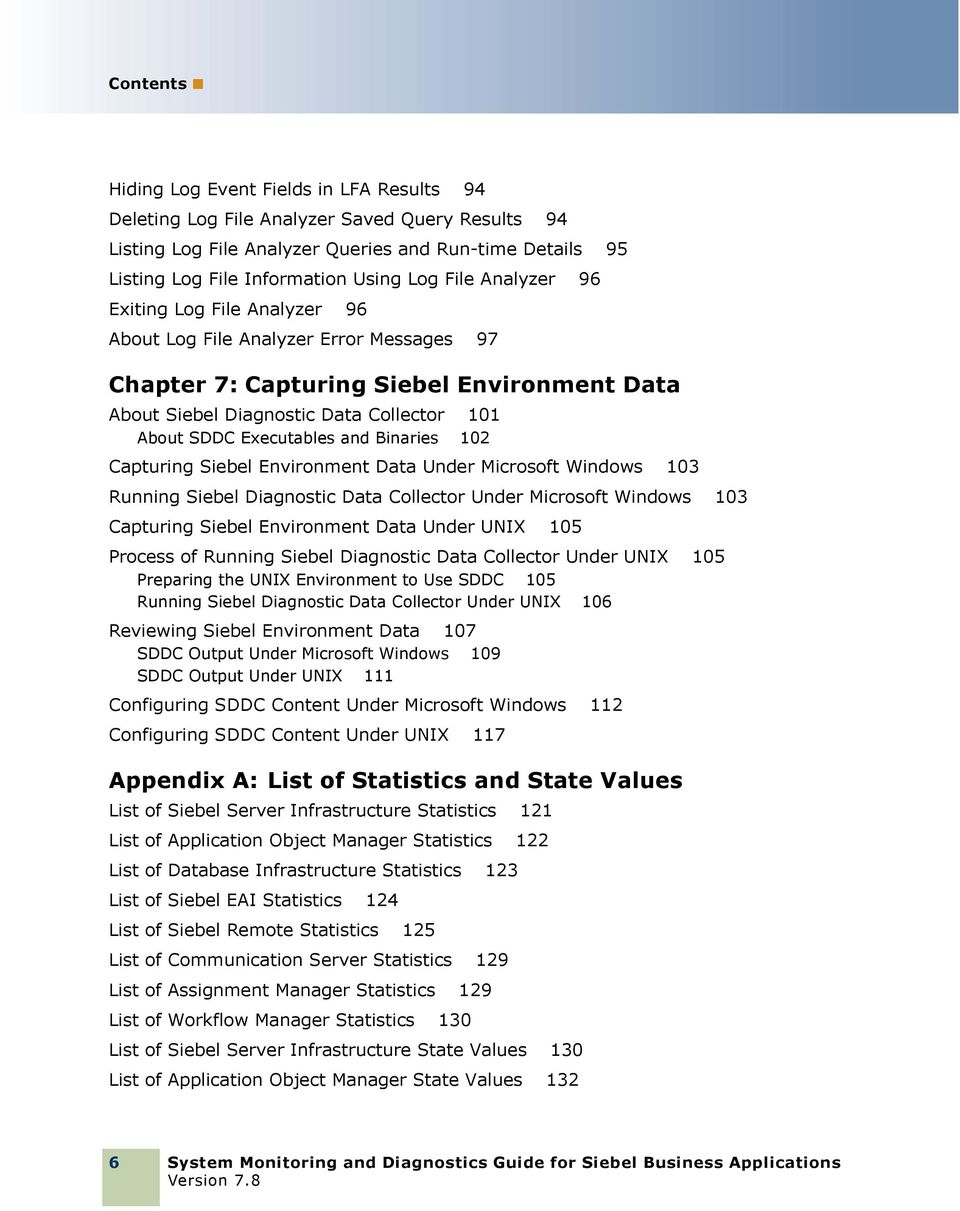
7 Contents List of Siebel EAI State Values 133 List of Siebel Remote State Values 134 List of Communications Server State Values 135 Index 7

8 Contents 8

9 1 What s New in This Release What s New in System Monitoring and Diagnostics Guide for Siebel Business Applications, Table 1 lists changes described in this version of the documentation to support Release 7.8 of the software. Table 1., Topic About Events and Event Logging on page 43 Common Event Types for Application Object Manager Diagnostics on page 56 Configuring the SWSE Statistics Page on page 63 About SDDC Executables and Binaries on page 102 Description Added information on location details for specific event types. Added two event types to this section on security-related events. Added a caution note in this section regarding changing the name of the Siebel Web Server Extension (SWSE) statistics page for security reasons. Added a new section on Siebel Diagnostic Data Collector (SDDC) executables and binaries. 9

10 What s New in This Release 10

11 2 Monitoring Siebel Server Run- Time Operations Monitoring Siebel Server run-time operations is a necessary, on-going aspect of administering a Siebel application. Use metrics such as log files, state values, and statistics to monitor the Siebel application performance. This chapter includes the following topics: About Siebel Server States on page 11 About Siebel Server Component Group States on page 13 About Siebel Server Component States on page 14 About Siebel Server Task States on page 16 About Component Job States on page 18 About User Sessions on page 18 About Siebel Application Statistics on page 19 About Siebel Application State Values on page 19 Monitoring Siebel Enterprise Server Status on page 20 Monitoring Siebel Server Status on page 21 Monitoring Siebel Server Component Status on page 26 Monitoring Server Component Task Status on page 30 Monitoring Component Job Status on page 33 Monitoring User Session Status on page 34 Analyzing System Data with Siebel Run-Time Data on page 38 About Siebel Server States After installation, a Siebel Server is always in one of the following states when connected to the Server Manager component (alias ServerMgr): Starting Up. Indicates that the Siebel Server is in the process of starting up. When this process is complete, the state changes to Running. 11
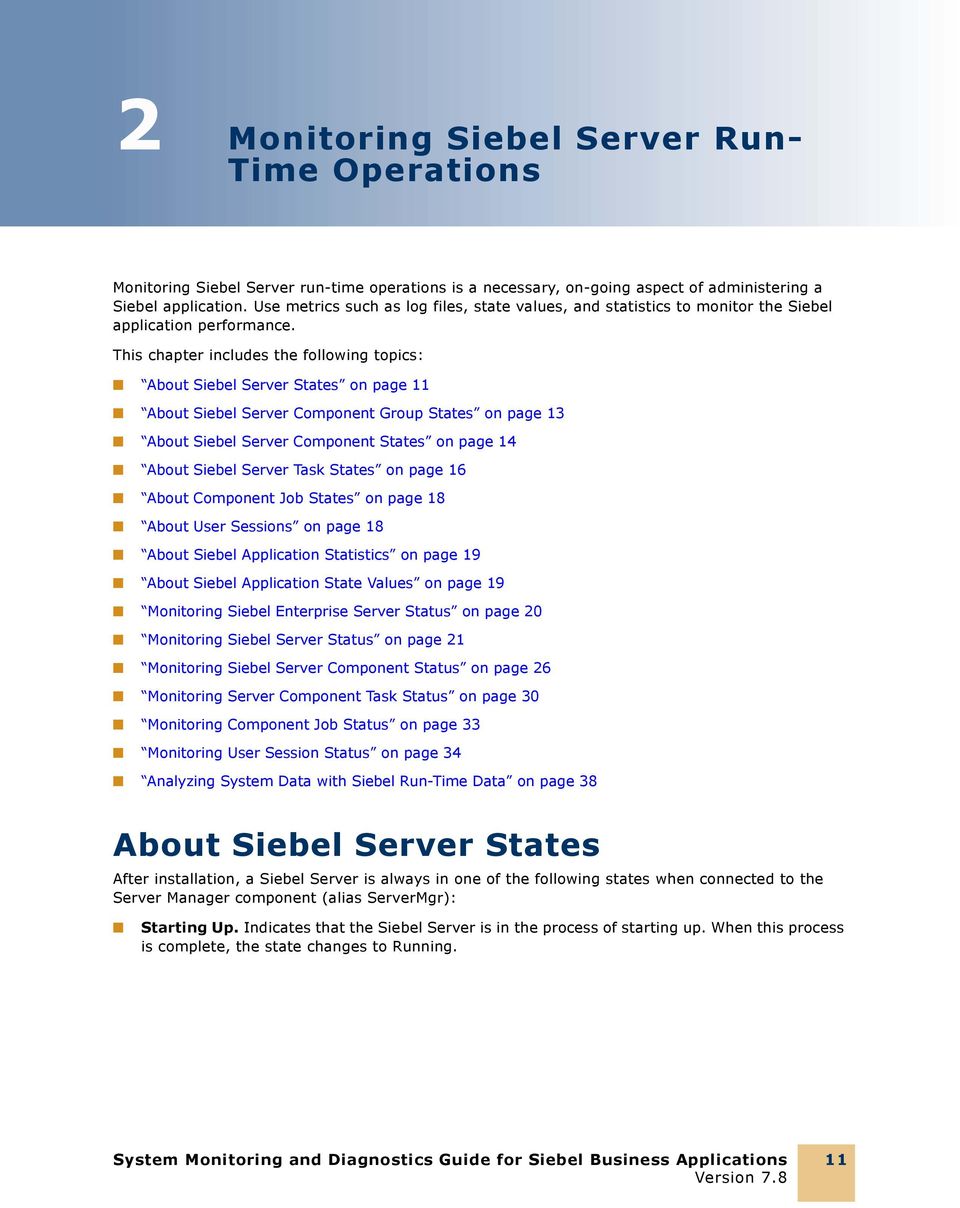
12 Monitoring Siebel Server Run-Time Operations About Siebel Server States Running. Indicates that the Siebel Server is running and that Siebel Server components can operate. This is the normal mode of operation for the Siebel Server. When the Siebel Server Service starts, it sets the Siebel Server to the Running state by default (depending on the value of the Auto Startup Mode Siebel Server-level parameter, which defaults to TRUE). When the Siebel Server starts, its components are enabled and the default number of tasks is instantiated for the background mode components (the number of tasks is determined by the value of the Default Tasks parameter for each component). Shutting Down. Indicates that the Siebel Server is in the process of shutting down. When this process is complete, the state changes to Shutdown. Shutdown. Indicates that the Siebel Server is running, but component tasks are not currently running (other than the Siebel Server Manager component, which is operational whenever the Server Manager is connected) and new tasks are not allowed to start. The only processes that can run when the Siebel Server is in a Shutdown state are the Siebel Server System Service itself and the Server Manager for a Siebel Server Manager client. Shut down the Siebel Server using the Server Manager whenever you want to shut down the: Server machine on which the Siebel Server is running. This allows a clean shutdown of each Siebel Server component. Siebel Server to perform maintenance. Siebel Server to perform an automatic upgrade on the Siebel Server s software using Siebel Upgrade Wizard. NOTE: Individual components may be shut down or disabled without having to shut down the entire Siebel Server. If the Siebel Server is not connected to the Server Manager component (alias ServerMgr), the following states are applicable: Not available. Indicates that the Siebel Server has not been started. Indicates that the Server Manager cannot connect to the Siebel Server; you will not be able to run any tasks or perform any administrative functions on that Siebel Server. Connect Failed. Indicates that Server Manager is able to get the connect string for the ServerMgr component from the Siebel Gateway Name Server but is unable to connect to the Siebel Server. Handshake Failed. On startup, Server Manager sends a handshake request to the Siebel Server for the ServerMgr component. If that request fails then this state occurs. Also, if the ServerMgr component on that particular Siebel Server cannot start any more tasks (because it has reached Maximum Tasks (alias MaxTasks) number of tasks) for the administration clients, this state occurs. For more information on the MaxTasks parameter, see Siebel System Administration Guide and Performance Tuning Guide. Login Failed. Server Manager connects to every Siebel Server for authentication. If the authentication fails for any Siebel Server, the Login Failed state appears. Disconnected. When Server Manager connects to the Siebel Server, the Siebel Server starts a task for the ServerMgr component. If that task exits (because of a crash or other problems), the Disconnected state appears. 12

13 Monitoring Siebel Server Run-Time Operations About Siebel Server Component Group States Siebel Server Status Fields Each Siebel Server record has three fields in which the Siebel Server status appears (Table 2). Table 2. Siebel Server Status Fields GUI Column Name Command-Line Interface Column Name Description Server State (Internal) SBLSRVR_STATE The state of the Siebel Server using ENU language code. State SV_DISP_STATE The state of the Siebel Server using the appropriate language code. State (Icon) Not applicable A stoplight representation of the state of the Siebel Server. Green indicates normal conditions. Red indicates a non-operational condition. Clicking the icon field reveals the state value associated with the color code. About Siebel Server Component Group States A component group may be in one of several states. The run state is dependent on the enable state; only component groups that have an Online enable state when the Siebel Server was started can have a run state of Online or Running: Online. Every component within the component group is enabled to run tasks. Running. Every component within the component group is enabled, and at least one component within the component group is running a task. Shutdown. Every component within the component group is shut down. Tasks cannot run for any components within the component group. Part shutdown. At least one component within the component group is shut down or shutting down. Offline. Every component within the component group is offline. Part offline. At least one component within the component group is offline or unavailable. Starting up. At least one component within the component group is starting up. 13
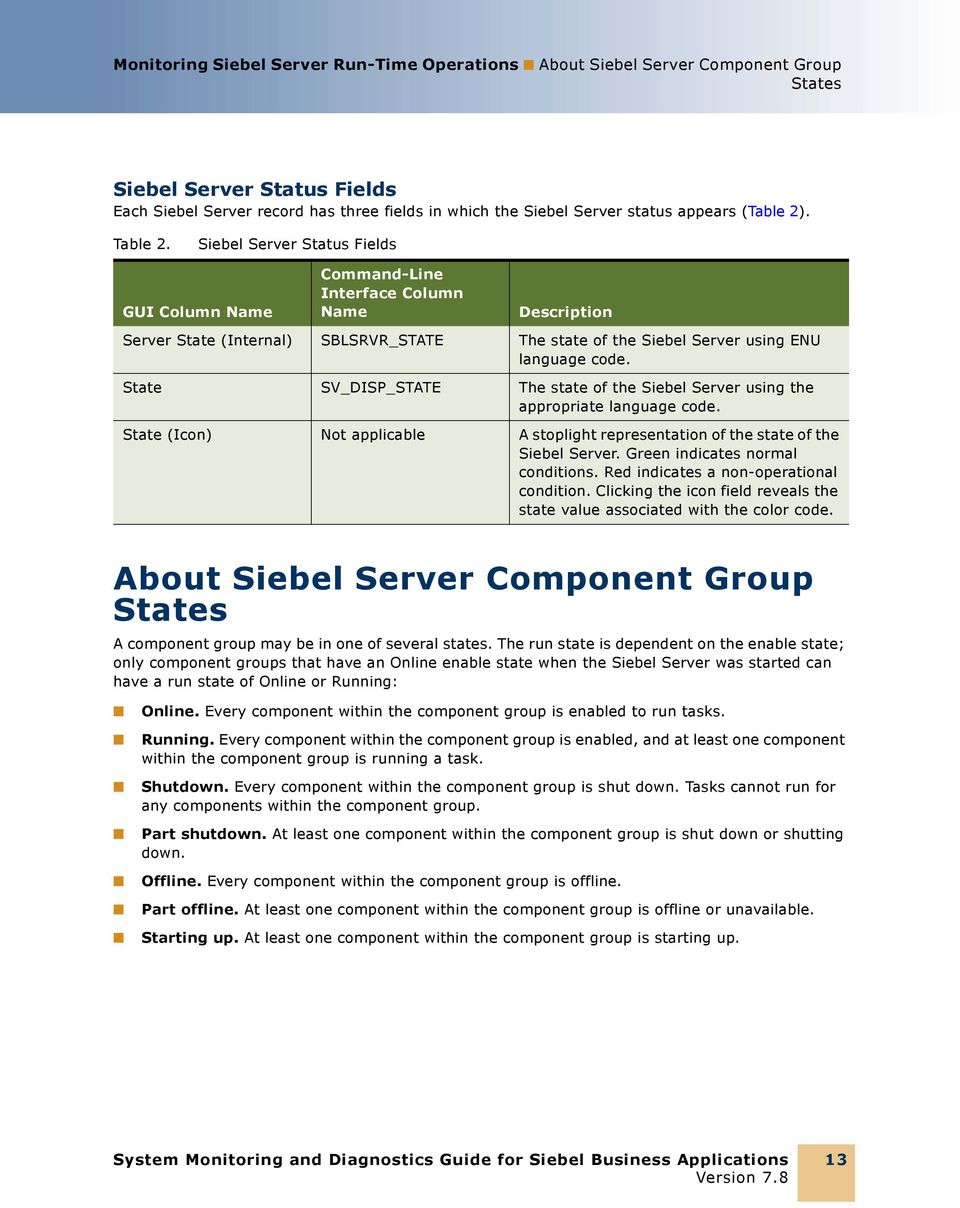
14 Monitoring Siebel Server Run-Time Operations About Siebel Server Component States Server Component Group Status Fields Each Siebel Server component group record has three fields in which the status appears (Table 3). Table 3. Siebel Server Component Group Status Fields GUI Column Name Command-Line Interface Column Name Description State CA_RUN_STATE The state of the server component group using ENU language code. Run State (internal) CA_RUN_STATE The state of the server component group using the appropriate language code. State (Icon) Not applicable A stoplight representation of the state of the server component group. Green indicates normal conditions. Yellow indicates a temporary non-operation condition. Red indicates a non-operational condition. Clicking the icon field reveals the state value associated with the color code. About Siebel Server Component States A Siebel Server component may be in one of the following states: Starting Up, Online, Running, Offline, Shutting Down, Shutdown, or Unavailable. The Siebel Server component state is dependent on the assignment state of the component group to which it belongs; only Siebel Server components within assigned component groups when the Siebel Server was started can be Running or Online: Starting Up. Indicates that the Siebel Server component is in the process of starting up. When this process is complete, the state changes to Online. When a new task is started for the component, the component state changes to Starting Up during the initialization phase and then to Running. Online. Indicates that tasks are currently not running for the Siebel Server component, but new tasks may be started through the Siebel Server Manager (or in response to client requests, for interactive-mode components). When the Siebel Server starts, all components for which processes are not started by default will be online. Running. Indicates that tasks are currently running for the Siebel Server component on the Siebel Server, and new tasks are allowed to start (up to the value of the Maximum Tasks parameter for the component). When the Siebel Server starts up, all background-mode components for which processes are started by default (components with a Default Tasks parameter set to a nonzero value) will start. 14
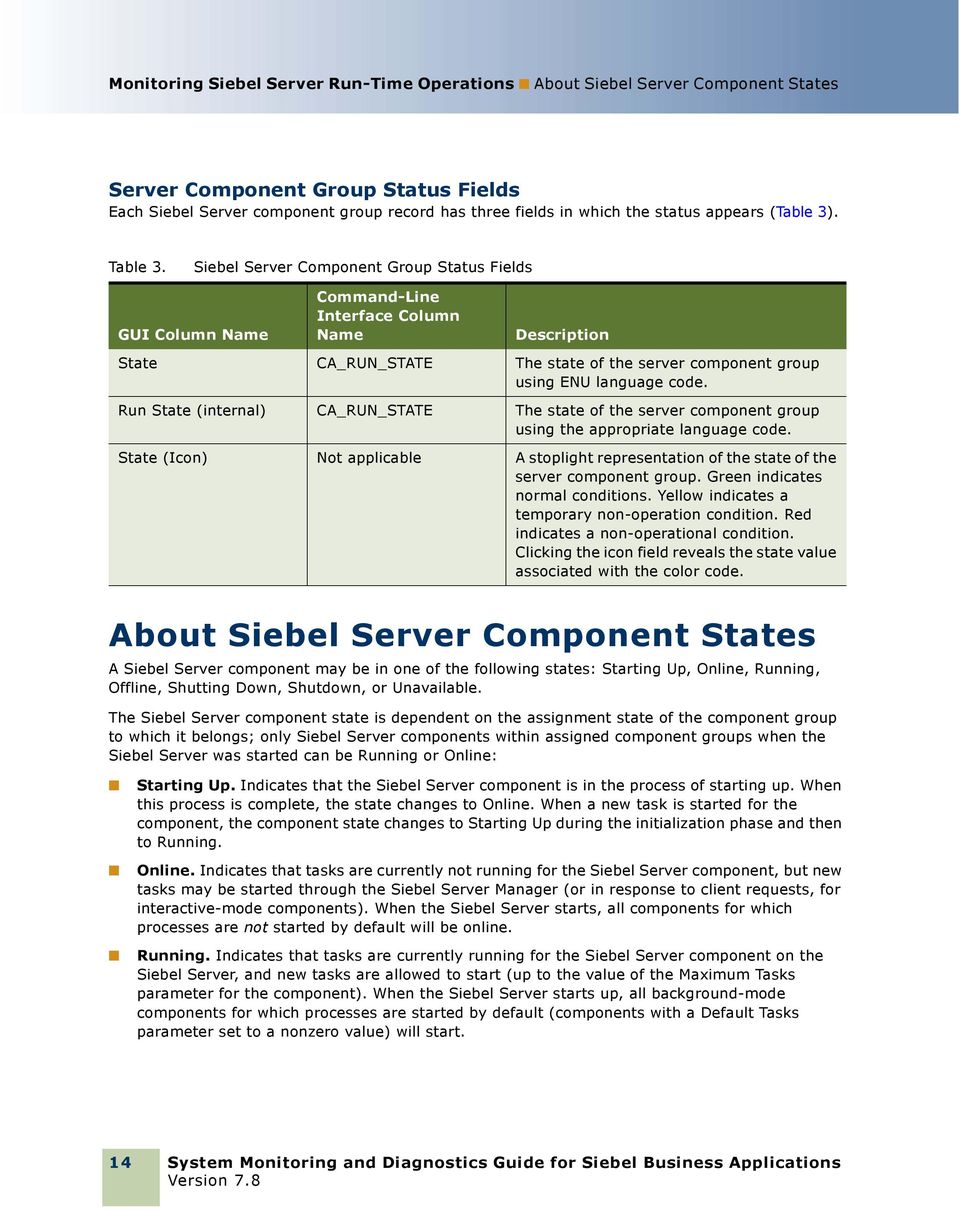
15 Monitoring Siebel Server Run-Time Operations About Siebel Server Component States Offline. Indicates that new tasks may not be started for the component, though current running tasks can continue running (for background-mode components) or run to completion (for batchmode and interactive-mode components). You may want to disable an individual component to perform a system maintenance operation outside of the Siebel Server. For example, you may disable the Synchronization Manager component to do a file system reorganization on the docking subdirectory. To minimize the number of multithreaded processes that will be started on the Siebel Server, you may want to disable components that you do not plan to run. You may also want to disable components due to database licenses. If you have exceeded the maximum licensed connections for your database, then you may want to disable the Siebel Server components that you will not be using. You should only disable components for which you do not plan to run tasks across the entire enterprise. Setting the Min MT Servers parameter to 0 for multithreaded Siebel Server components renders the server component unable to run tasks. An offline component may be set to Online (or Started, if there are still tasks running for the offline component) or Shutdown, in which case, any running tasks will be stopped as cleanly as possible. Shutting Down. Indicates that the Siebel Server component is in the process of shutting down. When this process is complete, the state changes to Shutdown. Shutdown. Indicates that processes are not running for the component and new tasks may not be started. Each task running when the component shuts down is stopped as soon as possible. All components will be set to Shutdown when the Siebel Server shuts down, with the exception of the Siebel Server Manager component, which remains Online to perform administrative commands executed by the Siebel Server Manager. Background-mode components that are set to Shutdown but have a Default Tasks parameter set to a nonzero value may be set to Online or Started. Unavailable. Indicates that processes are not running for the component when a Siebel Server process should be running. Multithreaded Siebel Server components change to an Unavailable component state when the Min MT Servers parameter is set to a value greater than 0 and no Siebel Server processes are actually running for that component. In this case, the Siebel Server component may exit with an error and become unavailable because it failed to initialize. Siebel Server components may also go into this state if the database connection is down. In this case, you need to restart the Siebel Server component after the database connection has been reestablished. 15
16 Monitoring Siebel Server Run-Time Operations About Siebel Server Task States Server Component Status Fields Each server component record has two fields in which the status appears (Table 4). Table 4. Server Component Status Fields GUI Column Name Command-Line Interface Column Name Description State CP_DISP_RUN_STATE The state of the Siebel Server component using the appropriate language code. State (Icon) Not applicable A stoplight representation of the state of the Siebel Server component. Green indicates normal conditions. Yellow indicates a temporary non-operation condition. Red indicates a non-operational condition. Clicking the icon field reveals the state value associated with the color code. About Siebel Server Task States A Siebel Server task is an instantiation of a Siebel Server component. To run a Siebel Server task, you need to run a component job, which requests one or more Siebel Server tasks to run. For information on component jobs, see Siebel System Administration Guide. A Siebel Server task may be in one of four fundamental states: Running, Paused, Stopping, or Completed. Running. Indicates that the task is executing normally. While the task is running, it will periodically update its task status, a component-generated message that indicates the task progress (or phase of operation). Background mode component tasks run until stopped manually, or until the Siebel Server or the server component shuts down. Batch mode component tasks run to completion when their assigned unit of work is done. Interactive mode component tasks run until the client signs off from the connection (or until the task, server component, or Siebel Server is shut down). You may explicitly stop any currently running component task. Paused. Indicates that the task has been temporarily placed in a suspended state. A paused task does not exclusively hold any shared system resources (such as file locks or database locks), or expend any processor or I/O cycles. You may choose to pause a running task to temporarily free up the system to process other critical tasks without having to restart the entire task. You may then resume or stop the paused task. NOTE: Only tasks from certain component types can be paused. See Siebel System Administration Guide for a list of these component types. 16

17 Monitoring Siebel Server Run-Time Operations About Siebel Server Task States Stopping. Indicates that the task has been instructed to stop, or the server component or Siebel Server is being shut down. Occasionally, the shutdown process may take a while, in which case you may issue another Stop command, and the shutdown will be forced (this state may appear as Forcing Shutdown). After a task has been instructed to stop, it may not be resumed. Completed. Indicates that the task is no longer running. After a task is completed, it may not be restarted, though you may start a new task for the same server component. Several variations exist for the Completed state, depending on the manner in which the task finished processing: Completed indicates that the task ran to completion and exited normally (batch mode and interactive mode tasks only). Exited with Error indicates that the task encountered an error during its processing (such as bad input values or database errors). In this case, the Task Status field displays the error identifier for the error that has occurred. Killed indicates that the task was not able to shut down cleanly, and you forced the task to shut down. About Task Status Fields Each Siebel Server record has three fields in which the Siebel Server status appears (Table 5). Table 5. Task Status Fields GUI Column Name Command-Line Interface Column Name Description State TK_RUNSTATE The state of the task using the appropriate language code. Status TK_STATUS Every component task sets various state values during the course of its operation. The Status column in the tasks view and the TK_STATUS column in the command-line interface displays the value for the state value Task Status (alias TaskStatus). State (Icon) Not applicable A stoplight representation of the state of the task. Green indicates normal conditions. Yellow indicates temporary non-operational conditions. Red indicates a non-operational condition. Clicking the icon field reveals the state value associated with the color code. About Siebel Server Task IDs Siebel Server Task IDs identify Siebel Server tasks and are referenced in various views of the GUI as well as in both Siebel Server and component log files. These identification numbers can help you locate individual tasks and their applicable log files. See About Siebel Server Log Files on page 46 for details on event logging and log files. 17

18 Monitoring Siebel Server Run-Time Operations About Component Job States Task IDs are assigned sequentially from each Siebel Server for each Siebel Server task beginning at 1. Each time the Siebel Server is restarted, Task ID numbers are increased by The maximum task ID number that can be assigned is (256*1024). After the maximum task ID number is reached, the task ID number begins again at 1. About Component Job States After the creation of a component job, it is always in one of the states in the following list. For further information on starting component jobs, see Siebel System Administration Guide. For further information on monitoring component job status, see Monitoring Component Job Status on page 33. Creating. Indicates the component job record is in the process of being defined. Queued. Indicates the component job record was started and is scheduled to run. The component job field Scheduled Start defines when the component job runs. Active. Indicates the scheduled component job is running. On Hold. Indicates the component job is on hold and will not run at the Scheduled Start time. Only component jobs in the queued state can be put on hold. Cancelled. Indicates the component job is cancelled. Only component jobs in the queued or on hold state can be cancelled. Canceling. Indicates the component job is in the process of being cancelled. Error. Indicates the component job ran, but encountered an error during operation. Success. Indicates the component job ran and completed successfully. Completed. Indicates that all repeating component jobs completed successfully. Expired. Indicates the component job has expired. The component job field Expiration Date defines when the component job expires. Parent Request Cancelled. Indicates the first component job of a repeating component job was cancelled. The first component job of a repeating component job is considered the parent job. Parent Request On Hold. Indicates the first component job of a repeating component job is on hold. The first component job of a repeating component job is considered the parent job. About User Sessions User sessions include data on any user logged into the Siebel Server as well as sessions created by the Siebel application. User sessions comprise all interactive component tasks. User sessions run based on a Siebel Server component task. Therefore, user sessions have the properties of Siebel Server component tasks. The Session ID field of an individual user session shares the same ID number as the Task ID of the component task that runs the session. That is, information on user sessions can be viewed as either a user session or a task. For information and procedures on monitoring user sessions, see Monitoring User Session Status on page

19 Monitoring Siebel Server Run-Time Operations About Siebel Application Statistics For information and procedures on monitoring tasks, see Monitoring Server Component Task Status on page 30. About Siebel Application Statistics Various statistics are recorded at the task level for every Siebel Server component task. You may use these statistics to: Monitor the progress and performance of a task, component, or Siebel Server Optimize system performance When the task completes its operation, task-level statistics (gathered dynamically during the operation of a task) roll up to the component and Siebel Server levels. Two types of statistics exist for task-level Siebel Server statistics: Subsystem statistics. Common to every component process (such as process management, networking, database access, and file I/O) and tracked for each component task. Component-specific statistics. Only applicable to the component for which the statistics are defined. When a task for a component completes its operation, both generic and component-specific statistics roll up to the component level. Only generic statistics roll up to the Siebel Server level. Statistics on the component level includes data for all completed tasks on interactive and batch mode components. Statistics for component tasks that are still running are not included. Check the tasks directly to monitor statistics for running tasks on interactive and batch mode components. For information on monitoring task statistics, see Monitoring Server Component Task Statistics on page 33. For background mode components, the statistic rollup behavior is slightly different because the component tasks should never complete. For background components, the component statistics change whenever a statistic value is updated by the running component task. For a listing and brief descriptions of Siebel application statistics, see Appendix A, List of Statistics and State Values. NOTE: If some Siebel application statistics are not visible, set the parameter Show Advanced Objects (alias ShowAdvancedObjects) to TRUE for the server component Server Manager (alias ServerMgr). For further information on advanced objects, see Siebel System Administration Guide. About Siebel Application State Values State values contain information about the current operation of a task or the component for which the task is running. Component tasks periodically update their state values to indicate information about their current processing, such as the current phase of operation. State values are defined at the component and task levels. Component-level state values refer to the state of the component as a whole. Task-level state values refer to the state of an individual process for a Siebel Server component. Two types of state values exist for components and component tasks: 19
20 Monitoring Siebel Server Run-Time Operations Monitoring Siebel Enterprise Server Status Subsystem state values. Kept for every component (such as Component Start Time and Component Stop Time) and component task (such as Task Start Time and Task Stop Time) that uses that subsystem. Component-specific state values. Kept for every component and component task. Only applicable to the component for which they are defined. Monitoring Siebel Enterprise Server Status Monitor the status of Siebel Servers in a Siebel Enterprise Server by using the Server Manager GUI or the Server Manager command-line interface program (srvrmgr). For configuration tasks and background information on the Siebel Enterprise Server, see Siebel System Administration Guide. To monitor a Siebel Enterprise Server on Server Manager GUI 1 Navigate to the Administration Server Management screen. 2 From the link bar, click Enterprise Operations. The name and description of the Siebel Enterprise Servers available are in the Enterprise Servers list. The state of the Siebel Servers for the selected Siebel Enterprise Server are available in the Siebel Servers list. For details on Siebel Server states, see About Siebel Server States on page 11. The state of the Siebel Server components for the selected Siebel Server are available in the Components list. For details on Siebel Server component states, see About Siebel Server Component States on page 14. Figure 1 shows an example of a Siebel Enterprise Server with a single Siebel Server. Figure 1. Example of a Siebel Enterprise Server with a Single Siebel Server To monitor Siebel Enterprise Server on srvrmgr At the srvrmgr program prompt, enter: 20

21 Monitoring Siebel Server Run-Time Operations Monitoring Siebel Server Status list servers NOTE: Make sure you do not start the Server Manager command-line interface program for a particular Siebel Server; that is, do not start the Server Manager command-line interface with the / s flag. For details on starting, running, and configuring the Server Manager command-line interface program, see Siebel System Administration Guide. Monitoring Siebel Server Status Monitor the status of Siebel Servers by using the Server Manager GUI or Server Manager commandline interface program (srvrmgr program). The following sections describe procedures that monitor the Siebel Server: Monitoring Siebel Server State on page 21 Monitoring Siebel Server Component Groups on page 22 Monitoring Siebel Server Log Files on page 23 Monitoring Siebel Server Statistics on page 24 Monitoring Siebel Server User Sessions on page 24 Monitoring Siebel Server Tasks on page 25 For background information Siebel Servers, including running and configuring procedures, see Siebel System Administration Guide. Monitoring Siebel Server State Monitor the status of a Siebel Server by using the Server Manager GUI or the Server Manager command-line interface program (srvrmgr). For details on the possible states of the Siebel Server, see About Siebel Server States on page 11. For information on monitoring other Siebel Server run-time operations, see Monitoring Siebel Server Status on page 21. To monitor the Siebel Server state on Server Manager GUI 1 Navigate to the Administration Server Management screen. 2 From the link bar, click Servers. 3 In the Servers list, select the Siebel Server of interest. 4 Review the state of the selected Siebel Server by referencing the State or Server State fields. 21
22 Monitoring Siebel Server Run-Time Operations Monitoring Siebel Server Status Figure 2 shows an example of monitoring a Siebel Server state. Figure 2. Example of a Siebel Server in the Servers list To monitor the Siebel Server state on srvrmgr At the srvrmgr program prompt, enter: list servers For details on starting, running, and configuring the srvrmgr program, see Siebel System Administration Guide. Monitoring Siebel Server Component Groups Monitor the status of component groups for a Siebel Server using the Server Manager GUI or the Server Manager command-line interface program (srvrmgr). For details on Siebel Server component group states, see About Siebel Server Component Group States on page 13. For information on monitoring other Siebel Server run-time operations, see Monitoring Siebel Server Status on page 21. To monitor component groups on Server Manager GUI 1 Navigate to the Administration Server Management screen. 2 From the link bar, click Servers. 3 In the Servers list, select the Siebel Server of interest. 4 From the view tabs, Click Component Groups. 5 Review the state of the component groups for the selected Siebel Server by referencing the Run State and Enable State fields of each component group record. 22
23 Monitoring Siebel Server Run-Time Operations Monitoring Siebel Server Status Figure 3 shows an example of monitoring component groups. Figure 3. Example of Component Group Status for a Siebel Server To monitor component groups on srvrmgr At the srvrmgr program prompt, enter list component groups for server siebel_server_name For details on starting, running, and configuring the srvrmgr program, see Siebel System Administration Guide. Monitoring Siebel Server Log Files Monitor the log files for a Siebel Server using the Server Manager GUI. You can also review Siebel Server log files by manually accessing the file or querying the file with the Log File Analyzer (LFA) utility. For background information on Siebel Server log files, see About Siebel Server Log Files on page 46. For background information on LFA, see About the Log File Analyzer on page 75. For background information on event logging, see About Configuring Siebel Server and Component Logging on page 43. For information on monitoring other Siebel Server run-time operations, see Monitoring Siebel Server Status on page 21. To monitor Siebel Server log files on Server Manager GUI 1 Navigate to the Administration Server Management screen. 2 From the link bar, click Servers. 3 In the Servers list, select the Siebel Server of interest. 23
24 Monitoring Siebel Server Run-Time Operations Monitoring Siebel Server Status 4 From the view tabs, click Log. Each entry in the Log view list represents an event logged in the Siebel Server log file. For further details on each entry, click the record of interest and review information in the Info Detail view. NOTE: The Server Manager GUI accesses Siebel Server log files from the log directory of each individual Siebel Server. Siebel Server log files use the following name convention: EnterpriseServerName.SiebelServerName.log. Monitoring Siebel Server Statistics Monitor Siebel Server statistics using the Server Manager GUI or the Server Manager command-line interface program (srvrmgr). For background information and a list of Siebel Server statistics, see Appendix A, List of Statistics and State Values. For information on monitoring other Siebel Server run-time operations, see Monitoring Siebel Server Status on page 21. To monitor Siebel Server statistics on Server Manager GUI 1 Navigate to the Administration Server Management screen. 2 From the link bar, click Servers. 3 In the Servers list, select the Siebel Server of interest. 4 From the view tabs, click Statistics. Statistics for the selected Siebel Server appear in the Statistics list. For a list and description of Siebel Server statistics, see Appendix A, List of Statistics and State Values. To monitor Siebel Server statistics on srvrmgr At the srvrmgr program prompt for a particular Siebel Server, enter: list statistics for server siebel_server_name For details on starting, running, and configuring the srvrmgr program, see Siebel System Administration Guide. Monitoring Siebel Server User Sessions Monitor user sessions for a particular Siebel Server by using the Server Manager GUI or the Server Manager command-line interface program (srvrmgr). For background information on user sessions, see About User Sessions on page 18. For information on monitoring other Siebel Server run-time operations, see Monitoring Siebel Server Status on page
25 Monitoring Siebel Server Run-Time Operations Monitoring Siebel Server Status To monitor Siebel Server user sessions on Server Manager GUI 1 Navigate to the Administration Server Management screen. 2 From the link bar, click Servers. 3 In the Servers list, select the Siebel Server of interest. 4 From the view tabs, click Sessions. 5 Review the status of users sessions for the selected Siebel Server by referencing the State, Task Hung State, and Status fields. For further details on monitoring individual user sessions, note the Session ID number and see Monitoring User Session Status on page 34. Figure 4 shows an example of monitoring Siebel Server user sessions. Figure 4. Example of Siebel Server User Session View To monitor Siebel Server user sessions on srvrmgr At the srvrmgr program prompt, enter: list sessions for server siebel_server_name For details on starting, running, and configuring the srvrmgr program, see Siebel System Administration Guide. Monitoring Siebel Server Tasks Monitor Siebel Server component tasks for a particular Siebel Server by using the Server Manager GUI or the Server Manager command-line interface program (srvrmgr). For details on Siebel Server component task states, see About Siebel Server Task States on page 16. For information on monitoring other Siebel Server run-time operations, see Monitoring Siebel Server Status on page
26 Monitoring Siebel Server Run-Time Operations Monitoring Siebel Server Component Status To monitor Siebel Server tasks on Server Manager GUI 1 Navigate to the Administration Server Management screen. 2 From the link bar, click Servers. 3 In the Servers list, select the Siebel Server of interest. 4 From the view tabs, click Tasks. 5 Review the status of tasks for the selected Siebel Server by referencing the State and Status fields. For further details on monitoring individual tasks, note the Task ID number and see Monitoring Server Component Task Status on page 30. Figure 5 shows an example of monitoring Siebel Server tasks. Figure 5. Example of the Siebel Server Tasks View To monitor Siebel Server user sessions on srvrmgr At the srvrmgr program prompt, enter: list tasks for server siebel_server_name For details on starting, running, and configuring the srvrmgr program, see Siebel System Administration Guide. Monitoring Siebel Server Component Status Monitor the status of Siebel Server components by using the Server Manager GUI or Server Manager command-line interface program (srvrmgr). The following sections describe procedures that monitor the Siebel Server components: Monitoring Siebel Server Component State on page 27 26
27 Monitoring Siebel Server Run-Time Operations Monitoring Siebel Server Component Status Monitoring Siebel Server Component State Values on page 28 Monitoring Siebel Server Component Statistics on page 28 Monitoring Siebel Server Component Tasks on page 29 For background information on Siebel Server components, including running and configuring procedures, see Siebel System Administration Guide. Monitoring Siebel Server Component State Monitor the status of Siebel Server components using the Server Manager GUI or the Server Manager command-line interface program (srvrmgr). For details on Siebel Server component states, see About Siebel Server Component States on page 14. For information on monitoring other Siebel Server component run-time operations, see Monitoring Siebel Server Component Status on page 26. To monitor the Siebel Server component state on Server Manager GUI 1 Navigate to the Administration Server Management screen. 2 From the link bar, click Components. 3 In the Components list, select the Siebel Server component of interest. 4 Review the state of the selected Siebel Server component by referencing the State field. The Components view from the link bar lists Siebel Server components from all Siebel Servers operating in the Siebel Enterprise Server. Figure 6 shows an example of monitoring Siebel Server Components. Figure 6. Example of Siebel Server Components List 27
28 Monitoring Siebel Server Run-Time Operations Monitoring Siebel Server Component Status To monitor the component state on srvrmgr At the srvrmgr program prompt, enter: list component For details on starting, running, and configuring the srvrmgr program, see Siebel System Administration Guide. Monitoring Siebel Server Component State Values Monitor Siebel Server component state values using the Server Manager GUI or the Server Manager command-line interface program (srvrmgr). For background information and a list of Siebel Server state values, see Appendix A, List of Statistics and State Values. For information on monitoring other Siebel Server component run-time operations, see Monitoring Siebel Server Component Status on page 26. To monitor component state values on Server Manager GUI 1 Navigate to the Administration Server Management screen. 2 From the link bar, click Components. 3 In the Components list, select the Siebel Server component of interest. 4 From the view tabs, click State Value. State values for the selected Siebel Server component appear in the State Values list. For a list and description of Siebel Server state values, see Appendix A, List of Statistics and State Values. To monitor component state values on srvrmgr At the srvrmgr program prompt, enter: list state values for component component_alias_name For details on starting, running, and configuring the srvrmgr program, see Siebel System Administration Guide. Monitoring Siebel Server Component Statistics Monitor Siebel Server component statistics using the Server Manager GUI or the Server Manager command-line interface program (srvrmgr). For background information and a list of Siebel Server component statistics, see Appendix A, List of Statistics and State Values. For information on monitoring other Siebel Server component run-time operations, see Monitoring Siebel Server Component Status on page
29 Monitoring Siebel Server Run-Time Operations Monitoring Siebel Server Component Status To monitor component statistics on Server Manager GUI 1 Navigate to the Administration Server Management screen. 2 From the link bar, click Components. 3 In the Components list, select the Siebel Server component of interest. 4 From the view tabs, click Statistics. Statistics for the selected Siebel Server component appear in the Statistics list. For a list and description of Siebel Server statistics, see Appendix A, List of Statistics and State Values. To monitor component statistics on srvrmgr At the srvrmgr program prompt, enter: list statistics for component component_alias_name For details on starting, running, and configuring the srvrmgr program, see Siebel System Administration Guide. Monitoring Siebel Server Component Tasks Monitor tasks for a particular Siebel Server component by using the Server Manager GUI or the Server Manager command-line interface program (srvrmgr). For details on Siebel Server component task states, see About Siebel Server Task States on page 16. For information on monitoring other Siebel Server run-time operations, see Monitoring Siebel Server Status on page 21. To monitor Siebel Server tasks on Server Manager GUI 1 Navigate to the Administration Server Management screen. 2 From the link bar, click Components. 3 In the Components list, select the Siebel Server component of interest. 4 From the view tabs, click Task. 5 Review the status of tasks for the selected Siebel Server component by referencing the State and Status fields. For further details on monitoring individual tasks, note the Task ID number and see Monitoring Server Component Task Status on page
30 Monitoring Siebel Server Run-Time Operations Monitoring Server Component Task Status Figure 7 shows an example of monitoring Siebel Server component tasks from the Components view. Figure 7. Example of Siebel Server Tasks View To monitor component tasks on srvrmgr At the srvrmgr program prompt, enter: list tasks for component component_alias_name For details on starting, running, and configuring the srvrmgr program, see Siebel System Administration Guide. Monitoring Server Component Task Status Monitor the status of Siebel Server component tasks by using the Server Manager GUI or Server Manager command-line interface program (srvrmgr). The following sections describe procedures that monitor Siebel Server component tasks: Monitoring Server Component Task State on page 31 Monitoring Server Component Task Log Files on page 32 Monitoring Server Component Task State Values on page 32 Monitoring Server Component Task Statistics on page 33 A task, in the context of a Siebel application, is an instantiation of a Siebel Server component. Administrators start tasks by creating jobs. Tasks are also started by the Siebel application itself. For background information on Siebel Server component tasks, including running and configuring procedures, see Siebel System Administration Guide. 30
31 Monitoring Siebel Server Run-Time Operations Monitoring Server Component Task Status Monitoring Server Component Task State Monitor the state of Siebel Server component tasks using the Server Manager GUI or the Server Manager command-line interface program (srvrmgr). For details on Siebel Server component task states, see About Siebel Server Task States on page 16. For information on monitoring other task run-time operations, see Monitoring Server Component Task Status on page 30. To monitor tasks on Server Manager GUI 1 Navigate to the Administration Server Management screen. 2 From the link bar, click Tasks. 3 In the Tasks list, select the task of interest. 4 Review the state of the selected task by referencing the State, Status and Task State fields. The Tasks view from the link bar lists tasks from all Siebel Servers operating in the Siebel Enterprise Server. To isolate tasks on a particular Siebel Server, see Monitoring Siebel Server Tasks on page 25. To isolate tasks for a particular Siebel Server component, see Monitoring Siebel Server Component Tasks on page 29. NOTE: You cannot sort tasks from different Siebel Servers across the enterprise. Figure 8 shows an example of monitoring Siebel Server component tasks from the Tasks view. Figure 8. Example of Siebel Server Component Task List To monitor tasks on srvrmgr At the srvrmgr program prompt, enter: list tasks For details on starting, running, and configuring the srvrmgr program, see Siebel System Administration Guide. 31
32 Monitoring Siebel Server Run-Time Operations Monitoring Server Component Task Status Monitoring Server Component Task Log Files Monitor the log files for a Siebel Server component task using the Server Manager GUI. Also review task log files by manually accessing the file or querying the file with the Log File Analyzer (LFA) utility. For background information on event logging, see Chapter 3, Configuring Siebel Server and Component Logging. For background information on task log files, see Configuring Siebel Server Component Logging on page 50. For background information on LFA, see Chapter 6, Querying System Log Files. For information on monitoring other task run-time operations, see Monitoring Server Component Task Status on page 30. To monitor task log files on Server Manager GUI 1 Navigate to the Administration Server Management screen. 2 From the link bar, click Tasks. 3 In the Tasks list, select the task of interest. 4 From the view tabs, click Log. Each entry in the Log view list represents an event logged in the task log file. Monitoring Server Component Task State Values Monitor Siebel Server component task state values using the Server Manager GUI or the Server Manager command-line interface program (srvrmgr). For background information and a list of task state values, see Appendix A, List of Statistics and State Values. For information on monitoring other task run-time operations, see Monitoring Server Component Task Status on page 30. To monitor task state values on Server Manager GUI 1 Navigate to the Administration Server Management screen. 2 From the link bar, click Tasks. 3 In the Tasks list, select the task of interest. 4 From the view tabs, click State Value. State values for the selected task appear in the State Values list. For a list and description of task state values, see Appendix A, List of Statistics and State Values. 32
33 Monitoring Siebel Server Run-Time Operations Monitoring Component Job Status To monitor task state values on srvrmgr At the srvrmgr program prompt, enter: list state values for task task_number For details on starting, running, and configuring the srvrmgr program, see Siebel System Administration Guide. Monitoring Server Component Task Statistics Monitor Siebel Server component task statistics using the Server Manager GUI or the Server Manager command-line interface program (srvrmgr). For background information and a list of task statistics, see Appendix A, List of Statistics and State Values. For information on monitoring other task run-time operations, see Monitoring Server Component Task Status on page 30. To monitor task statistics on Server Manager GUI 1 Navigate to the Administration Server Management screen. 2 From the link bar, click Tasks. 3 In the Tasks list, select the task of interest. 4 From the view tabs, click Statistics. Statistics for the selected task appear in the Statistic list. For a list and description of task statistics, see Appendix A, List of Statistics and State Values. To monitor task statistics on srvrmgr At the srvrmgr program prompt, enter: list statistics for task task_number For details on starting, running, and configuring the srvrmgr program, see Siebel System Administration Guide. Monitoring Component Job Status Monitor the status of Siebel Server component jobs using the Server Manager GUI. For background information on starting Siebel Server component jobs, see Siebel System Administration Guide. For information on component job states, see About Component Job States on page 18. To monitor component job status 1 Navigate to the Administration - Server Management screen. 33
34 Monitoring Siebel Server Run-Time Operations Monitoring User Session Status 2 From the link bar, click Jobs. 3 In the Jobs list, select the component job of interest. 4 Review the status of the component job by referencing the status field. To monitor component job status requested by your User ID 1 Navigate to the Server Jobs screen. 2 In the My Jobs list, select the component job of interest. 3 Review the status of the component job by referencing the status field. Monitoring User Session Status Monitor the status of user sessions by using the Server Manager GUI or Server Manager commandline interface program (srvrmgr). The following sections describe procedures that monitor user sessions: Monitoring User Session State on page 34 Monitoring User Session Log Files on page 36 Monitoring User Session State Values on page 36 Monitoring User Session Statistics on page 37 For background information on user sessions, see About User Sessions on page 18. Monitoring User Session State Monitor the state of Siebel Server user sessions using the Server Manager GUI or the Server Manager command-line interface program (srvrmgr). The state of the user session is that of the associated Siebel Server component task that represents the user session. For background information on user sessions, see About User Sessions on page 18. For background information on Siebel Server component task states, see About Siebel Server Task States on page 16. For information on monitoring other Siebel Server user session run-time operations, see Monitoring User Session Status on page 34. To monitor user sessions on Server Manager GUI 1 Navigate to the Administration Server Management screen. 2 From the link bar, click Sessions. 3 In the Sessions list, select the Siebel Server user session of interest. 34
35 Monitoring Siebel Server Run-Time Operations Monitoring User Session Status 4 Review the state of the selected Siebel Server user session by referencing the State and Status fields. The Sessions view from the link bar lists Siebel Server user sessions from all Siebel Servers operating in the Siebel Enterprise Server. To isolate sessions on a particular Siebel Server, see Monitoring Siebel Server User Sessions on page 24. Figure 9 shows an example of monitoring Siebel Server user sessions. Figure 9. Example of Siebel Server Sessions List To monitor user sessions for a Siebel Server using srvrmgr At the srvrmgr program prompt, enter: list sessions for server siebel_server_name To monitor user sessions for a Siebel Server component using srvrmgr At the srvrmgr program prompt, enter: list sessions for comp component_alias_name To monitor user sessions for an Application Object Manager using srvrmgr At the srvrmgr program prompt, enter: list sessions for login object_manager_login To list hung user sessions using srvrmgr At the srvrmgr program prompt, enter: list hung sessions for server siebel_server_name [or]comp component_alias_name [or]login object_manager_login 35
36 Monitoring Siebel Server Run-Time Operations Monitoring User Session Status To list active user sessions using srvrmgr At the srvrmgr program prompt, enter: list active sessions for server siebel_server_name [or]comp component_alias_name [or]login object_manager_login For details on starting, running, and configuring the srvrmgr program, see Siebel System Administration Guide. Monitoring User Session Log Files Monitor the log files for Siebel Server user sessions using the Server Manager GUI. User session log files are those of the associated Siebel Server component task that represents the user session. Also review Siebel Server user session log files by accessing the associated task log file or querying the associated task log file with the Log File Analyzer utility. For background information on user sessions, see About User Sessions on page 18. For background information on Siebel Server component task log files, see Configuring Siebel Server Component Logging on page 50. For background information on Log File Analyzer, see Chapter 6, Querying System Log Files. For background information on event logging, see Chapter 3, Configuring Siebel Server and Component Logging. For information on monitoring other Siebel Server user session run-time operations, see Monitoring User Session Status on page 34. To monitor user session log files on Server Manager GUI 1 Navigate to the Administration Server Management screen. 2 From the link bar, click Sessions. 3 In the Sessions list, select the Siebel Server user session of interest. 4 From the view tabs, click Log. Each entry in the Log view list represents an event logged in the Siebel Server component task log file that represents the user session. Monitoring User Session State Values Monitor Siebel Server user session state values using the Server Manager GUI or the Server Manager command-line interface program (srvrmgr). User session state values are those of the associated Siebel Server component task that represents the user session. For background information on user sessions, see About User Sessions on page 18. For background information and a list of task state values, see Appendix A, List of Statistics and State Values. For information on monitoring other Siebel Server user session run-time operations, see Monitoring User Session Status on page
37 Monitoring Siebel Server Run-Time Operations Monitoring User Session Status To monitor user session state values on Server Manager GUI 1 Navigate to the Administration Server Management screen. 2 From the link bar, click Sessions. 3 In the Sessions list, select the Siebel Server user session of interest. 4 From the view tabs, click State Value. State values for the selected task that represent the user session appear in the State Values list. For a list and description of task state values, see Appendix A, List of Statistics and State Values. To monitor user session state values on srvrmgr Use the srvrmgr command to list task state values. See To monitor task state values on srvrmgr on page 33. Use the Session ID for the task number parameter in this command. Monitoring User Session Statistics Monitor Siebel Server user session statistics using the Server Manager GUI or the Server Manager command-line interface program (srvrmgr). User session statistics are those of the associated Siebel Server component task that represents the user session. For background information on user sessions, see About User Sessions on page 18. For background information and a list of task statistics, see Appendix A, List of Statistics and State Values. For information on monitoring other Siebel Server user session run-time operations, see Monitoring User Session Status on page 34. To monitor user session statistics on Server Manager GUI 1 Navigate to the Administration Server Management screen. 2 From the link bar, click Sessions. 3 In the Sessions list, select the Siebel Server user session of interest. 4 From the view tabs, click Statistics. State values for the selected task that represent the user session appear in the State Values list. For a list and description of task state values, see Appendix A, List of Statistics and State Values. To monitor user session statistics on srvrmgr Use the srvrmgr command to list task statistics. See To monitor task statistics on srvrmgr on page 33. Use the Session ID for the task number parameter in this command. 37
38 Monitoring Siebel Server Run-Time Operations Analyzing System Data with Siebel Run-Time Data Analyzing System Data with Siebel Run- Time Data Analyze operating system data with Siebel run-time data using the following procedures. Identifying Task Log Files From the Siebel Server Log File on page 38 Process of Mapping Tasks with Operating System Data on page 39 Mapping User Sessions to Siebel Servers or AOMs on page 41 Identifying Task Log Files From the Siebel Server Log File Map the Siebel Server log file to its Siebel Server components and their log files by identifying the task ID in the Siebel Server log file. Review the task log file for further information on the task performance. NOTE: The detail of the log file depends on logging levels set for event types for each component. See Chapter 3, Configuring Siebel Server and Component Logging for details on event types and event logging. For information on analyzing other Siebel application diagnostic data, see Analyzing System Data with Siebel Run-Time Data on page 38. To identify task IDs from Siebel Server log files 1 Access a Siebel Server log file by using the Server Manager GUI. See Monitoring Siebel Server Log Files on page 23 for details on this procedure. Also access Siebel Server log files by: Using the Log File Analyzer. See Chapter 6, Querying System Log Files for details on this procedure. Opening the log file itself. See About Siebel Server Log Files on page 46 for details on locations and naming convention of Siebel Server log files. 2 Review the Text field of each log file entry for the Siebel Server component of interest. 3 The text field of each Siebel Server component log file entry also contains the task ID number started for this component. 4 Access the Siebel Server component task list. See Monitoring Server Component Task State on page 31 for details on this procedure. 5 Query the list with the task ID number identified in the Siebel Server log file. 38
39 Monitoring Siebel Server Run-Time Operations Analyzing System Data with Siebel Run-Time Data 6 Review the status of the Siebel Server component task by reviewing the log file, state value, and statistics for this task. See Monitoring Server Component Task Status on page 30 for details on these procedures. NOTE: The task ID number identified in step 3 can also be used to find the individual task log file stored in the log folder. The name of the task log file contains the task ID for the component. For example, in SCCObjMgr_enu_19369.log, the task ID is Process of Mapping Tasks with Operating System Data Mapping tasks to operating system data allows you to view operating system CPU and memory usage for each task. Once you map a task to an operating system process ID, you can use operating system tools, such as task manager on Windows or the ps (process list) function on UNIX systems, to view other information about the process and task including CPU utilization, memory usage, and so on. NOTE: Multithreaded components can have several tasks mapped to a single OS process ID so the operating system tools will not necessarily break the data down by task. Map the Siebel Server component task to the operating system data by: 1 Identifying the operating system process ID (PID) for a task. See Identifying Operating System PID for a Task on page 39 for this procedure. 2 Reviewing the PID in the operating system. See Identifying Operating System PID for a Task on page 39 for this procedure. For information on analyzing other Siebel application diagnostic data, see Analyzing System Data with Siebel Run-Time Data on page 38. Identifying Operating System PID for a Task Identifying operating system PID numbers is a task in the Process of Mapping Tasks with Operating System Data. Identify operating system process ID numbers (PID) for tasks by one of the following methods: From the Server Manager GUI From the Siebel Server log file From the Task log file NOTE: PIDs are only available in the Server Manager for running tasks. To identify operating system PID for a task from the Server Manager GUI 1 Access the Siebel Server component task list. See Monitoring Server Component Task State on page 31 for details on this procedure. 2 Query the task list for a specific Siebel Server component task or task ID. 3 Note the value in the PID field for that particular task. 39
40 Monitoring Siebel Server Run-Time Operations Analyzing System Data with Siebel Run-Time Data To identify operating system PID for a task from a Siebel Server log file 1 Access a Siebel Server log file by using the Server Manager GUI. See Monitoring Siebel Server Log Files on page 23 for details on this procedure. Also access Siebel Server log files by: Using the Log File Analyzer. See Chapter 6, Querying System Log Files for details on this procedure. Opening the log file itself. See About Siebel Server Log Files on page 46 for details on locations and naming convention of Siebel Server log files. 2 Review the Text field of each log file entry for the Siebel Server component of interest. 3 The Text field of each Siebel Server component log file entry also contains the process ID number started for this component task. To identify operating system PID for a task from a task log file 1 Access the Siebel Server component task log file of interest. See Chapter 3, Configuring Siebel Server and Component Logging for details on locations and naming convention of Siebel Server component task log files. 2 The first entry of the task log file contains the header information. The header information contains the PID number. See About Event Attributes and Log File Format on page 45 for a parsing of the header file and to identify the PID number. Reviewing the PID in the Operating System Reviewing the process ID number in the operating systems allows the identification of CPU and memory usage for individual tasks. To identify the PID number for a task, see Identifying Operating System PID for a Task. Reviewing the PID numbers in the operating system is a task in the Process of Mapping Tasks with Operating System Data. To review PID numbers under Microsoft Windows 1 Using the right mouse button, click a blank area on the taskbar. 2 Choose Task Manager. The Windows Task Manager dialog box appears. 3 Select the Processes tab and query for the task PID number. NOTE: If PID column is not visible, click View > Select Columns... To review PID numbers under UNIX Enter the command: 40
41 Monitoring Siebel Server Run-Time Operations Analyzing System Data with Siebel Run-Time Data ps -ef grep <PID> or: ps -aux <PID> where: <PID> = PID number of interest. Mapping User Sessions to Siebel Servers or AOMs Map user sessions from the Web server to individual Siebel Servers or application object managers (AOMs) by accessing the user session cookie in the Siebel Web Server Extension (SWSE) log file.for information on analyzing other Siebel application diagnostic data, see Analyzing System Data with Siebel Run-Time Data on page 38. To map user session to a Siebel Server 1 Access the SWSE log file. See Chapter 3, Configuring Siebel Server and Component Logging for details on locations and naming convention of Web server SWSE files. 2 Identify the Server ID number in the user session cookie entry for the SWSE log file. See Parsing a SWSE Log File Cookie on page 62 for details on reviewing SWSE cookies. 3 Start the Server Manager command-line interface program (srvrmgr) at the enterprise level. For information on starting and running srvrmgr, see Siebel System Administration Guide. 4 Enter the following command: list servers show SBLSRVR_NAME, SV_SRVID To map user session to an application object manager (AOM) task 1 Access the SWSE log file. See Chapter 3, Configuring Siebel Server and Component Logging for details on locations and naming convention of Web server SWSE files. 2 Identify the operating system ID number (PID) in the user session cookie entry for the SWSE log file. See Parsing a SWSE Log File Cookie on page 62 for details on reviewing SWSE cookies. 3 Access the Siebel Server component task list. See Monitoring Server Component Task State on page 31 for details on this procedure. 4 Query the task list for the specific PID to isolate the AOM task for that user session. 5 Review data on that AOM task. See Monitoring Server Component Task Status on page 30 for details on these procedures. 41
42 Monitoring Siebel Server Run-Time Operations Analyzing System Data with Siebel Run-Time Data 42
43 3 Configuring Siebel Server and Component Logging This chapter provides descriptions and examples of configuring Siebel Server and component logging using Siebel events. This chapter includes the following topics: About Configuring Siebel Server and Component Logging on page 43 Configuring Siebel Server Logging on page 47 Configuring Siebel Server Component Logging on page 50 About Configuring Siebel Server and Component Logging Configuring Siebel Server and component logging captures the internal activity and behavior of Siebel Business Applications during operation. Siebel Server and component logging use the Siebel event logging system to collect data and write the information to a text log file. Additionally, the event logging system can be used with third-party system management applications to notify administrators of any significant or adverse conditions. Most Siebel Business products and functional areas can be monitored and managed with the Siebel event logging system. The information collected by event logging can range from error messages to detailed diagnostic logs. Some of the application conditions and operations that result in data written to the log file include: Catastrophic or error conditions Change of status of a Siebel Server or server component Start or finish of a Siebel process or workflow Specific point in a Siebel process or workflow When measurable threshold values are reached or exceeded When operational conditions are met About Events and Event Logging The elements of the event logging system are defined in the following bullets: Event. An event is created each time you execute a program code (such as running a task). Event Type. Event types are categories of events. For information on event types pertinent to a specific part of Siebel applications, see productspecific documentation or details available on SupportWeb. 43
44 Configuring Siebel Server and Component Logging About Configuring Siebel Server and Component Logging For generic event types used in server component and application object manager diagnostics, see Common Event Types for Component Diagnostics on page 56 and Common Event Types for Application Object Manager Diagnostics on page 56. Event Subtype. Event subtypes are code references that define the event. Log Level. The log level determines the amount of information that is written to the log file. Log levels are set for event types. Table 6 lists the log levels of event types. Severity. A severity level is associated with each event subtype. The severity level and log level share the same scale and are compared when writing events to the log file. Table 6 lists the severity of event subtypes. Table 6. Severity and Log Levels Log and Severity Level Description 0 Fatal 1 Errors 2 Warnings 3 Informational 4 Details 5 Diagnostic When an event occurs, the severity level of the event (as defined by the event subtype) is compared with the log level of the event type. If the numerical value of the event severity level is equal to or lower than the numerical value of the event type log level, then the event is written to the log file. If the numerical value of the event severity level is higher than the numerical value of the event type log level, then the event is ignored. NOTE: Event subtypes with a lower numeric value have a higher severity. For example a value of 0 indicates the event subtype is more severe than one with a value of 5. By setting the event log level to a low number such as 1, only the most severe events are logged, but if the event log level is set to a higher number such as 5, more information is captured including less severe event subtypes. For example, the Siebel Server components in the Enterprise Application Integration component group (alias EAI) have an event type called EAI Siebel Wizard. Several event subtypes belong to the EAI Siebel Wizard event type, including: EAI Siebel Wizard Invalid Business Component with a severity level of 2 EAI Siebel Wizard Invalid MVG with a severity level of 2 EAI Siebel Wizard MVG with a severity level of 3 44
45 Configuring Siebel Server and Component Logging About Configuring Siebel Server and Component Logging While the EAI component group is running, the process encounters a multi-value group (MVG). This encounter creates an event of the EAI Siebel Wizard MVG subtype. If the MVG is invalid, a second event of the EAI Siebel Wizard Invalid MVG subtype is created. If the log level of the EAI Siebel Wizard event type is set to 1, both events are ignored. If the log level is set to 3, both events are written to the log file. Events are logged at the Siebel Server level and the component level. See Configuring Siebel Server Logging on page 47 for details on Siebel Server events; see Configuring Siebel Server Component Logging on page 50 for information on component events. About Event Attributes and Log File Format Each event within the log file contains information about the associated application condition, including: Event Identifier Type (category) Subtype Timestamp Severity Level Details (metrics) about the event For examples of individual events and their attribute values, see Examples of Siebel Server Log Files on page 49 and Examples of Component Log Files on page 52. For an example of a group of events collected within a log file, see Example of Detailed Component Log File on page 55. Events are written to and collected in a log file in the order of their occurrence. Each log file contains a header that provides information on the individual log file. The following is an example of a log file header: ï» :07: :00: f SiebSrvr d:\sea77\siebsrvr\log\siebel77.server1.log 7.7 [18027] ENU Log File Header Detail ï» Description Byte Order Marker (BOM). The BOM is a Unicode format instruction. If the log file header opens with similar characters to the left, it indicates that the text editor used to view the log file cannot interpret the Unicode instruction :07:28 Time stamp of log file creation Offset of the local time from the GMT in the format ±HHMM SiebSrvr The Siebel Server or component alias to which this log file refers Task ID 1364 OS Process ID (PID) 45
46 Configuring Siebel Server and Component Logging About Configuring Siebel Server and Component Logging Log File Header Detail Description 1548 Thread ID d:\sea77\siebsrvr\log\siebel7 7.server1.log Log file name 7.7 Version number [18027] Build number ENU Language code About Siebel Server Log Files Siebel Server log files record data for each individual Siebel Server deployed as part of a Siebel Enterprise Server. The Siebel application stores Siebel Server log files in the log directory for each individual Siebel Server. The log directory location on Windows is SIEBSRVR_ROOT\log. The log directory on UNIX is SIEBSRVR_ROOT/enterprises/EnterpriseServerName/SiebelServerName/log. Server log files use the following name convention: EnterpriseServerName.SiebelServerName.log. Information contained in the Siebel Server log file can be used to determine where to search and investigate component log files for further information. The task ID, which makes up a part of the component log file name, is referenced in messages written to the Siebel Server log file. Locate the appropriate component task ID in the Siebel Server log file and open the task-specific component log that has the task ID in the log file name. See Example of Component Startup Log File on page 52 for an example of this relationship. For further information and examples of Siebel Server log files, see Viewing Siebel Server Log Files on page 48 and Examples of Siebel Server Log Files on page 49. About Component Log Files Siebel Server component log files record data for each individual component and task functioning on a particular Siebel Server. These component log files are stored in the Siebel Server log directory on the Siebel Server in which the components are active. The log directory location on Windows is SIEBSRVR_ROOT\log. The log directory on UNIX is SIEBSRVR_ROOT/enterprises/ EnterpriseServerName/SiebelServerName/log. Using event logging with individual components allows you to isolate portions of the Siebel Business Application. Component log files use the following name convention: ComponentAlias_TaskId.log. For further information and examples of component log files, see Viewing Component Log Files on page 52 and Examples of Component Log Files on page
47 Configuring Siebel Server and Component Logging Configuring Siebel Server Logging Individual component task log files can also be consolidated into a single log file by setting the component parameter Use Shared Log File (alias LogUseSharedFile). See Siebel System Administration Guide for further information on this parameter and for information on administering Siebel Enterprise, Siebel Server, and server component parameters. NOTE: Both Siebel Server and component log files that record less severe event log level settings can become very large in size. Additionally, using less severe event level settings results in slower application performance. Therefore, use these settings only when troubleshooting. Configuring Siebel Server Logging Siebel Server logging use event types that relate to Siebel Servers. For example, the Server State event type is a Siebel Server-level event that logs changes to the state of the Siebel Server. This section describes how to configure and view Siebel Server event types. See the following topics for details: Setting Log Levels for Siebel Server Event Types on page 47 Viewing Siebel Server Log Files on page 48 Examples of Siebel Server Log Files on page 49 Setting Log Levels for Siebel Server Event Types This topic describes setting log levels for Siebel Server event types using the Server Manager GUI or Server Manager command-line interface program (srvrmgr). For background information on event logging and event types, see About Configuring Siebel Server and Component Logging on page 43. To see the resultant Siebel Server log files, see Viewing Siebel Server Log Files on page 48. For examples of Siebel Server log files, see Examples of Siebel Server Log Files on page 49. NOTE: The log level setting takes place immediately. To set log levels for a Siebel Server event type on Server Manager GUI 1 From the application-level menu, choose Navigation>Site Map>Administration - Server Configuration. 2 From the link bar, click Servers. 3 In the Siebel Servers list, select the Siebel Server of interest. 4 From the view tabs, click Events. 5 In the Event Type list, select the Siebel Server Event Type of interest. For information on event types pertinent to a specific part of Siebel applications, see productspecific documentation or details available on SupportWeb. 6 In the Log Level field, type in the log level you want to set for this event type. For a list of log levels, see Table 6 on page Click the menu button and then Save Record. 47
48 Configuring Siebel Server and Component Logging Configuring Siebel Server Logging Figure 10 shows an example of setting the Server State event type to a log level of 4. Figure 10. Setting Siebel Server Log Levels To set log levels for a Siebel Server event type on srvrmgr Enter: change evtloglvl event_alias_name=level for server siebel_server_name To list Siebel Server event types on srvrmgr Enter: list evtloglvl for server siebel_server_name For details on starting, running, and configuring the srvrmgr program, see Siebel System Administration Guide. Viewing Siebel Server Log Files Siebel Server-level events are written to the Siebel Server log file. The log directory location on Windows is SIEBSRVR_ROOT\log. The log directory location on UNIX is SIEBSRVR_ROOT/ enterprises/enterpriseservername/siebelservername/log. For background information on event logging and event types, see About Configuring Siebel Server and Component Logging on page 43. See About Siebel Server Log Files on page 46 for more information and file naming conventions. For examples of Siebel Server log files, see Examples of Siebel Server Log Files on page 49. You can also view Siebel Server event logs from the Server Manager GUI. For information on this task, see Monitoring Siebel Server Log Files on page 23. To assist in analyzing Siebel Server event log files, use the Log File Analyzer (LFA) utility to query and isolate log files of interest. For information on this feature, see Chapter 6, Querying System Log Files. 48
49 Configuring Siebel Server and Component Logging Configuring Siebel Server Logging Examples of Siebel Server Log Files This section provides examples of Siebel Server event log files. The event log format and information are detailed and described with the examples. Example of Siebel Server Startup Log File The following log file samples display what is written to the server log file during a regular startup of a Siebel Server. In this example, events are created that are defined by the event subtypes LstnObjCreate, ProcessCreate, and Startup, all of which have a severity of 1. See Table 7, Table 8, and Table 9 on page 50 for a detailed description of the sample output. These events belong to the event type Server Logging (alias ServerLog). If this event type is set to a log level between 1 and 5, the following information is a sample of what is recorded in the log file. ServerLog LstnObjCreate :35:10Created port for Server Request Processor Table 7. Event Subtype LstnObjCreate Log Detail ServerLog LstnObjCreate Description Event Type alias Event Subtype 1 Event Severity 0 SARM ID :35:10 Date and time of log Created port for Server Request Processor Log message ServerLog Startup :35:10Siebel Application Server is ready and awaiting requests Table 8. Event Subtype Startup Log Detail ServerLog Startup Description Event Type alias Event Subtype 1 Event Severity 0 SARM ID :35:10 Date and time of log Siebel Application Server is ready and awaiting requests Log message 49
50 Configuring Siebel Server and Component Logging Configuring Siebel Server Component Logging ServerLog ProcessCreate :35:10Created multithreaded server process (OS pid = 2756) for File System Manager with task id 4114 Table 9. Event Subtype ProcessCreate Log Detail ServerLog ProcessCreate Description Event Type alias Event Subtype 1 Event Severity 0 SARM ID :35:10 Date and time of log Created multithreaded server process (OS pid = 2756) for File System Manager with task id 4114 Log message Operating System Process ID number Siebel Server Component Task ID number referencing the Siebel Server task Configuring Siebel Server Component Logging Component logging uses event types that relate to a specific Siebel Server component. For example, the SQL Tracing event type is a component-level event that traces SQL statements for a particular server component. This section describes how to configure and view server component event types. See the following topics for details: Setting Log Levels for Component Event Types on page 50 Viewing Component Log Files on page 52 Examples of Component Log Files on page 52 Common Event Types for Component Diagnostics on page 56 Common Event Types for Application Object Manager Diagnostics on page 56 Setting Log Levels for Component Event Types This topic describes setting log levels for server component event types using the Server Manager GUI or Server Manager command-line interface program (srvrmgr). For background information on event logging and event types, see About Configuring Siebel Server and Component Logging on page 43. To see the resultant Siebel Server component log files, see Viewing Component Log Files on page 52. For examples of Siebel Server component log files, see Examples of Component Log Files on page 52. NOTE: The log level setting takes place immediately. 50
51 Configuring Siebel Server and Component Logging Configuring Siebel Server Component Logging To set log levels for a Siebel Server component event type on Server Manager GUI 1 From the application-level menu, choose Navigation>Site Map>Administration - Server Configuration. 2 From the link bar, click Servers. 3 In the Siebel Servers list, select the Siebel Server of interest. 4 In the Components list, select the Siebel Server component of interest. 5 Click Events in the lower view. 6 Select the Siebel Server component event type of interest. For information on event types pertinent to a specific part of Siebel applications, see productspecific documentation or details available on SupportWeb. For generic event types used in server component and application object manager diagnostics, see Common Event Types for Component Diagnostics on page 56 and Common Event Types for Application Object Manager Diagnostics on page In the Log Level field, type in the log level you want to set for this event type. For a list of log levels, see Table 6 on page Click the menu button and then Save Record. Figure 11 shows an example of setting the Performance Event event type to a log level of 2 for the Server Request Broker (alias SRBroker) component. Figure 11. Setting Server Component Log Levels To configure a component event type on srvrmgr Enter: change evtloglvl event_alias_name=level for component component_alias_name 51
52 Configuring Siebel Server and Component Logging Configuring Siebel Server Component Logging To configure a server-specific component event type on command-line interface Enter: change evtloglvl event_alias_name=level for server siebel_server_name component component_alias_name To list component event types on srvrmgr Enter: list evtloglvl for component component_alias_name For details on starting, running, and configuring the srvrmgr program, see Siebel System Administration Guide. Viewing Component Log Files Component-level events are written to log files for each task based on the component. The log directory location on Windows is SIEBSRVR_ROOT\log. The log directory location on UNIX is SIEBSRVR_ROOT/enterprises/EnterpriseServerName/SiebelServerName/log. Portions of component task log files can be viewed from the Server Manager GUI. See Monitoring Server Component Task Log Files on page 32 for details. Individual component task log files can also be consolidated into a single log file. See About Component Log Files on page 46 for more information and file naming conventions. To assist in analyzing Siebel Server component event log files, use the Log File Analyzer (LFA) utility to query and isolate log files of interest. For information on this feature, see Chapter 6, Querying System Log Files. Examples of Component Log Files This section provides excerpts and examples of component event log files. The event log format and information are detailed and described with each of the examples: Example of Component Startup Log File The following log file sample displays what is written to the individual Siebel Server component log files during a regular startup of components running on a Siebel Server. In the following example, an event is created for the File System Manager component that is defined by the event subtype LstnObjInherit. See Table 10 for a detailed description of this sample output. This event has a severity of 3 and events of this subtype belong to the event type ServerLog. If this event type is set to a log level between 1 and 5, the following information is recorded in the log file. 52
53 Configuring Siebel Server and Component Logging Configuring Siebel Server Component Logging ServerLog LstnObjInherit :35:10Inherited listening object for port Table 10. Event Subtype LstnObjInherit Log Detail ServerLog LstnObjInherit Description Event Type alias Event Subtype 3 Event Severity 0 SARM ID :35:10 Date and time of log Inherited listening object for port Log message This sample log file extract is from the component log file named FSMSrvr_4114.log and is located in the log directory of the Siebel Server. The task ID, 4114, which defines this log file title, corresponds to the log message in the appropriate Siebel Server log file. See Table 9 on page 50 for this message. Example of Server Request Broker Log File The following examples display log file entries in a sample Server Request Broker log file. The name of this log file is SRBroker_TaskID.log and is found in the Siebel Server /log directory. The first sample captures an event defined by the event subtype GenericInfo, which belongs to the component event type General Events (alias GenericLog). See Table 11 for a detailed description of this sample output. This event has a severity of 3 and is recorded to the log file if the General Event log level is set between 3 and 5. GenericLog GenericInfo :07:31Set environment variable DB2CODEPAGE=1252 Table 11. Event Subtype GenericInfo Log Detail GenericLog GenericInfo Description Event Type alias Event Subtype 3 Event Severity 0 SARM ID :07:31 Date and time of log Set environment variable DB2CODEPAGE=1252 Log message 53
54 Configuring Siebel Server and Component Logging Configuring Siebel Server Component Logging The next two samples belong to the component event type SQL Parse and Execute. Events were recorded of the event subtype Statement and Prepare + Execute. See Table 12 on page 54 and Table 13 on page 54, respectively, for detailed descriptions of the sample output. Both of these event subtypes have a severity of 4 and are recorded to the log file if the SQL Parse and Execute event type is set to either 4 or 5. SQLParseAndExecute Statement :07:38 select ROW_ID, NEXT_SESSION, MODIFICATION_NUM from dbo.s_ssa_id Table 12. Event Subtype Statement Log Detail SQLParseAndExecute Statement Description Event Type alias Event Subtype 4 Event Severity 0 SARM ID :07:38 Date and time of log select ROW_ID, NEXT_SESSION, MODIFICATION_NUM from dbo.s_ssa_id SQL statement SQLParseAndExecute Prepare + Execute :07:38Time: 0s, Rows: 0, Avg. Time: 0s Table 13. Event Subtype Prepare + Execute Log Detail SQLParseAndExecute Prepare + Execute Description Event Type alias Event Subtype 4 Event Severity 0 SARM ID :07:38 Date and time of log Time: 0s, Rows: 0, Avg. Time: 0s SQL Execution statistics Example of Component Error Log File This example displays an error entry from a sample Assignment Manager component log file. The log file is located in the SIEBSRVR_ROOT\log directory and is named AsgnSrvr_TaskID.log. The log message details an event defined by the event subtype GenericError, which belongs to the component event type General Events (alias GenericLog). See Table 14 for a detailed description of the sample output. An error event has a severity of 1 and is recorded to the log file if the General Event log level is set between 1 and 5. 54
55 Configuring Siebel Server and Component Logging Configuring Siebel Server Component Logging GenericLog GenericError :02:12[MERANT][ODBC Oracle 8 driver][oracle 8]ORA-12541: TNS:no listener Table 14. Event Subtype GenericError Log Detail GenericLog GenericError Description Event Type alias Event Subtype 1 Event Severity 0 SARM ID :02:12 Date and time of log MERANT][ODBC Oracle 8 driver][oracle 8]ORA-12541: TNS:no listener Error message Example of Detailed Component Log File The previous log file examples are sample extracts from various component log files. As a final example, the following collection of log file messages display the output recorded to a log file after a successful task run by the Document Server component. This log file information is recorded when the appropriate event type log levels are set. ObjMgrSessionInfoObjMgrLogin :54:01Login name : SADMIN ObjMgrSessionInfoObjMgrAuth :54:01Authentication name : SADMIN DocServerInfoDocServerInfo :54:01Document Server was called. DocServerInfoDocServerInfo :54:01Document Server input parameters: Service: Document Generator, Method: OnGenerateHTML CorrespInfoCorrespInfo :54:01Correspondence Service Constructor CorrespDetailCorrespDetail :54:01Correspondence service method invoked is Start. Correspondence Id is 1-26I5P. From Submit is. CorrespDetailCorrespDetail :54:01Correspondence service method invoked is OnGenerateHTML. Correspondence Id is 1-26I5P. From Submit is. CorrespDebugCorrespDebug :54:04Correspondence Service: Verify Recipients... CorrespDebugCorrespDebug :54:04Correspondence Service: Getting template from filesystem... CorrespDebugCorrespDebug :54:04Correspondence Service: Attach Word or Word Pro... CorrespDebugCorrespDebug :54:04Correspondence Service: Generating DataSource... CorrespDetailCorrespDetail :54:04Number of recipients: 1 CorrespDebugCorrespDebug :54:06Correspondence Service: Performing MailMerge... CorrespDebugCorrespDebug :54:08Correspondence Service: MailMerge is finished successfully. CorrespDebugCorrespDebug :54:10Correspondence Service: Shutting down word processor... DocServerInfoDocServerInfo :54:10Document Server finished successfully. CorrespInfoCorrespInfo :54:11Correspondence Service Destructor 55
56 Configuring Siebel Server and Component Logging Configuring Siebel Server Component Logging Common Event Types for Component Diagnostics Set the event types in Table 15 to the indicated log levels for general server component diagnostic purposes. The increased log levels either create log files for the server component of interest or increase the amount of logging information contained in the component log files. For a description on how to set log levels for component event types, see Setting Log Levels for Component Event Types on page 50. NOTE: Increased log levels require more memory and system resources. Make sure to return the event types to their previous values after completing diagnostics. Table 15. Common Event Types for Component Diagnostics Event Type Name Event Type Alias Log Level Setting Component Tracing Trace 4 General Events GenericLog 4 Task Configuration TaskConfig 4 SQL Tracing SQL 4 SQL Error SQLError 4 SQL Parse and Execute SQLParseAndExecute 4 Common Event Types for Application Object Manager Diagnostics Set the event types in Table 16 to the indicated log levels for general application object manager (AOM) diagnostic purposes. The increased log levels either create log files for the AOM of interest or increase the amount of logging information contained in the AOM component log files. Increasing the event logging provides information about the individual processes and steps that are part of the AOM task. 56
57 Configuring Siebel Server and Component Logging Configuring Siebel Server Component Logging For a description on how to set log levels for AOM component event types, see Setting Log Levels for Component Event Types on page 50. NOTE: Increased log levels require more memory and system resources. Make sure to return the event types to their previous values after completing diagnostics. Table 16. Common Event Types for Application Object Manager Diagnostics Event Type Name Event Type Alias Log Level Setting Description Event to track the flow of a message Object Manager Session Information MessageFlow 4 Captures messages exchanged between the Application Object Manager (AOM) and Siebel Web Server Extension (SWSE). ObjMgrSessionInfo 4 Captures User Session login, logout, and timeout information. Event Context EventContext 4 Captures applet and method executed, view names, and screen names that the user navigates to. 5 Captures username and IP address when the session completes. Object Manager Data Object Log ObjMgrDataObjLog 5 Captures data manager object tracking; that is, the creation, use, and deletion of database connections, search specifications, sort specifications, and cursors. Object Manager Log ObjMgrLog 5 Captures general AOM events: load license, open SRF, errors, and so on. Object Manager Business Component Log Object Manager Business Service Log ObjMgrBusCompLog 4 Captures Business Componentrelated events: create and delete. ObjMgrBusServiceLog 4 Captures Business Servicerelated events: create, delete, methods invoked, and so on. Main Thread Events MainThread 4 Captures task counter, task creates, and task exits (in main Multithreaded Server log). Task Related Events TaskEvents 4 Captures task creation, context, session timeout, and close info. 57
58 Configuring Siebel Server and Component Logging Configuring Siebel Server Component Logging Table 16. Common Event Types for Application Object Manager Diagnostics Event Type Name Event Type Alias Log Level Setting Description SQL Parse and Execute SQLParseAndExecute 4 Captures the SQL insert, update, and delete statements processed by the database connector. It includes the SQL statement and bind variables. The content is similar to the ObjMgrSqlLog event; however, the select statement is not captured by the SQLParseAndExecute event. Object Manager SQL Log ObjMgrSqlLog 4 Captures the SQL select, insert, update, and delete statements processed by the AOM data object layer. Includes the SQL statement and bind variables. It also captures the prepare, execute, and fetch time for the SQL cursor. 5 Captures internal and customerdefined search and sort specifications, the joins processed for queries, as well as a call stack of the operation performed. Setting this event to log level 5 incurs a significant performance impact because a callstack is generated. Only set this event to log level 5 in consultation with Siebel Technical Support. SQL Profiling SQLProfiling 4 Captures SQL Profiling information. Helps aid in the diagnosis of a poorly performing component. SQL Summary SQLSummary 4 Captures SQL prepare, fetch, and execute times. Provides detailed information regarding the execution of a SQL statement. 58
59 Configuring Siebel Server and Component Logging Configuring Siebel Server Component Logging Table 16. Common Event Types for Application Object Manager Diagnostics Event Type Name Event Type Alias Log Level Setting Description SQL Slow Query SQLSlowQuery 4 Captures SQL Performance lists ten slowest performing queries. Security Adapter Log SecAdptLog 5 Captures security adaptor tracing information to the AOM log file. Security Manager Log SecMgrLog 5 Captures security manager tracing information to the AOM log file. 59
60 Configuring Siebel Server and Component Logging Configuring Siebel Server Component Logging 60
61 4 Configuring SWSE Logging and Monitoring This chapter describes configuring the Siebel Web Server Extension (SWSE) for logging and monitoring purposes. This chapter includes the following topics: About SWSE Logging on page 61 Configuring SWSE Logging on page 62 Parsing a SWSE Log File Cookie on page 62 Parsing a SWSE Log File Cookie on page 62 About SWSE Monitoring on page 63 Configuring the SWSE Statistics Page on page 63 Accessing the SWSE Statistics Page on page 64 Reading the SWSE Statistics Page on page 65 Example of SWSE Statistics Page on page 66 About SWSE Logging The Siebel Web Server Extension (SWSE) generates one or more log files as a result of connection attempts with the Siebel Server. These log files reside in SWEAPP_ROOT\log directory (SWEAPP_ROOT is the installation directory of the Siebel Web Server Extension). The format of the SWSE log file name is as follows: where: PlatformPrefix_Timestamp_Proc_ID.log PlatformPrefix = ss timestamp = Date of log file in YYMMDD format. Proc_ID = The operating system process ID for the Web server that hosts the SWSE. Depending on the logging level you choose, these files record errors, warnings, and general information. You can set log levels using environment variables on the machine hosting the Web server. For information on configuring SWSE logging, see Configuring SWSE Logging on page 62. NOTE: SWSE does not use logging event levels as defined for Siebel Server and Siebel Server components. Events such as Web server failures or invalid configuration of the Siebel Web Engine are captured in these logs. Analyzing the log files can provide clues for troubleshooting problems with the SWSE. 61
62 Configuring SWSE Logging and Monitoring Configuring SWSE Logging Configuring SWSE Logging Use the following procedure to configure SWSE logging. The former method of configuring SWSE logging by setting a parameter in the eapps.cfg file is no longer valid. To configure SWSE logging 1 On the machine running the Web server, set the following environment variable to the given value: SIEBEL_LOG_EVENTS = 4 (or higher) For further information on setting environment variables, see Siebel System Administration Guide. 2 Optionally, set the following environment variables to add detailed information on session manager and SISNAPI tracing in the SWSE log file: SIEBEL_SESSMGR_TRACE = 1 SIEBEL_SISNAPI_TRACE = 1 NOTE: Configuring detailed logging uses a greater amount of disk space. Make sure sufficient disk space is available. For further information on these environment variables, see About Environment Variables for System Logging on page Stop and restart the Web server for these environment variables to take effect. NOTE: Reset the original values of these variables after troubleshooting the SWSE. Parsing a SWSE Log File Cookie The SWSE log file encodes system data in hexadecimal format at the end of the user session cookie. An example cookie follows: cookie (siebel.tcpip.none.none:// :2320/siebel/ecommunicationsobjmgr/!24.8c db56d28) See Table 17 for a description of the SWSE cookie data. Table 17. Example SWSE User Session Cookie Data Description Cookie Data in Hexadecimal Format Data Type Decimal Format Description 24 Server ID 36 ID number for Siebel Server. 8c4 OS PID 2244 Operating system ID number for of the application object manager (AOM) that handles the user session. 62
63 Configuring SWSE Logging and Monitoring About SWSE Monitoring Table 17. Example SWSE User Session Cookie Data Description Cookie Data in Hexadecimal Format Data Type Decimal Format Description 1779 Task ID 6009 Siebel task ID for the application OM that handles the user session. 3db56d28 Date Operating system timestamp format of the action for that cookie. About SWSE Monitoring Monitor the Siebel Web Server Extension (SWSE) by configuring and reading the SWSE Statistics page. This HTML page provides current information about the operations and communications of the SWSE, which allows System Administrators to have a better understanding of the use of the Web server. Each of the sections of the Statistics page lists measurable objects, their values, mean values, and standard deviations. CAUTION: As the SWSE Statistics page provides sensitive information about the type of requests running and potentially active sessions, it is strongly recommended that this page be protected with the Web server s, or a third party s, authentication mechanism. Configuring the SWSE Statistics Page The SWSE Statistics page is configured in the [swe] section of the eapps.cfg file by the parameter StatsPage. By default this value is: [defaults]statspage = _stats.swe CAUTION: For security reasons, change the default value for the StatsPage parameter, otherwise others without permission can access this data. Make sure the new file name retains the.swe suffix. For further information on security, see About SWSE Logging on page 61 and Security Guide for Siebel Business Applications. The eapps.cfg file contains an additional parameter that defines content in the SWSE Statistics page: SessionMonitor. SessionMonitor specifies if statistics are gathered on all current sessions and then reported to the application s SWSE Statistics page. If SessionMonitor is enabled (TRUE), when sessions are created they are entered into the statistical repository and appear on the application s SWSE Statistics page. This setting allows system administrators to determine who is logged onto the system at any given time, and to determine the session ID with a given user in a non-debug log level. However, performance is slightly degraded by using this feature. If SessionMonitor is disabled (FALSE), sessions are not monitored by the statistical repository and do not appear in an application s SWSE Statistics page. This parameter is configured in the [swe] section of the eapps.cfg. The default value is FALSE and appears as follows 63
64 Configuring SWSE Logging and Monitoring Accessing the SWSE Statistics Page [swe] SessionMonitor = FALSE Accessing the SWSE Statistics Page The Siebel Web Server Extension (SWSE) Statistics page is generated by the SWSE plug-in. To access the SWSE Statistics page, enter the following URL in a Web browser: In addition to defining the name of the SWSE Statistics page accessory handle, you can configure if currently active sessions appear on the page as well. For information about monitoring currently active sessions, see information on the SessionMonitor parameter in Configuring the SWSE Statistics Page on page 63. When accessing the SWSE Statistics page URL, additional parameters can be appended to the URL, which modify the display and content of the page. Statistical Page Verbosity Option. This option allows the user to dictate the amount of information to appear in SWSE Statistics page. There are three settings as shown in Table 18: Table 18. Statistical Page Verbosity Settings Verbose Parameter Setting Verbose=low Verbose=medium Verbose=high Description Default value if not present. Displays only system and application-level statistics. Displays the low setting information, plus the lock statistics. Displays the medium setting information, plus all currently active operations to the Siebel Server. Statistical Page Reset Option. This option allows the user to dictate if the statistics are reset after viewing. There are two settings as shown in Table 19: Table 19. Statistical Page Reset Settings Verbose Parameter Setting Reset=True Reset=False Description Resets all noncounter and current operational statistics. Default value if not present. Does not reset current operational statistics. An example of the SWSE Statistics page request with parameters: 64
65 Configuring SWSE Logging and Monitoring Reading the SWSE Statistics Page This request displays the System Stats, Applications, Current Sessions, Locks, and Current Operations Processing statistical categories and then resets all noncounter and current operational statistics. This request displays the System Stats and Applications statistical categories and then resets all noncounter and current operations statistics. Reading the SWSE Statistics Page The individual events and objects measured on the SWSE Statistics page are described in the following list. See Example of SWSE Statistics Page on page 66 for examples of these metrics. Open Session Time. This event reflects the total amount of time it took to open a session. In the general stats section, the count is the number of times a session was opened and the mean reflects the average time it took to open a session. Response Time (waiting for service event). This event measures the time it takes to receive a callback response from the Siebel server. This event functions with CTI and internal login callbacks. A callback is a mechanism used by the Siebel Server to initiate communication with the plug-in. Close Session Time. This event reflects the amount of time it takes to close a session. Closing the session might involve signaling to the session manager to close the session. The session manager might or might not close the TCP/IP connection. Request Time (waiting for service method to process). This event is the amount of time it takes to submit a request to the Siebel Server and to get a response back. For example, if the user (on the browser) clicked on a button then the plug-in receives the request and invokes a service on the Siebel Server. The value for Request Time is the total amount of time for invoking that service. Applications. This section displays information about the various applications, for example, session life span and number of attempts to use the application. Current Sessions. This section contains information about the current active sessions open. The parameter SessionMonitor must be set to True for this to take effect (see Configuring the SWSE Statistics Page on page 63 for further information on SessionMonitor). If verbose mode is used, then this section also displays the anonymous sessions (see Accessing the SWSE Statistics Page on page 64 for further information on verbose mode). 65
66 Configuring SWSE Logging and Monitoring Example of SWSE Statistics Page Example of SWSE Statistics Page A sample SWSE Statistics page is reproduced in: Table 20, Table 21 on page 66, Table 22 on page 67, Table 23 on page 67, and Table 24 on page 68. The information contained in these tables encompasses one SWSE Statistics page. Table 20. System Statistics Sample (All time in seconds) Event Value General Stats (count, mean, standard deviation) Frequency (mean, standard deviation) Open Session Time Response Time (waiting for service event) Close Session Time Request Time (waiting for service method to process) Table 21. Application Statistics Sample (All time in seconds) Application Name Totals General Stats (count, mean, standard deviation) Frequency (mean, standard deviation) /echannel/ /echannel/session Lifespan
67 Configuring SWSE Logging and Monitoring Example of SWSE Statistics Page Table 22. Current Sessions Sample (All time in seconds) Event Total Time General Stats (count, mean, standard deviation) Frequency (mean, standard deviation) siebel://test:2320/siebel/ objmgr/test/!1.64c.14.3bb0e99fuser0 siebel://test:2320/siebel/ objmgr/test/!9.34b.1fe.3bbf349fuser1 siebel://test:2320/siebel/ objmgr/test/!1.56.1ef.4c0a0e99fuser Table 23. Locks Sample (All time in seconds) Application Name Total General Stats (count, mean, standard deviation) Frequency (mean, standard deviation) /application/initlock /application/anonsessionlock SWEWebPublishMutex
68 Configuring SWSE Logging and Monitoring Example of SWSE Statistics Page Table 24. Current Operations Processing Sample Operation Duration NewAnonSession_ _ Open Session Time_ _
69 5 Configuring Additional System Logging This chapter describes other system logging configurations and information that can be used to uncover errors or improper application behavior in addition to Siebel Server and component event logging. This chapter includes the following topics: About Environment Variables for System Logging on page 69 Configuring Siebel Gateway Name Server Log Files on page 70 Configuring Standard Error Files on page 71 About Other Siebel Server Log Files on page 72 About Flight Data Recorder (FDR) Log Files on page 72 About Environment Variables for System Logging The following system environment variables can be set to assist with logging other aspects of the Siebel application deployment. For information on configuring these environment variables on both Microsoft Windows and UNIX, see the Siebel System Administration Guide or review the documentation specific to your operating system for details on changing these variables. SIEBEL_LOG_EVENTS. The SIEBEL_LOG_EVENTS environment variable sets the event logging level, which determines the extent of information captured in the log file. See Table 6 on page 44 for level settings and descriptions of information captured. More information is captured when the environment variable is set to a higher numeric value, and less information is captured when the variable is set to a lower numeric value. The numeric value is inversely proportional to the severity of the information 0 is more severe than 5 for instance. More disk space is consumed and performance is hindered when the value is set to a value of 5 than a value of 0. SIEBEL_LOG_ARCHIVES. The SIEBEL_LOG_ARCHIVES environment variable determines the number of log files archived. Set this value to a positive integer; this value indicates the number of files that will be saved. For example, if the value is 3 then only the 3 most recent log files are retained, any additional log files are deleted. When a new log is created, program.log, the previous versions are archived as program_1.log, program_2.log, and so on. The numbers in the file name increase as the file gets older. The oldest log file that numbers past the integer setting is deleted. The default value of this variable is ten. SIEBEL_LOG_DIR. The SIEBEL_LOG_DIR environment variable determines the log file location. Set this variable to change the location from the default directory. Make sure this directory already exists, access permission to write a file in that location is available, and sufficient space is free to support the log file. 69
70 Configuring Additional System Logging Configuring Siebel Gateway Name Server Log Files SIEBEL_CRASH_HANDLER. The SIEBEL_CRASH_HANDLER environment variable enables the creation of crash files. See About Other Siebel Server Log Files on page 72 for information on crash files. The default setting is 1, which enables the creation of crash files. Setting this variable to 0 disables this function. Only set this variable in consultation with Siebel Technical Support. SIEBEL_ASSERT_MODE. The SIEBEL_ASSERT_MODE environment variable enables the creation of assert files. See About Other Siebel Server Log Files on page 72 for information on assert files. The default setting is 0, which disables the creation of assert files. Only set this variable in consultation with Siebel Technical Support. SIEBEL_SESSMGR_TRACE. The SIEBEL_SESSMGR_TRACE environment variable enables tracing for session manager, which is part of the Siebel Web Server Extension (SWSE). By default, this variable is set to 0, which logs fatal and error events to the SWSE log file. For information on SWSE log files, see About SWSE Logging on page 61. To enable detailed logging of session manager, set this variable to 1. For further information on configuring logging for SWSE, see Configuring SWSE Logging on page 62. SIEBEL_SISNAPI_TRACE. The SIEBEL_SISNAPI_TRACE environment variable enables tracing for SISNAPI, which is a Siebel-proprietary communication protocol between the Web server and the Siebel Servers. By default, this variable is set to 0, which logs fatal and error events to the SWSE log file. For information on SWSE log files, see About SWSE Logging on page 61. To enable detailed logging of SISNAPI, set this variable to 1. For further information on configuring logging for SWSE, see Configuring SWSE Logging on page 62. SIEBEL_STDERROUT. The SIEBEL_STDERROUT environment variable enables logging of the standard error files. For further information on standard error files, see Configuring Standard Error Files on page 71. By default, this variable is set to 0, which disables standard error file logging. To enable logging of standard error files, set this variable to 1. Configuring Siebel Gateway Name Server Log Files The Siebel Gateway Name Server log file, NameSrvr.log, is located in the LOG folder of the Siebel Gateway Name Server root directory. This file captures operational information when the Siebel Gateway Name Server System Service is started manually or when Siebel Gateway Name Server errors occur. For further details on the Siebel Gateway Name Server, see Siebel System Administration Guide. To configure Siebel Gateway Name Server logging 1 On the machine running the Siebel Gateway Name Server, set the following environment variable to the given value: 70
71 Configuring Additional System Logging Configuring Standard Error Files SIEBEL_LOG_EVENTS = 3 (or higher) For further information on this variable, see About Environment Variables for System Logging on page 69. NOTE: If this value is set to 2 or lower, a Siebel Gateway Name Server log file is not created. For further information on setting environment variables, see Siebel System Administration Guide. 2 Stop and restart the machine running the Siebel Gateway Name Server for the environment variable to take effect. NOTE: If the Siebel Gateway Name Server does not create log files, the log details may still reside in the operating system buffer. Shut down the name server to flush the logging information to the log file. Configuring Standard Error Files Standard error files contain process messages that are directed to standard error and standard out. These messages come from Siebel Server or third-party components and contain important information to help diagnose Siebel Server functionality issues. For example, the information contained in a Siebel Server process message can help identify instances where siebmtshmw, the process shell in which the application object manager (AOM) component runs, is unable to start up due to problems like incorrect LIBPATH setting or a corrupt registry. For further information on Siebel Server processes, see Siebel System Administration Guide. When configured, process messages are saved to file in the directory labeled SIEBSRVR_ROOT/log/ StdErrOut. The format of the standard error files is as follows: where: stderrout_$process_id_$time_stamp.log Process_ID = The operating system process ID number (PID). Time_stamp = The log file creation time in YYYY-MM-DD HH:MM:SS format. Standard error file logging is not enabled by default. To configure standard error file logging 1 On the machine running the Siebel Server, set the following environment variable to the given value: SIEBEL_STDERROUT = 1 For further information on this variable, see About Environment Variables for System Logging on page 69. For further information on setting environment variables, see Siebel System Administration Guide. 71
72 Configuring Additional System Logging About Other Siebel Server Log Files 2 Stop and restart the machine running the Siebel Server for the environment variable to take effect. About Other Siebel Server Log Files Siebel Business Applications generate other text log files in the binary (bin) subdirectory of the Siebel Server root directory. These files record conditional responses when certain portions of code are executed during the operation of the application. They appear in the following form listed in Table 25: Table 25. Other Siebel Server Log Files Log File Name siebel_assert*.txt siebel_crash*.txt siebel_prefer*.txt Description Indicates a fatal condition that may have led to a crash or data corruption. Indicates a process has crashed. These files are produced only on Windows and HP-UX platforms. Indicate a less critical error condition that arises but did not lead to a crash or data corruption. If these files are generated during the normal running of processes when no errors occur, they can be ignored (or deleted as they can become very large). However, if these files are generated when errors occur (especially crashes), these files can be forwarded to Siebel Technical Support for investigation. About Flight Data Recorder (FDR) Log Files Siebel flight data recorder files (extension.fdr) are records of system and server component behavior at run time. In the event of a system or server component failure, the settings and events leading up to the failure are captured and logged. The Siebel flight data recorder log file can then be forwarded to Siebel Technical Support and used to troubleshoot and analyze the specific settings and events that occurred prior to the failure. The Siebel flight data recorder log files are stored in the Binary subdirectory of the Siebel Server root directory. They appear in the following form: SOI_P_ProcessID.fdr where: ProcessID is the identification number of the process that crashed or was killed. The Siebel flight data recorder feature is enabled by default. NOTE: FDR files are stored in binary format and cannot be read with a text editor. 72
73 Configuring Additional System Logging About Flight Data Recorder (FDR) Log Files Setting the environment variable SIEBEL_CRASH_HANDLER to 0 disables the creation of FDR files, in addition to several other logging functions. Only set this variable to 0 in consultation with Siebel Technical Support. 73
74 Configuring Additional System Logging About Flight Data Recorder (FDR) Log Files 74
75 6 Querying System Log Files Querying log files produced by a Siebel application is a useful diagnostic task to resolve problems that occur during any stage of operation. The Log File Analyzer (LFA) is a command-line utility that assists with this analysis. This chapter includes the following topics: About the Log File Analyzer on page 75 Strategy for Analyzing Log Files on page 76 Process for Analyzing Log Files with LFA on page 77 Configuring the Log File Analyzer on page 77 Launching the Log File Analyzer on page 81 About Running Log File Analyzer Commands on page 83 Creating and Saving LFA Queries on page 83 Filtering LFA Queries on page 89 About Log File Analyzer Error Messages on page 97 About the Log File Analyzer The Siebel Log File Analyzer (LFA) is a command-line utility designed to search through Siebel log files and isolate information of interest. Use the LFA to analyze and review the content of log files and to compile analysis information from these files. Run the LFA to query log files across Siebel Servers and Siebel Web Server Extensions (SWSE) while filtering on one or more of the following items: User name Log levels Literal values Events or subevents Session IDs Time and date of log files Component The LFA creates analysis output, which can be reviewed from the command-line or saved to text files. For details on the process to run the LFA, see Process for Analyzing Log Files with LFA on page
76 Querying System Log Files Strategy for Analyzing Log Files LFA Language Considerations The LFA uses information in the events of the main Siebel Server log file to determine what components are available. The events in this log file are translated for different languages. To understand the format of the events for different languages, the LFA reads information in the language files located in the locale subdirectory of the Siebel Server root directory (for example, / siebsrvr/locale), If the language files are changed, the LFA may not be able to recognize certain key events in the main Siebel Server log file, which lead to run-time errors. Strategy for Analyzing Log Files The strategy for analyzing log files depends on the type of issues encountered. Identify whether the issue of interest is related to a particular user or the application system in general. Run the Log File Analyzer (LFA) using the strategy applicable to the identified issue. For a strategy to use the LFA to examine user issues, see Analyzing User Issues. For a strategy to use the LFA to examine system issues, see Analyzing System Issues. For information and details on the process of using the LFA, see Process for Analyzing Log Files with LFA. Analyzing User Issues For user issues that are not immediately resolvable, log files provide additional information logged by the application regarding a user s time spent accessing and using the application. The LFA gives the administrator the capability of querying across numerous log files for log events that were pertinent to the user's session. For example, in a situation where a user named Casey Smith reports an issue with her application at approximately 13:00, use the LFA to query events pertinent to Casey that occurred between 12:30 and 14:00. To refine the results, include the condition that the log level must be greater than or equal to one, which represents an error condition. The LFA output includes information as to which file each log event came from. The administrator can, after finding an error or other log event of interest, check back in the original log file and look for events nearby that might give additional context useful for troubleshooting the issue. NOTE: To query log files for users, make sure the environment variable SIEBEL_LOG_EVENTS is set to 4. For further information on environment variables, see Common Event Types for Component Diagnostics on page 56. Analyzing System Issues For general system issues not involving user issues (for example, a problem with a workflow), the LFA assists the administrator in isolating and resolving issues relating to general system usage. For example, if the workflow processor is known to have failed within a particular time frame, use the LFA to search for log events that occurred during that time frame, and then look at the log files in which the events are contained for more specific detail. 76
77 Querying System Log Files Process for Analyzing Log Files with LFA As a preventative measure, the LFA is also useful to periodically check log files for any errors even if no system issue is apparent at that time. Process for Analyzing Log Files with LFA To analyze log files with the Log File Analyzer (LFA), perform the following tasks: 1 Configure the LFA to access the appropriate Siebel Server and Siebel Web Server Extension (SWSE) log files, if necessary. See Configuring the Log File Analyzer on page 77 for further information on this task. 2 Launch the LFA. See Launching the Log File Analyzer on page 81 for further information on this task. 3 Query the log files using LFA. See Creating and Saving LFA Queries on page 83 for information on this task. For general information on running the LFA, see About Running Log File Analyzer Commands on page 83. For strategies on analyzing log files using the LFA, see Strategy for Analyzing Log Files on page 76. Configuring the Log File Analyzer Configure the Log File Analyzer (LFA) by accessing and editing the LFA configuration file, which has the default name logreader.cfg. The LFA uses the LFA configuration file when launched to reference Siebel Server locations, Siebel Web Server Extension (SWSE) plug-in locations, and other run-time details. This task is the first step in Process for Analyzing Log Files with LFA on page 77. Once the LFA is configured, this step is optional unless further changes are necessary. The default location for the LFA configuration file is the binary subdirectory of the Siebel Server root directory (for example, /siebsrvr/bin). 77
78 Querying System Log Files Configuring the Log File Analyzer The LFA configuration file contains sections that configure which log files are analyzed by the utility and what content is reviewed. Edit the appropriate sections in the configuration file with a text editor. See Table 26 for LFA configuration file parameters and their descriptions. See Example of a Log File Analyzer Configuration File on page 80 for an example of a typical configuration file. Table 26. Log File Analyzer Configuration File Sections and Parameters Section Parameter Description [elements] [Siebel Server Identification Tag] Siebel Server Identification Tag Siebel Web Server Extension Identification Tag Path Under the [elements] section, list Siebel Servers searchable by the LFA. Use the following format: Siebel Server Identification Tag = server, where Siebel Server Identification Tag is a unique tag name identifying the Siebel Server of interest. This tag can be the actual Siebel Server name, but can also be any other configurable value. For example: [elements] SiebelServer1=server Under the [elements] section, list SWSE plugins searchable by the LFA. Use the following format: Siebel Web Server Extension Identification Tag = plug-in, where Siebel Web Server Extension Identification Tag is a unique tag identifying the SWSE plug-in of interest. This tag can be the actual SWSE plugin name, but can also be any other configurable value. For example: [elements] SiebelSWSE1=plugin Each Siebel Server identification parameter listed in the [elements] section has a respective section of its own with its name in square brackets. The path parameter of each Siebel Server section denotes the location of the associated log files for that Siebel Server. For example: [SiebelServer1] Path = //SiebSrv1/siebsrvr/log 78
79 Querying System Log Files Configuring the Log File Analyzer Table 26. Log File Analyzer Configuration File Sections and Parameters Section Parameter Description [Siebel Server Identification Tag.Siebel Server Component Name] [Siebel Web Server Extension Identification Tag] shortname Path List Siebel Server component display names in square brackets to allow the LFA to search for component references in log files. Add the Siebel Server component alias as the value for the shortname parameter. For example: [SiebelServer1.Server Request Broker] shortname=srbroker For a listing of Siebel Server components and their aliases, see Siebel System Administration Guide. Each SWSE plug-in identification parameter listed in the [elements] section has a respective section of its own with its name in square brackets. The path parameter of each SWSE plug-in section denotes the location of the associated log files for that SWSE plug-in. For example: [SiebelSWSE1] Path = //SWSE1/eappweb/log [Render] 1 event Displays information on log events if enabled. Set to 1 to enable; set to 0 to disable. subevent loglevel time file Displays information on log sub events if enabled. Set to 1 to enable; set to 0 to disable. Displays information on log level of event subtypes. Set to 1 to enable; set to 0 to disable. Displays log timing information in enabled.set to 1 to enable; set to 0 to disable. Displays log file path information if enbabled.set to 1 to enable; set to 0 to disable. 1. The parameter information in the [render] section is also controlled by using commands during the running of the LFA. See About Running Log File Analyzer Commands on page 83 for further information. NOTE: Do not modify the sections entitled [schemes], [user], and [session]. 79
80 Querying System Log Files Configuring the Log File Analyzer Example of a Log File Analyzer Configuration File The following example Log File Analyzer (LFA) configuration file is intended for a Siebel application with two Siebel Servers, named SiebSrv1 and SiebSrv2, and three Web servers with three Siebel Web Server Extensions (SWSE), named SWSE1, SWSE2, and SWSE3. The LFA configuration file also contains alias information on two Siebel Server components, Server Request Broker and Call Center Object Manager. Using this configuration file, the LFA searches all Siebel Server and SWSE log files, has the ability to search on the two Siebel Server components listed, and displays all information except log level and the log file path. See Configuring the Log File Analyzer on page 77 for descriptions of the individual sections and parameters. [elements] SiebSrv1=server SiebSrv2=server SWSE1=plugin SWSE2=plugin SWSE3=plugin [SiebSrv1] Path = //SiebSrv1/siebsrvr/log [SiebSrv2] Path = //SiebSrv2/siebsrvr/log [SiebSrv1.Server Request Broker] shortname=srbroker [SiebSrv2.Call Center Object Manager (ENU)] shortname=sccobjmgr [SWSE1] Path = //SWSE1/eappweb/log [SWSE2] Path = //SWSE2/eappweb/log [SWSE3] Path = //SWSE3/eappweb/log [Render] event=1 subevent=1 80
81 Querying System Log Files Launching the Log File Analyzer loglevel=0 time=1 file = 0 Launching the Log File Analyzer Launching the Log File Analyzer (LFA) is the second step in the Process for Analyzing Log Files with LFA on page 77. For background information on the LFA, see About the Log File Analyzer on page 75. The LFA utility resides in the binary subdirectory of Siebel Server root directory under Microsoft Windows as the executable logreader.exe or as binaries under UNIX. The procedure for launching the LFA under Microsoft Windows is available in Launching the Log File Analyzer Under Microsoft Windows on page 81. The procedure for launching the LFA under UNIX is available in Launching the Log File Analyzer Under UNIX on page 82. Launching the Log File Analyzer Under Microsoft Windows Use the following command to launch the Log File Analyzer (LFA) command-line utility under Microsoft Windows. To launch the Log File Analyzer under Microsoft Windows 1 Navigate to the binary subdirectory within the Siebel Server root directory (for example, / siebesrvr/bin). 2 Make sure the LFA configuration file (logreader.cfg) is present in the same directory as the utility. If this file is located in another directory, or has another name, use the /f parameter described in Table 27. For further information on the configuration file, see Configuring the Log File Analyzer on page At the Windows command prompt, enter logreader.exe using, as necessary, parameters listed in Table 27. The log reader command prompt appears after a successful launch as follows: logreader> 4 Run the LFA by using the commands described in About Running Log File Analyzer Commands on page 83. NOTE: Make sure the DLL files MSVCR70D.dll and MSVCP70D.dll are present in the LFA directory. 81
82 Querying System Log Files Launching the Log File Analyzer Table 27 describes the parameters available for use during the launching of the LFA. Table 27. Log File Analyzer Parameters Parameter Description Example /h Lists the parameters available for use with the LFA utility. logreader /h /f Locates the LFA configuration file if not present in LFA utility directory or if the configuration file is named differently than logreader.cfg. Include the path or new configuration file name after the /f parameter. If the configuration file name includes a space, enclose the argument with quotation marks. /i Specifies an input file that contains LFA commands. At launch, the LFA provides output from the commands listed in the input file. Include the file name and path, if necessary, after the /i parameter. logreader /f abc.cfg or log reader /f g:\abc\abc.cfg logreader /i g:\abc\abc.txt NOTE: Use the parameters /f and /i independently or together. Launching the Log File Analyzer Under UNIX Use the following command to launch the Log File Analyzer (LFA) command-line utility under UNIX. To launch the Log File Analyzer under UNIX 1 Make sure the LD_LIBRARY_PATH (Solaris), SHLIB_PATH (HP-UX), or LIBPATH (AIX) environment variable contains the full pathname for your database client library directory. For more information on these variables, see Siebel Installation Guide for UNIX: Servers, Mobile Web Clients, Tools. 2 Make sure the LFA configuration file (logreader.cfg) is present in the same directory as the utility. If this file is located in another directory, or has another name, use the /f parameter described in Table 27. For further information on the configuration file, see Configuring the Log File Analyzer on page Enter logreader using, as necessary, other parameters listed in Table 27. The log reader command prompt appears after a successful launch as follows: logreader> 4 Run the LFA by using the commands described in About Running Log File Analyzer Commands on page
83 Querying System Log Files About Running Log File Analyzer Commands About Running Log File Analyzer Commands Running the Log File Analyzer (LFA) allows you to search and filter information contained in Siebel application log files. For overall strategy on running the LFA, see Strategy for Analyzing Log Files on page 76. Make sure when running the LFA that you enter commands and parameters correctly. The following information is common to all LFA commands: The LFA is case sensitive. Enclose any parameters that contain spaces with quotation marks. The following sections list instructions for running the LFA: Creating and Saving LFA Queries on page 83. Creating and executing a query is the fundamental task associated with the LFA. Filtering LFA Queries on page 89. Filtering queries assists the user to isolate diagnostic information of interest. NOTE: Move log files to a nonproduction environment before querying them with the LFA. As the LFA parses through potentially large and numerous log files, using the LFA in a production environment may reduce overall system performance. Creating and Saving LFA Queries Creating and executing a query is the fundamental task associated with the Log File Analyzer (LFA). Creating saved queries is a task in the Process for Analyzing Log Files with LFA on page 77. Run queries using the LFA query command to search log files based on users, literal values, sessions, severity, events, subevents, log times, or combinations of these items. See the following sections for descriptions on running these commands. The LFA saves the results of each query to memory or saves it to a text file. See Displaying Saved Query Output on page 91 for details on displaying saved queries. For details on saving output to a text file, see Saving Log File Analyzer Output to Text Files on page 90. To stop a query before it finishes, see Interrupting Log File Analyzer Queries on page 92. Querying Log Files for Users Use the following procedure to search log files for events associated with individual users. See Creating and Saving LFA Queries on page 83 for other options of the Log File Analyzer (LFA) query command. NOTE: To query log files for users, make sure the environment variable SIEBEL_LOG_EVENTS is set to 4. For further information on environment variables, see Common Event Types for Component Diagnostics on page
84 Querying System Log Files Creating and Saving LFA Queries To query for events associated with a particular user Enter: query query_name where user = user_name where: query_name = Query command output stored in memory under this name. user_name = User of interest in log files. An example of this query command is as follows: query asqry where user = asmith This command queries log files for events associated with user asmith and saves the output to memory under the name asqry. Querying Log Files for Literal Values Use the following procedure to search log files for specific literal values. See Creating and Saving LFA Queries on page 83 for other options of the Log File Analyzer (LFA) query command. To query for a literal value Enter: query query_name where literal = literal_value where: query_name = Query command output stored in memory under this name. literal_value = Literal value of interest in log files. An example of this query command is as follows: query litqry where literal = Parameter This command queries log files for events associated with literal Parameter and saves the output to memory under the name litqry. Querying Log Files for Error Messages Use the following procedure to search log files for error messages. This command is an application of querying for literal values. See Creating and Saving LFA Queries on page 83 for other options of the Log File Analyzer (LFA) query command. To query for an error message Enter: 84
85 Querying System Log Files Creating and Saving LFA Queries query query_name where literal = error_message_number where: query_name = Query command output stored in memory under this name. error_message_number= Error message number of interest in log files. An example of this query command is as follows: query errorqry where literal = SBL-ASG This command queries log files for events associated with error message number SBL-ASG and saves the output to memory under the name errorqry. Querying Log Files for Sessions Use the following procedure to search log files for specific sessions. See Creating and Saving LFA Queries on page 83 for other options of the Log File Analyzer (LFA) query command. To query for events associated with a particular session Enter: query query_name where session = session_id where: query_name = Query command output stored in memory under this name. session_id = Session ID of interest in log files. An example of this query command is as follows: query sesqry where session =!1.15bc.c425.3f302b17 This command queries log files for events associated with session ID!1.15bc.c425.3f302b17 and saves the output to memory under the name sesqry. Querying Log Files of a Particular Severity Use the following procedure to search log files for events of a specific severity. See Creating and Saving LFA Queries on page 83 for other options of the Log File Analyzer (LFA) query command. Events are categorized from 0 to 5, 0 being the most severe or critical. For further information on event severity and event logging, see Siebel System Administration Guide. This command includes events of the indicated severity as well as events of a greater severity. For example, if you query for a severity of 2, events of severity 0 and 1 are also included in the output. 85
86 Querying System Log Files Creating and Saving LFA Queries To query for events associated with a particular severity Enter: query query_name where loglevel = severity_value where: query_name = Query command output stored in memory under this name. severity_value = Severity value of interest (integer value from 0 to 5). An example of this query command is as follows: query svtqry where loglevel = 1 This command queries log files for events associated with a severity of 0 and 1 and saves the output to memory under the name svtqry. Querying Log Files for a Particular Log Event Use the following procedure to search log files for a specific log event. See Creating and Saving LFA Queries on page 83 for other options of the Log File Analyzer (LFA) query command. For a partial listing of log events and for further information on event logging, see Siebel System Administration Guide. To query for events associated with a particular log event Enter: query query_name where event = event_name where: query_name = Query command output stored in memory under this name. event_name = Log event name of interest. An example of this query command is as follows: query evtqry where event = SessMgr This command queries log files for log events named SessMgr and saves the output to memory under the name evtqry. Querying Log Files with a Particular Log Subevent Use the following procedure to search log files for a specific log subevent. See Creating and Saving LFA Queries on page 83 for other options of the Log File Analyzer (LFA) query command. For a partial listing of log subevents and for further information on event logging, see Siebel System Administration Guide. 86
87 Querying System Log Files Creating and Saving LFA Queries To query log entries associated with a particular log subevent Enter: query query_name where subevent = subevent_name where: query_name = Query command output stored in memory under this name. subevent_name = Log subevent name of interest. An example of this query command is as follows: query subevtqry where subevent = SisnNetGeneric This command queries log files for log subevents named SisnNetGeneric and saves the output to memory under the name subevtqry. Querying Log Files After a Particular Time Use the following procedure to search log files created after a specific time. See Creating and Saving LFA Queries on page 83 for other options of the Log File Analyzer (LFA) query command. To query events logged after a certain time Enter: query query_name where time from YYYY-MM-DD HH:MM:SS where: query_name = Query command output stored in memory under this name. YYYY-MM-DD HH:MM:SS = Date and time of interest. NOTE: The exact time portion of the date and time parameter, HH:MM:SS, can be omitted. In this case, the date's base time defaults to 00:00:00. An example of this query command is as follows: query timeqry where time from :30:00 This command queries log files created after October 1, 2003 at 4:30 PM, and saves the output to memory under the name timeqry. This command is useful in combination with other parameters to filter results. See Querying Log Files Using Multiple Conditions on page 89 for further information. Querying Log Files Within a Time Interval Use the following procedure to search log files created within a specific time interval. See Creating and Saving LFA Queries on page 83 for other options of the Log File Analyzer (LFA) query command. 87
88 Querying System Log Files Creating and Saving LFA Queries To query events logged within a certain time interval Enter: query query_name where time from YYYY-MM-DD HH:MM:SS to YYYY-MM-DD HH:MM:SS where: query_name = Query command output stored in memory under this name. YYYY-MM-DD HH:MM:SS = Date and time of interest. NOTE: The exact time portion of the date and time parameter, HH:MM:SS, can be omitted. In this case, the date's from-time defaults to 00:00:00 and the to-time defaults to 23:59:59. An example of this query command is as follows: query timeintqry where time from :30:00 to This command queries log files created between October 1, 2003 at 4:30 PM and October 5, 2003 at 11:59 PM, and saves the output to memory under the name timeintqry. This command is useful in combination with other parameters to filter results. See Querying Log Files Using Multiple Conditions on page 89 for further information. Querying Log Files for Components Use the following procedure to search log files for a specific Siebel Server component. See Creating and Saving LFA Queries on page 83 for other options of the Log File Analyzer (LFA) query command. Make sure the LFA configuration file contains information on the Siebel Server component of interest. For further information, see Configuring the Log File Analyzer on page 77. For further information on Siebel Server components, see Siebel System Administration Guide. To query log entries for a particular Siebel Server component Enter: query query_name where component = component name where: query_name = Query command output stored in memory under this name. component name = Siebel Server component name of interest. NOTE: The component name parameter takes either the long form or alias form of the Siebel Server component name. For a list of component names and aliases, see Siebel System Administration Guide. An example of this query command is as follows: query compqry where component = SCCObjMgr 88
89 Querying System Log Files Filtering LFA Queries This command queries log files for the Call Center Object Manager (alias SCCObjMgr) and saves the output to memory under the name compqry. Querying Log Files Using Multiple Conditions See the following examples of combination query commands using multiple conditions. See Creating and Saving LFA Queries on page 83 for a list of individual query command conditions and their use. The logical AND and OR operators are also applicable to the Log File Analyzer (LFA) query command. To add clarity to multiple condition commands, group condition sets in parentheses. query litasqry where (literal = Parameter) or (user = asmith) This command queries log files for the literal Parameter or the user asmith. It saves the output to memory under the name litasqry. query aqry where literal = Parameter and literal = SBL-GEN This command queries log files for the literal Parameter and the literal SBL-GEN. It saves the output to memory under the name aqry. query asaugqry where user = asmith time from This command queries log files for the user asmith after August 05, It saves the output to memory under the name asaugqry. query asaugqry where user = asmith time from :20:00 to :30:00 This command queries log files for the user asmith during the ten minute time period between 3:20 PM and 3:30 PM on August 05, It saves the output to memory under the name asaugqry. Filtering LFA Queries Use the show command to further refine the output of saved queries. See Creating and Saving LFA Queries on page 83 for information on querying log files and creating saved queries. For information on displaying a saved query or multiple saved queries, see Displaying Saved Query Output on page 91. To filter saved query information Enter: show query_name where_clause where: query_name = Query command output stored in memory under this name. where_clause = Where clause used to filter display results using key words. 89
90 Querying System Log Files Saving Log File Analyzer Output to Text Files For a list of key words available for use with the Log File Analyzer (LFA), see Listing Query Command Key Words on page 92. The syntax of where clauses used with the show command are similar to those used with the query commands. Review Creating and Saving LFA Queries on page 83 for further information. Use multiple where clause conditions and the logical operators AND and OR to further filter an individual or multiple saved queries. See Examples of Filtered Saved Queries on page 90 for examples of these types of commands. To save filtered output from the show command, save the results to a text file. See Saving Log File Analyzer Output to Text Files on page 90 for description of this task. Filtered output from the show command cannot be saved in memory. Examples of Filtered Saved Queries The following examples display the type of filtering available on saved queries using the show command. show aquery where user = asmith This command filters the saved query aquery for information specific to user asmith. show aquery where user = asmith and literal = Parameter time from :20:20 to :30:00 > out.dat This command filters the saved query aquery for information on user asmith and the literal value parameter between the time of 3:20 and 3:30 PM on August 05, The command also stores the results of the filtered query to a text file named out.dat. show aquery, bquery where user = asmith and literal = Parameter time from :20:20 to :30:00 > out.dat This command filters the saved queries aquery and bquery based on the same conditions in the previous bullet. Saving Log File Analyzer Output to Text Files Use the following procedure to save the results of a Log File Analyzer (LFA) command to a text file. For information on running the LFA, see About Running Log File Analyzer Commands on page 83. Any LFA command that creates output can have the output channeled to a file. To save Log File Analyzer output to text files Enter: 90
91 Querying System Log Files Displaying Saved Query Output log_file_analyzer_command > file_name.txt where: log_file_analyzer_command = LFA command. file_name.txt = Name of the output text file. Make sure to: Include the > character when saving output to a text file. Specify a path name with the text file name if saving to another directory other than the Log File Analyzer (LFA) directory. Example: query litqry where literal = Parameter > output1.txt This command saves the output from the litqry saved query to the text file named output1.txt. The LFA stores this output text file in the save directory as the Log File Analyzer directory. Displaying Saved Query Output Use the following procedures to display results of one or more saved query commands to the screen. For a listing of saved queries, see Listing Log File Analyzer Queries and Run-time Details on page 95. For more information on the query command, see Creating and Saving LFA Queries on page 83. The Log File Analyzer (LFA) also saves query command output to text files. See Saving Log File Analyzer Output to Text Files on page 90 for further information on this task. To show saved query output to the screen Enter: show query_name where: query_name = Query command output stored in memory under this name. Example: show evtqry This example displays the output from a previous query command named evtqry. NOTE: The LFA only displays queries saved to memory during a given session. 91
92 Querying System Log Files Interrupting Log File Analyzer Queries To show multiple saved query output to the screen Enter: show query_name_1, query_name_2,..., query_name_nwhere: query_name_n = Query command output stored in memory under this name. Example: show evtqry1, evtqry2 This example displays the output from two previous query commands named evtqry1 and evtqry2. Interrupting Log File Analyzer Queries Use the following procedure to interrupt a query command. For more information on the query command, see Creating and Saving LFA Queries on page 83. To interrupt a query command in operation Hit CTRL-C during the operation of the command. Listing Query Command Key Words Use the following procedure to list the key words available for use with the query command where clause. See Creating and Saving LFA Queries on page 83 for detailed descriptions of use for each key word. To list the query command key words Enter: keys The key words are output to the screen. Listing Log Event Fields Display Status Use the following procedure to list the display status for log event fields. The value 1 indicates the log event field is set to display. The value 0 indicates the log event field is set to hide. To list log event fields display status Enter: fields To change the display status at run-time, see the task Showing Log Event Fields in LFA Results on page 93 or Hiding Log Event Fields in LFA Results on page 94 for further information. 92
93 Querying System Log Files Showing Log Event Fields in LFA Results Set the default display status of the event log fields by modifying the Log File Analyzer (LFA) configuration file. See Configuring the Log File Analyzer on page 77 for more information on the LFA configuration file. Showing Log Event Fields in LFA Results Use the following procedures to show log file fields in the output from the Log File Analyzer (LFA) during an individual LFA session. You can also set this information in the LFA configuration file, which is applicable to all LFA sessions. For further information, see Configuring the Log File Analyzer on page 77. To list the current event log field display status, see Listing Log Event Fields Display Status on page 92. To show log file fields in the LFA output Enter: showfield log_field_name where: log_field_name = Name of the log field name for display. See Table 28 for a list of the available display fields. Set multiple log file fields to show on a single showfield command by separating each log file field with a space or comma. Table 28. Configurable Log File Fields Log File Field event subevent loglevel file time Description Name of the event. Name of the subevent. Severity of the log file event. File and path name of the log file. Date and time of the log file. 93
94 Querying System Log Files Hiding Log Event Fields in LFA Results Hiding Log Event Fields in LFA Results Use the following procedures to hide log file fields in the output from the Log File Analyzer (LFA) during an individual LFA session. You can also set this information in the LFA configuration file, which is applicable to all LFA sessions. See Configuring the Log File Analyzer on page 77 for further information. To list the current event log field display status, see Listing Log Event Fields Display Status on page 92. To hide log file fields in the LFA output Enter: hidefield log_field_name where: log_field_name = Name of the log field name for display. See Table 28 on page 93 for a list of the available display fields. Set multiple log file fields to hide on a single showfield command by separating each log file field with a space or comma. Deleting Log File Analyzer Saved Query Results Use the following procedure to delete saved queries. See Creating and Saving LFA Queries on page 83 for further information on querying log files. NOTE: Deleting saved queries does not delete queries saved as text files. To delete Log File Analyzer query results Enter: delete query_name where: query_name = Query command output stored in memory under this name. Delete multiple saved queries by separating each query name with a space or comma when using the delete command. 94
95 Querying System Log Files Listing Log File Analyzer Queries and Run-time Details Listing Log File Analyzer Queries and Run-time Details Use the list command in the following procedure to list saved queries and run-time details to the screen. For information on running the Log File Analyzer (LFA), see About Running Log File Analyzer Commands on page 83. For information on creating saved queries, see Creating and Saving LFA Queries on page 83. For information on each list item, see Listing Log File Information Using Log File Analyzer on page 96 for details. To list Log File Analyzer queries and run-time details Enter: list list_item where: list_item = The list item of interest. See Table 29 for items availab le for listing. Table 29. Item all Log File Analyzer Items Available for Listing Description Lists all LFA items available for listing. NOTE: The LFA does not list users or sessions until you perform at least one user query. queries servers sessions plugins components processes users Lists LFA queries saved in the current session. Lists servers searched by LFA. Lists sessions found in the log files searched by LFA. Lists plug-ins searched by LFA. Lists components with information in log files searched by LFA. Lists processes with information in log files searched by LFA. Lists users with information in the log files searched by LFA. NOTE: If the LFA is not searching the appropriate server or plug-in, see Configuring the Log File Analyzer, for details on configuring the LFA to search the server and plug-in of interest. 95
96 Querying System Log Files Listing Log File Information Using Log File Analyzer Listing Log File Information Using Log File Analyzer Use the info command in the following procedure to list detailed information on the values of the run-time details. For a list of items available for use with the info command, see Listing Log File Analyzer Queries and Run-time Details on page 95. For information on running the Log File Analyzer (LFA), see About Running Log File Analyzer Commands on page 83. For information on creating saved queries, see Creating and Saving LFA Queries on page 83. To list information on values for Log File Analyzer run-time details Enter: info info_item where: info_item = The value of a list item of interest. See Table 29 on page 95 for items availab le for listing (with the exception of list item all and queries). List information on multiple list values by separating values with a comma or space for the info_item parameter. For example, using the list command for users revealed an entry named asmith. Use the following command to list information on asmith: info asmith Exiting Log File Analyzer Use the following command to exit the log file analyzer. Exiting the log file analyzer deletes saved queries for that session unless query output is saved to text files. See Saving Log File Analyzer Output to Text Files on page 90 for information on this task. To exit the Log File Analyzer Enter: exit 96
97 Querying System Log Files About Log File Analyzer Error Messages About Log File Analyzer Error Messages Table 30 lists the error codes, the message text, an explanation, and a resolution, if possible, of each error that the Log File Analyzer (LFA) may generate during processing. Table 30. Log File Analyzer Error Messages Error Code Error Text Explanation Resolution SBL-LFA Section [%s] in configuration file is empty. The section indicated in the error message is blank. LFA requires content for this section. See Configuring the Log File Analyzer on page 77 for the correct specification of the configuration file. SBL-LFA Rule "%s" appears in the configuration file but is not registered. A rule has been added to the LFA configuration file but not registered with the utility. Therefore, the rule is not recognized. At this time, it is not possible to create customized rules for the LFA. Remove this rule from the configuration file. SBL-LFA Cannot find section [%s] in the configuration file. Though it is a required section, the section of the LFA configuration file indicated in the error message text is missing. See the Configuring the Log File Analyzer on page 77 for the correct specification of the configuration file. SBL-LFA There is a format problem in section [%s] of the configuration file. There is a formatting error in the LFA configuration file section indicated in the error message text. See the Configuring the Log File Analyzer on page 77 for the correct specification of the configuration file. SBL-LFA Value "%s" in the section is invalid or missing. There is a missing value in the LFA configuration file section indicated in the error message text. See the Configuring the Log File Analyzer on page 77 for the correct specification of the configuration file. SBL-LFA Time filters are invalid or have contradictory values. The time filter you are trying to use in your query is invalid. It is possible that the To time is before the From time. See Querying Log Files Within a Time Interval on page 87 for information on using time filters correctly. SBL-LFA Value or Name for "%s" is a negative number. This value is not expected to be negative. Provide a positive value. SBL-LFA Cannot open file: "%s". The LFA cannot write output to the given file. Check your permissions to the file and directory. Make sure the file is not read only. 97
98 Querying System Log Files About Log File Analyzer Error Messages Table 30. Log File Analyzer Error Messages Error Code Error Text Explanation Resolution SBL-LFA File "%s" is already in use. This file may be locked by another running application. Shut down applications that might be accessing the file and try again. SBL-LFA Cannot create pipe for command \"%s\". Pipe is not supported. This functionality is not supported. SBL-LFA OUT OF MEMORY!!!!!! The computer on which you are using the LFA has run out of memory. Shut down some of your applications and try again. SBL-LFA Query's "where" clause is invalid. The where clause in the query is not correctly specified. See Creating and Saving LFA Queries on page 83 for information on correct application of the where clause. SBL-LFA Query with name "%s" does not exist. You have tried to reference a query that does not exist. Type list queries to see existing queries. If your query does not exist, you must create it before trying to reference it. See Creating and Saving LFA Queries on page 83 for information on creating queries. SBL-LFA Filter for "%s" does not exist. The specified parameter cannot be used as a filter. D.o not use this item as a query parameter. SBL-LFA Category "%s" does not exist. You tried to use the specified word, but only key words are expected Fix the command and try again. See Listing Query Command Key Words on page 92 for information on key words. SBL-LFA Object "%s" does not exist. The object (that is, Siebel Server, plug-in, query, user, component, or session) that you are trying to reference is unavailable. Make sure the object is available for reference. See Listing Log File Analyzer Queries and Run-time Details on page 95 for information on listing existing objects. SBL-LFA Object "%s" already exists. Please use another name An object by that name already exists. Use another name for your object. SBL-LFA Query "%s" finished abnormally. The query finished abnormally, possibly due to corrupt log files or user intervention. Re-run the query. If that does not work and the query is complex, try simplifying it. 98
99 Querying System Log Files About Log File Analyzer Error Messages Table 30. Log File Analyzer Error Messages Error Code Error Text Explanation Resolution SBL-LFA "%s" should not be used for naming. The name you have specified cannot be used. Use another combination of characters. SBL-LFA Cannot interpret: "%s" The name you have specified cannot be used in this place. The LFA identified an error in your command syntax. See About Running Log File Analyzer Commands on page 83 for information on valid LFA commands. SBL-LFA Token has a wrong value: "%s" The specified value is invalid. See About Running Log File Analyzer Commands on page 83 for information on valid LFA commands. SBL-LFA Unknown issue. There is an error in the command that you have entered. See About Running Log File Analyzer Commands on page 83 for information on valid LFA commands. SBL-LFA There is no file "%s". The input file that you specified when starting the LFA does not exist. Make sure the file exists and the filename and path is correct. SBL-LFA Wrong format of the string: "%s". The specified string is formatted incorrectly. See About Running Log File Analyzer Commands on page 83 for information on valid LFA commands. SBL-LFA Error parsing configuration file "%s". The Log File Analyzer configuration file specified in the message text is missing. Restart the LFA with another configuration file, or make sure the specified configuration file is available. SBL-LFA Too many unrelated files are found following main server log file pattern: "%s". The log files in the server log directory are inconsistent. More than one unrelated file fits the main server log file pattern that is used by the LFA to initialize the server model. Remove all unrelated files and try again. SBL-LFA Invalid usage of the command. You have used the command incorrectly. See About Running Log File Analyzer Commands on page 83 for information and links to the correct usage of LFA commands. 99
100 Querying System Log Files About Log File Analyzer Error Messages Table 30. Log File Analyzer Error Messages Error Code Error Text Explanation Resolution SBL-LFA Component with name "%s" could not be found. The Log File Analyzer cannot translate the component name you entered into a component short name. If this is a valid component, specify its short name in the LFA configuration file. See Configuring the Log File Analyzer on page 77 for more information. SBL-LFA Language "%s" could not be initialized. Please see Log File Analyzer documentation for more information. The language files in the locale directory on the Siebel Server may be missing or corrupt. Review information on LFA log file language considerations. See About the Log File Analyzer on page 75 for further information. SBL-LFA String with code "%s" could not be loaded. Please see Log File Analyzer documentation for more information. The language files in the locale directory on the Siebel Server may be missing or corrupt. Review information on LFA log file language considerations. See About the Log File Analyzer on page 75 for further information. SBL-LFA Formatting string "%s" is not supported. Parameters for this string could not be extracted. There is an error in the string that makes it impossible for the Log File Analyzer to parse it properly. Contact Siebel Technical Support if you cannot resolve the underlying issue that caused this error. 100
101 7 Capturing Siebel Environment Data Capturing Siebel environment information is useful for diagnostic and troubleshooting purposes. Use the command-line utility Siebel Diagnostic Data Collector (SDDC) to collect data such as environment setup, configuration settings, and logging information. This chapter includes the following topics: About Siebel Diagnostic Data Collector on page 101 Capturing Siebel Environment Data Under Microsoft Windows on page 103 Capturing Siebel Environment Data Under UNIX on page 105 Running Siebel Diagnostic Data Collector Under Microsoft Windows on page 103 Process of Running Siebel Diagnostic Data Collector Under UNIX on page 105 Reviewing Siebel Environment Data on page 107 Configuring SDDC Content Under Microsoft Windows on page 112 Configuring SDDC Content Under UNIX on page 117 About Siebel Diagnostic Data Collector The Siebel Diagnostic Data Collector (SDDC) is a command-line utility that resides in the binary subdirectory of the Siebel Server, Siebel Gateway Name Server, and Siebel Web Server Extension (SWSE) root directory as the executable siebsnap.exe under Microsoft Windows or as binaries under UNIX. When run, the Siebel Diagnostic Data Collector (SDDC) utility collects information individually for Siebel Servers, the Siebel Gateway Name Server, and the Siebel Web Server Extension.The utility stores the collected data in output files. These files are available for immediate review, or can be sent to Siebel Technical Support if required. For information on running the SDDC, see: Capturing Siebel Environment Data Under Microsoft Windows on page 103 or Capturing Siebel Environment Data Under UNIX on page 105 SDDC creates output files after each execution. These files document environment information for each specific entity. For details on the location and type of collected information, see: Reviewing Siebel Environment Data on page 107 NOTE: To run a complete environment data capture, make sure you have all necessary executables or binaries available. For further information, see About SDDC Executables and Binaries on page
102 Capturing Siebel Environment Data About Siebel Diagnostic Data Collector About SDDC Executables and Binaries The Siebel Diagnostic Data Collector (SDDC) utility uses the following executables or binaries for a comprehensive capture of the environment data. The SDDC does not require all executables and binaries to run; however, the SDDC captures the most information when all are present. The executables and binaries are divided based on operating system and platform. Windows Executables odbcsql osql (if using MS SQL) netstat sqlplus (if using Oracle) db2level (if using db2) UNIX Binaries (Common) The SDDC uses the following 31 binaries on all Unix platforms. /usr/bin/cp /bin/find /bin/hostname /usr/bin/ls /bin/touch /bin/uname /bin/tar /bin/echo /bin/netstat /bin/mv /bin/sum /etc/system /bin/compress /bin/wc /usr/sbin/ndd /bin/mkdir /bin/head /dev/tcp /bin/rm /bin/coreadm db2level /bin/chmod /bin/sed /usr/bin/ipcs /bin/grep /bin/awk db2 /bin/cat /bin/date sqlplus what UNIX Binares for Solaris psrinfo ifconfig /bin/ulimit -a sysdef CC /sbin/prtdiag prtconf /bin/isainfo UNIX Binaries for AIX lscfg lspv /bin/getconf instfix lsvg /bin/lslpp lsattr no /etc/security/limits lsps ifconfig /bin/errpt lsfs /bin/oslevel /etc/inittab 102
103 Capturing Siebel Environment Data Capturing Siebel Environment Data Under Microsoft Windows UNIX Binaries for HP-UX sysdef ioscan /etc/system acc /bin/getconf swlist /usr/lib/libcsup2 UNIX Binaries for Linux gcc /sbin/ifconfig /sbin/sysctl getconf /proc/cpuinfo Capturing Siebel Environment Data Under Microsoft Windows The Siebel Diagnostic Data Collector (SDDC) utility is manually run to capture environment setup, configuration settings, and logging information for system infrastructure. Run SDDC separately for the Siebel Servers, the Siebel Gateway Name Server, and the Siebel Web Server Extension (SWSE) to collect information specific to that entity. For background information on SDDC, see About Siebel Diagnostic Data Collector on page 101. See the following topic for information on running SDDC under Microsoft Windows: Running Siebel Diagnostic Data Collector Under Microsoft Windows on page 103 To review information captured by SDDC, see Reviewing Siebel Environment Data on page 107. Running Siebel Diagnostic Data Collector Under Microsoft Windows Use the following commands for running Siebel Diagnostic Data Collector (SDDC) under Microsoft Windows. For background information on running the SDDC utility under Microsoft Windows, see Capturing Siebel Environment Data Under Microsoft Windows on page 103. To collect Siebel Server information 1 Navigate to the binary subdirectory within the Siebel Server root directory. 2 Run siebsnap.exe using the /s flag and, as necessary, parameters listed in Table 31 on page 104 as shown in the following example: siebsnap.exe /s 3 Review the collected information in the siebsnap output directory, which is created by the SDDC utility under the SIEBSRVR_ROOT directory. 103
104 Capturing Siebel Environment Data Running Siebel Diagnostic Data Collector Under Microsoft Windows To collect Siebel Gateway Name Server information 1 Navigate to the binary subdirectory within the Siebel Gateway Name Server root directory. 2 Run siebsnap.exe using the /g flag and, as necessary, parameters listed in Table 31 on page 104 as shown in the following example: siebsnap.exe /g 3 Review the collected information in the siebsnap output directory, which is created by the SDDC utility under the gtwysrvr directory. To collect Web server and SWSE information 1 Navigate to the binary subdirectory within the Siebel SWSE_ROOT directory. 2 Run siebsnap.exe using the /w flag and, as necessary, parameters listed in Table 31 on page 104 as shown in the following example: siebsnap.exe /w 3 Review the collected information in the siebsnap output directory, which is created by the SDDC utility under the SWSE_ROOT output directory. Table 31 below provides a description of the parameters available for use with SDDC. Table 31. SDDC Parameters under Microsoft Windows Parameter Description Required? /g Append this parameter to the siebsnap.exe command to collect information on the Siebel Gateway Name Server. /s Append this parameter to the siebsnap.exe command to collect information on the Siebel Server. /w Append this parameter to the siebsnap.exe command to collect information on the Web server and SWSE. /c siebsnap.cfg Include this parameter to reference a particular configuration file. Use this parameter if Siebel Technical Support provides a configuration file. See Configuring SDDC Content Under Microsoft Windows on page 112 for further details. /h Use this parameter with the siebsnap.exe command to list information on SDDC and its parameters. Y Y Y N N NOTE: Use only one of the parameters /g, /s, and /w during a single SDDC execution. Examples of Microsoft Windows Siebel Diagnostic Data Collector Commands Some examples of Microsoft Windows Siebel Diagnostic Data Collector (SDDC) commands follow. 104
105 Capturing Siebel Environment Data Capturing Siebel Environment Data Under UNIX siebsnap.exe /c siebsnapw32.cfg -g This command retrieves Siebel Gateway Name Server information using a configuration file named siebsnapw32.cfg. siebsnap.exe /s This command retrieves Siebel Server information. siebsnap.exe /c siebsnapw32.cfg /w This command retrieves Web server and SWSE information using a configuration file named siebsnapw32.cfg. Capturing Siebel Environment Data Under UNIX The Siebel Diagnostic Data Collector (SDDC) utility is manually run by the user to capture environment setup, configuration settings, and logging information for system infrastructure. Run SDDC separately for Siebel Servers, the Siebel Gateway Name Server, and the Siebel Web Server Extension (SWSE) to collect information specific to that entity. For background information on SDDC, see About Siebel Diagnostic Data Collector on page 101. See the following topic for information on running SDDC under UNIX: Process of Running Siebel Diagnostic Data Collector Under UNIX on page 105 To review information captured by SDDC, see Reviewing Siebel Environment Data on page 107. Process of Running Siebel Diagnostic Data Collector Under UNIX To run Siebel Diagnostic Data Collector (SDDC) under UNIX, perform the following tasks: 1 Prepare the UNIX environment to use SDDC. See Preparing the UNIX Environment to Use SDDC on page 105 for information on this task. 2 Run the Siebel Diagnostic Data Collector. See Running Siebel Diagnostic Data Collector Under UNIX on page 106 for information on this task. For background information on capturing environment data with SDDC, see Capturing Siebel Environment Data Under UNIX on page 105. Preparing the UNIX Environment to Use SDDC Perform the following procedure to prepare the UNIX environment to use the Siebel Diagnostic Data Collector (SDDC). This task is a part of the Process of Running Siebel Diagnostic Data Collector Under UNIX on page
106 Capturing Siebel Environment Data Process of Running Siebel Diagnostic Data Collector Under UNIX To prepare environment to use SDDC 1 Run a database-specific script to set database environment variables. 2 Run the siebenv.sh or siebenv.csh scripts to set Siebel environment variables. For more information on these scripts, see Siebel Installation Guide for UNIX: Servers, Mobile Web Clients, Tools. 3 Change the permissions to execute SDDC. Running Siebel Diagnostic Data Collector Under UNIX Use the following commands for running Siebel Diagnostic Data Collector (SDDC) under UNIX. This task is a part of the Process of Running Siebel Diagnostic Data Collector Under UNIX on page 105. To collect Siebel Server information 1 Enter the siebsnap command using the -s flag and, as necessary, parameters listed in Table 32 on page 107 as shown in the following example: siebsnap -s siebel_server_name 2 Review the collected information in the siebsrvr_machine-name_server-name output directory. To collect Siebel Gateway Name Server information 1 Enter the siebsnap command using the -g flag and, as necessary, parameters listed in Table 32 on page 107 as shown in the following example: siebsnap -g siebel_gateway_name 2 Review the collected information in the machine-name_gateway output directory. To collect Web server and SWSE information 1 Enter the siebsnap command using the -w flag and, as necessary, parameters listed in Table 32 on page 107 as shown in the following example: siebsnap -w webserver_root 106
107 Capturing Siebel Environment Data Reviewing Siebel Environment Data 2 Review the collected information in the machine-name_webserver-name output directory. NOTE: Alternatively, use this_server in place of the Siebel Gateway Name Server name, Siebel Server name, or the Web server name when using SDDC under UNIX. Table 32. SDDC Parameters Under UNIX Parameter Description -g siebel_gateway_name Append the parameter -g with the name of the Siebel Gateway Name Server to collect information on the Siebel Gateway Name Server. Alternatively, use -g this_server. -s siebel_server_name Append the parameter -s with the name of the Siebel Server to collect information on a Siebel Server. Alternatively, use -s this_server. -w webserver_root Append the parameter -w with the path of the Web server root to collect information on the SWSE and Web server. Alternatively, use -w this_server. -c siebsnap.ini Include this parameter to reference a particular configuration INI file. See Configuring SDDC Content Under UNIX on page 117 for further details. -help Use this parameter with the siebsnap command to list information on SDDC and its parameters. Examples of UNIX Siebel Diagnostic Data Collector Commands Some samples of UNIX Siebel Diagnostic Data Collector (SDDC) commands follow. siebsnap -s this_server -u sadmin -p sadmin This command retrieves Siebel Server information using a username and password. siebsnap -g gtway1 This command retrieves Siebel Gateway Name Server information with a Siebel Gateway Name Server name of gtway1. siebsnap -w this_server This command retrieves Web server and SWSE information. Reviewing Siebel Environment Data The Siebel Diagnostic Data Collector (SDDC) utility creates output files and directories, as necessary, after each execution of the utility. Manually access these files to review the Siebel environment data or send the output files to Siebel Technical Support for review. The output files document the environmental setup information, application configurations, and log files if specified. For further information on running SDDC: 107
108 Capturing Siebel Environment Data Reviewing Siebel Environment Data Under Microsoft Windows, see Capturing Siebel Environment Data Under Microsoft Windows on page 103. Under UNIX, see Capturing Siebel Environment Data Under UNIX on page 105. The SDDC Microsoft Windows utility creates output in the format of a root directory with additional subdirectories and files. For details on SDDC Microsoft Windows output file information and locations, see SDDC Output Under Microsoft Windows on page 109. The SDDC UNIX utility creates output in the format of compressed files. For details on SDDC UNIX output file information and locations, see SDDC Output Under UNIX on page 111. SDDC uses the following naming convention for the creation of root directory and file names: ss_{gs SS WS}yyyy-mm-dd_hh_mm_ss Where: ss = siebsnap GS SS WS = Siebel Gateway Name Server, Siebel Server, or Web server yyyy-mm-dd = Year, month, and day hh_mm_ss = Hour, minute, and second based on a 24-hour clock. For example, the directory or file name ss_ss _17_10_30 represents information collected for a Siebel Server on April 8th at approximately 5:00 PM, and the directory or file name ss_gs _14_18_58 represents information collected for the Siebel Gateway Name Server on April 7th at approximately 2:00 PM. Common SDDC Output Files and Folders The output from a Siebel Diagnostic Data Collector (SDDC) execution for a Siebel Server, the Siebel Gateway Name Server, and Siebel Web Server Extension (SWSE) contains common folders and files. Table 33 provides further descriptions of the information collected in these files and folders. Table 33. Common Files and Folders Files and Subfolders ReadMe file Siebsnap log file Configuration file siebel_info directory Description Provides a snapshot of the files copied and directories created during the SDDC execution. Provides a detailed log of information collected during the SDDC execution. This file is only available for SDDC under Microsoft Windows. Copies the configuration file used if one is specified during the SDDC execution.this file is only available for SDDC under Microsoft Windows. Directory for Siebel environment information. This folder contains further subfolders, which contain log files and details on the Siebel environment. 108
109 Capturing Siebel Environment Data Reviewing Siebel Environment Data Table 33. Common Files and Folders Files and Subfolders system_info directory db_info directory WebserverLogs directory Description Directory for system information. This folder contains text files containing information on hardware, network statistics, operating system, and registry keys. Directory for database version information. This folder contains text files containing details on the database version. Directory for Web server log information. This folder contains log files for the Web server. SDDC Output Under Microsoft Windows Siebel Diagnostic Data Collector (SDDC) output under Microsoft Windows consists of files stored within a directory structure created by the utility. The default directory for the SDDC output under Microsoft Windows if a configuration file is not specified is the siebsnap directory under the Siebel Server root. To configure a different SDDC output location, update the parameter OutputDirectory in the SDDC configuration file. See Configuring SDDC Content Under Microsoft Windows on page 112 for further details on configuring this and other parameters in the SDDC configuration file. SDDC creates additional folders within the siebsnap directory (or the configured output directory) based on whether SDDC collects data for a Siebel Server, the Siebel Gateway Name Server, or the Web server and SWSE. See Reviewing Siebel Environment Data on page 107 for details on the timesensitive directory naming convention for these root folders. For locations of the output contents produced for these entities, see: Siebel Server SDDC Output Under Microsoft Windows on page 109 Siebel Gateway Name Server SDDC Output Under Microsoft Windows on page 110 Web Server SDDC Output Under Microsoft Windows on page 110 See Common SDDC Output Files and Folders on page 108 for descriptions of the files and directory content of the SDDC output, some of which are common between each entity. Siebel Server SDDC Output Under Microsoft Windows With a Siebel Server Siebel Diagnostic Data Collector (SDDC) execution, the utility creates the root Siebel Server output folder, in the format ss_ssyyyy-mm-dd_hh_mm_ss, within the siebsnap directory (or configured output directory). Within this folder, the utility creates a folder of the format, siebesrvr_server_name, where server_name represents the name of the Siebel Server profiled by the utility. The directory structure and contents appear as follows: ss_ssyyyy-mm-dd_hh_mm_ss\ siebesrvr_enterprise-name_server-name\ Readme file 109
110 Capturing Siebel Environment Data Reviewing Siebel Environment Data Siebsnap log file Configuration file system_info\ siebel_info\ db_info\ Siebel Gateway Name Server SDDC Output Under Microsoft Windows With a Siebel Gateway Name Server Siebel Diagnostic Data Collector (SDDC) execution, the utility creates the root Siebel Gateway Name Server output folder in the format ss_gsyyyy-mm-dd_hh_mm_ss within the siebsnap directory (or configured output directory). Within this folder, the utility creates a folder named gateway, which collects information on the Siebel Gateway Name Server. The directory structure and contents appear as follows: ss_gsyyyy-mm-dd_hh_mm_ss\ gateway\ Readme file Siebsnap log file Configuration file system_info\ siebel_info\ Web Server SDDC Output Under Microsoft Windows With a Web server Siebel Diagnostic Data Collector (SDDC) execution, the utility creates the root Web server output folder in the format ss_wsyyyy-mm-dd_hh_mm_ss within the siebsnap directory (or configured output directory). Within this folder, the utility creates a folder named webserver, which collects information on the Web server and SWSE. The directory structure and contents appear as follows: ss_wsyyyy-mm-dd_hh_mm_ss\ webserver\ Readme file Siebsnap log file Configuration file system_info\ siebel_info\ WebserverLogs\ 110
111 Capturing Siebel Environment Data Reviewing Siebel Environment Data SDDC Output Under UNIX Siebel Diagnostic Data Collector (SDDC) output under UNIX consists of files compressed within a directory structure created by the utility. The default directory for the compressed files is the directory from which SDDC is run. To configure a different SDDC output location, use the parameter -o during the SDDC execution. See Process of Running Siebel Diagnostic Data Collector Under UNIX on page 105 for further details on running the SDDC utility under UNIX. The compressed output files have the extension.tar.z appended to the file name created by SDDC using the SDDC output naming convention. See Reviewing Siebel Environment Data on page 107 for a descriptions of this naming convention. The extensions.logarchive.tar.z, asserts.tar.z, and logarchive_asserts.tar.z also apply based on the log parameters specified during execution. See Siebel Server SDDC Collector Output Under UNIX on page 111, Siebel Server SDDC Collector Output Under UNIX on page 111, and Web Server SDDC Output Under UNIX on page 111 for descriptions of the output for each entity. See Common SDDC Output Files and Folders on page 108 for descriptions of the files and directory content of the SDDC output, some of which are common between each entity. Siebel Server SDDC Collector Output Under UNIX With a Siebel Server Siebel Diagnostic Data Collector (SDDC) execution, the utility creates the compressed file in the format ss_ss_yyyy-mm-dd_hh_mm_ss.tar.z in the default output directory (or configured output directory). The information collected by the SDDC utility varies based on the parameter settings in the siebsnap.ini file. See Configuring SDDC Content Under Microsoft Windows on page 112 for information on configuring the siebsnap.ini file. By default the Siebel SErver SDDC execution collects system_info, database_info, and Siebel_info. See Common SDDC Output Files and Folders on page 108 for descriptions of the files and directory content. Siebel Gateway Name Server SDDC Output Under UNIX With a Siebel Gateway Name Server Siebel Diagnostic Data Collector (SDDC) execution, the utility creates the compressed file in the format ss_gs_yyyy-mm-dd_hh_mm_ss.tar.z in the default output directory (or configured output directory). The information collected by the SDDC utility varies based on the parameter settings in the siebsnap.ini file. See Configuring SDDC Content Under Microsoft Windows on page 112 for information on configuring the siebsnap.ini file. By default a Siebel Gateway Name Server SDDC execution collects system_info and Siebel_info. See Common SDDC Output Files and Folders on page 108 for descriptions of the files and directory content. Web Server SDDC Output Under UNIX With a Siebel Web server Siebel Diagnostic Data Collector (SDDC) execution, the utility creates the compressed file in the format ss_ws_yyyy-mm-dd_hh_mm_ss.tar.z in the default output directory (or configured output directory). The information collected by the SDDC utility varies based on the parameter settings in the siebsnap.ini file. See Configuring SDDC Content Under Microsoft Windows on page 112 for information on configuring the siebsnap.ini file. 111
112 Capturing Siebel Environment Data Configuring SDDC Content Under Microsoft Windows By default, a Web server SDDC execution collects system_info, Siebel_info, and Webserver_info. See Common SDDC Output Files and Folders on page 108 for descriptions of the files and directory content. Configuring SDDC Content Under Microsoft Windows The Microsoft Windows Siebel Diagnostic Data Collector (SDDC) can be configured to modify or enhance the amount of information collected during a SDDC execution. A Microsoft Windows SDDC configuration file is required by SDDC to modify any configurations to the output. The configuration file is referenced during the SDDC execution. By default, a configuration file is not included with the SDDC utility. It is recommended that you contact Siebel Technical Support before using configuration files. Siebel Technical Support provides configuration files based on the specific information required. For information on SDDC configurations under UNIX, see Configuring SDDC Content Under UNIX on page 117. The SDDC configuration file is divided into sections that can be used to configure the type of information and log files collected by the utility. Edit the configuration file with a text editor. See Table 34 for SDDC configuration file parameters. Table 34. SDDC Configuration File and Parameters Section Parameter Specifies [Main] OutputDirectory Specifies the directory location for the creation of the SDDC directory and output files. CollectLog CollectLogArchive CollectCrash CollectStderrFiles CollectDump CollectAssert SiebelBinDir Specifies whether log files are collected. Specifies whether log archive files are collected. Specifies whether crash files are collected. Specifies whether standard error files are collected. Specifies whether dump files are collected. Specifies whether assert and prefer files are collected. Specifies the directory location of the SIEBSRVR_ROOT binary folder. [Registry] Key01 Specifies a registry key for collection. Key02 Key03 Specifies a registry key for collection. Specifies a registry key for collection. 112
113 Capturing Siebel Environment Data Configuring SDDC Content Under Microsoft Windows Table 34. SDDC Configuration File and Parameters Section Parameter Specifies [CrashFiles] StartDate Specifies the start date for a range of crash files to collect. EndDate MatchingFiles Specifies the end date for a range of crash files to collect. Specifies the crash file extensions to collect. You can specify the collection of Siebel Flight Data Recorder (FDR) files in this section by identifying the extension FDR (for example, *.fdr). [StderrFiles] StartDate Specifies the start date for a range of standard error files to collect. EndDate MatchingFiles Specifies the end date for a range of standard error files to collect. Specifies the standard error file extensions to collect. [ProcessDump] StartDate Specifies the start date for a range of dump files to collect. EndDate MatchingFiles Specifies the end date for a range of dump files to collect. Specifies the dump file extensions to collect. [AssertFiles] StartDate Specifies the start date for a range of assert files to collect. EndDate MatchingFiles Specifies the end date for a range of assert files to collect. Specifies the assert file extensions to collect. [LogFiles] StartDate Specifies the start date for a range of log files to collect. EndDate MatchingFiles Specifies the end date for a range of log files to collect. Specifies the log file extensions to collect. You can specify the collection of Siebel Application Response Measurement (Siebel ARM) files in this section by identifying the file extension SARM (for example, *.sarm). [LogArchive] NumArchives Specifies that SDDC collects log archive files from the NumArchives directory. MatchingArchiveDir Specifies the archive directories for collection. [SiebelServer] LogDir Specifies the Siebel Server log directory in the case of not being able to connect to the Siebel Gateway Name Server. LogArchiveDir Specifies the Siebel Server log archive directory in the case of not being able to connect to the Siebel Gateway Name Server. 113
114 Capturing Siebel Environment Data Configuring SDDC Content Under Microsoft Windows Table 34. SDDC Configuration File and Parameters Section Parameter Specifies [GatewayServer] LogDir Specifies the Siebel Gateway Name Server in the case the directory name is different than the default. [WebServer] SiebelRoot Specifies the Siebel Server root directory in the case the directory name is different than the default. About SDDC Parameter Configuration The parameters StartDate, EndDate, and MatchingFiles, which appear in several Siebel Diagnostic Data Collector (SDDC) configuration file sections, have common configuration details. See Table 35 for these details. Table 35. Common Parameter Configuration Details Common Parameters StartDate, EndDate Configuration Details Set these parameters to specify collection of data between the two dates. If StartDate and EndDate are set, do not set the parameter MaxNumFiles. Configure the dates in the following format: dd-month_acronym-yyyy where: dd = Integer of the date ranging from 01 to 31. Month_Acronym = A three-letter month acronym as follows: Jan, Feb, Mar, Apr, May, Jun, Jul, Aug, Sep, Oct, Nov, Dec. yyyy = Integer of the year. Another valid configuration selection for the StartDate and EndDate parameters is NONE. If NONE is entered for StartDate and a valid date is entered for EndDate, files prior to the end date are collected. If NONE is entered for EndDate and a valid date is entered forstartdate, files from the start date to the current date are collected. MatchingFiles Set this parameter to collect multiple file formats using a comma-delimited list. Wildcard characters are also applicable. For example, to collect files containing siebmtsh in the filename with the extension.dmp and files of the type siebmtshmw5409.dmp, enter: MatchingFiles=siebmtsh*.dmp,siebmtshmw5409.dmp Example of Microsoft Windows SDDC Configuration File The following listing is an example of a Microsoft Windows Siebel Diagnostic Data Collector (SDDC) configuration file. See Configuring SDDC Content Under Microsoft Windows on page 112 for parameter descriptions and configuration details. 114
115 Capturing Siebel Environment Data Configuring SDDC Content Under Microsoft Windows [Main] OutputDirectory=D:\s\ \SWEApp\siebsnap CollectLog=TRUE CollectLogArchive=TRUE CollectCrash=TRUE CollectStderrFiles=TRUE CollectDump=TRUE CollectAssert=TRUE SiebelBinDir = D:\s\ \SWEApp\bin [Registry] Key01 = HKEY_LOCAL_MACHINE\SYSTEM\CurrentControlSet\Services\Tcpip\Tag Key02 = HKEY_LOCAL_MACHINE\SOFTWARE\Microsoft\Internet Explorer\Version Key02 = HKEY_LOCAL_MACHINE\SYSTEM\CurrentControlSet\Services\Tcpip\Parameters\MaxHashTableSize Key03 = HKEY_LOCAL_MACHINE\SYSTEM\CurrentControlSet\Services\Tcpip\Parameters\MaxFreeTcbs Key04 = HKEY_LOCAL_MACHINE\SYSTEM\CurrentControlSet\Services\Tcpip\Parameters\MaxUserPort [CrashFiles] StartDate=05-Jan-2002 EndDate=10-Feb-2004 MatchingFiles = crash*.txt [StderrFiles] StartDate=05-Jan-2003 EndDate=10-Jun-2004 MatchingFiles = stderrout_*.txt [ProcessDump] 115
116 Capturing Siebel Environment Data Configuring SDDC Content Under Microsoft Windows StartDate=05-Jan-2002 EndDate=10-Dec-2004 MatchingFiles = *.dmp [AssertFiles] StartDate=05-Dec-2002 EndDate=10-Dec-2003 MatchingFiles=siebel_prefer*,siebel_assert* [LogFiles] StartDate=05-Dec-2002 EndDate=10-Dec-2003 MatchingFiles=*.log [LogArchiveFiles] StartDate=05-Dec-2002 EndDate=24-Feb-2003 MatchingFiles=*.log [SiebelServer] LogDir=M:\siebel\log LogArchiveDir=M:\siebel\logarchive [GatewayServer] LogDir=M:\siebel\log [WebServer] SiebelRoot=M:\siebel 116
117 Capturing Siebel Environment Data Configuring SDDC Content Under UNIX Configuring SDDC Content Under UNIX The UNIX Siebel Diagnostic Data Collector (SDDC) can be configured to enhance the amount of information collected during a SDDC execution. Modify the SDDC INI file to record any configurations to the SDDC UNIX output. The SDDC INI file, siebsnap.ini, resides in the binary (bin) subdirectory of the Siebel Server root directory. To modify this file, open with a UNIX text editor. For information on SDDC configurations under Microsoft Windows, see Configuring SDDC Content Under Microsoft Windows on page 112. To configure SDDC to collect enhanced diagnostic information 1 With a text editor, open the siebsnap.ini file located in the binary (bin) subdirectory of the Siebel Server root directory. 2 Set specific parameters in the siebsnap.ini file based on how much information you require. See Table 36 for details and descriptions of SDDC INI file parameters. 3 Save the siebsnap.ini file. Table 36. UNIX Configuration Parameters for Siebsnap.ini file INI File Parameter Description Default OutputDirectory CollectLog CollectLogArchive Set this parameter to send the SDDC output to a different file location than the default. Set this parameter to TRUE to collect log file information. For further information on log files, see Chapter 3, Configuring Siebel Server and Component Logging. Set this parameter to TRUE to collect log archive information. The directory from which SDDC runs. =TRUE =TRUE CollectCrash Set this parameter to TRUE to collect crash file information. =TRUE CollectDump Set this parameter to TRUE to collect dump file information. =TRUE CollectAssert CollectFDR Set this parameter to TRUE to collect assert file information. For further information on assert files, see About Other Siebel Server Log Files on page 72. Set this parameter to TRUE to collect Flight Data Recorder (FDR) file information. For further information on these log files, see About Flight Data Recorder (FDR) Log Files on page 72. =TRUE =TRUE 117
118 Capturing Siebel Environment Data Configuring SDDC Content Under UNIX Table 36. UNIX Configuration Parameters for Siebsnap.ini file INI File Parameter Description Default CollectSARM CollectQuickFix FileRetention StartDate, EndDate StartTime, EndTime Set this parameter to TRUE to collect Siebel Application Response Measurement (Siebel ARM) information. For further information on these Siebel ARM files, see Performance Tuning Guide. Set this parameter to TRUE to collect the following quick fix files if present: upgrade.txt, obsolete.txt, incompatible.txt, and log.txt. Set this parameter to the number of.tar.z files you want to retain. It is useful to retain snapshots of the system in regular intervals and compare them. Once SDDC reaches the value set by the FileRetention parameter, it overwrites the oldest file. Set these parameters to allow the SDDC utility to collect files between a range of dates. Configure the date values in the following format: dd-month_acronym-yy where: dd = Integer of the date ranging from 01 to 31. Month_Acronym = A three-letter month acronym as follows: Jan, Feb, Mar, Apr, May, Jun, Jul, Aug, Sep, Oct, Nov, Dec. yy = Integer of the last two digits of the year. If no value is set for EndDate, then all files to the current date are collected. Set these parameters in conjunction with the StartDate and EndDate parameters to further refine the range of files collected by the SDDC utility. Configure the time values in the 24 hour clock format. If no values are set, the default start time is 00:00 and the default endtime is 23:59. =FALSE =TRUE =2 EndDate =Current Date StartTime =00:00, EndTime =23:59 Example of UNIX SDDC Configuration INI File The following listing is an example of the contents of a UNIX Siebel Diagnostic Data Collector (SDDC) configuration INI file. See Configuring SDDC Content Under UNIX on page 117 for parameter descriptions and configuration details. OutputDirectory= 118
119 Capturing Siebel Environment Data Configuring SDDC Content Under UNIX CollectLog=TRUE CollectLogArchive=TRUE CollectCrash=TRUE CollectDump=TRUE CollectAssert=TRUE CollectFDR=TRUE CollectSARM=FALSE CollectQuickFix=TRUE FileRetention=2 StartDate=01-Jan-03 StartTime=00:00 EndDate=20-Jan-03 EndTime=12:59 119
120 Capturing Siebel Environment Data Configuring SDDC Content Under UNIX 120
121 A List of Statistics and State Values This appendix contains listings and brief descriptions of Siebel application statistics and state values. See the following topics for further background information on these metrics: About Siebel Application Statistics on page 19 About Siebel Application State Values on page 19 List of Siebel Server Infrastructure Statistics Table 37 lists the statistics defined for the Siebel Server infrastructure. For background information on Siebel application statistics, see About Siebel Application Statistics on page 19. Table 37. List of Siebel Server Infrastructure Statistics Statistic Name Alias Description Avg. Transfer Time SCBAvgTransferTime Average time for transferring connection to component Component Maxed Out Error Component Unavailable Error SCBCompMaxeOut SCBCompOffline Number of times connection transfer failed because component is busy Failed to transfer connection due to Component Unavailable Successful Connections SCBFwdConn Connection successfully forwarded Total Connections SCBTotalConn Total number of connection attempts Total Transfer Time SCBTotalTransferTime Total time spent transferring connections to component FDR Buffer Wraps FDRWraps Number of buffer wraps FDR Buffer Life in seconds FDR Avg time between aging FDRBufferLife FDRAgingRate Seconds since buffer was created Avg Seconds per buffer wrap CPU Time CPUTime Total CPU time for component tasks (in seconds) Elapsed Time ElapsedTime Total elapsed (running) time for component tasks (in seconds) Maximum Peak Memory Usage MaxPeakMemory Peak Mem used by task. Rolls up differently from MinPeakMemory 121
122 List of Statistics and State Values List of Application Object Manager Statistics Table 37. List of Siebel Server Infrastructure Statistics Statistic Name Alias Description Minimum Peak Memory Usage MinPeakMemory Peak Mem used by task. Rolls up differently than MaxPeakMemory Sleep Time SleepTime Total amount of sleep time for component tasks (in seconds) Number of Sleeps Sleeps Total number of sleeps for component tasks Total Tasks TotalTasks Total number of tasks completed for server components Tasks Exceeding Configured Capacity TskXcdCfgCpt Number of tasks stated that exceeded configured capacity Num of DBConn Retries NumDBConnRtrs Number of Retries due to DB Connection Loss Num of DLRbk Retries NumDLRbkRtrs Number of Retries due to Deadlock Rollbacks Num of Exhausted Retries NumExhstRtrs Number of Times All Retries are Exhausted List of Application Object Manager Statistics Table 38 describes the statistics specific to the Application Object Manager (AOM). For background information on Siebel application statistics, see About Siebel Application Statistics on page 19. In Table 38, Application Object Manager session refers to a session between a client and an AOM. A session begins when the client connects to the AOM, and ends when the connection is terminated. A session starts a task on the AOM. If the AOM s Multithreaded parameter is set to TRUE, tasks are implemented as threads. NOTE: Disregard the following statistics, which are not AOM-specific but appear in the component statistics view: Avg SQL Execute Time, Number of SQL Executes, Number of SQL Fetches, and Number of SQL Parses. Table 38. List of AOM Statistics Statistics Name Alias Description Average Connect Time AvgConnTime Average connect time for Object Manager sessions Average Reply Size AvgRepSize Average size of reply messages (in bytes) Average Request Size AvgReqSize Average size of request messages (in bytes) 122
123 List of Statistics and State Values List of Database Infrastructure Statistics Table 38. List of AOM Statistics Statistics Name Alias Description Average Requests Per Session AvgReqs Average number of requests per Object Manager session Average Response Time AvgRespTime Average Object Manager response time Average Think Time AvgThinkTime Average end-user think time between requests Total Database Response Time DBRespTime Total Database Response/Processing Time (milliseconds) Object Manager Errors Errors Number of errors encountered during Object Manager session Reply Messages RepMsgs Number of reply messages sent by the server Total Reply Size RepSize Total size (in bytes) of reply messages Request Messages ReqMsgs Number of request message received by the server Total Request Size ReqSize Total size (in bytes) of request messages Total Response Time RespTime Total Object Manager response time (in seconds) Total Think Time ThinkTime Total end-user think time (in seconds) List of Database Infrastructure Statistics Table 39 describes the statistics specific to the database infrastructure. For background information on Siebel application statistics, see About Siebel Application Statistics on page 19. Table 39. List of Database Infrastructure Statistics Statistic Name Alias Description Avg SQL Execute Time AvgSQLExecTime Average time for SQL execute operations (in seconds) Avg SQL Fetch Time AvgSQLFetchTime Average time for SQL fetch operations (in seconds) Avg SQL Parse Time AvgSQLParseTime Average time for SQL parse operations (in seconds) SQL Execute Time SQLExecTime Total elapsed time for SQL execute operations (in seconds) Number of SQL Executes SQLExecs Total number of SQL execute operations 123
124 List of Statistics and State Values List of Siebel EAI Statistics Table 39. List of Database Infrastructure Statistics Statistic Name Alias Description SQL Fetch Time SQLFetchTime Total elapsed time for SQL fetch operations (in seconds) Number of SQL Fetches SQLFetches Total number of SQL fetch operations SQL Parse Time SQLParseTime Total elapsed time for SQL parse operations (in seconds) Number of SQL Parses SQLParses Total number of SQL parse operations List of Siebel EAI Statistics Table 40 describes the statistics specific to Siebel EAI. For background information on Siebel application statistics, see About Siebel Application Statistics on page 19. Table 40. List of Siebel EAI Statistics Statistic Name Alias Description Siebel Adapter Total Query Calls Siebel Adapter Total Query Size Siebel Adapter Total Sync/Upsert Calls Siebel Adapter Total Sync Size EAI Receiver Total Messages Processed Total XML Generator Calls Total XML Converter Size of Input Buffer Total XML Converter Size of Output Buffer SiebAdptTotQueryCalls SiebAdptTotQuerySize SiebAdptTotSyncCalls SiebAdptTotSyncSize EAIRcvrMsgsProcessed XMLGenTotCalls XMLParseTotSize XMLGenTotSize Total Number of Query calls made to Siebel Adapter Total cumulative size of output property sets (in KB) for all queries Total Number of non-query (synchronize, upsert, update or insert) calls made to Siebel Adapter Total cumulative size of input property sets (in KB) for all non-query calls (synchronize, upsert, update or insert) Total number of messages processed by the EAI Receiver Total number of XML Generator Calls Total Cumulative Size of Input Buffer (in KB) Total Cumulative Size of Output Buffer (in KB) Total XML Parser Calls XMLParseTotCalls Total number of XML Parser Calls 124
125 List of Statistics and State Values List of Siebel Remote Statistics List of Siebel Remote Statistics Table 41 describes the statistics specific to Siebel Remote. For background information on Siebel application statistics, see About Siebel Application Statistics on page 19. Table 41. List of Siebel Remote Statistics Statistic Name Alias Statistics Description Avg node extracted time AvgTime Average time per node extracted (in seconds) Total nodes extracted TotNodes Total number of nodes extracted Total time processing nodes Avg node processing time TotTime AvgTime Total time consumed to extract the lastest node (in seconds) Average time per node processed (in milliseconds) Total nodes processed TotNodes Total number of nodes processed Total time processing nodes Monitor Period (in Seconds) Monitor Period (in seconds) Current Operation Processing Rate Current Position-Rule Operation Processing Rate Current Related Visibility-Event Operation Processing Rate Current Visibility-Event Operation Processing Rate Total Operations Processed Total Vis-Event Operations Processed TotTime MonitorPeriod MonitorPeriod OperProcessRate PostnOperProcessRate RelVisOperProcessRate VisOperProcessRate TotOper TotVisOper Total time consumed to process the current node in the current iteration (in milliseconds) Advanced: Time duration for which all monitor data are collected and calculated (in seconds) Advanced: Time duration for which all monitor data are collected and calculated (in seconds) Advanced: Current operations processed per second Advanced: Current Position-Rule operations processed per second Advanced: Current Related Visibility-Event operations processed per second. Advanced: Current Visibility-Event operations processed per second Advanced: Total operations processed in the monitor period Advanced: Total Vis-Event operations processed in the monitor period 125
126 List of Statistics and State Values List of Siebel Remote Statistics Table 41. List of Siebel Remote Statistics Statistic Name Alias Statistics Description Total RelVisEvent Operations Processed Total Postn Related Operations Processed Average Time for Processing a Node TotRelVisOper TotPostnOper AvgTimePerNode Advanced: Total related Vis-Event operations processed in the monitor period Advanced: Total position rule related operations processed in the monitor period Average time for processing one node (in milliseconds) Total nodes processed TotNodes Total number of nodes processed Total time processing nodes Average Number of Rows Downloaded Total Number of Removed Records Average Number of Removed Records Total Time for Loading Visdata Average Time for Loading Visdata Total Time for Visdata Load SQL Average Time for Visdata Load SQL Total Visibility Check SQL Statements Executed Average Time for Waiting Visdata Total Time for Waiting Visdata Average Number of VisCheck Load SQL Total Records Fetched by Visibility Check TotTime AvgDownloadRows TotRecRemove AvgRemoveRows TotVisdataLoadTime AvgVisdataLoadTime TotVisdataLoadSqlTime AvgVisdataLoadSqlTime TotalVisCheckSQLExe AvgVisdataWaitTime TotVisdataWaitTime AvgVisCheckLoadSql TotRecFetchVisCheck Total time consumed to process the current node in the current iteration (in milliseconds) Advanced: Average number of downloaded records routed in the monitor period Advanced: Total number of removed records routed during the last monitor period. Advanced: Average number of removed records routed in the monitor period Advanced: Total time for loading Visdata in the monitor period (in millisecond). Advanced: Average time for loading Visdata in the monitor period Advanced: Total time for SQL execution for loading Visdata in the monitor period Advanced: Average time for SQL execution for loading Visdata in the monitor period Advanced: Total number of Visibility Check SQLs executed for loading Visibility Data database during the last monitor period Advanced: Average time for waiting Visdata in the monitor period Advanced: Total time for waiting Visdata in the monitor period (in millisecond). Advanced: Average number of VisCheck SQLs executed for loading Visdata in the monitor period Advanced: Total number of records fetched by Visibility Checks for loading Visibility Data database during the last monitor period 126
127 List of Statistics and State Values List of Siebel Remote Statistics Table 41. List of Siebel Remote Statistics Statistic Name Alias Statistics Description Average Number of VisCheck Load Rows Total Number of Visdata Loading Total Number of VisData VisChecks Total Number of Visdata Access Number of Visibility Data Garbage Collection Total Number of Visdata FSGC Total Number of Visdata RKGC Hit Ratio of Visibility Data Cache Reconcile-Operations Routed per Period Download-Operations Routed per Period Remove-Operations Routed per Period Number of Nodes Routed per Second Total Number of Opers Processed Monitor Period (in Seconds) Total Number of Nodes Processed Operations Routed per Second AvgVisCheckLoadRow TotVisdataLoads TotvisdataHit TotVisdataAcc NumVisDataGC TotVisdataFSGC TotVisdataRKGC HitRatioVisData ReconcileOperRoute DownloadOperRoute RemoveOperRoute NumNodeRoute TotOpers MonitorPeriod TotNumNode OperRoute Advanced: Average number of VisCheck SQL records fetched for loading Visdata in the monitor period Advanced: Total numbers of Visdata loading in the monitor period Advanced: Total number of VisChecks that used VisData in the monitor period Advanced: Total numbers of Visdata access in the monitor period Advanced: Total numbers of garbagecollection performed on the Visibility Data database during the last monitor period. Advanced: Total Number of Visdata Full Scan Garbage Collection in the monitor period Advanced: Total Number of Visdata Random Kill Garbage Collection in the monitor period Advanced: Hit ratio of the Visibility Data cache during the last monitor period Advanced: Total number of reconcileoperations routed in the last monitor period Advanced: Total number of Downloadoperations routed during the last monitor period Advanced: Total number of Removeoperations routed during the last monitor period Advanced: Number of nodes routed per second during the last monitor period. Advanced: Total number of operations routed in the monitor period Advanced: Time duration for which all monitor data are collected and calculated (in seconds) Advanced: Total number of nodes routed in the monitor period Advanced: Number of operations routed per second during the last monitor period 127
128 List of Statistics and State Values List of Siebel Remote Statistics Table 41. List of Siebel Remote Statistics Statistic Name Alias Statistics Description Total Time for TS I/O TotTSTime Advanced: Total time for Tall/Skinny file I/O in the monitor period Total Number of TS I/O TotTSAccess Advanced: Total number of Tall/Skinny file I/ O in the monitor period Average I/O Time for Tall-Skinny File Total Time for VisData I/ O Total Number of VisData I/O Average I/O Time for Visibility Data File AvgIOTSFile TotVisdataTime TotVisdataAccess AvgIOVisDataFile Advanced: Average I/O time for Tall-Skinny file during the monitor period (in millisecond). Advanced: Total time for visdata I/O in the monitor period (in millisecond). Advanced: Total number of Visdata I/O in the monitor period Advanced: Average I/O time for Visibility Data file during the monitor period (in millisecond). Total Time for DX File I/O TotDXFileTime Advanced: Total time for DX File I/O in the monitor period Total Number of DX File I/O Average I/O Time for DX File TotDXFileAccess AvgIODXFile Advanced: Total number of DX File I/O in the monitor period Advanced: Average I/O time for DX file during the last monitor period (in millisecond). Total Number of SQLs TotNumSQLs Advanced: Total number of SQLs executed in the monitor period Average Number of SQLs AvgNumSqls Advanced: Average number of SQLs executed per operation routed in the monitor period Total Time for Visibility Check Average Time for Vis- Check TotTimeVisCheck AvgVisCheckTime Advanced: Total time spent for Visibility Check during the last monitor period (in millisecond). Advanced: Average time for Vis-Check per operation routed in the monitor period Total Time for Reconcile TotReconcileTime Advanced: Total time needed for reconcile in the monitor period Average Time for Reconcile Total Time for Performing Related Visibility Check AvgReconcileTime TotTimeRelVisCheck Advanced: Average time needed for reconcile in the monitor period Advanced: Total time spent for performing Related Visibility-Check during the last monitor period (in millisecond). 128
129 List of Statistics and State Values List of Communication Server Statistics Table 41. List of Siebel Remote Statistics Statistic Name Alias Statistics Description Average Time for Related Vis-Check AvgRelVisCheckTime Advanced: Average time needed for Related Vis-Check in the monitor period Total Time for Download TotTimeDownload Advanced: Total time spent on downloading records the last monitor period (in millisecond). Average Time for Download Total Time for Reconcile VisCheck Average Time for Recocile Vis-Check Total Number of Records Downloaded AvgDownloadTime TotRecVisCheckTime AvgRecVisCheckTime TotRecDownload Advanced: Average time for downloading records in the monitor period Advanced: Total time needed for reconcile VisCheck in the monitor period Advanced: Average time needed for reconcile vis-check in the monitor period Advanced: Total number of downloaded records routed during the last monitor period. List of Communication Server Statistics Table 42 describes the statistics specific to Communication Server. For background information on Siebel application statistics, see About Siebel Application Statistics on page 19. Table 42. List of Communication Server Statistics Statistic Name Alias Description Events Processed EventsProcessed Total number of events processed Events Processed Rate EventsProcessedRate Rate of Processing the events List of Assignment Manager Statistics Table 43 describes the statistics specific to Assignment Manager. For background information on Siebel application statistics, see About Siebel Application Statistics on page 19. Table 43. List of Assignment Manager Statistics Statistic Name Alias Description Number of object rows assigned Number of rows assigned This statistic represents the cumulative number of records assigned by this component since the server was started. 129
130 List of Statistics and State Values List of Workflow Manager Statistics List of Workflow Manager Statistics Table 44 describes the statistics specific to Workflow Manager. For background information on Siebel application statistics, see About Siebel Application Statistics on page 19. Table 44. List of Workflow Manager Statistics Statistic Name Alias Description Number Requests NumRequests Total Number of requests processed Policy Violations Violations Total Number of policy violations List of Siebel Server Infrastructure State Values Table 45 describes the state values specific to the Siebel Server infrastructure. For background information on Siebel application state values, see About Siebel Application State Values on page 19. Table 45. List of Siebel Server Infrastructure State Values State Value Name Alias Level Description Number of notification messages processed NumNotifyMsgsProc essed Component Number of notification messages processed Number of notification messages received NumNotifyMsg Component Number of notification messages received over the pipe Number of successful notification handler invocations NumSuccessHndlrNo tifications Component Number of successful notification handler invocations Number of failed notification handler invocations NumFailedHndlrNotif ications Component Number of failed notification handler invocations Component Disable Time Component Enable Time Component Start Time CompDisableTime Component Timestamp of when the component was disabled CompEnableTime Component Timestamp of when the component was most recently enabled CompStartTime Component Timestamp of when the component was started Component Status CompStatus Component Current status of the server component Component Stop Time CompStopTime Component Timestamp of when the component was shutdown 130
131 List of Statistics and State Values List of Siebel Server Infrastructure State Values Table 45. List of Siebel Server Infrastructure State Values State Value Name Alias Level Description Component Tasks CompTasks Component Current running tasks for the server component Task Idle TaskIdle Task TRUE, if task is idle Task Label TaskLabel Task Identifying label for this task Task Memory Used TaskMemory Task Current amount of memory used by task Task Pause Time TaskPauseTime Task Timestamp of when the task was paused Task Start Time TaskStartTime Task Timestamp of when the task was started Task Ping Time TaskPingTime Task Timestamp of when the task was last known to be active Task Resume Time TaskResumeTime Task Timestamp of when the task was most recently resumed Task Schedule Time TaskSchedTime Task Timestamp of when the task was scheduled Task Status TaskStatus Task Current status of the task Task Stop Time TaskStopTime Task Timestamp of when the task was shutdown User Name User Task Database user name for the task Disk Full State DiskFullState Component This state value will get updated when we reach the disk full state during logging SCB Batch Execution Time SCB Deregistration time SCBBatchTime Component Num of seconds to execute a batch CDAction commands SCBDeregTime Component Time of last deregistration Max. Transfer Time SCBMaxTransferTim e Task Maximum time for transferring connection to component Min. Transfer Time SCBMinTransferTime Task Minimum time for transferring connection to component Server Non-Essential Tasks NonEssientialTasks Server Total Non-Essential running tasks for the server Server Disable Time ServerDisableTime Server Timestamp of when the Siebel Server was disabled Server Enable Time ServerEnableTime Server Timestamp of when the Siebel Server was most recently enabled Server Start Time ServerStartTime Server Timestamp of when the Siebel Server was started Server Status ServerStatus Server Current status of the Siebel Server 131
132 List of Statistics and State Values List of Application Object Manager State Values Table 45. List of Siebel Server Infrastructure State Values State Value Name Alias Level Description Server Stop Time ServerStopTime Server Timestamp of when the Siebel Server was shutdown Server Cipher Strength SrvrCipherStrength Server Server Encryption key length in bits Server Tasks SrvrTasks Server Total running tasks for the server Communication Cipher Strength ComCipherStrength Component Communication Encryption key length in bits List of Application Object Manager State Values Table 46 describes the state values specific to the Application Object Manager (AOM). For background information on Siebel application state values, see About Siebel Application State Values on page 19. Table 46. List of Application Object Manager State Values State Value Name Alias Level Description Maximum Reply Size MaxRepSize Component Maximum reply message size Maximum Request Size Maximum Response Time MaxReqSize Component Maximum request message size MaxRespTime Component Maximum response time for any Object Manager operation Applet Name ObjMgrApplet Task Current Applet Name Business Component ObjMgrBusComp Task Current Business Component Business Service ObjMgrBusSvc Task Current Business Service View Name ObjMgrView Task Current View Name Scripting State ScriptingState Task Current VB/eScript Scripting State Database Login Id DbLogin Task Database Login ID for the current user 132
133 List of Statistics and State Values List of Siebel EAI State Values List of Siebel EAI State Values Table 47 describes the state values specific to Siebel EAI at the task level. For background information on Siebel application state values, see About Siebel Application State Values on page 19. Table 47. List of Siebel EAI State Values State Value Name Alias Description Number of IDOC messages failed to dispatch Number of IDOC messages successfully dispatched Number of IDOC messages received Number of IDOC messages sent Number of IDOCs failed to dispatch Number of IDOCs successfully dispatched Number of IDOCs ignored Number of IDOCs read Number of IDOCs received Number of IDOCs sent NumIdocMsgsDispat chfail NumIdocMsgsDispat chsucc NumIdocMsgsReceiv ed NumIdocMsgsSent NumIdocsDispatchFa il NumIdocsDispatchS ucc NumIdocsIgnored NumIdocsRead NumIdocsReceived NumIdocsSent Total number of IDOC messages failed to dispatch Total number of IDOC messages successfully dispatched Total number of IDOC messages received Total number of IDOC messages sent Total number of IDOCs failed to dispatch Total number of IDOCs successfully dispatched Total number of IDOCs ignored Total number of IDOCs read Total number of IDOCs received Total number of IDOCs sent 133
134 List of Statistics and State Values List of Siebel Remote State Values List of Siebel Remote State Values Table 48 describes the state values specific to Siebel Remote at the task level. For background information on Siebel application state values, see About Siebel Application State Values on page 19. Table 48. List of Siebel Remote State Values State Value Name Alias Description Current node CurrNode Current node being extracted Current node start time CurrNodeStart Start time when current node is extracted Max time MaxTime Maximum time consumed to extract a node (in seconds) Min time MinTime Minimum time consumed to extract a node (in seconds) Current file num CurrFileNum Current file number to be merged Current node CurrNode Current node being merged First file num FirstFileNum First file number to be merged Last file num LastFileNum Last file number to be merged Max time Max Time Maximum process time for a node (in milliseconds) Min time MinTime Minimum process time for a node (in milliseconds) Node iteration NodeIter The iteration number in which the current node is processed Node start time NodeStartime Start time when current node is processed Time for Txn to be Merged Monitor Period (in Seconds) TimeTxnMerge MonitorPeriod Advanced: Elapsed time for a transaction to be merged in the last monitored period (in seconds) The period of time in which the statistic values are calculated Low Scan Mark LowScanMark The lowest transaction ID to start to process Time for Txn to be Processed TimeTxnProcess Advanced: Elapsed time for a transaction to be processed in the last monitored period (in seconds) Current node CurrNode Advanced: Current node (mobile client or regional node) being routed Current.dx read file CurrRFile Current.dx file being read Current.dx write file CurrWFile Current.dx file being written Current Transaction Id CurrTxnId Advanced: Current Transaction ID being routed Current Node List CurrNodeList Advanced: Current list of nodes being routed 134
135 List of Statistics and State Values List of Communications Server State Values Table 48. List of Siebel Remote State Values State Value Name Alias Description Last Update of Node List Time for Transaction to be Routed LastUpdNodeList TimeTxnRoute Advanced: Timestamp of the last update of the node list being used Advanced: Elapsed time for a transaction to be routed in the last monitor period (in seconds) List of Communications Server State Values Table 49 describes the state values specific to Communications Server at the component level. For background information on Siebel application state values, see About Siebel Application State Values on page 19. Table 49. List of Communications Server State Values State Value Name Alias Description Feedback Counter FeedbackCount Number of feedback accumulated Categorization Engine Initialized Initializaed Include KB loaded Last Update Time LastUpdateTime Last Time KB was updated Number of Response Groups Loaded Number of Comm Profiles Loaded Response Groups Loaded Number of busy work queue threads NumResponseGroup sloaded NumComm Profiles Loaded ResponseGroupsLoa ded NumBusyWorkerThr eads Number of response groups currently loaded Number of communication profiles currently loaded as part of the currently loaded response groups Response groups currently loaded Number of busy work queue threads Send Counter SendCount Number of messages sent 135
136 List of Statistics and State Values List of Communications Server State Values 136
137 Index A AOMs mapping user sessions 41 state values 132 statistics 122 application object managers See AOMs Applications event 65 Assignment Manager statistics 129 C Close Session Time event 65 command-line interface, configuring component type 52 Communications Server state values 135 statistics 129 Completed server task status, described 17 component event logs component error log file example 54 component startup log file example 52 detailed component log file example 55 server request broker log file example 53 viewing 52 component event types, administering about 50 component error log file example 54 component startup log file example 52 configuring component event types 50 detailed component log file example 55 server request broker log file example 53 viewing component event logs 52 component groups, administration See also individual component entries disabling by setting Min MT Servers parameter 15 server components, states 14 component log files, about 46 component-specific state values, about 19 Component-specific statistics, about 19 Current Sessions event 65 D database infrastructure statistics 123 deleting saved query results 94 E error messages, Log File Analyzer 97 event attributes, about 45 event logging, administrating about administering component event types 50 about administering Siebel Server event types 47 about component log files 46 about event and event logging 43 about event attributes and log file format 45 about event logging elements 43 about Siebel Server log files 46 component error log file example 54 component startup log file example 52 configuring component event types 50 configuring Siebel Server event types 47 detailed component log file example 55 server request broker log file example 53 Siebel Server startup log file example 49 viewing component event logs 52 viewing Siebel Server event logs 48 events logging elements 43 events, about 43 exiting the Log File Analyzer 96 L LFA See Log File Analyzer log events hiding output 94 listing display status 92 showing results 93 Log File Analyzer about 75 about running Log File Analyzer command 83 analyzing system issues 76 analyzing user issues 76 configuring 77 creating and saving queries 83 error messages 97 exiting
138 Index M filtered saved queries examples 90 filtering queries 89 language considerations 76 launching 81 launching the Log File Analyzer under UNIX 82 launching the Log File Analyzer under Windows 81 Log File Analyzer configuration file example 80 process for analyzing log files 77 querying log files after a particular time 87 querying log files for a particular event 86 querying log files for a particular log subevent 86 querying log files for components 88 querying log files for literal values 84 querying log files for sessions 85 querying log files for users 83 querying log files of a particular severity 85 querying log files using multiple conditions 89 querying log files within a time interval 87 strategy for analyzing log files 76 Log File Analyzer, administering deleting saved query results 94 displaying multiple saved query output 92 displaying saved query output 91 exiting 96 hiding log event output 94 interrupting queries 92 listing display status for log events 92 listing log file information 96 listing queries and run-time details 95 listing query command key words 92 saving output to text files 90 showing log event results 93 log files about component log files 46 event attributes and log file format 45 listing information using Log File Analyzer 96 monitoring Siebel Server log files 23 Siebel Server log files 46 log files, querying filtered saved queries examples 90 filtering Log File Analyzer queries 89 log files after a particular time 87 log files for a particular event 86 log files for a particular log subevent 86 log files for literal values 84 log files for sessions 85 log files for users 83 log files of a particular severity 85 log files using multiple conditions 89 log files within a time interval 87 querying log files for components 88 M Microsoft Windows about capturing Siebel environment data 103 collecting Siebel Gateway Name Server information 103 collecting Siebel Server information 103 collecting Web server and SWSE information 103 configuring Siebel Diagnostic Data Collector content 112 identifying process ID numbers 40 launching the Log File Analyzer 81 Siebel Diagnostic Data Collector command examples 104 Siebel Diagnostic Data Collector configuration file example 114 Siebel Diagnostic Data Collector output 109 Siebel Gateway Name Server SDDC output 110 Siebel Web server Siebel Diagnostic Data Collector output 110 multi-threaded processes, minimizing by disabling components 15 O Offline component group state, described 13 Offline component state, described 15 Online component group state, described 13 Online component state, described 14 Open Session Time event 65 operating system identifying process ID numbers for a task 39 identifying process ID numbers under UNIX 40 identifying process ID numbers under Windows 40 process of mapping tasks with OS data 39 P Part offline component group state, described 13 Part shutdown component group state, described
139 Index Q Paused server task status, described 16 Q queries deleting saved query results 94 displaying multiple saved query output 92 displaying saved query output 91 interrupting Log File Analyzer queries 92 listing and run-time details 95 listing query command key words 92 querying log files about running Log File Analyzer commands 83 about the Log File Analyzer 75 analyzing system issues 76 analyzing user issues 76 configuring the Log File Analyzer 77 creating and saving Log File Analyzer queries 83 filter Log File Analyzer queries 89 filtered saved queries examples 90 launching the Log File Analyzer 81 launching the Log File Analyzer under UNIX 82 launching the Log File Analyzer under Windows 81 Log File Analyzer configuration file example 80 Log File Analyzer language considerations 76 process for analyzing log files 77 querying log files after a particular time 87 querying log files for a particular event 86 querying log files for a particular log subevent 86 querying log files for components 88 querying log files for literal values 84 querying log files for sessions 85 querying log files for users 83 querying log files of a particular severity 85 querying log files using multiple conditions 89 querying log files within a time interval 87 strategy for analyzing log files 76 R Request Time event 65 Running component group state, described 13 Running component state, described 14 Running server task status, described 16 Running service state, described 12 run-time details listing for Log File Analyzer 95 listing information using Log File Analyzer 96 S saving Log File Analyzer output 90 SDDC See Siebel Diagnostic Data Collector server component statistics monitoring on Server Manager GUI 33 monitoring on srvrmgr 33 Server component task log files, monitoring 32 server component task state values monitoring on Server Manager GUI 32 monitoring on srvrmgr 32 server components states, described 14 Server Manager GUI identifying OS PID 39 using to monitor Siebel Enterprise Server status 20 Server Manager GUI, configuring component event types 50 Siebel Server event types 47 Server Manager GUI, monitoring server component statistics 33 server component task log files 32 server component task state values 32 Siebel Server component groups 22 Siebel Server component state values 28 Siebel Server component statistics 28 Siebel Server component status 27 Siebel Server component task state 31 Siebel Server component tasks 29 Siebel Server state 21 Siebel Server statistics 24 Siebel Server tasks 25 Siebel Server user sessions 24 user session log files 36 user session state 34 user session state values 36 user session statistics 37 Shutdown component group state, described 13 Shutdown component state, described 15 Shutdown server state, described 12 Siebel application state values about 19 Application Object Manager state values 132 Communications server state values
140 Index S Siebel EAI state values 133 Siebel Remote state values 134 Siebel Server infrastructure state values 130 Siebel application statistics about 19 Application Object Manager statistics 122 Assignment Manager statistics 129 Communications Server statistics 129 database infrastructure statistics 123 Siebel EAI statistics 124 Siebel Remote statistics 125 Workflow Manager statistics 130 Siebel Diagnostic Data Collector about capturing data under Windows 103 about collecting Siebel Server information under UNIX 105 collecting Siebel Gateway Name Server information under Windows 103 collecting Siebel Server information under Windows 103 collecting Web server and SWSE information under Windows 103 common output files and folders 108 configuration file example 114 configuration INI file example 118 configuring content under UNIX 117 configuring content under Windows 112 described 101 output under UNIX 111 output under Windows 109 preparing UNIX environment 105 process of running under UNIX 105 reviewing output files 107 running under UNIX 106 UNIX commands examples 107 Windows commands examples 104 Siebel EAI state values 133 statistics 124 Siebel Enterprise Server, monitoring status 20 Siebel environment data, capturing about capturing data under Windows 103 about collecting Siebel Server information under UNIX 105 about Siebel Diagnostic Data Collector 101 collecting Siebel Gateway Name Server information under Windows 103 collecting Siebel Server information under Windows 103 collecting Web server and SWSE information under Windows 103 common output files and folders 108 configuring Siebel Diagnostic Data Collector content under UNIX 117 configuring Siebel Diagnostic Data Collector content under Windows 112 output under UNIX 111 output under Windows 109 preparing UNIX environment to use Siebel Diagnostic Data Collector 105 process of running Siebel Diagnostic Data Collector under UNIX 105 reviewing output files 107 running Siebel Diagnostic Data Collector under UNIX 106 Siebel Diagnostic Data Collector configuration file example 114 Siebel Diagnostic Data Collector configuration INI file example 118 UNIX commands examples 107 Windows commands examples 104 Siebel Gateway Name Server about collecting information under UNIX 105 collecting information under UNIX 106 collecting information under Windows 103 Siebel Diagnostic Data Collector output under UNIX 111 Siebel Diagnostic Data Collector output under Windows 110 Siebel Remote state values 134 statistics 125 Siebel run-time data about using to analyze system data 38 identifying OS PID from a Siebel Server log file 39 identifying OS PID from the Server Manager GUI 39 identifying task log files 38 mapping user sessions to Siebel Servers or AOMs 41 OS PID from a task log file 39 process of mapping tasks with OS data 39 reviewing PID numbers under UNIX 40 reviewing PID numbers under Windows 40 Siebel Server about collecting information under UNIX 105 about component task statistics 19 collecting information under UNIX 106 collecting information under Windows 103 infrastructure state values 130 multi-threaded processes, about minimizing 15 Siebel Diagnostic Data Collector output under 140
141 Index S UNIX 111 Siebel Diagnostic Data Collector output under Windows 109 viewing event logs 48 Siebel Server component groups monitoring 22 monitoring on Server Manager GUI 22 monitoring on srvrmgr 23 Siebel Server component state values monitoring on Server Manager GUI 28 monitoring on srvrmgr 28 Siebel Server component statistics monitoring on Server Manager GUI 28 monitoring on srvrmgr 28 Siebel Server component status about monitoring 26 monitoring on Server Manager GUI 27 monitoring on srvrmgr 28 Siebel Server component task state monitoring on Server Manager GUI 31 monitoring on srvrmgr 31 Siebel Server component task status, about monitoring 30 Siebel Server component tasks monitoring on Server Manager GUI 29 monitoring on srvrmgr 30 Siebel Server event types about administering 47 configuring Siebel Server event types 47 Siebel Server startup log file example 49 viewing Siebel Server event logs 48 Siebel Server log files about 46 about monitoring 23 identifying OS PID 39 identifying task log files 38 monitoring on Server Manager GUI 23 Siebel Server run-time operations, monitoring about monitoring Siebel Server log files 23 about monitoring Siebel Server status 21 about monitoring user session status 34 about user sessions 18 analyzing data with Siebel run-time data 38 component groups on Server Manager GUI 22 component groups on srvrmgr 23 identifying OS PID for a task 39 identifying task log files 38 mapping user sessions to Siebel Servers or AOMS 41 process of mapping tasks with OS data 39 reviewing the PID in the OS 40 server component statistics 33 server component task log files 32 server component task state values 32 Siebel Enterprise Server status 20 Siebel Server component groups 22 Siebel Server component state 27 Siebel Server component state values 28 Siebel Server component statistics 28 Siebel Server component status 26 Siebel Server component task state 31 Siebel Server component task status 30 Siebel Server component tasks 29 Siebel Server log files on Server Manager GUI 23 Siebel Server states 21 Siebel Server statistics 24 Siebel Server tasks 25 Siebel user sessions 24 state on Server Manager GUI 21 state on srvrmgr 22 user session log files 36 user session state 34 user session state values 36 user session statistics 37 Siebel Server startup log file example 49 Siebel Server Statistics monitoring on Server Manager GUI 24 monitoring on srvrmgr 24 Siebel Server status about monitoring 21 list of states 21 monitoring state on Server Manager GUI 21 monitoring state on srvrmgr 22 Siebel Server task ID s, about 17 Siebel Server tasks monitoring on Siebel Server Manager GUI 25 monitoring user sessions on srvrmgr 26 Siebel Server user sessions monitoring on Server Manager GUI 24 monitoring on srvrmgr 25 Siebel Server, task administration Siebel Server Task ID s, about 17 Siebel Servers, mapping user sessions 41 Siebel Web server about collecting information under UNIX 105 collecting information under UNIX 106 collecting information under Windows 103 Siebel Diagnostic Data Collector output under UNIX 111 Siebel Diagnostic Data Collector output under Windows
142 Index T Siebel Web Server Extension about collecting information under UNIX 105 about statistics page 61 accessing statistics page 64 application statistics page example 66 collecting information under UNIX 106 collecting information under Windows 103 configuring statistics page 63 current operation processing example 67 current statistics page example 66 locks statistics page example 67 reading statistics page 65 statistical page reset option 64 statistical page verbosity option 64 system statistics page example 66 SIEBEL_LOG_ARCHIVES environment variable 69 SIEBEL_LOG_DIR environment variable 69 SIEBEL_LOG_EVENTS environment variable 69 srvrmgr listing component event types 52 listing Siebel Server event types 48 using to monitor Siebel Enterprise Server status 20 srvrmgr, configuring component event type 51 Siebel Server event type 48 srvrmgr, monitoring server component statistics 33 server component task state values 32 Siebel Server component state values 28 Siebel Server component statistics 28 Siebel Server component status 28 Siebel Server component task state 31 Siebel Server component tasks 30 Siebel Server state 22 Siebel Server statistics 24 Siebel Server tasks user sessions 26 Siebel Server user sessions 25 user session state 35, 36 user session state values 36 user session statistics 37 Starting up component group state, described 13 state values Application Object Manager state values 132 Communications server state values 135 component-specific state values 19 Siebel EAI state values 133 Siebel Remote state values 134 statistics about Siebel Server component task statistics 19 Application Object Manager statistics 122 Assignment Manager statistics 129 Communications Server statistics 129 database infrastructure statistics 123 Siebel EAI statistics 124 Siebel Remote statistics 125 Workflow Manager statistics 130 stopping Stopping server task status, described 17 subsystem state values, about 19 subsystem statistics, about 19 SWSE See Siebel Web Server Extension T Task ID s, about 17 task log files, identifying OS PID 39 U UNIX about collecting Siebel Server information 105 about Siebel Diagnostic Data Collector output 111 configuration INI file example 118 configuring Siebel Diagnostic Data Collector content 117 identifying process ID numbers 40 launching the Log File Analyzer 82 preparing environment to use Siebel Diagnostic Data Collector 105 process of running Siebel Diagnostic Data Collector 105 running Siebel Diagnostic Data Collector 106 Siebel Diagnostic Data Collector command examples 107 Siebel Gateway Name Server SDDC output 111 Siebel Server SDDC output 111 Siebel Web server Siebel Diagnostic Data Collector output 111 user session monitoring log files on Server Manager GUI 36 monitoring Siebel Server 24 user session state monitoring on Server Manager GUI 34 monitoring on srvrmgr 35, 36 user session state values 142
143 Index W monitoring on Server Manager GUI 36 monitoring on srvrmgr 36 user session statistics monitoring on Server Manager GUI 37 monitoring on srvrmgr 37 user session status about monitoring 34 about user sessions 18 W Web server See Siebel Web server Windows about capturing Siebel environment data 103 collecting Siebel Gateway Name Server information 103 collecting Siebel Server information 103 collecting Web server and SWSE information 103 configuring Siebel Diagnostic Data Collector content 112 identifying process ID numbers 40 launching the Log File Analyzer 81 Siebel Diagnostic Data Collector command examples 104 Siebel Diagnostic Data Collector configuration file example 114 Siebel Diagnostic Data Collector output 109 Siebel Gateway Name Server SDDC output 110 Siebel Web server Siebel Diagnostic Data Collector output 110 Workflow Manager statistics
144 Index W 144
Siebel System Monitoring and Diagnostics Guide. Version 8.0, Rev. B December 2011
 Siebel System Monitoring and Diagnostics Guide Version 8.0, Rev. B December 2011 Copyright 2005, 2011 Oracle and/or its affiliates. All rights reserved. This software and related documentation are provided
Siebel System Monitoring and Diagnostics Guide. Siebel Innovation Pack 2013 Version 8.1/8.2 September 2013
 Siebel System Monitoring and Diagnostics Guide Siebel Innovation Pack 2013 Version 8.1/8.2 September 2013 Copyright 2005, 2013 Oracle and/or its affiliates. All rights reserved. This software and related
SIEBEL SERVER ADMINISTRATION GUIDE
 SIEBEL SERVER ADMINISTRATION GUIDE VERSION 7.5.3 JULY 2003 12-FRLK3Z Siebel Systems, Inc., 2207 Bridgepointe Parkway, San Mateo, CA 94404 Copyright 2003 Siebel Systems, Inc. All rights reserved. Printed
Siebel Performance Management Guide. Version 7.8, Rev. A April 2005
 Siebel Performance Management Guide Version 7.8, Rev. A April 2005 Siebel Systems, Inc., 2207 Bridgepointe Parkway, San Mateo, CA 94404 Copyright 2005 Siebel Systems, Inc. All rights reserved. Printed
Siebel Professional Services Automation Guide
 Siebel Professional Services Automation Guide Version 7.7 November 2004 Siebel Systems, Inc., 2207 Bridgepointe Parkway, San Mateo, CA 94404 Copyright 2004 Siebel Systems, Inc. All rights reserved. Printed
SIEBEL PROFESSIONAL SERVICES AUTOMATION GUIDE
 SIEBEL PROFESSIONAL SERVICES AUTOMATION GUIDE VERSION 7.5, REV. A 12-EEE81N JANUARY 2003 Siebel Systems, Inc., 2207 Bridgepointe Parkway, San Mateo, CA 94404 Copyright 2002 Siebel Systems, Inc. All rights
SIEBEL SALES USER GUIDE
 SIEBEL SALES USER GUIDE VERSION 7.5, REV. A 12-EEE81Z JANUARY 2003 Siebel Systems, Inc., 2207 Bridgepointe Parkway, San Mateo, CA 94404 Copyright 2003 Siebel Systems, Inc. All rights reserved. Printed
Siebel Correspondence, Proposals, and Presentations Guide. Siebel Innovation Pack 2013 Version 8.1/8.2 September 2013
 Siebel Correspondence, Proposals, and Presentations Guide Siebel Innovation Pack 2013 Version 8.1/8.2 September 2013 Copyright 2005, 2013 Oracle and/or its affiliates. All rights reserved. This software
CA Clarity Project & Portfolio Manager
 CA Clarity Project & Portfolio Manager Using CA Clarity PPM with Open Workbench and Microsoft Project v12.1.0 This documentation and any related computer software help programs (hereinafter referred to
Siebel Installation Guide for Microsoft Windows. Siebel Innovation Pack 2013 Version 8.1/8.2, Rev. A April 2014
 Siebel Installation Guide for Microsoft Windows Siebel Innovation Pack 2013 Version 8.1/8.2, Rev. A April 2014 Copyright 2005, 2014 Oracle and/or its affiliates. All rights reserved. This software and
Deployment Planning Guide. Version 7.8 February 2005
 Deployment Planning Guide Version 7.8 February 2005 Siebel Systems, Inc., 2207 Bridgepointe Parkway, San Mateo, CA 94404 Copyright 2005 Siebel Systems, Inc. All rights reserved. Printed in the United States
Siebel Installation Guide for UNIX. Siebel Innovation Pack 2013 Version 8.1/8.2, Rev. A April 2014
 Siebel Installation Guide for UNIX Siebel Innovation Pack 2013 Version 8.1/8.2, Rev. A April 2014 Copyright 2005, 2014 Oracle and/or its affiliates. All rights reserved. This software and related documentation
CA Unified Infrastructure Management
 CA Unified Infrastructure Management Probe Guide for IIS Server Monitoring iis v1.7 series Copyright Notice This online help system (the "System") is for your informational purposes only and is subject
Monitor Print Popup for Mac. Product Manual. www.monitorbm.com
 Monitor Print Popup for Mac Product Manual www.monitorbm.com Monitor Print Popup for Mac Product Manual Copyright 2013 Monitor Business Machines Ltd The software contains proprietary information of Monitor
FOR WINDOWS FILE SERVERS
 Quest ChangeAuditor FOR WINDOWS FILE SERVERS 5.1 User Guide Copyright Quest Software, Inc. 2010. All rights reserved. This guide contains proprietary information protected by copyright. The software described
Dell InTrust 11.0. Preparing for Auditing Microsoft SQL Server
 2014 Dell Inc. ALL RIGHTS RESERVED. This guide contains proprietary information protected by copyright. The software described in this guide is furnished under a software license or nondisclosure agreement.
CA Clarity PPM. Connector for Microsoft SharePoint Product Guide. Service Pack 02.0.01
 CA Clarity PPM Connector for Microsoft SharePoint Product Guide Service Pack 02.0.01 This Documentation, which includes embedded help systems and electronically distributed materials, (hereinafter referred
VPN CLIENT USER S GUIDE
 STONEGATE IPSEC VPN 5.1 VPN CLIENT USER S GUIDE V IRTUAL PRIVATE NETWORKS Legal Information End-User License Agreement The use of the products described in these materials is subject to the then current
System 800xA Tools. System Version 5.1. Power and productivity for a better world TM
 System 800xA Tools System Version 5.1 Power and productivity for a better world TM System 800xA Tools System Version 5.1 NOTICE This document contains information about one or more ABB products and may
ArcGIS 9. Installation Guide: Workgroup for Microsoft SQL Server Express
 ArcGIS 9 Installation Guide: Workgroup for Microsoft SQL Server Express Copyright 2006 ESRI All Rights Reserved. Printed in the United States of America. The information contained in this document is the
ORACLE USER PRODUCTIVITY KIT USAGE TRACKING ADMINISTRATION & REPORTING RELEASE 3.6 PART NO. E17087-01
 ORACLE USER PRODUCTIVITY KIT USAGE TRACKING ADMINISTRATION & REPORTING RELEASE 3.6 PART NO. E17087-01 FEBRUARY 2010 COPYRIGHT Copyright 1998, 2009, Oracle and/or its affiliates. All rights reserved. Part
CA Spectrum and CA Service Desk
 CA Spectrum and CA Service Desk Integration Guide CA Spectrum 9.4 / CA Service Desk r12 and later This Documentation, which includes embedded help systems and electronically distributed materials, (hereinafter
CA VPN Client. User Guide for Windows 1.0.2.2
 CA VPN Client User Guide for Windows 1.0.2.2 This Documentation, which includes embedded help systems and electronically distributed materials, (hereinafter referred to as the Documentation ) is for your
Scheduling in SAS 9.4 Second Edition
 Scheduling in SAS 9.4 Second Edition SAS Documentation The correct bibliographic citation for this manual is as follows: SAS Institute Inc. 2015. Scheduling in SAS 9.4, Second Edition. Cary, NC: SAS Institute
PTC Integrity Eclipse and IBM Rational Development Platform Guide
 PTC Integrity Eclipse and IBM Rational Development Platform Guide The PTC Integrity integration with Eclipse Platform and the IBM Rational Software Development Platform series allows you to access Integrity
IBM Sterling Control Center
 IBM Sterling Control Center System Administration Guide Version 5.3 This edition applies to the 5.3 Version of IBM Sterling Control Center and to all subsequent releases and modifications until otherwise
CA ARCserve Backup for Windows
 CA ARCserve Backup for Windows Agent for Sybase Guide r16 This Documentation, which includes embedded help systems and electronically distributed materials, (hereinafter referred to as the Documentation
CA Nimsoft Monitor. Probe Guide for Active Directory Response. ad_response v1.6 series
 CA Nimsoft Monitor Probe Guide for Active Directory Response ad_response v1.6 series Legal Notices This online help system (the "System") is for your informational purposes only and is subject to change
Aventail Connect Client with Smart Tunneling
 Aventail Connect Client with Smart Tunneling User s Guide Windows v8.7.0 1996-2006 Aventail Corporation. All rights reserved. Aventail, Aventail Cache Control, Aventail Connect, Aventail Connect Mobile,
Siebel Application Deployment Manager Guide. Siebel Innovation Pack 2013 Version 8.1/8.2 September 2013
 Siebel Application Deployment Manager Guide Siebel Innovation Pack 2013 Version 8.1/8.2 September 2013 Copyright 2005, 2013 Oracle and/or its affiliates. All rights reserved. This software and related
Database Administration Guide
 Database Administration Guide 013008 2008 Blackbaud, Inc. This publication, or any part thereof, may not be reproduced or transmitted in any form or by any means, electronic, or mechanical, including photocopying,
How To Backup Your Computer With A Remote Drive Client On A Pc Or Macbook Or Macintosh (For Macintosh) On A Macbook (For Pc Or Ipa) On An Uniden (For Ipa Or Mac Macbook) On
 Remote Drive PC Client software User Guide -Page 1 of 27- PRIVACY, SECURITY AND PROPRIETARY RIGHTS NOTICE: The Remote Drive PC Client software is third party software that you can use to upload your files
HYPERION SYSTEM 9 N-TIER INSTALLATION GUIDE MASTER DATA MANAGEMENT RELEASE 9.2
 HYPERION SYSTEM 9 MASTER DATA MANAGEMENT RELEASE 9.2 N-TIER INSTALLATION GUIDE P/N: DM90192000 Copyright 2005-2006 Hyperion Solutions Corporation. All rights reserved. Hyperion, the Hyperion logo, and
WatchDox Administrator's Guide. Application Version 3.7.5
 Application Version 3.7.5 Confidentiality This document contains confidential material that is proprietary WatchDox. The information and ideas herein may not be disclosed to any unauthorized individuals
CA ARCserve Backup for Windows
 CA ARCserve Backup for Windows Agent for Sybase Guide r16.5 This Documentation, which includes embedded help systems and electronically distributed materials, (hereinafter referred to as the Documentation
Providing Patch Management With N-central. Version 7.1
 Providing Patch Management With N-central Version 7.1 Contents Patch Management 3 Introduction 3 Monitoring for Missing Patches 3 Setting up Patch Management in N-central 4 Adding a WSUS Server to N-central
SIEBEL ANALYTICS SCHEDULER GUIDE
 SIEBEL ANALYTICS SCHEDULER GUIDE VERSION 7.7 DECEMBER 2003 Siebel Systems, Inc., 2207 Bridgepointe Parkway, San Mateo, CA 94404 Copyright 2003 Siebel Systems, Inc. All rights reserved. Printed in the United
Xerox Secure Access Unified ID System 5.4 Administration Guide
 2014 Xerox Secure Access Unified ID System 5.4 Administration Guide Xerox Secure Access Unified ID System 5.4 Administration Guide Document Revision History Revision Date Revision List September 12, 2014
CaseWare Time. CaseWare Cloud Integration Guide. For Time 2015 and CaseWare Cloud
 CaseWare Time CaseWare Cloud Integration Guide For Time 2015 and CaseWare Cloud Copyright and Trademark Notice Copyright. 2015 CaseWare International Inc. ( CWI ). All Rights Reserved. Use, duplication,
Database Administration Guide
 Database Administration Guide 092211 2011 Blackbaud, Inc. This publication, or any part thereof, may not be reproduced or transmitted in any form or by any means, electronic, or mechanical, including photocopying,
CA Clarity Project & Portfolio Manager
 CA Clarity Project & Portfolio Manager Project Management User Guide v12.1.0 This documentation and any related computer software help programs (hereinafter referred to as the "Documentation") are for
SIEBEL EMAIL MARKETING STAND-ALONE ADMINISTRATION GUIDE
 SIEBEL EMAIL MARKETING STAND-ALONE ADMINISTRATION GUIDE VERSION 7.5.3, REVISION A MARCH 2004 Siebel Systems, Inc., 2207 Bridgepointe Parkway, San Mateo, CA 94404 Copyright 2004 Siebel Systems, Inc. All
Seagate Dashboard User Guide
 Seagate Dashboard User Guide Seagate Dashboard User Guide 2013 Seagate Technology LLC. All rights reserved. Seagate, Seagate Technology, the Wave logo, and FreeAgent are trademarks or registered trademarks
Nimsoft Monitor. dns_response Guide. v1.6 series
 Nimsoft Monitor dns_response Guide v1.6 series CA Nimsoft Monitor Copyright Notice This online help system (the "System") is for your informational purposes only and is subject to change or withdrawal
New Features Guide. Adaptive Server Enterprise 15.7 SP50
 New Features Guide Adaptive Server Enterprise 15.7 SP50 DOCUMENT ID: DC00641-01-157050-01 LAST REVISED: July 2013 Copyright 2013 by Sybase, Inc. All rights reserved. This publication pertains to Sybase
CA Nimsoft Monitor. Probe Guide for Internet Control Message Protocol Ping. icmp v1.1 series
 CA Nimsoft Monitor Probe Guide for Internet Control Message Protocol Ping icmp v1.1 series CA Nimsoft Monitor Copyright Notice This online help system (the "System") is for your informational purposes
Scheduling in SAS 9.3
 Scheduling in SAS 9.3 SAS Documentation The correct bibliographic citation for this manual is as follows: SAS Institute Inc 2011. Scheduling in SAS 9.3. Cary, NC: SAS Institute Inc. Scheduling in SAS 9.3
CA Clarity Project & Portfolio Manager
 CA Clarity Project & Portfolio Manager Connector for CA Unicenter Service Desk & CA Software Change Manager for Distributed Product Guide v2.0.00 This documentation, which includes embedded help systems
VirtualCenter Database Maintenance VirtualCenter 2.0.x and Microsoft SQL Server
 Technical Note VirtualCenter Database Maintenance VirtualCenter 2.0.x and Microsoft SQL Server This document discusses ways to maintain the VirtualCenter database for increased performance and manageability.
PTC Integrity Integration with Microsoft Visual Studio PTC Integrity 10.8
 PTC Integrity Integration with Microsoft Visual Studio PTC Integrity 10.8 Copyright 2015 PTC Inc. and/or Its Subsidiary Companies. All Rights Reserved. User and training guides and related documentation
WhatsUp Gold v16.2 Installation and Configuration Guide
 WhatsUp Gold v16.2 Installation and Configuration Guide Contents Installing and Configuring Ipswitch WhatsUp Gold v16.2 using WhatsUp Setup Installing WhatsUp Gold using WhatsUp Setup... 1 Security guidelines
Gentran Integration Suite. Archiving and Purging. Version 4.2
 Gentran Integration Suite Archiving and Purging Version 4.2 Copyright 2007 Sterling Commerce, Inc. All rights reserved. Additional copyright information is located on the Gentran Integration Suite Documentation
Dell SonicWALL Aventail 10.6.5 Connect Tunnel User Guide
 Dell SonicWALL Aventail 10.6.5 Connect Tunnel User Guide 1 Notes, Cautions, and Warnings NOTE: A NOTE indicates important information that helps you make better use of your system. CAUTION: A CAUTION indicates
SAS 9.4 PC Files Server
 SAS 9.4 PC Files Server Installation and Configuration Guide SAS Documentation The correct bibliographic citation for this manual is as follows: SAS Institute Inc. 2014. SAS 9.4 PC Files Server: Installation
CA Nimsoft Monitor Snap
 CA Nimsoft Monitor Snap Configuration Guide for IIS Server Monitoring iis v1.5 series Legal Notices This online help system (the "System") is for your informational purposes only and is subject to change
ShoreTel Enterprise Contact Center 8 Using Agent Toolbar
 ShoreTel Enterprise Contact Center 8 Using Agent Toolbar November 2012 Legal Notices Document and Software Copyrights Copyright 1998-2012 by ShoreTel Inc., Sunnyvale, California, USA. All rights reserved.
Enterprise Toolbar User s Guide. Revised March 2015
 Revised March 2015 Copyright Notice Trademarks Copyright 2007 DSCI, LLC All rights reserved. Any technical documentation that is made available by DSCI, LLC is proprietary and confidential and is considered
Manage the Endpoints. Palo Alto Networks. Advanced Endpoint Protection Administrator s Guide Version 3.1. Copyright 2007-2015 Palo Alto Networks
 Manage the Endpoints Palo Alto Networks Advanced Endpoint Protection Administrator s Guide Version 3.1 Contact Information Corporate Headquarters: Palo Alto Networks 4401 Great America Parkway Santa Clara,
Siebel CRM Desktop for Microsoft Outlook Administration Guide. Version 8.0, Rev A June 2011
 Siebel CRM Desktop for Microsoft Outlook Administration Guide Version 8.0, June 2011 Copyright 2005, 2011 Oracle and/or its affiliates. All rights reserved. This software and related documentation are
CA Nimsoft Monitor. Probe Guide for CA ServiceDesk Gateway. casdgtw v2.4 series
 CA Nimsoft Monitor Probe Guide for CA ServiceDesk Gateway casdgtw v2.4 series Copyright Notice This online help system (the "System") is for your informational purposes only and is subject to change or
Microsoft Visual Studio Integration Guide
 Microsoft Visual Studio Integration Guide MKS provides a number of integrations for Integrated Development Environments (IDEs). IDE integrations allow you to access MKS Integrity s workflow and configuration
ADP Workforce Now V3.0
 ADP Workforce Now V3.0 Manual What s New Checks in and Custom ADP Reporting Grids V12 Instructor Handout Manual Guide V10171180230WFN3 V09171280269ADPR12 2011 2012 ADP, Inc. ADP s Trademarks The ADP Logo
Chapter 1: How to Register a UNIX Host in a One-Way Trust Domain Environment 3
 Contents Chapter 1: How to Register a UNIX Host in a One-Way Trust Domain Environment 3 Introduction... 3 How to Register a UNIX Host in a One-Way Trust Domain Environment... 4 Creating a Windows Agentless
Remote Desktop Services User's Guide
 Contents Remote Desktop Services Document Revision Control Revision Description Author DATE 1.0 Initial Release Karen M. Hess 3/24/2015 1.1 Added section for viewing mapped drives Karen M. Hess 4/15/2015
IBM Information Server
 IBM Information Server Version 8 Release 1 IBM Information Server Administration Guide SC18-9929-01 IBM Information Server Version 8 Release 1 IBM Information Server Administration Guide SC18-9929-01
Scheduling Software User s Guide
 Scheduling Software User s Guide Revision 1.12 Copyright notice VisualTime is a trademark of Visualtime Corporation. Microsoft Outlook, Active Directory, SQL Server and Exchange are trademarks of Microsoft
Change Management for Rational DOORS User s Guide
 Change Management for Rational DOORS User s Guide Before using this information, read the general information under Appendix: Notices on page 58. This edition applies to Change Management for Rational
SMART Sync 2011. Windows operating systems. System administrator s guide
 SMART Sync 2011 Windows operating systems System administrator s guide Trademark notice SMART Sync, smarttech and the SMART logo are trademarks or registered trademarks of SMART Technologies ULC in the
AssetWise Performance Management. APM Remote Upgrade Guide
 AssetWise Performance Management APM Remote Upgrade Guide Trademark Notice Bentley, the B Bentley logo, AssetWise, Ivara, the Ivara EXP logo, Ivara Work Smart, Aladon and RCM2 are either registered or
Providing Patch Management With N-central. Version 7.2
 Providing Patch Management With N-central Version 7.2 Contents Patch Management 3 Introduction 3 Monitoring for Missing Patches 3 Setting up Patch Management in N-central 4 Adding a WSUS Server to N-central
Assistant Enterprise. User Guide. www.lumosnetworks.com 3-27-08
 Assistant Enterprise User Guide www.lumosnetworks.com 3-27-08 Assistant Enterprise (Toolbar) Guide Copyright Notice Trademarks Copyright 2007 BroadSoft, Inc. All rights reserved. Any technical documentation
HP Device Manager 4.6
 Technical white paper HP Device Manager 4.6 Installation and Update Guide Table of contents Overview... 3 HPDM Server preparation... 3 FTP server configuration... 3 Windows Firewall settings... 3 Firewall
ShoreTel Enterprise Contact Center Using Agent Toolbar
 ShoreTel Enterprise Contact Center Using Agent Toolbar USER GUIDES RELEASE 7 Document and Software Copyrights Copyright 1998 2011 ShoreTel, Inc. All rights reserved. Printed in the United States of America.
Welcome to MaxMobile. Introduction. System Requirements
 MaxMobile 10.5 for Windows Mobile Smartphone Welcome to MaxMobile Introduction MaxMobile 10.5 for Windows Mobile Smartphone provides you with a way to take your customer information on the road. You can
Providing Patch Management with N-central. Version 9.1
 Providing Patch Management with N-central Version 9.1 Contents Patch Management 4 Introduction 4 Monitoring for Missing Patches 4 Setting up Patch Management in N-central 5 Adding a WSUS Server to N-central
Net Protector Admin Console
 Net Protector Admin Console USER MANUAL www.indiaantivirus.com -1. Introduction Admin Console is a Centralized Anti-Virus Control and Management. It helps the administrators of small and large office networks
StarWind iscsi SAN Software: Installing StarWind on Windows Server 2008 R2 Server Core
 StarWind iscsi SAN Software: Installing StarWind on Windows Server 2008 R2 Server Core www.starwindsoftware.com Copyright 2008-2011. All rights reserved. COPYRIGHT Copyright 2008-2011. All rights reserved.
BrightStor ARCserve Backup for Laptops & Desktops
 BrightStor ARCserve Backup for Laptops & Desktops Server Administrator and Expert User Guide 11.0 C00027-1E This documentation and related computer software program (hereinafter referred to as the Documentation
Oracle Business Intelligence Server Administration Guide. Version 10.1.3.2 December 2006
 Oracle Business Intelligence Server Administration Guide Version 10.1.3.2 December 2006 Part Number: B31770-01 Copyright 2006, Oracle. All rights reserved. The Programs (which include both the software
PROMISE ARRAY MANAGEMENT (PAM) for
 PROMISE ARRAY MANAGEMENT (PAM) for FastTrak SX4030, SX4060 and S150 SX4-M User Manual Version 1.1 PAM for FastTrak SX4030, SX4060 and S150 SX4-M User Manual Copyright 2004 Promise Technology, Inc. All
User Guidance. CimTrak Integrity & Compliance Suite 2.0.6.19
 CimTrak Integrity & Compliance Suite 2.0.6.19 Master Repository Management Console File System Agent Network Device Agent Command Line Utility Ping Utility Proxy Utility FTP Repository Interface User Guidance
Release Bulletin. Sybase Mobile Sales for SAP CRM 1.2
 Release Bulletin Sybase Mobile Sales for SAP CRM 1.2 DOCUMENT ID: DC01178-01-0120-01 LAST REVISED: December 2010 Copyright 2010 by Sybase, Inc. All rights reserved. This publication pertains to Sybase
BrightStor ARCserve Backup for Linux
 BrightStor ARCserve Backup for Linux Agent for MySQL Guide r11.5 D01213-2E This documentation and related computer software program (hereinafter referred to as the "Documentation") is for the end user's
StarWind iscsi SAN Software: Using an existing SAN for configuring High Availability storage with Windows Server 2003 and 2008
 StarWind iscsi SAN Software: Using an existing SAN for configuring High Availability storage with Windows Server 2003 and 2008 www.starwindsoftware.com Copyright 2008-2011. All rights reserved. COPYRIGHT
Oracle Enterprise Manager. 1 Introduction to SAP Monitoring with Oracle Enterprise Manager Grid Control. 1.1 Overview
 Oracle Enterprise Manager SAP Monitoring Guide 10g Release 4 (10.2.0.4.0) E11037-02 February 2008 This document provides a brief introduction to SAP Monitoring using Oracle Enterprise Manager Grid Control.
Advanced Configuration Steps
 Advanced Configuration Steps After you have downloaded a trial, you can perform the following from the Setup menu in the MaaS360 portal: Configure additional services Configure device enrollment settings
FileMaker Server 11. FileMaker Server Help
 FileMaker Server 11 FileMaker Server Help 2010 FileMaker, Inc. All Rights Reserved. FileMaker, Inc. 5201 Patrick Henry Drive Santa Clara, California 95054 FileMaker is a trademark of FileMaker, Inc. registered
CA SiteMinder. Upgrade Guide. r12.0 SP2
 CA SiteMinder Upgrade Guide r12.0 SP2 This documentation and any related computer software help programs (hereinafter referred to as the "Documentation") are for your informational purposes only and are
CA Nimsoft Monitor. Probe Guide for DNS Response Monitoring. dns_response v1.6 series
 CA Nimsoft Monitor Probe Guide for DNS Response Monitoring dns_response v1.6 series Legal Notices This online help system (the "System") is for your informational purposes only and is subject to change
Oracle Beehive. Using Windows Mobile Device Release 2 (2.0.1.7)
 Oracle Beehive Using Windows Mobile Device Release 2 (2.0.1.7) E28326-01 July 2012 Document updated July, 2012 This document describes how to access Oracle Beehive from your Windows Mobile device using
DS License Server V6R2013x
 DS License Server V6R2013x DS License Server V6R2013x Installation and Configuration Guide Contains JAVA SE RUNTIME ENVIRONMENT (JRE) VERSION 7 Contains IBM(R) 64-bit SDK for AIX(TM), Java(TM) Technology
HP IMC Firewall Manager
 HP IMC Firewall Manager Configuration Guide Part number: 5998-2267 Document version: 6PW102-20120420 Legal and notice information Copyright 2012 Hewlett-Packard Development Company, L.P. No part of this
Web Work Module 11.6. User s Guide
 Web Work Module 11.6 User s Guide COPYRIGHT Copyright 2000 2005 MainSaver Software. All rights reserved. No part of this document may be copied or distributed, transmitted, transcribed, stored in a retrieval
Operating System Installation Guide
 Operating System Installation Guide This guide provides instructions on the following: Installing the Windows Server 2008 operating systems on page 1 Installing the Windows Small Business Server 2011 operating
CA Nimsoft Monitor. Probe Guide for Sharepoint. sharepoint v1.6 series
 CA Nimsoft Monitor Probe Guide for Sharepoint sharepoint v1.6 series Legal Notices This online help system (the "System") is for your informational purposes only and is subject to change or withdrawal
CA XCOM Data Transport for Windows Server/Professional
 CA XCOM Data Transport for Windows Server/Professional Installation Guide Release 11.6 Second Edition This Documentation, which includes embedded help systems and electronically distributed materials,
BrightStor ARCserve Backup for Windows
 BrightStor ARCserve Backup for Windows Agent for Microsoft SQL Server r11.5 D01173-2E This documentation and related computer software program (hereinafter referred to as the "Documentation") is for the
COMSPHERE 6700 SERIES NETWORK MANAGEMENT SYSTEM
 COMSPHERE 6700 SERIES NETWORK MANAGEMENT SYSTEM SECURITY MANAGER FEATURE SUPPLEMENT Document No. 6700-A2-GB41-30 February 1998 Copyright 1998 Paradyne Corporation. All rights reserved. Printed in U.S.A.
FileMaker Server 10 Help
 FileMaker Server 10 Help 2007-2009 FileMaker, Inc. All Rights Reserved. FileMaker, Inc. 5201 Patrick Henry Drive Santa Clara, California 95054 FileMaker, the file folder logo, Bento and the Bento logo
StarWind iscsi SAN Software: Challenge-Handshake Authentication Protocol (CHAP) for Authentication of Users
 StarWind iscsi SAN Software: Challenge-Handshake Authentication Protocol (CHAP) for Authentication of Users www.starwindsoftware.com Copyright 2008-2011. All rights reserved. COPYRIGHT Copyright 2008-2011.