
AdvancED Accreditation Standards for Quality School Systems. For Districts Seeking NCA CASI or SACS CASI Accreditation
|
|
|
- Tamsin Allison
- 9 years ago
- Views:
Transcription
1 AdvancED Accreditation Standards for Quality School Systems For Districts Seeking NCA CASI or SACS CASI Accreditation

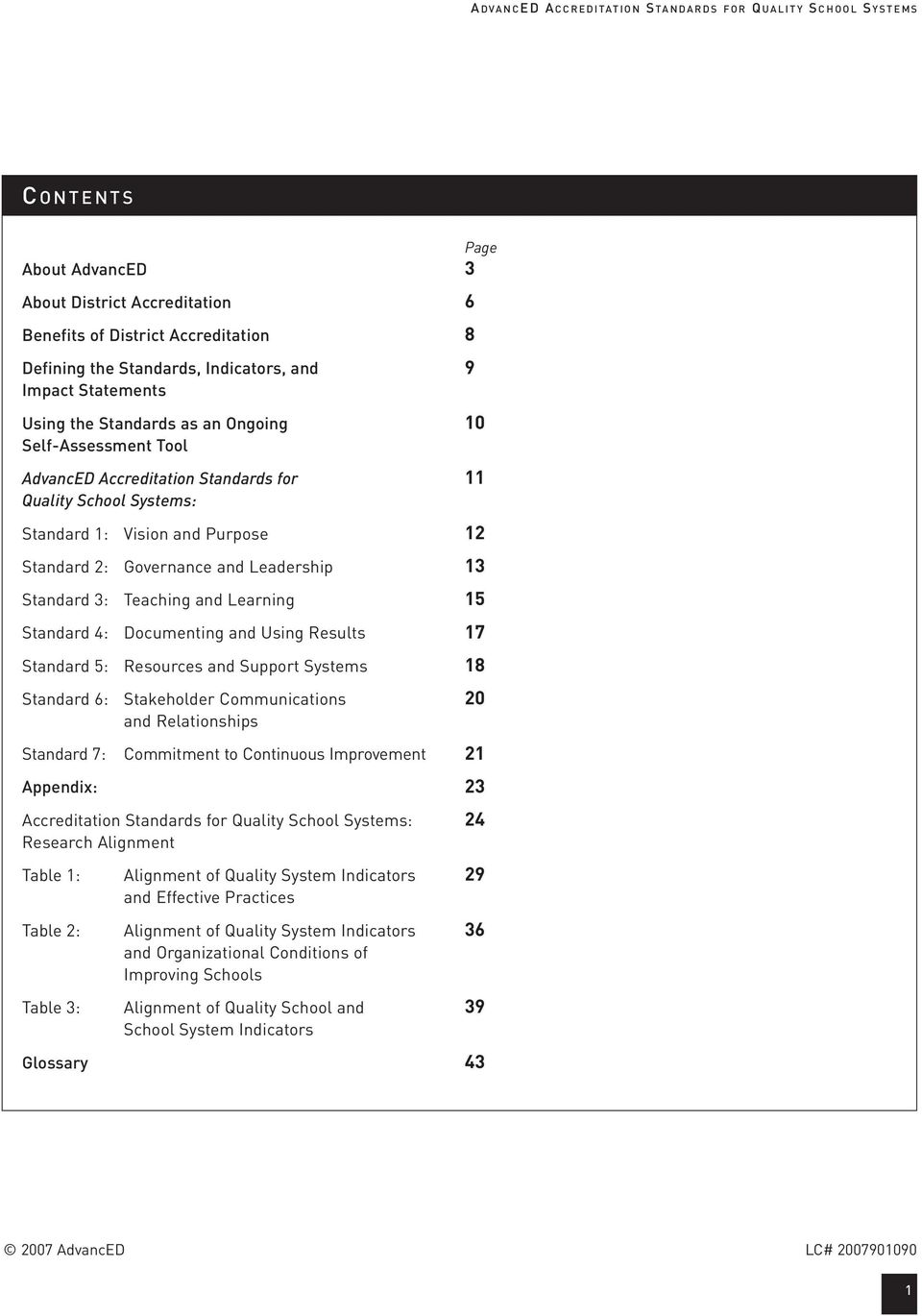
2 C ONTENTS About AdvancED About District Accreditation Benefits of District Accreditation Defining the Standards, Indicators, and Impact Statements Using the Standards as an Ongoing Self-Assessment Tool AdvancED Accreditation Standards for Quality School Systems: Standard 1: Vision and Purpose Standard 2: Governance and Leadership Standard 3: Teaching and Learning Standard 4: Documenting and Using Results Standard 5: Resources and Support Systems Standard 6: Stakeholder Communications and Relationships Standard 7: Appendix: Commitment to Continuous Improvement Accreditation Standards for Quality School Systems: Research Alignment Table 1: Table 2: Table 3: Glossary Alignment of Quality System Indicators and Effective Practices Alignment of Quality System Indicators and Organizational Conditions of Improving Schools Alignment of Quality School and School System Indicators Page AdvancED LC#
3 2

4 A BOUT A DVANCED In April 2006, the North Central Association Commission on Accreditation and School Improvement (NCA CASI), the Southern Association of Colleges and Schools Council on Accreditation and School Improvement (SACS CASI), and the National Study of School Evaluation (NSSE) came together to form one strong and unified organization under the name AdvancED. Worldwide Dedicated to advancing excellence in education, AdvancED works to: Help schools maximize student success Build the capacity of schools and school systems to achieve excellence through high standards, quality assurance, and continuous improvement Bring together research and resources for student, school, and system improvement 3

5 NCA CASI, SACS CASI AND NSSE SERVE SCHOOLS AND DISTRICTS ACROSS THE NATION AND THE WORLD ND MN WY SD WI MI CO NE KS IA MO IL IN OH KY WV VA AZ NM OK AR TN NC SC MS AL GA TX LA FL NCA CASI, SACS CASI, and NSSE also serve: Navajo Nation Department of Defense Educational Activity (DoDEA) Latin America 4

6 A BOUT A DVANCED ( CONTINUED) AdvancED is the world's largest education community, representing over 23,000 public and private schools and districts in 30 states and 65 countries and serving nearly 15 million students. Building on the strong state presence and volunteer networks of NCA CASI and SACS CASI, AdvancED leverages its size and global professional learning community to deliver the powerful combination of accreditation, research, and continuous improvement in a customized way to every school and district it serves. As schools and districts gain access to the enhanced benefits of the global AdvancED community, they continue to receive accreditation under the brand names of NCA CASI and SACS CASI. The NCA CASI and SACS CASI accreditation seals are recognized across the United States and around the world and continue to be the seals used by AdvancED to bestow accreditation. Background NCA CASI and SACS CASI. Founded in 1895, NCA CASI and SACS CASI accredit public and private schools and school systems in 30 states, the Navajo Nation, the Department of Defense Educational Activity Schools, and Latin America. NSSE. NSSE is a non-profit educational research and development organization founded in 1933 to support the work of the regional school accreditation commissions in the United States. NSSE provides educational leaders with state-of-the-art resources, tools, and support services to enhance and promote student growth and school improvement through accreditation. 5

7 A BOUT D ISTRICT A CCREDITATION AdvancED District Accreditation is a powerful systems approach to improving student performance results over time. District Accreditation recognizes that increasing student achievement involves more than improving instruction. It is a result of how well all the parts of the education system the district, school, and classroom work together to meet the needs of students. District Accreditation applies the three pillars of accreditation high standards, continuous improvement, and quality assurance to the entire district to ensure alignment and support between and among the district and its schools. The District Accreditation process provides the district and all of its schools with a comprehensive framework for continually improving student achievement and district performance. AdvancED Accreditation Standards for Quality School Systems The AdvancED Accreditation Standards for Quality School Systems form the foundation of District Accreditation. The standards build on NCA CASI's and SACS CASI's district accreditation standards. They are tightly aligned with the research on the factors that impact student performance (see the Appendix for a review of the research alignment) and were developed with broad input from practitioners and education experts. The standards apply to school systems within the 30-state region of NCA CASI and SACS CASI. Meeting these standards is one element of the accreditation process, as outlined on the next page. For the purposes of District Accreditation, a district may include school districts or systems, school corporations, diocesan school systems, or tribal school coalitions. Coalitions of unrelated schools joined together for the purpose of school improvement may be considered districts based on review by AdvancED. 6
8 A BOUT D ISTRICT A CCREDITATION ( CONTINUED) Accreditation is a voluntary method of quality assurance developed more than 100 years ago by American universities and secondary schools. The goal of accreditation is to evaluate, verify, and improve an institution s quality. To be accredited, the system must: 1) Meet the AdvancED Accreditation Standards for Quality School Systems and ensure that their schools meet the AdvancED Standards for Quality Schools The standards require that the district and its schools have a clear vision and purpose; have effective and responsive leadership; have a rigorous curriculum taught through sound, research-based methods; collect, report, and use performance results; provide adequate resources and support for its educational programs; and value and communicate with their stakeholders. 2) Engage in continuous improvement To demonstrate continuous improvement, the district and its schools must implement an improvement plan based on student performance and school/community data that includes clear goals for raising the achievement of all students. The district and its schools also must document growth in student performance and organizational effectiveness. 3) Demonstrate quality assurance through external review Districts must be evaluated by a team of professionals from outside the district on a periodic basis. The team engages the district staff in a healthy, professional dialogue about district improvement efforts, validates that the district meets the standards for accreditation, and provides feedback and makes recommendations concerning future efforts to improve student performance and organizational effectiveness. A detailed description of the AdvancED District Accreditation process can be found at 7

9 B ENEFITS OF D ISTRICT A CCREDITATION Mark of Quality An internationally-recognized mark of quality at both the district and school level Vehicle to Meet Government Requirements One unified and streamlined process to help districts meet and exceed local, state, and national requirements Focus and Common Language Shared focus and language of improvement across content areas and grade levels, as well as across individual schools, feeder schools, and district lines of responsibilities Continuity and Collaboration toward Shared Vision Framework for continuity and collaboration in planning for improvement anchored in a shared vision for education across the system External Review and Support Opportunity to gain valuable input, feedback, and support from peers Best Practices Connection to the best practices of over 3,500 districts and 23,000 schools Professional Development Annual conferences and state workshops on school and system improvement Technical Assistance Customized assistance to maximize improvement efforts Publications, Websites, and Resources Guides, handbooks, primers, resources, tools, and websites aimed at enhancing improvement efforts 8

10 D EFINING THE S TANDARDS, INDICATORS, AND I MPACT S TATEMENTS The seven standards described in this document are comprehensive statements of quality practices and conditions that research and best practice indicate are necessary for schools to achieve quality student performance and organizational effectiveness. As districts reach a higher level of implementation of the standards, they will have a greater capacity to support ever-increasing student performance and organizational effectiveness. Each of the seven standards has corresponding indicators and an impact statement. The indicators are operational definitions or descriptions of exemplary practices and processes. Together, the indicators provide a comprehensive picture of each standard. The impact statement describes characteristics, processes, and actions that would be observable and verifiable in a district that effectively implements the standard. The standards, indicators, and impact statements focus on systems within a district and systematic methods of attaining high student performance and organizational effectiveness. The standards and indicators are not isolated, but are systemic. They are related to and support other standards and indicators. For example: using student assessment data for making decisions is an indicator for Standard 4, Documenting and Using Results, because it is most closely related to this standard. However, data-based decision making is also an important aspect of effective leadership. A complete set of indicators for effective leadership can only be found when all of the standards are considered together. No one standard or set of indicators is complete without considering all seven as a collective whole. Consideration of this systemic connectedness is essential in understanding and applying the standards and indicators. 9

11 U SING THE S TANDARDS AS AN O NGOING S ELF-ASSESSMENT T OOL Accreditation is an ongoing process of meeting standards, continuous improvement, and quality assurance demonstrated through internal and external review. Through the accreditation process, staff members across the school system continuously review the standards and indicators to ensure that the standards are being met and to identify areas that may need to be strengthened or improved. This review challenges the school system to identify the data, information, evidence, and documented results that validate that it is meeting each standard. 10

12 A DVANCED ACCREDITATION S TANDARDS FOR Q UALITY S CHOOL S YSTEMS 11

13 S TANDARD 1: VISION AND P URPOSE The system establishes and communicates a shared purpose and direction for improving the performance of students and the effectiveness of the system. Quality School System Indicators In fulfillment of this standard, the system: 1.1 Establishes a vision for the system in collaboration with its stakeholders 1.2 Communicates the system s vision and purpose to build stakeholder understanding and support 1.3 Identifies system-wide goals and measures to advance the vision 1.4 Develops and continuously maintains a profile of the system, its students, and the community 1.5 Ensures that the system s vision and purpose guide the teaching and learning process and the strategic direction of schools, departments and services 1.6 Reviews its vision and purpose systematically and revises them when appropriate Impact Statement A system is successful in meeting this standard when it commits to a purpose and direction that is shared system-wide. The leadership establishes expectations for student learning aligned with the system's vision that is supported by system and school personnel and external stakeholders. These expectations serve as the focus for assessing student performance and district effectiveness. The system's vision guides allocations of time and human, material, and fiscal resources. 12
14 S TANDARD 2: GOVERNANCE AND L EADERSHIP The system provides governance and leadership that promote student performance and system effectiveness. Quality School System Indicators G OVERNANCE In fulfillment of this standard, the system operates under the jurisdiction of a governing board that: 2.1 Establishes and communicates policies and procedures that provide for the effective operation of the system 2.2 Recognizes and preserves the executive, administrative, and leadership authority of the administrative head of the system 2.3 Ensures compliance with applicable local, state, and federal laws, standards, and regulations 2.4 Implements policies and procedures that provide for the orientation and training of the governing board 2.5 Builds public support, secures sufficient resources, and acts as a steward of the system s resources 2.6 Maintains access to legal counsel to advise or obtain information about legal requirements and obligations 2.7 Maintains adequate insurance or equivalent resources to protect its financial stability and administrative operations L EADERSHIP In fulfillment of this standard, the system has leadership that: 2.8 Provides for systematic analysis and review of student performance and school and system effectiveness 2.9 Creates and supports collaborative networks of stakeholders to support system programs 13
15 S TANDARD 2: GOVERNANCE AND L EADERSHIP ( CONTINUED) 2.10 Provides direction, assistance, and resources to align, support, and enhance all parts of the system in meeting organizational and student performance goals 2.11 Provides internal and external stakeholders meaningful roles in the decision-making process that promote a culture of participation, responsibility, and ownership 2.12 Assesses and addresses community expectations and stakeholder satisfaction 2.13 Implements an evaluation system that provides for the professional growth of all personnel Impact Statement A system is successful in meeting this standard when it has leaders who are advocates for the system's vision and improvement efforts. The leaders provide direction and allocate resources to implement curricular and co-curricular programs that enable students to achieve expectations for their learning. Leaders function with clearly defined authority and responsibility and encourage collaboration and shared responsibility for system and school improvement among stakeholders. The system s policies, procedures, and organizational conditions ensure equity of learning opportunities and support for innovation. 14

16 S TANDARD 3: TEACHING AND L EARNING The system provides research-based curriculum and instructional methods that facilitate achievement for all students. Quality School System Indicators In fulfillment of this standard, the system: 3.1 Develops, articulates, and coordinates curriculum based on clearly-defined expectations for student learning, including essential knowledge and skills 3.2 Establishes expectations and supports student engagement in the learning process, including opportunities for students to explore application of higher order thinking skills and investigate new approaches to applying their learning 3.3 Ensures that system-wide curricular and instructional decisions are based on data and research at all levels 3.4 Supports instruction that is research-based and reflective of best practice 3.5 Supports a curriculum that challenges and meets the needs of each student, reflects a commitment to equity, and demonstrates an appreciation of diversity 3.6 Allocates and protects instructional time to support student learning 3.7 Maintains articulation among and between all levels of schooling to monitor student performance and ensure readiness for future schooling or employment 3.8 Supports the implementation of interventions to help students meet expectations for student learning 3.9 Maintains a system-wide climate that supports student learning 3.10 Ensures that curriculum is reviewed and revised at regular intervals 3.11 Coordinates and ensures ready access to instructional technology, information and media services, and materials needed for effective instruction 15

17 S TANDARD 3: TEACHING AND L EARNING ( CONTINUED) Impact Statement A system is successful in meeting this standard when it implements a curriculum based on clear and measurable expectations for student learning that provides opportunities for all students to acquire requisite knowledge, skills, and attitudes. The system ensures that teachers use proven instructional practices that actively engage students in the learning process; provide opportunities for students to apply their knowledge and skills to real world situations; and give students feedback to improve their performance. 16

18 S TANDARD 4: DOCUMENTING AND U SING R ESULTS The system enacts a comprehensive assessment system that monitors and documents performance and uses these results to improve student performance and school effectiveness. Quality School System Indicators In fulfillment of this standard, the system: 4.1 Establishes and implements a comprehensive assessment system, aligned with the system's expectations for student learning, that yields information which is reliable, valid, and free of bias 4.2 Ensures that student assessment data are used to make decisions for continuous improvement of teaching and learning 4.3 Conducts a systematic analysis of instructional and organizational effectiveness, including support systems, and uses the results to improve student and system performance 4.4 Provides a system of communication which uses a variety of methods to report student performance and system effectiveness to all stakeholders 4.5 Uses comparison and trend data from comparable school systems to evaluate student performance and system effectiveness 4.6 Demonstrates verifiable growth in student performance that is supported by multiple sources of evidence 4.7 Maintains a secure, accurate, and complete student record system in accordance with state and federal regulations Impact Statement A school system is successful in meeting this standard when it uses a comprehensive assessment system based on clearly-defined performance measures. The assessment system is used to assess student performance on expectations for student learning, identify gaps between expectations for student learning and student performance, evaluate the effectiveness of curriculum and instruction, and determine interventions to improve student performance. The assessment system yields timely and accurate information that is meaningful and useful to system and school leaders, teachers, and other stakeholders in understanding student performance, system and school effectiveness, and the results of improvement efforts. 17

19 S TANDARD 5: RESOURCES AND S UPPORT S YSTEMS The system has the resources and services necessary to support its vision and purpose and to ensure achievement for all students. Quality School System Indicators In fulfillment of this standard, the system: H UMAN R ESOURCES 5.1 Establishes and implements processes to recruit, employ, retain, and mentor qualified professional and support staff to fulfill assigned roles and responsibilities 5.2 Establishes and implements a process to assign professional and support staff based on system needs and staff qualifications as may be required by federal and state law and regulations (i.e., professional preparation, ability, knowledge, and experience) 5.3 Establishes and implements a process to design, evaluate, and improve professional development and ensures participation by all faculty and staff 5.4 Ensures that staff are sufficient in number to meet the vision and purpose of the school system and to meet federal and state law and regulations, if applicable F INANCIAL R ESOURCES 5.5 Engages in long-range budgetary planning and annually budgets sufficient resources to support its educational programs and to implement its plans for improvement 5.6 Ensures that all financial transactions are safeguarded through proper budgetary procedures and audited accounting measures 18

20 S TANDARD 5: RESOURCES AND S UPPORT S YSTEMS ( CONTINUED) P HYSICAL R ESOURCES 5.7 Maintains sites, facilities, services, and equipment to provide a safe, orderly, and healthy environment 5.8 Establishes and implements written security and crisis management plans with appropriate training for stakeholders 5.9 Implements processes and plans for maintaining and improving sites, facilities, and equipment 5.10 Provides technology infrastructure and equipment that is up-to-date and sufficient to accomplish the system's goals S UPPORT S YSTEMS 5.11 Provides and coordinates support services that meet the health, counseling, nutrition, safety, co-curricular, transportation, and special learning needs of all students 5.12 Provides student support services coordinated with the school, home, and community Impact Statement A system is successful in meeting this standard when it has sufficient human, material, and fiscal resources to implement a curriculum that: enables students to achieve expectations for student learning, meets special needs, and complies with applicable regulations. The system employs and allocates staff well-qualified for their assignments. The system provides ongoing learning opportunities for all staff to improve their effectiveness. The system ensures compliance with applicable local, state, and federal regulations. 19

21 S TANDARD 6: STAKEHOLDER C OMMUNICATIONS AND R ELATIONSHIPS The system fosters effective communications and relationships with and among its stakeholders. Quality School System Indicators In fulfillment of this standard, the system: 6.1 Fosters collaboration with community stakeholders to support student learning 6.2 Uses system-wide strategies to listen to and communicate with stakeholders 6.3 Solicits the knowledge and skills of stakeholders to enhance the work of the system 6.4 Communicates the expectations for student learning and goals for improvement to all stakeholders 6.5 Provides information that is meaningful and useful to stakeholders Impact Statement A system is successful in meeting this standard when it has the understanding, commitment, and support of stakeholders. System and school personnel seek opportunities for collaboration and shared leadership among stakeholders to help students learn and advance improvement efforts. 20
22 S TANDARD 7: COMMITMENT TO C ONTINUOUS I MPROVEMENT The system establishes, implements, and monitors a continuous process of improvement that focuses on student performance. Quality School System Indicators In fulfillment of this standard, the system: 7.1 Engages in a continuous process of improvement that articulates the vision and purpose the system is pursuing (Vision); maintains a rich and current description of students, their performance, system effectiveness, and the community (Profile); employs goals and interventions to improve student performance (Plan); and documents and uses the results to inform future improvement efforts (Results) 7.2 Engages stakeholders in the processes of continuous improvement 7.3 Ensures that each school's plan for continuous improvement is aligned with the system's vision and expectations for student learning 7.4 Ensures that each school's plan for continuous improvement includes a focus on increasing learning for all students and closing gaps between current and expected student performance levels 7.5 Provides research-based professional development for system and school personnel to help them achieve improvement goals 7.6 Monitors and communicates the results of improvement efforts to stakeholders 7.7 Evaluates and documents the effectiveness and impact of its continuous process of improvement 7.8 Allocates and protects time for planning and engaging in continuous improvement efforts system-wide 7.9 Provides direction and assistance to its schools and operational units to support their continuous improvement efforts 21
23 S TANDARD 7: COMMITMENT TO C ONTINUOUS I MPROVEMENT ( CONTINUED) Impact Statement A system is successful in meeting this standard when it implements a collaborative and ongoing process for improvement that aligns the functions of the system with the expectations for student learning. Improvement efforts are sustained and the system and its schools demonstrate progress in improving student performance. New improvement efforts are informed by the results of earlier efforts through analysis of student performance, system effectiveness, and assessment of the improvement process. 22
24 A PPENDIX 23
25 ACCREDITATION STANDARDS FOR QUALITY SCHOOL SYSTEMS: RESEARCH ALIGNMENT The Accreditation Standards for Quality School Systems are aligned with current educational research and best practices. Research supporting the accreditation standards involves factors within the scope of a school or school district that directly contribute to student achievement. Original research findings, research syntheses, and meta-analyses, as well as research from the domains of policy and practice, support the accreditation standards. The research base and information concerning the methodology that yielded the taxonomy for school improvement that describes the research base was identified by the National Study of School Evaluation. A publication presenting the research base, Technical Guide to School and District Factors Impacting Student Learning published by NSSE, is available online at The taxonomy identifies three primary categories and twenty-nine subcategories of factors impacting student achievement. To give the taxonomy utility for continuous improvement, the categories are described as core tasks to improve a school or school district. The NSSE research indicates that a school or school district seeking to improve student achievement needs to focus on three core tasks: Ensure Desired Results by expecting results and monitoring performance toward achieving desired results Improve Teaching and Learning by supporting students in their learning and maximizing teachers effectiveness Foster a Culture of Improvement by developing a learning community and leading for improvement The taxonomy identifies subcategories of effective practices that contribute to each of the three core tasks. Collectively, these effective practices are powerful levers for improving student achievement. 24
26 R ESEARCH A LIGNMENT ( CONTINUED) The seven AdvancED Accreditation Standards for Quality School Systems are represented in each of the three core tasks. C ORE TASK #1: E NSURE D ESIRED R ESULTS Schools and districts ensure desired results for student learning by expecting certain results and then monitoring performance in achieving them. Schools and districts determine what they desire as performance results based on their expectations for student learning. Schools or districts that expect and ensure certain results: Implement a vision for student learning through goals and strategies Maintain high expectations for student achievement Maintain a relentless focus on improving student learning that permeates all levels of the school or district Are compelled by a common belief that, collectively, staff and other stakeholders can impact the desired results of the school or district In addition, for a school or district to effectively monitor performance in order to produce the results it expects, it will: Use data to inform decision-making about teaching and learning Use a comprehensive assessment system to provide feedback for improvement in instructional practices and student performance Use classroom-based assessments to provide robust measures of students academic, cognitive, and metacognitive skills Identify performance targets, indicators, and measures for comparing and improving a school or district s effectiveness Take appropriate and timely action to improve areas of identified needs 25
27 R ESEARCH A LIGNMENT ( CONTINUED) C ORE TASK #2: I MPROVE T EACHING AND L EARNING The ultimate goal of the continuous improvement process is to improve teaching and learning. Schools and districts that support students in their learning: Maintain school-wide and district-wide expectations for student learning that reflect academic, cognitive, and metacognitive skills Deliver on these expectations for student learning through a curriculum that is coherent and rigorous Align an assessment system with the curriculum that is enacted in the classroom through instruction Support the equitable opportunity of students to learn through individualization and differentiation Provide student support services and special programs to optimize individual student learning Support a student learning community that includes student involvement beyond the classroom and that offers a safe environment Involve families and the community in supporting children as learners Equally important as supporting students is the district and its schools support for teachers and the practices that maximize teachers effectiveness. These practices help teachers: Use instructional strategies that provide students with focus, feedback, and sufficient opportunities to master skills Use appropriate strategies to assess students academic, cognitive, and metacognitive skills Adapt instruction to meet individual needs and engage learners Maximize the use of time for instruction Create classroom environments conducive to learning Optimize technology and multimedia as learning tools 26
28 R ESEARCH A LIGNMENT ( CONTINUED) C ORE TASK #3: F OSTER A C ULTURE OF I MPROVEMENT In addition to ensuring desired results and improving teaching and learning, the NSSE research indicates that schools and districts must cultivate an environment that has improvement embedded in its daily practices. The professional learning community will influence the impact of any improvement initiative. In order to foster a culture of improvement, learning community members: Share a common vision and goals that have enhanced student learning as the desired outcome Improve individual and collective performance by coming together regularly for learning, decisionmaking, problem solving, and celebration Enhance continuously individual effectiveness through inquiry, practice, and peer reflection Support a culture of collegiality, collaboration, respect, and trust Leaders of a professional learning community have a unique responsibility to: Share leadership for the improvement of teaching and learning throughout the district and its schools Articulate a compelling need for improvement and provide meaningful ways for the professional learning community to focus on its performance Engage in practices that support the ongoing improvement of teaching and learning 27
29 R ESEARCH A LIGNMENT ( CONTINUED) O RGANIZATIONAL C ONDITIONS In addition to the three core tasks of improving schools and districts, research by the National Study of School Evaluation identified five organizational conditions within a school system that contribute to improve student achievement. All five organizational conditions are embodied in the AdvancED Accreditation Standards for Quality School Systems. These organizational conditions for improving schools and districts provide a solid foundation for continuous improvement. Quality Teachers the recruitment, placement, and professional development of teachers to achieve the school s or district s vision of student learning Effective Leadership the leader s decisions and actions to support the vision of student learning Quality Information the collection, management, and use of information to enable the school or school district to make informed decisions, take specific actions, and assess the results of improvement efforts that support the school s or district s vision of student learning Policies and Procedures that Foster and Sustain Improvement the school s or district s development and implementation of policies and procedures that support improvement efforts Resources and Support Systems to Sustain Improvement the allocation and deployment of human, technology, and material resources to target areas for improvement 28
30 TABLE 1: ALIGNMENT OF QUALITY SCHOOL INDICATORS AND EFFECTIVE PRACTICES Tables 1 and 2 outline the alignment of the quality indicators for the accreditation standards with the effective practices that comprise the core tasks and the organizational conditions. The numbers in the tables pertain to the standards and corresponding indicators. Core Task #1: Ensure Desired Results Expecting Results Implement a vision for student learning through goals and strategies Maintain high expectations for student achievement Maintain a relentless focus on improving student learning that permeates all levels of the school or district Quality School System Indicators 1.1 Establishes a vision for the system in collaboration with its stakeholders 1.3 Identifies system-wide goals and measures to advance the vision 1.5 Ensures that the system's vision and purpose guide the teaching and learning process and the strategic direction of schools, departments, and services 1.6 Reviews its vision and purpose systematically and revises them when appropriate 5.4 Ensures that staff are sufficient in number to meet the vision and purpose of the school system and to meet federal and state law and regulations, if applicable 7.1 Engages in a continuous process of improvement that articulates the vision and purpose the system is pursuing (Vision); maintains a rich and current description of students, their performance, system effectiveness, and the community (Profile); employs goals and interventions to improve student performance (Plan); and documents and uses the results to inform future improvement efforts (Results) 7.2 Engages stakeholders in the processes of continuous improvement 7.3 Ensures that each school's plans for continuous improvement is aligned with the system's vision and expectations for student learning 3.1 Develops, articulates, and coordinates curriculum based on clearly defined expectations for student learning, including essential knowledge and skills 3.5 Supports a curriculum that challenges and meets the needs of each student, reflects a commitment to equity, and demonstrates an appreciation of diversity 1.5 Ensures that the system's vision and purpose guide the teaching and learning process and the strategic direction of schools, departments, and services 1.6 Reviews its vision and purpose systematically and revises them when appropriate 2.10 Provides direction, assistance, and resources to align, support, and enhance all parts of the system in meeting organizational and student performance goals 3.5 Supports a curriculum that challenges and meets the needs of each student, reflects a commitment to equity, and demonstrates an appreciation of diversity 29
31 TABLE 1 ( CONTINUED) Core Task #1: Ensure Desired Results Expecting Results (continued) Are compelled by a common belief that, collectively, staff and other stakeholders can impact the desired results of the school or district Quality School System Indicators 3.7 Maintains articulation among and between all levels of schooling to monitor student performance and ensure readiness for future schooling or employment 7.3 Ensures that each school's plan for continuous improvement is aligned with the system's vision and expectations for student learning 1.2 Communicates the system s vision and purpose to build stakeholder understanding and support 6.1 Fosters collaboration with community stakeholders to support student learning Monitoring Performance Use data to inform decision-making about teaching and learning Use a comprehensive assessment system that provides feedback for improvement in instructional practices and student performance Use classroom-based assessments to provide robust measures of students academic, cognitive, and metacognitive skills 1.4 Develops and continuously maintains a profile of the system, its students, and the community 3.3 Ensures that system-wide curricular and instructional decisions are based on data and research at all levels 4.2 Ensures that student assessment data are used to make decisions for continuous improvement of teaching and learning 4.3 Conducts a systematic analysis of instructional and organizational effectiveness, including support systems, and uses the results to improve student and system performance 7.1 Engages in a continuous process of improvement that articulates the vision and purpose the system is pursuing (Vision); maintains a rich and current description of students, their performance, system effectiveness, and the community (Profile); employs goals and interventions to improve student performance (Plan); and documents and uses the results to inform future improvement efforts (Results) 4.2 Ensures that student assessment data are used to make decisions for continuous improvement of teaching and learning 4.3 Conducts a systematic analysis of instructional and organizational effectiveness, including support systems, and uses the results to improve student and system performance 7.5 Provides research-based professional development for system and school personnel to help them achieve improvement goals 7.6 Monitors and communicates the results of improvement efforts to stakeholders 7.7 Evaluates and documents the effectiveness and impact of its continuous process of improvement 4.1 Establishes and implements a comprehensive assessment system, aligned with the system's expectations for student learning, that yields information which is reliable, valid, and free of bias 30
32 A DVANCED ACCREDITATION S TANDARDS FOR Q UALITY S CHOOL S YTEMS TABLE 1 ( CONTINUED) Core Task #1: Ensure Desired Results Monitoring Performance (continued) Identify performance targets, indicators, and measures for comparing and improving a school s or district s effectiveness Take appropriate and timely action to improve areas of identified needs Quality School System Indicators 4.1 Establishes and implements a comprehensive assessment system, aligned with the system's expectations for student learning, that yields information which is reliable, valid, and free of bias 4.5 Uses comparison and trend data from comparable school systems to evaluate student performance and system effectiveness 7.1 Engages in a continuous process of improvement that articulates the vision and purpose the system is pursuing (Vision); maintains a rich and current description of students, their performance, system effectiveness, and the community (Profile); employs goals and interventions to improve student performance (Plan); and documents and uses the results to inform future improvement efforts (Results) 3.9 Maintains a system-wide climate that supports student learning 7.1 Engages in a continuous process of improvement that articulates the vision and purpose the system is pursuing (Vision); maintains a rich and current description of students, their performance, system effectiveness, and the community (Profile); employs goals and interventions to improve student performance (Plan); and documents and uses the results to inform future improvement efforts (Results) 31
33 TABLE 1 ( CONTINUED) Core Task #2: Improve Teaching and Learning Supporting Student Learning Maintain school- or district-wide expectations for student learning that reflect academic, cognitive, and metacognitive skills Deliver on these expectations for student learning through a curriculum that is coherent and rigorous Align an assessment system with curriculum that is enacted in the classroom through instruction Support the equitable opportunity of students to learn through individualization and differentiation Provide student support services and special programs to optimize individual student learning Support a student learning community that includes student involvement beyond the classroom and offers a safe environment Involve families and the community in supporting children as learners Quality School System Indicators 3.1 Develops, articulates, and coordinates curriculum based on clearly defined expectations for student learning, including essential knowledge and skills 6.4 Communicates the expectations for student learning and goals for improvement to all stakeholders 3.1 Develops, articulates, and coordinates curriculum based on clearlydefined expectations for student learning, including essential knowledge and skills 3.2 Establishes expectations and supports student engagement in the learning process, including opportunities for students to explore application of higher order thinking skills and investigate new approaches to applying their learning 3.10 Ensures that curriculum is reviewed and revised at regular intervals 4.6 Demonstrates verifiable growth in student performance that is supported by multiple sources of evidence 3.1 Develops, articulates, and coordinates curriculum based on clearly defined expectations for student learning, including essential knowledge and skills 4.1 Establishes and implements a comprehensive assessment system, aligned with the system's expectations for student learning, that yields information which is reliable, valid, and free of bias 3.5 Supports a curriculum that challenges and meets the needs of each student, reflects a commitment to equity, and demonstrates an appreciation of diversity 5.11 Provides and coordinates support services that meet the health, counseling, nutrition, safety, co-curricular, transportation, and special learning needs of all students 5.12 Provides student support services coordinated with the school, home, and community 5.7 Maintains sites, facilities, services, and equipment to provide a safe, orderly, and healthy environment 2.11 Provides internal and external stakeholders meaningful roles in the decision-making process that promote a culture of participation, responsibility, and ownership 6.1 Fosters collaboration with community stakeholders to support student learning 32
34 TABLE 1 ( CONTINUED) Core Task #2: Improve Teaching and Learning Maximizing Teaching Effectiveness Use instructional strategies that provide students with focus, feedback, and sufficient opportunities to master skills Use appropriate strategies to assess the performance of students' academic, cognitive, and metacognitive skills Adapt instruction to meet individual needs and engage learners Maximize the use of time for instruction Create classroom environments conducive to learning Optimize technology and multimedia as learning tools Quality School System Indicators 3.4 Supports instruction that is research-based and reflective of best practice 3.4 Supports instruction that is research-based and reflective of best practice 4.1 Establishes and implements a comprehensive assessment system, aligned with the system's expectations for student learning, that yields information which is reliable, valid, and free of bias 4.3 Conducts a systematic analysis of instructional and organizational effectiveness, including support systems, and uses the results to improve student and system performance 3.2 Establishes expectations and supports student engagement in the learning process, including opportunities for students to explore application of higher order thinking skills and investigate new approaches to applying their learning 3.4 Supports instruction that is research-based and reflective of best practice 3.8 Supports the implementation of interventions to help students meet expectations for student learning 3.6 Allocates and protects instructional time to support student learning 3.1 Develops, articulates, and coordinates curriculum based on clearly defined expectations for student learning, including essential knowledge and skills 3.4 Supports instruction that is research-based and reflective of best practice 3.11 Coordinates and ensures ready access to instructional technology, information and media services, and materials needed for effective instruction 33
35 TABLE 1 ( CONTINUED) Core Task #3: Foster a Culture of Improvement Maximizing Developing a Teaching Professional Effectiveness Learning Community Share a common vision and goals that have student learning as the focus Quality School System Indicators 1.1 Establishes a vision for the system in collaboration with its stakeholders 1.2 Communicates the system's vision and purpose to build stakeholder understanding and support 6.4 Communicates the expectations for student learning and goals for improvement to all stakeholders 7.4 Ensures that each school's plan for continuous improvement includes a focus on increasing learning for all students and closing gaps between current and expected levels of student performance Improve individual and collective performance by coming together regularly for learning, decisionmaking, problem solving, and celebration Enhance continuously individual effectiveness through inquiry, practice, and peer reflection Support a culture of collegiality, collaboration, respect, and trust 2.11 Provides internal and external stakeholders meaningful roles in the decision-making process that promote a culture of participation, responsibility, and ownership 3.7 Maintains articulation among and between all levels of schooling to monitor student performance and ensure readiness for future schooling or employment 5.3 Establishes and implements a process to design, evaluate, and improve professional development and ensures participation by all faculty and staff 6.1 Fosters collaboration with community stakeholders to support student learning 7.5 Provides research-based professional development for system and school personnel to help them achieve improvement goals 2.4 Implements policies and procedures that provide for the orientation and training of the governing board 5.3 Establishes and implements a process to design, evaluate, and improve professional development and ensures participation by all faculty and staff 7.5 Provides research-based professional development for system and school personnel to help them achieve improvement goals 3.9 Maintains a system-wide climate that supports student learning 6.2 Uses system-wide strategies to listen to and communicate with stakeholders 7.2 Engages stakeholders in the processes of continuous improvement 34
36 TABLE 1 ( CONTINUED) Core Task #3: Foster a Culture of Improvement Leading for Improvement Share leadership for the improvement of teaching and learning throughout the school and district Articulate a compelling need for improvement and provide meaningful ways for the professional learning community to focus on its performance Engage in practices that support the ongoing improvement of teaching and learning Quality School System Indicators 2.4 Implements policies and procedures that provide for the orientation and training of the governing board 2.11 Provides internal and external stakeholders meaningful roles in the decision-making process that promote a culture of participation, responsibility, and ownership 2.12 Assesses and addresses community expectations and stakeholder satisfaction 7.1 Engages in a continuous process of improvement that articulates the vision and purpose the system is pursuing (Vision); maintains a rich and current description of students, their performance, system effectiveness, and the community (Profile); employs goals and interventions to improve student performance (Plan); and documents and uses the results to inform future improvement efforts (Results) 2.11 Provides internal and external stakeholders meaningful roles in the decision-making process that promote a culture of participation, responsibility, and ownership 5.3 Establishes and implements a process to design, evaluate, and improve professional development and ensures participation by all faculty and staff 7.1 Engages in a continuous process of improvement that articulates the vision and purpose the system is pursuing (Vision); maintains a rich and current description of students, their performance, system effectiveness, and the community (Profile); employs goals and interventions to improve student performance (Plan); and documents and uses the results to inform future improvement efforts (Results) 5.3 Establishes and implements a process to design, evaluate, and improve professional development and ensures participation by all faculty and staff 7.1 Engages in a continuous process of improvement that articulates the vision and purpose the system is pursuing (Vision); maintains a rich and current description of students, their performance, system effectiveness, and the community (Profile); employs goals and interventions to improve student performance (Plan); and documents and uses the results to inform future improvement efforts (Results) 7.5 Provides research-based professional development for system and school personnel to help them achieve improvement goals 35
37 TABLE 2: ALIGNMENT OF QUALITY SYSTEM INDICATORS AND ORGANIZATIONAL CONDITIONS OF IMPROVING SCHOOLS Organizational Conditions Quality School System Indicators Quality Teachers Effective Leadership 2.13 Implements an evaluation system that provides for the professional growth of all personnel 5.1 Establishes and implements processes to recruit, employ, retain, and mentor qualified professional and support staff to fulfill assigned roles and responsibilities 5.2 Establishes and implements a process to assign professional and support staff based on system needs and staff qualifications as may be required by federal and state law and regulations (i.e., professional preparation, ability, knowledge, and experience) 5.3 Establishes and implements a process to design, evaluate, and improve professional development and ensures participation by all faculty and staff 5.4 Ensures that staff are sufficient in number to meet the vision and purpose of the school system and to meet federal and state law and regulations, if applicable 2.1 Establishes and communicates policies and procedures that provide for the effective operation of the system 2.2 Recognizes and preserves the executive, administrative, and leadership authority of the administrative head of the system 2.3 Ensures compliance with applicable local, state, and federal laws, standards, and regulations 2.4 Implements policies and procedures that provide for the orientation and training of the governing board 2.5 Builds public support, secures sufficient resources, and acts as a steward of the system's resources 2.6 Maintains access to legal counsel to advise or obtain information about legal requirements and obligations 2.7 Maintains adequate insurance or equivalent resources to protect its financial stability and administrative operations 2.8 Provides for systematic analysis and review of student performance and school and system effectiveness 2.9 Creates and supports collaborative networks of stakeholders to support system programs 2.10 Provides direction, assistance, and resources to align, support, and enhance all parts of the system in meeting organizational and student performance goals 2.11 Provides internal and external stakeholders meaningful roles in the decision-making process that promote a culture of participation, responsibility, and ownership 2.12 Assesses and addresses community expectations and stakeholder satisfaction 2.13 Implements an evaluation system that provides for the professional growth of all personnel 36
38 TABLE 2 ( CONTINUED) Organizational Conditions Quality School System Indicators Effective Leadership (continued) Quality Information Policies and Procedures that Foster and Sustain Improvement 3.7 Maintains articulation among and between all levels of schooling to monitor student performance and ensure readiness for future schooling or employment 3.9 Maintains a system-wide climate that supports student learning 5.6 Ensures that all financial transactions are safeguarded through proper budgetary procedures and audited accounting measures 5.8 Establishes and implements written security and crisis management plans with appropriate training for stakeholders 6.1 Fosters collaboration with community stakeholders to support student learning 6.2 Uses system-wide strategies to listen to and communicate with stakeholders 6.3 Solicits the knowledge and skills of stakeholders to enhance the work of the system 6.4 Communicates the expectations for student learning and goals for improvement to all stakeholders 6.5 Provides information that is meaningful and useful to stakeholders 7.8 Allocates and protects time for planning and engaging in continuous improvement efforts system-wide 7.9 Provides direction and assistance to its schools and operational units to support their continuous improvement efforts 1.4 Develops and continuously maintains a profile of the system, its students, and the community 3.3 Ensures that system-wide curricular and instructional decisions are based on data and research at all levels 3.11 Coordinates and ensures ready access to instructional technology, information and media services, and materials needed for effective instruction 4.1 Establishes and implements a comprehensive assessment system, aligned with the system's expectations for student learning, that yields information which is reliable, valid, and free of bias 4.3 Conducts a systematic analysis of instructional and organizational effectiveness, including support systems, and uses the results to improve student and system performance 4.4 Provides a system of communication which uses a variety of methods to report student performance and system effectiveness to all stakeholders 1.6 Reviews its vision and purpose systematically and revises them when appropriate 2.1 Establishes and communicates policies and procedures that provide for the effective operation of the system 2.3 Ensures compliance with applicable local, state, and federal laws, standards, and regulations 37
39 TABLE 2 ( CONTINUED) Organizational Conditions Quality School System Indicators Policies and Procedures that Foster and Sustain Improvement (continued) Resources and Support Systems to Sustain Improvement 2.4 Implements policies and procedures that provide for the orientation and training of the governing board 3.7 Maintains articulation among and between all levels of schooling to monitor student performance and ensure readiness for future schooling or employment 3.10 Ensures that curriculum is reviewed and revised at regular intervals 4.4 Provides a system of communication which uses a variety of methods to report student performance and system effectiveness to all stakeholders 4.7 Maintains a secure, accurate, and complete student record system in accordance with state and federal regulations 5.8 Establishes and implements written security and crisis management plans with appropriate training for stakeholders 7.4 Ensures that each school's plan for continuous improvement includes a focus on increasing learning for all students and closing gaps between current and expected student performance levels 7.8 Allocates and protects time for planning and engaging in continuous improvement efforts system-wide 3.11 Coordinates and ensures ready access to instructional technology, information and media services, and materials needed for effective instruction 4.7 Maintains a secure, accurate, and complete student record system in accordance with state and federal regulations 5.2 Establishes and implements a process to assign professional and support staff based on system needs and staff qualifications as may be required by federal and state law and regulations (i.e., professional preparation, ability, knowledge, and experience) 5.4 Ensures that staff are sufficient in number to meet the vision and purpose of the school system and to meet federal and state law and regulations, if applicable 5.5 Engages in long-range budgetary planning and annually budgets sufficient resources to support its educational programs and to implement its plans for improvement 5.6 Ensures that all financial transactions are safeguarded through proper budgetary procedures and audited accounting measures 5.7 Maintains sites, facilities, services, and equipment to provide a safe, orderly, and healthy environment 5.9 Implements processes and plans for maintaining and improving sites, facilities, and equipment 5.10 Provides technology infrastructure and equipment that is up-to-date and sufficient to accomplish the system's goals 7.9 Provides direction and assistance to its schools and operational units to support their continuous improvement efforts 38
40 TABLE 3: ALIGNMENT OF QUALITY SCHOOL AND SCHOOL SYSTEM INDICATORS To earn District Accreditation, the district must meet the AdvancED Accreditation Standards for Quality School Systems provided in this document and ensure that its schools meet the AdvancED Accreditation Standards for Quality Schools. The school standards may be accessed at The following table demonstrates the alignment of the school and district standards. The two sets of standards support and reinforce each other. Quality School Indicators Quality School System Indicators The STANDARD seven 1: Accreditation Vision and Purpose Standards for Quality Schools are represented in each of the three core tasks. 1.1 Establishes a vision for the school in collaboration with its stakeholders 1.2 Communicates the vision and purpose to build stakeholder understanding and support 1.3 Identifies goals to advance the vision 1.4 Develops and continuously maintains a profile of the school, its students, and the community 1.5 Ensures that the school s vision and purpose guide the teaching and learning process 1.6 Reviews its vision and purpose systematically and revises them when appropriate STANDARD 2: Governance and Leadership 1.1 Establishes a vision for the system in collaboration with its stakeholders 1.2 Communicates the system s vision and purpose to build stakeholder understanding and support 1.3 Identifies system-wide goals and measures to advance the vision 1.4 Develops and continuously maintains a profile of the system, its students, and the community 1.5 Ensures that the system s vision and purpose guide the teaching and learning process and the strategic direction of schools, departments, and services 1.6 Reviews its vision and purpose systematically and revises them when appropriate 2.1 Establishes policies and procedures that provide for the effective operation of the school 2.2 Recognizes and preserves the executive, administrative, and leadership prerogatives of the administrative head of the school 2.3 Ensures compliance with applicable local, state, and federal laws, standards, and regulations 2.4 Employs a system that provides for analysis and review of student performance and school effectiveness 2.5 Fosters a learning community 2.6 Provides teachers and students opportunities to lead 2.7 Provides stakeholders meaningful roles in the decision making process that promote a culture of participation, responsibility, and ownership 2.8 Controls curricular and extracurricular activities that are sponsored by the school 2.9 Responds to community expectations and stakeholder satisfaction 2.10 Implements an evaluation system that provides for the professional growth of all personnel 2.1 Establishes and communicates policies and procedures that provide for the effective operation of the system 2.2 Recognizes and preserves the executive, administrative, and leadership authority of the administrative head of the system 2.3 Ensures compliance with applicable local, state, and federal laws, standards, and regulations 2.4 Implements policies and procedures that provide for the orientation and training of the governing board 2.5 Builds public support, secures sufficient resources, and acts as a steward of the system s resources 2.6 Maintains access to legal counsel to advise or obtain information about legal requirements and obligations 2.7 Maintains adequate insurance or equivalent resources to protect its financial stability and administrative operations 2.8 Provides for systematic analysis and review of student performance and school and system effectiveness 2.9 Creates and supports collaborative networks of stakeholders to support system programs 2.10 Provides direction, assistance, and resources to align, support, and enhance all parts of the system in meeting organizational and student performance goals 39
41 TABLE 3 ( CONTINUED) Quality School Indicators STANDARD 2: Governance and Leadership (continued) STANDARD 3: Teaching and Learning 3.1 Develops and implements curriculum based on clearly defined expectations for student learning 3.2 Promotes active involvement of students in the learning process, including opportunities for them to explore application of higher-order thinking skills and investigate new approaches to applying their learning 3.3 Gathers, analyzes, and uses data and research in making curricular and instructional choices 3.4 Designs and uses instructional strategies, innovations, and activities that are research-based and reflective of best practice 3.5 Offers a curriculum that challenges each student to excel, reflects a commitment to equity, and demonstrates an appreciation of diversity 3.6 Allocates and protects instructional time to support student learning 3.7 Provides for articulation and alignment between and among all levels of schools 3.8 Implements interventions to help students meet expectations for student learning 3.9 Monitors school climate and takes appropriate steps to ensure that it is conducive to student learning 3.10 Provides comprehensive information and media services that support the curricular and instructional programs 3.11 Ensures that all students and staff members have regular and ready access to instructional technology and a comprehensive materials collection that supports the curricular and instructional program Quality School System Indicators 2.11 Provides internal and external stakeholders meaningful roles in the decision-making process that promote a culture of participation, responsibility, and ownership 2.12 Assesses and addresses community expectations and stakeholder satisfaction 2.13 Implements an evaluation system that provides for the professional growth of all personnel 3.1 Develops, articulates, and coordinates curriculum based on clearly defined expectations for student learning, including essential knowledge and skills 3.2 Establishes expectations and supports student engagement in the learning process, including opportunities for students to explore application of higher order thinking skills and investigate new approaches to applying their learning 3.3 Ensures that system-wide curricular and instructional decisions are based on data and research at all levels 3.4 Supports instruction that is research-based and reflective of best practice 3.5 Supports a curriculum that challenges and meets the needs of each student, reflects a commitment to equity, and demonstrates an appreciation of diversity 3.6 Allocates and protects instructional time to support student learning 3.7 Maintains articulation among and between all levels of schooling to monitor student performance and ensure readiness for future schooling or employment 3.8 Supports the implementation of interventions to help students meet expectations for student learning 3.9 Maintains a system-wide climate that supports student learning 3.10 Ensures that curriculum is reviewed and revised at regular intervals 3.11 Coordinates and ensures ready access to instructional technology, information and media services, and materials needed for effective instruction STANDARD 4: Documenting and Using Results 4.1 Establishes performance measures for student learning that yield information that are reliable, valid, and free of bias 4.2 Develops and implements a comprehensive system for assessing progress toward meeting the expectations for student learning 4.1 Establishes and implements a comprehensive assessment system, aligned with the system s expectations for student learning, that yields information which is reliable, valid, and free of bias 40
42 TABLE 3 ( CONTINUED) Quality School Indicators STANDARD 4: Documenting and Using Results (continued) 4.3 Uses student assessment data for making decisions for continuous improvement of teaching and learning processes 4.4 Conducts a systematic analysis of instructional and organizational effectiveness and uses the results to improve student performance 4.5 Communicates the results of student performance and school effectiveness to all stakeholders 4.6 Uses comparison and trend data of student performance from comparable schools in evaluating its effectiveness 4.7 Demonstrates verifiable growth in student performance 4.8 Maintains a secure, accurate, and complete student record system in accordance with state and federal regulations Quality School System Indicators 4.2 Ensures that student assessment data are used to make decisions for continuous improvement of teaching and learning 4.3 Conducts a systematic analysis of instructional and organizational effectiveness, including support systems, and uses the results to improve student and system performance 4.4 Provides a system of communication which uses a variety of methods to report student performance and system effectiveness to all stakeholders 4.5 Uses comparison and trend data from comparable school systems to evaluate student performance and system effectiveness 4.6 Demonstrates verifiable growth in student performance that is supported by multiple sources of evidence 4.7 Maintains a secure, accurate, and complete student record system in accordance with state and federal regulations STANDARD 5: Resources and Support Systems 5.1 Recruits, employs, and mentors qualified professional staff that are capable of fulfilling assigned roles and responsibilities 5.2 Assigns professional staff responsibilities based on their qualifications (i.e., professional preparation, ability, knowledge, and experience) 5.3 Ensures that all staff participate in a continuous program of professional development 5.4 Provides and assigns staff that are sufficient in number to meet the vision and purpose of the school 5.5 Budgets sufficient resources to support its educational programs and to implement its plans for improvement 5.6 Monitors all financial transactions through a recognized, regularly audited accounting system 5.7 Maintains the site, facilities, services, and equipment to provide an environment that is safe and orderly for all occupants 5.8 Possesses a written security and crisis management plan with appropriate training for stakeholders 5.9 Ensures that each student has access to services that include, but are not limited to, counseling, appraisal, staff consulting, referral, and educational and career planning 5.1 Establishes and implements processes to recruit, employ, retain, and mentor qualified professional and support staff to fulfill assigned roles and responsibilities 5.2 Establishes and implements a process to assign professional and support staff based on system needs and staff qualifications as may be required by federal and state law and regulations (i.e., professional preparation, ability, knowledge, and experience) 5.3 Establishes and implements a process to design, evaluate, and improve professional development and ensures participation by all faculty and staff 5.4 Ensures that staff are sufficient in number to meet the vision and purpose of the school system and to meet federal and state law and regulations, if applicable 5.5 Engages in long-range budgetary planning and annually budgets sufficient resources to support its educational programs and to implement its plans for improvement 5.6 Ensures that all financial transactions are safeguarded through proper budgetary procedures and audited accounting measures 5.7 Maintains sites, facilities, services, and equipment to provide a safe, orderly, and healthy environment 5.8 Establishes and implements written security and crisis management plans with appropriate training for stakeholders 5.9 Implements processes and plans for maintaining and improving sites, facilities, and equipment 5.10 Provides technology infrastructure and equipment that is up to date and sufficient to accomplish the system s goals 5.11 Provides and coordinates support services that meet the health, counseling, nutrition, safety, co-curricular, transportation, and special learning needs of all students 5.12 Provides student support services coordinated with the school, home, and community 41
43 TABLE 3 ( CONTINUED) Quality School Indicators STANDARD 6: Stakeholder Communication and Relationships 6.1 Foster collaboration with community stakeholders to support student learning 6.2 Has formal channels to listen to and communicate with stakeholders 6.3 Solicits the knowledge and skills of stakeholders to enhance the work of the school 6.4 Communicates the expectations for student learning and goals for improvement to all stakeholders 6.5 Provides information about students, their performance, and school effectiveness that is meaningful and useful to stakeholders Quality School System Indicators 6.1 Fosters collaboration with community stakeholders to support student learning 6.2 Uses system-wide strategies to listen to and communicate with stakeholders 6.3 Solicits the knowledge and skills of stakeholders to enhance the work of the system 6.4 Communicates the expectations for student learning and goals for improvement to all stakeholders 6.5 Provides information that is meaningful and useful to stakeholders STANDARD 7: Commitment to Continuous Improvement 7.1 Engages in a continuous process of improvement that articulates the vision and purpose the school is pursuing (Vision); maintains a rich and current description of students, their performance, school effectiveness, and the school community (Profile); employs goals and interventions to improve student performance (Plan); and documents and uses the results to inform what happens next (Results). 7.2 Engages stakeholders in the processes of continuous improvement 7.3 Ensures that plans for continuous improvement are aligned with the vision and purpose of the school and expectations for student learning 7.4 Provides professional development for school personnel to help them implement improvement interventions to achieve improvement goals 7.5 Monitors and communicates the results of improvement efforts to stakeholders 7.6 Evaluates and documents the effectiveness and impact of its continuous process of improvement 7.1 Engages in a continuous process of improvement that articulates the vision and purpose the system is pursuing (Vision); maintains a rich and current description of students, their performance, system effectiveness, and the community (Profile); employs goals and interventions to improve student performance (Plan); and documents and uses the results to inform future improvement efforts (Results) 7.2 Engages stakeholders in the processes of continuous improvement 7.3 Ensures that each school s plans for continuous improvement is aligned with the system s vision and expectations for student learning 7.4 Ensures that each school s plans for continuous improvement includes a focus on increasing learning for all students and closing gaps between current and expected student performance levels 7.5 Provides research-based professional development for system and school personnel to help them achieve improvement goals 7.6 Monitors and communicates the results of improvement efforts to stakeholders 7.7 Evaluates and documents the effectiveness and impact of its continuous process of improvement 7.8 Allocates and protects time for planning and engaging in continuous improvement efforts system-wide 7.9 Provides direction and assistance to its schools and operational units to support their continuous improvement efforts 42
44 G LOSSARY Appreciation of diversity. Develops awareness, understanding and respect for differences, beliefs, and traditions of ethnic and cultural groups Articulation. The process of comparing the content of courses that are transferred between educational systems or schools. Best practice. Actions, processes, or interventions that are based in research or supported by results and are most likely to achieve the desired goal or performance level Climate. The situation or atmosphere that prevails at a particular time or place Collaborative networks. A large and widely distributed group of people that communicate and cooperate with one another and work together as a unit or system Communication. The exchange of information between persons, for example, by means of speaking, writing, or using a common system of signs or behavior Comprehensive assessment system. A system and processes for gathering, managing, analyzing, and disseminating data from multiple measures needed by the system and staff to make informed decisions, monitor performance and effectiveness, determine gaps in performance, identify needs (including professional development), and report results Continuous improvement. Ongoing process of improving performance and the effectiveness of relationships among the school s systems, processes, and people Continuously maintains. Regularly and purposefully updates and disseminates information and data Curriculum. An instructional plan captured in a document that describes the content (knowledge, skills, and dispositions) of what students are to learn Data. Numbers, words, sounds, or images that have not yet been arranged into meaningful patterns (e.g. assessment data and artifacts) Direction. Guidance emanating from a shared vision and feedback to schools from the district Diversity. Ethnic, socioeconomic, gender, group, and/or cultural variety Equity. The quality of being just, impartial, and fair; in the educational setting, equity includes insuring that all students have a fair and equal opportunity to access and benefit from all educational opportunities Expectations for student learning. Knowledge, skills, and attitudes that students are expected to acquire as a result of their school experience Evidence. Documentation and analysis of information for a particular purpose Free of Bias. Referring to measures of student performance, measures that are bias free are not discriminatory against any group of students due to stereotyping, unequal opportunity, or lack of language familiarity Governing Board. The legal body comprised of a panel of persons who develop policies for the school system Impact statement. Characteristics, processes, and actions that would be observable and verifiable in a district that effectively implements the standard Implementation of interventions. Taking intentional actions identified to meet improvement goals Improvement efforts. Actions taken as part of an improvement plan to improve student performance Indicator. See Quality system indicator Information services. The department within a school system that is responsible for the collection, organization, and retrieval, analysis, and distribution of data to be used by others Instructional effectiveness. The daily practices that guide student learning and the learning community Instructional technology. The use of technology to enhance the teaching and learning process Instructional time. Time devoted to acquiring knowledge, skills, and attitudes Intervention. Intentional actions that are identified to meet improvement goals Learning community. Colleagues who come together regularly to learn, make decisions, and solve problems in a meaningful and professional manner Learning process. A series of actions directed toward acquiring knowledge, skills, or attitudes Media Services. The department within a school system that is responsible for audio-visual equipment used in the teaching and learning process Measures. Instruments that gather various data for the purpose of making a formative or summative judgment Necessary conditions. The five research-based conditions of improving schools and school systems that are the foundation of continuous improvement Organizational effectiveness. The necessary conditions for improving student learning 43
45 G LOSSARY ( CONTINUED) Plan. Actions needed to implement interventions for an improvement goal in each target area for improvement Performance indicators. An index or composite of measures used to gauge the levels of performance or effectiveness of a part of the system for the purpose of monitoring results Policies. Sets of principles adopted by the governing body of the school system that form the legal foundation of the school system Professional staff. Staff in a school system that have completed university degree programs, are state certified in their area of expertise, and have a direct impact on teaching and learning, for example, teachers and administrators Profile. Description of a system s current reality; students, their performance, school effectiveness, and the school and community contexts for learning Purpose. The reasons a system exists as defined by its mission, beliefs, values, philosophy, and/or goals System effectiveness. The research-based practices that impact student performance and the organizational conditions of improving school systems Systematic. Processes that are repeatable and predictable rather than anecdotal and episodic Systemic. Interdependent functions within a system that work together to improve results System-wide. Impacting all systems within a school district district, school, departments, grade levels, classroom, and student Validity. The extent to which a measure is capable of producing information that is meaningful Vision. An expression of the ideal or desired state of student learning and/or organizational operations based on expectations that are possible to achieve Quality system indicator. The operational definition of the practices, processes, or products required of a system as they relate to meeting accreditation standards Reliability. The extent to which a measure can be depended on to provide consistent, error-free data Research based. Programs, process, interventions, or practices that are supported by research resulting from scientific or quasi-scientific designs; using valid and reliable measures, and resulting in verifiable and repeatable positive results Results. Changes that are directly related to interventions School effectiveness. The research-based practices that impact student performance and the organizational conditions of improving schools Stakeholders. Staff, students, parents, community members, and others who have a vested interest in the schools and their system Standards. The seven established qualitative conditions for excellence required of all accredited systems Steward. To hold in trust for another; to be accountable for the well-being of another or an organization Student performance. Knowledge, skills, or attitudes demonstrated by a student Support services. The ancillary services provided in a school system that help maintain the teaching and learning process for all students, including those with special needs 44
46 C ONTACT U S: NCA CASI and SACS CASI operate as accreditation divisions of AdvancED, serving schools and districts through state offices. For more information about the AdvancED Accreditation Standards for Quality School Systems, please contact your NCA CASI or SACS CASI state office. You can visit for a listing of state offices or call the AdvancED Accreditation Department at AdvancED is the parent organization for: NCA CASI Arizona State University P.O. Box Tempe, AZ SACS CASI 1866 Southern Lane Decatur, GA NSSE 1699 East Woodfield Road Suite 406 Schaumburg, IL
47 LC#: ADED03 04/07
Self Assessment. Introduction and Purpose of the Self Assessment Welcome to the AdvancED Self Assessment.
 Self Assessment Introduction and Purpose of the Self Assessment Welcome to the AdvancED Self Assessment. The Self Assessment is designed to serve as a valuable tool to help schools assess and maintain
Accreditation: A Guide for Teachers
 Accreditation: A Guide for Teachers What is accreditation? Accreditation is a voluntary method of quality assurance developed more than 100 years ago by American universities and secondary schools. Today,
Report of the Quality Assurance Review Team for Big A Elementary School Route 2, Box 384 Sorrells Road Eastanollee, Georgia 30538 United States
 Report of the Quality Assurance Review Team for Big A Elementary School Route 2, Box 384 Sorrells Road Eastanollee, Georgia 30538 United States Ms Gail S Fry Review Dates: 11/19/2008-11/20/2008 North Central
Section Three: Ohio Standards for Principals
 Section Three: Ohio Standards for Principals 1 Principals help create a shared vision and clear goals for their schools and ensure continuous progress toward achieving the goals. Principals lead the process
SACSCASI. August 21-22, 2007. Joe Smith, Principal, Sample School Mary Anderson, Chairperson, SAIS - SACS Team
 Note: This is a sample report designed to provide team chairs with a quick review of the components of the web-based report. The formatting of the report is done automatically through the web-based system.
Self-Assessment Duval County School System. Level 3. Level 3. Level 3. Level 4
 Standard 1: Purpose and Direction 1.1 The system engages in a systematic, inclusive, and comprehensive process to review, revise, and communicate a system-wide propose for the student success. The system
About AdvancED and NCA CASI/SACS CAS I
 About AdvancED and NCA CASI/SACS CAS I Background. Founded in 1895, the North Central Association Commission on Accreditation and School Improvement (NCA CASI) and the Southern Association of Colleges
Ayers Institute Leadership Resources: PSEL Alignment
 Professional Standards for al Leaders Standard 1: Mission, Vision, and Core Values Effective educational leaders develop, advocate, and enact a shared mission, vision, and core values of high-quality education
Education Leadership (ISLLC) Standards Comparison of Old (2007) and New Standards (2015)
 Education Leadership (ISLLC) Standards Comparison of Old (2007) and New Standards (2015) 2007 Standards 2015 Standards Standard 1: Vision and Mission Standard 1: Vision and Mission An education leader
Committee On Public Secondary Schools. Standards for Accreditation
 Committee On Public Secondary Schools Standards for Accreditation Effective 2011 New England Association of Schools & Colleges 3 Burlington Woods Drive, Suite 100 Burlington, MA 01803 Tel. 781-425-7700
NAAS - inacol Standards for Quality Online Programs
 NAAS - inacol Standards for Quality Online Programs Institutional Standards Institutional standards address the organization's vision, mission, philosophy and beliefs. The institutional standards define
DEGREE QUALIFICATIONS PROFILE: A PRIMER FOR IR AND ASSESSMENT PROFESSIONALS
 DEGREE QUALIFICATIONS PROFILE: A PRIMER FOR IR AND ASSESSMENT PROFESSIONALS Natasha Jankowski, NILOA, Assistant Director George Kuh, NILOA, Director AIR May 28, 2014 The Plan Brief Introduction to DQP
ACS WASC Accreditation Status Determination Worksheet
 ACS WASC Accreditation Status Determination Worksheet How are students achieving? Is the school doing everything possible to support high achievement for all its students? Directions 1. Discuss the evidence
Crosswalk of the New Colorado Principal Standards (proposed by State Council on Educator Effectiveness) with the
 Crosswalk of the New Colorado Principal Standards (proposed by State Council on Educator Effectiveness) with the Equivalent in the Performance Based Principal Licensure Standards (current principal standards)
How To Rate Plan On A Credit Card With A Credit Union
 Rate History Contact: 1 (800) 331-1538 Form * ** Date Date Name 1 NH94 I D 9/14/1998 N/A N/A N/A 35.00% 20.00% 1/25/2006 3/27/2006 8/20/2006 2 LTC94P I F 9/14/1998 N/A N/A N/A 35.00% 20.00% 1/25/2006 3/27/2006
U.S. Department of Education NCES 2011-460 NAEP. Tools on the Web
 U.S. Department of Education NCES 2011-460 NAEP Tools on the Web Whether you re an educator, a member of the media, a parent, a student, a policymaker, or a researcher, there are many resources available
CALIFORNIA PRELIMINARY ADMINISTRATIVE CREDENTIAL EXAMINATION (CPACE)
 Education Code section 44270.5 allows an examination alternative to the Administrative Services preparation program as long as the examination is aligned with the current Administrative Services Program
U.S. Department of Housing and Urban Development: Weekly Progress Report on Recovery Act Spending
 U.S. Department of Housing and Urban Development: Weekly Progress Report on Recovery Act Spending by State and Program Report as of 3/7/2011 5:40:51 PM HUD's Weekly Recovery Act Progress Report: AK Grants
Superintendent Effectiveness Rubric*
 Public Document 3 Purpose: Outlines the standards that are the foundation for the evaluation. Name of Superintendent: Date: Performance Rating Scale: Distinguished (4) Accomplished (3) standards for most
Principal Practice Observation Tool
 Principal Performance Review Office of School Quality Division of Teaching and Learning Principal Practice Observation Tool 2014-15 The was created as an evidence gathering tool to be used by evaluators
Principal has shared the school vision and goals with the staff. A process for developing a school vision and goals is not evident.
 Ohio Principal Evaluation System Ohio Principal Performance Rating Rubric Principal Performance Rubric The Principal Performance Rating Rubric is intended to be scored holistically. This means that evaluators
Educational Leadership Program Standards. ELCC Revised Standards
 Educational Leadership Program Standards ELCC Revised Standards For Advanced Programs that Prepare Principals, Superintendents, Curriculum Directors, and Supervisors March 2009 NATIONAL POLICY BOARD FOR
A N S W E R S R E L 2 0 0 9 N
 ISSUES& ANSWERS REL 2009 No. 076 Reducing stereotype threat in classrooms: a review of socialpsychological intervention studies on improving the achievement of Black students U.S. D e p a r t m e n t o
Masters Comprehensive Exam and Rubric (Rev. July 17, 2014)
 1 Educational Leadership & Policy Studies Masters Comprehensive Exam and Rubric (Rev. July 17, 2014) The comprehensive exam is intended as a final assessment of a student s ability to integrate important
Federation of State Boards of Physical Therapy Jurisdiction Licensure Reference Guide Topic: Continuing Competence
 This document reports CEU requirements for renewal. It describes: Number of required for renewal Who approves continuing education Required courses for renewal Which jurisdictions require active practice
EDUCATIONAL LEADERSHIP PROGRAM Recognition. Standards:
 EDUCATIONAL LEADERSHIP PROGRAM Recognition Standards: Building Level For institutions undergoing NCATE Accreditation and ELCC Program Review Page 2 For Advanced Programs at the Master, Specialist, or Doctoral
Framework for Leadership
 Framework for Leadership Date Leader Self-Assessment Evaluator Assessment Domain 1: Strategic/Cultural Leadership Principals/school leaders systemically and collaboratively develop a positive culture to
Utah Educational Leadership Standards, Performance Expectations and Indicators
 Utah Educational Leadership Standards, Performance Expectations and Indicators Standard 1: Visionary Leadership An educational leader promotes the success of every student by facilitating the development,
New York Public School Spending In Perspec7ve
 New York Public School Spending In Perspec7ve School District Fiscal Stress Conference Nelson A. Rockefeller Ins0tute of Government New York State Associa0on of School Business Officials October 4, 2013
Self Assessment Tool for Principals and Vice-Principals
 The Institute for Education Leadership (IEL) brings together representatives from the principals' associations, the supervisory officers' associations, councils of directors of education and the Ministry
Federation of State Boards of Physical Therapy Jurisdiction Licensure Reference Guide Topic: Continuing Competence
 This document reports CEU (continuing education units) and CCU (continuing competence units) requirements for renewal. It describes: Number of CEUs/CCUs required for renewal Who approves continuing education
Arkansas Teaching Standards
 Arkansas Teaching Standards The Arkansas Department of Education has adopted the 2011 Model Core Teaching Standards developed by Interstate Teacher Assessment and Support Consortium (InTASC) to replace
A descriptive analysis of state-supported formative assessment initiatives in New York and Vermont
 ISSUES& ANSWERS REL 2012 No. 112 At Education Development Center, Inc. A descriptive analysis of state-supported formative assessment initiatives in New York and Vermont ISSUES& ANSWERS REL 2012 No. 112
Educational Practices Reference Guide. Aligned to the Advance ED Standards for Quality Schools
 Aligned to the Advance ED Standards for Quality Schools February 2010 Table of Contents Page Number Introduction 3 Vision and Purpose 4 Governance and Leadership Duties of the Governing Authority 4 Role
Principal Appraisal Overview
 Improving teaching, leading and learning T e x a s P r i n c i p a l E va l u a t i o n S y s t e m Principal Appraisal Overview Design and Development a collaborative effort McREL International Texas
Meeting Oregon s new high school math graduation requirements: examining student enrollment and teacher availability
 ISSUES& ANSWERS REL 2012 No. 126 At Education Northwest Meeting Oregon s new high school math graduation requirements: examining student enrollment and teacher availability ISSUES& ANSWERS REL 2012 No.
North Carolina TEACHER. evaluation process. Public Schools of North Carolina State Board of Education Department of Public Instruction
 North Carolina TEACHER evaluation process Public Schools of North Carolina State Board of Education Department of Public Instruction Rubric for Evaluating North Carolina Teachers ( This form should be
Oak Park School District. Administrator Evaluation Program
 Oak Park School District Administrator Evaluation Program Table of Contents Evaluation Purpose...1 Evaluation Timeline...2 Rubric for Instructional Administrator Standard 1...3 Standard 2...5 Standard
Colorado Professional Teaching Standards
 Colorado Professional Teaching Standards Standard I: Teachers demonstrate knowledge of the content they teach a. Teachers provide instruction that is aligned with the Colorado Academic Standards and their
Alabama Standards for Instructional Leaders
 Alabama Standards for Instructional Leaders To realize the mission of enhancing school leadership among principals and administrators in Alabama resulting in improved academic achievement for all students,
The Future of Nursing Report
 The Future of Nursing Report Illinois Healthcare Action Coalition Strategic Planning Meeting June 16, 2011 Susan B. Hassmiller, PhD, RN, FAAN Campaign for Action Campaign Vision All Americans have access
Leadership Through Strategic Discussions Between Supervising Administrator and Principals
 Possible Guiding Questions Strategic Discussions Between Supervising Administrators and Principals This document utilizes the components within the Framework for Leadership to provide possible guiding
The School Leadership Collaborative Intern and Administrative Mentor Guide
 Gonzaga University School of Education The School Leadership Collaborative Intern and Administrative Mentor Guide Principal Certification Program Administrator Certification Department of Educational Leadership
SBEC/TExES Framework for Principal Certification
 SBEC/TExES Framework for Principal Certification The following SBEC Principal Domains, Competencies and supporting standards represent the knowledge, skills and dispositions principal candidates should
Analysis of Site-level Administrator and Superintendent Certification Requirements in the USA (2010)
 Analysis of Site-level Administrator and Superintendent Certification Requirements in the USA (2010) Stephen H. Davis, Ed.D. California State Polytechnic University, Pomona Summer 2010 Introduction The
Illinois Professional Teaching Standards
 Illinois Professional Teaching Standards Preamble: We believe that all students have the potential to learn rigorous content and achieve high standards. A well-educated citizenry is essential for maintaining
State Corporate Income Tax-Calculation
 State Corporate Income Tax-Calculation 1 Because it takes all elements (a*b*c) to calculate the personal or corporate income tax, no one element of the corporate income tax can be analyzed separately from
Illinois Center for School Improvement Framework: Core Functions, Indicators, and Key Questions
 Framework: Core Functions, Indicators, and Key Questions The Core Functions and Indicators, which form the structure for the delivery and execution of (Illinois CSI) services, describe the big ideas or
2015-2016 Instructional Management Plan
 Greenwood Public School District Dr. Montrell Greene, Superintendent Dr. June Leigh, Director of Curriculum 2015-2016 Instructional Management Plan Greenwood Public School District Academic Education Department
The school principal practices effective cultural leadership when he or she
 Strategic Leadership Summary: School leadership creates conditions that result in the strategic re-imaging of the school s vision, mission, and goals in the 21 st Century. The leader exhibits the understanding
Approved by the Virginia Board of Education on September 27, 2012. Virginia Department of Education P. O. Box 2120 Richmond, Virginia 23218-2120
 Advancing Virginia's Leadership Agenda Guidance Document: Standards and Indicators for School Leaders and Documentation for the Principal of Distinction (Level II) Administration and Supervision Endorsement
Part C Technical Assistance: State Approaches
 Brief Policy Analysis May 2007 Part C Technical Assistance: State Approaches An analysis of a critical issue in special education inforum Policymakers and early childhood experts have long recognized the
EDUCATIONAL LEADERSHIP PROGRAM Recognition. Standards:
 EDUCATIONAL LEADERSHIP PROGRAM Recognition Standards: District Level For institutions undergoing NCATE Accreditation and ELCC Program Review For Advanced Programs at the Master, Specialist, or Doctoral
Framework and Guidelines for Principal Preparation Programs
 THE FRAMEWORK FOR PRINCIPAL PREPARATION PROGRAM GUIDELINES PENNSYLVANIA DEPARTMENT OF EDUCATION 1 Purpose Of all the educational research conducted over the last 30 years in the search to improve student
Standards for Advanced Programs in Educational Leadership
 Standards for Advanced Programs in Educational Leadership for Principals, Superintendents, Curriculum Directors, and Supervisors NATIONAL POLICY BOARD FOR EDUCATIONAL ADMINISTRATION Published January,
CASS Practice Standards: Reflective Tool and Rubric
 CASS Practice Standards: Reflective Tool and Rubric Revised January 2015 College of Alberta School Superintendents Appendix D: CASS Practice Standard Reflective Tool Leadership Dimension 1: Visionary Leadership
Eugene School District 4J Professional School Counselor Rubric
 Eugene School District 4J Professional School Counselor Rubric Using leadership, collaboration and advocacy, the Professional School Counselor plans, delivers, manages and promotes a comprehensive guidance
Mapping State Proficiency Standards Onto the NAEP Scales:
 Mapping State Proficiency Standards Onto the NAEP Scales: Variation and Change in State Standards for Reading and Mathematics, 2005 2009 NCES 2011-458 U.S. DEPARTMENT OF EDUCATION Contents 1 Executive
Department of Business and Information Technology
 Department of Business and Information Technology College of Applied Science and Technology The University of Akron Summer 01 Graduation Survey Report 1. How would you rate your OVERALL EXPERIENCE at The
Oregon Framework for Teacher and Administrator Evaluation and Support Systems
 Oregon Framework for Teacher and Administrator Evaluation and Support Systems Revised for 2014 2015 State Guidelines for ESEA Waiver & SB 290 OREGON DEPARTMENT OF EDUCATION 255 Capitol St, NE, Salem, OR
Illinois Professional School Leader Standards [29.100]
![Illinois Professional School Leader Standards [29.100]](/thumbs/25/6856783.jpg "Illinois Professional School Leader Standards [29.100]") III. STANDARDS FOR ADMINISTRATIVE CERTIFICATION Illinois Professional School Leader Standards [29.100] STANDARD 1 - Facilitating a Vision of Learning facilitating the development, articulation, implementation,
III. STANDARDS FOR ADMINISTRATIVE CERTIFICATION Illinois Professional School Leader Standards [29.100] STANDARD 1 - Facilitating a Vision of Learning facilitating the development, articulation, implementation,
2014 Year in Review State Policies Impacting CTE. Catherine Imperatore, ACTE Andrea Zimmermann, NASDCTEc February 5, 2015
 2014 Year in Review State Policies Impacting CTE Catherine Imperatore, ACTE Andrea Zimmermann, NASDCTEc February 5, 2015 Background and Context Federal policies Perkins WIOA HEA Senate and Congressional
NHIS State Health insurance data
 State Estimates of Health Insurance Coverage Data from the National Health Interview Survey Eve Powell-Griner SHADAC State Survey Workshop Washington, DC, January 13, 2009 U.S. DEPARTMENT OF HEALTH AND
Andrea Zimmermann State Policy Associate NASDCTEc. The Role of CTE in College and Career Readiness
 Andrea Zimmermann State Policy Associate NASDCTEc The Role of CTE in College and Career Readiness Overview What is CTE? What is CTE s Role in College and Career Readiness? Questions? What is CTE? Small
ehealth Price Index Trends and Costs in the Short-Term Health Insurance Market, 2013 and 2014
 ehealth Price Index Trends and Costs in the Short-Term Health Insurance Market, 2013 and 2014 June 2015 1 INTRODUCTION In this report, ehealth provides an analysis of consumer shopping trends and premium
National Student Clearinghouse. CACG Meeting
 National Student Clearinghouse Presentation for CACG Meeting February 2010 Dr. Jeff Tanner, Vice President The Clearinghouse A non-profit organization founded in 1993 in affiliation with several educational
Cyber School Student Teaching Competencies
 Cyber School Student Teaching Competencies Introduction The Pennsylvania Department of Education (PDE) has developed a general set of student teaching competencies that afford a student teacher the opportunity
Federation of State Boards of Physical Therapy Jurisdiction Licensure Reference Guide Topic: License Renewal Who approves courses?
 Federation of State s of Physical The table below provides information on approval of continuing education/competence courses and for each jurisdiction. Summary Number of jurisdictions requiring approval
Enrollment Snapshot of Radiography, Radiation Therapy and Nuclear Medicine Technology Programs 2014
 Enrollment Snapshot of, Radiation Therapy and Nuclear Medicine Technology Programs 2014 January 2015 2015 ASRT. All rights reserved. Reproduction in any form is forbidden without written permission from
TITLE POLICY ENDORSEMENTS BY STATE
 TITLE POLICY ENDORSEMENTS BY STATE State Endorsement ID Endorsement Description AK ARM ALTA 6 Adjustable (Variable) Rate AK BALLOON FNMA Balloon Endorsement AK CONDO ALTA 4 Condominium AK COPY FEE Copies
Standardized Pharmacy Technician Education and Training
 Standardized Pharmacy Technician Education and Training Kevin N. Nicholson, RPh, JD Vice President, Pharmacy Regulatory Affairs National Association of Chain Drug Stores May 19, 2009 Overview of how technicians
State Technology Report 2008
 About This Report This State Technology Report is a supplement to the 11th edition of Technology Counts, a joint project of Education Week and the Editorial Projects in Education Research Center. As in
middle states association of colleges and schools
 middle states association of colleges and schools STANDARDS FOR ACCREDITATION of Supplementary Education Organizations (SEO) Commission on Secondary Schools (CSS) of the Middle States Association of Colleges
How NYPIRG s Physician Supply Report Misses the Mark. September 2014
 How NYPIRG s Physician Supply Report Misses the Mark September 2014 Lawsuit Reform Alliance of New York 19 Dove St., Suite 201 Albany, NY 12210 www.lrany.org About the Lawsuit Reform Alliance of New York
Field Experience and Student Teaching Competencies
 Field Experience and Student Teaching Competencies Introduction The Pennsylvania Department of Education (PDE) has developed a general set of field experience and student teaching competencies that will
Regional Electricity Forecasting
 Regional Electricity Forecasting presented to Michigan Forum on Economic Regulatory Policy January 29, 2010 presented by Doug Gotham State Utility Forecasting Group State Utility Forecasting Group Began
Rates and Bills An Analysis of Average Electricity Rates & Bills in Georgia and the United States
 Rates and Bills An Analysis of Average Electricity Rates & Bills in Georgia and the United States During regulatory and public policy discussions of electricity costs for Georgia ratepayers, the conversation
CINCINNATI HILLS CHRISTIAN ACADEMY COLLEGE QUESTIONNAIRE FOR STUDENTS
 CINCINNATI HILLS CHRISTIAN ACADEMY COLLEGE QUESTIONNAIRE FOR STUDENTS Complete & bring with you to your Junior College Planning Meeting. NAME: ADDRESS: EMAIL: BIRTHDATE: PHONE #: DATE: PLEASE READ BEFORE
1 REVISOR 8710.4925. C. show verification of completing a Board of Teaching preparation program
 1 REVISOR 8710.4925 8710.4925 READING LEADER. Subpart 1. Scope of practice. A reading leader is authorized to facilitate and provide site-based or districtwide leadership for kindergarten through grade
How To Improve A School
 Accreditation and School Improvement Policy Handbook Table of Contents Purpose of this Document...1 AdvancED Accreditation...1 AdvancED Standards...2 School Improvement Leadership...3 Purpose and Direction...4
NEW YORK STATE TEACHER CERTIFICATION EXAMINATIONS
 NEW YORK STATE TEACHER CERTIFICATION EXAMINATIONS ASSESSMENT DESIGN AND FRAMEWORK March 2014 Authorized for Distribution by the New York State Education Department NYSTCE, New York State Teacher Certification
Health Workforce Data Collection: Findings from a Survey of States
 Health Workforce Data Collection: Findings from a Survey of States Jean Moore, DrPH David Armstrong, PhD Health Workforce Technical Assistance Center School of Public Health University at Albany, SUNY
Curriculum Management
 The vision of the Fayetteville Public Schools is to provide an educational system where every student will leave with a full understanding of his or her potential and the skills necessary to be successful
NAAUSA Security Survey
 NAAUSA Security Survey 1. How would you rate the importance of each of the following AUSA security improvements. Very important Somewhat important Not too important Not at all important Secure parking
Standardization of Technician Education Want it? Need it? Janet Teeters, M.S., R.Ph. Director of Accreditation Services ASHP
 Standardization of Technician Education Want it? Need it? Janet Teeters, M.S., R.Ph. Director of Accreditation Services ASHP Disclosure Director of Accreditation Services Standardized Technician Education
Home Schooling Achievement
 ing Achievement Why are so many parents choosing to home school? Because it works. A 7 study by Dr. Brian Ray of the National Home Education Research Institute (NHERI) found that home educated students
Allgood Elementary Guidance and Counseling Services Franchis Cook, School Counselor NCSC, NCC, LPC
 Allgood Elementary Guidance and Counseling Services Franchis Cook, School Counselor NCSC, NCC, LPC Why Elementary School Counselors? Elementary school years set the tone for developing the knowledge, attitudes
Hawaii Teacher Standards Board Teacher Leader Work Group Report
 Hawaii Teacher Standards Board Teacher Leader Work Group Report Workgroup members: NBPTS Certified Teacher from the Field: Dr. Jonathan Gillentine, Special Education Teacher, Rev. Benjamin Parker Elementary
PRINCIPAL POSITION DESCRIPTION
 400-20 Administrative Procedure 430 Background PRINCIPAL POSITION DESCRIPTION The Principal is responsible for overall supervision and operation of his/her individual school. This responsibility includes
NCHRP 20-68A. Domestic Scan 13-01 Advances in Developing a Cross- Trained Workforce. Significant Findings and Recommendations July 22, 2015
 NCHRP 20-68A Domestic Scan 13-01 Advances in Developing a Cross- Trained Workforce Significant Findings and Recommendations July 22, 2015 Greg Duncan Applied Pavement Technology, Inc. 1 Overview Scan Objectives
Delaware Performance Appraisal System
 Delaware Performance Appraisal System Building greater skills and knowledge for educators DPAS-II Guide for Administrators (Principals) Principal Practice Rubric Updated July 2015 1 INEFFECTIVE A. DEVELOPS
GaPSC Teacher Leadership Program Standards
 GaPSC Teacher Leadership Program Standards Purpose: Georgia has identified a need to improve P-12 students academic performance as measured by various assessments. One method to ensure improved student
Federation of State Boards of Physical Therapy Jurisdiction Licensure Reference Guide Topic: PTA Supervision Requirements
 These tables provide information on what type of supervision is required for PTAs in various practice settings. Definitions Onsite Supervision General Supervision Indirect Supervision The supervisor is
Program: Educational Administration Masters, Director of Vocational Education
 1.3.1 facilitating the development, articulation, implementation, and stewardship of a vision of learning that is shared and supported by the school. Program: Educational Administration Masters, Director
Dental Therapist Initiatives, Access, and Changing State Practice Acts The ADHA Perspective: An Update
 Dental Therapist Initiatives, Access, and Changing State Practice Acts The ADHA Perspective: An Update Pam Quinones, RDH, BS President, ADHA April 29, 2012 I. The Dental Hygiene Workforce as a Partner
Appendix B: Part 100 and School Counseling Programs
 Appendix B: Part 100 and School Counseling Programs As per the New York State Education Department, listed in Part 100 of the Commissioner s Regulations, school counseling/guidance programs are defined
Broadband Technology Opportunities Program: Sustainable Broadband Adoption and Public Computer Centers
 Broadband Technology Opportunities Program: Sustainable Broadband Adoption and Public Computer Centers National Telecommunications and Information Agency (NTIA) U. S. Department of Commerce Funded by the
LexisNexis Law Firm Billable Hours Survey Report
 LexisNexis Law Firm Billable Hours Survey Report Executive Summary Despite the critical impact on a firm s bottom line, it remains challenging for some attorneys and legal staff to efficiently capture