
Human Capital Risk, Contract Enforcement, and the Macroeconomy
|
|
|
- Opal Gregory
- 9 years ago
- Views:
Transcription
1 Human Capital Risk, Contract Enforcement, and the Macroeconomy Tom Krebs University of Mannheim Moritz Kuhn University of Bonn Mark Wright UCLA and Chicago Fed

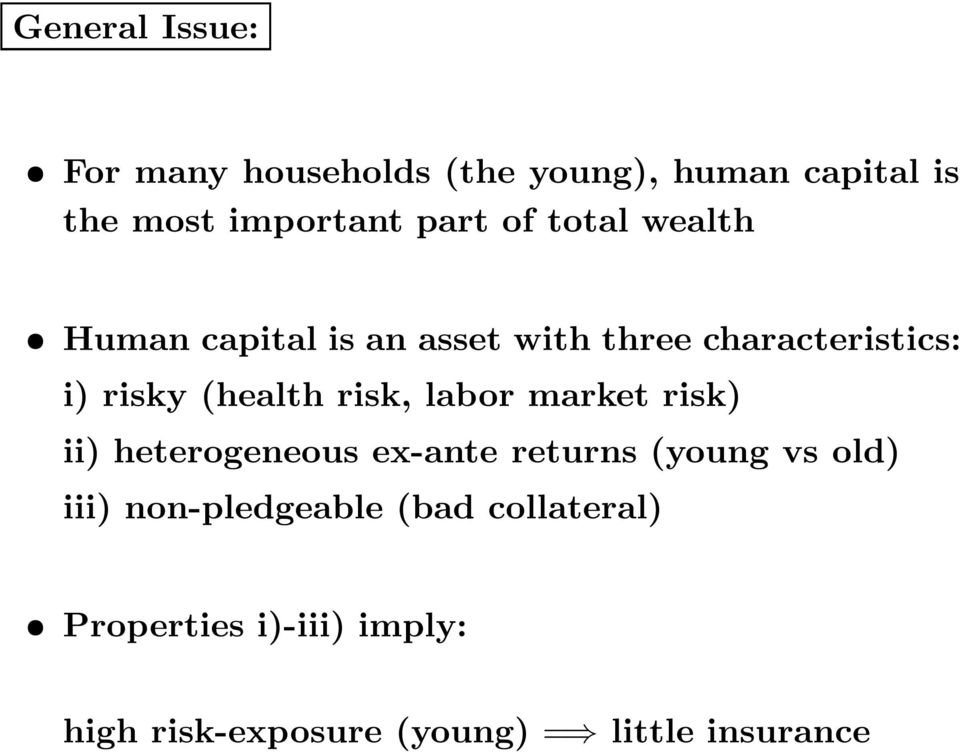
2 General Issue: For many households (the young), human capital is the most important part of total wealth Human capital is an asset with three characteristics: i) risky (health risk, labor market risk) ii) heterogeneous ex-ante returns (young vs old) iii) non-pledgeable (bad collateral) Properties i)-iii) imply: high risk-exposure (young) = little insurance
3 Intuition Households with high expected human capital returns (young) choose to invest a lot in human capital These households therefore have high risk exposure and large need for insurance With complete markets and perfect contract enforcement, these households will borrow and be perfectly insured With limited enforcement of credit contracts (US bankruptcy law), these households are borrowing constrained and under-insured

4 This Paper Contributions We show analytically that this risk-insurance relationship holds in equilibrium We establish this risk-insurance pattern in the data on life-insurance We show that a calibrated macro model can quantitatively match this and other important life-cycle facts We show that welfare cost of under-insurance of young households is substantial (4% of lifetime consumption)

5 This Paper Additional Contribution Tractable macro model with convex household decision problem Policy experiment: US reform of consumer bankruptcy regulation

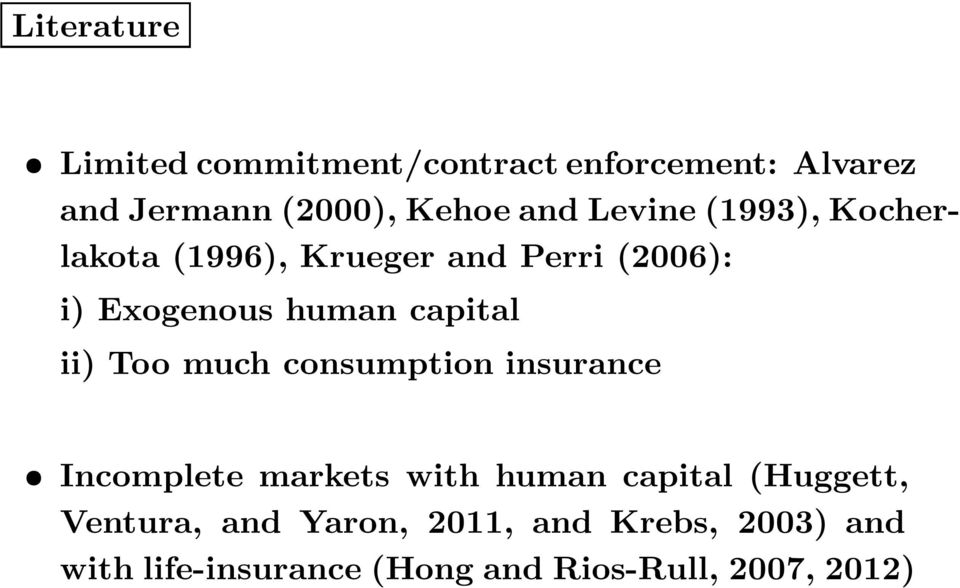
6 Literature Limited commitment/contract enforcement: Alvarez and Jermann (2000), Kehoe and Levine (1993), Kocherlakota (1996), Krueger and Perri (2006): i) Exogenous human capital ii) Too much consumption insurance Incomplete markets with human capital (Huggett, Ventura, and Yaron, 2011, and Krebs, 2003) and with life-insurance (Hong and Rios-Rull, 2007, 2012)
7 Production Y t = F(K t,h t ) Y t : aggregate output K t : aggregate stock of physical capital H t : aggregate stock of human capital Profit maximization: r kt = r k ( K t ) r ht = r h ( K t ) r k : rental rate of physical capital r h : rental rate of human capital K t = K t /H t : aggregate capital-to-labor ratio

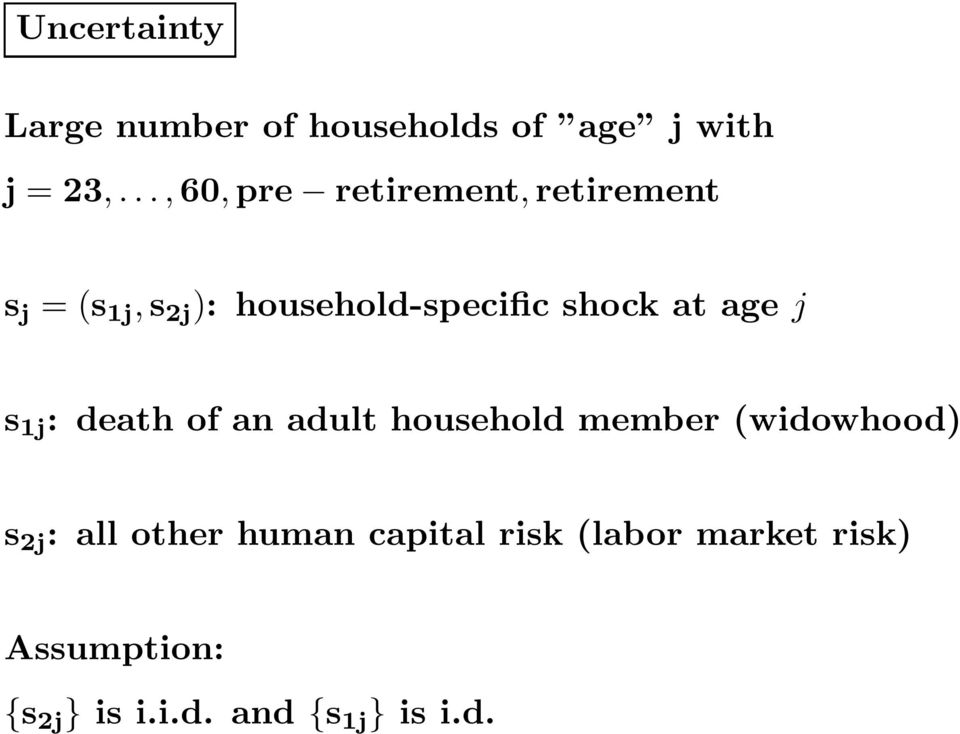
8 Uncertainty Large number of households of age j with j = 23,...,60,pre retirement,retirement s j = (s 1j,s 2j ): household-specific shock at age j s 1j : death of an adult household member (widowhood) s 2j : all other human capital risk (labor market risk) Assumption: {s 2j } is i.i.d. and {s 1j } is i.d.
9 Preferences Expected lifetime utility of individual household at age 23: 60 V 61 (a 61,h 61,s 61 )π 61 (s 61 ) j=23β j 23 s j lnc j (s j )π j (s j s 23 ) + s 61 V 61 : value function of households age j = 61 (preretirement stage of life) s j = (s 23,...,s j ): history of shocks up to age j

10 Budget Constraint c j + x hj + s j+1 q j (s j+1 )a j+1 (s j+1 ) = r h h j + a j (s j ) h j+1 = (1 δ h + η 1 (s 1j ) + η 2 (s 2j ))h j + φ j x hj η 1,η 2 : mortality risk and labor market risk x hj : human capital investment φ j : productivity of human capital investment a j+1 (s j+1 ): quantity of Arrow-security purchased/sold

11 Remarks We assume complete markets because we want to focus on one financial friction (limited contract enforcement) We can add general time-cost of human capital investment (Ben-Porath), but for tractability result we need linearity in x h and h

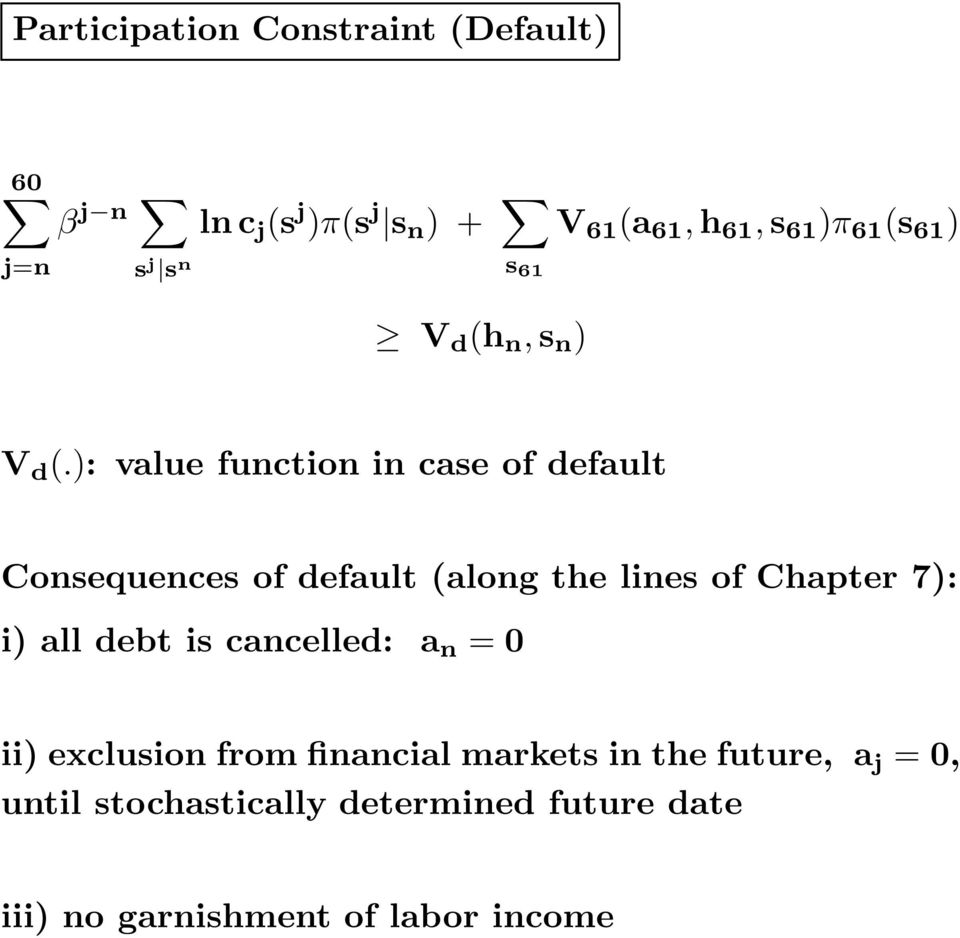
12 Participation Constraint (Default) 60 V 61 (a 61,h 61,s 61 )π 61 (s 61 ) j=n β j n s j s n lnc j (s j )π(s j s n ) + s 61 V d (h n,s n ) V d (.): value function in case of default Consequences of default (along the lines of Chapter 7): i) all debt is cancelled: a n = 0 ii) exclusion from financial markets in the future, a j = 0, until stochastically determined future date iii) no garnishment of labor income
13 Remarks The household problem separates into a consumptionsaving problem and a portfolio problem I.i.d. human capital shocks imply that labor income follows a log random walk

14 Financial Intermediaries no default in equilibrium perfect competition: insurance companies and credit companies (banks) make zero profit: q j (s j+1 ) = π j(s j+1 ) 1 + r f

15 Calibration Choose age-dependent expected human capital returns to match the life-cycle profile of median earnings (growth) Choose human capital risk s 1 to be consistent with empirical evidence on human capital (labor income) loss in the cases of death of an adult family member consequences of widowhood Choose human capital risk s 2 so that implied labor income process is consistent with estimates of the empirical literature on labor income risk

16 Data: Survey of Consumer Finance Repeated cross-section; every three years Household-level data We use data on labor income, net worth (financial wealth), and life insurance We use surveys We always compute median value from the data (conditional on age)
17 Figure 1: Life-cycle profile of log labor income

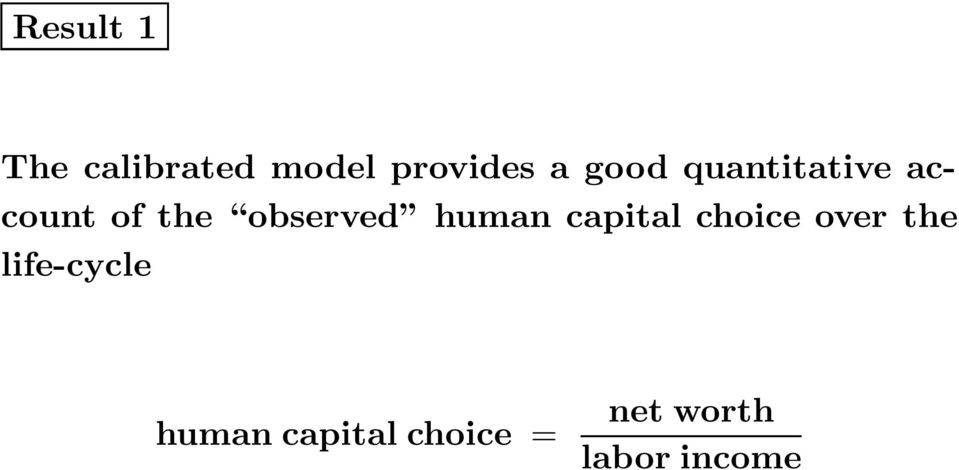
18 Result 1 The calibrated model provides a good quantitative account of the observed human capital choice over the life-cycle human capital choice = net worth labor income
19 Figure 3: Life-cycle profile of portfolio choice

20 Insurance Measure Model-based insurance measure I = insurance payout η(bad) h Empirical insurance measure Ĩ = insurance payout η(bad) (current earnings) PVF η(bad): fraction of household human capital lost when bad shock (death of an adult family member) occurs

21 Result 2 Both model-based and empirical insurance measure increase with age The match between basic version of the model and data is good for intensive margin An extended version of the model with heterogeneity in size of η(bad) and cost of life-insurance purchase also matches the extensive margin well
22 Figure 10: Life-cycle profile of life insurance (extended model)
23 Result 5 Calibrated model implies substantial welfare costs of under-insurance for the young equivalent to almost 4 percent of lifetime consumption for 23-old household
24 Figure 5: Life-cycle profile of welfare cost of under-insurance
25 Policy Implications What type of policy reform would lead to a welfareimproving increase in insurance and human capital investment? subsidize credit but ensure that households in default do not have access to the subsidy (not in paper) more stringent bankruptcy code garnish labor income (in paper)
Margin Regulation and Volatility
 Margin Regulation and Volatility Johannes Brumm 1 Michael Grill 2 Felix Kubler 3 Karl Schmedders 3 1 University of Zurich 2 Deutsche Bundesbank 3 University of Zurich and Swiss Finance Institute Workshop:
A systemic approach to home loans: Continuous workouts vs. fixed rate contracts (Shiller et al., 2014)
 A systemic approach to home loans: Continuous workouts vs. fixed rate contracts (Shiller et al., 2014) Discussion Cristian Badarinza EFA Meeting, Lugano, August 2014 Summary 1. Unexpected house price declines
Health Insurance and Retirement Incentives
 Health Insurance and Retirement Incentives Daniele Marazzina Joint work with Emilio Barucci and Enrico Biffis Emilio Barucci and Daniele Marazzina Dipartimento di Matematica F. Brioschi Politecnico di
Better Guidance on Matters of Life and Death
 In this issue, Research Digest summarizes recent work by Motohiro Yogo and his colleagues on helping households make better decisions about insurance and annuities Ellen McGrattan and Edward Prescott on
Optimal Taxation in a Limited Commitment Economy
 Optimal Taxation in a Limited Commitment Economy forthcoming in the Review of Economic Studies Yena Park University of Pennsylvania JOB MARKET PAPER Abstract This paper studies optimal Ramsey taxation
VI. Real Business Cycles Models
 VI. Real Business Cycles Models Introduction Business cycle research studies the causes and consequences of the recurrent expansions and contractions in aggregate economic activity that occur in most industrialized
Financial Development and Macroeconomic Stability
 Financial Development and Macroeconomic Stability Vincenzo Quadrini University of Southern California Urban Jermann Wharton School of the University of Pennsylvania January 31, 2005 VERY PRELIMINARY AND
The Effect of Housing on Portfolio Choice. July 2009
 The Effect of Housing on Portfolio Choice Raj Chetty Harvard Univ. Adam Szeidl UC-Berkeley July 2009 Introduction How does homeownership affect financial portfolios? Linkages between housing and financial
The Real Business Cycle Model
 The Real Business Cycle Model Ester Faia Goethe University Frankfurt Nov 2015 Ester Faia (Goethe University Frankfurt) RBC Nov 2015 1 / 27 Introduction The RBC model explains the co-movements in the uctuations
ECON20310 LECTURE SYNOPSIS REAL BUSINESS CYCLE
 ECON20310 LECTURE SYNOPSIS REAL BUSINESS CYCLE YUAN TIAN This synopsis is designed merely for keep a record of the materials covered in lectures. Please refer to your own lecture notes for all proofs.
Aggregate Risk and the Choice Between Cash and Lines of Credit
 Aggregate Risk and the Choice Between Cash and Lines of Credit Viral Acharya NYU Stern School of Business, CEPR, NBER Heitor Almeida University of Illinois at Urbana Champaign, NBER Murillo Campello Cornell
Macroeconomic Effects of Financial Shocks Online Appendix
 Macroeconomic Effects of Financial Shocks Online Appendix By Urban Jermann and Vincenzo Quadrini Data sources Financial data is from the Flow of Funds Accounts of the Federal Reserve Board. We report the
Lecture 3: Growth with Overlapping Generations (Acemoglu 2009, Chapter 9, adapted from Zilibotti)
 Lecture 3: Growth with Overlapping Generations (Acemoglu 2009, Chapter 9, adapted from Zilibotti) Kjetil Storesletten September 10, 2013 Kjetil Storesletten () Lecture 3 September 10, 2013 1 / 44 Growth
Optimal fiscal policy under commitment
 Abstract Optimal Fiscal and Monetary Policy with Commitment Mikhail Golosov and Aleh Tsyvinski 1 May 31, 2006 Forthcoming in New Palgrave Dictionary of Economics and Law Optimal fiscal and monetary policy
Topic 2. Incorporating Financial Frictions in DSGE Models
 Topic 2 Incorporating Financial Frictions in DSGE Models Mark Gertler NYU April 2009 0 Overview Conventional Model with Perfect Capital Markets: 1. Arbitrage between return to capital and riskless rate
Why Aren t More Families Buying Life Insurance?
 Why Aren t More Families Buying Life Insurance? Matthew S. Chambers Towson University Don E. Schlagenhauf Federal Reserve Bank of St. Louis Eric R. Young University of Virginia 2014 Workshop of the Quantitative
Agenda. The IS LM Model, Part 2. The Demand for Money. The Demand for Money. The Demand for Money. Asset Market Equilibrium.
 Agenda The IS LM Model, Part 2 Asset Market Equilibrium The LM Curve 13-1 13-2 The demand for money is the quantity of money people want to hold in their portfolios. The demand for money depends on expected
Sovereign Defaults. Iskander Karibzhanov. October 14, 2014
 Sovereign Defaults Iskander Karibzhanov October 14, 214 1 Motivation Two recent papers advance frontiers of sovereign default modeling. First, Aguiar and Gopinath (26) highlight the importance of fluctuations
Durable Goods, Borrowing Constraints, and Consumption Insurance
 Durable Goods, Borrowing Constraints, and Consumption Insurance Enzo A. Cerletti Goethe University Frankfurt Josep Pijoan-Mas CEMFI and CEPR March 29, 214 Abstract We study the different transmission of
Human Capital, Asset Allocation and Life Insurance
 Human Capital, Asset Allocation and Life Insurance Sunny Ng, CFA Research Director, Asia 2012 Morningstar, Inc. All rights reserved. Human capital and Investing Human capital is the cumulative value
New Dynamic Public Finance. Mikhail Golosov (Yale, New Economic School, and NBER) Aleh Tsyvinski (Yale, New Economic School, and NBER)
 New Dynamic Public Finance Mikhail Golosov (Yale, New Economic School, and NBER) Aleh Tsyvinski (Yale, New Economic School, and NBER) New Dynamic Public Finance is a recent literature that analyzes taxation
welfare costs of business cycles
 welfare costs of business cycles Ayse Imrohoroglu From The New Palgrave Dictionary of Economics, Second Edition, 2008 Edited by Steven N. Durlauf and Lawrence E. Blume Abstract The welfare cost of business
Discussion of Gertler and Kiyotaki: Financial intermediation and credit policy in business cycle analysis
 Discussion of Gertler and Kiyotaki: Financial intermediation and credit policy in business cycle analysis Harris Dellas Department of Economics University of Bern June 10, 2010 Figure: Ramon s reaction
Real Business Cycle Theory. Marco Di Pietro Advanced () Monetary Economics and Policy 1 / 35
 Real Business Cycle Theory Marco Di Pietro Advanced () Monetary Economics and Policy 1 / 35 Introduction to DSGE models Dynamic Stochastic General Equilibrium (DSGE) models have become the main tool for
Real Business Cycles. Federal Reserve Bank of Minneapolis Research Department Staff Report 370. February 2006. Ellen R. McGrattan
 Federal Reserve Bank of Minneapolis Research Department Staff Report 370 February 2006 Real Business Cycles Ellen R. McGrattan Federal Reserve Bank of Minneapolis and University of Minnesota Abstract:
Money and Capital in an OLG Model
 Money and Capital in an OLG Model D. Andolfatto June 2011 Environment Time is discrete and the horizon is infinite ( =1 2 ) At the beginning of time, there is an initial old population that lives (participates)
Current Accounts in Open Economies Obstfeld and Rogoff, Chapter 2
 Current Accounts in Open Economies Obstfeld and Rogoff, Chapter 2 1 Consumption with many periods 1.1 Finite horizon of T Optimization problem maximize U t = u (c t ) + β (c t+1 ) + β 2 u (c t+2 ) +...
3 The Standard Real Business Cycle (RBC) Model. Optimal growth model + Labor decisions
 Franck Portier TSE Macro II 29-21 Chapter 3 Real Business Cycles 36 3 The Standard Real Business Cycle (RBC) Model Perfectly competitive economy Optimal growth model + Labor decisions 2 types of agents
Financial Intermediation and Credit Policy in Business Cycle Analysis
 Financial Intermediation and Credit Policy in Business Cycle Analysis 06/2011 Introduction Motivation Environment Model Household Banks Non Financial firms Equillibrium Policies Calibration and Simulation
Prep. Course Macroeconomics
 Prep. Course Macroeconomics Intertemporal consumption and saving decision; Ramsey model Tom-Reiel Heggedal [email protected] BI 2014 Heggedal (BI) Savings & Ramsey 2014 1 / 30 Overview this lecture
Real Business Cycle Theory
 Chapter 4 Real Business Cycle Theory This section of the textbook focuses on explaining the behavior of the business cycle. The terms business cycle, short-run macroeconomics, and economic fluctuations
Fourth Edition. University of California, Berkeley
 Fourth Edition University of California, Berkeley Introduction Chapter 1 Chapter 2 Chapter 3 Chapter 4 Chapter 5 Chapter 6 Chapter 7 Chapter 8 Chapter 9 Chapter 10 Chapter 11 Chapter 12 Epilogue References
Optimal Consumption with Stochastic Income: Deviations from Certainty Equivalence
 Optimal Consumption with Stochastic Income: Deviations from Certainty Equivalence Zeldes, QJE 1989 Background (Not in Paper) Income Uncertainty dates back to even earlier years, with the seminal work of
Real Business Cycle Models
 Real Business Cycle Models Lecture 2 Nicola Viegi April 2015 Basic RBC Model Claim: Stochastic General Equlibrium Model Is Enough to Explain The Business cycle Behaviour of the Economy Money is of little
Optimal Social Insurance Design: UI Benefit Levels
 Florian Scheuer 4/8/2014 Optimal Social Insurance Design: UI Benefit Levels 1 Overview optimal insurance design, application: UI benefit level Baily (JPubE 1978), generalized by Chetty (JPubE 2006) optimal
Lecture 14 More on Real Business Cycles. Noah Williams
 Lecture 14 More on Real Business Cycles Noah Williams University of Wisconsin - Madison Economics 312 Optimality Conditions Euler equation under uncertainty: u C (C t, 1 N t) = βe t [u C (C t+1, 1 N t+1)
The Real Business Cycle model
 The Real Business Cycle model Spring 2013 1 Historical introduction Modern business cycle theory really got started with Great Depression Keynes: The General Theory of Employment, Interest and Money Keynesian
Chapter 3: The effect of taxation on behaviour. Alain Trannoy AMSE & EHESS
 Chapter 3: The effect of taxation on behaviour Alain Trannoy AMSE & EHESS Introduction The most important empirical question for economics: the behavorial response to taxes Calibration of macro models
READING 14: LIFETIME FINANCIAL ADVICE: HUMAN CAPITAL, ASSET ALLOCATION, AND INSURANCE
 READING 14: LIFETIME FINANCIAL ADVICE: HUMAN CAPITAL, ASSET ALLOCATION, AND INSURANCE Introduction (optional) The education and skills that we build over this first stage of our lives not only determine
Financial Intermediation and Credit Policy in Business Cycle Analysis. Mark Gertler and Nobuhiro Kiyotaki NYU and Princeton
 Financial Intermediation and Credit Policy in Business Cycle Analysis Mark Gertler and Nobuhiro Kiyotaki NYU and Princeton Motivation Present a canonical framework to think about the current - nancial
Discussion of Capital Injection, Monetary Policy, and Financial Accelerators
 Discussion of Capital Injection, Monetary Policy, and Financial Accelerators Karl Walentin Sveriges Riksbank 1. Background This paper is part of the large literature that takes as its starting point the
Charles I. Jones Maroeconomics Economic Crisis Update (2010 års upplaga) Kurs 407 Makroekonomi och ekonomisk- politisk analys
 HHS Kurs 407 Makroekonomi och ekonomisk- politisk analys VT2011 Charles I. Jones Maroeconomics Economic Crisis Update Sebastian Krakowski Kurs 407 Makroekonomi och ekonomisk- politisk analys Contents Overview...
Life Cycle Asset Allocation A Suitable Approach for Defined Contribution Pension Plans
 Life Cycle Asset Allocation A Suitable Approach for Defined Contribution Pension Plans Challenges for defined contribution plans While Eastern Europe is a prominent example of the importance of defined
Female labor supply as insurance against idiosyncratic risk
 Female labor supply as insurance against idiosyncratic risk Orazio Attanasio, University College London and IFS Hamish Low, University of Cambridge and IFS Virginia Sánchez-Marcos, Universidad de Cantabria
Lecture 1: Asset pricing and the equity premium puzzle
 Lecture 1: Asset pricing and the equity premium puzzle Simon Gilchrist Boston Univerity and NBER EC 745 Fall, 2013 Overview Some basic facts. Study the asset pricing implications of household portfolio
In ation Tax and In ation Subsidies: Working Capital in a Cash-in-advance model
 In ation Tax and In ation Subsidies: Working Capital in a Cash-in-advance model George T. McCandless March 3, 006 Abstract This paper studies the nature of monetary policy with nancial intermediaries that
This paper is not to be removed from the Examination Halls
 This paper is not to be removed from the Examination Halls UNIVERSITY OF LONDON EC2065 ZA BSc degrees and Diplomas for Graduates in Economics, Management, Finance and the Social Sciences, the Diplomas
Money and Public Finance
 Money and Public Finance By Mr. Letlet August 1 In this anxious market environment, people lose their rationality with some even spreading false information to create trading opportunities. The tales about
Intermediate Macroeconomics: The Real Business Cycle Model
 Intermediate Macroeconomics: The Real Business Cycle Model Eric Sims University of Notre Dame Fall 2012 1 Introduction Having developed an operational model of the economy, we want to ask ourselves the
Life Insurance and Household Consumption
 Life Insurance and Household Consumption Jay Hong José-Víctor Ríos-Rull Torino, April 13, 15 Life Insurance and Household Consumption April 13, 15 1/41 Introduction: A few questions How do preferences
Optimal Life-Cycle Asset Allocation with Housing as Collateral
 Optimal Life-Cycle Asset Allocation with Housing as Collateral Rui Yao and Harold H. Zhang October 2008 ABSTRACT We investigate household finance (asset allocation decisions among risk free asset, stock,
Universidad de Montevideo Macroeconomia II. The Ramsey-Cass-Koopmans Model
 Universidad de Montevideo Macroeconomia II Danilo R. Trupkin Class Notes (very preliminar) The Ramsey-Cass-Koopmans Model 1 Introduction One shortcoming of the Solow model is that the saving rate is exogenous
I. Introduction. II. Financial Markets (Direct Finance) A. How the Financial Market Works. B. The Debt Market (Bond Market)
 University of California, Merced EC 121-Money and Banking Chapter 2 Lecture otes Professor Jason Lee I. Introduction In economics, investment is defined as an increase in the capital stock. This is important
Pensions: A Corporate Finance Perspective. Economics of pensions. Corporate pension finance
 Pensions: A Corporate Finance Perspective Presentation by Zvi Bodie at the Seminar on Pension Finance and Economics June 11, 2004, Staple Inn, London Economics of pensions The primary function of pension
Consumer Bankruptcy: A Fresh Start
 Federal Reserve Bank of Minneapolis Research Department Consumer Bankruptcy: A Fresh Start Igor Livshits, James MacGee, and Michele Tertilt Working Paper 617 Revised January 2003 ABSTRACT American consumer
Dynamic Skill Accumulation, Education Policies and the Return to Schooling
 Dynamic Skill Accumulation, Education Policies and the Return to Schooling Christian Belzil Jörgen Hansen Xingfei Liu 2013 Christian Belzil, Jörgen Hansen, Xingfei Liu ()Dynamic Skill Accumulation, Education