
Family Court Settlement Conference Training Manual
|
|
|
- Stuart Andrews
- 9 years ago
- Views:
Transcription
1 Judicial Branch of Arizona in Maricopa County Family Court Settlement Conference Training Manual ELECTRONIC COPY AVAILABLE ON Click on Judge Pro Tempore link Alternative Dispute Resolution (ADR) Downtown Justice Center 620 W. Jackson St., Suite 2049 Phoenix AZ FAX: (PREPARED & COMPILED BY MEL DAILEY, ADR PROGRAM COORDINATOR) CURRENT AS OF: APRIL 23,

2 TABLE OF CONTENTS CHAPTER 1 - FAMILY COURT SETTLEMENT CONFERENCE ADMINISTRATIVE PROCEDURES FOR JUDGES PRO TEMPORE 3 FAMILY COURT SETTLEMENT CONFERENCE NOTICE 7 FAMILY COURT SETTLEMENT CONFERENCE REPORT* 12 AGREEMENT BETWEEN THE PARTIES PURSUANT TO A.R.F.L.P. 69 (WITH CHILDREN)* 15 AGREEMENT BETWEEN THE PARTIES PURSUANT TO A.R.F.L.P. 69 (WITHOUT CHILDREN)* 23 AGREEMENT BETWEEN THE PARTIES PURSUANT TO A.R.F.L.P. 69: BLANK FORM (WITH/WITHOUT CHILDREN)* 29 LINK TO FC SETTLEMENT CONFERENCE ON LINE SURVEY* 32 *THESE FORMS MAY BE DOWNLOADED FROM THE ADR WEBSITE. Click on Judge Pro Tempore link to access the forms. CHAPTER 2 - GETTING STARTED SETTLEMENT CONFERENCE GUIDE 33 TOP TIPS FOR CONDUCTING SETTLEMENT CONFERENCES 35 COMMUNICATION TECHNIQUES FOR SUCCESSFUL NEGOTIATIONS 37 ESTABLISHING A POSITIVE EMOTIONAL CLIMATE 38 THE SETTLEMENT FACILITATION PROCESS 39 ARIZONA RULES OF CIVIL PROCEDURE: RULE SETTLEMENT CONFERENCES: OBJECTIVES 45 AMENDED RULE 16(g), ARIZONA RULES OF CIVIL PROCEDURE 47 2

3 CHAPTER 1 FAMILY COURT SETTLEMENT CONFERENCE ADMINISTRATIVE PROCEDURES FOR JUDGES PRO TEMPORE Cases are referred to ADR during a hearing, while parties are present, by calling the ADR settlement conference hotline OR by minute entry. ADR uses judges pro tempore (JPTs), commissioners, retired judges, and judges for conducting settlement conferences. JPTs: ADR sends an request to JPTs for their 2-month schedules. An request is sent approximately every two months for Jan-Feb; Mar-Apr; May-June; Jul-Aug; Sept-Oct; & Nov-Dec. ADR schedules settlement conferences for JPTs in the dates and times provided to ADR. Commissioners/Retired Judges/Judges: ADR enters availability on ADR calendar on Microsoft Outlook. NOTE: JPTs are requested to notify ADR immediately if their schedule changes after signing up Scheduling Process 1. Referrals made during a hearing while parties are present by calling the ADR hotline a. The clerk calls the ADR hotline while in Court and is immediately given a date, time, location, and settlement judge (Commissioners/JPT) for the settlement conference b. The clerk then provides that information to the parties in open Court. c. ADR later issues a 5-page notice to the parties affirming the date, time and location of the settlement conference, along with necessary settlement conference instructions 2. When a judge refers a case to ADR for a settlement conference the clerk prepares a minute entry referring the matter to ADR a. ADR uses JPT s schedule by comparing their available dates/times with attorneys' schedules (available on the Court's Integrated Court Information System (icis)) i. Represented parties: When JPT s available dates/times match attorney's available dates/times, the settlement conference is set. ii. "Pro Per" parties: Settlement conference is set without calling parties. b. Once a settlement conference is set, a 5-page notice is generated and sent out to counsel or "Pro Per" parties, and the JPT assigned to the case. 3. Priority in setting cases referred to ADR by minute entry: a. Cases with trial dates within days and cases that have to be set within days are set first b. Cases without trial dates: Set in the order of receipt Locations of Settlement Conferences. Settlement conferences may be held at one of the following locations 1. Central Court Building (201 W. Jefferson St., Phoenix AZ) (commissioners courtrooms); 2. Judges courtrooms; 3. Alternative Dispute Resolution (ADR), Downtown Justice Center, 620 W. Jackson St., Suite 2049 (2 rd floor), Phoenix; 4. Southeast Regional Court Facility; 5. Northwest Regional Court Facility (Surprise); 6. Northeast Regional Court Facility (40 th Union Hills); and 7. JPTs offices 3

4 JPTs may select one of the above locations to conduct their settlement conferences (except Central Court Building). Documents for the Settlement Conference: 1. Family Court Settlement Conference Report*: This is a 3-page report to record the result of the settlement conference. Page 3 of the report is to be filled out when complete agreements are reached. It is an order to be signed by the parties* & JPT and given to ADR for filing. Note: *If parties signatures are not obtained, the JPT may insert one of the following in place of parties signatures: DICTATED ON THE RECORD or SEE RULE 69 AGREEMENT. This will allow the judge's calendars to be vacated in a more efficient manner; *THE BLANK FORM IS AVAILABLE ON ADR S WEBSITE. 2. Certificate of Pro Tem Hours form (MAY BE ATTACHED TO THE SETTLEMENT CONFERENCE REPORT). 3. Case card: Case information 4. Family Court Settlement Conference On Line Survey Form (with the link to the on line survey) To be distributed to parties/counsel (if represented). 5. AS NEEDED: THE FOLLOWING FORMS MAY BE DOWNLOADED FROM ADR S WEBSITE a. Agreement Between the Parties Pursuant to A.R.F.L.P. Rule 69 (with Children). If used, please fill in the appropriate information and have parties/counsel sign the form and send original to ADR for filing. JPT is requested to provide copies to counsel/parties b. Agreement Between the Parties Pursuant to A.R.F.L.P. Rule 69 (Without Children). If used, please fill in the appropriate information and have parties/counsel sign the form and send original to ADR for filing. JPT is requested to provide copies to counsel/parties c. Agreement Between the Parties Pursuant to A.R.F.L.P. Rule 69 (With/Without Children) (Blank Form) (NOTE: IF YOU CHOOSE TO PREPARE A HANDWRITTEN AGREEMENT, PLEASE USE THIS FORM AS THE COVERSHEET; PLEASE NOTE THAT THE CLERK S OFFICE WILL NOT ACCEPT WRITTEN AGREEMENTS WITHOUT A COVERSHEET). For OFF SITE SETTLEMENT CONFERENCES (JPT s office; Southeast Court Facility; Northeast Court Facility; & Northwest Court Facility): The JPT will receive a packet from ADR containing items 1-4 above. Upon conclusion of the settlement conference, the JPT must ensure that the settlement conference report plus appropriate documents, certificate of pro tem hours, and copy of digital recording are ed, mailed via US mail, or delivered to ADR via runner service. ADR s address: Alternative Dispute Resolution (ADR) Downtown Justice Center 620 W. Jackson St., Suite 2049 Phoenix AZ ADR s address: [email protected] Times for settlement conferences (allow at least 2 hours for each session): Morning (9:30-11:30 a.m.) or afternoon (1:30-3:30 p.m.) Memorializing Settlement Agreements: JPTs may use one of the following methods of memorializing settlement agreements as a result of FULL or PARTIAL settlements during FC settlement conferences o Digital Voice Recorder: Please use Microsoft Windows Media Player or MP3 format. Digital recordings may be ed to [email protected]* or downloaded to a CD and mailed to ADR via US mail or delivered via runner service. JPTs are encouraged to a copy of the recording to counsel/parties. ADR will then 4

5 save the digital recording on the ADR folder located on the network drive. *Size limit: 7 MB or less; anything over 7 MB should be downloaded to a CD and mailed to ADR via US mail or delivered via runner service. o Written Agreement (available on ADR s website): NOTE: PLEASE PREPARE THE AGREEMENT BY USING ONE OF THE FORMS BELOW. *IF YOU CHOOSE TO PREPARE THE AGREEMENT ON A BLANK SHEET OR LEGAL PAD, PLEASE USE PAGE 1 OF THE BLANK FORM BELOW AS THE COVER SHEET. Agreement Between the Parties Pursuant to A.R.F.L.P. Rule 69 (Without Children) Agreement Between the Parties Pursuant to A.R.F.L.P. Rule 69 (With Children) *Agreement Between the Parties Pursuant to A.R.F.L.P. Rule 69 (With/Without Children) (Blank Form) Court Files: To view records remotely, the JPT needs to first register with the Electronic Court Record Online (ECR Online) at a copy of the order naming the attorney as JPT to the customer support address: [email protected] or fax the document to the Clerk s Office at In the or fax to the Clerk s Office, include the case number and JPT s name as well as preferred contact information in case Clerk staff needs to follow-up. Office staff will manually add the case number to the JPT s list of viewable cases within ECR Online and will confirmation when the case is added, typically by the next business day. This customer service enhancement improves access for customers and allows the Clerk of the Court s Office to better manage its limited resources. Decree of Dissolution: When a decree is sent to the JPT for signature, please forward signed decree (including envelopes/copies) to ADR. ADR will then enter decree in icis and forward decree to Clerk of the Court's Office for processing and filing. Motion to Continue (MTC) Settlement Conference: JPTs may rule on MTCs. Upon ruling, forward original MTC to ADR for filing and mail copies to "pro per" parties and counsel (if represented). No Show Fee: Except for extraordinary circumstances, party s failure to appear at the time scheduled for the settlement conference as ordered by the court will result in a party being required to pay $100 no show fee by the assigned judge. Please indicate on the settlement conference report which party failed to appear (petitioner or respondent) and attach supporting documents, i.e., communications & phone calls to the party who failed to appear. NOTIFY ADR IMMEDIATELY VIA [email protected] or phone call: Any changes to the scheduled settlement conference: date, time, location, or continuation to subsequent session 2. Vacating settlement conference when parties settle prior to the scheduled settlement conference Processing of settlement conference reports 1. Upon receipt of completed report from JPT, ADR updates the court system and ADR s records 2. A copy of the report, along with appropriate documents, is scanned & sent to the assigned judge s division via . PLEASE DO NOT WRITE ANY CONFIDENTIAL INFORMATION ON THIS REPORT. The original is kept at ADR for one calendar year. 3. The reports are also used to generate ADR s statistics. 5
6 4. It is imperative that each JPT return the report upon conclusion of the settlement conference. This assures that our records and statistics are as accurate as possible. Family Court Settlement Conference On Line Survey Form: The link to the FC Settlement Conference On Line Survey is: vey/ All party information remains confidential. The comments are shared with the individual JPT at the end of the fiscal year. Statistics 1. One week after the end of each month, ADR prepares a statistical report for submission to Court Administration. It is imperative that each JPT submits their settlement conference reports for the previous month. This will ensure timely submission of the monthly statistical report to Court Administration. 2. At the end of each fiscal year, ADR issues a statistical report to each JPT. The report includes a statistical breakdown of the settlement agreement rate and evaluation comments. 3. The fiscal year statistical report is sent to each Family Court Superior Court Judge and Court Administration. 6
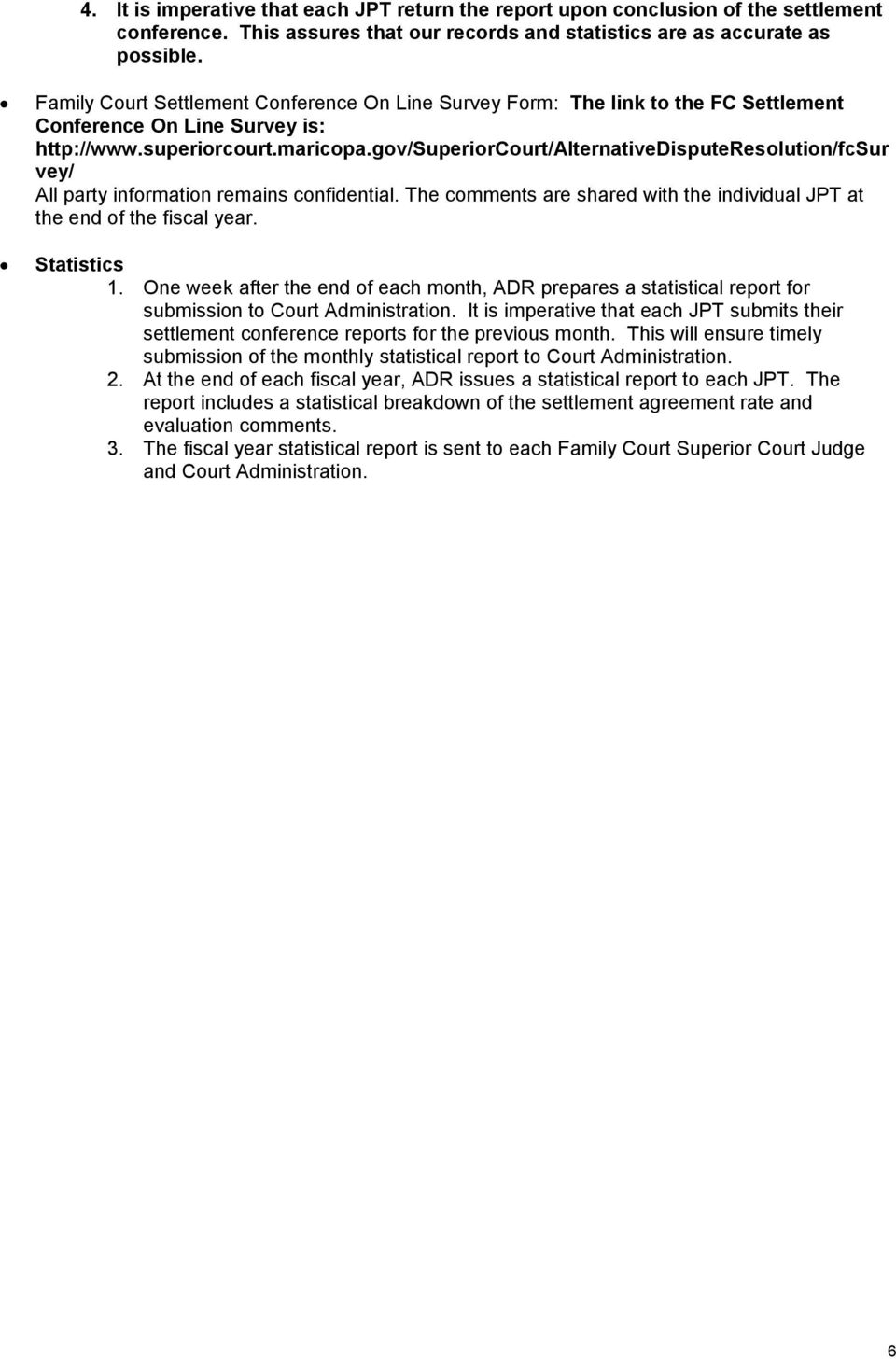
7 HONORABLE CASE NUMBER: SUPERIOR COURT OF ARIZONA MARICOPA COUNTY ALTERNATIVE DISPUTE RESOLUTION Notice of Family Court Settlement Conference FILED: BAR #/ATTY NAME or PRO PER S NAME/ADDRESS v BAR #/ATTY NAME or PRO PER S NAME/ADDRESS BAR #/JPT S NAME (FIRST, LAST) JPT S PHONE # ADDRESS Judge Pro Tempore Judge Pro Tempore JPT S NAME is appointed to conduct a Settlement Conference (SCF) and to enter stipulated orders in this matter, pursuant to Rules 66 and 67, A.R.F.L.P. A Settlement Conference shall be held at. The Settlement Conference shall be held on (DATE) at (TIME). The Judge Pro Tempore shall notify Alternative Dispute Resolution of any changes, i.e., date/time, to the above settlement conference. IT IS FURTHER ORDERED that all parties and counsel who will try the case (if parties are represented) shall appear IN PERSON at the Settlement Conference unless the court or the Judge Pro Tempore order otherwise in advance of the settlement conference. WARNING: Except for extraordinary circumstances, failure to appear at the time scheduled for this settlement conference as ordered by the court will result in your being required to pay $100 no show fee by the assigned judge in your case. If you are represented and unable to attend your settlement conference, please contact your counsel so they can file the appropriate motion to continue the settlement conference. If you are not represented, please file the appropriate motion to postpone/continue your settlement conference to avoid paying the no show fee. Docket Number 070 Version: {ADR002U 1.0.1} Page 1 of 5 7

8 SUPERIOR COURT OF ARIZONA MARICOPA COUNTY ALTERNATIVE DISPUTE RESOLUTION Notice of Family Court Settlement Conference COUNSEL SHALL AVOW IN THE SCF MEMORANDUM THAT 1) ALL MANDATORY DISCLOSURE HAS BEEN EXCHANGED; 2) THAT ALL DISCOVERY HAS BEEN COMPLETED WITH NO OUTSTANDING DISCOVERY DISPUTES; AND, 3) THAT COUNSEL HAS MET OR OTHERWISE CONFERRED WITH THE CLIENT PRIOR TO THE CONFERENCE REGARDING THE SCF PROCESS. All Settlement Conference participants should be prepared to attend the Settlement Conference for at least two hours. IT IS FURTHER ORDERED that each party shall furnish the Judge Pro Tempore with a separate Settlement Conference Memorandum at least seven days prior to the scheduled Settlement Conference. A sample Memorandum is available at along with the link to prepare a Child Support Worksheet The Settlement Conference memorandum shall include the following information: 1. A general description of the issues in the lawsuit, and each party s position with respect to each issue; 2. A description of the evidence each party intends to present, with respect to each issue; 3. A summary of any and all settlement negotiations that have previously occurred; 4. A current and complete Affidavit of Financial Information, including tax returns and pay stubs; 5. An inventory of major community or joint assets, including dates of acquisition, amounts of encumbrance, and present value; 6. A list of outstanding debts and the party responsible for each debt; and, 7. Any other information the party believes would be helpful to the settlement process. This memorandum SHALL NOT be filed with the Clerk of the Court. The parties shall not exchange this memorandum with each other. If Joint or Separate Pretrial or Resolution Management Statements have been filed with the court, THESE WILL NOT SATISFY THE REQUIREMENT FOR this Settlement Conference Memorandum. IT IS FURTHER ORDERED that all motions to continue the scheduled Settlement Conference shall be brought before the assigned Judge Pro Tempore. Any other pre-trial motions shall be brought before the judge permanently assigned to the case. IT IS FURTHER ORDERED that the Judge Pro Tempore may notify the court whether the parties were or were not prepared for the SCF pursuant to the requirements set forth in this order for the purpose of considering sanctions under A.R.S IT IS FURTHER ORDERED that any agreement the parties enter into, which is memorialized by the Judge Pro Tempore, shall be considered a binding agreement, in accordance with Rule 69, Arizona Rules of Family Law Procedure. Docket Number 070 Version: {ADR002U 1.0.1} Page 2 of 5 8
9 SUPERIOR COURT OF ARIZONA MARICOPA COUNTY ALTERNATIVE DISPUTE RESOLUTION Notice of Family Court Settlement Conference Pursuant to Rules 76(D) & 71, Arizona Rules of Family Law Procedure, failure to comply with this Court Order may result in the imposition of court sanctions, including, but not limited to: 1) The Judge Pro Tempore vacating or continuing the conference; 2) An Order refusing to allow the disobedient party to support or oppose designated claims or defenses, or prohibiting that party from introducing designated matters in evidence; 3) An Order striking out pleadings or parts thereof, or staying further proceedings until the order is obeyed, or dismissing the action or proceeding or any part thereof, or rendering a judgment by default against the disobedient party; 4) Treating as contempt of court the failure to obey any orders except an order to submit to a physical or mental examination; and, 5) Proceeding by default or dismissing the case should one or both parties fail to appear for the Settlement Conference. Source: Rules 71, 76(D), Arizona Rules of Family Law Procedure; Rule 3.11, Superior Court Local Rules Maricopa County. All parties representing themselves must keep the Court updated with address changes. A form may be downloaded at: ServiceCenter. Docket Number 070 Version: {ADR002U 1.0.1} Page 3 of 5 9

10 SUPERIOR COURT OF ARIZONA MARICOPA COUNTY ALTERNATIVE DISPUTE RESOLUTION Notice of Family Court Settlement Conference ATTACHMENT 1 PLEASE YOUR SETTLEMENT CONFERENCE MEMORANDUM TO THE JUDGE PRO TEMPORE (JPT) LISTED ON ATTACHED NOTICE; IF JPT DOES NOT HAVE AN ADDRESS LISTED, PLEASE TO [email protected]. PLEASE GO TO TO OBTAIN JPT S ADDRESS & PHONE/FAX NUMBERS. What is a settlement conference? A pre-trial meeting between parties and their attorneys (if parties are represented) and a judicial officer (judge pro tempore) acting as a neutral facilitator, who evaluates the strengths and weaknesses of their case and assists them in reaching an agreement. What types of cases are eligible for a family settlement conference? All pre- and post-decree dissolution cases, paternity and maternity matters, as well as grandparent visitation cases. What are the advantages of a settlement conference? Decreased cost: By settling the case and avoiding trial, parties can save the expenses associated with a traditional trial. Quicker solution: The traditional trial process is often time-consuming. By settling a dispute before trial, parties avoid the possibility of a long trial and can move on with their lives. Increased satisfaction: Court clients participating in a settlement conference generally experience a higher level of satisfaction with the process than those who go through the traditional trial process. Where are settlement conferences held and how long do they last? Most settlement conferences are held in Downtown Phoenix: Alternative Dispute Resolution, Downtown Justice Center OR 5 th Floor, Central Court Building, 201 W. Jefferson St., Phoenix, Arizona. In some cases, settlement conferences are held at the Southeast Court Facility, the Northwest Court Facility, Northeast Court Facility, and at judges pro tempore's offices. How long do they last? Approximately 2-3 hours. Who presides over a settlement conference? A judicial officer acting as a neutral facilitator (judge pro tempore) presides over a settlement conference. A judge pro tempore is a neutral attorney who is court-appointed to perform specific duties for the courts based on their experience and qualifications. What do I need to do to prepare for a settlement conference? Be prepared for the following: give a general description of the issues in the suit, including your views; explain all previous negotiations and results; discuss the possible consequences if your case proceeds to trial; bring any relevant financial, property, debt, and income information; bring any other relevant information for discussion; and communicate your needs fully, honestly, and respectfully with the judge pro tempore and with the other party. Docket Number 070 Version: {ADR002U 1.0.1} Page 4 of 5 10

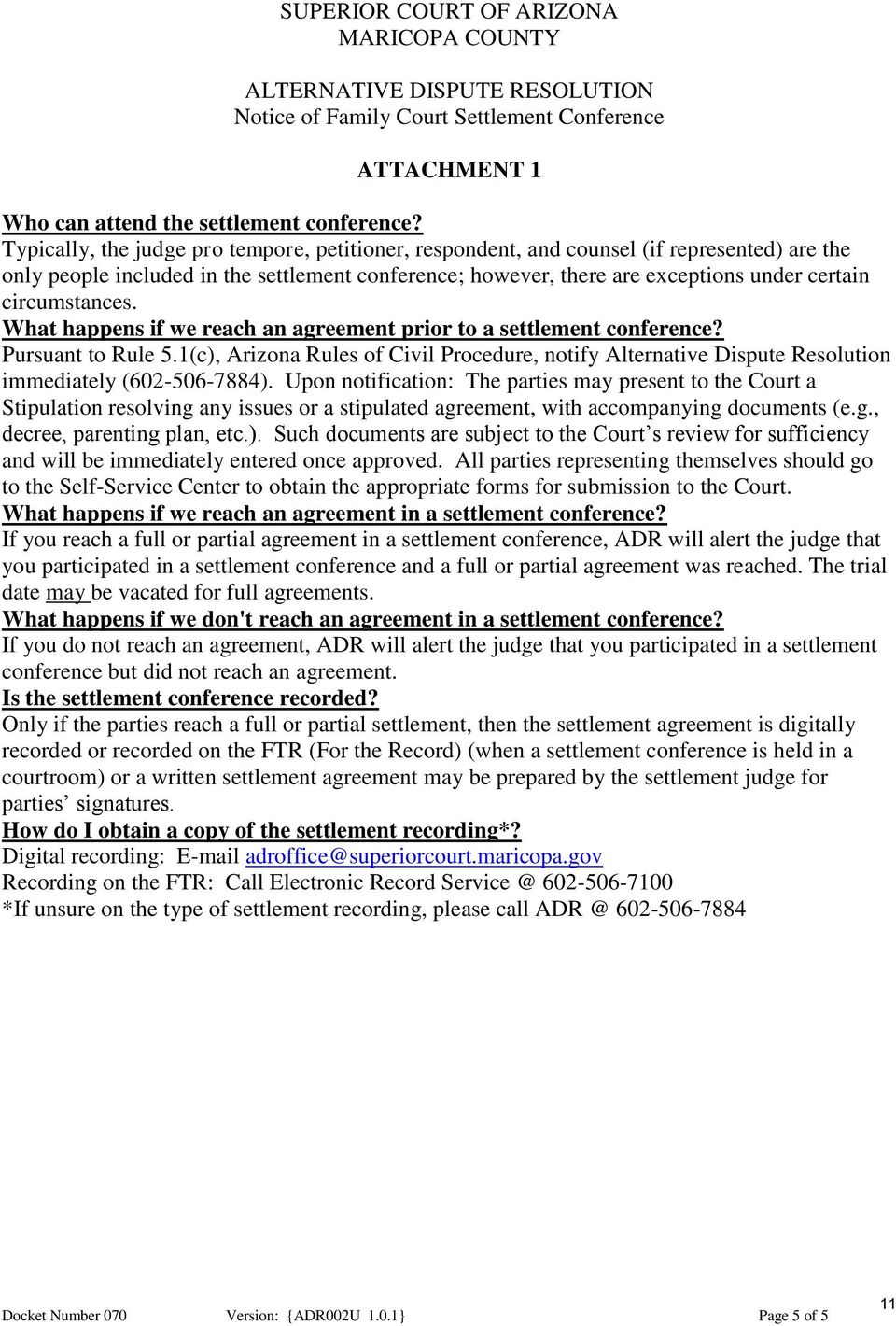
11 SUPERIOR COURT OF ARIZONA MARICOPA COUNTY ALTERNATIVE DISPUTE RESOLUTION Notice of Family Court Settlement Conference ATTACHMENT 1 Who can attend the settlement conference? Typically, the judge pro tempore, petitioner, respondent, and counsel (if represented) are the only people included in the settlement conference; however, there are exceptions under certain circumstances. What happens if we reach an agreement prior to a settlement conference? Pursuant to Rule 5.1(c), Arizona Rules of Civil Procedure, notify Alternative Dispute Resolution immediately ( ). Upon notification: The parties may present to the Court a Stipulation resolving any issues or a stipulated agreement, with accompanying documents (e.g., decree, parenting plan, etc.). Such documents are subject to the Court s review for sufficiency and will be immediately entered once approved. All parties representing themselves should go to the Self-Service Center to obtain the appropriate forms for submission to the Court. What happens if we reach an agreement in a settlement conference? If you reach a full or partial agreement in a settlement conference, ADR will alert the judge that you participated in a settlement conference and a full or partial agreement was reached. The trial date may be vacated for full agreements. What happens if we don't reach an agreement in a settlement conference? If you do not reach an agreement, ADR will alert the judge that you participated in a settlement conference but did not reach an agreement. Is the settlement conference recorded? Only if the parties reach a full or partial settlement, then the settlement agreement is digitally recorded or recorded on the FTR (For the Record) (when a settlement conference is held in a courtroom) or a written settlement agreement may be prepared by the settlement judge for parties signatures. How do I obtain a copy of the settlement recording*? Digital recording: [email protected] Recording on the FTR: Call Electronic Record *If unsure on the type of settlement recording, please call Docket Number 070 Version: {ADR002U 1.0.1} Page 5 of 5 11
12 ALTERNATIVE DISPUTE RESOLUTION JUDICIAL BRANCH OF ARIZONA MARICOPA COUNTY CONFERENCE DATE: PETITIONER RESPONDENT CASE NUMBER JUDGE FAMILY COURT SETTLEMENT CONFERENCE (SC) REPORT COUNSEL/"PRO PER" PARTIES PETITIONER RESPONDENT This is the time set for the Family Court Settlement Conference before JUDGE PRO TEMPORE conference are: Petitioner Counsel Respondent Counsel Other. At this DOCUMENTS HERETOFORE PRESENTED AND EXCHANGED PETITIONER RESPONDENT ( ) Settlement Conference Memorandum ( ) Settlement Conference Memorandum ( ) Joint Pretrial Statement ( ) Joint Pretrial Statement ( ) Spousal Affidavit ( ) Spousal Affidavit ( ) Inventory of Property ( ) Inventory of Property ( ) Proposed Disposition ( ) Proposed disposition ( ) Other Documents: ( ) Other Documents: JURISDICTIONAL TESTIMONY TAKEN FROM: PETITIONER RESPONDENT FULL SETTLEMENT A. PLEASE SEE SIGNED ORDER ON PAGE 3 (NOTE TO JPT: SEND ORIGINAL TO ADR FOR FILING) B. SETTLEMENT DICTATED: YES Written Agreement: Original attached Copy attached Filed N/A NO C. Signed Decree/Order Attached Filed FTR (Courtroom # ) Digital Recording: (Please to: [email protected]) PARTIAL SETTLEMENT (Provide comments on page 2) SETTLEMENT DICTATED: YES Written Agreement: Original attached Copy attached Filed N/A NO CASE NOT SETTLED (Provide comments on page 2) FTR (Courtroom # ) A. Estimated Length Of Trial (indicate days or hours) B. Testimony to be Taken on Trial Date C. Confirm Trial Date: Digital Recording: (Please to: [email protected]) OTHER: FAILED TO APPEAR VACATED SETTLED PRIOR TERMINATED ADR SCF REPORT FORM: CURRENT AS OF 5/1/

13 CASE NOT SETTLED/PARTIAL SETTLEMENT ISSUES TO BE TRIED COMMENTS LEGAL DECISION MAKING/ PARENTING TIME CHILD SUPPORT SPOUSAL MAINTENANCE DIVISION OF PROPERTY DIVISION OF DEBTS ATTORNEYS' FEES RELIEF DUE RE: PENDENTE LITE ORDER OTHER MATTERS TO BE CONSIDERED BY THE CT DATE: JUDGE PRO TEMPORE ADR SCF REPORT FORM: CURRENT AS OF 5/1/

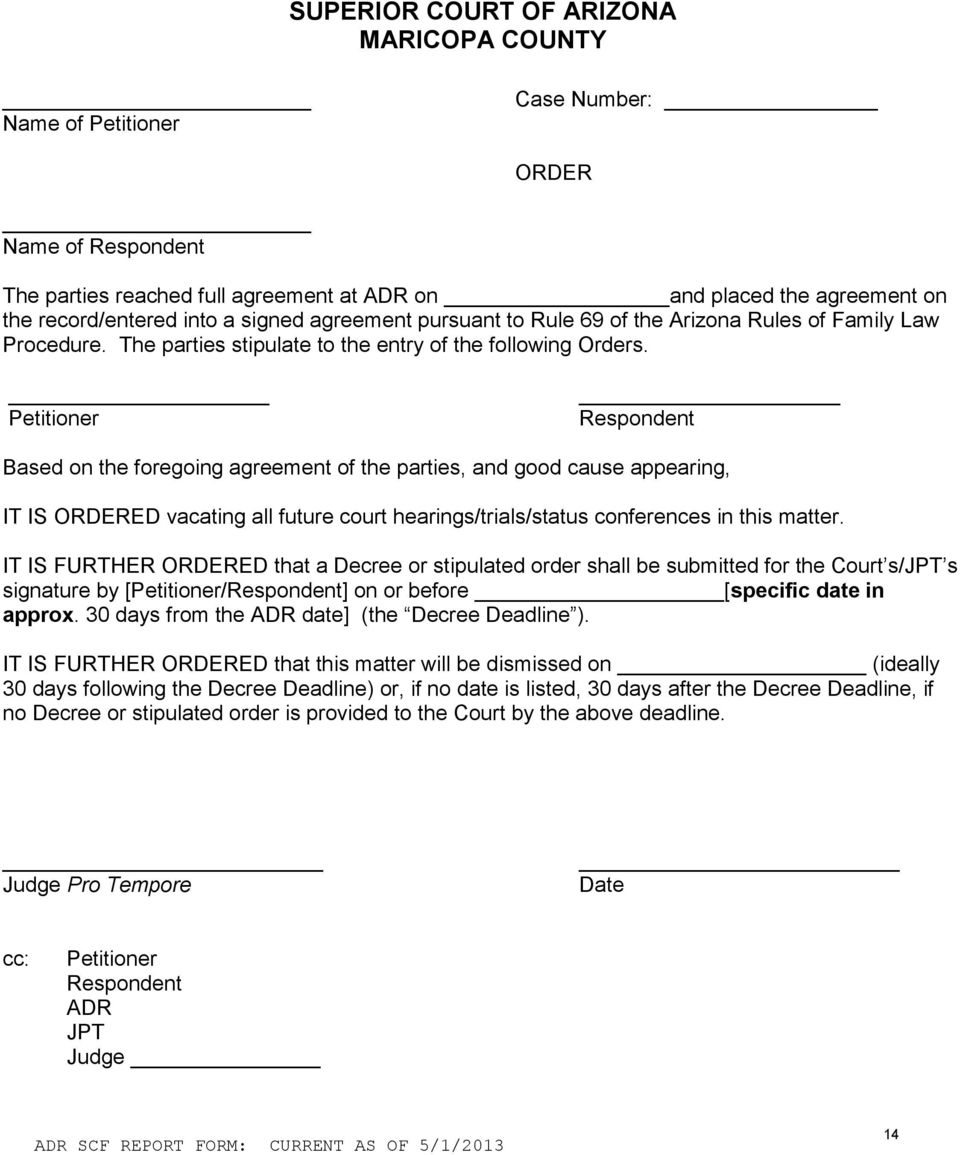
14 SUPERIOR COURT OF ARIZONA MARICOPA COUNTY Name of Petitioner Case Number: ORDER Name of Respondent The parties reached full agreement at ADR on and placed the agreement on the record/entered into a signed agreement pursuant to Rule 69 of the Arizona Rules of Family Law Procedure. The parties stipulate to the entry of the following Orders. Petitioner Respondent Based on the foregoing agreement of the parties, and good cause appearing, IT IS ORDERED vacating all future court hearings/trials/status conferences in this matter. IT IS FURTHER ORDERED that a Decree or stipulated order shall be submitted for the Court s/jpt s signature by [Petitioner/Respondent] on or before [specific date in approx. 30 days from the ADR date] (the Decree Deadline ). IT IS FURTHER ORDERED that this matter will be dismissed on (ideally 30 days following the Decree Deadline) or, if no date is listed, 30 days after the Decree Deadline, if no Decree or stipulated order is provided to the Court by the above deadline. Judge Pro Tempore Date cc: Petitioner Respondent ADR JPT Judge ADR SCF REPORT FORM: CURRENT AS OF 5/1/
15 JUDICIAL BRANCH OF ARIZONA IN MARICOPA COUNTY ALTERNATIVE DISPUTE RESOLUTION (Name of Petitioner) (Name of Respondent) Case Number: AGREEMENT BETWEEN THE PARTIES PURSUANT TO A. R. F. L. P. RULE 69 (WITH CHILDREN) FULL SETTLEMENT PARTIAL SETTLEMENT This is the time set for the Settlement Conference held before Judge Pro Tempore The assigned Judge on this case is Attending this conference are: Petitioner Petitioner s Counsel Respondent Respondent s Counsel Interpreter Other Has sixty days passed from service of the initial petition Yes Is there an Order of Protection in effect now Yes Have CPS or police been called on Petitioner Yes No Respondent Yes No Has there been a drug conviction within the last 12 months for Petitioner Yes No Respondent Yes No Does either party have a pending bankruptcy case? Petitioner Yes No Respondent Yes No Has a discharge been entered? Yes No If NO, what is the case number? No No PREGNANCY: Wife is not pregnant Wife is pregnant, and the husband is or is not the father of the child. A child who is common to the parties is expected to be born this date:. CHILDREN: All minor children common to the parties as follows: NAME (S) OF CHILD (REN) D/O/B(s) AGE If born prior to marriage, has proof of paternity been presented? Yes No AGP 1 of 8 Rule 69 Agreement (With Children) 15 7/1/2013

16 PARENT INFORMATION PROGRAM: Petitioner has has not attended the Parent Information Program Class. Respondent has has not attended the Parent Information Program Class. LEGAL DECISION MAKING: The parties are unable to reach an agreement concerning legal decision making SOLE LEGAL DECISION MAKING: The condition under which one person, Father shall have sole legal decision making of the minor child(ren). Mother Both parties agree to SOLE LEGAL DECISION MAKING: Sole legal decision making to Mother Father JOINT LEGAL DECISION MAKING: The condition under which both parents share legal decision making and neither parent's rights are superior except with respect to specified decisions as set forth by the court or the parents in the final judgment or order. Both parties agree to joint legal decision making. Mother Father will have the primary residence of the child(ren) CHILD SUPPORT Neither party shall be designated as the primary residence for the child(ren). EQUAL PARENTING TIME/PARENTING TIME: The condition under which the physical residence of the child(ren) is shared by the parents in a manner that assures that the child(ren) has/have substantially equal time and contact with both parents. Both parties agree to EQUAL PARENTING TIME or PARENTING TIME The parties are in agreement that child support will paid by the Mother Father using the child support guidelines. The parties agree on the following child support amount of to be paid to the Mother Father. The parties are in agreement to a deviation from the child support guidelines in the amount of to be paid to Mother Father. A child support order currently exists signed on in the amount of. The parties agree to have child support calculated prior to the final agreement. The parties are unable to reach an agreement concerning child support. AGP 2 of 8 Rule 69 Agreement (With Children) 7/1/

17 MEDICAL, DENTAL AND VISION INSURANCE, PAYMENTS, AND EXPENSES: Parties agree Petitioner child(ren). Respondent will provide medical, dental and vision insurance for the minor FURTHER: Unreimbursed health care expenses shall be allocated as follows: Petitioner will pay % AND Respondent will pay % The parties will pay proportionate to their incomes. The parties are unable to reach an agreement concerning medical, dental and vision insurance. TAX DEDUCTION: The parties agree that they shall claim as income tax dependency exemptions on federal and state tax returns as follows. Parent entitled to claim: Name of child(ren) Mother to take tax deduction on Even year s Odd years Every year. Name of child(ren) Father to take tax deduction on Even year s Odd years Every year. The parties agree to take tax deductions based on proportionate to child support worksheet guidelines. TAX RETURNS: * Subject to IRS Rules and Regulations. For prior years through, the parties agree to: File joint federal and state income tax returns, and hold the other harmless from half of all additional income taxes and costs, if any, and each party shall share equally in tax refunds, if any. For prior years, through, the parties agree to: File separate federal and state income tax returns. Each party shall file separate tax returns this calendar year and continuing thereafter. Each party shall give the other party all necessary documentation to file all tax returns. The parties are unable to reach an agreement concerning tax return issues. AGP 3 of 8 Rule 69 Agreement (With Children) 17 7/1/2013

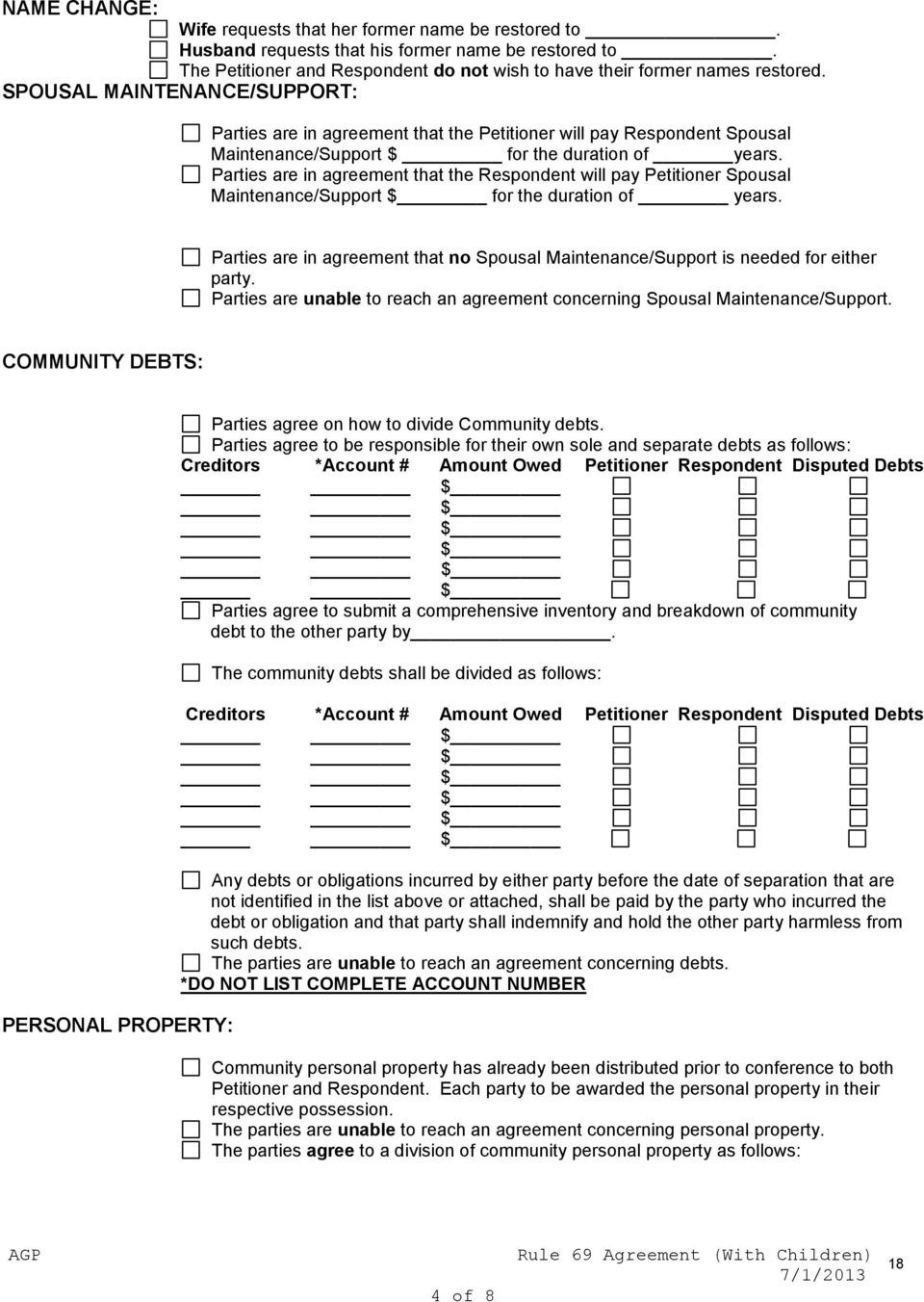
18 NAME CHANGE: Wife requests that her former name be restored to. Husband requests that his former name be restored to. The Petitioner and Respondent do not wish to have their former names restored. SPOUSAL MAINTENANCE/SUPPORT: Parties are in agreement that the Petitioner will pay Respondent Spousal Maintenance/Support $ for the duration of years. Parties are in agreement that the Respondent will pay Petitioner Spousal Maintenance/Support $ for the duration of years. Parties are in agreement that no Spousal Maintenance/Support is needed for either party. Parties are unable to reach an agreement concerning Spousal Maintenance/Support. COMMUNITY DEBTS: PERSONAL PROPERTY: Parties agree on how to divide Community debts. Parties agree to be responsible for their own sole and separate debts as follows: Creditors *Account # Amount Owed Petitioner Respondent Disputed Debts $ $ $ $ $ $ Parties agree to submit a comprehensive inventory and breakdown of community debt to the other party by. The community debts shall be divided as follows: Creditors *Account # Amount Owed Petitioner Respondent Disputed Debts $ $ $ $ $ $ Any debts or obligations incurred by either party before the date of separation that are not identified in the list above or attached, shall be paid by the party who incurred the debt or obligation and that party shall indemnify and hold the other party harmless from such debts. The parties are unable to reach an agreement concerning debts. *DO NOT LIST COMPLETE ACCOUNT NUMBER Community personal property has already been distributed prior to conference to both Petitioner and Respondent. Each party to be awarded the personal property in their respective possession. The parties are unable to reach an agreement concerning personal property. The parties agree to a division of community personal property as follows: AGP 4 of 8 Rule 69 Agreement (With Children) 7/1/
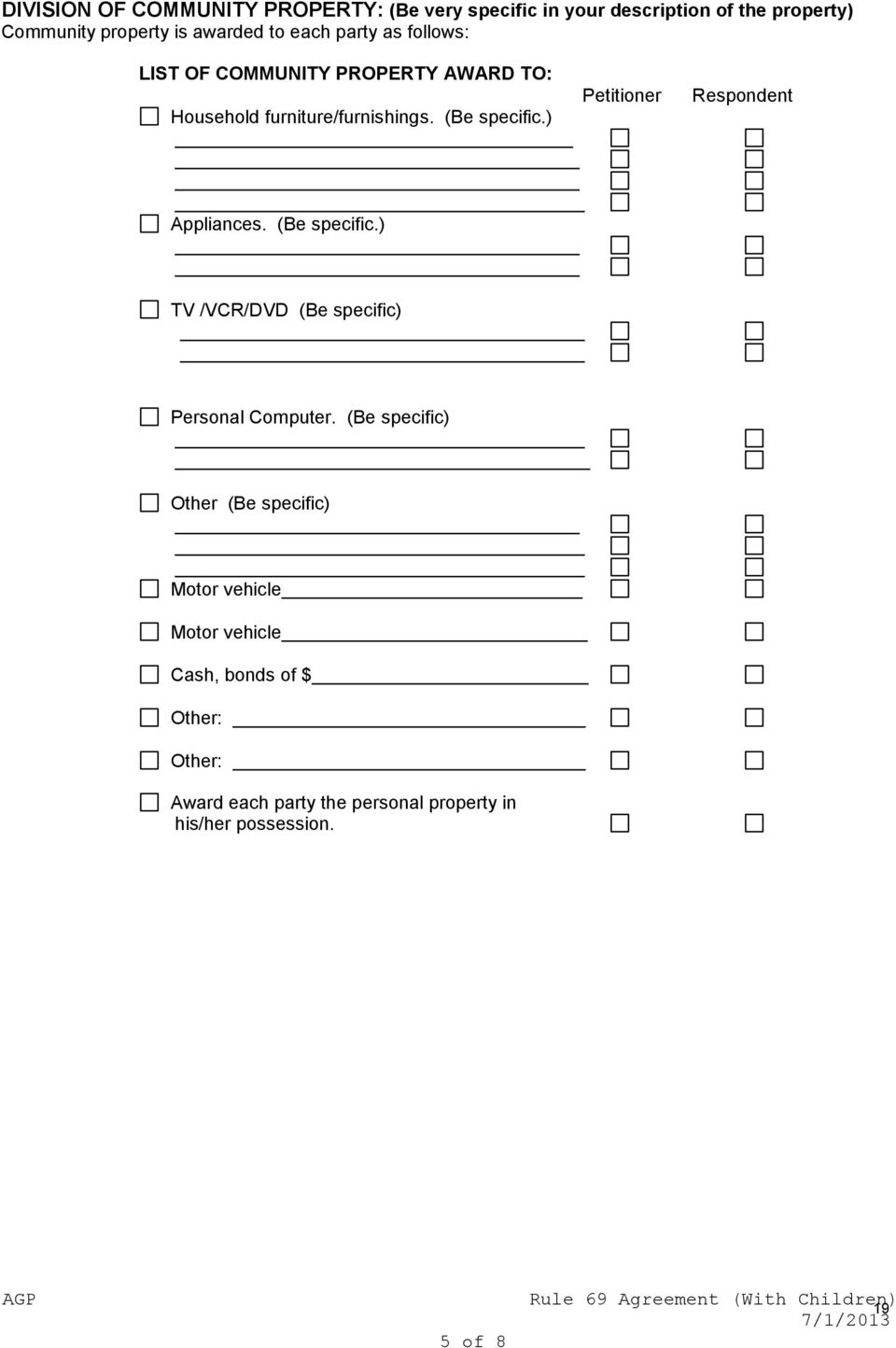
19 DIVISION OF COMMUNITY PROPERTY: (Be very specific in your description of the property) Community property is awarded to each party as follows: LIST OF COMMUNITY PROPERTY AWARD TO: Household furniture/furnishings. (Be specific.) Petitioner Respondent Appliances. (Be specific.) TV /VCR/DVD (Be specific) Personal Computer. (Be specific) Other (Be specific) Motor vehicle Motor vehicle Cash, bonds of $ Other: Other: Award each party the personal property in his/her possession. AGP 5 of 8 Rule 69 Agreement (With Children) 19 7/1/2013
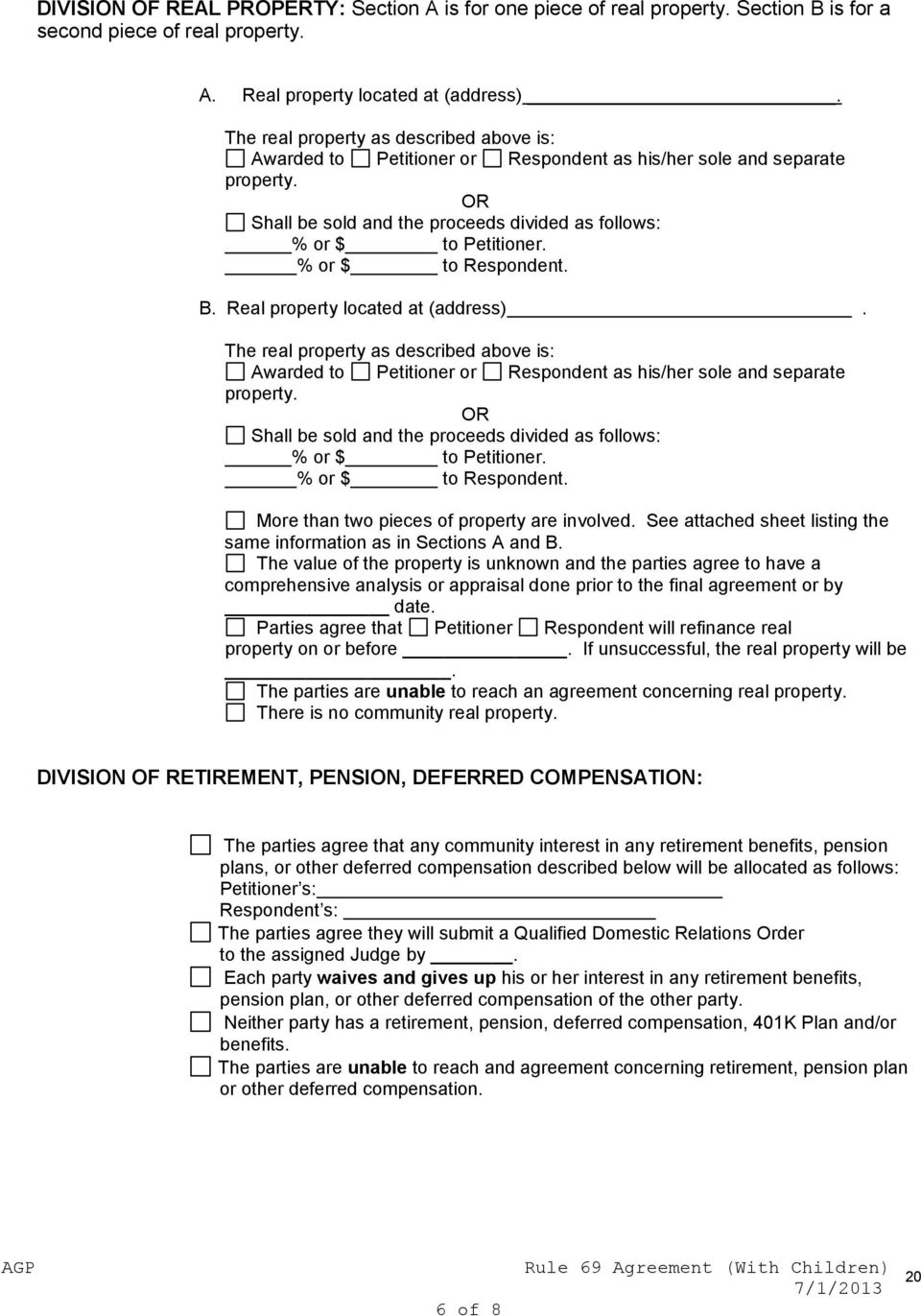
20 DIVISION OF REAL PROPERTY: Section A is for one piece of real property. Section B is for a second piece of real property. A. Real property located at (address). The real property as described above is: Awarded to Petitioner or Respondent as his/her sole and separate property. OR Shall be sold and the proceeds divided as follows: % or $ to Petitioner. % or $ to Respondent. B. Real property located at (address). The real property as described above is: Awarded to Petitioner or Respondent as his/her sole and separate property. OR Shall be sold and the proceeds divided as follows: % or $ to Petitioner. % or $ to Respondent. More than two pieces of property are involved. See attached sheet listing the same information as in Sections A and B. The value of the property is unknown and the parties agree to have a comprehensive analysis or appraisal done prior to the final agreement or by date. Parties agree that Petitioner Respondent will refinance real property on or before. If unsuccessful, the real property will be. The parties are unable to reach an agreement concerning real property. There is no community real property. DIVISION OF RETIREMENT, PENSION, DEFERRED COMPENSATION: The parties agree that any community interest in any retirement benefits, pension plans, or other deferred compensation described below will be allocated as follows: Petitioner s: Respondent s: The parties agree they will submit a Qualified Domestic Relations Order to the assigned Judge by. Each party waives and gives up his or her interest in any retirement benefits, pension plan, or other deferred compensation of the other party. Neither party has a retirement, pension, deferred compensation, 401K Plan and/or benefits. The parties are unable to reach and agreement concerning retirement, pension plan or other deferred compensation. AGP 6 of 8 Rule 69 Agreement (With Children) 7/1/
21 LEGAL FEES: Petitioner will pay Respondent s legal fees in the amount of $. Respondent will pay Petitioner s legal fees in the amount of $. Each party will pay their own legal fees. The parties are unable to reach an agreement concerning legal fees. Legal fees do not apply to this case. ADDITIONAL AGREEMENTS: ADDITIONAL ISSUES NOT AGREED UPON: OTHER ORDERS: TIMELINE FOR PARTIES: I am not under force, threats, duress, coercion, or undue influence from anyone, including the other party, to sign this Agreement. The Agreement, with attachments, if any, that I have signed is our agreement. I have not agreed to something different from what is stated in this agreement. The provisions regarding the division of property and debt are fair and equitable. Pursuant to Rule 69 of the Arizona Rules of Family Law Procedure, it is the intent of both parties that this agreement shall be binding. AGP Rule 69 Agreement (With Children) 7/1/ of 8 21
22 This is NOT a finalized divorce decree. This agreement merely provides a statement of resolution to some of the issues involved in your case. Petitioner: Respondent: Date: Date: If either party is represented by a lawyer, the lawyer must sign: Petitioner s Attorney: Respondent s Attorney: Date: Date: AGP Rule 69 Agreement (With Children) 7/1/ of 8 22
23 JUDICIAL BRANCH OF ARIZONA IN MARICOPA COUNTY ALTERNATIVE DISPUTE RESOLUTION (Name of Petitioner) (Name of Respondent) Case Number: AGREEMENT BETWEEN THE PARTIES PURSUANT TO A. R. F. L. P. RULE 69 (WITHOUT CHILDREN) FULL SETTLEMENT PARTIAL SETTLEMENT This is the time set for the Settlement Conference held Tempore The assigned Judge on this case is Attending this conference are: before Judge Pro Petitioner Petitioner s Counsel Respondent Respondent s Counsel Interpreter Other Has sixty days passed from service of the initial petition Yes Is there an Order of Protection in effect now Yes Does either party have a pending bankruptcy case? Petitioner Yes No Respondent Yes No Has a discharge been entered? Yes No If NO, what is the case number? No No PREGNANCY: Wife is not pregnant Wife is pregnant, and the husband is or is not the father of the child. A child who is common to the parties is expected to be born this date:. TAX RETURNS: * Subject to IRS Rules and Regulations. For prior years through, the parties agree to: File joint federal and state income tax returns, and hold the other harmless from half of all additional income taxes and costs, if any, and each party shall share equally in tax refunds, if any. For prior years, through, the parties agree to: File separate federal and state income tax returns. Each party shall file separate tax returns this calendar year and continuing thereafter. Each party shall give the other party all necessary documentation to file all tax returns. The parties are unable to reach an agreement concerning tax return issues. AGP Rule 69 Agreement (Without Children) 4/12/ of 6 23
24 NAME CHANGE: Wife requests that her former name be restored to. Husband requests that his former name be restored to. The Petitioner and Respondent do not wish to have their former names restored. SPOUSAL MAINTENANCE/SUPPORT: Parties are in agreement that the Petitioner will pay Respondent Spousal Maintenance/Support $ for the duration of years. Parties are in agreement that the Respondent will pay Petitioner Spousal Maintenance/Support $ for the duration of years. Parties are in agreement that no Spousal Maintenance/Support is needed for either party. Parties are unable to reach an agreement concerning Spousal Maintenance/Support. COMMUNITY DEBTS: PERSONAL PROPERTY: Parties agree on how to divide Community debts. Parties agree to be responsible for their own sole and separate debts as follows: Creditors *Account # Amount Owed Petitioner Respondent Disputed Debts $ $ $ $ $ $ Parties agree to submit a comprehensive inventory and breakdown of community debt to the other party by. The community debts shall be divided as follows: Creditors *Account # Amount Owed Petitioner Respondent Disputed Debts $ $ $ $ $ $ Any debts or obligations incurred by either party before the date of separation that are not identified in the list above or attached, shall be paid by the party who incurred the debt or obligation and that party shall indemnify and hold the other party harmless from such debts. The parties are unable to reach an agreement concerning debts. *DO NOT LIST COMPLETE ACCOUNT NUMBER Community personal property has already been distributed prior to conference to both Petitioner and Respondent. Each party to be awarded the personal property in their respective possession. The parties are unable to reach an agreement concerning personal property. The parties agree to a division of community personal property as follows: DIVISION OF COMMUNITY PROPERTY: (Be very specific in your description of the property) Community property is awarded to each party as follows: AGP Rule 69 Agreement (Without Children) 4/12/ of 6 24
25 LIST OF COMMUNITY PROPERTY AWARD TO: Household furniture/furnishings. (Be specific.) Petitioner Respondent Appliances. (Be specific.) TV /VCR/DVD (Be specific) Personal Computer. (Be specific) Other (Be specific) Motor vehicle Motor vehicle Cash, bonds of $ Other: Other: Award each party the personal property in his/her possession. AGP 3 of 6 Rule 69 Agreement (Without Children) 4/12/
26 DIVISION OF REAL PROPERTY: Section A is for one piece of real property. Section B is for a second piece of real property. A. Real property located at (address). The real property as described above is: Awarded to Petitioner or Respondent as his/her sole and separate property. OR Shall be sold and the proceeds divided as follows: % or $ to Petitioner. % or $ to Respondent. B. Real property located at (address). The real property as described above is: Awarded to Petitioner or Respondent as his/her sole and separate property. OR Shall be sold and the proceeds divided as follows: % or $ to Petitioner. % or $ to Respondent. More than two pieces of property are involved. See attached sheet listing the same information as in Sections A and B. The value of the property is unknown and the parties agree to have a comprehensive analysis or appraisal done prior to the final agreement or by date. Parties agree that Petitioner Respondent will refinance real property on or before. If unsuccessful, the real property will be. The parties are unable to reach an agreement concerning real property. There is no community real property. DIVISION OF RETIREMENT, PENSION, DEFERRED COMPENSATION: The parties agree that any community interest in any retirement benefits, pension plans, or other deferred compensation described below will be allocated as follows: Petitioner s: Respondent s: The parties agree they will submit a Qualified Domestic Relations Order to the assigned Judge by. Each party waives and gives up his or her interest in any retirement benefits, pension plan, or other deferred compensation of the other party. Neither party has a retirement, pension, deferred compensation, 401K Plan and/or benefits. The parties are unable to reach and agreement concerning retirement, pension plan or other deferred compensation. AGP Rule 69 Agreement (Without Children) 4/12/ of 6 26
27 LEGAL FEES: Petitioner will pay Respondent s legal fees in the amount of $. Respondent will pay Petitioner s legal fees in the amount of $. Each party will pay their own legal fees. The parties are unable to reach an agreement concerning legal fees. Legal fees do not apply to this case. ADDITIONAL AGREEMENTS: ADDITIONAL ISSUES NOT AGREED UPON: OTHER ORDERS: TIMELINE FOR PARTIES: I am not under force, threats, duress, coercion, or undue influence from anyone, including the other party, to sign this Agreement. The Agreement, with attachments, if any, that I have signed is our agreement. I have not agreed to something different from what is stated in this agreement. The provisions regarding the division of property and debt are fair and equitable. Pursuant to Rule 69 of the Arizona Rules of Family Law Procedure, it is the intent of both parties that this agreement shall be binding. AGP Rule 69 Agreement (Without Children) 4/12/ of 6 27
28 This is NOT a finalized divorce decree. This agreement merely provides a statement of resolution to some of the issues involved in your case. Petitioner: Respondent: Date: Date: If either party is represented by a lawyer, the lawyer must sign: Petitioner s Attorney: Respondent s Attorney: Date: Date: AGP Rule 69 Agreement (Without Children) 4/12/ of 6 28
29 JUDICIAL BRANCH OF ARIZONA IN MARICOPA COUNTY ALTERNATIVE DISPUTE RESOLUTION PETITIONER Case Number: VS RESPONDENT AGREEMENT BETWEEN THE PARTIES PURSUANT TO A. R. F. L. P. RULE 69 WITH CHILDREN FULL SETTLEMENT PARTIAL SETTLEMENT WITHOUT CHILDREN This is the time set for the Settlement Conference held (date) before Judge Pro Tempore (name). The assigned Judge on this case is Attending this conference are: Petitioner Petitioner s Counsel Respondent Respondent s Counsel Interpreter Other The parties in this matter have completed the settlement conference and have reached the following agreement and shall be considered a binding agreement pursuant to A.R.F.L.P Rule 69. STP 4/12/
30 STP 4/12/
31 I am not under force, threats, duress, coercion, or undue influence from anyone, including the other party, to sign this Agreement. The Agreement, with attachments, if any, that I have signed is our agreement. I have not agreed to something different from what is stated in this agreement. This is NOT a finalized divorce decree. This agreement merely provides a statement of resolution to some of the issues involved in your case. Petitioner: Respondent: Date: Date: If either party is represented by a lawyer, the lawyer must sign: Petitioner s Attorney: Respondent s Attorney: Date: Date: STP 4/12/
32 ALTERNATIVE DISPUTE RESOLUTION (ADR) SUPERIOR COURT OF ARIZONA MARICOPA COUNTY FAMILY COURT SETTLEMENT CONFERENCE SURVEY This survey will only take 5 minutes of your time. Your feedback is important to us. This information will be used to inform the court system and the judge pro tempore about your experience with the settlement conference. With your help, we can ensure that quality settlement conferences continue to be available on the Maricopa County Superior Court Service Provider Rosters. In accordance with ADR Superior Court policy, this information is confidential. Below is the link to the online survey. solution/fcsurvey/ 32
33 CHAPTER 2 - GETTING STARTED Settlement Conference Guide What is a settlement. An agreement between parties that resolves some or all of the issues in litigation. Settlement can Be full or partial Streamline issues that proceed to litigation Allow stipulation of agreed upon facts The effective settlement negotiator must know how to discount litigation s risks and rewards: Know the facts, not necessarily completion of discovery Know the applicable law Communicate the range of probable outcomes Rely on communication skills Remember: All cases settle at some point. If not in conference, there may be a good reason for proceeding to trial Why try to settle at a conference Expense of litigation costs Financial/emotional drain for parties Time/difficulty collecting fees Toll on the Court system and taxpayer Settlement: Generally, most satisfying outcome Based on what s fair, not what parties are asking for Parties have day in Court Attorneys can avoid complete loss for client Judge gets satisfaction of helping parties reach agreement Justice is served Settlements avoid extreme results Provide positive satisfaction with Court system Effective Settlement Conference Techniques Use basic mediation techniques (Getting to Yes by Fisher & Ury) Personalities impeding case resolution? Identify hidden emotional agendas Use effective listening: Watch what is being communicated, not just what s being said Focus on interest not positions : What do parties really need to move on? 33
34 Help parties find creative (non-monetary) alternatives: What can one party do for the other party more easily than that party can do for themselves? Maintain a rational, problem-solving focus for negotiations Judicial settlement conference techniques Establish your authority/expertise Set conference Ground Rules Start with initial group meeting Parties can consult with counsel Explain caucusing Set conference tone and style in introductory remarks. Project an image of experience, knowledge, fairness, and friendship Relaxed, informal atmosphere Set aside adversarial attitude/posturing Invite parties to reason together to resolve differences Be prepared: Read the file in advance Allow brief statement by attorneys and/or parties Identify the issues Give case history on negotiations State positions/why attorneys believe they re reasonable Judicial analysis Conduct candid discussion of strengths/weaknesses of each party s positions (in caucus) Watch for clues in speech/body language Use active listening skills Parroting Paraphrasing Reflective listening Brainstorm potential solutions If caucus Use reality testing Avoid appearance of bias Demonstrate an unreasonable position with role reversal Negotiation. Try to move parties off positions and closer to common ground Exert reciprocal pressure to settle--avoid coercion Split the difference only when parties are close in terms; no reasonable distinction in positions Offer additional conference time if needed What to do when parties settle: Always get agreements on the record with attorneys/parties present and their affirmation of settlement terms 34
35 Top Tips for Conducting Settlement Conferences 1. The Judge should be proactive in trying to resolve the issues in the case. 2. Create an environment conducive to settlement. Set the tone to encourage compromise and conciliation. 3. Make an introductory statement: Explain the purpose of the conference: To organize and clarify the issues for trial, settling issues that can be settled; issue any orders necessary to that end. Let parties know that you understand the seriousness of the matter and the emotional issues they are facing. Let parties know they don t have to settle; however, if they can work out their differences, it will save everyone significant time, frustration and expense. Let parties know they have a right to trial, but sometimes the Judge makes a decision that no one likes. By working on a settlement, they can reach an agreement that meets their family s needs. Encourage parties to be open about compromise. You are not the trial judge. Therefore, efforts at compromise will not be used against them at trial. 4. Be aware of the attorneys need to preserve their relationship with their client. Some nice words about the lawyers in the presence of their clients will tend to reduce obstruction from counsel. 5. Recognize the attorneys roles. Allow each attorney to make a brief opening statement regarding issues not yet resolved. Keep these statements to a minimum. Save the bulk of time for finding solutions. 6. Act as a sounding board for the issues. Parties and attorneys may be looking for feedback from the Judge. Be proactive and address the issues, making appropriate comment on the law as applied to these facts. 7. When parties begin by stating no agreement is possible, explore easy issues first to see if you can limit disagreements. 8. Think creatively. Create options or suggest alternatives that the attorneys may not have foreseen or could not suggest themselves. 9. Be a good listener. Identify and deal with emotional issues that may be impeding settlement. 10. Remain neutral even if you are inclined to side with one party Avoid caucus or it could be construed as siding with one party Avoid any appearance of favoring one side or one attorney. If you call one attorney by a first name, address the other attorney in the same manner. Acknowledge aloud that each party s feelings are genuine about their positions, but your hope is to discover what they really need to move on and put this litigation behind them. 11. Complete unfinished discovery. If a party has not cooperated with discovery requests or not carried out pre-trial orders, issue orders to timely gain the information and include sanctions for non-compliance. 12. Keep control of the proceedings. Proceed methodically. Don t accept a statement that no settlement is possible. Your job is to explore. 35
36 13. Address topics one at a time. When possible, nail down agreements before going on to the next topic. 14. Start with easy things first, such as personal property, debts, who gets what car, etc. This helps gets people in the mood to settle. 15. Be a facilitator, not a bully. People are more satisfied when they think they have voluntarily come to their own decisions. 16. In most cases, one or two issues are important to each party. They are not always the same issues. Find them. They will negotiate everything else. 17. Compliment attorneys on the work they have done, but let parties know that even though these attorneys will work hard for them, by settling this case they will save significant attorneys' fees. Remind people of the benefits of settlement, in terms of money, time, and trauma. 18. Take charge when settlement is imminent on an issue. Do not let it slip away before you get both parties to commit. 19. In reaching settlement, you want to terminate all ties that you can, so that parties do not have to worry about ongoing contact (except with regard to children). 20. When telling a party that the Court will not sustain their position, watch for their lawyer s reaction. If it is quiet and passive, it s probably reinforcing what the lawyer has already told the client. 21. Inform unreasonable people quickly if they will not be successful in Court on a point. 22. Start by identifying areas of agreement. This is a good tactic to encourage further agreement. Help avoid distraction by areas of disagreement. 23. Think of contingencies for the future, such as parties moving out of state, visitation when children get older, etc. 24. If the case settles, swear both parties in, have both parties say that they understand and approve of the settlement terms and consider the terms fair and equitable. State which lawyer will prepare the decree, that any judge can sign the decree, and that objections to the form of decree, if any, will be heard by you. Prepare a clear, detailed and complete settlement order When dictating settlement terms, be specific to ensure that the agreement is clear and understandable. If easier, dictate settlement terms as they are reached on each issue (although this may be difficult of parties revise terms). 25. Even if no settlement, encourage parties/attorneys to continue to negotiate. Seeds of settlement can be planted at the conference that result in subsequent agreements. 36
37 COMMUNICATION TECHNIQUES FOR SUCCESSFUL NEGOTIATIONS 1. Restatement The settlement judge listens to what has been said and repeats the content to the party in the party s own words. 2. Paraphrase The settlement judge listens to what has been said and restates the content to the party using different words that have the same meaning as the original statement. This is often called translation. 3. Active Listening The settlement judge decodes a spoken message and then feeds back to the speaker. This is commonly used in conciliation. 4. Summarization The settlement judge condenses the message of a speaker. 5. Expansion The settlement judge receives a message, expands and elaborates on it, states it back to the listener, and then checks to verify accurate perception. 6. Ordering The settlement judge helps a speaker organize ideas into a sequence (historical, size, importance, amount, and so forth). 7. Grouping The settlement judge helps a speaker identify common ideas or issues and combine them into logical units. 8. Structuring The settlement judge assists a speaker to organize and arrange his or her thoughts and speech into a coherent message. 9. Separation or Fractionating The settlement judge divides general points or principles in a speaker s component parts. 10. Generalization The settlement judge identifies general points or principles in a speaker s presentation. 11. Probing Questions The settlement judge asks questions to encourage a speaker to elaborate on an idea. 12. Questions of Clarification The settlement judge asks questions to encourage the speaker to give further information about a point in question. The settlement judge can enhance communication between disputants by encouraging disputants to use communication skills, by teaching disputants how to use them, and by reinforcing their use by commending parties who utilize them. 37
38 ESTABLISHING A POSITIVE EMOTIONAL CLIMATE In addition to facilitating communication, the settlement judge often must create an emotional climate conducive to clear communication and joint problem solving. Interventions related to promoting a positive emotional climate include: Preventing interruptions or verbal attacks. Encouraging parties to focus on the problem and not each other. Translating judgmental language of disputants into less emotionally charged terms. Affirming clear descriptions or statements, procedural suggestions, or gestures of good faith while not taking sides on substantive issues. Accepting the expression of feelings and being empathetic while not taking sides. Reminding parties about behavioral guidelines that they have established. Intervening to prevent conflict escalation. 38
39 CONFLICT CLASSIFICATION THE SETTLEMENT FACILITATION PROCESS Consensual or Interest-Based Conflict. Conflicts of interest usually exist in conditions of perceived or actual scarcity in which one or more parties believes that grains for one party may mean a loss for another. Conflicts of interest are often referred to as competitive cooperation, in that the disputants are collaborating to compete for the same set of goods or benefits. Because there are numerous types of interests that any given party may have in a dispute, there is often great latitude in trading one set of interests for another so that all parties can be satisfied in a settlement. Dissensual or Value-Based Conflict. In contrast to conflicts of interest in which a consensus exists between parties about competition for the desired end result or in which enough different interests exist to facilitate a trading process to minimize loss on all sides, dissensual conflicts are based on differences in values. Value disputes focus on such issues as guilt and innocence, what norms should prevail in a social relationship, what facts should be considered valid, what beliefs are correct, who merits what, or what principles should guide decision makers. Disputes of whether to build a housing development, whether to cut down a forest, whether divorcing parents should allow new lovers over when the children live at home, or whether a party should be punished (as opposed to making restitution) for committing a theft are all disputes over values. IDENTIFYING AND FRAMING ISSUES In the process of defining parameters of the dispute, the parties and the mediator engage in the preliminary definition of topic areas and issues that will be the focus of future negotiations. This process has been referred to variously as framing or reframing (Watzlawick, 1978), characterizing (Stulberg, 1981a), reconceptualizing, or redefining (Boulding, 1962: Sawyer and Guetzkow, 1965) the issues in dispute. Before exploring the moves of framing or reframing a situation, I will briefly explain how parties arrive at their viewpoint of the conflict. Each Disputant comes to the conflict with his or her own individual picture or subjective reality of what issues are in dispute and what the basis of conflict is (Berger and Luckmann, 1967). Watzlawick (1978,p.119) describes the individual s condition: Let us remember: We never deal with reality per se, but rather with images of reality that is, with interpretations. While the number of potentially possible interpretations is very large, our world image usually permits us to see only one and the one therefore appears to be the only possible, reasonable, permitted view. Furthermore, this one interpretation also suggests only one possible, reasonable, and permitted solution. 39
40 An example of how a situation is framed is the joke about how one distinguishes between an optimist and pessimist: The optimist says of a bottle that it is half full: the pessimist sees it as half empty. The same bottle and the same quantity of wine, in other words, the same first-order reality, but two very different world images, creating two very different (second-order) realities (Watzlawick, 1978, p. 119). More in line with our focus is the classic dispute in child custody over which parent will receive legal custody of the level of involvement in their child s life. They, and in many cases the judicial system, have defined the resolution procedure as a Court decision determining who can legally possess the child. There are, however, alternative ways that this parent-parent/parent-child relationship, and the concept of legal custody or ownership of the child is reframed into terms of parental rights and responsibilities toward their offspring, the bipolar struggle with only a win-lose outcome is transformed into a more complex issue with multiple variables that may be traded off on against another (Haynes, 1981;Ricci, 1980). By reframing how a dispute is seen and defined by the parties, the mediator can open the door to more collaborative and mutually satisfactory solutions. VARIABLES IN FRAMING AND REFRAMING ISSUES When negotiators frame issues in a productive, problem-solving format, the mediator may be merely an interested observer. However, some disputes become deadlocked because disputants have not discovered a mutually acceptable definition or framing of the issues that will allow them to cooperate. At this point, the mediator s intervention can be invaluable. The mediator may either frame the issues before the parties restrict themselves with a particular definition, or may reframe the issues by moving the parties away from an unproductive definition toward one that will lead to successful problem solving. When reframing the definition of issues in dispute from terms put forth by one or more parties to new terms that are subjectively acceptable to all disputants, the mediator should consider (1) the process for reframing interest-related issues, (2) techniques for reframing value-related issues, (3) the explicitness and timing of reframing, and (4) the appropriate language or syntax used in the redefinition of the situation. Reframing Interest-Related Issues. The act of reframing itself raises some important questions regarding the mediator s neutrality. The general assumption of mediators when reframing an issue is that they are making such a move based on some conception (implicit or explicit) of a more constructive or desirable relationship for the original players than the one that they see themselves engaging in at the onset of the interaction. And in this context, the terms constructive and desirable inevitably carry normative content. Be this as it may, mediators constantly redefine the context of disputes in ways that disputants find to be extremely helpful to avoid or overcome impasse (Young, 1972, p.59). 40
41 In general, reframing interest disputes is easier than reframing value conflicts resulting from dissensus over such issues as guilt, rights, or facts. In reframing interest disputes, mediators often use a technique that expands issues to provide the parties with more bargaining power. For example, in a labor management dispute, the union and management are bargaining to a deadlock over a wage increase. The union negotiators must bring to their constituents some tangible benefits from the negotiations. They have selected salary increases as their goal. The mediator can reframe the issue from the problem of wage increase to the problem of how the union can obtain benefits that its constituents will see are the result of the negotiations. This reframing of the situation allows the negotiator to look for other means of meeting union needs than solely emphasizing wages. Reframing interest disputes requires a careful analysis of position statements put forth by the parties and the interests represented by the position. Shifting from specific interests to more general ones may widen the number of settlement options available. Reframing issues and interests in narrower terms is also occasionally effective. For example, consider the case in which several people agreed to purchase a piece of property together that was to be used for cooperative housing. Several months after the purchase, the relationships among the owners deteriorated and several of the people decided that they wanted their money back. However, this would only be possible by revising the financial contract all the owners agreed upon. The initial issue, stated in the form of a demand was, I want my money back. The problem as the disputants framed it was that one person wanted his money back and was withdrawing from the contract, but the others felt that they could not reimburse him without selling the property. Sale of the property was not acceptable to the other owners. From this either/or situation, the mediator and the parties mutually reframed the issue into smaller, more manageable sub-issues: How much money? In what form? With interest? And so forth. The parties were then able to reach agreement on trade-off for these sub-issues. Reframing Value-Related Issues. Reframing conflicts over values is much more difficult than redefining interest-related issues. This seems to be because value issues have a strong tendency to become bipolar, with one side representing right and the other side wrong. Disputants place great emphasis on normative judgment, which often makes it difficult to compromise and trade as in interest-related issues. Even proposing such solutions may provoke escalation. People will claim that their ideas are not for sale or that one can t bargain with the truth (Aubert, 1963). Mediators accomplish identification and framing of value-based issues by (1) translating value disputes into interest disputes, (2) identifying superordinate goals, and (3) avoidance. I will discuss each approach in turn. Pure dissensus in conflicts over values and facts is relatively rare. Usually, value disputes are mixed disputes in that participants also have some common interest. Mediators who work with value disputes often try to translate values into interests so that the parties have more tangible issues. For example, if a value dispute over 41
42 authority can be translated into conflict over the division of power, there are some possibilities for compromise based on a formula for the division of power. In one case, two employees are rivals for promotion in their organization. There is only one position available at the next grade above their current rank. Both employees want the job and claim to be the best person for the job. If it is in the company s interest to satisfy both employees, those responsible may explore how the task, authority, and status of the job could be divided between the two equally qualified employees. Thus a struggle over who is best becomes moot as each employee is rewarded based on interest. In another dispute, an association of single-family homeowners were in dispute with a planning department over the construction of multifamily dwellings on the edge of their neighborhood. The single-family homeowners charged that the new construction would change the neighborhood's ambiance and that it would mean an entire shift in life-style. On careful examination, life-style values were translated into interests limited noise, no abrupt, transitions from single-family to multifamily homes, minimizing height of new construction to preserve views, and maintaining privacy by avoiding building complexes that overlook single-family home backyards. Given the interests of all parties, a mutually satisfactory development plan was negotiated that met most of the needs described above. A second approach to reframing value disputes is to identify larger superordinate goals with which all parties can identify. (Sherif and others, 1961). For example, in a dispute over a dam s location, one party may argue that the proposed construction site damages a pristine wilderness area, while the other party argues that it has a mandate to provide water to a nearby city and that the dam allows the party to fulfill contractual obligations. The mediator looks for a superordinate goal to join the parties in a cooperative effort. In this instance, the mediator might gain consensus that the topic to be discussed is (1) an agreement that the city needs a certain amount of water and (2) that the wilderness is to be protected. The parties can then participate in a joint search for potential sources of water. A third strategy for managing and identifying value-based issues is to avoid identifying or responding to them directly, or to reframe the situation so that parties agree to disagree. Since it is difficult to mediate guilt or innocence, right or wrong, respect or lack of respect, and so forth, the mediator may want to avoid these questions entirely and focus only on the dispute s components that can be turned toward interest-based bargaining, the importance of value differences will fade and will be dropped from a list of demands or topics for discussion. EXPLICIT-IMPLICIT REFRAMING AND TIMING To resolve disputes over interests or values, parties often must be explicit about the topic areas that divide them, the issues that need to be discussed, and the points on which they must conduct bargaining or negotiation. The degree of explicitness, however, may vary over time due to the dynamics of the negotiation process itself or to conscious strategies of the negotiators or mediator. The mediator should manage the 42
43 timing of issue identification so that the parties will be most receptive to the way the issue is framed. Parties are often vague at the start of negotiations about the specifics of issues in dispute. Only through a process of discussion and mutual education can the parties jointly define and make explicit the concrete issues that must be resolved. One party will often name an issue precisely only to hear another party repeatedly reject it. After several rounds of proposal rejection and exploration, the parties may finally be able to agree to discuss the issue. The final framing of the issues by the parties, or reframing by the mediator, may be identical to the earlier characterization of the problem. The final acceptance of the framing is a result of timing and the psychological readiness of the parties to accept the definition of the situation. This psychological shift often occurs after dialogue or when the neutral intervenor states the framing. There is research evidence that parties are often willing and able to hear and accept statements worded by the mediator when they are not able to hear or accept the identical statement from another disputant (Rubin and Brown, 1975). Appropriate language or Syntax One remaining point needs to be covered regarding framing the issues: the mediator s language or syntax. Syntax refers to the order and manner in which words are put together to form phrases or express a thought. Disputants use language that is judgmental, positional, and biased toward the subjective view. In joint session, mediators usually try to translate the language of the disputants into neutral terms to remove bias, positions, or judgment. Thus, when one party says, That fat slob hasn t paid his rent money for the past two months, the mediator translates this to: You are upset that you have not received money that you feel is due to you according to the terms of your rental agreement with Mr. Brown. In this case, the judgmental statement that Brown is a slob is dropped the you message, the portion of the communication directed at Brown for nonpayment is also shifted to focus on the landlord s feelings of deprivation and need for reimbursement. This, after all, is what concerns the landlord. Reframing the problem in this way also makes Brown feel more comfortable with the issue. The focus is no longer on his character but the landlord needs to be paid. In identifying and framing issues, mediators should be careful to state the problem clearly in a manner that favors neither side nor makes one part blameworthy. Ideally, the mediator should depersonalize the issues and put them outside the relationship between the disputants. The parties can then focus on the topic in a more objective manner (Filley, 1975). Stulberg (1981a) notes that mediators should take a great care to avoid trigger words or statements that parties may interpret as mediator bias or preconceived judgements as to who is wrong. Mediators occasionally avoid any adversarial language, referring to conflicts as problems, positions as viewpoints, parties as your group, and negotiations as discussions in order to depolarize and neutralize value-laden and conflict-oriented terminology. There are times, however, when entirely neutral terminology may not be as effective as more partisan language. If, for example, the parties cannot reach an agreement on 43
44 issues in joint session, the mediator may call a caucus to discuss the problem of issue identification. The mediator may use language more biased toward the interests or values of a particular party in the caucus to influence their decision-making. The mediator may use the same terminology, syntax, and emotion as one part to encourage identification by the part with the mediator and to progress toward agreement on issues with another disputant. Usually, however, mediators should take care that the way they speak in a caucus is not drastically different from their manner in joint session so that parties neither are confused nor feel double-crossed by the shift to more neutral language when they return to joint session. From Christopher Moore ~ The Mediation Process 44
45 ARIZONA RULES OF CIVIL PROCEDURE RULE SETTLEMENT CONFERENCES: OBJECTIVES (a) Mandatory Settlement Conferences. Except as to lower Court appeals, medical malpractice cases, and cases subject to compulsory arbitration under A.R.S , in any action in which a motion to set and certificate of readiness is filed, the Court, at the request of any party, shall, except for good cause shown, direct the parties, the attorneys for the parties and, if appropriate, representatives of the parties having authority to settle, to participate either in person or, with leave of Court, by telephone, in a conference or conferences before trial for the purpose of facilitating settlement. Unless otherwise ordered by the Court, all requests for settlement conferences shall be made not later than 60 days prior to trial. The Court may also schedule a settlement conference upon its own motion. In medical malpractice cases, the Court shall conduct a mandatory settlement conference no earlier than four (4) months after the conduct of the comprehensive pretrial conference and no later than thirty (30) days before trial. (b) Scheduling and Planning. The Court shall enter an order that sets the date for the settlement conference, a deadline for furnishing settlement conference memoranda, and other matters appropriate in the circumstances of the case. An order setting a settlement conference shall not be modified except by leave of Court upon a showing of good cause. (c) Settlement Conference Memoranda. At least five (5) days prior to the settlement conference, each party shall furnish the Court with a separate memorandum. In non-medical malpractice cases, the memorandum shall not be filed with the clerk of the Court, and the parties shall furnish the memoranda sealed to the division assigned to the case. In medical malpractice cases, the settlement conference memoranda shall be filed and exchanged. Each memorandum shall address the following: (1) a general description of the issues in the lawsuit, and the positions of each party with respect to each issue; (2) a general description of the evidence that will be presented by each side with respect to each issue; occurred; (3) a summary of the settlement negotiations that have previously (4) an assessment by each party of the anticipated result if the matter did proceed to trial; and (5) any other information each party believes will be helpful to the settlement process. 45
46 No part of any settlement conference memorandum shall be admissible at trial. (d) Attendance: Settlement conferences shall be attended by all of the parties to the litigation and their counsel unless specifically excused for good cause by the Court. In addition, the defendants shall have a representative present with actual authority to enter into a binding settlement agreement. All participants shall appear in person except pursuant to stipulation of the parties or order of the Court. (e) Confidentiality. The Court shall order that discussions in settlement conferences shall be confidential among the parties, their counsel, and the Court. (f) Discretion to Transfer. The Court, upon its own motion, or upon the motion of a party, may transfer the settlement conference to another division of the Court, willing to conduct the settlement conference. (g) Ex Parte Communications. At any settlement conference conducted pursuant to this Rule, the Court, with the consent of all those participating in the conference, may engage in ex parte communications if the Court determines that will facilitate the settlement of the case. (h) Sanctions. The provisions of Rule 16(f) of these Rules concerning sanctions shall apply to a conference provided for by this rule. Added Oct. 10, 2000, effective Dec. 1, State Bar Committee Note 2000 Amendment As part of the effort to consolidate formerly separate sets of procedural rules into either the Arizona Rules of Civil Procedure or the Rules of the Arizona Supreme Court, certain provisions of the former Uniform Rules of Practice of the Superior Court and of the former Uniform Rules of Practice for Medical Malpractice Cases which dealt with the subject of settlement conferences were combined into a new Rule 16.1 dealing with that subject generally. The provisions of subparts (a), (b), (c), (f), and (h) of this new Rule are taken largely from former Rule VI(e) of the Uniform Rules of Practice of the Superior Court; the provisions of subparts (d), (e), and (g) are taken from former Rule 2 of the Uniform Rules of Practice for Medical Malpractice Cases. The provision making the conduct of a settlement conference mandatory in all medical malpractice cases are retained; in all other cases, a settlement conference may be set either at the request of any party or by the Court, on its own motion. The new Rule also preserves the differing practice concerning the exchange of settlement conference memoranda. In medical malpractice cases, such memoranda are to be filed and exchanged; in other cases, they are not filed but are furnished under seal to the division to which the case is assigned. In a Comment to the original Uniform Rules of Practice for Medical Malpractice Cases, which was effective January 1, 1990 and was amended effective July 1, 1992, the special Committee stated the following concerning the provisions of rule 2 [now part of Rule 16.1]: "The committee recognizes that certain professional liability insurance policies require the consent of the insured before an insurer can settle a claim. All parties are encouraged to set forth in detail, orally or in writing, the basis of their positions with respect to their willingness to compromise disputed claims. A party who refuses to settle because that party insists on the right to trial cannot be found to have failed to comply with the provisions of this rule." 46
47 AMENDED RULE 16(g), ARIZONA RULES OF CIVIL PROCEDURE EFFECTIVE DECEMBER 1, 2001 (APPLICABLE TO ALL CASES FILED AFTER DECEMBER 1, 2001) (Changes or additions in text are indicated by underlining) RULE 16(g), RULES OF CIVIL PROCEDURE Rule 16(g) Alternative Dispute Resolution (1) Upon motion of any party, or upon its own initiative after consultation with the parties, the Court may direct the parties in any action to submit the dispute which is the subject matter of the action to an alternative dispute resolution program created or authorized by appropriate local Court rules. (2) The Parties' Duty to Consider ADR, and to Confer and Report. (A) No later than 90 days following the first appearance of a defendant, the parties shall confer, either in person or by telephone, about: case; and (1) the possibilities for a prompt settlement or resolution of the (2) whether they might benefit from participating in some alternative dispute resolution ("ADR") process that would be most appropriate in their case, the selection of an ADR service provider and the scheduling of the proceedings: (B) The attorneys of record and all unrepresented parties who have appeared in the case are jointly responsible for attempting in good faith to settle the case or agree on an ADR process and for reporting the outcome of their conference to the Court. Within 30 days after their conference, the parties shall inform the Court by means of a text prescribed in an official form promulgated pursuant to Rule 84 of the following: (1) if the parties have agreed to use a specific ADR process, the type of ADR process to be used, the name and address of the ADR service provider they will use and the date by which the ADR proceedings will be completed; (2) if the parties have not agreed to use a specific ADR process, the position of each party as the type of ADR process that is appropriate for their circumstances or, in the alternative, why ADR is not appropriate; and (3) whether any party requests that the Court conduct a conference to consider ADR. (C) Unless the parties have agreed to use a specific ADR process, the Court may direct the parties, the attorneys for the parties and, if appropriate, representatives of the parties having authority to settle, to discuss with a Court- 47
48 appointed ADR specialist, either in person or by telephone, whether ADR is appropriate and the types of ADR processes that might benefit their cases. Comment to 2001 Amendment to Rule 16(g) Parties are cautioned that the 2001 amendment to Rule 16(g) must be read in light of Martinez v Binsfield, 196 Ariz. 466 (2000), which held that Uniform Rule V(e) [now Rule 38.1(d)] applies to cases assigned to mandatory arbitration, and repeated continuances by the arbitrator in connection with mandatory arbitration did not provide good cause for continuing the case on the Inactive Calendar. 48
DECREE OF LEGAL SEPARATION WITHOUT CHILDREN
 Revised 12.19.12 DECREE OF LEGAL SEPARATION WITHOUT CHILDREN I N A N D F O R T H E C O U N T Y O F P I N A L PINAL COUNTY FORMS Provided as a Public Service by AMANDA STANFORD Clerk of the Superior Court
1a. DIVISION OF COMMUNITY PROPERTY: [ ] The following community property is awarded to each party as follows:
![1a. DIVISION OF COMMUNITY PROPERTY: [ ] The following community property is awarded to each party as follows:](/thumbs/33/16335809.jpg "1a. DIVISION OF COMMUNITY PROPERTY: [ ] The following community property is awarded to each party as follows:") EXHIBIT A: PROPERTY AND DEBTS 1a. DIVISION OF COMMUNITY PROPERTY: [ ] The following community property is awarded to each party as follows: 1b. LIST OF COMMUNITY PROPERTY. (Be specific) AWARDED TO: Petitioner
EXHIBIT A: PROPERTY AND DEBTS 1a. DIVISION OF COMMUNITY PROPERTY: [ ] The following community property is awarded to each party as follows: 1b. LIST OF COMMUNITY PROPERTY. (Be specific) AWARDED TO: Petitioner
SUPERIOR COURT OF ARIZONA IN PIMA COUNTY
 ` Person Filing: Address (if not protected): City, State, Zip Code: Telephone: Email Address: ATLAS Number: Lawyer s Bar Number: F CLERK S USE ONLY Representing Self, without a Lawyer or Attorney for Petitioner
IN THE SUPERIOR COURT OF ARIZONA, YAVAPAI COUNTY. (E) [ ] This is a Consent Decree
![IN THE SUPERIOR COURT OF ARIZONA, YAVAPAI COUNTY. (E) [ ] This is a Consent Decree](/thumbs/25/6382543.jpg "IN THE SUPERIOR COURT OF ARIZONA, YAVAPAI COUNTY. (E) [ ] This is a Consent Decree") (A) Petitioner s or Lawyer s Name: Mailing Address: Daytime Telephone: ATLAS Number: Lawyer s Bar Number: Representing [ ] Self, Without a Lawyer or [ ] Petitioner (B) Respondent's or Lawyer's Name: Mailing
(A) Petitioner s or Lawyer s Name: Mailing Address: Daytime Telephone: ATLAS Number: Lawyer s Bar Number: Representing [ ] Self, Without a Lawyer or [ ] Petitioner (B) Respondent's or Lawyer's Name: Mailing
Getting a Trial Date in Cowlitz County
 9950EN 6/2015 Getting a Trial Date in Cowlitz County Is this publication for me? Yes, if You have a civil case in Cowlitz County Superior Court AND The respondent/defendant in the case has filed a response
DIVORCE - WITH MINOR CHILDREN For Respondent Only
 DIVORCE - WITH MINOR CHILDREN For Respondent Only Response Part 3: Respond to a Divorce Petition (Forms Packet) Superior Court of Arizona in Maricopa County Packet Last Revised December 2008 DRDC3fc -
JUDICIAL CIRCUIT, IN AND FOR ORANGE AND OSCEOLA COUNTIES, FLORIDA
 ADMINISTRATIVE ORDER NO. 2004-14-02 IN THE CIRCUIT COURT OF THE NINTH JUDICIAL CIRCUIT, IN AND FOR ORANGE AND OSCEOLA COUNTIES, FLORIDA AMENDED ADMINISTRATIVE ORDER RE: FAMILY MEDIATION PROVIDING FOR MANDATORY
DIVORCE WITHOUT MINOR CHILDREN For Respondent Only
 Revised 1.1.15 DIVORCE WITHOUT MINOR CHILDREN For Respondent Only PINAL COUNTY NON-COVENANT MARRIAGE Response to Divorce Petition INSTRUCTIONAL FORMS Provided as a Public Service by Amanda Stanford Clerk
This Case Management Order has been: Emailed to: Hand Delivered to: Mailed to: Date: Judicial Assistant/Deputy Clerk:
 District Court, Douglas County, Colorado 4000 Justice Way Castle Rock, Colorado 80109 303-663-7200 Petitioner, And COURT USE ONLY Respondent/Co-Petitioner. Case Number: Division: 3/4/4W Domestic Relations
Any civil action exempt from arbitration by action of a presiding judge under ORS 36.405.
 CHAPTER 13 Arbitration 13.010 APPLICATION OF CHAPTER (1) This UTCR chapter applies to arbitration under ORS 36.400 to 36.425 and Acts amendatory thereof but, except as therein provided, does not apply
How To File A Family Law Case In California
 DIVISION 7 FAMILY LAW Rule Effective 700. Subject Matter of the Family Law Court 07/01/2011 700.5 Attorneys and Self Represented Parties 07/01/2011 700.6 Family Law Filings 01/01/2012 701. Assignment of
POST-DECREE OR POST-FINAL ORDERS
 District Court El Paso County, Colorado Court Address: 270 S. Tejon, PO Box 2980, Colorado Springs, CO 80901 (719) 448-7700 Petitioner: COURT USE ONLY Case Number: Respondent / Co-Petitioner: DOMESTIC
DIVORCE WITHOUT CHILDREN
 DIVORCE WITHOUT CHILDREN For Petitioner Only To File for Divorce in a Non-Covenant Marriage Without Minor Children Part 1: FORMS Superior Court of Arizona in Maricopa County DRDA1f-5012-0911 SELF-SERVICE
: : before this court (the Court Annexed Mediation Program ); and
 UNITED STATES BANKRUPTCY COURT SOUTHERN DISTRICT OF NEW YORK - - - - - - - - - - - - - - - - - - - - - - - - - - - - - - - - - - - - In re: ADOPTION OF PROCEDURES GOVERNING : MEDIATION OF MATTERS AND THE
Information for pro se litigants navigating the divorce process in King County Superior Court
 Information for pro se litigants navigating the divorce process in King County Superior Court DIVORCE ROADMAP Purpose To help people going through a divorce better understand and navigate the legal system.
RULES OF THE CIRCUIT COURT OF THE THIRD JUDICIAL CIRCUIT, STATE OF ILLINOIS (BOND AND MADISON COUNTIES)
 RULES OF THE CIRCUIT COURT OF THE THIRD JUDICIAL CIRCUIT, STATE OF ILLINOIS (BOND AND MADISON COUNTIES) Rule No. 2.01: Assignment and Coordination of Cases Involving Custody and Visitation A. Each child
LOCAL RULES SUPERIOR COURT of CALIFORNIA, COUNTY of ORANGE DIVISION 7 FAMILY LAW
 DIVISION 7 FAMILY LAW Rule Effective 700. Subject Matter of the Family Law Court 07/01/2011 700.5 Attorneys and Self Represented Parties 07/01/2011 700.6 Family Law Filings 01/01/2012 701. Assignment of
LOCAL RULES SUPERIOR COURT of CALIFORNIA, COUNTY of ORANGE DIVISION 7 FAMILY LAW
 DIVISION 7 FAMILY LAW Rule Effective 700. Subject Matter of the Family Law Court 01/01/07 700.5 Self Represented Litigants 01/01/07 701. Assignment of Family Law Cases 01/01/07 701.5 Related Cases 01/01/07
How To Divorce In Arizona
 DIVORCE General Information Packet#1 Are you heading for a Divorce? This first packet of information will give you an overall view of what is needed in order for you to get a divorce. You will find out
Read the attached order carefully. It applies to you and you will be responsible for complying with the order.
 Read the attached order carefully. It applies to you and you will be responsible for complying with the order. Highlights No relocation of child(ren) page 4 Shared parenting and time sharing page 3 Parenting
DIVORCE ANSWER PACKET
 DIVORCE ANSWER PACKET * IMPORTANT INFORMATION * YOUR RIGHTS MAY BE BETTER PROTECTED WITH THE HELP OF AN ATTORNEY. You can obtain a divorce without the assistance of an attorney, but if minor children will
Helen Davis, Esq. Keith A. Berkshire, Esq. The Cavanagh Law Firm, PA
 Helen Davis, Esq. Keith A. Berkshire, Esq. The Cavanagh Law Firm, PA Rule 69 Comparison to ARCP 80D A.R.S. 25-317 The Sharp Dilemma Recent Opinions Are Rule 69 Agreements Contracts Lodging documents with
JUSTICE COURT # 2 GRAHAM COUNTY STATE OF ARIZONA P.O. BOX 1159, 136 WEST CENTER STREET, PIMA AZ 85543 PHONE (928) 485-2771 FAX (928) 485-9961
 JUSTICE COURT # 2 GRAHAM COUNTY STATE OF ARIZONA P.O. BOX 1159, 136 WEST CENTER STREET, PIMA AZ 85543 PHONE (928) 485-2771 FAX (928) 485-9961 SMALL CLAIMS INSTRUCTIONS FOR FILING ***EFFECTIVE JANUARY 1,
RESPONSE TO PETITION FOR DISSOLUTION OF NON- COVENANT MARRIAGE
 Name: Mailing Address: Daytime Telephone: Representing Self, Without a Lawyer For Clerk s Use Only IN THE SUPERIOR COURT OF ARIZONA, YAVAPAI COUNTY Regarding the matter of Petitioner and 1300DO RESPONSE
INSTRUCTIONS: HOW TO RESPOND TO DISSOLUTION (DIVORCE) PAPERS FOR A NON-COVENANT MARRIAGE WITHOUT MINOR CHILDREN
 INSTRUCTIONS: HOW TO RESPOND TO DISSOLUTION (DIVORCE) PAPERS FOR A NON-COVENANT MARRIAGE WITHOUT MINOR CHILDREN DOMESTIC VIOLENCE: Domestic violence can be part of any marriage. Domestic violence includes
Compulsory Arbitration
 Local Rule 1301 Scope. Compulsory Arbitration Local Rule 1301 Scope. (1) The following civil actions shall first be submitted to and heard by a Board of Arbitrators: (a) (b) (c) (d) Civil actions, proceedings
Counsel must be fully familiar with the Uniform Civil Rules for the Supreme Court 22 NYCRR Part 202.
 JUSTICE GERALD E. LOEHR, J.S.C. Rockland County Supreme Court 1 South Main Street New City, New York 10956 Courtroom 1 Tel: (845) 483-8343 Fax: (845) 708-7236 Staff Bruce J. Pearl, Principal Law Secretary
CONSENT DECREE FOR DIVORCE
 A8 CONSENT DECREE F DIVCE or LEGAL SEPARATION for a NON-COVENANT MARRIAGE To get the Decree when both parties agree Forms and Instructions Superior Court of Arizona in Graham County All Rights Reserved
MEMORANDUM OF UNDERSTANDING AND AGREEMENT. Court File No.
 STATE OF MINNESOTA DISTRICT COURT COUNTY OF SHERBURNE TENTH JUDICIAL DISTRICT, and Petitioner, MEMORANDUM OF UNDERSTANDING AND AGREEMENT RE: FINANCIAL ISSUES, Court File No. Respondent. Financial Early
The parties do not own any Real Estate. The parties agree to the following terms relating to all Real Estate owned.
 District Court County, Colorado Court Address: In re the Marriage of: Petitioner: and Co-Petitioner/Respondent: Attorney or Party Without Attorney (Name and Address): Case Number: COURT USE ONLY Phone
7.010 PLEAS, NEGOTIATIONS, DISCOVERY AND TRIAL DATES IN CRIMINAL CASES
 CHAPTER 7 Case Management and Calendaring 7.010 PLEAS, NEGOTIATIONS, DISCOVERY AND TRIAL DATES IN CRIMINAL CASES (1) At the time of arraignment, the court may either accept a not guilty plea and set a
INSTRUCTIONS FOR FILING YOUR MODIFICATION OF CHILD SUPPORT
 INSTRUCTIONS FOR FILING YOUR MODIFICATION OF CHILD SUPPORT A modification of child support is allowed if the parties can show a change in income or financial status. If the parties agreed on child support
In Your Child s Best Interest
 In Your Child s Best Interest A Handbook for Separating/Divorcing Parents Includes information about: Includes information about: Court Ordered Programs Parenting Plan Deploying Military Parents Mediation
Divorce Law in Iowa. Iowa Legal Aid. When the Family. Questions and Answers. iowalegalaid.org. About Iowa Law on Divorce Issues
 Divorce Law in Iowa When the Family Has Questions and Answers About Iowa Law on Divorce Issues Iowa Legal Aid iowalegalaid.org IMPORTANT NOTICE: READ THIS INFORMATION BEFORE USING ANY PART OF THIS PUBLICATION
AGREED FINAL DECREE OF DIVORCE
 NO. XXXXXX IN THE MATTER OF IN THE DISTRICT COURT THE MARRIAGE OF JOHN DOE, Petitioner TARRANT COUNTY, TEXAS AND JANE DOE, Respondent 231ST JUDICIAL DISTRICT AGREED FINAL DECREE OF DIVORCE On the day of
CIRCUIT COURT. Uncontested Divorce Procedures Manual
 CIRCUIT COURT Uncontested Divorce Procedures Manual Adopted November 1, 2004. Last Revision Date: August 10, 2015 Notice to party proceeding pro se (without an attorney) If you are representing yourself
IN THE COMMON PLEAS COURT, PREBLE COUNTY, OHIO
 IN THE COMMON PLEAS COURT, PREBLE COUNTY, OHIO IN THE MATTER OF THE CIVIL AND CRIMINAL LOCAL RULES: ENTRY The following local rules are adopted to govern the practice and procedures of this Court, subject
INSTRUCTIONS FOR CUSTODY BY A THIRD PARTY
 INSTRUCTIONS FOR CUSTODY BY A THIRD PARTY YOU MAY NEED AN ATTORNEY IF: 1. The case is contested and your opponent has a lawyer. 2. You cannot find your opponent to serve him or her with your papers. 3.
Instructions and Forms
 Instructions and Forms Divorce: No Children Court Personnel Cannot Help You Fill out the Form(s) in this Packet. You may only use these forms if your answer to all of the following statements is "yes"
RESPONSE TO PETITION TO ESTABLISH PATERNITY, LEGAL DECISION-MAKING AND PARENTING TIME
 Revised 04.29.15 RESPONSE TO PETITION TO ESTABLISH PATERNITY, LEGAL DECISION-MAKING AND PARENTING TIME PINAL COUNTY FORMS Provided as a Public Service by AMANDA STANFORD Clerk of the Superior Court REPRESENTING
Things You Should Know About
 Things You Should Know About Divorce in Arizona This booklet is designed to give you general information about getting a divorce in Arizona and to let you know what steps are involved in taking a case
Bylaws of the Lawyer-Client Fee Dispute Resolution Committee of the Cleveland Metropolitan Bar Association. Enacted November 18, 2015
 Bylaws of the Lawyer-Client Fee Dispute Resolution Committee of the Cleveland Metropolitan Bar Association Enacted November 18, 2015 Preamble and Purpose 1.) Background. Under Rule V, Section 5 of the
WEST VIRGINIA PETITIONER S DIVORCE PACKET INSTRUCTIONS * IMPORTANT INFORMATION * TIME DEADLINES
 WEST VIRGINIA PETITIONER S DIVORCE PACKET INSTRUCTIONS * IMPORTANT INFORMATION * YOUR RIGHTS MAY BE BETTER PROTECTED WITH THE HELP OF AN ATTORNEY. You can obtain a divorce without the assistance of an
DIVORCE GUIDANCE IN HILLSBOROUGH COUNTY, FLORIDA Office of the Staff Judge Advocate, MacDill Air Force Base, Florida (813) 828-4422
 DIVORCE GUIDANCE IN HILLSBOROUGH COUNTY, FLORIDA Office of the Staff Judge Advocate, MacDill Air Force Base, Florida (813) 828-4422 ECONOMIC ISSUES REGARDING MARRIAGE AND DISSOLUTION OF MARRIAGE ASSETS
Hon. Maria S. Vazquez-Doles, J.S.C. Orange County Supreme Court 285 Main Street Goshen, NY 10924. Part Rules (Effective September 29, 2014)
 Law Clerk: Jane Harrington Secretary: Allison Cappella Part Clerk: Trisha Rittenhouse Phone: (845)476-3449 Fax: (845) 476-3684 APPEARANCES Hon. Maria S. Vazquez-Doles, J.S.C. Orange County Supreme Court
58 th UIA CONGRESS Florence / Italy October 29 November 2, 2014 FAMILY LAW COMMISSSION. Family Law Mediation and the Role of Today s Family Lawyer
 58 th UIA CONGRESS Florence / Italy October 29 November 2, 2014 FAMILY LAW COMMISSSION Friday, October 31, 2014 Family Law Mediation and the Role of Today s Family Lawyer Family Mediation in Florida Donna
INSTRUCTIONS FOR FLORIDA SUPREME COURT APPROVED FAMILY LAW FORM 12.901(b)(1), PETITION FOR DISSOLUTION OF MARRIAGE WITH DEPENDENT OR MINOR CHILD(REN)
 INSTRUTIONS FOR FLORIDA SUPREME OURT APPROVED FAMILY LAW FORM 12.901(b)(1), PETITION FOR DISSOLUTION OF MARRIAGE WITH DEPENDENT OR MINOR HILD(REN) When should this form be used? This form should be used
Submit a Valid Claim Form Deadline: February 12, 2016 Ask to be excluded Deadline: November 24, 2015. Object Deadline: November 24, 2015
 NOTICE OF CLASS ACTION SETTLEMENT California Superior Court, County of Los Angeles IF FIRE INSURANCE EXCHANGE APPLIED DEPRECIATION WHEN CALCULATING A PAYMENT MADE TO YOU ON A PROPERTY LOSS INSURANCE CLAIM,
ESTABLISH LEGAL DECISION MAKING (CUSTODY), PARENTING TIME and CHILD SUPPORT
 ESTABLISH LEGAL DECISION MAKING (CUSTODY), PARENTING TIME and CHILD SUPPORT 1 To Get The First Court Order When Paternity has already been legally established (Part 1: Forms and Instructions) Superior
The Circuit Court for Howard County Fifth Judicial Circuit Family Law Differentiated Case Management Plan
 The Circuit Court for Howard County Fifth Judicial Circuit Family Law Differentiated Case Management Plan Approved by the Court of Appeals of Maryland January 29, 2007 Second Revision 2010 The Honorable
Simple Divorce Packet
 ATTENTION: YOU MUST FILE YOUR CASE BEFORE SUBMITTING THIS PACKET. PLEASE PROVIDE YOUR KING COUNTY CASE NUMBER WHERE REQUESTED. Always at your service For more information on how to file your case, please
JUDICIAL BRANCH MEMORANDUM. Re: New Hampshire Superior Court Civil Rules Effective October 1, 2013
 JUDICIAL BRANCH MEMORANDUM To: Attorneys; Legal Assistants; Litigants From: Patricia A. Lenz, Superior Court Administrator Julie W. Howard, Strafford Superior Court Clerk Date: Updated December 16, 2013
Divorce. Consumer Pamphlet Series
 Divorce Consumer Pamphlet Series Foreword Divorce affects, directly or indirectly, virtually every family in the country. The following information is designed to briefly summarize Georgia s divorce laws.
What to Expect In Your Lawsuit
 What to Expect In Your Lawsuit A lawsuit is a marathon not a sprint. Stewart R. Albertson. There is a saying that the wheels of justice move slowly. That is as true today as when it was initially stated.
EXHIBIT A IN THE CIRCUIT COURT OF THE 11 TH JUDICIAL CIRCUIT IN AND FOR MIAMI-DADE COUNTY, FLORIDA ISSUED PURSUANT TO ADMINISTRATIVE ORDER NO.
 EXHIBIT A IN THE CIRCUIT COURT OF THE 11 TH JUDICIAL CIRCUIT IN AND FOR MIAMI-DADE COUNTY, FLORIDA ISSUED PURSUANT TO ADMINISTRATIVE ORDER NO. 14-13 STATUS QUO TEMPORARY DOMESTIC RELATIONS ORDER, WITH
Civil Suits: The Process
 Jurisdictional Limits The justice courts have exclusive jurisdiction or the authority to hear all civil actions when the amount involved, exclusive of interest, costs and awarded attorney fees when authorized
The Uncontested Divorce Process in Texas
 This guide is intended to help you use the uncontested divorce forms provided by www.texaslawhelp.org The Uncontested Divorce Process in Texas Do not use these forms or this guide if: Your divorce is contested*
CIVIL APPEALS DOCKETING STATEMENT INSTRUCTIONS
 IN THE Court of Appeals STATE OF ARIZONA DIVISION ONE CIVIL APPEALS DOCKETING STATEMENT INSTRUCTIONS Arizona Rule of Civil Appellate Procedure 12(e) requires an appellant to file a civil appeals docketing
SUPERIOR COURT OF CALIFORNIA COUNTY OF ORANGE CIVIL MEDIATION PROGRAM GUIDELINES
 SUPERIOR COURT OF CALIFORNIA COUNTY OF ORANGE CIVIL MEDIATION PROGRAM GUIDELINES 1. Description. The Superior Court of California, County of Orange (Court), offers a voluntary civil mediation program for
IN THE CIRCUIT COURT THIRD JUDICIAL CIRCUIT MADISON COUNTY, ILLINOIS PART FIVE - LAW DIVISION AMENDED COURT RULES
 IN THE CIRCUIT COURT THIRD JUDICIAL CIRCUIT MADISON COUNTY, ILLINOIS PART FIVE - LAW DIVISION AMENDED COURT RULES RULE 1. MEDIATION IN MALPRACTICE CASES In order to alleviate the burden to the parties
When should this form be used?
 INSTRUCTIONS FOR FLORIDA SUPREME COURT APPROVED FAMILY LAW FORM 12.905(a), SUPPLEMENTAL PETITION TO MODIFY CUSTODY OR VISITATION AND OTHER RELIEF (03/08) When should this form be used? This form should
PART 3 CIVIL DISTRICT COURT RULES (Revised) APROVED BY THE TEXAS SUPREME COURT IN MAY 2002
 PART 3 CIVIL DISTRICT COURT RULES (Revised) APROVED BY THE TEXAS SUPREME COURT IN MAY 2002 1. Introduction Every trial and pretrial hearing in civil district court is scheduled on one of the following
What Is Small Claims Court? What Types Of Cases Can Be Filed In Small Claims Court? Should I Sue? Do I Have the Defendant s Address?
 SMALL CLAIMS COURT What Is Small Claims Court? Nebraska law requires that every county court in the state have a division known as Small Claims Court (Nebraska Revised Statute 25-2801). Small Claims Court
Child Support In Philadelphia
 The hub of pro bono legal assistance in Philadelphia since 1981 Child Support In Philadelphia Brenna Simonson Philadelphia VIP Legal Intern Prepared July 2015 Philadelphia VIP I 1500 Walnut Street, Suite
INFORMATION ON DIVORCE IN FLORIDA
 INFORMATION ON DIVORCE IN FLORIDA CAN YOUR MARRIAGE BE SAVED? Are you sure your marriage cannot be saved? Before you take any legal steps to end your marriage, you may consider possible ways to save it.
The Uncontested Divorce Process in Texas
 The Uncontested Divorce Process in Texas This guide is intended to help you use the divorce forms provided by www.texaslawhelp.org for an uncontested divorce. Is your divorce contested? -Or- Is your divorce
How to Save Money on Your Divorce
 How to Save Money on Your Divorce An overview of the Divorce process in California, and how to choose the right Attorney for your budget. Brought to you by: Legal Action Workshop The Law Firm that offers
JOINT SIMPLIFIED DISSOLUTION OF MARRIAGE
 JOINT SIMPLIFIED DISSOLUTION OF MARRIAGE INFORMATION AND INSTRUCTIONS BOTH PARTIES NEED TO BE PRESENT This brochure is being provided to you along with the necessary forms for filing a joint simplified
IN DISTRICT COURT, COUNTY, NORTH DAKOTA., } Plaintiff, } } vs. } SETTLEMENT AGREEMENT }, } Civil No. Defendant. }
 IN DISTRICT COURT, COUNTY, NORTH DAKOTA, } Plaintiff, } } vs. } SETTLEMENT AGREEMENT }, } Civil No. Defendant. } Plaintiff and defendant have reached an agreement resolving all of the issues in this divorce
Case4:12-cv-03288-KAW Document2-1 Filed06/25/12 Page1 of 7 UNITED STATES DISTRICT COURT NORTHERN DISTRICT OF CALIFORNIA, OAKLAND DIVISION
 Case4:12-cv-03288-KAW Document2-1 Filed06/25/12 Page1 of 7 UNITED STATES DISTRICT COURT NORTHERN DISTRICT OF CALIFORNIA, OAKLAND DIVISION STANDING ORDER FOR MAGISTRATE JUDGE KANDIS A. WESTMORE (Revised
Terms and Definitions. Used in family law in Nova Scotia
 Terms and Definitions Used in family law in Nova Scotia A publication of the Court Services Division of the Nova Scotia Department of Justice May 2008 Terms and Definitions A Access........................................1
JAMS Dispute Resolution Rules for Surety Bond Disputes
 JAMS Dispute Resolution Rules for Surety Bond Disputes Effective February 2015 JAMS DISPUTE RESOLUTION RULES FOR SURETY BOND DISPUTES JAMS provides arbitration and mediation services worldwide. We resolve
SELECT SERVICES FLAT FEE REPRESENTATION AGREEMENT page 1 of 8
 Utah Family Law, LC Tel. No. 801-466-9277 E-mail: [email protected] Attorney Eric K. Johnson - Attorney Russell W. Hartvigsen Mail: 2666 South 2000 East, Suite 101 Salt Lake City Utah 84109 REMEMBER:
In re the Marriage of: SUSAN MARIE TRASK, Petitioner/Appellant, WADE MARTIN HANDLEY, Respondent/Appellee. No. 1 CA-CV 14-0543 FC
 NOTICE: NOT FOR OFFICIAL PUBLICATION. UNDER ARIZONA RULE OF THE SUPREME COURT 111(c), THIS DECISION IS NOT PRECEDENTIAL AND MAY BE CITED ONLY AS AUTHORIZED BY RULE. IN THE ARIZONA COURT OF APPEALS DIVISION
Exhibit A PROCEDURES OF THE SUPERIOR COURTS OF THE CONASAUGA JUDICIAL CIRCUIT OF GEORGIA FOR ALTERNATIVE DISPUTE RESOLUTION
 Exhibit A PROCEDURES OF THE SUPERIOR COURTS OF THE CONASAUGA JUDICIAL CIRCUIT OF GEORGIA FOR ALTERNATIVE DISPUTE RESOLUTION These amended ADR procedures apply to the Superior Courts of Whitfield and Murray
The two sides disagree on how much money, if any, could have been awarded if Plaintiffs, on behalf of the class, were to prevail at trial.
 SUPERIOR COURT OF THE COUNTY OF LOS ANGELES If you are a subscriber of Kaiser Foundation Health Plan, Inc. and you, or your dependent, have been diagnosed with an autism spectrum disorder, you could receive
PACKET 9. Forms for a Petition for Temporary Custody When:
 PACKET 9 Forms for a Petition for Temporary Custody When: 1. You are Extended Family or you reasonably believe that you are the father of the Minor Child(ren) 2. The child(ren) reside with you. EIGHTH
SUPERIOR COURT OF CALIFORNIA COUNTY OF LOS ANGELES CHAPTER FIVE FAMILY DIVISION RULES...122
 CHAPTER FIVE FAMILY DIVISION RULES...122 5.1 APPLICABILITY OF RULES; SANCTIONS...122 (a) Applicability of Rules...122 (b) Sanctions...122 5.2 MATTERS ASSIGNED TO FAMILY LAW DIVISION; COVER SHEET...122
IN THE TIDRTEENTH JUDICIAL CIRCUIT HILLSBOROUGH COUNTY, FLORIDA. ADMINISTRATIVE ORDER S-2015-022 (Supersedes Administrative Order S-2015-015)
 IN THE TIDRTEENTH JUDICIAL CIRCUIT HILLSBOROUGH COUNTY, FLORIDA ADMINISTRATIVE ORDER S-2015-022 (Supersedes Administrative Order S-2015-015) FORECLOSURE PROCEDURES In light of this circuit's Judicial Automated
The Woodlands Divorce Guide. Answers to common questions about getting divorced in Montgomery County
 The Woodlands Divorce Guide Answers to common questions about getting divorced in Montgomery County What is a Divorce? Divorce is a legal procedure to end a legal marriage relationship. It is available
SENATE BILL No. 510 AMENDED IN ASSEMBLY JULY 14, 2009 AMENDED IN ASSEMBLY JUNE 24, 2009 AMENDED IN SENATE MAY 5, 2009 AMENDED IN SENATE APRIL 13, 2009
 AMENDED IN ASSEMBLY JULY, 00 AMENDED IN ASSEMBLY JUNE, 00 AMENDED IN SENATE MAY, 00 AMENDED IN SENATE APRIL, 00 SENATE BILL No. Introduced by Senator Corbett (Coauthor: Assembly Member Tran) February,
DIVORCE BROCHURE Rev 10/2009
 DIVORCE BROCHURE Rev 10/2009 Dear Circuit Court Patron: My staff and I are dedicated to providing the best possible service to those using the Court. With this goal in mind, we developed the attached handout
IN THE DISTRICT COURT OF BROWN COUNTY, NEBRASKA
 IN THE DISTRICT COURT OF BROWN COUNTY, NEBRASKA KARMA L. MEYER, vs. Petitioner, Case No. CI00-19 DECREE OF DISSOLUTION OF MARRIAGE MICHAEL D. MEYER, Respondent. DATE OF FINAL HEARING: June 1, 2001. DATE
Final Decree of Divorce
 Print court information exactly as it appears on your Petition for Divorce Cause Number: IN THE MATTER OF THE MARRIAGE OF Petitioner: Print first, middle and last name of the spouse filing for divorce.
In March, 2012, Judge Robinson was appointed to fill the Third Circuit Court vacancy.
 JUDGE PHILLIP ROBINSON 3rd Circuit Court Room 611 I. BRIEF BIOGRAPHY Judge Phillip Robinson is a lifelong Nashvillian having graduated from Montgomery Bell Academy in 1968, the University of Tennessee
 Divorce in Florida CAN YOUR MARRIAGE BE SAVED? Before you take any legal steps to end your marriage, you should make sure that you have tried all possible ways to save it. Do you want professional help
IN THE COURT OF APPEALS STATE OF ARIZONA DIVISION ONE. In re the Marriage of: ) No. 1 CA-CV 10-0535 )
 NOTICE: THIS DECISION DOES NOT CREATE LEGAL PRECEDENT AND MAY NOT BE CITED EXCEPT AS AUTHORIZED BY APPLICABLE RULES. See Ariz. R. Supreme Court 111(c); ARCAP 28(c); Ariz. R. Crim. P. 31.24 IN THE COURT
Divorce Information and Worksheet
 Divorce Information and Worksheet Instructions: This worksheet is designed to be used by persons contemplating a divorce. It may also be used by your attorney. Completing this form before your initial
DOMESTIC RELATIONS CASE MANAGEMENT ORDER
 District Court, Grand County, Colorado Court Address: P.O. Box 192 Hot Sulphur Springs, CO 80451 Phone Number: 970-725-3357 Petitioner Co-Petitioner/Respondent COURT USE ONLY Case Number: DOMESTIC RELATIONS
2015 ENGAGEMENT AGREEMENT
 Law Offices of Vortman & Feinstein A Partnership of Professional Service Corporations 520 Pike Street Tower, Ste. 2250 Seattle, Washington 98101 Marlin L. Vortman (206) 223-9595 Larry B. Feinstein Fax:
WASHINGTON COUNTY COURT OF COMMON PLEAS PRO SE CUSTODY PACKET
 WASHINGTON COUNTY COURT OF COMMON PLEAS PRO SE CUSTODY PACKET NOTICE ALL PARTIES INVOLVED IN LITIGATION ARE STRONGLY ENCOURAGED TO SEEK PROFESSIONAL LEGAL ADVICE FROM AN ATTORNEY. Court staff cannot offer
Secretary of the Senate. Chief Clerk of the Assembly. Private Secretary of the Governor
 Senate Bill No. 510 Passed the Senate September 9, 2009 Secretary of the Senate Passed the Assembly August 24, 2009 Chief Clerk of the Assembly This bill was received by the Governor this day of, 2009,
Local Rules of the District Courts of Montgomery County, Texas
 Local Rules of the District Courts of Montgomery County, Texas Purpose The Local Rules of the District Courts of Montgomery County have as their primary purpose the management of the court dockets sensibly,
CIVIL PRACTICE AND PROCEDURE GARNISHMENT CHAPTER 77
 CIVIL PRACTICE AND PROCEDURE GARNISHMENT CHAPTER 77 77.01 Right to writ of garnishment.--every person or entity who has sued to recover a debt or has recovered judgment in any court against any person
CONTEMPT OF CUSTODY ORDER SELF-HELP KIT
 LYCOMING COUNTY CONTEMPT OF CUSTODY ORDER SELF-HELP KIT REMEMBER The law often changes. Each case is different. This self-help kit is meant to give you general information and not to give you specific
Section 1: The Eviction Process. Section 2: Eviction Answer Packet. Section 3: Eviction Answer and Counterclaim Packet
 Section 1: The Eviction Process Section 2: Eviction Answer Packet Section 3: Eviction Answer and Counterclaim Packet Section 4: Possession Bond Hearing Request Packet!! "#!! "$%&%"'! (!(!!!!!!") $# (!(!!((
BETH G. REINEKE, ESQUIRE 1003 W. CLEVELAND STREET TAMPA, FL 33606
 BETH G. REINEKE, ESQUIRE 1003 W. CLEVELAND STREET TAMPA, FL 33606 BOARD CERTIFIED EMERITUS FAMILY ATTORNEY CERTIFIED FAMILY LAW MEDIATOR September 18, 2014 TELEPHONE: (813) 205-6675 EMAIL: [email protected]
GENERAL INSTRUCTIONS For Use with All DOM REL Forms
 Please read these instructions before you file your papers. These instructions may contain some legal words that are not familiar to you. A list of common legal words and their definitions is attached.
Basic Virginia Divorce Procedures. By: Richard J. Byrd
 Basic Virginia Divorce Procedures By: Richard J. Byrd Basic Virginia Divorce Procedure By: Richard J. Byrd * The formal requirements to obtain a divorce in Virginia are basically the same for a contested