
Staying Safe Online. A Practical Guide for Parents and Children.
|
|
|
- Ginger Green
- 9 years ago
- Views:
Transcription
1 Staying Safe Online A Practical Guide for Parents and Children.
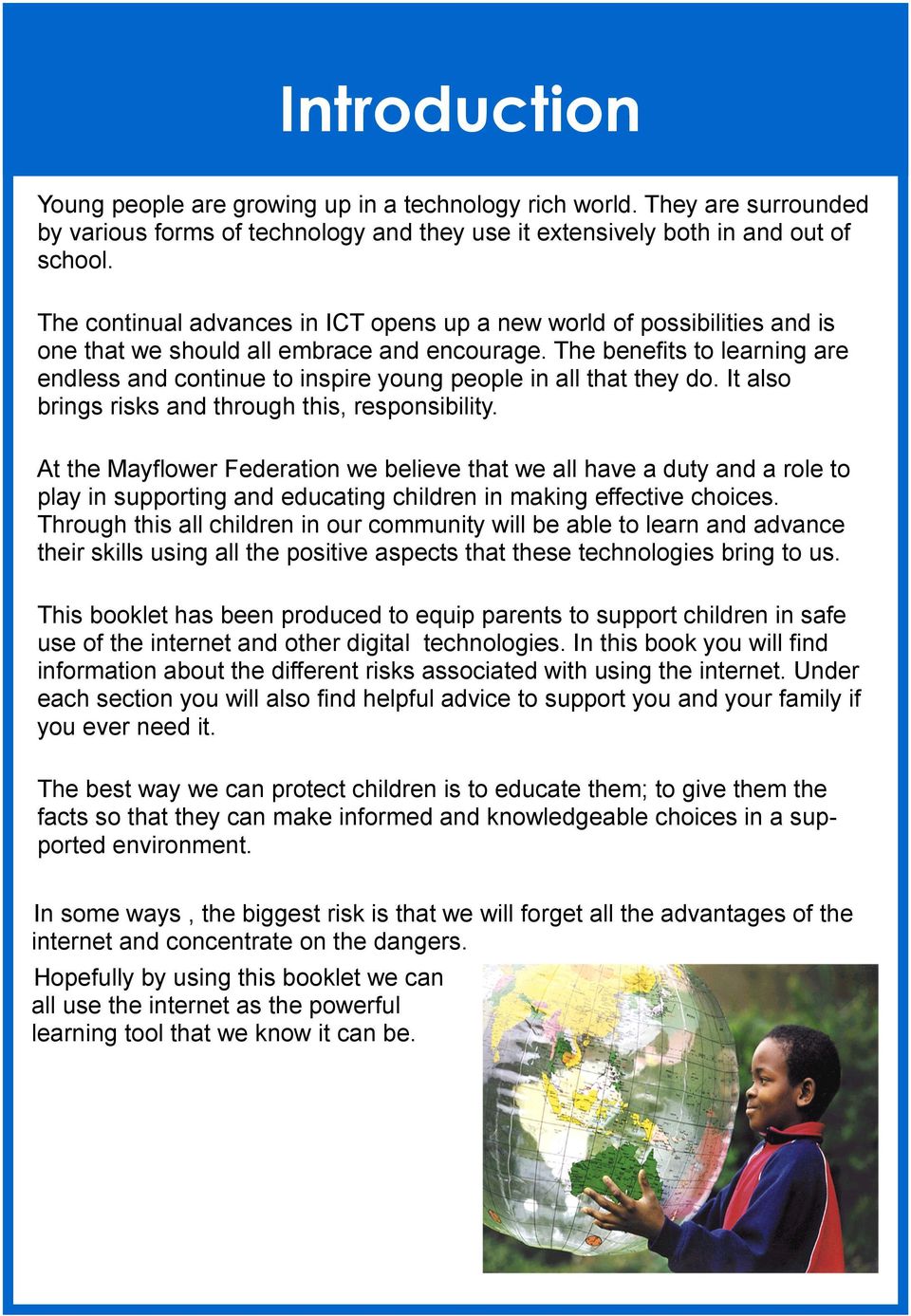
2 Introduction Young people are growing up in a technology rich world. They are surrounded by various forms of technology and they use it extensively both in and out of school. The continual advances in ICT opens up a new world of possibilities and is one that we should all embrace and encourage. The benefits to learning are endless and continue to inspire young people in all that they do. It also brings risks and through this, responsibility. At the Mayflower Federation we believe that we all have a duty and a role to play in supporting and educating children in making effective choices. Through this all children in our community will be able to learn and advance their skills using all the positive aspects that these technologies bring to us. This booklet has been produced to equip parents to support children in safe use of the internet and other digital technologies. In this book you will find information about the different risks associated with using the internet. Under each section you will also find helpful advice to support you and your family if you ever need it. The best way we can protect children is to educate them; to give them the facts so that they can make informed and knowledgeable choices in a supported environment. In some ways, the biggest risk is that we will forget all the advantages of the internet and concentrate on the dangers. Hopefully by using this booklet we can all use the internet as the powerful learning tool that we know it can be.
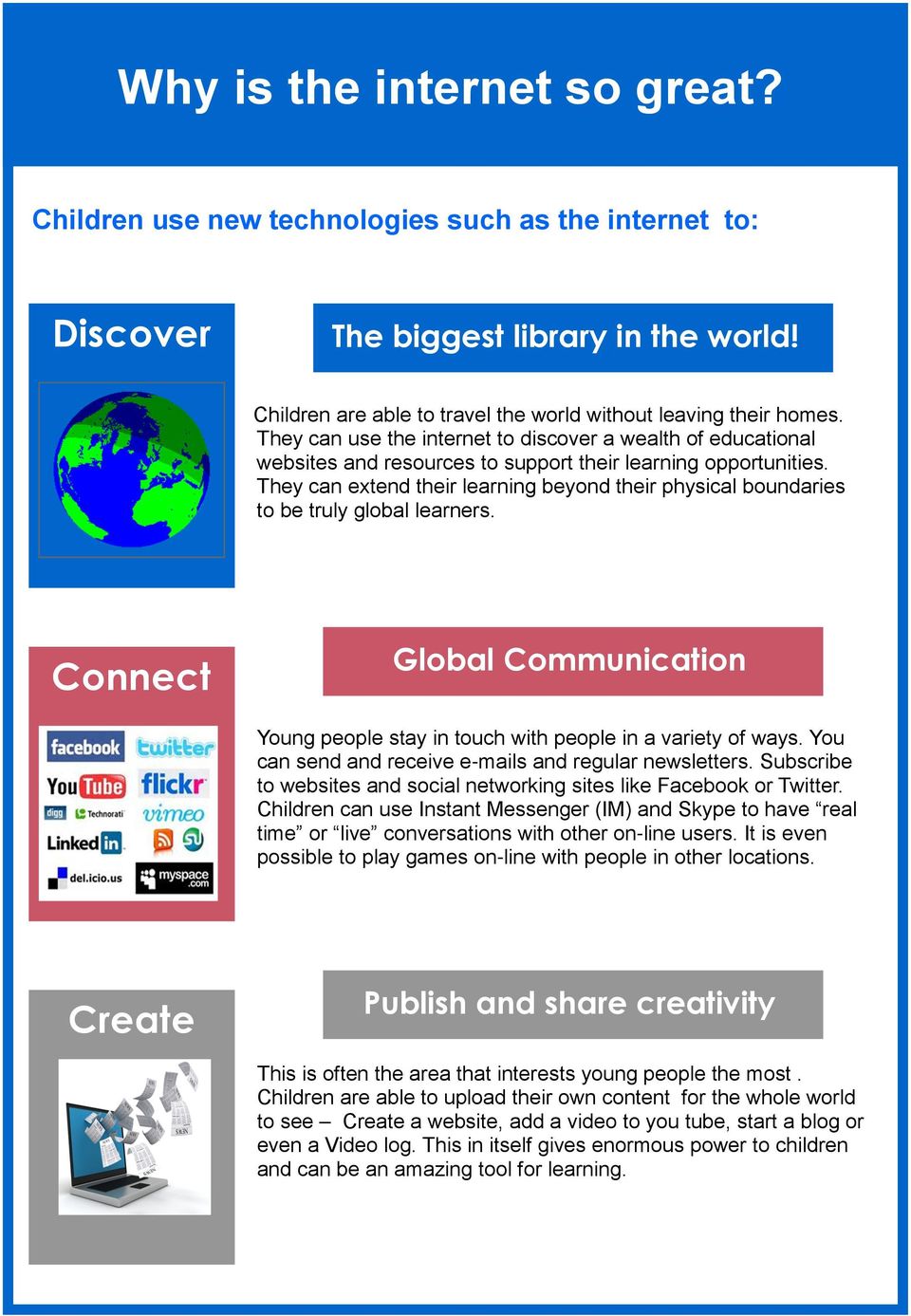
3 Why is the internet so great? Children use new technologies such as the internet to: Discover The biggest library in the world! Children are able to travel the world without leaving their homes. They can use the internet to discover a wealth of educational websites and resources to support their learning opportunities. They can extend their learning beyond their physical boundaries to be truly global learners. Connect Global Communication Young people stay in touch with people in a variety of ways. You can send and receive s and regular newsletters. Subscribe to websites and social networking sites like Facebook or Twitter. Children can use Instant Messenger (IM) and Skype to have real time or live conversations with other on-line users. It is even possible to play games on-line with people in other locations. Create Publish and share creativity This is often the area that interests young people the most. Children are able to upload their own content for the whole world to see Create a website, add a video to you tube, start a blog or even a Video log. This in itself gives enormous power to children and can be an amazing tool for learning.

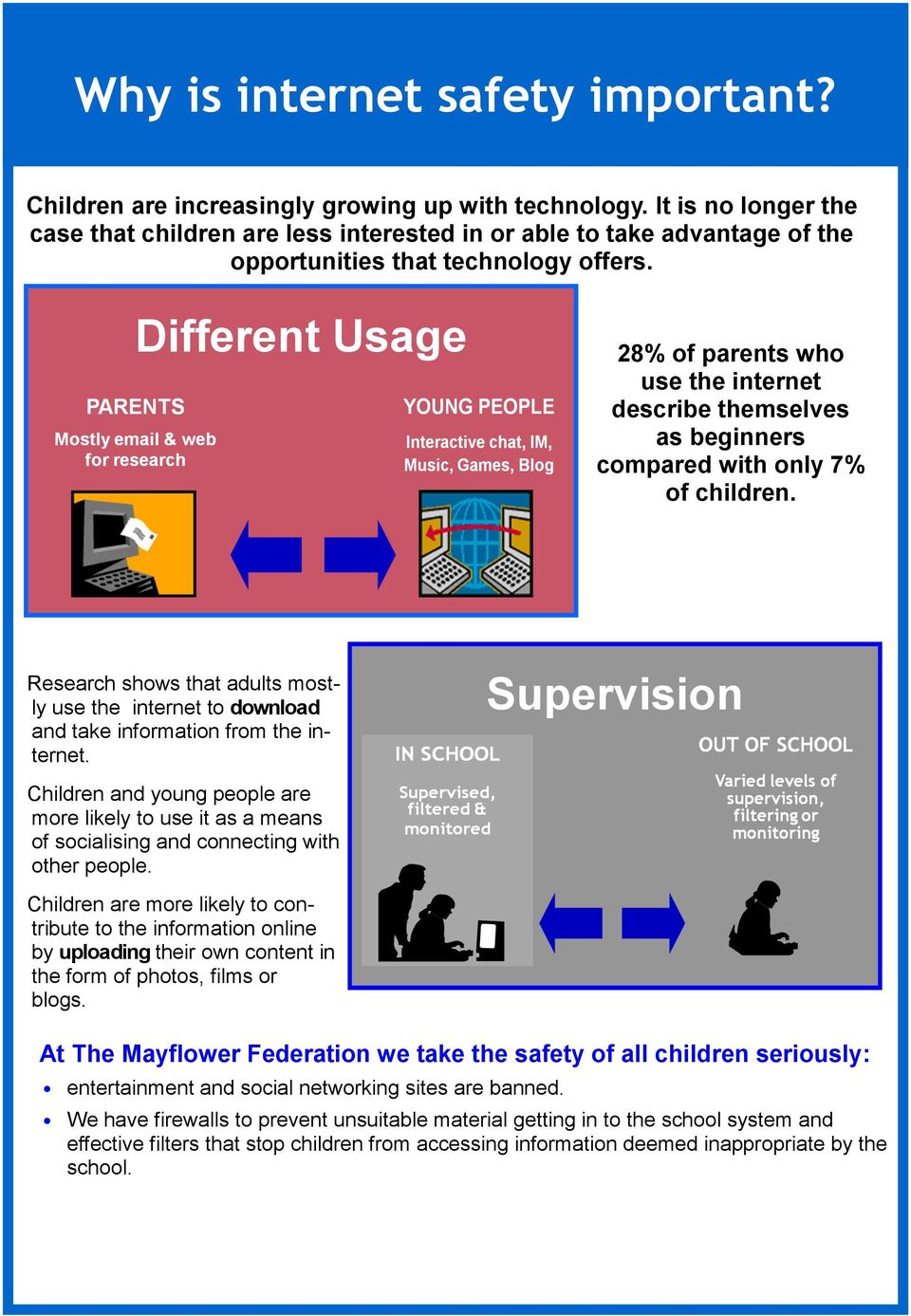
4 Why is internet safety important? Children are increasingly growing up with technology. It is no longer the case that children are less interested in or able to take advantage of the opportunities that technology offers. Different Usage 28% of parents who use the internet describe themselves as beginners compared with only 7% of children. Research shows that adults mostly use the internet to download and take information from the internet. Supervision Children and young people are more likely to use it as a means of socialising and connecting with other people. Children are more likely to contribute to the information online by uploading their own content in the form of photos, films or blogs. At The Mayflower Federation we take the safety of all children seriously: entertainment and social networking sites are banned. We have firewalls to prevent unsuitable material getting in to the school system and effective filters that stop children from accessing information deemed inappropriate by the school.
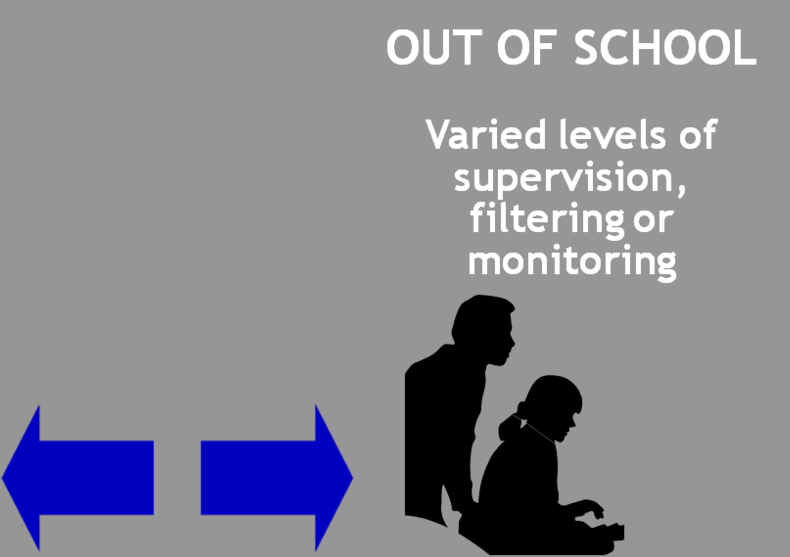
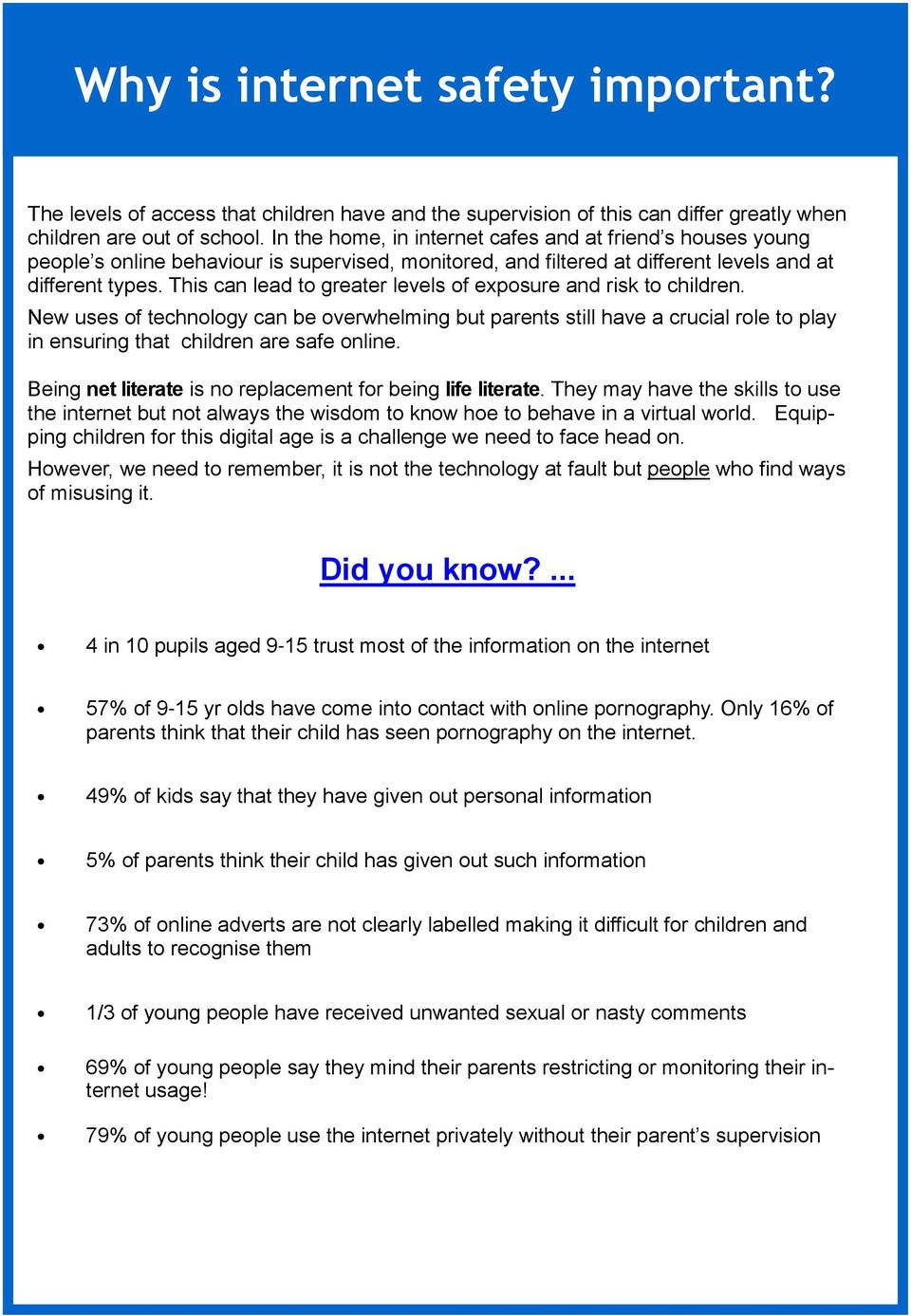
5 Why is internet safety important? The levels of access that children have and the supervision of this can differ greatly when children are out of school. In the home, in internet cafes and at friend s houses young people s online behaviour is supervised, monitored, and filtered at different levels and at different types. This can lead to greater levels of exposure and risk to children. New uses of technology can be overwhelming but parents still have a crucial role to play in ensuring that children are safe online. Being net literate is no replacement for being life literate. They may have the skills to use the internet but not always the wisdom to know hoe to behave in a virtual world. Equipping children for this digital age is a challenge we need to face head on. However, we need to remember, it is not the technology at fault but people who find ways of misusing it. Did you know?... 4 in 10 pupils aged 9-15 trust most of the information on the internet 57% of 9-15 yr olds have come into contact with online pornography. Only 16% of parents think that their child has seen pornography on the internet. 49% of kids say that they have given out personal information 5% of parents think their child has given out such information 73% of online adverts are not clearly labelled making it difficult for children and adults to recognise them 1/3 of young people have received unwanted sexual or nasty comments 69% of young people say they mind their parents restricting or monitoring their internet usage! 79% of young people use the internet privately without their parent s supervision
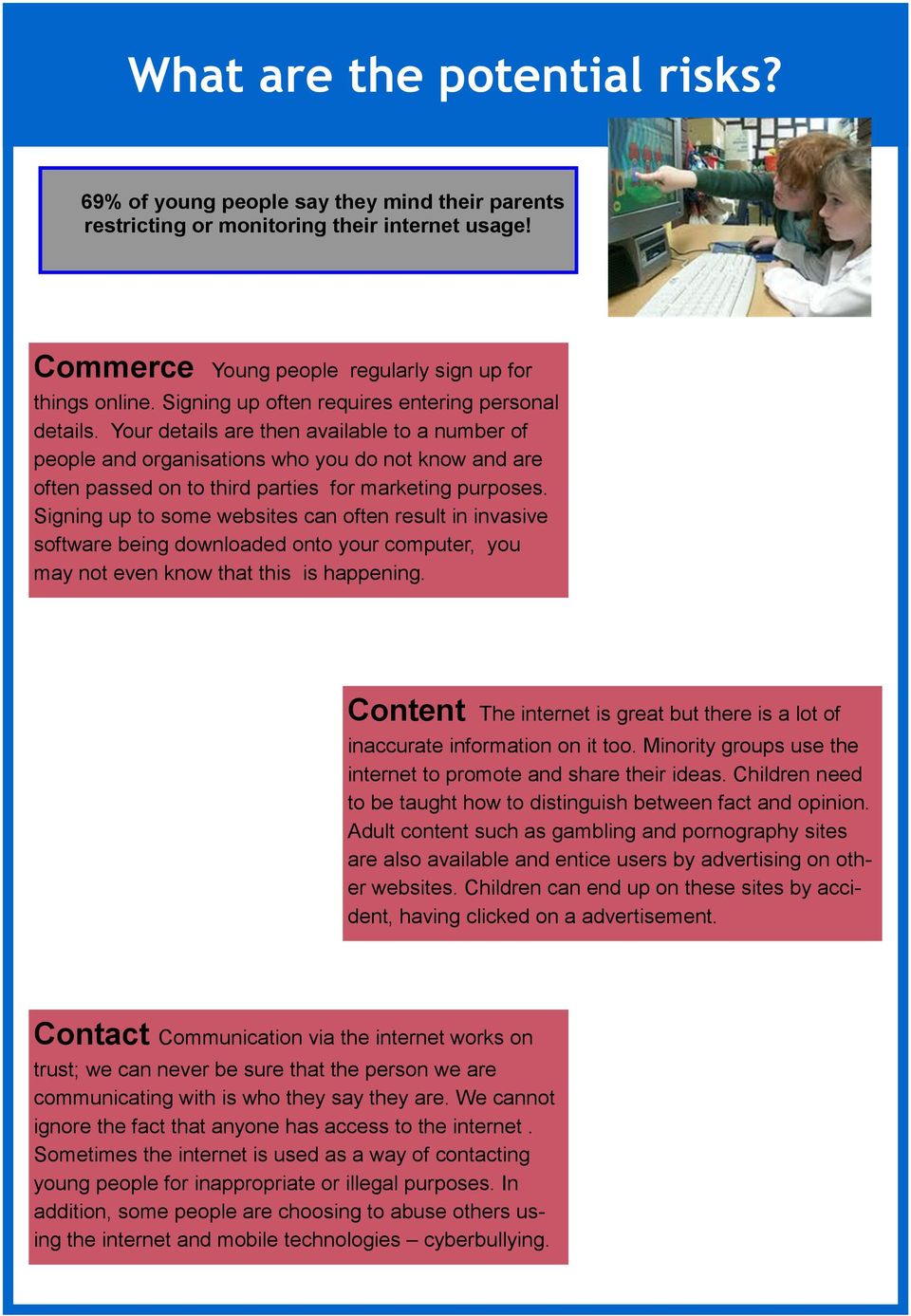
6 What are the potential risks? 69% of young people say they mind their parents restricting or monitoring their internet usage! Commerce Young people regularly sign up for things online. Signing up often requires entering personal details. Your details are then available to a number of people and organisations who you do not know and are often passed on to third parties for marketing purposes. Signing up to some websites can often result in invasive software being downloaded onto your computer, you may not even know that this is happening. Content The internet is great but there is a lot of inaccurate information on it too. Minority groups use the internet to promote and share their ideas. Children need to be taught how to distinguish between fact and opinion. Adult content such as gambling and pornography sites are also available and entice users by advertising on other websites. Children can end up on these sites by accident, having clicked on a advertisement. Contact Communication via the internet works on trust; we can never be sure that the person we are communicating with is who they say they are. We cannot ignore the fact that anyone has access to the internet. Sometimes the internet is used as a way of contacting young people for inappropriate or illegal purposes. In addition, some people are choosing to abuse others using the internet and mobile technologies cyberbullying.
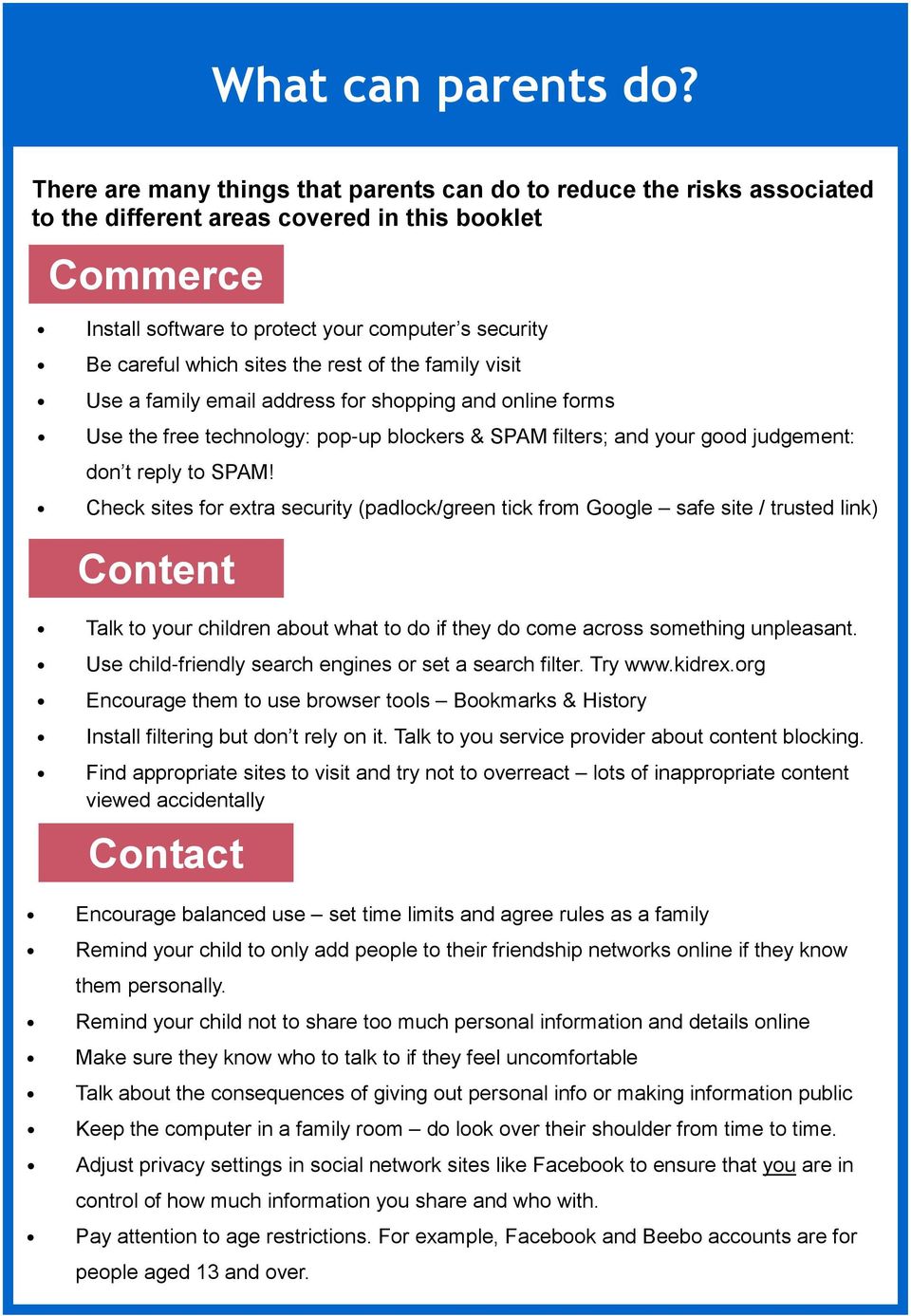
7 What can parents do? There are many things that parents can do to reduce the risks associated to the different areas covered in this booklet Commerce Install software to protect your computer s security Be careful which sites the rest of the family visit Use a family address for shopping and online forms Use the free technology: pop-up blockers & SPAM filters; and your good judgement: don t reply to SPAM! Check sites for extra security (padlock/green tick from Google safe site / trusted link) Content Talk to your children about what to do if they do come across something unpleasant. Use child-friendly search engines or set a search filter. Try Encourage them to use browser tools Bookmarks & History Install filtering but don t rely on it. Talk to you service provider about content blocking. Find appropriate sites to visit and try not to overreact lots of inappropriate content viewed accidentally Contact Encourage balanced use set time limits and agree rules as a family Remind your child to only add people to their friendship networks online if they know them personally. Remind your child not to share too much personal information and details online Make sure they know who to talk to if they feel uncomfortable Talk about the consequences of giving out personal info or making information public Keep the computer in a family room do look over their shoulder from time to time. Adjust privacy settings in social network sites like Facebook to ensure that you are in control of how much information you share and who with. Pay attention to age restrictions. For example, Facebook and Beebo accounts are for people aged 13 and over.
8 Cyber bullying What you should know and how to deal with it What is Cyber bullying? Cyber bullying is a growing problem with children of a younger age each year. Schools are increasingly dealing with issues that take place outside of school hours and related to the use of technology. Cyber bullying can occur in different ways and at different times. It can be via , text or instant messenger. It can happen during schooldays, at weekends, day or night. It can be by someone you know or someone you don t. It can be a one off incident or a more regular occurrence. It can include any of the following: Threats and intimidation Threats sent to people by mobile phone, , or online. Harassment or stalking Vilification and prejudice Repeated, prolonged, unwanted contact or monitoring of another person. These may be general insults, racist, homophobic or sexist bullying. This can also include peer rejection and exclusion of one person from a group Identity theft, unauthorised access and impersonation Hacking by finding out or guessing a username and password. Publicly posting, sending or forwarding information or images Disclosing information without consent on a website. Manipulation May involve getting people to act or talk in a provocative way. This may also involve the use of inappropriate images and other forms of content.

9 Cyber bullying What you should know and how to deal with it How can you help? If you do think that a child in your care is the target of cyber bullying you can take action by following the advice set out below: Be careful not to deny access. Children may feel reluctant to tell adults they are the victim of cyber bullying if they think that their mobile phone or access to online services may be taken away from them. Remind your child that they must not give their mobile phone number to anyone that they do not trust. Ensure that your child hands their mobile phone in at the school reception each day at school. This is the only way Schools have of reducing the risk of inappropriate contact during the school day. Try to get involved and understand the services or applications children are using. This will help you to better support them if things go wrong. Talk to your child about the dangers of cyber bullying to ensure they are aware of what to do in order to prevent cyber bullying from occurring or responding to it if it does occur. Encourage your child to download the CEOP Report Abuse button onto their online profiles. By pressing this button at anytime abusive content can be monitored by the Police authorities. Finally, know that you can report this behaviour to a number of places; The providers of technology have responsibilities to ensure that users are safe and do have policies in place for user s protection. And if the bullying is serious or you need help in identifying the bully then the police may be called upon to help resolve the situation.
10 What about mobiles? Anything that can be accessed online, positive or negative, can also be accessed via a mobile phone. With the added considerations that mobile phones are often constantly switched on and that many young people use their mobile phone for calls, texts, online chat away from adult supervision, the portable nature of mobile phones in some ways makes them much more difficult for parents to supervise than computers. Two of the main problems with mobile phones is the increased risk of cyber bullying. And sexting. Young people naturally want to share their contact details and pictures with other people. Children need to be aware of when this is appropriate and when it is not. Once children share images and contacts it is often hard to keep track of who exactly has access to your mobile number and personal information. How can you help? If your child needs to have a mobile phone only buy one with the essential features instead of all the latest technology and gadgets. Know how your child s phone works (e.g. Bluetooth, Internet access) Agree the type of content that you would be happy for them to download, knowingly receive or send on to others Save any abusive messages/inappropriate images for evidence purposes Remind your child not to give their telephone number to people that they do not know. Encourage balanced use switching off at mealtimes, bedtime. Sexting If your child receives an indecent image or text from someone, encourage them not to send this image on to others. Tell your children they need to report it to a responsible adult. If you know that an indecent image of a child has been posted in the online environment, you will need to contact the service provider, such as Facebook, or Youtube to have it removed. You can do this by visiting their safety centres and following their reporting links.
11 Want more advice? There are lots of organizations that offer more detailed and in depth advice and support on these and many other related issues. For more advice and information go to: your mobile phone operator your Internet Service Provider Child exploitation and online protection centre: Think U know - Guide to internet safety : CEOP and Think u know are Government run websites aimed at promoting e- safety with parents and children. The CEOP Report Abuse button can be downloaded from here. Childnet International: Digizen Safe social networking advice for children:
E-Safety Issues and Online Safety
 E-Safety Issues and Online Safety Parents Evening Aims of This Presentation To look at how your children use the internet To raise your awareness of online safety To provide guidance on online safety and
E-Safety Issues and Online Safety
 E-Safety Issues and Online Safety Parents Evening Aims of This Presentation To look at how your children use the internet To raise your awareness of online safety To provide guidance on online safety and
Simon Langton Grammar School for Boys E-Safety Policy
 Background to the Policy Simon Langton Grammar School for Boys E-Safety Policy The E Safety Policy and its implementation will be reviewed annually. Our E Safety Policy has been written by the school,
SOCIAL NETWORKING SITES
 YOUNG PEOPLE AND SOCIAL NETWORKING SITES A GUIDE FOR PARENTS, CARERS & TEACHERS ABOUT SOCIAL NETWORKING SITES Social networking sites such as Facebook, MySpace and Twitter, are very popular with children,
E-Safety Issues and Online Safety. Parents Evening
 E-Safety Issues and Online Safety Parents Evening To look at how your children use the internet To raise your awareness of online safety To provide guidance on online safety and privacy for your children
This document has been produced following a request from the Hft National Speak Out Group for help with staying safe when using the internet.
 This document has been produced following a request from the Hft National Speak Out Group for help with staying safe when using the internet. Hft Safeguarding Group commissioned a member of Hft National
HOW TO STAY SAFE. Smartphones
 HOW TO STAY SAFE Smartphones Smartphones provide a variety of interesting activities and ways for young people to engage with their friends and families. However, it is important to be aware of what these
How To Deal With Social Media At Larks Hill J & I School
 LARKS HILL JUNIOR & INFANT SCHOOL Social Media Policy Written: Reviewed Autumn Term 2015 Larks Hill J & I School Social Media Policy 1. Introduction For the purposes of this policy, social media refers
Networking and Social Media Policy
 Networking and Social Media Policy 1 Objectives This policy sets out the Millfields Community School policy on social networking. New technologies are an integral part of our lives and are powerful tools
Chatroom and messaging safety Staying away from pornography Avoiding internet bullying. Keeping your child safe on the. internet
 Chatroom and messaging safety Staying away from pornography Avoiding internet bullying Keeping your child safe on the internet AT A GLANCE Using the internet and messaging safely Not everyone who uses
Parents guide to online safety. Practical, issue-focussed information and advice for parents of children of all ages.
 Parents guide to online safety Practical, issue-focussed information and advice for parents of children of all ages. Cybersmart is a national cybersafety education program managed by the Australian Communications
Social Networking Sites like Facebook, MSN
 Most people, young and old, can use a computer and mobile phone these days. Using computers, mobile phones, Tablets (like the ipad) and the internet can be fun and let you keep in touch with friends and
Cyber safety Parent Easy Guide 63
 Cyber safety Parent Easy Guide 63 The online world is part of everyday life for many children and young people. It is a huge virtual playground where they can play, learn and socialise. It can be accessed
Internet Safety/CIPA Lesson Plan
 Internet Safety/CIPA Lesson Plan Social Networking Overview Students need to safely use the Internet for learning, socializing, and for preparing for college and work. While firewalls, antivirus software,
St Bernadette s Catholic Primary School. E-Safety Policy
 St Bernadette s Catholic Primary School E-Safety Policy St Bernadette s Catholic Primary School - e-safety policy Our Vision St Bernadette s Catholic Primary School embrace the positive impact and educational
September 2015 2 A 8.1 - Anti Bullying (Cyber Bullying) version 9
 Cyber-bullying The rapid development of, and widespread access to, technology has provided a new medium for virtual bullying, which can occur in or outside school. Cyber-bullying is a different form of
FIRBANK GRAMMAR SCHOOL
 FIRBANK GRAMMAR SCHOOL TECHNOLOGY GUIDELINES AND PROCEDURES FOR THE USE OF TECHNOLOGY STUDENTS Updated 2014 1 FIRBANK GRAMMAR SCHOOL Table of Contents POLICY FOR THE ACCEPTABLE USE OF TECHNOLOGY - students...
Common Facebook issues
 Common Facebook issues and how to resolve them Introduction Love it or loathe it, with over 28 million users in the UK alone, Facebook cannot be ignored. It is the social network of choice for many young
EMERSON PARK ACADEMY
 1 ACCEPTABLE USE POLICY (AUP) EMERSON PARK ACADEMY (Signature of Headteacher) 1 St September 2014 2 ACCEPTABLE USE POLICY EMERSON PARK ACADEMY 'Acceptable and Responsible Use of ICT Resources' Contents
Acceptable Use of ICT Policy. Staff Policy
 Acceptable Use of ICT Policy Staff Policy Contents INTRODUCTION 3 1. ACCESS 3 2. E-SAFETY 4 3. COMPUTER SECURITY 4 4. INAPPROPRIATE BEHAVIOUR 5 5. MONITORING 6 6. BEST PRACTICE 6 7. DATA PROTECTION 7 8.
Affirmative Action Presentation
 Affirmative Action Presentation Woodbridge Township School District A Guide to Social Media, Schools, and the Law. Woodbridge Township School District Staff Development 2012-2013 To provide school personnel,
Cybersmart Guide for Families
 Australia s regulator for broadcasting, the internet, radiocommunications and telecommunications www.acma.gov.au Cybersmart Guide for Families Safe internet use in the library and at home Introduction
Guideline on Windows 7 Parental Controls
 CMSGu2012-01 Mauritian Computer Emergency Response Team CERT-MU SECURITY GUIDELINE 2011-02 Enhancing Cyber Security in Mauritius Guideline on Windows 7 Parental Controls National Computer Board Mauritius
Archbishop Beck Catholic Sports College
 Archbishop Beck Catholic Sports College E Safety Policy Ratified: May 2014 Ratified by: Governors Staffing Committee Review: May 2017-1 - - 2 - 1. Development/Monitoring/Review of this Policy This e-safety
STOP. THINK. CONNECT. Online Safety Quiz
 STOP. THINK. CONNECT. Online Safety Quiz Round 1: Safety and Security Kristina is on Facebook and receives a friend request from a boy she doesn t know. What should she do? A. Accept the friend request.
Dulwich College ICT Acceptable Use Policy
 Dulwich College ICT Acceptable Use Policy Our Acceptable Use Policy is an extension to the College Rules. Dulwich College provides a computing network which allows a range of devices to be used. These
Social Networking Policy
 Feltonfleet School Social Networking Policy Introduction Objectives This policy sets out Feltonfleet School s policy on social networking. New technologies are an integral part of our lives and are powerful
EADS up. stop think connect
 EADS up stop think connect table of contents 2 4 8 12 Share with Care Interact with Tact The Protection Connection Word Search You text, you play games, you share photos and video. You update your status,
EASTNOR PAROCHIAL PRIMARY SCHOOL STAFF SOCIAL NETWORKING POLICY. Inspire and Achieve
 EASTNOR PAROCHIAL PRIMARY SCHOOL STAFF SOCIAL NETWORKING POLICY Inspire and Achieve Introduction This document sets out the guidance on social networking and aims to: Set clear expectations of behaviour
Policies & Procedures. Moat Community College E-Safety Policy
 Moat Community College E-Safety Policy Vision Statement Moat Community College embraces the positive impact and educational benefits that can be achieved through appropriate use of the Internet and associated
A parents guide to being Share Aware. Helping you to keep your child safe online
 A parents guide to being Share Aware Helping you to keep your child safe online We tell children it s good to share, but online it s different. That s why we re asking parents to be Share Aware. Help keep
How To Ensure Your School Is Safe Online
 Ivy Road Primary School Policy for e-safety Updated - 2014 1. Introduction Pupils interact with the internet and other communications technologies such as mobile phones on a daily basis. The exchange of
WORTHING COLLEGE STUDENT IT SECURITY POLICY. October 2014
 WORTHING COLLEGE STUDENT IT SECURITY POLICY October 2014 Policy name Student Information Technology Security Policy Author: Lesley May/Michael Perry Approved by SLT October 2014 Approved by Corporation
Digital Citizenship Lesson Plan
 Digital Citizenship Lesson Plan This course is to help people to understand how to use the Internet in a safe, productive way. Additional resources and links are available on the TechTECS website. http://techtecs.com/digital-citizenship
e-safety for Parents
 e-safety for Parents Helenswood Academy Published June 2014 1 Contents Introduction 4 The Web 5 Children online 6 Friends of your child 7 Information about your child 8 Ownership of your child s technology
Cyber Safety for Parent Involvement Council. Sandi Paul Director of Technology Edward Aguiles Director of Curriculum and Instruction
 Cyber Safety for Parent Involvement Council Sandi Paul Director of Technology Edward Aguiles Director of Curriculum and Instruction Topics for Presentation Parent Habits Poll Everywhere quiz Stats on actual
Protect yourself online
 Protect yourself online Advice from Nottinghamshire Police s Pre Crime Unit Get daily updates: www.nottinghamshire.police.uk www.twitter.com/nottspolice www.facebook.com/nottspolice www.youtube.com/nottinghampolice
Cyber-Safe Kids Cyber-Savvy Teens
 Cyber-Safe Kids Cyber-Savvy Teens Helping Young People Learn to Make Safe and Responsible Choices Online By Nancy E. Willard Author of: Cyber-Safe Kids, Cyber-Savvy Teens: Helping Young People Learn to
[Name of School] E-safety policy
![[Name of School] E-safety policy](/thumbs/30/14454703.jpg "[Name of School] E-safety policy") [Name of School] E-safety policy Adopted: Review date: Note: Blue boxes contain advisory notes which should be read and deleted. These indicate where schools need to make decisions or choices. This policy
[Name of School] E-safety policy Adopted: Review date: Note: Blue boxes contain advisory notes which should be read and deleted. These indicate where schools need to make decisions or choices. This policy
John of Rolleston Primary School
 John of Rolleston Primary School E-Safety Policy February 2014 Contents 1 Introduction... 2 2 Aims... 2 3 Roles and Responsibilities... 2 3.1 Governors... 2 3.2 The Headteacher... 2 3.3 The Senior Leadership
By Augusta Epuli Anjoh April 2013 Cyber security forum 2013
 By Augusta Epuli Anjoh April 2013 Cyber security forum 2013 What is a cyber space? The electronic medium of computer networks, in which online communication takes place. The American Heritage Science Dictionary
ICT Acceptable use Policy. Coláiste Mhuirlinne/ Merlin College Doughiska, Galway City.
 ICT Acceptable use Policy. Coláiste Mhuirlinne/ Doughiska, Galway City. Ratified by the Board of Management on 27 th May, 2015 Table of Contents Introduction... 2 General... 2 Internet Use... 3 Email...
Safety Tips for Social Networking
 Internet Safety for Kids & Families Safety Tips for Social Networking As a social medium, the Internet enables young people to stay in touch with friends when they are physically separated from them and
By Shanthi Balraj Ambigapathy Pandian Mohammed Zin Nordin Sumetha Nagalingam Julina Ismail
 By Shanthi Balraj Ambigapathy Pandian Mohammed Zin Nordin Sumetha Nagalingam Julina Ismail Introduction New Media Landscape New Media Culture Contributes to New Meanings, Messages, Norms, Values, Interactions
Social Networking Policy
 Social Networking Policy Policy Date June 2013 Review Date June 2015 Section 1: Introduction 1.1 Objectives 1.1.1 This policy sets out West Row Primary School s policy on social networking. New technologies
Roles and Responsibilities The following section outlines the e-safety roles and responsibilities of individuals and groups within Heath Farm School:
 Introduction This e-safety policy was approved by the School Senior Leadership Team: January2015 The implementation of this e-safety policy will be monitored by the: E-Safety Coordinator, Senior Leadership
Contents. NetSafe 3. Facebook 4. YouTube 6. Google 7. Microsoft 8. Yahoo! 10. Trade Me 12. Twitter 14. Further Reading 17
 Contents NetSafe 3 Facebook 4 YouTube 6 Google 7 Microsoft 8 Yahoo! 10 Trade Me 12 Twitter 14 Further Reading 17 The internet is a part of everyday life for New Zealanders. Four out of five of us spend
FREDERICK BREMER SCHOOL E SAFETY POLICY 2015-6. Date of Issue: June 2015 Ratified: For review:
 FREDERICK BREMER SCHOOL E SAFETY POLICY 2015-6 Date of Issue: June 2015 Ratified: For review: Index Contents Page Number Introduction 3 Aim of the policy 3 Roles and Responsibilities 4 Frederick Bremer
FAMILY GUIDE TO. Mobile Safety. How to keep your children safe and connected in today s mobile world SPONSORED BY:
 FAMILY GUIDE TO Mobile Safety How to keep your children safe and connected in today s mobile world SPONSORED BY: Is Your Child Ready for a Mobile Phone? MOBILE PHONES ARE PART OF OUR LIVES. They re powerful
Online Safety How to Protect Yourself and Your Family
 Online Safety How to Protect Yourself and Your Family Introduction Surfing the internet can be a very positive experience, it opens up a world of possibilities for everyone, expanding our horizons by exposing
Computer Facilities and External Networks Acceptable Use by Students
 Related Policies Copyright Media Usage Offshore Data Hosting Privacy Web Publishing Purpose Policy Computer facilities and external networks are made available as resources for use by students in Catholic
Great Horwood C.E. Combined School E-Safety/ ICT Acceptable Use Policy
 Great Horwood C.E. Combined School E-Safety/ ICT Acceptable Use Policy November 2013 This policy was adopted on:... Date of last review:... Signed:... Great Horwood C.E. Combined School Page 1 Acceptable
Sibford School Student Computer Acceptable Use Policy
 Introduction Sibford School Student Computer Acceptable Use Policy The use of the latest technology is actively encouraged at Sibford School but with this comes a responsibility to protect both students
Finchley Catholic High School. Anti Bullying Policy
 Finchley Catholic High School Anti Bullying Policy Bullying can occur through many types of anti-social behaviour: Physical A student can be physically punched, kicked, hit, spat at etc Verbal This can
E-Safety and Computer Security Rules
 E-Safety and Computer Security Rules Process / Signatures Portfolio Team Portfolio Team Lead Principal Chair of Governors Behaviour Safety & Ethos Mrs K Mitford Dr J V Edwards Mrs K Mitford Presented 2
4. The Importance of Internet Use in the Primary Curriculum
 Policy Contents 1. Introduction 2. Disability 3. Writing and Reviewing the e-safety Policy 4. The Importance of Internet Use in the Primary Curriculum 5. The Benefits of Using the Internet in Education
Sarah Smythe Youth Community Developer Western Ottawa Community Resource Centre. Genevieve Hupe School Resource Officer Ottawa Police Service
 Sarah Smythe Youth Community Developer Western Ottawa Community Resource Centre Genevieve Hupe School Resource Officer Ottawa Police Service From the choices below, which screen name is the worst for
Trinity High School Acceptable Use Policy (AUP) for Computers and the school networks.
 Trinity High School Acceptable Use Policy (AUP) for Computers and the school networks. This policy is divided into 5 main areas: 1. Aims and Objectives of the AUP 2. General Computer Use 3. Use of the
Acceptable Use Policy Holy Spirit Catholic School
 Acceptable Use Policy Holy Spirit Catholic School For the use of Computers, Mobile Devices, Internet Access, Google Apps for Education Suite, and Internet Applications Definitions User includes anyone,
SOCIAL MEDIA IN SCHOOLS. Guidelines for school staff using social media and other technologies. Licenced for NEALS
 SOCIAL MEDIA IN SCHOOLS Guidelines for school staff using social media and other technologies Licenced for NEALS TITLE: Social Media In Schools: Guidelines for school staff using social media and other
Melville Primary School. Bring Your Own ipad Connectable Device Program Usage Policy and Information for Parents and Students
 Melville Primary School Bring Your Own ipad Connectable Device Program Usage Policy and Information for Parents and Students Table of Contents 1 INTRODUCTION 2 DESCRIPTION AND PURPOSE OF THE PROJECT 3
COPPA. How COPPA & Parental Intelligence Systems Help Parents Protect Their Kids Online. The Children s Online Privacy Protection Act
 The Children s Online Privacy Protection Act COPPA How COPPA & Parental Intelligence Systems Help Parents Protect Their Kids Online A uknow White Paper by Tim Woda, co founder of uknow.com, Inc Overview
Appropriate Online Behavior Social Networking Etiquette Cyber Bullying Awareness
 Appropriate Online Behavior Social Networking Etiquette Cyber Bullying Awareness Gordon Cooper Technology Center 2012 From http://onguardonline.gov/ Think Before You Share What you post could have a bigger
Cyberbullying A whole-school community issue
 Cyberbullying A whole-school community issue Introduction Today s children and young people have grown up in a world that is very different from that of most adults. Many young people experience the internet