
Chapter 1 prairiefyre Contact Center Solutions suite. About the 6110 CCM User Guide... 2
|
|
|
- Erica Fox
- 9 years ago
- Views:
Transcription
1 version 3.0 -XQH

2

3 &RQWHQWV Chapter 1 prairiefyre Contact Center Solutions suite Features and benefits Licencing About the 6110 CCM User Guide User guide layout Chapter 1: prairiefyre suite Chapter 2: Call center concepts Chapter 3: Planning and managing your call center Chapter 4: Management Console Chapter 5: YourSite Chapter 6: Real-time Monitors Chapter 7: Reporter and Scheduled Reports Chapter 8: Data-mining Chapter 9: The Enterprise Node (CEN) Chapter 10: Network and Collector Monitors Chapter 11: WallBoarder Chapter 12: 6115 Interactive Contact Center Chapter 13: 6120 Contact Center Scheduling Chapter 14: 6150 Multimedia Contact Center User guide conventions User Interface (UI) syntax The word NOTE: designates essential user information Client downloads from the 6110 CCM Web site Client Downloads Navigating 6110 CCM Viewing multiple sessions of 6110 CCM Chapter 2 Call center concepts The ACD process ACD call flow Call routing Understanding the inbound call environment Random and predicted call arrival Caller tolerance Chapter 3 Planning and managing your call center Step #1 establish a corporate service level objective Service defined Why is service level more meaningful than other metrics? Calculating the service level How do I choose a service level goal? Quality of service Silent monitoring
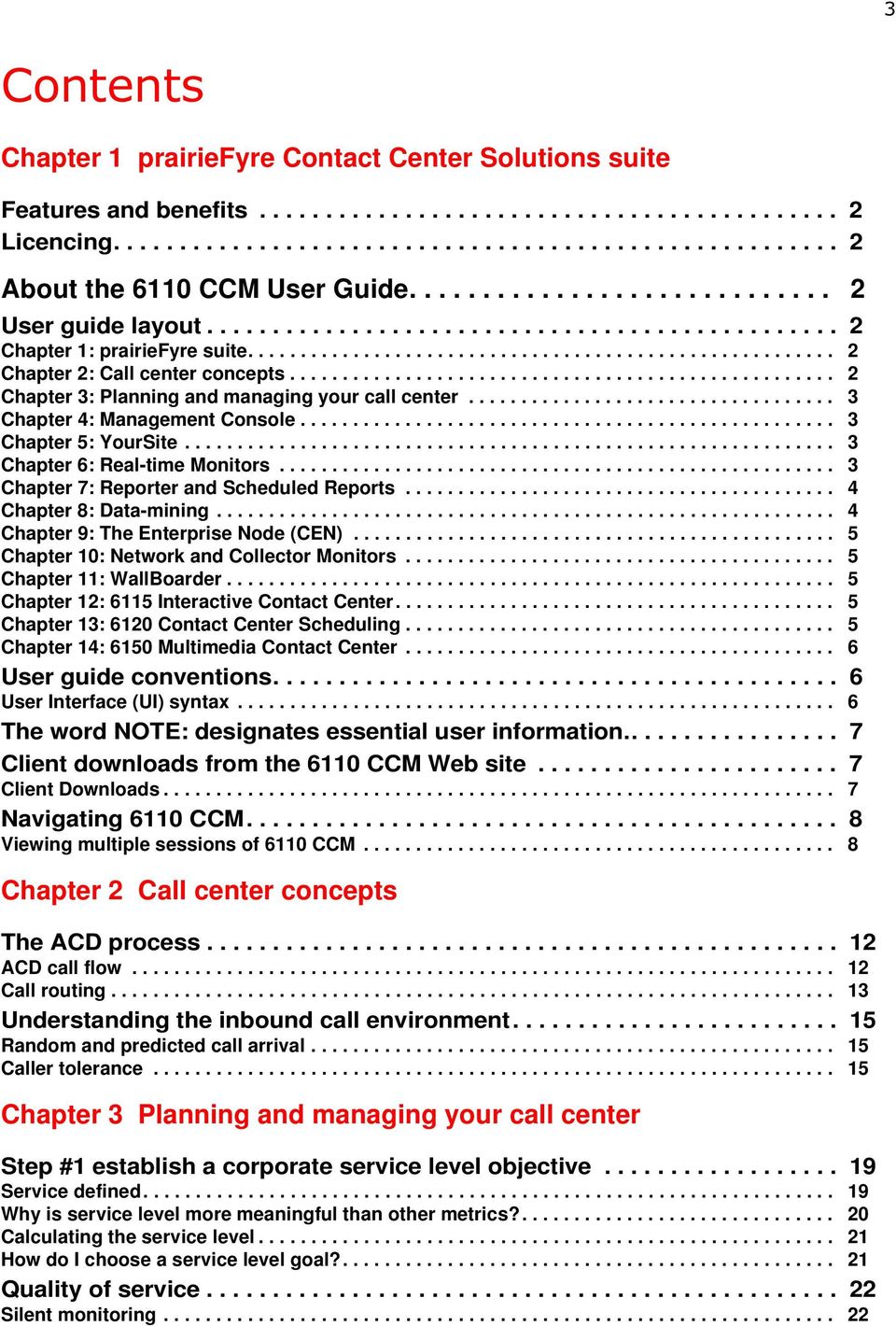
4 Silent monitoring systems IT support systems Step #2 collect data Collecting data on call handling Step #3 forecast the call load The importance of forecasting Conducting a forecast Step #4 calculate required resources Predicting the agent requirement Erlang C Service Level Determining the agent requirement Performing what-if scenarios The relationship between agents and trunks Predicting the trunk requirement Erlang B Determining trunk requirements Step #5 schedule agents The shrinkage factor Creative scheduling Call routing to optimize coverage Scheduling considerations How accurate is your scheduling? Step #6 determine call center costs A breakdown of expenses Cost of delay Cost per call Average call value Anticipating growth Chapter 4 Management Console Using Management Console Enabling the Real-time Demo Simulation on the 6110 CCM Server Gaining access to database menu options System Settings tab Editing registry settings Setting alarms Database tab Quick Configuration Tool for the SX Backing up the YourSite Database Restoring the YourSite Database Backing up the 6110 CCM Database Restoring the 6110 CCM Database Enterprise tab Chapter 5 YourSite Configuration Determining which call center devices to configure

5 Agent tab Adding elements to YourSite Editing YourSite elements Deleting YourSite elements Agent Group tab Dialable Number Adding groups to YourSite Editing YourSite groups Deleting YourSite groups Adding elements to YourSite groups Deleting elements from YourSite groups Team tab Queue tab Queues AnsBy Queue Number Dialable Number Service Level Calls Abandoned Parameter Properties Queue Group tab Extension tab Extension Group tab Trunk tab Trunk Group tab Account Code tab ANI tab DNIS tab DNIS Group tab Employee tab Employee Group tab Make Busy Reason Codes tab Automatic Synchronization with 6115 ICC The effects of Automatic Synchronization Employee IDs/Agent IDs Reporting numbers/dialable numbers New Queues Changing Device names Setting the MiTAI Node Entering the Queue dialable and reporting numbers Setting the re-synchronization time
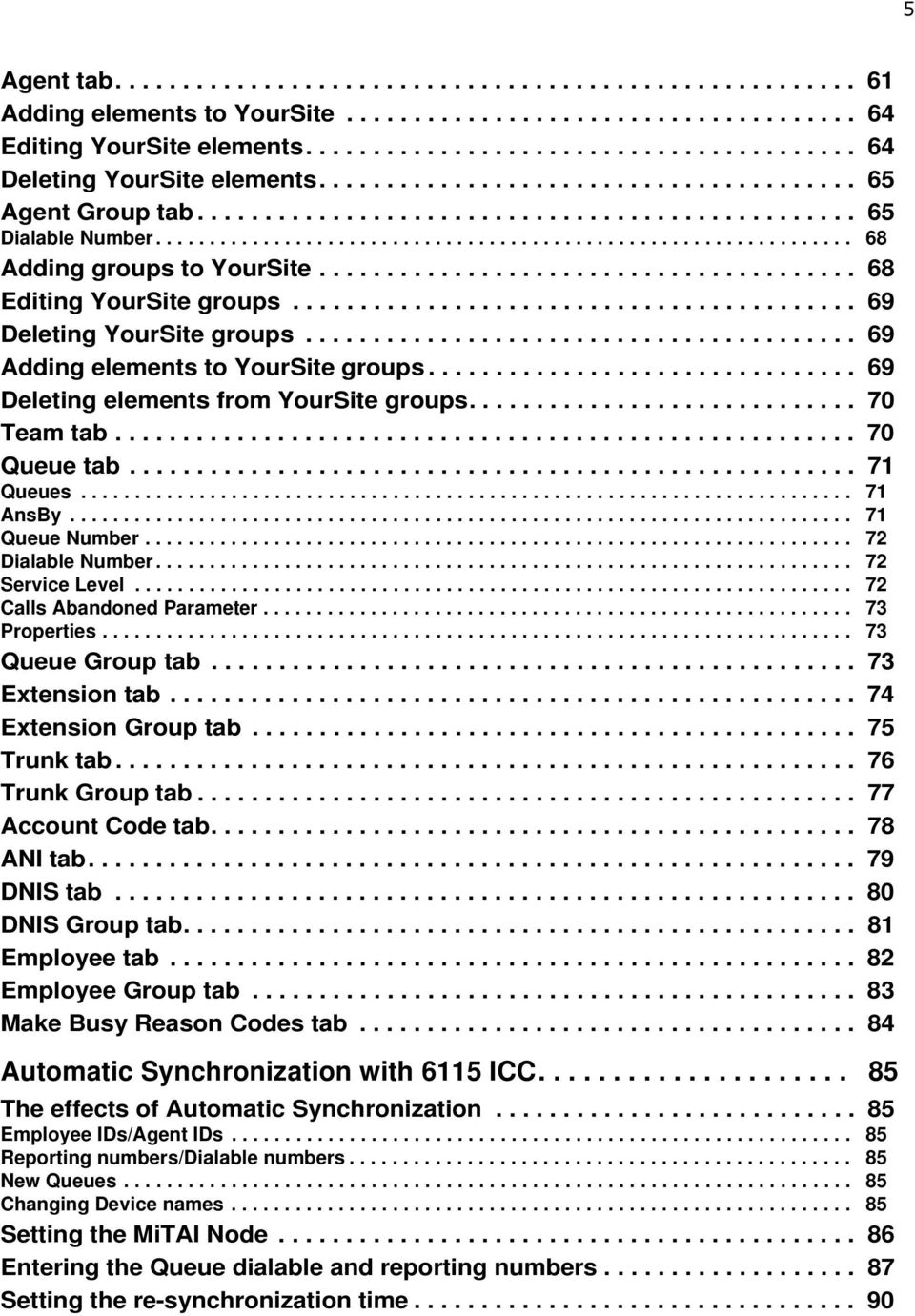
6 Security Creating a Security Role Granting or restricting access to 6110 CCM Creating lists Creating an Advanced Security Role Viewing My Security Role Chapter 6 Real-time monitors SuperAdvisor Grid properties SuperAdvisor monitors Agent State by Position and Employee State by Position grids Agent State by Time and Employee State by Time grids Agent Shift grid Queue by Period grid Queue Now and Queue Group Now grids Call Count by Queue chart Queue Service Level Percent chart Queue Status chart Viewing real-time statistics Adding, rearranging, resizing, and sorting devices Hiding grid fields Defining grid styles Defining chart styles Defining performance thresholds Creating profiles Loading profiles Chatting online in SuperAdvisor AgentAdvisor Installing AgentAdvisor Grid properties AgentAdvisor monitors Agent State by Position and Employee State by Position grids Queue Now grid My Shift grid Viewing real-time statistics Adding, rearranging, resizing, and sorting devices Hiding grid fields Defining grid styles Defining performance thresholds Creating profiles Loading profiles Chatting online in AgentAdvisor CCM InterActive

7 Configuring Make Busy Reason Codes Adding a Make Busy Reason Code Editing a Make Busy Reason Code Deleting a Make Busy Reason Code Agent controls Logging on Logging off Placing agents or yourself in make busy with reason, or do not disturb Removing agents or yourself from make busy with reason, or do not disturb Agent grid controls Logging off Placing all agents or yourself in make busy with reason, or do not disturb Removing all agents or yourself from make busy or do not disturb Queue controls Placing queues in do not disturb Removing queues from do not disturb Queue grid controls Placing all queues in do not disturb Removing all queues from do not disturb CyberTerminal SX-200 connectivity to the 6110 CCM Server Data streams and prairiefyre real-time displays Viewing real-time SX-200 statistics ACD Monitor sessions System Activity monitor Path Summary monitors Agent Group Summary monitors Agent Information monitors Chapter 7 Reporter and Scheduled Reports Run-on-demand reports Generating run-on-demand reports Viewing run-on-demand reports What to do if data is missing from the reports Deleting reports Scheduled Reports Generating a schedule Associating reports to the schedule Generating scheduled reports immediately Viewing scheduled reports What to do if data is missing from the reports Deleting reports Deleting Scheduled Reports

8 licence violations Report Distributor Report types Report parameters Queue Reports Performance Reports Internal External Reports Spectrum by Period Reports Spectrum by Day of the Week Reports Spectrum by Queue Reports ANI Reports Queue Group by Queue with Agent Information Agent Reports Performance Reports Internal/External Reports Event by Period Reports Inbound/Outbound Trace Reports Answering Agent Reports Agent Shift Reports Employee Reports Performance Reports Internal/External Reports Event by Period Reports Team Reports Performance Reports Event by Period Reports Trunk Reports Performance Reports Busy Minutes Reports Extension Reports Performance Reports Sight Reports DNIS Reports Performance Reports Chapter 8 Data-mining tools ACD Inspector ACD search criteria ACD search criteria - agent events ACD search criteria - queue events ACD search criteria - option events ACD search criteria - download status ACD search criteria - advanced Running searches in ACD Inspector

9 Wildcard Searches Interpreting ACD search results Agent Events tab Queue Events tab Option Events tab Exception Events tab Advanced Search tab Examples of ACD records SMDR Inspector SMDR search criteria SMDR search criteria - call parties SMDR search criteria - call types SMDR search criteria - options SMDR search criteria - advanced SMDR search criteria - agent shift SMDR search criteria - download status Running searches in SMDR Inspector Wildcard Searches Interpreting SMDR search results SMDR Search Results tab Advanced Search Results tab Agent Shift Results tab Exception Records tab SMDR record fields Examples of external SMDR records Advanced Inspector Switch related questions Queue related questions Agent related questions SuperAuditor SuperAuditor icons Viewing historical real-time events Chapter CCM Enterprise Node Local and remote collectors Enterprise communications Viewing real-time data collection on the 6110 CCM Enterprise Server Viewing data and system alarms Enabling and disabling the alarm beep Enabling pop-up alerts Re-Initializing the Collector Service Managing call center operations Setting up enterprise services Configuring 6110 CCM enterprise nodes Configuring local and remote collectors on the 6110 CCM Enterprise Server (Los Angeles in this example) Installing and configuring CEN software
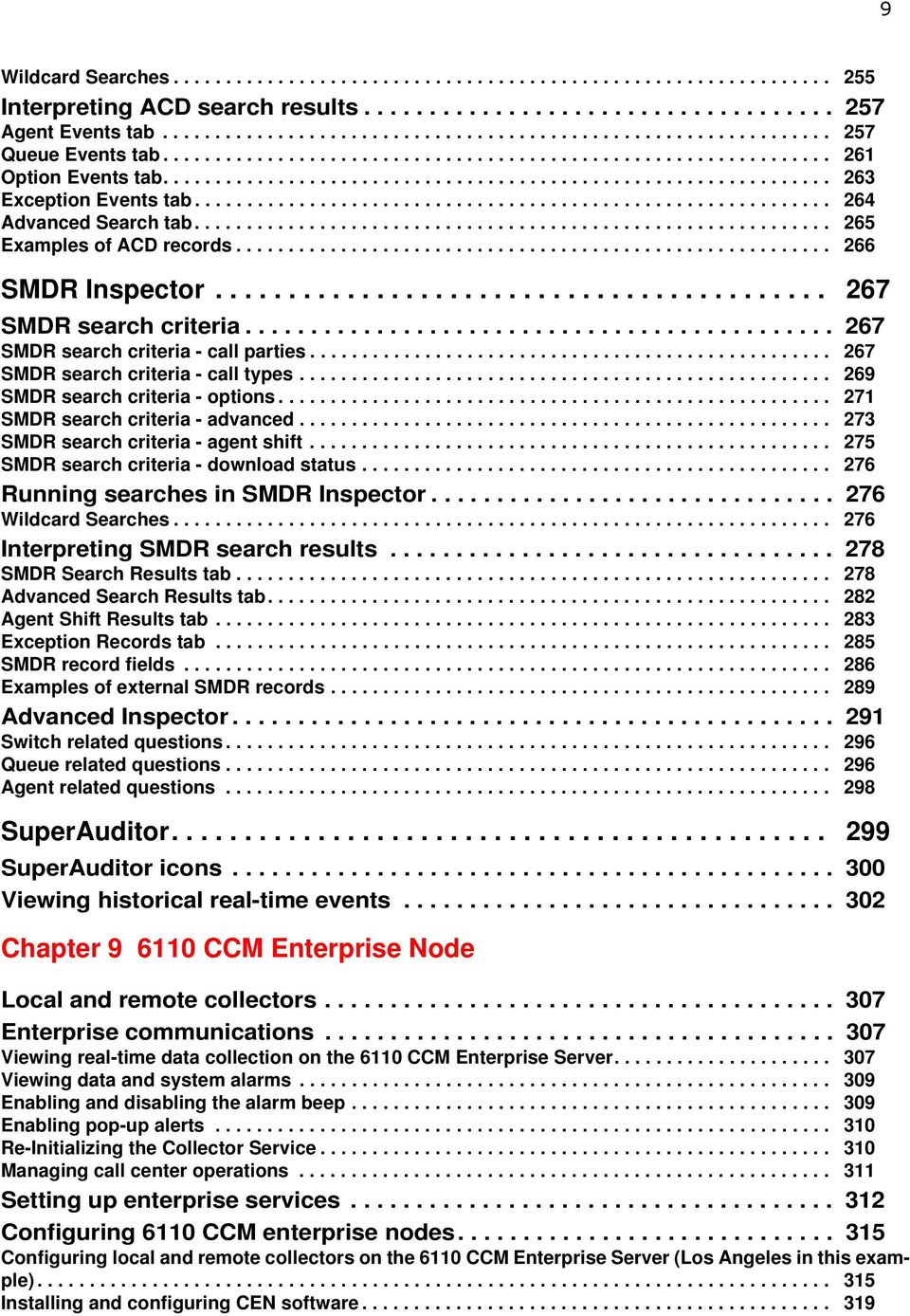
10 Chapter CCM Network and Collector Monitors Network Monitor overview Menu functions Setting the data alarms in the Management Console Enabling pop-up alerts What to do if data is not streaming Re-Initializing the Collector Service Collector Monitor overview Menu functions Starting the Collector Monitor Chapter 11 WallBoarder Spectrum wall sign setup Specifying wall sign comport settings Configuring wall sign messages Maintenance screen Resetting wall signs Variables screen Defining sign variables Messages screen Defining sign messages Groups screen Defining sign groups Priority Messages screen Defining priority messages Chapter 12 4Sight Forecast parameters Generating forecast reports Viewing forecast reports Performing what-if scenarios What to do if data is missing from the reports Deleting reports licence violations Report Distributor CCS Exporting, forecasting, and scheduling agents Chapter 13 Mitel Networks 6150 MCC Configuring 6150 MCC To configure employees Adding Employees
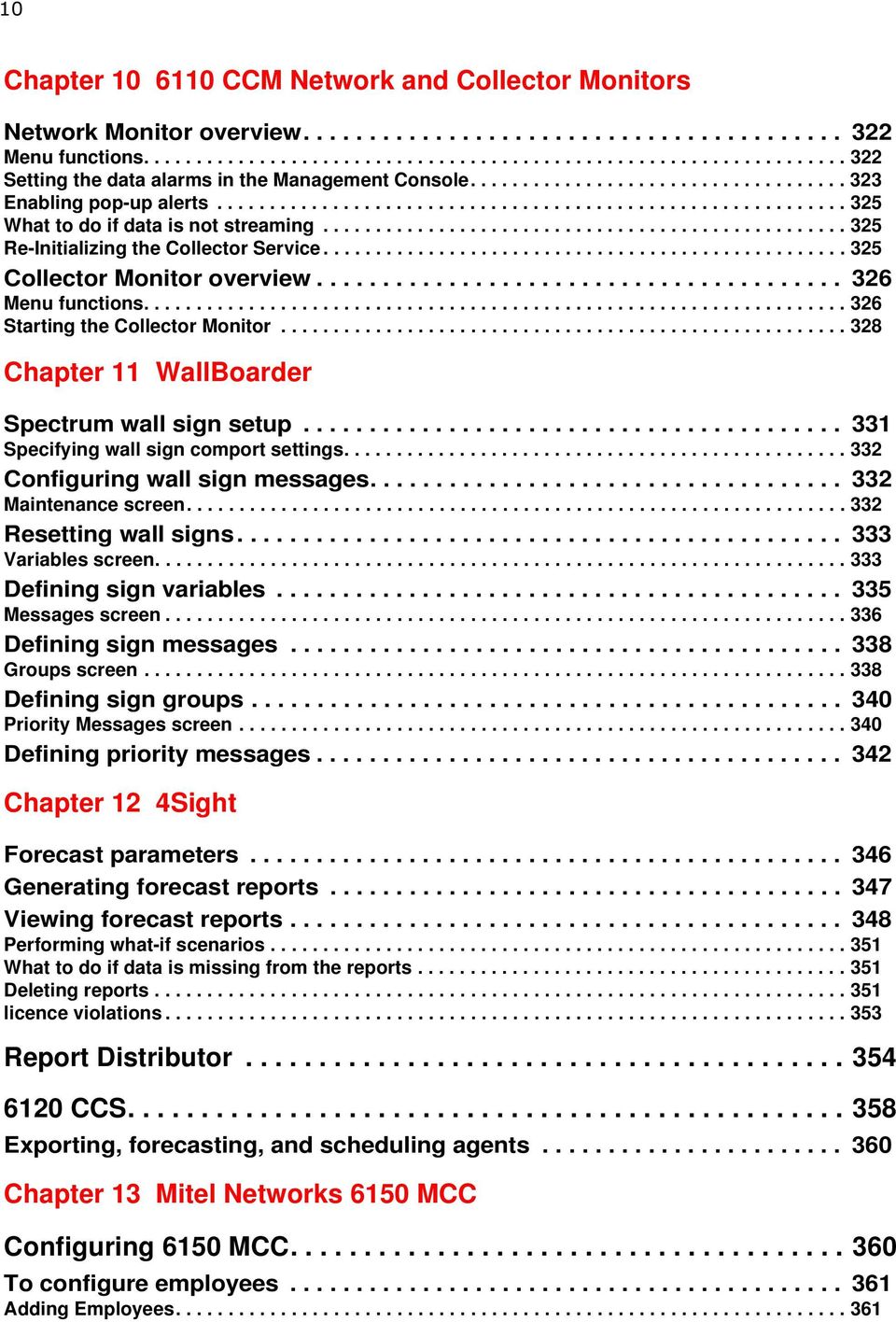
11 Editing Employees Deleting Employees To configure agents Adding Agents Editing Agents Deleting Agents To configure agent groups Adding Agent Groups Editing Agent Groups Deleting Agent Groups To configure members of an agent group Adding an agent to an agent group Removing an agent from an agent group To configure queues Adding Queues Editing Queues Deleting Queues To configure responses Adding Responses Editing Responses Deleting Responses Configuring 6110 CCM To configure Account Codes Adding an Account Code Editing an Account Code Deleting an Account Code To configure Make Busy Reason Codes Adding a Make Busy Reason Code Editing a Make Busy Reason Code Deleting a Make Busy Reason Code Changing 6150 MCC options To change the IP address and port number To open Outlook Opening Outlook Manually loading the 6150 MCC plug-in To view the 6150 MCC inbox when Outlook starts up To display 6150 MCC shortcuts To display the log on window when Outlook 2000 opens To make Outlook your top window when an arrives To direct to the 6150 MCC inbox To change the 6150 MCC arrival sound file Setting agent actions To log on to 6150 MCC
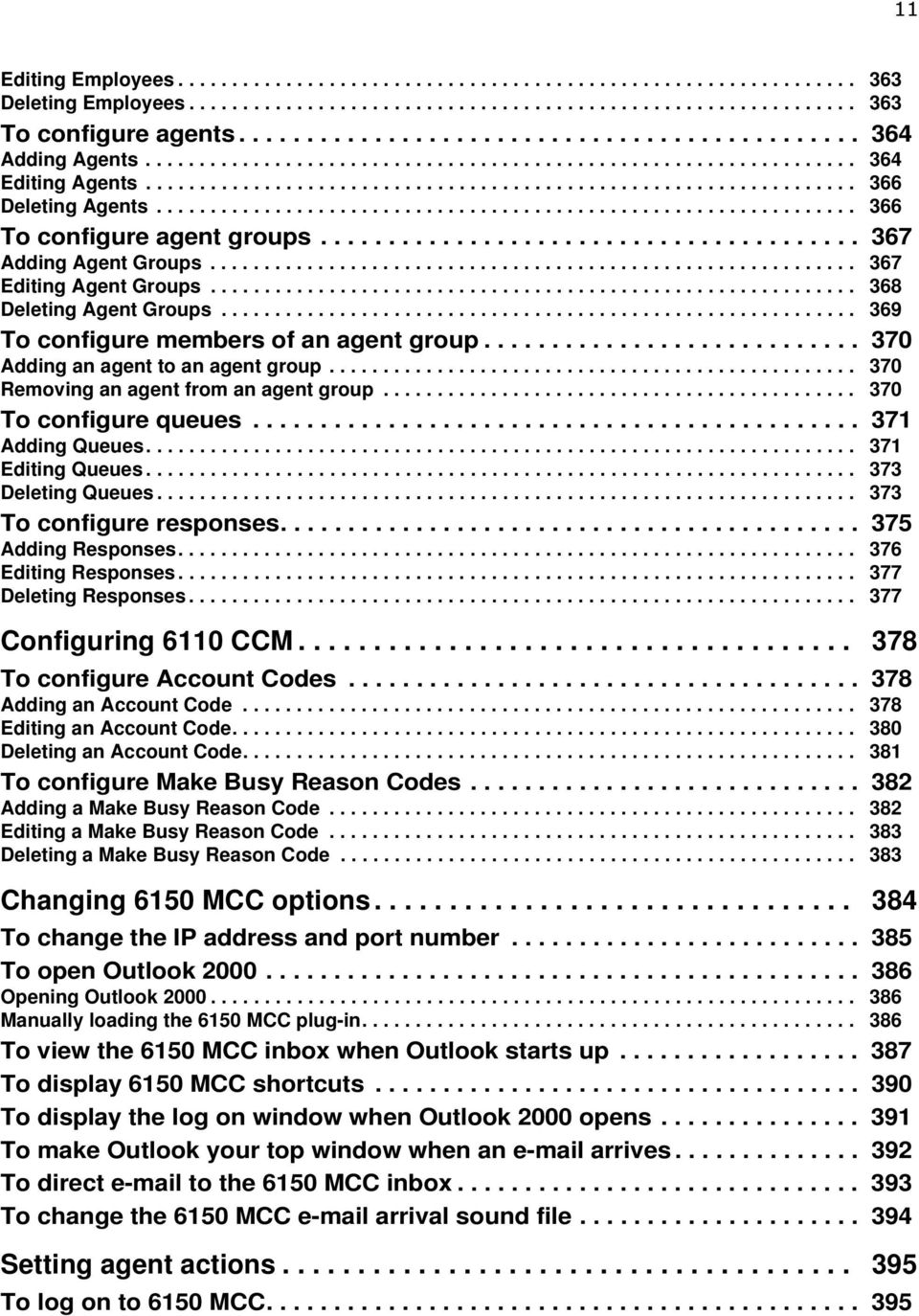
12 To log off from 6150 MCC To set a Make Busy Reason Code To remove Make Busy Responding to an To set an Account Code To hold an To transfer an To set No Reply Needed To send a reply Viewing history To view history To view Current Case To view Entire History To view a Specific To view the Current Creating and using a 6150 MCC template To create a template To use a 6150 MCC template Viewing Mini Queue Now Stats To view Mini Queue Now Stats To view the repository To view the original s To view the replies Appendix A MCC Terminology *ORVVDU\

13 &KDSWHU7KHSUDLULH)\UH&RQWDFW &HQWHU6ROXWLRQVVXLWH

14 &KDSWHUSUDLULH)\UH&RQWDFW&HQWHU0DQDJHPHQWVXLWH SUDLULH)\UH&RQWDFW&HQWHU6ROXWLRQVVXLWH )HDWXUHVDQGEHQHILWV The prairiefyre suite provides the following functionality: The browser-based user interface works across all 32-bit Windows platforms. It operates in conjunction with familiar office productivity tools. It is installed on the server only and can be accessed by an unlimited number of users. Configuration changes instantly deploy from the server to authorized intranet and Internet-based clients. You can remotely manage call center operations and restrict user access to program functions and individual call center elements log on to any PC and monitor call center operations and program system features. The prairiefyre Contact Center Solutions suite is designed for the SX-2000, SX-200, and SX-200 with realtime (SX-200 EL/ML LIGHTWARE Release 4.0 and greater) telephone systems. With the prairiefyre suite, you can manage your call center from anywhere, at any time. The suite provides data collection, analysis and storage, forecasting, real-time monitoring, online messaging, historical reporting, data mining, and wall sign messaging. /LFHQFLQJ NOTE: An employee is a physical person being tracked in your call center. Employees can have multiple agent IDs. The number of employees you program in the YourSite Database must be consistent with your software licence. If you have more employees programmed than your licence permits, [licence Is In Violation of Max Agents Allowed] will appear in place of your company name on the 6110 CCM user interface (UI) and on any reports you generate. $ERXWWKH&&08VHU*XLGH The 6110 Contact Center Manager User Guide provides information on the basics of ACD call center management and the use of 6110 CCM programs. The topics covered require the user to have a working knowledge of the Microsoft Windows operating environment and Microsoft Excel 97 or The tutorials that accompany Windows and Excel provide the information necessary for basic use. 8VHUJXLGHOD\RXW &KDSWHUSUDLULH)\UHVXLWH Chapter 1 describes the features and benefits of the prairiefyre suite, the layout of the document, and basic information about client downloads from our Web site. &KDSWHU&DOOFHQWHUFRQFHSWV Chapter 2 describes the inbound call center environment and how resources interact to process calls.

15 Call centers process a high volume of calls to meet marketing, sales, customer service, technical support, and other business objectives. A fine-tuned call center distributes calls efficiently and optimizes the use of agents and other resources. &KDSWHU3ODQQLQJDQGPDQDJLQJ\RXUFDOOFHQWHU Chapter 3 instructs you on how to plan and manage your call center. &KDSWHU0DQDJHPHQW&RQVROH Chapter 4 instructs you on how to configure the 6110 CCM server. Management Console is located on the 6110 CCM Enterprise server. With Management Console, you can troubleshoot 6110 problems, manage the SQL database, inspect the SQL database object and back up and restore the database, or critical portions of the database. &KDSWHU<RXU6LWH Chapter 5 instructs you on how to configure your database and security. You add elements and groups to the database in the Configuration module. You program and enforce security in the Security module. When you configure the YourSite Database, it must reflect the trunks, lines, routing and timing options, and agent positions in use on the telephone system. You can register account codes in YourSite for individual departments, projects, and services to generate reports. For example, an agent who receives calls for three catalog companies enters account code 1 for calls to company X, account code 2 for calls to company Y, and account code 3 for calls to company Z. You enter resource information in YourSite so that you can generate reports with 6110 CCM. If you register the aforementioned catalog companies in YourSite, 6110 CCM generates reports on the number, origin, and handling of calls to the three companies. You implement security to restrict the database teams and groups that individual users view when generating reports and monitoring real-time activities. If you do not implement security, then 6110 CCM users will see all of the devices, reports, and users listed in YourSite when running reports and monitoring real-time activities. &KDSWHU5HDOWLPH0RQLWRUV Chapter 6 instructs you on how to configure and use SuperAdvisor and AgentAdvisor. With SuperAdvisor, supervisors can view agent states and statistics in real-time. With AgentAdvisor, agents can view their own states and statistics. 6XSHU$GYLVRU The SuperAdvisor program provides real-time and cumulative agent statistics, and real-time, by 15-minute intervals, over-the business-day, queue statistics. You can view real-time statistics across multiple queues or agents. You can define alarm thresholds for individual queues or across all queues, and customize display characteristics. SuperAdvisor includes an online chat feature that communicates essential information to one or more agents or supervisors quickly and securely.

16 &KDSWHUSUDLULH)\UH&RQWDFW&HQWHU0DQDJHPHQWVXLWH $JHQW$GYLVRU The AgentAdvisor program provides real-time agent statistics. It displays the agent state, agent name, agent number, extension number (or queue number for On ACD and on ACD Hold agents), and time in state for each agent. AgentAdvisor also provides real-time and over-the-business-day queue statistics. The displays change color when pre-defined performance thresholds are exceeded to keep agents informed of significant changes in the service provided to callers. AgentAdvisor includes a chat feature agents use to send online messages to supervisors. &KDSWHU5HSRUWHUDQG6FKHGXOHG5HSRUWV Chapter 7 instructs you on how to create reports and scheduled reports. You use Reporter to produce run-ondemand reports, and Scheduled Reports to set up timetables for generating reports. The Reporter and Scheduled Reports programs provide detailed statistics on the performance of your call center resources. You can generate load activity, resource activity, ACD queue activity, and forecast reports for 15, 30, or 60-minute intervals across any series of days you specify. The reporting programs provide presentation quality reports and graphs in a Microsoft Excel spreadsheet. You can customize the content and style of report grids and graphs directly in your browser. 5HSRUW'LVWULEXWRU The Report Distributor application prints and s your reports and displays the status of your printing and mailing jobs. It runs in the system tray on your computer and must be running at all times in order to print and reports automatically. &KDSWHU'DWDPLQLQJ Chapter 8 instructs you on various data-mining tools: Inspector, Advanced Inspector, and SuperAuditor.,QVSHFWRU Inspector finds specific call center events, such as the exact time an agent logs off at lunch, the duration of time agents spend in Do Not Disturb from 1:00 P.M. to 2:00 P.M. on Monday, or the maximum number of callers that waited in queue for the day. In a single session you can search through the data from multiple days to find a specific event. The search follows a wild-card format; your specifications do not have to be exact. You can make the search as inclusive or exclusive as you wish. Inspector displays the results in an easy-tointerpret grid that you can print or save to file. $GYDQFHG,QVSHFWRU Using Advanced Inspector, you can determine why there are discrepancies between reports, verify the programming of the telephone system and the YourSite Database, and compare the data output by the ACD and SMDR data streams. The results are displayed in a table. The search output also provides a written explanation for the results. 6XSHU$XGLWRU With SuperAuditor you can view historical real-time events for any date, at your own pace. As you are viewing the event, you can step forward, jump forward, advance to the end of the day, or rewind to the beginning of the day. SuperAuditor makes it possible for you to analyze when and why past service problems occur. With this knowledge, you can easily solve similar problems in the future.

17 &KDSWHU7KH(QWHUSULVH1RGH&(1 Chapter 9 instructs you on how to configure both local and remote nodes. The Enterprise Node permits supervisors to access data from remote sites with a PC using Internet Explorer. A node is also known as a collector. &KDSWHU1HWZRUNDQG&ROOHFWRU0RQLWRUV Chapter 10 instructs you on how to use the Network and Collector Monitors. 1HWZRUN0RQLWRU With the Network Monitor, you can connect to a node (collector), view real-time data collection for all nodes, enable a popup alarm that notifies you of any data and system alarms, re-initialize the server, and view the Collector Monitor, which provides detailed node information. &ROOHFWRU0RQLWRU The Collector Monitor verifies that the Collector Service is collecting real-time data from your telephone system. It forwards the real-time data to connected clients and to the Structured Query Language (SQL) database. With the Collector Monitor, you can view detailed node information. &KDSWHU:DOO%RDUGHU Chapter 11 instructs you on how to configure and use WallBoarder. WallBoarder uses one or more Spectrum Light Emitting Diode (LED) wall signs (reader boards) to provide real-time ACD statistics to agents and supervisors, such as the number of calls in queue, the wait time of the longest waiting caller, and the number of available agents. You can customize the size and color of the displayed statistics and the way they move across the wall sign. &KDSWHU,QWHUDFWLYH&RQWDFW&HQWHU 6115 CCM is a purchasable option that complements the SX-2000 and 3200 ICP/3300 ICP (Integrated Communications Platform) telephone systems. Chapter 12 instructs you on how to configure and use SuperAdvisor and AgentAdvisor when used in conjunction with 6115 Interactive Contact Center. With SuperAdvisor and 6115 CCM, supervisors can interact with agent states in real-time. Supervisors can control the availability of agents and ACD queues. They can log an agent out of one queue and into a busier queue, or place the agent in make busy or do not disturb. In addition, they can log a queue in and out, or place the queue in make busy or do not disturb. With AgentAdvisor and 6115, agents have more control over their own states. &KDSWHU&RQWDFW&HQWHU6FKHGXOLQJ Chapter 13 instructs you on how to produce a 4Sight report. The 4Sight report can be imported into 6120 CCS to predict future workforce scheduling demands. For more information on 6120 CCS, please read the 6120 Contact Center Scheduling User Guide.

18 &KDSWHUSUDLULH)\UH&RQWDFW&HQWHU0DQDJHPHQWVXLWH Reporter and Scheduled Reports include a 4Sight report. You can accurately predict resource requirements using the Erlang C formula. Erlang C uses your historical call load data, average talk time data, service level percent, service level time, and wrap up time you specify to predict the agent requirement for the time interval and date range in the forecast. &KDSWHU0XOWLPHGLD&RQWDFW&HQWHU Chapter 14 instructs you on how to use 6150 CCM. 8VHUJXLGHFRQYHQWLRQV This user guide uses the following document conventions. 8VHU,QWHUIDFH8,V\QWD[ The following terms apply to actions you perform on user interface (UI) screens: Click precedes items you select with the mouse, such as buttons and items in list boxes. Press precedes items you select on the keyboard. Select or clear precedes items you turn on or turn off, such as check boxes. Select precedes items you select in combo boxes (text boxes with attached list boxes). Using a drag-and-drop operation means clicking an object on the screen with the left mouse button, and pressing the mouse button while you drag the object to a different position on the screen. For example: click OK; press ENTER; select the PFDatabase check box.,wdolf Italic typeface is used to set off words, letters, and numbers referred to as themselves in the text, and for characters or words you type in the user interface. For example: overflow is the routing of calls to more than one queue; the program saves text files as MMDDYYYY.sql. 4XRWDWLRQPDUNV Quotation marks are used for memorable or well known information. For example: perform what-if scenarios on the resultant data. %ROG Bold designates paths you select in your root directory and items you click, press, or select. For example: Click OK; delete 50 and insert 60; select the Check database integrity check box. 0HQXLWHPV Menu items you select are separated by an arrow [=>]. For example, File=>Open tells you to select the Open submenu on the File menu.

19 1RWH The word NOTE: designates essential user information. &OLHQWGRZQORDGVIURPWKH&&0:HEVLWH &OLHQW'RZQORDGV Client Downloads consists of the Critical Component Pack, the Client Component Pack, and Optional Component Pack. &ULWLFDO&RPSRQHQW3DFN The following Supervisor Desktop applications are included in the Critical Component Pack: MS Visual Basic version 6 Runtimes, MS MFC 6.2 version 6 Runtimes, MS MDAC 2.6 Runtimes, MS Standard OCX and DLL Redistributables, and Third Party licenced Redistributables Required by 6110 CCM/6150 MCC Programs. &OLHQW&RPSRQHQW3DFN The following Supervisor Desktop applications are included in the Client Component Pack: AgentAdvisor AgentAdvisor is an Agent Desktop applications for agent computers. This is a download for 6110 CCM that provides a subset of the functionality of SuperAdvisor. It runs as an executable program instead of from within the Internet Explorer environment. Excel Report Templates These are the templates for all 6110 CCM performance reports. You must install these on your TEMP directory before you can run any reports. If you change or customize your report templates, please ensure you back up your files before re-running this installation. Report Distributor With this download you can print your scheduled reports from your computer. When installed, the Report Distributor resides in your system tray. Network Monitor The Network Monitor indicates if your ACD and SMRD data streams are running. If the data streams are not running, you can easily clear the alarms that indicate the data streams are not running and reset the ACD and SMRD links. Auto Update If you upgrade your server the Auto Update download will notify you when you open Outlook that a new version of the 6150 Mulitmedia Contact Center is available MCC Outlook Extensions With the 6150 Mulitmedia Contact Center Outlook Extensions download you can run 6150 MCC.

20 &KDSWHUSUDLULH)\UH&RQWDFW&HQWHU0DQDJHPHQWVXLWH 2SWLRQDO&RPSRQHQWV Microsoft Data Access Components (MDAC) 2.6 This is a Microsoft installation that provides access to your structured data across a network connection. It is required for all prairiefyre clients. Adobe Acrobat Reader This is the Adobe Acrobat Reader installation for version 5.5. You require Acrobat Reader to view the online user guide and user tutorial. prairiefyre provides the following additional supporting applications. Microsoft Internet Explorer CCM requires at least IE 6.0 to function. CyberTerminal This is an optional installation required if you are running a call center with a Mitel SX-200 Digital PBX, and you have not purchased the ACD real-time event option from Mitel or your Interconnect. This is the server component that provides a networked-based VT-100 session for clients on the 6110 CCM network. Please refer to the online Help or Chapter 7 of this guide for a more detailed description. CEN CEN software implements mulit-site call center capabilities with a single server configuration. The CEN software is designed for geographically dispersed call centers requiring consolidated management reporting and real-time capabilities. CEN software can be installed on a remote Windows NT/2000 Server or Window 2000 Professional computers. Please do not install CEN on the Enterprise 6110 CCM Server computer. 1DYLJDWLQJ&&0 The following tips will help you navigate efficiently in 6110 CCM. 9LHZLQJPXOWLSOHVHVVLRQVRI&&0 Sometimes you will need to view two or more 6110 CCM programs simultaneously. For example, you open two or more sessions to perform multiple searches for event records, and to compare report data to SMDR search results. To run multiple 6110 CCM sessions: 1. In the browser, type in the 6110 CCM Server IP address CCM Server address]/ 6110 CCM/. Alternatively, double-click the 6110 CCM desktop icon. 2. If you do not see the 6110 CCM desktop icon, to create a shortcut to 6110 CCM, drag-and-drop the 6110 CCM Web address to your desktop. 3. Click Add to Favorites to add the 6110 CCM Server IP address to your list of favorite addresses and click OK. 4. Click Favorites, locate the prairiefyre 6110 CCM entry (at the bottom of the list) and move it to the top of the list using a drag-and-drop operation. 5. Optionally click Make Home Page to set the 6110 CCM Server IP address as your home page. 6. Enter your username and password and click Submit. 7. Click Change Password and change your 6110 CCM password.

21 You can start additional 6110 CCM sessions by clicking the Internet Explorer icon on the Windows Taskbar and selecting 6110 CCM from your list of favorites. Alternatively, you can click Tools=>Internet Options and set your Home Page to the 6110 CCM program (your 6110 CCM Server IP address) to run multiple sessions. You start the first instance of 6110 CCM by clicking the 6110 CCM desktop icon, and the second (and subsequent) 6110 CCM sessions by clicking the Internet Explorer icon on the Windows Taskbar. You can open multiple browser sessions of the SuperAdvisor, YourSite Configuration, ACD Inspector, SMDR Inspector, and ACDLink applications from their respective menus. For example, to open a new session of SMDR Inspector: 1. Click the 6110 CCM desktop icon and log on to 6110 CCM. 2. On the Tools menu, right-click SMDR Inspector. 3. Click Open in New Window to start SMDR Inspector in a new browser session CCM displays the new SMDR Inspector session in addition to your original 6110 CCM session. NOTE: You can switch between 6110 CCM sessions by holding down the Alt key and pressing the Tab key until you locate the desired session.
22 &KDSWHUSUDLULH)\UH&RQWDFW&HQWHU0DQDJHPHQWVXLWH
23 &KDSWHU&DOOFHQWHUFRQFHSWV $ILQHWXQHGFDOOFHQWHUGLVWULEXWHV FDOOVHIILFLHQWO\DQGRSWLPL]HVWKH XVHRIDJHQWVDQGRWKHUUHVRXUFHV
24 &KDSWHU&DOOFHQWHUFRQFHSWV &DOOFHQWHUFRQFHSWV Call centers process a high volume of calls to meet marketing, sales, customer service, technical support, and other business objectives. A fine-tuned call center distributes calls efficiently and optimizes the use of agents and other resources. This chapter describes the inbound call center environment and how resources interact to process calls. 7KH$&'SURFHVV An Automatic Call Distributor (ACD) is a specialized telephone system program for distributing incoming calls. The primary goal of an ACD is to ration calls to agents in a cost-effective manner that provides acceptable service to callers. To optimize the use of agents, you cross-train them so they can handle a variety of inquiries. Rather than distributing calls to a number of small, specialized agent or extension groups, the ACD distributes them efficiently among the entire pool of available agents. When you consolidate resources (use the Pooling Principle), the same number of call center agents handle more calls while maintaining service levels. Typically, you program the ACD to ensure the first call to arrive reaches the first available agent or the agent who has been idle the longest. However, you can vary the order of calls and agents to provide superior service to preferred customers, and skills-based routing. $&'FDOOIORZ Figure 2-1 illustrates how call center resources interact to process calls. )LJXUH$&'FDOOIORZ
25 The path of an incoming call is as follows. A caller telephones your call center via the Public Switched Telephone Network (PSTN). (The PSTN is a global collection of Central Offices (COs) interconnected by long-distance telephone switching systems.) The local CO directs the call to one of your trunk groups. An available trunk picks up the call. Typically, calls from the PSTN arrive to the call center over incoming trunks and calls from the call center to the PSTN travel over outgoing trunks. If no trunks are available, the call does not get through to the system (is blocked) and the caller receives a busy signal. When a trunk picks up a call, it forwards it through to a group of agents answering calls, or to some other answering point. The call arrives at the ACD queue of an agent group. The queue delays the call rather than blocking the call from entering the system. The length of time the caller waits in queue is the queue time. While waiting in queue, the caller listens to product features, announcements, or other messages provided by a Recorded Announcement Device (RAD). The caller can wait patiently in queue for an available agent, leave a voice mail message, or hang up (abandon) the call. An agent answers the call. The time the caller spends talking to the agent is the talk time. When the call is completed, the agent may need to perform additional work associated with the call. The time taken to perform this work is the wrap up time. 0RQLWRULQJWKHFDOOIORZSURFHVV Second-by-second (real-time) statistics presented on wall signs and desktop monitors enable you to monitor the service provided to callers. You can monitor the number of incoming calls, the time it takes to process them, the queue load, and the availability of agents using a Management Information System (MIS). The term MIS refers to the processing of data produced by the telephone system. The MIS uses telephone system records to provide forecasting, real-time monitoring, and reporting functions. (QVXULQJWUDIILFFDUU\LQJHIILFLHQF\ To optimize traffic-carrying efficiency ensure Sufficient trunks are available to carry incoming calls. Callers experience a delay in queue. There is a random distribution of calls among available agents. 6FKHGXOLQJWRRSWLPL]HFDOOIORZ You schedule agents so the number of incoming calls at any given time typically exceeds the number of agents currently available. The intent is that callers experience a slight delay before agents answer their calls. The expected number of incoming calls forecasted for the time of day, and day of the week influence scheduling decisions. &DOOURXWLQJ Call routing options you program in the telephone system provide a set of instructions that automate the movement of calls to their intended answering points. You can define options if the caller dials 1 forward the call to customer service. You can specify re-routing for calls not answered after a set period of time and parse incoming Automatic Number Identification (ANI) and Dialed Number Identification Service (DNIS) data to direct call routing. Figure 2-2 illustrates some common routing options.
26 &KDSWHU&DOOFHQWHUFRQFHSWV )LJXUH&DOOURXWLQJ 'LDOLQJDQDJHQW VH[WHQVLRQ In the simplest call scenario, a single trunk picks up an incoming call to your call center. The telephone system presents the caller with options to dial various answering points. The caller dials an individual agent at an extension through a queue number. A queue number is an address mechanism for a queue or other answering point. The programming associated with the queue number defines the routing and timing features of the call. The telephone system collects data on the agent and trunk involved in the call. The ACD management reporting program produces reports on agent and trunk activity. 'LDOLQJDTXHXH In the next call scenario a trunk group picks up an incoming call to your call center. The system presents the caller with options to dial various answering points. The caller dials queue number 1 to reach queue 1 (Customer Service). The system forwards the call to the first available agent in the agent or extension group associated with queue 1. The call is an ACD call because one dialable number represents all agents in the group. The telephone system collects data records for the call. The ACD management software produces Queue Reports on queue 1. &DOORYHUIORZ An ACD call that is not answered immediately is placed in a queue. If an agent does not pick up the call after a set amount of time (the overflow time) the system places the call in the queue of another agent group, in addition to keeping it in the first queue. The first available agent in either group answers the call. The overflow feature limits the delay faced by callers by queuing calls against two or more agent groups, as illustrated in Figure 2-3.
27 )LJXUH0XOWLSOHTXHXHURXWLQJ &DOOLQWHUIORZ You can program the telephone system to direct a queue delayed call to voice mail or to another answering point. The interflow timer runs independently of the overflow timer. If the interflow timer expires, the system removes the call from the queue and re-directs it to another answering point, such as a trunk or voice mail. 8QGHUVWDQGLQJWKHLQERXQGFDOOHQYLURQPHQW The inbound call center environment has unique characteristics that must be considered in effective planning and management. 5DQGRPDQGSUHGLFWHGFDOODUULYDO Calls arrive randomly to call centers. You cannot predict the minute-to-minute arrival of calls. This results in unanticipated increases in workload, and impacts staffing calculations and the load carried by system and network resources. You can predict the pattern of call arrivals for 15-minute or longer intervals. For example, you can predict that next Monday between 1:00 P.M. and 1:30 P.M. you will receive 60 phone calls. However, you cannot predict how many calls will arrive in the first five minutes, the second five minutes, and so on. &DOOHUWROHUDQFH Several factors influence a caller s tolerance to queue delays: The immediacy of the caller s requirement The availability of similar products or services The caller s expectations for service The time available to make the call Whether or not the caller is paying for the call
28 &KDSWHU&DOOFHQWHUFRQFHSWV
29 &KDSWHU3ODQQLQJDQGPDQDJLQJ \RXUFDOOFHQWHU (QVXUH\RXKDYHWKHULJKW UHVRXUFHVLQSODFHDWWKHULJKW WLPHVWRKDQGOHDQDFFXUDWHO\ IRUHFDVWHGZRUNORDGDWWKHGHVLUHG OHYHORIVHUYLFH
30 &KDSWHU3ODQQLQJDQGPDQDJLQJ\RXUFDOOFHQWHU 3ODQQLQJDQGPDQDJLQJ\RXUFDOOFHQWHU Effective call center management involves having the right resources in place at the right times to handle an accurately forecasted workload at the desired level of service. Commitment to a systematic planning and management strategy is essential; the strategy is based on corporate objectives that you continually access and refine. Whether you are managing a start-up call center or refining the performance of an existing operation, the process illustrated in Figure 3-1 applies. It is the basic framework for achieving and maintaining your service objectives. )LJXUH3ODQQLQJF\FOH The objective of call center management is to find the right balance between the agents scheduled and the service provided to customers. This involves assessing and re-assessing trade-offs between the service level, agents scheduled, and average call duration for a known call load for each 15-minute or half-hour interval of the day. Collecting, properly interpreting, and applying ACD and other information allows you to accurately forecast the workload and schedule sufficient agents to meet your service objectives.
31 6WHSHVWDEOLVKDFRUSRUDWHVHUYLFHOHYHOREMHFWLYH Defining and adequately funding a service level should be closely tied to your corporate mission. The service level identifies the average length of time a caller who has obtained a trunk waits for an available agent. It is the basis for planning and budgeting and links the resources you require to your service objectives. Choosing a service objective is the first step in a comprehensive planning and management solution. Once you set a service objective, you should routinely access it to see how consistently you are meeting it, on a 15-minute or half-hour basis. Call centers in different industries use different criteria for measuring service. Your service level objective should reflect the type of service being provided and the expectations of callers seeking the service. For example, a company that sells magazine subscriptions has less to lose in the outcome of any one call than a car dealership does. A caller to a credit card lost or stolen line might expect different service than a caller to a customer service department at a bank. Call center metrics across industries are designed to reflect this. Performance targets must suit the primary function of a call center. In revenue-based call centers where agents sell products or services, the net revenue per call is considered when defining a service objective. Revenuebased call centers strive to provide a high level of service with minimal blocking and delays. In cost-based call centers where agents provide customer service, call handling incurs costs but does not provide additional revenues. The level of service in cost-based call centers is typically not as high as the level of service in revenue-based centers. Although the chance of blocking is minimal, an almost certain delay in the ACD queue is to be expected. 6HUYLFHGHILQHG Service level is expressed as X percent of calls answered in Y seconds, such as 80 percent of calls answered in 20 seconds. Why is service level the standard measurement of service? The answer is service level provides the most accurate representation of the callers experience; it is ultimately the caller who decides what constitutes good service, and whether or not to end a call. The service level is sometimes called the telephone service factor (TSF). It applies to inbound transactions that must be addressed as they arrive. 6HUYLFH/HYHO The term service level is total number of calls which are answered, abandoned, and interflowed before a defined threshold time (Service Level Time), compared to the total number of calls answered, abandoned, and interflowed. It s the average length of time a caller who has obtained a trunk waits for an available agent. The service level = (Calls Answered + Long Calls Abandoned + Long Interflow) within the Service Level Time (Calls Answered + Long Calls Abandoned + Long Interflow). 6HUYLFH/HYHO3HUFHQW The service level percent is the proportion of calls, expressed as a percentage, which are answered, abandoned, and interflowed within a defined threshold time compared to the total number of calls answered or abandoned (after the short abandon time). 6HUYLFH/HYHO7LPH The service level time is the threshold time used in calculating the service level percentage, such as 90 percent of calls answered in 20 seconds. The service level percentage and service level time are parameters you define as your service objective.
32 &KDSWHU3ODQQLQJDQGPDQDJLQJ\RXUFDOOFHQWHU :K\LVVHUYLFHOHYHOPRUHPHDQLQJIXOWKDQRWKHUPHWULFV" Service level is one of many ACD statistics used to measure performance. Each statistic has its purpose. For example, the grade of service (GOS) statistic relates the number of trunks to the level of traffic and indicates the likelihood an attempted call will receive a busy signal. It is expressed as a decimal fraction. For example, a GOS of P.02 means a caller will have a two percent chance of receiving a busy signal. Since trunk costs are insignificant compared to agent costs call centers are well advised to schedule sufficient trunks; abandons should be minimal. A delayed call is a call placed in the ACD queue because it can not be answered immediately by an agent. The probability of delay statistic relates the number of agents or extensions to the level of traffic carried by the trunks and indicates the likelihood and amount of delay experienced. The GOS, probability of delay, and quality of service rendered by agents provide vital information about the callers experience, as illustrated in Figure 3-2. )LJXUH6HUYLFHFULWHULD The GOS and probability of delay contribute to our understanding of what happens to the calls not answered in Y seconds, and give meaning to service level. Service level is the primary statistic used in planning and budgeting because it is the most stable measurement of queue activity. $6$ The average speed of answer (ASA) is an ACD statistic that measures how long the average caller waits on hold before his or her call is picked up by an agent. ASA is a valuable measure of service quality, but is often misinterpreted. The average does not represent what is typically experienced by individual callers. Most calls are answered by agents more quickly than the average, but a small percentage of callers wait several minutes in queue. ASA is a useful parameter, but service level is a more reliable indicator of what callers experience.
33 $EDQGRQPHQW ACDs collect statistics on how long callers wait before abandoning calls, and what percentage of calls are abandoned. Unfortunately, abandonment is difficult to forecast because it is impossible to predict caller behavior with any reliability. Sometimes when the service level is high more callers abandon than expected. There are no industry standards for abandonment; it is a somewhat unreliable measure of call center performance. However, abandonment statistics assist in planning service levels, and provide valuable information used to create in-queue and message-on-hold announcements. &DOOV$EDQGRQHG3DUDPHWHU The Calls Abandoned Parameter specifies the value which determines whether a call is a Short Abandoned Call or a Long Abandoned Call. If the abandon time is less than the Call Abandoned Parameter, then it is a Short Abandoned Call. If the abandon time is more than the Call Abandoned Parameter, then it is a Long Abandoned Call. You assign the Calls Abandoned Parameter (called the Queue Short Abandon Time) values to ACD queues in the YourSite Database. Callers can abandon after they reach a trunk (before they reach the ACD queue) or while they are in queue waiting for an available agent (either before or after the short abandon time you specify). &DOFXODWLQJWKHVHUYLFHOHYHO The service level is the total number of calls which are answered, abandoned, and interflowed before a defined threshold time (Service Level Time), compared to the total number of calls answered, abandoned, and interflowed. It s the average length of time a caller who has obtained a trunk waits for an available agent. The service level = (Calls Answered + Long Calls Abandoned + Long Interflow) within the Service Level Time (Calls Answered + Long Calls Abandoned + Long Interflow). +RZGR,FKRRVHDVHUYLFHOHYHOJRDO" Contrary to popular belief, there is no industry standard service level. Some call centers base their service level goal on the targets of same-industry companies. In doing so, they assume these companies are actually meeting their intended targets. Companies are setting increasingly rigorous service level targets in sectors where outstanding customer service is the norm. In a survey of over 100 UK call centers Opta Consulting was surprised to find an average performance target of 90 percent of calls answered in 15 seconds. They found that companies setting extremely rigorous targets did not necessarily meet them, and the investment required to achieve best in class targets was difficult to justify. Setting an appropriate service level goal for your call center is not easy. The motivation and expectations of your customers, the availability of similar goods or services, the service level targets of same-industry companies, and the value of calls are things to consider. It may be useful to run some calculations to determine the trade-offs in service level associated with adding or removing an agent, and implement customer satisfaction surveys. When defining your corporate service level, consider several factors and rate their relative importance. An appropriate service level is one that Satisfies callers expectations for service Keeps abandonment in check (at less than five percent) Minimizes expenses and maximizes revenue Meets with the approval and support of agents, supervisors, and senior management
34 &KDSWHU3ODQQLQJDQGPDQDJLQJ\RXUFDOOFHQWHU Consider this modest objective. For a service level of 80 percent of calls answered in 20 seconds, callers receive the following service: Approximately 30 percent of callers experience a delay in queue. The longest wait time is approximately three minutes. The average speed of answer is approximately 12 seconds. Is this acceptable service for you and for your callers? 4XDOLW\RIVHUYLFH Agent statistics reflect the time agents spend in various states and are used to assess agent performance; the average time an agent spends in talk time, make busy, unavailable, and wrap up states directly affects his or her availability and the service level provided to callers. Service level alone does not ensure customer satisfaction. The quality of the interaction between the caller and agent leaves a lasting impression. The quality of service reflects an agent s ability to provide excellent service to each customer. The knowledge of the agent, the accuracy and completeness of the information provided, and the courtesy extended to the caller contribute to the caller s experience. 6LOHQWPRQLWRULQJ Silent monitoring systems complement ACD statistics by providing a snapshot of quality and productivity in your call center. You can track call handling techniques and determine where improvements can be made in individual performance. Advanced systems capture the voice conversations between agents and callers and record agent data screens for a complete picture of call handling. They provide online evaluation forms so you can annotate recordings with feedback. Silent monitoring takes the bias out of performance evaluation; it provides a systematic process for monitoring and grading agent calls. You can schedule sessions across different times of the day, days of the week, and evaluators promoting fairness and consistency. Showing agents where improvement is needed is more effective than just telling them. Silent monitoring can contribute to a reduction in call time, a reduction in monitoring time and personnel, and increased training efficiency. You can use pre-recorded conversations between agents and customers to train agents and for ongoing evaluation. You can use the information to Provide recorded examples of exceptional service and unacceptable service to agents in training. Record, review, annotate with feedback, and forward call records to agents who then review your comments within the context of the actual call. Calibrate and routinely access the scoring consistency of call monitors. Assess the effectiveness of current training programs. Assess the efficiency of the monitoring and assessment process.
35 'HILQLQJVFRULQJSDUDPHWHUV The parameters used to evaluate how well agents handle calls are based on the purpose of the calls. Goals vary across calls for inbound and outbound services. For example, in an outbound sales environment quality may be based on whether or not the agent made the sale, took advantage of cross-sell opportunities, and adhered to a pre-defined script. In an inbound environment quality may be based on the completeness and accuracy of the information and whether or not the caller s questions were answered satisfactorily. Agents are also evaluated on soft skills, such as voice quality, pausing at regular intervals, rate of speech, use of positive language, and other listening and communication skills. 6HWWLQJSHUIRUPDQFHVWDQGDUGVDQGJRDOV Once you determine appropriate scoring parameters, you define standards for exceptional and acceptable levels of performance. Assessment standards are based on consensus and must be clearly defined and communicated to monitors and agents. Collaborate with agents in setting performance goals and clearly define exceptional service and interim performance steps. Determine a baseline of current performance and set performance steps for an agent group. Provide agents in the group who meet or exceed the interim target with rewards and recognition commensurate with their performance. When systematically used in training and coaching recorded sessions positively impact productivity. Fair assessment is good for moral and motivation, and contributes to an environment in which agents can learn and grow. )UHTXHQF\RIPRQLWRULQJVHVVLRQV The frequency of monitoring sessions is determined by individual companies and ranges from once a month to 15 or 20 sessions a month. Implementing five to 10 monitoring sessions per month is common practice. Trainees and agents with consistently low scores are monitored more frequently than other agents. Resource limitations typically influence the frequency of monitoring. 6LOHQWPRQLWRULQJV\VWHPV Silent monitoring systems range from tape recorders to client/server based recording systems. Advanced systems schedule, record, and store voice files in a compressed digital format using a real-time link to your telephone system. They capture any data screens accessed by the agent in addition to voice data. Silences are eliminated to optimize monitoring efficiency. Recording sessions can be played back from any telephone, anywhere, at anytime. You can customize agent evaluation forms and define parameters for quality with advanced systems. They provide activity, status, and management reports for evaluating agents and observation practices.,7vxssruwv\vwhpv Information Technology (IT) support systems are commonplace in call centers. Call center agents divide their time between listening to customer requests, entering and updating customer information and other entries, searching for required information, and providing feedback to customers. In order to provide prompt and complete information, agents must have immediate online access to information including customer records and case histories, products and services, and company policies and procedures. The push to increase agent efficiency and customer service has placed new demands on computer information systems and information technology. Information products that enhance agent productivity are continually being developed. Call center systems are designed to incorporate some, or all of the following specialized support functions.
36 &KDSWHU3ODQQLQJDQGPDQDJLQJ\RXUFDOOFHQWHU &7, Computer telephony integration (CTI) is the merging of computers and telephone systems. Today s computerbased telephone systems deliver synchronized voice and data, voice and data conferencing, automatic information retrieval for calls, caller-based messaging and routing, and desktop productivity tools. You can use customer databases in call handling to enhance customer service and agent productivity. When databases are shared between call center departments each agent can access a caller s contact information, purchasing records, call history, and preferences by a caller ID number. $1, Automatic Number Identification (ANI) identifies the telephone numbers of callers to your call center, so agents can receive screen pops with calls. You can connect a database to your telephone system to simultaneously send calls and caller information. The telephone system forwards the caller s telephone number to a software program that relays database records on the caller to the agent. Alternately, the caller enters an ID number that the database associates with a set of records for the caller and the agent is sent the information. ANI saves agents time since they do not have to ask for and enter a name for a caller, and wait for the database to respond. This time savings significantly impacts staffing requirements and telephone service charges. ANI also identifies telephone numbers of callers who abandon calls so they can be contacted later for potential business. Reports can identify the volume of usage and costs of internal line numbers, and help you track the long distance distribution per line number and maximize long distance efficiency. '1,6 Dialed Number Identification Service (DNIS) is a feature of toll-free lines that identifies the telephone number the caller dials. This assists agents who answer calls for more than one business or product line. Each business or product line has its own toll-free number. When a caller dials a toll-free number, the telephone system forwards information to the agent so the agent can identify who the caller dialed. For example, a caller dials a tool-free number for a cruise line. The telephone system sends a script to the agent along with the call. The agent then knows to answer Good morning. Thank you for calling Southern Cruises, instead of the name of another cruise line serviced by the center. $XWRPDWHG+HOSGHVNZRUNIORZ Agents at IT help desks require quick access to customer information and call history, and the ability to rapidly log all support calls and incidents. Advanced help desk packages offer automated desk help workflow systems. They assist agents in logging service requests (tickets), dispatching them to prioritized queues or agents, tracking them, and documenting activities. External programs, help desk operators, or end users (in Web-based programs) generate tickets. The system generates them manually, or in some cases automatically, in response to system events. It can correlate multiple incidents with single tickets, and multiple problems with a single call. Automated help desk workflow systems track each step taken in the resolution of a call, with automatic time stamping of all referrals, escalations, reminders, alerts, and notifications. Calls are prioritized and referred to other departments without reassignment, reassigned (escalated) to other technicians or specialized staff, and placed in an alert condition when they are not resolved promptly. Activities are date and time stamped automatically. Most help desks offer outgoing notification and paging. Some help desks offer automated logging of incoming s, and automated call acknowledgment s to clients.
37 6WHSFROOHFWGDWD Telephone systems generate an enormous amount of real-time and historical data used in planning and management. You use real-time data to monitor the current call load and agent availability so minute-tominute adjustments can be made. You use historical information in forecasting, staffing, and scheduling. Other critical management information comes from customer surveys, market studies, employees, external departments, telephone networks, workforce management systems, competitors, and the media. Data collection is a continuous process you implement as soon as your telephone system is up and running. Telephone systems provide detailed report data on every aspect of call transactions. You can program computer-based telephone systems connected to a Local Area Network (LAN). Users on the LAN can view or print real-time and historical reports. With Web-enabled telephone systems, you can view and generate reports in a Web browser. You can monitor call center activities remotely, and distribute reports to people on different networks. &ROOHFWLQJGDWDRQFDOOKDQGOLQJ Call center reporting software displays real-time telephone system data on desktop monitors and wall signs. With real-time data, you can manage current conditions and ensure agents respond to changing call center events. The telephone system provides information on call activity, agent activity, and queue activity. You can use historical data in forecasting and in assessing the performance of your resources. Historical reports provide vital information on load activity, resource activity, and queue activity. For example, resource activity reports on trunks can tell you the highest number of trunks used during peak traffic periods, and the total duration of calls handled by each trunk for the reporting period. You can determine how busy your trunks are, and whether or not you have the right number of trunks scheduled. You can produce reports categorized by the requirement for call center resources, the reporting period, and by time interval. CTI provides in-depth information on call transactions. Detailed information on keystroke sequences, databases searched on, and on-screen assistance provides a clear picture of agent activities. With ANI data, you can identify callers by area code and collate information on demographic trends in caller behavior. Workforce management systems use telephone system data to forecast and schedule agents. Some packages monitor the real-time adherence of agents to scheduled activities, so you know the number of agents currently logged on and available to answer calls. Workforce management systems collect and store real-time adherence data. This data provides a historical account of adherence used in agent assessment. Customer surveys provide valuable supporting information on callers tolerance to delay, and expectations for service. They address some of the following questions: Was the agent accessible? Was the caller put on hold for too long? Was the agent courteous and responsive to my request? Was the agent well informed? Did the agent provide the correct information and keep commitments? Call centers use this information to estimate the repercussions of poor service: escalated costs, duplication of work, lost customers. As the economy moves towards individual, personalized services, new ways of handing calls continue to emerge. These new features add to the complexity of collecting and measuring information. It is vital you establish an integrated, reliable system for measuring the key indicators of performance: the efficiency of call handling, the service callers experience, and their perceptions of that service.
38 &KDSWHU3ODQQLQJDQGPDQDJLQJ\RXUFDOOFHQWHU 6WHSIRUHFDVWWKHFDOOORDG Finding the right balance between resources and traffic volumes is a critical step in effective call center management. Estimating resource requirements is particularly challenging as the number of calls and the total duration of calls expected for a given time interval is difficult to predict. Forecasting involves taking historical data generated by your telephone system and using it to predict future traffic volumes and patterns. 7KHLPSRUWDQFHRIIRUHFDVWLQJ The importance of accurate forecasting can not be overstated. Forecasting is the basis for estimating required resources, such as agents, trunks, and workstations, and impacts call center operations and performance in the following ways: The number of blocked and abandoned calls The level of service provided to callers and callers perception of service Agent workload, call behavior, and retention The accuracy and usefulness of schedules The success of periodic sales campaigns Forecasting is an imprecise science. It involves taking a year (or preferably two or three years) of queue traffic data and performing the following steps: 1. Examine trends in call load patterns. 2. Break the information down into monthly, weekly, daily, half-hour, and 15-minute intervals that reflect call load patterns. 3. Determine the handling times of calls. 4. Modify the forecast based on current call center activities and other considerations, such as absenteeism, agent breaks, holidays, and training. The range of forecast dates you specify depends on the purpose of the forecast. With long-term forecasts, you can estimate future budgets and expansion opportunities, and establish corporate objectives. With short-term forecasts (of one to three months) you can determine seasonal staffing requirements, plan for short-term sales campaigns, and assess upcoming hiring needs. You can use weekly, daily, hourly and half-hour forecasts to tweak agent schedules and adjust for absenteeism. &RQGXFWLQJDIRUHFDVW Conducting a forecast involves accurately estimating the three components of call load: talk time, wrap up time, and calls offered. The accuracy of your forecast increases markedly with the size of your data sample. For example, the call load estimate derived from data on 30 agents who receive 950 calls will be more accurate than the call load estimate on 10 agents who receive 280 calls during the same period. Extraneous values for talk time and transient changes in agent availability become less significant as the data sample increases. Most integrated call center management programs include software that will do the preliminary forecasting for you. Forecast programs analyze your historical traffic data and display the results in a spreadsheet program, such as Microsoft Excel. Forecast programs calculate the following parameters based on your historical data.
39 &DOOORDG The call load is the combined effect of the number of calls received by the ACD queue and their duration, or the calls offered x (average talk time + average wrap up time). &DOOV2IIHUHG All calls received by the ACD queue, regardless of how they are handled or routed, are referred to as the calls offered. This includes Calls Answered, Long Interflowed Calls, and Long Abandoned Calls. Calls Requeued, Path Unavailable Calls, Short Abandoned Calls and Short Interflowed Calls are not considered. Telephone system data on the calls offered and average talk time is used by the Erlang C equation in calculating the agents required. 7DONWLPH The talk time is the time the caller spends talking to an agent. $YHUDJHWDONWLPH The average talk time is the average time the agent spends talking to callers during a given time interval; it is the total average call duration plus any wrap up time you add. :UDSXSWLPH The wrap up time is the time an agent spends completing transactions associated with a call after the agent hangs up. The wrap up time is a standardized period. If an agent requires additional time to complete paperwork or online transactions, the agent can leave the ACD queue temporarily for this purpose. After you run a forecast, it is useful to examine the data and make adjustments based on present call center conditions. Tweak the forecast by adding or reducing calls based on your intuition and on information gathered by yourself and others. Devise a system that involves the collaboration of supervisors and managers from various departments. Meet routinely to discuss factors that may influence the forecast for the year and adjust it accordingly. You may need to consider the following issues: hardware or software system changes, expected callers, advertising and media, changes to your products, services, or pricing, new products, product performance, competitors actions, and international, national, and company events. It is vital to have a systematic forecasting process in place that all departments support. 6WHSFDOFXODWHUHTXLUHGUHVRXUFHV You calculate the agent requirement in conjunction with the trunking requirement. The number of available agents affects the likelihood and length of delay experienced by callers. The delay affects the load trunks must carry. Because the number of available agents impacts the number of trunks required, you calculate the agent requirement first. 3UHGLFWLQJWKHDJHQWUHTXLUHPHQW Agent costs account for over 60 percent of all call center costs. Accurately predicting the agent requirement, making the most effective use of agents, and standardizing and monitoring agent activities are paramount to achieving your service objectives. Agents are your most valuable resource: make team building and team management a high priority. You can predict the agent requirement for your service level percentage and service level time targets by applying the Erlang C equation to the estimated call load and average talk time.
40 &KDSWHU3ODQQLQJDQGPDQDJLQJ\RXUFDOOFHQWHU (UODQJ& Staffing models consider important factors unique to the inbound call center environment: Call arrival is random. Consolidating resources allows the same number of call center agents to handle more calls while maintaining service levels. Maintaining high service level targets requires staffing a large number of agents that will be idle a significant portion of the day. The industry standard Erlang C equation operates on these principals. Most call center reporting packages use Erlang C. An Erlang measures telephone traffic, or the flow of calls and call attempts to your call center during a given period. One Erlang equals one hour or 60 x 60 = 3,600 seconds of telephone conversation. This could be one call lasting one hour, six calls lasting 10 minutes, or any combination of calls and call durations that equal 60 minutes. The Erlang formulas provide a mathematical basis for making predictions about randomly arriving workloads. A.K. Erlang, a Danish engineer who worked for the Copenhagen Telephone Company, developed Erlang C in Agent and delay calculations use the Erlang C equation. It predicts the resources required to keep delay times within your service level objective. Three variables influence the delay time: the number of agents, the number of waiting callers, and the average time it takes to handle each call. Erlang C has fundamental principles that do not reflect real-world circumstances; it assumes all calls reach the call center and all callers wait indefinitely to reach agents. Because Erlang C assumes no blocking or abandons, it may overestimate the agents you need. Erlang C requires accurate information on call flow where voice messaging and call overflow are employed, assumes your call load prediction is extremely accurate, and assumes you have the same number of agents answering calls the entire half hour. Although Erlang C has its limitations, it is the preferred planning tool as it provides reasonable traffic estimates for call centers that maintain good service-minimal blocking and few abandons. Erlang C provides theoretical numbers for staffing that you need to assess in light of the following call center realities: The call center blocks a certain proportion of calls and some callers abandon their calls. Talk time is unpredictable, and although most calls may last two to three minutes, a few calls can last upwards of an hour. Agents in training may require more time to process calls. Agents may use wrap up (after-call paperwork) time inconsistently during busy periods. Not all agents within an agent group are available at all times to handle calls offered to the agent group. Erlang C predicts staffing needs fairly accurately. However, call centers that use skills-based routing, overflow, interflow, and advanced routing options need to use intuition and experience in adjusting the final numbers.
41 6HUYLFH/HYHO The term service level is total number of calls which are answered, abandoned, and interflowed before a defined threshold time (Service Level Time), compared to the total number of calls answered, abandoned, and interflowed. It s the average length of time a caller who has obtained a trunk waits for an available agent. The service level = (Calls Answered + Long Calls Abandoned + Long Interflow) within the Service Level Time (Calls Answered + Long Calls Abandoned + Long Interflow). 6HUYLFH/HYHO3HUFHQW The service level percent is the proportion of calls, expressed as a percentage, which are answered, abandoned, and interflowed within a defined threshold time compared to the total number of calls answered or abandoned (after the short abandon time). 6HUYLFH/HYHO7LPH The service level time is the threshold time used in calculating the service level percentage, such as 90 percent of calls answered in 20 seconds. The service level percentage and service level time are parameters you define as your service objective. 'HWHUPLQLQJWKHDJHQWUHTXLUHPHQW The Erlang C formula uses your historical call load and average talk time data to predict the agent requirement for the time interval and date range in the forecast. The resultant spreadsheet displays the call load and agents required across time intervals. 3HUIRUPLQJZKDWLIVFHQDULRV After you run a forecast, you can perform what-if scenarios on the resultant data by changing the value of forecast parameters and recalculating the results. You can enter values for the calls offered, average talk time, wrap up time, and service level percentage and time and recalculate the number of agents required. For example, you can reduce the average talk time and recalculate the agents required and the calls handled across 15-minute time intervals for the shift. 7KHUHODWLRQVKLSEHWZHHQDJHQWVDQGWUXQNV You are already familiar with the terms GOS (probability of blockage) and service level (average wait time). The following definitions are essential to understanding the relationship between agents and trunks. 'HOD\ Trunk calculations assume no queueing. For trunk calculations, the delay includes the time from when a trunk picks up a call until an agent answers it. $JHQWORDG The agent load includes the talk time and wrap up time. 7UXQNORDG The trunk load includes the time from when a trunk picks up a call until the agent finishes speaking to the caller and disconnects. The trunk load does not include wrap up time.
42 &KDSWHU3ODQQLQJDQGPDQDJLQJ\RXUFDOOFHQWHU Callers expect to have a 95 percent or better chance of obtaining a free trunk into your call center, and expect to connect to an agent within a reasonable amount of time. There must be sufficient trunks available to pick up calls, and sufficient agents available to handle the level of traffic carried by the trunks. The more agents handling a given call load, the less delay callers experience. Callers experience a delay if there are insufficient agents available. If the delay is considerable, calls back up and some calls do not reach the call center. Traffic engineering involves estimating the number of trunks and amount of communications equipment needed to service an anticipated number of callers. It revolves around basic questions concerning the relationships between service parameters and trunk and agent resources. How much traffic can a particular number of trunks handle for a particular GOS? What is the GOS for a particular number of trunks and traffic level? How many trunks are required to handle a particular traffic level and GOS? What is the probability of delay and length of delay experienced for a particular traffic level and number of agents? How many agents are required to handle a particular traffic level for a given set of delay characteristics? 3UHGLFWLQJWKHWUXQNUHTXLUHPHQW The number of trunks you require reflects the level of traffic expected during your busiest hour of operation. The busy hour is the hour during the workday in which a trunk group carries the most traffic. You calculate the trunk load after you forecast the call load for the busiest hour and determine the number of agents required to handle the call load for your service level objective. (UODQJ% Call centers use the Erlang B equation to estimate the number of trunks required. Erlang B assumes calls are not queued and that callers who receive a busy signal do not attempt to call again. It can underestimate the trunks required. Predicting your trunk requirement involves determining your busy hour traffic and deciding how many blocked calls you can tolerate. %XV\KRXUWUDIILF The busy hour traffic, measured in Erlangs, is the number of hours of call traffic (or trunk traffic) you experience during the busiest hour of operation. It is important that your busy hour Figure represent the busiest call load your trunks will ever receive, and not just today s peak traffic. The busy hour traffic is the (average call duration + average delay) x calls per hour This value represents the total trunk load (occupancy) in hours. The call center traffic is the average number of trunks busy during the hour in question. One Erlang equals one hour or 60 x 60 = 3,600 seconds of telephone conversation. If a call center experiences 6.12 erlangs (or 6.12 hours of telephone conversation) during an hour, an average of six trunks were busy. *26 The Grade of Service (GOS) value is a decimal fraction. A GOS of P.02 means a caller has a two percent chance of receiving a busy signal. Call centers use GOS in calculating the number of trunks required. It is important to specify a GOS that is right for you in order for the trunk calculation to be realistic.
43 'HWHUPLQLQJWUXQNUHTXLUHPHQWV Traffic calculators used to predict call center resource requirements are available on the Web from companies such as Westbay- You can obtain basic calculators at no cost. Calculators that display and print results or calculations made during the previous week are available at a modest cost. To calculate the trunks required you simply input two of the Figures and calculate the third. For example, if you know that your busy hour traffic is 10 erlangs and you want to determine how many trunks are required if only two calls are blocked in every 100 call attempts, you input the busy hour time (10) and your target rate of blocking (0.02). The calculator displays a value for the trunks required (17). Figure 3-3 illustrates the trunks required across a spectrum of GOS values. Whether you chose a GOS of 0.01, 0.05, or somewhere in between these values reflects how may calls per 100 call attempts you can afford to lose. In revenue-based call centers minimal blocking and delay is a priority. )LJXUH(VWLPDWLQJWKHWUXQNUHTXLUHPHQW Although some call centers base the trunk requirement on a staff-to-trunk ratio, such as 1.5 trunks per agent, many use the Erlang B equation. Whatever ratio results will be the right one for you. It is better to slightly overestimate than slightly underestimate the number of trunks required: trunks are inexpensive, compared to agent costs. You can always cancel a trunk if periodic trunk load calculations show low occupancy on the trunk. No staffing approach is absolute. You need to acknowledge the assumptions implicit in your calculations and use common sense when estimating your resource requirements. When you schedule resources, they must be closely monitored to ensure you are making full use of them.
44 &KDSWHU3ODQQLQJDQGPDQDJLQJ\RXUFDOOFHQWHU 6WHSVFKHGXOHDJHQWV Scheduling involves accurately forecasting the workload and determining which agents should work which shifts. This has traditionally been a labor-intensive manual process for call center supervisors. You can schedule agents for breaks, split shifts, ACD and non-acd work periods, repeating work patterns, holidays, and on call work. You can categorize agents by pay level, overtime eligibility, skill level, employment status (part time or full time), and scheduling preferences. Matching these shift and agent variables to the anticipated workload, and re-allocating agents in response to employee absenteeism can be a daunting task. Scheduling is becoming increasingly challenging, as call centers support a wider range of products and services, and agents require more frequent and specialized training. Advances in technology have automated many agent tasks and have resulted in more varied and challenging calls and responsibilities. Accurately forecasting and building schedules that reflect the workload as it changes across intervals for days of the week, weeks of the month, and seasons of the year is essential in meeting your service objectives. You need a schedule that accurately matches agents to the anticipated workload and agents who aspire to adhere to the activities scheduled. You can track the availability and activities of agents throughout the day and verify agents are performing the duties for which they are scheduled. Not adhering to the schedule, such as forgetting to log out for a break, or performing non-acd work when scheduled to perform ACD work (answer telephones) adversely affects your service level and the moral of other agents who must compensate for the unavailable agent. 7KHVKULQNDJHIDFWRU Accurately forecasting the workload and scheduling agents to satisfy your service level objective is a good start, but does not account for the activities that prevent agents from sitting at their desks and answering telephones. Agents scheduled for ACD work can be involved in some of the following activities: On a bathroom break Making or receiving personal calls Conferring with the supervisor or another agent On the phone with other departments Sending s or faxes Involved in a lengthy difficult call Prolonged in after-call work Absent due to illness or compassionate leave To account for short-term or daily unscheduled absences, you can calculate the rostered staff factor (shrinkage factor). The shrinkage factor is a numerical value that defines the percentage of time agents are scheduled to work but are unavailable to answer calls. It tells you the number of agents you must schedule in addition to the base number of agents required to meet your service level. You calculate the shrinkage factor for one or more agent groups as follows: 1. Determine the base staff forecasted by hour or half hour for the day. 2. Make a list of activities that prevent ACD agents from answering calls. 3. Add the base staff to the number of agents who are unavailable to answer calls because they are absent, on break, at a unanticipated meeting, etcetera. 4. Calculate the shrinkage factor for each time interval by dividing the scheduled staff by the base staff required to answer telephones.
45 The result is a set of shrinkage factors that represent the expected shrinkage by half hour, as illustrated in Figure 3-4. You multiply shrinkage values against the base staff required on telephones when setting future schedules. If your agent requirements vary considerably on certain days of the week, you can calculate a separate set of shrinkage factors for these days. You must use your good judgement in identifying absences that are relevant to include in your shrinkage factor calculations; anticipating higher absenteeism on Fridays and Mondays is a safe bet while factoring in daily compassionate leave is not. As with all steps in call center planning, routinely assess the accuracy of your shrinkage predictions and adjust them as required. )LJXUH&DOFXODWLQJWKHVKULQNDJHIDFWRU &UHDWLYHVFKHGXOLQJ Now that you have adjusted your agent requirement to account for unanticipated absences, the next step is to design a schedule that makes the most of your resources. The following examples illustrate ways to adequately staff a call center without having agents sit idle during slower periods. 6FKHGXOLQJVSOLWVKLIWV Although not everyone likes to take a long break in the middle of a shift, for some agents split shifts fit well with priorities outside of work. For call centers that experience heavy call traffic in the morning and evening, split shifts prevent overstaffing during these periods. 6WDJJHULQJVKLIWV Staggering shifts allows you to maintain staffing levels over busy periods or periods when agents are on breaks. For example, one set of agents could start at 8:00 A.M., a second group at 9:00 A.M., and a third group at 10:00 A.M. so the call center is fully staffed when it starts getting busy mid morning. Alternately, you could schedule morning and afternoon shifts that overlap from noon until 1:00 P.M. to enable the morning shift to break for lunch while the afternoon shift answers calls.
46 &KDSWHU3ODQQLQJDQGPDQDJLQJ\RXUFDOOFHQWHU 6WDJJHULQJEUHDNV Making slight adjustments to the timing of morning, lunch, and afternoon breaks has a tremendous effect on call handling, as illustrated in Figure 3-5. The Erlang C equation predicts 28 agents can handle 300 calls, each lasting 280 seconds and delayed 20 seconds. )LJXUH6WDJJHULQJEUHDNVWRRSWLPL]HFDOOKDQGOLQJ Figure 3-5 illustrates that changing the availability of only one agent decreases the average delay time by five seconds, and allows the call center to handle 16 additional calls. )RUHFDVWLQJQRQ$&'ZRUN Not all non-acd work must be performed immediately. For example, call-backs to clients, s, and discussions with staff and supervisors can sometimes wait until less busy periods. Forecast and schedule non- ACD work for slow times to ensure sufficient agents are available during peak periods. Set availability priorities and regularly communicate them to agents. 6FKHGXOLQJSDUWWLPHDJHQWVDQGDJHQWVRQFDOO When practical, scheduling part-time agents and agents on call can be an effective strategy for topping up your pool of available agents. Scheduling agents on call is particularly useful for days of the week and seasons when absenteeism is noticeably higher.
47 &DOOURXWLQJWRRSWLPL]HFRYHUDJH To optimize service, you can use routing strategies that involve resources outside of the target agent group. 2YHUIORZLQJFDOOVWROHVVEXV\DJHQWJURXSV You can overflow calls from busy agent groups to less busy agent groups during peak periods. You can route calls to agents who primarily perform non-acd work but act as reinforcements during busy periods, and to supervisors. (PSOR\LQJFDOOEDFNPHVVDJLQJ You can program the ACD to forward calls to voice mail so callers can leave messages instead of waiting for live agents. Call-back messaging helps to balance agent workloads between peak call periods and slow periods. &RQWUDFWLQJFDOOVWRFXVWRPHUFDUHEXUHDXV Contracting calls is a growing industry. During peak periods, you can route simple, routine calls externally to customer care bureaus. Service bureaus collaborate with call centers to set up scheduling and monitoring practices, and train agents to handle calls that vary in complexity. (PSOR\LQJ$&'HQWHUSULVHFDOOURXWLQJ Call centers that provide extended, or around-the-clock service, can interflow calls to other sites. For example, you can interflow mid-day calls received by a busy center in San Francisco to agents working the lateafternoon shift at a center in Philadelphia. This optimizes call handling without scheduling additional agents. 6FKHGXOLQJFRQVLGHUDWLRQV Scheduling should be a collaborative effort. Agents have schedule preferences, and want to know when they are working well in advance. Agents are more likely to adhere to schedules if they are involved in defining the conditions of schedule adherence and non-adherence, and in other areas of the planning process. Producing long-term schedules is less efficient than producing monthly schedules, as call center conditions and agent availability are continually changing. Short-term scheduling is more accurate, but less popular with agents. It is important to find a good balance. +RZDFFXUDWHLV\RXUVFKHGXOLQJ" You can measure the effectiveness of your scheduling process. Create a line graph of the service level for each half-hour interval for each day over the past week. Draw a horizontal line across the graph to indicate your service objective. Look for inconsistencies in the service provided for different time intervals across days, and how far you stray from your service objective. If the service level is erratic, you may have enough resources in place, but they may not be consistently available to answer calls. If the service level is inconsistent at certain time intervals across the week, or you are not meeting your service level objective, investigate to see if you are adequately staffed at these times and are making the best use of resources. Try to assess how consistently the agents are responding to real-time information displays. Determine if they are restricting non-acd activities to slow periods and adhering to the schedule.
48 &KDSWHU3ODQQLQJDQGPDQDJLQJ\RXUFDOOFHQWHU :RUNIRUFHPDQDJHPHQWWRROV Workforce management tools assist you in scheduling agents for work and holiday periods. Many packages offer an integrated forecasting component that uses historical data to partially automate the scheduling process for established agents. Scheduling is not entirely automated: you must tweak agent schedules and enter shift and agent variables for agents manually. 6WHSGHWHUPLQHFDOOFHQWHUFRVWV An effective budget conveys what is currently happening in the call center, projections for the upcoming year, and business objectives. It is important to highlight the trade-offs between the service provided to callers and costs to the organization by developing at least two budgets that reflect different scenarios. You need to provide a clear indication of how the money is being spent, what you are doing to reduce or curb spending, and what equipment is required to meet service objectives and expected growth over the next year. Budgeting is on-going process that needs continuous refinement. $EUHDNGRZQRIH[SHQVHV The costs associated with call center operations include Loaded labor costs Equipment and automation costs Transmission costs Loaded labor costs include wages, fringe benefits, and facilities, and account for over 60 percent of call center costs. This is a significant cost and underlines the importance of accurate forecasting and scheduling. Equipment and automation costs include the cost of the telephone system, computer systems, and furniture, and account for about five percent of total expenses. Transmission costs include costs incurred for voice (telephone lines) and data ( , fax, and modem) transmission, and account for 25 to 30 percent of call center costs. Transmission costs have decreased considerably in the past few years and are continuing to drop. In revenue-based call centers, toll-free lines cost approximately 15 cents per minute, or nine dollars per hour, per line. &RVWRIGHOD\ When insufficient agents are available to handle a given call load, the delay increases as does the trunk load. Calls are queued. For toll-free services each call delayed in queue is a cost to the organization. You are charged for the toll-free service from the time a trunk picks up a call until an agent completes the call and hangs up. The expense of queueing callers is known as the cost of delay. Staffing affects toll-free service costs: if insufficient agents are available and the service level is continually low, network costs will be high. You need to consider the cost of delay when estimating the agent requirement, and closely monitor it. &RVWSHUFDOO You use a cost-per-call analysis to measure call center profitability and performance. The cost per call measures labor, communication, and equipment costs against the revenue generated. You calculate it by dividing the total cost by the total calls for a particular period of time.
49 $YHUDJHFDOOYDOXH You use the average call value in revenue-based call centers. You calculate it by dividing the total revenue by the number of calls received for a given period. Sales and reservations environments use the average call value; the value of each call is balanced against the service provided to customers. $QWLFLSDWLQJJURZWK Predicting company growth is a challenging and essential aspect of call center costing. Growth predictions impact budgeting considerations and must be clearly communicated to senior management. It is useful to map out your projected costs and time frames for the upcoming year and substantiate them with statistics and graphs. Determine when and how many resources you require, and lead-time issues.
50 &KDSWHU3ODQQLQJDQGPDQDJLQJ\RXUFDOOFHQWHU
51 &KDSWHU0DQDJHPHQW&RQVROH HHSRQWRSRIV\VWHPVHWWLQJVZLWK 0DQDJHPHQW&RQVROH(GLWFRPSRUW YDOXHVDQG,3DGGUHVVHV
52 &KDSWHU0DQDJHPHQW&RQVROH 0DQDJHPHQW&RQVROH There are two versions of the Management Console application: Management Console Enterprise and Management Console Node. Call centers that have 6110 CCM Server software installed use Management Console Enterprise. Call centers that do not have 6110 CCM Server software installed use Management Console Node. You use the Management Console application for configuring your database if you have the SX-2000 or 3200 ICP/3300 ICP, and for troubleshooting problems, SQL database management, and SQL database object inspection. You can verify the existence of all critical 6110 CCM Database objects, change your IP address and comport settings, and back up and restore the 6110 CCM Database or critical portions of the database. You also use Management Console to configure multi-site monitoring and reporting. You start the Management Console program on the 6110 CCM Server. Before you start Management Console you must log on to the Windows NT Server with an account that has administrative privileges. 8VLQJ0DQDJHPHQW&RQVROH To start Management Console: /RJRQWRWKH:LQGRZV6HUYHUZLWKDQDFFRXQWWKDWKDVDGPLQLVWUDWLYHSULYLOHJHV &OLFN6WDUW!3URJUDPV!0LWHO1HWZRUNV!&&00DQDJHPHQW&RQVROHWR VWDUW0DQDJHPHQW&RQVROH Figure 4-1 appears. Management Console consists of the System Settings, Enterprise/Nodes, and Database (Management Console Enterprise version only) tabs. You use the System Settings and Enterprise tabs to change settings in the registry. You use the Database tab to view 6110 CCM Database records and perform diagnostics. )LJXUH0DQDJHPHQW&RQVROH(QWHUSULVH6\VWHP6HWWLQJVWDE
53 Management Console has the following menus. )LOHPHQX You can demonstrate the complete functionality of 6110 CCM using a simulation mode. You must click the Local Node Simulation Settings command and select the Run in simulation mode check box to run 6110 CCM in simulation mode. The Reload System Settings command refreshes the values displayed on the System Settings tab. The 6110 CCM User Manager command specifies 6110 CCM users (managers and supervisors), and which 6110 CCM applications the managers and supervisors are authorized to use. The Force Collector Settings Reload command forces the main NT Enterprise Service on the 6110 CCM Enterprise Server to reinitialize the local enterprise nodes. The Force Node Synchronization command synchronizes the raw data from remote nodes (CENs) with the data stored on the local hard drive of the 6110 CCM Enterprise Server. The Exit command quits Management Console. 'DWDEDVHPHQX0DQDJHPHQW&RQVROH(QWHUSULVHYHUVLRQRQO\ The Load SQL Databases command updates the settings displayed on the Database tab. The Launch prairiefyre Query Tool command starts an advanced diagnostic tool used for examining database data. It is intended you use this tool on technical support calls with prairiefyre. The Change 6110 CCM Login Password command edits the default 6110 CCM Web application login account. This is a single account that validates user logins. Before you click Change 6110 CCM Login Password, you must click Database=>Load SQL Databases. The Change SQL System Administrator Password command edits the administrator password. The Truncate SQL Transaction Log and Shrink Database Files command manually shrinks the transaction logs and SQL database files on the 6110 CCM Server. This action is performed by the prairiefyre Maintenance Service during the nightly maintenance routine. The SQL transaction log is a critical part of the SQL Server. It is used for disaster recovery and up-to-thesecond restorations. If the SQL database transaction log reaches the 100 MB maximum without a backup being done, then the SQL server will stop working. Therefore, ensure the prairiefyre Maintenance Service is always enabled. During the prairiefyre Maintenance Service nightly routine SQL writes a checkpoint into the transaction log. The log marks a certain amount of space as available to ensure it operates continuously. The Truncate and Shrink SQL Transaction Log function programmatically causes a checkpoint to be written into the log. Although this function helps move 6110 CCM towards a zero-maintenance model, it is not a substitute for implementing and following a regular backup plan. The Re-Index Database Tables command manually re-indexes the SQL database tables. This action is performed by the prairiefyre Maintenance Service during the nightly maintenance routine.
54 &KDSWHU0DQDJHPHQW&RQVROH The Start SQL Server and Stop SQL Server commands manually stop and restart the SQL Server. These actions are performed by the prairiefyre Maintenance Service during the nightly maintenance routine. The Back Up YourSite Configuration command backs up the current programming in the YourSite Database to a file in your Temp directory. The naming syntax is MMDDYYYY.sql. The Restore YourSite Configuration command restores the YourSite Database to the time of your last database backup. The Back Up 6110 CCM Database command backs up the current 6110 CCM Database configuration to a file in your Temp directory. The naming syntax is PFDB_BackupMMDDYYYY.bak. The Restore 6110 CCM Database command restores the 6110 CCM Database to the time of your last database backup. Call prairiefyre technical support at (613) before you restore the 6110 CCM Database. The Summarize Data command uploads historical data from the telephone system to the prairiefyre Service and SQL database for a particular date range. If you run a report and notice that data for a particular device is missing from the report output, verify the device is programmed in the telephone system and in the YourSite Database. If you determine the device is missing from the database, add it to the database and use the Summarize Data command to update the prairiefyre Service and the SQL database with the complete raw telephone system data (stored on the local hard drive). You can then produce reports on the device. The Notify Realtime Clients command updates the SuperAdvisor, AgentAdvisor, Reporter, and Scheduled Reports applications with any changes you make to the YourSite Database. The Delete Data from Database command deletes all data files from the database tables. &RQYHUVLRQ7RROV0HQX0DQDJHPHQW&RQVROH(QWHUSULVHYHUVLRQRQO\ The Convert V CCM Data Files to V2.5 command updates the raw 6110 CCM data files from version 2 to version 2.5. To update the raw data files: &OLFN'DWDEDVH!&RQYHUW9&&0'DWD)LOHVWR9 &OLFN0RYH)LOHVWRPRYHWKHVRXUFHGDWDIURPWKH'DWD'LUHFWRU\GLUHFWRU\WRWKH 1RGHBGHVWLQDWLRQGLUHFWRU\ &OLFN2 The Convert V5 Toolbox Database command exports your existing database to ACCESS and converts it to a format 6110 CCM can use. To convert the database: &OLFN'DWDEDVH!&RQYHUW97RROER['DWD &OLFN%URZVHDQGVHOHFWWKHGLUHFWRU\KRXVLQJ\RXUH[LVWLQJGDWDEDVHGDWD &OLFN&RQYHUWDQGFOLFN&ORVH
55 The Convert V5 Toolbox Text Files command converts your existing text files to a format 6110 CCM can use. To convert the text files: &OLFN&RQYHUW97RROER[7H[W)LOHV &OLFN0RYH)LOHVWRPRYHWKHVRXUFHGDWDIURPWKH'HVNWRSGLUHFWRU\WRWKH &&0'HVNWRSGHVWLQDWLRQGLUHFWRU\ &OLFN2 DQGFOLFN([LW The Convert V CCM Database to V2.5 command updates the version CCM Database to version 2.5. To update the database: &OLFN&RQYHUW9&&0'DWDEDVHWR9 &OLFN&RQYHUWWRFRQYHUWWKHGDWDEDVHDQGXSGDWHDOOXVHUVDQGVFKHGXOHV &OLFN&ORVH +HOSPHQX The Contents and Index option provides access to the current Help file. The About option provides Management Console licencing information. (QDEOLQJWKH5HDOWLPH'HPR6LPXODWLRQRQWKH&&0 6HUYHU To run the simulation, you must perform a complete installation of the 6110 CCM production version software (preferably your FREE in-house demonstration software). With a typical installation, prairiefyre automatically provides a sample database, PBX simulation data files, and a SuperAdvisor real-time profile. To locate these files, click <drive:>\program files\prairiefyre software\6110 CCM\acd manager\demo. &UHDWHWKH&&0'DWDEDVH To restore the demo database: &OLFN6WDUW!3URJUDPV!SUDLULH)\UH6RIWZDUH,QF!SUDLULH)\UH 0DQDJHPHQW&RQVROH &OLFN'DWDEDVH!5HVWRUH'DWDEDVHDQGQDYLJDWHWKURXJKWKHUHVWRUHZL]DUG (QVXUH\RXVHOHFWWKHGLUHFWRU\ZKHUHWKHGHPRGDWDEDVHILOHVUHVLGH GULYH!?SURJUDPILOHV?SUDLULHI\UHVRIWZDUH?&&0?DFGPDQDJHU?GHPR?GHPRGE &OLFN)LQLVK Before you generate example reports, you must summarize the demo data into the recently restored database. To summarize the data: 6WDUW0DQDJHPHQW&RQVROHDQGFOLFN'DWDEDVH!6XPPDUL]H'DWD 6HOHFW0DUFKDQGFOLFN2
56 &KDSWHU0DQDJHPHQW&RQVROH To run 6110 CCM in simulation mode:,q0dqdjhphqw&rqvrohfrqiljxuhwkhfrpsruwvwruhdgiurpdilohdqgvhohfwwkh $W[WDQG6W[WILOHVLQFOXGHGLQWKH'HPR'DWDIROGHU &OLFN)LOH!/RFDO1RGH6LPXODWLRQ6HWWLQJV,QWKH/RFDO1RGH6LPXODWLRQ6HWWLQJVGLDORJER[VHOHFWWKHIROORZLQJVHWWLQJV The Run in simulation mode check box enables the 6110 CCM simulation mode. The Enable 6110 CCM Interactive simulation mode check box allows you demonstrate the 6115 CCM functionality without a MiTAI link to the PBX. The next two settings specify the intervals during the day for which you read data. The Run fast from midnight until this time option skips through the file to a point in time where there is activity in the call center. In this case, select 8 A.M. The Run fast from this time to midnight option specifies the point in time you would like to stop reading data and fast forward to midnight (to the next day). This function skips through files to midnight. In this case, select 5 P.M. $GGLWLRQDOVLPXODWLRQRSWLRQV The Run simulator for this many days option replays the same SMDR and ACD files repeatedly for x number of days. It dynamically changes the date in the SMDR and ACD files displayed in the real-time and report applications. The Run simulator at this time multiplier option varies the speed at which the ACD and SMDR files are read. For example, if you choose 10, the simulator will run through 10 seconds of the ACD and SMDR files for each second of time that elapses. To stop or start the real-time simulation, navigate to the Services window, and stop and start the prairiefyre Collector Service. To log on to 6110 CCM, type demo for the username and demo for the password. *DLQLQJDFFHVVWRGDWDEDVHPHQXRSWLRQV You logged on to the Windows NT Server to start Management Console. You do not need to log on a second time if you only want to change system settings, such as the wall sign comport value. You do not need to log on to the SQL Server to back up or restore the YourSite Database: SQL Server uses your current credentials. You must log on to the SQL Server to gain access to all database menu options. To log on, you click Database=>Load SQL Databases. The first time you log on to the SQL Server, you use the following credentials: Username: sa Password: To change the sa password, click Database=>Change SQL System Administrator Password. Be sure to record the new password for your records. Do not disclose the password to anyone who does not absolutely require it.
57 6\VWHP6HWWLQJVWDE You use the System Settings tab to change settings in the registry. It is illustrated in Figure 4-1. (GLWLQJUHJLVWU\VHWWLQJV To edit a registry setting you double-click the setting and enter one or more values. The following registry settings are available on the System Settings tab: Sign Comport HTTP Server Data Alarms Schedule Data Alarm Time Out Minutes Auto Restart Data Ports Low Disk Space Threshold (MB) Time Maintenance Manager (Maintenance Service nightly routine) Runs Stop and Start SQL Server Once During Maintenance Enable MDR SMDR Buffering MiTAI Runtime Version You click File=>Reload System Settings to refresh the values displayed on the System Settings tab. 6LJQ&RPSRUW When you double-click Sign Comport Figure 4-2 appears. You configure the comports so the prairiefyre Service knows where to go to find data. )LJXUH6HOHFWFRQILJXUDWLRQW\SH You configure the comport to use one of three configuration types: COM Port, TCP/IP, or Read from file HUYHU The HTTP Server setting specifies the server IP address used by the 6110 CCM Web program. You must select the This Server uses SSL (Secure Sockets Layer) check box if you have SSL installed on your Web site. SSL encrypts communications between the client and server.
58 &KDSWHU0DQDJHPHQW&RQVROH 6HWWLQJDODUPV You set alarms in Management Console so the system will notify you if the prairiefyre Service is not receiving data or the server disk space is low. 'DWD$ODUPV6FKHGXOH The Data Alarms Schedule setting specifies the system raise data alarms when it detects the prairiefyre Service is not receiving data. You can program alarms across individual days of the week. 'DWD$ODUP7LPH2XW0LQXWHV The Data Alarm Time Out Minutes setting specifies the number of minutes the system waits (when it detects the prairiefyre Service is not receiving data) before it raises an alarm. $XWR5HVWDUW'DWD3RUWV The Auto Restart Data Ports setting attempts to reopen the data ports when it detects the prairiefyre Service is not receiving data. Provided alarms are set, the system closes the comports for 30 seconds and then attempts to reopen them. /RZ'LVN6SDFH7KUHVKROG The Low Disk Space Threshold setting detects if the disk space is low on the disk housing the text files and SQL database. If the disk space is less than the threshold specified, the system sets off an alarm in the SuperAdvisor program. When the system raises an alarm, the prairiefyre Network Monitor icon on your desktop flashes. Rightclick it and click Summary of Alarm Status to view any alarms. On the 6110 CCM Server, you can click Start=>Programs=>Administrative Tools=>Event Viewer to view additional information on the error.
59 Figure 4-3 illustrates the time out error details provided by the Event Viewer. )LJXUH(YHQWGHWDLOV 7LPH0DLQWHQDQFH0DQDJHU5XQV The Time Maintenance Manger Runs setting specifies the time the nightly maintenance service runs. 6WRSDQG6WDUW64/6HUYHU2QFH'XULQJ0DLQWHQDQFH The Stop and Start SQL Server Once During Maintenance setting instructs the maintenance manager to stop and restart the SQL server during the nightly maintenance routine. This ensures the SQL database makes optimal use of memory. (QDEOH0'560'5%XIIHULQJ The Enable MDR SMDR Buffering setting stores SMDR telephone system data in a separate file. The MDR application uses this data to generate call costing reports. 0L7$,5XQWLPH9HUVLRQ The MiTAI Runtime Version setting specifies the version of MiTAI software you are using. You configure this setting if you have installed the 6110 CCM 6115 CCM add-on application.
60 &KDSWHU0DQDJHPHQW&RQVROH 'DWDEDVHWDE The Database tab is not available on the Management Console Node application. You use the Database tab to configure your database if you have the SX-2000, or to view 6110 CCM Database objects and perform diagnostics. All objects are read-only. The objects are comprised of server logins (user groups for cross-domain resource sharing), tables, stored procedures, and database users. Figure 4-4 illustrates the Database tab. )LJXUH0DQDJHPHQW&RQVROH(QWHUSULVH'DWDEDVHWDE You click Database=>Load SQL Databases to update the settings displayed on the Database tab. 4XLFN&RQILJXUDWLRQ7RROIRUWKH6; If you have the SX-2000, then you can use the Quick Configuration Tool to configure your database. If you have the SX-200 or the SX-200 real-time, you must configure the database with YourSite. See There are three ways to configure the 6110 CCM system. The first time you configure your database on page 58. The Agent Group Assignment Form and the Path Assignment Form are found on the PBX. First you must convert these files to.txt files. Then you use the Quick Configuration tool to input the information from these forms into Mitel Networks 6110 Contact Center Management with the Management Console.
61 Converting Mitel forms to a.txt file: &OLFN6WDUW!3URJUDPV!$FFHVVRULHV!+\SHUWHUPLQDO!+\SHU7HUPLQDORU if you have Windows 2000, click Start=>Programs=>Accessories=>Communications =>HyperTerminal. The New Connection - HyperTerminal window and Connection Description window appear. 2QWKH&RQQHFWLRQ'HVFULSWLRQZLQGRZXQGHU1DPHW\SHWKHQDPHRIWKLV FRQQHFWLRQHJ&RQQHFWLRQ &OLFN2 The Connect To window appears. $IWHU&RQQHFWXVLQJVHOHFWWKHFRPSRUWHJ&20 &OLFN2 The COM1 Properties window appears. 9HULI\WKDWWKHELWVSHUVHFRQGGDWDELWVSDULW\VWRSELWVDQGIORZFRQWURODUH FRUUHFW &OLFN2 The Connection1 HyperTerminal window appears. &OLFN7UDQVIHU!&DSWXUH7H[W The Capture Text window appears. &OLFN%URZVHDQGVHOHFWWKHGHVWLQDWLRQRIWKHWH[WILOH &OLFN6WDUW The Mitel forms information will appear in the Connection1 HyperTerminal window. :KHQDOOWKH0LWHOIRUPVLQIRUPDWLRQLVFRQYHUWHGWRWH[WFORVHWKH&RQQHFWLRQ +\SHU7HUPLQDOZLQGRZ On the PBX, you now send all valid Agent Group Assignments and Path Assignment to the file. Save the text file and proceed to Configuring Agents, Agent Groups, and/or Queues.
62 &KDSWHU0DQDJHPHQW&RQVROH Configuring Agents, Agent Groups, and/or Queues: &OLFN6WDUW!3URJUDPV!SUDLULH)\UHVRIWZDUH,QF!SUDLULH)\UH 0DQDJHPHQW&RQVROH &OLFN'DWDEDVH!,PSRUW&RQILJXUDWLRQIURP0LWHO$VVLJQPHQW)RUPV The Interpret Mitel Assignment Forms window appears. $IWHU6HOHFWD)LOHFOLFN%URZVH 6HOHFWWKHGDWDILOHFUHDWHGE\WKH6;WHOHSKRQHVZLWFK &OLFN2 The Interpret Mitel Assignment Forms window reappears. &OLFN5HDG)LOH Under Results, the information retrieved from the forms is displayed. 6HOHFW$JHQWV$JHQW*URXSVDQGRU4XHXHV &OLFN&RPPLWWR'DWDEDVH
63 A legend appears that indicates if the data has been successfully added, if it already exists, or if it was not selected. 9. Click Close. %DFNLQJXSWKH<RXU6LWH'DWDEDVH You click Database=>Back Up YourSite Configuration to back up the current programming in the YourSite Database to a file in your Temp directory. The naming syntax is MMDDYYYY.sql. If required, you can later recover the YourSite Database data exclusively, rather than restoring the entire SQL database. This backup offers protection in case you program the database incorrectly, or a careless user reconfigures it. prairiefyre recommends you perform this backup weekly, in addition to regular database maintenance. 5HVWRULQJWKH<RXU6LWH'DWDEDVH You click Database=>Restore YourSite Configuration to restore the YourSite Database to the time of your last database backup.
64 &KDSWHU0DQDJHPHQW&RQVROH NOTE: Restoring the YourSite Database deletes all current database table entries and replaces them with the entries defined at the time of your last database backup. Any changes made to the database in the interim are lost. Backing up the YourSite Database also deletes all report permissions defined for users in the Report Permissions component of YourSite. %DFNLQJXSWKH&&0'DWDEDVH The 6110 CCM Database stores the YourSite Database, the telephone system call record data, and the stored procedures used to store and retrieve historical data. You click Database=>Back Up 6110 CCM Database to back up the current 6110 CCM Database configuration to a file in your Temp directory. The naming syntax is PFDB_BackupMMDDYYYY.bak. If required, you can later recover the 6110 CCM Database information exclusively, rather than restoring the entire SQL database. You use this backup for disaster recovery. prairiefyre recommends you perform this backup weekly, in addition to regular database maintenance. 5HVWRULQJWKH&&0'DWDEDVH Clicking Database=>Restore 6110 CCM Database restores the database to the time of your last database backup. NOTE: Call prairiefyre before you restore the 6110 CCM Database! Restoring the 6110 CCM Database deletes the entire 6110 CCM Database, which is the core of the 6110 CCM program. After you restore the database you need to take further steps to re-enter the telephone system data in the database. (QWHUSULVHWDE You use the Enterprise tab to change settings in the registry and to configure your nodes for multi-site monitoring and reporting. It is illustrated in Figure 4-9. /RFDODQG5HPRWH1RGHV A node is a data collection point for a single telephone system. Local nodes reside in call centers that have 6110 CCM Server software installed. Remote nodes reside in call centers that have 6110 CCM Enterprise Node (CEN) software installed on computer running NT Workstation or Windows 2000 Professional.
65 )LJXUH0DQDJHPHQW&RQVROH(QWHUSULVH(QWHUSULVHWDE When you click Enterprise, the following 6110 CCM Server settings appear.,3$gguhvv The IP Address box specifies the IP address for the 6110 CCM Server Web application.,33ruw The IP Port box specifies the port number over which the 6110 CCM Server communicates all with realtime clients. When you expand the Enterprise tree in the left pane, the settings illustrated in Figure 4-10 appear.
66 &KDSWHU0DQDJHPHQW&RQVROH )LJXUH(QWHUSULVHWDE,3$GGUHVV The IP Address box specifies the IP address of the local computer where data collection occurs.,33ruw The IP Port box specifies the port number over which the 6110 CCM Server service communicates with local data collection mechanisms. For remote nodes, both parties must use enter the same port number in order for communication to be successful. 6ZLWFK7\SH The Switch Type setting specifies the type of telephone system used at the node. 2SHUDWHVKRXUVDGD\ The Operates 24 hours a day option ensures proper reporting for call centers that operate over the midnight hour.
67 &UHGLW1RQ$QVZHUHG2XWERXQG&DOOV The Credit Non Answered Outbound Calls option includes non-answered outbound calls in the data collected for reporting. 60'5&RPSRUW The SMDR Comport setting specifies the SMDR comport setting for the local telephone system. $&'&RPSRUW The ACD Comport setting specifies the ACD comport setting for the local telephone system. &&0(QWHUSULVH1RGH 6110 CCM Enterprise Node (CEN) software provides multi-site call center capabilities with a single server configuration. It provides centralized reporting for geographically dispersed call centers. To learn how to install CEN software and configure local and remote nodes, see Chapter CCM Enterprise Node.
68 &KDSWHU0DQDJHPHQW&RQVROH
69 &KDSWHU<RXU6LWH 3URJUDP\RXUFDOOFHQWHUGDWDEDVH IURPDQ\ZKHUHDWDQ\WLPHZLWK <RXU6LWH
70 &KDSWHU<RXU6LWH <RXU6LWH The YourSite application consists of the configuration and the security for 6110 CCM. There are three ways to configure the 6110 CCM system. The first time you configure your database if you have the SX-2000, you use the Quick Configuration Tool. See Quick Configuration Tool for the SX-2000 on page 48. if you have Mitel Networks 6115 Interactive Contact Center, you use the Automatic Synchronization Tool. See Automatic Synchronization with 6115 ICC on page 85. if you have the SX-200 with real-time, or the SX-200, you must configure your system manually. Starting with version 2.8, 6110 CCM has new security features. The security can now be as basic or as flexible (advanced) as you need it. You must assign each user a security role. With these security roles, you can restrict what you want users to have access to. By default the security role is Not Restricted (to the Web site). &RQILJXUDWLRQ Call centers that use 6110 CCM (Contact Center Management) have two main databases: the telephone system database and the prairiefyre YourSite Database. In the Configuration module, you program the YourSite Database to mirror the lines, routing and timing options, and agent positions in use on the telephone system. For example, if you enter Deborah Black as Agent ID 5000 in the telephone system database then you must enter Deborah Black as Agent ID 5000 in the YourSite Database. For reporting purposes, the trunk, extension, agent, agent group, queue, dialable, and account code numbers you program in the YourSite Configuration Database must be identical to those of the telephone system.
71 &RQILJXUDWLRQPDLQVFUHHQ When you click YourSite=>Configuration Figure 5-1 appears featuring the Employee tab. )LJXUH&RQILJXUDWLRQPDLQVFUHHQ 'HWHUPLQLQJZKLFKFDOOFHQWHUGHYLFHVWRFRQILJXUH Before you program devices and device groups in the YourSite Database you must consider your needs. 5HSRUWLQJ Will you report on all devices and device groups, or only on agents, agent groups, queues, and queue groups? 5HDOWLPH SuperAdvisor and AgentAdvisor display statistics on agents, agent groups, queues, queue groups, employees, and employee groups. You must configure these devices in the YourSite Database and associate them to groups in order to view data on them in real-time. 2QOLQHFKDW Agents log on to the chat module using employee IDs: you must configure them in the database.
72 &KDSWHU<RXU6LWH NOTE: Mitel Networks 6110 CCM permissions are based on database teams and groups. If you have the SX- 2000, you can use the Quick Configuration Tool (see the Management Console). If you have the SX-200 with real-time or the SX-200, you must programming the YourSite Database in the traditional way. You must create agent IDs and associate the agents to employees and to agent groups. Then you associate the agent groups to the queues for which they answer calls. Associate the employees to employee groups and the queues to queue groups and then create these associations in the database in order to view real-time data and report on these devices. If you are reporting on extensions, trunks, and employees, you must add these devices to the YourSite Database and associate the extensions to extension groups, trunks to trunk groups, and DNIS numbers to DNIS groups. NOTE: When you upgrade from a Toolbox version 5.0 system to a Mitel Networks 6110 CCM system, 6110 CCM creates an employee ID for each agent ID programmed in the PBX. During the upgrade, if an agent has three agent IDs, 6110 CCM creates a unique employee ID for each of the three agent IDs. This is a problem. Agents must have only one employee ID. Following the upgrade, you must go into the YourSite Database and re-associate the three agent IDs (for the agent) to one employee number. The Configuration module is comprised of the following tabs: Agent, Agent Group, Team, Queue, Queue Group, Extension, Extension Group, Trunk, Trunk Group, Account Code, Automatic Number Identification (ANI), Dialed Number Identification Service (DNIS), DNIS Group, Employee, Employee Group, and Make Busy Reason Codes. Each of these tabs contains one or more grids with records. A record is a set of entries for a particular element.
73 $JHQWWDE The grid in Figure 5-1 displays the employee and agent IDs in YourSite. You define agent names and IDs by right-clicking the grid and clicking Add. You can double-click grid headers and sort the data by ascending or descending order. 1RGH The Node field lists the call center site to which the agent is currently associated. (PSOR\HH,' The employee ID field lists employee reporting numbers for employees defined in YourSite. You add employee reporting numbers on the Employee tab. 5HSRUWLQJ The agent Reporting field specifies agent IDs/reporting numbers for agents defined in YourSite. You assign multiple agent IDs to agents who are cross-trained to answer calls for different departments and log in and out of various queues. For example, agent Carol Jones answers calls for English, French, and Spanish queues. In the YourSite Database you assign agent Jones three agent IDs (one for each queue for which she answers calls) and an employee ID. 1DPH The Name field lists the names of agents defined in YourSite. /DVW0RGLILHG The Last Modified field specifies the date that database information on the device was last edited. $GG The Add command adds new agents to YourSite. (GLW The Edit command edits reporting numbers, names, and nodes for agents. 'HOHWH The Delete command deletes one or more agents from the Agents tab and from all corresponding database groups. 6KRZ'HOHWHG The Show Deleted command displays devices you have deleted from YourSite. )LQG The Find command locates a reporting number, name, or row number. 3ULQW The Print command prints the grid currently displayed.
74 &KDSWHU<RXU6LWH 4XLFN6HWXS The Quick Setup command adds a series of agents to YourSite. It is illustrated in Figure 5-2. )LJXUH4XLFN6HWXS NOTE: The YourSite Database programming must mirror that of the telephone system. The Advanced option specifies advanced numbering features illustrated in Figure 5-3. On the General tab, you can specify prefixes and postfixes for device names and dialable numbers, for a range of devices. On the Reporting tab, you can specify prefixes and postfixes for reporting numbers. You can use algorithms (+, -, *, /) to specify ranges of device numbers. For example, you can enter an active range of agent reporting numbers from 700 to 708 and an operator number of + 2. The resulting agent reporting numbers programmed are 702, 704, 706, 708, and 710. On the Metrics tab, you can specify service level time, short abandon time, and short talk time values for a range of queues or agent groups. On the Answer By tab, you can specify the answering priority for up to four agent groups for a range of queues. ([DPSOH You want to add a series of queues to the database with queue dialable numbers from 7900 to 7930 and queue reporting numbers from 900 to 930. To add the series of queues to YourSite: 1. Click Quick Setup. 2. Click Advanced.
75 The dialog box illustrated in Figure 5-3 appears. )LJXUH4XLFN6HWXSDGYDQFHGIHDWXUHV 3. In the Add the Entries to Node box, select a node. 4. In the Active Number From and Active Number To boxes, type 7900 and 7930 respectively. 5. Select the lower Create Reporting Number from check box. 6. Type P for the prefix, select the minus sign [-] for the active number, and type 7000 for the operator number. 7. Click Run and click Close. 1RWLI\5HDOWLPH&OLHQWV The Notify Realtime Clients command updates the SuperAdvisor, AgentAdvisor, Reporter, and Scheduled Reports applications with changes you make to the database. $JHQWV The Agents counter displays the number of agents programmed in YourSite. If you click the ACD Queue, Extension, or Trunk tab, the counter displays the number of ACD queues, extensions, or trunks programmed in YourSite.
76 &KDSWHU<RXU6LWH $GGLQJHOHPHQWVWR<RXU6LWH To add elements, such as agents, extensions, and account codes to YourSite: 1. Click the Agent, Extension, Trunk, Account Code, ANI, or DNIS tab. 2. Right-click the grid and click Add. 3. Add one or more elements to the database, being sure to select the call center site (node) to which the element belongs. 4. Click Add All. 5. Click Close to save changes to the database. To add a series of elements to YourSite: 1. Click the Agent, Extension, Trunk, Account Code, ANI, or DNIS tab. 2. Right-click the grid and click Quick Setup. 3. In the Add the Entries to Node box, select the call center site to which the elements belong. 4. In the Active Number From and Active Number To boxes, enter a range of elements/device numbers. 5. Click Run and click Close. NOTE: An employee is a physical person being tracked in your call center. Employees can have multiple agent IDs. The number of employees you program in the YourSite Database must be consistent with your software licence. If you have more employees programmed than your licence permits, [licence Is In Violation of Max Agents Allowed] will appear in place of your company name on the Mitel Networks 6110 CCM user interface (UI) and on any reports you generate. For the SX-200 and the SX-200 with real-time, the dialable number and queue number you define (in the YourSite Database) for a particular queue must be identical. If you use 5300 as the dialable number for the primary customer service queue, you must use P5300 for the corresponding queue number. You define queue numbers on the Queue tab and dialable numbers on the Extension tab. If you attempt to add an element to YourSite that is already in the database the system notifies you the element is already present. When you add a series of elements to YourSite, such as Extensions 5001 to 5005, if the system detects you have already added Extension 5002, then it will not add Extension 5002 or any subsequent extensions in the series (that is, Extensions 5003 to 5005) to the database. (GLWLQJ<RXU6LWHHOHPHQWV To edit YourSite elements: 1. Click the Agent, Extension, Trunk, Account Code, ANI, or DNIS tab. 2. Select a device. 3. Right-click the grid and click Edit. 4. Click a grid cell and make the required changes. 5. Click Update and click Close.
77 'HOHWLQJ<RXU6LWHHOHPHQWV To delete YourSite elements: 1. Click the Agent, Extension, Trunk, Account Code, ANI, or DNIS tab. 2. Right-click the grid and click Delete. 3. Select one or more agents or account codes to delete and click Clear All. 4. Click Remove and click Close. YourSite removes the element from the current table and from all corresponding database groups. $JHQW*URXSWDE Figure 5-4 illustrates the Agent Group tab. The Agent Group tab displays agents who belong to the agent group currently selected. You define agent group numbers, group names, and service level time values on the Agent Group tab by right-clicking the grid and clicking Add. You associate agents to agent groups on the Agent Group tab. You can sort the information presented in grid fields by ascending or descending order by double-clicking grid headers. )LJXUH$JHQW*URXSWDE The following functions are available on the Agent Group, Team, Queue, Queue Group, Extension Group, Trunk Group, DNIS, DNIS Group, Employee, Employee Group tabs, and the Make Busy Reason Codes.
78 &KDSWHU<RXU6LWH $GG The Add command adds agent groups to YourSite. (GLW The Edit command edits group names and service level time values for agent groups. 'HOHWH The Delete command deletes one or more agent groups. 6KRZ'HOHWHG The Show Deleted command displays devices you have deleted from YourSite. )LQG The Find Command locates a reporting number, name, or row number. 3ULQW The Print command prints a list of all agents programmed in YourSite for the current agent group. 3ULQW0HPEHUV The Print Members command prints a list of members who belong to the group currently selected. $GGDV0HPEHU The Add as Member command adds the device currently selected to the Members grid. 4XLFN6HWXS The Quick Setup command adds a series of agents to YourSite. It is illustrated in Figure 5-5. )LJXUH4XLFN6HWXS NOTE: The YourSite Database programming must mirror that of the telephone system. The Advanced option specifies advanced numbering features. On the General tab, you can specify prefixes and postfixes for device names and dialable numbers, for a range of devices.
79 On the Reporting tab, you can specify prefixes and postfixes for reporting numbers. You can use algorithms (+, -, *, /) to specify ranges of device numbers. For example, you can enter an active range of agent reporting numbers from 700 to 708 and an operator number of + 2. The resulting agent reporting numbers programmed are 701, 702, 704, 706, and 708. On the Metrics tab, you can specify service level time, short abandon time, and short talk time values for a range of queues or agent groups. On the Answer By tab, you can specify the answering priority for up to four agent groups for a range of queues. ([DPSOH You want to add a series of queues to the database with queue dialable numbers from 7900 to 7930 and queue reporting numbers from 900 to 930. To add the series of queues to YourSite: 1. Click Quick Setup. 2. Click Advanced. The dialog box illustrated in Figure 5-6 appears. )LJXUH4XLFN6HWXSDGYDQFHGIHDWXUHV 1RWLI\5HDOWLPH&OLHQWV The Notify Realtime Clients command updates the SuperAdvisor, AgentAdvisor, Reporter, and Scheduled Reports applications with changes you make to the database.
80 &KDSWHU<RXU6LWH $JHQW*URXSV The Agent Groups counter displays the number of agent groups programmed in YourSite. $YDLODEOH0HPEHUV The Available Members counter lists the number of agent available to become members of the agent group currently selected. The Available Members grid lists the agents you can add to the group. 0HPEHUV The Members counter lists the number of agents that belong to the agent group currently selected. The Members grid lists the agents that are members of the group. 1RGH The Node field lists the call center site to which the agent group is currently associated. 5HSRUWLQJ The Reporting field specifies reporting numbers for agent groups defined in YourSite. 1DPH The Name field lists the names of agent groups defined in YourSite. /DVW0RGLILHG The Last Modified field specifies the date that database information on the device was last edited. The following four fields appear on the Queue and Agent Group tabs only. 'LDODEOH1XPEHU The Dialable Number field specifies the number the caller dials to reach a device. $GGLQJJURXSVWR<RXU6LWH When you assign numbers to groups in YourSite, use numerical characters only, such as 1 (for Extension Group 1). Do not insert symbols, such as a star [ * ] or pound sign [ # ], in the number. To add groups, queues, or teams to YourSite: 1. Click the Agent Group, Team, Queue, Queue Group, Extension Group, Trunk Group, or DNIS Group tab. 2. Right-click the grid and click Add. 3. Add one or more groups, queues, or teams to the database, being sure to select the call center site (node) to which the group belongs. 4. Click Add All and click Close.
81 To add a series of groups, queues, or teams to YourSite: 1. Click the Agent Group, Team, Queue, Queue Group, Extension Group, Trunk Group, or DNIS Group tab. 2. Right-click the grid and click Quick Setup. 3. In the Add the Entries to Node box, select the call center site to which the groups belong. 4. In the Active Number From and Active Number To boxes, enter a range of group numbers. 5. Click Run and click Close. NOTE: If you attempt to add a group to YourSite that is already in the database the system notifies you that the group is already present. When you add a series of groups to YourSite, such as Extension Groups 1 to 5, if the system detects you have already added Extension Group 3, then it will not add Extension Group 3 or any subsequent extensions in the series (that is, Extension Group 4 or 5) to the database. (GLWLQJ<RXU6LWHJURXSV To edit YourSite groups: 1. Click the Agent Group, Team, Queue, Queue Group, Extension Group, Trunk Group or DNIS Group tab. 2. Select a group, queue, or team. 3. Right-click the grid and click Edit. 4. Click a grid cell and make the required changes. 5. Click Update. 6. Click Close. 'HOHWLQJ<RXU6LWHJURXSV To delete YourSite groups: 1. Click the Agent Group, Team, Queue, Queue Group, Extension Group, Trunk Group, or DNIS Group tab. 2. Right-click the grid and click Delete. 3. Select one or more groups to delete and click Clear All. 4. Click Remove and click Close. $GGLQJHOHPHQWVWR<RXU6LWHJURXSV To add elements to YourSite groups: 1. Click the Agent Group, Team, Queue, Queue Group, Extension Group, Trunk Group, or DNIS Group tab. 2. Select a group, queue, or team. 3. In the Available Members grid, select an element (or select multiple elements by clicking an element, holding down the left mouse button, and dragging down the list) and click the right [>>] arrow button to add it to the Members grid. Alternatively, you can select the Select All check box to add all elements to the Members grid. The elements are added to the members database instantly.
82 &KDSWHU<RXU6LWH 'HOHWLQJHOHPHQWVIURP<RXU6LWHJURXSV To delete elements from YourSite groups: 1. Click the Agent Group, Team, Queue, Queue Group, Extension Group, Trunk Group, or DNIS Group tab. 2. Select a group, queue, or team. 3. In the Members grid, select an element (or select multiple elements by clicking an element, holding down the left mouse button, and dragging down the list) and click the left [<<] arrow button to add it to the Available Members grid. The elements are removed from the members database instantly. 7HDPWDE Figure 5-7 illustrates the Team tab. The Team tab displays the agent groups that belong to the team currently selected. The functions on the Team tab are the same as those presented in the section entitled Agent Group tab. When you build teams, you can run reports for several agent groups simultaneously. You define team numbers and names on the Team tab by right-clicking the grid and clicking Add. )LJXUH7HDPWDE
83 4XHXHWDE Figure 5-8 illustrates the Queue tab. The Queue tab displays the agent groups that belong to the queue currently selected. You define queue numbers, dialable numbers, queue names, short abandon time values, short talk time values, and service level time values for queues by right-clicking the grid and clicking Add. )LJXUH4XHXHWDE NOTE: You must associate at least one agent group to a queue in order to produce reports on the queue. 4XHXHV The Queues counter lists the number of ACD queues programmed in YourSite. $QV%\ In the Members grid, the AnsBy field specifies the answering priority of up to four agent groups. To specify which agent groups have answering priority, and in what order: 1. Click the Queue tab. 2. In the Agent Groups Available table, click an agent group. 3. Click the right arrow [>>] to add the agent group to the first answered by position in the Queue Members table. 4. Repeat steps 1 to 3 to specify the answering priority for up to four agent groups. This saves the answering priority to the database.
84 &KDSWHU<RXU6LWH You define the following queue parameters by right-clicking the grid and clicking Add. 4XHXH1XPEHU Users often get confused when programming queue numbers. prairiefyre refers to the telephone system path reporting number as the queue reporting number. When you program the telephone system with a path number such as six, you enter this number in the YourSite Database as queue reporting number P006 (for the SX- 2000) or P0006 (for the SX-200 and the SX-200 with real-time). ACD queue numbers are four digits in length: P001 (for the SX-2000), or five or six digits in length: P0001 or P00001 (for the SX-200 and the SX-200 with real-time). For the SX-2000, the database expands any dialable number that is less than three digits. For example, if you enter a queue number comprised of fewer than three numeric characters, such as P1, YourSite adds two zeros preceding the 1, as does your telephone system. If you enter a queue number of P30, the database expands the number to P030. For the SX-200 and SX-200 with real-time, the database expands any dialable number that is less than four digits. For example, if you enter a queue number of P30, the database expands the number to P0030. NOTE: For the SX-200 and the SX-200 with real-time, the dialable number and queue number you define (in the YourSite Database) for a particular queue must be identical. If you use 5300 as the dialable number for the primary customer service queue, you must use P5300 for the corresponding queue number. You define queue numbers on the Queue tab and dialable numbers on the Queue tab. The following four fields appear on the Queue and Agent Group tabs. 'LDODEOH1XPEHU The Dialable Number field specifies the number the caller dials to reach a device. 6HUYLFH/HYHO The Service Level field specifies the service level time for the queue. You enter the value in seconds. NOTE: The 6110 CCM reporting and real-time applications use the service level time in calculating the service level percentage. 6HUYLFH/HYHO The service level is the total number of calls which are answered, abandoned, and interflowed before a defined threshold time (Service Level Time), compared to the total number of calls answered, abandoned, and interflowed. It s the average length of time a caller who has obtained a trunk waits for an available agent. The service level = (Calls Answered + Long Calls Abandoned + Long Interflow) within the Service Level Time (Calls Answered + Long Calls Abandoned + Long Interflow). 6HUYLFH/HYHO3HUFHQW The service level percent is the proportion of calls, expressed as a percentage, which are answered, abandoned, and interflowed within a defined threshold time compared to the total number of calls answered or abandoned (after the short abandon time). 6HUYLFH/HYHO7LPH The service level time is the threshold time used in calculating the service level percentage, such as 90 percent of calls answered in 20 seconds. The service level percentage and service level time are parameters you define as your service objective.
85 &DOOV$EDQGRQHG3DUDPHWHU The Calls Abandoned Parameter specifies the value which determines whether a call is a Short Abandoned Call or a Long Abandoned Call. If the abandon time is less than the Call Abandoned Parameter, then it is a Short Abandoned Call. If the abandon time is more than the Call Abandoned Parameter, then it is a Long Abandoned Call. You assign the Calls Abandoned Parameter (called the Queue Short Abandon Time) values to ACD queues in the YourSite Database. Callers can abandon after they reach a trunk (before they reach the ACD queue) or while they are in queue waiting for an available agent (either before or after the short abandon time you specify). 3URSHUWLHV With the properties field, under Business Hours, you can enter your business hours of operation so the system will put you in and out of Do Not Disturb automatically. Under Spectrum Values, you can set the spectrum threshold that the spectrum reports are based on. The spectrum values are in seconds. 4XHXH*URXSWDE Figure 5-9 illustrates the Queue Group tab. The Queue Group tab displays queues that belong to the queue group currently selected. The functions on the Queue Group tab are the same as those presented in the section entitled Agent Group tab. You define queue group numbers and names on the Queue Group tab by rightclicking the grid and clicking Add. )LJXUH4XHXH*URXSWDE
86 &KDSWHU<RXU6LWH ([WHQVLRQWDE Figure 5-10 illustrates the Extension tab. The functions on the Extension tab are the same as those presented in the section entitled Agent tab. You define extension numbers and names on the Extension tab by right-clicking the grid and clicking Add. )LJXUH([WHQVLRQWDE
87 ([WHQVLRQ*URXSWDE Figure 5-11 illustrates the Extension Group tab. The functions on the Extension Group tab are the same as those presented in the section entitled Agent Group tab. You define extension group numbers and names on the Extension Group tab by right-clicking the grid and clicking Add. )LJXUH([WHQVLRQ*URXSWDE
88 &KDSWHU<RXU6LWH 7UXQNWDE Figure 5-12 illustrates the Trunk tab. The functions on the Trunk tab are the same as those presented in the section entitled Agent tab. You define trunk numbers and names on the Trunk tab by right-clicking the grid and clicking Add. )LJXUH7UXQNWDE
89 7UXQN*URXSWDE Figure 5-13 illustrates the Trunk Group tab. The functions on the Trunk Group tab are the same as those presented in the section entitled Agent Group tab. You define trunk group numbers and names on the Trunk Group tab by right-clicking the grid and clicking Add. )LJXUH7UXQN*URXSWDE
90 &KDSWHU<RXU6LWH $FFRXQW&RGHWDE Figure 5-14 illustrates the Account Code tab. The functions on the Account Code tab are the same as those presented in the section entitled Agent tab. You define account code numbers and names on the Account Code tab by right-clicking the grid and clicking Add. )LJXUH$FFRXQW&RGHWDE You can register account codes in YourSite for individual departments, projects, and services and generate reports. For example, an agent who receives calls for three catalog companies enters account code 1 for calls to company X, account code 2 for calls to company Y, and account code 3 for calls to company Z. If you register these catalog companies in YourSite, the 6110 system generates reports on the number, origin, and handling of calls to the three companies.
91 $1,WDE Figure 5-15 illustrates the ANI tab. The functions on the ANI tab are the same as those presented in the section entitled Agent tab. The ANI tab provides area codes used to produce reports on the number of calls originating from various geographical regions. You define area codes and corresponding regions on the ANI tab by right-clicking the grid and clicking Add. )LJXUH$1,WDE
92 &KDSWHU<RXU6LWH '1,6WDE Figure 5-16 illustrates the DNIS tab. The functions on the DNIS tab are the same as those presented in the section entitled Agent tab. Dialed Number Identification Service (DNIS) is a feature of toll-free lines that identifies the telephone number the caller dials. This assists agents who answer calls for more than one business or product line. Each business or product line has its own toll-free number. When a caller dials a toll-free number, the telephone system forwards information to the agent allowing the agent to identify who the caller dialed. For example, a caller dials a tool-free number for a cruise line. The telephone system sends a script to the agent along with the call. The agent then knows to answer Good morning. Thank you for calling Southern Cruises, instead of the name of another cruise line serviced by the center. )LJXUH'1,6WDE
93 '1,6*URXSWDE Figure 5-17 illustrates the DNIS Group tab. The functions on the DNIS Group tab are the same as those presented in the section entitled Agent Group tab. )LJXUH'1,6*URXSWDE
94 &KDSWHU<RXU6LWH (PSOR\HHWDE Figure 5-18 illustrates the Employee tab. On the Employee tab, you must enter an employee ID for each call center agent and associate the employee ID to the agent ID. You enter employee names and IDs by rightclicking the grid and clicking Add. The agent ID and employee ID for an agent can be identical, or different. The choice is yours. It is important you do not assign the same employee ID to two agents; agents must have unique employee IDs. )LJXUH(PSOR\HHWDE NOTE: An employee is a physical person being tracked in your call center. Employees can have multiple agent IDs. The number of employees you program in the YourSite Database must be consistent with your software licence. If you have more employees programmed than your licence permits, [licence Is In Violation of Max Agents Allowed] will appear in place of your company name on the 6110 CCM user interface (UI) and on any reports you generate.
95 (PSOR\HH*URXSWDE Figure 5-19 illustrates the Employee Group tab. The functions on the Employee Group tab are the same as those presented in the section entitled Agent Group tab. You enter employee group numbers and names on the Employee Group tab by right-clicking the grid and clicking Add Group. )LJXUH(PSOR\HH*URXSWDE
96 &KDSWHU<RXU6LWH 0DNH%XV\5HDVRQ&RGHVWDE Figure 5-20 illustrates the Employee Group tab. The functions on the Make Busy Reason Codes tab are the same as those presented in the section entitled Agent Group tab. You enter Make Busy Reason Codes on the by right-clicking the grid and clicking Add. )LJXUH0DNH%XV\5HDVRQ&RGHVWDE
97 $XWRPDWLF6\QFKURQL]DWLRQZLWK,&& Automatic Synchronization is only available if you have Mitel Networks 6115 Interactive Contact Center. Automatic Synchronization reads the PBX Agent ID/Names, Agent groups/names, and Paths/Names (only if you have DNIS*), then it dynamically updates the YourSite database. *If you do not have DNIS, you can enter the Path Dialable and Reporting numbers, and then the Paths/Names will be automatically synchronized. NOTE: Ensure you have licences for each employee before you begin. If you have more employees than you have licences for, the Automatic Synchronization will not add employees to the database. You will have to add the employees and then associate them to the agents. To configure your database for the first time, you must 1. Set the MiTAI node. 2. Enter the Queue dialable and reporting numbers, and enable Interactive in the database. 3. Wait approximately five minutes for Automatic Synchronization. 4. Refresh the screen. 5. Set the re-synchronization time. Your database will be updated. If you have previously configured your database and just want to update your database daily, you must 1. Set the re-synchronization time. 7KHHIIHFWVRI$XWRPDWLF6\QFKURQL]DWLRQ (PSOR\HH,'V$JHQW,'V The Employee name and ID (Identification number) will now be the same as the Agent name and ID. 5HSRUWLQJQXPEHUV'LDODEOHQXPEHUV Reporting numbers that are known to 6110 CCM will remain unchanged. Reporting numbers that are unknown to 6110 CCM will appear in the following format: MDialable Number (M1600). For example, M1600 is the reporting number for the agent group with the dialable number HZ4XHXHV As new queues are entered into the switch, MiTAI will automatically update the database to include them. &KDQJLQJ'HYLFHQDPHV You can change the name of any device and Automatic Synchronization will not attempt to overwrite the name. That means that a single agent might be referred to as Agent1 on the PBX and referred to as Kevin in 6110 CCM.
98 &KDSWHU<RXU6LWH 6HWWLQJWKH0L7$,1RGH 1. Click Start=>Programs=>Mitel Networks=>Management Console. 2. Click Enterprise. 3. Expand the Local Nodes and select the MiTAI node. (For example, select Toronto.) 4. After Switch Type, select the MiTAI switch. 5. Type the Node, Name, IP Address, and IP Port. 6. Click Save Changes. )LJXUH0DQDJHPHQW&RQVROHZLQGRZ
99 (QWHULQJWKH4XHXHGLDODEOHDQGUHSRUWLQJQXPEHUV 1. Click YourSite=>Configuration. 2. Click the Queue tab. 3. Select a queue. The Queue window appears. See Figure )LJXUH7KH4XHXHZLQGRZ
100 &KDSWHU<RXU6LWH 4. Under Dialable, right-click and select Add. The Add Queue window appears. See Figure Under Dialable, type the dialable number. 6. Under Reporting, type the reporting number. 7. Under Name, type the name. 8. Under Service, type the service. 9. Under Short Abd, type the duration for short abandon. 10. Under Interactive, select Enabled. 11. Click Insert. 12. Repeat steps 5-7 until you have typed all dialable and reporting numbers, and enabled Interactive for the queue, then click Add All. )LJXUH$GG4XHXHZLQGRZ
101 You must update the real-time clients. (See Figure 5-24.) 13. Click Notify Realtime Clients. )LJXUH1RWLI\UHDOWLPHFOLHQWV
102 &KDSWHU<RXU6LWH 6HWWLQJWKHUHV\QFKURQL]DWLRQWLPH 1. Click Start=>Programs=>Mitel Networks=>Management Console. 2. Click Time MiTAI AutoSynchronization Runs. The Time Selection window appears. (See Figure 5-25.) 3. Select the time for the automatic synchronization to occur. 4. Click OK. 5. Close the Management Console. )LJXUH0DQDJHPHQW&RQVROH
103 6HFXULW\ After you install 6110 CCM, you must grant users access to the 6110 CCM Web site. When users browse to the 6110 CCM Enterprise server to start 6110 CCM, security requires they provide a valid user name and password CCM security challenges users a second time if they attempt to run an application to which they are not permitted access. Starting with version 2.8, Mitel Networks 6110 CCM has new security features. The security can now be as basic or as flexible (advanced) as you need it. With security roles, you can define what you want users to have access to. By default the security role is Not Restricted (to the Web site). However you have the option of creating a more customized security role and then assign users to it. &UHDWLQJD6HFXULW\5ROH NOTE: Every time the new install is run a default user is created. The default gives both prairiefyre staff and the installer the assurance that there is at least one account with which to access the Web site. Username: _Admin Password: _Password Security Role: Not Restricted, may do anything You must change the account password from the default to a unique password after EACH installation of Mitel Networks 6110 CCM. There are two categories of Security Role: Basic and Advanced. You can create a Basic Security Role to restrict user access to specific applications, or you can create an Advanced Security Role to restrict user access to customized lists: Device Lists, Report Lists, and/or User Lists. NOTE: For you to assign security roles, your account must be associated to a security role that does not restrict you from administering security.
104 &KDSWHU<RXU6LWH &UHDWLQJD%DVLF6HFXULW\5ROH When you first access the prairiefyre Web site, users by default have total access to the Web site. If you want some users to have access to the Web site, but do not want them to have access to everything (for example, you do not want them to administer security) then you must create a Security Role with that characteristic. 1. Click YourSite=>Security. 2. Click Security Roles. 3. Click Add. 4. Figure 5-26 appears. 5. After Role name, type the name of this security role. 6. After Role description, type the description of this security role. 7. On the Basic tab, select from the list that which the user is not permitted to access. For example, if agents are not permitted to administer security, select Not allowed to administer 6110 CCM security. 8. Click Save. )LJXUH6HFXULW\5ROHV 9. Log off and log back on to view the changes you just made. 10. Click YourSite=>Security. 11. Click Security Roles. The name of the security role you just created appears under Name. There are now two security roles: the original security roles (Not Restricted) and the security role you just created. You can assign the new security role to new users, or you can edit the current users existing security roles to that of the new security role. Users who are currently logged on will not be affected by changes made to their associated role until the next time they log on. If you want the security role changes to take effect immediately, start and stop the 6110 CCM Web site from the Internet Server Manager. All clients will be disconnected and forced to re-log on.
105 *UDQWLQJRUUHVWULFWLQJDFFHVVWR&&0 By default, security grants total access to the Website. 1. Click YourSite=>Security. Figure 5-27 appears. 2. Click Users. )LJXUH6HFXULW\ Figure 5-28 appears. The users and their associated security roles are listed here. 3. Click Add. )LJXUH8VHU$GPLQLVWUDWLRQ
106 &KDSWHU<RXU6LWH Figure 5-29 appears. 4. Type the user information into the text boxes. 5. After Security Role, select the appropriate Security Role. All new Security Roles will be listed here. 6. After Associated Employee, select the employee. The Associated Employee list will include all configured and licenced 6110 CCM employees. You must associate the user with the employee if that employee is an agent who answers the telephones. If the employee is not an agent who answers the telephone, then select No associated employee. 7. Click Save. )LJXUH &UHDWLQJOLVWV You must create a User List, a Report List, and/or a Device List before you create an Advanced Security Role. With these lists, you can fine-tune a Security Role. The User List restricts access to employees Chat. The Report List restricts access to report types. The Device List restricts access to historical reporting, real-time, and 6115 CCM statistics. &UHDWLQJD8VHU/LVW You create a User List to restrict access to Chat. 1. Click YourSite=>Security. 2. Click Security Lists. The Security List Administration window appears. 3. After Select List Type, select User Lists. 4. Click Add.
107 The Report List Administration - User List, Figure 5-30 appears. 5. After List name, type the list name (for example, No Chat). 6. After List description, type the list description, (for example, No Chat). 7. Select all employees who you are restricting access to Chat. 8. Click Save. )LJXUH5HSRUW/LVW$GPLQLVWUDWLRQ8VHU/LVW &UHDWLQJD5HSRUW/LVW You create a Report List to restrict specific report types on specific users. For example, you might want manager to view only Employee Reports (specific report type) on the employees they manage only (specific devices). By creating a Report List, you can restrict access to that specific report type only. 1. Click YourSite=>Security. 2. Click Security Lists. The Security List Administration window appears. 3. After Select List Type, select Report Lists. 4. Click Add. 5. After List name, type the report type (for example, only Employee Reports). 6. After List description, type the report list description, for example, Restrict all but Employee Reports). 7. Select the first report type (for example, 4Sight Reports).
108 &KDSWHU<RXU6LWH The Report List Administration - Add Report List window, Figure 5-31 appears. 8. Select all reports listed that you do not want the manager to have access to (for example 4Sight Forecast and 4Sight Group Forecast). 9. Select the next report type (for example, Agent Reports). 10. Select all reports listed that you do not want the manager to have access to. 11. Repeat steps 9-10 until you have selected every report you do not want the manager to have access to. 12. Click Save. )LJXUH5HSRUW/LVW$GPLQLVWUDWLRQ$GG5HSRUW/LVWZLQGRZ
109 There is now an only Employee Reports Report List. See the Security List Administration window, Figure )LJXUH6HFXULW\/LVW$GPLQLVWUDWLRQZLQGRZ &UHDWLQJD'HYLFH/LVW You create a Device List to restrict access to statistics on specific users. For example, you might want a manager to view only Employee Reports (specific report type) on the employees he manages only (specific devices). By creating a Device List, you can restrict access to those specific employees only. A Device is real-time or 6116 CCM statistics from which you can create a historical report or view real-time or 6115 CCM statistics: Agents, Agent Groups, Queues, Queue Groups, Extensions, Extension Groups, Trunks, Trunk Groups, Employees, Employee Groups, Teams, and DNIS. 1. Click YourSite=>Security. 2. Click Security Lists. The Security List Administration window appears. 3. After Select List Type, select Device Lists. 4. Click Add. 5. After List name, type the device type (for example, only Employee Group 6). 6. After List description, type the report list description, for example, (Dan s agents). 7. After Select Device Group Type, select the first device group (for example, Employee Groups). 8. Select all the devices you do not want the manager to have access to. 9. After Select Device Group Type, select the next device group. 10. Select all the devices you do not want the manager to have access to. You can click on the Device Group Type to view the members. This is for reference only. 11. Repeat steps 9-10 until all devices are selected except for the device you want the manager to have access to. 12. Click Save.
110 &KDSWHU<RXU6LWH Figure 5-33 appears. )LJXUH6HFXULW\/LVWV &UHDWLQJDQ$GYDQFHG6HFXULW\5ROH You must create a User List, a Report List, and/or a Device List before you create an Advanced Security Role. With these lists, you can fine-tune a Security Role. The User List restricts access to employees Chat. The Report List restricts access to report types. The Device List restricts access to real-time and 6115 CCM statistics.
111 &UHDWLQJDQ$GYDQFHG6HFXULW\5ROHWKDWUHVWULFWVDFFHVVWRUHSRUWV Once you create a Device List you can create an Advanced Security Role that restricts access to reports, based on the Report List. See Figure Click YourSite=>Security. 2. Click Security Roles. 3. Click Add. 4. Click the Advanced tab. 5. After Role name, type the name of this security role. 6. After Role description, type the description of this security role. 7. Under Reporting, select the Report List that you have created that you want to apply to this manager. (For example, select only Employee Reports). 8. Click Save. )LJXUH$GYDQFHG6HFXULW\5ROH
112 &KDSWHU<RXU6LWH &UHDWLQJDQ$GYDQFHG6HFXULW\5ROHWKDWUHVWULFWVDFFHVVWRUHDOWLPHDQG VWDWLVWLFV Once you create a Device List you can create an Advanced Security Role that restricts access to real-time and 6115 statistics, based on the Device List. 1. Click YourSite=>Security. 2. Click Security Roles. 3. Click Add. 4. Click the Advanced tab. 5. After Role name, type the name of this security role. 6. After Role description, type the description of this security role. 7. Under Devices, select the Device List that you have created that you want to apply to this manager. (For example, select Employee Group 6). 8. Click Save. &UHDWLQJDQ$GYDQFHG6HFXULW\5ROHWKDWUHVWULFWVDFFHVVWR&KDW Once you create a User List you can create an Advanced Security Role that restricts access to Chat, based on the User List. 1. Click YourSite=>Security. 2. Click Security Roles. 3. Click Add. 4. Click the Advanced tab. 5. After Role name, type the name of this security role. 6. After Role description, type the description of this security role. 7. Under Chat, select the User List that you have created that you want to apply to this manager. (For example, select No Chat). 8. Click Save. 9LHZLQJ0\6HFXULW\5ROH You can view what your Security Role permits or restricts. 1. Click My Options=>Security Role. You can either view the Restricted View (what you cannot do), or you can view the Allowed View (what you can do).
113 &KDSWHU5HDOWLPHPRQLWRUV 0RQLWRUUHDOWLPHFDOOFHQWHU DFWLYLWLHVRYHUWKH:HEZLWK 6XSHU$GYLVRU HHSDJHQWVXSWR GDWHZLWK$JHQW$GYLVRU:LWK,QWHUDFWLYHLQFRQMXQFWLRQZLWK 6XSHU$GYLVRUDQG$JHQW$GYLVRU WKHPRQLWRULQJSRZHULQFUHDVHV
114 &KDSWHU5HDOWLPHPRQLWRUV 5HDOWLPHPRQLWRUV Supervisor monitors, agent monitors, and (reader boards) wall signs display real-time telephone system data. Supervisors and agents view real-time statistics over the intranet or Internet in SuperAdvisor and AgentAdvisor respectively. Supervisors display text messages and call center statistics on one or more Spectrum light emitting diode (LED) wall signs using WallBoarder. The prairiefyre Service continuously updates the SuperAdvisor, AgentAdvisor, and WallBoarder displays with telephone system data. It updates the SuperAdvisor for the SX-2000 and the SX-200 with real-time (SX- 200 EL/ML LIGHTWARE Release 4.0 and greater) with SMDR and ACD records. The prairiefyre Service forwards real-time data to the Structured Query Language (SQL) database and to connected clients through Transmission Control Protocol-Internet Protocol (TCP-IP). TCP-IP is the basic communication language (protocol) of the Internet, and a communications protocol used in private networks (intranets). Figure 6-1 illustrates the connectivity between the prairiefyre Service and connected clients viewing the 6110 CCM real-time applications. NOTE: The following information applies to the SX-2000 and the SX-200 with real-time. For information on viewing real-time data with the SX-200 before EL/ML LIGHTWARE Release 4.0, see CyberTerminal. )LJXUH5HDOWLPHPRQLWRUV
115 6XSHU$GYLVRU SuperAdvisor displays statistics on agent and queue activity in color-coded grids. The grid cells change color when performance changes to keep supervisors informed of the service provided to callers. 6XSHU$GYLVRUPDLQVFUHHQ For the SX-2000 and the SX-200 with real-time, when you click RealTime=>SuperAdvisor Figure 6-2 appears. )LJXUH6XSHU$GYLVRUPDLQVFUHHQ SuperAdvisor consists of 11 monitors. The Agent State by Position, Employee State by Position, Agent State by Time, Employee State by Time, and Agent Shift monitors provide agent availability statistics. The Queue by Period, Queue Now, and Queue Group Now monitors provide queue statistics. The Call Count by Queue, Queue Service Level Percent, and Queue Status monitors provide graphic displays on queues statistics. With the Load profile, you can load a previously saved profile. With Save profile, you can save your current profile. On the SuperAdvisor main screen, you can create profiles to save threshold settings and display characteristics you define for monitors. The Save button saves all open monitors under one profile name. The Load button loads existing profiles and deletes profiles. When you open a new monitor, the computer monitor icon turns green to verify you are receiving data. If the computer icon is marked with a red X, SuperAdvisor is not receiving data. When you select devices, such as agents or queues, to display on a monitor you can specify the devices be sorted alphabetically or by device ID, in ascending or descending order. SuperAdvisor displays the devices across the grid in the order you specify. (See Viewing real-time statistics for more information). NOTE: 6110 CCM associations are based on database teams and groups. In programming the YourSite Database, you must create agent IDs and associate the agents to employees and to agent groups. You must associate the agent groups to the queues for which they answer calls. You must associate the employees to employee groups and the queues to queue groups. You must create these associations in the database in order to view real-time data and report on these devices. If you are reporting on extensions, trunks, DNIS numbers, and account codes, you must add these devices to the YourSite Database and associate the extensions to extension groups, trunks to trunk groups, and DNIS numbers to DNIS groups.
116 &KDSWHU5HDOWLPHPRQLWRUV *ULGSURSHUWLHV When you open an agent or queue monitor and right-click the grid, the following menu items appear. &OHDU$ODUPV The Clear Alarms command clears any current performance threshold alarms in SuperAdvisor. 7LOH+RUL]RQWDOO\9HUWLFDOO\ The Tile Horizontally command distributes active monitors down the SuperAdvisor window. The Tile Vertically command distributes active monitors across the SuperAdvisor window. $GG5HPRYH'HYLFH,'V The Add Device IDs command specifies devices or device groups to monitor. If you add an agent, the agent is placed in the current cell. If you add multiple agents, they are added to the bottom of the grid. The Remove Device IDs command removes one or more devices or device groups from the current grid. *ULG'LPHQVLRQV On the Agent State by Position grid, the Grid Dimensions command adds or deletes columns or rows. It deletes them from the lower right side of the grid. 6L]H*ULGWR)UDPH The Size Grid to Frame command resizes a grid re-distributes the grid cells equally across the grid and autofits the grid to the frame. 6RUW*ULGE\6WDWH On the Agent State by Position grid, the Sort Grid by State command sorts agents by state and time in state. SuperAdvisor displays the agents across the grid in the following order: On ACD agents ACD Hold agents Wrap Up agents Idle agents On Non ACD agents Non ACD Hold agents Outbnd agents Outbnd Hold agents Make Busy agents Do Not Disturb agents Log Off agents Unknown agents 7RJJOH7RROEDU The Toggle Toolbar command hides the toolbar. &KDW/RJLQ The Chat Login command logs on users so they can send online messages. &KDW The Chat command sends an online message to one or more agents or supervisors.
117 /HJHQG The Legend command displays a legend of agent state icons and their meanings. 3URSHUWLHV The Properties menu specifies grid display characteristics and performance thresholds for queues and agents. (PSOR\HH,QIRUPDWLRQ For employee monitors, the Employee Information menu displays the Employee Information dialog box. 6XSHU$GYLVRUPRQLWRUV The following section describes the monitors provided by the SuperAdvisor application. $JHQW6WDWHE\3RVLWLRQDQG(PSOR\HH6WDWHE\3RVLWLRQJULGV The Agent State by Position and Employee State by Position grids provide real-time agent information. They display the state, agent name, agent ID, extension number (or queue number for agents On ACD or on ACD Hold), and time in state, as illustrated in Figure 6-3. )LJXUH$JHQW6WDWHE\3RVLWLRQJULG You can change the height and width of grids and charts in SuperAdvisor by left-clicking the lower right corner of the display and performing a drag-and-drop operation. You can rearrange grid cells on the Agent/ Employee State by Position grid by left-clicking a cell, and performing a drag-and-drop operation. Table 7-1 lists the agent states provided. 7DEOH$JHQWVWDWHV 7HUP On ACD an agent on an ACD call 0HDQLQJ ACD Hold an agent who has placed an ACD call on hold Idle (green icon) an agent logged on and waiting to receive a call
118 &KDSWHU5HDOWLPHPRQLWRUV 7DEOH$JHQWVWDWHV On Non ACD Non ACD Hold an agent involved in an incoming non-acd call or agent originated call an agent who has placed a non-acd call on hold OutBnd an agent on an outgoing call OutBnd Hold an agent who has placed an outgoing call on hold Do Not Disturb Make Busy Wrap Up an agent who has activated Do Not Disturb and is not available to receive any ACD or non-acd calls an agent who is not available to receive ACD calls but can receive calls dialed directly to his or her extension an agent completing paperwork who is unavailable to receive calls Unknown Log Off (gray icon) an agent who has not generated any activity since 6110 CCM was started an agent not currently logged on to the ACD system If you have agents who are cross trained to answer calls for different departments (and log in and out of various queues) the telephone system requires you assign the agents multiple IDs. You use the Employee State by Position grid to view the activities of agents with multiple agent IDs. For example, agent Kathy Reid answers calls for English, French, and Spanish queues. In the YourSite Database you assign her three agent IDs (one for each queue for which she answers calls) and an employee ID. (See Chapter 5 YourSite for more information on employee IDs.) You click the Agent State by Position icon and select agents (including Kathy Reid) to monitor. The Agent State by Position grid displays three cells for Kathy Reid, as illustrated in Figure 6-4. The first two cells show Kathy logged off. The third cell shows Kathy s current state and agent ID. Each cell displays a different agent ID for Kathy. Agents can log on using only one agent ID at a time. If your agents have multiple IDs (and therefore multiple cells) the Agent State by Position grid becomes cluttered.
119 )LJXUH$JHQW6WDWHE\3RVLWLRQJULGYLHZLQJPXOWLSOHDJHQW,'V Alternatively, you can view the Employee State by Position grid. To view the grid, you click the Position icon and select employees, rather than agents, to monitor. The grid displays one cell for Kathy, with her current state and agent ID, as illustrated in Figure 6-5. )LJXUH(PSOR\HH6WDWHE\3RVLWLRQJULGYLHZLQJDVLQJOHHPSOR\HH,' Kathy is currently logged on to Queue 206 using Agent ID Sometime later you notice Kathy logs on to Queue 205 using Agent ID 76191, as illustrated in Figure 6-6. )LJXUH(PSOR\HH6WDWHE\3RVLWLRQJULG If you right-click the Employee State by Position grid and click Employee Information, Figure 6-7 appears.
120 &KDSWHU5HDOWLPHPRQLWRUV )LJXUH(PSOR\HHLQIRUPDWLRQ You use the Employee Information dialog box to verify the agent IDs defined for an agent (in the YourSite Database). The Employee Information dialog box tags agents as unavailable under the following conditions: The agent ID you are trying to view does not belong to any of the agent groups programmed in Your- Site You are restricted from viewing the agent group to which the agent ID is associated in YourSite Unavailable agents are agents not being tracked in real-time and therefore not available to be displayed in agent and employee grids. We recommend you periodically check the availability status of your agents on the Employee Information dialog box.
121 $JHQW6WDWHE\7LPHDQG(PSOR\HH6WDWHE\7LPHJULGV The Agent State by Time and Employee State by Time grids provide real-time agent information under ACD, Idle, On Non ACD, Unavailable, and Log Off column headings. They display the state, agent name, agent ID, extension number (or queue number for Agents On ACD and agents on ACD Hold), and time in state. The Agent State by Time and Employee State by Time grids place agents under the column heading that corresponds to their current state, as illustrated in Figure 6-8. Each column lists the agents in order of time in state. You can specify which columns of agent statistics are displayed. )LJXUH$JHQW6WDWHE\7LPHJULG Table 7-2 lists the column headings and their associated agent states. 7DEOH$JHQW6WDWH(PSOR\HH6WDWHE\7LPHFDWHJRULHV &DWHJRU\ On ACD Idle On Non ACD Unavailable Log Off $VVRFLDWHG$JHQW6WDWHV includes agents On ACD and agents on ACD Hold includes agents in the Idle state includes agents On Non ACD, on Non ACD Hold, OutBnd agents, and OutBnd Hold agents includes agents in Do Not Disturb, Make Busy, Wrap Up, and Unknown includes agents in the Log Off state If you have agents who are cross trained to answer calls for different departments (and log in and out of various queues) the telephone system requires you assign the agents multiple IDs. You use the Employee State by Time grid to view the activities of agents with multiple agent IDs. (See Agent State by Position and Employee State by Position grids for more information on viewing agents with multiple agent IDs.)
122 &KDSWHU5HDOWLPHPRQLWRUV $JHQW6KLIWJULG The Agent Shift grid provides running totals of statistics on individual agents for the day, as illustrated in Figure 6-9. You can specify which columns of agent shift statistics are displayed, and sort individual grid columns in ascending or descending order. )LJXUH$JHQW6KLIWJULG NOTE: The number of agents logged on at any time must be consistent with your software licence. If you have more agents logged on than your licence permits, [licence Is In Violation of Max Agents Allowed] will appear in place of your company name on the 6110 CCM user interface (UI) and on any reports you generate. Table 7-3 lists the column headings and their associated agent states. 7DEOH$JHQW6KLIWVWDWLVWLFV 7HUP 0HDQLQJ Log On Log Off Shift ACD Time Hold ACD Time Non ACD Time Hold Non ACD Time Out Time Hold Out Time DND Time MKB Time Wrap Up Time DND Count the time the agent logged on the time the agent logged off the total shift time for the agent the total time the agent spent on ACD calls the total time for ACD calls put on hold the total time the agent spent on non-acd calls the total time for non-acd calls put on hold the total time the agent spent on outbound calls the total time for outbound calls put on hold the total time the agent spent in the do not disturb state the total time the agent spent in the make busy state the total time the agent spent in the wrap up state the number of times the agent entered the do not disturb state
123 7DEOH$JHQW6KLIWVWDWLVWLFV MKB Count ACD Count Short ACD Count Hold ACD Count Non ACD Count Hold Non ACD Count Out Count Hold Out Count the number of times the agent entered the make busy state the total number of ACD calls answered by the agent the total number of ACD calls the agent answered that lasted less than 20 seconds the number of times the agent put ACD calls on hold the total number of non-acd calls answered by the agent the number of times the agent put non-acd calls on hold the total number of outgoing calls the agent made the number of times the agent put outgoing calls on hold 4XHXHE\3HULRGJULG The Queue by Period grid displays queue statistics collated over 15-minute intervals, as illustrated in Figure )LJXUH4XHXHE\3HULRGJULG You can rearrange columns on the Queue by Period grid. You click a column header to select a column, release the mouse button, click the column header again and move the column to another place on the grid using a drag-and-drop operation. In addition, you can specify which columns of queue statistics are displayed. NOTE: When an agent receives an ACD call and fails to pick up the call after X seconds or X rings, the telephone system places the agent in Make Busy. The telephone system requeues the call (places the call back in the same queue) and offers it to the next available agent. Table 7-4 lists the queue statistics provided. 7DEOH4XHXHE\3HULRGVWDWLVWLFV 7HUP 0HDQLQJ
124 &KDSWHU5HDOWLPHPRQLWRUV 7DEOH4XHXHE\3HULRGVWDWLVWLFV Offr d Ans Short Abn Abn Interflow ReQ AnsBy1-4 % Total Talk Avg Talk Avg TT Ans Avg TT Abn Avg TT Inter Flow Svc Lvl % Today Ans % the total number of calls offered to the queue the total number of calls answered by agents the total number of calls abandoned before the short abandon time programmed in YourSite the total number of calls abandoned before being answered by agents the total number of calls interflowed the total number of calls requeued a count of all calls answered by the first, second, third, and forth answer points the total time agents spent talking to callers the average time agents spent talking to callers the average number of minutes callers waited before agents answered their calls the average number of minutes callers waited before abandoning calls the average number of minutes callers waited before being interflowed the percentage of calls answered within your service level time value the percentage of calls answered compared to the total number of calls offered to the ACD queue for the day
125 4XHXH1RZDQG4XHXH*URXS1RZJULGV The Queue Now grid displays the following statistics across queues: Calls Wtg, Long Wtg, Agts Avail, Offr d Ans, Abn, Inter Flow, ReQ, AnsBy 1-4 %, Avg TT Ans, Avg TT Abn, Total Talk, Avg Talk, Svc Lvl %, Ans %, Total Q Unavail, and Current Q Unavail. The Queue Group Now grid displays the following statistics across queue groups: Max Calls Wtg, Max Long Wtg, Max Agts Avail, Offr d, Ans, Abn, Inter Flow, ReQ, AnsBy 1-4 %, Avg TT Ans, Avg TT Abn, Total Talk, Avg Talk, Svc Lvl %, Ans %, Total Q Unavail, and Current Q Unavail. NOTE: SuperAdvisor derives the Calls Wtg, Max Calls Wtg, Long Wtg, Max Long Wtg, Agts Avail, and Max Agts Avail statistics from the ACD stream. If the telephone system has not updated 6110 CCM with ACD real-time statistics in the last 90 seconds, question marks appear in place of these statistics. Figure 6-11 illustrates the Queue Now grid. )LJXUH4XHXH1RZJULG You can rearrange columns on the Queue Now and Queue Group Now grids. You click a column header to select a column, release the mouse button, click the column header again and move the column to another place on the grid using a drag-and-drop operation. In addition, you can specify which columns of queue statistics are displayed. NOTE: When an agent receives an ACD call and fails to pick up the call after X seconds or X rings, the telephone system places the agent in Make Busy. The telephone system requeues the call (places the call back in the same queue) and offers it to the next available agent. Table 7-5 lists the real-time and over-the business-day Queue Now statistics. 7DEOH4XHXH1RZVWDWLVWLFV 7HUP Calls Wtg Long Wtg Agts Avail Offr d 0HDQLQJ the current number of callers queued up waiting for an agent to become available, including those listening to silence, music, or recorded announcements the current duration, in minutes and seconds, of the call waiting the longest in queue the current number of agents on ACD calls the total number of calls offered to the queue
126 &KDSWHU5HDOWLPHPRQLWRUV 7DEOH4XHXH1RZVWDWLVWLFV Ans Abn Interflow ReQ AnsBy1-4 % Avg TT Ans Avg TT Abn Total Talk Avg Talk Svc Lvl % Ans % Total Q Unavail the total number of calls answered by agents for the day the total number of calls abandoned before being answered by an agent for the day the total number of calls interflowed for the day. Interflow is a mechanism that directs a queue delayed call to voice mail or to another answering point the total number of calls requeued for the day a count of all calls answered by the first, second, third, and forth answer points the current average time callers wait before being answered by an agent the current average time callers wait before abandoning calls the total talk time for the day the average talk time for the day the percentage of calls answered within your service level time value over the day the percentage of calls answered compared to the total number of calls offered to the ACD queue for the day the total number of times during the day callers dialed the queue and were rerouted because no agents were logged on to the queue or you set the queue to Unavailable See Path Unavailable Calls. Current Q Unavail This is the total number of callers that were rerouted after you set the queue to Unavailable. When you make the queue available again, this value resets to zero.
127 &DOO&RXQWE\4XHXHFKDUW The Call Count by Queue chart displays over-the business-day queue statistics, as illustrated in Figure It displays the total Calls Answered, Calls Abandoned, Calls Interflowed, and Calls Requeued for Queue 502 for the day. NOTE: When an agent receives an ACD call and fails to pick up the call after X seconds or X rings, the telephone system places the agent in Make Busy. The telephone system requeues the call (places the call back in the same queue) and offers it to the next available agent. )LJXUH&DOO&RXQWE\4XHXHFKDUW 4XHXH6HUYLFH/HYHO3HUFHQWFKDUW The Service Level Percent chart displays over-the business-day queue statistics, as illustrated in Figure It displays the average Service Level Percent, Answer Percent, and Calls Answered by the first, second, and third answering points for Queue 504 for the day. )LJXUH4XHXH6HUYLFH/HYHO3HUFHQWFKDUW
128 &KDSWHU5HDOWLPHPRQLWRUV 4XHXH6WDWXVFKDUW The Queue Status chart displays over-the business-day queue statistics, as illustrated in Figure It displays the Calls Waiting, Remote Calls Waiting, Longest Waiting, and Remote Longest Waiting for Queue 503 for the day. )LJXUH4XHXH6WDWXVFKDUW 9LHZLQJUHDOWLPHVWDWLVWLFV To view statistics on your desktop in SuperAdvisor: 1. Click the Position icon and click Agent by Position. Figure 6-15 appears. )LJXUH'HYLFH,'V
129 2. Under Agent Groups select agent groups to monitor. Alternatively, under Agent Group Members select agents to monitor. On the Device IDs dialog box you can sort devices alphabetically, or by device ID, in ascending or descending order. 3. Click the ID or Name header for a device or device group list to sort it by ID or name. 4. Click OK. SuperAdvisor displays the devices across the grid in the order you specified. 5. Repeat steps 1 to 4 to open the Queue Now monitor. When you open a second monitor, SuperAdvisor places it on top of the first monitor. You can move the monitor to a new position using a drag-and-drop operation. You can right-click any monitor to view the following menu options and a list of active monitors. If your monitors overlap one another, you can switch between monitors by right-clicking a monitor and selecting a different monitor from the menu. (See Figure 6-16.) NOTE: You can change the height and width of grids and charts in SuperAdvisor by left-clicking the lower right corner of the display and using a drag-and-drop operation. NOTE: 6110 CCM associations are based on database teams and groups. In programming the YourSite Database, you must create agent IDs and associate the agents to employees and to agent groups. You must associate the agent groups to the queues for which they answer calls. You must associate the employees to employee groups and the queues to queue groups. You must create these associations in the database in order to view real-time data and report on these devices. If you are reporting on extensions, trunks, DNIS numbers, and account codes, you must add these devices to the YourSite Database and associate the extensions to extension groups, trunks to trunk groups, and DNIS numbers to DNIS groups. )LJXUH0RQLWRUPHQX
130 &KDSWHU5HDOWLPHPRQLWRUV $GGLQJUHDUUDQJLQJUHVL]LQJDQGVRUWLQJGHYLFHV You can add, rearrange, resize, and sort devices on grids. For example, to add additional agents to the Agent State by Position grid: 1. Right-click the Agent State by Position grid and click Add Device IDs. 2. Under Agent Group Members, select additional agents and click OK. SuperAdvisor adds the agents to the bottom of the Agent State by Position grid. NOTE: If you right-click a cell and add a single agent to the grid, the new agent replaces the agent in the current cell. 3. Right-click the grid and click Legend to view agent state icons and their meanings. To rearrange and resize agent cells on the Agent State by Position grid:left-click an agent s cell and perform a drag-and-drop operation to move it to a different position on the grid. 4. Optionally click the column header above any column of agent state icons and drag the right edge of the header towards the left to make the column (and agent state icons) proportionately smaller. This resizes all agent state icons on the grid. To enlarge the grid frame: Left-click the lower right corner of the display and perform a drag-and-drop operation. To auto-fit the grid to the frame: Right-click the grid and click Size Grid to Frame. The grid cells change size to fit the new grid dimensions. To sort agents on the Agent State by Position grid: Right-click the grid and click Sort Grid by State. SuperAdvisor sorts the agents by state and time in state. SuperAdvisor displays the agents across the grid in the following order: On ACD agents ACD Hold agents Wrap Up agents Idle agents On Non ACD agents Non ACD Hold agents Outbnd agents Outbnd Hold agents Make Busy agents Do Not Disturb agents Log Off agents Unknown agents
131 +LGLQJJULGILHOGV You can hide grid fields (columns) you are not interested in viewing on all grids that display queue information. To hide grid columns: 1. Right-click the Queue Now grid and click Properties. 2. Click the Column Headers tab. 3. Under Show/Hide Column Headers, clear the check boxes of statistics you want to hide from view. 4. Click OK. 'HILQLQJJULGVW\OHV You can customize the appearance of grid elements, such as column and row headers. NOTE: If you have more than one Agent/Employee State by Position or Agent/Employee State by Time grid displayed, any changes you make to the ACD variable threshold programming or grid styles effect all open Agent/Employee State by Position or Agent/Employee State by Time monitors. 1. Right-click an open monitor and click Properties. 2. Click the Style tab. Figure 6-17 appears. 3. In the Grid Elements list, click a grid element. 4. Click Background, Font Type, and Font Color and specify a background color, font type, and font color for the grid element. 5. Select alignment and grid options for the grid element. 6. Click OK to save style changes for the grid element. 7. Repeat steps 4 to 7 for other grid elements. 8. Click OK. NOTE: You can select multiple grid elements by pressing Shift or Control and apply styles across them. )LJXUH6W\OHWDE
132 &KDSWHU5HDOWLPHPRQLWRUV 'HILQLQJFKDUWVW\OHV To define display characteristics for the Call Count by Queue, Queue Service Level Percent, and Queue Status charts: 1. Click the Call Count icon. 2. Right-click the display and click Properties. Figure 6-18 appears. 3. Specify chart characteristics (dimensions, drop shadow, background color, chart type and legend). 4. On the Axis tab, specify the width and color of axis lines, and axis scale characteristics. 5. Click the Text/Fonts tab. )LJXUH$[LVWDE
133 Figure 6-19 appears. 6. Specify axis label color and font properties. 7. Click the Series tab. )LJXUH7H[W)RQWVWDE
134 &KDSWHU5HDOWLPHPRQLWRUV Figure 6-20 appears. )LJXUH6HULHVWDE 8. Specify the style, width, and color of the border for the area, line, or bar chart selected. 9. Specify the color, pattern, and pattern color of the chart. 10. Click OK to apply the changes to the Call Count by Queue chart for the active queue. 11. Repeat steps 1 to 10 to define display characteristics for the other charts.
135 'HILQLQJSHUIRUPDQFHWKUHVKROGV SuperAdvisor displays statistics in color-coded grid cells on your desktop. The grid cells and statistics change color when performance changes to keep you informed of the service provided to callers. NOTE: If you have more than one Agent/Employee State by Position or Agent/Employee State by Time grid displayed, any changes you make to the ACD variable threshold programming or grid styles effect all open Agent/Employee State by Position or Agent/Employee State by Time monitors. When performance thresholds are not being met, SuperAdvisor appears on top of all open desktop applications and beeps. You can optionally select an alternate.wav file to play. To define performance thresholds and corresponding colors: 1. Select the Agent State by Position, Employee State by Position, Agent State by Time, or Employee State by Time monitor. 2. Right-click the grid and click Properties. 3. Click the Alarm tab. See Figure )LJXUH$ODUPWDE 4. In the Performance Variables list, click a variable.
136 &KDSWHU5HDOWLPHPRQLWRUV 5. Under Threshold 1, select range values for the statistic. 6. Click Background and Foreground and specify alarm threshold colors for Threshold Optionally select the Auto Popup check box to display SuperAdvisor on top of all other applications when the threshold conditions are satisfied. 8. Optionally select the Play Audible File check box to have SuperAdvisor beep when the threshold conditions are satisfied. 9. Repeat steps 5 to 8 to define parameters for Threshold 2 and Threshold Repeat steps 4 to 8 to define thresholds for other performance variables. 11. Click OK. Consider the threshold programming in the preceding figure. When an agent has been in the Idle state for zero to two minutes the grid cell housing the agent remains white. When an agent has been in the Idle state for two to four minutes the grid cell turns blue. When an agent has been in the Idle state for more than four minutes the grid cell turns red and the text in the grid cell turns navy blue. In addition, SuperAdvisor appears on top of all open desktop applications and beeps. You can define performance thresholds for individual or multiple queues on the Agent Shift, Queue Now, Queue Group Now, and Queue by Period monitors.
137 To define performance thresholds and corresponding colors: 1. Select the Agent Shift, Queue by Period, or Queue Now monitor. 2. Right-click the display and click Properties. 3. Click the Alarm tab. Figure 6-22 appears. )LJXUH$ODUPWDE NOTE: You can select the Select All check box to apply threshold settings for a performance variable across all available queues. If you select the Standard Grid Color check box the background color turns white for the active performance variable. 4. In the Device IDs list, select one or more queues/agents or select the Select All check box to select all queues/agents. 5. In the Performance Variables list, click a variable. 6. Under Threshold 1, select range values for the statistic. 7. Click Background and Foreground and specify alarm threshold colors for Threshold Optionally select the Auto Popup check box to display SuperAdvisor on top of all other applications when the threshold conditions are satisfied. 9. Optionally select the Play Audible File check box to have SuperAdvisor beep when the threshold conditions are satisfied. 10. Repeat steps 6 to 9 to define parameters for Threshold 2 and Threshold Repeat steps 4 to 9 to define thresholds for other performance variables. 12. Click OK.
138 &KDSWHU5HDOWLPHPRQLWRUV Consider the threshold programming in the preceding Figure. When zero to six callers are waiting in Queue P501 the grid cell housing the Calls Waiting statistic is yellow. When seven to 12 callers are waiting in Queue 501 the grid cell turns green. When 13 or more callers are waiting in Queue P501 the grid cell turns red. In addition, SuperAdvisor appears on top of all open desktop applications and plays an audible alarm. &UHDWLQJSURILOHV On the SuperAdvisor main screen, you can create profiles to save threshold settings and display characteristics you define for monitors. The Save button saves all open monitors under one profile name. You can now save all profiles in one folder so that all agents can access them. NOTE: You must save your open monitors to a profile before you select a different 6110 CCM application, such as YourSite, or Report Inbox, or your programming in SuperAdvisor will be lost. To save monitors currently displayed in SuperAdvisor: 1. Click Save. 2. After Save in, select where to save the profile. 3. Type a profile name and click OK. SuperAdvisor saves the profile. To clear monitors currently displayed: 1. On the Internet Explorer menu, click Refresh. SuperAdvisor closes all monitors.
139 /RDGLQJSURILOHV The Load button loads existing profiles. You can now browse to locate the profiles you want to load. 1. Click Load. The Browse, Open, or Create a Profile window appears. (See Figure 6-23.) 2. Click Browse. 3. After Look in, locate your profile. It is an.saf file. 4. Select the profile from the list box and click Open. )LJXUH%URZVH2SHQRU&UHDWHD3URILOH
140 &KDSWHU5HDOWLPHPRQLWRUV &KDWWLQJRQOLQHLQ6XSHU$GYLVRU You can communicate essential information to one or more agents or supervisors quickly and securely with the SuperAdvisor ChatLine. You can broadcast service alerts, coach agents, and send timely messages, such as asking an agent to delay going on break when it is busy. NOTE: You must log on to the SuperAdvisor chat module in order to send and receive online messages. When you receive a message, SuperAdvisor displays it immediately on top of all open windows. To chat online with agents or supervisors: 1. Right-click the SuperAdvisor main screen (or any open monitor) and click Chat. Figure 6-24 appears. 2. Type a message in the text window and click Send. )LJXUH6XSHU$GYLVRU&KDW/LQH
141 The Device ID list dialog box appears. 3. Select one or more agent groups, agents, or supervisors to send the message to and click OK. The agents or supervisors you selected appear in the Chat Sessions window. The Chat Sessions window lists the agent ID and name of each agent you selected. Supervisors are identified by name only. NOTE: On the agent grids, if you right-click an agent s cell and click Chat the agent appears in the Chat Sessions window automatically. Blue text appears in the chat window to confirm SuperAdvisor sent the message. The recipient s response to your message appears in the chat window below a red header. To send a subsequent message to agents or supervisors: 1. Right-click the Chat Sessions window and click Add Chat Sessions. 2. Select one or more agent groups, agents, or supervisors to send the message to and click OK. 3. Type a message in the text window and click Send. Alternatively, you can type a message, click Broadcast, select a recipient, and click OK to send a subsequent message to agents or supervisors. To reply to a message, type a message and press Enter. ChatLine sends your response to the person who most recently sent you a message (the person listed at the bottom of your chat window). To reply to a previous message, select the individual in the Chat Sessions window, type a message, and click Send. NOTE: If the agent or supervisor is logged out at the time you send the message, ChatLine marks the agent s or supervisor s icon (in the Chat Sessions window) with a red X. If you send a message to an agent who does not have AgentAdvisor open, ChatLine marks the agent s icon with a red X.
142 &KDSWHU5HDOWLPHPRQLWRUV $JHQW$GYLVRU Starting with 6110 CCM version 2.8, security now demands a password to access AgentAdvisor. See Security on page 91 for more details. The AgentAdvisor application provides real-time statistics for the SX-2000 and SX-200 with real-time systems. It displays statistics in color-coded sections on the agent s desktop. The display keeps agents informed of significant changes in the service provided to callers. NOTE: When you minimize AgentAdvisor a green AgentAdvisor icon appears on your system tray. You double-click the icon to restore AgentAdvisor.,QVWDOOLQJ$JHQW$GYLVRU On agent computers that have Internet Explorer 6.0 installed, to install AgentAdvisor: 1. Start Internet Explorer 6.0 and browse to the 6110 CCM Web application. 2. Log on to the 6110 CCM Enterprise Server using your 6110 CCM user name and password. 3. On the 6110 CCM user interface, click Help=>Client Download and click 6110 CCM Agent Desktop to run the AgentAdvisor Setup. Leave the Employee field blank if you do not know the agent s 6110 CCM employee number. 4. Click Start=>Programs=>prairieFyre Software Inc=>6110 CCM Agent Desktop to open the AgentAdvisor application. On agent computers that have a browser other than Internet Explorer 6.0 installed, to install AgentAdvisor: 1. Browse to the 6110 CCM Web application. 2. On the 6110 CCM user interface, click Software Download. 3. Click 6110 CCM Agent Desktop to run the AgentAdvisor Setup. Leave the Employee field blank if you do not know the agent s 6110 CCM employee number. 4. Click Start=>Programs=>prairieFyre Software Inc=>6110 CCM Agent Desktop to open the AgentAdvisor application. On agent computers that do not have a browser installed, to install AgentAdvisor: 1. In the OtherWebDownloads folder of the 6110 CCM Installation CD, click the 6110 CCMAgentDesktop.exe file or click the 6110 CCMAgentAdvisor.exe file (if you have 6110 CCM version 2.5 or less) to run the AgentAdvisor Setup. Leave the Employee field blank if you do not know the agent s 6110 CCM employee number. 2. Click Start=>Programs=>prairieFyre Software Inc=>6110 CCM Agent Desktop to open the AgentAdvisor application.
143 $JHQW$GYLVRUPDLQVFUHHQ AgentAdvisor consists of the Agent State by Position, Employee State by Position, My Shift, and Queue Now monitors. *ULGSURSHUWLHV When you open a monitor in AgentAdvisor and right-click the grid, the following menu items appear. $GG'HYLFH,'V The Add Device IDs command specifies devices or device groups to monitor. If you add one agent, the agent is placed in the current cell. If you add multiple agents, they are added to the bottom of the grid. 5HPRYH'HYLFH,'V The Remove Device IDs command removes one or more devices or device groups from the current grid. *ULG'LPHQVLRQV On the Agent State by Position grid, the Grid Dimensions command adds or deletes columns or rows. It deletes them from the lower right side of the grid. 6L]H*ULGWR)UDPH The Size Grid to Frame command resizes a grid re-distributes the grid cells equally across the grid and autofits the grid to the frame. 6RUW*ULGE\6WDWH On the Agent State by Position grid, the Sort Grid by State command sorts agents by state and time in state. SuperAdvisor displays the agents across the grid in the following order: On ACD agents ACD Hold agents Wrap Up agents Idle agents On Non ACD agents Non ACD Hold agents Outbnd agents Outbnd Hold agents Make Busy agents Do Not Disturb agents Log Off agents Unknown agents 3URSHUWLHV The Properties menu specifies grid display characteristics and performance thresholds for queues and agents. &DSWLRQ Clearing the Caption command hides the title bar. If you hide the title bar, you can move the display by holding down the shift key, clicking the grid, and performing a drag-and-drop operation.
144 &KDSWHU5HDOWLPHPRQLWRUV $OZD\VRQ7RS The Always on Top option displays the active monitor on top of all other applications. 6SHFLI\,3$GGUHVVXSRQ6WDUWXS The Specify IP Address upon Startup command omits the login verification process. &RQQHFWLRQ6WDWXV The Connection Status item lists your server IP address and server port number. +HOS The Help menu item provides online Help on the current application. &KDW The Chat command sends an online message to one or more supervisors. 6DYH3URILOH The Save Profile command saves profiles you create in AgentAdvisor for threshold settings and display characteristics you define for monitors. ([LW The Exit command closes the application. NOTE: You can change the height and width of grids and charts in SuperAdvisor by left-clicking the lower right corner of the display and performing a drag-and-drop operation. You can rearrange grid cells by leftclicking a cell, and performing a drag-and-drop operation. $JHQW$GYLVRUPRQLWRUV The following section describes the monitors provided by the AgentAdvisor application. $JHQW6WDWHE\3RVLWLRQDQG(PSOR\HH6WDWHE\3RVLWLRQJULGV The Agent State by Position and Employee State by Position grids provide real-time agent information. They display the agent state, agent name, agent ID, extension number (or queue number for On ACD and on ACD Hold agents), and time in state for each agent, as illustrated in Figure You can change the height and width of a grid in AgentAdvisor by left-clicking the lower right corner of the display and performing a drag-and-drop operation. You can rearrange grid cells on the Agent and Employee State by Position grids by left-clicking a cell and performing a drag-and-drop operation. )LJXUH$JHQW6WDWHE\3RVLWLRQJULG
145 If you have agents who are cross trained to answer calls for different departments (and log in and out of various queues) the telephone system requires you assign the agents multiple IDs. You use the Employee State by Time grid to view the activities of agents with multiple agent IDs. (See SuperAdvisor: Agent State by Position and Employee State by Position grids) for more information on viewing agents with multiple agent IDs.) Table 7-6 lists the agent states provided. 7DEOH$JHQWVWDWHV 7HUP On ACD an agent on an ACD call 0HDQLQJ ACD Hold an agent who has placed an ACD call on hold Idle an agent logged on and waiting to receive a call On Non ACD Non ACD Hold an agent involved in an incoming non-acd call or agent originated call an agent who has placed a non-acd call on hold OutBnd an agent on an outgoing call OutBnd Hold an agent who has placed an outgoing call on hold Do Not Disturb Make Busy Wrap Up an agent who has activated Do Not Disturb and is not available to receive any ACD or non-acd calls an agent who is not available to receive ACD calls but can receive calls dialed directly to his or her extension an agent completing paperwork who is unavailable to receive calls Unknown Log Off an agent who has not generated any activity since 6110 CCM was started an agent not currently logged on to the ACD system
146 &KDSWHU5HDOWLPHPRQLWRUV 4XHXH1RZJULG The Queue Now grid displays the following statistics across queues: Calls Wtg, Long Wtg, Agt Avail, Offr d, Ans, Abn, Inter Flow, ReQ, AnsBy 1-4 %, Avg TT Ans, Avg TT Abn, Total Talk, Avg Talk, Svc Lvl %, Ans %, Total Q Unavail, and Current Q Unavail. Figure 6-26 illustrates the Queue Now grid. NOTE: AgentAdvisor derives the Calls Wtg, Long Wtg, and Agts Avail statistics from the ACD stream. If the telephone system has not updated 6110 CCM with ACD real-time statistics in the last 90 seconds, question marks appear in place of these statistics. )LJXUH4XHXH1RZJULG You can rearrange columns on the Queue Now grid. You click a column header to select a column, release the mouse button, click the column header again and move the column to another place on the grid using a dragand-drop operation. In addition, you can specify which columns of queue statistics are displayed. NOTE: When an agent receives an ACD call and fails to pick up the call after X seconds or X rings, the telephone system places the agent in Make Busy. The telephone system requeues the call (places the call back in the same queue) and offers it to the next available agent. Table 7-7 displays the real-time and over-the business-day Queue Now statistics. 7DEOH4XHXH1RZVWDWLVWLFV 7HUP Calls Wtg Long Wtg Agt Avail Offr d Ans Abn Interflow 0HDQLQJ the current number of callers queued up waiting for an agent to become available, including those listening to silence, music, or recorded announcements the current duration, in minutes and seconds, of the call waiting the longest in queue the current number of agents on ACD calls the total number of calls offered to the queue for the day the total number of calls answered by agents for the day the total number of calls abandoned before being answered by an agent for the day the total number of calls interflowed for the day. Interflow is a mechanism that directs a queue delayed call to voice mail or to another answering point
147 7DEOH4XHXH1RZVWDWLVWLFV ReQ AnsBy1-4 % Avg TT Ans Avg TT Abn Total Talk Avg Talk Svc Lvl % Ans % Total Q Unavail the total number of calls requeued for the day a count of all calls answered by the first, second, third, and forth answer points the current average time callers wait before being answered by an agent the current average time callers wait before abandoning calls the total talk time for the day the average talk time for the day the percentage of calls answered within your service level time value over the day the percentage of calls answered compared to the total number of calls offered to the ACD queue for the day the total number of times during the day callers dialed the queue and were rerouted because no agents were logged on to the queue or the queue was set to Unavailable See Path Unavailable Calls. Current Q Unavail This is the total number of callers that were rerouted after you set the queue to Unavailable. When you make the queue available again, this value resets to zero. 0\6KLIWJULG The My Shift grid displays the following statistics across queues: Extn #, Log On, Log Off, Shift, ACD Time, Hold ACD Time, Non ACD Time, Hold Non ACD Time, Out Time, Hold Out Time, DND Time, MKB Time, Wrap-Up Time, DND Count, MKB Count, ACD Count, Short ACD Count, Hold ACD Count, Non ACD Count, Hold Non ACD Count, Out Count, Hold Out Count. The My Shift grid provides running totals of statistics for an agent for the day. It displays real-time shift statistics for the agent across the agent s IDs, as illustrated in Figure )LJXUH0\6KLIWJULG
148 &KDSWHU5HDOWLPHPRQLWRUV You can rearrange columns on the My Shift grid. You click a column header to select a column, release the mouse button, click the column header again and move the column to another place on the grid using a dragand-drop operation. In addition, you can specify which columns of queue statistics are displayed. Table 7-8 displays My Shift statistics. 7DEOH0\6KLIWVWDWLVWLFV Extn # Log On Log Off Shift 7HUP ACD Time Hold ACD Time Non ACD Time Hold Non ACD Time Out Time Hold Out Time DND Time MKB Time Wrap-Up Time DND Count MKB Count ACD Count Short ACD Count Hold ACD Count Non ACD Count Hold Non ACD Count Out Count Hold Out Count 0HDQLQJ the extension number of the phone the agent uses the time the agent logged on the time of the agent s last ACD event on the queue the total shift time for the agent the total time the agent spent on ACD calls the total time for ACD calls put on hold the total time for non-acd calls put on hold the total time for non-acd calls put on hold the total time the agent spent on outbound calls the total time for outbound calls put on hold the total time the agent spent in the do not disturb state the total time the agent spent in the make busy state the total time the agent spent in the wrap up state the number of times the agent entered the do not disturb state the number of times the agent entered the make busy state the total number of ACD calls answered by the agent the total number of ACD calls the agent answered that lasted less than 20 seconds the number of times the agent put ACD calls on hold the total number of non-acd calls answered by the agent the number of times the agent put non-acd calls on hold the total number of outgoing calls the agent made the number of times the agent put outgoing calls on hold
149 9LHZLQJUHDOWLPHVWDWLVWLFV NOTE: In the YourSite Database, an agent must be a member of an agent group, and must be associated to an employee ID in order for you to view the agent in AgentAdvisor. An employee must be a member of an employee group in order for you to view the employee in AgentAdvisor. A queue must be a member of a queue group and have at least one agent group associated to it in order for you to view the queue in AgentAdvisor. This is to support real-time and report permissions: you define permissions for database groups. To view real-time statistics: 1. Click Start=>Programs=>prairieFyre Software Inc=>6110 CCM AgentAdvisor. The Server Connection window appears. (See Figure 6-28.) 2. Verify your Server IP Address and Port and click OK. )LJXUH6HUYHU&RQQHFWLRQ
150 &KDSWHU5HDOWLPHPRQLWRUV The Login window appears. (See Figure 6-29.) 3. Log on to AgentAdvisor using your employee ID number, and click OK. )LJXUH/RJLQ 4. Log on to AgentAdvisor using your employee ID number, and click OK. Figure 6-30 appears. You enter profile names to save display parameters and alarm characteristics you define for agents and queues. The preceding Figure displays the Customer Service Agents profile. )LJXUH3URILOHVGLDORJ 5. Select a profile and click OK, or click New Profile (and enter the profile name later). Figure 6-31 appears. 6. Select the Agent State by Position monitor and click OK. )LJXUH0RQLWRUVHOHFWLRQ
151 Figure 6-32 appears. 7. Under Agent Groups select agent groups to monitor. Alternatively, under Agent Group Members select agents to monitor. )LJXUH'HYLFH,'OLVW To sorting devices alphabetically On the Device IDs dialog box you can sort devices alphabetically, or by device ID, in ascending or descending order. 1. Click the ID or Name header for a device or device group list to sort it by ID or name. 2. Click OK. AgentAdvisor displays the devices across the grid in the order you specified. To start a second instance of AgentAdvisor: 1. Log on to AgentAdvisor and start a new session. 2. Select the Queue Now monitor and click OK. 3. Repeat steps 5 to 7 to display the monitor. $GGLQJUHDUUDQJLQJUHVL]LQJDQGVRUWLQJGHYLFHV You can add, rearrange, resize, and sort devices on grids. To add additional agents to the Agent State by Position grid: 1. Right-click the Agent State by Position grid and click Add Device IDs. 2. Under Agent Group Members, select additional agents and click OK. SuperAdvisor adds the agents to the bottom of the Agent State by Position grid. NOTE: If you right-click a cell and add a single agent to the grid, the new agent replaces the agent in the current cell.
152 &KDSWHU5HDOWLPHPRQLWRUV To rearrange and resize agent cells on the Agent State by Position grid: 1. Left-click an agent s cell and perform a drag-and-drop operation to move it to a different position on the grid. 2. Optionally click the column header above any column of agent state icons and drag the right edge of the header towards the left to make the column (and agent state icons) proportionately smaller. This resizes all agent state icons on the grid. To enlarge the grid frame: Left-click the lower right corner of the display and perform a drag-and-drop operation. To auto-fit the grid to the frame: Right-click the grid and click Size Grid to Frame. The grid cells change size to fit the new grid dimensions. To sort agents on the Agent State by Position grid: Right-click the grid and click Sort Grid by State. SuperAdvisor sorts the agents by state and time in state. SuperAdvisor displays the agents across the grid in the following order: On ACD agents ACD Hold agents Wrap Up agents Idle agents On Non ACD agents Non ACD Hold agents Outbnd agents Outbnd Hold agents Make Busy agents Do Not Disturb agents Log Off agents Unknown agents
153 +LGLQJJULGILHOGV On on all queue grids you can optionally hide the grid fields (columns) you are not interested in viewing. For example, to hide grid columns on the Queue Now grid: 1. Right-click the Queue Now grid and click Properties. 2. Click the Column Headers tab. 3. Under Show/Hide Column Headers, clear any check boxes that correspond to statistics you want to hide from view on the grid. 4. Click OK. AgentAdvisor hides the grid columns. 'HILQLQJJULGVW\OHV You can customize the appearance of grid elements, such as column and row headers. 1. Select a monitor. 2. Right-click the display and click Properties. 3. Click the Style tab. Figure 6-33 appears. 4. In the Grid Elements list, click a grid element. 5. Click Background, Font Type, and Font Color and specify a background color, font type, and font color for the grid element. 6. Select alignment and grid options for the grid element. 7. Click OK to save style changes for the grid element. 8. Repeat steps 4 to 7 for other grid elements. 9. Click OK. NOTE: You can apply styles across multiple grid elements by pressing Shift or Control. )LJXUH6W\OHWDE
154 &KDSWHU5HDOWLPHPRQLWRUV 'HILQLQJSHUIRUPDQFHWKUHVKROGV AgentAdvisor displays queue and agent statistics. The grid cells and statistics change color when performance changes to keep you informed of the service provided to callers. To define performance thresholds and corresponding colors: 1. Open the Agent State by Position or Employee State by Position monitor. 2. Right-click the grid and click Properties. 3. Click the Alarm tab. Figure 6-34 appears. 4. In the Performance Variables list, click a variable. 5. Under Threshold 1, select range values for the statistic. 6. Click Background and Foreground and specify alarm threshold colors for Threshold Optionally select the Auto Popup check box to display AgentAdvisor on top of all other applications when the threshold conditions are satisfied. 8. Optionally select the Play Audible File check box to have AgentAdvisor beep when the threshold conditions are satisfied. 9. Repeat steps 5 to 8 to define parameters for Threshold 2 and Threshold Repeat steps 4 to 8 to define thresholds for other performance variables. 11. Click OK. )LJXUH$ODUPWDE
155 NOTE: If you select the Standard Grid Color check box, the background color turns white. Consider the threshold programming in the preceding Figure. When an agent has been in the Idle state for zero to two minutes the grid cell housing the agent remains white. When an agent has been in the Idle state for two to four minutes the grid cell turns blue. When an agent has been in the Idle state for more than four minutes the grid cell turns red and the text in the grid cell turns navy blue. In addition, AgentAdvisor appears on top of all open desktop applications and beeps. You can define threshold settings for performance variables for individual or multiple queues on the Queue Now monitor. To define performance thresholds and corresponding colors: 1. Open the Queue Now monitor. 2. Right-click the grid and click Properties. 3. Click the Alarm tab. Figure 6-35 appears. )LJXUH$ODUPWDE
156 &KDSWHU5HDOWLPHPRQLWRUV NOTE: You can select Select All, to apply threshold settings for a performance variable across all available queues. If you select the Standard Grid Color check box, the background color turns white for the active performance variable. 4. In the Device IDs list, select one or more queues or select the Select All check box to select all queues. 5. In the Performance Variables list, click a variable. 6. Under Threshold 1, select range values for the statistic. 7. Click Background and Foreground and specify alarm threshold colors for Threshold Optionally select the Auto Popup check box to display AgentAdvisor on top of all other applications when the threshold conditions are satisfied. 9. Optionally select the Play Audible File check box to have AgentAdvisor beep when the threshold conditions are satisfied. 10. Repeat steps 6 to 9 to define parameters for Threshold 2 and Threshold Repeat steps 4 to 9 to define thresholds for other performance variables. 12. Click OK. Consider the threshold programming in the preceding Figure. When zero to six callers are waiting in Queue P501 the grid cell housing the Calls Waiting statistic is yellow. When seven to 12 callers are waiting in Queue 501 the grid cell turns green. When 13 or more callers are waiting in Queue P501 the grid cell turns red. In addition, AgentAdvisor appears on top of all open desktop applications and plays an audible alarm. &UHDWLQJSURILOHV In AgentAdvisor you can create profiles to save threshold settings and display characteristics you define for monitors. You can now save all profiles in one folder so that all agents can access them. NOTE: You must save your open monitors to a profile before you select a different 6110 CCM application, such as YourSite, or Report Inbox, or your programming in AgentAdvisor will be lost. To save monitors currently displayed in AgentAdvisor: 1. Right-click the grid and click Save Profile. 2. After Save in, select where to save the profile. 3. Type a profile name and click OK. AgentAdvisor saves the profile.
157 /RDGLQJSURILOHV The Load button loads existing profiles. You can now browse to locate the profiles you want to load. 1. Click Load. The Browse, Open, or Create a Profile window appears. (See Figure 6-36.) 2. Click Browse. 3. After Look in, locate your profile. It is an.saf file. 4. Select the profile from the list box and click Open. )LJXUH%URZVH2SHQRU&UHDWHD3URILOH &KDWWLQJRQOLQHLQ$JHQW$GYLVRU Agents can communicate essential information to supervisors quickly and securely with the AgentAdvisor ChatLine. Agents requiring help on calls can consult with supervisors online and provide immediate feedback to clients, without having to leave their seats. NOTE: You must log on to AgentAdvisor in order to send and receive messages. When you receive a message, AgentAdvisor displays it immediately on top of all open windows. To chat online with supervisors or agents: 1. Right-click a monitor and click Chat. Figure 6-37 appears. 2. Type a message and click Send to. 3. Select one or more supervisors or agents to send the message to and click OK. )LJXUH$JHQW$GYLVRU&KDW/LQH
158 &KDSWHU5HDOWLPHPRQLWRUV Blue text appears in the chat window to confirm AgentAdvisor sent the message. The supervisor's or agent s response to the message appears in the chat window below a red header. To reply to a message, type a message and press Enter. ChatLine sends your response to the person who most recently sent you a message, that is, the person listed at the bottom of your chat window. To reply to a previous message, type in a message, click Send to, select a supervisor from the list, and click OK.
159 &&0,QWHU$FWLYH Mitel Network 6115 Contact Center Management is a purchasable option that complements the SX-2000 and 3200/3300 ICP (Integrated Communications Platform) telephone systems. It is used in conjunction with SuperAdvisor and AgentAdvisor. Using 6115 CCM and SuperAdvisor, supervisors can control the availability of agents and ACD queues. They can log an agent out of one queue and into a busier queue, or place the agent in make busy or do not disturb. In addition, they can log a queue in and out, or place the queue in make busy or do not disturb. Using 6115 CCM and AgentAdvisor, agents can control their own availability by logging on and logging off and with make busy and do not disturb. &&0PDLQVFUHHQ With SuperAdvisor, you can control the availability of agents and ACD queues on the Agent by Position, Employee by Position, and Queue Now grids. When you open the Queue Now monitor and right-click the grid, the menu illustrated in Figure 6-38 appears. With AgentAdvisor, you can control the availability of yourself on the Agent by Position, Employee by Position, and Queue Now grids. The Queue Control and Grid Control commands place a single agent, or all agents in do not disturb or make busy. )LJXUH&&0PHQX
160 &KDSWHU5HDOWLPHPRQLWRUV &RQILJXULQJ0DNH%XV\5HDVRQ&RGHV Every time an agent leaves his desk, he must set Make Busy. There are many reasons why an agent leaves his desk. Each of these reasons must be assigned a Make Busy Reason Code and added to YourSite before these reasons can be selected by the agent. For example, when an agent gets a coffee, takes his morning break, or takes his lunch, he uses the appropriate Make Busy Reason Code. (See Figure 6-39.) When an Agent Performance by Make Busy Code report is run, the report clearly indicates when the agent went on Make Busy, and why (which code the agent assigned each time). For example, in the following figure, John is setting Make Busy Reason Code 2: 1st Break. )LJXUH0DNH%XV\ZLWK5HDVRQ&RGH
161 $GGLQJD0DNH%XV\5HDVRQ&RGH 1. Click the Make Busy Reason Codes tab. 2. Right-click the first Make Busy Code, and select Add. The Make Busy Reason Codes window appears. (See Figure 6-40.) 3. Under Reporting, type the Make Busy Code. 4. Under Name, type the name of the Make Busy Code. 5. Click Add All. )LJXUH$GG0DNH%XV\5HDVRQ&RGHVZLQGRZ
162 &KDSWHU5HDOWLPHPRQLWRUV The Your Site Configuration window appears indicating the success or failure of the addition. (See Figure 6-41.) 6. Click OK. )LJXUH<RXU6LWH&RQILJXUDWLRQZLQGRZ (GLWLQJD0DNH%XV\5HDVRQ&RGH 1. Click the Make Busy Reason Code tab. 2. Right-click the Make Busy Reason Codes, and select Edit. 3. Select the Make Busy Reason Code you want to edit. 4. Under Reporting, type the correct Make Busy Reason Code. 5. Under Name, type the correct name. 6. Press Enter. 7. Click Update. The Your Site Configuration window appears indicating the success or failure of the edition. Click OK. 'HOHWLQJD0DNH%XV\5HDVRQ&RGH 1. Click the Make Busy Reason Code tab. 2. Right-click the Make Busy Reason Codes, and select Delete. 3. Select the Make Busy Reason Code you want to delete. 4. Click Remove. The Your Site Configuration window appears. 5. Click Yes. The Your Site Configuration window appears indicating the success or failure of the deletion. 6. Click OK. 7. Click Close.
163 $JHQWFRQWUROV With SuperAdvisor, using agent controls, you can log on and log off agents, set and remove agents from make busy with reason, and set and remove agents from do not disturb from the Agent State by Position grid or the Employee State by Position grid. With AgentAdvisor, using agent controls, you can log yourself on or off, set or remove yourself from make busy with reason, and set or remove yourself from do not disturb from the Agent State by Position grid or the Employee State by Position grid. /RJJLQJRQ SuperAdvisor To log on an agent: 1. Click the Position icon and click Agent by Position or Employee by Position. 2. Select agents or employees to monitor. 3. Click OK. SuperAdvisor displays the devices across the grid in the order you specified. 4. Right-click the cell of an agent who is logged out and click Agent Control=>Log IN. 5. Select one of the agent s IDs. The first time you log in an agent, you must specify the agent s extension number so 6115 CCM knows to which phone the agent is logged in. 6. Type the agent s extension number and click OK. SuperAdvisor logs in the agent. AgentAdvisor To log on: 1. Click the Position icon and click Agent by Position or Employee by Position. 2. Select agents or employees to monitor. 3. Click OK. AgentAdvisor displays the devices across the grid in the order you specified. 4. Right-click your cell and click Agent Control=>Log IN. 5. If you have multiple IDs, select one. The first time you log on, you must specify your extension number so 6115 CCM knows to which phone you are logged on. 6. Type your extension number and click OK. AgentAdvisor logs you on. /RJJLQJRII Agents can have multiple agent IDs. In the YourSite Database agent IDs are associated to agent groups, and agent groups are associated to queues. When you log in an agent in SuperAdvisor, the agent ID you select for the agent determines the queue to which the agent logs in. For example, Jeffrey Haynes has two Agent IDs: 1010 and They are associated to Queues P007 and P001 respectively. Figure 6-42 shows agent Haynes logged in to P007 using Agent ID To log agent Haynes out of P007 and in to P001, you right-click the grid, click Agent Control=>Log IN, and select 1011: Jeffrey Haynes from the list of available agent IDs.
164 &KDSWHU5HDOWLPHPRQLWRUV )LJXUH$JHQWVZLWKPXOWLSOHDJHQW,'V SuperAdvisor To log off an agent: Right-click the cell of the agent and click Agent Control=>Log OUT. SuperAdvisor logs off the agent. AgentAdvisor To log off: Right-click your cell and click Agent Control=>Log OUT. AgentAdvisor logs you off. 3ODFLQJDJHQWVRU\RXUVHOILQPDNHEXV\ZLWKUHDVRQRUGRQRW GLVWXUE NOTE: If you configure the Make Busy Reason Codes while you are logged on, you must click Notify RealTime Clients to update the Make Busy Reasons in SuperAdvisor or AgentAdvisor. You must configure the Make Busy Reason Codes with YourSite before you can assign the Make Busy Reason. SuperAdvisor To place an agent in make busy or do not disturb: Right-click the cell of an agent who is logged in and click Agent Control=>Set Make Busy, then select the Make Busy reason code, or click Agent Control=>Set Do Not Disturb. SuperAdvisor places the agent in make busy or do not disturb. AgentAdvisor To place yourself in make busy or do not disturb: Right-click your cell and click Agent Control=>Set Make Busy, then select the Make Busy reason, or click Agent Control=>Set Do Not Disturb. AgentAdvisor places the agent in make busy or do not disturb. 5HPRYLQJDJHQWVRU\RXUVHOIIURPPDNHEXV\ZLWKUHDVRQRUGR QRWGLVWXUE SuperAdvisor To remove an agent from make busy or do not disturb: Right-click the cell of an agent who is in make busy or do not disturb and click Agent Control=>Remove Make Busy or click Agent Control=>Remove Do Not Disturb. SuperAdvisor removes the agent from make busy or do not disturb.
165 AgentAdvisor To remove yourself from make busy or do not disturb: Right-click your cell and click Agent Control=>Remove Make Busy or click Agent Control=>Remove Do Not Disturb. AgentAdvisor removes the agent from make busy or do not disturb. $JHQWJULGFRQWUROV With SuperAdvisor, using grid controls, you can log on or log off all agents on a grid, and set or remove all agents from make busy with reason, and set or remove agents from do not disturb. With AgentAdvisor, using grid controls, you can log on or log off, and set or remove yourself from make busy with reason, and set or remove yourself from do not disturb for the My Shift and Agent by Position grids.
166 &KDSWHU5HDOWLPHPRQLWRUV /RJJLQJRII You can log out agents on the Agent State by Position grid or the Employee State by Position grid. SuperAdvisor To log out all of the agents on a grid: Right-click the grid and click Grid Control=>Log OUT. SuperAdvisor logs out all of the agents on the grid. AgentAdvisor To log off a grid (My Shift or Agent by Position): Right-click the grid and click Grid Control=>Log OUT. AgentAdvisor logs you off the grid. 3ODFLQJDOODJHQWVRU\RXUVHOILQPDNHEXV\ZLWKUHDVRQRUGRQRW GLVWXUE NOTE: If you configure the Make Busy Reason Codes while you are logged on, you must click Notify RealTime Clients to update the Make Busy Reasons in SuperAdvisor or AgentAdvisor. You must configure the Make Busy Reason Codes with YourSite before you can assign the Make Busy Reason. SuperAdvisor To place all of the agents on a grid in make busy or do not disturb: Right-click the grid and click Grid Control=>Set Make Busy, then select the Make Busy reason, or click Grid Control=>Set Do Not Disturb. SuperAdvisor places all of the logged in agents in make busy or do not disturb. AgentAdvisor To put yourself in make busy or do not disturb on a grid (My Shift or Agent by Position): 1. Right-click the grid and click Grid Control=>Set Make Busy, then select the Make Busy reason, or click Grid Control=>Set Do Not Disturb. AgentAdvisor places you in make busy with reason, or do not disturb.
167 5HPRYLQJDOODJHQWVRU\RXUVHOIIURPPDNHEXV\RUGRQRWGLVWXUE SuperAdvisor To remove all of the agents on a grid from make busy or do not disturb: Right-click the grid and click Grid Control=>Remove Make Busy or click Grid Control=>Remove Do Not Disturb. SuperAdvisor removes all of the agents from make busy or do not disturb. AgentAdvisor To remove yourself from make busy or do not disturb on a grid (My Shift or Agent by Position): Right-click the grid and click Grid Control=>Remove Make Busy or click Grid Control=>Remove Do Not Disturb. AgentAdvisor removes you from make busy or do not disturb. 4XHXHFRQWUROV With SuperAdvisor, using queue controls, you can set and remove queues from do not disturb on the Queue Now grid. Queue controls are not available to AgentAdvisor. 3ODFLQJTXHXHVLQGRQRWGLVWXUE SuperAdvisor To place a queue in do not disturb: Right-click the cell of an active queue and click Queue Control=>Set Do Not Disturb. SuperAdvisor places the queue in do not disturb. 5HPRYLQJTXHXHVIURPGRQRWGLVWXUE SuperAdvisor To remove a queue from do not disturb: Right-click the cell of a queue that is in do not disturb and click Queue Control=>Remove Do Not Disturb. SuperAdvisor removes the queue from do not disturb.
168 &KDSWHU5HDOWLPHPRQLWRUV 4XHXHJULGFRQWUROV Using grid controls, you can set or remove all queues from do not disturb simultaneously. Queue controls are not available to AgentAdvisor. 3ODFLQJDOOTXHXHVLQGRQRWGLVWXUE SuperAdvisor To place all of the queues on a grid in do not disturb: Right-click the grid and click Grid Control=>Set Do Not Disturb. SuperAdvisor places all of the active queues in do not disturb. 5HPRYLQJDOOTXHXHVIURPGRQRWGLVWXUE SuperAdvisor To remove all of the queues on a grid from do not disturb: Right-click the grid and click Grid Control=>Remove Do Not Disturb. SuperAdvisor removes all of the queues from do not disturb.
169 &\EHU7HUPLQDO The SX-200 displays data in a series of ACD Monitors on a standard VT100 compatible terminal. The ACD Monitors act as a window to the ACD system providing an event-display that is updated after the completion of each ACD activity. The VT100 has System Activity, Path Summary, Agent Group Summary, and Agent Information event-displays (sessions). prairiefyre uses CyberTerminal to view a VT100 terminal session. If you have Windows 2000, or Windows 2000 Professional, you can optionally view ACD Monitor sessions on the VT100 terminal using the HyperTerminal application. You click Start=>Programs=>Accessories=>Communications=> HyperTerminal to start HyperTerminal. 6;FRQQHFWLYLW\WRWKH&&06HUYHU Typically, the SX-200 telephone system is co-located with the 6110 CCM Server. By default, prairiefyre configures Comport 2 to accept the ACD data stream generated by the 1103 Datatset, and Comport 1 to accept the SMDR and Agent Shift data streams. The 1103 Dataset connects to the DNIC port on the SX-200. All components connect over RS-232 serial cable. Call centers that have only one 1103 Dataset and one DNIC port on the SX-200 system have a single VT100 terminal session available for viewing real-time System Activity, Path Summary, Agent Group Summary, and Agent Information ACD Monitor sessions. In order to view more than one session simultaneously, you require additional 1103 Datasets and DNIC ports. prairiefyre uses CyberTerminal to view a VT100 terminal session. The terminal session runs on the server in memory. The server distributes it to connected clients through TCP-IP. Figure 6-43 illustrates how CyberTerminal distributes real-time information through the VT100 terminal session for the SX-200 (prior to SX-200 EL/ML LIGHTWARE 17 Release 4.0). )LJXUH6;FRQQHFWLYLW\WRWKH&&06HUYHU 'DWDVWUHDPVDQGSUDLULH)\UHUHDOWLPHGLVSOD\V On the 6110 CCM Server, Comport 2 accepts the ACD data stream generated by the 1103 Dataset, and Comport 1 accepts the SMDR and Agent Shift data streams. Table 7-9 illustrates which data streams feed the various ACD monitors.
170 &KDSWHU5HDOWLPHPRQLWRUV 7DEOH'DWDVWUHDPVDQGSUDLULH)\UHUHDOWLPHGLVSOD\V 'DWD6WUHDP ACD ACD ACD SMDR & ACD SMDR SMDR SMDR 976HVVLRQ ACD System Screen Group Summary Screen Agent Summary Screen Path Summary Screen N/A N/A N/A Using CyberTerminal, multiple clients can simultaneously view real-time data displayed on a VT100 terminal. Clients view the session over the LAN or WAN, and can control which session is currently being viewed. They can connect to an existing VT100 display or create a new one if not all displays are already open. Clients have the same memory image as the server. All subsequent updates are sent to all connected clients. 9LHZLQJUHDOWLPH6;VWDWLVWLFV CyberTerminal displays one or more ACD Monitor sessions on the VT100 terminal. The monitors are arranged in a hierarchy that provides quick access to the following four areas of the telephone system: the System Activity Monitor, the Path Summary Monitors, the Agent Group Summary Monitors, and the Agent Information Monitors. Clients connected to the 6110 CCM Server computer are automatically updated with real-time statistics. To install CyberTerminal and view real-time statistics: 1. Start IE and browse to the 6110 CCM Web application. 2. Log on to the 6110 CCM Server using your 6110 CCM user name and password. 3. On the 6110 CCM user interface, click Help=>Client Download and click CyberTerminal to run the CyberTerminal Setup. 4. Click Start=>Programs=>prairieFyre Software Inc=>6110 CCM CyberTerminal. 5. Click File=>Connect, enter the 6110 CCM Server IP address and port number, and click OK. 6. Press Enter several times to view the System Activity display. Figure 6-44 appears.
171 )LJXUH&\EHU7HUPLQDO6\VWHP$FWLYLW\0RQLWRU The VT100 sessions are arranged in a hierarchy that provides access to the following four areas of the telephone system: the System Activity Monitor, Path Summary Monitors, Agent Group Summary Monitors, and Agent Information Monitors. To view a different display: 1. Type the number on your keyboard that corresponds to the display you want to view. 2. Press Enter. 3. Type 1 to display the Path Summary Monitor. 4. Type 5 to cancel the display and returns you to the previous display. 5. Type Ctrl-W to force the server to refresh all clients. The server main screen provides the following functions. )LOH The File menu consists of the following commands. The Connect command connects your computer to the 6110 CCM Server. The Disconnect command disconnects your computer from the 6110 CCM Server. The Exit command closes the application.
172 &KDSWHU5HDOWLPHPRQLWRUV 9LHZPHQX The View menu consists of the following commands. The AutoResize command resizes the CyberTerminal application to its default display size. The Options command provides options for changing the background color, and the font color and size for CyberTerminal. +HOSPHQX The Help menu provides the version number of the CyberTerminal application and access to an online Help file on CyberTerminal. $&'0RQLWRUVHVVLRQV The following section describes the VT100 System Activity, Path Summary, Agent Group Summary, and Agent Information ACD Monitors sessions. 6\VWHP$FWLYLW\PRQLWRU The System Activity monitor displays agent activity, the current status of the ACD system, and a summary of system performance over the past hour. Table 7-10 lists the fields of the System Activity display provided by CyberTerminal. 7DEOH7HUPVXVHGLQ6\VWHP$FWLYLW\GLVSOD\ 7HUP 0HDQLQJ &DOOHUV Callers Calls Wtg Longst Wtg Under 1st Between After 2nd On Recrdng Held Calls This is the number of callers within the ACD system including callers talking to agents and callers waiting for agents, but not including callers in the delay for ring back. This is the number of callers queued up waiting for an agent to become available, including those listening to silence, music, alternate music, or a recorded announcement. This is the duration, in minutes and seconds, of the call that has been waiting longest in queue. This is the percentage of callers in the system that wait less than the first threshold time programmed for the primary group of the path. This is the percentage of callers in the system that wait longer than the first threshold time but less than the second threshold time programmed for the primary group of the path. This is the percentage of callers in the system that wait longer than the second threshold time programmed for the primary group of the path. This is the number of calls that are listening to a recorded announcement while waiting in the queues. This indicates the number of ACD callers that have been placed on hold.
173 7DEOH7HUPVXVHGLQ6\VWHP$FWLYLW\GLVSOD\ $JHQWDFWLYLW\ On ACD Ready Make Busy DND On Non ACD Logged On Logged Off This is the number of agents currently on ACD calls. This is the number of agents currently ready. Those agents are not on any type of call and are available to receive ACD calls. This is the number of logged in agents that are in Make Busy. These agents do not receive ACD calls. This is the number of logged in agents that have activated Do Not Disturb. These agents do not receive ACD or non-acd calls. This is the number of agents currently involved in incoming non-acd calls or agent originated calls. This is the number of agents currently logged into the ACD system. This is the number of agents currently not logged in to the ACD system. 6XPPDU\ODVWKRXU Entered Time To Ans SVC Level Ans By Agt Ans By Agt On Non ACD Abandoned This is the total number of ACD calls that have entered a queue in the ACD system over the past hour. This is the average time before a call is answered by an agent. This is the summary - from all paths in the system - of the path service level statistics. The first field shows the number of calls answered within the paths service time; the second is the percentage of calls answered outside of the service time. This is the number of calls received over the past hour that have been answered by an agent and the average duration of the calls. This is the percentage of all ACD calls that entered over the past hour that were answered by an agent. This is the number of calls over the past hour that were either incoming non-acd calls answered by an agent or agent originated calls, and the average duration of these calls. This is the number of callers who abandoned before being answered by an agent and the average time a caller waited before abandoning.
174 &KDSWHU5HDOWLPHPRQLWRUV 6\VWHP$FWLYLW\PRQLWRU6RIWNH\V The System Activity monitor display has System Activity monitor Softkeys used to enter the second level in the monitor hierarchy. The softkeys provide access to detailed displays on the performance of specific paths (queues), agent groups and agents. Table 7-11 explains the various softkeys and their purpose. 7DEOH6\VWHP$FWLYLW\0RQLWRU6RIWNH\V PATHS AGENT GROUPS AGENTS When you enter 1 (for PATHS) at the prompt you are requested to provide a queue ID. The Path Summary monitors for the selected queue are displayed. When you enter 2 (for AGENT GROUPS) at the prompt you are requested to provide an Agent group number. The Agent Group Summary monitors for the selected group are displayed. When you enter 3 (for AGENTS) at the prompt you are requested to provide an Agent ID number. The Agent Information monitors showing current agent activity and the last hour s statistics are displayed. 3DWK6XPPDU\PRQLWRUV Figure 6-45 illustrates the main Path Summary Monitor. The Path Summary monitors provide data on individual queues, that includes the database defined parameters of the queue, the current activity on the queue, and a brief statistical analysis for the queue. )LJXUH3DWK6XPPDU\0RQLWRUV
175 The system displays path information on four forms. You enter the Path monitor sub-level from the Path Summary display, which shows activity on the requested path. When you enter 1 for PATHS on the System Activity Monitor and enter a queue number, Figure 6-45 appears. Table 6-12 lists the fields of the Path Summary display. 7DEOH7HUPVXVHGLQ3DWK6XPPDU\GLVSOD\ 7HUP 0HDQLQJ &XUUHQWLQIRUPDWLRQ Path Num Path Name Access Code Num Call Wtg Conn To Agts This is the path/queue number. Queues are displayed in ascending order by queue numbers (range = 1-50). This is the name of the queue as programmed in database. This is the access code of the queue (1-5 digits). This is the number of ACD calls which originated on this queue that are currently queued against any of the groups programmed in the queue. This is the number of callers from this queue currently talking to agents of any of the groups programmed in this queue. 6XPPDU\ODVWKRXU Entered Answered Abandoned Interflowed This is the number of calls that entered this path. See NOTE below. This is the first entry is the number of calls answered by all groups in the path. The second entry is the average time to answer for those calls. This is the first entry is the number of callers who abandoned while waiting for a group in this path. The second entry is the percentage of the calls offered that this represents, and the third is the average time a caller waited before abandoning. This is the first entry is the number of callers who interflowed out of this path. The second entry is the average time to interflow for those calls. NOTE: The Entered field on the Path Summary monitor shows the number of times a call enters the path. In cases where a path interflows to itself or to another path, each call that interflows increments the entered count. Therefore, one call into the system may have entered many times. The Path Summary display has Path Summary Softkeys you use to access detailed information in three categories: database programmed data, statistics gathered on the path over the past hour, and current path activity. Entering 2 for the STATISTICS softkey in the Path Summary window displays the Path Statistics display. This display provides a statistical overview of the queue s current performance, as well as a summary of activity over the past hour. Entering 3 for the ACTIVITY softkey in the Path Summary window displays the Path Activity display. This display provides a continuously updated picture of the traffic on a given queue. The information relates to the callers in line for the queue as well as any ready agents waiting for calls from the queue.
176 &KDSWHU5HDOWLPHPRQLWRUV $JHQW*URXS6XPPDU\PRQLWRUV The Agent Groups Summary monitors display data on individual agent groups. Displays include the database programmed data for each agent group, the current activity of the group, and a brief current analysis of statistical data for the group. The following four forms provide information about the agent groups programmed in the ACD system: The Group Summary form displays important information about each agent group. The Group Programmed Data form displays the data programmed in database for each agent group. The Group Statistics form provides statistics gathered on the agent group over the past hour and since the beginning of the shift. The Group Activity form shows current caller and agent activity for the group. When you enter 2 for AGENT GROUPS on the System Activity Monitor and enter an agent group number, Figure 6-46 appears. )LJXUH$JHQW*URXS6XPPDU\0RQLWRUV
177 Table 7-13 lists the fields of the Agent Group Summary display. 7DEOH7HUPVXVHGLQ*URXS6XPPDU\GLVSOD\ 7HUP 0HDQLQJ &XUUHQWLQIRUPDWLRQ Grp Num Group Name This is the agent group s number. This is the agent group s name as programmed in database. &XUUHQWVWDWH AGENTS LOGGED ON NUM CALLS WTG ON ACD CALLS This is the number of agents in this group currently logged on. This is the number of ACD calls queued up, from all paths, for agents in this group. This is the number of agents in this group currently active on ACD calls. 6XPPDU\ODVWKRXU OFFERED ANSWERED OVERFLOWED This is the number of incoming ACD calls offered to the group from all paths. This is the number of incoming ACD calls answered by this group and the average duration of those calls. This is the number of calls that overflowed in any path while queued for this group as the primary group. Agent Group form Softkeys provide access to detailed information on database programmed data, current queue activity, and statistics gathered on the queue over the past hour. Entering 2 for the STATISTICS softkey in the Agent Group Monitor window displays the Group Statistics form. This display provides a summary of statistics collected over the past hour and shift totals for the group. Entering 3 for the ACTIVITY softkey in the Agent Group Monitor window displays the Group Activity form. This form provides a continuously updated display of the activity of callers and agents within the group.
178 &KDSWHU5HDOWLPHPRQLWRUV $JHQW,QIRUPDWLRQPRQLWRUV The Agent Information monitors provide data on individual ACD agents. Displays include the database programmed data for each agent in the system, the current activity of the agents, and a brief current analysis of statistical data for the agents. The following forms provide information about the agents who are currently logged in, and who are programmed in the ACD system: The Agent Programmed Data display shows all information entered during customer data entry that affects this agent. The Agent Statistics display shows details of the agent s performance over the last hour, and a comparison between the performance of this agent and the entire group. The Agent Activity display shows the current status of any particular agent. When you enter 3 for AGENTS on the System Activity Monitor and enter an agent ID, Figure 6-47 appears. )LJXUH$JHQW,QIRUPDWLRQ0RQLWRUV The Agent Summary form is the primary form within the agent sub-level. This form provides an overview of current activity. Table 7-14 lists the fields of the Agent Summary display.
179 7DEOH7HUPVXVHGLQ$JHQW6XPPDU\GLVSOD\ 7HUP 0HDQLQJ $JHQWQDPHDQGFXUUHQWVWDWH Grp Num Agent Name Agent ID ACD State This is the agent group s number. This is the agent s name as programmed in database. This is the agent s ID or access code. This is the current state of the agent. The agent can be in one of the following states: The ACD agent in on an ACD call. The DND agent has Do Not Disturb activated. The hold agent has an ACD caller on hold. The make busy agent has entered the make busy state. The non-acd agent is on a non-acd or outgoing call. The ready agent is ready to accept an ACD call. The wrap up agent is in an after work timer state. 6XPPDU\ODVWKRXU Answered Cmp To Grp Av This is the number and average duration of incoming ACD calls answered by this agent. This is the first percentage is the ratio of the number of incoming ACD calls answered by this agent compared to the total number of calls answered by the group over the same period. Agents logging on and off during the period affect the numbers. This is the second percentage is the ratio of the average call duration of incoming ACD calls answered by this agent compared to the average duration of calls answered by the group over the same period. Non ACD Make Busy This is the number and average duration of non-acd calls received and placed by the agent. This is the number and average duration of times the agent was in a Make Busy state. The Agent Summary form display has Agent Summary form softkeys you use to access detailed information. Agent Summary form softkey labels provide detailed information in three categories: database programmed data, statistics gathered on the path over the past hour, and current path activity. Entering 2 for the STATISTICS softkey in the Agent Summary window displays the Group Statistics form. This form provides a summary of agent performance statistics collected over the past hour. Entering 3 for the ACTIVITY softkey in the Agent Group Monitor window displays the Group Activity form. This form provides a continuously updated display of the activity of callers and agents within the group. For more information on available softkeys and their purpose consult the CyberTerminal online Help file, or the Mitel ACD TELEMARKETERS programs Package on the SX-200 EL/ML Technical Documentation CD-ROM (PN NA).
180 &KDSWHU5HDOWLPHPRQLWRUV
181 &KDSWHU5HSRUWHUDQG 6FKHGXOHG5HSRUWV 9LHZRUJHQHUDWHVWDWXVUHSRUWV IURPDQ\ZKHUHDWDQ\WLPH
182 &KDSWHU5HSRUWHUDQG6FKHGXOHG5HSRUWV 5HSRUWHUDQG6FKHGXOHG5HSRUWV The Reporter and Scheduled Reports programs provide detailed statistics on the performance of your call center resources in the form of reports.you use Reporter to produce run-on-demand reports. You use Scheduled Reports to set up timetables for generating reports. All reports can be generated as a run-ondemand report or as a scheduled report. You can generate load activity, resource activity, ACD queue activity, and forecast reports for 15, 30, or 60- minute intervals across any series of days you specify. NOTE: If you intend to export a 4Sight report to 6120 CCS, the time interval must be 30 minutes. 5HSRUWHUPDLQVFUHHQ When you click the Reporting menu Figure 7-1 appears. The Reporter and Scheduled Reports programs have Agent, Queue, Employee, Team, Extension, Trunk, 4Sight, and DNIS Report categories. There is also a Custom Reports category for users who are licenced for custom reports. )LJXUH5HSRUWHUPDLQVFUHHQ 5HSRUW,QER[ The Report Inbox program stores all of your reports in your personal report inbox. The reports you generate are available only to you. You can gain access to your reports by clicking the Report Inbox menu.
183 5XQRQGHPDQGUHSRUWV *HQHUDWLQJUXQRQGHPDQGUHSRUWV Before you generate any reports, ensure you select Help=>Client Download and download the 6110 CCM Excel report templates from the Client Download page to your computer. The following example demonstrates how to generate a run-on-demand Queue Group Performance by Queue Report. If you intend to the report to one or more recipients you must add the recipients to a mailing list and associate the recipients to a group. To set up groups for ing reports: 1. Click My Options=>Contacts. 2. On the Contacts tab, click Add. 3. Type the fist name, last name, and address of the person to which you want to the report and click OK. 4. Optionally add additional recipients to the contacts list. 5. Click Contact Groups. 6. Click Add and type a name and description for the contract group, and click OK. 7. On the Groups tab, double-click the group, add members to the group, and click Save. To run the report: 1. Click Reporting=>Queue Reports. Figure 7-2 appears. )LJXUH6HOHFWUHSRUWRSWLRQV
184 &KDSWHU5HSRUWHUDQG6FKHGXOHG5HSRUWV 2. In the Report Type list, click Queue Group Performance by Queue. 3. In the Queue list, select a device. 4. In the Start Date and End Date lists, click a start date and end date for the report. 5. In the Start Hour and End Hour lists, click a start hour and end hour for the report. 6. In the Output Language list, select English or French. 7. In the Interval list, select the time interval for reporting. 8. Under Days to Include, select days of the week to include in the report. 9. Under Automatic Client Printing Options, select printing options. 10. Under Automatic Client Mailing Options, select the Enable check box and select an address. 11. Click Submit. The following options are available. 5HSRUW7\SH The Report Type field lists the report name. 4XHXH The Queue field lists the reporting number for the queue on which you are reporting. 6WDUW'DWH(QG'DWH The Start Date and End Date lists specify the range of dates used in the report. You can pick any calendar date as the start date, and any date later in the calendar year as the end date. 6WDUW+RXU(QG+RXU The Start Hour and End Hour lists specify the hours of the day included in the report. 2XWSXW/DQJXDJH The Output Language list specifies the language used in the report tables and charts: English or French.,QWHUYDO The Interval list specifies the report period: by 15, 30, or 60 minutes. 'D\VWR,QFOXGH The Days to Include check boxes specify days of the week to include in the report. $XWRPDWLF&OLHQW3ULQWLQJ The Automatic Client Printing check boxes print the report spreadsheet and associated graph. $XWRPDWLF&OLHQW0DLOLQJ Under Automatic Client Mailing, the Enable check box s the report spreadsheet and associated graph to the address selected in the Mail To list. You add contacts and contact groups to the Mail To list under the My Options menu. NOTE: Each time you run a report, Reporter retains the Start Hour, End Hour, Interval, and Days to Include report parameters last selected. NOTE: You can generate multiple queue reports simultaneously by selecting more than one queue in the Queue list and clicking Submit. This function applies to all report types.
185 Figure 7-3 appears. )LJXUH5HSRUWFRQILUPDWLRQ The Report Writer queries the SQL database for report data and saves the data on the 6110 CCM Server. 9LHZLQJUXQRQGHPDQGUHSRUWV Report Inbox includes Today s Reports, Yesterday s Reports, All of Your Reports, and Inbox Manager links. Today s Reports displays all of the reports generated today under your user name. Yesterday s Reports displays all of the reports generated yesterday under your user name. All of Your Reports displays all of the reports generated under your user name over the last 30 days. It provides links to run-on-demand, run-fromschedule, and all reports, by date. Inbox Manager deletes reports from your inbox by date range. To view reports: 1. Click View Report Inbox (upon submitting a report) or click Report Inbox=>Today. When you click the Report Inbox menu Figure 7-4 appears. )LJXUH6XEPLWWHGUHSRUWV
186 &KDSWHU5HSRUWHUDQG6FKHGXOHG5HSRUWV Report Writer displays all reports generated under your user name for the time period selected. 2. Select the Automatically Update Report Status Field check box to have the Web page automatically updated every 10 seconds. 3. Click the expansion box adjacent to a report to review report status details. Figure 7-5 appears. 4. Click the View entry associated with a report to open the report. )LJXUH5HSRUWVWDWXV Report Inbox provides the following information. 5HSRUW7\SH The Report Type field lists the report name. 'HYLFH The Device field lists the reporting number for the device on which you are reporting. 6WDWXV The Status field confirms if your report is ready. When Complete appears in the status field the report is waiting in your Report Inbox. When Pending appears, the report is not ready. No Data means no records were available for the parameters you specified. Failed means the report did not generate. If a report fails, the Report Writer logs errors in the NT event log. Clicking Re-Submit regenerates the report. 9LHZ The View command displays reports generated in Microsoft Excel. 'HOHWH The Delete command deletes reports from your report inbox. 3ULQW6WDWXV The Print Status field confirms if the Report Distributor program has printed a copy of the report. Field entries include Sent to Client, Pending, and Failed. Sent to Client means the Report Distributor received instructions to process the print job. Pending means the Report Distributor has not requested the job yet, or is not currently running on your computer.
187 3ULQW&KDUWV The Print Charts field confirms whether or not charts will be printed. 3ULQW$FWLRQ Under Print Action, the Re-Submit command resubmits the report for printing. 0DLO7R The Mail To field lists the address of the person to which you sent the report. 0DLO6WDWXV The Mail Status field confirms if the Report Distributor has mailed a copy of the report. Field entries include Sent to Client, Pending, and Failed. Sent to Client means the Report Distributor received instructions to process the . Pending means the Report Distributor has not requested the job yet, it is not currently running on your computer, or there was a problem in distributing the . $VVRFLDWHG6FKHGXOH The Associated Schedule field specifies the associated schedule for scheduled reports. 2XWSXW/DQJXDJH The Output Language list specifies the language used in the report tables and charts: English or French. When you click View, the client-side Report Writer (Web page) retrieves the data files from the 6110 CCM Server and re-creates the data set on your computer. It starts Excel and displays the report spreadsheet and graph. If you click View to open a second report, Report Writer displays it in the same Excel session You can graph other results by highlighting one or more columns of data in the spreadsheet and using the Excel Chart Wizard. You can also use the Excel chart wizard to change the grid style. While the report is open on your computer, you can save it to your local disc drive and it to others, or place it on a shared network drive for others to access. If you reports to other users, the users must have Excel installed on their computers to view the reports. NOTE: 6110 CCM permissions are based on database teams and groups. In programming the YourSite Database, you must create agent IDs and associate the agents to employees and to agent groups. You must associate the agent groups to the queues for which they answer calls. You must associate the employees to employee groups and the queues to queue groups. You must create these associations in the database in order to view real-time data and report on these devices. If you are reporting on extensions, trunks, DNIS numbers, and account codes, you must add these devices to the YourSite Database and associate the extensions to extension groups, trunks to trunk groups, and DNIS numbers to DNIS groups.
188 &KDSWHU5HSRUWHUDQG6FKHGXOHG5HSRUWV Figure 7-6 illustrates the report output for a Trunk Group Performance by Trunk Report. )LJXUH7UXQN*URXS3HUIRUPDQFHE\7UXQN5HSRUW
189 :KDWWRGRLIGDWDLVPLVVLQJIURPWKHUHSRUWV The prairiefyre Service compares the raw telephone system data to the configuration of the YourSite database and forwards relevant files to the Structured Query Language (SQL) database in real-time. Reports are run based on the data in the SQL database. NOTE: 6110 CCM associations are based on database teams and groups. In programming the YourSite Database, you must create agent IDs and associate the agents to employees and to agent groups. You must associate the agent groups to the queues for which they answer calls. You must associate the employees to employee groups and the queues to queue groups. You must create these associations in the database in order to view real-time data and report on these devices. If you are reporting on extensions, trunks, DNIS numbers, and account codes, you must add these devices to the YourSite Database and associate the extensions to extension groups, trunks to trunk groups, and DNIS numbers to DNIS groups. If you run a report and notice that the data for a particular device is missing from the report output, verify the device is programmed in the telephone system and in the YourSite Database. If you determine the device is missing from the database, add it to the database and use the Summarize Data command (on the Management Console program) to update the prairiefyre Service and the SQL database with the complete telephone system data stored on the local hard drive. You can then produce reports on the device.
190 &KDSWHU5HSRUWHUDQG6FKHGXOHG5HSRUWV 'HOHWLQJUHSRUWV You can delete reports individually in Report Inbox or by date in the Inbox Manager program. To delete all reports submitted on a given date: 1. Click Report Inbox=>Inbox Manager. Figure 7-7 appears. 2. Select a date range for deleting reports. 3. Click Delete. Inbox Manager deletes all reports submitted on the date(s) in question. NOTE: Report Writer deletes all reports that are 30 days or older from your report inbox. For run-on-demand reports, the request date governs the reports age. For scheduled reports, the date the system generates the report governs the reports age. You save any reports you want to retain beyond 30 days to your hard drive or network home directory. )LJXUH,QER[0DQDJHUPDLQVFUHHQ
191 6FKHGXOHG5HSRUWV Scheduled Reports sets up timetables for generating reports. Before you generate any reports, ensure you select Help=>Client Download and download the 6110 CCM Excel report templates from the Client Download page to your computer. 6FKHGXOHG5HSRUWVPDLQVFUHHQ When you click Reporting=>Scheduled Reports, Figure 7-8 appears. This is where you create and manage schedules. )LJXUH6FKHGXOHG5HSRUWVPDLQVFUHHQ On the Scheduled Reports main screen, under Create New Schedule you can create a new schedule. Under Manage One of Your Schedules, you can view and edit schedule details. Under Execute Schedule Now, you can select a schedule and generate the reports associated with the schedule immediately.
192 &KDSWHU5HSRUWHUDQG6FKHGXOHG5HSRUWV *HQHUDWLQJDVFKHGXOH During the nightly maintenance routine, the entire day s raw telephone system data is re-summarized from the local hard drive into the SQL database. In the event the SQL database is stopped and restarted during the day, re-summarizing the data ensures the SQL database has the entire set of raw data files. Reports are run based on the data in the SQL database. We recommend you schedule your reports to run after the nightly maintenance routine runs, that is, after 2:00 A.M., to ensure the reports are based on the entire day s raw telephone system data. If you intend to the report(s) (associated with your schedule) to one or more recipients you must add the recipients to a mailing list and associate the recipients to a group. To set up groups for ing reports: 1. Click My Options=>Contacts. 2. On the Contacts tab, click Add. 3. Type the fist name, last name, and address of the person to which you want to the report and click OK. 4. Optionally add additional recipients to the contacts list. 5. Click Groups. 6. Click Add and type a name and description for the contract group, and click OK. 7. On the Groups tab, double-click the group, add members to the group, and click Save. To create a schedule for running reports: 1. On the Scheduled Reports main screen, click Next under Create New Schedule to create a schedule. Figure 7-9 appears. )LJXUH6HOHFWVFKHGXOHSDUDPHWHUV
193 2. In the Schedule Name list, type a schedule name. 3. In the This Schedule Will Run list, click the schedule frequency, such as every day, every Wednesday, or the start of month. 4. In the At list, click the time of day the schedule will be activated. 5. In the Report Time Span list, specify the dates to be included in the report. 6. Under Automatic Client Printing, select printing options. 7. Under Automatic Client Mailing, select the Mail Reports from This Schedule To check box and select an address. Consider the schedule parameters in Figure 7-9. At 00:15 hours each Saturday, Scheduled Reports will generate reports associated with the Support1 schedule. It will place them in your inbox, print them in hard copy, and them automatically. Under Report Time Span, if you select Year to Date, the report output includes all days from 1 January to the present date. You can optionally select the From Given Start Date to Current Date option and produce reports for your fiscal year. If you select printing and mailing options, the Report Distributor prints and s all of the reports included in the schedule (on the date the system runs the reports). $VVRFLDWLQJUHSRUWVWRWKHVFKHGXOH 1. After creating a schedule for running reports, click Create. Figure 7-10 appears. 2. Click a report icon, such as Queue Reports. 3. In the Report Type list, click a report type. 4. In the Queue list, click a group. 5. In the Start Hour and End Hour lists, click a start hour and end hour for the report. 6. In the Interval list, select the time interval for reporting. 7. In the Output Language list, select English or French. 8. Under Days to Include, select days of the week to include in the report. 9. Click Submit. )LJXUH5HSRUWFDWHJRULHV
194 &KDSWHU5HSRUWHUDQG6FKHGXOHG5HSRUWV Figure 7-11 appears. )LJXUH4XHXHUHSRUWRSWLRQV The following options are available. 5HSRUW7\SH The Report Type field lists the report name. 4XHXH The Queue field lists the reporting number for the queue on which you are reporting. 6WDUW+RXU(QG+RXU The Start Hour and End Hour lists specify the hours of the day included in the forecast.,qwhuydo The Interval list specifies the report period: by 15, 30, or 60 minutes. 2XWSXW/DQJXDJH The Output Language list specifies the language used in the report tables and charts: English or French. 'D\VWR,QFOXGH The Days to Include check boxes specify the days of the week to include in the report. NOTE: Each time you run a report, Reporter retains the Start Hour, End Hour, Interval, and Days to Include report parameters last selected. NOTE: You can generate multiple queue reports simultaneously by selecting more than one queue in the Queue list and clicking Submit. This function applies to all report types.
195 Figure 7-12 appears. 10. Click Manage Schedule to review schedule details for the reports associated with the active schedule. )LJXUH6FKHGXOHFRQILUPDWLRQ Figure 7-13 appears. The Report Writer queries the SQL database for report data and saves the data on the 6110 CCM Server. 11. Click the expansion box adjacent to a report to review report status details. You can click Add Report (to add an additional report to the active schedule), Edit Schedule (to edit the active schedule) or Delete Schedule (to delete the active schedule), Manage Schedule (to review schedule status details) or Scheduled Report Menu (to create a new schedule). The Scheduled Reports program renders a grid and chart in Microsoft Excel in your browser. It retains the report start hour, end hour, interval, and report days last selected. )LJXUH0DQDJHVFKHGXOH
196 &KDSWHU5HSRUWHUDQG6FKHGXOHG5HSRUWV *HQHUDWLQJVFKHGXOHGUHSRUWVLPPHGLDWHO\ In Scheduled Reports, typically you create a schedule, associate reports to it, and specify the date and time you would like the reports to be run. On the Scheduled Reports main screen, under Execute Schedule Now, you can select a schedule and generate the reports associated with the schedule immediately. To generate scheduled reports immediately: 1. On the Scheduled Reports main screen, under Execute Schedule select a schedule. Figure 7-14 appears. 2. Under Select Start and End Dates, specify the dates on which you are reporting. 3. Click Execute Now. Scheduled Reports generates the reports associated with the schedule and files them to your personal report inbox immediately. )LJXUH([HFXWHVFKHGXOH
197 9LHZLQJVFKHGXOHGUHSRUWV NOTE: 6110 CCM associations are based on database teams and groups. In programming the YourSite Database, you must create agent IDs and associate the agents to employees and to agent groups. You must associate the agent groups to the queues for which they answer calls. You must associate the employees to employee groups and the queues to queue groups. You must create these associations in the database in order to view real-time data and report on these devices. If you are reporting on extensions, trunks, DNIS numbers, and account codes, you must add these devices to the YourSite Database and associate the extensions to extension groups, trunks to trunk groups, and DNIS numbers to DNIS groups. Report Inbox includes Today s Reports, Yesterday s Reports, All of Your Reports, and Inbox Manager links. Today s Reports displays all of the reports generated today under your user name. Yesterday s Reports displays all of the reports generated yesterday under your user name. All of Your Reports displays all of the reports generated under your user name over the last 30 days. It provides links to run-on-demand, run-fromschedule, and all reports, by date. Inbox Manager deletes reports from your inbox by date range. To view reports: 1. Click Report Inbox=>Today. Figure 7-15 appears. 2. Select the Automatically Update Report Status Field check box to have the Web page automatically updated every 10 seconds. 3. Click the expansion box adjacent to a report to review report status details. )LJXUH6XEPLWWHGUHSRUWV
198 &KDSWHU5HSRUWHUDQG6FKHGXOHG5HSRUWV Figure 7-16 appears. 4. Click the View entry associated with a report to open the report. )LJXUH5HSRUWVWDWXV The following options are available. 5HSRUW7\SH The Report Type field lists the report name. 'HYLFH The Device field lists the reporting number for the device on which you are reporting. 6WDWXV The Status field confirms if your report is ready. When Complete appears in the status field the report is waiting in your Report Inbox. When Pending appears, the report is not ready. No Data means no records were available for the parameters you specified. Failed means the report did not generate. If a report fails, the Report Writer logs errors in the NT event log. Clicking Re-Submit regenerates the report. 9LHZ The View command displays reports generated in Microsoft Excel. 'HOHWH The Delete command deletes reports from your report inbox. 3ULQW6WDWXV The Print Status field confirms if the Report Distributor program has printed a copy of the report. Field entries include Sent to Client, Pending, and Failed. Sent to Client means the Report Distributor received instructions to process the print job. Pending means the Report Distributor has not requested the job yet, or is not currently running on your computer. 3ULQW&KDUWV The Print Charts field confirms whether or not charts will be printed.
199 3ULQW$FWLRQ Under Print Action, the Re-Submit command resubmits the report for printing. 0DLO7R The Mail To field lists the address of the person to which you sent the report. 0DLO6WDWXV The Mail Status field confirms if the Report Distributor has mailed a copy of the report. Field entries include Sent to Client, Pending, and Failed. Sent to Client means the Report Distributor received instructions to process the . Pending means the Report Distributor has not requested the job yet, it is not currently running on your computer, or there was a problem in distributing the . $VVRFLDWHG6FKHGXOH The Associated Schedule field specifies the associated schedule for scheduled reports. 2XWSXW/DQJXDJH The Output Language list specifies the language used in the report tables and charts: English or French. When you click View, the client-side Report Writer (Web page) retrieves the data files from the 6110 CCM Server and re-creates the data set on your computer. It starts Excel and displays the report spreadsheet and graph. If you click View to open a second report, Report Writer displays it in the same Excel session. You can graph other results by highlighting one or more columns of data in the spreadsheet and using the Excel Chart Wizard. You can also use the Excel chart wizard to change the grid style. While the report is open on your computer, you can save it to your local disc drive and it to others, or place it on a shared network drive for others to access. If you reports to other users, the users must have Excel installed on their computers to view the reports. :KDWWRGRLIGDWDLVPLVVLQJIURPWKHUHSRUWV The prairiefyre Service compares the raw telephone system data to the configuration of the YourSite database and forward relevant files to the Structured Query Language (SQL) database in real-time. Reports are run based on the data in the SQL database. NOTE: 6110 CCM associations are based on database teams and groups. In programming the YourSite Database, you must create agent IDs and associate the agents to employees and to agent groups. You must associate the agent groups to the queues for which they answer calls. You must associate the employees to employee groups and the queues to queue groups. You must create these associations in the database in order to view real-time data and report on these devices. If you are reporting on extensions, trunks, DNIS numbers, and account codes, you must add these devices to the YourSite Database and associate the extensions to extension groups, trunks to trunk groups, and DNIS numbers to DNIS groups. If you run a report and notice that the data for a particular device is missing from the report output, verify the device is programmed in the telephone system and in the YourSite Database. If you determine the device is missing from the database, add it to the database and use the Summarize Data command (on the Management Console program) to update the prairiefyre Service and the SQL database with the complete telephone system data stored on the local hard drive. You can then produce reports on the device.
200 &KDSWHU5HSRUWHUDQG6FKHGXOHG5HSRUWV 'HOHWLQJUHSRUWV You can delete reports individually in Report Inbox or by date in the Inbox Manager program. To delete all reports submitted on a given date: 1. Click Report Inbox=>Inbox Manager. Figure 7-17 appears. 2. Select a date range for deleting reports. 3. Click Delete. Inbox Manager deletes all reports submitted on the date(s) in question. )LJXUH,QER[0DQDJHUPDLQVFUHHQ
201 'HOHWLQJ6FKHGXOHG5HSRUWV Inbox Manager does not delete reports you schedule to run in the future. For example, suppose you submit a schedule on Monday, October 18, 1999 for a report generated each Tuesday at 18:45 hours. If you open Inbox Manager on the morning of Tuesday October 19, 1999 and delete all reports submitted on Monday, October 18, the report scheduled for 18:45 hours on Tuesday will run and appear in your report inbox. NOTE: Report Writer deletes all reports that are 30 days or older from your report inbox. For run-on-demand reports, the request date governs the reports age. For scheduled reports, the date the system generates the report governs the reports age. You save any reports you want to retain beyond 30 days to your hard drive or network home directory. OLFHQFHYLRODWLRQV NOTE: An employee is a physical person being tracked in your call center. Employees can have multiple agent IDs. The number of employees you program in the YourSite Database must be consistent with your software licence. If you have more employees programmed than your licence permits, [licence Is In Violation of Max Agents Allowed] will appear in place of your company name on the 6110 CCM user interface (UI) and on any reports you generate.
202 &KDSWHU5HSRUWHUDQG6FKHGXOHG5HSRUWV 5HSRUW'LVWULEXWRU The Report Distributor application prints and s your reports and displays the status of your printing and mailing jobs. It runs in the system tray on your client computer and must be running at all times in order to print and reports automatically. You must have a mail client installed in order for Report Distributor to reports. In addition, you must inform Report Distributor of the address of the SMTP mail server over which you will relay s, and you must enter a valid address. To configure Report Distributor to reports: 1. On your system tray, right-click the Report Distributor icon and click Mail Configuration. Figure 7-18 Mail configuration appears. 2. Under SMTP server address, type your mail server address. 3. Under Mail address to use in from field, type your address. At one-minute intervals, Report Distributor seeks print and jobs and attempts to process the first 10 jobs in order of request date. The sort order is run-on-demand reports, scheduled reports, and then age. NOTE: Report Distributor runs under the identity of the logged on user and prints to the default printer as defined by the logged on user. A user who logs on but does not have a default printer setup, or does not have adequate permissions to use the default printer causes Report Distributor to fail each print job that it attempts to action. )LJXUH0DLOFRQILJXUDWLRQ
203 To enable the automatic printing of reports and s: 1. On your system tray, right-click the Report Distributor icon and click 6110 CCM Sites. Figure 7-19 appears. 2. Right-click Sites and click Add. Report Distributor needs to know which 6110 CCM Server to query for historical data. If the Report Distributor icon is not displayed on the system tray, click Start=>prairieFyre Software Inc.=>6110 CCM Report Distributor to start Report Distributor and click Options=>6110 CCM Sites. )LJXUH&&0VLWHV
204 &KDSWHU5HSRUWHUDQG6FKHGXOHG5HSRUWV Figure 7-20 appears. 3. Type a descriptive name. 4. Type a valid 6110 CCM URL, and your 6110 CCM user name and password, and click OK. 5. Optionally repeat steps 2 to 4 to add a second URL. 6. Right-click a site, click Set Default to specify the site as default target server address for Report Distributor, and click Close. To view the default 6110 CCM Server address and the status of a report distributed by Report Distributor: 1. Right-click the Report Distributor icon and click Restore. )LJXUH6LWHSURSHUWLHV
205 Figure 7-21 appears. Figure 7-21 displays the default 6110 CCM Server address and the status of a report printed and ed by Report Distributor. The Errors tab provides details on failed print or jobs. When the error box is full, it clears itself and displays a message with the date and time it was cleared. )LJXUH6WDWXVPHVVDJHV
206 &KDSWHU5HSRUWHUDQG6FKHGXOHG5HSRUWV 5HSRUWW\SHV There are eight main divisions of report types: queue reports, agent reports, employee reports, team reports, trunk reports, extension reports, 4Sight reports, and DNIS reports. 5HSRUWSDUDPHWHUV You specify the following report parameters on the Queue tab of the YourSite Database application. &DOOV$EDQGRQHG3DUDPHWHU The Calls Abandoned Parameter specifies the value which determines whether a call is a Short Abandoned Call or a Long Abandoned Call. If the abandon time is less than the Call Abandoned Parameter, then it is a Short Abandoned Call. If the abandon time is more than the Call Abandoned Parameter, then it is a Long Abandoned Call. You assign the Calls Abandoned Parameter (called the Queue Short Abandon Time) values to ACD queues in the YourSite Database. Callers can abandon after they reach a trunk (before they reach the ACD queue) or while they are in queue waiting for an available agent (either before or after the short abandon time you specify). &DOOV$EDQGRQHG6KRUW The Call Abandoned (Short) calls abandon with an abandon time less than the Call Abandoned Parameter. These abandoned calls are not included in the call statistics. &DOOV$EDQGRQHG/RQJ The Call Abandoned (Long) calls abandon with an abandon time greater than the Call Abandoned Parameter. These abandoned called are included in call statistics. 6HUYLFH/HYHO7LPH The 6110 CCM reporting and real-time applications use the service level time in calculating the service level percentage. 6HUYLFH/HYHO The service level is the total number of calls which are answered, abandoned, and interflowed before a defined threshold time (Service Level Time), compared to the total number of calls answered, abandoned, and interflowed. It s the average length of time a caller who has obtained a trunk waits for an available agent. The service level = (Calls Answered + Long Calls Abandoned + Long Interflow) within the Service Level Time (Calls Answered + Long Calls Abandoned + Long Interflow). 6HUYLFH/HYHO3HUFHQW The service level percent is the proportion of calls, expressed as a percentage, which are answered, abandoned, and interflowed within a defined threshold time compared to the total number of calls answered or abandoned (after the short abandon time).
207 6HUYLFH/HYHO7LPH The service level time is the threshold time used in calculating the service level percentage, such as 90 percent of calls answered in 20 seconds. The service level percentage and service level time are parameters you define as your service objective. $QVZHUHG%\ The Answered By parameter specifies the answering priority of up to four agent groups. &DOOV2IIHUHG All calls received by the ACD queue, regardless of how they are handled or routed, are referred to as the calls offered. This includes Calls Answered, Long Interflowed Calls, and Long Abandoned Calls. Calls Requeued, Path Unavailable Calls, Short Abandoned Calls and Short Interflowed Calls are not considered. Telephone system data on the calls offered and average talk time is used by the Erlang C equation in calculating the agents required. &DOOV$QVZHUHG An answered call is a call picked up by a live agent. Calls that listen to in queue RAD messages are not considered to be answered until an agent connects. &DOOV5HTXHXHG When an agent receives an ACD call and fails to pick up the call after X seconds or X rings, the telephone system places the agent in Make Busy. The telephone system requeues the call (places the call back in the same queue) and offers it to the next available agent. This requeued message has priority over the others and will be the next message answered. &DOOV,QWHUIORZHG The term interflow refers to a mechanism that directs a queue-delayed call to voice mail or to another answering point. If the interflow timer expires, the call is removed from the ACD queue and re-directed to yet another answering point, usually another voice mail box. The interflow time runs independently of the overflow time. 6KRUW&DOOV,QWHUIORZHG If, when the Interflow call is compared to the Calls Abandoned Parameter, the duration of the call is less than the parameter, it is considered a Short Call Interflowed. A Short Call Interflow is considered to be a Path Unavailable Call. /RQJ&DOOV,QWHUIORZHG If, when the Interflow call is compared to the Calls Abandoned Parameter, the duration of the call is more than the parameter, it is considered a Long Call Interflowed. $QVZHU The term answer percent refers to the percentage of calls answered compared to the total number of calls offered to the ACD queue.
208 &KDSWHU5HSRUWHUDQG6FKHGXOHG5HSRUWV 4XHXH5HSRUWV Queue Reports on individual queues or queue groups reflect the service experienced by callers and caller behavior. The list of queue reports is as follows: Performance Reports Queue and Queue Group Performance by Period Reports Queue and Queue Group Performance by Day of the Week Queue and Queue Group Performance by Day of the Month Queue and Queue Group Performance by Month Queue and Queue Group Performance by Account Code Reports Queue and Queue Group Performance by DNIS Reports Queue and Queue Group Performance by Agent Report Queue Group Performance by Queue Reports Internal/External Reports Queue and Queue Group Internal/External Call Counts by Period Reports Spectrum by Period Reports Queue and Queue Group Abandon Spectrum by Period Reports Queue and Queue Group Answer Spectrum by Period Reports Queue and Queue Group Interflow Spectrum by Period Reports Queue and Queue Group Talk Spectrum by Period Reports Spectrum by Day of the Week Reports Queue and Queue Group Abandon Spectrum by Day of the Week Queue and Queue Group Answer Spectrum by Day of the Week Reports Queue and Queue Group Interflow Spectrum by Day of the Week Reports Queue and Queue Group Talk Spectrum by Day of the Week Spectrum by Queue Reports Queue Group Abandon Spectrum by Queue Reports Queue Group Answer Spectrum by Queue Reports Queue Group Interflow Spectrum by Queue Reports Queue Group Talk Spectrum by Queue Reports By Queue Reports Queue Group by Queue with Agent Information Report ANI Reports Queue and Queue Group ANI by Area Code Reports Queue and Queue Group ANI Abandon Reports
209 3HUIRUPDQFH5HSRUWV 3HUIRUPDQFHE\3HULRG'D\RIWKH:HHN'D\RIWKH0RQWKDQG0RQWK The Queue and Queue Group Performance by Period Reports show the call activity of a queue and queue group across 15-, 30-, or 60-minute intervals for the shift duration and day(s) you specify. Queue and Queue Group Performance by Day of the Week shows the performance of each queue or queue group for each day of one week. Queue and Queue Group Performance by Day of the Month shows the performance of each queue or queue group for each day of one month. Queue and Queue Group Performance by Month shows the performance of each queue or queue group for one month. The following Figure illustrates the fields included in the Queue and Queue Group Performance by Period Reports. Queue and Queue Group Performance Reports provide the following information. 5HSRUW)LHOG Activity Period Calls Offered Calls Answered Calls Abandoned (Short) Calls Abandoned (Long) Calls Interflowed Calls Requeued Answered By ACD Group1 Answered By ACD Group2 Answered By ACD Group3 Answered By ACD Group4 Avg Speed of Answer (h:mm:ss) 'HVFULSWLRQ the interval of the report in hours and minutes, by day of the week, by day of the month, or by month the count of all calls offered to the ACD queue (answer, plus long abandon, plus long interflow) the count of all calls answered the count of all calls abandoned before the short abandon time the count of all calls abandoned after the short abandon time the count of al calls interflowed the count of all calls requeued back into the ACD queue - if an agent fails to pick up a call, the telephone system places the call back in the same queue and it is picked up by the first available agent the count of all calls answered by the first answer point the count of all calls answered by the second answer point the count of all calls answered by the third answer point the count of all calls answered by the fourth answer point the average delay before the call is answered
210 &KDSWHU5HSRUWHUDQG6FKHGXOHG5HSRUWV Avg Delay to Abandon (h:mm:ss) Avg Delay to Interflow (h:mm:ss) Total Talk Time (h:mm) Average Talk Time (h:mm:ss) Service Level% Answer% the average elapsed time before the call is abandoned the average elapsed time before the call interflows the total duration for calls answered the average duration for calls answered the percentage of calls answered within a specified threshold the percentage of offered calls answered 3HUIRUPDQFHE\$FFRXQW&RGH5HSRUWV Queue and Queue Group Performance by Account Code Reports show the use of account codes. Queue and Queue Group Performance by Account Code Reports provide the following information. 5HSRUW)LHOG Account Code Number ACD Calls Answered Total Speed of Answer (h:mm:ss) Avg Speed of Answer (h:mm:ss) Total Talk Time (h:mm:ss) Average Talk Time (h:mm:ss) 'HVFULSWLRQ the account code tagged to the ACD queue call the count of all answered calls associated with the above account code number the total delay before the call is answered the average delay before the call is answered the total duration for calls answered the average duration for calls answered NOTE: The prairiefyre Maintenance Manager deletes ANI records that are 15 days or older each night at 2:00 A.M. In addition, ANI records are deleted chronologically when the number of records in the database exceeds 10,000.
211 3HUIRUPDQFHE\'1,65HSRUWV The Queue and Queue Group Performance by DNIS Reports show the call traffic on toll-free lines, and the treatment callers who dial the toll-free lines receive for the day(s) you specify. The reports show the statistics in hours, minutes, and seconds, and provide call counts for the toll-free line. Dialed Number Identification Service (DNIS) is a feature of toll-free lines that identifies the telephone number the caller dials. Each toll-free line is tagged with a DNIS number. The following Figure illustrates the fields included in the Queue and Queue Group Performance by DNIS Reports. Queue and Queue Group Performance by DNIS Reports provide the following information. 5HSRUW)LHOG 'HVFULSWLRQ DNIS Number the DNIS number as programed in the YourSite Database Calls Offered the count of all calls offered to the ACD queue (answer, plus long abandon, plus long interflow) Calls Answered the count of all calls answered Calls Abandoned (Short) the count of all calls abandoned before the short abandon time Calls Abandoned (Long) the count of all calls abandoned after the short abandon time Calls Interflowed the count of al calls interflowed Calls Requeued the count of all calls requeued back into the ACD queue - if an agent fails to pick up a call, the telephone system places the call back in the same queue and it is picked up by the first available agent Avg Speed of Answer (h:mm:ss) the average delay before the call is answered Max Speed of Answer (h:mm:ss) the maximum delay before the call is answered Avg Delay to Abandon (h:mm:ss) the average elapsed time before the call is abandoned Max Delay to Abandon (h:mm:ss) the maximum delay before the call is abandoned Avg Delay to Interflow (h:mm:ss) the average elapsed time before the call interflows Max Delay to Interflow (h:mm:ss) the maximum delay before the call interflows Total Talk Time (h:mm:ss) the total duration for calls answered Average Talk Time (h:mm:ss) the average duration for calls answered Service Level% the percentage of calls answered within a specified threshold Answer% the percentage of offered calls answered
212 &KDSWHU5HSRUWHUDQG6FKHGXOHG5HSRUWV 3HUIRUPDQFHE\$JHQW5HSRUW The Queue Group Performance by Agent Report shows the call performance of each agent and therefore permits comparison of one agent s performance against other agents performances. Queue and Queue Group Performance by Agent Reports provide the following information. 5HSRUW)LHOG 'HVFULSWLRQ Agent Number the agent ID entered by the agent Agent Name the name associated with the agent ID in YourSite ACD Calls Answered the count of all ACD calls answered Total Speed of Answer (h:mm:ss) the total delay before the call is answered Average Speed of Answer (h:mm:ss)the average delay before the call is answered Total Talk Time (h:mm) the total duration for calls answered Average Talk Time (h:mm:ss) the average duration for calls answered
213 3HUIRUPDQFHE\4XHXH5HSRUWV The Queue Group Performance by Queue Report compares the workload distribution across the queues in a queue group for the shift duration and day(s) you specify. It reports the statistics in hours, minutes, and seconds, and provides call counts across queues. Queue Group Performance by Queue Reports provide the following information. 5HSRUW)LHOG ACD Queue Calls Offered Calls Answered Calls Abandoned Calls Interflowed Answered By ACD Group1 Answered By ACD Group2 Answered By ACD Group3 Answered By ACD Group4 Avg Speed of Answer (h:mm:ss) Avg Delay to Abandon (h:mm:ss) Avg Delay to Interflow (h:mm:ss) Total Talk Time (h:mm:ss) Average Talk Time (h:mm:ss) Service Level% Answer% 'HVFULSWLRQ the queues that are members of a queue group the count of all calls offered to the ACD queue (answer, plus long abandon, plus long interflow) the count of all calls answered the count of all calls abandoned the count of al calls interflowed the count of all calls answered by the first answer point the count of all calls answered by the second answer point the count of all calls answered by the third answer point the count of all calls answered by the fourth answer point the average delay before the call is answered the average elapsed time before the call is abandoned the average elapsed time before the call interflows the total duration for calls answered the average duration for calls answered the percentage of calls answered within a specified threshold the percentage of offered calls answered
214 &KDSWHU5HSRUWHUDQG6FKHGXOHG5HSRUWV,QWHUQDO([WHUQDO5HSRUWV,QWHUQDO([WHUQDO&DOO&RXQWVE\3HULRG The Queue Internal/External Call Counts by Period shows internal and external call activity of a queue across 15-, 30-, or 60-minute intervals for the shift duration and day(s) you specify. The Queue Group Internal/External Call Counts by Period shows internal and external call activity of a queue group across 15-, 30-, or 60-minute intervals for the shift duration and day(s) you specify. Here is a brief definition of external and internal calls: Internal Out is a call that you make from the office to a destination within the office. External Out is a call that you make from the office to a destination outside the office. Internal NonACD is a nonacd call that you receive in the office from an origin within the office. External NonACD is a nonacd call that you receive in the office from an origin outside the office. Internal ACD is an ACD call that originates from inside the office to a destination within the office. External ACD is an ACD call that originates from outside the office with a destination within the office. 5HSRUW)LHOG Activity Period Calls Offered Calls Answered Internal Calls Answered External Calls Answered Calls Abandoned [short] Calls Abandoned [long] Calls Interflowed Calls Requeued Total Internal Talk Time Total External Talk Time Avg Talk Time for Internal Calls Avg Talk Time for External Calls Avg Speed of Answer (h:mm:ss) Avg Delay to Abandon (h:mm:ss) Avg Delay to Interflow (h:mm:ss) Total Talk Time (h:mm:ss) Average Talk Time (h:mm:ss) Service Level% Answer% 'HVFULSWLRQ the interval of the report in hours and minutes, by day of the week, by day of the month, or by month the count of all calls offered to the ACD queue (answered, plus long abandon, plus long interflow) the count of all calls answered the count of all internal calls answered the count of all external calls answered the count of calls that abandoned before the short abandon time the count of calls that abandoned after the short abandon time the count of all calls interflowed the count of all calls requeued back into the ACD queue - if an agent fails to pick up a call, the telephone system places the call back in the same queue and it is picked up by the first available agent the average duration of internal calls answered the average duration of external calls answered the average duration for internal calls answered the average duration for external calls answered the average delay before the call is answered the average elapsed time before the call is abandoned the average elapsed time before the call interflows the total duration for answered calls the average duration for answered calls the percentage of calls answered within a specified threshold the percentage of offered calls answered
215 6SHFWUXPE\3HULRG5HSRUWV $EDQGRQ$QVZHU,QWHUIORZDQG7DON6SHFWUXPE\3HULRG5HSRUWV The spectrum reports provide a frequency distribution of calls abandoned, answered, or interflowed based on a defined time scale. For each time period, the Count < x sec field reflects the count of all calls for that interval and all preceding intervals. The% of Total field reflects the percentage of all calls for that interval and all preceding intervals. There are eight Queue and Queue Group Spectrum by Period Reports: Queue and Queue Group Abandon Spectrum by Period Report Queue and Queue Group Answer Spectrum by Period Report Queue and Queue Group Interflow Spectrum by Period Report Queue and Queue Talk Spectrum by Period Report $EDQGRQ6SHFWUXPE\3HULRG5HSRUWV The Queue Abandon Spectrum by Period Report provides a frequency distribution of calls abandoned on a queue across 15-, 30-, or 60-minute intervals for the shift duration and day(s) you specify. The Queue Group Abandon Spectrum by Period Report provides a frequency distribution of calls abandoned on a queue group across 15-, 30-, or 60-minute intervals for the shift duration and day(s) you specify. The following Figure illustrates the fields included in the Queue and Queue Group Abandon Spectrum by Period Reports. The following are the first three fields of the Queue and Queue Group Abandon Spectrum by Period Reports. 5HSRUW)LHOG Activity Period Calls Abandoned Max Delay to Abandon 'HVFULSWLRQ the interval of the report in hours and minutes, by day of the week, by day of the month, or by month the count of all calls abandoned for the activity period the maximum delay to abandon for the activity period
216 &KDSWHU5HSRUWHUDQG6FKHGXOHG5HSRUWV The remaining fields of the Queue and Queue Group Abandon Spectrum by Period Reports provide a frequency distribution of call patterns based on a defined time scale (5, 10, 15, 20, 30, 40, 60, 80, 120, and >120 seconds). For each time period, the Count < x sec field reflects the count of all calls for that interval and all preceding intervals. The% of Total field reflects the percentage of all calls for that interval and all preceding intervals. NOTE: For the >120 seconds time period, the Count < x sec field reflects the count of all calls for that interval only. $QVZHU6SHFWUXPE\3HULRG5HSRUWV The Queue Answer Spectrum by Period Report provides a frequency distribution of calls answered on a queue across 15-, 30-, or 60-minute intervals for the shift duration and day(s) you specify. The Queue Group Answer Spectrum by Period Report provides a frequency distribution of calls answered on a queue group across 15-, 30-, or 60-minute intervals for the shift duration and day(s) you specify. The following Figure illustrates the fields included in the Queue and Queue Group Answer Spectrum by Period Reports. The following are the first three fields of the ACD Queue and Queue Group Answer Spectrum by Period Reports. 5HSRUW)LHOG Activity Period Calls Answered Max Speed of Answer 'HVFULSWLRQ the interval of the report in hours and minutes, by day of the week, or by day of the month the count of all calls answered for the activity period the maximum speed of answer for the activity period The remaining fields of the Queue and Queue Group Answer Spectrum by Period Reports provide a frequency distribution of call patterns based on a defined time scale (5, 10, 15, 20, 30, 40, 60, 80, 120, and >120 seconds). For each time period, the Count < x sec field reflects the count of all calls for that interval and all preceding intervals. The% of Total field reflects the percentage of all calls for that interval and all preceding intervals. NOTE: For the >120 seconds time period, the Count < x sec field reflects the count of all calls for that interval only.
217 ,QWHUIORZ6SHFWUXPE\3HULRG5HSRUWV The Queue Interflow Spectrum by Period Report provides a frequency distribution of calls interflowed on a queue across 15-, 30-, or 60-minute intervals for the shift duration and day(s) you specify. The Queue Group Interflow Spectrum by Period Report provides a frequency distribution of calls interflowed on a queue group across 15-, 30-, or 60-minute intervals for the shift duration and day(s) you specify. The following Figure illustrates the fields included in the Queue and Queue Group Interflow Spectrum by Period Reports. The following are the first three fields of the ACD Queue and Queue Group Interflow Spectrum by Period Reports. 5HSRUW)LHOG Activity Period Calls Interflowed Max Delay to Interflow 'HVFULSWLRQ the interval of the report in hours and minutes, by day of the week, or by day of the month the count of all calls interflowed for the activity period the maximum delay to Interflow for the activity period The remaining fields of the Queue and Queue Group Interflow Spectrum by Period Reports provide a frequency distribution of call patterns based on a defined time scale (5, 10, 15, 20, 30, 40, 60, 80, 120, and >120 seconds). For each time period, the Count < x sec field reflects the count of all calls for that interval and all preceding intervals. The% of Total field reflects the percentage of all calls for that interval and all preceding intervals. NOTE: For the >120 seconds time period, the Count < x sec field reflects the count of all calls for that interval only.
218 &KDSWHU5HSRUWHUDQG6FKHGXOHG5HSRUWV 7DON6SHFWUXPE\3HULRG The Queue Talk Spectrum by Period Report provides a frequency distribution of call talk on a queue across 15-, 30-, or 60-minute intervals for the shift duration and day(s) you specify. The Queue Group Talk Spectrum by Period Report provides a frequency distribution of call talk on a queue group across 15-, 30-, or 60-minute intervals for the shift duration and day(s) you specify. The following are the first three fields of the Queue and Queue Group Talk Spectrum by Period Reports. 5HSRUW)LHOG Activity Period Calls Answered Max Duration 'HVFULSWLRQ the interval of the report in hours and minutes, by day of the week, or by day of the month the count of all calls answered for the activity period the duration of all calls answered for the activity period The remaining fields of the Queue and Queue Group Talk Spectrum by Period Reports provide a frequency distribution of call patterns based on a defined time scale (<10, <60, <180, <240, <300, <360, <420, <480, <540, and >541 seconds). For each time period, the Count < x sec field reflects the count of all calls for that interval and all preceding intervals. The% of Calls Answered field reflects the percentage of all calls for that interval and all preceding intervals. NOTE: For the >541 seconds time period, the Count<x sec field reflects the count of all calls for that interval only.
219 6SHFWUXPE\'D\RIWKH:HHN5HSRUWV $EDQGRQ$QVZHU,QWHUIORZDQG7DON6SHFWUXPE\'D\RIWKH:HHN5HSRUWV The Spectrum by Day of the Week Reports provide a frequency distribution of call talk on a queue or queue group across the days of one week. $EDQGRQ6SHFWUXPE\'D\RIWKH:HHN5HSRUWV The Queue Abandon Spectrum by Day of the Week Report provides a frequency distribution of calls abandoned on a queue across 15-, 30-, or 60-minute intervals for the days of one week. The Queue Group Abandon Spectrum by Day of the Week Report provides a frequency distribution of calls abandoned on a queue group across 15-, 30-, or 60-minute intervals for the days of one week. The following are the first three fields. 5HSRUW)LHOG Activity Period Calls Abandoned Max Delay to Abandon 'HVFULSWLRQ the interval of the report in hours and minutes, by day of the week, or by day of the month the count of all calls abandoned reported for the area code the maximum delay to abandon for the activity period The remaining fields of the Queue and Queue Group Abandon Spectrum by Day of the Week Reports provide a frequency distribution of call patterns based on a defined time scale (5, 10, 15, 20, 30, 40, 60, 80, 120, and >120 seconds). For each time period, the Count < x sec field reflects the count of all calls for that interval and all preceding intervals. The% of Total field reflects the percentage of all calls for that interval and all preceding intervals. NOTE: For the >120 seconds time period, the Count < x sec field reflects the count of all calls for that interval only.
220 &KDSWHU5HSRUWHUDQG6FKHGXOHG5HSRUWV $QVZHU6SHFWUXPE\'D\RIWKH:HHN5HSRUWV The Queue Answer Spectrum by Day of the Week Report provides a frequency distribution of calls answered on a queue across 15-, 30-, or 60-minute intervals for the days of one week. The Queue Group Answer Spectrum by Day of the Week Report provides a frequency distribution of calls answered on a queue group across 15-, 30-, or 60-minute intervals for the days of one week. The following are the first three fields. 5HSRUW)LHOG Activity Period Calls Answered Max Speed of Answer (h:mm:ss) 'HVFULSWLRQ the interval of the report in hours and minutes, by day of the week, or by day of the month the count of all calls answered for the activity period the maximum delay before the call is answered The remaining fields of the Queue and Queue Group Answer Spectrum by Day of the Week Reports provide a frequency distribution of call patterns based on a defined time scale (5, 10, 15, 20, 30, 40, 60, 80, 120, and >120 seconds). For each time period, the Count < x sec field reflects the count of all calls for that interval and all preceding intervals. The% of Total field reflects the percentage of all calls for that interval and all preceding intervals. NOTE: For the >120 seconds time period, the Count < x sec field reflects the count of all calls for that interval only.,qwhuiorz6shfwuxpe\'d\riwkh:hhn5hsruwv The Queue Interflow Spectrum by Day of the Week Report provides a frequency distribution of calls interflowed on a queue across 15-, 30-, or 60-minute intervals for the days of one week. The Queue Group Interflow Spectrum by Day of the Week Report provides a frequency distribution of calls interflowed on a queue group across 15-, 30-, or 60-minute intervals for the days of one week. The following are the first three fields. 5HSRUW)LHOG Activity Period Calls Interflowed Max Delay to Overflow 'HVFULSWLRQ the interval of the report in hours and minutes, by day of the week, or by day of the month the count of all calls interflowed reported for the area code the maximum delay to overflow for the activity period The remaining fields of the Queue and Queue Group Interflow Spectrum by Day of the Week Reports provide a frequency distribution of call patterns based on a defined time scale (5, 10, 15, 20, 30, 40, 60, 80, 120, and >120 seconds). For each time period, the Count < x sec field reflects the count of all calls for that interval and all preceding intervals. The% of Total field reflects the percentage of all calls for that interval and all preceding intervals. NOTE: For the >120 seconds time period, the Count < x sec field reflects the count of all calls for that interval only.
221 7DON6SHFWUXPE\'D\RIWKH:HHN5HSRUWV The Queue Talk Spectrum by Day of the Week Report provides a frequency distribution of call talk on a queue across 15-, 30-, or 60-minute intervals for the days of one week. The Queue Group Talk Spectrum by Day of the Week Report provides a frequency distribution of call talk on a queue group across 15-, 30-, or 60-minute intervals for the days of one week. 5HSRUW)LHOG Activity Period Calls Answered Max Duration 'HVFULSWLRQ the interval of the report in hours and minutes, by day of the week, or by day of the month the count of all calls answered for the activity period the duration of all calls answered for the activity period The remaining fields of the Queue and Queue Group Talk Spectrum by Day of the Week Reports provide a frequency distribution of call patterns based on a defined time scale (<10, <60, <180, <240, <300, <360, <420, <480, <540, and >541 seconds). For each time period, the Count < x sec field reflects the count of all calls for that interval and all preceding intervals. The% of Calls Answered field reflects the percentage of all calls for that interval and all preceding intervals. NOTE: For the >541 seconds time period, the Count<x sec field reflects the count of all calls for that interval only.
222 &KDSWHU5HSRUWHUDQG6FKHGXOHG5HSRUWV 6SHFWUXPE\4XHXH5HSRUWV $EDQGRQ$QVZHU,QWHUIORZDQG7DON6SHFWUXPE\4XHXH5HSRUWV Queue Spectrum by Queue Reports provides a frequency distribution of call talk on a queue across intervals from The Queue Group Spectrum by Queue Report provides a frequency distribution of call talk on a queue group across intervals from All of the preceding spectrum report fields are the same for Queue Group Abandon, Answer, Interflow and Talk Spectrum by Queue Reports with one exception. The Max field alters depending on the report. The following are the first three fields of the Queue and Queue Group Spectrum by Queue Reports. 5HSRUW)LHOG ACD Queue ACD Queue Name Calls Answered 'HVFULSWLRQ the ACD queue for which the agent answered calls the name of the ACD queue for which the agent answers calls the count of all calls answered for the activity period The next field depends on the report: Queue and Queue Group Abandon Spectrum by Queue Reports have the Max Delay to Abandon field. Queue and Queue Group Answer Spectrum by Queue Reports have the Max Speed of Answer field. Queue and Queue Group Interflow Spectrum by Queue Reports have the Max Delay to Overflow field. Queue and Queue Group Talk Spectrum by Queue Reports Max Duration field. 5HSRUW)LHOG 'HVFULSWLRQ Max Delay to Abandon (h:mm:ss) the maximum delay before the call is abandoned Max Speed of Answer (h:mm:ss) the maximum delay before the call is answered Max Delay to Overflow (h:mm:ss) the maximum delay to overflow for the activity period Max Duration (h:mm:ss) the duration of all calls answered for the activity period The remaining fields of the Queue and Queue Group Spectrum by Queue Reports provide a frequency distribution of call patterns based on a defined time scale (Spectral Interval 1-10). The Spectrum Interval field reflects the count of all calls for that interval and all preceding intervals. The % of Calls Answered field reflects the percentage of all calls for that interval and all preceding intervals. NOTE: Spectrum Interval 10 reflects the count of all calls for that interval only.
223 $1,5HSRUWV $1,E\$UHD&RGH5HSRUWV Queue and Queue Group ANI by Area Code Reports shows the call distribution across area codes. 5HSRUW)LHOG Area Code Geographic Location Calls Offered ACD Calls Answered Calls Abandoned Calls Interflowed Total Talk Time (h:mm:ss) Average Talk Time (h:mm:ss) Avg Speed of Answer (h:mm:ss) Avg Delay to Abandon (h:mm:ss) Avg Delay to Interflow (h:mm:ss) 'HVFULSWLRQ the area code reported by the ANI digits the region represented by the area code the count of all calls reported for the area code the count of all calls answered reported for the area code the count of all calls abandoned reported for the area code the count of all calls interflowed reported for the area code the total duration for calls answered the average duration for calls answered the average delay before the call is answered the average elapsed time before the call is abandoned the average elapsed time before the call interflows $1,$EDQGRQ5HSRUWV Queue and Queue Group ANI Abandon Reports shows the delay before a call was abandoned and the phone number. 5HSRUW)LHOG Date/Time Calling Line Number Delay to Abandon (h:mm:ss) 'HVFULSWLRQ the date and start time of the call record the ten digit telephone number reported by the ANI digits the elapsed time before the call is abandoned
224 &KDSWHU5HSRUWHUDQG6FKHGXOHG5HSRUWV 4XHXH*URXSE\4XHXHZLWK$JHQW,QIRUPDWLRQ 5HSRUW)LHOG 'HVFULSWLRQ Calls Answered the count of all calls answered Calls Requeued the count of all calls requeued back into the ACD queue - if an agent fails to pick up a call, the telephone system places the call back in the same queue and it is picked up by the first available agent Calls Interflowed the count of all calls interflowed Calls Unavailable the count of all Path Unavailable Calls Calls Abandoned (Long) the count of all calls that were not answered resulting in the caller hanging up, where the call time is longer than the Short Abandoned Time setting for the queue Avg Time to Answer ACD Call (h:mm:ss) the average duration before ACD calls were answered Calls Answered by Non Programmed Agent in 6110 CCM DB the call count of calls answered by a device where that device was not in the list of agents in the agent groups specified in the database Calls Answered by Direct Agent the call count of calls answered by any agent Avg Pure Talk Time for Direct Agent (h:mm:ss) the average duration of calls when only one agent is involved (the call did not have to be transferred to anyone else) Hold Count for Direct Agent the hold count for all calls when only one agent is involved Avg Hold Time by Direct Agent (h:mm:ss) the average hold duration of all calls when only one agent is involved ACD calls Trans/Conf to Another Agentthe call count of all calls that were transferred or conferenced to another agent, where that agent is in the database Avg Talk Time for Trans/Conf to Agent (h:mm:ss) the average duration of all calls that were transferred or conferenced Hold Count for Trans\Conf to Agentthe hold count of all calls that were transferred or conferenced Avg Hold Time by Trans/Conf to Agent (h:mm:ss) the average hold duration of all calls that were transferred or conferenced ACD Calls Trans/Conf to Non Programmed Agent in databasethe call count of all calls that were transferred or conferenced to another agent, where that agent is not in the database Max Calls Waiting Min Agents Available Lgst Caller Waiting (h:mm:ss) Avg MakeBusy Time (h:mm:ss) Avg WorkTimer Time (h:mm:ss) Avg Occupancy (h:mm:ss) the maximum number of calls that waited on the path the minimum number of agents who were logged on and not in WorkTimer, Make Busy or Do Not Disturb the greatest length of time a caller had to wait the average make busy time of all calls the average duration in WorkTimer the average duration of time spend in any state other than idle
225 $JHQW5HSRUWV Agent and agent group reports on individual agents and agent groups show how agents spend their time. The list of agent reports is as follows: Performance Reports Agent and Agent Group Performance by Period Agent and Agent Group Performance by Day of the Week Agent and Agent Group Performance by Day of the Month Agent and Agent Group Performance by Month Agent and Agent Group Performance by Account Code Agent and Agent Group Performance by Queue Agent and Agent Group Performance by Make Busy Code Agent Group Performance by Agent Internal/External Reports Agent and Agent Group Internal/External Call Counts by Period Agent and Agent Group Internal/External Call Counts by Day of the Week Agent and Agent Group Internal/External Call Counts by Day of the Month Agent and Agent Group Internal/External Call Counts by Month Event by Period Reports Agent and Agent Group Event by Period (Percent) Agent and Agent Group Event by Period (Percent) for SX-200 Agent and Agent Group Event by Period (h:mm:ss) Inbound/Outbound Trace Reports Agent Inbound Trace Report Agent Outbound Trace Report Answering Agent Reports Agent by Answering Agent Group Report Answering Agent Group by Agent Agent Shift Reports Agent Shift by Period
226 &KDSWHU5HSRUWHUDQG6FKHGXOHG5HSRUWV 3HUIRUPDQFH5HSRUWV 3HUIRUPDQFHE\3HULRG'D\RIWKH:HHN'D\RIWKH0RQWKDQG0RQWK 5HSRUWV The Agent and Agent Group Performance by Period Report shows the call handling performance of an agent and agent group across 15-, 30-, or 60-minute intervals for the shift duration and day(s) you specify. The Agent and Agent Group Performance by Day of the Week Report shows the call handling performance of an agent and Agent Group across the days of one week. The Agent and Agent Group Performance by Day of the Month Report shows the call handling performance of an agent and agent group across the days of the month. The Agent and Agent Group Performance by Month Report shows the call handling performance of an agent and agent group across the month. The following Figure illustrates the fields included in the Agent and Agent Group Performance by Period Reports.
227 The Agent and Agent Group Performance by Period, Day of the Week, Day of the Month, and Month Reports provide the following information. 5HSRUW)LHOG Activity Period ACD Calls Answered Non ACD Calls Answered Calls Abandoned Calls Outbound Calls Requeued 'HVFULSWLRQ the interval of the report in hours and minutes, by day of the week, by day of the month, or by month the count of all ACD queue calls answered for the period the count of all non-acd queue calls answered for the period the count of all calls abandoned at the agent s position the count of all outbound calls the count of all requeues at the agent s position - if an agent fails to pick up a call, the telephone system places the call back in the same queue and it is picked up by the first available agent the count of all calls transferred to the agent s position the count of all calls transferred from the agent s position the count of conference calls involving the agent the count of account codes entered by the agent the total duration for answered calls Calls Transferred to Agent Calls Transferred from Agent Conference Calls Account Codes Total ACD Talk Time (h:mm:ss) Average ACD Talk Time (h:mm:ss) the average duration for answered calls Total NonACD Talk Time (h:mm:ss)the total duration for non-acd calls Average NonACD Talk Time (h:mm:ss) the average duration for non-acd calls Total Outbound Talk Time (h:mm:ss)the total duration for outbound calls Average Outbound Time (h:mm:ss) the average duration for outbound calls 3HUIRUPDQFHE\$FFRXQW&RGH The Agent and Agent Group Performance by Account Code shows the Account Codes entered. The Agent and Agent Group Performance by Account Code provides the following information. 5HSRUW)LHOG Account Code Number Name Account Codes Entered Total Talk Time (h:mm:ss) Average Talk Time (h:mm:ss) 'HVFULSWLRQ the account code tagged to the ACD queue call the name of the account code If the Account Code 01 means the customer is happy, the name of the account code could be Happy Customer. the number of account codes entered the total duration for answered calls the average duration for answered calls
228 &KDSWHU5HSRUWHUDQG6FKHGXOHG5HSRUWV 3HUIRUPDQFHE\4XHXH5HSRUWV The Agent Performance by Queue Reports show ACD statistics on the queues for which the agent answered calls, and the summary total of statistics for non-acd calls involving the agent for the shift duration and day(s) you specify. After you associate agents to agent groups in the YourSite Database, you can run an Agent Group Performance by Queue Report on a particular agent group. The Agent Group Performance by Queue Reports show ACD statistics on the queues for which the agents in the agent group answered calls, and the summary total of statistics for non-acd calls involving the agents (in the agent group) for the shift duration and day(s) you specify. The following Figure illustrates the fields included in Agent and Agent Group Performance by Queue Reports. The Agent and Agent Group Performance by Queue Report provides the following information. The first five fields contain multiple records reflecting the ACD queues serving the ACD Agent and Agent Group. The remaining fields contain a single record that reflects the totals irrespective of ACD queue. 5HSRUW)LHOG 'HVFULSWLRQ ACD Queue the ACD queue for which the agent answered calls ACD Calls Answered the count of all ACD queue calls answered Total ACD Talk Time (h:mm:ss) the total duration for answered calls Average ACD Talk Time (h:mm:ss) the average duration for answered calls ACD Calls Requeued the count of all requeues at the agent s position - if an agent fails to pick up a call, the telephone system places the call back in the same queue and it is picked up by the first available agent Non ACD Calls Answered the count of all non-acd calls answered Outbound Calls the count of all outbound calls Calls Transferred to Agent the count of all calls transferred to the agent s position Calls Transferred from Agent the count of all calls transferred from the agent s position Conference the count of conference calls involving the agent Total Non ACD Talk Time (h:mm:ss) the total duration for non-acd calls Average ACD Talk Time (h:mm:ss)the average duration for non-acd calls Total Outbound Time (h:mm:ss) the total duration for outbound calls Average Outbound Time (h:mm:ss) the average duration for outbound calls
229 3HUIRUPDQFHE\0DNH%XV\&RGH The Agent and Agent Group Performance by Make Busy Code shows the frequency and duration the agent and agent group is in Make Busy. The Agent and Agent Group Performance by Make Busy Code provides the following information. 5HSRUW)LHOG 'HVFULSWLRQ Make Busy Code the make busy code tagged to the ACD queue call Name the name of the make busy code If the Make Busy Code 01 means the morning break, the name of the account code could be Morning Break. Make Busy Count the count of all make busy codes Total Make Busy Time (h:mm:ss) the total time the agent spends in the make busy state Average Make busy Time (h:mm:ss)the average time the agent spends in the make busy state 3HUIRUPDQFHE\$JHQW5HSRUW The Agent Group Performance by Agent Report shows the workload distribution across the agents in an agent group for the shift duration and day(s) you specify. It reports the statistics in hours, minutes, and seconds, and provides call counts across agents.
230 &KDSWHU5HSRUWHUDQG6FKHGXOHG5HSRUWV The Agent Group Performance by Agent Report provides the following information for individual agents in the group. 5HSRUW)LHOG 'HVFULSWLRQ Agent Number the agent ID entered by the agent Agent Name the name associated with the above agent ID in YourSite ACD Calls Answered the count of all ACD queue calls answered for the period Non ACD Calls Answered the count of all non-acd calls answered for the period Calls Outbound the count of all outbound calls Calls Requeued the count of all requeues at the agent s position - if an agent fails to pick up a call, the telephone system places the call back in the same queue and it is picked up by the first available agent Total Shift Time (h:mm:ss) the total elapsed time logged for the agent Total ACD Talk Time (h:mm:ss) the total duration for answered calls Average ACD Talk Time (h:mm:ss) the average duration for calls where the caller dials an extension Average Non ACD Talk Time (h:mm:ss) the average duration for answered calls Percent of Shift the percentage of shift time representing ACD call activity Total Non ACD Talk Time (h:mm:ss)the total duration for non-acd calls Average ACD Talk Time (h:mm:ss) the average duration for ACD calls Percent of Shift the percentage of shift time representing non-acd call activity Total Outbound Talk Time (h:mm:ss)the total duration for outbound calls Average Outbound Talk Time (h:mm:ss) the average duration for outbound calls Percent of Shift the percentage of shift time representing outbound call activity Make Busy Time (h:mm:ss) the total duration spent in the make busy state When a chart is created, the section labelled Other consists of Idle Time, DND Time, and Hold Time, to account for 100% of the performance time.
231 ,QWHUQDO([WHUQDO5HSRUWV,QWHUQDO([WHUQDO&DOO&RXQWVE\3HULRG'D\RIWKH:HHN'D\RIWKH0RQWK 0RQWKDQG$JHQW5HSRUWV Here is a brief definition of external and internal calls: Internal Out is a call that you make from the office to a destination within the office. External Out is a call that you make from the office to a destination outside the office. Internal NonACD is a call that you receive in the office from an origin within the office. External NonACD is a call that you receive in the office from an origin outside the office. Internal ACD is an ACD call that originates from inside the office to a destination within the office. External ACD is an ACD call that originates from outside the office with a destination within the office. There are nine Agent and Agent Group Internal/External Call Counts Reports: Agent and Agent Group Internal/External Call Counts by Period Reports show internal and external call activity of an agent and agent group across 15-, 30-, or 60-minute intervals for the shift duration and day(s) you specify. Agent and Agent Group Internal/External Call Counts by the Day of the Week Reports show internal and external call activity of an agent and agent group for the days of one week. Agent and Agent Group Internal/External Call Counts by the Day of the Month Reports show internal and external call activity of an agent and agent group for the days of the month. Agent and Agent Group Internal/External Call Counts by Month Reports show internal and external call activity of an agent and agent group for the month. Agent Group Internal/External Call Counts by Agent Reports show internal and external call activity of each agent in the agent group. All agent internal/external call count reports have the following headings: 5HSRUW)LHOG ACD Calls Answered Total Internal ACD Calls 'HVFULSWLRQ the count of all ACD calls answered the total number of all ACD calls that you receive that originate inside the office Total Talk Internal ACD (h:mm:ss) the total duration of all ACD calls that you receive that originate in the office Avg Internal ACD Duration (h:mm:ss)the average duration of an ACD call that you receive that originates in the office Total External ACD Calls the total number of all ACD calls that originate outside the office with a destination within the office Total External ACD Talk (h:mm:ss)the total duration of all ACD calls that originate outside the office with a destination within the office Avg External ACD Duration (h:mm:ss)the average duration of an ACD call that originates outside the office with a destination within the office NonACD Calls Answered the total number of all nonacd calls answered Total Internal NonACD Calls the total number of all nonacd calls that you receive that originate in the office Total Talk Internal NonACD (h:mm:ss)the total duration of all nonacd calls that you receive that
232 &KDSWHU5HSRUWHUDQG6FKHGXOHG5HSRUWV originate in the office Avg Internal NonACD Duration (h:mm:ss)the average duration of a nonacd call that you receive that originates in the office Total External NonACD Calls the total number of all nonacd calls that originate outside the office with a destination within the office Total External NonACD Talk (h:mm:ss)the total duration of all nonacd calls that originate outside the office with a destination within the office Avg External NonACD Duration (h:mm:ss)the average duration of a nonacd call that originates outside the office with a destination within the office Calls Outbound Total Internal Out Calls the total of calls that you make the total number of calls that you make to destinations within the office Total Talk Internal Out Calls (h:mm:ss)the total duration of all calls that you make to destinations within the office Avg Internal Out Duration (h:mm:ss)the average duration of a call that you make to destinations within the office Total Talk External Out Calls (h:mm:ss)the total duration of all calls that you make to destinations outside the office Avg External Out Duration (h:mm:ss)the average duration of a call that you make to destinations outside the office
233 (YHQWE\3HULRG5HSRUWV (YHQWE\3HULRG3HUFHQWDQG(YHQWE\3HULRG3HUFHQW6;5HSRUWV The Agent and Agent Event by Period (Percentages) Report displays log on and log off times for the agent and agent group, and the percentage of time the agent spends in various agent and agent group states for the day(s) you specify. It reports the statistics as a percentage of the total shift time. The Agent and Agent Group Event by Period (Percentages) SX-200 Report displays log on and log off times for the agent and agent group, and the percentage of time the agent and agent group spends in various agent states for the day(s) you specify for the SX-200 switch. It reports the statistics as a percentage of the total shift time. If you specify conditions in which agents enter unavailable states (logged off, make busy, do not disturb), you can accurately measure the time agents spend on various activities. For example, you could specify that agents log off when they go on breaks, for lunch, or when they are away from their desks for greater than five minutes. You could specify that agents go into make busy when they are away from their desks less than five minutes, and that they enter do not disturb when they are in meetings or in training. For the SX-2000 and the SX-200 with real-time, it provides the following information. 5HSRUW)LHOG Login Date/Time Logout Date/Time Total Shift Time (h:mm:ss) Idle Time Percentage ACD Talk Percentage ACD Hold Percentage NonACD Talk Percentage NonACD Hold Percentage OutBound Percentage OutBound Hold Percentage Wrap Up Percentage Make Busy Percentage DND Percentage Extension 'HVFULSWLRQ the date and time the agent logged in to the extension the date and time the agent last logged out of the extension the total elapsed time logged for the period for the agent the % of time the agent is logged on waiting to receive calls the % of time the agent answers calls the % of time for answered calls put on hold the % of time the agent spends on non-acd calls the % of time the agent spends on non-acd calls put on hold the % of time the agent spends on outbound calls the % of time for outbound calls put on hold the % of time the agent spends in the wrap up state the % of time the agent spends in the make busy state the % of time the agent spends in the do not disturb state the extension number used by the agent
234 &KDSWHU5HSRUWHUDQG6FKHGXOHG5HSRUWV For the SX-200, it provides the following information. 5HSRUW)LHOG Login Date/Time Logout Date/Time Total Shift Time (h:mm:ss) Idle Time Percentage Make Busy Percentage Extension 'HVFULSWLRQ the date and time the agent logged in to the extension the date and time the agent last logged out of the extension the total elapsed time logged for the period for the agent the % of time the agent is logged on waiting to receive calls the % of time the agent spends in the make busy state the extension number used by the agent The Agent Group Event by Period (Percentages) Report compares the percentage of time agents spend in various agent states, for an agent group a day(s) you specify. It reports the statistics as a percentage of the total shift time. For the SX-2000 and the SX-200 with real-time, the Agent Group Event by Period (Percentages) Report provides the following information. 5HSRUW)LHOG Total Shift Time (h:mm:ss) Idle Time Percentage ACD Talk Percentage ACD Hold Percentage NonACD Talk Percentage NonACD Hold Percentage OutBound Percentage OutBound Hold Percentage Wrap Up Percentage Make Busy Percentage DND Percentage 'HVFULSWLRQ the total elapsed time logged for the period the% of time agents are logged on waiting to receive calls the% of time agents answer calls the% of time for answered calls put on hold the% of time agents spend on non-acd calls the% of time agents spend on non-acd calls put on hold the% of time agents spend on outbound calls the% of time for outbound calls put on hold the% of time agents spend in the wrap up state the% of time agents spend in the make busy state the% of time agents spend in the do not disturb state For the SX-200 with real-time, the Agent Group Event by Period (Percentages) Report provides the following information: 5HSRUW)LHOG Agent Agent Name Total Shift Time (h:mm:ss) Idle Time Percentage Make Busy Percentage 'HVFULSWLRQ the agent ID entered by the agent the name associated with the agent ID in YourSite the total elapsed time logged for the period the% of time agents are logged on waiting to receive calls the% of time agents spend in the make busy state
235 (YHQWE\3HULRGKPPVV5HSRUWV The Agent Event by Period (h:mm:ss) Report displays log on and log off times for the agent and the total time the agent spends in various agent states for the day(s) you specify. It reports the statistics in hours, minutes, and seconds and provides call counts for the agent. The Agent Group Event by Period (h:mm:ss) Report displays log on and log off times for the agent group and the total time the agent group spends in various agent states for the day(s) you specify. It reports the statistics in hours, minutes, and seconds and provides call counts for the agent. The Agent Event by Period (h:mm:ss) Report is truncated to the first 1000 records. It provides the following information. 5HSRUW)LHOG 'HVFULSWLRQ Login Date/Time the date and time the agent logged in to the extension Logout Date/Time the date and time the agent last logged out of the extension Total Shift Time (h:mm:ss) the total elapsed time logged for the period for the agent Idle Time (h:mm:ss) the total time the agent is logged on waiting to receive calls Total ACD Call Count the total number of ACD calls the agent answers ACD Call Count < 20 Sec the total number of ACD calls answered in less than 20 seconds ACD Talk Time (h:mm:ss) the total time the agent answers calls Avg ACD Talk Time (h:mm:ss) the average time the agent spent answering calls Wrap Up Time (h:mm:ss) the total time the agent spends in the wrap up state NonACD Talk Time (h:mm:ss) the total time the agent spends on non-acd calls NonACD Call Count the total number of non-acd calls the agent answers OutBound Time (h:mm:ss) the total time the agent spends on outbound calls OutBound Call Count the total number of outbound calls the agent makes Total Hold Time (h:mm:ss) the total time for answered calls put on hold Total Make Busy Time (h:mm:ss) the total time the agent spends in the make busy state Average Make Busy Time (h:mm:ss) the average time the agent spends in the make busy state Make Busy Count the total number of times the agent enters the make busy state Total DND Time (h:mm:ss) the total time the agent spends in the do not disturb state DND Count the total number of times the agent enters the do not disturb state Extension the extension number used by the agent
236 &KDSWHU5HSRUWHUDQG6FKHGXOHG5HSRUWV The Agent Group Event by Period (h:mm:ss) Report compares the total time agents spend in various agent states, for the agent group and day(s) you specify. It reports the statistics in hours, minutes, and seconds. It also compares call counts across agents. The Agent Group Event by Period (h:mm:ss) Report provides the following information. 5HSRUW)LHOG 'HVFULSWLRQ Total Shift Time (h:mm:ss) the total elapsed time logged for the period Idle Time (h:mm:ss) the total time agents are logged on waiting to receive calls Total ACD Call Count the total number of ACD calls agents answer ACD Call Count < 20 Sec the total number of ACD calls answered in less than 20 seconds ACD Talk Time (h:mm:ss) the total time agents answer calls Avg ACD Talk Time (h:mm:ss) the average time agents spend answering calls Wrap Up Time (h:mm:ss) the total time agents spend in the wrap up state NonACD Talk Time (h:mm:ss) the total time agents spend on non-acd calls NonACD Call Count the total number of non-acd calls answered OutBound Time (h:mm:ss) the total time agents spend on outbound calls OutBound Call Count the total number of outbound calls made Total Hold Time (h:mm:ss) the total time for answered calls put on hold Total Make Busy Time (h:mm:ss) the total time agents spend in the make busy state Average Make Busy Time (h:mm:ss)the average time agents spend in the make busy state Make Busy Count the total number of times agents enter the make busy state Total DND Time (h:mm:ss) the total time agents spend in the do not disturb state DND Count the total number of times agents enter the do not disturb state
237 ,QERXQG2XWERXQG7UDFH5HSRUWV,QERXQG7UDFH5HSRUW The Agent Inbound Trace Report shows calls received by the agent. It lists the type of calls the agent receives and where those calls originate. The Agent Inbound Trace Report provides the following information. 5HSRUW)LHOG 'HVFULSWLRQ Call Start Time date and time of the call Agent agent number Extension the extension numbers used by agents Call Duration the length of the call Call Type internal or external Queue the queue number Agent Group agent group number 1, 2, 3, or 4 Trunk the communication line between two switching systems Area Code the area code reported by the ANI digits ANI the telephone number of the person calling you DNIS the DNIS number as programed in the YourSite Database Number Dialed the telephone number you have called Transfer the transfer number 2XWERXQG7UDFH5HSRUW The Agent Outbound Trace Report shows calls originated by the agent. It lists the type of calls the agent makes and where those calls go. The Agent Outbound Trace Report provides the following information. 5HSRUW)LHOG 'HVFULSWLRQ Call Start Time date and time of the call Agent agent number Extension the extension numbers used by agents Call Duration the length of the call Call Type internal or external Queue the queue number Agent Group agent group number 1, 2, 3, or 4 Trunk the communication line between two switching systems Area Code the area code reported by the ANI digits ANI the telephone number of the person calling you DNIS the DNIS number as programed in the YourSite Database Number Dialed the telephone number you have called Transfer the transfer number
238 &KDSWHU5HSRUWHUDQG6FKHGXOHG5HSRUWV $QVZHULQJ$JHQW5HSRUWV $JHQWE\$QVZHULQJ$JHQW*URXS5HSRUW The Agent by Answering Agent Group Report shows an agent s workload distributed across the agent groups for which the agent answers calls. It shows an agent s workload distribution across the agent groups for which the agent answers calls for the shift duration and day(s) you specify. It reports the statistics in hours, minutes, and seconds, and provides call counts. (If you have agents who answer for multiple agent groups, do not use the Agent Group by Agent Report: it assumes the agents belong to only one agent group.) The Answering Agent Group by Agent Report provides the following information for individual agents in the group. 5HSRUW)LHOG Agent Number Agent Name ACD Calls Answered Total ACD Talk Time (h:mm:ss) Average ACD Talk Time (h:mm:ss) 'HVFULSWLRQ the agent ID entered by the agent the name associated with the above agent ID in YourSite the count of all ACD queue calls answered for the period the total duration for answered calls the average duration for calls where the caller dials an extension
239 $QVZHULQJ$JHQW*URXSE\$JHQW5HSRUW The Answering Agent Group by Agent Report shows workload distribution across agents in an agent group. It compares the workload distribution across the agents in an agent group for the shift duration and day(s) you specify. It reports the statistics in hours, minutes, and seconds, and provides call counts across agents. (If you have agents who answer for multiple agent groups, do not use the Agent Group Answering by Agent Report: it assumes the agents belong to only one agent group.) The Answering Agent Group by Agent Report provides the following information for individual agents in the group. 5HSRUW)LHOG Agent Number Agent Name ACD Calls Answered Total ACD Talk Time (h:mm:ss) Average ACD Talk Time (h:mm:ss) 'HVFULSWLRQ the agent ID entered by the agent the name associated with the above agent ID in YourSite the count of all ACD queue calls answered for the period the total duration for answered calls the average duration for calls where the caller dials an extension
240 &KDSWHU5HSRUWHUDQG6FKHGXOHG5HSRUWV $JHQW6KLIW5HSRUWV 6KLIWE\3HULRG5HSRUW The Agent Shift by Period Report shows shift activity. The data for the report is taken from the ACD data stream. The Agent Shift by Period Report provides the following information. 5HSRUW)LHOG 'HVFULSWLRQ Activity Period the interval of the report in hours and minutes, by day of the week, by day of the month, or by month Total Shift Time (h:mm:ss) the total elapsed time logged for the agent Idle Time (h:mm:ss) the total time the agent is logged on waiting to receive calls Total ACD Call Count the total number of ACD calls the agent answers ACD Call Count < 20 Sec the total number of ACD calls answered in less than 20 seconds ACD Talk Time (h:mm:ss) the total time the agent answers calls Avg ACD Talk Time (h:mm:ss) the average time the agent spent answering calls Wrap Up Time (h:mm:ss) the total time the agent spends in the wrap up state NonACD Talk Time (h:mm:ss) the total time the agent spends on non-acd calls NonACD Call Count the total number of non-acd calls the agent answers OutBound Time (h:mm:ss) the total time the agent spends on outbound calls OutBound Call Count the total number of outbound calls the agent makes Total Hold Time (h:mm:ss) the total time for answered calls put on hold Total Make Busy Time (h:mm:ss) the total time the agent spends in the make busy state Average Make Busy Time (h:mm:ss)the average time the agent spends in the make busy state Make Busy Count the total number of times the agent enters the make busy state Total DND Time (h:mm:ss) the total time the agent spends in the do not disturb state DND Count the total number of times the agent enters the do not disturb state
241 (PSOR\HH5HSRUWV Employee Reports provide employment and performance information on agents. The list of employee reports is as follows: Performance Reports Employee and Employee Group Performance by Period Employee and Employee Group Performance by Day of the Week Employee and Employee Group Performance by Day of the Month Employee and Employee Group Performance by Month Employee and Employee Group Performance by Queue Employee and Employee Group Performance Make Busy Code Employee Performance by Agent ID Employee Group Performance by Employee Internal/External Reports Employee and Employee Group Internal/External Call Counts by Period Employee and Employee Group Internal/External Call Counts by Day of the Week Employee and Employee Group Internal/External Call Counts by Day of the Month Employee and Employee Group Internal/External Call Counts by Month Employee Internal/External Call Counts by Employee Employee Group Internal/External Call Counts by Agent Event by Period Reports Employee Event by Period
242 &KDSWHU5HSRUWHUDQG6FKHGXOHG5HSRUWV 3HUIRUPDQFH5HSRUWV 3HUIRUPDQFHE\3HULRG'D\RIWKH:HHN'D\RIWKH0RQWKDQG0RQWK The Employee and Employee Group Performance by Period Report shows the call handling performance of an employee and employee group for the shift duration and day(s) you specify. The Employee and Employee Group Performance by Day of the Week Report shows the call handling performance of an employee and employee group across the days of one week. The Employee and Employee Group Performance by Day of the Month Report shows the call handling performance of an employee and employee group across the days of the month. The Employee and Employee Group Performance by Month Report shows the call handling performance of an employee and employee group across the month. The Employee and Employee Group Performance Reports provide the following information. 5HSRUW)LHOG Activity Period ACD Calls Answered Non ACD Calls Answered Calls Abandoned Calls Outbound Calls Requeued 'HVFULSWLRQ the interval of the report in hours and minutes, by day of the week, by day of the month, or by month the count of all ACD queue calls answered for the period the count of all non-acd calls answered for the period the count of all calls abandoned at the agent s position the count of all outbound calls the count of all requeues at the agent's position - if an agent fails to pick up a call, the telephone system places the call back in the same queue and it is picked up by the first available agent the count of all calls transferred to the agent s position the count of all calls transferred from the agent s position the count of conference calls involving the agent the count of account codes entered by the agent the total duration for answered calls Calls Transferred to Agent Calls Transferred from Agent Conference Calls Account Codes Total ACD Talk Time (h:mm:ss) Average ACD Talk Time (h:mm:ss) the average duration for answered calls Total Non ACD Talk Time (h:mm:ss)the total duration for non-acd calls Average Non ACD Talk Time (h:mm:ss)the average duration for non-acd calls Total Outbound Talk Time (h:mm:ss)the total duration for outbound calls Average Outbound Talk Time (h:mm:ss) the average duration for outbound calls
243 3HUIRUPDQFHE\4XHXH The Employee Performance by Queue Reports show ACD statistics on the queues for which the employee answered calls, and the summary total of statistics for non-acd calls involving the employee for the shift duration and day(s) you specify. The Employee Group Performance by Queue Reports show ACD statistics on the queues for which the employees in the employee group answered calls, and the summary total of statistics for non-acd calls involving the employee (in the employee group) for the shift duration and day(s) you specify. The Employee and Employee Group Performance by Queue Reports provides the following information. 5HSRUW)LHOG 'HVFULSWLRQ ACD Queue the ACD queue for which the agent answered calls ACD Calls Answered the count of all ACD queue calls answered for the period Total ACD Talk Time (h:mm:ss) the total duration for answered calls Average ACD Talk Time (h:mm:ss) the average duration for answered calls ACD Calls Requeued the count of all ACD requeues at the agent s position - if an agent fails to pick up a call, the telephone system places the call back in the same queue and it is picked up by the first available agent Non ACD Calls Answered the count of all non-acd calls answered for the period Calls Outbound the count of all outbound calls Calls Transferred to Agent the count of all calls transferred to the agent s position Calls Transferred from Agent the count of all calls transferred from the agent s position Conference Calls the count of conference calls involving the agent Total Non ACD Talk Time (h:mm:ss)the total duration for non-acd calls Average Non ACD Talk Time (h:mm:ss)the average duration for non-acd calls Total Outbound Talk Time (h:mm:ss)the total duration for outbound calls Average Outbound Talk Time (h:mm:ss) the average duration for outbound calls 3HUIRUPDQFHE\0DNH%XV\&RGH5HSRUWV The Employee and Employee Group Performance by Make Busy Code Reports show the frequency and duration the employee and employee group are in Make Busy. The Employee and Employee Group Performance by Make Busy Code provides the following information. 5HSRUW)LHOG 'HVFULSWLRQ Make Busy Code the make busy code tagged to the ACD queue call Name the name of the make busy code If the Make Busy Code 01 means the morning break, the name of the account code could be Morning Break. Make Busy Count the count of all make busy codes Total Make Busy Time (h:mm:ss) the total time the agent spends in the make busy state Average Make busy Time (h:mm:ss)the average time the agent spends in the make busy state
244 &KDSWHU5HSRUWHUDQG6FKHGXOHG5HSRUWV 3HUIRUPDQFHE\$JHQW,'5HSRUWV The Employee Performance by Agent ID Reports show the performance of all the agents that an employee is. Remember, each employee can be several agents. Employee Performance by Agent ID Reports provide the following information. 5HSRUW)LHOG 'HVFULSWLRQ Agent Number the agent ID entered by the employee ACD Calls Answered the count of all ACD queue calls answered for the period Non ACD Calls Answered the count of all non-acd calls answered for the period Calls Outbound the count of all outbound calls Calls Requeued the count of all requeues at the agent s position - if an agent fails to pick up a call, the telephone system places the call back in the same queue and it is picked up by the first available agent Total Shift Time (h:mm:ss) the total elapsed time logged for the agent Total ACD Talk Time (h:mm:ss) the total duration for ACD calls Average ACD Talk Time (h:mm:ss) the average duration for ACD calls Percent of Shift the percentage of shift time representing ACD call activity Total Non ACD Talk Time (h:mm:ss)the total duration for non-acd calls Average Non ACD Talk Time (h:mm:ss) the average duration for non-acd calls Percent of Shift the percentage of shift time representing non-acd call activity Total Outbound Talk Time (h:mm:ss)the total duration for outbound calls Average Outbound Talk Time (h:mm:ss) the average duration for outbound calls Percent of Shift the percentage of shift time representing outbound call activity Make Busy Time (h:mm:ss) the total duration spent in the make busy state
245 3HUIRUPDQFHE\(PSOR\HH5HSRUWV The Employee Group Performance by Employee Reports show the workload distribution across the employees in an employee group for the shift duration and day(s) you specify. It reports the statistics in hours, minutes, and seconds, and provides call counts across employees. Employee Group Performance by Employee Reports provide the following employment and performance information across agents. 5HSRUW)LHOG 'HVFULSWLRQ Agent Name the name associated with the employee in YourSite Employee Number the employee ID assigned to the agent ACD Calls Answered the count of all ACD queue calls answered for the period Non ACD Calls Answered the count of all non-acd calls answered for the period Calls Outbound the count of all outbound calls Calls Requeued the count of all requeues at the agent s position - if an agent fails to pick up a call, the telephone system places the call back in the same queue and it is picked up by the first available agent Total Shift Time (h:mm:ss) the total elapsed time logged for the agent Total ACD Talk Time (h:mm:ss) the total duration for ACD calls Average ACD Talk Time (h:mm:ss) the average duration for ACD calls Percent of Shift the percentage of shift time representing ACD call activity Total Non ACD Talk Time (h:mm:ss)the total duration for non-acd calls Average Non ACD Talk Time (h:mm:ss) the average duration for non-acd calls Percent of Shift the percentage of shift time representing non-acd call activity Total Outbound Talk Time (h:mm:ss)the total duration for outbound calls Average Outbound Talk Time (h:mm:ss) the average duration for outbound calls Percent of Shift the percentage of shift time representing outbound call activity Make Busy Time (h:mm:ss) the total duration spent in the make busy state NOTE: Employee numbers are distinct from agent numbers. You assign them assigned to agents for identification purposes. When an agent leaves the call center, the database maintains the agent s call records for some time. If you assign the outgoing agent s, agent ID to a new agent, so that both agents share the same agent ID, the employee ID distinguishes the two agents.
246 &KDSWHU5HSRUWHUDQG6FKHGXOHG5HSRUWV,QWHUQDO([WHUQDO5HSRUWV,QWHUQDO([WHUQDO&DOO&RXQWVE\3HULRG'D\RIWKH:HHN'D\RIWKH0RQWK 0RQWK(PSOR\HHDQG$JHQW5HSRUWV Here is a brief definition of external and internal calls: Internal Out is a call that you make from the office to a destination within the office. External Out is a call that you make from the office to a destination outside the office. Internal NonACD is a call that you receive in the office from an origin within the office. External NonACD is a call that you receive in the office from an origin outside the office. Internal ACD is an ACD call that originates from inside the office to a destination within the office. External ACD is an ACD call that originates from outside the office with a destination within the office. There are ten Employee Internal/External Call Count Reports: Employee and Employee Group Internal/External Call Counts by Period Reports show internal and external call activity of an employee and employee group across 15-, 30-, or 60-minute intervals for the shift duration and day(s) you specify. Employee and Employee Group Internal/External Call Counts by the Day of the Week Reports show internal and external call activity of an employee and employee group for the days of one week. Employee and Employee Group Internal/External Call Counts by the Day of the Month Reports show internal and external call activity of an employee and employee group for the days of the month. Employee and Employee Group Internal/External Call Counts by Month show internal and external call activity of an employee and employee group for the month. Employee Internal/External Call Counts by Employee show internal and external call activity of each employee. Employee Group Internal/External Call Counts by Agent Reports show internal and external call activity of each agent in the employee group.
247 All employee internal/external call count reports have the following headings: 5HSRUW)LHOG Activity Period ACD Calls Answered Total Internal ACD Calls 'HVFULSWLRQ the interval of the report in hours and minutes, by day of the week, by day of the month, or by month the count of all ACD calls answered the total number of all ACD calls that you receive that originate inside the office Total Talk Internal ACD (h:mm:ss) the total duration of all ACD calls that you receive that originate in the office Avg Internal ACD Duration (h:mm:ss)the average duration of an ACD call that you receive that originates in the office Total External ACD Calls the total number of all ACD calls that originate outside the office with a destination within the office Total External ACD Talk (h:mm:ss)the total duration of all ACD calls that originate outside the office with a destination within the office Avg External ACD Duration (h:mm:ss)the average duration of an ACD call that originates outside the office with a destination within the office NonACD Calls Answered Total Internal NonACD Calls the total number of all nonacd calls answered the total number of all nonacd calls that you receive that originate in the office Total Talk Internal NonACD (h:mm:ss)the total duration of all nonacd calls that you receive that originate in the office Avg Internal NonACD Duration (h:mm:ss)the average duration of a nonacd call that you receive that originates in the office Total External NonACD Calls the total number of all nonacd calls that originate outside the office with a destination within the office Total External NonACD Talk (h:mm:ss)the total duration of all nonacd calls that originate outside the office with a destination within the office Avg External NonACD Duration (h:mm:ss)the average duration of a nonacd call that originates outside the office with a destination within the office Calls Outbound Total Internal Out Calls the total of calls that you make the total number of calls that you make to destinations within the office Total Talk Internal Out Calls (h:mm:ss)the total duration of all calls that you make to destinations within the office Avg Internal Out Duration (h:mm:ss)the average duration of a call that you make to destinations within the office Total Talk External Out Calls (h:mm:ss)the total duration of all calls that you make to destinations outside the office Avg External Out Duration (h:mm:ss)the average duration of a call that you make to destinations outside the office
248 &KDSWHU5HSRUWHUDQG6FKHGXOHG5HSRUWV (YHQWE\3HULRG5HSRUWV (YHQWE\3HULRGKPPVV5HSRUWV Employee Event by Period (h:mm:ss) Reports display log on and log off times for the employee and the total time the employee spends in various agent states for the day(s) you specify. It reports the statistics in hours, minutes, and seconds and provides call counts for the employee. Employee Event by Period (h:mm:ss) Reports are truncated to the first 1000 records. They provide the following information. 5HSRUW)LHOG 'HVFULSWLRQ Login Date/Time the date and time the agent logged in to the extension Logout Date/Time the date and time the agent last logged out of the extension Total Shift Time (h:mm:ss) the total elapsed time logged for the period for the agent Idle Time (h:mm:ss) the total time the agent is logged on waiting to receive calls Total ACD Call Count the total number of ACD calls the agent answers ACD Call Count < 20 Sec the total number of ACD calls answered in less than 20 seconds ACD Talk Time (h:mm:ss) the total time the agent answers calls Avg ACD Talk Time (h:mm:ss) the average time the agent spent answering calls Wrap Up Time (h:mm:ss) the total time the agent spends in the wrap up state NonACD Talk Time (h:mm:ss) the total time the agent spends on non-acd calls NonACD Call Count the total number of non-acd calls the agent answers OutBound Time (h:mm:ss) the total time the agent spends on outbound calls OutBound Call Count the total number of outbound calls the agent makes Total Hold Time (h:mm:ss) the total time for answered calls put on hold Total Make Busy Time (h:mm:ss) the total time the agent spends in the make busy state Average Make Busy Time (h:mm:ss)the average time the agent spends in the make busy state Make Busy Count the total number of times the agent enters the make busy state Total DND Time (h:mm:ss) the total time the agent spends in the do not disturb state DND Count the total number of times the agent enters the do not disturb state
249 7HDP5HSRUWV Teams are collections of agent groups used for reporting. You use Team Reports to view statistics (on individual agents) across multiple agent groups in one report. Team Reports provide an indication of how individual agents spend their time, and compare the performance of agents. The list of team reports is as follows: Performance Reports Team Performance by Period Reports Team Performance by Day of the Week Team Performance by Day of the Month Team Performance by Month Team Performance by Agent Team Performance by Queue Event by Period Reports Team Event by Period (Percent) Team Event by Period (Percent) for SX-200 3HUIRUPDQFH5HSRUWV 3HUIRUPDQFHE\3HULRG'D\RIWKH:HHN'D\RIWKH0RQWKDQG0RQWK 5HSRUWV Team Performance by Period Reports show the call activity of the team across 15-, 30-, or 60-minute intervals for the shift duration and day(s) you specify. Team Performance by Day of the Week Reports show the performance of the team for each day of one week. Team Performance by Day of the Month Reports show the performance of the team for each day of one month. Team Performance by Month Reports show the performance of the team for one month.
250 &KDSWHU5HSRUWHUDQG6FKHGXOHG5HSRUWV Team Performance by Period Reports provide the following information. 5HSRUW)LHOG Activity Period ACD Calls Answered Non ACD Calls Answered Calls Abandoned Calls Outbound Calls Requeued 'HVFULSWLRQ the interval of the report in hours and minutes, by day of the week, by day of the month, or by month the count of all ACD queue calls answered for the period the count of all non-acd queue calls answered for the period the count of all calls abandoned at the agent s position the count of all outbound calls the count of all requeues at the agent s position - if an agent fails to pick up a call, the telephone system places the call back in the same queue and it is picked up by the first available agent the count of all calls transferred to the agent s position the count of all calls transferred from the agent s position the count of conference calls involving the agent the count of account codes entered by the agent the total duration for answered calls Transferred to Agent Transferred from Agent Conference Calls Account Codes Total ACD Talk Time (h:mm:ss) Average ACD Talk Time (h:mm:ss) the average duration for answered calls Total Non ACD Talk Time (h:mm:ss)the total duration for non-acd calls Average Non ACD Talk Time (h:mm:ss) the average duration for non-acd calls Total Outbound Talk Time (h:mm:ss)the total duration for outbound calls Average Outbound Time (h:mm:ss) the average duration for outbound calls 3HUIRUPDQFHE\$JHQW5HSRUWV Team Performance by Agent Report shows the performance of each agent of a team. Team Performance by Agent Reports provide the following information on individual agents. 5HSRUW)LHOG 'HVFULSWLRQ Agent Number the agent ID entered by the agent Agent Name the name associated with the above agent ID in YourSite ACD Calls Answered the count of all ACD queue calls answered for the period Non ACD Calls Answered the count of all non-acd calls answered for the period Calls Outbound the count of all outbound calls ACD Calls Requeued the count of all requeues at the agent s position - if an agent fails to pick up a call, the telephone system places the call back in the same queue and it is picked up by the first available agent Total Shift Time (h:mm:ss) the total elapsed time logged for the agent Total ACD Talk Time (h:mm:ss) the total duration for answered calls Average ACD Talk Time (h:mm:ss) the average duration for answered calls Percent of Shift the percentage of shift time representing ACD call activity Total Non ACD Talk Time (h:mm:ss)the total duration for non-acd calls Average Non ACD Talk Time (h:mm:ss) the average duration for non-acd calls Percent of Shift the percentage of shift time representing non-acd call activity Total Outbound Talk Time (h:mm:ss)the total duration for outbound calls Average Outbound Talk Time (h:mm:ss) the average duration for outbound calls Percent of Shift the percentage of shift time representing outbound call activity Make Busy Time (h:mm:ss) the total duration spent in the make busy state
251 3HUIRUPDQFHE\4XHXH5HSRUWV Team Performance by Queue Reports provide the following information. The first five fields contain multiple records reflecting the ACD queues serving the ACD Agent and Agent Group. The remaining fields contain a single record reflecting the totals irrespective of ACD queue. 5HSRUW)LHOG 'HVFULSWLRQ ACD Queue the ACD queue for which the agent answered calls ACD Calls Answered the count of all ACD queue calls answered Total ACD Talk Time (h:mm:ss) the total duration for answered calls Average ACD Talk Time (h:mm:ss) the average duration for answered calls ACD Calls Requeued the count of all requeues at the agent s position - if an agent fails to pick up a call, the telephone system places the call back in the same queue and it is picked up by the first available agent Non ACD Calls Answered the count of all non-acd calls answered Calls Outbound the count of all outbound calls Calls Transferred to Agent the count of all calls transferred to the agent s position Calls Transferred from Agent the count of all calls transferred from the agent s position Conference the count of conference calls involving the agent Total Non ACD Talk Time (h:mm:ss)the total duration for non-acd calls Average Non ACD Talk Time (h:mm:ss) the average duration for non-acd calls Total Outbound Time (h:mm:ss) the total duration for outbound calls Average Outbound Time (h:mm:ss) the average duration for outbound calls (YHQWE\3HULRG5HSRUWV (YHQWE\3HULRG3HUFHQW (YHQWE\3HULRG3HUFHQW6; Team Event by Period Reports provide the following information. 5HSRUW)LHOG Log In Time Log Out Time Total Shift Time (h:mm:ss) Make Busy Time (h:mm:ss) Extension ACD Talk Time (h:mm:ss) ACD Hold Time (h:mm:ss) NonACD Talk (h:mm:ss) NonACD Hold (h:mm:ss) OutBound Talk (h:mm:ss) OutBound Hold (h:mm:ss) Wrap UpTime (h:mm:ss) DND Time (h:mm:ss) 'HVFULSWLRQ the time at which agents logged in to extensions the time at which agents last logged out of extensions the total elapsed time logged for the period the total elapsed time in the make busy state the extension numbers used by agents the total duration for answered calls the total duration for answered calls put on hold the total duration for non-acd calls the total duration for non-acd calls put on hold the total duration for outbound calls the total duration for outbound calls put on hold the total elapsed time in the wrap up state the total elapsed time in the do not disturb state
252 &KDSWHU5HSRUWHUDQG6FKHGXOHG5HSRUWV 7UXQN5HSRUWV Trunk Reports on individual trunks and trunk groups provide an indication of how busy your trunks are. The list of trunk reports is as follows: Performance Reports Trunk and Trunk Group Performance by Period Trunk and Trunk Group Performance by Day of the Week Trunk Performance by Trunk Busy Minutes Reports Trunk Group Busy Minutes 3HUIRUPDQFH5HSRUWV 3HUIRUPDQFHE\3HULRGDQG'D\RIWKH:HHN5HSRUWV Trunk and Trunk Group Performance by Period Reports show the call activity of the trunk and trunk group across 15-, 30-, or 60-minute intervals for the shift duration and day(s) you specify. Trunk and Trunk Group Performance by Day of the Week Reports show the performance of the trunk and trunk group for each day of one week. Trunk and Trunk Group Performance by Period Reports provide the following information. 5HSRUW)LHOG 'HVFULSWLRQ Activity Period The interval of the report, in hours and minutes, by day of the week, or by day of the month ACD Calls Answered the count of all ACD calls answered for the period Non ACD Calls Answered the count of all non-acd calls answered for the period Calls Abandoned the count of all abandoned calls for the period Calls Outbound the count of all outbound calls for the period Avg Speed of Answer (h:mm:ss) the average delay before the call is answered Avg Delay to Abandon (h:mm:ss) the average elapsed time before the call is abandoned Total ACD Talk Time (h:mm:ss) the total duration for answered calls Average ACD Talk Time (h:mm:ss) the average duration for ACD calls Total Non ACD Talk Time (h:mm:ss) the total duration for non-acd calls Average Non ACD Talk Time (h:mm:ss)the average duration for non-acd calls Total Outbound Time (h:mm:ss) the total duration for outbound calls Average Outbound Time (h:mm:ss) the average duration for outbound calls 3HUIRUPDQFHE\7UXQN5HSRUWV All of the preceding report fields are the same for Trunk Group Performance by Trunk Reports with one exception: a Trunk Number column defining the member trunks replaces the Activity Period column.
253 %XV\0LQXWHV5HSRUWV All Trunk Group Busy Minute Reports provide the following information. 5HSRUW)LHOG Activity Period Maximum Trunks Used All Trunks Busy Minutes 'HVFULSWLRQ the interval of the report, in hours and minutes, by day of the week, or by day of the month the maximum count of trunks in the trunk group simultaneously in use the total number of minutes all trunks were simultaneously in use ([WHQVLRQ5HSRUWV Extension Reports on individual extensions and extension groups provide an indication of activity on extensions. The list of extension reports is as follows: Performance Reports Extension and Extension Group Performance by Period Extension and Extension Group Performance by Day of the Week Extension and Extension Group Performance by Account Code Extension Group Performance by Extension 3HUIRUPDQFH5HSRUWV 3HUIRUPDQFHE\3HULRG5HSRUWV Extension and Extension Group Performance by Period Reports provide the following information. 5HSRUW)LHOG 'HVFULSWLRQ Activity Period the interval of the report, in hours and minutes, by day of the week, or by day of the month ACD Calls Answered the count of all ACD queue calls answered for the period Non ACD Calls Answered the count of all non-acd calls answered for the period Calls Abandoned the count of all abandoned calls for the period Calls Outbound the count of all outbound calls for the period Calls Transferred to Extension the count of all calls transferred to the agent's position Calls Transferred from Extension the count of all calls transferred from the agent's position Conference Calls the count of conference calls involving the agent Avg Speed of Answer (h:mm:ss) the average delay before the call is answered Avg Delay to Abandon (h:mm:ss) the average elapsed time before the call is abandoned Total ACD Talk Time (h:mm:ss) the total duration for answered calls Average ACD Talk Time (h:mm:ss) the average duration for answered calls Total Non ACD Talk Time (h:mm:ss) the total duration for non-acd calls Average Non ACD Talk Time (h:mm:ss) the average duration for non-acd calls Total Outbound Talk Time (h:mm:ss) the total duration for outbound calls Average Outbound Talk Time (h:mm:ss) the average duration for outbound calls
254 &KDSWHU5HSRUWHUDQG6FKHGXOHG5HSRUWV 3HUIRUPDQFHE\([WHQVLRQ5HSRUWV All of the preceding report fields are the same for Extension Group Performance by Extension Reports with one exception: an Extension Number column defining the member extensions replaces the Activity Period column. 6LJKW5HSRUWV The 4Sight Reports allows you to use past ACD call data regarding busy and slow periods in order to aid you in scheduling future staff. Please see the 4Sight section of the user guide. The list of agent reports is as follows: Forecast Reports 4Sight Forecast 4Sight Group Forecast
255 '1,65HSRUWV DNIS Reports on individual queues or queue groups reflect the service experienced by callers and caller behavior. DNIS Reports provide queue statistics for all calls involving a particular DNIS number. DNIS Group Reports provide queue statistics for all calls involving a particular group of DNIS numbers. The list of agent reports is as follows: Performance Reports DNIS Performance and Group Performance by Period DNIS Performance and Group Performance by Day of the Week DNIS Performance and Group Performance by Day of the Month DNIS Performance and Group Performance by Month DNIS Performance and Group Performance by Queue DNIS Group Performance by DNIS 3HUIRUPDQFH5HSRUWV 3HUIRUPDQFHE\3HULRG'D\RIWKH:HHN'D\RIWKH0RQWKDQG0RQWK 5HSRUWV DNIS and DNIS Group Performance by Period Reports show the DNIS and DNIS group performance for the shift duration and day(s) you specify. They provide call counts, and report statistics in hours, minutes, and seconds. DNIS and DNIS Group Performance by Day of the Week show the DNIS and DNIS group performance for the days of one week. DNIS and DNIS Group Performance by Day of the Month Reports show the DNIS and DNIS group performance for the days of one month. DNIS and DNIS Group Performance by Month Reports show the DNIS and DNIS group performance for the month. DNIS and DNIS Group Performance by Period, Day of the Week, Day of the Month, and Month Reports provide the following information. 5HSRUW)LHOG Activity Period Calls Offered ACD Calls Answered Calls Abandoned [short] Calls Abandoned [long] Calls Interflowed Calls Requeued Answered By ACD Group1 'HVFULSWLRQ the interval of the report in hours and minutes, by day of the week, by day of the month, or by month the count of all calls offered to the ACD queue (answer, plus long abandon, plus long interflow) the count of all calls answered the count of calls that abandoned before the short abandon time the count of calls that abandoned after the short abandon time the count of all calls interflowed the count of all calls requeued back into the ACD queue - if an agent fails to pick up a call, the telephone system places the call back in the same queue and it is picked up by the first available agent the count of all calls answered by the first answer point
256 &KDSWHU5HSRUWHUDQG6FKHGXOHG5HSRUWV Answered By ACD Group2 Answered By ACD Group3 Answered By ACD Group4 Avg Speed of Answer (h:mm:ss) Avg Delay to Abandon (h:mm:ss) Avg Delay to Interflow (h:mm:ss) Total Talk Time (h:mm:ss) Average Talk Time (h:mm:ss) Service Level % Answer % the count of all calls answered by the second answer point the count of all calls answered by the third answer point the count of all calls answered by the fourth answer point the average delay before the call is answered the average elapsed time before the call is abandoned the average elapsed time before the call interflows the total duration for answered calls the average duration for answered calls the percentage of calls answered within a specified threshold the percentage of offered calls answered 3HUIRUPDQFHE\4XHXH5HSRUWV The DNIS and Group DNIS Performance by Queue Reports show the DNIS and DNIS group performance for the queue you specify. DNIS and DNIS Group Performance by Queue Reports provide the following information. 5HSRUW)LHOG 'HVFULSWLRQ Queue Number the queue to which the DNIS number is associated Calls Offered the count of all calls offered to the ACD queue (answer, plus long abandon, plus long interflow) Calls Answered the count of all calls answered Calls Abandoned (Short) the count of all calls abandoned before the short abandon time Calls Abandoned (Long) the count of all calls abandoned after the short abandon time Calls Interflowed the count of al calls interflowed Calls Requeued the count of all calls requeued back into the ACD queue - if an agent fails to pick up a call, the telephone system places the call back in the same queue and it is picked up by the first available agent Avg Speed of Answer (h:mm:ss) the average delay before the call is answered Max Speed of Answer (h:mm:ss) the maximum delay before the call is answered Avg Delay to Abandon (h:mm:ss) the average elapsed time before the call is abandoned Max Delay to Abandon (h:mm:ss) the maximum delay before the call is abandoned Avg Delay to Interflow (h:mm:ss) the average elapsed time before the call interflows Max Delay to Interflow (h:mm:ss) the maximum delay before the call interflows Total Talk Time (h:mm:ss) the total duration for calls answered Average Talk Time (h:mm:ss) the average duration for calls answered Service Level% the percentage of calls answered within a specified threshold Answer% the percentage of offered calls answered 3HUIRUPDQFHE\'1,65HSRUWV DNIS Group Performance by DNIS Reports show each DNIS for the DNIS group you specify. DNIS Group Performance by DNIS Reports provide the following information. 5HSRUW)LHOG DNIS Number Calls Offered ACD Calls Answered 'HVFULSWLRQ the DNIS numbers that are members of a DNIS group the count of all calls offered to the ACD queue (answer, plus long abandon, plus long interflow) the count of all calls answered
257 Calls Abandoned Calls Interflowed Answered By ACD Group1 Answered By ACD Group2 Answered By ACD Group3 Answered By ACD Group4 Avg Speed of Answer (h:mm:ss) Avg Delay to Abandon (h:mm:ss) Avg Delay to Interflow (h:mm:ss) Total Talk Time (h:mm:ss) Average Talk Time (h:mm:ss) Service Level % Answer % the count of all calls abandoned the count of al calls interflowed the count of all calls answered by the first answer point the count of all calls answered by the second answer point the count of all calls answered by the third answer point the count of all calls answered by the fourth answer point the average delay before the call is answered the average elapsed time before the call is abandoned the average elapsed time before the call interflows the total duration for calls answered the average duration for calls answered the percentage of calls answered within a specified threshold the percentage of offered calls answered
258 &KDSWHU5HSRUWHUDQG6FKHGXOHG5HSRUWV
259 &KDSWHU'DWDPLQLQJWRROV :LWK,QVSHFWRU\RXFDQILQG LQGLYLGXDOHYHQWVWKDWVKDSH\RXU UHSRUWV :LWK6XSHU$XGLWRU\RXFDQYLHZ KLVWRULFDOUHDOWLPHHYHQWVDW\RXU RZQSDFH
260 &KDSWHU'DWDPLQLQJWRROV 'DWDPLQLQJWRROV Data-mining tools include Inspector and SuperAuditor. The Inspector program consists of ACD Inspector, SMDR Inspector, and Advanced Inspector search tools. Inspector finds specific call center events, such as the exact time an agent logs off at lunch. You can verify your reports are valid by conducting searches against raw telephone system data. In a single session, you can search through the data from multiple days to find a specific event. Your specifications do not have to be exact. The results are displayed in an easy-to-interpret grid that can be printed or saved to file. With Inspector, you can search on few or many parameters. For example, suppose you receive a complaint from a caller who waited 16 minutes in queue for a customer service agent, sometime between 1:00 P.M. and 1:30 P.M. on Monday. You can run a search and examine the activities of individual agents or all agents in a particular agent group or queue during that interval. You can search on specific agent states and other parameters, such as the number of calls waiting and the number of active agents. Inspector is a search tool. SuperAuditor is a tool with which you can view historical real-time events. $&',QVSHFWRU When you click Tools=>ACD Inspector Figure 8-1 appears. )LJXUH$&',QVSHFWRUPDLQVFUHHQDJHQWHYHQWV
261 $&'VHDUFKFULWHULD The ACD search tabs include Agent Events, Queue Events, Option Events, Download Status, and Advanced. $&'VHDUFKFULWHULDDJHQWHYHQWV Figure 8-1 displays the agent event criteria used in the search. 6HOHFW'DWHV'HOHWH'DWHV The Select Dates button specifies one or more days to be included in the search. The Delete Dates button deletes the search date currently selected. 6HOHFW6LWHV The Select Sites check boxes specify the origin of the data used in the search. $JHQW,QIRUPDWLRQ The Agent Information boxes specify the agent s ID and extension number, and line numbers for one or more telephone lines to which the agent connects. You can search for agent information records for a particular agent, or for all agents. $JHQW(YHQWV The Agent Events check boxes specify agent states and logon and logoff times used in the search.,goh(yhqw0rglilhu The Idle Event Modifier check boxes provide additional search criteria for the agent Idle event. You can select one or more check boxes to include records for Idle agents who activated DND and/or Make Busy. If you select the None check box only, the search results contain records for Idle agents who do not activate DND or Make Busy. NOTE: When conducting a search, if you accept the default settings (all check boxes including the None check box selected) the search output will contain all event records. You can clear check boxes to narrow down your search for records. $&'4XHXH The ACD Queue box specifies the ACD queue used in the search. If you enter an ACD queue number and an agent number (in the Agent ID box), the search results contain records for all calls the agent receives from the queue. 5HVHW&ULWHULD The Reset Criteria button resets all search parameters to their default settings.
262 &KDSWHU'DWDPLQLQJWRROV $&'VHDUFKFULWHULDTXHXHHYHQWV Figure 8-2 appears when you click the Queue Events tab. It displays the queue event criteria used in the search. )LJXUH$&'VHDUFKFULWHULDTXHXHHYHQWV 6HOHFW'DWHV'HOHWH'DWHV The Select Dates button specifies one or more days to be included in the search. The Delete Dates button deletes the search date currently selected. 6HOHFW6LWHV The Select Sites check boxes specify the origin of the data used in the search. 4XHXH,QIRUPDWLRQ The Queue Information box specifies the ACD queue or agent group used in the search. When you enter an ACD queue or agent group number, the search results contain records specific to the ACD queue or agent group. 4XHXH(YHQWV When you select all three Queue Events check boxes, the search results contain records for all agent groups and queues, and all telephone system refresh cycles. The telephone system performs a re-synchronization and generates a refresh record every time it notices the date or hour has changed (once an hour).
263 $JHQW,QIRUPDWLRQ The Agent Information boxes specify the range of values for the Agents Available statistic used in the search. For example, if you select a range of 5 to 10, the search results contain records for all calls during periods when 5 to 10 agents were logged on to the ACD. &DOO:DLWLQJ/RQJHVW:DLWLQJ6HWWLQJV The Call Waiting Settings and Longest Waiting Settings boxes specify ranges of values for the Calls Waiting and Longest Waiting statistics. For example, selecting a range from 10 to 999 in the Calls Waiting box produces all records for calls received during periods when more than 10 callers waited in queue. 5HVHW&ULWHULD The Reset Criteria button resets all search parameters to their default settings. $&'VHDUFKFULWHULDRSWLRQHYHQWV Figure 8-3 appears when you click the Option Events tab. It displays the time range, error, and information criteria used in the search. )LJXUH$&'VHDUFKFULWHULDRSWLRQHYHQWV 6HOHFW'DWHV'HOHWH'DWHV The Select Dates button specifies one or more days to be included in the search. The Delete Dates button deletes the search date currently selected. 6HOHFW6LWHV The Select Sites check boxes specify the origin of the data used in the search.
264 &KDSWHU'DWDPLQLQJWRROV 7LPH5DQJHV The Time Ranges boxes specify the time interval used for the search. The time interval applies to searches on agent and queue events. ([FHSWLRQ5HFRUGV The prairiefyre Service tags telephone system records that contain errors with an E (telephone system 1) or e (telephone system 2). Under Exception Records, you select the Error Records check box to include these records in the search output. The prairiefyre Service writes a log record to the data stream upon start up. It tags the log record with an I to indicate it is an information record. You select the Information Records check box to include log records in the search output. ACD Inspector displays the error and information search result records on the Exception Records tab. In call centers that have two telephone systems, the prairiefyre Service tags records from the second telephone system with an S. You specify the comports used by your telephone systems on the System Settings tab of the Management Console program. 5HVHW&ULWHULD The Reset Criteria button resets all search parameters to their default settings.
265 $&'VHDUFKFULWHULDGRZQORDGVWDWXV Figure 8-4 appears when you click the Download Status tab. It displays status messages on the progress of files being transferred from the server to the client computer. Typically you will only see status messages if your network is slow. )LJXUH$&'VHDUFKFULWHULDGRZQORDGVWDWXV
266 &KDSWHU'DWDPLQLQJWRROV $&'VHDUFKFULWHULDDGYDQFHG Figure 8-5 appears when you click the Advanced tab. It compares the agents answering calls to a particular queue group to the agents who are members of the group and a particular team. NOTE: When you perform an advanced search, ACD Inspector ignores all other search criteria. You select a member from the Queue Group list and the Team list when you perform a search. Do not use wild card symbols such as the star [ * ] or pound sign [ # ] in the search. )LJXUH$&'VHDUFKFULWHULDDGYDQFHG 6HOHFW'DWHV'HOHWH'DWHV The Select Dates button specifies one or more days to be included in the search. The Delete Dates button deletes the search date currently selected. 6HOHFW6LWHV The Select Sites check boxes specify the origin of the data used in the search.
267 4XHXH*URXSDQG7HDP When you select a queue group and team, the search output displays The agents associated to the queues in the selected queue group The agents associated to the selected team Answered calls involving agents who are not members of the queue group Answered calls involving agents who are not members of the team The agents who answered calls that are members of the queue group or team The agents associated to the queue group but not to the team The agents associated to the team but not to the queue group 5HVHW&ULWHULD The Reset Criteria button resets all search parameters to their default settings. 5XQQLQJVHDUFKHVLQ$&',QVSHFWRU When you run a search, Inspector searches through the raw telephone system data on the local hard drive. NOTE: When you program the telephone system with a path number such as six, you enter this number in the YourSite Database as queue reporting number P006 (for the SX-2000) or P0006 (for the SX-200 and the SX-200 with real-time). ACD queue numbers are four digits in length: P001 (for the SX-2000), or five or six digits in length: P0001 or P00001 (for the SX-200 and the SX-200 with real-time). When you run searches on queues in ACD Inspector, be sure to include a P preceding the queue number. :LOGFDUG6HDUFKHV On the ACD Inspector criteria tabs, some of the search fields contain question marks. You can enter an extension number, such as 3000, in the Extension search field (on the Agent Events tab) and the search will produce only records involving Extension Alternatively, you can run wildcard searches. For example, if you enter "." in the Extension search field and P5000 in the ACD Queue or Agent Group field (on the Queue Events tab), the search will produce only records that involve queue P5000 AND ANY extension. If you enter "???????" in the Extension search field, the search will produce only records that involve ANY extension. The following example demonstrates how to run a queue event search in ACD Inspector. Suppose you want to view the longest waiting records for Queue P001 on March 15, To examine the longest waiting records for queue P001: &OLFNWKH$&',QVSHFWRU&ULWHULDWDE &OLFNWKH4XHXH(YHQWVWDE &OLFN6HOHFW'DWHVDQGVHOHFW0DUFK,QWKH/RFDO&DOOV:DLWLQJER[HVHQWHUWR 6HOHFWWKH44XHXHFKHFNER[ 7\SH3LQWKH$&'4XHXHRU$JHQW*URXSER[ &OLFN6WDUW6HDUFK The ACD Inspector Results - Agent Events screen appears. &OLFNWKH4XHXH(YHQWVWDE
268 &KDSWHU'DWDPLQLQJWRROV Figure 8-6 appears. )LJXUH4XHXHHYHQWFDOOZDLWLQJUHFRUGV The first record in the search output shows that at 08:59:31 hours 4 calls waited in queue and the longest waiting caller waited eight minutes and fourteen seconds. There were 6 agents logged in (and busy).
269 ,QWHUSUHWLQJ$&'VHDUFKUHVXOWV This section describes the ACD search output records available. When you run a search in ACD Inspector, Figure 8-7 appears. It displays call event records for ACD agents. )LJXUH$&'VHDUFKUHVXOWV$JHQW(YHQWVWDE $JHQW(YHQWVWDE The Agent Events tab displays call event records for ACD agents. 1RGH The Node field identifies the switch that produced the event record. 'DWH The Date field displays the date of the event record. )XQFWLRQ(YHQW The Function/Event field displays the following agent state, logon, and logoff events. 7LPH The Time field displays the time the event occurred. 'LUHFWRU\1XPEHU The Directory Number field displays the extension number used in the call.
270 &KDSWHU'DWDPLQLQJWRROV $JHQW,' The Agent ID field displays the agent number for the agent involved in the call. /LQH1XPEHU The Line Number field displays the telephone line the agent used to pick up or originate the call. 0DNH%XV\'1' The Make Busy/DND field displays the Make Busy or DND status for the agent involved in the call. The following agent event record information originates from the Mitel "SX-2000 Applications Package" on the "SX-2000 Technical Documentation CD-ROM" (PN NA). $JHQW/RJ,Q This record is generated each time an agent successfully logs on. When an agent logs on, Make Busy and DND are removed on that extension. No record is generated for the removal of Make Busy. A remove DND record will only be generated if the extension was in DND. The extension number is the prime line of the ACD set which an agent is logged on to. $JHQW/RJ2XW This record is generated whenever an agent successfully logs off. If agent A is currently logged on extension X and agent B logs on to extension X, a log off record is automatically generated for A. This is followed by the log on record for B. Make busy is automatically enabled on the extension when the agent logs out. No remove make busy record is generated. The extension number is the prime line of the ACD set which an agent is logged on. 6HW'R1RW'LVWXUE A record is not generated when a hunt group is placed in DND. The records do not differentiate between setting DND locally and remotely. The extension number reported is always the prime line of the ACD extension. A set DND record will be generated for the following conditions: Setting DND locally by using the DND access code Setting DND remotely by using the remote DND access code Setting DND remotely by using the attendant console features key Setting DND locally on a SUPERSET 4 telephone by pressing the select features hardkey and dialing the digit 2 or setting it on a SUPERSET 4DN or SUPERSET 430 telephone by pressing the DO NOT DISTURB Feature Key
271 5HPRYH'R1RW'LVWXUE The extension number is always the prime line of the ACD extension. A clear DND record will be generated for the following conditions: Clearing DND locally by using an access code Clearing DND remotely by using the Cancel Remote DND access code Clearing DND remotely by using the attendant console feature key Clearing DND by using the Cancel All Features access code Clearing DND by using the Cancel All DND feature on the attendant console Agent logging in on an extension in DND Setting Make Busy This record is generated whenever an extension is placed in the Make Busy state. A record is not generated when an agent logs out because Set Make Busy is implied when an agent log out record is received. The extension number is always the prime line of the ACD extension. 5HPRYH0DNH%XV\ This is similar to Set Make Busy. No record is generated when the agent logs in. The remove make busy is implied by the log in record. The extension number is always the prime line of the ACD extension. $QVZHU$&'&DOO This record is generated whenever an agent answers a call that was directed to the ACD hunt group. The event record contains the Agent ID and extension number (hunt group pilot number to which the call was placed). The ACD extension that answered the call can be determined by using the last agent log in event for that extension. If the ACD set does not have a logged in agent, the Agent ID area is blank and the extension number is that extension s prime line. $QVZHU3HUVRQDO&DOO All non-acd hunt group calls are included in this category. The extension number is always the prime line of the ACD extension that answered. 2ULJLQDWH&DOO This record is generated whenever an agent originates a call and enters a conversation. A record is not generated under the following conditions; entering a feature access code, dialing an invalid number, or hanging up before the called party answers. An agent extension number is always the prime line of the ACD set that originated the call. $JHQW,GOH If Work Timer is in effect, the Agent Idle record is generated when the work timer expires or when it is cancelled. If the agent enters Make Busy while Work Timer is in effect, an Agent Idle record is generated followed immediately by a Set Make Busy record. A record is not generated to show the end of the call or the start of the work timer. This entire period is treated as part of the time to process the call. If Work Timer is not in effect, the Agent Idle record is generated at the end of a call, not when the agent hangs up. For example, if the agent presses the HANG-UP softkey and remains off hook for 5 seconds, the record is generated when the HANG-UP is pressed, not when the agent actually goes on hook. The extension number is always the prime line of the ACD set that is now idle.
272 &KDSWHU'DWDPLQLQJWRROV :RUN7LPHU6WDUW(YHQW This record is generated when an agent terminates an ACD call and the a work timer is started for that agent. If the work timer cannot be started, an idle event record is generated instead. :RUN7LPHU([SLUH(YHQW This record is generated when the work timer expires for that agent. &DOO+ROG(YHQW When an agent places a call on hold, a record is generated for that line appearance. If the agent places another call or answers a call on a second line, the call event record for the new line will not cause confusion for the reporting package. +ROG5HWULHYH(YHQW When the held call is retrieved, a record is generated for that line indicating that the agent is now busy on that line. +ROG$EDQGRQ(YHQW When the held call is abandoned, a record is generated for that line.
273 4XHXH(YHQWVWDE Figure 8-8 appears when you click the Queue Events tab. It displays call event records for ACD queues and agent groups. )LJXUH$&'VHDUFKUHVXOWV4XHXH(YHQWVWDE 1RGH The Node field identifies the switch that produced the event record. 'DWH The Date field displays the date of the event record. )XQFWLRQ(YHQW The Function/Event field indicates whether the event record is for a queue or an agent group. 7LPH The Time field displays the time the event occurred. 5HSRUW1XPEHU The Report Number field displays the agent group or queue reporting number. 1XPEHURI&DOOV:DLWLQJ/RFDO The Number of Calls Waiting (Local) field displays the number of callers waiting in queue for an available agent.
274 &KDSWHU'DWDPLQLQJWRROV 1XPEHURI$FWLYH$JHQWV/RFDO The Number of Active Agents (Local) field displays the number of agents that are logged on and ready to receive ACD calls (not in Make Busy or DND). /RQJHVW&DOO:DLWLQJ/RFDO The Longest Call Waiting (Local) field displays the wait time for the caller waiting the longest in queue for an available agent. 1XPEHURI&DOOV:DLWLQJ5HPRWH The Number of Calls Waiting (Remote) field displays the number of callers waiting in a remote queue for an available agent. /RQJHVW&DOO:DLWLQJ5HPRWH The Longest Call Waiting (Remote) field displays the wait time for the caller waiting the longest in a remote queue for an available agent.
275 2SWLRQ(YHQWVWDE Figure 8-9 appears when you click the Option Events tab. It displays telephone system refresh records. )LJXUH$&'VHDUFKUHVXOWV2SWLRQ(YHQWVWDE 1RGH The Node field identifies the switch that produced the event record. 'DWH The Date field displays the date of the event record. )XQFWLRQ(YHQW The Function/Event field displays refresh records. The refresh event signifies the start of a new cycle of group and queue statistics. 7LPH The Time field displays the time the refresh event occurred. The telephone system performs a resynchronization and generates a refresh record every time it notices the date or hour has changed (once an hour).
276 &KDSWHU'DWDPLQLQJWRROV ([FHSWLRQ(YHQWVWDE Figure 8-10 appears when you click the Exception Events tab. It displays error and information records. )LJXUH$&'VHDUFKUHVXOWV([FHSWLRQ(YHQWVWDE
277 $GYDQFHG6HDUFKWDE Figure 8-11 appears when you click the Advanced Search Results tab. It displays devices that answered calls for the queue. )LJXUH$&'VHDUFKUHVXOWV$GYDQFHGWDE 4XHXH0HPEHUV3URJUDPPHG This field displays the agents associated to the queues in the selected queue group. 7HDP0HPEHUV3URJUDPPHG This field displays the agents associated to the selected team. $QVZHUHG&DOO%871RWLQ4XHXH*URXS This field displays answered calls involving agents who are not programmed in the YourSite Configuration Database as members of the queue group. $QVZHUHG&DOO%871RWRQ7HDP This field displays answered calls involving agents who are not programmed in the YourSite Configuration Database as members of the team. $QVZHUHG&DOODQG0HPEHURI7HDPRU4XHXH*URXS This field displays the agents who answered calls that are members of the queue group or team programmed in the YourSite Configuration Database. 4XHXH*URXS$JHQWV1RWRQ7HDP This field displays the agents associated to the queue group but not to the team.
278 &KDSWHU'DWDPLQLQJWRROV 7HDP$JHQWV1RWLQ4XHXH*URXSV This field displays the agents associated to the team but not to the queue group. ([DPSOHVRI$&'UHFRUGV The following examples illustrate agent group and queue event records. ([DPSOH*URXS6WDWLVWLFV(YHQW 1999:12: :33 The group statistics event indicates agent group (reporting number) 006, has 20 calls waiting, 14 available agents and the longest waiting caller has been queued for 11 minutes, 33 seconds. ([DPSOH4XHXH6WDWLVWLFV(YHQW 1999:12:29 P :08 The queue statistics event indicates queue (reporting number) 121, has 50 calls waiting, 34 available agents and the longest waiting caller has been queued for 24 minutes, 8 seconds.
279 60'5,QVSHFWRU When you click Tools=>SMDR Inspector Figure 8-12 appears. SMDR Inspector searches on call event records. 60'5VHDUFKFULWHULD The SMDR search tabs include Call Parties, Call Types, Options, Advanced, Agent Shift Search, and Download Status. )LJXUH60'5,QVSHFWRUPDLQVFUHHQFDOOSDUWLHV 60'5VHDUFKFULWHULDFDOOSDUWLHV Figure 8-12 displays the call party criteria used in the search. 6HOHFW'DWHV'HOHWH'DWHV The Select Dates button specifies one or more days to be included in the search. The Delete Dates button deletes the search date currently selected.
280 &KDSWHU'DWDPLQLQJWRROV 6HOHFW6LWHV The Select Sites check boxes specify the origin of the data used in the search. 'LJLWV'LDOHG The Digits Dialed box specifies the queue number of the queue that picks up the call (for inbound calls) or the phone number the agent dials (for outbound calls). The ANI Digits box specifies the area code and telephone number for an inbound call. The search results contain records specific to the caller s area code and telephone number. The DNIS Digits box specifies the telephone number the caller dials, in call centers where agents answer calls for more than one business or product line. The Account Code box specifies the account code number used in the search. Agents enter account code numbers to tag inbound and outbound calls. &DOO3DUWLHV The Calling Party box specifies the extension or agent number (for an outbound call), or the trunk number (for an inbound call) used in the search. The Called Party box specifies the extension or agent number (for an inbound call), or the trunk number (for an outbound call) used in the search. The Third Party box searches for call records on the extension number used in a transfer. 5HVHW&ULWHULD The Reset Criteria button resets all search parameters to their default settings.
281 60'5VHDUFKFULWHULDFDOOW\SHV Figure 8-13 appears when you click the Call Types tab. It displays the call type criteria used in the search. )LJXUH60'5VHDUFKFULWHULDFDOOW\SHV 6HOHFW'DWHV'HOHWH'DWHV The Select Dates button specifies one or more days to be included in the search. The Delete Dates button deletes the search date currently selected. 6HOHFW6LWHV The Select Sites check boxes specify the origin of the data used in the search. &DOO7\SHV The Call Types check boxes specify one or more categories of calls used in the search. The telephone system generates an Unavailable (Path Unavailable Calls) event record when a caller dials a queue and the queue is not available (in DND) or there are no agents logged on to answer the call. $QVZHUHG6XSHUYLVLRQ The Answered Supervision check box searches for call records involving calls transferred between employees. In an answered supervised call, an employee dials another employee s extension to transfer a call, and waits until the employee picks up the call before hanging up. %XV\&DOOHH The Busy Callee check box searches for call records on queues or extensions the caller dials but finds busy.
282 &KDSWHU'DWDPLQLQJWRROV (UURUE\&DOOHU The Error by Caller check box searches for call records on numbers the caller dials that are not recognized by the telephone system. 7$)$6$QVZHUHG The TAFAS Answered check box searches for call records that involve calls manually picked up by agents at alternate extensions. In a TAFAS answered call, an employee hears another employee s phone ring and dials a number to pick up the call.,qwhuqdo&doo The Internal Call check box searches for call records on calls between employees that do not involve trunks. %ODQN The Blank check box searches for call records that have no data in the Call Completion field. That is, when the check box is selected, the search output contains records where there is nothing recorded in the Call Completion field. $WWHQGDQW,QYROYHG The Attendant Involved radio buttons specify whether or not call records for calls involving an automated attendant are used in the search. 7UDQVIHU&RQIHUHQFH The Transfer/Conference check box searches for records on transferred or conferenced calls, or interflowed calls that are not picked up by an agent. 6SHHG&DOO)RUZDUG The Speed Call/Forward check boxes search for call records involving a speed dial and/or conference function. When the Blank check box is selected, the search output contains records where there is nothing recorded in the Speed or Fwd check boxes. 6\VWHP,' The System ID check box searches for call records that pertain to a specific telephone system. In a multisite enterprise, you program each telephone system with a 3-digit system ID number. You can distinguish records by their system ID number. The telephone system appends it to all SMDR records. 5HVHW&ULWHULD The Reset Criteria button resets all search parameters to their default settings.
283 60'5VHDUFKFULWHULDRSWLRQV Figure 8-14 appears when you click the Options tab. It displays the time range, error, and information criteria used in the search. )LJXUH60'5VHDUFKFULWHULDRSWLRQV 6HOHFW'DWHV'HOHWH'DWHV The Select Dates button specifies one or more days to be included in the search. The Delete Dates button deletes the search date currently selected. 6HOHFW6LWHV The Select Sites check boxes specify the origin of the data used in the search. 7LPH5DQJHV The Time Ranges boxes specifies the time interval used in the search. 7LPHWR$QVZHU The Time to Answer boxes specify a range of values for the Time to Answer statistic used in the search. For example, if you select a time to answer of 240 to 999 seconds, the search records include calls that were answered by an agent after waiting at least 240 seconds to be answered. &DOO'XUDWLRQ The Call Duration boxes specify a range of values for the Call Duration statistic used in the search.
284 &KDSWHU'DWDPLQLQJWRROV ([FHSWLRQ5HFRUGV The prairiefyre Service tags telephone system records that contain errors with an E (telephone system 1) or e (telephone system 2). You select the Error Records check box to include these records in the search output. The prairiefyre Service writes a log record to the data stream upon start up. It tags the log record with an I to indicate it is an information record. You select the Information Records check box to include log records in the search output. ACD Inspector displays the error and information search result records on the Exception Records tab. In call centers that have two telephone systems, the prairiefyre Service tags records from the second telephone system with an S. You specify the comports used by your telephone systems on the System Settings tab of the Management Console program. 5HVHW&ULWHULD The Reset Criteria button resets all search parameters to their default settings.
285 60'5VHDUFKFULWHULDDGYDQFHG Figure 8-15 appears when you click the Advanced tab. It verifies the agents, agent groups, and queues not programmed in the Yoursite Database. )LJXUH60'5VHDUFKFULWHULDDGYDQFHG If you run a report and notice that the data for a particular device is missing from the report output, verify the device is programmed in the telephone system and in the YourSite Database. If you determine the device is missing from the database, add it to the database and use the Summarize Data command (on the Management Console program) to update the prairiefyre Service and the SQL database with the complete telephone system data. You can then produce reports on the device. NOTE: When you perform an advanced search, SMDR Inspector ignores all other search criteria. You enter information in the Queue or the Agent box when you perform a search. Do not use wild card symbols such as the star [ * ] or pound sign [ # ] in the search. 6HOHFW'DWHV'HOHWH'DWHV The Select Dates button specifies one or more days to be included in the search. The Delete Dates button deletes the search date currently selected. 6HOHFW6LWHV The Select Sites check boxes specify the origin of the data used in the search. 4XHXH6HDUFK When you type a queue number in the Queue box, the search output displays
286 &KDSWHU'DWDPLQLQJWRROV The agents that answered calls for the queue that are programmed in the Yoursite Database The agents that answered calls for the queue that are not programmed in the Yoursite Database $JHQW6HDUFK When you type an agent or queue number in the Agent box, the search output displays The queues or agent groups for which the agent answered calls that are programmed in the Yoursite Database for the agent The queues or agent groups for which the agent answered calls that are not programmed in the Yoursite Database for the agent 5HVHW&ULWHULD The Reset Criteria button resets all search parameters to their default settings.
287 60'5VHDUFKFULWHULDDJHQWVKLIW Figure 8-16 appears when you click the Agent Shift tab. It displays the shift information criteria used in the search. )LJXUH60'5VHDUFKFULWHULDDJHQWVKLIW 6HOHFW'DWHV'HOHWH'DWHV The Select Dates button specifies one or more days to be included in the search. The Delete Dates button deletes the search date currently selected. 6HOHFW6LWHV The Select Sites check boxes specify the origin of the data used in the search. $JHQW,QIRUPDWLRQ The Agent Information boxes specify the agent ID, agent group, or extension used in the search. 6KLIW,QIRUPDWLRQ The Shift Information boxes specify ranges of values for the login time and shift duration used in the search. 5HVHW&ULWHULD The Reset Criteria button resets all search parameters to their default settings.
288 &KDSWHU'DWDPLQLQJWRROV 60'5VHDUFKFULWHULDGRZQORDGVWDWXV Figure 8-17 appears when you click the Download Status tab. It displays status messages on the progress of files being transferred from the server to the client computer. Typically you will only see status messages if your network is slow. )LJXUH60'5VHDUFKFULWHULDGRZQORDGVWDWXV 5XQQLQJVHDUFKHVLQ60'5,QVSHFWRU When you run a search, SMDR Inspector searches through the raw telephone system data on the local hard drive. NOTE: When you program the telephone system with a path number such as six, you enter this number in the YourSite Database as queue reporting number P006 (for the SX-2000) or P0006 (for the SX-200 and the SX-200 with real-time). ACD queue numbers are four digits in length: P001 (for the SX-2000), or five or six digits in length: P0001 or P00001 (for the SX-200 and the SX-200 with real-time). When you run searches on queues in ACD Inspector, be sure to include a P preceding the queue number. :LOGFDUG6HDUFKHV On the SMDR Inspector criteria tabs, some of the search fields contain question marks. You can enter a DNIS number, such as 3000, in the DNIS search field (on the Call Parties tab) and the search will produce only records that involve DNIS number 3000.
289 Alternatively, you can run wildcard searches. For example, if you enter "." in the DNIS search field and P5000 in the Digits Dialed field, the search will produce only records that involve queue P5000 AND ANY DNIS number. If you enter "???????" in the DNIS search field, the search will produce only records that involve ANY DNIS number. To search for a string of numbers within a digits dialed string, enclose the string of numbers in parenthesis, such as "8905". The search will produce only records that include 8905 in the digits dialed string. To search for records where the calling, called or third party involved a trunk (BOTH T and X in one search), put a C in the calling, called or third party field (C as in CO). The following example demonstrates how to run an advanced search in SMDR Inspector. Suppose your Agent Group and Queue Reports do not line up: your Agent Group Report shows less calls answered than your Queue Report. You know that only one Agent Group is scheduled to answer calls for the queue. You need to find out which other agents were answering calls for the queue. To determine which other agents answered calls for the queue: &OLFNWKH60'5,QVSHFWRU&ULWHULDWDE &OLFNWKH$GYDQFHGWDE &OLFN6HOHFW'DWHVDQGVHOHFW-DQXDU\,QWKH4XHXHER[W\SH3 &OLFN6WDUW6HDUFK The SMDR Inspector Results - SMDR Search Results screen appears. &OLFNWKH$GYDQFHG6HDUFK5HVXOWVWDE Figure 8-18 appears. )LJXUH$JHQWVZKRDQVZHUHGFDOOVIRUWKHTXHXH
290 &KDSWHU'DWDPLQLQJWRROV The search output shows The agents that answered calls for P121 that are programmed in the YourSite Database The extensions and agents that answered calls for P121 that are not programmed in the YourSite Database You can print the search results and compare them to the YourSite Database programming.,qwhusuhwlqj60'5vhdufkuhvxowv This section describes the SMDR search output records available. When you run a search in SMDR Inspector Figure 8-19 appears. )LJXUH60'5VHDUFKUHVXOWV60'56HDUFK5HVXOWVWDE 60'56HDUFK5HVXOWVWDE The SMDR Search Results tab displays call event records for ACD agents. It displays call event search records. 1RGH The Node field identifies the switch that produced the event record. 'DWHPPGG The date is reported numerically as a 2-digit month followed by a 2-digit day. The year is not reported.
291 6WDUW7LPHKKPPS The start time of a call is reported in hours and minutes in either a 12- or 24-hour format. If a 12-hour clock is used, the letter P indicates P.M. 'XUDWLRQRI&DOOKKPPVV The duration of a call is reported in hours, minutes and seconds. Leading zeros are output (Maximum time = 99 hours, 59 minutes, 59 seconds). If the call duration exceeds 100 hours, a call duration of 99 hours, 99 minutes, 99 seconds will be recorded. &DOOLQJ3DUW\SSSS This is the identity of the party that originated the call. It may be a station, an attendant, or an incoming trunk, as described below: (a) Station Number as Calling Party (cccc). A station number may be one to four digits (0-9, *, #) which are left-justified; that is, no leading zeros. (b) Attendant as Calling Party (ATTm). Calls originated by an attendant that do not involve a third party are reported as a calling party by ATT followed by the console number. When the console number is in the range of 10 through 99, the format is modified to be ATmm. If an attendant calls an outside party on behalf of a station or trunk, that station or trunk is reported as the caller but the attendant flag symbol [*] appears in the Attendant was Involved field. (c) Trunk Number as Calling Party (Tnnn or Xnnn). When the originating party is an incoming CO trunk, Tnnn appears on the record, where nnn is the number of the trunk. If the trunk number is less than three digits long, it is left-padded with zeros. If the extended digit length option is enabled, the trunk number nnnn may be up to four digits long, left-justified and without leading zeros. When the originating party is an incoming non-co trunk, Xnnn appears in the trunks record. The T or X ensures that CO trunks and CO Attendant trunks can be distinguished from tie trunks. The trunk number is the trunk ID specified during customer data entry in the Trunk Assignment form. $WWHQGDQWI This 1-digit field contains an asterisk [*] when a call is assisted by, or initially answered by, an attendant. This flag will not appear if a call is transferred to an attendant. 7LPHWR$QVZHUWWW This is the number of seconds from the time an incoming external call rings the destination until the call is answered. If a call is never answered, this field displays three asterisk [***]. Leading zeros are output and the field remains at 999 when an overflow is reached. If the MITEL Call Distribution (MCD) feature package is installed, and the MCD report transfers option is enabled, this field contains the total time to answer regardless of the number of times the call is rerouted. This field does not apply to Internal SMDR. 'LJLWV'LDOHG[[[ External SMDR: The external SMDR application records the digits dialed on the outgoing trunk. A maximum of 26 digits is recorded. This number is reduced to 20 when the Report Meter Pulses option is selected in CDE. This field does not include the trunk group access code on outgoing calls. The digits recorded are the actual digits outpulsed on the trunk after digit modification has been performed. On incoming calls, the digits dialed in on the trunk are recorded. When more than 26/20 digits are dialed, the remaining digits are ignored.
292 &KDSWHU'DWDPLQLQJWRROV If the MCD option is enabled, each device is listed whenever the call is rerouted, rather than the last device as in non-mcd loads. To reflect the MCD option, the Digits Dialed on the Trunk field shows dd1 ddd2 ddd3. Internal SMDR: The Internal SMDR application records the digits dialed on an internal line. Up to 26 digits are recorded. &DOO&RPSOHWLRQ6WDWXVK External SMDR (Outgoing Calls): This reports the completion status of an outgoing call in so far as the telephone system is able to determine it. When an outgoing call fails toll-deny checking and is dropped, this field contains a T. When the trunk group is programmed to receive Answer Supervision and a supervision is received, an A is reported. When the trunk group is programmed for Toll Reversal and a supervision is received, a T is reported. External SMDR (Incoming Calls): The telephone system can monitor the outcome of a call and can provide a comprehensive report on call completion. When the station or hunt group to which a call is directed is busy, a B is recorded. When an incoming trunk accesses an invalid number and receives reorder tone, an E is reported. An E is also reported for incomplete calls. A T is reported if the incoming trunk is answered with Trunk Answer From Any Station (TAFAS) and if an outgoing trunk call is toll denied, or if the call is Pickup answered. When an incoming call is forwarded by an attendant to a busy station, a B appears in the call completion status field, the number called appears as the third party, and the Attendant appears as the called party. Internal SMDR: An I indicates that an internal call was completed. 6SHHG&DOORU&DOO)RUZDUG)ODJV6RU) This field contains an S when the number is speed dialed, and an F when an external call is forwarded through the external call forward feature. If Internal SMDR is enabled, an F is also recorded when an internal call is forwarded through the call forward feature. However, for internal calls the Third Party field does not contain the number of the station that initiated the call forward feature. The Third Party field is left blank because the Digit Dialed field identifies the station that has call forward enabled. &DOOHG3DUW\TTTT A called party can be a station number, an attendant, or for outgoing calls, the outgoing trunk number. The Called Party output format is identical to that used for the Calling party. See Calling Party (pppp). For incoming calls to an attendant, the called party is recorded as the attendant unless the attendant transfers a call to a station. For direct-in-lines, it would be the station number. On outgoing calls handled by an attendant, the called party would be the outgoing trunk s ID. 7UDQVIHU&RQIHUHQFH&DOO This field identifies calls involving three or more parties. It contains a T for supervised transfers, X for unsupervised transfers (that is, transfer into busy reports a T, transfer into ringing reports an X), and a C for 3-way conversations or conferences. 7KLUG3DUW\UUUU The third party field contains the number of the station to which a trunk call has been transferred. When several transfers take place during a trunk call, the first party is the only one reported, as long as MCD Report Transfers = No, and Record Transfers = No.
293 If an external call is made to a station whose call forwarding is set to an external number, the Third Party field contains the number of the station that initiated the call forward feature. For internal calls, the Third Party field is left blank because the Digit Dialed field identifies the station that has external call forward enabled. $FFRXQW&RGHDDD Enabling the report account codes option in the SMDR Options Assignment form allows an account code of two to 12 digits to be recorded here, if one is used to make a call. Leading zeros are reported if they are entered. 5RXWH2SWLPL]DWLRQ)ODJV At the starting and end nodes of a network call a flag will appear in this field if route optimization has taken place. A route optimized call involves two different trunks to the same party: the pre-optimization trunk and the post-optimization trunk. An SMDR record will be generated for both trunks, which will be distinguished by a lower case r for the pre-optimization trunk, and an upper case R for the postoptimization trunk. Route Optimization is only available with the MSDN/DPNSS Voice IV feature package. 6\VWHP,GHQWLILHULLL This optional 3-digit field may contain values from 000 to indicates that no identifier has been entered. In the absence of a System Identifier, a Node Identifier is printed (when programmed). When more than one node identifier exists, the first one on the programmed list is printed. When both a System ID and a Node ID are programmed, the System ID takes precedence. Programming of System Identifiers and Node Identifiers is described in the Customer Data Entry volume. $1,'1,6[[[[[[[[[ ANI/DNIS digits are recorded in this field. ANI and DINS numbers can be up to 10 digits in length, and are recorded for incoming calls on ANI/DNIS trunks. COS option ANI/DNIS reporting must be enabled. NOTE: If you enabled the extended digit length option in the telephone system SMDR Options Assignment form, the following fields will be affected.
294 &KDSWHU'DWDPLQLQJWRROV $GYDQFHG6HDUFK5HVXOWVWDE Figure 8-20 appears when you click the Advanced Search Results tab. It displays devices that answered calls for the queue. )LJXUH60'5VHDUFKUHVXOWV$GYDQFHG6HDUFK5HVXOWVWDE 'HYLFHV3URJUDPPHGLQWKH'DWDEDVH'HYLFHV1273URJUDPPHGLQWKH 'DWDEDVH The search output shows The agents that answered calls for the queue that are programmed in the YourSite Database The extensions and agents that answered calls for the queue that are not programmed in the YourSite Database You can print the search results and compare them to the YourSite Database programming.
295 $JHQW6KLIW5HVXOWVWDE Figure 8-21 appears when you click the Agent Shift Results tab. It displays shift activity statistics for agents, agent groups, and extensions.. )LJXUH60'5VHDUFKUHVXOWV$JHQW6KLIW5HVXOWVWDE 1RGH The Node field identifies the switch that produced the event record. 'DWHPPGG The date is reported numerically as a 2-digit month followed by a 2-digit day. The year is not reported. *URXS The Group field displays the agent group to which the agent belongs. $JHQW,' The Agent ID field displays the identification number of the agent. ([WHQVLRQ The Extension field displays the extension to which the agent logged on. /RJLQ The Login field displays the time the agent logged on.
296 &KDSWHU'DWDPLQLQJWRROV 6KLIW The Shift field displays the total shift time for the agent. $&'&DOOV$QVZHUHG The ACD Calls Answered field displays the total number of ACD calls answered by the agent. 7RWDO7LPHRQ$&' The Total Time on ACD field displays the total time the agent spent on ACD calls. 1XPEHURI2XWERXQG&DOOV The Number of Outbound Calls displays the total number of non-acd calls answered by the agent. 7RWDO7LPHRQ2XWERXQG The Total Time on Outbound calls field displays the total time the agent spent on outbound calls. 0DNH%XV\ The Make Busy field displays the number of times the agent entered the make busy state. 7RWDO7LPHLQ0DNH%XV\ The Total Time in Make Busy field displays the total time the agent spent in the make busy state.
297 ([FHSWLRQ5HFRUGVWDE Figure 8-22 appears when you click the Exception Results tab. It displays error and information records. )LJXUH60'5VHDUFKUHVXOWV([FHSWLRQ5HVXOWVWDE 1RGH The Node field identifies the switch that produced the event record. 'HVFULSWLRQ The Description field displays the record type: Error Record or Information Record. 'DWD5HFRUG The Data Record field displays detailed information on the exception record.
298 &KDSWHU'DWDPLQLQJWRROV 60'5UHFRUGILHOGV This section describes the SMDR search output records available. The information originates from the Mitel "SX-2000 Applications Package" on the "SX-2000 Technical Documentation CD-ROM" (PN NA). The telephone system records SMDR data in table format. Table 10-1 provides information used to interpret the SMDR Inspector search output. It summarizes the SMDR record fields and provides the meaning of the symbols used. 7DEOH6XPPDU\RIILHOGVLQ60'5UHFRUGV 1DPH )RUPDW 'HILQLWLRQ 1RWHV Date mm/dd mm = Month dd = Day Start Time hh:mmp hh = Hours mm = Minutes p = pm Duration of Call Calling Party hh:mm:ss hhhh:mm:ss pppp ppppppp hh:mm:ss = duration in hours:minutes:seconds hhhh:mm:ss = duration in hours:minutes: seconds cccc = Extension # Tnnn = Trunk # (CO) Xnnn = Trunk # (non-co) ATTm = Attendant ccccccc = Extension # Tnnnn = Trunk # (CO) Xnnnn = Trunk # (Non-CO) ATTmm = Attendant Attendant f * = Attendant -- = Attendant not involved Time to Answer ttt ttt = time in seconds ( ) *** = Call unanswered mm = dd = hh = or mm = p = P.M. (12-hour clock) hh = mm = ss = hhhh = mm = ss = c = 0-9, *, # nnn = m = Console # (ATmm for Attendant 00-99) c = 0-9, *, # nnnn = mm = Console # Attendant answered or initiated the call, then transferred it to an extension Leading zeros output. Incoming calls only.
299 7DEOH6XPPDU\RIILHOGVLQ60'5UHFRUGV 1DPH )RUPDW 'HILQLWLRQ 1RWHV Digits Dialed on the Trunk xx...x x...x y...y or Tx...x y...y (Network Format) Up to 26 (20 if metering) digits dialed on the trunk Network Format: up to 26 digits (20 if metering) in total x = 0-9, *, # y = 0-9, *, # x...x = Node ID & Extension # (up to 14 digits); y...y = actual digits dialed Tx...x = Node ID & Trunk # Call Completion Status h A = Answer Supervision B = Called Party Busy E = Caller Error I = Internal Call R = Requeue Call T = Toll-Denied, TAFAS answered, or Pickup answered Outgoing Incoming Direct/Dial-In Incoming/Dial-In Incoming Incoming/Outgoing Speed Call or Call Fwd Flags S or F S = Number was Speed called F = External call forwarded through External Call Fwd feature or internal call forwarded through Call Forward feature Outgoing Called Party qqqq qqqqqqq cccc = Extension # Tnnn = Trunk # (CO) Xnnn = Trunk # (non-co) ATTm = Attendant ccccccc = Extension # Tnnnn = Trunk # (CO) Xnnnn = Trunk # (non-co) ATTmm = Attendant c = 0-9, *, # nnn = Range specified in telephone system form programming m = Console # (ATmm for Attendant 00-99) c = 0-9, *, # nnnn = mm = Console # Transfer/ Conference Call K T = Supervised Transfer X = Unsupervised Transfer C = 3-Way or Conference U = Path Unavailable I = Interflow U and I only apply to ACD TELEMARKETER 2000.
300 &KDSWHU'DWDPLQLQJWRROV 7DEOH6XPPDU\RIILHOGVLQ60'5UHFRUGV 1DPH )RUPDW 'HILQLWLRQ 1RWHV Third Party Account Code (Opt.) Route Optimizatio n Flag (Opt.) System Identifier (Optional) rrrr rrrrrrr cccc = Extension # cccccccc = Extension # c = 0-9, *, # c = 0-9, *, # aa...a Length of 2 to 12 digits a = 0-9, space-filled s r = pre-optimization trunk R = post-optimization trunk - = Space (no route optimization) iii Entered by System ID i = 0-9 iii = = No Code Entered In the absence of a System ID, a Node ID is printed (if programmed). When both System ID and Node ID are programmed, System ID takes precedence. ANI/DNIS xx...xxxxxxx Format: -aaaaaaaaaa-dddddddddd - = blank a = ANIS digit d = DNIS digit Extended Digit Length Format: -aaaaaaaaaa-ddddddd For Extended Digit Length format only the 7 right most DNIS digits are recorded.
301 ([DPSOHVRIH[WHUQDO60'5UHFRUGV The following examples illustrate External SMDR call records, with and without Extended Digit Length, Network Format, and SMDR Record Transfer options enabled. ([DPSOHSDUW\RXWJRLQJFDOO 06/13 11:42 00:08: A T On June 13 at 11:42 A.M., station 214 accessed trunk number 54 and dialed Answer supervision (A) was provided. The conversation lasted 8 minutes, 29 seconds. ([DPSOHSDUW\RXWJRLQJFDOO 05/17 10:51 00:01: A X On May 17 at 10:51 A.M., station 213 accessed an identified tie trunk, then 201 to obtain a station in the other telephone system. The other telephone system provided answer supervision (A) and the conversation lasted 1 minute, 52 seconds. The trunk number was 082. ([DPSOHSDUW\LQFRPLQJFDOO 01/30 03:10P 00:02:22 T On January 30 at 3:10 P.M., incoming direct-in trunk number 102 rang in to station 201. The station answered after 8 seconds and the two parties talked for 2 minutes, 22 seconds. ([DPSOHSDUW\LQFRPLQJFDOO 03/12 09:11 00:01:12 X On March 12 at 9:11 A.M., dial-in tie trunk 116 dialed hunt group with access code 63. Station 224 answered after 7 seconds, and the conversation lasted 1 minute, 12 seconds. ([DPSOH$WWHQGDQWKDQGOHGFDOORXWJRLQJWUXQN 01/30 03:27P 00:35: * A T On January 30, station 201 dialed the attendant and asked for an outside line. The attendant dialed At 3:27 P.M., the called party answered and the conversation lasted 35 minutes, 11 seconds. trunk number 52 was used. An A appears before the number of the trunk because the attendant handled the call (Answer supervision). ([DPSOH$WWHQGDQWKDQGOHGFDOOLQFRPLQJWUXQN 04/15 01:42P 00:00:31 T090 *009 ATT2 000 On April 15 at 1:42 P.M., trunk 90 rang in to the attendant. After 9 seconds, the attendant at Console 2 answered. The calling party spoke to the attendant for 31 seconds, and then hung up. ([DPSOH&DOOLQJVWDWLRQWUDQVIHUFDOO 04/02 09:36 00:04: T162T
302 &KDSWHU'DWDPLQLQJWRROV On April 2 at 9:36 A.M., station 103 dialed a trunk access code followed by The called party answered, and after conversing, the caller transferred the called party to station 100. After further conversation station 100 hung up. The total period for both conversations was 4 minutes, 55 seconds. trunk equipment 162 was used for the call. ([DPSOH&DOOHGVWDWLRQWUDQVIHUFDOO 03/12 07:42 00:03:06 T162 * T On March 12 at 7:42 A.M., trunk 162 rang the console and requested station 241. The attendant took 3 seconds to answer the call. Station 241 then transferred the call to station 215. The total conversation lasted 3 minutes, 6 seconds. ([DPSOH$WWHQGDQWFRQWUROOHGFRQIHUHQFHZLWKWUXQN 03/10 09:48 00:13:40 ATT T178C 000 At 9:48 A.M. on March 10, the attendant dialed the CO trunk access code and seized trunk number 178. The call was then completed by dialing After speaking to the called party, the attendant set up a controlled conference (C) by dialing some internal stations and adding them to the conference in turn. The conference lasted for 13 minutes, 40 seconds. The record does not show what or how many stations were added. ([DPSOH,QFRPLQJFDOOFDOOIRUZDUGHQDEOHGDWFDOOHGVWDWLRQ 01/13 10:22 00:02:35 X FT At 10:22 A.M. on January 13, a call was received on an incoming trunk, 014. Because Call Forwarding was in effect at the called station (1200), the call was routed on a CO trunk (005) to the external number ([DPSOH,QWHUQDOFDOOFDOOIRUZDUGHQDEOHGDWFDOOHGVWDWLRQ 01/13 10:25 00:05: FT At 10:25 A.M. on January 13, an internal call was generated at station 1202 to reach station Since station 1200 had Call Forwarding in effect, the call was routed to an external number, via an external CO trunk, number 005.
303 $GYDQFHG,QVSHFWRU Using Advanced Inspector, you can determine why there are discrepancies between reports, verify the programming of the telephone system and the YourSite Database, and compare the data output by the ACD and SMDR data streams. The results are displayed in a table. The search output also provides a written explanation for the results. The following three examples demonstrate how to run searches in Advanced Inspector. ([DPSOH:K\DUHWKH$JHQW3HUIRUPDQFHE\3HULRG5HSRUWVDQG$JHQW (YHQWE\3HULRG5HSRUWVGLIIHUHQW" This search compares the SMDR and ACD data streams for agent events by time. You can search on ACD answered calls, personal answered calls, and/or outgoing calls. Suppose you compare the Agent Performance by Period and Agent Event by Period Reports for a particular agent, and notice a discrepancy in the number of calls answered by the agent. To examine the SMDR and ACD data streams for ACD answered and personal answered calls: 7\SHWKH85/KWWSZZZSUDLULHI\UHFRP>\RXU&&0(QWHUSULVHVHUYHU DGGUHVV@&&0 &OLFN7RROV!$GYDQFHG,QVSHFWRU The Advanced Inspector window appears. See Figure )LJXUH$GYDQFHG,QVSHFWRUZLQGRZ
304 &KDSWHU'DWDPLQLQJWRROV &OLFN:K\DUHWKH$JHQW3HUIRUPDQFHE\3HULRG5HSRUWVDQG$JHQW(YHQWE\ 3HULRG5HSRUWVGLIIHUHQW DQGFOLFN1H[W 6HOHFWWKHFKHFNER[HVIRUDJHQWV\RXZRXOGOLNH,QVSHFWRUWRDQDO\]HDQGFOLFN1H[W 6HOHFWWKH$&'$QVZHUHG&DOOVDQG3HUVRQDO$QVZHUHG&DOOVFKHFNER[HVDQG FOLFN1H[W 6HOHFWRQHRUPRUHGDWHVDQGFOLFN1H[W Figure 8-24 appears. )LJXUH$JHQW3HUIRUPDQFHE\3HULRGYV$JHQW(YHQWE\3HULRG
305 The search output for ACD answered and personal answered calls shows a discrepancy between the records produced by the ACD stream and those produced by the SMDR stream. The ACD stream produced a record for a personal call made at 10:16:50 and the SMDR stream did not. The search output provides numerous possible explanations. The call center has an SX-200. The SX-200 does not support internal SMDR records, which is why the call was not reported by the SMDR stream. ([DPSOH'R,KDYH60'5UHFRUGVIRULQWHUQDOFDOOV" If you have an SX-2000 and the Internal Calls option is enabled on the telephone system, the output from this search provides all of the SMDR call records that pertain to internal calls, for one or more 6110 CCM nodes. Suppose you think your agents are answering more calls than your agent reports suggest. This may be because Internal SMDR is not enabled on your telephone system and 6110 CCM is not reporting on internal calls. To determine if you have internal SMDR enabled on the telephone system: &OLFN7RROV!$GYDQFHG,QVSHFWRU &OLFN'R,KDYH60'5UHFRUGVIRULQWHUQDOFDOOV"DQGFOLFN1H[W 6HOHFWWKHFKHFNER[IRUWKH&&0QRGH\RXZDQWWRDQDO\]HDQGFOLFN1H[W 6HOHFWRQHRUPRUHGDWHVDQGFOLFN1H[W Figure 8-25 appears. )LJXUH60'5UHFRUGVIRULQWHUQDOFDOOV The message in Figure 8-25 pertains to the SX-200. The SX-200 does not produce SMDR records for internal calls. If you have an SX-2000 and have not purchased the Internal SMDR option and enabled it on the telephone system, or no data was generated for internal calls, the search will not report any SMDR records for internal calls.
306 &KDSWHU'DWDPLQLQJWRROV ([DPSOH'R,KDYHH[WHQGHGUHFRUGIRUPDWVLQERWKGDWDVWUHDPVDQGWKH GDWDEDVH" This search compares the YourSite Database programming and the SMDR and ACD data streams to determine if the record format for a particular node has extended agent or extension IDs. Call centers with extended agent or extension IDs (IDs greater than four digits) must have the Extended SMDR option enabled on the telephone system (SMDR Options/COS Assignment form) to prevent the telephone system from truncating the call record data. Suppose your extension reports do not show any data. This can occur when the extension numbers in the YourSite Database are not associated to extension groups, or differ from those programmed in the telephone system. This can also occur when the extension numbers in the telephone system are greater than four digits and Internal SMDR is not enabled in the telephone system. To examine the YourSite Database and SMDR and ACD data streams for extended record formats: &OLFN7RROV!$GYDQFHG,QVSHFWRU &OLFN'R,KDYHH[WHQGHGUHFRUGIRUPDWVLQERWKGDWDVWUHDPVDQGWKH GDWDEDVH"DQGFOLFN1H[W 6HOHFWWKHFKHFNER[IRUWKH&&0QRGH\RXZDQWWRDQDO\]HDQGFOLFN1H[W 6HOHFWRQHRUPRUHGDWHVDQGFOLFN1H[W Figure 8-26 appears. )LJXUH([WHQGHGVHWWLQJVLQWKHGDWDEDVHDQG$&'DQG60'5VWUHDPV The ACD and SMDR data streams are not generating extended agent or extension ID records. This means the telephone system is not programmed with extended IDs and the Extended SMDR option is not enabled. The agent and/or extension numbers in the YourSite Database are not extended. You must configure the agent and extension IDs in the YourSite Database to mirror those of the telephone system.
307 Table 10-2 describes the possible search output scenarios and what they mean in terms of the programming of the telephone system and the YourSite Database. 7DEOH&RPSDULQJ,'VLQWKHWHOHSKRQHV\VWHPDQG<RXU6LWH'DWDEDVH ([WHQGHG 6HWWLQJV LQ 'DWDEDVH ([WHQGHG 6HWWLQJVLQ $&''DWD 6WUHDP ([WHQGHG 6HWWLQJVLQ 60'5'DWD 6WUHDP 'LDJQRVLV n n n The telephone system and the YourSite Database have agent or extension IDs with four digits. e e e The telephone system and the YourSite Database have agent or extension IDs greater than four digits. e n n The telephone system has agent or extension IDs greater than four digits. The ACD and SMDR data streams are not generating extended ID records, possibly because Extended SMDR is not enabled. The YourSite Database has agent or extension IDs greater than four digits. Enable Extended SMDR on the telephone system. n e e The ACD and SMDR data streams are generating extended agent or extension ID records. This means the telephone system is programmed with extended IDs and the Extended SMDR option is enabled. The agent and/or extension numbers in the YourSite Database are not extended. You must configure the agent and extension IDs in the YourSite Database to mirror those of the telephone system. n e n The ACD data stream is generating extended agent or extension ID records, which means the telephone is programmed with extended IDs. The SMDR data stream is generating records with four digits: the SMDR records could be truncated. Ensure the Extended SMDR option is enabled. You must configure the agent and extension IDs in the YourSite Database to mirror those of the telephone system.
308 &KDSWHU'DWDPLQLQJWRROV You can run the following additional searches in Advanced Inspector. 6ZLWFKUHODWHGTXHVWLRQV 6KRZWKHVZLWFKW\SHIURPWKHGDWDVWUHDPVDQGWKHGDWDEDVH The search output reports the switch type (SX-200 or SX-2000) for the node based on the programming in the YourSite Database and the SMDR and ACD data streams, for one or more 6110 CCM nodes. 'RWKHGDWDVWUHDPVLQGLFDWHDORVVRIGDWD" This search reports any loss of data on the SMDR or ACD data stream for the node selected. If data has been lost, the search output displays a table with the enterprise node, file type, and record concerned.,v5hsruw$oo7udqvihuvhqdeohgdwwkhwhohskrqhvzlwfk" If you have an SX-2000 and the Report All Transfers option is enabled on the switch, a new record is generated for each segment of a transferred call. For example, if Agent X transfers a call to Agent Y, and the Report All Transfers option is enabled on the switch, both Agent X and Agent Y are credited for the call. The search output provides all of the SMDR call records that pertain to the transferred call. If you have an SX-2000 and you do not have the Report All Transfers option enabled on the switch, the search output provides an SMDR call record for Agent X, but not for Agent Y. The SX-200 does not support the Report All Transfers option. If you run this search on an SX-200 you will receive the following message: The Inspector has determined that the switch type associated to node (Mitel SX-200)FileServer2 does NOT support Internal SMDR records. 4XHXHUHODWHGTXHVWLRQV $UHWKHUHDQ\FDOOVWKDWZHUHURXWHGGXHWR3DWK8QDYDLODEOH" This search output reports any calls that were re-routed because a path (queue) was not available. 6KRZDOOUHFRUGVZKHUHWKHFDOOZDVUHTXHXHG When an agent receives an ACD call and fails to pick up the call after X seconds or X rings, the telephone system places the agent in the make busy state. The telephone system requeues the call (places the call back in the same queue) and offers it to the next available agent. This requeued message has priority over the others and will be the next message answered. The search output provides all of the SMDR call records that pertain to calls requeued, for one or more 6110 CCM nodes. It also provides a list of the agents requeuing the calls. 6KRZWKHDQVZHULQJGHYLFHVDQGWKHLUVHDUFKRUGHUIRUDVSHFLILFTXHXH You can specify the answering priority of up to four agent groups (per queue) in the telephone system, and in the YourSite Database. If the AnsBy columns in your queue reports do not display the statistics you expect, you can run the Show the answering devices and their search order for a specific queue search and compare the answering priority of your queues in the YourSite Database to see if it mirrors that of the telephone system. Typically, discrepancies result from errors in programming the YourSite Database.
309 The search output provides the following information: The agents in the YourSite Database that belong to the agent groups associated to the prioritized queues The agents who answered calls on the dates selected in the search The answering priority of the queues as programmed in the YourSite Database The answering priority of the queues as reflected in the SMDR data stream and programmed in the telephone system 6KRZDOO$QVZHU$&'FDOOUHFRUGVIURPWKH$&'VWUHDPZKHUHWKHTXHXH GRHVQRWWDNHWKHIRUP3[[[[ Sometimes queue and agent reports do not line up because agents pick up calls from queues to which they are not associated. In this case, the queue reports contain records for the answered calls, but the agent reports do not. The Show all AnswerACD call records from the ACD stream where the queue does not take the form Pxxxx search identifies agents who pick up calls for queues to which they are not associated. The search output provides all of the ACD call records that pertain to ACD calls answered where the queue number did not have the form Pxxxx. The search output lists the agent ID, the time the agent answered the call, and the extension number of the agent who answered the call. It also provides a list of queues that do not follow the Pxxxx convention. 6KRZDOOWLPHVWKH$&'VWUHDPLQGLFDWHGWKHUHZHUHQRDJHQWVDYDLODEOHIRU DTXHXHRUDQDJHQWJURXS This search output provides all of the ACD call records that pertain to instances when no agents were logged in to a particular queue.
310 &KDSWHU'DWDPLQLQJWRROV $JHQWUHODWHGTXHVWLRQV &RPSDUHWKH60'5DQVZHULQJGHYLFHVWRWKHGDWDEDVHPHPEHUV This search examines the SMDR data stream and compares the agents answering calls to a particular queue group to the agents who are members of the group and a particular team. See Figure 8-27 When you select a queue group and team, the search output displays The agent group associated to the queues in the selected queue group The agent group associated to the selected team The agent group associated to the queue group but not to the team The agent group associated to the team but not to the queue group The agents who answered calls for the selected queue or queue group Answered calls involving agents who are not members of the queue group Answered calls involving agents who are not members of the team )LJXUH$GYDQFHG,QVSHFWRUDGYDQFHGVHDUFK 6KRZWKHDJHQWVZKRDUH127DVVRFLDWHGWRDQ(PSOR\HH This search examines the database for agents who are not linked to an employee. If an agent is not linked to an employee then you will be unable to view that agent in real-time. 6KRZWKHDJHQWVZKRVHODVWHYHQWVZHUH127ORJRXWHYHQWV This search examines the ACD data stream for agents who have not logged off the telephone system. You can run this report at the end of each day to verify that all telephones were logged off.
311 6XSHU$XGLWRU With SuperAuditor you can view the historical real-time events, at your own pace. SuperAuditor makes it easy for you to analyze when and why past service problems occurred. When you determine how the call center should have reacted in the past, you will then know how the call center should react in the future under the same conditions. For example, you notice that on July 15 you have 12 calls abandon between 10:00 AM and 10:15 AM. You can review the calls and the agents actions on that date for that time period with SuperAuditor. Did all the calls arrive at the same time? Did all the agents go on break at the same time? If all the calls arrived at once, you need to schedule more people. If all the agents went on break at the same time, you need to adjust their break schedule. With SuperAuditor you can also track when employees log on and log off the system. It is easy to determine if any of the employees consistently start late or finish early. When you click Tools=>SuperAuditor, Figure 8-28 appears. SuperAuditor looks very similar to SuperAdvisor. The first tool bar is identical to both SuperAdvisor and SuperAuditor. It consists of the monitors that provided availability, queue, and graphic displays on queues. The monitors are: Agent State by Position, Employee State by Position, Agent State by time, Employee State by Time, Agent Shift, Queue by Period, Queue Now, Queue Group Now, Call count by Queue, Queue Service Level Percent, and Queue Status. Remember that with SuperAdvisor you can create profiles to save threshold settings and display characteristics you define for monitors. With SuperAuditor, you can use these existing profiles, including alarm thresholds, when viewing past days run in real-time. See Chapter 7 for more information on SuperAdvisor. )LJXUH6XSHU$XGLWRU
312 &KDSWHU'DWDPLQLQJWRROV 6XSHU$XGLWRULFRQV SuperAuditor has a second toolbar that SuperAdvisor does not. With it you select the date of the historical real-time events that you want to view and the speed at which to play the events. The icons are described in Table DEOH6XSHU$XGLWRU,FRQV Icon Term Meaning Calendar the date of the historical real-time events Clock/Speed of audit Rewind Stop the speed of audit, expressed as a ratio of real-time to play speed when real-time historical events are stopped, click to move back to the beginning of the day stop the real-time historical events from playing Play play the real-time historical events Step Forward Jump Forward Slider when real-time historical events are stopped, click to move forward in time by the small increment you have selected when real-time historical events are stopped, click to move forward in time by the large increment you have selected displays the time at which the historical real-time events occur
313 &DOHQGDU You can select the date of the historical real-time events that you want to view by clicking on the calendar. &ORFN6SHHGRIDXGLW The Speed of audit is expressed as a ratio of real-time to play speed. You can select the speed from a list of ratios that appears when you click the clock: 1:1, 1:2, 1:5, 1:10, 1:30, 1:60, and 1:120. If you select the ratio1:1, it will take you one second to view one second of the past day. If you select 1:60, it will take you one second to view one minute of the past day. 5HZLQG If you click Rewind when the play is stopped, you jump back to the beginning of the day. 6WRS You can stop the real-time historical events from playing by clicking Stop. 3OD\ You can play the real-time historical events by clicking Play. 6WHS)RUZDUG You can select the increment (in seconds) you will advance from a list that appears when you click the down arrow to the right of Step Forward: 1 sec, 2 sec, 5 sec, 10 sec, 15 sec, 30 sec, and 45 sec. If you select 30 seconds, then when the play is stopped, you can step forward in 30 second increments each time you click Step Forward. When you reach the end of data for that day, you will automatically jump to the end of the day. -XPS)RUZDUG You can select the increment (in minutes) you will advance from a list that appears when you click the down arrow to the right of Jump Forward: 1 min, 2 min, 5 min, 10 min, 15 min, 30 min, and 60 min. If you select 10 minutes, then when the play is stopped, you can jump forward in 10 minute increments each time you click Jump Forward. When you reach the end of data for that day, you will automatically jump to the end of the day. 6OLGHU As you view the events of the day, the slider indicates the time at which the events occurred. The length of the slider represents the length of the day you are viewing historical real-time events for.
314 &KDSWHU'DWDPLQLQJWRROV 9LHZLQJKLVWRULFDOUHDOWLPHHYHQWV 7\SHWKH85/KWWSZZZSUDLULHI\UHFRP>\RXU&&0(QWHUSULVHVHUYHU &OLFN7RROV!6XSHU$XGLWRU 2QWKHILUVWWRROEDUVHOHFWWKHPRQLWRU\RXZDQWWRYLHZKLVWRULFDOUHDOWLPH HYHQWVIRU)RUH[DPSOHFOLFN7LPH!$JHQWE\7LPH The Device IDs window appears. 6HOHFWWKH$JHQW*URXSVDQGWKH$JHQW*URXSPHPEHUV\RXZDQWWRYLHZKLVWRULFDO UHDOWLPHHYHQWVIRU &OLFN2 The Agent State by Time grid appears on the SuperAuditor screen. (See Figure 8-29.) )LJXUH6XSHU$XGLWRU$JHQW6WDWHE\7LPHVWRSSHG
315 2QWKHVHFRQGWRROEDUFOLFNWKHFDOHQGDUDQGVHOHFWDGDWH The date appears to the right of the calendar. &OLFNWKHFORFNDQGVHOHFWWKHVSHHGRIDXGLW The speed of audit, expressed as a ratio of real-time to play speed, appears to the right of the clock. &OLFN3OD\WRSOD\WKHUHDOWLPHHYHQWVRIWKHVHOHFWHGGDWH The historical real-time events start to play. (See Figure 8-30.) &OLFN6WRSWRVWRSWKHUHDOWLPHHYHQWVRIWKHVHOHFWHGGDWH )LJXUH6XSHU$XGLWRU$JHQW6WDWHE\7LPHSOD\LQJ
316 &KDSWHU'DWDPLQLQJWRROV
317 &KDSWHU(QWHUSULVH1RGH&(1 3HUIRUPPXOWLVLWHPRQLWRULQJDQG UHSRUWLQJZLWK&&0(QWHUSULVH 1RGH
318 &KDSWHU(QWHUSULVH1RGH&(1 &&0(QWHUSULVH1RGH 6110 CCM Enterprise Node (CEN) is an add-on application that provides multi-site call center capabilities using a single-server configuration. Multi-site reporting relies on two essential services: the prairiefyre Service (on the 6110 CCM Enterprise Server) and the Collector Service (on all enterprise nodes). At the local site, the collector(s) collects realtime telephone system data and files it to the local hard drive. At the remote site(s), the collector (CEN) collects real-time data, files it to the local hard drive, and streams it to the prairiefyre Service over TCP-IP. The prairiefyre Service provides enterprise-wide statistics so you can monitor real-time activities and run reports on any local or remote site within the enterprise. You can run both services on a single computer or on separate computers, as illustrated in Figure 9-1. )LJXUH&&0(QWHUSULVH1RGHVHWXS
319 /RFDODQGUHPRWHFROOHFWRUV A node is a data collection point for a single SX-2000 or SX-200 telephone system. Local collectors reside in call centers that have 6110 CCM Enterprise Server software installed. When you install 6110 CCM Enterprise Server software, a local collector is automatically installed on the same computer. Remote collectors, or CENs, reside in call centers within your enterprise that do not have 6110 CCM Enterprise Server software installed. You manually install remote collector software on computers running NT Workstation or Windows 2000 Professional. Local and remote collector software provides PBX-neutral data collection so you can produce reports on call centers with different Mitel telephone systems. The 6110 CCM Enterprise Server, and local and remote nodes provide the functions listed in table DEOH(QWHUSULVH5HVSRQVLELOLWLHV (QWHUSULVH6HUYHU /RFDOFROOHFWRUV 5HPRWH&ROOHFWRUV &(1V Collects real-time ACD and SMDR data from local and remote CENs Summarizes data files to SQL and files ACD and SMDR data to the local hard drive Provides enterprise-wide, realtime statistics to clients Synchronizes the data from remote CENs with the data stored on the local hard drive Collect ACD and SMDR data from a single telephone system File ACD and SMDR data to the hard drive on the local computer Connect to other CENs via the 6110 CCM Enterprise Server Collect ACD and SMDR data from a single telephone system File ACD and SMDR data to the hard drive on the local computer Connect to other CENs via the 6110 CCM Enterprise Server (QWHUSULVHFRPPXQLFDWLRQV You can view the real-time data collection and alarm configuration for any node within the enterprise, and manage call center operations over the Web (in a browser) for any node within the enterprise. 9LHZLQJUHDOWLPHGDWDFROOHFWLRQRQWKH&&0 (QWHUSULVH6HUYHU To view real-time data collection for all nodes (collection points): &OLFN6WDUW!3URJUDPV!SUDLULH)\UH6RIWZDUH,QF!&&01HWZRUN 0RQLWRU The 6110 CCM Network Monitor (a black Figure) appears in the system tray on your desktop. The 6110 CCM Network Monitor communicates with the collector to which you are connected.
320 &KDSWHU(QWHUSULVH1RGH&(1 NOTE: By default, the 6110 CCM Network Monitor on the 6110 CCM Enterprise Server points to the default data collection point. The default data collection point is the 6110 CCM Enterprise Server Collector Service. 5LJKWFOLFNWKH&&01HWZRUN0RQLWRUDQGFOLFN1RGH,QIRUPDWLRQ ([SDQGWKH&&0(QWHUSULVH1RGHWUHH Figure 9-2 appears. )LJXUH&&0HQWHUSULVHQRGHV The 6110 CCM Enterprise Node tree lists all of the local and remote nodes in the enterprise, as defined in the Management Console application. The preceding Figure displays two local nodes. Note that the local nodes share the same IP address as the 6110 CCM Enterprise Server, but have unique IP port numbers. Remote nodes (nodes that reside in call centers within your enterprise that do not have 6110 CCM Enterprise Server software installed) have a different IP address and IP port number than the 6110 CCM Enterprise Server. ([SDQGWKHILUVWQRGHDQGFOLFN&&0&ROOHFWRU0RQLWRU The ACDLink main screen appears. It displays real-time data streaming from the telephone system to the primary node s Collector Service. Figure 9-3 appears. )LJXUH1RGHLQIRUPDWLRQ 4XLW$&'/LQN ([SDQGWKHVHFRQGQRGHDQGFOLFN&&0&ROOHFWRU0RQLWRU The ACDLink main screen appears. It displays real-time data streaming from the telephone system to the secondary node s Collector Service.
321 9LHZLQJGDWDDQGV\VWHPDODUPV To view data and system alarms for a node:,qwkh1rghvwuhhh[sdqgwkh6xppdu\ri$odup6wdwxvwuhhirudqrgh Figure 9-4 appears. It displays the status of all alarms for the node currently selected. )LJXUH6XPPDU\RI$ODUPV 5LJKWFOLFN6XPPDU\RI$ODUP6WDWXV The 6110 CCM Collector Alarm Status Summary screen appears. It informs you if/of The current time of the Collector Service computer as derived from the telephone system data stream The time interval during which the system raises data alarms if it detects the Collector Service is not receiving data The number of records received by the Collector Service that were not valid SMDR or ACD records The Collector Service is not receiving SMDR or ACD data The telephone system is truncating agent IDs and extension numbers that exceed four characters The Collector Service attempted to write to the local data drive (when the disk was full) at least once today The disk space is low on the disk housing the text files (QDEOLQJDQGGLVDEOLQJWKHDODUPEHHS An audible alarm informs you if the ACDLink application disconnects from the Collector Service. The Disable Alarm command disables the audible alarm. To enable the alarm: 5LJKWFOLFNWKH&&01HWZRUN0RQLWRULFRQDQGFOLFN(QDEOH$ODUP%HHS
322 &KDSWHU(QWHUSULVH1RGH&(1 (QDEOLQJSRSXSDOHUWV You can enable pop-up alerts that display system and data alarm information. To enable pop-up alerts: 5LJKWFOLFNWKH&&01HWZRUN0RQLWRULFRQDQGFOLFN(QDEOH3RS8S$OHUW If a system or data alarm occurs, Figure 9-5 is displayed on top of all open applications. )LJXUH3RSXSDODUP This message informs you that the Collector Service for the node has been disconnected from the telephone system. Pop-up alarms will notify you of the same types of errors presented on the 6110 CCM Collector Alarm Status Summary screen. You can disable the beep that accompanies an alarm by clicking the speaker button (displayed in the preceding Figure). You can also prevent a message from re-appearing by selecting the Do not show alarm warning again check box. 5H,QLWLDOL]LQJWKH&ROOHFWRU6HUYLFH The ReInitialize Collector command reconnects the ACDLink application to the Collector Service. If you accidentally disconnect the ACDLink monitor from the Collector Service, or the system detects Collector Service errors, the 6110 CCM Network Monitor icon turns red and blinks. You can select the Summary of Alarm Status screen to see a summary of the errors. NOTE: Only 6110 CCM users with "Manager" permissions can re-initialize the Collector Service. To re-initialize the Collector Service: 5LJKWFOLFNWKH&&01HWZRUN0RQLWRULFRQDQGFOLFN5H,QLWLDOL]H&ROOHFWRU /RJRQZLWK\RXUXVHUQDPHDQGSDVVZRUGDQGFOLFN2
323 0DQDJLQJFDOOFHQWHURSHUDWLRQV You can communicate with the 6110 CCM Enterprise Server over the Web in I.E. 5, and manage call center operations for any node within the enterprise. If the Wide Area Network (WAN) link between a remote node and the 6110 CCM Enterprise Server goes down, the managers and supervisors at the remote node cannot view real-time data on their site until the WAN connection is restored. However, if the WAN link is down, data collection at the remote node continues. To run a 6110 CCM session: 6WDUW,(LQ\RXUEURZVHUDQGW\SHLQWKH&&0(QWHUSULVH6HUYHU,3DGGUHVV KWWS>WKH&&0(QWHUSULVH6HUYHU,3DGGUHVV@&&0 (QWHU\RXUXVHUQDPHDQGSDVVZRUGWRORJRQWR&&0 The 6110 CCM main page appears. All menus and functions apply to all nodes in the enterprise. In Figure 9-6, the two 6110 CCM Network Monitors communicate with the 6110 CCM Enterprise Server Collector Service, the default data collection point. They talk to Local Node 1 over IP Address and IP Port The 6110 CCM Enterprise Server collects real-time ACD and SMDR data from the local and remote nodes over TCP-IP.
324 &KDSWHU(QWHUSULVH1RGH&(1 )LJXUH&&0(QWHUSULVH 6HWWLQJXSHQWHUSULVHVHUYLFHV The following example demonstrates how to set up enterprise services. The enterprise consists of two call centers and three telephone systems. Site 1 has two telephone systems and Site 2 has one telephone system, as illustrated in Figure 9-7.
325 )LJXUH&&0(QWHUSULVH The 6110 CCM Enterprise Server resides at Site 1 in Los Angeles. Two local collectors provide data collection for the two telephone systems at the Los Angeles site. The 6110 CCM Enterprise Server and the local collectors reside on the same computer. The third telephone system resides at Site 2 in Boston. The Boston node runs remote collector software and NT Workstation or Windows 2000 Professional. It collects and stores data locally on the Boston system. The 6110 CCM Enterprise Server in Los Angeles collects real-time data from the Boston node and files it to the SQL database and local hard drive. This enables call center managers in Los Angeles to monitor realtime activities and run reports on the site in Boston. During the nightly maintenance routine, the 6110 CCM Enterprise Server synchronizes its data with the Boston database to ensure it has all of the data generated at the remote node for the day. In order to monitor call center activities and run reports, the supervisors at the Boston site must browse to the 6110 CCM Enterprise Server IP address in I.E. 5. If the Wide Area Network (WAN) link between Los Angeles and Boston goes down, the supervisors in Boston cannot view real-time data on their site until the WAN connection is restored. Figure 9-8 illustrates data collection at the local and remote nodes.
326 &KDSWHU(QWHUSULVH1RGH&(1 )LJXUH(QWHUSULVHVHUYLFHV
327 At the Los Angeles site, the manager logs on to the 6110 CCM Enterprise Server and starts the Management Console application. The manager selects the Enterprise tab and configures the IP addresses and IP port numbers for the two local collectors (Node 1 - IP Address: , IP Port: 5400, and Node 2 - IP Address: , IP Port: 5401), and for the remote (Node 3) CEN (IP Address: , IP Port: 5402) in the enterprise. At the Boston site, the manager logs on to the enterprise node computer and starts the Management Console application. The manager selects the Nodes tab and configures the IP address and IP port number ( IP Address: , IP Port: 5402) for the Boston node. NOTE: The managers at the Los Angeles and Boston sites must enter the same IP address and IP port number ( IP Address: , IP Port: 5402) for the remote node in order for data transfer to occur. The process is described in detail in the following section. &RQILJXULQJ&&0HQWHUSULVHQRGHV You configure collection points (collectors) in the Management Console application. There are two versions of Management Console software: Management Console Enterprise and Management Console Node. Call centers that have 6110 CCM Enterprise Server software installed use Management Console Enterprise. Remote call centers that have remote collector software installed (on a computer running NT Workstation or Windows 2000 Professional) use Management Console Node. In a call center that has 6110 CCM Enterprise Server software installed, you start the Management Console program on the 6110 CCM Enterprise Server only. &RQILJXULQJORFDODQGUHPRWHFROOHFWRUVRQWKH&&0 (QWHUSULVH6HUYHU/RV$QJHOHVLQWKLVH[DPSOH To configure the two local collectors on the 6110 CCM Enterprise Server computer: /RJRQWRWKH:LQGRZV176HUYHUZLWKDQDFFRXQWWKDWKDVDGPLQLVWUDWLYHSULYLOHJHV &OLFN6WDUW!3URJUDPV!SUDLULH)\UH6RIWZDUH,QF!SUDLULH)\UH 0DQDJHPHQW&RQVROHWRVWDUWWKH0DQDJHPHQW&RQVROH(QWHUSULVHDSSOLFDWLRQ &OLFNWKH(QWHUSULVHWDE,QWKHOHIWSDQHFOLFN(QWHUSULVH Figure 9-9 appears. You use the Enterprise tab to configure your nodes.
328 &KDSWHU(QWHUSULVH1RGH&(1 )LJXUH0DQDJHPHQW&RQVROH(QWHUSULVH(QWHUSULVHWDE 1DPH The name box specifies a descriptive (logical) name for the collector.,3$gguhvv The IP Address box specifies the IP address of the local computer where data collection occurs. This is the 6110 CCM Enterprise Server IP address. During the installation of 6110 CCM, the 6110 CCM setup specifies an IP address and IP port number of the 6110 CCM Enterprise Server.,33RUW The IP Port box specifies the port number over which the 6110 CCM Enterprise Server communicates all with real-time clients. ([SDQGWKH(QWHUSULVHWUHH Figure 9-10 appears.
329 )LJXUH/RV$QJHOHVORFDOQRGHVHWWLQJV,3$GGUHVV The IP Address box specifies the IP address of the local computer where data collection occurs.,33ruw The IP Port box specifies the port number over which the 6110 CCM Enterprise Server service communicates with local data collection mechanisms. For remote nodes, both parties must use enter the same port number in order for communication to be successful. 6ZLWFK7\SH The Switch Type setting specifies the type of telephone system used at the node. 2SHUDWHVKRXUVDGD\ The Operates 24 hours a day option ensures proper reporting for call centers that operate over the midnight hour.
330 &KDSWHU(QWHUSULVH1RGH&(1 &UHGLW1RQ$QVZHUHG2XWERXQG&DOOV The Credit Non Answered Outbound Calls option includes non-answered outbound calls in the data collected for reporting. 60'5&RPSRUW The SMDR Comport setting specifies the SMDR comport setting for the local telephone system. $&'&RPSRUW The ACD Comport setting specifies the ACD comport setting for the local telephone system. 5LJKWFOLFN/RFDO1RGHVDQGFOLFN$GG/RFDO )RU/RFDO1RGHW\SHDQDPH/RFDO1RGH 9HULI\WKH,3DGGUHVVQXPEHUWKH&&0(QWHUSULVH6HUYHU,3DGGUHVV 7\SHDXQLTXH,3SRUWQXPEHULQWKLVFDVHRYHUZKLFKWKHFROOHFWRUZLOOWDONWR WKH&&0(QWHUSULVH6HUYHUVHUYLFH 6HOHFWWKH2SHUDWHVKRXUVDGD\FKHFNER[LI\RXUFDOOFHQWHURSHUDWHVRYHUWKH PLGQLJKWKRXU 6HOHFWWKH&UHGLW1RQ$QVZHUHG2XWERXQG&DOOVFKHFNER[LI\RXZDQWWRLQFOXGH QRQDQVZHUHGRXWERXQGFDOOVLQWKHGDWDFROOHFWHGIRUUHSRUWLQJ 6SHFLI\60'5FRPDQG$&'FRPFRPSRUWVHWWLQJV &OLFN6DYH&KDQJHV 5LJKWFOLFN/RFDO1RGHVDQGFOLFN$GG/RFDOWRDGGDGGLWLRQDOORFDOQRGHV )RU/RFDO1RGHW\SHDQDPH/RFDO1RGH 7\SHDQ,3DGGUHVVQXPEHUWKH&&0(QWHUSULVH6HUYHU,3DGGUHVV 7\SHDQ,3SRUWQXPEHU NOTE: Ensure the second local IP port number is unique. 6HOHFWDWHOHSKRQHV\VWHPW\SH6; 2SWLRQDOO\VHOHFWWKH2SHUDWHVKRXUVDGD\FKHFNER[ 2SWLRQDOO\VHOHFWWKH&UHGLW1RQ$QVZHUHG2XWERXQG&DOOVFKHFNER[ 6SHFLI\60'5FRPDQG$&'FRPFRPSRUWVHWWLQJV &OLFN6DYH&KDQJHV To configure the remote Boston node on the 6110 CCM Enterprise Server computer: 5LJKWFOLFN5HPRWH1RGHVDQGFOLFN$GG5HPRWH )RUUHPRWH1RGHW\SHDQDPH5HPRWH1RGH 7\SHDQ,3DGGUHVVQXPEHU 7\SHDQ,3SRUWQXPEHU 6HOHFWDWHOHSKRQHV\VWHPW\SHLQWKLVFDVH6;57 2SWLRQDOO\VHOHFWWKH2SHUDWHVKRXUVDGD\FKHFNER[ 2SWLRQDOO\VHOHFWWKH&UHGLW1RQ$QVZHUHG2XWERXQG&DOOVFKHFNER[ &OLFN6DYH&KDQJHV The configuration is illustrated in Figure 9-11.
331 )LJXUH/RV$QJHOHVUHPRWHQRGHVHWWLQJV,QVWDOOLQJDQGFRQILJXULQJ&(1VRIWZDUH In multi-site call centers that use 6110 CCM, it is necessary to install 6110 CCM Enterprise Node (CEN) software at all remote sites. CEN enables supervisors at remote sites to monitor call center activities in realtime and run reports on their sites without having to install 6110 CCM Enterprise Server at the remote site. To install CEN at a remote site: 6WDUW,(DQGEURZVHWRWKH&&0(QWHUSULVH6HUYHUE\W\SLQJKWWS>\RXU &&0(QWHUSULVH6HUYHU,3DGGUHVV@&&0 2EWDLQDXVHU VDFFRXQWIURP\RXUV\VWHPDGPLQLVWUDWRUDQGORJRQWRWKH&&0 (QWHUSULVH6HUYHU The 6110 CCM Enterprise Web application appears. &OLFN+HOS!&OLHQW'RZQORDG &OLFN&&0&OLHQW'RZQORDGWRLQVWDOOWKH&&0FOLHQWVRIWZDUH &OLFN&&0(QWHUSULVH1RGH&(1,QVWDOODWLRQWRLQVWDOOWKH&(1VRIWZDUH
332 &KDSWHU(QWHUSULVH1RGH&(1 &RQILJXULQJ&(1ZLWK0DQDJHPHQW&RQVROH1RGH To configure the Boston node: &OLFN6WDUW!3URJUDPV!SUDLULH)\UH6RIWZDUH,QF!0DQDJHPHQW&RQVROH &OLFN7KH1RGHVWDEDQGH[SDQGWKH1RGHVWUHH 5LJKWFOLFN/RFDO1RGHVDQGFOLFN$GG )RUWKH%RVWRQ/RFDO1RGHW\SHDQDPH/RFDO1RGH 7\SHDQ,3DGGUHVVQXPEHU 7\SHDQ,3SRUWQXPEHU 6HOHFWDWHOHSKRQHV\VWHPW\SHLQWKLVFDVH6;57 2SWLRQDOO\VHOHFWWKH2SHUDWHVKRXUVDGD\FKHFNER[ 2SWLRQDOO\VHOHFWWKH&UHGLW1RQ$QVZHUHG2XWERXQG&DOOVFKHFNER[ 6SHFLI\60'5FRPDQG$&'FRPFRPSRUWVHWWLQJV &OLFN6DYH&KDQJHV The configuration is illustrated in Figure )LJXUH%RVWRQORFDOQRGHVHWWLQJV
333 &KDSWHU1HWZRUNDQG &ROOHFWRU0RQLWRUV *HWFRQQHFWHGZLWKWKH1HWZRUN 0RQLWRU&ROOHFWWHOHSKRQHV\VWHP GDWDDQGPRQLWRULQUHDOWLPH 9LHZGHWDLOHGQRGHLQIRUPDWLRQ ZLWKWKH&ROOHFWRU0RQLWRU
334 &KDSWHU1HWZRUN0RQLWRU &&01HWZRUNDQG&ROOHFWRU0RQLWRUV 1HWZRUN0RQLWRURYHUYLHZ You use the Network Monitor to monitor the 6110 CCM (Contact Center Management) Server to verify the Collector Monitor is collecting real-time telephone system node data to reset your SMDR and ACD data links The telephone system generates an enormous amount of real-time and historical data used to manage your call center. You use real-time data to monitor the current call load and agent availability and make minute-tominute adjustments. You use historical information for forecasting, staffing, and scheduling. 0HQXIXQFWLRQV When you right-click the Network Monitor icon on the system tray a menu appears. It provides the following commands: English French Popup on Alarms Node Information Exit When you right-click the Network Monitor (not the icon), you see two additional menu items: Connect To Client Statistics If you accidentally disconnect the Collector Monitor from the Collector Service, or the system detects Collector Service errors, the Network Monitor icon turns red and blinks. 3RSXSRQ$ODUPV The Enable Popup on Alarms command enables pop-up alerts that display system and data alarm information. 1RGH,QIRUPDWLRQ The Node Information command displays the Network Monitor. ([LW The Exit command quits the Network Monitor. &RQQHFW7R The Connect To command connects the Network Monitor to a particular collector service (node). &OLHQW6WDWLVWLFV The Client Statistics command gives the client IP address, the client type, connection information, and error information.
335 Figure 10-1 describes the connectivity between the prairiefyre Service and connected clients viewing the 6110 CCM real-time programs. )LJXUH5HDOWLPHPRQLWRUV 6HWWLQJWKHGDWDDODUPVLQWKH0DQDJHPHQW&RQVROH With the Management Console, you can set the days and times during which the data alarms will be activated. For those days and times, the system will notify you if the Collector Service is not receiving data or if the server disk space is low: the back figure in your system tray is marked with a red line and blinks. You can also set the duration from when the data stops streaming to when you want an alarm to appear. 6HWWLQJWKH'DWD$ODUP6FKHGXOH 1. Click Start=>Programs=> Mitel Networks=>Management Console. 2. Select the System Setting tab. 3. Select Data Alarm Schedule. The Data Alarm Schedule window appears. 4. Select the days and the hours the company is open and will be receiving calls. 5. Click OK. 6. Close the Management Console. 6HWWLQJWKH'DWD$ODUP7LPHRXW0LQXWHV 1. Click Start=>Programs=> Mitel Networks=>Management Console. 2. Select the System Setting tab. 3. Select Data Alarm Timeout Minutes. The Data Alarm Timeout Minutes window appears. 4. Use the up or down arrows to increase or decrease the duration of the time lapse from when the data stops streaming to when you want an alarm to appear. 5. Close the Management Console.
336 &KDSWHU1HWZRUN0RQLWRU 6WDUWLQJWKH1HWZRUN0RQLWRU Starting the Network Monitor on the 6110 CCM Enterprise Server: Double-click the 6110 CCM Network Monitor icon (the black figure on the system tray). If the Network Monitor is not active on the system tray, click Start=>Programs=>Mitel Networks=>Network Monitor to start the monitor. NOTE: By default, the Network Monitor on the 6110 CCM Enterprise Server points to the default data collection point. The default data collection point is the 6110 CCM Enterprise Server Collector Service. Starting the Network Monitor on a client computer 1. Click Help=>Client Download. 2. Click Network Monitor to install it. 3. Right-click the Network Monitor icon and click Connect To. 4. Type the 6110 CCM Enterprise Server IP address and IP port number and click OK. 5. Double-click the Network Monitor icon. Figure 10-2 appears. )LJXUH7KH1HWZRUN0RQLWRU
337 (QDEOLQJSRSXSDOHUWV You can enable pop-up alerts that display system and data alarm information. To enable pop-up alerts: 1. Click Start=>Programs=>Mitel Networks=>Network Monitor. The Network Monitor (a black figure) appears in the system tray on your desktop. It communicates with the collector to which you are connected. 2. Right-click the Network Monitor icon and click Popup on Alarms. If a system or data alarm occurs, the Network Monitor appears on top of all open applications. This message informs you that the Collector Service for the node has been disconnected from the telephone system. You can prevent a message from re-appearing by selecting the Do not show alarm warning again check box. :KDWWRGRLIGDWDLVQRWVWUHDPLQJ There can be several reasons why data is not streaming. The following resolutions address the most common streaming problems: Click Reset SMDR/ACD Link on the Collector Monitor main screen to restore the connection. Check the cabling connections from the telephone system to the comports. Release Collector Service control of the comports and use a hyperterminal session to view the comports. 7RYLHZWKHFRPSRUWV 1. Quit 6110 CCM. 2. Click Start=>Programs=>Accessories=>Hyperterminal. 3. Create a session and verify data is flowing through the comports. If data is not flowing through the comports, then either something is wrong with the comports, your cabling is not properly hooked up, or the telephone system is not producing data records. 5H,QLWLDOL]LQJWKH&ROOHFWRU6HUYLFH The ReInitialize Collector command reconnects the Collector Monitor application to the Collector Service. If you accidentally disconnect the Collector Monitor from the Collector Service, or the system detects Collector Service errors, the Network Monitor icon turns red and blinks. To re-initialize the Collector Service: 1. Click Start=>Programs=>Mitel Networks=>Network Monitor. The Network Monitor (a black figure) appears in the system tray on your desktop. It communicates with the collector to which you are connected. 2. Right-click the Network Monitor icon and click Node Information. 3. Right-click the Network Monitor and click ReInitialize Server. 4. Log on with your user name and password and click OK.
338 &KDSWHU1HWZRUN0RQLWRU &ROOHFWRU0RQLWRURYHUYLHZ The Collector Monitor informs you if/of the current time of the Collector Service computer as derived from the telephone system data stream the time interval during which the system raises data alarms if it detects the Collector Service is not receiving data the number of records received by the Collector Service that were not valid SMDR or ACD records the Collector Service is not receiving SMDR or ACD data the telephone system is truncating agent IDs and extension numbers that exceed four characters the Collector Service attempted to write to the local data drive (when the disk was full) at least once today the disk space is low on the disk housing the text files The Collector Service collects data from the SX-2000 and the SX-200 with real-time over SMDR and ACD, RS-232 ports. It collects data from the SX-200 over an SMDR/Agent Shift, RS-232 port. For the SX-2000 and the SX-200 with real-time, the Collector Service files telephone system data to the local hard drive compares the data to the configuration of the YourSite Database and forward relevant files to the SuperAdvisor, AgentAdvisor, and WallBoarder applications in real-time over TCP-IP simultaneously files this data set to the Structured Query Language (SQL) database in real-time For the SX-200, the Collector Service files telephone system data to the local hard drive compares the data to the configuration of the YourSite Database and forwards relevant files to the Structured Query Language (SQL) database in real-time SQL is the language used to talk to popular Relational Database Management Systems (RDBMSs). It is a standard query language you can use to enter, query, and change data in a database. You administer the YourSite Database using the Microsoft SQL Server, which is a database management system. 0HQXIXQFWLRQV You use the Collector Monitor to view the following: Server Started This Node's Alarm Status SMDR/ACD File Name File Write Errors Records Today Record Last Received Server s Current Time Clear All Data Alarms SMDR Data Stream/ACD Data Stream Record Errors Reset SMDR Link/Reset ACD Link 6HUYHU6WDUWHG The Server Started field displays the date and time you started the 6110 CCM Server.
339 7KLV1RGH V$ODUP6WDWXV The Alarm Status field displays system errors, such as SQL and comport errors. SQL errors occur when the connection to the SQL Server software is down. Comport errors occur when the data flow to the SMDR, ACD, and WallBoard comports is interrupted. 60'5$&')LOH1DPH The SMDR/ACD File Name field displays the name of the text file to which the Collector Service writes SMDR/ACD data. You can find the text file on the 6110 CCM Server in \\prairiefyre\6110 CCM\ACD Manager. The file naming convention is S (for SMDR) YYYY/MM/DD. The date in the text file name must match the date in the Server s Current Time field. )LOH:ULWH(UURUV The File Write Errors field displays a value for the number of times the Collector Service attempts to write to the 6110 CCM Server data drive (when the disk is full). 5HFRUGV7RGD\ Under SMDR Data Stream/ACD Data Stream, the Records Today field displays the total number of SMDR/ ACD records received for the day. 5HFRUG/DVW5HFHLYHG Under SMDR Data Stream/ACD Data Stream, the Record Last Received field displays the date and time the Collector Service received the SMDR/ACD record last sent. 6HUYHU V&XUUHQW7LPH The Server s Current Time field displays the current date and time set on the 6110 CCM Server. &OHDU$OO'DWD$ODUPV The Clear All Data Alarms button clears any current data alarms. 60'5'DWD6WUHDP$&''DWD6WUHDP The SMDR Data Stream/ACD Data Stream field displays SMDR/ACD records as they arrive from the telephone system. 5HFRUG(UURUV Under SMDR Data Stream/ACD Data Stream, the Record Errors field displays the number of records received by the Collector Service that were not valid SMDR/ACD records. 5HVHW60'5/LQN5HVHW$&'/LQN The Reset SMDR Link/Reset ACD Link button resets the SMDR/ACD data link from the telephone system to the Collector Service when the SMDR Data Stream/ACD Data Stream field shows no data is streaming. If you attempt to reset the link and data does not start streaming, check your cabling connections from the telephone system to the comports.
340 &KDSWHU1HWZRUN0RQLWRU 6WDUWLQJWKH&ROOHFWRU0RQLWRU 6WDUWLQJWKH&ROOHFWRU0RQLWRUIURPWKH&&0(QWHUSULVH6HUYHU When viewing the Network Monitor, click Data links. 6WDUWLQJWKH&ROOHFWRU0RQLWRURQDFOLHQWFRPSXWHU 1. Click Tools=>ACDLink on the 6110 CCM UI to start the Collector Monitor. )LJXUH7KH&ROOHFWRU0RQLWRU
341 &KDSWHU:DOO%RDUGHU 3URPLQHQWO\GLVSOD\DJHQWDQG TXHXHVWDWLVWLFVDQGQHHGWRNQRZ LQIRUPDWLRQZLWK:DOO%RDUGHU
342 &KDSWHU:DOO%RDUGHU :DOO%RDUGHU The WallBoarder program displays text messages and call center statistics on one or more Spectrum Light Emitting Diode (LED) reader boards (wall signs). Wall signs provide real-time statistics to agents and supervisors, such as the number of calls in queue, the wait time of the longest waiting caller, and the number of available agents. You can define display characteristics and alarm thresholds for ACD variables. When a call center has more than one wall sign they are networked together. The first wall sign connected to the 6110 CCM Server is the master sign. All other wall signs are slave signs. Telephone system statistics update WallBoarder every second. :DOO%RDUGHUPDLQVFUHHQ When you click RealTime=>WallBoarder Figure 11-1 appears. )LJXUH:DOO%RDUGHUPDLQVFUHHQ :DOO%RDUGHULFRQV WallBoarder has Maintenance, Variables, Messages, Groups, and Priority Messages components you use to reset the signs, define the appearance of displayed performance variables, program wall sign messages, assign wall sign messages to sign plans, and program priority messaging respectively.
343 6SHFWUXPZDOOVLJQVHWXS Figure 11-2 illustrates the connectivity between the 6110 CCM Server and the master sign (Wall Sign #1). The 6110 CCM Server connects to the master sign over an RS pin cable, an RS-485 converter, and RS-485 RJ-11 cabling. The master sign connects to slave signs over RS-485 cabling. )LJXUH6SHFWUXPVHWXS Each wall sign has a unique address. You use a keypad provided with the master sign to set the internal addresses of your signs. The addresses distinguish wall signs for messaging purposes. Use address 00 when you have only one wall sign. When you have more than one wall sign, number the master unit 01. You set the internal sign addresses with the keypad, and register them in WallBoarder on the Groups screen. WallBoarder uses sign groups to dictate the messages displayed by particular wall signs. Each sign group has a range of sign addresses. For example, you can specify that Sign Group #1 provide real-time displays for wall signs one to five, Sign Group #2 provide real-time displays for wall signs six to 10, and so on.
344 &KDSWHU:DOO%RDUGHU 6SHFLI\LQJZDOOVLJQFRPSRUWVHWWLQJV NOTE: The default comport settings for newer Spectrum IP/Serial wall signs are 8; None; 1. In the past, the default comport settings were: 7; Even; 2. Please refer to Spectrum documentation to verify the correct default comport settings. To edit wall sign comport settings: /RJRQWRWKH:LQGRZV176HUYHUZLWKDQDFFRXQWWKDWKDVDGPLQLVWUDWLYHSULYLOHJHV &OLFN6WDUW!3URJUDPV!SUDLULH)\UH6RIWZDUH,QF!SUDLULH)\UH&&0 0DQDJHPHQW&RQVROHWRVWDUWWKH0DQDJHPHQW&RQVROHSURJUDP &OLFNWKH6\VWHP6HWWLQJVWDE 'RXEOHFOLFN6LJQ&RPSRUWDQGHQWHUFRPSRUWYDOXHVIRUWKHFRPSRUWWKDWFRQQHFWV WKHZDOOVLJQWRWKH&&06HUYHU &OLFN2 &RQILJXULQJZDOOVLJQPHVVDJHV To program wall sign messages: 'HILQHWKUHVKROGFKDUDFWHULVWLFVIRUZDOOVLJQYDULDEOHVDFURVV$&'TXHXHJURXSV &RQVWUXFWPHVVDJHVWULQJVRIXVHUGHILQHGWH[WVLJQYDULDEOHVGLVSOD\IHDWXUHVDQG JUDSKLFV 'HILQHVLJQJURXSVWKDWVSHFLI\WKHFRQGLWLRQVLQZKLFKUHDOWLPHLQIRUPDWLRQLV GLVSOD\HGRQRQHRUPRUHZDOOVLJQV 2SWLRQDOO\SURJUDPSULRULW\PHVVDJHVWRSURYLGHHVVHQWLDOSHUVRQDOLQIRUPDWLRQWR DJHQWV 0DLQWHQDQFHVFUHHQ If you see question marks [???] instead of statistics on the wall sign, this means the telephone system has not updated 6110 CCM with ACD real-time statistics during the last 90 seconds. You verify the connectivity of (reset) your walls signs and synchronize them to the 6110 CCM Server computer time on the Maintenance screen illustrated in Figure )LJXUH0DLQWHQDQFHVFUHHQ The Set Clock command synchronizes the wall sign clocks to the 6110 CCM Server computer time. Synchronize your clocks to ensure scheduled messages are displayed on your wall signs at the correct time.
345 5HVHWWLQJZDOOVLJQV If WallBoarder is not displaying your sign messages, you can reset your wall sign to test the connection between the master wall sign and the 6110 CCM Server. To reset and synchronize your wall signs: &OLFNWKH0DLQWHQDQFH,FRQ &OLFN5HVHW$OO6LJQVWRYHULI\\RXUQHWZRUNVLJQFRQQHFWLRQV &OLFN6HW&ORFNWRVHWDOOZDOOVLJQFORFNVWRWKH&&06HUYHUFRPSXWHUGDWHDQG WLPH 9DULDEOHVVFUHHQ Table 1-1 lists the pool of ACD performance variables WallBoarder uses to configure wall sign messages. 7DEOH:DOO%RDUGHU$&'YDULDEOHV $&'9DULDEOH Calls Waiting in Queue Longest Waiting Caller in Queue ACD Agent Logged On Offered Calls Today 'HILQLWLRQ the current number of callers in queue waiting for available agents, including those listening to silence, music, or recorded announcements the current duration, in minutes and seconds, of the call waiting the longest in queue the current number of agents logged on to the ACD the total number of calls offered to the queue for the day All calls received by the ACD queue, regardless of how they are handled or routed, are referred to as the calls offered. This includes Calls Answered, Long Interflowed Calls, and Long Abandoned Calls. Calls Requeued, Path Unavailable Calls, Short Abandoned Calls and Short Interflowed Calls are not considered. Telephone system data on the calls offered and average talk time is used by the Erlang C equation in calculating the agents required. Answered Calls Today Abandoned Calls Today Answer Percentage Today Service Percentage Today the total number of calls answered by agents for the day the total number of calls abandoned before being answered by agents for the day the percentage of calls answered compared to the total number of calls offered to the ACD queue for the day The service level is the total number of calls which are answered, abandoned, and interflowed before a defined threshold time (Service Level Time), compared to the total number of calls answered, abandoned, and interflowed. The service level = (Calls Answered + Long Calls Abandoned + Long Interflow) within the Service Level Time (Calls Answered + Long Calls Abandoned + Long Interflow).
346 &KDSWHU:DOO%RDUGHU The service level is comprised of the service level percent and service level time. The service level time is the threshold time used in calculating the service level percent, such as 90 percent of calls answered in 20 seconds. You define and save display characteristics for sign variables (ACD variables associated with a particular ACD queue) on the Variables screen. NOTE: A queue must be a member of a queue group defined in the YourSite Database in order for you to select the queue and associate it to an ACD variable in WallBoarder. This is to support real-time and report permissions: you define permissions for database groups. Figure 11-4 displays the screen used to define sign variables. )LJXUH9DULDEOHVVFUHHQ Consider the programming for Sign Variable #1 in Figure The value for the Longest Waiting Caller statistic will be displayed in amber when the longest waiting caller in D1003 has waited less than 20 seconds, in green when the longest waiting caller in D1003 has waited less than 45 seconds, and in red at other times (when the longest waiting caller in D1003 has waited 46 seconds or more). The Variables screen provides the following functions. (GLWLQJ&XUUHQW9DULDEOH The Editing Current Variable group displays the current (active) sign variable. You select the Enabled check box to define alarm characteristics for the active variable and make it available for WallBoarder to incorporate in message strings.
347 9DULDEOH7\SH The Variable Type group associates an ACD variable and ACD queue to the active sign variable. 9DULDEOH,V/LQNHG7R The Variable Is Linked To group specifies the queue or queue group associated with the ACD variable currently selected. 9DULDEOH'LVSOD\HG The Variable Displayed group specifies the number of characters reserved for an ACD variable in the message string. It centers, left-justifies, or right-justifies the ACD variable within the variable string position. prairiefyre typically recommends you use a variable spacing of one to three character widths. The following example shows a width of three characters for the Calls Waiting in Queue ACD variable. The real-time value is right-justified in the variable string position. CALLS WAITING = 1 0 NOTE: WallBoarder displays the Longest Waiting Caller statistic in hh:mm:ss. Under Variable Displayed, type 8 for the width for the Longest Waiting Caller statistic. Otherwise, the at symbol [@] will appear on the wall sign in place of the Longest Waiting Caller statistic. 9DULDEOH&RORU7ULJJHUHGWR9DULDEOH9DOXH The Variable Color Triggers to Variable list defines color-coded alarms for ACD variable performance thresholds. 'HILQLQJVLJQYDULDEOHV To define sign variables and associated display characteristics:,qwkh(glwlqj&xuuhqw9duldeoholvwfolfn6ljq9duldeohdqgw\shdqdphwkdw UHODWHVWRWKHYDULDEOHW\SHDQG$&'TXHXHV\RXZLOODVVRFLDWHZLWK6LJQ9DULDEOH VXFKDV/RQJ&DOO:WJ3RU$JHQWVRQ$&'$OO3DWKV 8QGHU9DULDEOH7\SHVHOHFWDQ$&'YDULDEOHDQG$&'TXHXHWRDVVRFLDWHWR6LJQ 9DULDEOH 8QGHU9DULDEOH,V/LQNHG7RVHOHFWDTXHXHRUTXHXHJURXSWRDVVRFLDWHWRWKH$&' YDULDEOHFXUUHQWO\VHOHFWHG 8QGHU9DULDEOH'LVSOD\HGVSHFLI\WKH$&'YDULDEOH VSRVLWLRQRQWKHZDOOVLJQDQG WKHZLGWKRIGLVSOD\HGFKDUDFWHUV 8QGHU9DULDEOH&RORU7ULJJHUHGWR9DULDEOH9DOXHGHILQHSHUIRUPDQFHWKUHVKROGV IRUWKHDFWLYHYDULDEOH&DOOV:DLWLQJLQ4XHXH 5HSHDWVWHSVWRWRGHILQHRWKHUVLJQYDULDEOHVDQGDODUPFKDUDFWHULVWLFV &OLFN6DYHWRVDYHWKHSURJUDPPLQJWRWKH64/GDWDEDVH You have defined sign variables. The next step in configuring wall sign messages is to construct a global pool of sign messages.
348 &KDSWHU:DOO%RDUGHU 0HVVDJHVVFUHHQ You compose, test, and save message strings displayed on wall signs on the Messages screen illustrated in Figure Message strings indicate to the wall sign how messages are displayed. They are constructed of ACD variables, text, display features, and optionally graphics. Consider the message strings defined in the following Figure. WallBoarder displays the first message string on the top line [PS02-Top Line] of the wall sign. It displays the Long Call Wtg = component of the message string in red [C001-Red]. The message string flashes [MO03-Flash] across the sign at display speed 2 [MI06-Display Speed 2]. It is comprised of text you type (Long Call Wtg =) and Sign Variable #1 [VA01- Long Call Wtg - D1003], that displays the real-time value for the Longest Waiting Caller ACD variable. The color of the sign variable statistic changes with the wait time of the longest waiting caller, as per the threshold settings defined on the Variables tab. WallBoarder displays the second message string in red [C001-Red] on the middle line [PS01-Middle Line] of the wall sign. )LJXUH0HVVDJHVVFUHHQ The Messages screen provides the following functions. (GLWLQJ&XUUHQW0HVVDJH The Editing Current Message group displays the current (active) sign message. You select the Enabled check box to define display characteristics for the active sign message and make the message available to WallBoarder to incorporate in sign groups.
349 3RVLWLRQ The Position tab specifies the vertical position of the message string on the wall sign. If you do not specify the text position, the wall sign defaults to the fill mode: the message enters the wall sign from the upper left corner and scrolls to fill up to three rows of text. If you specify the text position, do so before setting other display features. &RORUV The Colors tab specifies the color of text you type in the message string, and the color of any pre-defined text and graphics you select on the Special tab. You can specify different colors for each word in the text string. If you specify text coloring, do so after specifying text positioning, but prior to specifying other display features. Some Spectrum signs offer more color choices than other Spectrum signs. Please refer to the Spectrum product brochure for more information. (IIHFWV The Effects tab specifies how messages move across wall signs. If you do not specify effects, the wall sign defaults to the Automode option. Automode produces random message display formats, such as message strings that flash or roll to the left. 6SHFLDO The Special tab provides display features and illustrations you can add to message strings. 0LVFHOODQHRXV The Miscellaneous tab specifies the speed at which WallBoarder displays message strings, the size of message string text, the display time and date, and other features. 9DULDEOHV The Variables tab associates ACD variables and ACD queues to sign variables, and specifies display characteristics and color-coded alarm thresholds. When you incorporate a sign variable, such as Sign Variable #6, in a message string, the real-time value of the associated ACD variable is displayed.
350 &KDSWHU:DOO%RDUGHU 'HILQLQJVLJQPHVVDJHV To define and test sign messages:,qwkh(glwlqj&xuuhqw0hvvdjholvwfolfn6ljq0hvvdjh &OLFNWKH3RVLWLRQWDEDQGGRXEOHFOLFNDYHUWLFDOSRVLWLRQW\SH &OLFNWKH&RORUWDEDQGGRXEOHFOLFNDFRORUIRUWKHPHVVDJHVWULQJ &OLFNWKH(IIHFWVWDEDQGGRXEOHFOLFNDQRSWLRQIRUPRYLQJWKHPHVVDJHDFURVVWKH ZDOOVLJQ &OLFNWKH6SHFLDOWDEDQGGRXEOHFOLFNRQHRUPRUHDGGLWLRQDOGLVSOD\IHDWXUHV &OLFNWKH0LVFHOODQHRXVWDEDQGGRXEOHFOLFNDGGLWLRQDOGLVSOD\IHDWXUHV 7\SHDQDPHIRUWKHYDULDEOHVXFKDV/RQJ&DOO:DLWLQJ &OLFNWKH9DULDEOHVWDEDQGGRXEOHFOLFNDVLJQYDULDEOH &OLFN7HVWWRWHVWWKHPHVVDJHGLVSOD\RQWKHZDOOVLJQ 3UHVV(QWHUDQGRSWLRQDOO\HQWHUDVHFRQGPHVVDJHVWULQJWRWKHZDOOVLJQ 5HSHDWVWHSVWRWRGHILQHDQGWHVWDGGLWLRQDOZDOOVLJQPHVVDJHV &OLFN6DYHWRVDYHWKHSURJUDPPLQJWRWKH64/GDWDEDVH You have defined a global pool of sign messages. The next step in configuring wall sign messages is to define sign groups and specify the conditions in which sign messages are displayed on one or more wall signs. *URXSVVFUHHQ You define sign groups on the Groups screen illustrated in Figure Sign groups dictate the messages displayed by particular wall signs. Each wall sign has a unique address. Only sign messages addressed to a particular wall sign will reach the wall sign. Each sign group has a range of sign addresses. For example, you can specify that Sign Group #1 provide real-time displays for wall signs one through five, Sign Group #2 provide real-time displays for wall signs six to 10, and so on. You can specify up to five statements (conditions) using sign groups. Conditions dictate which message strings WallBoarder displays, and the priority in which WallBoarder displays them. If none of the conditions are satisfied, WallBoarder displays the default message on all wall signs. The default message can be a message congratulating agents, or informing them of an upcoming meeting or other need-to-know information.
351 )LJXUH*URXSVVFUHHQ Consider the sign group programming defined in the preceding Figure. The first condition specifies "If Sign Variable #1 (the Calls Waiting in D1003) exceeds 10 play Sign Message #01." The second condition specifies "If Sign Variable #2 (the Longest Waiting Caller in D1003) exceeds 45 seconds play Sign Message #03. "The third condition specifies "If Sign Variable #3 (the ACD Agents Logged On to D1003) drops below 6 play Sign Message #02." The Groups screen provides the following functions. (GLWLQJ&XUUHQW6LJQ*URXS The Editing Current Sign group displays the current (active) sign group. You select the Enabled check box to define the conditions in which message strings are displayed, and the priority in which they are displayed for the active sign group. 6HOHFWD1RGH The Select a Node list specifies the call center site(s) for which you are programming wall sign messages. 6LJQ$GGUHVVHV The First Sign and Last Sign boxes associate the active sign group to a range of wall sign addresses. Each sign group specifies the real-time display characteristics for a unique range of wall signs. For example, if you associate Sign Group 1 to wall signs one through eight, these wall signs display the same set of sign variables and message strings.,i The If check box provides access to conditional messages. You can specify up to five statements (conditions). Conditions dictate which message strings WallBoarder displays, and the priority in which WallBoarder displays them.
352 &KDSWHU:DOO%RDUGHU 6LJQ9DULDEOH The Sign Variable list specifies the sign variable to display for the current (active) condition. (YDOXDWHV7R The Evaluates To group specifies the value, above or below which, WallBoarder displays the message string associated with the sign variable for the current condition. 3OD\0HVVDJH The Play Message list specifies the sign message to display for the current (active) condition. %HHS The Beep check box programs the wall sign to produce an audible beep prior to displaying a message for a satisfied condition. 'HIDXOW0HVVDJHWR3OD\,I1R9DULDEOHV+DYH7ULJJHUHGD0HVVDJHWR3OD\ The Default Message to Play If No Variables Have Triggered a Message to Play list specifies a default message to display on the wall sign. WallBoarder displays the message during periods when the defined conditions ("If" statements) are not satisfied for the sign group. That is, when the call center is quiet. 'HILQLQJVLJQJURXSV To define sign groups:,qwkh(glwlqj&xuuhqw6ljq*urxsolvwfolfn6ljq*urxs,qwkh6hohfw$1rgholvwvhohfwdfdoofhqwhuvlwhv,qwkh)luvw6ljqdqg/dvw6ljqer[hvw\shdvljqdgguhvvrududqjhrivljq DGGUHVVHVIRU6LJQ*URXS 6HOHFWWKHXSSHUPRVW,IFKHFNER[WRGHILQHWKHILUVWFRQGLWLRQDOPHVVDJHIRU6LJQ *URXS,QWKH6LJQ9DULDEOHOLVWVHOHFWDVLJQYDULDEOH,QWKH(YDOXDWHV7ROLVWVVSHFLI\WKHWKUHVKROGDERYHRUEHORZZKLFKDVLJQ PHVVDJHLVGLVSOD\HG,QWKH3OD\0HVVDJHOLVWVHOHFWDVLJQPHVVDJH 6HOHFWWKH%HHSFKHFNER[LI\RXZDQWDQDXGLEOHDODUPWRDFFRPSDQ\WKHPHVVDJH 5HSHDWVWHSVWRWRGHILQHRWKHUFRQGLWLRQDOPHVVDJHVIRU6LJQ*URXS 5HSHDWVWHSVWRWRGHILQHPHVVDJLQJIRUDGGLWLRQDOVLJQJURXSV &OLFN6DYHWRVDYHWKHSURJUDPPLQJWRWKH64/GDWDEDVH This completes the programing of wall sign messaging for your call center. You can optionally define priority messages that WallBoarder displays at particular time intervals over the day. 3ULRULW\0HVVDJHVVFUHHQ You define priority messages on the Priority Messages screen illustrated in Figure Priority messages provide agents with essential information. For example, you can program WallBoarder to display a priority message from 6:00 P.M. to 6:15 P.M. each day reminding agents to log off, as illustrated in Figure 11-7.
353 )LJXUH3ULRULW\0HVVDJHVVFUHHQ When you select the Enabled check box, WallBoarder displays the current (active) priority message on all wall signs until you manually clear the check box; priority messages override all other sign messages. You can define up to five priority messages. WallBoarder lists the messages in the Editing Current Priority Message list. Typically, you define a unique display schedule for each message, such as Priority Message #1 runs from 5:00 P.M. to 5:30 P.M. and Priority Message #2 runs from 5:30 P.M. to 6:00 P.M. In the event that two or more schedules overlap, the order in which you list the messages dictates the priority in which WallBoarder displays them. The following functions are available on the Priority Messages screen. (GLWLQJ&XUUHQW3ULRULW\0HVVDJH The Editing Current Priority Message group displays the current (active) priority message. You select the Enabled check box to define display characteristics for the active priority message and to enable priority messaging. 6HOHFWD1RGH The Select a Node list specifies the call center site(s) for which you are programming priority messages. 0HVVDJH3DUDPHWHUV The Message Parameters group specifies the time interval during which the wall sign displays the current (active) priority message. You can optionally program the time interval to cross midnight. The Beep check box provides an audible alarm that accompanies the priority message displayed.
354 &KDSWHU:DOO%RDUGHU 3RVLWLRQ The Position tab specifies the vertical position of the message string on the wall sign. If you do not specify text position, the wall sign defaults to the fill mode: the message enters the wall sign from the upper left corner and scrolls to fill up to three rows of text. If you specify text positioning, do so before setting other display features. &RORUV The Colors tab specifies the color of text you type in the message string, and the color of any pre-defined text and graphics you select on the Special tab. You can specify different colors for each word in the text string. If you specify text coloring, do so after specifying text positioning, but prior to specifying other display features. Some Spectrum signs offer more color choices than other Spectrum signs. Please refer to the Spectrum product brochure for more information. (IIHFWV The Effects tab specifies how messages move across wall signs. If you do not specify effects, the wall sign defaults to the Automode option. Automode produces random message display formats, such as message strings that flash or roll to the left. 6SHFLDO The Special tab provides display features and illustrations you can add to message strings. 0LVFHOODQHRXV The Miscellaneous tab specifies the speed in which WallBoarder displays message strings, the size of message string text, the display time and date, and other features. 'HILQLQJSULRULW\PHVVDJHV To define and test priority messages:,qwkh(glwlqj&xuuhqw3ulrulw\0hvvdjholvwfolfn3ulrulw\0hvvdjh,qwkh6hohfw$1rgholvwvhohfwdfdoofhqwhuvlwhv,qwkh0hvvdjh3dudphwhuvolvwvvshfli\wkhwlphlqwhuydo:doo%rdughuzlooglvsod\ WKHSULRULW\PHVVDJH 6HOHFWWKH%HHSFKHFNER[LI\RXZDQWDQDXGLEOHDODUPWRDFFRPSDQ\WKHPHVVDJH &OLFNWKH3RVLWLRQWDEDQGGRXEOHFOLFNDYHUWLFDOSRVLWLRQW\SH &OLFNWKH&RORUWDEDQGGRXEOHFOLFNDFRORUIRUWKHPHVVDJHVWULQJ &OLFNWKH(IIHFWVWDEDQGGRXEOHFOLFNDQRSWLRQIRUPRYLQJWKHPHVVDJHDFURVVWKH ZDOOVLJQ &OLFNWKH6SHFLDOWDEDQGGRXEOHFOLFNRQHRUPRUHDGGLWLRQDOGLVSOD\IHDWXUHV &OLFNWKH0LVFHOODQHRXVWDEDQGGRXEOHFOLFNDGGLWLRQDOGLVSOD\IHDWXUHV 7\SHDPHVVDJH &OLFN7HVWWRWHVWWKHSULRULW\PHVVDJHRQWKHZDOOVLJQ 3UHVV(QWHUDQGRSWLRQDOO\HQWHUDVHFRQGPHVVDJHVWULQJWRGLVSOD\RQWKHZDOOVLJQ 5HSHDWVWHSVWRWRGHILQHDQGWHVWDGGLWLRQDOSULRULW\PHVVDJHV &OLFN6DYHWRVDYHWKHSURJUDPPLQJWRWKH64/GDWDEDVH
355 &KDSWHU6LJKW5HSRUWV &DOFXODWHWKHDJHQWUHTXLUHPHQW DQGSHUIRUPZKDWLIVFHQDULRV WRGHWHUPLQHDFFHSWDEOHOHYHOVRI VHUYLFHIRU\RXDQG\RXUFDOOHUV
356 &KDSWHU6LJKW 6LJKW Effective call center management involves having the right resources in place at the right times to handle an accurately forecasted work load at the desired level of service. Finding the right balance between resources and traffic volumes is critical. 4Sight accurately predicts your resource requirements. The task of estimating resource requirements is particularly challenging as the number of calls and the total duration of calls expected for a given time interval is difficult to predict. Forecasting involves taking a year (or preferably two or three years) of historical data generated by your telephone system and using that information to predict future traffic volumes and patterns. Forecasting involves examining trends in call load patterns, breaking the information down into monthly, weekly, daily, half-hour, and 15-minute intervals that reflect call load patterns, and determining the handling times of the calls. You then modify the forecast based on current call center activities and other considerations, such as absenteeism, agent breaks, holidays, and training. The accuracy of your forecast increases markedly with the size of your data sample. For example, the call load estimate derived from data on 30 agents who receive 950 calls, will be more accurate than the call load estimate derived from data on 10 agents who receive 280 calls during the same period. Extraneous values for talk time, and temporary changes in agent availability become less significant as the data sample increases in size. The importance of accurate forecasting can not be overstated. Forecasting is the basis for estimating required resources, such as agents, trunks, and workstations, and impacts call center operations and performance in the following ways: The number of blocked and abandoned calls The level of service provided to callers and the callers perception of service Agent work load, call behavior, and retention The accuracy and usefulness of schedules The success of periodic sales campaigns Conducting a forecast involves accurately estimating the three components of call load: talk time, wrap up time, and call volume. You can apply the Erlang C equation to the estimated call load and average talk time and predict the agent requirement for your service level percentage and service level time targets. Call centers use the Erlang C equation for agent and delay calculations where ACD queueing is involved. An Erlang measures telephone traffic, or the flow of calls and call attempts to your call center during a given period of time. One Erlang equals one hour or 60 x 60 = 3,600 seconds of telephone conversation. Erlang C predicts the resources required to keep wait (delay) times within your service level objective. The delay time is based on three variables: the number of agents, the number of waiting callers, and the average time it takes to handle each call. The Erlang C formula uses your historical call load data, and the service level percentage, service level time, and wrap up time you specify and predicts the agent requirement for the time interval and date range in the forecast. Although Erlang C has its limitations, it is the preferred planning tool as it provides reasonable traffic estimates for call centers that maintain good service minimal blocking and few abandons.
357 6LJKWPDLQVFUHHQ You can generate run-on-demand or scheduled forecast reports. When you click Reporting=>4Sight Figure 12-1 appears. This is the screen you use to select report parameters for a run-on-demand 4Sight Report. )LJXUH6LJKWPDLQVFUHHQ 4Sight provides the following report options. 5HSRUW7\SH The Report Type list specifies the type of forecast report you produce: 4Sight Forecast (queue) or 4Sight Group Forecast (queue group). 4XHXH The Queue list specifies queues and queue groups you can use as a basis for the forecast. 6WDUW'DWH(QG'DWH The Start Date and End Date lists specify the range of historical dates you use in the forecast. You can pick any calendar date as the start date, and any date later in the calendar year as the end date. 6WDUW+RXU(QG+RXU The Start Hour and End Hour lists specify the hours of the day included in the forecast.
358 &KDSWHU6LJKW,QWHUYDO The Interval list specifies the report period: by 15, 30, or 60 minutes. 2XWSXW/DQJXDJH The Output Language list specifies the language used in the report tables and charts: English or French. $XWRPDWLF&OLHQW0DLOLQJ Under Automatic Client Mailing, the Enable check box s the report spreadsheets and associated graphs to an address you specify. $XWRPDWLF&OLHQW3ULQWLQJ The Automatic Client Printing check boxes print the report spreadsheet and associated graph. )RUHFDVWSDUDPHWHUV 4Sight uses the following parameters in calculating the agents required. &DOOORDG The term call load refers to the combined effect of the number of calls received by the ACD queue and their duration, or the calls offered x (average talk time + average wrap up time). &DOOV2IIHUHG All calls received by the ACD queue, regardless of how they are handled or routed, are referred to as the calls offered. This includes Calls Answered, Long Interflowed Calls, and Long Abandoned Calls. Calls Requeued, Path Unavailable Calls, Short Abandoned Calls and Short Interflowed Calls are not considered. Telephone system data on the calls offered and average talk time is used by the Erlang C equation in calculating the agents required. $YHUDJHWDONWLPH The talk time is the time the caller is connected to an agent. The average talk time is the average time the agent spends talking to callers during a given time interval; it is the total average call duration plus any wrap up time you add. 6HUYLFH/HYHO The service level is the total number of calls which are answered, abandoned, and interflowed before a defined threshold time (Service Level Time), compared to the total number of calls answered, abandoned, and interflowed. It s the average length of time a caller who has obtained a trunk waits for an available agent. The service level = (Calls Answered + Long Calls Abandoned + Long Interflow) within the Service Level Time (Calls Answered + Long Calls Abandoned + Long Interflow). 6HUYLFH/HYHO3HUFHQW The service level percent is the proportion of calls, expressed as a percentage, which are answered, abandoned, and interflowed within a defined threshold time compared to the total number of calls answered or abandoned (after the short abandon time).
359 6HUYLFH/HYHO7LPH The service level time is the threshold time used in calculating the service level percentage, such as 90 percent of calls answered in 20 seconds. The service level percentage and service level time are parameters you define as your service objective. :UDSXSWLPH The wrap up time is the time an agent spends completing transactions associated with a call after the agent hangs up. The wrap up time is a standardized period. If an agent requires additional time to complete paperwork or online transactions, the agent can remove him or herself from the ACD queue temporarily for this purpose. *HQHUDWLQJIRUHFDVWUHSRUWV The Erlang C formula uses your historical call load data, service level percentage, service level time, and wrap up time and predicts the agent requirement for the time interval and date range in the forecast. The Start Date and End Date lists specify the range of historical dates used in the forecast. The resultant spreadsheet displays the call load and agents required across time intervals. You can generate run-on-demand or scheduled forecast reports. Before you generate any reports, ensure you select Help=>Client Download and download the 6110 CCM Excel report templates from the Client Download page to your computer. NOTE: You can generate multiple queue reports simultaneously by selecting more than one queue in the Queue list and clicking Submit. NOTE: Each time you run a report, Reporter retains the Start Hour, End Hour, and Interval report parameters last selected. If you intend to the forecast report to one or more recipients you must add the recipients to a mailing list and associate the recipients to a group. To set up groups for ing reports: &OLFN0\2SWLRQV!&RQWDFWV 2QWKH&RQWDFWVWDEFOLFN$GG 7\SHWKHILVWQDPHODVWQDPHDQGHPDLODGGUHVVRIWKHSHUVRQWRZKLFK\RXZDQWWR HPDLOWKHUHSRUWDQGFOLFN2 2SWLRQDOO\DGGDGGLWLRQDOHPDLOUHFLSLHQWVWRWKHFRQWDFWVOLVW &OLFN*URXSV &OLFN$GGDQGW\SHDQDPHDQGGHVFULSWLRQIRUWKHFRQWUDFWJURXSDQGFOLFN2 2QWKH*URXSVWDEGRXEOHFOLFNWKHJURXSDGGPHPEHUVWRWKHJURXSDQGFOLFN 6DYH To generate a run-on-demand forecast report: &OLFN5HSRUWLQJ!6LJKW,QWKH5HSRUW7\SHOLVWFOLFNDUHSRUWW\SH,QWKH4XHXHOLVWVHOHFWDGHYLFH The Start Date and End Date specify the date range for the historical data you use in the forecast.
360 &KDSWHU6LJKW,QWKH6WDUW'DWHDQG(QG'DWHOLVWVFOLFNDVWDUWGDWHDQGHQGGDWHIRUWKHUHSRUW,QWKH6WDUW+RXUDQG(QG+RXUOLVWVFOLFNDVWDUWKRXUDQGHQGKRXUIRUWKHUHSRUW,QWKH2XWSXW/DQJXDJHOLVWVHOHFW(QJOLVKRU)UHQFK,QWKH,QWHUYDOOLVWVHOHFWWKHIRUHFDVWLQWHUYDOE\RUPLQXWHV 8QGHU$XWRPDWLF&OLHQW3ULQWLQJ2SWLRQVVHOHFWSULQWLQJRSWLRQV 8QGHU$XWRPDWLF&OLHQW0DLOLQJ2SWLRQVVHOHFWWKH(QDEOHFKHFNER[DQGVHOHFWDQ HPDLODGGUHVV &OLFN6XEPLW Figure 12-2 appears. )LJXUH5HSRUWFRQILUPDWLRQ The Report Writer queries the SQL database for report data and saves the data on the 6110 CCM Server. 4Sight uses service level percentage (80%), service level time (20 sec), and wrap up time (15 sec) values in calculating the agents required. You can change these values in the resultant spreadsheet and recalculate the agents required. 9LHZLQJIRUHFDVWUHSRUWV NOTE: 6110 CCM permissions are based on database teams and groups. In programming the YourSite Database, you must create agent IDs and associate the agents to employees and to agent groups. You must associate the agent groups to the queues for which they answer calls. You must associate the employees to employee groups and the queues to queue groups. You must create these associations in the database in order to view real-time data and report on these devices. If you are reporting on extensions, trunks, DNIS numbers, and account codes, you must add these devices to the YourSite Database and associate the extensions to extension groups, trunks to trunk groups, and DNIS numbers to DNIS groups. Report Inbox includes Today s Reports, Yesterday s Reports, All of Your Reports, and Inbox Manager links. Today s Reports displays all of the reports generated today under your user name. Yesterday s Reports displays all of the reports generated yesterday under your user name. All of Your Reports displays all of the reports generated under your user name over the last 30 days. It provides links to run-on-demand, run-fromschedule, and all reports, by date. Inbox Manager deletes reports from your inbox by date range. To view the 4Sight report and corresponding graphs: &OLFN9LHZ5HSRUW,QER[XSRQVXEPLWWLQJDUHSRUWRUFOLFN5HSRUW,QER[!7RGD\ When you click View Report Inbox Figure 12-3 appears.
361 )LJXUH5HSRUW,QER[PDLQVFUHHQ Your report inbox displays all reports generated under your user name. 6HOHFWWKH$XWRPDWLFDOO\8SGDWH5HSRUW6WDWXV)LHOGFKHFNER[WRKDYHWKH:HE SDJHDXWRPDWLFDOO\XSGDWHGHYHU\VHFRQGV &OLFNWKHH[SDQVLRQER[DGMDFHQWWRDIRUHFDVWUHSRUWWRYLHZUHSRUWVWDWXVGHWDLOV Figure 12-4 appears. )LJXUH5HSRUWVWDWXV Report Inbox provides the following options. 5HSRUW7\SH The Report Type field lists the forecast report name.
362 &KDSWHU6LJKW 'HYLFH The Device field lists the reporting number for the device you are reporting on. 6WDWXV The Status field confirms if your report is ready. When Complete appears in the status field the report is waiting in your Report Inbox. When Pending appears, the report is not ready. No Data means no records were available for the parameters you specified. Failed means the report did not generate. If a report fails, the Report Writer logs errors in the NT event log. Clicking Re-Submit regenerates the report. 9LHZ The View command displays reports generated in Microsoft Excel. 'HOHWH The Delete command deletes reports from your report inbox. 3ULQW6WDWXV The Print Status field confirms if the Report Distributor program has printed a copy of the report. Field entries include Sent to Client, Pending, and Failed. Sent to Client means the Report Distributor received instructions to process the print job. Pending means the Report Distributor has not requested the job yet, or is not currently running on your computer. 3ULQW&KDUWV The Print Charts field confirms whether or not charts will be printed. 3ULQW$FWLRQ Under Print Action, the Re-Submit command resubmits the report for printing. 0DLO7R The Mail To field lists the address of the person to which you sent the report. 0DLO6WDWXV The Mail Status field confirms if the Report Distributor program has mailed a copy of the report. Field entries include Sent to Client, Pending, and Failed. Sent to Client means the Report Distributor received instructions to process the . Pending means the Report Distributor has not requested the job yet, it is not currently running on your computer, or there was a problem in distributing the . $VVRFLDWHG6FKHGXOH The Associated Schedule field specifies the associated schedule for scheduled reports. 2XWSXW/DQJXDJH The Output Language list specifies the language used in the report tables and charts: English or French. &OLFNWKH9LHZHQWU\DVVRFLDWHGZLWKDIRUHFDVWUHSRUWWRRSHQWKHUHSRUW When you click View, the client-side Report Writer (Web page) retrieves the data files from the 6110 CCM Server and re-creates the data set on your computer. It starts Excel and displays the forecast report spreadsheet and graphs. If you click View to open a second report, Report Writer displays it in the same Excel session.
363 You can graph other results by highlighting one or more columns of data in the spreadsheet and using the Excel Chart Wizard. You can also use the Excel chart wizard to change the grid style. While the report is open on your computer, you can save it to your local disc drive and it to others, or place it on a shared network drive for others to access. If you reports to other users, the users must have Excel installed on their computers to view the reports. 3HUIRUPLQJZKDWLIVFHQDULRV After you run a forecast, you can perform "what-if" scenarios on the resultant data by changing the value of parameters displayed in the Excel spreadsheet and clicking 6110 CCM=>Recalculate to recalculate the results. You can enter values for the calls offered, average talk time, wrap up time, and service level percentage and time and recalculate the number of agents required. For example, you can reduce the average talk time and recalculate the agents required across 15-minute time intervals for the shift. :KDWWRGRLIGDWDLVPLVVLQJIURPWKHUHSRUWV NOTE: 6110 CCM permissions are based on database teams and groups. In programming the YourSite Database, you must create agent IDs and associate the agents to employees and to agent groups. You must associate the agent groups to the queues for which they answer calls. You must associate the employees to employee groups and the queues to queue groups. You must create these associations in the database in order to view real-time data and report on these devices. If you are reporting on extensions, trunks, DNIS numbers, and account codes, you must add these devices to the YourSite Database and associate the extensions to extension groups, trunks to trunk groups, and DNIS numbers to DNIS groups. If you run a report and notice that the data for a particular device is missing from the report output, verify the device is programmed in the telephone system and in the YourSite Configuration Database. If you determine the device is missing from the database, add it to the database and use the Summarize Data command (on Management Console program) to update the prairiefyre Service and the SQL database with the complete telephone system data (stored on the local hard drive). You can then produce reports on the device. 'HOHWLQJUHSRUWV You can delete reports individually in Report Inbox or simultaneously in the Inbox Manager program. To delete all reports submitted on a given date: &OLFN5HSRUW,QER[!,QER[0DQDJHU Figure 12-5 appears.
364 &KDSWHU6LJKW )LJXUH,QER[0DQDJHUPDLQVFUHHQ 6HOHFWDGDWHUDQJHIRUGHOHWLQJUHSRUWV &OLFN'HOHWH Inbox Manager deletes all reports submitted on the date(s) in question. 'HOHWLQJ6FKHGXOHG5HSRUWV Inbox Manager does not delete reports you schedule to run in the future. For example, suppose you submit a schedule on Monday, October 18, 1999 for a report generated each Tuesday at 18:45 hours. If you open Inbox Manager on the morning of Tuesday October 19, 1999 and delete all reports submitted on Monday, October 18, the report scheduled for 18:45 hours on Tuesday will run and appear in your Report Inbox. NOTE: Report Writer deletes all reports that are 30 days or older from your report inbox. For run-ondemand reports, the request date governs the reports age. For scheduled reports, the date the system generates the report governs the reports age. You save any reports you want to retain beyond 30 days to your hard drive or network home directory.
365 OLFHQFHYLRODWLRQV NOTE: An employee is a physical person being tracked in your call center. Employees can have multiple agent IDs. The number of employees you program in the YourSite Database must be consistent with your software licence. If you have more employees programmed than your licence permits, "[licence Is In Violation of Max Agents Allowed]" will appear in place of your company name on the 6110 CCM user interface (UI) and on any reports you generate.
366 &KDSWHU6LJKW 5HSRUW'LVWULEXWRU The Report Distributor application prints and s your reports and displays the status of your printing and mailing jobs. It runs in the system tray on your computer and must be running at all times in order to print and reports automatically. You must have a mail client installed in order for Report Distributor to reports. In addition, you must inform Report Distributor of the address of the STMP mail server over which you will relay s, and you must enter a valid address. To configure Report Distributor to reports: 2Q\RXUV\VWHPWUD\ULJKWFOLFNWKH5HSRUW'LVWULEXWRULFRQDQGFOLFN0DLO &RQILJXUDWLRQ Figure 12-6 Mail configuration appears. )LJXUH0DLOFRQILJXUDWLRQ 8QGHU6073VHUYHUDGGUHVVW\SH\RXUPDLOVHUYHUDGGUHVV 8QGHU0DLODGGUHVVWRXVHLQIURPILHOGW\SH\RXUHPDLODGGUHVV At one-minute intervals, Report Distributor seeks print and jobs and attempts to process the first 10 jobs in order of request date. The sort order is run-on-demand reports, scheduled reports, and then age.
367 NOTE: Report Distributor runs under the identity of the logged on user and prints to the default printer as defined by the logged on user. A user who logs on but does not have a default printer setup, or does not have adequate permissions to use the default printer causes Report Distributor to fail each print job that it attempts to action. To enable the automatic printing of reports and s: 2Q\RXUV\VWHPWUD\ULJKWFOLFNWKH5HSRUW'LVWULEXWRULFRQDQGFOLFN&&0 6LWHV If the Report Distributor icon is not displayed on the system tray, click Start=>prairieFyre Software Inc.=>6110 CCM Report Distributor to start Report Distributor. Figure 12-7 appears. )LJXUH&&0VLWHV Report Distributor needs to know which 6110 CCM Server to query for historical data. 5LJKWFOLFN6LWHVDQGFOLFN$GG Figure 12-8 appears.
368 &KDSWHU6LJKW )LJXUH6LWHSURSHUWLHV 7\SHDGHVFULSWLYHQDPH (QWHUDYDOLG&&085/XVHUQDPHDQGSDVVZRUGDQGFOLFN2 2SWLRQDOO\UHSHDWVWHSVWRWRDGGDVHFRQG85/ 5LJKWFOLFNDVLWHFOLFN6HW'HIDXOWWRVSHFLI\WKHVLWHDVGHIDXOWWDUJHWVHUYHU DGGUHVVIRU5HSRUW'LVWULEXWRUDQGFOLFN&ORVH To view the default 6110 CCM Server address and the status of a report distributed by Report Distributor: 5LJKWFOLFNWKH5HSRUW'LVWULEXWRULFRQDQGFOLFN5HVWRUH Figure 12-9 appears.
369 )LJXUH6WDWXVPHVVDJHV Figure 12-9 displays the default 6110 CCM Server address and the status of a report printed and ed by Report Distributor. The Errors tab provides details on failed print or jobs. When the error box is full, it clears itself and displays a message with the date and time it was cleared.
370 &KDSWHU6LJKW &&6 Mitel Networks 6120 Contact Center Scheduling is an add-on program that works in conjunction with 4Sight to match your staffing levels to your business needs. 4Sight exports forecast data on the agents required to WorkFORCE, and WorkFORCE automatically schedules agents to optimize coverage and labor costs. The following overview explains how to export, forecast, and schedule agents. 6WDUWWKH:RUN)25&(SURJUDP 2QWKH3HRSOHZLQGRZHQWHUGHSDUWPHQWQDPHVVFKHGXOHQDPHVMREWLWOHVDQG HPSOR\HHV 4XLW:RUN)25&( 6WDUWWKH6LJKWSURJUDPRYHUWKH:HEDQGJHQHUDWHDIRUHFDVWIRUDJLYHQTXHXHRU TXHXHJURXS &OLFNWKH9LHZ5HSRUW,QER[LFRQDQGFOLFN9LHZWRVHHWKHIRUHFDVWUHVXOWV &OLFNWKH&&0!S)$GDSWLY([SRUW([FHOPHQXLWHPDQGH[SRUWWKHIRUHFDVW GDWDWR:RUN)25&( 6HOHFWDVFKHGXOHGHSDUWPHQWDQGHPSOR\HHMREWLWOHVXFKDV,QWHUPHGLDWH$JHQW DQGFOLFN1H[W 6WDUW:RUN)25&(DQGFOLFNWKH)RUHFDVWLFRQWRYLHZDOORIWKHDJHQWVIRUHFDVWIRU WKHSDUWLFXODUGHSDUWPHQWDQGMREWLWOHVHOHFWHGLQVWHS &OLFNWKH6FKHGXOHLFRQWRYLHZDJHQWVKLIWDQGDYDLODELOLW\GHWDLOV
371 &&6PDLQVFUHHQ When you open 6120 CCS Figure appears. This is the screen you use to add agent shifts, and to view and tweak agent schedules. )LJXUH6FKHGXOHVZLQGRZ The Schedules window provides the following menu options. The Schedules, Departments, Titles, and Skills lists specify which information you display on the grid. You can click View=>Totals to specify types of availability information to display, such as the total agents forecasted and scheduled, and the total agents on break.
372 &KDSWHU6LJKW You can click the Insert menu to add an agent and shift, and specify shift parameters. You can select Tools=>Options to specify overtime, vacation, holiday, shift, and auto-scheduling parameters. ([SRUWLQJIRUHFDVWLQJDQGVFKHGXOLQJDJHQWV To forecast and schedule agents: 6WDUWWKH:RUN)25&(SURJUDP &OLFNWKH3HRSOHLFRQ Figure appears.
373 )LJXUH3HRSOHZLQGRZ 5LJKWFOLFNWKH3HRSOHJULGWRLQVHUWDJHQWVGHSDUWPHQWVVFKHGXOHVDQGMRE FDWHJRULHV 4XLW:RUN)25&( NOTE: The export will not be successful if you do not quit 6120 CCS. 6WDUWWKH6LJKWSURJUDP 6HOHFWDUHSRUWW\SH 6HOHFWDTXHXHRUTXHXHJURXSRQZKLFKWREDVHWKHIRUHFDVW &KRRVHDVWDUWGDWHDQGHQGGDWHIRUWKHIRUHFDVW 6HOHFWDVWDUWKRXUDQGHQGKRXUIRUWKHIRUHFDVW &KRRVHWKHIRUHFDVWLQWHUYDOE\PLQXWHVRQO\ZKHQJHQHUDWLQJDIRUHFDVWIRU WKH:RUN)25&(VWDQGDORQHYHUVLRQ &OLFN6XEPLW 4Sight renders a report and graphs in Microsoft Excel in your browser. &OLFN9LHZ5HSRUW,QER[XSRQVXEPLWWLQJDUHSRUWRUFOLFN5HSRUW,QER[!7RGD\ &OLFN9LHZWRVHHWKHIRUHFDVWUHVXOWV &OLFNWKH&&0!S)$GDSWLY([SRUW([FHOPHQXLWHPDQGH[SRUWWKHIRUHFDVW GDWDWR:RUN)25&( Figure appears.
374 &KDSWHU6LJKW )LJXUH6HOHFWVFKHGXOHSDUDPHWHUV $VVRFLDWHDVFKHGXOHGHSDUWPHQWDQGHPSOR\HHMREWLWOHWRWKHIRUHFDVWGDWDDQGFOLFN 1H[W Figure appears. )LJXUH6HOHFWIRUHFDVWGDWHV 6HOHFWDVWDUWGDWHDQGHQGGDWHIRUWKHIRUHFDVWDQGFOLFN)LQLVK :DLWZKLOHWKHIRUHFDVWDQGVFKHGXOHLQIRUPDWLRQLVLQWHJUDWHG 6DYH\RXU([FHOVSUHDGVKHHWLI\RXPDGHFKDQJHVWRWKHIRUHFDVWRXWSXW 6WDUW:RUN)25&( &OLFNWKH)RUHFDVWLFRQ
375 Figure appears. )LJXUH)RUHFDVWZLQGRZ The Forecast window displays the agents forecast for the department, schedule, and job title you selected when exporting data from 4Sight. To forecast the agent requirement for Agents in Training or Advanced Agents (for the Customer Service department), quit WorkFORCE, re-open the Excel forecast spreadsheet, click 6110 CCM=>6120 CCS Export, and associate new schedule information to the forecast data. When you re-open the Forecast window in WorkFORCE, forecast and schedule information is displayed for both job titles. &OLFNWKH6FKHGXOHLFRQWRYLHZDJHQWVKLIWDQGDYDLODELOLW\GHWDLOV Figure appears.
376 &KDSWHU6LJKW )LJXUH6FKHGXOHZLQGRZ Forecast, agent shift, and agent availability information is displayed. &OLFN9LHZ!7RWDOVVHOHFWDYDLODELOLW\LQIRUPDWLRQWRGLVSOD\DQGFOLFN2 )RUHFDVWWKHDJHQWUHTXLUHPHQWIRURWKHUGHSDUWPHQWVVFKHGXOHVDQGMREWLWOHV
377 &KDSWHU0LWHO1HWZRUNV0&& 7UDFNDQGGLVWULEXWHHPDLO UHTXHVWV
378 0LWHO1HWZRUNV0&& &RQILJXULQJ0&& To configure all components of Mitel Networks 6150 MCC (Mulitmedia Contact Center) you must configure 6150 MCC and some of Mitel Networks 6110 CCM (Contact Center Management). You can configure employees, agents, agent groups, queues, and responses with 6150 MCC Configuration. You can configure Account Codes and Make Busy Reason Codes with 6110 CCM Configuration. Using Internet Explorer, type in your 6110 CCM Enterprise Server IP address CCM Enterprise Server address]/6110 CCM/ 8QGHU8VHUQDPHW\SHWKHXVHUQDPH 8QGHU3DVVZRUGW\SHWKHSDVVZRUG &OLFN<RXU6LWH!0&&&RQILJXUDWLRQ
379 7RFRQILJXUHHPSOR\HHV 7RFRQILJXUHHPSOR\HHV The Configuration window, Employees tab appears. (See Figure 13-1.) $GGLQJ(PSOR\HHV 2QWKH&RQILJXUDWLRQZLQGRZFOLFNWKH(PSOR\HHVWDE &OLFN$GG )LJXUH&RQILJXUDWLRQZLQGRZ(PSOR\HHVWDE
380 0LWHO1HWZRUNV0XOLWPHGLD&RQWDFW&HQWHU The Employee Properties window appears. (See Figure 13-2.) 8QGHU1DPHW\SHWKHHPSOR\HH VILUVWQDPHVSDFHDQGODVWQDPH The name is two words separated by a space, and can be up to 50 characters. NOTE: The name the employee currently uses as the window user name must be entered in the Public Folder/Windows User Name box. 8QGHU3XEOLF)ROGHU:LQGRZV8VHU1DPHW\SHWKHHPSOR\HH V:LQGRZVXVHU QDPH NOTE: The reporting number is used as identification. A reporting number for an employee can be up to 20 characters or digits. For example, the agent Jane Smith might be reporting number JS1. This report number would be referenced when a report is created from Jane Smith s data. 8QGHU5HSRUWLQJW\SHWKHUHSRUWLQJQXPEHU &OLFN2 Figure 13-2 Employee Properties window
381 7RFRQILJXUHHPSOR\HHV (GLWLQJ(PSOR\HHV NOTE: You cannot edit the Public Folder/Windows User Name box therefore it does not appear on the Employee Properties window when editing. 2QWKH&RQILJXUDWLRQZLQGRZFOLFNWKH(PSOR\HHVWDE 6HOHFWWKHHPSOR\HHZKRVHLQIRUPDWLRQ\RXZDQWWRHGLW The Employee Properties box appears. (See Figure 13-3.) 6HOHFWWKHQDPHRUWKHUHSRUWLQJQXPEHU\RXZDQWWRHGLW 7\SHWKHQHZQDPHRUWKHQHZUHSRUWLQJQXPEHU &OLFN2 Figure 13-3 Employee Properties window 'HOHWLQJ(PSOR\HHV You must delete all agents linked to the employee before the employee can be deleted. You will not be permitted to delete an employee without first deleting the linked agents. A single employee can use several agent names. Employees are linked to agent names to indicate that they refer to the same person. &OLFNWKH$JHQWVWDE 6HOHFWDQDJHQWOLQNHGWRWKHHPSOR\HH\RXZDQWWRGHOHWH &OLFN'HOHWH 5HSHDWXQWLODOODJHQWVOLQNHGWRWKHHPSOR\HHDUHGHOHWHG &OLFNWKH(PSOR\HHVWDE 6HOHFWWKHHPSOR\HH\RXZDQWWRHGLW &OLFN'HOHWH
382 0LWHO1HWZRUNV0XOLWPHGLD&RQWDFW&HQWHU 7RFRQILJXUHDJHQWV 2QWKH&RQILJXUDWLRQZLQGRZFOLFNWKH$JHQWVWDE The Agents window appears. (See Figure 13-4.) $GGLQJ$JHQWV &OLFN$GG Figure 13-4 Configuration window: Agents tab
383 7RFRQILJXUHDJHQWV The Agent Properties window appears. (See Figure 13-5.) 8QGHU1DPHW\SHWKHQDPH 8QGHU1LFNQDPHW\SHWKHQLFNQDPH 8QGHU,'W\SHWKHHPSOR\HHLGHQWLILFDWLRQQXPEHU 8QGHU1RGHVHOHFWWKHQRGHIURPZKLFKWKHDJHQWZLOOUHFHLYHFDOOV 8QGHU/LQNHGWR(PSOR\HHVHOHFWWKHQDPHRIWKHHPSOR\HHZKRLVWKLVDJHQW Figure 13-5 Agent Properties window
384 0LWHO1HWZRUNV0XOLWPHGLD&RQWDFW&HQWHU (GLWLQJ$JHQWV 2QWKH&RQILJXUDWLRQZLQGRZFOLFNWKH$JHQWVWDE 6HOHFWWKHDJHQW\RXZDQWWRHGLW &OLFN(GLW The Agent Properties window appear. (See Figure 13-6.) 8QGHU1DPHW\SHWKHDJHQWQDPH The name can be up to 50 characters. 8QGHU1LFNQDPHW\SHWKHQLFNQDPH This nick name will help you to keep track of which queue you are working on, if you have several queues. The nick name can be up to 50 characters. 8QGHU,'W\SHWKHDJHQWLGHQWLILFDWLRQQXPEHU The agent identification number can be from 1 to 7 digits. 8QGHU1RGHVHOHFWWKHQRGHIURPZKLFKWKHDJHQWZLOOUHFHLYHHPDLOV A single employee can use several agent names. You must link the agent names to the employee to indicate that they refer to the same person. 8QGHU/LQNHGWR(PSOR\HHVHOHFWWKHQDPHRIWKHHPSOR\HHZKRLVWKLVDJHQW &OLFN2 Figure 13-6 Agent Properties window 'HOHWLQJ$JHQWV 2QWKH&RQILJXUDWLRQZLQGRZFOLFNWKH$JHQWVWDE 6HOHFWWKHDJHQW\RXZDQWWRGHOHWH &OLFN'HOHWH
385 7RFRQILJXUHDJHQWJURXSV 7RFRQILJXUHDJHQWJURXSV 2QWKH&RQILJXUDWLRQZLQGRZFOLFNWKH$JHQW*URXSVWDE The Agent Groups window appears. (See Figure 13-7.) $GGLQJ$JHQW*URXSV &OLFN$GG Figure 13-7 Configuration window: Agent Groups tab
386 0LWHO1HWZRUNV0XOLWPHGLD&RQWDFW&HQWHU The Agent Group Properties window appears. (See Figure 13-8.) 8QGHU1DPHW\SHWKHDJHQWJURXSQDPH 8QGHU3XEOLF)ROGHU1DPHW\SHWKHDJHQWJURXS V:LQGRZVXVHUQDPH 8QGHU,'W\SHWKHDJHQWJURXSLGHQWLILFDWLRQQXPEHU The agent group identification number must be 3 digits. 8QGHU1RGHVHOHFWWKHQRGHIURPZKLFKWKHDJHQWJURXSZLOOUHFHLYHFDOOV &OLFN2 Figure 13-8 Agent Group Properties window (GLWLQJ$JHQW*URXSV &OLFNWKH$JHQW*URXSVWDE 6HOHFWDQDJHQWJURXS &OLFN(GLW The Agent Group Properties window appears. (See Figure 13-9.) 6HOHFWWKHQDPHRULGHQWLILFDWLRQ\RXZDQWWRHGLW The agent group identification number must be 3 digits. 7\SHWKHQHZLWHP $OWHUQDWLYHO\VHOHFWWKHQHZQRGH &OLFN2 Figure 13-9 Agent Group Properties window
387 7RFRQILJXUHDJHQWJURXSV 'HOHWLQJ$JHQW*URXSV You must delete all queues links to the agent group before the agent group can be deleted. You will not be permitted to delete an agent group without first deleting the linked queues. &OLFNWKH4XHXHVWDE 6HOHFWDTXHXHOLQNHGWRWKHDJHQWJURXS\RXZDQWWRGHOHWH &OLFN'HOHWH 5HSHDWXQWLODOOTXHXHVOLQNHGWRWKHDJHQWJURXSDUHGHOHWHG &OLFNWKH$JHQW*URXSVWDE 6HOHFWWKHDJHQWJURXS\RXZDQWWRHGLW &OLFN'HOHWH
388 0LWHO1HWZRUNV0XOLWPHGLD&RQWDFW&HQWHU 7RFRQILJXUHPHPEHUVRIDQDJHQWJURXS You can add or remove the agents that compose the agent group with the Members button. $GGLQJDQDJHQWWRDQDJHQWJURXS &OLFNWKH$JHQW*URXSVWDE 6HOHFWWKHDJHQWJURXSWRZKLFK\RXZDQWWRDGGWKHDJHQW &OLFN0HPEHUV The Agent Group Members window appears. (See Figure ) 6HOHFWDQDJHQWIURPWKH$YDLODEOH0HPEHUVOLVW &OLFNWKHDUURZVSRLQWLQJWRZDUGVWKH0HPEHUOLVW &OLFN2 Figure Agent Group Members window 5HPRYLQJDQDJHQWIURPDQDJHQWJURXS &OLFNWKH$JHQW*URXSVWDE 6HOHFWWKHDJHQWJURXSWRZKLFK\RXZDQWWRUHPRYHWKHDJHQW &OLFN0HPEHUV 6HOHFWDQDJHQWIURPWKH0HPEHUVOLVW &OLFNWKHDUURZVSRLQWLQJWRZDUGWKH$YDLODEOH0HPEHUVOLVW &OLFN2
389 7RFRQILJXUHTXHXHV 7RFRQILJXUHTXHXHV &OLFNWKH4XHXHVWDE The Queues window appears. (See Figure ) $GGLQJ4XHXHV &OLFN$GG Figure Configuration window: Queues tab
390 0LWHO1HWZRUNV0XOLWPHGLD&RQWDFW&HQWHU The Queue Properties window appears. (See Figure ) 8QGHU1DPHW\SHWKHTXHXHQDPHXSWRFKDUDFWHUV 8QGHU3XEOLF0DLO$GGUHVVW\SHWKHDGGUHVV 8QGHU5HSRUWLQJW\SHWKHTXHXHUHSRUWLQJQXPEHU3[[[ 6HOHFWWKH1RGH\RXZDQW 6HOHFWWKHTXHXHWRWKH3ULPDU\$JHQW*URXSQXPEHUUDQJLQJIURP 7\SHWKH,QWHUIORZ7LPHLQPLQXWHV 6HOHFWWKH,QWHUIORZ4XHXH,I\RXZDQWWRGLUHFWLQFRPLQJHPDLOWRDQHPDLODGGUHVVFOLFNWKH(QDEOH([WHUQDO,QIORZFKHFNER[ 7\SHWKH5HTXHXH7LPHLQPLQXWHV 7\SHWKH6HUYLFH/HYHOLQPLQXWHV 6HOHFWD5HVSRQVH0HVVDJH 7\SHWKH2YHUIORZ7LPHDQGLQPLQXWHV 6HOHFWWKHTXHXHRIWKHDJHQWJURXSIRU2YHUIORZ$JHQW*URXSDQGUDQJLQJ IURP 7\SHWKH3ULRULW\YDOXHRIWKHTXHXH,I\RXKDYHHQDEOHGWKH([WHUQDO,QIORZFKHFNER[W\SHWKH([WHUQDO,QWHUIORZ $GGUHVVHPDLODGGUHVV\RXZDQWWKHLQFRPLQJHPDLOWREHGLUHFWHGWR 7\SHWKH+ROG5HTXHXH7LPHRXWLQPLQXWHV 7\SHWKH1RQ$YDLODEOH5HTXHXH7LPHRXWLQPLQXWHV 7\SHWKH3XEOLF)ROGHU1DPH &OLFN2 Figure Queue Properties window
391 7RFRQILJXUHTXHXHV (GLWLQJ4XHXHV &OLFNWKH4XHXHVWDE &OLFN(GLW The Queue Properties window appears. (See Figure ) 7\SHRUVHOHFWWKHLQIRUPDWLRQWREHHGLWHG 7\SHRUVHOHFWWKHFRUUHFWLQIRUPDWLRQ &OLFN2 Figure Queue Properties window 'HOHWLQJ4XHXHV Queues are linked to agent groups. Agent groups are linked to agents. You must first find the agent group(s) linked to the queue you want to delete. Then you must find the agents that are linked with that agent group. You must delete all agents linked with the agent group before the agent group can be deleted. You will not be permitted to delete an agent group without first deleting the linked agents. Then you must delete the agent group, and only then can you delete the queue. &OLFNWKH$JHQWVWDE 6HOHFWHDFKDJHQW\RXZDQWWRGHOHWH &OLFN'HOHWH &OLFNWKH$JHQW*URXSVWDE 6HOHFWHDFKDJHQWJURXS\RXZDQWWRGHOHWH &OLFN'HOHWH &OLFNWKH4XHXHVWDE
392 0LWHO1HWZRUNV0XOLWPHGLD&RQWDFW&HQWHU 6HOHFWWKHTXHXH\RXZDQWWRGHOHWH &OLFN'HOHWH
393 7RFRQILJXUHUHVSRQVHV 7RFRQILJXUHUHVSRQVHV &OLFNWKH5HVSRQVHVWDE The Responses window appears. (See Figure ) &OLFN$GG Figure Configuration window: Responses tab
394 0LWHO1HWZRUNV0XOLWPHGLD&RQWDFW&HQWHU The Response Message Properties window appears. (See Figure ) $GGLQJ5HVSRQVHV 8QGHU'HVFULSWLRQW\SHWKHUHVSRQVHGHVFULSWLRQ For example, type out of office if you will use this response when you are out of the office. 6HOHFWWKH7KHERG\RIWKLVPHVVDJHVKRXOGEHVHQWDV+70/FKHFNER[ You must have Internet Explorer 5.5 to support the HTML features. 8QGHU0HVVDJH%RG\W\SHWKHPHVVDJH &OLFN2 Figure Response Message Properties window
395 7RFRQILJXUHUHVSRQVHV (GLWLQJ5HVSRQVHV &OLFNWKH5HVSRQVHVWDE 6HOHFWWKHUHVSRQVH\RXZDQWWRHGLW &OLFN(GLW The Response Message Properties window appears. (See Figure ) 8QGHU'HVFULSWLRQW\SHWKHQHZGHVFULSWLRQ 8QGHU0HVVDJH%RG\W\SHWKHQHZPHVVDJH &OLFN2 Figure Response Message Properties window 'HOHWLQJ5HVSRQVHV &OLFNWKH5HVSRQVHVWDE 6HOHFWWKHUHVSRQVH\RXZDQWWRGHOHWH &OLFN'HOHWH
396 0LWHO1HWZRUNV0XOLWPHGLD&RQWDFW&HQWHU &RQILJXULQJ&&0 8VLQJ,QWHUQHW([SORUHUW\SHWKH85/KWWS,3DGGUHVV&&0 VWDUWBHQDVS 8QGHU8VHUQDPHW\SHWKHXVHUQDPH 8QGHU3DVVZRUGW\SHWKHSDVVZRUG &OLFN<RXU6LWH!&RQILJXUDWLRQ 7RFRQILJXUH$FFRXQW&RGHV $GGLQJDQ$FFRXQW&RGH &OLFNWKH$FFRXQW&RGHWDE The Account Code window appears. (See Figure ) 5LJKWFOLFNWKHILUVW$FFRXQW&RGHDQGVHOHFW$GG Figure Account Code window
397 7RFRQILJXUH$FFRXQW&RGHV The Add Account Code window appears. (See Figure ) 8QGHU5HSRUWLQJW\SHWKH$FFRXQW&RGH 8QGHU1DPHW\SHWKHQDPHRIWKH$FFRXQW&RGH &OLFN$GG$OO Figure Add Account Code window The Your Site Configuration window appears indicating the success or failure of the addition. (See Figure ) &OLFN2 Figure Your Site Configuration window
398 0LWHO1HWZRUNV0XOLWPHGLD&RQWDFW&HQWHU (GLWLQJDQ$FFRXQW&RGH &OLFNWKH$FFRXQW&RGHWDE 5LJKWFOLFNWKH$FFRXQW&RGHVDQGVHOHFW(GLW 6HOHFWWKH$FFRXQW&RGH\RXZDQWWRHGLW 8QGHU5HSRUWLQJW\SHWKHFRUUHFW$FFRXQW&RGH 8QGHU1DPHW\SHWKHFRUUHFWQDPH 3UHVV(QWHU &OLFN8SGDWH The Your Site Configuration window appears indicating the success or failure of the edition. &OLFN2
399 7RFRQILJXUH$FFRXQW&RGHV 'HOHWLQJDQ$FFRXQW&RGH &OLFNWKH$FFRXQW&RGHWDE 5LJKWFOLFNWKH$FFRXQW&RGHVDQGVHOHFW'HOHWH The Delete Account Code window appears. (See Figure ) 6HOHFWWKH$FFRXQW&RGH\RXZDQWWRGHOHWH &OLFN5HPRYH The Delete Account Code window appears. (See Figure ) &OLFN<HV The Your Site Configuration window appears indicating the success or failure of the deletion. &OLFN2 &OLFN&ORVH Figure Delete Account Code window
400 0LWHO1HWZRUNV0XOLWPHGLD&RQWDFW&HQWHU 7RFRQILJXUH0DNH%XV\5HDVRQ&RGHV $GGLQJD0DNH%XV\5HDVRQ&RGH &OLFNWKH0DNH%XV\5HDVRQ&RGHVWDE 5LJKWFOLFNWKHILUVW0DNH%XV\&RGHDQGVHOHFW$GG The Make Busy Reason Codes window appears. (See Figure ) 8QGHU5HSRUWLQJW\SHWKH0DNH%XV\&RGH 8QGHU1DPHW\SHWKHQDPHRIWKH0DNH%XV\&RGH &OLFN$GG$OO Figure Add Make Busy Reason Codes window
401 7RFRQILJXUH0DNH%XV\5HDVRQ The Your Site Configuration window appears indicating the success or failure of the addition. (See Figure ) &OLFN2 Figure Your Site Configuration window (GLWLQJD0DNH%XV\5HDVRQ&RGH &OLFNWKH0DNH%XV\5HDVRQ&RGHWDE 5LJKWFOLFNWKH0DNH%XV\5HDVRQ&RGHVDQGVHOHFW(GLW 6HOHFWWKH0DNH%XV\5HDVRQ&RGH\RXZDQWWRHGLW 8QGHU5HSRUWLQJW\SHWKHFRUUHFW0DNH%XV\5HDVRQ&RGH 8QGHU1DPHW\SHWKHFRUUHFWQDPH 3UHVV(QWHU &OLFN8SGDWH The Your Site Configuration window appears indicating the success or failure of the edition. &OLFN2 'HOHWLQJD0DNH%XV\5HDVRQ&RGH &OLFNWKH0DNH%XV\5HDVRQ&RGHWDE 5LJKWFOLFNWKH0DNH%XV\5HDVRQ&RGHVDQGVHOHFW'HOHWH 6HOHFWWKH0DNH%XV\5HDVRQ&RGH\RXZDQWWRGHOHWH &OLFN5HPRYH The Your Site Configuration window appears. &OLFN<HV The Your Site Configuration window appears indicating the success or failure of the deletion. &OLFN2 &OLFN&ORVH
402 0LWHO1HWZRUNV0XOLWPHGLD&RQWDFW&HQWHU &KDQJLQJ0&&RSWLRQV There are three types of 6150 MCC options that can be changed: 5HDO7LPH6HUYHU&RQQHFWLRQ3DUDPHWHUV 0&&6WDUWXS2SWLRQV 0&&0DLO$UULYDO2SWLRQV RealTime Server Connection Parameters options allow you to change the IP address and port number. The 6150 MCC Startup options allow you to change which inbox appears when Outlook 2000 is opened, make the log on window appear when Outlook is opened, and view the 6150 MCC shortcuts MCC Mail Arrival Options allow you to change the way the 6150 MCC mail arrives. For example, Outlook can be set to appear as the top window when arrives. You can also change the sound file used to indicate an has arrived.
403 7RFKDQJHWKH,3DGGUHVVDQGSRUW 7RFKDQJHWKH,3DGGUHVVDQGSRUWQXPEHU 'RXEOHFOLFNRQWKH2XWORRNGHVNWRSLFRQ Outlook 2000 opens. &OLFN7RROV!2SWLRQV The Options window appears. (See Figure ) &OLFNWKH0&&WDE 8QGHU,3$GGUHVVW\SHWKHFRUUHFW,3$GGUHVV 8QGHU3RUW1XPEHUW\SHWKHFRUUHFW3RUW1XPEHU &OLFN2 Figure Options window: IP Address and Port Number
404 0LWHO1HWZRUNV0XOLWPHGLD&RQWDFW&HQWHU 7RRSHQ2XWORRN If you have not yet installed Microsoft Outlook 2000 on the client computer, do so now. NOTE: The user name for the client computer installation is the user s name not prairiefyre. See Mitel Networks 6150 Mulitmedia Contact Center Installation Guide: Installing Outlook 2000 and Starting Outlook. The first time you start Outlook 2000 after you have installed 6150 MCC, you will be asked if the 6150 MCC plug-in should be loaded each time Outlook 2000 is started. NOTE: 'RQRWORDGWKH0&&SOXJLQLI\RXDUHRSHQLQJ2XWORRNRQDFRPSXWHU WKDWDFWVDVERWKVHUYHUDQGFOLHQWFRPSXWHU$VHUYHUZLOOVWDUW2XWORRNIRUUHDVRQV DGGLWLRQDOWRHPDLOUHWULHYDO,I\RXGRQRWORDGWKHSOXJLQ\RXZLOOQHHGWRORDGLWPDQXDOO\ZKHQ\RXZDQWWR DFFHVV\RXU0&&HPDLO 2SHQLQJ2XWORRN 'RXEOHFOLFNWKH2XWORRNGHVNWRSLFRQ The Inbox Microsoft Outlook window appears. 0DQXDOO\ORDGLQJWKH0&&SOXJLQ &OLFN7RROV!2SWLRQV The Options window appears. &OLFNWKH2WKHUWDE 8QGHU*HQHUDOFOLFN$GYDQFHG2SWLRQV The Advanced Options window appears. &OLFN&20$GG,QV 6HOHFWWKH0&&2XWORRN3OXJLQFKHFNER[ &OLFN2 &ORVHWKH2SWLRQVZLQGRZ
405 7RYLHZWKH0&&LQER[ZKHQ 7RYLHZWKH0&&LQER[ZKHQ2XWORRNVWDUWVXS If the 6150 MCC plug-in is loaded, then when you open Outlook 2000, by default, you will be directed to your 6150 MCC inbox, located in the Public Folders. That means that you already will view the 6150 MCC inbox when Outlook starts up. (See Figure ) However, if the 6150 MCC plug-in is not loaded, then when you open Outlook 2000, you will be directed to your personal inbox. You will have to go to your options window and load 6150 MCC manually, and then change the Go to my Agent Inbox folder 6150 MCC Startup Option. See Manually loading the 6150 MCC plug-in on page 386. Go to my Agent Inbox folder 6150 MCC Startup Option 2QWKHH[SORUHUEDUXQGHU0&&FOLFN$JHQW,QER[ &OLFN7RROV!2SWLRQV
406 0LWHO1HWZRUNV0XOLWPHGLD&RQWDFW&HQWHU Figure Microsoft Outlook: 6150 MCC Inbox
407 7RYLHZWKH0&&LQER[ZKHQ The Options window appears. (See Figure ) &OLFNWKH0&&WDE 8QGHU0&&6WDUWXS2SWLRQVVHOHFWWKH*RWRP\$JHQW,QER[IROGHUFKHFN ER[ &OLFN2 Figure Options window: Go to my Agent Inbox folder
408 0LWHO1HWZRUNV0XOLWPHGLD&RQWDFW&HQWHU 7RGLVSOD\0&&VKRUWFXWV You can display 6150 MCC shortcuts with the 6150 MCC Startup Options. 6HOHFW\RXU0&&LQER[ &OLFN7RROV!2SWLRQV The Options window appears. (See Figure ) &OLFNWKH0&&WDE 8QGHU0&&6WDUWXS2SWLRQVVHOHFWWKH'LVSOD\0&&VKRUWFXWVFKHFN ER[ &OLFN2 Figure Options window: Display 6150 MCC shortcuts
409 7RGLVSOD\WKHORJRQZLQGRZZKHQ 7RGLVSOD\WKHORJRQZLQGRZZKHQ2XWORRNRSHQV You can display the log on window when Outlook 2000 opens. 6HOHFW\RXU0&&LQER[ &OLFN7RROV!2SWLRQV The Options window appears. (See Figure ) &OLFNWKH0&&WDE 8QGHU0&&6WDUWXS2SWLRQVVHOHFWWKH'LVSOD\/RJLQIRUPFKHFNER[ &OLFN2 Figure Options window: Display 6150 MCC shortcuts
410 0LWHO1HWZRUNV0XOLWPHGLD&RQWDFW&HQWHU 7RPDNH2XWORRN\RXUWRSZLQGRZZKHQDQHPDLODUULYHV You can make an incoming appear as your top window with the 6150 MCC Mail Arrival Options. 6HOHFW\RXU0&&LQER[ &OLFN7RROV!2SWLRQV The Options window appears. (See Figure ) &OLFNWKH0&&WDE 8QGHU0&&0DLO$UULYDO2SWLRQVVHOHFWWKH0DNH2XWORRNP\WRSZLQGRZ FKHFNER[ 6HOHFWWKHXQOHVVDQHPDLOLVDFWLYHFKHFNER[ &OLFN2 Figure Options window: Make Outlook my top window
411 7RGLUHFWHPDLOWRWKH0&&LQ 7RGLUHFWHPDLOWRWKH0&&LQER[ All , by default, is sent to your personal inbox. You can send 6150 MCC to your Agent Inbox public folder with the 6150 MCC Mail Arrival Options. 6HOHFW\RXU0&&LQER[ &OLFN7RROV!2SWLRQV The Options window appears. (See Figure ) &OLFNWKH0&&WDE 8QGHU0&&0DLO$UULYDO2SWLRQVVHOHFW*RGLUHFWO\WRP\$JHQW,QER[ IROGHUFKHFNER[ &OLFN2 Figure Options window: Go directly to my Agent Inbox folder
412 0LWHO1HWZRUNV0XOLWPHGLD&RQWDFW&HQWHU 7RFKDQJHWKH0&&HPDLODUULYDOVRXQGILOH You can change the 6150 MCC arrival sound file with the 6150 MCC Mail Arrival Options. 6HOHFW\RXU0&&LQER[ FOLFN7RROV!2SWLRQV The Options window appears. (See Figure ) &OLFNWKH0&&WDE &OLFNWKHHOOLSVHVEXWWRQ 6HOHFWWKHVRXQGILOH:$9WKDW\RXZDQW &OLFN2SHQ 8QGHU0&&0DLO$UULYDO2SWLRQVVHOHFW3OD\WKLVVRXQGILOHFKHFNER[ &OLFN2 Figure Play this sound file
413 7RORJRQWR0&& 6HWWLQJDJHQWDFWLRQV Agent actions are logging on, logging off, setting Make busy Reason Codes, and removing Make Busy codes. 7RORJRQWR0&& 2SHQ2XWORRN &OLFN$JHQW$FWLRQV!/RJLQ6HH)LJXUH Figure MCC: Login The 6150 MCC Login window appears. (See Figure ) &OLFNWKH$JHQW,'FKHFNER[WKDW\RXZLOOXVHWRORJRQ &OLFN/RJLQ Figure MCC Login window
414 0LWHO1HWZRUNV0XOLWPHGLD&RQWDFW&HQWHU You are now logged on and available to answer incoming s. (See Figure ) Figure MCC: logged on and available 7RORJRIIIURP0&& 2QWKH,QER[0LFURVRIW2XWORRNZLQGRZFOLFN$JHQW$FWLRQV!/RJRXW6HH )LJXUH Figure MCC: Logout
415 7RVHWD0DNH%XV\5HDVRQ&RGH 7RVHWD0DNH%XV\5HDVRQ&RGH 2SHQ2XWORRN &OLFN$JHQW$FWLRQV!6HW0DNH%XV\ 6HOHFWWKH0DNH%XV\5HDVRQFRGH\RXZDQWWRDSSO\6HH)LJXUH Figure Set Make Busy
416 0LWHO1HWZRUNV0XOLWPHGLD&RQWDFW&HQWHU The Make Busy Reason (MKB) code now appears as Morning Break. (See Figure ) Figure Morning Break 7RUHPRYH0DNH%XV\ 2QWKH,QER[0LFURVRIW2XWORRNZLQGRZFOLFN$JHQW$FWLRQV!5HPRYH0DNH %XV\6HH)LJXUH Figure Remove Make Busy
417 7RUHPR H0DNH XV\ 5HVSRQGLQJWRDQHPDLO When you select a 6150 MCC , the window appears. (See Figure ) You have five options when responding to the 6HW$FFRXQW&RGHV +ROGWKHHPDLO 7UDQVIHUWKHHPDLO 1R5HSO\1HHGHG 6HQGWKHHPDLO You can add an account code to indicate if the customer was happy with the service. You can hold the while waiting for further information before you respond to the customer s request, or you can transfer the to another agent or queue who has the required information. You can reply to the and send it, or you can tag it with No Reply Needed. Figure window
418 0LWHO1HWZRUNV0XOLWPHGLD&RQWDFW&HQWHU 7RVHWDQ$FFRXQW&RGH 2QWKH0&&HPDLOZLQGRZFOLFN$FFRXQW&RGHV The 6150 MCC Account Codes window appears. (See Figure ) 6HOHFWWKHFKHFNER[RIWKH$FFRXQW&RGH\RXZDQWWRDSSO\ &OLFN6XEPLW Figure MCC Account Codes window
419 7RKROGDQHPDLO 7RKROGDQHPDLO If you cannot answer an immediately, you can hold it until you have the information required to answer it. You will still receive other s while you are on hold. When you are ready to answer the , you select it, respond to it, and send it as you would a new . 2QWKH0&&HPDLOZLQGRZFOLFN+ROG The agent state will indicate that the agent is holding an . (See Figure ) Figure Hold
420 0LWHO1HWZRUNV0XOLWPHGLD&RQWDFW&HQWHU 7RWUDQVIHUDQHPDLO You can transfer an to an agent or to a queue. 2QWKH0&&HPDLOZLQGRZFOLFN7UDQVIHU The 6150 MCC Transfer window appears. (See Figure 13-41). 8QGHU7UDQVIHU7RVHOHFWDJHQWRUTXHXH 6HOHFWWKHFKHFNER[RIWKHDJHQWRUTXHXHWRZKRP\RXDUHVHQGLQJWKHHPDLO &OLFN7UDQVIHU Figure MCC Transfer window
421 7RVHW1R5HSO\1HHGHG 7RVHW1R5HSO\1HHGHG 2QWKH0&&HPDLOZLQGRZFOLFN1R5HSO\1HHGHG The 6150 MCC Outlook Plugin window appears. (See Figure ) &OLFN<HV Figure MCC Outlook Plugin 7RVHQGDUHSO\ There is no reply button, you click send to reply to the customer. 2QWKH0&&HPDLOZLQGRZFOLFN6HQG
422 0LWHO1HWZRUNV0XOLWPHGLD&RQWDFW&HQWHU 9LHZLQJHPDLOKLVWRU\ You can view history with the 6150 MCC response window. (See Figure ) 7RYLHZHPDLOKLVWRU\ &OLFNWKH&OLHQW+LVWRU\WDE Figure MCC response window
423 7RYLHZHPDLOKLVWRU\ No history is currently displayed. (See Figure ) You must choose from four types of client history: &XUUHQWFDVH The current case consists of the currently in the Message window and all associated correspondence spawning from that particular . (QWLUHKLVWRU\ The entire history consists of all s from that particular client and all the responses. 6SHFLILFHPDLO A specific that you request by inputing the message ID of that . &XUUHQWHPDLO The current is the currently in the Message window. Figure Client History tab
424 0LWHO1HWZRUNV0XOLWPHGLD&RQWDFW&HQWHU 7RYLHZ&XUUHQW&DVH &OLFN'LVSOD\&XUUHQW&DVH The currently in the Message window, and all associated correspondence spawning from that , appears in the Client History window. (See Figure ) Figure Display Current Case
425 7RYLHZHPDLOKLVWRU\ 7RYLHZ(QWLUH+LVWRU\ &OLFN'LVSOD\(QWLUH+LVWRU\ All s from that particular client and the responses appear in the Client History window. (See Figure ) Figure Display Entire History
426 0LWHO1HWZRUNV0XOLWPHGLD&RQWDFW&HQWHU 7RYLHZD6SHFLILF(PDLO &OLFN'LVSOD\6SHFLILF(PDLO The Message ID box appears. (See Figure ) 7\SHWKHGLJLW0HVVDJH,'QXPEHURIWKHPHVVDJH\RXZDQWWRYLHZSUHFHGHGE\ SI)RUH[DPSOHW\SHSI &OLFN2 Figure Display Specific Message ID Figure 13-48
427 7RYLHZHPDLOKLVWRU\ The specific that you requested appears in the Client History window. (See Figure ) Figure Display Specific
428 0LWHO1HWZRUNV0XOLWPHGLD&RQWDFW&HQWHU 7RYLHZWKH&XUUHQW(PDLO &OLFN'LVSOD\&XUUHQW(PDLO The currently in the Message window appears in the Client History window. (See Figure ) Figure Display Current
429 7RFUHDWHDWHPSODWH &UHDWLQJDQGXVLQJD0&&WHPSODWH You can create a template from a post in your personal inbox for use with each 6150 MCC queue you are assigned. This template is then used to frame your responses and should contain standard information. For example, the template should contain your name and your company s address. 7RFUHDWHDWHPSODWH 2SHQ\RXUSHUVRQDOLQER[ 5LJKWFOLFN\RXUSHUVRQDOLQER[DQGVHOHFW1HZ)ROGHU The Create New Folder window appears. (See Figure ) 8QGHU1DPHW\SH0&&7HPSODWHV &OLFN2 Figure Create New Folder The 6150 MCC Templates folder appears under your personal inbox. 2QWKHWRROEDUQH[WWR1HZFOLFNWKHGRZQDUURZ 6HOHFW3RVWLQ7KLV)ROGHU
430 0LWHO1HWZRUNV0XOLWPHGLD&RQWDFW&HQWHU The Untitled - Discussion window appears. 8QGHU6XEMHFWW\SHWKHQDPHRIWKHTXHXHIRUZKLFK\RXDUHFUHDWLQJWKHWHPSODWH )RUH[DPSOHW\SH6XSSRUW The name of the window changes to Support - Discussion. (See Figure ) 7\SHVWDQGDUGLQIRUPDWLRQIRUWKLVWHPSODWH)RUH[DPSOHODEHOWKHWHPSODWHDVD VXSSRUWUHVSRQVHWKHQW\SH\RXUQDPHWKHFRPSDQ\VQDPHDQGDJUHHWLQJ &OLFN3RVW Figure Support - Discussion window
431 7RXVHD0&&WHPSODWH 7RXVHD0&&WHPSODWH 2SHQ\RXU0&&LQER[ 6HOHFWDQXQDQVZHUHGHPDLO The 6150 MCC window appears. (See Figure ) 2SHQ$('7HPSODWHV 2SHQWKHWHPSODWHIRUWKHTXHXH\RXDUHFXUUHQWO\ZRUNLQJLQ)RUH[DPSOHVHOHFWWKH WHPSODWHODEHOOHG6XSSRUW The 6150 MCC Support Templates information will be added above the request information. 7\SH\RXUUHVSRQVHWRWKHHPDLOLQWKHVXSSRUWWHPSODWH &OLFN6HQG Figure MCC window
432 0LWHO1HWZRUNV0XOLWPHGLD&RQWDFW&HQWHU 9LHZLQJ0LQL4XHXH1RZ6WDWV Mini Queue Now Stats provides information on the number of available agents, the number of e- mails waiting, and the length of time the oldest has been waiting. However, if you have AgentAdvisor (a component of 6110 CCM) you have access to much more detailed queue information. 7RYLHZ0LQL4XHXH1RZ6WDWV 2QWKH,QER[0LFURVRIW2XWORRNZLQGRZFOLFN4XHXH The list of queues available appears. (See Figure ) 6HOHFWWKHTXHXHWKDW\RXZDQWWRYLHZ Figure Queues available
433 7RYLHZWKHUHSRVLWRU\ The statistics for can now be viewed. There are four agents available, there are no s waiting, and the length of time the oldest has waited is zero seconds. (See Figure ) Figure Support queue statistics 7RYLHZWKHUHSRVLWRU\ You can view each and every sent and the corresponding reply in the repository. 7RYLHZWKHRULJLQDOHPDLOV,QWKH)ROGHU/LVWRI2XWORRNRSHQ5HSRVLWRU\ &OLFN2ULJLQDOV The Originals window appears with the s listed. 7RYLHZWKHHPDLOUHSOLHV,QWKH)ROGHU/LVWRI2XWORRNRSHQ5HSRVLWRU\ &OLFN5HSOLHV The Replies window appears with the replies listed.
434 0&&7HUPLQRORJ\ $SSHQGL[$ 0&&7HUPLQRORJ\ (QDEOH([WHUQDO,QWHUIORZ The enable external interflow check box allows you to direct incoming to an address. ([WHUQDO,QWHUIORZ$GGUHVV The external interflow address is the address the incoming is directed to. +ROG5HTXHXH7LPHRXW The hold requeue time is the length of time the message will sit in the assigned agent s queue before a warning is flashed to indicate that the message will soon be reassigned to another agent s queue if not answered.,qwhuiorz4xhxh The interflow queue is the queue the message is directed to when it first arrives at a company s address.,qwhuiorz7lph The interflow is the path along which the message is directed. The interflow time is the length of time the message will wait in the queue that the interflow directed it to. If the interflow timer expires, the call is removed from the original queue and re-directed to another answering point, such as a trunk. This ensures the message does not go unanswered for long. 1DPH The name is the queue name. For example, the name might be Q1. 1RGH The node is where 6150 MCC and 6110 CCM organizes and distributes and phone calls throughout your company. If your company is large, you might have several nodes. 1RQ$YDLODEOH5HTXHVW7LPHRXW 6150 MCC knows which agent answered which . If a customer has already received a response from an agent but has further questions, the customer s next is directed back to the original agent. However, that agent might not be available. The non available request timeout time is the length of time the will sit in the original agent s queue before being forwarded to another agent. If the non available request timeout is 60 minutes, and an is sent after office hours, then the would, of course, be forwarded to another agent. 2YHUIORZ$JHQW*URXS The overflow agent group is the agent group that an message is forwarded to because the e- mail message was not answered by the primary agent group within a set period of time (the overflow time). The message is placed in the queue of the overflow agent group in addition to keeping its place in the first queue. The first available agent in either group answers the call.
435 0&&7HUPLQRORJ\ If the message is not answered by overflow agent group1 within the overflow time, it is placed in the queue of overflow agent group 2 in addition to keeping its place in the first queue (primary agent group) and second queue (overflow agent group 1). There are three possible overflow agent groups: overflow agent group 1, overflow agent group 2, and overflow agent group 3.
436 0&&7HUPLQRORJ\ 2YHUIORZ7LPH The overflow time is the length of time an will sit in the primary agent group queue before also being forwarded to a overflow agent group. 3ULPDU\$JHQW*URXS The primary agent group is the group assigned to answer a particular message first. 3ULRULW\ Priority assigns priority to queues. The highest priority is 1, and the lowest priority is 10. This allows you to answer queues of higher priority first. 3XEOLF)ROGHU1DPH The public folder name is the windows user name. 3XEOLF0DLO$GGUHVV The public mail address is the company address. This is the address the customers will use to you. 5HSRUWLQJ1XPEHUIRUDTXHXH The reporting number is assigned for reporting purposes. This report number is referenced when creating a report about data from a particular queue. A queue reporting number must start with P and have three digits following. For example, the reporting number for a queue might be P123. 5HTXHXHG7LPH The requeue time is the length of time the will sit in the assigned agent s queue before it is assigned to another agent s queue. When an agent receives an message and fails to respond to the after X seconds, 6150 MCC places the agent in Make Busy and the message is requeued (placed back in queue). This requeued message has priority over the others and will be the next message answered. 5HVSRQVH0HVVDJH The response message is a message that is automatically sent to the client upon receipt of the clients . For example, Thank you for your interest in prairiefyre Software. We have received your , and it is being handled by one of our agents. Please expect a reply shortly. The response message is created with the Responses tab. 6HUYLFH/HYHO The term service level is total number of calls which are answered, abandoned, and interflowed before a defined threshold time (Service Level Time), compared to the total number of calls answered, abandoned, and interflowed. It s the average length of time a caller who has obtained a trunk waits for an available agent. The service level = (Calls Answered + Long Calls Abandoned + Long Interflow) within the Service Level Time (Calls Answered + Long Calls Abandoned + Long Interflow).
437 0&&7HUPLQRORJ\ 6HUYLFH/HYHO3HUFHQW The service level percent is the proportion of calls, expressed as a percentage, which are answered, abandoned, and interflowed within a defined threshold time compared to the total number of calls answered or abandoned (after the short abandon time). 6HUYLFH/HYHO7LPH The service level time is the threshold time used in calculating the service level percentage, such as 90 percent of calls answered in 20 seconds. The service level percentage and service level time are parameters you define as your service objective.
438 0&&7HUPLQRORJ\
439 *ORVVDU\ This User Tutorial includes the following terms. $JHQW/RDG The agent load includes the time the agent spends talking to the caller (talk time) plus wrap up time. $QVZHUHG%\ The answered by statistic is a count of all calls answered by the first, second, third, and forth answer points. $QVZHU3HUFHQW The term answer percent refers to the Calls Answered compared to the Calls Offered. $&' An Automatic Call Distributor (ACD) is a specialized telephone system application for distributing incoming calls. ACDs are programmed to process calls in a pre-defined order, queue calls, provide inqueue messaging, and report on real-time and historical activities. $1, Automatic Number Identification (ANI) is a technology that identifies telephone numbers of callers to your call center, so agents can receive a screen pop along with the call. Connecting a database to your telephone system allows the caller information and call to be sent simultaneously. $6$ The average speed of answer (ASA) is an ACD statistic that measures how long the average caller waits on hold before his or her call is picked up by an agent. $YHUDJH$EDQGRQ7LPH The average abandon time is the average number of seconds callers wait in queue before they abandon a call. $YHUDJH7DON7LPH The average talk time is the average time agents spent talking to callers during a given time interval; it is the total average call duration plus any wrap up time you add. %ORFNHG&DOO A blocked call is a call that does not get through to the system because no trunks are available; the caller receives a busy signal. %XV\+RXU7UDIILF The Busy hour traffic, measured in Erlangs, is the number of hours of call traffic (or trunk traffic) there are during your busiest hour of operation. It is important that your busy hour Figure represent the busiest call load your trunks will ever be offered, and not just today s peak traffic. The busy hour traffic = (average call duration+ average delay) x calls per hour This value represents the total trunk load (occupancy) in hours.
440 *ORVVDU\ &DOO/RDG The term call load refers to the aggregate effect of the number of calls received by the ACD queue and their duration, or the calls offered multiplied by the (average talk time plus average wrap up time). &DOO5RXWLQJ Call routing refers to the set of instructions programmed in the switch that automate the movement of calls to their intended answering points. &DOO9ROXPH6HH&DOOV2IIHUHG &DOOV$EDQGRQHG An abandoned call is a call that does not reach an agent because the caller hung up. &DOOV$EDQGRQHG3DUDPDWHU The Calls Abandoned Parameter specifies the value which determines whether a call is a Short Abandoned Call or a Long Abandoned Call. If the abandon time is less than the Call Abandoned Parameter, then it is a Short Abandoned Call. If the abandon time is more than the Call Abandoned Parameter, then it is a Long Abandoned Call. You assign the Calls Abandoned Parameter (called the Queue Short Abandon Time) values to ACD queues in the YourSite Database. Callers can abandon after they reach a trunk (before they reach the ACD queue) or while they are in queue waiting for an available agent (either before or after the short abandon time you specify). &DOOV$EDQGRQHG6KRUW The Call Abandoned (Short) calls abandon with an abandon time less than the Call Abandoned Parameter. These abandoned calls are not included in the call statistics. &DOOV$EDQGRQHG/RQJ The Call Abandoned (Long) calls abandon with an abandon time greater than the Call Abandoned Parameter. These abandoned called are included in call statistics. &DOOV$QVZHUHG An answered call is a call picked up by a live agent. Calls that listen to inqueue RAD messages are not considered to be answered until an agent connects. &DOOV,QWHUIORZHG The term interflow refers to a mechanism that directs a queue-delayed call to voice mail or to another answering point. If the interflow timer expires, the call is removed from the ACD queue and re-directed to yet another answering point, usually another voice mail box. The interflow time runs independently of the overflow time. 6KRUW&DOOV,QWHUIORZHG If, when the Interflow call is compared to the Calls Abandoned Parameter, the duration of the call is less than the parameter, it is considered a Short Call Interflowed. A Short Call Interflow is considered to be a Path Unavailable Call.
441 /RQJ&DOOV,QWHUIORZHG If, when the Interflow call is compared to the Calls Abandoned Parameter, the duration of the call is more than the parameter, it is considered a Long Call Interflowed. &DOOV2IIHUHG All calls received by the ACD queue, regardless of how they are handled or routed, are referred to as the calls offered. This includes Calls Answered, Long Interflowed Calls, and Long Abandoned Calls. Calls Requeued, Path Unavailable Calls, Short Abandoned Calls and Short Interflowed Calls are not considered. Telephone system data on the calls offered and average talk time is used by the Erlang C equation in calculating the agents required. &DOOV5HTXHXHG When an agent receives an ACD call and fails to pick up the call after X seconds or X rings, the telephone system places the agent in Make Busy. The telephone system requeues the call (places the call back in the same queue) and offers it to the next available agent. &DOOV:DLWLQJ The calls waiting is the number of callers queued up waiting for an agent to become available, including those listening to silence, music, or a recorded announcement. &2 The local Central Office (CO) or telephone exchange connects subscribers telephone lines to switching equipment. This allows long distance and local subscribers to connect to one another. &7, Computer telephony integration (CTI) is the merging of computer technology with telephone systems. Today s PC-based telephone systems allow you to deliver synchronized voice and data delivery, voice and data conferencing, automatic information retrieval for calls, caller-based messaging and routing, and desktop productivity tools. 'HOD\HG&DOO A delayed call is a call placed in the ACD queue because it can not be immediately answered by an agent. The ACD queue allows the caller to wait for an available agent rather than being blocked from entering the system. 'LDODEOH1XPEHU The term dialable number refers to the digit or series of digits a caller dials to reach an agent at an extension, an ACD Queue, voice mail, or some other answering point. '1,6 Dialed Number Identification Service (DNIS) is a feature of toll-free lines that provides the number the caller dials. This assists agents who answer calls for more than one business or product line. Each business or product line has its own toll-free number. When a toll-free number is dialed, the telephone system forwards information to the agent allowing him/her to identify who the caller dialed. '1' The term do not disturb (DND) refers to an agent state in which the agent disables his/her extension to prevent any calls from being routed there.
442 *ORVVDU\ (UODQJ An Erlang measures telephone traffic, or the flow of calls and call attempts to your call center during a given period of time. One Erlang equals one hour or 60 x 60 = 3,600 seconds of telephone conversation. This could be one call lasting 1 hour, six calls lasting 10 minutes, or any combination of calls and call durations which equal 60 minutes. The Erlang series of formulae provide a mathematical basis for making predictions about randomly arriving workloads. (UODQJ& Erlang C was developed in 1917 by A.K. Erlang, a Danish engineer who worked for the Copenhagen Telephone Company. The Erlang C equation is commonly used for agent and delay calculations where ACD queueing is involved. It predicts the resources required to keep wait (delay) times within your service level objective. The Erlang C formula uses your historical call load data and the service level percentage, service level time, and wrap up time you specify and predicts the agent requirement for the time interval and date range in the forecast. ([WHQVLRQ An extension is an answering point for a call. A caller to your center is presented with options to dial various answering points. The caller can dial an individual agent at an extension through a queue number (address mechanism for a queue or other answering point). *UDGHRI6HUYLFH The grade of service (GOS) relates the number of trunks to the level of traffic, and indicates the likelihood an attempted call will receive a busy signal. The Grade of Service (GOS) is expressed as a decimal fraction. A GOS of P.02 means that a caller has a two percent chance of receiving a busy signal.,qerxqg The term inbound refers to incoming calls to your call center. /$1 The Local Area Network (LAN) connects multiple computers together over short distances. LANs typically operate within a building. The computers share information, applications, and peripherals, such as printers. /RJJHG2Q An agent is logged on when they sign in to the ACD system. The agent may or may not be ready to receive calls. /RJJHG2II An agent is logged off when he or she signs out of the call center. /RQJHVW:DLWLQJ The longest waiting is the duration, in minutes and seconds, of the call that has been waiting the longest in queue. 0DNH%XV\ The term make busy refers to an agent state in which the agent removes him/herself from the ACD queue. While in make busy, the agent does not receive any ACD queue calls, but can receive calls dialed directly to his or her extension.
443 0,6 The term Management Information System (MIS) refers to the manipulation or processing of data produced by the telephone system. The MIS database uses telephone system records to provide forecasting, real-time monitoring, and reporting functions. 2Q$&' An agent is on ACD when he or she is involved in an ACD call. 2Q1RQ$&' An agent is on non-acd when he or she is currently involved in an incoming non-acd call or an agent originated call. 2YHUIORZ The term overflow refers to a mechanism that limits the delay faced by callers by queuing calls against two or more agent groups. An ACD call that can not be answered immediately is placed in an ACD queue. If the call is not answered after a set amount of time (the overflow time), it is placed in the ACD queue of another agent group, in addition to keeping its place in the first queue. The first available agent in either group answers the call. 3DWK8QDYDLODEOH A call that cannot be routed because the path (queue) is unavailable. Reasons the path might be unavailable are: no agent is logged on, or all agents are in Do Not Disturb. The term unavailable refers to a report field that collates all instances where an agent goes into make busy, wrap up, and Do Not Disturb (DND) during a work shift. 3RROLQJ3ULQFLSOH The term Pooling Principle refers to a consolidation of resources that allows the same number of call center agents to handle more calls while maintaining service levels. The Pooling Principle also applies when determining the number of call centers required, and how they are networked across time zones in your ACD enterprise. 3UREDELOLW\RI'HOD\ The probability of delay is the likelihood a call will be delayed in the ACD queue. It relates the number of agents/extensions compared to the level of traffic carried by the trunks and indicates the likelihood and amount of delay experienced The Public Switched Telephone Network (PSTN) is a global collection of CO s interconnected by long distance telephone switching systems 4XDOLW\RI6HUYLFH The quality of service reflects an agent s ability to provide excellent assistance to each customer. 4XHXH1XPEHU A queue number is an address mechanism for a queue or other answering point. The programming associated with the queue number defines the routing and timing options available to the call.
444 *ORVVDU\ 5HDGHUERDUGVHH:DOO%RDUG 5HDO7LPH$GKHUHQFH The term real-time adherence describes whether or not agents are performing activities they are schedule to be doing. Workforce management tools keep supervisors informed of discrepancies between agents work schedules and the actual activities they perform. 5HFRUGHG$QQRXQFHPHQW'HYLFH A Recorded Announcement Device (RAD) is a system that provides prerecorded messages to callers waiting in the ACD queue. 5HSRUWLQJ1XPEHU The term reporting number refers to the number assigned to call center resources, such as agents, and to devices, such as ACD queues, for reporting purposes. 6HUYLFH/HYHO The service level is the total number of calls which are answered, abandoned, and interflowed before a defined threshold time (Service Level Time), compared to the total number of calls answered, abandoned, and interflowed. It s the average length of time a caller who has obtained a trunk waits for an available agent. The service level = (Calls Answered + Long Calls Abandoned + Long Interflow) within the Service Level Time (Calls Answered + Long Calls Abandoned + Long Interflow). 6HUYLFH/HYHO3HUFHQW The service level percent is the proportion of calls, expressed as a percentage, which are answered, abandoned, and interflowed within a defined threshold time compared to the total number of calls answered or abandoned (after the short abandon time). 6HUYLFH/HYHO7LPH The service level time is the threshold time used in calculating the service level percentage, such as 90 percent of calls answered in 20 seconds. The service level percentage and service level time are parameters you define as your service objective. 6LOHQW0RQLWRULQJ Silent monitoring refers to the process of capturing the voice conversations between agents and callers. Silent monitoring systems allow you to track call handling techniques and determine where improvements can be made in individual performance. They complement ACD statistics by providing a snapshot of both quality and productivity in your call center. 64/ Structured Query Language (SQL) is the language used to talk to popular Relational Database Management Systems (RDBMSs). SQL is a standard query language that can be used to enter, query, and change data in a database. SQL is also used to create and administer databases. Administration of YourSite is done using Microsoft s SQL Server, a database management system. 6XSSRUW6\VWHPV Support systems are information products and technologies that allow agents to provide prompt and complete information to callers. They provide agents with immediate online access to a customer s records and case history, products and services, and company policies and procedures.
445 7DON7LPH The talk time is the time the caller is connected to an agent. 7&3,3 Transmission Control Protocol-Internet Protocol (TCP-IP) is the basic communication language (protocol) of the Internet, and is used as a communications protocol in private networks (intranets). When you are set up with direct access to the Internet, you are provided with a copy of the TCP-IP program. Other computers that you may get information from also have a copy of TCP-IP. 7HOHSKRQH6\VWHP The term telephone system refers to the business telephone switch or Private Branch Exchange (PBX) used to process incoming and outgoing calls to your call center. 7LPH6WDPS The term time stamp refers to the time collated queue statistics were last updated by the telephone system. 7UXQN/RDG The trunk load includes the time from when a trunk picks up a call until the agent finishes speaking to the caller and disconnects. The trunk load does not include wrap up time. 8QDYDLODEOHVHH3DWK8QDYDLODEOH :DOO%RDUG A wall board is a large electronic sign placed on the wall of a call center. Wall boards provide real-time ACD statistics to agents and supervisors, such as the number of calls in queue, the wait time of the longest waiting caller, and the number of available agents. :$1 Wide Area Networks (WANs) connect computers across wide geographic areas. WANs operate over telephone carrier lines through bridges or routers. Router options enable communication between high speed LAN links and slower speed WAN links (that tie LAN segments together). :RUNIRUFH0DQDJHPHQW Workforce management is the forecasting and scheduling of agents. Some workforce management systems use telephone system data to monitor the real-time adherence of agents to scheduled activities, so you to know how many agents are currently logged in and available to answer calls. :UDS8S7LPH The wrap up time is the time the agent spends completing transactions associated with a call after he or she hangs up. The wrap up time is a standardized period of time during which an agent is not available to receive calls. If an agent requires additional time to complete paperwork or online transactions, the agent can remove him/herself from the ACD queue temporarily for this purpose.
446 *ORVVDU\
447 ,QGH[ 1XPHULFV 4Sight deleting reports 247 exporting forecast data to WorkFORCE 256 forecast parameters 242 generating reports 243 main function 240 performing what-if scenarios 247 printing and mailing reports 250 scheduling agents in WorkFORCE 257 troubleshooting reports 253 viewing reports 244 $ Abandoned calls 23, 30, 130, 170 Account code numbers as agent report statistics 143, 157, 165 as queue report statistics 127 Account codes adding account codes to YourSite 76 ACD. See Automatic Call Distributor (ACD) ACDLink main function 49 on the CyberACD Server 52 viewing telephone system records 51 52, 355 Adaptiv WorkFORCE forecasting and scheduling agents 256 main function 254 AgentAdvisor Agent by Position statistics 204 chatting online 218 creating profiles 217 defining grid styles 213 defining performance thresholds 214 Employee by Position statistics 204 main function 202 Queue Now statistics viewing real-time statistics 209 Agents adding agents to YourSite 62 adherence to schedules 42 agent load 39 predicting required agents 37 scheduling agents 41 Alarms setting alarms 340 ANI adding ANI numbers to YourSite 77 ANI. See Automatic Number Identification (ANI) Answered calls 170 Answering priority specifying the answering priority of agent groups 69, 124, 324 Automatic Call Distributor (ACD) 22 Automatic Number Identification (ANI) 77 Automatic Number Identification (ANI). See also Information technology support systems 33 Average talk time 242 % Blocked calls 23, 39 Busy hour traffic 40 & Call flow 22 Call load 242 Call routing mechanisms 24 to optimize coverage 44 Callers caller tolerance 26 customer surveys 35 Calls offered 242 Central Office (CO) 23 CO. See Central Office (CO) Comport settings for a single PBX 339 for a wall sign 339 for the CyberACD Server 339 Computer Telephony Integration (CTI). See also Information technology support systems 33 Cost-based call center 29 Costing average call value 46 cost of delay 46 cost per call 46 creating an effective budget 45 equipment and automation costs 46 loaded labor costs 46 transmission costs 46 CTI. See Computer Telephony Integration (CTI) ' Data backups backing up the CyberACD Database 346 backing up the YourSite Database 345 Data collection customer surveys 35 historical data 35 real-time data 34 verifying data collection 49 viewing telephone system records 51 workforce management systems 35 Data recovery restoring the CyberACD Database 346 restoring the YourSite Database 345 Database objects viewing database objects and performing diagnostics 342 Delayed calls 23, 39 Dialable number adding dialable numbers to YourSite 66, 70 Dialed Number Identification Service (DNIS). See also Information technology support systems 34 DNIS adding DNIS numbers to YourSite 78 DNIS. See Dialed Number Identification Service ( Employee IDs
448 ,QGH[ adding Employee IDs to YourSite 80 Erlang B Erlang C 37 Extensions adding extensions to YourSite 72 dialing extensions 24 ) Forecasting defined 35 importance of 35 process 36 See also 4Sight 38 tweaking forecasts 37 what-if scenarios 39 * GOS. See Grade of Service (GOS) Grade of Service (GOS) 29, 40 + Historical statistics account codes 127 agents 141 ANI 138 employees 156 extensions 168 queues 125, 170 teams 164 trunks 167, Inbox Manager deleting reports simultaneously 108, 118 deleting scheduled reports 118 Information technology support systems Automatic Number Identification (ANI) 33 Computer Telephony Integration (CTI) 33, 35 Dialed Number Identification Service (DNIS) 34 Inspector ACD record examples 294 ACD search criteria 277, 295 ACD search results 285 main function 276 running searches in ACD Inspector 283 running searches in SMDR Inspector 304 SMDR record examples 317 SMDR record fields and symbols used 314 SMDR search critiera 299 SMDR search results 306 Interflow. See also Call routing 25 Interflowed calls 130, 170 IP address Report Distributor 121, Management Console backing up the CyberACD Database 346 backing up the YourSite Database 345 editing CyberACD comport settings 339 editing registry settings 339, 346, 361 main function 334 restoring the CyberACD Database 346 restoring the YourSite Database 345 viewing CyberACD Database tables 342 Management Information System (MIS) 23 MIS. See Management Information System (MIS) 2 Offered calls 170 Overflow. See also Call routing 25 3 Planning cycle 28 Pooling Principle 22 Probability of delay 29 PSTN. See Public Switched Telephone Network (PSTN) Public Switched Telephone Network (PSTN) 23 4 Quality of service 31 Queues adding queues to YourSite 69 dialing queues 25 queue numbers 24, 70 5 RAD. See Recorded Announcement Device (RAD) Random call arrival 26 RealTime Broadcast Agent Group Summary monitor statistics 234 Agent Information monitor statistics 236 Path Summary monitor statistics 232 System Activity monitor statistics 230 viewing ACD Monitor sessions 4, 227 Real-time statistics agent and employee 177, 179, , 204 queue queue totals 424 Recorded Announcement Device (RAD) 23 Report Distributor main function 3, 120, 250 verifying reports distribution 121, 251 Report Inbox main function 100 viewing run-on-demand reports 103 viewing scheduled reports 115 Reporter automatically mailing reports 102 automatically printing reports 102 deleting reports 124 generating run-on-demand reports 101 main function 100 troubleshooting 107, 117 viewing run-on-demand reports 103 Requeued calls 130, 170 Revenue-based call centers 29, 40
449 6 Scheduled Reports associating reports to a schedule 111 automatically mailing reports 111 automatically printing reports 111 deleting reports 108, 118 generating report schedules 107, 110, 117 main function 100 troubleshooting 107, 117 viewing scheduled reports 115 Scheduling accuracy 45 defined 41 optimizing schedules 43 scheduling agents in WorkFORCE 256 shrinkage factor 42 workforce management systems 35 Service level adding service level values to YourSite 70 calculating 30 calculating agent requirements 38 defined 29, 38 setting a corporate objective 29, 31 Service level percentage 70, 125, 242 Service level time 70, 125, 242 Short abandon time adding short abandon time values to YourSite 71, 124 Shrinkage factor 42 Silent monitoring 32 defining scoring parameters 32 frequency of monitoring 32 monitoring systems 32 setting performance standards 32 Spectrum wall sign setup 263 SQL. See Structured Query Language (SQL) Staffing. See Scheduling Structured Query Language (SQL) data collection 48, 107, 117 SuperAdvisor adding, rearranging, resizing, and sorting devices 190, 211 Agent by Position statistics 177 Agent by Time statistics 181 chatting online 200 creating profiles 198 defining chart styles 193 defining grid styles 192 defining performance thresholds 195 Employee by Position statistics 177 Employee by Time statistics 181 hiding grid fields 191 Queue Group Now statistics 185 Queue Now statistics 185 viewing real-time statistics 188 SX Telephone Service Factor (TSF). See Service level 29 Traffic traffic calculators 40 traffic-carrying efficiency 24 Trunks adding trunks to YourSite 74 predicting required trunks trunk load 39 TSF. See Telephone Service Factor (TSF) 8 User s Guide conventions 8 9 VT100 ACD Monitors 4, 227 : WallBoarder configuring wall sign messages 264 defining priority messages 274 defining sign groups 272 defining sign messages 270 defining sign variables 267 main function 262 resetting wall signs 265 Spectrum sign connectivity 262 What-If scenarios 39, 247 Workforce management. See Scheduling Wrap up time 23, 243 < YourSite adding database elements 62 adding database groups 66 adding elements to database groups 67 configuration main function 56 deleting database elements 63 deleting database groups 67 deleting elements from database groups 68 editing database elements 62 editing database groups 67 Permissions main function 10, 89 specifying the answering priority of agent groups 69, 124
Getting Started Guide
 Getting Started Guide Version 4 January 9, 2004 1 Contents Installing 6110 Contact Center Management If you need help.......................................................... 1 Before installing Enterprise
MITEL. Call Accounting
 MITEL Call Accounting User Guide Version 6.0.2 December 10, 2012 NOTICE The information contained in this document is believed to be accurate in all respects but is not warranted by Mitel Networks Corporation
Customer Interaction Solutions
 FEATURE MATRIX MITEL Customer Interaction Solutions A Highly Flexible, Two-tiered Offering Mitel Customer Interaction Solutions consists of Mitel Contact Center Enterprise Edition and Mitel Contact Center
ShoreTel Contact Center Using ShoreWare Agent Toolbar
 ShoreTel Contact Center Using ShoreWare Agent Toolbar USER GUIDES RELEASE 6 Document and Software Copyrights Copyright 1998 2010 ShoreTel, Inc. All rights reserved. Printed in the United States of America.
Contact Center Solutions
 1256_7964-Contact Center Solutions_Layout 1 2/17/11 10:51 AM Page 1 FEATURE MATRIX MITEL Contact Center Solutions A Highly Flexible, Two-Tiered Offering Mitel Contact Center Solutions consist of Mitel
Nortel Networks Call Center Reporting Set Up and Operation Guide
 Nortel Networks Call Center Reporting Set Up and Operation Guide www.nortelnetworks.com 2001 Nortel Networks P0919439 Issue 07 (24) Table of contents How to use this guide... 5 Introduction...5 How this
ShoreTel Enterprise Contact Center 8 Supervisor Guide
 ShoreTel Enterprise Contact Center 8 Supervisor Guide November 2012 Legal Notices Document and Software Copyrights Copyright 1998-2012 by ShoreTel Inc., Sunnyvale, California, USA. All rights reserved.
Call Management. V6 User Guide
 Call Management V6 User Guide 1 Page Overview 3 Call Management 3 My Reports Dashboard 4 Standard Widgets 5 Custom Widgets 6 Call Recordings 6-7 Reports Catalogue 7 Time Interval Reports 7 Extension Reports
5 Setting up a Contact Center
 contact_center.fm 5 This example describes the setup and configuration of an OpenScape Office Contact Center based on a fictional customer scenario. It is intended to assist you in setting up a customized
MiVoice Business Product Category. MiVoice Business System Administration. MiVoice Business Moves, Adds, and Changes Self Study
 MiVoice Business Product Category MiVoice Business Moves, Adds, and Changes Self Study (formerly MCD 3300 ICP Basic System Administration Self Study) (Note: This course is also bundled at no cost with
SonicWALL SSL VPN 3.5: Virtual Assist
 SonicWALL SSL VPN 3.5: Virtual Assist Document Scope This document describes how to use the SonicWALL Virtual Assist add-on for SonicWALL SSL VPN security appliances. This document contains the following
There are numerous ways to access monitors:
 Remote Monitors REMOTE MONITORS... 1 Overview... 1 Accessing Monitors... 1 Creating Monitors... 2 Monitor Wizard Options... 11 Editing the Monitor Configuration... 14 Status... 15 Location... 17 Alerting...
Salesforce.com Integration
 Salesforce.com Integration Resource Guide In conjunction with Contact Center Solutions version 5.6 Contents About this Resource Guide... 3 About Salesforce.com Integration... 4 Installing Salesforce.com
Personal Call Manager User Guide. BCM Business Communications Manager
 Personal Call Manager User Guide BCM Business Communications Manager Document Status: Standard Document Version: 04.01 Document Number: NN40010-104 Date: August 2008 Copyright Nortel Networks 2005 2008
DiskPulse DISK CHANGE MONITOR
 DiskPulse DISK CHANGE MONITOR User Manual Version 7.9 Oct 2015 www.diskpulse.com [email protected] 1 1 DiskPulse Overview...3 2 DiskPulse Product Versions...5 3 Using Desktop Product Version...6 3.1 Product
CLIENT APPLICATION USER GUIDE
 CLIENT APPLICATION USER GUIDE NOTICE The information contained in this document is believed to be accurate in all respects but is not warranted by Mitel Networks Corporation (MITEL ). The information is
MegaPath Call Center Agent/Supervisor
 MegaPath Call Center Agent/Supervisor User Guide Table of Contents 1 Introduction to Call Center...9 1.1 Call Center Agent... 9 1.2 Call Center Supervisor... 10 2 Getting Started... 12 2.1 Launch Call
MiVoice Business Product Category. MiVoice Business System Administration. MiVoice Business Moves, Adds, and Changes Self Study
 MiVoice Business Product Category MiVoice Business Moves, Adds, and Changes Self Study (formerly MCD 3300 ICP Basic System Administration Self Study) (Note: This course is also bundled at no cost with
Unified Communicator Advanced Training Handout
 Unified Communicator Advanced Training Handout About Unified Communicator Advanced (UCA) Video Summary (must have access to the internet for this to launch) http://www.mitel.tv/videos/mitel_unified_communicator_advanced_na
Module One: Getting Started... 6. Opening Outlook... 6. Setting Up Outlook for the First Time... 7. Understanding the Interface...
 2 CONTENTS Module One: Getting Started... 6 Opening Outlook... 6 Setting Up Outlook for the First Time... 7 Understanding the Interface...12 Using Backstage View...14 Viewing Your Inbox...15 Closing Outlook...17
BroadWorks Call Center Guide
 BroadWorks Call Center Guide Table of Contents Log into Call Center Configuration Settings Page 3 Change Your Password... Page 3 Dashboard... Page 4 Agent View and Status... Page 5 Change Agent ACD State...
Contact Center Solutions A Highly Flexible, Two-Tiered Offering
 feature matrix Mitel Solutions A Highly Flexible, Two-Tiered Offering Mitel Solutions consist of Mitel Enterprise Edition and Mitel. Whether you run a large, multi-site corporation or a high volume, dynamic
User Guide for TASKE Desktop
 User Guide for TASKE Desktop For Avaya Aura Communication Manager with Aura Application Enablement Services Version: 8.9 Date: 2013-03 This document is provided to you for informational purposes only.
VistaPoint Companion is a client program used within the VistaPoint Enterprise system. VistaPoint Companion is available in two versions:
 VistaPoint Companion Users Guide file:///c:/users/tdavis/appdata/local/temp/~hh2a10.htm Page 1 of 3 10/22/2012 VistaPoint Companion Users Guide For VistaPoint Console Companion and VistaPoint Desktop Companion
Compact Contact Center Call Center View
 Compact Contact Center 40DHB0002USBB Issue 5 (21 st September 2004) Table Of Contents... 1 Introduction... 3 General... 3 Starting CCC User Access... 4 (CCV)... 5 Introduction... 5 Starting... 6 To Connect
UNICORN 6.4. Administration and Technical Manual
 UNICORN 6.4 Administration and Technical Manual Page intentionally left blank Table of Contents Table of Contents 1 Introduction... 1.1 Administrator functions overview... 1.2 Network terms and concepts...
ShoreTel Enterprise Contact Center Supervisor Guide
 ShoreTel Enterprise Contact Center Supervisor Guide USER GUIDES RELEASE 7 Document and Software Copyrights Copyright 1998 2011 ShoreTel, Inc. All rights reserved. Printed in the United States of America.
NDA-30141 ISSUE 1 STOCK # 200893. CallCenterWorX-Enterprise IMX MAT Quick Reference Guide MAY, 2000. NEC America, Inc.
 NDA-30141 ISSUE 1 STOCK # 200893 CallCenterWorX-Enterprise IMX MAT Quick Reference Guide MAY, 2000 NEC America, Inc. LIABILITY DISCLAIMER NEC America, Inc. reserves the right to change the specifications,
Hosted VoIP Phone System. Admin Portal User Guide for. Call Center Administration
 Hosted VoIP Phone System Admin Portal User Guide for Call Center Administration Contents Table of Figures... 4 1 About this Guide... 6 2 Accessing the Hosted VoIP Phone System Administration Portal...
Dell SonicWALL SRA 7.5 Secure Virtual Meeting and Secure Virtual Assist
 Dell SonicWALL SRA 7.5 Secure Virtual Meeting and Secure Virtual Assist Document Scope This document describes how to configure and use the Dell SonicWALL SRA Secure Virtual Meeting feature and the Dell
Corporate Telephony Toolbar User Guide
 Corporate Telephony Toolbar User Guide 1 Table of Contents 1 Introduction...6 1.1 About Corporate Telephony Toolbar... 6 1.2 About This Guide... 6 1.3 Accessing The Toolbar... 6 1.4 First Time Login...
Outlook Email. User Guide IS TRAINING CENTER. 833 Chestnut St, Suite 600. Philadelphia, PA 19107 215-503-7500
 Outlook Email User Guide IS TRAINING CENTER 833 Chestnut St, Suite 600 Philadelphia, PA 19107 215-503-7500 This page intentionally left blank. TABLE OF CONTENTS Getting Started... 3 Opening Outlook...
ShoreTel Enterprise Contact Center Using Agent Toolbar
 ShoreTel Enterprise Contact Center Using Agent Toolbar USER GUIDES RELEASE 7 Document and Software Copyrights Copyright 1998 2011 ShoreTel, Inc. All rights reserved. Printed in the United States of America.
UNICORN 7.0. Administration and Technical Manual
 UNICORN 7.0 Administration and Technical Manual Page intentionally left blank Table of Contents Table of Contents 1 Introduction... 1.1 Administrator functions overview... 1.2 Network terms and concepts...
Deploying Cisco Unified Contact Center Express Volume 1
 Deploying Cisco Unified Contact Center Express Volume 1 Course Introduction Learner Skills and Knowledge Course Goal and Course Flow Additional References Your Training Curriculum General Administration
Hosted VoIP Phone System. Admin Portal User Guide for. Call Center Administration
 Hosted VoIP Phone System Admin Portal User Guide for Call Center Administration Contents 1 About this Guide... 4 2 Accessing the Hosted VoIP Phone System Administration Portal... 5 3 Hosted VoIP Phone
MXIE User s Guide. Introduction
 Introduction MXIE is the software interface by which system users can access MX services and resources. This guide introduces the most frequently used MXIE operations. Refer to the MXIE User s Manual for
ShoreTel Enterprise Contact Center 8 Using Agent Toolbar
 ShoreTel Enterprise Contact Center 8 Using Agent Toolbar November 2012 Legal Notices Document and Software Copyrights Copyright 1998-2012 by ShoreTel Inc., Sunnyvale, California, USA. All rights reserved.
Outlook 2010 Essentials
 Outlook 2010 Essentials Training Manual SD35 Langley Page 1 TABLE OF CONTENTS Module One: Opening and Logging in to Outlook...1 Opening Outlook... 1 Understanding the Interface... 2 Using Backstage View...
Installation and Operation Manual Portable Device Manager, Windows version
 Installation and Operation Manual version version About this document This document is intended as a guide for installation, maintenance and troubleshooting of Portable Device Manager (PDM) and is relevant
Course Catalog End User Training
 MiVoice Business Product Category MiVoice Business Moves, Adds, and Changes Self Study (formerly MCD 3300 ICP Basic System Administration Self Study) (Note: This course is also bundled at no cost with
Scheduling Software User s Guide
 Scheduling Software User s Guide Revision 1.12 Copyright notice VisualTime is a trademark of Visualtime Corporation. Microsoft Outlook, Active Directory, SQL Server and Exchange are trademarks of Microsoft
MITEL MiCONTACT CENTER
 BROCHURE MITEL MiCONTACT CENTER A HIGHLY FLEXIBLE, TWO-TIERED OFFERING Mitel Mi Business consists of Mi Business Edition and Mi Enterprise Edition. Enterprise Edition is available in several different
Virtual CD v10. Network Management Server Manual. H+H Software GmbH
 Virtual CD v10 Network Management Server Manual H+H Software GmbH Table of Contents Table of Contents Introduction 1 Legal Notices... 2 What Virtual CD NMS can do for you... 3 New Features in Virtual
VRC 7900/8900 Avalanche Enabler User s Manual
 VRC 7900/8900 Avalanche Enabler User s Manual WLE-VRC-20030702-02 Revised 7/2/03 ii Copyright 2003 by Wavelink Corporation All rights reserved. Wavelink Corporation 6985 South Union Park Avenue, Suite
Legal Notes. Regarding Trademarks. 2012 KYOCERA Document Solutions Inc.
 Legal Notes Unauthorized reproduction of all or part of this guide is prohibited. The information in this guide is subject to change without notice. We cannot be held liable for any problems arising from
Contact Center Anywhere: Supervision Manager (SM) Overview
 Contact Center Anywhere: Supervision Manager (SM) Overview Supervision Manager Overview The majority of all Call Center expenses revolve around people. The ability to more effectively manage the people
NYS OCFS CMS Contractor Manual
 NYS OCFS CMS Contractor Manual C O N T E N T S CHAPTER 1... 1-1 Chapter 1: Introduction to the Contract Management System... 1-2 CHAPTER 2... 2-1 Accessing the Contract Management System... 2-2 Shortcuts
Citrix EdgeSight for Load Testing User s Guide. Citrix EdgeSight for Load Testing 3.8
 Citrix EdgeSight for Load Testing User s Guide Citrix EdgeSight for Load Testing 3.8 Copyright Use of the product documented in this guide is subject to your prior acceptance of the End User License Agreement.
Reports. Quick Reference Card. Option Group. Date Settings. Time Options. Agent and Queue Selection. Call Types
 s Quick Reference Card Introduction to s The s module empowers Zeacom Communications Center users to run customized reports about their contact center agents, call handling, and Zeacom CTI Server system
BillQuick Agent 2010 Getting Started Guide
 Time Billing and Project Management Software Built With Your Industry Knowledge BillQuick Agent 2010 Getting Started Guide BQE Software, Inc. 2601 Airport Drive Suite 380 Torrance CA 90505 Support: (310)
Version 4.61 or Later. Copyright 2013 Interactive Financial Solutions, Inc. All Rights Reserved. ProviderPro Network Administration Guide.
 Version 4.61 or Later Copyright 2013 Interactive Financial Solutions, Inc. All Rights Reserved. ProviderPro Network Administration Guide. This manual, as well as the software described in it, is furnished
The following reference lineup was used in our verification testing for Version 6.0.1.0:
 Article ID: 51647 Last Review: September 13th, 2012 Release notes for 6.0.1 This is the list of all items for 6.0.1, released on Friday, September 14th, 2012. For more information, you can visit Mitel
MGC WebCommander Web Server Manager
 MGC WebCommander Web Server Manager Installation and Configuration Guide Version 8.0 Copyright 2006 Polycom, Inc. All Rights Reserved Catalog No. DOC2138B Version 8.0 Proprietary and Confidential The information
Troubleshooting Failover in Cisco Unity 8.x
 CHAPTER 16 Troubleshooting Failover in Cisco Unity 8.x This chapter describes methods for troubleshooting Cisco Unity failover. See the following sections: Failover Configuration Wizard Does Not Finish
ClickCall. User Guide. Please read this manual carefully before operation. Retain it for future reference.
 ClickCall User Guide Please read this manual carefully before operation. Retain it for future reference. Copyright 2013 Ericsson-LG Enterprise Co., Ltd. All Rights Reserved. This material is copyrighted
UniCom with Office Communicator and Live Meeting. Quick Start Guide
 UniCom with Office Communicator and Live Meeting Quick Start Guide Table of Contents Understanding UniCom and Office Communicator... 1 What is UniCom?... 1 What Is Office Communicator?... 1 Who Can Use
FOR SHORETEL CHAMPION PARTNERS ShoreTel Contact Center Workgroups vs. ECC 9 GENERAL SYSTEM OVERVIEW
 FOR SHORETEL CHAMPION PARTNERS ShoreTel Contact Center Workgroups vs. ECC 9 Features Targeted Solutions Workgroup GENERAL SYSTEM OVERVIEW Informal ACD Groups Enterprise Contact Center 9 Medium to Large
OfficeServ DataView User Manual
 OfficeServ DataView User Manual Every effort has been made to eliminate errors and ambiguities in the information contained in this guide. Any questions concerning information presented here should be
FEATURE MATRIX. Contact Center Business Edition is the right solution for contact centers that:
 FEATURE MATRIX Solutions A Highly Flexible, Two-Tiered Offering Mitel Solutions consist of Mitel Enterprise Edition and Mitel Contact Center Business Edition. Whether you run a large, multi-site corporation
Parallels Panel. Parallels Small Business Panel 10.2: User's Guide. Revision 1.0
 Parallels Panel Parallels Small Business Panel 10.2: User's Guide Revision 1.0 Copyright Notice ISBN: N/A Parallels 660 SW 39 th Street Suite 205 Renton, Washington 98057 USA Phone: +1 (425) 282 6400 Fax:
Horizon Debt Collect. User s and Administrator s Guide
 Horizon Debt Collect User s and Administrator s Guide Microsoft, Windows, Windows NT, Windows 2000, Windows XP, and SQL Server are registered trademarks of Microsoft Corporation. Sybase is a registered
Outlook. Getting Started Outlook vs. Outlook Express Setting up a profile Outlook Today screen Navigation Pane
 Outlook Getting Started Outlook vs. Outlook Express Setting up a profile Outlook Today screen Navigation Pane Composing & Sending Email Reading & Sending Mail Messages Set message options Organizing Items
Install FileZilla Client. Connecting to an FTP server
 Install FileZilla Client Secure FTP is Middle Georgia State College s supported sftp client for accessing your Web folder on Webdav howeve you may use FileZilla or other FTP clients so long as they support
... SphericallTM. Sphericall Desktop User Manual
 ................................... SphericallTM Sphericall Desktop User Manual ................................... Sphericall Desktop User Manual H T T P : / / W W W. S P H E R E C O M. C O M P A R T
Getting Started Guide. Trimble Accubid Enterprise Software
 Getting Started Guide Trimble Accubid Enterprise Software Revision A August 2013 F Toronto Office Trimble Canada Ltd. 7725 Jane Street Concord, Ontario L4K 1X4 Copyright and Trademarks 2005-2013 Trimble
Understanding ACD and SMDR
 Understanding ACD and SMDR If your contact center uses Customer Interaction Solutions and the Mitel SX-2000 or 3300 ICP, all data used in reports and real-time monitors are generated from two PBX data
WebEx Meeting Center User's Guide
 WebEx Meeting Center User's Guide Table of Contents Accessing WebEx... 3 Choosing the scheduler that works for you... 6 About the Quick Scheduler Page... 6 About the Advanced Scheduler... 8 Editing a scheduled
Using Avaya Aura Messaging
 Using Avaya Aura Messaging Release 6.3.2 Issue 1 December 2014 Contents Chapter 1: Getting Started... 4 Messaging overview... 4 Prerequisites... 4 Accessing your mailbox from any phone... 4 Accessing the
Network Event Viewer now supports real-time monitoring enabling system administrators to be notified immediately when critical events are logged.
 About Network Event Viewer is a network wide event log monitoring, consolidation, auditing and reporting tool enabling System Administrators to satisfy Sarbanes-Oxley auditing requirements while proactively
WebSphere Business Monitor V7.0 Business space dashboards
 Copyright IBM Corporation 2010 All rights reserved IBM WEBSPHERE BUSINESS MONITOR 7.0 LAB EXERCISE WebSphere Business Monitor V7.0 What this exercise is about... 2 Lab requirements... 2 What you should
SC-T35/SC-T45/SC-T46/SC-T47 ViewSonic Device Manager User Guide
 SC-T35/SC-T45/SC-T46/SC-T47 ViewSonic Device Manager User Guide Copyright and Trademark Statements 2014 ViewSonic Computer Corp. All rights reserved. This document contains proprietary information that
Citrix EdgeSight for Load Testing User s Guide. Citrx EdgeSight for Load Testing 2.7
 Citrix EdgeSight for Load Testing User s Guide Citrx EdgeSight for Load Testing 2.7 Copyright Use of the product documented in this guide is subject to your prior acceptance of the End User License Agreement.
Copyright 2012 Trend Micro Incorporated. All rights reserved.
 Trend Micro Incorporated reserves the right to make changes to this document and to the products described herein without notice. Before installing and using the software, please review the readme files,
Clear Connections in the Cloud SM. Call Center Agent and Supervisor Client Software User Guide. Revised and Effective May 6, 2014 1
 Clear Connections in the Cloud SM Call Center Agent and Supervisor Client Software User Guide Revised and Effective May 6, 2014 1 Contents Purpose... 10 Interface Overview... 11 Call Center Agent... 11
Deploying BitDefender Client Security and BitDefender Windows Server Solutions
 Deploying BitDefender Client Security and BitDefender Windows Server Solutions Quick Install Guide Copyright 2010 BitDefender; 1. Installation Overview Thank you for selecting BitDefender Business Solutions
BusinessObjects Enterprise InfoView User's Guide
 BusinessObjects Enterprise InfoView User's Guide BusinessObjects Enterprise XI 3.1 Copyright 2009 SAP BusinessObjects. All rights reserved. SAP BusinessObjects and its logos, BusinessObjects, Crystal Reports,
Help Menu. Kakapo Systems Ltd 1
 Help Menu 1. Introducing Unity 2. Initial Login and Setup 3. Getting Started 3.1. Resizing Unity 3.2. Maximising and Minimising 3.2.1. Using Unity From the System Tray 4. Call Control 4.1. Make a Call
Wave ISM 1.5 SP2. Wave ViewPoint User Guide
 Wave ISM 1.5 SP2 Wave ViewPoint User Guide Release 1.5 SP2 2009 by Vertical Communications, Inc. All rights reserved. Vertical Communications and the Vertical Communications logo and combinations thereof
Cisco WebView Reporting
 Data Sheet Cisco WebView Reporting Improving customer service in a resource-efficient manner is critical to the success of any contact center. To produce such operational excellence in their facilities,
Advanced Event Viewer Manual
 Advanced Event Viewer Manual Document version: 2.2944.01 Download Advanced Event Viewer at: http://www.advancedeventviewer.com Page 1 Introduction Advanced Event Viewer is an award winning application
National Fire Incident Reporting System (NFIRS 5.0) NFIRS Data Entry/Validation Tool Users Guide
 National Fire Incident Reporting System (NFIRS 5.0) NFIRS Data Entry/Validation Tool Users Guide NFIRS 5.0 Software Version 5.3 Prepared for: Directorate of Preparedness and Response (FEMA) Prepared by:
Q. The Phone Manager call banner disappears after being displayed for a couple of seconds...5 Q. The Phone Manager icon in the taskbar is blue and
 Phone Manager FAQ s Q. The Phone Manager call banner disappears after being displayed for a couple of seconds...5 Q. The Phone Manager icon in the taskbar is blue and has a cross on it. 5 Q. Some options
Business Communications Solutions 9910 Irvine Center Drive Irvine, CA 92618 www.bcsconsultants.com [ m ] 949.333.1000 [ f ] 949.333.
![Business Communications Solutions 9910 Irvine Center Drive Irvine, CA 92618 www.bcsconsultants.com [ m ] 949.333.1000 [ f ] 949.333.](/thumbs/28/12943220.jpg "Business Communications Solutions 9910 Irvine Center Drive Irvine, CA 92618 www.bcsconsultants.com [ m ] 949.333.1000 [ f ] 949.333.") VERTICAL VIEWPOINT 2.0 USER GUIDE Business Communications Solutions 9910 Irvine Center Drive Irvine, CA 92618 www.bcsconsultants.com [ m ] 949.333.1000 [ f ] 949.333.1001 TABLE OF CONTENTS Logging on to
VERTICAL VIEWPOINT 2.0 USER GUIDE Business Communications Solutions 9910 Irvine Center Drive Irvine, CA 92618 www.bcsconsultants.com [ m ] 949.333.1000 [ f ] 949.333.1001 TABLE OF CONTENTS Logging on to
PRIMUS CALL CENTRE: AGENTS & SUPERVISOR GUIDE
 PRIMUS CALL CENTRE: AGENTS & SUPERVISOR GUIDE PRIMUS BUSINESS SERVICES CALL CENTRE AGENT & SUPERVISOR USER GUIDE PRIMUSBUSINESS.CA 1 v1.2 20140512 TABLE OF CONTENTS 1 About This Document 6 1.1 Audience
Allworx Queuing and Automated Call Distribution Guide (Release 7.1.0.x)
 Allworx Queuing and Automated Call Distribution Guide (Release 7.1.0.x) No part of this publication may be reproduced, stored in a retrieval system, or transmitted, in any form or by any means, electronic,
Webmail Instruction Guide
 Webmail Instruction Guide This document is setup to guide your through the use of the many features of our Webmail system. You may either visit www.safeaccess.com or webmail.safeaccess.com to login with
Telephony Toolbar Corporate. User Guide
 Telephony Toolbar Corporate User Guide Release 7.1 March 2011 Table of Contents 1 About This Guide...7 1.1 Open Telephony Toolbar - Corporate... 7 1.2 First Time Login... 8 1.3 Subsequent Use... 11 2 Using
WebSphere Business Monitor V6.2 Business space dashboards
 Copyright IBM Corporation 2009 All rights reserved IBM WEBSPHERE BUSINESS MONITOR 6.2 LAB EXERCISE WebSphere Business Monitor V6.2 What this exercise is about... 2 Lab requirements... 2 What you should
Sage 200 Web Time & Expenses Guide
 Sage 200 Web Time & Expenses Guide Sage (UK) Limited Copyright Statement Sage (UK) Limited, 2006. All rights reserved If this documentation includes advice or information relating to any matter other than
How to Fix Time Matters. 2011 Active Practice LLC
 How to Fix Time Matters How to Fix Time Matters Troubleshooting tips, techniques and solutions by Wells H. Anderson, J.D., CIC. Contents 3 Table of Contents Part I Backing Up Time Matters 4 1 Manual...
MICROSOFT OFFICE OUTLOOK 2007 - LEVEL 1
 MICROSOFT OFFICE 2007 MICROSOFT OFFICE OUTLOOK 2007 - LEVEL 1 Exploring Outlook Getting Help Sending and Receiving Messages Using Outlook Messaging Features Working with Components and Office Organizing
InfoView User s Guide. BusinessObjects Enterprise XI Release 2
 BusinessObjects Enterprise XI Release 2 InfoView User s Guide BusinessObjects Enterprise XI Release 2 Patents Trademarks Copyright Third-party contributors Business Objects owns the following U.S. patents,
HDA Integration Guide. Help Desk Authority 9.0
 HDA Integration Guide Help Desk Authority 9.0 2011ScriptLogic Corporation ALL RIGHTS RESERVED. ScriptLogic, the ScriptLogic logo and Point,Click,Done! are trademarks and registered trademarks of ScriptLogic
6. If you want to enter specific formats, click the Format Tab to auto format the information that is entered into the field.
 Adobe Acrobat Professional X Part 3 - Creating Fillable Forms Preparing the Form Create the form in Word, including underlines, images and any other text you would like showing on the form. Convert the
Avaya one-x Communicator User Reference
 Avaya one-x Communicator User Reference Table Of Contents Introduction...1 Logging in to the server...3 Logging out of the server...5 Using your feature buttons...7 Using Avaya one-x Communicator with
Core Essentials. Outlook 2010. Module 1. Diocese of St. Petersburg Office of Training [email protected]
 Core Essentials Outlook 2010 Module 1 Diocese of St. Petersburg Office of Training [email protected] TABLE OF CONTENTS Topic One: Getting Started... 1 Workshop Objectives... 2 Topic Two: Opening and Closing
F-Secure Messaging Security Gateway. Deployment Guide
 F-Secure Messaging Security Gateway Deployment Guide TOC F-Secure Messaging Security Gateway Contents Chapter 1: Deploying F-Secure Messaging Security Gateway...3 1.1 The typical product deployment model...4
Fidelity ACD Agent. User Guide
 Fidelity ACD Agent User Guide TABLE OF CONTENTS 1- BASIC CONCEPTS...3 2- START THE FIDELITY ACD AGENT PROGRAM...4 3- USING THE FIDELITY ACD AGENT PROGRAM...5 3.1 Registering... 5 3.2 Answering an Incoming