
Program Guide
|
|
|
- Ethelbert Craig
- 10 years ago
- Views:
Transcription
1 Department of Mathematics and Computer Science Computer Science Graduate Program Program Guide BIS, CSE, EIT-ES, EIT-SDE, ES, IST Where innovation starts

2

3 Computer Science Graduate Program Program Guide Business Information Systems Computer Science and Engineering Embedded Systems Information Security Technology EIT Service Design and Engineering EIT Embedded Systems Editor: dr. M.A. Westenberg Version: 1.1 ( )

4 2

5 Contents I General Information 7 1 Studying in the Computer Science Graduate Program Structure of the master programs Lecture and interim examination periods Course and exam registration Examination and titles Admissions General admissions requirements Admissions with deficiencies Foreign students Polytechnic graduates (HBO) Admissions procedure Studying abroad Honors program Internal quality assurance Study advisor Making an appointment with the study advisor After graduation Software Technology PDEng degree program PhD programs Pre-master programs Computer Science and Engineering Business Information Systems Information Security Technology Embedded Systems Information sources II Master Programs 21 3 Computer Science and Engineering Admission Learning outcomes Curriculum Data Science stream Software Science stream

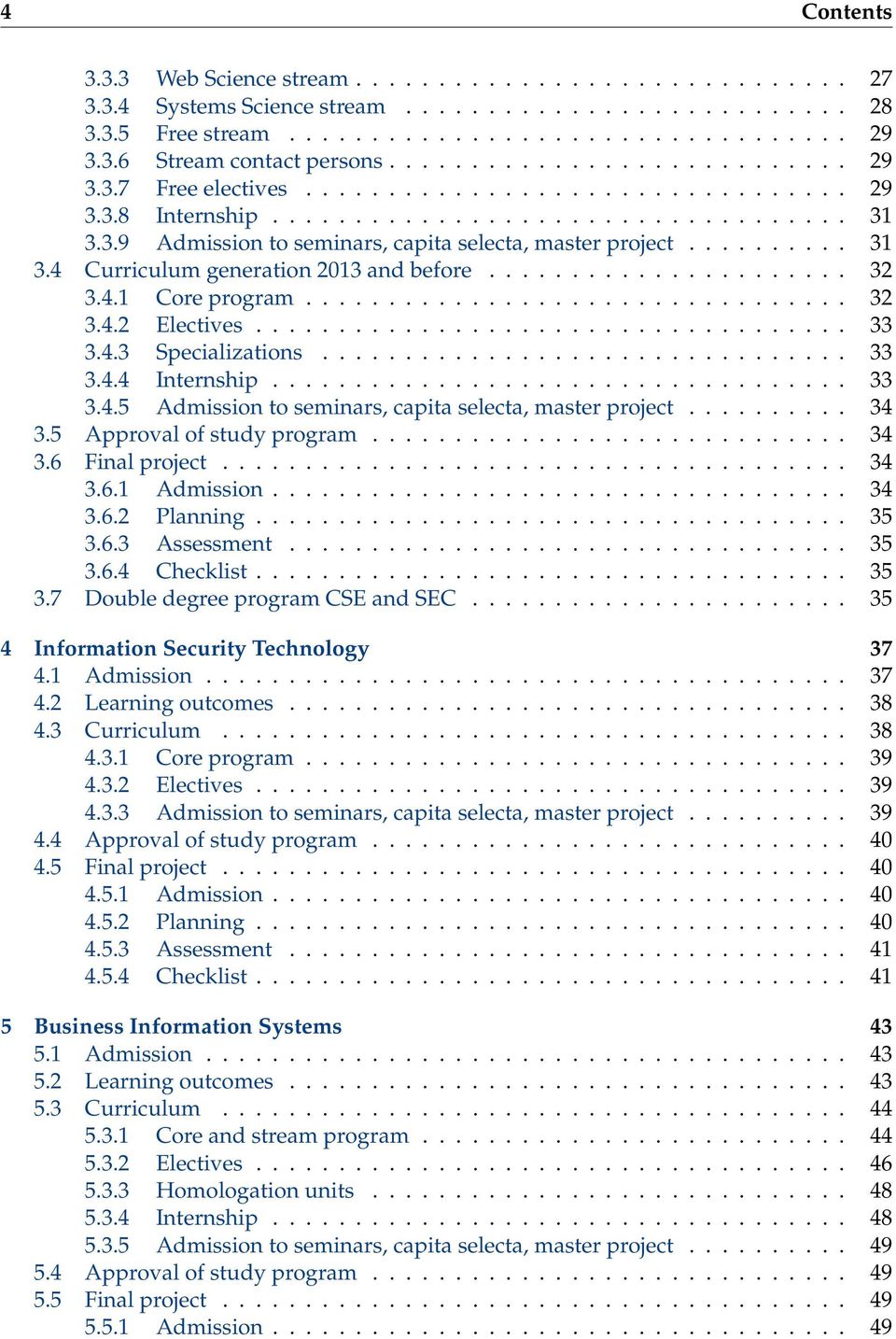
6 4 Contents Web Science stream Systems Science stream Free stream Stream contact persons Free electives Internship Admission to seminars, capita selecta, master project Curriculum generation 2013 and before Core program Electives Specializations Internship Admission to seminars, capita selecta, master project Approval of study program Final project Admission Planning Assessment Checklist Double degree program CSE and SEC Information Security Technology Admission Learning outcomes Curriculum Core program Electives Admission to seminars, capita selecta, master project Approval of study program Final project Admission Planning Assessment Checklist Business Information Systems Admission Learning outcomes Curriculum Core and stream program Electives Homologation units Internship Admission to seminars, capita selecta, master project Approval of study program Final project Admission
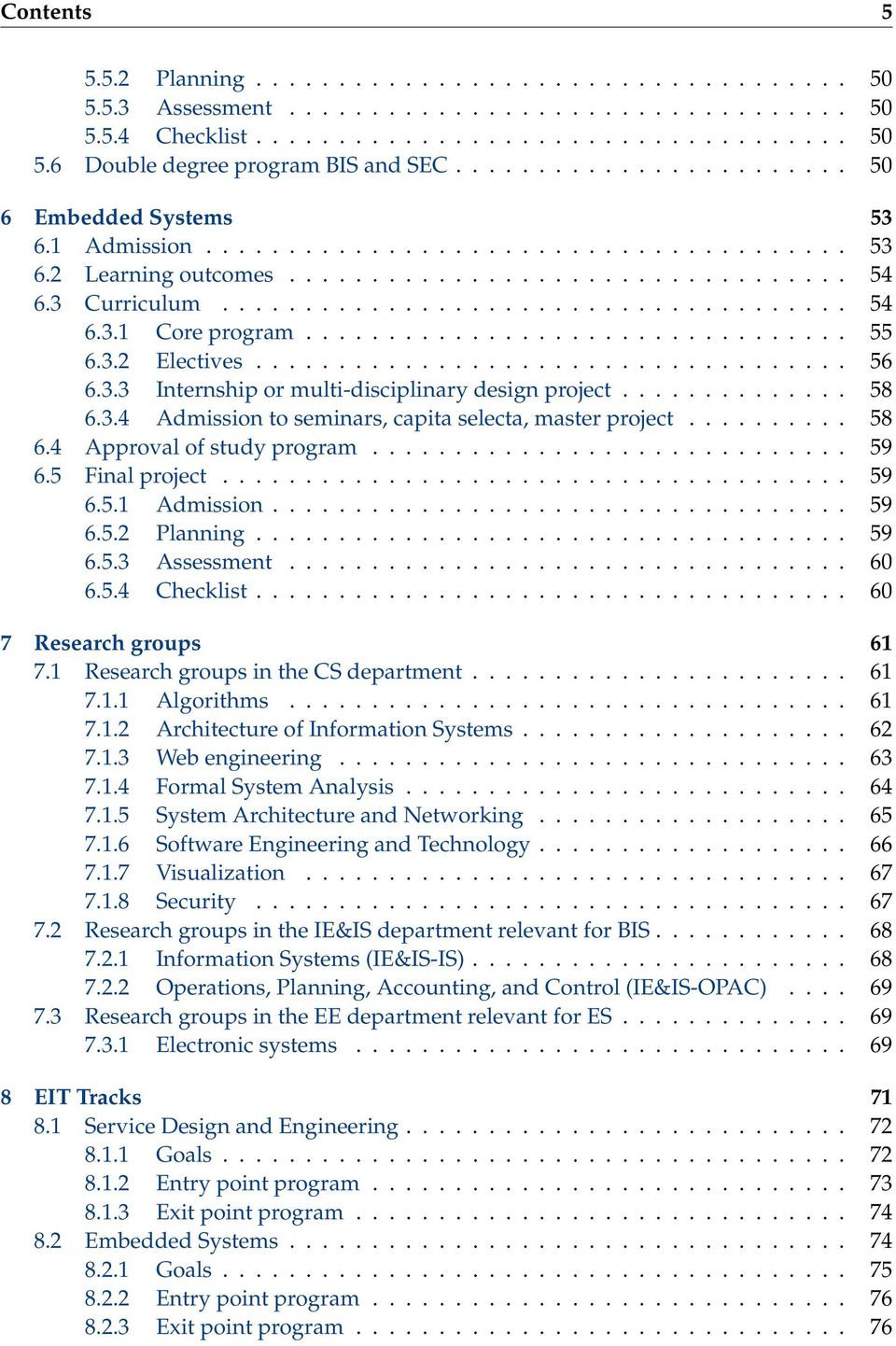
7 Contents Planning Assessment Checklist Double degree program BIS and SEC Embedded Systems Admission Learning outcomes Curriculum Core program Electives Internship or multi-disciplinary design project Admission to seminars, capita selecta, master project Approval of study program Final project Admission Planning Assessment Checklist Research groups Research groups in the CS department Algorithms Architecture of Information Systems Web engineering Formal System Analysis System Architecture and Networking Software Engineering and Technology Visualization Security Research groups in the IE&IS department relevant for BIS Information Systems (IE&IS-IS) Operations, Planning, Accounting, and Control (IE&IS-OPAC) Research groups in the EE department relevant for ES Electronic systems EIT Tracks Service Design and Engineering Goals Entry point program Exit point program Embedded Systems Goals Entry point program Exit point program
8 6 Contents III Organization and regulations 79 9 Academic administration Academic administration of the department Department Board of Mathematics and Computer Science Study-program Director Study-program Committee Examinations Committee Department Council CS Division and professors Department Office Student Council Facilities Buildings Lecture rooms, halls and other instruction facilities Library services Sale of study materials Computer Services Office Conditions for computer use Study association GEWIS Information resources A Teaching and Examination Regulations 89 A.1 CSE A.2 BIS A.3 ES B Graduation checklist 91

9 Part I General Information 7

10

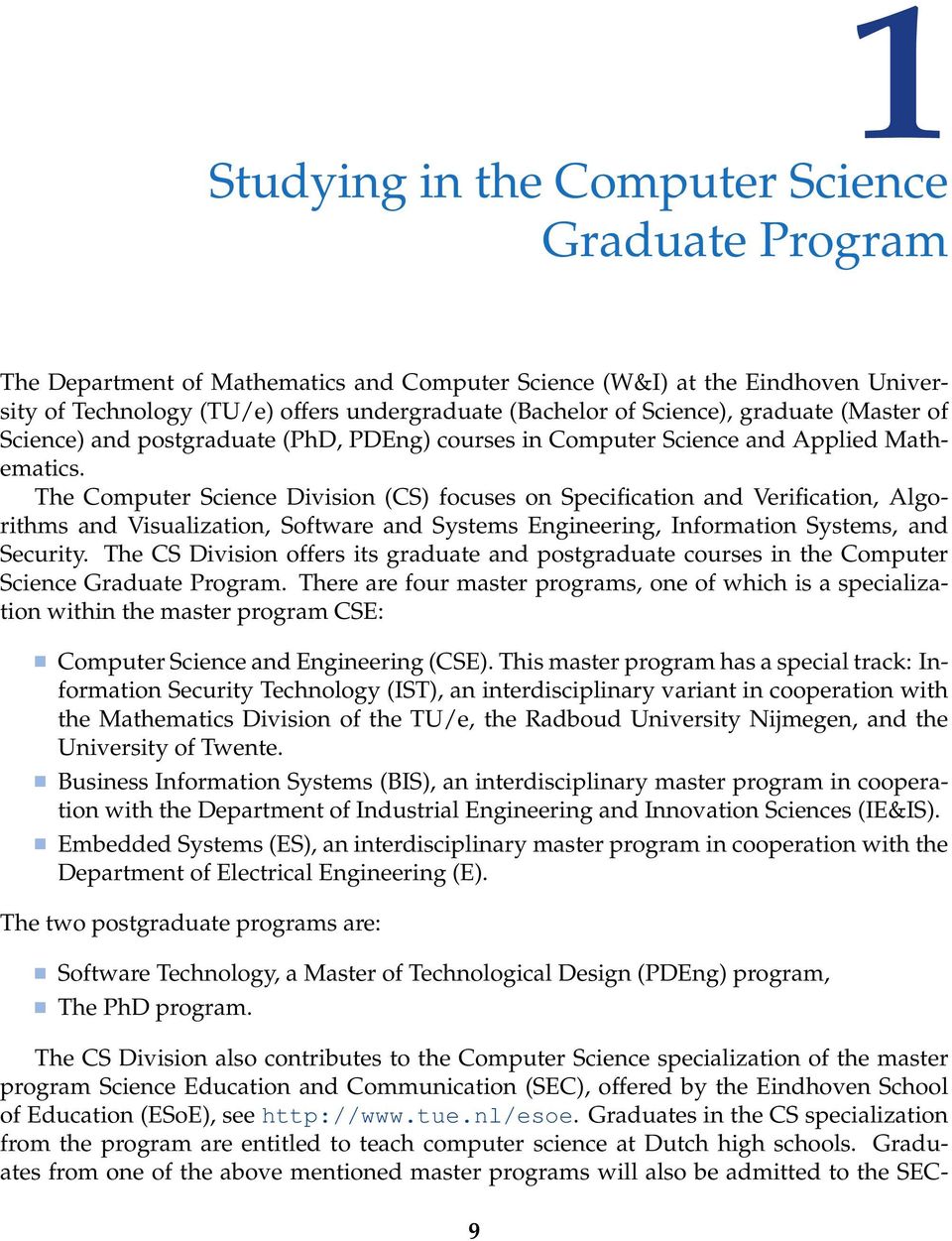
11 1 Studying in the Computer Science Graduate Program The Department of Mathematics and Computer Science (W&I) at the Eindhoven University of Technology (TU/e) offers undergraduate (Bachelor of Science), graduate (Master of Science) and postgraduate (PhD, PDEng) courses in Computer Science and Applied Mathematics. The Computer Science Division (CS) focuses on Specification and Verification, Algorithms and Visualization, Software and Systems Engineering, Information Systems, and Security. The CS Division offers its graduate and postgraduate courses in the Computer Science Graduate Program. There are four master programs, one of which is a specialization within the master program CSE: Computer Science and Engineering (CSE). This master program has a special track: Information Security Technology (IST), an interdisciplinary variant in cooperation with the Mathematics Division of the TU/e, the Radboud University Nijmegen, and the University of Twente. Business Information Systems (BIS), an interdisciplinary master program in cooperation with the Department of Industrial Engineering and Innovation Sciences (IE&IS). Embedded Systems (ES), an interdisciplinary master program in cooperation with the Department of Electrical Engineering (E). The two postgraduate programs are: Software Technology, a Master of Technological Design (PDEng) program, The PhD program. The CS Division also contributes to the Computer Science specialization of the master program Science Education and Communication (SEC), offered by the Eindhoven School of Education (ESoE), see Graduates in the CS specialization from the program are entitled to teach computer science at Dutch high schools. Graduates from one of the above mentioned master programs will also be admitted to the SEC- 9
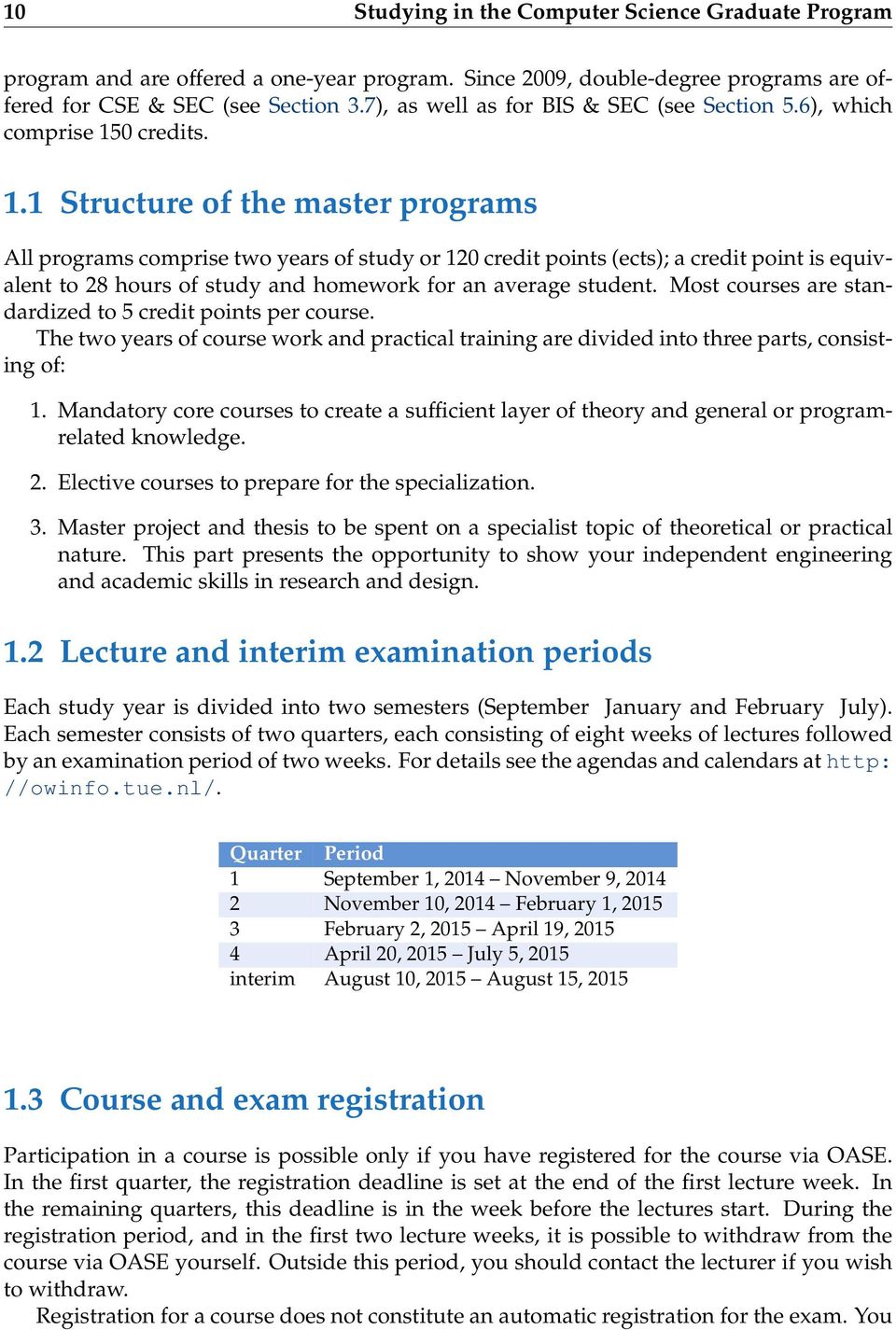
12 10 Studying in the Computer Science Graduate Program program and are offered a one-year program. Since 2009, double-degree programs are offered for CSE & SEC (see Section 3.7), as well as for BIS & SEC (see Section 5.6), which comprise 150 credits. 1.1 Structure of the master programs All programs comprise two years of study or 120 credit points (ects); a credit point is equivalent to 28 hours of study and homework for an average student. Most courses are standardized to 5 credit points per course. The two years of course work and practical training are divided into three parts, consisting of: 1. Mandatory core courses to create a sufficient layer of theory and general or programrelated knowledge. 2. Elective courses to prepare for the specialization. 3. Master project and thesis to be spent on a specialist topic of theoretical or practical nature. This part presents the opportunity to show your independent engineering and academic skills in research and design. 1.2 Lecture and interim examination periods Each study year is divided into two semesters (September January and February July). Each semester consists of two quarters, each consisting of eight weeks of lectures followed by an examination period of two weeks. For details see the agendas and calendars at http: //owinfo.tue.nl/. Quarter Period 1 September 1, 2014 November 9, November 10, 2014 February 1, February 2, 2015 April 19, April 20, 2015 July 5, 2015 interim August 10, 2015 August 15, Course and exam registration Participation in a course is possible only if you have registered for the course via OASE. In the first quarter, the registration deadline is set at the end of the first lecture week. In the remaining quarters, this deadline is in the week before the lectures start. During the registration period, and in the first two lecture weeks, it is possible to withdraw from the course via OASE yourself. Outside this period, you should contact the lecturer if you wish to withdraw. Registration for a course does not constitute an automatic registration for the exam. You
13 Studying in the Computer Science Graduate Program 11 have to register for each exam separately via OASE ( before the set deadlines. Note that if you are not registered for an exam, you cannot take part in it. 1.4 Examination and titles There is only one examination at the end of the program, in which the examination committee verifies and judges the final course results and the final master project grade. Completion of the program will lead to the title: Master of Science (MSc) with addition of the name of the program. Graduates are also entitled to use the Dutch title of ingenieur (ir). 1.5 Admissions General and specific master program requirements are applicable to admissions. The specific requirements may be higher in terms of knowledge prerequisites, but may also provide more possibilities for entry for students from other related areas of specialization. The specific requirements for admission to each of the master programs are described in the corresponding chapters General admissions requirements To be eligible for admission to any of the master programs, a Bachelor of Science degree is required. This degree must be of an equivalent academic level and approximate scientific content as the corresponding Dutch BSc degrees. In addition, sufficient proficiency in the English language is required Admissions with deficiencies For admitted students from other universities, it may be necessary to repair deficiencies due to differences in programs. The admission committee will point out those so-called homologation courses to the students directly or via the study advisor. Students coming from other disciplines at the three Dutch technical universities may be admissible after they followed a deficiency program of up to 30 credits. The disciplines in question are mentioned in the 3TU-doorstroommatrix, the corresponding deficiency program is constructed on an individual basis Foreign students The applications of students with a foreign university BSc degree will be evaluated by the admissions committee, taking into account both the academic level of the degree and the subjects studied by the applicant. In some special cases, relevant work experience may also be considered. The level of the degree is determined by the NUFFIC (

14 12 Studying in the Computer Science Graduate Program Polytechnic graduates (HBO) Students who have completed a polytechnic program may be eligible to participate in the pre-master programs. Completion of the pre-master program gives access to the corresponding master program. In Chapter 2 further details about admission for HBO students and the premaster program can be found Admissions procedure The procedure to be followed depends on your particular situation. Detailed information on the application procedure can be found on the site of the Education and Student Service Center of the TU/e, Foreign students must be aware that the admissions procedure, including visa application and other formalities, may take a while. 1.6 Studying abroad In case a student wants to study abroad as part of the program, several options are available for students with a Dutch Bachelor diploma: Take subjects at a foreign university Do an internship abroad Do the graduation project abroad Consult the study advisor for programmatic issues. For organizational issues, the international affairs coordinator provides assistance. The contact person is E. van den Hurk bc., Room MF 3.068, [email protected]. You need to deal with the organizational aspects yourself. The Education and Student Service desk has a handy checklist; it can be found on services/stu/. Information on scholarships can also be found at nl/. 1.7 Honors program The Honors program is aimed at excellent students from one of the Master programs offered by the Computer Science sub-department: Business Information Systems, Computer Science and Engineering, Information Security Technology, and Embedded Systems. The goal of the program is to give these students the opportunity to participate in and contribute to the research being done at the department. Concretely, the Honors program consists of: Two projects for 6 ects each, one in semester 1B of the Master program and one in semester 2A. These projects can be research-oriented or design-oriented and are done in different research groups in the department. The exact contents of the projects is determined by the supervisor of the research group where the project is done, in consultation with the student. The expected outcome of the project is a paper (published as a technical report of the department, and possibly also elsewhere).
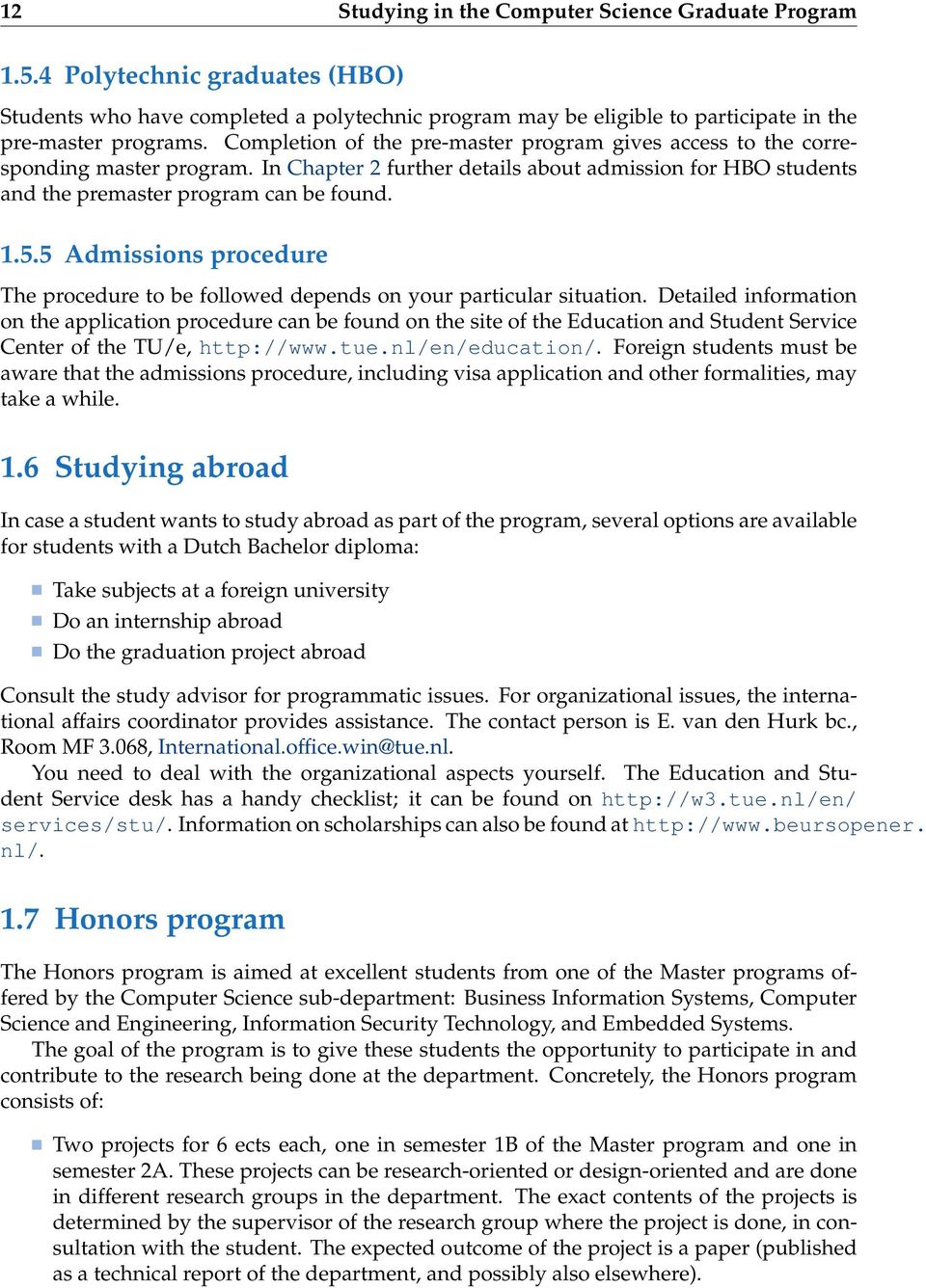
15 Studying in the Computer Science Graduate Program 13 Beside the projects, the student participates in other activities of the research group (for example in research seminars) and is encouraged to participate in activities organized by one of the national Dutch research schools (ASCI, IPA, or SIKS). The latter activities are typically short courses or conferences. Note that the Honors program is done on top of the regular Master program, that is, the 12 ects do not count towards the 120 credits you need to accumulate for your Master program. Students who successfully complete the Honors program will receive a certificate upon graduation. Participating in the Honors program is useful if you are interested in taking a PhD later on, since it allows you to experience what its like to do research in two different areas. But above all, the Honors program is challenging and fun. The program is aimed at motivated and excellent students (among the top 10% of the Master students in the department) who had excellent grades in their Bachelor programs and scored high grades during the first semester of the Master program (average at least 8). For admission to the honors program, an application procedure applies. Detailed instructions for application and the deadline will be announced by to all students in February of each year. More information about the honors program can be obtained from the honors program coordinator prof.dr. Paul De Bra, [email protected]. 1.8 Internal quality assurance After each semester the individual courses as well as the program are evaluated by the educational management and the study program committee. Based on this evaluation followup actions for improvement are defined if necessary. Input for the evaluation sessions are statistical data on the examination results, and the aggregated results from the semester questionnaires for students. It is of vital importance that students cooperate in this respect since only questionnaires with a sufficient number of respondents are taken into consideration. Apart from that, the examinations committee periodically carries out an investigation, in particular on the quality of the graduation projects and the quality of (partial) interim examinations. The opinion of students on the quality of their graduation project and process is gathered by means of a graduation questionnaire, which is filled in after the assessment of the graduation project. These are collected and aggregated once a year. The results are discussed both in the study program committee and examinations committee. 1.9 Study advisor The master study advisor for all programs is dr. Peter Veltkamp. Office: MF [email protected] Phone: Consulting hours: Monday, Tuesday and Thursday from 17:00 to 18:00 (or later if necessary) based on appointments (see below). Walk-in hour without appointment is often possible on Thursdays from to 13.30, except
16 14 Studying in the Computer Science Graduate Program when the study advisor is not in office then (check with the Study Program Secretariat) Making an appointment with the study advisor The preferred way of making an appointment is by an to the Study Program Secretariat at least one working day before you want to come. Alternatively, you can call either (040-) or (040-) , but then make sure your name gets across correctly. You can choose the day (see above) and the length of the time slot (15 minutes or 30 minutes, see below). Please also indicate a topic for the appointment, so the secretaries can assess whether you need a 15- or 30-minute slot. You will then receive a meeting request with an exact time. Please decline if the time does not suit, otherwise accept. If you are unable to come to a set appointment, please inform the secretariat as soon as possible (phone, , decline the appointment), so that the time slot can be given to someone else. 15 minute slot: For approval of a graduation plan. Please ensure that the form is filled out completely, that you have collected all required signatures, that you have a separate problem description, and that your individual study program has been approved already. 30 minute slot: For all other cases. In case you are not able to visit the study advisor during his consulting hours, you can make an appointment for a meeting at another time After graduation As an MSc graduate from the Computer Science Graduate Program, you are optimally prepared for a broad range of ICT-related jobs. However, you might consider to qualify yourself further for special jobs like system or software architect or for an academic career. In the latter case, the department of Mathematics and Computer Science offers the following opportunities Software Technology PDEng degree program The Professional Doctorate in Engineering (PDEng) degree program in Software Technology is provided in the context of the 3TU School for Technological Design, the Stan Ackermans Institute. It is an accredited and challenging two-year doctorate-level engineering degree program during which its trainees focus on strengthening their technical and non-technical competences related to the effective and efficient design and development of software-intensive systems, such as real-time embedded systems, in an industrial setting. The emphasis is on large-scale project-based design and development of this kind of software. The various parts of the PDEng degree program aid to develop the capability of individuals to work within a professional context. It advocates a scientific research based approach to solving problems, a systematic way of collecting evidence and a critical, reflective, and independent mind for the analysis and interpretation of evidence.

17 Studying in the Computer Science Graduate Program 15 It adds an additional dimension to a full MSc. program by extending it and integrating it with new elements. The emphasis is on developing and strengthening (exercising) the competencies necessary for finding technical solutions. For finding such solutions, an effective collaboration with representatives of different domains is inevitable, and this is practiced during the program. During the program, the PDEng trainees focus on systems architecting and designing software for software-intensive systems in multiple application domains for the High Tech Industry. After successfully completing all requirements, trainees are awarded a Professional Doctorate in Engineering degree. More information can be found on: tue.nl/ PhD programs When pursuing an academic career, the first step is to obtain a doctorate. A PhD program is an individual four year program, dedicated to sharpen your research skills. You are typically hired on a specific research project and become part of the scientific staff of the research group in which the project takes place. Your main task is to perform research under the guidance of and in collaboration with the supervisor(s) appointed by the Department. At the end of the four-year period, a PhD thesis is written on the research results. You do not only perform research, but also receive scientific training and training related to professional skills and personal development. More information about PhD programs can be found on: education/tue-graduate-school/taking-a-phd/

18 16 Studying in the Computer Science Graduate Program

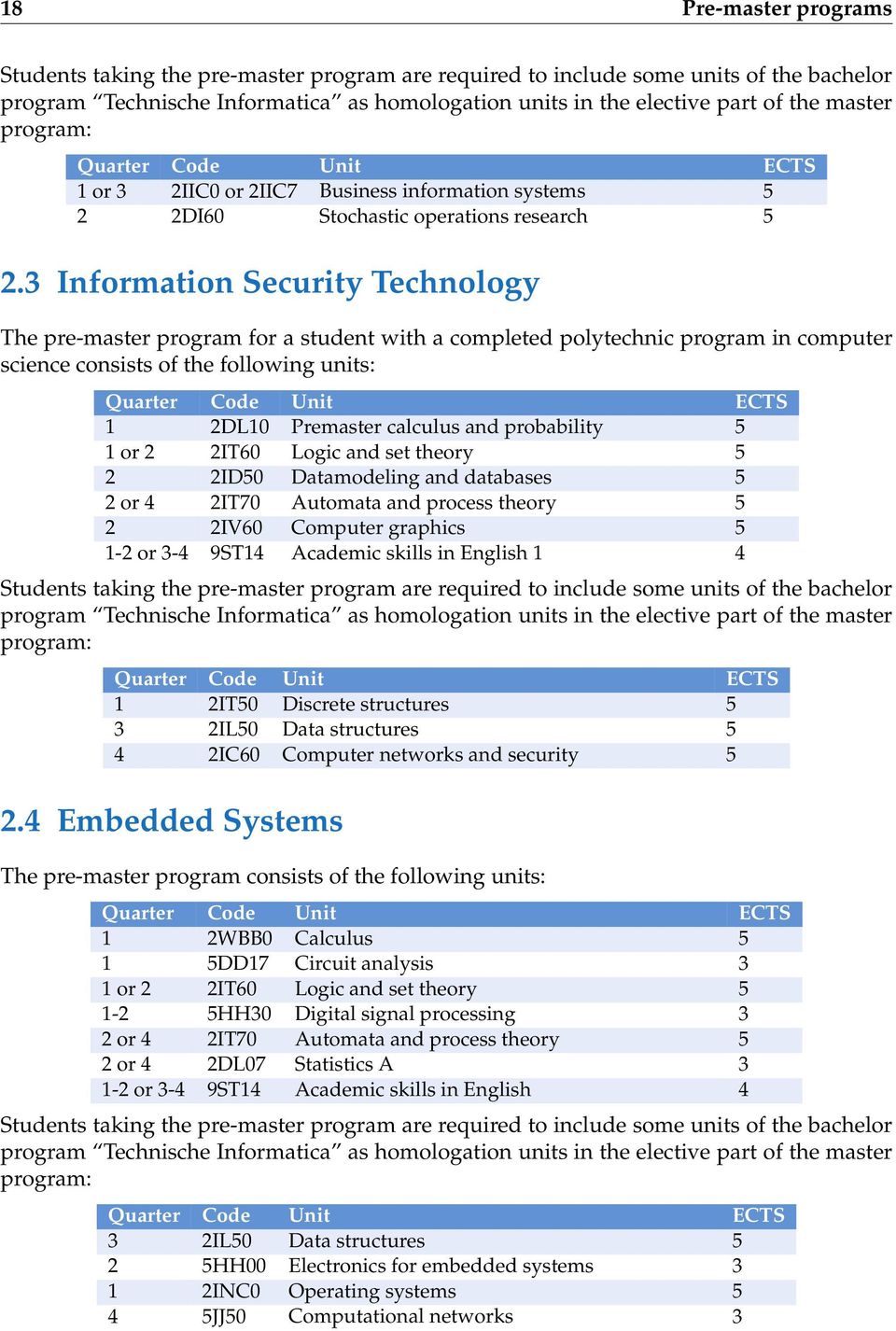
19 2 Pre-master programs 2.1 Computer Science and Engineering The pre-master program for a student with a completed polytechnic program in computer science consists of the following units: Quarter Code Unit ECTS 1 2DL10 Premaster calculus and probability 5 1 or 2 2IT60 Logic and set theory 5 2 2ID50 Datamodeling and databases 5 2 or 4 2IT70 Automata and process theory 5 2 2IV60 Computer graphics or 3-4 9ST14 Academic skills in English 1 4 Students taking the pre-master program are required to include some units of the bachelor program Technische Informatica as homologation units in the elective part of the master program: Quarter Code Unit ECTS 3 2IL50 Data structures 5 4 2IC60 Computer networks and security Business Information Systems The pre-master program consists of the following units: Quarter Code Unit ECTS 1 2DL10 Premaster calculus and probability or 3-4 9ST14 Academic skills in Engish 4 1 or 2 2IT60 Logic and set theory 5 2 2ID50 Datamodeling and databases 5 1 2IP90 Programming 5 2 or 4 2IT70 Automata and process theory 5 17

20 18 Pre-master programs Students taking the pre-master program are required to include some units of the bachelor program Technische Informatica as homologation units in the elective part of the master program: Quarter Code Unit ECTS 1 or 3 2IIC0 or 2IIC7 Business information systems 5 2 2DI60 Stochastic operations research Information Security Technology The pre-master program for a student with a completed polytechnic program in computer science consists of the following units: Quarter Code Unit ECTS 1 2DL10 Premaster calculus and probability 5 1 or 2 2IT60 Logic and set theory 5 2 2ID50 Datamodeling and databases 5 2 or 4 2IT70 Automata and process theory 5 2 2IV60 Computer graphics or 3-4 9ST14 Academic skills in English 1 4 Students taking the pre-master program are required to include some units of the bachelor program Technische Informatica as homologation units in the elective part of the master program: Quarter Code Unit ECTS 1 2IT50 Discrete structures 5 3 2IL50 Data structures 5 4 2IC60 Computer networks and security Embedded Systems The pre-master program consists of the following units: Quarter Code Unit ECTS 1 2WBB0 Calculus 5 1 5DD17 Circuit analysis 3 1 or 2 2IT60 Logic and set theory HH30 Digital signal processing 3 2 or 4 2IT70 Automata and process theory 5 2 or 4 2DL07 Statistics A or 3-4 9ST14 Academic skills in English 4 Students taking the pre-master program are required to include some units of the bachelor program Technische Informatica as homologation units in the elective part of the master program: Quarter Code Unit ECTS 3 2IL50 Data structures 5 2 5HH00 Electronics for embedded systems 3 1 2INC0 Operating systems 5 4 5JJ50 Computational networks 3
21 Pre-master programs Information sources Study advisor: dr. C.J. (Roel) Bloo, MF 3.067, phone Coordinator: ms. E. (Elisabeth) Melby, MF 3.094, phone
22 20 Pre-master programs
23 Part II Master Programs 21
24
25 3 Computer Science and Engineering The Master program in Computer Science and Engineering (CSE) gives a broad view of computer science from both a scientific and an engineering perspective, and provides ample opportunities for specialization. The program offers four different streams: Data Science, Software Science, Systems Science, and Web Science. Each stream has a core program of five courses, and a large list of stream electives from which you can choose. There is also ample room in the program to choose electives from outside your stream. 3.1 Admission A Bachelor degree in Computer Science obtained at a Dutch university provides direct admission to the CSE program. Students with a different degree and from foreign universities have to apply for admission via the admission committee. Dutch HBO graduates have to take a pre-master program before they can be admitted, see Section 2.1. The admission procedure is described in Section 1.5, and the requirements are listed in the Teaching and Examination Regulations (see Appendix A.1). 3.2 Learning outcomes A graduate from the master program is qualified to degree level in the domain of science, engineering and technology; is competent in the relevant domain-specific discipline, namely computer science and engineering; is capable of acquiring knowledge independently; approaches computer-science problems in a thorough and scientifically founded manner; is capable of critical thinking, can reason logically and form opinions; has design skills, presentation skills, and communication skills; 23
26 24 Computer Science and Engineering has insight into the role of computer science in industry, society, and science; and, in addition to a recognizable domain-specific profile, possesses a sufficiently broad basis to be able to work in an interdisciplinary and multidisciplinary context. In addition to these general learning outcomes, CSE graduates should also be experts in the subarea of computer science that they specialize in. 3.3 Curriculum 2014 The Master program Computer Science and Engineering is a two-year program of 120 ECTS in total. The academic year is subdivided into two semesters, the fall semester starting in September, and the spring semester starting in February. It is possible to enter the program in either semester; however, starting in September is preferred. The program is full time. The CSE curriculum is structured in streams, which provide an organized set of courses in particular subject areas within computer science. The streams provide guidance for the directions in which you can specialize, and ensure that you choose a comprehensive and coherent set of courses. The streams are: Data science Software science Web science Systems science Each stream has the same structure, as summarized in the following table. Units ECTS Mandatory courses 25 Stream electives 25 Free electives 35 Seminar 5 Master project 30 Each stream has a number of mandatory courses, and a selected set of elective courses from which at least 25 credit points should be chosen. There is great flexibility in defining the remaining part of your individual study program from all courses that are offered by the computer science department (35 credit points). To prepare for the master project, you take a seminar course from one of the eight computer science research groups. In the following sections, more details for each of the streams are given Data Science stream Recent technological and societal changes have led to an explosion of digitally available data. Exploiting the available data to its fullest extent, in order to improve decision making, increase productivity, and deepen our understanding of scientific questions, is one of today s key challenges. Data science is an emerging area that aims to address this challenge, and computer science is one of its key areas. The CSE stream Data Science focuses on the computer-science aspects of this area. You learn how to develop effective and efficient methods to analyze data and turn it into meaningful information, which can then be presented (visually) to data users. As a graduate of the Data Science stream, you
27 Computer Science and Engineering 25 have expertise in a variety of approaches to analyze data understand the pros and cons of these approaches and apply them in the appropriate situations can perform research and develop novel methods and techniques in one of the computerscience areas relevant to data science The following table lists the mandatory courses. Quarter Code Unit ECTS Exam Mandatory courses IL45 Advanced algorithms 5 a 1 2ID26 Web information retrieval and data mining 5 w+a 2 2IV35 Visualization 5 a 3 2DI70 Statistical learning theory 5? 4 2II66 Advanced process mining 5 w+a 2 or 4 Seminar 1 5 a 2IM91 Master project 2 30 a Stream electives IN28 Grid and cloud computing 5 a 1 2IV55 Interactive virtual environments 5 a 2 2II36 Web-based interactive systems 5 w+a 2 2II75 Business process simulation 5 a 2 2IS27 Principles of data protection 5 w+a 3 1BM56 Business intelligence 5 w+a 3 2IL76 Algorithms for geographic data 5 a 3 2IV06 Visual computing project 5 a 3-4 2DD23 Time-series analysis & forecasting 5 a+o 3-4 5P480 Knowledge systems and applications 4 o 4 0EM02 Survey design & statistical analysis 3 a 4 2ID35 Database technology 5 w+a 4 5N520 Statistical bioinformatics 2 w Free electives 35 1 Seminars can be taken from the fourth quarter of your study program onwards. This means that if you enroll in September, you cannot take the seminars in quarter 2 in your first year, but that you have to wait until you have entered the second year. Similarly, if you enroll in February, the seminars in quarter 4 can only be followed in your second year. 2 You can only start the master project if your individual study program has been approved by the Examinations Committee, and if all homologation units (if any) have been completed successfully, see also Section You have to choose at least 25 credit points from this list Software Science stream Innovative software systems are the driving force behind many exciting developments in society, industry, and science. However, designing software systems that function correctly, efficiently and securely, is far from easy. The CSE stream Software Science focuses on the formal techniques and technology you need for this. You learn model-driven engineering techniques to increase the quality of computer programs. As a graduate of the stream Soft-
28 26 Computer Science and Engineering ware Science, you have in-depth knowledge of techniques needed to model and design efficient and reliable software understand the strengths and weaknesses of these techniques and can apply them in the appropriate situation, taking limitations of cost, time, and other resources into account can analyze existing software systems and understand the fundamental issues involved in software maintenance The following table lists the mandatory courses. Quarter Code Unit ECTS Exam Mandatory courses IL45 Advanced algorithms 5 a 1 2IS15 Generic language technology 5 w+a 1 2IW26 System validation 5 w+a 3 2IS55 Software evolution 5 a 4 2ID35 Database technology 5 w+a 2 or 4 Seminar 1 5 a 2IM91 Master project 2 30 a Stream electives ID26 Web information retrieval and data mining 5 w+a 1 2II45 Architecture of distributed systems 5 w+a 1 2II65 Metamodeling and interoperability 5 w+a 1 2II70 Constraint programming 5 a 1 2IN28 Grid and cloud computing 5 a 2 2IF85 Program verification techniques 5 w+a 2 2IL55 Geometric algorithms 5 a 2 2IW15 Automated reasoning 5 w+a 3 2IN26 Real-time systems 5 w+a 3 2IW55 Algorithms for model checking 5 w+a 4 2IF45 Process algebra 5 w+a 4 2IN35 VLSI programming 5 a 4 2IP45 Software project management 5 a 4 2IW02 Real-time software development 5 a Free electives 35 1 Seminars can be taken from the fourth quarter of your study program onwards. This means that if you enroll in September, you cannot take the seminars in quarter 2 in your first year, but that you have to wait until you have entered the second year. Similarly, if you enroll in February, the seminars in quarter 4 can only be followed in your second year. 2 You can only start the master project if your individual study program has been approved by the Examinations Committee, and if all homologation units (if any) have been completed successfully, see also Section You have to choose at least 25 credit points from this list
29 Computer Science and Engineering Web Science stream Over the past decade the use of web-based systems has exploded. Buying clothes, books, and DVDs, booking hotels, checking the weather forecast, contacting your friends: all of this is done on the internet nowadays, and novel web-based applications are developed every day. The CSE stream Web Science focuses on the technology behind these developments. In the stream you learn techniques needed to design intelligent and reliable web-based systems and to analyze the use of such systems. As a graduate of the Web Science stream you have knowledge of the principles and technologies that drive the Web have the skills to design effective web-based systems, and to analyze existing webbased systems and their use can design intelligent information services using semantic-web technology or machinelearning techniques have insight into privacy and security issues related to web-based systems. The following table lists the mandatory courses. Quarter Code Unit ECTS Exam Mandatory courses ID26 Web information retrieval and data mining 5 w+a 1 2II45 Architecture of distributed systems 5 w+a 2 2II36 Web-based interactive systems 5 w+a 2 2IS27 Principles of data protection 5 w+a 4 2ID35 Database technology 5 w+a 2 or 4 Seminar 1 5 a 2IM91 Master project 2 30 a Stream electives IC35 Physical aspects of digital security 5 w 1 2ID56 Adaptive web-based systems 5 a 1 2IL45 Advanced algorithms 5 a 1 2IN28 Grid and cloud computing 5 a 1 2IV55 Interactive virtual environments 5 a 1 2 2IF17 Hacker s hut 6 a 2 2IV35 Visualization 5 a 3 2II55 Business process management systems 5 w+a 4 0EM02 Survey design & statistical analysis 3 a 4 0EM51 Infonomics 3 a 4 2II66 Advanced process mining 5 w+a Free electives 35 1 Seminars can be taken from the fourth quarter of your study program onwards. This means that if you enroll in September, you cannot take the seminars in quarter 2 in your first year, but that you have to wait until you have entered the second year. Similarly, if you enroll in February, the seminars in quarter 4 can only be followed in your second year. 2 You can only start the master project if your individual study program has been approved by the Examinations Committee, and if all homologation units (if any) have been completed successfully, see also Section You have to choose at least 25 credit points from this list
30 28 Computer Science and Engineering Systems Science stream Modern systems are defined by software. Trends include cloud platforms, consisting of large connected server farms, and Cyber Physical Systems, with a tight integration of physical system, control, communication and computation. In the CSE stream Systems Science you study these new technologies and the process to develop them. Protocols, interfaces and algorithms need to be designed to improve (energy) efficiency and automation. Larger systems are never built from scratch anymore, but composed from existing building blocks. An understanding of the essential structures and behaviors of a system - the architecture, laid down in models - is therefore essential. Models are further used to validate and monitor required qualities (reliability, robustness, safety, security and privacy), and to drive the implementation. Experimentation and online methods (like self-monitoring) are essential ingredients. As a student graduating in the stream Systems Science you are familiar with the architectures and architectural principles of large-scale software systems understand the role of models in model-driven systems engineering, and can develop and use corresponding techniques to design systems with required qualities are capable to perform research on processes and tools, as well as on new emerging technologies. The following table lists the mandatory courses. Quarter Code Unit ECTS Exam Mandatory courses II45 Architecture of distributed systems 5 w+a 1 2IW26 System validation 5 w+a 2 2IW15 Automated reasoning 5 w+a 3 2IN26 Real-time systems 5 w+a 3 4 2IF02 Verification of security protocols 6 w+a 2 or 4 Seminar 1 5 a 2IM91 Master project 2 30 a Stream electives II70 Constraint programming 5 a 1 2IL45 Advanced algorithms 5 a 1 2IN28 Grid and cloud computing 5 a 1 2IS15 Generic language technology 5 w+a 1-2 5KK73 Embedded computer architecture 5 o 2 2IN27 Quantitative evaluation of embedded systems 5 w+a 2 2IS27 Principles of data protection 5 w+a 2 2IV35 Visualization 5 a 3 2IF65 Proving with computer assistance 5 w+a 3 2IS55 Software evolution 5 a 3 2IW55 Algorithms for model checking 5 w+a 3-4 5KK80 Multiprocessors 5 a+o 4 2IF45 Process algebra 5 w+a 4 2IN35 VLSI programming 5 a 4 5KK60 Systems on silicon 5 w+a Free electives 35
31 Computer Science and Engineering 29 1 Seminars can be taken from the fourth quarter of your study program onwards. This means that if you enroll in September, you cannot take the seminars in quarter 2 in your first year, but that you have to wait until you have entered the second year. Similarly, if you enroll in February, the seminars in quarter 4 can only be followed in your second year. 2 You can only start the master project if your individual study program has been approved by the Examinations Committee, and if all homologation units (if any) have been completed successfully, see also Section You have to choose at least 25 credit points from this list Free stream The streams have been set up such that they provide a structured set of courses related to important topics in computer science. If you feel that none of the streams appeal to you, there is the possibility to take the Free stream. However, you have to ask permission to the Examinations Committee, and motivate why you cannot set up a desired individual study program that falls within one of the streams. The Free stream is identical to the curriculum of CSE for generations 2013 and before, see Section Stream contact persons Each of the streams has a contact person, with whom you can talk about the specialization area, choosing stream electives or other courses, and other stream-related topics. For general study advice, you should consult the study advisor, see Section 1.9. The stream contact persons are: prof. Jack van Wijk (data science) dr. Alexander Serebrenik (software science and free stream) dr. Natasha Stash (web science) prof. Jan Friso Groote (systems science) Free electives This section provides a list of courses than can be chosen in the free electives space in the curriculum. The list applies to all streams. To compose a balanced program, you should consult the contact person for your stream (see Section 3.3.6) or the contact person of the research group in which you want to do a master project (see Section 3.4.3). Some courses may be prescribed as homologation courses (up to 18 credits) to make up for deficiencies in former education. Other courses may only be selected after approval by the Examinations Committee in advance (please consult the master study advisor). In some cases an internship of 15 credits may be part of the electives, see Section Quarter Code Unit ECTS Exam 1 2IC35 Physical aspects of digital security 5 w 1 2ID26 Web information retrieval and data mining 5 w+a 1 2ID56 Adaptive web-based systems 5 a 1 2II45 Architecture of distributed systems 5 w+a 1 2II65 Metamodeling and interoperability 5 w+a continued on next page
32 30 Computer Science and Engineering continued from previous page Quarter Code Unit ECTS Exam 1 2II70 Constraint programming 5 a 1 2IL45 Advanced algorithms 5 a 1 2IN28 Grid and cloud computing 5 a 1 2IS15 Generic language technology 5 w+a 1 2IV55 Interactive virtual environments 5 a 1 2IW26 System validation 5 w+a 1 2 2IF17 Hacker s hut 6 a 1 2 9ST14 Academic skills in English w+o 2 2IF85 Program verification techniques 5 w+a 2 2II36 Web-based interactive systems 5 w+a 2 2II75 Business process simulation 5 a 2 2IL55 Geometric algorithms 5 a 2 2IN27 Quantitative evaluation of embedded systems 5 w+a 2 2IS27 Principles of data protection 5 w+a 2 2IV35 Visualization 5 a 2 2IW15 Automated reasoning 5 w+a 3 2IF65 Proving with computer assistance 5 w+a 3 2II55 Business process management systems 5 w+a 3 2IL76 Algorithms for geographic data 5 a 3 2IN26 Real-time systems 5 w+a 3 2IS55 Software evolution 5 a 3 2IV06 Visual computing project 5 a 3 2IW04 Knowledge based control systems 5 w+a 3 2IW55 Algorithms for model checking 5 w+a 3 4 2IF02 Verification of security protocols 6 w+a 3 4 2WO08 Graphs and algorithms 6 w 3 4 9ST14 Academic skills in English w+o 4 2ID35 Database technology 5 w+a 4 2IF45 Process algebra 5 w+a 4 2II66 Advanced process mining 5 w+a 4 2IN35 VLSI programming 5 a 4 2IP45 Software project management 5 a 4 2IV15 Simulation in computer graphics 5 a 4 2IW02 Real-time software development 5 a 4 2WO07 Approximation algorithms 3 a Courses at Utrecht University 2 1 2IUU1 Intelligent agents 7.5 w 2 2IUU2 Multi-agent systems 7.5 w+a 2 2IUU3 Computer animation 7.5 a 2 2IUU4 Computer vision 7.5 w+a 4 2IUU5 Games and agents 7.5 a Seminars 3 2 2II96 Seminar architecture of information systems 5 a 2 2ID96 Seminar web engineering 5 a 2 2IN95 Seminar systems architecture and networking 5 a 2 2IS95 Seminar software engineering and technology 5 a 2 2IV95 Seminar visualization 5 a 3 4 2IF03 Seminar information security technology 6 a continued on next page
33 Computer Science and Engineering 31 continued from previous page Quarter Code Unit ECTS Exam 4 2IF96 Seminar formal system analysis 5 a 4 2IL95 Seminar algorithms 5 a Capita selecta courses/internship 4 2IF98 Capita selecta formal system analysis 5 a 2IS99 Capita selecta software engineering and technology 5 a 2IC99 Capita selecta security 5 a 2IL99 Capita selecta algorithms 5 a 2IN99 Capita selecta systems architecture and networking 5 a 2IV99 Capita selecta visualization 5 a 2ID98 Capita selecta web engineering 5 a 2II99 Capita selecta architecture of information systems 5 a 2IM02 Internship 5 15 a 1 For foreign students, and for students who have completed a polytechnic (HBO) programme of computer science. 2 Enrollment ( neveninschrijving ) at Utrecht University is required to follow these courses. Note that all teaching activities take place in Utrecht. 3 Seminars can be taken from the fourth quarter of your study program onwards. This means that if you enroll in September, you cannot take the seminars in quarter 2 in your first year, but that you have to wait until you have entered the second year. Similarly, if you enroll in February, the seminars in quarter 4 can only be followed in your second year. 4 Capita selecta can only be taken with permission of the responsible lecturer. 5 The internship can be followed only after having obtained permission of the internship coordinator Internship Since the master project can already be performed in an industrial environment, it is usually advised to spend the rest of the study program on regular courses. In some cases, however, an internship may be a valuable addition to the program, provided that it enhances practical experience, provides deepening of knowledge, and contributes to the specialization. An internship takes 15 credit points as part of the electives, and can be followed only by permission of the internship coordinator. The internship is not open to IST-students. Requests for internships accompanied by convincing arguments explaining the reasons why the intended internship has a clear added value to the study program are to be sent to the internship coordinator dr. J.P. Veltkamp Admission to seminars, capita selecta, master project Capita selecta courses are occasional educational elements, often with a research flavor. They may be experimental courses, a lecture series given by a visitor, or a special individual assignment as a preparation on future research. The capita selecta can be followed only by permission of the responsible lecturer. Students do not have a right to do these courses, but they may be granted the possibility. The seminars, capita selecta, and master project are only open to students that are fully admitted. This means that they are not available for students that do not yet have their BSc diploma or students that did not yet complete the premaster. Other students that have deficiencies (e.g. uncompleted homologation courses) cannot start the master project.
34 32 Computer Science and Engineering year 1 quarter 1 quarter 2 quarter 3 quarter 4 core course core course core course core course year 2 core course seminar master s thesis project Figure 3.1: Global CSE study program for generations 2013 and before. The white slots indicate electives. 3.4 Curriculum generation 2013 and before The global contents of the program is as follows: Study component Credits Core program 25 Electives 60 Research seminar 5 (or 6) Master project The individual study program has to be approved before you can start the master project, see Section 3.5 for details. Note also that you cannot start the master project if you still have uncompleted homologation units. A global view of the study program is shown in Fig Core program The core courses provide you with a sound theoretical basis. This mandatory part of the Master program consists of a choice of five courses from each of the specialization areas. Each research group offers a core course. Additionally, you should follow a research seminar in your specialization (see Chapter 7) to prepare for your master project. Each of the eight computer science research groups offers a seminar, in which typical topics for that particular field of research are addressed. Quarter Code Unit ECTS Exam Core courses 1 2IL45 Advanced algorithms 5 a 1 2IS15 Generic language technology 5 w+a 1 2IW26 System validation 5 w+a 2 2IV35 Visualization 5 a 3 2II55 Business process management systems 5 w+a 3 2IN26 Real-time systems 5 w+a 3 4 2IF02 Verification of security protocols 6 w+a 4 2ID35 Database technology 5 w+a continued on next page
35 Computer Science and Engineering 33 continued from previous page Quarter Code Unit ECTS Exam Seminars 1 2 2II96 Seminar architecture of information systems 5 a 2 2ID96 Seminar web engineering 5 a 2 2IN95 Seminar systems architecture and networking 5 a 2 2IS95 Seminar software engineering and technology 5 a 2 2IV95 Seminar visualization 5 a 3 4 2IF03 Seminar information security technology 6 a 4 2IF96 Seminar formal system analysis 5 a 4 2IL95 Seminar algorithms 5 a 1 Seminars can be taken from the fourth quarter of your study program onwards. This means that if you enroll in September, you cannot take the seminars in quarter 2 in your first year, but that you have to wait until you have entered the second year. Similarly, if you enroll in February, the seminars in quarter 4 can only be followed in your second year Electives The elective part of the curriculum amounts to 60 credits. You can choose freely from the list provided in Section To compose a balanced program, you should consult the contact person of the specialization of your interest (see Section 3.4.3). Some courses may be prescribed as homologation courses (up to 18 credits) to make up for deficiencies in former education. Other courses may only be selected after approval by the Examinations Committee in advance (please consult the master study advisor). In some cases an internship of 15 credits may be part of the electives, see Section Specializations The CS division has eight research groups (see details and the names of contact persons in Chapter 7), each offering specialization courses in addition to their core course. After taking some courses, you will probably have a more clear picture of the academic direction you want to pursue in your studies. If not, you may want to talk to several staff members or the study advisor. In the specialization for your subject, there are people that you may want to be involved with for your final master project. In order to compose a wellbalanced program that provides adequate prerequisites for the this project, it is advisable to first choose and consult a project supervisor in the specialization of your interest before choosing elective courses. As a rule of thumb, you should start your search for a supervisor and the construction of your individual program not later than at the end of your first year Internship Since the master project can already be performed in an industrial environment, it is usually advised to spend the rest of the study program on regular courses. In some cases, however, an internship may be a valuable addition to the program, provided that it enhances practical experience, provides deepening of knowledge, and contributes to the specialization. An internship takes 15 credit points as part of the electives, and can be followed only by
36 34 Computer Science and Engineering permission of the internship coordinator. The internship is not open to IST-students. Requests for internships accompanied by convincing arguments explaining the reasons why the intended internship has a clear added value to the study program are to be sent to the internship coordinator dr. J.P. Veltkamp Admission to seminars, capita selecta, master project Capita selecta courses are occasional educational elements, often with a research flavor. They may be experimental courses, a lecture series given by a visitor, or a special individual assignment as a preparation on future research. The capita selecta can be followed only by permission of the responsible lecturer. Students do not have a right to do these courses, but they may be granted the possibility. The seminars, capita selecta, and master project are only open to students that are fully admitted. This means that they are not available for students that do not yet have their BSc diploma or students that did not yet complete the premaster. Other students that have deficiencies (e.g. uncompleted homologation courses) cannot start the master project. 3.5 Approval of study program The Examinations Committee must approve your program consisting of the mandatory courses and your choice of the electives. In order to obtain this approval you construct a program, possibly with the help of the study advisor, fill out the program form, have it signed by yourself and the supervisor of your choice and hand it in at the student administration office (MF 3.068). 3.6 Final project The final project of 30 credit points can be completed in any of the research groups in the CS-division, as long as a CS staff member is supervising it. The start of your master project is marked by submitting a completed graduation plan containing the necessary information on the project (name, place, period, supervisor, and so on), and stating the fact that you have completed your curricular part of the program (see Section 3.5). The form must be accompanied by a project description and signed by you, your supervisor, the head of the relevant specialization and the study advisor Admission During the master project, you should be able to spend full time and concentration on your project. In practice, however, it turns out to be rather difficult to plan curricular activities and, especially, their success. Therefore, we leave room for at most two courses of in total at most ten credit points to be finished during the master project period. Courses that are to be taken as homologation units have to be passed before you can start the master project. Also, be aware that you are not allowed to finish your project before you completed all your courses.
37 Computer Science and Engineering Planning Together with your supervisor, you decide on a description of your topic and a global planning. You also arrange the supervision method, including how often you and your supervisor will meet to discuss progress. The project is concluded with a thesis and a presentation followed by a defense. In general, the master project has to be finished within 6 months from the start. An extension to 9 months is possible. In exceptional cases, and only if it is clear that the project can be finished, the exam committee may allow for an additional 3 months period. It is important to note that the project must be finished within 1 year (when working full time) to prevent cancellation of the project, and having to start a new project with a different supervisor. The graduation regulations can be found on the website Assessment Your final project is graded by an assessment committee. The committee usually consists of your supervisor, a staff member from your specialization area, and a staff member from one of the other CS research groups. The supervisor is responsible for forming this committee at least one month before graduation. The assessment committee takes the following criteria into account: Report: Structure, completeness, correctness, readability, argumentation. Graduation presentation: Structure, contents, clarity, contact with audience. Defense: Argumentation, demonstration of knowledge, competency in discerning main aspects from details of the project. Execution of the project: Level of independence, planning, organization, handling deadlines and setbacks, level of own contribution. Not all criteria are equally important. The assessment committee decides the relative importance of each criterion to arrive at a final grade. The motivation for the grade is documented in an assessment report, see the website Checklist The graduation checklist (Appendix B) summarizes all the steps required from having your study program approved to the graduation ceremony. 3.7 Double degree program CSE and SEC The qualification to teach computer science to senior secondary school pupils is coupled to the 3TU program Science Education and Communication (SEC). This program encompasses 120 credits. In Eindhoven it is offered by the Eindhoven School of Education (ESoE). In the Education track of the SEC program, a student specializes in one of four disciplines: maths, physics, chemistry or computer science. Please note that the SEC program is completely lectured in Dutch! BSc graduates in computer science are directly admitted to the SEC-program. So are MSc graduates from a computer science oriented program; their SEC-program is reduced to 60 credits because of exemptions. For this last category an even shorter route is available by taking the double degree program, which amounts up to 150 credits. Enrollment is required
38 36 Computer Science and Engineering for both master programs (one main enrollment and a second enrollment). Certificates will be granted after completion of the whole program. Details about the curriculum are available at the ESoE website: esoe/.
39 4 Information Security Technology A Master of Science in Information Security Technology (IST) is an academic expert in the area of digital communication in general, and in information security technology in particular. Information security technology protects data that are stored, transmitted, accessed, or modified against all kinds of threats. This can vary from unauthorized access to malicious manipulations. Information security technology is essential for secure communication and data protection in many situations. The IST program is a joint master program between three Dutch universities: Eindhoven University of Technology (TU/e), Radboud University Nijmegen (RU), and University of Twente (UT). These three universities have joint their forces with respect to security education in the Kerckhoffs Institute. Each of the mandatory and special elective courses is taught at only one of these three universities. This implies that students have to travel to other sites for part of their education. The program is set up in such a way that averaged over the two years of their master s studies students will have to travel one day per week to another university. A Master of Science in Information Security Technology can become involved in cryptographic primitives, security protocols, data storage, communication, or information security management. Additionally, he or she can act as internal or external consultant, regarding the security of information systems and networks, or regarding the security policy of an organization. A Master of Science in Information Security Technology can enter a job in the following institutions: research laboratories and academic institutes (both for theoretical and applied work); applied R&D in industry; the financial world; governmental agencies; consultancy agencies (all with respect to security in the area of information systems and relevant policymaking). 4.1 Admission A Bachelor degree in Computer Science obtained at a Dutch university provides direct admission to the CSE program. Students with a different degree and from foreign universities have to apply for admission via the admission committee. Dutch HBO graduates have to take a pre-master program before they can be admitted, see Section
40 38 Information Security Technology The admission procedure is described in Section 1.5, and the requirements are listed in the Teaching and Examination Regulations (see Appendix A.1). 4.2 Learning outcomes The goal of the program is to transform Bachelors in Computer Science and Mathematics into academic experts in the area of digital communication in general and in information security in particular. Alumni will be able to function as researcher or as system developer in university or society. They will be well aware of the state-of-the-art in information security technology at the master level. They will be able to analyze complex security situations and to reduce them to solvable problems. A graduate from the master program is qualified to degree level in the domain of science, engineering and technology; is competent in the relevant domain-specific discipline, namely computer science and engineering; is capable of acquiring knowledge independently; approaches computer-science problems in a thorough and scientifically founded manner; is capable of critical thinking, can reason logically and form opinions; has design skills, presentation skills, and communication skills; has insight into the role of computer science in industry, society, and science; and, in addition to a recognizable domain-specific profile, possesses a sufficiently broad basis to be able to work in an interdisciplinary and multidisciplinary context. In addition to these general learning outcomes, a graduate from IST has a broad view of information security; should be able to evaluate existing and newly designed security systems; should be able to list relevant security requirements in an application and to select the right techniques to address these issues; is an expert in at least one subarea of information security; can contribute to discussions about the role of information security in our society; has experience in the process of specifying, designing, and realization of an application in which security plays an important role. 4.3 Curriculum The Master track Information Security Technology is a two-year program of 120 ECTS in total. The academic year is subdivided into two semesters, the fall semester starting in September, and the spring semester starting in February. It is only possible to enter the program September. The program is full time. The curriculum contains both computer science courses and mathematics courses, and consists of a mandatory core program and elective courses. See Fig. 4.1 for a global view of the program.
41 Information Security Technology 39 year 1 quarter 1 quarter 2 quarter 3 quarter 4 Network security Cryptography I Verification of security protocols Software security year 2 Security and privacy in mobile systems Security in organizations master s thesis project Core program Figure 4.1: Global IST study program. The white slots indicate electives. The mandatory part of the program contains the following courses: Quarter Code Unit ECTS Exam Location First year 1-2 2IF08 Network security 6 w+a Twente 1-2 2WC12 Cryptography 1 6 w Eindhoven 3-4 2IF02 Verification of security protocols 6 w+a Eindhoven 3-4 2IF06 Software security 6 w Nijmegen Second year 1-2 2IF19 Security and privacy in mobile systems 6 a Twente 1-2 2IF07 Security in organizations 6 w+a Nijmegen 3-4 2IM91/ 2H016 Master project * 30 *) In case the master project is done within the Mathematics Division the code is 2H016. All mandatory courses are offered as tele-lectures, so it is not strictly necessary to travel to the other locations Electives The list below contains the preferred electives for the IST program. It is also possible to choose electives from the CSE program (see Section 3.3.7); an internship (2IM02) is not possible however. At least three courses must be chosen from the following list of preferred electives: Quarter Code Unit ECTS Exam Location First year 1-2 2IF09 Biometric recognition 6 a Twente 1-2 2IF18 Cyber crime Science 6 a Twente 1-2 2IF17 Hacker s hut 6 a Eindhoven 3-4 2IF03 Seminar information security technology 6 a Eindhoven 3-4 2IF13 Privacy seminar 6 a Nijmegen 3-4 2WC13 Cryptography 2 6 a Eindhoven Second year 1-2 2IF12 Law in cyberspace 6 w+a Nijmegen 1-2 2IF14 Hardware and operating system security 6 a Nijmegen 1-2 2IF15 Secure data management 6 a Twente
42 40 Information Security Technology The seminars, capita selecta, and master project are only open to students that are fully admitted. This means that they are not available for students that do not yet have their BSc diploma or students that did not yet complete the premaster. Other students that have deficiencies (e.g. uncompleted homologation courses) cannot start the master project. 4.4 Approval of study program The Examinations Committee must approve your program consisting of the mandatory courses and your choice of the electives. In order to obtain this approval you construct a program, possibly with the help of the study advisor, fill out the program form, have it signed by yourself and the supervisor of your choice and hand it in at the student administration office (MF 3.068). 4.5 Final project The start of your master project is marked by submitting a completed graduation plan containing the necessary information on the project (name, place, period, supervisor, and so on), and stating the fact that you have completed your curricular part of the program (see Section 4.4). The form must be accompanied by a project description and signed by you, your supervisor, the head of the relevant specialization and the study advisor Admission During the master project, you should be able to spend full time and concentration on your project. In practice, however, it turns out to be rather difficult to plan curricular activities and, especially, their success. Therefore, we leave room for at most two courses of in total at most ten credit points to be finished during the master project period. Courses that are to be taken as homologation units have to be passed before you can start the master project. Also, be aware that you are not allowed to finish your project before you completed all your courses Planning Together with your supervisor, you decide on a description of your topic and a global planning. You also arrange the supervision method, including how often you and your supervisor will meet to discuss progress. The project is concluded with a thesis and a presentation followed by a defense. In general, the master project has to be finished within 6 months from the start. An extension to 9 months is possible. In exceptional cases, and only if it is clear that the project can be finished, the exam committee may allow for an additional 3 months period. It is important to note that the project must be finished within 1 year (when working full time) to prevent cancellation of the project, and having to start a new project with a different supervisor. The graduation regulations can be found on the website.
43 Information Security Technology Assessment Your final project is graded by an assessment committee. The committee usually consists of your supervisor, a staff member from your specialization area, and a staff member from one of the other CS research groups. The supervisor is responsible for forming this committee at least one month before graduation. The assessment committee takes the following criteria into account: Report: Structure, completeness, correctness, readability, argumentation. Graduation presentation: Structure, contents, clarity, contact with audience. Defense: Argumentation, demonstration of knowledge, competency in discerning main aspects from details of the project. Execution of the project: Level of independence, planning, organization, handling deadlines and setbacks, level of own contribution. Not all criteria are equally important. The assessment committee decides the relative importance of each criterion to arrive at a final grade. The motivation for the grade is documented in an assessment report Checklist The graduation checklist (Appendix B) summarizes all the steps required from having your study program approved to the graduation ceremony.
44 42 Information Security Technology
45 5 Business Information Systems The Department of Mathematics and Computer Science and the Department of Industrial Engineering and Innovation Sciences play an active role in the development of new, innovative and application-oriented technology. The cooperation between the Information Systems section within Computer Science and the Information Systems section within Industrial Engineering and Innovation Sciences is long established and fruitful. The master program in Business Information Systems (BIS) at TU/e is illustrative of these cooperative efforts. The program rests on a sound theoretical foundation, with emphasis on the design and application of quality business information systems and technology for information systems. As a graduate of this program, the student will have developed a scientific attitude and a model-driven, engineering approach to the field. The student is trained in the use of formal models allowing for specification analysis. The area of expertise will be the development of business information systems from a business perspective. The student will be able to play a leading role in the development and application of business information systems in various sections of society (profit and non-profit). 5.1 Admission A Bachelor degree in Computer Science or in Industrial Engineering obtained at a Dutch university provides direct admission to the BIS program. Students with a different degree and from foreign universities have to apply for admission via the admission committee. Dutch HBO graduates have to take a pre-master program before they can be admitted, see Section 2.2. The admission procedure is described in Section 1.5, and the requirements are listed in the Teaching and Examination Regulations (see Appendix A.2). 5.2 Learning outcomes A graduate from the master program 43
46 44 Business Information Systems is qualified to degree level in the domain of science, engineering and technology; is competent in the relevant domain-specific discipline, namely business information systems; is capable of acquiring knowledge independently; approaches computer-science problems in a thorough and scientifically founded manner; is capable of critical thinking, can reason logically and form opinions; has design skills, presentation skills, and communication skills; has insight into the role of computer science in industry, society, and science; and, in addition to a recognizable domain-specific profile, possesses a sufficiently broad basis to be able to work in an interdisciplinary and multidisciplinary context. A BIS graduate should also possess knowledge of the mathematical formalisms, methods, tools and their mutual dependencies needed to understand and model business processes and data; have the engineering skills needed to apply this knowledge to design high-quality business information systems; understand the role of IT in the context of organizations, business processes and their management. 5.3 Curriculum The Master program Business Information Systems is a two-year program of 120 ECTS in total. The academic year is subdivided into two semesters, the fall semester starting in September, and the spring semester starting in February. It is possible to enter the program in either semester; however, starting in September is preferred. The program is full time. The curriculum consists of computer science courses and courses in industrial engineering. All students take the core program, choose a stream package, and complete the program with electives Core and stream program An overview of the BIS curriculum is shown in Fig The core courses are as follows. Quarter Code Unit ECTS Exam 1 2ID26 Web information retrieval and data mining 5 w+a 1-2 1BM05 Business process management 5 w+a 1-2 1BM10 Electronic business 5 a+o 2 2II75 Business process simulation 5 a 3-4 1BM41 Business information systems architecture 5 w+a 3-4 1BM65 IT-governance 5 w+a 3 2II55 Business process management systems 5 w+a 4 2ID35 Database technology 5 w+a
47 Business Information Systems 45 year 1 quarter 1 quarter 2 quarter 3 quarter 4 Business process management Electronic business Information Business process retrieval simulation IT governance Business information syst. architecture Business process Database management syst. technology year 2 master s thesis project Figure 5.1: Global study program of BIS. The white slots indicate stream courses or electives. Streams distinguish various profiles within the BIS program. In principle, one of the following stream packages has to be chosen as part of the program. Logistics. The logistics stream is aimed at students interested in logistical systems, not only from an managerial, but also from a mathematical point of view. Topics that are addressed are accounting and finance, supply chain management, constraint-based optimization and distributed systems. The goal of this stream is for students not only to understand the complexity of logistical systems, but also to be able to develop solution architectures for supporting logistical systems while focusing on optimality of the provided solutions. Information Management. The focus of the information management stream is on the managerial side of information technology. Emphasis is placed on how people interact with software, how software should be managed and how innovative organizations should be organized. Furthermore, the students are trained in writing a business plan and maintaining a business network. Business Process Intelligence. The business process intelligence stream aims at the more technical side of business information systems. The focus of this stream is on the analysis of models and other sources of information such as event logs, using techniques and insights from metamodelling, process mining, visualization, and business intelligence. The stream courses can be found in the table below. Quarter Code Unit ECTS Exam Business Process Intelligence 1 2II65 Metamodelling and interoperability 5 w+a 2 2IV35 Visualization 5 a 3 1BM56 Business intelligence 5 w+a 4 2II66 Advanced process mining 5 w+a Information Management continued on next page
48 46 Business Information Systems continued from previous page Quarter Code Unit ECTS Exam 1-2 1BM70 Healthcare business networks 5 a+o 1-2 1BM20 Software requirements management 5 w+a 3-4 1ZM40 Strategy and technology management 5 a 3-4 1JM27 Human performance in innovative organizations 5 a Logistics 1 2II70 Constraint programming 5 a 1-2 2xxxx Operations research (consult with program manager) 5 a 3-4 1CM22 Management accounting 5 w 3-4 1CM25 Supply chain operations planning 5 w+a Electives The elective part of the curriculum consists mainly of courses. In general, courses can be chosen freely from the lists provided this section. Other courses may only be selected after approval by the examinations committee in advance (you may consult the study advisor). In some cases, an internship of 15 credits may be part of the electives. Some courses, up to a maximum of 18 credits, may be prescribed as homologation courses to make up for deficiencies in former education, see Section The following table outlines a collection of courses that can be selected as elective without prior approval of the Examinations Committee. Quarter Code Unit ECTS Exam 1 0EM60 Perspectives on medical technology 3 o 1 2IC35 Physical aspects of digital security 5 w 1 2ID56 Adaptive web-based systems 5 a 1 2II45 Architecture of distributed systems 5 w+a 1 2II65 Metamodeling and interoperability 5 w+a 1 2II70 Constraint programming 5 a 1 2IL45 Advanced algorithms 5 a 1 2IN28 Grid and cloud computing 5 a 1 2IS15 Generic language technology 5 w+a 1 2IV55 Interactive virtual environments 5 a 1 2IW26 System validation 5 w+a 1-2 1BM20 Software requirements management 5 w+a 1-2 1BM70 Healthcare business networks 5 a+o 1-2 1BM95 Literature study for BIS-students 1 5 a 1-2 1CM05 Design of operations planning and control 5 a systems 1-2 1CM10 Modeling and analysis of manufacturing 5 a systems 1-2 1CM40 Retail operations 5 w+a 1-2 1JM11 Performance enhancement 5 w+a 1-2 1ZM16 Management of product development 5 w+a 1-2 1ZM20 Technology entrepeneurship 5 w+a continued on next page
49 Business Information Systems 47 continued from previous page Quarter Code Unit ECTS Exam 1-2 1ZM45 International negotiation 3 w+a 2 1CM45 Business economics and management 4 w+a accounting for BIS 2 2IF85 Program verification techniques 5 w+a 2 2II36 Web-based interactive systems 5 w+a 2 2IL55 Geometric algorithms 5 a 2 2IN27 Quantitative evaluation of embedded systems 5 w+a 2 2IS27 Principles of data protection 5 w+a 2 2IV35 Visualization 5 a 2 2IW15 Automated reasoning 5 w+a 3 1BM56 Business intelligence 5 w+a 3 2IF65 Proving with computer assistance 5 w+a 3 2IL76 Algorithms for geographic data 5 a 3 2IN26 Real-time systems 5 w+a 3 2IS55 Software evolution 5 a 3 2IV06 Visual computing project 5 a 3 2IW55 Algorithms for model checking 5 w+a 3-4 1BM95 Literature study for BIS-students 1 5 a 3-4 1CM15 Project and process management 5 a 3-4 1CM22 Integrated financial & operations management 5 w 3-4 1CM25 Supply chain operations planning 5 w+a 3-4 1CM30 Service supply chain for capital goods 5 w 3-4 1CM36 Game theory with applications to supply chain 5 w management 3-4 1JM06 Human aspects of innovation 5 a 3-4 1JM21 Designing effective performance management 5 w+a systems 3-4 1JM27 Human performance in innovative 5 a organizations 3-4 1ZM25 Knowledge processes and management 5 a 3-4 1ZM35 Strategic sourcing and supply management 5 a 3-4 1ZM40 Strategy and technology management 5 a 3-4 1ZM45 International negotiation 3 w+a 3-4 2IF02 Verification of security protocols 6 w 4 2IF45 Process algebra 5 w+a 4 2II66 Advanced process mining 5 w+a 4 2IN35 VLSI programming 5 a 4 2IV15 Simulation in computer graphics 5 a Seminars 2 2ID96 Seminar web engineering 5 a 2 2II96 Seminar architecture of information systems 5 a 2 2IN95 Seminar systems architecture and networking 5 a 2 2IS95 Seminar software engineering and technology 5 a 2 2IV95 Seminar visualization 5 a 3-4 2IF03 Seminar information security technology 6 a 4 2IF96 Seminar formal system analysis 5 a 4 2IL95 Seminar algorithms 5 a Capita selecta 2 continued on next page
50 48 Business Information Systems continued from previous page Quarter Code Unit ECTS Exam 2IC99 Capita selecta security 5 a 2ID98 Capita web engineering 5 a 2IF98 Capita selecta formal system analysis 5 a 2II99 Capita selecta architecture of information 5 a systems 2IL99 Capita selecta algorithms 5 a 2IN99 Capita selecta systems architecture and 5 a networking 2IS99 Capita selecta software engineering and 5 a technology 2IV99 Capita selecta visualization 5 a 2IM02/1BM02 Internship 3 15 a 1 This literature study can only be followed by students that will perform their master project in the Information Systems group of IE&IS. 2 Capita selecta can only be taken after prior approval by the responsible lecturer. 3 In case the internship is done within the Mathematics and Computer Science department the code is 2IM02. In case the internship is done within the Industrial Engineering & Innovation Sciences department the code is 1BM02. The internship can be followed only by permission of the internship coordinator Homologation units Homologation units are bachelor courses that should be taken to make up for deficiencies in former education. Students who have a Dutch university bachelor degree in Computer Science have to include the following unit as an elective: Quarter Code Unit ECTS Exam 2 2DI60 Stochastic operations research 5 w Students who have a Dutch university bachelor degree in Industrial Engineering have to include the following unit as an elective: Quarter Code Unit ECTS Exam 1 2IP90 Programming 5 w+a Students who have a foreign bachelor degree may be prescribed different courses. This is done on an individual basis by the Admissions Committee Internship Since the master project can already be performed in an industrial environment, it is usually advised to spend the rest of the study program on regular courses. In some cases, however, an internship may be a valuable addition to the program, provided that it enhances practical experience, provides deepening of knowledge, and contributes to the specialization. An internship takes 15 credit points as part of the electives, and can be followed only by permission of the internship coordinator. Requests for internships accompanied by convincing
51 Business Information Systems 49 arguments explaining the reasons why the intended internship has a clear added value to the study program are to be sent to the internship coordinator dr. J.P. Veltkamp Admission to seminars, capita selecta, master project Capita selecta courses are occasional educational elements, often with a research flavor. They may be experimental courses, a lecture series given by a visitor, or a special individual assignment as a preparation on future research. The capita selecta can be followed only by permission of the responsible lecturer. Students do not have a right to do these courses, but they may be granted the possibility. The seminars, capita selecta, and master project are only open to students that are fully admitted. This means that they are not available for students that do not yet have their BSc diploma or students that did not yet complete the premaster. Other students that have deficiencies (e.g. uncompleted homologation courses) cannot start the master project. 5.4 Approval of study program The Examinations Committee must approve your program consisting of the mandatory courses and your choice of the electives. In order to obtain this approval you construct a program, possibly with the help of the study advisor, fill out the program form, have it signed by yourself and the supervisor of your choice and hand it in at the student administration office (MF 3.068). 5.5 Final project The knowledge and experience, which were acquired in the first part of the program, are applied in an individual setting in order to develop to the necessary level to function as an academic professional in the field of Business Information Systems. The project can be completed in any of the specializations listed in Section 7.1 and Section 7.2, provided that a staff member of the associated group has the supervision. The start of your master project is marked by submitting a completed graduation plan containing the necessary information on the project (name, place, period, supervisor, and so on), and stating the fact that you have completed your curricular part of the program (see Section 5.4). The form must be accompanied by a project description and signed by you, your supervisor, the head of the relevant specialization and the study advisor. In case the master project is carried out under supervision of a staff member of the Department IE&IS the code is 1BM Admission During the master project, you should be able to spend full time and concentration on your project. In practice, however, it turns out to be rather difficult to plan curricular activities and, especially, their success. Therefore, we leave room for at most two courses of in total at most ten credit points to be finished during the master project period. Courses that are to be taken as homologation units have to be passed before you can start the master project.
52 50 Business Information Systems Also, be aware that you are not allowed to finish your project before you completed all your courses Planning Together with your supervisor, you decide on a description of your topic and a global planning. You also arrange the supervision method, including how often you and your supervisor will meet to discuss progress. The project is concluded with a thesis and a presentation followed by a defense. In general, the master project has to be finished within 6 months from the start. An extension to 9 months is possible. In exceptional cases, and only if it is clear that the project can be finished, the exam committee may allow for an additional 3 months period. It is important to note that the project must be finished within 1 year (when working full time) to prevent cancellation of the project, and having to start a new project with a different supervisor. The graduation regulations can be found on the website Assessment Your final project is graded by an assessment committee. The committee usually consists of your supervisor, a staff member from your specialization area, and a staff member from one of the other research groups. The supervisor is responsible for forming this committee at least one month before graduation. The assessment committee takes the following criteria into account: Report: Structure, completeness, correctness, readability, argumentation. Graduation presentation: Structure, contents, clarity, contact with audience. Defense: Argumentation, demonstration of knowledge, competency in discerning main aspects from details of the project. Execution of the project: Level of independence, planning, organization, handling deadlines and setbacks, level of own contribution. Not all criteria are equally important. The assessment committee decides the relative importance of each criterion to arrive at a final grade. The motivation for the grade is documented in an assessment report, see the website Checklist The graduation checklist (Appendix B) summarizes all the steps required from having your study program approved to the graduation ceremony. 5.6 Double degree program BIS and SEC The qualification to teach computer science to senior secondary pupils is coupled to the 3TU program Science Education and Communication (SEC). This program encompasses 120 credits. In Eindhoven it is offered by the Eindhoven School of Education (ESoE). In the Education track of the SEC program a student specializes in one of four disciplines: maths, physics, chemistry or computer science. Please note that the SEC program is completely lectured in Dutch!
53 Business Information Systems 51 BSc graduates in computer science are directly admitted to the SEC-program. So are MSc graduates from a computer science oriented program like BIS; their SEC-program is reduced to 60 credits because of exemptions. For this last category an even shorter route is available by taking the double degree program, which amounts up to 150 ects. In the BIS-part of the program the stream is replaced by SEC subjects. Enrollment is required for both master programs (one main enrollment and a second enrollment). Certificates will be granted after completion of the whole program. Details about the curriculum are available at the ESoE website: esoe/.
54 52 Business Information Systems
55 6 Embedded Systems The design of innovative software and hardware is the core of technological and industrial progress. Both the departments of Mathematics and Computer Science and Electrical Engineering play an active role in the development of new, innovative technology. The Master of Science program in Embedded Systems at the TU/e is illustrative of this active role, as it is a co-production of these two departments, awaiting students with a background in computer science, as well as graduates from the field of electrical engineering. The program rests on a sound theoretical foundation, with an emphasis on the design of quality embedded systems. As a graduate of this program, you will have developed a scientific attitude and an engineering approach to the field. Your position will be the design of embedded systems from a high-level architecture viewpoint, via requirements and behavioral specifications and using platforms, hardware and silicon. You will be able to play a leading role in the development of embedded systems, either in scientific research, in industry or governmental organizations. The Embedded Systems program focuses on the design of efficient and reliable systems. In order to be able to compose dependable protocols for the behavior of such systems, you need knowledge of algorithms, performance, hardware, methods of design and documentation, and an insight into the variability and maintainability of these protocols. All these aspects are addressed in the compulsory part of the program. The masters degree program in Embedded Systems is a joint program of the 3TU federation. The programs offered at each location shave the common core part (25 credits). Furthermore, some specialisation courses are exchanged by 3TU telefacilities. 6.1 Admission A Bachelor degree in Computer Science or in Electrical Engineering obtained at a Dutch university provides direct admission to the ES program. Students with a different degree and from foreign universities have to apply for admission via the admission committee. Dutch HBO graduates have to take a pre-master program before they can be admitted, see Section
56 54 Embedded Systems The admission procedure is described in Section 1.5, and the requirements are listed in the Teaching and Examination Regulations (see Appendix A.3). 6.2 Learning outcomes A graduate from the master program is qualified to degree level in the domain of science, engineering and technology; is competent in the relevant domain-specific discipline, namely computer science and engineering; is capable of acquiring knowledge independently; approaches computer-science problems in a thorough and scientifically founded manner; is capable of critical thinking, can reason logically and form opinions; has design skills, presentation skills, and communication skills; has insight into the role of computer science in industry, society, and science; and, in addition to a recognizable domain-specific profile, possesses a sufficiently broad basis to be able to work in an interdisciplinary and multidisciplinary context. In addition to these general learning outcomes, ES graduates will have developed the following domain specific competences: The graduate has a holistic view on systems and system development. On the one hand he is capable of an abstract view to understand and master systems of huge complexity. On the other hand he is able to describe and study the structure and the behavior of the (embedded) systems in precise detail. He understands the position and importance of the system during its lifetime. The graduate has thorough knowledge of contemporary techniques to realize embedded systems. He has sufficient academic background to understand and apply techniques that will become available within the next decades. He is cost and environment aware, thus capable of making optimal use of available means (software/hardware). The graduate has a sufficient basis to design embedded systems at the required level of quality, or assess a priori that such a design cannot be constructed. This presupposes thorough knowledge of requirement engineering, modeling, testing and implementation techniques. The graduate has a flexible and inquisitive mind. He understands the theories, techniques and tools in this field in such a way that he is able to adapt these to optimally fit their purpose. He is able to invent his own tools, theories and techniques if these are not available. 6.3 Curriculum The curriculum consists of computer science courses and courses in electrical engineering. This section describes the curriculum at the TU/e; the programs of the two partner universities can be found in the Teaching and Examination Regulations (see Appendix A.3).
57 Embedded Systems Core program The core program is mandatory for all students. Quarter Code Unit ECTS Exam 1 2IW26 1 System Validation 5 w+a 1 2II45 Architecture of distributed systems 5 w+a 1-2 5KK73 1 Embedded Computer Architecture 5 a+o 2 2IW15 Automated reasoning 5 w+a 2 2IN27 1 Quantitative Evaluation of Embedded Systems 5 w+a 3 2IN26 1 Real-time Systems 5 w+a 3-4 5KK03 1 Embedded Systems Laboratory 5 a+o 3-4 5KK80 Multiprocessors 5 a+o 4 5KK60 Systems on silicon 5 w+a 2IM92/5T514 Preparation graduation project ES 2 10 a 1 These courses are in the common core of the 3TU program. 2 Preparation for graduation project ES consists of a literature survey and feasibility study for the graduation project. The preparation has to be finished and graded before the start of the final project. Students who have completed a Dutch university bachelor program in computer science are required to include some additional units as homologation study components in the elective part of the master program: Quarter Code Unit ECTS Exam 1 5DD17 Circuit analysis 3 w 1-2 5HH30 Digital signal processing 3 w 2 5HH00 Electronics for embedded systems 3 w Students who have completed a Dutch university bachelor program in electrical engineering are required to include some additional units as homologation study components in the elective part of the master program: Quarter Code Unit ECTS Exam 2 or 4 2IT70 Automata and process theory 5 w+a 2 5HH00 Electronics for embedded systems 3 w 3 2IW80 Software specification and architecture 5 w+a Students with a non-dutch bachelor degree may be prescribed different courses. This is done on an individual basis by the Admissions Committee.
58 56 Embedded Systems Electives The elective part of the curriculum consists mainly of courses. In general, courses can be chosen freely from the list provided this section. Some courses may be prescribed as homologation courses (up to 18 credits) to make up for deficiencies in former education, as mentioned in Section Other courses may only be selected after approval by the Examinations Committee in advance (please consult the master study advisor). In some cases an internship of 15 credits may be part of the electives, see Section Quarter Code Unit ECTS Exam 1 2IC35 Physical aspects of digital security 5 w 1 2ID26 Web information retrieval and data mining 5 w+a 1 2ID56 Adaptive web-based systems 5 a 1 2II65 Metamodeling and interoperability 5 w+a 1 2II70 Constraint programming 5 a 1 2IL45 Advanced algorithms 5 a 1 2IN28 Grid and cloud computing 5 a 1 2IS15 Generic language technology 5 w+a 1 2IV55 Interactive virtual environments 5 a 1 5L130 Electrophysiology 3 o 1 5ME00 Signal processing for communication 3 w 1 5ME10 Statistical signal processing 3 w 1 5MX00 Dynamical systems 3 w 1 5N280 Low-power electronics 4 o 1 5P340 Information theory 2 4 o 1 5P380 Advanced digital circuit design 4 w/o 1 5P450 Analogue/digital and digital/analogue converters 4 o 1 5P530 Video processing for multimedia systems 4 o 1 5P690 Advanced actuator systems 4 w 1-2 5KK04 Networked embedded systems 5 a+o 1-2 9ST14 Academic skills in English w+o 2 2IF85 Program verification techniques 5 w+a 2 2II36 Web-based interactive systems 5 w+a 2 2II75 Business process simulation 5 a 2 2IL55 Geometric algorithms 5 a 2 2IS27 Principles of data protection 5 w+a 2 2IV35 Visualization 5 a 2 2IW01 Embedded computer architectures w+a 2 2IX17 Communication skills 3 a 2 5MB20 Adaptive information processing 3 w 2 5MB30 Robust control 3 w 2 5MC10 Combinatorial algorithms 3 w 2 5MD00 Computer architecture 3 a+o 2 5MF00 EM waves and antennas 2 w 2 5MG00 Mathematics for electromagnetism 3 a 2 5MY10 Wireless communication I 3 w 2 5P500 Monitoring of respiration and circulation 3 w 2 5SC20 State space control 3 w continued on next page
59 Embedded Systems 57 continued from previous page Quarter Code Unit ECTS Exam 3 2IF65 Proving with computer assistance 5 w+a 3 2II55 Business process management systems 5 w+a 3 2IL76 Algorithms for geographic data 5 a 3 2IS55 Software evolution 5 a 3 2IV06 Visual computing project 5 a 3 2IW04 Knowledge based control systems 3 4 w+a 3 2IW55 Algorithms for model checking 5 w+a 3 5DD40 Multimedia video coding and architecture 4 a+o 3 5KK06 Computer arithmetic 3 5 w+a 3 5MB10 Model reduction 3 w 3 5MB40 System identification 3 w+a 3 5MD20 Design automation 3 w 3 5MH00 Computational electromagnetics 3 a 3 5MH20 EM theory of wave guides 3 a+o 3 5MH30 Optical communication technology 3 a 3 5P060 Nonlinear systems / neural networks 4 w 3 5SC21 Model predictive control 3 a+o 3 5TT40 RF transceiver electronics 3 a 3-4 2IF02 Verification of security protocols 6 w+a 3-4 5HC99 Embedded visual control 5 a 3-4 5P220 Antennas and propagation 4 o 3-4 5P480 Knowledge systems and applications 4 a+o 3-4 5TT30 Photonic IC design 3 a 3-4 5TT50 Advanced CMOS design 4 a 3-4 9ST14 Academic skills in English w+o 4 2ID35 Database technology 5 w+a 4 2IF45 Process algebra 5 w+a 4 2II66 Advanced process mining 5 w+a 4 2IN35 VLSI programming 5 a 4 2IP45 Software project management 5 a 4 2IV15 Simulation in computer graphics 5 a 4 2IW02 Real-time software development 2 5 a 4 5N520 Statistical bioinformatics 2 o 4 5P630 Special topics in power electronics 4 a 4 5TT00 Optical communication networks 3 w+a 5P050 Selected topics in Electronics 4 o Seminars 2 2ID95 Seminar databases and hypermedia 5 a 2 2II96 Seminar architecture of information systems 5 a 2 2IN95 Seminar systems architecture and networking 5 a 2 2IS95 Seminar software engineering and technology 5 a 2 2IV95 Seminar visualization 5 a 3-4 2IF02 Seminar information security technology 6 a 4 2IF96 Seminar formal system analysis 5 a 4 2IL95 Seminar algorithms 5 a Capita Selecta 2IC99 Capita selecta security 5 a 2ID98 Capita selecta web engineering 5 a continued on next page
60 58 Embedded Systems continued from previous page Quarter Code Unit ECTS Exam 2IF98 Capita selecta formal system analysis 5 a 2II99 Capita selecta architecture of information systems 5 a 2IL99 Capita selecta algorithms 5 a 2IN99 Capita selecta systems architecture and networking 5 a 2IS99 Capita selecta software engineering and technology 5 a 2IV99 Capita selecta visualization 5 a Internship / Multi-disciplinary design project (second year) 2IM02/5L990 Internship 4 15 a 2IW70/5KK05 Multi-disciplinary design project 4 10 a 1 For foreign students, and for students who have completed a polytechnic (HBO) programme of computer science. 2 Offered as a tele-lecture by the University of Twente. 3 Offered as a tele-lecture by Delft University of Technology. 4 Note that only one of these may be chosen, and that the Internship requires permission of the coordinator. See Section for the details Internship or multi-disciplinary design project Since the master project can already be performed in an industrial environment, it is usually advised to spend the rest of the study program on regular courses. In some cases, however, an internship (code 2IM02 or 5L990) may be a valuable addition to the program, provided that it enhances practical experience, provides deepening of knowledge, and contributes to the specialization. An internship takes 15 credit points as part of the electives, and can be followed only by permission of the internship coordinator. Requests for internships accompanied by convincing arguments explaining the reasons why the intended internship has a clear added value to the study program are to be sent to the internship coordinator dr. J.P. Veltkamp. Instead of an internship, a multi-disciplinary design project (code 2IW70 or 5KK05) can be performed, in which students work in groups of 2 to 3 on an embedded design under the supervision of a member of staff. We refer to the course page for more information. Note that it is not possible to do both an internship and the multi-disciplinary design project Admission to seminars, capita selecta, master project Capita selecta courses are occasional educational elements, often with a research flavor. They may be experimental courses, a lecture series given by a visitor, or a special individual assignment as a preparation on future research. The capita selecta can be followed only by permission of the responsible lecturer. Students do not have a right to do these courses, but they may be granted the possibility. The seminars, capita selecta, and master project are only open to students that are fully admitted. This means that they are not available for students that do not yet have their BSc diploma or students that did not yet complete the premaster. Other students that have deficiencies (e.g. uncompleted homologation courses) cannot start the master project.
61 Embedded Systems Approval of study program The Examinations Committee must approve your program consisting of the mandatory courses and your choice of the electives. In order to obtain this approval you construct a program, possibly with the help of the study advisor, fill out the program form, have it signed by yourself and the supervisor of your choice and hand it in at the student administration office (MF 3.068). 6.5 Final project The project can be completed in any of the specializations listed in Section 7.1 and Section 7.3, provided that a staff member of the associated group has the supervision. In case the project is carried out under supervision of a staff member of the Mathematics and Computer Science department, the course code is 2IM91. In case the supervisor is from the Electrical Engineering department, the code is 5T746. The start of your master project is marked by submitting a completed graduation plan containing the necessary information on the project (name, place, period, supervisor, and so on), and stating the fact that you have completed your curricular part of the program (see Section 6.4). The form must be accompanied by a project description and signed by you, your supervisor, the head of the relevant specialization and the study advisor Admission During the master project, you should be able to spend full time and concentration on your project. In practice, however, it turns out to be rather difficult to plan curricular activities and, especially, their success. Therefore, we leave room for at most two courses of in total at most ten credit points to be finished during the master project period. Courses that are to be taken as homologation units have to be passed before you can start the master project. Also, be aware that you are not allowed to finish your project before you completed all your courses. Note that the preparation for graduation ES project (2IM92 or 5T514) needs to be finished and graded before you can start the master project Planning Together with your supervisor, you decide on a description of your topic and a global planning. You also arrange the supervision method, including how often you and your supervisor will meet to discuss progress. The project is concluded with a thesis and a presentation followed by a defense. In general, the master project has to be finished within 6 months from the start. An extension to 9 months is possible. In exceptional cases, and only if it is clear that the project can be finished, the exam committee may allow for an additional 3 months period. It is important to note that the project must be finished within 1 year (when working full time) to prevent cancellation of the project, and having to start a new project with a different supervisor. The graduation regulations can be found on the website.
62 60 Embedded Systems Assessment Your final project is graded by an assessment committee. The committee consists of three voting members, including your supervisor. The voting members are from at least two research groups within the Computer Science division and the Electrical Engineering department at the TU/e or within the corresponding departments at the TUD or UT. The supervisor is responsible for forming this committee at least one month before graduation. The assessment committee takes the following criteria into account: Report: Structure, completeness, correctness, readability, argumentation. Graduation presentation: Structure, contents, clarity, contact with audience. Defense: Argumentation, demonstration of knowledge, competency in discerning main aspects from details of the project. Execution of the project: Level of independence, planning, organization, handling deadlines and setbacks, level of own contribution. Not all criteria are equally important. The assessment committee decides the relative importance of each criterion to arrive at a final grade. The motivation for the grade is documented in an assessment report, see the website Checklist The graduation checklist (Appendix B) summarizes all the steps required from having your study program approved to the graduation ceremony.
63 7 Research groups In this chapter, you can read about the different research groups associated with the master programs. Each group provides a short description of their research area, and mentions some courses that are relevant for students who wish to participate their research. The courses are not meant to be obligatory for candidate graduates, but they give an impression of the predispositions of the staff. The contact person mentioned may give you additional information on the possibilities of a graduation project in the corresponding group. 7.1 Research groups in the CS department This section describes the research groups that provide graduation projects for all master programs, i.e., BIS, CSE, ES, and IST Algorithms Contact person: prof. Mark de Berg The creation, storage, analysis and manipulation of spatial data plays a central role in robotics, computer graphics, geographical information systems, and other areas of computer science. In all these areas, there are many challenging algorithmic questions. For example, a typical problem in robotics is to compute efficient routes for a robot moving through a factory building while avoiding all obstacles in its way. A typical problem in geographic information systems could be to find a good location of a new airfield, say the location such that the region in a 20-mile radius around it is the least populated. Such problems form the focus of this specialization: we study techniques and concepts for the design and analysis of efficient algorithms and data structures, with emphasis on algorithms for spatial data. Typical master projects are either experimental or theoretical in nature, depending on the interests of the student. Relevant courses are: Algorithms for geographic data (2IL76) 61
64 62 Research groups Advanced algorithms (2IL45) Geometric algorithms (2IL55) Seminar algorithms (2IL95) Capita selecta algorithms (2IL99) Other relevant courses: Visual computing project (2IV06) Visualization (2IV35) Interactive virtual environments (2IV55) Architecture of Information Systems Contact person: dr. Natalia Sidorova The Architecture of Information Systems (AIS) research group investigates methods, techniques and tools for the design and analysis of Process-Aware Information Systems (PAIS), i.e., systems that support business processes (workflows) inside and between organizations. AIS is not only interested in these information systems and their architecture, but also model and analyze the business processes and organizations they support. The group aims at results that are highly original and applicable in real-life situations. The main three research lines of AIS are: Process Modeling and Analysis. Models are commonly used to answer questions related to correctness and performance. One of the main goals here is to further improve verification techniques to check various properties such as soundness, data/resource soundness, accordance, controllability, and selected temporal properties. Pattern-based approaches are used for correctness-by-design. Another goal is to develop innovative simulation approaches that better reflect reality and that can be used in an operational setting while using process mining results. Process Mining. Process mining techniques are used to extract process-related information from event logs, e.g., to automatically discover models, check conformance, and augment existing models with additional insights extracted from some event log. The goals are to significantly improve the state-of-the-art in process discovery, to advance the state-of-the-art in conformance checking, and to predict problems, i.e., provide warnings based on historic information (e.g., a case will be late or an error is likely to occur). PAIS Technology. PAISs are used to manage and execute operational processes involving people, applications, and/or information sources. Examples are WFM (Workflow Management), BPM (Business Process Management), and ERP (Enterprise Resource Planning) systems. Increasingly, these systems are driven by models and produce high-quality event logs. We are interested in the artifacts used and produced by these systems (i.e., models and logs) as these are essential for testing the techniques developed in the two other research lines. For example, it is interesting to convert and verify process models expressed in some particular industry language. The same holds of course for event logs. Service-orientation plays an important role here and this new architectural style poses new research questions.
65 Research groups 63 Relevant courses are: IT-governance (1BM65) Web information retrieval and data mining (2ID26) Architecture of distributed systems (2II45) Business process management systems (2II55) Metamodeling and interoperability (2II65) Contraint programming (2II70) Business process simulation (2II75) Seminar architecture of information systems (2II96) Capita selecta architecture of information systems (2II99) Web engineering Contact person: prof. Paul De Bra The focus of WE is on the study of concepts and technologies that are used to store, access and manage information. Information often comes from several sources that each contains a wealth of information of which only a small subset is of interest to any particular user or user group. Database systems are needed to store, maintain, and efficiently query the data; data can come in different flavors from unstructured text-data, semi-structured XML data to structured databases; Datamining and information retrieval automate the extraction of information and knowledge from large amounts of data; often so much data is collected that manual analysis is no longer possible. Data mining and information retrieval assist data analysts in locating relevant information and patterns in the data. Web-information systems make these databases accessible over the Web; and Adaptation, or automatic personalization, must ensure that each user is guided (automatically) to the information that is relevant to him or her, resulting in Adaptive Hypermedia systems. Adaptive Hypermedia is studied at the conceptual and the practical level: the former is done through the study of Adaptive Hypermedia Reference Models, the latter through the development of the Adaptive Hypermedia Architecture (currently named AHA!), a general-purpose web-based adaptive hypermedia system. The WE group focuses research in these overlapping domains aimed at the efficient disclosure of large data repositories in a user-friendly manner. Relevant courses are: Web information retrieval and data mining (2ID26) Database technology (2ID35) Adaptive web-based systems (2ID56) Capita selecta databases and hypermedia (2ID99) Web-based interactive systems (2II36) Seminar web engineering (2ID96)
66 64 Research groups Formal System Analysis Contact person: prof. Jan Friso Groote The focus of the specialization FSA is on modeling and verifying behavior of systems and programs. Behavior must be understood as all possible actions that a system can consecutively perform during its lifetime. Computer-based systems are so complex, that it is impossible to program them without understanding how the different software components communicate, and what the responsibilities of these parts are. By modeling the behavior, these responsibilities are made explicit. Due to the complexity of the matter at hand, it is also non-trivial to get these behavioral models correct. For this purpose we use analysis techniques. Primarily, these are used to find flaws in the model, and ultimately these are employed to show that the modeled behavior satisfies all the requirements. For instance, a data communication protocol must not lose messages, and a firewall should under no circumstance let an intruder pass. With current modeling techniques it is no problem to model the communication patterns of even the most complex systems. Using modal formulas most requirements can be formulated in a formal, precise way. Using one of the many existing process equivalences, it is very well possible to state the behavioral equivalence between implementations and specifications. So, in general, it is not really problematic (but sometimes hard) to formulate the properties that a system ought to have. The current technological bottleneck is our capability to prove that a requirement holds for a given model (the model checking problem) or that two processes are actually equivalent (the equivalence checking problem). The major research activity of this group is to increase the strength of the analysis tools. The core problem of the analysis of behavior is the state space explosion problem. There are so many states in which a system can end up, that it is generally impossible to explore these all individually. For this purpose, we must use so-called symbolic techniques to enable the verification. These techniques come from the realm of automatic reasoning, term rewriting and computer assisted theorem checking. Also, state space reduction techniques (abstract interpretation, confluence checking) are relevant to reduce the problem size. Visualization turns out to be a relevant tool, to detect unforeseen problems and to increase insight in the behavior. Knowledge of algorithms, including I/O-efficient algorithms is relevant, to construct analysis tools capable of dealing with huge state spaces. In order to investigate how effective our analysis techniques are, we are constantly assessing their practical use. For instance, the FSA group is involved in the standardization of several protocol standards (e.g. firewire). Our role is to assist the standardization process by showing where the protocol does not conform to its intention. With several of the embedded system industries around Eindhoven, we have a similar relationship: we design, model and analyze (parts of) the behavior of the equipment they are building. Relevant courses are: Automated reasoning (2IW15) System validation (2IW26) Algorithms for model checking (2IW55) Seminar formal system analysis (2IW96) Capita selecta formal system analysis (2IW98)
67 Research groups 65 Program verification techniques (2IF85) Process algebra (2IF45) Proving with computer assistance (2IF65) Architecture of distributed systems (2II45) Advanced algorithms (2IL45) Generic language technology (2IS15) Visualization (2IV35) System Architecture and Networking Contact person: dr. Rudolf Mak Imagine just any electronic system that is not somehow networked with other systems. Found one? Must be a pretty boring system then, since one of the fascinating developments of the last years is that devices of all form factors and functionality become connected. In our group we study parallel and distributed systems with an emphasis on pervasive systems or, as we call it, Resource Constrained Networked Embedded Systems. Relevant courses are: Real-time systems (2IN26) Architecture of distributed systems (2II45) VLSI programming (2IN35) Seminar system architecture and networking (2IN95) Capita selecta system architecture and networking (2IN99) (not always given) Other relevant courses are: Quantitative Evaluation of Embedded Systems (2IN27) Adaptive web-based systems (2ID56) Seminar information security technology (2IF03) Principles of data protection (2IS26) Web-based interactive systems (2II36) Advanced algorithms (2IL45) Generic language technology (2IS15) System validation (2IW26) Master thesis assignments are related to the research topics of SAN, which focus on distributed aspects of RCNES (middleware and networked services), on the platform (predictable and reliable resource management) and on efficient embedded computations (typical for signal processing). Research questions are, for example, how to build and manage applications composed from distributed services, and how to perform distributed resource management. We pay a lot of attention to quality aspects, which include performance, predictability, dependability, programmability and security. A dominant issue in our work is therefore the architecture of these RCNES, in particular the software architecture, as this is where the quality aspects are addressed. We relate our work to application domains which we see as
68 66 Research groups vehicles for our research. Example application domains include distributed media systems, wireless sensor networks, automotive electronics and, more recently, lighting. Much of this work is done in cooperation with industry through national and international projects. Have a look at our research page to see the projects we are involved in Software Engineering and Technology Contact person: prof. Mark van den Brand The software industry is facing two trends. First of all, the amount of software is exploding. Secondly, the quality of software is decreasing. These trends result in new research challenges. How to develop more high quality software in less time? How to guarantee the quality of the software? How to deal with the huge amount of existing software? The answers to these questions are not straightforward. A common theme in the answer to these questions is model driven software engineering. Models provide a higher level of abstraction and thus allow the specification of more functionality in less code. The models can also be used as starting point for simulation and verification. Finally, existing software can be analyzed and the underlying models can be extracted. The research focus of the research group SET is on model driven software development. The field of model driven software development is broad. In fact we specialize in two directions: the development of tooling to support the development of models in domain specific formalisms and the extraction of high level models given source code. Research on tooling for model driven software development includes the development of semantics of domain specific languages, semantics of model transformation formalisms, quality of model transformations and model versioning. The ultimate goal is to provide a tool set which provides high fidelity software generation. The other side of the coin is the extraction of information from existing source code. Again this is a broad field. The success of research in this field depends on the flexibility of the tooling. The analysis of software should not be restricted to one programming language, but should be multi-lingual. Our expertise in generic language technology is crucial to be able to deal with multi-lingual software systems. In close cooperation with LaQuSo multi-lingual tooling for software analysis and visualization has been developed. The ultimate goal of this research is to extract models of existing source code at the right level of abstraction. These models can then be used for maintenance purposes, verification, and/or forward engineering. A third research topic is the development of an integrated development environment to allow the development of software and proofs at the same time. The challenges in this type of research are flexibility and scalability. An environment which is too slow or tedious to use will never become a success. Our focus is to develop an environment where the software developer is supported by a collection of provers when developing the software. This research is closer to programming-in-the-small and is strongly related to the Eindhovens way of software development, once promoted by E.W. Dijkstra. Relevant courses are: Generic language technology (2IS15) Software evolution (2IS55) Architecture of distributed systems (2II45) Seminar Software Engineering and Technology (2IS95)
69 Research groups 67 Process algebra (2IF45) Program verification techniques (2IF85) Visualization Contact person: dr. Huub van de Wetering The focus of this specialization is on the development of new methods and techniques for interactive visualization in order to analyze and understand large datasets. The main fields of interest are information visualization and visual analytics, both aiming at insight in abstract data, such as tree structures, networks, and multivariate data, for applications in areas as software engineering, biological networks, and areas such as moving object analysis. Our aims are to develop new visual representations and interaction methods, as well as new evaluation methods to obtain a better understanding of the visualization process itself. Another interest is in high performance scientific computing, applied to visualization and computer graphics. Furthermore, in cooperation with the National Research Institute for Mathematics and Computer Science (CWI) desktop virtual reality systems are studied. Typical topics here are to develop methods for calibration, input - including 2D/3D combination input - and pattern matching and to build and evaluate applications. Relevant courses for the VIS specialization are: Visualization (2IV35) Geometric algorithms (2IL55) Visual computing project (2IV06) Simulation in computer graphics (2IV15) Interactive virtual environments (2IV55) Seminar visualization (2IV95) Capita selecta visualization (2IV99) Other relevant courses: Web information retrieval and data mining (2ID26) Security Contact person: prof. Sandro Etalle The interconnectivity and pervasiveness of computers and of embedded systems like PDAs and smart phones is not only determining new functionalities, but is also opening the way to increasingly sophisticated attacks. Indeed, in the last years the field of security has become one of the main focuses of computer science research around the globe. The recently established security group aims at contributing to a comprehensive framework for the engineering, the deployment and the maintenance of secure distributed systems, in which existing and new techniques are harmonized and integrated. The group focuses on distributed system security: a broad area that deals with the security of embedded systems as well as of the ICT infrastructures. Prominent subfields are: the specification and the enforcement of usage policies of critical systems, verification of security protocols, trust management.
70 68 Research groups The group cooperates actively with the Radboud University Nijmegen and the University of Twente in the Kerckhoffs security master. Relevant courses are: Seminar information security technology (2IF03) Verification of security protocols (2IF02) Principles of data protection (2IS26) Hackers hut (2IF17) Cryptography 1 (2WC12) Cryptography 2 (2WC13) Coding and crypto 1 (2WC09) Physical aspects of computer security (2IC35) Software evolution (2IS55) 7.2 Research groups in the IE&IS department relevant for BIS Students in the BIS program can do a graduation project in any of the Computer Science research groups mentioned in Section 7.1. In addition, a project is possible in two research groups in the IE&IS department Information Systems (IE&IS-IS) Contact person: dr.ir. Jos Trienekens The specializations of the Information Systems group are as follows: Architecture/EIS. The cluster addresses research topics that deal with design of enterprise information systems at a high level of abstraction. Business Process Management. The research is conducted against the insight that operational performance is most effectively managed in many domains by a focus on cross-functional business processes and the application of information technology. Cross-Organizational Information Systems. Within the cluster a number of topics related to cross-organizational information systems is being investigated. Process Mining. Research is concerned with the extraction of knowledge about a (business) process from its process execution logs. Process Mining strives to gain insight into various perspectives, such as the process (or control flow) perspective, the performance, data, and organizational perspective. Software Management. The Software Management cluster focuses on topics related to the development and implementation of (embedded) software and information systems. Healthcare. The focus of the Healthcare cluster is on the application of information systems in the healthcare domain, in particular to improve the safety, effectiveness, and efficiency of operational processes within and across hospitals, health and treatment centers, private clinics, and other medical institutes. For more information see
71 Research groups Operations, Planning, Accounting, and Control (IE&IS-OPAC) Contact person: dr.ir. Henny van Ooijen The sub-department Operations, Planning, Accounting, and Control performs research into the control of operational processes in service and manufacturing industries. Operational processes can be manufacturing processes of all kinds, distribution processes, transportation processes, warehouse processes, retail processes, but also service processes like maintenance of equipment, health care processes and public transportation. There are four research programs within OPAC: Capital Goods Physical Distribution and Logistics Management Process Industry Operations Healthcare Operations For more information see or contact 7.3 Research groups in the EE department relevant for ES Students in the ES program can do a graduation project in any of the Computer Science research groups mentioned in Section 7.1. In addition, a project is possible in the EE department Electronic systems Contact person: ms. Marja de Mol The mission of the section electronic systems is to provide a scientific basis for design trajectories of digital electronic circuits and systems from (generalized) algorithm to realization. To identify the key problems, and verify the validity, robustness and completeness of our results, we develop, implement and maintain consistent and complete flows, and use them for realizing innovative multimedia hardware with emphasis on video processing and embedded architectures. The research focuses on how to convert the art of designing electronic systems into methodology, an absolute necessity, because the complexity of modern integrated circuits continues to increase, new physical phenomena at submicron feature dimensions are having more and more impact, not only on performance, but even on the functionality, and the heavy demand pull from signal processing applications, in particular multimedia and telecommunications, requires rigorous and robust answers. The approach taken is an algorithmic one, based on combinatorics and process algebra. The main application area is video processing. More information can be found on http: // Relevant courses are:
72 70 Research groups Combinatorial algorithms (5MC10) Computer architecture (5MD00) Design automation (5MD20) Signal processing for communication (5ME00) Video processing for multimedia systems (5P530)
73 8 EIT Tracks EIT ICT Labs Master School offers an international Master program on ICT Innovation, combining and integrating technical majors with a fully standardized minor on Innovation and Entrepreneurship. As a student in the EIT ICT Labs Master School you not only get fundamental knowledge and skills on a technical topic, but also learn how to drive your innovative ideas to the market. Mobility A distinctive feature of the ICT Innovation program is geographic mobility: you will study at two top-notch universities in two different European countries. When you apply for admission to the two-year program, you select an entry point (the university at which you do the first year of the program), and an exit point (the university at which you do the second year of the program). You will also travel to a kick-off event, summer and winter schools to meet other students, business partners and professionals. Learning about cultural and language differences enables our students to become experts in their technical field and also succeed as managers in global markets. Double Degrees and the EIT ICT Labs certificate When you successfully complete the program you will receive a double degree from your entry point university and your exit point university. In addition, you will get the EIT ICT Labs certificate, documenting the EIT ICT Labs specific learning outcomes on Innovation and Entrepreneurship. Tuition fee waivers For the top 30% of the admitted students, EIT ICT Labs will provide tuition fee waivers. Furthermore, EIT ICT Labs is trying to secure funds with the European Commission to also offer scholarships covering personal expenses. 71
74 72 EIT Tracks Two tracks Eindhoven University of Technology offers two tracks in the context of the ICT Innovation program: Embedded Systems: This program equips engineers of tomorrow to specify, design, and implement computer systems that are widely used in a variety of personal and industrial devices in e.g. transportation and health-care. Service Design and Engineering: This program will provide both the technical competence and the entrepreneurial and innovative skills needed for a successful business in the area of service design and engineering. 8.1 Service Design and Engineering The Master program on Service Design and Engineering (SDE) is a two-year Master program organized in the context of the EIT ICT Labs Master School. It provides both the technical competence for the design and engineering of services and skills in the area of entrepreneurship and innovation. The first year is common for all SDE students and consists of technical courses in areas important for SDE (e.g., information systems, distributed systems, business process management and software engineering). It also includes an extensive module on entrepreneurship and innovation. For the second year, you choose one of the following specializations: Mobile Services, Service-oriented Business Process Management, Service-oriented Social Informatics, and Distributed Service Systems. A distinctive feature of the program is that you study at two universities in two different countries. For the first year you have to choose between Aalto University (Finland) or Eindhoven University of Technology (The Netherlands). The university at which you do the second-year specialization, depends on the specialization of your choice: The specialization on Mobile Services is offered by Aalto University. The specialization on Service-oriented Business Process Management is offered by Eindhoven University of Technology. The specialization on Service-oriented Social Informatics is offered by University of Trento. The specialization on Distributed Service Systems is offered by a collaboration of two universities in Budapest. The university at which you do the first year of the program is called the entry point; the university at which you do the second year specialization is called the exit point. For details about the other specializations we refer to the website of the EIT ICT Labs Master School: Goals The general learning outcomes of the programme are:
75 EIT Tracks 73 Identify and master appropriate software technologies, architectures and systems related to service-oriented computing. Relate business insights and behavioral, legal, and societal expertise in modern information systems and services. Analyze the user and organizational needs for services and their decomposition. Analyze different service-oriented computing approaches and open standards. Relate technology skills (e.g. communication, knowledge integration, engineering systems) with strategic business expertise in practicable technology and business opportunities. Model, design and integrate software intensive service applications and information systems considering various stakeholder requirements, their potential evolution as well as scalability, usability and security dimensions. Communicate complex and intangible challenges and solutions in an explicit and concrete manner with diverse professional experts. Co-operate in international and multidisciplinary teams and apply expertise from diverse competence domains and cultures to construct and develop concrete solutions. Apply state-of-the-art theories in service science in real enterprise experiences. Propose novel and innovative services with sustainable business models Entry point program Aalto and TU/e offer an entry-point programme for the SDE technical major. It consists of a Technical common base, an (entry point) I&E module, and electives. The following table summarises the TU/e entry-point programme: Quarter Code Unit ECTS 1 2IIC0 Business information systems ZM20 Technology entrepreneurship BM10 Electronic business 5 2 2II75 Business process simulation 5 3 2II55 Business process management systems 5 3 1ZS20 Corporate entrepreneurship 3 3 1ZS21 Entrepreneurial finance: introduction ZM55 Service engineering and marketing BM65 IT governance 5 4 2ID35 Database technology Winter school and extended project in 1ZM Electives 10 EIT ICT Labs summer school 4 Electives To complete their entry-point programme at TU/e, you can choose between the following two packages:
76 74 EIT Tracks Exit point program Quarter Code Unit ECTS Computer Science 1 2II65 Metamodeling and interoperability 5 2 2IV35 Visualization 5 Industrial Engineering 1-2 1BM20 Software requirements management BM70 Healthcare business networks 5 The TU/e offers an exit-point programme with a specialisation in the direction of Serviceoriented Business Process Management. The specialisation will be organised by the Architecture of Information Systems group. The following table summarises the programme: Quarter Code Unit ECTS 1-2 1BM05 Business process management BM10 Electronic business 5 1 2II65 Metamodeling and interoperability 5 1 2IIC0 Business information systems 5 2 2II75 Business process simulation ZS30 Innovation and entrepreneurship thesis IM91/1BM91 Master project 30 Master project The Master project will be carried out within one of the EIT ICT Labs business partners Philips and Novay. TU/e participates, together with Philips, in a research-to-business project Service Spaces for Health and Wellbeing. Together with Philips we will define graduation projects associated with that project. Note that the role of service spaces for health and wellbeing will also be addressed in the course 2II65 Metamodeling and Interoperability. 8.2 Embedded Systems The term embedded system refers to electronic components (which almost invariably include one or more software programmable parts) of a wide variety of personal and industrial devices, e.g., transportation systems, health-care equipments as well as equipments in the construction industry. In all these areas, embedded systems confer added value to the products by either extending the range of the delivered functionalities or by enhancing the quality of a traditional functionality that is rendered to the user. The graduates of this program will have a holistic view on the specification, design, and implementation of complex embedded systems, taking issues such as resource-constraints, budget and development time into account. In addition to the technical skills, the EIT program offers insights on the elements of business and developing innovations into successful business ideas. A distinctive feature of the program is that you study at two universities in two different institutions and in two different countries: you spend one year at the entry node taking the
77 EIT Tracks 75 common base courses and part of your innovation and entrepreneurship module and then you move to the exit node for your specialization courses and your graduation project as well as the rest of the innovation and entrepreneurship module. Graduation options The EIT Embedded Systems program requires mobility among six renowned European universities, listed below: Aalto University (Aalto), Finland Royal Institute of Technology (KTH), Sweden Technische Universität Berlin (TU Berlin), Germany 3TU.Federation (3TU), represented by TU Eindhoven, The Netherlands Turku Centre for Computer Science (TUCS), Finland University of Trento (UNITN), Italy. After being admitted to one of the entry nodes (KTH for EE students, TU Berlin for CE students and TU Eindhoven for CS students), during your second year, you will have the option of specializing in one of the following areas offered at the exit nodes: UNITN: Real-Time Embedded Systems 3TU (TU/e): Embedded Networking KTH: Embedded Platforms TUCS: Energy Efficient Computing Aalto: Mobile Cyber-Physical Systems TU Berlin: Embedded Multicore Processing Goals The general learning outcomes of the programme are: The graduate has a holistic, system-based and multi-disciplinary view on embedded systems, their development and their integration. She is able to formulate abstract views to understand embedded systems of great complexity. She is able to describe and study the structure and the behaviour of embedded systems with respect to both functional and non-functional behaviour, e.g., resource usage and dependability. The graduate has a thorough knowledge of contemporary techniques to realise embedded systems. She has sufficient academic background to understand and apply techniques that will become available within the next decades. The graduate has a sufficient basis for designing embedded systems at the required level of quality, or assessing feasibility. This supposes knowledge of requirement engineering, performance analysis, validation and testing, and implementation techniques. She is familiar with a range of realisation platforms, ranging from software to direct realisation in silicon. She knows of the life span of embedded systems, and of the role of architectures in this field. She is aware of costs and environmental issues, and capable of making optimal use of the available means.
78 76 EIT Tracks The graduate has a flexible and inquisitive mind. She understands the theories, techniques and tools in this field in such a way that he is able to adapt these to fit their purpose optimally. She is able to invent his own tools, theories and techniques if these are not available. The graduate is aware of her position and that of the embedded systems she constructs in society. She is aware of and has a responsible attitude concerning the impact of new technology on the economy, the environment, and the daily life of citizens. She is able to present and communicate her ideas and visions in a clear and concise way. She is also able to work in multidisciplinary design teams, a competence the industrial field of embedded systems is in great need of. The graduate has an understanding how technological innovations can be developed into successful business ideas. She is aware of the basic concepts of business organisation, product development, entrepreneurial finance, and market dynamics. She is also able to start up and manage a technology-based company and understands how to develop and lead human resources of such a company Entry point program KTH, TU Berlin, and TU/e offer an entry-point programme for the ES technical major. It consists of a Technical Common Base, an (entry point) I&E module, and Electives. The following table summarises the TU/e entry-point programme: Quarter Code Unit ECTS Technical common base 1 2IW26 System validation KK73 Embedded computer architecture 5 2 2IN27 Quantitative evaluation of embedded systems 5 3 2IN26 Real-time systems KK03 Embedded systems laboratory 5 Innovation & entrepreneurship module 1 1ZS01 Technology entrepreneurship or 3-4 1ZSM0 CTEM project 10 2IU56 EIT ICT Labs summer school 4 Electives Embedded Systems 11 Electives Innovation & entrepreneurship Exit point program The TU/e offers an exit-point program with a specialisation in Embedded Networking. The following table summarises the programme: Quarter Code Unit ECTS 1 2IN28 Grid and cloud computing 5 1 2II45 Architecture of distributed systems KK04 Networked embedded systems 5 continued on next page
79 EIT Tracks 77 continued from previous page Quarter Code Unit ECTS Electives 9 1ZS30 Innovation and entrepreneurship thesis 6 2IM91/5T746 Master project 30 Electives The courses listed in Section of the regular Embeddded Systems program are suitable as electives.
80 78 EIT Tracks
81 Part III Organization and regulations 79
82
83 9 Academic administration 9.1 Academic administration of the department The structure of the academic organization is based on the Academic Administration Structure Modernization Act (MUB), as implemented in the academic year A student may contribute to the improvement of the academic organization as a member or advisor on the Department Board, the Study-program Committee or the Department Council. Participation in these organizations offers special privileges, such as facilities for oral instead of written exams or extra opportunities for taking examinations outside regular scheduling. Important organizations: The Department Board (Faculteitsbestuur); The Study-program Director (Opleidingsdirecteur); The Study-program Committee (Opleidingscommissie); The Examinations Committee (Examencommissie); The Department Council (Faculteitsraad); The CS Division and Professors (Capaciteitsgroep en Hoogleraren); The CS Division Board (Capaciteitsgroepsbestuur); The Department Office (Faculteitsbureau); The Student Council (Studentenraad) Department Board of Mathematics and Computer Science The Department Board appoints a study-program director for the graduate program, and a program manager for each master program. The study-program director and program manager are mandated to develop, organize and implement the master program. Although some authority is delegated to the study-program director, the Department Board retains final responsibility for each master program. This means that the study-program director must report to the Department Board. The Department Board establishes the education and examination regulations (OER) and the program budget, and oversees the implementation 81
84 82 Academic administration of the master program. The Department Board is comprised of four members: the dean and chairperson, two vice-dean and division chairs and the managing director. A student advisor also participates in the board meetings, as advisor. Other attendees at the board meetings are the policy advisors and the department secretary. The current members of the Department Board are: Dean: prof.dr.ir. E.H.L. Aarts Vice-deans: prof.dr. M.G.J. van den Brand and prof.dr.ir. B. Koren Managing director: drs. P.D.M. Groothuis Study-program Director Every year the study-program director outlines in the OER the academic program and policies, including the program structure and curriculum. He develops the program curriculum in close consultation with the teaching staff and the curriculum committee. The Studyprogram Committee advises the study-program director on his curriculum and quality plans. The study-program director is in charge of the development and implementation of a quality management system. The Study-program Committee advises the study-program director on his curriculum and quality plans. The study-program director advises the Division Board on the academic program. Whenever necessary, he also advises the Division Board on quality improvement and performance of the academic staff. The study-program director relies on the Department Office for administrative and managerial support. The Department Office also advises the study-program director on academic issues. In the Computer Science graduate program, some of the responsibilities of the studyprogram director are delegated to program managers. Each master program has a program manager. The study-program director, the vice-director, and the program managers together form the Educational Board: Study-program director: prof.dr. P.M.E. De Bra Vice-director: dr. M.A. Westenberg Program manager CSE: dr. J. Schmaltz Program manager BIS and SDE: dr.ir. B.F. van Dongen Program manager ES and EIT-ES: dr. S.P. Luttik Program manager IST: dr. B. Skoric Study-program Committee The study-program committee (OC) is appointed by the Department Board, and it has the following tasks: to advise the study-program director and the Department Board on issues relating to the OER to annually evaluate the implementation of the OER to advise on all issues relevant to the academic program The department has three study-program committees: for the CSE program including the special tracks IST and EIT-SDE, for the BIS program, and for the ES program including the special track EIT-ES.
85 Academic administration Examinations Committee The Departmental Board appoints an Examinations Committee for each program. This committee is responsible for organizing and coordinating the examinations, and for appointing examiners in accordance with the provisions of Art of the Higher Education and Scientific Research Act Its members are all drawn from the Computer Science and Engineering teaching staff. The Examination Committee must approve the Examination Regulations to ensure the probity and integrity of all examinations, and will take all necessary measures in this regard. Its secretary is ms. J.M.L.G. Sanders Department Council The Departmental Council has a statutory advisory function and certain decisions made by the Departmental Board require the formal approval of the Departmental Council. This will be the case if those decisions entail any amendment to department statutes, or the Education and Examination Regulations. The Departmental Council has ten members, of whom five are staff members who are elected by the staff, and five are students elected by students within the department. You can find more information on the activities of the Department Council on their web site: CS Division and professors The general tasks of the CS Division are: to contribute to the preparation and implementation of the educational and exam programs to contribute to the research programs to contribute to the interdepartmental and inter-university education and research programs In addition, the CS Division Board aims to come to agreement with the study-program director on issues of quantity and quality of academic staff. The tasks of the professors are: to develop their assigned research areas to advise the study-program director and program manager on the contents of the educational program. Division secretary: ms. M.M.W.G. van den Bosch-Zaat, phone number Staff members: a complete list is available on the web site Department Office The Department Board delegates day-to-day operations to the Department Office. The managing director heads the Department Office, which is sub-divided into six offices: Human Resource Management (HRM) Office (MF 3.086)
86 84 Academic administration Financial Services Office Computer Services Office BCF (MF 3.082) Management Support Office Education Office (MF 3.068) Public Relations (MF 3.074) The managing director of the Department Office is drs. P.D.M. Groothuis. Study advisors and Education secretariat: Bachelor study advisor: dr. C.J. Bloo (MF 3.067) Master study advisor: dr. J.P. Veltkamp (MF 3.066) Secretarial services: (MF 3.065) ms. G.M. van der Linden ms. C.C.H. Welten-Verhulst ms. P.C.J. Gudden-van den Boomen Student Council The Student Councils (StudentenRaad, SR) main goal is to help solve problems in the educational process, such as problems with examinations, time tables or professors. The SR also mediates in cases where individual students encounter problems, and it serves as a first information point for students who do not know who to go to if they have a question. In many cases, the SR can refer students to the right place. Students with complaints or questions can reach the SR in the following ways: During one of the biweekly meetings. For the most recent meeting schedule, please refer to By [email protected] or [email protected] By contacting the education commissary of GEWIS: [email protected] Finally, the SR attempts to stimulate and facilitate contact among student members of the study program committee (OCI, ECM, OC-BIS, OC-CSE, OC-ES, OC-SEC), the Faculty Council (FR), University Council (UR) and the Student Advisory Body (SAO) and to discuss the items on the agendas of each of these bodies. This is why members of these bodies are always encouraged to be present at SR meetings. 9.2 Facilities Buildings The department of Mathematics and Computer Science is located in the upper five floors of MetaForum. Regulations on access to university buildings are described in the departmental chapter of the student statutes and on the use of computer rooms are outlined on the website. For oral English explanation of these regulations, contact the Computer Services Office in room MF 3.083, telephone number (040)(247) 2802 or [email protected].
87 Academic administration Lecture rooms, halls and other instruction facilities The department uses lecture rooms within the whole university. Lecture rooms and halls are managed at institutional level by ms. M. de Voogd, Auditorium 2.08, telephone number (040)(247) 2645 or on Reservations of the meeting and instruction rooms in MetaForum can be arranged through the department student administration, telephone number (040)(247) 2379/ Or on Library services The TU/e Library holds a large and up-to-date collection of scientific information. The TU/e Library website provides round-the-clock access from any workplace to a wealth of digital information resources using advanced search tools. The TU/e Library collection is focused mainly on the technical sciences. Collection policy is linked directly to fields of research at TU/e departments. The fully redeveloped and centralized TU/e Library is now located in MetaForum, the building in the centre of the campus. It provides the TU/e community with an inspiring and information-oriented environment for individual and collective study and work. There are over 950 study seats divided into quiet areas near the book collection and workspaces where groups of students can discuss their assignments. Each seat is equipped with wireless Internet access. Students may borrow publications from the Library free of charge using a fully automated loan system. Regular opening hours of the TU/e Library are: Monday-Friday h. and Saturday-Sunday h. Even longer hours apply during examination periods. For all further information about TU/e Library service go to our website: nl/library Sale of study materials Study material can be bought at the Reproshop ( Dictatenverkoop ). Daily opening hours are from 8:00 to 16:30. The shop is closed during the introduction week. Inquiries can be made at: MF 1.552, telephone number (040) (247) Computer Services Office The Computer service office (BCF) is part of the department office. BCF is located in MF The BCF-helpdesk is open on working days from 9.00 until hrs, tel. (040) (247) 2802, [email protected], Website: The tasks of the Computer Service Office (BCF) are: to provide computer facilities; to provide user support; to administer student accounts on the student server svstud, a Linux-server for the students of the department; and to manage the use of computer rooms Students can print at printers on the third floor. Working locations for notebook use are available at the lower levels of MetaForum. Details on the regulations on the use of the computer facilities can be accessed at
88 86 Academic administration For problems with student accounts, please contact the ICT Information and Service Desk at LG 1.94, telephone number (040)(247) The Notebooks Help Desk is located at MF 3.083, telephone number (040)(247) Conditions for computer use The use of all computer and network facilities is subject to the rules listed in the document Computer- en netwerkgebruik in ruimten van de faculteit W&I (Computer and Network Use in Rooms of the Department of Mathematics and Computer Science), which can be downloaded from A copy is also available for inspection in the Computer Services Office. Use of any facilities implies your acceptance of these rules in full. The department s policy is that students should be able to print program-related documents free of charge. There are four free printers available: one on the fifth floor and the others on the tenth floor. Usage is monitored and any student printing more than five hundred pages in any one year will be asked to explain. His or her account will be blocked if usage remains excessive and will only be reactivated on payment of 20 euros. The department considers photocopying unnecessary. Students with a PAS account can use the university printers and photocopiers. The PAS card can be topped up at the Computer Services Office in Room MF Any problems or technical faults with hardware or software should be reported to the Computer Services Office, as should any infractions of the rules governing the use of the computer rooms, computers and networks. 9.3 Study association GEWIS The study association GEWIS (union of math- and computer-science students) was founded over 25 years ago. GEWIS champions student rights, promotes student interests and offers students extracurricular activities. It organizes excursions to national companies and tries to organize an international study trip on a regular basis. It organizes the freshmen introduction week and the weekly drink on Thursdays from 16:30 until 19:00 in MF GEWIS publishes a magazine Supremum, a yearbook, and organizes sporting events, (sailing-) weekends, parties and numerous other activities. On request, it is possible to organize an informal gathering at GEWIS. Every weekday from 12:30 to 13:30, GEWIS provides a book sale in MF 3.155, offering study books at reduced prices. In addition, the GEWISwebsite offers old exams. The education commissary of GEWIS plays an important role as representative of students in the education processes. GEWIS can be reached at: MF 3.155, phone number (040)(247) 2815, the website http: // and [email protected]. 9.4 Information resources Current information on program regulations, program changes, changes in the course schedules, practical courses, exams and other important matters is available as listed below. Leading information on the program:
89 Academic administration 87 The master program guide is digitally available. The Education and Examination Regulations and Examination Rules and Procedures are digitally available. Personal contact at the department: The master study advisor: dr. J.P. Veltkamp Student Administration in room MF (inquiries desk) or at telephone number (040)(247) 2379, for general information and inquiries about study arrangements, regulations, schedules and calendars and study results. The opening times of the inquiries desk are for students from 11:00 to 12:00, and from 13:00 to 15:00. More information can be found on website International students coordinator: E. van den Hurk in room MF 3.068, telephone number (040)(247) 2752 or The Study Association GEWIS is in room MF or at telephone number (040)(247) Personal contact at the university: The Education and Student Service Center is in room MF or at telephone number (040)(247) 4747 for general information and inquiries about financial aid, student assistantships, admissions, university passes, exam regulations etc. Several internet sources of information are available: The website at provides general TU/e information. Information about the department, academic counseling, social events and activities, etc. can be found at The electronic course catalog can be accessed at and contains current course information. Also examinations and course schedules are available at this webpage. Information about education in computer science is available at tue.nl/en/education/ Video recordings of lectures:
90 88 Academic administration
91 A Teaching and Examination Regulations A.1 CSE Available at the website: A.2 BIS Available at the website: A.3 ES Available at the website: 89
92 90 Teaching and Examination Regulations
93 B Graduation checklist 1. Submit study program if you have accumulated credits. Form 1: Make sure both you and your graduation supervisor sign the form. Submit a signed paper version at the student administration and a digital version (in Word-format, without signatures) to: [email protected]. 2. Read the graduation regulations before actually starting your graduation project. Graduation regulations: 3. Submit your graduation plan before actually starting your graduation project. Form 2: Gather all the required signatures on the form and make a separate problem description. Submit all documents to the student administration. 4. Register for the examination meeting at the latest four weeks in advance. Via 5. Compose the assessment committee at the latest 1 month before your final presentation. Form 3: The graduation supervisor must assemble the commitee according to the regulations, gather all the required signatures on the form, and submit it to the student administration. 6. Graduation presentation at the latest 2 weeks before the examination meeting. You can book a room for your presentation at the student administration (provided all results of your study program are registered at the administration). After the presentation, your supervisor should submit your grade and an assessment report at the student administration. 91
94 92 Graduation checklist 7. Fill in the Graduation Form (form 4), which you receive by from the student administration. Submit it signed 2 weeks before the examination meeting to the student administation. If applicable, please deliver your locker key as well. 8. Print your graduation report at the latest 1 week before the examination meeting. Hand in a digital version (on CD) in PDF at the student administration. Title page: If your report should be confidential for 1 year or longer, have your supervisor indicate this on the graduation project assessment form. You will receive the graduation enveloppe from the student administration. 9. Fill in the graduation survey (only for CSE, BIS and ES students). You will get an with the link from the student administration. 10. Come to the graduation ceremony. You will get an with the invitation from the student administration.
Program Guide 2013 2014
 Department of Mathematics and Computer Science Computer Science Graduate Program Program Guide 2013 2014 BIS, CSE, EIT-ES, EIT-SDE, ES, IST Where innovation starts Computer Science Graduate Program Program
Program Guide 2015 2016
 Department of Mathematics and Computer Science Computer Science Graduate Program Program Guide 2015 2016 BIS, CSE, DSE, EIT-DS, EIT-ES, EIT-SDE, ES, IST Where innovation starts Computer Science Graduate
I m visualizing large datasets to generate
 GRADUATE SCHOOL 2015-2016 I m visualizing large datasets to generate new insights Graduate program Computer Science * This major is formally part of the Computer Science & Engineering Bachelor program
DEPARTMENT OF COMPUTER SCIENCE
 DEPARTMENT OF COMPUTER SCIENCE Faculty of Engineering DEPARTMENT OF COMPUTER SCIENCE MSc REGULATIONS AND PROCEDURES (Revised: September 2013) TABLE OF CONTENTS 1. MSC ADMISSION REQUIREMENTS 1.1 Application
Introduction to MSc Program in Operations Management & Logistics
 Introduction to MSc Program in Operations Management & Logistics Today s program What is OML? The Master s Program Program structure International semester Thesis After OML Student experience / School
How To Become A Master Engineer
 Operations Management & Logistics Today s program What is OML? The Master s Program Program structure International semester Thesis After OML Student experience: Sanne Lastdrager / School of Industrial
Erik Jonsson School of Engineering and Computer Science Interdisciplinary Programs
 Erik Jonsson School of Engineering and Computer Science Interdisciplinary Programs Software Engineering (B.S.S.E.) Goals of the Software Engineering Program The focus of the Software Engineering degree
DEPARTMENT OF MATHEMATICS AND STATISTICS GRADUATE STUDENT HANDBOOK. April 2015
 DEPARTMENT OF MATHEMATICS AND STATISTICS GRADUATE STUDENT HANDBOOK April 2015 Postal address: Department of Mathematics and Statistics, Washington State University, Pullman, WA 99164-3113 Voice: 509-335-8645
TEACHING AND EXAMINATION REGULATIONS PART B: programme specific section MASTER S PROGRAMME IN FORENSIC SCIENCE
 UNIVERSITY OF AMSTERDAM FACULTY OF SCIENCE TEACHING AND EXAMINATION REGULATIONS PART B: programme specific section Academic year 2015 2016 MASTER S PROGRAMME IN FORENSIC SCIENCE Chapter 1 Article 1.1 Article
Curriculum for The Master of Science in Economics and Business Administration (cand.merc.)
 Curriculum for The Master of Science in Economics and Business Administration (cand.merc.) Esbjerg, Kolding, Odense, Sønderborg 2009, 1 of 21 This curriculum has been prepared under powers conferred by
Erik Jonsson School of Engineering and Computer Science
 Erik Jonsson School of Engineering and Computer Science Bachelor of Science in Computer Science (B.S.C.S.) Goals for the Computer Science Program The undergraduate Computer Science program is committed
FACULTY OF MANAGEMENT THE LEON RECANATI GRADUATE SCHOOL OF BUSINESS ADMINISTRATION
 FACULTY OF MANAGEMENT THE LEON RECANATI GRADUATE SCHOOL OF BUSINESS ADMINISTRATION Graduate Programs http://recanati.tau.ac.il Graduate Programs Master of Business Administration (MBA) Master of Science
Introduction to MSc Program in Operations Management & Logistics
 Introduction to MSc Program in Operations Management & Logistics Dr. Tarkan Tan OML MSc Program Director [email protected], Pav F.07 May 19, 2015 New OML MSc program: Questions /School of Industrial Engineering
PROGRAMME SPECIFIC PART OF THE EDUCATION AND EXAMINATION REGULATIONS FOR THE BACHELOR S DEGREE PROGRAMME IN ELECTRICAL ENGINEERING
 PROGRAMME SPECIFIC PART OF THE EDUCATION AND EXAMINATION REGULATIONS FOR THE BACHELOR S DEGREE PROGRAMME IN ELECTRICAL ENGINEERING June 12, 2014 CONTENTS Chapter A General provisions... 3 Article A1 Applicability...
PROGRAMME SPECIFICATION POSTGRADUATE PROGRAMME
 PROGRAMME SPECIFICATION POSTGRADUATE PROGRAMME KEY FACTS Programme name Advanced Computer Science Award MSc School Mathematics, Computer Science and Engineering Department or equivalent Department of Computing
EDUCATION AND EXAMINATION REGULATIONS PART B: programme-specific section MASTER S PROGRAMME IN INFORMATION STUDIES
 UNIVERSITY OF AMSTERDAM FACULTY OF SCIENCE EDUCATION AND EXAMINATION REGULATIONS PART B: programme-specific section Academic year 2014-2015 MASTER S PROGRAMME IN INFORMATION STUDIES Chapter 1 Article 1.1
THE IMPLEMENTATION REGULATIONS 2015-2016 3TU MASTER S DEGREE PROGRAMME. M Sustainable Energy Technology (SET) DELFT UNIVERSITY OF TECHNOLOGY
 THE IMPLEMENTATION REGULATIONS 2015-2016 3TU MASTER S DEGREE PROGRAMME Sustainable Energy Technology - Delft (SET) DELFT UNIVERSITY OF TECHNOLOGY Administrative data Nomenclature in CROHO M Sustainable
ATILIM UNIVERSITY GRADUATE SCHOOL OF SOCIAL SCIENCES ACADEMIC REGULATIONS CONCERNING GRADUATE STUDY, EXAMINATIONS, AND ASSESSMENT PART ONE Aim,
 ATILIM UNIVERSITY GRADUATE SCHOOL OF SOCIAL SCIENCES ACADEMIC REGULATIONS CONCERNING GRADUATE STUDY, EXAMINATIONS, AND ASSESSMENT PART ONE Aim, Scope, Basis and Definitions Aim ARTICLE 1- (1) The aim of
Computer Science and Engineering Bachelor Program
 Department of Mathematics and Computer Science Computer Science and Engineering Bachelor Program Program Guide 2012 2013 Where innovation starts Computer Science and Engineering Bachelor Program Program
Computer Science and Engineering Bachelor Program
 Department of Mathematics and Computer Science Computer Science and Engineering Bachelor Program Program Guide 2013 2014 Where innovation starts Computer Science and Engineering Bachelor Program Program
Bachelor of Information Technology
 Bachelor of Information Technology Detailed Course Requirements The 2016 Monash University Handbook will be available from October 2015. This document contains interim 2016 course requirements information.
PROGRAMME SPECIFICATION UNDERGRADUATE PROGRAMMES
 PROGRAMME SPECIFICATION UNDERGRADUATE PROGRAMMES KEY FACTS Programme name BEng Electrical & Electronic Engineering / BEng Electrical & Electronic Engineering with Placement Award BEng (Hons) School School
Teaching and Examination Regulations 2014-2015. for the. Computer Science and Telematics. Master of Science programmes. University of Twente
 Teaching and Examination Regulations 2014-2015 for the Computer Science and Telematics Master of Science programmes University of Twente (Section 7.13 of the Higher Education and Research Act) Teaching
Rationale for changes to the MA in Communication Studies and to the MA in Communication Studies with an option in Community College Pedagogy
 CGS Agenda Item: 11 37 Effective: Fall 2011 Rationale for changes to the MA in Communication Studies and to the MA in Communication Studies with an option in Community College Pedagogy Over the last four
Computer Engineering Graduate Handbook. Administered by the Computer Science and the Charles L. Brown Department of Electrical & Computer Engineering
 Computer Engineering Graduate Handbook Administered by the Computer Science and the Charles L. Brown Department of Electrical & Computer Engineering This document details the degree requirement and procedures
How To Study Engineering In Global And Manufacturing
 1 Academic Regulations 2014, Bachelor of Engineering in Global and Manufacturing (GMM) Applicable to students enrolled in September 2014 and onwards Contents 1. Framework provisions of the Academic Regulations...
Software Engineering
 Undergraduate Program Guide Bachelor of Science in Software Engineering 2014-2015 DEPARTMENT OF COMPUTER SCIENCE and ENGINEERING The University of Texas at Arlington 500 UTA Blvd. Engineering Research
Computer Engineering
 Undergraduate Program Guide Bachelor of Science in Computer Engineering 2014-2015 DEPARTMENT OF COMPUTER SCIENCE and ENGINEERING The University of Texas at Arlington 500 UTA Blvd. Engineering Research
College of Engineering and Applied Science Department of Computer Science
 College of Engineering and Applied Science Department of Computer Science Guidelines for Doctor of Philosophy in Engineering Focus Area: Computer Science Last Updated: December 2014 I. INTRODUCTION The
I m connecting hard-to-reach places
 GRADUATE SCHOOL 2015-2016 I m connecting hard-to-reach places Graduate program Graduate program has become an essential part of people s lives. It involves solving a wide range of problems relating to
MASTER OF SCIENCE PROGRAMS ADMISSION REQUIREMENTS
 MASTER OF SCIENCE IN COMPUTER SCIENCE MASTER OF SCIENCE PROGRAMS ADMISSION REQUIREMENTS PROGRAM REQUIREMENTS MASTER OF SCIENCE MASTER OF SCIENCE WITH SPECIALIZATION IN SOFTWARE ENGINEERING MASTER OF SCIENCE
These degree requirements are in effect starting from 2014-2015 Admission.
 MASTER S DEGREE PROGRAM IN Computer Science These degree requirements are in effect starting from 2014-2015 Admission. College of Engineering University of Colorado Denver The Department of Computer Science
Graduate Student Handbook Supplement Department of Computer Science Tufts University Fall 2015
 Graduate Student Handbook Supplement Department of Computer Science Tufts University Fall 2015 Details Last Updated: July 13, 2015. If you need any further clarifications please contact the Director of
Curriculum for the Master of Laws (LL.M.) at the University of Copenhagen
 Curriculum for the Master of Laws (LL.M.) at the University of Copenhagen This document is a translation produced solely for guidance purposes. The Danish language version of this document is the only
These degree requirements are in effect starting from 2012-2013 Admission.
 MASTER S DEGREE PROGRAM IN Computer Science College of Engineering University of Colorado Denver These degree requirements are in effect starting from 2012-2013 Admission. The Department of Computer Science
PROGRAMME SPECIFICATION UNDERGRADUATE PROGRAMMES. Programme name BEng Electrical & Electronic Engineering with Foundation Year
 PROGRAMME SPECIFICATION UNDERGRADUATE PROGRAMMES KEY FACTS Programme name BEng Electrical & Electronic Engineering with Foundation Year Award BEng (Hons) School School of Engineering and Mathematical Sciences
3TU Master of Science in Systems and Control. An essential engineering qualification for future decades
 3TU Master of Science in Systems and Control An essential engineering qualification for future decades The challenge of Systems and Control As the complexity and importance of our many industrial structures
These degree requirements are in effect starting from 2015-2016 Admission.
 MASTER S DEGREE PROGRAM IN Computer Science College of Engineering University of Colorado Denver These degree requirements are in effect starting from 2015-2016 Admission. The Department of Computer Science
Study Regulations for the Master of Science Programs at MODUL University Vienna
 Study Regulations for the Master of Science Programs at MODUL University Vienna 24 June 2015 Due to the accreditation as a private university (decision of the Austrian Accreditation Council on 12 July
COMPUTER SCIENCE AND ENGINEERING
 The University of Connecticut School of Engineering COMPUTER SCIENCE AND ENGINEERING GUIDE TO COURSE SELECTION AY 2013-2014 Revised May 23, 2013 for Computer Science and Engineering (CSE) Majors in the
Undergraduate Program Guide. Bachelor of Science. Computer Science 2015-2016. DEPARTMENT OF COMPUTER SCIENCE and ENGINEERING
 Undergraduate Program Guide Bachelor of Science in Computer Science 2015-2016 DEPARTMENT OF COMPUTER SCIENCE and ENGINEERING The University of Texas at Arlington 500 UTA Blvd. Engineering Research Building,
Master of Science in Engineering (MSE)
 Electrical and Computer Engineering (ECE) Department Master of Science in Engineering (MSE) Electrical Engineering (EE) Option Computer Engineering (CompE) Option Graduate Program Handbook 2014-2015 Academic
ELECTRICAL ENGINEERING GRADUATE STUDENT HANDBOOK
 ELECTRICAL ENGINEERING GRADUATE STUDENT HANDBOOK Master of Science Doctor of Philosophy Department of Electrical and Computer Engineering College of Engineering North Carolina A&T State University McNair
UNIVERSITY OF THESSALY SCHOOL OF ENGINEERING
 UNIVERSITY OF THESSALY SCHOOL OF ENGINEERING DEPARTMENT OF ELECTRICAL & COMPUTER ENGINEERING (ECE) GRADUATE STUDIES PROGRAM DOCTORAL STUDIES (PhD) PROGRAM POLICY COMPENDIUM 1. GENERAL REGULATIONS & PROCEDURES
PROGRAMME SPECIFICATION UNDERGRADUATE PROGRAMMES
 PROGRAMME SPECIFICATION UNDERGRADUATE PROGRAMMES KEY FACTS Programme name Electrical & Electronic Engineering/ Electrical & Electronic Engineering with Placement Award MEng School School of Engineering
3TU MSc in Construction Management and Engineering. Creating the construction leaders of the future
 3TU MSc in Construction Management and Engineering Creating the construction leaders of the future The challenge of Construction Management and Engineering Today s construction industry is changing fast.
UNIVERSITY OF AMSTERDAM FACULTY OF SCIENCE. EDUCATION AND EXAMINATION REGULATIONS Academic Year 2012-2013 PART B THE MASTER S PROGRAMME IN LOGIC
 UNIVERSITY OF AMSTERDAM FACULTY OF SCIENCE EDUCATION AND EXAMINATION REGULATIONS Academic Year 2012-2013 PART B THE MASTER S PROGRAMME IN LOGIC September 1 st 2012 Chapter 1 Article 1.1 Article 1.2 Chapter
Rules governing masters studies at the Reykjavík University School of Law
 Rules governing masters studies at the Reykjavík University School of Law Article 1 Masters Degree in Law The Reykjavík University School of Law confers the academic title of Master of Legal Studies (
Graduate Degree Requirements
 Graduate Degree Requirements Duke University Department of Computer Science Last revision: May 2007 Introduction To earn a graduate degree in Computer Science, students must successfully complete a program
Programme Specification (Postgraduate)
 Programme Specification (Postgraduate) 1. Programme Title(s): MSc/PGDip*/PGCert* Data Analysis for Business Intelligence *Exit awards only 2. Awarding body or institution: University of Leicester 3. a)
Curriculum for the Master of Science (MSc) in Social Sciences in Comparative Public Policy and Welfare Studies
 Curriculum for Master of Science (MSc) in Social Sciences in Comparative Public Policy and Welfare Studies Odense 2013 1 of 19 This curriculum has been prepared under powers conferred by The Ministry of
Agreement on. Dual Degree Master Program in Computer Science KAIST. Technische Universität Berlin
 Agreement on Dual Degree Master Program in Computer Science between KAIST Department of Computer Science and Technische Universität Berlin Fakultät für Elektrotechnik und Informatik (Fakultät IV) 1 1 Subject
M.Sc. Program in Informatics and Telecommunications
 M.Sc. Program in Informatics and Telecommunications at UoA-DIT Prof. Ioannis Stavrakakis Deputy Dept Chair, Director of Graduate Studies 1 Overview of Graduate Studies Initiated in 1993 Modified in 2000
Implementation Regulation for the MSc Programme Nanobiology
 Implementation Regulation for the MSc Programme Nanobiology Part of the Course and Exam Regulation of the Master Programme As referred to in Section 2 of the Course and Exam Regulation. Faculty of Medicine
Bioinformatics Graduate Program Requirements Guidelines for Students and Mentors/Supervisors
 Bioinformatics Graduate Program Requirements Guidelines for Students and Mentors/Supervisors 1. Admissions Acceptance into the Program is dependent on: (a) meeting the Bioinformatics Program requirements
Statute for the PhD Program in Political Science at the Department of Political Science University of Copenhagen
 Statute for the PhD Program in Political Science at the Department of Political Science University of Copenhagen Adopted by the Faculty of Social Sciences Doctoral Committee on 28 May 2014 Introductory
EDUCATION AND EXAMINATION REGULATIONS PART B: programme-specific section MASTER S PROGRAMME SOFTWARE ENGINEERING
 UNIVERSITY OF AMSTERDAM FACULTY OF SCIENCE EDUCATION AND EXAMINATION REGULATIONS PART B: programme-specific section Academic year 2014-2015 MASTER S PROGRAMME SOFTWARE ENGINEERING Chapter 1 Article 1.1
College of Engineering and Applied Science Department of Computer Science
 College of Engineering and Applied Science Department of Computer Science Guidelines for Doctor of Philosophy in Engineering Focus Area: Security Last Updated October 2012. I. INTRODUCTION The College
Swiss Joint Master in Computer Science of the universities of Bern, Neuchâtel and Fribourg
 Swiss Joint Master in Computer Science of the universities of Bern, Neuchâtel and Fribourg 1 The MSc program in computer science Worldwide, computer scientists are in high demand. To cater for this demand,
City University of Hong Kong
 CIR-MAJ City University of Hong Kong Department of Computer Science Effective from Semester A 2015/16 For Students Admitted/Changed to the Major with Catalogue Term Semester A 2015/16 and thereafter Part
GEDIZ UNIVERSITY UNDERGRADUATE EDUCATION AND EXAMINATION REGULATIONS PART ONE
 GEDIZ UNIVERSITY UNDERGRADUATE EDUCATION AND EXAMINATION REGULATIONS PART ONE Aim, Scope, Basis and Definitions Aim ARTICLE 1 (1) The aim of these regulations is to stipulate the procedure and principles
Study Regulations for the Bachelor of Science in International Management
 Study Regulations for the Bachelor of Science in International Management 24 June 2015 Due to the accreditation as a private university (decision of the Austrian Accreditation Council on 12 July 2007 according
Electrical and Computer Engineering Undergraduate Advising Manual
 Electrical and Computer Engineering Undergraduate Advising Manual Department of Engineering University of Massachusetts Boston Revised: October 5, 2015 Table of Contents 1. Introduction... 3 2. Mission
Technology Courses. The following chart outlines the required courses in each of these three categories for the Ph.D. curriculum:
 ITP PH.D. PROGRAM CONTENTS Overview... 2 Course Requirements... 3 Core Course Requirement... 4 Technology Course Requirement... 5 Business/Economic/Policy Course Requirement... 6 Preliminary Exam... 7
PROGRAMME SPECIFICATION POSTGRADUATE PROGRAMMES. Masters in Management of Information Security and Risk
 PROGRAMME SPECIFICATION POSTGRADUATE PROGRAMMES KEY FACTS Programme name Masters in Management of Information Security and Risk Award MSc School School of Mathematics, Computer Science and Engineering
The University of Connecticut. School of Engineering COMPUTER SCIENCE GUIDE TO COURSE SELECTION AY 2013-2014. Revised May 23, 2013.
 The University of Connecticut School of Engineering COMPUTER SCIENCE GUIDE TO COURSE SELECTION AY 2013-2014 Revised May 23, 2013 for Computer Science (CSci) Majors in the School of Engineering Table of
Please review current Graduate College policies and procedures.
 Ph.D. Degree Requirements and Procedures Summary of Procedures for Ph.D. Students Complete every deficiency course with a grade of B or higher within the first two terms File an approved tentative program
PhD in Computer Science at North Carolina A&T State University
 PhD in Computer Science at North Carolina A&T State University December 5, 2013 Contents Admission...1 Program Requirements...2 Course Work...2 Advisory Committee...2 Residency and Other Requirements...2
University of Cambridge: Programme Specifications
 University of Cambridge: Programme Specifications Every effort has been made to ensure the accuracy of the information contained in this programme specification. At the time of publication, the programme
Master of Science (MS) in Computer Science
 Master of Science (MS) in Computer Science Overview of Degree The Master of Science degree in Computer Science at The University of Georgia is a comprehensive program of study intended to give qualified
Graduate Program Handbook M.S. and Ph.D. Degrees
 Graduate Program Handbook M.S. and Ph.D. Degrees Department of Computer Science University of New Hampshire updated: Summer 2012 1 Overview The department offers both an M.S. in Computer Science and a
Curriculum for Doctoral Studies in. Computer Science. at Karlstad University
 Faculty of Economic Sciences, Communication and IT Curriculum for Doctoral Studies in Computer Science at Karlstad University Approved by the Faculty Board of Economic Sciences, Communication and IT on
imtech Curriculum Presentation
 imtech Curriculum Presentation Effective from Batch 2015 Onwards April, 2015 Course Structure Every course has a fixed number of credits associated with it (e.g., 4 credits) One has to earn 200 credits
Online Computer Science Degree Programs. Bachelor s and Associate s Degree Programs for Computer Science
 Online Computer Science Degree Programs EDIT Online computer science degree programs are typically offered as blended programs, due to the internship requirements for this field. Blended programs will
A New MSc Curriculum in Computer Science and Mathematics at the University of Zagreb
 A New MSc Curriculum in Computer Science and Mathematics at the University of Zagreb Robert Manger, Goranka Nogo, Mladen Vuković Department of Mathematics, University of Zagreb Bijenička cesta 30, 10000
Plymouth University. Faculty of Science and Engineering. School of Computing Electronics and Mathematics. Programme Specification
 Plymouth University Faculty of Science and Engineering School of Computing Electronics and Mathematics Programme Specification MSc Network Systems Engineering Programme codes: 2359 (Sept), 2938(Jan) September
Master of Science in Computer Science Information Systems
 Master of Science in Computer Science Information Systems 1. General Admission Requirements. Admission to Graduate Studies (see graduate admission requirements). 2. Program Admission. In addition to meeting
Professional Organization Checklist for the Computer Science Curriculum Updates. Association of Computing Machinery Computing Curricula 2008
 Professional Organization Checklist for the Computer Science Curriculum Updates Association of Computing Machinery Computing Curricula 2008 The curriculum guidelines can be found in Appendix C of the report
Curriculum for the Master Programme in Manufacturing Technology
 Curriculum for the Master Programme in Manufacturing Technology Studieordning for kandidatuddannelsen i virksomhedsteknologi The Faculties of Engineering, Science and Medicine Aalborg University 2010 0
EDUCATION AND EXAMINATION REGULATIONS PART B: programme-specific section MASTER S PROGRAMME SYSTEM AND NETWORK ENGINEERING
 UNIVERSITY OF AMSTERDAM FACULTY OF SCIENCE EDUCATION AND EXAMINATION REGULATIONS PART B: programme-specific section Academic year 2014-2015 MASTER S PROGRAMME SYSTEM AND NETWORK ENGINEERING Chapter 1 Article
SYSTEMS, CONTROL AND MECHATRONICS
 2015 Master s programme SYSTEMS, CONTROL AND MECHATRONICS INTRODUCTION Technical, be they small consumer or medical devices or large production processes, increasingly employ electronics and computers
UNIVERSITEIT VAN AMSTERDAM. Faculty of Science CERTIFICATION OF THE SUPPLEMENT. Purpose of this document. Student information
 bachelor Diploma Supplement UNIVERSITEIT VAN AMSTERDAM Faculty of Science Purpose of this document This supplement provides a description of the nature, level, content and status of the studies that were
Applied mathematics and mathematical statistics
 Applied mathematics and mathematical statistics The graduate school is organised within the Department of Mathematical Sciences.. Deputy head of department: Aila Särkkä Director of Graduate Studies: Marija
PROGRAMME SPECIFICATION UNDERGRADUATE PROGRAMMES. Programme BEng Computer Systems Engineering/BEng Computer Systems Engineering with Placement
 PROGRAMME SPECIFICATION UNDERGRADUATE PROGRAMMES KEY FACTS Programme BEng Computer Systems Engineering/BEng name Computer Systems Engineering with Placement Award BEng (Hons) School School of Engineering
Rules for the PhD Programme at the Graduate School, Arts
 Rules for the PhD Programme at the Graduate School, Arts Table Of Contents 1. Purpose, structure, etc.... 1 1.1. Purpose... 1 1.2. Organisation... 1 2. Admission etc. to the PhD programme... 2 2.1. The
Computer Science Graduate Program Rules and Procedures Michigan Technological University. September 17, 2015
 Computer Science Graduate Program Rules and Procedures Michigan Technological University September 17, 2015 Contents 1 Introduction 3 2 PhD Policies and Procedures 3 2.1 Admission Requirements....................................
Agreement on Dual Degree Master Program in Computer Science. Politechnika Warszawska. Technische Universität Berlin
 Agreement on Dual Degree Master Program in Computer Science between Politechnika Warszawska Faculty of Electronics and Information Technology and Technische Universität Berlin School of Electrical Engineering
Accelerated Undergraduate/Graduate (BS/MS) Dual Degree Program in Computer Science
 Accelerated Undergraduate/Graduate (BS/MS) Dual Degree Program in The BS degree in requires 126 semester hours and the MS degree in Computer Science requires 30 semester hours. Undergraduate majors who
GIRNE AMERICAN UNIVERSITY TEACHING AND EXAMINATION BY LAW FOR ASSOCIATE AND BACHELOR S DEGREES
 GIRNE AMERICAN UNIVERSITY TEACHING AND EXAMINATION BY LAW FOR ASSOCIATE AND BACHELOR S DEGREES Name 1. This by law is referred to as the Girne American University Teaching and Examination By law for Associate
Computer Science CATALOG 2014/2015 BINUS UNIVERSITY
 Computer Science Vision To become a leading and world class Computer Science School that is reputable and excellent in teaching and research, in order to keep relevant with the needs of the global industry