
Malaria chemoprophylaxis in sickle cell disease (Review)
|
|
|
- Edmund Crawford
- 9 years ago
- Views:
Transcription
1 Oniyangi O, Omari AAA This is a reprint of a Cochrane review, prepared and maintained by The Cochrane Collaboration and published in The Cochrane Library 2009, Issue 1

2 T A B L E O F C O N T E N T S HEADER ABSTRACT PLAIN LANGUAGE SUMMARY BACKGROUND OBJECTIVES METHODS RESULTS DISCUSSION AUTHORS CONCLUSIONS ACKNOWLEDGEMENTS REFERENCES CHARACTERISTICS OF STUDIES DATA AND ANALYSES Analysis 1.1. Comparison 1 Chloroquine plus benzathine penicillin versus placebo, Outcome 1 Malaria episodes after 12 months of treatment Analysis 2.1. Comparison 2 Proguanil or pyrimethamine (data combined) versus placebo, Outcome 1 Death Analysis 2.2. Comparison 2 Proguanil or pyrimethamine (data combined) versus placebo, Outcome 2 Sickle cell crisis. 13 Analysis 2.3. Comparison 2 Proguanil or pyrimethamine (data combined) versus placebo, Outcome 3 Blood transfusion. 14 Analysis 2.4. Comparison 2 Proguanil or pyrimethamine (data combined) versus placebo, Outcome 4 Malaria infection. 14 Analysis 2.5. Comparison 2 Proguanil or pyrimethamine (data combined) versus placebo, Outcome 5 Hospital admission. 15 Analysis 2.6. Comparison 2 Proguanil or pyrimethamine (data combined) versus placebo, Outcome 6 Haemoglobin concentration APPENDICES WHAT S NEW HISTORY CONTRIBUTIONS OF AUTHORS DECLARATIONS OF INTEREST SOURCES OF SUPPORT DIFFERENCES BETWEEN PROTOCOL AND REVIEW INDEX TERMS i

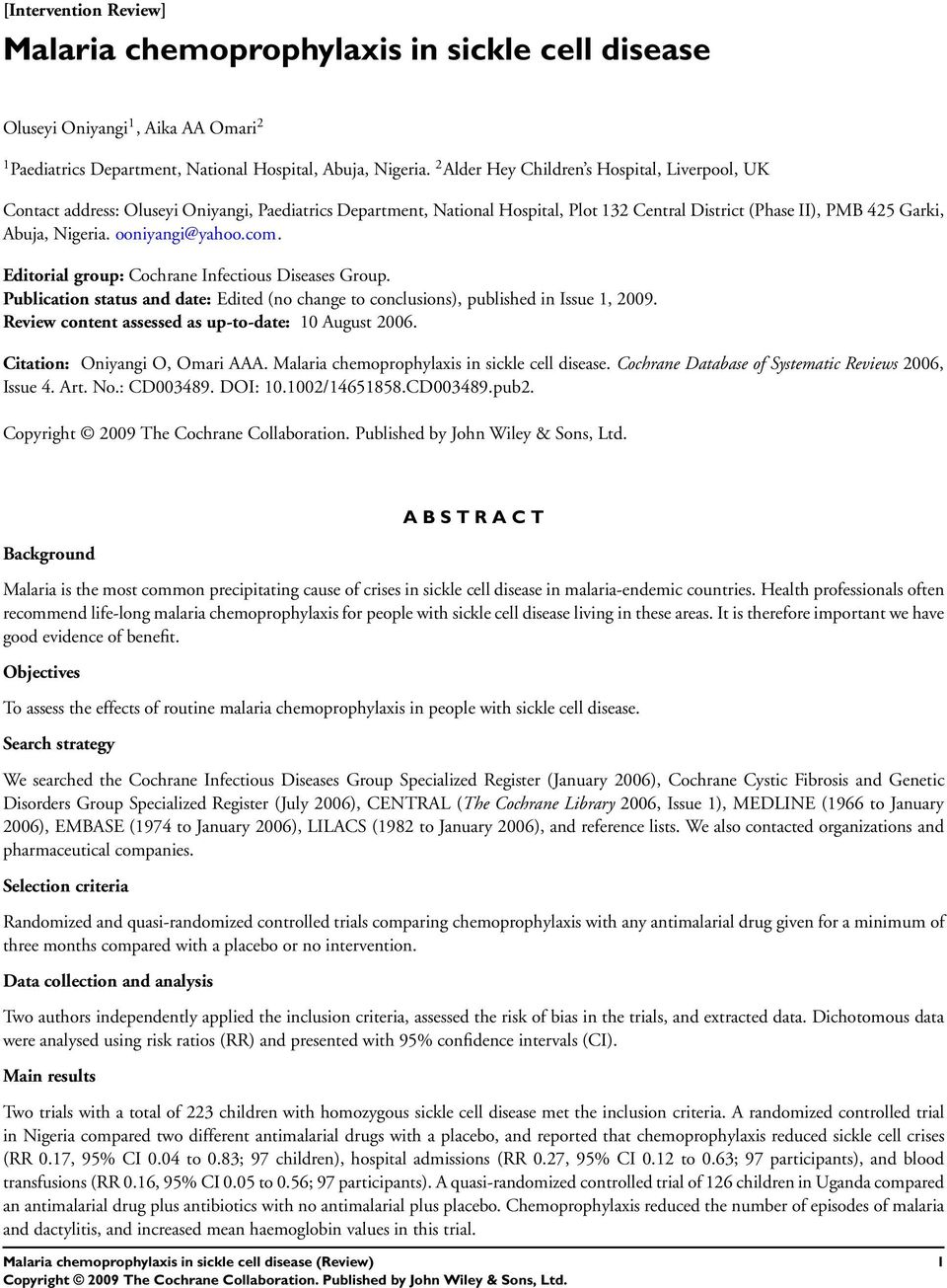
3 [Intervention Review] Malaria chemoprophylaxis in sickle cell disease Oluseyi Oniyangi 1, Aika AA Omari 2 1 Paediatrics Department, National Hospital, Abuja, Nigeria. 2 Alder Hey Children s Hospital, Liverpool, UK Contact address: Oluseyi Oniyangi, Paediatrics Department, National Hospital, Plot 132 Central District (Phase II), PMB 425 Garki, Abuja, Nigeria. [email protected]. Editorial group: Cochrane Infectious Diseases Group. Publication status and date: Edited (no change to conclusions), published in Issue 1, Review content assessed as up-to-date: 10 August Citation: Oniyangi O, Omari AAA. Malaria chemoprophylaxis in sickle cell disease. Cochrane Database of Systematic Reviews 2006, Issue 4. Art. No.: CD DOI: / CD pub2. Background A B S T R A C T Malaria is the most common precipitating cause of crises in sickle cell disease in malaria-endemic countries. Health professionals often recommend life-long malaria chemoprophylaxis for people with sickle cell disease living in these areas. It is therefore important we have good evidence of benefit. Objectives To assess the effects of routine malaria chemoprophylaxis in people with sickle cell disease. Search strategy We searched the Cochrane Infectious Diseases Group Specialized Register (January 2006), Cochrane Cystic Fibrosis and Genetic Disorders Group Specialized Register (July 2006), CENTRAL (The Cochrane Library 2006, Issue 1), MEDLINE (1966 to January 2006), EMBASE (1974 to January 2006), LILACS (1982 to January 2006), and reference lists. We also contacted organizations and pharmaceutical companies. Selection criteria Randomized and quasi-randomized controlled trials comparing chemoprophylaxis with any antimalarial drug given for a minimum of three months compared with a placebo or no intervention. Data collection and analysis Two authors independently applied the inclusion criteria, assessed the risk of bias in the trials, and extracted data. Dichotomous data were analysed using risk ratios (RR) and presented with 95% confidence intervals (CI). Main results Two trials with a total of 223 children with homozygous sickle cell disease met the inclusion criteria. A randomized controlled trial in Nigeria compared two different antimalarial drugs with a placebo, and reported that chemoprophylaxis reduced sickle cell crises (RR 0.17, 95% CI 0.04 to 0.83; 97 children), hospital admissions (RR 0.27, 95% CI 0.12 to 0.63; 97 participants), and blood transfusions (RR 0.16, 95% CI 0.05 to 0.56; 97 participants). A quasi-randomized controlled trial of 126 children in Uganda compared an antimalarial drug plus antibiotics with no antimalarial plus placebo. Chemoprophylaxis reduced the number of episodes of malaria and dactylitis, and increased mean haemoglobin values in this trial. 1
4 Authors conclusions It is beneficial to give routine malaria chemoprophylaxis in sickle cell disease in areas where malaria is endemic. P L A I N L A N G U A G E S U M M A R Y In areas where malaria is common, malaria drug prophylaxis benefits people with sickle cell disease Sickle cell disease is a blood disorder, and means the part of the red blood cell that carries oxygen from the lungs to the body tissues (haemoglobin) is abnormal. It is a genetic disorder and occurs when people inherit abnormal genes from both parents. It is more common in people originating from tropical Africa, and the Caribbean, Mediterranean, Indian, and Middle Eastern regions. Some types of sickle cell disease cause more severe symptoms than others, but in general people with the disease may be tired and weak (due to anaemia), and have severe and recurrent pain in the bones (referred to as crises), have more infections, more problems with breathing, and more chance of having a stroke. Sickle cell disease contributes to the death of children in the first five years of life, and infants aged six to 12 months are particularly at risk. Malaria infection is known to trigger a sickle cell crisis. So preventing malaria in people with sickle cell disease may also help to reduce crises and all the problems that go along with it. Health professionals often recommend life-long drugs to prevent malaria infections (chemoprophylaxis) for people with sickle cell disease living in these high risk areas for malaria. However, it is important to assess how effective this may be and what the adverse effects there might be from taking these drugs over a long period of time. This review of trials identified two small trials involving 223 people with homozygous sickle cell disease (commonly called sickle cell anaemia). These showed benefit in terms of reducing the number of sickle cell crises, blood transfusions, hospital admissions, and increasing the mean haemoglobin levels, but they did not collect data on potential adverse effects. More research is needed, therefore, to be sure of the benefits and to assess possible problems of drug resistance, and other potential long-term adverse effects that may be associated with continuous treatment. B A C K G R O U N D Sickle cell disease is an inherited blood condition. It is more common in people with their origins in Equatorial Africa, and the Caribbean, Mediterranean, Indian, and Middle Eastern regions ( Serjeant 1997; WHO 2000). It is caused by abnormalities in the production of haemoglobin, which is the part of the red blood cell that carries oxygen from the lungs to the body tissues. Sickle cell disease occurs when people inherit from both parents abnormal genes responsible for haemoglobin production. There are two common genotypes: Homozygous sickle cell disease (also known as sickle cell anaemia), where the sickle cell gene responsible for the production of abnormal haemoglobin S is inherited from both parents. Sickle cell/haemoglobin C disease, where the person inherits one sickle cell gene from one parent, and another abnormal haemoglobin gene (haemoglobin C) from the other. Two other genotypes are less common: Sickle cell/beta + thalassaemia, where the person inherits one sickle cell gene from one parent, and another abnormal haemoglobin gene (thalassaemia) from the other. This is a mild form of the disease in which haemoglobin A is present. Sickle cell/beta 0 thalassaemia, where the person inherits one sickle cell gene from one parent, and another abnormal haemoglobin gene (beta 0 thalassaemia) from the other. This is a severe form of the disease in which haemoglobin A is absent ( Serjeant 1997; Ashley-Koch 2000). The frequency of the different genotypes found in sickle cell disease varies with populations. The highest frequencies of homozygous sickle cell disease in the world occur in sub-saharan Africa where 3% to 4% of the populations are affected (WHO 2000). In Jamaica, homozygous sickle cell disease is the most common (1 in 300), followed by sickle cell/haemoglobin C disease (1 in 500), 2

5 with the thalassaemia variants being much less common (Serjeant 1997). The pattern in Nigeria is similar (Adekile 1999). The sickle cell gene occurs commonly in areas of the world with intense malaria transmission. One of the reasons that the sickle cell gene has persisted is that it appears to be of benefit in carriers of the gene. Carriers are people with one sickle cell gene and one normal haemoglobin gene. These people have some resistance to infection with Plasmodium falciparum malaria (Serjeant 1997; Adekile 1999; Ashley-Koch 2000). The illness seen in different genotypes varies with some causing more severe disease. Different forms of sickle cell disease may manifest the same problems and complications, some of which are potentially life threatening. Homozygous sickle cell disease and sickle cell/beta 0 thalassaemia tend to be more severe, whereas sickle cell/haemoglobin C disease and sickle cell/beta + thalassaemia are milder (Serjeant 1997). The clinical manifestations of the disease are anaemia, recurring episodes (crises) of severe excruciating pain in the bones, an increased susceptibility to infections, the acute chest syndrome (a life threatening pneumonia-like illness), and cerebrovascular accidents (strokes) (Serjeant 1997; Ashley-Koch 2000). Sickle cell disease appears to contribute to mortality especially in the first five years of life (Molineaux 1979a; Fleming 1989; Leikin 1989; Athale 1994; Platt 1994). Infants aged six to 12 months are particularly at risk (Rogers 1978; Serjeant 1997). In the USA, homozygous sickle cell disease reduces life expectancy to an average of 42 years for men and 48 years for women, even with specialized care and services (Platt 1994). Malaria is the most common precipitating cause of crises in sickle cell disease in countries where malaria is endemic (Konotey- Ahulu 1971a; Fleming 1989). Mortality and morbidity are increased in people with both sickle cell disease and malaria (Aluoch 1997; Ashley-Koch 2000). One study found malaria parasites were the commonest infecting organism in people with homozygous sickle cell disease requiring hospitalizations in Nigeria (Maharajan 1983). Another study reported malaria infection as the precipitating cause in 133 of 848 consecutive admissions for crises in homozygous sickle cell disease in a hospital in Ghana (Konotey- Ahulu 1971b). An increased number of malaria attacks and deaths were observed in people with homozygous sickle cell disease who were not taking malaria chemoprophylaxis (Colbourne 1956; Adeloye 1971; Molineaux 1979a). Fewer deaths and crises were reported with malaria chemoprophylaxis, while growth, quality of life, as well as resistance to other infections, were thought to be improved ( Konotey-Ahulu 1971a; Fleming 1989). Therefore many authorities recommend life-long malaria prophylaxis in people with homozygous sickle cell disease. Antimalarial drugs used for chemoprophylaxis include proguanil, pyrimethamine, and mefloquine ( Okuonghae 1992; Ogala 1999; Nwokolo 2001). Several factors have to be considered when starting life-long malaria chemoprophylaxis. Poor adherence may occur as it is difficult to take drugs regularly. Adverse drug effects may develop, such as hair loss and mouth ulcers with proguanil, and neuropsychiatric reactions with mefloquine (WHO 2001). The development of natural immunity to malaria (particularly in children) could be impaired by chemoprophylaxis with the potential risk of severe malaria on stopping the treatment (Otoo 1988; Salako 2000). Drug resistance may develop increasing the cost of treating patients, since newer antimalarials are more expensive (WHO 1990). It is therefore important to assess the benefits and harms of this life-long intervention carefully. O B J E C T I V E S To assess the effects of routine malaria chemoprophylaxis in people with sickle cell disease. M E T H O D S Criteria for considering studies for this review Types of studies Randomized and quasi-randomized controlled trials. Types of participants Adults and children with sickle cell disease (proven by electrophoresis or DNA tests as appropriate) in a malaria-endemic zone. This includes people with homozygous sickle cell disease, sickle-cell/haemoglobin C disease, sickle cell/beta + thalassaemia, and sickle cell/beta 0 thalassaemia. Types of interventions Intervention Chemoprophylaxis with any antimalarial drug given for a minimum of three months. Control Placebo or no intervention. 3

6 Types of outcome measures Primary Death. Sickle cell painful crises (episodes of severe pain in the bones or abdomen). Severe anaemia (haemoglobin concentration 5 g/dl or less) requiring blood transfusions. Secondary Malaria infection (diagnosed from blood film examinations). Hospital admissions. Haemoglobin concentrations in the absence of symptoms attributable to sickle cell disease or infection. Adverse events that are fatal, life threatening, require hospitalization, or result in the discontinuation of treatment. Reference lists We also checked the reference lists of all studies identified by the above methods. Data collection and analysis Selection of studies We independently screened the results of the search strategy for potentially relevant trials and independently assessed them for inclusion in the review using a pre-designed eligibility form based on the inclusion criteria. Data extraction and management We independently extracted data on the trial characteristics including the methods, participants, interventions, and outcomes. We resolved disagreements through discussion or by consulting an Editor of the Cochrane Infectious Diseases Group. Search methods for identification of studies We attempted to identify all relevant trials regardless of language or publication status (published, unpublished, in press, and in progress). Databases We searched the following databases using the search terms and strategy described in Appendix 1: Cochrane Infectious Diseases Group Specialized Register (January 2006); Cochrane Central Register of Controlled Trials (CENTRAL), published in The Cochrane Library (2006, Issue 1); MEDLINE (1966 to January 2006); EMBASE (1974 to January 2006); LILACS (1982 to January 2006). We also searched Current Controlled Trials ( January 2006) using malaria and sickle cell as search terms. We also searched the haemoglobinopathies specialized register of controlled trials held at the editorial base of the Cochrane Cystic Fibrosis and Genetic Disorders Group (July 2006) using malaria and sickle cell as search terms. Organizations and pharmaceutical companies In 2002, we contacted the Georgia Comprehensive Sickle Cell Center (Atlanta, USA), the Sickle Cell Association of Ghana, the Jamaican Sickle Cell Unit of the Medical Research Council of Jamaica, and the pharmaceutical companies AstraZeneca UK Ltd (manufacturers of proguanil) and GlaxoSmithKline UK (manufacturers of pyrimethamine), for information about unpublished and ongoing trials. Assessment of risk of bias in included studies Using a pre-designed validity form, we independently assessed the risk of bias in the included trials using generation of the allocation sequence, allocation concealment, blinding, and the inclusion of all randomized participants. We assessed the methods used to generate the allocation sequence and conceal allocation to be adequate or inadequate according to Jüni We described who was blinded in each trial, and assessed the number of randomized participants included in the final analysis to be adequate if 90% or over. Data synthesis Where appropriate, we analysed data in Review Manager 5, using risk ratios (RR) and with 95% confidence intervals (CI) for dichotomous data. The included trials did not report continuous data and there were too few trials to assess heterogeneity; methods for these situations will be used should such data become available. R E S U L T S Description of studies See: Characteristics of included studies; Characteristics of excluded studies. We identified five potentially relevant trials. Two met the inclusion criteria (Warley 1965; Eke 2003; see Characteristics of included 4

7 studies for details) and three were excluded (see Characteristics of excluded studies ). Warley 1965 was conducted in Uganda in 1962 on 126 children with homozygous sickle cell disease who attended a clinic over a two-year period. The trial was conducted in an area of stable malaria where transmission occurred all year round. The intervention group was given chloroquine tablets as malaria chemoprophylaxis every week. Children aged below three years received 100 mg and those above three years received 200 mg of chloroquine. The intervention group also received long-acting benzathine penicillin injections of 1,200,000 units (all age groups) as antibiotic prophylaxis. The control group were given sterile water injections. The main outcome measures were episodes of malaria, dactylitis (swelling or tenderness of bones of the hands or feet), and haemoglobin levels. Eke 2003 was conducted in Nigeria on 97 children with homozygous sickle cell disease who were attending clinic. The trial was held over a nine-month period in an area of stable malaria endemicity. This included the rainy season, which is the period of maximum malaria transmission. Participants were aged one to 16 years and were treated with curative doses of antimalarial drugs on enrolment into the trial. They were then divided into three groups each to receive pyrimethamine (0.5 mg/kg/week) or proguanil (1.5 mg/kg/day) as malaria chemoprophylaxis, or placebo (vitamin C 1 mg/kg/day). The main outcome measures were episodes of malaria, bone pain crises (recurrent bilateral pattern of bone pains and including dactylitis), haemolytic crisis (presence of jaundice, anaemia, or splenomegaly in the absence of other precipitating cause), aplastic crisis (bone marrow aplasia from malarial infection), number of hospitalizations, number of blood transfusions, mean haemoglobin levels, and mean parasite density. Risk of bias in included studies See Characteristics of included studies for details. The allocation sequence was generated by alternate allocation in Warley 1965 and by block randomization (one in six) in Eke Allocation was therefore inadequately concealed in Warley 1965, while it was adequate in Eke 2003 as participants selected their intervention groups from sealed, opaque envelopes. Both trials were open: Warley 1965 was open because of the different routes of administration of the interventions, and the regimens were different in Eke Less than 30% of the participants were followed up for 12 months in Warley 1965 (inadequate), whereas Eke 2003 followed more than 90% of participants for nine months (adequate). Effects of interventions Chloroquine plus benzathine penicillin versus placebo (Warley 1965) Chemoprophylaxis significantly reduced the number of episodes of dactylitis (swelling and tenderness of the bones of the hands or feet) 12 months after treatment (P < 0.1, trial authors calculation); data were derived from the published average cumulative incidence of dactylitis (Table 1). Chemoprophylaxis also significantly reduced the number of episodes of malaria after 12 months of prophylaxis (RR 0.16, 95% CI 0.07 to 0.39; 157 children, Analysis 1.1) and increased the mean haemoglobin (P < 0.02, trial authors calculation). Death, severe anaemia (requiring blood transfusions), hospital admissions, and adverse events were not reported. Table 1. Dactylitis crises 12 months after intervention, Warley 1965 Dactylitis crises Chemoprophylaxis Placebo Monthly cumulated incidence (estimated from published graph) Participants Episodes: cumulated incidence x no. participants

8 Proguanil or pyrimethamine versus placebo (Eke 2003) Data for the antimalarial drugs were pooled in the analyses. Chemoprophylaxis did not reduce the number of deaths (97 children, Analysis 2.1), and the one death that was reported occurred in the placebo group and was attributed to viral hepatitis and presumed overwhelming septicaemia. Chemoprophylaxis did however have a positive impact on reducing the number of painful sickle cell crises (RR 0.17, 95% 0.04 to 0.83; 97 children, Analysis 2.2) and blood transfusions required from episodes of severe anaemia (RR 0.16, 95% 0.05 to 0.56; 97 children, Analysis 2.3). For the secondary outcome measures, the number of hospital admissions was significantly reduced by chemoprophylaxis (RR 0.27, 95% CI 0.12 to 0.63; 97 participants, Analysis 2.5). There was no statistically significant difference in the number of malaria infections (97 children, Analysis 2.4), defined as body temperatures > 37.5 C and malaria parasitaemia, or mean haemoglobin concentrations in the steady state (97 children, Analysis 2.6). No adverse events due to the drugs were reported. D I S C U S S I O N We identified two trials that compared malaria chemoprophylaxis with no intervention or placebo in children with homozygous sickle cell disease. Eke 2003 had antimalarial chemoprophylaxis as the sole intervention, while Warley 1965 had antimalarial chemoprophylaxis intervention combined with antibiotics. Both trials showed improved clinical outcomes. Warley 1965 reported improved outcomes of fewer episodes of malaria, dactylitis, and higher mean haemoglobin levels with chemoprophylaxis. It could be argued that this was the result of the combined effect of the antimalarial and antibiotic prophylaxis. Either bacterial infections or malaria can precipitate a crisis in sickle cell disease, although the reduction in malaria infections was most probably due to the antimalarial intervention. Eke 2003 showed reduced episodes of bone pain crises, hospital admissions, and blood transfusions that were solely due to the effects of the antimalarial prophylaxis. It had been previously reported that malaria chemoprophylaxis in sickle cell disease reduces morbidity from malaria infections and is thought to improve resistance to other infections as well (Konotey-Ahulu 1971a; Fleming 1989). Eke 2003 supports this finding as malaria chemoprophylaxis not only improved clinical outcomes and decreased hospitalization rates from malaria infections, but from other causes as well. The trials did not address the important issues of drug resistance to antimalarial chemotherapy, which may explain the varying results obtained from the chemoprophylaxis group or the potential for impairment of development of natural immunity to malaria. In areas where malaria is endemic, chemoprophylaxis is often prescribed to people with homozygous sickle cell disease. We have found evidence to support this practice. We found no evidence to confirm or refute the benefits of malaria chemoprophylaxis in other types of sickle cell disease, that is, sickle-cell/haemoglobin C disease, sickle cell/beta + thalassaemia, and sickle cell/beta 0 thalassaemia. A U T H O R S C O N C L U S I O N S Implications for practice Malaria chemoprophylaxis is widely used in homozygous sickle cell disease (commonly called sickle cell anaemia) because of the associated morbidity and mortality. Existing policies recommending prophylaxis have been based on case reports, observational studies, and consensus. The trials included in this review support these policies in people with homozygous sickle cell disease. There is inadequate evidence to support or refute giving routine antimalarial chemoprophylaxis in other forms of sickle cell disease in areas where malaria is endemic. Implications for research Randomized controlled trials are required to evaluate the use of malaria chemoprophylaxis in sickle cell disease. In homozygous sickle cell disease there is such a strong clinical relationship between sickle cell crises, anaemia, and malaria that it would be difficult to justify another placebo-controlled trial. As those with homozygous sickle cell disease are often placed on chemoprophylaxis in endemic areas, a comparison of the different antimalarial regimens, such as proguanil versus pyrimethamine or proguanil versus mefloquine, could be made. In the other forms of the disease, antimalarial drugs, such as proguanil, pyrimethamine, and mefloquine, should be given as prophylaxis with placebo or other proven methods of preventing malaria (such as insecticide-treated bed nets) as the control intervention. Trials evaluating specific methods to ensure adherence to long-term drug therapy, development of drug resistance, and adverse events with the drugs should also be carried out. A C K N O W L E D G E M E N T S The protocol for this review was developed during the Mentorship Programme organized by the Cochrane Infectious Diseases Group, May to June The UK Department for International Development (DFID) supports the editorial base of the Cochrane Infectious Diseases Group through a project funded by the DFID for the benefit of developing countries. The views expressed are not necessarily those of DFID. 6

9 R E F E R E N C E S References to studies included in this review Eke 2003 {published data only} Eke FU, Anochie I. Effects of pyrimethamine versus proguanil in malaria chemoprophylaxis in children with sickle cell disease: a randomized, placebo-controlled, open-label study. Current Therapeutic Research 2003;64(8): Warley 1965 {published data only} Lewthwaite CJ. A trial of chemoprophylaxis in sickle-cell anaemia. East African Medical Journal 1962;39(5): Warley MA, Hamilton PJ, Marsden PD, Brown RE, Merselis JG, Wilks N. Chemoprophylaxis of homozygous sicklers with antimalarials and long-acting penicillin. British Medical Journal 1965;2(5453):86 8. References to studies excluded from this review Hendrickse 1966 {published data only} Hendrickse RG, Barnes PM. Sickle cell anaemia: report of a therapeutic trial. West African Medical Journal 1966;15(2): Molineaux 1979b {published data only} Molineaux L, Gramiccia G. The Garki Project: research on the epidemiology and control of malaria in the Sudan savanna of West Africa. Geneva: World Health Organization, Terlouw 2004 {published data only} Terlouw DJ, Desai MR, Wannemuehler KA, Kariuki SK, Pfeiffer CM, Kager PA, et al.relation between the response to iron supplementation and sickle cell haemoglobin phenotype in preschool children in western Kenya. American Journal of Clinical Nutrition 2004;79(3): Additional references Adekile 1999 Adekile AD. Haemoglobinopathies. In: Azubuike JC, Nkangineme KEO editor(s). Paediatrics and child health in a tropical region. Owerri, Nigeria: African Educational Services, 1999: [: ISBN ] Adeloye 1971 Adeloye A, Luzzatto L, Edington GM. Severe malarial infection in a patient with sickle-cell anaemia. British Medical Journal 1971;2 (759): Aluoch 1997 Aluoch JR. Higher resistance to Plasmodium falciparum infection in patients with homozygous sickle cell disease in western Kenya. Tropical Medicine & International Health 1997;2(6): Ashley-Koch 2000 Ashley-Koch A, Young Q, Olney RS. Sickle haemoglobin (HbS) allele and sickle cell disease: a HuGE review. American Journal of Epidemiology 2000;151(9): Athale 1994 Athale UH, Chintu C. Clinical analysis of mortality in hospitalized Zambian children with sickle cell anaemia. East African Medical Journal 1994;71(6): Colbourne 1956 Colbourne MJ, Edington GM. Sickling and malaria in the Gold Coast. British Medical Journal 1956;i(4970): Fleming 1989 Fleming AF. The presentation, management and prevention of crisis in sickle cell disease in Africa. Blood Reviews 1989;3(1): Higgins 2005 Higgins J, Green S, editors. Highly sensitive search strategies for identifying reports of randomized controlled trials in MEDLINE. Cochrane Handbook for Systematic Reviews of Interventions [updated May 2005]; Appendix 5b. handbook/hbook.htm (accessed 1 March 2006). Jüni 2001 Jüni P, Altman DG, Egger M. Systematic reviews in health care: Assessing the quality of controlled clinical trials. BMJ 2001;323 (7303):42 6. Konotey-Ahulu 1971a Konotey-Ahulu FID. Malaria and sickle-cell disease. British Medical Journal 1971;2(763): Konotey-Ahulu 1971b Konotey-Ahulu FID, Serjeant G, White JM. Treatment and prevention of sickle cell crisis. Lancet 1971;2(7736): Leikin 1989 Leikin SL, Gallagher D, Kinney TR, Sloan D, Klug P, Rida W. Mortality in children and adolescents with sickle cell disease. Pediatrics 1989;84(3): Maharajan 1983 Maharajan R, Fleming AF, Egler L. Pattern of infections among patients with sickle cell anaemia requiring hospital admission. Nigerian Journal of Paediatrics 1983;10:13 7. Molineaux 1979a Molineaux L, Fleming AF, Cornille-Brogger R, Kagan I, Storey J. Abnormal haemoglobins in the Sudan savanna of Nigeria. III. Malaria, immunoglobulins and antimalarial antibodies in sickle cell disease. Annals of Tropical Medicine and Parasitology 1979;73(4): Nwokolo 2001 Nwokolo C, Wamebe C, Akinyanju O, Raji AA, Audu BS, Emodi IJ, et al.mefloquine versus proguanil in short-term malaria chemoprophylaxis in sickle cell anaemia. Clinical Drug Investigation 2001;21(8): Ogala 1999 Ogala WN. Malaria. In: Azubuike JC, Nkanginieme KEO editor (s). Paediatrics and child health in a tropical region. African Educational Services, 1999: [: ISBN ] Okuonghae 1992 Okuonghae HO, Nwankwo MU, Offor E. Malarial parasitaemia in febrile children with sickle cell anaemia. Journal of Tropical Pediatrics 1992;38(2):83 5. Otoo 1988 Otoo LN, Snow RW, Menon A, Byass P, Greenwood BM. Immunity to malaria in young Gambian children after a two-year 7

10 period of chemoprophylaxis. Transactions of the Royal Society of Tropical Medicine and Hygiene 1988;82(1): Platt 1994 Platt OS, Brambila DJ, Rosse WF, Milner PF, Castro O, Steinberg MH, et al.mortality in sickle cell disease. Life expectancy and risk factors for early death. New England Journal of Medicine 1994;330 (23): Review Manager 5 The Nordic Cochrane Centre, The Cochrane Collaboration. Review Manager (RevMan) Copenhagen: The Nordic Cochrane Centre, The Cochrane Collaboration, Rogers 1978 Rogers DW, Clarke JM, Cupidore L, Ramlal AM, Sparke BR, Serjeant GR. Early deaths in Jamaican children with sickle cell disease. British Medical Journal 1978;1(6126): Salako 2000 Salako L. Malaria in Nigeria. Proceedings of the 31st Annual General and Scientific Meeting of the Paediatric Association of Nigeria; 2000 January 28; Abuja. Abuja: Paediatric Association of Nigeria, Serjeant 1997 Serjeant GR. Sickle-cell disease. Lancet 1997;350(9079): WHO 1990 WHO Scientific Group on the Chemotherapy of Malaria. Practical chemotherapy of malaria: report of a WHO scientific group [meeting held in Geneva from 5 to 12 June 1989]. Technical Report Series 805. Geneva: World Health Organization, WHO 2000 World Health Organization. Updated estimates of the frequency of the haemoglobin disorders in each country. programmes/ncd/hgm/haemogl.htm (accessed May 2001). WHO 2001 Global Parnership to Roll Back Malaria. The use of antimalarial drugs: report of a WHO informal consultation, November 2000 [WHO/CDS/RBM/ ]. Geneva: World Health Organization, Indicates the major publication for the study 8

11 C H A R A C T E R I S T I C S O F S T U D I E S Characteristics of included studies [ordered by study ID] Eke 2003 Methods Participants Interventions Outcomes Notes Randomized controlled trial Generation of allocation sequence: block randomization (1 in 6); equal allocation Allocation concealment: participants selected their intervention groups from sealed opaque envelopes Blinding: none Inclusion of all randomized participants in analysis: > 90% participants followed up for 9 months (32/35 proguanil group, 29/30 placebo group, and 100% pyrimethamine group) 97 children with homozygous sickle cell disease (sickle cell anaemia genotype SS) 1. Pyrimethamine (0.5 mg/kg/week) 2. Proguanil (1.5 mg/kg/day) 3. Placebo (vitamin C; 1 mg/kg/day for 9 months) 1. Deaths 2. Malaria infections 3. Bone pain crises 4. Haemolytic crises 5. Aplastic crisis 6. Number of hospitalizations 7. Number of blood transfusions 8. Mean haemoglobin levels 9. Mean parasite density 10. Splenomegaly Location: University of Port Harcourt Teaching Hospital, Nigeria Warley 1965 Methods Participants Interventions Outcomes Quasi-randomized controlled trial Generation of allocation sequence: alternate allocation Allocation concealment: none Blinding: none Inclusion of all randomized participants in analysis: < 30% of participants followed up for 12 months (13/60 intervention group and 19/66 control group) 126 children with homozygous sickle cell disease (sickle cell anaemia genotype SS) 1. Chloroquine tablet (100 mg < 3 years; 200 mg > 3 years) plus benzathine penicillin injection (1,200,000 units) 2. No tablets plus sterile water injection 1. Parasitaemia 2. Dactylitis 3. Mean haemoglobin 4. Fall in haemoglobin 9

12 Warley 1965 (Continued) Notes Location: Mulago Hospital, Uganda Date: August 1962 to May

13 Characteristics of excluded studies [ordered by study ID] Hendrickse 1966 Molineaux 1979b Terlouw 2004 Compared different antimalarial regimens in people with sickle cell anaemia; did not compare the interventions to placebo or to no intervention Longitudinal research project on epidemiology of malaria conducted in 1970 in Garki, Northern Nigeria Study participants had the sickle cell trait (haemoglobin genotype AS) and not sickle cell disease 11

14 D A T A A N D A N A L Y S E S Comparison 1. Chloroquine plus benzathine penicillin versus placebo Outcome or subgroup title No. of studies No. of participants Statistical method Effect size 1 Malaria episodes after 12 months of treatment 1 Risk Ratio (M-H, Fixed, 95% CI) Totals not selected Comparison 2. Proguanil or pyrimethamine (data combined) versus placebo Outcome or subgroup title No. of studies No. of participants Statistical method Effect size 1 Death 1 Risk Ratio (M-H, Fixed, 95% CI) Subtotals only 2 Sickle cell crisis 1 Risk Ratio (M-H, Fixed, 95% CI) Subtotals only 3 Blood transfusion 1 Risk Ratio (M-H, Fixed, 95% CI) Subtotals only 4 Malaria infection 1 Risk Ratio (M-H, Fixed, 95% CI) Subtotals only 5 Hospital admission 1 Risk Ratio (M-H, Fixed, 95% CI) Subtotals only 6 Haemoglobin concentration 1 Mean Difference (IV, Fixed, 95% CI) Subtotals only Analysis 1.1. Comparison 1 Chloroquine plus benzathine penicillin versus placebo, Outcome 1 Malaria episodes after 12 months of treatment. Review: Malaria chemoprophylaxis in sickle cell disease Comparison: 1 Chloroquine plus benzathine penicillin versus placebo Outcome: 1 Malaria episodes after 12 months of treatment Study or subgroup Prophylaxis Placebo Risk Ratio Risk Ratio n/n n/n M-H,Fixed,95% CI M-H,Fixed,95% CI Warley /73 36/ [ 0.07, 0.39 ] Favours prophylaxis Favours placebo 12

15 Analysis 2.1. Comparison 2 Proguanil or pyrimethamine (data combined) versus placebo, Outcome 1 Death. Review: Malaria chemoprophylaxis in sickle cell disease Comparison: 2 Proguanil or pyrimethamine (data combined) versus placebo Outcome: 1 Death Study or subgroup Prophylaxis Placebo Risk Ratio Risk Ratio n/n n/n M-H,Fixed,95% CI M-H,Fixed,95% CI Eke /68 1/ [ 0.01, 3.46 ] Favours prophylaxis Favours placebo Analysis 2.2. Comparison 2 Proguanil or pyrimethamine (data combined) versus placebo, Outcome 2 Sickle cell crisis. Review: Malaria chemoprophylaxis in sickle cell disease Comparison: 2 Proguanil or pyrimethamine (data combined) versus placebo Outcome: 2 Sickle cell crisis Study or subgroup Prophylaxis Placebo Risk Ratio Risk Ratio n/n n/n M-H,Fixed,95% CI M-H,Fixed,95% CI Eke /68 5/ [ 0.04, 0.83 ] Favours prophylaxis Favours placebo 13
![Ratio n/n n/n M-H,Fixed,95% CI M-H,Fixed,95% CI Eke 2003 0/68 1/29 0.14 [ 0.01, 3.46 ] 0.001 0.01 0.1 1 10 100 1000 Favours prophylaxis Favours placebo Analysis 2.2. Comparison 2 Proguanil or pyrimethamine (data combined) versus placebo, Outcome 2 Sickle cell crisis.](/docs-images/44/16092498/images/page_15.jpg "Review: Malaria chemoprophylaxis in sickle cell disease Comparison: 2 Proguanil or pyrimethamine (data combined) versus placebo Outcome: 2 Sickle cell crisis Study or subgroup Prophylaxis Placebo")
16 Analysis 2.3. Comparison 2 Proguanil or pyrimethamine (data combined) versus placebo, Outcome 3 Blood transfusion. Review: Malaria chemoprophylaxis in sickle cell disease Comparison: 2 Proguanil or pyrimethamine (data combined) versus placebo Outcome: 3 Blood transfusion Study or subgroup Prophylaxis Placebo Risk Ratio Risk Ratio n/n n/n M-H,Fixed,95% CI M-H,Fixed,95% CI Eke /68 8/ [ 0.05, 0.56 ] Favours prophylaxis Favours placebo Analysis 2.4. Comparison 2 Proguanil or pyrimethamine (data combined) versus placebo, Outcome 4 Malaria infection. Review: Malaria chemoprophylaxis in sickle cell disease Comparison: 2 Proguanil or pyrimethamine (data combined) versus placebo Outcome: 4 Malaria infection Study or subgroup Prophylaxis Placebo Risk Ratio Risk Ratio n/n n/n M-H,Fixed,95% CI M-H,Fixed,95% CI Eke /68 9/ [ 0.46, 1.75 ] Favours prophylaxis Favours placebo 14
![Ratio Risk Ratio n/n n/n M-H,Fixed,95% CI M-H,Fixed,95% CI Eke 2003 3/68 8/29 0.16 [ 0.05, 0.56 ] 0.01 0.1 1 10 100 Favours prophylaxis Favours placebo Analysis 2.4.](/docs-images/44/16092498/images/page_16.jpg "Comparison 2 Proguanil or pyrimethamine (data combined) versus placebo, Outcome 4 Malaria infection.")
17 Analysis 2.5. Comparison 2 Proguanil or pyrimethamine (data combined) versus placebo, Outcome 5 Hospital admission. Review: Malaria chemoprophylaxis in sickle cell disease Comparison: 2 Proguanil or pyrimethamine (data combined) versus placebo Outcome: 5 Hospital admission Study or subgroup Prophylaxis Placebo Risk Ratio Risk Ratio n/n n/n M-H,Fixed,95% CI M-H,Fixed,95% CI Eke /68 11/ [ 0.12, 0.63 ] Favours prophylaxis Favours placebo Analysis 2.6. Comparison 2 Proguanil or pyrimethamine (data combined) versus placebo, Outcome 6 Haemoglobin concentration. Review: Malaria chemoprophylaxis in sickle cell disease Comparison: 2 Proguanil or pyrimethamine (data combined) versus placebo Outcome: 6 Haemoglobin concentration Study or subgroup Prophylaxis Placebo Mean Difference Mean Difference N Mean(SD) N Mean(SD) IV,Fixed,95% CI IV,Fixed,95% CI Eke (2.06) (2.15) 0.60 [ -0.32, 1.52 ] Favours prophylaxis Favours placebo 15
![Risk Ratio Risk Ratio n/n n/n M-H,Fixed,95% CI M-H,Fixed,95% CI Eke 2003 7/68 11/29 0.27 [ 0.12, 0.63 ] 0.1 0.2 0.5 1 2 5 10 Favours prophylaxis Favours placebo Analysis 2.6. Comparison 2 Proguanil or pyrimethamine (data combined) versus placebo, Outcome 6 Haemoglobin concentration.](/docs-images/44/16092498/images/page_17.jpg "Review: Malaria chemoprophylaxis in sickle cell disease Comparison: 2 Proguanil or pyrimethamine (data combined) versus placebo Outcome: 6 Haemoglobin concentration Study or subgroup Prophylaxis")
18 A P P E N D I C E S Appendix 1. Search methods: search strategies for database Search set CIDG SR a CENTRAL MEDLINE b EMBASE b LILACS b 1 malaria malaria malaria malaria malaria 2 sickle cell disease sickle cell disease sickle cell disease sickle cell disease sickle cell disease 3 sickle cell anaemia ANEMIA, SICKLE CELL ANEMIA, CELL SICKLE SICKLE-CELL- ANEMIA sickle cell anaemia 4 2 or 3 haemoglobin SC haemoglobin SC HEMOGLOBINOPA- THY 2 or and 4 haemoglobin SS haemoglobin SS haemoglobin SC 1 and haemoglobin SD haemoglobin SD haemoglobin SS thalassaemia thalassaemia haemoglobin SD drepanocyt* drepanocyt* thalassaemia meniscocytosis meniscocytosis drepanocyt$ /or 2-9/or 2-9/or and 10 1 and 10 1 and 10 - a Cochrane Infectious Diseases Group Specialized Register. b Search terms used in combination with the search strategy for retrieving trials developed by The Cochrane Collaboration (Higgins 2005); upper case: MeSH or EMTREE heading; lower case: free text term. W H A T S N E W Last assessed as up-to-date: 10 August July 2008 Amended Converted to new review format with minor editing. 16

19 H I S T O R Y Protocol first published: Issue 1, 2002 Review first published: Issue 3, August 2006 New citation required and conclusions have changed 2006, Issue 4 (substantive update): The conclusions of the review have changed due to inclusion of information obtained from the new trials that have been carried out since it was first published. We have subjected the results of the included trials to meta-analysis. The search for trials has been updated. 11 August 2006 New search has been performed 2006, Issue 4 (substantive update): The conclusions of the review have changed due to inclusion of information obtained from the new trials that have been carried out since it was first published. We have subjected the results of the included trials to meta-analysis. The search for trials has been updated. 8 May 2003 Amended 2003, Issue 3 (first review version): The order of the outcome measures has changed from those in the protocol. This is because our primary interest is how the clinical manifestations of the disease are affected by malaria chemoprophylaxis. Sickle cell painful crises and severe anaemia have been moved from secondary to primary outcome measures; and episodes of malaria has been moved to secondary outcome measures where it has been renamed malaria infection. We have also clarified in the secondary outcome measures that the steady state in which haemoglobin concentrations are measured is that in which symptoms attributable to sickle cell disease or infection are absent. C O N T R I B U T I O N S O F A U T H O R S Oluseyi Oniyangi wrote the protocol, extracted and analysed data, and drafted the review. Aika Omari helped write the protocol, extracted and analysed data, and helped draft the review. Both authors have been involved in updating the review. 17

20 D E C L A R A T I O N S O F None known. I N T E R E S T S O U R C E S O F S U P P O R T Internal sources Liverpool School of Tropical Medicine, UK. External sources Department for International Development, UK. D I F F E R E N C E S B E T W E E N P R O T O C O L A N D R E V I E W 2003, Issue 3 (first review version): The order of the outcome measures has changed from those in the protocol. This is because our primary interest is how the clinical manifestations of the disease are affected by malaria chemoprophylaxis. Sickle cell painful crises and severe anaemia have been moved from secondary to primary outcome measures; and episodes of malaria has been moved to secondary outcome measures where it has been renamed malaria infection. We have also clarified in the secondary outcome measures that the steady state in which haemoglobin concentrations are measured is that in which symptoms attributable to sickle cell disease or infection are absent. I N D E X T E R M S Medical Subject Headings (MeSH) Antimalarials [ therapeutic use]; Malaria [ prevention & control]; Randomized Controlled Trials as Topic; Sickle Cell Trait [ complications] MeSH check words Child; Humans 18

Artemether-lumefantrine (four-dose regimen) for treating uncomplicated falciparum malaria (Review)
 Artemether-lumefantrine (four-dose regimen) for treating uncomplicated falciparum malaria (Review) Omari AAA, Gamble C, Garner P This is a reprint of a Cochrane review, prepared and maintained by The Cochrane
WORLD HEALTH ORGANIZATION. Sickle-cell anaemia
 WORLD HEALTH ORGANIZATION FIFTY-NINTH WORLD HEALTH ASSEMBLY A59/9 Provisional agenda item 11.4 24 April 2006 Sickle-cell anaemia Report by the Secretariat PREVALENCE OF SICKLE-CELL ANAEMIA 1. Sickle-cell
- 301-17. SICKLE CELL SCREENING AND SELECT TOPICS IN PREVENTION OF COMPLICATIONS Mark Schuster, M.D., Ph.D.
 - 301-17. SICKLE CELL SCREENING AND SELECT TOPICS IN PREVENTION OF COMPLICATIONS Mark Schuster, M.D., Ph.D. We used the following sources to construct indicators for sickle cell disease screening for newborns
Educator s Guide to Sickle Cell Disease
 Educator s Guide to Sickle Cell Disease Educator s Guide to Sickle Cell Disease Sickle cell disease is an inherited blood disorder affecting about one out of every 350 African Americans. Most children
A Study of Malaria and Sickle Cell Anemia: A Hands-on Mathematical Investigation Student Materials: Reading Assignment
 4/15/99 1 A Study of Malaria and Sickle Cell Anemia: A Hands-on Mathematical Investigation Student Materials: Reading Assignment Malaria is a parasitic disease which is spread by the female Anopheles mosquitoes.
Hydroxyurea Treatment for Sickle Cell Disease
 Hydroxyurea Treatment for Sickle Cell Disease Before hydroxyurea After hydroxyurea Hydroxyurea Treatment for Sickle Cell Disease 1 This document is not intended to take the place of the care and attention
Red Blood Cell Transfusions for Sickle Cell Disease
 Red Blood Cell Transfusions for Sickle Cell Disease Red Blood Cell Transfusions for Sickle Cell Disease 1 Produced by St. Jude Children s Research Hospital, Departments of Hematology, Patient Education,
Treatment of seizures in multiple sclerosis (Review)
 Koch MW, Polman SKL, Uyttenboogaart M, De Keyser J This is a reprint of a Cochrane review, prepared and maintained by The Cochrane Collaboration and published in The Cochrane Library 009, Issue 3 http://www.thecochranelibrary.com
Therapeutic Treatment Options: Chronic Blood Transfusions Bone Marrow Transplantation. Marianne E. McPherson Yee, MD, MSc
 Therapeutic Treatment Options: Chronic Blood Transfusions Bone Marrow Transplantation Marianne E. McPherson Yee, MD, MSc Sickle Cell Treatment Options Supportive Care Newborn Screen PCN Immunizations Education
NATIONAL DRUG POLICY ON MALARIA (2013)
 203 - 2 - NATIONAL DRUG POLICY ON MALARIA (203) Preamble Malaria is one of the major public health problems of the country. Around.5 million laboratory confirmed cases of malaria are annually reported
10. Treatment of peritoneal dialysis associated fungal peritonitis
 10. Treatment of peritoneal dialysis associated fungal peritonitis Date written: February 2003 Final submission: July 2004 Guidelines (Include recommendations based on level I or II evidence) The use of
Contact centred strategies to reduce transmission of M. leprae
 Contact centred strategies to reduce transmission of M. leprae Jan Hendrik Richardus, MD, PhD Department of Public Health Erasmus MC, University Medical Center Rotterdam The Netherlands Outline lecture
Information for couples where both partners carry Haemoglobin S (sickle cell)
 Information for couples where both partners carry Haemoglobin S (sickle cell) Including information on prenatal diagnosis Contacts for prenatal diagnosis centre Couple at risk for Sickle Cell Anaemia Ms
SICKLE CELL DISEASE IN GEORGIA
 SICKLE CELL DISEASE IN GEORGIA Peter A Lane, MD Professor of Pediatrics Emory University School of Medicine Director, Sickle Cell Disease Program Children s Healthcare of Atlanta SICKLE CELL DISEASE IN
Clinical Trials: Questions and Answers
 Clinical Trials: Questions and Answers Key Points Clinical trials are research studies that test how well new medical approaches work in people (see Question 1). Every clinical trial has a protocol, which
Guidance for Industry Diabetes Mellitus Evaluating Cardiovascular Risk in New Antidiabetic Therapies to Treat Type 2 Diabetes
 Guidance for Industry Diabetes Mellitus Evaluating Cardiovascular Risk in New Antidiabetic Therapies to Treat Type 2 Diabetes U.S. Department of Health and Human Services Food and Drug Administration Center
If several different trials are mentioned in one publication, the data of each should be extracted in a separate data extraction form.
 General Remarks This template of a data extraction form is intended to help you to start developing your own data extraction form, it certainly has to be adapted to your specific question. Delete unnecessary
Nige g ri e an a N at a ional a Antimal a ari a a Tre re t a men e t g ide d l e ines
 Nigerian National Antimalaria Treatment guidelines Pre Purpose: To provide guidelines for the treatment of malaria in Pregnant women in Nigeria Pregnant women Malaria: An infectious disease caused by plasmodium.
CDEC FINAL RECOMMENDATION
 CDEC FINAL RECOMMENDATION RIVAROXABAN (Xarelto Bayer Inc.) New Indication: Pulmonary Embolism Note: The Canadian Drug Expert Committee (CDEC) previously reviewed rivaroxaban for the treatment of deep vein
Cord blood banking: information for parents
 Cord blood banking: information for parents Published August 2006 by the RCOG Contents Page number Key points 1 About this information 2 What is cord blood? 2 Why is cord blood useful? 3 How is cord blood
An overview of CLL care and treatment. Dr Dean Smith Haematology Consultant City Hospital Nottingham
 An overview of CLL care and treatment Dr Dean Smith Haematology Consultant City Hospital Nottingham What is CLL? CLL (Chronic Lymphocytic Leukaemia) is a type of cancer in which the bone marrow makes too
Frequently Asked Questions (FAQs)
 Frequently Asked Questions (FAQs) Research Rationale 1. What does PrEP stand for? There is scientific evidence that antiretroviral (anti-hiv) medications may be able to play an important role in reducing
Cochrane Review: Psychological treatments for depression and anxiety in dementia and mild cognitive impairment
 23 rd Alzheimer Europe Conference St. Julian's, Malta, 2013 Cochrane Review: Psychological treatments for depression and anxiety in dementia and mild cognitive impairment Orgeta V, Qazi A, Spector A E,
Genetic Testing in Research & Healthcare
 We Innovate Healthcare Genetic Testing in Research & Healthcare We Innovate Healthcare Genetic Testing in Research and Healthcare Human genetic testing is a growing science. It is used to study genes
Cancer Treatments Subcommittee of PTAC Meeting held 18 September 2015. (minutes for web publishing)
 Cancer Treatments Subcommittee of PTAC Meeting held 18 September 2015 (minutes for web publishing) Cancer Treatments Subcommittee minutes are published in accordance with the Terms of Reference for the
GRANIX (tbo-filgrastim)
 RATIONALE FOR INCLUSION IN PA PROGRAM Background Neutropenia is a hematological disorder characterized by an abnormally low number of neutrophils. A person with severe neutropenia has an absolute neutrophil
Cochrane Quality and Productivity topics
 Long-acting insulin analogues versus NPH insulin (human isophane insulin) for type 2 diabetes mellitus NICE has developed the Cochrane Quality and Productivity (QP) topics to help the NHS identify practices
33 % of whiplash patients develop. headaches originating from the upper. cervical spine
 33 % of whiplash patients develop headaches originating from the upper cervical spine - Dr Nikolai Bogduk Spine, 1995 1 Physical Treatments for Headache: A Structured Review Headache: The Journal of Head
A newsletter of the Newborn Screening Program and the Newborn Screening Laboratory
 NEWBORN SCREENING August 2001 Be Kind To Tiny Feet A newsletter of the Newborn Screening Program and the Newborn Screening Laboratory HEMOGLOBINOPATHIES Second Edition Follow-up procedures for hemoglobinopathy
Chapter 4 Pedigree Analysis in Human Genetics. Chapter 4 Human Heredity by Michael Cummings 2006 Brooks/Cole-Thomson Learning
 Chapter 4 Pedigree Analysis in Human Genetics Mendelian Inheritance in Humans Pigmentation Gene and Albinism Fig. 3.14 Two Genes Fig. 3.15 The Inheritance of Human Traits Difficulties Long generation time
Factsheet September 2012. Pertussis immunisation for pregnant women. Introduction
 Factsheet September 2012 Pertussis immunisation for pregnant women Introduction The routine childhood immunisation programme has been very effective in reducing the overall numbers of cases of pertussis.
A list of FDA-approved testosterone products can be found by searching for testosterone at http://www.accessdata.fda.gov/scripts/cder/drugsatfda/.
 FDA Drug Safety Communication: FDA cautions about using testosterone products for low testosterone due to aging; requires labeling change to inform of possible increased risk of heart attack and stroke
Title Older people s participation and engagement in falls prevention interventions: Comparing rates and settings
 Title Older people s participation and engagement in falls prevention interventions: Comparing rates and settings Keywords: patient adherence; falls, accidental; intervention studies; patient participation;
Adoption by CHMP for release for consultation November 2010. End of consultation (deadline for comments) 31 March 2011
 1 2 3 November 2010 EMA/759784/2010 Committee for Medicinal Products for Human Use 4 5 6 7 Reflection paper on the need for active control in therapeutic areas where use of placebo is deemed ethical and
WORLD SICKLE CELL DAY REPORT 2013
 WORLD SICKLE CELL DAY REPORT 2013 SICKLE CELL ANEMIA, THE KENYA SITUATION A report on the commemoration of the 4th World Sickle Cell day, held on 19th June 2013 at Gertrude s Children Hospital, Muthaiga,
Mother s blood test to check her unborn baby s blood group
 Mother s blood test to check her unborn baby s blood group This leaflet explains why it is important to have a blood test to check the baby s blood group, so that only those who need it, receive anti-d
SICKLE CELL DISEASE AS A MAJOR PUBLIC HEALTH CONCERN IN NIGERIA. - Based on research and qualitative interviews - - Bachelor thesis - Presented by
 University of Applied Sciences Faculty of Life Sciences Bachelor of Health Sciences SICKLE CELL DISEASE AS A MAJOR PUBLIC HEALTH CONCERN IN NIGERIA - Based on research and qualitative interviews - - Bachelor
Clinical Study Synopsis
 Clinical Study Synopsis This Clinical Study Synopsis is provided for patients and healthcare professionals to increase the transparency of Bayer's clinical research. This document is not intended to replace
Series 1 Case Studies Adverse Events that Represent Unanticipated Problems: Reporting Required
 Welcome! This document contains three (3) series of Case Study examples that will demonstrate all four OHSU reporting categories (#1 4) as well as examples of events that are considered not reportable.
Hardy-Weinberg Equilibrium Problems
 Hardy-Weinberg Equilibrium Problems 1. The frequency of two alleles in a gene pool is 0.19 (A) and 0.81(a). Assume that the population is in Hardy-Weinberg equilibrium. (a) Calculate the percentage of
Department of Epidemiological Surveillance and Intervention
 Department of Epidemiological Surveillance and Intervention EPIDEMIOLOGICAL DATA FOR MALARIA IN GREECE (MANDATORY NOTIFICATION SYSTEM) Key Points The notification rate of malaria in Greece shows an increasing
Everolimus plus exemestane for second-line endocrine treatment of oestrogen receptor positive metastatic breast cancer
 LONDON CANCER NEWS DRUGS GROUP RAPID REVIEW Everolimus plus exemestane for second-line endocrine treatment of oestrogen receptor positive metastatic breast cancer Everolimus plus exemestane for second-line
Summary of the risk management plan (RMP) for Orkambi (lumacaftor and ivacaftor)
 EMA/662624/2015 Summary of the risk management plan (RMP) for Orkambi (lumacaftor and ivacaftor) This is a summary of the risk management plan (RMP) for Orkambi, which details the measures to be taken
Marrying a relative. Is there an increased chance that a child will have genetic problems if its parents are related to each other?
 Marrying a relative Is there an increased chance that a child will have genetic problems if its parents are related to each other? The simple answer to this question is Yes, there is an increased chance.
Alternative versus standard packages of antenatal care for low-risk pregnancy (Review)
 Alternative versus standard packages of antenatal care for low-risk pregnancy (Review) Dowswell T, Carroli G, Duley L, Gates S, Gülmezoglu AM, Khan-Neelofur D, Piaggio GGP This is a reprint of a Cochrane
Multiple Myeloma. This reference summary will help you understand multiple myeloma and its treatment options.
 Multiple Myeloma Introduction Multiple myeloma is a type of cancer that affects white blood cells. Each year, thousands of people find out that they have multiple myeloma. This reference summary will help
HOMEOPATHY AS AN ALTERNATIVE TO ANTIBIOTICS
 HOMEOPATHY AS AN ALTERNATIVE TO ANTIBIOTICS Professor Dr. Michael FRASS Medical University of Vienna, Department Medicine I Doctor s Asscociation for Classical Homeopathy www.aekh.at President, Umbrella
Best supportive care: Do we know what it is?
 Best supportive care: Do we know what it is? Angela Boland Rumona Dickson Barbara Jack James Stevenson Edge Hill University Faculty of Health www.liv.ac.uk/lrig Collaborative partners Liverpool Reviews
FastTest. You ve read the book... ... now test yourself
 FastTest You ve read the book...... now test yourself To ensure you have learned the key points that will improve your patient care, read the authors questions below. Please refer back to relevant sections
Disclosures. Consultant and Speaker for Biogen Idec, TEVA Neuroscience, EMD Serrono, Mallinckrodt, Novartis, Genzyme, Accorda Therapeutics
 Mitzi Joi Williams, MD Neurologist MS Center of Atlanta, Atlanta, GA Disclosures Consultant and Speaker for Biogen Idec, TEVA Neuroscience, EMD Serrono, Mallinckrodt, Novartis, Genzyme, Accorda Therapeutics
Antibiotic Prophylaxis for Short-term Catheter Bladder Drainage in adults. A Systematic Review (Cochrane database August 2013)
 Antibiotic Prophylaxis for Short-term Catheter Bladder Drainage in adults A Systematic Review (Cochrane database August 2013) Gail Lusardi, Senior Lecturer Dr Allyson Lipp, Principal Lecturer, Dr Chris
National MS Society Information Sourcebook www.nationalmssociety.org/sourcebook
 National MS Society Information Sourcebook www.nationalmssociety.org/sourcebook Chemotherapy The literal meaning of the term chemotherapy is to treat with a chemical agent, but the term generally refers
95% of childhood kidney cancer cases are Wilms tumours. Childhood kidney cancer is extremely rare, with only 90 cases a year in
 James Whale Fund for Kidney Cancer Childhood kidney cancer factsheet Kidney cancer rarely afflicts children and about 90 paediatric cases are diagnosed in the UK each year. About 75% of childhood kidney
Facts About Chickenpox and Shingles for Adults
 Facts About Chickenpox and Shingles for Adults What is chickenpox? Chickenpox, also known as varicella, is a very contagious disease caused by the varicella-zoster virus. It is spread easily through the
DIABETES A chronic, debilitating and often deadly disease A global epidemic Diabetes in Africa
 DIABETES A chronic, debilitating and often deadly disease Diabetes is a chronic condition that arises when the pancreas does not produce enough insulin, or when the body cannot effectively use the insulin
INTRODUCTION Thrombophilia deep vein thrombosis DVT pulmonary embolism PE inherited thrombophilia
 INTRODUCTION Thrombophilia (Hypercoagulability) is a condition in which a person forms blood clots more than normal. Blood clots may occur in the arms or legs (e.g., deep vein thrombosis DVT), the lungs
Cystic Fibrosis Webquest Sarah Follenweider, The English High School 2009 Summer Research Internship Program
 Cystic Fibrosis Webquest Sarah Follenweider, The English High School 2009 Summer Research Internship Program Introduction: Cystic fibrosis (CF) is an inherited chronic disease that affects the lungs and
Q4: Are acamprosate, disulfiram and naltrexone safe and effective in preventing relapse in alcohol dependence in nonspecialized health care settings?
 updated 2012 Preventing relapse in alcohol dependent patients Q4: Are acamprosate, disulfiram and naltrexone safe and effective in preventing relapse in alcohol dependence in nonspecialized health care
Frequently asked questions about whooping cough (pertussis)
 Frequently asked questions about whooping cough (pertussis) About whooping cough What is whooping cough? Whooping cough is a highly contagious illness caused by bacteria. It mainly affects the respiratory
Summary and general discussion
 Chapter 7 Summary and general discussion Summary and general discussion In this thesis, treatment of vitamin K antagonist-associated bleed with prothrombin complex concentrate was addressed. In this we
RE: Australian Safety and Quality Goals for Health Care: Consultation paper
 10 February 2012 Mr Bill Lawrence AM Acting CEO Australian Commission on Safety and Quality in Health Care GPO Box 5480 Sydney NSW 2001 Email: [email protected] Dear Mr Lawrence RE: Australian
RDW-- Interpreting the Full Blood Count
 RDW-- Interpreting the Full Blood Count The most important components of a Full Blood Count report are, of course, the Haemoglobin, the White Cell Count and Differential and the Platelet Count. However,
boceprevir 200mg capsule (Victrelis ) Treatment experienced patients SMC No. (722/11) Merck, Sharpe and Dohme Ltd
 boceprevir 200mg capsule (Victrelis ) Treatment experienced patients SMC No. (722/11) Merck, Sharpe and Dohme Ltd 09 September 2011 The Scottish Medicines Consortium (SMC) has completed its assessment
School-age child 5-1 THE BLOOD
 C A S E S T U D Y 5 : School-age child Adapted from Thomson Delmar Learning s Case Study Series: Pediatrics, by Bonita E. Broyles, RN, BSN, MA, PhD. Copyright 2006 Thomson Delmar Learning, Clifton Park,
Bile Duct Diseases and Problems
 Bile Duct Diseases and Problems Introduction A bile duct is a tube that carries bile between the liver and gallbladder and the intestine. Bile is a substance made by the liver that helps with digestion.
Mayo Clinic College of Medicine Pharmacy Services. Rotation Summary
 Mayo Clinic College of Medicine Pharmacy Services Rotation Summary Rotation Title: PGY-2 Pediatric Hematology-Oncology Rotation Length: 3-6 weeks Primary Preceptor Name: Amanda Kuper, PharmD, BPCS, Ron
Presented by: Jean Yoo-Campbell, Matthew Konerman, Monica Konerman, Jean Yoo Campbell, Christian Gocke, Eunpi Cho Donald Lynch
 Bass N.M., et. al. N Engl J Med 2010; 362:1071-1081 Presented by: Jean Yoo-Campbell, Matthew Konerman, Monica Konerman, Jean Yoo Campbell, Christian Gocke, Eunpi Cho Donald Lynch Faculty Advisor: Dr. Fred
BACKGROUND MEDIA INFORMATION Fast facts about liver disease
 BACKGROUND MEDIA INFORMATION Fast facts about liver disease Liver, or hepatic, disease comprises a wide range of complex conditions that affect the liver. Liver diseases are extremely costly in terms of
Other treatments for chronic myeloid leukaemia
 Other treatments for chronic myeloid leukaemia This information is an extract from the booklet Understanding chronic myeloid leukaemia. You may find the full booklet helpful. We can send you a copy free
Borderless Diseases By Sunny Thai
 Borderless Diseases By Sunny Thai Millennium Development Goal #6 6. Combat HIV/AIDS, malaria and other borderless diseases. A. Halt and begin reversing spread of HIV by 2015. B. Achieve universal access
INTRODUCTION Thrombophilia deep vein thrombosis DVT pulmonary embolism PE inherited thrombophilia
 INTRODUCTION Thrombophilia (Hypercoagulability) is a condition in which a person forms blood clots more than normal. Blood clots may occur in the arms or legs (e.g., deep vein thrombosis DVT), the lungs
BLOOD TRANSFUSION SAFETY
 BLOOD TRANSFUSION SAFETY Estimated use of red cell transfusion in developed countries 35% 15% 6 3 7% 34% Pregnancy-related 6% Children 3% Surgery 34% Trauma 7% Medical 35% Haematological 15% blood saves
Selective IgA deficiency (slgad) [email protected] 0800 987 8986 www.piduk.org
 Selective IgA deficiency (slgad) [email protected] 0800 987 8986 www.piduk.org About this booklet This booklet provides information on selective IgA deficiency (sigad). It has been produced by the PID UK
CLL. Handheld record. Stockport NHS foundation trust
 CLL 2015 Handheld record Contains- Patient information booklet, details of haematology clinic assessment and ongoing clinical assessment at GP surgery Stockport NHS foundation trust You have been diagnosed
The submission positioned dimethyl fumarate as a first-line treatment option.
 Product: Dimethyl Fumarate, capsules, 120 mg and 240 mg, Tecfidera Sponsor: Biogen Idec Australia Pty Ltd Date of PBAC Consideration: July 2013 1. Purpose of Application The major submission sought an
Patient identifier/label: Page 1 of 6 PATIENT AGREEMENT TO SYSTEMIC THERAPY: CONSENT FORM FEC-T. Patient s first names. Date of birth.
 Patient identifier/label: Page 1 of 6 PATIENT AGREEMENT TO SYSTEMIC THERAPY: CONSENT FORM FEC-T Patient s surname/family name Patient s first names Date of birth Hospital Name: Guy s Hospital St. Thomas
The Basics of Drug Resistance:
 CONTACT: Lisa Rossi +1-412-641-8940 +1-412- 916-3315 (mobile) [email protected] The Basics of Drug Resistance: QUESTIONS AND ANSWERS HIV Drug Resistance and ARV-Based Prevention 1. What is drug resistance?
ESCMID Online Lecture Library. by author
 Do statins improve outcomes of patients with sepsis and pneumonia? Jordi Carratalà Department of Infectious Diseases Statins for sepsis & community-acquired pneumonia Sepsis and CAP are major healthcare
BREAST CANCER AWARENESS FOR WOMEN AND MEN by Samar Ali A. Kader. Two years ago, I was working as a bedside nurse. One of my colleagues felt
 Ali A. Kader, S. (2010). Breast cancer awareness for women and men. UCQ Nursing Journal of Academic Writing, Winter 2010, 70 76. BREAST CANCER AWARENESS FOR WOMEN AND MEN by Samar Ali A. Kader Two years
Summary of the risk management plan (RMP) for Cerdelga (eliglustat)
 EMA/743948/2014 Summary of the risk management plan (RMP) for Cerdelga (eliglustat) This is a summary of the risk management plan (RMP) for Cerdelga, which details the measures to be taken in order to
2.1 Who first described NMO?
 History & Discovery 54 2 History & Discovery 2.1 Who first described NMO? 2.2 What is the difference between NMO and Multiple Sclerosis? 2.3 How common is NMO? 2.4 Who is affected by NMO? 2.1 Who first
Frequently asked questions for malaria
 Frequently asked questions for malaria 1. What is malaria? Malaria is an infectious disease caused by a parasite that is transmitted through bite of an infected mosquito at night. There are two main types
ABOUT XARELTO CLINICAL STUDIES
 ABOUT XARELTO CLINICAL STUDIES FAST FACTS Xarelto (rivaroxaban) is a novel, oral direct Factor Xa inhibitor. On September 30, 2008, the European Commission granted marketing approval for Xarelto for the
Careers in Haematology
 Careers in Haematology A Guide for Medical Students and Junior Doctors Haematology is the medical speciality concerned with blood disorders. Your non-medical friends however will always think that you
How To Treat Leukaemia With Cord Blood Stem Cell
 Cord blood for the treatment of acute lymphoblastic leukemia in young children By Caitlin McGreevy Kiara Paramjothy Pass with Merit RESEARCH PAPER BASED ON PATHOLOGY LECTURES AT MEDLINK 2011 1 Abstract: