
Lifting, Moving and Positioning Patients From Brady s First Responder (8th Edition) 44 Questions
|
|
|
- Phebe Fletcher
- 9 years ago
- Views:
Transcription
1 Lifting, Moving and Positioning Patients From Brady s First Responder (8th Edition) 44 Questions 1. Approximately how much of the log roll will be complete before the rescuer at the patient's head will begin to move? p. 97 A.) One-eighth B.) One-third C.) One-fourth *D.) One-half 2. What must be done when applying a cervical collar to a combative patient to keep the neck and head still? p. 103 A.) Place cushioning around the head *B.) Use manual stabilization also C.) Use a pediatric spine board D.) Tape the head to the board first 3. What should be the minimum number of rescuers used to perform a nonemergency move when possible? p. 88 A.) Four *B.) Three C.) One D.) Two 4. What position is the patient placed into second when performing the extremity lift? p. 91 A.) Standing B.) Laying *C.) Semi sitting D.) On the side 5. What is the best position to place an unresponsive patient with no suspected spine injury? p. 94 *A.) Left lateral recumbent B.) Right lateral recumbent C.) Prone D.) Supine

2 6. What should the patient's position be when beginning a direct ground lift? p. 90 A.) Prone with arms on the chest B.) Lateral recumbent with arms on the chest C.) Seated with arms on the chest *D.) Supine with arms on the chest 7. What should be used when possible to carry a patient down stairs? p. 85 *A.) Chair B.) Litter C.) Backboard D.) Wheeled stretcher 8. Where should you try to bend when lifting with proper technique? p. 85 A.) Waist B.) Shoulders *C.) Knees D.) Back 9. What is an important component when coordinating a lift? p. 84 A.) Good shoes *B.) Eye contact C.) Manpower D.) Brute strength 10. Which is the most common type of full-body immobilization device? p. 103 A.) The Reeves sleeve B.) Miller full body splint C.) SAM splint *D.) Full-body vacuum splint

3 11. Which statement is correct when performing the direct carry method? p. 92 *A.) Position the stretcher perpendicular to the bed B.) One rescuer should be at the patient's head and the other at her feet C.) One rescuer should stand between the bed and stretcher D.) Place the head end of the stretcher at the head of the bed 12. Who should have a spotter when using a stair chair? p. 85 *A.) Person walking backward B.) Everyone C.) Patient D.) Person walking forward 13. Where is the cervical collar placed first when the patient is seated? p. 106 A.) Above the head B.) Along the chest C.) Behind the neck *D.) Beneath the chin 14. Which is used to move a patient with no suspected spine injury from a bed to a stretcher? p. 92 A.) Extremity lift *B.) Direct carry method C.) Cradle carry D.) Direct ground lift 15. Where should the patient's left arm be placed first when placing him into the recovery position? p. 95 A.) Across his chest B.) To his cheek C.) Around his waist *D.) Above his head

4 16. Which type of stretcher is used in restricted areas or narrow hallways? p. 101 A.) Scoop B.) Portable C.) Basket *D.) Flexible 17. What will the patient's head rest upon when in the recovery position? p. 95 A.) Right arm *B.) Left arm C.) Ground D.) Pillow 18. Where is the cervical collar placed first when the patient is supine? p. 107 *A.) Behind the neck B.) Beneath the ears C.) Above the head D.) Along the chest 19. What position should the patient be placed in when performing the firefighter's drag? p. 87 A.) On his left side B.) On his front C.) On his right side *D.) On his back 20. Where should the rescuer at the patient's lower legs place his arms when performing the direct ground lift? p. 90 *A.) Knees and ankles B.) Knees and feet C.) Groin and ankles D.) Groin and knees

5 21. How many carrying handles are usually found on the flexible stretcher? p. 103 A.) Two B.) Four *C.) Three D.) Five 22. What must be stabilized first when packaging a patient on an immobilization device? p. 103 A.) Neck and shoulders *B.) Head and neck C.) Torso and legs D.) Arms and legs 23. Which part of the patient's body should be used as a lever when placing him into the recovery position? p. 95 A.) Elbow B.) Wrist *C.) Knee D.) Shoulder 24. What should you use to lift? p. 85 *A.) Legs B.) Arms C.) Shoulders D.) Back 25. Which type of stretcher is used to transport over rough terrain? p. 101 A.) Portable B.) Scoop *C.) Basket D.) Flexible

6 26. Which is the most important person during the log roll? p. 97 *A.) Person at the head B.) Person at the chest C.) Person at the feet D.) Person at the legs 27. Where on the patient should you hold onto when performing the pack strap carry? p. 89 *A.) Wrists B.) Elbows C.) Waist D.) Shoulder 28. Which should be performed when a patient is found prone and a spine trauma is suspected? p. 95 *A.) Log roll B.) Sheet roll C.) Stretcher roll D.) Recovery roll 29. At what angle is the stretcher placed to the bed when performing the direct carry method? p. 93 A.) 45-degree B.) 180-degree *C.) 90-degree D.) 60-degree 30. Which is usually appropriate for very light patients? p. 89 A.) Piggy back carry *B.) Cradle carry C.) Firefighter's carry D.) One-rescuer assist

7 31. What is one of the greatest dangers in moving a patient too quickly? p. 86 A.) Making abdominal bleeding worse B.) Making a broken bone move *C.) Making a spine injury worse D.) Making a patient experience more pain 32. When performing the one-rescuer assist, where should you place the patient's arm? p. 89 *A.) Around your neck B.) Under your armpit C.) In your hand D.) Around your waist 33. Where should rescuers roll the patient during lifting when performing the direct ground lift? p *A.) Chest B.) Waist C.) Knees D.) Neck 34. Where is the drag initiated most of the time? p. 86 A.) Waist B.) Feet *C.) Shoulders D.) Knees 35. Where are the rescuer's arms clasped when performing the two-rescuer cradle carry? p. 90 A.) Beneath the patient's legs and around the shoulders B.) Beneath the patient's legs and under the buttocks C.) Beneath the patient's legs and behind the head *D.) Beneath the patient's legs and behind the back

8 36. When is an emergency move often used to be able to access other patients who need life saving care? p. 86 A.) Building collapse B.) Natural disaster incidents *C.) Motor-vehicle crashes D.) Falls from great heights 37. What position should the patient be placed in when performing the extremity lift? p. 91 *A.) Face up with knees flexed B.) Face down with knees flexed C.) Face down with knees straight D.) Face up with knees straight 38. Where should the patient be grabbed when using a drag to move him down stairs? p. 86 *A.) Shoulders B.) Chest C.) Waist D.) Neck 39. Which is used to remove patients from a vehicle when it is suspected they have neck or spine injuries? p. 102 *A.) Short spine board B.) Portable spine board C.) Flexible spine board D.) Long spine board 40. Where should the patient's arms cross when performing the piggy back carry? p. 89 *A.) Your chest B.) Her chest C.) Your waist D.) Her waist

9 41. Which type of portable stretcher is now commonly used for sanitation reasons? p. 99 *A.) Aluminum and plastic B.) Aluminum and canvas C.) Aluminum and cotton D.) Aluminum and wood 42. Where should the patient be lifted first when performing the direct ground lift? p. 90 A.) Waist level B.) Shoulder level *C.) Knee level D.) Ankle level 43. What should the sides of the cervical collar come very close to or slightly overlap when fitted correctly? p. 105 A.) Nose B.) Chin *C.) Earlobes D.) Hairline 44. How many pieces does the scoop stretcher break apart into? p. 99 A.) Four B.) Three C.) Five *D.) Two

Lifting & Moving Patients. Lesson Goal. Lesson Objectives 9/10/2012
 Lifting & Moving Patients Lesson Goal Learn the correct techniques, equipment, & positioning for moving patients safely and effectively in a variety of situations &locations Lesson Objectives Define body
Exercise 1: Knee to Chest. Exercise 2: Pelvic Tilt. Exercise 3: Hip Rolling. Starting Position: Lie on your back on a table or firm surface.
 Exercise 1: Knee to Chest Starting Position: Lie on your back on a table or firm surface. Action: Clasp your hands behind the thigh and pull it towards your chest. Keep the opposite leg flat on the surface
Range of Motion. A guide for you after spinal cord injury. Spinal Cord Injury Rehabilitation Program
 Range of Motion A guide for you after spinal cord injury Spinal Cord Injury Rehabilitation Program This booklet has been written by the health care providers who provide care to people who have a spinal
Spine Conditioning Program Purpose of Program
 Prepared for: Prepared by: OrthoInfo Purpose of Program After an injury or surgery, an exercise conditioning program will help you return to daily activities and enjoy a more active, healthy lifestyle.
Physiotherapy Database Exercises for people with Spinal Cord Injury
 Physiotherapy Database Exercises for people with Spinal Cord Injury Compiled by the physiotherapists associated with the following Sydney (Australian) spinal units : Last Generated on Mon Mar 29 16:57:20
Stretching in the Office
 Stretching in the Office Legs: Quads, Hamstrings, IT band, Hip flexors, Gluts, Calves Quads: Standing @ desk maintaining upright posture, grab one leg @ a time by foot or ankle and bring it towards backside
General Guidelines. Neck Stretch: Side. Neck Stretch: Forward. Shoulder Rolls. Side Stretch
 Stretching Exercises General Guidelines Perform stretching exercises at least 2 3 days per week and preferably more Hold each stretch for 15 20 seconds Relax and breathe normally Stretching is most effective
Basic Training Exercise Book
 Basic Training Exercise Book Basic Training Exercise Book Instructions The exercises are designed to challenge the major muscles groups every day, approximately every 2 to 3 hours., for a total of 6 times
Cardiac Rehab Program: Stretching Exercises
 Cardiac Rehab Program: Stretching Exercises Walk around the room, step side to side, ride a bike or walk on a treadmill for at least 5 minutes to warm up before doing these stretches. Stretch warm muscles
Shoulders (free weights)
 Dumbbell Shoulder Raise Dumbbell Shoulder Raise 1) Lie back onto an incline bench (45 or less) with a DB in each hand. (You may rest each DB on the corresponding thigh.) 2) Start position: Bring the DB
HELPFUL HINTS FOR A HEALTHY BACK
 HELPFUL HINTS FOR A HEALTHY BACK 1. Standing and Walking For correct posture, balance your head above your shoulders, eyes straight ahead, everything else falls into place. Try to point toes straight ahead
Knee Conditioning Program. Purpose of Program
 Prepared for: Prepared by: OrthoInfo Purpose of Program After an injury or surgery, an exercise conditioning program will help you return to daily activities and enjoy a more active, healthy lifestyle.
Lower Body Strength/Balance Exercises
 Compliments of (Medical Group Name & Phone # to be inserted here) Lower Body Strength/Balance Exercises Hip Flexion Strengthens thigh and hip muscles. Use ankle weights, if you are ready to. Stand to the
EXERCISE DESCRIPTIONS PHASE I Routine #1
 EXERCISE DESCRIPTIONS PHASE I Routine #1 Hip Mobility Exercise: Forward Out-In Movement: Raise leg out to the side, and rotate around to the front. Keep shin/thigh angle at 90 degrees. Exercise: Backward
Exercises for Low Back Injury Prevention
 DIVISION OF AGRICULTURE RESEARCH & EXTENSION University of Arkansas System Family and Consumer Sciences Increasing Physical Activity as We Age Exercises for Low Back Injury Prevention FSFCS38 Lisa Washburn,
EGOSCUE CLINIC PAIN/POSTURE STRETCHES 1. Standing Arm Circles: Helps Restore Upper Body Strength
 EGOSCUE CLINIC PAIN/POSTURE STRETCHES 1. Standing Arm Circles: Helps Restore Upper Body Strength Two sets of 40 repetitions each. Stand with your feet pointed straight and hip-width apart. Place your fingertips
Cervicothoracic Mobility Exercises
 Cervicothoracic Mobility Exercises Upper Cervical Mobility Exercises... 2 Lower Cervical Mobility Exercises... 3 Cervicothoracic Junction Mobility Exercises... 4 1 st Rib Mobility Exercises... 5 Cervical
Understand nurse aide skills needed to promote skin integrity.
 Unit B Resident Care Skills Essential Standard NA5.00 Understand nurse aide s role in providing residents hygiene, grooming, and skin care. Indicator Understand nurse aide skills needed to promote skin
CHAPTER 32 QUIZ. Handout 32-1. Write the letter of the best answer in the space provided.
 Handout 32-1 QUIZ Write the letter of the best answer in the space provided. 1. All of the following are signs and symptoms in patients with spinal injuries except A. paralysis. C. hyperglycemia. B. priapism.
SAMPLE WORKOUT Full Body
 SAMPLE WORKOUT Full Body Perform each exercise: 30 secs each x 2 rounds or 2-3 sets of 8-12 reps Monday & Wednesday or Tuesday & Thursday Standing Squat Muscles: glutes (butt), quadriceps (thigh) Stand
Info. from the nurses of the Medical Service. LOWER BACK PAIN Exercise guide
 Info. from the nurses of the Medical Service LOWER BACK PAIN Exercise guide GS/ME 03/2009 EXERCISE GUIDE One of the core messages for people suffering with lower back pain is to REMAIN ACTIVE. This leaflet
Adult Advisor: Plantar Fasciitis. Plantar Fasciitis
 Adult Advisor: Plantar Fasciitis Page 1 of 3 Plantar Fasciitis What is plantar fasciitis? Plantar fasciitis is a painful inflammation of the bottom of the foot between the ball of the foot and the heel.
Otago Exercise Program Activity Booklet
 Head Movements Stand up tall and look ahead. Slowly turn your head as far as you can to the right. Slowly turn your head as far as you can to the left. Repeat five times to each side. 44 Neck Movements
EXERCISE INSTRUCTIONS 1
 EXERCISE INSTRUCTIONS 1 Contents ANKLE TOUCHES... 4 BACK EXTENSIONS... 4 BACK REVERSE FLYES... 4 BALL ROLL... 4 BASKETBALL SQUATS... 4 BEAR CRAWL... 4 BICEP CURL (Resistance Band)... 4 BOXING JABS... 5
Sheet 1A. Treating short/tight muscles using MET. Pectorals. Upper trapezius. Levator scapula
 Sheet 1A Treating short/tight muscles using MET Pectorals Once daily lie at edge of bed holding a half-kilo can, arm out sideways. Raise arm and hold for 10 seconds, then allow arm to hang down, stretching
How To Stretch Your Body
 Exercise Module A New Leaf Choices for Healthy Living University of North Carolina at Chapel Hill 2007 Center for Health Promotion and Disease Prevention Physical Activity Exercises for Keeping Active
Do s and Don ts with Low Back Pain
 Do s and Don ts with Low Back Pain Sitting Sit as little as possible and then only for short periods. Place a supportive towel roll at the belt line of the back especially when sitting in a car. When getting
Chapter. Some days I m so stiff. But even then, your firm yet gentle guidance always helps me move more easily. MOVING AND POSITIONING
 15 MOVING AND POSITIONING Chapter Helping a resident move and be comfortably positioned is one of the most important things you do as a nurse assistant. Remember that CMS Guidelines say that all long term
Hip Conditioning Program. Purpose of Program
 Prepared for: Prepared by: OrthoInfo Purpose of Program After an injury or surgery, an exercise conditioning program will help you return to daily activities and enjoy a more active, healthy lifestyle.
RP0807 - PERFORM SPLINTING TECHNIQUES
 RP0807 - PERFORM SPLINTING TECHNIQUES TERMINAL LEARNING OBJECTIVE. 1. Without the aid of references, given a casualty and standard combat lifesaver medical equipment set, perform splinting techniques,
COMMON OVERUSE INJURIES ATTRIBUTED TO CYCLING, AND WAYS TO MINIMIZE THESE INJURIES
 COMMON OVERUSE INJURIES ATTRIBUTED TO CYCLING, AND WAYS TO MINIMIZE THESE INJURIES Listed are a few of the most common overuse injuries associated with cycling long distances. 1. Cervical and upper back
SHOULDER PULL DOWNS. To learn efficient use of the shoulder blades and arms while maintaining a neutral spine position.
 SHOULDER INTRODUCT ION Welcome to your shoulder exercise program The exercises in the program are designed to improve your shoulder mobility, posture and the control of the muscles in your neck and shoulder
MINDING OUR BODIES. Healthy Eating and Physical Activity for Mental Health
 MINDING OUR BODIES Healthy Eating and Physical Activity for Mental Health Facilitators Guide: Background Information (note: tell participants to consult with their doctor before starting to exercise) What
Strength Training HEALTHY BONES, HEALTHY HEART
 Strength Training HEALTHY BONES, HEALTHY HEART No matter what your age, strength training can improve your bone health and your balance. As we age, our bones lose both tissue and strength. This condition
Motor Vehicle Collision Form
 Patients Name: Date: / / 1) Please choose the date of the MVC: / / 2) Please the time of the MVC: : am / pm 3) Please enter the number of vehicles involved in the MVC: 1 2 3 4 5 6 7 8 9 4) In dollars,
total hip replacement
 total hip replacement EXCERCISE BOOKLET patient s name: date of surgery: physical therapist: www.jointpain.md Get Up and Go Joint Program Philosophy: With the development of newer and more sophisticated
Preventing Overuse Injuries at Work
 Preventing Overuse Injuries at Work The Optimal Office Work Station Use an adjustable chair with good lumbar support. Keep your feet flat on a supportive surface (floor or foot rest). Your knees should
Lumbar/Core Strength and Stability Exercises
 Athletic Medicine Lumbar/Core Strength and Stability Exercises Introduction Low back pain can be the result of many different things. Pain can be triggered by some combination of overuse, muscle strain,
Fact sheet Exercises for older adults undergoing rehabilitation
 Fact sheet Exercises for older adults undergoing rehabilitation Flexibility refers to the amount of movement possible around a joint and is necessary for normal activities of daily living such as stretching,
A small roller with a big effect. The mini roller for massaging, strengthening, stretching and warming up
 A small roller with a big effect The mini roller for massaging, strengthening, stretching and warming up Suva Preventative products P. O Box, 6002 Lucerne Enquiries Tel. 041 419 58 51 Orders www.suva.ch/waswo
Head & Spinal Trauma. Lesson Goal. Lesson Objectives 9/10/2012
 Head & Spinal Trauma Lesson Goal Learn assessment of patients with head or spinal injuries and how to treat those injuries Lesson Objectives State nervous system components List central nervous system
Back Safety and Lifting
 Back Safety and Lifting Structure of the Back: Spine The spine is the part of the back that supports the trunk and head. It protects the spinal cord as well as giving flexibility to the body. Vertebrae
Basic Stretch Programme 3. Exercise Circuit 4
 Basic Stretch Programme 3 Exercise Circuit 4 2 1 Calves Stand approximately 1 metre away from wall with legs straight and heels on floor. Step and lean forward and slowly push hips towards wall. Should
ADVICE FOR PATIENTS WITH NECK PAIN
 ADVICE FOR PATIENTS WITH NECK PAIN Patient Information Leaflet Physiotherapy Department (Information sheet code SHOT/SHOA) A SMOKING FREE ENVIRONMENT WAHT-TH-007-1 - Version 1.2 Dear Patient This advice
Aquatic Exercises: Upper Body Strengthening
 Aquatic Exercises: Upper Body Strengthening These exercises will strengthen your muscles in your arms, shoulders, chest and neck. Exercising in water allows you to have less stress on your joints. When
TIPS and EXERCISES for your knee stiffness. and pain
 TIPS and EXERCISES for your knee stiffness and pain KNEE EXERCISES Range of motion exercise 3 Knee bending exercises 3 Knee straightening exercises 5 STRENGTHENING EXERCISES 6 AEROBIC EXERCISE 10 ADDITIONAL
Advise and Do s and Don ts for low back pain
 Advise and Do s and Don ts for low back pain ADVISE : Wear lumbar belt. Do hot fomentation (with hot moist towel/hot water bottle) thrice a day. Keeps a towel roll under your lower back while doing exercise,
Exercises for the Hip
 Exercises for the Hip Gluteal Sets: Lie on your back, tighten buttocks and hold for 3-5 seconds. Repeat 20 times. Supine Hip ER/IR: Lie on your back with legs straight. Gently rotate knees out and in limited
Exercises for older people
 Exercise for older people Exercises for older people Sitting Getting started If you ve not done much physical activity for a while, you may want to get the all-clear from a GP before starting. For the
Cervical Exercise: How important is it? What can be done? The Backbone of Spine Treatment. North American Spine Society Public Education Series
 Cervical Exercise: The Backbone of Spine Treatment How important is it? What can be done? North American Spine Society Public Education Series Important: If you have had an accident that started your neck
A proper warm-up is important before any athletic performance with the goal of preparing the athlete both mentally and physically for exercise and
 A proper warm-up is important before any athletic performance with the goal of preparing the athlete both mentally and physically for exercise and competition. A warm-up is designed to prepare an athlete
INTRODUCTION TO POSITIONING. MODULE 3: Positioning and Carrying
 MODULE 3: Positioning and Carrying Blankets, pillows and towels, sandbags, carpet on the floor, a doll with floppy limbs that can be positioned i.e. not a hard plastic doll, display materials. Icebreaker
Transferring Safety: Prevent Back Injuries
 Transferring Safety: Prevent Back Injuries OBJECTIVES: At the end of this class you will be able to: 1. Describe the back and what it does. 2. List things that you can do everyday in your home and at work
Self-mobilization methods
 Self-mobilization methods 5 Muscle energy techniques, as outlined in previous chapters, provide us with an excellent series of methods for relaxation and stretching of specific tight, shortened, contracted
he American Physical Therapy Association would like to share a secret with you. It can help you do more with less effort breathe easier feel great.
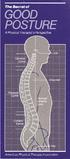 The Secret... T he American Physical Therapy Association would like to share a secret with you. It can help you do more with less effort breathe easier feel great. The secret is about good posture, which
Schiffert Health Center www.healthcenter.vt.edu. Neck Pain (Cervical Strain) COMMON CAUSES: QUICK TREATMENT : NECK PAIN TREATING NECK PAIN:
 Schiffert Health Center www.healthcenter.vt.edu Patient Information: Neck Pain (Cervical Strain) COMMON CAUSES: Neck pain may be triggered by a specific event, such a sport injury or motor vehicle accident.
INSTRUCTIONAL MATERIALS: REFERENCES: a. PAEC School Safety Manual b. Any locally produced Back Injury pamphlet TRAINING AIDS:
 LESSON TOPIC: AVERAGE TIME: BACK INJURY PREVENTION 30 Minutes INSTRUCTIONAL MATERIALS: REFERENCES: a. PAEC School Safety Manual b. Any locally produced Back Injury pamphlet TRAINING AIDS: a. Handout #1
Injuries from lifting, loading, pulling or pushing can happen to anyone in any industry. It is important to be aware of the risks in your workplace.
 Workplace safety: lifting One of the biggest concerns in the workplace is lifting and loading. When you lift something, the load on your spine increases and your spine can only bear so much before it is
Instructor Training Program Levels 1 through 4 Uneven Bars
 USA Gymnastics Online: Technique: Uneven Bars Page 1 of 9 Instructor Training Program Levels 1 through 4 Uneven Bars Level 1 - Uneven Bars MOUNT: BACK HIP PULLOVER Grasp bar with hands "shoulder width"
Australian Centre for Agricultural Health and Safety. Farming with Back Pain
 Australian Centre for Agricultural Health and Safety Farming with Back Pain 2008 Australian Centre for Agricultural Health and Safety All rights reserved Title: Farming with Back Pain Authors: Boughton
Physical Capability Strength Test: One Component of the Selection Process
 Physical Capability Strength Test: One Component of the Selection Process One aspect of the Power Systems Institute selection process is to successfully complete and achieve a passing score on a physical
Injury Prevention for the Back and Neck
 Injury Prevention for the Back and Neck www.csmr.org We have created this brochure to provide you with information regarding: Common Causes of Back and Neck Injuries and Pain Tips for Avoiding Neck and
try Elise s toning exercise plan
 try Elise s toning exercise plan Whether you want to start things off slow and gradually build up your fi tness, or begin with a challenge, Elise s toning exercise programme is designed for all levels.
Yoga Routine. Khun Reinhard. (www.khunreinhard.com)
 Yoga Routine by Khun Reinhard (www.khunreinhard.com) Yoga-Routine Khun Reinhard - 2 - December 2013 Introduction This yoga routine has been taught by the author of this paper over many years to more than
Lower Body Exercise One: Glute Bridge
 Lower Body Exercise One: Glute Bridge Lying on your back hands by your side, head on the floor. Position your feet shoulder width apart close to your glutes, feet facing forwards. Place a theraband/mini
Psoas Syndrome. The pain is worse from continued standing and from twisting at the waist without moving the feet.
 Psoas Syndrome The iliopsoas muscle is a major body mover but seldom considered as a source of pain. Chronic lower back pain involving the hips, legs, or thoracic regions can often be traced to an iliopsoas
Pelvic Girdle Pain (PGP) Fact Sheet
 Pelvic Girdle Pain (PGP) Fact Sheet Physiotherapy PGP describes pain that is experienced in the front (symphysis pubis joint) and/or back (sacroiliac joints) of your pelvis. This is a common problem, affecting
CHAPTER 3: BACK & ABDOMINAL STRETCHES. Standing Quad Stretch Athletic Edge - www.athleticedge.biz - (650) 815-6552
 CHAPTER : BACK & ABDOMINAL STRETCHES Standing Quad Stretch ) Stand and grasp right ankle with same hand, use a wall or chair to Lower maintain Back balance with left hand. Maintain an upright Stretches
UPPER QUADRANT PAC. Do only those exercises that I have checked off for you to do independently. THINGS TO AVOID
 UPPER QUADRANT PAC Most common pain / disfunction syndromes occur as a result of a combination of poor posture habit and imbalanced muscle groups. The following exercise protocols will address the most
Physical Agility Test Preparation and Safety
 Physical Agility Test Preparation and Safety TT DD CC JJ J How to Prepare for the PAT Prior to taking the Physical Agility Test, applicants should seek medical advice from their physician. The day of the
Don t. Hamstrings. Calf Muscles. both legs 2-3 times. stretch is felt in the back of the calf. Repeat with both legs 2-3 times.
 Remember to: Warm-up your muscles first before stretching (e.g. stretch after walking). Stretch until you feel mild discomfort, not pain. Never bounce or force a stretch. Hold the stretch for 10-30 seconds
FUNCTIONAL STRENGTHENING
 FUNCTIONAL STRENGTHENING *This group of exercises are designed to increase leg and core endurance and stability as related to bipedal functional activities. *Perform this program for 4-6 weeks. It is ideal
Physical & Occupational Therapy
 In this section you will find our recommendations for exercises and everyday activities around your home. We hope that by following our guidelines your healing process will go faster and there will be
Clasp hands behind hips and stretch arms down towards floor. Roll shoulder back to open chest. Do not let back arch. Power Skips
 Warm Up Exercises Jump Rope Ankle Bounces Jumping Jacks Using a fast twirl, rapidly jump up and down using spring in the feet and ankles, not in knees. V-Jumps Rapidly jump up and down using spring in
Cervical Spine Stretches
 Cervical Spine Stretches Stretching exercises help to restore joint range of motion by lengthening shortened muscles and connective tissue, which helps to reduce pain and tightness. Instructions: 1. Perform
Lower Back Pain An Educational Guide
 Lower Back Pain An Educational Guide A publication from the Center of Pain Medicine and Physiatric Rehabilitation 2002 Medical Parkway Ste 150 1630 Main St Ste 215 Annapolis, MD 21401 Chester, MD 21619
ABOUT THE FUNCTIONAL FITNESS TEST: ABOUT THE AUTHORS:
 The Interactive Health Partner Wellness Program addresses fall prevention with assessments and outcomes tracking in an easy to use, comprehensive online system. Website: www.interactivehealthpartner.com
Stretching for Young Athletes. Shawn P. Anderson, SPT Duke University Doctor of Physical Therapy
 Stretching for Young Athletes Shawn P. Anderson, SPT Duke University Doctor of Physical Therapy Sports and exercise are usually integral parts of many adolescents life. Whether they play at school or in
McMaster Spikeyball Therapy Drills
 BODY BLOCKS In sequencing Breathing and Tempo Flexibility / Mobility and Proprioception (feel) Upper body segment Middle body segment Lower body segment Extension / Static Posture Office / Computer Travel
20 Great Exercises for Women
 20 Great Exercises for Women Life Gym, 3 Castell Close, Enterprise Park Swansea SA7 9FH Tel: 01792 547777 www.lifegyms.co.uk Source: www.womensfitness.co.uk 2 When it comes to fitness experts say that
THROWER S TEN EXERCISE PROGRAM
 THROWER S TEN EXERCISE PROGRAM Diagonal Pattern D2 Extension Involved hand will grip tubing handle overhead and out to the side. Pull tubing down and across your body to the opposite side of leg. During
Spinal Exercise Program/Core Stabilization Program Adapted from The Spine in Sports: Robert G. Watkins
 Spinal Exercise Program/Core Stabilization Program Adapted from The Spine in Sports: Robert G. Watkins Below is a description of a Core Stability Program, designed to improve the strength and coordination
CORRECTIVE CHIROPRACTIC EXERCISES
 CORRECTIVE CHIROPRACTIC EXERCISES J O W E T T & M O U L T O N C h i r o p r a c t o r s introduction This booklet, presented by Jowett and Moulton Chiropractors, is designed to provide you with a general
X-Plain Neck Exercises Reference Summary
 X-Plain Neck Exercises Reference Summary Introduction Exercising your neck can make it stronger, more flexible and reduce neck pain that is caused by stress and fatigue. This reference summary describes
-Balance on hands and feet rolling the upper hamstring area.
 -Begin w/roller around mid balance w/ back flat on ground, put hands behind head. -Slowly roll to mid/upper shoulder blade area. -Roll to right or left to emphasize one side. Thoracic Spine Mobility -Sit
Whiplash Associated Disorder (WAD)
 Information for patients Whiplash Associated Disorder (WAD) Physiotherapy Department Tel: 01473 703312 DPS ref: 05731-14(RP) Issue 3: December 2014 Review date: November 2017 The Ipswich Hospital NHS Trust,
Otago Exercise Program
 Otago Exercise Program Edited Version Exercise Booklet Created by: Genesee County Coalition Supported by a grant from the Health Foundation for Western and Central New York Otago Exercise Program to Prevent
are you reaching your full potential...
 T h e r e s n o s u c h t h i n g a s b a d e x e r c i s e - j u s t e x e r c i s e d o n e b a d l y FIT for sport are you reaching your full potential... These tests are a series of exercises designed
SECTION 9. Mobility, positioning, and transfers. Moving after a stroke 9.1. Fatigue. Loss of sensation. Loss of motor function.
 SECTION 9 Mobility, positioning, and transfers Section overview This section looks at: Moving after a stroke Assisting with mobility Positioning Managing the affected limb Transfers Wheelchair use Walking
Bankart Repair For Shoulder Instability Rehabilitation Guidelines
 Bankart Repair For Shoulder Instability Rehabilitation Guidelines Phase I: The first week after surgery. Goals:!! 1. Control pain and swelling! 2. Protect the repair! 3. Begin early shoulder motion Activities:
KNEE EXERCISE PROGRAM
 KNEE PROGRAM INTRODUCT ION Welcome to your knee exercise program. The exercises in the program are designed to improve your knee stability and strength of the muscles around your knee and hip. The strength
Starting position: Lying with knees bent up and feet flat on floor/bed about 12" (30cms) apart
 Exercise 3 Bridging Starting position: Lying with knees bent up and feet flat on floor/bed about 12" (30cms) apart Tighten your buttocks, then raise them off the floor to form a bridge, then hold. Then
Mike s Top Ten Tips for Reducing Back Pain
 Mike s Top Ten Tips for Reducing Back Pain The following article explains ways of preventing, reducing or eliminating back pain. I have found them to be very useful to myself, my clients and my patients.
Rehabilitation after shoulder dislocation
 Physiotherapy Department Rehabilitation after shoulder dislocation Information for patients This information leaflet gives you advice on rehabilitation after your shoulder dislocation. It is not a substitute
Workout Routine - Dumbbells - Full Body Printed on Apr 28 2011
 Workout Routine - Dumbbells - Full Body Printed on Apr 28 2011 Workout Routine Snapshot 2 Workout Days 0 Cardio Exercises 14 Strength Training 0 Stretching Exercises 2 Abs 2 Back 2 Chest 2 Shoulders 2
STANDARD OPERATING PROCEDURES (SOP) FOR COMPUTER WORK, DESK TOP
 STANDARD OPERATING PROCEDURES (SOP) FOR COMPUTER WORK, DESK TOP General Guidelines-Best Practices: The following guidelines are applicable to office workers who sit at a desk and/or work on computers.
Routine For: OT - General Guidelines/Energy Conservation (Caregiver)
 GENERAL GUIDELINES - 9 Tips for Exercise: Body Mechanics for Helper - To protect back, stay as upright as possible and keep head in line with trunk. - Always position yourself as close as possible to the
HOPE EXERCISE RECOVERY RESOURCES RELATIONSHIPS INFORMATION REHABILITATION PREVENTION SELF ADVOCACY RELATIONSHIPS MOVEMENT. A Stroke Recovery Guide
 INFORMATION REHABILITATION PREVENTION SELF ADVOCACY RECOVERY HOPE A Stroke Recovery Guide RELATIONSHIPS MOVEMENT RESOURCES RELATIONSHIPS EXERCISE www.stroke.org CHAPTER FOUR Movement and Exercise Moving
Low Back Pain Exercises Interactive Video Series Transcript July 2013
 Introduction Low Back Pain Exercises Interactive Video Series Transcript July 2013 ** Note: If an exercise causes an increase in your pain, stop the exercise.** [Music introduction; Dr. John Sheehan onscreen]
PERFORMANCE RUNNING. Piriformis Syndrome
 Piriformis Syndrome Have you started to experience pain in your hip or down your leg while beginning or advancing your fitness program? This pain may be stemming from the piriformis muscle in your hip.