
Education, Audiovisual and Culture Executive Agency. Application procedures Call 2015 (EAC/A04/2014)
|
|
|
- Samantha Butler
- 10 years ago
- Views:
Transcription
1 Education, Audiovisual and Culture Executive Agency SPORT, YOUTH AND EU AID VOLUNTEERS Application procedures Call 2015 (EAC/A04/2014) ERASMUS+ : SPORT COLLABORATIVE PARTNERSHIPS NOT-FOR-PROFIT EUROPEAN SPORT EVENTS Instructions for completing the Application Package 1
2 TABLE OF CONTENTS 1. Introduction About the call and the application procedure Innovations introduced for the Erasmus+ Programme Registration in the Participant Portal Presentation and organisation of instructions Contents of the Application Package Deadlines and submission of the Application Package... 6 The Application Package... 8 Application Form... 9 Part A. Completion of organisation data Part B. Description of the project Part C. Statistical information Part D. Organisation and activities Part E. Project characteristics and relevance Part F. Quality of the project design and implementation Part G. Quality of the project team and cooperation arrangements Part H. Impact and dissemination Detailed budget table Declaration of Honour by the Legal Representative of the Applicant Organisation

3 1. 1. INTRODUCTION This document is intended to help applicants for the sport actions of the Erasmus+ Programme to find the information they need, to complete their applications and to prepare their projects. It should not be used for any other type of action. In order to prepare and submit an application, applicants have to refer to a range of other documents. Information that is contained in the documents listed below will not be repeated in these instructions, although references are made where appropriate: The Legal Basis: :347:0050:0073:EN:PDF This provides you with the rationale for the Erasmus+ Programme and emphasises its aims and priorities. The Call for Proposals: :362:0062:0065:EN:PDF This is the official notification of the General call for proposals. It is a short document that provides, inter alia, information on the countries that can participate, budgetary details and deadlines. The Erasmus+ Programme Guide: This is a key document covering definitions and rules for all the actions included in the General Call for Proposals. There you will find general information regarding the content and management of the programme and specific information on sport projects. You should not attempt to make an application without referring to the relevant sections of the Programme Guide. It is structured as follows: Introduction Part A General Information about the Erasmus+ Programme Part B Information about the actions covered by this guide Part C Information for applicants Annex I Additional rules and information relating to the actions covered by the Programme Guide Annex II Dissemination guidelines for beneficiaries Annex III Glossary of key terms Annex IV Useful references and contact details This text provides the complete funding framework including rules relating to project budgets, explanations on the assessment procedures and information on dissemination and exploitation strategies. This document also provides information on different eligibility, exclusion and selection criteria that are applied to each application through the selection procedure. The Proposal Submission User Guide: 3
4 This is a technical user guide that you will need to follow to ensure that you register your organisations correctly and complete the electronic application form correctly and under optimal conditions. Frequently asked questions (FAQ): The Agency publishes answers to questions that are frequently asked by potential applicants. It is very important for applicants to check them in order to benefit from clarification that has been asked for by other applicants. These FAQs are made public to ensure that all applicants are treated fairly with respect to having access to the same information. The FAQs include clarification on eligibility and interpretations / clarification of aspects of the official documents. 2. ABOUT THE CALL AND THE APPLICATION PROCEDURE 2.1. Innovations introduced for the Erasmus+ Programme Although there is a significant amount of continuity from the previous generation of programmes, there are a number of changes that will affect the preparation of applications: Registration of all organisations in the Participant Portal: the applicant will need to first register in the participant portal described below. Many organisations linked to the EU research programmes are already in the participant portal. Award criteria and scoring mechanism: there has been a simplification and harmonisation of award criteria and scoring mechanisms Registration in the Participant Portal The applicant organisation must ensure that all partner organisations (in case of collaborative partnerships) that will participate in the application have been registered in the EAC/EACEA Participant Portal. Each organisation that is registered in the Participant Portal is allocated a unique Participant Identification Code (PIC). The PIC is a 9 digit number that helps the European Commission and Agencies identify a participant. It is used in all grant-related interactions between the participants and the Commission. If an organisation does not have a PIC number it cannot be a partner in an application. Please note that not-for-profit European sport events have only one applicant organisation, no partner organisations. The transnational element of the event is secured via participants from the defined number of different Programme Countries. This is an eligibility criterion. However, the sending organisations (the organisation which recruit and send the participants to the event) are not partners of the project, will not sign a grant agreement and will not receive any part of the EU grant. The sending organisations also do not need a PIC number. You will need an ECAS account in order to register your organisation in the Participant Portal. The home page of the Participant Portal includes a link to the ECAS registration website (click on the link 'Are you a new user?'). To enter the Participant Portal, click on the following link: 4

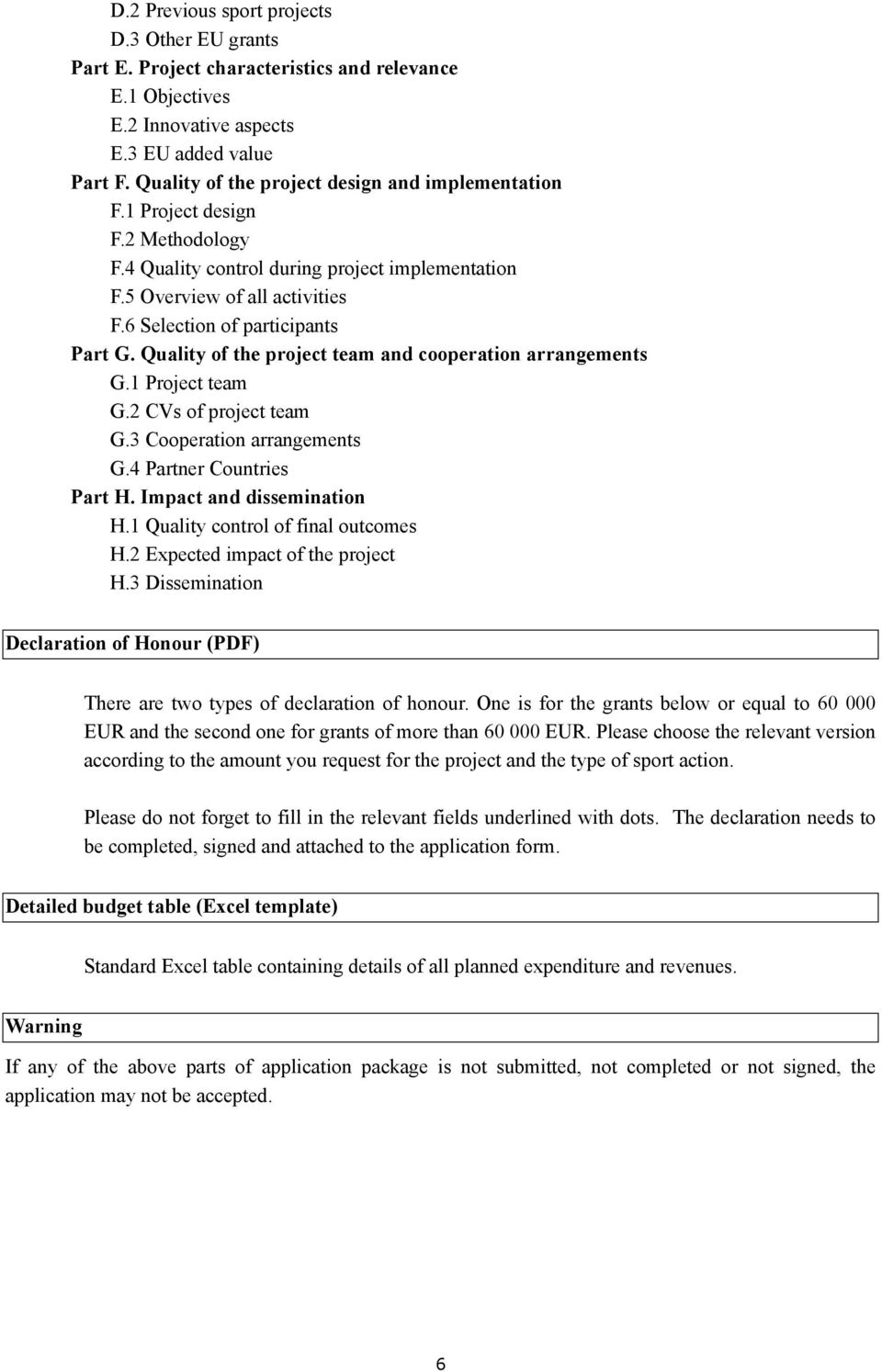
5 If your organisation has already received a grant from the EU, it is likely that the organisation has already received a PIC number. You can search for existing PIC numbers in the Participant Portal via the 'My Organisation' option. The registration of your organisation in the Participant Portal will not take more than 10 minutes. At the time of registration, organisations must also upload the documents as indicated in the Erasmus+ Programme Guide (Part C). If your PIC is already validated, you do not have to upload any further documents. However, you can make modifications (e.g. change of phone number), if needed Presentation and organisation of instructions The purpose of this document is to offer a guidance regarding the content of Application Form, the application procedure and the rules that must be respected. These detailed instructions follow the same order as the application itself. The applicants who do not follow the instructions and guidance therein, risk submitting an incomplete or incorrect application, and therefore significantly reduce the chances of their application being successful Contents of the Application Package The Application Package consists of the following elements and must be downloaded from the website of the Executive Agency: The application package consists of several documents, the content of which is summarised below. Each of these must be completed and submitted as instructed. Application Form (eform) Part A: Identification of the applicant (administrative information) A.1. Applicant's data A.2 Person responsible for the management of application (contact person) A.3 Person authorised to represent the organisation in legally binding agreements (legal representative) Part B: Description of the project (general information) B.1 Summary of the project B.2 Topics B.3 Dates and languages B.4 Budget summary Part C: Statistical information (action specific information) C.1 Estimated amount of the members of sport organisations involved in the project C.2 Participants involved in the Not-for-profit European Sport Events (for events only) Detailed Description of the Project (MS Word template) Part D. Organisation and activities D.1 Aims and activities of organisation 5

6 D.2 Previous sport projects D.3 Other EU grants Part E. Project characteristics and relevance E.1 Objectives E.2 Innovative aspects E.3 EU added value Part F. Quality of the project design and implementation F.1 Project design F.2 Methodology F.4 Quality control during project implementation F.5 Overview of all activities F.6 Selection of participants Part G. Quality of the project team and cooperation arrangements G.1 Project team G.2 CVs of project team G.3 Cooperation arrangements G.4 Partner Countries Part H. Impact and dissemination H.1 Quality control of final outcomes H.2 Expected impact of the project H.3 Dissemination There are two types of declaration of honour. One is for the grants below or equal to EUR and the second one for grants of more than EUR. Please choose the relevant version according to the amount you request for the project and the type of sport action. Please do not forget to fill in the relevant fields underlined with dots. The declaration needs to be completed, signed and attached to the application form. Declaration of Honour (PDF) Detailed budget table (Excel template) Warning Standard Excel table containing details of all planned expenditure and revenues. If any of the above parts of application package is not submitted, not completed or not signed, the application may not be accepted. 6
7 2.5. Deadlines and submission of the Application Package The applications must be sent by 22 January 2015 for the call of proposals related to the 2015 European Week of Sport, 12 pm (midday, not midnight) Brussels time (CET) and by 14 May 2015 for the call of proposals not related to the 2015 European Week of Sport, 12 pm (midday, not midnight) Brussels time (CET). Applications sent by post, fax or will not be accepted. Applicants cannot make any changes to their grant application after the submission deadline. Once the eform and annexes have been submitted, a reference number is automatically generated on the eform. In addition, a notification message will be sent by to the contact person of the applicant organisation (or coordinating organisation, if applicable) to the address indicated in the eform. Please ensure that the presentation of the package conforms to the instructions printed in the Call for Proposals, notably: The application must be completed electronically by computer and submitted online (no paper, no handwritten submissions, or submissions completed using a typewriter will be accepted). No information or documents other than the Application Package can be sent. Any further documents will not be taken into consideration in the evaluation of application. No changes to the application can be made after the deadline has expired. However, if there is a need to clarify certain administrative aspects (e.g. contact details), the applicant may be contacted for this purpose. Please note the date and time of the online submission. Applicants are STRONGLY advised to submit their application well in advance of the deadline and to keep proof of the safe arrival of the application in the system. If you experience any technical problems during the submission, please contact the eform Helpdesk immediately ([email protected]). If you have questions on the content of the eform and the Annexes, please contact the helpdesk ([email protected]). Note on submission of application package (please read it carefully) Before applying, you must carefully check whether you meet all the eligibility criteria. It is your responsibility to compete your online registration application in time. We strongly advise you not to wait until the last few days before applying, since heavy internet traffic or a problem with the internet connection could lead to your online registration application being interrupted before you are able to submit it. Once the deadline has passed, you will no longer be able to submit. The EACEA Erasmus+ Sport team as well as the EACEA IT Helpdesk are willing to provide technical support during the application phase if needed. However, please make sure that, if need be, you contact them well before the deadline. 7

8 Please note that if you cannot validate and send the eform because you e.g. did not fill in all mandatory fields, you filled them in wrongly or you put contradictory information (e.g. in the budget table), not reading and respecting the Guidelines for applicants and other instructions, this cannot be considered as a technical problem on our side. Please note that if you try to send us the application per just before or after pm (midday) CET claiming there was a technical problem on our side, we will carefully check and verify when you last modified your application and if the application was valid or not before the deadline. If we find out that your application was not filled in correctly and as a result, the system prevented you to send us your application, it can be rejected even if sent to the EACEA IT Helpdesk per before the deadline. Once you complete and submit your online application, an acknowledgement receipt of your application will be sent to the address of contact person indicated in your application. It is your responsibility to verify providing the correct address. THE APPLICATION PACKAGE Please note: The language used to complete the application package must be an official EU language and it must be a language that is understood by all members of your consortium. In case of collaborative partnership, this is also in line with the Declaration of Honour stating that all the partners should have agreed to the content of the application and should have confirmed their intention to carry out the tasks described. If you use abbreviations, please make sure each abbreviation is clearly defined. It is advisable to compile a list of all abbreviations used in your application and attach it to the Project description. The application package has the following parts: OR Application form (eform) Project description (WORD) Detailed budget table (EXCEL) Declaration of Honour signed by the Legal Representative of Applicant Organisation below or equal to EUR (PDF) for the relevant type of action Declaration of Honour signed by Legal Representative of Applicant Organisation more than EUR (PDF) for the relevant type of action 8

9 Please note that all four documents must be submitted in order to apply for the sport actions. Failing to do so will result in an ineligible application. Changing, adapting or using own templates in not allowed and can result in the rejection of your application. APPLICATION FORM (EFORM) The eform is an Adobe development and applicants should ensure that they can install Adobe version 9 or higher on the computer they will be using to complete the application form. The form is downloaded onto a local computer and completed remotely. Once the text is ready and the attachments are linked to the application, it has to be submitted using an internet connection. The eform is constructed to ensure that applicants have the greatest chance of submitting an eligible application. Therefore you will find that submission will be impossible unless all mandatory fields are completed. Full details of these are available in the Proposal submission User Guide (further referred to as "User Guide"), which is published alongside the eform. It is strongly recommended to read the User Guide before you start completing the eform. A lot of processes are explained in detail in the User Guide, and without this knowledge you may have problems completing the form. Before starting to complete an eform, all partner organisations of an application must be registered in the EAC/EACEA Participant Portal. This process is explained in the User Guide. Without the proper registration of partner organisations, you will not be able to complete the eform. Chose the eform of the action you want to apply for from the Application eform homepage eacea.ec.europa.eu/ppmt/ As a next step, you need to provide the registration codes of all organisations participating in your proposal. During this step, you are also required to identify the applicant organisation (For details, please see the User Guide). Please note that all fields marked with * are mandatory. This applies to all parts of the eform. 9
10 Cover page of the application form 1 Eight fields appear in the first table of application form. You should choose a project title that will be meaningful to someone who knows nothing about the content of the project and an acronym. The title must not exceed 200 characters. The acronym must not exceed 7 characters. The title and acronym can contain letters (Latin characters only), numbers and common punctuation marks. The language used to complete the form must be an official EU language. Please mention the language you have chosen in the last field of table. The application form must be completed in one language only. Do not provide information in various languages as the experts selected to assess your application will not necessarily be able to understand the various languages used. In addition, the language you chose must be understood by all members of your consortium. Part A. Completion of organisation data The most fields in part A.1 are completed automatically, based on the information you provided while registering your organisation in the EAC/EACEA Participant Portal. The applicant organisation has to complete the following sections for all participating organisations: In part A.1, the field "Role in the application" (for collaborative partnership only), "Type of Organisation" and "Region" needs to be completed by choosing an available option from a drop-down list. 1 The deadline has changed, but the cover page remained the same. 10

11 11

12 In the section A.2, complete the title, family name, first name, role in the organisation and address of the person who is responsible for the management of the application (contact person) in your organisation. If the «contact person» has a different address from the registered address of the organisation, check the corresponding box and provide the address and telephone number. Section A.3 will have to be filled in for the applicant organisation and other participating organisations applying for actions with a multibeneficiary grant agreement (i.e. for collaborative partnerships). If the Legal representative has a different address from the registered address, check the corresponding box to access the fields necessary to provide this information. If the application is successful, the Legal representative, will also be required to sign the Grant Agreement and other associated documents. If the application is signed by a different person, or if it is discovered in later stages of the selection or during contracting that the person identified as the Legal representative does not have the authority to sign, the application may be declared ineligible: an invalid signature could lead therefore to the rejection of the application. 12

13 There is only one field for the contact details of legal representative/contact person for partners in collaborative partnerships. If these two posts are different in your organisation, please write the contact details of legal representative. The following table applies only to collaborative partnerships. The list of all partner organisations is completed automatically and provides an overview of the entered information. 13

14 Part B. Description of the project Section B.1, summary of the project, invites applicants to provide key information on their application. For dissemination purposes, this section must be provided also in English, if the initial language chosen was different to English. For successful applications, this section will be reproduced in the form of an abstract. Applicants should therefore ensure that the text gives a concrete overview of the work the organisation plans to undertake following the structure proposed in the form. Please note that due to database limitations, the indicated limit of characters (including spaces) cannot be exceeded. The provided text will be cut when exceeding the limit. Section B.2. Topics This section relates to topics addressed by this proposal. Please tick only one of the seven topics listed for collaborative partnerships: Enhance social inclusion, equal opportunities, volunteering and participation in sports Fight against doping at grassroots level 14

15 Fight against match-fixing Approaches to contain violence and tackle racism and intolerance in sport EU principles on good governance in sport EU Guidelines on dual careers of athletes EU Physical Activity Guidelines In case of Not-for-profit European sport events, please tick only one out of the three topics: Enhance social inclusion, equal opportunities, volunteering and participation in sports EU Physical Activity Guidelines European week of sport Section B.3. Dates and languages In section B.3, you have to fill in the duration of action and call you apply for. Each eform is set-up in a way that you will not be able to provide dates or durations that are in contradiction to the rules of the action you apply for. This complies with the eligibility periods. However, you have to specify the exact start and end date of your project activities in the project description (one of the three annexes you attach to the eform). Collaborative Partnerships The eligibility period of collaborative partnerships for the call for proposal related to the 2015 European Week of Sport, starts between 1 April and 1 September In the field 'duration', there is only an option to choose 18 months (maximum eligibility period). However, your project activities as specified in the project description can be planned and finished before the end date of eligibility period. Thus, your project can last less than the maximum of 18 months. The eligibility period of collaborative partnerships for the call for proposal not related to the 2015 European Week of Sport, starts on 01/01/2016 and this date appears in the eform automatically. In the field 'duration', there is an option to choose among 12, 18, 24, 30 or 36 months. Not-for-profit European sport events The eligibility period of not-for-profit European sport events for the call for proposal related to the 2015 European Week of Sport, is automatically set from 01/05/2015 till 30/04/2016. The eligibility period of not-for-profit European sport events for the call for proposal not related to the 2015 European Week of Sport, is automatically set from 01/11/2015 till 31/10/2016. However, in both cases, you have to specify the exact start and end date of your project activities in the project description (one of the three annexes you attach to the eform). For instance, the eligibility period of not-for-profit European sport event is from 01/11/2015 till 31/10/2016, but your project activities (as specified in the project description) may start e.g. on 01/04/2016 and finish e.g. on 30/09/2016. Please note that in any case your project must start and finish within the eligibility periods indicated above. 15

16 The English language is set for the Grant Agreement/Decision and the official communication with the Executive Agency. Section B.4. Budget summary This table provides information on expenditure and income of the project. The table should be completed only after the duration has been indicated (above) and the Excel budget sheet have been completed and validated: the amounts in the Excel table and in the budget summary must be identical. All budgetary information must be provided in Euro/. Distribution of grant by organisation (for collaborative partnerships only) The following table needs to be completed, listing the amount of the grant requested by participating organisation. The indicated total has to be identical to the total grant requested in the budget summary of the eform, and to the total grant requested in the Excel budget sheet. Partner number Section C.1. Size of membership P1 P2 P. Total Partner name Part C. Statistical information Grant requested This section applies to both, collaborative partnerships and not-for-profit European sport events. In section C.1, please provide an estimated number of those members who will participate in the project. Hence, the total number you provide in this section corresponds to participating members from all participating organisations. For instance, if an organisation from a country XY sends 50 members to participate in the event in a country XZ, you count 50 for this particular organisation. If the organisation sends 50 people out of which only 40 are its members, you count 40 for this particular organisation. You have to count the 'participating members' from each sending organisation together and provide the final number in the C.1.box. 16

17 Section C.2. Participants involved in the Not-for-profit European sport event This section applies only to the not-for-profit European sport events. Section C.2 lists all organisations that send participants to the not-for-profit European sport event. Please indicate the country of sending organisation. Please add lines if participants from several organisations from one country and/or participants from organisations from more than 3 or 12 countries respectively (depending on call) take part at the event. Please note that one of eligibility criteria is that a not-for-profit European sport event involves participants from at least 3 or 12 different Programme Countries (depending on call). All sending organisations must be identified in the eform, it means that concrete names of organisations must be stated. A generic indication, such as the sport club/federation, city of XY, etc. may result in the rejection of application. 17

18 The project description is an annex of application form (eform) and must be uploaded and submitted together with the application form electronically. You can only use the template published on the EACEA website. You are not allowed to change, adapt or use your own template. All text fields in all sections are obligatory unless specified that the field applies to collaborative partnership or not-for-profit European sport event only. For adding information in the new columns/rows of tables, please use the copy-paste function of your computer. Please note that, as this is a word document, it is possible to insert pictures and diagrams into the text boxes in addition to the character limit. However, in order to avoid any potential problem during the submission of application, the maximum capacity of application package (eform + three annexes) is 10 MB. Part D. Organisation and activities PROJECT DESCRIPTION (WORD) This section provides information about applicant organisation and, where applicable, to partner organisations (in case of collaborative partnerships). It also provides an overview of main activities and involvement in previous or current projects co-financed by the European Union. Section D.1. Aims and activities of organisation The description in this section should provide a brief presentation of the applicant organisation. Please do not forget to state the key activities relating to the area covered by the project. In case of collaborative partnership, please provide the same type of information for all partner organisations. If your organisation's name is in other than English language, please provide the name of your organisation in both, the national and English language. Section D.2. Previous sport projects Please mention all projects financed in the framework of the sport preparatory actions ( ) by the European Commission, DG Education and Culture or the EACEA based on the Erasmus+ sport calls for proposals, the applicant organisation was involved in. You must provide references to these projects in the respective table. Quote the full reference number of your project (e.g. the EU grant agreement number) and then complete the various sub-sections in this table. The 'website' relates to the website of project. You also have to summarise the project outcomes and describe if and how the new proposal builds on them. Section D.3. Other EU grants 18

19 Please list the projects for which the applicant organisation responsible for the management of this application has received financial support from the EU programmes or initiatives during this financial year. Please add more tables if you received more than one financial contribution. Please list the EU grant applications the applicant organisation submitted for other projects this financial year. Please indicate the EU programme and/or key action concerned as well as the title of project and the amount requested. Section E.1. Objectives First of all, please tick only one of the three objectives listed in the table. As a second step, it is important to describe the reasons for undertaking the project and how the project addresses the objective ticked above. The applicant also has to demonstrate the expertise and knowledge in the field of operation. The applicant should explain any synergies with other fields of operation too. In addition, it is important to explain the relevance of your proposal to the objectives of European policies in the field of sport. The description should help experts to assess the level of preparedness and operational capacity for the implementation of the project initiative and for addressing relevant needs. The rationale and background of the project, including specific needs/problems/challenges that it intends to address has to be described too. Section E.2. Innovative aspects Please provide an analysis of the state of art in the project domain and describe how and why the project has an innovative character. Please provide explanation of innovative aspects of your project. Section E.3. EU added value Detailed information on the benefit of the European cooperation should be provided in this section. It has to explain why it is necessary to implement the project at European level rather than at national/regional/ local level. Part E. Project characteristics and relevance Part F. Quality of the project design and implementation Section F.1. Project design 19

20 This section should outline how the project intends to tackle the need for action, which was previously analysed, in order to improve the situation (or deficiencies) in the project domain. This section also has to provide a clear and complete work programme and describe main activities planned. An overview of all activities will be presented in section F.4. If you prefer to describe the project via work packages, you can do so. Please structure the text and activities thoroughly, so that experts can evaluate your project proposal properly. The lack of good structure and explanation of project activities will considerably impact the overall score of project. Section F.2. Methodology The applicant has to elaborate the methodological approach applied in the project. This illustrates how the project team proceeds to achieve the envisaged objectives and how the progress of project activities can be assessed against milestones and measurable indicators. This section plays an important role in the assessment of work programme quality and the foreseen project activities. If you intend to subcontract, please provide all details in this section (companies you intend to subcontract, the approach applied when selecting the companies, tasks performed by these companies, total costs of subcontracting, etc.). Section F.3. Quality control during project implementation In this section, you have to provide an overview of work monitoring and evaluation undertaken within the activities foreseen. The applicant is also asked to provide explanations as regards the achievements of results within the available budget and in an economical way. The coherence between activities and the overall coordination of project should be stressed. Equally important is a risk assessment. Please provide an analysis of potential risks and measures to redress them. Section F.4. Overview of all activities Please list all main activities envisaged in the work programme and specify their venues (town and country). Please describe the target group(s) and activity. Make sure that activities in this section correspond to those mentioned in the section F.1. Each activity line in the table starts with a number. Please make sure that each budget table line (excel table) involves all activity line numbers of this F.4. section. In other words, the activities in this section shall be aligned to the costs stated in the budget table. Section F.5. Selection of participants This section applies only to not-for-profit European sport event (and not to the collaborative partnerships). It has to describe the steps and procedures for identifying and selecting individuals for the event. This part should explain the methodology and the actions foreseen to secure the selection and a good cooperation with the sending organisations. It is also important to explain the logistics and other support 20

21 provided (accommodation, insurances, etc.) for the event participants. The quality measures set up in the sending and receiving organisations to monitor the mobility activity should be explained, as well as the corrective measures in case the envisaged results seem not to be met. Please note that one of eligibility criteria is that a not-for-profit European sport event involves participants from at least 3 or 12 different Programme Countries (depending on the respective call). If you involve people with fewer opportunities, please explain the type of fewer opportunities, how many persons and organisations are concerned as well as from which countries they come from. Please explain the nature of the support required to ensure that these persons can fully engage in the foreseen activities. Part G. Quality of the project team and cooperation arrangements Section G.1. Project team You are expected to describe skills and expertise of key staff involved in the project. This section also has to describe how the project team divides and organises its work. All members of the project team presented in this section shall work for the project and this shall be aligned with an appropriate staff costs (based on the staff cost per day) in the detailed budget table. Section G.2. CVs of project team This table should include a résumé of specific expertise of each of the key staff involved in the project. In the spaces provided, you should provide the names of all key staff and summarise their work skills/ experience and educational background relevant to the project domain. Please copy-paste the table as many times as needed in order to insert the data for each of key staff member involved. It is not allowed to include the CVs of organisation's staff who will not work for the project. For instance, if a president or a secretary general of organisation is included with his/her CV demonstrating the education and working experience, but in reality a junior project officer works on the project, the CV of the president/secretary general cannot be presented in this section. If you decide to allocate at least a few days to the president/secretary general in order to include his/her CV, but the corresponding activities/ involvement in this project are not justified and reasonable, taking into consideration the concrete project/ project activities in question, this can result in a low score for the application. Section G.3. Cooperation arrangements This section applies only to collaborative partnerships (and not to the not-for-profit European sport event). The applicant must explain the overall structure of the management, thereby making specific references to the structure of the partnership, the decision-making process, the methods for communication and reporting within the partnership. The applicant organisation must explain how the overall project 21
22 management will be implemented, how the tasks and resources (including the grant) will be divided between the partners. Section G.4. Partner Countries This section applies only to collaborative partnerships (and not to the not-for-profit European sport event). The applicant should bear in mind that the application will be rejected in case the applicant fails to demonstrate sufficient partner country participation added-value. In case the proposal involves organisations from the Erasmus+ Partner Countries, it should be explained how the participation of these countries adds value to the project in terms of specific skills, experience or expertise these organisations bring to the partnership. If the partnership does not involve any organisations from the Partner Countries, this section can be deleted. Part H. Impact and dissemination Section H.1 Quality control of final outcomes The applicant should describe which mechanisms are put in place for ensuring the quality of the project and how the evaluation will be carried out, as well as any methodology to verify the outcomes of the activities. Section H.2 Expected impact of the project The applicant is requested to elaborate how the project outcomes affect the addressed target groups. In addition, it has to explain how the organisation intends to reach these target groups during the project lifetime as well as after the project is finished. Section H.3 Dissemination Please describe how dissemination will be organised in order to ensure that positive results will be made available both within and outside the participating organisations during the project lifetime. Describe what kind of dissemination actions the event envisages in order to make the outcomes available to groups not directly involved in the project. This could include information sessions, training exercises or the involvement of policy-makers not belonging to the applicant institution. In addition, if the project produces any material, it should be clearly indicated how this material will be made freely accessible through the use of open licences. Although dissemination and exploitation of results are closely related, they are distinct processes. While the mechanisms for dissemination and exploitation often overlap, dissemination (information provision 22
23 and awareness raising) can take place from the beginning of a project and intensify as results become available, but full exploitation (mainstreaming and multiplication of results) can happen only when it becomes possible to transfer what has been learnt into new policies and improved practices. Please describe how exploitation activities ensure optimal use of the results (see Erasmus+ Programme Guide, Annex II Dissemination and exploitation of results). 23
24 The detailed budget table is an annex of application form (eform) and must be uploaded and submitted electronically together with the application form. The EU-Grant for Collaborative Partnerships as well as for Not-for-profit European sport events is based on the reimbursement of a specified portion of the approved eligible costs incurred. Therefore each applicant has to provide a detailed estimated budget in order to indicate the total estimated costs and incomes related to the project proposal. The detailed project budget has to be indicated in the excel template that can be downloaded from the call notification for Collaborative Partnerships and for Not-for-profit European sport events on the EACEA website: Please make sure that you choose the correct template. When completing the budget table please keep in mind that the maximum grant that may be awarded for the Sport Actions is as follows: Erasmus+ Sport Action DETAILED BUDGET TABLE (EXCEL) Collaborative Partnerships related to the 2015 European Week of Sport (EWoS) Max. Grant awarded Euro Collaborative Partnerships NOT related to the 2015 EWoS Euro Not-for-profit European sport events related to the 2015 EWoS Euro Not-for-profit European sport events NOT related to the 2015 EWoS Euro In no case the maximum rate of EU-contribution can go beyond 80 % of the total eligible costs. Before drafting the estimated project budget, applicants are advised to make themselves familiar with the financial provisions set out in the Programme Guide, in particular with the financial conditions applying for all actions funded under the Erasmus+ Programme (see Part C of the Erasmus+ Programme Guide) and the specific conditions applying for Collaborative Partnerships or for Not-for-profit European sport events (see Part B of the Programme Guide). In order to calculate the EU-Grant the applicants have to provide information on the estimated direct and indirect costs in the expenditure part as well as the sources of funding in the income part of the budget template. The details provided in the budget table shall be clear, precise, and allow for the evaluation of the estimated costs in relation to the proposed project activities. 24
25 Furthermore, applicants have to demonstrate a clear link between the project activities, the project team indicated in the Project Description and the budgeted amounts. The costs foreseen in the project budget need to provide information on the persons involved in the project, on the activities foreseen etc. Please note that it is not mandatory to fill in each heading of the detailed project budget i.e. in case a cost category is not applicable for your project you may leave it empty. ESTIMATED EXPENDITURES: Any costs that can be directly linked to the implementation of the complementary activities of the project and can therefore be attributed directly to it should be filled in the part "Direct Costs". In particular, the following direct costs may be included in the project budget provided that they satisfy the conditions outlined in the Erasmus+ Programme Guide: Direct Cost: Please note that with Collaborative Partnerships the estimated direct costs have to be indicated per project partner. This does not apply for Not-for-profit European sport events as no partners are foreseen within this action. Staff costs: - the costs of personnel (permanent or temporary staff) working under an employment contract with the applicant (in case of a Not-for Profit European sport event) or applicant/partner organisation (in case of Collaborative Partnerships) or an equivalent appointing act and assigned to the action; - comprise actual salaries plus social security contributions and other statutory costs included in the remuneration; - have to be in line with the applicant's usual policy on remuneration; - the corresponding salary costs of personnel of national administrations are eligible to the extent that they relate to the cost of activities which the relevant public authority would not carry out if the action concerned were not undertaken; The following information has to be provided in the detailed budget for each staff member individually (separate lines): name of participating organisation (please use the organisation name or the partner number as indicated in the 'List of participating organisation' in the eform), name of staff member and his/ her function in the project, the number of working days in the project, average costs per working day, a task description as well as a clear reference to the respective activity indicated in F.4 of the Project Description. Please note that the staff members for whom costs are foreseen in the budget have to correspond to the 'project team' indicated in the 'Project Description'. If this is not the case, the respective staff costs may be considered ineligible. Travel and subsistence costs: Travel costs: - costs of travel provided that these costs are in line with the applicant's usual practices on travel; - costs may be claimed only for journeys directly connected to specific and clearly identifiable projectrelated activities; - reimbursement must be based on real costs, irrespective of the means of travel chosen (rail, bus, taxi, plane, car hire); - travel by car are reimbursed at EUR 0,22 per km or in line with the applicant's usual practices; 25
26 - the economically most advantageous means of transport should be chosen The following information has to be provided in the detailed budget for each person travelling: name of participating organisation (or sending organisation in case of a Not-for-Profit-European sport event), name of person travelling, the place of departure and arrival, the number of persons travelling, the mode of transport, and a clear link to the respective project activity indicated in F.4 of the Project Description. Please note that in case of 'Collaborative Partnerships' activities must take place in the countries (one or more) of the organisations involved in the Collaborative Partnership; travels to other destinations may not be considered eligible. In case travels are not clearly linked to a project activity (F.4 of the Project Description) the planned costs may be considered ineligible. Subsistence costs: - costs of subsistence allowances, provided that these costs are in line with the applicant's usual practices on travel; - reimbursement must be based on the existing internal rules which may be calculated on an actual cost (reimbursement of receipts) or on a daily allowance basis; - subsistence rates cover accommodation, meals and all local travel costs The following information has to be provided in the detailed budget for each person receiving subsistence allowances: name of participating organisation (or sending organisation in case of a Not-for-Profit- European sport event), name of person receiving subsistence allowances, the place of stay, the number of persons receiving subsistence allowance, details on the calculation of the subsistence allowances including a clear link to the respective project activity indicated in F.4 of the Project Description. Subsistence costs claimed have to be in line with the travels indicated. In case subsistence allowances are not clearly linked to a project activity, the costs may be considered ineligible. Please note that no accommodation for local staff i.e. persons from a participating organisation may be requested if this organisation is located in the city where the meeting takes place. Equipment Costs - the depreciation costs of equipment or other assets (new or second-hand) as recorded in the accounting statement of the applicant. Equipment or other assets have to be written off in accordance with the international accounting standards and the usual accounting practices of the applicant. - the costs of rental or lease of equipment or other assets are eligible, provided that these costs do not exceed the depreciation costs of similar equipment or assets and are exclusive of any finance fees; - only the portion of the equipment's depreciation, rental or lease costs corresponding to the eligibility period of the project and the rate of actual use for the purposes of the action may be taken into account; - each item of equipment group of similar items (e.g. equipment with similar specifications) should be described and justified in a separate line in the excel table; - the depreciation rule applies to any purchase above 500 EUR. It is recommended to rent the equipment required for implementing the project. In case it is economically more advantageous to purchase equipment instead of renting it, the deprecation rule applies to any purchase above 500 EUR. Purchased equipment needs to be written off in line with the international accounting standards and the usual accounting practices of the applicant. Example for calculation: Not-for-profit European sport event with a project duration of 12 months: if the equipment needs to be written off over 3 years only 1/3 (33,33%) of the costs may be accepted for the project. In addition, the correct usage rate of the equipment 26
27 needs to be indicated e.g. 1 month would correspond to a usage rate of 8,33 %. The correct application of the deprecation and usage rate may be checked at final report level. Consumables and supplies - costs of consumables and supplies, provided that they are directly assigned to the action, e.g. photocopies, office supply specifically for the project otherwise these costs should be included in the indirect cost; Please note that the costs for project publications shall be either indicated under 'Subcontracting' or in 'Other costs'. If translation of publications is foreseen, the languages into which the publication will be translated shall be indicated. Translation costs shall also be indicated either under 'Subcontracting' or in 'Other costs'. Subcontracting Costs: - costs entailed by procurement contracts for the purposes of carrying out specific and limited parts of the action, provided that they meet the conditions for sub-contracting and award of procurement contracts. A description and justification needs to be provided in the project description (see F.2 Methodology). If translation of publications is foreseen, the languages into which the publication will be translated shall be indicated. Translation costs shall be indicated either under 'Subcontracting' or in 'Other costs'. Duties, taxes and charges - duties, taxes and charges related to the implementation of the project and to be paid by the applicant in line with the provisions set out in the Erasmus+ Programme Guide. Under this category you may include e.g. costs for visa applications for staff travelling for the project or charges to be paid to a public authority in relation to the implementation of your project (e.g. charges for the registration of an event with a municipality). Non recoverable VAT amounts shall not be indicated under this budget heading. Instead, gross amounts shall be filled in the respective budget heading(s). For the provisions concerning VAT please see 'Specific provisions applying to grants paid on the basis of reimbursement of a specified portion of eligible costs' in Part C of the E+ Programme Guide); Other costs Costs falling under this category may be considered eligible if: - they arise directly from requirement imposed by the grant agreement e.g. audit costs or costs of any financial services (especially costs of financial guarantees); - they are related to the implementation of the project and are not covered by the other categories e.g. costs for translations or for publications if not subcontracted, etc. Indirect costs "Indirect Costs" of the action are those costs which are not specific costs directly linked to the implementation of the action and can therefore not be attributed directly to it. A flat-rate amount of a maximum of 7 % of the total eligible direct costs of the project may be added as "Indirect Costs" representing the applicant's general administrative costs which can be regarded as chargeable to the project. Examples of indirect costs are: - all costs for equipment related to the administration of the project (e.g. PCs, portables, etc.) - communication costs (postage, fax, telephone, internet access, mailing etc.) 27
28 - infrastructure costs (rent, electricity, etc.) of the premises where the project is being carried out; Please note: Indirect costs shall not be eligible under a project grant awarded to a beneficiary who already receives an operating grant from the EU during the period in question. ESTIMATED INCOME In the income part of the detailed project budget the applicant must indicate the contribution from sources other than the EU grant. This co-financing may take the form of the applicant's own resources, financial contributions from third parties or income generated by the project. Please note that the budget has to be balanced in order to be valid i.e. the total project expenditure must be equal to the total project income. How to complete the excel table for the detailed project budget The applicant is requested to fill the white cells only. Coloured cells are locked and any calculation will be made automatically. In case of non-respect of basic financial provisions a warning message in the excel table will appear. The system will request the applicant to modify some of the amounts stated. The coherence between the budget and the planned project activities will be evaluated once the application has been received. Applicants are requested to indicate for each cost item the respective activity number which corresponds to the first column of F.4. in the 'Project Description'. When preparing the project budget, applicants should pay attention to allocate the estimated costs in the correct budget heading and to make sure that these estimated costs are justified in relation to the planned activities. It is possible to add lines for the different budget headings, if need be. In order to insert a 'sheet row' please go to the beginning of the row where you would like to add a new line. Then chose 'home' in the menu bar and then 'Insert Sheet Rows'. 28
29 The budget (please refer to Total estimated expenditure and Total estimated income) needs to be balanced in order to be valid. The estimated budget shall be cost-effective. EACEA reserves the right to cut excessive or reckless expenditures. Certain amounts of the detailed project budget have to be transferred to the application form (B.4. Budget summary) and to the Declaration of Honour (EU-Grant requested). The applicant is advised to check carefully that these amounts are coherent. Furthermore, applications for Collaborative Partnerships have to indicate in the application form (B.4. Budget summary) how the requested EU-grant will be split among the project partners. This does not apply for Not-for-profit European sport events as no partners are foreseen within this action. 29
30 The declaration of honour is an annex of application form (eform) and must be uploaded and submitted together with the application form electronically. A Declaration of Honour should be attached and signed by beneficiaries applying for the EU grant. There are two different templates available depending on the amount of the grant requested: o for a grant higher than EUR , o for a grant below or equal to EUR In addition, please note that there is a difference between the declarations of honour for collaborative partnerships and not-for-profit European sport events. The correct templates are always published together with other documents by the respective call notification as annexes. The Declaration of Honour certifies that all information contained in the application, including the project description, is correct, to the best knowledge of the person identified as legal representative of the applicant organisation, who is familiar with the contents of the application form and attachments. The Declaration confirms that the applicant organisation has the financial and operational capacity to complete the proposed project. The legal representative of the applicant organisation takes note that, under the provisions of the Financial Regulations applicable to the general budget of the European Union, grants may not be awarded to applicants who are in any of the situations defined in the exclusion criteria. Please note that the total grant amount indicated in the Declaration must correspond to the one indicated in the application form (section B.4) and the detailed budget table (excel table). The Declaration of Honour must be printed, filled in, signed by the legal representative and attached to the application form. DECLARATION OF HONOUR BY THE LEGAL REPRESENTATIVE OF THE APPLICANT ORGANISATION (PDF) 30
Submission and selection procedures
 Submission and selection procedures Luciano Di Fonzo Education, Audiovisual and Culture Executive Agency 1 Purpose of the presentation Maximise your chances of submitting a high quality application by:
28 September 2007 LIFELONG LEARNING PROGRAMME GUIDE FOR APPLICANTS: ADMINISTRATIVE AND FINANCIAL RULES
 28 September 2007 LIFELONG LEARNING PROGRAMME GUIDE FOR APPLICANTS: ADMINISTRATIVE AND FINANCIAL RULES 1 Table of Content 2 1. GENERAL PROVISIONS This document contains supplementary information to the
Guide for Applicants. Call for Proposal:
 Guide for Applicants Call for Proposal: COSME Work Programme 2014 TABLE OF CONTENTS I. Introduction... 3 II. Preparation of the proposal... 3 II.1. Relevant documents... 3 II.2. Participants... 4 II.2.1.
Guide for Applicants COSME calls for proposals 2015
 Guide for Applicants COSME calls for proposals 2015 CONTENTS I. Introduction... 3 II. Preparation of the proposal... 3 II.1. Relevant documents... 3 II.2. Participants... 4 Consortium coordinator... 4
GUIDE FOR APPLICANTS SUPPORT FOR EUROPEAN COOPERATION PROJECTS
 Education, Audiovisual and Culture Executive Agency Culture Unit GUIDE FOR APPLICANTS SUPPORT FOR EUROPEAN COOPERATION PROJECTS CREATIVE EUROPE (2014-2020) CULTURE SUB-PROGRAMME VERSION: July 2014 Disclaimer:
BUDGET HEADING 04.03.03.03 INFORMATION, CONSULTATION AND PARTICIPATION OF REPRESENTATIVES OF UNDERTAKINGS CALL FOR PROPOSALS
 EUROPEAN COMMISSION Employment, Social Affairs and Inclusion DG Employment and Social Legislation, Social Dialogue Labour Law BUDGET HEADING 04.03.03.03 INFORMATION, CONSULTATION AND PARTICIPATION OF REPRESENTATIVES
BUDGET HEADING 04 03 01 08 CALL FOR PROPOSALS. Improving expertise in the field of industrial relations VP/2016/004
 EUROPEAN COMMISSION Employment, Social Affairs and Inclusion DG Employment and Social Governance Social dialogue BUDGET HEADING 04 03 01 08 Industrial relations and social dialogue CALL FOR PROPOSALS Improving
Action grants to support national and transnational projects projects aiming to promote Union citizenship
 EUROPEAN COMMISSION DIRECTORATE-GENERAL JUSTICE CALL FOR PROPOSALS Action grants to support national and transnational projects projects aiming to promote Union citizenship RIGHTS, EQUALITY AND CITIZENSHIP
GUIDE FOR APPLICANTS SUPPORT FOR LITERARY TRANSLATION PROJECTS
 Education, Audiovisual and Culture Executive Agency Culture Unit GUIDE FOR APPLICANTS SUPPORT FOR LITERARY TRANSLATION PROJECTS CREATIVE EUROPE (2014-2020) CULTURE SUB-PROGRAMME VERSION: December 2013
GUIDE FOR APPLICANTS GRANTS PROGRAMME 2016/2017 TRAINING IN CONFERENCE INTERPRETING
 GUIDE FOR APPLICANTS GRANTS PROGRAMME 2016/2017 TRAINING IN CONFERENCE INTERPRETING The aim of this guide is to give a summary of the main points of the administrative and financial processes governing
Erasmus+ General Information. Application Form Call: 2015. KA2 Cooperation and Innovation for Good Practices
 General Information This application form consists of the following main sections: - Context: this section asks for general information about the type of project proposal you want to submit; - Participating
EUROPEAN RETURN FUND 2008-2013 1 GUIDE FOR APPLICANTS
 EUROPEAN COMMISSION DIRECTORATE-GENERAL HOME AFFAIRS Directorate C: Schengen EUROPEAN RETURN FUND 2008-2013 1 COMMUNITY ACTIONS GUIDE FOR APPLICANTS 1 The European Return Fund 2008-2013 was established
EUROPEAN COMMISSION DIRECTORATE-GENERAL JUSTICE
 EUROPEAN COMMISSION DIRECTORATE-GENERAL JUSTICE CALL FOR PROPOSALS Action grants to support projects on non-discrimination and Roma integration RIGHTS, EQUALITY AND CITIZENSHIP PROGRAMME (2014-2020) TABLE
How To Get A Strategic Partnership For Schools
 Key Action 2 (KA2) Guide for Applicants Strategic Partnerships for Schools (partnerships composed of only school) Deadline 12:00 AM (CET) on Wednesday 30 April 2014 Version 1: Published 28 March 2014 by
How To Fund A Project
 PREPARATORY ACTION IN THE FIELD OF SPORT Administrative and Financial Management Handbook The rules outlined in this Administrative and Financial Handbook apply to the projects funded by the Preparatory
BUDGET HEADING 04.03.01.06 INFORMATION, CONSULTATION AND PARTICIPATION OF REPRESENTATIVES OF UNDERTAKINGS CALL FOR PROPOSALS
 EUROPEAN COMMISSION Employment, Social Affairs and Inclusion DG Employment and Social Legislation, Social Dialogue Labour Law BUDGET HEADING 04.03.01.06 INFORMATION, CONSULTATION AND PARTICIPATION OF REPRESENTATIVES
EUROPEAN COMMISSION DIRECTORATE-GENERAL JUSTICE CALL FOR PROPOSALS JUST/2013/DAP/SAG/CAAM FOR CHILD ABDUCTION ALERT MECHANISMS SPECIFIC ACTION GRANTS
 EUROPEAN COMMISSION DIRECTORATE-GENERAL JUSTICE Directorate A: Civil justice Unit A.4: Programme management SPECIFIC PROGRAMME "DAPHNE III (2007 2013) CALL FOR PROPOSALS JUST/2013/DAP/SAG/CAAM FOR CHILD
EUROPEAN COMMISSION DIRECTORATE-GENERAL JUSTICE and CONSUMERS CALL FOR PROPOSALS JUST/2014/RDAP/AG/HARM
 EUROPEAN COMMISSION DIRECTORATE-GENERAL JUSTICE and CONSUMERS Call for proposals for action grants CALL FOR PROPOSALS Action grants to support transnational projects aiming to prevent, inform about and
BUDGET HEADING 04 03 01 05 CALL FOR PROPOSALS VP/2015/002
 EUROPEAN COMMISSION Employment, Social Affairs and Inclusion DG Employment and Social Legislation, Social Dialogue Social dialogue, Industrial Relations BUDGET HEADING 04 03 01 05 Information and training
GUIDE FOR APPLICANTS ACTION GRANTS
 EUROPEAN COMMISSION DIRECTORATE-GENERAL JUSTICE Directorate A: Civil justice Unit A.4: Programme management GUIDE FOR APPLICANTS *** ACTION GRANTS *** JUST/2013/JCIV/AG Civil Justice JUST/2013/JPEN/AG
BUDGET HEADING 04.03.01.08 CALL FOR PROPOSALS. Improving expertise in the field of industrial relations VP/2015/004
 EUROPEAN COMMISSION Employment, Social Affairs and Inclusion DG Employment and Social Legislation, Social Dialogue Social dialogue, Industrial Relations BUDGET HEADING 04.03.01.08 Industrial relations
AUDIT CERTIFICATE GUIDANCE NOTES 6 TH FRAMEWORK PROGRAMME
 AUDIT CERTIFICATE GUIDANCE NOTES 6 TH FRAMEWORK PROGRAMME GUIDANCE NOTES FOR CONTRACTORS AND CERTIFYING ENTITIES MATERIALS PREPARED BY INTERDEPARTMENTAL AUDIT CERTIFICATE WORKING GROUP VERSION 1 APPROVED
SPECIFIC PROGRAMME "CRIMINAL JUSTICE" (2007-2013) CALL FOR PROPOSALS JUST/2012/JPEN/AG/EJT Action grants
 EUROPEAN COMMISSION DIRECTORATE-GENERAL JUSTICE SPECIFIC PROGRAMME "CRIMINAL JUSTICE" (2007-2013) CALL FOR PROPOSALS JUST/2012/JPEN/AG/EJT Action grants 1. INTRODUCTION On 12 February 2007, the Council
Application Form Call: 2015. KA1 - Learning Mobility of Individuals. VET learner and staff mobility
 General Information This application form consists of the following main sections: - Context: this section asks for general information about the type of project proposal you want to submit and about the
EUROPEAN COMMISSION DIRECTORATE-GENERAL HOME AFFAIRS. Directorate B - Migration, Asylum. Preparatory Action HOME/2013/CFP/PARS
 EUROPEAN COMMISSION DIRECTORATE-GENERAL HOME AFFAIRS Directorate B - Migration, Asylum Preparatory Action Network of contacts and discussion between targeted municipalities and local authorities on experiences
BUDGET HEADING 04 03 01 05 CALL FOR PROPOSALS VP/2014/002
 EUROPEAN COMMISSION Employment, Social Affairs and Inclusion DG Employment and Social Legislation, Social Dialogue Social dialogue, Industrial Relations BUDGET HEADING 04 03 01 05 Information and training
1st call for proposals: Administrative and submission procedures Infoday La Valeta, Malta, June 17th 2015
 1st call for proposals: Administrative and submission procedures Infoday La Valeta, Malta, June 17th 2015 SIZE OF THE PARTNERSHIP As a minimum requirement, the partnership must involve: at least 4 financing
Frequently asked questions. FP7 Financial Guide
 Frequently asked questions FP7 Financial Guide Budgetary matters Eligible costs of a project What are the criteria for determining whether the costs of a project are eligible? First of all, costs must
URBACT III Programme Manual
 URBACT III Programme Manual Fact Sheet 2E Network Management Table of contents Fact Sheet 2E 0. Introduction... 1 1. Roles and responsibilities of Lead and Project Partners... 2 2. The legal framework...
EUROPEAN COMMISSION EUROSTAT. Directorate C: National Accounts, Prices and Key Indicators. Call for proposals 21040/2014/003
 EUROPEAN COMMISSION EUROSTAT Directorate C: National Accounts, Prices and Key Indicators Call for proposals 21040/2014/003 PREPARATORY WORK FOR THE MODERNISATION OF PUBLIC SECTOR ACCOUNTING SYSTEMS ON
URBACT III OPERATIONAL PROGRAMME (2014-2020) CALL FOR PROPOSALS FOR THE CREATION OF 20 ACTION-PLANNING NETWORKS
 URBACT III OPERATIONAL PROGRAMME (2014-2020) CALL FOR PROPOSALS FOR THE CREATION OF 20 ACTION-PLANNING NETWORKS Open 30 March 2015 16 June 2015 1 TABLE OF CONTENT INTRODUCTION... 3 SECTION 1 - ABOUT URBACT
EUROPEAN COMMISSION Employment, Social Affairs and Inclusion DG. Employment and Social Legislation, Social Dialogue Labour Law
 EUROPEAN COMMISSION Employment, Social Affairs and Inclusion DG Employment and Social Legislation, Social Dialogue Labour Law BUDGET HEADING 04.03.01.06 INFORMATION, CONSULTATION AND PARTICIPATION OF REPRESENTATIVES
Grant Schemes - General
 Frequently Asked Questions Status 09.09.2010 Grant Schemes - General : Principle investigator Team Project Host Institution Grant Schemes - ERC Starting Grant: Principle investigator PhD Equivalent degrees,
TOPIC: Action grants to support judicial cooperation in criminal matters
 EUROPEAN COMMISSION DIRECTORATE-GENERAL FOR JUSTICE and CONSUMERS CALL FOR PROPOSALS JUST/2015/JCOO/AG TOPIC: Action grants to support judicial cooperation in criminal matters JUSTICE PROGRAMME (2014-2020)
Rules and Procedures in the new Programme 14-20
 Rules and Procedures in the new Programme 14-20 OBJECTIVES Overview of main rules and procedures to be followed Main novelties compared to the 2007-2013 period Risky points Information to be completed
Program Proposal: European Network of Young Entrepreneurs Ambassadors
 Program Proposal: European Network of Young Entrepreneurs Ambassadors 1. CONTEXT This is a pilot project which aims to ensure that experiences, good practices and learnt lessons are exchanged and reinforced
EUROPEAN COMMISSION DIRECTORATE-GENERAL FOR JUSTICE AND CONSUMERS
 EUROPEAN COMMISSION DIRECTORATE-GENERAL FOR JUSTICE AND CONSUMERS CALL FOR PROPOSALS JUST/2015/JCOO/AG TOPIC: Action grants to support judicial cooperation in criminal matters relating to the criminal
DRAFT. Erasmus+ Application Form for Accreditation - Call: 2014
 - Accreditation of Higher Education Mobility Consortia General Information This form is to be filled out by organisations wishing to be accredited under the Erasmus+ programme. Please see the Erasmus+
RFCS Information Package 2015
 RESEARCH AND INNOVATION Research Fund for Coal and Steel RFCS Information Package 2015 Volume I Proposal preparation and submission V18.07.2015 Table of contents 1 INTRODUCTION 5 2 FUNDING OPPORTUNITIES
DRAFT. Erasmus+ Application Form for Accreditation - Call: 2014
 - Accreditation of youth volunteering organisations General Information This form is to be filled out by organisations wishing to be accredited under the Erasmus+ programme. Please see the Erasmus+ Programme
How to submit your Travel Reimbursement Form (TRR) in e-cost User guide
 How to submit your Travel Reimbursement Form (TRR) in e-cost User guide Version 2 2016-3-18 Content Introduction... 3 Travel Reimbursement Request (TRR) rules... 4 How to submit a Travel Reimbursement
BUDGET HEADING 04.03.01.08 CALL FOR PROPOSALS. Support for social dialogue VP/2014/001
 EUROPEAN COMMISSION Employment, Social Affairs and Inclusion DG Employment and Social Legislation, Social Dialogue Social dialogue, Industrial Relations BUDGET HEADING 04.03.01.08 Industrial relations
EUROPEAN COMMISSION DIRECTORATE-GENERAL JUSTICE
 EUROPEAN COMMISSION DIRECTORATE-GENERAL JUSTICE CALL FOR PROPOSALS Action grant(s) to create a web-based knowledge platform for professionals dealing with female genital mutilation 2014 Pilot Project 1.
Guide for Applicants 2015
 Third EU Health Programme (2014-2020) Project Grants (HP-PJ-2015) Guide for Applicants 2015 11 June 2015 Disclaimer This document is aimed at informing potential applicants for 3 rd EU Health Programme
Eligibility Rules & Declaration of Expenses
 Eligibility Rules & Declaration of Expenses Call 2 Table of contents 1 Basic eligibility rules... 2 2 Budget lines... 2 2.1 Personnel costs (incl. general costs / overheads)... 3 2.1.1 Conditions... 3
European Commission Directorate General for HOME AFFAIRS. Guide for applicants. Call for expression of interest HOME/2014/AMIH/001
 European Commission Directorate General for HOME AFFAIRS Guide for applicants Call for expression of interest HOME/2014/AMIH/001 for the establishment of a list of individual external experts to assist
Guide for Applicants
 Third EU Health Programme (2014-2020) Project Grants (HP-PJ) Guide for Applicants Version 1.0 06 June 2014 Disclaimer This document is aimed at informing potential applicants for 3 rd EU Health Programme
Guide for reporting, documentation of activities and financial management of grants, 2016
 Nordplus Adult Guide for reporting, documentation of activities and financial management of grants, 2016 All beneficiaries of the Nordplus Adult programme must submit a final report to the programme administration
Frequently Asked Questions
 SME Instrument Frequently Asked Questions Contents FOR APPLICANTS A. Eligibility and type of SMEs targeted... 2 B. Preparing your application and submitting your proposal... 4 C. Evaluation of your proposal...
APPLICATION INSTRUCTIONS
 Version 1.1 APPLICATION INSTRUCTIONS Instructions for completing the Preparatory project call application form for the Northern Periphery and Arctic Programme 2014-2020 The application instructions are
FREQUENTLY ASKED QUESTIONS Version November 2011
 FREQUENTLY ASKED QUESTIONS Version November 2011 Composition of a Comenius Regio Partnership Which types of institutions are eligible to participate in Comenius Regio? Comenius Regio partnerships are bilateral
Memo Online Travel Reimbursement Request (OTRR)
 Memo Online Travel Reimbursement Request (OTRR) Dear COST Action participants, In order to optimise the travel reimbursement process and to avoid a duplication of work on the e-cost system, the COST Association
PREANNOUNCES RESEARCH WITHIN PRIORITY SECTORS CALL FOR PROPOSALS
 THE GENERAL SECRETARIAT FOR RESEARCH AND TECHNOLOGY AS PROGRAMME OPERATOR OF THE GREEK-EEA RESEARCH PROGRAMME IMPLEMENTED UNDER THE GREEK FINANCIAL MECHANISM 2009-2014 PREANNOUNCES RESEARCH WITHIN PRIORITY
EUROPEAN COMMISSION RESEARCH EXECUTIVE AGENCY (REA) H2020 1 MODEL GRANT AGREEMENT FOR MARIE SKŁODOWSKA-CURIE INDIVIDUAL FELLOWSHIPS 2 (MSC-IF MONO)
 EUROPEAN COMMISSION RESEARCH EXECUTIVE AGENCY (REA) Director H2020 1 MODEL GRANT AGREEMENT FOR MARIE SKŁODOWSKA-CURIE INDIVIDUAL FELLOWSHIPS 2 (MSC-IF MONO) Introductory remark MSC-IF Mono deviates from
GUIDE FOR FILLING IN THE APPLICATION FORM. Central Baltic Programme 2014-2020. Version 2.0 (21.8.2015)
 GUIDE FOR FILLING IN THE APPLICATION FORM Central Baltic Programme 2014-2020 Version 2.0 (21.8.2015) Contents INTRODUCTION... 2 Small and regular projects... 2 The emonitoring System... 2 Support when
Guidelines for Applicants
 Guidelines for Applicants CORNET 21 st Call for Proposals Combining national and regional programmes for international Collective Research for the benefit of SMEs. Closing date: 30 st of March 2016, 12
BUDGET HEADING 04.03.01.08 CALL FOR PROPOSALS. Support for social dialogue VP/2015/001
 EUROPEAN COMMISSION Employment, Social Affairs and Inclusion DG Employment and Social Legislation, Social Dialogue Social dialogue, Industrial Relations BUDGET HEADING 04.03.01.08 Industrial relations
Administrative forms (Part A) Project proposal (Part B)
 Ref. Ares(2015)2346168-04/06/2015 Project Grants (HP-PJ) Administrative forms (Part A) Project proposal (Part B) Version 2.0 05 June 2015 Disclaimer This document is aimed at informing potential applicants
Guidelines for reporting. for Transnational Access. implemented as. Specific Support Action
 SIXTH FRAMEWORK PROGRAMME Research Infrastructures Action Guidelines for reporting for implemented as Specific Support Action This document can be found on the INTERNET at the following address: http://www.cordis.lu/fp6/infrastructures.htm
COMMISSION DECISION. of XXX
 EUROPEAN COMMISSION Brussels, XXX [ ](2014) XXX draft COMMISSION DECISION of XXX authorising the use of reimbursement on the basis of unit costs for actions requiring the conduct of clinical studies under
URBACT III Programme Manual
 URBACT III Programme Manual Fact Sheet 2A Action Planning Networks Table of contents Fact Sheet 2A 1. Main objectives and expected results... 1 2. Network s development... 2 3. Partnership... 3 4. Activities
GUIDE FOR APPLICANTS. Internal Security Fund
 GUIDE FOR APPLICANTS Internal Security Fund "Police" and "Borders and Visa" and Justice programme (part delegated to DG HOME) "Preventing and reducing drug demand and supply" 2015 DISCLAIMER These guidelines
Amendments Guide for FP7 Grant Agreements
 Amendments Guide for FP7 Grant Agreements Version 10/09/2013 Disclaimer This guide is aimed at assisting beneficiaries. It is provided for information purposes only and its contents are not intended to
Guidelines for Applicants
 Guidelines for Applicants CORNET 19 th Call for Proposals Opening National and Regional Programmes for transnational Collective Research between SME Associations and Research Organisations. Closing date:
Proposal Submission User Guide. How to create, complete and submit an Application eform
 Proposal Submission How to create, complete and submit an Application eform Version 1 14 February 2014 TABLE OF CONTENTS Technical requirements... 3 Overview of the process... 5 A. Creation of a new application
PROGRAMME MANUAL 3. APPLICATION STAGE
 PROGRAMME MANUAL 3. APPLICATION STAGE 3. APPLICATION STAGE...1 Introduction...3 3.1. Application procedure...6 3.1.1. Application Procedure for modular projects...6 3.1.2. Application Procedure for horizontal
H2020 Model Grant Agreement for Lump sum grants (H2020 MGA Lump sum Multi)
 H2020 Model Grant Agreement for Lump sum grants (H2020 MGA Lump sum Multi) Version 1.0 9 June 2015 HISTORY OF CHANGES Version Publication date Changes 1.0 09.06.2015 Initial version 1 EUROPEAN COMMISSION
TENDER SPECIFICATIONS
 EUROPEAN COMMISSION DIRECTORATE-GENERAL FOR EDUCATION AND CULTURE Youth and sport; Erasmus+ Traineeships Office INTERINSTITUTIONAL CALL FOR TENDERS OPEN PROCEDURE N EAC/05/2014 COLLECTIVE HEALTH INSURANCE
PROGRAMME MANUAL 3. APPLICATION STAGE
 PROGRAMME MANUAL 3. APPLICATION STAGE 3. APPLICATION STAGE...1 Introduction...3 3.1. Application procedure...6 3.1.1. Application Procedure for modular projects...6 3.1.2. Application Procedure for horizontal
Science and Innovation Investment Fund (SIIF) Grant Scheme, 2nd Call. Reference: EuropeAid/131920/M/ACT/HR
 IPA Component IIIc - Regional Competitiveness Operational Programnme 2007-2011 for Community Assistance under the IPA Regional Development Component in Croatia Science and Innovation Investment Fund (SIIF)
PROPOSAL ACRONYM - ETN / EID / EJD (delete as appropriate and include as header on each page) START PAGE MARIE SKŁODOWSKA-CURIE ACTIONS
 START PAGE MARIE SKŁODOWSKA-CURIE ACTIONS Innovative Training Networks (ITN) Call: H2020-MSCA-ITN-2015 PART B PROPOSAL ACRONYM This proposal is to be evaluated as: [ETN] [EID] [EJD] [delete as appropriate]
Erasmus Charter for Higher Education
 Erasmus Charter for Higher Education How to complete and submit an application for accreditation Version 1 2 March 2015 TABLE OF CONTENTS Technical requirements... 3 Overview of the application process...
Education, Audiovisual and Culture Executive Agency Financial Information Kit
 Education, Audiovisual and Culture Executive Agency Financial Information Kit Introduction This financial information kit helps you avoid financial pitfalls in managing your project This Financial Information
PREVENTION OF AND FIGHT AGAINST CRIME 2007-2013 ACTION GRANTS 2012 TARGETED CALL FOR PROPOSALS
 PREVENTION OF AND FIGHT AGAINST CRIME 2007-2013 ACTION GRANTS 2012 TARGETED CALL FOR PROPOSALS Law enforcement cooperation through measures to set up Passenger Information Units in Member States for the
Horizon 2020 Annotated Model Grant Agreements
 Horizon 2020 Annotated Model Grant Agreements General Model Grant Agreement and specific Model Grant Agreements (ERC, SME Instrument, ERA-NET Cofund, PCP-PPI Cofund, EJP Cofund, Framework Partnerships
BUDGET HEADING 04.03.02.01. Posting of workers: enhancing administrative cooperation and access to information
 EUROPEAN COMMISSION Employment, Social Affairs and Inclusion DG Employment and Social Legislation, Social Dialogue Labour Law BUDGET HEADING 04.03.02.01 Posting of workers: enhancing administrative cooperation
Proposal Submission User Guide. How to create, complete and submit an Application eform
 Proposal Submission How to create, complete and submit an Application eform Version 1 21 November 2013 TABLE OF CONTENTS Technical requirements... 3 Overview of the process... 5 A. Creation of a new application
GUIDELINES FOR APPLICANTS
 GUIDELINES FOR APPLICANTS TABLE OF CONTENTS I. ABOUT POLONEZ... 2 II. APPLICANTS... 2 III. HOST INSTITUTION OF THE FELLOWSHIP... 3 IV. FUNDING... 5 V. HOW TO COMPLETE THE POLONEZ 1 APPLICATION FORM...
EUROPEAN COMMISSION Directorate-General for Internal Market, Industry, Entrepreneurship and SMEs. Innovation and Advanced Manufacturing Director
 EUROPEAN COMMISSION Directorate-General for Internal Market, Industry, Entrepreneurship and SMEs Innovation and Advanced Manufacturing Director CALL FOR PROPOSALS Business transfers to employees creating
Proposal Submission User Guide. How to create, complete and submit an Application eform
 Proposal Submission How to create, complete and submit an Application eform Version 1 16 July 2014 TABLE OF CONTENTS Technical requirements...3 Overview of the process...5 A. Creation of a new application
Users manual for submission of on-line project applications and reports on the use of past grants
 Users manual for submission of on-line project applications and reports on the use of past grants United Nations Voluntary Fund for Victims of Torture January 2015 1 A. On-line project applications 1-
BUDGET HEADING 04.03.02.01. Posting of workers: enhancing administrative cooperation and access to information
 EUROPEAN COMMISSION Employment, Social Affairs and Inclusion DG Employment and Social Legislation, Social Dialogue Labour Law BUDGET HEADING 04.03.02.01 Posting of workers: enhancing administrative cooperation
MANUAL FOR THE EURO-HEALTHY
 MANUAL FOR THE EURO-HEALTHY INTERNAL AND PERIODIC PROJECT MONITORING AND REPORTING Coimbra, May, 2015 EURO-HEALTHY project has received funding from the European Union s Horizon 2020 research and innovation
CERTIFICATES ISSUED BY EXTERNAL AUDITORS GUIDANCE NOTES FOR BENEFICIARIES AND AUDITORS
 CERTIFICATES ISSUED BY EXTERNAL AUDITORS GUIDANCE NOTES FOR BENEFICIARIES AND AUDITORS MATERIALS PREPARED BY THE WORKING GROUP ON CERTIFICATE ON THE METHODOLOGY UNDER FP7: DG RESEARCH AND INNOVATION DG
Project Completion Report (PCR) User Guide
 Project Completion Report (PCR) User Guide FM0027-GDL-00041-EV17 8 February 2010 Page 2 of 10 1. Introduction The Project Completion Report (PCR) is a structured reporting format provided by the Financial
FREQUENTLY ASKED QUESTIONS
 https://erasmusmundus.univaq.it/mayanet Europe Group A: Honduras, El Salvador, Guatemala, Nicaragua Group B: Argentina, Brazil, Chile, Colombia, Costa Rica, Cuba, Mexico, Panama, Uruguay, Venezuela Erasmus
CREATIVE EUROPE. MEDIA Sub-programme SUPPORT FOR TRAINING GUIDELINES -1-
 CREATIVE EUROPE MEDIA Sub-programme SUPPORT FOR TRAINING GUIDELINES -1- TABLE OF CONTENTS 1. INTRODUCTION 2. OBJECTIVES - PRIORITIES 2.1. Objectives and Priorities 2.2. Targeted Projects 3. TIMETABLE 4.
HERCULE III PROGRAMME 2014-2020 CALL FOR PROPOSALS - 2015 LEGAL TRAINING AND STUDIES E PROGRA MME 2014-0. Deadline Tuesday, 22 September 2015
 HERCULE III PROGRAMME 2014-2020 UL CALL FOR PROPOSALS - 2015 LEGAL TRAINING AND STUDIES E PROGRA MME 2014-0 Deadline Tuesday, 22 September 2015 The English version of the Call is the original The English
HOME/2014/AMIF/AG/ASYL
 EUROPEAN COMMISSION DIRECTORATE-GENERAL MIGRATION AND HOME AFFAIRS ASYLUM, MIGRATION AND INTEGRATION FUND (AMIF) 2014-2020 HOME/2014/AMIF/AG/ASYL Call for proposals for Asylum Action Grants (ASYL CFP)
Reporting transnational access and service activity costs. Version May 2011
 Reporting transnational access and service activity costs Version May 2011 Disclaimer This guide is aimed at assisting beneficiaries. It is provided for information purposes only and its contents are not
The Eurostars Programme
 The Eurostars Programme TM funding excellence in innovation Guidelines for applicants Publication date: 29 June 2009 Version: 9.0 The Eurostars Programme is a joint initiative of EUREKA and the European