
INFORMATION TECHNOLOGY
|
|
|
- Shanon Archibald Powers
- 9 years ago
- Views:
Transcription
1 United States Government Accountability Office Report to Congressional Requesters May 2016 INFORMATION TECHNOLOGY Federal Agencies Need to Address Aging Legacy Systems GAO

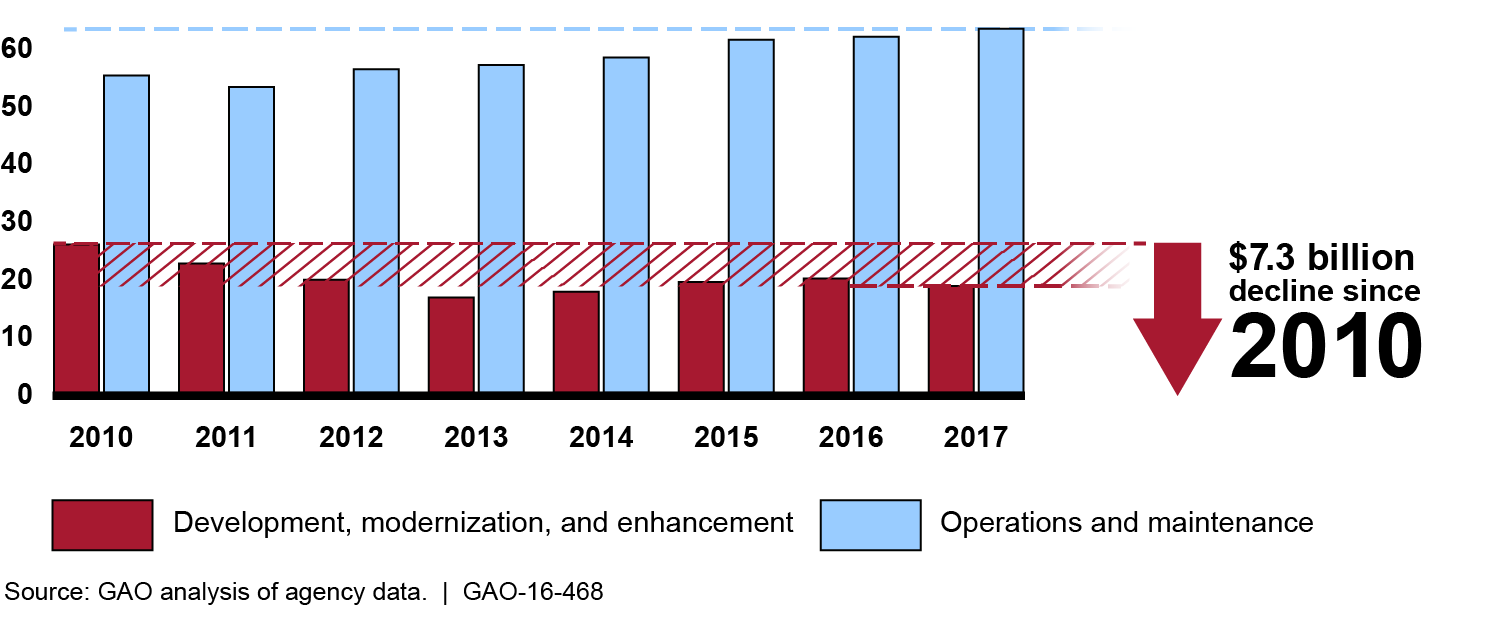
2 May 2016 INFORMATION TECHNOLOGY Federal Agencies Need to Address Aging Legacy Systems Highlights of GAO , a report to congressional requesters Why GAO Did This Study The federal government invests more than $80 billion on IT annually, with much of this amount reportedly spent on operating and maintaining existing (legacy) IT systems. Given the magnitude of these investments, it is important that agencies effectively manage their O&M. GAO s objectives were to (1) assess federal agencies IT O&M spending, (2) evaluate the oversight of at-risk legacy investments, and (3) assess the age and obsolescence of federal IT. To do so, GAO reviewed OMB and 26 agencies IT O&M spending for fiscal years 2010 through GAO further reviewed the 12 agencies that reported the highest planned IT spending for fiscal year 2015 to provide specifics on agency spending and individual investments. What GAO Recommends GAO is making 16 recommendations, one of which is for OMB to develop a goal for its spending measure and finalize draft guidance to identify and prioritize legacy IT needing to be modernized or replaced. GAO is also recommending that selected agencies address at-risk and obsolete legacy O&M investments. Nine agencies agreed with GAO s recommendations, two agencies partially agreed, and two agencies stated they had no comment. The two agencies that partially agreed, Defense and Energy, outlined plans that were consistent with the intent of our recommendations. View GAO For more information, contact David A. Powner at (202) or [email protected]. What GAO Found The federal government spent about 75 percent of the total amount budgeted for information technology (IT) for fiscal year 2015 on operations and maintenance (O&M) investments. Such spending has increased over the past 7 fiscal years, which has resulted in a $7.3 billion decline from fiscal years 2010 to 2017 in development, modernization, and enhancement activities. Total Federal IT Spending by Type (in billions) Specifically, 5,233 of the government s approximately 7,000 IT investments are spending all of their funds on O&M activities. Moreover, the Office of Management and Budget (OMB) has directed agencies to identify IT O&M expenditures known as non-provisioned services that do not use solutions often viewed as more efficient, such as cloud computing and shared services. Agencies reported planned spending of nearly $55 billion on such nonprovisioned IT in fiscal year OMB has developed a metric for agencies to measure their spending on services such as cloud computing and shared services, but has not identified an associated goal. Thus, agencies may be limited in their ability to evaluate progress. Many O&M investments in GAO s review were identified as moderate to high risk by agency CIOs, and agencies did not consistently perform required analysis of these at-risk investments. Further, several of the at-risk investments did not have plans to be retired or modernized. Until agencies fully review their at-risk investments, the government s oversight of such investments will be limited and its spending could be wasteful. Federal legacy IT investments are becoming increasingly obsolete: many use outdated software languages and hardware parts that are unsupported. Agencies reported using several systems that have components that are, in some cases, at least 50 years old. For example, Defense uses 8- inch floppy disks in a legacy system that coordinates the operational functions of the nation s nuclear forces. In addition, the Treasury uses assembly language code a computer language initially used in the 1950s and typically tied to the hardware for which it was developed. OMB recently began an initiative to modernize, retire, and replace the federal government s legacy IT systems. As part of this, OMB drafted guidance requiring agencies to identify, prioritize, and plan to modernize legacy systems. However, until this policy is United States Government Accountability Office

3 Federal Agencies Need to Address Aging Legacy Systems Examples of Legacy Investments and Systems finalized and fully executed, the government runs the risk of maintaining systems that have outlived their effectiveness. The following table provides examples of legacy systems across the federal government that agencies report are 30 years or older and use obsolete software or hardware, and identifies those that do not have specific plans with time frames to modernize or replace these investments. Agency the Treasury the Treasury Defense Veterans Affairs Veterans Affairs Justice Social Security Administration Investment or system Individual Master File Business Master File Strategic Automated Command and Control System Personnel and Accounting Integrated Data Benefits Delivery Network Sentry Title II Systems Description The authoritative data source for individual taxpayers where accounts are updated, taxes are assessed, and refunds are generated. This investment is written in assembly language code a low-level computer code that is difficult to write and maintain and operates on an IBM mainframe. Retains all tax data pertaining to individual business income taxpayers and reflects a continuously updated and current record of each taxpayer s account. This investment is also written in assembly language code and operates on an IBM mainframe. Coordinates the operational functions of the United States nuclear forces, such as intercontinental ballistic missiles, nuclear bombers, and tanker support aircrafts. This system runs on an IBM Series/1 Computer a 1970s computing system and uses 8-inch floppy disks. Automates time and attendance for employees, timekeepers, payroll, and supervisors. It is written in Common Business Oriented Language (COBOL) a programming language developed in the 1950s and 1960s and runs on IBM mainframes. Tracks claims filed by veterans for benefits, eligibility, and dates of death. This system is a suite of COBOL mainframe applications. Provides information regarding security and custody levels, inmate program and work assignments, and other pertinent information about the inmate population. The system uses COBOL and Java programming languages. Determines retirement benefits eligibility and amounts. The investment is comprised of 162 subsystems written in COBOL. Agencyreported age Specific, defined plans for modernization or replacement ~56 No - The agency has general plans to replace this investment, but there is no firm date associated with the transition. ~56 No - The agency has general plans to update this system, but there is no time frame established for this transition. 53 Yes - The agency plans to update its data storage solutions, port expansion processors, portable terminals, and desktop terminals by the end of fiscal year Yes - The agency plans to replace it with a project called Human Resources Information System Shared Service Center in No - The agency has general plans to roll capabilities into another system, but there is no firm time frame associated with this transition. 35 Yes - The agency plans to update the system through September Yes - The agency has ongoing modernization efforts, including one that is experiencing cost and schedule challenges due to the complexities of the legacy software. Source: GAO analysis of IT Dashboard data, agency documentation, and interviews. GAO Note: Age was reported by agencies. Systems and investments may have individual components newer than the reported age. Highlights

4 Contents Letter 1 Background 3 Government-wide Spending on IT Operations and Maintenance Is Increasing 11 Many O&M Investments Were at Risk and Lacked Proper Oversight 20 IT Investments Are Becoming Obsolete and Agencies Are Not Required to Identify Investments That Need Attention 26 Conclusions 34 Recommendations for Executive Action 35 Agency Comments and Our Evaluation 35 Appendix I Objectives, Scope and Methodology 39 Appendix II Agency-Reported Spending on O&M 42 Appendix III Bureaus Reporting Spending Less than 10 Percent on Development, Modernization, and Enhancement 44 Appendix IV Agency-Reported Oldest Systems or Investments 46 Appendix V Profiles of 12 Legacy Investments or Systems 48 Appendix VI Comments from Commerce 63 Appendix VII Comments from the Defense 65 Appendix VIII Comments from the Energy 67 Page i

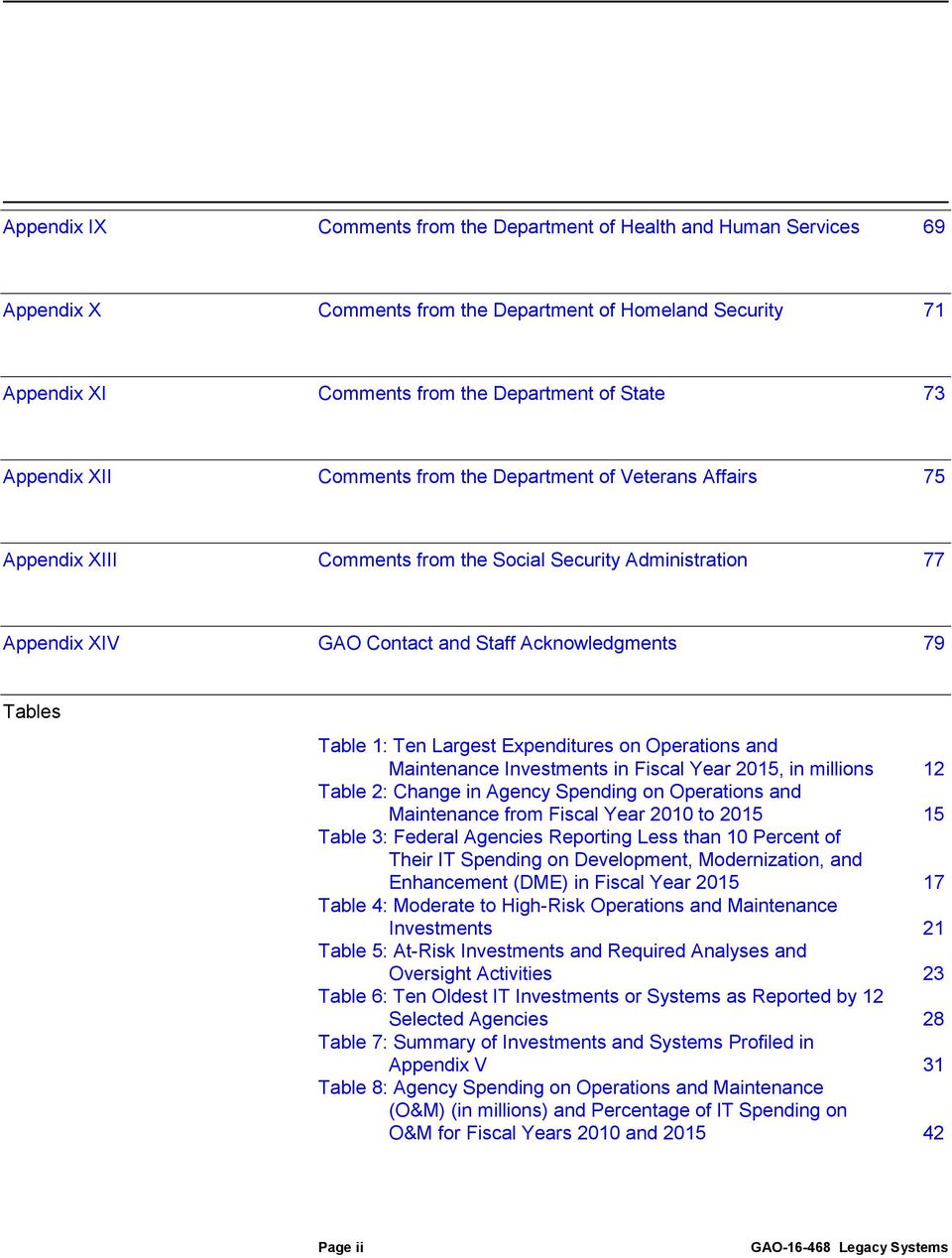
5 Appendix IX Comments from the Health and Human Services 69 Appendix X Comments from the Homeland Security 71 Appendix XI Comments from the State 73 Appendix XII Comments from the Veterans Affairs 75 Appendix XIII Comments from the Social Security Administration 77 Appendix XIV GAO Contact and Staff Acknowledgments 79 Tables Table 1: Ten Largest Expenditures on Operations and Maintenance Investments in Fiscal Year 2015, in millions 12 Table 2: Change in Agency Spending on Operations and Maintenance from Fiscal Year 2010 to Table 3: Federal Agencies Reporting Less than 10 Percent of Their IT Spending on Development, Modernization, and Enhancement (DME) in Fiscal Year Table 4: Moderate to High-Risk Operations and Maintenance Investments 21 Table 5: At-Risk Investments and Required Analyses and Oversight Activities 23 Table 6: Ten Oldest IT Investments or Systems as Reported by 12 Selected Agencies 28 Table 7: Summary of Investments and Systems Profiled in Appendix V 31 Table 8: Agency Spending on Operations and Maintenance (O&M) (in millions) and Percentage of IT Spending on O&M for Fiscal Years 2010 and Page ii
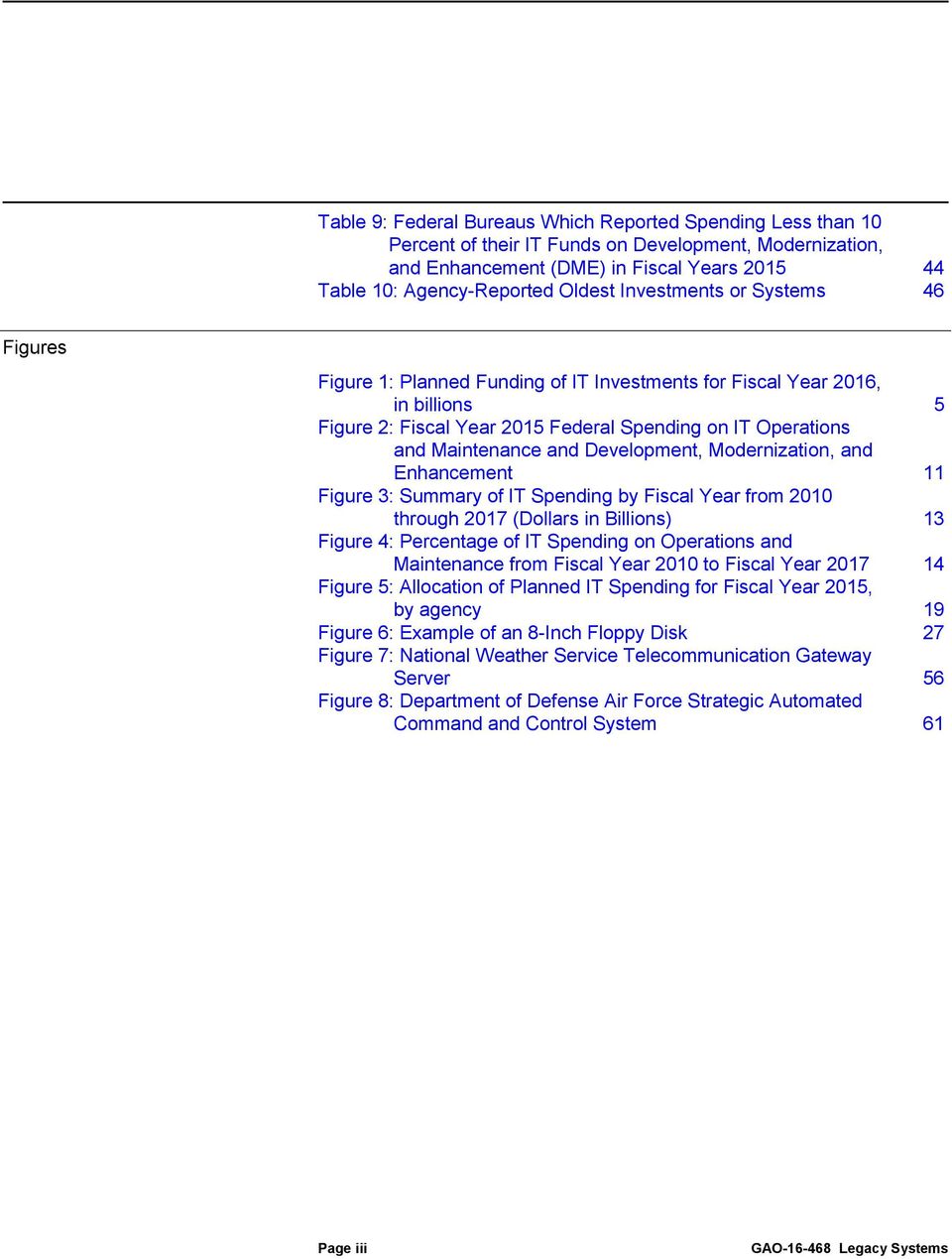
6 Table 9: Federal Bureaus Which Reported Spending Less than 10 Percent of their IT Funds on Development, Modernization, and Enhancement (DME) in Fiscal Years Table 10: Agency-Reported Oldest Investments or Systems 46 Figures Figure 1: Planned Funding of IT Investments for Fiscal Year 2016, in billions 5 Figure 2: Fiscal Year 2015 Federal Spending on IT Operations and Maintenance and Development, Modernization, and Enhancement 11 Figure 3: Summary of IT Spending by Fiscal Year from 2010 through 2017 (Dollars in Billions) 13 Figure 4: Percentage of IT Spending on Operations and Maintenance from Fiscal Year 2010 to Fiscal Year Figure 5: Allocation of Planned IT Spending for Fiscal Year 2015, by agency 19 Figure 6: Example of an 8-Inch Floppy Disk 27 Figure 7: National Weather Service Telecommunication Gateway Server 56 Figure 8: Defense Air Force Strategic Automated Command and Control System 61 Page iii
7 Abbreviations CADE 2 Customer Account Data Engine 2 CAS Core Accounting System CIO Chief Information Officer COBOL Common Business Oriented Language Commerce Commerce DHS Homeland Security DME development, modernization, and enhancement DNDO Domestic Nuclear Detection Office Defense Defense DOT Transportation DVIS Diversity Visa Information System Energy Energy HHS Health and Human Services IMF Individual Master File IRS Internal Revenue Service IT information technology Justice Justice NWSTG National Weather Service Telecommunication Gateway O&M operations and maintenance OMB Office of Management and Budget PAID Personnel and Accounting Integrated Data ROSS Resource Ordering and Status System SSA Social Security Administration State State Treasury the Treasury TSA Transportation Security Administration USCG U.S. Coast Guard USDA U.S. Agriculture VA Veterans Affairs This is a work of the U.S. government and is not subject to copyright protection in the United States. The published product may be reproduced and distributed in its entirety without further permission from GAO. However, because this work may contain copyrighted images or other material, permission from the copyright holder may be necessary if you wish to reproduce this material separately. Page iv

8 Letter 441 G St. N.W. Washington, DC May 25, 2016 The Honorable Ron Johnson Chairman Committee on Homeland Security and Governmental Affairs United States Senate The Honorable Jason Chaffetz Chairman Committee on Oversight and Government Reform House of Representatives The federal government spends more than $80 billion annually on information technology (IT), with about 75 percent reportedly spent on operating and maintaining existing (legacy) IT systems. Given the size and magnitude of these investments, it is important that agencies effectively manage the operations and maintenance (O&M) of existing investments. Our objectives were to (1) assess federal agencies IT O&M spending, (2) evaluate the oversight of at-risk legacy investments, and (3) assess the age and obsolescence of federal IT. Our review of O&M spending included the Office of Management and Budget (OMB) and the 26 agencies that report to OMB s IT Dashboard. 1 For specific information on individual systems or investments, we focused on the 12 agencies that reported the highest planned IT spending for 1 In June 2009, OMB established the IT Dashboard, a public website that provides detailed information on major IT investments at 26 federal agencies. The 26 agencies are the Departments of Agriculture, Commerce, Defense, Education, Energy, Health and Human Services, Homeland Security, Housing and Urban Development, the Interior, Justice, Labor, State, Transportation, the Treasury, and Veterans Affairs; U.S. Army Corps of Engineers, Environmental Protection Agency, General Services Administration, National Aeronautics and Space Administration, National Archives and Records Administration, National Science Foundation, Nuclear Regulatory Commission, Office of Personnel Management, Small Business Administration, Social Security Administration, and U.S. Agency for International Development. Page 1

9 fiscal year 2015, given that these agencies make up over 90 percent of reported federal IT spending. 2 To assess federal agencies IT O&M spending, we reviewed data reported to OMB as part of the budget process for fiscal years 2010 through We analyzed that data to determine whether spending had changed over those years and compared OMB s associated performance measure to federal best practices. 3 We evaluated the extent to which the 12 selected federal agencies are performing oversight on their existing legacy investments by reviewing agency IT Dashboard data to identify investments in O&M that had been identified as being moderate to high risk. We also reviewed agency documentation such as TechStat documentation and operational analyses, as available. To assess the age and obsolescence of federal IT, we reviewed agency documentation, such as operational analyses and enterprise architecture documents, and interviewed agency officials on issues related to legacy investments. We also requested that the 12 agencies provide a list of their three oldest systems. In some cases, agencies reported that they do not track the ages of individual systems. In those cases, we requested that the agency provide their three oldest IT investments. We also compared OMB and agencies current practices with federal guidance, such as OMB s Circular No. A-11: Preparation, Submission, and Execution of the Budget and its associated supplement on capital assets, to determine whether OMB and agencies are adequately managing the age and obsolescence of federal IT. In addition, we profiled selected systems and investments. To select those, we selected a system or investment that was identified as one of the agency s oldest or had been identified as being at-risk. In particular, we selected one system or investment per agency using factors such as investment type (major or 2 These agencies are the Departments of Agriculture, Commerce, Defense, Energy, Health and Human Services, Homeland Security, Justice, State, Transportation, the Treasury, Veterans Affairs, and the Social Security Administration. 3 the Navy, Office of the Chief Information Officer, Guide for Developing and Using Information Technology (IT) Performance Measurements (Washington, D.C.: October 2001); and General Services Administration, Office of Governmentwide Policy, Performance-Based Management: Eight Steps To Develop and Use Information Technology Performance Measures Effectively (Washington, D.C.: 1996). Page 2
10 non-major), system or investment age, and risk level. We reviewed agency documentation and interviewed agency officials on the profiled systems or investments. To assess the reliability of the OMB budget data and IT Dashboard data, we reviewed related documentation, such as OMB guidance on budget preparation, capital planning, and IT Dashboard submissions. In addition, we corroborated with each agency that the data downloaded were accurate and reflected the data it had reported to OMB. We determined that the data were reliable for the purposes of our reporting objectives. Details of our objectives, scope, and methodology are contained in appendix I. We conducted this performance audit from April 2015 to May 2016 in accordance with generally accepted government auditing standards. Those standards require that we plan and perform the audit to obtain sufficient, appropriate evidence to provide a reasonable basis for our findings and conclusions based on our audit objectives. We believe that the evidence obtained provides a reasonable basis for our findings and conclusions based on our audit objectives. Background Over the last three decades, Congress has enacted several laws to assist agencies and the federal government in managing IT investments. For example, to assist agencies in managing their investments, Congress enacted the Clinger-Cohen Act of This act requires OMB to establish processes to analyze, track, and evaluate the risks and results of major capital investments in information systems made by federal agencies and report to Congress on the net program performance benefits achieved as a result of these investments. Most recently, in December 2014, Congress enacted IT acquisition reform legislation (commonly referred to as the Federal Information Technology Acquisition Reform Act or FITARA) 5 that, among other things, requires OMB to develop standardized performance metrics, including cost savings, and to submit quarterly reports to Congress on cost savings U.S.C , et. seq. 5 Pub. L. No , div. A, title VIII, subtitle D,128 Stat. 3292, (Dec. 19, 2014). Page 3
11 In carrying out its responsibilities, OMB uses several data collection mechanisms to oversee federal IT spending during the annual budget formulation process. Specifically, OMB requires federal departments and agencies to provide information related to their Major IT Business Cases (previously known as exhibit 300) and IT Portfolio Summary (previously known as exhibit 53). 6 Major IT Business Case. The purpose of this requirement is to provide a business case for each major IT investment and to allow OMB to monitor IT investments once they are funded. Agencies are required to provide information on each major 7 investment s cost, schedule, and performance. IT Portfolio Summary. The purpose of the IT portfolio summary is to identify all IT investments both major and non-major and their associated costs within a federal organization. This information is designed, in part, to help OMB better understand what agencies are spending on IT investments. OMB directs agencies to break down IT investment costs into two categories: (1) O&M and (2) development, modernization, and enhancement (DME). O&M (also known as steady state) costs refer to the expenses required to operate and maintain an IT asset in a production environment. DME costs refers to those projects and activities that lead to new IT assets/systems, or change or modify existing IT assets to substantively improve capability or performance. Beginning in 2014, OMB directed agencies to further break down their O&M and DME costs to identify provisioned IT service costs. A provisioned IT service is one that is (1) owned, operated, and provided by an outside vendor or external government organization and (2) consumed by the agency on an as-needed basis. Examples of provisioned IT service could include cloud services or shared services from another federal 6 OMB Circular No. A-11, Preparation, Submission, and Execution of the Budget (June 30, 2015). 7 According to OMB guidance, a major IT investment requires special management attention because of its importance to the mission or function to the government; significant program or policy implications; high executive visibility; high development, operating, or maintenance costs; unusual funding mechanism; or definition as major by the agency s capital planning and investment control process. Page 4

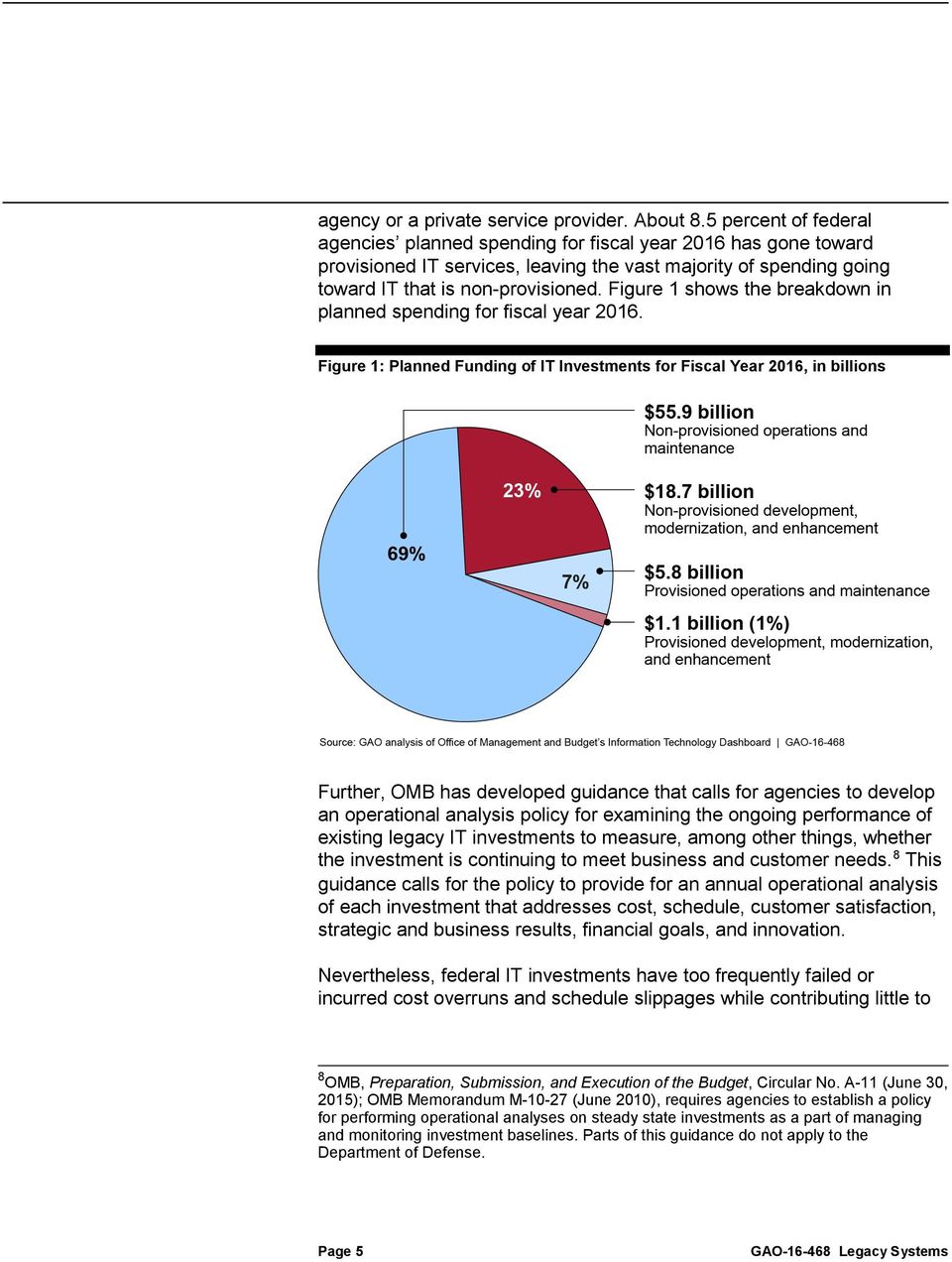
12 agency or a private service provider. About 8.5 percent of federal agencies planned spending for fiscal year 2016 has gone toward provisioned IT services, leaving the vast majority of spending going toward IT that is non-provisioned. Figure 1 shows the breakdown in planned spending for fiscal year Figure 1: Planned Funding of IT Investments for Fiscal Year 2016, in billions Further, OMB has developed guidance that calls for agencies to develop an operational analysis policy for examining the ongoing performance of existing legacy IT investments to measure, among other things, whether the investment is continuing to meet business and customer needs. 8 This guidance calls for the policy to provide for an annual operational analysis of each investment that addresses cost, schedule, customer satisfaction, strategic and business results, financial goals, and innovation. Nevertheless, federal IT investments have too frequently failed or incurred cost overruns and schedule slippages while contributing little to 8 OMB, Preparation, Submission, and Execution of the Budget, Circular No. A-11 (June 30, 2015); OMB Memorandum M (June 2010), requires agencies to establish a policy for performing operational analyses on steady state investments as a part of managing and monitoring investment baselines. Parts of this guidance do not apply to the Defense. Page 5
13 mission-related outcomes. The federal government has spent billions of dollars on failed and poorly performing IT investments which often suffered from ineffective management, such as project planning, requirements definition, and program oversight and governance. 9 Accordingly, in February 2015, we introduced a new government-wide high-risk area, Improving the Management of IT Acquisitions and Operations. 10 This area highlights several critical IT initiatives underway, including reviews of troubled projects, an emphasis on incremental development, a key transparency website, data center consolidation, and the O&M of legacy systems. To make progress in this area, we identified actions that OMB and the agencies need to take. These include implementing the recently-enacted statutory requirements promoting IT acquisition reform, as well as implementing our previous recommendations. In the last 6 years, we made approximately 800 recommendations to OMB and multiple agencies to improve effective and efficient investment in IT. As of October 2015, about 32 percent of these recommendations had been implemented. OMB s Recent Major Initiatives for Overseeing IT Investments OMB has implemented a series of initiatives to improve the oversight of underperforming investments and more effectively manage IT. These efforts include the following: IT Dashboard. In June 2009, to further improve the transparency into and oversight of agencies IT investments, OMB publicly deployed the IT Dashboard. As part of this effort, OMB issued guidance directing federal agencies to report, via the Dashboard, the performance of their IT investments. Currently, the Dashboard publicly displays information on the cost, schedule, and performance of over 700 major federal IT investments at 26 federal agencies. Further, the public display of these data is intended to allow OMB, other oversight bodies, and the general public to hold the government agencies 9 GAO, Information Technology: OMB and Agencies Need to More Effectively Implement Major Initiatives to Save Billions of Dollars, GAO T (Washington, D.C.: July 25, 2013). 10 GAO, High-Risk Series: An Update, GAO (Washington, D.C.: Feb. 11, 2015). Page 6

14 accountable for results and progress. Among other things, agencies are to submit ratings from their Chief Information Officers (CIO), which, according to OMB s instructions, should reflect the level of risk facing an investment relative to that investment s ability to accomplish its goals. To do so, each agency CIO is to assess his or her IT investments against a set of six pre-established evaluation factors identified by OMB and then assign a rating of 1 (high risk and red) to 5 (low risk and green) based on the CIO s best judgement of the level of risk facing the investment. Over the past several years, we have made over 20 recommendations to help improve the accuracy and reliability of the information on the IT Dashboard and to increase its availability. 11 Most agencies agreed with our recommendations or had no comment. TechStat reviews. In January 2010, the Federal CIO began leading TechStat sessions face-to-face meetings to terminate or turn around IT investments that are failing or are not producing results. These meetings involve OMB and agency leadership and are intended to increase accountability and improve performance. OMB also empowered agency CIOs to begin to hold their own TechStat sessions within their respective agencies by June In June 2013, we reported that OMB and selected agencies held multiple TechStats, but additional OMB oversight was needed to ensure that these meetings were having the appropriate impact on underperforming projects and that resulting cost savings were valid. 12 Among other things, we recommended that OMB require agencies to address highrisk investments. OMB generally agreed with this recommendation. However, as of October 28, 2015, OMB had only conducted one TechStat review in the prior 2 years and OMB had not listed any 11 GAO, IT Dashboard: Agencies Are Managing Investment Risk, but Related Ratings Need to Be More Accurate and Available, GAO (Washington, D.C.: Dec. 12, 2013); Information Technology Dashboard: Opportunities Exist to Improve Transparency and Oversight of Investment Risk at Select Agencies, GAO (Washington, D.C.: Oct. 16, 2012); IT Dashboard: Accuracy Has Improved, and Additional Efforts Are Under Way to Better Inform Decision Making, GAO (Washington, D.C.: Nov. 7, 2011); Information Technology: OMB Has Made Improvements to Its Dashboard, but Further Work Is Needed by Agencies and OMB to Ensure Data Accuracy, GAO (Washington, D.C.: Mar. 15, 2011); and Information Technology: OMB s Dashboard Has Increased Transparency and Oversight, but Improvements Needed, GAO (Washington, D.C.: July 16, 2010). 12 GAO, Information Technology: Additional Executive Review Sessions Needed to Address Troubled Projects, GAO (Washington, D.C: June 13, 2013). Page 7
15 savings from TechStats in its quarterly reporting to Congress since June Cloud computing strategy. In order to accelerate the adoption of cloud computing solutions across the government, OMB s 25-Point IT Reform Plan included a Cloud First policy that required each agency CIO to, among other things, implement cloud-based solutions whenever a secure, reliable, and cost-effective cloud option exists. 13 Building on this requirement, in February 2011, OMB issued the Federal Cloud Computing Strategy, which provided definitions of cloud computing services; benefits of cloud services, such as accelerating data center consolidations; case studies to support agencies migration to cloud computing; and roles and responsibilities for federal agencies. 14 In April 2016, we reported, 15 among other things, that we had identified 10 key practices that if included in cloud service agreements can help agencies ensure services are performed effectively, efficiently, and securely. OMB s guidance, released in February 2012, included most of the key practices, and we recommended that OMB include all 10 key practices in future guidance. PortfolioStat reviews. To better manage existing IT systems, OMB launched the PortfolioStat initiative in March 2012, which requires agencies to conduct an annual, agency-wide IT portfolio review to, among other things, reduce commodity IT 16 spending and demonstrate how their IT investments align with the agency s mission and business functions. In 2013 and 2015 we reported 17 that agencies 13 OMB, 25-Point Implementation Plan to Reform Federal Information Technology Management (Washington, D.C.: Dec. 9, 2010). 14 OMB, Federal Cloud Computing Strategy (Washington, D.C.: Feb. 8, 2011). 15 GAO, Cloud Computing: Agencies Need to Incorporate Key Practices to Ensure Effective Performance, GAO (Washington, D.C.: Apr. 7, 2016). 16 According to OMB, commodity IT includes services such as IT infrastructure (data centers, networks, desktop computers and mobile devices); enterprise IT systems ( , collaboration tools, identity and access management, security, and web infrastructure); and business systems (finance, human resources, and other administrative functions). 17 GAO, Information Technology: Additional OMB and Agency Actions Are Needed to Achieve Portfolio Savings, GAO (Washington, D.C.: Nov. 6, 2013); and Information Technology: Additional OMB and Agency Actions Needed to Ensure Portfolio Savings Are Realized and Effectively Tracked, GAO (Washington, D.C.: Apr. 16, 2015). Page 8
16 had the potential to save at least $3.8 billion through this initiative. However, we noted that weaknesses existed in agencies implementation of the initiative; therefore, we made more than 60 recommendations to OMB and agencies. OMB partially agreed with our recommendations, and responses from 21 of the agencies varied, with some agreeing and others not. IT Shared Services Strategy. In May 2012, OMB released its Federal IT Shared Services Strategy. 18 The strategy requires agencies to use shared services IT functions that are provided for consumption by multiple organizations within or between federal agencies for IT service delivery in order to increase return on investment, eliminate waste and duplication, and improve the effectiveness of IT solutions. Examples of commodity IT areas to consider migrating to a shared environment, as described in the strategy, include software licenses, systems, and human resource systems. GAO Has Reported on the Need to Improve Oversight of Legacy IT We have previously reported on legacy IT and the need for the federal government to improve its oversight of such investments. For example, in October 2012, 19 we reported on agencies operational analyses policies and practices. As previously mentioned, operational analysis is a key performance evaluation and oversight mechanism required by OMB to ensure O&M investments continue to meet agency needs. In particular, we reported that although OMB guidance called for agencies to develop an operational analysis policy and perform such analyses annually, the extent to which the selected five federal agencies we reviewed carried out these tasks varied significantly. Specifically, the Departments of Homeland Security (DHS) and Health and Human Services (HHS) developed policies and conducted analyses, but excluded key investments and assessment factors. The Departments of Defense (Defense), the Treasury (Treasury), and Veterans Affairs (VA) had not developed a policy or conducted operational analyses. As such, we recommended that the agencies develop operational analysis policies, 18 OMB, Federal Information Technology Shared Services Strategy (Washington, D.C.: May 2, 2012). 19 GAO, Information Technology: Agencies Need to Strengthen Oversight of Billions of Dollars in Operations and Maintenance Investments, GAO (Washington, D.C.: Oct. 16, 2012). Page 9
17 annually perform operational analyses on all investments, and ensure the assessments include all key factors. Further, we recommended that OMB revise its guidance to include directing agencies to post the results of such analyses on the IT Dashboard. OMB and the five selected agencies agreed with our recommendations and have efforts planned and underway to address them. In particular, OMB issued guidance in August 2012 directing agencies to report operational analysis results along with their fiscal year 2014 budget submission documentation (e.g., exhibit 300) to OMB. Thus far, operational analyses have not yet been posted on the IT Dashboard. We further reported in November 2013 that agencies were not conducting proper analyses. Specifically, we reported 20 on IT O&M investments and the use of operational analyses at selected agencies and determined that of the top 10 investments with the largest spending in O&M, only the DHS investment underwent an operational analysis. DHS s analysis addressed most, but not all, of the factors that OMB called for (e.g., comparing current cost and schedule against original estimates). DHS officials attributed this to the department still being in the process of implementing its new operational analysis policy. The remaining agencies did not assess their investments, which accounted for $7.4 billion in reported O&M spending. Agency officials cited several reasons for not doing so, including relying on budget submission and related management reviews that measure performance; however, OMB has noted that these are not a substitute for an operational analysis. Consequently, we recommended that seven agencies perform operational analyses on their IT O&M investments and that DHS ensure that its analysis was complete and addressed all OMB factors. Three of the agencies agreed with our recommendations; two partially agreed; and two agencies had no comments. 20 GAO, Information Technology: Agencies Need to Strengthen Oversight of Multibillion Dollar Investments in Operations and Maintenance, GAO (Washington, D.C.: Nov. 6, 2013). Page 10
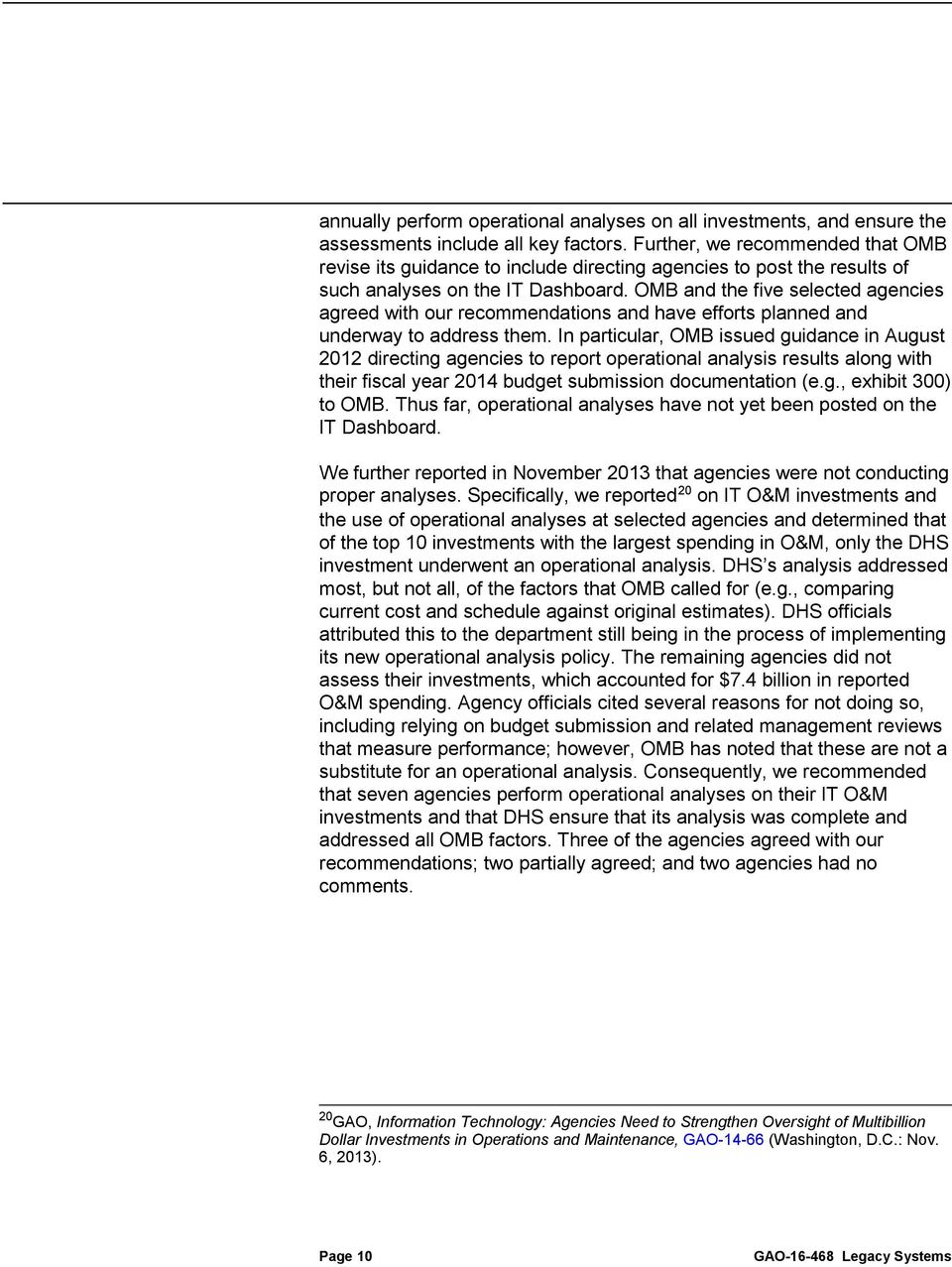
18 Government-wide Spending on IT Operations and Maintenance Is Increasing Federal agencies reported spending the majority of their fiscal year 2015 IT funds on operating and maintaining a large number of legacy (i.e., steady-state) investments. Of the more than $80 billion reportedly spent on federal IT in fiscal year 2015, 26 federal agencies 21 spent about $61 billion on O&M, more than three-quarters of the total amount spent. Specifically, data from the IT Dashboard shows that, in 2015, 5,233 of the government s nearly 7,000 investments were spending all of their funds on O&M activities. This is a little more than three times the amount spent on DME activities (See figure 2). Figure 2: Fiscal Year 2015 Federal Spending on IT Operations and Maintenance and Development, Modernization, and Enhancement According to agency data reported to OMB s IT Dashboard, the 10 IT investments spending the most on O&M for fiscal year 2015 total $12.5 billion, 20 percent of the total O&M spending, and range from $4.4 billion on the Health and Human Services (HHS) Centers for Medicare and Medicaid Services Medicaid Management Information 21 This $80 billion represents what 26 agencies reported to OMB on planned IT spending. However, this $80 billion figure is understated. This figure does not include spending for Defense classified IT systems; and 58 independent executive branch agencies, including the Central Intelligence Agency. Additionally, not all executive branch IT investments are included in this estimate because agencies have differed on what they considered an IT investment. For example, some have considered research and development systems as IT investments, while others have not. Page 11
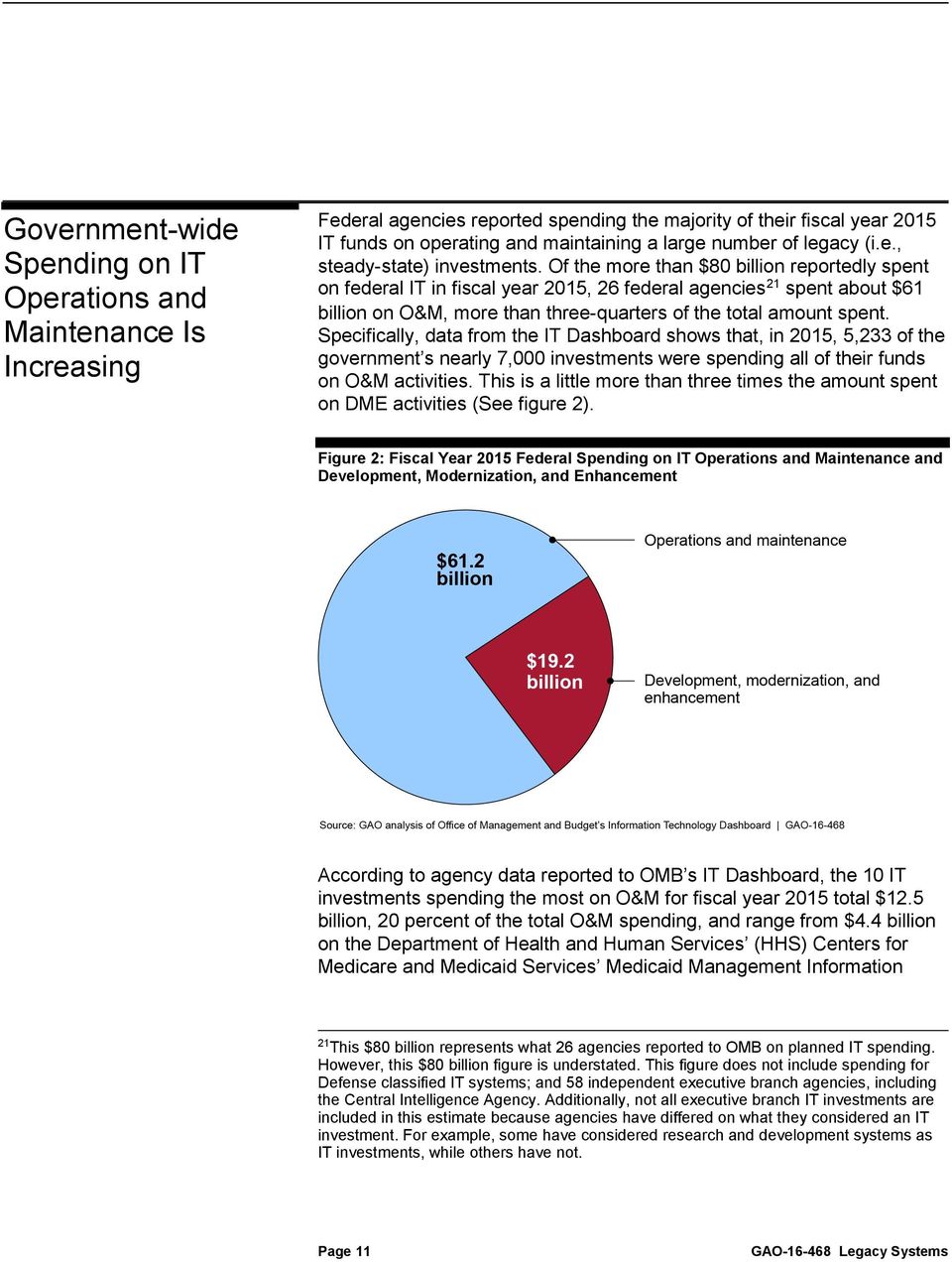
19 System 22 to $666.1 million on HHS s Centers for Medicare and Medicaid Services IT Infrastructure investment (see table 1). Table 1: Ten Largest Expenditures on Operations and Maintenance Investments in Fiscal Year 2015, in millions Agency Health and Human Services Defense Veterans Affairs Defense Social Security Administration Veterans Affairs Defense Defense Defense Health and Human Services Total Fiscal year 2015 Investment funds in millions Centers for Medicare and Medicaid Services Medicare Management Information System a $4,381.0 Defense Information Systems Network $1,252.2 Medical IT Support $1,234.9 Next Generation Enterprise Network Increment 1 $1,057.7 Infrastructure Operations and Maintenance $864.0 Enterprise IT Support $809.5 Network Enterprise Technology Command $767.5 Network Enterprise Center Staff Operations Costs $752.8 Non-Defense Information Systems Network Telecomm $688.8 Centers for Medicare and Medicaid Services IT Infrastructure Ongoing $666.1 $12,474.5 million Source: GAO analysis of agency budgetary data. GAO Note: a This investment represents the federal share of state Medicaid systems cost. In technical comments on a draft of this report, the Health and Human Services stated that it does not manage any of these IT assets or control how this money is spent. 22 The 50 states, the District of Columbia, and the 5 U.S. territories each administer a state-based Medicaid program. Every state must implement a claims processing and information retrieval system to support the administration of the program. This investment represents the federal share of state Medicaid systems cost. In technical comments on a draft of this report, HHS stated that it does not manage any of these IT assets or control how this money is spent. Page 12
20 Spending on O&M Has Increased over 7 Years Over the past 7 fiscal years, O&M spending has increased, while the amount invested in developing new systems has decreased by about $7.3 billion since fiscal year (See figure 3.) Figure 3: Summary of IT Spending by Fiscal Year from 2010 through 2017 (Dollars in Billions) Note: According to DOD officials, the department s fiscal year 2010 IT expenditures reported to the IT Dashboard includes both classified and unclassified spending, whereas its fiscal year 2011 to 2017 expenditures only include unclassified spending. Further, agencies have increased the amount of O&M spending relative to their overall IT spending by 9 percent since Specifically, in fiscal year 2010, O&M spending was 68 percent of the federal IT budget, while in fiscal year 2017, agencies plan to spend 77 percent of their IT funds on O&M. (See figure 4.) Page 13

21 Figure 4: Percentage of IT Spending on Operations and Maintenance from Fiscal Year 2010 to Fiscal Year 2017 Further, 15 of the 26 agencies have increased their spending on O&M from fiscal year 2010 to fiscal year 2015, with 10 of these agencies having over a $100 million increase. The spending changes per agency range from an approximately $4 billion increase (HHS) to a decrease of $600 million (National Aeronautics and Space Administration). See table 2 for more details on agency spending. Page 14
22 Table 2: Change in Agency Spending on Operations and Maintenance from Fiscal Year 2010 to 2015 Change in spending, Agency in millions (percent change) Health and Human Services $4,288.7 (-10.5%) Veterans Affairs $792.8 (2.5%) Homeland Security $632.8 (16.6%) Agriculture $582.0 (6.6%) Transportation $361.3 (6.8%) Social Security Administration $292.0 (9.4%) Justice $258.9 (14.6%) the Treasury $211.4 (-8.1%) the Interior $116.8 (5.0%) State $109.0 (-0.9%) Labor $80.9 (2.2%) Education $61.3 (19.5%) Nuclear Regulatory Commission $27.0 (5.6%) National Science Foundation $15.0 (1.0%) Office of Personnel Management $10.5 (-16.3%) Small Business Administration $-3.2 (11.1%) National Archives and Records Administration $-4.7 (9.3%) U.S. Agency for International Development $-8.6 (19.1%) General Services Administration $-19.7 (-5.9%) Environmental Protection Agency $-28.4 (7.0%) U.S. Army Corps of Engineers $-38.4 (3.5%) Housing and Urban Development $-50.7 (-1.5%) Commerce $ (17.0%) Energy $ (1.8%) Defense $ (13.9%) National Aeronautics and Space Administration $ (1.2%) Source: GAO analysis of IT Dashboard data. GAO In addition, 20 of the 26 agencies have increased the percentage of total IT spending on O&M from fiscal year 2010 to fiscal year 2015, with 13 agencies having an increase of over 5 percent. The percentage of total IT spending on O&M ranges from a 20 percent increase ( Education) to a 16 percent decrease (Office of Personnel Management). Appendix II provides detailed information on agency spending on operations and maintenance from fiscal year 2010 to fiscal year Page 15
23 According to agency officials, reasons for the increase in O&M spending include the recent shift of major systems from DME to O&M (as the investment completed development activities and began O&M activities); and rising costs to maintain legacy IT infrastructure, such as those that use older programming languages. They also noted that improved reporting (i.e., ensuring that O&M expenditures were properly reported as O&M instead of as DME) has made it appear that O&M spending has increased. For example, a DHS official in the Office of the CIO stated that one reason for the increased spending on O&M as a percentage of its total is because initially DHS had high DME spending to setup the agency, but now that the major parts of the agency are established, the funding has shifted to O&M. 23 DHS officials stated that they anticipate future increases in DME funding as prioritized IT modernization efforts are approved and funded. Further, an official in State s (State) Bureau of Information Resource Management stated that the increase is largely due to increased costs of maintaining the infrastructure, including meeting security requirements. Moreover, VA officials stated that updates to its technology are the primary reason for the increase in spending. In addition, an official in HHS s Office of the CIO stated that the increased spending on O&M was largely due to grants to states and local entities for new programs, such as the Affordable Care Act. Conversely, several agencies have decreased spending on O&M. For example, as we have previously reported, the Energy (Energy) reduced spending by approximately $300 million, which it attributed to the reclassification of high performance computers from the IT portfolio to facilities. 24 According to Energy officials, these investments were re-categorized because they include both supercomputers and laboratory facilities. 25 Similarly, the Commerce (Commerce) reduced spending by approximately $110 million and attributed it to the reclassification of satellite ground systems from its IT portfolio. In making this decision, Commerce determined that it needed to 23 DHS was established in 2002 and combined 22 different departments and agencies into one cabinet-level agency. 24 GAO While Energy has reportedly established a separate process to report to OMB on these computers, these expenditures are not included in federal estimates of IT O&M spending. Page 16
24 refocus oversight efforts to a more appropriate level and consequently minimized the role of the CIO and others in the oversight of satellites. We disagreed with these reclassifications, and reported that they run contrary to the Clinger-Cohen Act of 1996, which specifies requirements for the management of IT. Further, we reported that by gathering incomplete information on IT investments, OMB increases the risk of not fulfilling its oversight responsibilities, of agencies making inefficient and ineffective investment decisions, and of Congress and the public being misinformed as to the performance of federal IT investments. We recommended that Energy and Commerce appropriately categorize their IT investments, but both agencies disagreed. A policy analyst within OMB s Office of E-Government and Information Technology expressed concern when agencies, or their bureaus, spend a low percentage of their IT funds on DME. The analyst further stated that this could indicate that the agency s maintenance costs are reducing its flexibility and the agency or bureau is unable to innovate. For example, 5 of the 26 agencies that report to the IT Dashboard reported spending less than 10 percent on DME activities in fiscal year 2015 (see table 3). Table 3: Federal Agencies Reporting Less than 10 Percent of Their IT Spending on Development, Modernization, and Enhancement (DME) in Fiscal Year 2015 Percent spent Agency on DME activities Housing and Urban Development 7.55% the Interior 8.17% Environmental Protection Agency 9.92% National Aeronautics and Space Administration 8.70% U.S. Army Corps of Engineers 0.75% Source: GAO analysis of IT Dashboard data. GAO Further, 34 percent of bureaus (i.e., 51 of the 151) spent less than 10 percent on DME. For more details on the bureaus spending less than 10 percent on DME activities, see appendix III. According to agency officials, reasons for these bureaus low spending on DME include the size and mission of the bureau (e.g., smaller bureaus do not perform much DME work), as well as several bureaus having recently completed major DME work that is now in the O&M phase. Further, according to Commerce officials, one of their bureaus had no actual IT systems in its budget, as its IT has been absorbed by headquarters, and thus any DME spending is part of the Office of IT Services budget. Page 17
25 OMB staff in the Office of E-Government and Information Technology have recognized the upward trend of O&M spending and identified several contributing factors, including (1) the support of O&M activities requires maintaining legacy hardware, which costs more over time, and (2) costs are increased in maintaining applications and systems that use older programming languages, since programmers knowledgeable in these older languages are becoming increasingly rare and thus more expensive. Further, OMB officials stated that in several situations where agencies are not sure whether to report costs as O&M or DME, agencies default to reporting as O&M. According to OMB, agencies tend to categorize investments as O&M because they attract less oversight, require reduced documentation, and have a lower risk of losing funding. Less than a Quarter of Federal IT Spending Is Categorized as Provisioned OMB encourages agencies to adopt provisioned IT services, such as cloud computing and shared services, to make IT more efficient and agile, and enable innovation. 26 Specifically, it provides an approach for agencies to implement cloud-based solutions whenever a secure, reliable, and cost-effective cloud option exists and to use shared services for IT service delivery in order to increase return on investment, eliminate waste and duplication, and improve the effectiveness of IT solutions. Further, as part of its guidance on the implementation of recent IT legislation, 27 OMB identified a series of performance metrics for agencies PortfolioStat sessions to measure the federal government s progress in driving value in federal IT investments. One measure is the percent of IT spending on non-provisioned O&M spending. An OMB official stated that focusing on the O&M spending that has not been provisioned will allow OMB to identify legacy systems in need of modernization. Federal agencies reported spending $55 billion 69 percent of total IT spending on non-provisioned O&M in fiscal year 2015, with the percent allocated to non-provisioned O&M varying by agency. For example, State allocates about 87 percent of its IT spending on non-provisioned O&M, whereas the Transportation (DOT) allocates 50 percent. See figure 5 for details on agencies planned spending allocations. 26 OMB, Federal Cloud Computing Strategy, (Washington, D.C.: Feb. 8, 2011). 27 OMB, Management and Oversight of Federal Information Technology, M (Washington, D.C.: June 10, 2015). Page 18
26 Figure 5: Allocation of Planned IT Spending for Fiscal Year 2015, by agency Additionally, OMB has not identified an associated goal with its nonprovisioned IT measure that is part of PortfolioStat process. An OMB official within the Office of E-Government and Information Technology stated that the aim is for the amount of spending on DME and provisioned IT services to rise, thus reducing the percent of spending on nonprovisioned IT. This official also stated that OMB has not identified a specific goal for the measure because it would be ever changing. While goals for performance measures may change over time, it is still Page 19
27 important for OMB to set a target by which agencies can measure their progress in meeting this measure. In particular, leading practices stress that organizations should measure performance in order to evaluate the success or failure of their activities and programs. 28 Performance measurement involves identifying performance goals and measures, identifying targets for improving performance, and measuring progress against those targets. Without links to outcomes and goals, organizations are not able to effectively measure progress toward those goals. Further, OMB s own website, performance.gov 29 states that when measuring performance, a goal is a simple but powerful way to motivate people and communicate priorities. In addition, the website states that the federal government operates more effectively when agency leaders, at all levels of the organization, starting at the top, set clear measurable goals aligned to achieving better outcomes. Until OMB develops a specific goal associated with measuring nonprovisioned services, OMB and agencies will be limited in their ability to evaluate progress that has been made and whether or not they are achieving their goals to increase the amount spent on development activities and provisioned IT services. Many O&M Investments Were at Risk and Lacked Proper Oversight According to OMB guidance, 30 the O&M phase is often the longest phase of an investment and can consume more than 80 percent of the total lifecycle costs. As such, agencies must actively manage their investment during this phase. To help them do so, OMB requires that CIOs submit ratings that reflect the level of risk facing an investment. 28 the Navy, Office of the Chief Information Officer, Guide for Developing and Using Information Technology (IT) Performance Measurements (Washington, D.C.: October 2001); and General Services Administration, Office of Governmentwide Policy, Performance-Based Management: Eight Steps To Develop and Use Information Technology Performance Measures Effectively (Washington, D.C.: 1996). 29 In 2011, OMB established a single, performance-related website ( that is intended to provide both a public view into government performance to support transparency as well as providing executive branch management capabilities to enhance senior leadership decision making. 30 OMB, Preparation, Submission, and Execution of the Budget, Circular No. A-11 (2015). Page 20
28 Several O&M investments were rated as moderate to high risk in fiscal year Specifically, CIOs from the 12 selected agencies reported that 23 of their 187 major IT O&M investments were moderate to high risk as of August They requested $922.9 million in fiscal year 2016 for these investments. Of the 23 investments, agencies had plans to replace or modernize 19 investments. However, the plans for 12 of those were general or tentative in that the agencies did not provide specificity on time frames, activities to be performed, or functions to be replaced or enhanced. Further, agencies did not plan to modernize or replace 4 of the investments (see table 4). Table 4: Moderate to High-Risk Operations and Maintenance Investments Agency Agriculture Commerce Energy Health and Human Services Homeland Security Investment title (IT portfolio) CIO rating, as of August 2015 Specific, defined plans for modernization or replacement Resource Ordering and Status System a Moderate Yes - Agency plans to replace the system in Public Safety Land Mobile Radio System Moderate No - Agency recently began a modernization initiative; however, it is not clear when it will be completed. Forest Service Computer Base Moderate No - Agency has general plans to restructure the investment to allow better visibility into the underlying systems, but has not provided plans for functions to be replaced or enhanced. Enterprise Telecommunications Shared Services National Oceanic and Atmospheric Administration/ National Weather Service Telecommunication Gateway System a Office of Chief Information Officer Enterprise Cyber Security Monitoring and Operations High High Moderate Yes - Agency has several modernization efforts underway, including one to consolidate networks. Yes - Agency plans to retire the system in fiscal year 2017, and replace it with a new system. No - Agency has general plans to update cyber monitoring across the agency, but has not provided specific activities or timelines associated with this effort. Contractor Business Financial and Moderate No - Agency has no firm future plans for retirement Administrative Systems a or modernization. Centers for Medicare and Medicaid Services Medicare Appeals System a Moderate No - The agency has general plans for continuous modernization, as funding allows; but has not provided specific activities or timelines associated with this effort. Trusted Internet Connection Investment High b No - Agency has general plans to continually evaluate the investment and perform necessary improvements as needed; but has not provided plans for specific functions to be replaced or enhanced. Immigration and Customs Enforcement - Detention and Removal Operations Modernization Moderate Yes - Agency has specific plans to improve the core database infrastructure in fiscal year Page 21
29 Agency the Treasury CIO rating, as of August 2015 Investment title (IT portfolio) Immigration and Customs Enforcement - IT Moderate Infrastructure National Protection and Programs Moderate Directorate - Infrastructure Security Compliance - Chemical Security Assessment Tool Specific, defined plans for modernization or replacement Yes - Agency plans to replace its IT equipment that is outdated in No - Agency has general plans for minor enhancements, but has not provided specific timelines associated with this effort. OneNet Moderate No - Agency has general plans for continuous updates to this investment as user requirements change, but has not provided specific timelines associated with this effort. Coast Guard - Vessel Logistics System Moderate No - Agency has plans to decommission one system within the investment in The agency has general plans to replace the full investment in the future with the Logistics Information Management System, but there is no firm transition date. Coast Guard - Core Accounting System Suite a Moderate Yes - Agency plans to retire the system in fiscal year 2018 with a migration to federal shared services. Coast Guard - Standard Workstation Infrastructure Recapitalization and Sustainment Customs and Border Protection - Tactical Communications Modernization Customs and Border Protection - Integrated Fixed Towers National Protection and Programs Directorate Federal Protective Service Tac Com Equipment and Support Customs and Border Protection - Tethered Aerostat Radar System Moderate Moderate High b Moderate Moderate Customs and Border Protection TRIRIGA Moderate Departmental Offices IT Infrastructure Mainframes and Servers Services and Support Departmental Offices IT Infrastructure End User Systems and Support Moderate Moderate No - Agency has general plans, including a migration to Windows 10, but did not provide dates on when this would happen. Yes - Agency plans to decommission obsolete equipment by the end of fiscal year No - Agency has no plans for retirement or modernization at this time because the investment only reached initial operating capability in October It plans to reach final operating capability in fiscal year No - Agency has general plans to update the program, but no firm date associated with the effort. No - Agency has no plans for replacement or modernization of the investment, but is currently undergoing an analysis of alternatives to determine whether they should modernize or replace the system. No - Agency has no plans for replacement or modernization of the investment. No - Agency has general plans to update this investment, but has not provided specific activities or timelines associated with this effort. No - Agency has general plans to update this investment, but has not provided specific activities or timelines associated with this effort. Source: GAO analysis of IT Dashboard data, agency documentation, and interviews. GAO Notes: a Investment was selected for profiling and will be discussed further in an appendix of the report. Page 22
30 b According to agency officials, this investment has since been lowered to moderate risk. The lack of specific plans to modernize or replace these investments could result in wasteful spending on moderate- and high-risk investments. Many O&M Investments Lacked Reviews and Oversight In instances where investments experience problems, agencies can perform a TechStat, a face-to-face meeting to terminate or turn around IT investments that are failing or not producing results. 31 In addition, OMB directs agencies to monitor O&M investments through operational analyses, which should be performed annually and assess costs, schedules, whether the investment is still meeting customer and business needs, and investment performance. While agencies generally conducted the required operational analyses, they did not consistently perform TechStat reviews on all of the at-risk investments. Table 5 provides details on the 23 investments and whether the operational analyses and TechStats were performed. Table 5: At-Risk Investments and Required Analyses and Oversight Activities Agency Agriculture Commerce Energy Health and Human Services Operational analysis performed TechStat Investment performed Resource Ordering and Status System X X Public Safety Land Mobile Radio System X Forest Service Computer Base X Enterprise Telecommunications Shared Services X X X National Oceanic and Atmospheric Administration/ National Weather Service Telecommunication Gateway System Office of Chief Information Officer Enterprise Cyber Security Monitoring and Operations Contractor Business Financial and Administrative Systems X X Centers for Medicare and Medicaid Services Medicare Appeals System X X Trusted Internet Connection Investment X 31 OMB, 25-Point Implementation Plan to Reform Federal Information Technology Management (Washington, D.C.: Dec. 9, 2010). Page 23
31 Agency Homeland Security the Treasury Investment Immigration and Customs Enforcement - Detention and Removal Operations Modernization Immigration and Customs Enforcement - IT Infrastructure National Protection and Programs Directorate - Infrastructure Security Compliance - Chemical Security Assessment Tool OneNet Coast Guard - Vessel Logistics System Coast Guard - Core Accounting System Suite Coast Guard - Standard Workstation Infrastructure Recapitalization and Sustainment Customs and Border Protection - Tactical Communications Modernization Customs and Border Protection - Integrated Fixed Towers National Protection and Programs Directorate Federal Protective Service Tac Com Equipment and Support Customs and Border Protection - Tethered Aerostat Radar System Customs and Border Protection TRIRIGA Departmental Offices IT Infrastructure Mainframes and Servers Services and Support Departmental Offices IT Infrastructure End User Systems and Support TechStat performed X Operational analysis performed X X X X X X X X X X X Source: GAO analysis of agency documentation. GAO Although not required, agencies had performed TechStats on only five of the at-risk investments. Moreover, TechStats were not performed on three of the four investments rated as high risk: DHS s Customs and Border Protection - Integrated Fixed Towers, HHS s Trusted Internet Connection Investment, and U.S. Agriculture s (USDA) Enterprise Telecommunications Shared Services. Agencies provided several reasons for not conducting TechStats. For example, according to agency officials, several of the investments risk levels were reduced to low or moderately-low risk in the months since the IT Dashboard had been publicly updated. 32 An Acting Deputy Executive Director in DHS s Enterprise Business Management Office stated that the 32 The public portion of the IT Dashboard is not updated during the formulation of President s Budget. Page 24
32 agency had performed an internal health assessment on its Integrated Fixed Towers investment, understood the issues it was facing, and decided that a TechStat was not necessary. An official from HHS s Office of the CIO stated that, at the time it was evaluated, its Trusted Internet Connection Investment did not meet its internal TechStat criteria of having cost variance over 10 percent. An official from USDA s Office of the CIO stated that while the office did not hold a formal TechStat, the program was required to work on a corrective action plan and has since been upgraded from high to moderate risk. It should be noted that recent legislation requires agencies to perform a review of each major IT investment that receives a high-risk rating for 4 consecutive quarters. 33 Further, the associated OMB guidance requires agencies to hold a TechStat on an investment if it has been rated as high risk for 3 consecutive months. 34 In addition, operational analyses were not conducted for four at-risk investments. These investments were: Commerce s Enterprise Cyber Security Monitoring and Operations, DHS s Integrated Fixed Towers, Treasury s Departmental Offices IT Infrastructure Mainframes and Servers Services and Support, and Treasury s Departmental Offices IT Infrastructure End User Systems and Support. An official from Commerce s Office of the CIO stated that, in place of operational analyses, National Weather Service (the responsible bureau) reviews the status of the previous month s activities for the development, integration, modification, and procurement to report issues to management. However, Commerce s monthly process does not include all of the key elements of an operational analysis. The Integrated Fixed Towers Program Manager stated that since the investment had only U.S.C (c)(4). The statute does not specify that a TechStat must be conducted but requires a review that shall identify the (1) root causes of the high risk, (2) extent to which the causes can be addressed, and (3) probability of future success. The assessment of Defense s major IT investments may be accomplished in accordance with 10 U.S.C. 2445c. 34 OMB, Management and Oversight of Federal Information Technology, Memorandum M (Washington, D.C.: June 10, 2015). Page 25
33 become operational in October 2015, an operational analysis was not yet required. DHS plans to perform the analysis on the investment in August Performing the analysis once the investment is operational will enable DHS to determine whether it is meeting the needs of the agency and delivering the expected value. The Director of Treasury s Capital Planning and Investment Control program stated that the department s policy does not require infrastructure investments to have an operational analysis performed. 35 However, OMB s guidance on operational analyses does not exclude infrastructure investments. Until agencies ensure that their O&M investments are fully reviewed, the government s oversight of old and vulnerable investments will be impaired and the associated spending could be wasteful. IT Investments Are Becoming Obsolete and Agencies Are Not Required to Identify Investments That Need Attention Legacy IT investments across the federal government are becoming increasingly obsolete. Specifically, many use outdated languages and old parts. Numerous old investments are using obsolete programming languages. Several agencies, such as the Justice (Justice), DHS, HHS, Treasury, USDA, and VA, reported using Common Business Oriented Language (COBOL) a programming language developed in the late 1950s and early 1960s to program their legacy systems. It is widely known that agencies need to move to more modern, maintainable languages, as appropriate and feasible. For example, the Gartner Group, a leading IT research and advisory company, has reported that organizations using COBOL should consider replacing the language and in 2010 noted that there should be a shift in focus to using more modern languages for new products. 36 In addition, some legacy systems may use parts that are obsolete and more difficult to find. For instance, Defense is still using 8-inch floppy 35 As of 2015, Treasury s bureau, the Internal Revenue Service, developed and implemented a process to prioritize its operations support activities that addresses prioritization and comparison of IT assets against each other and criteria for making selection and prioritization decisions. 36 Gartner, IT Market Clock for Application Development, August Page 26
34 disks in a legacy system that coordinates the operational functions of the United States nuclear forces. 37 (See figure 6). Figure 6: Example of an 8-Inch Floppy Disk Further, in some cases, the vendors no longer provide support for hardware or software, creating security vulnerabilities and additional costs. For example, each of the 12 selected agencies reported using unsupported operating systems and components in their fiscal year 2014 reports pursuant to the Federal Information Security Management Act of Commerce, Defense, DOT, HHS, and VA reported using 1980s and 1990s Microsoft operating systems that stopped being supported by the vendor more than a decade ago. 37 Introduced in the 1970s, the 8-inch floppy disk is a disk-based storage medium that holds 80 kilobytes of data. In comparison, a single modern flash drive can contain data from the equivalent of more than 3.2 million floppy disks. Page 27
35 Lastly, legacy systems may become increasingly more expensive as agencies have to deal with the previously mentioned issues and may pay a premium to hire staff or contractors with the knowledge to maintain outdated systems. For example, one agency (SSA) reported re-hiring retired employees to maintain its COBOL systems. Selected agencies reported that they continue to maintain old investments in O&M. For example, Treasury reported systems that were about 56 years old. Table 6 shows the 10 oldest investments and/or systems, as reported by selected agencies. 38 Agencies reported having plans to modernize or replace each of these investments and systems. However, the plans for five of those were general or tentative in that the agencies did not provide specific time frames, activities to be performed, or functions to be replaced or enhanced. For a full list of the agencies reported oldest systems, see appendix IV. Table 6: Ten Oldest IT Investments or Systems as Reported by 12 Selected Agencies Agency the Treasury the Treasury Investment or system Individual Master File Business Master File Description This investment is the authoritative data source for individual taxpayer accounts where accounts are updated, taxes are assessed, and refunds are generated during the tax filing period. It is written in assembly language code a low-level computer code that is difficult to write and maintain. However, the hardware has been upgraded to a more modern IBM mainframe. This investment retains all tax data pertaining to individual business income taxpayers and reflects a continuously updated and current record of each taxpayer s account. It is also written in assembly language code and operates on an IBM mainframe. Agencyreported age Specific, defined plans for modernization or replacement ~56 No - A new investment will eventually replace this investment, but there is no firm date associated with the transition. ~56 No - The agency has general plans to update this system, but there is no date associated with this update. 38 Not all agencies track systems and their associated ages in the same manner some track individual systems and others track by investment. An investment may be made up of several systems and infrastructure. In some cases, agencies were unsure of the actual age of the system or investment and had to approximate the initiation date. Page 28
36 Agency Defense Veterans Affairs Defense Veterans Affairs Transportation Commerce Investment or system Strategic Automated Command and Control System Personnel and Accounting Integrated Data Compass Benefits Delivery Network Hazardous Materials Information System at the Pipeline and Hazardous Materials Safety Administration National Oceanic and Atmospheric Administration/ National Weather Service Dissemination Systems Description This system coordinates the operational functions of the United States nuclear forces, such as intercontinental ballistic missiles, nuclear bombers, and tanker support aircrafts. It runs on an IBM Series/1 Computer a 1970s computing system and uses 8-inch floppy disks. This system automates time and attendance for employees, timekeepers, payroll, and supervisors. It is written in COBOL a programming language developed in the 1950s and 1960s and runs on IBM mainframes. This system is a command and control system that is used for deliberate and crisis action planning, strategic mobility analysis, and mobilization and deployment movement execution. It runs on a Windows 2008 server and is programed in Java a programming language first released in It also uses a 2009 Oracle 11g database. This system tracks claims filed by veterans for benefits, eligibility, and dates of death. It is a suite of COBOL mainframe applications. This system allows the agency to maintain comprehensive information on hazardous materials incidents. The software applications and processes used by the system, such as Classic Active Server Pages and Microsoft.NET, have become outdated and costly to maintain. In addition, the system uses an application that is no longer supported by the manufacturer, which can cause security risks, among other issues. This investment includes three information dissemination systems used to provide the US public and emergency managers warnings of severe weather events. It runs a variety of operating systems and software, including Windows Server 2003, which is no longer supported by the vendor, and uses a variety of programming languages including FORTRAN a high-level programming language developed in the 1950s for scientific and engineering applications. Agencyreported age Specific, defined plans for modernization or replacement 53 Yes - The agency is planning to update data storage solutions, port expansion processors, portable terminals, and desktop terminals; which are all scheduled to be completed by the end of fiscal year Yes - The agency plans to replace it with a project called Human Resources Information System Shared Service Center in Yes - The system is currently using an Oracle 11g database, but the agency plans to migrate it to a 2012 SQL server by the end of the year. 51 No - The agency has general plans to roll capabilities into another system, but there is no firm date associated with this transition. ~46 Yes - All legacy components within this system are scheduled to be replaced by No - The agency has general plans to continuously update system components. Page 29
37 Agency Commerce Homeland Security Investment or system National Oceanic and Atmospheric Administration/ National Weather Service/ National Data Buoy Center Ocean Observing System of Systems Immigration and Customs Enforcement - Hiring Tracking Systems Description This investment supports systems that include meteorological, oceanographic, tsunami, and climate observing platforms. It runs on both Windows and Linux operating systems, including Windows Server 2003, which is no longer supported by the vendor. In addition, it uses a version of Oracle that is also no longer fully supported by the vendor. This investment also uses a variety of programming languages, including FORTRAN. This system is used by the agency to track current and prior hiring actions and maintains information about individuals who are selected for vacant positions. It runs on a 2008 IBM z10 mainframe using COBOL, among other languages. The web component runs on a Windows 2012 server using Java. Agencyreported age Specific, defined plans for modernization or replacement 46 No - The agency has general plans for continuous incremental upgrades to this investment. 39 Yes - The agency plans to replace the existing mainframe with a service-oriented architecture to allow for integration with new systems beginning in fiscal year 2016, contingent upon receiving funding. Source: GAO analysis of agency data. GAO Note: Systems and investments may have selected components newer than the reported age. Separately, we profiled one system or investment from each of the 12 selected agencies. The selected systems and investments range from 11 to approximately 56 years old, and serve a variety of purposes. For example, Treasury s Individual Master File was first initiated about 56 years ago and currently is the authoritative data source for individual taxpayer accounts where accounts are updated, taxes are assessed, and refunds are generated during the tax filing period. In addition, DOT s profiled system was initiated about 46 years ago and allows the agency to maintain comprehensive information on hazardous materials incidents. Of the 12 investments or systems, agencies had plans to replace or modernize 11 of these. However, the plans for 3 of those were general or tentative in that the agencies did not provide specificity on time frames, activities to be performed, or functions to be replaced or enhanced. Further, there were no plans to replace or modernize 1 investment. The profiles of these systems and investments are summarized in table 7 and can be found in appendix V. Page 30
38 Table 7: Summary of Investments and Systems Profiled in Appendix V Agency Commerce Defense Homeland Security Transportation Investment or system National Weather Service Telecommunication Gateway Strategic Automated Command and Control System Core Accounting System Suite Hazardous Material Information System Description This investment is the nation s hub for the collection and distribution of weather data and products. The agency replaced its hardware and software with Power7 IBM servers and Unix operating systems; however, the investment still lacks full backup capability for 26 percent of its functions. This system coordinates the operational functions of the nation s nuclear forces. This system is running on an IBM Series/1 Computer a 1970s computing system and uses 8-inch floppy disks. This investment is the primary financial management system for the Coast Guard and other Homeland Security agencies. The system relies on outdated and heavily customized Oracle Federal Financials software that was first available in 2004, and the extended vendor support for the software ended in November As a result, it has become expensive to support. Further, it relies on Windows 2003 servers and any changes would require recoding of many functions within its suite. In some cases, Coast Guard is unable to upgrade the system to the newest version of software because it is dependent on older versions of supporting software. This system maintains and provides access to comprehensive information on hazardous materials incidents, among other things. The software applications and processes used by the system, such as Classic Active Server Pages and Microsoft.NET, have become outdated and costly to maintain. In addition, the system uses an application that is no longer supported by the manufacturer, which can cause security risks, among other issues. Agencyreported age Specific, defined plans for modernization or replacement 31 Yes - The agency plans to retire the system in fiscal year 2017 and replace it with a new system. 53 Yes - The agency is planning to update data storage solutions, port expansion processors, portable terminals, and desktop terminals are scheduled for completion by the end of fiscal year A full system replacement is scheduled to be completed in fiscal year Yes - The agency plans to transition to federal shared services in fiscal year ~46 Yes - The agency is developing a new system to replace legacy modules and plans to retire the legacy modules by the end of fiscal year Page 31
39 Agency Energy Health and Human Services Justice Social Security Administration State the Treasury Investment or system Contractor Business Financial and Administrative Systems Medicare Appeals System Sentry Title II Systems Diversity Visa Information System Individual Master File Description This investment is the business and administrative systems for a management and operating contractor, liquid waste contractor, and the site security contractor to manage human resources, financial reporting, supply chain, and project management. It runs on Windows and Unix servers and uses Oracle s PeopleSoft applications. The investment has gone through several updates, with the last including the retirement of 16 associated legacy applications in This system facilitates the maintenance and transfer of case-specific data with regard to Medicare appeals through multiple levels of the appeal process. The system runs on a Solaris 10 operating system and uses commercial-offthe-shelf systems for case management and reporting. This system provides information regarding security and custody levels, inmate program and work assignments, and other pertinent information about the inmate population. When the system was first deployed, it was comprised of approximately 700 program routines written in COBOL and ran on a mainframe platform. Over the years, the agency has updated the system to allow for web accessibility. These systems determine retirement benefits eligibility and amounts. The investment is comprised of 162 subsystems, and some are still written in COBOL. This system is an electronic case management system to track and validate application information submitted by foreign nationals under the Diversity Visa immigration program. The interface software, PowerBuilder, is no longer supported by the vendor. This investment is the authoritative data source for individual taxpayer accounts where accounts are updated, taxes are assessed, and refunds are generated during the tax filing period. This investment is written in assembly language code a low-level computer code that is difficult to write and maintain and operates on an IBM mainframe. Agencyreported age Specific, defined plans for modernization or replacement 12 No - The agency does not have future plans for retirement or modernization. 11 No - The agency has general plans to continuously update the system. 35 Yes The agency plans to update the user interface and integrate system data through September Yes - The agency has ongoing modernization efforts, including one that is experiencing cost and schedule challenges due to the complexities of the legacy software. ~26 No - The agency plans to replace the investment at an unknown date and has general plans to upgrade unsupported software to a new version, which is also not supported. ~56 No - The agency plans to replace the investment at an unknown date. Page 32
40 Agency Agriculture Veterans Affairs Investment or system Resource Ordering and Status System Personnel and Accounting Integrated Data Description This investment mobilizes and deploys a multitude of resources, including qualified individuals, teams, aircraft, equipment, and supplies to fight wildland fires and respond to all hazard incidents. One of the applications the system uses is no longer supported by the vendor, creating vulnerability issues. This system automates time and attendance for employees, timekeepers, payroll, and supervisors. This system is written in COBOL a programming language developed in the 1950s and 1960s and runs on IBM mainframes. Agencyreported age Specific, defined plans for modernization or replacement 18 Yes - The agency plans to replace the system in Yes - The agency plans to replace most of the system s functionality in Source: GAO analysis of agency documentation and interviews. GAO Note: Systems and investments may have components newer than the reported age. We have previously provided guidance that organizations should periodically identify, evaluate, and prioritize their investments, including those that are in O&M; at, near, or exceeding their planned life cycles; and/or are based on technology that is now obsolete, to determine whether the investment should be kept as-is, modernized, replaced or retired. 39 This critical process allows the agency to identify and address high-cost or low-value investments in need of update, replacement, or retirement. Agencies are, in part, maintaining obsolete investments because they are not required to identify, evaluate, and prioritize their O&M investments to determine whether they should be kept as-is, modernized, replaced, or retired. According to OMB staff from the Office of E-Government and Information Technology, OMB has created draft guidance that will require agencies to identify and prioritize legacy information systems that are in need of replacement or modernization. Specifically, the guidance is intended to develop criteria through which agencies can identify the highest priority legacy systems, evaluate and prioritize their portfolio of existing IT systems, and develop modernization plans that will guide agencies efforts to streamline and improve their IT systems. 39 GAO, Information Technology Investment Management: A Framework for Assessing and Improving Process Maturity, Version 1.1, GAO G (Washington, D.C.: March 2004). Page 33
41 The draft guidance includes time frames for the efforts regarding developing criteria, identifying and prioritizing systems, and planning for modernization. However, OMB did not commit to a firm time frame for when the policy would be issued. Until OMB s policy is finalized and carried out, the federal government runs the risk of continuing to maintain investments that have outlived their effectiveness and are consuming resources that outweigh their benefits. Regarding upgrading obsolete investments, in April 2016, the IT Modernization Act 40 was introduced into the U.S. House of Representatives. If enacted, it would establish a revolving fund of $3 billion that could be used to retire, replace, or upgrade legacy IT systems to transition to new, more secure, efficient, modern IT systems. It also would establish processes to evaluate proposals for modernization submitted by agencies and monitor progress and performance in executing approved projects. Conclusions Of the more than $80 billion that the 26 agencies reported spending for federal IT in fiscal year 2015, the agencies spent about $61 billion on O&M. This O&M spending has steadily increased and as a result, key agencies are devoting a small amount of IT spending to DME activities. To its credit, OMB has identified a performance metric to measure the percent of IT spending on non-provisioned IT spending. However, it has not identified an associated goal with this measure. Until it does so, OMB and agencies will be constrained in their ability to evaluate their progress in adopting cloud and shared services. Several of the 12 selected agencies major O&M investments were rated as moderate or high risk in fiscal year While the agencies had specific plans to retire or modernize some of these investments, most investments did not have specific plans with time frames, activities to be performed, or functions to be replaced or enhanced. Further, agencies did not consistently perform required analysis on at-risk investments. Until agencies fully review at-risk O&M investments, the government s oversight of such investments will be impaired and its spending could be wasteful. 40 Information Technology Modernization Act, H.R. 4897, 114th Cong. (2016). Page 34
42 Finally, legacy federal IT investments are becoming obsolete. Several aging investments are using unsupported components, many of which did not have specific plans for modernization or replacement. This is contrary to OMB s draft initiative, which calls for agencies to analyze and review O&M investments. Until this policy is finalized and implemented, the federal government runs the risk of continuing to maintain investments that have outlived their effectiveness and are consuming resources that outweigh their benefits. Recommendations for Executive Action To better manage legacy systems and investments, we are making 2 recommendations to OMB and 14 recommendations to federal agencies. Specifically, we recommend that the Director of OMB identify and publish a specific goal associated with its non-provisioned O&M spending measure, and commit to a firm date by which its draft guidance on legacy systems will be issued, and subsequently direct agencies to identify legacy systems and/or investments needing to be modernized or replaced. To monitor whether existing investments are meeting the needs of their agencies, we recommend that the Secretaries of Commerce and the Treasury direct the respective agency CIO to ensure that required analyses are performed on investments in the operations and maintenance phase. Further, to address obsolete IT investments in need of modernization or replacement, we recommend that the Secretaries of Agriculture, Commerce, Defense, Energy, Health and Human Services, Homeland Security, State, the Treasury, Transportation, and Veterans Affairs; the Attorney General; and the Commissioner of Social Security direct their respective agency CIOs to identify and plan to modernize or replace legacy systems as needed and consistent with OMB s draft guidance, including time frames, activities to be performed, and functions to be replaced or enhanced. Agency Comments and Our Evaluation We received comments on a draft of this report from OMB and the other 12 agencies in our review. Eight agencies (USDA, Commerce, HHS, DHS, State, Transportation, VA, and SSA) and OMB agreed with our recommendations, Defense and Energy partially agreed, and Justice and Page 35
43 the Treasury stated they had no comment on the recommendations. Each agency s comments are discussed in more detail below. In comments provided via on May 12, 2016, an official from OMB s Office of E-Government and Technology stated that it concurred with our recommendations. The agency also provided technical comments, which we have incorporated in the report as appropriate. In comments provided via on May 3, 2016, an official from USDA s Office of the CIO s Oversight and Compliance Division stated that the department concurred with our recommendation. In written comments, Commerce concurred with both of its recommendations. Regarding the recommendation that the department ensure that required analyses are performed on investments in the O&M phase, the department concurred and stated that it will reiterate and expand the department s existing policies requiring such analyses. The department also concurred with the recommendation to identify and plan to modernize or replace legacy systems and stated that it is already appropriately replacing and modernizing systems as needed within budget constraints. Commerce s comments are reprinted in appendix VI. The department also provided technical comments, which we have incorporated in the report as appropriate. In written comments, Defense partially concurred with our recommendation to address obsolete IT investments in need of modernization or replacement. It stated that the department has modernized, upgraded, or retired hundreds of systems in the last several years through an investment review process. The department stated it plans to continue to identify, prioritize, and manage legacy systems that should be modernized or replaced, based on existing department policies and processes, and consistent to the extent practicable with OMB s draft guidance. Defense s plan to be consistent with OMB s guidance to the extent practicable is consistent with the intent of our recommendation. Defense s comments are reprinted in appendix VII. In written comments, Energy partially concurred with our recommendation to address obsolete IT investments and stated that the department continues to take steps to modernize its legacy investments and systems, as needed and as funding is available. It further stated that all four of the systems listed in appendix IV have Page 36
44 been identified for modernization or replacement and three have been modernized as recently as fiscal year However, since OMB s draft guidance has not yet been issued, Energy could not concur with this part of the recommendation, but plans to review and consider implementation of such guidance. Energy s plan to consider OMB s guidance when it is finalized is consistent with the intent of our recommendation. Energy s comments are reprinted in appendix VIII. The department also provided technical comments, which we have incorporated in the report as appropriate. In written comments, HHS stated that it concurred with our recommendation and is working to identify and plan to modernize or replace IT systems. HHS s comments are reprinted in appendix IX. The department also provided technical comments, which we have incorporated in the report as appropriate. In written comments, DHS stated that it concurred with its recommendation and that the department plans to establish a framework for identifying and replacing or modernizing legacy systems after receipt of the finalized guidance. DHS s comments are reprinted in appendix X. The department also provided technical comments, which we have incorporated in the report as appropriate. In comments provided via on May 11, 2016, an official from Justice s audit liaison group, speaking on behalf of the department, stated that it had no comment on the recommendation but plans to follow OMB s guidance once it is formally issued. The department also provided technical comments, which we have incorporated in the report as appropriate. In written comments, State agreed with the recommendation and noted that it is currently awaiting final modernization guidance from OMB. Upon publication of OMB s guidance, it plans to work with OMB to develop detailed plans for modernization. State s comments are reprinted in appendix XI. The department also provided technical comments, which we have incorporated in the report as appropriate. In comments provided via on May 12, 2016, an official from Treasury s Office of the CIO stated that the department had no comments on the draft report. In comments provided via on May 6, 2016, an official from Transportation s Office of the Secretary stated that the department Page 37
45 concurred with the draft findings and recommendations and had no additional comments on the report. In written comments, VA concurred with our recommendation and stated that it launched a new office in April 2016 that will provide lifecycle management oversight for portfolios of systems. In addition, it stated that the department is planning to retire two high-risk, COBOLbased systems (Personnel and Accounting Integrated Data and Benefits Delivery Network) in 2017 and 2018, respectively. VA s comments are reprinted in appendix XII. In written comments, SSA stated that it agreed with our recommendation and that it has already initiated numerous activities to modernize or replace legacy systems. SSA s comments are reprinted in appendix XIII. We are sending copies of this report to interested congressional committees; the Secretaries of Agriculture, Commerce, Defense, Energy, Health and Human Services, Homeland Security, State, the Treasury, Transportation, and Veterans Affairs; the U.S. Attorney General of the Justice; the Commissioner of the Social Security Administration; the Director of the Office of Management and Budget and other interested parties. This report will also be available at no charge on our website at If you or your staffs have any questions on matters discussed in this report, please contact me at (202) or [email protected]. Contact points for our Offices of Congressional Relations and Public Affairs may be found on the last page of this report. GAO staff who made major contributions to this report are listed in appendix XIV. David A. Powner Director Information Technology Management Issues Page 38
46 Appendix I: Scope and Appendix I: Objectives, Scope and Methodology Methodology Our objectives were to (1) assess the extent to which federal agencies have invested in operating and maintaining existing information technology (IT), (2) evaluate the oversight of at-risk legacy investments, and (3) assess the age and obsolescence of federal IT. For our first objective, our review included the Office of Management and Budget (OMB) and the 26 agencies that report to OMB s IT Dashboard. 1 For all three objectives, to identify specific reasons for changes in spending and specific information on individual systems or investments, we focused on the 12 agencies with the highest planned IT spending for fiscal year 2015, given that these agencies make up over 90 percent of reported federal IT spending: Agriculture, Commerce, Defense, Energy, Health and Human Services, Homeland Security, Justice, State, the Treasury, Transportation, Veterans Affairs, and Social Security Administration. To assess the extent to which federal agencies have invested in operating and maintaining existing IT, we reviewed data reported to OMB as part of the budget process to determine operations and maintenance (O&M) spending for fiscal years 2010 through We analyzed that data to determine the extent to which spending had changed over those years. We also compared OMB s associated performance measure on 1 The 26 agencies are the Departments of Agriculture, Commerce, Defense, Education, Energy, Health and Human Services, Homeland Security, Housing and Urban Development, the Interior, Justice, Labor, State, Transportation, the Treasury, and Veterans Affairs; as well as the U.S. Army Corps of Engineers, Environmental Protection Agency, General Services Administration, National Aeronautics and Space Administration, National Archives and Records Administration, National Science Foundation, Nuclear Regulatory Commission, Office of Personnel Management, Small Business Administration, Social Security Administration, and U.S. Agency for International Development. Page 39
47 Appendix I: Objectives, Scope and Methodology driving value in federal IT investments (the percent of IT spending that is on development, modernization, and enhancement (DME) activities or provisioned O&M services) to federal best practices. 2 To assess the cause of the changes in spending, we evaluated OMB budget data and interviewed officials at the 12 selected agencies and OMB. To evaluate the oversight of at-risk legacy investments, we reviewed agency IT Dashboard data from the 12 selected agencies to identify investments in O&M that had been identified as being moderate to high risk. Specifically, we reviewed IT Dashboard data on O&M investments to identify those that were rated as moderate to high risk by the agency chief information officer (CIO). We reviewed agency documentation such as TechStat documentation and operational analyses that had been performed on the investments, as available. In addition, we interviewed agency officials to determine plans for replacing or modernizing the investments. To assess the age and obsolescence of federal IT, we reviewed agency documentation associated with their legacy investments, such as operational analyses and enterprise architecture documents, and interviewed agency officials on the issues related to legacy investments. We also requested that agencies provide a list of their three oldest systems. In some cases, agencies reported that they do not track the ages of individual systems. In those cases, we requested that the agencies provide their three oldest IT investments. Agencies noted that these systems and investments may have components that are newer than their operational age. We also compared OMB and agencies current practices with federal guidance, such as OMB s Circular No. A-11: Preparation, Submission, and Execution of the Budget and its associated supplement on capital assets, to determine whether OMB and agencies are adequately managing the age and obsolescence of federal IT. We then interviewed agency officials to confirm and obtain additional information on the systems or investments. 2 the Navy, Office of the Chief Information Officer, Guide for Developing and Using Information Technology (IT) Performance Measurements (Washington, D.C.: October 2001); and General Services Administration, Office of Governmentwide Policy, Performance-Based Management: Eight Steps To Develop and Use Information Technology Performance Measures Effectively (Washington, D.C.: 1996). Page 40
48 Appendix I: Objectives, Scope and Methodology To select systems or investments to profile, we identified agencies existing investments in O&M that were rated as medium or high risk by their agencies CIO (from the previous objective on oversight). Since not all of our selected agencies had identified an at-risk O&M investment (the Departments of Defense, Justice, State, Transportation, and Veterans Affairs and the Social Security Administration did not), we also used the list of agency-identified oldest systems or investments. From the resulting list of systems and investments, we selected one system or investment per agency using the following factors: investment type (major or nonmajor), system or investment age, and risk level as of November In particular, we sought to have a mix of systems and investments that included both major and non-major investment types; a range of ages; and a range of risk ratings. We also reviewed agency documentation and interviewed agency officials on those profiled systems or investments. To assess the reliability of the OMB budget data and IT Dashboard data, we reviewed related documentation, such as OMB guidance on budget preparation, capital planning, and IT Dashboard submissions. In addition, we corroborated with each agency that the data downloaded were accurate and reflected the data it had reported to OMB. We determined that the budget and IT Dashboard data were reliable for our purposes of reporting IT O&M spending and related information on O&M investments. We conducted this performance audit from April 2015 to May 2016 in accordance with generally accepted government auditing standards. Those standards require that we plan and perform the audit to obtain sufficient, appropriate evidence to provide a reasonable basis for our findings and conclusions based on our audit objectives. We believe that the evidence obtained provides a reasonable basis for our findings and conclusions based on our audit objectives. Page 41
49 Appendix II: Spending on Appendix II: Agency-Reported Spending on O&M O&M Table 8 provides the reported spending by agency on operations and maintenance (O&M) and the percentage of IT spending on O&M for fiscal years 2010 and Table 8: Agency Spending on Operations and Maintenance (O&M) (in millions) and Percentage of IT Spending on O&M for Fiscal Years 2010 and 2015 Agency 2010 O&M (% of IT spending on O&M) 2015 O&M (% of IT spending on O&M) Change in spending 2010 to 2015 (% of spending on O&M) Agriculture $2,137.6 (82.4%) $2,719.7 (89.0%) $582.0 (6.6%) Commerce 1,525.5 (50.1) 1,413.0 (67.1) (17.0) a Defense 23,940.0 (63.4) 23,490.0 (77.2) (13.9) b Education (58.3) (77.8) 61.3 (19.5) Energy 1,691.1 (85.6) 1,387.5 (87.4) (1.8) Health and Human Services 4,905.8 (77.9) 9,194.5 (67.4) 4,288.7 (-10.5) Homeland Security 4,287.3 (66.6) 4,920.1 (83.2) (16.6) Housing and Urban Development (94.0) (92.5) (-1.5) the Interior (86.8) (91.8) (5.0) Justice 1,891.0 (66.6) 2,150.5 (81.2) (14.6) Labor (78.3) (80.5) 80.9 (2.2) State 1,269.5 (88.3) 1,378.5 (87.4) (-0.9) Transportation 1,291.9 (43.6) 1,653.2 (50.4) (6.8) the Treasury 2,675.2 (84.7) 2,886.6 (76.6) (-8.1) Veterans Affairs 2,686.6 (80.4) 3,479.3 (82.9) (2.5) Environmental Protection Agency (83.1) (90.1) (7.0) General Services Administration (77.5) (71.6) (-5.9) National Aeronautics and Space Administration 1,865.4 (90.1) 1,265.2 (91.3) (1.2) National Archives and Records Administration 69.5 (49.4) 64.8 (58.7) -4.7 (9.3) National Science Foundation 78.8 (83.1) 93.9 (84.1) 15.0 (1.0) Nuclear Regulatory Commission (83.0) (88.7) 27.0 (5.6) Office of Personnel Management 60.8 (73.9) 71.4 (57.6) 10.5 (-16.3) Small Business Administration 83.2 (66.9) 80.0 (78.0) -3.2 (11.1) Social Security Administration (49.9) 1,103.0 (59.3) (9.4) U.S. Agency for International Development (59.4) (78.6) -8.6 (19.1) U.S. Army Corps of Engineers (95.8) (99.3) (3.5) Totals $54,958.0 (68.1) $60,177.9 (76.1) $6,220.0 (8.0) Source: GAO analysis of data reported by agencies to the Office of Management and Budget s IT Dashboard. GAO a Agency officials stated that the increase in O&M spending was due to the reclassification of satellite ground systems that are no longer considered an IT investment. As previously reported, we disagree Page 42
50 Appendix II: Agency-Reported Spending on O&M with these reclassifications and believe that they run contrary to the Clinger-Cohen Act of 1996, which specifies requirements for the management of IT. b According to Defense officials, the department s fiscal year 2010 IT expenditures reported to the IT Dashboard includes both classified and unclassified spending, whereas its fiscal year 2011 to 2017 expenditures only include unclassified spending. Page 43
51 Appendix III: Spending Appendix III: Bureaus Reporting Spending Less than 10 Percent on Development, Modernization, and Enhancement Less than 10 Percent on Development, Modernization, and Enhancement Table 9 lists the 51 federal bureaus which reported spending less than 10 percent of their IT funds on development, modernization, and enhancement in fiscal year Table 9: Federal Bureaus Which Reported Spending Less than 10 Percent of their IT Funds on Development, Modernization, and Enhancement (DME) in Fiscal Years 2015 Agency Bureau Percent spent on DME Agriculture Agricultural Research Service 9.24% Executive Operations 0% Forest Service 0.86% National Agricultural Statistics Service 6.7% Office of Chief Financial Officer 0% Office of Chief Information Officer 4.66% Office of Inspector General 0% Office of the General Counsel 0% Commerce Commerce a 8.06% Economic Development Administration 0% Economics and Statistics Administration 8.38% National Institute of Standards and Technology 0% Energy Departmental Administration 8.78% Energy Programs 9.50% Environmental and Other Defense Activities 4.82% Health and Human Services Administration for Children and Families b 4.07% Agency for Healthcare Research and Quality 8.25% Indian Health Service 8.30% Homeland Security Homeland Security a 9.41% Federal Emergency Management Agency 5.17% Federal Law Enforcement Training Center 1.82% Office of the Inspector General 0% Transportation Security Administration 5.7% U.S. Customs and Border Protection 9.43% Housing and Urban Development Housing and Urban Development a 7.59% Management and Administration 0% Justice Federal Prison System 4.22% Office of Justice Programs 8.80% United States Parole Commission 0% Page 44
52 Appendix III: Bureaus Reporting Spending Less than 10 Percent on Development, Modernization, and Enhancement Agency Bureau Percent spent on DME Labor Bureau of Labor Statistics 7.97% Employee Benefits Security Administration 0% Employment and Training Administration 8.95% Office of Federal Contract Compliance Programs 0% Office of Labor Management Standards 0% Office of Workers Compensation Programs 6.16% Wage and Hour Division 0% the Interior Bureau of Land Management 9.86% the Interior a 7.28% Office of Surface Mining Reclamation and Enforcement 5.09% Office of the Special Trustee for American Indians 2.82% United States Geological Survey 0.19% the Treasury Alcohol and Tobacco Tax and Trade Bureau 0% Comptroller of the Currency 0% Financial Crimes Enforcement Network 3.87% United States Mint 2.64% Transportation Federal Railroad Administration 6.85% Maritime Administration 3.01% Office of Inspector General 0% Environmental Protection Agency Environmental Protection Agency 9.92% National Aeronautics and Space Administration National Aeronautics and Space Administration a 8.7% U.S. Army Corps of Engineers Corps of Engineers-Civil Works 0.75% Source: GAO analysis of IT Dashboard data. GAO a Some agencies have bureaus named the same as the agency, but these are one of several bureaus and do not necessarily include all of that particular agency s investments. b According to the Health and Human Services, 89 percent ($593 million) of the Administration for Children and Families is allocated to grants to state and local IT investments. Out of the remaining funds, the Administration for Children and Families spends 35.6 percent of its IT budget on DME activities. Page 45
53 Appendix IV: Oldest Appendix IV: Agency-Reported Oldest Systems Investments Systems or Investments As part of this review, we requested that agencies provide a list of their three oldest systems. In some cases, agencies reported that they do not track the ages of individual systems, and as a result, we requested that the agency provide their 3 oldest IT investments and their approximate age. Table 10 provides a listing these systems or investments, as reported by agencies. Table 10: Agency-Reported Oldest Investments or Systems Agency Agriculture Commerce Homeland Security Defense Energy a Health and Human Services Investment/system Year operational Approximate age Forest Service Automated Timber Sale Accounting Farm Service Agency Consolidated General Sales Manager # Forest Service Computer Base National Weather Service Dissemination Systems National Data Buoy Center Ocean Observing System of Systems National Oceanic and Atmospheric Administration Office of the Chief Information Officer Financial Management IT Operations Immigration and Customs Enforcement Hiring Tracking Systems Customs and Border Protection Computerized Aircraft Reporting and Material Control Federal Emergency Management Agency United States Fire Administration Systems Strategic Automated Command and Control System Compass AN/WLR-9B(V) Series Office of Environmental Management Savannah River Telecommunications Networks Telephone System Associate Under Secretary for Environment, Health, Safety and Security 1990s ~26 Enterprise Personnel Security Systems Associate Under Secretary for Environment, Health, Safety and Security 1990s ~26 Enterprise Health and Safety Reporting Systems Associate Under Secretary for Environment, Health, Safety and Security 1990s ~26 Enterprise Security Program Systems Centers for Medicare and Medicaid Services Medicare Beneficiary Enrollment Data Management Indian Health Service Resource and Patient Management System - Maintenance and Enhancements Substance Abuse and Mental Health Services Administration - Center for Behavioral Health Statistics and Quality National Survey on Drug Use and Health Page 46
54 Appendix IV: Agency-Reported Oldest Systems or Investments Agency Justice Social Security Administration State Transportation the Treasury Veterans Affairs Investment/system Year operational Approximate age Federal Bureau of Prisons SENTRY Federal Bureau of Prisons BOPNet Federal Bureau of Investigation Digital Collection Title II Systems FALCON Data Entry System Supplemental Security Income Record Maintenance System Diversity Immigrant Visa Information System Immigrant Visa Information System Non-Immigrant Visa System Hazardous Materials Information System at Pipeline and Hazardous Materials 1970s ~46 Safety Administration Financial Management System of Saint Lawrence Seaway Development Corporation 2001 TranStats (Bureau of Transportation Statistics) Individual Master File 1960s ~56 Business Master File non-major 1960s ~56 Integrated Data Retrieval System Personnel and Accounting Integrated Data Benefits Delivery Network Electronic Health Record VistA Source: GAO analysis of agency documentation and interviews. GAO Notes: The systems and investments listed here may have components newer than the age listed. a The Energy provided a list of multiple old investments. Because three were tied for second oldest, we include four investments here. Page 47
55 Appendix V: Profiles 12 Legacy Investments Appendix V: Profiles of 12 Legacy or Systems Investments or Systems We selected one system or investment per agency using a combination of factors including investment type (major or non-major), system or investment age, and risk level as of November In particular, we sought to have a mix of systems and investments that included both major and non-major investment types, a range of ages, and a range of risk ratings. Page 48
56 Appendix V: Profiles of 12 Legacy Investments or Systems Contractor Business Financial and Administrative Systems Energy Number of users: 2,100 users Investment start date: 2004 Age: 12 years Investment anticipated end date: None Fiscal year 2016 funding: $10.2 million Total estimated life-cycle costs (through fiscal year 2016): $109.7 million Development costs: $13.7 million Operations and maintenance costs: $96.0 million Plans for retirement or modernization: None The Contractor Business Financial and Administrative Systems investment is intended to provide business and administrative systems for the Energy s (Energy) Savannah River Site s 1 management and operating contractor, 2 liquid waste contractor, and the site security contractor to manage human resources (including payroll, benefits, and retirement for 13,000 employees and pensioners), transparent financial reporting to Energy, supply chain, and project management. The investment is a commercial off-the-shelf system that runs on Windows and Unix servers using Oracle s PeopleSoft applications. Specifically, the investment uses the PeopleSoft Supply Chain Management and PeopleSoft Financials modules. According to an agency official in Savannah River Operations, the vendors still support all of the hardware and software used by this investment. The agency is not currently planning future modernization activity because the investment has gone through several updates in the past, with the last allowing the retirement of 16 associated legacy applications in 2011 and retired two mainframe systems. The officials stated that there is no projected end of life date, and they plan to continue to maintain and use the system. 1 The Savannah River Site is an Energy industrial complex responsible for the environmental stewardship, environmental cleanup, waste management, and disposition of nuclear materials. 2 Management and operating contracts are agreements under which the government contracts for the operation, maintenance, or support, on its behalf, of a government-owned or -controlled research, development, special production, or testing establishment wholly or principally devoted to one or more of the major programs of the contracting federal agency. Federal Acquisition Regulation (FAR), 48 C.F.R Page 49
57 Appendix V: Profiles of 12 Legacy Investments or Systems Core Accounting System Suite Homeland Security U.S. Coast Guard Number of users: 14,000 Coast Guard users and also services the Transportation Security Administration Investment start date: 1998 Age: 18 years Investment anticipated end date: 2018 Fiscal year 2016 funding: $29.8 million Total estimated life-cycle costs: $543.2 million Development costs: $0 Operations and maintenance costs: $543.2 million Plans for retirement or modernization: Agency plans to transition to federal shared services in fiscal year The Core Accounting System (CAS) Suite is the primary financial management system for the U.S. Coast Guard (USCG) and, as a shared service, the financial management system for the Transportation Security Administration (TSA) and the Domestic Nuclear Detection Office (DNDO). CAS is a set of several applications that assist the agencies in several areas, including accounts receivable, accounts payable, purchasing, asset management, procurement, and document imaging and processing. According to the investment s operational analysis document, CAS relies on outdated and heavily customized Oracle software and has become expensive to support. Specifically, it uses a version of Oracle Federal Financials software that was first available in 2004 and the extended vendor support for the software ended in November Further, it relies on Windows 2003 servers and any changes would require recoding of many functions within the CAS suite. The agency plans to pursue using other shared services to provide its financial management services and, therefore, began the Financial Management Service Improvement Initiative to migrate the services from CAS to the the Interior s shared service offering for financial management. In August 2014, the agencies agreed to a staggered transition of these services, with DNDO transitioning in fiscal year 2016, TSA in fiscal year 2017, and USCG in fiscal year Until the migration is complete and CAS can be decommissioned, USCG plans to resolve emergent issues and maintain applications. In the meantime, due to the costs associated with implementing a full fix and the impending transition to shared services, USCG has accepted the security risks associated with its legacy software. Page 50
58 Appendix V: Profiles of 12 Legacy Investments or Systems Diversity Visa Information System State Number of users: Approximately 30 to 40 consular center staff and 55,000 applicants annually System start date: early 1990s Age: Approximately 26 years System anticipated end date: 2020 Fiscal year 2016 funding: about $164,000 Total estimated life-cycle costs: $2.4 million Development costs: Not tracked at system level Operations and maintenance costs: Not tracked at system level Plans for retirement or modernization: Plans to replace with ConsularOne at an unknown time. The Diversity Visa Information System (DVIS) is an electronic case management system used by approximately 30 federal employees and contractor staff working at the State s (State) Kentucky Consular Center to track and validate application information submitted by foreign nationals under the Diversity Visa immigration program. 3 The DVIS interface software, PowerBuilder, is no longer supported by the vendor. According to State officials, the main challenges in maintaining DVIS s aging technology are related to information security and infrastructure concerns. In 2013, State initiated an effort to replace numerous legacy systems, including DVIS. As a part of this effort, State plans to replace DVIS s functionality with a project called ConsularOne. According to State officials, the replacement effort is to begin in October 2018 and they plan to retire DVIS when appropriate. In the meantime, the department plans to upgrade the unsupported software to a new version, which is also not supported. 3 The Diversity Visa Program is provided by law to promote immigration from countries with historically low rates of immigration to the United States. The program creates an internet based lottery and randomly selects individuals from a pool of eligible entrants and qualifies them to apply for immigrant visas. Page 51
59 Appendix V: Profiles of 12 Legacy Investments or Systems Hazardous Materials Information System Transportation Pipeline and Hazardous Materials Safety Administration Number of users: 250 federal users, 547,000 active hazardous materials facilities, 10,000 active pipeline operators, and several million potential facilities Investment start date: 1970s Age: about 41 years Investment anticipated end date: 2018 Fiscal year 2016 funding : $6.7 million Total estimated life-cycle costs: $38.0 million Development costs: $22.7 million Operations and maintenance costs: $15.3 million Plans for retirement or modernization: Developing new system to replace legacy modules, and plan to retire the legacy modules by the end of fiscal year The Transportation s (DOT) Hazardous Materials Information System maintains and provides access to comprehensive information on hazardous materials incidents, exemptions and approvals, enforcement actions, and other elements that support the regulatory program. The system consists of five modules that register carriers and shippers, document incidents involving hazardous materials, issue special permits, facilitate approvals and exemptions pertaining to safety regulations, and document standards. Officials from Pipeline and Hazardous Material Safety s Office of the Chief Information Officer stated that software applications and processes used by the system have become outdated and costly to maintain. 4 For example, the system uses Microsoft.NET 5 and Classic Active Server Pages. 6 Officials stated that costs have increased due to maintaining the personnel with the knowledge to use these older applications. In particular, the costly applications include those for scanning, imaging, and documentation management. Further, these applications are compartmentalized, so data is duplicated and not integrated. Finally, the system uses an application that is no longer supported by the manufacturer, which can cause security risks, among other issues. Specifically, the system uses Kofax Indicius software to perform optical character recognition on scanned hazardous materials incident reports; the software was no longer supported by the vendor, as of December DOT is in the process of updating the functions performed by the system. The new system s modules are intended to be integrated, automated, and improve efficiency, effectiveness, and data quality. Further, the unsupported application is planned to be eliminated. While DOT does not have dates for when individual legacy modules will be retired, officials stated that they plan to have all the legacy modules retired by the end of fiscal year According to Transportation, a photograph could not be provided due to security reasons. 5 Microsoft.NET is a general purpose development platform that provides capabilities for building applications. It was first available in Active Server Pages enables web servers to dynamically generate web pages and create interactive web applications by using server-side scripting technology. Active Server Pages was first available in the late 1990s. Page 52
60 Appendix V: Profiles of 12 Legacy Investments or Systems Individual Master File the Treasury Internal Revenue Service Number of users: Approximately 230 million tax accounts Investment start date: 1960s Age: Approximately 56 years Investment anticipated end date: 2019 Fiscal year 2016 funding: $13.6 million Total estimated life-cycle costs: $135.4 million Development costs: $38.8 million Operations and maintenance costs: $96.6 million Plans for retirement or modernization: Will be replaced by Customer Account Data Engine 2 at an unknown date. The Internal Revenue Service s (IRS), Individual Master File (IMF) is the authoritative data source for individual taxpayer accounts. Within IMF, accounts are updated, taxes are assessed, and refunds are generated as required during each tax filing period. Virtually all IRS information system applications and processes depend on output, directly or indirectly, from this data source. IMF was written in an outdated assembly language code 7 and operates on a 2010 IBM z196/2817-m32 mainframe. 8 This has resulted in difficulty delivering technical capabilities addressing identify theft and refund fraud, among other things. In addition, there is a risk of inaccuracies and system failures due to complexity of managing dozens of systems synchronizing individual taxpayer data across multiple data files and databases, limitations in meeting normal financial requirements and security controls, and keeping pace with modern financial institutions. IRS plans to address these issues by replacing IMF with the Customer Account Data Engine 2 (CADE 2) investment. The CADE 2 investment includes plans to re-engineer the IMF by: (1) applying modern programming languages, (2) establishing CADE 2 as the authoritative data source, and (3) implementing functionality to address the IRS financial material weakness. However, the replacement date is currently unknown. In addition, we have previously reported on IRS s difficulty in 7 Assembly language code is a low-level computer language initially used in the 1950s. Programs written in assembly language are conservative of machine resources and quite fast; however, they are much more difficult to write and maintain than other languages. Programs written in assembly language are also typically able to run only on the make of computer for which they were originally developed. 8 A large and very fast computer that can handle multiple tasks concurrently and to which other computers can be connected so that they can share facilities the mainframe provides. The term usually refers to hardware only, namely, main storage, execution circuitry, and peripheral units. According to Treasury, a photograph could not be provided due to security reasons. Page 53
61 Appendix V: Profiles of 12 Legacy Investments or Systems delivering planned capabilities on time and on budget. 9 Further, a key phase of the replacement project was initially to be completed by March 2015, but IRS is currently planning to complete parts of this phase well into As a result, the agency will continue to maintain two separate systems until the replacement is complete. Medicare Appeals System Health and Human Services Centers for Medicare and Medicaid Services Number of users: 1,900 system users Investment start date: 2005 Age: 11 years Investment anticipated end date: none Fiscal year 2016 funding: $6.7 million Total estimated life-cycle costs (through fiscal year 2017): $99.6 million Development costs: $20.6 million Operations and maintenance costs: $79.0 million Plans for retirement or modernization: The agency has general plans to continuously update the system. The Centers for Medicare and Medicaid Services Medicare Appeals System is a case tracking system that is to facilitate maintenance and transfer of case specific data with regard to Medicare appeals through multiple levels of the appeal process. In addition, the system is to provide the capability to report on appeals data and enable more accurate and expedient responses to Congressional questions. The system runs on a Solaris 10 operating system, last updated in February 2016, and uses commercial off-the-shelf systems for case management and reporting. According to the agency, the software is still supported by the vendors. The system has faced challenges due to the rapid growth in appeals processed each year, expanded use of settlements, and the increased interest in appeals data. This has resulted in an increased need for infrastructure changes, such as more storage, licenses, and processing capacity. Agency officials stated that they do not have any plans to address these gaps and that doing so is contingent on funding. They also noted general plans to continuously update the system, but they too are contingent on receiving funding. 9 GAO, Information Technology: Management Needs to Address Reporting of IRS Investments Cost, Schedule, and Scope Information, GAO (Washington, D.C.: Feb. 25, 2015). Page 54
62 Appendix V: Profiles of 12 Legacy Investments or Systems National Weather Service Telecommunication Gateway Commerce National Oceanic and Atmospheric Administration Number of users: Thousands of users across the federal, state, and local levels, in addition to those in the international and academic communities Investment start date: 1985 Age: 31 years Investment anticipated end date: 2017 Fiscal year 2016 funding: $12.7 million Total estimated life-cycle costs: $282.8 million Development costs: $35.4 million Operations and maintenance costs: $247.4 million Plans for retirement or modernization: Agency plans to retire the system in fiscal year 2017 and replace it with a new system. The National Weather Service Telecommunication Gateway (NWSTG) system is operated by the National Oceanic and Atmospheric Administration, a component of the Commerce. It is the nation s hub for the collection and distribution of weather data and products and provides national and global real-time exchange services using automated communications resources to collect and distribute a wide variety of environmental data such as observations, analysis, and forecast products. Thousands of customers worldwide use data distributed by the NWSTG and these data affect a wide range of economic and emergency management decisions. Concerns with the system had been increasing because the investment faced risks and challenges associated with an aging and unsupportable infrastructure, limited backup capability, and un-scalable architecture to support future data volume collection and dissemination. In 2013, the agency upgraded its hardware and software to Power7 IBM servers and Unix operating systems (as depicted in the figure); however, NWSTG still lacks full backup capability for 26 percent of its functions. Page 55
63 Appendix V: Profiles of 12 Legacy Investments or Systems Figure 7: National Weather Service Telecommunication Gateway Server In fiscal year 2013, a major rearchitecture and redesign effort began which, according to Commerce officials, will result in an entirely new dissemination architecture which will replace the NWSTG with an integrated system that is more capable, more reliable, and have 100 percent backup capability. According to officials, a detailed project plan to rearchitecture NWSTG is now being carried out and is scheduled to replace the NWSTG in early fiscal year Page 56
64 Appendix V: Profiles of 12 Legacy Investments or Systems Personnel and Accounting Integrated Data Veterans Affairs Number of users: 2,900 system users across 200 human resources offices System start date: 1963 Age: 53 years System anticipated end date: 2017 Fiscal year 2016 funding: $6.7 million Total estimated life-cycle costs: n/a, not tracked by system Development costs: n/a, not tracked by system Operations and maintenance costs: $6.6 million yearly Plans for retirement or modernization: The system will mostly be replaced by the Human Resources Information System Shared Service Center, which will consolidate several IT services to provide core human resourcesrelated functions. The Personnel and Accounting Integrated Data (PAID) system automates time and attendance for employees, timekeepers, payroll, and supervisors in the Veterans Affairs (VA). The PAID software has three major modules: Time and Attendance, Employee Master Record Downloads, and Education Tracking. According to VA officials, PAID is a 50-year old COBOL-based 10 system at the end of its life span. The system runs on IBM mainframes 11 and uses an IBM database. Officials stated the system is not user friendly and requires extensive training in order to use the system successfully. As a result, the cost of maintaining the personnel to manage the system is high. VA officials stated that PAID is intended to be mostly replaced by Human Resources Information System Shared Service Center in 2017, which is to consolidate human resources IT functions and services to provide core human resources-related functions, such as benefits and compensation. However, the target solution is experiencing cost overruns of $14.8 million and VA officials stated that they will not be able to replace all of PAID s functions. The agency is currently working on a transition plan and will determine whether VA should find another solution for the missing functionality or continue to keep PAID running indefinitely. 10 COBOL is a programming language developed in the late 1950s and early 1960s. The Gartner Group, a leading IT research and advisory company, has reported that organizations using COBOL should consider replacing the language, as procurement and operating costs will steadily rise, and because there is a decrease in people available with the proper skill sets. 11 A large and very fast computer that can handle multiple tasks concurrently and to which other computers can be connected so that they can share facilities the mainframe provides. The term usually refers to hardware only, namely, main storage, execution circuitry, and peripheral units. Page 57
65 Appendix V: Profiles of 12 Legacy Investments or Systems Resource Ordering and Status System U.S. Agriculture U.S. Forest Service Number of users: more than 600 federal, state, and local agencies; 10,000 user accounts Investment start date: 1998 Age: 18 years Investment anticipated end date: 2018 Fiscal year 2016 funding: $5.5 million Total estimated life-cycle costs: $106.2 million Development costs: $31.9 million Operations and maintenance costs: $74.3 million Plans for retirement or modernization: Being replaced in The U.S. Agriculture s (USDA) U.S. Forest Service s Resource Ordering and Status System (ROSS) is used to mobilize and deploy a multitude of resources, including qualified individuals, teams, aircraft, equipment, and supplies to fight wildland fires and respond to all hazard incidents. The system supports the basic needs of the first responders and support personnel at an incident location by processing orders and replenishing supplies. According to the U.S Forest Service, the technology used by ROSS is on the verge of technical obsolescence. Specifically, one of the applications ROSS uses is no longer supported by the vendor, creating vulnerability issues. In addition, in order to use the system, users must download client software onto their local computers, as opposed to accessing the system through the web. In September 2015, the U.S. Forest Service issued a request for information for services to develop ROSS s replacement Interagency Resources Ordering Capability. Additionally, in January 2016, Forest Service officials signed a charter to begin this project. Agency officials estimated that this effort will cost $14 million through fiscal year 2019 and the solution will go live in Page 58
66 Appendix V: Profiles of 12 Legacy Investments or Systems Sentry Justice Bureau of Prisons Number of users: 38,000 Bureau of Prisons staff, private institution staff, and other federal agencies Investment start date: 1981 Age: 35 years Investment anticipated end date: None Fiscal year 2016 funding: $40.4 million Total estimated life-cycle costs: $571.5 million Development costs: $9.8 million Operations and maintenance costs: $561.7 million Plans for retirement or modernization: Plans to update the user interface and integrate system data through September Plans for continuous modernization. The Bureau of Prisons Sentry is a real-time information system comprised of various modules that are to enable the agency to maintain proper custody of persons committed to their custody. It provides information regarding security and custody levels, inmate program and work assignments, and other pertinent information about the inmate population. Sentry is used to process inmates at all phases of incarceration, including release, transfer, and sentence computation. When Sentry was first deployed over 30 years ago, it was comprised of approximately 700 program routines written in COBOL 12 and ran on a mainframe platform with an Integrated Database Management System database. It became increasingly more difficult and expensive to maintain complex, highly-customized systems written in older programming languages. Sentry s entire platform its mainframe operating system, transaction processing software, the system software, and the database software and system were recently updated in 2012 and uses Java and a new database. As part of this, the bureau migrated the older database, merged the legacy data into the newer database platform, and modified the COBOL programs to ensure compatibility with the new software and database. In addition, the legacy Sentry programs are now accessible via a web browser and use a relational database and both COBOL and Java programming languages. 13 The bureau has plans for updating the user interface and integrating the data through September According to agency officials, there are no plans to replace Sentry, as the system is the main system used by the bureau. 12 COBOL is a programming language developed in the late 1950s and early 1960s. The Gartner Group, a leading IT research and advisory company, has reported that organizations using COBOL should consider replacing the language, as procurement and operating costs will steadily rise, and because there is a decrease in people available with the proper skill sets. 13 According to the agency, a photograph could not be provided due to security reasons. Page 59
67 Appendix V: Profiles of 12 Legacy Investments or Systems Strategic Automated Command and Control System Defense Air Force Number of users: 175 users across command functions for intercontinental ballistic missiles, bombers, tankers, munitions sites, intelligence, surveillance, and reconnaissance platforms Investment start date: 1963 Age: 53 years Investment anticipated end date: 2030 Fiscal year 2016 funding: $5.6 million Total estimated life-cycle costs: $135 million through 2032 Development costs: Approximately $60 million Operations and maintenance costs: $75 million Plans for retirement or modernization: Defense is initiating a $60 million full system replacement which is scheduled to be completed in fiscal year The Strategic Automated Command and Control System is the Defense s (Defense) dedicated high-speed data transmission, processing, and display system. The system coordinates the operational functions of the United States nuclear forces, such as intercontinental ballistic missiles, nuclear bombers, and tanker support aircrafts, among others. For those in the nuclear command area, the system s primary function is to send and receive emergency action messages to nuclear forces. According to Defense officials, the system is made up of technologies and equipment that are at the end of their useful lives. For example, the system is still running on an IBM Series/1 Computer, which is a 1970s computing system, and written in assembly language code. 14 It also uses 8-inch floppy disks, which are a 1970s-era storage device; and assembly programming code typically used in mainframes. Replacement parts for the system are difficult to find because they are now obsolete. 14 Assembly language code is a low-level computer language. Programs written in assembly language are conservative of machine resources and quite fast; however, they are much more difficult to write and maintain than other languages. Programs written in assembly language are typically able to run only on the make of computer for which they are originally developed. Page 60
68 Appendix V: Profiles of 12 Legacy Investments or Systems Figure 8: Defense Air Force Strategic Automated Command and Control System As of March 2016, Defense is initiating a $60 million full system replacement which is scheduled to be completed in fiscal year In addition, Defense is also replacing some legacy functions in the near term according to officials, there is a plan underway to replace the floppy disks with secure digital cards. This effort is underway and is expected to be completed in the fourth quarter of fiscal year Page 61
69 Appendix V: Profiles of 12 Legacy Investments or Systems Title II Systems Social Security Administration Number of users: Services general public, 1,300+ field offices with 50,000 to 60,000 employees, as well as other federal agencies System start date: 1985 Age: 31 years Investment anticipated end date: None Fiscal year 2016 funding: $9.6 million Total estimated life-cycle costs (through fiscal year 2017): $519.8 million Development costs: $235.7 million Operations and maintenance costs: $284.1 million Plans for retirement or modernization: Agency has ongoing modernization efforts. The Social Security Administration s (SSA) Title II investment includes the Title II system which determines retirement benefits eligibility and amounts, 162 subsystems, as well as several smaller IT improvement initiatives and projects. According to SSA officials, the Title II investment accomplished its goal to improve service delivery by eliminating antiquated Title II programs, reducing compartmentalized systems across the agency, and reducing maintenance costs through integration. SSA officials stated that Title II is comprised of 162 subsystems and some are still written in COBOL. 15 These systems were also built in a compartmentalized structure by SSA, rather than contractors, because the agency determined that there were not commercial programs that could satisfy the agency s business needs and the volume of data needed. SSA officials stated that most of the employees who developed these systems are ready to retire and the agency will lose their collective knowledge. Officials further stated that training new employees to maintain the older systems takes a lot of time. SSA does not have plans to retire the Title II system. Rather, the agency plans to continue to eliminate and replace Title II s older and more costly subsystems. Specifically, SSA currently is planning to retire four Title II subsystems, including a claims control system, and one that processes changes in earnings transactions. In addition, SSA has other efforts to modernize or consolidate Title II systems, such as its database management systems. To address the issues associated with losing knowledgeable employees, SSA officials stated that the agency has rehired retirees to work on the legacy systems. 15 COBOL is a programming language developed in the late 1950s and early 1960s. The Gartner Group, a leading IT research and advisory company, has reported that organizations using COBOL should consider replacing the language, as procurement and operating costs will steadily rise, and because there is a decrease in people available with the proper skill sets. Page 62
70 Appendix VI: from Appendix VI: Comments from Commerce Commerce Page 63
71 Appendix VI: Comments from Commerce Page 64
72 Appendix VII: from the Department Appendix VII: Comments from the of Defense Defense Page 65
73 Appendix VII: Comments from the Department of Defense Page 66
74 Appendix VIII: from the Department Appendix VIII: Comments from the of Energy Energy Page 67
75 Appendix VIII: Comments from the Department of Energy Page 68
76 Appendix IX: from the Department Appendix IX: Comments from the of Health and Human Services Health and Human Services Page 69
77 Appendix IX: Comments from the Department of Health and Human Services Page 70
78 Appendix X: Comments from the Department of Homeland Security Appendix X: Comments from the Department of Homeland Security Page 71
79 Appendix X: Comments from the Department of Homeland Security Page 72
80 Appendix XI: from the Department Appendix XI: Comments from the of State State Page 73
81 Appendix XI: Comments from the Department of State Page 74
82 Appendix XII: from the Department Appendix XII: Comments from the of Veterans Affairs Veterans Affairs Page 75
83 Appendix XII: Comments from the Department of Veterans Affairs Page 76
84 Appendix XIII: from the Social Appendix XIII: Comments from the Social Security Administration Security Administration Page 77
85 Appendix XIII: Comments from the Social Security Administration Page 78
86 Appendix XIV: GAO and Staff Appendix XIV: GAO Contact and Staff Acknowledgments Acknowledgments GAO Contact Staff Acknowledgments David A. Powner, (202) or In addition to the contact name above, individuals making contributions to this report included Gary Mountjoy (assistant director), Kevin Walsh (assistant director), Scott Borre, Rebecca Eyler, Bradley Roach, Tina Torabi, and Jessica Waselkow. (100087) Page 79
87 GAO s Mission Obtaining Copies of GAO Reports and Testimony Order by Phone Connect with GAO To Report Fraud, Waste, and Abuse in Federal Programs Congressional Relations Public Affairs The Government Accountability Office, the audit, evaluation, and investigative arm of Congress, exists to support Congress in meeting its constitutional responsibilities and to help improve the performance and accountability of the federal government for the American people. GAO examines the use of public funds; evaluates federal programs and policies; and provides analyses, recommendations, and other assistance to help Congress make informed oversight, policy, and funding decisions. GAO s commitment to good government is reflected in its core values of accountability, integrity, and reliability. The fastest and easiest way to obtain copies of GAO documents at no cost is through GAO s website ( Each weekday afternoon, GAO posts on its website newly released reports, testimony, and correspondence. To have GAO you a list of newly posted products, go to and select Updates. The price of each GAO publication reflects GAO s actual cost of production and distribution and depends on the number of pages in the publication and whether the publication is printed in color or black and white. Pricing and ordering information is posted on GAO s website, Place orders by calling (202) , toll free (866) , or TDD (202) Orders may be paid for using American Express, Discover Card, MasterCard, Visa, check, or money order. Call for additional information. Connect with GAO on Facebook, Flickr, Twitter, and YouTube. Subscribe to our RSS Feeds or Updates. Listen to our Podcasts and read The Watchblog. Visit GAO on the web at Contact: Website: [email protected] Automated answering system: (800) or (202) Katherine Siggerud, Managing Director, [email protected], (202) , U.S. Government Accountability Office, 441 G Street NW, Room 7125, Washington, DC Chuck Young, Managing Director, [email protected], (202) U.S. Government Accountability Office, 441 G Street NW, Room 7149 Washington, DC Please Print on Recycled Paper.
INFORMATION TECHNOLOGY REFORM
 United States Government Accountability Office Report to Congressional Requesters September 2015 INFORMATION TECHNOLOGY REFORM Billions of Dollars in Savings Have Been Realized, but Agencies Need to Complete
DATA CENTER CONSOLIDATION. Reporting Can Be Improved to Reflect Substantial Planned Savings
 United States Government Accountability Office Report to Congressional Requesters September 2014 DATA CENTER CONSOLIDATION Reporting Can Be Improved to Reflect Substantial Planned Savings GAO-14-713 September
GAO DATA CENTER CONSOLIDATION. Strengthened Oversight Needed to Achieve Cost Savings Goal. Report to Congressional Requesters
 GAO United States Government Accountability Office Report to Congressional Requesters April 2013 DATA CENTER CONSOLIDATION Strengthened Oversight Needed to Achieve Cost Savings Goal GAO-13-378 April 2013
FEDERAL SOFTWARE LICENSES
 United States Government Accountability Office Report to the Chairman, Committee on Homeland Security and Governmental Affairs, U.S. Senate May 2014 FEDERAL SOFTWARE LICENSES Better Management Needed to
INFORMATION MANAGEMENT
 United States Government Accountability Office Report to the Committee on Homeland Security and Governmental Affairs, U.S. Senate May 2015 INFORMATION MANAGEMENT Additional Actions Are Needed to Meet Requirements
GAO DATA CENTER CONSOLIDATION. Agencies Need to Complete Inventories and Plans to Achieve Expected Savings. Report to Congressional Requesters
 GAO United States Government Accountability Office Report to Congressional Requesters July 2011 DATA CENTER CONSOLIDATION Agencies Need to Complete Inventories and Plans to Achieve Expected Savings GAO-11-565
CLOUD COMPUTING. Additional Opportunities and Savings Need to Be Pursued
 United States Government Accountability Office Report to Congressional Requesters September 2014 CLOUD COMPUTING Additional Opportunities and Savings Need to Be Pursued GAO-14-753 September 2014 CLOUD
CLOUD COMPUTING. Agencies Need to Incorporate Key Practices to Ensure Effective Performance
 United States Government Accountability Office Report to Congressional Requesters April 2016 CLOUD COMPUTING Agencies Need to Incorporate Key Practices to Ensure Effective Performance GAO-16-325 April
GAO DATA CENTER CONSOLIDATION. Agencies Making Progress on Efforts, but Inventories and Plans Need to Be Completed. Report to Congressional Requesters
 GAO United States Government Accountability Office Report to Congressional Requesters July 2012 DATA CENTER CONSOLIDATION Agencies Making Progress on Efforts, but Inventories and Plans Need to Be Completed
GAO ELECTRONIC GOVERNMENT ACT. Agencies Have Implemented Most Provisions, but Key Areas of Attention Remain
 GAO United States Government Accountability Office Report to the Committee on Homeland Security and Governmental Affairs, U.S. Senate September 2012 ELECTRONIC GOVERNMENT ACT Agencies Have Implemented
GAO INFORMATION TECHNOLOGY REFORM. Progress Made but Future Cloud Computing Efforts Should be Better Planned
 GAO July 2012 United States Government Accountability Office Report to the Subcommittee on Federal Financial Management, Government Information, Federal Services, and International Security, Committee
STRATEGIC SOURCING. Selected Agencies Should Develop Performance Measures on Inclusion of Small Businesses and OMB Should Improve Monitoring
 United States Government Accountability Office Report to Congressional Requesters January 2014 STRATEGIC SOURCING Selected Agencies Should Develop Performance Measures on Inclusion of Small Businesses
INFORMATION TECHNOLOGY
 United States Government Accountability Office Report to the Subcommittee on Financial Services and General Government, Committee on Appropriations, U.S. Senate June 2016 INFORMATION TECHNOLOGY IRS Needs
MANAGING FOR RESULTS. Agencies Report Positive Effects of Data-Driven Reviews on Performance but Some Should Strengthen Practices
 United States Government Accountability Office Report to Congressional Addressees July 2015 MANAGING FOR RESULTS Agencies Report Positive Effects of Data-Driven Reviews on Performance but Some Should Strengthen
DOD BUSINESS SYSTEMS MODERNIZATION. Additional Action Needed to Achieve Intended Outcomes
 United States Government Accountability Office Report to Congressional Committees July 2015 DOD BUSINESS SYSTEMS MODERNIZATION Additional Action Needed to Achieve Intended Outcomes GAO-15-627 July 2015
GAO MAJOR AUTOMATED INFORMATION SYSTEMS. Selected Defense Programs Need to Implement Key Acquisition Practices
 GAO United States Government Accountability Office Report to Congressional Addressees March 2013 MAJOR AUTOMATED INFORMATION SYSTEMS Selected Defense Programs Need to Implement Key Acquisition Practices
STRATEGIC SOURCING. Opportunities Exist to Better Manage Information Technology Services Spending
 United States Government Accountability Office Report to Congressional Requesters September 2015 STRATEGIC SOURCING Opportunities Exist to Better Manage Information Technology Services Spending GAO-15-549
The Department of the Treasury s HR Connect Human Resources System Was Not Effectively Implemented. February 2005. Reference Number: 2005-10-037
 The Department of the Treasury s HR Connect Human Resources System Was Not Effectively Implemented February 2005 Reference Number: 2005-10-037 This report has cleared the Treasury Inspector General for
GAO FRAUD DETECTION SYSTEMS. Centers for Medicare and Medicaid Services Needs to Ensure More Widespread Use. Report to Congressional Requesters
 GAO United States Government Accountability Office Report to Congressional Requesters June 2011 FRAUD DETECTION SYSTEMS Centers for Medicare and Medicaid Services Needs to Ensure More Widespread Use GAO-11-475
U.S. Government Receivables and Debt Collection Activities of Federal Agencies
 FISCAL YEAR 2013 REPORT TO THE CONGRESS U.S. Government Receivables and Debt Collection Activities of Federal Agencies Department of the Treasury July 2014 department of the treasury washington, dc office
Briefing Outline. Overview of the CUI Program. CUI and IT Implementation
 Briefing Outline Overview of the CUI Program Establishment of the Program Elements of the CUI Executive Order Categories and Registry Handling CUI Current Efforts Implementation Plan CUI and IT Implementation
SMALL BUSINESS RESEARCH PROGRAMS. Challenges Remain in Meeting Spending and Reporting Requirements
 United States Government Accountability Office Report to Congressional Committees April 2015 SMALL BUSINESS RESEARCH PROGRAMS Challenges Remain in Meeting Spending and Reporting Requirements GAO-15-358
DEFENSE BUSINESS SYSTEMS. Further Refinements Needed to Guide the Investment Management Process
 United States Government Accountability Office Report to Congressional Committees May 2014 DEFENSE BUSINESS SYSTEMS Further Refinements Needed to Guide the Investment Management Process GAO-14-486 May
FEDERAL INFORMATION SECURITY. Mixed Progress in Implementing Program Components; Improved Metrics Needed to Measure Effectiveness
 United States Government Accountability Office Report to Congressional Committees September 2013 FEDERAL INFORMATION SECURITY Mixed Progress in Implementing Program Components; Improved Metrics Needed
TITLE I GENERAL PROVISIONS
 Public Law 101-576 November 15, 1990 Chief Financial Officers Act of 1990 One Hundred First Congress of the United States of America AT THE SECOND SESSION Begun and held at the City of Washington on Tuesday,
INFORMATION TECHNOLOGY
 United States Government Accountability Office Report to Congressional Committees December 2015 INFORMATION TECHNOLOGY FDA Has Taken Steps to Address Challenges but Needs a Comprehensive Strategic Plan
GAO DEPARTMENT OF HOMELAND SECURITY. Actions Taken Toward Management Integration, but a Comprehensive Strategy Is Still Needed
 GAO November 2009 United States Government Accountability Office Report to the Subcommittee on Oversight of Government Management, the Federal Workforce, and the District of Columbia, Committee on Homeland
Executive Office of the President. Office of Management and Budget. Fiscal Year 2015 Budget
 Fiscal Year 2015 Budget Mission Statement and Background The (OMB) assists the President in the development and execution of his policies and programs and in meeting certain requirements in law such as
HOMELAND SECURITY ACQUISITIONS
 United States Government Accountability Office Report to Congressional Requesters March 2015 HOMELAND SECURITY ACQUISITIONS DHS Should Better Define Oversight Roles and Improve Program Reporting to Congress
VA Office of Inspector General
 VA Office of Inspector General OFFICE OF AUDITS AND EVALUATIONS Department of Veterans Affairs Audit of Office of Information Technology s Strategic Human Capital Management October 29, 2012 11-00324-20
1st Session 114 162 DHS IT DUPLICATION REDUCTION ACT OF 2015
 114TH CONGRESS REPORT " HOUSE OF REPRESENTATIVES! 1st Session 114 162 DHS IT DUPLICATION REDUCTION ACT OF 2015 JUNE 17, 2015. Committed to the Committee of the Whole House on the State of the Union and
ELECTRONIC HEALTH RECORDS. Fiscal Year 2013 Expenditure Plan Lacks Key Information Needed to Inform Future Funding Decisions
 United States Government Accountability Office Report to Congressional July 2014 ELECTRONIC HEALTH RECORDS Fiscal Year 2013 Expenditure Plan Lacks Key Information Needed to Inform Future Funding Decisions
GAO MILITARY EDUCATION. Improved Oversight and Management Needed for DOD s Fellowship and Training-with-Industry Programs
 GAO United States Government Accountability Office Report to Congressional Committees April 2012 MILITARY EDUCATION Improved Oversight and Management Needed for DOD s Fellowship and Training-with-Industry
GAO CYBERSECURITY HUMAN CAPITAL. Initiatives Need Better Planning and Coordination
 GAO November 2011 United States Government Accountability Office Report to the Chairman, Subcommittee on Immigration, Refugees, and Border Security, Committee on the Judiciary U.S. Senate CYBERSECURITY
FEDERAL VEHICLE FLEETS. Adopting Leading Practices Could Improve Management
 United States Government Accountability Office Report to the Ranking Member, Committee on the Budget, United States Senate July 2013 FEDERAL VEHICLE FLEETS Adopting Leading Practices Could Improve Management
1 GAO-12-281R Equipment Lease versus Purchase Analysis
 United States Government Accountability Office Washington, DC 20548 February 7, 2012 The Honorable Joseph I. Lieberman Chairman The Honorable Susan M. Collins Ranking Member Committee on Homeland Security
Subject: GSA On-line Procurement Programs Lack Documentation and Reliability Testing
 United States General Accounting Office Washington, DC 20548 December 21, 2001 The Honorable Stephen A. Perry Administrator General Services Administration 1800 F Street NW Washington, DC 20405 Subject:
INTERIOR FRANCHISE FUND PERMANENT AUTHORITY TO OPERATE
 INTERIOR FRANCHISE FUND PERMANENT AUTHORITY TO OPERATE The authority of the Secretary of the Interior to perform centralized administrative services (including interagency acquisitions), and the establishment
Audit of Veterans Health Administration Blood Bank Modernization Project
 Department of Veterans Affairs Office of Inspector General Audit of Veterans Health Administration Blood Bank Modernization Project Report No. 06-03424-70 February 8, 2008 VA Office of Inspector General
DEFENSE ACQUISITION WORKFORCE
 United States Government Accountability Office Report to Congressional Committees December 2015 DEFENSE ACQUISITION WORKFORCE Actions Needed to Guide Planning Efforts and Improve Workforce Capability GAO-16-80
INSPECTOR GENERAL DEPARTMENT OF DEFENSE 4800 MARK CENTER DRIVE ALEXANDRIA, VIRGINIA 22350-1500
 INSPECTOR GENERAL DEPARTMENT OF DEFENSE 4800 MARK CENTER DRIVE ALEXANDRIA, VIRGINIA 22350-1500 MAY 2 8 2014 MEMORANDUM FOR DISTRIBUTION SUBJECT: Government Accountability Office (GAO) Weekly Activity Repati
GAO CONTRACTING STRATEGIES. Data and Oversight Problems Hamper Opportunities to Leverage Value of Interagency and Enterprisewide Contracts
 GAO United States Government Accountability Office Report to Congressional Requesters April 2010 CONTRACTING STRATEGIES Data and Oversight Problems Hamper Opportunities to Leverage Value of Interagency
STATEMENT OF CHARLES EDWARDS DEPUTY INSPECTOR GENERAL U.S. DEPARTMENT OF HOMELAND SECURITY BEFORE THE
 STATEMENT OF CHARLES EDWARDS DEPUTY INSPECTOR GENERAL U.S. DEPARTMENT OF HOMELAND SECURITY BEFORE THE COMMITTEE ON HOMELAND SECURITY SUBCOMMITTEE ON OVERSIGHT AND MANAGEMENT EFFICIENCY U.S. HOUSE OF REPRESENTATIVES
Department of Homeland Security
 Department of Homeland Security DHS Information Technology Management Has Improved, But Challenges Remain OIG-12-82 May 2012 Office of Inspector General U.S. Department of Homeland Security Washington,
GRANT WORKFORCE. Agency Training Practices Should Inform Future Government-wide Efforts
 United States Government Accountability Office Report to Congressional Requesters June 2013 GRANT WORKFORCE Agency Training Practices Should Inform Future Government-wide Efforts GAO-13-591 June 2013 GRANT
Identification And Review Of The Department s Major Information Technology Systems Inventory
 Identification And Review Of The Department s Major Information Technology Systems Inventory U.S. Department of Justice Office of the Inspector General Audit Division Audit Report 07-37 June 2007 IDENTIFICATION
Report via OMB s Integrated Data Collection (IDC), https://community.max.gov/x/lhtgjw 10
 EXECUTIVE OFFICE OF THE PRESIDENT OFFICE OF MANAGEMENT AND BUDGET WASHINGTON, D.C. 20503 June 2, 2016 M-16-12 MEMORANDUM FOR THE HEADS OF DEPARTMENTS AND AGENCIES FROM: Anne E. Rung United States Chief
ClOP CHAPTER 1351.39. Departmental Information Technology Governance Policy TABLE OF CONTENTS. Section 39.1
 ClOP CHAPTER 1351.39 Departmental Information Technology Governance Policy TABLE OF CONTENTS Section 39.1 Purpose... 1 Section 39.2 Section 39.3 Section 39.4 Section 39.5 Section 39.6 Section 39.7 Section
DEFENSE LOGISTICS. Army Should Track Financial Benefits Realized from its Logistics Modernization Program. Report to Congressional Requesters
 United States Government Accountability Office Report to Congressional Requesters November 2013 DEFENSE LOGISTICS Army Should Track Financial Benefits Realized from its Logistics Modernization Program
GAO FEDERAL EMERGENCY MANAGEMENT AGENCY. Workforce Planning and Training Could Be Enhanced by Incorporating Strategic Management Principles
 GAO United States Government Accountability Office Report to Congressional Requesters April 2012 FEDERAL EMERGENCY MANAGEMENT AGENCY Workforce Planning and Training Could Be Enhanced by Incorporating Strategic
IT DASHBOARD FAQ. Background. CIO Evaluations. Contracts. Cost, Schedule, Performance. Submitting Data to the IT Dashboard.
 IT DASHBOARD FAQ Background 1. What is the IT Dashboard? 2. Why did we launch the IT dashboard? 3. Who is the intended audience for the IT Dashboard? 4. What information does the IT Dashboard display?
S. ll IN THE SENATE OF THE UNITED STATES A BILL
 HENF Discussion Draft S.L.C. TH CONGRESS ST SESSION S. ll To promote innovation and realize the efficiency gains and economic benefits of on-demand computing by accelerating the acquisition and deployment
No. 29 February 12, 2016. The President
 Vol. 81 Friday, No. 29 February 12, 2016 Part IV The President Executive Order 13719 Establishment of the Federal Privacy Council VerDate Sep2014 20:00 Feb 11, 2016 Jkt 238001 PO 00000 Frm 00001 Fmt
SENTINEL AUDIT V: STATUS OF
 SENTINEL AUDIT V: STATUS OF THE FEDERAL BUREAU OF INVESTIGATION S CASE MANAGEMENT SYSTEM U.S. Department of Justice Office of the Inspector General Audit Division Audit Report 10-03 November 2009 Redacted
GAO CONTRACT MANAGEMENT. Small Businesses Continue to Win Construction Contracts. Report to Congressional Committees
 GAO United States General Accounting Office Report to Congressional Committees June 2001 CONTRACT MANAGEMENT Small Businesses Continue to Win Construction Contracts GAO-01-746 Contents Letter 1 Results
STATE HEALTH INSURANCE MARKETPLACES. CMS Should Improve Oversight of State Information Technology Projects
 United States Government Accountability Office Report to Congressional Requesters September 2015 STATE HEALTH INSURANCE MARKETPLACES CMS Should Improve Oversight of State Information Technology Projects
a GAO-05-700 GAO INFORMATION SECURITY Department of Homeland Security Needs to Fully Implement Its Security Program
 GAO United States Government Accountability Office Report to the Ranking Minority Member, Committee on Homeland Security and Governmental Affairs, U.S. Senate June 2005 INFORMATION SECURITY Department
INFORMATION TECHNOLOGY: Reservation System Infrastructure Updated, but Future System Sustainability Remains an Issue
 INFORMATION TECHNOLOGY: Reservation System Infrastructure Updated, but Future System Audit Report OIG-A-2015-010 May 19, 2015 This page intentionally left blank. NATIONAL RAILROAD PASSENGER CORPORATION
AUDIT REPORT. The Energy Information Administration s Information Technology Program
 U.S. Department of Energy Office of Inspector General Office of Audits and Inspections AUDIT REPORT The Energy Information Administration s Information Technology Program DOE-OIG-16-04 November 2015 Department
STATEMENT OF. Dr. David McClure Associate Administrator Office of Citizen Services and Innovative Technologies General Services Administration
 STATEMENT OF Dr. David McClure Associate Administrator Office of Citizen Services and Innovative Technologies General Services Administration BEFORE THE HOUSE COMMITTEE ON OVERSIGHT AND GOVERNMENT REFORM
How To Write A Defense Science And Technology Policy Report
 United States Government Accountability Office Report to Congressional Committees March 2015 DEFENSE SCIENCE AND TECHNOLOGY Further DOD and DOE Actions Needed to Provide Timely Conference Decisions and
GAO. INFORMATION SECURITY Governmentwide Guidance Needed to Assist Agencies in Implementing Cloud Computing
 GAO For Release on Delivery Expected at 10:00 a.m. EDT Thursday, July 1, 2010 United States Government Accountability Office Testimony Before the Committee on Oversight and Government Reform and Its Subcommittee
DoD Methodologies to Identify Improper Payments in the Military Health Benefits and Commercial Pay Programs Need Improvement
 Report No. DODIG-2015-068 I nspec tor Ge ne ral U.S. Department of Defense JA N UA RY 1 4, 2 0 1 5 DoD Methodologies to Identify Improper Payments in the Military Health Benefits and Commercial Pay Programs
No. 30 February 16, 2016. The President
 Vol. 81 Tuesday, No. 30 February 16, 2016 Part IV The President Executive Order 13719 Establishment of the Federal Privacy Council: Republication VerDate Sep2014 16:34 Feb 12, 2016 Jkt 238001 PO 00000
REVIEW OF NASA S INTERNAL CONTROLS FOR AWARDS WITH SMALL BUSINESSES
 FEBRUARY 28, 2013 AUDIT REPORT OFFICE OF AUDITS REVIEW OF NASA S INTERNAL CONTROLS FOR AWARDS WITH SMALL BUSINESSES OFFICE OF INSPECTOR GENERAL National Aeronautics and Space Administration REPORT NO.
MANAGING FOR RESULTS. OMB Should Strengthen Reviews of Cross-Agency Goals
 United States Government Accountability Office Report to Congressional Addressees June 2014 MANAGING FOR RESULTS OMB Should Strengthen Reviews of Cross-Agency Goals GAO-14-526 June 2014 MANAGING FOR RESULTS
GAO. VETERANS AFFAIRS Status of Effort to Consolidate VA Data Centers. Report to the Honorable Chaka Fattah, House of Representatives
 GAO United States General Accounting Office Report to the Honorable Chaka Fattah, House of Representatives April 1998 VETERANS AFFAIRS Status of Effort to Consolidate VA Data Centers GAO/AIMD-98-94 GAO
INFORMATION SECURITY. Additional Oversight Needed to Improve Programs at Small Agencies
 United States Government Accountability Office Report to Congressional Requesters June 2014 INFORMATION SECURITY Additional Oversight Needed to Improve Programs at Small Agencies GAO-14-344 June 2014 INFORMATION
IT Baseline Management Policy. Table of Contents
 Table of Contents 1. INTRODUCTION... 1 1.1 Purpose... 2 1.2 Scope and Applicability... 2 1.3 Compliance, Enforcement, and Exceptions... 3 1.4 Authority... 3 2. ROLES, RESPONSIBILITIES, AND GOVERNANCE...
GAO. INFORMATION SECURITY Persistent Weaknesses Highlight Need for Further Improvement
 GAO For Release on Delivery Expected at time 1:00 p.m. EDT Thursday, April 19, 2007 United States Government Accountability Office Testimony Before the Subcommittee on Emerging Threats, Cybersecurity,
GAO PREVENTION AND PUBLIC HEALTH FUND. Activities Funded in Fiscal Years 2010 and 2011. Report to Congressional Requesters
 GAO United States Government Accountability Office Report to Congressional Requesters September 2012 PREVENTION AND PUBLIC HEALTH FUND Activities Funded in Fiscal Years 2010 and 2011 To access this report
a GAO-06-530 GAO DEFENSE WORKING CAPITAL FUND Military Services Did Not Calculate and Report Carryover Amounts Correctly
 GAO United States Government Accountability Office Report to the Chairman, Subcommittee on Defense, Committee on Appropriations, House of Representatives June 2006 DEFENSE WORKING CAPITAL FUND Military
The OMB Federal IT Dashboard: Overview and Potential Application for IT Cost and Schedule Analysis
 The OMB Federal IT Dashboard: Overview and Potential Application for IT Cost and Schedule Analysis Daniel Harper For Internal MITRE Use Did you know. 2 that there is a public available database of over