
A Multi-modal Sensing Framework for Human Activity Recognition
|
|
|
- Roger Montgomery
- 9 years ago
- Views:
Transcription
1 A Multi-modal Sensing Framework for Human Activity Recognition Barbara Bruno 1, Jasmin Grosinger 2, Fulvio Mastrogiovanni 1, Federico Pecora 2, Alessandro Saffiotti 2, Subhash Sathyakeerthy 2, and Antonio Sgorbissa 1 1 University of Genova, Dept. DIBRIS, Via Opera Pia 13, Genova, Italy {barbara.bruno,fulvio.mastrogiovanni,antonio.sgorbissa}@unige.it 2 Örebro University, AASS Cognitive Robotic Systems Lab, Fakultetsgatan 1, S Örebro, Sweden {jasmin.grosinger,fpa,asaffio,subhash.sathyakeerthy}@aass.oru.se Abstract. Robots for the elderly are a particular category of home assistive robots, helping people in the execution of daily life tasks to extend their independent life. Such robots should be able to determine the level ofindependenceoftheuserandtrackits evolutionovertime,toadaptthe assistance to the person capabilities and needs. We present an heterogeneous information management framework, allowing for the description of a wide variety of human activities in terms of multi-modal environmental and wearable sensing data and providing accurate knowledge about the user activity to any assistive robot. 1 Introduction Home assistive robotics addresses the design of robots to be deployed in domestic environments, to assist the residents in the execution of daily life tasks. Robots for the elderly are a particular category of home assistive robots, which rely on social interaction with the person and aim at extending the elderly independent life [1]. To properly and effectively perform the assistive duties, robots for the elderly should be context-aware, i.e., able to assess the status of the environment they are in, user-aware, i.e., able to assess the status of the person they are working for, and also ageing-aware, i.e., able to perform a long term analysis of the person cognitive and physical evolution, to adapt to their current capabilities. Human Activity Recognition (HAR systems for elderly-care are devoted to the identification, among all actions executed by a person during a day, of specific activities of interest, the Activities of Daily Living (ADL, which require the use of different cognitive and physical abilities and are used by gerontologists to estimate the level of autonomy of a person [2]. ADL cover a wide variety of human activities: consequently, a number of sensing strategies have been developed for their automatic recognition. ADL occurring at home, in particular, are usually monitored with smart environments[3] and wearable sensing systems [4]. Unfortunately, wearable sensing systems are prone to ambiguity, while smart environments may reach erroneous conclusions due to incomplete information.


2 2 Bruno et al. We address the problem of endowing robots for the elderly with the ability of monitoring the Activities of Daily Living, by designing a HAR system which allows for a seamless integration with the robot planning system. We propose the integration of multiple sensing strategies in a single framework, to compensate the weaknesses of each modality and increase the recognition reliability. The abstract is organized as follows. Section 2 details the system architecture. Preliminary experimental results are analysed in Section 3. Conclusions follow. 2 System Architecture We set up a test bed in an apartment located in the city of Örebro (SWE, in the elderly care facility Ängen. The apartment, shown in Figure 1, is composed of fully furnished living-room, bathroom, bedroom and kitchen. (a (b Fig.1. (a The test bed apartment in the elderly care facility Ängen, in Örebro (SWE. (b WearAmI system architecture: dark boxes at the bottom denote the adopted sensors. Shades of blue represent environmental sensing components, while shades of green represent wearable sensing components. We propose the multi-modal monitoring system with the architecture shown in Figure 1 for the reliable detection of the activities: transferring (denoting the motions of sitting down, standing up, lying down, getting up; feeding (eating, drinking; food preparation; indoor transportation (climbing stairs, descending stairs, walking. The system makes use of: (i a wrist-placed inertial sensor; (ii a waist-placed inertial sensor; (iii a network of Passive Infra-Red sensors; (iv RFID tags, pressure sensors and switches; and (v a temporal reasoner. The data extracted by the wrist sensor are used to detect occurrences of gestures [5,6], such as walking, picking up or sitting. The data provided by the waist sensor, instead, are used to estimate the person posture on the basis of the angle between the torso and the gravity force. The combined analysis of wrist and waist acceleration data also allows for detecting falls with high accuracy [7]. Person localization is achieved via a network of Passive Infra-Red (PIR sensors. We identified three categories of objects to monitor: cutlery and dishes, which are

3 Multi-modal Sensing for Human Activity Recognition 3 assumed to be in use when located onthe kitchen table and that we detect viaan RFID network; furniture, such as chairs, armchairs and bed, for which pressure sensors detect whether and which is in use; household appliances, such as the fridge and the oven, whose usage can be inferred by checking the status of their doors with switches. All elements in the architecture are envisioned as Physically Embedded Intelligent Systems (PEIS [8], i.e., devices incorporating computational, communication, sensing and/or actuating resources, connected with each other by a uniform communication model. The analysis systems (focusing on objects usage, user localization and user posture & gestures, respectively share information among each other and with a reasoning system which is responsible for the recognition of all occurrences of activities of interest. The adopted temporal reasoner uses and extends Allen s interval algebra to model the activities as sets of temporal constraints [9]. 3 Experimental Evaluation Listing 1.1 reports the models of sitting and standing. The field Head defines the entity it refers to and the name of the model, separated by a ::. As an example, Head Human::SitDown( indicates that whenever the reported constraints are satisfied, the reasoner should infer that the activity of sitting has been executed by the person. The field RequiredState defines the sensor values which correspond to the execution of the motion. The field Constraint defines the temporal relation between each sensor value of interest and the activity. Listing 1.1. DDL models for the activities sit down and stand up. (Head Human:: SitDown( (RequiredState req1 Gesture :: Sit ( (RequiredState req2 Posture :: Sitting ( (RequiredState req3 Chair ::On( (Constraint OverlappedBy(Head, req1 (Constraint During(Head, req2 (Constraint EndEnd(Head, req3 (Head Human:: SitDown( (RequiredState req1 Gesture :: Sit ( (RequiredState req2 Posture :: Sitting ( (RequiredState req3 Armchair ::On( (Constraint OverlappedBy(Head, req1 (Constraint During(Head, req2 (Constraint EndEnd(Head, req3
![All elements in the architecture are envisioned as Physically Embedded Intelligent Systems (PEIS [8], i.e., devices incorporating computational, communication, sensing and/or actuating resources, connected with each other by a uniform communication model.](/docs-images/50/15959741/images/page_3.jpg "The analysis systems (focusing on objects usage, user localization and user posture & gestures, respectively share information among each other and with a reasoning system which is responsible for")
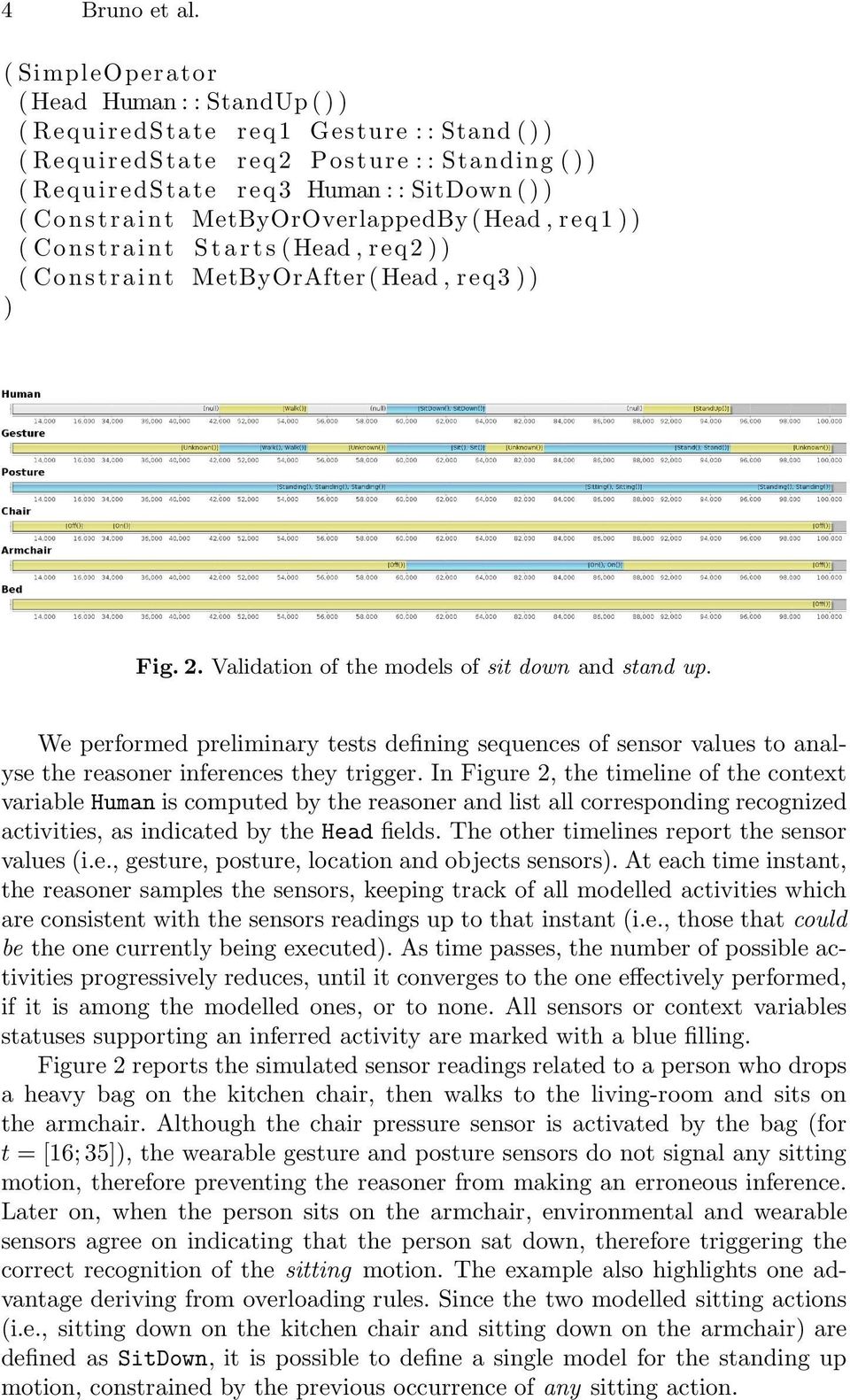
4 4 Bruno et al. (Head Human:: StandUp( (RequiredState req1 Gesture :: Stand( (RequiredState req2 Posture :: Standing ( (RequiredState req3 Human:: SitDown( (Constraint MetByOrOverlappedBy(Head, req1 (Constraint Starts(Head, req2 (Constraint MetByOrAfter(Head, req3 Fig.2. Validation of the models of sit down and stand up. We performed preliminary tests defining sequences of sensor values to analyse the reasoner inferences they trigger. In Figure 2, the timeline of the context variable Human is computed by the reasoner and list all corresponding recognized activities, as indicated by the Head fields. The other timelines report the sensor values (i.e., gesture, posture, location and objects sensors. At each time instant, the reasoner samples the sensors, keeping track of all modelled activities which are consistent with the sensors readings up to that instant (i.e., those that could be the one currently being executed. As time passes, the number of possible activities progressively reduces, until it converges to the one effectively performed, if it is among the modelled ones, or to none. All sensors or context variables statuses supporting an inferred activity are marked with a blue filling. Figure 2 reports the simulated sensor readings related to a person who drops a heavy bag on the kitchen chair, then walks to the living-room and sits on the armchair. Although the chair pressure sensor is activated by the bag (for t = [16;35], the wearable gesture and posture sensors do not signal any sitting motion, therefore preventing the reasoner from making an erroneous inference. Later on, when the person sits on the armchair, environmental and wearable sensors agree on indicating that the person sat down, therefore triggering the correct recognition of the sitting motion. The example also highlights one advantage deriving from overloading rules. Since the two modelled sitting actions (i.e., sitting down on the kitchen chair and sitting down on the armchair are defined as SitDown, it is possible to define a single model for the standing up motion, constrained by the previous occurrence of any sitting action.
5 Multi-modal Sensing for Human Activity Recognition 5 4 Conclusions In this abstract, we introduce the idea of a multi-modal monitoring system, which combines information retrieved via different monitoring approaches and we prove, in simulation, that the integration of wearable and environmental information is beneficial for the purposes of human activity monitoring. Future work will focus on the set up of a test bed apartment in an elderly care facility in Örebro, Sweden, to test the performance of the system under realistic conditions. References 1. Johnson, D.O., Cuijpers, R.H., Juola, J.F., Torta, E., Simonov, M., Frisiello, A., Bazzani, M., Yan, W., Weber, C., Wermter, S., Meins, N., Oberzaucher, J., Panek, P., Edelmayer, G., Mayer, P., Beck, C.: Socially Assistive Robots: A Comprehensive Approach to Extending Independent Living. International Journal of Social Robotics 6,2, ( Katz, S., Chinn, A., Cordrey, L.: Multidisciplinary studies of illness in aged persons: a new classification of functional status in activities of daily living. J. Chron. Dis. 9,1, ( Alam, M.R., Reaz, M.B.I., Ali M.A.M.: A Review of Smart HomesPast, Present, and Future. IEEE Trans on Systems, Man, and Cybernetics, Part C: Applications and Reviews 42,6, ( Lara O.D., Labrador, M.A.: A Survey on Human Activity Recognition using Wearable Sensors. IEEE Communications Surveys and Tutorials, 15,3, ( Bruno, B., Mastrogiovanni, F., Sgorbissa, A., Vernazza, T., Zaccaria, R.: Human motion modelling and recognition: A computational approach. In: IEEE Int Conf on Automation Science and Engineering (CASE, ( Bruno, B., Mastrogiovanni, F., Sgorbissa, A., Vernazza, T., Zaccaria, R.: Analysis of human behavior recognition algorithms based on acceleration data. In: IEEE Int Conf on Robotics and Automation (ICRA, ( Kangas, M., Konttila, A., Lindgren, P., Winblad, I., Jamsa, T.: Comparison of low-complexity fall detection algorithms for body attached accelerometers. Gait & Posture 28, ( Saffiotti, A., Broxvall, M., Gritti, M., LeBlanc, K., Lundh, R., Rashid, J., Seo, B.S., Cho, Y.J.: The PEIS-ecology project: vision and results. In: IEEE/RSJ Int Conf on Intelligent Robots and Systems (IROS, ( Pecora, F., Cirillo, M., Dell Osa, F., Ullberg, J., Saffiotti, A.: A constraint-based approach for proactive, context-aware human support. Journal of Ambient Intelligence and Smart Environments 4, (2012
Network Robot Systems
 Network Robot Systems Alberto Sanfeliu 1, Norihiro Hagita 2 and Alessandro Saffiotti 3 Guest Editors of the Special Issue on NRS 1 Institut de Robòtica I Informàtica Industrial (UPC-CSIC), Universitat
Assessing computer systems for monitoring elderly people living at home
 Assessing computer systems for monitoring elderly people living at home Nadia ZOUBA 1, François BREMOND 1, Monique THONNAT 1, Alain ANFOSSO 2, Éric PASCUAL 2, Patrick MALLEA 3, Véronique MAILLAND 3, and
Activity recognition in ADL settings. Ben Kröse [email protected]
 Activity recognition in ADL settings Ben Kröse [email protected] Content Why sensor monitoring for health and wellbeing? Activity monitoring from simple sensors Cameras Co-design and privacy issues Necessity
Accurate, Fast Fall Detection Using Gyroscopes and Accelerometer-Derived Posture Information
 Accurate, Fast Fall Detection Using Gyroscopes and Accelerometer-Derived Posture Information Qiang Li, John A. Stankovic, Mark Hanson, Adam Barth, John Lach University of Virginia {lq7c, stankovic, mah6s,
Accurate, Fast Fall Detection Using Gyroscopes and Accelerometer-Derived Posture Information
 Accurate, Fast Fall Detection Using Gyroscopes and Accelerometer-Derived Posture Information Qiang Li, John A. Stankovic, Mark A. Hanson, Adam T. Barth, John Lach University of Virginia Email: {lq7c, stankovic,
A smartphone based real-time daily activity monitoring system. Shumei Zhang Paul McCullagh Jing Zhang Tiezhong Yu
 A smartphone based real-time daily activity monitoring system Shumei Zhang Paul McCullagh Jing Zhang Tiezhong Yu Outline Contribution Background Methodology Experiments Contribution This paper proposes
Summer projects for Dept. of IT students in the summer 2015
 Summer projects for Dept. of IT students in the summer 2015 Here are 7 possible summer project topics for students. If you are interested in any of them, contact the person associated with the project
Health and Well-being
 Activity Monitoring for Behaviour, Health and Well-being Christopher James Professor of Healthcare Technology and Director Institute of Digital Healthcare, WMG University of Warwick Overview activity monitoring
Report of Research Results
 Report of Research Results Scaling and Deployment of e-guardian to Eldercare Centers and Single Elderly Homes Primary Researcher: Prof. Tan Kok Kiong, Department of Electrical and Computer Engineering
Fall Detection System based on Kinect Sensor using Novel Detection and Posture Recognition Algorithm
 Fall Detection System based on Kinect Sensor using Novel Detection and Posture Recognition Algorithm Choon Kiat Lee 1, Vwen Yen Lee 2 1 Hwa Chong Institution, Singapore [email protected] 2 Institute
Smart Carpet using differential piezoresistive pressure sensors for elderly fall detection
 Smart Carpet using differential piezoresistive pressure sensors for elderly fall detection Kabalan Chaccour, Student Member, IEEE, Rony Darazi, Member, IEEE, Amir Hajjam el Hassani, Emmanuel Andres Ticket
Wireless Multimedia Technologies for Assisted Living
 Second LACCEI International Latin American and Caribbean Conference for Engineering and Technology (LACCEI 2004) Challenges and Opportunities for Engineering Education, Research and Development 2-4 June
A Demonstration of a Robust Context Classification System (CCS) and its Context ToolChain (CTC)
 A Demonstration of a Robust Context Classification System () and its Context ToolChain (CTC) Martin Berchtold, Henning Günther and Michael Beigl Institut für Betriebssysteme und Rechnerverbund Abstract.
A Genetic Algorithm-Evolved 3D Point Cloud Descriptor
 A Genetic Algorithm-Evolved 3D Point Cloud Descriptor Dominik Wȩgrzyn and Luís A. Alexandre IT - Instituto de Telecomunicações Dept. of Computer Science, Univ. Beira Interior, 6200-001 Covilhã, Portugal
Integration of Smart Home Technologies in a Health Monitoring System for the Elderly
 Integration of Smart Home Technologies in a Health Monitoring System for the Elderly Amaya Arcelus Dept. Systems and Computer Engineering Carleton University, Ottawa, ON, Canada [email protected] Rafik
Dr. Asher Vaturi The Max Stern Yezreel Valley College
 Dr. Asher Vaturi The Max Stern Yezreel Valley College Performance indicators for Indoor and outdoor environment built areas Concern about the overall quality of the indoor environment We focus on issues
ADLife An Activities of Daily Living (ADL) monitoring
 ADLife An Activities of Daily Living (ADL) monitoring Solution Sheet For many older people, admittance to residential or nursing home care is often deemed necessary despite client reluctance and the relatively
Multi-Person Pose Recognition Using a Zigbee Sensor Network
 Proceedings of the 7th World Congress The International Federation of Automatic Control Seoul, Korea, July 6, 8 Multi-Person Pose Recognition Using a Zigbee Sensor Network Kai-Tai Song and Chun-Wei Chen
Journal of Industrial Engineering Research. Adaptive sequence of Key Pose Detection for Human Action Recognition
 IWNEST PUBLISHER Journal of Industrial Engineering Research (ISSN: 2077-4559) Journal home page: http://www.iwnest.com/aace/ Adaptive sequence of Key Pose Detection for Human Action Recognition 1 T. Sindhu
A DECISION TREE BASED PEDOMETER AND ITS IMPLEMENTATION ON THE ANDROID PLATFORM
 A DECISION TREE BASED PEDOMETER AND ITS IMPLEMENTATION ON THE ANDROID PLATFORM ABSTRACT Juanying Lin, Leanne Chan and Hong Yan Department of Electronic Engineering, City University of Hong Kong, Hong Kong,
Using Received Signal Strength Variation for Surveillance In Residential Areas
 Using Received Signal Strength Variation for Surveillance In Residential Areas Sajid Hussain, Richard Peters, and Daniel L. Silver Jodrey School of Computer Science, Acadia University, Wolfville, Canada.
Obstacle Avoidance Design for Humanoid Robot Based on Four Infrared Sensors
 Tamkang Journal of Science and Engineering, Vol. 12, No. 3, pp. 249 258 (2009) 249 Obstacle Avoidance Design for Humanoid Robot Based on Four Infrared Sensors Ching-Chang Wong 1 *, Chi-Tai Cheng 1, Kai-Hsiang
Vision based approach to human fall detection
 Vision based approach to human fall detection Pooja Shukla, Arti Tiwari CSVTU University Chhattisgarh, [email protected] 9754102116 Abstract Day by the count of elderly people living alone at home
A MOTION ACTIVITY MONITOR MONITOR POHYBOVÉ AKTIVITY
 A MOTION ACTIVITY MONITOR MONITOR POHYBOVÉ AKTIVITY Josef Marek, Ladislav Štěpánek 1 Summary: The paper deals with motion and vital activity monitoring of person in the case of dangerous environment (rescue
Modern Multipupose Security And Power Management System
 Modern Multipupose Security And Power Management System Mohanaprakash 1 Sathya 2 Dhanabal 3 1 Assistant Professor, 2,3 PG Scholars Dept of Electronics and Communication Engineering, Jay Shiri Ram Group
THE MS KINECT USE FOR 3D MODELLING AND GAIT ANALYSIS IN THE MATLAB ENVIRONMENT
 THE MS KINECT USE FOR 3D MODELLING AND GAIT ANALYSIS IN THE MATLAB ENVIRONMENT A. Procházka 1,O.Vyšata 1,2,M.Vališ 1,2, M. Yadollahi 1 1 Institute of Chemical Technology, Department of Computing and Control
STMicroelectronics is pleased to present the. SENSational. Attend a FREE One-Day Technical Seminar Near YOU!
 SENSational STMicroelectronics is pleased to present the SENSational Seminar Attend a FREE One-Day Technical Seminar Near YOU! Seminar Sensors and the Internet of Things are changing the way we interact
Asset Tracking Application Can It Drive Business Efficiencies?
 Asset Tracking Application Can It Drive Business Efficiencies? Executive Summary In today s competitive environment, businesses are continuously looking for ways to improve their business processes and
The Intelligent Data Network: Proposal for Engineering the Next Generation of Distributed Data Modeling, Analysis and Prediction
 Making Sense of your Data The Intelligent Data Network: Proposal for Engineering the Next Generation of Distributed Data Modeling, Analysis and Prediction David L. Brock The Data Center, Massachusetts
Artificial Intelligence and Robotics @ Politecnico di Milano. Presented by Matteo Matteucci
 1 Artificial Intelligence and Robotics @ Politecnico di Milano Presented by Matteo Matteucci What is Artificial Intelligence «The field of theory & development of computer systems able to perform tasks
Recognition of Day Night Activity Using Accelerometer Principals with Aurdino Development Board
 Recognition of Day Night Activity Using Accelerometer Principals with Aurdino Development Board Swapna Shivaji Arote R.S. Bhosale S.E. Pawar Dept. of Information Technology, Dept. of Information Technology,
Fall Detection System for Healthcare Quality Improvement in Residential Care Facilities
 Journal of Medical and Biological Engineering, 30(4): 47-5 47 Fall Detection System for Healthcare Quality Improvement in Residential Care Facilities Chih-Ning Huang 1 Chih-Yen Chiang 1 Guan-Chun Chen
Ontology for Home Energy Management Domain
 Ontology for Home Energy Management Domain Nazaraf Shah 1,, Kuo-Ming Chao 1, 1 Faculty of Engineering and Computing Coventry University, Coventry, UK {nazaraf.shah, k.chao}@coventry.ac.uk Abstract. This
A Case Study on Smart Environments and Network Marketing
 Politecnico di Torino Master degree in Computer Engineering Context Aware and Device Dependent Interaction in Smart Environments Candidate: Supervisors: Emanuele Furci Academic year 2013-2014 Fulvio Corno
A Cognitive Approach to Vision for a Mobile Robot
 A Cognitive Approach to Vision for a Mobile Robot D. Paul Benjamin Christopher Funk Pace University, 1 Pace Plaza, New York, New York 10038, 212-346-1012 [email protected] Damian Lyons Fordham University,
Human Activities Recognition in Android Smartphone Using Support Vector Machine
 2016 7th International Conference on Intelligent Systems, Modelling and Simulation Human Activities Recognition in Android Smartphone Using Support Vector Machine Duc Ngoc Tran Computer Engineer Faculty
Chapter 4. The sleep and activities of daily living (ADL) monitoring application
 Authors: Yuchen-Huang (2014-07-30); recommended: Yeh-Liang Hsu(2014-08-01). Chapter 4. The sleep and activities of daily living (ADL) monitoring application Long-term ADL profiles of the older adults acquired
A Healthcare/Eldercare Robot based on Skilligent Technology
 A Healthcare/Eldercare Robot based on Skilligent Technology Application Proposal Revision 7 Copyright 2008 Skilligent Page 1 of 8 http://www.skilligent.com TABLE OF CONTENTS 1 INTRODUCTION 3 2 CONCEPTION
Int. J. Sensor Networks, Vol. x, No. x, xxxx 1
 Int. J. Sensor Networks, Vol. x, No. x, xxxx 1 Chameleon: personalised and adaptive fall detection of elderly people in home-based environments Lingmei Ren* Department of Computer Science and Technology,
A Surveillance Robot with Climbing Capabilities for Home Security
 Available Online at www.ijcsmc.com International Journal of Computer Science and Mobile Computing A Monthly Journal of Computer Science and Information Technology IJCSMC, Vol. 2, Issue. 11, November 2013,
Colorado School of Mines Computer Vision Professor William Hoff
 Professor William Hoff Dept of Electrical Engineering &Computer Science http://inside.mines.edu/~whoff/ 1 Introduction to 2 What is? A process that produces from images of the external world a description
Database-Centered Architecture for Traffic Incident Detection, Management, and Analysis
 Database-Centered Architecture for Traffic Incident Detection, Management, and Analysis Shailendra Bhonsle, Mohan Trivedi, and Amarnath Gupta* Department of Electrical and Computer Engineering, *San Diego
Industry 4.0 and Big Data
 Industry 4.0 and Big Data Marek Obitko, [email protected] Senior Research Engineer 03/25/2015 PUBLIC PUBLIC - 5058-CO900H 2 Background Joint work with Czech Institute of Informatics, Robotics and
IEEE IoT IoT Scenario & Use Cases: Social Sensors
 IEEE IoT IoT Scenario & Use Cases: Social Sensors Service Description More and more, people have the possibility to monitor important parameters in their home or in their surrounding environment. As an
Cloud Computing for Agent-based Traffic Management Systems
 Cloud Computing for Agent-based Traffic Management Systems Manoj A Patil Asst.Prof. IT Dept. Khyamling A Parane Asst.Prof. CSE Dept. D. Rajesh Asst.Prof. IT Dept. ABSTRACT Increased traffic congestion
Journal of Emerging Trends in Computing and Information Sciences
 Sleep Walking Prevention (SWP) Alarm System 1 Kuo-pao Yang, 2 Theresa Beaubouef, 3 Johnnie Morrison 1, 2, 3 Department of Computer Science and Industrial Technology, Southeastern Louisiana University,
Check for Safety. A Home Fall Prevention Checklist for Older Adults
 P Safety This checklist was produced with support from the MetLife Foundation. Centers Disease Control and Prevention National Center Injury Prevention and Control A Home Fall Prevention list Older Adults
Development of Docking System for Mobile Robots Using Cheap Infrared Sensors
 Development of Docking System for Mobile Robots Using Cheap Infrared Sensors K. H. Kim a, H. D. Choi a, S. Yoon a, K. W. Lee a, H. S. Ryu b, C. K. Woo b, and Y. K. Kwak a, * a Department of Mechanical
A Simulation Analysis of Formations for Flying Multirobot Systems
 A Simulation Analysis of Formations for Flying Multirobot Systems Francesco AMIGONI, Mauro Stefano GIANI, Sergio NAPOLITANO Dipartimento di Elettronica e Informazione, Politecnico di Milano Piazza Leonardo
DESIGN AND DEVELOPMENT OF FALL DETECTOR USING FALL ACCELERATION
 DESIGN AND DEVELOPMENT OF FALL DETECTOR USING FALL ACCELERATION Sudarshan B G 1, Raveendra Hegde 2, Prasanna Kumar S C 3, Satyanarayana B S 4 1 Assistant Professor, 3 Professor and Head, 4 Principal, Dept.
THE ACCURATE FALLING DETECTION SYSTEM FOR THE ELDERLY (AFDE)
 THE ACCURATE FALLING DETECTION SYSTEM FOR THE ELDERLY (AFDE) Jie Ni Dorette Ong 1, Huijie Zhang 1, Vwen Yen Alwyn Lee 2, Clifton Phua 2, Kelvin Sim 2, Yan Liu 3 and Xian Zhang 3 1 Raffles Girls School
Graduation Project Ideas Proposed By Faculty Members Department of Communication and Networks
 Graduation Project Ideas Proposed By Faculty Members Department of Communication and Networks Updated 7/12/2013 Faculty Member Proposed Project Title Research Interests Dr. Abdullah M. Almuhaideb Email:
Real-time asset location visibility improves operational efficiencies
 Real-time asset location visibility improves operational efficiencies Offering smart capabilities for asset tracking to dramatically improve efficiency and lower cost Highlights Improve asset utilization
Original Research Articles
 Original Research Articles Researchers Mr.Ramchandra K. Gurav, Prof. Mahesh S. Kumbhar Department of Electronics & Telecommunication, Rajarambapu Institute of Technology, Sakharale, M.S., INDIA Email-
WAITER: A Wearable Personal Healthcare and Emergency Aid System
 Sixth Annual IEEE International Conference on Pervasive Computing and Communications WAITER: A Wearable Personal Healthcare and Emergency Aid System Wanhong Wu 1, Jiannong Cao 1, Yuan Zheng 1, Yong-Ping
Pakistan-U.S. Science and Technology Cooperation Program Annual Technical Report Form
 Pakistan-U.S. Science and Technology Cooperation Program Annual Technical Report Form Reports should be prepared jointly by the Pakistani and U.S. principal investigators and should cover all project-related
Vibrations can have an adverse effect on the accuracy of the end effector of a
 EGR 315 Design Project - 1 - Executive Summary Vibrations can have an adverse effect on the accuracy of the end effector of a multiple-link robot. The ability of the machine to move to precise points scattered
Recognition of false alarms in fall detection systems
 Recognition of false alarms in fall detection systems Stefano Abbate, Marco Avvenuti, Guglielmo Cola, Paolo Corsini, Janet Light and Alessio Vecchio IMT Institute for Advanced Studies, Lucca, Italy, [email protected]
http://intranet.urmc-sh.rochester.edu/policy/smhpolicies/section10/10-22.pdf
 APPENDIX B Patient Care Lifting Guidelines Patient handling, including lifting, transferring, and repositioning, is covered by SMH Policy 10.22 Minimal Lift for Patient Handling, which can be found at:
Cisco Context-Aware Mobility Solution: Put Your Assets in Motion
 Cisco Context-Aware Mobility Solution: Put Your Assets in Motion How Contextual Information Can Drastically Change Your Business Mobility and Allow You to Achieve Unprecedented Efficiency What You Will
GLOVE-BASED GESTURE RECOGNITION SYSTEM
 CLAWAR 2012 Proceedings of the Fifteenth International Conference on Climbing and Walking Robots and the Support Technologies for Mobile Machines, Baltimore, MD, USA, 23 26 July 2012 747 GLOVE-BASED GESTURE
Android Phone Controlled Robot Using Bluetooth
 International Journal of Electronic and Electrical Engineering. ISSN 0974-2174, Volume 7, Number 5 (2014), pp. 443-448 International Research Publication House http://www.irphouse.com Android Phone Controlled
Object Location Modeling in Office Environments First Steps
 Object Location Modeling in Office Environments First Steps Thomas Pederson Department of Computing Science, Umeå University, SE-90187 Umeå, Sweden [email protected] Abstract. In this position paper we briefly
How cloud-based systems and machine-driven big data can contribute to the development of autonomous vehicles
 How cloud-based systems and machine-driven big data can contribute to the development of autonomous vehicles David Fidalgo- Altran Senior Business Manager CONTENTS I. Altran Group/ Intelligence Systems
Distributed Database for Environmental Data Integration
 Distributed Database for Environmental Data Integration A. Amato', V. Di Lecce2, and V. Piuri 3 II Engineering Faculty of Politecnico di Bari - Italy 2 DIASS, Politecnico di Bari, Italy 3Dept Information
Accelerometer Based Real-Time Gesture Recognition
 POSTER 2008, PRAGUE MAY 15 1 Accelerometer Based Real-Time Gesture Recognition Zoltán PREKOPCSÁK 1 1 Dept. of Telecomm. and Media Informatics, Budapest University of Technology and Economics, Magyar tudósok
Solutions for the Connected Home
 Solutions for the Connected Home Customized to Fit Your Lifestyle An Alarm.com powered system provides superior security and offers advanced mobile and web features that allow you to monitor and control
Social Innovation through Utilization of Big Data
 Social Innovation through Utilization of Big Data Hitachi Review Vol. 62 (2013), No. 7 384 Shuntaro Hitomi Keiro Muro OVERVIEW: The analysis and utilization of large amounts of actual operational data
Hospitals of the Future Ubiquitous Computing support for Medical Work in Hospitals
 Hospitals of the Future Ubiquitous Computing support for Medical Work in Hospitals Jakob E. Bardram Centre for Pervasive Healthcare Department of Computer Science, University of Aarhus Aabogade 34, 8200
EL Program: Smart Manufacturing Systems Design and Analysis
 EL Program: Smart Manufacturing Systems Design and Analysis Program Manager: Dr. Sudarsan Rachuri Associate Program Manager: K C Morris Strategic Goal: Smart Manufacturing, Construction, and Cyber-Physical
Chapter 2 Sensors for Human Behavior Analysis
 Chapter 2 Sensors for Human Behavior Analysis This chapter proposes a brief description of the most common sensors used in literature to perform the automatic analysis of the human behavior. For each kind
Service Engineering for the Internet of Things
 Software & Services Priorities for WP 2009-10 Workshop, March 4, 2008 Service Engineering for the Internet of Things Mikhail Simonov, [email protected] Service engineering in the IoT and IoS Actual real
Development of a GSM based Control System for Electrical Appliances
 International Journal of Engineering and Technology Volume 3 No. 4, April, 2013 Development of a GSM based Control System for Electrical Appliances Oke A. O., Emuoyibofarhe J. O., Adetunji A. B. Department
Human Behavior Analysis in Intelligent Retail Environments
 Human Behavior Analysis in Intelligent Retail Environments Andrea Ascani, Emanuele Frontoni, Adriano Mancini, Primo Zingaretti 1 D.I.I.G.A., Università Politecnica delle Marche, Ancona - Italy, {ascani,
Project Report: ESG Elevator Accelerator
 Project Report: ESG Elevator Accelerator Felix Sun Guangtao Zhang Cover photo: Elevator Accelerator controller and display in the ESG lounge. Project III Final Report 2 Abstract Many people experience
Check for Safety. A Home Fall Prevention Checklist for Older Adults
 This checklist is based on the original version printed by the Centers Disease Control and revention. Support this version was provided by MetLife Foundation. 2005 Department of Health and Human Services
Framework for Biometric Enabled Unified Core Banking
 Proc. of Int. Conf. on Advances in Computer Science and Application Framework for Biometric Enabled Unified Core Banking Manohar M, R Dinesh and Prabhanjan S Research Candidate, Research Supervisor, Faculty
Management Dashboard in a Retail Environment
 Management Dashboard in a Retail Environment Gerrit Kahl, Stefan Warwas, Pascal Liedtke, Lübomira Spassova, Boris Brandherm German Research Center for Artificial Intelligence LAMDa 2011, 13. February,