
A DECISION TREE BASED PEDOMETER AND ITS IMPLEMENTATION ON THE ANDROID PLATFORM
|
|
|
- Dominick Short
- 10 years ago
- Views:
Transcription
1 A DECISION TREE BASED PEDOMETER AND ITS IMPLEMENTATION ON THE ANDROID PLATFORM ABSTRACT Juanying Lin, Leanne Chan and Hong Yan Department of Electronic Engineering, City University of Hong Kong, Hong Kong, China This paper describes a decision tree (DT) based pedometer algorithm and its implementation on Android. The DT- based pedometer can classify 3 gait patterns, including walking on level ground (WLG), up stairs (WUS) and down stairs (WDS). It can discard irrelevant motion and count user s steps accurately. The overall classification accuracy is 89.4%. Accelerometer, gyroscope and magnetic field sensors are used in the device. When user puts his/her smart phone into the pocket, the pedometer can automatically count steps of different gait patterns. Two methods are tested to map the acceleration from mobile phone s reference frame to the direction of gravity. Two significant features are employed to classify different gait patterns. KEYWORDS Pedometer, Decision Tree, Sensor, Gait analysis &Classification, Mobile Phone Applications. 1. INTRODUCTION Commonly used pedometers are often built as separate products and their accuracy is often affected by random motions. In this paper, we present a new method to count steps of walking using a mobile phone. We use several sensors to extract signal features and a decision tree to perform data classification. Gyroscopes and accelerometers are wildly used to detect human motions. Gyroscope sensor is used to measure the angular velocity of an object. Doheny et al. used a single gyroscope to analyze spatial gait [1]. Lim et al. proposed a gyroscope-based pedometer [2]. A gyroscope is adhered to the right shank segment to detect user s motion. The work presented here uses gyroscope to measure angular velocity of user s thigh, when the phone is in the user s pocket as shown in Figure 1. The accelerometer can be used as a sensor to measure the acceleration of an object. Aguiar et al. used the accelerometer embedded in smart phone to detect falling of the elder [3]. Mantyjarvi et al. used accelerometers to recognize human motions [4]. The magnetic field sensor is often used in global positioning system navigation. In this work, data from this sensor are used to generate a rotation matrix. Using the matrix and the original acceleration, the vertical acceleration can be determined. Decision tree is one of the predictive modeling approaches used in statistics, data mining and machine learning. In a decision tree [5], leaves represent target values, which are also called class labels, and branches represent measurements about an item, which is also called a feature. Manap et al. used decision tree to detect parkinsonian gait motor impairment [6]. David C. Wyld et al. (Eds) : CCSIT, SIPP, AISC, NLP pp , CS & IT-CSCP 2015 DOI : /csit


2 74 Computer Science & Information Technology (CS & IT) Figure 1. An example of a mobile phone in the user s pocket. In the work by Lovell et al. [7], a sliding window with a size of 128 samples is used to segment signal of acceleration. In our work, an angular velocity based algorithm is developed to segment the signal of acceleration. Using this algorithm, classification and step counting can be done at the same time. In many pervious work of pedometer or gait classification, such as [2], [7], [8], researchers did not consider the capacity of anti-interference of their systems. In our method, daily irrelevant motions are added to the training set to improve the capacity of anti-interference of the system. 2. SYSTEM STRUCTURE System Start Sensor: Collect data Segment the signal Acceleration mapping Feature extraction Classification and count steps Figure 2. System follow chart of the pedometer. The system structure of the proposed pedometer is shown in Figure 2. Signals of original acceleration, angular velocity and magnetic field are recorded with a sampling frequency of 100 Hz. Then the signals will be cut into small segments. After that, original acceleration is mapped to the direction of the gravity. The features are extracted from each segment. Finally, all features are sent to the decision tree to classify each segment.

3 Computer Science & Information Technology (CS & IT) SIGNAL PROCESSING ALGORITHMS 3.1. Algorithms for signal segmenting To the thigh, a cycle of walking only contains 2 phases, forward rotation (FR) and backward rotation (BR). According to the case shown in Figure 1 and the reference frame of gyroscope shown in Figure 3, BR and FR can be detected by the x-axis of gyroscope in mobile phone. Figure 3. Three axes of the gyroscope in a mobile phone. Most mobile phones now have a large screen and occupy most space of user s pocket. Therefore, the position of mobile phone is usually stable in the user s pocket and it is reliable to use the x- axis to detect FR and BR. FR and BR can be easily recognized in the signal of x-axis as shown in Figures 5, 6 and 7. The principle of the algorithm is to detect FR of user s thigh and use it to separate signal of each step. The system will continue to monitor the angular velocity of x-axis and detect FR. If there are 15 consecutive data points whose values are all less than -1 rad/s, an FR is detected. The start point of a segment is the first data point with positive value after the FR. The start point is located by monitoring the first positive point after detecting the 15 consecutive negative points. The end point of a segment is the last peak whose value is larger than 1 rad/s, before the FR of the next step. A peak is located by checking whether there is a data point denoted by x(n) that meets the requirement : x(n)-x(n-1)>0 and x(n+1)-x(n)<0, where n denotes the index of the data point. After setting the start point, if no FR is detected, the end point of the segment will be set to be the 150th data point after the start point. The signals of angular velocity and vertical vibration are segmented according to start points and end points as shown in Figures 4, 5, 6 and 7. FR is an important element of a walk-like event. If no FR is detected, no segments will be created as illustrated by the signals after the segmentation in Figure 8. Therefore, some irrelevant motions are discarded and the reliability of the system is improved. Using this algorithm, one segment represents a walk-like event. The system can simply count the number of segments, which are considered to be true walk events by a decision tree, and obtain the number of steps of different gait patterns as shown in Figure 8. Let S WLG, S WUS, and S WDS denote the number of steps of the 3 gait patterns. The mobile phone only monitors one of user s thighs. Therefore, one segment represents 2 steps. If a sliding window is used, one step might be detected with 2 consecutive windows, and the number of segments is not equal to the number of steps. Also, a step near the boundary of a segment might be missed, if the step counting algorithm is applied to a larger segment that consists of several small segments.

4 76 Computer Science & Information Technology (CS & IT) Figure 4. Signals of walking on a level ground Figure 5. Signals of walking up stairs. Figure 6. Signals of walking down stairs.

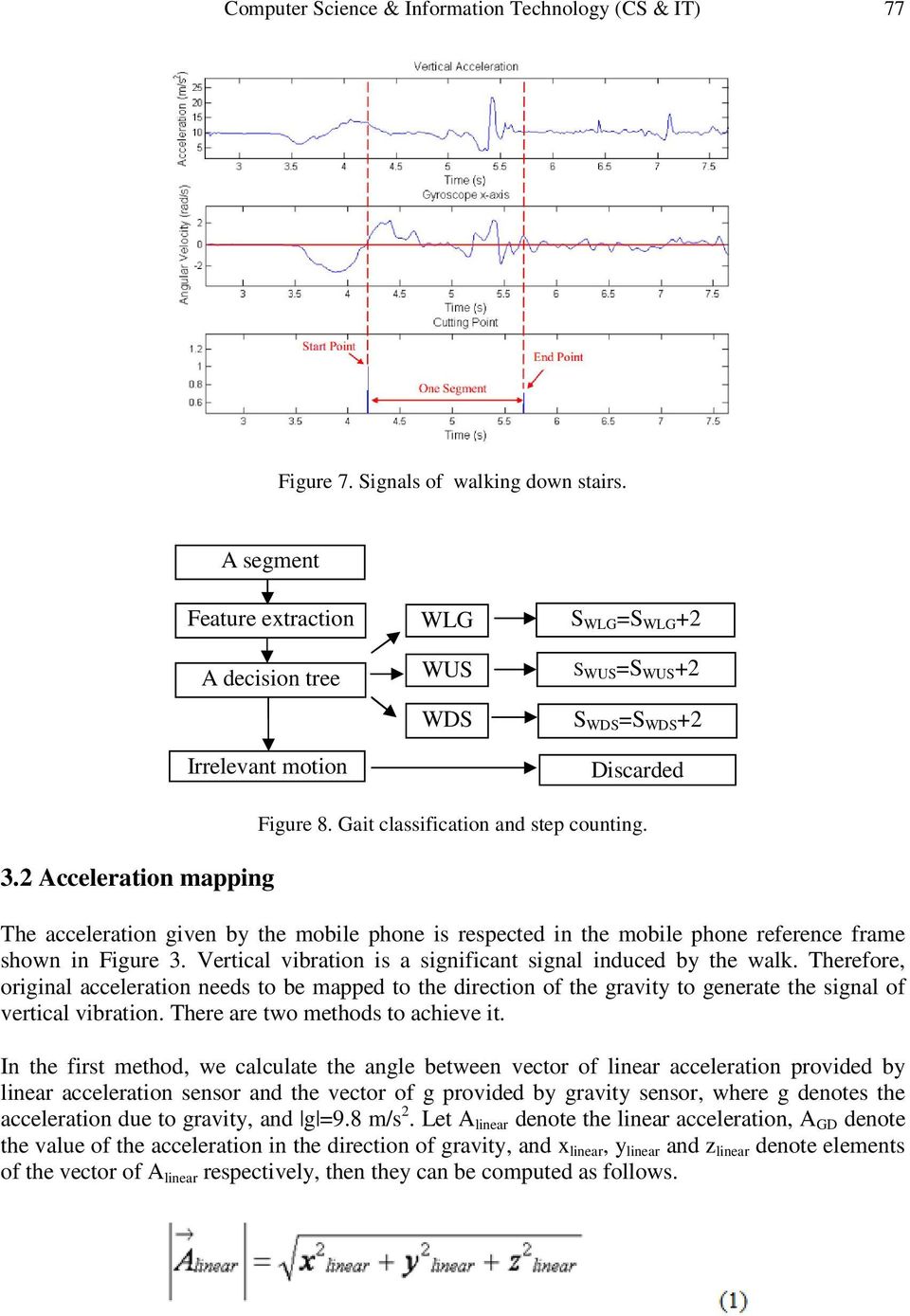
5 Computer Science & Information Technology (CS & IT) 77 Figure 7. Signals of walking down stairs. A segment Feature extraction A decision tree Irrelevant motion WLG WUS WDS S WLG =S WLG +2 S WUS =S WUS +2 S WDS =S WDS +2 Discarded 3.2 Acceleration mapping Figure 8. Gait classification and step counting. The acceleration given by the mobile phone is respected in the mobile phone reference frame shown in Figure 3. Vertical vibration is a significant signal induced by the walk. Therefore, original acceleration needs to be mapped to the direction of the gravity to generate the signal of vertical vibration. There are two methods to achieve it. In the first method, we calculate the angle between vector of linear acceleration provided by linear acceleration sensor and the vector of g provided by gravity sensor, where g denotes the acceleration due to gravity, and g =9.8 m/s 2. Let A linear denote the linear acceleration, A GD denote the value of the acceleration in the direction of gravity, and x linear, y linear and z linear denote elements of the vector of A linear respectively, then they can be computed as follows.
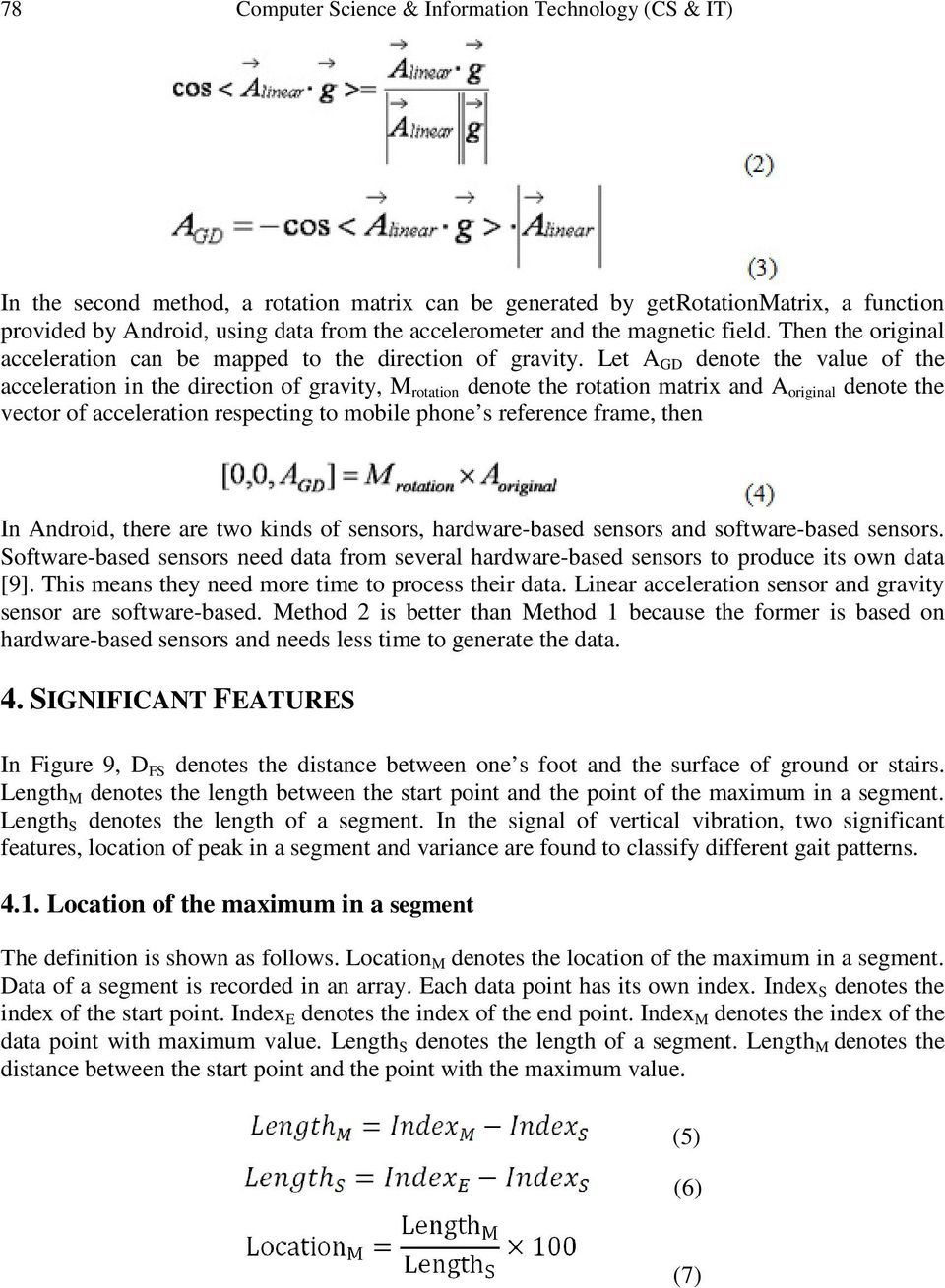
6 78 Computer Science & Information Technology (CS & IT) In the second method, a rotation matrix can be generated by getrotationmatrix, a function provided by Android, using data from the accelerometer and the magnetic field. Then the original acceleration can be mapped to the direction of gravity. Let A GD denote the value of the acceleration in the direction of gravity, M rotation denote the rotation matrix and A original denote the vector of acceleration respecting to mobile phone s reference frame, then In Android, there are two kinds of sensors, hardware-based sensors and software-based sensors. Software-based sensors need data from several hardware-based sensors to produce its own data [9]. This means they need more time to process their data. Linear acceleration sensor and gravity sensor are software-based. Method 2 is better than Method 1 because the former is based on hardware-based sensors and needs less time to generate the data. 4. SIGNIFICANT FEATURES In Figure 9, D FS denotes the distance between one s foot and the surface of ground or stairs. Length M denotes the length between the start point and the point of the maximum in a segment. Length S denotes the length of a segment. In the signal of vertical vibration, two significant features, location of peak in a segment and variance are found to classify different gait patterns Location of the maximum in a segment The definition is shown as follows. Location M denotes the location of the maximum in a segment. Data of a segment is recorded in an array. Each data point has its own index. Index S denotes the index of the start point. Index E denotes the index of the end point. Index M denotes the index of the data point with maximum value. Length S denotes the length of a segment. Length M denotes the distance between the start point and the point with the maximum value. (5) (6) (7)
7 Computer Science & Information Technology (CS & IT) 79 Figure 9. Gait analysis and signal of vertical vibration Signal in a segment represents the BR of user s thigh, as shown in Figure 9. In motions of walking on level ground or walking up stairs, when the user begins to rotate his/her thigh backward, his/her foot will soon touch the surface, due to small D FS. Then vibration is induced by heel strike. Therefore, the maximum is located near the start point of a segment. When walking down stairs, D FS is larger. After beginning to rotate one s thigh backward, one s foot will not soon touch the surface and induce vibration. Then the maximum is not located near the start point. This feature can separate the motion of walking down stairs from the other 2 gait patterns. 4.2 Variance of a segment Let D a denote the average of data values in a segment, n denote the number of data points, and Di denote a specified data point. Var denotes the variance of a segment. We calculate the variance of a segment as follows (8) In Figure 9, R1 and R2 denote 2 ranges in the signals of walking on level ground and down stairs respectively. R1 is a range of vibration. This range will increase the variance of the segment. Compared with R1, R2 is a range that is relatively flat. R2 will decrease the variance of the segment. Therefore, the variance of a segment of walking on level ground will be larger than that in a segment of walking up stairs. Using this feature, the motion of walking on level ground can be distinguished from the motion of walking up stairs. (9)

8 80 Computer Science & Information Technology (CS & IT) 5. TRAINING SET AND DECISION TREE Five subjects, participate in an experiment to create a training set with 4 kinds of motions, including the 3 gait patterns and irrelevant motion. We choose the decision tree as the classification engine since it has a very low computational complexity and can be implemented on a mobile computing unit (MCU) efficiently [10-12]. In order to avoid imbalanced distribution of different classes in a decision tree, the amount of each class in a training set should be balanced. If one class is the majority in a training set, the decision tree created by this training set is more likely to classify an unknown instance to that class. Then C4.5 algorithm in Weka is used to identify distinct features and create a decision tree, according to the training set. Six features are selected to create the decision tree as shown in Figure 10. In this figure, Ground denotes walking on level ground. Up denotes walking up stairs. Down denotes walking down stairs. Other denotes irrelevant motion. In the signal of vertical acceleration, AcceleGMin denotes the minimum value, AcceleGMax denotes the maximum value, AcceleGAverage denotes the average, AcceleGMaxL denotes the location of the maximum and AcceleGVar denotes the variance. In the signal of angular velocity, GyroMin denotes the minimum. Figure 10. Decision tree used in the system While creating the classifier Weka also evaluate the performance of this predictive model. Cross validation is a common method to evaluate the accuracy of classifiers [10]. In Leave One-Out (LOO) cross validation, one subject is used for testing and the rest are used for training. The classification result is then computed and repeated until all subjects have participated in the testing dataset. The overall classification result is then computed as the average of all testing subjects [13]. Here 10-folder cross-validation is used to measure the accuracy of this classifier. In
![We choose the decision tree as the classification engine since it has a very low computational complexity and can be implemented on a mobile computing unit (MCU) efficiently [10-12].](/docs-images/51/13461399/images/page_8.jpg "In order to avoid imbalanced distribution of different classes in a decision tree, the amount of each class in a training set should be balanced.")
9 Computer Science & Information Technology (CS & IT) 81 the cross-validation, the whole training dataset is divided into 10 subsets. One subset is used for testing the rest are used for training. The classification accuracy of this decision tree is %. Another measure of classification algorithms performance is a confusion matrix [14]. Precision and recall are typical classification performance measures using the confusion matrix [15]. Precision and recall are defined as: (10) To a class in training dataset, TP (True Positive) denotes the number of correctly classified positive instances, FN (false negative) denotes the number of positive instances incorrectly classified as negative; TN (true negative) denotes the number of correctly classified negative instances and FP( false positive) denotes number of negative instances incorrectly classified as positive. The precise and recall of each class is shown in table 1. Table.1 Confusion matrix of the decision tree Classified as Measurement Class WLG WUS WDS Other TP FP FN Precision Recall WLG % 93.0% WUS % 94.6% WDS % 92.0% Other % 90.6% 6. EXPERIMENT RESULT The decision tree based pedometer is tested in a walking experiment and an anti-interference experiment. Subjects were asked to wear a Samsung Gear fit [16], a wearable device, in the two experiments. Then the efficiency of the proposed system can be compared with that of the Gear fit. Four subjects participated in these two experiments. In the walking experience, each subject was asked to take 200 steps on level ground, go up 4 floors, then go down 4 floors. Each floor has 16 stairs. In the anti-interference experiment, subjects were asked to shake or swing the mobile phone and the Gear fit 10 times at the same time and to see whether the pedometer and Gear fit take those motions as steps. Samsung Gear fit cannot classify gait patterns. The accuracy of Gear fit in Table 1 only represents the accuracy of step detection. In the walking experiment, the overall classification accuracy is 89.4%. In the anti-interference experiment, the average false steps recorded by the pedometer are 2.5, while Gear fit produces 12 false steps, as shown in Table 2. Table.1 Accuracy of step detection Proposed Pedometer (11) Samsung Gear Fit Gait Total Steps Detected Accuracy of Step Detection Steps Accuracy of Pattern Steps Detected Step detection WLG % % WUS % % WDS % % Average % %
![Precision and recall are typical classification performance measures using the confusion matrix [15].](/docs-images/51/13461399/images/page_9.jpg "Precision and recall are defined as: (10) To a class in training dataset, TP (True Positive) denotes the number of correctly classified positive instances, FN (false negative) denotes the number of")
10 82 Computer Science & Information Technology (CS & IT) Table.2 Accuracy of classification Proposed Pedometer Gait Pattern Total Steps Steps Correctly Classified Accuracy of Classification WLG % WUS % WDS % Average % Table 3. Result of anti-interference experiment False Steps Recorded Subject1 Subject2 Subject3 Subject4 Average Proposed Pedometer Gear fit CONCLUSION A decision-based pedometer that can count steps and classify 3 gait patterns is developed. An angular velocity based algorithm is used in this pedometer to segment signals and enable the pedometer to count steps of different gait patterns easily. The decision tree is used to improve the accuracy and reliability of the pedometer. The system has been tested in several experiments with good results. The experiment results show that the proposed pedometer produces much less false step count than a commercial product. ACKNOWLEDGEMENTS This work is supported by City University of Hong Kong (Project ). REFERENCES [1] E.P.Doheny, T.G.Foran and B.R.(2010) Greene, "A single gyroscope method for spatial gait analysis," in Proc. EMBC, pp [2] Y.P.Lim, I.T.Brown and J.C.T.Khoo,( 2008) "An accurate and robust gyroscope-based pedometer," in Proc. EMBS, pp [3] B.Aguiar, T.Rocha, J.Silva and I.Sousa,(2014) "Accelerometer-based fall detection for smartphones," in Proc. MeMeA, pp [4] J.Mantyjarvi, J.Himberg and T.Seppanen,(2001) "Recognizing human motion with multiple acceleration sensors," in Proc. Systems, Man, and Cybernetics, vol. 2, pp [5] Rokach, L., O.Maimon,(2008) Data mining with decision trees: theory and applications, World Scientific Pub Co Inc, pp vii and 71. [6] H.H.Manap, N.Md Tahir, R.Abdullah,(2013) "Parkinsonian Gait Motor Impairment Detection Using Decision Tree," in Proc. EMS, pp [7] N.H.Lovell, N.Wang, E.Ambikairajah, B.G. Celler,(2007) "Accelerometry Based Classification of Walking Patterns Using Time-frequency Analysis," in Proc. EMBS, pp [8] J.S.Wang, C.W.Lin, T.C.Yang, Y.J Ho,(2012) "Walking Pattern Classification and Walking Distance Estimation Algorithms Using Gait Phase Information," IEEE Trans. Biomedical Engineering, vol. 59, no. 10, pp [9] Motion Sensors in Android [10] R.O.Duda, P.E.Hart & D. G. Stork,(2001) Pattern Classification. 2nded, New York: Wiley.

11 Computer Science & Information Technology (CS & IT) 83 [11] Z.Chi and H.Yan, (1996) "ID3-derived fuzzy rules and optimized defuzzification for handwritten numeral recognition," IEEE Trans. on Fuzzy Systems, vol. 4, no. 1, pp [12] S.Zhao, Z.Chi, P. Shi and H. Yan, (2003) "Tow-stage segmentation of handwritten Chinese characters based on fuzzy decision rules," Pattern Recognition, vol. 36, pp [13] A.Murad, T.Sarkodie-Gyan, H.Y.Yu, O.Fuentes, R.Brower. & A.Abdelgawad, (2011) "Automatic classification of pathological gait patterns using ground reaction forces and machine learning algorithms," EMBC, pp [14] N.V.Chawla, K.W.Bowyer, L.O.Hall, and W.P.Kegelmeyer, (2002) "SMOTE: Synthetic Minority Over-sampling Technique", Journal of Artificial Intelligence Research, vol. 16, pp [15] D.L.Olson & D.Delen (2008) Advanced Data Mining Techniques. Springer. [16] Information on Samsung Gear Fit: microsite/gear/gearfit_features.html AUTHORS Juanying Lin received his master degree in Electronic and Information Engineering from City University of Hong Kong. He is currently a research assistant in the Department of Electronic Engineering at City University of Hong Kong. His research interests include digital image processing, motion pattern recognition and mobile computing. Leanne Chan received her PhD degree in Biomedical Engineering from University of Southern California. She is currently Assistant Professor in the Department of Electronic Engineering at City University of Hong Kong. Her research interests include retinal prosthesis testbed development and microelectronic systems. Hong Yan received his Ph.D. degree from Yale University. He was professor of imaging science at the University of Sydney and currently is professor of computer engineering at City University of Hong Kong. He was elected an IAPR fellow for contributions to document image analysis and an IEEE fellow for contributions to image recognition techniques and applications. His research interests include bioinformatics, image processing and pattern recognition.
![Yan, (2003) "Tow-stage segmentation of handwritten Chinese characters based on fuzzy decision rules," Pattern Recognition, vol. 36, pp. 145-156. [13] A.Murad, T.Sarkodie-Gyan, H.Y.Yu, O.Fuentes, R.](/docs-images/51/13461399/images/page_11.jpg "Brower. & A.Abdelgawad, (2011) \"Automatic classification of pathological gait patterns using ground reaction forces and machine learning algorithms,\" EMBC, pp.453-457. [14] N.V.Chawla, K.W.Bowyer, L.")
Effective Use of Android Sensors Based on Visualization of Sensor Information
 , pp.299-308 http://dx.doi.org/10.14257/ijmue.2015.10.9.31 Effective Use of Android Sensors Based on Visualization of Sensor Information Young Jae Lee Faculty of Smartmedia, Jeonju University, 303 Cheonjam-ro,
Addressing the Class Imbalance Problem in Medical Datasets
 Addressing the Class Imbalance Problem in Medical Datasets M. Mostafizur Rahman and D. N. Davis the size of the training set is significantly increased [5]. If the time taken to resample is not considered,
Human Activities Recognition in Android Smartphone Using Support Vector Machine
 2016 7th International Conference on Intelligent Systems, Modelling and Simulation Human Activities Recognition in Android Smartphone Using Support Vector Machine Duc Ngoc Tran Computer Engineer Faculty
VIRTUAL REALITY GAME CONTROLLED WITH USER S HEAD AND BODY MOVEMENT DETECTION USING SMARTPHONE SENSORS
 VIRTUAL REALITY GAME CONTROLLED WITH USER S HEAD AND BODY MOVEMENT DETECTION USING SMARTPHONE SENSORS Herman Tolle 1, Aryo Pinandito 2, Eriq Muhammad Adams J. 3 and Kohei Arai 4 1,2,3 Multimedia, Game
Time Domain and Frequency Domain Techniques For Multi Shaker Time Waveform Replication
 Time Domain and Frequency Domain Techniques For Multi Shaker Time Waveform Replication Thomas Reilly Data Physics Corporation 1741 Technology Drive, Suite 260 San Jose, CA 95110 (408) 216-8440 This paper
SVM Ensemble Model for Investment Prediction
 19 SVM Ensemble Model for Investment Prediction Chandra J, Assistant Professor, Department of Computer Science, Christ University, Bangalore Siji T. Mathew, Research Scholar, Christ University, Dept of
E-commerce Transaction Anomaly Classification
 E-commerce Transaction Anomaly Classification Minyong Lee [email protected] Seunghee Ham [email protected] Qiyi Jiang [email protected] I. INTRODUCTION Due to the increasing popularity of e-commerce
Performance Analysis of Naive Bayes and J48 Classification Algorithm for Data Classification
 Performance Analysis of Naive Bayes and J48 Classification Algorithm for Data Classification Tina R. Patil, Mrs. S. S. Sherekar Sant Gadgebaba Amravati University, Amravati [email protected], [email protected]
Sensors & Motion Sensors in Android platform. Minh H Dang CS286 Spring 2013
 Sensors & Motion Sensors in Android platform Minh H Dang CS286 Spring 2013 Sensors The Android platform supports three categories of sensors: Motion sensors: measure acceleration forces and rotational
Feature Subset Selection in E-mail Spam Detection
 Feature Subset Selection in E-mail Spam Detection Amir Rajabi Behjat, Universiti Technology MARA, Malaysia IT Security for the Next Generation Asia Pacific & MEA Cup, Hong Kong 14-16 March, 2012 Feature
Multi-Person Pose Recognition Using a Zigbee Sensor Network
 Proceedings of the 7th World Congress The International Federation of Automatic Control Seoul, Korea, July 6, 8 Multi-Person Pose Recognition Using a Zigbee Sensor Network Kai-Tai Song and Chun-Wei Chen
A new Approach for Intrusion Detection in Computer Networks Using Data Mining Technique
 A new Approach for Intrusion Detection in Computer Networks Using Data Mining Technique Aida Parbaleh 1, Dr. Heirsh Soltanpanah 2* 1 Department of Computer Engineering, Islamic Azad University, Sanandaj
Impact of Feature Selection Technique on Email Classification
 Impact of Feature Selection Technique on Email Classification Aakanksha Sharaff, Naresh Kumar Nagwani, and Kunal Swami Abstract Being one of the most powerful and fastest way of communication, the popularity
Online Farsi Handwritten Character Recognition Using Hidden Markov Model
 Online Farsi Handwritten Character Recognition Using Hidden Markov Model Vahid Ghods*, Mohammad Karim Sohrabi Department of Electrical and Computer Engineering, Semnan Branch, Islamic Azad University,
How To Fix Out Of Focus And Blur Images With A Dynamic Template Matching Algorithm
 IJSTE - International Journal of Science Technology & Engineering Volume 1 Issue 10 April 2015 ISSN (online): 2349-784X Image Estimation Algorithm for Out of Focus and Blur Images to Retrieve the Barcode
FRAUD DETECTION IN ELECTRIC POWER DISTRIBUTION NETWORKS USING AN ANN-BASED KNOWLEDGE-DISCOVERY PROCESS
 FRAUD DETECTION IN ELECTRIC POWER DISTRIBUTION NETWORKS USING AN ANN-BASED KNOWLEDGE-DISCOVERY PROCESS Breno C. Costa, Bruno. L. A. Alberto, André M. Portela, W. Maduro, Esdras O. Eler PDITec, Belo Horizonte,
Active Learning SVM for Blogs recommendation
 Active Learning SVM for Blogs recommendation Xin Guan Computer Science, George Mason University Ⅰ.Introduction In the DH Now website, they try to review a big amount of blogs and articles and find the
Tracking and Recognition in Sports Videos
 Tracking and Recognition in Sports Videos Mustafa Teke a, Masoud Sattari b a Graduate School of Informatics, Middle East Technical University, Ankara, Turkey [email protected] b Department of Computer
ANDROID APPS DEVELOPMENT FOR MOBILE AND TABLET DEVICE (LEVEL II)
 Sensor Overview ANDROID APPS DEVELOPMENT FOR MOBILE AND TABLET DEVICE (LEVEL II) Lecture 5: Sensor and Game Development Most Android-powered devices have built-in sensors that measure motion, orientation,
Artificial Neural Network, Decision Tree and Statistical Techniques Applied for Designing and Developing E-mail Classifier
 International Journal of Recent Technology and Engineering (IJRTE) ISSN: 2277-3878, Volume-1, Issue-6, January 2013 Artificial Neural Network, Decision Tree and Statistical Techniques Applied for Designing
Keywords Data mining, Classification Algorithm, Decision tree, J48, Random forest, Random tree, LMT, WEKA 3.7. Fig.1. Data mining techniques.
 International Journal of Emerging Research in Management &Technology Research Article October 2015 Comparative Study of Various Decision Tree Classification Algorithm Using WEKA Purva Sewaiwar, Kamal Kant
International Journal of Advanced Research in Computer Science and Software Engineering
 Volume 3, Issue 3, March 203 ISSN: 2277 28X International Journal of Advanced Research in Computer Science and Software Engineering Research Paper Available online at: www.ijarcsse.com Real Time Monitoring
Accurate, Fast Fall Detection Using Gyroscopes and Accelerometer-Derived Posture Information
 Accurate, Fast Fall Detection Using Gyroscopes and Accelerometer-Derived Posture Information Qiang Li, John A. Stankovic, Mark Hanson, Adam Barth, John Lach University of Virginia {lq7c, stankovic, mah6s,
EFFICIENCY OF DECISION TREES IN PREDICTING STUDENT S ACADEMIC PERFORMANCE
 EFFICIENCY OF DECISION TREES IN PREDICTING STUDENT S ACADEMIC PERFORMANCE S. Anupama Kumar 1 and Dr. Vijayalakshmi M.N 2 1 Research Scholar, PRIST University, 1 Assistant Professor, Dept of M.C.A. 2 Associate
Automatic Calibration of an In-vehicle Gaze Tracking System Using Driver s Typical Gaze Behavior
 Automatic Calibration of an In-vehicle Gaze Tracking System Using Driver s Typical Gaze Behavior Kenji Yamashiro, Daisuke Deguchi, Tomokazu Takahashi,2, Ichiro Ide, Hiroshi Murase, Kazunori Higuchi 3,
Blog Post Extraction Using Title Finding
 Blog Post Extraction Using Title Finding Linhai Song 1, 2, Xueqi Cheng 1, Yan Guo 1, Bo Wu 1, 2, Yu Wang 1, 2 1 Institute of Computing Technology, Chinese Academy of Sciences, Beijing 2 Graduate School
Overview. Evaluation Connectionist and Statistical Language Processing. Test and Validation Set. Training and Test Set
 Overview Evaluation Connectionist and Statistical Language Processing Frank Keller [email protected] Computerlinguistik Universität des Saarlandes training set, validation set, test set holdout, stratification
Chapter 6. The stacking ensemble approach
 82 This chapter proposes the stacking ensemble approach for combining different data mining classifiers to get better performance. Other combination techniques like voting, bagging etc are also described
T-61.3050 : Email Classification as Spam or Ham using Naive Bayes Classifier. Santosh Tirunagari : 245577
 T-61.3050 : Email Classification as Spam or Ham using Naive Bayes Classifier Santosh Tirunagari : 245577 January 20, 2011 Abstract This term project gives a solution how to classify an email as spam or
Accurate, Fast Fall Detection Using Gyroscopes and Accelerometer-Derived Posture Information
 Accurate, Fast Fall Detection Using Gyroscopes and Accelerometer-Derived Posture Information Qiang Li, John A. Stankovic, Mark A. Hanson, Adam T. Barth, John Lach University of Virginia Email: {lq7c, stankovic,
AN APPLYING OF ACCELEROMETER IN ANDROID PLATFORM FOR CONTROLLING WEIGHT
 AN APPLYING OF ACCELEROMETER IN ANDROID PLATFORM FOR CONTROLLING WEIGHT Sasivimon Sukaphat Computer Science Program, Faculty of Science, Thailand [email protected] ABSTRACT This research intends to present
Constrained Classification of Large Imbalanced Data by Logistic Regression and Genetic Algorithm
 Constrained Classification of Large Imbalanced Data by Logistic Regression and Genetic Algorithm Martin Hlosta, Rostislav Stríž, Jan Kupčík, Jaroslav Zendulka, and Tomáš Hruška A. Imbalanced Data Classification
How To Cluster
 Data Clustering Dec 2nd, 2013 Kyrylo Bessonov Talk outline Introduction to clustering Types of clustering Supervised Unsupervised Similarity measures Main clustering algorithms k-means Hierarchical Main
Experiments in Web Page Classification for Semantic Web
 Experiments in Web Page Classification for Semantic Web Asad Satti, Nick Cercone, Vlado Kešelj Faculty of Computer Science, Dalhousie University E-mail: {rashid,nick,vlado}@cs.dal.ca Abstract We address
A smartphone based real-time daily activity monitoring system. Shumei Zhang Paul McCullagh Jing Zhang Tiezhong Yu
 A smartphone based real-time daily activity monitoring system Shumei Zhang Paul McCullagh Jing Zhang Tiezhong Yu Outline Contribution Background Methodology Experiments Contribution This paper proposes
Accelerometer Based Real-Time Gesture Recognition
 POSTER 2008, PRAGUE MAY 15 1 Accelerometer Based Real-Time Gesture Recognition Zoltán PREKOPCSÁK 1 1 Dept. of Telecomm. and Media Informatics, Budapest University of Technology and Economics, Magyar tudósok
Neural Network based Vehicle Classification for Intelligent Traffic Control
 Neural Network based Vehicle Classification for Intelligent Traffic Control Saeid Fazli 1, Shahram Mohammadi 2, Morteza Rahmani 3 1,2,3 Electrical Engineering Department, Zanjan University, Zanjan, IRAN
Sensor Based Control of Autonomous Wheeled Mobile Robots
 Sensor Based Control of Autonomous Wheeled Mobile Robots Gyula Mester University of Szeged, Department of Informatics e-mail: [email protected] Abstract The paper deals with the wireless sensor-based
Supervised Feature Selection & Unsupervised Dimensionality Reduction
 Supervised Feature Selection & Unsupervised Dimensionality Reduction Feature Subset Selection Supervised: class labels are given Select a subset of the problem features Why? Redundant features much or
ECE 533 Project Report Ashish Dhawan Aditi R. Ganesan
 Handwritten Signature Verification ECE 533 Project Report by Ashish Dhawan Aditi R. Ganesan Contents 1. Abstract 3. 2. Introduction 4. 3. Approach 6. 4. Pre-processing 8. 5. Feature Extraction 9. 6. Verification
1. Classification problems
 Neural and Evolutionary Computing. Lab 1: Classification problems Machine Learning test data repository Weka data mining platform Introduction Scilab 1. Classification problems The main aim of a classification
Method of Combining the Degrees of Similarity in Handwritten Signature Authentication Using Neural Networks
 Method of Combining the Degrees of Similarity in Handwritten Signature Authentication Using Neural Networks Ph. D. Student, Eng. Eusebiu Marcu Abstract This paper introduces a new method of combining the
Modelling, Extraction and Description of Intrinsic Cues of High Resolution Satellite Images: Independent Component Analysis based approaches
 Modelling, Extraction and Description of Intrinsic Cues of High Resolution Satellite Images: Independent Component Analysis based approaches PhD Thesis by Payam Birjandi Director: Prof. Mihai Datcu Problematic
Automatic Fall Detector based on Sliding Window Principle
 Automatic Fall Detector based on Sliding Window Principle J. Rodriguez 1, M. Mercuri 2, P. Karsmakers 3,4, P.J. Soh 2, P. Leroux 3,5, and D. Schreurs 2 1 UPC, Div. EETAC-TSC, Castelldefels, Spain 2 KU
AN APPROACH TO WORD SENSE DISAMBIGUATION COMBINING MODIFIED LESK AND BAG-OF-WORDS
 AN APPROACH TO WORD SENSE DISAMBIGUATION COMBINING MODIFIED LESK AND BAG-OF-WORDS Alok Ranjan Pal 1, 3, Anirban Kundu 2, 3, Abhay Singh 1, Raj Shekhar 1, Kunal Sinha 1 1 College of Engineering and Management,
Evaluation & Validation: Credibility: Evaluating what has been learned
 Evaluation & Validation: Credibility: Evaluating what has been learned How predictive is a learned model? How can we evaluate a model Test the model Statistical tests Considerations in evaluating a Model
Recognition of Day Night Activity Using Accelerometer Principals with Aurdino Development Board
 Recognition of Day Night Activity Using Accelerometer Principals with Aurdino Development Board Swapna Shivaji Arote R.S. Bhosale S.E. Pawar Dept. of Information Technology, Dept. of Information Technology,
International Journal of Advance Research in Computer Science and Management Studies
 Volume 2, Issue 12, December 2014 ISSN: 2321 7782 (Online) International Journal of Advance Research in Computer Science and Management Studies Research Article / Survey Paper / Case Study Available online
Mining the Software Change Repository of a Legacy Telephony System
 Mining the Software Change Repository of a Legacy Telephony System Jelber Sayyad Shirabad, Timothy C. Lethbridge, Stan Matwin School of Information Technology and Engineering University of Ottawa, Ottawa,
Cell Phone based Activity Detection using Markov Logic Network
 Cell Phone based Activity Detection using Markov Logic Network Somdeb Sarkhel [email protected] 1 Introduction Mobile devices are becoming increasingly sophisticated and the latest generation of smart
DECISION TREE INDUCTION FOR FINANCIAL FRAUD DETECTION USING ENSEMBLE LEARNING TECHNIQUES
 DECISION TREE INDUCTION FOR FINANCIAL FRAUD DETECTION USING ENSEMBLE LEARNING TECHNIQUES Vijayalakshmi Mahanra Rao 1, Yashwant Prasad Singh 2 Multimedia University, Cyberjaya, MALAYSIA 1 [email protected]
Detecting User Activities using the Accelerometer on Android Smartphones
 Detecting User Activities using the Accelerometer on Android Smartphones Sauvik Das Georgia Institute of Technology LaToya Green University of Houston Beatrice Perez University of Puerto Rico, Mayaguez
Financial Trading System using Combination of Textual and Numerical Data
 Financial Trading System using Combination of Textual and Numerical Data Shital N. Dange Computer Science Department, Walchand Institute of Rajesh V. Argiddi Assistant Prof. Computer Science Department,
Active Vibration Isolation of an Unbalanced Machine Spindle
 UCRL-CONF-206108 Active Vibration Isolation of an Unbalanced Machine Spindle D. J. Hopkins, P. Geraghty August 18, 2004 American Society of Precision Engineering Annual Conference Orlando, FL, United States
Multimodal Biometric Recognition Security System
 Multimodal Biometric Recognition Security System Anju.M.I, G.Sheeba, G.Sivakami, Monica.J, Savithri.M Department of ECE, New Prince Shri Bhavani College of Engg. & Tech., Chennai, India ABSTRACT: Security
Automated Monitoring System for Fall Detection in the Elderly
 Automated Monitoring System for Fall Detection in the Elderly Shadi Khawandi University of Angers Angers, 49000, France [email protected] Bassam Daya Lebanese University Saida, 813, Lebanon Pierre
NAVIGATING SCIENTIFIC LITERATURE A HOLISTIC PERSPECTIVE. Venu Govindaraju
 NAVIGATING SCIENTIFIC LITERATURE A HOLISTIC PERSPECTIVE Venu Govindaraju BIOMETRICS DOCUMENT ANALYSIS PATTERN RECOGNITION 8/24/2015 ICDAR- 2015 2 Towards a Globally Optimal Approach for Learning Deep Unsupervised
A CLASSIFIER FUSION-BASED APPROACH TO IMPROVE BIOLOGICAL THREAT DETECTION. Palaiseau cedex, France; 2 FFI, P.O. Box 25, N-2027 Kjeller, Norway.
 A CLASSIFIER FUSION-BASED APPROACH TO IMPROVE BIOLOGICAL THREAT DETECTION Frédéric Pichon 1, Florence Aligne 1, Gilles Feugnet 1 and Janet Martha Blatny 2 1 Thales Research & Technology, Campus Polytechnique,
! Sensors in Android devices. ! Motion sensors. ! Accelerometer. ! Gyroscope. ! Supports various sensor related tasks
 CSC 472 / 372 Mobile Application Development for Android Prof. Xiaoping Jia School of Computing, CDM DePaul University [email protected] @DePaulSWEng Outline Sensors in Android devices Motion sensors
Dispersion diagrams of a water-loaded cylindrical shell obtained from the structural and acoustic responses of the sensor array along the shell
 Dispersion diagrams of a water-loaded cylindrical shell obtained from the structural and acoustic responses of the sensor array along the shell B.K. Jung ; J. Ryue ; C.S. Hong 3 ; W.B. Jeong ; K.K. Shin
Motion Sensing with mcube igyro Delivering New Experiences for Motion Gaming and Augmented Reality for Android Mobile Devices
 Motion Sensing with mcube igyro Delivering New Experiences for Motion Gaming and Augmented Reality for Android Mobile Devices MAY 2014 Every high-end smartphone and tablet today contains three sensing
Enhancing Quality of Data using Data Mining Method
 JOURNAL OF COMPUTING, VOLUME 2, ISSUE 9, SEPTEMBER 2, ISSN 25-967 WWW.JOURNALOFCOMPUTING.ORG 9 Enhancing Quality of Data using Data Mining Method Fatemeh Ghorbanpour A., Mir M. Pedram, Kambiz Badie, Mohammad
AUTO CLAIM FRAUD DETECTION USING MULTI CLASSIFIER SYSTEM
 AUTO CLAIM FRAUD DETECTION USING MULTI CLASSIFIER SYSTEM ABSTRACT Luis Alexandre Rodrigues and Nizam Omar Department of Electrical Engineering, Mackenzie Presbiterian University, Brazil, São Paulo [email protected],[email protected]
Florida International University - University of Miami TRECVID 2014
 Florida International University - University of Miami TRECVID 2014 Miguel Gavidia 3, Tarek Sayed 1, Yilin Yan 1, Quisha Zhu 1, Mei-Ling Shyu 1, Shu-Ching Chen 2, Hsin-Yu Ha 2, Ming Ma 1, Winnie Chen 4,
Introducing diversity among the models of multi-label classification ensemble
 Introducing diversity among the models of multi-label classification ensemble Lena Chekina, Lior Rokach and Bracha Shapira Ben-Gurion University of the Negev Dept. of Information Systems Engineering and
Knowledge Discovery and Data Mining
 Knowledge Discovery and Data Mining Lecture 15 - ROC, AUC & Lift Tom Kelsey School of Computer Science University of St Andrews http://tom.home.cs.st-andrews.ac.uk [email protected] Tom Kelsey ID5059-17-AUC
Selecting Data Mining Model for Web Advertising in Virtual Communities
 Selecting Data Mining for Web Advertising in Virtual Communities Jerzy Surma Faculty of Business Administration Warsaw School of Economics Warsaw, Poland e-mail: [email protected] Mariusz Łapczyński
Data in seismology: networks, instruments, current problems
 Data in seismology: networks, instruments, current problems Seismic networks, data centres, instruments Seismic Observables and their interrelations Seismic data acquisition parameters (sampling rates,
A Method of Caption Detection in News Video
 3rd International Conference on Multimedia Technology(ICMT 3) A Method of Caption Detection in News Video He HUANG, Ping SHI Abstract. News video is one of the most important media for people to get information.
Supervised Learning (Big Data Analytics)
 Supervised Learning (Big Data Analytics) Vibhav Gogate Department of Computer Science The University of Texas at Dallas Practical advice Goal of Big Data Analytics Uncover patterns in Data. Can be used
International Journal of Computer Science Trends and Technology (IJCST) Volume 2 Issue 3, May-Jun 2014
 RESEARCH ARTICLE OPEN ACCESS A Survey of Data Mining: Concepts with Applications and its Future Scope Dr. Zubair Khan 1, Ashish Kumar 2, Sunny Kumar 3 M.Tech Research Scholar 2. Department of Computer
Final Project Report
 CPSC545 by Introduction to Data Mining Prof. Martin Schultz & Prof. Mark Gerstein Student Name: Yu Kor Hugo Lam Student ID : 904907866 Due Date : May 7, 2007 Introduction Final Project Report Pseudogenes
A Content based Spam Filtering Using Optical Back Propagation Technique
 A Content based Spam Filtering Using Optical Back Propagation Technique Sarab M. Hameed 1, Noor Alhuda J. Mohammed 2 Department of Computer Science, College of Science, University of Baghdad - Iraq ABSTRACT
Data Mining Solutions for the Business Environment
 Database Systems Journal vol. IV, no. 4/2013 21 Data Mining Solutions for the Business Environment Ruxandra PETRE University of Economic Studies, Bucharest, Romania [email protected] Over
A Reliability Point and Kalman Filter-based Vehicle Tracking Technique
 A Reliability Point and Kalman Filter-based Vehicle Tracing Technique Soo Siang Teoh and Thomas Bräunl Abstract This paper introduces a technique for tracing the movement of vehicles in consecutive video
Microcontroller Based Smart ATM Access & Security System Using Fingerprint Recognition & GSM Technology
 Microcontroller Based Smart ATM Access & Security System Using Fingerprint Recognition & GSM Technology Bharath K M, Rohit C V Student of B.E Electronics and Communication Coorg Institute of Technology,
ARM7 Based Smart ATM Access & Security System Using Fingerprint Recognition & GSM Technology
 ARM7 Based Smart ATM Access & Security System Using Fingerprint Recognition & GSM Technology Khatmode Ranjit P 1, Kulkarni Ramchandra V 2, Ghodke Bharat S 3, Prof. P. P. Chitte 4, Prof. Anap S. D 5 1 Student
Obstacle Avoidance Design for Humanoid Robot Based on Four Infrared Sensors
 Tamkang Journal of Science and Engineering, Vol. 12, No. 3, pp. 249 258 (2009) 249 Obstacle Avoidance Design for Humanoid Robot Based on Four Infrared Sensors Ching-Chang Wong 1 *, Chi-Tai Cheng 1, Kai-Hsiang
TECHNOLOGY ANALYSIS FOR INTERNET OF THINGS USING BIG DATA LEARNING
 TECHNOLOGY ANALYSIS FOR INTERNET OF THINGS USING BIG DATA LEARNING Sunghae Jun 1 1 Professor, Department of Statistics, Cheongju University, Chungbuk, Korea Abstract The internet of things (IoT) is an
FOREX TRADING PREDICTION USING LINEAR REGRESSION LINE, ARTIFICIAL NEURAL NETWORK AND DYNAMIC TIME WARPING ALGORITHMS
 FOREX TRADING PREDICTION USING LINEAR REGRESSION LINE, ARTIFICIAL NEURAL NETWORK AND DYNAMIC TIME WARPING ALGORITHMS Leslie C.O. Tiong 1, David C.L. Ngo 2, and Yunli Lee 3 1 Sunway University, Malaysia,
Activity recognition in ADL settings. Ben Kröse [email protected]
 Activity recognition in ADL settings Ben Kröse [email protected] Content Why sensor monitoring for health and wellbeing? Activity monitoring from simple sensors Cameras Co-design and privacy issues Necessity
DATA MINING TECHNIQUES AND APPLICATIONS
 DATA MINING TECHNIQUES AND APPLICATIONS Mrs. Bharati M. Ramageri, Lecturer Modern Institute of Information Technology and Research, Department of Computer Application, Yamunanagar, Nigdi Pune, Maharashtra,
E0-245: ASP. Lecture 16+17: Physical Sensors. Dipanjan Gope
 E0-245: ASP Lecture 16+17: Physical Sensors Module 2: Android Sensor Applications Location Sensors - Theory of location sensing - Package android.location Physical Sensors - Sensor Manager - Accelerometer
EM Clustering Approach for Multi-Dimensional Analysis of Big Data Set
 EM Clustering Approach for Multi-Dimensional Analysis of Big Data Set Amhmed A. Bhih School of Electrical and Electronic Engineering Princy Johnson School of Electrical and Electronic Engineering Martin
Performance Measures in Data Mining
 Performance Measures in Data Mining Common Performance Measures used in Data Mining and Machine Learning Approaches L. Richter J.M. Cejuela Department of Computer Science Technische Universität München
VEHICLE LOCALISATION AND CLASSIFICATION IN URBAN CCTV STREAMS
 VEHICLE LOCALISATION AND CLASSIFICATION IN URBAN CCTV STREAMS Norbert Buch 1, Mark Cracknell 2, James Orwell 1 and Sergio A. Velastin 1 1. Kingston University, Penrhyn Road, Kingston upon Thames, KT1 2EE,
ENSEMBLE DECISION TREE CLASSIFIER FOR BREAST CANCER DATA
 ENSEMBLE DECISION TREE CLASSIFIER FOR BREAST CANCER DATA D.Lavanya 1 and Dr.K.Usha Rani 2 1 Research Scholar, Department of Computer Science, Sree Padmavathi Mahila Visvavidyalayam, Tirupati, Andhra Pradesh,
Data Mining. Nonlinear Classification
 Data Mining Unit # 6 Sajjad Haider Fall 2014 1 Nonlinear Classification Classes may not be separable by a linear boundary Suppose we randomly generate a data set as follows: X has range between 0 to 15
Android Sensor Programming. Weihong Yu
 Android Sensor Programming Weihong Yu Sensors Overview The Android platform is ideal for creating innovative applications through the use of sensors. These built-in sensors measure motion, orientation,
AXIS DESIGNATION IN NC PART PROGRAMMING
 AXIS DESIGNATION IN NC PART PROGRAMMING 1 FUNCTIONS PERFORMED BY THE CONTROL SYSTEM OF NC MACHINE TOOL DISPLACEMENT OF SLIDE MEMBERS. ANGULAR ROTATION OF THE CIRCULAR TABLE. STOP / START MAIN SPINDLE.