
Yoga practice and Rheumatoid Arthritis a case study by Hilla Arnon
|
|
|
- Alban Garrison
- 9 years ago
- Views:
Transcription
1 Yoga practice and Rheumatoid Arthritis a case study by Hilla Arnon What is Rheumatoid Arthritis (RA) Rheumatoid Arthritis is an autoimmune disease in which the body's immune system attacks cells and tissues of the joints. It is expressed mostly in the joints of the toes and fingers, the palms and feet, the knees, wrists and sometimes other joints. The disease is characterized by severe pain, swelling of the joints and sensitivity to touch and to temperature changes. Joints may develop an inflammatory condition that include: swelling, redness, fever, pain and limited range of motion. Inflammation may develop to the point of deformation, changes in the structure of the joint, and in severe cases it might amount to loss of function and a need for joint replacement. The disease is quite common and it is found in approximately 1% of the population. A Higher percentage, up to three times higher, is found in women and it usually tends to erupt between the ages of 20 to 50, but it can occur at any age. The joint is a juncture where one bone connects to another. It is wrapped in a capsule made of connective tissue (tendons and ligaments) and its inner lining is the synovial membrane that secretes the synovial fluid whose role is to lubricate the joint. In rheumatoid arthritis cells of the immune system, known as B cells, migrate from the blood to the synovial membrane tissue of the joints, attack it and cause damage to the tissue and the cartilage of the joint. In addition to pain, tenderness and redness in the joints, the symptoms of the disease include the following: Fatigue, weakness and body temperature that is slightly higher than normal and lasts for long periods of time; A feeling of stiffness and difficulty in moving the joints in the morning; The inflammation is expressed symmetrically for example: both knees will be affected and not just one; Structural changes in the joint itself that can be detected on x ray. Patients with rheumatoid arthritis differ from each other in terms of the number of joints afflicted, their type, the development rate of the infection, the symptoms and specific medications that are beneficial in their case. The disease has direct and immediate effects on daily activities, ranging from opening the lid of a jar to walking and making the transition from sitting to standing up. All those symptoms depend on the severity of the infection. We can distinguish between periods of flare-up of the disease, during which the pain, swelling and sensitivity are aggravated and one feels pain and weakness in the whole body, and quiet periods of recession, in which the range of movement is still limited but is moderate, the pain and sensitivity decrease significantly, the overall feeling is better and the daily functioning is easier and they feel more comfortable. 1

2 The cause of the disease is still unknown. Some of the literature claims that there is a hereditary factor. Some assume that environmental factors such as smoking, stress, and so on affect this condition. As part of coping with the chronic condition, it is recommended for patients suffering from RA to foster a beneficial and balanced lifestyle that includes a healthy diet and moderate exercise. The practice of yoga is a beneficial exercise that answers the need of moderation. Case Study Tamara is a woman in her 50s, married with two adult children, works full time, and maintains a complete daily routine. She has been suffering from rheumatoid arthritis for 15 years. The root of her disease is probably genetic: her father suffered from arthritis, and also her sister was diagnosed with rheumatoid arthritis, though of a different type. Tamara is treated with medication she receives a transfusion every year or two, and during acute periods she takes painkillers. In cases of local flare-up of the inflammation she is treated by steroid injections into the inflamed joint. The overall quality of Tamara s life when the inflammation is in recess is good and she can lead a normal daily active routine. In addition to the arthritis Tamara has asthma which is almost completely dormant and some allergies. She suffered for years from periods of low back pain and a sense of strain in her shoulder girdle. These phenomena have lessened considerably over the years of yoga practice. Apart from that she enjoys good health. Tamara s arthritis affects mainly the knees and wrist bones in these joints the range of motion is limited i.e., narrower than normal, and when the infection flares-up the pain is centered mainly in these joints. Symptoms are also found in her feet in the joints of the toes, in the right hip joint where the range of motion in rotating the hip inwardly is limited, and also in the fingers of both hands. We have been meeting for a private yoga class once a week for the past seven years consistently. When I first met Tamara she had a history of eight years of dealing with the disease. Over the years she recognized the progress route of the inflammation and the symptoms, and the disease has been stabilized by medication. It should be noted that finding the right medication to the patient often involves a process of trial and error, since different patients respond differently to the same drugs despite the identical disease. It should also be noted that Tamara arrived to my classes with a rich experience of working with the body, especially the Feldenkrais practice. I find it important to mention these two factors as they eased for us the beginning of our work together, contributed greatly and continue to contribute to Tamara s ability to deepen her practice of yoga and persevere. 2

3 Tamara s limitations in the beginning of our work seven years ago were the following: Limited range of motion and a limited ability to carry weight at certain angles in the afflicted joints. A relative weakness in the muscles of the front thighs and shoulder girdle, that to my opinion were due to the limited range of motion of the knees and wrists; Chronic pain in the joints; Lower back pain that at times disable her completely. Tamara s Vijnana Yoga practice A General structure of a lesson Sitting; Practicing Pranayama; Gentle warm-up, mostly lying on the back one of the symptoms of arthritis is a feeling of stiffness and contraction in the body and in the muscles. I find that a gentle warm-up with soft and slow movements helps the body to relax and unwind and is an excellent preparation for asana practice. Standing poses this is the warm-up and preparation for the essential part of the class that consists of forward bends, backbends, strengthening of the shoulder girdle or deepening into the standing poses. These poses replace the Sun Salutation that Tamara does not perform due to the sensitivity in her knees and wrists. The center of the lesson forward bends, backbends, shoulder girdle strengthening and deepening into the standing poses. towards the end of the lesson calming and relaxing poses such as: o Supta Padangusthasana leg stretches using a belt or with feet on the wall, o Sarvangasana with modification on the wall, o Viparita Karani a blanket or a pillow under the pelvis and legs on a wall or on a chair, o Sitting Sukhasana or Baddha Konasana. Savasana relaxation was often done with bolsters under the knees and ankles to deepen the sense of rest and relaxation of the legs and the lower back. We can get a sense of the importance of the bolster to her practice from the fact that Tamara calls it "the man's best friend." Standing poses Like the process of a regular practice we began with basic standing poses: Tadasana and Virabhadrasana I Warrior pose I, Virabhadrasana II Warrior pose II, Trikonasana triangle pose, Uttanasana Standing Forward Bend. Prasarita Padottanasana Standing in a wide stance and bending forward. 3

4 We moved to the next poses: Vriksasana Tree pose Parivritta Trikonasana twisted Triangle Pose Parsvakonasana one side of the body extended in lateral bend, Parsvottanasana sides of the body extended in forward bend Utkatasana Chair Pose. Gradually we started to connect the postures to form sequences Tamara greatly enjoys the flow of the movements and then we added the more challenging poses in terms of posture, flexibility strength and balancing: Modifications: Ardha Chandrasana Half-moon pose Parivritta Ardha Chandrasana twisted half-moon pose Virabhadrasana III Warrior pose III, Parivritta Parsvakonasana extended sides of the body in forward bend, twisted. 1) during the first period we worked with legs in small spread: for a comfortable balance, to make it easier on the knees, especially in poses where one knee is bent, and to improve the effectiveness of learning and creating a foundation of an effective posture that does not burden the lower back, an area that caused Tamara pain. 2) Using aids for complex poses in terms of balancing: such as Ardha Chandrasana, Parivritta Ardha Chandrasana and Virabhadrasana III. For some time we used thick rectangular blocks made of sponge, but it turned out that they were not stable enough. Today we use a chair to rest one hand or two on it, yet the emphasis is always on rooting and placing the weight on the leg and not on the hand resting on the chair. Virabhadrasana III Parivritta Ardha Chandrasana Ardha Chandrasana 3) Instead of Utthita Hasta Padangusthasana hand to the toe of the outstretched leg, which is the last position of the Virabhadrasana I sequence. Tamara ends the sequence with a standing twist with one foot on a chair, and the direction of the twist is to the bent leg resting on the chair. 4

5 4) The dancer pose Tamara practices it next to the wall facing it; one hand touching the wall to help balancing, and the other holds a belt bound around the back of the foot that is bent backwards. Similarly, one can practice the dancer pose lying on their side. In these poses we elongate the front leg muscles, in addition to working on balancing, caring for the center of the body and maintaining a quiet back. This practice is important for Tamara, since she does not practice Virasana and Vajrasana Side view Rear view 5) After she felt established and happy in Utkatasana, which is her favorite pose, Tamara began practicing the position of the feet in Garudasna. Here too, facing the wall so that one hand can touch it, but not lean, just to help with balance Sitting Tamara practices fully these sitting poses Sukhasana and Baddha Konasana. Due to the restriction of the knees she cannot practice Virasana, Vajrasana and Ardha Padmasana Half Lotus. Therefore, we found the following modification: 1) Virasana with one leg, sitting on a chair sitting close to the right side of the seat and sending the back of the right foot on the ground, towards the right rear leg of the chair. The same with the left foot. In this way she gets an extension of the front thigh and calf muscles and flexibility of the back of the foot. It should be noted that Virasana or Vajrasana with elevation on blocks, are not possible for Tamara 2) Half-lotus, with one leg, sitting on a chair sitting on the edge of the seat so that the back is not supported by the back rest. The left foot on the ground (left heel under left knee) and the external ankle of the right leg resting on the left thigh near the knee. In this way we get an opening of the right hip and extension of the muscles of the buttocks and part of the thigh muscles 5

6 Hand Balances Since the Inflammation damaged the wrist bones, weight bearing in certain positions is not possible for her because there is no range of motion or 90 degrees flexion. Therefore, handstands, Bakasanas, and Vasisthasana, are not practiced. Tamara practices the following poses to strengthen the shoulder girdle, arms and palms: Downward facing dog usually Tamara practices this posture gradually. First with hands in fists against the wall and an angle of about 90 degrees between the hips and the pelvis. Then, with the outstretched palms resting on the edge of the chair seat and the angle between the hips and pelvis is less than 90 degrees. In preparation for a full pose of downward facing dog she practices with palms placed on hard sponge blocks adjacent to the wall. Tamara enters the full pose of downward facing dog from Uttanasana, while progressing forward on her fingertips, until her palms are placed on the mat spread in an angle that is possible for her wrists. Coming back from the Dog pose is done by transferring the weight back to Uttanasana, or by resting the knees and forearms on the floor for a few moments, in a sort of an embryo pose, and then transferring to sitting or lying down. 6

7 Dog pose on forearms Tamara practices a variation of this pose standing with her forearms against the wall with the elbows, forearms and hands rooted into the wall at 90 degrees angels between the forearms and the arms and between the arms and the rib cage. The next step is dog pose on the forearms with the elbows, forearms and hands rooted to the chair seat. Here we strive to have an angle bigger than 90 degrees between the arms and ribs and between the arms and forearms. It is also possible to practice with elevation by blocks adjacent to the wall as a more challenging stage after the practice with a chair. Backbends Tamara practices basic backbend poses Salabhasanas. For a long time she did not practice those poses because of the pain and sensitivity in the lower back, that were aggravated by the backbends and benefited continuously from forward bends. During the recess from practicing these poses Tamara's practice deepened in terms of relaxation, rooting and connecting. Slowly she learned to relax further and further the lower back, the buttocks and tail bone area, so that the position of the anterior pelvic tilt was moderated, the legs became stronger and posture improved so there was less and less strain on the sensitive area in the back. Recently Tamara began to practice Salabhasana and she implements the same understanding of relaxation, rooting and connecting that she acquired in the standing poses, in poses lying prone,and with great success. In these poses there is no restriction in terms of arthritis. In backbends such as Setu Bandha (small bridge pose), Urdhva Mukha Svanasana (Upward-Facing Dog), Ustrasana (Camel Pose) Dhanurasana (the bow), and Urdhva Dhanurasana (Bridge), the restriction of movement of the knees and wrist is reflected, and we do not practice them. 7

8 However, Tamara practices the moderate back bend that is part of certain poses such as Virabhadrasana I, the preparation for Parsvottanasana, with the hands behind the back, and also in the practice of a kind of a Cobra pose, standing against the wall or sitting on a chair. Forward bends while sitting From the selection of forward bends while sitting Tamara practices those that do not involve deep knee bending: Janu Sirsasana Parivritta Janu Sirsasana Upavistha Konasana Baddha Konasana Paschimottanasana Inverted poses The two inversions that Tamara practices are: Partial Sarvangasana through mounting with the legs on the wall, and without placing the full weight of the pelvis on the hands. Sarvangasana 2 Sarvangasana 1 Mounting to Sarvangasana 2 Another pose is Viparita Karani the pelvis is elevated on a bolster or on blankets, and the feet are on a wall or on a chair. 8

9 Other poses Supta Padangusthasana during acute periods of inflammation of the knee Tamara practices this pose with a straight leg from the start, i.e. without the stage of straightening the bent knee. Variations of Navasana Boat pose Eka Pada Ardha Navasana, Navasana with one leg straightening up the weight of the upper body on the elbows and forearms. Aids & accessories for support and for resting poses Accessories such as a chair, blankets, blocks, belts, and bolsters assist in various ways in the active asanas and also serve as a good support for deepening the relaxation in the passive and restorative poses. Rest is important in dealing with arthritis, especially during the acute periods and the accessories help the body to relax, rest and regain strength. Training pace Practicing yoga when dealing with arthritis requires a moderate training pace, during which the practitioner can be aware of body sensations in movement and in resting periods within the poses. This pace allows noticing the presence of pain or its relief and maintaining ranges of motion where there is no over burdening of the joints. Working at a moderate pace builds a sense of confidence in terms of balance, it facilitates the understanding of the directions of body movement in space, and in general it allows a continuous presence of the mind with the body and breath. Working with the principles from the perspective of Vijnana In Vijnana Yoga the seven principles constitute the core of practice: practicing Relaxation, Quieting the mind, clear Intent, Breathing awareness, discovering Rooting and Connecting and developing the capacity of Expanding into Elongation and Widening, without losing the Rooting and Connection. These principles are the basis for organizing and guiding the mind, body and breath in the practice of each asana. The same principles are also the guidelines in finding the appropriate modification of classical asanas according to the limitations of the practitioner. This is the importance of finding the middle the mental and physical center, and consequently a quiet and strain-less back in all poses will follow, even in the complex poses. It is less important to me to perform, for example, Virabhadrasana III fully and without support under the arms, if this overloads the joints of the standing leg, weighs on the back and shoulder girdle and puts the whole body under stress. We can use support under both palms using a chair or blocks, and in this mode direct the rooting of the standing leg that will bare more and more weight, develop Intent and rooting backwards of the leg in the air, learn Elongation between the tail bone and the head that keeps the back quiet, and then experiment in detaching one hand and sending it forward with awareness to Rooting and Connecting in the whole body. 9

10 In my experience, the ability to move forward in terms of Rooting, Connecting, Extending, finding balance in the poses, especially the complex ones, increases if we work in a gradual way, advancing slowly. I found out that there is efficiency and gain, in terms of focusing the mind, using a controlled effort and having a good sense of self, in a practice that has a relaxed sense in the poses as a starting point from which we will meet the challenge. In this way every now and then a new ability arises and becomes accessible, presents itself it cannot be forced. This happens to us all even in a regular practice, and in working with limitations this requires an even greater creativity, that will help to moderate and make the complex advancement gradual and thus support the practitioner in points of difficulty. Over the years Tamara deepened the practice, both in terms of the complex poses she practices and in terms of the quality and depth of her practice from the perspective of working with the principles. With the help of Connecting and Rooting her posture is more effective also in large ranges of motion, both in widening the stance in standing poses and in terms Elongating into space. I suppose that, due to a more balanced weight bearing and a more efficient flow throughout the skeleton, the load on the joints is more moderate and balanced. The ability to let go of unnecessary effort during movement and during staying in poses also contributes to reducing the strain on the joints and lower back. Transitions between poses in sequences, which were a challenge in themselves, particularly transitions into the complex poses in terms of balance, became smoother and more efficient with the deepening of practice. The legs got stronger, a present "body center" and a quiet back were established, Rooting and Connecting to the furthest edges from earth evolved into Expansion and Elongation. The flexibility of the muscles of the legs, back and shoulder girdle is maintained and even increases. Summary Today, after seven years of practice, Tamara practices the sequences of standing poses almost fully: Downward-Facing Dog without pausing on the knees (on the way up, basic backbends Salabhasanas, seated forward bends and poses lying on the back such as Supta Padangusthasana and abdominal poses. One inverted pose that we practice is a version of Sarvangasana next to the wall. That is, the practice is done while lying on the back, the stomach or on the side, sitting on the ground and on a chair, standing on both feet and a four point stance. We almost completely refrain from a six point stance due to the damage of inflammation in the knees, and also from hand balances due to the damage in the wrist. Strengthening the shoulder girdle and arms is done through Downward facing Dog and a dog pose on forearms with variations. Tamara reports that her hip muscles are strengthening; a feeling that is supported by her routine medical tests. This strengthening supports the knee joints. She feels that the range of motion in her wrist bones is maintained, and even increased, due to the 11

11 practice of Namaste and Downward facing dog with variations. The lower back pain is almost completely gone, and the range of motion in the shoulders has increased. Tamara feels that the practice of Pranayama helps keep the asthma in a quiet state, and she can pass through winters without colds and severe flus. It helps her during physical effort as climbing stairs and even as a tool for relaxation and calm when she experiences stress, tension or nervousness. Moreover, the practice of yoga eased the pain that she felt four years ago when she went through a severe flare of the disease. During a few weeks, while Tamara was waiting for an approval of the health authorities for a drug that will help her in treating the inflammation, she suffered severe pain throughout the body, and the painkillers that she took did not ease her pain sufficiently. During this time she turned to practice yoga at home on her own since she felt that the practice of Yoga has a very relieving effect on the pain; a relief that lasts a few hours after the end of practice. She reported that the relief that she felt following the practice was general, not just in a particular joint, but a general feeling throughout the body. The practice filled the space that the painkillers could not satisfy and helped her get through a few more hours a day with reduced pain. Tamara's feels, and so do I, that when yoga is practiced with a simultaneous recruit of mind, body and breath, into a joint focus provides an additional advantage to our general feeling, body and soul, that is experienced as calm, relaxation, a center, as a sense of relaxed and beneficial being within. Such practice is discovered to ease the pain; it helps people who live with the constant presence of physical pain to deal with it and with the unexpected appearance of pain along the way. I find that a soft approach towards ourselves in the practice, searching for pleasant ranges of motion and staying in the ones that feel good and not in those that arouse pain cultivate a sense of calm and confidence and of having the ability to be in motion and action without pain. This is a significant and encouraging state for someone that is used to the almost constant presence of pain. This approach dictates a moderate work pace that is very attentive to the body in each and every practice. It also allows long-term processes in which strength, flexibility and a physical and mental stability evolve and are established. The Principles Relaxation, Quieting, Intent, Breathing, Rooting, Connecting, Elongation and Expansion are the tools for such practice. I would like to emphasize that the work with Tamara is done in a joint and constant search for the useful and beneficial practice by questions like does it evoke pain? Eases pain? Doesn't increase pain, yet doesn't ease it? Pleasant? Unpleasant? Feels like a positive effort or as excessive effort? 11

12 Tamara is one of my students among a few with rheumatoid arthritis. The disease and its accompanying limitations differ from one to the other. There are differences in the nature of inflammation, pain intensity, frequency of exacerbations (flare-ups), and the effects of medication. These differences are reflected in various joints in the body. For example, poses that are possible and benevolent for Tamara like prolonged practice of standing poses are painful for another student due to painful inflammation in the feet. This other student can stay relatively comfortably on a six point stance and the child pose, while Tamara is unable to practice them due to the limitations in the knees. My work with students that have physical limitations due to rheumatoid arthritis show that they will be limited in the training and practice of yoga, but there are there are no built sequences and no uniform answers for how to practice. Practicing yoga we endeavor, while applying the seven principles of Vijnanas Yoga, to have an encounter of a joint investigation that will yield a beneficial long-term practice. About the author Hilla Arnon, a senior yoga teacher, with a background in dance studies, movement analysis and anatomy. She teaches group yoga classes since 2002 and individual classes of therapeutic yoga since Lives and works in the greater Tel Aviv area. For more information and contact please visit her yoga site. 12

Yoga Teacher Training Home Study Course. Part 4. Teaching and Practicing Standing, Kneeling and Balance Postures
 Yoga Teacher Training Home Study Course Part 4 Teaching and Practicing Standing, Kneeling and Balance Postures Introduction This section will explain methods for teaching numerous standing, kneeling and
CHAPTER 3: BACK & ABDOMINAL STRETCHES. Standing Quad Stretch Athletic Edge - www.athleticedge.biz - (650) 815-6552
 CHAPTER : BACK & ABDOMINAL STRETCHES Standing Quad Stretch ) Stand and grasp right ankle with same hand, use a wall or chair to Lower maintain Back balance with left hand. Maintain an upright Stretches
by Ellen Saltonstall and Dr. Loren Fishman
 10 Yoga Poses for Low Back Pain Prevention by Ellen Saltonstall and Dr. Loren Fishman Introduction This series of poses is designed to prevent future back pain and also to relieve back pain that you may
ISOMETRIC EXERCISE HELPS REVERSE JOINT STIFFNESS, BUILDS MUSCLE, AND BOOSTS OVERALL FITNESS.
 ISOMETRIC EXERCISE HELPS REVERSE JOINT STIFFNESS, BUILDS MUSCLE, AND BOOSTS OVERALL FITNESS. By Askari A. Kazmi KazmisBioscienceLabs exercise helps reverse joint stiffness, builds muscle, and boosts overall
Psoas Syndrome. The pain is worse from continued standing and from twisting at the waist without moving the feet.
 Psoas Syndrome The iliopsoas muscle is a major body mover but seldom considered as a source of pain. Chronic lower back pain involving the hips, legs, or thoracic regions can often be traced to an iliopsoas
How To Stretch Your Body
 Exercise Module A New Leaf Choices for Healthy Living University of North Carolina at Chapel Hill 2007 Center for Health Promotion and Disease Prevention Physical Activity Exercises for Keeping Active
Healing (and Preventing) Wrist Injuries
 { asana solutions } Healing (and Preventing) Wrist Injuries Proper alignment of the hands and balanced muscle tone in the forearms can protect vulnerable wrists. By doug keller Few things put the brakes
Exercise 1: Knee to Chest. Exercise 2: Pelvic Tilt. Exercise 3: Hip Rolling. Starting Position: Lie on your back on a table or firm surface.
 Exercise 1: Knee to Chest Starting Position: Lie on your back on a table or firm surface. Action: Clasp your hands behind the thigh and pull it towards your chest. Keep the opposite leg flat on the surface
stretches and exercises
 stretches and exercises The enclosed sheets contain stretches and exercises which can be used to delay and minimise the development of contractures and deformities occurring in children with Duchenne muscular
Range of Motion. A guide for you after spinal cord injury. Spinal Cord Injury Rehabilitation Program
 Range of Motion A guide for you after spinal cord injury Spinal Cord Injury Rehabilitation Program This booklet has been written by the health care providers who provide care to people who have a spinal
General Guidelines. Neck Stretch: Side. Neck Stretch: Forward. Shoulder Rolls. Side Stretch
 Stretching Exercises General Guidelines Perform stretching exercises at least 2 3 days per week and preferably more Hold each stretch for 15 20 seconds Relax and breathe normally Stretching is most effective
HELPFUL HINTS FOR A HEALTHY BACK
 HELPFUL HINTS FOR A HEALTHY BACK 1. Standing and Walking For correct posture, balance your head above your shoulders, eyes straight ahead, everything else falls into place. Try to point toes straight ahead
Exercises for older people
 Exercise for older people Exercises for older people Sitting Getting started If you ve not done much physical activity for a while, you may want to get the all-clear from a GP before starting. For the
YOGA ASSOCIATION OF ALBERTA CHECKLIST FOR YAA HATHA YOGA INITIAL CERTIFICATION
 APPENDIX H YOGA ASSOCIATION OF ALBERTA CHECKLIST FOR YAA HATHA YOGA INITIAL CERTIFICATION for Hatha Yoga Teachers Certified Through Other Teacher Training Programs Up-to-date YAA membership. See website
Exercises for Low Back Injury Prevention
 DIVISION OF AGRICULTURE RESEARCH & EXTENSION University of Arkansas System Family and Consumer Sciences Increasing Physical Activity as We Age Exercises for Low Back Injury Prevention FSFCS38 Lisa Washburn,
Fact sheet Exercises for older adults undergoing rehabilitation
 Fact sheet Exercises for older adults undergoing rehabilitation Flexibility refers to the amount of movement possible around a joint and is necessary for normal activities of daily living such as stretching,
YIYT Release2_October 21, 2014 1
 Yoga teachers are eligible to register for a YogaNext Intermediate Yoga Teacher (YIYT) credential upon demonstrating that they have sufficient training-hours and teaching experience to fulfill the YogaNext
Strength Training HEALTHY BONES, HEALTHY HEART
 Strength Training HEALTHY BONES, HEALTHY HEART No matter what your age, strength training can improve your bone health and your balance. As we age, our bones lose both tissue and strength. This condition
Elbow Injuries and Disorders
 Elbow Injuries and Disorders Introduction Your elbow joint is made up of bone, cartilage, ligaments and fluid. Muscles and tendons help the elbow joint move. There are many injuries and disorders that
The Eight Principles of Movement
 The Eight Principles of Movement At Functional Synergy we follow eight principles of movement to help maintain focus and ease. Based on the natural concepts of anatomy, physiology, and kinesiology, they
Reduce Stress with This 15-Minute Restorative Yoga Sequence
 Reduce Stress with This 15-Minute Restorative Yoga Sequence Try this short, stress-busting restorative yoga sequence to ease tension around the holidays, at work, and more Stress it s something everyone
Range of Motion Exercises
 Range of Motion Exercises Range of motion (ROM) exercises are done to preserve flexibility and mobility of the joints on which they are performed. These exercises reduce stiffness and will prevent or at
SHOULDER PULL DOWNS. To learn efficient use of the shoulder blades and arms while maintaining a neutral spine position.
 SHOULDER INTRODUCT ION Welcome to your shoulder exercise program The exercises in the program are designed to improve your shoulder mobility, posture and the control of the muscles in your neck and shoulder
Yoga Teacher Training Home Study Course. Part 3b. Teaching and Practicing Sun Salutations
 Yoga Teacher Training Home Study Course Part 3b Teaching and Practicing Sun Salutations Sun Salutations (Surya Namaskar) A sun salutation is a graceful sequence of positions performed as one continuous
EGOSCUE CLINIC PAIN/POSTURE STRETCHES 1. Standing Arm Circles: Helps Restore Upper Body Strength
 EGOSCUE CLINIC PAIN/POSTURE STRETCHES 1. Standing Arm Circles: Helps Restore Upper Body Strength Two sets of 40 repetitions each. Stand with your feet pointed straight and hip-width apart. Place your fingertips
Spine Conditioning Program Purpose of Program
 Prepared for: Prepared by: OrthoInfo Purpose of Program After an injury or surgery, an exercise conditioning program will help you return to daily activities and enjoy a more active, healthy lifestyle.
Passive Range of Motion Exercises
 Exercise and ALS The physical or occupational therapist will make recommendations for exercise based upon each patient s specific needs and abilities. Strengthening exercises are not generally recommended
X-Plain Rheumatoid Arthritis Reference Summary
 X-Plain Rheumatoid Arthritis Reference Summary Introduction Rheumatoid arthritis is a fairly common joint disease that affects up to 2 million Americans. Rheumatoid arthritis is one of the most debilitating
Lower Body Strength/Balance Exercises
 Compliments of (Medical Group Name & Phone # to be inserted here) Lower Body Strength/Balance Exercises Hip Flexion Strengthens thigh and hip muscles. Use ankle weights, if you are ready to. Stand to the
For Deep Pressure Massage
 T H E R A C A N E O W N E R S M A N U A L For Deep Pressure Massage Thera Cane is a self massager used to apply pressure to sore muscles. The unique design of the Thera Cane lets you apply deep pressure
Preventing Falls. Strength and balance exercises for healthy ageing
 Preventing Falls Strength and balance exercises for healthy ageing Exercise should be comfortable and fun. To get the most out of your home exercise book, join a class for older people to check your exercises
Take a few minutes for yourself and incorporate some Office Yoga into your daily routine.
 OFFICE YOGA Working in an office or at a computer for prolonged periods of time can put strain on the neck, shoulder and back muscles which in turn can lead to tension and stiffness. This tension can cause
Cardiac Rehab Program: Stretching Exercises
 Cardiac Rehab Program: Stretching Exercises Walk around the room, step side to side, ride a bike or walk on a treadmill for at least 5 minutes to warm up before doing these stretches. Stretch warm muscles
Stretching in the Office
 Stretching in the Office Legs: Quads, Hamstrings, IT band, Hip flexors, Gluts, Calves Quads: Standing @ desk maintaining upright posture, grab one leg @ a time by foot or ankle and bring it towards backside
Keep fit at the workplace! A simple training programme for more exercise at the workplace.
 Keep fit at the workplace! A simple training programme for more exercise at the workplace. INTRODUCTION Dear Readers, Keeping your body in one position, such as sitting or standing for a long time, results
Knee Conditioning Program. Purpose of Program
 Prepared for: Prepared by: OrthoInfo Purpose of Program After an injury or surgery, an exercise conditioning program will help you return to daily activities and enjoy a more active, healthy lifestyle.
Low Back Pain: Exercises
 Low Back Pain: Exercises Your Kaiser Permanente Care Instructions Here are some examples of typical rehabilitation exercises for your condition. Start each exercise slowly. Ease off the exercise if you
A Stretch-Break Program for Your Workplace! www.healthyworkplaceweek.ca
 www.healthyworkplaceweek.ca A Stretch-Break Program for Your Workplace! Why is stretching at work important? Sitting at a desk or computer; or standing at your work station for extended periods of time
KNEE EXERCISE PROGRAM
 KNEE PROGRAM INTRODUCT ION Welcome to your knee exercise program. The exercises in the program are designed to improve your knee stability and strength of the muscles around your knee and hip. The strength
9 exercises to rehab a torn ACL without surgery
 MENU Search foxnews.com Health Home Men's Health Women's Health Children's Health Alternative Medicine Diabetes Heart Health Allergies HEALTH 9 exercises to rehab a torn ACL without surgery By Julie Wilcox
Rehabilitation. Rehabilitation. Walkers, Crutches, Canes
 Walkers, Crutches, Canes These devices provide support through your arms to limit the amount of weight on your operated hip. Initially, after a total hip replacement you will use a walker to get around.
Arthritis www.patientedu.org
 written by Harvard Medical School Arthritis www.patientedu.org Arthritis is the most common chronic disease in the world, and it s the leading cause of disability in the United States. There are more than
Post-Operative Exercise Program
 785 E. Holland Spokane, WA 99218 (877) 464-1829 (509) 466-6393 Fax (509) 466-3072 Knee Joint Replacement Surgery Weeks 1 through 6 The goal of knee replacement surgery is to return you to normal functional
Info. from the nurses of the Medical Service. LOWER BACK PAIN Exercise guide
 Info. from the nurses of the Medical Service LOWER BACK PAIN Exercise guide GS/ME 03/2009 EXERCISE GUIDE One of the core messages for people suffering with lower back pain is to REMAIN ACTIVE. This leaflet
COMMON OVERUSE INJURIES ATTRIBUTED TO CYCLING, AND WAYS TO MINIMIZE THESE INJURIES
 COMMON OVERUSE INJURIES ATTRIBUTED TO CYCLING, AND WAYS TO MINIMIZE THESE INJURIES Listed are a few of the most common overuse injuries associated with cycling long distances. 1. Cervical and upper back
Physical & Occupational Therapy
 In this section you will find our recommendations for exercises and everyday activities around your home. We hope that by following our guidelines your healing process will go faster and there will be
PERFORMANCE RUNNING. Piriformis Syndrome
 Piriformis Syndrome Have you started to experience pain in your hip or down your leg while beginning or advancing your fitness program? This pain may be stemming from the piriformis muscle in your hip.
Hip Conditioning Program. Purpose of Program
 Prepared for: Prepared by: OrthoInfo Purpose of Program After an injury or surgery, an exercise conditioning program will help you return to daily activities and enjoy a more active, healthy lifestyle.
Rehabilitation after shoulder dislocation
 Physiotherapy Department Rehabilitation after shoulder dislocation Information for patients This information leaflet gives you advice on rehabilitation after your shoulder dislocation. It is not a substitute
Pelvic Girdle Pain (PGP) Fact Sheet
 Pelvic Girdle Pain (PGP) Fact Sheet Physiotherapy PGP describes pain that is experienced in the front (symphysis pubis joint) and/or back (sacroiliac joints) of your pelvis. This is a common problem, affecting
A small roller with a big effect. The mini roller for massaging, strengthening, stretching and warming up
 A small roller with a big effect The mini roller for massaging, strengthening, stretching and warming up Suva Preventative products P. O Box, 6002 Lucerne Enquiries Tel. 041 419 58 51 Orders www.suva.ch/waswo
Self-mobilization methods
 Self-mobilization methods 5 Muscle energy techniques, as outlined in previous chapters, provide us with an excellent series of methods for relaxation and stretching of specific tight, shortened, contracted
Don t. Hamstrings. Calf Muscles. both legs 2-3 times. stretch is felt in the back of the calf. Repeat with both legs 2-3 times.
 Remember to: Warm-up your muscles first before stretching (e.g. stretch after walking). Stretch until you feel mild discomfort, not pain. Never bounce or force a stretch. Hold the stretch for 10-30 seconds
Basic Stretch Programme 3. Exercise Circuit 4
 Basic Stretch Programme 3 Exercise Circuit 4 2 1 Calves Stand approximately 1 metre away from wall with legs straight and heels on floor. Step and lean forward and slowly push hips towards wall. Should
Rehabilitation. Rehabilitation. Walking after Total Knee Replacement. Continuous Passive Motion Device
 Walking after Total Knee Replacement After your TKR, continue using your walker or crutches until your surgeons tells you it is okay to stop using them. When turning with a walker or crutches DO NOT PIVOT
Otago Exercise Program
 Otago Exercise Program Edited Version Exercise Booklet Created by: Genesee County Coalition Supported by a grant from the Health Foundation for Western and Central New York Otago Exercise Program to Prevent
Ankle Sprain. Information and Rehabilitation. Grade II. Grade I. Grade III
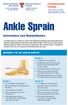 514-412-4400, ext. 23310 2300 Tupper street, C-831, Montreal (Quebec) H3H 1P3 Ankle Sprain Information and Rehabilitation An ankle sprain is a stretch or a tear of the ligaments (bands of tissue that hold
Coccydynia. (Coccyx Pain) Information for patients. Outpatients Physiotherapy Tel: 01473 703312
 Information for patients Coccydynia (Coccyx Pain) Outpatients Physiotherapy Tel: 01473 703312 DPS ref: 4508-12(RP) Issue 1: February 2013 Review date: January 2016 The Ipswich Hospital NHS Trust, 2013.
A proper warm-up is important before any athletic performance with the goal of preparing the athlete both mentally and physically for exercise and
 A proper warm-up is important before any athletic performance with the goal of preparing the athlete both mentally and physically for exercise and competition. A warm-up is designed to prepare an athlete
Injury Prevention for the Back and Neck
 Injury Prevention for the Back and Neck www.csmr.org We have created this brochure to provide you with information regarding: Common Causes of Back and Neck Injuries and Pain Tips for Avoiding Neck and
Lumbar/Core Strength and Stability Exercises
 Athletic Medicine Lumbar/Core Strength and Stability Exercises Introduction Low back pain can be the result of many different things. Pain can be triggered by some combination of overuse, muscle strain,
X-Plain Neck Exercises Reference Summary
 X-Plain Neck Exercises Reference Summary Introduction Exercising your neck can make it stronger, more flexible and reduce neck pain that is caused by stress and fatigue. This reference summary describes
Self Management Program. Ankle Sprains. Improving Care. Improving Business.
 Ankle Sprains Improving Care. Improving Business. What is an ankle sprain? Ligaments attach to the ankle bones and allow for normal movement and help prevent too much motion within the joint. Ankle sprains
INTRODUCTION TO POSITIONING. MODULE 3: Positioning and Carrying
 MODULE 3: Positioning and Carrying Blankets, pillows and towels, sandbags, carpet on the floor, a doll with floppy limbs that can be positioned i.e. not a hard plastic doll, display materials. Icebreaker
EXERCISE INSTRUCTIONS 1
 EXERCISE INSTRUCTIONS 1 Contents ANKLE TOUCHES... 4 BACK EXTENSIONS... 4 BACK REVERSE FLYES... 4 BALL ROLL... 4 BASKETBALL SQUATS... 4 BEAR CRAWL... 4 BICEP CURL (Resistance Band)... 4 BOXING JABS... 5
Physical Capability Strength Test: One Component of the Selection Process
 Physical Capability Strength Test: One Component of the Selection Process One aspect of the Power Systems Institute selection process is to successfully complete and achieve a passing score on a physical
TIPS and EXERCISES for your knee stiffness. and pain
 TIPS and EXERCISES for your knee stiffness and pain KNEE EXERCISES Range of motion exercise 3 Knee bending exercises 3 Knee straightening exercises 5 STRENGTHENING EXERCISES 6 AEROBIC EXERCISE 10 ADDITIONAL
Wellness Workbook. Journaling your way to a healthier life! By Tamiko Arbuckle http://myfoggybrain.com
 Wellness Workbook Journaling your way to a healthier life! By Tamiko Arbuckle http://myfoggybrain.com Please send any questions/ feedback to [email protected] Here s to your Wellness! Welcome and
Functional rehab after breast reconstruction surgery
 Functional rehab after breast reconstruction surgery UHN A guide for women who had DIEP, latissimus dorsi with a tissue expander or implant, or two-stage implant based breast reconstruction surgery Read
Cast removal what to expect #3 Patient Information Leaflet
 Cast removal what to expect #3 Patient Information Leaflet SM466 Now your cast is off, self help is the key! Follow the advice given to you by your doctor and the staff in the clinic. Your skin will be
Spinal Exercise Program/Core Stabilization Program Adapted from The Spine in Sports: Robert G. Watkins
 Spinal Exercise Program/Core Stabilization Program Adapted from The Spine in Sports: Robert G. Watkins Below is a description of a Core Stability Program, designed to improve the strength and coordination
Pre - Operative Rehabilitation Program for Anterior Cruciate Ligament Reconstruction
 Pre - Operative Rehabilitation Program for Anterior Cruciate Ligament Reconstruction This protocol is designed to assist you with your preparation for surgery and should be followed under the direction
The advanced back rehabilitation programme
 Physiotherapy Department The advanced back rehabilitation programme This booklet explains what happens during the advanced back rehabilitation programme and how the exercises may help your condition. We
Yoga Routine. Khun Reinhard. (www.khunreinhard.com)
 Yoga Routine by Khun Reinhard (www.khunreinhard.com) Yoga-Routine Khun Reinhard - 2 - December 2013 Introduction This yoga routine has been taught by the author of this paper over many years to more than
Sports Injury Treatment
 Sports Injury Treatment Participating in a variety of sports is fun and healthy for children and adults. However, it's critical that before you participate in any sport, you are aware of the precautions
Lower Body Exercise One: Glute Bridge
 Lower Body Exercise One: Glute Bridge Lying on your back hands by your side, head on the floor. Position your feet shoulder width apart close to your glutes, feet facing forwards. Place a theraband/mini
Qigong. Ba Duan Jin. The Eight Pieces of Brocade
 Qigong Ba Duan Jin The Eight Pieces of Brocade by Col and g Hamilton Yiheyuan Martial Arts Contents Page Introduction 2 Preparation 2 1. Hold up the Sky 3 2. The Archer 4 3. Join Heaven and Earth 5 4a.
ILIOTIBIAL BAND SYNDROME
 ILIOTIBIAL BAND SYNDROME Description The iliotibial band is the tendon attachment of hip muscles into the upper leg (tibia) just below the knee to the outer side of the front of the leg. Where the tendon
During the breathing exercises, it is important not to use your neck or shoulder muscles. Generally, ten breath cycles per session is adequate.
 Cool-Down Breathing Exercises Overview Breathing exercises help make use of the entire lung and keep the chest muscles active. They allow for more oxygen with each breath and to breathe with less effort.
Exercises for Growing Taller
 1 Exercises for Growing Taller A Mini-Guide By Rodney Williams Copyright and Legal Notice 2 Published by: Copyright 2011. All Rights Reserved. No part of this publication may be reproduced or transmitted
What Are Bursitis and Tendinitis?
 Bursitis and tendinitis are both common conditions that cause swelling around muscles and bones. They occur most often in the shoulder, elbow, wrist, hip, knee, or ankle. A bursa is a small, fluid-filled
Lower Back Pain www.spireperform.com 01283 576333
 Lower Back Pain www.spireperform.com 01283 576333 Low back pain can be caused through deficiencies in movement, posture and your lower limbs or pelvis. The advice in this booklet aims to help with relieving
Carpal Tunnel Pain. STRETCH YOUR: 1) Wrist Flexors 2) Wrist Extensors 3) Wrist Decompression 4) Neck (see other chapters for more examples)
 Carpal Tunnel Pain STRETCH YOUR: 1) Wrist Flexors 2) Wrist Extensors 3) Wrist Decompression 4) Neck (see other chapters for more examples) wrist flexors wrist extensors carpal tunnel Athletic Edge - www.athleticedge.biz
Arthritis of the hip. Normal hip In an x-ray of a normal hip, the articular cartilage (the area labeled normal joint space ) is clearly visible.
 Arthritis of the hip Arthritis of the hip is a condition in which the smooth gliding surfaces of your hip joint (articular cartilage) have become damaged. This usually results in pain, stiffness, and reduced
How To Roll Out
 THE GUIDE: ROLLING OUT WHAT IS THE MYOFASCIAL SYSTEM? The Myofascial System is a superficial fascia (a thin sheath of silvery tissue) that wraps around the outer surface of muscles and individual muscle
ACL RECONSTRUCTION POST-OPERATIVE REHABILITATION PROGRAMME
 ACL RECONSTRUCTION POST-OPERATIVE REHABILITATION PROGRAMME ABOUT THE OPERATION The aim of your operation is to reconstruct the Anterior Cruciate Ligament (ACL) to restore knee joint stability. A graft,
Otago Exercise Program Activity Booklet
 Head Movements Stand up tall and look ahead. Slowly turn your head as far as you can to the right. Slowly turn your head as far as you can to the left. Repeat five times to each side. 44 Neck Movements
Flexibility Assessment and Improvement Compiled and Adapted by Josh Thompson
 Flexibility Assessment and Improvement Compiled and Adapted by Josh Thompson Muscles must have a full and normal range of motion in order for joints and skeletal structure to function properly. Flexibility
Range of Motion & Positioning
 Range of Motion & Positioning Teaching Guide To use this lesson for self-study, the learner should read the material, do the activity, and take the test. For group study, the leader may give each learner
12 Week Do-it-Yourself Fitness Program
 12 Week Do-it-Yourself Fitness Program Created by Brad Awalt, MS, ACSM Assistant Manager, Health Plus [email protected] January 2011 Do you have a goal to begin an exercise routine, but not sure
YOUR GUIDE TO TOTAL HIP REPLACEMENT
 A Partnership for Better Healthcare A Partnership for Better Healthcare YOUR GUIDE TO TOTAL HIP REPLACEMENT PEI Limited M50 Business Park Ballymount Road Upper Ballymount Dublin 12 Tel: 01-419 6900 Fax:
The Santa Monica Orthopaedic and Sports Medicine Research Foundation. The PEP Program: Prevent injury and Enhance Performance
 The Santa Monica Orthopaedic and Sports Medicine Research Foundation The PEP Program: Prevent injury and Enhance Performance This prevention program consists of a warm-up, stretching, strengthening, plyometrics,
Information on Rheumatoid Arthritis
 Information on Rheumatoid Arthritis Table of Contents About Rheumatoid Arthritis 1 Definition 1 Signs and symptoms 1 Causes 1 Risk factors 1 Test and diagnosis 2 Treatment options 2 Lifestyle 3 References
Trunk Strengthening and Muscle and Coordination Exercises for Lower Limb Amputees
 Trunk Strengthening and Muscle and Coordination Exercises for Lower Limb Amputees Part One: Trunk Strengthening Trunk Extension Needed: Sturdy chair or stool, Theraband, and a Theraball if necessary. Sit
.org. Plantar Fasciitis and Bone Spurs. Anatomy. Cause
 Plantar Fasciitis and Bone Spurs Page ( 1 ) Plantar fasciitis (fashee-eye-tiss) is the most common cause of pain on the bottom of the heel. Approximately 2 million patients are treated for this condition
Sue Schuerman, PT, GCS, PhD UNLVPT
 Sue Schuerman, PT, GCS, PhD UNLVPT Exercise & Physical Activity (Your Everyday Guide from the National Institute on Aging) Go4Life Retain our physical and mental health Continue to do the things we enjoy
Cervical Exercise: How important is it? What can be done? The Backbone of Spine Treatment. North American Spine Society Public Education Series
 Cervical Exercise: The Backbone of Spine Treatment How important is it? What can be done? North American Spine Society Public Education Series Important: If you have had an accident that started your neck
Chair Exercises For Older Adults
 Chair Exercises For Older Adults Many of these exercises were adapted from these sources: National Institute on Aging, Exercise: A Guide from the National Institute on Aging, 2001, http://www.nia.nih.gov/healthinformation/publications/exerciseguide/.
Sheet 1A. Treating short/tight muscles using MET. Pectorals. Upper trapezius. Levator scapula
 Sheet 1A Treating short/tight muscles using MET Pectorals Once daily lie at edge of bed holding a half-kilo can, arm out sideways. Raise arm and hold for 10 seconds, then allow arm to hang down, stretching