
Research Article Effects of Machine Tool Spindle Decay on the Stability Lobe Diagram: An Analytical-Experimental Study
|
|
|
- Alban Jackson
- 10 years ago
- Views:
Transcription
1 Shock and Vibration Volume 2016, Article ID , 9 pages Research Article Effects of Machine Tool Spindle Decay on the Stability Lobe Diagram: An Analytical-Experimental Study Omar Gaber and Seyed M. Hashemi Department of Aerospace Engineering, Ryerson University, 350 Victoria Street, Toronto, ON, Canada M5B 2K3 Correspondence should be addressed to Seyed M. Hashemi; [email protected] Received 3 July 2015; Revised 4 October 2015; Accepted 21 October 2015 Academic Editor: Evgeny Petrov Copyright 2016 O. Gaber and S. M. Hashemi. This is an open access article distributed under the Creative Commons Attribution License, which permits unrestricted use, distribution, and reproduction in any medium, provided the original work is properly cited. An analytical-experimental investigation of machine tool spindle decay and its effects of the system s stability lobe diagram (SLD) is presented. A dynamic stiffness matrix (DSM) model for the vibration analysis of the OKADA VM500 machine spindle is developed and is validated against Finite Element Analysis (FEA). The model is then refined to incorporate flexibility of the system s bearings, originally modeled as simply supported boundary conditions, where the bearings are modeled as linear spring elements. The system fundamental frequency obtained from the modal analysis carried on an experimental setup is then used to calibrate the DSM model by tuning the springs constants. The resulting natural frequency is also used to determine the 2D stability lobes diagram (SLD) for said spindle. Exploiting the presented approach and calibrated DSM model it is shown that a hypothetical 10% change in the natural frequency would result in a significant shift in the SLD of the spindle system, which should be taken into consideration to ensure chatter-free machining over the spindle s life cycle. 1. Introduction A great number of airframe structural components are manufactured by high speed milling, where problems can arise related to the instability in the process, dimensional errors in the work pieces, and even breakage of the tools. The instability of the process, a vibration phenomenon known as chatter, appears in the high removal rate roughing, as well as in the finishing of low rigidity airframe sections. Machine chatter has been researched since the early 20th century [1]. It has been well established that chatter is dependent on the dynamic behavior of machine tool structure and is directly linked to the machine vibrational characteristics [2], which is often expressed in terms of the frequency response function (FRF) of the system at the tool point. As the machine vibrational characteristics change, the machine stability behavior changes. Inthemid-1990s,AltintasandBudak[3]presentedan analytical form of the so-called two-dimensional (2D) stability lobe theory for milling. The two-dimensional stability lobe theory deals with the stability of solutions for dynamical cutting systems, which usually stands for the spindle speed and axial depth of cut. As a function of these two cutting parameters, the border between a stable cut (i.e., chatterfree) and an unstable one (i.e., with chatter) can be visualized in a chart known as stability lobes diagram (SLD). A stable cut is defined as cut where the tool tooth displacement decreases from one pass to the next dampening the effect of the initial deflection. If the displacement increases or stays the same causing a wave pattern on the part, the cut is unstable. Numerous effective experimental and analytical techniques have been developed to establish SLD and to predict stable processes in recent decades (see, e.g., Altintas and Weck [4]). A more recent review of methods of obtaining stability lobe diagram in high speed milling operation is presented by Palpandian et al. [5]. 3D stability lobes were also later established considering radial depth of cut as another parameter [6]. Both of these stability lobe theories can help to select the appropriate cutting parameters of the spindle speed and axial depth to avoid chatter in machining processes. Attempts have also been made to integrate the dynamical behaviorvariationofthepartwithrespecttothetoolposition in 3D lobes construction, with application to thin-walled structure milling, in order to determine optimal cutting conditions during the machining process [7].
2 2 Shock and Vibration The stability lobes calculation requires the dynamic parameters of the system, namely, stiffness, natural frequency, and damping ratio of the workpiece for each natural mode. Thevenot et al. [7] used FEM-based numerical models to determine the system s stiffness terms, but the damping ratio cannot be easily calculated numerically, and therefore it is usually evaluated through experimental measurements. Ertürk et al. [8] modeled the machine tool spindle with a set of springs and dampers to simulate bearing behavior and to predict tool tip FRF. Cao and Altintas [9] investigated the effect of preload applied to a bearing on the overall system natural frequency and showed that the greater the preload, the higher the system s natural frequency. Many researchers have studied the stability through machine behavior, assuming a rigid work piece. The tool tip transfer function is then elaborated through models or experimental approaches. In addition, most of the previous models reportedintheopenliteraturehavebeendevelopedassuming that spindle-tool set dynamics do not change over the full spindle speed range. However, this assumption needs to be reconsidered in high speed machining, where gyroscopic moments and centrifugal forces on both bearings and spindle shaft induce spindle speed dependent dynamics changes. Furthermore, the change of spindle system dynamics has not been accounted for in most existing stability studies. Few studies were also reported considering the flexibility of work piece [10]. In summary, the methods of obtaining stability lobe diagram (SLD) can be divided in three main categories, namely, experimental, semianalytical, and analytical approaches. The aim of experimental methods is to obtain SLD by conducting a series of experiments on work piece by machining it using a milling machine tool; while machining at a certain depth of cut along the tool path, forced vibrations turn into self-excited vibrations, causing the milling process to become unstable, that is, chatter onset. This procedure is used in various experiments and is repeated for various depth of cut and spindle speed combinations. In semianalytical methods, most of the parameters required to obtain stability lobes are calculated analytically. The modal parameters of spindle/tool-holder/tool systems, however, are obtained experimentally (e.g., using tap test), from the resulting FRF of the system. The system s parameters canthenbeusedtocalculateitssld. The analytical approaches (see, e.g., [3]) aim to obtain the transfer functions of structure, which is required in the stability model, and to eliminate the need for series of costly experimental impact testing at various points on a work piece. The dynamic characteristics of the entire (spindle/toolholder/tool) system, contributing in the transfer functions of structure, have been shown to depend on a large number of factors, including holder characteristics, spindle shaft geometry and drawbar force, and the stiffness and damping provided by the bearings. Thus the analytical approaches, complemented with numerical methods such as FEM, eliminate the need for experimentation and save the time and cost involved in determining the stability lobes. The aim of this paper is to present a semianalytical stability technique, developed to incorporate the spindle s dynamic behavior variations in the stability lobes diagram (SLD). The change in the spindle s dynamic behavior, also referred to as aging, is generally caused by system s bearings wear, translated through a reduction in the system s natural frequencies. Exploiting and adapting the dynamic stiffness matrix (DSM) method [11], the model of the spindle system is generated, where the boundary conditions (BC) at the bearings are originally enforced using simple supports. The spindle DSM model is also validated against conventional FEM-based simulations generated in the educational version of commercial software ANSYS V13. Once the correctness of the DSM method has been established, the simple supports BC are replaced with linear spring elements to incorporate the inherent flexibility of the bearings. The experimental (working) fundamental frequency of the spindle system, determined from FRF data obtained from tap testing, is subsequently used to adjust the spring stiffness constants, leading to a calibrated dynamic stiffness matrix (CDSM) [12] model of the system. Using the system s CDSM model and the experimental FRF data, the SLD can then be determined. Exploiting the proposed semianalytical method, it will then be possible to evaluate updated SLD and optimized machining parameters, should one know the variation of system s stiffness (i.e., changes in the fundamental frequency) over the spindle life cycle. The application of the proposed model is demonstrated throughanokadavm500machinespindle,wherethe shift in the SLD resulting from a simulated 10% reduction of the system s fundamental frequency and its effects on the machining parameters are investigated. The spindle, initially examined while mounted on the original machine tool, was then installed on a bench top fixture to carry out further experimentations. 2. Theory and Governing Equations In what follows, the differential equations governing the bending-bending (BB) vibrations of a spinning beam segment are briefly discussed. Following mainly the theory presented by Banerjee and Su [11], the effect of torsional stiffness is assumed to be large enough so that the torsional vibrations can be ignored (see, e.g., [12]). Figure 1 shows the beam in a right-handed rectangular Cartesian coordinates system. The beam length is L, the mass per unit length is m=ρa, the polar mass moment of inertia per unit length is I α, the principal axes bending rigidities are EI for both planes, and the torsional rigidity is GJ. The differential equations governing the bendingbending (BB) vibrations of a spinning beam segment can be written as [11, 12] EI yy u mω 2 u+mu 2mΩV =0, (1) 2mΩu EI xx V mv +mω 2 V =0, (2) where u and V are displacement of a point, P, at an arbitrary cross sectionat z, in the X and Y directions. The cross section is allowed to rotate or twist about the OZ axis. The resulting
3 Shock and Vibration 3 θ x2 U 1 θ x2 U2 where λ 2 x = mω2 L 4 EI xx, λ 2 y = mω2 L 4 EI yy, (11) V 1 θ y2 V 2 θ y2 Figure 1: Degrees of freedom of a spinning beam segment. loads are then found to be in the following forms, written for shear forces as and for Bending Moments as S x =EI xx u, (3) S y =EI yy V M x =EI xx V, M y = EI yy u. Assuming simple harmonic motion, u (z, t) =U(z) cos ωt, V (z, t) =V(z) sin ωt, where ω is the circular frequency of oscillation and U and V, respectively, are the amplitudes of u and V. Substituting(5) into (1) and (2), they can be rewritten as (4) (5) (EI yy U m(ω 2 +ω 2 ) U) + 2mΩωV = 0, (6) (EI xx V m(ω 2 +ω 2 ) V) + 2mΩωU = 0. (7) Now we introduce ξ = z/l and D = d/dξ, which are nondimensional length and the differential operator. We substitute them back into (6) and (7): η 2 = Ω2 ω 2. The solution of the differential equation is sought in the form Substituting (12) into (10) leads to where W=e rξ. (12) r 8 (λ 2 x +λ2 y )(1+η2 )r 4 +λ 2 x λ2 y (1 η2 ) 2, (13) r 1,3 =± α, r 2,4 =± β, r 5,7 =±i α, r 6,8 =±i β, α 2 = 1 2 {(λ2 x +λ2 y )(1+η2 ) + (λ 2 x λ2 y )2 (1 + η 2 ) λ 2 x λ2 y η2 } β 2 = 1 2 {(λ2 x +λ2 y )(1+η2 ) (λ 2 x λ2 y )2 (1 + η 2 ) λ 2 x λ2 y η2 }. (14) (15) (16) Based on the roots presented in (14), solutions for U and V can then be written as U=(A 1 sin αξ + A 2 cos αξ + A 3 sinh αξ [D 4 m(ω2 +ω 2 )L 4 EI yy [D 4 m(ω2 +ω 2 )L 4 EI xx ]U+ 2mΩωL4 EI yy V=0, (8) ] V+ 2mΩωL4 EI xx U=0. (9) +A 4 cosh αξ + A 5 sin βξ + A 6 cos βξ +A 7 sinh βξ + A 8 cosh βξ) V=(B 1 sin αξ + B 2 cos αξ + B 3 sinh αξ (17) Combining the above equations into one 8th order, the resultingdifferential equationin terms of W, satisfied by both U and V,isthenwrittenas [D 8 (λ 2 x +λ2 y )(1+η2 )D 4 +λ 2 x λ2 y (1 η2 ) 2 ]W =0, (10) +B 4 cosh αξ + B 5 sin βξ + B 6 cos βξ +B 7 sinh βξ + B 8 cosh βξ). Based on Euler-Bernoulli beam bending theory, the corresponding bending rotation, that is, slope, about X and Y
4 4 Shock and Vibration axes, Θ x and Θ y,respectively,isgivenby(see[12]forfurther details): Θ x = dv dz = 1 dv L dξ, Θ y = du dz = 1 du L dξ. (18) By doing similar substitutions in load equations (3) and (4), one finds S x =( EI yy U L 3 )(d3 dξ 3 ), S y =( EI xx V L 3 )(d3 dξ 3 ), M x =( EI yy U L 2 )(d2 dξ 2 ), M y =( EI xx V L 2 )(d2 dξ 2 ). (19) Substituting the boundary conditions into the governing equations, enforced at z = 0 (ξ = 0)andz = L (ξ = 1), leads to δ = BR, (20) where δ =[U 1 V 1 Θ x1 Θ y1 U 2 V 2 Θ x2 Θ y2 ] T, (21) R =[R 1 R 2 R 3 R 4 R 5 R 6 R 7 R 8 ] T. Substituting similarly for the force equation one finds F = AR, (22) where F =[S x1 S y1 M x1 M y1 S x2 S y2 M x2 M y2 ] T. (23) Finally, the frequency-dependent, dynamic stiffness matrix (DSM) of the spinning beam segment, K(ω), can be derived by eliminating R, wheretheforceamplitudeisrelatedtothe displacement vector by F = Kδ (24) and F = K(BR) =AR, where assuming KB = A finally leads to K (ω) = AB 1. (25) The element matrices are then assembled to find the global dynamicstiffnessmatrix, K(ω), and the system boundary conditions are applied. Setting force vector F = 0 (for free vibrations) then leads to the following nonlinear eigenproblem: K (ω) δ = 0, (26) where the solution then consists of searching for system natural frequencies, ω, satisfying K (ω) = 0. (27) 3. Numerical DSM Results The DSM formulation was used to model an OKADA VM500 vertical milling machine spindle [13] (see Figure 2 for the schematic structure of the spindle). The spindle has a total of 10bearings,withfoursetsofangularcontactbearingsandtwo other ball bearings, and two belt assemblies, which provide the necessary driving force from the spindle motor. The spindle dimensions and geometric/sectional data, modeled using CATIA V5, were taken from [13]. For the sake of modeling convenience, the tapered and curved areas of the spindle and tool were modeled as uniform sections. The spindle along with the tool-holder and tool was modeled as a single piecewise uniform, stepped system, as shown in Figure 3, where the connection between the tool and heat shrink tool-holder is assumed to be rigid, as instructed by the tool-holder manufacturer. In the case of system studied here, the grip force is 5000 to lbf, depending on the extent of the interference fit, that is, in. The rigid connection assumption is justified, as the cutting forces required for aluminum are normally much less than the nominal grip forces, that is, 2000 N or 450 lbf of maximum referenceforce,asreportedin[2].alsothetool-holderis made of hardened steel and therefore the deflection of this connection is minimal. The spindle was modeled using the DSM method presented in the previous section, where only one element per uniform segment (i.e., a total of 26 elements) was used and simply supported boundary conditions were applied at the bearings locations. The material properties of tool steel, elastic modulus of E = 210 GPa and mass density of ρ = 7850 Kg/m 3, were used. Modal analysis was carried out and the fundamental flexural natural frequency of the spindle system was found to be 2303 Hz. To validate the spindle DSM model, frequency data were compared with those obtained from a 154-element FEM model created in ANSYS V13 software [14]. The BEAM188 element used is one-dimensional (1D) line element and has 2 nodes and 6 degrees of freedom (3 translational and 3 rotational). Comparing the DSM and FEM frequency results shows minor differences, with less than 3% error, confirming the correctness and accuracy of the DSM model, making it attractive for practical modeling applications. 4. Experimental Modal Analysis The experimental modal analysis results, obtained using tap testing, were used to determine the system s nominal fundamental frequency. Experimental Apparatus (Figure 4) includes the following components: (1) 352A21 (Light, 0.8 g) accelerometer, (2) 086C04 (5000 N Hammer) Hammer, (3) SIM3 Module Photon+ Data Acquisition, (4) MetalMax Software (TXF). The accelerometer was attached to the edge of the tool-holder using wax. The spindle was struck 10 times and the average FRF graphs were generated and the experimentally evaluated
5 Shock and Vibration 5 Figure 2: Schematic diagram of an OKADA VM500 spindle [13]. z x y Bearing location Tool-holder Tool Figure 3: Spindle model. 5.00E 07 Real portion of FRF graph FRF data points (m/n) 3.00E E 07 A B E 07 Frequency (Hz) 3.00E 07 Figure 4: Experimental equipment. frequency response function (FRF) data were measured for the spindle system while mounted on the machine (see Figures5and6).AscanbeobservedfromFRFgraphs,themost predominant natural frequency measured experimentally is foundtobe1722hz,correspondingtothelowestpeakofthe imaginary part of the FRF graph. 5. Experimentally Calibrated CDSM Results The system s fundamental frequencies were found to be much higher than that of the experimentally measured fundamental natural frequency, that is, 2303 Hz (from DSM) and 2367 Hz (from FEM) versus 1722 evaluated experimentally. The large difference (34%) between numerical and experimental results 5.00E 07 Figure 5: Spindle experimental frequency response function (FRF) (real part). FRF data point (m/n) Imaginary portion of FRF graph 1.00E E 22 C E 07 Frequency (Hz) 2.00E E E E E 07 D Figure 6: Spindle experimental frequency response function (FRF) (imaginary part).
6 6 Shock and Vibration 2500 Spindle operational speed limit Figure 7: Spindle with bearings replaced with springs. Spindle natural frequency (Hz) OKADA natural frequency (Hz) E E E E E + 04 Bearing equivalent spring constant K (N/m) Varying K Simply supported Figure 8: System fundamental frequency versus bearing equivalent spring constant for a low speed spindle (in log scale). canbeassociatedwiththebearingsflexibility.asmentioned earlier in this paper, the spindle DSM and FEM models were both initially equipped with simply supported (frictionless pin) boundary conditions at the bearing locations, that is, infinite lateral stiffness. A calibrated dynamic stiffness matrix (CDSM) model of the system was created by implementing spring boundary conditions (i.e., finite lateral stiffness) in the spindle s DSM model (Figure 7). The spring constant, K S, was then varied to calibrate the model to the experimentally evaluated fundamental frequency of the spindle system (see Figure 8). As it is clear from Figure 8, as the spring stiffness, K S, is increased, the natural frequency asymptotically approaches the natural frequency value for the spindle with simply supported boundary conditions, that is, bearings with zero flexibility, or infinite stiffness. 1.00E E E E E E E Spring BC Simply supported Spindle RPM Figure 9: Spindle natural frequency versus spindle RPM; high torque spindle. To achieve the system s experimental natural frequency of 1722 Hz, the required bearing stiffness was found to be k s = N/m (see Figure 8). Furthermore, the spindle s critical speed was also evaluated using both uncalibrated DSM and calibrated CDSM models and is found to be 138,464 RPM and 103,142 RPM, respectively (See Figure 9). Both values, however, are well above the operational RPM of the spindle; the suggested manufactures operational speed is 6000 RPM. 6. Stability Lobes The stability lobes were generated using the experimental FRF data obtained. The peak picking method was used to determine the equivalent stiffness at the tool tip [2]. Consider again the initial FRF data, shown in Figures 5 and 6. In the imaginary graph (Figure 6), the frequencies labeled at C correspond to the minimum peaks of the FRF. The corresponding frequency at this peak represents the dominant natural frequency of the system, ω n.theequivalent damping ratio at each mode can be calculated by using the two frequencies in the real part (ω A and ω B ): Ž = ω B ω A. (28) 2ω n ThepeakvalueofFRFintheimaginarypart(Figure6)isused to calculate the equivalent stiffness values at each mode: K exp = 1 2ŽD. (29) Using above K exp, one can then generate stability lobes diagram (SLD) using methods described in [2] (see Figure 10, thegraphsinredcolor,wheredampingratioofž =
7 Shock and Vibration 7 Stability chart for an OKADA VM500 spindle using 2 different frequencies Depth of cut (mm) Hz 1722 Hz Spindle RPM Figure 10: Stability chart an OKADA VM500 spindle using 2 different frequencies. and the equivalent stiffness value of K exp = E+07 N/m have been used to generate the SLD). Furthermore, exploiting the calibrated CDSM method, it is possible to evaluate updated SLD and optimized machining parameters, should one know the variation of system s stiffness (i.e., changes in the fundamental frequency) over the spindle life cycle. This reduction can correspond to a combination of bearing degradation and loss of bearing preload due to age and/or damage. For the spindle system at hand, however, the authors were not able to find any data publicly available on the time history and reduction of the system s fundamental frequency versus service time. However, to demonstrate the application of the presented CDSM and the process, let us consider a hypothetical 10% reduction in the system s fundamental frequency. As presented in [2], the stability lobes are generated based on a spindle structure modeled as a single-dof system, subjected to end force. However, the spindle models investigated here consist of continuous DSM elements (or largenumberofbeamfemelements)andthesupporting bearings represented by multiple linear spring elements. Therefore, one needs to first convert the rotating system to a spring-damper system, in order to evaluate the equivalent stiffness of the entire updated system, K theo. In what follows, the process of evaluating K theo is briefly presented. Exploiting the graph given in Figure 8 (the system s natural frequency versus spring constant), the required bearing stiffness, K s, in the calibrated DSM model to achieve a fundamental frequency of 1550 Hz (i.e., 90% of the nominal experimental frequency) is first evaluated (k s = N/m). The updated calibrated dynamic stiffness matrix ofthesystemisthenconvertedtoastaticstiffnessmatrixby linearizing the nonlinear eigenvalue problem of the system, as described by Hashemi (1998) [15]. Based on this method, the static stiffness of the system can be evaluated at zero frequency (i.e., no vibration: ω=0), or in the neighborhood of any given frequency [16]. Let us consider a very small natural frequency, ω L,inthe vicinity of zero (ω 0). Adding a very small frequency increment, Δω,toω L,leadsto ω U =ω L +Δω (30) and an average frequency value, ω, defined as ω= (ω U +ω L ). (31) 2 Linearizing the updated system s nonlinear eigenproblem (26), in the vicinity of ω,leadsto [K (ω)] = [K] ω 2 [M], (32) where K(ω) is the system DSM and [K] and [M] are the static stiffness and mass matrices, respectively. Subsequently, the mass matrix of the system is written as d [K (ω)] [M] = d(ω 2 ) (33) andsubstituting(33)backinto(32),thesystemstaticstiffness matrix is obtained as [K] = [K (ω)] + ω 2 [M (ω)]. (34) Once the static stiffness matrix of the system, [K], has been evaluated, one can then apply any force to the node representing the tool tip in the spindle model and calculate the deflection, x, in the same direction as the applied force, F x, using the following expression: [U] = [K] 1 [F]. (35) This deflection, x, is then used to calculate the theoreticaltool stiffness, as follows: K theo = F x x. (36) The updated system s parameters are then used to develop the revised stability lobes diagrams (SLD). The updated stability lobes, together with original SLD, are shown in Figure 10 graphs in blue, where damping ratio of Ž = and the equivalent stiffness value of K theo = E + 07 N/m have been used to generate the SLD. As it is clear from Figure 10, a 10% reduction in the system s fundamental frequency leads to a significant shift in the stability lobes. If this shift is not accounted for and the machining parameters are not updated, a chatter-free cutting program can start yielding chatter as the spindle ages and/or gets damaged. A typical 10% reduction in the system s natural frequency over the spindle s lifetime hasbeenpreviouslyobservedandreportedinanearlierwork by the authors [17]. Furthermore, it is worth noting that an FEM model (see, e.g., [14]) could be developed and calibrated for the spindle modeling purposes and subsequently used to producethesystem sfrf.however,theaimofthepresent study was to introduce the dynamic stiffness matrix (DSM) approach to assess the system s dynamic behavior. The DSM
8 8 Shock and Vibration method, formulated based on the continuous beam model and exact within the limits of the theory, is validated against FEM and used to ultimately evaluate K theo,representingthe system s overall stiffness, treated as an equivalent single- DOF system. It is to be noted that one could equally use conventionalfemtoachievethesamegoal. Finally,thereasonfornotusingtheFRFdirectlyand entirely is the extremely large amount of data points in the FRF file. The goal of the present study was to use a quick approach to generate stability lobes that would benefit someone working as a machine operator in a manufacturing facility, with limited computation capabilities, that is, the CNC machine programmers. The stability lobes generated in this research, however, were confirmed against ones directly generated from FRF graphs. Additionally, as also suggested in [18], including the higher/additional modes obtained from the FRF does not increase the accuracy of the stability lobe chart significantly. 7. Conclusion An experimentally calibrated dynamic stiffness matrix (DSM) formulation was presented and used to model an OKADA VM500 spindle. Unlike conventional FEM, the modeling method commonly used in this field, the presented element DSM is exact within the limits of the theory. As a result,incomparisonwithfem,thedsmmodelrequires much fewer elements to achieve the desired precision, that is, one element per uniform segment. The system s natural frequency found experimentally was used to calibrate the spindle model, equipped with bearings represented as linear spring elements, and to generate spindle s stability lobes. This natural frequency was then reduced by 10% to simulate a bearing degradation, or loss of preload due to spindle aging and/or damage. Incorporating the reduced frequency into the calibrated DSM, it was utilized to calculate the spindle s equivalent stiffness value, used to generate updated stability lobe diagram. It was found that a 10% reduction in frequency leads to a significant shift in the stability lobes, which should betakenintoconsiderationtoensurethatamachinespindle runs chatter-free over its entire life cycle. Disclosure The authors declare that this paper presents the results of a recent research, conducted by the first author, under the supervision of the second (corresponding) author. The authors also declare that the present paper in its present form has not been published, nor has it been submitted for publication, in any other journals. Conflict of Interests The authors declare that there is no conflict of interests regarding the publication of this paper. Acknowledgments The authors wish to acknowledge the supports provided by Natural Sciences and Engineering Research Council of Canada (NSERC) and Ryerson University. References [1] F. W. Taylor, OntheArtofCuttingMetal,vol.28ofTransactions of the ASME,1907. [2] T.L.SchmitzandK.S.Smith,Machining Dynamics, Springer, [3] Y. Altintas and E. Budak, Analytical prediction of stability lobes in milling, CIRP Annals Manufacturing Technology, vol.44, no. 1, pp , [4] Y. Altintas and M. Weck, Chatter stability of metal cutting and grinding, CIRP Annals Manufacturing Technology,vol.53,no. 2, pp , [5] P.Palpandian,R.V.Prabhu,andS.SatishBabu, Stabilitylobe diagram for high speed machining processes: comparison of experimental and analytical methods a review, International Journal of Innovative Research in Science, Engineering and Technology,vol.2,no.3,pp ,2013. [6] A. Tang and Z. Liu, Three dimensional stability lobe and maximum material removal rate in end milling of thin walled plate, Advanced Manufacturing Technology, vol. 43, no. 1-2, pp , [7] V. Thevenot, L. Arnaud, G. Dessein, and G. Cazenave-Larroche, Integration of dynamic behaviour variations in the stability lobes method: 3D lobes construction and application to thinwalled structure milling, The Advanced Manufacturing Technology,vol.27,no.7-8,pp ,2006. [8] A. Ertürk, H. N. Özgüven, and E. Budak, Analytical modeling of spindle-tool dynamics on machine tools using Timoshenko beam model and receptance coupling for the prediction of tool point FRF, Machine Tools & Manufacture,vol.46,no.15,pp ,2006. [9] Y. Cao and Y. Altintas, Modeling of spindle-bearing and machine tool systems for virtual simulation of milling operations, Machine Tools & Manufacture, vol.47,no.9,pp ,2007. [10] U.Bravo,O.Altuzarra,L.N.L.DeLacalle, J.A.Sánchez, and F. J. Campa, Stability limits of milling considering the flexibility of the workpiece and the machine, Machine Tools and Manufacture, vol.45,no.15,pp , [11] J. R. Banerjee and H. Su, Development of a dynamic stiffness matrix for free vibration analysis of spinning beams, Computers and Structures, vol. 82, no , pp , [12] O. Gaber and S. M. Hashemi, On the free vibration modeling of spindle systems: a calibrated dynamic stiffness matrix, Shock and Vibration,vol.2014,ArticleID787518,10pages,2014. [13] OKADA VM500 FANUC 6MB, Maintenance Manual. [14] H. Sambandamurthy, Numerical and experimental modal analysis of machine tool spindle systems [M.S. thesis], Department of Aerospace Engineering, Ryerson University, Toronto, Canada, [15] S. M. Hashemi, Free vibrational analysis of rotating beamlike structures: a dynamic finite element approach [Ph.D. thesis], Department of Mechanical Engineering, Laval University, Québec, Canada, 1998.
9 Shock and Vibration 9 [16] T. H. Richards and Y. T. Leung, An accurate method in structural vibration analysis, JournalofSound&Vibration, vol. 55,no.3,pp ,1977. [17] O. Gaber and S. M. Hashemi, Prediction of updated cutting parameters for a spindle subjected to bearing wear: a free vibration-based approach, Advanced Materials Research, vol , pp , [18] Y. Altintas, Manufacturing Automation: Metal Cutting Mechanics, Machine Tool Vibrations, and CNC Design, Cambridge University Press, Cambridge, UK, 2nd edition, 2012.
10 Rotating Machinery Engineering Journal of The Scientific World Journal Distributed Sensor Networks Journal of Sensors Journal of Control Science and Engineering Advances in Civil Engineering Submit your manuscripts at Journal of Journal of Electrical and Computer Engineering Robotics VLSI Design Advances in OptoElectronics Navigation and Observation Chemical Engineering Active and Passive Electronic Components Antennas and Propagation Aerospace Engineering Modelling & Simulation in Engineering Shock and Vibration Advances in Acoustics and Vibration
PREDICTION OF MACHINE TOOL SPINDLE S DYNAMICS BASED ON A THERMO-MECHANICAL MODEL
 PREDICTION OF MACHINE TOOL SPINDLE S DYNAMICS BASED ON A THERMO-MECHANICAL MODEL P. Kolar, T. Holkup Research Center for Manufacturing Technology, Faculty of Mechanical Engineering, CTU in Prague, Czech
Experimental Analysis of Regenerative Chatter in BFW Vertical Milling Machine
 Experimental Analysis of Regenerative Chatter in BFW Vertical Milling Machine Sunilsing Rajput 1, Dr. D.S. Deshmukh 2 P.G. Student, Department of Mechanical Engineering, SSBT College of Engineering, Jalgaon,
Dispersion diagrams of a water-loaded cylindrical shell obtained from the structural and acoustic responses of the sensor array along the shell
 Dispersion diagrams of a water-loaded cylindrical shell obtained from the structural and acoustic responses of the sensor array along the shell B.K. Jung ; J. Ryue ; C.S. Hong 3 ; W.B. Jeong ; K.K. Shin
Vibrations of a Free-Free Beam
 Vibrations of a Free-Free Beam he bending vibrations of a beam are described by the following equation: y EI x y t 4 2 + ρ A 4 2 (1) y x L E, I, ρ, A are respectively the Young Modulus, second moment of
Analytical Prediction of Part Dynamics for Machining Stability Analysis
 Paper: Analytical Prediction of Part Dynamics Salih Alan, Erhan Budak, and H. Nevzat Özgüven Department of Mechanical Engineering, Middle East Technical University 06531 Ankara, Turkey Faculty of Engineering
Rotor Dynamic Response of a High-Speed Machine Tool Spindle
 Rotor Dynamic Response of a High-Speed Machine Tool Spindle Nagaraj Arakere, Assoc. Prof., Tony L. Schmitz, Asst. Prof., Chi-Hung Cheng, Grad. Student University of Florida, Department of Mechanical and
International Journal of Engineering Research-Online A Peer Reviewed International Journal Articles available online http://www.ijoer.
 RESEARCH ARTICLE ISSN: 2321-7758 DESIGN AND DEVELOPMENT OF A DYNAMOMETER FOR MEASURING THRUST AND TORQUE IN DRILLING APPLICATION SREEJITH C 1,MANU RAJ K R 2 1 PG Scholar, M.Tech Machine Design, Nehru College
The simulation of machine tools can be divided into two stages. In the first stage the mechanical behavior of a machine tool is simulated with FEM
 1 The simulation of machine tools can be divided into two stages. In the first stage the mechanical behavior of a machine tool is simulated with FEM tools. The approach to this simulation is different
CHAPTER 3 MODAL ANALYSIS OF A PRINTED CIRCUIT BOARD
 45 CHAPTER 3 MODAL ANALYSIS OF A PRINTED CIRCUIT BOARD 3.1 INTRODUCTION This chapter describes the methodology for performing the modal analysis of a printed circuit board used in a hand held electronic
8.2 Elastic Strain Energy
 Section 8. 8. Elastic Strain Energy The strain energy stored in an elastic material upon deformation is calculated below for a number of different geometries and loading conditions. These expressions for
Finite Element Formulation for Beams - Handout 2 -
 Finite Element Formulation for Beams - Handout 2 - Dr Fehmi Cirak (fc286@) Completed Version Review of Euler-Bernoulli Beam Physical beam model midline Beam domain in three-dimensions Midline, also called
Unit - 6 Vibrations of Two Degree of Freedom Systems
 Unit - 6 Vibrations of Two Degree of Freedom Systems Dr. T. Jagadish. Professor for Post Graduation, Department of Mechanical Engineering, Bangalore Institute of Technology, Bangalore Introduction A two
OPTIMIZING STATIC AND DYNAMIC STIFFNESS OF MACHINE TOOLS SPINDLE SHAFT, FOR IMPROVING MACHINING PRODUCT QUALITY
 Journal of KONES Powertrain and Transport, Vol. 20, No. 4 2013 OPTIMIZING STATIC AND DYNAMIC STIFFNESS OF MACHINE TOOLS SPINDLE SHAFT, FOR IMPROVING MACHINING PRODUCT QUALITY Tri Prakosa, Agung Wibowo
An Analytical Design Method for Milling Cutters With Nonconstant Pitch to Increase Stability, Part I: Theory
 E. Budak* Faculty of Engineering and atural Sciences, Sabancı University, İstanbul, Turkey e-mail: [email protected] An Analytical Design Method for Milling Cutters With onconstant Pitch to Increase
STUDY OF DAM-RESERVOIR DYNAMIC INTERACTION USING VIBRATION TESTS ON A PHYSICAL MODEL
 STUDY OF DAM-RESERVOIR DYNAMIC INTERACTION USING VIBRATION TESTS ON A PHYSICAL MODEL Paulo Mendes, Instituto Superior de Engenharia de Lisboa, Portugal Sérgio Oliveira, Laboratório Nacional de Engenharia
Simulation in design of high performance machine tools
 P. Wagner, Gebr. HELLER Maschinenfabrik GmbH 1. Introduktion Machine tools have been constructed and used for industrial applications for more than 100 years. Today, almost 100 large-sized companies and
DYNAMIC MODELING AND ANALYSIS OF MOTORIZED MILLING SPINDLES FOR OPTIMIZING THE SPINDLE CUTTING PERFORMANCE
 DYNAMIC MODELING AND ANALYSIS OF MOTORIZED MILLING SPINDLES FOR OPTIMIZING THE SPINDLE CUTTING PERFORMANCE Dr. Sinan Badrawy, Engineering Manager Moore Nanotechnology Systems, LLC ABSTRACT Future machine
EFFECTS ON NUMBER OF CABLES FOR MODAL ANALYSIS OF CABLE-STAYED BRIDGES
 EFFECTS ON NUMBER OF CABLES FOR MODAL ANALYSIS OF CABLE-STAYED BRIDGES Yang-Cheng Wang Associate Professor & Chairman Department of Civil Engineering Chinese Military Academy Feng-Shan 83000,Taiwan Republic
3-D WAVEGUIDE MODELING AND SIMULATION USING SBFEM
 3-D WAVEGUIDE MODELING AND SIMULATION USING SBFEM Fabian Krome, Hauke Gravenkamp BAM Federal Institute for Materials Research and Testing, Unter den Eichen 87, 12205 Berlin, Germany email: [email protected]
Soil Dynamics Prof. Deepankar Choudhury Department of Civil Engineering Indian Institute of Technology, Bombay
 Soil Dynamics Prof. Deepankar Choudhury Department of Civil Engineering Indian Institute of Technology, Bombay Module - 2 Vibration Theory Lecture - 8 Forced Vibrations, Dynamic Magnification Factor Let
Solved with COMSOL Multiphysics 4.3
 Vibrating String Introduction In the following example you compute the natural frequencies of a pre-tensioned string using the 2D Truss interface. This is an example of stress stiffening ; in fact the
SPINDLE ERROR MOVEMENTS MEASUREMENT ALGORITHM AND A NEW METHOD OF RESULTS ANALYSIS 1. INTRODUCTION
 Journal of Machine Engineering, Vol. 15, No.1, 2015 machine tool accuracy, metrology, spindle error motions Krzysztof JEMIELNIAK 1* Jaroslaw CHRZANOWSKI 1 SPINDLE ERROR MOVEMENTS MEASUREMENT ALGORITHM
Back to Elements - Tetrahedra vs. Hexahedra
 Back to Elements - Tetrahedra vs. Hexahedra Erke Wang, Thomas Nelson, Rainer Rauch CAD-FEM GmbH, Munich, Germany Abstract This paper presents some analytical results and some test results for different
The elements used in commercial codes can be classified in two basic categories:
 CHAPTER 3 Truss Element 3.1 Introduction The single most important concept in understanding FEA, is the basic understanding of various finite elements that we employ in an analysis. Elements are used for
DEVELOPMENT AND APPLICATIONS OF TUNED/HYBRID MASS DAMPERS USING MULTI-STAGE RUBBER BEARINGS FOR VIBRATION CONTROL OF STRUCTURES
 13 th World Conference on Earthquake Engineering Vancouver, B.C., Canada August 1-6, 2004 Paper No. 2243 DEVELOPMENT AND APPLICATIONS OF TUNED/HYBRID MASS DAMPERS USING MULTI-STAGE RUBBER BEARINGS FOR
Finite Element Analysis for Acoustic Behavior of a Refrigeration Compressor
 Finite Element Analysis for Acoustic Behavior of a Refrigeration Compressor Swapan Kumar Nandi Tata Consultancy Services GEDC, 185 LR, Chennai 600086, India Abstract When structures in contact with a fluid
The use of Operating Deflection Shapes (ODS) to model the vibration of sanders and polishers HSL/2006/104. Project Leader: Author(s): Science Group:
 Harpur Hill, Buxton Derbyshire, SK17 9JN T: +44 (0)1298 218000 F: +44 (0)1298 218590 W: www.hsl.gov.uk The use of Operating Deflection Shapes (ODS) to model the vibration of sanders and polishers HSL/2006/104
ME 343: Mechanical Design-3
 ME 343: Mechanical Design-3 Design of Shaft (continue) Dr. Aly Mousaad Aly Department of Mechanical Engineering Faculty of Engineering, Alexandria University Objectives At the end of this lesson, we should
Fluid structure interaction of a vibrating circular plate in a bounded fluid volume: simulation and experiment
 Fluid Structure Interaction VI 3 Fluid structure interaction of a vibrating circular plate in a bounded fluid volume: simulation and experiment J. Hengstler & J. Dual Department of Mechanical and Process
New approaches in Eurocode 3 efficient global structural design
 New approaches in Eurocode 3 efficient global structural design Part 1: 3D model based analysis using general beam-column FEM Ferenc Papp* and József Szalai ** * Associate Professor, Department of Structural
STATIC STIFFNESS ANALYSIS OF HIGH FREQUENCY MILLING SPINDLE
 STATIC STIFFNESS ANALYSIS OF HIGH FREQUENCY MILLING SPINDLE Anandkumar Telang Assistant.Professor, Mechanical Engg Department, BKIT, Bhalki, Karnataka, India Abstract Compared with conventional spindles,
DYNAMIC ANALYSIS OF THICK PLATES SUBJECTED TO EARTQUAKE
 DYNAMIC ANALYSIS OF THICK PLATES SUBJECTED TO EARTQUAKE ÖZDEMİR Y. I, AYVAZ Y. Posta Adresi: Department of Civil Engineering, Karadeniz Technical University, 68 Trabzon, TURKEY E-posta: [email protected]
In-situ Load Testing to Evaluate New Repair Techniques
 In-situ Load Testing to Evaluate New Repair Techniques W.J. Gold 1 and A. Nanni 2 1 Assistant Research Engineer, Univ. of Missouri Rolla, Dept. of Civil Engineering 2 V&M Jones Professor, Univ. of Missouri
Stress and deformation of offshore piles under structural and wave loading
 Stress and deformation of offshore piles under structural and wave loading J. A. Eicher, H. Guan, and D. S. Jeng # School of Engineering, Griffith University, Gold Coast Campus, PMB 50 Gold Coast Mail
Comparison of the Response of a Simple Structure to Single Axis and Multiple Axis Random Vibration Inputs
 Comparison of the Response of a Simple Structure to Single Axis and Multiple Axis Random Vibration Inputs Dan Gregory Sandia National Laboratories Albuquerque NM 87185 (505) 844-9743 Fernando Bitsie Sandia
Series 6000 Torque measured metal bellow coupling
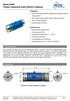 Properties Free of float metal bellow coupling with integrated torque measurement Non-contact measurement system, high robustness High torsional stiffness Limited torque of inertia Performance Measurement
MCE380: Measurements and Instrumentation Lab. Chapter 9: Force, Torque and Strain Measurements
 MCE380: Measurements and Instrumentation Lab Chapter 9: Force, Torque and Strain Measurements Topics: Elastic Elements for Force Measurement Dynamometers and Brakes Resistance Strain Gages Holman, Ch.
ANALYTICAL METHODS FOR ENGINEERS
 UNIT 1: Unit code: QCF Level: 4 Credit value: 15 ANALYTICAL METHODS FOR ENGINEERS A/601/1401 OUTCOME - TRIGONOMETRIC METHODS TUTORIAL 1 SINUSOIDAL FUNCTION Be able to analyse and model engineering situations
Effect of Sleeve Shrink-fit on Bearing Preload of a Machine Tool Spindle: Analysis using Finite Element Method
 Effect of Sleeve Shrink-fit on Bearing Preload of a Machine Tool Spindle: Analysis using Finite Element Method Aslam Pasha Taj 1, Chandramouli SR 2* ACE Designers Limited, Peenya Industrial Area, Bangalore-560058
Lap Fillet Weld Calculations and FEA Techniques
 Lap Fillet Weld Calculations and FEA Techniques By: MS.ME Ahmad A. Abbas Sr. Analysis Engineer [email protected] www.advancedcae.com Sunday, July 11, 2010 Advanced CAE All contents Copyright
Application Information
 Moog Components Group manufactures a comprehensive line of brush-type and brushless motors, as well as brushless controllers. The purpose of this document is to provide a guide for the selection and application
Vehicle-Bridge Interaction Dynamics
 Vehicle-Bridge Interaction Dynamics With Applications to High-Speed Railways Y. B. Yang National Taiwan University, Taiwan J. D. Yau Tamkang University, Taiwan Y. S. Wu Sinotech Engineering Consultants,
Laterally Loaded Piles
 Laterally Loaded Piles 1 Soil Response Modelled by p-y Curves In order to properly analyze a laterally loaded pile foundation in soil/rock, a nonlinear relationship needs to be applied that provides soil
Active Vibration Isolation of an Unbalanced Machine Spindle
 UCRL-CONF-206108 Active Vibration Isolation of an Unbalanced Machine Spindle D. J. Hopkins, P. Geraghty August 18, 2004 American Society of Precision Engineering Annual Conference Orlando, FL, United States
The Basics of FEA Procedure
 CHAPTER 2 The Basics of FEA Procedure 2.1 Introduction This chapter discusses the spring element, especially for the purpose of introducing various concepts involved in use of the FEA technique. A spring
SOLID MECHANICS TUTORIAL MECHANISMS KINEMATICS - VELOCITY AND ACCELERATION DIAGRAMS
 SOLID MECHANICS TUTORIAL MECHANISMS KINEMATICS - VELOCITY AND ACCELERATION DIAGRAMS This work covers elements of the syllabus for the Engineering Council exams C105 Mechanical and Structural Engineering
Module 2 - GEARS Lecture 7 - SPUR GEAR DESIGN
 Module 2 - GEARS Lecture 7 - SPUR GEAR DESIGN Contents 7.1 Spur gear tooth force analysis 7.2 Spur gear - tooth stresses 7.3 Tooth bending stress Lewis equation 7.4 Tooth bending stress AGMA procedure
Competence gives security. A competitive edge in rotary axes through experience, simulation, calculation, testing
 Competence gives security A competitive edge in rotary axes through experience, simulation, calculation, testing Bearings for rotary axes Competence gives security Figure 1: Axial/radial bearing YRTSM
Precise Modelling of a Gantry Crane System Including Friction, 3D Angular Swing and Hoisting Cable Flexibility
 Precise Modelling of a Gantry Crane System Including Friction, 3D Angular Swing and Hoisting Cable Flexibility Renuka V. S. & Abraham T Mathew Electrical Engineering Department, NIT Calicut E-mail : [email protected],
Onboard electronics of UAVs
 AARMS Vol. 5, No. 2 (2006) 237 243 TECHNOLOGY Onboard electronics of UAVs ANTAL TURÓCZI, IMRE MAKKAY Department of Electronic Warfare, Miklós Zrínyi National Defence University, Budapest, Hungary Recent
CAE -Finite Element Method
 16.810 Engineering Design and Rapid Prototyping Lecture 3b CAE -Finite Element Method Instructor(s) Prof. Olivier de Weck January 16, 2007 Numerical Methods Finite Element Method Boundary Element Method
A Fuzzy System Approach of Feed Rate Determination for CNC Milling
 A Fuzzy System Approach of Determination for CNC Milling Zhibin Miao Department of Mechanical and Electrical Engineering Heilongjiang Institute of Technology Harbin, China e-mail:[email protected]
The Mechanics of Arrow Flight upon Release
 The Mechanics of Arrow Flight upon Release Lieu, D.K. University of California, Berkeley Kim, Jinho and Kim, Ki Chan Korea National Sport University, Seoul Abstract The dynamic behavior of arrows upon
5-Axis Test-Piece Influence of Machining Position
 5-Axis Test-Piece Influence of Machining Position Michael Gebhardt, Wolfgang Knapp, Konrad Wegener Institute of Machine Tools and Manufacturing (IWF), Swiss Federal Institute of Technology (ETH), Zurich,
Chatter Suppression in NC Machine Tools by Cooperative Control of Spindle and Stage Motors
 IEEJ International Workshop on Sensing, Actuation, and Motion Control Chatter Suppression in NC Machine Tools by Cooperative Control of Spindle and Stage Motors Satoshi Fukagawa a) Student Member, Hiroshi
Clutch and Operation as a System
 Clutch and Operation as a System Dipl.-Ing. Matthias Zink Dipl.-Ing. René Shead Introduction New technologies and increasing demands for comfort, require increased total system thinking, also in the area
Finite Element Method (ENGC 6321) Syllabus. Second Semester 2013-2014
 Finite Element Method Finite Element Method (ENGC 6321) Syllabus Second Semester 2013-2014 Objectives Understand the basic theory of the FEM Know the behaviour and usage of each type of elements covered
Nonlinear analysis and form-finding in GSA Training Course
 Nonlinear analysis and form-finding in GSA Training Course Non-linear analysis and form-finding in GSA 1 of 47 Oasys Ltd Non-linear analysis and form-finding in GSA 2 of 47 Using the GSA GsRelax Solver
Finite Element Formulation for Plates - Handout 3 -
 Finite Element Formulation for Plates - Handout 3 - Dr Fehmi Cirak (fc286@) Completed Version Definitions A plate is a three dimensional solid body with one of the plate dimensions much smaller than the
Systematic Optimisation of Gearboxes for Hybrid and Electric Vehicles in Terms of Efficiency, NVH and Durability
 Systematic Optimisation of Gearboxes for Hybrid and Electric Vehicles in Terms of Efficiency, NVH and Durability Dr. Artur Grunwald GKN Driveline 1 Content of presentation Scope and introduction Gearbox
Advanced Structural Analysis. Prof. Devdas Menon. Department of Civil Engineering. Indian Institute of Technology, Madras. Module - 5.3.
 Advanced Structural Analysis Prof. Devdas Menon Department of Civil Engineering Indian Institute of Technology, Madras Module - 5.3 Lecture - 29 Matrix Analysis of Beams and Grids Good morning. This is
Manufacturing Equipment Modeling
 QUESTION 1 For a linear axis actuated by an electric motor complete the following: a. Derive a differential equation for the linear axis velocity assuming viscous friction acts on the DC motor shaft, leadscrew,
Mechanics and Dynamics of 5-axis Ball-end Milling Operations
 Mechanics and Dynamics of 5-axis Ball-end Milling Operations Erdem OZTURK, PhD.Candidate L.Taner TUNC, PhD. Candidate Assoc.Prof. Erhan BUDAK Manufacturing Research Laboratory, SABANCI UNIVERSITY, ISTANBUL
Section 5.0 : Horn Physics. By Martin J. King, 6/29/08 Copyright 2008 by Martin J. King. All Rights Reserved.
 Section 5. : Horn Physics Section 5. : Horn Physics By Martin J. King, 6/29/8 Copyright 28 by Martin J. King. All Rights Reserved. Before discussing the design of a horn loaded loudspeaker system, it is
PERPLEXING VARIABLE FREQUENCY DRIVE VIBRATION PROBLEMS. Brian Howes 1
 PERPLEXING VARIABLE FREQUENCY DRIVE VIBRATION PROBLEMS Brian Howes 1 1 Beta Machinery Analysis Ltd., Calgary, AB, Canada, T3C 0J7 ABSTRACT Several unusual vibration problems have been seen recently that
Dev eloping a General Postprocessor for Multi-Axis CNC Milling Centers
 57 Dev eloping a General Postprocessor for Multi-Axis CNC Milling Centers Mihir Adivarekar 1 and Frank Liou 1 1 Missouri University of Science and Technology, [email protected] ABSTRACT Most of the current
MEMS Multiphysics Simulation in ANSYS Workbench David Harrar II, PhD Ozen Engineering, Inc.
 MEMS Multiphysics Simulation in ANSYS Workbench David Harrar II, PhD Ozen Engineering, Inc. 1 Ozen Engineering, Inc. We are the local ANSYS Channel Partner With over 25 years of experience in FEA and CFD
Introduction to Mechanical Behavior of Biological Materials
 Introduction to Mechanical Behavior of Biological Materials Ozkaya and Nordin Chapter 7, pages 127-151 Chapter 8, pages 173-194 Outline Modes of loading Internal forces and moments Stiffness of a structure
Accuracy and Tuning in CNC Machine Tools
 FAMA Technical Article/001 Accuracy and Tuning in CNC Machine Tools Introduction: This article explains how it is possible to achieve a better performance on High Speed CNC Machine Tools. Performance is
CAE -Finite Element Method
 16.810 Engineering Design and Rapid Prototyping CAE -Finite Element Method Instructor(s) Prof. Olivier de Weck January 11, 2005 Plan for Today Hand Calculations Aero Æ Structures FEM Lecture (ca. 45 min)
B.TECH. (AEROSPACE ENGINEERING) PROGRAMME (BTAE) Term-End Examination December, 2011 BAS-010 : MACHINE DESIGN
 No. of Printed Pages : 7 BAS-01.0 B.TECH. (AEROSPACE ENGINEERING) PROGRAMME (BTAE) CV CA CV C:) O Term-End Examination December, 2011 BAS-010 : MACHINE DESIGN Time : 3 hours Maximum Marks : 70 Note : (1)
User orientated simulation strategy to analyse large drive trains in SIMPACK
 User orientated simulation strategy to analyse large drive trains in SIMPACK SIMPACK User Meeting / Dipl.-Ing. Thomas Hähnel / Dipl.-Ing. Mathias Höfgen 21. / 22. November 2007 Content Motivation, state
Understanding Poles and Zeros
 MASSACHUSETTS INSTITUTE OF TECHNOLOGY DEPARTMENT OF MECHANICAL ENGINEERING 2.14 Analysis and Design of Feedback Control Systems Understanding Poles and Zeros 1 System Poles and Zeros The transfer function
A Simulation Study on Joint Velocities and End Effector Deflection of a Flexible Two Degree Freedom Composite Robotic Arm
 International Journal of Advanced Mechatronics and Robotics (IJAMR) Vol. 3, No. 1, January-June 011; pp. 9-0; International Science Press, ISSN: 0975-6108 A Simulation Study on Joint Velocities and End
Machine Tool Genome Project
 Milling models enable pre-process parameter selection and optimization, but the results are specific to the tool-holder-spindle-machine combination. For example, stability lobe diagrams offer selection
MASTER DEGREE PROJECT
 MASTER DEGREE PROJECT Finite Element Analysis of a Washing Machine Cylinder Thesis in Applied Mechanics one year Master Degree Program Performed : Spring term, 2010 Level Author Supervisor s Examiner :
Module 5 Couplings. Version 2 ME, IIT Kharagpur
 Module 5 Couplings Lesson 1 Introduction, types and uses Instructional Objectives At the end of this lesson, the students should have the knowledge of The function of couplings in machinery. Different
When looking at machine tools, the details of the installed drive technology usually
 Multiple Solutions: Different Drive Concepts for Machine Tools When looking at machine tools, the details of the installed drive technology usually remain concealed. There are, in principle, various possibilities
Active damping of chatter in machine tools - Demonstration with a Hardware in the Loop simulator
 Active damping of chatter in machine tools - Demonstration with a Hardware in the Loop simulator A. Ganguli 1, A. Deraemaeker 1, M. Horodinca 2, A. Preumont 1 1 Active Structures Lab, Université Libre
DYNAMIC RESPONSE OF VEHICLE-TRACK COUPLING SYSTEM WITH AN INSULATED RAIL JOINT
 11 th International Conference on Vibration Problems Z. Dimitrovová et al. (eds.) Lisbon, Portugal, 9-12 September 2013 DYNAMIC RESPONSE OF VEHICLE-TRACK COUPLING SYSTEM WITH AN INSULATED RAIL JOINT Ilaria
Introduction to Solid Modeling Using SolidWorks 2012 SolidWorks Simulation Tutorial Page 1
 Introduction to Solid Modeling Using SolidWorks 2012 SolidWorks Simulation Tutorial Page 1 In this tutorial, we will use the SolidWorks Simulation finite element analysis (FEA) program to analyze the response
Finite Element Model Calibration of a Full Scale Bridge Using Measured Frequency Response Functions
 Finite Element Model Calibration of a Full Scale Bridge Using Measured Frequency Response Functions Masoud Sanayei 1 and Jesse D. Sipple 2 1 Professor, Department of Civil and Environmental Engineering,
CHAPTER 4 4 NUMERICAL ANALYSIS
 41 CHAPTER 4 4 NUMERICAL ANALYSIS Simulation is a powerful tool that engineers use to predict the result of a phenomenon or to simulate the working situation in which a part or machine will perform in
CNC Machine Control Unit
 NC Hardware a NC Hardware CNC Machine Control Unit Servo Drive Control Hydraulic Servo Drive Hydraulic power supply unit Servo valve Servo amplifiers Hydraulic motor Hydraulic Servo Valve Hydraulic Servo
Torsion Tests. Subjects of interest
 Chapter 10 Torsion Tests Subjects of interest Introduction/Objectives Mechanical properties in torsion Torsional stresses for large plastic strains Type of torsion failures Torsion test vs.tension test
Precision Miniature Load Cell. Models 8431, 8432 with Overload Protection
 w Technical Product Information Precision Miniature Load Cell with Overload Protection 1. Introduction The load cells in the model 8431 and 8432 series are primarily designed for the measurement of force
Rotation: Moment of Inertia and Torque
 Rotation: Moment of Inertia and Torque Every time we push a door open or tighten a bolt using a wrench, we apply a force that results in a rotational motion about a fixed axis. Through experience we learn
Structural Axial, Shear and Bending Moments
 Structural Axial, Shear and Bending Moments Positive Internal Forces Acting Recall from mechanics of materials that the internal forces P (generic axial), V (shear) and M (moment) represent resultants
How To Calculate Tunnel Longitudinal Structure
 Calculation and Analysis of Tunnel Longitudinal Structure under Effect of Uneven Settlement of Weak Layer 1,2 Li Zhong, 2Chen Si-yang, 3Yan Pei-wu, 1Zhu Yan-peng School of Civil Engineering, Lanzhou University
Module 2. Analysis of Statically Indeterminate Structures by the Matrix Force Method. Version 2 CE IIT, Kharagpur
 Module Analysis of Statically Indeterminate Structures by the Matrix Force Method esson 11 The Force Method of Analysis: Frames Instructional Objectives After reading this chapter the student will be able
Dynamics of Offshore Wind Turbines
 Proceedings of the Twenty-first (2011) International Offshore and Polar Engineering Conference Maui, Hawaii, USA, June 19-24, 2011 Copyright 2011 by the International Society of Offshore and Polar Engineers