
Supporting Information
|
|
|
- Beatrice Hunter
- 10 years ago
- Views:
Transcription
1 Copyright WILEY VCH Verlag GmbH & Co. KGaA, Weinheim, Germany, Supporting Information for Adv. Funct. Mater., DOI: /adfm Colorimetric Detection of Warfare Gases by Polydiacetylenes Toward Equipment-Free Detection Jiseok Lee, Sungbaek Seo, and Jinsang Kim*

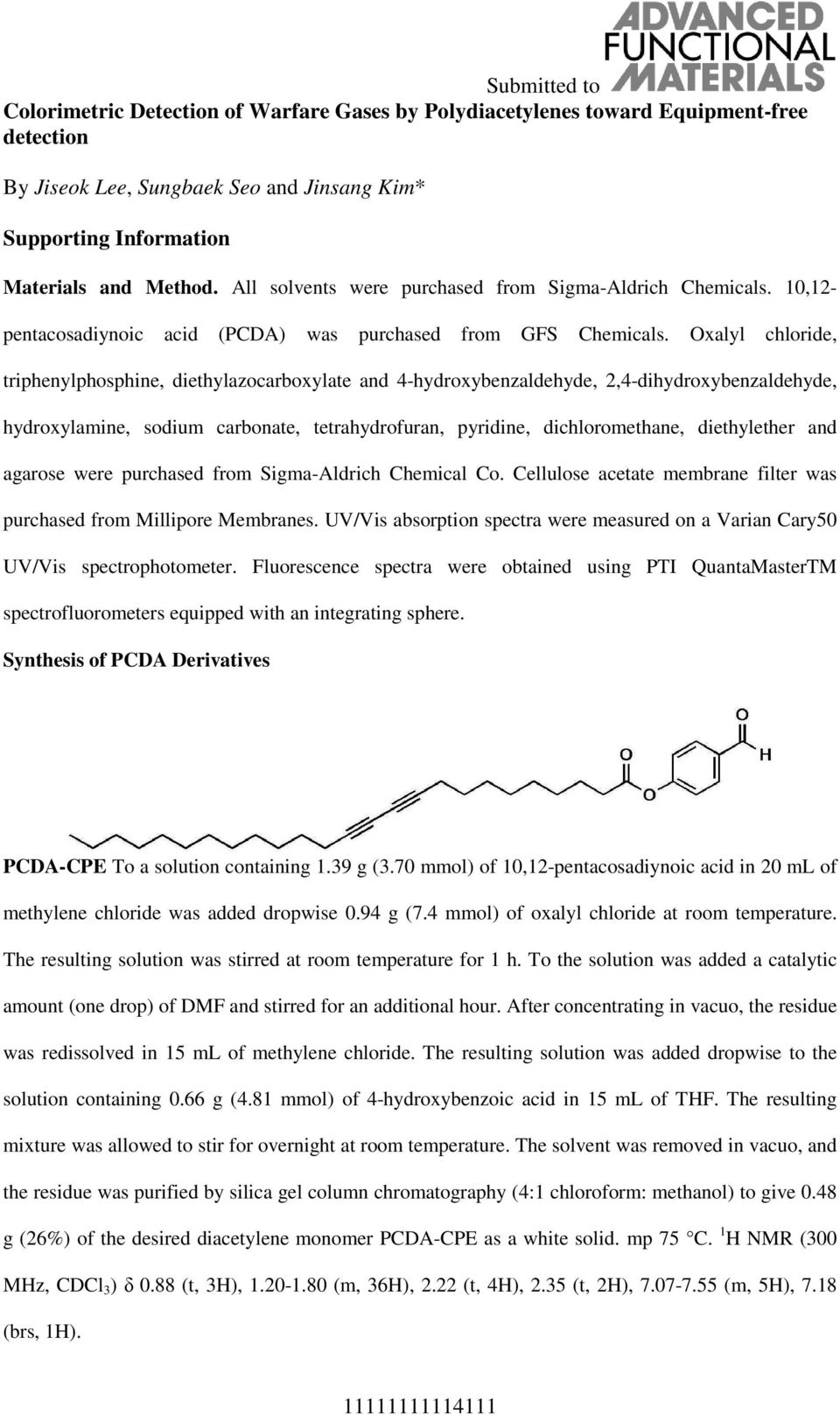
2 Colorimetric Detection of Warfare Gases by Polydiacetylenes toward Equipment-free detection By Jiseok Lee, Sungbaek Seo and Jinsang Kim* Supporting Information Materials and Method. All solvents were purchased from Sigma-Aldrich Chemicals. 10,12- pentacosadiynoic acid (PCDA) was purchased from GFS Chemicals. Oxalyl chloride, triphenylphosphine, diethylazocarboxylate and 4-hydroxybenzaldehyde, 2,4-dihydroxybenzaldehyde, hydroxylamine, sodium carbonate, tetrahydrofuran, pyridine, dichloromethane, diethylether and agarose were purchased from Sigma-Aldrich Chemical Co. Cellulose acetate membrane filter was purchased from Millipore Membranes. UV/Vis absorption spectra were measured on a Varian Cary50 UV/Vis spectrophotometer. Fluorescence spectra were obtained using PTI QuantaMasterTM spectrofluorometers equipped with an integrating sphere. Synthesis of PCDA Derivatives PCDA-CPE To a solution containing 1.39 g (3.70 mmol) of 10,12-pentacosadiynoic acid in 20 ml of methylene chloride was added dropwise 0.94 g (7.4 mmol) of oxalyl chloride at room temperature. The resulting solution was stirred at room temperature for 1 h. To the solution was added a catalytic amount (one drop) of DMF and stirred for an additional hour. After concentrating in vacuo, the residue was redissolved in 15 ml of methylene chloride. The resulting solution was added dropwise to the solution containing 0.66 g (4.81 mmol) of 4-hydroxybenzoic acid in 15 ml of THF. The resulting mixture was allowed to stir for overnight at room temperature. The solvent was removed in vacuo, and the residue was purified by silica gel column chromatography (4:1 chloroform: methanol) to give 0.48 g (26%) of the desired diacetylene monomer PCDA-CPE as a white solid. mp 75 C. 1 H NMR (300 MHz, CDCl 3 ) δ 0.88 (t, 3H), (m, 36H), 2.22 (t, 4H), 2.35 (t, 2H), (m, 5H), 7.18 (brs, 1H)
3 PCDA-pBzA To a solution of 10,12-pentacosadiynoic acid (2.00 g, 5.34 mmol) in dichloromethane (20 ml) at room temperature was added dropwise oxalyl chloride (2.03 g, mmol). The resulting solution was stirred at room temperature for 30 min. To the solution was added a catalytic amount of dimethylformamide and stirred for an additional hour. After concentrating in vacuo, the residue was redissolved in THF (15 ml). The resulting solution was added dropwise to the solution containing 4- aminobenzoic acid (1.10 g, 8.01 mmol) and TEA (2.16 g, mmol) in THF (15 ml). The resulting mixture was allowed to stir for overnight at room temperature, poured into the water and extracted with ethyl acetate. The organic layer was washed 3 times with water to eliminate the excess 4- aminobenzoic acid, dried with MgSO4 and filtered. The solvent was removed under vacuo. The resulting solution was recrystallized from methyl alcohol and isopropyl alchol to give 2.20 g (83 %) of desired diacetylene monomer PCDA-pBzA as a white solid. mp 190 o C 1 H NMR (400 MHz, CDCl 3 ): δ 0.85 (t, 3H), (m, 32H), (m, 4H), (m, 2H), 7.69 (d, 2H), 7.86 (d, 2H), (s, 1H). PCDA-pBA To a solution of 10,12-pentacosadiynoic acid (1.00 g, 1.33 mmol) in dichloromethane (20 ml) at room temperature was added dropwise oxalyl chloride (1.01 g, 7.98 mmol). The resulting solution was stirred at room temperature for 30 min. To the solution was added a catalytic amount (one drop) of dimethylforamide and stirred for an additional hour. After concentrating in vacuo, the residue was redissolved in tetrahydrofuran (15 ml) and added dropwise to the solution containing 4- hydroxybenzaldehyde (0.65 g, 5.32 mmol) in pyridine (15 ml). The resulting mixture was allowed to stir for overnight at room temperature. The residue was extracted with ethyl acetate and dried with MgSO 4 and filtered. The solvent was removed under vacuo. The residue was further purified by silica
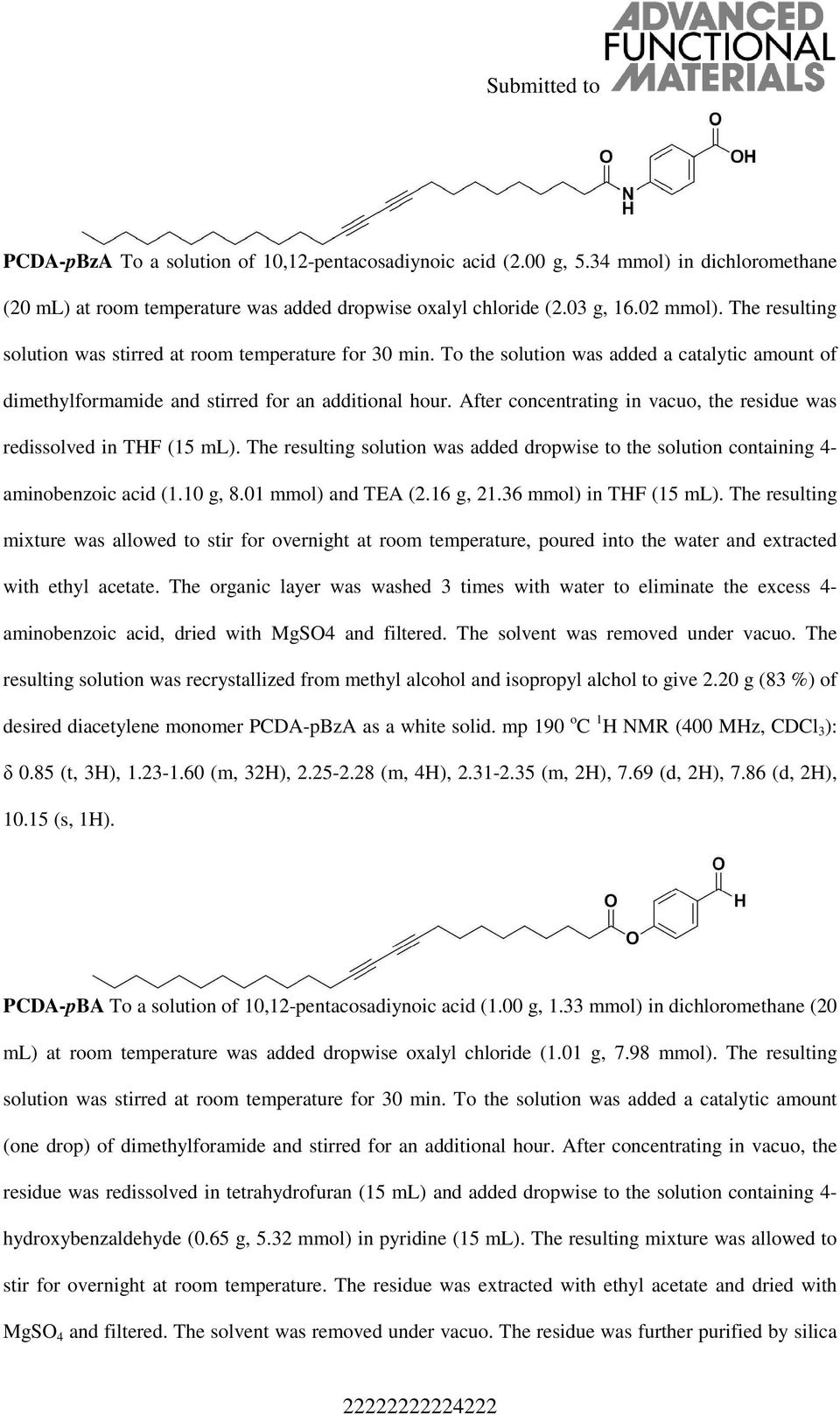
4 gel column chromatography (hexane:ethylacetate =6:1) to give 1.00 g (86.2 %) of desired diacetylene monomer PCDA-pBA as a white solid. mp 80 C. 1 H NMR (400 MHz, DMSO-d 6 ): δ 0.85 (t, 3H), (m, 32H), 2.26 (t, 4H), 7.35 (d, 2H), 7.98 (d, 2H), 9.90 (s, 1H). PCDA-pBO To a solution of PCDA-pBA (1.00 g, 2.09 mmol) in 2-propanol (100 ml) at room temperature was added dropwise hydroxylamine hydrochloride (0.17 g, 2.51 mmol) and sodium carbonate (0.20 g, 2.51 mmol) in 60 ml of 2-propanol/di-water (1/2). The reaction mixture was refluxed at 80 C for 2 hours. After cooling, the reaction mixture was concentrated in vacuo and extracted with diethylether. The residue was recrystalized in 2-propanol/di-water (1/1) and further purified with gel column chromatography (ethylacetate: hexane = 1:5) to give 0.60 g (59 %) of desired diacetylene monomer PCDA-pBO as a white solid. mp 100 C. 1 H NMR (400 MHz, DMSO-d 6 ): δ 0.84 (t, 3H), (m, 34H), 2.27 (t, 4H), 2.61 (t, 2H), 7.12 (d, 2H), 7.60 (d, 2H), 8.12 (s, 1H) (s, 1H). PCDA-HBA To a solution of 10,12-pentacosadiynoic acid (2.00 g, 5.33 mmol) in dichloromethane (20 ml) at room temperature was added dropwise oxalyl chloride (2.00 g, 15.7 mmol). The resulting solution was stirred at room temperature for 30 min. To the solution was added a catalytic amount (one drop) of dimethylforamide and stirred for an additional hour. After concentrating in vacuo, the residue was redissolved in 2-butanone (20 ml). The resulting solution was added dropwise to the solution containing 2,4-dihydroxybenzaldehyde (0.72 g, 5.27 mmol) and TEA (0.62 g, 6.17 mmol) in 2-butanone (50 ml). The resulting mixture was allowed to stir for 6 hours at room temperature. The solvent was removed under vacuo and the residue was crystallized in methanol for 40 min. The residue was further purified by silica gel column chromatography (hexane:ethyl acetate =9:1) to give 1.2 g (44 %) of desired diacetylene monomer PCDA-HBA as a white solid. Mp 90 C. 1 H NMR (
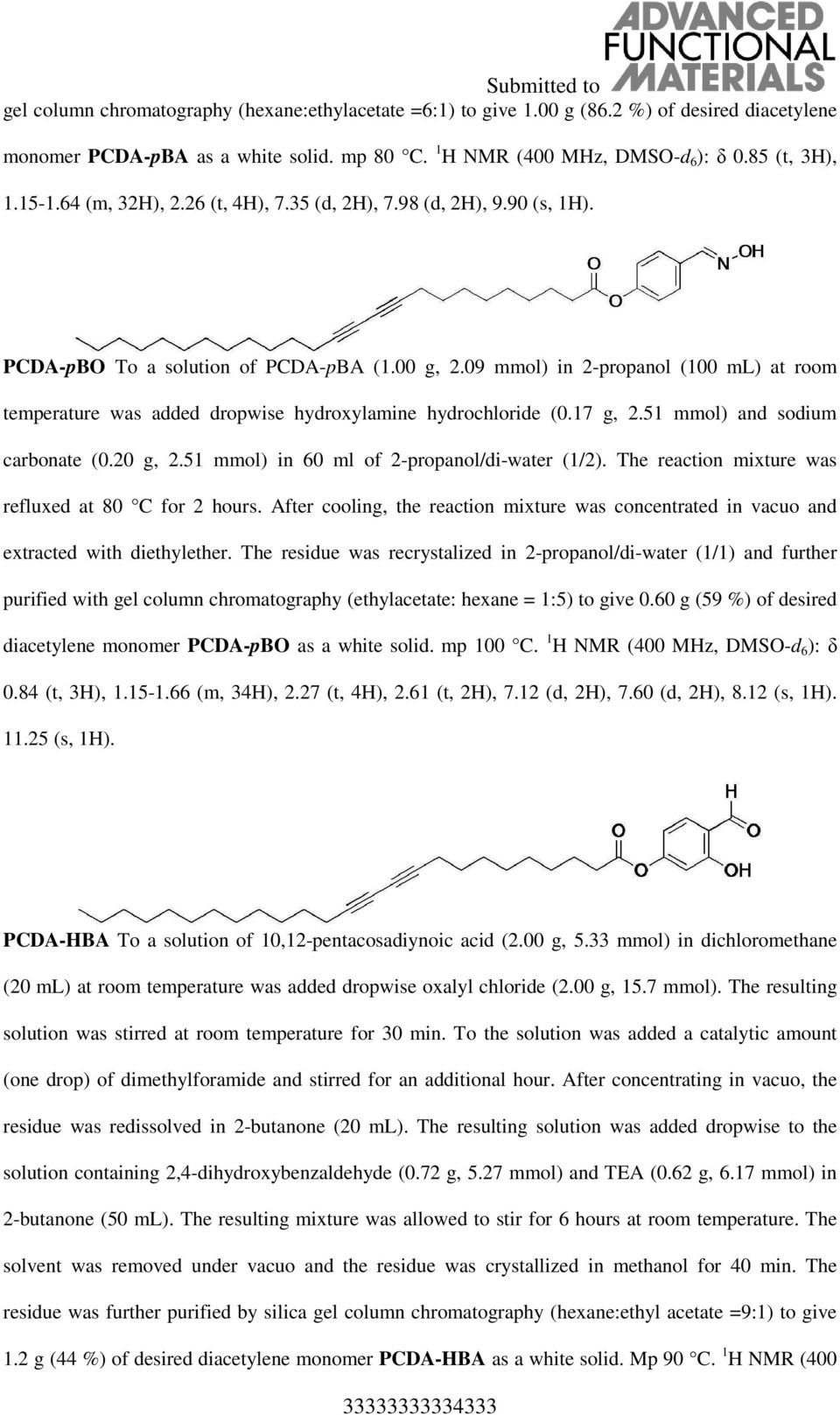
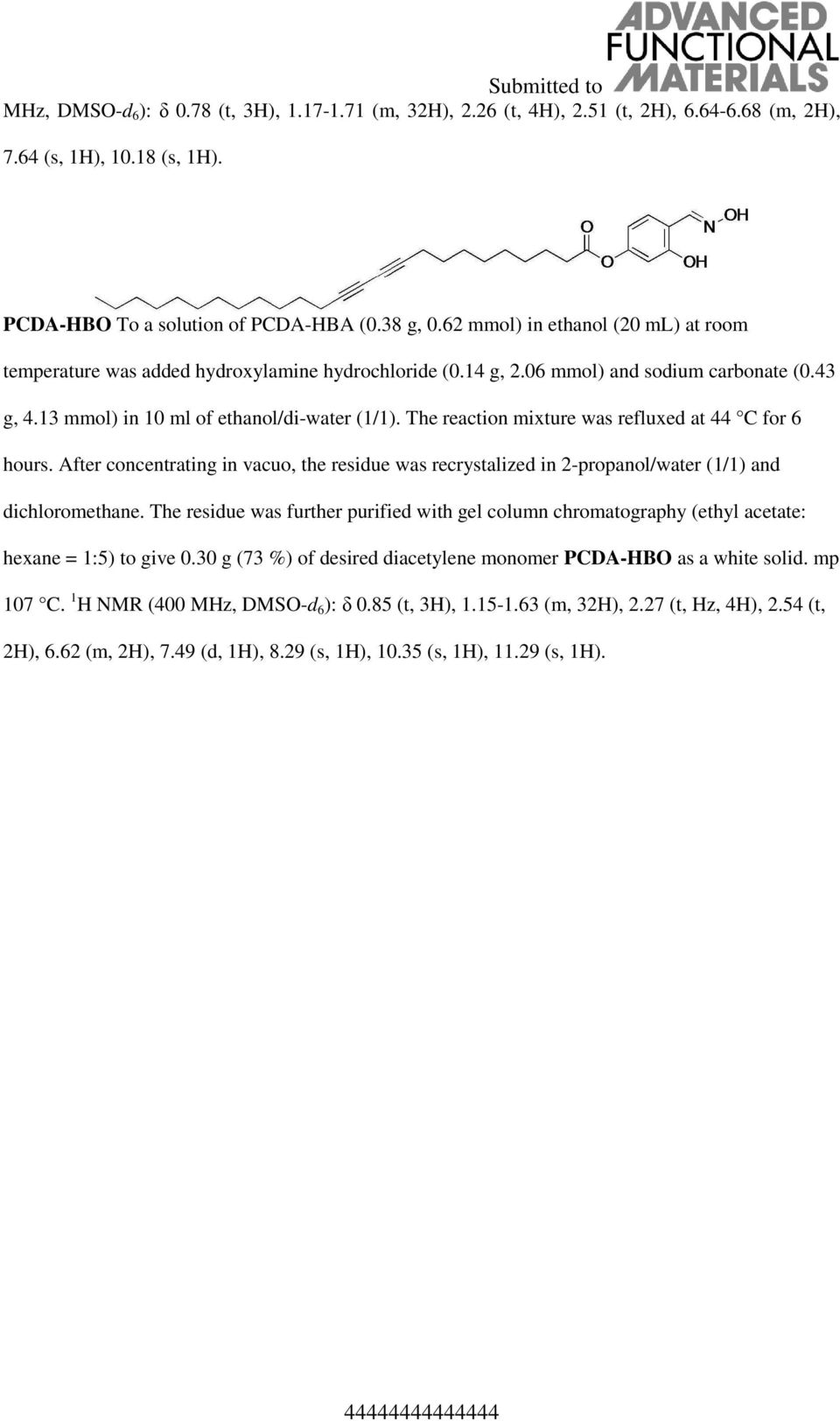
5 MHz, DMSO-d 6 ): δ 0.78 (t, 3H), (m, 32H), 2.26 (t, 4H), 2.51 (t, 2H), (m, 2H), 7.64 (s, 1H), (s, 1H). PCDA-HBO To a solution of PCDA-HBA (0.38 g, 0.62 mmol) in ethanol (20 ml) at room temperature was added hydroxylamine hydrochloride (0.14 g, 2.06 mmol) and sodium carbonate (0.43 g, 4.13 mmol) in 10 ml of ethanol/di-water (1/1). The reaction mixture was refluxed at 44 C for 6 hours. After concentrating in vacuo, the residue was recrystalized in 2-propanol/water (1/1) and dichloromethane. The residue was further purified with gel column chromatography (ethyl acetate: hexane = 1:5) to give 0.30 g (73 %) of desired diacetylene monomer PCDA-HBO as a white solid. mp 107 C. 1 H NMR (400 MHz, DMSO-d 6 ): δ 0.85 (t, 3H), (m, 32H), 2.27 (t, Hz, 4H), 2.54 (t, 2H), 6.62 (m, 2H), 7.49 (d, 1H), 8.29 (s, 1H), (s, 1H), (s, 1H)
Supplementary Information for
 Electronic Supplementary Material (ESI) for Polymer Chemistry. This journal is The Royal Society of Chemistry 2015 Supplementary Information for Doubly Responsive Polymersomes towards Monosaccharides and
A prochelator with a modular masking group featuring hydrogen peroxide activation with concurrent fluorescent reporting
 Electronic Supplementary Material (ESI) for ChemComm. This journal is The Royal Society of Chemistry 2014 Supporting Information A prochelator with a modular masking group featuring hydrogen peroxide activation
Supporting Information
 Supporting Information Chemoproteomics-Enabled Discovery of a Potent and Selective Inhibitor of the DNA Repair Protein MGMT Chao Wang +, Daniel Abegg +, Dominic G. Hoch, and Alexander Adibekian* ange_201511301_sm_miscellaneous_information.pdf
The D-glucosamine-derived pyridyl-triazole@palladium recoverable catalyst for Mizoroki-Heck reactions under solvent-free conditions
 Electronic Supplementary Material (ESI) for Green Chemistry. This journal is The Royal Society of Chemistry 204 Supporting Information The D-glucosamine-derived pyridyl-triazole@palladium recoverable catalyst
4026 Synthesis of 2-chloro-2-methylpropane (tert-butyl chloride) from tert-butanol
 4026 Synthesis of 2-chloro-2-methylpropane (tert-butyl chloride) from tert-butanol OH + HCl Cl + H 2 O C 4 H 10 O C 4 H 9 Cl (74.1) (36.5) (92.6) Classification Reaction types and substance classes nucleophilic
Working with Hazardous Chemicals
 A Publication of Reliable Methods for the Preparation of Organic Compounds Working with Hazardous Chemicals The procedures in Organic Syntheses are intended for use only by persons with proper training
NMR Chemical Shifts of Common Laboratory Solvents as Trace Impurities
 7512 J. Org. Chem. 1997, 62, 7512-7515 NMR Chemical Shifts of Common Laboratory Solvents as Trace Impurities Hugo E. Gottlieb,* Vadim Kotlyar, and Abraham Nudelman* Department of Chemistry, Bar-Ilan University,
A Simple and efficient method for mild and selective oxidation of propargylic alcohols using TEMPO and calcium hypochlorite
 A Simple and efficient method for mild and selective oxidation of propargylic alcohols using TEMPO and calcium hypochlorite Sabbasani Rajasekhara Reddy, a,b Anju Chadha b,c* a School of Advanced Sciences,
and its application in the synthesis of Nilotinib intermediate
 Electronic upplementary Material (EI) for RC Advances. This journal is The Royal ociety of Chemistry 204 upporting Information An efficient D-glucosamine-based copper catalyst for C-X couplings and its
1. COUPLING REAGENTS : Structure and acronyms
 Coupling Reagents 1. COUPLING REAGENTS : Structure and acronyms... 2 2. CARBODIIMIDE... 3 1.a. N,N -Dicyclohexylcarbodimide (DCC)... 3 DCC/HOBt coupling experimental procedure:... 4 1.b. N-(3-Dimethylaminopropyl)-N
Structure-Based Design of Covalent Siah Inhibitors
 Chemistry & Biology, Volume 20 Supplemental Information Structure-Based Design of Covalent Siah Inhibitors John L. Stebbins, Eugenio Santelli, Yongmei Feng, Surya K. De, Angela Purves, Khatereh Motamedchaboki,
Supplementary Information. Primary amino acid lithium salt as a catalyst for asymmetric Michael addition of isobutyraldehyde with β-nitroalkenes.
 This journal is (c) The Royal Society of Chemistry 8 Supplementary Information Primary amino acid lithium salt as a catalyst for asymmetric Michael addition of isobutyraldehyde with β-nitroalkenes. Atsushi
A Ratiometric NMR ph Sensing Strategy Based on Slow- Proton-Exchange (SPE) Mechanism
 Electronic Supplementary Material (ESI) for Chemical Science. This journal is The Royal Society of Chemistry 2015 A Ratiometric NMR ph Sensing Strategy Based on Slow- Proton-Exchange (SPE) Mechanism Loïse
CH243: Lab 4 Synthesis of Artificial Flavorings by Fischer Esterification
 H243: Lab 4 Synthesis of Artificial Flavorings by Fischer Esterification PURPSE: To prepare esters by reaction of carboxylic acids and alcohols. To modify a known procedure to prepare an unknown. DISUSSIN:
Solid-phase Synthesis of Homodimeric Peptides: Preparation of Covalently-linked Dimers of Amyloid-beta Peptide
 Electronic Supplementary Information Solid-phase Synthesis of Homodimeric Peptides: Preparation of Covalently-linked Dimers of Amyloid-beta Peptide W. Mei Kok, a,b,c Denis B. Scanlon, b John A. Karas,
LUMEFANTRINE Draft proposal for The International Pharmacopoeia (October 2006)
 October 2006 RESTRICTED LUMEFANTRINE Draft proposal for The International Pharmacopoeia (October 2006) DRAFT FOR DISCUSSION World Health Organization 2006 All rights reserved. This draft is intended for
Name Lab #3: Solubility of Organic Compounds Objectives: Introduction: soluble insoluble partially soluble miscible immiscible
 Lab #3: Solubility of rganic Compounds bjectives: - Understanding the relative solubility of organic compounds in various solvents. - Exploration of the effect of polar groups on a nonpolar hydrocarbon
Light-driven Nanoscale Chiral Molecular Switch: Reversible Dynamic Full Range Color Phototuning
 This journal is (c) The Royal Society of Chemistry Supporting Information Light-driven Nanoscale Chiral Molecular Switch: Reversible Dynamic Full Range Color Phototuning Ji Ma, Yannian Li, Timothy White,
EXPERIMENT Aspirin: Synthesis and NMR Analysis
 EXPERIMENT Aspirin: Synthesis and NMR Analysis Introduction: When salicylic acid reacts with acetic anhydride in the presence of an acid catalyst, acetylsalicylic acid, or aspirin, is produced according
Intelligent use of Relative Response Factors in Gas Chromatography-Flame Ionisation Detection
 52 May/June 2012 Intelligent use of Relative Response Factors in Gas Chromatography-Flame Ionisation Detection by Karen Rome and Allyson McIntyre, AstraZeneca, Macclesfield, SK10 2NA, UK Quantitative analysis
Supporting Information
 Supporting Information Wiley-VCH 2006 69451 Weinheim, Germany Supporting information: experimental details of the synthesis of the amino-functionalized polymers and nanoparticles used Tailor-made ligands
Acid-Base Extraction.
 Acid-Base Extraction. Extraction involves dissolving a compound or compounds either (1) from a solid into a solvent or (2) from a solution into another solvent. A familiar example of the first case is
Supporting information for Journal of Materials Chemistry
 Supporting information for Journal of Materials Chemistry Porphyrin-crosslinked Block Copolymer Assemblies as Photophysically-active Nanoscopic Devices Jennifer L. Sorrells, a, Ritu Shrestha, a William
EUDRAGIT E 100, EUDRAGIT E PO and
 Technical Information EUDRAGIT E 100, and Specification and Test Methods Ph. Eur. USP/NF JPE Basic Butylated Methacrylate Copolymer Amino Methacrylate Copolymer - NF Aminoalkyl Methacrylate Copolymer E
Alkoxycarbonylation of Ethylene with Cellulose in Ionic Liquids
 Supplementary data Alkoxycarbonylation of Ethylene with Cellulose in Ionic Liquids Anna sichow and Stefan Mecking* Chair of Chemical Materials Science, Dept. of Chemistry, University of Konstanz, 78464
oxidize 4-Cholesten-3-one
 Isolation of Cholesterol from Egg Yolk Preparation: Bring a hard-boiled egg yolk to lab! Cholesterol (1) is a major component of cell membranes. An egg yolk contains about 200 milligrams of cholesterol,
Supplemental data. A simple and effective cleavable linker for chemical proteomics applications
 Supplemental data A simple and effective cleavable linker for chemical proteomics applications Yinliang Yang, annes ahne, Bernhard Kuster, and Steven. L. Verhelst * Figure S1 Figure S2 Figure S3 Table
Experimental procedures. Solid phase peptide synthesis (SPPS)
 Electronic Supplementary Material (ESI) for Organic & Biomolecular Chemistry This journal is The Royal Society of Chemistry 214 Experimental procedures Solid phase peptide synthesis (SPPS) Solid phase
SUCRALOSE. White to off-white, practically odourless crystalline powder
 SUCRALOSE Prepared at the 41st JECFA (1993), published in FNP 52 Add 2 (1993). Metals and arsenic specifications revised at the 63rd JECFA (2004). An ADI of 0-15 mg/kg bw was established at the 37th JECFA
GRIGNARD REACTION: PREPARATION OF TRIPHENYLMETHANOL (12/22/2009)
 GRIGNARD REACTIN: PREPARATIN F TRIPHENYLMETHANL (12/22/2009) Grignard reagents are among the most versatile organometallic reagents, and they are the easiest organometallic reagent to prepare. Grignard
Honors Cup Synthetic Proposal
 onors Cup Synthetic Proposal Section: 230-IV Group Members: Alex yla, Lauren eath, Sahar Rahmani Title: Synthesis of Melatonin from 3-(3-phthalimidopropyl) ethyl acetacetate using Green Chemistry Introduction:
ISOLATION OF CAFFEINE FROM TEA
 ISLATIN F CAFFEINE FRM TEA Introduction In this experiment, caffeine is isolated from tealeaves. The chief problem with the isolation is that caffeine does not exist alone in the tealeaves, but other natural
Supporting Information. Copyright Wiley-VCH Verlag GmbH & Co. KGaA, 69451 Weinheim, 2008
 Supporting Information Copyright Wiley-VCH Verlag GmbH & Co. KGaA, 69451 Weinheim, 2008 Titanosilsesquioxane Anchored on Mesoporous Silicas. A Novel Approach for the preparation of Heterogeneous Catalysts
Revised Structures of N-Substituted Dibrominated Pyrrole Derivatives and Their Polymeric Products. Termaleimide Models with Low Optical Band Gaps
 2646 J. Org. Chem. 1998, 63, 2646-2655 Revised Structures of N-Substituted Dibrominated Pyrrole Derivatives and Their Polymeric Products. Termaleimide Models with Low Optical Band Gaps Dong-Sook Choi,
Tiangang TM BW-10LD (622)
 Tiangang TM BW-10LD Oligomeric Hindered Amine Light Stabilizer (HALS) Poly-(N-β-hydroxyethyl-2,2,6,6-tetramethyl-4-hydroxy-piperidyl-succinate) CAS number 65447-77-0 BW-10LD BW-10LD is a highly effective
Materials and Methods. Protocol for Fmoc- based solid- phase peptide synthesis
 Materials and Methods All commercially available materials (Aldrich, TCI, ovabiochem, Fluka ) were used without further purification. All solvents were reagent grade or PLC grade (Fisher ). Anhydrous TF,
α-cyclodextrin SYNONYMS α-schardinger dextrin, α-dextrin, cyclohexaamylose, cyclomaltohexaose, α- cycloamylase
 α-cyclodextrin New specifications prepared at the 57th JECFA (2001) and published in FNP 52 Add 9 (2001). An ADI not specified was established at the 57th JECFA (2001). SYNONYMS α-schardinger dextrin,
lung cancer targeted photodynamic therapy and imaging
 99m Tc-Hematoporphyrin linked albumin nanoparticles for lung cancer targeted photodynamic therapy and imaging Su-Geun Yang, Ji-Eun Chang, Byungchul Shin, Sanghyun Park, Kun Na and Chang-Koo Shim* *Corresponding
Online edition for students of organic chemistry lab courses at the University of Colorado, Boulder, Dept of Chem and Biochem.
 u Experiment 9 Aromatic Chemistry: Synthesis of o-nitroaniline and p-nitroaniline via a Multi-Step Sequence Reading: Introduction to rganic Chemistry by Streitwieser, Heathcock, and Kosower, pp. 695-696
Supporting Information
 Supporting Information Wiley-VCH 2005 69451 Weinheim, Germany Magnetic Nanoparticle-Capped Mesoporous Silica Nanorod-Based Stimuli-Responsive Controlled Release Delivery System** Supratim Giri, Brian G.
Purification of reaction mixtures using flash chromatography.
 Purification of reaction mixtures using flash chromatography. This technical note details the use of ISOLUTE Flash chromatography columns for the purification of reaction mixtures. What is flash chromatography?
ELECTRONIC SUPPLEMENTARY INFORMATION
 ELECTRONIC SUPPLEMENTARY INFORMATION General.. 1 1 HNMR titration fitplots.. 2 1 HNMR titration Job plots... 2 1 HNMR spectra of 1 + TBAacetate. 3 Isothermal Titration Calorimetry.. 3 High Resolution Mass
Chapter 5, Lesson 3 Why Does Water Dissolve Salt?
 Chapter 5, Lesson 3 Why Does Water Dissolve Salt? Key Concepts The polarity of water molecules enables water to dissolve many ionically bonded substances. Salt (sodium chloride) is made from positive sodium
EXPERIMENT Oil of Wintergreen: Synthesis and NMR Analysis
 EXPERIMENT il of Wintergreen: Synthesis and NMR Analysis Introduction: When salicylic acid reacts with methanol in the presence of an acid catalyst, methyl salicylate, or oil of wintergreen, is produced
TECHNICAL REPORT STUDY CHEMICAL PROPERTIES OF RATTAN SHOOT FROM PLANTATION IN THAILAND
 TECHNICAL REPORT STUDY CHEMICAL PROPERTIES OF RATTAN SHOOT FROM PLANTATION IN THAILAND by Assistant Professor Dr. Noojaree Prasitpan Chemist Analyzer of the ITTO Project on PD 24/00 Rev.1 (I): Promotion
CERTIFICATE OF ANALYSIS Methyl 4-Hydroxybenzoate
 CERTIFICATE OF ANALYSIS Methyl 4-Hydroxybenzoate C8H8O3 Molecular Weight 152.15 1. Description White crystalline powder or colorless crystals. 2. Solubility Slightly soluble in water, freely soluble in
DNA SPOOLING 1 ISOLATION OF DNA FROM ONION
 DNA SPOOLING 1 ISOLATION OF DNA FROM ONION INTRODUCTION This laboratory protocol will demonstrate several basic steps required for isolation of chromosomal DNA from cells. To extract the chromosomal DNA,
Planar Chromatography
 CH 2252 Instrumental Methods of Analysis Unit V Planar Chromatography M. Subramanian Assistant Professor Department of Chemical Engineering Sri Sivasubramaniya Nadar College of Engineering Kalavakkam 603
PECTINS. SYNONYMS INS No. 440 DEFINITION DESCRIPTION. FUNCTIONAL USES Gelling agent, thickener, stabilizer, emulsifier CHARACTERISTICS
 PECTINS SYNONYMS INS No. 440 Prepared at the 71 st JECFA (2009) and published in FAO JECFA Monographs 7 (2009), superseding specifications prepared at the 68 th JECFA (2007) and published in FAO JECFA
Unexpected course of a Williamson ether synthesis
 Issue in onor of Prof. Atta-ur-Rahman ARKIVC 2007 (vii) 291-300 Unexpected course of a Williamson ether synthesis Klaus-Peter Zeller, a * Peter aiss, a Meike artmann, a and Klaus Eichele b a Institut für
TECHNICAL BULLETIN. HIS-Select Nickel Affinity Gel. Catalog Number P6611 Storage Temperature 2 8 C
 HIS-Select Nickel Affinity Gel Catalog Number P6611 Storage Temperature 2 8 C TECHNICAL BULLETIN Product Description HIS-Select Nickel Affinity Gel is an immobilized metalion affinity chromatography (IMAC)
Convenient and robust one-pot synthesis of symmetrical and unsymmetrical benzyl thioethers from benzyl halides using thiourea
 Convenient and robust one-pot synthesis of symmetrical and unsymmetrical benzyl thioethers from benzyl halides using thiourea Kevin S. Eccles, a Curtis J. Elcoate, a Simon E. Lawrence, a and Anita R. Maguire*
H H H O. Pre-Lab Exercises Lab 6: Organic Chemistry. Lab 6: Organic Chemistry Chemistry 100. 1. Define the following: a.
 Lab 6: Organic hemistry hemistry 100 1. Define the following: a. ydrocarbon Pre-Lab Exercises Lab 6: Organic hemistry Name Date Section b. Saturated hydrocarbon c. Unsaturated hydrocarbon 2. The formula
CHEM 2423 Recrystallization of Benzoic Acid EXPERIMENT 4 - Purification - Recrystallization of Benzoic acid
 EXPERIMENT 4 - Purification - Recrystallization of Benzoic acid Purpose: a) To purify samples of organic compounds that are solids at room temperature b) To dissociate the impure sample in the minimum
Experiment 3: Extraction: Separation of an Acidic, a Basic and a Neutral Substance
 1 Experiment 3: Extraction: Separation of an Acidic, a Basic and a Neutral Substance Read pp 142-155, 161-162, Chapter 10 and pp 163-173, Chapter 11, in LTOC. View the videos: 4.2 Extraction (Macroscale);
Applications of Organic Solvent Nanofiltration in the Process Development of Active Pharmaceutical Ingredients. Dominic Ormerod
 Applications of rganic Solvent Nanofiltration in the Process Development of Active Pharmaceutical Ingredients Dominic rmerod Introduction A non-thermal solvent exchange. Removal of Excess reagents via
experiment5 Understanding and applying the concept of limiting reagents. Learning how to perform a vacuum filtration.
 81 experiment5 LECTURE AND LAB SKILLS EMPHASIZED Synthesizing an organic substance. Understanding and applying the concept of limiting reagents. Determining percent yield. Learning how to perform a vacuum
RECITATION NOTES FOR EXPERIMENT # 5 A&B THIN LAYER CHROMATOGRAPHY
 RECITATION NOTES FOR EXPERIMENT # 5 A&B THIN LAYER CHROMATOGRAPHY Have your lab textbook available for quick reference to specific pages, indicated in red. BASIC PRINCIPLES OF CHROMATOGRAPHY Chromatography
Chemistry 321, Experiment 8: Quantitation of caffeine from a beverage using gas chromatography
 Chemistry 321, Experiment 8: Quantitation of caffeine from a beverage using gas chromatography INTRODUCTION The analysis of soft drinks for caffeine was able to be performed using UV-Vis. The complex sample
Guidance for Industry
 Guidance for Industry Q3C Tables and List U.S. Department of Health and Human Services Food and Drug Administration Center for Drug Evaluation and Research (CDER) Center for Biologics Evaluation and Research
Supporting Information
 Supporting Information Copyright Wiley-VCH Verlag GmbH & Co. KGaA, 69451 Weinheim, 2013 More than Meets the Eye: Conformational Switching of a Stacked Dialkoxynaphthalene Naphthalenetetracarboxylic diimide
Synthetic approach to pentacyclic quassinoids from communic acids, via ambracetal derivatives
 Tetrahedron 61 (2005) 837 844 Synthetic approach to pentacyclic quassinoids from communic acids, via ambracetal derivatives E. J. Alvarez-Manzaneda, a, * J. L. Romera, a A. F. Barrero, a R. Alvarez-Manzaneda,
molbank ISSN 1422-8599 www.mdpi.com/journal/molbank
 Molbank 2009, M602 OPEN ACCESS molbank ISSN 1422-8599 www.mdpi.com/journal/molbank Short Note Preparation of 5-Bromo-2-naphthol: The Use of a Sulfonic Acid as a Protecting and Activating Group Renata Everett,
Human serum albumin (HSA) nanoparticles stabilized with. intermolecular disulfide bonds. Supporting Information
 Human serum albumin (HSA) nanoparticles stabilized with intermolecular disulfide bonds Wentan Wang, Yanbin Huang*, Shufang Zhao, Ting Shao and Yi Cheng* Department of Chemical Engineering, Tsinghua University,
EXPERIMENT 1 - Determination of the purity and identity of organic compounds by melting point and/or analytical thin layer chromatography
 EXPERIMENT 1 - Determination of the purity and identity of organic compounds by melting point and/or analytical thin layer chromatography PART A Melting points and mixed melting points. As discussed in
SODIUM CARBOXYMETHYL CELLULOSE
 SODIUM CARBOXYMETHYL CELLULOSE Prepared at the 28th JECFA (1984), published in FNP 31/2 (1984) and in FNP 52 (1992). Metals and arsenic specifications revised at the 55 th JECFA (2000). An ADI not specified
TANNIC ACID. SYNONYMS Tannins (food grade), gallotannic acid, INS No. 181 DEFINITION DESCRIPTION
 TANNIC ACID Prepared at the 39th JECFA (1992), published in FNP Add 1 (1992) superseding specifications prepared at the 35th JECFA (1989), published in FNP 49 (1990) and in FNP 52 (1992). Metals and arsenic
Experiment 8 Preparation of Cyclohexanone by Hypochlorite Oxidation
 Experiment 8 Preparation of Cyclohexanone by ypochlorite xidation In this experiment we will prepare cyclohexanone from cyclohexanol using hypochlorite oxidation. We will use common household bleach that
LABORATORY OF ORGANIC CHEMISTRY
 LABRATRY F RGANIC CHEMISTRY NATURAL PRDUCTS AND PHARMACEUTICALS Anna K. Przybył Joanna Kurek Edited by Jan Milecki UAM, Poznań 2013 CNSTENTS I. Synthesis of compounds 1. Aspirin (synthesis)...... 2. Paracetamol
Organic Lab 1 Make-up Experiment. Extraction of Caffeine from Beverages. Introduction
 Organic Lab 1 Make-up Experiment Extraction of Caffeine from Beverages Introduction Few compounds consumed by Americans are surrounded by as much controversy as caffeine. One article tells us that caffeine
To remove solvent: 1. You must have ebullation to concentrate at atmospheric pressure--use a boiling stone, a capillary tube, or agitation.
 Crystallization is used to purify a solid. The process requires a suitable solvent. A suitable solvent is one which readily dissolves the solid (solute) when the solvent is hot but not when it is cold.
TIANquick Mini Purification Kit
 TIANquick Mini Purification Kit For purification of PCR products, 100 bp to 20 kb www.tiangen.com TIANquick Mini Purification Kit (Spin column) Cat no. DP203 Kit Contents Contents Buffer BL Buffer PB Buffer
Syllabus CHM 2202 Organic Chemistry Laboratory II Spring 2011
 Villanova University Department of Chemistry Syllabus CHM 2202 Organic Chemistry Laboratory II Spring 2011 Text: C.E. Bell, D.F. Taber and A.K. Clark, Organic Chemistry Laboratory with Qualitative Analysis,
This compound, which contains two carbon atoms with a C-OH structure on one end of the molecule is ethanol, commonly called ethyl alcohol.
 ESTERS An Introduction to rganic hemistry Reactions 2006, 1990, 1982 by David A. Katz. All rights reserved. Reproduction permitted for educationa use provided original copyright is included. In contrast
Thermo Scientific HyperSep Solid Phase Extraction Method Development Guide
 chromatography Thermo Scientific HyperSep Solid Phase Extraction Method Development Guide The following guide provides considerations, tips and general guidelines for developing SPE methods using the Thermo
Synthesis and characterization of diethyl-p-vinylbenzyl phosphonate monomer: precursor of ion exchange polymers for fuel cells
 Superficies y Vacío () -,septiembre de Sociedad Mexicana de iencia y Tecnología de Superficies y Materiales Synthesis and characterization of diethyl-p-vinylbenzyl phosphonate monomer: precursor of ion
Separation by Solvent Extraction
 Experiment 3 Separation by Solvent Extraction Objectives To separate a mixture consisting of a carboxylic acid and a neutral compound by using solvent extraction techniques. Introduction Frequently, organic
CHEM 2423 Extraction of Benzoic Acid EXPERIMENT 6 - Extraction Determination of Distribution Coefficient
 EXPERIMENT 6 - Extraction Determination of Distribution Coefficient Purpose: a) To purify samples of organic compounds that are solids at room temperature b) To dissociate the impure sample in the minimum
Peptide Synthesis Zheng Miao* and Zhen Cheng
 Peptide Synthesis Zheng Miao* and Zhen Cheng 1 Department of Radiology, Molecular Imaging Program at Stanford, Stanford University School of Medicine, Stanford, USA *For correspondence: [email protected]
Experiment #7: Esterification
 Experiment #7: Esterification Pre-lab: 1. Choose an ester to synthesize. Determine which alcohol and which carboxylic acid you will need to synthesize your ester. Write out the reaction for your specific
Analysis of Fat-Soluble Vitamin Capsules using UltraPerformance Convergence Chromatography (UPC 2 )
 Analysis of Fat-Soluble Vitamin Capsules using UltraPerformance Convergence Chromatography (UPC 2 ) Andrew Aubin Waters Corporation, Milford, MA, USA A P P L I C AT ION B E N E F I T S Fast analysis of
Chemiluminescence: Synthesis of Cyalume 3 Chemiluminescence: Synthesis of Cyalume and Making it Glow
 Chemiluminescence: Synthesis of Cyalume 3 Chemiluminescence: Synthesis of Cyalume and Making it Glow Intro Chemiluminescence is the process whereby light is produced by a chemical reaction. The flashes
APPLICATIONS MANUAL. Ifosfamide in blood serum... 2. Ingredients in blood serum... 3. Organophosphorus pesticides in tea leaf... 5
 1 APPLICATIONS MANUAL CONTENTS Ifosfamide in blood serum... 2 Ingredients in blood serum... 3 Organophosphorus pesticides in tea leaf... 5 Sudan i ii iii iv in chilli sauce... 6 Pah in water... 7 Phenols
Preparation of frequently used solutions
 Preparation of frequently used solutions Content 1. Diluting Concentrated Acids (Last Login: 08/08/2009) 2. Indicators (Last Login: 27/07/2009) 3. Standard Buffer Solutions (Last Login: 27/07/2009) 4.
SYNTHESIS AND ANALYSIS OF A COORDINATION COMPOUND OF COPPER
 Chemistry 111 Lab: Synthesis of a Copper Complex Page H-1 SYNTHESIS AND ANALYSIS OF A COORDINATION COMPOUND OF COPPER In this experiment you will synthesize a compound by adding NH 3 to a concentrated
Small μmol Scale Synthesis of a Labeled Antimicrobial Peptide using Biotage
 Application ote A098 Small μmol Scale Synthesis of a Labeled Antimicrobial Peptide Page 1 Small μmol Scale Synthesis of a Labeled Antimicrobial Peptide using Biotage Initiator+ Alstra Introduction Labeled
Synthesis of tetraamminecopper(ii) sulfate, [Cu(NH 3 ) 4 ]SO 4 The reaction for making tetraamminecopper(ii) sulfate and some molar masses are:
![Synthesis of tetraamminecopper(ii) sulfate, [Cu(NH 3 ) 4 ]SO 4 The reaction for making tetraamminecopper(ii) sulfate and some molar masses are:](/thumbs/40/21089358.jpg "Synthesis of tetraamminecopper(ii) sulfate, [Cu(NH 3 ) 4 ]SO 4 The reaction for making tetraamminecopper(ii) sulfate and some molar masses are:") Experiment 9 Synthesis of a opper oordination omplex and Aspirin with Demonstrations of the Synthesis of Nylon, Bakelite, and Polyvinyl Alcohol Slime Synthesis of tetraamminecopper(ii) sulfate, [u(n 3
Experiment 9 Synthesis of a opper oordination omplex and Aspirin with Demonstrations of the Synthesis of Nylon, Bakelite, and Polyvinyl Alcohol Slime Synthesis of tetraamminecopper(ii) sulfate, [u(n 3
Supporting Information
 Supporting Information Wiley-VCH 2007 69451 Weinheim, Germany Methanol Behavior in Direct Methanol Fuel Cells Younkee Paik, Seong-Soo Kim, and Oc Hee Han * Experimental Section Preparation of MEA: Standard
Experiment #8 properties of Alcohols and Phenols
 Introduction Experiment #8 properties of Alcohols and Phenols As has been mentioned before, over 20 million organic compounds have been identified. If each substance had to be studied as an entity completely