
Eaton Intelligent Power Protector User s Guide / AI Eaton Intelligent Power Protector User s Guide
|
|
|
- August Brooks
- 10 years ago
- Views:
Transcription
1 Eaton Intelligent Power Protector User s Guide

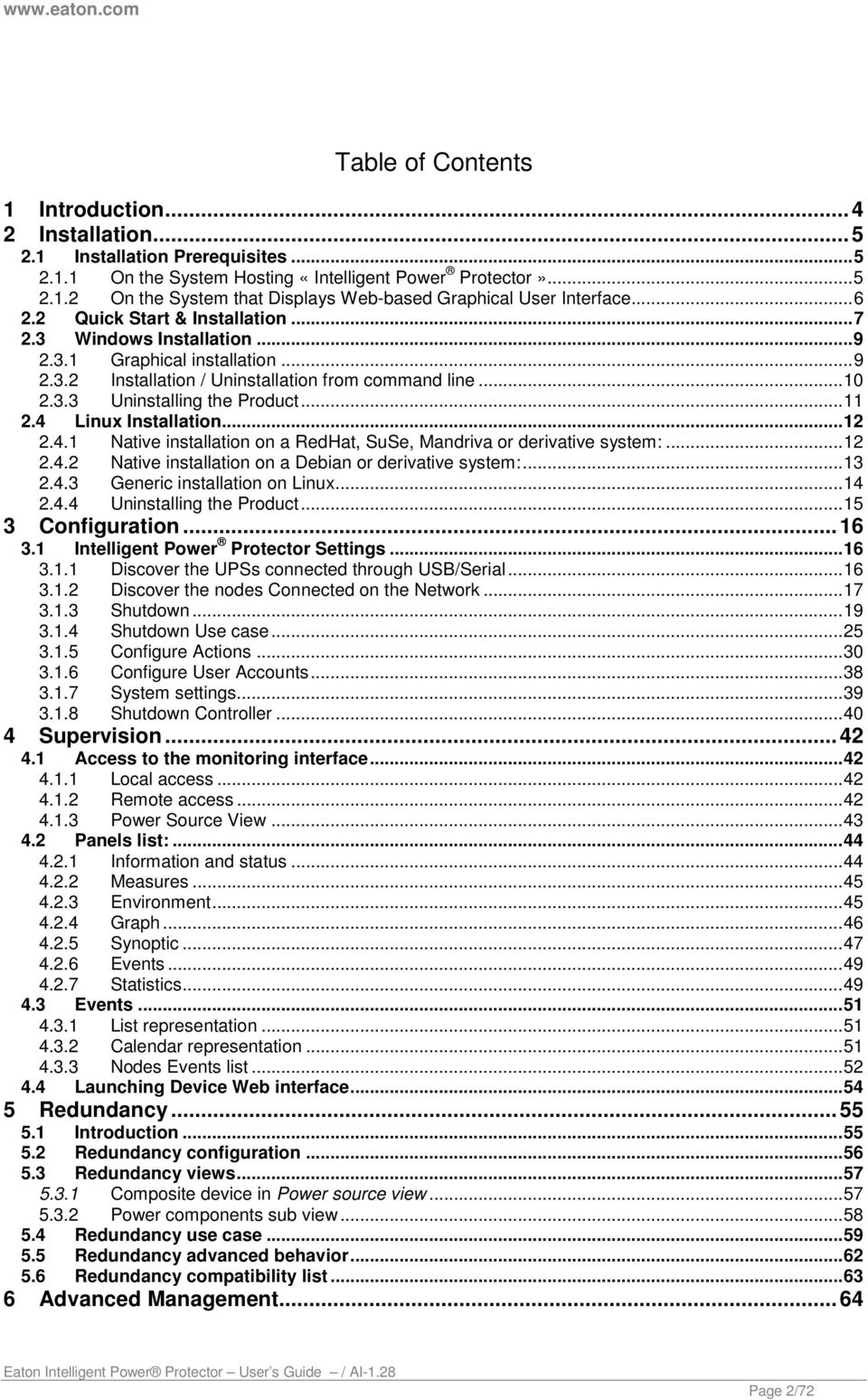
2 Table of Contents 1 Introduction Installation Installation Prerequisites On the System Hosting «Intelligent Power Protector» On the System that Displays Web-based Graphical User Interface Quick Start & Installation Windows Installation Graphical installation Installation / Uninstallation from command line Uninstalling the Product Linux Installation Native installation on a RedHat, SuSe, Mandriva or derivative system: Native installation on a Debian or derivative system: Generic installation on Linux Uninstalling the Product Configuration Intelligent Power Protector Settings Discover the UPSs connected through USB/Serial Discover the nodes Connected on the Network Shutdown Shutdown Use case Configure Actions Configure User Accounts System settings Shutdown Controller Supervision Access to the monitoring interface Local access Remote access Power Source View Panels list: Information and status Measures Environment Graph Synoptic Events Statistics Events List representation Calendar representation Nodes Events list Launching Device Web interface Redundancy Introduction Redundancy configuration Redundancy views Composite device in Power source view Power components sub view Redundancy use case Redundancy advanced behavior Redundancy compatibility list Advanced Management Page 2/72
3 7 Compatibility List Eaton Serial line Devices Eaton Network Devices Eaton Legacy cards Network Ports FAQ and Error messages Glossary Acknowledgements Page 3/72

4 1 Introduction The new Eaton graceful shutdown application is called "Intelligent Power Protector" Intelligent Power Protector: Provides local computer graceful shutdown - acquisition through Eaton UPSs USB or RS232 communication ports (Pulsar & Powerware series) - acquisition through Web/SNMP Cards (Network Management Card NMC Network-MS (ex / ) and Modbus-MS (ex 66103), Connect UPS XSlot, PXGX 2000 P/N , PXGX-UPS (*) ) (*) Please refer to the "Compatibility list" Chapter for a comprehensive list of the supported cards Can be supervised by Intelligent Power Manager. Can be managed by Intelligent Power Manager (mass configuration / mass update/ ) Page 4/72

5 2 Installation 2.1 Installation Prerequisites On the System Hosting «Intelligent Power Protector» Supported Operating Systems: Intelligent Power Protector can be installed on following systems: Windows (x86_64) 8 / 2012 / 7 / 2008 /2008 R2 / Vista / 2003 / XP Windows (x86) 8 / 2012 / 7 / 2008 / Vista / 2003 / XP / 2000 Linux (x86/x86_64) Debian GNU Linux: 5, 6 SUSE/Novell: SLES 11, OpenSUSE 11.2, 11.4 RedHat Enterprise Linux: RHEL 5.4, 5.5, 6, Fedora core 14, 15 Ubuntu: LTS, 10.10, Virtual Environments: VMware: ESX 5.1, 5.0, 4.0, 4.10, ESXi 4.0& 4.1 (pay version only) ESXi 5.1, 5.0 (pay version only) Hyper-V: Hyper-V and Hyper V Server R1, R2 XEN Citrix XenServer 5.6, 6.0 Open Source Xen 2.6 on RHEL 5, Open Source Xen 3.2 on Debian 5.0 KVM KVM on RHEL 6 and Debian 5 For the installation in these specific Virtual Environments, please refer to the user manual appendix that describes the specific steps for those environments. The Linux package is based on standard Linux mechanisms and therefore can be installed and used with other Linux distributions. Feedbacks / test or bug reports are welcome at EATON Support address: (contacttechnical at eaton.com). The following list is not exhaustive. Intelligent Power Protector should be compatible with: Linux (x86/x86_64) SUSE/Novell: SLES 10, OpenSUSE 10.3 RedHat Enterprise Linux: Fedora core 13 Ubuntu: 8.04 LTS Mandriva: 2010, 2011 CentOS: 5.4, 5.5, Software compatibility limitations: To avoid network or serial port access conflicts, you can not install the Intelligent Power Protector on a machine that also hosts: the Eaton Intelligent Power Manager (or Eaton Enterprise Power Manager) the Eaton Network Shutdown Module the Network Management Proxy Personal Solution Pac Page 5/72

6 LanSafe and LanSafe Web View Netwatch Standby configuration (Windows): In Configuration Panel -> Power Option properties: You must unselect the Standby configuration of your Operating System to be compliant with the Intelligent Power Protector. With the standby configuration checked your system is not protected. If you want to save energy, please prefer the hibernate feature Driver installation IPP installs all the necessary drivers (for USB communication). If Windows Operating System wants to install a driver from Windows Update, you can cancel this process On the System that Displays Web-based Graphical User Interface The Eaton Intelligent Power Protector graphical interface can be accessed remotely using a simple Web browser. Access to this interface can be secured through SSL connection and is also secured through Login & password. The Intelligent Power Protector graphical interface has been tested with: Google Chrome (tested with 14) Mozilla Firefox (tested with 5 and 6) Iceweasel Microsoft Internet Explorer (*) 7, 8, 9, 10 Opera 10 For optimal performance, Google Chrome or Firefox 6 is recommended. For good performance Internet Explorer 9 or any later version are recommended. (*) IE6 should work, however, performance is limited Page 6/72
7 2.2 Quick Start & Installation To start in 5 minutes, please perform the following steps: Step 1 (Installation) On a Windows 2000/XP/2003/Vista/2008/7/8, Linux, machine, run the Intelligent Power Protector package under an administrator account. A Web browser is automatically displayed (enter admin as Login / admin as Password and click on the Login button). A popup message advises you to change your default login / password. Step 2 (Configuration) When started, the application automatically performs a Quick scan. Using the Quick scan operation, you will discover: =>Serial line connected UPSs (RS232 or USB) The discovered UPS connected through (RS232 or USB) is automatically assigned as the Power source (the Status icon is Green ) => Networked UPSs through broadcast within a few seconds Quick Scan is compatible with following Web/SNMP Cards (Network-MS (ex / ) and Modbus-MS (ex 66103), Connect UPS XSlot, PXGX 2000 P/N Page 7/72

8 5591, PXGX-UPS Card) The discovered UPS connected through (Network) are not automatically assigned as the Power source (You have to select the node and click on the button Set as Power Source the icon becomes Green ) The discovered nodes are displayed in Settings Auto Discovery For the other nodes, please perform the discovery based on IP address ranges (Range scan) Using the Range Scan operation you will discover the nodes that are outside of the Network segment In the Settings Shutdown page, assign the IP address of the UPS that powers the local Computer. In the Settings User List page, assign the access rights through login and password Step 3 (Operation) The Views Power Source menu item (optional) allows you to supervise the current state of the UPS that powers the server running Intelligent Power Protector The Events Event List view allows you to view the device events. Page 8/72

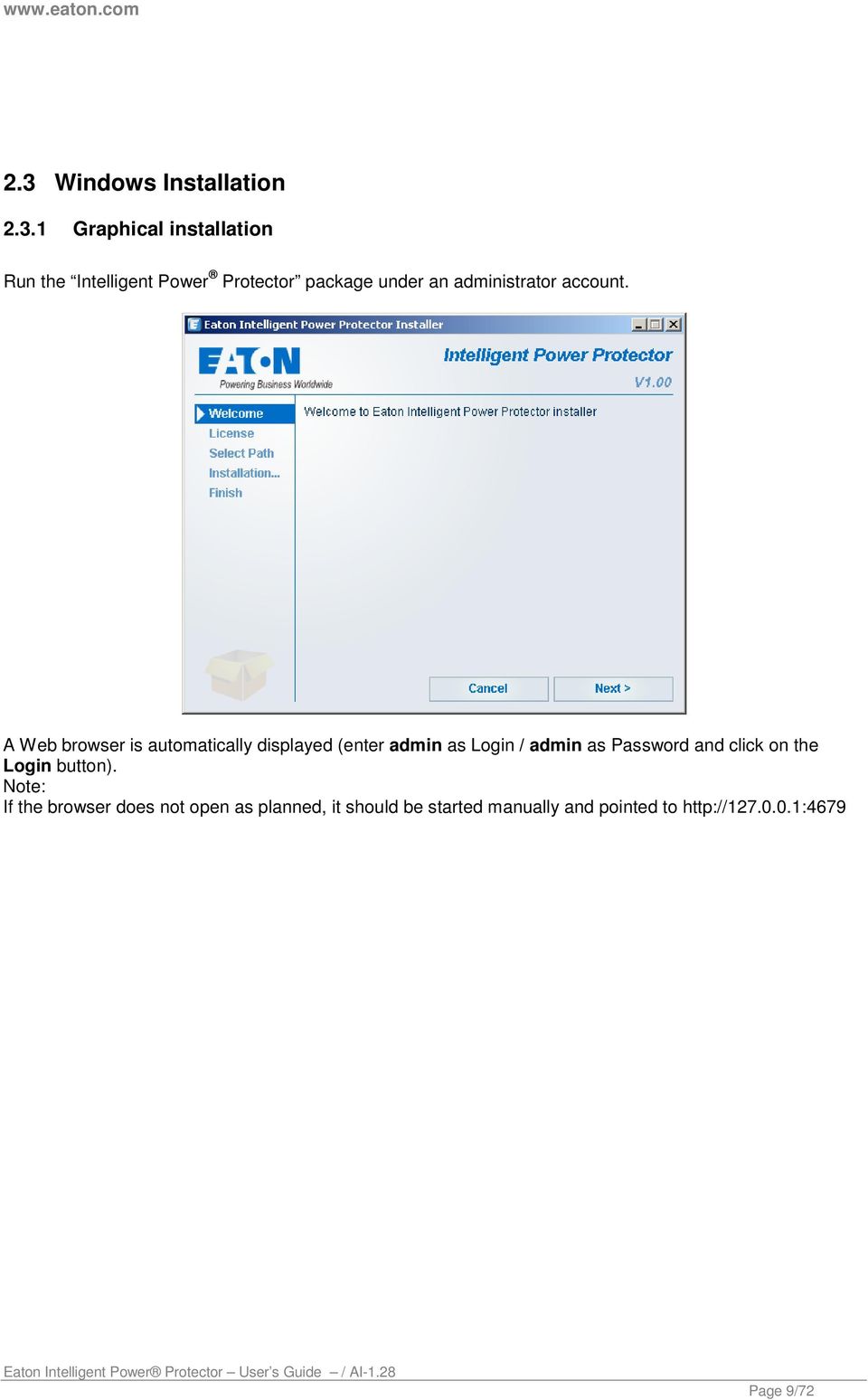
9 2.3 Windows Installation Graphical installation Run the Intelligent Power Protector package under an administrator account. A Web browser is automatically displayed (enter admin as Login / admin as Password and click on the Login button). Note: If the browser does not open as planned, it should be started manually and pointed to Page 9/72
10 2.3.2 Installation / Uninstallation from command line It is possible to install or uninstall the product from a command line in order to deploy the software massively and/or without graphical interface. This method also provides the ability to configure protection settings from the command line. Detail of available command options can obtained using command: <packagename> -help <packagename> [COMMAND] [OPTION]... Available commands: -install Launches the installation/upgrade process (default). -uninstall Launches the uninstallation process. Available options: -debug -silent Displays debugging information on the console. Install the application silently. Installation folder can be provided with: -dir <installpath> Example: <packagename> -install -silent -dir "C:\Program Files\MyFolder" will install IPP silently in C:\Program Files\MyFolder Once the installation is completed, open a Web browser with the following URL <host> is the host name or IP address of the machine hosting IPP. Page 10/72
![Detail of available command options can obtained using command: <packagename> -help <packagename> [COMMAND] [OPTION]... Available commands: -install Launches the installation/upgrade process (default).](/docs-images/40/15534002/images/page_10.jpg "-uninstall Launches the uninstallation process. Available options: -debug -silent Displays debugging information on the console. Install the application silently.")
11 Installation Result If you install a new Intelligent Power Protector release without uninstalling the old one you will keep your product settings. At the end of the installation, the following shortcuts are created in the group: Start Programs Eaton Intelligent Power Protector Name Open Eaton Intelligent Power Protector Start Eaton Intelligent Power Protector Stop Eaton Intelligent Power Protector Uninstall Eaton Intelligent Power Protector Description Opens the "Intelligent Power Protector " web page from default browser Starts the service Stops the service Uninstalls the Program A service called «Eaton Intelligent Power Protector» is also created for the Database Acquisition Engine. This service automatically starts on machine boot-up. This service provides the Web Interface. An alarm notification box, accessible from the System Tray icon displays the alarms on the local computer Uninstalling the Product From the Add/Remove programs item of the control panel, execute the "Eaton Intelligent Power Protector Vx.xx" package. You can also uninstall from the shortcuts: Start Programs Eaton Intelligent Power Protector Uninstall Eaton Intelligent Power Protector. This will remove the product and the custom files if you confirm it. Page 11/72

12 2.4 Linux Installation Introduction IPP for Linux is available both in native package form (.deb or.rpm) and as a generic installer for Command Line Interface (CLI) Native installation on a RedHat, SuSe, Mandriva or derivative system: 1) Graphical installation To install graphically, double click on the Intelligent Power Protector.rpm package, The system will prompt for the root password, and then launch a graphical front-end, like RedHat's Package Installer below: 2) Command line installation To install from a command line, use the following command (as root): $ rpm -i ipp-linux_x.y.z.rpm For example: $ rpm -ivh ipp-linux i386.rpm Preparing... ########################################### [100%] 1:ipp-linux ########################################### [100%] Once the installation is completed, open a Web browser with the following URL <@IP> is the IP address of the machine hosting IPP Page 12/72

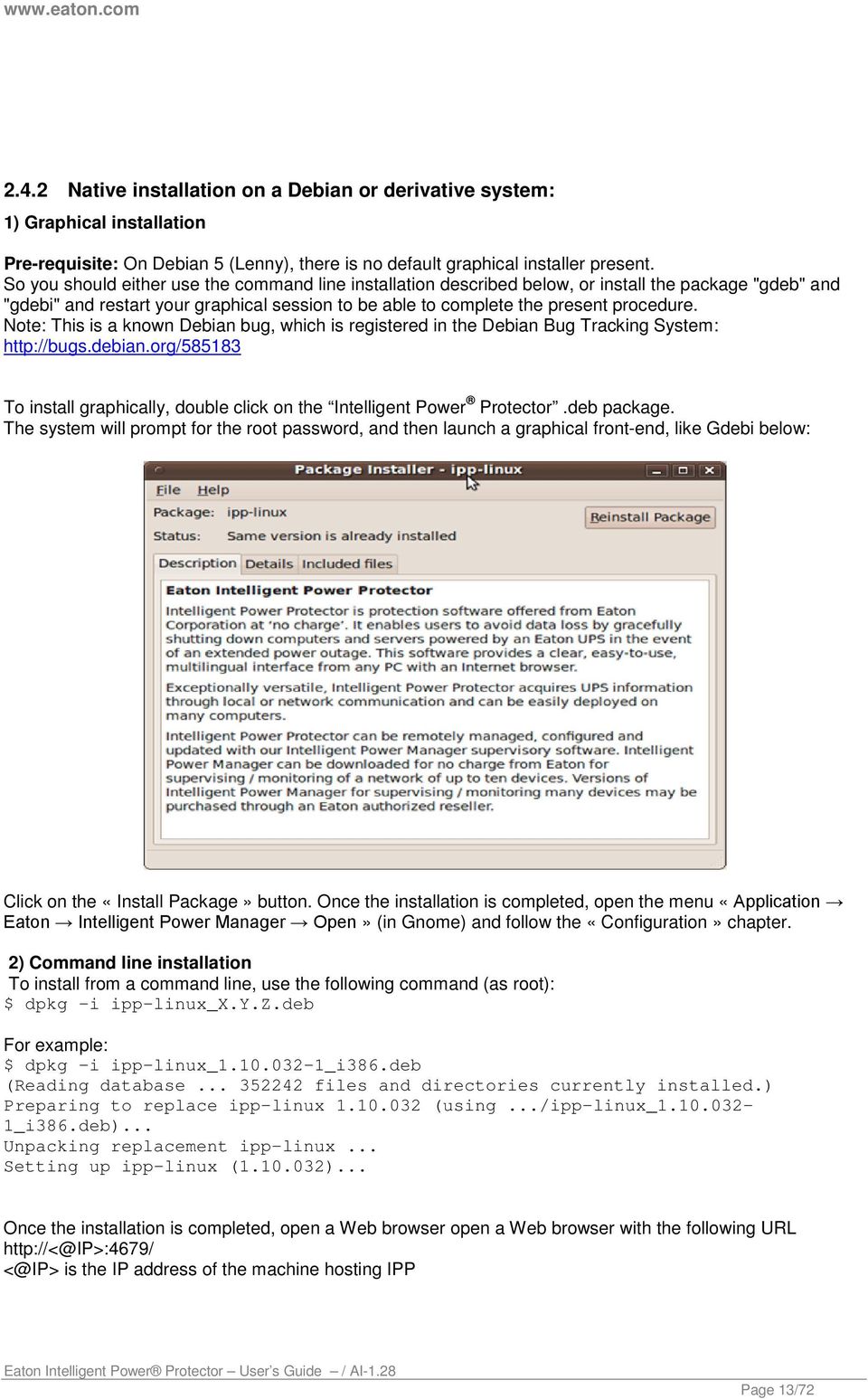
13 2.4.2 Native installation on a Debian or derivative system: 1) Graphical installation Pre-requisite: On Debian 5 (Lenny), there is no default graphical installer present. So you should either use the command line installation described below, or install the package "gdeb" and "gdebi" and restart your graphical session to be able to complete the present procedure. Note: This is a known Debian bug, which is registered in the Debian Bug Tracking System: To install graphically, double click on the Intelligent Power Protector.deb package. The system will prompt for the root password, and then launch a graphical front-end, like Gdebi below: Click on the «Install Package» button. Once the installation is completed, open the menu «Application Eaton Intelligent Power Manager Open» (in Gnome) and follow the «Configuration» chapter. 2) Command line installation To install from a command line, use the following command (as root): $ dpkg -i ipp-linux_x.y.z.deb For example: $ dpkg -i ipp-linux_ _i386.deb (Reading database files and directories currently installed.) Preparing to replace ipp-linux (using.../ipp-linux_ _i386.deb)... Unpacking replacement ipp-linux... Setting up ipp-linux ( )... Once the installation is completed, open a Web browser open a Web browser with the following URL <@IP> is the IP address of the machine hosting IPP Page 13/72
14 2.4.3 Generic installation on Linux If your system doesn't derive from RedHat (using.rpm) or Debian (using.deb); you can install IPP using the generic package. Note: this method is only supported from the command line. To install from a command line in interactive mode, use the following command from where the generic installer is located (as root): $ ipp-linux-1_10_035-i386.run -install For silent installation, add the -silent parameter as shown below (as root): $ ipp-linux-1_10_035-i386.run -install -silent Once the installation is completed, open a Web browser open a Web browser with the following url <@IP> is the IP address of the machine hosting IPP Page 14/72

15 2.4.4 Uninstalling the Product As for the product installation, if you have chosen the native packages, you can use your favorite packages management application to remove the «ipp-linux» package. You can also do the same from the command line. For example, on RedHat and derivatives, use: $ rpm -e ipp-linux On Debian and derivatives, use: $ dpkg -r ipp-linux Note: After uninstalling the native.deb or.rpm packages, some user's configuration and data are not removed, due to technical constraints. If you want to fully remove these, use (as root): $ rm -rf /usr/local/eaton/intelligentpowerprotector If you have chosen the generic installer, use the following command for interactive uninstall (as root): $ /installation/path/mc2 -uninstall For silent uninstall add the -silent parameter as shown below (as root): $ /installation/path/mc2 -uninstall silent Page 15/72

16 3 Configuration 3.1 Intelligent Power Protector Settings Start the "Intelligent Power Protector" main graphical interface from the previously created shortcut, and then click on the Settings-> Auto Discovery menu item Discover the UPSs connected through USB/Serial The first discovered UPS connected through (RS232 or USB) is automatically assigned as the Power source (the Status icon is Green - ) Page 16/72

17 3.1.2 Discover the nodes Connected on the Network From the Settings Auto Discovery item; the following discovery methods are available: Quick Scan (automatically performed when application starts) Range Scan Address Scan Notes: Each network node (Web/SNMP Card ) must have a valid IP address (or a DNS name) in the range that you have entered for auto-discovery. Refer to the compatibility list. Intelligent Power Protector automatically receives the alarms (through notification or polling) Required Connect UPS XSlot/BD configuration: Set the IPP discovery password to the same value as the Web /SNMP read community name (default is public) In ConnectUPS Write Access Managers control menu (via telnet, ssh or serial connection): disable SNMP access restricted by IP/Hostname (this is the default setting since firmware version 2.02) or configure it correctly (IPP has to be configured in trusted host list) Required PXGX 2000 & PXGX-UPS cards configuration: Set the IPP discovery password to the same value as the PXGX read community name (default is public) In PXGX Access control page: disable SNMP access restricted by IP/Hostname or configure it correctly (IPP has to be configured in trusted host list) In PXGX Take care to configure PXGX2000 in SNMP V1 or SNMP V1 + V3 The Quick scan request is a Broadcast frame on 4679 IANA reserved port and 69 standard TFTP port. Using the Quick scan operation, you will discover through broadcast within a few seconds following Web/SNMP Cards (Network-MS (ex / ) and Modbus-MS (ex 66103), Connect UPS XSlot P/N , PXGX 2000 P/N , PXGX-UPS, ) For the nodes outside of the Network segment, please perform the discovery based on IP address ranges (Range scan) Address Scan performs a single address scan The discovered UPS connected through (Network) are not automatically assigned as the Power source (you have to select the node and click on the button Set as Power Source. The Edit shutdown configuration window opens automatically when the Power source is set. Please refer to the next paragraph to configure correctly the parameters. Once the power source is configured, the icon becomes Green or Grey if the communication fails). Page 17/72
18 Page 18/72

19 3.1.3 Shutdown Introduction Intelligent Power Protector provides local computer graceful shutdown with an acquisition through: USB/Serial or Network (Web/SNMP Cards) To configure shutdown, proceed as follows: Login with an administrator user profile From the Settings menu Item, select the Shutdown menu item then the following page is displayed: From this page, the configuration options are provided: Edit power source Edit shutdown configuration. Edit advanced shutdown criteria. Edit UPS configuration Test Access. Test shutdown. These configuration options are described hereafter Power source To configure Power Source, perform the following actions: Click on Edit Power Source. Page 19/72
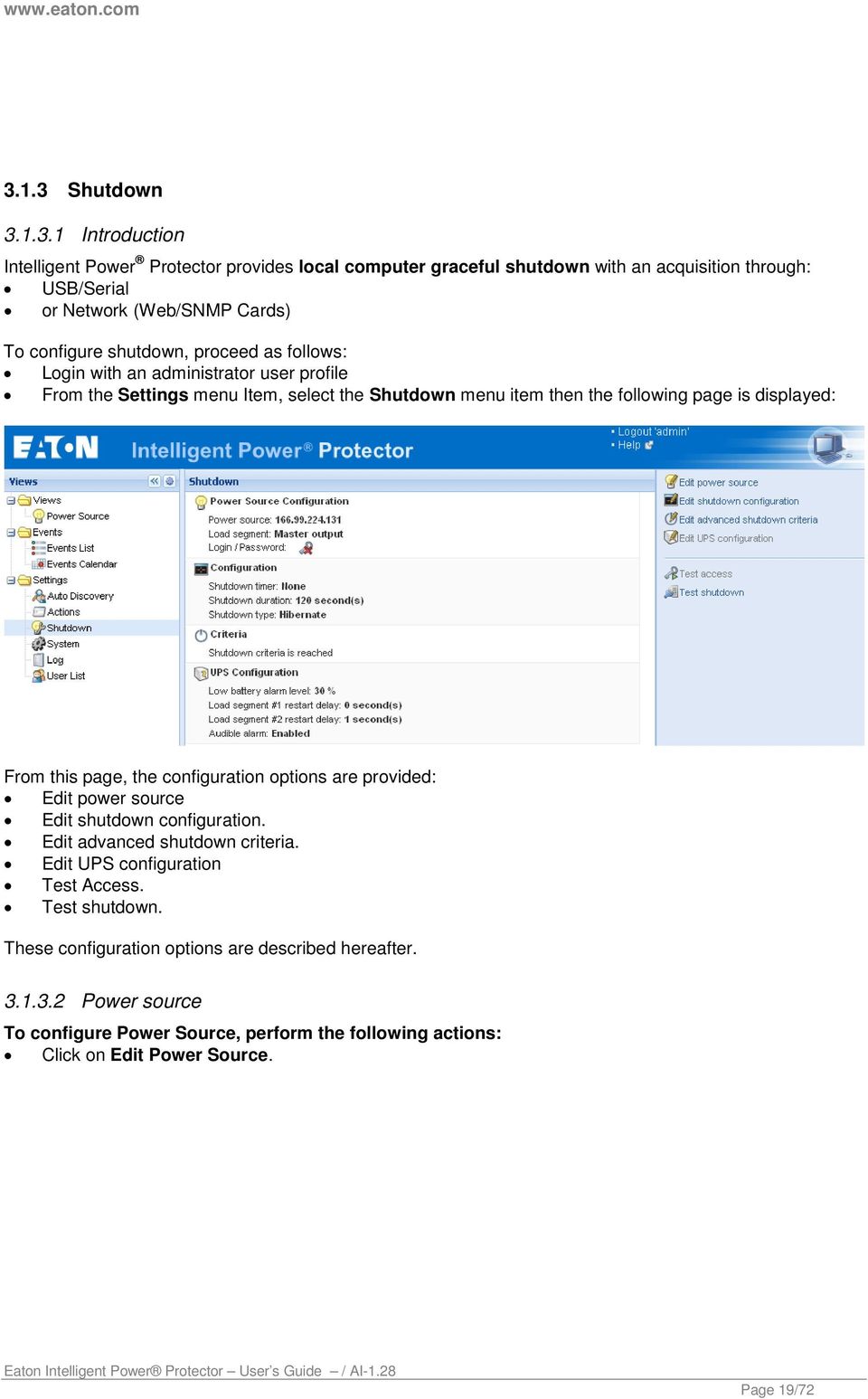
20 In the Power source field select the UPS that powers the computer hosting Intelligent Power Protector (This settings is also accessible through Settings -> Auto-Discovery -> Set as PowerSource) Check other parameters. Click on Save Other parameters: Load Segment: (Optional) the load segment that powers the server hosting IPP Note: When Master is selected the entire UPS will switch off. Access parameters: (When Power Source is managed through the network) If the Power source is a Web/SNMP Cards (Network-MS (ex / ) and Modbus-MS (ex 66103)), Login and password are needed only if Intelligent Power Protector has to set values in the Web/SNMP Card. (e.g. when changing the shutdown duration value) If the Power source is another Intelligent Power Protector with shutdown controller feature activated, then Login and password are mandatory. The Login must be the admin account. In case of a misconfigured Shutdown feature, the software signals a communication error. Check that power source and access parameters (if needed) are correctly set. Page 20/72

21 Edit Shutdown Configuration To configure Shutdown parameters, perform the following actions: Click on Edit shutdown configuration. Shutdown timer: (Optional) The time period from the time of the power failure until the launch of the UPS shutdown sequence. Shutdown duration: The shutdown delay needed to properly shut down the computer. Page 21/72
22 Shutdown type: Hibernate (default option) If available with your operating system, is better to use the hibernation feature (first available with Windows 2000) as there are a number of advantages. If the system is shut down, all work in progress and system information are automatically saved to the disk. The computer itself is also de-energized. When mains power returns, all the applications re-open exactly as they were and the user placed back in their work environment. Hibernate function must first have been activated in the operating system. In the power options on the Windows control panel, check that hibernate option is activated on the Hibernate tab sheet. Note: If you select hibernate, but your computer does not have this function, Intelligent Power Protector will still protect the installation by carrying out the normal (default) shutdown. Note: For Windows Vista, please refer to the FAQ section of this manual. Shutdown. This option shuts down your applications and the system, but does not de-energize the computer. The system offers the user the choice to de-energize the computer, in which case it is the UPS that cuts power. On most computers, this configuration is necessary if you want the server to restart as soon as mains power returns. Power-off This option shuts down your applications and the system, and de-energizes the computer. This configuration is advised if you wish to be on hand when the system re-starts. (or for load shedding) Script: This option manages the shutdown in a custom script that you can create to fit with your own shutdown sequence. You can integrate the standard Windows shutdown command (more info with shutdown /? in a Windows Command Line interpreter). Shutdown script: the absolute path of the script. Outlet shutoff Active: Using this option, IPP will send a delayed shutoff command to the outlet. This delayed command is sent to the UPS at the beginning of the shutdown sequence, and this is the point of no return for this sequence. The outlet is turned off at the end of the shutdown sequence. Shutdown sequence trigger: When a power utility failure occurs, the shutdown sequence is started as soon as the first of the two following condition is reached. After the Shutdown timer (if configured). When WEB / SNMP UPS CARD or UPS shutdown criteria is reached (UPS / WEB / SNMP UPS CARD Decision according to many criteria see next figure) Page 22/72
23 Edit advanced Shutdown Criteria Edit advanced Shutdown Criteria opens the Edit advanced Shutdown Criteria window: Criteria definition: Shutdown criteria is reached: (enabled by default) this is the standard shutdown sequence taking into account time based criteria and UPS low battery level criteria In addition, the user can also select one or several events in the following events list. If these events are selected, they will trigger an immediate shutdown sequence when they occur. Redundancy lost (For Eaton MX Frame only) Protection lost (For Eaton MX Frame only) UPS fault (internal fault or battery fault) UPS overload Output on bypass Communication failure Note: When using a Virtual Power Source (in redundant configuration), only following criteria can be used: Shutdown criteria is reached Redundancy lost Protection lost Page 23/72
24 Edit UPS Configuration Edit UPS Configuration opens the UPS Configuration screen. It is available for some UPSs connected through USB or serial. Otherwise, the parameters are displayed on read only through Network or if the UPS doesn t support this feature. You can configure following UPS parameters: Low Battery alarm level Load Segment restart delays Audible alarm Test access Test access checks if Login and password are correctly configured so that: IPP can update his shutdown configuration on the card or IPP can remotely access to the IPP shutdown controller Test shutdown Test shutdown starts a shutdown procedure (According to the IPP parameters) Page 24/72
25 3.1.4 Shutdown Use case According to different architecture, we describe several typical use cases that will help you to configure properly the shutdown sequence according to your needs Architecture #1 (local attached UPS through serial /USB) Use Case #1: You want to keep your computer hosting IPP#1 alive as long as possible. This is the default IPP#1 configuration. The next screenshot illustrates this IPP default configuration available from Settings -> Shutdown - > Edit Shutdown Configuration. Use Case #2: To save battery backup time, you want to perform load shedding (stop your computer after a predefined time) Configure a Shutdown timer value on IPP#1 (this configuration parameter is available from Settings->Shutdown->Edit Shutdown Configuration) Page 25/72
26 Architecture #2 (Network attached UPS Web SNMP Card) Use Case #1: You want to keep all your computers alive as long as possible This is the default configuration for the IPPs and the Network-MS IPP default configuration is available from Settings -> Shutdown -> Edit Shutdown Configuration. e.g. Network-MS (ex / ) and Modbus-MS (ex 66103), WEB / SNMP UPS CARD default shutdown configuration is available from UPS-> Shutdown Configuration as illustrated on next screenshot: Use Case #2: To save battery backup time, you want to stop all your computers after a predefined time. Page 26/72
27 On the WEB / SNMP UPS CARD, configure a Shutdown Criteria. e.g. Network-MS (ex / ) and Modbus-MS (ex 66103) WEB / SNMP UPS CARD shutdown configurations are available from UPS-> Shutdown Configuration Note: In this case the computer automatic restart is guaranteed. Use Case #3: You want to perform load shedding on the specific computer hosting IPP#2 (i.e. stop the computer hosting IPP#2 after a predefined time) On IPP#2, configure a Shutdown timer value (this configuration parameter is available from Settings->Shutdown->Edit Shutdown Configuration) Note: In this case the automatic restart for the computer hosting IPP#2 is not guaranteed Note: Use Case 3 can be combined with Use Case 1 or Use Case 2 Page 27/72
28 Architecture #3 (Network attached UPS through Shutdown Controller) Use Case #1: You want to keep all your computers alive as long as possible. This is the default shutdown configuration for the Shutdown Controller IPP#1 and other IPPs IPP default configuration is available from Settings -> Shutdown -> Edit Shutdown Configuration. Use Case #2: To save battery backup time, you want to stop all your computers after a predefined time. On IPP#1 (Shutdown Controller) configure a Shutdown timer value. (this configuration parameter is available from Settings->Shutdown->Edit Shutdown Configuration) Note: In this case the automatic restart for all the computers is guaranteed Use Case #3: You want to perform load shedding on the specific computer hosting IPP #2 (stop the computer hosting IPP#2 after a predefined time). On IPP#2, configure a Shutdown timer value (this configuration parameter is available from Settings->Shutdown->Edit Shutdown Configuration) Note: In this case the automatic restart for the computer hosting IPP#2 is not guaranteed Note: Use Case 3 can be combined with Use Case 1 or Use Case 2 Use Case #4: Typical example with 4 computers. According to the servers roles, you may want to shutdown the servers at different times: Computer hosting IPP#1: is directly attached to the UPS (USB/Serial) The shutdown Controller has to be installed on the server that will be the last one to shutdown. Note: On Pulsar series this computer has to be powered by the master outlet. Computer hosting IPP#2: is a computer that requires a long delay to shutdown (e.g. hosting database or VM-Ware) Computer hosting IPP#3: is a computer that requires being the last one to be shutdown (as other servers depend on it) (e.g. File server) Computer hosting IPP#4: is another server that has be stopped before computer B or C (Web server) Page 28/72
29 Recommended configuration: or this computer can also be stopped for load shedding purpose. (Workstation) On IPP#1: On IPP#2: On IPP#3: On IPP#4: Configure Shutdown Timer to None and Shutdown Duration to 120 s Configure Shutdown Timer to 180 s and Shutdown Duration to 180 s Configure Shutdown Timer to None and Shutdown Duration to 120 s Configure Shutdown Timer to 120 s and Shutdown Duration to 120 s The following time diagram summarizes this configuration: Power 1 min. 2 min. 3 min. 4 min. 5 min. 6 min. 7 min. 8 min. 9 min. 10 min. Utility UPS On battery OFF IPP#1 IPP#2 IPP#3 IPP#4 Page 29/72
30 3.1.5 Configure Actions You can define the way users will be notified when node events happen. From the Settings Actions item; the following channels are available: Execute script/program Notification to the local alarm notification box, available from the System Tray icon. Notifications summary window The Create new action button will display following interface: Notes: The * fields are required. Clicking on the pen icon starts an assistant to fill the field. Action active: enables/disables the action. Action name: user friendly name for the action. Page 30/72
31 Events filter: You can filter the action according to: The Event criticalities. (Critical, Warning, Normal, Communication Lost). The Event category (All Events, Alarms, Shutdown events, Power events, Measures) refer to the list hereafter. The view that triggers the event (From view). Note on Event Criticality parameter: With this parameter, you can filter the notification according to the event level. Refer to the event list provided below in this document. If you select Critical as filter you will not receive the associated Normal event informing that the device status changes from Critical to Normal. Action type: you can select following action: ( / Command / Notification). According to your choice, specific settings are available for each action. The configuration of these 3 actions is detailed hereafter. Detailed Alarms and events list in Event category : Alarms: Utility failure Communication lost Shutdown Imminent Battery Low Internal Failure Overload Output On/Off Outlets On/Off Battery Fault On Automatic Bypass On Manual Bypass Redundancy Lost Protection Lost Shutdown Events: Utility failure Battery Low Shutdown Imminent Local Run Time to Shutdown Power Events: Output Percent Load Output Apparent Power Output Active Power Output Power Factor System Defined Output Overload Alarm Measures: Output Percent Load Battery Remaining Capacity Battery Run Time to Empty Main 1: Voltage, Current and Frequency Main 2: Voltage, Current and Frequency Output: Voltage, Current and Frequency Output Apparent Power Page 31/72
32 Output Active Power Output Power Factor This action is not active by default. Some of the fields are preconfigured by default. For the generic fields at the top of the window, please refer to create new action section Page 32/72
33 Specific action settings: SMTP Server: To receive s on UPS events you have to indicate the SMTP server IP address Login, Password: authentication information of the SMTP server Recipient: Receiver address. Note: you can specify multiple receivers by separating them with coma. Sender: (Optional field) the sender Note that your SMTP server may require a valid address. Subject: The subject (can be customized with pre-defined variables). Message: The message body (can be customized with pre-defined variables). Digest: you can specify that you want to receive a consolidation of the alarms that occurred during a delay that you can choose (if you specify none, each alarm will generate an . With this setting you will receive more s for the same number of events. Possible values are: None / Every 10 seconds / Every minutes / Every hour / Every day Notes: It is possible to duplicate an existing action already configured and just change some parameters. For advanced use, you can Customize the subject and Message e.g. if you have to translate an into an SMS (using an to SMS external provider). Clicking on the pen icon starts the Edit message assistant to fill the field with some variables. Click on the button to add a variable. Page 33/72
34 Command (Execute script/program): In order to execute a program on UPS events the program path will be required. Example to play sound alarms on events: Create a batch command file containing the command: mplay32.exe /play /close C:/WINDOWS/Media/<sound>.wav Create an action of type command calling this batch file. Notes: For Windows, the program is executed under the SYSTEM account. For the right execution of some privileged commands, you may have to apply following procedure: It may be necessary to modify the context before certain actions can be run. To allow a user to run specific tools and programs with permissions that are different from those assigned to the user's account use the Windows RunAs Command which allows you to save the password (Windows XP Service Pac 2 and more recent versions). Use the following Microsoft command: runas /profile /user:<my login> /savecred <my_program.exe> On first execution a password is required, it is saved for subsequent executions. For Linux, the IPP process is running under root privilege (sudo command is not needed to execute a program or shell script). Page 34/72
35 Notification (Alarm box notification): The Notification action is active by default. The alarms are displayed on the local computer in an alarm box. This alarm box displays the last 10 alarms. It takes the focus when a new alarm occurs. From the event section you can view more than 10 alarms. The alarm notification box is accessible from the System Tray icon. Click on the icon to open the window that displays the alarms on the local computer. A right click on the System Tray icon provides you a fast access to following functions: Page 35/72
36 If a Power source has been declared, System Tray Icon can have following states: The System Tray Icon correctly receives alarms from Intelligent Power Protector ( AC is present on the Power source) The System Tray Icon correctly receives alarms from Intelligent Power Protector ( The Power Source runs in battery mode) The System Tray Icon correctly receives alarms from Intelligent Power Protector (A Warning event occurred on Power Source) The System Tray Icon correctly receives alarms from Intelligent Power Protector ( A critical event occurred on Power Source) Communication with Power source has failed Page 36/72
37 Advanced events and actions customization: In Intelligent Power Protector installation folder, you can see a configs/scripts folder containing a sample user-defined action script (sample_user_script.js). You have the possibility to modify this script or create new scripts that define very specific events and actions. The sample script provides details about the expected structure and syntax for defining new actions and triggers. To activate the execution of a script you have to set the enabled property to true as follows: UserScript = { name: "MyScript", enabled: true, // Set this property to true to enable the script Page 37/72
38 3.1.6 Configure User Accounts Multiple user accounts can be configured. From the Settings menu Item, select the User List item, then perform the following steps: Click on Add user. Set the User Login and the User password. Select the User s Profile level. The following levels are available: => admin (the user will be able to access all the features) => user (the user will only access the supervision and is not able to set parameters to the system or nodes). Click on Create new user button. User Accounts window Intelligent Power Protector contains a default Administrator profile with: admin as login admin as password Warning: For security reasons, it is strongly recommended to change default password immediately after the installation. A Popup warns you on security if the password contains less than 8 characters. Notes: The Login and Password is case sensitive The original admin account login value is fixed (admin) and its Password has to be modified There is no limit in the accounts number Page 38/72
39 3.1.7 System settings System settings Select one of the items, and then click on the corresponding button on the right: Edit system information: to enter contact and location information for IPP software. Edit language allows the user to change the user language. (Czech, English, French, German, Japanese, Korean, Polish, Portuguese, Russian, Simplified Chinese, Spanish, Traditional Chinese are currently supported) Edit scan settings changes the default SNMP community name for discovery and enables/disables periodic scan of new nodes. Edit update settings will customize Automatic Updates Features. This feature gives you access to Eaton software updates. Intelligent Power Protector will always be up to date if you select the Check automatically option. When a new software version is detected on just follow the wizard instructions. Notes: Intelligent Power Protector settings will be retained with this operation Intelligent Power Manager can manage updates with large number of computers (refer to chapter 5) Check for updates will check if a more recent version of the product is available on Eaton Web site Module Settings enables optional modules (e.g. Shutdown Controller) Page 39/72
40 3.1.8 Shutdown Controller Introduction Intelligent Power Protector can acquire UPS alarms from a UPS (through USB or RS232 or from SNMP/Web card (*) or Virtual Power Source (*)) and forward the shutdown alarms to the other Intelligent Power Protectors. This specific Intelligent Power Protector is called the Shutdown Controller. (*) Note: This is a new feature available since IPP Activating Shutdown Controller feature You have to activate the Shutdown Controller feature on the IPP 1 that relays the alarms (connected to the UPS through USB or RS232). This option can be activated from Settings-> System -> Module Setting Double click on Module settings then check the checkbox. When this feature is activated on one IPP: A new view called Notified Applications appears in the menu of the Shutdown Controller IPP and the IPP top banner is updated with this graphical sign: Other IPPs will discover this IPP through a network scan. From these other IPPs configure the parameters in Setting-> Shutdown-> Configuration. The main parameters are: * Power Source (indicate the IP address of IPP1 that is the Shutdown Controller) * Load Segment * Login and Password (You must use admin account) Click on Save. Now your IPP is registered in the Notified Application view of the Shutdown Controller (refer to the next chapter). Example with 3 computers (refer to the Shutdown Use Case for Architecture #3) : A UPS is locally connected (through USB) to computer 1 hosting IPP1 (Shutdown Controller) the IPP 1 automatically detects its UPS the user has to activate the Shutdown Controller feature for IPP1 In IPP2 interface the user will have to indicate the IP address of IPP1 computer, the load segment and IPP1 Login and Password In IPP3 interface the user will have to indicate the IP address of IPP1 computer, the load segment and IPP1 Login /Password IPP1 will forward Shutdown alarms to remote IPPs (IPP2) (IPP3) As a consequence the 3 servers powered by this UPS are protected. Page 40/72
41 This is the corresponding Power flow view where 1 UPS powers 3 single feed Servers: Notified Application view The notified application View appears when the Shutdown Controller feature is activated. When the user selects a line, the right hand panels will be refreshed according to the selection. Notified Applications View Status: Green icon indicates that communication is OK between Local and Remote IPP Grey icon indicates that communication is lost between Local and Remote IPP Shutdown Diagram: The shutdown diagram is a time illustration of the shutdown sequence of the selected computer. It aims to present a visual representation of the shutdown sequencing between the different computers. The total width is the remaining runtime to empty of the power source (in case a power failure would happen or is in progress). The green part is the runtime to shutdown duration of the computer The orange part represents the computer shutdown duration. The red part is the computer off time. Note: The Notified Applications list is persistent. The status of this remote IPP will change from OK to Communication Lost if you uninstall a remote IPP or if there is a communication lost event between the shutdown controller IPP and the remote IPP. With this mechanism the IT administrator will be able to monitor any change in the IT distributed architecture. You can manually remove the IPPs from this list through the Autodiscovery -> Remove Nodes Page 41/72
42 4 Supervision 4.1 Access to the monitoring interface To monitor the Power Source, start the main Intelligent Power Protector interface. You can access the same interface locally or remotely Local access From the system where Intelligent Power Protector is installed, you can use the following shortcut: Start -> Programs -> Eaton -> Intelligent Power Protector ->Open Eaton Intelligent Power Protector From a local machine, you can type the following URL in a Web browser or Remote access From a remote machine, you can type the following URL in a Web browser or IP address of computer hosting IPP>:4680/ or or IP address of computer hosting IPP>:4679/ In SSL mode, accept the certificate (by clicking on Yes) e.g. To install the certificate on IE7, you need to perform the following steps: Accepting the SSL Certificate > Run IE as an administrator (Right-click the desktop icon) > Visit the IPP site. > Click through the certificate error > Click the "Certificate Error" button in the address bar. > Click View Certificate > Click Install Certificate > Click the Place all certificates in the following store radio button, and choose the Trusted Root Certification Authorities store. If you don t do this, the certificate goes in your personal store, and it isn t trusted by IE. Enter the Login and Password Page 42/72
43 4.1.3 Power Source View From the Views menu Item, select the Power Source item: You will be able: to supervise the information from the UPS that powers the Intelligent Power Protector computer to drag and drop the panels in this window Page 43/72
44 4.2 Panels list: Information and status This panel displays information on the device that powers the server running IPP. Information Panel The following node information is displayed in this panel: the DNS name (or IP address) is displayed near the status icon Description the commercial product name Nominal Apparent Power the UPS Nominal Apparent Power (in VA or KVA) IP address (if network acquisition) the Web/SNMP card IP address Mac address (if network acquisition) the Web/SNMP card Mac address Location the device location (value of syslocation object or can also be configured in the Device page ) Contact the device contact (value of syscontact object or can also be configured in the Device page ) Serial Number The device Serial Number (if available) Link link to the device Web site (if available) Battery state Charging / Discharging / Default / Floating / Resting Power source AC Power / Battery Load Level the output load level of the device Battery capacity Battery capacity of the device Battery run time the device remaining backup time Master Output Main output status (ON/OFF/Internal Failure/On Automatic Bypass/Manual By Pass/Overload) Group #x output outlet status (ON/OFF) Note: The information displayed in this panel depends on the UPS capabilities. Page 44/72
45 4.2.2 Measures This panel displays the selected device electrical parameters (single phase or 3 phases) depending on the node capabilities Environment This panel displays the selected device sensor information: Temperature, Humidity level, Dry contact status (Open/Closed) (This panel is only available when the source is a Web / SNMP card) Temperature Sensor temperature (in C) Humidity Humidity level Input #1 Status of first contact (open / closed) Input #2 Status of second contact (open / closed) Page 45/72
46 4.2.4 Graph This panel displays the graph of the main measures of the selected device. To read the values, proceed as follows: Place your mouse cursor over the graph, a vertical line appears over it and you can read the values in the box for the selected date. The The button allows you to zoom in the graph. button allows you to select the data you want to display in the graph (refer to following screenshot) In this window, you can select up to 6 measures simultaneously Time scale possible values are 1 hour / 2 hours / 6 hours / 12 hours / 24 hours / 2 days / 1 week Page 46/72
47 4.2.5 Synoptic This panel displays the selected device synoptic. In the top left corner, the UPS electrical topology is indicated (Online UPS, Line Interactive UPS, ). A tool tip is displayed when the mouse is over one of the functional block. Page 47/72
48 Synoptic Color codes: UPS modules: AC/DC DC/AC By-Pass Color Description Green Status OK & Active Red Grey Internal fault & Inactive Status OK & Inactive or Unknown Battery module: Symbol Color Description Green Status OK Orange Battery charge is less than 50% Red Grey Battery fault or End-of-backup Battery status unknown Electrical flows: Symbol Color Description Yellow Current flow through the cable Note: the object animation gives the direction of current flow Grey No current flow through the cable (Warning the cable may be under voltage) Electrical power source at UPS input: Symbol Color Description Green Source powered. Status OK Grey Source not powered or status unknown Examples of combinations between flow status and power source status: Green/ The electrical power source is powered and provides electrical flow Yellow Green/ The electrical power source is powered and does not provide electrical flow Grey Page 48/72
49 Load at UPS output: (its status is linked to that of the UPS output status) Symbol Color Description Green Load powered and protected. Status OK Red Grey Load not powered Load status unknown Examples of combinations between flow status and load status: Yellow/ Load powered and protected Green Grey/ Load not powered Red Events This panel displays the events list of the selected node. You can sort the events according to Status, Date, and Message by clicking on the column header Statistics This panel displays the statistics of the selected node. The button allows you to select the time interval for the statistics. You can adjust the time interval by clicking on the 2 buttons with the From and To dates. Page 49/72
50 Here is the list of Statistics Computed Data: Apparent Consumption (or Active Consumption in next release) Average Apparent Power (or Average Active Power in next release) Power Failure Count Power Failure Cumulated Duration Battery Fault Count Internal Failure Count Overload Count Warning Alarm Count Critical Alarm Count Output Off Count Communication Lost Count Note: This information depends on device capabilities Page 50/72
51 4.3 Events List representation Select the Events -> Events List and the following page appears: Alarms list. Buttons on the bottom toolbar allow filtering on unacknowledged alarms of the corresponding level. All new alarms are stored in this log. You can sort the alarms according to Status, Date, Name, Message and Ack. The following functions are available: Acknowledge selected events will add a check box in the Ack column for selected events Acknowledge all events will add a check box in the Ack column for all events Note: When an alarm is acknowledged, it is marked with a checkbox but it is still viewable in this Event list It decreases the number of non acknowledged alarms at the bottom of the Web page The acknowledged alarms disappear in the PowerSource -> Event panel Export Logs will create a logs.csv file with the following syntax: "Date";"Node";"Type";"Level";"Object";"Value";"Message"; "2009/01/27-18:35:20.840";" ";"Measure";"0";"UPS.PowerConverter.Input[1].Frequency";"49";""; Select all will select all displayed events Deselect all will deselect all selected events Tips: You can select one alarm by clicking on it You can select several alarms with Shift Click or Alt click Then the selected lines appear in dark blue Calendar representation Select the Events -> Events Calendar and the following page appears: In this matrix representation, each line is a week and each column is a day in the week. If you select a day or an interval (with date picker or shift+click command), events and statistics panels will give you all information for this selection and will automatically refresh when new statistics have been computed. Page 51/72
52 4.3.3 Nodes Events list The icons in the different views represent the event severity. Icon Event status Normal. With this event, the UPS device is coming back to a normal status. Event list (UPSs): Communication with device is restored Communication restored with UPS The system is powered by the utility The UPS output is on Communication restored with UPS Battery OK UPS returns to normal load UPS OK Bypass : Return on UPS End of low battery alarm The outlet group 1 is on The outlet group 2 is on Communication failure with environment sensor Communication restored with environment sensor Humidity is in normal range Temperature is in normal range Input #x on Input #x off End of warning alarm End of critical alarm Redundancy restored Protection restored Page 52/72
53 Warning. A problem occurred on the UPS device. Your application is still protected. Event list (UPSs): The system is powered by the UPS battery Output on automatic bypass Output on manual bypass Humidity is below low threshold Humidity is above high threshold Temperature is below low threshold Temperature is above high threshold Warning Alarm (a generic Warning alarm is active on the device) The device is under its load alarm threshold The device is over its load alarm threshold Protection lost Redundancy lost Shutdown in {time} Remote Communication Error (remote communication or configuration issue is detected) Critical. A serious problem occurred on the UPS device. This problem requires an urgent action. Your application might NOT BE powered anymore. Event list (UPSs): The UPS output is off The outlet group 1 is off The outlet group 2 is off Battery fault UPS overload UPS fault Low battery alarm Applications must stop immediately... System shutdown in progress... Critical alarm (a generic Critical alarm is active on the device) Communication lost Event list: Communication failure with Device or Application Page 53/72
54 4.4 Launching Device Web interface From the Status panel, you can access the Web Page for Eaton cards including an on-board web server. Click on the web Link associated to this blue icon (http access) or this yellow one (https access). Opening different Web interfaces from Intelligent Power Protector. Page 54/72
55 5 Redundancy 5.1 Introduction Intelligent Power Protector provides management for composite devices. Composite devices are virtual nodes composed of nodes mounted with specific redundancy schemas (Redundant Supplies, Hot Standby or Static Transfer Switch for two components and Parallel for two or more components) and a dedicated redundancy level. This Redundancy feature has to be Enabled from the Settings -> System -> Modules Settings Intelligent Power Protector will then shutdown a local computer powered by several UPSs (composite device). Here are illustrated the electrical redundancy topologies: Redundant Supplies UPS 1 Server 1 In this case the two UPSs provide power on one or several multiple feed servers. UPS 2 Server 2 Hot Standby UPS 2 For "Hot Standby" mode, when the upstream UPS powers the load, the downstream UPS is on bypass. UPS 1 Page 55/72
56 Static Transfer Switch for two components UPS 1 UPS 2 STS For "STS" mode there are several cases with single STS or multiple STSs. UPS 1 STS 1 UPS 2 STS 2 Parallel for two or more components UPS 1 All the UPSs power the load at the same time. UPS 2 UPS 3 UPS Redundancy configuration Login with an administrator user profile Select two or more nodes and click on the Set composite device menu item: In the dialog box, enter redundancy mode and level, eventually specify a device name Device name: User name of the composite device Redundancy mode: Refer to the Introduction chapter to select the correct electrical topology Page 56/72
57 (Parallel / Redundant Supplies / Hot Standby / Static Transfer Switch) Redundancy Level: It is the minimal number of redundant UPSs powering your system: The default value is 0. If you set this parameter to a higher level you will receive the Redundancy Lost alarm when you don t have enough redundant UPSs. Then the new node is created. You can see it in the Auto discovery node list: You can select it as power source. You can edit composite device properties by selecting it in the discovery view then click again on the Set composite device menu item. If you select components of a composite device and click on the Set composite device menu item again, properties of existing composite device are shown; no new composite device is created so no composite device duplication is possible. 5.3 Redundancy views Composite device in Power source view When Redundancy module is activated, a composite device can be selected as power source. The user can show it in the Power Source view. In this case, Information, Status, Events and Power components panels are displayed with specifics data. Page 57/72
58 5.3.2 Power components sub view When Redundancy module is activated, a new view called Power components is available as a sub view of Power source. This view shows a list of nodes with their properties but just with components of the selected power source if it is a composite device. Page 58/72
59 5.4 Redundancy use case We describe several typical use cases that will help you to configure properly the redundant shutdown sequence according to your needs. Use Case #1: The user wants to have the longest backup time with the redundant configuration This is the default IPP configuration. The next screenshot illustrates this IPP default configuration available from Settings -> Shutdown - > Edit Shutdown Configuration. This is the default configuration on WEB / SNMP UPS CARD e.g. with Network-MS (ex / ) and Modbus-MS (ex 66103), WEB / SNMP UPS CARD default shutdown configuration is available from UPS-> Shutdown Configuration as illustrated on next screenshot: Page 59/72
60 Use Case #2: The user wants to have a shutdown after a predefined time of 10 mins. The shutdown has to occur even if only one UPS is on battery. In this case, each server can have its own shutdown timer (10 mins, 8 mins, 6 mins ) The user has to configure a shutdown timer of 10 mins in IPP. The next screenshot illustrates this IPP default configuration available from Settings -> Shutdown - > Edit Shutdown Configuration. this is the default configuration on WEB / SNMP UPS CARD (refer to previous use case) Use Case #3: The user wants to have a shutdown starting 10 mins from the last detected Utility failure event. (We have 2 UPSs, one of them is redundant) In this case, all servers shut down at the same time. This is the default IPP configuration The user has to configure a shutdown timer of 10 mins in all the WEB / SNMP UPS Cards In this case; the last UPS will send the shutdown order after 10 min. if it runs on battery. If the last UPS never run on battery, the first UPS will simply shutdown at the end of autonomy and the last UPS will take the load.(if it has the capacity, otherwise the shutdown will occur sooner) WEB / SNMP UPS CARD Shutdown configuration is available from UPS-> Shutdown Page 60/72
61 Configuration as illustrated on next screenshot: Use Case #4: The user wants to have a shutdown when the remaining time of the last UPS is 10 minutes In this case, each server can have its own shutdown duration (10 mins, 8 mins, 3 mins ) The user has to configure a shutdown duration of 10 mins in IPP. The next screenshot illustrates this IPP default configuration available from Settings -> Shutdown - > Edit Shutdown Configuration. This is the default configuration on WEB / SNMP UPS CARD (refer to previous use case) Page 61/72
62 5.5 Redundancy advanced behavior For the following tables we take a parallel UPS configuration with 4 UPSs (Each UPS is 20 kw) For this parallel topology, the Load can vary between 0 and 80 KW. UPS 1 UPS 2 UPS 3 UPS 4 Redundancy alarm Management with 4 modules: According to the user defined Redundancy Level and the Load, we detail following information: R is the number of redundant UPSs Status of Redundancy lost alarm Load / Redundancy Level Load < 20 KW 20 KW < Load < 40 KW 40 KW < Load < 60 KW 60 KW < Load < 80 KW 0 R=3 R=2 R=1 R=0 1 R=3 R=2 R=1 R=0 Redundancy Lost active 2 R=3 R=2 R=1 Redundancy Lost active R=0 Redundancy Lost active 3 R=3 R=2 Redundancy Lost active Protection alarm Management with 4 modules: R=1 Redundancy Lost active According to the Load and the Number of failed UPSs, we detail following information: P is the number of UPSs protecting the load R is the number of redundant UPSs Status of Protection lost alarm R=0 Redundancy Lost active Load / Failures Load < 20 KW 20 KW < Load < 40 KW 40 KW < Load < 60 KW 60 KW < Load < 80 KW No failure. P=4; R=3 P=4; R=2 P=4; R=1 P=4; R=0 1 failure. P=3; R=2 P=3; R=1 P=3; R=0 P=3; R=0 Protection Lost active 2 failures. P=2; R=1 P=2; R=0 P=2; R=0 Protection Lost active P=2; R=0 Protection Lost active 3 failures. P=1; R=0 P=1; R=0 P=1; R=0 P=1; R=0 4 failures. P=0; R=0 Protection Lost active Protection Lost active P=0; R=0 Protection Lost active Protection Lost active P=0; R=0 Protection Lost active Protection Lost active P=0; R=0 Protection Lost active Page 62/72
63 5.6 Redundancy compatibility list Eaton has tested in redundant mode following UPSs and topologies Other topologies or UPSs may work but have not been tested UPS Parallel Multiple Feed Hot Standby 9120, 9130, 9135 NA NET USB NA NET USB Eaton 5PX, Evolution, Evolution S Pulsar 700 / 1500 (Intl. & US) STS NA NET USB NA NET USB NA NET USB NA NET USB Pulsar M / EX NA NET USB NA NET USB Pulsar MX 1+1 NET NA NA NA Pulsar MX Frame 16 U NA NET USB NA NET USB EX RT NA NET NET (*) NET UPS Compatibility List for Redundancy on 1-phase UPSs UPS Parallel Multiple Feed Hot Standby Blade UPS NET NET NA NA 9x55 (9155 and 9355) NET NET NA NA 9390 NET NET NA NA 9395 NET NET NA NA Eaton 9E Essential NA NET NA NA UPS Compatibility List for Redundancy on 3-phases UPSs STS NET: USB: NA: NET (*): Acquisition through the Network Card Acquisition through USB Not Applicable Behavior has been implemented, but has not been tested Page 63/72
64 6 Advanced Management The Intelligent Power Manager (1.12 minimum version) can remotely: Display an Intelligent Power Protector configuration. Configure a single Intelligent Power Protector. Synchronize multiple Intelligent Power Protector configurations. Trigger the Intelligent Power Protector Upgrade More details are available in Intelligent Power Manager user s manual. (You can evaluate the free version to manage up to 10 nodes from Page 64/72
65 7 Compatibility List Eaton has tested the compatibility of Eaton Power Protector with the following devices and applications: 7.1 Eaton Serial line Devices Eaton Equipment designation Eaton Powerware series: 3105, 5110, 5115, 5130, 9130, 9135 and legacy 9120, 9125 Eaton Powerware series: BladeUPS, 5125, 9155, 9355, 9390, 9395 Eaton Pulsar Series: Eaton 5PX Evolution 650 / 850 / 1150 / S 1250 / 1550 / S 1750 / 2000 / S 2500 / S 3000 Pulsar 700 / 1000 / 1500 / 1000 RT2U / 1500 RT2U (intl. & US Models) Pulsar M / EX Pulsar MX & Pulsar MX Frame 16 U / MX Eaton Pulsar Series: EX RT Comet EX RT 1:1 / 3:1 / EX 5 RT (Asia/Pacific) Connectivity USB or RS232 RS232 only USB or RS232 RS232 only Notes: XSlot-USB Module for Powerware series is unsupported by Intelligent Power Protector 1.10 Ellipse ASR 600/750/1000/1500 USBS, Ellipse MAX, Protection Station, Protection Center, NOVA AVR, are currently supported by Personal Solution Pac software. 7.2 Eaton Network Devices Eaton equipment designation Type Illustration Network Management Card MiniSlot SNMP/Web Network- MS (ex 66102) (DA firmware revision and above) And associated Environment Sensor UPS Option Card Eaton Pulsar Network Management Card & Modbus/JBus Modbus-MS (ex 66103) (through Ethernet Network) And associated Environment Sensor ConnectUPS-MS MiniSlot Network Management Card Network-MS (ex ) And associated Environment Sensor UPS Option Card Eaton Pulsar UPS Option Card Eaton Powerware ConnectUPS-BD Web /SNMP P/N (**) And associated Environment Sensor ConnectUPS-XSlot Web /SNMP/xHubCard, P/N (*) (**) And associated Environment Sensor PXGX-UPS Card UPS Option Card Eaton Powerware UPS Option Card Eaton Powerware UPS Option Card Eaton Page 65/72
66 PXGX2000 P/N (*) (***) UPS Option Card Eaton Powerware Note: Connect-UPS-E for Powerware series should be compatible, but Eaton didn t perform official testing on it. (*) With Intelligent Power Protector 1.10, the Eaton Powerware 3 phase UPSs compatibility is officially available according to the following solution: Cards: ConnectUPS-X v4.32 or PXGX2000 v UPSs: Blade UPS, PW9155 Dual Phase, PW kva, PW kva, PW kva & SBM Known limitation: PW9315 will not be supported by this 1.10 release. (**)Required Connect UPS XSlot/BD configuration: Set the IPP discovery password to the same value as the Web /SNMP read community name (default is public) In ConnectUPS Write Access Managers control menu (via telnet, ssh or serial connection): disable SNMP access restricted by IP/Hostname (this is the default setting since firmware version 2.02) or configure it correctly (IPP has to be configured in trusted host list) (***)Required PXGX 2000 / PXGX-UPS configurations: Set the IPP discovery password to the same value as the PXGX read community name (default is public) In PXGX Access control page: disable SNMP access restricted by IP/Hostname or configure it correctly (IPP has to be configured in trusted host list) In PXGX Take care to configure PXGX in SNMP V1 or SNMP V1 + V3 7.3 Eaton Legacy cards These cards should be compatible, but Eaton didn t perform official testing on them. Eaton equipment designation Type Illustration MGE Network Management Card MiniSlot SNMP/Web And associated Environment Sensor UPS Option Card (legacy) Network Management Card Transverse SNMP/Web And associated Environment Sensor UPS Option Card (Legacy) Page 66/72
67 7.4 Network Ports Here is the list of Network ports used by IPM and IPP: Netwo rk MS/ NMC PXGX2000, PXGX-UPS, ConnectUPS BD, ConnectUPS XSlot IPP with Shutdown controller IPP IPM Protocol Mode/Port SMTP TCP/25 OUT OUT OUT OUT OUT DHCP/BOOTP UDP/67 OUT OUT x x x TFTP UDP/69 IN x OUT OUT OUT HTTP TCP/80 IN IN OUT OUT OUT NTP UDP/123 OUT OUT x x x SNMP UDP/161 IN IN OUT OUT OUT SNMP Traps UDP/162 OUT OUT x x x UNMP UDP/200 x OUT IN/OUT IN/OUT IN/OU T HTTPS TCP/443 IN IN OUT OUT OUT EATON Supervision TCP/4679 x x IN/OUT IN/OUT IN/OU T EATON Notification Broadcast UDP/4679 IN/OU T x IN/OUT IN/OUT IN/OU T IN/OU T EATON SSL Supervision TCP/4680 x x IN/OUT IN/OUT EATON Alarms Broadcast UDP/4680 OUT x IN IN IN EATON Connected Alarms TCP/5000 IN x OUT OUT OUT EATON Connected Alarms TCP/5001 x x IN OUT OUT Page 67/72
68 8 FAQ and Error messages In the HTML pages: Cannot display the UPS properties page. HTTP 404 error with IE. Solution: Check the URL entered. > or IP of the computer hosting IPP>:4680/ or > or IP of the computer hosting IPP>:4679/ In Ubuntu's Software Center: Message "The package is of bad quality" Solution: This is a known issue specific to Ubuntu Software Center. Just click the "ignore and install" button. In the Linux Graphical System integration: Linux (Debian and Ubuntu, with Gnome) Eaton-Intelligent Power Manager - "Open" shortcut is not present Solution: The menu shortcut will appear the next time you will launch Gnome. In the meantime, simply open a web browser and enter the following URL: Linux (OpenSuSe 11, with KDE) Eaton-Intelligent Power Manager - "Open" shortcut is not visible Solution: To find IPP icon, use the 'Search' function from the Application Menu. You should then find IPP icon in the Favorites section. Linux (Red Hat, OpenSuSe and Mandriva) Notification icon ("system tray icon") is not started upon installation or upgrade Solution 1: Launch the following command, as your standard user, from a terminal or using a "Launch" feature: $ /usr/local/eaton/intelligentpowerprotector/mc2 -systray Note that if you launch this command from a terminal, you will need to add an ampersand (" &") at the end of the command line, in order to detach the process. Solution 2: Close your graphical session, and log into a new one. The notification icon will be automatically started with the new graphical session. Page 68/72
69 Linux (Unity desktop) Eaton-Intelligent Power Manager - "Open" shortcut is not present Solution: Open a terminal and type the following line : sudo xdg-desktop-menu install --novendor /usr/local/eaton/intelligentpowerprotector/desktop/eaton.directory /usr/local/eaton/intelligentpowerprotector/desktop/ipp.directory /usr/local/eaton/intelligentpowerprotector/desktop/open.desktop After this you can type "open" in the search box of the unity menu to retrieve the "Open" shortcut. You can also simply open a web browser and enter the following URL: In the Linux Network System integration: Linux: Network proxy not detected If your network proxy was not detected during installation, you will not be able to access automatic update and other Internet resources from IPP. This can be validated by the absence of proxy.cfg under /usr/local/eaton/intelligentpowerprotector/configs/ Solution: Create a file name 'proxy.cfg' under /usr/local/eaton/intelligentpowerprotector/configs/ with the following content: { } 'proxyhost': "your.proxy.address.com", 'proxyport': "proxy_port" For example: { } 'proxyhost': "proxy.domain.com", 'proxyport': "8080" Then restart IPP to reload the configuration Linux: IPP Linux displays the Network Communication lost alarm after 20 minutes only Solution: Improvement in a next release When activating Shutdown Controller under Linux When you enable the Shutdown Controller optional module, a problem in the IPP service initialization occurs on Linux. Solution: The issue can be easily solved by restarting the IPP daemon once the Shutdown Controller module has been activated. There is no need to restart the IPP daemon when disabling this feature. Page 69/72
70 In Events and actions with some Windows x64 bits OS When the shutdown command is called from the IPP context, the system doesn't find it because it is searched in "C:\Windows\SysWOW64" even if the specified path is explicitly "C:\Windows\System32\shutdown.exe". This is a problem of some Windows x64 OS versions (e.g. XP x64 and 2003 x64). This problem doesn t appear on Windows 7 x64 for example. Solution: Retrieve "shutdown.exe" from the "C:\Windows\System32\" folder and copy it into "D:\IPP\" for example. Then modify "shutdown.bat" to explicitly call "D:\IPP\shutdown.exe" In Windows Vista Hibernate sequence: By default IPP runs an Operating System hibernate. Unfortunately, the Hibernate option of Windows Vista is sometimes no more available after a Disk Cleanup. In this case Windows Vista hibernate fails. Solutions: Change the IPP shutdown configuration from Hibernate to Shutdown Or Execute the command "Powercfg -h on" under an administrator account, to restore the Windows Vista hibernate option. In shutdown sequence: PW 9130 UPS doesn t shutoff as expected when IPP is connected through USB/Serial and when a Web SNMP card is plugged into the slot Solution: you have to disable the UPS shutoff command from the card interface to ensure a proper shutdown of your machine protected by IPP. For that, go to the Configuration/UPS Shutdown and Restart Settings page of the card and select No for the parameter Load Segment to Turn Off after OS Shutdown. Note: If you have chosen to use the USB/serial connector for communication between IPP and your UPS which also has a web card inside, it is better to disable the shutdown criteria of the card to ensure the shutdown and the restart of your machine. When connected through Serial RS232, sometimes Pulsar UPSs don t shutoff as expected. In this case the UPS does not take into account "Shutdown Duration" parameter of Intelligent Power Protector. Solution: Use USB connection. Next IPP version will implement this correction in RS232. Page 70/72
71 9 Glossary IP address When TCP/IP is installed on a computer, an address is assigned to the system. Each address is unique and is made up of four numbers, each between 0 and 256 (e.g ). NMS (Network Management System) The NMS supervises SNMP devices connected to the TCP-IP Network. Network Shutdown Module The Network Shutdown Module is a software module that uses the information transmitted by the Network Management Card/Proxy to inform computer users on the current status of the electrical power supplied to the computer. If the supply of the electrical power from the UPS is at risk, the Network Shutdown Module initiates an orderly shutdown of the computer under the most secure conditions possible. SSL (Secure Socket Layer, created by Netscape) A solution for securing transactions over the internet. SSL is a communication protocol that authenticates the data exchanged, as well as ensuring its confidentiality and integrity. The protocol uses a recognized encryption method, the RSA algorithm with a public key (where RSA means Rivest, Shamir and Adleman, the inventors). An RSA key is the result of operations involving prime numbers. SSL is built into the Internet browsers on the market. The padlock in the bottom of your browser screen is automatically displayed if the server sending information uses SSL. TCP/IP (Transmission Control Protocol / Internet Protocol) Family of protocols for the transport and network layers. Page 71/72
72 10 Acknowledgements Huge thanks from the Eaton software development team to the following projects: Spider Monkey JSMiniNSPR Ext JS SQLite the SQLite Project Their generous donation of the source code to the public domain helped us for this project. Open SSL This IPP product includes software developed by the OpenSSL Project for use in the OpenSSL Toolkit ( This IPP product includes cryptographic software written by Eric Young This IPP product includes software written by Tim Hudson Lib USB Net SNMP The full License version for each of these projects is available from Intelligent Power Protector (Settings -> System -> About) Page 72/72
Dell UPS Local Node Manager. User Guide. Dell.com
 User Guide TABLE OF CONTENTS 1. INTRODUCTION...1 2. INSTALLATION...1 2.1. Installation Prerequisites...1 2.1.1. On the System Hosting «Dell UPS Local Node Manager»...1 2.1.1.1. Supported Operating Systems...1
Intelligent Power Protector User manual extension for Microsoft Virtual architectures: Hyper-V 6.0 Manager Hyper-V Server (R1&R2)
 Intelligent Power Protector User manual extension for Microsoft Virtual architectures: Hyper-V 6.0 Manager Hyper-V Server (R1&R2) Hyper-V Manager Hyper-V Server R1, R2 Intelligent Power Protector Main
Dell UPS Local Node Manager USER'S GUIDE EXTENSION FOR MICROSOFT VIRTUAL ARCHITECTURES Dellups.com
 CHAPTER: Introduction Microsoft virtual architecture: Hyper-V 6.0 Manager Hyper-V Server (R1 & R2) Hyper-V Manager Hyper-V Server R1, Dell UPS Local Node Manager R2 Main Operating System: 2008Enterprise
ViewPower. User s Manual. Management Software for Uninterruptible Power Supply Systems
 ViewPower User s Manual Management Software for Uninterruptible Power Supply Systems Table of Contents 1. ViewPower Overview... 2 1.1. Introduction...2 1.2. Structure...2 1.3. Applications...2 1.4. Features...2
Citrix XenServer 5.6 OpenSource Xen 2.6 on RHEL 5 OpenSource Xen 3.2 on Debian 5.0(Lenny)
 Installing and configuring Intelligent Power Protector On Xen Virtualized Architecture Citrix XenServer 5.6 OpenSource Xen 2.6 on RHEL 5 OpenSource Xen 3.2 on Debian 5.0(Lenny) 1 Introduction... 3 1. Citrix
Installation and Configuration User's Guide
 Dell UPS Management Software Installation and Configuration User's Guide www.kesintisizservis.com Notes NOTE: A NOTE indicates important information that helps you make better use of your software. Information
ViewPower User Manual
 ViewPower User Manual Management Software for Uninterruptible Power Supply Systems Table of Contents 1. ViewPower Overview... 1 1.1. Introduction... 1 1.2. Structure... 1 1.3. Applications... 1 1.4. Features...
User s Manual. Management Software for Uninterruptible Power Supply Systems
 PowerShield NetGuard User s Manual Management Software for Uninterruptible Power Supply Systems Table of Contents 1. NetGuard Overview...2 1.1. Introduction...2 1.2. Structure...2 1.3. Applications...3
User Manual WatchPower
 User Manual WatchPower Management Software for Inverter Table of Contents 1. WatchPower Overview... 1 1.1. Introduction... 1 1.2. Features... 1 2. WatchPower Install and Uninstall... 1 2.1. System Requirement...
User s Manual. Management Software for Inverter
 WatchPower User s Manual Management Software for Inverter Table of Contents 1. WatchPower Overview... 2 1.1. Introduction... 2 1.2. Features... 2 2. WatchPower Install and Uninstall... 2 2.1. System Requirement...
ViewPower Pro. User s Manual. Management Software for Uninterruptible Power Supply Systems
 ViewPower Pro User s Manual Management Software for Uninterruptible Power Supply Systems Table of Contents 1. ViewPower Pro Overview...3 1.1. Introduction...3 1.2. Structure...3 1.3. Features...4 2. ViewPower
ViewPower Pro. User s Manual. Management Software for Uninterruptible Power Supply Systems
 ViewPower Pro User s Manual Management Software for Uninterruptible Power Supply Systems Table of Contents 1. ViewPower Pro Overview...4 1.1. Introduction...4 1.2. Structure...4 1.3. Features...5 2. ViewPower
How To Set Up Power Supply On Windows 8.1.1 (Windows) With Powerup (Windows 8) On Windows 7.1) On A Pc Or Windows 8 (Windows 7) On An Ipad Or Ipad (Windows Xp
 User Guide Contents Contents... 2 Chapter 1 Software introduction... 4 1.1 Brief introduction... 4 1.2 Software structure... 4 1.3 Application... 5 1.3.1 Application on individual computer... 5 1.3.2 Application
Control Software for UPS with LAN-Ethernet Interface
 ENGLISH Control Software for UPS with LAN-Ethernet Interface User s Manual Management Software for Uninterruptible Power Supply Systems VPP 1.13 User manual Page 1 1. View Power Overview 4 1.1. Introduction
Network Shutdown Module V3 User Manual
 Network Shutdown Module V3 User Manual Network Shutdown Module V3 User Manual - 34 003 896 XU / AB Network Shutdown Module V3 User Manual Network Shutdown Module V3 User Manual - 34 003 896 XU / AB Table
PowerPanel Business Edition Installation Guide
 PowerPanel Business Edition Installation Guide For Automatic Transfer Switch Rev. 5 2015/12/2 Table of Contents Introduction... 3 Hardware Installation... 3 Install PowerPanel Business Edition Software...
Eaton NetWatch v5.0 NetWatch on Microsoft Hyper-V server 2008 Installation and configuration guide
 Eaton NetWatch v5.0 NetWatch on Microsoft Hyper-V server 2008 Installation and configuration guide Hyper-V 6.0 NetWatch Main operating system: 2008 Enterprise x64 (hosting Hyper-V) Eaton UPS Eaton NetWatch
Network Management Proxy 5 User manual
 Network Management Proxy 5 User manual Network Management Proxy 5 User manual - 34 003 896 XU / AE Page 1/36 Table of Contents 1 EATON Network Solution...3 1.1 Overview...3 1.2 Select architecture...5
Network Shutdown Module V3 Extension of the User Manual for IBM BladeCenter architecture
 Network Shutdown Module V3 Extension of the User Manual for IBM BladeCenter architecture Network Shutdown Module V3 Extension for IBM BladeCenter Architecture- 34 022 272 XU / AC Contents 1 Introduction...3
Attix5 Pro Server Edition
 Attix5 Pro Server Edition V7.0.3 User Manual for Linux and Unix operating systems Your guide to protecting data with Attix5 Pro Server Edition. Copyright notice and proprietary information All rights reserved.
SNMP Web card. User s Manual. Management Software for Uninterruptible Power Supply Systems
 SNMP Web card User s Manual Management Software for Uninterruptible Power Supply Systems Table of Contents 1. Overview... 3 1.1 Introduction... 3 1.2 Features... 3 1.3 Overlook... 3 1.4 Installation and
PowerPanel Business Edition USER MANUAL
 USER MANUAL Rev. 0.9 2007/10/26 Copyright 2006-2007 Cyber Power Systems, Inc. All rights reserved. PowerPanel Business Edition USER S MANUAL PowerPanel Business Edition provides power management Services.
User s Manual. Management Software for ATS
 ATS Monitor User s Manual Management Software for ATS Table of Contents 1. ATS Monitor Overview... 2 2. ATS Monitor Install and Uninstall... 2 2.1. System Requirement... 2 2.2. Software Install... 2 2.3.
User Manual. Onsight Management Suite Version 5.1. Another Innovation by Librestream
 User Manual Onsight Management Suite Version 5.1 Another Innovation by Librestream Doc #: 400075-06 May 2012 Information in this document is subject to change without notice. Reproduction in any manner
Legal Notes. Regarding Trademarks. 2012 KYOCERA Document Solutions Inc.
 Legal Notes Unauthorized reproduction of all or part of this guide is prohibited. The information in this guide is subject to change without notice. We cannot be held liable for any problems arising from
Dell Network Management Card. User's Guide. w w w. d e l l. c o m s u p p o r t. d e l l. c o m
 Dell Network Management Card User's Guide w w w. d e l l. c o m s u p p o r t. d e l l. c o m Notes and Warnings NOTE: A NOTE indicates important information that helps you make better use of your software.
Belkin. Automatic Power Management Software. User s Manual
 Belkin Automatic Power Management Software User s Manual Table of Contents Belkin... 1 Automatic Power Management Software... 1 User s Manual...1 Table of Contents...i Chapter 1 Belkin Automatic Power
User s Manual Network Management Card
 User s Manual Network Management Card RMCARD202 Intelligent Network Management Card allows a UPS system to be managed, monitored, and configured Version 1.0 E-K01-SNMP005-0 TABLE OF CONTENTS Introduction
USER GUIDE WEB-BASED SYSTEM CONTROL APPLICATION. www.pesa.com August 2014 Phone: 256.726.9200. Publication: 81-9059-0703-0, Rev. C
 USER GUIDE WEB-BASED SYSTEM CONTROL APPLICATION Publication: 81-9059-0703-0, Rev. C www.pesa.com Phone: 256.726.9200 Thank You for Choosing PESA!! We appreciate your confidence in our products. PESA produces
User and Installation Manual
 PowerNETGuard User and Installation Manual 0MNSWK007ENUE SUPPORT AND LIABILITY STATEMENT The manufacturer does not accept liability for loss of data, productivity, equipment or any other associated damage
Kaspersky Security Center Web-Console
 Kaspersky Security Center Web-Console User Guide CONTENTS ABOUT THIS GUIDE... 5 In this document... 5 Document conventions... 7 KASPERSKY SECURITY CENTER WEB-CONSOLE... 8 SOFTWARE REQUIREMENTS... 10 APPLICATION
Online Help StruxureWare Data Center Expert
 Online Help StruxureWare Data Center Expert Version 7.2.1 What's New in StruxureWare Data Center Expert 7.2.x Learn more about the new features available in the StruxureWare Data Center Expert 7.2.x release.
NETWORK PRINT MONITOR User Guide
 NETWORK PRINT MONITOR User Guide Legal Notes Unauthorized reproduction of all or part of this guide is prohibited. The information in this guide is subject to change without notice. We cannot be held liable
Desktop Surveillance Help
 Desktop Surveillance Help Table of Contents About... 9 What s New... 10 System Requirements... 11 Updating from Desktop Surveillance 2.6 to Desktop Surveillance 3.2... 13 Program Structure... 14 Getting
PRINT FLEET MANAGER USER MANUAL
 PRINT FLEET MANAGER USER MANUAL 1 Disclaimer of warranties and limitation of liabilities ( YES ) reserves all rights in the program as delivered. The program or any portion thereof may not be reproduced
DiskPulse DISK CHANGE MONITOR
 DiskPulse DISK CHANGE MONITOR User Manual Version 7.9 Oct 2015 www.diskpulse.com [email protected] 1 1 DiskPulse Overview...3 2 DiskPulse Product Versions...5 3 Using Desktop Product Version...6 3.1 Product
Winpower. User Manual. To find user manual in other languages and software updates, please visit www.eaton.com/eseries for more information
 Winpower User Manual To find user manual in other languages and software updates, please visit www.eaton.com/eseries for more information Table of Contents Chapter 1 Winpower Introduction -----------------------------------------------------
UPS Monitoring Software. User manual Borri Power Guardian
 UPS Monitoring Software User manual Borri Power Guardian For Microsoft Windows 8 Microsoft Windows Server 2012 Microsoft Windows 7 Microsoft Windows Server 2008 R2 Microsoft Windows VISTA Microsoft Windows
Gigabyte Management Console User s Guide (For ASPEED AST 2400 Chipset)
 Gigabyte Management Console User s Guide (For ASPEED AST 2400 Chipset) Version: 1.4 Table of Contents Using Your Gigabyte Management Console... 3 Gigabyte Management Console Key Features and Functions...
Eaton ConnectUPS MS Web/SNMP Card User's Guide
 Eaton ConnectUPS MS Web/SNMP Card User's Guide Class B EMC Statements FCC Part 15 Class B NOTE This equipment has been tested and found to comply with the limits for a Class B digital device, pursuant
SentryPlus. Shutdown Management Software for Windows. User s Manual
 SentryPlus Shutdown Management Software for Windows User s Manual Table of Contents Introduction...3 SentryPlus Features...3 SentryPlus Installation...4 SentryPlus Setup...4 SentryPlus Service...5 SentryPlus
Operating Instructions Driver Installation Guide
 Operating Instructions Driver Installation Guide For safe and correct use, be sure to read the Safety Information in "Read This First" before using the machine. TABLE OF CONTENTS 1. Introduction Before
TANDBERG MANAGEMENT SUITE 10.0
 TANDBERG MANAGEMENT SUITE 10.0 Installation Manual Getting Started D12786 Rev.16 This document is not to be reproduced in whole or in part without permission in writing from: Contents INTRODUCTION 3 REQUIREMENTS
User s Guide. PowerAlert Software Versions 12.04.0048 / 12.04.0049 / 12.04.0051
 User s Guide PowerAlert Software Versions 12.04.0048 / 12.04.0049 / 12.04.0051 Note: PowerAlert is not required to operate your UPS system. For the latest PowerAlert updates, go to www.tripplite.com/software.
Netwatch Installation For Windows
 Netwatch Installation For Windows Netwatch is a program designed to monitor a Powerware UPS unit using the ConnectUPS-Web or Bestlink-Web interfaces and MGE UPS unit using the Network Management Card over
EasyMP Monitor Operation Guide Ver.4.53
 EasyMP Monitor Operation Guide Ver.4.53 2 Notations Used in This Guide The following table shows the symbols used in this manual, along with descriptions of what they mean. q s Indicates additional information
NVMS-1200. User Manual
 NVMS-1200 User Manual Contents 1 Software Introduction... 1 1.1 Summary... 1 1.2 Install and Uninstall... 1 1.2.1 Install the Software... 1 2 Login Software... 3 2.1 Login... 3 2.2 Control Panel Instruction...
CTERA Agent for Linux
 User Guide CTERA Agent for Linux September 2013 Version 4.0 Copyright 2009-2013 CTERA Networks Ltd. All rights reserved. No part of this document may be reproduced in any form or by any means without written
Winpower. User Manual. e-mail:[email protected]
 Winpower User Manual www.advice.co.il e-mail:[email protected] Table of Contents Chapter 1 Winpower Introduction... 4 1. Winpower profile... 4 2. Winpower Structure... 4 3. Winpower Application Range...
ServerView Inventory Manager
 User Guide - English FUJITSU Software ServerView Suite ServerView Inventory Manager ServerView Operations Manager V6.21 Edition October 2013 Comments Suggestions Corrections The User Documentation Department
Kramer Electronics, Ltd. Site-CTRL and Web Access Online User Guide (Documentation Revision 2)
 Kramer Electronics, Ltd. Site-CTRL and Web Access Online User Guide (Documentation Revision 2) Software Version 1.9. 2902 To check that you have the latest version, go to the DOWNLOADS section of our Web
Central Management Software CV3-M1024
 Table of Contents Chapter 1. User Interface Overview...5 Chapter 2. Installation...6 2.1 Beginning Installation...6 2.2 Starting the CMS software...10 2.3 Starting it from the Start menu...10 2.4 Starting
Liebert MultiLink. User Manual - Fundamental & Advanced
 Liebert MultiLink User Manual - Fundamental & Advanced TABLE OF CONTENTS 1.0 WHAT IS LIEBERT MULTILINK?..............................................2 1.1 How Does Liebert MultiLink Work?.............................................
StruxureWare Data Center Expert 7.2.4 Release Notes
 StruxureWare Data Center Expert 7.2.4 Release Notes Table of Contents Page # Part Numbers Affected...... 1 Minimum System Requirements... 1 New Features........ 1 Issues Fixed....3 Known Issues...3 Upgrade
MFPConnect Monitoring. Monitoring with IPCheck Server Monitor. Integration Manual Version 2.05.00 Edition 1
 MFPConnect Monitoring Monitoring with IPCheck Server Monitor Integration Manual Version 2.05.00 Edition 1 TABLE OF CONTENTS 1. INTRODUCTION...3 2. REQUIREMENTS...4 3. RESTRICTIONS...5 4. INSTALLATION...6
Network Management Card (Network-MS) User Manual
 34003991XT_EN/EG Page 1/129 Contents 1 EATON NETWORK SOLUTION 6 1.1 GENERAL PRESENTATION 6 1.1.1 Connecting the UPS to the Ethernet network 7 1.1.2 Protection of the computers/servers 7 1.1.3 Supervision
How To Use Senior Systems Cloud Services
 Senior Systems Cloud Services In this guide... Senior Systems Cloud Services 1 Cloud Services User Guide 2 Working In Your Cloud Environment 3 Cloud Profile Management Tool 6 How To Save Files 8 How To
SyAM Software, Inc. Server Monitor Desktop Monitor Notebook Monitor V3.2 Local System Management Software User Manual
 SyAM Software, Inc. Server Monitor Desktop Monitor Notebook Monitor V3.2 Local System Management Software User Manual Revision A August 2006 1 2006 SyAM Software, Inc. All rights reserved. SyAM Software
Network Management Card. User Manual
 User Manual 1 Contents Contents 2 Chapter 1 Overview 3 1.1 NMC package contents 4 1.2 NMC CD Resources 4 1.3 Features 4 1.4 NMC Applications 5 Chapter 2 NMC parameters setting via serial COM port 6 2.1
Hosting Users Guide 2011
 Hosting Users Guide 2011 eofficemgr technology support for small business Celebrating a decade of providing innovative cloud computing services to small business. Table of Contents Overview... 3 Configure
Using the Cisco OnPlus Scanner to Discover Your Network
 Using the Cisco OnPlus Scanner to Discover Your Network Last Revised: October 22, 2012 This Application Note explains how to use the Cisco OnPlus Scanner with the Cisco OnPlus Portal to discover and manage
Thin Client Manager. Table of Contents. 1-10ZiG Manager. 2 - Thin Client Management. 3 - Remote client configurations. 1 of 16
 1 of 16 Thin Client Manager Table of Contents 1-10ZiG Manager 1.1 - Configuring and Managing the Server 1.1.1 - Server Settings 1.1.2 - Starting and Stopping the Server 1.2 - Configuring and Starting the
Gigabyte Content Management System Console User s Guide. Version: 0.1
 Gigabyte Content Management System Console User s Guide Version: 0.1 Table of Contents Using Your Gigabyte Content Management System Console... 2 Gigabyte Content Management System Key Features and Functions...
Pharos Control User Guide
 Outdoor Wireless Solution Pharos Control User Guide REV1.0.0 1910011083 Contents Contents... I Chapter 1 Quick Start Guide... 1 1.1 Introduction... 1 1.2 Installation... 1 1.3 Before Login... 8 Chapter
ivms-4200 Client Software Quick Start Guide V1.02
 ivms-4200 Client Software Quick Start Guide V1.02 Contents 1 Description... 2 1.1 Running Environment... 2 1.2 Surveillance System Architecture with an Performance of ivms-4200... 3 2 Starting ivms-4200...
LOREX CLIENT Remote Software 4.0
 LOREX CLIENT Remote Software 4.0 Instruction Manual English Version 2.0 MODEL: L20WD800 Series www.lorexcctv.com Copyright 2008 LOREX Technology Inc. Table of Contents Table of Contents Software Installation...
Ekran System Help File
 Ekran System Help File Table of Contents About... 9 What s New... 10 System Requirements... 11 Updating Ekran to version 4.1... 13 Program Structure... 14 Getting Started... 15 Deployment Process... 15
EasyMP Monitor Operation Guide Ver.4.40
 EasyMP Monitor Operation Guide Ver.4.40 2 Notations Used in This Guide The following table shows the symbols used in this manual, along with descriptions of what they mean. Caution q s Indicates procedures
UPSMON PRO Linux --- User Manual
 UPSMON PRO Linux --- User Manual Version : 2.1 *Attention : root authority is necessary to execute at Linux here AA. UPSMON PRO Install 2 BB. UPSMON PRO Start 3 CC. UPSMON PRO Status 6 DD. UPSMON PRO Config
Before You Start 1 Overview 2 Supported Devices 4 Public (User LAN) and Private (APC LAN) Networks 5. Initial Configuration Requirements 6
 Contents Introduction 1 Before You Start 1 Overview 2 Supported Devices 4 Public (User LAN) and Private (APC LAN) Networks 5 Initial Configuration Requirements 6 Overview 6 Setup Wizard 7 Status, Alarm,
Eucalyptus 3.4.2 User Console Guide
 Eucalyptus 3.4.2 User Console Guide 2014-02-23 Eucalyptus Systems Eucalyptus Contents 2 Contents User Console Overview...4 Install the Eucalyptus User Console...5 Install on Centos / RHEL 6.3...5 Configure
StruxureWare Data Center Expert 7.2.1 Release Notes
 StruxureWare Data Center Expert 7.2.1 Release Notes Table of Contents Page # Part Numbers Affected...... 1 Minimum System Requirements... 1 New Features........ 1 Issues Fixed....2 Known Issues...2 Upgrade
Sharp Remote Device Manager (SRDM) Server Software Setup Guide
 Sharp Remote Device Manager (SRDM) Server Software Setup Guide This Guide explains how to install the software which is required in order to use Sharp Remote Device Manager (SRDM). SRDM is a web-based
Corporate Telephony Toolbar User Guide
 Corporate Telephony Toolbar User Guide 1 Table of Contents 1 Introduction...6 1.1 About Corporate Telephony Toolbar... 6 1.2 About This Guide... 6 1.3 Accessing The Toolbar... 6 1.4 First Time Login...
FileMaker Server 14. FileMaker Server Help
 FileMaker Server 14 FileMaker Server Help 2007 2015 FileMaker, Inc. All Rights Reserved. FileMaker, Inc. 5201 Patrick Henry Drive Santa Clara, California 95054 FileMaker and FileMaker Go are trademarks
13 Managing Devices. Your computer is an assembly of many components from different manufacturers. LESSON OBJECTIVES
 LESSON 13 Managing Devices OBJECTIVES After completing this lesson, you will be able to: 1. Open System Properties. 2. Use Device Manager. 3. Understand hardware profiles. 4. Set performance options. Estimated
Wakanda Studio Features
 Wakanda Studio Features Discover the many features in Wakanda Studio. The main features each have their own chapters and other features are documented elsewhere: Wakanda Server Administration Data Browser
Kaspersky Security Center Web-Console
 Kaspersky Security Center Web-Console User Guide CONTENTS ABOUT THIS GUIDE... 5 In this document... 5 Document conventions... 7 KASPERSKY SECURITY CENTER WEB-CONSOLE... 8 SOFTWARE REQUIREMENTS... 10 APPLICATION
Table of Contents MONITORING SOFTWARE USER MANUAL
 Table of Contents MONITORING SOFTWARE USER MANUAL 1.Installations & Settings... 2 1.1. Note... 2 1.2. Installation... 2 1.3. Un-install EnerSolis Monitoring Software from Your Computer 6 2. Function Explanations...
1. Installing and configuring APC UPS Management
 1. Installing and configuring APC UPS Management 1.1. Objectives and Overview In this lab, you will learn how to install and configure the APC UPS power management suite and the Web/SNMP Management Card.
PowerPanel Personal Edition User Manual. User Manual. PowerPanel Personal Edition. Rev. 9 2015/12/2
 User Manual PowerPanel Personal Edition Rev. 9 2015/12/2 ELECTRONIC END USER LICENSE AGREEMENT FOR CYBERPOWER POWERPANEL PERSONAL EDITION NOTICE TO USER: THIS IS A CONTRACT. BY INSTALLING THIS SOFTWARE
Monitoring Network DMN
 Monitoring Network DMN User Manual Table of contents Table of contents... 2 1. Product features and capabilities... 3 2. System requirements... 5 3. Getting started with the software... 5 3-1 Installation...
How To Backup Your Computer With A Remote Drive Client On A Pc Or Macbook Or Macintosh (For Macintosh) On A Macbook (For Pc Or Ipa) On An Uniden (For Ipa Or Mac Macbook) On
 Remote Drive PC Client software User Guide -Page 1 of 27- PRIVACY, SECURITY AND PROPRIETARY RIGHTS NOTICE: The Remote Drive PC Client software is third party software that you can use to upload your files
CONNECT-TO-CHOP USER GUIDE
 CONNECT-TO-CHOP USER GUIDE VERSION V8 Table of Contents 1 Overview... 3 2 Requirements... 3 2.1 Security... 3 2.2 Computer... 3 2.3 Application... 3 2.3.1 Web Browser... 3 2.3.2 Prerequisites... 3 3 Logon...
Using the UPSMON-Plus Monitoring Software
 Using the UPSMON-Plus Monitoring Software With UPSMON-Plus UPS Monitoring software, you can: Monitor battery level, load level, input and output current. Schedule daily, weekly, or monthly battery self
Net Protector Admin Console
 Net Protector Admin Console USER MANUAL www.indiaantivirus.com -1. Introduction Admin Console is a Centralized Anti-Virus Control and Management. It helps the administrators of small and large office networks
WhatsUp Gold v16.3 Installation and Configuration Guide
 WhatsUp Gold v16.3 Installation and Configuration Guide Contents Installing and Configuring WhatsUp Gold using WhatsUp Setup Installation Overview... 1 Overview... 1 Security considerations... 2 Standard
File Management Utility User Guide
 File Management Utility User Guide Legal Notes Unauthorized reproduction of all or part of this guide is prohibited. The information in this guide is subject to change without notice. We cannot be held
EasyMP Monitor Operation Guide Ver.4.50
 EasyMP Monitor Operation Guide Ver.4.50 Notations Used in This Guide The following table shows the symbols used in this manual, along with descriptions of what they mean. Attention s Indicates procedures
Attix5 Pro Server Edition
 Attix5 Pro Server Edition V7.0.2 User Manual for Mac OS X Your guide to protecting data with Attix5 Pro Server Edition. Copyright notice and proprietary information All rights reserved. Attix5, 2013 Trademarks
NMS300 Network Management System
 NMS300 Network Management System User Manual June 2013 202-11289-01 350 East Plumeria Drive San Jose, CA 95134 USA Support Thank you for purchasing this NETGEAR product. After installing your device, locate
Sentry Bulldog Shutdown Management Software (For UNIX Series)
 Sentry Bulldog Shutdown Management Software (For UNIX Series) User Manual Table of Contents Introduction...4 Sentry Bulldog Installation...5 Sentry Bulldog Services...6 Sentry Bulldog Monitor...7 Networking...8
PowerPanel Personal Edition User Manual. User Manual. PowerPanel Personal Edition. Rev. 6 2012/02/24
 User Manual PowerPanel Personal Edition Rev. 6 2012/02/24 ELECTRONIC END USER LICENSE AGREEMENT FOR CYBERPOWER POWERPANEL PERSONAL EDITION NOTICE TO USER: THIS IS A CONTRACT. BY INSTALLING THIS SOFTWARE
Aspera Connect User Guide
 Aspera Connect User Guide Windows XP/2003/Vista/2008/7 Browser: Firefox 2+, IE 6+ Version 2.3.1 Chapter 1 Chapter 2 Introduction Setting Up 2.1 Installation 2.2 Configure the Network Environment 2.3 Connect
Network Probe User Guide
 Network Probe User Guide Network Probe User Guide Table of Contents 1. Introduction...1 2. Installation...2 Windows installation...2 Linux installation...3 Mac installation...4 License key...5 Deployment...5
Managing Linux Servers with System Center 2012 R2
 Managing Linux Servers with System Center 2012 R2 System Center 2012 R2 Hands-on lab In this lab, you will use System Center 2012 R2 Operations Manager and System Center 2012 R2 Configuration Manager to
Kaspersky Endpoint Security 8 for Linux INSTALLATION GUIDE
 Kaspersky Endpoint Security 8 for Linux INSTALLATION GUIDE A P P L I C A T I O N V E R S I O N : 8. 0 Dear User! Thank you for choosing our product. We hope that this documentation will help you in your
ez Agent Administrator s Guide
 ez Agent Administrator s Guide Copyright This document is protected by the United States copyright laws, and is proprietary to Zscaler Inc. Copying, reproducing, integrating, translating, modifying, enhancing,
Remote Control 5.1.2. Tivoli Endpoint Manager - TRC User's Guide
 Tivoli Remote Control 5.1.2 Tivoli Endpoint Manager - TRC User's Guide Tivoli Remote Control 5.1.2 Tivoli Endpoint Manager - TRC User's Guide Note Before using this information and the product it supports,