
Standard Terminology Wrist Disorders
|
|
|
- Howard Osborne
- 10 years ago
- Views:
Transcription
1 Standard Terminology Wrist Disorders Gregory I Bain, Luigi Pederzini, Gary Poehling Corresponding Author Ass Prof G.I.Bain University of Adelaide, Australia 1. Introduction The aim of this manuscript is to provide standard terminology, definitions and classification systems in the field of wrist arthroscopy. This chapter will provide guidelines for the assessment of normal and pathologic aspects of the wrist joint at arthroscopy. Assessment of wrist pathology starts by the clinical diagnosis. Clinical diagnosis is based on history and physical examination. The clinical diagnosis might be confirmed by radiological investigations including ultrasound scan, plain radiograph, CAT scan, MRI scan with or without arthrogram. In this chapter 9 different clinical diagnoses in the field of wrist arthroscopy are described. Each clinical diagnosis is defined followed by a brief description of the symptoms and signs as well as the underlying pathology. Finally the arthroscopic findings are presented that typically belong to the clinical picture. Of these typical arthroscopic findings the definition is given followed by a classification concerning this abnormality. Clinical diagnosis and findings at arthroscopy: Definitions and classifications Intra-articular wrist pathology is assessed in the following manner: Clinical diagnosis with history and examination, appropriate investigation then Examination under anaesthetic of both wrists and arthroscopy 1

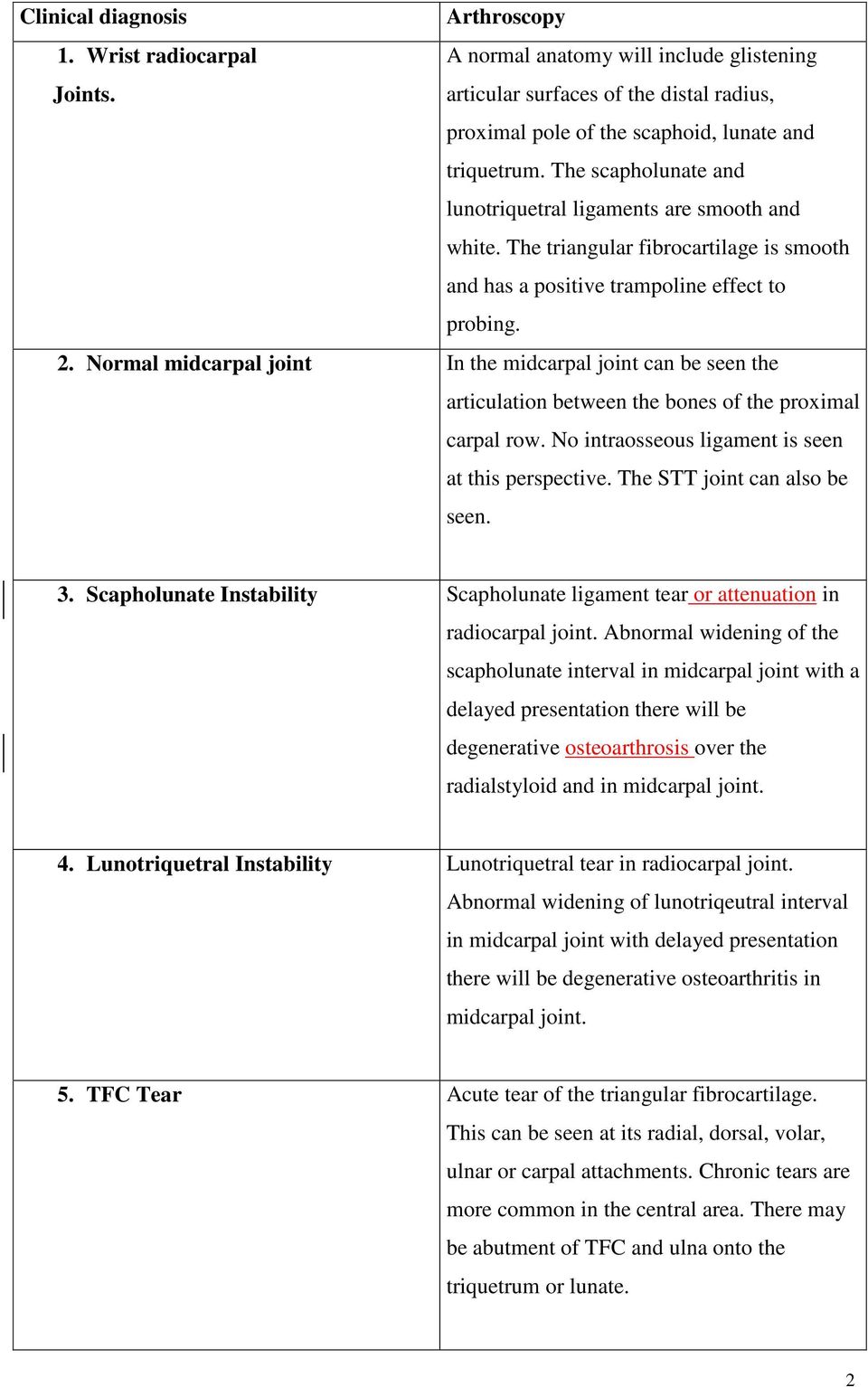
2 Clinical diagnosis Arthroscopy 1. Wrist radiocarpal A normal anatomy will include glistening Joints. articular surfaces of the distal radius, proximal pole of the scaphoid, lunate and triquetrum. The scapholunate and lunotriquetral ligaments are smooth and white. The triangular fibrocartilage is smooth and has a positive trampoline effect to probing. 2. Normal midcarpal joint In the midcarpal joint can be seen the articulation between the bones of the proximal carpal row. No intraosseous ligament is seen at this perspective. The STT joint can also be seen. 3. Scapholunate Instability Scapholunate ligament tear or attenuation in radiocarpal joint. Abnormal widening of the scapholunate interval in midcarpal joint with a delayed presentation there will be degenerative osteoarthrosis over the radialstyloid and in midcarpal joint. 4. Lunotriquetral Instability Lunotriquetral tear in radiocarpal joint. Abnormal widening of lunotriqeutral interval in midcarpal joint with delayed presentation there will be degenerative osteoarthritis in midcarpal joint. 5. TFC Tear Acute tear of the triangular fibrocartilage. This can be seen at its radial, dorsal, volar, ulnar or carpal attachments. Chronic tears are more common in the central area. There may be abutment of TFC and ulna onto the triquetrum or lunate. 2
3 6. Distal Radius Fracture DRF seen in radiocarpal joint. Associated ligament injuries can also be identified. 7. SLAC Wrist A chronic tear of scapholunate ligament and abnormal widening of scapholunate interval. Degenerative osteoarthritis radial styloid and midcarpal joint. 8. Kienbock s Disease Radiocarpal synovitis. Soft lunate proximal pole. Degenerative osteoarthritis of lunate facet and possibly midcarpal joint. 9. STT Osteoarthritis Degenerative osteoarthritis of STT joint with associated synovitis. 10. Stiff Wrist Narrow joint space. Associated synovitis, thickening of capsule and possible chondral changes. 2. ASYMPTOMATIC WRIST 2.1. Introduction: The wrist comprises of 3 joints. A thorough knowledge of intra-articular and extra-articular anatomy is required to be able to separate normal from abnormal complaints and findings. 2.2 Definition: A patient has an asymptomatic wrist when there are no complaints and tests on physical examination are usually negative, regardless of whether there is any pathologic finding present on arthroscopy. 2.3 Symptoms and signs: There may be a history of intermitted or transient symptoms but there are no current complaints. There is a wide variation of examination findings within the normal range. It is important to compare the symptomatic and normal sides. Instability is defined as symptomatic laxity, this can be difficult to define in some situations. Radiographic changes include early osteoarthrosis, often at the radial styloid. 3

4 2.4 Pathology: A variety of pathologies can remain asymptomatic. Symptoms can develop spontaneously, with prolonged heavy activity, heavy lifting and trauma either from a direct blow to the wrist or a fall onto an outstretched arm. 2.5 Normal Findings at arthroscopy: The surgeon should develop a systematic approach to the intra-articular inspection of the joint. Radiocarpal Joint In the radiocarpal joint the normal glistening firm articular surface of the distal radius can be seen to be separated by the sagittal ridge which separates the scaphoid fossa and the lunate fossa. The proximal pole of the scaphoid, lunate and triquetrum can all be seen. It can be difficult to distinguish the scapholunate and lunotriquetral ligaments from the adjacent articular surface. However direct probing can assist in identifying the articular surface which is firm, versus the soft intraosseous ligaments. The normal triangular fibrocartilage attaches to the ulnar margin of the distal radius. This can also be identified with the aid of the probe. On the ulnar aspect of the triangular fibrocartilage it attaches to a significant depression which is the fovea. Placing a probe onto the triangular fibrocartilage will demonstrate a softness of the triangular TFC but with an normal resilience which is described as the trampoline effect. The hook test is where the probe is placed into the fovea and an attempt is made to drag the TFC radially. It should not move. If it moves radial it will be due to a deep tear of the TFC. The volar ligaments of the wrist can clearly be identified. These include from the radial side the radioscaphocapitate ligament, a long radiolunate ligament, short radiolunate ligament, ulnar lunate ligament and ulnar triquetral ligament. It is common for there to be a defect visualised (pisotriquetral recess) on the ulnar volar aspect of the wrist, ulnar to the ulno-triquetral ligament through which the pisoform can be seen. If the entire pisoform can be seen this indicates that there is abscence of the ulnotriquetral ligament. Midcarpal Joint In the midcarpal joint can be seen the articular surfaces between the scaphoid, lunate, triquetrum, capitate and hamate. In addition can be seen the STT joint. 4

5 A probe can be placed into scapholunate and lunotriquetral intervals. It is normal for the probe to either not be admitted or to be able to be admitted but not be able to be rotated into the intervals. Scapholunate ligament and lunotriquetral ligament cannot be seen from the midcarpal joint but if there is any abnormal widening between this interval then this is indicative of instability of these intervals Variants of normal anatomy: In the midcarpal joint the variants of the articular surface of the articulation can clearly be seen. Viegas described 2 types of lunate. The distal articular surface can have 1 facet (type 1 lunate) or 2 facets (type 2). McLean describes differences in the articulation of the triquetrohamate joint. These are; (a) double faceted helicoidal joint, with complimentary concave and convex surfaces (b) flat in which the joint is like a dish 3. Scapholunate Instability 3.1 Introduction: Scapholunate instability usually occurs following a fall in which the scapholunate ligament is ruptured. The ligament has three parts. The dorsal is the most important to maintain stability and is the strongest. The central portion is the weakest and contributes little to stability. The volar is intermediate. 3.2 Definition: Clinical instability which presents as pain, clicking or catching in the wrist as a consequence of disruption of the scapholunate ligament and possibly its secondary restraints. 3.3 Symptoms and signs: The patient complains of pain, clicking and catching over the dorsal aspect of the wrist. This often occurs during gripping and grasping activities. In some patients a tear of the ligament and associated instability may be identified, despite any localised symptoms. In the acute phase the wrist will be swollen and tender and may be diagnosed as a suspected scaphoid fracture. On examination the Watson s scapholunate instability test may will be positive. Plain radiographs demonstrate an abnormal widening of the scapholunate interval. There may be abnormal extension of the lunate on plain radiographs (DISI), abnormal flexion of the scaphoid and associated increase in the scapholunate angle. There may be a loss of carpal height on plain radiographs. 5

6 3.4 Pathology: In the acute case the patient will have a tear of the scapholunate ligament and possibly the secondary restraints. With time the ligament shortens and becomes scarred. There may become a fixed deformity of the scaphoid leading to abnormal flexion. Degenerative osteoarthritis will develop over the radial styloid and also in the midcarpal joint. This degenerative process is referred to as a SLAC wrist (scapholunate advanced collapse). 3.5 Findings at arthroscopy: Findings at arthroscopy include a tear of the scapholunate ligament which can be visualised in the radiocarpal joint. If there is instability of the interval then this is best assessed in the midcarpal joint where the probe can be introduced into the scapholunate interval and abnormally rotated. Geissler (2005) described arthroscopic classification of carpal instability. Geissler Arthroscopic Classification of Carpal Instability. Grade I II III IV Description Attenuation/haemorrhage of interosseous ligament as seen from the radiocarpal joint. No in congruency of carpal alignment in the mid-carpal space. Attenuation/haemorrhage of interosseous ligament as seen from the radiocarpal joint. In congruency/step-off as seen from the mid-carpal space. A slight gap (less than width of a probe) between the carpal bones may be present. In congruency/step-off of carpal alignment is seen in the radiocarpal and mid-carpal space. The probe may be passed through the gap between the carpal bones. In congruency/step-off of carpal alignment is seen in the radiocarpal and mid-carpal space. Gross instability with manipulation is noted. A 2.7mm arthroscope may be passed through the gap between the carpal bones (socalled drive-through lesion ). Geissler,

7 In grade I & II an isolated central tear may be found. If present debridement is effective. ( Poehling, Chabon and Ruch 1994) For grade III & IV percutaneous k wire fixation of the scapholunate interval can be performed under arthroscopic assisted reduction (Whipple 1995, 1997, Assad 1997, Bain and Duncan 2003). 4. Lunotriquetral Instability 4.1 Definition: Lunotriquetral instability is where the patient has instability symptoms of pain, weakness or giving away in the wrist associated with a tear of the lunotriquetral ligament. 4.2 Signs and symptoms: The patient will often have ulnar sided wrist pain when performing activities particularly under load. This will begin frequently following a fall onto the outstretched hand. The patient will have difficulty with power grip and twisting rotating activities. Clinical diagnosis can be difficult to make. It is based on localised discomfort following an injury. There maybe abnormal motion and discomfort on ballottement between the lunate and triquetrum. 4.3 Pathology: In this clinical syndrome the patient will have a tear of the lunotriquetral interval. There will often be a VISI which is seen on a lateral plain radiograph with the lunate tilted into flexion. There can be abnormal widening of the lunotriquetral interval seen on AP plain radiograph but this can be difficult to assess. LTAC (lunotriquetral advanced collapse) which is where there is an associated fixed deformity of the carpus with degenerative osteoarthritis usually best visualised in the midcarpal joint. The Geissler classification as described for the scapholunate interval can also be used for the lunotriquetral interval. Tears of the lunotriquetral interval can be associated with tears of the triangular fibrocartilage. 7

8 4.4 Findings at arthroscopy: In the radiocarpal joint the tear of the lunotriquetral interval can be seen from the ulnar sided portals. In the midcarpal joint abnormal widening of the lunotriquetral interval can be identified in the same way as the findings in the scapholunate interval. The Geissler classification can also be used at the lunotriquetral interval. Degenerative osteoarthritis changes can be seen at the midcarpal joint in late cases. 5. TFC Tear 5.1 Definition: The triangular fibrocartilage is the cartilaginous disc between the base of the ulnar styloid and sigmoid notch of the distal radius. The triangular fibrocartilage complex includes the other adjacent ligamentous structures which include the dorsal and volar radioulnar ligaments, the ulnar carpal ligaments (ulnar triquetral and ulnar lunate ligaments). 5.2 Symptoms and signs: The patient will often describe ulnar sided wrist pain. This may occur following an acute injury particularly a rotating or twisting injury of the wrist. Chronic ulnar sided wrist pain may occur from ulnar carpal impaction. The patients may have difficulty carrying heavy weights, performing power grasp, but particularly with twisting or rotating manoeuvres and with repetitive activities. 5.3 Pathology/arthroscopic findings: The function of the TFCC is both to stabilize (the DRUJ and ulnar carpus) and to transmit load (20% of the total load in ulnar neutral variance) (Palmer et al., 1984). Only the peripheral 25% of the TFCC on the dorsal, volar and ulnar margins is vascularised (Bednar et al., 1991). The central and radial portions remain avascular. Lesions in these areas do not have the potential to heal and are therefore treated with debridement. The dorsal and volar ligaments (peripheral 2mm) maintain stability of the TFCC and it is crucial that these be preserved (Adams, 1993). Palmer s classification of TFCC injuries can be used to help guide treatment (See Table 2.3) (Palmer, 1989). This divides lesions into type 1 (traumatic) and type 2 (degenerative). Type 1 lesions are classified according to the location of the tear. 8

9 Table TFCC Injuries Palmer s Classification. Type of Tear Description of Tear Traumatic 1A 1B 1C 1D Tear in horizontal or central portion of disc. Tear from distal ulnar insertion ± ulnar styloid fracture. Tear with ulnocarpal ligaments disrupted. (Ulnolunate and Ulnotriquetral ligaments). Tear from radial insertion Degenerative 2A 2B 2C 2D 2E TFCC wear but no perforation TFCC wear but no perforation - Chondromalacia of lunate or ulnar head Central perforation of TFCC - Chondromalacia of lunate or ulnar head Central perforation of TFCC - Chondromalacia of lunate or ulnar head - Perforation of LT ligament Central perforation of TFCC - Perforation of LT ligament - Ulnocarpal arthritis Abbreviations - Triangular fibrocartilage complex (TFCC), Flexor carpi ulnaris (FCU), Extensor carpi ulnaris (ECU), Lunotriquetral ligament (LT). From - Palmer, Central tears (Type 1A) are managed with arthroscopic debridement of the TFCC tear, performed with the arthroscope in the 6-R portal and the instruments in the 3-4 portal. The 3.5mm oscillating resector removes degenerative fibrocartilage and adjacent synovitis. The outcomes from this limited debridement are rewarding with 80-85% of patients requiring no further surgery and having a good to excellent result (Gan et al., 1995; Whipple and Geissler, 1993). In those patients where there is a neutral or negative ulnar variance, arthroscopic 9

10 debridement of the TFC is all that is required. In patients who have positive ulnar variance, additional procedures may be required such as a diaphyseal ulnar shortening. A peripheral tear in the TFCC (Type 1B) can be difficult to detect. A normal TFCC has tension within its substance when applying a probe across it - referred to as the trampoline effect. Loss of this normal trampoline effect would indicate that there is a peripheral tear of the triangular fibrocartilage (Hermansdorfer and Kleinman, 1991). Patients with a peripheral tear can be managed with either an outside-in or inside-out repair technique (Poehling et al., 1994; Whipple and Geissler, 1993). Newer techniques using a slotted cannula, suture welding and mini-incisions methods performed with arthroscopic assistance, have also been developed (Badia and Khanchandani, 2007; Culp, 2005; Pederzini et al., 2006). When an unstable peripheral tear is associated with a fractured ulnar styloid, an open procedure must be performed to address the ulnar styloid fragment either through bony reattachment or fragment excision and reattachment of the TFC to the remaining distal ulna. The ECU tendon sheath is intimately related to the dorsal aspect of the TFCC (Palmer, 1990). A peripheral TFCC tear may be associated with ECU subluxation and require open reconstruction in addition to any arthroscopic procedures performed. Type 1C lesions involve disruption of the TFCC from the ulnar extrinsic ligament complex. At arthroscopy there will be laxity of the ulnar intrinsic ligaments and the pisiform may be easily identified through the ligament rent. These injuries are less common but more complex to manage (Culp, 2005). Augmentation with a flexor carpi ulnaris distally based strip (which is then brought to the dorsal aspect of the triangular fibrocartilage) can also be performed (Culp, 2005). Type 1D radial-sided tears have a poor chance of healing. This is due to the relative avascularity of the radial side of the TFCC and the fact that it attaches onto the articular cartilage of the sigmoid notch. The majority of these tears are managed with arthroscopic debridement; however, a number of suture techniques have previously been published, with two-thirds of patients having good to excellent results (Cooney et al., 1994; Culp, 2005; Sagerman and Short, 1996). Techniques have included using a jig to assist in guiding advancing K-wires or needles from the ulnar side to the radial side of the wrist. Trumble described the use of a cannula and then preloaded meniscal repair sutures (Trumble et al., 1996). This allows pre-placed sutures to be fixed onto the radius. 10

11 Type 2 TFCC lesions are degenerative tears that are often asymptomatic (Mikic, 1978). Most symptomatic degenerative tears of the TFCC are related to chronic overloading of the ulnocarpal joint secondary to positive ulnar variance (Culp, 2005; Viegas and Ballantyne, 1987). The primary pathology in these cases is not limited only to the TFCC itself but also to the sequelae of chronic ulnar impaction between the ulna and the carpus, with secondary damage to surrounding structures including the lunotriquetral ligament, articular surfaces of the lunate, triquetrum and distal ulna (Culp, 2005; Palmer, 1989). When performing an arthroscopic debridement, the TFCC, adjacent synovitis and chondral changes are all debrided. It is essential to preserve the peripheral 2mm of the TFCC to maintain DRUJ stability. If there is a positive ulnar variance, shortening of the ulna with either a diaphyseal ulnar shortening or arthroscopic wafer procedure should be performed. The arthroscopic wafer procedure involves resection of the prominent distal ulna through the TFCC tear (Darrow et al., 1985; Osterman, 1990; Verheyden and Short, 2001). Resection is continued until 2-3mm of ulna is removed over the radial two-thirds of the ulna to achieve a 1.5mm ulnar negative variance. Wnorowski et al recommended a wafer procedure be to the level of the subchondral bone, as this will unload the head of the ulna (Wnorowski et al., 1992). The forearm is rotated from pronation to supination to visualize and resect the full circumference of the ulnar head. Adequate resection is confirmed with fluoroscopy. Osterman reported pain relief in 73% and improvement in another 12% with this procedure (Osterman, 1990). These results are similar to the 78% good results reported for ulnar shortening by Darrow (Darrow et al., 1985; Osterman, 1990). The results of arthroscopic debridement of type 2 degenerative lesions have yielded good to excellent results in 75% of cases, with up to 5 years follow-up (Nagle, 1994). Feldon et al stated that the wafer procedure is contraindicated if there is carpal instability or degenerative arthritis of the distal radioulnar joint (Feldon et al., 1992). Palmer and coworkers believe that this procedure is contraindicated if there is an associated lunotriquetral tear, because it unloads the ulnocarpal joint and increases the carpal instability (Feldon et al., 1992). If instability is present, an open ulnar shortening osteotomy to prevent the ulnar impaction and tighten the ulnar carpal ligaments is often preferred. A lunotriquetral fusion may be required in some patients if there is gross lunotriquetral instability. Deep sided tears of the TFC are uncommon, and can be difficult to diagnose. Arthroscopy of 11

12 the DRUJ may be required to secure the diagnosis. The tear can then be debrided from within the DRUJ. Ulnar stylo-carpal impaction Stylo-carpal impaction is an uncommon cause of ulnar-sided wrist pain that is due to a long ulnar styloid that impinges on the carpus. It usually impinges onto the triquetrum, with wrist extension and supination. Typically, patients are reported to have an ulnar styloid which is longer than the average of 3-6mm (Biyani et al., 1990). Confirmation of diagnosis of ulnar styloid carpal impingement has been based on provocation by placing the wrist into ulnar deviation and supination, and long ulnar styloid identified on plain radiographs. Placing the wrist into the provocation position and performing 3D CT scan is diagnostic if the images confirm the styloid is impinging on the carpus. Previous authors have described open excision of the ulnar styloid (Tomaino et al., 2001; Topper et al., 1997). This involves an open capsulotomy and osteotomy of the ulnar styloid near its base. However the styloid can be debrided arthroscopically and confirmed to have adequate resection with fluoroscopy. (Bain and Bidwell) 6. Distal Radius Fractures 6.1 Introduction: Fractures of the distal radius are common in clinical practice. Arthroscopy has been used to assist in identifying associated soft tissue injuries in the wrist. They are also of significant aid in identifying the quality of the reduction. In view of the fact that the prognosis is related to the articular deformity and fracture displacement, arthroscopy has found a place in distal radius fracture management. 6.2 Definition: Fracture of the distal radius involves the osseous component of the distal radius. However in clinical practice it is not uncommon for there to be associated ligamentous injuries including scapholunate, lunotriquetral and triangular fibrocartilage tears. Other carpal injuries have also been describes as distal radius fractures. 6.3 Signs and symptoms: The patient usually presents with pain and swelling and possibly deformity of the wrist following an injury such as a fall. 12

13 6.4 Pathology: When the patient has a fall onto the outstretched hand there is an axial load which is impacted onto the distal radius from the carpus. There is also a bending moment which may lead to a dorsal or volar displacement of the fracture. Fractures can be classified into intra-articular and extra-articular fractures. Knirk and Jupiter reported that radiological arthritis developed in 91% of those wrists that had any degree of articular step, and in all of those with a step greater than 2mm (Knirk and Jupiter, 1986). Other authors have confirmed this in the ensuing years (Bassett, 1987; Bradway et al., 1989; Melone, 1986; Missakian et al., 1992). Melone stated that articular fragment separation of as little as 2mm is prone to persistent and progressive joint incongruity with a high probability of development of degenerative arthritis (Melone, 1993). Mehta reports a displacement of the fractures of 1 mm was associated with increased pain. Failure to reduce intra-articular fractures of the distal radius predisposes to pain, restricted range of motion and degenerative arthritis (Bradway et al., 1989; Knirk and Jupiter, Malposition in these injuries relates not only to parameters such as radial height, radial angle and volar tilt but also to the accuracy of intra-articular reduction (Melone, 1986; Missakian et al., 1992; Pogue et al., 1990). Many authors have reported the use of wrist arthroscopy in the management of intra-articular distal radial fractures (Cooney et al., 1980; Culp and Osterman, 1995; Geissler, 1995; Geissler, 1997; Hanker, 1996; Levy and Glickel, 1993; Roth et al., 1995; Wolfe et al., 1995). It is less invasive and allows a magnified view of the articular surface as well as assessment of triangular fibrocartilage, scapho-lunate and lunotriquetral ligaments. All of the arthroscopic reports have noted a high incidence of associated ligament injuries. Culp and Osterman reported on 27 cases treated with arthroscopically assisted reduction of intra-articular distal radial fractures (Culp and Osterman, 1995). They reported 10 excellent and 12 good results using the Gartland and Werley classification (Gartland and Werley, 1951). Pain, satisfaction and complications were not reported. 6.5 Findings at arthroscopy: Findings at arthroscopy usually demonstrate the fragmented distal articular surface of the distal radius. These can be manipulated with the aid of an arthroscopic probe, joystick or direct manipulation. Tears of the associated ligaments such as the triangular fibrocartilage, scapholunate lunotriquetral ligament can also be identified. 13

14 Other chondral lesions within the carpus can be identified. 7. Ganglions 7.1 Introduction: Ganglions of the wrist are common in clinical practice. The most common form is a dorsal ganglion over the scapholunate ligament. Less common forms of ganglions occur over the volar aspect of the scapholunate ligament or over the triangular fibrocartilage. 7.2 Definition: A ganglion is a soft tissue swelling which is due to myxoid degeneration of the capsule or ligament. This presents as a swelling over the joint and may cause pain for the patient. 7.3 Signs and symptoms: The patient would usually present with a swelling over the dorsal volar or ulnar aspect of the wrist. This will often get bigger following repetitive activities with the wrist. In same cases these can be particularly painful and in other patients it is maybe almost asymptomatic. The occult dorsal ganglion is a small ganglion which can be located over the dorsal aspect of the scapholunate ligament but can be particularly painful. These are usually only diagnosed with ultrasound or MRI scan. 7.4 Pathology: The ganglion arises from the myxoid degeneration of the capsule or ligament. These are usually filled with a clear viscous fluid that is a high concentration of hyaluronic acid (Green and O Brien 1978). The wall is usually thin with fibroblasts and collagen. There is no epithelial or synovial lining. 7.5 Findings at arthroscopy: Osterman and Raphael reported excision of the dorsal ganglion using standard wrist arthroscopy portal sites (Osterman and Raphael, 1995). The scope is placed in the 6-R portal and the instruments is the 1-2 portal. The ganglion is resected from the dorsum of the scapho-lunate ligament. Osterman reports approximately two-thirds of patients will have a visible pearl-like ganglion stalk. When such a stalk is not seen, the origin is assumed to be from the dorsal capsule, in which case synovitis is usually noted. A needle placed through the skin and extended into the stalk is utilised. A ganglion portal (almost always equivalent to the standard 3-4 portal) can also be established to assist with excision of the ganglion. A full-radius resector or basket punch is used to resect a 1cm diameter of dorsal 14

15 capsule at the ganglion origin. Care should be taken to avoid injury to the scapho-lunate ligament and extensor tendons. Dorsal synovitis, where present, is debrided. In one-third of cases, the underlying extensor tendons may be visible. The wrist is removed from the traction tower and re-examined. It is important to ensure that the extra-articular portion of the ganglion has been fully ruptured. Osterman reported only one recurrence in his series of 150 patients. Ho reported on excision of the volar wrist ganglion by placing the resector into the interligamentous sulcus located between the RSC and LRL ligaments. The resector is advanced through this interval to resect the ganglion tissue (Ho, 2007). Ho cautioned that the volar ganglions from the STT joint are at the distal wrist crease and currently can not be removed with arthroscopic techniques. 8. Kienbock s Disease 8.1 Introduction: In 1910 Robert Kienböck described avascular necrosis of the lunate based on plain radiographs. Kienböck s disease is idiopathic avascular necrosis of the lunate which is more common in males and typically presents between the ages of 20 and 40 years. Patients often present with wrist pain, swelling, restricted range of motion and difficulty performing activities of daily living. 8.2 Definition: Kienbock s Disease is idiopathic avascular necrosis of the lunate, which often produces pain, swelling and stiffness of the wrist. This is sclerosis and often fragmantation of the wrist on plain xrays. 8.3 Signs and symptoms: The patient is usually in the age of years of age and presents with pain and swelling and restricted range of motion over the wrist. The patient often has difficulty performing activities of daily living. 8.4 Pathology: The ulnar variance of the wrist is considered to be an important etiological factor in the development of Kienböck s disease (Gelberman et al., 1975). It is considered that a negative ulnar variance leads to increased joint loading that affects vascularity of the lunate (Gelberman et al., 1983). Patients with a negative ulnar variance are often recommended to have a joint levelling procedure (Amadio and Wolfe, 2005). Lichtman s radiological classification of Kienböck s disease is commonly used to grade the condition (Lichtman et al., 1977). However, inter-observer variability studies have shown a poor reliability (Goldfarb et al., 2003; Hjorth Jensen et al., 1996; Jafarnia et al., 2000). 15

16 Lichtman classification. The management of Kienböcks disease has been very controversial (Amadio and Wolfe, 2005). Non-operative management has included immobilisation (Stahl and Reis, 1986). The results of non-operative treatment have varied, but have included a progression of the disease process with further collapse of the lunate (Mikkelsen and Gelineck, 1987). For those patients who fail to improve with non-operative modalities, surgical treatment is often offered. The number of surgical procedures described is of concern. Lunate excision has been reported, but may produce a severe carpal instability and a disabled wrist (Kawai et al., 1988). Replacement arthroplasties have been reported using silicone, titanium and cement (Alexander et al., 1990; Alexander et al., 1990; Carroll, 1983; Hastings et al., 1983; Ishiguro, 1984). However, lunate replacement procedures will not prevent further collapse of the carpus (Amadio and Wolfe, 2005). Of the operative techniques, joint leveling procedures have been the most popular, especially in patients who have a negative ulnar variance (Frykman et al., 1988; Gelberman et al., 1975; Nakamura et al., 1993). Examples include radial shortening (Almquist and Burns, 1982), ulna lengthening (Amadio and Wolfe, 2005) and angular osteotomy of the radius (Nakamura et al., 1993). Capitate shortening also changes the joint loading at the radiolunate articulation, but from the mid-carpal joint perspective (Almquist, 1987). Limited wrist fusions in the form of an STT arthrodesis have previously been popular (Allieu et al., 1991; Watson, 1980; Watson et al., 1996). The STT fusion had the advantage of maintaining carpal height and unloading the radiolunate articulation. Miniami reported that there was a progression of the radioscaphoid degeneration following STT arthrodesis (Minami et al., 1994). Other limited wrist fusions in the form of radio-scapho-lunate and capito-hamate fusion have also been reported (Chuinard and Zeman, 1980). Proximal row carpectomy has also been utilised (Begley and Engber, 1994). Revascularisation procedures address the primary problem of inadequate blood supply (Botte et al., 2004; Leblebicioglu et al., 2003). Moran reported a series of 48 cases in which postoperative MRI showed revascularisation in 60% of cases (Hori et al., 1979). Those patients with improved vascularisation had significantly improved pain scores. Moran recommends an external fixateur or pinning the scaphocapitate joint to unload the joint for a period 8-12 weeks. However, revascularisation procedures are only likely to be effective in those patients who have not yet had any carpal collapse 16

17 8.5 Findings at arthroscopy: The use of wrist arthroscopy for the treatment of Kienböck s disease has been reported by Menth-Chiari et al (Menth-Chiari et al., 1999.). They utilised arthroscopy for both assessing the diseased joints and debriding the necrotic lunate. All patients in their study were graded as Lichtman IIIA or IIIB and all experienced relief of their painful mechanical symptoms. All patients were treated with debridement regardless of the arthroscopic findings. It was concluded that although the progression of the disease cannot be altered, arthroscopic assessment and debridement offers a benefit in clinical outcome and may defer more definitive surgery (Menth-Chiari et al., 1999). Arthroscopic Classification of Kienbock s Disease This is based upon the number of non-functional articular surfaces. Bain defines a normal articular surface as having normal glistening appearance or minor fibrillation, with normal hard subchondral bone on palpation. A non-functional articular surface is defined as having any one of the following: extensive fibrillation, fissuring, localized or extensive articular loss, a floating articular surface or fracture. The severity of the synovitis is not used to specifically grade the type of wrist, but is usually an indication of the severity of the chondral changes. The grade allocated for each wrist is dependent upon the number of articular surfaces that are defined as non-functional. They observed that, based on MRI, plain radiographs and arthroscopy, a characteristic pattern of changes occurs in the lunate. The changes always occur on the proximal convexity of the lunate, with many patients having a subchondral fracture. These more severe cases have secondary changes in the lunate facet of the radius. It is unusual to have involvement of the distal articular surface of the lunate, except if a coronal fracture extends through to the surface or late cases. This has allowed us to develop the following classification. 17

18 Grade 0 Grade 1 All articular surfaces are functional One non-functional articular surface. This is typically the proximal articular surface of the lunate. Grade 2 Grade 2A Grade 2B Two non-functional articular surfaces. The proximal lunate and the lunate facet of the radius. Proximal articular surface of the lunate, and distal articular surface of the lunate. Grade 3 Three non-functional articular surfaces. The lunate facet of the radius, proximal and distal articular surfaces of the lunate, with a preserved capitate. Grade 4 All four articular surfaces are non-functional. 18

19 Recommended treatment The principles of treatment are to perform a synovectomy as part of the arthroscopic procedure. A reconstructive procedure is then performed, depending upon the arthroscopic findings. The principle is that the chosen reconstructive procedure will address the nonfunctional articular surface and will utilize remaining functional articular surfaces. Grade 0: All articular surfaces are functional and, therefore, an extra-articular procedure is recommended. An extra-articular unloading procedure may be indicated. If there is negative ulnar variance then a radial shortening osteotomy is indicated. For neutral or positive ulnar variance a capitate shortening procedure can be performed. A revascularization procedure could be indicated in this group. Grade 1: Non-functional proximal lunate articular surface. Proximal row carpectomy or a radio-scapholunate fusion can be performed. Grade 2: Two non-functional articular surfaces. Grade 2A: The proximal articular surface of the lunate and the lunate fossa are both non functional. The radio-scapholunate fusion will remove both non-functional articular surfaces and enable the wrist to articulate through the normal mid-carpal joint. Grade 2B: The proximal and distal articular surfaces of the lunate are non-functional. This typically occurs when there is a coronal fracture in the lunate. This is best managed with a proximal row carpectomy. 19

20 Grade 3: Three articular surfaces are non-functional. Usually there will be only a functional capitate articular surface. Theoretically this could be managed with a hemiarthroplasty. Alternatively, a salvage procedure such as a total wrist fusion or arthroplasty is indicated. Grade 4: All four articular surfaces are non-functional. Total wrist fusion or arthroplasty is indicated. Arthroscopy is a valuable tool in the assessment of articular surface and the softness of the lunate. It is not uncommon for plain radiographs to underscore the severity of the articular involvement. 9. STT Joint Arthritis 9.1 Introduction: Scapho-trapezio-trapezoid (STT) joint arthritis is a common clinical condition. Assessment of cadaveric wrists has demonstrated that degenerative changes are seen in 39% of specimens (Moritomo et al., 2000). The most common site of degenerative change is on the ulnar side of the distal scaphoid and centrally on the trapezoid and trapezium (Moritomo et al., 2000). 9.2 Definition: Degenerative osteoarthritis of the STT joint is a localised degenerative osteoarthritis within this triscaphe joint. 9.3 Signs and symptoms: It is common for the patient to be asymptomatic with this condition. However those patients that do have pain usually localise it to the radial aspect of the wrist. It is often aggravated by radial deviation and the range of motion may be restricted in radial deviation. The patient may have pain with power grip in the radial arc. The patient may have difficulty performing activities of daily living. 9.4 Pathology: Involvement of the STT joint is a very common pattern of osteoarthritis (Rogers and Watson, 1990). Concomitant trapeziometacarpal arthritis occurs in the majority of patients, but 20

21 isolated pathology occurs in 2% to 16% of the population (Chamay and Piaget-Morerod, 1994; Garcia-Elias et al., 1999). It is more common in postmenopausal women (Armstrong et al., 1994). Flexor carpi radialis tendinitis and radiopalmar ganglions can be associated with STT joint arthritis (Srinivasan and Matthews, 1996). 9.5 Findings at arthroscopy: Arthroscopic findings included eburnated bone of the entire distal scaphoid, proximal aspect of the trapezium and trapezoid. It is common for there to be associated synovitis at this articulation. Previous surgical treatments reported after failed conservative treatment include STT joint fusion (Srinivasan and Matthews, 1996), excisional arthroplasty with (Eiken, 1979) or without (Garcia-Elias et al., 1999) a silicone spacer. Pain relief is not uniform in these series, with post-operative morbidity from complications being noted. STT arthrodesis has a high reported complication rate, which includes painful non-union, radioscaphoid impingement and hardware complications (Garcia-Elias et al., 1999; Ishida and Tsai, 1993; Srinivasan and Matthews, 1996). Secondary arthritis of radioscaphoid or trapeziometacarpal joints can also occur. Excision arthroplasty of the distal scaphoid will leave almost 40% of patients with mild pain. Excision of the distal scaphoid resulted in a change in the carpal alignment with a DISI pattern in 12 of 21 cases (Garcia-Elias et al., 1999). Ashwood and Bain reported the results from isolated arthroscopic debridement of the STT joint. They formed the greater majority of patients had symptomatic relief from debridement alone. Other authors are now performing arthroscopic resection of the distal scaphoid. However when performed as an open procedure this has led to problems of pain and further instability. 10. Contracture of the wrist 10.1 Introduction: Following trauma or surgery to the wrist, stiffness of the wrist is common Definition: Contracture of the wrist can be considered as a patient who has a restricted range of motion which effects their ability to perform activities of daily living. Often this is made in reference to the functional range of motion of the wrist as defined by Palmer. 21
22 10.3 Signs and symptoms: The patient will have a restricted range of motion of the wrist. If this is an isolated pathology to the capsule then the patient will often have no pain and a normal articular surface. Other causes of contracture of the wrist include rheumatoid arthritis, post traumatic degenerative osteoarthritis. These problems are important to identify prior to surgery. A contracture of the wrist can be classified into 3 sub-types. (Verhellen and Bain) 1 - Intra-articular disorders such as post traumatic degenerative osteoarthritis or rheumatoid arthritis where there is associated chondral defects and synovitis and the carpal instability. These conditions can be managed with a debridement but are likely to be improved with a capsular release. 2 - Capsular contracture. This is usually following surgery or trauma where there is an isolated contracture of the capsule. This patient is ideal for the capsular release and it likely to have the best outcome from surgery. 3 - Extra-articular causes such as heterotopic bone formation or musculo tenderness contracture from cerebral palsy. These conditions require extra articular surgery. 4 Mixed pathologies. It is not uncommon for a patient with post-traumatic arthritis to have multiple etiologies eg intra-articular step, ligament injury, capsular contraction and even heterotopic bone formation Arthroscopic findings: The arthroscopic findings will depend upon the pathology. The patient who is having a capsular release ideally there will be a normal joint or some synovitis. Distraction of a joint is important and the capsular release can be performed as described by Verhellen (Bain). The best results from arthroscopic release of the wrist are likely to be obtained if: 1 The capsular contracture is the origin of the stiffness. 2 There is normal articular cartilage and congruity. 3 The joint is pain free 4 There is no generalised arthropathy. For those patients who have more florid degenerative changes within the carpus synovectomy and debridement is required as described by Luchetti, Adolfsson. The loose bodies, chondral changes, osteophytes are all removed. Dorsal capsular release can also be performed. (Bergman & Bain) 22
23 Because of the close proximity of the dorsal capsule nylon tape can be rail-roaded between the 3-4 and 6R portal between the extensor tendons and the dorsal capsule. This nylon tape can then be used as a retractor of the extensor tendons. The abnormal dorsal capsule can then be debrided more safely. 23
24 REFERENCES Adams BD (1993). Partial excision of the triangular fibrocartilage complex articular disk: A biomechanical study. Hand Surg, 18: Adams BD, Berger RA (2002). An anatomic reconstruction of the distal radioulnar ligaments for posttraumatic distal radioulnar joint instability. Journal of Hand Surgery (American Edition), 27(2): Adolfsson L, Nylander G (1993). Arthroscopic synovectomy of the rheumatoid wrist. Journal of Hand Surgery British Volume, 18(1): Alexander AH, Turner MA, Alexander CE, Lichtman DW (1990). Lunate silicone replacement arthroplasty in kienböck s disease: A long-term follow-up. Journal of Hand Surgery (American Volume), 15: Allieu Y, Chammas M, Lussiez B, et.al (1991). Place de l arthrodèse scapho-trapézöidienne dans le traitement de la maladie de kienböck: A propos de onze observations. Annales de Chirurgie de la Main, 10: Almquist EE (1987). Kienböck s disease. Hand Clinics, 3: Almquist EE, Burns JF, Jr. (1982). Radial shortening for the treatment of kienböck's disease - a 5 to 10 year follow-up. Journal of Hand Surgery (American Edition), 7(4): Ashwood N, Bain GI, Fogg Q (2003). Results of arthroscopic debridement for isolated scaphotrapeziotrapezoid arthritis. Journal of Hand Surgery (American Volume), 28(5): Assad C, Ross DC, Richards RS, Roth JH. Outcome of arthroscopic reduction and percutaneous pinning of scapholunate instability. in ASSH 52nd Annual Meeting Denver. Badia A, Jimenez A (2006). Arthroscopic repair of peripheral triangular fibrocartilage complex tears with suture welding: A technical report. Journal of Hand Surgery (American Edition), 31(8): Badia A, Khanchandani P (2007). Suture welding for arthroscopic repair of peripheral triangular fibrocartilage complex tears. Techniques in Hand and Upper Extremity Surgery, 11(1): Bain GI, Begg M (2006). Arthroscopic assessment and classification of kienbock's disease. Techniques in Hand and Upper Extremity Surgery, 10(1): Bain GI, Bidwell TA (2006) Arthroscopic excision of ulnar styloid in stylocarpal impaction. Arthroscopy, 22(6): 677 e Bain GI, Duncan AWW (2003). Arthroscopy-assisted reduction and percutaneous fixation of acute scapholunate injuries. Knee Surg Sports Traumatol, 11: Bain GI, Richards RS, Roth JH (1997). Wrist arthroscopy. In: Lichtman DM, Alexander AH, (Ed). The wrist and its disorders. Second ed. Philadelphia. W.B. Saunders
25 Bednar MS, Arnoczky SP, Weiland AJ (1991). The microvasculature of the triangular fibrocartilage complex: Its clinical significance. Journal of Hand Surgery (American Volume), 16(6): Begley BW, Engber WD (1994). Proximal row carpectomy in advanced kienböck's disease. Journal of Hand Surgery (American Edition), 196: Bergman J, Bain G. Arthroscopic release of wrist contracture. In: Slutsky DJ, Osterman AL, (Ed). Distal radius fractures and carpal injury: The cutting edge. ed. Philadelphia. Elsevier. In Press. Carro LP, Golano P, Farinas O, Cerezal L, Hidalgo C (2003). The radial portal for scaphotrapeziotrapezoid arthroscopy. Arthroscopy, 19(5): Cerofolini E, Luchetti R, Pederzini L, Soragni O, Colombini R, D'Alimonte P, Romagnoli R (1990). Mr evaluation of triangular fibrocartilage complex tears in the wrist: Comparison with arthrography and arthroscopy. Journal of Computer Assisted Tomography, 14(6): Chamay A, Piaget-Morerod F (1994). Arthrodesis of the trapeziometacarpal joint. Journal of Hand Surgery British Volume, 19(4): Chen AC, Hsu KY, Chang CH, Chan YS (2005). Arthroscopic suture repair of peripheral tears of triangular fibrocartilage complex using a volar portal. Arthroscopy, 21(11): Chuinard RG, Zeman SC (1980). Kienböck s disease: An analysis and rationale for treatment by capitatehamate fusion. Orthopaedic Transactions, 4: 18. Cooney WP, Dobyns JH, Linscheid RL (1990). Arthroscopy of the wrist: Anatomy and classification of carpal instability. Arthroscopy, 6(2): Cooney WP, Sagerman SD, Short WH (1994). Arthroscopic repair of the radial sided tfcc tears: A followup study. Presented at the 49th Annual Meeting of the American Society for Surgery of the Hand, Cincinnati, OH: Craigen MA, Stanley JK (1995). Wrist kinematics. Row, column or both? Journal of Hand Surgery British Volume, 20(2): Culp RW (1999). Complications of wrist arthroscopy. Hand Clinics of North America, 15(3): Culp RW, McGuigan FX, Turner MA, Lichtman DM, Osterman AL, McCarroll HR (1993). Proximal row carpectomy: A multicenter study. Journal of Hand Surgery (American Edition), 18A: Culp RW, Osterman AL (1995). Arthroscopic reduction and internal fixation of distal radius fractures. Orthopaedic Clinics of North America, 26(4): Culp RW, Talsania JS, Osterman AL (1997). Arthroscopic proximal row carpectomy. Techniques in hand and Upper Extremity Surgery, 1(2):
26 Darlis NA, Kaufmann RA, Giannoulis F, Sotereanos DG (2006). Arthroscopic debridement and closed pinning for chronic dynamic scapholunate instability. Journal of Hand Surgery (American Edition), 31(3): De Smet L (2002). Pitfalls in wrist arthroscopy. Acta Orthop Belg, 68(4): Edwards CC, 2nd, Haraszti CJ, McGillivary GR, Gutow AP (2001). Intra-articular distal radius fractures: Arthroscopic assessment of radiographically assisted reduction. Journal of Hand Surgery (American Edition), 26(6): Eiken O (1979). Implant arthroplasty of the scapho-trapezial joint. Scandinavian Journal of Plastic and Reconstructive Surgery, 13(3): Ferlic DC, Clayton ML, Mills MF (1991). Proximal row carpectomy: Review of rheumatoid and nonrheumatoid wrists. Journal of Hand Surgery (American Edition), 16: Fernandez DL, Geissler WB (1991). Treatment of displaced articular fractures of the radius. Journal of Hand Surgery (American Volume), 16: Freeland AE, Geissler WB (2000). The arthroscopic management of intra-articular distal radius fractures. Hand Surgery, 5(2): Frykman EB, af Ekenstam FW, Wadin K (1988). Triscaphoid arthrodesis and its complications. Journal of Hand Surgery (American Edition), 13A: Gaebler C, Kukla C, Breitenseher M, Trattnig S, Mittlboeck M, Vecsei V (1996). Magnetic resonance imaging of occult scaphoid fractures. Journal of Trauma, 41(1): Gan BS, Richards RS, Roth JH (1995). Arthroscopic treatment of triangular fibrocartilage tears. Orthop Clin North Am, 26(4): Garcia-Elias M, Lluch AL, Farreres A, Castillo F, Saffar P (1999). Resection of the distal scaphoid for scaphotrapeziotrapezoid osteoarthritis. Journal of Hand Surgery British Volume, 24(4): Garcia-Elias M, Lluch AL, Farreres A, Castillo F, Saffar P (1999). Resection of the distal scaphoid for scaphotrapezoid osteoarthritis. Journal Of Hand Surgery (British & European Volume), 24B(4): Geissler WB (1995). Arthroscopically assisted reduction of intra-articular fractures of the distal radius. Hand Clinics of North America, 11: Geissler WB (1997). Arthroscopic treatment of intra-articular distal radius fractures. Atlas of the Hand Clinics, 2(1): Geissler WB, Freeland AE (1996). Arthroscopically assisted reduction of intraarticular distal radial fractures. Clin Orthop Relat Res, (327):
27 Geissler WB, Freeland AE, Savoie FH, III., McIntyre LW, Whipple TL (1996). Intracarpal soft-tissue lesions associated with an intra-articular fracture of the distal end of the radius. Journal of Bone and Joint Surgery, 78A: Gelberman RH, Salamon PB, PB, Jurist JM, Posch JL (1975). Ulnar variance in kienböck's disease. Journal of Bone and Joint Surgery, 57A: Gobel F, Vardakas DG, Riano F, Vogt MT, Sarris I, Sotereanos DG (2004). Arthroscopically assisted intraarticular corrective osteotomy of a malunion of the distal radius. American Journal of Orthopedics, 33(6): Goldfarb CA, Hsu J, Gelberman RH, Boyer MI. The Lichtman classification for Kienbock's disease: An assessment of reliability. Journal of Hand Surgery [Am] 2003; 28(1): Haase SC, Berger RA, Shin AY (2007). Association between lunate morphology and carpal collapse patterns in scaphoid nonunions. Journal of Hand Surgery (American Edition), 32(7): Hanker GJ (1996). Intraarticular fractures of the distal radius. 2 edn. Operative arthroscopy, ed. McGinty JB.New York: Lippincott-Raven Publishers Hermansdorfer JD, Kleinman WB (1991). Management of chronic peripheral tears of the triangular fibrocartilage complex. J Hand Surg (Am), 16: Hjorth Jensen C, Thomsen K, Holst-Nielsen F, Choueka J, Koval KJ, Kummer FJ, Zuckerman JD (1996). Radiographic staging of kienböck's disease:poor reproducibility of stahl's and lichtman's staging systems. Acta Orthopaedica Scandinavica, 67: Ho PC, Lo WN, Hung LK (2003). Arthroscopic resection of volar ganglion of the wrist: A new technique. Arthroscopy, 19(2): Ishida O, Tsai TM (1993). Complications and results of scapho-trapezio-trapezoid arthrodesis. Clin Orthop Relat Res, (287): Ishiguro T (1984). Experimental and clinical studies of kienböck s disease: Excision of the lunate followed by packing of the free tendon. J Jpn Orthop Assoc, (58): Jafarnia K, Collins ED, Kohl HW, 3rd, Bennett JB, Ilahi OA (2000). Reliability of the Lichtman classification of kienböck's disease. Journal of Hand Surgery (American Volume), 25(3): Jantea CL, Fu FH, McCarthy DM, Herndon JH, Horikoshi M (1994). Palmer approaches/portals for arthroscopy of the wrist. Arthroskopie, 7: Kawai H, Yamamoto K, Yamamoto T, Tada K, Kaga K (1988). Excision of the lunate in kienböck's disease. Journal of Bone and Joint Surgery (British Edition), 70B: Knirk JL, Jupiter JB (1986). Intraarticular fractures of the distal end of the radius in young adults. Journal of Bone and Joint Surgery, 68A:
28 Landsmeer JM (1961). Studies in the anatomy of articulation. I. The equilibrium of the "Intercalated" Bone. Acta Morphologica Neerlando-Scandinavica, 3: Larsen CF, Lauritsen J (1993). Epidemiology of acute wrist trauma. International Journal of Epidemiology, 22(5): Leblebicioglu G, Doral MN, Atay AA, Tetik O, Whipple TL (2003). Open treatment of stage III kienböck's disease with lunate revascularization compared with arthroscopic treatment without revascularization. Arthroscopy, 19(2): Leibovic SJ, Geissler WB (1994). Treatment of complex intra-articular distal radius fractures. Orthopaedic Clinics of North America, 25(4): Levy HJ, Glickel SZ (1993). Arthroscopic assisted internal fixation of volar intraarticular wrist fractures. Arthroscopy, 9(1): Lichtman DM, Mack G, R,, MacDonald RI, Gunther SF, Wilson JN (1977). Kienböcks disease: The role of silicone replacement arthroplasty. Journal of Bone and Joint Surgery, 59-A(7): Lindau T, Adlercreutz C, Aspenberg P (2003). Cartilage injuries in distal radial fractures. Acta Orthopaedica Scandinavica, 74(3): Luchetti R, Andrea A (2003). Arthroscopic wrist arthrolysis. Journal of Hand Surgery (American Edition), 28 Suppl 1: 4. McLean J, Bain G, Eames M, Fogg Q, Pourgiezis N (2006). An anatomic study of the triquetrum-hamate joint. Journal of Hand Surgery (American Edition), 31(4): Martini AK, Schiltenwolf M. A new classification of semilunar bone necrosis. Handchir Mikrochir Plast Chir 1998; 30(3): Mehta JA, Bain GI, Heptinstall RJ (2000). Anatomical reduction of intra-articular fractures of the distal radius. An arthroscopically-assisted approach. Journal of Bone and Joint Surgery (British Edition), 82(1): Melone CP, Jr. (1986). Open treatment for displaced articular fractures of the distal radius. Clin Orthop Relat Res, (202): Melone CP, Jr. (1993). Distal radius fractures: Patterns of articular fragmentation. Orthopaedic Clinics of North America, 24(2): Menth-Chiari WA, GG Poehling, Wiesler ER, Ruch DS (1999). Arthroscopic debridement for the treatment of kienböck's disease. Arthroscopy, 15(1): Menth-Chiari WA, Poehling GG (2000). Preiser's disease: Arthroscopic treatment of avascular necrosis of the scaphoid. Arthroscopy, 16(2):
29 Mikkelsen SS, Gelineck J (1987). Poor function after nonoperative treatment of kienböck s disease. Acta Orthopaedica Scandinavica, 58: Minami A, Kimura T, Suzuki K (1994). Long-term results of kienböck s disease treated by triscaphe arthrodesis and excisional arthroplasty with a coiled palmaris longus tendon. Journal of Hand Surgery (American Edition), 19: Moritomo H, Viegas SF, Elder K, Nakamura K, Dasilva MF, Patterson RM (2000). The scaphotrapeziotrapezoidal joint. Part 2: A kinematic study. Journal of Hand Surgery (American Edition), 25(5): Morley J, Bidwell J, Bransby-Zachary M (2001). A comparison of the findings of wrist arthroscopy and magnetic resonance imaging in the investigation of wrist pain. Journal of Hand Surgery (British Edition), 26(6): Nagle DJ (1994). Arthroscopic treatment of degenerative tears of the triangular fibrocartilage. Hand Clinics, 10(4): Nakamura K, Beppu M, Matsushita K, Arai T, Ide T (1997). Biomechanical analysis of the stress force on midcarpal joint in kienböck's disease. Hand Surgery, 2(2): Osterman AL (1990). Arthroscopic debridement of triangular fibrocartilage complex tears. Arthroscopy, 6(2): Osterman AL (2001). Arthroscopic pisoforectomy. in International Wrist Investigators Workshop. Osterman AL, Raphael J (1995). Arthroscopic resection of dorsal ganglion of the wrist. Hand Clinics, 11(1): Palmer AK (1989). Triangular fibrocartilage complex lesions:a classification. Journal of Hand Surgery (American Volume), 14A: Palmer AK (1990). Triangular fibrocartilage disorders: Injury patterns and treatment. Arthroscopy, 6(2): Palmer AK, Glisson RR, Werner FW (1984). Relationship between ulnar variance and triangular fibrocartilage complex thickness. Journal of Hand Surgery (American Volume), 9(5): Palmer AK, Werner FW, Murphy D, Glisson R. Functional wrist motion: A biomechanical study. Journal of Hand Surgery [Am] 1985; 10A(1): Pathak G, Bain G (2003). Arthroscopic capsular shrinkage for midcarpal instabilty of the wrist. J Bone Joint Surg (Br), 85B: 177. Pederzini L, Luchetti R, Soragni O, Alfarano M, Montagna G, Cerofolini E, Colombini R, Roth J (1992). Evaluation of the triangular fibrocartilage complex tears by arthroscopy, arthrography, and magnetic resonance imaging. Arthroscopy, 8(2):
30 Pederzini LA, Tosi M, Prandini M, Botticella C, Milandri L (2006). All-class suture technique for palmer class 1b triangular fidrocartilage repair. Riv Chir Mano, 43(2): 1-3. Poehling GG, Roth JH (1991). Articular cartilage lesions of the wrist. In: Mc Ginty JB, (Ed). Operative arthroscopy. ed. New York. Raven Press Poehling GG, Chabon SJ, Ruch DS Carpal Instabilities In: Poehling GG, (Ed). Arthroscopy of the Wrist and Elbow. ed. New York. Raven Press Poehling GG, Chabon SJ, Siegel DB (1994). Diagnostic and operative arthroscopy. In: Gelberman RH, (Ed). The wrist: Master techniques in orthopedic surgery. ed. New York. Raven Press. Ribak S (2007). The importance of wrist arthroscopy for staging and treatment of kienböck's disease., in Pesentation FP484, IFSSH. Sydney. Richards RS, Bennett JD, Roth JH, Milne K, Jr. (1997). Arthroscopic diagnosis of intra-articular soft tissue injuries associated with distal radial fractures. Journal of Hand Surgery (American Volume), 22(5): Rogers WD, Watson HK (1990). Degenerative arthritis at the triscaphe joint. Journal of Hand Surgery (American Edition), 15(2): Roth JH, Haddad RG (1986). Radiocarpal arthroscopy and arthrography in the diagnosis of ulnar wrist pain. Arthroscopy, 2(4): Roth JH, Poehling GG (1990). Arthroscopic "-ectomy" Surgery of the wrist. Arthroscopy, 6: Roth JH, Poehling GG, Whipple TL (1988). Arthroscopic surgery of the wrist. Instructional Course Lectures, 37: Roth JH, Poehling GG, Whipple TL (1988). Hand instrumentation for small joint arthroscopy. Arthroscopy, 4: Roth JH, Richards RS, Bennett JD, Milne K, Jr. (1995). Soft tissue injuries in distal radial fractures. Current Trends in Hand Surgery: Ruch DS, Chang DS, Poehling GG (1998). The arthroscopic treatment of avascular necrosis of the proximal pole following scaphoid nonunion. Arthroscopy, 14(7): Ruch DS, Poehling GG (2005). Wrist arthroscopy: Anatomy and diagnosis. In: Green DP, Hotchkiss RN, Pederson WC, Wolfe SW, (Ed). Green's operative hand surgery. ed. Philadelphia. Elsevier, Churchill Livingstone Ruch DS, Vallee J, Poehling GG, Smith BP, Kuzma GR (2004). Arthroscopic reduction versus fluoroscopic reduction in the management of intra-articular distal radius fractures. Arthroscopy, 20(3): Sagerman SD, Short W (1996). Arthroscopic repair of radial-sided triangular fibrocartilage complex tears. Arthroscopy, 12:
31 Short WH, Werner FW, Fortino MD, Palmer AK (1992). Distribution of pressures and forces on the wrist after simulated intercarpal fusion and kienböck's disease. Journal of Hand Surgery (American Edition), 17A: Slade JF, 3rd, Geissler WB, Gutow AP, Merrell GA (2003). Percutaneous internal fixation of selected scaphoid nonunions with an arthroscopically assisted dorsal approach. J Bone Joint Surg Am, 85-A Suppl 4: Slutsky DJ (2002). Arthroscopic repair of dorsal radiocarpal ligament tears. Arthroscopy, 18(9): E49. Slutsky DJ (2002). Wrist arthroscopy through a volar radial portal. Arthroscopy, 18(6): Slutsky DJ (2005). Arthroscopic dorsal radiocarpal ligament repair. Arthroscopy, 21(12): Smiley P, Wasilewski SA (1990). Arthroscopic synovectomy. Arthroscopy, 6: Srinivasan VB, Matthews JP (1996). Results of scaphotrapeziotrapezoid fusion for isolated idiopathic arthritis. Journal of Hand Surgery (British & European Edition), 21B(3): Stahl S, Reis ND (1986). Traumatic ulnar variance in kienböck's disease. Journal of Hand Surgery (American Edition), 11(1): Tham S, Coleman S, Gilpin D (1999). An anterior portal for wrist arthroscopy. Journal Of Hand Surgery (British & European Volume), 24B(4): Thurston AJ, Stanley JK (2000). Hamato-lunate impingement: An uncommon cause of ulnar-sided wrist pain. Arthroscopy, 16(5): Trumble TE, Gilbert M, Vedder N (1996). Arthroscopic repair of the triangular fibrocartilage complex. Arthroscopy, (12): Verhellen R, Bain GI (2000). Arthroscopic capsular release for contracture of the wrist: A new technique. Arthroscopy, 16(1): Verheyden J, Short WH (2001). Arthroscopic wafer procedure. Atlas of the Hand Clinics, 6(2): Viegas SF. The lunatohamate articulation of the midcarpal joint. Journal of Arthroscopic and Related Surgery 1990;6:5-10. Warhold LG, Ruth RM (1995). Complications of wrist arthroscopy and how to prevent them.. Hand Clinics of North America, 11(1): Watson HK, Monacelli DM, Milford RS, Ashmead D, IV. (1996). Treatment of kienböck's disease with scaphotrapezio-trapezoid arthrodesis. Journal of Hand Surgery (American Volume), 21(a): Weil WM, Slade JF, 3rd, Trumble TE (2006). Open and arthroscopic treatment of perilunate injuries. Clin Orthop Relat Res, 445:
32 Weiss AP, Sachar K, Glowacki KA (1997). Arthroscopic debridement alone for intercarpal ligament tears. Journal of Hand Surgery (American Edition), 22(2): Whipple T (1992). Arthroscopic surgery of the wrist.philadelphia: JB Lippincott. Whipple TL (1982). Clinical applications of wrist arthroscopy. In: Lichtman DM, (Ed). The wrist and its disorders. ed. Philadelphia. WB Saunders Whipple TL (1988). Powered instruments for wrist arthroscopy. Arthroscopy, 4: Whipple TL (1982). Articular surface defects and loose bodies. In: Arthroscopic surgery of the wrist. ed. Philidelphia. JB Lippincott Whipple TL (1995). The role of arthroscopy in the treatment of intra-articular wrist fractures. Hand Clinics of North America, 11(1): Whipple TL (1995). The role of arthroscopy in the treatment of scapholunate instability. Hand Clinics of North America, 11: Whipple TL, Geissler WB (1993). Arthroscopic management of wrist triangular fibrocartilage complex injuries in the athlete. Orthopedics, 16(9): Wnorowski DC, Palmer AK, Werner FW (1992). Anatomic and biomechanical analysis of the arthroscopic wafer procedure. Arthroscopy, 8: Wolfe SW, Easterling KJ, Yoo HH (1995). Arthroscopic-assisted reduction of distal radius fractures. Arthroscopy, 11(6):
Ulnar sided Wrist Pain
 Ulnar sided Wrist Pain 1 Susan Cross, 1 Anshul Rastogi, 2 Brian Cohen, 1 Rosy Jalan 1 Dept of Radiology, Barts Health NHS Trust, London, UK 2 London Orthopaedic Centre Contact: [email protected]
WRIST EXAMINATION. Look. Feel. Move. Special Tests
 WRIST EXAMINATION Look o Dorsum, side, palmar- palmar flex wrist to exacerbate dorsal swellings o Deformity e.g. radial deviation after colles, prominent ulna o Swellings e.g. ganglion o Scars, muscle
Common wrist injuries in sport. Chris Milne Sports Physician Hamilton,NZ
 Common wrist injuries in sport Chris Milne Sports Physician Hamilton,NZ Overview / Classification Acute injuries Simple - wrist sprain Not so simple 1 - Fracture of distal radius/ulna 2 - Scaphoid fracture
Arthroscopy of the Hand and Wrist
 Arthroscopy of the Hand and Wrist Arthroscopy is a minimally invasive procedure whereby a small camera is inserted through small incisions of a few millimeters each around a joint to view the joint directly.
INJURIES OF THE HAND AND WRIST By Derya Dincer, M.D.
 05/05/2007 INJURIES OF THE HAND AND WRIST By Derya Dincer, M.D. Hand injuries, especially the fractures of metacarpals and phalanges, are the most common fractures in the skeletal system. Hand injuries
RADIOGRAPHIC EVALUATION
 Jeff Husband MD Objectives Evaluate, diagnose and manage common wrist injuries due to high energy trauma in athletes Appropriately use radiographs, CT scans and MRI Know when to refer patients for additional
Wrist Fractures. Wrist Injuries/Pain. Upper Extremity Care in an Aging Population. Objectives. Jon J. Cherney, M.D. Fractures of the Distal Radius
 Upper Extremity Care in an Aging Population Hand and Upper Extremity Center of Northeast Wisconsin, Ltd. Symposium February 24, 2012 1 2 Objectives Wrist Injuries/Pain by Jon J. Cherney, M.D. Anatomy History/Evaluation
Distal Radius Fractures. Lee W Hash, MD Affinity Orthopedics and Sports Medicine
 Distal Radius Fractures Lee W Hash, MD Affinity Orthopedics and Sports Medicine The Problem of Distal Radius Fractures Common injury: >450,000/yr. in USA High potential for functional impairment and frequent
Systemic condition affecting synovial tissue Hypertrohied synovium destroys. Synovectomy. Tenosynovectomy Tendon Surgery Arthroplasty Arthrodesis
 Surgical Options for Rheumatoid Arthritis of the Wrist Raj Bhatia Consultant Hand & Orthopaedic Surgeon Bristol Royal Infirmary & Avon Orthopaedic Centre Rheumatoid Arthritis Systemic condition affecting
Fractures around wrist
 Fractures around wrist Colles Fracture Smiths fracture Barton s fracture Chauffer s fracture Scaphoid fracture Lunate dislocation Vivek Pandey Colles fracture Definition: Fracture of the distal end radius
ASSOCIATED LESIONS COMPLICATIONS OSTEOARTICULAR COMPLICATIONS
 Corrective Osteotomy of Distal Radius Malunion---New Horizons I certify that, to the best of my knowledge, no aspect of my current personal or profession situation might reasonably be expected to affect
Wrist Ligaments and Instability
 Wrist Ligaments and Instability The Wrist The wrist or carpus provides a stable support for the hand, allowing for the transmission of grip forces as well as positioning of the hand and digits for fine
PERILUNATE AND LUNATE DISLOCATIONS
 PERILUNATE AND LUNATE DISLOCATIONS Rebecca Morris Advanced Practitioner Plain Film Reporting March 2011 Perilunate and Lunate dislocations Introduction Definition Anatomy Clinical presentation Mechanism
DIAGNOSING SCAPHOID FRACTURES. Anthony Hewitt
 DIAGNOSING SCAPHOID FRACTURES Anthony Hewitt Introduction Anatomy of the scaphoid Resembles a deformed peanut Articular cartilage covers 80% of the surface It rests in a plane 45 degrees to the longitudinal
Scaphoid Fractures- Anatomy And Diagnosis: A Systemic Review Of Literature
 Article ID: WMC001268 ISSN 2046-1690 Scaphoid Fractures- Anatomy And Diagnosis: A Systemic Review Of Literature Corresponding Author: Dr. Dharm Meena, junior resident, orthopaedics, PGIMER, E 402, MDH,PGIMER,CHANDIGARH,
There are several different causes, both idiopathic
 REVIEW ARTICLE Osteoarthritis of the Wrist Krista E. Weiss, Craig M. Rodner, MD From Harvard College, Cambridge, MA and Department of Orthopaedic Surgery, University of Connecticut Health Center, Farmington,
Wrist Fractures: What the Clinician Wants to Know 1
 What the Clinician Wants to Know Charles A. Goldfarb, MD Yuming Yin, MD Louis A. Gilula, MD Andrew J. Fisher, MD Martin I. Boyer, MD Index terms: Bones, CT, 43.1211 Wrist, fractures, 43.41 Wrist, MR, 43.12141,
EXTENSOR CARPI ULNARIS TENDINOPATHY. Amanda Cooper
 EXTENSOR CARPI ULNARIS TENDINOPATHY Amanda Cooper OVERVIEW Anatomy Biomechanics Injury Pathology Assessment Treatment Anatomy Origin: Middle third of the posterior border of ulna Lateral epicondyle of
Radial Head Fracture Repair and Rehabilitation
 1 Radial Head Fracture Repair and Rehabilitation Surgical Indications and Considerations Anatomical Considerations: The elbow is a complex joint due to its intricate functional anatomy. The ulna, radius
IFSSH Scientific Committee on. Wrist Biomechanics and Instability
 IFSSH Scientific Committee on Wrist Biomechanics and Instability Chair: Hisao Moritomo (Japan) Committee: Emmanuel Apergis (Greece) Guillaume Herzberg (France) Scott Wolfe (USA) Jose Maria Rotella (Argentina)
IFSSH Scientific Committee on Bone and Joint Injuries: Distal Radioulnar Joint Instability
 IFSSH Scientific Committee on Bone and Joint Injuries: Distal Radioulnar Joint Instability Chair: Goo Hyun Baek (Korea) Committee: Hiroyuki Kato (Japan) Leszek Romanowski (Romania) Report submitted November
NOW PLAYING THE WRIST. David Costa, OTR/L October 20, 2007
 NOW PLAYING THE WRIST David Costa, OTR/L October 20, 2007 Starring Radius Ulna Scaphoid Lunate Triquetrum Trapezium Trapezoid Capitate Hamate Pisiform TFCC Transverse Carpal Ligament Scapholunate Ligament
August 1st, 2006. Scaphoid Fractures. Dr. Christine Walton, PGY 2 Orthopedics
 August 1st, 2006 Scaphoid Fractures Dr. Christine Walton, PGY 2 Orthopedics Injury Patterns to the Carpal Bones 1) Perilunate pattern injuries 2) Axial pattern injuries 3) Local impaction/avulsion injuries
Wrist and Hand Injuries Keep Your Edge: Hockey Sports Medicine 2015 Toronto, Canada August 28-30
 Wrist and Hand Injuries Keep Your Edge: Hockey Sports Medicine 2015 Toronto, Canada August 28-30 Steven E. Rokito, MD Division Chief, Sports Medicine, NSLIJ Associate team orthopedist NY Islanders Wrist
Musculoskeletal Trauma of the Wrist
 September 2000 Musculoskeletal Trauma of the Wrist Murat Akalin, Harvard Medical School, Year- IV Gillian Lieberman, MD The Wrist Most common site of injury in entire skeleton Distal radius and ulna fractures
Posttraumatic medial ankle instability
 Posttraumatic medial ankle instability Alexej Barg, Markus Knupp, Beat Hintermann Orthopaedic Department University Hospital of Basel, Switzerland Clinic of Orthopaedic Surgery, Kantonsspital Baselland
Acute Scapholunate and Lunotriquetral Dissociation
 CHAPTER 10 Acute Scapholunate and Lunotriquetral Dissociation Craig M. Rodner, MD Arnold-Peter C. Weiss, MD INTRODUCTION: The scapholunate (SL) and lunotriquetral (LT) ligaments are interosseous carpal
NERVE COMPRESSION DISORDERS
 Common Disorders of the Hand and Wrist Ryan Klinefelter, MD Associate Professor of Orthopaedics Department of Orthopaedics The Ohio State University Medical Center NERVE COMPRESSION DISORDERS 1 Carpal
Scaphoid Fracture of the Wrist
 Page 1 of 6 Scaphoid Fracture of the Wrist Doctors commonly diagnose a sprained wrist after a patient falls on an outstretched hand. However, if pain and swelling don't go away, doctors become suspicious
Pediatric Sports Injuries of the Wrist and Hand. Sunni Alford, OTR/L,CHT Preferred Physical Therapy
 Pediatric Sports Injuries of the Wrist and Hand Sunni Alford, OTR/L,CHT Preferred Physical Therapy Wrist injuries TFCC ECU/ FCU tendonitis Instability Growth Plate Fractures Ulnar abutment syndrome Triangular
Wrist Fractures. Wrist Defined: Carpal Bones Distal Radius Distal Ulna
 Wrist Fractures Wrist Fractures Wrist Defined: Carpal Bones Distal Radius Distal Ulna Wrist Fractures Wrist Joints: CMC Intercarpal Radiocarpal DRUJ drudge Wrist Fractures Wrist Fractures: (that we are
Chpter 2 Nonoperative Management of Non-displaced Acute Scaphoid Fracture
 Chpter 2 Nonoperative Management of Non-displaced Acute Scaphoid Fracture Megan Tomaino and Thomas B. Hughes Case Presentation The patient is a 15-year-old male with a history of left wrist pain following
Citation International Orthopaedics, 2011, v. 35 n. 3, p. 389-394. Creative Commons: Attribution 3.0 Hong Kong License
 Title Operative treatment of distal radial fractures with locking plate system - A prospective study Author(s) Kwan, KYH; Lau, TW; Leung, F Citation International Orthopaedics, 2011, v. 35 n. 3, p. 389-394
Treatment of Injuries to the Ulnar Side of the Wrist Occuring with Distal Radial Fractures
 Hand Clin 21 (2005) 417 425 Treatment of Injuries to the Ulnar Side of the Wrist Occuring with Distal Radial Fractures Tommy Lindau, MD, PhD a,b, * a Department of Orthopedics, Hospital of A ngelholm,
Injury to the Scapholunate Ligament in Sport A Case Report
 World Journal of Sport Sciences 7 (3): 154-159, 2012 ISSN 2078-4724 IDOSI Publications, 2012 DOI: 10.5829/idosi.wjss.2012.7.3.71228 Injury to the Scapholunate Ligament in Sport A Case Report 1 1 1 SoutAkbar
At the completion of the rotation, the resident will have acquired the following competencies and will function effectively as:
 Goals and Objectives Orthopedic Surgery Residency Program - Memorial University Plastic Surgery DEFINITION Traumatic or acquired problems of the musculoskeletal system frequently have a soft tissue component
Hand and Upper Extremity Injuries in Outdoor Activities. John A. Schneider, M.D.
 Hand and Upper Extremity Injuries in Outdoor Activities John A. Schneider, M.D. Biographical Sketch Dr. Schneider is an orthopedic surgeon that specializes in the treatment of hand and upper extremity
Wrist and Hand. Patient Information Guide to Bone Fracture, Bone Reconstruction and Bone Fusion: Fractures of the Wrist and Hand: Carpal bones
 Patient Information Guide to Bone Fracture, Bone Reconstruction and Bone Fusion: Wrist and Hand Fractures of the Wrist and Hand: Fractures of the wrist The wrist joint is made up of the two bones in your
Scaphoid Fractures 1
 1 Scaphoid Fractures Scaphoid Fractures Introduction Anatomy Biomechanics History Clinical examination Radiographic evaluation DDx Classification Treatment Complications 2 Scaphoid fractures Introduction
Scaphoid Non-union. Dr. Mandel Dr. Gyomorey. May 3 rd 2006
 Scaphoid Non-union Dr. Mandel Dr. Gyomorey May 3 rd 2006 Introduction Scaphoid fracture incidence: 8-38/100,000 Non-union 5% (0-22%) Adams and Leonard (1928) first described operative treatment of the
ASSOCIATE PROFESSOR BO POVLSEN Emeritus Consultant Orthopaedic Surgeon Guy s & St Thomas Hospitals NHS Trust GMC no. 3579329
 ASSOCIATE PROFESSOR BO POVLSEN Emeritus Consultant Orthopaedic Surgeon Guy s & St Thomas Hospitals NHS Trust GMC no. 3579329 Consultant Orthopaedic Surgeon London Bridge Hospital Medico-Legal Secretary:
.org. Shoulder Pain and Common Shoulder Problems. Anatomy. Cause
 Shoulder Pain and Common Shoulder Problems Page ( 1 ) What most people call the shoulder is really several joints that combine with tendons and muscles to allow a wide range of motion in the arm from scratching
.org. Arthritis of the Hand. Description
 Arthritis of the Hand Page ( 1 ) The hand and wrist have multiple small joints that work together to produce motion, including the fine motion needed to thread a needle or tie a shoelace. When the joints
THE WRIST. At a glance. 1. Introduction
 THE WRIST At a glance The wrist is possibly the most important of all joints in everyday and professional life. It is under strain not only in many blue collar trades, but also in sports and is therefore
A Simplified Approach to Common Shoulder Problems
 A Simplified Approach to Common Shoulder Problems Objectives: Understand the basic categories of common shoulder problems. Understand the common patient symptoms. Understand the basic exam findings. Understand
A Systematic Approach To A Painful Wrist
 A Systematic Approach To A Painful Wrist Although wrist injuries are not life threatening, they are of great importance in terms of how they can affect daily functioning. Without an accurate diagnosis,
QUESTION I HAVE BEEN ASKED TO REHAB GRADE II AND III MCL INJURIES DIFFERENTLY BY DIFFERENT SURGEONS IN THE FIRST 6WEEKS FOLLOWING INJURY.
 QUESTION I HAVE BEEN ASKED TO REHAB GRADE II AND III MCL INJURIES DIFFERENTLY BY DIFFERENT SURGEONS IN THE FIRST 6WEEKS FOLLOWING INJURY. SOME ARE HINGE BRACED 0-90 DEGREES AND ASKED TO REHAB INCLUDING
Most active and intricate part of the upper extremity Especially vulnerable to injury Do not respond well to serious trauma. Magee, 2008. pg.
 PTA 216 Most active and intricate part of the upper extremity Especially vulnerable to injury Do not respond well to serious trauma Magee, 2008. pg. 396 28 bones Numerous articulations 19 intrinsic muscles
MR and CT Arthrography of the Wrist
 27 Luis Cerezal, M.D. 1 Juan de Dios Berná-Mestre, M.D., Ph.D. 2 Ana Canga, M.D. 3 Eva Llopis, M.D. 4 Alejandro Rolon, M.D. 5 Xavier Martín-Oliva, M.D. 6 Francisco del Piñal, M.D., Ph.D. 7 1 Department
How To Fix A Radial Head Plate
 Mayo Clinic CoNGRUENT RADIAL HEAD PLATE Since 1988 Acumed has been designing solutions to the demanding situations facing orthopedic surgeons, hospitals and their patients. Our strategy has been to know
Radius and Scaphoid Fractures
 Page 1 of 7 Return to the Table of Contents Site Map Your Account Support About Us Marketplace Offerings: Medscape.com Charts Mobile Logician CBSHealthwatch American Academy of Orthopaedic Surgeons Annual
50 Hand and Wrist Pain
 50 Hand and Wrist Pain CARRIE R. SWIGART KEY POINTS Patients with carpal tunnel syndrome typically present with nocturnal paresthesias associated with intermittent pain or paresthesia during the day. Ganglia
Arthroscopy of the Hip
 Arthroscopy of the Hip Professor Ernest Schilders FRCS, FFSEM Consultant Orthopaedic Surgeon Specialist in Shoulder and Hip Arthroscopy, Groin and Sports Injuries Private consulting rooms The London Hip
Evaluation of Disorders of the Hands and Wrists
 Evaluation of Disorders of the Hands and Wrists Case 27 yo female with 6 month history of right forearm and hand pain Works as secretary, symptoms are interfering with her job duties Complains that she
eng Integra surgical technique Spider and Mini-Spider Limited Wrist Fusion System Products for sale in Europe, Middle-East and Africa only.
 eng Integra Spider and Mini-Spider Limited Wrist Fusion System surgical technique Table of contents Indications... 03 Contraindications... 03 Features... 03 Component Materials... 03 Surgical Technique
Hand and Wrist Injuries and Conditions
 Hand and Wrist Injuries and Conditions Julia Wild Hand Therapist www.southernhandtherapy.com.au 02 9553 8597 POSI Position of Safe Immobilisation So everything is balanced Wrist 30⁰ ext MCP 70⁰ flex for
Elbow Examination. Haroon Majeed
 Elbow Examination Haroon Majeed Key Points Inspection Palpation Movements Neurological Examination Special tests Joints above and below Before Starting Introduce yourself Explain to the patient what the
Musculoskeletal: Acute Lower Back Pain
 Musculoskeletal: Acute Lower Back Pain Acute Lower Back Pain Back Pain only Sciatica / Radiculopathy Possible Cord or Cauda Equina Compression Possible Spinal Canal Stenosis Red Flags Initial conservative
The Wrist I. Anatomy. III. Wrist Radiography Typical wrist series: Lateral Oblique
 [email protected] The Wrist I. Anatomy The wrist is a complex system of articulations comprising 27 articular surfaces among the radius, ulna, carpus, and metacarpals. It is generally agreed that the
SPECT/CT Wrist. Wrist pain 3/27/2012
 Wrist pain Wrist joint - complicated anatomy complex biomechanics Imaging and management of wrist pain presents a significant challenge Significant economic burden SPECT/CT Wrist HK Mohan GSTT London Intra-capsular
The intricate anatomy and compartmentalization of structures
 Radiographic Evaluation of the Wrist: A Vanishing Art Rebecca A. Loredo, MD,* David G. Sorge, MD, Lt. Colonel, and Glenn Garcia, MD The intricate anatomy and compartmentalization of structures in the wrist
9 DISTAL RADIUS AND ULNA FRACTURES
 9: DISTAL RADIUS AND ULNA FRACTURES Rockwood and Wilkins Fractures in Children 9 DISTAL RADIUS AND ULNA FRACTURES PETER M. WATERS Classification Anatomy Physeal Injuries Diagnosis Treatment Options Complications
Distal Radio-Ulnar Joint Instability. Literature Review. And. Case Studies
 Distal Radio-Ulnar Joint Instability Literature Review And Case Studies Email: [email protected] PO Box 88 East Lyme CT 06333 Phone: 860/739-4497 Fax: 860/739-7256 By Joanne Moore, MS, PT, OCS, MTC In
Whether a physician is
 ILLUSTRATIONS BY SCOT BODELL Hand and Wrist Injuries: Part I. Nonemergent Evaluation JAMES M. DANIELS II, M.D., M.P.H., Southern Illinois University School of Medicine, Quincy, Illinois ELVIN G. ZOOK,
Arthritis of the Shoulder
 Arthritis of the Shoulder In 2011, more than 50 million people in the United States reported that they had been diagnosed with some form of arthritis, according to the National Health Interview Survey.
Common Hand and Wrist Conditions: When to Refer? Dr Tim Heath
 Common Hand and Wrist Conditions: When to Refer? Dr Tim Heath Difficult Balance Many hand conditions can be managed non-operatively / simply Missed injury or delayed diagnosis not uncommon Common Problems
Motion-preserving salvage surgery of the wrist after a scaphoid non-union or scapholunate dissociation
 Volume 01 / Issue 02 / September 2013 boa.ac.uk Page 50 Motion-preserving salvage surgery of the wrist after a scaphoid non-union or scapholunate dissociation Joseph J Dias This article looks at salvage
WRIST DISORDERS IN THE YOUNG ATHLETE
 WRIST DISORDERS IN THE YOUNG ATHLETE PETER G. GERBINO, II, MD In the young athlete, forced dorsiflexion causes most wrist injuries. Sudden dorsiflexion from a fall onto the outstretched hand results in
Adult Forearm Fractures
 Adult Forearm Fractures Your forearm is made up of two bones, the radius and ulna. In most cases of adult forearm fractures, both bones are broken. Fractures of the forearm can occur near the wrist at
The Emergent Evaluation and Treatment of Hand and Wrist Injuries
 The Emergent Evaluation and Treatment of Hand and Wrist Injuries Michael K. Abraham, MD, MS a,b, *, Sara Scott, MD a,c KEYWORDS Hand and wrist injuries Emergency physician Emergent evaluation Treatment
UPPER EXTREMITY INJURIES IN SPORTS
 UPPER EXTREMITY INJURIES IN SPORTS Wrist and Hand Injuries in the Athlete Tim L. Uhl, PhD, ATC, PT Philip Blazar, MD Greg Pitts, MS, OTR/L, CHT Kelly Ramsdell, ATC CHAPTER 2 Sports Physical Therapy Section
The distal radioulnar joint in rheumatoid arthritis
 Acta Orthop. Belg., 2006, 72, 381-386 REVIEW ARTICLE The distal radioulnar joint in rheumatoid arthritis Luc DE SMET From the University Hospital Pellenberg, Pellenberg, Belgium Rheumatoid arthritis (RA)
Volar Fixation for Dorsally Displaced Fractures of the Distal Radius: A Preliminary Report
 Volar Fixation for Dorsally Displaced Fractures of the Distal Radius: A Preliminary Report Jorge L. Orbay, MD, Miami, FL, Diego L. Fernandez, MD, Berne, Switzerland Using a volar approach to avoid the
.org. Distal Radius Fracture (Broken Wrist) Description. Cause
 Distal Radius Fracture (Broken Wrist) Page ( 1 ) The radius is the larger of the two bones of the forearm. The end toward the wrist is called the distal end. A fracture of the distal radius occurs when
Pain localization of the wrist is the most common
 24 Clinical Approach to the Painful Wrist Andrea Atzei and Riccardo Luchetti Pain localization of the wrist is the most common cause of referral to consultation in the office of many hand and wrist surgeons.
Treatment Guide Understanding Hand and Wrist Pain. Using this Guide. Choosing Your Care
 Treatment Guide Understanding Hand and Wrist Pain With how much we rely on our hands, there s no wonder hand and wrist pain can be so disabling and frustrating. When this pain interferes with typing on
Elbow Injuries and Disorders
 Elbow Injuries and Disorders Introduction Your elbow joint is made up of bone, cartilage, ligaments and fluid. Muscles and tendons help the elbow joint move. There are many injuries and disorders that
Stable fixation of fractures of the distal radius can
 Fractures of the distal radius treated by internal fixation and early function A PROSPECTIVE STUDY OF 73 CONSECUTIVE PATIENTS M. Jakob, D. A. Rikli, P. Regazzoni From the Kantonsspital, Aarau, Switzerland
Wrist Fusion and Back to Work
 Wrist Fusion and Back to Work Marc J. Richard, M.D. Associate Professor Department of Orthopaedic Surgery Durham, North Carolina 42 yo Ironworker, Failed Scope Debridement FUSION ARTHROPLASTY FUSION ARTHROPLASTY
Examination of the Elbow. Elbow Examination. Structures to Examine. Active Range of Motion. Active Range of Motion 8/22/2012
 Examination of the Elbow The elbow is a complex modified hinge joint The humero-ulnar joint is a hinge joint allowing flexion and extension The radio-ulnar joint allows for pronation and supination of
Total Elbow Arthroplasty and Rehabilitation
 Total Elbow Arthroplasty and Rehabilitation Surgical Indications and Considerations Anatomical Considerations: There are three bones and four joint articulations that have a high degree of congruence in
Chapter 30. Rotational deformity Buddy taping Reduction of metacarpal fracture
 Chapter 30 FINGER FRACTURES AND DISLOCATIONS KEY FIGURES: Rotational deformity Buddy taping Reduction of metacarpal fracture Because we use our hands for so many things, finger fractures and dislocations
Arthroscopic Shoulder Procedures. David C. Neuschwander MD. Shoulder Instability. Allegheny Health Network Orthopedic Associates of Pittsburgh
 Arthroscopic Shoulder Procedures David C. Neuschwander MD Allegheny Health Network Orthopedic Associates of Pittsburgh Shoulder Instability Anterior Instability Posterior Instability Glenohumeral Joint
How To Know If You Can Recover From A Knee Injury
 David R. Cooper, M.D. www.thekneecenter.com Wilkes-Barre, Pa. Knee Joint- Anatomy Is not a pure hinge Ligaments are balanced Mechanism of injury determines what structures get damaged Medial meniscus tears
Upper Limb QUESTIONS UPPER LIMB: QUESTIONS
 1 Upper Limb QUESTIONS 1.1 Which of the following statements best describes the scapula? a. It usually overlies the 2nd to 9th ribs. b. The spine continues laterally as the coracoid process. c. The suprascapular
.org. Tennis Elbow (Lateral Epicondylitis) Anatomy. Cause
 Tennis Elbow (Lateral Epicondylitis) Page ( 1 ) Tennis elbow, or lateral epicondylitis, is a painful condition of the elbow caused by overuse. Not surprisingly, playing tennis or other racquet sports can
ARTHROSCOPIC HIP SURGERY
 ARTHROSCOPIC HIP SURGERY Hip Arthroscopy is a relatively simple procedure whereby common disorders of the hip can be diagnosed and treated using keyhole surgery. Some conditions, which previously were
The 10 Most Common Hand Pathologies In Adults. 1. Carpal Tunnel and Cubital Tunnel
 The 10 Most Common Hand Pathologies In Adults Bobbi Jacobsen PA C 1. Carpal Tunnel and Cubital Tunnel CARPAL TUNNEL (median nerve) ( ) Pain and numbness Distal, proximal radiating Sensory disturbance Distribution
Bankart Repair using the Smith & Nephew BIORAPTOR 2.9 Suture Anchor
 Shoulder Series Technique Guide *smith&nephew BIORAPTOR 2.9 Suture Anchor Bankart Repair using the Smith & Nephew BIORAPTOR 2.9 Suture Anchor Gary M. Gartsman, M.D. Introduction Arthroscopic studies of
SHOULDER INSTABILITY IN PATIENTS WITH EDS
 EDNF 2012 CONFERENCE LIVING WITH EDS SHOULDER INSTABILITY IN PATIENTS WITH EDS Keith Kenter, MD Associate Professor Sports Medicine & Shoulder Reconstruction Director, Orthopaedic Residency Program Department
The Land of Os: Accessory Ossicles of the Foot
 The Land of Os: Accessory Ossicles of the Foot Susan Cross, Anshul Rastogi, Rosy Jalan; Dept of Radiology, Barts Health NHS Trust, London, UK Contact: [email protected] Pictorial review Abstract
Imaging of Lisfranc Injury
 November 2011 Imaging of Lisfranc Injury Greg Cvetanovich, Harvard Medical School Year IV Agenda Case Presentation Introduction Anatomy Lisfranc Injury Classification Imaging Treatment 2 Case Presentation
what do you mean by Acute Carpal Tunnel Syndrome? 7/14/2012 Acute Variants of Typically Chronic Conditions
 what do you mean by DMK Acute Causes of Chronic Conditions Acute Carpal Tunnel Syndrome? Acute Variants of Typically Chronic Conditions Acute Variants of Typically Chronic Conditions Kennedy-White Orthopaedic
Elbow, Forearm, Wrist, & Hand. Bony Anatomy. Objectives. Bones. Bones. Bones
 Objectives Elbow, Forearm, Wrist, & Hand Chapter 19 Identify and discuss the functional anatomy of the elbow and forearm Discuss the common injuries associated with these anatomical structures Bones Humerus
1 of 6 1/22/2015 10:06 AM
 1 of 6 1/22/2015 10:06 AM 2 of 6 1/22/2015 10:06 AM This cross-section view of the shoulder socket shows a typical SLAP tear. Injuries to the superior labrum can be caused by acute trauma or by repetitive