
SUPPORTING KNOWLEDGE WORKERS: CASE MANANGEMENT MODEL AND NOTATION (CMMN)
|
|
|
- Milo Howard
- 10 years ago
- Views:
Transcription
1 INFORMATION SYSTEMS IN MANAGEMENT Information Systems in Management (2013) Vol. 2 (1) 3 11 SUPPORTING KNOWLEDGE WORKERS: CASE MANANGEMENT MODEL AND NOTATION (CMMN) AGNIESZKA GRUDZIŃSKA-KUNA Department of Computer Science, University of Lodz Since the intensive computer automation of operational and administrative processes there has been increase in demand for knowledge intensive work. Knowledge workers have significant impact on companies they work in but the processes they use in their work are not well supported by technology. Case management with its data centric and artefact based approach to business process management is emerging as a way to provide knowledge workers with flexibility they need in planning and executing their tasks. In January 2013 Object Management Group released specification of Case Management Model and Notation (CMMN). Aim of this paper is to present CMMN basic concepts and provide some insights in ways how CMMN can be used to support knowledge workers and their effectiveness and efficiency. Keywords: knowledge workers, case management, model, notation 1. Introduction Growing importance of knowledge workers as the valuable organizational asset has its origins in economic and organizational trends of 20 th and the beginning of 21st Century. As production technologies developed they generated more information flows and needed more communication to manage organizational processes. As a result the demand for informational labour that is capable of handling, synthesizing and creating knowledge has grown while the demand for traditional manual work that can be easily replaced by automation and mechanization has reduced. Increase in industry productivity made room for new workplace in services re-

2 quired to meet the needs of modern, post-industrial society where economic success increasingly depends on ability to wisely use knowledge. Workers who engage knowledge-intensive tasks in their daily work are referred to as knowledge workers. Their primary job is to create, distribute and apply knowledge. Knowledge workers differ from other workers in their autonomy motivation and attitudes [7]. Almost all types of job entail some mental effort but what differentiate knowledge work from other conventional work is processing of nonroutine problems that require non-linear and creative thinking. In solving problems knowledge workers organize information artefacts, consider and transform them. They are guided by plans which are continuously adapted in reaction to changes of working environment. In modern organizations there are many people who do both knowledge and manual work. Drucker calls them technologists. Knowledge in technologist work is relatively subordinate but always necessary [5]. Over last decades it has been reported a growth not only in number of knowledge workers but also in their importance to organizational success. In 2007 McKinsey expected that by 2015 knowledge workers would have accounted for about 44 per cent of total US workforce. Knowledge workers have significant impact on companies they work in but the processes they use in their work are not well supported by technology. In appraising performance of knowledge worker quality is the first criterion. It means that knowledge worker must or, at least, should concentrate on his or her tasks and eliminate everything else. Case management with its data centric and artefact based approach to business process management is emerging as a way to provide knowledge workers with flexibility they need in planning and executing their tasks. In January 2013 Object Management Group (OMG) released specification of Case Management Model and Notation (CMMN). Aim of this paper is to present CMMN basic concepts and provide some insights in ways how CMMN can be used to support knowledge workers in improving their performance. 2. Case management Case management as a practice was developed to help organizations such as government agencies, banks, big legal firms and insurance providers handle complex customer and service interactions. Set of activities, interactions with customer and other parties that are necessary to deal with customer request is known as a case. All information concerning the case is gathered in the case folder during the processing to record and to evaluate case progress. The staff working on the case can decide how some parts of the case should be handled relying on his or her judgement and discretion. Although cases follow some general patterns, each particular case can take its own path depending on circumstances and whose case is being processed. 4
![Knowledge workers differ from other workers in their autonomy motivation and attitudes [7].](/docs-images/44/15317090/images/page_2.jpg "Almost all types of job entail some mental effort but what differentiate knowledge work from other conventional work is processing of nonroutine problems that require non-linear and creative thinking.")
3 In the business process management literature term case handling was introduced by van der Aalst and Weske in 2005 [8] who described it as a new paradigm for supporting flexible and knowledge intensive business processes. Building on deficiencies of traditional workflow systems they proposed case handling meta model which position case as a central concept - a product with structure and state. Proposed model assumed data and process integration because the state of case (i.e., which activities were enabled) was determined by the presence of data objects. Case workers (actors) could play multiple roles with different rights in model what guaranteed them some degree of freedom. Forrester analysts define case management as a highly structured, but also collaborative, dynamic, and information intensive process that is driven by outside events and requires incremental and progressive responses from the business domain handling the case [5]. Whereas BPTrends in one of white papers characterizes case management as long-lived collaborative processes that coordinate knowledge, content, correspondence and resources to progress a case to achieve a particular goal; where the path of execution cannot be predetermined in advance of execution; where human judgment is required to determine how the end goal can be achieved; and where the state of a case can be altered by external out-of-band events [7]. Both definitions highlight role of knowledge and information in case processing, unpredictable nature of cases, their dynamics, multiplicity of participants and roles, importance of collaboration and coordination. These characteristics indicate not only reasons why case management is so poorly supported but also challenges of its automation. Staff acquire their knowledge through their experience working on similar cases and through collaboration, becoming thoroughly familiar with the tacit and explicit rules governing how cases should be managed. Obtained knowledge should be quickly applied to process definitions to improve them according to the assumption that solving new problems can be based on solution of similar past problems. Case management entails collection of diverse data including documents, records, s etc. They can be in different formats, structured and unstructured, can come from different resources. There is a need to effectively store, maintain and retrieve case information. Case data should be always provided in the context of current state of the case. Moreover it should be presented to all users in appropriate way and time so they do not become overwhelmed by its volume. A case can change in unpredictable, dynamic and ad hoc ways as it is progressed through an organization. Although overall pattern of typical case is known, each stage can result in range of outcomes which determine next stage or stages. Traditional process automation assumes that a sequence or pattern can be defined a priori during analysis or design phase. Any routing that is not specified at design 5

4 time will not be supported by the system at run-time. However, as far as case automation is concerned, there is no predetermined sequence, and new tasks and processes can be added at any point during the life cycle of the case as the need for them arises. It does not mean that case management cannot be supported by IT or even automated. Any job represents a certain point of a spectrum running from well defined procedure to loosely defined discretionary practice [7]. Cases can evolve based on users decisions and experience. In the beginning of formalization case management practice users have to learn how to specify applicability rules for case activities. Over time they might find out some recurring patterns in case processing. Presented characteristics of case management cannot be expressed in Business Process Model and Notation (BPMN) which is de facto modelling standard of control flow based processes adopted by most state-of-art business process management systems (BPMS). Dealing with unique, unpredictable cases requires different analysis techniques, different notation and new tools that will implement them. The tools should allow knowledge workers to be involved in designing of processes they participate in. Knowledge workers should be able to define the processes, make changes to them by themselves as a part of their process work. For these reasons OMG and several BPMS vendors have shown an interest in standardization of case management modelling. 3. Case management model and notation (CMMN) 3.1. Background In January 2013 OMG released beta version of CMMN specification which is currently in finalization phase [5]. It has been developed to complement BPMN in modelling and managing processes that depend on circumstances and ad-hoc decisions of knowledge workers. CMMN draws on variety of concepts. Many of them can be traced back to the literature and commercial products. Business artefact is one of the most important notions that laid foundation for CMMN. According to Bhattacharya et al, a business artefact is defined as a business entity used to store information pertinent to a given business context and meaningful to the business user. It has a lifecycle from creation to completion and unique identifier that allows identification of an artefact across the enterprise. Business artefacts allow for measuring whether or not business goals are going to be achieved. [5]. To represent artefact lifecycle, finite state machines were widely used (e.g. by Kumaran et al in ADocs ) [5]. The states are thought of as milestones, i.e., business-relevant operational objectives that an artefact may meet (c.f. Business Entity Lifecycle Analytics method). Declarative lifecycle models were adopted for process management flexibility. The Guard-Stage-Milestone (GSM) ap- 6

5 proach was introduced by Hull et al for specifying business entity lifecycles [8]. It enhanced business artefacts to the point that OMG has found GSM to provide basis for CMMN core model. At least three commercial products have been influential in CMMN development: FLOWer by Pallas Athena (meta-model presented by van der Aalst and Weske was formalization of FLOWer assumptions), IBM Case Manager (developed on GSM ideas, deploys case folder hierarchy and document classes) and Cordys Case Management (uses concept of case file as an information model and activity cluster as building block of behavioural model, offers ability for users to alter run-time plan) Model A case is a central notion of CMMN meta-model. OMG defines case as a proceeding that involves actions taken regarding a subject in a particular situation to achieve a desired outcome [1, p.15]. Case is top level concept that combines all elements that constitute case model: case file, case plan and case roles. Figure 1 presents relations between case and its plan model. A case is different from a process which is predefined, fully specified and repeatable. Process model specified at the design time serves as its plan for execution. Process planning is equivalent to process modelling. Fundamental characteristic of case management is planning at run-time. During the design-time phase, business analysts define tasks that are always part of pre-defined segments in the case model, and discretionary tasks that are available to the case worker, to be applied in addition, to his/her discretion. In the run-time phase, case workers not only execute the plan, particularly by performing tasks but they can add discretionary tasks to the plan of the case instance as well. This run-time planning is based on information that has become available to the case. Documents and other unstructured or structured data about a case are captured and referenced in the case file for decision-making by case workers. Case file is logical information model. Information in the case file serves as context for raising events and evaluating expressions as well as reference point for case parameters, such as inputs and outputs of tasks. Case file also serves as a container for data that is accessible (through case parameters) to other systems and people outside the case. Plan model contains all elements that represent initial plan of the case and all elements that support the further evolution of the plan through run-time planning by knowledge workers. Plan consists of tasks, event listeners and milestones organized by stages, meant to handle the case. Task is an atomic unit of work. It can denote human task or serve to invoke processes or other cases. Event listener is used to capture time and user events. 7

6 Milestone is a plan element, which represents an achievable target, defined to enable evaluation of progress of the case. Stage can contain any element required to construct and further evolve case plans. It is a recursive concept - stages can be nested within other stages. The most outer stage is associated to the case as its plan. Stage has its run-time representation, thus its progress and completion can be tracked based on its lifecycle. Figure 1. Case model as UML class diagram Source: Own elaboration based on [5] Sentry is a criterion to enable or terminate a task or stage or to achieve a milestone. It is defined as combination of zero or more events and zero or one condition. A sentry, as criterion, is satisfied when the event(s) has (have) occurred, and the condition has evaluated to true. Sentries express dependencies between plan items. If sentry is satisfied, plan item is enabled (entered) or terminated (exited). For example: completion of one task satisfies the sentry that enables the start of the other. 8

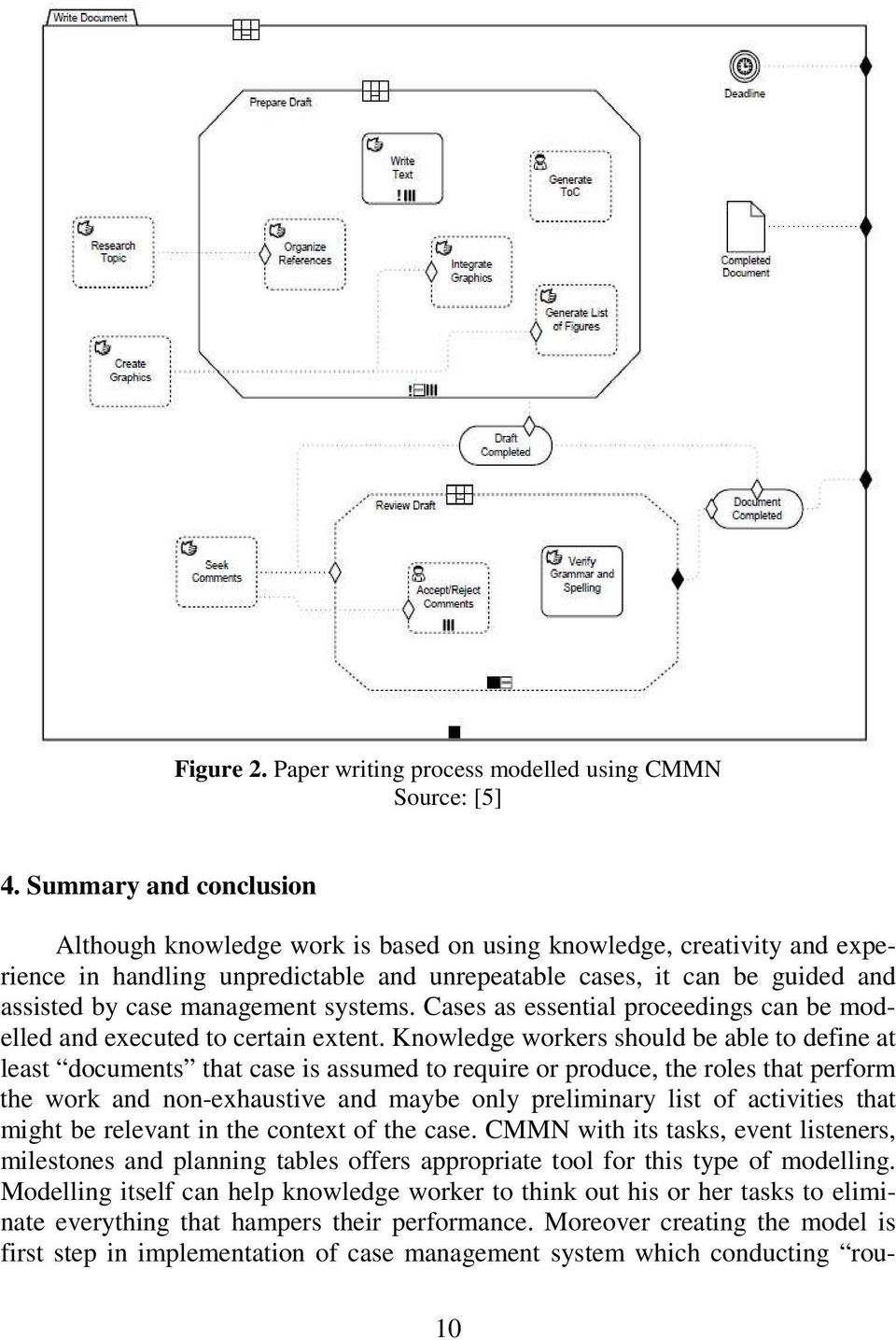
7 As mentioned above, planning is a run-time effort. It is regulated by planning table that defines scope of planning. Planning table comprises set of elements that can be considered for planning stage or task, rules that regulate their applicability and references to roles that are authorized to use the elements to their discretion Notation The CMMN notation provides for the depiction of the behavioural elements of a case (i.e. elements of a plan). Case plan is depicted using a folder shape with the name of the case. All elements of case plan model are located within boundaries of case plan shape. Because of declarative nature of CMMN relative positions of shapes have no meaning. Every type of plan item has individual shape assigned to it. A stage is depicted by a rectangle shape with angled corners whereas task is a rectangle with rounded corner. Depending on type and/or parameters, task shape can have some additional symbol placed in upper left corner (e.g. hand symbol denotes non-blocking human task). Composite elements (e.g. stages) can take collapsed or expanded form. Discretionary items are outline with dashed lines. Plan items may have associated sentries. Sentry can be used as entry (shallow diamond shape) or exit criterion (solid diamond shape). When allowed, diamonds can be placed as decorator anywhere on the boundary of a plan item shape. Rectangle with half-rounded ends gives a picture to milestone. An event listener is depicted by a double line circle shape with an open centre so that markers can be placed inside to indicate variations of an event listener. Certain dependencies between elements (e.g. when one task depends on completion of other task) can be expressed by connectors. The shape of the connector object is a dotted line. A stage or a human task can have a planning table. A planning table is symbolized by a table shape composed of six cells with the centre bottom cell containing a marker indicating if the discretionary items are visualized or not. The planning table symbol can only be placed as a decorator on the boundary of a stage or a human task. Figure 2 illustrates process of paper writing modelled with CMMN. Paper writing is undoubtedly intensive knowledge work. It can be handled in different ways. Process has two milestones (draft completed and document completed) that have to be reached. Many tasks (e.g. seek comments) or even stage (i.e. review draft stage) is left to the discretion of the author case plan and both stages have expanded planning tables. Prepare draft stage with write text task is mandatory. This stage has defined repetition rule what is symbolized by repetition decorator (three bold, black bars). It can be altered by further research or graphic creation. Process will be finished when document is created or the deadline is reached. 9

8 Figure 2. Paper writing process modelled using CMMN Source: [5] 4. Summary and conclusion Although knowledge work is based on using knowledge, creativity and experience in handling unpredictable and unrepeatable cases, it can be guided and assisted by case management systems. Cases as essential proceedings can be modelled and executed to certain extent. Knowledge workers should be able to define at least documents that case is assumed to require or produce, the roles that perform the work and non-exhaustive and maybe only preliminary list of activities that might be relevant in the context of the case. CMMN with its tasks, event listeners, milestones and planning tables offers appropriate tool for this type of modelling. Modelling itself can help knowledge worker to think out his or her tasks to eliminate everything that hampers their performance. Moreover creating the model is first step in implementation of case management system which conducting rou- 10
9 tine activities allows knowledge workers to concentrate on crucial and creative ones. User is not obliged to predict thoroughly the entire case proceeding, but she or he is rather expected to model some main episodes of the case which provide basis to create and execute case instances. CMMN follows evolutionary paradigm. It assumes that during execution with gaining experience user will be able to reveal and define more plan elements and the rules that regulate their applicability and behaviour, and then to incorporate them iteratively into case model. Building on variety of concepts CMMN represents universal solution that provides interoperability (XML Model for Interchange, XML Schema) and execution semantics. REFERENCES [1] Bhattacharya K., Hull R., Su J. (2008) A Data-Centric Design Methodology for Business processes, Handbook of Research on Business Process Modeling. [2] Davenport T. (2005) Thinking for a Living, Harvard Business School Press. [3] Drucker P.F. (1999) Knowledge-Worker Productivity: The Biggest Challenge, California Management Review, Vol. 41(2). [4] Hull, R., Damaggio, E., Fournier, F., et al. (2010 ) Introducing the guard-stagemilestone approach for specifying business entity lifecycles, Proceedings of the 7th Intl. Workshop WS-FM, LNCS 6551, pp.1-24, Springer. [5] Marin M., Hull R., Vaculin R. (2012) Data Centric BPM and the Emerging Case Management Standard: A Short Survey Hull-Vaculin-Data-Centric-BPM-and-CMMN-for-ACM-workshop-2012-final.pdf. [ ] [6] Object Management Group (2013) Case Management Model and Notation (CMMN), [ ] [7] Singularity (2009) Case Management: Combining Knowledge with Process, BPTrends, [ ] [8] Van der Aalst V.M.P., Weske M., Grünbauer D. (2005) Case handling: a new paradigm for business process support, Data & Knowledge Engineering 53, pp , Elsevier. 11

Data Centric BPM and the Emerging Case Management Standard: A Short Survey
 IBM Research Data Centric BPM and the Emerging Case Management Standard: A Short Survey Mike Marin IBM Software Group Richard Hull, Roman Vaculin IBM T.J. Watson Research Center 3 September 2012 2012 IBM
COMBINING PROCESS MODELLING AND CASE MODELLING
 Page 1 COMBINING PROCESS MODELLING AND CASE MODELLING Knut Hinkelmann and Arianna Pierfranceschi FHNW University of Applied Sciences and Arts Northwestern Switzerland, School of Business Riggenbachstrasse
Data Centric BPM and the Emerging Case Management Standard: A Short Survey
 Data Centric BPM and the Emerging Case Management Standard: A Short Survey Mike Marin α,β, Richard Hull γ,1, and Roman Vaculín γ α IBM Software Group, 1540 Scenic Ave., Costa Mesa, CA 92626 USA [email protected]
Introduction to BPMN
 Stephen A. White, IBM Corporation Abstract This paper is intended to provide a high-level overview and introduction to the Business Process Modeling Notation (BPMN). The context and general uses for BPMN
Process Modeling Notations and Workflow Patterns
 Process Modeling Notations and Workflow Patterns Stephen A. White, IBM Corp., United States ABSTRACT The research work of Wil van der Aalst, Arthur ter Hofstede, Bartek Kiepuszewski, and Alistair Barros
Bruce Silver Associates Independent Expertise in BPM
 Bruce Silver Associates Independent Expertise in BPM BPMN and the Business Process Expert Summary: BPMN has become the standard language of the Business Process Expert, usable for descriptive process modeling,
Case Management: Cordys Approach
 Case Management: Cordys Approach Henk de Man This article, like the previous one by Henk de Man, explores the idea of case management. In essence, dynamic processes that deal with unique cases may require
Quick Guide Business Process Modeling Notation (BPMN)
 Quick Guide Business Process Modeling Notation (BPMN) IDM Technical Team January 2007 Quick Guide: BPMN 2 of 14 The scope of this document is to provide a quick guide to the concepts and usage of the Business
Business Process Modeling and Standardization
 Business Modeling and Standardization Antoine Lonjon Chief Architect MEGA Content Introduction Business : One Word, Multiple Arenas of Application Criteria for a Business Modeling Standard State of the
Process Modeling using BPMN 2.0
 Process Modeling using BPMN 2.0 This chapter provides a brief overview of Business Process Modeling Notation (BPMN) concepts with particular emphasis on the BPMN 2.0 additions. In addition, it describes
Semantic Business Process Management Lectuer 1 - Introduction
 Arbeitsgruppe Semantic Business Process Management Lectuer 1 - Introduction Prof. Dr. Adrian Paschke Corporate Semantic Web (AG-CSW) Institute for Computer Science, Freie Universitaet Berlin [email protected]
A process model is a description of a process. Process models are often associated with business processes.
 Process modeling A process model is a description of a process. Process models are often associated with business processes. A business process is a collection of related, structured activities that produce
Managing and Tracing the Traversal of Process Clouds with Templates, Agendas and Artifacts
 Managing and Tracing the Traversal of Process Clouds with Templates, Agendas and Artifacts Marian Benner, Matthias Book, Tobias Brückmann, Volker Gruhn, Thomas Richter, Sema Seyhan paluno The Ruhr Institute
From Business World to Software World: Deriving Class Diagrams from Business Process Models
 From Business World to Software World: Deriving Class Diagrams from Business Process Models WARARAT RUNGWORAWUT 1 AND TWITTIE SENIVONGSE 2 Department of Computer Engineering, Chulalongkorn University 254
Using UML Part Two Behavioral Modeling Diagrams
 UML Tutorials Using UML Part Two Behavioral Modeling Diagrams by Sparx Systems All material Sparx Systems 2007 Sparx Systems 2007 Page 1 Trademarks Object Management Group, OMG, Unified Modeling Language,
White Paper BPMN 2.0 Task Types Explained
 White Paper BPMN 2.0 Task Types Explained WP0093 August 2013 Tasks represent the most fundamental process elements, which define units of work in a process. In BPMN, a Task represents an atomic Activity
Adaptive Case Management
 (ACM) You are the process Dynamic BPM with Danilo Schmiedel & Torsten Winterberg OPITZ CONSULTING Deutschland GmbH BPM in Practice, October 2013 Seite 1 The Team: Masons-of-SOA Bernd Trops (Talend): [email protected]
Business Process Modeling Notation. Bruce Silver Principal, BPMessentials [email protected]
 Business Process Modeling Notation Bruce Silver Principal, BPMessentials [email protected] About Me Founder/principal BPMessentials (2007) The leading provider of BPMN training and certification Now expanded
BPM and Simulation. A White Paper. Signavio, Inc. Nov 2013. Katharina Clauberg, William Thomas
 BPM and Simulation A White Paper Signavio, Inc. Nov 2013 Katharina Clauberg, William Thomas Table of Contents 1. Executive Summary... 3 2. Setting the Scene for Process Change... 4 3. Identifying the Goals
Business Process Standards and Modeling
 Business Process Standards and Modeling Janne J. Korhonen Helsinki University of Technology STANDARDS Standards Organizations Object Management Group (www.omg.org) Business Process Modeling Notation (BPMN)
BPMN Business Process Modelling Notation
 BPMN Business Process Modelling Notation Knut Hinkelmann This chapter is based on the BPMN Tutorial of Stephen A. White and the book White, S.A., Miers, D. (2008) BPMN - Modeling and Reference Guide. Future
Meta-Model specification V2 D602.012
 PROPRIETARY RIGHTS STATEMENT THIS DOCUMENT CONTAINS INFORMATION, WHICH IS PROPRIETARY TO THE CRYSTAL CONSORTIUM. NEITHER THIS DOCUMENT NOR THE INFORMATION CONTAINED HEREIN SHALL BE USED, DUPLICATED OR
How To Develop Software
 Software Engineering Prof. N.L. Sarda Computer Science & Engineering Indian Institute of Technology, Bombay Lecture-4 Overview of Phases (Part - II) We studied the problem definition phase, with which
Business Process Management Initiative - BPMN and the BPCNOM Style
 June 3, 2014 Paul Harmon OMG BPM Standards There are several groups that are working to develop standards for the business process space. One group is the Object Management Group (OMG). The OMG is a consortium
The Business Process Model
 The Business Process Model by Sparx Systems All material Sparx Systems 2007 Sparx Systems 2007 Page: 1 Table of Contents INTRODUCTION...3 BUSINESS PROCESS MODELING NOTATION (BPMN)...4 FLOW ELEMENTS...4
The OMG BPM Standards
 The OMG BPM Standards Derek Miers CEO, BPM Focus +44 (20) 8742 8500 UK Office +44 (7703) 178 500 UK Cell +1 (714) 600 9010 US Cell [email protected] A BPM Definition Business Process Management is primarily
INFORMATION SYSTEMS IN MANAGEMENT
 INFORMATION SYSTEMS IN MANAGEMENT Systemy informatyczne w zarządzaniu Vol. 2 2013 No. 1 Quarterly Information Systems in Management Primary version of the journal is an electronic version. Editor Department
Dr. Jana Koehler IBM Zurich Research Laboratory
 Precise Modeling of Business Processes with the Business Process Modeling Notation BPMN 2.0 Dr. Jana Koehler IBM Zurich Research Laboratory ZRL BIT at a Glance Computer Science at ZRL: Security/Cryptography
Comparative Analysis of SOA and Cloud Computing Architectures Using Fact Based Modeling
 Comparative Analysis of SOA and Cloud Computing Architectures Using Fact Based Modeling Baba Piprani 1, Don Sheppard 2, and Abbie Barbir 3 1 MetaGlobal Systems, Canada 2 ConCon Management Services, Canada
Business Process Management
 Business Process Management Janne J. Korhonen Helsinki University of Technology What is a business process? Business Process 1993 Simply a structured, measured set of activities designed to produce a specified
SERVICE-ORIENTED MODELING FRAMEWORK (SOMF ) SERVICE-ORIENTED SOFTWARE ARCHITECTURE MODEL LANGUAGE SPECIFICATIONS
 SERVICE-ORIENTED MODELING FRAMEWORK (SOMF ) VERSION 2.1 SERVICE-ORIENTED SOFTWARE ARCHITECTURE MODEL LANGUAGE SPECIFICATIONS 1 TABLE OF CONTENTS INTRODUCTION... 3 About The Service-Oriented Modeling Framework
MEASURING SOFTWARE FUNCTIONAL SIZE FROM BUSINESS PROCESS MODELS
 International Journal of Software Engineering and Knowledge Engineering World Scientific Publishing Company MEASURING SOFTWARE FUNCTIONAL SIZE FROM BUSINESS PROCESS MODELS CARLOS MONSALVE CIDIS-FIEC, Escuela
LEADing Practice: Artifact Description: Business, Information & Data Object Modelling. Relating Objects
 LEADing Practice: Artifact Description: Business, Information & Data Object Modelling Relating Objects 1 Table of Contents 1.1 The Way of Thinking with Objects... 3 1.2 The Way of Working with Objects...
Lightweight Data Integration using the WebComposition Data Grid Service
 Lightweight Data Integration using the WebComposition Data Grid Service Ralph Sommermeier 1, Andreas Heil 2, Martin Gaedke 1 1 Chemnitz University of Technology, Faculty of Computer Science, Distributed
Workflow Management Standards & Interoperability
 Management Standards & Interoperability Management Coalition and Keith D Swenson Fujitsu OSSI [email protected] Introduction Management (WfM) is evolving quickly and expolited increasingly by businesses
Elite: A New Component-Based Software Development Model
 Elite: A New Component-Based Software Development Model Lata Nautiyal Umesh Kumar Tiwari Sushil Chandra Dimri Shivani Bahuguna Assistant Professor- Assistant Professor- Professor- Assistant Professor-
Business Process Modelling. CA4 Business Process Modelling 1
 Business Process Modelling CA4 Business Process Modelling 1 Historical View of BP Modelling Work Process Flow (early to mid 1900s) + Frank Gilbreth & his 'Flow Process Charts' (= flowcharts) + First structured
A Variability Viewpoint for Enterprise Software Systems
 2012 Joint Working Conference on Software Architecture & 6th European Conference on Software Architecture A Variability Viewpoint for Enterprise Software Systems Matthias Galster University of Groningen,
Winery A Modeling Tool for TOSCA-based Cloud Applications
 Institute of Architecture of Application Systems Winery A Modeling Tool for TOSCA-based Cloud Applications Oliver Kopp 1,2, Tobias Binz 2, Uwe Breitenbücher 2, and Frank Leymann 2 1 IPVS, 2 IAAS, University
Modeling Workflow Patterns
 Modeling Workflow Patterns Bizagi Suite Workflow Patterns 1 Table of Contents Modeling workflow patterns... 4 Implementing the patterns... 4 Basic control flow patterns... 4 WCP 1- Sequence... 4 WCP 2-
What is BPM? Software tools enabling BPM
 What is BPM? BPM, or Business Process Management, is a technology, but it is also more than that. Broadly speaking, one can consider BPM as a management discipline in which processes are valued as assets
SOA Enabled Workflow Modernization
 Abstract Vitaly Khusidman Workflow Modernization is a case of Architecture Driven Modernization (ADM) and follows ADM Horseshoe Lifecycle. This paper explains how workflow modernization fits into the ADM
Business-Driven Software Engineering Lecture 3 Foundations of Processes
 Business-Driven Software Engineering Lecture 3 Foundations of Processes Jochen Küster [email protected] Agenda Introduction and Background Process Modeling Foundations Activities and Process Models Summary
Refactoring BPMN Models: From Bad Smells to Best Practices and Patterns
 Refactoring BPMN Models: From Bad Smells to Best Practices and Patterns INTRODUCTION Darius Silingas and Edita Mileviciene, No Magic, Lithuania BPMN is already acknowledged as a de facto standard for business
From Workflow Design Patterns to Logical Specifications
 AUTOMATYKA/ AUTOMATICS 2013 Vol. 17 No. 1 http://dx.doi.org/10.7494/automat.2013.17.1.59 Rados³aw Klimek* From Workflow Design Patterns to Logical Specifications 1. Introduction Formal methods in software
Modeling Guidelines Manual
 Modeling Guidelines Manual [Insert company name here] July 2014 Author: John Doe [email protected] Page 1 of 22 Table of Contents 1. Introduction... 3 2. Business Process Management (BPM)... 4 2.1.
The value of modeling
 The value of modeling Level: Introductory Gary Cernosek, Marketing Manager, IBM Rational Eric Naiburg, Group Market Manager Desktop Products, IBM Rational 15 Nov 2004 from The Rational Edge: This article
Writing Use Case Scenarios for Model Driven Development
 Writing Use Case Scenarios for Model Driven Development This guide outlines how to use Enterprise Architect to rapidly build Use Cases and increase your productivity through Model Driven Development. Use
OMG releases BPMN 1.1 - What's changed?
 OMG releases BPMN 1.1 - What's changed? (revised version as of April 2008) Gero Decker 1 and Torben Schreiter 2 1 Hasso Plattner Institute, Potsdam, Germany 2 inubit AG, Berlin, Germany Abstract The Business
Multi-Paradigm Process Management
 Multi-Paradigm Process Management Michael zur Muehlen 1, Michael Rosemann 2 1 Stevens Institute of Technology Wesley J. Howe School of Technology Management Castle Point on the Hudson Hoboken, NJ 07030,
MTAT.03.231 Business Process Management (BPM) (for Masters of IT) Lecture 2: Introduction to BPMN
 MTAT.03.231 Business Process Management (BPM) (for Masters of IT) Lecture 2: Introduction to BPMN Marlon Dumas marlon.dumas ät ut. ee How to engage in BPM? 1. Opportunity assessment 2. Process modelling
Mapping Business Process Modeling constructs to Behavior Driven Development Ubiquitous Language
 Mapping Business Process Modeling constructs to Behavior Driven Development Ubiquitous Language Rogerio Atem de Carvalho, Fernando Luiz de Carvalho e Silva, Rodrigo Soares Manhaes Emails: [email protected],
Business Process Modelling Notation A tutorial
 Business Process Modelling Notation A tutorial Sam Mancarella Chief Technology Officer Sparx Systems [email protected] OMG SOA in Healthcare January 14, 2011 Tutorial Objectives This tutorial
Increasing Development Knowledge with EPFC
 The Eclipse Process Framework Composer Increasing Development Knowledge with EPFC Are all your developers on the same page? Are they all using the best practices and the same best practices for agile,
1.1 Motivation and Definitions
 1 Introduction Business process management has received considerable attention recently by both business administration and computer science communities. Members of these communities are typically characterized
Teaching Methodology for 3D Animation
 Abstract The field of 3d animation has addressed design processes and work practices in the design disciplines for in recent years. There are good reasons for considering the development of systematic
A B C D E F G H I J K L M N O P Q R S T U V W X Y Z
 Business Process Management (BPM) Center of Excellence (CoE) Glossary October 26, 2009 A B C D E F G H I J K L M N O P Q R S T U V W X Y Z A Activity A generic term for work that a company or organization
Comparison of The Workflow Management Systems Bizagi, ProcessMaker, and Joget
 The International Arab Conference on Information Technology (ACIT 2013) Comparison of The Workflow Management Systems Bizagi, ProcessMaker, and Joget Farh Mohamed Zeinelbdeen Abdelgader, Omer O. Salih
Using UML Part One Structural Modeling Diagrams
 UML Tutorials Using UML Part One Structural Modeling Diagrams by Sparx Systems All material Sparx Systems 2007 Sparx Systems 2007 Page 1 Trademarks Object Management Group, OMG, Unified Modeling Language,
EU CUSTOMS BUSINESS PROCESS MODELLING POLICY
 EUROPEAN COMMISSION MASP Revision 2014 v1.1 ANNEX 4 DIRECTORATE-GENERAL TAXATION AND CUSTOMS UNION Customs Policy, Legislation, Tariff Customs Processes and Project Management Brussels, 03.11.2014 TAXUD.a3
Towards an Integration of Business Process Modeling and Object-Oriented Software Development
 Towards an Integration of Business Process Modeling and Object-Oriented Software Development Peter Loos, Peter Fettke Chemnitz Univeristy of Technology, Chemnitz, Germany {loos peter.fettke}@isym.tu-chemnitz.de
Object Oriented Programming. Risk Management
 Section V: Object Oriented Programming Risk Management In theory, there is no difference between theory and practice. But, in practice, there is. - Jan van de Snepscheut 427 Chapter 21: Unified Modeling
Enterprise IT Architectures BPM (Business Process Management)
 Dr. Hans-Peter Hoidn Executive Architect, IBM Distinguished IT Architect (Opengroup) Enterprise IT Architectures BPM (Business Process Management) Introduction 2 Agenda of this Part Business Process Management
Business Process Modeling with BPMN. Dr. Darius Šilingas Head of Solutions Department [email protected]
 Business Process Modeling with BPMN Dr. Darius Šilingas Head of Solutions Department [email protected] No Magic Europe, 2012 About Instructor Dr. Darius Šilingas q Principal Consultant and Head
Chapter 2 Introduction to Business Processes, BPM, and BPM Systems
 Chapter 2 Introduction to Business Processes, BPM, and BPM Systems This chapter provides a basic overview on business processes. In particular it concentrates on the actual definition and characterization
Data Modeling Basics
 Information Technology Standard Commonwealth of Pennsylvania Governor's Office of Administration/Office for Information Technology STD Number: STD-INF003B STD Title: Data Modeling Basics Issued by: Deputy
INTRODUCTION TO BUSINESS PROCESS MODELING NOTATION BPMN 1.2 AND BPMN 2.0
 INTRODUCTION TO BUSINESS PROCESS MODELING NOTATION BPMN 1.2 AND BPMN 2.0 Email: {goliva,gerosa}@ime.usp.br / Twitter: @golivax Agenda 2 Introduction to Business Processes BPMN 1.2 Introduction Elements
Business Process Management (BPM)
 Business Process Management (BPM) What is BPM? Business Process Management is primarily a business philosophy About people The way they work together (their business processes) The performance objectives
AHP Based Comparison of open-source BPM Systems
 AHP Based Comparison of open-source BPM Systems Dragan Mišić *, Milena Mišić **, MilanTrifunović *, Tanja Arh, Pipan Matić *** * Faculty of Mechanical Engineering, Niš, Serbia ** Student at the Faculty
Business Process Modeling Information Systems in Industry (372-1-4207 )
 Business Process Modeling Information Systems in Industry (372-1-4207 ) Arnon Sturm The material of this presentation is adopted from various people including:, Pnina Soffer, Iris Reinhartz-Berger 1 Outline
BPMN Fundamentals. BPMI Meeting #12. London, United Kingdom May 13-14, 2004. Stephen A. White, IBM Notation Working Group Chair
 BPMN Fundamentals Stephen A. White, IBM Notation Working Group Chair BPMI Meeting #12 London, United Kingdom May 13-14, 2004 Topics Background Relationship to other BPM Notations/ Languages and to Standards
SIMULATION STANDARD FOR BUSINESS PROCESS MANAGEMENT. 15 New England Executive Park The Oaks, Clews Road
 Proceedings of the 2011 Winter Simulation Conference S. Jain, R.R. Creasey, J. Himmelspach, K.P. White, and M. Fu, eds. SIMULATION STANDARD FOR BUSINESS PROCESS MANAGEMENT John Januszczak Geoff Hook Meta
BIS 3106: Business Process Management. Lecture Two: Modelling the Control-flow Perspective
 BIS 3106: Business Process Management Lecture Two: Modelling the Control-flow Perspective Makerere University School of Computing and Informatics Technology Department of Computer Science SEM I 2015/2016
Rules and Business Rules
 OCEB White Paper on Business Rules, Decisions, and PRR Version 1.1, December 2008 Paul Vincent, co-chair OMG PRR FTF TIBCO Software Abstract The Object Management Group s work on standards for business
The Service, The Cloud & The Method: The Connection Points
 The Service, The Cloud & The Method: The Connection Points Thomas Erl SOA Systems Inc. Prentice Hall Service-Oriented Computing Series Started in 2003 Text Books are an Official Part of the SOACP Curriculum
Adaptive Case Management - Capabilities for Faster Decisions
 Adaptive Case Management - Capabilities for Faster Decisions Tayo Runsewe Chris Pinnell ECM Solutions IBM Canada ECM Client Solution Professional IBM Canada The beginning of wisdom is a definition of terms
Enterprise Application Designs In Relation to ERP and SOA
 Enterprise Application Designs In Relation to ERP and SOA DESIGNING ENTERPRICE APPLICATIONS HASITH D. YAGGAHAVITA 20 th MAY 2009 Table of Content 1 Introduction... 3 2 Patterns for Service Integration...
Transforming PICTURE to BPMN 2.0 as Part of the Model-driven Development of Electronic Government Systems
 Heitkötter, Henning, Transforming PICTURE to BPMN 2.0 as Part of the Model-Driven Development of Electronic Government Systems, 44th Hawaii International Conference on System Sciences (HICSS), pp. 1 10,
Information Management Metamodel
 ISO/IEC JTC1/SC32/WG2 N1527 Information Management Metamodel Pete Rivett, CTO Adaptive OMG Architecture Board [email protected] 2011-05-11 1 The Information Management Conundrum We all have Data
Model Simulation in Rational Software Architect: Business Process Simulation
 Model Simulation in Rational Software Architect: Business Process Simulation Mattias Mohlin Senior Software Architect IBM The BPMN (Business Process Model and Notation) is the industry standard notation
Budapest University of Technology and Economics Department of Measurement and Information Systems. Business Process Modeling
 Budapest University of Technology and Economics Department of Measurement and Information Systems Business Process Modeling Process, business process Workflow: sequence of given steps executed in order
4.7 Business Process Model and Notation
 206 4 Process Orchestrations 4.7 Business Process Model and Notation This section introduces the Business Process Model and Notation (BPMN), developed under the coordination of the Object Management Group.
DEVELOPING REQUIREMENTS FOR DATA WAREHOUSE SYSTEMS WITH USE CASES
 DEVELOPING REQUIREMENTS FOR DATA WAREHOUSE SYSTEMS WITH USE CASES Robert M. Bruckner Vienna University of Technology [email protected] Beate List Vienna University of Technology [email protected]
Cover Page. The handle http://hdl.handle.net/1887/33081 holds various files of this Leiden University dissertation.
 Cover Page The handle http://hdl.handle.net/1887/33081 holds various files of this Leiden University dissertation. Author: Stettina, Christoph Johann Title: Governance of innovation project management