
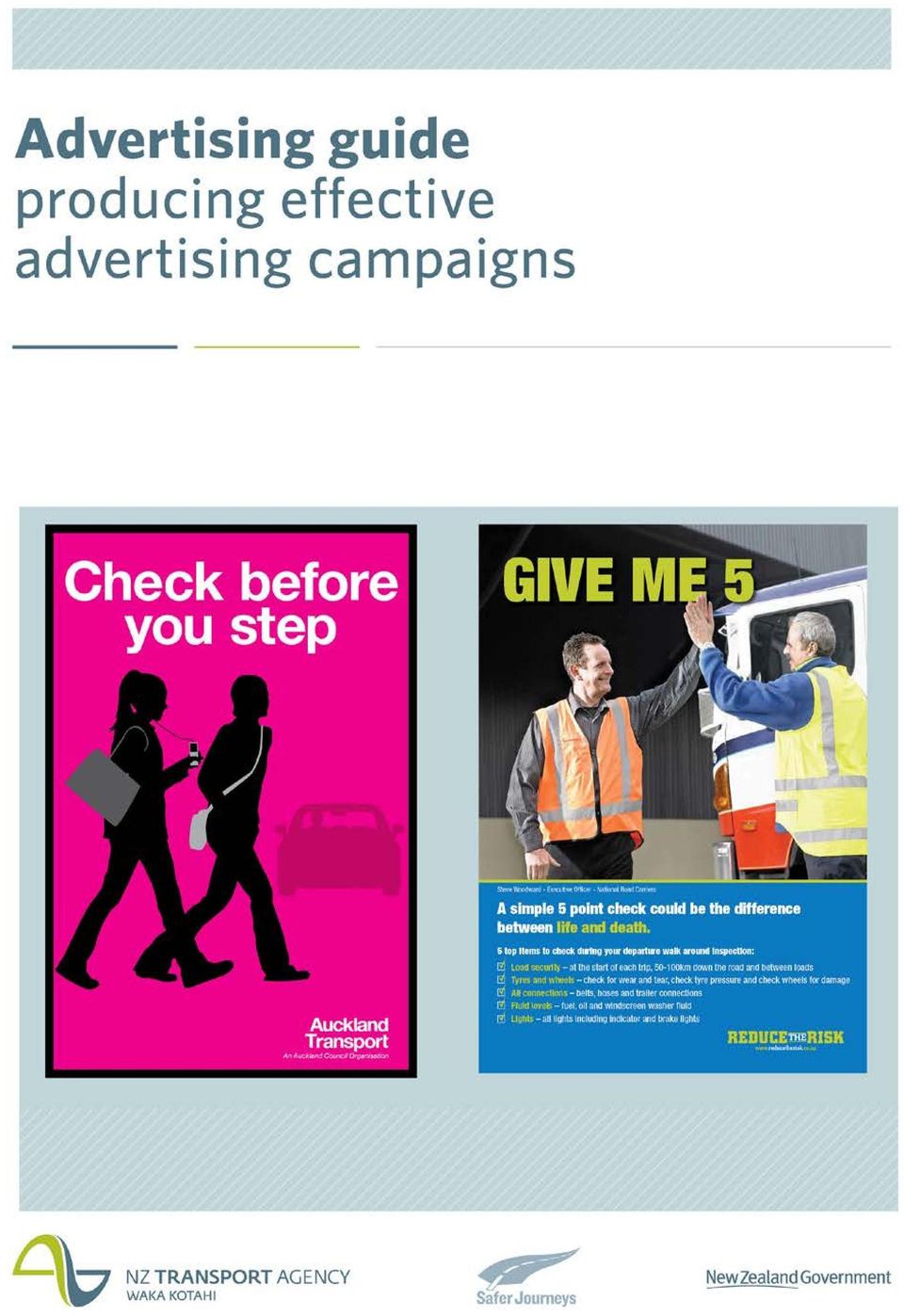
Advertising guide. producing effective advertising campaigns. NZ Transport Agency.
|
|
|
- Homer Morris
- 10 years ago
- Views:
Transcription
1
2

3 Page v Advertising guide producing effective advertising campaigns NZ Transport Agency July 2012 ISBN (online) ISBN (print)
4 Copyright information This publication is copyright NZ Transport Agency (NZTA). Material in it may be reproduced for personal or inhouse use without formal permission or charge, provided suitable acknowledgement is made to this publication and the NZTA as the source. Requests and enquiries about the reproduction of material in this publication for any other purpose should be made to: NZ Transport Agency Private Bag 6995 Wellington 6141 The permission to reproduce material in this publication does not extend to any material for which the copyright is identified as being held by a third party. Authorisation to reproduce material belonging to a third party must be obtained from the copyright holder(s) concerned. Disclaimer The NZTA has endeavoured to ensure material in this document is technically accurate and reflects legal requirements. However, the document does not override governing legislation. The NZTA does not accept liability for any consequences arising from the use of this document. If the user of this document is unsure whether the material is correct, they should make direct reference to the relevant legislation and contact the NZTA. More information First published 2011 This edition published July 2012 ISBN (online) ISBN (print) If you have further queries, call our contact centre on or write to us: NZ Transport Agency Private Bag 6995 Wellington 6141 This document is available on the NZTA s website at

5 Page i Contents Why use these guidelines?... 1 The advertising process... 2 The Advertising brief/advertising approval application forms... 3 Evaluating advertising concepts... 7 How to test concepts on a limited budget Developing advertising material...15 Evaluating advertising campaigns General rules for advertising...26 Outdoor advertising Media Common mistakes Examples of common mistakes in advertising Appendix 1 - Advertising brief form Appendix 2 - Advertising approval application form Appendix 3 - Intellectual property rights Glossary advertising technical language or jargon... 54
6

7 Page 1 Why use these guidelines? These guidelines are for approved organisations and NZ Transport Agency (NZTA) staff to use. They were developed to help you produce and implement effective advertising campaigns using best practice. The information in this resource is based on the most common questions we re asked at the NZTA. It also shows you how the advertising process works (based on the assumption your funding from the National Land Transport Programme [NLTP] has been approved). We recommend you refer to these guidelines when developing an advertising initiative. They document the best way to develop and implement your campaign and also show you how to complete an Advertising brief or an Advertising approval application form. The more thorough your preparation and advertising brief is, the more likely you are to achieve your objectives. The topics addressed in this resource aren t exhaustive by any means. We re always happy for you to call or come and talk to us about a specific initiative or issue you may have. Thank you to the approved organisations who have allowed us to use examples throughout this resource. The advertising team NZ Transport Agency (NZTA) [email protected]
8 Page 2 The advertising process The process step-by-step 1 Identify the problem you want to address and set key campaign objectives/themes. Base your decision on evidence, ie crash statistics (CAS), ACC statistics, the Communities at risk register, Safer Journey s priority areas and action plan, RSAP linkages and local knowledge. 2 Investigate whether any existing/approved regional and national campaigns meet your campaign objectives. Check intellectual property rights. 3 If you can t find a suitable existing/approved campaign, prepare an Advertising brief (template available). Approved organisations are encouraged to consult with the NZTA s National Office advertising team early in the development process for assistance. They can provide feedback on your early idea/s. 4 An advertising brief must be used when designing your campaign. This brief can then be used with your inhouse marketing team or can be sent to external agencies. If your advertising is audited by the NZTA, this document will be required. 5 The NZTA s National Office advertising team must approve any concepts developed for campaigns that cost $250,000 or more. For these applications, use the Advertising approval application form (template available). If your advertising is audited by the NZTA, this document will be required. 6 Conduct pre-testing on concepts and refine where necessary. 7 If seeking feedback/approval, you ll need to send the completed Advertising brief/advertising approval application form (templates provided) to the NZTA s National Office advertising team. Allow at least five working days for feedback. 8 The NZTA National Office advertising team will: check the material s content, consistency and appropriateness provide feedback on your brief and creative idea/s approve or decline the application if it costs $250,000 or more. 9 You can now produce your advertising campaign. 10 For campaigns costing less than $250,000, you will need to include evaluation feedback on the advertising component in your end of year reporting. This can be completed as soon as the activity is finished, but must be attached in the annual achievement return in transport investment online (TIO) each July. For campaigns costing $250,000 or more, you ll need to complete TIO as above, and send a separate evaluation to the National Office advertising team so it can be attached to the initial brief and approval. 11 If advertising does not follow NZTA guidelines, the NZTA may request immediate removal and discontinuation of the advertising. This will be at the expense of the approved organisation and a return of funding for the campaign may be sought. 12 The content of road safety advertising maybe subject to an audit by NZTA.

9 Page 3 Please note Important Local advertising must meet these advertising guidelines. We recommend that you work closely with the NZTA s National Office advertising team early on when developing your brief/concepts. They ll give you advice on best-practice road safety advertising principles. Advertising brief/advertising approval application forms must be used when designing your campaign. The NZTA s advertising team must approve any concepts developed for campaigns that cost $250,000 or more. To meet the NZTA s requirements, your concepts may need to be changed. The content of road safety advertising maybe subject to an audit by the NZTA. The Advertising brief/advertising approval application forms The process step-by-step Problem identification NZTA road safety outcomes The Advertising brief/advertising approval application forms (creative brief) should be attached to your draft concepts when you submit them for feedback/approval. The creative brief is a good tool for thinking through your campaign. Use it to prompt yourself to ask the right questions at the very start of the process. The creative brief can be used when you engage with an advertising agency or inhouse team. It provides all the information an agency requires to develop your creative concepts. For a copy of the: Advertising brief form, refer to appendix 1 Advertising approval application form, refer to appendix 2. Listed below are the criteria you ll need to address when filling out the creative brief. These are the same criteria you d need to address when putting together an Advertising approval application form. State the road safety issue that the proposed campaign will focus on. Include any data and information that has been used to identify this issue or further explain why the campaign is focusing on this issue. It s not sufficient to simply state a problem, eg speed, with no supporting data or information. State the road safety objective/s of your advertising campaign. Road safety outcomes are the long-term outcomes the advertising will contribute to, eg reduced crashes at intersections, a reduced incidence of alcohol and drug impaired driving. These outcomes are unlikely to be achieved by your advertising campaign alone. Despite this, you still need to be clear about what you want to achieve. These outcomes need to be measurable.
10 Page 4 Advertising objectives Key messages Taglines Creative ideas and concepts State the objectives you aim to achieve with the proposed campaign. They should have distinct goals, such as: to increase awareness of the dangers of driving over the speed limit in urban areas to increase awareness around the dangers of running red lights to increase the intolerance of drink-driving in rural areas. Advertising alone is unlikely to change behaviour. However, raising awareness or changing attitudes to road safety issues may contribute to positive behaviour change and may help achieve road safety outcomes. The advertising initiative should aim to contribute to the NZTA s long-term road safety outcomes. State the key messages you want your audience to take out of your advertising. Key messages aren t explicitly stated in advertising they re not the taglines. They re the internal thoughts that the target audience should think when they look at/engage with your advertising campaign. Be clear about your key messages. When these are clear, they help guide the development of the creative concepts and ultimately improve on the delivery of the advertising objectives. Examples of recent key messages for the national drink-driving campaign are: If I drink and drive, I put myself and my mates at risk. Speak up when a friend is going to drive drunk. Regardless of my own behaviour and how tricky it might feel, if someone I care about drinks and drives, I need to do something. State the tagline you ll be using in your campaign. Taglines should be a call to action where possible, ie instructional. They re the last message you want your audience to take out of your advertising. They should be consistent across all mediums (outdoor, print, radio, online, ambient, etc), eg Stop a mate driving drunk, Bloody legend. If your taglines are inconsistent, you could confuse your target audience with multiple messages. This would reduce the impact of your campaign. It s beneficial to use existing taglines from the national road safety advertising campaign for relevant regional campaigns where possible, eg The faster you go, the bigger the mess. This is because you can benefit from their established awareness. Target audiences will absorb an established message easier than a new one. However, it may not always be appropriate. The creative idea or concept is what the advertising will actually look or sound like when it s produced. Some examples are a photo of a crashed car or a script for a radio ad that the campaign will use to get its message across. It s important that the concept supports the key messages that your campaign intends to deliver. Describe the concept/s intended for your campaign in this section of the creative brief. If you have a draft concept or script, attach them to the form too. However, you may not have a creative idea or concept at this stage. We recommend that you work closely with the NZTA s National Office advertising team early on when developing your concepts. They ll give you advice
11 Page 5 on best-practice road safety advertising principles. Keep in mind that existing promotional products and nationally created ads are available for use at a regional level. There may be a charge for some products or files if you need to adapt them for your purposes. The average cost to change a billboard file is $300. This can vary depending on the concept. Consult the NZTA s website at to see what s available, and talk with the NZTA s advertising team if you have any queries. You can contact the NZTA s advertising team at this address: [email protected] Media Timelines or media schedules Testing Evaluation What media will you use to deliver your concept, eg outdoor, print, radio, online, ambient? Your chosen media should suit your concept and be the best way to reach your target audience, eg a detailed concept is best suited to print as the audience has time to read it and think it through. If you re unsure about what media is best for your target audience or you would like some advice, contact [email protected]. Different media varies widely in price. It s better to reach your true target audience rather than invest in media that s not effective at delivering your campaign message. Outline the proposed timeline or media schedule for your advertising campaign, ie when will the advertising start and when will it stop? Do you intend to use it again and if so, over what timeframe? Outline whether pre-testing has taken or will take place. Testing your concepts with the target audience is essential, as it ensures your target audience will take out your key messages. In the testing phase, target audiences interpret the creative idea/s and feed back on what they think the ad is telling them. Testing allows you to establish whether your concept delivers the correct message or whether it unintentionally delivers other messages. It gives you the information you need to refine your concept and develop the best ad you can. Testing is a very worthwhile investment and doesn t need to take a lot of time or cost a lot of money. More information on testing can be found on pages Describe how you ll evaluate the effectiveness of your advertising, ie what measures you intend to use. Your objectives outline what you aim to achieve. Your evaluation should access whether you have achieved them. More information on evaluation can be found on pages

12 Page 6 Budgets How much is the overall budget for your campaign? The budget should take into account all the different costs associated with your advertising, such as your: production budget this is the amount of money you ll spend developing and creating your advertising. Costs may encompass design, alterations, developing billboard skins, installation costs of billboard skins, printing, recording a radio ad or changes to files using existing national advertising when appropriate (outdoor, print, radio, online, ambient, etc) will substantially reduce the overall cost of your production budget media budget this is the amount of money you ll spend on communicating your message through various mediums, eg billboards, print, radio, online, ambient, outdoor panels, text messages and promotional products testing and evaluation budget this is the amount of money you ll spend on testing and evaluating. This should be around 5% of your total budget, although this may be neither practical nor necessary for smaller campaigns.
13 Page 7 Evaluating advertising concepts How do I critique the concepts I receive from my agency or inhouse team? Why should I test my concepts? Who do I test my concepts on? When concepts are presented to you by your agency or inhouse team, the first thing you should do is refer back to your creative brief. Ask yourself whether the presented concepts meet your criteria. Do you think that your target audience will easily understand and relate to your key messages? If you think the concepts don t meet your brief, talk with the agency and explain why you feel they re not on target. The agency may challenge your feedback, so fully discuss your concerns and be clear about why you think the concepts aren t on brief. The agency should be able to incorporate your feedback and rework the concepts. When you re generally happy with the concepts, it s time to have them tested. Concepts are tested to ensure that they engage your target audience and communicate your intended message at the same time. Choosing a concept that works can be time consuming. Often you might favour one concept over another or you might think that one in particular has cracked it! However, it s unlikely that you ll be part of your target audience; only the target audience can tell you whether the concepts are likely to work or not. We know that negative feedback can be disheartening. You might hear that your concept isn t relevant, it doesn t engage the audience, it has the wrong message out-takes, or your audience thinks its rubbish. This type of feedback slows down the production schedule and can also be stressful. Therefore, it s important to allow for the testing process and potential redevelopment in your development schedule at the very start. Use the test results to your best advantage redevelop your concepts or keep them as they are. It s essential that you test your concepts on your primary target audience, not family members, people in your office or people who know what you re working on. These people are rarely part of your target audience. And as they re likely to be familiar with road safety issues, can also create a bias in the testing procedure, which needs to be avoided.

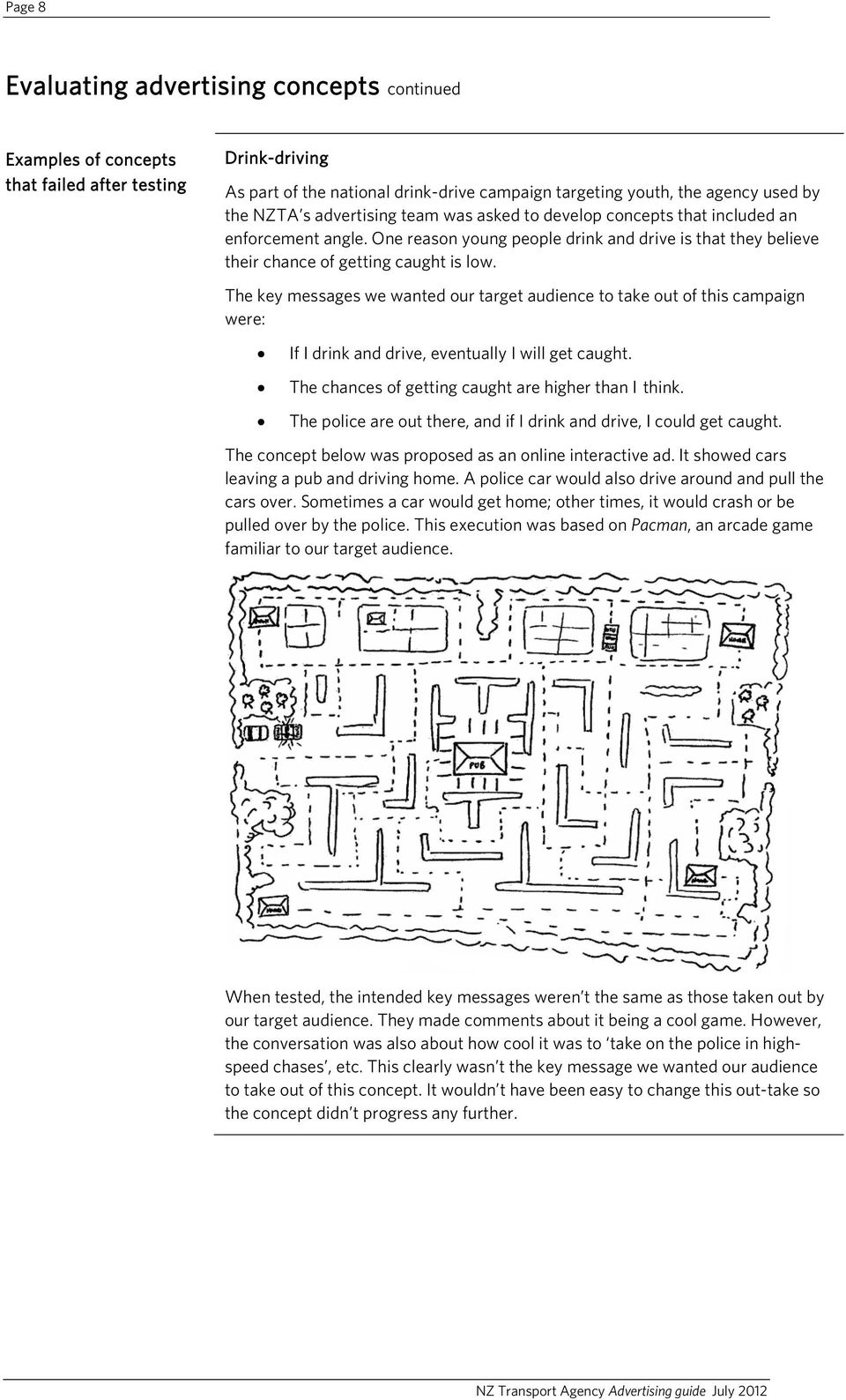
14 Page 8 Evaluating advertising concepts continued Examples of concepts that failed after testing Drink-driving As part of the national drink-drive campaign targeting youth, the agency used by the NZTA s advertising team was asked to develop concepts that included an enforcement angle. One reason young people drink and drive is that they believe their chance of getting caught is low. The key messages we wanted our target audience to take out of this campaign were: If I drink and drive, eventually I will get caught. The chances of getting caught are higher than I think. The police are out there, and if I drink and drive, I could get caught. The concept below was proposed as an online interactive ad. It showed cars leaving a pub and driving home. A police car would also drive around and pull the cars over. Sometimes a car would get home; other times, it would crash or be pulled over by the police. This execution was based on Pacman, an arcade game familiar to our target audience. When tested, the intended key messages weren t the same as those taken out by our target audience. They made comments about it being a cool game. However, the conversation was also about how cool it was to take on the police in highspeed chases, etc. This clearly wasn t the key message we wanted our audience to take out of this concept. It wouldn t have been easy to change this out-take so the concept didn t progress any further.
15 Page 9 Evaluating advertising concepts continued Examples of concepts that failed after testing continued Speed Part of our national speed campaign, this concept was intended to support our 2009 urban speed television ad Another 10k, which examined the realities of driving up to 10km/h over the speed limit in a 50km/h area. This concept was rejected before it went to testing as it didn t communicate the intended key messages ie: It doesn t matter how good I think I am, I m not alone. When I m driving too fast, I could kill someone. If I m driving over the speed limit, I don t have time to react safely to unexpected urban hazards. In this concept, the parked car, driver and child were repeated, with one slightly further along the road than the other. Aside from this being confusing, it appeared to be more about stopping distances than unexpected urban hazards. Also, if the parent and child stepped into the path of an oncoming car, the parent would be deemed to be at fault. This could completely change the intended out-take.
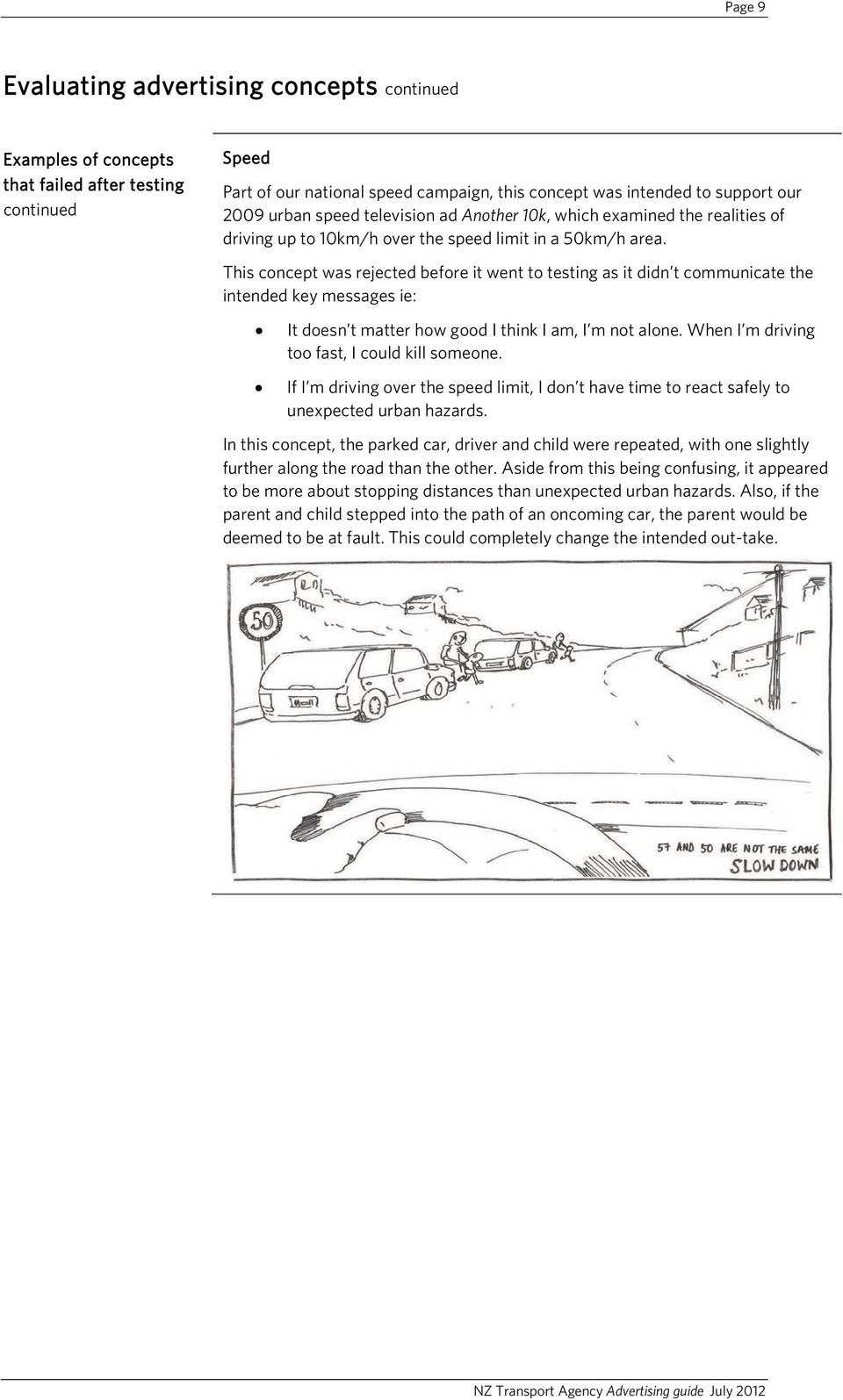
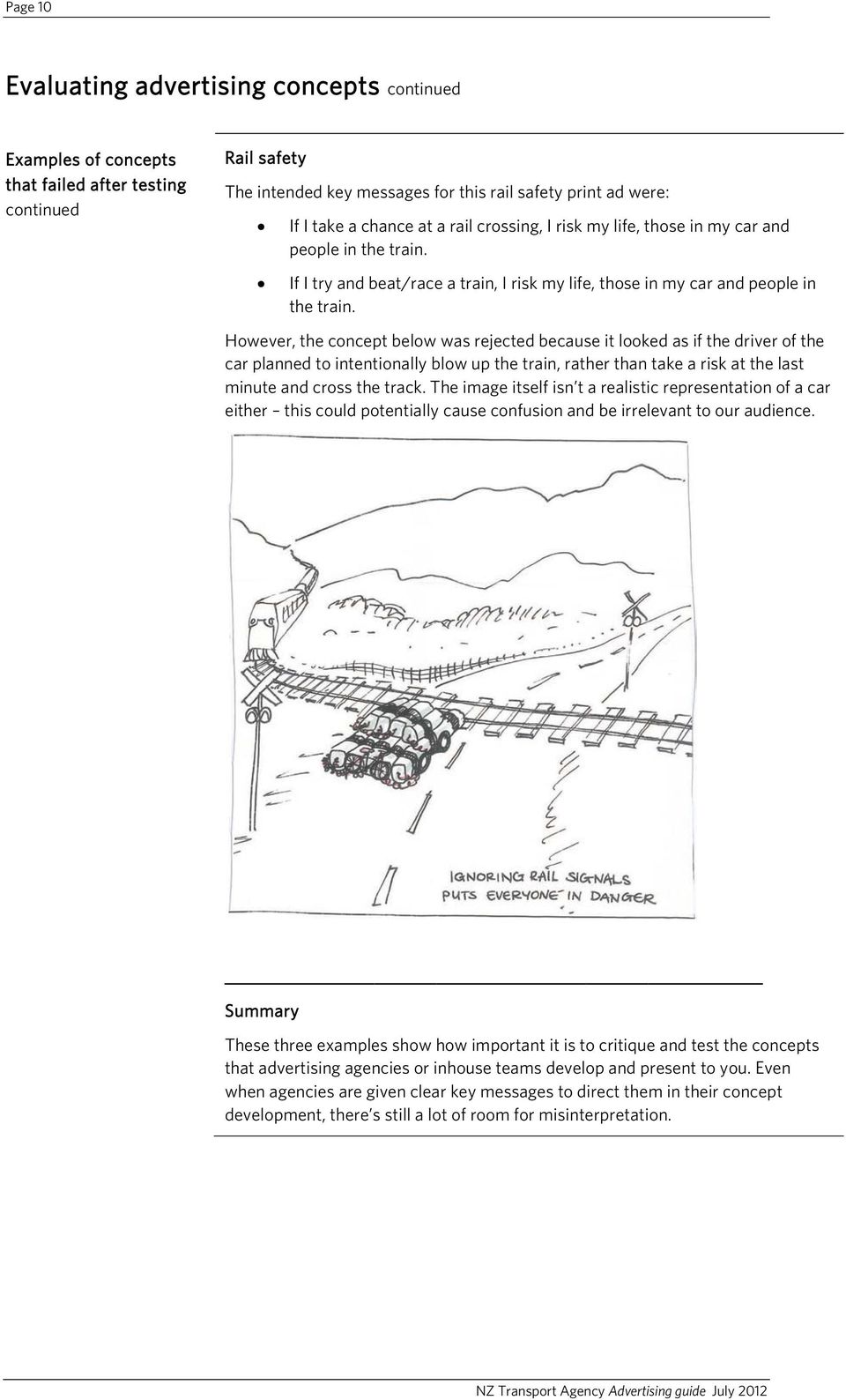
16 Page 10 Evaluating advertising concepts continued Examples of concepts that failed after testing continued Rail safety The intended key messages for this rail safety print ad were: If I take a chance at a rail crossing, I risk my life, those in my car and people in the train. If I try and beat/race a train, I risk my life, those in my car and people in the train. However, the concept below was rejected because it looked as if the driver of the car planned to intentionally blow up the train, rather than take a risk at the last minute and cross the track. The image itself isn t a realistic representation of a car either this could potentially cause confusion and be irrelevant to our audience. Summary These three examples show how important it is to critique and test the concepts that advertising agencies or inhouse teams develop and present to you. Even when agencies are given clear key messages to direct them in their concept development, there s still a lot of room for misinterpretation.
17 Page 11 How to test concepts on a limited budget Introduction How do I find representatives of my target audience for testing? What if the agency wants to do the testing for me? How many people do I need in my test group? How do I record the feedback I receive? Testing your concepts is vital. How will you know if your ad is going to resonate with the target audience if you don t get any feedback from them? Concept testing on a limited budget can be challenging. Below are some suggestions you can use to test concepts yourself. First, you need to identify your target audience. If your target audience is young people who drive drunk, you need to find young people who drive drunk to test your concepts on. If your target audience is people who speed, you need to find people who ve received a speeding ticket in the last 1 2 years or people who freely admit to speeding on occasion. The only way to do this is to ask people. This may be difficult though, as most people don t like to admit that they do either of these things. Perhaps the best way is to ask them if any of their friends or associates do this type of thing. By default, most people associate with others who share common values, traits and behaviours. Therefore, if they admit their friends participate in this behaviour, it s likely that they also engage in the same behaviour. When an agency offers to complete concept testing for you, it can be an appealing prospect. It makes your life easier and they re the professionals, after all. However, the argument that an agency s staff are the best people to test their own concept is clearly flawed. Agency staff are usually too close to the project to be completely objective. They won t be comfortable critiquing their creative director and it s very difficult for them to remain neutral when they believe that the concept they ve developed meets the brief. They re also potentially under pressure to move onto other projects. The NZTA s advertising team very intentionally separates the creative development from the testing of creative concepts. This helps maintain objectivity, as seeking independent feedback removes both our own and the agency s bias Ideally, a separate party should do the testing. This may be unrealistic for a small to medium advertising campaign though. If this is the case, you should do the testing yourself. Each creative piece in your campaign should be tested on approximately people who represent your target audience. We recommend that two people conduct the testing process. One person should ask the questions and the other should record the feedback without participating in any discussion. The person recording feedback should remain objective and record all comments. This person should avoid making judgements about whether a particular comment is important or not. It s natural for people to take in information that confirms their established beliefs and discard information that doesn t support these beliefs. There s a well-established theory (relevant to this testing process) in the field of social psychology called Confirmation/information bias. This theory tells us that people only search for and/or interpret and/or register new information that supports their current beliefs and biases. This means that people are likely to discard information that doesn t support their current beliefs. Just why people do this is
18 Page 12 complex, but what it does tell us is that we re in danger of only listening to opinions or information that support our current beliefs. When we apply this to testing advertising concepts, these information biases can lead us to dismiss any feedback that contradicts our beliefs. Many of us don t like to admit that we didn t get it right but this is the main purpose of testing. Testing in groups How many people should I have in a test group? If you want to test your concepts with groups of people rather than individuals, it s best to have a maximum of three or four people per group. If a group s too big, an individual s feedback can get lost there are usually one or two people in a group who are more vocal and opinionated than others. Outspoken people can influence a group and others may feel they can t voice their opinion if it s different. When this happens, a group becomes ineffective. How do I select a group of people? When you select a group of people, try to get a diverse group in your target audience. Have a look around a food court, school or other meeting area. You could ask individuals, or a group of two or three friends who are sitting together. Irrespective of whether they re an individual or a small group, each must be counted as one observation or interview. For example, if you count a group of three friends as three observations, this will bias your sample as it s likely that these people will have similar opinions. Often, our friends and associates are similar, so it s not unusual for them to think and act in the same way.
19 Page 13 Random street sample What and how do I ask them? How many people should I approach in a random street sample? Test each concept on people. Make sure that they re in your target audience. On the street, you can usually identify people by age etc but it s always good to ask. How do I select a person? If you re looking for males aged between 30 and 50 years, you should pick every 5th or 7th male who looks like they re between 30 and 50. This will ensure that the sample group you test your advertising on is relatively random. This also helps reduce bias in your sample. Consider what time of day you select your sample. If you select people at lunchtime, you re likely to get people who work and who are on a lunch break. Approaching people at different times will get you a good cross-section of people, eg students, stay-at-home parents, people who are unemployed. It s also important to think about where you do your testing. Do you want to test in low or high socio-economic areas? These differences may affect your feedback. Avoid asking people directly about their personal opinion, as it can place too much pressure on them people may feel compelled to give answers they think you want rather than what they really think. Make sure you use open-ended questions that allow a person to make a statement or to voice their opinion rather than closed questions that require a yes or no answer. This way, you ll get more information about your creative concept. Examples: 1 What would your friends think this ad is about? 2 On a scale of one to five, how relevant do you think this ad is to people like yourself? (with one being very relevant and five being not relevant). What s your reason for this?
20 Page 14 How to test concepts on a limited budget continued What and how do I ask them? continued What do I do with all this information? 3 What do you think the advertiser is saying in this ad? 4 On a scale of one to five, how likely or unlikely do you think it is that this ad will change the attitudes of people like yourself towards road safety issues? (with one being very likely and five being very unlikely). 5 What would people like you think this ad is about? 6 Would people you know think this message is relevant to them? 7 Is there any reason that people you know would object to this ad? 8 What would people like you think this ad is trying to say? 9 Would any of your friends not like anything about this ad? 10 What do you think your friends would think the meaning of this ad is? Go back to your advertising brief and look at the key messages you wanted your target audience to take out of the advertising: Do the comments you ve recorded match your key messages? Look for any themes. Did your sample target audience understand the deeper meaning of a specific symbol/picture you used or did they not understand why you used this? Did they comment on it or not? Did they engage with one concept more than another? Did one concept initiate a lot of thought or discussion about what you wanted them to talk about? Was one concept dismissed, pushed aside or turned over by your sample target audience? Did your sample target audience focus on one part of the concept? eg: There is blood on the car and your sample target audience over-engaged with the gore and horror of the crash scene instead of the key message. They focused on the make and model of the car rather than the key message. All of these types of comments tell you that your audience is buying out of the intended message and they re focusing on other things. This isn t ideal. Did your sample target audience talk about irrelevant aspects of the concept? Examples of this could be that: they couldn t get past the fact that a 70-year-old man that looks the way the actor does in your concept would wear a hoodie they kept talking about the colour of the actor s shirt, shoes, etc. This isn t a good sign as it tells you that you need to either remove these features or change the importance of them in your concept. When you ve collated the feedback for each concept, look at the themes and relate the feedback to your agency or designer. At this stage, there could be a few changes or a lot of changes; some concepts may need to be scrapped, while others may already be brilliant.

21 Page 15 Developing advertising material How do I make sure an advertising agency or inhouse team develops appropriate material for me? How do I link into the national advertising campaign and why would I? To make sure an agency delivers appropriate and effective creative material for road safety advertising, you need to: give your agency a clear brief ensure that your agency understands these road safety advertising guidelines. You could also send them the electronic regional advertising quick guide. These road safety advertising guidelines restrict how, when, what and where we can advertise. The guidelines are new to many advertising agencies. Many agencies and people new to road safety often question why commercial companies can use a diverse range of attention-grabbing ideas to get their message across and we can t do the same for road safety. Commercial companies, for the most part, aren t tasked with reducing the number of crashes and fatalities on New Zealand roads. They re simply trying to sell a product. Therefore, they don t have to work within the road safety advertising guidelines. These guidelines also ensure outdoor advertising such as billboards create the least possible distraction to the driver. This will be explored further in later sections. Whether you choose to use nationally created advertising or develop new advertising for your regional campaign, we recommend that you link your campaigns to the national road safety advertising calendar. The national road safety advertising calendar shows you the themes, eg speed, drink-driving, that are being focused on at different times throughout the year. The national advertising campaign supports police enforcement activity. For example, when police target speeding drivers, the national advertising campaign will also focus on speed enforcement messages. Research conducted in 2009 showed that the most recalled road safety messages within South Auckland were the national road safety campaigns at up to 53% (depending on the longevity of the campaign). A well-established three-year local campaign had a low awareness level in comparison (4 8%). The public see and hear the national road safety messages more than any local road safety campaigns due to the amount of media time/space the NZTA purchases. If the local campaigns in your region are similar or support the same issues or messages as the national campaign, your regional work will build on this exposure. If the issues or messages in your region are different from the national message, your campaign will require a bigger media budget to build the awareness levels of your target audience.
22 Page 16 Developing advertising material continued How do I make use of NZTA advertising taglines? Wherever possible, we encourage you to use national messages for regional work so that the messages for each road safety theme are consistent, ie The faster you go, the bigger the mess or Stop a mate driving drunk. Bloody legend. If you choose to use one of the national taglines, make sure that it s appropriate for your target audience. For example, our tagline Stop a mate driving drunk. Bloody legend was created for young males, as mateship is everything to them. This tagline would be less relevant for 50-year-old males. Ensure that the tagline is represented as it was originally intended. The tagline should also be the last message that your target audience sees or hears. To ensure relevant and appropriate use of national taglines please ensure NZTA s advertising team ([email protected]) sign off all regional concepts using a national tagline before the ad is produced. This ensures that the messages don t conflict with other advertising activities. You need to allow approximately five working days to get this approval. Examples Intersections In the regional intersection campaign below, Dunedin City Council used the national tagline Intersections. It s your call and created their own series of billboards to regionalise the intersection campaign. Drink-driving Dunedin City Council used the national tagline Be the sober driver and take one for the team as part of a sober driver campaign in their region.
23 Page 17 Developing advertising material continued How do I use the NZTA logo on promotional material? How do I access NZTA promotional material? The NZTA corporate logo doesn t need to be included on your promotional material. If a logo must be included, use the logo of the local organisation or community group that backed you in developing the item. This shows the community that the campaign is a local one and makes it more meaningful to them. However, if you d like to acknowledge NZTA sponsorship or funding, you can access the NZTA logo by registering your details at BrandFM: This is an external website that manages the NZTA brand library on our behalf. Once you ve signed up to the website, follow the process and instructions outlined. There are clear guidelines about what size, colour and quality the logo should be. Use of the NZTA logo must be approved by the NZTA s advertising team ([email protected]). They must sign off a proof before the ad is produced. This requirement ensures that the NZTA is aware of the demand for and use of the logo. You need to allow approximately five working days to get this approval. NZTA advertising taglines or brands should (in almost every case) stand alone, ie without the NZTA corporate logo. Also, allowing a logo to overpower the creative or campaign message isn t recommended. Advertising is about communicating a message, not stating where the message has come from. The most important take-out for your audience is the road safety message, not an organisation s name. Irrespective of this, all advertising must identify who the advertiser is. The NZTA has some promotional material that may support your campaign. Items include posters and displays. To find out more about what s currently available, access to see what advertising is currently available. Contact the NZTA s advertising team ([email protected]) to order these items. How do I use national advertising material? If a local campaign in your region is similar or supports the same issues or messages as a national campaign, it will build on this exposure. However, before you do this, you must consult with the NZTA s advertising team ([email protected]) and get permission to use any national images, taglines or existing ads. Talent contracts are in place to protect the interests of our actors and some images can only be used on certain mediums. As with any brand, you must check the legalities of its use first or you could be faced with an unnecessary expense.
24 Page 18 Developing advertising material continued What do I do if I m working with multiple organisations? If you work with multiple organisations on a regular basis, consider establishing a road safety group. That way, you can create one logo to represent all the organisations in your region. This has worked in other regions (see example below). If this isn t a viable solution, work within your existing corporate guidelines. There are usually different ways to represent a logo. Ensure your internal communications or marketing team is aware of the logo requirements and why this is. How do I use role models and celebrities in my advertising campaigns? The NZTA has always been very careful not to use role models because we can t control their future behaviour. If you use a local or nationally recognised role model, you ll need to do the following: Ensure that the person in question has agreed to a police check. This will reveal any driving offences, such as drink-driving and driving at excessive speed. If their record isn t clean, they re probably not the right person to be the face of your campaign, especially if they have recent convictions or infringements. There may be circumstances where a person is known to have turned their life around and this may make them an appropriate face for the campaign. We recommend that you discuss this with the NZTA s advertising team to work through any potential issues. Test the popularity of a potential role model with your target audience. Will they be turned off by them? Is this person appropriate to deliver your message? Do they have the credibility to deliver your message? Is the person able and willing to be a role model? Has the person ever been involved in something that could mean people dismiss them and the key message? The public and the media are very savvy. If they think a person isn t worthy of being a role model, they ll quickly dismiss them and your message too.
25 Page 19 Developing advertising material continued How do I use other talent? Who owns the work once it s created (intellectual property)? How long should my campaign be? It s normal for models/talent to be used in advertising. However, it s essential that all talent used to front an NZTA-funded campaign undergo a police check. We want to ensure the talent we use are fit and proper, eg the NZTA will not use people who have a drink-driving conviction. Work in partnership with the local police in your area to ensure this occurs. There may be times when your talent fails a police check but police can t give you a clear reason. If this is the case, you must move on and find another person to use in your campaign. Information around police records is strictly confidential. When using talent, make sure that they re relevant to your target audience. For example, if they look dramatically different from your target audience, the audience will buy out of the advertising and assume it s not relevant to them. Once you ve paid for your work, it should belong to you. However, it s important that you establish this before your work s created. You need to have the rights to own and use the work that you ve paid for. Specify this in the contract for the work and talk it through with your designers. Appendix 3 is an example of a section on intellectual property rights taken from a standard contract. You can use this or adapt it for your own contract. By establishing the issue of ownership early on, you can avoid the need to obtain further consents relating to the material from anyone in the future. Make sure your legal team looks over the contract before you sign it. Remember to think about talent fees (regional vs national, people and animals). These are issues that could restrict how long you can use the campaign for and where it can be used. When you ve decided to target a specific road safety issue, be prepared to stick with this issue for approximately 2 3 years. The advertising that you create (outdoor, print, radio, online, ambient etc) should remain consistent for this period. This is so your target audience becomes aware of the campaign. Repetition is the key. If you chop and change messages or how the campaign looks and feels, then your advertising is likely to be less effective. For a short-term campaign, you should focus on only one road safety issue at a time for a period of three months. Don t try and cover too many road safety issues within a three-month period, as this will leave your audience confused and overwhelmed.
26 Page 20 Developing advertising material continued Advertising collateral vs programme resources Advertising attempts to raise awareness of key messages. It also directs the target audience to participate in a defined behaviour, such as: slowing down not drinking and driving wearing your safety belt enticing people to visit a website, ring an 0800 number or attend an event. Examples of traditional forms of advertising include: TV ads, radio ads, print ads billboards, bus backs, outdoor panels stands/displays at an event, branded merchandise banners, online ads, text messages. The line between advertising and programme resource development can sometimes be confusing. The NZTA s advertising team defines advertising as material/resources that support or promote a campaign, event or project using the same visible creative/message/tagline. This can include the traditional forms of advertising listed above, as well as promotional giveaways, posters, stickers, bar mats, etc. It can also incorporate new technology areas through viral marketing, eg social networks, video clips, music. Some campaigns may have both advertising and programme resource components. Here is an example of a national campaign that demonstrates what can be considered advertising collateral and what is deemed a programme resource.
27 Page 21 Developing advertising material continued Advertising collateral vs programme resources continued How do I create promotional material that effectively promotes my message? Example Parents of teen drivers campaign In 2011, the NZTA launched a campaign to improve the poor road safety record of teenage drivers in New Zealand. The campaign s aim was to educate parents about the risks teen drivers face. It also supported them by providing some straightforward steps that they could take to help their teenager learn the skills needed to safely get through the graduated driver licensing system (GDLS). The following advertising all used the Don t bail out just yet Stay involved message to promote the website: 60 and 30 second television and cinema ads radio ads print ads in metropolitan newspapers/magazines online ads in places like Stuff, Trade Me and Facebook posters were also available. The following programme resources allowed parents and schools to access information, tools and advice via the website This was to help them become more effective driving coaches, both in and out of the car: website development information, tools, psychologist video tips print copies of tools for people without internet access information packs for principals of secondary schools PR campaign media releases and direct marketing links to other resources Practice/eDrive. Promotional material (merchandise or giveaways) by themselves aren t likely to have much impact on people s attitudes or behaviour. However, if they re used to support a campaign, event or project that has the same visible message, they may add value. Consider the following before developing any promotional material: Is the giveaway relevant to and valued by your target audience? It s also essential that the product you use can carry the message your campaign is advertising. Is it the best way to get your message across? How long will the giveaway last? For example, balloons can float away quickly, deflate or pop, and stickers put on clothing can come off in the wash. Longevity is preferred. That way, your message will be seen for a long time. How safe is the giveaway? For example, small parts could come off and be a danger to young children. Is the giveaway appropriate to the community? For example, some colours could identify a local gang. To get the most out of any promotional material, we recommend you promote one simple message and one (if any) organisation s logo. The less clutter there is, the more likely people will take-out the message you re promoting. Less is best.
28 Page 22 Evaluating advertising campaigns Introduction Independent evaluation What should I be measuring? A very important part of an advertising campaign is its effectiveness: The concept testing phase is focused on ensuring that the creative concept effectively engages with the target audience. The evaluation phase investigates whether a campaign is gaining enough awareness and delivering the intended messages to its target audience. This phase is an essential tool in gathering feedback. The information gathered should be used to adjust and modify a campaign. For example, if the target audience isn t aware of the campaign, it may be that the media strategy isn t as effective as it should be or that the campaign hasn t had time to build enough awareness. This may lead to increased media exposure for the second phase of the campaign while the creative is kept consistent to build on existing awareness. Like concept testing, the evaluation stage of a campaign is ideally conducted by an independent external party, separate from the advertising agency. If you ve employed an external party to conduct the concept testing, it s likely that they ll be able to conduct the evaluation for you. The evaluation should be developed at the same time the campaign is being developed irrespective of whether an external party is conducting the evaluation or not. This will ensure that the measurable campaign objectives are clearly outlined for the evaluation phase. If you engage a company to conduct the evaluation, they should include the measures outlined in the following section. A company may suggest adding other questions. However, it should be clear what additional value these responses will add to the campaign. If you need help, contact the NZTA s advertising team ([email protected]) to discuss these matters. Awareness This indicator of campaign health is measured in two ways: free recall where the respondent freely and without being prompted identifies the campaign prompted recall where the interviewer provides the person with more information about the campaign, ie the tagline or the name of the campaign. Free and prompted recall indicates the level of awareness of the campaign. If the campaign has a low level of awareness, there s a limited possibility that the key messages will connect with the target audience. A campaign s awareness levels take time to build. For this reason, we recommend that campaigns should remain consistent for two to three years, ie retain the same key messages and taglines.
29 Page 23 Evaluating advertising campaigns continued What should I be measuring? continued Conducting an evaluation on a budget Main message out-take This measures the key messages that the target audience believe the advertising conveys. It s likely that there ll be many similar messages reported. If the key messages that the target audience report aren t related to your intended key messages, then something isn t quite right with your creative. That s why it s important to thoroughly test advertising concepts before work is produced. Below are the key message out-takes reported by the target audience (males years) for the Quarter four tracking 2011 of the Bloody Legend advertising campaign. 1. Don t drink and drive (89%). 2. If your friends are drunk don t let them drive/stop a mate from drinkdriving (40%). 3. Don t hesitate/have courage to speak up (23%). 4. It s acceptable/cool/ok to stop a person from drink-driving (12%). 5. You won t look stupid if you speak up (10%). 6. Be a good mate (8%). 7. Stay put if you ve been drinking (8%). 8. Aimed at young drivers (3%). Our intended key messages are the number two and three messages. There can be fluctuations each quarter in reported key messages. The number one message tends to become the default message that the target audience refers to for most road safety alcohol campaigns. Purely, because this is ultimately what we are after and this message has been around for a long time. If you don t have the budget to engage an external agency, there s no reason why you can t conduct a good evaluation yourself. To make sure that your evaluation is robust, consider the following: How many people will I need to interview? This depends on the size of the campaign. Just as you did in your testing phase, you ll need to correctly identify members of your target audience who selfidentify as a person relevant to the focus of your campaign, eg they drive after drinking; they drive above the speed limit. Telephone interviews Telephone interviews are conducted by randomly ringing numbers in the telephone directory. When someone answers, you need to identify who you are and where you re calling from, then ask whether someone in the household fits your target audience. A disadvantage of this approach is that it can take a while to find your target audience, especially because many young people have mobile phones that aren t listed in the directory.
30 Page 24 Evaluating advertising campaigns continued Conducting an evaluation on a budget continued Interpreting the results Street and mall interviews In street and mall interviews, you must correctly identify your target audience through a range of short questions, eg checking their age. You must also ensure that your sample is random. The same biases outlined in the testing phase for time and location also apply (see page 13). Keep your interview short. Try not to keep the person for longer than 3-4 minutes so that you can hold their attention. Don t pack in too many questions. Where possible, it s important that the person asking the questions in face-toface interviews is also part of the target audience. This makes them better equipped to engage the target audience in conversation. Interviews that will create biases Some interviews will create biases and interfere with the evaluation results. Examples of these include: Interviews with friends and family members, colleagues or stakeholders such as SADD students. These people are more likely to be aware of the work that you do. Including their responses will bias your results. Evaluations conducted with people who call your office to query or gain information, or access your website. These people may not be your target audience and may already have some knowledge of the work that you do. They could be more socially minded than your target audience as well. Gathering opinions from groups of people who know each other, eg a group of friends sitting on a bench together. It s important that the people you ask are randomly selected, ie you ask every seventh person who you believe fits your target audience. This ensures that the people you interview aren t connected. As during the testing process, conducting an evaluation from one location or at a specific time of day will create a bias due to the possibility that only certain people will be out on the street at certain times. Awareness The question that is perhaps the most important when evaluating a campaign in its initial stages is the one that gives you the free recall and prompted recall figures. These figures indicate the percentage of people in the target audience who are aware of your campaign. If a person isn t aware of the campaign even after being prompted, then it s not necessary to ask them the remaining questions. Key messages This is the stage where you ask the participant what they think the key messages of the campaign are. You should record every key message that they reply with. Once you ve interviewed everyone for this question, group the responses into themes and then tally up how many responses fit within each theme. This will give you a good indication about what key messages the campaign s delivering. If 50% of the sample gets the right message but 50% don t, the key messages that are wrong will give you some indication of what might need to change in your creative.
31 Page 25 Evaluating advertising campaigns continued Example of an evaluation outline Questions to ask: Have you heard of campaign? (Record all yes/no answers.) If no, prompt with campaign material. If the answer is still no, thank them for their time. (They re no longer needed) Where did you hear or see this advertising? (Record all answers, even if they re wrong. It ll tell you what mediums are working the best.) Can you describe what you heard or saw? What do you think the advertising was saying? Have you changed your driving since seeing this campaign?
32 Page 26 General rules for advertising Remember that less is more Avoid packing in as many messages as you can into one advertisement keep it simple and focus on one topic at a time. Ads with multiple messages: are difficult to read, as they require an audience to exert more effort overload the senses, which can cause your audience to disengage from your message. Look at the examples below. The example on the left is too complicated. To resolve this, a separate poster was created for each message. messages 1 and 2 = message 1 + message 2 Successful advertising doesn t have to be clever or exciting but it does need to be relevant to your target audience, as well as clear and easily understood. If it s not easily understood by your target audience, your advertising won t have any impact. Be realistic and convincing Generally avoid using images that aren t real or are based on fantasy. Use language and images that reflect the reality of what you want to communicate. If they re not considered real or believable, your target audience will opt out of your message. The concept below tried to replicate a person asleep at the wheel as part of fatigue support. However, the dream sequence was too fantasy-based to be believable.
33 Page 27 General rules for advertising continued Judgemental language Avoid using judgemental images or language. Audiences will disengage if you criticise or offend them. The print ad below shows how this can happen. It s too aggressive and risks alienating the target audience. Negatively labelling the people whose behaviour you want to change will have the same effect. Generally, people don t like to acknowledge that their behaviour makes them a bad person. Use of authority Examples of authority are organisations such as NZ Police, the fire service, the ambulance service. Try not to use authority to lecture or threaten. People can react negatively to this approach and will possibly buy out of your message. It s appropriate to show enforcement and consequences (as in the examples below). The images will need to be approved by the relevant organisation at a local level and potentially at a national level to ensure the messages are consistent with current brands and values.
34 Page 28 General rules for advertising continued Shock tactics The use of shock tactics is difficult to do effectively. There s a fine line between engaging with your audiences core fears and producing advertising that is shocking. When shock tactics are used in national campaigns, the key messages are extensively researched to ensure they re effective and relevant to the target audience, ie this could happen to me. If you want to use shock tactics, please contact the NZTA s advertising team, who can provide you with guidance. The example below is a pub poster that was a support message for the drinkdriving television advertisement Trapped. This targets young rural/provincial males. The creative shows the reality of being involved in a crash it s not glamorous, it hurts. Language Try to keep the language you use in your ads to short statements that are positive and instructional. Use words that your target audience will understand. Generally, we aim to use language that can be read by an year old. This ensures the majority of your audience will quickly and easily understand it. There s some vocabulary that the NZTA always uses. To be consistent, we encourage you to use it too. For example, use: safety belts rather than seat belts, as the word safety highlights the benefit of them crashes rather than accidents, because crash incorporates the human behaviour whereas accidents just happen. Avoid the use of words such as boy-racer and speedster as they can glorify behaviour that we want to discourage.
35 Page 29 General rules for advertising continued Numbers and statistics Associating with commercial operations It s difficult to use numbers and statistics effectively. When the numbers are too small or too big, they can encourage the audience to buy out of your message. An example is the statement In the past six years, five people died on highway 44 the general public are likely to think five deaths are acceptable over six years. It s also likely that the audience will have travelled on that piece of road many times and never had an issue. They re likely to think why should I worry or change my behaviour? Those people were probably bad drivers. When using numbers or statistics, make sure they ll have an impact on your target audience. Remember, what seems like a large number to you may be trivial to your target audience. Simple alternatives such as the words high crash area are more effective than stating numbers or statistics. Including costs is also difficult to do effectively, eg social costs or repair costs are not likely to influence your target audience. Most people will not understand or care what a social cost is, what it means or how it impacts on their life. Including a large dollar amount in your advertising is unlikely to engage your target audience unless they have the opportunity to win it. As the NLTP funding is government funding, your advertising shouldn t be seen to endorse any commercial organisation. The example to the right implies a commercial relationship between Beaurepaires, Flybuys and an NZTA-funded campaign. This commercial alliance needed to be removed before this pamphlet was considered appropriate.
36 Page 30 Outdoor advertising What is outdoor advertising and why should I use it? What general rules are there around outdoor advertising? Strategically placed outdoor advertising (billboards, bus backs, truck backs and outdoor panels) can be a good way to get a message across to many people, particularly drivers at a moment of truth (ie the advertising is visible to them when they re driving) in a particular region. Outdoor advertising extends the life of your radio or television ads when it uses key images, key messages or taglines from these existing campaigns. Check out the guidelines on the design and location of advertising signs on the NZTA s website at These guidelines include information on the rules surrounding outdoor advertising and are recommended across all forms of outdoor advertising. The following is a summary of the guidelines: 1 Outdoor advertising should have no more than 8 elements. To prevent potential distractions, the NZTA restricts the number of elements that any outdoor advertising funded by the NZTA can have. An element refers to each individual item that appears in your advertising, eg a word is one element, an image is one element, a logo is one element. There shouldn t be any more than eight elements per ad and the words shouldn t take up more than six elements, ie a maximum of six words. The words should use a maximum of 40 characters in total. 2 Outdoor advertising shouldn t show artwork that can be confused with official signs, eg a stop sign or a speed limit sign. It s inappropriate to use images of traffic signs on advertising billboards that are in view of a road. There is potential for distraction and confusion, which is why it is prohibited in the Traffic Control Devices Rule. For further information 3 Wherever possible, billboards shouldn t be placed at an intersection. Drivers need to be fully focused at an intersection and could be inadvertently distracted by a billboard. As a general rule, billboards should be placed at least 50 metres from an intersection; however, this is not always possible in an urban environment. 4 State highway guidelines State highway guidelines state that billboards must not be more than 6 metres wide or 3 metres high.
37 Page 31 Pedestrian only outdoor panels (sometimes referred to as an adshel) Adshels of a complex creative nature, ie they have more than 8 elements, can be used but caution should be used when doing this. Sites cannot be positioned to face oncoming traffic. Only invest in adshels that face the wrong way on one-way streets and are visible by pedestrians only or are in pedestrian thoroughfares. An example of a complex adshel from the NZTA drug driving campaign. This has been positioned on a one-way street so drivers cannot view the adshel. What s a dynamic billboard and why won t the NZTA approve them? How do I target my outdoor advertising so it s more effective? What colours are best used in outdoor advertising? What fonts are best used in outdoor advertising? A dynamic billboard has or appears to have elements that move or change in any way, eg reflective material and flashing lights. Extra attention is required to view a dynamic billboard, so they are a potential distraction for drivers. It doesn t matter how little or how much the elements move or change, or how subtle the changes are. As a driver s attention is diverted from the road to the billboard, this increases the likelihood that the driver will have or cause a crash. If you re unsure whether your billboard concept will result in a dynamic billboard, please check with the NZTA advertising team. Billboard and outdoor panel effectiveness is enhanced by locating them in areas where: a significant amount of traffic will see them (although busy roads and those close to the central city are more expensive) your target audience is. If you choose to advertise on bus backs or truck backs, make sure the vehicles you advertise on actually drive in the areas where you want your message seen. Think about the colour of your words and how they ll stand out on the background colour you ve chosen. Use dark writing on light backgrounds or vice versa, as this works best. Some colours are difficult to read when placed together, eg red and black. Choose fonts that are easy to read. Avoid curly fonts or fonts that slope or lean. Tall, thin letters are often easier to read than short, thick letters. Examples of good font styles and those that are undesirable for advertising
38 Page 32 include: Good examples Undesirable examples Words should be written in sentence-case (eg Slow down or Slow Down) as it is much easier to read than upper-case (SLOW DOWN). You can upper case the first letter of main words in a tagline if necessary, eg Slow Down, Stay in Mantrol.
39 Page 33 Media A very important part of any advertising campaign is an effective media strategy. It s important to create advertising concepts that both engage and connect with your target audience. However, if your target audience never gets to see or hear your advertising, it has little chance of influencing their attitudes or behaviour. If your campaign uses national advertising messages, try and coordinate your advertising with the national campaign flights (periods of advertising) outlined in the road safety advertising calendar ( Your NZTA regional staff member will regularly send you media schedules for the national campaigns. These schedules tell you what advertisements will be in your region and when. The information that accompanies the schedules tells you the best way to reach a specific target audience in your region. This may be useful for your own campaigns. Developing a media strategy When you develop your advertising campaign, remember that it s important your target audience engages with the same message through different media. Schedule your advertising so that the campaign maintains a consistent presence. Avoid lumping all your advertising into one media type or advertising at just one time. One way to plan your media is to prepare a media schedule for the year. This will also help you plan your media spend carefully. An ideal media schedule ensures a constant campaign presence through the use of different media over a certain period of time, ie three months or staggered over a longer period, such as a year. For example, you might want to use billboards for one or two months and then replace them with radio ads for four weeks (maybe split between two relevant radio stations your target audience likes), then outdoor panels and bus backs after that. Where possible, it s preferable that the campaign message is heard or seen on different media. The campaign doesn t necessarily need to run on one medium at a time, but this will depend on the size of your budget. Your media schedule should complement the national advertising media schedule as much as possible. That way, your campaign will maximise its reach within your community. Ensure that the media you purchase is appropriate to your target audience. Always consider the relevance of the media that you advertise in. Billboards, bus shelters, t-shirts, etc are all appropriate mediums for some audiences but may be inappropriate for others. Be aware of cheap media spaces as well. Cheap media is often cheap for a reason!
40 Page 34 Media continued Sponsoring an event How do I translate my messages and resources into other languages? Sponsoring an event can be an effective way to promote a road safety message or product. It can add value to your message, community development initiative or programme. As a general rule, however much the sponsorship costs you, you ll need to spend around twice as much in terms of promotional support to ensure you get the required exposure. While sponsorship can be an excellent way to increase the profile of your group or organisation, be wary of promoting your profile ahead of the actual message. When evaluating a sponsorship opportunity, check that: the sponsorship organiser can actually deliver what you want to the audience you re trying to reach in terms of numbers, profile, etc the sponsorship organiser has a good track record with previous events or programmes you re not going to be buried among a lot of other sponsors where your message will go unnoticed there ll be plenty of acknowledgements of your sponsorship throughout the event, in the programme, in the advertising and in all support material they ll promote your key road safety message, not your organisation s brand the sponsorship has some synergy with what you re trying to do (this may seem obvious but it s of limited use to sponsor a swim carnival if your focus is on safe cycling the best sponsorships have a close fit with the topic/event/ programme) you ve thought of every possible way you can attract the most attention throughout the event allow enough time/budget to produce support material, handouts and giveaways that are relevant and unlikely to get thrown in the bin once out of sight you ve got enough helpers at the event to cope with crowds and help set up, clear away, etc. If you work with an audience that requires information or messages in a language other than English, or if a resource you re using was originally developed in another language, you can have it translated into the language you require. We recommend you: check with the NZTA that the message or resource hasn t already been translated and that the information s current and not about to change make sure you use a reputable and experienced translator test translated material with your target audience and/or with a translating professional before producing it. This will help you make sure the translation is correct and true to the original document, and that the translated material isn t offensive or culturally insensitive inform the NZTA s advertising team of the translated material this lets us know what has been translated, in case other people ask for the same information.
41 Page 35 Common mistakes Introduction When an advertising campaign s developed, it s easy to make mistakes if you re not careful. Here are some examples of common mistakes. No advertising brief or a poor advertising brief Irrelevant advertising topics Squashing too many subjects into one campaign Changing campaigns too often Too many elements in outdoor advertising Pro-bono work (free work) The advertising brief is vital as it covers the key areas you need to think about to either justify your advertising initiative or give it to an advertising agency so they can create advertising concepts for your campaign. You need to give your advertising agency a framework to work within and guidance on what you want them to create. They need to know who the target audience is, what the key messages are and what the tagline is. If you don t provide guidance or boundaries in which to focus the work, they re likely to come up with exciting concepts that won t meet your desired outcomes. Advertising about a topic that annoys you isn t an effective use of advertising funding. Advertising should be justifiable; it should be based on crash statistics and/or research conducted in your area. Campaigns that try to include more than one road safety message, are ineffective, eg slow down, reduce your speed around corners, drive sober, take a break. If you change your campaigns too often, people won t retain the messages you re promoting. Prioritising is key. You should only have eight elements in any form of outdoor advertising. Many campaigns try to include too much detail and need to be refined. Remember that each individual part of the overall picture is classed as an element, eg a prominent shadow, a sign in the background, a person, a logo, each word, each cloud, a dog, traffic lights, each car, each building. If an advertising agency offers you pro-bono work, it s essential you create an advertising brief that clearly outlines your requirements. Corners shouldn t be cut simply because a free service is being provided.
42 Page 36 Common mistakes continued Promoting the messenger over the message Too much information in one campaign The information is too complex New Zealand Advertising Standards Authority (ASA) Under the advertising standards, you re required to identify who the advertiser is. However, remember to keep logos small so they don t override the message. A fundamental mistake is either having too many logos on a piece of advertising or making your logo too big. They shouldn t dominate the advertising. The main objective of the advertising is to communicate your message, not where it has come from. Successful advertising focuses on one issue at a time. A common trap is to incorporate multiple topics, pictures, words and/or maps. It may appear better value for money but remember the golden rule: less is more. You must target your advertising to a reading level of approximately years. This ensures the majority of your audience will quickly and easily understand it. To engage successfully, you should keep the layout simple and easy to read. Have a lot of space between words and pictures; avoid squashing a lot of information into one space. Think about the type of language you use, the amount of information you provide and avoid using technical language where possible. People who read long technical articles are highly motivated people and are unlikely to be your target audience these people are usually the converted. A good check is to ask whether an 11 or 12 year old would be able to understand and take in this much information. The ASA ( is the self-regulating body that sets rules and regulations around what is and isn t acceptable in advertising. Appropriate codes to consider when creating road safety advertising are the: Code of ethics Code for advertising vehicles.
43 Page 37 Examples of common mistakes in advertising Introduction This section highlights some of the errors that can occur when developing advertising and how you can fix them. Try and see the ads from an audience s point of view. Are they engaging and easy to understand? Do they have one clear message? How could they be improved? The following examples have been used with approval from approved organisations. Tracks (print ad) There are too many logos and they overpower the message of the ad. The solution would be to make all the logos much smaller or, as the West Coast has done, move to one logo that encompasses all the road safety partners in the region. The picture isn t relevant to road safety it has more to do with a drug issue. The solution would be to get a relevant picture that suits your needs. The tagline s very small. It s a nice, simple end-line, but it isn t big enough for the audience to really see it and take the message away. Electronic stability control (print ad) This ad tries to portray the benefits of electronic stability control in an unexpected situation. But the actual message taken out is that the car has irresponsibly overtaken the truck in the path of an oncoming vehicle. Note the size of the logos in this advertisement. They re small and they re not the main feature of the advertisement. They re simply used as an identifier.
44 Page 38 Examples of common mistakes in advertising continued The road s no race track (print ad) Although the images engage the target audience, they also overpower the intended message. The creative concept doesn t adhere to the codes of practice from the ASA that state advertisements shouldn t glorify excessive speed and/or unsafe driving practices. Stopping distances (print ad) An already complicated picture is complicated further by the number of logos. There s also no need for the text This reminder from the WEST COAST ROAD SAFETY CO-ORDINATOR. There s so much information included in the graph that it s difficult to read. The target audience will lose interest as they ll only spend a couple of moments trying to engage with the advertising. Part of the solution would be to remove the four lines below the graph, as the graph shouldn t need to be explained. The graph needs to be much clearer and easier to read. The background should not be the same colour as one of the graph colours. The title of the ad should explain more clearly what the ad is about, eg Stopping distances as opposed to Road safety reminder.
45 Page 39 Examples of common mistakes in advertising continued A hit in your pocket (print ad) There are too many logos. The picture s difficult to see and the message isn t clear. The amount of money highlighted is very large but not meaningful to the average person. The words social cost are used. But the average person has no idea of what this means and how it affects them personally. The tagline This cost is unacceptable! links into the ad but it isn t a positive message. It leaves the audience wondering what to do about it.
46 Page 40 Examples of common mistakes in advertising continued Keep left (outdoor/ambient) This concept involved having cut-outs of people on the side of the road, with signs telling drivers to keep left. The issue with this concept is that it s likely to distract drivers as they wouldn t expect to see people on the side of the road. Share our roads (billboard) Multiple commercial logos appear in this billboard on the car and the cyclist. NZTA funding can t be seen to support one commercial operator over another so the logos must be removed. The number plate of a car shouldn t be shown in an ad, unless the owner of that car agrees to it. Otherwise, people could look up the registration details of the car. The solution is to blur out the number plate. The power poles should also be digitally removed to prevent unnecessary clutter in the ad. Only a fool breaks the two-second rule (billboard) A B Billboard A contains too many elements. The solution was to remove the extra elements (power poles and their shadows) and the words only a fool breaks and keep your distance, as in billboard B.
47 Page 41 Examples of common mistakes in advertising continued Give way to walkers (bus back) This ad shows road signs on an actual road. Although the road signs are depicted as characters, this may be confused with official road signs. See page 30. Keep left (billboard) This billboard has too many elements (each person is considered one element) and has the potential to be distracting. The trees in the background could be removed to reduce the clutter. The words in capitals should be in sentence case. This didn t progress beyond the concept stage as the key message was lost when the people were removed from the centreline. Watch out for bikes (bus back) There are too many elements on this creative concept for a piece of outdoor advertising. Bus backs should be treated the same as billboards. The solution is to remove the words in white writing. The main tagline should also be in sentence case for ease of reading.
48 Page 42 Examples of common mistakes in advertising continued Otago motorcycles (billboards) A B These two creative pieces were put forward as billboards. However, both have too many elements, ie cars, words, trees, signs and lampposts. The full stops are unnecessary as the statements end naturally at the end of each line. To maintain a regional feel, both ads show local scenes. We suggested that the advertisements run in print only. Print concepts can have more elements than billboards because people have the time to read and absorb the ad. A B Billboard A was the initial concept. This contains too many elements for a billboard, ie hands, words, speedometer and switches on the handlebars for people to look at. The bike angle is incorrect as it looks as if the bike is driving into the sea instead of following the road. Full stops aren t necessary and the words are in capitals. The solution was billboard B. The bike image was pulled back so you can t see the speedo or the handle bars, etc. The words were changed to sentence case. The image is still easily recognisable as a motorbike. The bike has been tipped to the right so it follows the line of the road. The billboard has less detail than before and consequently takes less time and effort to read as the eye doesn t get caught up in the detail.
49 Page 43 Appendix 1 - Advertising brief form
50 Page 44
51 Page 45
52 Page 46
53 Page 47
54 Page 48 Appendix 2 - Advertising approval application form
55 Page 49
56 Page 50
57 Page 51
58 Page 52 Appendix 3 - Intellectual property rights What s in this appendix? Below is an example of a section on intellectual property rights from a standard contract. We encourage you to use this text when you develop your own contract. It gives you all the rights you ll need to own and use any advertising material you commission. It ll also protect your ownership and help you avoid the need to obtain further consents relating to the material from anyone in the future. Definitions 1. In this section: Intellectual Property Rights means any copyright, patents, trademarks, trade names, service marks, registered designs and all goodwill rights associated with such works, domain names, symbols, logos and all other intellectual property rights and interests in any jurisdiction. Our Existing Intellectual Property Rights means all Intellectual Property Rights owned by or licensed to us prior to the date you signed this Agreement and which are used to create or form part of the advertising material. Advertising Material means the material you produce under this Agreement. Third Party Intellectual Property Rights means all Intellectual Property Rights licensed to you by third parties which form part of the advertising material. Your Existing Intellectual Property Rights means all Intellectual Property Rights owned by you prior to the date you signed this Agreement. Your Resulting Intellectual Property Rights means all Intellectual Property Rights in any material created or produced by you in providing the Services under this Agreement that does not form part of the advertising material and was not specified or anticipated as part of this Agreement. We own Intellectual Property Rights Licence of Intellectual Property Rights Third Party Intellectual Property Rights 2. Exclusive ownership of and title to any Intellectual Property Rights (except for Your Existing Intellectual Property Rights, Your Resulting Intellectual Property Rights and the Third Party Intellectual Property Rights) in the Advertising Material will immediately and directly vest in us upon their creation. To the extent such ownership does not so vest, you irrevocably assign such Intellectual Property Rights to us. 3. We grant you a non-exclusive licence to exercise the Intellectual Property Rights in the Advertising Material that are owned by us, provided that: you must notify us before you exercise any Intellectual Property Rights licensed by us under this clause; and we may revoke such licence at any time if we believe on reasonable grounds that your exercise of such Intellectual Property Rights may be detrimental to our rights or is in some other way inappropriate. 4. You will at your cost procure for us the full right to use any Third Party Intellectual Property Rights for the purpose of using or dealing with the Advertising Material in any way, including (without limitation) its publication, licence and sale.
59 Page 53 Appendix 3 - Intellectual property rights continued Your Intellectual Property Rights Our Existing Intellectual Property Rights 5. We acknowledge that Your Existing Intellectual Property Rights and Your Resulting Intellectual Property Rights are your exclusive property. You grant us a perpetual, non-exclusive, transferable, irrevocable licence to use Your Existing Intellectual Property Rights and Your Resulting Intellectual Property Rights and permit third parties to use these rights for: the purpose of using or dealing with the Advertising Material in any way, including (without limitation) its publication, licence and sale; or any other purpose that may be agreed between us. 6. You acknowledge that Our Existing Intellectual Property Rights remain our exclusive property. We grant you a non-exclusive licence to use Our Existing Intellectual Property Rights, but only for the purpose of you performing, and to the extent necessary for you to perform, your obligations under this Agreement.
60 Page 54 Glossary advertising technical language or jargon Introduction As in many fields, a lot of technical language or jargon is used in advertising. Here are some terms you might come across: Ambient media Clicks Flight Hits Media schedule Online Outdoor panel (sometimes referred to as an adshel) Scamp Skin Social media Spot Tabloid Tagline Viral Ambient advertising is non-traditional advertising that s found in our surroundings, eg supermarket trolleys and petrol pumps. This advertising usually targets its audience at a moment of truth. Measures the reaction of a user to an internet ad. The length of time a particular TV or radio ad is on air. Generally, our national TV ads run for two or three weeks at a time, ie a three-week flight. A term used to measure the workload of servers. The number of hits isn t related to the number of pages downloaded. The number of hits is a poor guide for measuring the number of people who have accessed a website. Unique page views is a more specific measure than hits as the same person may have looked at a page more than once this doesn t count the duplicates. A calendar of media material (eg TV, radio, magazines) that shows what s due to run and when (eg day, week or month). Advertising that appears on pages of the internet, eg Stuff, Trade Me. An advertising space that is often illuminated and holds large posters, eg in bus shelters and pedestrian areas. A creative concept or initial idea that s often a sketch. Billboard artwork that s printed onto an acrylic skin and then stretched across a billboard frame. An online destination that gives users the chance to connect with one or more groups of friends. This allows sharing of content, news and information among them, eg Facebook, Twitter and You Tube. One appearance of an advertisement on a schedule, eg if there are three TV spots scheduled for a Monday, it means the ad will run three times that day. Newspapers that are smaller than the standard dailies, eg the Sunday news is tabloid size (40 7) compared with the Sunday star times. The standard line at the end of an ad, eg Stop a mate driving drunk. Bloody Legend. Advertising and/or marketing that is spread like a virus by being passed on from consumer to consumer and market to market. Something only becomes viral when the target audience values it enough to pass it on to others.
THE DESIGN AND EVALUATION OF ROAD SAFETY PUBLICITY CAMPAIGNS
 THE DESIGN AND EVALUATION OF ROAD SAFETY PUBLICITY CAMPAIGNS INTRODUCTION This note discusses some basic principals of the data-led design of publicity campaigns, the main issues that need to be considered
Walking school bus. coordinator, s guide
 Walking school bus coordinator, s guide Contents 1 Why set up a Walking School Bus? How does it work? What parents/caregivers tell us Why students think a Walking School Bus is fun 2 Getting started Ideas
GUIDE Social Media Strategy Guide. How to build your strategy from start to finish
 GUIDE Social Media Strategy Guide How to build your strategy from start to finish Social Media Strategy Guide How to build your strategy from start to finish Whether you re a social media coordinator for
Copyright (c) 2015 Christopher Small and The Art of Lawyering. All rights reserved.
 Copyright (c) 2015 Christopher Small and The Art of Lawyering. All rights reserved. 1 In this special report, I ll be sharing with you the ten biggest mistakes that lawyers make when marketing their law
How to Brief an Agency
 How to Brief an Agency Contents: Introduction - Introduction - What makes a good brief? - Important Steps to take - Finalising the Brief - Evaluating the Agency's proposal Giving a thorough brief to your
The Road to an Effective Campaign Think! Don t Drink and Drive Case Study. Richard Bookey Leo Burnett 27 th January 2009
 The Road to an Effective Campaign Think! Don t Drink and Drive Case Study Richard Bookey Leo Burnett 27 th January 2009 Aim: by 2010 to reduce road deaths & serious injuries by: 40% overall 50% for children
Insight Guide. E-Learning Compliance. www.kineo.com
 Insight Guide E-Learning Compliance LAST MENU BACK NEXT Insight Guide Overview The challenges of compliance training Questions to ask before you begin your design 20 minutes A new generation of design
CREATIVE S SKETCHBOOK
 Session Plan for Creative Directors CREATIVE S SKETCHBOOK THIS SKETCHBOOK BELONGS TO: @OfficialSYP 1 WELCOME YOUNG CREATIVE If you re reading this, it means you ve accepted the We-CTV challenge and are
7 Insider Secrets For Selecting the Perfect Web Designer For Your Next Project. By Bruce Spiher & Tarun Gehani
 7 Insider Secrets For Selecting the Perfect Web Designer For Your Next Project By Bruce Spiher & Tarun Gehani Table of Contents Introduction Page 3 Secret #1 Be clear what you want before you contact a
A conversation with Scott Chappell, CMO, Sessions Online Schools of Art and Design
 A conversation with Scott Chappell, CMO, Sessions Online Schools of Interviewed by: Steven Groves, StevenGroves.com Guy R. Powell, DemandROMI Can you talk to us a little bit about Sessions and what Sessions
Guide to marketing. www.glasgow.ac.uk/corporatecommunications. University of Glasgow Corporate Communications 3 The Square Glasgow G12 8QQ
 Guide to marketing www.glasgow.ac.uk/corporatecommunications University of Glasgow Corporate Communications 3 The Square Glasgow G12 8QQ 0141 330 4919 2 Introduction One of the easiest mistakes to make
Understand how PPC can help you achieve your marketing objectives at every stage of the sales funnel.
 1 Understand how PPC can help you achieve your marketing objectives at every stage of the sales funnel. 2 WHO IS THIS GUIDE FOR? This guide is written for marketers who want to get more from their digital
@amyporterfield #FBlistbuilding 2013 Amy Porterfield, Inc.
 @amyporterfield #FBlistbuilding 2013 Amy Porterfield, Inc. bit.ly/fbworksheet Have you made list building a core priority in your business? CONFESSION TIME Here s What You ll Learn Setting Priorities:
road safety issues 2001 road toll for the WBOP/Tauranga Police area JULY 2002 Regional crash causes 1997 2001 Major road safety issues:
 WESTERN BAY OF PLENTY/TAURANGA POLICE AREA road safety issues JULY 22 The Land Transport Safety Authority (LTSA) has prepared this Road Safety Issues Report. It is based on reported crash data and trends
Persuasive and Compelling
 Win More Business With Persuasive and Compelling Author: Greg Roworth B Bus (Acc) MBA What is the purpose of your website? For most businesses, a website has a number of objectives that may include generating
Marketing at McDonald s
 at McDonald s Careers McDonald s is one of the best known brands worldwide. This case study shows how McDonald s aims to continually build its brand by listening to its customers. It also identifies the
branding guide for tax pros
 by Your Business Matters the branding guide for tax pros how to grow your tax business by building a powerful brand What s in this guide? What branding means Why branding matters in your tax practice How
INBOUND MARKETING. should do online. Put up a website? Google Adwords? Facebook Ads? Both? Something else?
 1 INBOUND MARKETING Digitally marketing a product or service can get complicated. Before digital came along things seemed easier. Consider a farmer s market: a farmer has a product and displays it on a
How the Internet has Impacted Marketing?
 Online Marketing and Social Media ( Module 1 ) How the Internet has Impacted Marketing? The internet has developed very rapidly as a major force in the marketing equation for many consumer products. Not
November 2014 March 2015
 November 2014 March 2015 April 2015 1 Executive Summary & Acknowledgements Background Aims Objectives National context Local context - Trafford School Nurse Service Methodology Project Outline Firs Primary
For More Free Marketing Information, Tips & Advice, visit www.lgx.im
 For More Free Marketing Information, Tips & Advice, visit www.lgx.im DISCLAIMER AND/OR LEGAL NOTICES The information presented in this E Book represents the views of the publisher as of the date of publication.
marketing checklist new & updated for 2014 Tired of never having a steady stream of NEW customers, clients, or patients?
 marketing checklist new & updated for 2014 Tired of never having a steady stream of NEW customers, clients, or patients? Find and fix the leaks in your marketing plan NOW with by following the steps in
5 - Low Cost Ways to Increase Your
 - 5 - Low Cost Ways to Increase Your DIGITAL MARKETING Presence Contents Introduction Social Media Email Marketing Blogging Video Marketing Website Optimization Final Note 3 4 7 9 11 12 14 2 Taking a Digital
Marketing Channel and Messaging Research
 Circle Research White Paper Marketing Channel and Messaging Research Marketing Channel and Messaging Research IN SUMMARY This paper on marketing channel and messaging research explores how to maximise
WHITE PAPER. Vehicle branding: Is there hidden value in your fleet?
 WHITE PAPER Vehicle branding: Is there hidden value in your fleet? WHITE PAPER Executive summary In today s challenging business landscape, companies often find themselves striving to shrink expenses as
Good Fast or Low cost marketing
 Email Marketing 101 Good Fast or Low cost marketing We ve all heard the old adage about how, when it comes to marketing, you can get what you need done well, delivered quickly or produced inexpensively;
digital mums THE Strategic Social Media Manager Programme COURSE BROCHURE
 digital mums THE Strategic Social Media Manager Programme COURSE BROCHURE About Digital Mums Digital Mums are a new kind of social media solution. We take the natural talents and skills of mums, add some
A GUIDE FOR PEOPLE WITH HIV IN THEIR TEENS AND EARLY ADULTHOOD
 student life going to university or College: A GUIDE FOR PEOPLE WITH HIV IN THEIR TEENS AND EARLY ADULTHOOD ncb.org.uk/lifelinks student life 2 So you re thinking of going to university or college and
Reflective Writing. How do you write reflectively? Stages of reflective thinking
 Reflective Writing Reflective Writing There are a variety of reasons you might need to write reflectively. When you apply for jobs, undertake self-evaluation at work or whilst studying, or when writing
Email Marketing Content Creation
 Email Marketing Content Creation Writing your way into the inbox. Email marketing is primarily a textual medium focusing on phrases, stories and sentences that are used to gain attention and hold it until
How much should you spend on marketing?
 How much should you spend on marketing? An e-guide to help small businesses with small budgets work out what they need to spend on marketing 1 Marketing Angels How much should I spend on marketing? Copyright
Young Drivers The High-Risk Years
 Chubb Personal Insurance (CPI) is the personal lines property and casualty strategic business unit of Chubb & Son, a division of Federal Insurance Company, as manager and/or agent for the insurers of the
WE RE A MARKETING AGENCY FOR THE TREATMENT INDUSTRY
 WE RE A MARKETING AGENCY FOR THE TREATMENT INDUSTRY We help you reach the people you heal. WE ATTRACT QUALIFIED CLIENTS TO YOUR PROGRAM. WE CONVERT THEM INTO QUALIFIED LEADS. YOU CLOSE MORE BUSINESS. Our
DESCRIBING OUR COMPETENCIES. new thinking at work
 DESCRIBING OUR COMPETENCIES new thinking at work OUR COMPETENCIES - AT A GLANCE 2 PERSONAL EFFECTIVENESS Influencing Communicating Self-development Decision-making PROVIDING EXCELLENT CUSTOMER SERVICE
Copyright 2010 You have giveaway rights to this report. Feel free to share.
 Article Marketing Magic Copyright 2010 You have giveaway rights to this report. Feel free to share. Table of Contents What Is Article Marketing?...3 The History of Article Marketing...7 Article Marketing
3 KEYS To Successful Online LEAD GENERATION For Local Businesses
 3 KEYS To Successful Online LEAD GENERATION For Local Businesses Increasing your business visibility, attracting new customer and increasing growth through the targeted use of online display ads. Advertising
Boosting your Sales Through Direct Marketing & Public Relations
 C&H Communications 2011 Boosting your Sales Through Direct Marketing & Public Relations By: Charbel El Khouri Marketing & Communications Consultant email: [email protected] Mob: +971-50-4612513
Publicity Guide. How to promote your community relations event through the media. How to promote your community relations event through the media.
 Publicity Guide How to promote your community relations event through the media How to promote your community relations event through the media. 1 Contents 1. Introduction... 4 2. Why publicity?... 4 3.
10 Parts of a Marketing Plan Worksheet:
 10 Parts of a Marketing Plan Worksheet: Not all plans will be detailed at all levels. It may seem intimidating to create a full 10 part plan so keep the framework in mind and try to fill out as many areas
Commitment to Customer Care Providing a high quality patient experience
 Commitment to Customer Care Providing a high quality patient experience Commitment to Customer Care Our promise: At Sheffield Teaching Hospitals, all receptions will The Commitment to Customer Care Guide
Alternative fatigue management scheme (AFMS): AFMS 1 standard
 Alternative fatigue management scheme (AFMS): AFMS 1 standard NZ Transport Agency www.nzta.govt.nz July 2010 ISBN 978-0-478-36467-5 (online) Copyright information This publication is copyright NZ Transport
Social Media- tips for use and development Useful tips & things to avoid when using social media to promote a Charity.
 Social Media- tips for use and development Useful tips & things to avoid when using social media to promote a Charity. This is compilation of some of the advice and guidance found online to help organisations
to selection. If you have any questions about these results or In the second half of 2014 we carried out an international
 Candidate Experience Survey RESULTS INTRODUCTION As an HR consultancy, we spend a lot of time talking We ve set out this report to focus on the findings of to our clients about how they can make their
SAFER JOURNEYS. DISCUSSION DOCUMENT Have your say on our next road safety strategy AUGUST 2009
 22 SAFER JOURNEYS DISCUSSION DOCUMENT Have your say on our next road safety strategy AUGUST 29 11 Reducing the impact of alcohol/drug impaired driving What is the problem? Alcohol/drug impaired driving
To Successful Online LEAD GENERATION For RV Dealerships
 To Successful Online LEAD GENERATION For RV Dealerships Increasing your RV Dealerships visibility, attracting new customers and increasing growth through the targeted use of online display ads. Advertising
Sales Lead Brokerage Profit Plan Bonus Document
 Sales Lead Brokerage Profit Plan Bonus Document Introduction Hello and thanks for ordering the Sales Lead Brokerage Profit Plan through the Money Makers Reviewed website. As you ll know if you read my
OVERVIEW OF INTERNET MARKETING
 OVERVIEW OF INTERNET MARKETING Introduction to the various ways in which you can market your business online 2 April 2012 Version 1.0 Contents Contents 2 Introduction 4 Skill Level 4 Terminology 4 What
how to run a table top sale/car boot sale/flea market
 how to run a table top sale/car boot sale/flea market What is a table top sale/car boot sale/flea market? These are all just different types of market where anyone can bring along items to sell to the
5 costly mistakes you should avoid when developing new products
 5 costly mistakes you should avoid when developing new products By Paul Forsythe Managing Director at Alemare Solutions And Product Development expert with 25 years experience Hello, As you will know,
Transition to Community Nursing Practice
 Transition to Community Nursing Practice Contents Section A - Thinking about working in the community Chapter 1 - What is community nursing Chapter 2 - Making the transition Section B - Working in the
The 7 Biggest Marketing Mistakes Small Business Owners Make and How to Avoid Them
 The 7 Biggest Marketing Mistakes Small Business Owners Make and How to Avoid Them www.basicbananas.com BASICBANANAS Ph:+611300691883 ABN43239027805 POBox502,Narrabeen,NSW2101,Sydney,Australia The 7 Biggest
Putting on an exhibition about your research
 Real Life Methods Part of the ESRC National Centre for Research Methods Toolkit #02 Putting on an exhibition about your research Hazel Burke, Real Life Methods, University of Manchester July 2008 About
CONGRATULATIONS! YOU HAVE YOUR G1
 CONGRATULATIONS! YOU HAVE YOUR G1 Exciting times for you. Nervous times for your parents but it doesn t have to be. Driving a car is one of the biggest responsibilities you will ever undertake. One mistake
Welcome... T. hank You for supporting Cornwall Air Ambulance Trust.
 FUNDRAISING GUIDE Welcome... T hank You for supporting Cornwall Air Ambulance Trust. The Cornwall Air Ambulance first took to the skies in 1987 the first service of its kind in the UK. Today, it remains
Organising for health and safety
 Organising for health and safety A course for UNISON health and safety representatives Updated July 2012 trained and active 1 Organising for safety Introduction Welcome to this course on health and safety
The Top 10 Local Marketing Secrets
 The Top 10 Local Marketing Secrets Using technology to beat your competitors Business Marketing techniques are changing rapidly, more rapidly than most business owners are able to keep up. This FREE report
WIRED VIDEO STEP GUIDE TO COMMISSIONING VIDEO CONTENT.
 WIRED VIDEO STEP GUIDE TO COMMISSIONING VIDEO CONTENT. IN THIS GUIDE Each film is unique, but the process of taking your messages and turning them into images and sounds which will fix them indelibly in
How To Get A Story Out Of A Story
 Public Relations in the Education market The essence of PR is a clash of wants and desires. PR involves telling journalists, producers and editors about your product or service in a way that results in
E-Government Chair Research Project The use of social media for effective public engagement. Case Study - NZ Transport Agency: Drugged drivers
 E-Government Chair Research Project The use of social media for effective public engagement Case Study - NZ Transport Agency: Drugged drivers Author: Summary New Zealand Transport Agency (NZTA) uses a
Derek What Is Authentic List Building?
 How to Build a Super-Responsive Email List of Qualified Prospects that Continually Buy Your Products Using Authentic List Building Techniques That Work (all in a matter of weeks ) Derek What Is Authentic
Social Media Strategy:
 Social Media Strategy: The Beginners Guide to Strategy Success in 7 Steps A Simple Guide In association with: Chapter Title Contents Page Page 2 What is Social Media...3 What is a Social Media Strategy
The 4 Ways You Can. When A Realtor Can t Do The Job
 The 4 Ways You Can Sell Your Home When A Realtor Can t Do The Job Table Of Contents: 1. Selling Your Home Fast. 2. Home Selling Guidelines 3. Is It A Good Idea To Sell The Home Yourself? 4. Marketing Your
Email Marketing for Small Business: What s the Big Idea? A hands-on guide to making email marketing work for you.
 Email Marketing for Small Business: What s the Big Idea? A hands-on guide to making email marketing work for you. You re considering email marketing to promote your business? Smart Move! Congratulations,
Comprehensive Guide to Marketing Like Starbucks
 Comprehensive Guide to Marketing Like Starbucks 1 Introduction 6 reasons Starbucks Marketing Communications Strategy is so Effective is one of our most popular posts, continuing to be a top performer even
Website Planning Questionnaire. Introduction. Thank you for your interest in the services of The Ultimate Answer!
 Website Planning Questionnaire Colleen Rice Nelson Introduction Thank you for your interest in the services of The Ultimate Answer! Every choice and decision you make concerning your website may or may
Then a web designer adds their own suggestions of how to fit the brand to the website.
 Branding Small to Medium-Sized Businesses For small businesses, the idea of branding can start with a desire to present a uniform image to the world. The challenge comes when the brand is created without
Creating Effective Podcasts for Your Business
 Creating Effective Podcasts for Your Business Podcasting is an exciting new way to communicate with people both inside and outside your organization. Effective podcasts build a loyal audience that keeps
FAMILY GUIDE TO. Mobile Safety. How to keep your children safe and connected in today s mobile world SPONSORED BY:
 FAMILY GUIDE TO Mobile Safety How to keep your children safe and connected in today s mobile world SPONSORED BY: Is Your Child Ready for a Mobile Phone? MOBILE PHONES ARE PART OF OUR LIVES. They re powerful
INTERVIEW TIPS 1. PREPARING BEFORE THE INTERVIEW PRINT OFF YOUR JOB APPLICATION RESEARCH THE COMPANY PLAN YOUR JOURNEY
 INTERVIEW TIPS If you've been invited to interview, it means you've passed the first part of the screening process. Congratulations! Your CV must have demonstrated that you have relevant experience for
The Comprehensive Interview
 Uncovering the Real Candidate Behind the Interview Persona Janna Mansker Kelly Land www.berkeassessment.com The Comprehensive Interview When sitting across the table from a candidate during an interview,
Website Promotion for Voice Actors: How to get the Search Engines to give you Top Billing! By Jodi Krangle http://www.voiceoversandvocals.
 Website Promotion for Voice Actors: How to get the Search Engines to give you Top Billing! By Jodi Krangle http://www.voiceoversandvocals.com Why have a website? If you re busier than you d like to be
A personalised approach to Home Insurance
 A personalised approach to Home Insurance We re delighted to announce the launch of our brand new Home Insurance that significantly moves the home insurance market forward by allowing customers a greater
Top 10 best practices that savvy marketers know about
 Top 10 best practices that savvy marketers know about Includes your three FREE bonus exercises courtesy of Sherry Prescott-Willis, author, Market This! www.marketthisbook.com Top 10 best practices that
How to Choose the Right Web Site Design Company. By Lyz Cordon
 How to Choose the Right Web Site Design Company A White Paper on Choosing the Perfect Web Site Design Company for Your Business By Lyz Cordon About the Author: Lyz Cordon is owner of Diligent Design and
A guide to evaluating road safety education programs for young adults
 A guide to evaluating road safety education programs for young adults Contents Introduction................................................ 1 1. Identify the goals and objectives of your program.........................
YOUR GUIDE TO. A checklist for buying a
 YOUR GUIDE TO A checklist for buying a house or apartment in NSW. Do I really need a solicitor to make an offer on a house? The answer is that buying a home is often the biggest financial decision we ll
Code of Business Principles Helping us do the right thing
 Code of Business Principles Helping us do the right thing Code of Business Principles Helping us do the right thing Contents 01 Foreword 02 Who is the code for? 03 Where to find advice or raise a concern
CONDUCT AND ETHICS 4. CONDUCT AND ETHICS. 4.1 Renishaw s Alcohol and Drug Policy. 4.2 Dealings in Company Shares. 4.3 Conflict of Interests
 chapter _v5 15/10/200 12:21 pm Page 3 CONDUCT AND ETHICS. CONDUCT AND ETHICS.1 Renishaw s Alcohol and Drug Policy.2 Dealings in Company Shares.3 Conflict of Interests. Unauthorised Gambling and Lotteries.5
Market Research: Friend or Foe to Christian Charities?
 Market Research: Friend or Foe to Christian Charities? by Redina Kolaneci Senior Fundraising & Stewardship Consultant McConkey Johnston international UK If you are ignorant of yourself, in addition to
Level 2 Award in Safe Driving at Work
 Level 2 Award in Safe Driving at Work Student notes (sample) www.britsafe.org Membership Training Qualifications Audit and Consultancy Audit and Policy Consultancy and Opinion Policy Awards and Opinion
THE COMMUNITY MANAGER PROGRAMME BROCHURE
 digital mums THE COMMUNITY MANAGER PROGRAMME BROCHURE About Digital Mums Digital Mums are a new kind of social media solution. We take the natural talents and skills of mothers, add some innovative social
What is Text Message Marketing?
 What is Text Message Marketing? SMS (Short Message Service) Text Message Marketing is the ability to send permission-based text messages to a group of people who have opted-in to your mobile list. The
Back to School Car Safety. Direct Buy Warranty Staff September 19, 2014
 Back to School Car Safety Direct Buy Warranty Staff September 19, 2014 It s back to school season, and that means kids are picking out new clothes, putting on their backpacks, and hitting the road to get
Central England People First s friendly guide to downloading
 Central England People First s friendly guide to downloading What is Skype? Skype is a computer programme that turns your computer into a telephone. This means that you can speak to other people using
Financial literacy. Australians understanding money
 Financial literacy Australians understanding money Financial literacy Australians understanding money Commonwealth of Australia 2007 ISBN: 0 642 74410 6 This work is copyright. Apart from any use as permitted
Written by: Francois Muscat, Digital Marketing Expert
 Written by: Francois Muscat, Digital Marketing Expert Copyright 2013 WSI. Each WSI franchise office is an independently owned and operated business. In the past, businesses could get away with sending
Critical analysis. Be more critical! More analysis needed! That s what my tutors say about my essays. I m not really sure what they mean.
 Critical analysis Be more critical! More analysis needed! That s what my tutors say about my essays. I m not really sure what they mean. I thought I had written a really good assignment this time. I did