
Proposed OMB Uniform Guidance: Cost Principles, Audit, and Administrative Requirements for Federal Awards
|
|
|
- Rosalyn Simon
- 10 years ago
- Views:
Transcription
1 Proposed OMB Uniform Guidance: Cost Principles, Audit, and Administrative Requirements for Federal Awards
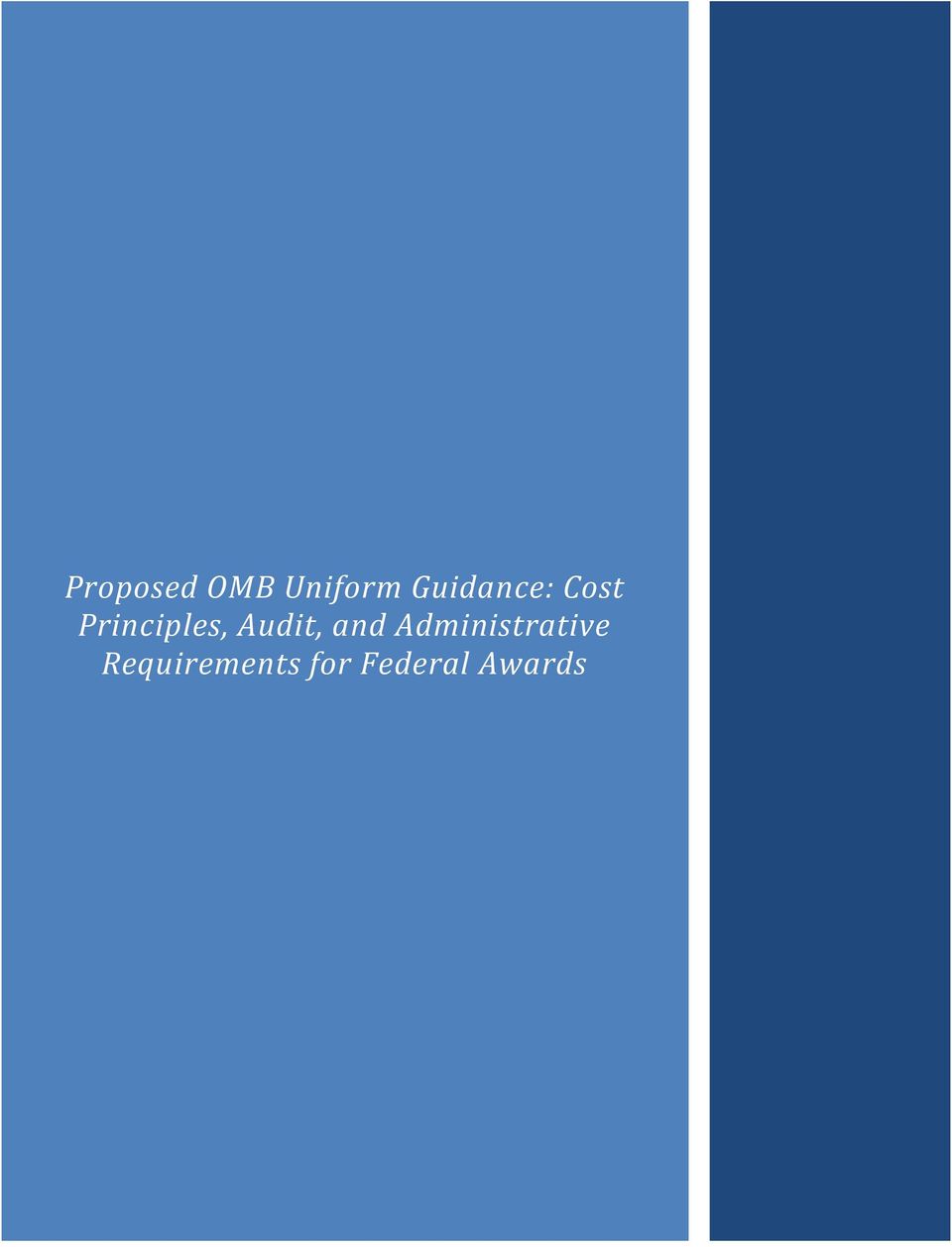
2 Contents Subchapter A General Provisions Purpose Applicability Exceptions Conditional Exemptions Authorities Rescission and Supersession Effect on Other Issuances Required Action OMB Responsibilities Information Contact Review Date Effective Date Subchapter B - Pre- award Requirements Purpose Use of Grants, Cooperative Agreements, and Contracts Requirement to Provide Public Notice of Federal Financial Assistance Programs Announcements of Funding Opportunities Agency Review of Merit of Proposals and Risk Posed by Applicants Standard Application Requirements Specific Conditions for Individual Recipients Certifications And Representations Pre-Award Costs Subchapter C Federal Award Notice Content of this Subchapter Provision Of Notification for Each Federal Award Method Of Notification Information Contained In Federal award
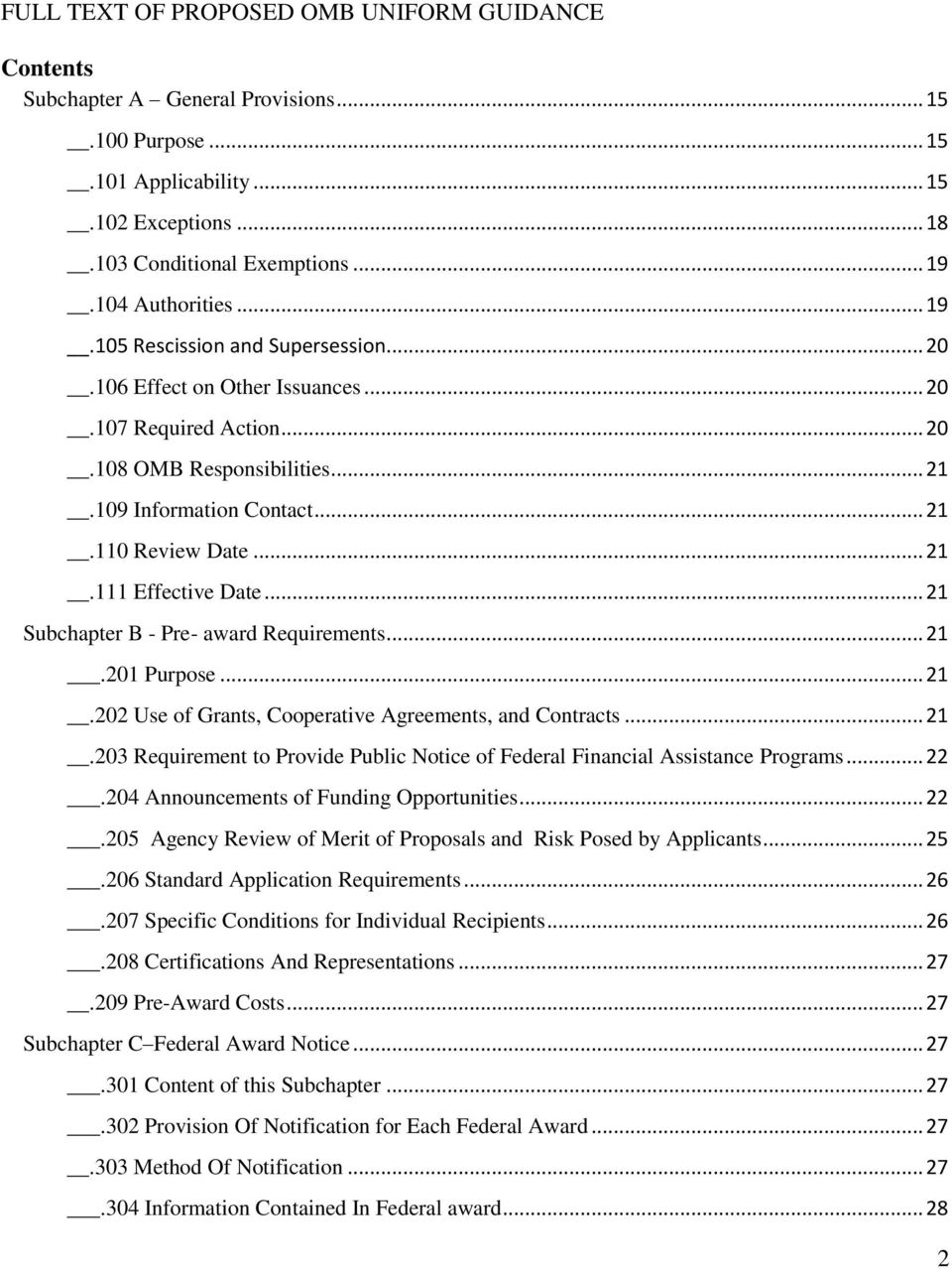
3 Subchapter D Inclusion of Terms and Conditions in Federal Award Notice General Terms and Conditions Administrative and National Policy Requirements Agency, Program, or Federal Award-Specific Terms and Conditions Award Performance Goals Subchapter E- Post Federal award Requirements Subrecipient Monitoring and Management Standards for Financial and Program Management Property Standards Procurement Standards Performance and Financial Monitoring and Reporting Record Retention and Access Termination and Enforcement Closeout Post-Closeout Adjustments and Continuing Responsibilities Collection Of Amounts Due Subchapter F: Cost Principles Subtitle I General Provisions Policy guide Application Inquiries Subtitle II. Basic Considerations Composition of Costs Factors Affecting Allowability of Costs Reasonable Costs Allocable Costs Applicable Credits Documentation Advance Understanding
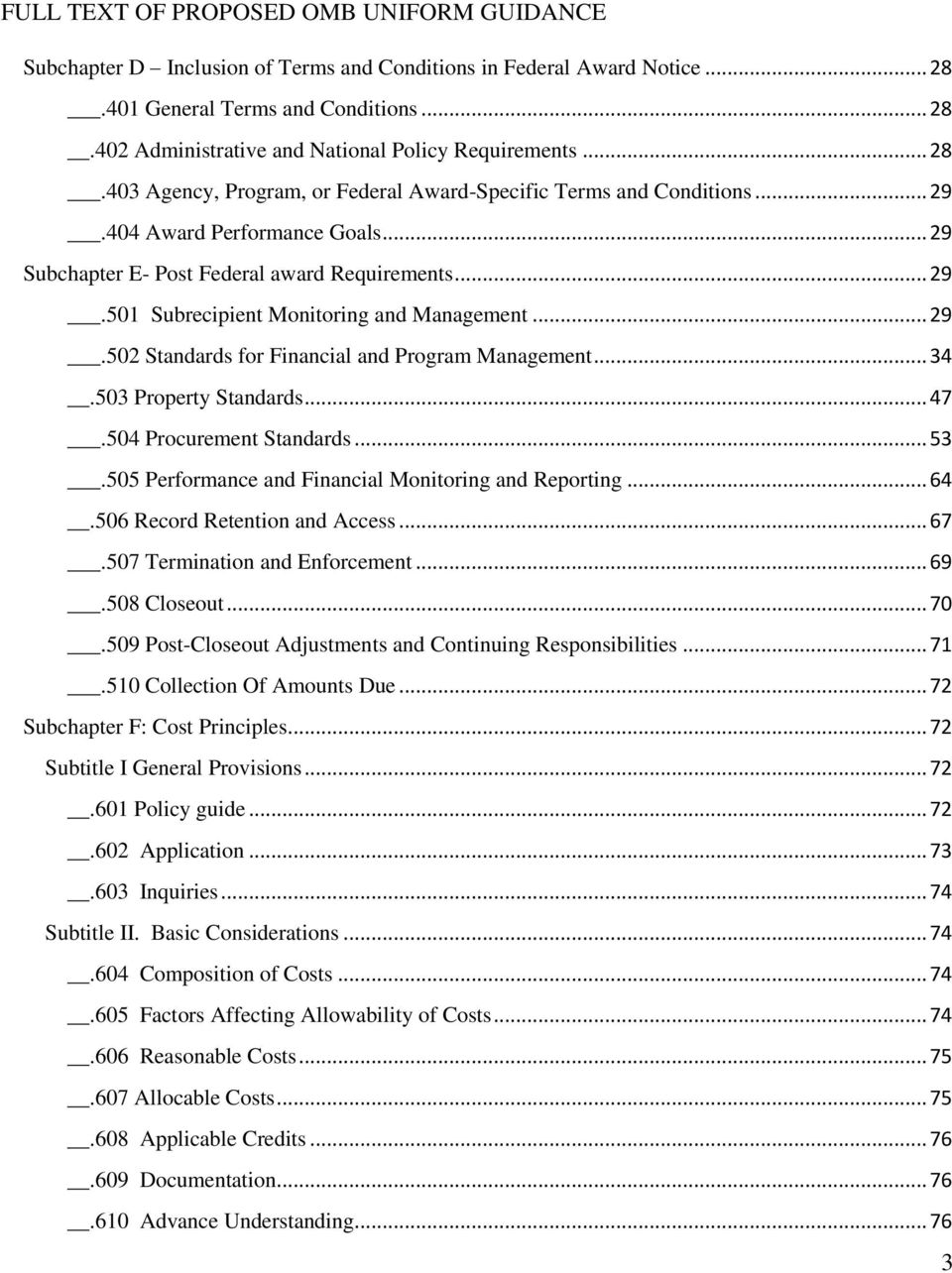
4 .611 Limitation on Allowance of Costs Special Considerations Collection of Unallowable Costs Adjustment of Previously Negotiated Indirect (F&A) Cost Rates Containing Unallowable Costs Subtitle III Direct and Indirect (F&A) Costs Direct Costs Indirect (F&A) Costs Required certifications Subtitle IV Special Considerations for State, Local and Indian Tribal Governments Cost allocation Plans and Indirect Cost Proposals Interagency Service Subtitle V Special Considerations for Institutions of Higher Education Costs incurred by State and local governments Subtitle VI General Provisions for Selected Items of Cost Selected Items of Cost C-1 Advertising and Public Relations C-2 Advisory Councils C-3 Alcoholic Beverages C-4 Alumni/ae Activities C-5 Audit Services C-6 Bad Debts C-7 Bonding Costs C-8 Collections of Improper Payments C-9 Commencement and Convocation Costs C-10 Compensation - Personal Services C-11 Compensation - Fringe Benefits C-12 Contingency Provisions C-13 Contributions and Donations
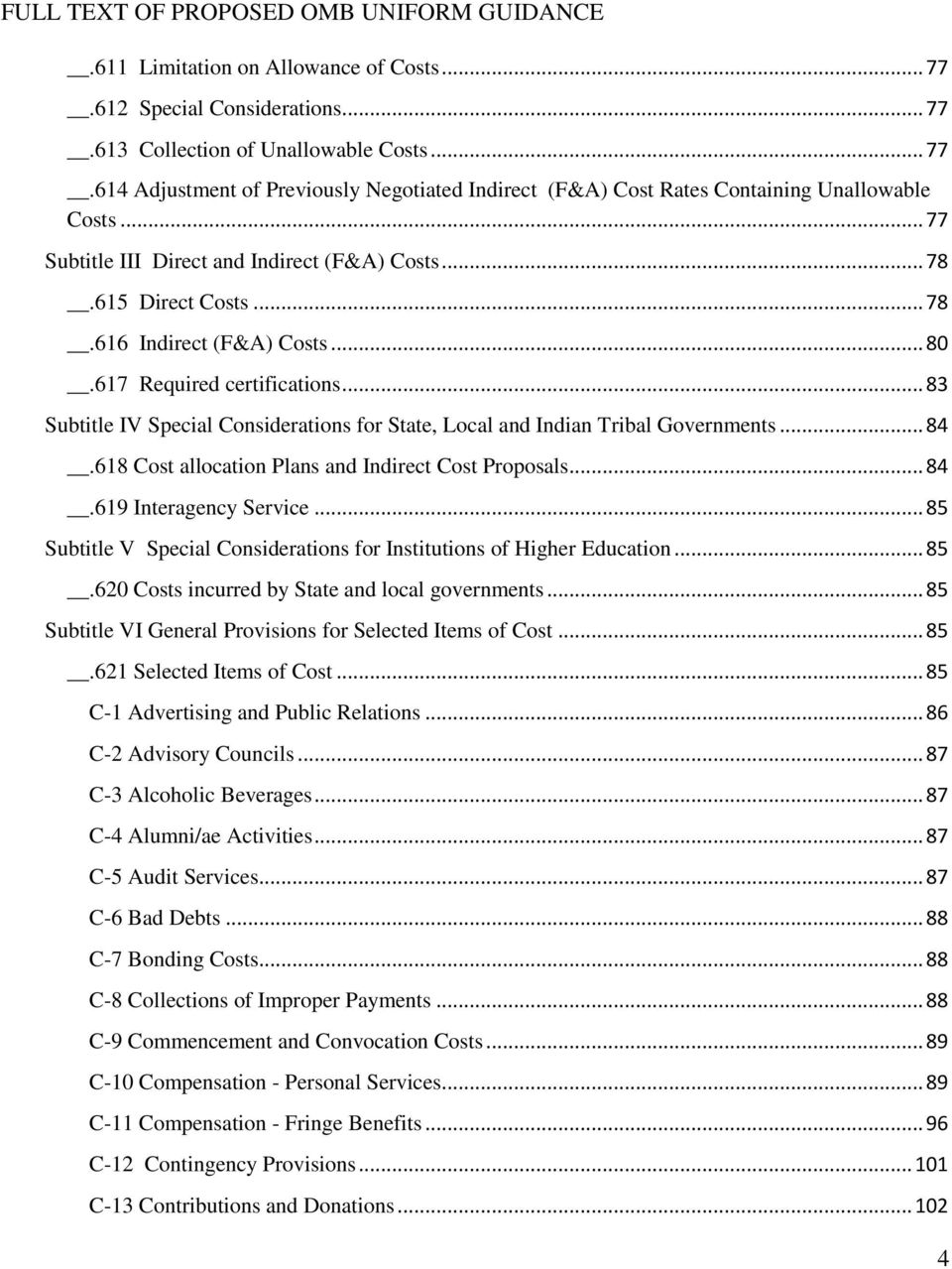
5 C-14 Defense And Prosecution of Criminal and Civil Proceedings, Claims, Appeals and Patent Infringements C-15 Depreciation C-16 Employee Morale, Health, and Welfare Costs C-17 Entertainment Costs C-18 Equipment and Other Capital Expenditures C-19 Fines, Penalties, Damages and Other Settlements C-20 Fund Raising and Investment Management Costs C-21 Gains and Losses on Disposition of Depreciable Assets C-22 General Government Expenses C-23 Goods or Services for Personal Use C-24 Idle Facilities and Idle Capacity C-25 Insurance and Indemnification C-26 Intellectual Property C-27 Interest C-28 Lobbying C-29 Losses on other Federal Awards or Contracts C-30 Maintenance and Repair Costs C-31 Material and Supplies Costs, Including Costs of Computing Devices C-32 Meetings and conferences (external) C-33 Memberships, Subscriptions, and Professional Activity Costs C-34 Organization Costs C-35 Participant Support Costs C-36 Plant and Homeland Security Costs C-37 Pre-award (or Pre-agreement) Costs C-38 Professional Service Costs C-39 Proposal Costs C-40 Publication and Printing Costs C-41 Rearrangement and Reconversion Costs

6 C-42 Recruiting Costs C-43 Relocation Costs of Employees C-44 Rental Costs of Real Property and Equipment C-45 Scholarships and Student Aid Costs C-46 Selling and Marketing Costs C-47 Specialized Service Facilities C-48 Student Activity Costs C-49 Taxes C-50 Termination Costs C-51 Training and Education Costs C-52 Transportation Costs C-53 Travel Costs C-54 Trustees Subchapter G- Audit Requirements Subtitle I General Purpose Subtitle II Audits Audit Requirements Basis For Determining Federal Awards Expended Relation To Other Audit Requirements Frequency of Audits Sanctions Audit Costs Program-Specific Audits Subtitle III Auditees Auditee responsibilities Auditor Selection Financial Statements Audit Findings Follow-Up
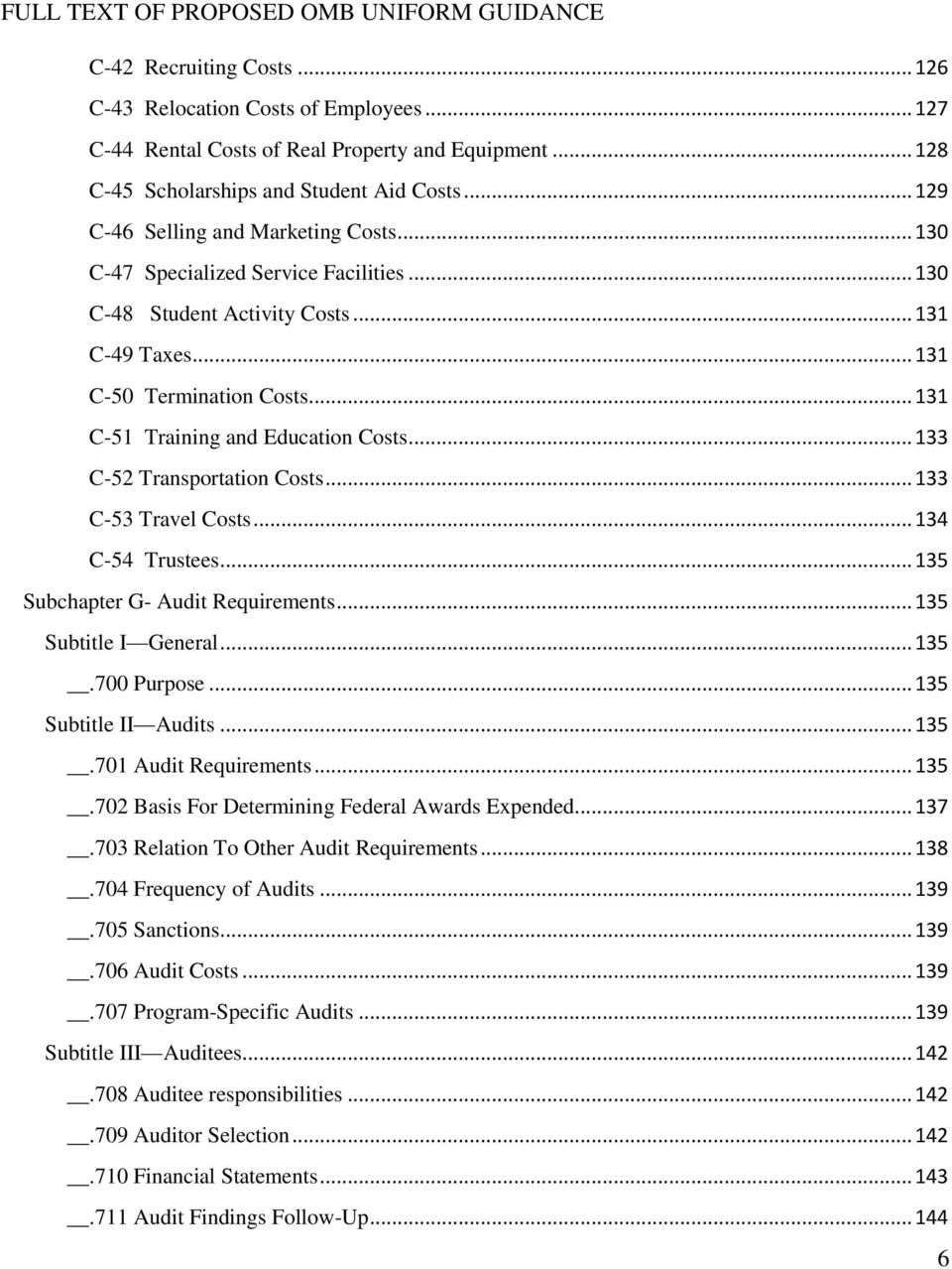
7 .712 Report Submission Subtitle IV - Federal Agencies Responsibilities Management Decision Subtitle V--Auditors Scope Of Audit Audit Reporting Audit Findings Audit Documentation Major Program Determination Criteria For Federal Program Risk Criteria For A Low-Risk Auditee Subchapter H APPENDICES Appendix I Definitions Acquisition cost Advance payment Agent or Authorized Representative Allocation Approval or Authorization of the Awarding or Cognizant Federal Agency Audit Finding Auditee Auditor Award Agreement Budget Cash Contributions Central Service Cost Allocation Plan CFFA Number Claim Class of Federal Awards
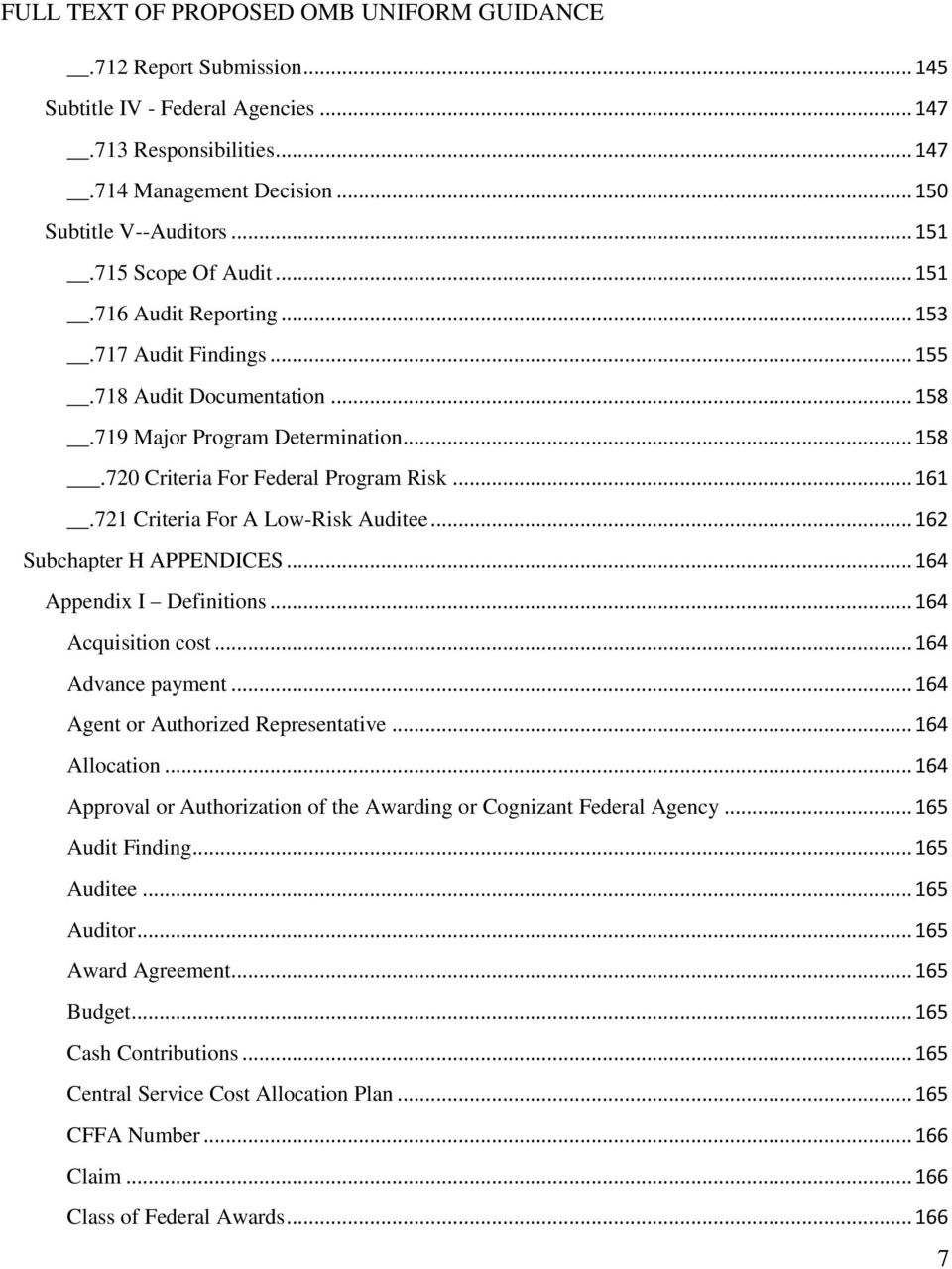
8 Cognizant Agency for Indirect Cost Cognizant Agency for Audit Compliance Supplement Contract Contractor Cooperative Agreement Cooperative Audit Resolution Corrective Action Cost Allocation Plan Cost Objective Cost Sharing or Matching Cross-Cutting Audit Finding Disallowed Costs Data Universal Numbering System (DUNS) number Entity Equipment Expenditures Facilities and Administrative (indirect (F&A)) Costs Federal Agency Federal Awarding Agency Federal Award Federal Financial Assistance Federal Cost-reimbursement Contract Federal Program Federally Recognized Indian Tribal Government Federal Share Final Cost Objective For-profit Entity Funding Period
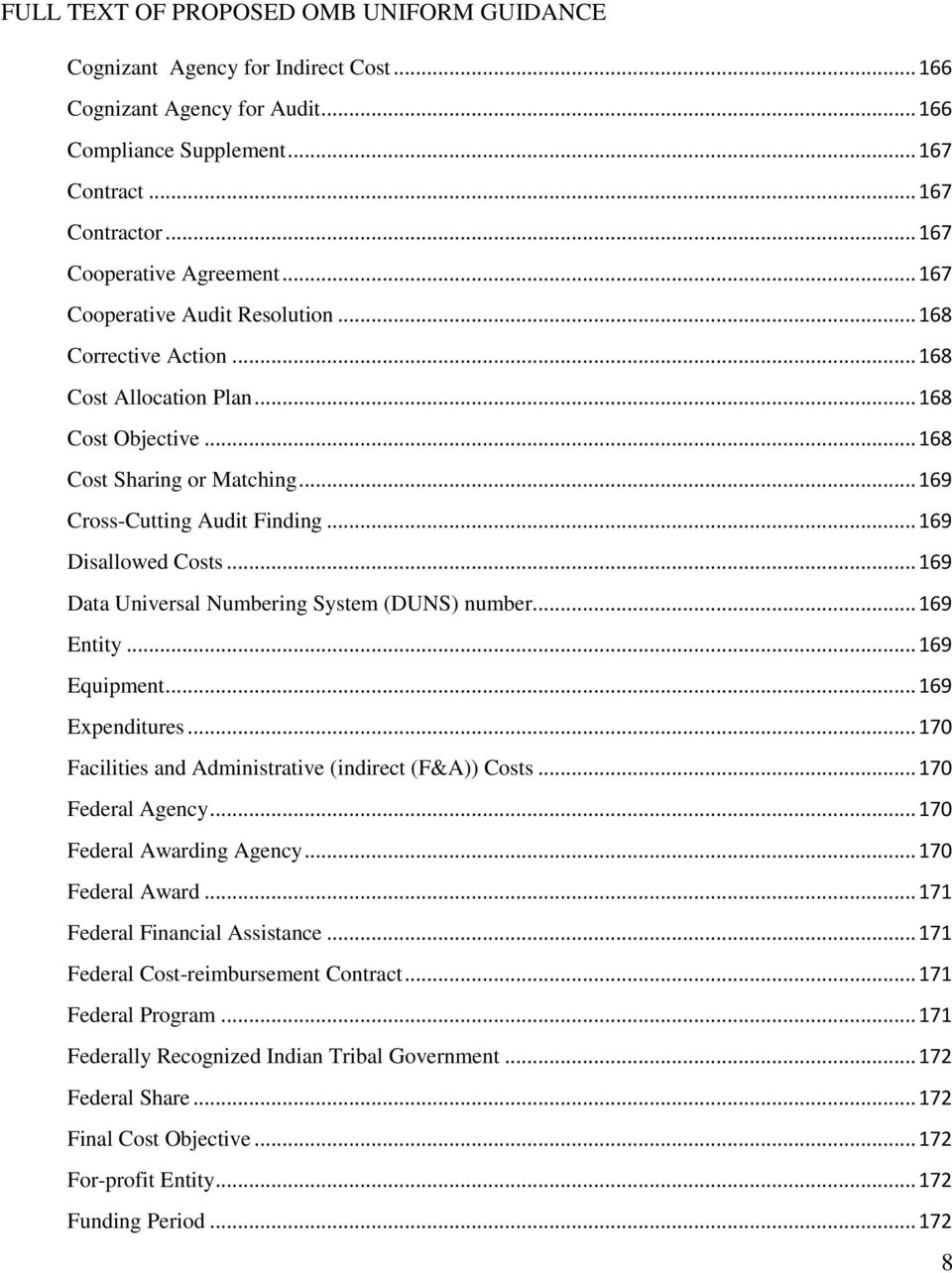
9 Generally Accepted Accounting Principles (GAAP) Generally Accepted Government Auditing Standards (GAGAS) Governmental Unit Grant Hospital Indian Tribe (or Federally Recognized Indian Tribe ) Institutions of Higher Education Indirect Cost Rate Proposal In-Kind Contribution Intermediate cost objective Internal Controls Internal Control Pertaining to the Compliance Requirements for Federal Programs Loan Local Government Major Program Management decision Non-Federal Entity Nonprofit Organization Obligations OMB Organizational Conflict of Interest Oversight Agency for Audit Outlays Pass-through entity Performance Goal Person Personally Identifiable Information Personal Property Prior Approval

10 Program-specific Audit Project or Program Period Property Public assistance cost allocation plan Questioned cost Real property Recipient Research and development Simplified Acquisition Threshold Single Audit Small Award State Student Financial Aid (SFA) Subaward Subrecipient Supplies Termination Third-Party In-Kind Contributions Unliquidated Obligations for Financial Reports Prepared on a Cash Basis Unobligated Balance Unrecovered Indirect Cost Appendix II- Full Text of Notice of Funding Opportunity Full Text of Announcement I. Funding Opportunity Description Required II. Award Information Required III. Eligibility Information Eligible Applicants Required Cost Sharing or Matching Required Other Required, if applicable
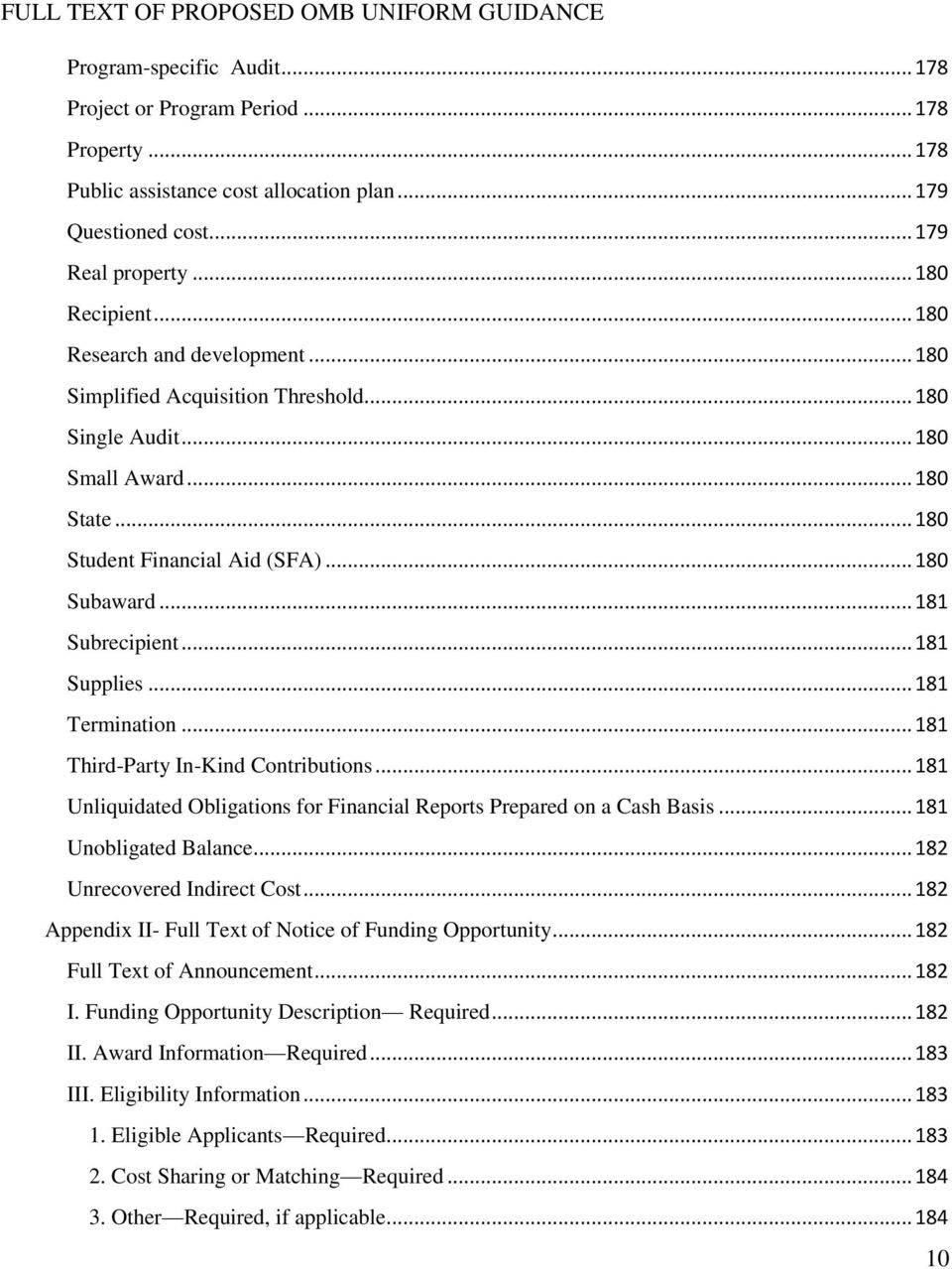
11 IV. Application and Submission Information Address to Request Application Package Required Content and Form of Application Submission Required Submission Dates and Times Required Intergovernmental Review Required, if applicable Funding Restrictions Required Other Submission Requirements Required Appendix III- Contract Provisions for Recipient and Subrecipient Contracts Appendix IV- Indirect (F&A)Costs Identification and Assignment, and Rate Determination for Educational Institutions A. General Major functions of an institution Criteria for distribution B. Identification and assignment of indirect (F&A) costs Definition of Facilities and Administration Depreciation Interest Operation and maintenance expenses General administration and general expenses Departmental administration expenses Sponsored projects administration Library expenses Student administration and services Offset for indirect (F&A) expenses otherwise provided for by the Federal Government C. Determination and application of indirect (F&A) cost rate or rates Indirect (F&A) cost pools The distribution basis Negotiated lump sum for indirect (F&A) costs Predetermined rates for indirect (F&A) costs

12 5. Negotiated fixed rates and carry-forward provisions Provisional and final rates for indirect (F&A) costs Fixed rates for the life of the sponsored agreement Limitation on reimbursement of administrative costs Alternative method for administrative costs Negotiation and approval of indirect (F&A) rate Standard Format for Submission D. Simplified method for small institutions General Simplified procedure - Salaries and wages base Simplified procedure - Modified total direct cost base E. Documentation requirements F. Certification Certification of charges Certification of indirect (F&A) costs Appendix V - Indirect (F&A)Costs Identification and Assignment, and Rate Determination for Nonprofit Organizations A. General B. Allocation of Indirect Costs and Determination of Indirect Cost Rates General Simplified allocation method Multiple allocation base method Direct allocation method Special indirect cost rates C. Negotiation and Approval of Indirect Cost Rates Definitions Negotiation and approval of rates Appendix VI - State/Local- Wide Central Service Cost Allocation Plans A. General
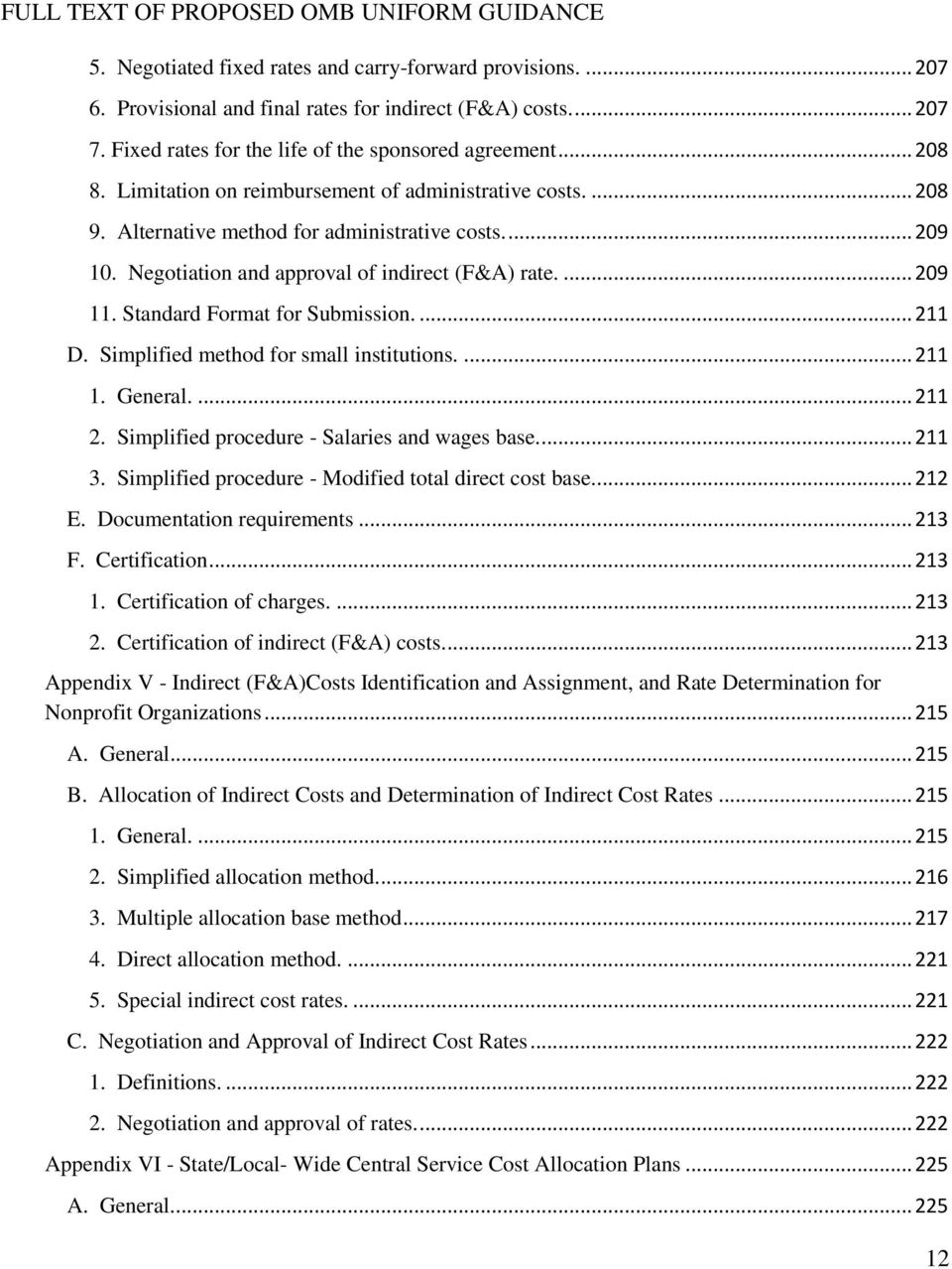
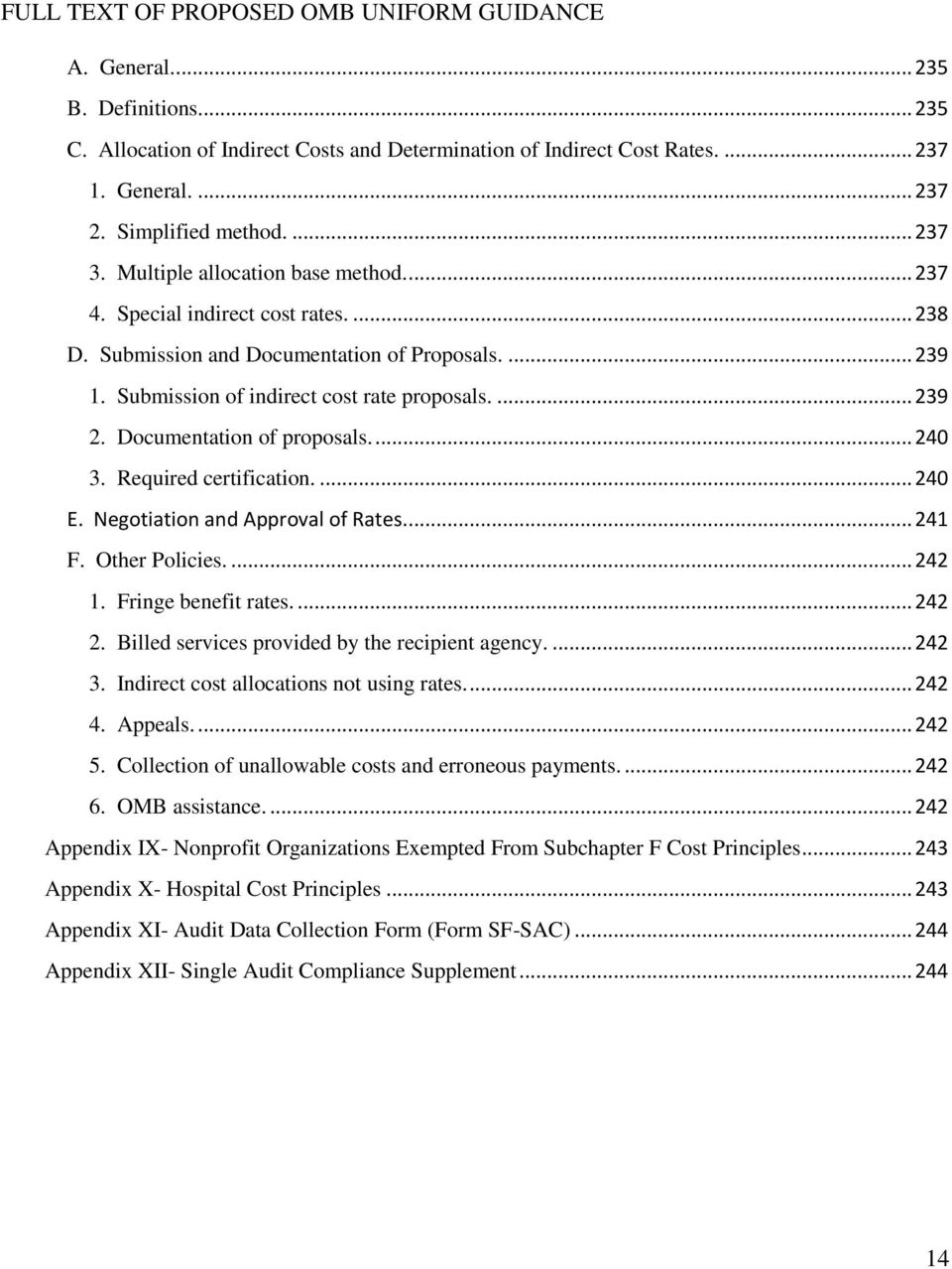
13 B. Definitions C. Scope of the Central Service Cost Allocation Plans D. Submission Requirements E. Documentation Requirements for Submitted Plans General Allocated central services Billed services Required certification F. Negotiation and Approval of Central Service Plans Federal Cognizant Agency Assignments for Cost Negotiation Review Agreement Adjustments G. Other Policies Billed central service activities Working capital reserves Carry-forward adjustments of allocated central service costs Adjustments of billed central services Records retention Appeals OMB assistance Appendix VII- Public Assistance Cost Allocation Plans A. General B. Definitions C. Policy D. Submission, Documentation, and Approval of Public Assistance Cost Allocation Plans E. Review of Implementation of Approved Plans F. Unallowable Costs Appendix VIII- State and Local Indirect Cost Proposals

14 A. General B. Definitions C. Allocation of Indirect Costs and Determination of Indirect Cost Rates General Simplified method Multiple allocation base method Special indirect cost rates D. Submission and Documentation of Proposals Submission of indirect cost rate proposals Documentation of proposals Required certification E. Negotiation and Approval of Rates F. Other Policies Fringe benefit rates Billed services provided by the recipient agency Indirect cost allocations not using rates Appeals Collection of unallowable costs and erroneous payments OMB assistance Appendix IX- Nonprofit Organizations Exempted From Subchapter F Cost Principles Appendix X- Hospital Cost Principles Appendix XI- Audit Data Collection Form (Form SF-SAC) Appendix XII- Single Audit Compliance Supplement
15 Subchapter A General Provisions.100 Purpose (a) This guidance establishes uniform cost principles and audit requirements for all Federal awards to non-federal entities and administrative requirements for all Federal grants and cooperative agreements. Federal awarding agencies shall not impose additional or inconsistent requirements, except as provided in Sections.102 Exceptions, and.403 Agency, Program, or Federal Award-Specific Terms and Conditions or unless specifically required by Federal statute, regulation, guidance, or Executive Order. (b) (1) Pre- and post-federal award requirements. Subchapters B through E of this Guidance set forth the requirements for agency management of Federal grant programs before the award has been made, and the requirements agencies may impose on recipients after the award has been made. (2) The guidance provides the basis for a systematic and periodic collection and uniform submission by Federal agencies of information on all Federal financial assistance programs to the Office of Management and Budget (OMB). It also establishes Federal policies related to the delivery of this information to the public, including through the use of electronic media. It prescribes the manner in which General Services Administration (GSA), OMB, and Executive branch agencies that administer domestic assistance programs are to carry out their statutory responsibilities under the Federal Program Information Act (31 U.S.C ). (c) Cost Principles. Subchapter F of this guidance establishes principles for determining the allowable costs incurred by non-federal entities under Federal awards. The principles are for the purpose of cost determination and are not intended to identify the circumstances or dictate the extent of Federal government participation in the financing of a particular program or project. The principles are designed to provide that Federal awards bear their fair share of cost recognized under these principles except where restricted or prohibited by law. Agencies are not expected to place additional restrictions on individual items of cost. In general and except for some provisions of sections.501 Subrecipient Monitoring and Management,.502 Standards for Financial and Program Management.701 Audit Requirements provision for profit or other increment above cost, including prize authority, is outside the scope of this guidance. (d) Single Audit Requirements and Audit Follow-up. Subchapter G of this guidance is issued pursuant to the Single Audit Act Amendments of 1996, (31 U.S.C ). It sets forth standards for obtaining consistency and uniformity among Federal agencies for the audit of non- Federal entities expending Federal awards. These provisions also provide the policies and procedures for use by Federal agencies when reporting the results of these audits..101 Applicability 15

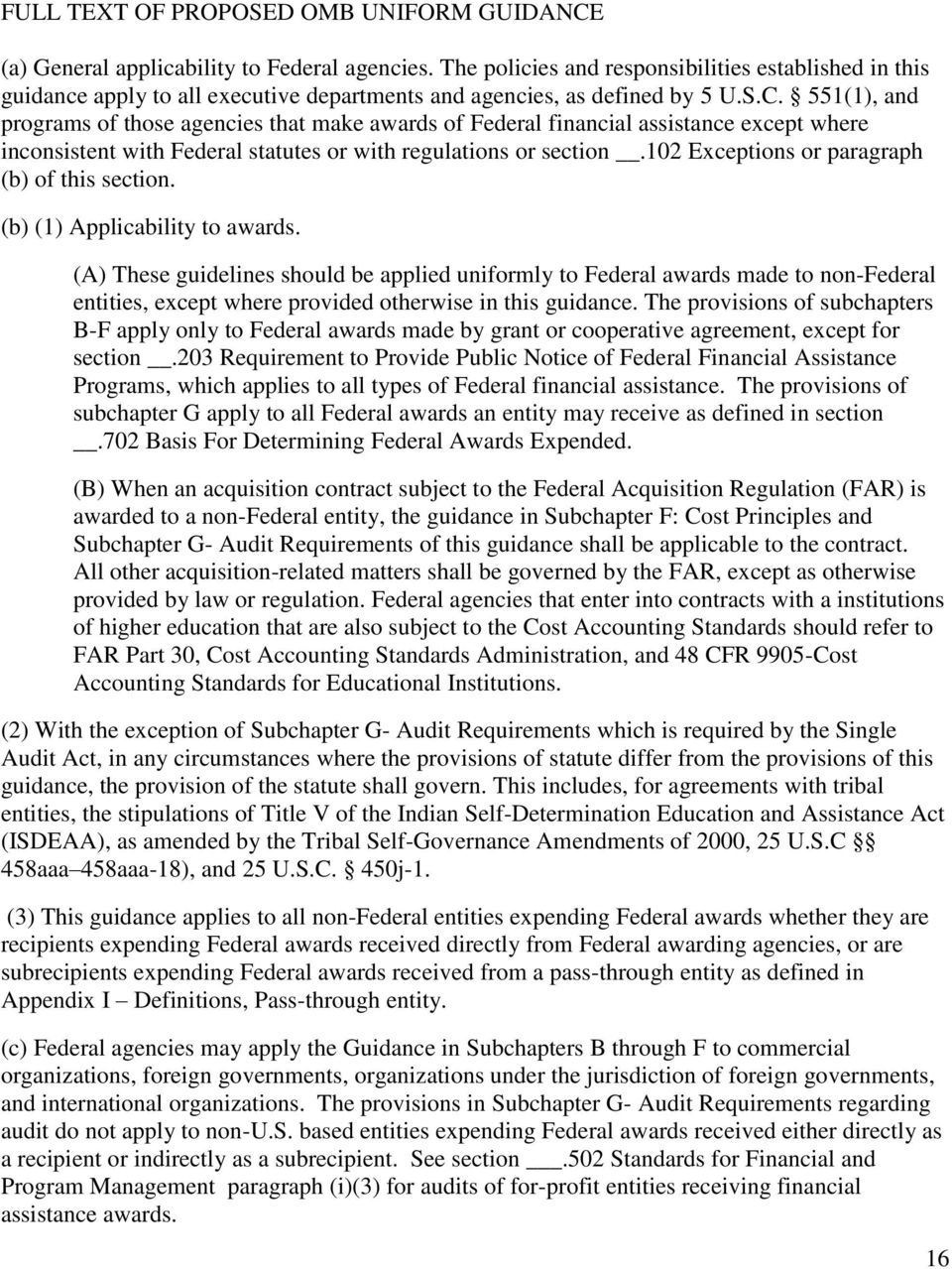
16 (a) General applicability to Federal agencies. The policies and responsibilities established in this guidance apply to all executive departments and agencies, as defined by 5 U.S.C. 551(1), and programs of those agencies that make awards of Federal financial assistance except where inconsistent with Federal statutes or with regulations or section.102 Exceptions or paragraph (b) of this section. (b) (1) Applicability to awards. (A) These guidelines should be applied uniformly to Federal awards made to non-federal entities, except where provided otherwise in this guidance. The provisions of subchapters B-F apply only to Federal awards made by grant or cooperative agreement, except for section.203 Requirement to Provide Public Notice of Federal Financial Assistance Programs, which applies to all types of Federal financial assistance. The provisions of subchapter G apply to all Federal awards an entity may receive as defined in section.702 Basis For Determining Federal Awards Expended. (B) When an acquisition contract subject to the Federal Acquisition Regulation (FAR) is awarded to a non-federal entity, the guidance in Subchapter F: Cost Principles and Subchapter G- Audit Requirements of this guidance shall be applicable to the contract. All other acquisition-related matters shall be governed by the FAR, except as otherwise provided by law or regulation. Federal agencies that enter into contracts with a institutions of higher education that are also subject to the Cost Accounting Standards should refer to FAR Part 30, Cost Accounting Standards Administration, and 48 CFR 9905-Cost Accounting Standards for Educational Institutions. (2) With the exception of Subchapter G- Audit Requirements which is required by the Single Audit Act, in any circumstances where the provisions of statute differ from the provisions of this guidance, the provision of the statute shall govern. This includes, for agreements with tribal entities, the stipulations of Title V of the Indian Self-Determination Education and Assistance Act (ISDEAA), as amended by the Tribal Self-Governance Amendments of 2000, 25 U.S.C 458aaa 458aaa-18), and 25 U.S.C. 450j-1. (3) This guidance applies to all non-federal entities expending Federal awards whether they are recipients expending Federal awards received directly from Federal awarding agencies, or are subrecipients expending Federal awards received from a pass-through entity as defined in Appendix I Definitions, Pass-through entity. (c) Federal agencies may apply the Guidance in Subchapters B through F to commercial organizations, foreign governments, organizations under the jurisdiction of foreign governments, and international organizations. The provisions in Subchapter G- Audit Requirements regarding audit do not apply to non-u.s. based entities expending Federal awards received either directly as a recipient or indirectly as a subrecipient. See section.502 Standards for Financial and Program Management paragraph (i)(3) for audits of for-profit entities receiving financial assistance awards. 16
17 (d) Except for section.203 Requirement to Provide Public Notice of Federal Financial Assistance Programs, the guidance in Subchapters B and C does not apply to the following programs: (1) The block awards authorized by the Omnibus Budget Reconciliation Act of 1981 (including Community Services; Preventive Health and Health Services; Alcohol, Drug Abuse, and Mental Health Services; Maternal and Child Health Services; Social Services; Low-Income Home Energy Assistance; States Program of Community Development Block Awards for Small Cities; and Elementary and Secondary Education other than programs administered by the Secretary of Education under title V, subtitle D, chapter 2, section 583 the Secretary s discretionary award program) and titles I-III of the Job Training Partnership Act of 1982 and both the Alcohol and Drug Abuse Treatment and Rehabilitation Block Award (42 U.S.C. 300x x-35 and 42 U.S.C. 300x x64) and the Mental Health Service for the Homeless Block Award (42 U.S.C. 300x 300x-9) under the Public Health Services Act. (2) Entitlement awards to carry out the following programs of the Social Security Act: (A) Temporary Assistance to Needy Families (title IV-A of the Social Security Act, 42 U.S.C ); (B) Child Support Enforcement and Establishment of Paternity (title IV-D of the Social Security Act, 42 U.S.C b); (C) Foster Care and Adoption Assistance (title IV-E of the Act, 42 U.S.C c); (D) Aid to the Aged, Blind, and Disabled (titles I, X, XIV, and XVI-AABD of the Act, as amended); and (E) Medical Assistance (Medicaid) (title XIX of the Act,, 42 U.S.C w-5) not including the State Medicaid Fraud Control program authorized by section 1903(a)(6)(B) of the Social Security Act (42 U.S.C. 1396b(a)(6)(B)). (3) Entitlement awards under the following programs of The National School Lunch Act: (A) National School Lunch Program (section 4 of the Act, 42 U.S.C. 1753), (B) Commodity Assistance (section 6 of the Act, 42 U.S.C. 1755), (C) Special Meal Assistance (section 11 of the Act, 42 U.S.C. 1759a), (D) Summer Food Service Program for Children (section 13 of the Act, 42 U.S.C. 1761), and 17

18 (E) Child Care Food Program (section 17 of the Act, 42 U.S.C. 1766). (4) Entitlement awards under the following programs of The Child Nutrition Act of 1966: (A) Special Milk Program (section 3 of the Act, 42 U.S.C. 1772), and (B) School Breakfast Program (section 4 of the Act, 42 U.S.C. 1773). (5) Entitlement awards for State Administrative expenses under The Food and Nutrition Act of 2008 (section 16 of the Act, 7 U.S.C. 2025). (6) An award for an experimental, pilot, or demonstration project that is also supported by an award listed in paragraph (d)(2) of this section; (7) Funds federally awarded under subsection 412(e) of the Immigration and Nationality Act and subsection 501(a) of the Refugee Education Assistance Act of 1980 (Pub. L , 94 Stat. 1809), for cash assistance, medical assistance, and supplemental security income benefits to refugees and entrants and the administrative costs of providing the assistance and benefits (8 U.S.C. 1522(e)); (8) Awards to local education agencies under 20 U.S.C b, (portions of the Impact Aid program; and (9) Payments under the Department of Veterans Affairs State Home Per Diem Program (38 U.S.C. 1741)..102 Exceptions (a)with the exception of Subchapter G- Audit Requirements, OMB may allow exceptions for classes of awards or recipients subject to the requirements of this Guidance when exceptions are not prohibited by statute. However, in the interest of maximum uniformity, exceptions from the requirements of this Guidance shall be permitted only in unusual circumstances. Exceptions for classes of awards or recipients will be published on the OMB website at (b) Exceptions on a case-by-case basis for individual recipients and subrecipients may be authorized by the affected Federal agencies except where otherwise required by law or where OMB or other approval is expressly required by this guidance. No case-by-case exceptions may be granted to the provisions of Subchapter G- Audit Requirements. (c) Federal awarding agencies may apply more restrictive requirements to a class of recipients when approved by OMB, required by statute, or when those requirements are codified in the Code of Federal Regulations except for the requirements in Subchapter G- Audit Requirements. 18

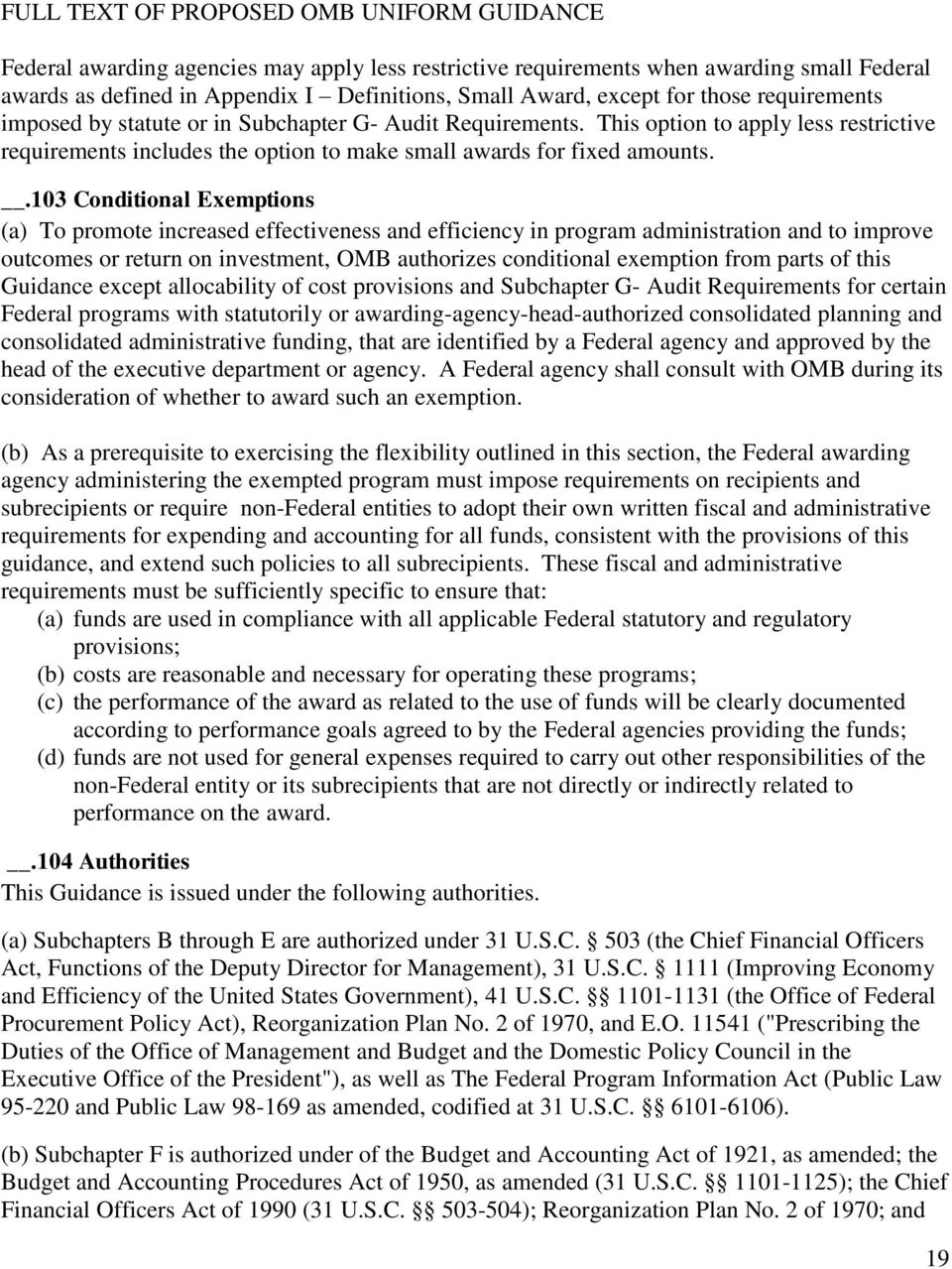
19 Federal awarding agencies may apply less restrictive requirements when awarding small Federal awards as defined in Appendix I Definitions, Small Award, except for those requirements imposed by statute or in Subchapter G- Audit Requirements. This option to apply less restrictive requirements includes the option to make small awards for fixed amounts..103 Conditional Exemptions (a) To promote increased effectiveness and efficiency in program administration and to improve outcomes or return on investment, OMB authorizes conditional exemption from parts of this Guidance except allocability of cost provisions and Subchapter G- Audit Requirements for certain Federal programs with statutorily or awarding-agency-head-authorized consolidated planning and consolidated administrative funding, that are identified by a Federal agency and approved by the head of the executive department or agency. A Federal agency shall consult with OMB during its consideration of whether to award such an exemption. (b) As a prerequisite to exercising the flexibility outlined in this section, the Federal awarding agency administering the exempted program must impose requirements on recipients and subrecipients or require non-federal entities to adopt their own written fiscal and administrative requirements for expending and accounting for all funds, consistent with the provisions of this guidance, and extend such policies to all subrecipients. These fiscal and administrative requirements must be sufficiently specific to ensure that: (a) funds are used in compliance with all applicable Federal statutory and regulatory provisions; (b) costs are reasonable and necessary for operating these programs; (c) the performance of the award as related to the use of funds will be clearly documented according to performance goals agreed to by the Federal agencies providing the funds; (d) funds are not used for general expenses required to carry out other responsibilities of the non-federal entity or its subrecipients that are not directly or indirectly related to performance on the award..104 Authorities This Guidance is issued under the following authorities. (a) Subchapters B through E are authorized under 31 U.S.C. 503 (the Chief Financial Officers Act, Functions of the Deputy Director for Management), 31 U.S.C (Improving Economy and Efficiency of the United States Government), 41 U.S.C (the Office of Federal Procurement Policy Act), Reorganization Plan No. 2 of 1970, and E.O ("Prescribing the Duties of the Office of Management and Budget and the Domestic Policy Council in the Executive Office of the President"), as well as The Federal Program Information Act (Public Law and Public Law as amended, codified at 31 U.S.C ). (b) Subchapter F is authorized under of the Budget and Accounting Act of 1921, as amended; the Budget and Accounting Procedures Act of 1950, as amended (31 U.S.C ); the Chief Financial Officers Act of 1990 (31 U.S.C ); Reorganization Plan No. 2 of 1970; and 19
20 Executive Order No ("Prescribing the Duties of the Office of Management and Budget and the Domestic Policy Council in the Executive Office of the President"). (c) Subchapter G on Audit requirements is authorized under the Single Audit Act Amendments of 1996, (31 U.S.C )..105 Rescission and Supersession This Guidance rescinds and supersedes the following OMB Guidance documents and regulations under Title 2, Code of Federal Regulations: (a) A-21 Cost Principles for Educational Institutions (2 CFR 220); (b) A-87 Cost Principles for State, Local and Indian Tribal Governments (2 CFR 225); (c) A-89 Federal Domestic Assistance Program Information ; (d) A-102 Awards and Cooperative Agreements with State and Local Governments (codified by agencies in their titles of the CFR); (e) A-110 Uniform Administrative Requirements for Awards and Other Agreements with Institutions of Higher Education, Hospitals, and Other Nonprofit Organizations (codified at 2 CFR 215); (f) A-122, Cost Principles for Non-Profit Organizations ( 2 CFR 230); (g) A-133 Audits of States, Local Governments and Non-Profit Organizations, and (h) This Guidance will also supersede those sections of A-50 related to Single Audits..106 Effect on Other Issuances For Federal awards subject to this guidance, all administrative requirements, program manuals, handbooks and other non-regulatory materials that are inconsistent with the requirements of this guidance shall be superseded upon codification of this guidance, except to the extent they are required by statute or authorized in accordance with the provisions in section.102 Exceptions. Agency regulations or other documents implementing these guidance documents and regulations under Title 2, CFR, shall remain in effect until such time as superseding regulations are issued..107 Required Action The specific requirements and responsibilities of Federal agencies and non-federal entities are set forth in Subchapters B through G of this Guidance. Federal agencies making Federal awards to non-federal entities, either directly or indirectly, shall implement the language in the Subchapters B through G of this guidance in codified regulations, unless different provisions are required by Federal statute or are approved by OMB. 20

21 .108 OMB Responsibilities OMB will review agency regulations and implementation of this guidance, and will provide interpretations of policy requirements and assistance to insure effective and efficient implementation. Any exceptions will be subject to approval by OMB. Exceptions will only be made in particular cases where adequate justification is presented..109 Information Contact Further information concerning this Guidance may be obtained by contacting the Office of Federal Financial Management, Office of Management and Budget, in Washington, DC..110 Review Date OMB will review this Guidance every five years after date of issuance..111 Effective Date (a) The standards set forth in this guidance which affect administration of grants and cooperative agreements issued by Federal agencies become effective once codified by Federal agencies as described below. (b) Federal agencies shall implement the policies and procedures applicable to recipients of awards and agreements (and subrecipients) by promulgating final regulations and any other appropriate guidance documents effective on a specified date which will be within one year after this guidance or any amendment to this guidance becomes final. (c) The standards set forth in Subchapter G Audit Requirements which apply directly to Federal agencies, shall be effective [date to be inserted when this guidance becomes final], and shall apply to audits of fiscal years beginning after [date to be inserted when this guidance becomes final]. Subchapter B - Pre- award Requirements.201 Purpose (a) Sections.202 Use of Grants, Cooperative Agreements, and Contracts through.208 Certifications And Representations prescribe instructions and other pre-award matters to be used in the announcement and application process for all Federal financial assistance awards. (b) Use of sections.204 Announcements of Funding Opportunities,.205 Agency Review of Merit of Proposals and Risk Posed by Applicants, and.207, is required only for competitive Federal financial assistance awards, but may also be used by Federal agencies for non-competitive awards where appropriate..202 Use of Grants, Cooperative Agreements, and Contracts In each instance, the Federal awarding agency shall decide on the appropriate Federal award instrument (i.e., contract, grant or cooperative agreement) as defined by the Federal Grant and Cooperative Agreement Act (FCGAA) (31 U.S.C ). 21
22 .203 Requirement to Provide Public Notice of Federal Financial Assistance Programs (a) Federal awarding agencies shall notify the public of Federal financial assistance programs in the Catalog of Federal Financial Assistance (CFFA), maintained by the General Services Administration (GSA). (1) The CFFA, or any OMB-designated replacement is the single, authoritative, governmentwide comprehensive source of Federal financial assistance program information produced by the executive branch of the Federal Government. (2) The information that must be submitted by Federal agencies to GSA for approval by OMB is listed in paragraph (b) of this section. GSA shall prescribe the format for the submission. (3) An agency may not award Federal financial assistance without assigning it to a program that has been included in the CFFA as required in this section unless there are exigent circumstances requiring otherwise, such as timing requirements imposed by statute. (b) For each program that awards Federal discretionary awards, non-discretionary awards, loans, insurance, or any other type of assistance, agencies shall submit the following information to GSA: (1) Program Description, Purpose, Goals and Measurement. A brief summary of the statutory or regulatory requirements of the program and its intended outcome. Where, appropriate, the Program Description, Purpose, Goals, and Measurement should align with the strategic goals and objectives within the Federal agency s performance plan and should support the Federal agency s performance measurement, management, and reporting as required by Part 6 of OMB Circular A- 11; (2) Whether the program makes awards on a discretionary basis or the awards are prescribed by Federal statute, such as in the case of formula grants. (3) Projected total amount of Federal award funds for project or program awards. Estimates based on previous year funding is acceptable if current appropriations are not available at the time of the submission; (4) Anticipated Source of Available Funds: The statutory authority for funding the program and, to the extent possible, agency, sub-agency, or, if known, the specific program unit that will issue the Federal awards, and associated funding identifier (e.g., Treasury Account Symbol(s)); and (5) General Eligibility Requirements: The statutory, regulatory or other eligibility factors or considerations that determine the applicant s qualification for Federal awards under the program (e.g., recipient entity type)..204 Announcements of Funding Opportunities 22
23 For each individual discretionary Federal financial assistance program that issues competitive grants or cooperative agreements, Federal awarding agencies shall announce specific funding opportunities by providing the following information in a public notice: (a) Summary Information of Funding Opportunity Announcement. The agency must display the following information posted on the OMB-designated governmentwide website for finding and applying for Federal financial assistance, in a location preceding the full text of the announcement: (A) (B) (C) (D) (E) Federal Agency Name; Funding Opportunity Title; Announcement Type (whether the funding opportunity is the initial announcement of this funding opportunity or a modification of a previously announced opportunity); Funding Opportunity Number (required, if applicable). If the Federal agency has assigned or will assign a number to the funding opportunity announcement, this number must be provided; Catalog of Federal Financial Assistance (CFFA) Number(s); (F) Key Dates. Such dates include due dates for applications or E. O submissions, as well as for any letters of intent or pre-applications. For any announcement issued before a program s application materials are available, key dates also include the date on which those materials will be released; and any other additional information, as deemed applicable by the relevant Federal agency. (G) Agencies shall make all solicitations available for application for at least 30 days, unless exigent circumstances dictate otherwise, as determined by the head of the agency. (b) Full Text of Announcement. Agencies shall include the following information in the full text announcement for each funding opportunity. For additional guidance, refer to Appendix II- Full Text of Notice of Funding Opportunity. (A) Full programmatic description of the funding opportunity; (B) Federal award information. Federal award information may include total amount of expected funding, anticipated number of Federal awards, types of available Federal awards (i.e., grant, cooperative agreement, or other instrument), as well as any expected 23
24 limitations to negotiated indirect cost rates or other cost sharing requirements as required by statute or regulation or approved by the agency head and OMB (see section.616 Indirect (F&A) Costs (b)); (C) Specific eligibility or qualification information. (D) Any other factors or priorities that affect an applicant s or its application s eligibility for selection. (E) Criteria Used in Agency Review of Applications. A clear description of all criteria, including any sub-criteria, used to evaluate applications. If criteria vary in importance, specify the relative percentages, weights, or other means used to distinguish among them where applicable. For statutory, regulatory, or other preferences provide a detailed explanation of those preferences with an explicit indication of their effect (e.g., whether they result in additional points being assigned). See.205 Agency Review of Merit of Proposals and Risk Posed by Applicants. (F) Other factors. Any other agency, or program policy, or other elements or factors that may be used in selecting applications for Federal award (e.g., geographical dispersion, program balance, or diversity). If an applicant s proposed cost sharing will be considered in the review process (as opposed to being an eligibility criterion), clearly describe how it will be considered. See also section.502 Standards for Financial and Program Management (f)(1). (G) (H) (I) Application submission information and deadline for application. Anticipated announcement and Federal award dates, as appropriate; and Federal award administration information, including applicable: (i) Administrative requirements; (ii) National policy requirements that will be included in the Federal award, including applicable civil rights statutes and regulations, all of which may be incorporated by reference; (iii) Special Terms & Conditions. If the funding opportunity may lead to Federal awards with some special terms and conditions that differ from the agency s usual (sometimes called general) terms and conditions, the announcement shall highlight those special terms and conditions to the extent practicable; 24
25 (iv) Reporting requirements. General information about the type (e.g., financial and/or performance), frequency, and means of submission of post-federal award reporting requirements; (v) Agency contact(s); and (vi) Any other information required by the agency..205 Agency Review of Merit of Proposals and Risk Posed by Applicants (a) Prior to making an award, whether competitive or non-competitive, the Federal agency shall evaluate the risks to the program posed by each applicant if it receives an award. This evaluation shall be in addition to the evaluation of the applicant s eligibility or the quality of its application. If a Federal agency determines that an award will be made, special conditions that correspond to the degree of risk assessed may be applied to the award. Criteria to be evaluated shall be described in the announcement of funding opportunity described in section.204 Announcements of Funding Opportunities. In evaluating risks, agencies may consider items such as the following: (1) Financial stability; (2) Quality of management systems and ability to meet the management standards prescribed in this Guidance; (3) History of performance. The applicant s record in managing awards, cooperative agreements, or procurement awards, if it is a prior recipient of such Federal awards, including timeliness of compliance with applicable reporting requirements and if applicable, the extent to which any previously awarded amounts will be expended prior to future awards; (4) Information available through any OMB-designated repositories of governmentwide eligibility qualification or financial integrity information, such as Federal Awardee Performance and Integrity Information System (FAPIIS), Duns and Bradstreet, or Do Not Pay ; (5) Reports and findings from single audits performed under Subchapter G of this guidance or the reports and findings of any other available audits; and (6) The applicant s ability to effectively implement statutory, regulatory, or other requirements imposed on recipients. (b) In addition to this review, Federal agencies shall comply with the guidelines on governmentwide suspension and debarment in 2 CFR 180, and shall require recipients to comply with these provisions. These provisions restrict subawards and contracts with certain parties that are debarred, suspended or otherwise excluded from or ineligible for participation in Federal assistance programs or activities. 25
26 (c) For competitive grant programs, unless prohibited by statute, agencies shall design and execute a merit review process for applications. This process shall be described in the announcement of funding opportunity or incorporated by reference as required by section.204 Announcements of Funding Opportunities..206 Standard Application Requirements (a) Paperwork clearances. Federal awarding agencies may only use those award-related application, report, and other information collections approved by OMB under the Paperwork Reduction Act of 1995 and OMB s implementing regulations in 5 CFR 1320 Controlling Paperwork Burdens on the Public. (b) Federal agencies that desire to collect information in addition to that approved by OMB for governmentwide use must submit to OMB a justification for increasing the reporting burden from that which is already OMB-approved, establishing, for example, how additional detail or frequency of reporting contributes to the ability of the agency to significantly improve program outcomes or inform Federal policy. OMB will authorize the collection of additional information only on a limited basis. (c) If applicable, Federal agencies may inform applicants and recipients that they do not need to provide certain information otherwise required by the relevant information collection..207 Specific Conditions for Individual Recipients Based on the criteria set forth in.205 Agency Review of Merit of Proposals and Risk Posed by Applicants, or when a recipient materially fails to comply with the general or specific terms and conditions of a Federal award, or fails to meet expected performance goals as described in section.404 Award Performance Goals, Federal awarding agencies may impose additional specific award conditions on individual recipients, such as requiring payments as reimbursements rather than advances, as needed under the following conditions: (a) The applicant or recipient is notified as to: (1) The nature of the additional requirements; (2) The reason why the additional requirements are being imposed; (3) The nature of the corrective action needed, if applicable; (4) The time allowed for completing the corrective actions if applicable, and (5) The method for requesting reconsideration of the additional requirements imposed. (b) Any corrective special conditions shall be promptly removed once the conditions that prompted them have been corrected. (c) See also section.403 Agency, Program, or Federal Award-Specific Terms and Conditions. 26
27 .208 Certifications And Representations Unless prohibited by statute or codified regulation, each Federal awarding agency is authorized to require recipients to submit certifications and representations required by statute, Executive Order, or regulation on an annual basis. Submission may be required more frequently if the recipient is failing to meet a requirement of its Federal award..209 Pre-Award Costs For guidance on costs incurred by recipients prior to the award, see section.621 Selected Items of Cost C-37 Pre-award (or Pre-agreement) Costs Subchapter C Federal Award Notice.301 Content of this Subchapter This subchapter contains guidance on what information Federal agencies must include in their notices of Federal awards..302 Provision Of Notification for Each Federal Award (a) A Federal agency must provide notification of a Federal award to the recipient for each Federal award it makes, which shall include the information listed below:. : (1) Award recipient; (2) Recipient s DUNS number (see Appendix I Definitions, Data Universal Numbering System (DUNS) number); (3) Unique award identification code (3) Federal award project description; and (4) Date and amount of the Federal award. (b) Further, for awards above $25,000 except as noted below, an agency must announce all Federal award decisions publicly and publish the above listed information on a publicly available OMB-designated governmentwide website. (c) Nothing in this section shall be construed as requiring the publication of information otherwise exempt under The Freedom of Information Act (5 U.S.C 552), or controlled unclassified information pursuant to E.O Method Of Notification A Federal agency shall provide notices of Federal award to the recipient electronically. However, an agency must provide a paper copy of the Federal award notice upon request from the recipient or when the recipient does not easily have access to electronically transmitted information. 27
28 .304 Information Contained In Federal award The notice of Federal award shall include the following information (see also Subchapter D Inclusion of Terms and Conditions in Federal Award Notice): (a) The information listed in section.302 Provision Of Notification for Each Federal Award paragraph (a); (b) General terms and conditions as described in sections.401 General Terms and Conditions and.402 Administrative and National Policy Requirements ; (c) Any agency or Federal award-specific terms and conditions as described in section.403 Agency, Program, or Federal Award-Specific Terms and Conditions; and (d) Any other information required by the agency. Subchapter D Inclusion of Terms and Conditions in Federal Award Notice.401 General Terms and Conditions (a) Federal agencies shall incorporate either in the provided award notice or by reference the following requirements as general terms and conditions, as applicable: (1) Administrative requirements, implemented by the Federal agency as specified in subchapters E through G of this guidance. (2) National policy requirements. These include statutory, executive order, other Presidential directive, or regulatory requirements that apply by specific reference and are not programspecific. (b) Agencies shall either provide the general terms and conditions in the award notice or incorporate them by reference. The Federal award notice must include wording to incorporate by reference the appropriate set of general terms and conditions. The reference must be to the website at which the agency maintains the general terms and conditions, in accordance with paragraph (b) above. If a recipient requests a copy of the full text of the general terms and conditions, an agency must provide it. Where accessible to the recipient, this may be done electronically. However, an agency may not generally provide a copy separately with each Federal award because the general terms and conditions do not vary from one Federal award to another. (c) Wherever the general terms and conditions described in (a) are publicly available, the agency must maintain an archive of previous versions of the general terms and conditions, with effective dates, for use by recipients, auditors, or others..402 Administrative and National Policy Requirements Federal agencies shall manage and administer grants and cooperative agreements in a manner so as to ensure that Federal funding is expended and associated programs are implemented in full accordance with U.S. statutory and public policy requirements: including but not limited to those protecting public welfare, the environment, and prohibiting discrimination. Federal agencies shall communicate to recipients all relevant public policy requirements, including those outlined in 28
29 general appropriations provisions, and incorporate them either directly or by reference in the terms and conditions of the award. Recipient and subrecipient entities are responsible for understanding and complying with all applicable award provisions. For all Federal awards, this includes the provisions of the Federal Funding Accountability and Transparency Act of 2006, as amended by section 6202 of Public Law (31 U.S.C. 6101), which includes guidance on executive compensation, and also guidance implementing the requirements of that act for recipients at 2 CFR 25 or 2 CFR Agency, Program, or Federal Award-Specific Terms and Conditions (a) Federal awarding agencies must include with each award notice any terms and conditions needed to communicate additional requirements, whether administrative or programmatic, specific to agency policy, the program, or the individual Federal award that are in addition to the requirements outlined in the Federal awarding agency s general terms and conditions. Whenever practicable, these specific terms and conditions should also be shared on a public website and in announcements of funding opportunities (as outlined in.204 Announcements of Funding Opportunities) in addition to being included in an award. See also section Award Performance Goals An agency must include in the Federal award notice an indication of the timing and scope of expected performance by the recipient as related to the outcomes intended to be achieved by the program. In some instances (e.g., discretionary research awards), this may be limited to the requirement to submit technical performance reports (to be evaluated in accordance with agency policy). Where appropriate, the Federal award may include specific performance goals, indicators, milestones, or expected outcomes (such as outputs, or services performed or public impacts of any of these) with an expected timeline for accomplishment. Reporting requirements must be clearly articulated such that, where appropriate performance during the execution of the award has a standard against which recipient performance can be measured. An agency may include program-specific requirements, as applicable. These requirements should be aligned with agency strategic goals, strategic objectives or performance goals that are relevant to the program. See also OMB Circular A-11, Preparation, Submission and Execution of the Budget part 6 for definitions of strategic objectives and performance goals. Subchapter E- Post Federal award Requirements.501 Subrecipient Monitoring and Management (a) Applicability. Eligible recipients may perform or subaward the performance of all or a portion of a scope of work under a Federal award. For ease of reference and as defined in Appendix I, this section refers to the subawarding recipient or subrecipient as a pass-through entity. (1) This section sets forth a pass-through entity s responsibilities with respect to making Federal subawards and ensuring the subrecipients compliance with the terms and conditions of those 29
30 awards. It does not apply to a pass-through entity s administration of procurement contracts awarded to contractors under Federal awards. Pass-through entities shall apply the guidance in paragraph (b) of this section for purposes of distinguishing subrecipients of grants from contractors. (2) By their own terms, the following provisions of this guidance do not apply to the award and administration of subawards: (A) (B).206 Standard Application Requirements The payment procedures specified at 31 CFR 205, cited in section.502 Standards for Financial and Program Management paragraph (c) Payment; and section.508 Closeout (b) Subrecipient and Contractor Determinations. An entity may concurrently receive Federal funds as a recipient, a subrecipient, and a contractor, depending on the substance of its agreements with Federal agencies and pass-through entities. Therefore, a pass-through entity must make case-by-case determinations whether each agreement it makes for the disbursement of Federal program funds casts the party receiving the funds in the role of a subrecipient or a contractor. Federal agencies may supply and require recipients to comply with additional guidance to support these determinations provided such guidance does not conflict with this section. (1) Subrecipients. A Federal subaward of Federal financial assistance creates a Federal assistance relationship between the pass-through entity and the subrecipient. Characteristics whose presence supports the classification of an entity as a subrecipient are when the entity receiving funds under the award: (A) (B) (C) (D) (E) Determines who is eligible to receive what Federal assistance; Has its performance measured in relation to whether objectives of a Federal program were met; Has responsibility for programmatic decision making; Is responsible for adherence to applicable Federal program requirements specified in the Federal award; In accordance with its agreement, uses the Federal funds to carry out a program for a public purpose specified in authorizing statute,, as opposed to providing goods or services for the benefit of the pass-through entity. 30
31 (2) Contractors. Contracts awarded by non-federal entities under Federal financial assistance awards for the purpose of obtaining goods and services for the entity s own use are not considered subawards for purposes of this guidance. Such a contract creates a procurement relationship between the parties. Characteristics indicative of a procurement relationship between a non- Federal entity and a contractor are when the entity receiving the Federal funds: (A) (B) (C) (D) Provides the goods and services within normal business operations; Provides similar goods or services to many different purchasers; Normally operates in a competitive environment; Provides goods or services that are ancillary to the operation of the Federal program; and (E) Is not subject to compliance requirements of the Federal program as a result of the subaward, though similar requirements may apply for other reasons. (3) Use of judgment in making determination. In determining whether an agreement between a pass-through entity and another entity casts the latter as a subrecipient or a contractor, the substance of the relationship is more important than the form of the agreement. All of the characteristics listed above may not be present in all cases, and the pass-through entity must use judgment in classifying each agreement as a subaward or a procurement contract. (c) All pass-through entities shall: (1) Ensure that every subaward includes: (A) (B) (C) (D) All clauses required by Federal statute, regulations, guidance, E.O.s and their implementing regulations; Each administrative, national policy, and program-specific requirement that the Federal awarding agency requires the pass-through entity to flow down to subawards and subrecipients; Any additional Federal requirements that the pass-through entity imposes on the subrecipient in order for the pass-through entity to meet its own responsibility to the Federal awarding agency ; An approved Federally recognized indirect cost rate negotiated between the subrecipient and the Federal government or, if no such rate exists, either a rate negotiated between the pass-through and subrecipient entities (in compliance with 31
32 Federal guidelines in this guidance), or a de minimis indirect cost rate equal to 10% of total modified direct costs as defined in section.616 Indirect (F&A) Costs paragraph (b) of this guidance. (E) (F) A requirement that the subrecipient permit the pass-through entity and auditors to have access to the subrecipient s records and financial statements as necessary for the pass-through entity to meet the requirements of this section, section.502 Standards for Financial and Program Management and Subchapter G- Audit Requirements of this Guidance; and Appropriate terms and conditions concerning closeout of the subaward. (2) Consider imposing specific subaward conditions (not previously included in the Federal award announcement) upon a subrecipient that has materially failed to comply with the general and program-specific terms and conditions of a subaward. The pass-through entity shall do this as described in section.207 Specific Conditions for Individual Recipients of this guidance with respect to specific Federal award conditions imposed upon pass-through entities by Federal awarding agencies. (3) Inform the subrecipient of the CFFA title and number, Federal award name and number, Federal award year, whether the Federal award is research and development (R&D) as defined in Appendix I Definitions, Research and development of this guidance, and the name of the Federal awarding agency. The pass-through entity shall provide this information to each subrecipient at the time of Federal award and with each annual continuation of the subaward. If a disbursement contains funds from multiple Federal awards or non-federal funds, the pass-through entity shall identify the dollar amount made available under each Federal award. (4) Ensure that subrecipients are aware of requirements imposed upon them by Federal laws, regulations, the provisions of subawards, and any supplemental requirements imposed by the pass-through entity. See also section.402 Administrative and National Policy Requirements. (5) Monitor the activities of subrecipients as necessary to ensure that Federal subawards are used for authorized purposes, in compliance with laws, regulations, and the provisions of subawards; and that subaward performance goals are achieved, in accordance with the guidance in section.505 Performance and Financial Monitoring and Reporting. Pass-through entity monitoring of subrecipients shall include: (A) Analyzing financial and programmatic reports submitted by subrecipients (including analyses to identify patterns and trends of program activity) and performing such other procedures as necessary to ensure proper accountability and compliance with program requirements and achievement of performance goals of the award. 32
33 (B) Following-up and ensuring that subrecipients take timely and appropriate action on all deficiencies detected through audits, on-site reviews, and other means. (C) Issuing a management decision for audit findings affecting the pass-through entity s programs as required by section.714 Management Decision. For cross-cutting findings, pass-through entities may rely on management decisions issued by the cognizant or oversight agency for audit in lieu of issuing a separate management decision. Depending upon the pass-through entity s assessment of risk posed by the subrecipient, the following monitoring tools may be useful for pass-through entities to ensure proper accountability and compliance with program requirements and achievement of performance goals: (D) (E) (F) Performing on-site reviews of subrecipients program operations; Providing subrecipients with training and technical assistance on program-related matters; and Arranging for agreed-upon-procedures engagements as described in section.621 Selected Items of Cost (6) Evaluation of risk posed by subrecipients for purposes of monitoring may include such factors as: (A) The results of previous audits; (B) Whether the entity is a new subrecipient; (C) Whether the entity has new personnel or new or substantially changed systems; and (D) The extent of Federal monitoring if the subrecipient entity also receives direct awards. (7) Ensure that every subrecipient is audited as required under section.701 Audit Requirements if it has expended Federal funds during the respective fiscal year that equaled or exceeded the threshold for audit set forth in that section. (8) As applicable, establish audit requirements for for-profit subrecipients, which are not covered by the Single Audit Act, as amended (31 U.S.C ), or Subchapter G- Audit Requirements of this Guidance. Pass-through entities may adopt the audit requirements set forth Subchapter G- Audit Requirements, or devise their own. See also section.502 Standards for Financial and Program Management paragraph (i)(3) of this guidance 33
34 (09) Consider whether the results of subrecipient audits and on-site reviews necessitate adjustments to the pass-through entity s own records. (10) Consider taking enforcement action against noncompliant subrecipients, as described in.507 Termination and Enforcement of this Guidance and in program regulations. (d) Pass-through entities other than States. In addition to paragraph (c) of this section, Federal agencies shall require pass-through entities other than states to comply with all provisions of this guidance which are otherwise directed at Federal agencies when awarding and administering subawards. (e) States. In addition to paragraph (c) of this section, states shall follow state law and procedures when awarding and administering subawards. Federal agencies shall also require states to follow do the following: (1) Ensure that every subaward includes a provision for compliance with section.506 Record Retention and Access of this subchapter; and (2) Conform any advances of Federal subaward funds to subrecipients to substantially the same standards of timing and amount that apply to cash advances by Federal awarding agencies. (f) All pass-through entities may provide subawards based on fixed amounts up to the simplified acquisition threshold set in the Federal Acquisition Regulation at 48 CFR 13 and authorized by 41 U.S.C ($150,000 at the time of publication)..502 Standards for Financial and Program Management (a) Performance measurement. Federal awarding agencies shall require recipients to relate financial data to performance accomplishments of the award whenever practicable. Where available, recipients shall also provide cost information to demonstrate cost effective practices (e.g., through unit cost data). The award recipient s performance should be measured in a way that will help Federal agencies and other recipients to improve program outcomes, share lessons learned and spread the adoption of promising practices. Federal awarding agencies should provide recipients with clear performance goals, indicators, and milestones expected as a condition of the grant. Performance reporting frequency and content should be established to not only allow the Federal agency to understand recipient progress but also to facilitate identification of promising practices among recipients and build upon the evidence base on which the Federal agency s program and performance decisions are made. (b) A state must expend and account for award funds in accordance with state laws and procedures for expending and accounting for its own funds. A state s financial management system must be sufficient to permit: (1) the preparation of reports required by general and 34
35 program-specific terms and conditions; and (2) the tracing of funds to a level of expenditures adequate to establish that such funds have been used according to all applicable terms, conditions, and restrictions. (c) Other recipients and subrecipients' financial management systems shall provide for the following (see also section.506 Record Retention and Access): (1) Accurate, current, and complete disclosure of the financial results of each Federal award or program in accordance with the reporting requirements set forth in section.505 Performance and Financial Monitoring and Reporting. If a Federal awarding agency requires reporting on an accrual basis from a recipient that maintains its records on other than an accrual basis, the recipient shall not be required to establish an accrual accounting system. These recipients may develop such accrual data for its reports on the basis of an analysis of the documentation on hand. (2) Records that identify adequately the source and application of funds for Federally-funded activities. These records shall contain information pertaining to Federal awards, authorizations, obligations, unobligated balances, assets, outlays, income and interest. (3) Effective control over and accountability for all funds, property, and other assets. Recipients shall adequately safeguard all such assets and assure that they are used solely for authorized purposes. (4) Comparison of outlays with budget amounts for each Federal award. Whenever possible, financial information should be provided in the context of performance accomplishments of the award (e.g., unit cost data). (5) Written procedures to minimize the time elapsing between the transfer of funds to the recipient from the U.S. Treasury and the issuance or redemption of checks, warrants or payments by other means for program purposes by the recipient. To the extent that the provisions of the Cash Management Improvement Act (CMIA) (Pub. L ) govern, payment methods of state agencies, instrumentalities, and fiscal agents shall be consistent with CMIA Treasury-State Agreements or the CMIA default procedures codified at 31 CFR 205, " Rules and Procedures for Efficient Federal-State Funds Transfers." (6) Written procedures for determining the reasonableness, allocability and allowability of costs in accordance with the provisions of the applicable Federal cost principles in this guidance and the terms and conditions of the Federal award. (7) Accounting records including cost accounting records that are supported by source documentation. 35
36 (d) Bonds. An agency may include a provision on bonding, insurance, or both in the following circumstances: (1) Where the Federal government guarantees or insures the repayment of money borrowed by the recipient, the Federal awarding agency, at its discretion, may require adequate bonding and insurance if the bonding and insurance requirements of the recipient are not deemed adequate to protect the interest of the Federal government. (2) The Federal awarding agency may require adequate fidelity bond coverage where the recipient lacks sufficient coverage to protect the Federal government's interest. (3) Where bonds are required in the situations described above, the bonds shall be obtained from companies holding certificates of authority as acceptable sureties, as prescribed in 31 CFR 223, "Surety Companies Doing Business with the United States." (e) Payment. (1) Payment methods shall minimize the time elapsing between the transfer of funds from the United States Treasury and the disbursement by the recipient by electronic funds transfer, or issuance or redemption of checks, warrants, or payment by other means. Payment methods of state agencies or instrumentalities shall be consistent with Treasury-State CMIA agreements and default procedures codified at 31 CFR 205 and Volume 1 of the Treasury Financial Manual at part 6 Chapter See also paragraph (c)(5) of this section. Except as noted elsewhere in this Guidance, agencies shall require recipients to use only OMBapproved standard governmentwide information collection requests to request payment via either advances or reimbursements. Such information shall be submitted to agencies electronically, unless otherwise requested by the recipient. If paper copies are submitted, agencies shall not require more than an original and two copies. (2) Recipients may be paid in advance, provided they maintain or demonstrate the willingness to maintain both written procedures that minimize the time elapsing between the transfer of funds and disbursement by the recipient, and financial management systems that meet the standards for fund control and accountability as established in this section. Cash advances to a recipient organization shall be limited to the minimum amounts needed and be timed to be in accordance with the actual, immediate cash requirements of the recipient in carrying out the purpose of the approved program or project. The timing and amount of cash advances shall be as close as is administratively feasible to the actual disbursements by the recipient organization for direct program or project costs and the proportionate share of any allowable indirect costs. The recipient shall make timely payment to vendors in accordance with the contract provisions. Project costs means all costs of accomplishing the objectives of an award that are allowable under the award terms and conditions and included either as: (i) Costs that the recipient incurs and charges to the award, whether: 36
37 (a) (b) Paid by Federal funds; or Paid by the recipient with non-federal funds and counted toward cost sharing or matching specified by the award; or (ii) The value of third party in-kind contributions counted toward the recipient s cost sharing or matching specified by the award. (3) Whenever possible, advances shall be consolidated to cover anticipated cash needs for all Federal awards made by the Federal awarding agency to the recipient. (A) Advance payment mechanisms include, but are not limited to, Treasury check and electronic funds transfer and should comply with applicable guidance in 31 CFR 208. (B) Advance payment mechanisms (pre-issuance and post-issuance funding ) to states and state entities are subject to 31 CFR 205. (C) Recipients shall be authorized to submit requests for advances and reimbursements at least monthly when electronic fund transfers are not used, and as often as they like when electronic transfers are used. (D) Reimbursement is the preferred method when the requirements in paragraph (e)(2) cannot be met or when the recipient requests payment by reimbursement. Federal awarding agencies may also use this method on any construction award, or if the major portion of the construction project is accomplished through private market financing or Federal loans, and the Federal award constitutes a minor portion of the project. (i) When the reimbursement method is used, the Federal awarding agency shall make payment within 30 days after receipt of the billing, unless the awarding agency reasonably believes the request to be improper. (E) If a recipient cannot meet the criteria for advance payments and the Federal awarding agency has determined that reimbursement is not feasible because the recipient lacks sufficient working capital, the Federal awarding agency may provide cash on a working capital advance basis. Under this procedure, the Federal awarding agency shall advance cash to the recipient to cover its estimated disbursement needs for an initial period generally geared to the Federal recipient's disbursing cycle. Thereafter, the Federal awarding agency shall reimburse the recipient for its actual cash disbursements. Use of the working capital advance method of payment requires that the recipient provide timely advances to any subrecipients in order to meet the subrecipient s actual cash disbursements. The working capital advance method of payment shall not be used by recipients or subrecipients if the reason for using this method is the unwillingness or inability of the recipient to provide timely advances to the subrecipient to meet the subrecipient s actual case disbursements. 37
38 (F) Use of resources before requesting cash advances. To the extent available, recipients shall disburse funds available from repayments to a revolving fund, program income, rebates, refunds, contract settlements, audit recoveries and interest earned on such funds before requesting additional cash payments. (G) Unless otherwise required by statute, Federal awarding agencies shall not withhold payments for proper charges made by recipients at any time during the project period unless (i) or (ii) apply. (i) A recipient has failed to comply with the project objectives, the terms and conditions of the Federal award, or Federal reporting requirements. (ii) The recipient or subrecipient is delinquent in a debt to the United States as defined in OMB Guidance A-129, "Managing Federal Credit Programs." Under such conditions, the Federal awarding agency may, upon reasonable notice, inform the recipient that payments shall not be made for obligations incurred after a specified date until the conditions are corrected or the indebtedness to the Federal government is liquidated. (H) Cash withheld for failure to comply with grant award conditions, but without suspension of the grant, shall be released to the recipient upon subsequent compliance. When a grant is suspended, payment adjustments will be made in accordance with paragraph (I) of this section. (I) A Federal agency shall not make payments to recipients for amounts that are withheld by recipients or subrecipients from payment to contractors to assure satisfactory completion of work. Payments shall be made by the Federal agency when the recipient or subrecipients actually disburse the withheld funds to the contractors or to escrow accounts established to assure satisfactory completion of work. (J) Standards governing the use of banks and other institutions as depositories of funds advanced under Federal awards are as follows. (i) Except for situations described in paragraphs (K) and (L) of this section, Federal awarding agencies shall not require separate depository accounts for funds provided to a recipient or establish any eligibility requirements for depositories for funds provided to a recipient. However, recipients must be able to account for the receipt, obligation and expenditure of funds. (ii) Advances of Federal funds shall be deposited and maintained in insured accounts whenever possible. (K) Recipients shall maintain advances of Federal funds in interest-bearing accounts, unless (i), (ii) or (iii) apply. 38
39 (i) The recipient receives less than $120,000 in Federal awards per year. (ii) The best reasonably available interest-bearing account would not be expected to earn interest in excess of $500 per year on Federal cash balances. (iii) The depository would require an average or minimum balance so high that it would not be feasible within the expected Federal and non-federal cash resources. (L) For those entities where CMIA and its implementing regulations do not apply, interest earned on Federal advances deposited in interest-bearing accounts shall be promptly refunded to the Federal awarding agency unless specifically prohibited by law, per the guidance in the Treasury Financial Manual at I TFM Interest amounts up to $500 per year may be retained by the recipient for administrative expense. If an entity subject to CMIA uses its own funds to pay pre-award costs for discretionary Federal awards without prior written approval from the Federal awarding agency as required by section.621 Selected Items of Cost C-37 Pre-award (or Pre-agreement) Costs, it waives its right to recover the interest under CMIA. (f) Cost sharing or matching. (1) Voluntary committed cost sharing is not expected under Federal research proposals and is not to be used as a factor in the review of applications or proposals. See also section.616 Indirect (F&A) Costs. Where cost sharing is allowed, all contributions, including cash and third party in-kind contributions, shall be accepted as part of the recipient's cost sharing or matching when such contributions meet all of the following criteria: (A) Are verifiable from the recipient's records; (B) Are not included as contributions for any other Federally-assisted project or program; (C) Are necessary and reasonable for accomplishment of project or program objectives; (D) Are allowable under the applicable cost principles; (E) Are not paid by the Federal government under another Federal award, except where authorized by Federal statute to be used for cost sharing or matching; (F) Are provided for in the approved budget when required by the Federal awarding agency; and (G) Conform to other provisions of this Guidance, as applicable. (2) Unrecovered indirect costs may be included as part of cost sharing or matching only with the prior approval of the Federal awarding agency. 39
40 (3) Values for recipient contributions of services and property shall be established in accordance with the applicable cost principles. If a Federal awarding agency authorizes recipients to donate buildings or land for construction/facilities acquisition projects or long-term use, the value of the donated property for cost sharing or matching shall be the lesser of (A) or (B). (A) The certified value of the remaining life of the property recorded in the recipient's accounting records at the time of donation. (B) The current fair market value. However, when there is sufficient justification, the Federal awarding agency may approve the use of the current fair market value of the donated property, even if it exceeds the certified value at the time of donation to the project. (4) Volunteer services furnished by professional and technical personnel, consultants, and other skilled and unskilled labor may be counted as cost sharing or matching if the service is an integral and necessary part of an approved project or program. Rates for volunteer services shall be consistent with those paid for similar work in the recipient's organization. In those instances in which the required skills are not found in the recipient organization, rates shall be consistent with those paid for similar work in the labor market in which the recipient competes for the kind of services involved. In either case, paid fringe benefits that are reasonable, allowable, and allocable may be included in the valuation. (5) When an employer other than the recipient furnishes the services of an employee, these services shall be valued at the employee's regular rate of pay (plus an amount of fringe benefits that is reasonable, allowable, and allocable, but exclusive of overhead costs), provided these services employ the same skill(s) for which the employee is normally paid. (6) Donated supplies from third parties may include such items as equipment, office supplies, laboratory supplies or workshop and classroom supplies. Value assessed to donated supplies included in the cost sharing or matching share shall be reasonable and shall not exceed the fair market value of the property at the time of the donation. (7) The method used for determining cost sharing or matching for third-party- donated equipment, buildings and land for which title passes to the recipient may differ according to the purpose of the Federal award, if (A) or (B) applies. (A) If the purpose of the Federal award is to assist the recipient in the acquisition of equipment, buildings or land, the total value of the donated property may be claimed as cost sharing or matching. (B) If the purpose of the Federal award is to support activities that require the use of equipment, buildings or land, normally only depreciation or use charges for equipment and buildings may be made. However, the full value of equipment or other capital assets and fair rental charges for land may be allowed, provided that the Federal awarding agency has approved the charges. See also section.621 Selected Items of Cost 40
41 (8) The value of donated property shall be determined in accordance with the usual accounting policies of the recipient, with the following qualifications: (A) The value of donated land and buildings shall not exceed its fair market value at the time of donation to the recipient as established by an independent appraiser (e.g., certified real property appraiser or General Services Administration representative) and certified by a responsible official of the recipient as required by the Uniform Relocation Assistance and Real Property Acquisition Policies Act of 1970, as amended, (42 U.S.C ) (Uniform Act). (B) The value of donated equipment shall not exceed the fair market value of equipment of the same age and condition at the time of donation. (C) The value of donated space shall not exceed the fair rental value of comparable space as established by an independent appraisal of comparable space and facilities in a privately-owned building in the same locality. (D) The value of loaned equipment shall not exceed its fair rental value. (9) The following requirements pertain to the recipient's supporting records for in-kind contributions from third parties: (A) Volunteer services shall be documented and, to the extent feasible, supported by the same methods used by the recipient for its own employees. (B) The basis for determining the valuation for personal service, material, equipment, buildings and land shall be documented. (C) Some third-party in-kind contributions are goods and services that, if the recipient, subrecipient, or contractor receiving the contribution had to pay for them, would have been as indirect costs. Cost sharing or matching credit for such contributions shall be given only if the recipient, subrecipient, or contractor has established, along with its regular indirect cost rate, a special rate for allocating to individual projects or programs the value of the contributions. (10) General revenue sharing. For the purpose of this section, general revenue sharing funds distributed under 31 U.S.C are not considered Federal award funds. (g) Program income. (1) General. Recipients are encouraged to earn income to defray program costs where appropriate. Program income includes, but is not limited to: income from fees for services performed, from the use or rental of real or personal property acquired with award funds, from the sale of commodities or items fabricated under a Federal award, and from payments of principal and interest on loans made with award funds. Except as otherwise provided in Federal 41
42 regulations or the award, program income does not include rebates, credits, discounts, refunds, etc. and interest earned on any of them, or directly on award funds. (2) Definition of program income. Program income means gross income received by the recipient or subrecipient directly generated by an award supported activity, or earned only as a result of the award during the award period. "During the award period" is the time between the effective date of the Federal award and the ending date of the Federal award reflected in the notice of award. (3) Cost of generating program income. If authorized by Federal regulations or the Federal award, costs incidental to the generation of program income may be deducted from gross income to determine program income, provided these costs have not been charged to the award. (4) Governmental revenues. Taxes, special assessments, levies, fines, and other such revenues raised by a recipient or subrecipient are not program income unless the revenues are specifically identified in the award or Federal agency regulations as program income. (5) Royalties. Unless Federal regulations or the Federal award provides otherwise, recipients shall have no obligation to the Federal government with respect to program income earned from license fees and royalties for copyrighted material, patents, patent applications, trademarks, and inventions produced under an award. However, United States Patent Law (35 U.S.C ) applies to inventions made under Federal awards. (6) Property. Proceeds from the sale of real property or equipment will be handled in accordance with the requirements of.503 Property Standards (b) and (c). (7) Use of program income. In the event that the Federal agency does not specify in its regulations or award how program income is to be used, paragraph 8 shall apply automatically to all projects or programs except research. For awards that support research, paragraph (9) shall apply automatically unless the awarding agency specifies an alternative (or a combination of alternatives) in the award notice. In specifying alternatives, the Federal agency may distinguish between income earned by the recipient and income earned by subrecipients and between the sources, kinds, or amounts of income. When Federal agencies authorize the alternatives in paragraphs (9) and (10) of this section, program income in excess of any limits stipulated shall also be deducted from outlays. (8) Deduction. Ordinarily program income shall be deducted from total allowable costs to determine the net allowable costs. Program income shall be used for current costs unless the Federal agency authorizes otherwise. Program income that the recipient did not anticipate at the time of the Federal award shall be used to reduce the Federal agency and recipient contributions rather than to increase the funds committed to the project. (9) Addition. When authorized, program income may be added to the funds committed to the award by the Federal agency and the recipient. The program income shall be used for the purposes and under the conditions of the Federal award. 42
43 (10) Cost sharing or matching. When authorized, program income may be used to meet the cost sharing or matching requirement of the award. The amount of the Federal award remains the same. (11) Income after the Federal award period. There are no Federal requirements governing the disposition of program income earned after the end of the Federal award period (i.e., after the ending date of the final financial report, see paragraph (g)(2) of this section), unless the terms of the agreement or the Federal agency regulations provide otherwise. Federal agencies may negotiate agreements with recipients regarding appropriate uses of accrued program income as part of the grant closeout process. See also section.508 Closeout (h) Revision of budget and program plans. (1) The budget plan summarizes the financial aspects of the project or program as approved during the Federal award process. It may include either the Federal and non-federal share (see Appendix I Definitions, Federal Share) or only the Federal share, depending upon Federal awarding agency requirements. It shall be related to performance for program evaluation purposes whenever appropriate. (2) Recipients are required to report deviations from budget and program plans, and request prior approvals for budget and program plan revisions, in accordance with this section. (3) For non-construction Federal awards, recipients shall request prior approvals from Federal awarding agencies for one or more of the following program or budget related reasons: (A) Change in the scope or the objective of the project or program (even if there is no associated budget revision requiring prior written approval). (B) Change in a key person specified in the application or Federal award document. (C) The absence for more than three months, or a 25 percent reduction in time devoted to the project, by the approved project director or principal investigator. (D) The need for additional Federal funding. (E) The transfer of amounts budgeted for indirect costs to absorb increases in direct costs, or vice versa, if approval is required by the Federal awarding agency. (F) The inclusion, unless waived by the Federal awarding agency, of costs that require prior approval in accordance with Subchapter F of this Guidance or 45 CFR 74 Appendix E, "Principles for Determining Costs Applicable to Research and Development under Awards and Contracts with Hospitals," or 48 CFR 31, "Contract Cost Principles and Procedures," as applicable. 43
44 (G) The transfer of funds allotted for training allowances (direct payment to trainees) or participant support costs as defined in.621 Selected Items of Cost C-35 Participant Support Costs to other categories of expense. (H) Unless described in the application and funded in the approved Federal awards, the subaward, transfer or contracting out of any work under a Federal award. This provision does not apply to the acquisition of supplies, material, equipment or general support services. (I) No other prior approval requirements for specific items may be imposed unless a deviation has been approved by OMB. (4) Except for requirements listed in paragraphs (3)(A) and (3)(D) of this section, Federal awarding agencies are authorized, at their option, to waive cost-related and administrative prior written approvals required by this Guidance. Such waivers may include authorizing recipients to do any one or more of the following. (A) Incur project costs 90 calendar days before the Federal agency makes an award. Expenses more than 90 calendar days pre-award require prior approval of the Federal awarding agency. All costs incurred before the Federal agency makes an award are at the recipient's risk (i.e., the Federal awarding agency is under no obligation to reimburse such costs if for any reason the recipient does not receive a Federal award or if the Federal award is less than anticipated and inadequate to cover such costs). See also.621 Selected Items of Cost C-37 Pre-award (or Pre-agreement) Costs (B) Initiate a one-time extension of the expiration date of the Federal award by up to 12 months unless one or more of the conditions outlined in paragraphs (i)-(iii) below apply. For one-time extensions, the recipient must notify the Federal awarding agency in writing with the supporting reasons and revised expiration date at least 10 days before the expiration date specified in the Federal award. This one-time extension may not be exercised merely for the purpose of using unobligated balances. Extensions require explicit prior agency approval when: (i) The terms and conditions of the Federal award prohibit the extension. (ii) The extension requires additional Federal funds. (iii) The extension involves any change in the approved objectives or scope of the project. (C) Carry forward unobligated balances to subsequent funding periods. (D) For Federal awards that support research, unless the Federal awarding agency provides otherwise in the Federal award or in the agency's regulations, the prior approval requirements described in paragraph (4) are automatically waived (i.e., recipients need not 44
45 obtain such prior approvals) unless one of the conditions included in paragraph (4)(B) applies. (5) The Federal awarding agency may, at its option, restrict the transfer of funds among direct cost categories or programs, functions and activities for Federal awards in which the Federal share of the project the simplified acquisition threshold set in the Federal Acquisition Regulation at 48 CFR 13 and authorized by 41 U.S.C ($150,000 at the time of publication) and the cumulative amount of such transfers exceeds or is expected to exceed 10 percent of the total budget as last approved by the Federal awarding agency. No Federal awarding agency shall permit a transfer that would cause any Federal appropriation or part thereof to be used for purposes other than those consistent with the original intent of the appropriation. (6) All other changes to non-construction budgets, except for the changes described in paragraph (7), do not require prior approval. (7) For construction Federal awards, recipients shall request prior written approval promptly from Federal awarding agencies for budget revisions whenever (A), (B) or (C) applies. (A) The revision results from changes in the scope or the objective of the project or program. (B) The need arises for additional Federal funds to complete the project. (C) A revision is desired which involves specific costs for which prior written approval requirements may be imposed consistent with applicable OMB cost principles listed in Subchapter F of this Guidance. (D) No other prior approval requirements for specific items may be imposed unless a deviation has been approved by OMB. (8) When a Federal awarding agency makes a Federal award that provides support for both construction and non-construction work, the Federal awarding agency may require the recipient to request prior approval from the Federal awarding agency before making any fund or budget transfers between the two types of work supported. (9) For both construction and non-construction Federal awards, Federal awarding agencies shall require recipients to notify the Federal awarding agency in writing promptly whenever the amount of Federal authorized funds is expected to exceed the needs of the recipient for the project period by more than $5000 or five percent of the Federal award, whichever is greater. This notification shall not be required if an application for additional funding is submitted for a continuation Federal award. (10) When requesting approval for budget revisions, recipients shall provide the appropriate budget information consistent with information provided in the application, unless the Federal awarding agency indicates a letter of request suffices. 45
46 (11) Within 30 calendar days from the date of receipt of the request for budget revisions, Federal awarding agencies shall review the request and notify the recipient whether the budget revisions have been approved. If the revision is still under consideration at the end of 30 calendar days, the Federal awarding agency shall inform the recipient in writing of the date when the recipient may expect the decision. (i) Non-Federal audits. (1) Recipients and subrecipients that are institutions of higher education or other non-profit organizations (including hospitals), or state and local governments shall be subject to the audit requirements contained in Subchapter G- Audit Requirements of this Guidance. (2) For-profit hospitals not covered by the audit provisions in Subchapters G and H shall be subject to the audit requirements of the Federal awarding agencies. (3) Commercial or for-profit organizations shall be subject to the audit requirements of the Federal awarding agency or the prime recipient as incorporated into the Federal award document. (j) Allowable costs and limitation on use of funds. Award funds may be used only for: (1) The allowable costs of the recipients, subrecipients, and cost-type contractors, including allowable costs in the form of payments to fixed price contractors; and (2) Reasonable fees or profit to cost-type contractors but not any fee or profit (or other increment above allowable costs) to the recipient or subrecipient. (3) A cost type contract means a contract or subcontract under an award or subaward for which the contractor or subcontractor is paid on the basis of the costs it incurs, with or without a fee, but does not include a Federal cost reimbursement contract that an agency makes to a non-federal entity. (4) Allowability of costs shall be determined in accordance with the cost principles in Subchapter F of this guidance. (k) Period of availability of funds. Where a funding period is specified, a recipient may charge to the award only allowable costs resulting from actual costs incurred during the funding period and any costs incurred before the Federal agency made the award that were authorized by the Federal awarding agency. (l) Internal Controls. In order to fulfill its responsibilities under Subchapter G- Audit Requirements, the recipient shall: (1) Identify, in its accounts, all Federal awards received and expended and the Federal programs under which they were received. Federal program and Federal award identification shall include, 46
47 as applicable, the CFFA title and number, Federal award identification number and year, name of the Federal agency, and name of the pass-through entity. (2) Maintain internal control over Federal programs that provides reasonable assurance that the recipient is managing Federal awards in compliance with laws, regulations, and the terms and conditions of Federal awards that could have a material effect on each of its Federal programs. (3) Comply with laws, regulations, and the terms and conditions of Federal awards related to each of its Federal programs..503 Property Standards This section sets forth uniform standards governing management and disposition of property furnished by the Federal government and property whose cost was charged in whole or in part to a Federal award. Federal awarding agencies shall require recipients to observe these standards under Federal awards and shall not impose additional requirements, unless specifically required by Federal statute or regulation. The recipient may use its own property management standards and procedures provided it observes the provisions of this section. (a) Insurance coverage. Recipients shall, at a minimum, provide the equivalent insurance coverage for real property and equipment acquired with Federal funds as provided to property owned by the recipient. Federally-owned property need not be insured unless required by the terms and conditions of the Federal award. (b) Real property. (1) Title. Subject to the obligations and conditions set forth in this section, title to real property acquired under an award or subaward will vest upon acquisition in the recipient or subrecipient respectively. (2) Use. Except as otherwise provided by Federal statutes, real property will be used for the originally authorized purpose as long as needed for that purpose, during which time the recipient or subrecipient shall not dispose of or encumber its title or other interests. (3) Disposition. When real property is no longer needed for the originally authorized purpose, the recipient or subrecipient will request disposition instructions from the Federal awarding agency. The instructions will provide for one of the following alternatives: (A) Retention of title. Retain title after compensating the Federal awarding agency. The amount paid to the Federal awarding agency will be computed by applying the Federal awarding agency's percentage of participation in the cost of the original purchase to the fair market value of the property. However, in those situations where a recipient or subrecipient is disposing of real property acquired or improved with award funds and 47
48 acquiring replacement real property under the same program, the net proceeds from the disposition may be used as an offset to the cost of the replacement property. (B) Sale of property. Sell the property and compensate the Federal awarding agency. The amount due to the Federal awarding agency will be calculated by applying the Federal awarding agency's percentage of participation in the cost of the original purchase (and cost of any improvements) to the proceeds of the sale after deduction of any actual and reasonable selling and fixing-up expenses. If the award is still active, the net proceeds from sale may be offset against the original cost of the property. When a recipient or subrecipient is directed to sell property, sales procedures shall be followed that provide for competition to the extent practicable and result in the highest possible return. (C) Transfer of title. Transfer title to the Federal awarding agency or to a third party designated/approved by the Federal awarding agency. The recipient or subrecipient shall be entitled to be paid an amount calculated by applying the award or subaward recipient's percentage of participation in the purchase of the real property (and cost of any improvements) to the current fair market value of the property. (c) Federally-owned and exempt property. (1) Federally-owned property. (A) Title to federally-owned property remains vested in the Federal government. Recipients shall submit annually an inventory listing of federally-owned property in their custody to the Federal awarding agency. Upon completion of the Federal award or when the property is no longer needed, the recipient shall restore the property to the Federal awarding agency for further Federal agency utilization. (B) If the Federal awarding agency has no further need for the property, it shall declare the property excess and report it for disposal to the appropriate Federal disposal authority, unless the Federal awarding agency has statutory authority to dispose of the property by alternative methods (e.g., the authority provided by the Federal Technology Transfer Act (15 U.S.C (i)) to donate research equipment to educational and non-profit organizations in accordance with E.O , "Improving Mathematics and Science Education in Support of the National Education Goals"). Appropriate instructions shall be issued to the recipient by the Federal awarding agency. (2) Exempt property. When statutory authority exists, the Federal awarding agency has the option to vest title to property acquired with Federal funds in the recipient without further obligation to the Federal government and under conditions the Federal awarding agency considers appropriate. Such property is "exempt property." Should a Federal awarding agency not establish conditions, title to exempt property upon acquisition shall vest in the recipient without further obligation to the Federal government. 48
49 (d) Equipment. (See also section.621 Selected Items of Cost, item C-18 Equipment and Other Capital Expenditures) (1) Title. Subject to the obligations and conditions set forth in this section, title to equipment acquired under an award or subaward will vest upon acquisition in the recipient or subrecipient respectively. (2) States. A state will use, manage, and dispose of equipment acquired under an award by the state in accordance with state laws and procedures. Other recipients and subrecipients will follow paragraphs (3) through (5) of this section. (3) Use. (A) Equipment shall be used by the recipient or subrecipient in the program or project for which it was acquired as long as needed, whether or not the project or program continues to be supported by Federal funds. When no longer needed for the original program or project, the equipment may be used in other activities supported by a Federal agency. This includes consolidated equipment for information technology systems. (B) The recipient or subrecipient shall also make equipment available for use on other projects or programs currently or previously supported by the Federal government, providing such use will not interfere with the work on the projects or program for which it was originally acquired. First preference for other use shall be given to other programs or projects supported by the Federal government. Use for non-federally-funded programs or projects is also permissible. User fees should be considered if appropriate. (C) Notwithstanding the encouragement in.502 Standards for Financial and Program Management (g) to earn program income, the recipient or subrecipient must not use equipment acquired with award funds to provide services for a fee to compete unfairly with private companies that provide equivalent services, unless specifically permitted by Federal statute. (D) When acquiring replacement equipment, the recipient or subrecipient may use the equipment to be replaced as a trade-in or sell the property and use the proceeds to offset the cost of the replacement property, subject to the approval of the Federal awarding agency. (4) Management requirements. Procedures for managing equipment (including replacement equipment), whether acquired in whole or in part with award funds, until disposition takes place will, as a minimum, meet the following requirements: (A) Property records must be maintained that include a description of the property, a serial number or other identification number, the source of property, who holds title, the acquisition date, and cost of the property, percentage of Federal participation in the cost of 49
50 the property, the location, use and condition of the property, and any ultimate disposition data including the date of disposal and sale price of the property. (B) A physical inventory of the property must be taken and the results reconciled with the property records at least once every two years. (C) A control system must be developed to ensure adequate safeguards to prevent loss, damage, or theft of the property. Any loss, damage, or theft shall be investigated. (D) Adequate maintenance procedures must be developed to keep the property in good condition. (E) If the recipient or subrecipient is authorized or required to sell the property, proper sales procedures must be established to ensure the highest possible return. (5) Disposition. When original or replacement equipment acquired under an award or subaward is no longer needed for the original project or program or for other activities currently or previously supported by a Federal agency, disposition of the equipment will be made as follows, in accordance with Federal awarding agency disposition instructions when provided: (A) Items of equipment with a current per unit fair market value of $5,000 or less (defined as supplies per.621 Selected Items of Cost C-31 Material and Supplies Costs, Including Costs of Computing Devices) may be retained, sold or otherwise disposed of with no further obligation to the Federal awarding agency. (B) Except as provided in paragraph (c)(2) above, items of equipment with a current perunit fair-market value in excess of $5,000 may be retained by the recipient or subrecipient or sold, and the Federal awarding agency shall have a right to an amount calculated by multiplying the current market value or proceeds from sale by the Federal awarding agency's percentage of participation in the cost of the original purchase. (C) The recipient may transfer title to the property to the Federal Government or to an eligible third party provided that, in such cases, the recipient shall be entitled to compensation for its attributable percentage of the current fair market value of the property. (D) In cases where an recipient or subrecipient fails to take appropriate disposition actions, the Federal awarding agency may direct the recipient or subrecipient to take disposition actions. (e) Supplies. See also section.620 Selected Items of Cost, item C-31 Material and supplies costs, including costs of computing devices. (1) Title to supplies shall vest in the recipient upon acquisition. If there is a residual inventory of unused supplies exceeding $5,000 in total aggregate value upon termination or completion of the 50
51 project or program and the supplies are not needed for any other federally-sponsored project or program, the recipient shall retain the supplies for use on non-federal sponsored activities or sell them, but shall, in either case, compensate the Federal government for its share. The amount of compensation shall be computed in the same manner as for equipment. See (d)(5)(b) of this section for the calculation methodology. See (d)(5)(a) of this section for the method of disposition of equipment not exceeding $5,000 in total aggregate value. (2) As long as the Federal government retains an interest in the supplies, the recipient shall not use supplies acquired with Federal funds to provide services to non-federal outside organizations for a fee that is less than private companies charge for equivalent services, unless specifically authorized by Federal statute. (f) Intangible property. (1) Intangible property and debt instruments means property that does not have physical existence. (A) It includes, but is not limited to: (i) Copyrights and rights in data for which assignments of rights are acquired under an award; (ii) Patents, trademarks, and other intellectual property for which ownership is acquired under an award; (iii) (iv) (v) (vi) Loans, notes, and other debt instruments; Lease agreements; Stock, bonds, and other instruments of property ownership; and Software acquired with grant funds. (B) For the purposes of this guidance, the term intangible property excludes copyrights, patents, and other intellectual property that are generated or developed under awards (rather than acquired, as described in paragraphs (A)(i) and (ii) of this section). (C) All property and legal instruments listed in paragraph (A) of this definition are considered intangible for the purposes of this guidance, even if considered tangible for other purposes. (2) The recipient may copyright any work that is subject to copyright and was developed, or for which ownership was acquired, under a Federal award. The Federal awarding agency reserves a royalty-free, nonexclusive and irrevocable right to reproduce, publish, or otherwise use the work for Federal purposes, and to authorize others to do so. 51
52 (3) Recipients are subject to applicable regulations governing patents and inventions, including governmentwide regulations issued by the Department of Commerce at 37 CFR 401, "Rights to Inventions Made by Nonprofit Organizations and Small Business Firms Under Government Awards, Contracts and Cooperative Agreements." (4) The Federal government has the right to: (A) obtain, reproduce, publish, or otherwise use for Federal purposes the data produced under a Federal award; and (B) authorize others to receive, reproduce, publish, or otherwise use such data for Federal purposes. (5) (A) In addition, in response to a Freedom of Information Act (FOIA) request for research data relating to published research findings produced under a Federal award that were used by the Federal government in developing an agency action that has the force and effect of law, the Federal awarding agency shall request, and the recipient shall provide, within a reasonable time, the research data so that they can be made available to the public through the procedures established under the FOIA. If the Federal awarding agency obtains the research data solely in response to a FOIA request, the agency may charge the requester a reasonable fee equaling the full incremental cost of obtaining the research data. This fee should reflect costs incurred by the agency, the recipient, and applicable subrecipients. This fee is in addition to any fees the agency may assess under the FOIA (5 U.S.C. 552(a)(4)(A)). (B) The following definitions apply for purposes of paragraph (f) (5) of this section: (i) Research data is defined as the recorded factual material commonly accepted in the scientific community as necessary to validate research findings, but not any of the following: preliminary analyses, drafts of scientific papers, plans for future research, peer reviews, or communications with colleagues. This "recorded" material excludes physical objects (e.g., laboratory samples). Research data also do not include: (a) Trade secrets, commercial information, materials necessary to be held confidential by a researcher until they are published, or similar information which is protected under law; and (b) Personnel and medical information and similar information the disclosure of which would constitute a clearly unwarranted invasion of personal privacy, such as information that could be used to identify a particular person in a research study. (ii) Published is defined as either when: (a) Research findings are published in a peer-reviewed scientific or technical journal; or 52
53 (b) A Federal agency publicly and officially cites the research findings in support of an agency action that has the force and effect of law. (iii) Used by the Federal government in developing an agency action that has the force and effect of law is defined as when an agency publicly and officially cites the research findings in support of an agency action that has the force and effect of law. (6) Title to intangible property and debt instruments acquired under a Federal award or subaward vests upon acquisition in the recipient. The recipient shall use that property for the originallyauthorized purpose, and the recipient shall not encumber the property without approval of the Federal awarding agency. When no longer needed for the originally authorized purpose, disposition of the intangible property shall occur in accordance with the provisions in paragraph (d)(5) of this section. (g) Property trust relationship. Real property, equipment, intangible property, and debt instruments that are acquired or improved with Federal funds shall be held in trust by the recipient as trustee for the beneficiaries of the project or program under which the property was acquired or improved. Agencies may require recipients to record liens or other appropriate notices of record to indicate that personal or real property has been acquired or improved with Federal funds and that use and disposition conditions apply to the property..504 Procurement Standards (a) States. When procuring property and services under an award, a state will follow the same policies and procedures it uses for procurements from its non-federal funds. The state will ensure that every purchase order or other contract includes any clauses required by Federal statutes, regulations, guidance or executive orders and their implementing regulations. All other recipients and subrecipients will follow paragraphs (b) through (i) in this section. (b) Procurement standards. (1) Other recipients and subrecipients will use their own procurement procedures which reflect applicable State and local laws and regulations, provided that the procurements conform to applicable Federal law and the standards identified in this section. (2) Recipients and subrecipients will maintain a contract administration system which ensures that contractors perform in accordance with the terms, conditions, and specifications of their contracts or purchase orders. (3) The recipient and subrecipients shall maintain written standards of conduct governing the performance of its employees engaged in the award and administration of contracts. No employee, officer, or agent shall participate in the selection, award, or administration of a contract supported by Federal funds if a real or apparent conflict of interest would be involved. Such a conflict would arise when the employee, officer, or agent, any member of his or her immediate family, his or her partner, or an organization which employs or is about to employ any of the parties indicated herein, has a financial or other interest in the firm selected for an award. The 53
54 officers, employees, and agents of the recipient shall neither solicit nor accept gratuities, favors, or anything of monetary value from contractors or parties to subawards. However, recipients may set standards for situations in which the financial interest is not substantial or the gift is an unsolicited item of nominal value. The standards of conduct shall provide for disciplinary actions to be applied for violations of such standards by officers, employees, or agents of the recipient. (4) Recipient and subrecipient procedures will provide for a review of proposed procurements to avoid acquisition of unnecessary or duplicative items. Consideration should be given to consolidating or breaking out procurements to obtain a more economical purchase. Where appropriate, an analysis will be made of lease versus purchase alternatives, and any other appropriate analysis to determine the most economical approach. (5) To foster greater economy and efficiency, recipients and subrecipients are encouraged to enter into state and local intergovernmental agreements where appropriate for procurement or use of common goods and services. (6) Recipients and subrecipients are encouraged to use Federal excess and surplus property in lieu of purchasing new equipment and property whenever such use is feasible and reduces project costs. (7) Recipients and subrecipients are encouraged to use value engineering clauses in contracts for construction projects of sufficient size to offer reasonable opportunities for cost reductions. Value engineering is a systematic and creative analysis of each contract item or task to ensure that its essential function is provided at the overall lower cost. (8) Recipients and subrecipients will make Federal awards only to responsible contractors possessing the ability to perform successfully under the terms and conditions of a proposed procurement. Consideration will be given to such matters as contractor integrity, compliance with public policy, record of past performance, and financial and technical resources. (9) Recipients and subrecipients will maintain records sufficient to detail the history of a procurement. These records will include, but are not necessarily limited to the following: rationale for the method of procurement, selection of contract type, contractor selection or rejection, and the basis for the contract price. (10) Recipients and subrecipients may use time and material type contracts only (A) After a determination that no other contract is suitable, and (B) If the contract includes a ceiling price that the contractor exceeds at its own risk. (11) Recipients and subrecipients alone will be responsible, in accordance with good administrative practice and sound business judgment, for the settlement of all contractual and administrative issues arising out of procurements. These issues include, but are not limited to, source evaluation, protests, disputes, and claims. These standards do not relieve the recipient or 54
55 subrecipient of any contractual responsibilities under its contracts. Federal agencies will not substitute their judgment for that of the recipient or subrecipient unless the matter is primarily a Federal concern. Violations of law will be referred to the local, state, or Federal authority having proper jurisdiction. (12) Recipients and subrecipients will have protest procedures to handle and resolve disputes relating to their procurements and shall in all instances disclose information regarding the protest to the Federal awarding agency. A protestor must exhaust all administrative remedies with the recipient and subrecipient before pursuing a protest with the Federal agency. Reviews of protests by the Federal agency will be limited to: (A) Violations of Federal law or regulations and the standards of this section (violations of state or local law will be under the jurisdiction of state or local authorities), and (B) Violations of the award or subaward recipient's protest procedures for failure to review a complaint or protest. Protests received by the Federal agency other than those specified above will be referred to the recipient or subrecipient. (c) Competition. (1) All procurement transactions will be conducted in a manner providing full and open competition consistent with the standards of this section. In order to ensure objective contractor performance and eliminate unfair competitive advantage, contractors that develop or draft specifications, requirements, statements of work, and invitations for bids or requests for proposals shall be excluded from competing for such procurements. Some of the situations considered to be restrictive of competition include but are not limited to: (A) Placing unreasonable requirements on firms in order for them to qualify to do business, (B) Requiring unnecessary experience and excessive bonding, (C) Noncompetitive pricing practices between firms or between affiliated companies, (D) Noncompetitive Federal awards to consultants that are on retainer contracts, (E) Organizational conflicts of interest, (F) Specifying only a "brand name" product instead of allowing "an equal" product to be offered and describing the performance or other relevant requirements of the procurement, and (G) Any arbitrary action in the procurement process. (2) Recipients and subrecipients will conduct procurements in a manner that prohibits the use of statutorily or administratively imposed state or local geographical preferences in the evaluation of 55
56 bids or proposals, except in those cases where applicable Federal statutes expressly mandate or encourage geographic preference. Nothing in this section preempts state licensing laws. When contracting for architectural and engineering (A/E) services, geographic location may be a selection criterion provided its application leaves an appropriate number of qualified firms, given the nature and size of the project, to compete for the contract. (3) Recipients will have written selection procedures for procurement transactions. These procedures will ensure that all solicitations: (A) Incorporate a clear and accurate description of the technical requirements for the material, product, or service to be procured. Such description shall not, in competitive procurements, contain features which unduly restrict competition. The description may include a statement of the qualitative nature of the material, product or service to be procured, and when necessary, shall set forth those minimum essential characteristics and standards to which it must conform if it is to satisfy its intended use. Detailed product specifications should be avoided if at all possible. When it is impractical or uneconomical to make a clear and accurate description of the technical requirements, a "brand name or equivalent" description may be used as a means to define the performance or other salient requirements of a procurement. The specific features of the named brand which must be met by offerors shall be clearly stated; and (B) Identify all requirements which the offerors must fulfill and all other factors to be used in evaluating bids or proposals. (4) Recipients and subrecipients will ensure that all prequalified lists of persons, firms, or products which are used in acquiring goods and services are current and include enough qualified sources to ensure maximum open and free competition. Also, recipients and subrecipients will not preclude potential bidders from qualifying during the solicitation period. (d) Methods of procurement to be followed. In all of the below methods, some form of cost or price analysis is required as described in paragraph (f)(1) of this section. Recipients and subrecipients may be required to submit the proposed procurement to the Federal awarding agency for pre-federal award review in accordance with paragraph (g) of this section. (1) Procurement by small purchase procedures. Small purchase procedures are those relatively simple and informal procurement methods for securing services, supplies, or other property that do not cost more than the simplified acquisition threshold set in the Federal Acquisition Regulation at 48 CFR 13 and authorized by 41 U.S.C ($150,000 at the time of publication). If small purchase procedures are used, price or rate quotations shall be obtained from an adequate number of qualified sources. (2) Procurement by sealed bids (formal advertising). Bids are publicly solicited and a firm fixed price contract (lump sum or unit price) is awarded to the responsible bidder whose bid, conforming with all the material terms and conditions of the invitation for bids, is the lowest in 56
57 price. The sealed bid method is the preferred method for procuring construction, if the conditions in.504 Procurement Standards (d)(2) (A) apply. (A) In order for sealed bidding to be feasible, the following conditions should be present: (i) A complete, adequate, and realistic specification or purchase description is available; (ii) Two or more responsible bidders are willing and able to compete effectively for the business; and (iii) The procurement lends itself to a firm fixed price contract and the selection of the successful bidder can be made principally on the basis of price. (B) If sealed bids are used, the following requirements apply: (i) The invitation for bids will be publicly advertised and bids shall be solicited from an adequate number of known suppliers, providing them sufficient response time prior to the date set for opening the bids; (ii) The invitation for bids, which will include any specifications and pertinent attachments, shall define the items or services in order for the bidder to properly respond; (iii) All bids will be publicly opened at the time and place prescribed in the invitation for bids; (iv) A firm fixed price contract award will be made in writing to the lowest responsive and responsible bidder. Where specified in bidding documents, factors such as discounts, transportation cost, and life cycle costs shall be considered in determining which bid is lowest. Payment discounts will only be used to determine the low bid when prior experience indicates that such discounts are usually taken advantage of; and (v) Any or all bids may be rejected if there is a sound documented reason. (3) Procurement by competitive proposals. The technique of competitive proposals is normally conducted with more than one source submitting an offer, and either a fixed price or cost reimbursement type contract is awarded. It is generally used when conditions are not appropriate for the use of sealed bids. If this method is used, the following requirements apply: (A) Requests for proposals will be publicized and identify all evaluation factors and their relative importance. Any response to publicized requests for proposals shall be considered to the maximum extent practical; (B) Proposals will be solicited from an adequate number of qualified sources; 57
58 (C) Recipients and subrecipients will have a written method for conducting technical evaluations of the proposals received and for selecting recipients; (D) Federal awards will be made to the responsible firm whose proposal is most advantageous to the program, with price and other factors considered; and (E) Recipients and subrecipients may use competitive proposal procedures for qualifications-based procurement of architectural/engineering (A/E) professional services whereby competitors' qualifications are evaluated and the most qualified competitor is selected, subject to negotiation of fair and reasonable compensation. The method, where price is not used as a selection factor, can only be used in procurement of A/E professional services. It cannot be used to purchase other types of services though A/E firms are a potential source to perform the proposed effort. (4) Procurement by noncompetitive proposals is procurement through solicitation of a proposal from only one source or, if after solicitation of a number of sources, competition is determined inadequate. Procurement by noncompetitive proposals may be used only when the award of a contract is documented to be infeasible under small purchase procedures, sealed bids, or competitive proposals, and one of the following circumstances applies: (A) The item is available only from a single source; (B) The public exigency or emergency for the requirement will not permit a delay resulting from competitive solicitation; (C) The Federal awarding agency expressly authorizes noncompetitive proposals in response to a written request from the recipient; or (D) After solicitation of a number of sources, competition is determined inadequate as described in paragraph (4) above. (e) Contracting with small and minority businesses, women's business enterprises, and labor surplus area firms. (1) The recipient and subrecipients will take all necessary affirmative steps to assure that minority businesses, women's business enterprises, and labor surplus area firms are used when possible. (2) Affirmative steps shall include: (A) Placing qualified small and minority businesses and women's business enterprises on solicitation lists; (B) Assuring that small and minority businesses, and women's business enterprises are solicited whenever they are potential sources; 58
59 (C) Dividing total requirements, when economically feasible, into smaller tasks or quantities to permit maximum participation by small and minority businesses, and women's business enterprises; (D) Establishing delivery schedules, where the requirement permits, which encourage participation by small and minority businesses, and women's business enterprises; (E) Using the services and assistance of the Small Business Administration and the Minority Business Development Agency of the Department of Commerce; and (F) Requiring the prime contractor, if subcontracts are to be let, to take the affirmative steps listed in paragraphs (e)(2)(a) through (E) of this section. (f) Contract cost and price. (1) Recipients and subrecipients must perform a cost or price analysis in connection with every procurement action in excess of the simplified acquisition threshold set in the Federal Acquisition Regulation at 48 CFR 13 and authorized by 41 U.S.C ($150,000 at the time of publication) including contract modifications. The method and degree of analysis is dependent on the facts surrounding the particular procurement situation, but as a starting point, recipients must make independent estimates before receiving bids or proposals. (2) Recipients and subrecipients will negotiate profit as a separate element of the price for each contract in which there is no price competition and in all cases where cost or price analysis is performed. To establish a fair and reasonable profit, consideration will be given to the complexity of the work to be performed, the risk borne by the contractor, the contractor's investment, the amount of subcontracting, the quality of its record of past performance, and industry profit rates in the surrounding geographical area for similar work. (3) Costs or prices based on estimated costs for contracts under awards will be allowable only to the extent that costs incurred or cost estimates included in negotiated prices are consistent with Federal cost principles (see Subchapter F: Cost Principles). Recipients may reference their own cost principles that comply with the applicable Federal cost principles. (4) The cost plus a percentage of cost and percentage of construction cost methods of contracting shall not be used. (g) Federal awarding agency review. (1) Recipients and subrecipients must make available, upon request of the Federal awarding agency, technical specifications on proposed procurements where the Federal awarding agency believes such review is needed to ensure that the item or service specified is the one being proposed for acquisition. This review generally will take place prior to the time the specification is incorporated into a solicitation document. However, if the recipient or subrecipient desires to have the review accomplished after a solicitation has been developed, the Federal awarding 59
60 agency may still review the specifications, with such review usually limited to the technical aspects of the proposed purchase. (2) Recipients and subrecipients must on request make available for Federal awarding agency pre- Federal award review procurement documents, such as requests for proposals or invitations for bids, independent cost estimates, etc., when: (A) An award or subaward recipient's procurement procedures or operation fails to comply with the procurement standards in this section; or (B) The procurement is expected to exceed the simplified acquisition threshold and is to be awarded without competition or only one bid or offer is received in response to a solicitation; or (C) The procurement, which is expected to exceed the simplified acquisition threshold, specifies a "brand name" product; or (D) The proposed award is more than the simplified acquisition threshold and is to be awarded to other than the apparent low bidder under a sealed bid procurement; or (E) A proposed contract modification changes the scope of a contract or increases the contract amount by more than the simplified acquisition threshold. (3) A recipient or subrecipient will be exempt from the pre-award review in paragraph (g)(2) of this section if the Federal awarding agency determines that its procurement systems comply with the standards of this section. (A) A recipient or subrecipient may request that its procurement system be reviewed by the Federal awarding agency to determine whether its system meets these standards in order for its system to be certified. Generally, these reviews shall occur where there is continuous high-dollar funding, and third party contracts are awarded on a regular basis; (B) A recipient or subrecipient may self-certify its procurement system. Such selfcertification shall not limit the Federal awarding agency's right to survey the system. Under a self-certification procedure, Federal awarding agencies may wish to rely on written assurances from the recipient or subrecipient that it is complying with these standards. A recipient or subrecipient will cite specific procedures, regulations, standards, etc., as being in compliance with these requirements and have its system available for review. (h) Bonding requirements. For construction or facility improvement contracts or subcontracts exceeding the simplified acquisition threshold, the Federal awarding agency may accept the bonding policy and requirements of the recipient or subrecipient provided that the Federal awarding agency has made a determination that its interest is adequately protected. If such a determination has not been made, the minimum requirements shall be as follows: 60
61 (1) A bid guarantee from each bidder equivalent to five percent of the bid price. The "bid guarantee" shall consist of a firm commitment such as a bid bond, certified check, or other negotiable instrument accompanying a bid as assurance that the bidder will, upon acceptance of the bid, execute such contractual documents as may be required within the time specified. (2) A performance bond on the part of the contractor for 100 percent of the contract price. A "performance bond" is one executed in connection with a contract to secure fulfillment of all the contractor's obligations under such contract. (3) A payment bond on the part of the contractor for 100 percent of the contract price. A "payment bond" is one executed in connection with a contract to assure payment as required by law of all persons supplying labor and material in the execution of the work provided for in the contract. (i) Contract provisions. A recipient s or subrecipient's contracts must contain the provisions in V. Application Review Information 1. Criteria Required. This section must address the criteria that your agency will use to evaluate applications. This includes the merit and other review criteria that evaluators will use to judge applications, including any statutory, regulatory, or other preferences (e.g., minority status or Native American tribal preferences) that will be applied in the review process. These criteria are distinct from eligibility criteria that are addressed before an application is accepted for review and any program policy or other factors that are applied during the selection process, after the review process is completed. The intent is to give applicants visibility into the evaluation process so that they can make informed decisions when preparing their applications and so that the process is as fair and equitable as possible. The announcement should clearly describe all criteria, including any sub-criteria. If criteria vary in importance, the announcement should specify the relative percentages, weights, or other means used to distinguish among them. For statutory, regulatory, or other preferences, the announcement should provide a detailed explanation of those preferences with an explicit indication of their effect (e.g., whether they result in additional points being assigned). If an applicant s proposed cost sharing will be considered in the review process (as opposed to being an eligibility criterion described in Section III.2), the announcement must specifically address how it will be considered (e.g., to assign a certain number of additional points to applicants who offer cost sharing, or to break ties among applications with equivalent scores after evaluation against all other factors). If cost sharing will not be considered in the evaluation, the announcement should say so, so that there is no ambiguity for potential applicants. Vague statements that cost sharing is encouraged, without clarification as to what that means, are unhelpful to applicants. It also is important that the announcement be clear about any restrictions on the types of cost (e.g., in-kind contributions) that are acceptable as cost sharing. 61
62 2. Review and Selection Process Required. This section may vary in the level of detail provided. The announcement must list any program policy or other factors or elements, other than merit criteria, that the selecting official may use in selecting applications for award (e.g., geographical dispersion, program balance, or diversity). You also may include other details you deem appropriate. For example, this section may indicate who is responsible for evaluation against the merit criteria (e.g., peers external to the agency or Federal agency personnel) and/or who makes the final selections for award. If you have a multi-phase review process (e.g., an external panel advising internal agency personnel who make final recommendations to the deciding official), you may describe the phases. You also may include: the number of people on an evaluation panel and how it operates, the way reviewers are selected, reviewer qualifications, and the way that conflicts of interest are avoided. With respect to electronic methods for providing information about funding opportunities or accepting applicants submissions of information, each agency is responsible for compliance with Section 508 of the Rehabilitation Act of 1973, as amended by the Workforce Investment Act of In addition, if you permit applicants to nominate suggested reviewers of their applications or suggest those they feel may be inappropriate due to a conflict of interest, that information should be included in this section. 3. Anticipated Announcement and Award Dates Optional. This section is intended to provide applicants with information they can use for planning purposes. If there is a single application deadline followed by the simultaneous review of all applications, the agency can include in this section information about the anticipated dates for announcing or notifying successful and unsuccessful applicants and for having awards in place. If applications are received and valuated on a rolling basis at different times during an extended period, it may be appropriate to give applicants an estimate of the time needed to process an application and notify the applicant of the agency s decision. VI. Award Administration Information 1. Award Notices Required. This section must address what a successful applicant can expect to receive following selection. If your practice is to provide a separate notice stating that an application has been selected before you actually make the award, this section would be the place to indicate that the letter is not an authorization to begin performance (to the extent that you allow charging to awards of pre-award costs at the recipient s own risk). This section should indicate that the notice of award signed by the grants officer (or equivalent) is the authorizing document, and whether it is provided through postal mail or by electronic means and to whom. It also may address the timing, form, and content of notifications to unsuccessful applicants. 2. Administrative and National Policy Requirements Required. This section must identify the usual administrative and national policy requirements your agency s awards may include. 62
63 providing this information lets a potential applicant identify any requirements with which it would have difficulty complying if its application is successful. In those cases, early notification about the requirements allows the potential applicant to decide not to apply or to take needed actions before award. The announcement need not include all of the award terms and conditions, but may refer to a document (with information about how to obtain it) or Internet site where applicants can see the terms and conditions. If this funding opportunity will lead to awards with some special terms and conditions that differ from your agency s usual (sometimes called general ) terms and conditions, this section should highlight those special terms and conditions. Doing so will alert applicants who have received awards from your agency previously and might not otherwise expect different terms and conditions. For the same reason, you should inform potential applicants about special requirements that could apply to particular awards after review of applications and other information, based on the particular circumstances of the effort to be supported (e.g., if human subjects were to be involved or if some situations may justify special terms on intellectual property, data sharing or security requirements). 3. Reporting Required. This section must include general information about the type (e.g., financial or performance), frequency, and means of submission (paper or electronic) of postaward reporting requirements. Highlight any special reporting requirements for awards under this funding opportunity that differ (e.g., by report type, frequency, form/format, or circumstances for use) from what your agency s awards usually require. VII. Agency Contact(s) Required You must give potential applicants a point(s) of contact for answering questions or helping with problems while the funding opportunity is open. The intent of this requirement is to be as helpful as possible to potential applicants, so you should consider approaches such as giving: Points of contact who may be reached in multiple ways (e.g., by telephone, FAX, and/ or , as well as regular mail). A fax or address that multiple people access, so that someone will respond even if others are unexpectedly absent during critical periods. Different contacts for distinct kinds of help (e.g., one for questions of programmatic content and a second for administrative questions). VIII. Other Information Optional This section may include any additional information that will assist a potential applicant. For example, the section might: Indicate whether this is a new program or a one-time initiative. 63
64 Mention related programs or other upcoming or ongoing agency funding opportunities for similar activities. Include Internet addresses for agency Web sites that may be useful to an applicant in understanding the program (NOTE: you should make certain that any Internet sites are current and accessible). Alert applicants to the need to identify proprietary information and inform them about the way the agency will handle it. Include certain routine notices to applicants (e.g., that the Government is not obligated to make any award as a result of the announcement or that only grants officers can bind the Government to the expenditure of funds). Appendix III- Contract Provisions for..505 Performance and Financial Monitoring and Reporting (a) This section sets forth the requirements and procedures for monitoring and reporting on the recipient's financial and program performance and the necessary standard information to be reported. Where appropriate, agencies should establish performance reporting requirements for recipients that inform the evidence base upon which the agency establishes program policies, improve the effectiveness of agency program outcomes or implementation and facilitate learning across delivery partners. Agencies should anticipate how they will use, analyze or disseminate the performance information provided by award recipients for the purposes of improving program outcomes and productivity, spreading promising practices or managing risks. Where appropriate, agencies should strive to establish performance reporting requirements that enable them to view variations, patterns and relationships in performance across award recipients to allow agencies to identify promising practices to validate and problem areas that need attention. (b) For both program and financial reports the agency shall collect such reports electronically, unless the recipient prefers to submit paper copies. If submission is by paper, recipients shall not be required to submit more than the original and two copies of any financial reports. The agency shall implement these requirements as terms and conditions to the Federal award. (c) Financial reporting. Unless otherwise approved by OMB, the agency shall solicit only the standard, OMB-approved governmentwide data elements for collection of financial information. This information shall be collected with the frequency required by the terms and conditions of the Federal award, but no less than annually, and preferably in coordination with performance reporting. (d) Monitoring and reporting program performance. 64
65 (1) Monitoring by recipients. Recipients are responsible for oversight of the relevant operations of award and subaward supported activities. Recipients must monitor award and subaward supported activities to assure compliance with applicable Federal requirements and that performance expectations are being achieved. Monitoring by recipients must cover each program, function or activity. See also section.501 Subrecipient Monitoring and Management. (2) Non-construction performance reports. Where available, the Federal awarding agency shall utilize standard, OMB-approved governmentwide data elements for collection of performance information. The Federal agency may, if it decides that performance information available from subsequent applications contains sufficient information to meet its programmatic needs, require the recipient to submit a performance report only upon expiration or termination of award support. (A) Recipients shall submit performance reports at the interval required by the Federal awarding agency to best inform improvements in program outcomes and productivity. Intervals shall be no less frequently than annually nor more frequently than quarterly except in unusual circumstances, for example where more frequent reporting is necessary for the effective monitoring of the award or could significantly affect program outcomes. Annual reports shall be due 90 days after the reporting period; quarterly or semiannual reports shall be due 30 days after the reporting period. Alternatively, the Federal awarding agency may require annual reports before the anniversary dates of multiple year Federal awards. The final performance report will be due 90 days after the expiration or termination of award support. If a justified request is submitted by a recipient, the Federal agency may extend the due date for any performance report. (B) Performance reports will contain, for each award, brief information on the following unless other collections are approved by OMB: (i) A comparison of actual accomplishments to the objectives of the award established for the period. Where the accomplishments of the award can be quantified, a computation of the cost (for example, related to units of accomplishment) may be required if that information will be useful. Where performance trend data and analysis would be informative to the Federal agency program, the agency should include this as a performance reporting requirement. (ii) The reasons for slippage if established objectives were not met. (iii) Additional pertinent information including, when appropriate, analysis and explanation of cost overruns or high unit costs. 65
66 (C) Recipients will adhere to the guidance in this section and any applicable guidance in.501 Subrecipient Monitoring and Management in prescribing performance reporting requirements for subrecipients. (3) Construction performance reports. For the most part, onsite technical inspections and certified percentage of completion data are relied on heavily by Federal agencies to monitor progress under construction awards and subawards. The Federal agency will require additional formal performance reports only when considered necessary. (4) Significant developments. Events may occur between the scheduled performance reporting dates that have significant impact upon the supported activity. In such cases, the recipient must inform the Federal agency as soon as the following types of conditions become known: (A) Problems, delays, or adverse conditions which will materially impair the ability to meet the objective of the Federal award. This disclosure must include a statement of the action taken, or contemplated, and any assistance needed to resolve the situation. (B) Favorable developments which enable meeting time schedules and objectives sooner or at less cost than anticipated or producing more or different beneficial results than originally planned. (5) Federal agencies may make site visits as warranted by program needs. (6) Waivers, extensions. (A) Federal agencies may waive any performance report required by this guidance if not needed. (B) The recipient may waive any performance report from a subrecipient when not needed. The recipient may extend the due date for any performance report from a subrecipient if the recipient will still be able to meet its performance reporting obligations to the Federal agency. (e) Reporting on Real Property. (1) Reporting critical changes. An agency must require a recipient to submit reports at least annually on the status of real property in which the government retains an interest, unless the Federal interest in the real property extends 15 years or longer. In those instances where the Federal interest attached is for a period of 15 years or more, the agency, at its option, may require the recipient to report at various multi-year frequencies (e.g., every two years or every three years, not to exceed a five-year reporting period; or an agency may require annual reporting for the first 66
67 three years of a Federal award and thereafter require reporting every five years). In such reports, the agency must require that a recipient report critical changes in the status of real property. For purposes of this section and when used in connection with the acquisition or improvement of real property, equipment, or supplies under an award, Federal interest means the dollar amount that is the product of the: (A) Federal share of total project costs; and (B) Current fair market value of the property, improvements, or both, to the extent the costs of acquiring or improving the property were included as project costs (whether paid by Federal funds or recipient contributions, or through third party in-kind contributions counted toward cost sharing and matching requirements). (2) Request to purchase or improve real property. An agency must specify requirements for prior approvals for purchases of, or improvements to, real property under a Federal award. (3) Requirements for subawards. An agency must specify the requirements for real property that a recipient must include in subawards. (4) Inclusion of Federal award terms and conditions. The agency shall implement these requirements as terms and conditions to the Federal award..506 Record Retention and Access (a) Retention and access requirements for records. This paragraph sets forth requirements for record retention and access. Federal awarding agencies shall not impose any other record retention or access requirements upon recipients. (1) Financial records, supporting documents, statistical records, and all other records pertinent to a Federal award shall be retained for a period of three years from the date of submission of the final expenditure report or, for Federal awards that are renewed quarterly or annually, from the date of the submission of the quarterly or annual financial report, respectively, as authorized by the Federal awarding agency. The only exceptions are the following: (A) If any litigation, claim, or audit is started before the expiration of the 3-year period, the records shall be retained until all litigation, claims, or audit findings involving the records have been resolved and final action taken. (B) Records for real property and equipment acquired with Federal funds shall be retained for 3 years after final disposition. (C) When records are transferred to or maintained by the Federal awarding agency, the 3- year retention requirement is not applicable to the recipient. (D) This section does not apply to records maintained by contractors or subcontractors. 67
68 (E) Records for income transactions after award or subaward support. In some cases recipients must report program income after the period of award. Where there is such a requirement, the retention period for the records pertaining to the earning of the program income starts from the end of the recipient's fiscal year in which the program income is earned. (F) Indirect cost rate proposals, cost allocations plans, etc. This paragraph applies to the following types of documents and their supporting records: indirect cost rate computations or proposals, cost allocation plans, and any similar accounting computations of the rate at which a particular group of costs is chargeable (such as computer usage chargeback rates or composite fringe benefit rates). (i) If submitted for negotiation. If the proposal, plan, or other computation is required to be submitted to the Federal government (or to the recipient) to form the basis for negotiation of the rate, then the 3 year retention period for its supporting records starts from the date of such submission. (ii) If not submitted for negotiation. If the proposal, plan, or other computation is not required to be submitted to the Federal government (or to the recipient) for negotiation purposes, then the 3 year retention period for the proposal, plan, or computation and its supporting records starts from the end of the fiscal year (or other accounting period) covered by the proposal, plan, or other computation. (2) The Federal awarding agency shall request transfer of certain records to its custody from recipients when it determines that the records possess long-term retention value. However, in order to avoid duplicate recordkeeping, a Federal awarding agency may make arrangements for recipients to retain any records that are continuously needed for joint use. (b) Substitution of electronic records. When original records are electronic, there is no need to create and retain paper copies. When originals are paper, copies made through the use of duplication or other forms of electronic media, provided that such records meet the standards for source documentation as required by the Single Audit Act or other statute, are subject to periodic quality control reviews, and remain readable, may be substituted for the original records. (c) Access to records. (1) Records of recipients and subrecipients. The Federal awarding agency, Inspectors General and the Comptroller General of the United States, or any of their authorized representatives, shall have the right of access to any pertinent documents, papers, or other records of recipients and subrecipients which are pertinent to the award, in order to make audits, examinations, excerpts, and transcripts. The right also includes timely and reasonable access to a recipient s or subrecipient s personnel for the purpose of interview and discussion related to such documents. Only under extraordinary and rare circumstances would such access include review of the true name of victims of a crime. When access to the true name of victims of a crime is necessary, 68
69 appropriate steps to protect this sensitive information must be taken by both the recipient and Federal awarding agency. Any such access, other than under a court order or subpoena pursuant to a bona fide confidential investigation, must be approved by the head of the Federal awarding agency. (2) Expiration of right of access. The rights of access in this section must not be limited to the required retention period but shall last as long as the records are retained. (d) Restrictions on public access. No Federal awarding agency shall place restrictions on recipients that limit public access to the records of recipients that are pertinent to an award, except when the Federal awarding agency can demonstrate that such records shall be kept confidential and would have been exempted from disclosure pursuant to the Freedom of Information Act (5 U.S.C. 552) if the records had belonged to the Federal awarding agency. Unless required by Federal, state, or local law, recipients and subrecipients are not required to permit public access to their records..507 Termination and Enforcement (a) Termination. (1) Federal awards may be terminated in whole or in part only as follows: (A) By the Federal awarding agency, if a recipient materially fails to comply with the terms and conditions of a Federal award. (B) By the Federal awarding agency with the consent of the recipient, in which case the two parties shall agree upon the termination conditions, including the effective date and, in the case of partial termination, the portion to be terminated; or (C) By the recipient upon sending to the Federal awarding agency written notification setting forth the reasons for such termination, the effective date, and, in the case of partial termination, the portion to be terminated. However, if the Federal awarding agency determines in the case of partial termination that the reduced or modified portion of the award will not accomplish the purposes for which the award was made, it may terminate the award in its entirety under either paragraphs (1)(A) or (1)(B). (2) When an award is terminated or partially terminated, both the Federal awarding agency and recipient remain responsibly for compliance with the requirements in sections.508 Closeout and.509 Post-Closeout Adjustments and Continuing Responsibilities. (b) Notification requirement. (1) The Federal agency must provide to the recipient a notice of termination. (2) If the award is terminated for a recipient s materially failing to comply with the terms and conditions, the notification must state that the termination decision may be considered in evaluating future applications received from the recipient. 69
70 (3) Upon termination, the Federal agency shall provide the information required under the Federal Funding and Accountability and Transparency Act (FFATA) (31 U.S.C. 6101) to the Federal website established to fulfill the requirements of FFATA, and update or notify any other relevant governmentwide systems or entities of any indications of poor performance as appropriate. (c) Enforcement. (1) Remedies for noncompliance. If a recipient materially fails to comply with the terms and conditions of a Federal award, whether stated in a Federal statute, regulation, assurance, application, or notice of Federal award, and the Federal awarding agency determines that noncompliance cannot be remedied by imposing conditions under section.403 Agency, Program, or Federal Award-Specific Terms and Conditions, the Federal awarding agency may take one or more of the following actions, as appropriate in the circumstances: (A) Temporarily withhold cash payments pending correction of the deficiency by the recipient or more severe enforcement action by the Federal awarding agency. (B) Disallow (that is, deny both use of funds and any applicable matching credit for) all or part of the cost of the activity or action not in compliance. (C) Wholly or partly suspend or terminate the current Federal award. (D) Initiate suspension or debarment proceedings as authorized under 2 CFR 180. (E) Take other remedies that may be legally available. (2) Hearings and appeals. In taking an enforcement action, the Federal awarding agency shall provide the recipient an opportunity to respond to the agency s notice of proposed termination, including an informal opportunity to provide information supporting a decision not to terminate the award. The agency shall comply with any requirements for hearings, appeals, or other administrative proceedings to which the recipient is entitled under any statute or regulation applicable to the action involved. (3) Effects of suspension and termination. Costs to a recipient resulting from obligations incurred by the recipient during a suspension or after termination of a Federal award are not allowable unless the Federal awarding agency expressly authorizes them in the notice of suspension or termination or subsequently. However, costs during suspension or after termination are allowable if: (A) The costs result from obligations which were properly incurred by the recipient before the effective date of suspension or termination, are not in anticipation of it; and (B) The costs would be allowable if the Federal award were not suspended or expired normally at the end of the funding period in which the termination takes effect..508 Closeout 70
71 Closeout means the process by which a Federal awarding agency determines that all applicable administrative actions and all required work of the award have been completed by the recipient and Federal awarding agency. This section specifies the actions the recipient and agency must take to complete this process at the end of the project or program period. (a) Recipients shall submit, within 90 calendar days after the date of completion of the Federal award, all financial, performance, and other reports as required by the terms and conditions of the Federal award. The Federal awarding agency may approve extensions when requested by the recipient. Date of completion means the date on which all work under an award is completed or the date on the award document, or any supplement or amendment thereto, on which Federal sponsorship ends. (b) Unless the Federal awarding agency authorizes an extension, a recipient shall liquidate all obligations incurred under the Federal award not later than 90 calendar days after the funding period or the date of completion as specified in the terms and conditions of the Federal award or in agency implementing instructions. (c) The Federal awarding agency shall make prompt payments to a recipient for allowable reimbursable costs under the Federal award being closed out. (d) The recipient shall promptly refund any balances of unobligated cash that the Federal awarding agency has advanced or paid and that is not authorized to be retained by the recipient for use in other projects. OMB Circular A-129 governs unreturned amounts that become delinquent debts. (e) When authorized by the terms and conditions of the Federal award, the Federal awarding agency shall make a settlement for any upward or downward adjustments to the Federal share of costs after closeout reports are received. (f) The recipient shall account for any real and personal property acquired with Federal funds or received from the Federal government in accordance with section.503 Property Standards. (g) Federal agencies should complete all closeout actions for Federal awards no later than 180 days after the final report is received..509 Post-Closeout Adjustments and Continuing Responsibilities (a) The closeout of a Federal award does not affect any of the following. (1) The right of the Federal awarding agency to disallow costs and recover funds on the basis of a later audit or other review. 71
72 (2) The obligation of the recipient to return any funds due as a result of later refunds, corrections, or other transactions. (3) Audit requirements in Subchapter G- Audit Requirements. (4) Property management requirements in section.503 Property Standards. (5) Records retention as required in section.506 Record Retention and Access. (b) After closeout of a Federal award, a relationship created under the award may be modified or ended in whole or in part with the consent of the Federal awarding agency and the recipient, provided the responsibilities of the recipient referred to in paragraph (a) of this section including those for property management as applicable, are considered and provisions made for continuing responsibilities of the recipient, as appropriate..510 Collection Of Amounts Due (a) Any funds paid to a recipient in excess of the amount to which the recipient is finally determined to be entitled under the terms of the Federal award constitute a debt to the Federal government. If not paid within 90 days after demand, the Federal agency may reduce the debt by: (1) Making an administrative offset against other requests for reimbursements, (2) Withholding advance payments otherwise due to the recipient, or (3) Other action permitted by law. (b) Except where otherwise provided by statutes or regulations, the Federal agency will charge interest on an overdue debt in accordance with the Federal Claims Collection Standards Standards (31 CFR 9). The date from which interest is computed is not extended by litigation or the filing of any form of appeal. Subchapter F: Cost Principles Subtitle I General Provisions.601 Policy guide The application of these cost principles is based on the fundamental premises that: (a) Non-Federal entities are responsible for the efficient and effective administration of Federal awards through the application of sound management practices. 72
73 (b) Non-Federal entities assume responsibility for administering Federal funds in a manner consistent with underlying agreements, program objectives, and the terms and conditions of the Federal award. (c) Non-Federal entities, in recognition of their own unique combination of staff, facilities, and experience, will have the primary responsibility for employing whatever form of organization and management techniques may be necessary to assure proper and efficient administration of Federal awards. (d) The application of these cost principles should require no significant changes in the internal accounting policies and practices of non-federal entities. However, the accounting practices must support the accumulation of costs as required by the principles, and must provide for adequate documentation to support costs charged to Federal awards. (e) Cognizant agencies involved in negotiating indirect (or facilities and administrative (F&A)) cost rates and auditing should assure that non-federal entities are generally applying these cost accounting principles on a consistent basis during their review and negotiation of indirect cost proposals. Where wide variations exist in the treatment of a given cost item among non-federal entities, the reasonableness and equity of such treatments should be fully considered during rate negotiations and audits. See Appendix I Definitions, Facilities and Administrative (indirect (F&A)) Costs..602 Application (a) General. These principles shall be used in determining the allowable costs of work performed by non-federal entities under Federal awards. The principles shall also be used in determining the allowability of the costs of work performed by such non-federal entities under subgrants, cost-reimbursement subcontracts, and other awards made to them under Federal awards. They also shall be used as a guide in the pricing of fixed-price contracts and subcontracts where costs are used in determining the appropriate price. The principles do not apply to: (1) Arrangements under which Federal financing is in the form of loans, scholarships, fellowships, traineeships, or other fixed amounts based on such items as education allowance or published tuition rates and fees of an institution. (2) Capitation awards, which are awards based on case counts or number of beneficiaries. (3) Other awards under which the entity is not required to account to the Federal government for actual costs incurred such as fixed-price contracts. (b) Federal Contract. Where a Federal contract awarded to a non-federal entity incorporates a Cost Accounting Standards (CAS) clause, the requirements of that clause shall apply. In such cases, the non-federal entity and the cognizant Federal agency shall establish an appropriate 73
74 advance agreement on how the entity will comply with applicable CAS requirements when estimating, accumulating, and reporting costs under CAS-covered contracts. The agreement shall indicate that the requirements of this guidance will be applied to other Federal awards. In all cases, only one set of records needs to be maintained by the non-federal entity. (c) Exemptions. Some nonprofit organizations, because of their size and nature of operations, can be considered to be similar to commercial concerns for purpose of applicability of cost principles. Such nonprofit organizations shall operate under Federal cost principles applicable to commercial concerns located at FAR part 31. A listing of these organizations is contained in Appendix IX- Nonprofit Organizations Exempted From Subchapter F Cost Principles. Other organizations, as approved by the cognizant Federal agency, may be added from time to time..603 Inquiries All inquiries from Federal agencies concerning the cost principles contained in this guidance, including the administration and implementation of these principles shall be addressed by the Office of Federal Financial Management at OMB. Non-Federal entities inquiries should be addressed to the cognizant agency. Subtitle II. Basic Considerations.604 Composition of Costs (a) Total cost. The total cost of an award is the sum of the allowable direct and allocable indirect costs less any applicable credits..605 Factors Affecting Allowability of Costs To be allowable under Federal awards, costs must meet the following general criteria: (a) Be reasonable for the performance of the award and be allocable thereto under these principles. (b) Conform to any limitations or exclusions set forth in these principles or in the award as to types or amount of cost items. (c) Be consistent with policies and procedures that apply uniformly to both federally-financed and other activities of the organization. (d) Be accorded consistent treatment. (e) Be determined in accordance with generally accepted accounting principles (GAAP). (f) Not be included as a cost or used to meet cost sharing or matching requirements of any other 74
75 federally-financed program in either the current or a prior period. (g) Be adequately documented..606 Reasonable Costs A cost is reasonable if, in its nature and amount, it does not exceed that which would be incurred by a prudent person under the circumstances prevailing at the time the decision was made to incur the cost. In determining reasonableness of a given cost, consideration shall be given to: (a) Whether the cost is of a type generally recognized as ordinary and necessary for the operation of the non-federal entity or the proper and efficient performance of the Federal award. (b) The restraints or requirements imposed by such factors as: sound business practices; arm slength bargaining; Federal, state and other laws and regulations; and terms and conditions of the Federal award. (c) Market prices for comparable goods or services for the geographic area. (d) Whether the individuals concerned acted with prudence in the circumstances considering their responsibilities to the non-federal entity, its employees, the public at large, and the Federal government. (e) Significant deviations from the established practices and policies of the non-federal entity regarding the incurrence of costs, which may unjustifiably increase the Federal award's cost..607 Allocable Costs (a) A cost is allocable to a particular Federal award if the goods or services involved are chargeable or assignable to that award in accordance with relative benefits received. (b) All activities which benefit from the non-federal entity's indirect (F&A) cost, including unallowable activities and donated services by the non-federal entity or third parties, will receive an appropriate allocation of indirect costs. (c) Any cost allocable to a particular Federal award under the principles provided for in this guidance may not be charged to other Federal awards to overcome fund deficiencies, to avoid restrictions imposed by law or terms of the Federal awards, or for other reasons. However, this prohibition would not preclude non-federal entities from shifting costs that are allowable under two or more awards in accordance with existing program agreements, Federal legislation, or regulation. (d) Direct cost allocation principles. If a cost benefits two or more projects or activities in 75
76 proportions that can be determined without undue effort or cost, the cost should be allocated to the projects based on the proportional benefit. If a cost benefits two or more projects or activities in proportions that cannot be determined because of the interrelationship of the work involved, then, notwithstanding paragraph (c), the costs may be allocated or transferred to benefitted projects on any reasonable documented basis..608 Applicable Credits (a) Applicable credits refer to those receipts or reduction-of-expenditure-type transactions that offset or reduce expense items allocable to Federal awards as direct or indirect (F&A) costs. Examples of such transactions are: purchase discounts, rebates or allowances, recoveries or indemnities on losses, insurance refunds or rebates, and adjustments of overpayments or erroneous charges. To the extent that such credits accruing to or received by the non-federal entity relate to allowable costs, they shall be credited to the Federal award either as a cost reduction or treated as program income as described in.502 Standards for Financial and Program Management paragraph (g), as appropriate. (b) In some instances, the amounts received from the Federal government to finance activities or service operations of the non-federal entity should be treated as applicable credits. Specifically, the concept of netting such credit items (including any amounts used to meet cost sharing or matching requirements) should be recognized in determining the rates or amounts to be charged to Federal awards. (See C-15 Depreciation and C-47 Specialized Service Facilities, for areas of potential application in the matter of Federal financing of activities.) (c) For rules covering program income (i.e., gross income earned from federally supported activities), non-federal entities should refer to section.502 Standards for Financial and Program Management paragraph (g) Program Income..609 Documentation Federal requirements for documentation are specified in sections.505 Performance and Financial Monitoring and Reporting and.506 Record Retention and Access of this guidance..610 Advance Understanding Under any given award, the reasonableness and allocability of certain items of costs may be difficult to determine. This is particularly true in connection with non-federal entities that receive a preponderance of their support from Federal agencies. In order to avoid subsequent disallowance or dispute based on unreasonableness or nonallocability, a non-federal entity may seek a written agreement with the cognizant or awarding agency in advance of the incurrence of special or unusual costs. The absence of an advance agreement on any element of cost will not, in itself, affect the reasonableness or allocability of that element. 76
77 .611 Limitation on Allowance of Costs Federal awards may be subject to statutory requirements that limit the allowance of costs. When the maximum amount allowable under a limitation is less than the total amount determined in accordance with the principles in this guidance, the amount not recoverable under a Federal award may not be charged to other Federal awards..612 Special Considerations In addition to the basic considerations regarding the allowability of costs highlighted in this subtitle, Subtitle III Direct and Indirect (F&A) Costs and Subtitle IV Special Considerations for State, Local and Indian Tribal Governments and Subtitle V Special Considerations for describe special considerations and requirements applicable to state, local and Indian tribal governments, and to institutions of higher education, respectively. In addition, certain provisions among the items of cost in.621 Selected Items of Cost, are only applicable to certain types of entities, as specified in that section..613 Collection of Unallowable Costs The following provision applies to the collection of unallowable costs, excess costs due to noncompliance with cost policies by a non-federal entity, increased costs due to failure to follow a disclosed accounting practice, and increased costs resulting from a change in cost accounting practice. The following costs shall be refunded (including interest) to the Federal government in accordance with applicable Federal agency regulations: (a) Costs specifically identified as unallowable in section.621 Selected Items of Cost either directly or indirectly, and charged to the Federal government. (b) Excess costs due to failure by the non-federal entity to comply with the cost policies in this guidance..614 Adjustment of Previously Negotiated Indirect (F&A) Cost Rates Containing Unallowable Costs Negotiated indirect (F&A) cost rates based on a proposal later found to have included costs that (a) are unallowable as specified by (i) law or regulation, (ii).621 Selected Items of Cost of this guidance, (iii) terms and conditions of Federal awards, or (b) are unallowable because they are clearly not allocable to Federal awards, shall be adjusted, or a refund shall be made, in accordance with the requirements of this section. These adjustments or refunds are designed to correct the proposals used to establish the rates and do not constitute a reopening of the rate negotiation. The adjustments or refunds will be made regardless of the type of rate negotiated (predetermined, final, fixed, or provisional). (a) For rates covering a future fiscal year of the non-federal entity, the unallowable costs will be 77
78 removed from the indirect (F&A) cost pools and the rates appropriately adjusted. (b) For rates covering a past period, the Federal share of the unallowable costs will be computed for each year involved and a cash refund (including interest chargeable in accordance with applicable regulations) will be made to the Federal government. If cash refunds are made for past periods covered by provisional or fixed rates, appropriate adjustments will be made when the rates are finalized to avoid duplicate recovery of the unallowable costs by the Federal government. (c) For rates covering the current period, either a rate adjustment or a refund, as described in paragraphs (a) and (b) of this section, shall be required by the cognizant agency. The choice of method shall be at the discretion of the cognizant agency, based on its judgment as to which method would be most practical. (d) The amount or proportion of unallowable costs included in each year's rate will be assumed to be the same as the amount or proportion of unallowable costs included in the base year proposal used to establish the rate. Subtitle III Direct and Indirect (F&A) Costs.615 Direct Costs (a) General. Direct costs are those costs that can be identified specifically with a particular Federal award or that can be directly assigned to activities in support of a Federal award relatively easily with a high degree of accuracy. Costs incurred for the same purpose in like circumstances must be treated consistently as either direct or indirect (F&A) costs. (b) Classification of costs. There is no universal rule for classifying certain costs as either direct or indirect (F&A) under every accounting system. A cost may be direct with respect to some specific service or function, but indirect with respect to the Federal award or other final cost objective. Therefore, it is essential that each item of cost be treated consistently in like circumstances either as a direct or an indirect (F&A) cost in order to avoid possible doublecharging of Federal awards. Guidelines for determining direct and indirect (F&A) costs charged to Federal awards are provided in Subtitle III Direct and Indirect (F&A) Costs. (c) Application to Federal awards. Identification with the Federal award rather than the nature of the goods and services involved is the determining factor in distinguishing direct from indirect (F&A) costs of Federal awards. Typical costs charged directly to a Federal award are the compensation of employees, related fringe benefit costs, the costs of materials and other items of expense incurred for the Federal award. Direct costs may also include extraordinary utility consumption, the cost of materials supplied from stock or services rendered by specialized facilities or other institutional service operations. 78
79 (d) The salaries of administrative and clerical staff should normally be treated as indirect (F&A) costs. Direct charging of these costs may be appropriate where all of the following conditions are met: (1) administrative or clerical services are integral to a project or activity; (2) individuals involved can be specifically identified with the project or activity; (3) such costs are explicitly included in the budget; and (4) the costs are not also recovered as indirect costs. (e) Minor items. Any direct cost of minor amount may be treated as an indirect (F&A) cost for reasons of practicality where such accounting treatment for that item of cost is consistently applied to all cost objectives. (f) The cost of certain activities are not allowable as charges to Federal awards. However, even though these costs are unallowable for purposes of computing charges to Federal awards, they nonetheless must be treated as direct costs for purposes of determining indirect (F&A) cost rates and be allocated their share of the non-federal entity's indirect costs if they represent activities which (1) include the salaries of personnel, (2) occupy space, and (3) benefit from the non-federal entity's indirect (F&A) costs. (g) For nonprofit organizations, the costs of activities performed by the organization primarily as a service to members, clients, or the general public when significant and necessary to the organization's mission must be treated as direct costs whether or not allowable, and be allocated an equitable share of indirect (F&A) costs. Some examples of these types of activities include: (1) Maintenance of membership rolls, subscriptions, publications, and related functions. (2) Providing services and information to members, legislative or administrative bodies, or the public. (3) Promotion, lobbying, and other forms of public relations. (4) Meetings and conferences except those held to conduct the general administration of the organization. (5) Maintenance, protection, and investment of special funds not used in operation of the organization. (6) Administration of group benefits on behalf of members or clients, including life and 79
80 hospital insurance, annuity or retirement plans, and financial aid..616 Indirect (F&A) Costs (a) General. Indirect (Facilities and Administrative (F&A)) costs are those incurred for a common or joint purpose benefitting more than one cost objective, and not readily assignable to the cost objectives specifically benefitted, without effort disproportionate to the results achieved. To facilitate equitable distribution of indirect expenses to the cost objectives served, it may be necessary to establish a number of pools of indirect (F&A) costs. Indirect (F&A) cost pools should be distributed to benefitted cost objectives on bases that will produce an equitable result in consideration of relative benefits derived. See also Appendix IV- Indirect (F&A)Costs Identification and Assignment, and Rate Determination for Educational Institutions, section B.1. (b) Facilities and Administration Classification. For major educational institutions and major nonprofit organizations, indirect (F&A) costs shall be classified within two broad categories: "Facilities" and Administration." "Facilities" is defined as depreciation and use allowances on buildings, equipment and capital improvement, interest on debt associated with certain buildings, equipment and capital improvements, and operations and maintenance expenses. "Administration" is defined as general administration and general expenses such as the director's office, accounting, personnel and all other types of expenditures not listed specifically under one of the subcategories of Facilities (including cross allocations from other pools, where applicable). For nonprofit organizations, library expenses are included in the Administration category; for institutions of higher education, they are included in the Facilities category. Major educational institutions are defined as those which use the standard allocation (instead of the simplified allocation) method to calculate the overhead rates. Major nonprofit organizations are those which receive more than $10 million dollars in direct Federal funding. (c) Federal Agency Acceptance of Negotiated Indirect Cost Rates. (Please see also section.502 Standards for financial and program management (f) cost sharing and matching.) (1) The negotiated rates shall be accepted by all Federal agencies. Only when required by law or regulation, or when approved by a Federal agency head based on documented justification as described in paragraph (3) below may an agency use a rate different from the negotiated rate for a class of Federal awards or a single Federal award. (2) Agency heads shall notify OMB of any approved deviations. (3) Agencies shall implement and make publically available, the policies, procedures and general decision making criteria that their programs will follow to seek and justify deviations from negotiated rates, (4) Per the requirements in section.204 Announcements of Funding Opportunities, policies relating to indirect cost rate reimbursement, matching, or cost share as approved per paragraph (1) above must be included in the announcement of funding opportunity, and as appropriate, 80
81 incorporated into agency outreach activities with the grantee community prior to the posting of a funding opportunity announcement. (5) Pass-through entities making subawards are subject to the requirements in section.501 Subrecipient Monitoring and Management (d) Indirect (F&A) cost proposals and cost allocation plans. Requirements for development and submission of indirect (F&A) cost rate proposals and cost allocation plans are contained in Appendices IV through VIII as follow: (1) Appendix IV- Indirect (F&A)Costs Identification and Assignment, and Rate Determination for Educational Institutions (2) Appendix V - Indirect (F&A)Costs Identification and Assignment, and Rate Determination for Nonprofit Organizations (3) 81
82 Appendix VI - State/Local- Wide Central Service Cost Allocation Plans (4) Appendix VII- Public Assistance Cost Allocation Plans (5) 82
83 Appendix VIII- State and Local Indirect Cost Proposals (e) In addition to the procedures outlined in the appendices above, any entity that has never received or does not currently have a negotiated indirect cost rate is eligible for a de minimis indirect cost rate of 10% of modified total direct costs (MTDC), which may be utilized for an initial period of up to four years. MTDC is defined as all salaries and wages, fringe benefits, materials and supplies, services, travel, and subgrants and subcontracts up to the first $25,000 of each subgrant or subcontract (regardless of the period covered by the subgrant or subcontract). Equipment, capital expenditures, charges for patient care, rental costs, tuition, participant support costs and the portion of subcontracts and subawards in excess of $25,000 shall be excluded from MTDC. Participant support costs shall generally be excluded from MTDC. Other items may only be excluded when the Federal cost cognizant agency or awarding agency determines that an exclusion is necessary to avoid a serious inequity in the distribution of indirect costs. All entities may apply for a one-time extension of a current negotiated indirect cost rates for a period of up to 4 years. This extension will be subject to the review and approval of the indirect cost cognizant agency. If an extension is granted the entity may not request a rate review until the extension period ends. (f) Diversity of nonprofit organizations. Because of the diverse characteristics and accounting practices of nonprofit organizations, it is not possible to specify the types of cost which may be classified as indirect (F&A) cost in all situations. Identification with the sponsored work rather than the nature of the goods and services involved is the determining factor in distinguishing direct from indirect (F&A) costs of Federal awards. However, typical examples of indirect (F&A) cost for many nonprofit organizations may include depreciation on buildings and equipment, the costs of operating and maintaining facilities, and general administration and general expenses, such as the salaries and expenses of executive officers, personnel administration, and accounting..617 Required certifications (a) To assure that expenditures are proper and in accordance with the terms and conditions of Federal awards and approved project budgets, the annual and final fiscal reports or vouchers requesting payment under the agreements will include a certification, signed by an authorized official, which reads essentially as follows: "I certify that all expenditures reported (or payment requested) are for appropriate purposes and in accordance with the provisions of the application and award documents." (b) Certification of cost allocation plan or indirect (F&A) cost rate proposal. Each cost allocation plan or indirect (F&A) cost rate proposal submission must comply with the following: (1) A proposal to establish a cost allocation plan or an indirect (F&A) cost rate, whether submitted to a cognizant agency or maintained on file by the non-federal entity, must be certified 83
84 by the non-federal entity using the Certificate of Cost Allocation Plan or Certificate of Indirect Costs as set forth in Appendices IV through VIII. The certificate must be signed on behalf of the non-federal entity by an individual at a level no lower than chief financial officer that submits the proposal or component covered by the proposal. (2) The Federal government may either disallow all indirect (F&A) costs or unilaterally establish such a plan or rate when the non-federal entity fails to submit a certified proposal for establishing such a plan or rate in accordance with the requirements. Such a plan or rate may be based upon audited historical data or such other data that have been furnished to the cognizant agency and for which it can be demonstrated that all unallowable costs have been excluded. When a cost allocation plan or indirect cost rate is unilaterally established by the Federal government because of failure of the non-federal entity to submit a certified proposal, the plan or rate established will be set to ensure that potentially unallowable costs will not be reimbursed. (c) Certifications by non-profit organization that they did not meet the definition of a major corporation as defined in section.616 Indirect (F&A) Costs paragraph (b). Subtitle IV Special Considerations for State, Local and Indian Tribal Governments The provisions in Subtitle IV pertain only to state, local and Indian tribal governments and do not apply to other non-federal entities..618 Cost allocation Plans and Indirect Cost Proposals For state, local and Indian tribal governments, certain services, such as motor pools, computer centers, purchasing, accounting, etc., are provided to operating agencies on a centralized basis. Since federally-supported awards are performed within the individual operating agencies, there needs to be a process whereby these central service costs can be identified and assigned to benefitted activities on a reasonable and consistent basis. The central service cost allocation plan provides that process. At the individual operating agencies (governmental department or agency), indirect costs are normally charged to Federal awards by the use of an indirect cost rate. A separate indirect cost rate(s) proposal for each operating agency is usually necessary to claim indirect costs under Federal awards. Indirect costs include (a) the indirect costs originating in each department or agency of the governmental unit carrying out Federal awards and (b) the costs of central governmental services distributed through the central service cost allocation plan and not otherwise treated as direct costs. The requirements for development and submission of cost allocation plans (for central service costs and public assistance programs) and indirect cost rate proposals are contained in Appendices VI, VII and VIII..619 Interagency Service 84
85 The cost of services provided by one agency to another within the governmental unit may include allowable direct costs of the service plus a pro-rated share of indirect costs. A standard indirect cost allowance equal to ten percent of the direct salary and wage cost of providing the service (excluding overtime, shift premiums, and fringe benefits) may be used in lieu of determining the actual indirect costs of the service. These services do not include centralized services included in central service cost allocation plans as described in Appendix VI. Subtitle V Special Considerations for Institutions of Higher Education The provision under Subtitle V pertains only to institutions of higher education (institutions) and do not apply to other types of non-federal entities..620 Costs incurred by State and local governments Costs incurred or paid by state or local governments on behalf of their colleges and universities for fringe benefit programs, such as pension costs and FICA and any other costs specifically incurred on behalf of, and in direct benefit to, the institutions, are allowable costs of such institutions whether or not these costs are recorded in the accounting records of the institutions, subject to the following: (a) The costs meet the requirements of Subtitle II. Basic Considerations (b) The costs are properly supported by approved cost allocation plans in accordance with applicable Federal cost accounting principles. (c) The costs are not otherwise borne directly or indirectly by the Federal government. Subtitle VI General Provisions for Selected Items of Cost.621 Selected Items of Cost This section provides principles to be applied in establishing the allowability of certain items involved in determining cost. These principles should apply irrespective of whether a particular item of cost is properly treated as direct cost or indirect (F&A) cost. Failure to mention a particular item of cost is not intended to imply that it is either allowable or unallowable; rather, determination as to allowability in each case should be based on the treatment provided for similar or related items of cost, or based on the principles described in Subtitle II. Basic Considerations. In case of a discrepancy between the provisions of a specific Federal award and the provisions below, the award should govern. For this subpart, entity means non-federal entity. In determining allowability, emphasis should be placed on the applicability of the criteria outlined in section.605 Factors Affecting Allowability of Costs. C-1 Advertising and Public Relations (1) The term advertising costs means the costs of advertising media and corollary administrative costs. 85
86 Advertising media include magazines, newspapers, radio and television, direct mail, exhibits, electronic or computer transmittals, and the like. (2) The only allowable advertising costs are those which are solely for: (A) The recruitment of personnel required for the performance by the recipient of obligation arising under a Federal award (See also section.620 Selected Items of Cost item C-42 Recruiting Costs); (B) The procurement of goods and services for the performance of a Federal award; (C) The disposal of scrap or surplus materials acquired in the performance of a Federal award except when recipients are reimbursed for disposal costs at a predetermined amount; or (D) Other specific purposes necessary to meet the requirements of the Federal award. (3) The term public relations includes community relations and means those activities dedicated to maintaining the image of the entity or maintaining or promoting understanding and favorable relations with the community or public at large or any segment of the public. (4) The only allowable public relations costs are: (A) Costs specifically required by the Federal award; (B) Costs of communicating with the public and press pertaining to specific activities or accomplishments which result from performance of Federal award (these costs are considered necessary as part of the outreach effort for the Federal award); or (C) Costs of conducting general liaison with news media and government public relations officers, to the extent that such activities are limited to communication and liaison necessary keep the public informed on matters of public concern, such as notices of Federal contract/grant awards, financial matters, etc. (5) Costs identified in subsections (2) (C) and (D) if incurred for more than one Federal award or for both Federally sponsored work and other work of the recipient entity, are allowable to the extent that the principles in sections.615 Direct Costs and.616 Indirect (F&A) Costs are observed. (6) Unallowable advertising and public relations costs include the following: 86
87 (A) All advertising and public relations costs other than as specified in subsections (2)(4) and (5) above.; (B) Costs of meetings, conventions, convocations, or other events related to other activities of the entity, including: (i) Costs of displays, demonstrations, and exhibits; (ii) Costs of meeting rooms, hospitality suites, and other special facilities used in conjunction with shows and other special events; and (iii) Salaries and wages of employees engaged in setting up and displaying exhibits, making demonstrations, and providing briefings; (C) Costs of promotional items and memorabilia, including models, gifts, and souvenirs; (D) Costs of advertising and public relations designed solely to promote the entity. C-2 Advisory Councils Costs incurred by advisory councils or committees are unallowable unless authorized by statute, the Federal awarding agency or as an indirect cost where allocable to Federal awards. See C-22 General Government Expenses, applicable to state, local and Indian tribal governments. C-3 Alcoholic Beverages Costs of alcoholic beverages are unallowable. C-4 Alumni/ae Activities Costs incurred by institutions of higher education for, or in support of, alumni/ae activities are unallowable. C-5 Audit Services (1) A reasonably proportionate share of the costs of audits required by, and performed in accordance with, the Single Audit Act Amendments of 1996 (31 U.S.C ), as implemented by subchapter G- Audit Requirements of this guidance, are allowable. However, the following audit costs are unallowable: (A) Any costs when audits required by the Single Audit Act and subchapter G of this guidance have not been conducted or have been conducted but not in accordance therewith; and (B) Any costs of auditing a non-federal entity that is exempted from having an audit conducted under the Single Audit Act and Subchapter G- Audit Requirements of this 87
88 guidance because its expenditures under Federal awards are less than $750,000 per year. But see paragraph (3) of this section, below. (2) Other audit costs are allowable if included in an approved cost allocation plan or indirect cost proposal, or if specifically approved by the awarding agency as a direct cost to a Federal award. (3) Pass-through entities may charge Federal awards for the cost of agreed-upon-procedures engagements to monitor subrecipients (in accordance with section.501 Subrecipient Monitoring and Management) who are exempted from the requirements of the Single Audit Act and Subchapter G of this guidance. This cost is allowable only if the agreed-upon-procedures engagements are: (A) Conducted in accordance with GAGAS attestation standards; (B) Paid for and arranged by the pass-through entity; and (C) Limited in scope to one or more of the following types of compliance requirements: activities allowed or unallowed; allowable costs/cost principles; eligibility; and reporting. C-6 Bad Debts Bad debts (debts which have been determined to be uncollectable), including losses (whether actual or estimated) arising from uncollectable accounts and other claims, are unallowable. Related collection costs, and related legal costs, arising from such debts after they have been determined to be uncollectable are also unallowable. (But see also item C-8 Collections of Improper Payments.) C-7 Bonding Costs (1) Bonding costs arise when the Federal government requires assurance against financial loss to itself or others by reason of the act or default of the entity. They arise also in instances where the entity requires similar assurance. Included are such bonds as bid, performance, payment, advance payment, infringement, and fidelity bonds for employees and officials. (2) Costs of bonding required pursuant to the terms of the award are allowable. (3) Costs of bonding required by the entity in the general conduct of its operations are allowable as an indirect cost to the extent that such bonding is in accordance with sound business practice and the rates and premiums are reasonable under the circumstances. C-8 Collections of Improper Payments The costs incurred by a recipient to recover improper payments are allowable as either direct or indirect costs, as appropriate. Amounts collected may be used by the recipient in accordance with cash management standards set forth in section.502 Standards for Financial and Program Management (e) Payment. Where the time elapsed between the collection of the funds and expenditure is or will be too great, the recipient should return the funds to the payment system to 88
89 be drawn down in accordance with the guiding policies for the Federal award. C-9 Commencement and Convocation Costs For institutions of higher education, costs incurred for commencements and convocations are unallowable, except as provided for in Appendix IV, section (B)(9) Student Administration and services, as student activity costs. C-10 Compensation - Personal Services (1) General. Compensation for personal services includes all remuneration, paid currently or accrued, for services rendered during the period of performance under Federal awards, including but not necessarily limited to wages and salaries. Compensation for personal services may also include fringe benefits which are addressed in C-11 Compensation - Fringe Benefits. Costs of compensation are allowable to the extent that they satisfy the specific requirements of this guidance, and that the total compensation for individual employees: (A) Is reasonable for the services rendered and conforms to the established policy of the recipient consistently applied to both Federal and non-federal activities; (B) Follows an appointment made in accordance with a recipient's laws and/or rules or policies and meets the requirements of Federal law, where applicable; and (C) Is determined and supported as provided in paragraph (9) below, Standards for Documentation of Personnel Expenses, when applicable. (2) Reasonableness. Compensation for employees engaged in work on Federal awards will be considered reasonable to the extent that it is consistent with that paid for similar work in other activities of the recipient. In cases where the kinds of employees required for Federal awards are not found in the other activities of the recipient, compensation will be considered reasonable to the extent that it is comparable to that paid for similar work in the labor market in which the recipient competes for the kind of employees involved. Compensation surveys providing data representative of the labor market involved will be an acceptable basis for evaluating reasonableness. (3) Non-institutional professional activities. Unless an arrangement is specifically authorized by a Federal sponsoring agency, a recipient must follow its organization-wide policies and practices (including conflict-of-interest policies) concerning the permissible extent of professional services that can be provided outside the organization for non-organizational compensation. Where such organization-wide policies do not exist or do not adequately define the permissible extent of consulting or other non-organizational activities undertaken for extra outside pay, the Federal government may require that the effort of professional staff working on Federal awards be allocated between (1) organizational activities and (2) non-organizational professional activities. If the sponsoring agency considers the extent of non-organizational professional effort excessive 89
90 or inconsistent with conflicts-of-interest terms and conditions, appropriate arrangements governing compensation will be negotiated on a case-by-case basis. (4) Unallowable costs. Costs which are unallowable under other sections of these principles shall not be allowable under this section solely on the basis that they constitute personnel compensation. (5) Special considerations. Special considerations in determining allowability of compensation will be given to any change in an organization s compensation policy resulting in a substantial increase in its employees level of compensation (particularly when the change was concurrent with an increase in the ratio of Federal awards to other activities) or any change in the treatment of allowability of specific types of compensation due to changes in Federal policy. (6) Incentive compensation. Incentive compensation to employees based on cost reduction, or efficient performance, suggestion awards, safety awards, etc., is allowable to the extent that the overall compensation is determined to be reasonable and such costs are paid or accrued pursuant to an agreement entered into in good faith between the recipient and the employees before the services were rendered, or pursuant to an established plan followed by the recipient so consistently as to imply, in effect, an agreement to make such payment. (7) Nonprofit organizations. For compensation to members of nonprofit organizations, trustees, directors, associates, officers, or the immediate families thereof, determination should be made that such compensation is reasonable for the actual personal services rendered rather than a distribution of earnings in excess of costs. This may include director s and executive committee member s fees, incentive awards, allowances for off-site pay, incentive pay, location allowances, hardship pay, and cost-of-living differentials. (8) Institutions of higher education. (A) Administrative salaries and expenses of deans of faculty and graduate schools (or their equivalent) and their staffs are generally allowable, usually as indirect costs as described in Appendix IV- Indirect (F&A)Costs Identification and Assignment, and Rate Determination for Educational Institutions. (B) Certain conditions require special consideration and possible limitations in determining allowable personnel compensation costs under Federal awards. Among such conditions are the following: (i) Related and incidental activities. Charges to Federal awards may include reasonable amounts for activities contributing and intimately related to work under an agreement, such as delivering special lectures about specific aspects of the ongoing activity, writing reports and articles, developing and maintaining protocols (human, 90
91 animals, etc.), managing substances/chemicals, managing and securing project-specific data, participating in appropriate seminars, consulting with colleagues and graduate students, and attending meetings and conferences. Incidental work for which supplemental compensation is allowable under institutional policy need not be included in the payroll distribution systems described in paragraph (9) of this section, provided that the work and compensation are separately identified and documented in the financial management system of the institution. (ii) Salary rates for faculty members. (a) Salary basis. Many faculty members accrue salary during an institutionallydefined academic year (typically 9 months) which is paid to them over a 12-month period. In such cases, efforts during periods outside the academic year (typically summer months) are generally compensated separately, if at all. Additionally, policies of some universities allow for extra service pay for effort beyond that expected (and otherwise compensated) during the paid appointment period. In all cases (including, where appropriate, for calculation of indirect cost rates), the basis of an individual faculty member's salary is the regular compensation received for the committed period of employment under the policies of the institution concerned. (b) Salary rates for the academic year. Charges for work performed on Federal awards by faculty members during the academic year are allowable at the base salary rate. Since intra-university consulting is assumed to be undertaken as a university obligation requiring no compensation in addition to full time base salary, extra service pay is allowable during the committed period of employment only in unusual cases where an employee serves as a consultant consultant outside of the individual faculty member s home department(s) or organizational unit or is otherwise remote from the base assignment and the work performed is in addition to the faculty member s full time workload. Such consulting arrangements must be specifically provided for in the award budget as approved by the Federal awarding agency or approved in writing by the Federal awarding agency. Additionally, compensation in the form of extra service pay is allowable if the following conditions are met: (1) The entity establishes uniform, consistent policies which apply uniformly to all employees of a given class, not just those working on Federal projects. See Subchapter F Section.621 C-10 Compensation-Personal Services, paragraph (1) and Subchapter F Subtitle II. Basic Considerations of this guidance. (2) The entity establishes a consistent definition of a full-time workload which is specific enough to determine conclusively when work beyond that level has occurred. (3) The supplementation policy is consistently followed for all employees who qualify, not merely those who work on Federal projects. 91
92 (4) The supplementation amount paid is commensurate with the base pay rate and the amount of additional work performed. See Section.621 C-10 Compensation Personal Services, paragraph (8)(B)(ii)(a) of this guidance. (5) The salaries, as supplemented, fall within the salary structure and pay ranges established by or otherwise applicable to the entity. (6) The total salaries and workload as supplemented are considered the full activity of the individual and constitutes 100 percent of effort under the entity s activity reporting system. (c) Periods outside the academic year. (1) Except as specified for teaching activity in subsection (2), below, charges for work performed by faculty members on Federal awards during periods not included in the base salary period will be at a rate not in excess of the basis salary as defined in subsection (a), above. (2) Charges for teaching activities performed by faculty members on Federal awards during periods not included in the base salary period will be based on the normal policy of the institution governing compensation to faculty members for teaching assignments during such periods. (d) Part-time faculty. Charges for work performed on Federal awards by faculty members having only part-time appointments will be determined at a rate not in excess of that regularly paid for part-time assignments. For example, if an institution pays $5,000 to a faculty member for half-time teaching during the academic year, it should pay the same amount (chargeable to the agreement) for an equal commitment to a sponsored activity. Total compensation may not exceed full-time ($10,000 in this example). (iii) Sabbatical leave costs. Rules for sabbatical leave are as follow: (a) Costs of leaves of absence by employees for performance of graduate work or sabbatical study, travel, or research are allowable provided the institution has a uniform policy on sabbatical leave for persons engaged in instruction and persons engaged in research. Such costs will be allocated on an equitable basis among all related activities of the institution. (b) Where sabbatical leave is included in fringe benefits for which a cost is determined for assessment as a direct charge, the aggregate amount of such assessments applicable to all work of the institution during the base period must be 92
93 reasonable in relation to the institution's actual experience under its sabbatical leave policy. (iv) Salary rates for non- faculty members. Non-faculty full-time professional personnel may also earn extra service pay in accordance with the recipient s policy and consistent with paragraph (ii) of this section. (9) Standards for Documentation of Personnel Expenses Charges to Federal awards for salaries and wages, whether treated as direct or indirect costs, will be based on documented payrolls approved by a responsible official of the non-federal entity. The payroll distribution system will (i) be incorporated into the official records of the recipient, (ii) reasonably reflect the activity for which the employee is compensated by the recipient, not exceeding 100% of compensated effort, and (iii) encompass both Federally assisted and all other activities compensated by the recipient on an integrated basis, but may include the use of subsidiary records. Payroll documentation will comply with the established accounting policies and practices of the recipient. (See paragraph (8)(B)(i) above for treatment of incidental work.) In general, the distribution of salaries and wages must be supported by certifications of the consistency of charges with the work executed. All required certifications may either be provided electronically or on paper. Other standards for reporting and for payroll distribution systems are described below. (A) No documentation outside the payroll distribution system is required for the salaries and wages of employees who work in a single indirect cost activity. Such costs may be aggregated in a residual category and subsequently distributed by any reasonable method mutually agreed to, including, but not limited to, suitably conducted surveys, statistical sampling procedures, or the application of negotiated fixed rates. (B) Where employees are expected to work solely on a single Federal award or cost objective, charges for their salaries and wages will be supported by periodic certifications that the employees worked solely on that program for the period covered by the certification. These certifications will be prepared at least semi-annually and will be signed by the employee or a responsible supervisory official. (C) Except as noted in paragraph (F) below, certified reports reflecting the distribution of charges within the payroll for each employee (professional or nonprofessional) whose compensation is charged, in whole or in part, directly to Federal awards must be maintained. Reports may be integrated with or separate from the payroll distribution system; where integrated, duplication of records should not be necessary. There is no single best method for documenting the distribution of charges for personal services, but the method used must meet the following standards: 93
94 (i) The reports must provide an after-the-fact certification of the conformance of payroll charges with the activity of each employee, unless a mutually satisfactory alternative is approved by the awarding agency. Certification periods are to be established as appropriate to provide adequate oversight and stewardship of Federal awards consistent with the business and reporting cycles of the recipient. In no case will certification periods exceed 12 months. Budget estimates (i.e., estimates determined before the services are performed) do not qualify as support for charges to awards, but may be used for interim accounting purposes, provided that: (a) The system for establishing the estimates produces reasonable approximations of the activity actually performed; (b) Significant changes in the corresponding work activity are identified and entered into the payroll distribution system in a timely manner. Short term (such as one or two months) fluctuation between workload categories need not be considered as long as the distribution of salaries and wages is reasonable over the longer term, such as a certification period; (c) The budget estimates or other distribution percentages are revised at least quarterly, if necessary, to reflect significantly changed circumstances. (ii) Because practices vary as to the activity constituting a full workload, reports may reflect categories of activities expressed as a percentage distribution of total activities. (iii) It is recognized that teaching, research, service, and administration are often inextricably intermingled in an academic setting. When apportioning and certifying payrolls for institutions of higher education, a precise assessment of factors that contribute to costs is therefore not always feasible, nor is it expected. Reliance may be placed on estimates in which a degree of tolerance is appropriate. (iv) Effort supported by a Federal award must be certified either by the individual employee or by an individual responsible for verification that the work was performed. Where an individual employee receives support from multiple Federal awards and certification is performed by supervisory personnel, each certifier need address only elements relevant to their function, but will have access to activity reports compliant with this Section. (v) For systems which meet these standards, the recipient will not be required to provide additional support or documentation for the effort actually performed, other than that referenced in paragraph (D) below. (D) Charges for the salaries and wages of nonprofessional employees, in addition to the 94
95 supporting documentation described in paragraph (B), must also be supported by records indicating the total number of hours worked each day maintained in conformance with Department of Labor regulations implementing the Fair Labor Standards Act (FLSA) (29 CFR 516). For this purpose, the term "nonprofessional employee" shall have the same meaning as "nonexempt employee," under FLSA. (E) Salaries and wages of employees used in meeting cost sharing or matching requirements on awards must be supported in the same manner as salaries and wages claimed for reimbursement from awarding agencies. (F) Substitute systems for allocating salaries and wages to Federal awards may be used in place of the reports described in paragraph (C) if approved by the cognizant agency. These systems are subject to approval if required by the cognizant or oversight agency. Such systems may include, but are not limited to, random moment sampling, rolling time studies, case counts, or other quantifiable measures of employee effort. (i) Substitute systems which use sampling methods (primarily for Temporary Assistance for Needy Families (TANF), Medicaid, and other public assistance programs) must meet acceptable statistical sampling standards including: (a) The sampling universe must include all of the employees whose salaries and wages are to be allocated based on sample results except as provided in subsection (F)(iii), below; (b)the entire time period involved must be covered by the sample; and (c) The results must be statistically valid and applied to the period being sampled. (ii) Allocating charges for the sampled employees' supervisors, clerical and support staffs, based on the results of the sampled employees, will be acceptable. (iii) Less than full compliance with the statistical sampling standards noted in subsection (F)(i) may be accepted by the cognizant or oversight agency if it concludes that the amounts to be allocated to Federal awards will be minimal, or if it concludes that the system proposed by the recipient will result in lower costs to Federal awards than a system which complies with the standards. (iv) Federal cognizant or oversight agencies are encouraged to approve alternative reporting proposals based on outcomes and milestones for program performance where these are clearly documented. Where approved by the Federal cognizant or oversight agency, these plans are acceptable as an alternative to documented the reports described in paragraph (C) of this section. 95
96 (v) For awards of similar purpose activity or instances of approved blended funding, recipients may submit performance plans that incorporate funds from multiple awards and account for their combined use based on performance-oriented metrics rather than the reports described in paragraph (C), provided that such plans are approved in advance by all involved awarding agencies. In these instances, recipients must submit a request for waiver of the requirements in paragraph (C) based on documentation that describes the method of charging costs, relates the charging of costs to specific activity that is applicable to all fund sources, and is based on quantifiable measures of the activity in relation to time charged. C-11 Compensation - Fringe Benefits (1) Fringe benefits are allowances and services provided by employers to their employees as compensation in addition to regular salaries and wages. Fringe benefits include, but are not limited to, the costs of leave (vacation, family-related, sick or military), employee insurance, pensions, and unemployment benefit plans. Except as provided elsewhere in these principles, the costs of fringe benefits are allowable provided that the benefits are reasonable and are required by law, entity-employee agreement, or an established policy of the entity. (2) Leave. The cost of fringe benefits in the form of regular compensation paid to employees during periods of authorized absences from the job, such as for annual leave, family-related leave, sick leave, holidays, court leave, military leave, and other similar benefits, are allowable if: (A) They are provided under established written leave policies; (B) The costs are equitably allocated to all related activities, including Federal awards; and, (C) The accounting basis (cash or accrual) selected for costing each type of leave is consistently followed by the entity unit or specified grouping of employees. (D) When an entity unit uses the cash basis of accounting, the cost of leave is recognized in the period that the leave is taken and paid for. Payments for unused leave when an employee retires or terminates employment are allowable in the year of payment. (E) The accrual basis may be only used for those types of leave for which a liability as defined by Generally Accepted Accounting Principles (GAAP) exists when the leave is earned. When an entity uses the accrual basis of accounting, in accordance with GAAP, allowable leave costs are the lesser of the amount accrued or funded. (3) The cost of fringe benefits in the form of employer contributions or expenses for social security; employee life, health, unemployment, and worker's compensation insurance (except as indicated in C-25 Insurance and Indemnification); pension plan costs (see paragraph (9) of this section); and other similar benefits are allowable, provided such benefits are granted under established written policies. Such benefits, whether treated as indirect costs or as direct costs, 96
97 shall be allocated to Federal awards and all other activities in a manner consistent with the pattern of benefits attributable to the individuals or group(s) of employees whose salaries and wages are chargeable to such Federal awards and other activities. (4) Fringe benefits may be assigned to cost objectives by identifying specific benefits to specific individual employees or by allocating on the basis of entity-wide salaries and wages of the employees receiving the benefits. When the allocation method is used, separate allocations must be made to selective groupings of employees, unless the entity demonstrates that costs in relationship to salaries and wages do not differ significantly for different groups of employees. (5) Insurance. See also C-25 Insurance and Indemnification paragraphs (4)(A) and (B). (A) Provisions for a reserve under a self-insurance program for unemployment compensation or workers' compensation are allowable to the extent that the provisions represent reasonable estimates of the liabilities for such compensation, and the types of coverage, extent of coverage, and rates and premiums would have been allowable had insurance been purchased to cover the risks. However, provisions for self-insured liabilities which do not become payable for more than one year after the provision is made shall not exceed the present value of the liability. (B) Where an organization follows a consistent policy of expending actual payments to, or on behalf of, employees or former employees for unemployment compensation or workers' compensation, such payments are allowable in the year of payment with the prior approval of the awarding agency, provided they are allocated to all activities of the organization. (C) Costs of insurance on the lives of trustees, officers, or other employees holding positions of similar responsibility are allowable only to the extent that the insurance represents additional compensation. The costs of such insurance when the organization is named as beneficiary are unallowable. (6) Automobiles. That portion of automobile costs furnished by the entity that relates to personal use by employees (including transportation to and from work) is unallowable as fringe benefit or indirect (F&A) costs regardless of whether the cost is reported as taxable income to the employees. (7) Pension Plan Costs. Pension plan costs which are incurred in accordance with the established policies of the entity are allowable, provided that: (A) Such policies meet the test of reasonableness. (B) The methods of cost allocation are not discriminatory. (C) The cost assigned to each fiscal year is determined in accordance with generally 97
98 accepted accounting principles (GAAP). (D) The costs assigned to a given fiscal year are funded for all plan participants within six months after the end of that year. However, increases to normal and past service pension costs caused by a delay in funding the actuarial liability beyond 30 days after each quarter of the year to which such costs are assignable are unallowable. Entity may elect to follow the Cost Accounting Standard for Composition and Measurement of Pension Costs ( ). (E) Pension plan termination insurance premiums paid pursuant to the Employee Retirement Income Security Act (ERISA) of 1974 (29 U.S.C ) are allowable. Late payment charges on such premiums are unallowable. Excise taxes on accumulated funding deficiencies and other penalties imposed under ERISA are unallowable. (F) Pension plan costs may be computed using a pay-as-you-go method or an acceptable actuarial cost method in accordance with established written policies of the entity. (i) For pension plans financed on a pay-as-you-go method, allowable costs will be limited to those representing actual payments to retirees or their beneficiaries. (ii) Pension costs calculated using an actuarial cost-based method recognized by GAAP are allowable for a given fiscal year if they are funded for that year within six months after the end of that year. Costs funded after the six month period (or a later period agreed to by the cognizant agency) are allowable in the year funded. The cognizant agency may agree to an extension of the six month period if an appropriate adjustment is made to compensate for the timing of the charges to the Federal government and related Federal reimbursement and the entity's contribution to the pension fund. Adjustments may be made by cash refund or other equitable procedures to compensate the Federal government for the time value of Federal reimbursements in excess of contributions to the pension fund. (iii) Amounts funded by the entity in excess of the actuarially determined amount for a fiscal year may be used as the entity's contribution in future periods. (iv) When an entity converts to an acceptable actuarial cost method, as defined by GAAP, and funds pension costs in accordance with this method, the unfunded liability at the time of conversion shall be allowable if amortized over a period of years in accordance with GAAP. (v) The Federal government shall receive an equitable share of any previously allowed pension costs (including earnings thereon) which revert or inure to the entity 98
99 in the form of a refund, withdrawal, or other credit. (8) Post-Retirement Health. Post-retirement health plans (PRHP) refers to costs of health insurance or health services not included in a pension plan covered by paragraph (9) of this section for retirees and their spouses, dependents, and survivors. PRHP costs may be computed using a pay-as-you-go method or an acceptable actuarial cost method in accordance with established written polices of the entity. (A) For PRHP financed on a pay-as-you-go method, allowable costs will be limited to those representing actual payments to retirees or their beneficiaries. (B) PRHP costs calculated using an actuarial cost method recognized by GAAP are allowable if they are funded for that year within six months after the end of that year. Costs funded after the six month period (or a later period agreed to by the cognizant agency) are allowable in the year funded. The cognizant agency may agree to an extension of the six month period if an appropriate adjustment is made to compensate for the timing of the charges to the Federal government and related Federal reimbursements and the entity's contributions to the PRHP fund. Adjustments may be made by cash refund, reduction in current year's PRHP costs, or other equitable procedures to compensate the Federal government for the time value of Federal reimbursements in excess of contributions to the PRHP fund. (C) Amounts funded in excess of the actuarially determined amount for a fiscal year may be used as the government's contribution in a future period. (D) When an entity converts to an acceptable actuarial cost method and funds PRHP costs in accordance with this method, the initial unfunded liability attributable to prior years shall be allowable if amortized over a period of years in accordance with GAAP, or, if no such GAAP period exists, over a period negotiated with the cognizant agency. (E) To be allowable in the current year, the PRHP costs must be paid either to: (i) An insurer or other benefit provider as current year costs or premiums, or (ii) An insurer or trustee to maintain a trust fund or reserve for the sole purpose of providing post-retirement benefits to retirees and other beneficiaries. (F) The Federal government shall receive an equitable share of any amounts of previously allowed post-retirement benefit costs (including earnings thereon) which revert or inure to the entity in the form of a refund, withdrawal, or other credit. (9) Severance Pay. 99
100 (A) Severance pay, also commonly referred to as dismissal wages, is a payment in addition to regular salaries and wages, by organizations to workers whose employment is being terminated. Costs of severance pay are allowable only to the extent that in each case, it is required by (a) law, (b) employer-employee agreement, (c) established policy that constitutes, in effect, an implied agreement on the organization's part, or (d) circumstances of the particular employment. (B) Costs of severance payments are divided into two categories as follows: (i) Actual normal turnover severance payments shall be allocated to all activities; or, where the organization provides for a reserve for normal severances, such method will be acceptable if the charge to current operations is reasonable in light of payments actually made for normal severances over a representative past period, and if amounts charged are allocated to all activities of the organization. (ii) Abnormal or mass severance pay is of such a conjectural nature that measurement of costs by means of an accrual will not achieve equity to both parties. Thus, accruals for this purpose are not allowable. However, the Federal government recognizes its obligation to participate, to the extent of its fair share, in any specific payment. Thus, allowability will be considered by the cognizant agency on a case-by-case basis in the event or occurrence. (iii) Costs incurred in certain severance pay packages (commonly known as "golden parachutes"), which are in an amount in excess of the normal severance pay paid by the organization to an employee upon termination of employment and are paid to the employee contingent upon a change in management control over, or ownership of, the organization's assets, are unallowable. (iv) Severance payments to foreign nationals employed by the organization outside the United States, to the extent that the amount exceeds the customary or prevailing practices for the organization in the United States, are unallowable, unless they are necessary for the performance of Federal programs and approved by awarding agencies. (v) Severance payments to foreign nationals employed by the organization outside the United States due to the termination of the foreign national as a result of the closing of, or curtailment of activities by, the organization in that country, are unallowable, unless they are necessary for the performance of Federal programs and approved by awarding agencies. (10) For educational institutions only. Fringe benefits in the form of tuition or remission of tuition for individual employees are allowable, provided such benefits are granted in accordance with established educational institutional policies, and are distributed to all institutional activities on an equitable basis. Tuition benefits for family members other than the employee are 100
101 unallowable. See C-45 Scholarships and Student Aid Costs, for treatment of tuition remission provided to students. (11) For institutions of higher education whose costs are paid by state or local governments, fringe benefit programs (such as pension costs and FICA) and any other benefits costs specifically incurred on behalf of, and in direct benefit to, the institutions, are allowable costs of such institutions whether or not these costs are recorded in the accounting records of the institutions, subject to the following: (A) The costs meet the requirements of Subtitle II. Basic Considerations; (B) The costs are properly supported by approved cost allocation plans in accordance with applicable Federal cost accounting principles; and (C) The costs are not otherwise borne directly or indirectly by the Federal government. C-12 Contingency Provisions (1) Contingency is that part of a budget estimate of future costs (typically of large construction projects, IT systems, or other items as approved by the awarding agency) which is associated with possible events or conditions arising from causes the precise outcome of which is indeterminable at the time of estimate, and that experience shows will likely result, in aggregate, in additional costs for the approved activity or project. Amounts for major project scope changes, unforeseen risks, or extraordinary events may not be included. (2) It is permissible for contingency amounts other than those excluded in paragraph (1) above to be explicitly included in budget estimates, to the extent they are necessary to improve the precision of those estimates. Amounts must be estimated using broadly-accepted cost estimating methodologies, specified in the budget documentation of the award, and accepted by the Federal awarding agency. As such, contingency amounts are to be included in the award. In order for actual costs incurred to be allowable, they must comply with the cost principles in this guidance; be necessary and reasonable for proper and efficient accomplishment of project or program objectives, and be verifiable from the recipient s records. (3) Payments made by a Federal agency to a recipient s contingency reserve or any similar payment made for events the occurrence of which cannot be foretold with certainty as to the time or intensity, or with an assurance of their happening, are unallowable, except as noted in section C-11 Compensation - Fringe Benefits regarding self-insurance, pensions, severance and postretirement health costs, and C-25 Insurance and Indemnification. C-13 Contributions and Donations (1) Costs of contributions and donations, including cash, property, and services, from the recipient to other entities, are unallowable. 101
102 (2) The value of donated services and property are not allowable either as a direct or indirect (F&A) cost, except that depreciation on donated assets is permitted in accordance with C-15 Depreciation. In addition, the value of donated services and property may be used to meet cost sharing or matching requirements (see section.502 Standards for Financial and Program Management (f). (3) Donated or volunteer services may be furnished to an entity by professional and technical personnel, consultants, and other skilled and unskilled labor. The value of these services is not allowable either as a direct or indirect cost. However, the value of donated services may be used to meet cost sharing or matching requirements in accordance with the provisions of section.502 Standards for Financial and Program Management (f) of this guidance. (4) To the extent feasible, donated services will be supported by the same methods used to support the allocability of regular personnel services. (5) The following provisions apply to nonprofit organizations. The value of donated services utilized in the performance of a direct cost activity shall be considered in the determination of the organization's indirect cost rate(s) and, accordingly, shall be allocated a proportionate share of applicable indirect costs when the following circumstances exist: (i) The aggregate value of the services is material; (ii) The services are supported by a significant amount of the indirect costs incurred by the organization; (a) In those instances where there is no basis for determining the fair market value of the services rendered, the non-federal entity and the cognizant agency shall negotiate an appropriate allocation of indirect cost to the services. (b) Where donated services directly benefit a project supported by an award, the indirect costs allocated to the services will be considered as a part of the total costs of the project. Such indirect costs may be reimbursed under the award or used to meet cost sharing or matching requirements. (c) The value of the donated services may be used to meet cost sharing or matching requirements under conditions described in.502. Where donated services are treated as indirect costs, indirect cost rates will separate the value of the donations so that reimbursement will not be made. (6) Fair market value of donated services shall be computed as follows: 102
103 (A) Rates for volunteer services. Rates for volunteers shall be consistent with those regular rates paid for similar work in other activities of the organization. In cases where the kinds of skills involved are not found in other activities of the organization, the rates used shall be consistent with those paid for similar work in the labor market in which the organization competes for such skills. (B) Services donated by other organizations. When an employer donates the services of an employee, these services shall be valued at the employee's regular rate of pay (exclusive of fringe benefits and indirect costs), provided the services are in the same skill for which the employee is normally paid. If the services are not in the same skill for which the employee is normally paid, fair market value shall be computed in accordance with paragraph (A). (C) Goods and space. (i) Donated goods; i.e., supplies, and donated use of space may be furnished to an organization. The value of the goods and space is not reimbursable either as a direct or indirect cost. (ii) The value of the donations may be used to meet cost sharing or matching share requirements under the conditions described in section.502 Standards for Financial and Program Management. The value of the donations shall be determined in accordance with.502 Standards for Financial and Program Management. Where donations are treated as indirect costs, indirect cost rates will separate the value of the donations so that reimbursement will not be made. C-14 Defense And Prosecution of Criminal and Civil Proceedings, Claims, Appeals and Patent Infringements (1) Definitions. (A) Conviction, as used herein, means a judgment or conviction of a criminal offense by any court of competent jurisdiction, whether entered upon verdict or a plea, including a conviction due to a plea of nolo contendere. (B) Costs, include the services of in-house or private counsel, accountants, consultants, or others engaged to assist the recipient before, during, and after commencement of a judicial or administrative proceeding, that bear a direct relationship to the proceeding. (C) Fraud, as used herein, means (i) acts of fraud or corruption or attempts to defraud the Federal government or to corrupt its agents, (ii) acts that constitute a cause for debarment or suspension (as specified in agency regulations), and (iii) acts which 103
104 violate the the False Claims Act (31 U.S.C ) or the Anti-kickback Act (41 U.S.C. 1320a-7b(b)). (D) Penalty, does not include restitution, reimbursement, or compensatory damages. (E) Proceeding, includes an investigation. (2) (A) Except as otherwise described herein, costs incurred in connection with any criminal, civil or administrative proceeding (including filing of a false certification) commenced by the Federal government, or a state, local or foreign government, are not allowable if the proceeding (a) relates to a violation of, or failure to comply with, a Federal, state, local or foreign statute or regulation, by the recipient (including its agents and employees); and (b) results in any of the following dispositions: (i) In a criminal proceeding, a conviction. (ii) In a civil or administrative proceeding involving an allegation of fraud or similar misconduct, a determination of recipient liability. (iii) In the case of any civil or administrative proceeding, the imposition of a monetary penalty. (iv) A final decision by an appropriate Federal official to debar or suspend the recipient, to rescind or void an award, or to terminate an award for default by reason of a violation or failure to comply with a law or regulation. (v) A disposition by consent or compromise, if the action could have resulted in any of the dispositions described in paragraphs (i) through (iv) above. (B) If more than one proceeding involves the same alleged misconduct, the costs of all such proceedings shall be unallowable if any results in one of the dispositions shown in paragraph (2) of this section. (3) If a proceeding referred to in paragraph (2) of this section is commenced by the Federal government and is resolved by consent or compromise pursuant to an agreement by the recipient and the Federal government, then the costs incurred may be allowed to the extent specifically provided in such agreement. (4) If a proceeding referred to in paragraph (2) of this section is commenced by a state, local or foreign government, the authorized Federal official may allow the costs incurred if such authorized official determines that the costs were incurred as a result of (1) a specific term or condition of a federal award, or (2) specific written direction of an authorized official of the 104
105 Federal awarding agency. (5) Costs incurred in connection with proceedings described in paragraph (2) of this section, which are not made unallowable by that subsection, may be allowed but only to the extent that: (A) The costs are reasonable and necessary in relation to the administration of the Federal award and activities required to deal with the proceeding and the underlying cause of action; (B) Payment of the allowable and allocable costs incurred is not prohibited by any other provision(s) of the Federal award; (C) The costs are not recovered from the Federal Government or a third party, either directly as a result of the proceeding or otherwise; and, 105
106 (D) An authorized Federal official shall determine the percentage of costs allowed considering the complexity of litigation, generally accepted principles governing the award of legal fees in civil actions involving the United States, and such other factors as may be appropriate. Such percentage shall not exceed 80 percent. However, if an agreement reached under paragraph (3) of this section has explicitly considered this 80 percent limitation and permitted a higher percentage, then the full amount of costs resulting from that agreement shall be allowable. (6) Costs incurred by the recipient in connection with the defense of suits brought by its employees or ex-employees under section 2 of the Major Fraud Act of 1988 (18 U.S.C. 1031), including the cost of all relief necessary to make such employee whole, where the recipient was found liable or settled, are unallowable. (7) Costs of prosecution of claims against the Federal government, including appeals of final agency decisions, are unallowable. (8) Costs of legal, accounting, and consultant services, and related costs, incurred in connection with patent infringement litigation, are unallowable unless otherwise provided for in the federal award. (9) Costs which may be unallowable under this section, including directly associated costs, shall be segregated and accounted for separately. During the pendency of any proceeding covered by paragraphs (2) and (6) of this section, the Federal government shall generally withhold payment of such costs. However, if in its best interests, the Federal government may provide for conditional payment upon provision of adequate security, or other adequate assurance, and agreement to repay all unallowable costs, plus interest, if the costs are subsequently determined to be unallowable. C-15 Depreciation (1) Depreciation is of the method for allocating the cost of fixed assets to periods benefitting from asset use. Entities may be compensated for the use of their buildings, capital improvements, equipment, and software projects capitalized in accordance with Government Accounting Standards Board Statement Number 51 (GASB 51), provided that they are used, needed in the entities' activities, and properly allocated to Federal awards. Such compensation shall be made by computing depreciation. (2) The allocation for depreciation shall be made in accordance with Appendices IV through VIII. (3) Depreciation is computed applying the following rules: (A) The computation of depreciation shall be based on the acquisition cost of the assets 106
107 involved. For this purpose, the acquisition cost will exclude: (i) the cost of land; (ii) any portion of the cost of buildings and equipment borne by or donated by the Federal government, irrespective of where title was originally vested or where it is presently located; (iii)any portion of the cost of buildings and equipment contributed by or for the entity, or a related donor organization, in satisfaction of a matching requirement or where law or agreement prohibit recovery. For an asset donated to the entity by a third party, its fair market value at the time of the donation shall be considered as the acquisition cost; and (iv) any asset acquired for the performance of a non-federal award. (4) When computing depreciation charges, the following shall be observed: (A) The period of useful service or useful life established in each case for usable capital assets must take into consideration such factors as type of construction, nature of the equipment, technological developments in the particular area, and the renewal and replacement policies followed for the individual items or classes of assets involved. (B) The depreciation method used to charge the cost of an asset (or group of assets) to accounting periods shall reflect the pattern of consumption of the asset during its useful life. In the absence of clear evidence indicating that the expected consumption of the asset will be significantly greater in the early portions than in the later portions of its useful life, the straight-line method shall be presumed to be the appropriate method. Depreciation methods once used shall not be changed unless approved in advance by the cognizant agency. The depreciation methods used to calculate the depreciation amounts for indirect (F&A) rate purposes shall be the same methods used by the entity for its financial statements. (C) The entire building, including the shell and all components, may be treated as a single asset and depreciated over a single useful life. A building may also be divided into multiple components. Each component item may then be depreciated over its estimated useful life. The building components shall be grouped into three general components of a building: building shell (including construction and design costs), building services systems (e.g., elevators, HVAC, plumbing system and heating and air-conditioning system) and fixed equipment (e.g., sterilizers, casework, fumehoods, cold rooms and glassware/washers). In exceptional cases, a cognizant agency may authorize an entity to use more than these three groupings. When an entity elects to depreciate its buildings by its components, the same depreciation methods must be used for indirect (F&A) purposes and financial statements purposes, as described in (4)(A) and (B) above. 107
108 (D) No depreciation may be allowed on any assets that have outlived their depreciable lives. (E) Where the depreciation method is introduced to replace the use allowance method, depreciation shall be computed as if the asset had been depreciated over its entire life (i.e., from the date the asset was acquired and ready for use to the date of disposal or withdrawal from service). The total amount of use allowance and depreciation for an asset (including imputed depreciation applicable to periods prior to the conversion from the use allowance method as well as depreciation after the conversion) may not exceed the total acquisition cost of the asset. (5) Charges for depreciation must be supported by adequate property records, and physical inventories must be taken at least once every two years to ensure that the assets exist and are usable, used, and needed. Statistical sampling techniques may be used in taking these inventories. In addition, adequate depreciation records showing the amount of depreciation taken each period must also be maintained. C-16 Employee Morale, Health, and Welfare Costs (1) The costs of employee information publications, health or first-aid clinics or infirmaries, recreational activities, employee counseling services, and any other expenses incurred in accordance with the institution's established practice or custom for the improvement of working conditions, employer-employee relations, employee morale, and employee performance are allowable. (2) Such costs will be equitably apportioned to all activities of the institution. Income generated from any of these activities will be credited to the cost thereof unless such income has been irrevocably sent to employee welfare organizations. (3) Losses resulting from operating food services are allowable only if the institution s objective is to operate such services on a break-even basis. Losses sustained because of operating objectives other than the above are allowable only (a) where the institution can demonstrate unusual circumstances, and (b) with the approval of the cognizant Federal agency. C-17 Entertainment Costs Costs of entertainment, including amusement, diversion, and social activities and any costs directly associated with such costs (such as tickets to shows or sports events, meals, lodging, rentals, transportation, and gratuities) are unallowable, except where specific costs that might otherwise be considered entertainment have a programmatic purpose and are authorized under the terms of the award. C-18 Equipment and Other Capital Expenditures (1) For purposes of this subsection, the following definitions apply: 108
109 (A) "Capital Expenditures means expenditures for the acquisition cost of capital assets (equipment, buildings, land and software project costs capitalized under GASB 51), or expenditures to make improvements to capital assets that materially increase their value or useful life. Acquisition cost means the cost of the asset including the cost to put it in place. Acquisition cost for equipment, for example, means the net invoice price of the equipment, including the cost of any modifications, attachments, accessories, or auxiliary apparatus necessary to make it usable for the purpose for which it is acquired. Acquisition costs for software includes those development costs capitalized in accordance with GASB 51. Ancillary charges, such as taxes, duty, protective in transit insurance, freight, and installation may be included in or excluded from the acquisition cost in accordance with the entity s regular accounting practices. (B) "Equipment" means an article of nonexpendable, tangible personal property or information technology systems and software having a useful life of more than one year and an acquisition cost which equals or exceeds the lesser of the capitalization level established by the entity for financial statement purposes, or $5,000. (C) "Special purpose equipment" means equipment which is used only for research, medical, scientific, or other technical activities. Examples of special purpose equipment include microscopes, x-ray machines, surgical instruments, and spectrometers. (D) "General purpose equipment" means equipment, which is not limited to research, medical, scientific or other technical activities. Examples include office equipment and furnishings, modular offices, telephone networks, information technology equipment and systems, air conditioning equipment, reproduction and printing equipment, and motor vehicles. (2) The following rules of allowability shall apply to equipment and other capital expenditures: (A) Capital expenditures for general purpose equipment, buildings, and land are unallowable as direct charges, except where approved in advance by the awarding agency. (B) Capital expenditures for special purpose equipment are allowable as direct costs, provided that items with a unit cost of $5,000 or more have the prior approval of the Federal awarding agency. (C) Capital expenditures for improvements to land, buildings, or equipment which materially increase their value or useful life are unallowable as a direct cost except with the prior approval of the Federal awarding agency. (D) When approved as a direct charge pursuant to paragraphs (2)(A)-(C) above, capital expenditures will be charged in the period in which the expenditure is incurred, or as otherwise determined appropriate and negotiated with the awarding agency. In addition, Federal awarding agencies are authorized at their option to waive or delegate the prior approval requirement. 109
110 (E) Equipment and other capital expenditures are unallowable as indirect costs. However, see section C-15 Depreciation, for rules on the allowability of depreciation on buildings, capital improvements, and equipment. Also, see section C-44 Rental Costs of Real Property. (F) The unamortized portion of any equipment written off as a result of a change in capitalization levels may be recovered by continuing to claim the otherwise allowable depreciation on the equipment, or by amortizing the amount to be written off over a period of years negotiated with the cognizant agency. (G) When replacing equipment purchased in whole or in part with Federal funds, the entity may use the equipment to be replaced as a trade-in or sell the property and use the proceeds to offset the cost of the replacement property. C-19 Fines, Penalties, Damages and Other Settlements Costs resulting from violations of, or failure of the entity to comply with Federal, state, and local or foreign laws and regulations are unallowable, except when incurred as a result of compliance with specific provisions of the Federal award, or instructions in writing from the authorized official of the Federal awarding agency authorizing in advance such payments. (See also section C-14 Defense And Prosecution of Criminal and Civil Proceedings, Claims, Appeals and Patent Infringements.) C-20 Fund Raising and Investment Management Costs (1) Costs of organized fund raising, including financial campaigns, endowment drives, solicitation of gifts and bequests, and similar expenses incurred to raise capital or obtain contributions are unallowable. Fund raising costs for the purposes of extending the federal program objectives are allowable with prior approval from the federal awarding agency. (2) Costs of investment counsel and staff and similar expenses incurred to enhance income from investments are unallowable except when associated with investments covering pension, selfinsurance, or other funds which include Federal participation allowed by this guidance. (3) Costs related to the physical custody and control of monies and securities are allowable. (4) Fund raising and investment activities shall be allocated an appropriate share of indirect costs under the conditions described.615 Direct Costs. C-21 Gains and Losses on Disposition of Depreciable Assets (1) (A) Gains and losses on the sale, retirement, or other disposition of depreciable property shall be included in the year in which they occur as credits or charges to the asset cost grouping(s) in which the property was included. The amount of the gain or loss to be included as 110
111 a credit or charge to the appropriate asset cost grouping(s) shall be the difference between the amount realized on the property and the undepreciated basis of the property. (B) Gains and losses from the disposition of depreciable property shall not be recognized as a separate credit or charge under the following conditions: (i) The gain or loss is processed through a depreciation account and is reflected in the depreciation allowable under C-15 Depreciation, and C-18 Equipment and Other Capital Expenditures. (ii) The property is given in exchange as part of the purchase price of a similar item and the gain or loss is taken into account in determining the depreciation cost basis of the new item. (iii) A loss results from the failure to maintain permissible insurance, except as otherwise provided in C-25 Insurance and Indemnification. (iv) Compensation for the use of the property was provided through use allowances in lieu of depreciation. (v) Gains and losses arising from mass or extraordinary sales, retirements, or other dispositions shall be considered on a case-by-case basis. (2) Gains or losses of any nature arising from the sale or exchange of property other than the property covered in paragraph (1) of this section, e.g., land, shall be excluded in computing Federal award costs. (3) When assets acquired with Federal funds, in part or wholly, are disposed of, the distribution of the proceeds shall be made in accordance with section.503 Property Standards. C-22 General Government Expenses (1) For state, local, and tribal governments, the general costs of government are unallowable (except as provided in section C-53 Travel Costs). These include: (A) Salaries and expenses of the Office of the Governor of a state or the chief executive of a political subdivision or the chief executive of federally-recognized Indian tribal government; (B) Salaries and other expenses of a state legislature, tribal council, or similar local governmental body, such as a county supervisor, city council, school board, etc., whether incurred for purposes of legislation or executive direction; (C) Costs of the judicial branch of a government; 111
112 (D) Costs of prosecutorial activities unless treated as a direct cost to a specific program if authorized by statute or regulation (however, this does not preclude the allowability of other legal activities of the Attorney General as described in section C-14 Defense And Prosecution of Criminal and Civil Proceedings, Claims, Appeals and Patent Infringements); and (E) Costs of other general types of government services normally provided to the general public, such as fire and police, unless provided for as a direct cost under a program statute or regulation. (2) For federally-recognized Indian tribal governments and Councils Of Governments (COGs), the portion of salaries and expenses directly attributable to managing and operating Federal programs by the chief executive and his staff is allowable. C-23 Goods or Services for Personal Use (1) Costs of goods or services for personal use of the entity s employees are unallowable regardless of whether the cost is reported as taxable income to the employees. (2) Costs of housing (e.g., depreciation, maintenance, utilities, furnishings, rent), housing allowances and personal living expenses are only allowable as direct costs regardless of whether reported as taxable income to the employees. In addition, to be allowable direct costs they must be necessary for the performance of a Federal award and approved in advance by a Federal awarding agency. C-24 Idle Facilities and Idle Capacity (1) As used in this section the following terms have the meanings set forth below: (A) Facilities means land and buildings or any portion thereof, equipment individually or collectively, or any other tangible capital asset, wherever located, and whether owned or leased by the entity. (B) Idle facilities means completely unused facilities that are excess to the entity's current needs. (C) Idle capacity means the unused capacity of partially used facilities. It is the difference between (i) that which a facility could achieve under 100 percent operating time on a one-shift basis less operating interruptions resulting from time lost for repairs, setups, unsatisfactory materials, and other normal delays and (ii) the extent to which the facility was actually used to meet demands during the accounting period. A multi-shift basis should be used if it can be shown that this amount of usage would normally be expected for the type of facility involved. (D) Cost of idle facilities or idle capacity means costs such as maintenance, repair, housing, rent, and other related costs, e.g., insurance, interest, and depreciation, and could include the costs of 112
113 idle public safety emergency facilities, telecommunications, or information technology system capacity that is built to withstand major fluctuations in load, e.g., consolidated data centers. (2) The costs of idle facilities are unallowable except to the extent that: (A) They are necessary to meet fluctuations in workload including workload of information technology systems; or (B) Although not necessary to meet fluctuations in workload, they were necessary when acquired and are now idle because of changes in program requirements, efforts to achieve more economical operations, reorganization, termination, or other causes which could not have been reasonably foreseen. Under the exception stated in this subsection, costs of idle facilities are allowable for a reasonable period of time, ordinarily not to exceed one year, depending on the initiative taken to use, lease, or dispose of such facilities. (3) The costs of idle capacity are normal costs of doing business and are a factor in the normal fluctuations of usage or indirect cost rates from period to period. Such costs are allowable, provided that the capacity is reasonably anticipated to be necessary to carry out the purpose of the award or was originally reasonable and is not subject to reduction or elimination by use on other Federal awards, subletting, renting, or sale, in accordance with sound business, economic, or security practices. Widespread idle capacity throughout an entire facility or among a group of assets having substantially the same function may be considered idle facilities. C-25 Insurance and Indemnification (1) Costs of insurance required or approved and maintained, pursuant to the Federal award, are allowable. (2) Costs of other insurance in connection with the general conduct of activities are allowable subject to the following limitations: (A) Types and extent and cost of coverage are in accordance with the entity's policy and sound business practice. (B) Costs of insurance or of contributions to any reserve covering the risk of loss of, or damage to, Federal government property are unallowable except to the extent that the awarding agency has specifically required or approved such costs. (C) Costs allowed for business interruption or other similar insurance shall exclude coverage of management fees. (D) Costs of insurance on the lives of trustees, officers, or other employees holding positions of similar responsibilities are allowable only to the extent that the insurance represents additional 113
114 compensation (C-11 Compensation - Fringe Benefits). The cost of such insurance when the entity is identified as the beneficiary is unallowable. (E) Insurance against defects. Costs of insurance with respect to any costs incurred to correct defects in the entity s materials or workmanship are unallowable. (F) Medical liability (malpractice) insurance. Medical liability insurance is an allowable cost of Federal research programs only to the extent that the Federal research programs involve human subjects or training of participants in research techniques. Medical liability insurance costs shall be treated as a direct cost and shall be assigned to individual projects based on the manner in which the insurer allocates the risk to the population covered by the insurance. (3) Actual losses which could have been covered by permissible insurance (through a selfinsurance program or otherwise) are unallowable, unless expressly provided for in the Federal award or as described below. However, the Federal government will participate in actual losses of a self-insurance fund that are in excess of reserves. Costs incurred because of losses not covered under nominal deductible insurance coverage provided in keeping with sound management practice, and minor losses not covered by insurance, such as spoilage, breakage, and disappearance of small hand tools, which occur in the ordinary course of operations, are allowable. Federal agencies may choose whether to participate in such losses not covered by a recipient s self-insurance reserves. (4) Contributions to a reserve for certain self-insurance programs including workers compensation, unemployment compensation, and severance pay are allowable subject to the following provisions: (A) The type of coverage and the extent of coverage and the rates and premiums would have been allowed had insurance (including reinsurance) been purchased to cover the risks. However, provision for known or reasonably estimated self-insured liabilities, which do not become payable for more than one year after the provision is made, shall not exceed the discounted present value of the liability. The rate used for discounting the liability must be determined by giving consideration to such factors as the recipient's settlement rate for those liabilities and its investment rate of return. (B) Earnings or investment income on reserves must be credited to those reserves. (C) Contributions to reserves must be based on sound actuarial principles using historical experience and reasonable assumptions. Reserve levels must be analyzed and updated at least biennially for each major risk being insured and take into account any reinsurance, coinsurance, etc. Reserve levels related to employee-related coverages will normally be limited to the value of claims (i) submitted and adjudicated but not paid, (ii) submitted but not adjudicated, and (iii) incurred but not submitted. Reserve levels in excess of the amounts based on the above must be 114
115 identified and justified in the cost allocation plan or indirect cost rate proposal. (D) Accounting records, actuarial studies, and cost allocations (or billings) must recognize any significant differences due to types of insured risk and losses generated by the various insured activities or agencies of the entity. If individual departments or agencies of the entity experience significantly different levels of claims for a particular risk, those differences are to be recognized by the use of separate allocations or other techniques resulting in an equitable allocation. (E) Whenever funds are transferred from a self-insurance reserve to other accounts (e.g., general fund or unrestricted account), refunds shall be made to the Federal government for its share of funds transferred, including earned or imputed interest from the date of transfer and debt interest, if applicable, chargeable in accordance with applicable Federal cognizant agency regulations. (5) Actual claims paid to or on behalf of employees or former employees for workers' compensation, unemployment compensation, severance pay, and similar employee benefits (e.g., post-retirement health benefits), are allowable in the year of payment provided (i) the entity follows a consistent costing policy and (ii) they are allocated as a general administrative expense to all activities of the entity. (6) Insurance refunds shall be credited against insurance costs in the year the refund is received. (7) Indemnification includes securing the entity against liabilities to third persons and other losses not compensated by insurance or otherwise. The Federal government is obligated to indemnify the entity only to the extent expressly provided for in the Federal award, except as provided in paragraph (3). C-26 Intellectual Property (1) Patent costs. (A) The following costs related to securing patents and copyrights are allowable: (i) Costs of preparing disclosures, reports, and other documents required by the award, and of searching the art to the extent necessary to make such disclosures; (ii) Costs of preparing documents and any other patent costs in connection with the filing and prosecution of a United States patent application where title or royalty-free license is required by the Federal government to be conveyed to the Federal government; and (iii) General counseling services relating to patent and copyright matters, such as advice on patent and copyright laws, regulations, clauses, and employee intellectual property agreements (but see section C-38 Professional Service Costs). 115
116 (B) The following costs related to securing patents and copyrights are unallowable: (i) Costs of preparing disclosures, reports, and other documents, and of searching the art to make disclosures not required by the award; (ii) Costs in connection with filing and prosecuting any foreign patent application, or any United States patent application, where the Federal award does not require conveying title or a royalty-free license to the Federal government. (2) Royalties and other costs for use of patents and copyrights. (A) Royalties on a patent or copyright or amortization of the cost of acquiring by purchase a copyright, patent, or rights thereto, necessary for the proper performance of the award are allowable unless: (i) The Federal government already has a license or the right to free use of the patent or copyright. (ii) The patent or copyright has been adjudicated to be invalid, or has been administratively determined to be invalid. (iii) The patent or copyright is considered to be unenforceable. (iv) The patent or copyright is expired. (B) Special care should be exercised in determining reasonableness where the royalties may have been arrived at as a result of less-than-arm's-length bargaining, e.g.: (i) Royalties paid to persons, including corporations, affiliated with the recipient entity. (ii) Royalties paid to unaffiliated parties, including corporations, under an agreement entered into in contemplation that a Federal award would be made. (iii) Royalties paid under an agreement entered into after an award is made to a non- Federal entity. (C) In any case involving a patent or copyright formerly owned by the non-federal entity, the amount of royalty allowed should not exceed the cost which would have been allowed had the entity retained title thereto. C-27 Interest 116
117 (1) General. Interest on debt (or financing costs) to acquire, construct, or replace capital assets is allowable, subject to the conditions stated in this section C-27 Interest. All other interest costs, including interest on borrowed capital, temporary use of endowment funds, and use of the recipient s own funds, however represented, are unallowable. (2) Definitions. (A) The asset cost includes (as applicable) acquisition costs, construction costs, and other costs capitalized in accordance with Accounting Principles Generally Accepted in the United States of America (U.S. GAAP). (B) Capital assets include: (i) Land, buildings (facilities), and equipment, whether acquired by purchase or through capital leases; (ii) Renovations or alterations to buildings or equipment; and (iii) For awards made after January 1, 2016, intangible assets, such as patents and computer software. The software may be developed internally for the recipient s own use, developed for the recipient by a contractor, or acquired from a contractor. For software development projects, only interest attributable to the portion of the project costs capitalized in accordance with GASB 51 is allowable. (3) Conditions for all recipient entities. (A) The recipient uses the capital assets in support of Federal awards; (B) The allowable asset costs to acquire facilities and equipment are limited to a fair market value available to the entity from an unrelated (arm s length) third party. (C) The entity obtains the financing via an arm s-length transaction (that is, a transaction with an unrelated third party); or claims reimbursement of actual interest cost at a rate available via such a transaction. (D) The recipient limits claims for Federal reimbursement of interest costs to the least expensive alternative. For example, a capital lease may be determined less costly than purchasing through debt financing, in which case reimbursement shall be limited to the amount of interest determined if leasing had been used. (E) The recipient expenses or capitalizes allowable interest cost in accordance with U.S. GAAP. 117
118 (F) Earnings generated by the investment of borrowed funds pending their disbursement for the asset costs are used to offset the current period s allowable interest cost, whether that cost is expensed or capitalized. Earnings subject to being reported to the Federal Internal Revenue Service under arbitrage requirements are excludable. (G) The following conditions shall apply to debt arrangements over $1 million to purchase or construct facilities, unless the recipient makes an initial equity contribution to the purchase of 25 percent or more. For this purpose, initial equity contribution means the amount or value of contributions made by the recipient for the acquisition of facilities prior to occupancy. (i) The recipient shall reduce claims for reimbursement of interest cost by an amount equal to imputed interest earnings on excess cash flow attributable to the portion of the facility used for Federal awards. (ii) The recipient shall impute interest on excess cash flow as follows: (a) Annually, the recipient shall prepare a cumulative (from the inception of the project) report of monthly cash inflows and outflows, regardless of the funding source. For this purpose, inflows consist of Federal reimbursement for depreciation, amortization of capitalized construction interest, and annual interest cost. Outflows consist of initial equity contributions, debt principal payments (less the pro-rata share attributable to the cost of land), and interest payments. (b) To compute monthly cash inflows and outflows, the recipient shall divide the annual amounts determined in step (i) by the number of months in the year (usually 12) that the building is in service. (c) For any month in which cumulative cash inflows exceed cumulative outflows, interest shall be calculated on the excess inflows for that month and be treated as a reduction to allowable interest cost. The rate of interest to be used shall be the three-month Treasury bill closing rate as of the last business day of that month. (4) Additional conditions for state, local, and Indian tribal governments. The entity incurred the interest costs for buildings after October 1, 1980, or for land and equipment after September 1, (A) The requirement to offset interest earned on borrowed funds against current allowable interest cost (paragraph (2)(F), above) also applies to earnings on debt service reserve funds. (B) Governmental units will negotiate the amount of allowable interest cost related to the acquisition of facilities with asset costs of $1 million or more, as outlined in paragraph (2)(G), above. For this purpose, a governmental unit shall consider only cash inflows and outflows 118
119 attributable to that portion of the real property used for Federal awards. (5) Additional conditions for institutions of higher education. The institution incurred the interest costs after September 23, 1982, in connection with acquisitions of capital assets that occurred after that date. (6) Additional conditions for nonprofit organizations. (A)The nonprofit organization incurred the interest costs after September 29, 1995, in connection with acquisitions of capital assets that occurred after that date. (B) Under the following conditions, the nonprofit organization shall prepare a needs justification for the acquisition or replacement of a facility (excluding renovations and alterations): (i) The total cost of the facility exceeds $10 million; (ii) The Federal government is expected to reimburse 40 percent or more of the facility s acquisition cost; (iii)the organization must complete the justification before acquiring a new facility or replacing an existing one; (iv) The justification must demonstrate the need for the facility in the operation of Federal awards. At a minimum, it should include the following: (a) A statement of purpose and justification for facility acquisition or replacement; (b) A statement as to why current facilities are not adequate; (c) A statement of planned future use of the facility; (d) A description of the arrangements for financing the cost of the facility; (e) If applicable, a summary of the construction contract with estimated cost information and a statement of sources and uses of funds; and (f) A schedule of planned occupancy dates. (v) Upon request, the organization shall provide the needs justification to the Federal agency with cost cognizance authority as a prerequisite to the continued allowability of interest on debt and depreciation related to the facility. 119
120 C-28 Lobbying (1) The cost of certain influencing activities associated with obtaining grants, contracts, cooperative agreements, or loans is an unallowable cost. Lobbying with respect to certain grants, contracts, cooperative agreements, and loans shall be governed by relevant statutes including the Anti- Lobbying Act (18 U.S.C. 1913) as amended, the provisions of 31 U.S.C. 1352, as well as the common rule, "New Restrictions on Lobbying" published at 55 FR 6736 (February 26, 1990), including definitions, and the Office of Management and Budget "Governmentwide Guidance for New Restrictions on Lobbying" and notices published at 54 FR (December 20, 1989), 55 FR (June 15, 1990), 57 FR 1772 (January 15, 1992), and 61 FR 1412 (January 19, 1996). (A) In accordance with the statutes cited above, no federally appropriated funding made available under a Federal award may be used, either directly or indirectly, to support the enactment, repeal, modification, or adoption of any law, regulation, or policy, by any government, without a specific determination by the Federal awarding agency that such use is expressly authorized by statute. (B) Any violations of this prohibition is subject to a minimum $10,000 fine for each occurrence. (2) Executive lobbying costs. Costs incurred in attempting to improperly influence either directly or indirectly, an employee or officer of the executive branch of the Federal government to give consideration or to act regarding a Federal award or a regulatory matter are unallowable. Improper influence means any influence that induces or tends to induce a Federal employee or officer to give consideration or to act regarding a Federal award or regulatory matter on any basis other than the merits of the matter. (3) In addition to the above, the following restrictions are applicable to nonprofit organizations and institutions of higher education: (A) Notwithstanding other provisions of this guidance, costs associated with the following activities are unallowable: (i) Attempts to influence the outcomes of any Federal, state, or local election, referendum, initiative, or similar procedure, through in-kind or cash contributions, endorsements, publicity, or similar activity; (ii) Establishing, administering, contributing to, or paying the expenses of a political party, campaign, political action committee, or other organization established for the purpose of influencing the outcomes of elections; (iii) Any attempt to influence (1) the introduction of Federal or state legislation, (2) the enactment or modification of any pending Federal or state legislation through 120
121 communication with any member or employee of the Congress or state legislature (including efforts to influence state or local officials to engage in similar lobbying activity), or (3) any government official or employee in connection with a decision to sign or veto enrolled legislation; (iv) Any attempt to influence (1) the introduction of Federal or state legislation; or (2) the enactment or modification of any pending Federal or state legislation by preparing, distributing, or using publicity or propaganda, or by urging members of the general public, or any segment thereof, to contribute to or participate in any mass demonstration, march, rally, fund raising drive, lobbying campaign or letter writing or telephone campaign; or (v) Legislative liaison activities, including attendance at legislative sessions or committee hearings, gathering information regarding legislation, and analyzing the effect of legislation, when such activities are carried on in support of or in knowing preparation for an effort to engage in unallowable lobbying. (B) The following activities, if otherwise allowable under subsection (1)(A), are excepted from the coverage of subsection (3)(A): (i) Technical and factual presentations on topics directly related to the performance of a grant, contract, or other agreement (through hearing testimony, statements, or letters to the Congress or a state legislature, or subdivision, member, or cognizant staff member thereof), in response to a documented request (including a Congressional Record notice requesting testimony or statements for the record at a regularly scheduled hearing) made by the recipient s member of congress, legislative body or a subdivision, or a cognizant staff member thereof, provided such information is readily obtainable and can be readily put in deliverable form, and further provided that costs under this section for travel, lodging or meals are unallowable unless incurred to offer testimony at a regularly scheduled Congressional hearing pursuant to a written request for such presentation made by the Chairman or Ranking Minority Member of the Committee or Subcommittee conducting such hearings; (ii) Any lobbying made unallowable by subsection (A) (iii) to influence state legislation in order to directly reduce the cost, or to avoid material impairment of the organization/institution's authority to perform the grant, contract, or other agreement; or (iii) Any activity specifically authorized by statute to be undertaken with funds from the grant, contract, or other agreement. (iv) When an entity seeks reimbursement for indirect (F&A) costs, total lobbying costs shall be separately identified in the indirect (F&A) cost rate proposal, and thereafter 121
122 treated as other unallowable activity costs in accordance with the procedures of section.615 Direct Costs. (v) Entities shall submit as part of their annual indirect (F&A) cost rate proposal a certification that the requirements and standards of this section have been complied with. (vi) Entities shall maintain adequate records to demonstrate that the determination of costs as being allowable or unallowable pursuant to this section complies with the requirements of this guidance. (vii) Time logs, calendars, or similar records shall not be required to be created for purposes of complying with this section during any particular calendar month when: (1) the employee engages in lobbying (as defined in paragraphs (A) and (B)) 25 percent or less of the employee's compensated hours of employment during that calendar month, and (2) within the preceding five-year period, the entity has not materially misstated allowable or unallowable costs of any nature, including legislative lobbying costs. When conditions (1) and (2) are met, entities are not required to establish records to support the allowability of claimed costs in addition to records already required or maintained. Also, when conditions (1) and (2) are met, the absence of time logs, calendars, or similar records will not serve as a basis for disallowing costs by contesting estimates of lobbying time spent by employees during a calendar month. (viii) Agencies shall establish procedures for resolving in advance, in consultation with OMB, any significant questions or disagreements concerning the interpretation or application of this section. Any such advance resolutions shall be binding in any subsequent settlements, audits, or investigations with respect to that grant or contract for purposes of interpretation of this guidance, provided, however, that this shall not be construed to prevent a contractor or recipient from contesting the lawfulness of such a determination. C-29 Losses on other Federal Awards or Contracts Any excess of costs over income under any other Federal award or contract of any nature is unallowable. This includes, but is not limited to, the entity's contributed portion by reason of cost-sharing agreements or any under-recoveries through negotiation of flat amounts for indirect (F&A) costs. C-30 Maintenance and Repair Costs Costs incurred for utilities, insurance, security, necessary maintenance, janitorial services, repair, or upkeep of buildings and equipment (including Federal property unless otherwise provided for) which neither add to the permanent value of the property nor appreciably prolong its intended life, but keep it in an efficient operating condition, are allowable. Costs incurred for 122
123 improvements which add to the permanent value of the buildings and equipment or appreciably prolong their intended life shall be treated as capital expenditures (see C-18 Equipment and Other Capital Expenditures). These costs are only allowable to the extent not paid through rental or other agreements. C-31 Material and Supplies Costs, Including Costs of Computing Devices (1) Computing devices are defined as machines used to acquire, store, analyze, process, and publish data and other information electronically, including accessories (or peripherals ) for printing, transmitting and receiving, or storing electronic information. Consistent with the definition of supplies in section.503 Property Standards a computing device is subject to requirements for supplies, rather than those in section.621 Selected Items of Cost, C-18 Equipment and Other Capital Expenditures for equipment, if its acquisition cost is less than $5,000 (or less than the requiring institution s capitalization threshold, if that threshold is less than $5,000). (2) Costs incurred for materials, supplies, and fabricated parts necessary to carry out a Federal award are allowable. (3) Purchased materials and supplies shall be charged at their actual prices, net of applicable credits. Withdrawals from general stores or stockrooms should be charged at their actual net cost under any recognized method of pricing inventory withdrawals, consistently applied. Incoming transportation charges are a proper part of materials and supplies costs. (4) Only materials and supplies actually used for the performance of a Federal award may be charged as direct costs. In the specific case of computing devices, charging as direct costs is allowable for devices that are essential and allocable, but not solely dedicated, to the performance of a Federal award. (5) Where federally-donated or furnished materials are used in performing the Federal award, such materials will be used without charge. (6) In accordance with the policy on disposition of equipment valued at less than $5,000 in section.503 Property Standards (d)(5)(a) a residual inventory of unused materials or supplies not exceeding $5,000 in total aggregate value upon termination or completion of a Federal award may be retained with no further obligation to the Federal government. C-32 Meetings and conferences (external) Costs of external meetings and conferences the primary purpose is the dissemination of technical information beyond the recipient entity, are allowable. This includes costs of meals, transportation, rental of facilities, speakers' fees, and other items incidental to such meetings or 123
124 conferences, and the identification of locally available dependent-care resources unless further restricted by Federal awarding agency policy. Federal awarding agencies may authorize exceptions where appropriate for programs including federally recognized Indian tribes, children, and the elderly. See also C-17 Entertainment Costs, C-35 Participant Support Costs, C-53 Travel Costs, and C-54 Trustees. C-33 Memberships, Subscriptions, and Professional Activity Costs (1) Costs of the entity's membership in business, technical, and professional organizations are allowable. (2) Costs of the entity s subscriptions to business, professional, and technical periodicals are allowable. (3) Costs of membership in any civic or community organization are allowable with prior approval by the awarding or cognizant agency. (4) Costs of membership in any country club or social or dining club or organization are unallowable. (5) Cost of membership in organizations substantially engaged in lobbying are unallowable. C-34 Organization Costs For nonprofit organizations, expenditures such as incorporation fees, brokers' fees, fees to promoters, organizers or management consultants, attorneys, accountants, or investment counselors; whether or not employees of the organization, in connection with establishment or reorganization of an organization, are unallowable except with prior approval of the awarding agency. C-35 Participant Support Costs Participant support costs are direct costs for items such as stipends or subsistence allowances, travel allowances, and registration fees paid to or on behalf of participants or trainees (but not employees) in connection with meetings, conferences, symposia, or training projects. These costs are allowable with the prior approval of the awarding agency. C-36 Plant and Homeland Security Costs Necessary and reasonable expenses incurred for routine and homeland security to protect facilities, personnel, and work products are allowable. Such costs include, but are not limited to, wages and uniforms of personnel engaged in security activities; equipment; barriers; contractual 124
125 security services; and consultants. Capital expenditures for homeland and plant security purposes are subject to section C-18 Equipment and Other Capital Expenditures. C-37 Pre-award (or Pre-agreement) Costs Pre-award costs are those incurred prior to the effective date of an award directly pursuant to the negotiation and in anticipation of the award where such costs are necessary to comply with the proposed delivery schedule or period of performance. Such costs are allowable only to the extent that they would have been allowable if incurred after the date of the award and only with the written approval of the awarding agency. (See also section.502 Standards for Financial and Program Management paragraphs (e) and (h). C-38 Professional Service Costs (1) Costs of professional and consultant services rendered by persons who are members of a particular profession or possess a special skill, and who are not officers or employees of the entity, are allowable, subject to paragraphs (2) and (3) when reasonable in relation to the services rendered and when not contingent upon recovery of the costs from the Federal government. In addition, legal and related services are limited under section C-14 Defense And Prosecution of Criminal and Civil Proceedings, Claims, Appeals and Patent Infringements. (2) In determining the allowability of costs in a particular case, no single factor or any special combination of factors is necessarily determinative. However, the following factors are relevant: (A) The nature and scope of the service rendered in relation to the service required. (B) The necessity of contracting for the service, considering the entity's capability in the particular area. (C) The past pattern of such costs, particularly in the years prior to Federal awards. (D) The impact of Federal awards on the entity's business (i.e., what new problems have arisen). (E) Whether the proportion of Federal work to the institution's total business is such as to influence the entity in favor of incurring the cost, particularly where the services rendered are not of a continuing nature and have little relationship to work under Federal grants and contracts. (F) Whether the service can be performed more economically by direct employment rather than contracting. (G) The qualifications of the individual or concern rendering the service and the customary fees charged, especially on non-federal awards. 125
126 (H) Adequacy of the contractual agreement for the service (e.g., description of the service, estimate of time required, rate of compensation, and termination provisions). (3) In addition to the factors in paragraph (2), retainer fees to be allowable must be supported by evidence of bona fide services available or rendered. C-39 Proposal Costs Proposal costs are the costs of preparing bids or proposals on potential Federal and non-federal awards or projects, including the development of data necessary to support the entity's bids or proposals. Proposal costs of the current accounting period of both successful and unsuccessful bids and proposals normally should be treated as indirect (F&A) costs and allocated currently to all activities of the entity. No proposal costs of past accounting periods will be allocable to the current period. However, the entity's established practices may be to treat proposal costs by some other recognized method and proposal costs may be charged directly to Federal awards with the prior approval of the Federal awarding agency. C-40 Publication and Printing Costs (1) Publication costs for electronic and print media, including distribution, promotion, and general handling are allowable. If these costs are not identifiable with a particular cost objective, they should be allocated as indirect costs to all benefiting activities of the institution. (2) Page charges for professional journal publications are allowable where: (A) The publications report work supported by the Federal government; and (B) The charges are levied impartially on all items published by the journal, whether or not by federally-sponsored authors. C-41 Rearrangement and Reconversion Costs (1) Costs incurred for ordinary and normal rearrangement and alteration of facilities are allowable as indirect costs. Special arrangements and alterations costs incurred specifically for a Federal award are allowable as a direct cost with the prior approval of the Federal awarding agency. (2) Costs incurred in the restoration or rehabilitation of the entity's facilities to approximately the same condition existing immediately prior to commencement of Federal awards, less costs related to normal wear and tear, are allowable. C-42 Recruiting Costs 126
127 (1) Subject to paragraphs (2) and (3), and provided that the size of the staff recruited and maintained is in keeping with workload requirements, costs of "help wanted" advertising, operating costs of an employment office necessary to secure and maintain an adequate staff, costs of operating an aptitude and educational testing program, travel costs of employees while engaged in recruiting personnel, travel costs of applicants for interviews for prospective employment, and relocation costs incurred incident to recruitment of new employees, are allowable to the extent that such costs are incurred pursuant to the recipient s standard recruitment program. Where the entity uses employment agencies, costs not in excess of standard commercial rates for such services are allowable. (2) Special emoluments, fringe benefits, and salary allowances incurred to attract professional personnel from other non-federal entities that do not meet the test of reasonableness or do not conform with the established practices of the entity, are unallowable. (3) Where relocation costs incurred incident to recruitment of a new employee have been allowed either as an allocable direct or indirect (F&A) cost, and the newly hired employee resigns for reasons within the employee s control within 12 months after hire, the entity will be required to refund or credit such relocation costs to the Federal government. C-43 Relocation Costs of Employees (1) Relocation costs are costs incident to the permanent change of duty assignment (for an indefinite period or for a stated period of not less than 12 months) of an existing employee or upon recruitment of a new employee. Relocation costs are allowable, subject to the limitations described in paragraphs (2), (3), and (4) of this section, provided that: (A) The move is for the benefit of the employer. (B) Reimbursement to the employee is in accordance with an established written policy consistently followed by the employer. (C) The reimbursement does not exceed the employee's actual (or reasonably estimated) expenses. (2) Allowable relocation costs for current employees are limited to the following: (A) The costs of transportation of the employee, members of his immediate family and his household, and personal effects to the new location. (B) The costs of finding a new home, such as advance trips by employees and spouses to locate living quarters and temporary lodging during the transition period, up to maximum period of 30 days. 127
128 (C) Closing costs, such as brokerage, legal, and appraisal fees, incident to the disposition of the employee's former home. These costs, together with those described in (D), are limited to 8 per cent of the sales price of the employee's former home. (D) The continuing costs of ownership of the vacant former home after the settlement or lease date of the employee's new permanent home, such as maintenance of buildings and grounds (exclusive of fixing-up expenses), utilities, taxes, and property insurance. (E) Other necessary and reasonable expenses normally incident to relocation, such as the costs of canceling an unexpired lease, transportation of personal property, and purchasing insurance against loss of or damages to personal property. The cost of canceling an unexpired lease is limited to three times the monthly rental. (3) Allowable relocation costs for new employees are limited to those described in paragraphs (2)(A) and (B) above. When relocation costs incurred incident to the recruitment of new employees have been allowed either as a direct or indirect cost and the employee resigns for reasons within the employee s control within 12 months after hire, the organization shall refund or credit the Federal government for its share of the cost. However, the costs of travel to an overseas location shall be considered travel costs in accordance with C-53 Travel Costs, and not C-43 Relocation Costs of Employees, for the purpose of this paragraph if dependents are not permitted at the location for any reason and the costs do not include costs of transporting household goods. (4) The following costs related to relocation are unallowable: (A) Fees and other costs associated with acquiring a new home. (B) A loss on the sale of a former home. (C) Continuing mortgage principal and interest payments on a home being sold. (D) Income taxes paid by an employee related to reimbursed relocation costs. C-44 Rental Costs of Real Property and Equipment (1) Subject to the limitations described in paragraphs (2) through (4) of this section, rental costs are allowable to the extent that the rates are reasonable in light of such factors as: rental costs of comparable property, if any; market conditions in the area; alternatives available; and the type, life expectancy, condition, and value of the property leased. Rental arrangements should be reviewed periodically to determine if circumstances have changed and other options are available. 128
129 (2) Rental costs under sale and lease back arrangements are allowable only up to the amount that would be allowed had the entity continued to own the property. This amount would include expenses such as depreciation, maintenance, taxes, and insurance. (3) Rental costs under "less-than-arm s-length" leases are allowable only up to the amount (as explained in paragraph (2)) that would be allowed had title to the property vested in the institution. For this purpose, a less-than-arm s-length lease is one under which one party to the lease agreement is able to control or substantially influence the actions of the other. Such leases include, but are not limited to those between (1) divisions of an institution; (2) non-federal entities under common control through common officers, directors, or members; and (3) an institution and a director, trustee, officer, or key employee of the institution or an immediate family member, either directly or through corporations, trusts, or similar arrangements in which they hold a controlling interest. For example, an institution may establish a separate corporation for the sole purpose of owning property and leasing it back to the institution. (4) Rental costs under leases which are required to be treated as capital leases under GAAP are allowable only up to the amount (as explained in subsection (2)) that would be allowed had the institution purchased the property on the date the lease agreement was executed. The provisions of Financial Accounting Standards Board Statement 13, Accounting for Leases, shall be used to determine whether a lease is a capital lease. Interest costs related to capital leases are allowable to the extent they meet the criteria in C-27 Interest. Unallowable costs include amounts paid for profit, management fees, and taxes that would not have been incurred had the institution purchased the facility. C-45 Scholarships and Student Aid Costs (1) Costs of scholarships, fellowships, and other programs of student aid at institutions of higher education are allowable only when the purpose of the Federal award is to provide training to selected participants and the charge is approved by the sponsoring agency. However, tuition remission and other forms of compensation paid as, or in lieu of, wages to students performing necessary work are allowable provided that (A) The individual is conducting activities necessary to the Federal award; (B) Tuition remission and other support are provided in accordance with established policy of the institution of higher education and consistently provided in a like manner to students in return for similar activities conducted under Federal awards as well as other activities; and (C) During the academic period, the student is enrolled in an advanced degree program at a recipient or affiliated institution and the activities of the student in relation to the Federallysponsored research project are related to the degree program; (D) The tuition or other payments are reasonable compensation for the work performed and are conditioned explicitly upon the performance of necessary work; and 129
130 (E) It is the institution's practice to similarly compensate students under Federal awards as well as other activities. (2) Charges for tuition remission and other forms of compensation paid to students as, or in lieu of, salaries and wages shall be subject to the reporting requirements stipulated in C-10 Compensation - Personal Services, and shall be treated as direct or indirect cost in accordance with the actual work being performed. Tuition remission may be charged on an average rate basis. See also section.621 Selected Items of Cost, item C-11 Compensation - Fringe Benefits. C-46 Selling and Marketing Costs Costs of selling and marketing any products or services of the recipient (unless allowed under C- 1 Advertising and Public Relations ) are unallowable, except as direct costs, with prior approval by the Federal awarding agencies when necessary for the performance of the Federal award. C-47 Specialized Service Facilities (1) The costs of services provided by highly complex or specialized facilities operated by the institution, such as computing facilities, wind tunnels, and reactors are allowable, provided the charges for the services meet the conditions of either paragraphs (2) or (3) of this section, and, in addition, take into account any items of income or Federal financing that qualify as applicable credits under section.608 Applicable Credits. (2) The costs of such services, when material, must be charged directly to applicable awards based on actual usage of the services on the basis of a schedule of rates or established methodology that: (A) does not discriminate against federally-supported activities of the entity, including usage by the institution for internal purposes, and (B) is designed to recover only the aggregate costs of the services. The costs of each service shall consist normally of both its direct costs and its allocable share of all indirect (F&A) costs. Rates shall be adjusted at least biennially, and shall take into consideration over/under applied costs of the previous period(s). (3) Where the costs incurred for a service are not material, they may be allocated as indirect (F&A) costs. (4) Under some extraordinary circumstances, where it is in the best interest of the Federal government and the institution to establish alternative costing arrangements, such arrangements may be worked out with the cognizant Federal agency. 130
131 C-48 Student Activity Costs For institutions of higher education, costs incurred for intramural activities, student publications, student clubs, and other student activities, are unallowable, unless specifically provided for in the Federal awards. C-49 Taxes (1) For state, local and Indian tribal governments: (A) Taxes that a governmental unit is legally required to pay are allowable, except for selfassessed taxes that disproportionately affect Federal programs or changes in tax policies that disproportionately affect Federal programs. (B) Gasoline taxes, motor vehicle fees, and other taxes that are in effect user fees for benefits provided to the Federal government are allowable. (C) This provision does not restrict the authority of Federal agencies to identify taxes where Federal participation is inappropriate. Where the identification of the amount of unallowable taxes would require an inordinate amount of effort, the cognizant agency may accept a reasonable approximation thereof. (2) For nonprofit organizations and educational institutions: (A) In general, taxes which the entity is required to pay and which are paid or accrued in accordance with GAAP, and payments made to local governments in lieu of taxes which are commensurate with the local government services received are allowable, except for (i) taxes from which exemptions are available to the organization/institution directly or which are available to the organization/institution based on an exemption afforded the Federal government and in the latter case when the awarding agency makes available the necessary exemption certificates, (ii) special assessments on land which represent capital improvements, and (iii) Federal income taxes. (B) Any refund of taxes, and any payment to the entity of interest thereon, which were allowed as award costs, will be credited either as a cost reduction or cash refund, as appropriate, to the Federal government. However, any interest actually paid or credited to an organization/institution incident to a refund of tax, interest, and penalty will be paid or credited to the Federal government only to the extent that such interest accrued over the period during which the organization/institution has been reimbursed by the Federal government for the taxes, interest, and penalties. C-50 Termination Costs Termination of awards generally gives rise to the incurrence of costs, or the need for special treatment of costs, which would not have arisen had the Federal award not been terminated. Cost 131
132 principles covering these items are set forth below. They are to be used in conjunction with the other provisions of this guidance in termination situations. (1) The cost of items reasonably usable on the entity s other work shall not be allowable unless the entity submits evidence that it would not retain such items at cost without sustaining a loss. In deciding whether such items are reasonably usable on other work of the entity, the awarding agency should consider the entity s plans and orders for current and scheduled activity. Contemporaneous purchases of common items by the entity shall be regarded as evidence that such items are reasonably usable on the entity's other work. Any acceptance of common items as allocable to the terminated portion of the Federal award shall be limited to the extent that the quantities of such items on hand, in transit, and on order are in excess of the reasonable quantitative requirements of other work. (2) If in a particular case, despite all reasonable efforts by the entity, certain costs cannot be discontinued immediately after the effective date of termination, such costs are generally allowable within the limitations set forth in this guidance, except that any such costs continuing after termination due to the negligent or willful failure of the entity to discontinue such costs shall be unallowable. (3) Loss of useful value of special tooling, machinery, and equipment is generally allowable if: (A) Such special tooling, special machinery, or equipment is not reasonably capable of use in the other work of the entity, (B) The interest of the Federal government is protected by transfer of title or by other means deemed appropriate by the awarding agency (see also section.503 Property Standards paragraph (d)(5), and (C) The loss of useful value for any one terminated Federal award is limited to that portion of the acquisition cost which bears the same ratio to the total acquisition cost as the terminated portion of the Federal award bears to the entire terminated Federal award and other Federal awards for which the special tooling, machinery, or equipment was acquired. (4) Rental costs under unexpired leases are generally allowable where clearly shown to have been reasonably necessary for the performance of the terminated Federal award less the residual value of such leases, if: (A) The amount of such rental claimed does not exceed the reasonable use value of the property leased for the period of the Federal award and such further period as may be reasonable, and (B) The entity makes all reasonable efforts to terminate, assign, settle, or otherwise reduce the cost of such lease. There also may be included the cost of alterations of such leased property, 132
133 provided such alterations were necessary for the performance of the Federal award, and of reasonable restoration required by the provisions of the lease. (5) Settlement expenses including the following are generally allowable: (A) Accounting, legal, clerical, and similar costs reasonably necessary for: (i) The preparation and presentation to the awarding agency of settlement claims and supporting data with respect to the terminated portion of the Federal award, unless the termination is for default (see section.507 Termination and Enforcement); and (ii) The termination and settlement of subawards. (B) Reasonable costs for the storage, transportation, protection, and disposition of property provided by the Federal government or acquired or produced for the Federal award, except when recipients or contractors are reimbursed for disposal at a predetermined amount in accordance section.503 Property Standards. (C) Indirect (F&A) costs related to salaries and wages incurred as settlement expenses in paragraphs (A) and (B) above. Normally, such indirect (F&A) costs shall be limited to fringe benefits, occupancy cost, and immediate supervision. (6) Claims under subawards, including the allocable portion of claims which are common to the Federal award and to other work of the entity, are generally allowable. An appropriate share of the entity's indirect costs may be allocated to the amount of settlements with subcontractors and/or subrecipients, provided that the amount allocated is otherwise consistent with the basic guidelines contained in section.616 Indirect (F&A) Costs. The indirect costs so allocated shall exclude the same and similar costs claimed directly or indirectly as settlement expenses. C-51 Training and Education Costs The cost of training and education provided for employee development is allowable. C-52 Transportation Costs Costs incurred for freight, express, cartage, postage, and other transportation services relating either to goods purchased, in process, or delivered, are allowable. When such costs can readily be identified with the items involved, they may be charged directly as transportation costs or added to the cost of such items. Where identification with the materials received cannot readily be made, inbound transportation cost may be charged to the appropriate indirect (F&A) cost accounts if the entity follows a consistent, equitable procedure in this respect. Outbound freight, if reimbursable under the terms of the Federal award, should be treated as a direct cost. 133
134 C-53 Travel Costs (1) General. Travel costs are the expenses for transportation, lodging, subsistence, and related items incurred by employees who are in travel status on official business of the entity. Such costs may be charged on an actual cost basis, on a per diem or mileage basis in lieu of actual costs incurred, or on a combination of the two, provided the method used is applied to an entire trip and not to selected days of the trip, and results in charges consistent with those normally allowed in like circumstances in the entity s non-federally-funded activities activities and in accordance with entity s written travel reimbursement policies. Notwithstanding the provisions of C-22 General Government Expenses, travel costs of officials covered by that section are allowable with the prior approval of an awarding agency when they are specifically related to Federal awards. (2) Lodging and subsistence. Costs incurred by employees and officers for travel, including costs of lodging, temporary dependent care costs directly resulting from such travel, other subsistence, and incidental expenses, shall be considered reasonable and allowable only to the extent such costs do not exceed charges normally allowed by the entity in its regular operations as the result of the entity s written travel policy. In addition, documentation must justify that: (A) Participation of the individual is necessary to the Federal award; (B) The costs are reasonable and consistent with entity s established travel policy; and (C) The dependent care costs are direct results of the individual s travel requirement for the Federal award and are only temporary during travel period. In the absence of an acceptable, written institution policy regarding travel costs, the rates and amounts established under 5 U.S.C , ( Travel and Subsistence Expenses; Mileage Allowances ), or by the Administrator of General Services, or by the President (or his or her designee) pursuant to any provisions of such subchapter shall apply to travel under Federal awards (48 CFR (a)). (3) Commercial air travel. (1) Airfare costs in excess of the customary standard commercial airfare (coach or equivalent), Federal government contract airfare (where authorized and available), or the lowest commercial discount airfare are unallowable except when such accommodations would: (a) require circuitous routing; (b) require travel during unreasonable hours; (c) excessively prolong travel; (d) Result in additional costs that would offset the transportation savings; or (e) offer accommodations not reasonably adequate for the traveler s medical needs. The entity must justify and document these conditions on a case-by-case basis in order for the use of first-class or business-class airfare to be allowable in such cases. 134
135 (2) Unless a pattern of avoidance is detected, the Federal government will generally not question an entity's determinations that customary standard airfare or other discount airfare is unavailable for specific trips if the entity can demonstrate either of the following: (a) that such airfare was not available in the specific case; or (b) that it is the entity s overall practice to make routine use of such airfare. (4) Air travel by other than commercial carrier. Costs of travel by entity-owned, -leased, or - chartered aircraft include the cost of lease, charter, operation (including personnel costs), maintenance, depreciation, insurance, and other related costs. The portion of such costs that exceeds the cost of allowable commercial air travel, as provided for in paragraph (3) above, is unallowable. C-54 Trustees Travel and subsistence costs of trustees (or directors) at institutions of higher education and nonprofit organizations are unallowable without prior written approval from the Federal awarding agency. Subchapter G- Audit Requirements Subtitle I General.700 Purpose This guidance sets forth standards for obtaining consistency and uniformity among Federal agencies for the audit of non-federal entities expending Federal awards. Subtitle II Audits.701 Audit Requirements (a) Audit required. Non-Federal entities that expend $750,000 or more in a year in Federal awards shall have a single or program-specific audit conducted for that year in accordance with the provisions of this guidance. (b) Single audit. Non-Federal entities that expend $750,000 or more in a year in Federal awards shall have a single audit conducted in accordance with.715 Scope Of Audit except when they elect to have a program-specific audit conducted in accordance with paragraph (c) of this section. (c) Program-specific audit election. When an auditee expends Federal awards under only one Federal program (excluding R&D) and the Federal program's laws, regulations, or awards do not require a financial statement audit of the auditee, the auditee may elect to have a programspecific audit conducted in accordance with.707 Program-Specific Audits. A program- 135
136 specific audit may not be elected for R&D unless all of the Federal awards expended were received from the same Federal agency, or the same Federal agency and the same pass-through entity, and that Federal agency, or pass-through entity in the case of a subrecipient, approves in advance a program-specific audit. (d) Exemption when Federal awards expended are less than $750,000. Non-Federal entities that expend less than $750,000 a year in Federal awards are exempt from Federal audit requirements for that year, except as noted in section.703 Relation To Other Audit Requirements (a), but records must be available for review or audit by appropriate officials of the Federal agency, passthrough entity, and Government Accountability Office (GAO). (e) Federally Funded Research and Development Centers (FFRDC). Management of an auditee that owns or operates a FFRDC may elect to treat the FFRDC as a separate entity for purposes of this guidance. (f) Subrecipients and Contractors. An auditee may be a recipient, a subrecipient, and a contractor. Federal awards expended as a recipient or a subrecipient would be subject to audit under this guidance. The payments received for goods or services provided as a contractor would not be considered Federal awards. The guidance.501 Subrecipient Monitoring and Management(b) of this Guidance should be considered in determining whether payments constitute a Federal financial assistance award or a payment for goods and services as a contractor. (g) Compliance responsibility for contractors. In most cases, the auditee's compliance responsibility for contractors is only to ensure that the procurement, receipt, and payment for goods and services comply with laws, regulations, and the terms and conditions of Federal awards. Federal financial assistance program compliance requirements normally do not pass through to contractors. However, the auditee is responsible for ensuring compliance for procurement transactions which are structured such that the contractor is responsible for program compliance or the contractor's records must be reviewed to determine program compliance. Also, when these procurement transactions relate to a major program, the scope of the audit shall include determining whether these transactions are in compliance with laws, regulations, and the terms and conditions of Federal awards. (h) For-profit subrecipient. Since this guidance does not apply to for-profit subrecipients, the pass-through entity is responsible for establishing requirements, as necessary, to ensure compliance by for-profit subrecipients. The contract with the for-profit subrecipient should describe applicable compliance requirements and the for-profit subrecipient's compliance responsibility. Methods to ensure compliance for Federal awards made to for-profit subrecipients may include pre-award audits, monitoring during the contract, and post-award audits. See also section.501 Subrecipient Monitoring and Management. 136
137 .702 Basis For Determining Federal Awards Expended (a) Determining Federal awards expended. The determination of when a Federal award is expended should be based on when the activity related to the Federal award occurs. Generally, the activity pertains to events that require the non-federal entity to comply with laws, regulations, and the terms and conditions of Federal awards, such as: expenditure/expense transactions associated with awards including grants, cost-reimbursement contracts, cooperative agreements, and direct appropriations; the disbursement of funds to subrecipients; the use of loan proceeds under loan and loan guarantee programs; the receipt of property; the receipt of surplus property; the receipt or use of program income; the distribution or use of food commodities; the disbursement of amounts entitling the non-federal entity to an interest subsidy; and the period when insurance is in force. (b) Loan and loan guarantees (loans). Since the Federal government is at risk for loans until the debt is repaid, the following guidelines shall be used to calculate the value of Federal awards expended under loan programs, except as noted in paragraphs (c) and (d) of this section: 1. Value of new loans made or received during the fiscal year; plus 2. Beginning-of-the-year balance of loans from previous years for which the Federal government imposes continuing compliance requirements; plus 3. Any interest subsidy, cash, or administrative cost allowance received. (c) Loan and loan guarantees (loans) at institutions of higher education. When loans are made to students of an institution of higher education but the institution does not make the loans, then only the value of loans made during the year shall be considered Federal awards expended in that year. The balance of loans for previous years is not included as Federal awards expended because the lender accounts for the prior balances. (d) Prior loan and loan guarantees (loans). Loans, the proceeds of which were received and expended in prior years, are not considered Federal awards expended under this guidance when the laws, regulations, and the terms and conditions of Federal awards pertaining to such loans impose no continuing compliance requirements other than to repay the loans. (e) Endowment funds. The cumulative balance of Federal awards for endowment funds that are federally restricted are considered Federal awards expended in each year in which the funds are still restricted. (f) Free rent. Free rent received by itself is not considered a Federal award expended under this guidance. However, free rent received as part of a Federal award to carry out a Federal program shall be included in determining Federal awards expended and subject to audit under this guidance. 137
138 (g) Valuing non-cash assistance. Federal non-cash assistance, such as free rent, food commodities, donated property, or donated surplus property, shall be valued at fair market value at the time of receipt or the assessed value provided by the Federal agency. (h) Medicare. Medicare payments to a non-federal entity for providing patient care services to Medicare-eligible individuals are not considered Federal awards expended under this guidance. (i) Medicaid. Medicaid payments to a subrecipient for providing patient care services to Medicaid-eligible individuals are not considered Federal awards expended under this guidance unless a state requires the funds to be treated as Federal awards expended because reimbursement is on a cost-reimbursement basis. (j) Certain loans provided by the National Credit Union Administration. For purposes of this guidance, loans made from the National Credit Union Share Insurance Fund and the Central Liquidity Facility that are funded by contributions from insured institutions are not considered Federal awards expended..703 Relation To Other Audit Requirements (a) Audit under this guidance in lieu of other audits. An audit made in accordance with this guidance shall be in lieu of any financial audit required under individual Federal awards. To the extent this audit meets a Federal agency's needs, the agency shall rely upon and use this audit. The provisions of this guidance neither limit the authority of Federal agencies, their Inspectors General, or GAO to conduct or arrange for additional audits (e.g., financial audits, performance audits, evaluations, inspections, or reviews), nor authorize any auditee to constrain Federal agencies from carrying out additional audits. Any additional audits shall be planned and performed in such a way as to build upon work performed, including the working papers, sampling, and testing already performed, by other auditors. (b) Federal agency to pay for additional audits. A Federal agency that conducts or contracts for additional audits shall, consistent with other applicable laws and regulations, arrange for funding the full cost of such additional audits. (c) Request for a program to be audited as a major program. A Federal agency may request that an auditee have a particular Federal program audited as a major program in lieu of the Federal agency conducting or arranging for the additional audits. To allow for planning, such requests should be made at least 180 days prior to the end of the fiscal year to be audited. The auditee, after consultation with its auditor, should promptly respond to such a request by informing the Federal agency whether the program would otherwise be audited as a major program using the risk-based audit approach described in.719 Major Program Determination and, if not, the estimated incremental cost. The Federal agency shall then promptly confirm to the auditee whether it wants the program audited as a major program. If the program is to be audited as a major program based upon this Federal agency request, and the Federal agency agrees to pay the 138
139 full incremental costs, then the auditee shall have the program audited as a major program. A pass-through entity may use the provisions of this paragraph for a subrecipient..704 Frequency of Audits Except for the provisions for biennial audits provided in paragraphs (a) and (b) of this section, audits required by this guidance shall be performed annually. Any biennial audit shall cover both years within the biennial period. (a) A state or local government that is required by constitution or statute, in effect on January 1, 1987, to undergo its audits less frequently than annually, is permitted to undergo its audits pursuant to this guidance biennially. This requirement must still be in effect for the biennial period. (b) Any nonprofit organization that had biennial audits for all biennial periods ending between July 1, 1992, and January 1, 1995, is permitted to undergo its audits pursuant to this guidance biennially..705 Sanctions In cases of continued inability or unwillingness to have an audit conducted in accordance with this guidance, Federal agencies and pass-through entities shall take appropriate action using sanctions such as: (a) Withholding a percentage of Federal awards until the audit is completed satisfactorily; (b) Withholding or disallowing overhead costs; (c) Suspending Federal awards until the audit is conducted; or (d) Terminating the Federal award..706 Audit Costs See section.620 Selected Items of Cost, item C-5 Audit Services..707 Program-Specific Audits (a) Program-specific audit guide available. In many cases, a program-specific audit guide will be available to provide specific guidance to the auditor with respect to internal controls, compliance requirements, suggested audit procedures, and audit reporting requirements. The auditor should contact the Office of Inspector General of the Federal agency to determine whether such a guide is available. When a current program-specific audit guide is available, the auditor shall follow GAGAS and the guide when performing a program-specific audit. 139
140 (b) Program-specific audit guide not available. (1) When a program-specific audit guide is not available, the auditee and auditor shall have basically the same responsibilities for the Federal program as they would have for an audit of a major program in a single audit. (2) The auditee shall prepare the financial statement(s) for the Federal program that includes, at a minimum, a schedule of expenditures of Federal awards for the program and notes that describe the significant accounting policies used in preparing the schedule, a summary schedule of prior audit findings consistent with the requirements of.711 Audit Findings Follow-Up paragraph (b), and a corrective action plan consistent with the requirements of.711 Audit Findings Follow-Up paragraph (c). (3) The auditor shall: (A) Perform an audit of the financial statement(s) for the Federal program in accordance with GAGAS; (B) Obtain an understanding of internal controls and perform tests of internal controls over the Federal program consistent with the requirements of.715 Scope Of Audit paragraph (c) for a major program; (C) Perform procedures to determine whether the auditee has complied with laws, regulations, and the terms and conditions of Federal awards that could have a direct and material effect on the Federal program consistent with the requirements of.715 Scope Of Audit paragraph (d) for a major program; (D) Present, appropriately document, and provide clear and sufficient context and perspective for any findings, such as deficiencies in internal controls, noncompliance with provisions of laws, regulations, contracts or other requirements; (4) The auditor's report(s) may be in the form of either combined or separate reports and may be organized differently from the manner presented in this section. The auditor's report(s) shall state that the audit was conducted in accordance with this guidance and include the following: (A) An opinion (or disclaimer of opinion) as to whether the financial statement(s) of the Federal program is presented fairly in all material respects in conformity with the stated accounting policies; (B) A report on internal control related to the Federal program, which shall describe the scope of testing of internal control and the results of the tests; 140
141 (C) A report on compliance which includes an opinion (or disclaimer of opinion) as to whether the auditee complied with laws, regulations, and the terms and conditions of Federal awards which could have a direct and material effect on the Federal program; and (D) A schedule of findings and questioned costs for the Federal program that includes a summary of the auditor's results relative to the Federal program in a format consistent with.716 Audit Reporting paragraph (d)(1) and findings and questioned costs consistent with the requirements of.716 Audit Reporting paragraph (d)(3). (c) Report submission for program-specific audits. (1) The audit shall be completed and the reporting required by paragraph (b) (4) or (c) (3) of this section submitted within the earlier of 30 days after receipt of the auditor s report(s), or nine months after the end of the audit period, unless a different period is specified in a programspecific audit guide. (Unless restricted by law or regulation, the auditee shall make report copies available for public inspection. Auditees and auditors shall ensure that their respective parts of the reporting package do not include personally identifiable information. (2) When a program-specific audit guide is available, the auditee shall submit to the Federal clearinghouse designated by OMB the data collection form prepared in accordance with.712 Report Submission(b), as applicable to a program-specific audit, and the reporting required by the program-specific audit guide to be retained as an archival copy. (3) When a program-specific audit guide is not available, the reporting package for a programspecific audit shall consist of the financial statement(s) of the Federal program, a summary schedule of prior audit findings, and a corrective action plan as described in paragraph (b)(2) of this section, and the auditor's report(s) described in paragraph (b)(4) of this section. The data collection form prepared in accordance with.712 Report Submission(b), as applicable to a program-specific audit, and one copy of this reporting package shall be submitted to the Federal clearinghouse designated by OMB to be retained as an archival copy. (d) Other sections of this guidance may apply. Program-specific audits are subject to: (1).700 Purpose through.704 Frequency of Audits paragraph (b), (2).705 Sanctions through.706 Audit Costs, (3).709 Auditor Selection, (4).711 Audit Findings Follow-Up, (5).712 Report Submission paragraph (f) through.712 Report Submission paragraph (j), (6).713 Responsibilities through.714 Management Decision, (7).715 Scope Of Audit paragraph (e) (8).717 Audit Findings through.718 Audit Documentation, and other referenced provisions of this guidance unless contrary to the provisions of this section, a program-specific audit guide, or program laws and regulations. 141
142 Subtitle III Auditees.708 Auditee responsibilities The auditee shall: (a) Prepare appropriate financial statements, including the schedule of expenditures of Federal awards in accordance with.710 Financial Statements (b) Procure or otherwise arrange for the audits required by this guidance in accordance with section.709 Auditor Selection, and ensure they are properly performed and submitted when due. (c) Follow up and take corrective action on audit findings, including preparation of a summary schedule of prior audit findings and a corrective action plan in accordance with.711 Audit Findings Follow-Up(b) and.711 Audit Findings Follow-Up(c), respectively. (d) Provide the auditor with access to personnel, accounts, books, records, supporting documentation, and other information as needed for the auditor to perform the audit required by this subchapter..709 Auditor Selection (a) Auditor procurement. In procuring audit services, auditees shall follow the procurement standards prescribed by section.504 Procurement Standards or the FAR (48 CFR 42), as applicable. When procuring audit services, the objective should be to obtain high-quality audits. In requesting proposals for audit services, the objectives and scope of the audit should be made clear and the non-federal entity shall request a copy of the audit organization s peer review report which the auditor is required to provide under GAGAS. Factors to be considered in evaluating each proposal for audit services include the responsiveness to the request for proposal, relevant experience, availability of staff with professional qualifications and technical abilities, the results of external quality control reviews, and price. Whenever possible, auditees shall make positive efforts to utilize small businesses, minority-owned firms, and women's business enterprises, in procuring audit services as stated in section.504 Procurement Standards, or the FAR (48 CFR 42), as applicable. (b) Restriction on auditor preparing indirect cost proposals. An auditor who prepares the indirect cost proposal or cost allocation plan may not also be selected to perform the audit required by this guidance when the indirect costs recovered by the auditee during the prior year exceeded $1 million. This restriction applies to the base year used in the preparation of the indirect cost proposal or cost allocation plan and any subsequent years in which the resulting indirect cost agreement or cost allocation plan is used to recover costs. 142
143 (c) Use of Federal auditors. Federal auditors may perform all or part of the work required under this guidance if they comply fully with the requirements of this guidance..710 Financial Statements (a) Financial statements. The auditee shall prepare financial statements that reflect its financial position, results of operations or changes in net assets, and, where appropriate, cash flows for the fiscal year audited. The financial statements shall be for the same organizational unit and fiscal year that is chosen to meet the requirements of this guidance. However, organization-wide financial statements may also include departments, agencies, and other organizational units that have separate audits in accordance with.715 Scope Of Audit paragraph (a) and prepare separate financial statements. (b) Schedule of expenditures of Federal awards. The auditee shall also prepare a schedule of expenditures of Federal awards for the period covered by the auditee's financial statements. While not required, the auditee may choose to provide information requested by Federal awarding agencies and pass-through entities to make the schedule easier to use. For example, when a Federal program has multiple Federal award years, the auditee may list the amount of Federal awards expended for each Federal award year separately. At a minimum, the schedule shall: (1) List individual Federal programs by Federal agency. For Federal programs included in a cluster of programs, list individual Federal programs within a cluster of programs as defined in paragraph (c). For R&D, total Federal awards expended shall be shown either by individual Federal award or by Federal agency and major subdivision within the Federal agency. For example, the National Institutes of Health is a major subdivision in the Department of Health and Human Services. (2) For Federal awards received as a subrecipient, the name of the pass-through entity and identifying number assigned by the pass-through entity shall be included. (3) Provide total Federal awards expended for each individual Federal program and the CFFA number or other identifying number when the CFFA information is not available. (4) Include notes that describe the significant accounting policies used in preparing the schedule. (5) Identify in the schedule the total amount provided to subrecipients from each Federal program. (6) Identify, in the schedule, the value of the Federal awards expended in the form of non-cash assistance, the amount of insurance in effect during the year. For loans or loan guarantees, include in the schedule the amount of Federal awards expended determined in accordance with 143
144 section.702 Basis For Determining Federal Awards Expended. In addition, for loan or loan guarantee programs described in section.702 Basis For Determining Federal Awards Expended, (b), identify the loans or loan guarantees outstanding at year end in a footnote to the schedule. (c) Cluster of programs means a grouping of closely related programs that share common compliance requirements. The types of clusters of programs are research and development (R&D), student financial aid (SFA), and other clusters. "Other clusters" are as defined by OMB in the compliance supplement or as designated by a state for Federal awards the state provides to its subrecipients that meet the definition of a cluster of programs. When designating an "other cluster," a state shall identify the Federal awards included in the cluster and advise the subrecipients of compliance requirements applicable to the cluster, consistent with Section.713 Responsibilities paragraph (d)(1) and (d)(2), respectively. A cluster of programs shall be considered as one program for determining major programs, as described in section.719 Major Program Determination, and, with the exception of R&D as described in section.701 Audit Requirements paragraph (c), whether a program-specific audit may be elected..711 Audit Findings Follow-Up (a) General. The auditee is responsible for follow-up and corrective action on all audit findings. As part of this responsibility, the auditee shall prepare a summary schedule of prior audit findings. The auditee shall also prepare a corrective action plan for current year audit findings. The summary schedule of prior audit findings and the corrective action plan shall include the reference numbers the auditor assigns to audit findings under.717 Audit Findings paragraph (c). Since the summary schedule may include audit findings from multiple years, it shall include the fiscal year in which the finding initially occurred. The corrective action plan and summary schedule of prior audit findings shall include findings relating to the financial statements which are required to be reported in accordance with GAGAS. (b) Summary schedule of prior audit findings. The summary schedule of prior audit findings shall report the status of all audit findings included in the prior audit's schedule of findings and questioned costs. The summary schedule shall also include audit findings reported in the prior audit's summary schedule of prior audit findings except audit findings listed as corrected in accordance with paragraph (b)(1) of this section, or no longer valid or not warranting further action in accordance with paragraph (b)(4) of this section. (1) When audit findings were fully corrected, the summary schedule need only list the audit findings and state that corrective action was taken. (2) When audit findings were not corrected or were only partially corrected, the summary schedule shall describe the reasons for the finding s recurrence and planned corrective action, and any partial corrective action taken. 144
145 (3) When corrective action taken is significantly different from corrective action previously reported in a corrective action plan or in the Federal agency's or pass-through entity's management decision, the summary schedule shall provide an explanation. (4) When the auditee believes the audit findings are no longer valid or do not warrant further action, the reasons for this position shall be described in the summary schedule. (c) Corrective action plan. At the completion of the audit, the auditee shall prepare in a document separate from the auditor s findings described in section.717 Audit Findings a corrective action plan to address each audit finding included in the current year auditor s reports. The corrective action plan shall provide the name(s) of the contact person(s) responsible for corrective action, the corrective action planned, and the anticipated completion date. If the auditee does not agree with the audit findings or believes corrective action is not required, then the corrective action plan shall include an explanation and specific reasons..712 Report Submission (a) General. The audit shall be completed and the data collection form described in paragraph (b) of this section and reporting package described in paragraph (c) of this section shall be submitted within the earlier of 30 days after receipt of the auditor s report(s), or nine months after the end of the audit period. Unless restricted by law or regulation, the auditee shall make copies available for public inspection. Auditees and auditors shall ensure that their respective parts of the reporting package do not include personally identifiable information. (b) Data Collection. (1) The auditee shall submit required data elements described in Appendix XI- Audit Data Collection Form (Form SF-SAC), which state whether the audit was completed in accordance with this guidance and provides information about the auditee, its Federal programs, and the results of the audit. The data shall include information available from the audit required by this subchapter that is necessary for Federal agencies to use the audit to ensure integrity for Federal programs. The data elements and format shall be approved by OMB, available from the Federal clearinghouse designated by OMB, and include collections of information from the reporting package described in paragraph (c) of this section. A senior level representative of the auditee (e.g., state controller, director of finance, chief executive officer, or chief financial officer) shall sign a statement to be included as part of the data collection certifying that: the auditee complied with the requirements of this guidance, the data were prepared in accordance with this guidance (and the instructions accompanying the form), the reporting package does not include personally identifiable information, the Federal clearinghouse designated by OMB is authorized to make the reporting package and the form publicly available on a website, and the information included in its entirety is accurate and complete. 145
146 (2) Using the information included in the reporting package described in paragraph (c) of this section, the auditor shall complete the applicable data elements. The auditor shall sign a statement to be included as part of the data collection form that indicates, at a minimum, the source of the information included in the form, the auditor s responsibility for the information, that the form is not a substitute for the reporting package described in paragraph (c) of this section, and that the content of the form is limited to the collection of information prescribed by OMB. (c) Reporting package. The reporting package shall include the: (1) Financial statements and schedule of expenditures of Federal awards discussed in.710 Financial Statements(a) and.710 Financial Statements paragraph (b), respectively; (2) Summary schedule of prior audit findings discussed in.711 Audit Findings Follow-Up paragraph (b); (3) Auditor's report(s) discussed in.716 Audit Reporting; and (4) Corrective action plan discussed in.711 Audit Findings Follow-Up paragraph (c). (d) Submission to clearinghouse. All auditees shall electronically submit to the Federal clearinghouse designated by OMB the data collection form described in paragraph (b) of this section and the reporting package described in paragraph (c) of this section. (e) Requests for management letters issued by the auditor. In response to requests by a Federal agency or pass-through entity, auditees shall submit a copy of any management letters issued by the auditor. (f) Report retention requirements. Auditees shall keep one copy of the data collection form described in paragraph (b) of this section and one copy of the reporting package described in paragraph (c) of this section on file for three years from the date of submission to the Federal clearinghouse designated by OMB. (g) Clearinghouse responsibilities. The Federal clearinghouse designated by OMB shall make available the reporting packages received in accordance with paragraph (c) of this section and.707 Program-Specific Audits paragraph (c) to the public, and maintain a data base of completed audits, provide appropriate information to Federal agencies, and follow up with known auditees that have not submitted the required data collection forms and reporting packages. 146
147 (h) Clearinghouse address. The address of the Federal clearinghouse currently designated by OMB is Federal Audit Clearinghouse, Bureau of the Census, 1201 E. 10th Street, Jeffersonville, IN The web address of the clearinghouse is: (i) Electronic filing. Nothing in this guidance shall preclude electronic submissions to the Federal clearinghouse in such manner as may be approved by OMB. Subtitle IV - Federal Agencies.713 Responsibilities (a) Cognizant agency for audit responsibilities. Recipients expending more than $50 million a year in Federal awards shall have a cognizant agency for audit. The designated cognizant agency for audit shall be the Federal awarding agency that provides the predominant amount of direct funding to a recipient unless OMB designates a specific cognizant agency for audit. To provide for continuity of cognizance, the determination of the predominant amount of direct funding shall be based upon direct Federal awards expended in the recipient's fiscal years ending in 2009, 2014, 2019 and every fifth year thereafter. For example, audit cognizance for periods ending in 2011 through 2015 will be determined based on Federal awards expended in Notwithstanding the manner in which audit cognizance is determined, a Federal awarding agency with cognizance for an auditee may reassign cognizance to another Federal awarding agency that provides substantial funding and agrees to be the cognizant agency for audit. Within 30 days after any reassignment, both the old and the new cognizant agency for audit shall provide notice of the change to the Federal clearinghouse designated by OMB, the auditee, and, if known, the auditor. The cognizant agency for audit shall: (1) Provide, to the extent practicable, technical audit advice and liaison assistance to auditees and auditors. (2) Obtain or conduct quality control reviews of a representative, generalizable, and statistically valid sample of selected audits made by non-federal auditors, and provide detailed results of such reviews, when appropriate, to other interested organizations. (3) Promptly inform other affected Federal agencies and appropriate Federal law enforcement officials of any direct reporting by the auditee or its auditor of irregularities or illegal acts, as required by GAGAS or laws and regulations. (4) Advise the community of independent auditors of any noteworthy or important factual trends related to the quality of audits stemming from quality control reviews. Patterns of significant problems or quality issues consistently identified through quality control reviews of audit reports shall be referred to appropriate state licensing agencies and professional bodies. 147
148 (5) Advise the auditor and, where appropriate, the auditee of any deficiencies found in the audits when the deficiencies require corrective action by the auditor. When advised of deficiencies, the auditee shall work with the auditor to take corrective action. If corrective action is not taken, the cognizant agency for audit shall notify the auditor, the auditee, and applicable Federal awarding agencies and pass-through entities of the facts and make recommendations for follow-up action. Major inadequacies or repetitive substandard performance by auditors shall be referred to appropriate State licensing agencies and professional bodies for disciplinary action. (6) Coordinate, to the extent practical, audits or reviews made by or for Federal agencies that are in addition to the audits made pursuant to this guidance, so that the additional audits or reviews build upon rather than duplicate audits performed in accordance with this guidance. (7) Coordinate a management decision for cross-cutting audit findings (see Appendix I Definitions, Cross-Cutting Audit Finding) that affect the Federal programs of more than one agency when requested by any Federal awarding agency whose awards are included in the finding or the auditee. For audit findings where the cognizant agency for audit is also a Federal awarding agency whose awards are included in the finding, submit a copy of the management decision to the Federal clearinghouse designated by OMB which shall make the management decision available electronically to the public along with audit reports. (8) Coordinate the audit work and reporting responsibilities among auditors to achieve the most cost-effective audit. (b) Oversight agency for audit responsibilities. An auditee who does not have a designated cognizant agency for audit will be under the general oversight of the Federal agency determined in accordance with Appendix I Definitions, Cognizant Agency for Audit and Oversight Agency for Audit. The oversight agency for audit: (1) Shall provide technical advice to auditees and auditors as requested. (2) May assume all or some of the responsibilities normally performed by a cognizant agency for audit. (c) Federal awarding agency responsibilities. The Federal awarding agency shall perform the following for the Federal awards it makes: (1) Identify Federal awards made by informing each recipient of the CFFA title and number, Federal award name and number, Federal award year, and if the Federal award is for R&D. When some of this information is not available, the Federal agency shall provide information necessary to clearly describe the Federal award. 148
149 (2) Advise recipients of requirements imposed on them by Federal laws, regulations, and the terms and conditions of Federal awards. (3) Ensure that audits are completed and reports are received in a timely manner and in accordance with the requirements of this guidance. (4) Provide technical advice and counsel to auditees and auditors as requested. (5) Follow-up on audit findings to ensure that the recipient takes appropriate and timely corrective action. As part of audit follow-up, the Federal awarding agency shall: (A) (B) Issue a management decision as prescribed in.714 Management Decision; Monitor recipients taking appropriate and timely corrective action; (C) Use cooperative audit resolution mechanisms (Appendix I Definitions, Cooperative Audit Resolution ) to improve Federal program outcomes through better audit resolution, follow-up, and corrective action; (D) Develop a baseline, metrics, and targets to track, over time, the effectiveness of the Federal agency s process to follow-up on audit findings and on the effectiveness of Single Audits in improving recipient accountability and their use by agencies in making award decisions; and (E) Submit management decisions to the Federal Audit Clearinghouse, as appropriate, with the objective promoting consistency and efficiency in audit follow-up across agencies. Ensure that management decisions submitted do not contain any personally identifiable or business confidential information. The appointed clearinghouse, in turn, shall catalog and share such decisions in a searchable format. (6) Provide OMB annual updates to the compliance supplement and work with OMB to ensure that the compliance supplement focuses the auditor to test the compliance requirements most likely to cause improper payments, fraud, waste, abuse or generate audit finding for which the Federal agency will take sanctions (7) Provide OMB with the name of a single audit accountable official from among the senior policy officials of the agency who shall be: (A) Responsible for ensuring that the agency fulfills all the requirement of this Subchapter and effectively uses the single audit process to reduce improper payments and improve Federal program outcomes. 149
150 (B) Held accountable to improve the effectiveness of the single audit process based upon metrics as described in paragraph (5)(D) above. (C) Designate the agency s key single audit coordinator. (8) Provide OMB with the name of a key single audit coordinator who shall: (A) Serve as the Federal agency s management point of contact for the single audit process both within and outside the Federal government. (B) Promote interagency coordination, consistency, and sharing in areas such as coordinating audit follow-up; identifying higher-risk recipients; providing guidance to non-federal entities and their auditors; providing input on single audit and follow-up policy; enhancing the utility of the Federal clearinghouse designated by OMB; and studying ways to use single audit results to improve award accountability and best practices. (C) Oversee training for the agency s personnel involved in the single audit process. (D) Promote the agency s use of cooperative audit resolution mechanisms. (E) Coordinate the agency s activities to ensure appropriate and timely follow-up and corrective action on audit findings. (F) Organize, to the extent practical, the cognizant agency for audit s follow-up on crosscutting audit findings that affect the Federal programs of more than one agency. (G) Ensure the agency provides annual updates of the compliance supplement to OMB. (H) Support the agency s single audit accountable official s mission..714 Management Decision (a) General. The management decision shall clearly state whether or not the audit finding is sustained, the reasons for the decision, and the expected auditee action to repay disallowed costs, make financial adjustments, or take other action. If the auditee has not completed corrective action, a timetable for follow-up should be given. Prior to issuing the management decision, the Federal agency or pass-through entity may request additional information or documentation from the auditee, including a request for auditor assurance related to the documentation, as a way of mitigating disallowed costs. The management decision should describe any appeal process available to the auditee. While not required, the Federal agency or pass-through entity may also issue a management decision on findings relating to the financial statements which are required to be reported in accordance with GAGAS. 150
151 (b) Federal agency. As provided in.713 Responsibilities paragraph (a)(7), the cognizant agency for audit shall be responsible for coordinating a management decision for audit findings that affect the programs of more than one Federal agency. As provided in.713 Responsibilities paragraph (c)(5), a Federal awarding agency is responsible for issuing a management decision for findings that relate to Federal awards it makes to recipients. For cross-cutting findings where the cognizant or oversight agency for audit has issued a management decision which is available through the Federal clearinghouse designated by OMB, a Federal awarding agency may rely on the management decision issued by the cognizant or oversight agency for audit. Alternate arrangements may be made on a case-by-case basis by agreement among the Federal agencies concerned. (c) Pass-through entity. As provided in.713 Responsibilities paragraph (d)(5), and.501 Subrecipient Monitoring and Management, the pass-through entity shall be responsible for making the management decision for audit findings that relate to Federal awards it makes to subrecipients. For cross-cutting findings where the cognizant or oversight agency for audit has issued a management decision available through the Federal clearinghouse designated by OMB, the pass-through entity may rely on a management decision issued by the cognizant or oversight agency for audit. (d) Time requirements. The entity responsible for making the management decision shall do so within six months of acceptance of the audit report by the Federal clearinghouse designated by OMB. The auditee shall initiate corrective action immediately after receipt of the audit report and proceed with corrective action as rapidly as possible. (e) Reference numbers. Management decisions shall include the reference numbers the auditor assigned to each audit finding in accordance with.717 Audit Findings paragraph (c). Subtitle V--Auditors.715 Scope Of Audit (a) General. The audit shall be conducted in accordance with GAGAS. The audit shall cover the entire operations of the auditee, or, at the option of the auditee, such audit shall include a series of audits that cover departments, agencies, and other organizational units that expended or otherwise administered Federal awards during such fiscal year, provided that each such audit shall encompass the financial statements and schedule of expenditures of Federal awards for each such department, agency, and other organizational unit, which shall be considered to be a non-federal entity. The financial statements and schedule of expenditures of Federal awards shall be for the same fiscal year. (b) Financial statements. The auditor shall determine whether the financial statements of the auditee are presented fairly in all material respects in conformity with generally accepted 151
152 accounting principles. The auditor shall also determine whether the schedule of expenditures of Federal awards is presented fairly in all material respects in relation to the auditee's financial statements taken as a whole. (c) Internal control. (1) The compliance supplement provides guidance on internal controls over federal programs based upon the guidance in Standards for Internal Control in the Federal Government issued by the Comptroller General of the United States and the Internal Control Integrated Framework, issued by the Committee of Sponsoring Organizations of the Treadway Commission (COSO). (2) In addition to the requirements of GAGAS, the auditor shall perform procedures to obtain an understanding of internal control over Federal programs sufficient to plan the audit to support a low assessed level of control risk for major programs. (3) Except as provided in paragraph (c)(4) of this section, the auditor shall: (A) Plan the testing of internal control over major programs to support a low assessed level of control risk for the assertions relevant to the compliance requirements for each major program; and (B) Perform testing of internal control as planned in paragraph (c)(3)(a) of this section. (4) When internal control over some or all of the compliance requirements for a major program are likely to be ineffective in preventing or detecting noncompliance, the planning and performing of testing described in paragraph (c)(3) of this section are not required for those compliance requirements. However, the auditor shall report a significant deficiency or material weakness in accordance with.717 Audit Findings, assess the related control risk at the maximum, and consider whether additional compliance tests are required because of ineffective internal control. (d) Compliance. (1) In addition to the requirements of GAGAS, the auditor shall determine whether the auditee has complied with laws, regulations, and the terms and conditions of Federal awards that may have a direct and material effect on each of its major programs. (2) The principal compliance requirements applicable to most Federal programs and the compliance requirements of the largest Federal programs are included in the compliance supplement. 152
153 (3) For the compliance requirements related to Federal programs contained in the compliance supplement, an audit of these compliance requirements will meet the requirements of this guidance. Where there have been changes to the compliance requirements and the changes are not reflected in the compliance supplement, the auditor shall determine the current compliance requirements and modify the audit procedures accordingly. For those Federal programs not covered in the compliance supplement, the auditor should follow the compliance supplement s guidance for programs not included in the supplement. (4) The compliance testing shall include tests of transactions and such other auditing procedures necessary to provide the auditor sufficient evidence to support an opinion on compliance. (e) Audit follow-up. The auditor shall follow-up on prior audit findings, perform procedures to assess the reasonableness of the summary schedule of prior audit findings prepared by the auditee in accordance with.711 Audit Findings Follow-Up paragraph (b), and report, as a current year audit finding, when the auditor concludes that the summary schedule of prior audit findings materially misrepresents the status of any prior audit finding. The auditor shall perform audit follow-up procedures regardless of whether a prior audit finding relates to a major program in the current year. (f) Data Collection Form. As required in.712 Report Submission(b)(3), the auditor shall complete and sign specified sections of the data collection form..716 Audit Reporting The auditor's report(s) may be in the form of either combined or separate reports and may be organized differently from the manner presented in this section. The auditor's report(s) shall state that the audit was conducted in accordance with this guidance and include the following: (a) An opinion (or disclaimer of opinion) as to whether the financial statements are presented fairly in all material respects in conformity with generally accepted accounting principles and an opinion (or disclaimer of opinion) as to whether the schedule of expenditures of Federal awards is presented fairly in all material respects in relation to the financial statements taken as a whole. (b) A report on internal control over financial reporting and on compliance with laws, regulations, and the provisions of contracts or award agreements, noncompliance with which could have a material effect on the financial statements and other matters based on the audit of the financial statements. This report shall describe the scope of testing of internal control and compliance and the results of the tests, and, where applicable, it will refer to the separate schedule of findings and questioned costs described in paragraph (d) of this section. (c) A report on compliance and internal control over compliance applicable to each major program. This report shall describe the scope of testing of internal control over compliance and compliance, include opinions (or disclaimer of opinions) as to whether the auditee complied with 153
154 laws, regulations, and the terms and conditions of Federal awards which could have a direct and material effect on each major program, and, where applicable, refer to the separate schedule of findings and questioned costs described in paragraph (d) of this section. (d) A schedule of findings and questioned costs which shall include the following three components: (1) A summary of the auditor's results, which shall include: (A) The type of report the auditor issued on the financial statements of the auditee (i.e., unqualified opinion, qualified opinion, adverse opinion, or disclaimer of opinion); (B) Where applicable, a statement about whether significant deficiencies or material weaknesses in internal control were disclosed by the audit of the financial statements; (C) A statement as to whether the audit disclosed any noncompliance that is material to the financial statements of the auditee; (D) Where applicable, a statement about whether significant deficiencies or material weaknesses in internal control over major programs were disclosed by the audit; (E) The type of report the auditor issued on compliance for major programs (i.e., unqualified opinion, qualified opinion, adverse opinion, or disclaimer of opinion); (F) A statement as to whether the audit disclosed any audit findings that the auditor is required to report under.717 Audit Findings(a); (G) An identification of major programs; (H) The dollar threshold used to distinguish between Type A and Type B programs, as described in.719 Major Program Determination(b); and (I) A statement as to whether the auditee qualified as a low-risk auditee under.721 Criteria For A Low-Risk Auditee (2) Findings relating to the financial statements which are required to be reported in accordance with GAGAS. (3) Findings and questioned costs for Federal awards which shall include audit findings as defined in.717 Audit Findings(a). 154
155 (A) Audit findings (e.g., internal control findings, compliance findings, questioned costs, or fraud) that relate to the same issue should be presented as a single audit finding. Where practical, audit findings should be organized by Federal agency or pass-through entity. (B) Audit findings that relate to both the financial statements and Federal awards, as reported under paragraphs (d)(2) and (d)(3) of this section, respectively, should be reported in both sections of the schedule. However, the reporting in one section of the schedule may be in summary form with a reference to a detailed reporting in the other section of the schedule..717 Audit Findings (a) Audit findings reported. The auditor shall report the following as audit findings in a schedule of findings and questioned costs: (1) Significant deficiencies and material weaknesses in internal control over major programs and significant instances of abuse relating to major programs. The auditor's determination of whether a deficiency in internal control is a significant deficiency or material weakness for the purpose of reporting an audit finding is in relation to a type of compliance requirement for a major program identified in the Compliance Supplement. (2) Material noncompliance with the provisions of laws, regulations, or terms and conditions of Federal awards related to a major program. The auditor's determination of whether a noncompliance with the provisions of laws, regulations, or terms and conditions of Federal awards is material for the purpose of reporting an audit finding is in relation to a type of compliance requirement for a major program identified in the compliance supplement. (3) Known questioned costs that are greater than $25,000 for a type of compliance requirement for a major program. Known questioned costs are those specifically identified by the auditor. In evaluating the effect of questioned costs on the opinion on compliance, the auditor considers the best estimate of total costs questioned (likely questioned costs), not just the questioned costs specifically identified (known questioned costs). The auditor shall also report known questioned costs when likely questioned costs are greater than $25,000 for a type of compliance requirement for a major program. In reporting questioned costs, the auditor shall include information to provide proper perspective for judging the prevalence and consequences of the questioned costs. (4) Known questioned costs that are greater than $25,000 for a Federal program which is not audited as a major program. Except for audit follow-up, the auditor is not required under this guidance to perform audit procedures for such a Federal program; therefore, the auditor will normally not find questioned costs for a program that is not audited as a major program. However, if the auditor does become aware of questioned costs for a Federal program that is not audited as a major program (e.g., as part of audit follow-up or other audit procedures) and the 155
156 known questioned costs are greater than $25,000, then the auditor shall report this as an audit finding. (5) The circumstances concerning why the auditor's report on compliance for major programs is other than an unqualified opinion, unless such circumstances are otherwise reported as audit findings in the schedule of findings and questioned costs for Federal awards. (6) Known or likely fraud affecting a Federal award, unless such fraud is otherwise reported as an audit finding in the schedule of findings and questioned costs for Federal awards. This paragraph does not require the auditor to report publicly information which could compromise investigative or legal proceedings or to make an additional reporting when the auditor confirms that the fraud was reported outside the auditor s reports under the direct reporting requirements of GAGAS. (7) Instances where the results of audit follow-up procedures disclosed that the summary schedule of prior audit findings prepared by the auditee in accordance with.711 Audit Findings Follow-Up (b) materially misrepresents the status of any prior audit finding. (b) Audit finding detail and clarity. Audit findings shall be presented in sufficient detail and clarity, and should be accompanied by sufficient supporting documentation for the auditee to prepare a corrective action plan and take corrective action, and for Federal agencies and passthrough entities to arrive at a management decision. Consistent with GAGAS, auditors must also place their findings in perspective by describing the nature and extent of the issues being reported and the extent of the work performed that resulted in the finding. To give the reader a basis for judging the prevalence and consequence of findings, auditors should as appropriate, relate the instances identified to the population or the number of cases examined and quantify the results in terms of dollar value or other measures. If the results cannot be projected, auditors should limit their conclusions appropriately. The following specific information shall be included, as applicable, in audit findings: (1) Federal program and specific Federal award identification including the CFFA title and number, Federal award identification number and year, name of Federal agency, and name of the applicable pass-through entity. When information, such as the CFFA title and number or Federal award identification number, is not available, the auditor shall provide the best information available to describe the Federal award. (2) The criteria or specific requirement upon which the audit finding is based, including statutory, regulatory, or other citation. Criteria generally identify the required or desired state or expectation with respect to the program or operation. Criteria provide a context for evaluating evidence and understanding findings. 156
157 (3) The condition found, including facts that support the deficiency identified in the audit finding. (4) A statement of cause that identifies the reason or explanation for the condition or the factors responsible for the difference between the situation that exists (condition) and the required or desired state (criteria), which may also serve as a basis for recommendations for corrective action. (5) A statement of the effect or potential effect that includes is a clear, logical link to establish the impact or potential impact of the difference between the condition and the criteria. (6) Identification of questioned costs and how they were computed. Known questioned costs must be identified by applicable CFFA number (s) and applicable award number (s). (7) Information to provide proper perspective for judging the prevalence and consequences of the audit findings, such as whether the audit findings represent an isolated instance or a systemic problem. Where appropriate, instances identified shall be related to the universe and the number of cases examined and be quantified in terms of dollar value. (8) In cases where the auditor relies upon or utilizes statistical sampling techniques, the auditor must provide audit documentation to clearly show how the same was drawn, to support that the sample size utilized is appropriate and proportional to any findings or conclusions in the audit that are based on the sample, and to demonstrate that the sample was drawn in such a way that it can be expected to be representative of the population. (9) Identification of whether the audit finding was a repeat of a finding in the immediately prior audit and if so any applicable prior year audit finding numbers. (10) The possible asserted effect to provide sufficient information to the auditee and Federal agency, or pass-through entity in the case of a subrecipient, to permit them to determine the cause and effect to facilitate prompt and proper corrective action. (11) Recommendations to prevent future occurrences of the deficiency identified in the audit finding. (12) Views of responsible officials of the auditee. (c) Reference numbers. Each audit finding in the schedule of findings and questioned costs shall include a reference number in format meeting the requirements of the data collection form submission which is required by section.712 Report Submission paragraph (b) to allow for easy referencing of the audit findings during follow-up. 157
158 .718 Audit Documentation (a) Sufficiency of audit documentation. The auditor shall prepare and provide documentation and reports that are sufficiently detailed to enable someone having no previous connection to the audit to understand: (1) The nature, timing, and extent of auditing procedures performed to comply with applicable legal standards and regulatory requirements; (2) The results of audit procedures performed and the audit evidence obtained; (3) Conclusions reached on significant matters, and; (4) The extent of agreement between accounting records and the audited financial statement or other audited information. (b) Retention of audit documentation. The auditor shall retain audit documentation and reports for a minimum of three years after the date of issuance of the auditor's report(s) to the auditee, unless the auditor is notified in writing by the cognizant agency for audit, oversight agency for audit, cognizant agency for indirect costs, or pass-through entity to extend the retention period. When the auditor is aware that the Federal awarding agency, pass-through entity, or auditee is contesting an audit finding, the auditor shall contact the parties contesting the audit finding for guidance prior to destruction of the audit documentation and reports. (c) Access to audit documentation. Audit documentation shall be made available upon request to the cognizant or oversight agency for audit or its designee, cognizant agency for indirect cost, a Federal agency providing direct or indirect funding, or GAO at the completion of the audit, as part of a quality review, to resolve audit findings, or to carry out oversight responsibilities consistent with the purposes of this guidance. Access to audit documentation includes the right of Federal agencies to obtain copies of audit documentation, as is reasonable and necessary..719 Major Program Determination (a) General. The auditor shall use a risk-based approach to determine which Federal programs are major programs. This risk-based approach shall include consideration of: current and prior audit experience, oversight by Federal agencies and pass-through entities, and the inherent risk of the Federal program. The process in paragraphs (b) through (i) of this section shall be followed. (b) Step 1. (1) The auditor shall identify the larger Federal programs, which shall be labeled Type A programs. Type A programs are defined as Federal programs with Federal awards expended during the audit period exceeding the larger of: 158
159 (A) $500,000 or three percent (.03) of total Federal awards expended in the case of an auditee for which total Federal awards expended equal or exceed $1 million but are less than or equal to $100 million. (B) $3 million or three-tenths of one percent (.003) of total Federal awards expended in the case of an auditee for which total Federal awards expended exceed $100 million but are less than or equal to $10 billion. (C) $30 million or 15 hundredths of one percent (.0015) of total Federal awards expended in the case of an auditee for which total Federal awards expended exceed $10 billion. (2) Federal programs not labeled Type A under paragraph (c)(1) of this section shall be labeled Type B programs. (3) The inclusion of large loan and loan guarantees (loans) should not result in the exclusion of other programs as Type A programs. When a Federal program providing loans exceeds four times the largest non-loan program it is considered large, and the auditor shall consider this Federal program as a Type A program and exclude its values in determining other Type A programs. A cluster of programs is treated as one program and this recalculation is performed after removing the total of all large loan programs. For the purposes of excluding large loan programs in the determination of Type A programs, a cluster of programs is not considered to be a loan program if the individual loan programs within the cluster comprise less than 50% of the Federal awards expended for the cluster. (4) For biennial audits permitted under.704 Frequency of Audits, the determination of Type A and Type B programs shall be based upon the Federal awards expended during the two-year period. (c) Step 2. (1) The auditor shall identify Type A programs which are low-risk. In making this determination, the auditor shall consider the guidance in section.720 Criteria For Federal Program Risk. For a Type A program to be considered low-risk, it shall have been audited as a major program in at least one of the two most recent audit periods (in the most recent audit period in the case of a biennial audit), and, in the most recent audit period, the program shall have not had: (A) Internal control deficiencies which were identified as material weaknesses in the auditor s report on internal control for major programs as required under section.716 Audit Reporting paragraph (b); (B) Other than an unqualified opinion on the program in the auditor s report on major programs as required under section.716 Audit Reporting paragraph (c); or 159
160 (C) Known or likely questioned costs that exceed five percent of the total Federal awards expended for the program;. (2) Notwithstanding paragraph (c)(1) of this section, OMB may approve a Federal awarding agency's request that a Type A program may not be considered low risk for certain recipients. For example, it may be necessary for a large Type A program to be audited as a major program each year at particular recipients to allow the Federal agency to comply with (31 U.S.C. 3515). The Federal agency shall notify the recipient and, if known, the auditor of OMB s approval at least 180 days prior to the end of the fiscal year to be audited. (d) Step 3. (1) The auditor shall identify Type B programs which are high-risk using professional judgment and the criteria in.720 Criteria For Federal Program Risk. However, the auditor is not required to identify more high-risk Type B programs than at least one fourth the number of lowrisk Type A programs identified as low-risk under Step 2 (paragraph (c) of this section). Except for known significant deficiencies or material weakness in internal control or compliance problems as discussed in.720 Criteria For Federal Program Risk paragraphs (b)(1), (b)(2), and (c)(1), a single criteria in risk would seldom cause a Type B program to be considered highrisk. When identifying which Type B programs to risk assess, the auditor is encouraged to use an approach which provides an opportunity for different high-risk Type B programs to be audited as major over a period of time. (2) The auditor is not expected to perform risk assessments on relatively small Federal programs. Therefore, the auditor is only required to perform risk assessments on Type B programs that exceed twenty-five percent (0.25) of the Type A threshold determined in Step 1 (paragraph (b) of this section). (e) Step 4. At a minimum, the auditor shall audit all of the following as major programs: (1) All Type A programs, except the auditor may exclude any Type A programs identified as low-risk under Step 2 (paragraph (c)(1) of this section). (2) The Type B programs identified as high-risk under Step 3 (paragraph (d) of this section). except that this paragraph does not required the auditor to audit more high-risk Type B programs than at least one fourth the number of low-risk Type A programs identified as low-risk under Step 2. (3) Such additional programs as may be necessary to comply with the percentage of coverage rule discussed in paragraph (f) of this section. This may require the auditor to audit more programs as major programs than the number of Type A programs. 160
161 (f) Percentage of coverage rule. If the auditee meets the criteria in.721 Criteria For A Low- Risk Auditee, the auditor need only audit as major programs Federal programs with Federal awards expended that, in aggregate, encompass at least 20 percent (0.20) of total Federal awards expended. Otherwise, the auditor shall audit as major programs Federal programs with Federal awards expended that, in aggregate, encompass at least 40 percent (0.40) of total Federal awards expended. (g) Documentation of risk. The auditor shall include in the audit documentation the risk analysis process used in determining major programs. (h) Auditor's judgment. When the major program determination was performed and documented in accordance with this guidance, the auditor's judgment in applying the risk-based approach to determine major programs shall be presumed correct. Challenges by Federal agencies and passthrough entities shall only be for clearly improper use of the guidance in this guidance. However, Federal agencies and pass-through entities may provide auditors guidance about the risk of a particular Federal program and the auditor shall consider this guidance in determining major programs in audits not yet completed..720 Criteria For Federal Program Risk (a) General. The auditor's determination should be based on an overall evaluation of the risk of noncompliance occurring that could be material to the Federal program. The auditor shall consider criteria, such as described in paragraphs (b), (c), and (d) of this section, to identify risk in Federal programs. Also, as part of the risk analysis, the auditor may wish to discuss a particular Federal program with auditee management and the Federal agency or pass-through entity. (b) Current and prior audit experience. (1) Weaknesses in internal control over Federal programs would indicate higher risk. Consideration should be given to the control environment over Federal programs and such factors as the expectation of management's adherence to applicable laws and regulations and the terms and conditions of Federal awards and the competence and experience of personnel who administer the Federal programs. (A) A Federal program administered under multiple internal control structures may have higher risk. When assessing risk in a large single audit, the auditor shall consider whether weaknesses are isolated in a single operating unit (e.g., one college campus) or pervasive throughout the entity. (B) When significant parts of a Federal program are passed through to subrecipients, a weak system for monitoring subrecipients would indicate higher risk. 161
162 (2) Prior audit findings would indicate higher risk, particularly when the situations identified in the audit findings could have a significant impact on a Federal program or have not been corrected. (3) Federal programs not recently audited as major programs may be of higher risk than Federal programs recently audited as major programs without audit findings. (c) Oversight exercised by Federal agencies and pass-through entities. (1) Oversight exercised by Federal agencies or pass-through entities could be used to assess risk. For example, recent monitoring or other reviews performed by an oversight entity that disclosed no significant problems would indicate lower risk, whereas monitoring that disclosed significant problems would indicate higher risk. (2) Federal agencies, with the concurrence of OMB, may identify Federal programs that are higher risk. OMB will provide this identification in the compliance supplement. (d) Inherent risk of the Federal program. (1) The nature of a Federal program may indicate risk. Consideration should be given to the complexity of the program and the extent to which the Federal program contracts for goods and services. For example, Federal programs that disburse funds through third party contracts or have eligibility criteria may be of higher risk. Federal programs primarily involving staff payroll costs may have high risk for time and effort reporting, but otherwise be at low risk. (2) The phase of a Federal program in its life cycle at the Federal agency may indicate risk. For example, a new Federal program with new or interim regulations may have higher risk than an established program with time-tested regulations. Also, significant changes in Federal programs, laws, regulations, or the provisions of contracts or award agreements may increase risk. (3) The phase of a Federal program in its life cycle at the auditee may indicate risk. For example, during the first and last years that an auditee participates in a Federal program, the risk may be higher due to start-up or closeout of program activities and staff. (4) Type B programs with larger Federal awards expended would be of higher risk than programs with substantially smaller Federal awards expended..721 Criteria For A Low-Risk Auditee An auditee that meets all of the following conditions for each of the preceding two audit periods shall qualify as a low-risk auditee and be eligible for reduced audit coverage in accordance with.719 Major Program Determination 162
163 (a) Full single audits were performed on an annual basis in accordance with the provisions of this Subchapter, including submitting the data collection form and the reporting package to the Federal clearinghouse designated by OMB within the timeframe specified in.712 Report Submission. A non-federal entity that has biennial audits does not qualify as a low-risk auditee, (b) The auditor's opinions on the financial statements and the schedule of expenditures of Federal awards were unqualified. (c) There were no deficiencies in internal control which were identified as material weaknesses under the requirements of GAGAS. (d) The auditor did not report a substantial doubt about the auditee s ability to continue as a going concern. (e) None of the Federal programs had audit findings from any of the following in either of the preceding two two audit periods in which they were classified as Type A programs: (1) Internal control deficiencies that were identified as material weaknesses in the auditor s report on internal control for major programs as required under section.716 Audit Reporting (b); (2) Other than an unqualified opinion on the program in the auditor s report on major programs as required under section.716 Audit Reporting (c); or (3) Known or likely questioned costs that exceeded five percent of the total Federal awards expended for a Type A program during the year. 163
164 Subchapter H APPENDICES Appendix I Definitions Acquisition cost (a) This term means the cost of an asset including the cost to put it in place. (b) When used in connection with equipment, the term-- (1) Means the net invoice price of the equipment, including the cost of-- (i) (ii) (iii) (iv) Modifications; Attachments; Accessories; or Auxiliary apparatus necessary to make the property usable for the purpose for which it was acquired. (2) Must include or exclude, in accordance with the entity's regular accounting practices, other charges such as-- (i) (ii) (iii) (iv) (v) Installation costs; Transportation costs; Taxes; Duty; or The cost of protective in-transit insurance. Advance payment means Federal funds received ahead of disbursement. Agent or Authorized Representative means any person who acts on behalf of, or who is authorized to commit, a participant in an award agreement. Allocation 164
165 means the process of assigning a cost, or a group of costs, to one or more cost objective(s), in reasonable and realistic proportion to the benefit provided or other equitable relationship. A cost objective may be a major function of the entity, a particular service or project, a Federal award, or an indirect (F&A) cost activity, as described in Subchapter F: Cost Principles. The process may entail assigning a cost(s) directly to a final cost objective or through one or more intermediate cost objectives. Approval or Authorization of the Awarding or Cognizant Federal Agency means documentation evidencing consent prior to incurring a specific cost. If such costs are specifically identified in a Federal award document, approval of the document constitutes approval of the costs. If the costs are covered by a state- or local-wide cost allocation plan or an indirect cost proposal, approval of the plan constitutes the approval. Audit Finding means deficiencies which the auditor is required by section.717 Audit Findings (a) to report in the schedule of findings and questioned costs. Auditee means any non-federal entity that expends Federal awards which must be audited under this guidance. Auditor means an auditor who is a public accountant or a Federal, state or local government audit organization, which meets the general standards specified in generally accepted government auditing standards (GAGAS). The term auditor does not include internal auditors of non-federal entities. Award Agreement means the document detailing the terms, conditions and amounts of the funding for a particular award, including amounts obligated, and project period. Budget when used in connection with an award, means the financial plan for the project or program that the Federal awarding agency or pass-through entity approves during the award process or in subsequent amendments to the award. It may include the Federal and non-federal share or only the Federal share, as determined by the Federal awarding agency. Cash Contributions means the outlay of cash contributed by the non-federal entity, including the outlay of money contributed to the non-federal entity by third parties. Central Service Cost Allocation Plan 165
166 means the documentation identifying, accumulating, and allocating or developing billing rates based on the allowable costs of services provided by a state, local, or tribal governmental unit on a centralized basis to its departments and agencies. The costs of these services may be allocated or billed to users. CFFA Number means the number assigned to a Federal program in the Catalog of Federal Financial Assistance (CFFA). This is the same number that was previously known as the Catalog of Federal Domestic Assistance (CFDA) number. Claim means a written demand or written assertion by one of the parties to an award seeking as a matter of right: (a) The payment of money in a sum certain; (b) The adjustment or interpretation of award terms; or (c) Other relief arising under or relating to an award. (d) The term does not include-- (1) A request for payment that is not in dispute when submitted; or (2) An appeal, such as an appeal filed by a recipient in response to questioned audit costs, after a final management decision is made by the responsible Federal agency. Class of Federal Awards means a group of awards either awarded under a specific program or group of programs or to a specific type of entity or group of entities to which specific provisions or exceptions may apply. Cognizant Agency for Indirect Cost means the Federal agency responsible for reviewing, negotiating, and approving cost allocation plans or indirect cost proposals developed under this guidance on behalf of all Federal agencies. OMB publishes a listing of cognizant agencies for indirect costs (available at insert updated list location here). The cognizant agency for indirect cost is not necessarily the same as the cognizant agency for audit. Cognizant Agency for Audit means the Federal agency designated to carry out the responsibilities described in section.713 Responsibilities (a). The cognizant agency for audit is not necessarily the same as the cognizant agency for indirect costs. 166
167 Compliance Supplement refers to the document previously known as the Circular A-133 Compliance Supplement, included as Appendix B to Circular A-133, or such documents as OMB or its designee may issue to replace it, including this guidance. This document is available from the Government Printing Office, Superintendent of Documents, Washington, DC , or on the OMB website at Contract Contract means a legal instrument by which a recipient purchases property or services needed to carry out the project or program under an award. The term as used in this guidance does not include a legal instrument, even if the recipient considers it a contract, when the substance of the transaction meets the definition of a subaward (see definition of Subaward). Contractor means a dealer, distributor, merchant, or other seller providing goods or services that are required for the conduct of a Federal program. These goods or services may be for an organization's own use or for the use of beneficiaries of the Federal program. Additional guidance on distinguishing between a subrecipient and a contractor is provided in section.501 Subrecipient Monitoring and Management. Cooperative Agreement means a legal instrument of financial assistance between an agency and a recipient that, consistent with 31 U.S.C (a) Is used to enter into a relationship the principal purpose of which is to transfer anything of value from the agency to the recipient to carry out a public purpose authorized by a law of the United States (see 31 U.S.C. 6101(3)); and not to acquire property or services for the government's direct benefit or use; (b) Is distinguished from a grant in that it provides for substantial involvement between the agency and the recipient in carrying out the activity contemplated by the award. (c) The term does not include: (1) A cooperative research and development agreement as defined in 15 U.S.C. 3710a; or (2) An agreement that provides only: (i) Direct United States government cash assistance to an individual; (ii) A subsidy; (iii) A loan; 167
168 (iv) A loan guarantee; or (v) Insurance. Cooperative Audit Resolution means the use of audit follow-up techniques which promote prompt corrective action by improving communication, fostering collaboration, promoting trust, and developing an understanding between the Federal agency and the non-federal entity. This approach is based upon: (a) A strong commitment by Federal agency and non-federal entity leadership to program integrity; (b) Federal agencies strengthening partnerships and working cooperatively with non-federal entities and their auditors; and non-federal entities and their auditors working cooperatively with Federal agencies (c) A focus on current conditions and corrective action going forward; (d) Federal agencies offering appropriate amnesty for past noncompliance when audits show prompt corrective action has occurred; and (e) Federal agency leadership sending a clear message that continued failure to correct conditions identified by audits which are likely to cause improper payments, fraud, waste, or abuse is unacceptable and will result in sanctions. Corrective Action means action taken by the auditee that: (1) Corrects identified deficiencies; (2) Produces recommended improvements; or (3) Demonstrates that audit findings are either invalid or do not warrant auditee action Cost Allocation Plan means central service cost allocation plan or public assistance cost allocation plan. Cost Objective means a function, organizational subdivision, award, or other workunit for which cost data are desired and for which provision is made to accumulate and measure the cost of processes, products, jobs, capitalized projects, etc. See also definitions of Final Cost Objective and Intermediate cost objective. 168
169 Cost Sharing or Matching means the portion of project costs not paid by Federal funds. Cross-Cutting Audit Finding means an audit finding where the same underlying condition or issue affects federal awards of more than one federal agency or pass-through entity. Disallowed Costs means those charges to a Federal award that the Federal awarding agency determines to be unallowable, in accordance with the applicable Federal cost principles or other terms and conditions contained in the award. Additionally, costs questioned by an audit organization that the entity responsible for management decisions has determined should not be charged to the government. Data Universal Numbering System (DUNS) number means the nine-digit number established and assigned by Dun and Bradstreet, Inc. (D&B) to uniquely identify business entities. A DUNS number may be obtained from D&B by telephone (currently ) or the Internet (currently at Entity means non-federal entity. Equipment means an article of tangible, nonexpendable, personal property having (a) A useful life of more than one year; and (b) An acquisition cost of $5,000 or more per unit (c) A recipient may use its own definition of equipment (i.e., using the capitalization threshold established for purposes of its financial statement) to include an article of property with a useful life of less than one year, an acquisition cost of less than $5,000, or both, as long as the definition includes at least all property included in paragraphs (a) and (b) above. (d) If a recipient uses its own definition, as described in the preceding paragraph (c), then (1) In Subchapter F: Cost Principles, equipment means all property included in the recipient s definition, except where explicitly stated otherwise. (2) In all other subchapters of this guidance, equipment means only an article of property with a useful life of more than one year and acquisition cost of $5,000 or more, except where explicitly stated otherwise. 169
170 (e) For purposes of this guidance, software is not considered as equipment and therefore not subject to the requirements herein, except where explicitly stated otherwise. Expenditures means charges made by a non-federal entity to a project or program for which Federal financial assistance was received. (a) (b) The charges may be reported on a cash or accrual basis. For reports prepared on a cash basis, expenditures are the sum of-- (1) Cash disbursements for direct charges for property and services; (2) The amount of indirect expense charged; (3) The value of third-party in-kind contributions applied; and (4) The amount of cash advance payments and payments made to subrecipients. (c) For reports prepared on an accrual basis, expenditures are the sum of-- (1) Cash disbursements for direct charges for property and services; (2) The amount of indirect expense incurred; (3) The value of in-kind contributions applied; and (4) The net increase or decrease in the amounts owed by the non-federal entity for-- (i) (ii) (iii) Goods and other property received; Services performed by employees, contractors, subrecipients, and other payees; and Programs for which no current services or performance are required. Facilities and Administrative (indirect (F&A)) Costs has the same meaning as indirect costs (as described in.616 Indirect (F&A) Costs). Federal Agency means a Federal agency as defined at 5 U.S.C. 551(1) and further clarified by 5 U.S.C. 552(f). Federal Awarding Agency 170
171 means the Federal agency that provides an award directly to a non-federal entity. Federal Award means Federal financial assistance and Federal cost-reimbursement contracts that non-federal entities receive directly from Federal awarding agencies or indirectly from pass-through entities. It does not include procurement contracts, including procurement contracts under grants or contracts, that are used to buy goods or services from contractors. Contracts to operate Federal government owned, contractor operated facilities (GOCOs) and direct Federal contracts are excluded from the requirements of this guidance. Federal Financial Assistance means assistance that non-federal entities receive or administer in the form of-- (1) Grants; (2) Cooperative agreements; (3) Loans; (4) Loan guarantees; (5) Property (including donated surplus property); (6) Interest subsidies; (7) Insurance; (8) Food commodities; (9) Direct appropriations; and (10) Other financial assistance. (a) Does not include amounts received as reimbursement for services rendered to individuals as described in section.702 Basis For Determining Federal Awards Expended (h) and (i) of this guidance. Federal Cost-reimbursement Contract means a Federal procurement contract under which the contractor or subcontractor is paid on the basis of the costs it incurs, with or without a fee. Federal Program 171
172 (a) All Federal awards to a non-federal entity which are assigned a single number in the CFFA. (b) When no CFFA number is assigned, all Federal awards from the same agency made for the same purpose should be combined and considered one program. (c) Notwithstanding paragraphs (a) and (b) of this definition, a cluster of programs. The types of clusters of programs are: (1) Research and development (R&D); (2) Student financial aid (SFA); and (3) "Other clusters," as described in section.710 Financial Statements. These programs may link to programs as defined for the purposes of the Federal Program Inventory (FPI). For more detail on the FPI see A-11 Part 6 Section 280. Federally Recognized Indian Tribal Government means the unit of government that represents a Federally Recognized Indian Tribe as defined by Indian Tribe (or Federally Recognized Indian Tribe ) Federal Share means the percentage of the total project costs that are paid by Federal funds. Final Cost Objective means a cost objective which has allocated to it both direct and indirect costs, and in the entity s accumulation system, is one of the final accumulation points, such as a particular award, internal project, or other direct activity of an entity. See also Cost Objective and Final Cost Objective. For-profit Entity Means an entity that is formed and operated with the intention of earning a profit. Funding Period means the period of time when Federal funding is available for expenditure by the recipient. Generally Accepted Accounting Principles (GAAP) has the meaning specified in accounting standards issued by the Government Accounting Standards Board (GASB) and the Financial Accounting Standards Board (FASB). Generally Accepted Government Auditing Standards (GAGAS) means generally accepted government auditing standards issued by the Comptroller General of the United States, which are applicable to financial audits. 172
173 Governmental Unit means the entire state, local or federally-recognized Indian tribal government, including any component thereof. Components of governmental units may function independently of the governmental unit in accordance with the terms of a Federal award. Grant (a) This term means a legal instrument of financial assistance between an agency and a recipient that, consistent with 31 U.S.C. 6302, 6304 (1) Is used to enter into a relationship the principal purpose of which is to transfer anything of value from the agency to the recipient to carry out a public purpose authorized by a law of the United States (see 31 U.S.C. 6101(3)); and not to acquire property or services for the government's direct benefit or use; (2) Is distinguished from a cooperative agreement in that it does not provide for substantial involvement between the agency and the recipient in carrying out the activity contemplated by the award. (b) The term does not include an agreement that provides only-- (1) Direct United States Government cash assistance to an individual; (2) A subsidy; (3) A loan; (4) A loan guarantee; or (5) Insurance. Hospital means a facility licensed as a hospital under the law of any state or a facility operated as a hospital by the United States, a state or a subdivision of a state. Indian Tribe (or Federally Recognized Indian Tribe ) means an Indian or Alaska Native tribe, band, nation, pueblo, village, or community that the Secretary of the Interior acknowledges to exist as an Indian tribe pursuant to the Federally Recognized Indian Tribe List Act of 1994, (25 U.S.C. 479a, 479a-1). See Bureau of Indian Affairs list of Indian Entities Recognized and Eligible to Receive Services from the United States Bureau of Affairs, available at 75 FR Institutions of Higher Education is defined at 20 U.S.C
174 Indirect Cost Rate Proposal means the documentation prepared by a non-federal entity to substantiate its request for the establishment of an indirect cost rate as described in Appendices IV-VIII of this guidance. In-Kind Contribution See definition for Third-party in-kind contributions. Intermediate cost objective means a cost objective that is used to accumulate indirect costs or service center costs that are subsequently allocated to one or more indirect cost pools or final cost objectives. See also Cost Objective and Final Cost Objective. Internal Controls means a process, implemented by an entity's management and other personnel, designed to provide reasonable assurance regarding the achievement of objectives in the following categories: (a) Effectiveness and efficiency of operations; (b) Reliability of financial reporting; and (c) Compliance with applicable laws and regulations. Internal Control Pertaining to the Compliance Requirements for Federal Programs (Internal control over Federal programs) means a process effected by an entity's management and other personnel designed to provide reasonable assurance regarding the achievement of the following objectives for Federal programs: (a) Transactions are properly recorded and accounted for to: (1) Permit the preparation of reliable financial statements and Federal reports; (2) Maintain accountability over assets; and (3) Demonstrate compliance with laws, regulations, and other compliance requirements; (b) Transactions are executed in compliance with: (1) Laws, regulations, and provisions of contracts or grant agreements that could have a direct and material effect on a Federal program; and (2) Any other laws and regulations that are identified in the compliance supplement; and 174
175 (c) Funds, property, and other assets are safeguarded against loss from unauthorized use or disposition. Loan means a Federal loan or loan guarantee received or administered by a non-federal entity. (a) The term "direct loan" means a disbursement of funds by the government to a non-federal borrower under a contract that requires the repayment of such funds with or without interest. The term includes the purchase of, or participation in, a loan made by another lender and financing arrangements that defer payment for more than 90 days, including the sale of a government asset on credit terms. The term does not include the acquisition of a federally guaranteed loan in satisfaction of default claims or the price support loans of the Commodity Credit Corporation. (b) The term "direct loan obligation" means a binding agreement by a Federal agency to make a direct loan when specified conditions are fulfilled by the borrower. (c) The term "loan guarantee" means any guarantee, insurance, or other pledge with respect to the payment of all or a part of the principal or interest on any debt obligation of a non-federal borrower to a non-federal lender, but does not include the insurance of deposits, shares, or other withdrawable accounts in financial institutions. (d) The term "loan guarantee commitment" means a binding agreement by a Federal agency to make a loan guarantee when specified conditions are fulfilled by the borrower, the lender, or any other party to the guarantee agreement. Local Government means any unit of government within a state, including a: (a) (b) (c) (d) (e) (f) (g) County; Borough; Municipality; City; Town; Township; Parish; 175
176 (h) (i) (j) (k) (l) Local public authority, including any public housing agency under the United States Housing Act of 1937; Special district; School district; Intrastate district; Council of governments, whether or not incorporated as a nonprofit corporation under state law; and (m) Parish sheriff (n) Any other instrumentality of a local government. Major Program means a Federal program determined by the auditor to be a major program in accordance with section.719 Major Program Determination or a program identified as a major program by a Federal agency or pass-through entity in accordance with section.703 Relation To Other Audit Requirements (c). Management decision means the evaluation by the Federal awarding agency, cognizant agency for audit, oversight agency for audit, or pass-through entity of the audit findings and corrective action plan and the issuance of a written decision as to what corrective action is necessary. Non-Federal Entity means a state, local or tribal government or nonprofit organization including institutions of higher education. Nonprofit Organization (a) Means any corporation, trust, association, cooperative, or other organization that-- (1) Is operated primarily for scientific, educational, service, charitable, or similar purposes in the public interest; (2) Is not organized primarily for profit; and (3) Uses net proceeds to maintain, improve, or expand the operations of the organization. Obligations 176
177 when used in connection with a recipient s utilization of funds under an award, means amounts for which the recipient has made binding commitments for performance under grant awards or for orders placed for property and services, contracts and subawards made, and similar transactions during a given period that require payment by the recipient during the same or a future period. OMB means the Executive Office of the President, Office of Management and Budget. Organizational Conflict of Interest means that because of other activities or relationships with other persons or organizations, a recipient (or subrecipient) is unable or potentially unable to be impartial in the selection of a contractor, or the recipient s (or subrecipient s) objectivity in conducting a procurement transaction is or might be otherwise impaired. Such an organizational conflict could arise when a recipient (or subrecipient) selects a parent company, affiliate, or subsidiary. Such entities are considered part of the recipient (or subrecipient) for grant administration purposes. Oversight Agency for Audit means the Federal awarding agency that provides the predominant amount of direct funding to a recipient not assigned a cognizant agency for audit. When there is no direct funding, the Federal agency which is the predominant source of pass-through funding shall assume the oversight responsibilities. The duties of the oversight agency for audit are described in section.713 Responsibilities paragraph (b). A Federal agency with oversight for an auditee may reassign oversight to another Federal agency which provides substantial funding and agrees to be the oversight agency for audit. Within 30 days after any reassignment, both the old and the new oversight agency for audit shall notify the Federal clearinghouse designated by OMB, the auditee, and, if known, the auditor of the reassignment. Outlays For Federal agencies, this term has the same meaning as expenditures. Pass-through entity means a non-federal entity that provides a Federal subaward to a subrecipient to carry out part of a Federal program. Performance Goal means a target level of performance expressed as a tangible, measurable objective, against which actual achievement can be compared, including a goal expressed as a quantitative standard, value, or rate.. In some instances (e.g., discretionary research awards), this may be limited to the requirement to submit technical performance reports (to be evaluated in accordance with agency policy). 177
178 Person means any individual, corporation, partnership, association, unit of government, or legal entity, however organized. Personally Identifiable Information Personally Identifiable Information (PII). The term PII, as defined in OMB Memorandum M refers to information that can be used to distinguish or trace an individual s identity, either alone or when combined with other personal or identifying information that is linked or linkable to a specific individual. The definition of PII is not anchored to any single category of information or technology. Rather, it requires a case-by-case assessment of the specific risk that an individual can be identified. In performing this assessment, it is important for an agency to recognize that non-pii can become PII whenever additional information is made publicly available in any medium and from any source that, when combined with other available information, could be used to identify an individual. Personal Property See the definition of property. Prior Approval means written approval by an authorized official evidencing prior consent. The term includes both approvals (a) (b) By agency officials for recipients actions that require approval; and By OMB for agencies actions that require approval. Program-specific Audit means an audit of one Federal program as provided for in.701 Audit Requirements (d) and.707 Program-Specific Audits. Project or Program Period means the period established in the award during which Federal financial assistance begins and ends. If an award is terminated before the end of the period previously established in the award, the project or program period ends at the time the termination takes effect. Property 178
179 means real property and personal property, unless stated otherwise. Real property and personal property are defined as follows: (a) Real property: (1) Means land, including land improvements, structures, and appurtenances. (2) Does not include movable machinery and equipment. (b) Personal property: (1) Means property of any kind except real property. (2) May be tangible, with physical existence, or intangible. (3) Includes (see definitions in this guidance): (i) (ii) Equipment; Supplies; and (iii) Intangible property as defined in.503 Property Standards paragraph (f)(1) that is acquired under Federal awards. (4) Excludes, for the purposes of this subtitle, copyrights, patents, and other intellectual property that are generated or developed (rather than acquired) under awards. Public assistance cost allocation plan means a narrative description of the procedures that will be used in identifying, measuring and allocating all administrative costs to all of the programs administered or supervised by state public assistance agencies as described in Appendix VII- Public Assistance Cost Allocation Plans. Questioned cost means a cost that is questioned by the auditor because there exists (1) A violation or possible violation of a provision of a law, regulation, contract, grant, cooperative agreement, or other agreement or document governing the use of Federal funds, including funds used to match Federal funds; (2) Costs which, at the time of the audit, are not supported by adequate documentation; or (3) Costs incurred which appear unreasonable and do not reflect the actions a prudent person would take in the circumstances. 179
180 Real property See the definition of property. Recipient means a non-federal entity that receives an award directly from a Federal awarding agency to carry out an activity under a Federal program. Research and development means all research activities, both basic and applied, and all development activities that are performed by non-federal entities. The term research also includes activities involving the training of individuals in research techniques where such activities utilize the same facilities as other research and development activities and where such activities are not included in the instruction function. "Research" is defined as a systematic study directed toward fuller scientific knowledge or understanding of the subject studied. "Development" is the systematic use of knowledge and understanding gained from research directed toward the production of useful materials, devices, systems, or methods, including design and development of prototypes and processes. Simplified Acquisition Threshold Means the amount updated periodically to keep pace with inflation, currently set in the Federal Acquisition Regulation at 48 C.F.R and authorized by 41 U.S.C ($150,000 at the time of publication) Single Audit means an audit which includes both the entity's financial statements and the Federal awards as described in section.715 Scope Of Audit. Small Award means a grant or cooperative agreement not exceeding the simplified acquisition threshold set in the Federal Acquisition Regulation at 48 CFR 13 and authorized by 41 U.S.C ($150,000 at the time of publication). State means any state of the United States, the District of Columbia, the Commonwealth of Puerto Rico, the Virgin Islands, Guam, American Samoa, the Commonwealth of the Northern Mariana Islands, and the Trust Territory of the Pacific Islands, any instrumentality thereof, any multistate, regional, or interstate entity which has governmental functions, and any Indian tribe as defined in this section Student Financial Aid (SFA) includes those programs of general student assistance, such as those authorized by Title IV of the Higher Education Act of 1965, as amended, (20 U.S.C d) which is administered 180
181 by the U.S. Department of Education, and similar programs provided by other Federal agencies. It does not include programs that provide fellowships or similar Federal awards to students on a competitive basis, or for specified studies or research. Subaward means an award provided by a pass-through entity to a subrecipient for the subrecipient to carry out part of a program for which the recipient received Federal support. It but does not include payments to a contractor or payments to an individual that is a beneficiary of a Federal program. A subaward may be provided through any form of legal agreement, including an agreement that the recipient calls a contract. Subrecipient means a non-federal entity that receives a subaward from a pass-through entity to carry out part of a Federal program; but does not include an individual that is a beneficiary of such program. A subrecipient may also be a recipient of other Federal awards directly from a Federal awarding agency. Supplies (a) This term means all tangible personal property other than equipment. (b) The term therefore excludes Intangible property, as defined in.503 Property Standards paragraph (f) (1). (c) Inventions of a recipient conceived or first actually reduced to practice in the performance of a project or program under a funding agreement ( subject inventions as defined in 37 CFR 401, Rights to Inventions Made by Nonprofit Organizations and Small Business Firms Under Government Grants, Contracts, and Cooperative Agreements ). Termination when used in connection with an award, means the cancellation of a Federal award, in whole or in part, under the award at any time prior to the planned end of the project or program period. Third-Party In-Kind Contributions means the value of non-cash contributions (i.e., property or services) that- (a) (b) Benefit a federally assisted project or program; and Are contributed by non-federal third parties, without charge, to a recipient, subrecipient, or cost-type contractor under an award. Unliquidated Obligations for Financial Reports Prepared on a Cash Basis 181
182 for financial reports prepared on a cash basis this means obligations incurred by the recipient that have not been paid. For reports prepared on an accrual expenditure basis, these are obligations incurred by the recipient for which an outlay has not been recorded. Unobligated Balance means the amount of Federal funds under an award that the recipient has not obligated. The amount is computed by subtracting the cumulative amount of the recipient s obligations of Federal funds under the award from the cumulative amount of the funds that the Federal awarding agency authorized the recipient to obligate. Unrecovered Indirect Cost means the difference between the amount awarded and the amount which could have been awarded under the recipient's approved negotiated indirect cost rate. Appendix II- Full Text of Notice of Funding Opportunity Full Text of Announcement The full text of the announcement is organized in sections. The required format outlined below indicates immediately following the title of each section whether that section is required in every announcement or is an agency option. The format is designed so that similar types of information will appear in the same sections in announcements of different Federal funding opportunities. Toward that end, there is text in each of the following sections to describe the types of information that an agency would include in that section of an actual announcement. An agency that wishes to include information that the format does not specifically discuss may address that subject in whatever section(s) is most appropriate. For example, if an agency chooses to address performance goals in the announcement, it might do so in the funding opportunity description, the application content, or the reporting requirements. Similarly, when this format calls for a type of information to be in a particular section, an agency wishing to address that subject in other sections may elect to repeat the information in those sections or use cross references between the sections (there should be hyperlinks for crossreferences in any electronic versions of the announcement). For example, an agency may want to include in Section I information about the types of recipients who are eligible to apply. The format specifies a standard location for that information in Section III.1 but that does not preclude repeating the information in Section I or creating a cross reference between Sections I and III.1, as long as a potential applicant can find the information quickly and easily from the standard location. The sections of the full text of the announcement are described in the following paragraphs. I. Funding Opportunity Description Required 182
183 This section contains the full programmatic description of the funding opportunity. It may be as long as needed to adequately communicate to potential applicants the areas in which funding may be provided. It describes the agency s funding priorities or the technical or focus areas in which the agency intends to provide assistance. As appropriate, it may include any program history (e.g., whether this is a new program or a new or changed area of program emphasis). This section may communicate indicators of successful projects (e.g., if the program encourages collaborative efforts) and may include examples of projects that have been funded previously. This section also may include other information the agency deems necessary, and must at a minimum include citations for authorizing statutes and regulations for the funding opportunity. II. Award Information Required This section provides sufficient information to help an applicant make an informed decision about whether to submit a proposal. Relevant information could include the total amount of funding that the Federal awarding agency expects to award through the announcement; the anticipated number of awards; the expected amounts of individual awards (which may be a range); the amount of funding per award, on average, experienced in previous years; and the anticipated start dates and periods of performance for new awards. This section also should address whether applications for renewal or supplementation of existing projects are eligible to compete with applications for new Federal awards. This section also must indicate the type(s) of assistance instrument (e.g., grant, cooperative agreement) that may be awarded if applications are successful. If cooperative agreements may be awarded, this section either should describe the substantial involvement that the agency expects to have or should reference where the potential applicant can find that information (e.g., in the funding opportunity description in I. Funding Opportunity Description Required or award administration information in section IV. Application and Submission Information). If procurement contracts also may be awarded, this must be stated. III. Eligibility Information This section addresses considerations or factors that make an applicant or application eligible or ineligible for consideration. This includes the eligibility of particular types of applicant organizations, any factors affecting the eligibility of the principal investigator or project director, and any criteria that make particular projects ineligible. You should make clear whether an applicant s failure to meet an eligibility criterion by the time of an application deadline will result in your agency s returning the application without review or, even though an application may be reviewed, will preclude the agency from making an award. Key elements to be addressed are: 1. Eligible Applicants Required. Announcements must clearly identify the types of entities that are eligible to apply. If there are no restrictions on eligibility, this section may simply indicate that all potential applicants are eligible. If there are restrictions on eligibility, it is important to be clear about the specific types of entities that are eligible, not just the types that 183
184 are ineligible. You may not eliminate organizations that are eligible under the statute, or restrict competition to certain applicants, without providing justification. For example, if your program is limited to nonprofit organizations subject to 26 U.S.C. 501(c)(3) of the tax code, the announcement should say so. Similarly, it is better to state explicitly that Native American tribal organizations are eligible than to assume that they can unambiguously infer that from a statement that nonprofit organizations may apply. Eligibility also can be expressed by exception, (e.g., open to all types of domestic applicants other than individuals). This section should refer to any portion of Section IV specifying documentation that must be submitted to support an eligibility determination (e.g., proof of 501(c)(3) status as determined by the Internal Revenue Service or an authorizing tribal resolution). To the extent that any funding restriction in Section IV.5 could affect the eligibility of an applicant or project, you must either restate that restriction in this section or provide a cross-reference to its description in Section IV Cost Sharing or Matching Required. Announcements must state whether there is required cost sharing, matching, or cost participation without which an application would be ineligible (if cost sharing is not required, you must explicitly say so). Required cost sharing may be a certain percentage or amount, or may be in the form of contributions of specified items or activities (e.g., provision of equipment). It is important that the announcement be clear about any restrictions on the types of cost (e.g., in-kind contributions) that are acceptable as cost sharing. Cost sharing as an eligibility criterion includes requirements based in statute or regulation, as described in section.502 Standards for Financial and Program Management (f) of this guidance. This section should refer to the appropriate portion(s) of section IV. Application and Submission Information stating any pre-award requirements for submission of letters or other documentation to verify commitments to meet cost-sharing requirements if an award is made. 3. Other Required, if applicable. If there are other eligibility criteria (i.e., criteria that have the effect of making an application or project ineligible for award, whether referred to as responsiveness criteria, go-no go criteria, threshold criteria, or in other ways), must be clearly stated and must include a reference to the regulation of requirement that describes the restriction, as applicable. For example, if entities that have been found to be in violation of a particular Federal statute are ineligible, it is important to say so. This section must also state any limit on the number of applications an applicant may submit under the announcement and make clear whether the limitation is on the submitting organization, individual investigator/program director, or both. This section should also address any eligibility criteria for beneficiaries or for program participants other than award recipients. IV. Application and Submission Information 1. Address to Request Application Package Required. Potential applicants must be told how to get application forms, kits, or other materials needed to apply (if this announcement contains everything needed, this section need only say so). An Internet address where the materials can be accessed is acceptable. However, since high-speed Internet access is not yet universally available for downloading documents, there also should be a way for potential applicants to request paper 184
185 copies of materials, such as a U.S. Postal Service mailing address, telephone or FAX number, Telephone Device for the Deaf (TDD), Text Telephone (TTY) number, and/or Federal Information Relay Service (FIRS) number. 2. Content and Form of Application Submission Required. This section must identify the required content of an application and the forms or formats that an applicant must use to submit it. If any requirements are stated elsewhere because they are general requirements that apply to multiple programs or funding opportunities, this section should refer to where those requirements may be found. This section also should include required forms or formats as part of the announcement or state where the applicant may obtain them. This section should specifically address content and form or format requirements for: Pre-applications, letters of intent, or white papers required or encouraged (see Section IV.3), including any limitations on the number of pages or other formatting requirements similar to those for full applications. The application as a whole. For all submissions, this would include any limitations on the number of pages, font size and typeface, margins, paper size, number of copies, and sequence or assembly requirements. If electronic submission is permitted or required, this could include special requirements for formatting or signatures. Component pieces of the application (e.g., if all copies of the application must bear original signatures on the face page or the program narrative may not exceed 10 pages). This includes any pieces that may be submitted separately by third parties (e.g., references or letters confirming commitments from third parties that will be contributing a portion of any required cost sharing). Information that successful applicants must submit after notification of intent to make an award, but prior to an award. This could include evidence of compliance with human subjects requirements or information needed to comply with the National Environmental Policy Act (NEPA) (42 U.S.C h). 3. Submission Dates and Times Required. Announcements must identify due dates and times for all submissions. This includes not only the full applications but also any preliminary submissions (e.g., letters of intent, white papers, or pre-applications). It also includes any other submissions of information before award that are separate from the full application. If the funding opportunity is a general announcement that is open for a period of time with no specific due dates for applications, this section should say so. Note that the information on dates that is included in this section also must appear with other overview information in a location preceding the full text of the announcement (see Overview Information segment of this section). 185
186 Each type of submission should be designated as encouraged or required and, if required, any deadline date (or dates, if the agency plans more than one cycle of application submission, review, and award under the announcement) should be specified. The announcement must state (or provide a reference to another document that states): Any deadline in terms of a date and local time. What the deadline means (e.g., whether it is the date and time by which the agency must receive the application, the date by which the application must be postmarked, or something else) and how that depends, if at all, on the submission method (e.g., mail, electronic, or personal/courier delivery). The effect of missing a deadline (e.g., whether late applications are neither reviewed nor considered or are reviewed and considered under some circumstances). How the receiving Federal office determines whether an application or pre-application has been submitted before the deadline. This includes the form of acceptable proof of mailing or systemgenerated documentation of receipt date and time. This section also may indicate whether, when, and in what form the applicant will receive an acknowledgement of receipt. This information should be displayed in ways that will be easy to understand and use. It can be difficult to extract all needed information from narrative paragraphs, even when they are well written. A tabular form for providing a summary of the information may help applicants for some programs and give them what effectively could be a checklist to verify the completeness of their application package before submission. 4. Intergovernmental Review Required, if applicable. If the funding opportunity is subject to Executive Order (EO) 12372, Intergovernmental Review of Federal Programs, the notice must say so. In alerting applicants that they must contact their state s Single Point of Contact (SPOC) to find out about and comply with the state s process under EO 12372, it may be useful to inform potential applicants that the names and addresses of the SPOCs are listed in the Office of Management and Budget s home page at: Funding Restrictions Required. Notices must include information on funding restrictions in order to allow an applicant to develop an application and budget consistent with program requirements. Examples are whether construction is an allowable activity, if there are any limitations on direct costs such as foreign travel or equipment purchases, and if there are any limits on indirect costs (or facilities and administrative costs). Applicants must be advised if awards will not allow reimbursement of pre-award costs. 6. Other Submission Requirements Required. This section must address any other submission requirements not included in the other paragraphs of this section. This might include 186
187 the format of submission, i.e., paper or electronic, for each type of required submission. Applicants should not be required to submit in more than one format and this section should indicate whether they may choose whether to submit applications in hard copy or electronically, may submit only in hard copy, or may submit only electronically. This section also must indicate where applications (and any pre-applications) must be submitted if sent by postal mail, electronic means, or hand-delivery. For postal mail submission, this must include the name of an office, official, individual or function (e.g., application receipt center) and a complete mailing address. For electronic submission, this should include the URL or address; whether a password(s) is required; whether particular software or other electronic capabilities are required; what to do in the event of system problems and a point of contact that will be available in the event the applicant experiences technical difficulties. 1 V. Application Review Information 1. Criteria Required. This section must address the criteria that your agency will use to evaluate applications. This includes the merit and other review criteria that evaluators will use to judge applications, including any statutory, regulatory, or other preferences (e.g., minority status or Native American tribal preferences) that will be applied in the review process. These criteria are distinct from eligibility criteria that are addressed before an application is accepted for review and any program policy or other factors that are applied during the selection process, after the review process is completed. The intent is to give applicants visibility into the evaluation process so that they can make informed decisions when preparing their applications and so that the process is as fair and equitable as possible. The announcement should clearly describe all criteria, including any sub-criteria. If criteria vary in importance, the announcement should specify the relative percentages, weights, or other means used to distinguish among them. For statutory, regulatory, or other preferences, the announcement should provide a detailed explanation of those preferences with an explicit indication of their effect (e.g., whether they result in additional points being assigned). If an applicant s proposed cost sharing will be considered in the review process (as opposed to being an eligibility criterion described in Section III.2), the announcement must specifically address how it will be considered (e.g., to assign a certain number of additional points to applicants who offer cost sharing, or to break ties among applications with equivalent scores after evaluation against all other factors). If cost sharing will not be considered in the evaluation, the announcement should say so, so that there is no ambiguity for potential applicants. Vague statements that cost sharing is encouraged, without clarification as to what that means, are unhelpful to applicants. It also is important that the announcement be clear about any restrictions 1 With respect to electronic methods for providing information about funding opportunities or accepting applicants submissions of information, each agency is responsible for compliance with Section 508 of the Rehabilitation Act of 1973, as amended by the Workforce Investment Act of
188 on the types of cost (e.g., in-kind contributions) that are acceptable as cost sharing. 2. Review and Selection Process Required. This section may vary in the level of detail provided. The announcement must list any program policy or other factors or elements, other than merit criteria, that the selecting official may use in selecting applications for award (e.g., geographical dispersion, program balance, or diversity). You also may include other details you deem appropriate. For example, this section may indicate who is responsible for evaluation against the merit criteria (e.g., peers external to the agency or Federal agency personnel) and/or who makes the final selections for award. If you have a multi-phase review process (e.g., an external panel advising internal agency personnel who make final recommendations to the deciding official), you may describe the phases. You also may include: the number of people on an evaluation panel and how it operates, the way reviewers are selected, reviewer qualifications, and the way that conflicts of interest are avoided. With respect to electronic methods for providing information about funding opportunities or accepting applicants submissions of information, each agency is responsible for compliance with Section 508 of the Rehabilitation Act of 1973, as amended by the Workforce Investment Act of In addition, if you permit applicants to nominate suggested reviewers of their applications or suggest those they feel may be inappropriate due to a conflict of interest, that information should be included in this section. 3. Anticipated Announcement and Award Dates Optional. This section is intended to provide applicants with information they can use for planning purposes. If there is a single application deadline followed by the simultaneous review of all applications, the agency can include in this section information about the anticipated dates for announcing or notifying successful and unsuccessful applicants and for having awards in place. If applications are received and valuated on a rolling basis at different times during an extended period, it may be appropriate to give applicants an estimate of the time needed to process an application and notify the applicant of the agency s decision. VI. Award Administration Information 1. Award Notices Required. This section must address what a successful applicant can expect to receive following selection. If your practice is to provide a separate notice stating that an application has been selected before you actually make the award, this section would be the place to indicate that the letter is not an authorization to begin performance (to the extent that you allow charging to awards of pre-award costs at the recipient s own risk). This section should indicate that the notice of award signed by the grants officer (or equivalent) is the authorizing document, and whether it is provided through postal mail or by electronic means and to whom. It also may address the timing, form, and content of notifications to unsuccessful applicants. 188
189 2. Administrative and National Policy Requirements Required. This section must identify the usual administrative and national policy requirements your agency s awards may include. providing this information lets a potential applicant identify any requirements with which it would have difficulty complying if its application is successful. In those cases, early notification about the requirements allows the potential applicant to decide not to apply or to take needed actions before award. The announcement need not include all of the award terms and conditions, but may refer to a document (with information about how to obtain it) or Internet site where applicants can see the terms and conditions. If this funding opportunity will lead to awards with some special terms and conditions that differ from your agency s usual (sometimes called general ) terms and conditions, this section should highlight those special terms and conditions. Doing so will alert applicants who have received awards from your agency previously and might not otherwise expect different terms and conditions. For the same reason, you should inform potential applicants about special requirements that could apply to particular awards after review of applications and other information, based on the particular circumstances of the effort to be supported (e.g., if human subjects were to be involved or if some situations may justify special terms on intellectual property, data sharing or security requirements). 3. Reporting Required. This section must include general information about the type (e.g., financial or performance), frequency, and means of submission (paper or electronic) of post-award reporting requirements. Highlight any special reporting requirements for awards under this funding opportunity that differ (e.g., by report type, frequency, form/format, or circumstances for use) from what your agency s awards usually require. VII. Agency Contact(s) Required You must give potential applicants a point(s) of contact for answering questions or helping with problems while the funding opportunity is open. The intent of this requirement is to be as helpful as possible to potential applicants, so you should consider approaches such as giving: Points of contact who may be reached in multiple ways (e.g., by telephone, FAX, and/ or e- mail, as well as regular mail). A fax or address that multiple people access, so that someone will respond even if others are unexpectedly absent during critical periods. Different contacts for distinct kinds of help (e.g., one for questions of programmatic content and a second for administrative questions). VIII. Other Information Optional This section may include any additional information that will assist a potential applicant. For example, the section might: Indicate whether this is a new program or a one-time initiative. 189
190 Mention related programs or other upcoming or ongoing agency funding opportunities for similar activities. Include Internet addresses for agency Web sites that may be useful to an applicant in understanding the program (NOTE: you should make certain that any Internet sites are current and accessible). Alert applicants to the need to identify proprietary information and inform them about the way the agency will handle it. Include certain routine notices to applicants (e.g., that the Government is not obligated to make any award as a result of the announcement or that only grants officers can bind the Government to the expenditure of funds). Appendix III- Contract Provisions for Recipient and Subrecipient Contracts All Federal award or subaward recipient's contracts must contain the following provisions. Federal agencies are permitted to require changes, remedies, changed conditions, access and records retention, suspension of work, and other clauses approved by the OMB Office of Procurement Policy. (1) Contracts for more than the simplified acquisition threshold currently set at $150,000, which is the inflation adjusted amount determined by the Civilian Agency Acquisition Council and the Defense Acquisition Regulations Council (Councils) as authorized by 41 U.S.C. 1908) must address administrative, contractual, or legal remedies in instances where contractors violate or breach contract terms, and provide for such sanctions and penalties as appropriate. (2) All contracts in excess of $10,000 must address termination for cause and for convenience by the recipient or subrecipient including the manner by which it will be effected and the basis for settlement. (3) Equal Employment Opportunity All contracts shall contain a provision requiring compliance with applicable Federal agency statutes, regulations, implementing guidance, and other applicable guidance, pursuant to Executive Order 11246, Equal Employment Opportunity (30 FR 12319, 12935, 3 CFR, Comp., p. 339), as amended by Executive Order 11375, Amending Executive Order Relating to Equal Employment Opportunity, and as supplemented by regulations at 41 CFR 60, Office of Federal Contract Compliance Programs, Equal Employment Opportunity, Department of Labor. (4) C. Davis-Bacon Act, as amended (40 U.S.C ) When required by Federal program legislation, all construction contracts awarded by the recipients and subrecipients of more than $2000 shall include a provision for compliance with the Davis-Bacon Act (40 U.S.C , ) as supplemented by Department of Labor regulations (29 CFR 5, Labor Standards Provisions Applicable to Contracts Governing Federally Financed and 190
191 Assisted Construction ). Under this Act, contractors shall be required to pay wages to laborers and mechanics at a rate not less than the minimum wages specified in a wage determination made by the Secretary of Labor. In addition, contractors shall be required to pay wages not less than once a week. The recipient shall place a copy of the current prevailing wage determination issued by the Department of Labor in each solicitation. The decision to award a contract or subcontract shall be conditioned upon the acceptance of the wage determination. The recipient shall report all suspected or reported violations to the Federal awarding agency. The contracts shall also include a provision for compliance with the Copeland Anti-Kickback Act (18 U.S.C. 874), as supplemented by Department of Labor regulations (29 CFR 3, Contractors and Subcontractors on Public Building or Public Work Financed in Whole or in Part by Loans or Grants from the United States ). The Act provides that each contractor or subrecipient shall be prohibited from inducing, by any means, any person employed in the construction, completion, or repair of public work, to give up any part of the compensation to which he or she is otherwise entitled. The recipient shall report all suspected or reported violations to the Federal awarding agency. (5) Contract Work Hours and Safety Standards Act (40 U.S.C ) Where applicable, all contracts awarded by recipients in excess of $100,000 for construction contracts and in excess of $2500 for other contracts that involve the employment of mechanics or laborers shall include a provision for compliance 40 U.S.C and 40 U.S.C. 3704,, as supplemented by Department of Labor regulations (29 CFR 5). Under 40 U.S.C of the Act, each contractor shall be required to compute the wages of every mechanic and laborer on the basis of a standard work week of 40 hours. Work in excess of the standard work week is permissible provided that the worker is compensated at a rate of not less than one and a half times the basic rate of pay for all hours worked in excess of 40 hours in the work week. 40 U.S.C is applicable to construction work and provides that no laborer or mechanic shall be required to work in surroundings or under working conditions which are unsanitary, hazardous or dangerous. These requirements do not apply to the purchases of supplies or materials or articles ordinarily available on the open market, or contracts for transportation or transmission of intelligence. (6) Rights to Inventions Made Under a Contract or Agreement Contracts or agreements for the performance of experimental, developmental, or research work shall provide for the rights of the Federal government and the recipient in any resulting invention in accordance with 37 CFR 401, Rights to Inventions Made by Nonprofit Organizations and Small Business Firms Under Government Grants, Contracts and Cooperative Agreements, and any implementing regulations issued by the awarding agency. (7) Federal awarding agency requirements and regulations pertaining to copyrights and rights in data. (8) Access by the recipient or subrecipient, the Federal award agency, the Comptroller General of the United States, or any of their duly authorized representatives to any documents, papers, 191
192 and other records of the contractor which are directly pertinent to that specific contract for the purpose of making audit, examination, excerpts, and transcriptions. (9) Retention of all required records for three years after recipients or subrecipients make final payments and all other pending matters are closed. See also section.506 Record Retention and Access. (10) Clean Air Act (42 U.S.C q.) and the Federal Water Pollution Control Act (33 U.S.C ), as amended Contracts and subgrants of amounts in excess of $150,000 shall contain a provision that requires the recipient to agree to comply with all applicable standards, orders or regulations issued pursuant to the Clean Air Act (42 U.S.C q) and the Federal Water Pollution Control Act as amended (33 U.S.C ). Violations shall be reported to the Federal awarding agency and the Regional Office of the Environmental Protection Agency (EPA). (11) Mandatory standards and policies relating to energy efficiency which are contained in the state energy conservation plan issued in compliance with the Energy Policy and Conservation Act (Pub. L , 89 Stat. 871). (12) Debarment and Suspension (Executive Orders and 12689) - A contract award with an amount expected to equal or exceed $25,000 and certain other contract awards (see 2 CFR ) shall not be made to parties listed on the governmentwide Excluded Parties List System, in accordance with the OMB guidelines at 2 CFR 180 that implement Executive Orders (3 CFR, 1986 Comp., p. 189) and (3 CFR, 1989 Comp., p. 235), Debarment and Suspension. The Excluded Parties List System contains the names of parties debarred, suspended, or otherwise excluded by agencies, as well as parties declared ineligible under statutory or regulatory authority other than E.O (13) Byrd Anti-Lobbying Amendment (31 U.S.C. 1352) Contractors who apply or bid for an award of $100,000 or more for grants, cooperative agreements, and subawards shall file the required certification. For loans and loan guarantees the threshold is $150,000. Each tier certifies to the tier above that it will not and has not used Federal appropriated funds to pay any person or organization for influencing or attempting to influence an officer or employee of any agency, a member of Congress, officer or employee of Congress, or an employee of a member of Congress in connection with obtaining any Federal contract, grant or any other award covered by 31 U.S.C Each tier shall also disclose any lobbying with non-federal funds that takes place in connection with obtaining any Federal award. Such disclosures are forwarded from tier to tier up to the recipient. (14) In accordance with Section 6002 of the Solid Waste Disposal Act (42 U.S.C. 6962), State agencies and agencies of a political subdivision of a state that are using appropriated Federal funds for procurement must procure items designated in guidelines of the Environmental Protection Agency (EPA) at 40 CFR 247 that contain the highest percentage of recovered materials practicable, consistent with maintaining a satisfactory level of competition, where the 192
193 purchase price of the item exceeds $10,000 or the value of the quantity acquired in the preceding fiscal year exceeded $10,000; must procure solid waste management services in a manner that maximizes energy and resource recovery; and must have established an affirmative procurement program for procurement of recovered materials identified in the EPA guidelines. 193
194 Appendix IV- Indirect (F&A)Costs Identification and Assignment, and Rate Determination for Educational Institutions A. General. This appendix provides criteria for identifying and computing indirect (or indirect (F&A)) rates at educational institutions (institutions). indirect (F&A) costs are those that are incurred for common or joint objectives and therefore cannot be identified readily and specifically with a particular sponsored project, an instructional activity, or any other institutional activity. See subsection B.1, Definition of Facilities and Administration, for a discussion of the components of indirect (F&A) costs. 1. Major functions of an institution refers to instruction, organized research, other sponsored activities and other institutional activities as defined below: a. Instruction means the teaching and training activities of an institution. Except for research training as provided in subsection b, this term includes all teaching and training activities, whether they are offered for credits toward a degree or certificate or on a non-credit basis, and whether they are offered through regular academic departments or separate divisions, such as a summer school division or an extension division. Also considered part of this major function are departmental research, and, where agreed to, university research. (1) Sponsored instruction and training means specific instructional or training activity established by grant, contract, or cooperative agreement. For purposes of the cost principles, this activity may be considered a major function even though an institution's accounting treatment may include it in the instruction function. (2) Departmental research means research, development and scholarly activities that are not organized research and, consequently, are not separately budgeted and accounted for. Departmental research, for purposes of this document, is not considered as a major function, but as a part of the instruction function of the institution. b. Organized research means all research and development activities of an institution that are separately budgeted and accounted for. It includes: 194
195 (1) Sponsored research means all research and development activities that are sponsored by Federal and non-federal agencies and organizations. This term includes activities involving the training of individuals in research techniques (commonly called research training) where such activities utilize the same facilities as other research and development activities and where such activities are not included in the instruction function. (2) University research means all research and development activities that are separately budgeted and accounted for by the institution under an internal application of institutional funds. University research, for purposes of this document, shall be combined with sponsored research under the function of organized research. c. Other sponsored activities means programs and projects financed by Federal and non-federal agencies and organizations which involve the performance of work other than instruction and organized research. Examples of such programs and projects are health service projects and community service programs. However, when any of these activities are undertaken by the institution without outside support, they may be classified as other institutional activities. d. Other institutional activities means all activities of an institution except: (1) instruction, departmental research, organized research, and other sponsored activities, as defined above; (2) Indirect (F&A) cost activities identified in Section B, Identification and assignment of indirect (F&A) costs; and (3) Specialized service facilities. Other institutional activities include operation of residence halls, dining halls, hospitals and clinics, student unions, intercollegiate athletics, bookstores, faculty housing, student apartments, guest houses, chapels, theaters, public museums, and other similar auxiliary enterprises. This definition also includes any other categories of activities, costs of which are "unallowable" to Federal awards, unless otherwise indicated in an award agreement. 2. Criteria for distribution. a. Base period. A base period for distribution of indirect (F&A) costs is the period during which the costs are incurred. The base period normally should coincide with the fiscal year established by the institution, but in any event the base period should be so selected as to avoid inequities in the distribution of costs. b. Need for cost groupings. The overall objective of the indirect (F&A) cost allocation process is to distribute the indirect (F&A) costs described in Section B, Identification and assignment of 195
196 indirect (F&A) costs, to the major functions of the institution in proportions reasonably consistent with the nature and extent of their use of the institution's resources. In order to achieve this objective, it may be necessary to provide for selective distribution by establishing separate groupings of cost within one or more of the indirect (F&A) cost categories referred to in subsection B.1, Definition of Facilities and Administration. In general, the cost groupings established within a category should constitute, in each case, a pool of those items of expense that are considered to be of like nature in terms of their relative contribution to (or degree of remoteness from) the particular cost objectives to which distribution is appropriate. Cost groupings should be established considering the general guides provided in subsection c below. Each such pool or cost grouping should then be distributed individually to the related cost objectives, using the distribution base or method most appropriate in light of the guidelines set forth in subsection d below. c. General considerations on cost groupings. The extent to which separate cost groupings and selective distribution would be appropriate at an institution is a matter of judgment to be determined on a case-by-case basis. Typical situations which may warrant the establishment of two or more separate cost groupings (based on account classification or analysis) within an indirect (F&A) cost category include but are not limited to the following: (1) Where certain items or categories of expense relate solely to one of the major functions of the institution or to less than all functions, such expenses should be set aside as a separate cost grouping for direct assignment or selective allocation in accordance with the guides provided in subsections b and d. (2) Where any types of expense ordinarily treated as general administration or departmental administration are charged to Federal awards as direct costs, expenses applicable to other activities of the institution when incurred for the same purposes in like circumstances must, through separate cost groupings, be excluded from the indirect (F&A) costs allocable to those Federal awards and included in the direct cost of other activities for cost allocation purposes. (3) Where it is determined that certain expenses are for the support of a service unit or facility whose output is susceptible of measurement on a workload or other quantitative basis, such expenses should be set aside as a separate cost grouping for distribution on such basis to organized research, instructional, and other activities at the institution or within the department. (4) Where activities provide their own purchasing, personnel administration, building maintenance or similar service, the distribution of general administration and general expenses, or operation and maintenance expenses to such activities should be accomplished through cost 196
197 groupings which include only that portion of central indirect (F&A) costs (such as for overall management) which are properly allocable to such activities. (5) Where the institution elects to treat fringe benefits as indirect (F&A) charges, such costs should be set aside as a separate cost grouping for selective distribution to related cost objectives. (6) The number of separate cost groupings within a category should be held within practical limits, after taking into consideration the materiality of the amounts involved and the degree of precision attainable through less selective methods of distribution. d. Selection of distribution method. (1) Actual conditions must be taken into account in selecting the method or base to be used in distributing individual cost groupings. The essential consideration in selecting a base is that it be the one best suited for assigning the pool of costs to cost objectives in accordance with benefits derived; with a traceable cause-and-effect relationship; or with logic and reason, where neither benefit nor a cause-and-effect relationship is determinable. (2) Where a cost grouping can be identified directly with the cost objective benefitted, it should be assigned to that cost objective. (3) Where the expenses in a cost grouping are more general in nature, the distribution may be based on a cost analysis study which results in an equitable distribution of the costs. Such cost analysis studies may take into consideration weighting factors, population, or space occupied if appropriate. Cost analysis studies, however, must (a) be appropriately documented in sufficient detail for subsequent review by the cognizant agency, (b) distribute the costs to the related cost objectives in accordance with the relative benefits derived, (c) be statistically sound, (d) be performed specifically at the institution at which the results are to be used, and (e) be reviewed periodically, but not less frequently than rate negotiations, updated if necessary, and used consistently. Any assumptions made in the study must be stated and explained. The use of cost analysis studies and periodic changes in the method of cost distribution must be fully justified. (4) If a cost analysis study is not performed, or if the study does not result in an equitable distribution of the costs, the distribution shall be made in accordance with the appropriate base cited in Section B, Identification and assignment of indirect (F&A) costs, unless one of the following conditions is met: (a) it can be demonstrated that the use of a different base would result in a more equitable allocation of the costs, or that a more readily available base would not increase the costs charged to Federal awards, or (b) the institution qualifies for, and elects to use, the simplified method for computing indirect (F&A) cost rates described in Section D, Simplified method for small institutions. 197
198 (5) Notwithstanding subsection (3), effective July 1, 1998, a cost analysis or base other than that in Section B shall not be used to distribute utility or student services costs. Instead, subsections B.4.c Operation and maintenance expenses, may be used in the recovery of utility costs. e. Order of distribution. (1) indirect (F&A) costs are the broad categories of costs discussed in Section B.1, Definitions of Facilities and Administration. (2) Depreciation, interest expenses, operation and maintenance expenses, general administrative and general expenses, and library expenses should be allocated in that order to the remaining indirect (F&A) cost categories as well as to the major functions and specialized service facilities of the institution. Other cost categories may be allocated in the order determined to be most appropriate by the institutions. When cross allocation of costs is made as provided in subsection (3), this order of allocation does not apply. (3) Normally an indirect (F&A) cost category will be considered closed once it has been allocated to other cost objectives, and costs may not be subsequently allocated to it. However, a cross allocation of costs between two or more indirect (F&A) cost categories may be used if such allocation will result in a more equitable allocation of costs. If a cross allocation is used, an appropriate modification to the composition of the indirect (F&A) cost categories described in Section B is required. B. Identification and assignment of indirect (F&A) costs. 1. Definition of Facilities and Administration. Indirect (F&A) costs are broad categories of costs. "Facilities" is defined as depreciation; interest on debt associated with certain buildings, equipment and capital improvements; operation and maintenance expenses; and library expenses. "Administration" is defined as general administration and general expenses, departmental administration, sponsored projects administration, student services and administration, and all other types of expenditures not listed specifically under one of the subcategories of Facilities (including cross allocations from other pools). See also section.616 Indirect (F&A) Costs. 2. Depreciation. a. The expenses under this heading are the portion of the costs of the institution's buildings, capital improvements to land and buildings, and equipment which are computed in accordance with Section 620.C-15 Depreciation. 198
199 b. In the absence of the alternatives provided for in Section A.2.d, Selection of distribution method, the expenses included in this category shall be allocated in the following manner: (1) Depreciation on buildings used exclusively in the conduct of a single function, and on capital improvements and equipment used in such buildings, shall be assigned to that function. (2) Depreciation on buildings used for more than one function, and on capital improvements and equipment used in such buildings, shall be allocated to the individual functions performed in each building on the basis of usable square feet of space, excluding common areas such as hallways, stairwells, and rest rooms. (3) Depreciation on buildings, capital improvements and equipment related to space (e.g., individual rooms, laboratories) used jointly by more than one function (as determined by the users of the space) shall be treated as follows. The cost of each jointly used unit of space shall be allocated to benefitting functions on the basis of: (a) the employee full-time equivalents (FTEs) or salaries and wages of those individual functions benefitting from the use of that space; or (b) institution-wide employee FTEs or salaries and wages applicable to the benefitting major functions (see Section A.1) of the institution. (4) Depreciation on certain capital improvements to land, such as paved parking areas, fences, sidewalks, and the like, not included in the cost of buildings, shall be allocated to user categories of students and employees on a full-time equivalent basis. The amount allocated to the student category shall be assigned to the instruction function of the institution. The amount allocated to the employee category shall be further allocated to the major functions of the institution in proportion to the salaries and wages of all employees applicable to those functions. 3. Interest. Interest on debt associated with certain buildings, equipment and capital improvements, as defined in C-27 Interest, shall be classified as an expenditure under the category Facilities. These costs shall be allocated in the same manner as the depreciation on the buildings, equipment and capital improvements to which the interest relates. 4. Operation and maintenance expenses. a. The expenses under this heading are those that have been incurred for the administration, supervision, operation, maintenance, preservation, and protection of the institution's physical plant. They include expenses normally incurred for such items as janitorial and utility services; repairs and ordinary or normal alterations of buildings, furniture and equipment; care of grounds; 199
200 maintenance and operation of buildings and other plant facilities; security; earthquake and disaster preparedness; environmental safety; hazardous waste disposal; property, liability and all other insurance relating to property; space and capital leasing; facility planning and management; and central receiving. The operation and maintenance expense category should also include its allocable share of fringe benefit costs, depreciation, and interest costs. b. In the absence of the alternatives provided for in Section A.2.d, the expenses included in this category shall be allocated in the same manner as described in subsection 2.b for depreciation and use allowances. c. For allocation of utilities costs, either of the following alternatives may be employed: (1) Where space is devoted to a single function and metering at either the building or subbuilding level allows unambiguous measurement of usage either, costs shall be assigned to that function. (2) Where space is allocated to different functions and metering does not allow unambiguous measurement of usage by function, costs shall be allocated as follows: (i) Utilities costs should be apportioned to functions in the same manner as depreciation, based on square footage for monitored space (site, building, floor, or room), except that the effective square footage described in subsection (ii) below will be used instead of actual square footage for research space. (ii) Effective square footage allocated to research space shall be calculated as the actual square footage times the relative energy utilization index (REUI) posted on the OMB website at the time of a rate determination. A. This index is the ratio of a laboratory energy use index (lab EUI) to the corresponding index for overall average college or university space (college EUI). B. In July 2012, values for these two indices (taken respectively from the Lawrence Berkeley Laboratory Labs for the 21st Century benchmarking tool and the US Department of Energy Buildings Energy Databook were 310 kbtu/sq ft yr and 155 kbtu/sq ft yr, so that the adjustment ratio is 2.0 by this methodology. To retain currency, OMB will adjust the EUI numbers from time to time (no more often than annually nor less often than every 5 years), using reliable and publicly disclosed data. Current values of both the EUIs and the REUI will be posted on the OMB web site. 200
201 5. General administration and general expenses. a. The expenses under this heading are those that have been incurred for the general executive and administrative offices of educational institutions and other expenses of a general character which do not relate solely to any major function of the institution; i.e., solely to (1) instruction, (2) organized research, (3) other sponsored activities, or (4) other institutional activities. The general administration and general expense category should also include its allocable share of fringe benefit costs, operation and maintenance expense, depreciation and use allowances, and interest costs. Examples of general administration and general expenses include: those expenses incurred by administrative offices that serve the entire university system of which the institution is a part; central offices of the institution such as the President's or Chancellor's office, the offices for institution-wide financial management, business services, budget and planning, personnel management, and safety and risk management; the office of the General Counsel; and the operations of the central administrative management information systems. General administration and general expenses shall not include expenses incurred within non-universitywide deans' offices, academic departments, organized research units, or similar organizational units. (See subsection 6, Departmental administration expenses.) b. In the absence of the alternatives provided for in Section A.2.d, the expenses included in this category shall be grouped first according to common major functions of the institution to which they render services or provide benefits. The aggregate expenses of each group shall then be allocated to serviced or benefitted functions on the modified total cost basis. Modified total costs consist of the same elements as those in Section C.2. When an activity included in this indirect (F&A) cost category provides a service or product to another institution or organization, an appropriate adjustment must be made to either the expenses or the basis of allocation or both, to assure a proper allocation of costs. 6. Departmental administration expenses. a. The expenses under this heading are those that have been incurred for administrative and supporting services that benefit common or joint departmental activities or objectives in academic deans' offices, academic departments and divisions, and organized research units. Organized research units include such units as institutes, study centers, and research centers. Departmental administration expenses are subject to the following limitations. (1) Academic deans' offices. Salaries and operating expenses are limited to those attributable to administrative functions. (2) Academic departments: 201
202 (a) Salaries and fringe benefits attributable to the administrative work (including bid and proposal preparation) of faculty (including department heads) and other professional personnel conducting research and/or instruction, shall be allowed at a rate of 3.6 percent of modified total direct costs. This category does not include professional business or professional administrative officers. This allowance shall be added to the computation of the indirect (F&A) cost rate for major functions in Section C, Determination and application of indirect (F&A) cost rate or rates; the expenses covered by the allowance shall be excluded from the departmental administration cost pool. No documentation is required to support this allowance. (b) Other administrative and supporting expenses incurred within academic departments are allowable provided they are treated consistently in like circumstances. This would include expenses such as the salaries of secretarial and clerical staffs, the salaries of administrative officers and assistants, travel, office supplies, stockrooms, and the like. (3) Other fringe benefit costs applicable to the salaries and wages included in subsections (1) and (2) are allowable, as well as an appropriate share of general administration and general expenses, operation and maintenance expenses, and depreciation. (4) Federal agencies may authorize reimbursement of additional costs for department heads and faculty only in exceptional cases where an institution can demonstrate undue hardship or detriment to project performance. b. The following guidelines apply to the determination of departmental administrative costs as direct or indirect (F&A) costs. (1) In developing the departmental administration cost pool, special care should be exercised to ensure that costs incurred for the same purpose in like circumstances are treated consistently as either direct or indirect (F&A) costs. For example, salaries of technical staff, laboratory supplies (e.g., chemicals), telephone toll charges, animals, animal care costs, computer costs, travel costs, and specialized shop costs shall be treated as direct costs wherever identifiable to a particular cost objective. Direct charging of these costs may be accomplished through specific identification of individual costs to benefitting cost objectives, or through recharge centers or specialized service facilities, as appropriate under the circumstances. See section.615 Direct Costs paragraph (c) and C-47 Specialized Service Facilities. (2) Items such as office supplies, postage, local telephone costs, and memberships shall normally be treated as indirect (F&A) costs. c. In the absence of the alternatives provided for in Section A.2.d, the expenses included in this category shall be allocated as follows: 202
203 (1) The administrative expenses of the dean's office of each college and school shall be allocated to the academic departments within that college or school on the modified total cost basis. (2) The administrative expenses of each academic department, and the department's share of the expenses allocated in subsection (1) shall be allocated to the appropriate functions of the department on the modified total cost basis. 7. Sponsored projects administration. a. The expenses under this heading are limited to those incurred by a separate organization(s) established primarily to administer sponsored projects, including such functions as grant and contract administration (Federal and non-federal), special security, purchasing, personnel, administration, and editing and publishing of research and other reports. They include the salaries and expenses of the head of such organization, assistants, and immediate staff, together with the salaries and expenses of personnel engaged in supporting activities maintained by the organization, such as stock rooms, stenographic pools and the like. This category also includes an allocable share of fringe benefit costs, general administration and general expenses, operation and maintenance expenses, and depreciation. Appropriate adjustments will be made for services provided to other functions or organizations. b. In the absence of the alternatives provided for in Section A.2.d, the expenses included in this category shall be allocated to the major functions of the institution under which the sponsored projects are conducted on the basis of the modified total cost of sponsored projects. c. An appropriate adjustment shall be made to eliminate any duplicate charges to Federal awards when this category includes similar or identical activities as those included in the general administration and general expense category or other indirect (F&A) cost items, such as accounting, procurement, or personnel administration. 8. Library expenses. a. The expenses under this heading are those that have been incurred for the operation of the library, including the cost of books and library materials purchased for the library, less any items of library income that qualify as applicable credits under Section 220, Applicable credits. The library expense category should also include the fringe benefits applicable to the salaries and wages included therein, an appropriate share of general administration and general expense, operation and maintenance expense, and depreciation. Costs incurred in the purchases of rare books (museum-type books) with no value to Federal awards should not be allocated to them. 203
204 b. In the absence of the alternatives provided for in Section A.2.d, the expenses included in this category shall be allocated first on the basis of primary categories of users, including students, professional employees, and other users. (1) The student category shall consist of full-time equivalent students enrolled at the institution, regardless of whether they earn credits toward a degree or certificate. (2) The professional employee category shall consist of all faculty members and other professional employees of the institution, on a full-time equivalent basis. (3) The other users category shall consist of all other users of library facilities. c. Amount allocated in subsection b shall be assigned further as follows: (1) The amount in the student category shall be assigned to the instruction function of the institution. (2) The amount in the professional employee category shall be assigned to the major functions of the institution in proportion to the salaries and wages of all faculty members and other professional employees applicable to those functions. (3) The amount in the other users category shall be assigned to the other institutional activities function of the institution. 9. Student administration and services. a. The expenses under this heading are those that have been incurred for the administration of student affairs and for services to students, including expenses of such activities as deans of students, admissions, registrar, counseling and placement services, student advisers, student health and infirmary services, catalogs, and commencements and convocations. The salaries of members of the academic staff whose responsibilities to the institution require administrative work that benefits sponsored projects may also be included to the extent that the portion charged to student administration is determined in accordance with Section.621 Selected Items of Cost, C-9 Commencement and Convocation Costs For institutions of higher education, costs incurred for commencements and convocations are unallowable, except as provided for in Appendix IV, section (B)(9) Student Administration and services, as student activity costs. C-10 Compensation - Personal Services. This expense category also includes the fringe benefit costs applicable to the salaries and wages included therein, an appropriate share of general administration and general expenses, operation and maintenance, and depreciation. 204
205 b. In the absence of the alternatives provided for in Section A.2.d, the expenses in this category shall be allocated to the instruction function, and subsequently to Federal awards in that function. 10. Offset for indirect (F&A) expenses otherwise provided for by the Federal Government. a. The items to be accumulated under this heading are the reimbursements and other payments from the Federal government which are made to the institution to support solely, specifically, and directly, in whole or in part, any of the administrative or service activities described in subsections 2 through 9. b. The items in this group shall be treated as a credit to the affected individual indirect (F&A) cost category before that category is allocated to benefitting functions. C. Determination and application of indirect (F&A) cost rate or rates. 1. Indirect (F&A) cost pools. a. (1) Subject to subsection b, the separate categories of indirect (F&A) costs allocated to each major function of the institution as prescribed in Section B, Identification and assignment of indirect (F&A) costs, shall be aggregated and treated as a common pool for that function. The amount in each pool shall be divided by the distribution base described in subsection 2 to arrive at a single indirect (F&A) cost rate for each function. (2) The rate for each function is used to distribute indirect (F&A) costs to individual Federal awards of that function. Since a common pool is established for each major function of the institution, a separate indirect (F&A) cost rate would be established for each of the major functions described in Section A.1 under which Federal awards are carried out. (3) Each institution's indirect (F&A) cost rate process must be appropriately designed to ensure that Federal sponsors do not in any way subsidize the indirect (F&A) costs of other sponsors, specifically activities sponsored by industry and foreign governments. Accordingly, each allocation method used to identify and allocate the indirect (F&A) cost pools, as described in Sections A.2, Criteria for distribution, and B.2 through B.9, must contain the full amount of the institution's modified total costs or other appropriate units of measurement used to make the computations. In addition, the final rate distribution base (as defined in subsection 2) for each major function (organized research, instruction, etc., as described in Section A.1, Major functions of an institution) shall contain all the programs or activities which utilize the indirect (F&A) costs allocated to that major function. At the time an indirect (F&A) cost proposal is submitted to a cognizant agency, each institution must describe the process it uses to ensure that Federal funds are not used to subsidize industry and foreign government funded programs. 205
206 b. In some instances a single rate basis for use across the board on all work within a major function at an institution may not be appropriate. A single rate for research, for example, might not take into account those different environmental factors and other conditions which may affect substantially the indirect (F&A) costs applicable to a particular segment of research at the institution. A particular segment of research may be that performed under a single sponsored agreement or it may consist of research under a group of Federal awards performed in a common environment. The environmental factors are not limited to the physical location of the work. Other important factors are the level of the administrative support required, the nature of the facilities or other resources employed, the scientific disciplines or technical skills involved, the organizational arrangements used, or any combination thereof. Where a particular segment of a sponsored agreement is performed within an environment which appears to generate a significantly different level of indirect (F&A) costs, provisions should be made for a separate indirect (F&A) cost pool applicable to such work. The separate indirect (F&A) cost pool should be developed during the regular course of the rate determination process and the separate indirect (F&A) cost rate resulting therefrom should be utilized; provided it is determined that (1) such indirect (F&A) cost rate differs significantly from that which would have been obtained under subsection a, and (2) the volume of work to which such rate would apply is material in relation to other Federal awards at the institution. 2. The distribution basis. Indirect (F&A) costs shall be distributed to applicable Federal awards and other benefitting activities within each major function (see Section A.1, Major functions of an institution) on the basis of modified total direct costs, consisting of all salaries and wages, fringe benefits, materials and supplies, services, travel, and subgrants and subcontracts up to the first $25,000 of each subgrant or subcontract (regardless of the period covered by the subgrant or subcontract). Modified total direct costs exclude equipment, capital expenditures, charges for patient care and tuition remission, rental costs, scholarships, and fellowships as well as the portion of each subgrant and subcontract in excess of $25,000. Other items may only be excluded where necessary to avoid a serious inequity in the distribution of indirect (F&A) costs. For this purpose, an indirect (F&A) cost rate should be determined for each of the separate indirect (F&A) cost pools developed pursuant to subsection 1. The rate in each case should be stated as the percentage which the amount of the particular indirect (F&A) cost pool is of the modified total direct costs identified with such pool. 3. Negotiated lump sum for indirect (F&A) costs. A negotiated fixed amount in lieu of indirect (F&A) costs may be appropriate for self-contained, off-campus, or primarily subcontracted activities where the benefits derived from an institution's indirect (F&A) services cannot be readily determined. Such negotiated indirect (F&A) costs will be treated as an offset before allocation to instruction, organized research, other sponsored 206
207 activities, and other institutional activities. The base on which such remaining expenses are allocated should be appropriately adjusted. 4. Predetermined rates for indirect (F&A) costs. Public Law (76 Stat. 437) as amended (42 U.S.C. 4708) authorizes the use of predetermined rates in determining the "indirect costs" (indirect (F&A) costs) applicable under research agreements with educational institutions. The stated objectives of the law are to simplify the administration of cost-type research and development contracts (including grants) with educational institutions, to facilitate the preparation of their budgets, and to permit more expeditious closeout of such contracts when the work is completed. In view of the potential advantages offered by this procedure, negotiation of predetermined rates for indirect (F&A) costs for a period of two to four years should be the norm in those situations where the cost experience and other pertinent facts available are deemed sufficient to enable the parties involved to reach an informed judgment as to the probable level of indirect (F&A) costs during the ensuing accounting periods. 5. Negotiated fixed rates and carry-forward provisions. When a fixed rate is negotiated in advance for a fiscal year (or other time period), the over- or under-recovery for that year may be included as an adjustment to the indirect (F&A) cost for the next rate negotiation. When the rate is negotiated before the carry-forward adjustment is determined, the carry-forward amount may be applied to the next subsequent rate negotiation. When such adjustments are to be made, each fixed rate negotiated in advance for a given period will be computed by applying the expected indirect (F&A) costs allocable to Federal awards for the forecast period plus or minus the carry-forward adjustment (over- or under-recovery) from the prior period, to the forecast distribution base. Unrecovered amounts under lump-sum agreements or cost-sharing provisions of prior years shall not be carried forward for consideration in the new rate negotiation. There must, however, be an advance understanding in each case between the institution and the cognizant agency as to whether these differences will be considered in the rate negotiation rather than making the determination after the differences are known. Further, institutions electing to use this carry-forward provision may not subsequently change without prior approval of the cognizant agency. In the event that an institution returns to a post-determined rate, any over- or under-recovery during the period in which negotiated fixed rates and carry-forward provisions were followed will be included in the subsequent post-determined rates. Where multiple rates are used, the same procedure will be applicable for determining each rate. 207
208 6. Provisional and final rates for indirect (F&A) costs. Where the cognizant agency determines that cost experience and other pertinent facts do not justify the use of predetermined rates, or a fixed rate with a carry-forward, or if the parties cannot agree on an equitable rate, a provisional rate shall be established. To prevent substantial overpayment or underpayment, the provisional rate may be adjusted by the cognizant agency during the institution s fiscal year. Predetermined or fixed rates may replace provisional rates at any time prior to the close of the institution s fiscal year. If a provisional rate is not replaced by a predetermined or fixed rate prior to the end of the institution s fiscal year, a final rate will be established and upward or downward adjustments will be made based on the actual allowable costs incurred for the period involved. 7. Fixed rates for the life of the sponsored agreement Federal agencies shall use the negotiated rates except as provided in section.616 Indirect (F&A) Costs paragraph (b)(1) for indirect (F&A) costs in effect at the time of the initial award to fund the Federal award throughout its life. Award levels for Federal awards may not be adjusted in future years as a result of changes in negotiated rates. Negotiated rates include final, fixed, and predetermined rates and exclude provisional rates. Life for the purpose of this subsection means each competitive segment of a project. A competitive segment is a period of years approved by the Federal funding agency at the time of the award. If negotiated rate agreements do not extend through the life of the Federal award at the time of the initial award, then the negotiated rate for the last year of the Federal award shall be extended through the end of the life of the Federal award. b. Except as provided in.616 Indirect (F&A) Costs, when an educational institution does not have a negotiated rate with the Federal government at the time of an award (because the educational institution is a new recipient or the parties cannot reach agreement on a rate), the provisional rate used at the time of the award shall be adjusted once a rate is negotiated and approved by the cognizant agency. 8. Limitation on reimbursement of administrative costs. Notwithstanding the provisions of subsection 1.a, the administrative costs charged to Federal awards awarded or amended (including continuation and renewal awards) with effective dates beginning on or after the start of the institution's first fiscal year which begins on or after October 1, 1991, shall be limited to 26% of modified total direct costs (as defined in subsection 2) for the total of General Administration and General Expenses, Departmental Administration, Sponsored Projects Administration, and Student Administration and Services (including their allocable share of depreciation, interest costs, operation and maintenance expenses, and fringe benefits costs, as provided by Section B, Identification and assignment of indirect (F&A) costs, and all 208
209 other types of expenditures not listed specifically under one of the subcategories of facilities in Section B. 9. Alternative method for administrative costs. a. Notwithstanding the provisions of subsection 1.a, an institution may elect to claim a fixed allowance for the "Administration" portion of indirect (F&A) costs. The allowance could be either 24% of modified total direct costs or a percentage equal to 95% of the most recently negotiated fixed or predetermined rate for the cost pools included under "Administration" as defined in Section B.1, whichever is less. Under this alternative, no cost proposal need be prepared for the "Administration" portion of the indirect (F&A) cost rate nor is further identification or documentation of these costs required (see subsection c). Where a negotiated indirect (F&A) cost agreement includes this alternative, an institution shall make no further charges for the expenditure categories described in Section B.5, General administration and general expenses, Section B.6, Departmental administration expenses, Section B.7, Sponsored projects administration, and Section B.9, Student administration and services. b. In negotiations of rates for subsequent periods, an institution that has elected the option of subsection a may continue to exercise it at the same rate without further identification or documentation of costs. c. If an institution elects to accept a threshold rate as defined in subsection a above, it is not required to perform a detailed analysis of its administrative costs. However, in order to compute the facilities components of its indirect (F&A) cost rate, the institution must reconcile its indirect (F&A) cost proposal to its financial statements and make appropriate adjustments and reclassifications to identify the costs of each major function as defined in Section A.1, as well as to identify and allocate the facilities components. Administrative costs that are not identified as such by the institution's accounting system (such as those incurred in academic departments) will be classified as instructional costs for purposes of reconciling indirect (F&A) cost proposals to financial statements and allocating facilities costs. 10. Negotiation and approval of indirect (F&A) rate. a. Cognizant agency assignments. A cognizant agency means the Federal agency responsible for negotiating and approving indirect (F&A) rates for an educational institution on behalf of all Federal agencies. (1) Cost negotiation cognizance is assigned to the Department of Health and Human Services (HHS) or the Department of Defense s Office of Naval Research (DOD), normally depending on which of the two agencies (HHS or DOD) provides more funds to the educational institution for the most recent three years. Information on funding shall be derived from relevant data gathered 209
210 by the National Science Foundation. In cases where neither HHS nor DOD provides Federal funding to an educational institution, the cognizant agency assignment shall default to HHS. Notwithstanding the method for cognizance determination described above, other arrangements for cognizance of a particular educational institution may also be based in part on the types of research performed at the educational institution and shall be decided based on mutual agreement between HHS and DOD. (2) After cognizance is established, it shall continue for a five-year period. b. Acceptance of rates. See.616 Indirect (F&A) Costss c. Correcting deficiencies. The cognizant agency shall negotiate changes needed to correct systems deficiencies relating to accountability for Federal awards. Cognizant agencies shall address the concerns of other affected agencies, as appropriate. d. Resolving questioned costs. The cognizant agency shall conduct any necessary negotiations with an educational institution regarding amounts questioned by audit that are due the Federal government related to costs covered by a negotiated agreement. e. Reimbursement. Reimbursement to cognizant agencies for work performed under this guidance may be made by reimbursement billing under the Economy Act, 31 U.S.C f. Procedure for establishing facilities and administrative rates. The cognizant agency shall arrange with the institution of higher education to provide copies of rate proposals and supporting documentation for the proposal to all interested agencies. Agencies wanting such copies should notify the cognizant agency. Rates shall be established by one of the following methods: (1) Formal negotiation. The cognizant agency is responsible for negotiating and approving rates for an educational institution on behalf of all Federal agencies. Non-cognizant Federal agencies, which make awards to an educational institution, shall notify the cognizant agency of specific concerns (i.e., a need to establish special cost rates) which could affect the negotiation process. The cognizant agency shall address the concerns of all interested agencies, as appropriate. A pre-negotiation conference may be scheduled among all interested agencies, if necessary. The cognizant agency shall then arrange a negotiation conference with the educational institution. (2) Other than formal negotiation. The cognizant agency and educational institution may reach an agreement on rates without a formal negotiation conference; for example, through correspondence or use of the simplified method described in this section D of this Appendix. 210
211 g. Formalizing determinations and agreements. The cognizant agency shall formalize all determinations or agreements reached with an educational institution and provide copies to other agencies having an interest. Determinations should include a description of any adjustments, the actual amount, both dollar and percentage adjusted, and the reason for making adjustments. h. Disputes and disagreements. Where the cognizant agency is unable to reach agreement with an educational institution with regard to rates or audit resolution, the appeal system of the cognizant agency shall be followed for resolution of the disagreement. 11. Standard Format for Submission. For facilities and administrative (indirect (F&A)) rate proposals, educational institutions shall use the standard format, shown in section E below, to submit their indirect (F&A) rate proposal to the cognizant agency. The cognizant agency may, on an institution-by-institution basis, grant exceptions from all or portions of Part II of the standard format requirement. This requirement does not apply to educational institutions that use the simplified method for calculating indirect (F&A) rates, as described in Section D of this Appendix. D. Simplified method for small institutions. 1. General. a. Where the total direct cost of work covered by this guidance at an institution does not exceed $10 million in a fiscal year, the simplified procedure described in subsections 2 or 3 may be used in determining allowable indirect (F&A) costs. Under this simplified procedure, the institution s most recent annual financial report and immediately available supporting information shall be utilized as a basis for determining the indirect (F&A) cost rate applicable to all Federal awards. The institution may use either the salaries and wages (see subsection 2) or modified total direct costs (see subsection 3) as the distribution basis. b. The simplified procedure should not be used where it produces results which appear inequitable to the Federal government or the institution. In any such case, indirect (F&A) costs should be determined through use of the regular procedure. 2. Simplified procedure - Salaries and wages base. a. Establish the total amount of salaries and wages paid to all employees of the institution. b. Establish an indirect (F&A) cost pool consisting of the expenditures (exclusive of capital items and other costs specifically identified as unallowable) which customarily are classified under the following titles or their equivalents: 211
212 (1) General administration and general expenses (exclusive of costs of student administration and services, student activities, student aid, and scholarships). (2) Operation and maintenance of physical plant and depreciation (after appropriate adjustment for costs applicable to other institutional activities). (3) Library. (4) Department administration expenses, which will be computed as 20 percent of the salaries and expenses of deans and heads of departments. In those cases where expenditures classified under subsection (1) have previously been allocated to other institutional activities, they may be included in the indirect (F&A) cost pool. The total amount of salaries and wages included in the indirect (F&A) cost pool must be separately identified. c. Establish a salary and wage distribution base, determined by deducting from the total of salaries and wages as established in subsection a the amount of salaries and wages included under subsection b. d. Establish the indirect (F&A) cost rate, determined by dividing the amount in the indirect (F&A) cost pool, subsection b, by the amount of the distribution base, subsection c. e. Apply the indirect (F&A) cost rate to direct salaries and wages for individual agreements to determine the amount of indirect (F&A) costs allocable to such agreements. 3. Simplified procedure - Modified total direct cost base. a. Establish the total costs incurred by the institution for the base period. b. Establish an indirect (F&A) cost pool consisting of the expenditures (exclusive of capital items and other costs specifically identified as unallowable) which customarily are classified under the following titles or their equivalents: (1) General administration and general expenses (exclusive of costs of student administration and services, student activities, student aid, and scholarships). (2) Operation and maintenance of physical plant and depreciation (after appropriate adjustment for costs applicable to other institutional activities). (3) Library. 212
213 (4) Department administration expenses, which will be computed as 20 percent of the salaries and expenses of deans and heads of departments. In those cases where expenditures classified under subsection (1) have previously been allocated to other institutional activities, they may be included in the indirect (F&A) cost pool. The modified total direct costs amount included in the indirect (F&A) cost pool must be separately identified. c. Establish a modified total direct cost distribution base, as defined in Section C.2, The distribution basis, that consists of all institution s direct functions. d. Establish the indirect (F&A) cost rate, determined by dividing the amount in the indirect (F&A) cost pool, subsection b, by the amount of the distribution base, subsection c. e. Apply the indirect (F&A) cost rate to the modified total direct costs for individual agreements to determine the amount of indirect (F&A) costs allocable to such agreements. E. Documentation requirements Final draft of this appendix will also include standard format for documentation requirements for indirect (indirect (F&A) ) rate proposals for claiming costs under the regular method, available here: appx_c.pdf F. Certification 1. Certification of charges. To assure that expenditures for Federal awards are proper and in accordance with the agreement documents and approved project budgets, the annual and/or final fiscal reports or vouchers requesting payment under the agreements will include a certification, signed by an authorized official of the university, which reads essentially as follows: "I certify that all expenditures reported (or payment requested) are for appropriate purposes and in accordance with the provisions of the application and award documents." 2. Certification of indirect (F&A) costs. a. Policy. No proposal to establish indirect (F&A) cost rates shall be acceptable unless such costs have been certified by the educational institution using the Certificate of indirect (F&A) Costs set forth in subsection b. The certificate must be signed on behalf of the institution by an individual at a level no lower than vice president or chief financial officer of the institution that submits the proposal. 213
214 (1) No indirect (F&A) cost rate shall be binding upon the Federal government if the most recent required proposal from the institution has not been certified. Where it is necessary to establish indirect (F&A) cost rates, and the institution has not submitted a certified proposal for establishing such rates in accordance with the requirements of this section, the Federal government shall unilaterally establish such rates. Such rates may be based upon audited historical data or such other data that have been furnished to the cognizant agency and for which it can be demonstrated that all unallowable costs have been excluded. When indirect (F&A) cost rates are unilaterally established by the Federal government because of failure of the institution to submit a certified proposal for establishing such rates in accordance with this section, the rates established will be set at a level low enough to ensure that potentially unallowable costs will not be reimbursed. b. Certificate. The certificate required by this section shall be in the following form: Certificate of indirect (F&A) Costs This is to certify that to the best of my knowledge and belief: (1) I have reviewed the indirect (F&A) cost proposal submitted herewith; (2) All costs included in this proposal [identify date] to establish billing or final indirect (F&A) costs rate for [identify period covered by rate] are allowable in accordance with the requirements of the Federal agreement(s) to which they apply and with the cost principles applicable to those agreements. (3) This proposal does not include any costs which are unallowable under applicable cost principles such as (without limitation): public relations costs, contributions and donations, entertainment costs, fines and penalties, lobbying costs, and defense of fraud proceedings; and (4) All costs included in this proposal are properly allocable to Federal agreements on the basis of a beneficial or causal relationship between the expenses incurred and the agreements to which they are allocated in accordance with applicable requirements. I declare that the foregoing is true and correct. Institution of Higher Education: Signature: Name of Official: 214
215 Title: Date of Execution: Appendix V - Indirect (F&A)Costs Identification and Assignment, and Rate Determination for Nonprofit Organizations A. General 1. Indirect costs are those that have been incurred for common or joint objectives and cannot be readily identified with a particular final cost objective. Direct cost of minor amounts may be treated as indirect costs under the conditions described in subsection After direct costs have been determined and assigned directly to awards or other work as appropriate, indirect costs are those remaining to be allocated to benefitting cost objectives. A cost may not be allocated to an award as an indirect cost if any other cost incurred for the same purpose, in like circumstances, has been assigned to an award as a direct cost. 2. Because of the diverse characteristics and accounting practices of nonprofit organizations (organizations), it is not possible to specify the types of cost which may be classified as indirect cost in all situations. However, typical examples of indirect cost for many nonprofit organizations may include depreciation or use allowances on buildings and equipment, the costs of operating and maintaining facilities, and general administration and general expenses, such as the salaries and expenses of executive officers, personnel administration, and accounting. 3. For major nonprofit organizations, indirect costs shall be classified within two broad categories: "Facilities" and Administration." "Facilities" is defined as depreciation and use allowances on buildings, equipment and capital improvement, interest on debt associated with certain buildings, equipment and capital improvements, and operations and maintenance expenses. "Administration" is defined as general administration and general expenses such as the director's office, accounting, personnel, library expenses and all other types of expenditures not listed specifically under one of the subcategories of Facilities (including cross allocations from other pools, where applicable). Major nonprofit organizations are those organizations that receive more that $10 million in direct Federal funding in a fiscal year. See indirect cost rate reporting requirements in subsections B.2.e and B.3.g. B. Allocation of Indirect Costs and Determination of Indirect Cost Rates 1. General. a. Where a nonprofit organization has only one major function, or where all its major functions benefit from its indirect costs to approximately the same degree, the allocation of indirect costs 215
216 and the computation of an indirect cost rate may be accomplished through simplified allocation procedures, as described in subparagraph 2. b. Where an organization has several major functions which benefit from its indirect costs in varying degrees, allocation of indirect costs may require the accumulation of such costs into separate cost groupings which then are allocated individually to benefitting functions by means of a base which best measures the relative degree of benefit. The indirect costs allocated to each function are then distributed to individual awards and other activities included in that function by means of an indirect cost rate(s). c. The determination of what constitutes an organization's major functions will depend on its purpose in being; the types of services it renders to the public, its clients, and its members; and the amount of effort it devotes to such activities as fundraising, public information and membership activities. d. Specific methods for allocating indirect costs and computing indirect cost rates along with the conditions under which each method should be used are described in subparagraphs 2 through 5. e. The base period for the allocation of indirect costs is the period in which such costs are incurred and accumulated for allocation to work performed in that period. The base period normally should coincide with the organization's fiscal year but, in any event, shall be so selected as to avoid inequities in the allocation of the costs. 2. Simplified allocation method. a. Where an organization's major functions benefit from its indirect costs to approximately the same degree, the allocation of indirect costs may be accomplished by (i) separating the organization's total costs for the base period as either direct or indirect, and (ii) dividing the total allowable indirect costs (net of applicable credits) by an equitable distribution base. The result of this process is an indirect cost rate which is used to distribute indirect costs to individual awards. The rate should be expressed as the percentage which the total amount of allowable indirect costs bears to the base selected. This method should also be used where an organization has only one major function encompassing a number of individual projects or activities, and may be used where the level of Federal awards to an organization is relatively small. b. Both the direct costs and the indirect costs shall exclude capital expenditures and unallowable costs. However, unallowable costs which represent activities must be included in the direct costs under the conditions described in subsection 300.4, Direct costs. c. The distribution base may be total direct costs (excluding capital expenditures and other distorting items, such subcontracts or subgrants for $25,000 or more), direct salaries and wages, 216
217 or other base which results in an equitable distribution. The distribution base shall generally exclude participant support costs as defined in section 48, subpart F. d. Except where a special rate(s) is required in accordance with subsection 5, the indirect cost rate developed under the above principles is applicable to all awards at the organization. If a special rate(s) is required, appropriate modifications shall be made in order to develop the special rate(s). e. For an organization that receives more than $10 million in Federal funding of direct costs in a fiscal year, a breakout of the indirect cost component into two broad categories, Facilities and Administration as defined in subparagraph A.3, is required. The rate in each case shall be stated as the percentage which the amount of the particular indirect cost category (i.e., Facilities or Administration) is of the distribution base identified with that category. 3. Multiple allocation base method a. General. Where an organization's indirect costs benefit its major functions in varying degrees, indirect costs shall be accumulated into separate cost groupings, as described in subparagraph b. Each grouping shall then be allocated individually to benefitting functions by means of a base which best measures the relative benefits. The default allocation bases by cost pool are described in subparagraph c. b. Identification of indirect costs. Cost groupings shall be established so as to permit the allocation of each grouping on the basis of benefits provided to the major functions. Each grouping shall constitute a pool of expenses that are of like character in terms of functions they benefit and in terms of the allocation base which best measures the relative benefits provided to each function. The groupings are classified within the two broad categories: "Facilities" and "Administration," as described in subparagraph C.3. The indirect cost pools are defined as follows: (1) Depreciation and use allowances. The expenses under this heading are the portion of the costs of the organization's buildings, capital improvements to land and buildings, and equipment which are computed in accordance with section 20, subpart F, Depreciation and use allowances. (2) Interest. Interest on debt associated with certain buildings, equipment and capital improvements are computed in accordance with section 36, subpart F, Interest expenses. (3) Operation and maintenance expenses. The expenses under this heading are those that have been incurred for the administration, operation, maintenance, preservation, and protection of the organization's physical plant. They include expenses normally incurred for such items as: janitorial and utility services; repairs and ordinary or normal alterations of buildings, furniture 217
218 and equipment; care of grounds; maintenance and operation of buildings and other plant facilities; security; earthquake and disaster preparedness; environmental safety; hazardous waste disposal; property, liability and other insurance relating to property; space and capital leasing; facility planning and management; and central receiving. The operation and maintenance expenses category shall also include its allocable share of fringe benefit costs, depreciation and use allowances, and interest costs. (4) General administration and general expenses. The expenses under this heading are those that have been incurred for the overall general executive and administrative offices of the organization and other expenses of a general nature which do not relate solely to any major function of the organization. This category shall also include its allocable share of fringe benefit costs, operation and maintenance expense, depreciation and use allowances, and interest costs. Examples of this category include central offices, such as the director's office, the office of finance, business services, budget and planning, personnel, safety and risk management, general counsel, management information systems, and library costs. In developing this cost pool, special care should be exercised to ensure that costs incurred for the same purpose in like circumstances are treated consistently as either direct or indirect costs. For example, salaries of technical staff, project supplies, project publication, telephone toll charges, computer costs, travel costs, and specialized services costs shall be treated as direct costs wherever identifiable to a particular program. The salaries and wages of administrative and pooled clerical staff should normally be treated as indirect costs. Direct charging of these costs may be appropriate where a major project or activity explicitly requires and budgets for administrative or clerical services and other individuals involved can be identified with the program or activity. Items such as office supplies, postage, local telephone costs, periodicals and memberships should normally be treated as indirect costs. c. Allocation bases. Actual conditions shall be taken into account in selecting the base to be used in allocating the expenses in each grouping to benefitting functions. The essential consideration in selecting a method or a base is that it is the one best suited for assigning the pool of costs to cost objectives in accordance with benefits derived; a traceable cause and effect relationship; or logic and reason, where neither the cause nor the effect of the relationship is determinable. When an allocation can be made by assignment of a cost grouping directly to the function benefitted, the allocation shall be made in that manner. When the expenses in a cost grouping are more general in nature, the allocation shall be made through the use of a selected base which produces results that are equitable to both the Federal government and the organization. The distribution shall be made in accordance with the bases described herein unless it can be demonstrated that the use of a different base would result in a more equitable 218
219 allocation of the costs, or that a more readily available base would not increase the costs charged to sponsored awards. The results of special cost studies (such as an engineering utility study) shall not be used to determine and allocate the indirect costs to sponsored awards. (1) Depreciation. Depreciation expenses shall be allocated in the following manner: (a) Depreciation on buildings used exclusively in the conduct of a single function, and on capital improvements and equipment used in such buildings, shall be assigned to that function. (b) Depreciation on buildings used for more than one function, and on capital improvements and equipment used in such buildings, shall be allocated to the individual functions performed in each building on the basis of usable square feet of space, excluding common areas, such as hallways, stairwells, and restrooms. (c) Depreciation on buildings, capital improvements and equipment related space (e.g., individual rooms, and laboratories) used jointly by more than one function (as determined by the users of the space) shall be treated as follows. The cost of each jointly used unit of space shall be allocated to the benefitting functions on the basis of: (i) the employees and other users on a full-time equivalent (FTE) basis or salaries and wages of those individual functions benefitting from the use of that space; or (ii) organization-wide employee FTEs or salaries and wages applicable to the benefitting functions of the organization. (d) Depreciation on certain capital improvements to land, such as paved parking areas, fences, sidewalks, and the like, not included in the cost of buildings, shall be allocated to user categories on a FTE basis and distributed to major functions in proportion to the salaries and wages of all employees applicable to the functions. (2) Interest. Interest costs shall be allocated in the same manner as the depreciation or use allowances on the buildings, equipment and capital equipment to which the interest relates. (3) Operation and maintenance expenses. Operation and maintenance expenses shall be allocated in the same manner as the depreciation and use allowances. (4) General administration and general expenses. General administration and general expenses shall be allocated to benefitting functions based on modified total costs (MTC). The MTC is the modified total direct costs (MTDC), as described in subsection f., plus the allocated indirect cost proportion. The expenses included in this category could be grouped first according to major 219
220 functions of the organization to which they render services or provide benefits. The aggregate expenses of each group shall then be allocated to benefitting functions based on MTC. d. Order of distribution. (1) Indirect cost categories consisting of depreciation and use allowances, interest, operation and maintenance, and general administration and general expenses shall be allocated in that order to the remaining indirect cost categories as well as to the major functions of the organization. Other cost categories could be allocated in the order determined to be most appropriate by the organization. When cross allocation of costs is made as provided in subparagraph (2), this order of allocation does not apply. (2) Normally, an indirect cost category will be considered closed once it has been allocated to other cost objectives, and costs shall not be subsequently allocated to it. However, a cross allocation of costs between two or more indirect costs categories could be used if such allocation will result in a more equitable allocation of costs. If a cross allocation is used, an appropriate modification to the composition of the indirect cost categories is required. e. Application of indirect cost rate or rates. Except where a special indirect cost rate(s) is required in accordance with subparagraph B.5, the separate groupings of indirect costs allocated to each major function shall be aggregated and treated as a common pool for that function. The costs in the common pool shall then be distributed to individual awards included in that function by use of a single indirect cost rate. f. Distribution basis. Indirect costs shall be distributed to applicable sponsored awards and other benefitting activities within each major function on the basis of MTDC. MTDC consists of all salaries and wages, fringe benefits, materials and supplies, services, travel, and subgrants and subcontracts up to the first $25,000 of each subgrant or subcontract (regardless of the period covered by the subgrant or subcontract). Equipment, capital expenditures, charges for patient care, rental costs and the portion in excess of $25,000 shall be excluded from MTDC. Participant support costs shall generally be excluded from MTDC. Other items may only be excluded when the Federal cost cognizant agency determines that an exclusion is necessary to avoid a serious inequity in the distribution of indirect costs. g. Individual Rate Components. An indirect cost rate shall be determined for each separate indirect cost pool developed. The rate in each case shall be stated as the percentage which the amount of the particular indirect cost pool is of the distribution base identified with that pool. Each indirect cost rate negotiation or determination agreement shall include development of the rate for each indirect cost pool as well as the overall indirect cost rate. The indirect cost pools 220
221 shall be classified within two broad categories: "Facilities" and "Administration," as described in subparagraph A Direct allocation method. a. Some nonprofit organizations treat all costs as direct costs except general administration and general expenses. These organizations generally separate their costs into three basic categories: (i) General administration and general expenses, (ii) fundraising, and (iii) other direct functions (including projects performed under Federal awards). Joint costs, such as depreciation, rental costs, operation and maintenance of facilities, telephone expenses, and the like are prorated individually as direct costs to each category and to each award or other activity using a base most appropriate to the particular cost being prorated. b. This method is acceptable, provided each joint cost is prorated using a base which accurately measures the benefits provided to each award or other activity. The bases must be established in accordance with reasonable criteria, and be supported by current data. This method is compatible with the Standards of Accounting and Financial Reporting for Voluntary Health and Welfare Organizations issued jointly by the National Health Council, Inc., the National Assembly of Voluntary Health and Social Welfare Organizations, and the United Way of America. c. Under this method, indirect costs consist exclusively of general administration and general expenses. In all other respects, the organization's indirect cost rates shall be computed in the same manner as that described in subparagraph Special indirect cost rates. In some instances, a single indirect cost rate for all activities of an organization or for each major function of the organization may not be appropriate, since it would not take into account those different factors which may substantially affect the indirect costs applicable to a particular segment of work. For this purpose, a particular segment of work may be that performed under a single award or it may consist of work under a group of awards performed in a common environment. These factors may include the physical location of the work, the level of administrative support required, the nature of the facilities or other resources employed, the scientific disciplines or technical skills involved, the organizational arrangements used, or any combination thereof. When a particular segment of work is performed in an environment which appears to generate a significantly different level of indirect costs, provisions should be made for a separate indirect cost pool applicable to such work. The separate indirect cost pool should be developed during the course of the regular allocation process, and the separate indirect cost rate resulting therefrom should be used, provided it is determined that (i) the rate differs significantly 221
222 from that which would have been obtained under subparagraphs 2, 3, and 4, and (ii) the volume of work to which the rate would apply is material. C. Negotiation and Approval of Indirect Cost Rates 1. Definitions. As used in this section, the following terms have the meanings set forth below: a. Cognizant agency means the Federal agency responsible for negotiating and approving indirect cost rates for a nonprofit organization on behalf of all Federal agencies. b. Predetermined rate means an indirect cost rate, applicable to a specified current or future period, usually the organization's fiscal year. The rate is based on an estimate of the costs to be incurred during the period. A predetermined rate is not subject to adjustment. c. Fixed rate means an indirect cost rate which has the same characteristics as a predetermined rate, except that the difference between the estimated costs and the actual costs of the period covered by the rate is carried forward as an adjustment to the rate computation of a subsequent period. d. Final rate means an indirect cost rate applicable to a specified past period which is based on the actual costs of the period. A final rate is not subject to adjustment. e. Provisional rate or billing rate means a temporary indirect cost rate applicable to a specified period which is used for funding, interim reimbursement, and reporting indirect costs on awards pending the establishment of a final rate for the period. f. Indirect cost proposal means the documentation prepared by an organization to substantiate its claim for the reimbursement of indirect costs. This proposal provides the basis for the review and negotiation leading to the establishment of an organization's indirect cost rate. g. Cost objective means a function, organizational subdivision, contract, grant, or other work unit for which cost data are desired and for which provision is made to accumulate and measure the cost of processes, projects, jobs and capitalized projects. 2. Negotiation and approval of rates. a. Unless different arrangements are agreed to by the agencies concerned, the Federal agency with the largest dollar value of awards with an organization will be designated as the cognizant agency for the negotiation and approval of the indirect cost rates and, where necessary, other rates such as fringe benefit and computer charge-out rates. Once an agency is assigned 222
223 cognizance for a particular nonprofit organization, the assignment will not be changed unless there is a shift in the dollar volume of the Federal awards to the organization for at least three years. All concerned Federal agencies shall be given the opportunity to participate in the negotiation process but, after a rate has been agreed upon, it will be accepted by all Federal agencies. When a Federal agency has reason to believe that special operating factors affecting its awards necessitate special indirect cost rates in accordance with subsection B.5, it will, prior to the time the rates are negotiated, notify the cognizant agency. b. A nonprofit organization which has not previously established an indirect cost rate with a Federal agency shall submit its initial indirect cost proposal immediately after the organization is advised that an award will be made and, in no event, later than three months after the effective date of the award. c. Organizations that have previously established indirect cost rates must submit a new indirect cost proposal to the cognizant agency within six months after the close of each fiscal year. d. A predetermined rate may be negotiated for use on awards where there is reasonable assurance, based on past experience and reliable projection of the organization's costs, that the rate is not likely to exceed a rate based on the organization's actual costs. e. Fixed rates may be negotiated where predetermined rates are not considered appropriate. A fixed rate, however, shall not be negotiated if (i) all or a substantial portion of the organization's awards are expected to expire before the carry-forward adjustment can be made; (ii) the mix of Federal and non-federal work at the organization is too erratic to permit an equitable carryforward adjustment; or (iii) the organization's operations fluctuate significantly from year to year. f. Provisional and final rates shall be negotiated where neither predetermined nor fixed rates are appropriate. g. The results of each negotiation shall be formalized in a written agreement between the cognizant agency and the nonprofit organization. The cognizant agency shall distribute copies of the agreement to all concerned Federal agencies. h. If a dispute arises in a negotiation of an indirect cost rate between the cognizant agency and the nonprofit organization, the dispute shall be resolved in accordance with the appeals procedures of the cognizant agency. 223
224 i. To the extent that problems are encountered among the Federal agencies in connection with the negotiation and approval process, OMB will lend assistance as required to resolve such problems in a timely manner. CERTIFICATION OF COST ALLOCATION PLAN This is to certify that I have reviewed the cost allocation plan submitted herewith and to the best of my knowledge and belief: (1) All costs included in this proposal [identify date] to establish cost allocations or billings for [identify period covered by plan] are allowable in accordance with the requirements of OMB guidance, "Uniform Guidelines for Grants and Cooperative Agreements" and the Federal award(s) to which they apply. Unallowable costs have been adjusted for in allocating costs as indicated in the cost allocation plan. (2) All costs included in this proposal are properly allocable to Federal awards on the basis of a beneficial or causal relationship between the expenses incurred and the awards to which they are allocated in accordance with applicable requirements. Further, the same costs that have been treated as indirect costs have not been claimed as direct costs. Similar types of costs have been accounted for consistently. I declare that the foregoing is true and correct. Name of Organization: Signature: Name of Official: Title: 224
225 Appendix VI - State/Local- Wide Central Service Cost Allocation Plans A. General. 225
226 1. Most governmental units provide certain services, such as motor pools, computer centers, purchasing, accounting, etc., to operating agencies on a centralized basis. Since federally-supported awards are performed within the individual operating agencies, there needs to be a process whereby these central service costs can be identified and assigned to benefitted activities on a reasonable and consistent basis. The central service cost allocation plan provides that process. All costs and other data used to distribute the costs included in the plan should be supported by formal accounting and other records that will support the propriety of the costs assigned to Federal awards. 2. Guidelines and illustrations of central service cost allocation plans are provided in a brochure published by the Department of Health and Human Services entitled "A Guide for State, Local and Indian Tribal Governments: Cost Principles and Procedures for Developing Cost Allocation Plans and Indirect Cost Rates for Agreements with the Federal Government." A copy of this brochure may be obtained from the Superintendent of Documents, U.S. Government Printing Office. B. Definitions. 1. Agency or operating agency means an organizational unit or sub-division within a governmental unit that is responsible for the performance or administration of awards or activities of the governmental unit. 2. Allocated central services means central services that benefit operating agencies but are not billed to the agencies on a fee-for-service or similar basis. These costs are allocated to benefitted agencies on some reasonable basis. Examples of such services might include general accounting, personnel administration, purchasing, etc. 3. Billed central services means central services that are billed to benefitted agencies or programs on an individual fee-for-service or similar basis. Typical examples of billed central services include computer services, transportation services, insurance, and fringe benefits. 4. Cognizant agency means the Federal agency responsible for administering the provisions of this guidance, including the review and approval of cost allocation plans and indirect cost rates. The determination of cognizant agency for state and local governments is described in section F.1, Negotiation and Approval of Central Service Plans. 5. Major local government means local government that receives more than $100 million in direct Federal awards subject to this guidance. C. Scope of the Central Service Cost Allocation Plans. The central service cost allocation plan will include all central service costs that will be claimed (either as a billed or an allocated cost) under Federal awards and will be documented as described in section E. Costs of central services omitted from the plan will not be reimbursed. 226
227 D. Submission Requirements. 1. Each state will submit a plan to the Department of Health and Human Services for each year in which it claims central service costs under Federal awards. The plan should include (a) a projection of the next year's allocated central service cost (based either on actual costs for the most recently completed year or the budget projection for the coming year), and (b) a reconciliation of actual allocated central service costs to the estimated costs used for either the most recently completed year or the year immediately preceding the most recently completed year. 2. Each major local government is also required to submit a plan to its cognizant agency annually. 3. All other local governments claiming central service costs must develop a plan in accordance with the requirements described in this guidance and maintain the plan and related supporting documentation for audit. These local governments are not required to submit their plans for Federal approval unless they are specifically requested to do so by the cognizant agency. Where a local government only receives funds as a subrecipient, the recipient will be responsible for monitoring the subrecipient's plan. 4. All central service cost allocation plans will be prepared and, when required, submitted within six months prior to the beginning of each of the governmental unit's fiscal years in which it proposes to claim central service costs. Extensions may be granted by the cognizant agency on a case-by-case basis. E. Documentation Requirements for Submitted Plans. The documentation requirements described in this section may be modified, expanded, or reduced by the cognizant agency on a case-by-case basis. For example, the requirements may be reduced for those central services which have little or no impact on Federal awards. Conversely, if a review of a plan indicates that certain additional information is needed, and will likely be needed in future years, it may be routinely requested in future plan submissions. Items marked with an asterisk (*) should be submitted only once; subsequent plans should merely indicate any changes since the last plan. 1. General. All proposed plans must be accompanied by the following: an organization chart sufficiently detailed to show operations including the central service activities of the state/local government whether or not they are shown as benefitting from central service functions; a copy of the Comprehensive Annual Financial Report (or a copy of the Executive Budget if budgeted costs are being proposed) to support the allowable costs of each central service activity included in the plan; and, a certification (see subsection 4.) that the plan was prepared in accordance with this guidance, contains only allowable costs, and was prepared in a manner that treated similar costs consistently among the various Federal awards and between Federal and non-federal awards/activities. 227
228 2. Allocated central services. For each allocated central service, the plan must also include the following: a brief description of the service, an identification of the unit rendering the service and the operating agencies receiving the service, the items of expense included in the cost of the service, the method used to distribute the cost of the service to benefitted agencies, and a summary schedule showing the allocation of each service to the specific benefitted agencies. If any self-insurance funds or fringe benefits costs are treated as allocated (rather than billed) central services, documentation discussed in subsections 3.b. and c. shall also be included. 3. Billed services. a. General. The information described below shall be provided for all billed central services, including internal service funds, self-insurance funds, and fringe benefit funds. b. Internal service funds. (1) For each internal service fund or similar activity with an operating budget of $5 million or more, the plan shall include: a brief description of each service; a balance sheet for each fund based on individual accounts contained in the governmental unit's accounting system; a revenue/expenses statement, with revenues broken out by source, e.g., regular billings, interest earned, etc.; a listing of all non-operating transfers (as defined by Generally Accepted Accounting Principles (GAAP)) into and out of the fund; a description of the procedures (methodology) used to charge the costs of each service to users, including how billing rates are determined; a schedule of current rates; and, a schedule comparing total revenues (including imputed revenues) generated by the service to the allowable costs of the service, as determined under this guidance, with an explanation of how variances will be handled. (2) Revenues shall consist of all revenues generated by the service, including unbilled and uncollected revenues. If some users were not billed for the services (or were not billed at the full rate for that class of users), a schedule showing the full imputed revenues associated with these users shall be provided. Expenses shall be broken out by object cost categories (e.g., salaries, supplies, etc.). c. Self-insurance funds. For each self-insurance fund, the plan shall include: the fund balance sheet; a statement of revenue and expenses including a summary of billings and claims paid by agency; a listing of all non-operating transfers into and out of the fund; the type(s) of risk(s) covered by the fund (e.g., automobile liability, workers' compensation, etc.); an explanation of how the level of fund contributions are determined, including a copy of the current actuarial report (with the actuarial assumptions used) if the contributions are determined on an actuarial basis; and, a description of the procedures used to charge or allocate fund contributions to benefitted activities. Reserve levels in excess of claims (1) 228
229 submitted and adjudicated but not paid, (2) submitted but not adjudicated, and (3) incurred but not submitted must be identified and explained. d. Fringe benefits. For fringe benefit costs, the plan shall include: a listing of fringe benefits provided to covered employees, and the overall annual cost of each type of benefit; current fringe benefit policies; and procedures used to charge or allocate the costs of the benefits to benefitted activities. In addition, for pension and post-retirement health insurance plans, the following information shall be provided: the governmental unit's funding policies, e.g., legislative bills, trust agreements, or state-mandated contribution rules, if different from actuarially determined rates; the pension plan's costs accrued for the year; the amount funded, and date(s) of funding; a copy of the current actuarial report (including the actuarial assumptions); the plan trustee's report; and, a schedule from the activity showing the value of the interest cost associated with late funding. 4. Required certification. Each central service cost allocation plan will be accompanied by a certification in the following form: CERTIFICATE OF COST ALLOCATION PLAN This is to certify that I have reviewed the cost allocation plan submitted herewith and to the best of my knowledge and belief: (1) All costs included in this proposal [identify date] to establish cost allocations or billings for [identify period covered by plan] are allowable in accordance with the requirements of OMB guidance, "Uniform Guidelines for Grants and Cooperative Agreements" and the Federal award(s) to which they apply. Unallowable costs have been adjusted for in allocating costs as indicated in the cost allocation plan. (2) All costs included in this proposal are properly allocable to Federal awards on the basis of a beneficial or causal relationship between the expenses incurred and the awards to which they are allocated in accordance with applicable requirements. Further, the same costs that have been treated as indirect costs have not been claimed as direct costs. Similar types of costs have been accounted for consistently. I declare that the foregoing is true and correct. Governmental Unit: Signature: Name of Official: Title: Date of Execution: 229
230 F. Negotiation and Approval of Central Service Plans. 1. Federal Cognizant Agency Assignments for Cost Negotiation. In general, unless different arrangements are agreed to by the concerned Federal agencies, the Federal agency with the largest dollar value of awards with a governmental unit or component, as appropriate, is designated as the cognizant agency responsible for the review and approval of indirect cost rates or cost allocation plans. Once designated as the cognizant agency, the Federal agency shall remain so for a period of five years. In addition, the following Federal agencies continue to be responsible for the indicated governmental entities: Department of Health and Human Services - Public assistance and state-wide cost allocation plans for all states (including the District of Columbia and Puerto Rico), state and local hospitals, libraries and health districts. Department of the Interior - Indian tribal governments, territorial governments, and state and local park and recreational districts. Department of Labor - State and local labor departments. Department of Education - School districts and state and local education departments. Department of Agriculture - State and local agriculture departments. Department of Transportation - State and local airport and port authorities and transit districts. Department of Commerce - State and local economic development districts. Department of Housing and Urban Development - State and local housing and development districts. Environmental Protection Agency - State and local water and sewer districts. 2. Review. All proposed central service cost allocation plans that are required to be submitted will be reviewed, negotiated, and approved by the cognizant agency on a timely basis. The cognizant agency will review the proposal within six months of receipt of the proposal and either negotiate/approve the proposal or advise the governmental unit of the additional documentation needed to support/evaluate the proposed plan or the changes required to make the proposal acceptable. Once an agreement with the governmental unit has been reached, the agreement will be accepted and used by all Federal agencies, unless prohibited or limited by statute. Where a Federal funding agency has reason to believe that 230
231 special operating factors affecting its awards necessitate special consideration, the funding agency will, prior to the time the plans are negotiated, notify the cognizant agency. 3. Agreement. The results of each negotiation shall be formalized in a written agreement between the cognizant agency and the governmental unit. This agreement will be subject to re-opening if the agreement is subsequently found to violate a statute or the information upon which the plan was negotiated is later found to be materially incomplete or inaccurate. The results of the negotiation shall be made available to all Federal agencies for their use. 4. Adjustments. Negotiated cost allocation plans based on a proposal later found to have included costs that: (a) are unallowable (i) as specified by law or regulation, (ii) as identified in subpart F, General Provisions for selected Items of Cost of this guidance, or (iii) by the terms and conditions of Federal awards, or (b) are unallowable because they are clearly not allocable to Federal awards, shall be adjusted, or a refund including earned or imputed interest from the date of transfer and debt interest, if applicable, chargeable in accordance with applicable Federal cognizant agency regulations shall be made at the option of the cognizant agency. These adjustments or refunds are designed to correct the plans and do not constitute a reopening of the negotiation. G. Other Policies. 1. Billed central service activities. Each billed central service activity must separately account for all revenues (including imputed revenues) generated by the service, expenses incurred to furnish the service, and profit/loss. 2. Working capital reserves. Internal service funds are dependent upon a reasonable level of working capital reserve to operate from one billing cycle to the next. Charges by an internal service activity to provide for the establishment and maintenance of a reasonable level of working capital reserve, in addition to the full recovery of costs, are allowable. A working capital reserve as part of retained earnings of up to 60 days cash expenses for normal operating purposes is considered reasonable. A working capital reserve exceeding 60 days may be approved by the cognizant agency in exceptional cases. 3. Carry-forward adjustments of allocated central service costs. Allocated central service costs are usually negotiated and approved for a future fiscal year on a "fixed with carry-forward" basis. Under this procedure, the fixed amounts for the future year covered by agreement are not subject to adjustment for that year. However, when the actual costs of the year involved become known, the differences between the fixed amounts previously approved and the actual costs will be carried forward and used as an adjustment to the fixed amounts established for a later year. 231
232 This "carry-forward" procedure applies to all central services whose costs were fixed in the approved plan. However, a carry-forward adjustment is not permitted, for a central service activity that was not included in the approved plan, or for unallowable costs that must be reimbursed immediately. 4. Adjustments of billed central services. Billing rates used to charge Federal awards shall be based on the estimated costs of providing the services, including an estimate of the allocable central service costs. A comparison of the revenue generated by each billed service (including total revenues whether or not billed or collected) to the actual allowable costs of the service will be made at least annually, and an adjustment will be made for the difference between the revenue and the allowable costs. These adjustments will be made through one of the following adjustment methods: (a) a cash refund including earned or imputed interest from the date of transfer and debt interest, if applicable, chargeable in accordance with applicable Federal cognizant agency regulations to the Federal Government for the Federal share of the adjustment, (b) credits to the amounts charged to the individual programs, (c) adjustments to future billing rates, or (d) adjustments to allocated central service costs. Adjustments to allocated central services will not be permitted where the total amount of the adjustment for a particular service (Federal share and non- Federal) share exceeds $500, Records retention. All central service cost allocation plans and related documentation used as a basis for claiming costs under Federal awards must be retained for audit in accordance with the records retention requirements contained in section.506 Record Retention and Access. 6. Appeals. If a dispute arises in the negotiation of a plan between the cognizant agency and the governmental unit, the dispute shall be resolved in accordance with the appeals procedures of the cognizant agency. 7. OMB assistance. To the extent that problems are encountered among the Federal agencies or governmental units in connection with the negotiation and approval process, OMB will lend assistance, as required, to resolve such problems in a timely manner. 232
233 Appendix VII- Public Assistance Cost Allocation Plans A. General. Federally-financed programs administered by state public assistance agencies are funded predominately by the Department of Health and Human Services (HHS). In support of its stewardship requirements, HHS has published requirements for the development, documentation, submission, negotiation, and approval of public assistance cost allocation plans in Subpart E of 45 CFR 95. All administrative costs (direct and indirect) are normally charged to Federal awards by implementing the public assistance cost allocation plan. This Appendix extends these requirements to all Federal agencies whose programs are administered by a state public assistance agency. Major federally-financed programs typically administered by state public assistance agencies include: Temporary Aid to Needy Families (TANF), Medicaid, Food Stamps, Child Support Enforcement, Adoption Assistance and Foster Care, and Social Services Block Grant. B. Definitions. 1. State public assistance agency means a state agency administering or supervising the administration of one or more public assistance programs operated by the state as identified in Subpart E of 45 CFR 95. For the purpose of this Appendix, these programs include all programs administered by the state public assistance agency. 2. State public assistance agency costs means all costs incurred by, or allocable to, the state public assistance agency, except expenditures for financial assistance, medical contractor payments, food stamps, and payments for services and goods provided directly to program recipients. C. Policy. State public assistance agencies will develop, document and implement, and the Federal Government will review, negotiate, and approve, public assistance cost allocation plans in accordance with Subpart E of 45 CFR 95. The plan will include all programs administered by the state public assistance agency. Where a letter of approval or disapproval is transmitted to a state public assistance agency in accordance with Subpart E, the letter will apply to all Federal agencies and programs. The remaining sections of this Appendix (except for the requirement for certification) summarize the provisions of Subpart E of 45 CFR 95. D. Submission, Documentation, and Approval of Public Assistance Cost Allocation Plans. 1. State public assistance agencies are required to promptly submit amendments to the cost allocation plan to HHS for review and approval. 233
234 2. Under the coordination process outlined in section E, Review of Implementation of Approved Plans, affected Federal agencies will review all new plans and plan amendments and provide comments, as appropriate, to HHS. The effective date of the plan or plan amendment will be the first day of the calendar quarter following the event that required the amendment, unless another date is specifically approved by HHS. HHS, as the cognizant agency acting on behalf of all affected Federal agencies, will, as necessary, conduct negotiations with the state public assistance agency and will inform the state agency of the action taken on the plan or plan amendment. E. Review of Implementation of Approved Plans. 1. Since public assistance cost allocation plans are of a narrative nature, the review during the plan approval process consists of evaluating the appropriateness of the proposed groupings of costs (cost centers) and the related allocation bases. As such, the Federal government needs some assurance that the cost allocation plan has been implemented as approved. This is accomplished by reviews by the funding agencies, single audits, or audits conducted by the cognizant audit agency. 2. Where inappropriate charges affecting more than one funding agency are identified, the cognizant HHS cost negotiation office will be advised and will take the lead in resolving the issue(s) as provided for in Subpart E of 45 CFR If a dispute arises in the negotiation of a plan or from a disallowance involving two or more funding agencies, the dispute shall be resolved in accordance with the appeals procedures set out in 45 CFR 16. Disputes involving only one funding agency will be resolved in accordance with the funding agency's appeal process. 4. To the extent that problems are encountered among the Federal agencies or governmental units in connection with the negotiation and approval process, the Office of Management and Budget will lend assistance, as required, to resolve such problems in a timely manner. F. Unallowable Costs. Claims developed under approved cost allocation plans will be based on allowable costs as identified in this guidance. Where unallowable costs have been claimed and reimbursed, they will be refunded to the program that reimbursed the unallowable cost using one of the following methods: (a) a cash refund(including interest chargeable in accordance with applicable Federal cognizant agency regulations), (b) offset to a subsequent claim, or (c) credits to the amounts charged to individual awards. 234
235 Appendix VIII- State and Local Indirect Cost Proposals A. General. 1. Indirect costs are those that have been incurred for common or joint purposes. These costs benefit more than one cost objective and cannot be readily identified with a particular final cost objective without effort disproportionate to the results achieved. After direct costs have been determined and assigned directly to Federal awards and other activities as appropriate, indirect costs are those remaining to be allocated to benefitted cost objectives. A cost may not be allocated to a Federal award as an indirect cost if any other cost incurred for the same purpose, in like circumstances, has been assigned to a Federal award as a direct cost. 2. Indirect costs include (a) the indirect costs originating in each department or agency of the governmental unit carrying out Federal awards and (b) the costs of central governmental services distributed through the central service cost allocation plan (as described in Appendix VI) and not otherwise treated as direct costs. 3. Indirect costs are normally charged to Federal awards by the use of an indirect cost rate. A separate indirect cost rate(s) is usually necessary for each department or agency of the governmental unit claiming indirect costs under Federal awards. Guidelines and illustrations of indirect cost proposals are provided in a brochure published by the Department of Health and Human Services entitled "A Guide for State and Local Government Agencies: Cost Principles and Procedures for Establishing Cost Allocation Plans and Indirect Cost Rates for Grants and Contracts with the Federal Government." A copy of this brochure may be obtained from the Superintendent of Documents, U.S. Government Printing Office. 4. Because of the diverse characteristics and accounting practices of governmental units, the types of costs which may be classified as indirect costs cannot be specified in all situations. However, typical examples of indirect costs may include certain state/local-wide central service costs, general administration of the recipient department or agency, accounting and personnel services performed within the recipient department or agency, depreciation on buildings and equipment, the costs of operating and maintaining facilities. 5. This Appendix does not apply to state public assistance agencies. These agencies should refer instead to Appendix VII. B. Definitions. 1. Base means the accumulated direct costs (normally either total direct salaries and wages or total direct costs exclusive of any extraordinary or distorting expenditures) used to distribute indirect costs to individual Federal awards. The direct cost base selected should result in each award bearing a fair share of the indirect costs in reasonable relation to the benefits received from the costs. 235
236 2. Base period for the allocation of indirect costs is the period in which such costs are incurred and accumulated for allocation to activities performed in that period. The base period normally should coincide with the governmental unit's fiscal year, but in any event, shall be so selected as to avoid inequities in the allocation of costs. 3. Cognizant agency means the Federal agency responsible for reviewing and approving the governmental unit s indirect cost rate(s) on the behalf of the Federal government. The cognizant agency assignment is described in Appendix VI, section F, Negotiation and Approval of Central Service Plans. 4. Final rate means an indirect cost rate applicable to a specified past period which is based on the actual allowable costs of the period. A final audited rate is not subject to adjustment. 5. Fixed rate means an indirect cost rate which has the same characteristics as a predetermined rate, except that the difference between the estimated costs and the actual, allowable costs of the period covered by the rate is carried forward as an adjustment to the rate computation of a subsequent period. 6. Indirect cost pool is the accumulated costs that jointly benefit two or more programs or other cost objectives. 7. Indirect cost rate is a device for determining in a reasonable manner the proportion of indirect costs each program should bear. It is the ratio (expressed as a percentage) of the indirect costs to a direct cost base. 8. Indirect cost rate proposal means the documentation prepared by a governmental unit or subdivision thereof to substantiate its request for the establishment of an indirect cost rate. 9. Predetermined rate means an indirect cost rate, applicable to a specified current or future period, usually the governmental unit's fiscal year. This rate is based on an estimate of the costs to be incurred during the period. Except under very unusual circumstances, a predetermined rate is not subject to adjustment. (Because of legal constraints, predetermined rates are not permitted for Federal contracts; they may, however, be used for grants or cooperative agreements.) Predetermined rates may not be used by governmental units that have not submitted and negotiated the rate with the cognizant agency. In view of the potential advantages offered by this procedure, negotiation of predetermined rates for indirect costs for a period of two to four years should be the norm in those situations where the cost experience and other pertinent facts available are deemed sufficient to enable the parties involved to reach an informed judgment as to the probable level of indirect costs during the ensuing accounting periods. 10. Provisional rate means a temporary indirect cost rate applicable to a specified period which is used for funding, interim reimbursement, and reporting indirect costs on Federal awards pending the establishment of a "final" rate for that period. 236
237 C. Allocation of Indirect Costs and Determination of Indirect Cost Rates. 1. General. a. Where a governmental unit's department or agency has only one major function, or where all its major functions benefit from the indirect costs to approximately the same degree, the allocation of indirect costs and the computation of an indirect cost rate may be accomplished through simplified allocation procedures as described in subsection 2. b. Where a governmental unit's department or agency has several major functions which benefit from its indirect costs in varying degrees, the allocation of indirect costs may require the accumulation of such costs into separate cost groupings which then are allocated individually to benefitted functions by means of a base which best measures the relative degree of benefit. The indirect costs allocated to each function are then distributed to individual awards and other activities included in that function by means of an indirect cost rate(s). c. Specific methods for allocating indirect costs and computing indirect cost rates along with the conditions under which each method should be used are described in subsections 2, 3 and Simplified method. a. Where a recipient agency's major functions benefit from its indirect costs to approximately the same degree, the allocation of indirect costs may be accomplished by (1) classifying the recipient agency's total costs for the base period as either direct or indirect, and (2) dividing the total allowable indirect costs (net of applicable credits) by an equitable distribution base. The result of this process is an indirect cost rate which is used to distribute indirect costs to individual Federal awards. The rate should be expressed as the percentage which the total amount of allowable indirect costs bears to the base selected. This method should also be used where a governmental unit's department or agency has only one major function encompassing a number of individual projects or activities, and may be used where the level of Federal awards to that department or agency is relatively small. b. Both the direct costs and the indirect costs shall exclude capital expenditures and unallowable costs. However, unallowable costs must be included in the direct costs if they represent activities to which indirect costs are properly allocable. c. The distribution base may be (1) total direct costs (excluding capital expenditures and other distorting items, such as pass-through funds, major subcontracts, etc.), (2) direct salaries and wages, or (3) another base which results in an equitable distribution. 3. Multiple allocation base method. 237
238 a. Where a recipient agency's indirect costs benefit its major functions in varying degrees, such costs shall be accumulated into separate cost groupings. Each grouping shall then be allocated individually to benefitted functions by means of a base which best measures the relative benefits. b. The cost groupings should be established so as to permit the allocation of each grouping on the basis of benefits provided to the major functions. Each grouping should constitute a pool of expenses that are of like character in terms of the functions they benefit and in terms of the allocation base which best measures the relative benefits provided to each function. The number of separate groupings should be held within practical limits, taking into consideration the materiality of the amounts involved and the degree of precision needed. c. Actual conditions must be taken into account in selecting the base to be used in allocating the expenses in each grouping to benefitted functions. When an allocation can be made by assignment of a cost grouping directly to the function benefitted, the allocation shall be made in that manner. When the expenses in a grouping are more general in nature, the allocation should be made through the use of a selected base which produces results that are equitable to both the Federal government and the governmental unit. In general, any cost element or related factor associated with the governmental unit's activities is potentially adaptable for use as an allocation base provided that: (1) it can readily be expressed in terms of dollars or other quantitative measures (total direct costs, direct salaries and wages, staff hours applied, square feet used, hours of usage, number of documents processed, population served, and the like), and (2) it is common to the benefitted functions during the base period. d. Except where a special indirect cost rate(s) is required in accordance with subsection 4, the separate groupings of indirect costs allocated to each major function shall be aggregated and treated as a common pool for that function. The costs in the common pool shall then be distributed to individual Federal awards included in that function by use of a single indirect cost rate. e. The distribution base used in computing the indirect cost rate for each function may be (1) total direct costs (excluding capital expenditures and other distorting items such as pass-through funds, major subcontracts, etc.), (2) direct salaries and wages, or (3) another base which results in an equitable distribution. An indirect cost rate should be developed for each separate indirect cost pool developed. The rate in each case should be stated as the percentage relationship between the particular indirect cost pool and the distribution base identified with that pool. 4. Special indirect cost rates. a. In some instances, a single indirect cost rate for all activities of a recipient department or agency or for each major function of the agency may not be appropriate. It may not take into account those different factors which may substantially affect the indirect costs applicable to a particular program or group of programs. The factors may include the physical location of the work, the level of administrative support required, the nature of the facilities or other resources employed, the 238
239 organizational arrangements used, or any combination thereof. When a particular award is carried out in an environment which appears to generate a significantly different level of indirect costs, provisions should be made for a separate indirect cost pool applicable to that award. The separate indirect cost pool should be developed during the course of the regular allocation process, and the separate indirect cost rate resulting therefrom should be used, provided that: (1) the rate differs significantly from the rate which would have been developed under subsections 2. and 3., and (2) the award to which the rate would apply is material in amount. b. Although this guidance adopts the concept of the full allocation of indirect costs, there are some Federal statutes which restrict the reimbursement of certain indirect costs. Where such restrictions exist, it may be necessary to develop a special rate for the affected award. Where a "restricted rate" is required, the same procedure for developing a non-restricted rate will be used except for the additional step of the elimination from the indirect cost pool those costs for which the law prohibits reimbursement. D. Submission and Documentation of Proposals. 1. Submission of indirect cost rate proposals. a. All departments or agencies of the governmental unit desiring to claim indirect costs under Federal awards must prepare an indirect cost rate proposal and related documentation to support those costs. The proposal and related documentation must be retained for audit in accordance with the records retention requirements contained in the Common Rule. b. A governmental department or agency unit that receives more than $35 million direct Federal funding covered under this guidance must submit its indirect cost rate proposal to its cognizant agency. Other governmental department or agency must develop an indirect cost proposal in accordance with the requirements of this guidance and maintain the proposal and related supporting documentation for audit. These governmental departments or agencies are not required to submit their proposals unless they are specifically requested to do so by the cognizant agency. Where a local government only receives funds as a subrecipient, the pass-through entity will be responsible for negotiating and/or monitoring the subrecipient's plan. c. Each Indian tribal government desiring reimbursement of indirect costs must submit its indirect cost proposal to the Department of the Interior (its cognizant agency). d. Indirect cost proposals must be developed (and, when required, submitted) within six months after the close of the governmental unit's fiscal year, unless an exception is approved by the cognizant agency. If the proposed central service cost allocation plan for the same period has not been approved by that time, the indirect cost proposal may be prepared including an amount for central services that is based on the latest federally-approved central service cost allocation plan. The difference between these 239
240 central service amounts and the amounts ultimately approved will be compensated for by an adjustment in a subsequent period. 2. Documentation of proposals. The following shall be included with each indirect cost proposal: a. The rates proposed, including subsidiary work sheets and other relevant data, cross referenced and reconciled to the financial data noted in subsection b. Allocated central service costs will be supported by the summary table included in the approved central service cost allocation plan. This summary table is not required to be submitted with the indirect cost proposal if the central service cost allocation plan for the same fiscal year has been approved by the cognizant agency and is available to the funding agency. b. A copy of the financial data (financial statements, comprehensive annual financial report, executive budgets, accounting reports, etc.) upon which the rate is based. Adjustments resulting from the use of unaudited data will be recognized, where appropriate, by the Federal cognizant agency in a subsequent proposal. c. The approximate amount of direct base costs incurred under Federal awards. These costs should be broken out between salaries and wages and other direct costs. d. A chart showing the organizational structure of the agency during the period for which the proposal applies, along with a functional statement(s) noting the duties and/or responsibilities of all units that comprise the agency. (Once this is submitted, only revisions need be submitted with subsequent proposals.) 3. Required certification. Each indirect cost rate proposal shall be accompanied by a certification in the following form: CERTIFICATE OF INDIRECT COSTS This is to certify that I have reviewed the indirect cost rate proposal submitted herewith and to the best of my knowledge and belief: (1) All costs included in this proposal [identify date] to establish billing or final indirect costs rates for [identify period covered by rate] are allowable in accordance with the requirements of the Federal award(s) to which they apply and the provisions of this guidance. Unallowable costs have been adjusted for in allocating costs as indicated in the cost allocation plan (2) All costs included in this proposal are properly allocable to Federal awards on the basis of a beneficial or causal relationship between the expenses incurred and the agreements to which they are allocated in accordance with applicable requirements. Further, the same costs that have been treated as 240
241 indirect costs have not been claimed as direct costs. Similar types of costs have been accounted for consistently and the Federal government will be notified of any accounting changes that would affect the predetermined rate. I declare that the foregoing is true and correct. Governmental Unit: Signature: Name of Official: Title: Date of Execution: E. Negotiation and Approval of Rates. 1. Indirect cost rates will be reviewed, negotiated, and approved by the cognizant agency on a timely basis. Once a rate has been agreed upon, it will be accepted and used by all Federal agencies unless prohibited or limited by statute. Where a Federal funding agency has reason to believe that special operating factors affecting its awards necessitate special indirect cost rates, the funding agency will, prior to the time the rates are negotiated, notify the cognizant agency. 2. The use of predetermined rates, if allowed, is encouraged where the cognizant agency has reasonable assurance based on past experience and reliable projection of the recipient agency's costs, that the rate is not likely to exceed a rate based on actual costs. Long-term agreements utilizing predetermined rates extending over two or more years are encouraged, where appropriate. 3. The results of each negotiation shall be formalized in a written agreement between the cognizant agency and the governmental unit. This agreement will be subject to re-opening if the agreement is subsequently found to violate a statute, or the information upon which the plan was negotiated is later found to be materially incomplete or inaccurate. The agreed upon rates shall be made available to all Federal agencies for their use. 4. Refunds shall be made if proposals are later found to have included costs that (a) are unallowable (i) as specified by law or regulation, (ii) as identified in Subpart F, General Provisions for Selected Items of Cost, of this guidance, or (iii) by the terms and conditions of Federal awards, or (b) are unallowable because they are clearly not allocable to Federal awards. These adjustments or refunds will be made regardless of the type of rate negotiated (predetermined, final, fixed, or provisional). 241
242 F. Other Policies. 1. Fringe benefit rates. If overall fringe benefit rates are not approved for the governmental unit as part of the central service cost allocation plan, these rates will be reviewed, negotiated and approved for individual recipient agencies during the indirect cost negotiation process. In these cases, a proposed fringe benefit rate computation should accompany the indirect cost proposal. If fringe benefit rates are not used at the recipient agency level (i.e., the agency specifically identifies fringe benefit costs to individual employees), the governmental unit should so advise the cognizant agency. 2. Billed services provided by the recipient agency. In some cases, governmental departments or agencies (components of the governmental unit) provide and bill for services similar to those covered by central service cost allocation plans (e.g., computer centers). Where this occurs, the governmental departments or agencies (components of the governmental unit)should be guided by the requirements in Appendix VI relating to the development of billing rates and documentation requirements, and should advise the cognizant agency of any billed services. Reviews of these types of services (including reviews of costing/billing methodology, profits or losses, etc.) will be made on a case-by-case basis as warranted by the circumstances involved. 3. Indirect cost allocations not using rates. In certain situations, a governmental departments or agencies (components of the governmental unit), because of the nature of their awards, may be required to develop a cost allocation plan that distributes indirect (and, in some cases, direct) costs to the specific funding sources. In these cases, a narrative cost allocation methodology should be developed, documented, maintained for audit, or submitted, as appropriate, to the cognizant agency for review, negotiation, and approval. 4. Appeals. If a dispute arises in a negotiation of an indirect cost rate (or other rate) between the cognizant agency and the governmental unit, the dispute shall be resolved in accordance with the appeals procedures of the cognizant agency. 5. Collection of unallowable costs and erroneous payments. Costs specifically identified as unallowable and charged to Federal awards either directly or indirectly will be refunded (including interest chargeable in accordance with applicable Federal cognizant agency regulations). 6. OMB assistance. To the extent that problems are encountered among the Federal agencies or governmental units in connection with the negotiation and approval process, OMB will lend assistance, as required, to resolve such problems in a timely manner. 242
243 Appendix IX- Nonprofit Organizations Exempted From Subchapter F Cost Principles 1. Advance Technology Institute (ATI), Charleston, South Carolina 2. Aerospace Corporation, El Segundo, California 3. American Institutes of Research (AIR), Washington D.C. 4. Argonne National Laboratory, Chicago, Illinois 5. Atomic Casualty Commission, Washington, D.C. 6. Battelle Memorial Institute, Headquartered in Columbus, Ohio 7. Brookhaven National Laboratory, Upton, New York 8. Charles Stark Draper Laboratory, Incorporated, Cambridge, Massachusetts 9. CNA Corporation (CNAC), Alexandria, Virginia 10. Environmental Institute of Michigan, Ann Arbor, Michigan 11. Georgia Institute of Technology/Georgia Tech Applied Research Corporation/Georgia Tech Research Institute, Atlanta, Georgia 12. Hanford Environmental Health Foundation, Richland, Washington 13. IIT Research Institute, Chicago, Illinois 14. Institute of Gas Technology, Chicago, Illinois 15. Institute for Defense Analysis, Alexandria, Virginia 16. LMI, McLean, Virginia 17. Mitre Corporation, Bedford, Massachusetts 18. Mitretek Systems, Inc., Falls Church, Virginia 19. National Radiological Astronomy Observatory, Green Bank, West Virginia 20. National Renewable Energy Laboratory, Golden, Colorado 21. Oak Ridge Associated Universities, Oak Ridge, Tennessee 22. Rand Corporation, Santa Monica, California 23. Research Triangle Institute, Research Triangle Park, North Carolina 24. Riverside Research Institute, New York, New York 25. South Carolina Research Authority (SCRA), Charleston, South Carolina 26. Southern Research Institute, Birmingham, Alabama 27. Southwest Research Institute, San Antonio, Texas 28. SRI International, Menlo Park, California 29. Syracuse Research Corporation, Syracuse, New York 30. Universities Research Association, Incorporated (National Acceleration Lab), Argonne, Illinois 31. Urban Institute, Washington D.C. 32. Non-profit insurance companies, such as Blue Cross and Blue Shield Organizations 33. Other non-profit organizations as negotiated with awarding agencies Appendix X- Hospital Cost Principles Based on initial feedback, OMB proposes to establish a review process to consider existing hospital cost determine how best to update and align them with this guidance. Until such time as revised guidance is proposed and implemented for hospitals, the existing principles located at 45 CFR 74 Appendix E, entitled Principles for Determining Cost Applicable to Research and Development Under Grants and Contracts with Hospitals, remain in effect. 243
244 Appendix XI- Audit Data Collection Form (Form SF-SAC) The Audit Data Collection Form SF- SAC is available online at: [link to be inserted here]. Appendix XII- Single Audit Compliance Supplement The final version of this guidance will include a link to most recent compliance supplement: (e.g. for 2011 here: 244
WEATHERIZATION ASSISTANCE PROGRAM FINANCIAL MANAGEMENT 2 CFR PART 200 AND PART 910 KNOW YOUR REQUIREMENTS TRAINER S MANUAL THREE HOUR WORKSHOP
 WEATHERIZATION ASSISTANCE PROGRAM FINANCIAL MANAGEMENT 2 CFR PART 200 AND PART 910 KNOW YOUR REQUIREMENTS TRAINER S MANUAL THREE HOUR WORKSHOP Financial Management for Department of Energy Weatherization
Overview of Federal Cost Allocation & Indirect Cost Rates (2 CFR Part 200) for The State of Washington
 Overview of Federal Cost Allocation & Indirect Cost Rates (2 CFR Part 200) for The State of Washington Presented by: MGT of America, Inc. Bret Schlyer, Director [email protected] 316-214-3163 Cost Principles
How To Pay Back A Grant
 ADMINISTRATIVE REQUIREMENTS FOR GRANTS AND COOPERATIVE AGREEMENTS TO STATE, LOCAL AND FEDERALLY RECOGNIZED INDIAN TRIBAL GOVERNMENTS Subpart A General 85.1 Purpose and scope of this part. 85.2 Scope of
Air Force Research Laboratory Grants Terms and Conditions September 2009 Awards to International Educational Institutions and Non-Profit Organizations
 Air Force Research Laboratory Grants Terms and Conditions September 2009 Awards to International Educational Institutions and Non-Profit Organizations PART I. Article 1. Administrative Information and
OMB. Uniform Guidance
 2014 OMB Uniform Guidance Assessing the OMB Uniform Guidance: Major Changes and Impacts The Office of Management and Budget (OMB) consolidated the federal government s guidance on Uniform Administrative
Allowable and Unallowable Costs Reference Guide Description Allowable Unallowable
 1 Advertizing and Public Relations 200.421 Advertizing and Public relations costs for: Advertizing and Public relations costs for: The term advertising costs means the costs of advertising media and corollary
Federal Single Audit Act Update
 Federal Single Audit Act Update Presented By: James Halleran, CPA Partner June 16, 2015 What We Will Cover Background and Effective Dates Key Points of the Uniform Guidance for Federal Awards Key Points
Frequently Asked Questions Updated: September 2015
 Frequently Asked Questions Updated: September 2015 For The Office of Management and Budget s Uniform Administrative Requirements, Cost Principles, and Audit Requirements for Federal Awards At 2 CFR 200
Uniform Administrative Requirements, Cost Principles, and Audit Requirements for Federal Awards AT 2 CFR 200
 Uniform Administrative Requirements, Cost Principles, and Audit Requirements for Federal Awards AT 2 CFR 200 November 11, 2014 WHAT S CHANGING AND WHEN? Grants Reform Office of Management and Budget Circulars
How To Determine The Cost Of A Project
 51880 Federal Register / Vol. 70, No. 168 / Wednesday, August 31, 2005 / Rules and Regulations E.O.s 12549 (3 CFR, 1986 Comp., p. 189) and 12689 (3 CFR, 1989 Comp., p. 235), Debarment and Suspension. The
AN INTRODUCTION TO FINANCIAL MANAGEMENT FOR GRANT RECIPIENTS
 AN INTRODUCTION TO FINANCIAL MANAGEMENT FOR GRANT RECIPIENTS National Historical Publications and Records Commission National Archives www.archives.gov/nhprc June 17, 2015 Table of Contents USE OF THE
Federal Register / Vol. 70, No. 168 / Wednesday, August 31, 2005 / Rules and Regulations 51927
 Federal Register / Vol. 70, No. 168 / Wednesday, August 31, 2005 / Rules and Regulations 51927 occurs, the governmental unit should be guided by the requirements in Appendix C to this part relating to
15 CFR Subtitle A (1 1 02 Edition)
 Pt. 24 PART 24 UNIFORM ADMINISTRA- TIVE REQUIREMENTS FOR GRANTS AND COOPERATIVE AGREE- MENTS TO STATE AND LOCAL GOVERNMENTS Subpart A General Sec. 24.1 Purpose and scope of this part. 24.2 Scope of subpart.
http://agnis/sites/amsissuances/shared%20documents/201.1.htm
 Page 1 of 11 Directive 201.1 11/4/91 ASSISTANCE DOCUMENTS AND MEMORANDUMS OF UNDERSTANDING TABLE OF CONTENTS Page I. PURPOSE... 2 II. REPLACEMENT HIGHLIGHTS... 2 III. POLICY... 2 IV. DEFINITIONS... 2 V.
FREQUENTLY ASKED QUESTIONS THE CLOSEOUT PROCESS. What should the grantee have completed in preparation for and during closeout?
 FREQUENTLY ASKED QUESTIONS THE CLOSEOUT PROCESS Where can I find DOL/ETA s closeout regulations? What are the definitions of closeout terms? What is a grant lifecycle? What are the standard closeout procedures?
TITLE I GENERAL PROVISIONS
 Public Law 101-576 November 15, 1990 Chief Financial Officers Act of 1990 One Hundred First Congress of the United States of America AT THE SECOND SESSION Begun and held at the City of Washington on Tuesday,
24 CFR PART 85 85.36 Procurement. States. Procurement standards.
 85.36 Procurement. (a) States. When procuring property and services under a grant, a State will follow the same policies and procedures it uses for procurements from its non-federal funds. The State will
H:\Cost\OMB\OMB completed templates\subpart F-Audit Requirements\Subpart F Audit Req Word Docs\Uniform-Guidance-Section_200.
 H:\Cost\OMB\OMB completed templates\subpart F-Audit Requirements\Subpart F Audit Req Word Docs\Uniform-Guidance-Section_200.512 - Fund Accounting.docx 200.512 Report submission. (a) General. (1) The audit
MODULE DESCRIPTIONS. A Brief Introduction to SMART Training (20 minutes)
 MODULE DESCRIPTIONS A Brief Introduction to SMART Training (20 minutes) This module introduces the SMART theme for the series of training modules on developing and implementing sound financial management
Thompson Publishing Group, Inc. Audio Conference June 6, 2006 Troubleshooting Subrecipient Monitoring: Review of Pass-Through Entity Responsibilities
 What is Monitoring? A definition from the Department of Health and Human Services Grants Policy Directive: Monitoring - A process whereby the programmatic and business management performance aspects of
MAINE DEPARTMENT OF EDUCATION Federal Grant Management Handbook Fiscal Guidance for Federal Grant Programs
 MAINE DEPARTMENT OF EDUCATION Federal Grant Management Handbook Fiscal Guidance for Federal Grant Programs SUMMARY: The purpose of this document is to provide a reference to the fiscal requirements and
Uniform Grant Guidance Checklist
 2 CFR 200 Uniform Administrative Requirements, Cost Principles, and Audit Requirements for Federal Awards Initial Implementation / Planning (LEAs) 1. New awards or additional funding received after December
CIRCULAR NO. A-122 Revised May 10, 2004
 TO THE HEADS OF EXECUTIVE DEPARTMENTS AND ESTABLISHMENTS SUBJECT: Cost Principles for Non-Profit Organizations CIRCULAR NO. A-122 Revised May 10, 2004 1. Purpose. This Circular establishes principles for
Office of the Secretary, Commerce Pt. 14
 Office of the Secretary, Commerce Pt. 14 13.10 Accommodation of intergovernmental concerns. (a) If a state process provides a state process recommendation to the Department through its single point of
.110-9 Effective Dates and Consistent Implementation (Federal)... 9.110-10 Effective Dates and Consistent Implementation (States)... 9.
 Frequently Asked Questions For The Office of Management and Budget s Uniform Administrative Requirements, Cost Principles, and Audit Requirements for Federal Awards At 2 CFR 200 The following are frequently
CAPACITY BUILDING INVESTMENTS
 Form 900A OMB Approval No. 0610-0094 Approval Expires 12/31/2005 ECONOMIC DEVELOPMENT ADMINISTRATION Community and Regional Economic Development CAPACITY BUILDING INVESTMENTS Program Requirements PWEDA
Unallowable Cost Categories (in alphabetical order)
 Unallowable Cost Definitions Unallowable costs are those costs that cannot be charged to the Federal Government or included in the Facilities and Administrative (indirect) cost rate. Overview The Office
Objectives. Single Audit: Recent Changes and Preparation Tips. Overview. Overview 1/20/2016
 Objectives Single Audit: Recent Changes and Preparation Tips January 21, 2016 Discuss and review recently issued Uniform Administrative Requirements, Cost Principles, and Audit Requirements for Federal
10/30/2015. Procurement Under the New Requirements. Why This Session Is Needed. Lesson Overview & Module Objectives. Changes to conflict of interest
 Requirements Procurement under the New Requirements 1 1 Why This Session Is Needed New provisions in Uniform Guidance Changes to conflict of interest requirements in Uniform Guidance Distinctions between
FINANCIAL MANAGEMENT GUIDE FOR NON-PROFIT ORGANIZATIONS
 FINANCIAL MANAGEMENT GUIDE FOR NON-PROFIT ORGANIZATIONS NATIONAL ENDOWMENT FOR THE ARTS OFFICE OF INSPECTOR GENERAL SEPTEMBER 2008 Questions about this guide may be directed to the National Endowment for
RULES OF THE AUDITOR GENERAL
 RULES OF THE AUDITOR GENERAL CHAPTER 10.650 FLORIDA SINGLE AUDIT ACT AUDITS NONPROFIT AND FOR-PROFIT ORGANIZATIONS EFFECTIVE 9-30-15 RULES OF THE AUDITOR GENERAL CHAPTER 10.650 TABLE OF CONTENTS Rule Description
EPA Policy on Assessing Capabilities of Non-Profit Applicants for Managing Assistance Awards
 Classification No.: 5700.8 Approval Date: 02/23/2009 Review Date: 02/23/2012 1. PURPOSE. EPA Policy on Assessing Capabilities of Non-Profit Applicants for Managing Assistance Awards This Order establishes
GRANTS MANAGEMENT. After completing the module, you will have a working knowledge of the:
 MODULE 4 LEARNING OBJECTIVES: GRANTS MANAGEMENT After completing the module, you will have a working knowledge of the: Components of grants management Reporting requirements Financial regulations Administrative
How To Audit An Educational Institution
 March 26, 2015 13(1) CHAPTER 13 Table of Contents Paragraph Page 13-000 Audits at Educational Institutions, Nonprofit Organizations, and Federally Funded Research and Development Centers (FFRDCs) 13-001
An organization which employs, or is about to employ, any of the above, has a financial or other interest in the firm selected for award.
 85.36 Procurement (a) States. When procuring property and services under a grant, a State will follow the same policies and procedures it uses for procurements from its non-federal funds. The State will
Office of Management and Budget
 Vol. 78 Thursday, No. 248 December 26, 2013 Part III Office of Management and Budget 2 CFR Chapter I, Chapter II, Part 200, et al. Uniform Administrative Requirements, Cost Principles, and Audit Requirements
ATTACHMENT B FEDERAL CERTIFICATIONS FOOD SERVICE MANAGEMENT COMPANIES AND PUBLIC SCHOOLS
 The undersigned states that: ATTACHMENT B FEDERAL CERTIFICATIONS FOOD SERVICE MANAGEMENT COMPANIES AND PUBLIC SCHOOLS 1. He or she is the duly authorized representative of the Vendor named below; 2. He
ADMINISTRATIVE PRACTICE LETTER
 Page 1 of 9 Index Purpose of Guidelines Policy Who is Responsible Definitions and Terms Responsibilities and Procedures o Audit Requirements o For-profit Recipients and Audit Requirements o Roles and Responsibilities
GAO FEDERAL STUDENT LOAN PROGRAMS. Opportunities Exist to Improve Audit Requirements and Oversight Procedures. Report to Congressional Committees
 GAO United States Government Accountability Office Report to Congressional Committees July 2010 FEDERAL STUDENT LOAN PROGRAMS Opportunities Exist to Improve Audit Requirements and Oversight Procedures
FNS INSTRUCTION FINANCIAL MANAGEMENT - CHILD AND ADULT CARE FOOD PROGRAM. TABLE OF CONTENTS Page VI MONITORING NONPROFIT FOOD SERVICE STATUS...
 Food & Nutrition Service ACTION BY: FNS INSTRUCTION U.S. DEPARTMENT OF AGRICULTURE 3101 PARK CENTER DRIVE ALEXANDRIA, VA 22302-1500 Regional Directors Special Nutrition Programs NUMBER 796-2 Rev. 4 INFORMATION
CHAPTER 7 COST PRINCIPLES
 CHAPTER 7 COST PRINCIPLES 7101. Cost Principles. (a) Definitions. (1) Actual Costs are all direct and indirect costs which have been incurred for services rendered, supplies delivered, or construction
Program Policy Guidance OSHC-2011-06
 U.S. DEPARTMENT OF HOUSING AND URBAN DEVELOPMENT Office of Sustainable Housing and Communities WASHINGTON, DC 20410-0050 Date: April 13, 2011 Program Policy Guidance OSHC-2011-06 Subject: Indirect Cost
Grant Agreement Administrative and Fiscal Guidelines for Support and Direct Services 2014-2015
 Individuals with Disabilities Education Act Part B (IDEA-B) Section 611 Grants to States Grant Agreement Administrative and Fiscal Guidelines for Support and Direct Services 2014-2015 COMMONWEALTH OF PENNSYLVANIA
TITLE IX, PART E UNIFORM PROVISIONS SUBPART 1 PRIVATE SCHOOLS. Non-Regulatory Guidance
 TITLE IX, PART E UNIFORM PROVISIONS SUBPART 1 PRIVATE SCHOOLS Equitable Services to Eligible Private School Students, Teachers, and Other Educational Personnel Non-Regulatory Guidance Office of Non-Public
MINNESOTA DEPARTMENT OF HEALTH MASTER GRANT CONTRACT FOR COMMUNITY HEALTH BOARDS
 MINNESOTA DEPARTMENT OF HEALTH MASTER GRANT CONTRACT FOR COMMUNITY HEALTH BOARDS DRAFT for Discussion Only 8.22.14 THIS MASTER GRANT CONTRACT, and amendments and supplements thereto, is between the State
2 CFR Part 200: 300-309
 Standards for Financial and Program Management Page 1 Standards for Financial and Program Management 2 CFR Part 200: 300-309 Kris Rhodes, Director 1 2 CFR Part 200, Subpart D: 200.300 200.309 What We Will
BILLING CODE: 9111-66-P, 9110-17 DEPARTMENT OF HOMELAND SECURITY. 2 CFR Part 3002. Federal Emergency Management Agency
 This document is scheduled to be published in the Federal Register on 10/02/2015 and available online at http://federalregister.gov/a/2015-24584, and on FDsys.gov BILLING CODE: 9111-66-P, 9110-17 DEPARTMENT
How To Write A Cost Allocation Plan
 51910 Federal Register / Vol. 70, No. 168 / Wednesday, August 31, 2005 / Rules and Regulations OFFICE OF MANAGEMENT AND BUDGET 2 CFR Part 225 Cost Principles for State, Local, and Indian Tribal Governments
7 CFR Parts 3400, 3401, 3402, 3403, 3405, 3406, 3407, 3415, 3430, and 3431
 This document is scheduled to be published in the Federal Register on 02/16/2016 and available online at http://federalregister.gov/a/2016-02473, and on FDsys.gov Billing Code: 3410-KS-P DEPARTMENT OF
FOUR TESTS OF ALLOWABILITY: An allowable cost must pass all four tests, otherwise it is unallowable.
 COST POLICY A critical responsibility in the post award administration of sponsored projects is to ensure that all costs charged are ALLOWABLE, ALLOCABLE and REASONABLE under the approved budget and the
MICHIGAN AUDIT REPORT OFFICE OF THE AUDITOR GENERAL THOMAS H. MCTAVISH, C.P.A. AUDITOR GENERAL
 MICHIGAN OFFICE OF THE AUDITOR GENERAL AUDIT REPORT THOMAS H. MCTAVISH, C.P.A. AUDITOR GENERAL The auditor general shall conduct post audits of financial transactions and accounts of the state and of all
SUMMARY: This rule implements provisions of the National Defense Authorization
 Billing Code: 8025-01 SMALL BUSINESS ADMINISTRATION 13 CFR Part 121 RIN: 3245-AG59 Advisory Small Business Size Decisions AGENCY: Small Business Administration. ACTION: Final rule. SUMMARY: This rule implements
RULES OF THE AUDITOR GENERAL
 RULES OF THE AUDITOR GENERAL CHAPTER 10.550 LOCAL GOVERNMENTAL ENTITY AUDITS EFFECTIVE 9-30-15 RULES OF THE AUDITOR GENERAL CHAPTER 10.550 TABLE OF CONTENTS Rule Description Page Section No. PREFACE TO
Conference Call #1-888-494-4032 Access Code #9786079493 A Training Session Given to DHS Providers October, 2014
 DHS Mission: To assist our customers to achieve maximum self-sufficiency, independence and health through the provision of seamless, integrated services for individuals, families and communities. Conference
Lawrence University Procurement Policy for Federally Sponsored Projects
 Lawrence University Procurement Policy for Federally Sponsored Projects PURPOSE Federal grants are taxpayer dollars entrusted to Lawrence University for the advancement of public good. It is incumbent
The Environmental Careers Organization Reported Outlays for Five EPA Cooperative Agreements
 OFFICE OF INSPECTOR GENERAL Attestation Report Catalyst for Improving the Environment The Environmental Careers Organization Reported Outlays for Five EPA Cooperative Agreements Report No. 2007-4-00065
Indirect Cost Rate Agreement Guide for Non-Profit Organizations
 U.S. Department of Veterans Affairs Homeless Providers Grant and Per Diem Program Indirect Cost Rate Agreement Guide for Non-Profit Organizations Based on the Cost Principles and Procedures Required under
DEPARTMENT OF FINANCE AND ADMINISTRATION-POLICY 03
 DEPARTMENT OF FINANCE AND ADMINISTRATION-POLICY 03 Policy 3-Uniform Reporting Requirements and Cost Allocation Plans for Subrecipients of Federal and State Grant Monies (Revised 12/97) Introduction to
Tribal TANF and CCDF Guide to
 Tribal TANF and CCDF Guide to Financial Management, Grants Administration, and Program Accountability DEPARTMENT OF HEALTH & HUMAN SERVICES Child Care Bureau Office of Family Assistance Table of Contents
DoD Financial Management Regulation Volume 12, Chapter 5 September 1996 CHAPTER 5 GRANTS AND COOPERATIVE AGREEMENTS
 CHAPTER 5 GRANTS AND COOPERATIVE AGREEMENTS 0501 OVERVIEW 050101. Purpose. This chapter prescribes the guidance to be followed by DoD Components to account for and control grants and cooperative agreements.
MEMORANDUM OF UNDERSTANDING Between Defense Contract Audit Agency and Department of Homeland Security
 MEMORANDUM OF UNDERSTANDING Between Defense Contract Audit Agency and Department of Homeland Security 1. PURPOSE This memorandum sets forth an understanding of contract audit coverage and related audit
Attachment II FLOW-DOWN CLAUSES APPLICABLE TO PURCHASE ORDERS INVOLVING FUNDS FROM A FEDERAL GOVERNMENT CONTRACT OR GRANT
 Attachment II FLOW-DOWN CLAUSES APPLICABLE TO PURCHASE ORDERS INVOLVING FUNDS FROM A FEDERAL GOVERNMENT CONTRACT OR GRANT If the Order involves funds from a Federal government contract or funds from a
MEMORANDUM OF UNDERSTANDING Between Defense Contract Audit Agency and Department of Homeland Security
 MEMORANDUM OF UNDERSTANDING Between Defense Contract Audit Agency and Department of Homeland Security 1. PURPOSE This memorandum sets forth an understanding of contract audit coverage and related audit
AGENCY: National Highway Traffic Safety Administration (NHTSA), Department of
 This document is scheduled to be published in the Federal Register on 02/04/2016 and available online at http://federalregister.gov/a/2016-02101, and on FDsys.gov DEPARTMENT OF TRANSPORTATION National
93.994 MATERNAL AND CHILD SERVICES BLOCK GRANT TO THE STATES
 APRIL 2011 93.994 MATERNAL AND CHILD SERVICES BLOCK GRANT TO THE STATES State Project/Program: SCHOOL NURSE FUNDING INITIATIVE U. S. Department of Health and Human Services Health Resources and Services
REIMBURSEMENT MEMORANDUM OF AGREEMENT (STATE AND LOCAL GOVERNMENT ENTITY)
 REIMBURSEMENT MEMORANDUM OF AGREEMENT (STATE AND LOCAL GOVERNMENT ENTITY) I. Parties This Memorandum of Agreement (MOA) and the attached USCIS SAVE Non-Federal Submission Form constitute the complete MOA
COSTS CHARGED TO HEAD START PROGRAM ADMINISTERED BY ROCKINGHAM COMMUNITY ACTION,
 Department of Health and Human Services OFFICE OF INSPECTOR GENERAL COSTS CHARGED TO HEAD START PROGRAM ADMINISTERED BY ROCKINGHAM COMMUNITY ACTION, INC. DECEMBER 2003 A-01-03-02500 Office of Inspector
under Federal Grants/Cooperative Agreements and Cost Reimbursement Contracts (Rev. 7/15/14)
 CHARGING OF DIRECT and INDIRECT COSTS under Federal Grants/Cooperative Agreements and Cost Reimbursement Contracts (Rev. 7/15/14) Direct Costs are those costs which are allowed to be reimbursed under federal
U.S. Fish and Wildlife Service Financial Assistance Business Process Indirect Costs and Negotiated Indirect Cost Rate Agreements
 U.S. Fish and Wildlife Service Financial Assistance Business Process Indirect Costs and Negotiated Indirect Cost Rate Agreements Definitions Term Cognizant agency for indirect costs Direct costs Indirect
Procurement Standards 2 CFR 200.317-326
 2 CFR 200 Uniform Guidance Procurement Standards Kris Rhodes, Director Sponsored Project Services 1 Procurement Standards 2 CFR 200.317-326 200.317 Procurement by states 200.318 General procurement standards
Presidential Documents
 Federal Register Vol. 58, No. 190 Presidential Documents Monday, October 4, 1993 Title 3 The President Executive Order 12866 of September 30, 1993 Regulatory Planning and Review The American people deserve
Department of the Treasury Interagency Agreement Guide. Second Edition
 Department of the Treasury Interagency Agreement Guide Second Edition March 2013 DEPARTMENT OF THE TREASURY INTERAGENCY AGREEMENT GUIDE TABLE OF CONTENTS Contents 1) Purpose... 3 2) Scope... 3 3) Authorities...
SECTION K REPRESENTATIONS, CERTIFICATIONS, AND OTHER STATEMENTS OF OFFERORS
 SECTION K REPRESENTATIONS, CERTIFICATIONS, AND OTHER STATEMENTS OF OFFERORS Updated through FAC 2005 65 Last updated: 2/2013 This SECTION is made up of six parts as follows: 1. Annual Representations and