
Gateway Liberalisation
|
|
|
- Ashley Gallagher
- 10 years ago
- Views:
Transcription
1 Gateway Liberalisation Stimulating economic growth Full Report

2 TABLE OF CONTENTS EECUTIVE SUMMARY 1 1 INTRODUCTION AIM AND SCOPE CONTINUING PREVALENCE OF IGW MONOPOLIES REPORT STRUCTURE 12 2 BASIC CONCEPTS OVERVIEW IGWS AND INTERNATIONAL INFRASTRUCTURE IGW INTERCONNECTION WITH INTERNATIONAL NETWORKS 17 3 MODELS FOR ACCESS TO INTERNATIONAL SERVICES DIFFERENT MODELS OF ACCESS MONOPOLY IGW MODELS COMPETITIVE IGW MODELS CONCLUSION 29 4 HISTORICAL OVERVIEW OF IGW REFORM AND TRENDS SCOPE AND PURPOSE HISTORICAL OVERVIEW IN DEVELOPED MARKETS HISTORICAL OVERVIEW IN DEVELOPING MARKETS IMPACT OF MARKET AND TECHNOLOGY DEVELOPMENTS 34 5 ECONOMIC PRINCIPLES INTRODUCTION THE CASE AGAINST MONOPOLIES ARE IGW MONOPOLIES ARTIFICIAL BOTTLENECKS? 44

3 5.4 EFFECT OF IGW LIBERALISATION ON DOMESTIC CHARGES AND AFFORDABILITY POLITICAL IMPLICATIONS 46 6 THE IMPACT OF IGW LIBERALISATION INTRODUCTION IGW MONOPOLY PRICING AND BEHAVIOUR DIRECT BENEFITS OF IGW LIBERALISATION WIDER BENEFITS ARISING FROM IGW LIBERALISATION 57 7 POLICY CONCLUSIONS INTRODUCTION HOW MUCH LIBERALISATION? BARRIERS TO LIBERALISATION BEST PRACTICE REGULATORY FRAMEWORK FOR IGW LIBERALISATION CONCLUDING COMMENTS 73 APPENDI A: IGW COUNTRY CASE STUDIES 74 APPENDI B: STATUS OF INTERNATIONAL GATEWAY LIBERALISATION 106 APPENDI C: SUMMARY OF ELASTICITY ESTIMATES FOR INTERNATIONAL CALLS 113 APPENDI D: ECONOMIC SIMULATION RESULTS INTRODUCTION THE SIMULATION IMPLICATIONS AND FURTHER WORK 122 APPENDI E: SAMPLE IGW LICENCE INTERNATIONAL SERVICES THE LICENSED SYSTEM CONNECTION OF OTHER SYSTEMS AND APPARATUS OPERATION OF LICENSED SYSTEM INTERCONNECTION 128

4 6 TARIFFS, CHARGES, CALL METERING AD BILLING COMPETITIVE SAFEGUARDS PRE-NOTIFICATION OF JOINT VENTURES NUMBERING ARRANGEMENTS CUSTOMER INFORMATION BYPASS REPRESENTATION OF CONSUMERS INTERESTS REQUIREMENT TO FURNISH INFORMATION TO THE COMMISSION PAYMENT OF FEES REVOCATION INTERPRETATION 137

5 EECUTIVE SUMMARY This study examines the experience of a range of countries at various stages of liberalising their international gateway (IGW) services. We assess the overall effect of liberalisation in terms of prices, traffic volumes, demand elasticity and the wider economic effects as well as the relative success of different approaches to liberalisation. IGWs are the facilities through which international calls are sent and received. For developing countries to fully participate in the globalising economy, it is imperative that their IGW are fully liberalised to mobile network operators. While most developed markets now have fully competitive international telecommunications markets, many countries in the Asia-Pacific region, Middle East, Africa and Central and South America have not implemented IGW liberalisation. Resistance to IGW liberalisation is based on the false notion that the high outbound call charges IGW monopolies are economically advantageous to, and facilitate the national interests of developing countries. The assumptions underlying these arguments have been made redundant by recent market and technological developments, namely, vigorous competition in international call service markets and the increasingly rampant use of illegal bypass to avoid high IGW monopoly charges. The question is: which structure monopoly or liberalisation best serves a country and its citizens today? In this study, we have analysed 8 countries at various stages of liberalisation (from nil to full liberalisation) to compare the impact of IGW liberalisation against that of IGW monopolies. Our findings suggest IGW monopolies are highly inefficient ways of achieving development and policy objectives. Detriments outweigh any supposed gains from IGW monopolies. In contrast, IGW liberalisation reduces consumer costs, increases traffic volume and improves quality of service. This in turn delivers macro-economic benefits through lower cost of business to facilitate trade and greater connectedness to the globalising economy. These are goals, which are particularly important to developing countries. (a) Key findings Based on the range of experiences drawn from the case study countries, the following central propositions are made about the effect of gateway liberalisation. 1. Gateway liberalisation delivers substantial economic benefits to a nation. These comprise direct benefits in the form of dramatically lower international inbound and outbound call prices, increases in international bandwidth and lower costs in the provision of international services. Moreover, there are often wider economic benefits through lowering the cost of business and facilitating trade and investment and thereby raising overall employment and living standards. Page 1

6 2. Provision of international services, and the right to operate IGWs, traditionally has been viewed as the responsibility of fixed operators. Fixed incumbents were historically granted monopolies over IGWs. The underlying assumption was that an IGW monopoly would allow a country to keep its international charges high. High outbound charges would discourage outbound calling. This was coupled with the effect that consumers in developed countries had a better ability to pay for high international call charges than those in developing countries. Thus inbound call profits were seen as valuable source of revenue to fund network rollout by the fixed incumbent and, in many cases, to share with the Government through its ownership of the fixed incumbent and through taxes. 3. Changes in technology have however substantially lowered the cost of entry in the provision of international services, particularly with the deployment of Voice over IP (VoIP) services and small aperture satellite dishes (VSATs). Technological developments have thereby significantly increased competition, whether legitimised through regulation or illegal. Entry into the international sector is now an irresistible force which regulatory restrictions are unlikely to prevent. In countries which have attempted to maintain IGW monopolies, illegal bypass can account for 30-60% or more of traffic. 1 Although bypass delivers cheap prices to consumers, it does so at a cost: the cost of good service quality and the risk of service interruption for consumers when local services relying on illegal technologies are shut-down. Governments are faced with significant regulatory and law enforcement costs in seeking to prevent bypass at the same time as losing out on the tax revenue that could be generated by legal services. In contrast, IGW liberalisation has the ability to deliver lower retail prices, better services and wider benefits for the country as a whole. Hence, the issue for policy makers and regulators is not whether there will be competition. The question is whether competition will occur within a regulatory framework, where the legitimate competitors and the Government are able to realise value for the provision of international services, or whether this value will be lost to illegal operators. 4. Despite the changes in technology, some Governments have been reluctant to introduce IGW liberalisation. This reluctance stems from the belief that IGW liberalisation will result in decreases in inbound international revenue and thus less funds for the incumbent operator to expand its network. However, with illegal bypass, Governments are losing control over the IGW monopoly and the inbound revenue due to the high cost provision of inbound services. Liberalisation options therefore need to be considered in light of this dynamic of lower technological 1 These estimates are based on responses by mobile operators to Country Surveys conducted for this report. These countries estimate that bypass traffic accounted for the following proportions of total incoming and outgoing international traffic: Bangladesh 55%; Egypt 45%; Pakistan and Indonesia 40%; and Chad and the Democratic Republic of Congo 30%. Page 2

7 barriers to entry, the consequent entry of illegal operators and the loss of control that this entails. 5. Early, incremental approaches to liberalisation continued to adhere to the assumption that fixed operators would be responsible for IGWs. Thus, even when the first step in liberalisation was to introduce mobile competition, the mobile operators were often required to access international services through the monopoly IGW or, in the case of multiple IGWs, were required to interconnect through the competing fixed international gateway providers. In many cases, mobile operators were prevented from establishing their own IGWs. 6. A major re-evaluation of this approach to incremental liberalisation is required, based on two compelling trends: First, mobile operations have been key in delivering access in developing markets. In many countries, particularly developing countries, access to telecommunications services by consumers is by way of mobile phones. Access is no longer the exclusive domain of fixed service providers. Hence, previous arguments that fixed providers should be the IGW providers so that international inbound revenue may fund the extension of the fixed network apply at least equally to mobile operators who provide the primary means of telephony access in many developing countries. Further, liberalisation of the mobile market has meant that mobile operators compete vigorously with each other across the range of services provided and this competition can extend to international services where permitted to do so. Second, developments in the international market have seen the emergence of specialist international operators and networks. International networks were once non-competing cooperative undertakings between Government-owned national fixed carriers. However, the international market has become very competitive, with the emergence of specialist global providers of connectivity, construction of private undersea cable networks, the privatisation of the international satellite organisations, the development of alternative commercial models for international traffic to the accounting rate system, such as traffic exchanges and hubbing arrangements and an excess of capacity on many routes. This means that assumptions made by Governments about international revenues obtained through the bilateral accounting rate system are now very dated and can no longer be relied upon due to the vastly more dynamic nature of the international telecommunications market. 7. These two trends suggest that consumers will realise greater benefits where the model for liberalisation allows mobile operators to directly access the international market for services and capacity through their own international gateways. Lesser known are the wider opportunities available to governments if they target one of the last remaining anomalies in the liberalised domestic and international telecommunications sectors: the international gateway monopoly. Page 3

8 (b) Costs of IGW monopolies We find that there are often large costs associated with restrictions on the provision of IGW services. These costs go beyond the higher prices suffered by consumers making international calls to and from the country. The price and quality of international communication services can be a key factor in location choice for foreign direct investment. For instance, low price international call services can be critical to the economics of cross-border business process outsourcing. A failure to liberalise can be particularly harmful when other similarly-placed countries have successfully pursued liberalisation. Further, any reasons for maintaining the monopoly which may have existed are being undermined by the increasing prevalence of bypass technologies and the increasing opportunity to re-route traffic through third countries to avoid high monopoly costs. IGW monopolies also give rise to other perverse effects, particularly in an environment where other services have been liberalised. Where IGW revenues are used to subsidise particular markets, they can act to discourage entrants from competing in those markets with the result that the incumbent maintains its monopoly and competition is foreclosed. Such monopolies also tend to lead to bypass arrangements which deliver cheaper retail prices for consumers, but ultimately exist as a result of the inefficient IGW monopoly system. (c) Benefits of liberalisation Direct benefits In this study, we assess the actual effects of liberalisation in practice with regard to a number of case studies. We find that IGW liberalisation generates substantial direct benefits: Dramatic benefits to consumers in terms of lower retail prices: o o o Average international call prices in countries liberalising fell by at least 31% with partial liberalisation and as high as 90% in the years immediately following full liberalisation. Prices for other international services such as international leased lines also fell. Where countries initially partially liberalised, further price falls resulted following full liberalisation. For instance, while Kenya provided IGW licences for data transmission in 2004 (enabling lower VoIP call prices), it was only this year following receipt of their own IGW licences that the Kenya mobile operators were able to substantially cut the price of mobile international calls. These price reductions can represent a substantial increase in consumer welfare as consumers retain more of the value of each call they make. Page 4

9 Higher levels of international call volumes: o o o Under monopoly, higher international call prices and limited capacity acted to constrain demand. Following liberalisation, our case studies showed increases in international call volumes of between 32% and 104% in the years immediately following liberalisation. Existing studies and our case studies suggest a reasonable range for price elasticities for international calling from -0.7 to -1.5 or larger in the long-run. This implies that any price reductions in international calls will lead to an increase in the traffic volumes. The surplus generated for consumers by these additional calls that otherwise would not have been made represents an overall increase in welfare and GDP for the country. More efficient and higher quality telecommunications services: o Multiple IGW providers lead to improved international connectivity including greater service reliability and reduced prices for internet connectivity. Increased investment and employment opportunities in telecommunications-related industries. o o Liberalisation in Nigeria was followed by substantial new investment by new entrants including a 675 million project by Globalcom to expand its network and install 3 international gateways. Countries that made WTO commitments towards liberalising their telecommunications sector have achieved higher sector revenues as a percentage of GDP than comparable countries that have not made such commitments. Wider economic benefits Through these direct benefits, IGW liberalisation also leads to wider economic benefits. At its most basic, lower telecommunications prices are a key determinant in the decisions of multi-national corporations to invest, given that international connectivity is a basic requirement for such businesses. Countries are competing against one another for international business. Just as low labour costs have been attributed to advances in outsourcing, the countries analysed in this report show a direct correlation between IGW liberalisation and the propensity for foreign direct investment: o Following lower prices and improved reliability for international calls resulting from IGW liberalisation, HSBC chose Malta for the location of one of its main call centres employing up to 350 new employees. Page 5

10 o Lower international communication prices can also support lower businesses that need low-cost, reliable communications to fully take advantage of export opportunities. Research has shown that an improved performance of the telecommunications sector yields significant macroeconomic benefits. For example, in a study of Middle Eastern and North African countries, it was found that a one percent improvement of their indicator of telecommunication sector performance increases the ratio of manufactured export to GDP by 0.37 percent and increases FDI by 0.75 percent. We have used modelling to isolate the effects of liberalisation of the international gateways in Bangladesh. This shows that liberalisation would lead to higher growth and employment. In particular, liberalisation would create an additional 5,350 jobs in the initial year after liberalisation. Liberalisation also leads to higher international trade and investment with Bangladesh s overall balance of trade improving. Benefits to Government There are also benefits to Government associated with IGW liberalisation. Competitive international gateways lead to rapid decreases in the cost of provision of international gateway services which is passed on to consumers in the form of lower retail prices. As traffic volumes increase, liberalised operators generate revenues, become more profitable and make greater tax payments to the government. Higher investment and employment contribute to raising a country s overall GDP and the living standards of its citizens. This effects can be illustrated as: Increased Competition Lower Prices Better Reliability Higher Volumes and More Expenditure Higher investment, Higher tax revenues Higher GDP IGW liberalisation makes sense for developing countries and those responsible for telecommunications regulation as it creates a feasible case for wide and long-term economic benefits. Page 6

11 (d) Addressing the impediments to liberalisation It is acknowledged that there may be impediments to the direct adoption of an IGW liberalisation policy. Arguments advanced against liberalisation, and the findings of this study that debunk those arguments, include: The idea that IGW liberalisation may lead to a loss of international revenue used for investment by the monopoly or for other Government services: o The evidence shows that liberalisation actually stimulates investment and that the fear of loss of international revenues is illusory. The argument that liberalisation requires tariff rebalancing, with consequent increases in local tariffs and reduction in affordability of lines: o The evidence shows that affordability of fixed lines is not a significant social issue, with most lines being used by business and middle to high income earners. In fact, this issue illustrates the role of mobile phones which are more widely used for social purposes such as access in developing countries. Country-specific rights, such as exclusive rights conferred by a monopoly IGW licence, can be problematic. The monopoly operator may demand compensation for loss of its IGW exclusivity. o By weighing the costs of exclusivity against the costs of liberalisation, an individual country can make its own assessment about the suitability of IGW liberalisation as a regulatory goal. The key lesson is that these impediments do not preclude IGW liberalisation occurring. Liberalisation does not necessarily need to occur in a single big bang radical regulatory shift. Alternatives include a phased-in approach, or partial liberalisation; or a regulation that requires the IGW monopolist to share the benefits of added inbound traffic with mobile operators. (e) Conclusion We find that partial liberalisation can deliver significant economic benefits stemming from reductions in international call prices and improved reliability. However, our case studies also showed that full benefits from liberalisation may not be realised through only limited liberalisation. For instance, while ISPs can deliver substantial price reductions for international VoIP calls, any such benefits will be confined to consumers who are in a position to access Internet services. In contrast, the much greater availability of mobile services in many countries implies that a liberalised scheme of IGW licences for mobile operators can be critical to achieving widespread access to low-cost international calling for consumers. Combined with the Page 7

12 wider economic benefits to a country and its Government, IGW liberalisation is a rational and best practice regulatory response to the IGW monopoly. Page 8

13 1 INTRODUCTION 1.1 AIM AND SCOPE Subscribers are increasingly using their mobile devices to make and receive international calls, to send and receive international SMS and MMS, and to access content which is hosted on the global internet. The impact of the growth of mobile services has been particularly strong in developing countries. China is the largest mobile market and there are substantially more mobile subscribers in developing countries than the industrial world. Pyramid Research estimates that over 80 per cent of new mobile subscribers added to global mobile networks over will be in Africa, the Middle East, Asia and Eastern Europe. 2 An Ofcom report noted in 2000 that whilst use of mobiles is still considerably lower than use of fixed lines to call abroad, Oftel Market Information indicates an increase in international calls from mobile phones. Similarly, calls made from abroad on UK mobile phones are also on the rise. 3 By 2005, it was reported that between 40% and 60% of calls made from mobiles are international calls. In the US, the current level of international calls made from mobiles is not this high, but this is seen as an untapped source and the level is predicted to grow rapidly. 4 Mobile operators need to interconnect with international networks to provide these services to their subscribers. Domestic networks within each country, whether fixed or mobile, access international networks through facilities called International Gateways (IGWs). GSMA commissioned CRA International and Gilbert + Tobin to undertake this study to examine: the status of liberalisation of IGWs worldwide; the economic drivers and conditions for different types of liberalisation, including the comparative benefits of a fully liberalised approach as opposed to a duopoly or staggered liberalisation approach; post liberalisation trends including: o o the incremental benefits of liberalisation of the sector including any increase in FDI, employment, and competitiveness in export-oriented industries; the opportunities for bypass that exist when the IGW is monopolised, the technology employed for bypass purposes and the economic effects of bypass measures; and 2 Telecom Finance, Issue 137, 26 July Ofcom, Consumers use of mobile telephony: Summary of Oftel residential survey, Nov Larry Frank, In Focus: How U.S. mobile operators can take full advantage of international service opportunities, 29 December Page 9

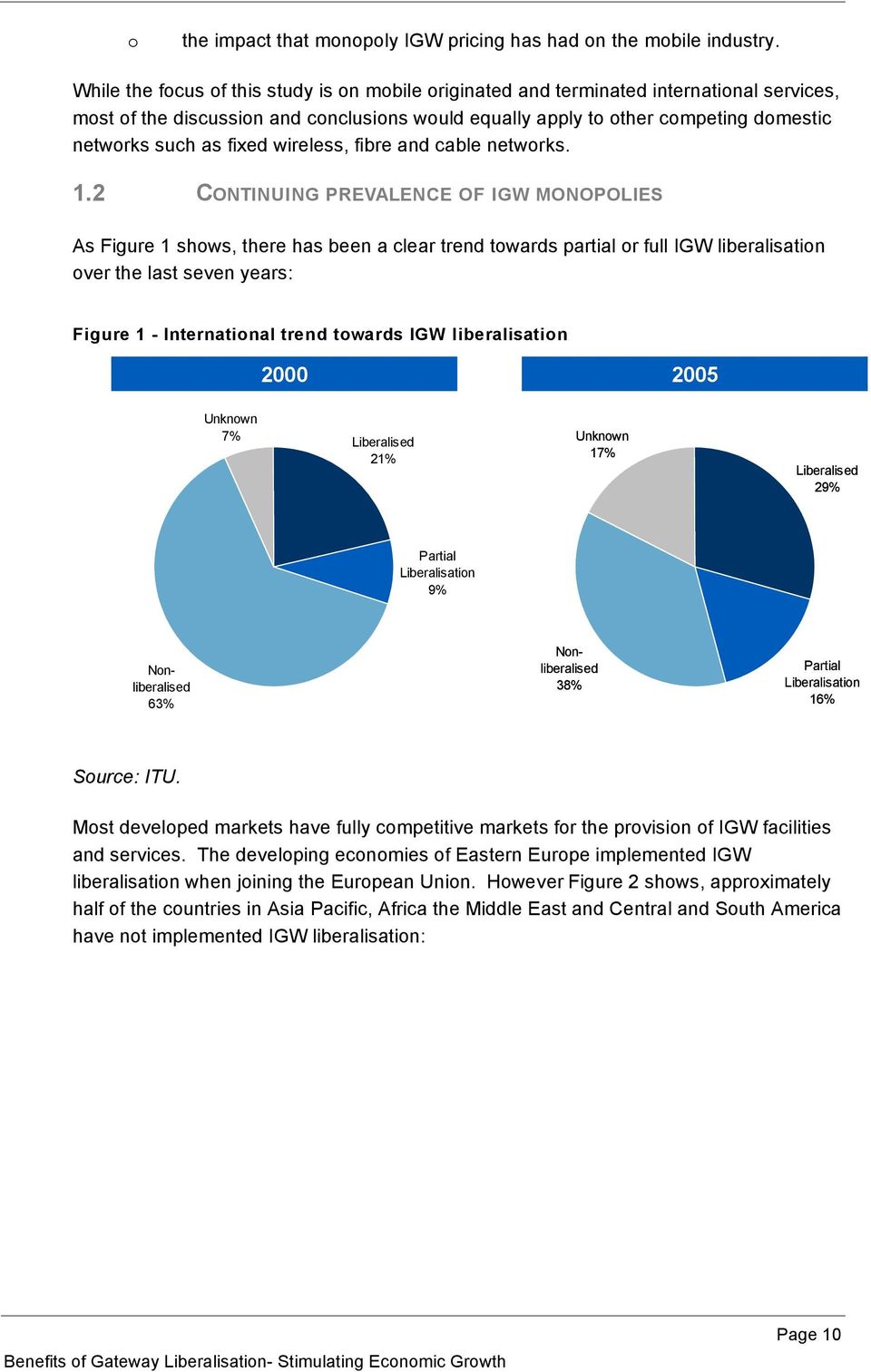
14 o the impact that monopoly IGW pricing has had on the mobile industry. While the focus of this study is on mobile originated and terminated international services, most of the discussion and conclusions would equally apply to other competing domestic networks such as fixed wireless, fibre and cable networks. 1.2 CONTINUING PREVALENCE OF IGW MONOPOLIES As Figure 1 shows, there has been a clear trend towards partial or full IGW liberalisation over the last seven years: Figure 1 - International trend towards IGW liberalisation Unknown 7% Liberalised 21% Unknown 17% Liberalised 29% Partial Liberalisation 9% Nonliberalised 38% Nonliberalised 63% Partial Liberalisation 16% Source: ITU. Most developed markets have fully competitive markets for the provision of IGW facilities and services. The developing economies of Eastern Europe implemented IGW liberalisation when joining the European Union. However Figure 2 shows, approximately half of the countries in Asia Pacific, Africa the Middle East and Central and South America have not implemented IGW liberalisation: Page 10
15 Figure 2 Global status of liberalisation Liberalised Partially Liberalised 5 Non- Liberalised Unknown Number of countries Africa region Americas region Asian region European region Oceania region Governments can be slow to move towards IGW liberalisation for three reasons: First, if the incumbent is Government owned, the Government s viewpoint may be driven by the profits generated by the international business of the incumbent operator. The fear is that as liberalisation will drive down retail prices, tax receipts and profit distributions will fall. Second, the IGW monopoly is often seen as protecting scarce foreign exchange reserves. This stems from the vast imbalance between outgoing (less) and incoming (more) minutes in many developing countries This is highlighted by using Bangladesh as an example where international outbound traffic volume was much less than inbound traffic volume from 2004 to 2006: Figure 3 - Comparisons of Bangladesh inbound and outbound traffic volumes Year Outbound traffic volume Inbound traffic volume 2004 (full 4 quarters) 350m paid minutes 2100m paid minutes 2005 (full 4 quarters) 370m paid minutes 2405m paid minutes 2006 (first 3 quarters) 300m paid minutes 2100m paid minutes 5 Partial Liberalisation refers to a country that has licensed more than one IGW operator, but the number of IGW licences remains restricted by law, regulation or Government policy. This means that partially liberalised countries are subject to oligopolistic conditions. Countries which are Liberalised have no restrictions on number of licences, although there may be qualifying criteria with requisite commitments such as licence fee payments. Page 11

16 The fear is that as liberalisation drives down retail prices, more outbound international calls will be made by a country s citizens. Hence, the traffic balance will shift towards foreign carriers and more foreign currency will have to be found to pay for termination of those outbound calls. Third, it is argued that international revenue is an important source of revenue and funds for subsidising other market segments in developing countries. The argument proceeds that revenue from incoming calls will be used to subsidise network infrastructure investment or investing in new services and that this revenue needs to be protected and remain the exclusive domain of an IGW monopoly operator. As will be seen from this study, the ability of Governments and an incumbent IGW monopoly to quarantine or protect artificially high international charges is being severely undermined by illegal bypass operators. Low-cost technologies such as VoIP and VSATs make prevention and detection of large scale bypass difficult. Bypass traffic accounts for 30 to 60% of total international traffic in many developing countries. 6 Illegal bypass traffic makes no contribution to tax revenues or to funding investment in domestic infrastructure and services. Monopolies are usually a highly inefficient way of achieving development and policy objectives. As discussed in this study, the evidence from markets where IGW liberalisation has been implemented suggests that any supposed gains from the IGW monopolies are likely to be outweighed by the detriment of high cost, low quality international services. 1.3 REPORT STRUCTURE This report is structured to set out: the basic models for retail service provision and interconnection between domestic operators and IGWs in monopoly and liberalised international services markets; a comparison of the drivers for IGW liberalisation; the problems of IGW monopolies; the benefits and options for IGW liberalisation, including pricing and other data from the case study countries; policy conclusions arising from the research and economic analysis; and a sample annotated licence for an open IGW regime. 6 These estimates are based on responses by mobile operators to Country Surveys conducted for this report. These countries estimate that bypass traffic accounted for the following proportions of total incoming and outgoing international traffic: Bangladesh 55%; Egypt 45%; Pakistan and Indonesia 40%; and Chad and the Democratic Republic of Congo 30%. Page 12

17 Background material relevant to the country case studies in this report are contained in Appendix A. Page 13

18 2 BASIC CONCEPTS 2.1 OVERVIEW In this section, we provide a description of: what an IGW is, how it operates and how international connectivity occurs; of how the IGW interconnects with the domestic network; and how IGW operators exchange international traffic between each other. 2.2 IGWS AND INTERNATIONAL INFRASTRUCTURE At its most basic, an IGW exchange is a telephone switch that forms the gateway between a domestic telephone network and one or more other international networks. These international networks may be provided by way of submarine cables, satellite or, in some bordering countries, by wireless links. The IGW comprises a unique network node, equipped for interfacing with all international variants of telecommunications signalling protocols. The most common international signalling protocol used by operators is the SS7 signalling protocol. The IGW operates as a protocol converter and translates messages between the different protocol formats used in international networks and domestic networks. The IGW exchange has to support international accounting and settlement arrangements so that the right domestic and international networks can be charged or paid for each international message. The IGW exchange also has to capture information about the calling and called parties, the originating network and each out of the country s network over which the message travels to the called party. The IGW exchange must also support the numbering plan of each country to which it provides connection (or at least the higher levels of those numbering plans) so that outbound calls can be correctly routed. (a) IGW network architecture Figure 4 illustrates the network architecture of an IGW and how it is connected to the international system. The international connection may be provided by satellite, submarine cable system or wireless links. Submarine cable networks are preferred for carriage of voice calls because satellite services have an inherent delay, which means that in a two way telephone call the parties can end up talking over each other. Satellite capacity can be cost effective for data transmissions, such as downloading content from the global internet. Nonetheless, some developing markets, such as Samoa, are not connected to any cable networks and rely solely on satellite for all their international services. Page 14

19 Figure 4 - IGW architecture satellite earth station earth station M N O US fixed PSTN Hong Kong Hong Kong I G W s u b m a r i n e cable network U S I G W New York (b) Cable-based international network architecture Figure 5 illustrates the basic elements of the onshore facilities of a cable-based international network. The cable comes ashore at a cable landing station where the cable capacity which is being landed in the country is stepped down (called de-muxing) from the cable system. The cable station is connected over backhaul capacity provided on fibre links to one or more Points of Presence (PoPs) located within the country. The PoP is the interface between the domestic networks and the international network. The IGW exchange (there may be more than one) sends and receives traffic across that interface. In a monopoly environment, the IGW operator will usually own or control the cable station, the international capacity which lands in the country, the backhaul, the PoP and the IGW exchange. In a competitive IGW environment, the incumbent may still own much of the onshore international infrastructure and the competing IGW operators will require access in order to connect to the capacity which they have acquired on international networks. As Figure 5 illustrates, a competing IGW operator may either: directly connect its IGW exchange to its cable capacity at the cable station, in which case it will require the cable station owner (which may be the incumbent) to provide co-location facilities; or connect to its international capacity through the PoP, in which case it requires colocation space at the PoP and backhaul capacity to the cable station (again, usually from the incumbent). Page 15

20 Figure 5 - Cable-based international network architecture c o m p e t i n g I G W 1 capacity leased or built by I G W 1 P o P c o l o c a t i o n s p a c e i n c u m b e n t I G W b a c k h a u l provided by i n c u m b e n t cable landing s t a t i o n international cable capacity leased or built by IGW 2 c o m p e t i n g I G W 2 (c) IGW interconnection with domestic networks The most efficient way for each domestic fixed and mobile network to directly interconnect with the international network is for each to directly interface with the IGW. This is shown in Figure 6. However in an IGW monopoly environment, the incumbent fixed operator may require other domestic networks to hand over calls at a lower point in the incumbent s fixed network and indirectly connect to the IGW. This will involve more carriage over the incumbent s network. In the case of outbound calls, competing domestic operators may have to pay higher interconnection charges to cover the additional switching and carriage required in the incumbent s domestic fixed network to reach the IGW. In the case of inbound calls terminating on another operator s network, the competing operator may receive a lower share of the charges paid by the foreign operator because the incumbent carries the call further over its own network. Page 16

21 Figure 6 - Direct interconnection with IGW direct connection monopoly gateway MNO indirect connection domestic PSTN Calls are routed between domestic networks and international networks based on the dialled number. In the case of an outbound call, the network connecting the calling party will recognise the international dialling prefix (e.g. 00 ) and, without further processing the call (i.e. analysing the rest of the dialled number), will route the call to the IGW. The IGW exchange then will analyse the dialled number to identify the country code of the called location to determine to which foreign IGW to send the call. As the called country is likely to be served by a number of IGWs, the originating IGW may analyse the city or area code within the dialled number: for example, to send a call dialled to a New York City number to an IGW on the East Coast rather than the West Coast of the United States. 2.3 IGW INTERCONNECTION WITH INTERNATIONAL NETWORKS In order to understand the dynamic nature of the international services market, it is important to understand the fundamental commercial arrangements which support the market and the changes that have occurred in that market over time. The arrangements for the exchange of international traffic between IGW operators historically has been governed by a model originally developed by the International Telecommunications Union (ITU) called the international accounting rate system. This system, in turn, reflected how monopoly IGWs co-operated to build and operate international networks, particularly cable systems. International submarine cables used to be built by consortia of monopoly IGWs formed for each cable system. The consortium owned the cable system as a whole, but capacity was allocated to individual consortium members, and sometimes sold to non-consortium parties, on a half circuit basis. This arrangement meant that each IGW operator owned a Page 17
22 notional mid point between its own country and each other country to which it wanted a connection. It was intended to establish a complete link with another country an IGW operator had to enter bilateral arrangements to match its half circuits with the half circuits of an IGW operator in the other country 7. The international rate system determines the payments which each IGW operator then makes to use capacity on the other IGW operator s half circuits to terminate international calls. The international accounting rate system has three elements: First, the collection rate. This is the retail rate which the calling party pays for the end to end call. This rate is set by the retail provider of the call, which usually will be the IGW operator. Second, the accounting rate. This is the rate agreed between the two IGW operators which represents the end to end wholesale value of the capacity used in each call. The accounting rate is to cover the international capacity and the origination and termination on the domestic networks at each end of the call. Accounting rates are not necessarily cost related. Third, the settlement rate. This is the amount which the originating IGW operator pays the terminating IGW operator for termination, including domestic termination. The settlement rate is calculated as a proportion of the accounting rate, usually 50% to reflect the underlying half circuit arrangements. If the terminating IGW operator uses domestic networks of other operators to terminate the call, it will be responsible for paying interconnection charges to those other operators, which it funds out of the settlement rate. Figure 7 illustrates how the accounting rate system overlays the half circuit capacity and domestic interconnection arrangements. 7 Half circuits are only a notional concept. There is not an actual physical dividing point on the cable midway between the two countries. Page 18
23 Figure 7 - Relationship between half-circuit capacity and the accounting rate system m o b i l e s u b s c r i b e r pays MNO retail charge HK MNO US PSTN Hong Kong I G W HK IGW US IGW h a l f c i r c u i t h a l f c i r c u i t n o t i o n a l h a l f w a y p o i n t U S I G W New York accounting rate agreed between Hong Kong and US IGWs direction of the call Hong Kong IGW pays settlement rate = 50% of accounting rate US IGW pays domestic operators On any given route, one IGW operator pays settlements to another IGW operator only to the extent that there is a traffic imbalance that is, one IGW operator has terminated a greater volume of telephone minutes than the other. The accounting rate system makes carriers net international revenue for international service a function of their accounting/settlement rates as well as their collection charges. If a carrier has a significant incoming traffic deficit, the settlement payments which it must make to its foreign correspondent IGWs limit its ability to reduce its collection charges. Conversely, an IGW operator with a net traffic surplus has little incentive to operate more efficiently or to reduce the accounting rate because of the net settlement benefits it receives under the status quo. In the 1990s, with the liberalisation of domestic telecommunications markets in developed economies, the international accounting rate system came under great pressure. Collection (retail) rates fell dramatically in competitive markets but IGWs in monopoly markets or in markets which had a net inflow of traffic resisted reductions in the accounting rates. As a result, IGWs in competitive markets faced a price squeeze. The Federal Communications Commission (FCC) in the United States took action by setting benchmark accounting rates between the US and other countries. The FCC enforced its ruling by prohibiting US carriers (and any foreign carriers with foreign subsidies in the US) from agreeing rates higher than the benchmark rates. The ITU followed and determined similar rates in similar bands to the FCC. However, the international accounting system has proved remarkably resilient. It has adapted to accommodate arrangements on routes with competing IGWs at each end. Page 19
24 There are a range of other options for terminating traffic outside the accounting rate system which keeps downwards pressure on accounting rates. The combination of domestic liberalisation and falling costs of international capacity and termination has directly translated into falling international retail prices paid by customers. Telegeography estimates that the average retail price of an international call dropped from US$1.57 in 1983 to $0.42 in Competitive markets witnessed even greater price falls - in 1997, the price of a call from the US to the UK cost around US$0.30 per minute, whereas current prices are now around US$ In the USA, the average price paid per minute for an international call in 1995 was $1.63 whilst by 2003 the average price had fallen by over 80% to $0.29 per minute. Whilst prices fell for calls to most countries, we have seen bigger price reductions for calls to countries that have liberalised in this period. 9 However as discussed below, the benefits of a more competitive international market will be less likely to flow through to end users where an IGW monopoly persists. Where the domestic mobile market has been liberalised, the monopoly IGW represents a choke point between the competitive international and mobile market and is able to collect a toll from each. This creates irresistible pressure for customers and operators in each market to bypass this artificial IGW bottleneck. 8 Figures reported in C Rossotto, A Lewin, C Gomez and B Wellenius, Competition in International Voice Communications: The Cost of Non-Reform for Developing Countries, The World Bank Group. 9 FCC data available at Page 20
25 3 MODELS FOR ACCESS TO INTERNATIONAL SERVICES 3.1 DIFFERENT MODELS OF ACCESS At the outset, it is important to understand the retail and wholesale relationships which underpin access to the international services market. In the simplest case, a verticallyintegrated monopoly which controls access to all telecommunications (including the IGW) services in a country is the sole retail and underlying network provider of the international service. Where there are competing providers of telecommunications services (whether the fixed or mobile), then it is important to understand the different models for access to international services. This is because the different models have an impact of revenue flows and competitive nature of the supply of international services. When an international call originates or terminates on a domestic network not owned by the IGW operator, a two step analysis is involved: Step 1: Determine which operator is the provider of the retail international call to the calling party. 10 This is usually, but not always, the operator which invoices the calling party. Step 2: The other operators will then usually be treated as providers of wholesale services to the retail service provider. As they do not recover a retail charge, they need to recover their costs of supplying carriage on their networks through the international settlement and domestic interconnection charges. We first describe the IGW monopoly models and then describe the IGW competitive models of access to the international services market. 3.2 MONOPOLY IGW MODELS There are two basic access models described below which apply when there is a monopoly IGW provider and a separate local or mobile operator: Model 1: The IGW operator acts as the retailer of the international service, with the local/mobile operator acting as a wholesaler; or Model 2: The local/mobile operator acts as the retailer of the international service with the IGW operator acting as the wholesaler. 10 In some call cases the retail charge will be paid by the called customer, for example reverse or collect charge calls. The same principles apply but the retail provider will be the terminating network or terminating IGW. Page 21
26 (a) Model 1: IGW operator as monopoly retail provider (outbound calls) Figure 8 Model 1: IGW operator as monopoly retail provider (outbound calls) i n t e r n a t i o n a l P S T N m o b i l e c u s t o m e r m o b i l e s w i t c h i n t e r n a t i o n a l g a t e w a y New York origination provided by fixed incumbent to monopoly IGW operator end to end call provided by monopoly IGW operator to mobile subscriber In this case, the IGW operator acquires an origination service from the mobile operator and often a service to bill and collect retail charges, for which it will pay a fixed per minute or per call charge or more usually a revenue share. The IGW operator sets the retail price, although in practice the mobile operator may be allowed to credit some of its revenue share to the customers which provides for a limited scope for different international prices on fixed and mobile networks. The respective functions of the mobile operator and the IGW operator under Model 1 may be summarised as follows: Function Mobile Operator IGW Operator Role Provides origination to IGW. Provides retail service to mobile end user. Retail price Billing and collection of retail charge Bad debt No role, but may be allowed to credit some of revenue share. Includes international call charges in standard bill. Provides as a service to the IGW operator. Responsibility of IGW operator. Sets retail price. Contracts with mobile operator to bill and collect international call charges on its behalf. IGW operator may factor into the revenue share which mobile operator entitled to retain. Page 22
27 For inbound calls under this model, the IGW monopoly would generally collect the inbound international termination revenue and only pay a local terminating fee to the local (fixed or mobile) operator. This access model applies in Bangladesh where the IGW is not liberalised and remains a monopoly of the incumbent (BTTB). BTTB sets the retail charges for international outbound calls and mobile operators are not compensated for use of BTTB s network in making outbound or inbound calls. 11 As a result of Bangladesh s use of this model international traffic has remained relatively static with 2 international voice traffic minutes per person in 2000 and 3 in (b) Model 2: IGW operator as monopoly international wholesale provider (outbound calls) Figure 9 depicts a less common model in the monopoly environment which is for the IGW operator to provide outbound switched wholesale services to the mobile operator. Figure 9 Model 2: IGW operator as monopoly international wholesale provider (outbound calls) i n t e r n a t i o n a l P S T N m o b i l e c u s t o m e r m o b i l e s w i t c h i n t e r n a t i o n a l g a t e w a y New York international wholesale service provided by monopoly IGW operator to mobile operator end to end call provided by mobile operator to mobile subscriber The mobile operator sets the retail price, providing for some measure of competition with the retail price on fixed network. The wholesale outbound charges may be a discount off the retail IGW prices. This discount could be based on the retail and network costs the vertically-integrated operator avoids as a result of the call originating on the mobile network rather than the fixed network. The inbound call model is the same. The respective functions of the mobile operator and the IGW operator under Model 1 may be summarised as follows: 11 Bangladesh survey response to GSMA. 12 The World Bank. Page 23
28 Function Mobile Operator IGW Operator Role Provides retail service to mobile end user. Provides wholesale outbound call minutes. Retail price Sets retail price. No role. Billing and collection of retail charge Bad debt Bills and collects as part of its retail charges. Responsibility of mobile operator. No role. Receives wholesale charge irrespective of whether mobile subscriber pays. For inbound calls under this model, the IGW operator may share the incoming revenue with the local operator (whether fixed or mobile) in recognition of the fact that the local operator, with the connection to the customer, is substantially contributing to the volume of inbound calls. 3.3 COMPETITIVE IGW MODELS The models which apply in a competitive IGW context are more complex for obvious reasons, with a range of local and IGW providers available to provide retail and wholesale services. It is important to note that the outcomes in a competitive model are dictated more by competition than regulation, so the relevant model is likely to emerge from the competitive nature of the market and not determined by way of regulation.. The following models are considered: Model 3: The mobile operator is allowed to establish its own gateway and provides mobile and international services to its customers as a single package. Model 4: The mobile operator is not permitted to establish its own gateway but the mobile operator provides the retail international service to end users and acquires wholesale services from one of competing IGWs. Model 5: The mobile operator is not permitted to establish its own gateway and the competing IGWs are the retail providers of the outbound calls services. This raises the issue of how customers of the mobile operator access the international services of the IGW, as discussed further below. Access may be through call-by-call selection, pre-selection or other access means such as through the use of calling cards. As a result of these different customer access methods, there is a range of sub-options within Model 5 depending on the customer access method. Page 24
29 (a) Model 3: Mobile operator self provides IGW The IGW is self-provided by the mobile operator. When a customer dials an international service, the international service is provided by the mobile operator. The mobile operator is responsible for obtaining its own international capacity and for negotiating termination arrangements with IGWs in other countries. Under this model, mobile operators compete with other national (whether fixed or mobile) operators in supplying international services, as depicted below: Figure 10 Mobile operator self-provides IGW international PSTN mobile operator international gateway fixed incumbent international gateway national mobile network fixed incumbent network In this case, the revenue flows are very straightforward. The mobile operator collects all retail revenues and is responsible for all costs of providing the end-to-end international service (including the international settlement with overseas operators). Malta employs this model with great success. Since liberalisation in 2003, the volume of outgoing calls has increased dramatically. Within a year of IGW liberalisation the outgoing minutes jumped by 18 million minutes from 35 million minutes to 53 million Page 25
30 minutes. In 2006, this figure is believed to have grown to 80 million minutes. 13 Additionally, international call prices decreased by 79% between Q and Q3 of In 2006, Kenya adopted this model when it awarded IGW licences to the two main mobile operators. Since obtaining the licences the mobile operators have announced new prices including the announcement by Safaricom in September 2006 of a 70% reduction in its international call prices. (b) Model 4: Mobile operator acquires wholesale international services from a range of possible IGW providers In this model, the mobile operator acquires wholesale international services from an IGW operator. The mobile operator may be connected to one or more IGW operators and may route calls to the cheapest IGW provider depending on the call destination and the time of day. Figure 11 Mobile operator acquires wholesale international services model National market IGW (1) International PSTN IGW (2) end to end call provided by mobile operator to mobile operator end-user international termination provided by gateway operator to mobile operator Here, the mobile operator is the retail provider, provides the end-to-end international service and collects all retail revenue. The mobile operator is responsible for the cost of providing the service, including the cost of acquisition of the wholesale international service from the IGW operator. 13 Maltese Communications Authority. Page 26
31 The revenue flows are the same as apply in the case of Model 2. However, with Model 2, there is likely to be a strong case for regulation of the price charged by the monopoly IGW provider. Competition is likely to set an appropriate price of supply in the case of this model due to the multiple IGW providers who may provide the wholesale international service. Sri Lanka is an example of a country that uses Model 4. In 2003, Sri Lanka issued four facilities based IGW licenses and 29 non-facilities based IGW licenses. The non-facilities based licences were required to use the facilities based IGWs to provide international services. Since liberalisation, there has been large growth in both the fixed and mobile sector. (c) Model 5: IGW operator as retail provider The mobile operator may be providing its own retail service but it may also be required to provide access to international services of other IGW operators. Figure 12 IGW as retail provider mobile customer dials 008 I G W 1 New York mobile customer dials 006 mobile customer dials calling card number Hong Kong M N O calling card platform I G W 2 L o n d o n M a n i l a Egypt is an example of a country that uses this model. In February 2006, Egypt announced that it would liberalise its IGWs in a two stage approach. In the first stage, the two additional companies will hold IGW licenses but they must operate the IGW based on infrastructure provided by the incumbent. If this model applies, then the mobile operator provides the relevant IGW with an originating access service. The IGW operator collects the retail revenue in the same way as in Model 1. Page 27
32 However with Model 5, it is important to consider the options for the customer to choose between multiple providers of international services, including the mobile operator s own international service (if permitted). There are three basic options for consumers to access competing IGW providers (in addition to accessing the mobile operator s own international service if permitted) using Model 5: Call-by-call selection: In this case, a consumer chooses between competing IGWs made by the consumer at the retail level on a call by call basis. A default may occur if the customer dial the standard international code (eg 001) and this default may set to the mobile operator s own service or, in some cases, the provider of the international service using the same default code. To access competing IGW operators international services, each IGW provider will be allocated an access code (eg 002, 003, etc). When the customer prefixes the international country code with this access code, the mobile operator routes the call to the relevant IGW operator and the IGW operator provides the retail service to the customer in the manner described above. Indonesia uses call-by-call selection in its international calling. In 2004, the Government partially liberalised the IGW with Telkom and Indosat operating as duopoly IGW operators. A Decree was issued that allowed customers to freely select their international providers by dialling the operators individual prefix code on a call-by-call basis. Pre-selection: The retail customer makes a choice between competing IGWs, usually at the time of connection. For all international calls made by the customer, the mobile operator automatically routes these calls to the pre-selected IGW operator. Customers may still access alternative providers using the call-by-call selection method if they choose to do so. This method of customer access is less common at the retail mobile level and is more common in developed countries in relation to access to international services from fixed lines. International calling card: The mobile customer dials a special calling card number (e.g. an 800) number or a local number to access the calling card operator s platform. The customer then keys in their account number and PIN or access code. The calling card platform determines whether the customer is authorised to make the call and, if so, provides a second dial tone to the customer who then dials the international number in the usual way. This involves two separate calls: a call to the calling card platform which the mobile operator charges to the calling customer in the same way as any other mobile call; and an international call which the calling card provider charges to the customer, either against their credit card or from a pre-paid account. Page 28
33 3.4 CONCLUSION Final market outcomes will be determined by a combination of demand and cost factors as well as market structure. Our case studies and analysis below show that the full benefits of liberalisation are unlikely to be realised without allowing for the entry of multiple gateway operators or the threat of new entry should the existing players price too highly. While partial liberalisation such as the licensing of a second IGW operator can deliver significant benefits particularly in relation to improved reliability of international connectivity as well as some price reductions to stimulate the demand to utilise the new capacity as the second operator builds its own customer base, our case studies showed that even after partial liberalisation there was substantial scope for further price reductions. Accordingly, the models which support full liberalisation (namely, Model 3, 4 and 5 above) are the models which will deliver the most benefits from liberalisation. Whether different customer access models need to be available having regard to the cost of doing so, when compared with the benefits, is discussed further below. In summary, Models 3 or 4 would appear to provide the full benefits while minimising the cost of liberalisation and it is those models which are supported by this study. Page 29
34 4 HISTORICAL OVERVIEW OF IGW REFORM AND TRENDS 4.1 SCOPE AND PURPOSE This section contains: an overview of the experience in the early IGW liberalising economies of Australia, the United Kingdom, Japan and the United States; the impact of market and technology developments of gateway liberalisation, particularly the strong role that mobile now plays in telecommunications; and an evaluation of the bypass problems on the feasibility of IGW monopolies. It will be seen from this section that the previous models of deregulating the international telecommunications sector are not necessarily the best way forward. While the historical overview is important to give IGW liberalisation some context, it is moreover relevant in identifying any trends and their possible application to the current environment. 4.2 HISTORICAL OVERVIEW IN DEVELOPED MARKETS Early IGW liberalisation in most developed markets was characterised by two main features: First, IGW functions were typically considered to be the province of fixed line operators. IGW liberalisation, therefore, was part of the process of fixed network liberalisation. As international networks and services had been a club of monopoly fixed operators, competing fixed IGWs were seen as more consistent with how the international market worked. As the mobile sector was also liberalised, mobile operators licence rights generally did not extend to establishing their own IGWs. Mobile operators might be entitled to obtain a separate IGW licence, but usually they were required to interconnect to international networks through the fixed IGWs. Second, in most countries, other than the United States and Japan, the right of an operator to establish an IGW generally formed part of a general fixed carrier licence. The model in Australia and the United Kingdom, and many countries throughout Europe, was that vertically-integrated fixed competitors were licensed to compete with the fixed incumbent. The policy rationale for this vertically integrated form of deregulation was to ensure that new entrants could fund domestic network deployment from the lucrative international call revenue stream. Page 30
35 (a) United States In the United States, IGW was one of the first telecommunications markets to be opened to competition. Unlike other jurisdictions, the monopoly over telecommunications, including the IGW, arose in the US as a result of patents owned by the Bell. In 1879 Bell was granted patents over all voice communications over wire. The first step towards liberalisation in the US was achieved after the expiry of the Bell patents. In 1971, the Specialised Common Carrier decision allowed AT&T s competitors to enter the common carriage market through microwave and satellite networks. This decision allowed MCI, AT&T s oldest competitor to establish its business. In the 1971 decision, the FCC concluded: 14 We further find and conclude that a general policy in favour of the entry of new carriers in the specialised communications field would serve the public interest, convenience and necessity. This position quickly evolved into a model of unrestricted entry with the only test posed by the FCC being that competitors in the international market should not enjoy a monopoly position in the local market. The dominant feature of the telecommunications market in the United States was the Modified Final Judgment in 1982 following which AT&T was ordered to divest its local operations into Regional Bell Operating Companies (RBOCs). The RBOCs were prohibited from competing in long distance and international markets. Although vertical integration was no longer a feature of the US market following the 1982 divestiture, telecommunications competition policy was driven from the perspective of the fixed sector. 15 Even today, mobile remains a secondary feature of the telecommunications market in the US. Proportional return rules also divided the market for terminating incoming international traffic among the US carriers on a country-by-country basis, in proportion to a US carrier s share of billed outgoing international traffic to the corresponding country. Subsequently, additional carriers invested heavily in network roll out and by 1985 the incumbent AT&T had only 28% of total fibre system route miles and the relatively new carrier, Sprint, had a fibre system that was almost as extensive AT&T s. 16 In May 1999, in response to a petition regarding an arbitrage proceeding, the FCC deregulated carrier to carrier interconnection charges for international communications. By 2003, there were over 2,000 operators supplying international services in the US Federal Communications Commission, 1971, Microwave Communications, Inc decision, p The 1996 Telecommunications Act permitted RBOCs access to the long-distance market on the condition that they allow sufficient competition in their local market. In 2001 an FCC decision authorised the first RBOCs to offer long-distance services. 16 Cave, Majumdar & Vogelsang, Handbook of Telecommunications Economics, Volume 1, Elsevier, 2002, p Policy Division, Global ICT Department, Competition in International Voice Communications, Report No January 2004, p 45 (Citing TeleGeography 2003). Page 31
36 (b) United Kingdom Liberalisation was staggered in the UK. In 1984, BT was privatised and a Duopoly Policy was established. The Duopoly Policy was pursued from 1984 to 1992 and it limited competition in the fixed network to BT and Mercury, a subsidiary of Cable & Wireless and the first fixed line competitor. The emergence of the second operator who provided fixed services only in this vertically integrated market allowed some limited competition in international services. The liberalisation of fixed services was slowly introduced throughout the 1990s. The UK progressed on an early path of rebalancing and price controls through CPI- price caps. As a result, the dominant carrier s domestic and international call tariffs were rebalanced over the course of 1984 to 1989 in a phased manner. 18 The 1991 White Paper, Competition and Choice: Telecommunications Policy for the 1990s, announced that the UK would allow new competition in international services by licensing some companies to provide low cost International Simple Resale (ISR) to certain routes. In 1996, full competition in international services was allowed when the Government licensed an initial batch of 44 companies to provide international telecommunications services on any route they choose over their own IGW. In the mobile market, two operators were licensed in 1985, BT Cellnet (now O2) and Vodafone. In 1993 two new operators, Orange and Mercury One to One, were granted licenses. The mobile operators were initially not allowed to operate their own IGW, as the IGW licensees were exclusively provided to fixed operators. It was not until full competition was introduced in 1996 that all mobile operators were able to own and operate their own IGW. As at 2004 there were around 500 suppliers of international services in the UK. 19 (c) Australia A similar duopoly approach was adopted in Australia with the licensing of Optus. A political argument in Australia over the direction of the international telecommunications market lead to the formation of two competing companies. Telstra, the incumbent operator, merged with the Overseas Telecommunications Corporation (OTC) to form the AOTC. Optus was licensed as a second vertically-integrated fixed line competitor to the AOTC in the international market. The deregulation of the IGW market in Australia was focussed on fixed line services and only fixed operators were able to obtain a licence to install an IGW. Mobile companies, 18 R Nicholls, Bypass and Transit Arbitrage Issues in International Interconnection and Revenue Reporting in Developing Countries, presented to the Pacific Telecommunications Council Conference in Honolulu, Hawaii on 19 January 2005, citing Ros and Banerjee (2000). 19 Policy Division, Global ICT Department, Competition in International Voice Communications, Report No January 2004, p 46. Page 32
37 such as Vodafone, were initially prohibited from owning their own IGW and had to use either the Telstra or Optus IGW to provide international services to its customers. Full liberalisation of the international market in Australia was achieved in (d) Japan Japan pursued a middle path with IGW liberalisation. Initially, Japan had separate international and national operators. In 1952, the Nippon Telegraph and Telephone Public Corporation (NTT) was granted a monopoly over domestic telecommunications and Kokusai Denshin Denwa (KDD) had a monopoly over international services. The Government allowed each to enter the others market as vertically integrated operators and then allowed entrants at both the national and international level, so the companies could choose to operate on a non-vertically integrated basis. Japan introduced competition into the market in 1985 by simultaneously liberalising the terminal equipment market and introducing competition into the provisioning of telecommunications network infrastructure and services. There are no longer any line-ofbusiness restrictions in Japan and many major global companies are competing in the Japanese telecommunications market. As a result, there is strong competition in the international market. In the mobile market, NTT enjoyed a monopoly position until In April 1994, Japan allowed competition in the mobile market with four digital cellular mobile carriers allowed to enter each of ten separate regional markets. Up to this point the mobile operators had to use the IGW of NTT to access international services. Since IGW liberalisation and the ability of mobile companies to operate their own IGWs, mobile subscriptions have increased six-fold. The rapid growth of mobile networks has led some commentators to consider that these can be an alternative to local fixed voice telephony, which is still dominated by NTT. 20 While Japan was one of the earliest countries to initiate liberalisation in the 1980s its unique market structure with monopolies in the domestic and international market has meant slower progress than the UK and the USA. Japan now has many carriers in each segment of the market and is the second largest telecommunications market in the world HISTORICAL OVERVIEW IN DEVELOPING MARKETS The case studies in Appendix A provide some background to the rationale and trends in IGW liberalisation some key developing countries. By way of overview and historical 20 OECD, Regulatory Reform in Japan, Regulatory Reform in the Telecommunications Industry, OECD, Regulatory Reform in Japan, Regulatory Reform in the Telecommunications Industry, Page 33
38 context, Rossotto et al noted that by the late 1990s/early 2000s there were substantial regional and global differences in international voice competition: 22 competition in international voice communications appeared prevalent in several Latin American countries such as Argentina, Bolivia, Brazil and Chile. Chile s liberalisation in the mid-1990s is widely recognised and noted by Rossotto as one of the notable successful cases in consumers reaping the benefits of full competition. in South-East Asia, competition had been established in India and Malaysia. Sri Lanka undertook a detailed study of the options for IGW liberalisation in 2002, resulting in the issuing of new IGW licences in 2003; however despite these developments, the 25 per cent of global outgoing international traffic that was then not open to competition originated almost exclusively from developing countries. Rossotto et al concluded that Latin America was the leader among developing regions in terms of competition in international long distance services. In contrast, Africa and the Middle East were substantially lagging in comparison. As can be seen the country case studies, there has been a sporadic trend towards IGW liberalisation in selected African and Middle Eastern countries. 4.4 IMPACT OF MARKET AND TECHNOLOGY DEVELOPMENTS Three changes have impacted upon the lessons that can be learned from early liberalising nations in both developing and developed countries, as further discussed in this section: First: The international market has become increasingly competitive. Different providers who have invested in international bandwidth in non-traditional ways have significantly contributed to this competitiveness. Second: Significant illegal bypass is occurring. IGW monopolies are becoming increasingly unstable as more leakage occurs and as the cost of providing illegal bypass reduces. Third: Mobile technology has become a key access technology. It is now also a means of achieving national goals such as communications penetration and consumer affordability. Hence, IGW liberalisation should no longer be seen through the prism of fixed market deregulation as was the case in early liberalising countries. Each of these factors is discussed below. 22 C Rossotto, A Lewin, C Gomez and B Wellenius, Competition in International Voice Communications: The Cost of Non-Reform for Developing Countries, The World Bank Group. Page 34
39 (a) Competitive international market Ten years ago, the international market for termination of voice calls was little more than a clearing house for national monopolies. As noted above, international cable networks were built by consortia of vertically integrated national fixed monopolies. The fixed incumbents were the landing parties under the cable consortia agreements in their home countries and therefore controlled the onshore cable capacity. The half circuits in the activated capacity and in the inactivated capacity terminating in the incumbent s home country were assigned to it. International satellite and cable networks were also joint ventures between national monopolies. This tight vertical integration between the national fixed incumbents and global networks meant that international capacity and services was not freely traded outside the circle of incumbent carriers. Even if they were licensed to provide their own international services, new entrants in national markets faced hurdles in directly acquiring international capacity and entering into bilateral accounting rate arrangements with fixed incumbents in other national markets. Competition in international networks and services has since been transformed by the following developments: Private operators have built and deployed international cable systems. The amount of available capacity far exceeds current demand, which has created an environment of rapidly falling capacity prices. Inevitably, rates for international termination services have come down. Domestic liberalisation has allowed larger operators to obtain their own licences in other countries and build their own end to end international links. This means that it is possible to bypass the IGW operators and independently carry traffic to a called country to interconnect directly with domestic carriers. This is only economically justifiable for large volumes of traffic between two countries. New entrants in competitive domestic markets, followed by incumbents, have set themselves up as wholesale providers of international termination. Other IGWs route traffic to these transit operators for them to on-terminate in the called a country. By being able to aggregate traffic from several operators, these transit providers often can negotiate lower accounting rates with other IGW operators. IGW operators may hub their own traffic into another country to exploit its own accounting rate arrangements with other countries. Specialist international traffic exchanges have been established. Individual IGWs can buy and sell minutes on these exchanges and dynamically route calls to utilise that capacity almost real time. Specialist international wholesale carriers have emerged. These may be based around private cable systems, such as Global Crossing; or may be arms of large Page 35
40 domestic incumbents, such as BT Global Services; or may have been spun out from incumbent operators, such as REACH in Asia which is a joint venture between Hong Kong s incumbent PCCW and Australia s incumbent, Telstra. Formal and informal restrictions which kept mobile operators, ISPs and other domestic carriers out of the wholesale market for international capacity and services have been removed. Mobile operators contract directly with global wholesale suppliers to terminate their traffic. Mobile operators enter into traffic exchange agreements with each other and fixed operators which are similar to the traditional accounting rate arrangements. There are now global and regional markets in which international capacity and services are traded independently of national incumbents. In conclusion: The international market has become highly competitive in both services and infrastructure. Non-vertically integrated or specialist international suppliers of capacity and services have emerged, including bandwidth and minutes exchanges. Therefore, domestic operators have a choice of providers of international services. For instance, they can be direct buyers into the international market without having to deal with the fixed line incumbent operators. (b) Prevalence of illegal bypass The competitive opportunities and pressures in domestic liberalised markets and at the international level also fuel illegal bypass of IGW monopolies as competitors seek ways to reduce their costs of supply by finding cheaper termination. Low cost technology has also allowed illegal bypass operators to supply outbound calls in monopoly IGW markets in ways which are difficult for the regulator to prevent, detect and stop. Bypass is the use of any telecommunications facilities or services that circumvents those facilities used by IGW operators to terminate international calls, thereby evading the settlement rates incurred in using a recognised international gateway. Insight Research found that in 2004, VoIP bypass calling amounted to slightly more than one-third of the US$98 billion spent on international calling in China, India, Japan and other Asian countries. The same study predicts that in 2011, VoIP bypass will take a far smaller percentage of total international voice revenue, as international settlements begin to align with real costs of delivering the service and the arbitrage opportunity becomes less appealing Insight Research, Telecommunications and VoIP in Asia, Oceania and the Mideast: A Market Perspective on the Major Economies results reported in the Insight Research Corporation Page 36
41 It has been seen that in Indonesia, before liberalisation was completed in 2004, the monopoly provider of international calls was losing revenue each year as more calls were being made through illegal bypass channels. However, as shown in Figure 13,once the country s gateways were liberalised, the amount of revenue made through the legal channels almost doubled in a year. Due to its status, we cannot quantify the amount of calls made through bypassing the official channels, however we can see the impact it has had on the official monopoly provider. Figure 13 - Indonesia: revenue generated by international calls, Billions of Ruppiah In Bangladesh, where there is still a monopoly provider of international calls, it was noted this year that the monopoly operator, the Bangladesh Telegraph and Telephone Board (BTTB) is set to miss its revenue target in 2006 by a huge margin. The reason given by BTTB officials was that the goal was impossible to achieve. This is because the volume of international calls, which contribute about 40 per cent of the total revenue, continues to fall due to widespread use of bypass through illegal internet telephony. Bypass is only limited by the ingenuity of the bypass operators and bypass methods are constantly shifting and developing as technology and market developments open up new arbitrage opportunities. Some of the more common means of illegal bypass for inbound calls are depicted infigure 14. Press Release, Asia International Call Revenue Lost to VoIP Bypass Declines in 2005, Says INSIGHT Research, 16 June Available at Page 37
42 Figure 14 - Illegal bypass via VSAT satellite VSAT IGW s monopoly domestic PSTN legitimate inbound call monopoly IGW New York private network using capacity leased from incumbent customer office It is relevant to appreciate the relative ease of implementing bypass, such as by utilising a VSAT dish installed on a premises. VSAT dishes are relatively small and similar in appearance to satellite TV reception dishes, making them harder to detect. The VSAT connects to a small desktop switches or modems which process the inbound calls to identify the dialled number and on-route the call. The illegal bypass operator may route the calls over standard subscriber PSTN lines into the incumbent s PSTN. The incumbent s switch then processes the dialled number and routes the call as if it has been dialled from those PSTN lines as ordinary incountry calls. Rather than route the calls directly into the incumbent s PSTN, the VSAT operator may seek to disguise the traffic source by routing the calls through a competing fixed or mobile network, which then interconnects the calls with the incumbent s PSTN in the same way as any call dial from one of its subscribers to a subscriber on the incumbents network. The competing fixed or mobile network may be an unwitting provider of transit services. It may also turn a blind eye to the activity because it benefits from the bypass. Bypass may also occur over international private networks. A customer may lease a circuit from the incumbent for the purposes of providing data services between its offices or, if permitted by regulation, its own in-house telephone calls. However, the circuit may be used to carry traffic which is routed back into the incumbent s PSTN, once again as if it was a locally originated call. Incumbents and their employees themselves can be engaged in bypass over private circuits as they seek to reduce or siphon off international revenue which otherwise would be reportable to and taxed by the Government. Outbound bypass was less common because not many customers in developing countries could afford to make international calls, even at the reduced rates offered by bypass operators. However, VoIP has changed the economics of international calling, including for bypass operators. Although it is technically possible to block the internet Page 38
43 ports normally used for VoIP services, and a number of incumbent operators in developed markets have tried to block providers such as Vonage. Since these markets are fully liberalised, regulators have formally or informally stepped in to prevent the blocking. In the interests of promoting competitive supply of internet services, some developed markets have decided to implement liberalisation of ISP international gateways ahead of IGWs for voice services. India is an example of the problems which can be encountered with this approach. ISPs were permitted to establish their own international data gateways using satellite-based services, but the international voice IGWs remained a duopoly. Outbound VoIP bypass through these satellite gateways grew rapidly, with estimates of 40% or more of traffic on some routes being illegal bypass traffic. 24 Bypass of the IGW monopoly reduces the income of those monopolies in respect of both originating and settlement minutes. Given the requirement for rebalancing, this has a disproportionate effect on profitability. 25 The economic effects of bypass are clear: Bypass reduces the economies of scale achievable by legitimate operators. Bypass reduces the revenue base available to fund network expansion, including USO funding schemes. Even cost-effective bypass technology will result in a fall in residential international traffic (both originating and settlement). Some business originating traffic will also drop and there will be no change in the level of international mobile traffic. The effect here is that the incumbent s international revenue stays almost static at a time when line growth is large. 26 The carriage of bypass traffic itself may also be inefficient for reasons including: 27 Some forms of bypass traffic involve third-country routing. The extra transit, switching and managerial coordination required is likely to make handling such traffic more expensive than handling settled traffic under established bilateral arrangements. 24 These estimates are based on responses by mobile operators to Country Surveys conducted for this report. These countries estimate that bypass traffic accounted for the following proportions of total incoming and outgoing international traffic: Bangladesh 55%; Egypt 45%; Pakistan and Indonesia 40%; and Chad and the Democratic Republic of Congo 30%. 25 Nicholls, R. Bypass and transit Arbitrage issues in International Interconnection and Revenue Reporting in Developing Countries, presented to the Pacific Telecommunications Council Conference in Honolulu, 19 January Nicholls, R. Bypass and transit Arbitrage issues in International Interconnection and Revenue Reporting in Developing Countries, presented to the Pacific Telecommunications Council Conference in Honolulu, 19 January Galbi, D., The Implications of By-pass for Traditional International Interconnection, 22 December Page 39
44 The voice network on IGWs has been optimised for voice traffic and so it is more cost efficient for such traffic than infrastructure used to support bypass traffic designed for more diverse traffic streams. Other forms of bypass involve placing voice traffic on alternative networks. This is a problem because the existing international network has been optimised for voice traffic. It is therefore likely to be more cost efficient for such traffic than alternative networks designed for more diverse traffic streams. The provision of bypass services may expose a carrier to significant regulatory and commercial risks, which raises the cost of bypass services relative to traditional settled traffic. High levels of switched voice bypass can also have wider implications for a Government s ambitions to increase its country s global connectivity. Many developed countries present a marginal case for building international submarine or terrestrial international links, partly because bypass traffic is usually carried over illegal VSAT or microwave links. If bypass traffic can be brought back within legitimate interconnection arrangements and existing or new licensing regimes, and international traffic can be further stimulated by more competitive gateway arrangements, the business case for international fixed network connections can substantially improve. Those new cable connections will deliver substantially increased bandwidth which is available for internet and broadband services, as well as voice traffic. Illegal bypass is not, however, completely bad for an economy. Illegal bypass reduces prices towards the cost of supply. In other words, illegal bypass performs the role of a competitor in a monopoly IGW circumstance. Certainly consumers benefit to an extent, from illegal bypass, in the form of lower prices for international services. As long as bypass mechanisms remain illegal, operators engaged in illegal bypass undermine the regulatory system and can exacerbate corruption in countries where corruption is significant (e.g. through payments by illegal bypass operators to remain in business). Bypass operators also avoid contributing to universal access or service funds and the payment of licence fees to support regulatory activities. Large bypass operators are often well-known in most markets. They can also be politically well-connected or have sufficient resources to defend their operations if challenged. Regulators often do not have the legal powers, such as compulsory search powers, or the resources required to investigate and prosecute illegal bypass. The national law enforcement agencies usually face more serious challenges than addressing these economic crimes relating to bypassing. Even if regulators were armed with more power and resources, it is unlikely that they would make significant inroads against illegal bypass. The technological ease of bypass and the powerful economic incentives provided by the high legitimate charges means that as soon as the regulator closes down one operator another will spring up. Page 40
45 The result is that bypass holds the regulatory system to ridicule as ineffectual, eroding the regulator s credibility and undermining a culture of compliance. Accordingly, the debate has progressed from whether illegal bypass is good or bad or whether it can be stopped or not. As long as IGW monopolies charge significantly in excess of cost for international calls, illegal operators will exist to offer lower priced options using bypass technology. (c) Mobile technology and IGW liberalisation It is clear that in early liberalising countries such as the United States, the United Kingdom, Australia and Japan, the focus was on fixed liberalisation, of which IGW liberalisation formed a part. In some cases, this was implemented through the emergence of separately licensed vertically integrated operators who were licensed to provide the full range of fixed services (including international) such as in the UK and Australia. In some cases, international operations were separately provided under a nonvertically-integrated structure. However in general terms, mobile was a nascent technology during this period. At the time of early liberalisation in the 1980s and early 1990s, the introduction of mobile services was not linked to IGW liberalisation. In fact, in most cases as seen above, the licensing of mobile services as generally undertaken as a separate form of liberalisation and newly licensed mobile operators were not licensed to self-provide IGWs. Mobile operators in early liberalised countries generally had to acquire international services from a separately licensed IGW operator under one of the IGW access models described in section 2. During the 1990s, mobile networks emerged and often mobile services were the first competitively-supplied telecommunications services for a country. Mobile has since become the main provider of communications in the developing world. In Africa the number of mobile phone subscribers overtook the number of fixed lines in The proportion of mobile users has continued to grow across the continent and in 2003, nearly three quarters of telephone subscribers in Sub-Saharan Africa used a mobile phone. 28 A study commissioned by the GSM Association also highlighted the importance of mobile and the potential for mobile to provide universal access. 29 It estimated that mobile communications will deliver affordable voice, data and internet services to more than 5 billion people by Mobile networks now cover 80% of the world s population. This is double the coverage rate in These high coverage rates are due to investments by mobile operators and the liberalisation of telecommunications markets by governments. The report estimates that by 2010, the coverage will reach 90% of the worlds population. So, mobile liberalisation is a key means of increasing communications penetration (ie achieving access goals) and consequently achieving ICT goals in particular countries. 28 GSM Association, Regulation and the Digital Divide, GSM Association, Universal Access, How Mobile Can Bring Communications to All, Page 41
46 However, in some countries the mobile services sector has been liberalised ahead of fixed line services. Consequently in some countries which have liberalised mobile services, international services remain provided under monopoly or partially liberalised conditions. Mobile operator licences did not include the right to provide their own IGW in countries such as Benin, Burkina Faso, Cameroon, Cape Verde, Mozambique, Tunisia, Bolivia, Paraguay, San Marino and Macedonia. This is despite the importance of mobile technology to the development of international service competition: Mobile competition is important to the development of competition in international communications. In many cases mobile is the only legal competition and is a powerful force as the penetration of mobile to fixed-line is now reversed in most developing nations. 30 By contrast, in other jurisdictions, such as Morocco, mobile liberalisation has preceded fixed liberalisation, but liberalisation of IGWs has gone hand in hand with liberalisation of the mobile sector, such that new mobile service entrants are permitted to provide their own IGW from the outset. In Section 5, we examine by reference to the case studies the impact of different models of IGW liberalisation, including on the mobile sector, to determine the best way to achieve social goals, such as the achievement of access and ICT goals. A significant contributor to these goals has been mobile operators and the discussion is set in this context. 30 Policy Division, Global ICT Department, Competition in International Voice Communications, Report No January 2004, p 4 (Citing Wellenius and Rossotto, 1999). Page 42
47 5 ECONOMIC PRINCIPLES 5.1 INTRODUCTION In this section, we set out a number of key economic principles that are important in understanding the impact of IGW monopolies. We first explain the general harm created by restrictions on IGW competition. We then turn to consider certain arguments that are sometimes made as to why IGW monopolies should be maintained. One group of arguments is based on potential benefits for the population of the country if, say, international call profits are used to subsidise lower prices for domestic calls or to fund the expansion of the fixed network. Another claimed benefit is that IGW monopolies can generate greater revenues for the government in the form of tax revenue or dividends paid by the incumbent. These revenues could in turn be used to fund general social programmes. We find that these claimed benefits are overstated and that they ignore the substantial costs created by the maintenance of the monopoly. Accordingly, this section sets the scene for understanding the actual impact of liberalisation in practice which we turn to in the following section. 5.2 THE CASE AGAINST MONOPOLIES Well-established economic theory shows that monopolies have the incentive to set prices above costs. In contrast to firms in competitive markets, monopolies are not constrained in their pricing by the risk that if they set excessive prices, customers will buy from one of their competitors. Prices set above costs have their most direct impact on economic efficiency and living standards by leading to allocative inefficiency. Allocative inefficiency arises where an economy does not use its scarce resources to produce the goods and services that provide maximum benefit to its people. Where prices are set significantly above costs, some consumers will not make calls even when it is efficient to do so, i.e. even when they would value making a call at least as high as the cost of supplying that call. The consumer welfare benefit that would be generated by such calls is loss to the country as a whole. Economists refer to this as the dead weight loss of monopolies. Monopolies can also lead to productive inefficiency in that the services are not produced at the lowest cost. In particular, IGW monopolies reduce the incentive for operators to reduce costs and can also lead to inefficient bypass (such as higher cost satellite transmission). There may also be a loss in dynamic efficiency, as uncontested monopolies have lesser incentives to improve their services or be innovative in the development and/or adoption of new technologies. Rather, the maintenance of the IGW monopoly results in incentives for stakeholders to engage in inefficient rent-seeking behaviour. This is exacerbated by the information asymmetry between the IGW operator and the regulatory authority. A Page 43
48 loss of dynamic efficiency implies less growth in living standards over time compared with countries with competitive markets. The monopoly over IGW services may also harm competition more generally in the telecommunications sector. In particular, even where there are new fixed and mobile entrants, the ability of these entrants to compete may be harmed by the incumbent setting higher prices or reduced quality of service for its IGW services compared with the access that it provides to its own retail arm. Thus IGW monopolies may also limit the benefits from wider telecommunications liberalisation. 5.3 ARE IGW MONOPOLIES ARTIFICIAL BOTTLENECKS? A bottleneck is a facility that cannot be economically duplicated. If a facility is accurately categorised as a bottleneck, then the welfare maximising (i.e. from the perspective of the society as a whole) industry structure may be a monopoly. In particular, a monopoly satisfies this welfare maximising option if the loss in productive inefficiency due to duplication outweighs the competitive benefit of having new entrants in the market. In order to ensure that the monopoly rents earned in this case are not exorbitant, a logical approach would be to impose some form of regulation on the bottleneck, such as through access regulation. Such regulation seeks to minimise the detrimental effects resulting from the lack of competition. However, it is typically not part of best-practice regulation to provide any form of protection to the monopolist against the potential erosion of the bottleneck. This erosion might occur when the costs of duplication decrease due to factors such as technological progress. However, IGWs do not qualify as bottlenecks. Aside from possible licensing restrictions, the cost of establishing IGWs has significantly reduced as discussed above and IGWs can be profitably duplicated even for relatively small countries such as Malta with less than half a million people. Technological changes and developments in the international market have made it relatively simple to establish an international gateway and secure termination services for outbound traffic and sell termination services for inbound traffic. Bypass illustrates how easily international connectivity can be achieved, such as by a household installing a VSAT dish on its roof for outbound and inbound international calls, or by using a VoIP service readily available over the internet such as Skype. The implications of an IGW monopoly as an artificial bottleneck are significant for regulators: an IGW operator cannot retain its monopoly status simply by the normal operation of the market. Its monopoly position must be entrenched in regulation or licences that create and maintain an artificial bottleneck. As a consequence, IGW monopolies cause problems of monopoly pricing which are not outweighed by any savings in the costs of duplication. In summary, there is no economic bottleneck justification for maintaining a monopoly over IGWs. Page 44
49 5.4 EFFECT OF IGW LIBERALISATION ON DOMESTIC CHARGES AND AFFORDABILITY In many countries, the prolonged period of telecommunications monopoly has given rise to a highly distorted pricing structure for fixed telephony services with access charges and local calls often being priced below cost with cross subsidies from long distance and international calls. A concern with the liberalisation of IGW services is that the reduction in international call profits for the incumbent would require large increases in access changes and local call prices for the incumbent to remain financially viable. Higher charges for fixed access and local calls could be seen as harming lower income groups as well as reducing overall access to telephony. In assessing this argument, the first point to note is that mobile phones have become the low cost means of providing telephony access in most developing countries. As we note in our case studies in the Annex A, mobile penetration is often many multiples higher than fixed penetration. Rosotto et. al (2004) point out that fixed networks in developing countries are much less pervasive, with most subscribers being middle-income and business users. In this context, allowing the fixed incumbent to retain its IGW monopoly means that mobile operators are prevented from earning a greater share of international call revenues. Higher international revenues could alternatively help fund the cost of mobile networks and, through competition between mobile operators, flow through into lower prices for mobile access and mobile calling. Given that mobile phones are already the lower cost form of telephony access, liberalisation of IGW and even lower prices for mobile services could greatly expand the share of the population for whom telephony access is affordable. Moreover, the extent to which fixed prices may need to increase should not be overstated. For instance, the Maltese regulator assessed the necessary degree of rebalancing with the use of cost modelling and found that only a relatively small increase in local call prices was needed to protect Maltacom s financial viability. Moreover, general liberalisation of the telecommunications sector often creates the stimulus for the incumbent operator to diversify its revenue sources and to improve its operating efficiency. Finally, to the extent that it is considered appropriate to retain some subsidies for telephony access then there are much less costly ways of doing so than to maintain an IGW monopoly. As discussed above, IGW monopolies entail significant efficiency costs which are exacerbated by revenues being accrued from only a narrow range of services. Raising the funds for a subsidy from alternative broader revenue sources would reduce the loss in efficiency and harm to overall living standards that is caused by IGW monopolies. Page 45
50 5.5 POLITICAL IMPLICATIONS Another concern of the opponents of liberalisation is that government revenues might fall. Similarly to the issue of transfers, the effect of IGW liberalisation is complex. Unless the IGW (state-owned) monopoly operators have been operating under a profit-cap regime, liberalisation erodes some of these profits and can thereby reduce government revenue in the form of dividends or tax revenue. Any direct loss in government revenue would be expected to be limited by the increase in traffic volumes due to the lower price and by a reduction in illegal bypass. Moreover, the longer run benefit of liberalisation is to grow the overall telecommunications sector and to support greater investment and employment in the economy more generally. In this regard, IGW liberalisation can lead to higher overall taxation revenues over time with the government receiving a share of the growing economy. Commentators also observe that the following factors contribute to a reluctance or resistance to move towards an environment of competitive IGWs: Lack of regulatory capacity. Fear of bankrupting the incumbent operator. Security concerns over too many data entry points that make monitoring difficult. Political/economic reasons inactive or weak consumer groups. Corruption and nepotism. 31 As commentators note, however, none of these factors provide a compelling reason for maintaining IGW monopolies. Concerns are often overstated or can be addressed through other means. A lack of political will can best be addressed through careful examination of the concerns raised against liberalisation as well as demonstrating the substantial benefits that liberalisation has brought to other countries. We turn to consider these benefits in the next section. 31 These observations are made in C Rossotto, A Lewin, C Gomez and B Wellenius, Competition in International Voice Communications: The Cost of Non-Reform for Developing Countries, The World Bank Group, 2004 p47 and J Gordon, Working Paper: Illegal Internet Networks in the Developing World, Berkman Center for Internet and Society, Harvard Law School, Research Publication No , 2/2004, available at Page 46
51 6 THE IMPACT OF IGW LIBERALISATION 6.1 INTRODUCTION In assessing the impact of IGW liberalisation, it is necessary to understand the change that occurs in moving from a monopoly to a liberalised IGW services environment. This section firstly analyses some of the outcomes of IGW monopolies. It then compares the monopoly outcomes with those resulting from IGW liberalisation, particularly with reference to a number of case study countries and specifically the effect of liberalisation in terms of: lower prices; higher call volumes; improved reliability; and wider economic benefits such as in relation to higher investment and employment. 6.2 IGW MONOPOLY PRICING AND BEHAVIOUR In this section, we provide an overview of the outcomes of IGW monopolies. (a) Retail voice prices remain high and volumes low A study by The World Bank found that the regions in the world in which there is limited IGW competition, particularly Africa and East Asia, had the highest prices to call the US whereas the cheapest prices were found in Latin America and Europe where a much larger share of countries had liberalised their IGW services. 32 The study also found that prices were lower in markets that had fully liberalised rather than partially liberalised (see Figure 15). High international call prices, in turn, constrain demand for international calls and create the incentive for bypass. While only about 36% of countries have fully liberalised, these countries originate about 80% of global voice traffic. 33 Perhaps the strongest evidence though that IGW monopolies charge excessive prices and constrain call volumes is provided by considering the impact when monopoly rights have been removed. This evidence shows that IGW monopolies not only result in high international call prices but also result in retail voice prices being higher on average, i.e. any flow-through from international call prices to lower other prices is only partial. We come to this in the next section. 32 C Rossotto, A Lewin, C Gomez and B Wellenius, Competition in International Voice Communications: The Cost of Non-Reform for Developing Countries, The World Bank Group. 33 Based on ITU data. Page 47
52 Figure 15 - Price of 3 minute call to US by Market structure Price of 3 minute call ($), Partially competitive markets Fully Competitive markets (developing countries) Fully competitive markets (all available countries) (b) Higher cost, lower quality data and Internet services IGW monopolies also lead to higher costs for Internet access, as local ISPs are required to obtain a licence to operate an IGW in order to access the internet backbone located offshore. Where no such licences are available, ISPs must obtain their bandwidth from the IGW monopolist. 35 This often results in high subscription rates which in turn either inflates the cost of the service to a level at which only the very wealthy can afford, or decreases the quality of the service available to the majority of the population. There is evidence that suggests incumbent operators can also use their IGW monopoly to provide more favourable access to international bandwidth to their own ISP compared with independent ISPs. 36 Reliance on one IGW operator can also lead to reduced service reliability as the entire country can be left without Internet access if the monopoly IGW operator has technical problems. (c) Impact on investment Monopoly environments also experience lower levels of network investment. In particular, monopolies generate their profits by raising prices above competitive levels and the 34 Figures taken from C Rossotto, A Lewin, C Gomez and B Wellenius, Competition in International Voice Communications: The Cost of Non-Reform for Developing Countries, The World Bank Group. 35 J Gordon, Working Paper: Illegal Internet Networks in the Developing World, Berkman Center for Internet and Society, Harvard Law School, Research Publication No , 2/2004, available at 36 For instance, see our case study on Kenya in the Annex A. Page 48
53 higher prices have the effect of reducing demand. Thus monopolies only need to invest to meet a smaller level of demand than would be provided in a competitive market. Moreover, monopolies may also under-invest in quality as if customers do not like the quality of service provided they do not have the option of switching to an alternative provider. Figure 16 shows telecommunications investment as a percentage of GDP for our case study countries in Malta has the higher investment share in a year in which its second IGW and international cable were being installed. In the case studies, we refer to other investments generated by IGW liberalisation which also go beyond the IGW switch to also include investment in international transmission links. The World Bank has noted that countries that retain monopolies will attract less network investment and be excluded from the development of international backbone networks. 37 Interestingly, Bangladesh has the lowest share and it retains its IGW monopoly today. Figure 16 - Investment in telecommunications as percentage of GDP for case study countries % 1.40% 1.20% Investment in Telecoms as % of GDP 1.00% 0.80% 0.60% 0.40% 0.20% 0.00% Bangladesh Sri Lanka Kenya Nigeria Egypt Indonesia Morocco Malta Figure 17 highlights how those countries that have made WTO commitments and either achieved liberalisation in, or started to liberalise their entire telecommunications sector, are performing better than countries at similar levels of economic development that have not. The sector revenues as a percentage of GDP are much higher for those countries that have liberalised. This is true even where, as the case of the Sub-Saharan African region, those countries without WTO commitments started at higher sector revenues. 37 C Rossotto, A Lewin, C Gomez and B Wellenius, Competition in International Voice Communications: The Cost of Non-Reform for Developing Countries, The World Bank Group, p ITU Yearbook 2004 Page 49
54 It has been argued that making such a liberalisation commitment provides a credible signal that the Government is committed to sector reform and has taken the necessary steps to allow for such investment, particularly foreign direct investment. 39 The sector revenues as a percentage of GDP are much higher for those countries that have liberalised. This is true even where, as the case of the Sub-Saharan African region, those countries without WTO commitments started at higher sector revenues. Figure 17 shows for African, European and Central Asian countries how over time these sector improvements can directly benefit the whole economy. 40 Figure 17 Sector revenues as percentage of GDP for countries with WTO Telecoms commitments compared to countries with no WTO commitments. 39 Bressie K., Kende M., & Williams H., Telecommunications trade liberalization and the WTO, September Graphs referenced from Bressie K., Kende M., & Williams H., Telecommunications trade liberalization and the WTO, September Page 50
55 Page 51
56 (d) Wider economic impact of IGW monopolies IGW monopolies can have further damaging effects. By raising the price of international communications and risking lower reliability, IGW monopolies raise the costs for businesses that require international communications. This can limit the ability of local companies to realise export opportunities and it can make the country retaining the IGW monopoly less attractive for foreign direct investment. Dramatically lower prices for international communications have been an important factor driving the shift to outsourcing of business process functions from more developed economies. Countries that cannot offer low prices for communications services risk losing out on substantial investment and employment opportunities to their more liberalised rivals. 6.3 DIRECT BENEFITS OF IGW LIBERALISATION Having reviewed the cost of IGW monopolies, we next turn to assess the effects that have arisen from liberalisation in practice. In particular, our analysis is based on a detailed review of the experiences of a range of countries at different stages of liberalisation. Partial liberalisation refers to the issuing of an additional licence or licences but with the total number of IGW licences remaining limited. For greater detail on each country and data showing the effect of the international liberalisation status on each country please see Appendix A. Figure 18 - IGW status of case study countries Country Liberalised Partial liberalisation Non-liberalised Year liberalised Kenya 2006 (Partially liberalised 2004) Page 52
57 Country Liberalised Partial liberalisation Non-liberalised Year liberalised Malta 2003 Morocco 2005 (Partially liberalised 2002) Nigeria 2006 (Partially liberalised 2001) Sri Lanka 2003 Indonesia 2004 Egypt (Liberalising currently) 2006 Bangladesh N/A (a) Price effect Liberalisation allows rival operators to install their own IGW and start providing international connectivity either to themselves and, in more liberalised countries, to third parties as well. The extent and timing of the price effects of liberalisation will depend on a number of factors: The approach of the incumbent operator to impending competition; The speed with which new operators install their own capacity; How many new operators are licensed; and Whether licences are limited to particular international communications services (such as data or mobiles) or are more general. In some cases, we have seen that international call prices start falling even before liberalisation. For instance, the Kenya regulator allowed for price rebalancing in the lead up to liberalisation so that the incumbent would be in a better position to compete while remaining financially viable. In Morocco and Egypt, the incumbent operators appear to have cut prices in advance of liberalisation as a customer retention strategy. Page 53
58 It is actual liberalisation, however, that delivers the fastest reduction. In Sri Lanka, there had been gradual reductions in the price of international calls in the years prior to liberalization - in the year after liberalisation, there was a sharp fall in prices to only 42% of the original price. 41 In Kenya, the incumbent s standard international call prices falling by 31% in the year of initial partial liberalization in this reduction was 13% faster than the trend seen prior to liberalisation. International data transmission prices in Kenya halved in Further, sharp reductions in mobile international call prices, in the order of 70%, have occurred in 2006 following the licensing of the Kenyan mobile operators for IGW services. 43 While Kenya s new IGW operators have relied to date on satellite transmission, in other countries the largest price falls follow the commencement of new cable transmission capacity. In Malta the incumbent s international call prices fell by 79% in the quarter in which Vodafone launched its own IGW, two years after liberalisation. 44 In Nigeria, there was also a sharp price fall when Globalcom s cable capacity become operational in 2003 and prices in 2005 were 10% of their level from Overall, we find that average international call prices in countries liberalising fell by at least 31% with partial liberalisation and as high as 90% in the years following full liberalisation. Prices for other international services such as international leased lines have also fallen significantly. (b) Volume Effects Sharply lower prices for international communications has been accompanied by large increases in traffic volumes. In Kenya, traffic increased by 40% in the long run after liberalisation. This was 32% higher than the trend in traffic increases we had seen following the price rebalancing in the lead up to liberalisation. The volume response in Kenya suggests a relatively large long run elasticity of between 1.2 and Average of prices to top five calling destinations. International call prices are for peak calls from the incumbent PSTN operator based on Tarifica data. The Volume of calls to individual countries was taken from Telegeography. 42 Average of prices to top five calling destinations. International call prices are for peak calls from the incumbent PSTN operator based on Tarifica data. The Volume of calls to individual countries was taken from Telegeography. 43 ITU News Log, < 44 Malta Communications Authority, Electronic Communications Market Review, Biannual reports from April 2002-March Nigerian Communications Commission, Trends in Telecommunications in Nigeria , 2005 p27 and questionnaire response from Celtel Nigeria Page 54
59 In Malta, traffic increased by 104% in the two years after the partial liberalisation of the network. 46 In Nigeria the average traffic in the five years after the licences were issued for three GSM operators to provide international calls was 65% higher than the traffic in the five years prior to liberalisation. 47 In Sri Lanka, overall market traffic data was only available for the years prior to liberalisation; however Sri Lankan Telecom reports significantly increasing call volumes in 2004 and In Indonesia we see that the volume of calls made through legal channels increased by over 100% in the year after partial liberalisation as the new entrant was able to provide international calls directly. The large volume effects in our case studies are consistent with earlier studies on the price elasticity of international calling. The existing literature (see Appendix B) suggests a reasonable range for price elasticities for international calling from -0.7 to -1.5 or larger in the long-run. In going beyond viewing volume effects as simply an economic statistic, it is important to bear in mind that more accessibly priced international calls can generate large benefits at an individual level by, for instance, better enabling families to keep in contact when particular family members are working abroad. In this regard, international communications should not simply be seen as business input but also as providing broader social benefits. (c) Innovative offerings IGW liberalisation can also support more innovative pricing offers. In Kenya, after receiving their international gateways licence earlier in 2006, Celtel launched its One Network plan in September This plan allows Celtel s mobile customers to make calls at local rates across Kenya, Tanzania or Uganda dramatically decreasing costs for their customers. 48 Access to low cost international connectivity is critical for the viability of this plan. 46 Malta Communications Authority, Electronic Communications Market Review, Biannual reports from April 2002-March Traffic data for Nigeria was taken from Telegeography data where possible. If data was missing for any years we have relied on annual traffic data from International Telecommunications Union, Yearbook of Statistics , July Page 55
60 Liberalisation in Kenya also led to pricing innovations from the incumbent operator. In particular, Telkom launched its own VoIP service with dramatically lower call prices, following the entry of other VoIP providers into the market. 49 Vodafone Malta also indicated that its own IGW has enabled it to participate in Vodafone Group initiatives such as the Passport product enabling lower prices for international roaming calls. (d) Improved access IGW liberalisation can also raise quality of services and access to telephony. In Kenya, prior to liberalisation of the international gateways, the incumbent subjected ISPs to sudden and enormous price hikes as well as technical problems which, for instance, meant that the country did not have access to the global Internet for an entire weekend in August Service reliability has increased since liberalisation with a number of providers of international transmission capacity. By enabling mobile operators to capture a greater share of international call revenues, liberalisation can also reduce the share of network costs that need to be recovered from domestic calls. This can support lower mobile prices and increased mobile penetration. (e) Increased telecommunications investment IGW liberalisation directly increases investment in IGW facilities. In many cases, this extends beyond the switch to also include investment in new transmission capacity. For instance, Globalcom in Nigeria is building its own fibre optic cable linking Nigeria to the UK. This project is valued at around US$170 million and is in addition to Globalcom s 675 million investment in expanding its network in Nigeria including installing 3 international gateways. Similarly, Vodafone in Malta has used its IGW licence to install a new submarine cable between Italy and Malta (the second international transmission cable to Malta). More generally, liberalisation of IGW services can support the overall competitiveness of the telecommunications sector by limiting the scope for the incumbent operator to use access to the IGW to favour its own retail business. The general impact of telecommunications liberalisation can be seen in Sri Lanka in which over US$1300 million has been invested in the telecom sector since liberalisation and both fixed penetration and mobile penetration have been growing rapidly. 51 Since 49 Global insights, Kenya: Telkom Kenya Launches International VoIP Service, 28 September The East And Central Africa Global Competitiveness Trade Hub, Implications for Kenya of Accession to the World Trade Organization's Information Technology Agreement, October p13 51 World Dialogue on Regulation, Regulation and Investment: Sri Lanka Case Study, Available at: < doc> Page 56
61 liberalisation, even the incumbent Sri Lanka Telecom is in a better financial state with both the EBITDA and Earnings After Tax having increased significantly. 52 Sri Lanka s experience can be compared with Bangladesh. Total investment in telecommunications as a per cent of telecommunications revenue is 24.6% in Sri Lanka compared with 15.3% in Bangladesh WIDER BENEFITS ARISING FROM IGW LIBERALISATION Telecommunications represents a key input into many other businesses. Therefore, lowering the costs of telecommunication services can be expected to lead to significant flow-on effects across the economy. As the costs of international telecommunication represents a significant share of the price for telecommunication services particularly in countries where international telecommunication infrastructure is not liberalised reducing the cost of international telecommunication services would have wide economic effects ultimately resulting in more efficient production, an improved trade balance and higher employment. Low cost and highly reliable international communications are particularly critical for business services outsourcing which has been growing rapidly. Following IGW liberalisation, HSBC chose Malta for the location of one of its major international call centres employing up to 350 new employees. Outsourcing of IT functions and processing is also often reliant on efficient international communications. International communications can also support local business in realising export opportunities. Even for businesses that are not reliant on international communications, these services can still represent a significant cost component. Lower prices for international calls can help flow-through into making new investments viable (such as additional mining exploration) or freeing funds for other activities (such as where NGOs work on fixed budgets). All these impacts are likely to support higher general employment. An issue that is sometimes raised against liberalisation is that it may act to reduce foreign exchange earnings by decreasing revenues received on incoming international calls. It is highly questionable whether maintaining an IGW monopoly is likely to lead to higher foreign exchange compared with liberalising and thereby increasing the country s attractiveness as a destination for foreign investment. In any event, foreign exchange earnings should not be an objective in their own right and are generally only an issue when governments seek to maintain foreign exchange rates out of line with their market value. In this regard, changes to foreign exchange policy are likely to be a much more efficient solution to any shortfall in foreign exchange. Even at a more detailed level, the policy s effectiveness may be overstated. Many international callers are likely to be relatives abroad who may otherwise remit their 52 Data calculated by Central Bank of Sri Lanka and the Telecommunications Regulatory Commission. 53 World Bank, ICT at a glance, < Page 57
62 incomes or return after a period and hence raising revenues from their calls may only come at the expense of other sources of revenues. Commentators have noted that high prices for international communications may come at the expense of longer-term development. As one study noted: Bandwidth is the life-blood of the world s knowledge economy, but it is scarcest where it is most needed in the developing nations of Africa which require low cost communications to accelerate their socio-economic development. Few schools, libraries, universities and research centres on the continent have any internet access the biggest cause is the high cost of international connections to the global telecommunication backbones. This is mainly the result of the lack of international optic fibre infrastructure, which is necessary to deliver sufficient volumes of low-cost bandwidth, and the consequent dependency on much more expensive satellite bandwidth. Less than 20 of the 54 African countries have international optic fibre cable connections, and these are currently controlled by inefficient state-owned operators which charge monopoly prices while neglecting to build the national backbones needed to carry local and international traffic. As a result, circuits from Africa to the US or Europe usually cost more than US$5000/month, while cross-atlantic links between North America and Europe can now be obtained for US$2.5/Mbps/month and for US$16 30/Mpbs/month on international routes in Asia. 54 While economic theory unambiguously predicts that gateway liberalisation will benefit the whole economy, the empirical consequences of gateway liberalisation for GDP growth, trade and employment are difficult to isolate, because gateway liberalisation is likely to unfold its macroeconomic benefits over time and together with many concurrent other influences on macroeconomic outcomes. Although it has been difficult to isolate the effect of gateway liberalisation on overall economic performance, research has shown that an improved performance of the telecommunications sector yields significant macroeconomic benefits. For example, in a study of Middle Eastern and North African countries, Rossotto et al find that a one percent improvement of their indicator of telecommunication sector performance increases the ratio of manufactured export to GDP by 0.37 percent and increases FDI by 0.75 percent. 55 One way of examining the likely macroeconomic effects of gateway liberalisation (or other aspects of telecommunications reform) in isolation is to employ economic models. For the purposes of this study, we have sought to model the overall economic impact of IGW liberalisation for the one case study country that has not embarked on liberalisation, Bangladesh. Estimating the wider economic impact requires a model that captures how the different segments of the economic interact with each other. Such models are 54 Jensen, M. Lowering the cost of international bandwidth in Africa, APC Issues Paper Series, Rossotto, C. M., K. Sekkat and A. Varoudakis, Opening up Telecommunications to Competition and MENA Integration in the World Economy, World Bank, Page 58
63 commonly employed in modelling the impact of trade liberalisation. Our modelling is based on the GTAP (Global Trade Analysis Project) framework which is one of the most respected approaches academically for modelling overall impacts on economies and used extensively by the World Bank amongst other institutions. In Appendix D, we present the detailed results of our modelling. In summary, the modelling showed that liberalisation can be expected to increase growth, investment and employment. The modelling showed that liberalisation can be expected to create 5,350 additional jobs in Bangladesh overall. The modelling also found that liberalisation would increase overall international trade with Bangladesh s balance of trade improving. Our modelling results are consistent with the prediction of economic theory that liberalisation is likely to raise living standards. The evidence from the case studies, such as HSBC s decision to locate its call centre in Malta also supports our conclusions of the overall benefits from liberalisation. Page 59
64 7 POLICY CONCLUSIONS 7.1 INTRODUCTION In this section we develop a set of policy conclusions about: The most appropriate liberalisation approaches, including whether partial liberalisation is likely to be desirable where Governments would prefer to take a more incremental approach to IGW liberalisation. The enabling regulatory mechanisms for IGW liberalisation, including what should be the key terms of an IGW licence terms and what access obligations should be imposed on the former IGW monopoly operator to facilitate entry by new IGW operators. Whether other aspects of the regulatory regime need to be modified in conjunction with IGW liberalisation, such as retail tariff rebalancing and the universal service scheme. In summary, our conclusions are that while achieving better results than an IGW monopoly environment, partial liberalisation creates risks of coordinated pricing, diluting the benefits which flow through to consumers and the economy, and is unlikely to steam the tide of illegal bypass. Accordingly, our conclusion is that full liberalisation is the best policy outcome, and that: there should be no restriction on the number of licensees; IGW licence and royalty fees should be low to encourage entry; there should be no build obligations on IGW operators to build or significant restrictions on technology or operations; where the incumbent IGW facility represents a bottleneck because it is not able to be economically replicated, access obligations should be considered; and there should be limited intervention over retail pricing subject to any rebalancing requirements. 7.2 HOW MUCH LIBERALISATION? Given the benefits of IGW liberalisation, the question turns to the most appropriate approach to achieve these positive outcomes. While full IGW liberalisation will maximise consumer benefits, Governments may prefer to reach that goal through an incremental process of liberalisation. As occurred in the UK and Australia, the initial stage of liberalisation may involve allowing entry by one or two new IGW operators to compete against the former monopoly IGW operator. The benefits of partial liberalisation are that the former monopoly IGW operator has time to adjust to Page 60
65 competition, including to rebalance its domestic and international tariffs and a couple of new entrants have time to build a strong competitive position against the incumbent before they are hit with the full force of competition. In this section we consider the economic benefits and practical feasibility of a partial liberalisation approach. (a) The Relative Benefits of Partial vs Full Liberalisation In considering the relative benefits of partial IGW liberalisation versus full liberalisation, it is useful to consider how much of the total expected consumer gains from a liberalised market will be achieved by the entry of just one or two competitors. In other words, how much competitive benefit is lost or delayed by partially liberalising instead of fully liberalising? At a minimum, partial liberalisation would imply only two IGW operators. The more IGW operators that are licensed, the closer the outcomes are likely to be to that of a fully liberalised market. Unfortunately, economics does not provide a simple answer as to exactly how market outcomes change as the number of competitors increase. Rather, the exact outcomes depend on market specific factors. In particular, even when there are multiple operators present, market outcomes may be close to those of a monopoly if all of the following conditions are satisfied: Firms are able to explicitly or tacitly reach an understanding in relation to particular market parameters (for instance, in the extreme case, operators may all coordinate their pricing at the monopoly price level). Firms would be able to detect if any other firm deviates from that coordinated outcome. Firms are able to credibly act so that no firm would find it in the firm s interest to deviate from the coordinated outcome. The co-ordinated outcome cannot be undermined by the actions of buyers or new entrants. Where only one new IGW operator is licensed, there may be a period in which coordination is unlikely. In particular, the new IGW operator will have an incentive to set its prices at least somewhat below the incumbent IGW operator so as to grow its customer base. Nonetheless, both firms are likely to have an interest in preventing prices from being decreased too far and thus there would be a significant risk of coordinated outcomes after a period. The presence of more IGW operators would make coordination less likely as there is greater likelihood that operators would not be able to reach explicit or tacit agreement on how the market should be divided between them and thus whether they see scope to reduce their prices to grow their market share. Specific information on market conditions would be necessary to understand to what extent coordination is likely in any particular market. Page 61
66 For these reasons, an IGW duopoly (or other structures with a very limited number of IGW operators) may not result in the same level of competitiveness as full liberalisation. Accordingly, if the numbers of IGW operators are restricted, some of the artificial bottleneck characteristics of IGW exchanges may remain. (b) Regulation as an alternative In the presence of an IGW monopoly or a partially liberalised market, the question may arise as to whether regulation could deliver the same benefits as would result from full liberalisation. In particular, regulation may be required to perform the function of competition: i.e. to make up for the competitive deficit resulting from a market structure short of full liberalisation. Typically, the kinds of regulation which would be applied include: Regulated access: Where there is one or a limited number of IGW operators and a range of non-vertically integrated domestic operators (whether fixed or mobile), those domestic operators will need to provide an international service to their customers. A regulator may wish to set the pricing and other terms and conditions of access to the IGW services so as to promote competition in the retail telecommunications services markets; and/or Regulated retail pricing: Alternatively, regulators may see a role to impose retail price regulation to secure particular outcomes for end-users. While regulation can help limit the scope for monopoly profits to be earned or competition in end-user services markets harmed, regulation carries significant risks. New international transmission capacity can be a financially risky investment and operators may be reluctant to do so where they expect the regulator to intervene and limit the return with the potential for the regulator to err and set too low a return. In addition, regulation cannot match the more dynamic benefits generated by competition such as innovative pricing offers. In many developing countries with limited regulatory resources, there is also the question of whether those resources should be focused on fundamental economic bottlenecks rather than regulating the price of IGW facilities which may otherwise be competitively provided in a more liberalised market. Accordingly, even regulation is not an effective means of ensuring the same benefits are delivered by partial deregulation as may be provided by full liberalisation. (c) Will full liberalisation lead to too much competition? The question then arises as to whether the government has a role in protecting IGWs from competition. In this sense, the notion of ruinous competition (whereby competition after entry does not cover the total long-term costs of providing the service) is sometimes used as an argument in favour of government intervention that limits the number of competitors to a healthy level. Proponents of the case for limiting the number of competitors point to the industry failures following the bursting of the tech bubble, including the bankruptcy of a number of undersea cable operators. Page 62
67 However, government intervention in this way could only be beneficial and effective if the government is better informed about market conditions than potential market entrants and if market entrants are overly optimistic about the profitability of entry. In addition, the intervention would then have to include an ongoing review of whether the restriction to the number of competitors is still appropriate as market conditions evolve. Market exit through business failure or mergers or buy-outs is as much a function of competitive markets as market entry and need not be a concern for governments. Market exit can be disruptive, which may not itself be bad for competition as it may push the remaining competitors to develop in new directions. While individual business operators may fail and exit the market, the business assets, particularly in an infrastructure-based industry like telecommunications, often remain in the market. Another new operator may enter the market by acquiring an exiting IGW operator s network at a lower cost basis and make it profitable. Existing operators may be able to strength their own competitive positions by consolidating the exiting operator s business into their own. Governments can be concerned about the disruptive effect of business failures on consumers. However, this is much less of a concern in relation to international services than local services. The customer s retail relationship will usually be with its provider of fixed local services or mobile services and that fixed and mobile operator will be able to find substitute IGW services from another operator. Even if the customer s retail relationship is with the IGW operator, the IGW operator s exit will not mean that the customer s local fixed or mobile telephone service is disconnected and the customer will be able to readily find another IGW supplier. Altogether, given the rarity of situations in which ruinous competition could be effectively prevented by the government without imposing unnecessary constraints on competition, governments should not try to restrict entry of competitor IGW operators. Accordingly, the concept of ruinous competition is unlikely to provide a justification for delaying full liberalisation. 7.3 BARRIERS TO LIBERALISATION (a) Dealing with incumbent compensation claims In some countries, IGW monopolies are granted through exclusive licences or other contractual arrangements which the incumbent will argue legally bind the Government. Even where there is no formal contract, the incumbent may argue that it has a legitimate expectation that its exclusive licence will not be terminated early as it had made investments in international and domestic infrastructure based on the exclusive licence. Therefore, governments sometime face the prospect of large compensation claims if they decide to liberalise their IGW environment. The incumbent may also argue that, even if there is not a legal basis for a compensation claim, early termination will be seen by foreign investors as a sign that the government will not standby its commitments and that the regulatory risks of investment in that country are substantial. Page 63
68 A successful solution could consist of negotiation with the incumbent in two steps: Identify and value the scope of monopoly rights that are either: o o enforceable by the monopoly operator; or the removal of which would result in a damage to reputation outweighing the benefit of removing them. The drafting of the scope of the exclusive licence may not be comprehensive and may not cover, for example, VoIP (e.g. if the exclusivity is limited to public switched telephone services). Alternatively, the exclusivity might be capable of being fairly interpreted as a facilities-based or wholesale reservation but as not preventing the supply of competing retail services using regulated wholesale services from the monopoly IGW provider. The Hong Kong regulator, in effect, adopted this interpretation of the incumbent s exclusive international licence and fostered retail level competition between fixed and mobile operators notwithstanding that exclusive licence. If there is a risk that liberalisation would be inconsistent with the monopoly IGW licence, consider compensation for the monopoly carrier for voluntarily giving up these rights. Compensating the incumbent for early termination of its monopoly licence will still be welfare enhancing because the negotiated compensation is likely to be lower than the damage to the society of maintaining the monopoly. Economic theory demonstrates that the overall welfare cost to society from monopoly pricing is greater than the amount of profits earned by the monopoly. The practical difficulty, of course, is that monopoly rents are very valuable and many developing country governments may not have the financial strength or access to funds to make such a transfer. The taxpayers who fund the buy out of the incumbent s monopoly IGW rights are likely to be narrower than the beneficiaries of liberalisation. There are a number of options which could be explored: Compensation need not be fully paid in cash: Governments control a range of valuable rights and concessions which could be used to provide compensation. For example, part of the compensation mix in Hong Kong was giving the incumbent the right to redevelop its telephone exchange sites for other commercial purposes. The incumbent s retail rates for local telephone services also may be controlled and the incumbent could be given consent to progressively rebalance its local charges. The Government also controls licensing of new services, such as broadband wireless or pay TV, which could be awarded to the incumbent. In Malta, the incumbent operator lost its IGW monopoly partly in return for being allowed to enter the mobile market earlier. A levy on international revenues or calls to fund compensation payments to the incumbent: This would mean that consumers, as the direct beneficiaries of Page 64
69 competition, would fund the costs of buying out of the incumbent s monopolies. However, poorly designed levies can be highly distortionary. A levy which applied to new IGW revenues would place them at a competitive disadvantage to the incumbent because, as they would have to match the incumbent s retail charges, they would find it difficult to pass the levy onto consumers through their retail charges. To be non-distortionary, all consumers, whether using the incumbent s or competing IGW services, would need to pay the levy. However, a levy on legal outbound calls may serve to reinforce illegal bypass because those calls would escape the levy. Utilise other regulatory powers: If it is not feasible for the IGW monopoly to be terminated early, it at least may be legally possible through exercising other regulatory powers to ensure that the monopoly revenues are more fairly distributed amongst in-country operators. The incumbent s access to monopoly rents from its IGW services allows it to cross subsidise its domestic fixed and mobile services in competing against other operators. A fairer distribution of the monopoly IGW rents amongst all operators also assists them all in funding their in-country network roll out. One approach is to use regulatory powers over interconnection to require the international gateway operator to share the benefit of the added inbound traffic with the competing domestic operators generate. By growing the pool of telephone subscribers, new entrants in the domestic fixed and mobile markets increase the total outbound and inbound international traffic through the monopoly IGW. This approach was adopted in Hong Kong and Bahrain. The mobile operator receives a higher charge for terminating inbound calls than for terminating local calls. The mobile operator s share can be calculated as a percentage of the total settlement rate received by the incumbent IGW for calls terminated to the mobile operator s network: in Hong Kong, for example, competing local carrier s received 50% of the settlement rate. In Bahrain, the regulator calculated the mobile operator s share as a percentage (which is confidential) of the profit from inbound calls, being the settlement rate less the incremental costs the incumbent carrying the call over its international network. This inbound traffic sharing approach is depicted in Figure 19 below: Page 65
70 Figure 19 - Inbound traffic sharing P o I New entrant M N O i n t e r n a t i o n a l g a t e w a y New York I n c u m b e n t M N O leased capacity I n c u m b e n t f i x e d o p e r a t o r MNO resells outbound call at retail less x% MNO receives growth related terminated charge of x% of (accounting rates less international transit cost) (b) Impact on privatisation objectives At times, Governments may be resistant to liberalisation if they are also trying to retain the value of the monopoly held by a Government owned operator that they are planning to privatise. In some countries, a first step is to privatise a previously state-owned monopoly incumbent, but to continue to allow it to remain a monopolist for a defined exclusivity period. 56 Wallsten analyses the effects of granting an exclusivity period and finds: that it will substantially affect the firm s value to investors, more than doubling the price they will pay to purchase the company; that a long distance service monopoly is even more valuable to investors than a local monopoly; and that any exclusivity period can reduce network growth by 20-40%, and that an exclusivity period of more than 3 years can reduce network growth by 13-30% Wallsten in S Wallsten, Telecommunications Privatization in Developing Countries: The Real Effects of Exclusivity Periods, World Bank, October 2000, considers whether the effects of these exclusivity periods. 57 S Wallsten, Telecommunications Privatization in Developing Countries: The Real Effects of Exclusivity Periods, World Bank, October 2000, at p13. Using ITU and private firm data. Page 66
71 His paper concludes that retaining a monopoly for an exclusivity period will increase proceeds from the sale of the incumbent, however this comes at a real cost to total welfare in the form of reduced growth in that telecommunications network to a magnitude of an up to 40% reduction in the number of telephone mainlines. Concerns about the impact of liberalisation on the value of the incumbent also can be overstated. Sophisticated investors recognise that the experience of liberalisation in both developed and developing markets shows that incumbents will be powerful competitors in a competitive market and that the incumbent, in the long run, is likely to become more efficient and profitable. Sri Lanka, for example, successfully managed the public listing of its incumbent operator at the same time as liberalising its IGW market. 7.4 BEST PRACTICE REGULATORY FRAMEWORK FOR IGW LIBERALISATION (a) Approach to licensing The form and content of the new IGW licences and the administrative process adopted to issue them will determine the extent to which the benefits of IGW competition are realised in practice. It follows from the above that a fully liberalised environment is likely to provide the greatest welfare benefits. Therefore, there should be no limit on the number of new IGW licences which are on issue. Licences can be issued in one of three ways: Beauty contest : Applicants outline their business cases and the commitments which they are prepared to make in return for an IGW licence, such as building new international capacity. The regulator then makes a discretionary judgment about the applicants which will deliver the most benefits to consumers and the country. The drawbacks of this approach are that regulators are not skilled in choosing winners. Beauty contests are not transparent, run the risk of the appearance or actuality of corruption, are complex for regulators to administer and often culminate in litigation. Price based allocation: IGW licences could be awarded to the highest bidders. However, in the case of IGW licences, a price based auction would depend on creating an artificial scarcity by limiting the number of IGW operators, with a consequent risk of coordinated market outcomes. Class licensing: This approach gives licences to all applicants which meet a minimal set of criteria, such as a low application fee and minimum criteria to ensure financial soundness. This approach is most consistent with maximising the benefits of full liberalisation. It also is the approach which is best calculated to bring the illegal bypass operators into the legitimate market. Sri Lanka adopted this approach and nearly 30 parties applied for IGW licences. Page 67
72 Governments often see licensing fees as a way of raising revenue from a highly profitable industry. However, license fees which are set too high will be a barrier to entry by smaller and mid-sized operators. While there are large international operators which may be able to pay high licence fees, they still have to make a business case for entering a market and high licence fees in developing markets with limited traffic volumes may make entry not commercially viable. The benefits to the economy of full liberalisation will far outweigh short term licence fee revenue benefits for a Government and this outcome should be avoided. For example, India, while a very large market, nonetheless had difficulty attracting IGW operators when licence fees were initially set at approximately US$2 million with an ongoing royalty of 11 per cent. The licence fees were subsequently reduced to approximately US$500,000 with an ongoing 5 per cent. Sri Lanka, by contrast, charged US$30,000 for its IGW licences. (b) Competitive Safeguards While the incumbent s IGW legal monopoly may be removed, the incumbent may continue to control important parts of the international network which new IGW operators may not be economically or technically able to duplicate, at least initially ( bottlenecks ). Without equivalent access to these bottlenecks, the new IGW operators may not be able to enter the market or compete effectively against the incumbent. IGW operators may need to be supported by domestic regulation to ensure reasonable and efficient access to these bottleneck facilities. What parts of a country s international network constitute a bottleneck will depend on the particular circumstances of that country. Just because facilities were built by the incumbent during the monopoly period does not mean that they are bottlenecks and should be shared. In particular, overextensive regulation of the incumbent s infrastructure could dampen investment by new IGW operators because it is cheaper and less risky to buy access from the incumbent on regulated terms than it is to build their own facilities. The following parts of the international network are often subject to access regulation when IGWs are liberalised: Cable stations: As described in section 2.2(c), new IGW operators may require access to the incumbent s cable stations to co-locate their own equipment to connect directly to international capacity which they lease on cable systems. The same applies to co-location at large dish satellite earth stations owned by the incumbent. Additionally, requiring open access to cable stations may facilitate the construction of additional international cables because the cable owner avoids the costs and planning and environmental difficulties associated with building a completely new cable landing station. Backhaul: The incumbent is likely to own the only network connecting the cable station to the urban areas in which the new IGW operators will locate their international PoPs. While the new IGWs may be able to acquire international capacity independently of the incumbent, the incumbent may seek to charge a high price or provide limited capacity to the new IGWs to connect their PoPs to the cable Page 68
73 capacity. The IGW licence may carry the right for the IGW operator to build its own backhaul (in which case cable station collocation is needed). However, even if the IGW licensees do have this right, some smaller IGWs may not find it economically feasible to do so and will depend on backhaul from the incumbent. Regulated access to backhaul services from the incumbent at cost based prices ensures that the incumbent cannot leverage its control of backhaul to limit competition in downstream IGW services. PoP collocation: The incumbent s backhaul network from its cable landing station or earth station will terminate in its international PoP. If the new IGW operators utilise backhaul from the incumbent, they will need to connect their own international PoPs to the backhaul capacity at the incumbent s international PoP. This will require collocation facilities at the incumbent s PoP, including access to power and other utilities. Local leased circuits: While the new IGW operators may be permitted to build backhaul to cable landing stations or earth stations, they are not usually allowed to build network connecting their PoPs to the incumbent s PoPs as this infrastructure is considered to be part of the domestic network falling outside the scope of an IGW licence. That being so, the new IGW operators will usually be dependent on leased lines from the incumbent. If competition has been introduced in the domestic market, wholesale leased lines (called partial private circuits ) may already be regulated services (e.g. available to mobile operators to connect base stations to mobile switching centres). If not, consideration should be given to regulating wholesale leased lines for access by all competitors, including IGW operators. International capacity: With the rapid development of competition at the international level, new IGW operators usually will be able to secure access to international capacity without the need for regulated access to the capacity controlled by the former monopoly. However in some developing markets, there may only be one existing cable system and the incumbent may control all or most of the existing capacity and the rights to any upgradeable capacity on the system. Under the cable agreement (called a Construction and Maintenance Agreement) the incumbent may have contractual rights to veto new members joining the cable consortium or other members selling spare capacity to new IGW operators. In these circumstances, the international capacity landing in a country might be considered as a bottleneck and the incumbent could be required to provide access to any capacity not reasonably required to meet its current and reasonable future needs. In countries such as Singapore which have sought to establish themselves as international hubs, regulation in the domestic market to ensure international operators can access domestic infrastructure has been a regulatory priority. So, all of the elements described above are required to be provided by the incumbent operator, Singapore Telecom, to licensed international providers in Singapore who are using Singapore as their hub for operations. Page 69
74 (c) Customer access in a fully liberalised environment Different models can apply in a liberalised environment between the IGW operators and the domestic operators as to which of them is the retail provider of the international services to the domestic operators direct connect customers. As discussed in section 3.2, there are two access models: the domestic operator (whether fixed or mobile) provides all retail international service only to its retail customers and either self provides its own international IGW (Model 3) or acquires wholesale international services from an IGW operator (Model 4); or the IGW operators can provide retail international services to customers connected to the domestic network providers in which case they acquire originating access from the domestic operator (Model 5). This model requires some form of customer access, such as use of carrier specific dial codes, to allow the customer to select between competing IGW retail services. The retail provision model will depend on the competitiveness of the relevant domestic market. In fixed markets usually dominated by an incumbent, domestic fixed competitors do not provide effective competition in the provision of the local loop due to high barriers to entry and sunk costs. So the only effective means of introducing competition in the fixed sector is usually to provide customers of the fixed incumbent with access to multiple retail providers of international services using a form of customer access. In some markets, customers of mobile networks are also provided with a choice of competing IGW operators, which may include the mobile operator s own IGW service. The usual customer access method is use of carrier specific dial codes. Countries which use this model include Sri Lanka, Indonesia and Hong Kong. While allowing customers of mobile operators to have access to a range of international providers (such as the model in Indonesia) may appear attractive, there are fundamental differences between fixed and mobile markets. While the prospects of competing local fixed networks are low in most countries, competing mobile networks build overlapping networks on an end to end basis, with the result that customers have a choice of their direct connect provider of mobile services. Mobile operators compete with each other (both at the time of subscription and during the life of the customer due to the customer s ability to churn to another provider) to provide a range or bundle of services and hence there is little prospect of the mobile operator gouging its customer for high international charges once connected. Requiring mobile operators to unbundle international services by allowing other IGW operators to offer service on their networks produces the following effects: it reduces the sources of revenue which mobile operators can use to provide the most competitive bundled packages; Page 70
75 it reduces the economies of scale and scope that mobile operators can achieve by providing a range of services; and it is costly in terms of switch resources, customer education etc which need to be weighed up against the additional customer benefits that this provides. Accordingly, Models 3 and 4 (which are efficient build-buy options for the mobile operator) are likely to provide appropriate competitive outcomes without the additional costs associated with making customer access available. The harm to competition would appear to be minimal where mobile operators compete vigorously in the retail market in any case. (d) Funding Domestic Network and Services The incumbent operator is likely to argue that the profits it earns from monopoly provision of international services cross subsidise low prices to customers for local and national services and network roll out in rural areas. There is likely to be some truth in this argument. However, it does not follow that the incumbent is either using all of its monopoly IGW rents on cross subsidies or that it is the most efficient provider of universal services. As a general principle, competition functions best when charges for a services fully recover the costs of that service (i.e. there are no cross subsidies). This realignment of local and international tariffs to better reflect underling costs of each service is called rebalancing. However, governments may be concerned about the impact on poorer consumers, who make few international calls, of sudden rises in local telephone charges to cover the revenue the incumbent loses from competition in IGW services, which tends to benefit business and better off customers. The appropriate approach to rebalancing depends on local factors, including the structure of local telephone charges, the likely size of the access deficit between the local telephone charges and the higher costs of provision of the service, and consumer ability and willingness to pay. However, the incumbent s arguments that rebalancing should be a pre-condition to gateway liberalisation needs to be evaluated in the following context: if the incumbent faces competition in both the domestic and now the IGW sectors, the incumbent will be driven to become more efficient, providing scope for the incumbent to hold down any increases in its local telephone charges. Competition itself is likely to keep a lid on rises in domestic telephone prices; the incumbent s monopoly rents earned from IGW services are not likely to disappear overnight with the liberalisation of the IGW sector. Prices will tend to fall over time towards costs. This provides an opportunity for the incumbent to incrementally increase its other charges, limiting the impact on consumers; Page 71
76 the government can introduce measures which provide consumers with protection against an overly aggressive process of rebalancing by the incumbent, such as price caps which limit the maximum increase in local telephone charges; and moreover, it should no longer be assumed that the incumbent s fixed network will be the means by which telephone services will be provided to most consumers or that a subsidy is required to offer service to most consumers. Mobile technology provides service to poor and rural subscribers across developed markets without the need for industry or government subsidies. Given the success of mobile in providing widespread service, there would be a need to assess whether there are significant numbers of customers who would be left without reasonable access to telephony. To the extent that it was consider desirable to fund network in uneconomic regions from contributions by all operators (including the incumbent) then the creation of a Universal Service Fund (USF) could be considered. This, in effect, functions as a tax on all subscribers in profitable areas. A concern in developing markets is that many subscribers even in profitable areas have limited means to pay for telecommunications services and cannot afford the USF tax. Moreover, as mobiles are often the lower cost means of providing access in developing countries impose a tax on mobile operators to support fixed network rollout may actually harm greater overall access to telephony. An alternative is to limit the USF contribution to international revenues, in particular inbound calls. The practical effect is to shift the burden of funding in-country network onto foreign callers, many of whom will be located in richer countries. However, requirements that international operators are taxed to pay a domestic network subsidy are unlikely to fulfil the objective sought. As discussed above, illegal bypass is a considerable problem in relation to the regulation of IGW monopolies. If, in a liberalised environment, IGW operators are required to pay a tax or levy to contribute to local infrastructure development, then such a requirement invites bypass of this requirement. This may particularly occur as international prices and margins fall and operators who bypass the local tax or subsidy are disproportionately rewarded when compared with IGW licensees operating within the regulated system. Both Hong Kong and Sri Lanka impose higher termination charges on inbound international calls than local calls (called a local access charge or LAC) and appear to have high levels of illegal bypass. A detailed discussion of universal service funding mechanisms is beyond the scope of this paper. However, one model which may be less susceptible to bypass charges a higher termination charge for all calls, domestic or international, in rural areas to encourage network rollout by fixed and mobile operators. Page 72
77 7.5 CONCLUDING COMMENTS Our report has found substantial benefits from liberalisation of IGW services. These benefits include substantial reductions in international communications prices, higher call volumes as well as higher investment and employment in both the telecommunications sector and the wider economy. While governments have put forward a number of reasons for retaining IGW monopolies, we find that the substantial growth in illegal bypass opportunities implies that IGW monopolies are no longer serving those purposes. Moreover, there are alternative less costly means to satisfy those objectives. Accordingly, governments should feel confident in moving forward on gateways liberalisation to the benefit of telecommunications consumers and the economy more generally. Page 73
78 APPENDI A: IGW COUNTRY CASE STUDIES This appendix sets out our analysis of a number of case studies. First, we consider a range of countries that have recently liberalised: Kenya, Malta, Morocco, Nigeria and Sri Lanka. We then consider Indonesia which has only partly liberalised before examining Egypt which is in the process of liberalising and finally Bangladesh which retains a IGW monopoly. A.1 KENYA A.1.1 Overview Kenya has recently liberalised its IGW services. A limited number of IGW licences were initially provided for international data services in 2004 and then fuller liberalisation was achieved with the Kenyan mobile operators receiving their own IGW licences in June Kenya is a relatively large country with a population of around 34 million and a GDP per capita of around US$1, The communications sector of Kenya has been one of Kenya s fastest growing sectors since its liberalisation. In 2004, the communications sector accounted for just over 10% of GDP. 59 In 1998, the Kenyan telecommunications regulator, the Communications Commission of Kenya (CCK), was formed after the enactment of the Kenya Communications Act A.1.2 Current Market (a) Fixed Sector Kenya s incumbent operator, Telekom Kenya, is state owned and had a statutory monopoly on fixed line services until June The CCK has subsequently licensed 19 operators to provide local services and is in the process of licensing a second national operator. The teledensity rate for fixed lines in Kenya is in decline with 1 fixed line per 100 inhabitants in 2003, 0.9 in 2004 and 0.82 in (b) Mobile Sector In contrast to the fixed sector, mobile service provision, led by Safaricom and Celtel, is growing strongly with penetration now at per 100 inhabitants. 61 The number of mobile phone subscribers more than doubled from about 2.2 million in 2004 to 4.6 million in Pre-paid services account for almost the entire mobile market (98.1%). 58 OECD, Kenya, 2005, < 59 OECD, Kenya, 2005, < 60 OECD, Kenya, 2005, < 61 ITU 2005, < 62 OECD, Kenya, 2005, < Page 74
79 Safaricom has 65.9% of the market share and Celtel has 34.5%. Econot Wireless Kenya also has a licence although it has not yet commenced offering services. VTel, the second national operator, will provide both fixed and mobile services when it is operational. 63 (c) Information Technology Sector Kenya has 1.36 computers per 100 inhabitants and 3.22 internet users per 100 inhabitants. 64 There are approximately 72 ISPs operating in Kenya. 65 Currently, there are no submarine cable landing points in Kenya. However, in November 2006, the Kenyan government entered into a partnership with Etisalat to lay an undersea fibre optic cable, known as The East African Marine Systems (Teams). The cable will link Mombassa in Kenya to Fujairah in Oman. It will allow for increased communications between east Africa and the rest of the world and will enable Kenya and surrounding countries to be more competitive in the global economy. 66 A.1.3 Recent Developments (a) Liberalisation of international gateways As part of its overall statutory monopoly, Telkom retain an IGW monopoly until June Following the end of monopoly period, the regulator provided licences only for Internet backbone gateway operators with 6 licences being issued over Internet bandwidth charges fell by almost 50% during Alternative operators were allowed to offer VoIP calls. One company that entered following these reforms, Kenya Data Networks, states that it now carries up to 70 per cent of Kenya s outbound international traffic. The sector was further liberalised in June 2006 when the Communications Commission of Kenya awarded international gateways licences to Kenya s two main mobile operators. (b) Effects of liberalisation Figure 20 shows the development of prices and volumes for standard international calls in Kenya. Of particular note is the large increase in outgoing international call volumes increased by 12% in 2004 and by 25% in The initial licensing of gateways for international data traffic supported the growth of VoIP calls over 2004 and With new VoIP-based rivals, even the incumbent launched its own VoIP service in September 2005 which offered calls to the UK and USA for just $0.20 per minute, substantially below standard call prices. 68 The incumbent has, however, kept 63 Gateway Communication, Country Survey Response 64 ITU, < 65 Gateway Communication, Country Survey Response 66 ITU News Log, < 67 CCK Annual Report Global Insight, Kenya: Telkom Kenya Launches International VoIP Service, 28 September 2005 Page 75
80 its prices for standard international calls constant following the earlier regulated reductions. The mobile operators have been substantially reducing their own international call prices. Safaricom reduced its prices in 2005 (by around 46% for calls to South Africa and Europe) and has recently announced further reduction of around 70%. The latest reduction follows Safaricom receiving its own IGW licence in June 2006 and its use of a satellite earth station for routing its own international traffic. 69 Kenya s other mobile operator, Celtel, has also announced new pricing. Celtel launched its One Network price plan in September The plan abolishes roaming charges and charging for receiving incoming calls for its customers when they travel between Kenya, Tanzania and Uganda. Lower costs for international connectivity were important in supporting the viability of the plans. Figure 20 - Prices and volumes of outgoing international calls in Kenya Traffic Telkom Prices Safaricom Prices Million Minutes US$/min Source: Data from Communications Commission of Kenya and operator websites. In preparation for liberalisation, the regulator allowed Telkom to rebalance its tariffs over a five year period with local call prices rising and long distance and international call prices being reduced. This has helped reduce the financial impact of liberalisation on Telkom. As well as the price and volume effects, liberalisation has also help boost the growth of the Internet service providers and improved quality of service. A report for the US Development Agency, USAID, noted in 2004 that: 69 ITU News Log, < Page 76
81 A major factor inhibiting growth of this vibrant [Internet service] sector is the monopoly of Jambonet, which is owned by Telkom Kenya and provides the only international gateway service. In August the state-owned firm announced that bandwidth prices for ISPs would rise by as much as 160 percent on September 1. In addition to sudden and enormous price hikes, the monopoly subjects the ISPs to erratic service. For example, because there is only one gateway, which has occasional technical problems, the entire country did not have access to the global Internet for one whole weekend in August Telkom s JamboNet continued monopoly as the sole provider of Internet services has resulted in regular service outages, high user fees, and lost business opportunities. 70 Liberalisation of the telecommunications sector, including IGW, has resulted in rapid growth of the overall Kenya telecommunications sector. The OECD has particularly noted the high level of investment in the mobile and Internet services provision two sectors that have benefited from IGW liberalisation. 71 In 2004, the communications sector grew at an overall rate of 8 per cent. 70 The East And Central Africa Global Competitiveness Trade Hub, Implications for Kenya of Accession to the World Trade Organization's Information Technology Agreement, October p13 71 OECD, Kenya, 2005, < Page 77
82 A.2 MALTA A.2.1 Overview Malta is another country that has recently liberalised its IGW services and thus is also helpful in assessing the effects of liberalisation. Malta is a relatively small island with a population of less than half a million and a GDP per capita of around US$18, Malta s telecommunications sector was liberalised in January The Malta Communications Authority (MCA) was established in 2001 by the Telecommunications (Regulation) Act as amended by the Malta Communications Authority Act. 73 (a) (i) Current Market Fixed Sector The incumbent operator, Maltacom, dominants the fixed sector and retains a market share of 80% of fixed calls. 74 The fixed penetration rate was 50.4 fixed lines per 100 inhabitants in VoIP calls have proved popular following liberalisation of the sector. 76 (ii) Mobile Sector Vodafone s position as the monopoly mobile operator in Malta ended in 2000 with Maltacom being permitted to also offer mobile services. The second operator has grown rapidly to capture almost half the market. Mobile penetration has also grown quickly in Malta and reached per 100 inhabitants in While Vodafone s monopoly was originally intended to last an additional 10 years, it was prepared to relinquish the monopoly early with the understanding that it would then be allowed its own international gateway licence. (iii) General Information Technology Malta has computers per 100 inhabitants, internet users per 100 inhabitants and broadband and / or internet subscribers per 100 inhabitants. 78 The percentage 72 ITU, < 73 ITU, < 74 Malta Communications Authority, International telephone services provided at a fixed location, 9 October 2006 p3 75 ITU, <ww.itu.int/itu-d/treg/index.phtml> 76 Malta Communications Authority, International telephone services provided at a fixed location, 9 October 2006 p3 77 ITU 2005, <ww.itu.int/itu-d/treg/index.phtml> 78 ITU, <ww.itu.int/itu-d/treg/index.phtml> Page 78
83 of households connected to cable TV is the highest of the EU applicant countries at 71%. 79 A.2.2 Recent Developments (a) International Gateways liberalisation International gateways in Malta were liberalised as part of the overall liberalization of the sector in The most immediate impact of general liberalization was the proliferation of Internet Service Providers offering international VoIP calls services. 80 Following the resolution of a number of regulatory and commercial uncertainties, Vodafone installed its own cable to Italy and commenced carrying its own international services from July (b) Effects of liberalisation Figure 14 shows that Malta s outgoing international call volumes have increased significantly since international gateways were liberalised in January In the year prior to liberalisation, there were 35 million minutes outbound. Within a year of liberalisation this jumped by 18 million minutes to 53 million minutes and in 2006 outgoing call volumes are expected to reach 80 million minutes. These figures are a total combined fixed, mobile and VoIP. 79 European Commission, < > 80 Malta Communications Authority, International telephone services provided at a fixed location, 9 October 2006 pp9-10 Page 79
84 Figure 21 Outgoing International call minutes and prices, Traffic Price 20 2 Million Minutes euros/min Q Q Q Q Q Q Q Q Q Q Q Q Q Q Two periods can be distinguished following liberalisation. In the initial period, the average price of standard international calls fell by around 13 per cent. Initially, most of the impact of liberalization on the international call market was driven by the entry of Internet Service Providers offering VoIP. Figure 22 shows the rapid growth in their share of the market for fixed international calls and their contribution to overall market growth, before Maltacom subsequently cut its own prices. 81 The data was taken from various editions of Malta Communications Authority, Electronic Communications Market Review between April 2002 and September The numbers were estimated from various data points on a graph and for each quarterly period, the most possible recent report was used. The dashed line refers to the date that the decision was made to licence international gateways. The full line refers to the date when Vodafone launched its own International gateway Page 80
85 Figure 22 Aggregate international ISP minutes It was only with the launch of Vodafone s international gateway in the second quarter 2004 that standard international call prices decreased substantially. There was a 77% reduction in the price of international calls between the first quarter and second quarter of By halfway through 2005, 36% of calls were made using Vodafone s international gateway. 82 Vodafone has advised that its international gateway is also enabling significant reductions on prices that it charges for a range of other international services (including for Internet transit and international leased lines). In addition, Vodafone has stated that the lower international connectivity costs following the launch of its international gateway also enables Vodafone Malta to participate in Vodafone International Group s initiatives such as the Passport product that offers lower roaming prices. A further effect noted by Vodafone in gaining its own gateway is the greater competitive freedom that it has gained from not needing to advise the incumbent of new products prior to launch, facilitating the scope for more competitive price offers. Maltacom was permitted to rebalance its tariffs in response to the reductions in international call prices. However, the extent of rebalancing was determined with respect to detailed cost modelling undertaken by the regulator. The regulator found that only a small increase in local call prices was needed to ensure that Maltacom was able to cover its overall costs despite the reduction in international call revenues Malta Communications Authority, International telephone services provided at a fixed location, 9 October 2006 p28 83 Malta Communications Authority, Annual Report 2004, p. 23. Page 81
86 The liberalisation of IGW in Malta is also leading to wider economic benefits. The second international cable provides businesses with greater confidence in relation to reliable international connectivity as well as lower international call prices. In April 2006, HSBC announced that it had chosen Malta to locate one of its major global call centres, employing up to 350 new employees HSBC Malta press release, 27 April Page 82
87 A.3 MOROCCO A.3.1 Overview Morocco initially liberalised its IGW services by allowing the second mobile operator to have an IGW for its own traffic from 1 January Morocco started to reform its telecommunications sector in 1997 following the enactment of Law No which separated telecommunications operations from postal operations and established the National Telecommunications Regulations Agency. 85 Morocco has a population of 31 million and a GDP per capita of US$4, The communications and transport sector accounted for 7.5% of the GDP in A.3.2 Current Market (a) Fixed Sector The incumbent telecommunications operator is Maroc Telecom (which was partially privatised in 2000). 88 Fixed penetration stood at 4.26 fixed lines per 100 inhabitants in The fixed line sector is developing slowly although it has increased slightly since Maroc Telecom lost its exclusive right to provide fixed line voice services. 90 A second fixed line licence was granted to Médi Télécom (Méditel) in July 2005 and a third licence was awarded to Maroc Connect in September (b) Mobile Sector Morocco s mobile services market was liberalised in August 1999, when the Moroccan government awarded a second GSM licence to Méditel for US$1.14 billion. This development meant the number of subscribers rose quickly from 0.15 million in 1999, to 5.5 million in % of the population is covered by a mobile signal. This high coverage rate means that the mobile signal covers a larger area than fixed line services. In July 2006, Maroc Télécom, Méditel, and Maroc Connect were awarded 3G licences by the national regulator ITU, < , ITU, < 87 OECD, Nigeria 2005, < 88 Maroc Télécom, Document de Référence 2005, p. 40, 89 ITU, <ww.itu.int/itu-d/treg/index.phtml> 90 OECD, Facilitating adjustment: Sector experiences from agriculture, telecommunications and chemicals, 12 October 2006, < /$FILE/JT PDF> 91 ANRT, Communiqué, Signature des Cahiers des Charges par les trios opérateurs, 28 Juillet 2006, Page 83
88 As shown below, mobile phone penetration has surpassed fixed-line penetration. From 1997 to 2005, mobile penetration increased from 0.3% (per 100 inhabitants) to 41.5%, while fixed-line penetration decreased from 4.8% to 4.5%. 92 Méditel had achieved a market share of nearly 30% by September Figure 23 Fixed and mobile penetration rates in Morocco, % 40.0% 35.0% 30.0% Subscribers/100 habitants 25.0% 20.0% 15.0% Mobile Fixed 10.0% 5.0% 0.0% (c) General Information Technology Sector Morocco has 2.07 computers per 100 inhabitants, internet users per 100 inhabitants and 0.79 broadband and / or internet subscribers per 100 inhabitants. 95 A.3.3 Recent Developments (a) International gateway liberalisation Maroc Telecom had retained an IGW monopoly until the licensing of the second mobile operator, Méditel, which was given the right to operate its own international gateway from 1 January Figures are from: ANRT Rapports Annuels, ; ANRT, The Moroccan Telecommunications Sector Key Indicators: ANRT, Mobile telephony in Morocco Quarterly Observatory, September 2006, p Notes: Fixed penetration rates include public phones (i.e., penetration is equal to the sum of professional and residential subscribers and public phones divided by 100 inhabitants). Source: ANRT Rapports Annuels, ; ANRT, The Moroccan Telecommunications Sector Key Indicators: ITU, <ww.itu.int/itu-d/treg/index.phtml> Page 84
89 (b) Effects of liberalisation Figure 24 shows international call volumes and prices to major calling destinations from Maroc Télécom s Offering Memorandum. For the most part, international call tariffs began to decline at a faster rate starting in 1997 or 1998, at the time the government began to liberalise the sector. In fact, Maroc Télécom appears to attribute much of the decline in international tariffs to increased liberalisation, and has stated that, in order to maintain competitiveness in the recently-liberalised fixed-line market, it intends to proceed with its price restructuring policy, in particular through the reduction of international rates. 97 Particularly noteworthy is that with the commencement of Meditel s International Gateway in 2002, prices fell by 23% compared with the year before. Figure 24 International traffic and call prices, Outgoing Volume Incoming Volume Tunisia France Saudi Arabia USA 20.0 Million Minutes Price per minute A significant share of international calls is now made over mobile phones a recent survey conducted by the Arab Advisors Group revealed that 47% of mobile subscribers make international calls using their mobile phones. 99 International tariffs from mobile 96 Bjorn Wellenius and Carlo Maria Rossotto, Public Policy for the Private Sector, Introducing Telecommunications Competition through a Wireless License Lessons from Morocco, November Maroc Télécom, Offering Memorandum, 10 December 2004, p. 48, 98 Notes: Prices are nominal, in Moroccan dirhams. Figures are for a three-minute call at peak times, and apply to residential and professional subscribers, exclusive of special pricing offers. Source: Maroc Télécom, Offering Memorandum, 10 December 2004, p While Morocco s GSM penetration exceeds 40% in 2005, some 80% of GSM users are still using the payphone services for national calls, June 12, 2006, Page 85
90 phones to fixed lines in other countries decreased considerably over the period 2002 to 2004: between 2003 and 2004 alone Maroc Télécom prepaid customers benefited from reductions of approximately 1.5 dirhams per minute on calls to France, Algeria, and Tunisia; and 4 dirhams per minute on calls to the UK and USA ANRT website, Tarifs d IAM Mobile vers l international Octobre 2003; and Maroc Telecom, Offering Memorandum, 10 December 2004, pp. 52 and 64, Page 86
91 A.4 NIGERIA A.4.1 Overview Nigeria provides a useful case study of the effects of gradual liberalisation as it partially liberalised in 2001 before fully liberalising in Nigeria, with around 130 million people, has the largest population of any country in Africa. 101 Following a prolonged period of military rule, a new constitution was adopted in 1999 establishing civilian government. The civilian government has been pursuing reform including liberalisation of the telecommunications sector. The communications sector recorded a double-digit growth rate in 2005 and was an important contributor to the overall economic growth rate of nearly 7 per cent in Compared to many other countries, Nigerians spend a relatively high share of their income on telecommunications. Figure 25 Nigeria: Share of income spent on telecommunications Source: African Telecommunications indicators (ITU) 2004 A.4.2 Current Market (a) Fixed Sector NITEL, Nigeria s incumbent operator is state owned. The teledensity rate for fixed lines in Nigeria is relatively low at 0.93 fixed lines per 100 inhabitants. 103 The number of 101 ITU, < 102 IMF Country Report No.6/180 - Nigeria, May ITU, <ww.itu.int/itu-d/treg/index.phtml> Page 87
92 subscriptions has been growing steadily following liberalisation. Prior to liberalisation in 2001, fixed penetration was 0.49 lines per 100 inhabitants. 104 (b) Mobile Sector Following the new Government s National Policy on Telecommunications, 3 GSM licences were auctioned in January The mobile sector has subsequently grown rapidly from around 30,000 subscribers in 2000 to over 9 million in Nigeria s mobile penetration rate reached per cent in The leading mobile operator is MTN Nigeria with 45% of the market, followed by Globacom (26.3%), Celtel Nigeria (22%) and M-Tel (5.4%). 106 Almost the entire mobile market is pre-paid with, for example, Celtel citing 98.9% of their market as being pre-paid. (c) Information Technology Sector Nigeria has 0.68 computers per 100 inhabitants and 3.80 internet users per 100 inhabitants. 107 The number of ISPs increased from 50 in 1996 to over 200 in There are now approximately 271 ISPs in the country. 109 Nigeria has been marked by the popularity of Voice over IP, particularly for international calls. A.4.3 Recent Developments (a) Liberalisation of international gateways The fixed incumbent, NITEL, retained a monopoly on IGW services until the licensing of the GSM operators in January The new GSM operators were given the right to supply international services to their own customers using their own IGWs. The new operators were given exclusivity in the provision of mobile services for five years. 110 Following licensing, there was a period of over a year before operators were able to launch their gateway services. Celtel (then Econet) launched its IGW services in October IGW services were then fully liberalised in February 2006, when holders of a unified licence were able to offer a variety of both fixed and mobile services including telephony, digital mobile services, internet services, value added services and international gateway services. In May 2006, the NCC issued four unified telecommunications licences with the 104 ITU, Yearbook of statistics, July ITU 2005, <ww.itu.int/itu-d/treg/index.phtml> 106 Country Survey Response 107 ITU, <ww.itu.int/itu-d/treg/index.phtml> 108 Ovia, Jim, Internet Service Provision in Nigeria: The Way Forward, Keynote speech at the 1st Nigeria ISP Awards, 2 May Available at Also cited in J Gordon, Working Paper: Illegal Internet Networks in the Developing World, Berkman Center for Internet and Society, Harvard Law School, Research Publication No , 2/2004, available at Country Survey Response Page 88
93 operators each paying US$2.11million for the ten year licences. The licences were awarded to Multilinks, Starcomms, Intercellular, Prest Cable and Satellite Communications. Additional gateways licences have also been created for international data access. VoIP calls have also grown significantly with most Internet Service Providers relying on satellite transmission capacity as well as access to the SAT-3 submarine cable partly owned by NITEL. The price of satellite access to the Internet fell by 600 per cent between 1999 and (b) Effects An analysis of international voice traffic suggests that partial liberalisation in 2001 has led to a substantial increase in traffic (Figure 26). Average annual traffic in the five years after liberalisation was 65% higher than traffic in the five years prior to liberalisation. Rapid traffic growth has been supported by large reductions in prices for both incoming and outgoing international calls. The price of an international call in 2005 was 10% of the price in Figure 26 Price and traffic of outgoing international calls, International Traffic International Price Million Minutes Naira/min The sharp fall between 2002 and 2003 is particularly noticeable. This is likely to reflect a number of factors including the earlier GSM operators becoming more established, Globalcom commencement of services and the popularity of low priced VoIP calls. As Table 1 shows the reduction in international call prices has also contributed to a significant fall in average fixed telecommunications prices. 111 NCC, Trends in the Telecommunications Markets in Nigeria 2003/2004. Page 89
94 Pricing information from the Nigerian mobile operators indicates that prices for international calls made on mobiles have fallen dramatically this year. For instance, on most of MTN Nigeria s pre-paid tariffs, the price for international calling has been reduced in 2006 by more than half from N90 per minute to N42 per minute. Table 1: Fixed tariff trend (average prices per minute in Naira) Dec-02 Dec-03 Jun-04 Dec-04 Local National To GSM International Average % change -46% -6% Source: NCC, Trends in the Telecommunications Markets in Nigeria 2003/2004 General liberalisation has also contributed to the overall health of economy. Private investment into the Nigerian telecommunications sector has grown to over US$6 billion in 2004 from US$50 million in Investment has included a 675 million project by Globalcom to install 1 million mobile lines, 100,000 fixed lines, 3 international gateways and a national fibre-optic backbone. Globalcom is also building its own fibre optic submarine cable linking Nigeria to the United Kingdom which will compete with the cable that NITEL has exclusive rights to use. The Globalcom cable project is estimated to be valued at around US$170m. Around 4,500 Nigerians have been directly employed by the GSM operators. In commenting on Globalcom s investment in international gateway switches, the Nigerian regulator noted: The major benefits of this development for Nigerian telephone users is substantial saving on international calls, improved voice clarity, a significant reduction in call delays, and the elimination of distort ions. The dedicated circuits provided and managed by Globacom will also ensure higher call completion rates NCC, Trends in the Telecommunications Markets in Nigeria 2003/ NCC, Trends in the Telecommunications Markets in Nigeria 2003/2004, p.47. Page 90
95 A.5 SRI LANKA A.5.1 Overview The Sri Lankan experience is a good example of how the opening up of the telecommunications market and the liberalisation of the sector increases the overall health of the economy. Significant effects have been experienced since the opening up of all telecommunications markets in 2002 and the liberalisation of the sector in Sri Lanka has a population of 20 million. 114 The Telecommunications Regulatory Commission (TRC) of Sri Lanka was created in A.5.2 Current Market (a) Fixed Sector The partially privatised incumbent is Sri Lanka Telecom Limited (SLTL), which operates in the fixed line market with two other providers (Suntel and Lanka Bell). The teledensity rate for fixed lines in Sri Lanka is 6 fixed lines per 100 inhabitants. 116 (b) Mobile Sector There are 4 mobile operators in Sri Lanka; Lanka Cellular Services, Mobitel, MTN Networks and Celltel. MTN is the dominant operator with more than 60% of the market share. The teledensity rate for mobile subscribers is per 100 inhabitants with 85% of the population receiving a mobile signal. 117 The sector has experienced significant growth since liberalisation. In 2001, there were less than 700,000 mobile connections in Sri Lanka and they were mostly concentrated in the urban centres. Provision of service by private operators (both fixed and mobile) was banned in the Northern and Eastern provinces due to civil war. In 2002, when this ban was lifted, the mobile operators took the opportunity to reach a much larger proportion of the population. In 2001, the Northern province had only 3.6% household penetration but in 2004 it had a household penetration of 19.7%. This is in contrast to the smaller growth experienced in the main urban centre of the Western province which had 44.6% penetration in 2001 and 45.3% in ITU, < 115 ITU, < 116 ITU, <ww.itu.int/itu-d/treg/index.phtml> 117 ITU 2005, <ww.itu.int/itu-d/treg/index.phtml> 118 Data calculated by Rohan Samarajiva from data from Central Bank of Sri Lanka and the TRC. Page 91
96 (c) General Information Technology Sector In regards to the wider information technology sector, Sri Lanka has 2.72 computers per 100 inhabitants, 1.44 internet users per 100 inhabitants and 0.07 broadband and / or internet subscribers per 100 inhabitants. 119 A.5.3 Recent Developments (a) International gateways International gateways have been fully liberalised in Sri Lanka. In 2003, the Government issued 4 facilities based gateways licences and 29 (non-facilities) based gateways licences. The number of IGW licences in Sri Lanka is not restricted to this number and more may be allocated on a class licence basis. This class licence approach gives IGW licences to all applicants which meet a minimal set of criteria. In the years prior to IGW liberalisation, there were gradual reductions in the price of international calls. Post-liberalisation, however, was a sharp fall in prices to a mere 42% of pre-liberalisation prices. Figure 27 Fixed and mobile growth in Sri Lanka ,000,000 6,000,000 5,000,000 4,000,000 3,000,000 International liberalization 2,000,000 1,000,000 Licensing of fixed entrants & commencement of 4th mobile operator Privatization of incumbent H1 Fixed Mobile Total In addition and contrary to concerns usually expressed about the impact of liberalisation on the (partially) Government owned former monopoly operator, the incumbent SLTL is in 119 ITU, <ww.itu.int/itu-d/treg/index.phtml> Page 92
97 a better financial shape since liberalisation. Two years after the end of the SLTL s IGW monopoly, SLTL is in fact in a better financial position, as shown below: Figure 28 - SLTL profitability 120 Analysis by LIRNEasia suggests that the EBITDA and Earnings after Tax dipped in 2003 and 2004 were caused less by the adjustment to the liberalized market, and more by the managerial mishaps of trying to run the mobile subsidiary it acquired in late Not only does SLTL have a healthier financial outlook but it is also deriving revenue from a greater number of sources. Whilst the percentage of revenues earned through international calls has decreased new business lines such as data have increased revenues. SLTL s revenue breakdown is shown in the following graph: 120 SLTL Annual Report Page 93

98 Figure 29 - Revenue composition of SLTL Additionally, investment in Sri Lanka has increased substantially after liberalisation and this investment has fuelled the information technology sector - over US$1300 million has been invested in the telecom sector; fixed teledensity has increased from below 1 to almost 5; mobile teledensity has increased from below 0.1 to over 5 and the telecom sector is one of the highest growth sectors in the economy. 122 The total investment in telecommunications as a % of revenue is 24.6% in Sri Lanka. 123 This investment has not only fuelled the information sector but the economy as a whole. The World Bank statistics on Sri Lanka show that the GNI per capita 124 in Sri Lanka is consistently above the South East Asian region at US$1,010 in 2004 compared to the region of US$ SLTL Annual Report World Dialogue on Regulation, Regulation and Investment: Sri Lanka Case Study, Available at: < doc> 123 World Bank, ICT at a glance, < 124 Atlas method, < > Page 94
99 A.6 INDONESIA A.6.1 Overview Indonesia s international gateway has only been partially liberalised and thus is a useful country for our case studies. Indonesia has a population of 223 million. 125 The Indonesian Telecommunication Regulatory Body (BRTI) was formed in 2003, which consists of the Directorate General of Post and Telecommunications and the Commission of Indonesian Telecommunication Regulatory. BRTI reports to the Minister of Communication and Information. The Telecommunications Law (No.36/1999) was enacted in This legislation continues to promote competition, private participation, and effective regulation. A.6.2 Current Market (a) Fixed Sector The fixed international operator was originally a duopoly of Indosat and Satelindo before the two merged and Telkom become the second fixed international operator. The fixed local operators initially were Telkom (national) and Bakrie Telecommunication (regional fixed wireless), and later Indosat becomes the second national fixed operator.. In 2005, the teledensity rate for fixed lines in Indonesia was 5.73 fixed lines per 100 inhabitants. 126 In recent years, fixed wireless lines have made up an increasing proportion of this fixed teledensity rate with fixed wireless accounting for 2.02 and fixed tale-density accounting for 3.71 per 100 inhabitants in In 2004, The World Bank data estimated that Indonesia had 5 minutes per person of international voice traffic and that the price of a 3 minute call to the United States was just under US$2.79. This is much higher than the East Asia and Pacific Region in 2004 which was US$ (b) Mobile Sector Mobile service provision in Indonesia is led by Telkomsel and Indosat (other operators include Excelcomindo Natrindo Telecommunication and Cyber Access). The teledensity rate for mobile subscribers is per 100 inhabitants with 90% of the population being covered by a mobile signal. 128 Mobile subscriptions have continued to grow from 18.6 million in 2003 to 47.4 million in In 2005, Telkomsel had the vast majority of subscribers with 24.3 million, followed by Indosat with 14.5 million and Excelcomindo with 7 million. 125 ITU, < 126 ITU, <ww.itu.int/itu-d/treg/index.phtml> 127 World Bank, 2004, < 128 ITU 2005, <ww.itu.int/itu-d/treg/index.phtml> Page 95
100 (c) General Information Technology Sector Indonesia has 1.36 computers per 100 inhabitants, 7.18 internet users per 100 inhabitants and 0.02 broadband and / or internet subscribers per 100 inhabitants. 129 A.6.3 Recent Developments (a) International gateways In March 2004, the DGPT partially liberalised the gateways by issuing a decree that allowed customers to freely select their domestic and international providers by dialling the operators prefix code. Telkom and Indosat then were operating as duopoly international gateway operators. Along with the introduction of a interconnection regime which will come into effect in January 2007, the Indonesian government is considering introducing another IGW operator. Analysis by LIRNEasia suggests that since two of the three largest GSM operators currently operate the two IGWs, it is likely that the third IGW licence will be given to the third GSM operator. In December 2006, the DGPT issued a White Paper Plan to Open Business Opportunity to Develop Local Fixed Network, Long Distance Fixed Network, and International Fixed Network announcing the Government s intention of giving a new license for international fixed network operation to existing operators. It is unclear whether the retail service provision will apply so that the other mobile operators and the fixed operators have to provide originating access on their networks to the new gateway operator. If not there will be a competitive asymmetry. (b) Effects of liberalisation Under the preceding telecommunication law, Indosat and Satelindo had exclusive rights to provide an international direct dialling service (IDD). Customers of other operators, including Telkom, could make outgoing international calls by dialling a prefix to use the international gateways of Indosat and Satelindo. Although there were two IGW operators, price competition was not permitted by the Government. The Telecommunication Law No. 36 which passed in 1999 partially liberalised international services. In August 2001, the exclusive rights of Telkom in the domestic fixed line service and Indosat in international services were terminated and a duopoly was created for the provision of all fixed line services. In 2003, Satelindo was merged with Indosat. VoIP services have played an important role in the Indonesian international telecommunications sector. In 2002, the Indonesian government licensed 12 companies to provide VoIP services (prior to this VoIP was illegal). VoIP service providers are 129 ITU, <ww.itu.int/itu-d/treg/index.phtml> Page 96
101 allowed to determine their own collection charges, and each service provider must negotiate with the applicable network provider for interconnection charges. For Indosat, the interconnection tariff for international incoming and outgoing calls to/from network providers are regulated by the Ministry. International calls that go over domestic fixed-line and fixed-wireless network are charged an access charge of Rp 850 per successful incoming and outgoing call and a usage charge of Rp 550 per paid minute of successful incoming and outgoing call. Indosat and Telkom have separate interconnection agreements with those operators that interconnect directly with their international gateways. The revenue sharing agreements are confidential. The government has recently issued a new interconnection regime and in January 2007, the actual tariff will depend on the operators Reference Interconnection Offer (RIO) and negotiation between the interconnecting parties based on BRTI s tariff formula. As the rates charged to end users for international services were traditionally established by the Ministry, retail tariffs for international services remained relatively stable over time and were not affected by competition either from VoIP or partial liberalization of the IGW. Even though the Ministry does not set international tariffs any longer, the tariffs have remained unchanged and price competition is taking place mostly between VoIP services. The partial liberalisation had little impact on retail tariffs (non-voip) but noticeable impact on traffic flows. When the IGW duopoly was created and both Indosat and Telkom could provide international services outgoing traffic plummeted. Analysis from LIRNEasia indicated that the licensing of VoIP services, rather than the partial liberalisation of the IGWs, had by far the most significant impact on traffic flows and international calling rates. These included lower international prices due to increased competition. The partial liberalisation had little impact on retail tariffs (non-voip) but noticeable impact on traffic flows. Outgoing traffic plummeted since the new IGW operator, with the largest mobile and fixed market, was able to provide international dialling directly to its customers. Interestingly, the licensing of VoIP services had by far the most significant impact on traffic flows and international calling rates. As can be seen below, Telkom s revenues from international service (incoming & outgoing) is significantly higher than Indosat in 2004, when it launched its international service. In the current year, Telkom s international revenues are nearly twice that of Indosat. Some of the increased traffic after Telkom s entry may also represent bypass traffic that has entered into the legal stream. Page 97
102 Figure 30 - Indonesia: International Traffic and Revenue Trends International Traffic & Revenue Trend for Indonesia Indosat & Telkom 3500 Total international revenues Indosat Total international revenues Telkom Total minutes (In+Out) Billions of ruppiah Millions of minutes H1 0 Source: LIRNEasia research Limited competition in the IGW market has reduced termination rates and increased incoming call volumes. It has also brought part of the bypass traffic that was being illegally routed as domestic traffic into the legal system. In contrast, outgoing traffic and revenues have been falling steadily since the licensing of VoIP operators in Much of the bypass in the outgoing calling market is legal in Indonesia being conducted by existing network operators using their VoIP gateways. Although there are 12 VoIP operators in the market, only those who are also network operators are in a position to significantly exploit VoIP for voice traffic. Those without a network of their own are dependent on interconnection agreements with network providers in order to terminate voice traffic, whether domestic or international. Page 98
103 A.7 EGYPT A.7.1 Overview Our next case study is Egypt which has been general liberalising its telecommunications sector although it has been slower to provide additional licences for IGW services. Egypt has a population of 74 million and a GDP per capita in 2004 of around US$4, In 2003, a new telecommunications law was enacted aimed at liberalising the sector. The National Telecommunications Regulatory Authority (NTRA), created in 1998, is the regulatory body that is overseeing the process of liberalisation. A.7.2 Current market (a) Fixed Sector Egypt has one fixed line operator, the partially state owned Telecom Egypt. The teledensity rate in Egypt is fixed phone lines per 100 inhabitants. Telecom Egypt s monopoly on fixed line services is set to end in late (b) Mobile Sector The number of mobile subscribers in Egypt has been growing rapidly and the mobile penetration rate reached 22 per cent in the third quarter The market is fairly evenly split between Vodafone and MobiNil. In July 2006, a third mobile licence was granted to a consortium led by Etisalat. (c) Information Technology Sector Egypt has 3.29 computers per 100 inhabitants and 0.15 broadband and / or internet subscribers per 100 inhabitants. 133 There are approximately 27 ISPs operating in Egypt and the information technology sector is showing average growth of 15 to 20% a year. 134, 135 A.7.3 Recent Developments (a) International gateways liberalisation Egypt is in the process of liberalising its international gateway services with the regulator s objectives being: 1. Attracting foreign investments in the international telecom sector in Egypt. 130 ITU, < 131 ITU 2005, < 132 NTRA website. 133 ITU, < 134 OECD, Egypt, 2005, < 135 Vodafone Egypt, Country Survey Response Page 99
104 2. Promoting competition in the international telecom cables in Egypt and making available the capacity needed to expand the companies providing voice, internet, and data services in Egypt. 3. Optimizing Egypt s regional role in the field of international telecom gateways as the centre of international traffic. 4. Conveying international experience to Egyptian companies in the field of international cables construction, operation and maintenance. 136 In February 2006, the regulator announced that two new licensees will be allowed to operate international gateways in a phased approach with the licences expected to be issued in early During the first phase the companies can operate international gateways based on infrastructure provided by Telecom Egypt. In the second phase, commencing in the latter half of 2008, the companies will be permitted to build their own infrastructure. 137 There is disagreement within the Egyptian industry over whether the third mobile operator should be given a gateway licence but not the existing mobile operators. Currently, Telecom Egypt, sets the retail charges for outbound international calls and then pays mobile operators a domestic termination charge. Only Vodafone Egypt has exclusive international gateway services provided by Telecom Egypt and the two companies have recently signed agreements to provide joint services. 138 Whilst bypass is illegal, bypass via VoIP is seen to be a problem for Egypt. Vodafone estimate that illegal inbound traffic is 35% of the total and illegal outbound traffic is 7% of the total traffic. 139 Telecom Egypt s prices for outgoing international calls had remained at virtually the same level since However, Telecom Egypt has recently significantly reduced its international call prices in the face of imminent liberalisation NTRA press release, International gateways liberalisation. 137 Egypt: Liberalising the ICT Sector, 7 February 2006, < Vodafone Egypt, Country Survey Response 140 Egypt Daily Star, 9 October Page 100
105 A.8 BANGLADESH A.8.1 Overview The communications sector in Bangladesh has not been liberalised and as such has been included as a country case study to compare with other liberalised sectors. The communications sector in Bangladesh is performing below potential but is exhibiting rapid growth in mobile. According to the World Bank, Bangladesh is one of the worlds most poorly governed countries with government effectiveness, regulatory quality and rule of law all in the 10 th to 25 th percentile. 141 Bangladesh has a population of 142 million. 142 The Bangladesh Telecommunication Regulatory Commission (BTRC) was created in 2002 by the Bangladesh Telecommunication Act (2001). 143 The formation of the BTRC was designed to help the government fulfil its national ICT policy which aims to transform Bangladesh into a knowledge based economy. A.8.2 Current Market (a) Fixed Sector The monopoly incumbent fixed line operator is the Bangladesh Telegraph and Telephone Board (BTTB). The teledensity rate for fixed lines in Bangladesh is low at a rate of 0.75 fixed lines per 100 inhabitants, 144 or 1.2 million people. 145 The rate is even lower in rural areas. In 2000, non-dhaka and rural teledensity was estimated to be 0.19 with approximately 80% of the population living in rural areas. 146 (b) Mobile Sector Bangladesh is experiencing rapid growth in mobile sector. In 2000, there were 2 mobile subscribers per 1,000 people and in 2004 there were While the World Bank estimated in 2005 that only 50% of the population was covered by a mobile signal, the largest mobile phone provider in Bangladesh, GrameenPhone now covers 95% of the population. The rapid growth experienced by mobile can be evidenced by the number of subscribers added from January to September In January 2006, there were million subscribers, by May, this figure was million, by July it was million and by September it was million World Bank, Governance Indicators 2006, < , ITU, < 143 ITU, < 144 ITU, <ww.itu.int/itu-d/treg/index.phtml> 145 Bangladesh survey response. 146 OECD, DAC Network on Poverty Reduction, Grameenphone revisited: Investors reaching out to the poor, October Available at: ( 147 World Bank, BTRC Page 101
106 There are several mobile operators in Bangladesh including GrameenPhone, Telecom Malaysia Bd. Ltd and Banglalink. GrameenPhone is the largest provider and has a 54.02% market share, Telecom Malaysia Bd. Ltd has 24.14%, Bangalink has 16.10% and others including the BTTB subsidiary have the remaining 5.74%. One of the largest problems with the telecommunications sector in Bangladesh is the lack of interconnection capacity to the main fixed network run by BTTB. This lack of capacity has forced mobile operators to sometimes offer only mobile-to-mobile services. The present interconnect regime in Bangladesh is: Interconnection Price Domestic Mobile to Mobile and Mobile to PSTN 0.90 BDT/mt (Peak) 0.50 BDT/mt (Off Peak) Domestic Mobile to BTTB (except Teletalk, the BTTB subsidiary): 1.7 BDT per call (max length 5 mts) Domestic BTTB to Mobile: Nothing is paid. Domestic BTTB to PSTN and Teletalk 70:30 revenue sharing International Mobile to BTTB IDD rate Mobile companies add domestic charge which they keep International BTTB-Mobile Recommended Retail Price applies A new interconnection regime has been agreed to by the operators but is currently not in place. GrameenPhone, the largest mobile provider, runs a Village Phone Programme. Since 1997, the village phone programme has provided 45,00 mobile telephones to 39,000 villages in Bangladesh, bringing telephone access to 70 million people. 149 A villager borrows $350 from Grameen Bank and repays the loan by selling phone service to fellow villagers (the phones have access to the national and international grid). Not only does this programme bring the benefits of telecommunications to the villagers but it is also a 149 OECD, DAC Network on Poverty Reduction, Grameenphone revisited: Investors reaching out to the poor, October Available at: ( Page 102
107 profitable business for the village phone operators who, on average, earn a net daily profit of US$2 more than double the per capita income in Bangladesh. 150 (c) General Information Technology Sector Bangladesh has 1.2 computers per 100 inhabitants and 0.22 internet users per 100 inhabitants. 151 There are 54 ISPs operating nation wide and 180 operating in regional or local areas. 152 A.8.3 Recent Developments (a) International traffic International and long distance calls are not liberalised and remain a monopoly of BTTB. BTTB sets the retail charges for international outbound calls and mobile operators are not compensated for use of their networks in making outbound or inbound calls. The only available evidence of incoming minutes, included in the table below, is somewhat dated. Table 2: BTTB international traffic, total revenues and surpluses; and growth CAGR Outgoing paid mts 43,917,940 43,559,021 39,269,674 76,553, ,573, % Incoming paid mts 173,292, ,700, ,504, ,005, ,037, % Tot. rev (int'l & other) (BDT) 14,007 13,052 15,831 15,448 15, % Surplus (BDT) 9,142 9,148 11,195 9,564 9, % Incoming mts/mo. 14,441,048 19,641,690 29,625,407 47,000,441 45,919,796 YOY growth OECD, DAC Network on Poverty Reduction, Grameenphone revisited: Investors reaching out to the poor, October Available at: ( 151 ITU, <ww.itu.int/itu-d/treg/index.phtml> 152 Grameenphone survey response, 153 BTTB Annual Report, Page 103
108 In terms of price, Bangladesh performs quite poorly in the leased lines segment, as shown by Figure 31: 35,000 30,000 25,000 20,000 15,000 10,000 5,000 0 Pakistan India Sri Lanka 5,281 Bangladesh 30,812 EU Benchmark 8,520 4,802 5,352 Taiwan South Korea mobile prices are lower than its peers: 16,320 18,000 18,32418,756 13,116 Malaysia Australia Indonesia Singapore Hong Kong Figure 31 - Leased line prices (2MB, 2 km, annual, USD) Source: LIRNEasia research However, Ovum, in a GSMA commissioned report, states that Bangladesh retail Source: Ovum (2006, April). The economic and social benefits of mobile services in Bangladesh. International and long distance calls are not liberalised and remain a monopoly of BTTB. BTTB sets the retail charges for international outbound calls and mobile operators are not compensated for use of their networks in making outbound or inbound calls. International traffic is only slightly increasing, in 2000 there were 2 international voice traffic minutes per person and in 2004 there were International traffic represents 7.2% of total traffic. 155 The international traffic rates from 2004 to 2006 are: Year Outbound traffic volume Inbound traffic volume 2004 (full 4 quarters) 350m paid minutes 2100m paid minutes 2005(full 4 quarters) 370m paid minutes 2405m paid minutes 2006(first 3 quarters) 300m paid minutes 2100m paid minutes 154 World Bank, Grameenphone survey response, Page 104
109 Whilst bypass is illegal, significant bypass is still occurring in the incoming and outgoing markets. According to Table 3, incoming minutes started to decline in despite the countries significantly increased potential for attracting incoming calls. The table below, whilst a little outdated, does show that bypass reached a qualitatively higher stage in Table 3: Historical development of Bangladesh s international call traffic CAGR Outgoing paid mts 43,917, ,559,021 39,269,674 76,553, ,573, % Incoming paid mts 173,29 2, ,700, ,504, ,005, ,037, % Tot. revenue (int'l & other) (BDT) 14,007 13,052 15,831 15,448 15, % Surplus (BDT) 9,142 9,148 11,195 9,564 9, % Incoming mts/mo. 14,441, ,641,690 29,625,407 47,000,441 45,919,796 YOY growth BTTB Annual Report, Page 105
110 APPENDI B: STATUS OF INTERNATIONAL GATEWAY LIBERALISATION Source: ITU Data 2005 Country Liberalised Non- Liberalised Afghanistan Albania Algeria Andorra (*) Partial Unknown Angola Antigua & Barbuda Argentina Armenia (*) Australia Austria Azerbaijan Bahamas Bahrain Bangladesh Barbados Belarus Belgium Belize (*) Benin (*) Bhutan Bolivia (*) Bosnia & Herzegovina Botswana (*) Brazil Brunei Page 106
111 Country Liberalised Non- Liberalised Partial Unknown Bulgaria (**) Burkina Faso Burundi Cambodia (**) Cameroon (*) Canada Cape Verde Central African Republic (*) Chad (*) Chile China (**) Colombia Comoros (*) Congo Congo (Dem. Rep.) (**) Costa Rica (*) Cote de Ivoire (**) Croatia Cuba (*) Cyprus Czech Republic D.P.R Korea (*) Denmark Djibouti (*) Dominica (*) Dominican Republic Ecuador (**) Egypt El Salvador Page 107
112 Country Liberalised Non- Liberalised Equatorial Guinea (*) Partial Unknown Eritrea Estonia Ethiopia Fiji (*) Finland France Gabon Gambia Georgia Germany Ghana (**) Greece Grenada (*) Guatemala Guinea (**) Guinea Bissau Guyana (*) Haiti (**) Honduras (*) Hungary Iceland India Indonesia Iran Iraq (*) Ireland Israel Italy Page 108
113 Country Liberalised Non- Liberalised Partial Unknown Jamaica Japan Jordan Kazakhstan Kenya Kiribati (*) Korea (Rep.) Kuwait Kyrgyzstan Lao (P.D.R) Latvia Lebanon (*) Lesotho Liberia Libya Liechtenstein Lithuania Luxembourg Madagascar Malawi (**) Malaysia Maldives Mali (**) Malta Marshall Islands (*) Mauritania Mauritius Mexico Micronesia (*) Page 109
114 Country Liberalised Non- Liberalised Partial Unknown Moldova Monaco (*) Mongolia Montenegro Morocco Mozambique Myanmar Namibia Nauru (*) Nepal Netherlands New Zealand Nicaragua Niger (*) Nigeria (**) Norway Oman Pakistan Panama Papua New Guinea (*) Paraguay (*) Peru Philippines Poland Portugal Qatar Romania Russia (**) Rwanda Page 110
115 Country Liberalised Non- Liberalised S. Tome & Principe (*) Partial Unknown Samoa San Marino (*) Saudi Arabia Senegal Serbia Seychelles (**) Sierra Leone (**) Singapore Slovak Republic Slovenia Solomon Islands (*) Somalia South Africa Spain Sri Lanka St Kitts & Nevis St Lucia St Vincent & the Grenadines Sudan Suriname Swaziland (*) Sweden Switzerland Syria (*) Tajikistan (*) Tanzania Macedonia (*) Thailand Page 111
116 Country Liberalised Non- Liberalised Togo Partial Unknown Tonga (**) Trinidad & Tobago Tunisia (*) Turkey Turkmenistan (*) Tuvalu (*) Uganda (**) Ukraine United Arab Emirates United Kingdom United States Uruguay (**) Uzbekistan (**) Vanuatu (*) Vatican N/A Venezuela Vietnam Yemen Zambia Zimbabwe (*)Based on information stating there is a monopoly for international services (**)Based on information stating there is partial competition for international services Page 112
117 APPENDI C: SUMMARY OF ELASTICITY ESTIMATES FOR INTERNATIONAL CALLS Below is a summary of the currently available literature which aims to determine the price elasticity for international calls. We can see that the literature dealing with the elasticity for international calls produces a range of possible elasticities from a low figure of around -0.2 to a high elasticity of The main results from the existing literature suggest a reasonable range for price elasticities for international calling from -0.7 to -1.5 or larger in the long-run. C.1 PRICE ELASTICITIES FOR TELECOMMUNICATIONS SERVICES WITH REFERENCE TO DEVELOPED COUNTRIES - WHEATLEY This article provides a summary of the existing literature and calculates a simple average of these rates which is then considered as the average price elasticity for international calls. Even though this article was written in 2006, the sources quoted are dated, with the most recent being from However it does provide a thorough analysis of different price elasticities for a range of developed countries. Typical price elasticities found in developed countries are found to be between -0.2 and with an average price elasticity for the international calls of -0.84, within which there is a good deal of systematic variation. The Swedish figures given by Hackl and Westlund are averages. It was found that for most of the routes studied price elasticity increased between 1976 and Studies of traffic on other routes originating in the USA have also shown a decrease in price elasticity. One reason is likely to be the substantial fall in tariffs which has taken place with the development of competition on international services. This has been especially strong on transatlantic routes where traffic volumes are high. 157 Table 4: List of elasticity estimates for international calls 158 Reference Date Elasticity type Country Elasticity Amaral 1995 Short run Spain Full-Rate Canada-USA to Appelbe 1988 Discount rate unidirectional to Berstein 1977 International Canada Jeffery Wheatley, Price Elasticities for telecommunications services with reference to developed countries, January 2006 p7 158 Jeffery Wheatley, Price Elasticities for telecommunications services with reference to developed countries, January 2006 p16 Page 113
118 BT CPRD 1979 Short run UK-France BT CPRD 1979 Long run UK-France BT CPRD 1979 UK - New Zealand BT CPRD 1979 UK-USA Craver & Neckowitz 1979 UK-USA Minutes UK-USA Drew 1973 Calls and letters UK Short run Sweden-Denmark Long run Short run Sweden-Finland Long run Hackl & Westlund 1995 Short run Sweden-Germany Long run Short run Sweden-Norway Long run Short run Sweden-UK Long run Short run Sweden-USA Long run Khadem 1977 Short run -1 Canada Long run -1.5 Kwok, Lee & Pearce 1975 Short run -1.7 Long run Lago 1970 International Nace 1974 Japan GPO SPRD Report UK Yatrakis nations in Average Page 114
119 C.2 ESTIMATION OF PRICE ELASTICITIES FOR INTERNATIONAL TELECOMMUNICATIONS DEMAND - AGIAKLOGLOU AND YANNELIS This study aimed to compare the effect of price per call minute on international demand for calls made from Greece to different destination countries: Australia, the USA, the UK and Germany. The table below shows the results of the analysis. The study concluded that the price elasticity is higher for calls to Australia and the US than the closer European countries. A range was found of between and for the time varying price elasticities. Table 5: Price Elasticity results for international calls made from Greece 159 Australia USA UK Germany Total Deman d Net Dema nd Total Dema nd Net Dema nd Total Dema nd Net Dema nd Total Deman d Net Dema nd Time varying price elasticity constant price elasticity Source: The price elasticity for Total Demand is calculated for all international calls made by the incumbent and mobile providers. The price elasticity for Net Demand is calculated for international calls made by the incumbent only. C.3 REPORT ON THE ECONOMETRIC INVESTIGATION INTO THE EFFECT OF A COUNTRY S NETWORK SIZE ON INTERNATIONAL TELEPHONE TRAFFIC - NEU In a study primarily concerned with the impact on network size on the demand for international calls, the ITU determined the elasticity of price on the demand for international calls for calls between the US and 173 destinations countries. They conclude that the price elasticities for international calls are high with a value of -0.7 in three cases and one case of It was noted that prior studies had indicated an elasticity of -1 or higher Agiakloglou and Yannelis, Estimation of Price elasticities for international Telecommunications Demand, Neu, Report on the Econometric Investigation into the Effect of a Country s Network Size on International Telephone Traffic, 2004 Page 115
120 Table 6: Results for calls from the U.S. to other countries (outbound calls) Year Type of Statistic Network Size GDP Price 1998 Parameter R2 = t-statistic (5.41) (0.77) (-3.76) 2001 Parameter R2 = t-statistic (5.23) (1.85) (-2.23) Table 7: Results for calls from other countries to the U.S. (inbound calls) Year Type of Statistic Network Size GDP Price 1998 Parameter R2 = t-statistic (4.29) (1.45) (-1.18) 2001 Parameter R2 = t-statistic (5.31) (1.60) (-2.06) Page 116
121 APPENDI D: ECONOMIC SIMULATION RESULTS 1 INTRODUCTION In this document we report the results of simulating the effects of Telecommunications reform in Bangladesh that would allow increased competition in the provision of international gateway services in Bangladesh. The increased competition is assumed to lead to a reduction in economic rents earned by the current provider of gateway services. A hypothetical reduction in the cost of gateway services of 50 per cent was simulated. In the following section we describe the model used to undertake the simulations and detail the results of the simulation. 2 THE SIMULATION We modelled a reduction in the rent on gateway services via a two step procedure. First we ran the model and introduced higher gateway prices via the introduction of a tariff on imports of these services. The tariff revenue goes to a super consumer in the model and so is akin to an economic rent being achieved on imports of gateway services. In the second step of the simulation the tariff on imported gateway services is reduced so that the price of imported gateway services to users, both industry and households, falls by 50 per cent. The simulated reduction in the tariff on imported gateway services will initially result in lower income to the super consumer in Bangladesh. Consequently, the simulation allowed the effects of the reduced economic rent to flow through to income received by the Bangladesh community. Thus the simulation picks up the positive effects on the Bangladesh economy of reduced gateway prices plus the negative effects on the economy of a reduction in income accruing to some members of the Bangladesh community as a result of the removal of economic rents. The simulation was undertaken in a dynamic general Equilibrium model of the world economy known as AE-GEM which is based on the GTAP model database known as Version 6. In the application reported in this note the AE-GEM model had 16 commodities and 26 countries (Table 8). Industry 10 is communications which includes both telecommunications and postal services. In this industry imports of communications services account for less that 1 per cent of sales of communications services in Bangladesh. This suggests that even relatively large changes in the price of gateway services would have a small impact on the national economy. Page 117
122 An important part of the simulations is the specification of the economic environment in which the change being simulated will take place. This is known as the closure of the model. In this application a standard closure of the AE-GEM model was used. This assumes: For the labour market, it is assumed that policy shock does not push unemployment above the natural rate of unemployment for any economy. Government tax growth rate is exogenous and the public sector borrowing requirement can vary in this model. The capital stock in each region/country adjusts to maintain rates of return achieved in the base case. National savings are assumed to move in the line with national income (or GNP from income side). Total consumption expenditure is the difference between current household income and savings. Government consumption (or expenditure) are assumed to move in the line with national income. Given this closure, a base case scenario was first simulated. The base case tracks the development of the 26 regions over the period The reduction in gateway prices is then simulated and the results from this simulation are then compared to the base case results to determine the effect of an increase in competition in gateway services in Bangladesh (Table 9). Page 118
123 Table 8: Sectors and Regions in AE-GEM Number Sector Description Number Region Description 1 Agriculture 1 Australia 2 Mining Industry 2 New Zealand 3 Manufacturing 3 China 4 Construction 4 Taiwan 5 Utility Usage 5 Hong Kong 6 Trade 6 Japan 7 Road and rail transport 7 Korea 8 Water transport 8 Rest of East Asia 9 Air transport 9 Indonesia 10 Communications 10 Philippines 11 Other financial services 11 Malaysia 12 Insurance services 12 Singapore 13 Other business services 13 Vietnam 14 Other services 14 Rest of Southeast Asia 15 Government services 15 Bangladesh 16 Ownership of dwellings 16 India 17 Other Asia 18 Middle East 19 USA 20 Canada 21 UK 22 Germany 23 Rest of Europe 24 Africa 25 South America 26 Rest of the World Source: AE-GEM The reduction in gateway prices is simulated to expand output of the Bangladesh economy by about.01 per cent over the longer term via an improvement in the competitiveness of the traded goods sector of the economy. This is indicated by a relatively large increase in exports and imports in the simulation (Table 9). The relatively large increase in exports leads to a drop in export prices as represented by the index of export prices given in Table 9. This implies that some of the benefit of lower gateway charges in Bangladesh accrues to foreigners in terms of lower prices for goods produced in Bangladesh. Overall, however, lower gateway prices are seen as beneficial to the Bangladesh economy as indicated by the increase in real consumption observed in the simulation Table 9. Page 119
124 Table 9: Economic Impact of Telecommunication Reform on Bangladesh: Deviation from the Baseline (%) Scenario REAL GDP REAL CONSUMPTION REAL INVESTMENT REAL EPORTS REAL IMPORTS CPI Export Index Import Index GDP Deflator Price Price EMPLOYMENT ( 000) Source: AE-GEM We can convert the deviations from the base case given in Table 9 into the absolute change in the various variables. These absolute changes in variables are given in Page 120
125 Table 10. In the initial years of the simulation the improved competitiveness of the Bangladesh economy is reflected in the creation of an additional 5,350 jobs. However, as time goes on this increased demand for jobs is reflected more in increased real wages rather than an increase in jobs. Consequently, in the longer term employment creation as a result of gateway reform falls away. Page 121
126 Table 10: Economic Impact of Telecommunication Reform on Bangladesh: Deviation from the Baseline ($ million) Scenario REAL GDP REAL CONSUMPTION REAL INVESTMENT REAL EPORTS REAL IMPORTS EMPLOYMENT ( 000) Source: AE-GEM IMPLICATIONS AND FURTHER WORK The simulation results indicate that lower gateway prices would be beneficial to Bangladesh as they lower costs faced by the traded goods sector of the economy. This improves the competitiveness of the economy leading to increased growth, jobs creation and higher incomes for the Bangladesh community. We have run the simulation on the total communications sector. It would be desirable to scale the results obtained to reflect the proportion of telecommunications in the communications sector in Bangladesh. This scaling will be undertaken for the final report. Page 122
127 APPENDI E: SAMPLE IGW LICENCE Licence granted to [Name of Licensee] to operate a Gateway for International Telecommunications under the [insert name of law] The Licence The Minister, in exercise of the powers conferred by the [insert name of law] (Act), grants to [LICENSEE Regulator] (IGW Operator) a licence: (a) (b) which shall, subject to clause 14 of the terms and conditions of this licence, come into force on [Commencement Date] and remain valid for a period of [ten] years from that date; to provide, on a non-exclusive basis, International Services, as specified in clause 1, by means of: (i) (ii) the Licensed System, as specified in clause 2; and connection to the other telecommunications systems and/or apparatus with which the IGW Operator is authorised to connect, as specified in clause 3, in accordance with the terms and conditions of this licence. Minister: [DATE] [Explanatory Note: the national telecommunications legislation may provide that licences are issued by the Regulator and not the Minister.] Based on the External Gateway Licence used in Sri Lanka drafted by Gilbert + Tobin. Page 123
128 Part 1: International Services, the Licensed System and Authority to Connect 1 INTERNATIONAL SERVICES (a) (b) The IGW Operator may provide International Services in [name of country], by means of the Licensed System and any Connectable System, utilising any technology. Notwithstanding clause 1(a), this licence does not authorise the provision of the following services: (i) (ii) (iii) communications to or between aircraft; communications between satellite mobile handsets in [insert country] and satellites; and communications between: (A) (B) satellites and any very small aperture satellite earth station (VSAT) device; or satellites and any other earth station, to which customers are directly connected, other than by means of a telecommunications network operated by a Local Operator. [Explanatory Note: The purpose of this clause is to prevent bypass of in-country fixed and mobile networks. The IGW Operator must acquire originating and terminating access over local networks. An alternative approach would be to allow the IGW Operator to provide direct connections for private network services, although this can increase the risk of bypass.] 2 THE LICENSED SYSTEM (a) For the purposes of the IGW Operator providing International Services, the IGW Operator is authorised to install, own, operate and maintain, on a non-exclusive basis: (i) (ii) (iii) (iv) (v) international capacity, using any kind of network and any form of transmission technology, between places outside [country] and the relevant cable landing station or radio communications facility in [country]; cable landing stations; subject to clause 1(b)(iii) VSAT device; International Gateway Facilities; and facilities which are ancillary to the facilities listed in paragraphs (i) to (iv) or to the provision of the International Services, such as a customer support centre, billing systems, and an intelligent network platform. [Regulator] may is- Page 124
129 sue guidelines on the facilities which [Regulator] considers are ancillary facilities, (collectively, the Licensed System). (B) (c) The IGW Operator, for the purposes of establishing the facilities authorised by this licence, may use or share any of the facilities of any operator authorised to provide those facilities, provided that the IGW Operator maintains a commercially separate identity from the other operator. The IGW Operator may participate in any joint venture or consortium to build, own and operate international cable or satellite capacity. This clause is subject to the requirements of clauses 7 and 8. Subject to clause 2(d), the following facilities must not be installed or owned by the IGW Operator but, if required for the provision of International Services, the IGW Operator may acquire services provided by means of those kinds of facilities from a Local Operator: (i) (ii) (iii) links between the IGW Operator s International Gateway Facility and the relevant cable landing station or satellite earth station in [country] at which the IGW Operator accesses international capacity, other than where such interconnecting links are entirely within the same premises; links between the IGW Operator s International Gateway Facility and the point or points of interconnection with the relevant network of a Local Operator or another IGW Operator s network, other than where such interconnecting links are entirely within the same premises; and links between the IGW Operator s International Gateway Facility and the premises of the IGW Operator s customers. (d) [Regulator] may determine that, by reason of the lack of effective competition in the market for wholesale provision to IGW Operators of any of the facilities listed in clause 2(c), all IGW Licence holders are authorised to install, own, operate and maintain specified facilities in accordance with the terms of that authorisation. [Explanatory Note: This clause provides a competitive safeguard to allow the regulator to authorise IGW Operators to build in-country facilities if they are unable to obtain competitive wholesale supply from the local operators, such as the fixed network incumbent.] 3 CONNECTION OF OTHER SYSTEMS AND APPARATUS (a) The IGW Operator must not connect the Licensed System to telecommunications systems other than the following: (i) (ii) any Telecommunication system outside [country]; subject to clause 3(b), any connectable system in [country] the licence for which authorises it to be connected to the Licensed System. Page 125
130 (b) If a direct connection is established between a customer s site and the IGW Operator s International Gateway Facility, such as by means of a leased circuit, then: (i) (ii) that direct connection must only be used to provide International Private Network Services to that customer; and traffic originating from that customer must not be terminated on any network within [country]. (c) An end-user may connect to a network termination point established by the IGW Operator within customer premises any Telecommunications Apparatus which can legally be connected to any public telecommunications network in [country]. No Telecommunications Apparatus shall be permitted to be kept directly connected to the Licensed System if in the reasonable opinion of the IGW Operator that apparatus: (i) (ii) (iii) no longer conforms to the required technical standards and [Regulator] has not expressed a contrary opinion; is liable materially to impair the quality of any Telecommunication Service provided by means of any licensed system or is liable to cause damage to the property of the IGW Operator and Regulator has not expressed a contrary opinion; or is liable to cause the death of or personal injury to any person engaged in the running of the Licensed System. Part 2: Licence Conditions 4 OPERATION OF LICENSED SYSTEM (a) The IGW Operator must: (i) (ii) maintain the Licensed System in proper working order; establish and operate at least [one] International Gateway Facility; [Explanatory Note: Consideration will need to be given to a network roll-out obligations. A balance needs to be struck between ensuring new entrants make an investment commitment to the country while ensuring that rollout requirements are not themselves barriers to entry.] (iii) (iv) in the case of Voice Call services provided by the IGW Operator to the public over a Local PSTN (other than as part of an International Private Network Service), make available a customer inquiry and assistance telephone service and publish the [country] number or numbers at which customers can contact that service; publish and comply with a code of practice setting out how the IGW Operator will handle and respond to complaints and inquiries received from customers; Page 126
131 (v) participate in good faith in any Telecommunications industry body or forum that may be established or convened for the purpose of developing a Bypass Control Code; [Explanatory Note: The Bypass Control Code allows the Regulator to develop and, in the future, revise rules to limit bypass.] (vi) (vii) comply with any Bypass Control Code, to the extent that it applies to any activities of the IGW Operator and, if the IGW Operator is also a Local Operator, to Local Operators; and ensure that any Affiliate of the IGW Operator complies with the Bypass Control Code. (b) (c) (d) (e) The IGW Operator must ensure that the quality of all International Services offered by the IGW Operator meets or exceeds the relevant quality of service standards rules published by [Regulator] from time to time. The IGW Operator must, on the dates or at the intervals notified by [Regulator] to the IGW Operator, report to [Regulator] quality of service data relating to those International Services provided by the IGW Operator which have been specified by [Regulator], in accordance with quality of service reporting standards notified by [Regulator] to the IGW Operator from time to time. [Regulator] may from time to time publish quality of service data relating to the IGW Operator s services, on a comparative basis with similar data relating to all or some of the IGW Operators providing International Services. If the IGW Operator offers Voice Calls to the public in [country] (other than as part of an International Private Network Service) utilising voice over internet protocol (VoIP) technology over the public Internet or using public peering points, the IGW Operator must include in all sales literature, marketing, promotional and advertising materials a clear statement that this service is provided using VoIP and the IGW Operator cannot guarantee the availability of the service during power outages or the quality of the service the user will experience or words to similar effect. If the IGW Operator proposes to make any changes in the technical parameters of the Licensed System which the IGW Operator should reasonably anticipate could materially adversely affect: (i) (ii) a Connectable System which is directly connected to the Licensed System; or Telecommunication Apparatus which is directly connected to the Licensed System, the IGW Operator must give notice in writing: (ii) if the IGW Operator is a Dominant Operator, not less than ninety (90) days in advance; and Page 127
132 (iv) if the IGW Operator is not a Dominant Operator, not less than thirty (30) days in advance, to the affected parties and to [Regulator] and must provide [Regulator] with such additional information as it may reasonably require. 5 INTERCONNECTION [Explanatory Note: These provisions will not be necessary if the national telecommunications law clearly has dominance or significant market power provisions addressing interconnection.] (a) If the IGW Operator is declared to be a Dominant Operator, the Dominant Operator must: (i) (ii) within sixty (60) days of that declaration, submit to [Regulator] a reference interconnection offer (RIO) setting out the terms and conditions on which the Dominant Operator will connect a Connectable System to the Licensed System for the purposes of originating and terminating Dominant Services offered by the Dominant Operator on that Connectable System; and provide such interconnection and access services as may be specified by [Regulator] and reasonably required by other licensed providers of International Services. (b) Variations to an approved RIO must be submitted for approval by [Regulator]. [Regulator] must, within thirty (30) days of receipt of an RIO or proposed variation to an RIO, consider that RIO or proposed variation and notify the IGW Operator in writing: (i) (ii) that the RIO or proposed variation is approved by [Regulator]; or that the RIO or proposed variation is not approved by [Regulator], in which case the IGW Operator must submit a modified RIO or proposed variation to [Regulator] for approval within a specified period of time, which shall be not more than thirty (30) days. (c) Subject to clause 5(d) the IGW Operator is a Dominant Operator and the licensee of a Connectable System (Licensee) requests to enter into an agreement with the IGW Operator to directly connect the Connectable System, and keep it connected, to the Licensed System: (i) (ii) the IGW Operator must enter into an agreement for that purpose with the Licensee; and the terms and conditions of that agreement shall be agreed between the IGW Operator and the Licensee or, failing agreement, determined by [Regulator], on the application of either party. [Regulator] shall, in determining the terms of supply, have due regard to the terms of any RIO. If a RIO is still being prepared by the Dominant Operator or reviewed by [Regulator], [Regulator] may make an interim or short-term determination on such terms as [Regulator] considers appropriate, pending approval of the relevant RIO. Page 128
133 [Regulator] may make an interim determination based on benchmarking of price and non-price terms in other jurisdictions, with such adjustments for local conditions as [Regulator] considers appropriate. (d) The IGW Operator (whether or not the IGW Operator is a Dominant Operator) shall not be obliged to enter into an agreement pursuant to clause (c) for direct connection with another operator if the IGW Operator can show to the satisfaction of [Regulator] that: (i) (ii) a practical alternative to direct connection with the other operator exists by way of indirect connection across a third party network; and transit access across a third network is cost effective, having regard to the direct and indirect costs and benefits of direct connection and the direct and indirect costs and benefits of indirect connection. (e) The IGW Operator must provide, on request and to the extent technically feasible, space, utility services and physical access (Facilities Access) to any cable station owned or under the control of the licensee that is required by: (i) (ii) another IGW Operator authorised to provide international services, to install and operate equipment and links required for that operator to connect its International Gateway Facility to cable capacity acquired by that operator; or a Local Operator, to install and operate equipment for the purposes of that Local Operator providing IGW Operators with links from the cable station to their International Gateway Facilities. (f) (g) The IGW Operator may charge for Facilities Access provided pursuant to clause (e), to recover its costs, calculated on an efficient cost orientated basis. If, after the commencement date of this licence, the IGW Operator proposes to establish a cable landing station or proposes that a new cable be landed at a existing cable station owned or controlled by it, the IGW Operator must: (i) (ii) submit for approval by [Regulator] design plans which show that the cable station will accommodate Facilities Access for a reasonable number of operators; and construct or modify the cable station in accordance with the plans approved by [Regulator]. 6 TARIFFS, CHARGES, CALL METERING AD BILLING (a) The IGW Operator must publish a tariff (or variations to an existing tariff) of the IGW Operator s charges for International Services offered by the IGW Operator to end-users within [country]: (i) (ii) in a form approved by [Regulator]; and setting out, in relation to each kind of International Service: Page 129
134 (A) (B) a description of the International Service; and details of the nature and amounts of the charges payable for the International Service, not later than the date of commencement of provision of such International Service. (b) (c) The IGW Operator is not obliged to file a tariff in relation to International Private Network Services if those services are not marketed in [country] to end-users. Publication of a tariff by the IGW Operator (if the IGW Operator is not a Dominant Operator) shall be effected by: (i) (ii) providing [Regulator] with the tariff in writing; and making the tariff publicly available in accordance with guidelines on publication issued by [Regulator] following consultation with interested parties. (d) If the IGW Operator is a Dominant Operator, the IGW Operator must file its proposed tariffs (and variations) with [Regulator] not less than 30 days prior to the proposed commencement date of the tariff. A Dominant Operator must not demand or receive payment for the supply of a Dominant Service to any person, except where: (i) (ii) that particular kind of Dominant Service is included in a tariff of the Dominant Operator; and the relevant tariff either: (A) (B) has been approved by [Regulator] by notice in writing to the Dominant Operator; or is deemed to have been approved by [Regulator] pursuant to clause (e). (e) A tariff submitted by a Dominant Operator to [Regulator] for approval shall be deemed to have been approved by [Regulator] if: (i) (ii) (iii) the tariff is not in respect of a bundle of services; and at the time that the Dominant Operator provided the tariff to [Regulator] in writing the Dominant Operator also provided [Regulator] with evidence in writing to show that the charges set out in the tariff would not be lower than one or more other operators charges for services that are the same or substantially the same; and [Regulator] has not within 21 days of receipt of the tariff notified the Dominant Operator that [Regulator] has reason to believe that the proposed tariff has the purpose or has or is likely to have the effect of substantially lessening competition in a market for goods or services in [country]. Page 130
135 (f) (g) The IGW Operator shall be responsible for billing and collection of its charges, including those payable by end-users who are directly connected customers of other operators (unless a commercial billing and collection arrangement is agreed with the relevant operator). The IGW Operator shall issue bills to each of its customers, unless otherwise agreed with the customer, setting out itemised charges for each International Service provided to the customer, including on a percall basis. The IGW Operator shall take all reasonable steps to ensure the accuracy and reliability of any charging device used in connection with the Licensed System, and shall keep such records as may be determined by [Regulator] to be necessary in relation to any metering device which appears to [Regulator] to be a source of difficulty. 7 COMPETITIVE SAFEGUARDS [Explanatory Note: These clauses are not necessary if the national telecommunications law has adequate competitive safeguards.] (a) (b) (c) (d) The IGW Operator must not engage in any Anti-competitive Practice. The IGW Operator must not enter into any agreement, arrangement or understanding with any person concerned in the ownership, operation or maintenance of an overseas Telecommunications system, which has the purpose or has or is likely to have the effect of precluding or restricting the provision by another licensed operator of International Services. The IGW Operator may be declared by [Regulator] to be a Dominant Operator if, in the opinion of [Regulator], the IGW Operator is able to act in a market in which an International Service is provided without significant competitive restraint from its competitors and customers. [Regulator] may from time to time, following due consultation with interested parties, issue rules for the purpose of providing practical guidance in respect of declaration of Dominant Operator status. A Dominant Operator must not, except with the prior written consent of [Regulator]: (i) (ii) (iii) offer a bundle comprising one or more Dominant Services together with one or more other services which are not Dominant Services, unless approved by [Regulator] or permitted in accordance with a class exemption issued by [Regulator]; enter into any Exclusive Dealing Arrangement; discriminate between particular persons or persons of any class or description who acquire a service from the Dominant Operator or who provide a service to the Dominant Operator, whether in respect of the charges or other terms or conditions of supply or otherwise; or Page 131
136 (iv) allow any cross-subsidy to occur: (A) (B) (C) between the Dominant Operator and any Affiliate; between the International Service Business of the Dominant Operator and any other business of the Dominant Operator; or between such parts of the Dominant Operator s business as [Regulator] may determine in consultation with the Dominant Operator. (e) If the IGW Operator or an Affiliate operates a Local PSTN, then the IGW Operator must not: (i) (ii) offer a bundle comprising one or more International Services together with one or more domestic services, unless approved by [Regulator] or permitted in accordance with a class exemption issued by [Regulator]; allow any cross-subsidy to occur between the IGW Operator s International Services Business and either: (A) (B) the IGW Operator s Local PSTN business; or an Affiliate s Local PSTN business. (f) The IGW Operator must: (i) (ii) establish and maintain a set of accounts in relation to its International Services Business that is separate from any other business carried on by the IGW Operator or any Affiliate of the IGW Operator; allocate any costs that are shared between any International Services Business activity and any other business activity of the IGW Operator or any Affiliate of the IGW Operator according to a methodology for allocating costs that: (A) (B) (C) is fair and reasonable; is fully described in explanatory notes accompanying those accounts; and has not been disapproved by [Regulator]; and (iii) comply with such other obligations in respect of the conduct of its International Services Business as [Regulator] may from time to time notify to the IGW Operator. (g) A Dominant Operator must comply with such additional accounting requirements as [Regulator] may from time to time determine apply to Dominant Operators. If the IGW Operator is not a Dominant Operator [Regulator] may determine that the IGW Operator shall not be obliged to comply with specified accounting requirements. Page 132
137 (h) If the IGW Operator or an Affiliate owns or operates a Local PSTN, then the IGW Operator must not give any undue preference to or demand or receive any unfair advantage from the Affiliate and must not give any undue preference to or demand or receive any unfair advantage from its own International Services Business, whether in respect of the charges or other terms or conditions of supply or otherwise; 8 PRE-NOTIFICATION OF JOINT VENTURES [Explanatory Note: These clauses are not necessary if there are merger control provisions in the national telecommunications law or the national competition law.] (a) If the IGW Operator or an Affiliate enters into an agreement, arrangement or understanding: (i) (ii) (iii) (iv) with any person or persons for the establishment or Control or acquisition of Control of any company for the purpose of operating a Telecommunication system which requires a licence under the [Telecommunications Act]; for the establishment of a partnership for any of the purposes or in any of the circumstances referred to in paragraph (a); in the nature of a joint venture for any of the purposes or in any of the circumstances referred to in paragraph (a); or for the acquisition of, or of an interest of fifteen percent (15%) or more in, a person s International Services Business for any of the purposes or in any of the circumstances referred to in paragraph (i), the IGW Operator shall, unless [Regulator] otherwise agrees, notify [Regulator] in writing not less than sixty (60) days before any such agreement, arrangement or understanding is to take effect, giving particulars of that agreement, arrangement or understanding. (b) (c) (d) If the agreement, arrangement or understanding required to be notified to [Regulator] pursuant to clause 8(a) has the purpose or is has or is likely to have the effect of substantially lessening competition in a market for telecommunications services in [country], [Regulator] may, by notice in writing to the IGW Operator, direct the IGW Operator to take such action specified in the notice as [Regulator] considers necessary to prevent the agreement, arrangement or understanding from having the effect of substantially lessening competition. Before a notice is issued under clause 8.2, the IGW Operator and other interested parties shall be allowed a reasonable opportunity to make representations to [Regulator] in relation to the agreement, arrangement or understanding. If a law comes into force in [country] which applies in any of the circumstances in which this clause 8 applies, the Minister may, in consultation with [Regulator], Page 133
138 suspend the operation of all or any part of this clause 8, by notice published in the [Government Gazette]. [Explanatory Note: If a competition law is introduced later, this clause allows the competition law to apply in the telecommunications sector. Provisions in paragraph (d) also subject to national law.] 9 NUMBERING ARRANGEMENTS (a) (b) (c) The IGW Operator must comply with the Numbering Plan determined from time to time by [Regulator], to the extent that the Numbering Plan applies to any activities of the IGW Operator. The IGW Operator shall not be entitled to have allocated to it any Local PSTN numbers for any direct customer connections to the Licensed System. Any telephone numbers or Access Codes allocated to the IGW Operator remain the property of [Regulator] and the IGW Operator shall have no right, title or interest in them. 10 CUSTOMER INFORMATION (a) The IGW Operator must, within three (3) months of the date on which this licence enters into force, submit a draft of a code of practice to [Regulator] for approval which: (i) (ii) (iii) specifies the persons to whom the IGW Operator must not disclose information about a customer of the IGW Operator which has been acquired in the course of business, except with the prior consent of that customer; specifies the kinds of information about any such customer which may be disclosed without that customer s consent; and restricts the disclosure of information relating to the testing of apparatus. (b) The IGW Operator shall take all reasonable steps to ensure that its employees observe the provisions of such code of practice from the time it is approved by [Regulator]. 11 BYPASS (a) The IGW Operator must not engage in any conduct which: (i) (ii) has the purpose or effect of concealing or misrepresenting the origin or nature of any traffic; is inconsistent with any direction or guideline on traffic handover or bypass control measures that may from time to time be notified by [Regulator] to the IGW Operator; Page 134
139 (iii) (iv) is inconsistent with any Bypass Control Code; or has the purpose or has or is likely to have the effect of avoiding or minimising the IGW Operator s liability to pay Network Contribution Levy, any USO contribution payable under clause 14 or any charge payable to another licensed operator. (v) (c) Without limiting clause 11(a), the IGW Operator must not in the case of a Voice Call transmitted utilising internet protocol format, hand the call over to another network for termination on a Local PSTN without having first translated it from internet protocol format to switched minute format. For the purposes of facilitating [Regulator] s monitoring of International Services to ensure that bypass is not occurring, the IGW Operator shall provide such information about: (i) (ii) (iii) traffic handled by the IGW Operator; and the IGW Operator s interconnection arrangements with other parties, as may be specified in the Bypass Control Code or any bypass information recording rules notified by [Regulator] to the IGW Operator from time to time or requested by [Regulator]. (d) If after investigation [Regulator] has determined that the IGW Operator has engaged in or knowingly assisted conduct which breaches this clause or the Bypass Control Code, [Regulator] may: (i) (ii) (iii) (iv) suspend the licence on such terms as [Regulator] considers appropriate; revoke the licence; order the IGW Operator to pay compensation to any licensed operator equal to the net revenue which, but for the conduct of the IGW Operator and/or the Affiliate, the licensed operator would have earned, plus a reasonable amount of interest; or order the IGW Operator to pay the USO contribution which, but for the conduct of the IGW Operator and/or the Affiliate, would have been paid, plus a reasonable amount of interest. 12 REPRESENTATION OF CONSUMERS INTERESTS (a) (b) The IGW Operator shall give due consideration to any matter which is the subject of a representation made to the IGW Operator by a body recognised as representing the interests of consumers of telecommunication services or apparatus or an advisory body established by [Regulator]. The IGW Operator will submit, for approval by [Regulator], a code which sets out the procedures it will follow for receiving, investigating and resolving consumer complaints. Page 135
140 13 REQUIREMENT TO FURNISH INFORMATION TO THE COMMISSION (a) (b) The IGW Operator shall furnish to [Regulator], in such manner and at such times as [Regulator] may request, such documents, accounts, estimates, returns, data or other information and procure and furnish to [Regulator] such reports as it may reasonably require for the purpose of exercising its functions under the [Telecommunications Act]. The IGW Operator shall provide information and shall periodically provide update data to [Regulator] in respect of: (i) (ii) international bearer systems and plant owned or leased by the IGW Operator including the network connecting apparatus of the Licensed System providing connection to such bearers; and such other facilities as [Regulator] may notify to the IGW Operator from time to time. (c) The IGW Operator must measure and record Traffic Data and must: (i) (ii) disclose such Traffic Data to [Regulator]; and publish such Traffic Data, or such part of it as [Regulator] may from time to time direct, in such format, at such times and by such means as [Regulator] may from time to time direct. 14 PAYMENT OF FEES (a) This licence shall not commence until the latter of: (i) (ii) the date on which this licence is expressed to commence; or the date on which the licence fee of [insert amount] and applicable taxes or such other amount as may be notified in writing by [Regulator] is paid in full. (b) [Regulator] may develop a universal service contribution (USO) scheme to assist to meet the costs of deployment and operation of network in Loss Making areas or to Loss Making customers in [country]. [Regulator] will consult the IGW Operator on the USO scheme. The IGW Operator shall make USO payments in accordance with any USO scheme published by [Regulator]. 15 REVOCATION (a) The [Minister/Regulator] may at any time revoke this licence by thirty (30) days notice in writing given to the IGW Operator at its registered office in any of the following circumstances: (i) if the IGW Operator agrees in writing with [Regulator] that this licence should be revoked; Page 136
141 (ii) (iii) (iv) (v) if any amount payable under clause 14 is unpaid and remains unpaid for a period of fourteen (14) days after [Regulator] notifies the IGW Operator that the payment is overdue, which notification shall not be given earlier than the sixteenth (16th) day after the day on which the payment became due; if the IGW Operator fails to comply with an order of [Regulator] under the Act and that order is not subject to appeal proceedings and such failure is not rectified within three (3) months after [Regulator] has given notice in writing of such failure to the IGW Operator; if the IGW Operator fails to comply with any rule or regulation for the time being in force under the [Telecommunications Act]; or if the IGW Operator breaches any of the terms or conditions of this licence. 16 INTERPRETATION In this licence (including the licence terms and conditions), unless the context otherwise requires: Affiliate means a person who: (a) (b) (c) is a Subsidiary of the IGW Operator or is another body corporate in which the IGW Operator has a substantial interest; is a Holding Company of or Controls the IGW Operator; or is a Subsidiary of a Holding Company which owns or Controls or has a substantial interest in the IGW Operator, where Subsidiary and Holding Company have the meanings ascribed to those expressions under the [national companies law]. Anti-Competitive Practice means: (a) (b) any practice whereby the IGW Operator, in the course of business, pursues a course of conduct which of itself or when taken together with a course of conduct pursued by any Affiliate of or any persons associated with the IGW Operator, has the purpose or has or is likely to have the effect of restricting, distorting, preventing or substantially lessening competition in connection with the production, supply or acquisition of goods or services in [country]; and Resale Price Maintenance. Bypass Control Code means a code of practice in respect of the handling and handover of traffic and related matters. Connectable System means a Telecommunication system which is authorized to be operated under a licence which authorises connection of that System to other systems, Page 137
142 except where the authorisation under that other licence is limited so as not to authorise connection of that system to the Licensed System. Control means, for the purposes of clause 8 of this licence: (a) (b) (c) beneficial ownership of more than fifteen percent (15%) of the Voting Shares in the relevant body corporate; Voting Control of more than fifteen percent (15%) of the Voting Shares in the relevant body corporate; or the power, by virtue of any powers conferred by the memorandum or articles of association or other instrument regulating the relevant body corporate or any other body corporate, to ensure that the affairs of the relevant body corporate are conducted in accordance with the wishes of the first mentioned person or persons. Dominant Operator means an IGW Operator which has been declared to be a Dominant Operator pursuant to clause 7.3 and in respect of which that declaration remains in force. Dominant Service means an International Service offered by an IGW Operator in a market in relation to which the IGW Operator is a Dominant Operator. Exclusive Dealing Arrangement means any agreement, arrangement or understanding whereby the IGW Operator makes the acquisition from any person in [country] or outside [country] by the IGW Operator or any of its wholly owned subsidiaries, or the installation or servicing by any person in [country] or outside [country] for itself or any such subsidiary of any Telecommunication Apparatus of any description conditional upon agreement: (a) (b) (c) to supply to the IGW Operator, or to supply or not to supply to any other person, apparatus of a different description; to supply to the IGW Operator or to supply or not to supply to any other person, any Telecommunication service of a different description; or to transfer to the IGW Operator or to any other person any interest in industrial or intellectual property with a view to restricting unreasonably the freedom of the supplier of the apparatus or the provider of the service in question to exploit the supplier s industrial or intellectual property in order to confer on the IGW Operator or some other person an unfair competitive advantage. International Gateway Facility means that part of the Licensed System which comprises a telecommunications switch or equivalent facility through which the IGW Operator routes International Services to or from its international network. International Gateway (IGW) Operator means a Telecommunications operator in [country] that is licensed under the Act to operate an International Gateway Facility. Page 138
143 International Private Network Services means services enabling Telecommunication: (a) (b) between members of a closed group of customers, some members of which are situated within [country] and others of which are situated outside [country], which group comprises individuals, businesses or companies engaged in a common business or activity and which was formed for the specific purpose of furthering such common business or activity; and related to the common business or activity of the group. International Services Business means the wholesale and/or retail business or businesses of the IGW Operator supplying International Services under this licence. International Service means a service for: (a) (b) the carriage of Messages between a place within [country] and a place outside [country]; or the provision of bandwidth or facilities between an International Gateway Facility, cable station or satellite earth station in [country] and a place outside [country] (including a transponder on a satellite). Local Operator means a person licensed to operate a domestic Telecommunication system within [country]. Local PSTN means: (a) (b) a public switched telecommunications network in [country], and includes a mobile network; and any other network in [country] utilising any technology, including internet protocol, over which telecommunications services, including Voice Calls, are provided to the public utilising numbers from the national numbering plan published by [Regulator]. Loss Making means an area or a customer in relation to which an efficient service provider does or would incur unavoidable net incremental costs from providing basic Telecommunication services, after taking account of the direct and indirect revenue and other benefits the efficient provider would derive from providing the service. Message means any communication sent or received or made by Telecommunication or to be sent by Telecommunication or to be delivered and includes any signal or combination of signals used for the broadcasting of music, conversations, speeches, lectures, stage performances, writing, facsimiles, images or pictures and the like. regulator means [name of regulator as defined in law]. Page 139
144 Resale Price Maintenance means: (a) (b) (c) entering into an agreement, arrangement or understanding requiring a person, or attempting to induce a person, not to sell the IGW Operator s services at less than a price specified by the IGW Operator; making it known to a person that the IGW Operator will not supply that person unless that person agrees not to sell below the price specified by the IGW Operator; withholding supply of services because: (i) (ii) (iii) the person seeking to acquire those services has not agreed not to sell below a price specified by the IGW Operator; the person seeking to acquire those services has sold the IGW Operator s services at a price lower than a price specified by the IGW Operator; or a purchaser from the person seeking to acquire those services either: (A) has not agreed not to sell below a price specified by the IGW Operator; or (B) has sold the IGW Operator s services at a price lower than a price specified by the IGW Operator; or (d) using in relation to the supply of services a statement as to price which is likely to be understood by the person to whom those services are supplied as a minimum sale price. Telecommunication means the making of any transmission, emission or reception of signs, signals, writing, images, sound or intelligence of any nature by optical means or by wire or radio waves or any other electromagnetic system. Telecommunication Apparatus means apparatus constructed or adapted for use in transmitting or receiving Telecommunications and includes any protocol, message format or stored command in such apparatus. Traffic Data means data relating to the amount of inbound and outbound call traffic passing through the International Gateway Facility operated by the IGW Operator and such other information relating to International Services traffic as [Regulator] may from time to time notify the IGW Operator. Voice Calls means two-way real-time voice calls delivered by means of any transmission technology, including voice over internet protocol. Voting Control means the control of, or the ability to control, whether directly or indirectly, the exercise of the right to vote attaching to one or more Voting Shares in a body corporate: (a) by the exercise of a right, where such exercise confers the ability to exercise a right to vote or to control the exercise of a right to vote; Page 140
145 (b) (c) (d) (e) (f) by an entitlement to exercise such a right to vote; under a duty or obligation; through a nominee; through or by means of a trust, agreement or arrangement, understanding or practice, whether or not the trust, agreement or arrangement, understanding or practice has legal or equitable force or is based on legal or equitable rights; or as a charger of Voting Shares in an body corporate unless the chargee of the Voting Shares or the nominee of the chargee has given notice in writing to the charger under the charge of an intention to exercise the right to vote attaching to such Voting Shares. Voting Shares means shares in a body corporate which entitle the holder of such shares to vote at meetings of shareholders of the body corporate. Any word or expression used in this licence (including the licence terms and conditions) shall, unless the context otherwise requires, have the same meaning as it has in the [Telecommunications Act]. For the purposes of interpreting this licence (including the licence terms and conditions), headings and titles to any clause shall be disregarded. Page 141
Appendix A: Country Case Study: Cambodia
 Antelope Consulting FINAL, JULY 2001 DFID Internet Costs Study Appendix A: Country Case Study: Cambodia Executive Summary Cambodia is a very poor country, emerging from a civil war. The lack of fixed
Regulation of New Technologies: IP Telephony and Next Generation Networks
 Regulation of New Technologies: IP Telephony and Next Generation Networks By Lawrence S M KWAN Seminar on Next Generation Networks and Telecommunication Regulations WuXi, China 25 26 August 2004 1 Outline
A review of wholesale leased line pricing in the Bailiwick of Guernsey
 A review of wholesale leased line pricing in the Bailiwick of Guernsey A REPORT PREPARED FOR THE OFFICE OF UTILITY REGULATION January 2007 Frontier Economics Ltd, London. i Frontier Economics January 2007
CONSULTATION. National Numbering Plan Review. A short Consultation issued by the Telecommunications Regulatory Authority 28 August 2007
 National Numbering Plan Review A short Consultation issued by the Telecommunications Regulatory Authority 28 August 2007 The address for responses to this document is: The General Director, Telecommunications
Flat Rate versus Per Minute Charges for Telephone Service: The Relationship between Internet Access and Telephone Tariffs.
 Flat Rate versus Per Minute Charges for Telephone Service: The Relationship between Internet Access and Telephone Tariffs December 4, 2001 The vast majority of residential Internet users and many business
THE ELEMENTS OF COST FOR LEASED LINES
 THE ELEMENTS OF COST FOR LEASED LINES Talk to EC Sector Inquiry on the Competitive Provision of Leased Lines in EU Telecoms Market, Brussels 22 September, 2000 1. Definitions Leased lines services can
Submission by the Asia Pacific Carriers Coalition
 Submission by the Asia Pacific Carriers Coalition In Response to Consultation Paper issued by TRAI on Relaxing Restrictive Provision of Internet Telephony (IPT) (Consultation Paper No. 11/08 issued on
The Status of Telecommunications in Grenada
 The Status of Telecommunications in Grenada 1 Overview The telecommunications sector was estimated to have contributed EC $94.9 million to GDP, Telecommunications Investment and Revenue in Grenada representing
Guidelines on International Gateway Access and Voice over Internet Protocol (VoIP) Issued by the Nigerian Communications Commission
 Guidelines on International Gateway Access and Voice over Internet Protocol (VoIP) Issued by the Nigerian Communications Commission 1. Background (1) The Nigerian Communications Commission ( the Commission
APPLICATION OF THE NEW EU REGULATORY FRAMEWORK TO IP TELEPHONY
 Electronic Communications Committee (ECC) within the European Conference of Postal and Telecommunications Administrations (CEPT) APPLICATION OF THE NEW EU REGULATORY FRAMEWORK TO IP TELEPHONY Paris, March
Telecommunications Regulation. SOUTH AFRICA Bowman Gilfillan
 Telecommunications Regulation SOUTH AFRICA Bowman Gilfillan CONTACT INFORMATION Daniel Pretorius Bowman Gilfillan 165 West Street, Sandton P.O. Box 785812 Johannesburg, 2146 +27116699381 [email protected]
Creating a Regulatory Framework for New Technologies
 Creating a Regulatory Framework for New Technologies Pricing and Interconnection Challenges Calvin S. Monson Vice President Hong Kong December 2, 2006 Consortium The following consortium worked on the
Asia/Pacific VoIP: A Change of Heart
 Asia/Pacific VoIP: A Change of Heart Market Analysis Abstract: Voice over IP, which has been struggling to get off the ground for a long time, is beginning to take off in Asia/Pacific, especially in the
OVERVIEW OF THE TELECOMMUNICATIONS INDUSTRY
 Certain facts, statistics and data presented in this section and elsewhere in this document have been derived, in part, from various government or official sources. Whilst the Directors have taken all
VoIP in the Enterprise
 VoIP in the Enterprise Date: March. 2005 Author: Sonia Hanson Version: 1.1 1 1 Background Voice over IP In the late 1990s Voice over IP (VoIP) was seen as a disruptive new technology that had the potential
Defining Relevant Markets for Leased Lines: the Interface with Local Loop Unbundling
 Defining Relevant Markets for Leased Lines: the Interface with Local Loop Unbundling Professor Howard Williams University of Strathclyde Glasgow GI 5QE Paper presented to the EC Sector Inquiry on the Competitive
GLOBAL BANDWIDTH RESEARCH SERVICE EXECUTIVE SUMMARY. Executive Summary
 Executive Summary The international bandwidth market is undergoing a transformation. The traditional dynamic by which carriers link broadband users to global networks is still a core part of the market,
AMENDED GUIDELINE ON CALL CENTER LICENSING
 BANGLADESH TELECOMMUNICATION REGULATORY COMMISSION IEB Bhaban, Ramna, Dhaka-1000 No. BTRC/LL/Call Center/Licensing Procedure(268)/2008-491 Date:06-07-2009 AMENDED GUIDELINE ON CALL CENTER LICENSING BANGLADESH
Promoting Cross Border Data Flows Priorities for the Business Community
 Promoting Cross Border Data Flows Priorities for the Business Community The movement of electronic information across borders is critical to businesses around the world, but the international rules governing
Regulatory models for broadband in emerging markets
 THINKING TELECOMS SERIES Sydney Auckland Singapore London May 2014 Regulatory models for broadband in emerging markets All governments want to promote broadband access. The key point here is that governments
VoIP Regulation Klaus Nieminen Helsinki University of Technology [email protected]
 VoIP Regulation Klaus Nieminen Helsinki University of Technology [email protected] Abstract Voice over IP (VoIP) is currently the uppermost telecommunication regulatory question globally. The purpose
Lex Mundi Telecommunications Regulation Multi-Jurisdictional Survey
 Lex Mundi Telecommunications Regulation Multi-Jurisdictional Survey CONTACT INFORMATION António Lobo Xavier Morais Leitão Galvão Teles Soares Silva Rua Castilho, 165 1070-050 Lisboa Portugal (+351) 226
TAC Memo VoIP Interconnection. September 24, 2012
 TAC Memo VoIP Interconnection September 24, 2012 As part of the transition from TDM to VoIP, many service providers in the United States have considered the migration from TDM to IP Interconnections to
OPEN SKIES POLICY - MARKET ACCESS PRINCIPLES FOR SATELLITE COMMUNICATIONS
 OPEN SKIES POLICY - MARKET ACCESS PRINCIPLES FOR SATELLITE COMMUNICATIONS Executive Summary The need for Open Skies approach for satellite services stems from the reach and nature of satellite signals,
Sprint s Partner Interexchange Network (PIN) A New Approach to Scalable Voice Peering
 Sprint s Partner Interexchange Network (PIN) A New Approach to Scalable Voice Peering Sprint Wholesale White Paper October, 2009 Executive Overview has caused Sprint to develop a a larger community of
Opening up the bandwidth bottleneck in Africa. Martin Mutiiria, Director, Sales, Africa, WIOCC
 Opening up the bandwidth bottleneck in Africa Martin Mutiiria, Director, Sales, Africa, WIOCC Martin Mutiiria Director, Sales - Africa Opening up the bandwidth bottleneck in Africa Africa Submarine Cables
Appendix A: Basic network architecture
 Appendix A: Basic network architecture TELECOMMUNICATIONS LOCAL ACCESS NETWORKS Traditionally, telecommunications networks are classified as either fixed or mobile, based on the degree of mobility afforded
International roaming explained
 International roaming explained Africa Contents 1. Mobile roaming explained 1. Mobile roaming explained... 1 2. Mobile roaming in Africa... 5 3. Price trends... 10 4. Impact of regulation... 11 5. Best
Telecommunications Regulation. PAKISTAN Rizvi, Isa, Afridi & Angell
 Telecommunications Regulation PAKISTAN Rizvi, Isa, Afridi & Angell CONTACT INFORMATION Ahsan Zahir Rizvi Rizvi, Isa, Afridi & Angell D-67 Block 4, Clifton Karachi Pakistan 009221-5865198 [email protected]
European Commission Consultation document on Voice over IP
 STELLUNGNAHME European Commission Consultation document on Voice over IP This paper provides the eco comment on the European Commission consultation document. eco is the association of German internet
Wholesale Leased Lines: Review of Price Controls. Initial Notice Proposed directions to JT (Jersey) Limited
 Wholesale Leased Lines: Review of Price Controls Initial Notice Proposed directions to JT (Jersey) Limited Document No: CICRA 12/37 26 July 2012 Jersey Competition Regulatory Authority, 2 nd Floor, Salisbury
Bridging the African Internet
 Bridging the African Internet Introduction Mike Silber Head of Legal and Commercial Liquid Telecom Board member ICANN.za Domain Name Authority TENET ISPA (South Africa) Management Committee Bridging the
THE INTERNET PROTOCOL TRANSIT AND PEERING LANDSCAPE IN SINGAPORE
 THE INTERNET PROTOCOL TRANSIT AND PEERING LANDSCAPE IN SINGAPORE Submission by StarHub Ltd to the Info-communications Development Authority of Singapore 10 April 2015 Contact Details: StarHub Ltd 67 Ubi
Broadband costing and pricing - Approaches and best practices
 Broadband costing and pricing - Approaches and best practices AGER, São Tomé 3 February 2015 Pedro Seixas, ITU Expert International Telecommunication Union Agenda Overview situation in Africa Cable landing
Gibtelecom response to Public Consultation 01/07
 Gibtelecom response to Public Consultation 01/07 Retail Fixed Markets 8 June 2007 Gibtelecom Limited Suite 942 Europort Gibraltar Gibtelecom Response to GRA Market Review for Retail Fixed Markets In response
Realising the WiMAX Opportunity in the Middle East
 Realising the WiMAX Opportunity in the Middle East This paper describes the technical and business planning that is required for an effective commercial WiMAX deployment. It is based on our experience
Process and Principles for Interconnection rates calculation
 Process and Principles for Interconnection rates calculation by Werner Neu Arusha, 15 to 17 April 2002 Slide 0 Agenda What are Switched Interconnection Services? What should be regulated? How to set Prices
Company Profile. Overview. Company Background. Highlights. The ECN Brand
 Overview Company Background ECN a division of Reunert Limited, was founded in January 2005 with the specific aim of exploiting the impending liberalisation of the South African telecommunications market.
International Wholesale: Increasingly regional, on the brink of change
 International Wholesale: Increasingly regional, on the brink of change The wholesale connectivity business, once dominated by giants such as voice carriers like Verizon, Tata or Deutsche Telekom and global
International Telecommunications Market Regulation Inquiry
 International Telecommunications Market Regulation Inquiry Telstra response to follow-up questions by the Inquiry arising from the Telstra submission of 6 May and faxed letter of 28 April (Ref: e-mail
Electricity network services. Long-term trends in prices and costs
 Electricity network services Long-term trends in prices and costs Contents Executive summary 3 Background 4 Trends in network prices and service 6 Trends in underlying network costs 11 Executive summary
Terms of Reference: Consultancy Firm. Selection #1019083
 Terms of Reference: Consultancy Firm Selection #1019083 Support for Broadband Competitiveness Program in Eastern Europe, South Caucasus and Central Asia (ECA) Trust Fund: TF071399 Creating Sustainable
The European Electronic Communications Regulation and Markets 11 th Report Frequently Asked Questions
 MEMO/06/84 Brussels, 20 February 2006 The European Electronic Communications Regulation and Markets 11 th Report Frequently Asked Questions What is the EU regulatory framework for electronic communications?
Response to Consultation Paper on Regulation on Internet Protocol Telephony. Submitted by Hong Kong Internet Service Providers Association
 CB(1)467/04-05(01) Response to Consultation Paper on Regulation on Internet Protocol Telephony Submitted by Hong Kong Internet Service Providers Association On 3 rd December 2004 1. In response to the
Business Voice BT s Managed Global Voice Solution
 Business Voice BT s Managed Global Voice Solution Businesses need to adapt More for less Connected world Consolidation & restructuring Globalisation Connected World - offering a single global voice solution
KANSAS CORPORATION COMMISSION IP-to-IP Interconnection Report
 KANSAS CORPORATION COMMISSION IP-to-IP Interconnection Report 2014 REPORT ON IP- TO- IP INTERCONNECTION A Summary of Status of the FCC s Internet Protocol- to- Internet Protocol Interconnection Proceeding
White Paper. SIP Trunking. Abstract
 White Paper SIP Trunking Abstract This paper provides a brief description of SIP Trunks, how they are deployed and the benefits widely put forward in the marketplace as a reason for adopting them. Analysts
CHAPTER 13 TELECOMMUNICATIONS. commercial mobile services means public telecommunications services supplied through mobile wireless means;
 CHAPTER 13 TELECOMMUNICATIONS Article 13.1: Definitions For the purposes of this Chapter: commercial mobile services means public telecommunications services supplied through mobile wireless means; cost-oriented
A redeveloped business telecommunications Corporate Services Price Index
 A redeveloped business telecommunications Corporate Services Price Index Keith Hermiston The experimental Corporate Services Price Index (CSPI) has introduced a redeveloped index, which is now based on
National leased lines: Effective competition review and policy options
 National leased lines: Effective competition review and policy options Consultation document issued by the Director General of Telecommunications August 2000 Office of Telecommunications 50 Ludgate Hill
Draft WGIG Issue paper on Affordable and Universal Access
 Draft WGIG Issue paper on Affordable and Universal Access This paper is a 'draft working paper' reflecting the preliminary findings of the drafting team. It has been subject to review by all WGIG members,
POSITION PAPER. Regulation of Voice over Internet Protocol Services. Position Paper No. 1 of 2007 LAU/0504/054
 Position Paper No. 1 of 2007 LAU/0504/054 A Position Paper issued by the Telecommunications Regulatory Authority on Regulation of Voice over Internet Protocol ( VoIP ) Services 30 May 2007 Issue 1.1 Consolidated
Unlocking Broadband for All:
 Unlocking Broadband for All: Infrastructure Sharing for Better Connectivity SADC/CRASA Stakeholder Validation Workshop May 20-21st 2015 Infrastructure Sharing - A Key Strategy for Meeting Universal Access
Products and Services Catalogue
 Products and Services Catalogue Voice & Multimedia Services Voice & Multimedia Services Wholesale VoIP Wholesale VoIP (Voice over Internet Protocol) services offer cost-effective communication solutions
How To Regulate Voice Over Internet Protocol (Voip) In The Uk
 Introduction This note is intended to provide informal guidance for companies who are using Voice over Internet Protocol (VoIP) technology to deliver communications services to customers. The guidance
ESRI Research Note. The Irish Electricity Market: New Regulation to Preserve Competition Valeria di Cosmo and Muireann Á. Lynch
 ESRI Research Note The Irish Electricity Market: New Regulation to Preserve Competition Valeria di Cosmo and Muireann Á. Lynch Research Notes are short papers on focused research issues. They are subject
Commercial considerations in IP interconnection agreements
 Commercial considerations in IP interconnection agreements March 2014 A review of the key commercial issues determining how interconnection agreements will be settled in practice Agenda The IP Interconnection
Internet Protocol (IP) Telephony Clearinghouses
 Internet Protocol (IP) Telephony Clearinghouses Definition Clearinghouses provide Internet service providers (ISPs), Internet telephony service providers (ITSPs), and telecommunications companies with
CITIC 1616 Holdings Limited 中 信 1616 集 團 有 限 公 司
 Holdings Limited 中 信 1616 集 團 有 限 公 司 (Stock Code: 1883) Annual Results Announcement for the year ended 31 December 29 11 Feb 21 Highlights for the Year Ended 31 December 29 Profit attributable to equity
Voice over the IP network
 Abossé AKUE-KPAKPO Telecommunication Manager Head, Internet and Business Offer Division [email protected] PO Box: 8103 Lomé Tel.: +228 221 86 54 Mobile: +228 904 01 81 Fax: +228 221 88 36 1 Outline
Comments of Verizon Business. Regarding the Public Consultation Paper:
 Comments of Verizon Business Regarding the Public Consultation Paper: Review of Direct and Indirect Interconnection Arrangements Between Telecommunications Licensees 8 December 2006 Contact Information:
MNS Viewpoint: LTE EVOLUTION IN AFRICA 1. Introduction
 MNS Viewpoint: LTE EVOLUTION IN AFRICA 1. Introduction Wireless communications have evolved rapidly since the emergence of 2G networks. 4G technology (also called LTE), enables to answer the new data market
Carrier Selection for VoIP Services
 Malta Communications Authority "Il-Pjazzetta", Suite 43/44, Tower Road, Sliema SLM 16, Malta, Europe. Tel: (356) 21 336 840. Fax: (356) 21 336 846 website: www.mca.org.mt e-mail: [email protected] Table
FTTH AT THE HEART OF A SMART CITY A WHITE PAPER BY THE SMART CITIES OPERATIONS AND APPLICATIONS COMMITTEE
 FTTH AT THE HEART OF A SMART CITY A WHITE PAPER BY THE SMART CITIES OPERATIONS AND APPLICATIONS COMMITTEE October 2015 SUMMARY Smart cities require fast fibre networks at their heart. The problem is that
A Public Consultation Document. Regulatory Policies for Licensing of Fixed and Mobile Services in the Kingdom of Saudi Arabia
 A Public Consultation Document On Regulatory Policies for Licensing of Fixed and Mobile Services in the Kingdom of Saudi Arabia Issued by the CITC in Riyadh, 15/04/1427H; 13/05/2006G 15//04/1427H; 13//05/2006G
Definitions of the Telecommunication indicators used in the EUROSTAT telecommunications inquiry
 Definitions of the Telecommunication indicators used in the EUROSTAT telecommunications inquiry Table 1 Operators (Unit: number (NBR)) Number of active operators (only active) offering publicly available
OECD Policy Guidance on Convergence and Next Generation Networks
 2 OECD POLICY GUIDANCE ON CONVERGENCE AND NEXT GENERATION NETWORKS OECD Policy Guidance on Convergence and Next Generation Networks Introduction The digitalisation of content, the emergence of IP, and
2011 Telecommunications Retail Prices Benchmarking Report for Arab Countries
 2011 Telecommunications Retail Prices Benchmarking Report for Arab Countries Prepared by Teligen on behalf of TRA Bahrain September 2011 www.strategyanalytics.com Teligen, Strategy Analytics Ltd, 2011.
TAXONOMY OF TELECOM TERMS
 TAXONOMY OF TELECOM TERMS Prepared by TUFF Ltd This short taxonomy is designed to describe the various terms used in today s telecommunications industry. It is not intended to be all embracing but to describe
REACH LTD. SUBMISSION IN RESPONSE TO IDA S PUBLIC CONSULTATION POLICY FRAMEWORK FOR IP TELEPHONY AND ELECTRONIC NUMBERING IN SINGAPORE
 REACH LTD. SUBMISSION IN RESPONSE TO IDA S PUBLIC CONSULTATION POLICY FRAMEWORK FOR IP TELEPHONY AND ELECTRONIC NUMBERING IN SINGAPORE 21 October 2004 Contact Details: Mr. Dermot Keilthy Director, Regulatory
Confessions of a Telecommunications Provider. Five things you MUST know about Global Voice over IP (VoIP) Providers
 Confessions of a Telecommunications Provider Five things you MUST know about Global Voice over IP (VoIP) Providers 1 Contents 3 Introduction 5 Aren t all VoIP networks the same? 6 Delivery is everything!
How To Mitigate Market Power
 ENERGY ADVISORY COMMITTEE Electricity Market Review: Market Power The Issue To review the range of practices in assessing and mitigating market power in the electricity supply industry, and to consider