
Trimming & Felling of Trees & Brush Near Powerlines
|
|
|
- Allison Howard
- 10 years ago
- Views:
Transcription
1 Trimming & Felling of Trees & Brush Near Powerlines

2

3 TRIMMING AND FELLING OF TREES AND BRUSH NEAR POWER LINES Western Area Power Administration Power System Maintenance Manual Chapter 11 Approved for Publication and Distribution

4 Acknowledgements Thanks to the following workgroup members for their efforts in revising this document: Randy Fettig, Safety and Security Manager, Upper Great Plains Region Dave Floyd, Lineman, Northern California Maintenance, Sierra Nevada Region Chuck Huckfeldt, Foreman II Lineman, Maintenance, Rocky Mountain Region Ed Hunt, Foreman II Lineman, Maintenance, Rocky Mountain Region John Quintana, Engineer, Chief Program Office, Corporate Services Office Ken Schriner, Safety & Security, Rocky Mountain Region Leo Wandler, Safety Specialist, Upper Great Plains Region

5 Disclaimer The information contained in this manual regarding commercial products or firms may not be used for advertising or promotional purposes and is not to be construed as an endorsement by Western Area Power Administration (Western) of any product or firm. The information contained in this manual was developed for Western; no warranty as to the accuracy, usefulness, or completeness is expressed or implied when used by other entities.

6 Preface This guide is issued by the Western Area Power Administration (Western) and is designed to provide specific guidelines, instructions, procedures, and criteria for performing trimming and felling of trees and brush near Western s power lines. Procedures and guidelines are in accordance with Western s Power System Safety Manual (PSSM). Corrections or comments concerning this guide may be addressed to: Western Area Power Administration Attn: A3900 P.O. Box Lakewood, Colorado

7 PROPOSED REVISION TO PSMM, CHAPTER 11 Type of Suggested Revision: Addition, Deletion, PSMM, Chapter 11 Rewording, Other (Circle one) Section Number: SUGGESTED NEW WORDING: REASON FOR REVISION:

8 Revision recommended by: Mail Code: Name Date: If additional space is needed, attach necessary pages. Please return to: Western Area Power Administration Corporate Services Office, Attn: A3900 P.O. Box Lakewood, CO 80228

9 TABLE OF CONTENTS SECTION PAGE 1. GENERAL Purpose Definitions Interpretations Job Planning TRAINING REQUIREMENTS Instruction and Certification PERSONAL PROTECTIVE EQUIPMENT Required Safety Equipment - Ground Required Safety Equipment - Aerial Device CHAIN SAW SAFETY FEATURES/EQUIPMENT Required Features/Equipment Recommended Features/Equipment CHAIN SAW MAINTENANCE Pre-Cutting Procedures Post-Cutting Procedures CHAIN SAW OPERATIONS Starting Chain Saws Tree Removal Criteria Felling Trees Wedges Electrical Hazards Multiple Tree Felling in an Area Hang-Trees Rigging Trees Tree Climbing Tree Trimming from an Aerial Device Electrical Hazards Hydraulic Tree Trimming Tools Branch Control Limbing and Bucking CHIPPER OPERATIONS Operating Requirements Personal Protective Equipment REFERENCES... 10

10 APPENDIXES PPENDIX TITLE PAGE Appendix A Cutting Diagrams A1 Traditional Face Cut A2 Corner Wedging Technique A3 Humbolt Face Cut A4 Side Boring Back Cut A5 Scandinavian Face Cut Appendix B Right-Of-Way Management Guidance for Danger Trees, Encroachments, and Access Routes LIST OF FIGURES FIGURE TITLE PAGE Figure 1 Example of Rigging a Tree Branch Prior to Removal... 6 Figure 2 Basic Hinge Cut... 7 Figure A.1 Traditional Face Cut Diagrams Figure A.2 Corner-Wedging Technique Diagrams Figure A.3 Humboldt Face Cut Diagrams...13 Figure A.4 Side Boring Back-Cut Diagrams Figure A.5 Scandinavian Face Cut Diagrams LIST OF TABLES TABLE TITLE PAGE Table 1 Tree Removal Criteria.... 5

11 1. General 1.1 Purpose. The purpose of this chapter is to provide information on maintenance practices that are required when performing trimming and felling of trees and brush near power lines. Information on cutting practices, diagrams of recommended cutting procedures, and Western s policy on right-of-way management have also been included. 1.2 Definitions. Back Cut - The last of the three cuts required to fell a tree. Located on the opposite side of the tree s intended falling path and minimally two inches above the face cuts. For an illustration, refer to cutting diagrams found in Appendix A. Barber Chair - Vertical split of a tree during the felling procedure. Generally a result of improper undercutting or back cutting. Characterized by a portion of the fallen tree being left on the stump. Danger Tree - A standing tree located within or adjacent to the easement or permit area that presents an immediate hazard to the facility or employees, due to conditions such as, but not limited to encroaching within the safe distance to the conductor (as a result of bending, growing, swinging, or falling toward the conductor), or deterioration or physical damage to the root system, trunk, stem or limbs, and the direction and lean of the tree. Dogs - Spikes located on the sides of the chain saw near the engine adjacent to the bar. Dogs are used to support the weight of the chain saw by digging them into the side of the tree stump while cutting into the tree. Expert (tree feller) - A person with a high degree of skill and knowledge on trimming and felling of trees and brush, and is currently employed in the field of tree felling. Face Cuts - The first two cuts required to fell a tree. Located on the same side of the tree s intended falling path and are roughly the depth of one third of the trunk s diameter. For an illustration, refer to cutting diagrams found in Appendix A. Gunning Mark - A dark line located on the sides of the chain saw engine casing that runs perpendicular to the saw bar and is used as an aid in determining the falling path of the tree. Hung Tree - A tree which is prevented from falling to the ground by leaning against, or becoming entangled with another tree or object. Holding Wood - A section of wood that is located between the face cuts and the back cut which prevents the tree from prematurely slipping from the stump. The holding wood also helps direct where the tree will fall. Kickback - A quick violent jerking motion of the chain saw resulting from the teeth of the saw catching (rather than cutting into) the tree or limb. Kickback may be caused by striking a limb with the tip of the moving chain, running the engine too slowly at the start or during the cut, a dull or loose chain, cutting above shoulder height, or a loose grip

12 May - permissive choice ( may equals is permitted ). 1.3 Interpretations Shall or Must - Mandatory under normal conditions ( must or shall equals is required to ). Will - Mandatory, but allowing the responsible employee or party some discretion as to when, where and how. Should - Advisory. Should statements represent the best advise available at the time of printing ( should equals is recommended that ). 1.4 Job Planning. Prior to performing the removal of trees or brush on rights-of-way, it is required that consideration be given to Safety and Environmental issues such as: Work planning will include reviews to ensure compliance with environmental laws, regulations and policies. A job hazard analysis (written or verbal depending on the size and complexity of the job) shall be performed at the work site before any tree cutting/trimming operation. The JHA is the responsibility of the foreman, supervisor, the acting or lineman in charge. A first-aid kit shall be located on each employee transport vehicle. The number of first-aid kits and the content of each kit shall reflect the degree of isolation, the number of employees, and the hazards reasonably anticipated at the work site. The proper equipment shall be available and shall be in top working condition. Personnel performing the work shall be trained and shall possess a certification. 2. Training Requirements 2.1 Instruction and Certification. Only certified personnel shall perform or supervise work involving tree trimming/felling activities. Certification shall ensure that an individual is not only knowledgeable in the contents of this chapter, but also competent in performing the work. Uncertified personnel may perform tree felling/trimming activities during certification training. Initial certification shall include hands-on competency testing under the direction of an expert in the field. Recertification is not a requirement. Refresher training should be done at any time the employee or supervisor feels it is necessary, and as a minimum every four years. An expert in the field shall be scheduled to perform tree felling and chain saw operations training for Western on an annual basis. The training should be rotated among regions. This would require that each region host the training on a four-year cycle. This will ensure that each region will have the opportunity to be trained at least once every four years. New employees that are not yet certified shall attend the training within their first year of employment by taking it at the region hosting it for that year.

13 3. Personal Protective Equipment 3.1 Required Safety Equipment - Ground. The following personal protective equipment is required for all tree felling operations (tree felling, limbing and bucking) while on the ground (i.e., not from inside a bucket truck, or flail mower): Full length chaps. Leather or ballistic gloves (nonslip grip preferred). Hard hat. Face shield or screen, or safety glasses. Hearing protection. Cut-resistant footwear meeting ASTM standard F1818. Protective-toed safety boots. NOTE: Tripping hazards associated with all footwear shall be addresses in the JHA. 3.2 Required Safety Equipment - Aerial Devices. The following personal protective equipment is required for all tree trimming activities conducted from an aerial device: Leather or ballistic gloves (nonslip grip preferred). Hard hat. Face shield or screen, or safety glasses. Hearing protection. Proper fall protection equipment. Protective-toed safety boots. 4. Chain Saw Safety Features/Equipment 4.1 Required Features/Equipment. The following is a list of required chain saw features for all Western owned and maintained chain saws: Engine equipped with a spark arrester. Antivibration mounting. Gunning marks. Dogs (both sides if available). 4.2 Recommended Features/Equipment. The following is a list of recommended chain saw features and other equipment for all Western-owned and maintained chain saws: Wraparound handle bars when available. A semiskip chain on the saw, it has 30 percent fewer teeth. This makes cutting less fatiguing for the operator and lengthens the life of the saw. A saw with at least a 24" bar on hand for clearing branches. The longer bar permits clearing without squatting. Several small (5-6 inch) wedges on hand and one or two large (8-10 inch) wedges. Do not use wood or metallic wedges. Standardized bar nuts and bolts so that only one size wrench and one size replacement nut is needed. Standardized size of teeth on every chain so that only one size of file is needed for all chain saws.

14 5. Chain Saw Maintenance 5.1 Pre-Cutting Procedures. Prior to performing any chain saw operations the following should be taken into consideration: To assure that the gas and oil are mixed thoroughly, shake the fuel container. To reduce the chance of foreign material falling into the fuel tank during filling, brush wood chips and sawdust from clothing and wipe around the fuel cap, with a rag. Clean oil and fuel from the outer surfaces of the saw after refueling; make sure the handle is clean and dry before using the saw. Check chain tension and sharpness. It is recommended that only the amount of fuel to be used in one week be mixed. 5.2 Post-Cutting Procedures. Allow the saw to cool before returning it to the carrying case. If the saw is to be put away for more than one month, drain the fuel and oil. The fuel mixture will spoil after a few months of storage. After heavy use, thoroughly clean and service the chain saw prior to storage. Maintain correct chain tension and sharpen as necessary. A dull chain can heat up and break and is a safety hazard because it catches and jerks the saw. 6. Chain Saw Operations 6.1 Starting chain saws. The following are requirements prior to starting a chain saw at the work site: Wear required protective clothing. Study the owner s manual if necessary for details on saw settings for start-up. The manual will also have instructions for stabilizing the saw when pulling the starter cord. Move the saw at least 15 feet from the fueling location before starting the engine. Clear flammable materials away from the muffler before starting. Wrap your thumb under the handle, not over it, for proper grip to control kickback. Ensure you have control of the saw and that the bar tip cannot contact an object during starting. Start the saw as close to the work location as possible. Avoid walking with the saw when the engine is running. Carry the chain saw with the engine stopped, the guide bar to the rear, and muffler away from your body. Test the chain saw after starting by squeezing and releasing the throttle to ensure the chain stops when the throttle is released. 6.2 Tree Removal Criteria. Table 1 provides criteria for tree removal or trimming based on the distance from the nearest point on a tree to the conductor. If the distance is less than or equal to the distances specified for the voltage shown in Table 1, the tree must either be removed or trimmed. The Maintenance Managers have discretion in applying a more stringent criteria based upon tree problems, land ownership, terrain, and contract easement or permit rights to remove such trees. For the complete details of Western s policy, responsibilities and general guidance on right-of-way management for trees, encroachments and access routes, refer to WAPA Order , found in appendix B. 6.3 Felling Trees. Perform a JHA prior to any cutting activities and have another person in a safe position at the worksite. Depending on the size and complexity of the job, the JHA may be verbal or written. Items listed below should be included in the JHA. Pre-Felling Procedure Study the tree to be cut. Whenever possible, plan the face cuts (see Appendix A - Cutting Diagrams) so that the tree falls in the direction parallel to the transmission line. Determine the area that the tree will fall and walk the path if necessary to assure that the area is clear. Clean an area for the trees to fall into if necessary.

15 Transmission Line ROW Tree Removal Requirements Line Voltage Minimum Distance Between Conductor and Trees 69-kV and below 15 feet 115-kV 15 feet 8 inches 138-kV 16 feet 4 inches 161-kV 16 feet 8 inches 230-kV 18 feet 345-kV 20 feet 4 inches 500-kV 24 feet 5 W APA (2) ROW Permits on Government Land. (a ) Where provided in the ROW permit, the Maintenance Managers may remove danger trees within the permit areas. (b Where land use plans or permit terms dictate that trees may only be topped Table 1 Tree Removal Criteria Visualize the path that the tree will take as it falls and make sure that the tree will maintain proper clearance from energized equipment as it falls. Determine an escape route from the falling tree. Plan an escape route that is free of brush and other obstacles. Plan and if necessary, clear an escape path at a 45-degree angle from directly behind the tree s direction of fall. If the tree slides off the stump during the fall, it may shoot backwards rapidly. Felling Procedure/Precautions During sawing, focus your attention to the top of the tree for falling limbs and debris. Cut at high engine speeds. Be aware of the push and pull motions of the chain saw. Some woods are soft and the push and pull motions are not great, but hard woods, knots, metal objects, and hardened sap can catch the chain resulting in strong push and pull motions. Proceed with caution with a firm grip on the handle with thumb wrapped underneath. Post-Felling Procedure Leave the saw at the site, do not run with the saw. Do not leave tree stumps over eight inches high that may cause damage to vehicles or other equipment. Special Precautions The chain saw shall not be used to cut directly overhead. Good control of the saw cannot be maintained, and there is no protection of the upper torso in the event of a kickback. Cutting above head height is permissible if it is to remove a limb that is not located directly overhead and the procedure can be done safely. Dead and dying trees should be felled first. Treat these trees with caution since vibration from the saw or movement from the wind can cause the tree to come crashing down or loosen dead limbs above your head. Sound the tree with an ax to determine the extent of decay. It may take several seconds for the vibration to reach the top and return so watch aloft for falling limbs and debris. Cut only when you have a clear working area (small brush and saplings can get caught in the chain), secure footing, and a planned escape path from the falling tree. The face cut diagrams in Appendix A depict several cuts that can be used to fell trees. Training and hands-on experience are needed to perform these cuts safely. Do not attempt to fell a tree if you feel it cannot be accomplished safely. As an added precaution to prevent a tree from splitting apart while cutting (barber-chairing), a log chain wrapped around the tree and locked with a chain hook back into itself over a five foot section above the face cut may be used in conjunction with all other proper tree cutting procedures.

16 Figure 1. Example of Rigging a Tree Branch Prior to Removal Wedges. Wedges are used to prevent pressure on a chain-saw blade or start the fall of a tree. In applicable situations, drive a wedge in the same direction as the intended fall as shown in figure A1, towards the center of the tree, into the back cut, behind the bar as soon as there is room. Multiple wedges can be used to guide the tree. If needed, this may be done in stages. Cut part way into the tree and then tap on the wedge using the back of an ax; then cut farther and drive the wedge a little farther. This will help keep pressure off the bar of the saw as the tree settles. If the bar is stuck, trying to pull the saw from the stump is bad for the saw and may be unsafe. Therefore, as soon as the tree sits back on the bar, the cutter must reevaluate the situation, anticipate what possible reaction to expect and if necessary, prepare an alternate escape path. If possible,drive a wedge into the cut, behind the bar, to release the pressure on the saw. Watch the tree closely and be prepared for it to fall. If the tree begins to fall, leave the saw and leave the site by following the appropriate escape path.

17 6.3.2 Electrical Hazards. When removing branches or trees that are violating minimum approach distances specified in the PSSM and PSMM, a clearance is required and personal grounds attached. If trees have the potential to violate the minimum aproach distances, a clearance with grounds attached shall be taken or a written JHA shall be done defining alternate methods to cut the tree Multiple Tree Felling In An Area. If several craftsmen are cutting at the same time, allow at least two tree lengths of clearance between cutting sites. Study the entire cutting area to assure that the paths of the falling trees do not intersect nor the escape paths do not intersect the path of the falling trees. Shouting as a tree is falling is a good way to alert others, but it is not sufficient warning for other workers since they will be wearing hearing protection and will not hear the warning call. Check the path of the tree before making the final back cut to assure that other craftsmen are out of the path of the falling tree. No one should enter the cutting area until they have been acknowledged and been given permission to enter by the cutter. Conductors Figure 2. Basic Hinge Cut Hung-Trees. If a tree hangs up on another, do not attempt to dislodge the tree until you have consulted with the other members of the cutting crew and determined the best method to free it. Leave the tree if a safe method to remove the tree cannot be determined. If a hung tree must be left, barricade the area so that workers and other people cannot get into the felling area. Wind can knock the hung tree loose after the crew has left the site. Attempting to cut down the tree that is holding up the leaning tree is prohibited. Using a winch line or a long rope and a vehicle or other methods to pull the first tree off the second allows workers to be out of the path of the tree when it falls. Use the rope or winch method only if the rope can be attached to the tree safely.

18 6.3.5 Rigging Trees. Never use rigging as a substitute for wedging. Continuous communication must be maintained between the tree feller and the operator of the winch line. The following special precautions apply to rigging trees for felling: Keep slight tension on the rigging line while the back cut is being made. If the tree is still standing after the back cut is made, add tension on the line and tighten the wedges. This procedure is repeated until the tree falls. Rigging lines shall be of sufficient length to prevent the tree from falling on equipment. A ladder or aerial device should be used to attach rigging to the tree. 6.4 Tree Climbing. The practice of climbing trees shall only be performed by qualified climbers for the purpose of attaching the proper rigging for tree felling operations. The employee shall be attached at the work location. The attachment point shall be to the main trunk of the tree. Under no circumstances shall an employee be permitted to climb a tree for the purpose of topping or trimming. If a situation exists where a tree must be topped or trimmed, and accessing the cutting area of the tree cannot be accomplished through an aerial device, either a variance must be obtained, or the job must be contracted out. The following rules apply to climbing trees: Proper tree climbing equipment (tree climbing gaffs) must be used for tree climbing procedures. Attachment is optional when the employee is ascending/descending the tree. 6.5 Tree Trimming from an Aerial Device. Western's policy states that all tree trimming activities performed aloft, will be performed from aerial devices as opposed to climbing the tree or a transmission line structure to access branches to be removed. If a situation exists where a tree must be topped or trimmed, and accessing the cutting area of the tree cannot be accomplished through an aerial device, either a variance must be obtained, or the job must be contracted out. Safety precautions that shall be adhered to when using chain saws from an aerial device include the following: Be aware of slipping hazards while operating chain saws inside a bucket. chain saws shall be started on the outside of fiberglass buckets. Where electrical hazards exist (determined by a JHA), only insulated aerial devices may be used to perform tree trimming activities. The chain saw shall not be used to cut directly overhead. Good control of the saw cannot be maintained, and there is no protection for the upper torso in the event of a kickback Electrical Hazards. When removing trees or tree limbs that are violating or have the potential to violate the minimum approach distances specified in the PSSM, if the limb were to fall directly toward the line, or sway within the MAD due to wind, a clearance on the line must be taken. In addition to receiving a clearance, personal protective grounds shall be installed if the limb has any potential of coming any closer to the line once it is cut Hydraulic Tree Trimming Tools. When performing work involving the use of hydraulic tree trimming tools, the following shall be adhered to: Insulated hydraulic tools shall not be used as a means to mitigate the electrical hazards associated with tree trimming near transmission lines. Hydraulic driven tools connected to dielectric oil systems shall be maintained as part of that system and are not to be used on non-dielectric oil systems. This is to prevent hydraulic oil cross-contamination.

19 6.5.3 Branch Control. JHA s for tree trimming (branch removal activities) from a bucket shall include consideration of the branch s size in light of the dangers involved in not being able to control the branch and the absence of an escape route. A method used to control the horizontal direction a branch falls is by performing a hinge cut. A hinge cut is very similar to performing a tree felling cut since three cuts are made and the direction the branch swings as it begins to fall is determined by the location of the three cuts. Although performing a hinge cut aids in directing the fall of a cut branch it should not be totally relied upon for critical cuts; proper rigging should also be used to guarantee the direction of fall for that branch. Figure 2 depicts a basic hinge cut along with the proper rigging necessary to direct the fall of the branch. The notch cuts, two total, are made first followed by the back cut which severs the limb. Another method of branch control is the control cut method. The worker(s) will cut one to three foot sections at the end of a limb. The size of the section being cut will be whatever can safely fall freely or be handled safely by the second person aloft that is not operating the saw or pruner. The cut sections shall be tossed, lowered, or allowed to fall freely to the ground after assuring personnel are clear from the path of the falling limb. 6.6 Limbing and Bucking. Study how the trunk section will roll as the limbs are removed from it and position yourself to avoid the path of the trunk. Cut the tree into small enough pieces to prevent back injuries when carrying the pieces to the chipper or trailer. 7. Chipper Operations 7.1 Personal Protective Equipment. All workers feeding brush into chippers shall wear the following personal protective equipment: Hearing protection Eye protection Gloves Hard hat Foot protection Operators shall not wear loose clothing or gauntlet-type gloves while feeding the chipper. 7.2 Operating Requirements. Brush chippers shall be fed from the side of the feed table centerline, and the operator shall immediately turn away from the feed table when the brush is taken into the rotor or feed rollers. Chippers should be fed from the curbside whenever practical. Foreign material such as stones, nails, sweepings, etc., shall not be fed into the chipper. The chipper chute shall not be raised or removed while any part of the machine is turning or moving. The chipper shall not be used unless a discharge chute is of sufficient length or design to prevent contact with the blade in place. The ignition system on brush chippers shall be equipped with an appropriate locking device in accordance with OSHA CFR 29,

20 8. References Chain saw Savvy - A Complete Guide, Neil Soderstrom, Morgan and Morgan, Line Clearing Manual for Overhead Conductors, Nebraska Public Power District. Professional Timber Falling - A Procedural Approach, D. Douglas Dent, American National Standards Institute (ANSI) Z133.1, Tree Care Operations. Occupational Safety and Health Administration (OSHA) CFR 29, , Logging Operations. Occupational Safety and Health Administration (OSHA) CFR 29, , Electric Power Generation, Transmission & Distribution.

21 Appendix A Cutting Diagrams A.1 Traditional Face Cut. Face cuts meet at about one-third of the trunk diameter and form at least a 45-degree angle. The backcut is horizontal and about 2 inches higher than the intersection of the face cuts. Do not cut through the tree. Allow the remaining holding wood to act as a hinge to help prevent the tree from twisting or jumping off the trunk as it falls. The procedure, shown in figure A1, is as follows: The lower face cut (1) is made first, gunning your saw in the direction that you want the tree to fall. The upper face cut (2) is made second, making sure that the corners meet (are matched up), and that your opening is clear of any debris. The backcut (3) is made last, installing wedges as soon as there is room (with the saw in the tree) Chain Saw
22 A.2 Corner-Wedging Technique. The only difference in procedure between the corner wedging technique and the traditional face cut technique is when making the back corner cut and inserting the corner wedge. When applying the corner wedging technique, the corner wedge is used for stabilizing the tree and keeping the tree from setting on the tip of the saw bar. All other cutting procedures are the same as shown in figure A2: The lower face cut (1) is made first, gunning your saw in the direction that you want the tree to fall. The upper face cut (2) is made second, making sure that the corners meet (are matched up), and that your opening is clear of any debris. Bore in to make your corner cut (3) third, and install the corner wedge (4) such that it points parallel with the undercut. The backcut (5) is made last, installing wedges as soon as there is room (with the saw in the tree). 3 Corner Cut 5 Back Cut Wedge 3 Corner Cut Direction of Fall
23 Traditional 1 & 2 Face Cuts 4 Corner Wedge FIGURE A2. Corner-Wedging Technique Diagrams
24 A.3 Humboldt Face Cut. This cut is especially useful when felling a tree uphill. This cut helps prevent the butt from jumping backward off the stump. The upper face cut (1) is made first, the lower face cut (2) second, and the backcut (3) last, as shown in figure A3. The Humboldt face cut was developed to save usable wood by making the angled cut underneath. Chain Saw
25 A.4 Side Boring Back-Cut. Trees that lean over two feet in the direction of intended fall present barber chairing, root pulling, or slabbing dangers, if cut by traditional or Humboldt methods. One method of dealing with this problem is to perform the side boring back cut. The proper face cuts are made first as in A.1. Bore in at 3 and cut through the tree leaving a section of holding wood two inches above and behind the face cut as shown in figure A.4. Cut in the direction shown through to the back of the tree. When boring into the tree, be alert for kickbacks until the saw tip is safely embedded in the trunk. Insure the boring cut has reached across the stump. If it doesn't, make a second boring cut from the opposite side. NOTE: The presence of rotten wood in the trunk requires rethinking, particularly if it is in the holding and back holding wood. Be prepared to leave the site along the escape path should the bar of the saw get stuck and/or the tree start to fall. Chain Saw Bar Holding Wood3 D i r e c t i o n o f E a l l 1 & 2 Chain Holding Wood Traditional Face Cuts Saw Bar FIGURE A4. Side Boring Back-Cut Diagrams
26 A.5 Scandinavian Face Cut. The Scandinavian face cuts are made at 90-degree angles (as shown in figure A.5), so that the faces do not close until the tree hits the ground. The butt remains attached throughout the fall. The face cuts are shallower than in the Traditional cut. This allows the sapwood to be the holding wood instead of the heartwood as in the other cuts, providing better control as the tree falls. The disadvantage of this cut is that the holding wood may remain intact after the tree has fallen. At this point, the holding wood may be under severe pressure posing a hazard when it is cut. The tree may fly away from the stump unpredictably when the holding wood is released. Use extreme caution. This cut is not suitable for large trees. 4 Holding Wood Direction Wedge
27 of Fall Scandinavian Face Cuts 1, 2, & 3Chain Saw Bar FIGURE A5. Scandinavian Face Cut Diagrams
28 Appendix B U.S. Department of Energy ORDER WAPA RIGHT-OF-WAY MANAGEMENT GUIDANCE FOR DANGER TREES, SUBJECT: ENCROACHMENTS, AND ACCESS ROUTES 1. PURPOSE. This Order delegates and clarifies responsibilities to the Maintenance Managers and establishes guidance and organizational support for the maintenance and safe operation of Western Area Power Administration (WAPA) rights-of-way (ROW). 2. SCOPE. The provisions of this Order apply to all organizational elements of WAPA. 3. REFERENCES. See Attachment DEFINITIONS. a. Danger Trees. Trees located within or adjacent to the easement or permit area that present an immediate hazard to the facility or have the potential to encroach within the safe distance to the conductor as a result of bending, growing, swinging, or falling toward the conductor. b. Emergency Situations. An emergency situation occurs when there is not time to notify a landowner or Government entity prior to removing a danger tree and the tree poses an immediate danger to WAPA s facility as well as the welfare of the public and WAPA s maintenance personnel. c. Encroachments. Encroachments are those uses or developments that occur within the transmission line easement or permit area that impair WAPA s rights to operate and maintain the facilities or present a safety hazard. Examples of potential encroachments are houses, businesses, signs, light structures, outbuildings, landfills, roadways, etc. d. Maintenance Manager. The individual located in the Area or District Office who is accountable for managing maintenance and/or operations functions. For example, in the Loveland Area Office this would be the Assistant Area Manager for Maintenance; in the Huron District Office this would be the District Manager. e. WAPA Authorized Representative. The WAPA field representative in the Area or District who has the authority to take a maintenance action. (This will be the Area Manager or his designee.) DISTRIBUTION: INITIATED BY: All Supervisors - WAPA-Wide Division of Lands and Division of Power System Maintenance
29 W APA POLICY. The Maintenance Managers have the authority and responsibility for maintenance of WAPA s transmission line easement and permit areas in a manner to ensure the safe and reliable operations of the line, as well as to protect the environment, the well-being of the public, and WAPA s maintenance personnel. This responsibility includes the routine maintenance of access routes; vegetation management, especially danger trees; identification of potential encroachments; and positive landowner relations. Area Realty Officers, Area Environmental Managers, Area Safety Managers, and, when necessary, the Headquarters Office of General Counsel and Division of Lands will provide support to Maintenance Managers. Through this program, it will be WAPA s long-term goal to significantly reduce, if not eliminate, tree cutting and trimming activities. 6. BACKGROUND. WAPA s easements are acquired across private land while permits are generally associated with ROWs across Federal lands. WAPA s rights to maintain vegetation, including danger trees, to challenge a use that is considered to impair or encroach upon WAPA s rights, and to access the transmission line are dictated by the language in contract easements across private land and in terms and conditions specified in Federal ROW permits. a. Private Land. Generally, the easement contract language provides for the perpetual right to access, construct, operate, and maintain the transmission line facility in a manner that ensures safe operation and system integrity. (1) Vegetation Management and Control. Responsibility for these functions are often WAPA s and may, based upon the terms of the easement contract, require compensation to the landowner for damages to crops or trees. Contract language may also specify that orchards are allowed under the conductor. Contracts are generally reviewed by the Area Realty Officers to determine the extent of WAPA s right to maintain or clear vegetation, including removal of danger trees. (2) Landowner s Use of the Easement Area. Easement contracts specify WAPA s rights to operate and maintain the transmission line facilities, often including the right of access. Where landowners have added uses or developments in the easement area, the Maintenance Managers must determine, through the review of the easement contract, whether the use or development must be removed or mitigated to protect WAPA s rights. (3) General Access Rights Language. Language defining WAPA s access rights is usually provided in the easement contract. To ensure that open and safe access is available across private land, the easement contract must be thoroughly researched and verified to identify access routes and any restrictions that regulate their use. b. Government Land. ROW permits are usually issued for a specific term and specify stipulations or conditions associated with vegetation management, compatible land uses, and access rights.
30 W APA (1) Vegetation Management and Control. Responsibility for these functions are WAPA s, but are restricted based upon land and resource plans that dictate tree removal or trimming criteria within and adjacent to the ROW area. (2) ROW Use and Development. Uses or developments within WAPA s ROW are authorized by the government entity managing the land and are usually reviewed and concurred upon by a WAPA authorized representative prior to the use being allowed. (3) Access Routes. Access routes are normally authorized by separate permits or agreements and contain specific terms and conditions that may restrict the season of use and rights for upgrading of the authorized access routes. Federal land agencies often times restrict access during specific seasons of the year to limit or control WAPA s access as well as public access. 7. RESPONSIBILITIES. a. Area Managers. Provide oversight of the ROW maintenance program in their respective Areas. b. Area Office Maintenance Managers. Develop long-term strategies and programs, in coordination with Area safety, environmental, and realty personnel, to resolve danger tree, vegetation, encroachment, and access problems in and along WAPA s transmission line easements and ROW permit areas. c. Area Safety Managers. Support the Maintenance Managers in providing interpretation of Occupational Safety and Health Administration guidance for resolution of danger tree problems around energized conductors as well as ensuring the Area ROW program meets WAPA s safety goals and objectives. d. Area Office Environmental Managers. Support the Maintenance Managers in ensuring that maintenance activities employed to resolve danger tree, vegetation, encroachment, and access problems are in compliance with environmental laws and regulations. e. Area Realty Officers. Support the Maintenance Managers in the identification and resolution of danger tree, vegetation, encroachment, public relations, and access problems. The Area Realty Officers also provide coordination in working with the landowners and have the responsibility of identifying land rights, including vegetation control rights. f. General Counsel. Provides legal advice, counsel, and representation in the pursuit of available legal remedies in the resolution of danger tree, vegetation, encroachment, and access problems. g. Headquarters Director, Division of Lands. Provides real property acquisition support and realty advice to the Maintenance Managers and Area Realty Officers in resolving danger tree, vegetation, encroachment, and access problems.
31 W APA GENERAL GUIDANCE. As a component of each Area Office s routine maintenance activities, each Maintenance Manager will develop a ROW management program, including performance measures, for his area of responsibility and will coordinate its development and implementation with Area safety, environmental, and realty personnel as well as Headquarters Division of Lands and Office of General Counsel, when necessary. For the purpose of this guidance, vegetation management and control shall pertain to danger trees. This program will include a long-term strategy to inventory WAPA s rights as they pertain to danger trees, restrictions to use and developments, and access. The program will identify potential problem areas or situations to be resolved and the resolution process. a. Danger Tree Management. It shall be the responsibility of the Area Realty Officers to inventory the vegetation management rights, including any compensation rights to landowners, on a transmission line project on an as-needed basis. The following guidance is provided for tree management practices within and adjacent to easement areas as they pertain to private land and ROW permit areas as they pertain to Government land. Prior to danger tree removal, efforts will be made to notify landowners through coordination with the Area Realty Officers. Such notifications or attempts to notify landowners shall be documented. (1) Easements on Private Land. (a) Where provided in the easement contract, the Maintenance Managers may remove all danger trees within and adjacent to the easement that present an existing or potential hazard to the facility and/or human life. (b) Compensation shall be paid to the landowner when specifically addressed in the easement contract; otherwise, the Maintenance Managers have discretion in mitigating the removal of trees, including reasonable compensation to the landowner and/or the planting of low growing vegetation suitable in meeting environmental requirements. (c) Where the easement contract does not provide for the rights to remove danger trees in or adjacent to the easement area, the Maintenance Managers have discretion in removing such trees after notification to the landowner and negotiating any damages with the landowner. Headquarters Office of General Counsel and Division of Lands will provide assistance and consultation to support the Maintenance Managers and support the future expansion of easement rights to include tree removal. (d) Where easement contracts specify that trees may only be topped or trimmed within the easement area, the Headquarters Division of Lands will support the Maintenance Manager in obtaining modifications to the contract to allow tree removal, where necessary. (4) Customer Focus. It is WAPA s policy that landowners are our customers. Maintenance Managers have the responsibility to ensure early notification to the private landowner or government entity prior to the removal activity within or adjacent to easement or permit areas. Where emergency removal of danger trees is necessary within or adjacent to the easement or permit areas and prior notice was not possible, the Maintenance Manager is responsible for initiating or coordinating notification after the fact. The Area Realty Officers will provide support in mitigating such actions.
32 Transmission Line ROW Tree Removal Requirements Line Voltage Minimum Distance Between Conductor and Trees 69-kV and below 15 feet 115-kV 15 feet 8 inches 138-kV 16 feet 4 inches 161-kV 16 feet 8 inches 230-kV 18 feet 345-kV 20 feet 4 inches 500-kV 24 feet 5 W APA (2) ROW Permits on Government Land. (a ) Where provided in the ROW permit, the Maintenance Managers may remove danger trees within the permit areas. (b ) Where land use plans or permit terms dictate that trees may only be topped within the permit areas, the Headquarters Division of Lands will support the Maintenance Manager in obtaining modifications to the ROW permit to allow tree (c ) removal, where necessary. Where the ROW permit does not provide for the removal of danger trees in or adjacent to the ROW, the Maintenance Managers have discretion in removing such trees after notification to the Federal land managers. Headquarters Division of Lands will provide support to the Maintenance Managers to expand ROW rights to include tree removal. (3) Tree Removal Criteria. The following table provides criteria for tree removal or trimming when the clear distance from the nearest point on a tree to the conductor is less than the distances specified for the voltage shown. The distances shown in the table were taken from the Power System Safety Manual 1994, Appendix B, Table B-1 Transmission Line ROW Tree Removal Requirements and increased Line Voltage by 5 feet to allow for tree growth. The Maintenance Minimum Distance Managers Betwe have discretion in applying a more stringent criteria based upon Trees the danger tree problems, landownership, 69-kV and terrain, below and contract easement or permit 15 rights feet to remove such trees. 115-kV 15 feet 8 inches 138-kV 16 feet 4 inches 161-kV 16 feet 8 inches 230-kV 18 feet 345-kV 20 feet 4 inches 500-kV 24 feet 5 W APA (2) ROW Permits on Government Lan (a Where provided in the ROW permit, the Maintenance ) danger trees within the permit areas. (b Where land use plans or permit terms dictate that tree
33 W APA b. Encroachments. (1) The Maintenance Managers shall be accountable for identifying potential encroachments. The Area Realty Officer is accountable for verification and resolution. Where encroachments are found to be compatible with WAPA s rights, a license will be issued by the WAPA authorized representative. Where the encroachment is found to be incompatible, the Realty Officer shall coordinate the removal or mitigate the use or development. The Area Realty Officer may consult or ask assistance from the Headquarters Division of Lands and Office of General Counsel in those cases involving complex legal issues and landowner investments. (2) For situations where uses or developments are located within ROW permit areas on Government land that appear to impair WAPA s rights to operate and maintain its facilities, the Area Realty Officer will be responsible for contacting the government entity and resolving the problem. If necessary, the Area Realty Officer may consult with or ask assistance from the Headquarters Division of Lands and Office of General Counsel. c. Access Routes. (1) To ensure safe, reliable access to WAPA s facilities for maintenance purposes, it shall be the responsibility of the Maintenance Managers to identify and locate access routes in support of facility maintenance programs across private and Government land, where necessary. Maintenance Managers have the discretion to reopen blocked access routes where WAPA s right of access is being impeded. Area Realty Officers will be responsible to respond to the Maintenance Managers when requested to coordinate the reopening of such routes with the landowners and/or Government agency and will be supported by the Headquarters Division of Lands and Office of General Counsel, when necessary. (2) Where new access is needed across private land, the Area Realty Officer must consult with the Area Environmental Manager and the Headquarters Division of Lands to develop an acquisition plan to obtain access easements. Where access is needed across Government land, the Area Realty Officer shall perform the same coordination as for private land except that WAPA will obtain ROW permit amendments. In either case, WAPA will strive to obtain access routes with the fewest restrictions as to season of use or impacts to resources. /s/ signed by J. M. Shafer J. M. Shafer Administrator WAPA Attachment Page 1 (and 2)
34 REFERENCES 1 DOE C, REAL PROPERTY MANAGEMENT, of , which establishes Department of Energy policies and procedures for the acquisition, use, inventory, and disposal of real property or interests therein. 2 WAPA A, ENVIRONMENTAL CONSIDERATIONS IN THE PLANNING, DESIGN, CONSTRUCTION, AND MAINTENANCE OF POWER FACILITIES AND ACTIVITIES, of , which describes environmental requirements that may be necessary to support maintenance activities. 3 WAPA Engineering Manual (EM) , PROPERTY DAMAGE INVESTIGATION APPRAISAL AND SETTLEMENT, of , which establishes policy for the quick investigation and settlement for all legitimate damages caused by activities of WAPA personnel or contractors on the right-of-way resulting from construction, reconstruction, operation, and maintenance activities. 4 WAPA EM 6404, CONSTRUCTION MANAGEMENT PRACTICES AND PROCEDURES, Chapter V, Real Estate, of , which establishes responsibilities for the acquisition of real estate, in support of construction projects, and the allowance for other uses of the real estate through an authorization process. 5 WAPA Power System Maintenance Manual, Chapter 12, JOB HAZARD ANALYSIS, of November WAPA Power System Safety Manual, of WAPA Power System Operations Manual, Chapter 1, POWER SYSTEM SWITCHING PROCEDURE, of July Chain Saw Operations Guideline, of July Transmission Line Right-of-Way Handbook, of February 1990, which provides an overview of right-of-way requirements, encroachment identification and resolution, and damage claim settlement.
35
CUTTING TREES, PRE-COMMERCIAL THINNING AND SLASHING
 CUTTING TREES, PRE-COMMERCIAL THINNING AND SLASHING TABLE OF CONTENTS I 437-007-0800 General Requirements... I-1 437-007-0805 Mechanical Falling... I-3 437-007-0810 Manual Falling... I-4 437-007-0815 Wedges...
Chainsaw Training and Certification Program
 I. Purpose and Need Chainsaw Training and Certification Program employees perform a variety of jobs requiring the use of chainsaws. Among these are firefighting, timber stand improvement, road maintenance,
Chainsaw Safety. This training will prepare you to safely operate chainsaws, as well as perform basic servicing and maintenance.
 Chainsaw Safety Photo taken by Ann Steele, SSAI This training will prepare you to safely operate chainsaws, as well as perform basic servicing and maintenance. Personal Protective Equipment ANSI approved
WARNING Read Rules for Safe Operation and Installation Carefully. Prevents Rotational Chain Saw Kickbacks when Properly Installed.
 INSTALLATION AND USE KICK GUARD WARNING Read Rules for Safe Operation and Installation Carefully Prevents Rotational Chain Saw Kickbacks when Properly Installed. X7503201804 89857139134 10/03 2 Contents
Guide to Safe Working with Timber and Chainsaws
 Guide to Safe Working with Timber and Chainsaws Our vision: A national culture where all commit to safe and healthy workplaces and the safe and sustainable management of chemicals. Introduction This guidance
The Craft of Tree Felling
 The Craft of Tree Alan Hale 19 August 2008 Introduction Fence (Head Lean) Tree 34 D Side Heavy Lean Desired Head Barn Other Trees Presentation Objective Outline Techniques For Trees In A Different From
UTILITY ARBORIST PROGRAM PHILOSOPHY & DESCRIPTION SECONDARY EDUCATIONAL LEVEL
 UTILITY ARBORIST PROGRAM PHILOSOPHY & DESCRIPTION SECONDARY EDUCATIONAL LEVEL Program Philosophy: Having electricity as a resource is often taken for granted, but in its absence, many basic needs of society
MATERIAL HANDLING PROGRAM (Section 10)
 MATERIAL HANDLING PROGRAM (Section 10) OVERVIEW (WMI Facility) (1) Only certified personnel will operate powered industrial lifts. (2) Training will be provided to those who require to be certified or
DICKINSON COLLEGE TREE CARE SAFETY PROGRAM
 DICKINSON COLLEGE TREE CARE SAFETY PROGRAM November 13, 2006 Table of Contents I. Introduction A. Scope and Application B. Responsibility C. Availability D. Annual Review II. Control Methods A. Standard
the requirements for work instruction and a routine for communication between workers the requirement for a separate chainsaw room the requirements
 Supplement to the booklet "Working with Chain Saw" published by Swedish Forestry Board and which includes a summary of mandatory national regulations (AFS 2012:01) for the use of chainsaw and rules and
Cable Drum Machine. Operation Manual BC260 SERIES. Cleans 1 1/4" to 3" lines up to 50'
 Cable Drum Machine Operation Manual BC260 SERIES Cleans 1 1/4" to 3" lines up to 50' Used For: Sink, Shower & Floor Drains 42FM " WARNING - Read All Instructions, When Using Electric Tools, Basic Safety
Trenching and Excavation Safety
 1.0 ACTIVITY DESCRIPTION 1.1 This document provides basic safety guidelines related to excavation and trenching in pipeline construction activities. These guidelines are applicable to the locating, marking
Public Utility District #1 of Jefferson County Vegetation Clearance Policy And Specifications
 Jefferson County PUD Company Policy Policy No. Date: Public Utility District #1 of Jefferson County Vegetation Clearance Policy And Specifications Purpose The purpose of this policy statement and these
Machine/Woodworking Shop The Basic Rules
 Machine/Woodworking Shop The Basic Rules 1. Eye protection or face shields are required when working in the shop. A selection of protective goggles and safety glasses are available in the shop. The eyeglasses
Notes. Material 1. Tools the employee is expected to operate
 OSHA Standard29 CFR 1910.211-.247, Subpart O, Machinery and Machine Guarding, and Subpart P, Hand and Portable-Powered Tools and other Hand- Held Equipment. Hand Tool Safety Preparation 1. Read Applicable
Responsibilities of a Volunteer Leader
 Responsibilities of a Volunteer Leader Inspecting tools for safe conditions. Removing unsafe tools from use and immediately notifying site supervisor. Teaching safe tool use to volunteers on your crew.
A. In this chapter, the following terms have the meanings indicated.
 08.07.02.01 Title 08 DEPARTMENT OF NATURAL RESOURCES Subtitle 07 FORESTS AND PARKS Chapter 02 Roadside Tree Care Authority: Natural Resources Article, 5-209 and 5-406, Annotated Code of Maryland.01 Purpose.
FALLING OBJECTS EXCESSIVE NOISE CHAINSAW & CHIPPER WORK AT HEIGHTS MANUAL HANDLING
 JOB NO: PROJECT: DATE: SWMS NO: SWMS 001.1 PREPARED BY: Ian Hartley REVISED BY: Nick Bragg & Cameron McNeil ACTIVITY: TREE REMOVAL & PRUNING SIGNED BY: REVISION DATE: December 2015 MINIMUM PERSONAL PROTECTIVE
There is no water, surface tension cracks, nor other environmental conditions present that reduce the stability of the excavation.
 Part 1926 Subpart P Introduction The Occupational Safety and Health Administration (OSHA) issued its first Excavation and Trenching Standard in 1971 to protect workers from excavation hazards. Since then,
Safety Rules. Car Washes CORPORATE HEADQUARTERS 518 EAST BROAD STREET COLUMBUS, OHIO 43215 614.464.5000 STATEAUTO.COM
 TM Safety Rules Car Washes CORPORATE HEADQUARTERS 518 EAST BROAD STREET COLUMBUS, OHIO 43215 614.464.5000 STATEAUTO.COM TM Disclaimer: The information contained in this publication was obtained from sources
Ladder Program and Training Materials
 Prepared by Built Insurance Brokerage LLC Ladder Program and Training Materials Table of Contents Ladder Program... 1 Appendix A... 5 Appendix B... 7 Employee Handout... 9 Presentation Instructor Notes...
Super Slider ADJUSTABLE FROM 3.5-12 Model #HD26229
 Super Slider ADJUSTABLE FROM 3.5-12 Model #HD26229 IMPORTANT!!! ALL PERSONS USING THIS EQUIPMENT MUST READ AND UNDERSTAND ALL INSTRUCTIONS. FAILURE TO DO SO MAY RESULT IN SERIOUS INJURY OR DEATH. USERS
Tree Trimming, Removal & Replacement Policy Township of Springwater
 Township of Springwater Approved: November 2, 2009 Effective: November 2, 2009 Next Review: TBD Department: Public Works Subject: tree removal, tree trimming, tree replacement, stump removal Policy Number:
SECTION 5.0 LADDER SAFETY
 SECTION 5.0 LADDER SAFETY The following material is being provided for informational purposes and in order to promote safety awareness. It does not constitute nor should it serve as a substitute for legal
FPICOT2221A Trim and cross cut felled trees
 FPICOT2221A Trim and cross cut felled trees Release: 1 FPICOT2221A Trim and cross cut felled trees Modification History Not applicable. Unit Descriptor This unit specifies the outcomes required to trim
Roll-Up Door Maintenance Guide
 R Roll-Up Door Maintenance Guide Cable Replacement on Two Spring Type Balancer Page 1 Panel Replacement - Removable Roller Cover Type Bottom Panel Page 1 Panel Replacement - Removable Roller Cover Type
E3902 Seeing Accidents Before They Happen Leader s Guide
 E3902 Seeing Accidents Before They Happen Leader s Guide ERI PRODUCTIONS INC. SEEING ACCIDENTS BEFORE THEY HAPPEN This easy-to-use Leader s Guide is provided to assist in conducting a successful presentation.
DO NOT OPERATE LANCELOT OR SQUIRE WITHOUT FIRST ADJUSTING THE SAFETY GUARD. ( See Below)
 Assembly Instructions - Lancelot and Squire King Arthur s Tools (KAT) is pleased to present the first tandem mounted saw chain accessories whereby differing combinations of Lancelot and Squire may be paired
Congratulations on your purchase of the Great Planes SLOT MACHINE, the first truly easy way to cut hinge slots in your model airplanes.
 INSTRUCTION MANUAL Congratulations on your purchase of the Great Planes SLOT MACHINE, the first truly easy way to cut hinge slots in your model airplanes. The Slot Machine you have purchased is equipped
EXCAVATOR SAFETY TRAINING
 EXCAVATOR SAFETY TRAINING INSPECTION CHECKLIST INSPECTION AREA INSPECTION RESULTS Sat. Unsat. N/A Comments Carrier & Car Body Rotation system Tracks Rollers Frame, welds, bolts Drive system Upper Structure
VERTICAL / FIXED BEAM CLAMP I-BEAM ANCHOR ADJUSTABLE FROM 4-14 Model # HD26249
 VERTICAL / FIXED BEAM CLAMP I-BEAM ANCHOR ADJUSTABLE FROM 4-14 Model # HD26249 IMPORTANT!!! ALL PERSONS USING THIS EQUIPMENT MUST READ AND UNDERSTAND ALL INSTRUCTIONS. FAILURE TO DO SO MAY RESULT IN SERIOUS
MGB Chrome Bumper Conversion
 MGB Chrome Bumper Conversion Installation Instructions For 1974 1/2-1980 MGB This kit requires cutting, welding, and painting. Professional installation recommended. Note: Every MGB body is slightly different
Personal Protective Equipment Policy & Procedure Date: August, 2001 Approved by:
 OCCUPATIONAL SAFETY AND HEALTH POLICY Topic: Personal Protective Equipment Policy & Procedure Date: August, 2001 Approved by: Author(s): Distribution: Cindy Davis, Risk Management; Ed Polluconi, EH&S;
TRAINING AND EQUIPMENT MANUAL 304 LADDER PRACTICES 304.006 EXTENSION LADDERS EFFECTIVE: OCTOBER 2007
 TRAINING AND EQUIPMENT MANUAL 304 LADDER PRACTICES 304.006 EXTENSION LADDERS EFFECTIVE: OCTOBER 2007 The Department utilizes 10-foot, 14-foot, 24-foot, and 35-foot extension ladders. Extension ladders
ERGONOMICS. Improve your ergonomic intelligence by avoiding these issues: Awkward postures Repetitive tasks Forceful exertions Lifting heavy objects
 ERGONOMICS The goal of ergonomics is to reduce your exposure to work hazards. A hazard is defined as a physical factor within your work environment that can harm your body. Ergonomic hazards include working
Shoulders (free weights)
 Dumbbell Shoulder Raise Dumbbell Shoulder Raise 1) Lie back onto an incline bench (45 or less) with a DB in each hand. (You may rest each DB on the corresponding thigh.) 2) Start position: Bring the DB
GET A GRIP TO AVOID INJURIES
 GET A GRIP TO AVOID INJURIES What does GET A GRIP Mean? Using 3 Points of Contact Getting in and out of vehicles or heavy equipment When climbing up or down stairs (using the handrail) When using ladders
MODEL T-4 TRENCHER. Operators Manual
 DO NOT THROW AWAY IMPORTANT MANUAL MODEL TRENCHER Operators Manual P.O.BOX 290 San Bernardino, CA. 92402 Phone (909) 478-5700 (800) 922-4680 Fax (909) 478-5710 E-mail: [email protected] www.groundhoginc.com
Union County Public Schools. Facilities Department. Electrical. Safe Work Practices
 1 Union County Public Schools Facilities Department Electrical Safe Work Practices 2 Purpose In accordance with OSHA Standards 1910.331-335, safety-related work practices shall be used by Union County
Topics of the Presentation
 Drill Rig Safety Topics of the Presentation Personnel safety and monitoring PPE Health (Drugs and Alcohol) Drill Rig operation Safe set up procedures Safe operation of machine Safety related accidents
15GAL STEEL OIL DRAIN WITH 110V PUMP
 15GAL STEEL OIL DRAIN WITH 110V PUMP OWNER S MANUAL WARNING: Read carefully and understand all ASSEMBLY AND OPERATION INSTRUCTIONS before operating. Failure to follow the safety rules and other basic safety
Installation Instructions for Alarm Module Kit A043F059
 Instruction Sheet 07-2013 Installation Instructions for Alarm Module Kit A043F059 1 Introduction The information contained within is based on information available at the time of going to print. In line
HAZARD IDENTIFICATION AND RISK ASSESSMENT PROCEDURES FOR DEEP SOUTH CRANE & RIGGING
 HAZARD IDENTIFICATION AND RISK ASSESSMENT PROCEDURES FOR DEEP SOUTH CRANE & RIGGING PURPOSE Due to the risks inherent in lifting and transporting large, heavy, and/or cumbersome objects, it is critically
SITE SPECIFIC FALL PROTECTION PLAN
 1 THIS PLAN IS SPECIFIC TO: PROJECT & ADDRESS 1.1 THIS PLAN IS SPECIFIC TO THE FOLLOWING AREA(S) ON SITE: Parkade level: Typical level: Other: Between G/L: 1.2 THIS PLAN IS APPLICABLE TO THE FOLLOWING
Overhead Power Line Safety for Contractors
 Overhead Power Line Safety for Contractors By following simple procedures, you can save lives and prevent accidents. Working Safely As a contractor, before you can even break ground on a construction project,
Powered Industrial Truck Safety Program
 Powered Industrial Truck Safety Program TABLE OF CONTENTS Forklift Safety Program 1.0 Overview... 3 2.0 Policy.....3 3.0 Requirements 3 4.0 Purpose. 3 5.0 Scope......4 6.0 Forklift Procedures 4 6.0 Responsibilities.....6
AERIAL FIBER OPTIC CABLE PLACEMENT
 Installation Practice IP003 Aerial Fiber Optic Cable Placement Rev.-June 2000 Page 1 of 6 AERIAL FIBER OPTIC CABLE PLACEMENT CONTENTS PARAGRAPH SCOPE...1 GENERAL PRECAUTIONS...2 GENERAL DESCRIPTION OF
GEK-90214B. GE Lift Truck. User s Guide 144D2933G1 144D2912G1 144D2911G5
 g GEK-90214B GE Lift Truck User s Guide 144D2933G1 144D2912G1 144D2911G5 GE LIFT TRUCK EACH USER HAS THE RESPONSIBILITY TO INSTRUCT ALL PERSONNEL ASSOCIATED WITH THIS EQUIPMENT ON ALL SAFETY PRECAUTIONS
Eric Six Heath Consultants Incorporated
 Eric Six Heath Consultants Incorporated 9030 Monroe Road Houston, TX 77061 www.heathus.com The contents of this manual are proprietary to Heath Consultants (HEATH). Reproduction in whole or in part of
Moving and Handling Techniques
 Moving and Handling Techniques Introduction Manual handling involves any activity that requires the use of force exerted by a person to lift, lower, push, pull, carry or otherwise move or hold an object.
Guidelines for Earthquake Bracing of Residential Water Heaters
 Guidelines for Earthquake Bracing of Residential Water Heaters Department of General Services Division of the State Architect 1102 Q Street, Suite 5100 Sacramento, CA 95814 Phone: (916) 324-7099 Fax: (916)
STEADYfast Stabilizer Installation Notes Fifth Wheel and Travel Trailers 11/23/13
 STEADYfast Stabilizer Installation Notes Fifth Wheel and Travel Trailers 11/23/13 (See Supplemental Instructions for trailers with heavy duty round footplates and/or Power Leveling Systems) PHONE SUPPORT
This material was produced under grant number SH-17792-08-60-F-48 Occupational Safety and Health Administration, U.S. Department of Labor.
 Big Four Construction Hazards: Fall Hazards This material was produced under grant number SH-17792-08-60-F-48 Occupational Safety and Health Administration, U.S. Department of Labor. It does not necessarily
Q. Why does OG&E clear vegetation away from power lines? A. Trees that grow into power lines can cause problems in multiple ways:
 Q. Why does OG&E clear vegetation away from power lines? A. Trees that grow into power lines can cause problems in multiple ways: Outages Tree limbs contacting power lines are one of the most common causes
EXERCISE INSTRUCTIONS 1
 EXERCISE INSTRUCTIONS 1 Contents ANKLE TOUCHES... 4 BACK EXTENSIONS... 4 BACK REVERSE FLYES... 4 BALL ROLL... 4 BASKETBALL SQUATS... 4 BEAR CRAWL... 4 BICEP CURL (Resistance Band)... 4 BOXING JABS... 5
CONTROL METHODS. There are five ways to control the release of asbestos fibers:
 Control Methods CONTROL METHODS When asbestos containing materials are found in a building, the owner must decide which method or methods will be used to deal with the asbestos. The decision will be based
Tech Shop Safety Level 2 - FN000425. Tech Shop / Tool Safety Operations. (Fermilab machines not covered in course FN000258)
 Tech Shop Safety Level 2 - FN000425 Tech Shop / Tool Safety Operations (Fermilab machines not covered in course FN000258) Table of Contents Tech Shop / Tool Safety Operations 3 General Rules of Safety
Abrasive Wheel Grinder Safety
 Abrasive Wheel Grinder Safety One of the most common pieces of machinery in use in the maintenance shops on campus is the abrasive wheel grinder. These useful machines, used to remove metal from flat and
3620 W 11th Streetб Houston, TX 77008 Telephone: 713-635-6291 Email: [email protected] Website: www.kellogg-american.com
 Unpackaging & Handling Be sure to carefully inspect the unit before accepting the shipment. If any damage has occurred document it with the trucking company immediately. Contact your Kellogg Distributor
SAFE USE OF LADDERS AND STEP LADDERS
 SAFE USE OF LADDERS AND STEP LADDERS HEALTH & SAFETY UNIT REVIEWS SPRING 2006 CONTENTS 1. INTRODUCTION...1 2. SAFE SYSTEM...1 4. SAFE USE OF LADDERS...3 4.1 Leaning ladders...3 4.2 Extension ladders...3
ATS Overhead Table Shelf System INSTRUCTION MANUAL
 ATS Overhead Table Shelf System INSTRUCTION MANUAL ATS Overhead Table Shelf System Instruction Manual Warranty Newport Corporation warrants this product to be free of defects in material and workmanship
Workplace Job Accommodations Solutions for Effective Return to Work
 Workplace Job Accommodations Solutions for Effective Return to Work Workplace Job Accommodations Solutions for Effective Return to Work Published by 102 275 Broadway Winnipeg, MB R3C 4M6 www.mflohc.mb.ca
City of Alcoa Electric Department Tree Trimming Policy
 City of Alcoa Electric Department Tree Trimming Policy General City of Alcoa Electric Department (CAED) is required by TVA, the system that we operate under, to provide and reasonably maintain electrical
ABSTRACT. This instruction provides guidance on the application of OSHA General Industry standards to tree care and tree removal operations.
 DIRECTIVE NUMBER: CPL 02-01-045 EFFECTIVE DATE: 8/21/2008 SUBJECT: Citation Guidance Related to Tree Care and Tree Removal Operations ABSTRACT Purpose: Scope: This instruction provides guidance on the
Mini Pallet Jack OWNER S MANUAL
 Mini Pallet Jack OWNER S MANUAL WARNING: Read carefully and understand all ASSEMBLY AND OPERATION INSTRUCTIONS before operating. Failure to follow the safety rules and other basic safety precautions may
MA FACE Occupational Fatality Report
 MA FACE Occupational Fatality Report Arborist Dies in Fall from a Tree after being Hoisted by a Crane to the Tree - Massachusetts Release Date: September 25, 2013 Investigation: # 11-MA-031-01 Massachusetts
Table of Contents WARNING SYMBOLS AND DEFINITIONS
 Table of Contents SAFETY INSTALLATION OPERATION MAINTENANCE Safety... 2 Specifications... 4 Installation... 5 Operation... 8 WARNING SYMBOLS AND DEFINITIONS Maintenance... 9 Parts List and Assembly Diagram...
CAER Construction and Environmental Resource
 CAER Construction and Environmental Resource OLD COLONY HABITAT FOR HUMANITY WORK CREW SAFETY: Construction Safety Policy INTRODUCTION Safety is everybody's concern and is always an important consideration
Troop 8 Totin Chip Outline
 Troop 8 Totin Chip Outline Troop 8 Lesson Plan 2 (1) Introduction (Discuss with Scout): The Totin Chit card is granted by Troop 8 to Scouts who have demonstrated the proper procedures for handling a knife,
TABLE OF CONTENTS. I. TROUBLESHOOTING... 2 - Section 1.01: Common Problems/Solutions... 2
 BAL Accu-Slide System I. Table of Contents TABLE OF CONTENTS I. TROUBLESHOOTING... 2 - Section 1.01: Common Problems/Solutions... 2 II. GETTING STARTED... 5 - Section 2.01: Tools You Will Need... 5 - Section
Owner s Manual Gantry Cranes
 Owner s Manual Gantry Cranes Fixed Height Gantry Crane MODEL NUMBER: SERIAL NUMBER: CAPACITY IN TONS: Telescoping Gantry Crane Bushman AvonTec 262-790-4200, 800338-7810, Fax 262-790-4200 www.bushmanavontec.com
CONSTRUCTION SAFETY. NOTE: Barriers, guards, and warning signs are required to ensure safety against existing hazards.
 CONSTRUCTION SAFETY Introduction The following sections provide general guidelines and procedures for construction safety. This chapter covers the following topics: TOPIC PAGE General Construction Guidelines
TEMPORARY EMPLOYEES SAFETY PROCEDURES
 TEMPORARY EMPLOYEES SAFETY PROCEDURES Temporary Agencies will ensure that any temporary employee sent to work at Modern will have received and understand the General Safety Rules. GENERAL SAFETY RULES
Fall Protection System: A system put in place to protect workers from falling. (i.e. installation of guardrails, fall arrest, fall restraint, etc.
 SWP (6) FALL PROTECTION PROGRAM The following information on Fall Protection has been based around the BC OHS Regulations, standards, policies and guidelines. Prior to starting work outside of BC, the
Videos for Safety Meetings
 Videos for Safety Meetings 2474 2005, ERI Safety Videos OPERATING ELECTRIC PALLET JACKS SAFELY This easy-to-use Leader s Guide is provided to assist in conducting a successful presentation. Featured are:
* 20 8 RN. 74 Guide Bars HERE S HOW THE OREGON SAW BAR. 12" 14" 18" 20" 36" (Etc.) 0=.050" 8=.058" 3=.063" 4=.043"
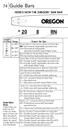 74 Guide Bars HERE S HOW THE OREGON SAW BAR * 20 8 RN Length in Inches 12" 14" 18" 20" 36" (Etc.) Gauge 0=.050" 8=.058" 3=.063" 4=.043" GUARD MATE HOLES These holes are built into the noses of certain
LEVEL 2 CERTIFICATE OF COMPETENCE IN BRUSHCUTTING OPERATIONS ASSESSMENT SCHEDULE
 NPTC Registered Charity No. 1096429 STONELEIGH PARK, WARWICKSHIRE CV8 LG Tel: 024 7685 7300 Fax: 024 7669 6128 Email: [email protected] LEVEL 2 CERTIFICATE OF COMPETENCE IN BRUSHCUTTING OPERATIONS
Requirements for the Attachment of Communication Cable Facilities on PPL Poles
 Page 99 of 137 Requirements for the Attachment of Communication Cable Facilities on Replaces: URS-3002 URS-3004 URS-101C-304 A-157649 Page 100 of 137 Reference Notes for Drawings: General 1. The term communication
working surface can be a potential fall hazard.
 OSHA s Focus Four Mitigating Jobsite Hazards By Pete Rice, CSP, CIH, REHS Construction is among the most dangerous industries in the country. In 2010, data from the Bureau of Labor Statistics (BLS) indicate
Preventing Slips, Trips, & Falls
 Preventing Slips, Trips, & Falls OSHA s Walking & Working Surfaces, & Fall Protection Standards Contents Introduction and Purpose General Injury Prevention Overview of Slips, Trips and Falls Types of Housekeeping
IMPORTANT SAFETY NOTICE
 IMPORTANT SAFETY NOTICE To: Our Valued Customers User safety is a major focus in the design of our products. Following the precautions outlined in this manual will minimize your risk of injury. ITT Goulds
General Safety. Always do a risk assessment.
 recipitous.co.uk Access Equipment Call 020 8684 6999 Scaffold Towers Ladders & Steps Podiums Rigging Tube & Fittings New & Used Sales Hire Repair Manufacture The Skymaster Ladder is a 3 section combination
The regulations that impact outdoor space, surfacing, fall zones, equipment, entrapments, hazards and supervision are:
 Small Group, Large Group and School Age Child Care Licensing POLICY STATEMENT: Playground Safety 6.06 CMR 7.07(7); 7.07(16)(e); 7.07(13); 7.10(10) According to the U. S. Consumer Product Safety Commission
Replacement Window Installation Guide Non-Impact & Impact Resistant Windows without Nailing Fin
 Replacement Window Installation Guide Non-Impact & Impact Resistant Windows without Nailing Fin americancraftsmanwindows.com Project Requirements: Failure to follow these instructions may void product
Conducting a Job Hazard Assessment. Environmental, Health and Safety 275-3241
 Conducting a Job Hazard Assessment Environmental, Health and Safety 275-3241 EH&S Programs: Fire Safety Blood Borne Pathogens Hazard Communication Personal Protective Equipment Emergency Preparedness General
Label Placement Guide P/N 7300-286
 Label Placement Guide RECOMMENDED PLACEMENT ON TAYLOR MACHINES S PLACEMENT OF LABELS 3377-010, 3377--019, AND 3377--020 ON THE EXTERIOR OF MACHINE... EXAMPLE A AND EXAMPLE B. S PLACE LABEL NO. 3377-010
IMPORTANT SAFETY RULES TO FOLLOW
 WARNING FLOOR & CARPET CLEANER Any piece of equipment can be dangerous if not operated properly. YOU are responsible for the safe operation of this equipment. The operator must carefully read and follow
Auxiliary Rams USERS MANUAL
 Auxiliary Rams 2007 Chief Automotive Technologies, Inc. Chief s Limited One-Year Warranty & Liability CHIEF'S LIMITED ONE-YEAR WARRANTY & LIABILITY Chief Automotive Technologies, Inc. warrants for one
Simple Machines. What are simple machines?
 Definitions to know: Simple Machines Work done when an applied force causes an object to move in the direction of the force Energy ability to cause change; can change the speed, direction, shape, or temperature
Walking and Working Surface Checklist:
 Walking and Working Surfaces Purpose: This information is presented to improve the level of safety in our operations, and to inform you that we will comply with the OSHA Standard 29 CFR 1910.23. Responsibility:
EXERCISE DESCRIPTIONS PHASE I Routine #1
 EXERCISE DESCRIPTIONS PHASE I Routine #1 Hip Mobility Exercise: Forward Out-In Movement: Raise leg out to the side, and rotate around to the front. Keep shin/thigh angle at 90 degrees. Exercise: Backward
TREE CUTTING & TRIMMING INFORMATION As of 8-20-2009
 TREE CUTTING & TRIMMING INFORMATION As of 8-20-2009 Many people are unaware that Electric Utilities have the legal right and authority to maintain its electrical transmission and distribution facilities
[Project name] Standard Operating Procedures. Body Mechanics
![[Project name] Standard Operating Procedures. Body Mechanics](/thumbs/27/11986346.jpg "[Project name] Standard Operating Procedures. Body Mechanics") [Project name] Standard Operating Procedures Body Mechanics PURPOSE. The purpose of this SOP is to provide information to minimize staff injuries with the focus on back injuries resulting from improper
[Project name] Standard Operating Procedures Body Mechanics PURPOSE. The purpose of this SOP is to provide information to minimize staff injuries with the focus on back injuries resulting from improper
OSHA 1910.66 Remove impacted systems and components. Inspect systems prior to use.
 Q: When do I remove my harness from service? A: ANSI (American National Standards Institute) A10.32-2004 states the service life of fall protection equipment manufactured of synthetic fiber shall be 5
CIRCULAR SAW SAFETY Reviewed 9/24/2007
 1. General Safety Rules CIRCULAR SAW SAFETY Reviewed 9/24/2007 DANGER -- Keep hands away from cutting area behind the saw blade since kickback could cause the saw to jump backwards over your hand. Keep
Electrical Safety in the Workplace
 Electrical Safety in the Workplace NFPA 70 E Presented by Sabine Mueller What Made Sabine Choose Such a DRY Topic? Ulterior Motive Metso Mueller Engineering has been visiting many scrap yards two or more