
An Elastic Cable Model for Cable-Driven Parallel Robots Including Hysteresis Effects
|
|
|
- Lisa Robertson
- 10 years ago
- Views:
Transcription
1 An Elastic Cable Model for Cable-Driven Parallel Robots Including Hysteresis Effects Philipp Miermeister, Werner Kraus, Tian Lan and Andreas Pott Abstract Experimental results indicate that time invariant linear elastic models for cable-driven parallel robots show a significant error in the force prediction during operation. This paper proposes the use of an extended model for polymer cables which allows to regard the hysteresis effects depending on the excitation amplitude, frequency, and initial tension level. The experimental design as well as the parameter identification are regarded. 1 Introduction A cable-driven parallel robot, in the following simply called cable robot, is a parallel kinematic machine mainly consisting of a platform, cables, and winches as shown in Fig. 1. The cables connect the platform to the winches which in turn control the platform pose by changing the cable length. The control inputs for the winches usually are computed using a simplified kinematic robot model which regards the platform and frame geometry under the assumption that the attachment points at the platform and the contact points at the winch are time invariant. Methods for design and workspace computation of such systems can be found in [3, 4, 10, 12]. Extended kinematic models also include the pulley geometry at the winches and result in higher positioning accuracy [9]. The cable robot IPAnema at Fraunhofer IPA uses Dyneema cables instead of conventional steel cables which brings the advantage of the lower weight but at the same time introduces a more complex elastic behavior in the most relevant force transition element of the cable robot. It showed that the Dyneema polyethylene cables have a changing elastic behavior over time, are subject to settling effects, are sensitive to overload, and show hysteresis effects. Since it is very difficult to build the models and identifying the related parameters using models from different fields such as tribology, viscoelasticity, and multibody systems, here we propose a black box approach to model the drive chain. While white box modeling demands a P. Miermeister (B) W. Kraus T. Lan A. Pott Fraunhofer IPA, Stuttgart, Germany [email protected] Springer International Publishing Switzerland 2015 A. Pott and T. Bruckmann (eds.), Cable-Driven Parallel Robots, Mechanisms and Machine Science 32, DOI / _2 17

2 18 P. Miermeister et al. Fig. 1 Overconstrained cable-driven parallel robot very good knowledge of the inner relations of a system, black box modeling tries to identify the system behavior by observing the input output behavior of a system. In the fist part of the paper the modeling of the cables is shown. The second part deals with the parameter identification, while the third part shows the evaluation of the model for different input signals. 2 Robot and Cable Elasticity Model The minimal robot model usually running in a numerical control to operate a robot is based on a solely geometrical model as shown in Fig. 2 including the m platform and winch attachment points b i and a i with i = 1...m, respectively. The cables can be modeled in different ways depending on the demanded degree of accuracy. The most simple model is just the geometrical model without elastic behavior, meaning that the inverse kinematic equation

3 An Elastic Cable Model for Cable-Driven Parallel Robots Fig. 2 Kinematic loop for one cable l i = a i (r + Rb i ) (1) can be used to compute the cable length l i = l i 2 from a given platform position r and rotation R. More complex models deal with pulleys by introducing time variant anchorage points and handle non negligible cable mass by utilizing catenary equations to model the cable sagging [5, 11]. Since the mass of the cables of the IPAnema robot is small in comparison to the applied tension level it is not necessary to regard the cable sagging in the model. For cable force control, admittance control, and parameter identification it is necessary to predict the cable force very accurately. The force and torque equilibrium of a cable robot is described by the structure equation [ ] f 1 [ ] u 1 u m. b 1 u 1 b m u fp m. + = 0 (2) τ p } {{ } f m } {{ } A T } {{ } w f where A T is the well known structure matrix [12], u i = l i l i 1 2 is a unit vector in direction of the cables, f is the vector of cable forces and w is the external wrench. Going from the kinematic model to a linear elastic model of type
![More complex models deal with pulleys by introducing time variant anchorage points and handle non negligible cable mass by utilizing catenary equations to model the cable sagging [5, 11].](/docs-images/43/15010200/images/page_3.jpg "Since the mass of the cables of the IPAnema robot is small in comparison to the applied tension level it is not necessary to regard the cable sagging in the model.")
4 20 P. Miermeister et al. f i = { fi = c i Δl i for Δl i > 0 0 forδl i < 0 (3) with Δl i = l SP,i l i where c i is the cable stiffness and l SP,i is the set point for the cable length while l i is the actual cable length in the workspace one can achieve a more accurate prediction. Modeling the cable forces in this way gives acceptable results for positive cable tensions, but leads to numerical problems in case of Δl i < 0 due to the discontinuity and the zero area. Comparing the linear elastic model with experimental data showed that cables also come along with a hysteresis behavior which depends on the actuation frequency, amplitude, tension level and amplitude as well as the current angle of the cables with regards to the redirection pulleys of the robot. Different models such as the Bouc Wen-Model, Bilinear Model, Bingham Model, or Polynomial model can be used to describe the hysteresis behavior [1, 2, 6]. A single tensioned cable of the robot can be seen as single degree of freedom system with an elastic plastic behavior whose hysteresis by means of the cable elongation x can be described by two polynomial functions, one for the upper part and one for the lower part n P F U (x) = a i x i, ẋ > 0 (4) i=0 and n P F L (x) = ( 1) i+1 a i x i, ẋ < 0, (5) i=0 respectively. Under the assumption of displacement anti-symmetry one can compute the hysteresis function by combining Eqs. (4) and (5) to with the polynomials F(x, ẋ) = g(x) + h(x)sgn(ẋ) (6) g(x) = a 1 + a 3 x 3 + +a m x n g h(x) = a 0 + a 2 x 2 + +a n x n h (7) where n g is an odd number and n h = n g 1. The degree of the polynomials can be chosen according to the expected accuracy. The sum of the polynomials g(x) and h(x) can be interpreted as the superposition of an anhysteretic nonlinear elastic part and hysteretic nonlinear damping part as shown in Fig. 3. The expression in Eq. (6) allows to describe the hysteresis for a certain amplitude A independent of the current velocity state. Experiments showed that the hysteretic behavior of the cable is different comparing very small an very large amplitudes. Extending the model in order to deal with variable amplitudes and replacing the solely polynomial description by a velocity depended damping expression one can write

5 An Elastic Cable Model for Cable-Driven Parallel Robots Fig. 3 Decomposition of a hysteresis curve into its anhysteretic nonlinear elastic part and its nonlinear damping part F = K 0 + K 1 (A)x + K 2 (A)x 2 + K 3 (A)x 3 + S a v α(a) sgn(v) A(Aω) α(a) lπ (8) where the first amplitude dependent polynomial part, now describes the nonlinear non hysteretic spring behavior and the second part of the equation deals with the velocity depended hysteretic damping forces. The hysteretic part is parameterized by the area of the hysteresis S a and the viscoelastic damping factor α. In case of α = 0 the second part of Eq. (8) gets independent of the velocity representing dry friction behavior. The energy dissipation in one cycle for a given friction behavior is l = T/2 0 sin (ωt) α(a)+1 dωt T/2 0 sin (ωt) 2 dωt = 2π T/2 0 sin (ωt) α(a)+1 dωt (9) where T is the time of oscillation and ω is the angular frequency (Fig. 3). 3 Design of Experiments and Parameter Identification Considering Eq. (8) for a given amplitude level, one has a five dimensional parameter space where the first parameter K 0 determines the pretensioned cable state with A = 0 and v = 0 reducing the identification problem to four dimensions p M = [ K 1 K 2 K 3 S a ] T. (10)

6 22 P. Miermeister et al. Table 1 Parameter sensitivity K 1 K 2 K 3 S a Sensitivity The amplitude model is considered separately. While the parameter identification problem for p M has to deal with the problem of finding the inverse mapping function from four to one dimensions p M = fm 1 (r M), the identification of p M,i = f A,i (A) is just a one dimensional problem. For an efficient measurement and identification process it is important to have a good selection of model parameters and measurement samples. A good selection of model parameters means a high sensitivity with regards to the objective function and a good selection of samples means maximized information gain with a minimal number of samples. To obtain the optimal number of parameters necessary for the model identification, the sensitivity of the parameters is computed by S = O ( ) 2 O 1 I2 I 1 1. (11) Ō 12 Ī 12 This sensitivity metric gives the relative normalized change of the output O with regards to the input I using the averages Ō and Ī. Parameters with a low sensitivity do not have to be regarded in the model. As can be seen in Table 1, elements with an order higher than three can be neglected in the model. The influence of the parameters K 1 and S a are visualized in Figs. 4 and 5. The selection of measurement samples was done according to a D-optimal design of experiments giving a set of tuples (p M,i, r M,i ), i = 1...n D where n D is the number of measurements and r M,i is the ith error function for the parameter identification problem given by r i (p) = F(p, x i ) F M,i (12) Fig. 4 Parameter sensitivity of K 1

7 An Elastic Cable Model for Cable-Driven Parallel Robots Fig. 5 Parameter sensitivity of S a Assuming only small deviations Δp it is possible to use linearization around p 0 which gives the Jacobian J rp. From that the optimum parameter set can be found by minimizing the least squared error using the objective function p opt = min ( 1 2 n D i=0 ) ( ) 2 F(p, xi ) F M,i. (13) Using the linearization one can compute the minimal solution for Eq. (13) by solving the well known normal equation Jrp T J rpδp = Jrp T Δr. (14) In case that the error of the model is small, a local optimization scheme such as the Levenberg Marquardt algorithm can be used to find the optimal parameter set. Having a good initial guess p 0 is essential for a successful parameter identification. It showed that local optimization is a good choice for long term parameter tracking or repeated adjustment after certain time periods, but did not work well for the very first identification process. Nonlinearities and the huge initial errors demanded for more global optimization techniques such as simulated annealing or genetic optimization procedures which can be used to identify the global optimum. 4 Experimental Results For measurement, the platform is fixed at the origin such that no interaction between the cables can occur. The excitation function for the cable elongation and it s associated velocity is chosen as

8 24 P. Miermeister et al. Table 2 Parameter sensitivity K 1 K 2 K 3 S a Sensitivity Δl = A cos(ωt) (15) Δ l = v = Aω sin(ωt) For this excitation function the damping force can be calculated as where c is damping function F h = c Aω sin(ωt) α sgn(sin(ωt)) (16) T/2 c = S a 2A(Aω) α sin (ωt) α+1 dωt. (17) 0 with S a describing the area of the hysteresis function. The cables were actuated with an amplitude ranging from 0.1 mm up to 1.5 mm. The pretension level was chosen at 60 N. Running the test was done by generating the cable length set points according to the experimental design using Matlab. The length for each cable in the joint space was commanded by a TwinCat3 controller connected to industrial synchronous servo motors. Force sensors between the cables and the platform were used to measure the cable forces. The force data together with the actual cable lengths were stored in a csv file by TwinCAT and used for model identification in Matlab. Using the actual cable lengths instead of the commanded cable lengths is important to reduce errors introduced by system dead time and controller delay. The results of the parameter identification process can be found in Table 2. The comparison of measurements and simulation results after the identification process gave an average model error of 0.4 N for a static pose. Checking the model prediction after a few days of operation, the model and the real system already started to diverge as can be seen in Fig. 6 where the cable force already shows an offset of 0.4 N to the previously created model. This may be caused by temperature changes, cable settlement and high tension states resulting in lasting changes in the cable s elastic behavior. Using the model for a sinusoidal excitation, a randomly shaped signal can be approximated by a Fourier decomposition. A trapezoidal and a triangular signal where used as test signals to verify the model for different shaped inputs. The Fourier decomposition of the triangular function for example is given by f (t) = 8A π 2 (sin(ωt) sin(3ωt) + 1 (sin(5ωt)) ). (18) 52 The comparison of the curve progression of the Fourier based force model and the actual measurements are shown in Fig. 7 for an approximation with the first three

9 An Elastic Cable Model for Cable-Driven Parallel Robots Fig. 6 Comparison of hysteresis model and measurements after approximately for days of operation Fig. 7 Triangular test signal with Fourier approximation Fourier coefficients. The related error shown in Fig. 8 has a maximum magnitude of ±1.5 N at the peak points. The model prediction is based on the whole set of measurement samples which provides knowledge about the past and future of the signal at a certain time stamp. Using the model in a real scenario one has to use

10 26 P. Miermeister et al. Fig. 8 Hysteresis function and error for a triangular test signal Fig. 9 Pulley assembly of the cable-robot demonstrator. a Pulley for cable redirection. b Cable and bearing forces a continuous-time Foruier transformation to deal with the unknown future of the signal, or the numerical control has to feed forward the positioning set points of the cables. While the prediction for a small area around the initial pose was accurate, experimental results showed that the model error increased depending on the platform pose in the workspace. This is is caused by the elasticity of the pulley mounting and the damping behavior of the pulley bearings. To get better model prediction for the whole workspace, these influences have to be regarded in the elasticity model of the power trains. Introducing the angle α to measure the wrapping length of the cable as shown in Fig. 9b, its influence on the stiffness of a single powertrain is experimentally determined as can be seen in Fig. 10. The influence of angle α on the hysteresis behavior is shown in Fig. 11.

11 An Elastic Cable Model for Cable-Driven Parallel Robots Fig. 10 Hysteresis and stiffness behavior in relation to the pulley angle α Fig. 11 Damping behavior in relation to the pulley α The effect may be caused by the increased wrapping angle and the direction of the changing force vector as shown in Fig. 9b, increasing the reaction and friction force at the pulley bearing according to F i = f 2 cos(α i + 1). (19) The angle of attack also influences the torque applied to the bearing on the frame and therefore influences the observed elasticity in the cables.

12 28 P. Miermeister et al. 5 Conclusion and Outlook In this paper an improved cable model was presented which allows to regard the hysteresis effect during force computation. The approach can be used to improve force algorithms and the identification of geometrical robot parameters in an auto calibration procedure which relies on the force sensors for data acquisition. The simplicity of the model allows to compute the force values in a deterministic time slot, meeting the demand of real-time algorithms. While the model gives significantly better results than the linear elastic model it showed that the cable behavior not only depends on local parameters such as the amplitude, but also on more global and time variant parameters such as the platform pose. Beside that, the actual robot and the model tend to diverge over time depending on the operating load and environmental conditions. Further experiments will be executed to evaluate the long term parameter stability of the robot parameters depending on operational time. It also would be interesting to investigate the influence of overload on the cables alone and in interaction with the surrounding support structure. References 1. Badrakhan F (1987) Rational study of hysteretic systems under stationary random excitation. Non-Linear Mech 22(4): Bouc R (1971) Modle mathmatique dhystrsis. Acustica 24: Gouttefarde M, Merlet JP, Daney D (2007) Wrench-feasible workspace of parallel cable-driven mechanisms. In: IEEE international conference on robotics and automation, Roma, Italy, pp Hiller M, Fang S, Mielczarek S, Verhoeven R, Franitza D (2005) Design, analysis and realization of tendon-based parallel manipulators. Mech Mach Theory 40(4): Irvine M (1981) Cable structures. MIT Press, Cambridge 6. Ismail M, Ikhouane F, Rodellar J (2009) The hysteresis Bouc Wen model, a survey. Arch Comput Methods Eng 16(2): Kossowski C, Notash L (2002) CAT4 (Cable actuated truss 4 Degrees of Freedom): a novel 4 DOF cable actuated parallel manipulator. J Rob Syst 19: Merlet J-P, Daney D (2007) A new design for wire-driven parallel robot. In: 2nd international congress, design and modelling of mechanical systems, Pott A (2012) Influence of pulley kinematics on cable-driven parallel robots. In: Advances in robot kinematics, Austria, pp Pott A, Bruckmann T, Mikelsons L (2009) Closed-form force distribution for parallel wire robots. In: Computational kinematics. Springer-Verlag, Duisburg, Germany, pp Thai H, Kim S (2011) Nonlinear static and dynamic analysis of cable structures. Finite Elem Anal Des 47(3): Verhoeven R (2004) Analysis of the workspace of tendon-based Stewart platforms. PhD thesis, University of Duisburg-Essen, Duisburg

13

A Novel Design to Improve Pose Accuracy for Cable Robots
 The 14th IFToMM World Congress, Taipei, Taiwan, October 25-30, 2015 DOI Number: 10.6567/IFToMM.14TH.WC.OS2.018 A Novel Design to Improve Pose Accuracy for Cable Robots A. Gonzalez-Rodríguez Univ. Castilla-La
Manufacturing Equipment Modeling
 QUESTION 1 For a linear axis actuated by an electric motor complete the following: a. Derive a differential equation for the linear axis velocity assuming viscous friction acts on the DC motor shaft, leadscrew,
CALIBRATION OF A ROBUST 2 DOF PATH MONITORING TOOL FOR INDUSTRIAL ROBOTS AND MACHINE TOOLS BASED ON PARALLEL KINEMATICS
 CALIBRATION OF A ROBUST 2 DOF PATH MONITORING TOOL FOR INDUSTRIAL ROBOTS AND MACHINE TOOLS BASED ON PARALLEL KINEMATICS E. Batzies 1, M. Kreutzer 1, D. Leucht 2, V. Welker 2, O. Zirn 1 1 Mechatronics Research
Active Vibration Isolation of an Unbalanced Machine Spindle
 UCRL-CONF-206108 Active Vibration Isolation of an Unbalanced Machine Spindle D. J. Hopkins, P. Geraghty August 18, 2004 American Society of Precision Engineering Annual Conference Orlando, FL, United States
A PAIR OF MEASURES OF ROTATIONAL ERROR FOR AXISYMMETRIC ROBOT END-EFFECTORS
 A PAIR OF MEASURES OF ROTATIONAL ERROR FOR AXISYMMETRIC ROBOT END-EFFECTORS Sébastien Briot, Ilian A. Bonev Department of Automated Manufacturing Engineering École de technologie supérieure (ÉTS), Montreal,
Precise Modelling of a Gantry Crane System Including Friction, 3D Angular Swing and Hoisting Cable Flexibility
 Precise Modelling of a Gantry Crane System Including Friction, 3D Angular Swing and Hoisting Cable Flexibility Renuka V. S. & Abraham T Mathew Electrical Engineering Department, NIT Calicut E-mail : [email protected],
Force/position control of a robotic system for transcranial magnetic stimulation
 Force/position control of a robotic system for transcranial magnetic stimulation W.N. Wan Zakaria School of Mechanical and System Engineering Newcastle University Abstract To develop a force control scheme
Modeling Mechanical Systems
 chp3 1 Modeling Mechanical Systems Dr. Nhut Ho ME584 chp3 2 Agenda Idealized Modeling Elements Modeling Method and Examples Lagrange s Equation Case study: Feasibility Study of a Mobile Robot Design Matlab
High Accuracy Articulated Robots with CNC Control Systems
 Copyright 2012 SAE International 2013-01-2292 High Accuracy Articulated Robots with CNC Control Systems Bradley Saund, Russell DeVlieg Electroimpact Inc. ABSTRACT A robotic arm manipulator is often an
Rotation: Moment of Inertia and Torque
 Rotation: Moment of Inertia and Torque Every time we push a door open or tighten a bolt using a wrench, we apply a force that results in a rotational motion about a fixed axis. Through experience we learn
Reaction Torque Sensor
 Force 1 1 N m up to 1 000 1 000 N m Type 9329A 9389A These easy to install piezoelectric reaction torque sensors are particularly suitable for measuring rapidly changing torques at non-rotating shafts.
The simulation of machine tools can be divided into two stages. In the first stage the mechanical behavior of a machine tool is simulated with FEM
 1 The simulation of machine tools can be divided into two stages. In the first stage the mechanical behavior of a machine tool is simulated with FEM tools. The approach to this simulation is different
Introduction to Engineering System Dynamics
 CHAPTER 0 Introduction to Engineering System Dynamics 0.1 INTRODUCTION The objective of an engineering analysis of a dynamic system is prediction of its behaviour or performance. Real dynamic systems are
Motion Control of 3 Degree-of-Freedom Direct-Drive Robot. Rutchanee Gullayanon
 Motion Control of 3 Degree-of-Freedom Direct-Drive Robot A Thesis Presented to The Academic Faculty by Rutchanee Gullayanon In Partial Fulfillment of the Requirements for the Degree Master of Engineering
How To Program A Laser Cutting Robot
 Robotics ABB Robotics Laser Cutting Software High precision laser cutting made easy - Greater manufacturing flexibility at lower capital investment Robotic laser cutting Overview Allows for the increased
POTENTIAL OF STATE-FEEDBACK CONTROL FOR MACHINE TOOLS DRIVES
 POTENTIAL OF STATE-FEEDBACK CONTROL FOR MACHINE TOOLS DRIVES L. Novotny 1, P. Strakos 1, J. Vesely 1, A. Dietmair 2 1 Research Center of Manufacturing Technology, CTU in Prague, Czech Republic 2 SW, Universität
Constraint satisfaction and global optimization in robotics
 Constraint satisfaction and global optimization in robotics Arnold Neumaier Universität Wien and Jean-Pierre Merlet INRIA Sophia Antipolis 1 The design, validation, and use of robots poses a number of
Spring Simple Harmonic Oscillator. Spring constant. Potential Energy stored in a Spring. Understanding oscillations. Understanding oscillations
 Spring Simple Harmonic Oscillator Simple Harmonic Oscillations and Resonance We have an object attached to a spring. The object is on a horizontal frictionless surface. We move the object so the spring
Time Domain and Frequency Domain Techniques For Multi Shaker Time Waveform Replication
 Time Domain and Frequency Domain Techniques For Multi Shaker Time Waveform Replication Thomas Reilly Data Physics Corporation 1741 Technology Drive, Suite 260 San Jose, CA 95110 (408) 216-8440 This paper
EDUMECH Mechatronic Instructional Systems. Ball on Beam System
 EDUMECH Mechatronic Instructional Systems Ball on Beam System Product of Shandor Motion Systems Written by Robert Hirsch Ph.D. 998-9 All Rights Reserved. 999 Shandor Motion Systems, Ball on Beam Instructional
Available online at www.sciencedirect.com Available online at www.sciencedirect.com
 Available online at www.sciencedirect.com Available online at www.sciencedirect.com Procedia Procedia Engineering Engineering () 9 () 6 Procedia Engineering www.elsevier.com/locate/procedia International
Physics 9e/Cutnell. correlated to the. College Board AP Physics 1 Course Objectives
 Physics 9e/Cutnell correlated to the College Board AP Physics 1 Course Objectives Big Idea 1: Objects and systems have properties such as mass and charge. Systems may have internal structure. Enduring
Guideway Joint Surface Properties of Heavy Machine Tools Based on the Theory of Similarity
 Research Journal of Applied Sciences, Engineering and Technology 5(): 530-536, 03 ISSN: 040-7459; e-issn: 040-7467 Maxwell Scientific Organization, 03 Submitted: October, 0 Accepted: December 03, 0 Published:
INSTRUCTOR WORKBOOK Quanser Robotics Package for Education for MATLAB /Simulink Users
 INSTRUCTOR WORKBOOK for MATLAB /Simulink Users Developed by: Amir Haddadi, Ph.D., Quanser Peter Martin, M.A.SC., Quanser Quanser educational solutions are powered by: CAPTIVATE. MOTIVATE. GRADUATE. PREFACE
Lecture 2 Linear functions and examples
 EE263 Autumn 2007-08 Stephen Boyd Lecture 2 Linear functions and examples linear equations and functions engineering examples interpretations 2 1 Linear equations consider system of linear equations y
Real Time Simulation for Off-Road Vehicle Analysis. Dr. Pasi Korkealaakso Mevea Ltd., May 2015
 Real Time Simulation for Off-Road Vehicle Analysis Dr. Pasi Korkealaakso Mevea Ltd., May 2015 Contents Introduction Virtual machine model Machine interaction with environment and realistic environment
The elements used in commercial codes can be classified in two basic categories:
 CHAPTER 3 Truss Element 3.1 Introduction The single most important concept in understanding FEA, is the basic understanding of various finite elements that we employ in an analysis. Elements are used for
General model of a structure-borne sound source and its application to shock vibration
 General model of a structure-borne sound source and its application to shock vibration Y. Bobrovnitskii and T. Tomilina Mechanical Engineering Research Institute, 4, M. Kharitonievky Str., 101990 Moscow,
Enhancing the SNR of the Fiber Optic Rotation Sensor using the LMS Algorithm
 1 Enhancing the SNR of the Fiber Optic Rotation Sensor using the LMS Algorithm Hani Mehrpouyan, Student Member, IEEE, Department of Electrical and Computer Engineering Queen s University, Kingston, Ontario,
The Basics of FEA Procedure
 CHAPTER 2 The Basics of FEA Procedure 2.1 Introduction This chapter discusses the spring element, especially for the purpose of introducing various concepts involved in use of the FEA technique. A spring
Midterm Solutions. mvr = ω f (I wheel + I bullet ) = ω f 2 MR2 + mr 2 ) ω f = v R. 1 + M 2m
 Midterm Solutions I) A bullet of mass m moving at horizontal velocity v strikes and sticks to the rim of a wheel a solid disc) of mass M, radius R, anchored at its center but free to rotate i) Which of
CAD-BASED DESIGN PROCESS FOR FATIGUE ANALYSIS, RELIABILITY- ANALYSIS, AND DESIGN OPTIMIZATION
 CAD-BASED DESIGN PROCESS FOR FATIGUE ANALYSIS, RELIABILITY- ANALYSIS, AND DESIGN OPTIMIZATION K.K. Choi, V. Ogarevic, J. Tang, and Y.H. Park Center for Computer-Aided Design College of Engineering The
Simulation of Trajectories and Comparison of Joint Variables for Robotic Manipulator Using Multibody Dynamics (MBD)
 Simulation of Trajectories and Comparison of Joint Variables for Robotic Manipulator Using Multibody Dynamics (MBD) Jatin Dave Assistant Professor Nirma University Mechanical Engineering Department, Institute
Simulation in design of high performance machine tools
 P. Wagner, Gebr. HELLER Maschinenfabrik GmbH 1. Introduktion Machine tools have been constructed and used for industrial applications for more than 100 years. Today, almost 100 large-sized companies and
A Nate on Dynamics and Kinematics*
 A Nate on Dynamics and Kinematics* Geoffrey P. Bingham At the Fourth International Conference on Event Perception and Action in Trieste this past summer. Karl Newell. Bruce Kay. and I had a brief discussion
Encoders for Linear Motors in the Electronics Industry
 Technical Information Encoders for Linear Motors in the Electronics Industry The semiconductor industry and automation technology increasingly require more precise and faster machines in order to satisfy
SOLID MECHANICS TUTORIAL MECHANISMS KINEMATICS - VELOCITY AND ACCELERATION DIAGRAMS
 SOLID MECHANICS TUTORIAL MECHANISMS KINEMATICS - VELOCITY AND ACCELERATION DIAGRAMS This work covers elements of the syllabus for the Engineering Council exams C105 Mechanical and Structural Engineering
Dynamics. Basilio Bona. DAUIN-Politecnico di Torino. Basilio Bona (DAUIN-Politecnico di Torino) Dynamics 2009 1 / 30
 Dynamics Basilio Bona DAUIN-Politecnico di Torino 2009 Basilio Bona (DAUIN-Politecnico di Torino) Dynamics 2009 1 / 30 Dynamics - Introduction In order to determine the dynamics of a manipulator, it is
Chapter 3 Non-parametric Models for Magneto-Rheological Dampers
 Chapter 3 Non-parametric Models for Magneto-Rheological Dampers The primary purpose of this chapter is to present an approach for developing nonparametric models for magneto-rheological (MR) dampers. Upon
Controller Design in Frequency Domain
 ECSE 4440 Control System Engineering Fall 2001 Project 3 Controller Design in Frequency Domain TA 1. Abstract 2. Introduction 3. Controller design in Frequency domain 4. Experiment 5. Colclusion 1. Abstract
Simple Harmonic Motion
 Simple Harmonic Motion 1 Object To determine the period of motion of objects that are executing simple harmonic motion and to check the theoretical prediction of such periods. 2 Apparatus Assorted weights
ACTUATOR DESIGN FOR ARC WELDING ROBOT
 ACTUATOR DESIGN FOR ARC WELDING ROBOT 1 Anurag Verma, 2 M. M. Gor* 1 G.H Patel College of Engineering & Technology, V.V.Nagar-388120, Gujarat, India 2 Parul Institute of Engineering & Technology, Limda-391760,
Design-Simulation-Optimization Package for a Generic 6-DOF Manipulator with a Spherical Wrist
 Design-Simulation-Optimization Package for a Generic 6-DOF Manipulator with a Spherical Wrist MHER GRIGORIAN, TAREK SOBH Department of Computer Science and Engineering, U. of Bridgeport, USA ABSTRACT Robot
Unit - 6 Vibrations of Two Degree of Freedom Systems
 Unit - 6 Vibrations of Two Degree of Freedom Systems Dr. T. Jagadish. Professor for Post Graduation, Department of Mechanical Engineering, Bangalore Institute of Technology, Bangalore Introduction A two
Vibrations can have an adverse effect on the accuracy of the end effector of a
 EGR 315 Design Project - 1 - Executive Summary Vibrations can have an adverse effect on the accuracy of the end effector of a multiple-link robot. The ability of the machine to move to precise points scattered
1 Introduction. Alberto Trevisani
 Experimental Validation of a Trajectory Planning Approach Avoiding Cable Slackness and Excessive Tension in Underconstrained Translational Planar Cable-Driven Robots Alberto Trevisani Abstract The objective
Course in. Nonlinear FEM
 Course in Introduction Outline Lecture 1 Introduction Lecture 2 Geometric nonlinearity Lecture 3 Material nonlinearity Lecture 4 Material nonlinearity continued Lecture 5 Geometric nonlinearity revisited
Nonlinear normal modes of three degree of freedom mechanical oscillator
 Mechanics and Mechanical Engineering Vol. 15, No. 2 (2011) 117 124 c Technical University of Lodz Nonlinear normal modes of three degree of freedom mechanical oscillator Marian Perlikowski Department of
Topology optimization based on graph theory of crash loaded flight passenger seats
 7. LS-DYNA Anwenderforum, Bamberg 2008 Optimierung III Topology optimization based on graph theory of crash loaded flight passenger seats Axel Schumacher, Christian Olschinka, Bastian Hoffmann Hamburg
Code_Aster. A finite element of cable-pulley
 Titre : Un élément fini de câble-poulie Date : 09/12/2013 Page : 1/14 A finite element of cable-pulley Summarized : The pulleys play an important role in structures of cables such as the air electric lines.
Introduction to the Finite Element Method (FEM)
 Introduction to the Finite Element Method (FEM) ecture First and Second Order One Dimensional Shape Functions Dr. J. Dean Discretisation Consider the temperature distribution along the one-dimensional
ASEN 3112 - Structures. MDOF Dynamic Systems. ASEN 3112 Lecture 1 Slide 1
 19 MDOF Dynamic Systems ASEN 3112 Lecture 1 Slide 1 A Two-DOF Mass-Spring-Dashpot Dynamic System Consider the lumped-parameter, mass-spring-dashpot dynamic system shown in the Figure. It has two point
Finite Element Method (ENGC 6321) Syllabus. Second Semester 2013-2014
 Finite Element Method Finite Element Method (ENGC 6321) Syllabus Second Semester 2013-2014 Objectives Understand the basic theory of the FEM Know the behaviour and usage of each type of elements covered
STUDY OF DAM-RESERVOIR DYNAMIC INTERACTION USING VIBRATION TESTS ON A PHYSICAL MODEL
 STUDY OF DAM-RESERVOIR DYNAMIC INTERACTION USING VIBRATION TESTS ON A PHYSICAL MODEL Paulo Mendes, Instituto Superior de Engenharia de Lisboa, Portugal Sérgio Oliveira, Laboratório Nacional de Engenharia
Nonlinear analysis and form-finding in GSA Training Course
 Nonlinear analysis and form-finding in GSA Training Course Non-linear analysis and form-finding in GSA 1 of 47 Oasys Ltd Non-linear analysis and form-finding in GSA 2 of 47 Using the GSA GsRelax Solver
Series 6000 Torque measured metal bellow coupling
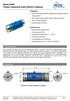 Properties Free of float metal bellow coupling with integrated torque measurement Non-contact measurement system, high robustness High torsional stiffness Limited torque of inertia Performance Measurement
5-Axis Test-Piece Influence of Machining Position
 5-Axis Test-Piece Influence of Machining Position Michael Gebhardt, Wolfgang Knapp, Konrad Wegener Institute of Machine Tools and Manufacturing (IWF), Swiss Federal Institute of Technology (ETH), Zurich,
Chapter 15, example problems:
 Chapter, example problems: (.0) Ultrasound imaging. (Frequenc > 0,000 Hz) v = 00 m/s. λ 00 m/s /.0 mm =.0 0 6 Hz. (Smaller wave length implies larger frequenc, since their product,
DCMS DC MOTOR SYSTEM User Manual
 DCMS DC MOTOR SYSTEM User Manual release 1.3 March 3, 2011 Disclaimer The developers of the DC Motor System (hardware and software) have used their best efforts in the development. The developers make
Transient analysis of integrated solar/diesel hybrid power system using MATLAB Simulink
 Transient analysis of integrated solar/diesel hybrid power system using ATLAB Simulink Takyin Taky Chan School of Electrical Engineering Victoria University PO Box 14428 C, elbourne 81, Australia. [email protected]
Design of a Universal Robot End-effector for Straight-line Pick-up Motion
 Session Design of a Universal Robot End-effector for Straight-line Pick-up Motion Gene Y. Liao Gregory J. Koshurba Wayne State University Abstract This paper describes a capstone design project in developing
Understanding Poles and Zeros
 MASSACHUSETTS INSTITUTE OF TECHNOLOGY DEPARTMENT OF MECHANICAL ENGINEERING 2.14 Analysis and Design of Feedback Control Systems Understanding Poles and Zeros 1 System Poles and Zeros The transfer function
Time domain modeling
 Time domain modeling Equationof motion of a WEC Frequency domain: Ok if all effects/forces are linear M+ A ω X && % ω = F% ω K + K X% ω B ω + B X% & ω ( ) H PTO PTO + others Time domain: Must be linear
P4 Stress and Strain Dr. A.B. Zavatsky MT07 Lecture 3 Statically Indeterminate Structures
 4 Stress and Strain Dr... Zavatsky MT07 ecture 3 Statically Indeterminate Structures Statically determinate structures. Statically indeterminate structures (equations of equilibrium, compatibility, and
2. Permanent Magnet (De-) Magnetization 2.1 Methodology
 Permanent Magnet (De-) Magnetization and Soft Iron Hysteresis Effects: A comparison of FE analysis techniques A.M. Michaelides, J. Simkin, P. Kirby and C.P. Riley Cobham Technical Services Vector Fields
Numerical simulation of the utility glass press-andblow
 Numerical simulation of the utility glass press-andblow process Introduction STEKLÝ, J., MATOUŠEK, I. Glass melt press-and-blow process is a typical two stage technology allowing automatized production
dspace DSP DS-1104 based State Observer Design for Position Control of DC Servo Motor
 dspace DSP DS-1104 based State Observer Design for Position Control of DC Servo Motor Jaswandi Sawant, Divyesh Ginoya Department of Instrumentation and control, College of Engineering, Pune. ABSTRACT This
Mathematical Modeling and Dynamic Simulation of a Class of Drive Systems with Permanent Magnet Synchronous Motors
 Applied and Computational Mechanics 3 (2009) 331 338 Mathematical Modeling and Dynamic Simulation of a Class of Drive Systems with Permanent Magnet Synchronous Motors M. Mikhov a, a Faculty of Automatics,
Practice Exam Three Solutions
 MASSACHUSETTS INSTITUTE OF TECHNOLOGY Department of Physics Physics 8.01T Fall Term 2004 Practice Exam Three Solutions Problem 1a) (5 points) Collisions and Center of Mass Reference Frame In the lab frame,
Harmonic oscillations of spiral springs Springs linked in parallel and in series
 .3.26 Related topics Spring constant, Hooke s Law, oscillations, limit of elasticity, parallel springs, serial springs, use of an interface. Principle and task The spring constant D is determined for different
Methods for Vibration Analysis
 . 17 Methods for Vibration Analysis 17 1 Chapter 17: METHODS FOR VIBRATION ANALYSIS 17 2 17.1 PROBLEM CLASSIFICATION According to S. H. Krandall (1956), engineering problems can be classified into three
Electric Motors and Drives
 EML 2322L MAE Design and Manufacturing Laboratory Electric Motors and Drives To calculate the peak power and torque produced by an electric motor, you will need to know the following: Motor supply voltage,
DEVELOPMENT OF A GRIP AND THERMODYNAMICS SENSITIVE PROCEDURE FOR THE DETERMINATION OF TYRE/ROAD INTERACTION CURVES BASED ON OUTDOOR TEST SESSIONS
 DEVELOPMENT OF A GRIP AND THERMODYNAMICS SENSITIVE PROCEDURE FOR THE DETERMINATION OF TYRE/ROAD INTERACTION CURVES BASED ON OUTDOOR TEST SESSIONS Flavio Farroni, Aleksandr Sakhnevych, Francesco Timpone
F1 Fuel Tank Surging; Model Validation
 F1 Fuel Tank Surging; Model Validation Luca Bottazzi and Giorgio Rossetti Ferrari F1 team, Maranello, Italy SYNOPSIS A Formula One (F1) car can carry more than 80 kg of fuel in its tank. This has a big
ANALYTICAL METHODS FOR ENGINEERS
 UNIT 1: Unit code: QCF Level: 4 Credit value: 15 ANALYTICAL METHODS FOR ENGINEERS A/601/1401 OUTCOME - TRIGONOMETRIC METHODS TUTORIAL 1 SINUSOIDAL FUNCTION Be able to analyse and model engineering situations
Parameter identification of a linear single track vehicle model
 Parameter identification of a linear single track vehicle model Edouard Davin D&C 2011.004 Traineeship report Coach: dr. Ir. I.J.M. Besselink Supervisors: prof. dr. H. Nijmeijer Eindhoven University of
Intelligent Robotics Lab.
 1 Variable Stiffness Actuation based on Dual Actuators Connected in Series and Parallel Prof. Jae-Bok Song ([email protected] ). (http://robotics.korea.ac.kr) ti k Depart. of Mechanical Engineering, Korea
Simulation and Analysis of Parameter Identification Techniques for Induction Motor Drive
 International Journal of Electronic and Electrical Engineering. ISSN 0974-2174 Volume 7, Number 10 (2014), pp. 1027-1035 International Research Publication House http://www.irphouse.com Simulation and
SPINDLE ERROR MOVEMENTS MEASUREMENT ALGORITHM AND A NEW METHOD OF RESULTS ANALYSIS 1. INTRODUCTION
 Journal of Machine Engineering, Vol. 15, No.1, 2015 machine tool accuracy, metrology, spindle error motions Krzysztof JEMIELNIAK 1* Jaroslaw CHRZANOWSKI 1 SPINDLE ERROR MOVEMENTS MEASUREMENT ALGORITHM
ME 115(b): Solution to Homework #1
 ME 115(b): Solution to Homework #1 Solution to Problem #1: To construct the hybrid Jacobian for a manipulator, you could either construct the body Jacobian, JST b, and then use the body-to-hybrid velocity
System Modeling and Control for Mechanical Engineers
 Session 1655 System Modeling and Control for Mechanical Engineers Hugh Jack, Associate Professor Padnos School of Engineering Grand Valley State University Grand Rapids, MI email: [email protected] Abstract
Mounting instructions. Acceleration Transducer B12. B 26.B12.10 en
 Mounting instructions Acceleration Transducer B12 B 26.B12.10 en B12 3 Contents Page Safety instructions.............................................. 4 1 Scope of supply..............................................
Precision Miniature Load Cell. Models 8431, 8432 with Overload Protection
 w Technical Product Information Precision Miniature Load Cell with Overload Protection 1. Introduction The load cells in the model 8431 and 8432 series are primarily designed for the measurement of force
Hollow Cylinder Apparatus (GDS SS-HCA)
 HCA:1 Options available for SS-HCA Axial Load/Torque 1kN/1Nm 1kN/2Nm 12kN/2Nm 15kN/4Nm Dynamic upgrade frequencies Hollow Cylinder Apparatus (GDS SS-HCA).5Hz 2Hz 1Hz 5Hz Sample Height/Outer Ø/Inner Ø 2/1/6mm
Comparison of the Response of a Simple Structure to Single Axis and Multiple Axis Random Vibration Inputs
 Comparison of the Response of a Simple Structure to Single Axis and Multiple Axis Random Vibration Inputs Dan Gregory Sandia National Laboratories Albuquerque NM 87185 (505) 844-9743 Fernando Bitsie Sandia
HYDRAULIC ARM MODELING VIA MATLAB SIMHYDRAULICS
 Engineering MECHANICS, Vol. 16, 2009, No. 4, p. 287 296 287 HYDRAULIC ARM MODELING VIA MATLAB SIMHYDRAULICS Stanislav Věchet, Jiří Krejsa* System modeling is a vital tool for cost reduction and design
Sensory-motor control scheme based on Kohonen Maps and AVITE model
 Sensory-motor control scheme based on Kohonen Maps and AVITE model Juan L. Pedreño-Molina, Antonio Guerrero-González, Oscar A. Florez-Giraldo, J. Molina-Vilaplana Technical University of Cartagena Department
Physics 231 Lecture 15
 Physics 31 ecture 15 Main points of today s lecture: Simple harmonic motion Mass and Spring Pendulum Circular motion T 1/f; f 1/ T; ω πf for mass and spring ω x Acos( ωt) v ωasin( ωt) x ax ω Acos( ωt)
Robot Task-Level Programming Language and Simulation
 Robot Task-Level Programming Language and Simulation M. Samaka Abstract This paper presents the development of a software application for Off-line robot task programming and simulation. Such application
New approaches in Eurocode 3 efficient global structural design
 New approaches in Eurocode 3 efficient global structural design Part 1: 3D model based analysis using general beam-column FEM Ferenc Papp* and József Szalai ** * Associate Professor, Department of Structural
Dimensional analysis is a method for reducing the number and complexity of experimental variables that affect a given physical phenomena.
 Dimensional Analysis and Similarity Dimensional analysis is very useful for planning, presentation, and interpretation of experimental data. As discussed previously, most practical fluid mechanics problems