
Microsoft SQL Server Best Practice Policies
|
|
|
- Russell Sutton
- 10 years ago
- Views:
Transcription
1 A P P E N D I X Microsoft SQL Server Best Practice Policies SQL Server 2008 ships with a number of best practice policies. These are policies created by Microsoft, ready for you to use. It s worth reviewing them, to see whether any of them apply to your environment. Don t implement best practice policies blindly. They aren t absolute rules. Think of them more as strong suggestions. They are policies that tend to be useful, but you should carefully evaluate any policy before enabling it, to ensure that it s really a good fit in your environment. This appendix contains descriptions of the best practice policies, as well as information about the conditions and facets used by these policies. Best Practice Policy Descriptions Listing A-1 shows a query that you can issue to get descriptions of the built-in policies Listing A-1. Query against msdb database to return descriptions of best practice policies SELECT name, [description], help_link FROM msdb.dbo.syspolicy_policies_internal ORDER BY date_created, name Table A-1 shows the output that you ll get from the query. You ll receive a list of short descriptions. Each description is associated with an HTML link that takes you to more in-depth information about the policy in question. Table A-1. Best Practice Policies Policy Policy Description HTML Link Asymmetric Key Encryption Algorithm Checks whether asymmetric keys were created with 1024-bit or better

2 APPENDIX MICROSOFT SQL SERVER BEST PRACTICE POLICIES Policy Policy Description HTML Link Backup and Data File Location CmdExec Rights Secured Data and Log File Location Checks if database and the backups are on separate backup devices. If they are on the same backup device, and the device that contains the database fails, your backups will be unavailable. Also, putting the data and backups on separate devices optimizes the I/O performance for both the production use of the database and writing the backups. Checks that only members of the sysadmins fixed server role can execute CmdExec and ActiveX script job steps. Applies only to SQL Server Checks whether data and log files are placed on separate logical drives. Placing both data and log files on the same drive can cause contention for that drive and result in poor performance. Placing the files on separate drives allows the I/O activity to occur at the same time for both the data and log files. The best practice is to specify separate drives for the data and log when you create a new database. To move files after the database is created, the database must be taken offline. Move the files by using one of the following methods: Restore the database from backup by using the RESTORE DATABASE statement with the WITH MOVE option. Detach and then reattach the database specifying separate locations for the data and log devices. Specify a new location by running the ALTER DATABASE statement with the MODIFY FILE option, and then restarting the instance of SQL Server

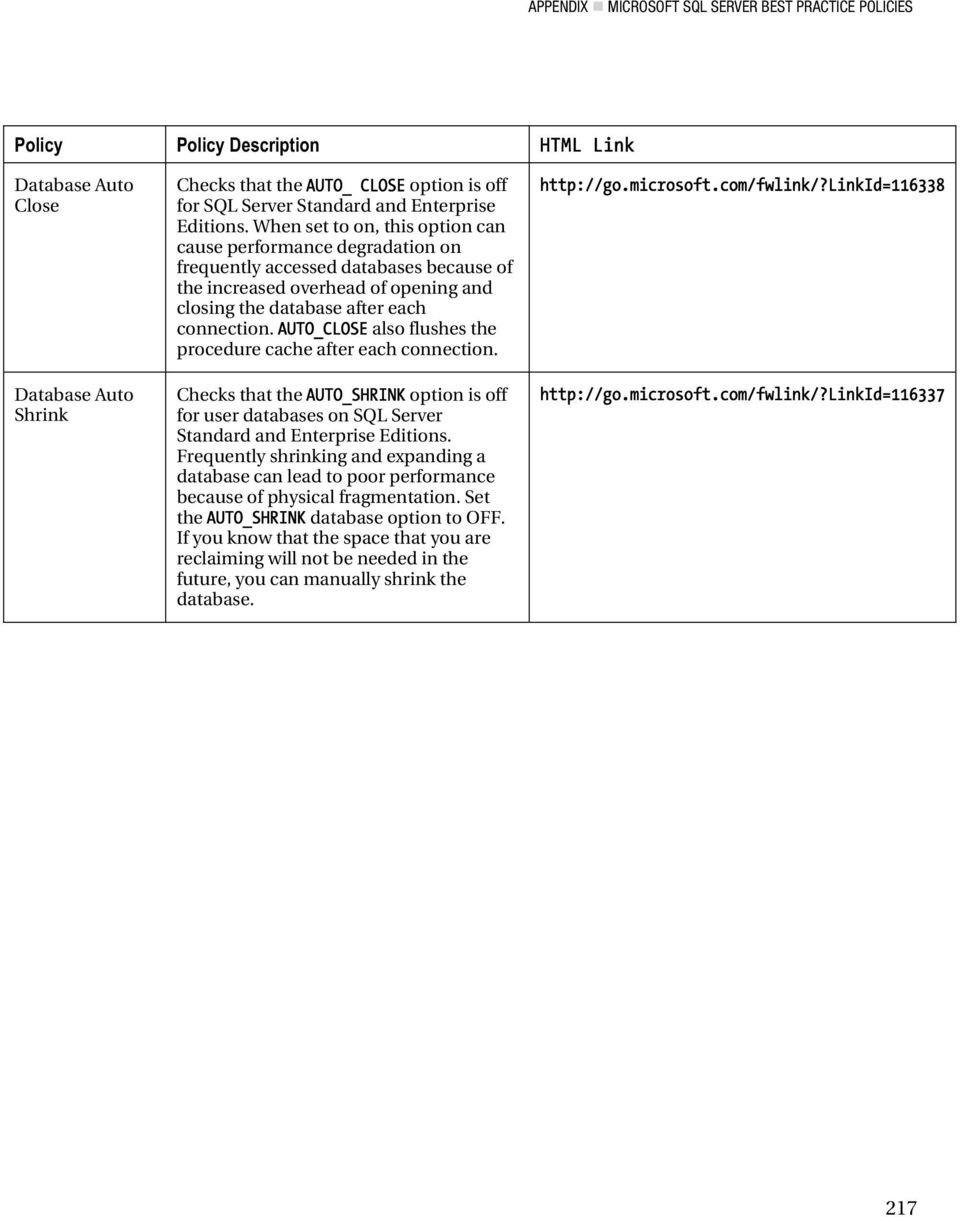
3 APPENDIX MICROSOFT SQL SERVER BEST PRACTICE POLICIES Policy Policy Description HTML Link Database Auto Close Database Auto Shrink Checks that the AUTO_ CLOSE option is off for SQL Server Standard and Enterprise Editions. When set to on, this option can cause performance degradation on frequently accessed databases because of the increased overhead of opening and closing the database after each connection. AUTO_CLOSE also flushes the procedure cache after each connection. Checks that the AUTO_SHRINK option is off for user databases on SQL Server Standard and Enterprise Editions. Frequently shrinking and expanding a database can lead to poor performance because of physical fragmentation. Set the AUTO_SHRINK database option to OFF. If you know that the space that you are reclaiming will not be needed in the future, you can manually shrink the database
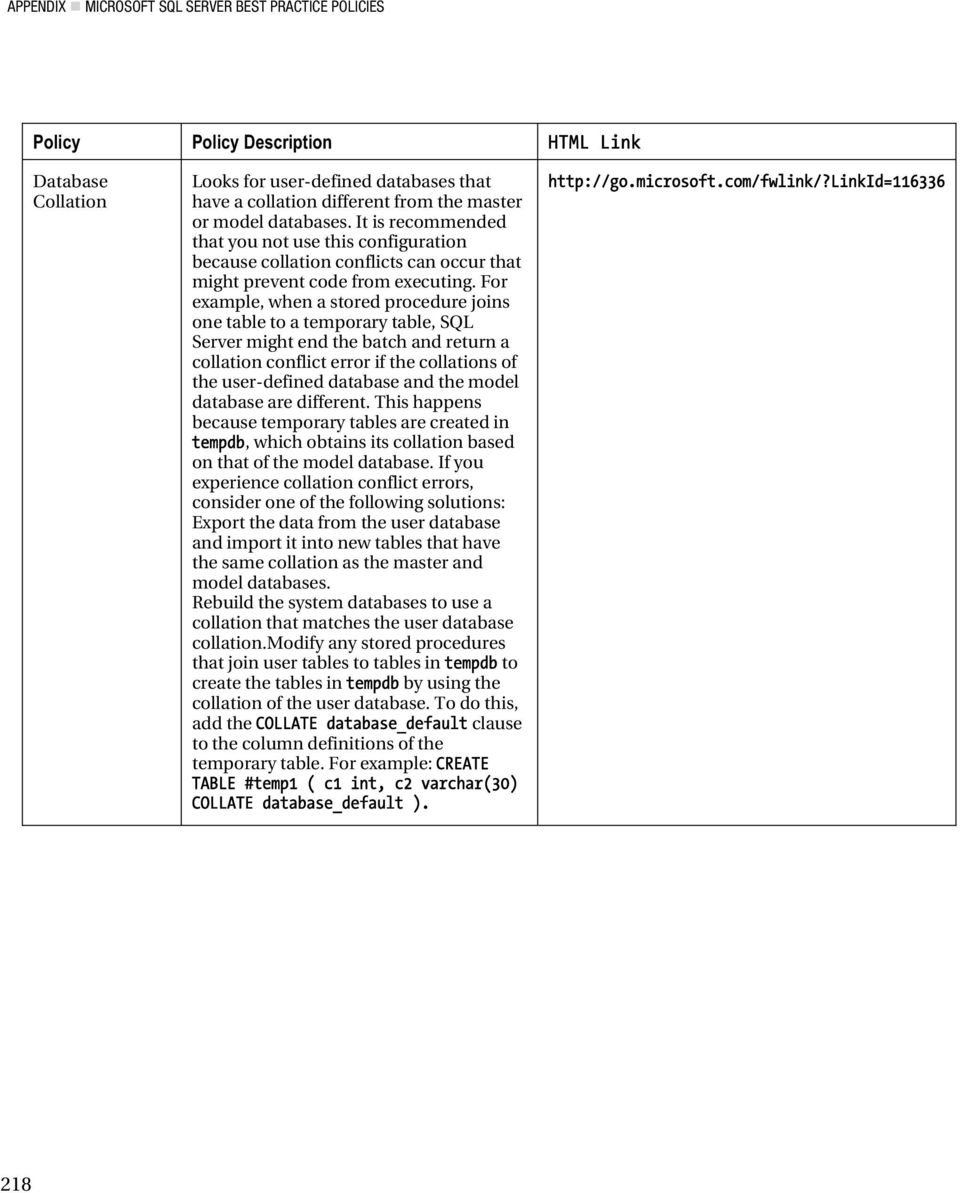
4 APPENDIX MICROSOFT SQL SERVER BEST PRACTICE POLICIES Policy Policy Description HTML Link Database Collation Looks for user-defined databases that have a collation different from the master or model databases. It is recommended that you not use this configuration because collation conflicts can occur that might prevent code from executing. For example, when a stored procedure joins one table to a temporary table, SQL Server might end the batch and return a collation conflict error if the collations of the user-defined database and the model database are different. This happens because temporary tables are created in tempdb, which obtains its collation based on that of the model database. If you experience collation conflict errors, consider one of the following solutions: Export the data from the user database and import it into new tables that have the same collation as the master and model databases. Rebuild the system databases to use a collation that matches the user database collation.modify any stored procedures that join user tables to tables in tempdb to create the tables in tempdb by using the collation of the user database. To do this, add the COLLATE database_default clause to the column definitions of the temporary table. For example: CREATE TABLE #temp1 ( c1 int, c2 varchar(30) COLLATE database_default )
5 APPENDIX MICROSOFT SQL SERVER BEST PRACTICE POLICIES Policy Policy Description HTML Link Database Page Status Database Page Verification Checks whether the database has suspect database pages. A database page is set suspect by error 824. This error occurs when a logical consistency error is detected during a read operation, which frequently indicates data corruption caused by a faulty I/O subsystem component. When the SQL Server Database Engine detects a suspect page, the page ID is recorded in the msdbo.dbo.suspect_pages table. This is a severe error condition that threatens database integrity and must be corrected immediately. Best practices recommendations: Review the SQL Server error log for the details of the 824 error for this database. Complete a full database consistency check (DBCC CHECKDB). Implement the user actions defined in MSSQLSERVER_824. Checks if the PAGE_VERIFY database option is not set to CHECKSUM to provide a high level of data-file integrity. When CHECKSUM is enabled for the PAGE_VERIFY database option, the SQL Server Database Engine calculates a checksum over the contents of the whole page, and stores the value in the page header when a page is written to disk. When the page is read from disk, the checksum is recomputed and compared to the checksum value that is stored in the page header. This helps provide a high level of data-file integrity

6 APPENDIX MICROSOFT SQL SERVER BEST PRACTICE POLICIES Policy Policy Description HTML Link File Growth for SQL Server 2000 Guest Permissions Checks an instance of SQL Server Warns if the data file is 1 GB or larger, and is set to autogrow by a percentage, instead of growing by a fixed size. Growing a data file by a percentage can cause SQL Server performance problems because of progressively larger growth increments. For an instance of SQL Server 2000, set the FILEGROWTH (autogrow) value to a fixed size to avoid escalating performance problems. Checks if permission to access the database is enabled for guest user. Remove access to the guest user if it is not required. The guest user cannot be dropped, but a guest user account can be disabled by revoking its CONNECT permission. You do this by executing REVOKE CONNECT FROM GUEST from within any database other than master or tempdb

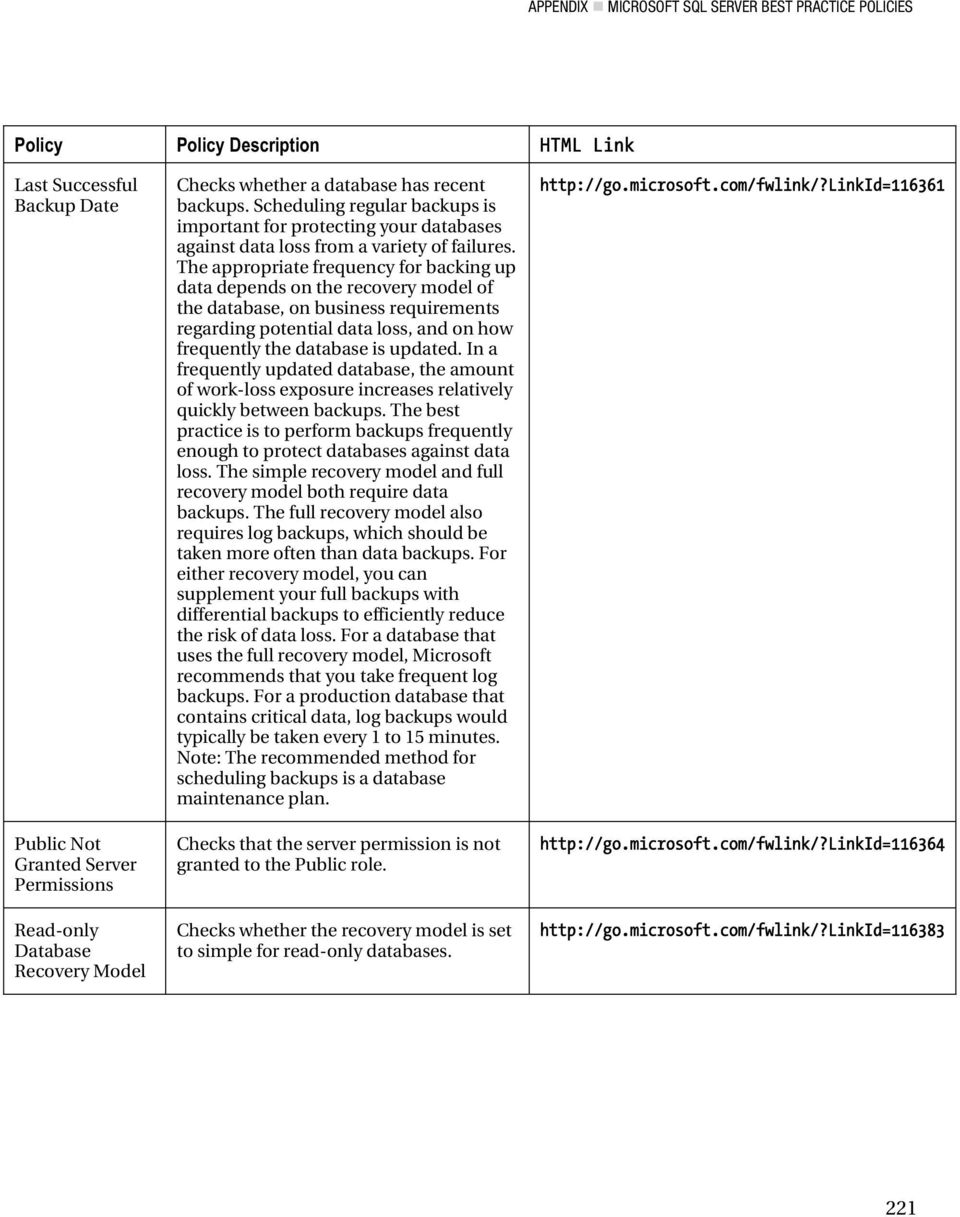
7 APPENDIX MICROSOFT SQL SERVER BEST PRACTICE POLICIES Policy Policy Description HTML Link Last Successful Backup Date Public Not Granted Server Permissions Read-only Database Recovery Model Checks whether a database has recent backups. Scheduling regular backups is important for protecting your databases against data loss from a variety of failures. The appropriate frequency for backing up data depends on the recovery model of the database, on business requirements regarding potential data loss, and on how frequently the database is updated. In a frequently updated database, the amount of work-loss exposure increases relatively quickly between backups. The best practice is to perform backups frequently enough to protect databases against data loss. The simple recovery model and full recovery model both require data backups. The full recovery model also requires log backups, which should be taken more often than data backups. For either recovery model, you can supplement your full backups with differential backups to efficiently reduce the risk of data loss. For a database that uses the full recovery model, Microsoft recommends that you take frequent log backups. For a production database that contains critical data, log backups would typically be taken every 1 to 15 minutes. Note: The recommended method for scheduling backups is a database maintenance plan. Checks that the server permission is not granted to the Public role. Checks whether the recovery model is set to simple for read-only databases
8 APPENDIX MICROSOFT SQL SERVER BEST PRACTICE POLICIES Policy Policy Description HTML Link SQL Server 32- bit Affinity Mask Overlap SQL Server 64- bit Affinity Mask Overlap SQL Server Affinity Mask SQL Server Blocked Process Threshold Checks an instance of SQL Server having processors that are assigned with both the affinity mask and the affinity I/O mask options. On a computer that has more than one processor, the affinity mask and the affinity I/O mask options are used to designate which CPUs are used by SQL Server. Enabling a CPU with both the affinity mask and the affinity I/O mask can slow performance by forcing the processor to be overused. Checks an instance of SQL Server having processors that are assigned with both the affinity64 mask and the affinity64 I/O mask options. On a computer that has more than one processor, the affinity64 mask and the affinity64 I/O mask options are used to designate which CPUs are used by SQL Server. Enabling a CPU with both the affinity64 mask and the affinity64 I/O mask can slow performance by forcing the processor to be overused. Checks an instance of SQL Server for setting affinity mask to its default value of 0, since in most cases, the Microsoft Windows 2000 or Windows Server 2003 default affinity provides the best performance. Confirms whether the setting affinity mask of server is set to 0. Checks whether the blocked process threshold option is set lower than 5 and is not disabled (0). Setting the blocked process threshold option to a value from 1 to 4 can cause the deadlock monitor to run constantly. Values 1 to 4 should be used only for troubleshooting and never long term or in a production environment without the assistance of Microsoft Customer Service and Support

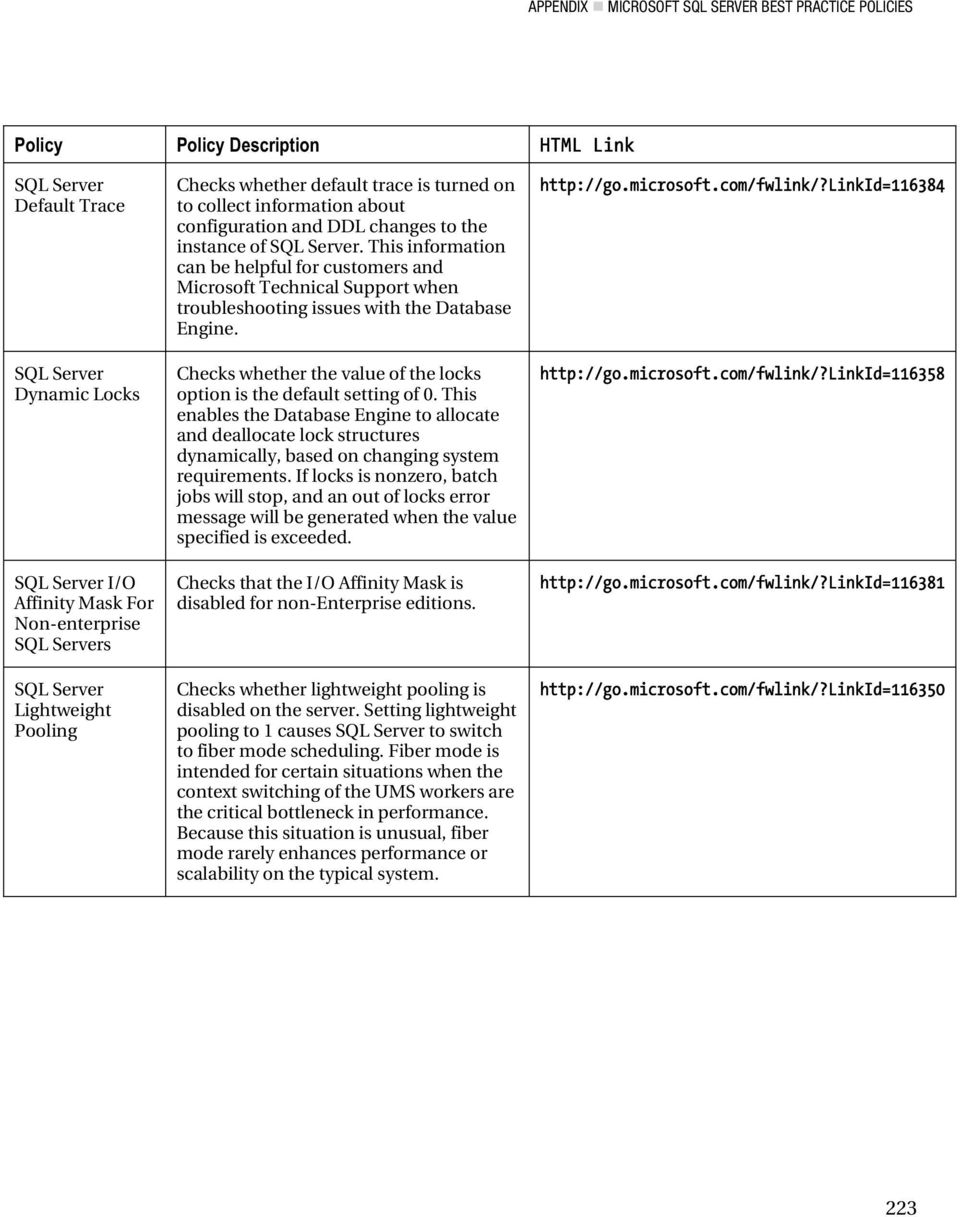
9 APPENDIX MICROSOFT SQL SERVER BEST PRACTICE POLICIES Policy Policy Description HTML Link SQL Server Default Trace SQL Server Dynamic Locks SQL Server I/O Affinity Mask For Non-enterprise SQL Servers SQL Server Lightweight Pooling Checks whether default trace is turned on to collect information about configuration and DDL changes to the instance of SQL Server. This information can be helpful for customers and Microsoft Technical Support when troubleshooting issues with the Database Engine. Checks whether the value of the locks option is the default setting of 0. This enables the Database Engine to allocate and deallocate lock structures dynamically, based on changing system requirements. If locks is nonzero, batch jobs will stop, and an out of locks error message will be generated when the value specified is exceeded. Checks that the I/O Affinity Mask is disabled for non-enterprise editions. Checks whether lightweight pooling is disabled on the server. Setting lightweight pooling to 1 causes SQL Server to switch to fiber mode scheduling. Fiber mode is intended for certain situations when the context switching of the UMS workers are the critical bottleneck in performance. Because this situation is unusual, fiber mode rarely enhances performance or scalability on the typical system
10 APPENDIX MICROSOFT SQL SERVER BEST PRACTICE POLICIES Policy Policy Description HTML Link SQL Server Login Mode SQL Server Max Degree of Parallelism SQL Server Max Worker Threads for 32-bit SQL Server 2000 Checks for Windows Authentication. When possible, Microsoft recommends using Windows Authentication. Windows Authentication uses Kerberos security protocol, provides password policy enforcement in terms of complexity validation for strong passwords (applies only to Windows Server 2003 and later), provides support for account lockout, and supports password expiration. Checks the max degree of parallelism option for the optimal value to avoid unwanted resource consumption and performance degradation. The recommended value of this option is 8 or less. Setting this option to a larger value often results in unwanted resource consumption and performance degradation. Checks the max worker threads server option for potentially incorrect settings of an instance of SQL Server 2000 that is running on a 32-bit server. Setting the max worker threads option to a small value might prevent enough threads from servicing incoming client requests in a timely manner, and can lead to shortage of threads. Conversely, because each active thread consumes 512 KB on 32-bit servers, setting the option to a large value can waste address space

11 APPENDIX MICROSOFT SQL SERVER BEST PRACTICE POLICIES Policy Policy Description HTML Link SQL Server Max Worker Threads for 64-bit SQL Server 2000 SQL Server Max Worker Threads for SQL Server 2005 and above SQL Server Network Packet Size SQL Server Open Objects for SQL Server 2000 Checks the max worker threads server option for potentially incorrect settings of an instance of SQL Server 2000 that is running on a 64-bit server. Setting the max worker threads option to a small value might prevent enough threads from servicing incoming client requests in a timely manner, and can lead to shortage of threads. Conversely, because each active thread consumes up to 4 MB on 64- bit servers, setting the option to a large value can waste address space. Checks the max work threads server option for potentially incorrect settings of an instance of SQL Server Setting the max worker threads option to a nonzero value will prevent SQL Server from automatically determining the proper number of active worker threads based on user requests. Checks whether for the value specified for network packet size server option is set to the optimal value of 8060 bytes. If the network packet size of any logged-in user is more than 8060 bytes, SQL Server performs different memory allocation operations. This can cause an increase in the process virtual address space that is not reserved for the buffer pool. Checks whether the open objects server option is set to 0, the optimal value on instances SQL Server Using a nonzero value can lead to errors when you are using SQL Server This value should not be changed from the default value of 0, unless you are working with Microsoft Customer Support Services to solve a specific problem

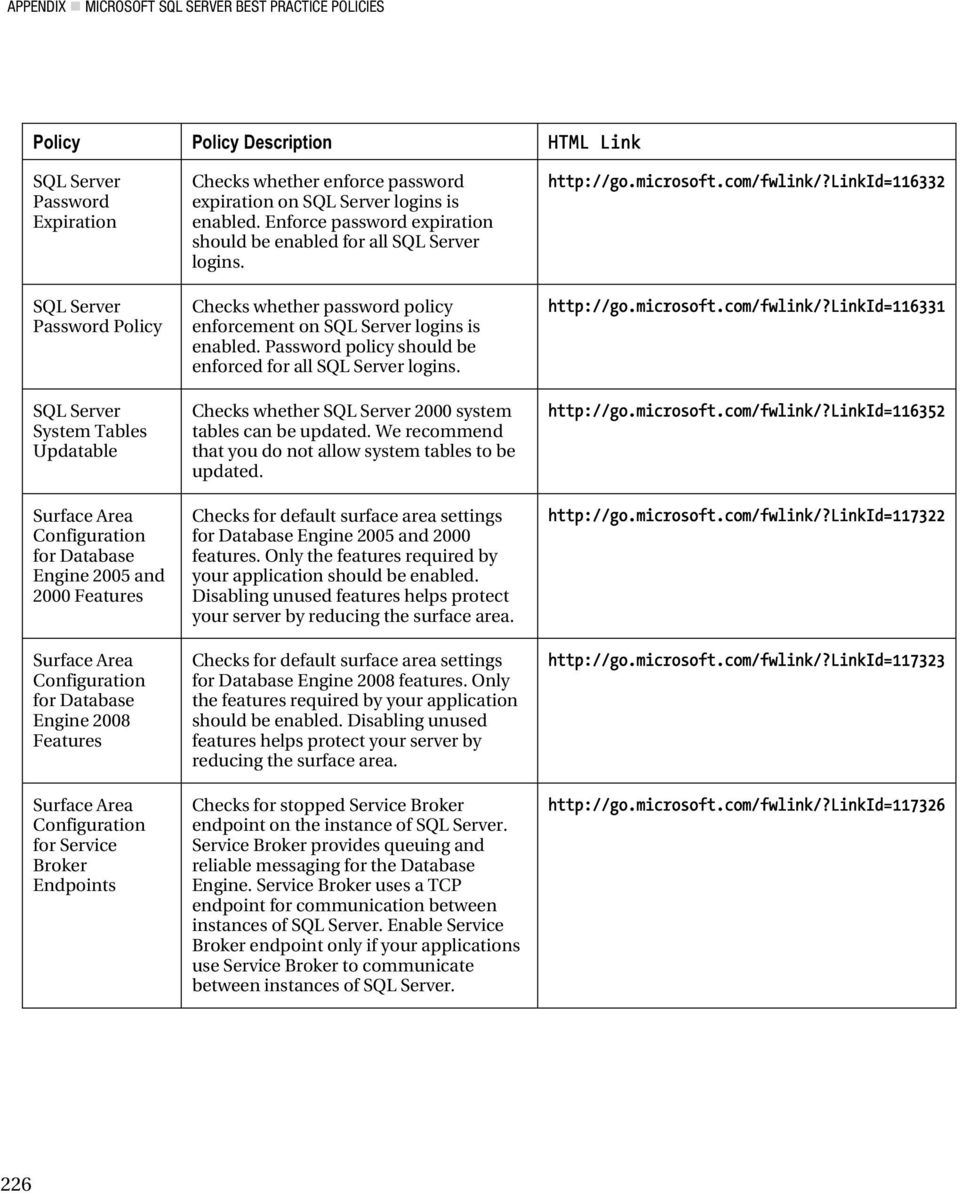
12 APPENDIX MICROSOFT SQL SERVER BEST PRACTICE POLICIES Policy Policy Description HTML Link SQL Server Password Expiration SQL Server Password Policy SQL Server System Tables Updatable Surface Area Configuration for Database Engine 2005 and 2000 Features Surface Area Configuration for Database Engine 2008 Features Surface Area Configuration for Service Broker Endpoints Checks whether enforce password expiration on SQL Server logins is enabled. Enforce password expiration should be enabled for all SQL Server logins. Checks whether password policy enforcement on SQL Server logins is enabled. Password policy should be enforced for all SQL Server logins. Checks whether SQL Server 2000 system tables can be updated. We recommend that you do not allow system tables to be updated. Checks for default surface area settings for Database Engine 2005 and 2000 features. Only the features required by your application should be enabled. Disabling unused features helps protect your server by reducing the surface area. Checks for default surface area settings for Database Engine 2008 features. Only the features required by your application should be enabled. Disabling unused features helps protect your server by reducing the surface area. Checks for stopped Service Broker endpoint on the instance of SQL Server. Service Broker provides queuing and reliable messaging for the Database Engine. Service Broker uses a TCP endpoint for communication between instances of SQL Server. Enable Service Broker endpoint only if your applications use Service Broker to communicate between instances of SQL Server
13 APPENDIX MICROSOFT SQL SERVER BEST PRACTICE POLICIES Policy Policy Description HTML Link Surface Area Configuration for SOAP Endpoints Symmetric Key Encryption for User Databases Symmetric Key for master Database Symmetric Key for System Databases Trustworthy Database Checks for disabled Simple Object Access Protocol (SOAP) endpoints on the instance of SQL Server. Native XML Web Services provide database access over HTTP by using SOAP messages. Enable HTTP endpoints only if your applications use them to communicate with the Database Engine. Checks that symmetric keys with a length less than 128 bytes do not use the RC2 or RC4 encryption algorithm. The best practice recommendation is to use AES 128 bit and above to create symmetric keys for data encryption. If AES is not supported by the version of your operating system, use 3DES. Checks for user-created symmetric keys in the master database, which is not recommended. The master database contains the Master Symmetric key. Checks for user-created symmetric keys in the msdb, model, and tempdb databases. This is not recommended. This recommendation does not apply to the master database. Checks whether the dbo or a db_owner is assigned to a fixed server sysadmin role for databases where the trustworthy bit is set to on. Database users with the appropriate level of permissions can elevate privileges to the sysadmin role. In this role, the user can create and execute unsafe assemblies that compromise the system. The best practice is to turn off the trustworthy bit or change the dbo and db_owner to a fixed server role other than sysadmin

14 APPENDIX MICROSOFT SQL SERVER BEST PRACTICE POLICIES Policy Policy Description HTML Link Windows Event Log Cluster Disk Resource Corruption Error Windows Event Log Device Driver Control Error Windows Event Log Device Not Ready Error Windows Event Log Disk Defragmentation Windows Event Log Failed I/O Request Error Detects SCSI host adapter configuration issues or a malfunctioning device error message in the system log. Detects error event ID 11 in the system log. This error could be because of a corrupted device driver, a hardware problem, a malfunctioning device, poor cabling, or termination issues. Detects error messages in the system log that can be the result of SCSI host adapter configuration issues or related problems. Detects an error message in the system log that can result when the Windows 2000 disk defragmenter tool does not move a particular data element, and schedules Chkdsk.exe. In this condition, the error is a false positive. There is no loss of data, and the integrity of the data is not affected. Detects a failed I/O request error message in the system log. This could be the result of a variety of things, including a firmware bug or faulty SCSI cables

15 APPENDIX MICROSOFT SQL SERVER BEST PRACTICE POLICIES Policy Policy Description HTML Link Windows Event Log I/O Delay Warning Windows Event Log I/O Error During Hard Page Fault Error Windows Event Log Read Retry Error Windows Event Log Storage System I/O Timeout Error Windows Event Log System Failure Error Detects event ID 833 in the system log. This message indicates that SQL Server has issued a read or write request from disk, and that the request has taken longer than 15 seconds to return. This error is reported by SQL Server and indicates a problem with the disk I/O subsystem. Delays this long can severely limit the performance of your instance of SQL Server. Detects I/O error during hard page fault in system log. Detects error event ID 825 in the system log. This error message indicates that SQL Server could not read data from the disk on the first try. This message indicates a major problem with the disk I/O subsystem, not with SQL Server itself. However, the disk problem can cause data loss or database corruption if it is not resolved. Detects error event ID 9 in the system log. This error indicates that I/O timeout has occurred within the storage system, as detected from the driver for the controller. Detects error event ID 6008 in the system log. This error indicates an unexpected system shutdown. The system might be unstable and might not provide the stability and integrity that is required to host an instance of SQL Server. If it is known, you should address the root cause of the unexpected server restarts. Otherwise, move the instance of SQL Server to another computer

16 APPENDIX MICROSOFT SQL SERVER BEST PRACTICE POLICIES Best Practice Policy Conditions and Facets You might also be interested in condition and facet information for the best practice policies. Listing A-2 shows a query that you can use to retrieve condition and facet details from the msdb database. Listing A-2. Query against msdb database to return condition and facet information for best practice policies SELECT a.name AS 'Policy', c.name as 'Condition', c.facet FROM msdb.dbo.syspolicy_policies_internal a INNER JOIN msdb.dbo.syspolicy_policies_internal b ON a.policy_id = b.policy_id INNER JOIN msdb.dbo.syspolicy_conditions c ON b.condition_id = c.condition_id ORDER BY a.name GO Executing the query in Listing A-2 gives you the results shown in Table A-2. Table A-2. Condition and Facet Details for Best Practice Policies Policy Condition Condition Facet Asymmetric Key Encryption Algorithm RSA 1024 or RSA 2048 Encrypted AsymmetricKey Backup and Data File Location Data and Backup on Separate Drive IDatabaseMaintenanceFacet CmdExec Rights Secured CmdExec Rights for sysadmins Only IServerSecurityFacet Data and Log File Location Data and Log Files on Separate Drives IDatabasePerformanceFacet Database Auto Close Auto Close Disabled IDatabasePerformanceFacet Database Auto Shrink Auto Shrink Disabled IDatabasePerformanceFacet Database Collation Collation Matches master or model IDatabasePerformanceFacet Database Page Status No Suspect Database Pages IDatabaseMaintenanceFacet Database Page Verification Page Verify Checksum IDatabaseMaintenanceFacet File Growth for SQL Server 2000 Growth Type Not Percent DataFile Guest Permissions Has No Database Access User 230
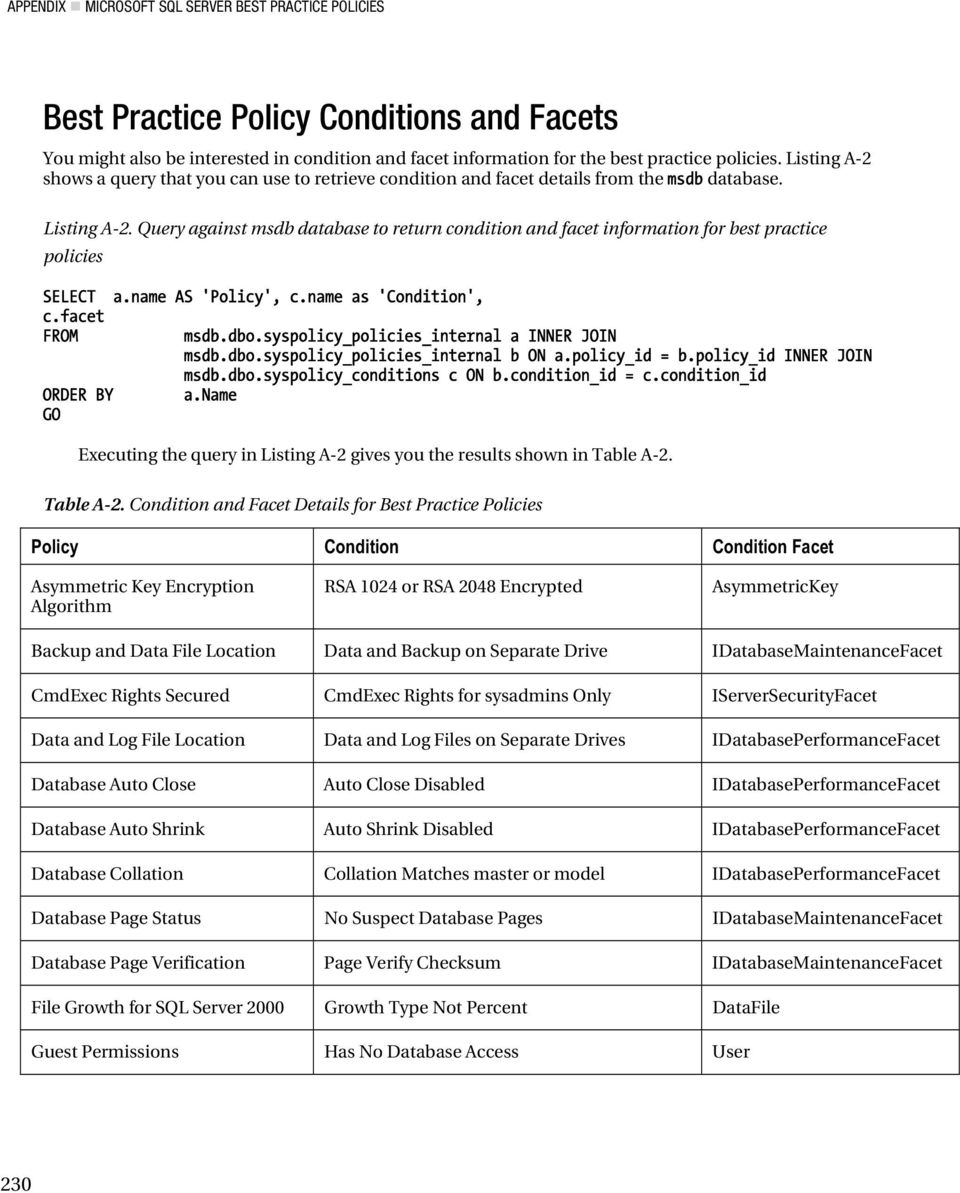
17 APPENDIX MICROSOFT SQL SERVER BEST PRACTICE POLICIES Last Successful Backup Date Safe Last Backup Date IDatabaseMaintenanceFacet Public Not Granted Server Permissions Read-only Database Recovery Model SQL Server 32-bit Affinity Mask Overlap SQL Server 64-bit Affinity Mask Overlap Public Server Role Has No Granted Permissions Recovery Model Simple 32-bit Affinity Mask Overlapped 64-bit Affinity Mask Overlapped IServerSecurityFacet IDatabaseMaintenanceFacet IServerPerformanceFacet IServerPerformanceFacet SQL Server Affinity Mask Affinity Mask Default IServerPerformanceFacet SQL Server Blocked Process Threshold Blocked Process Threshold Optimized IServerPerformanceFacet SQL Server Default Trace Default Trace Enabled IServerAuditFacet SQL Server Dynamic Locks Auto-configured Dynamic Locks IServerPerformanceFacet SQL Server I/O Affinity Mask For Non-enterprise SQL Servers I/O Affinity Mask Disabled IServerConfigurationFacet SQL Server Lightweight Pooling Lightweight Pooling Disabled IServerPerformanceFacet SQL Server Login Mode Windows Authentication Mode IServerSecurityFacet SQL Server Max Degree of Parallelism SQL Server Max Worker Threads for 32-bit SQL Server 2000 SQL Server Max Worker Threads for 64-bit SQL Server 2000 SQL Server Max Worker Threads for SQL Server 2005 and above Maximum Degree of Parallelism Optimized Maximum Worker Threads for 32-bit Configuration Optimized Maximum Worker Threads for 64-bit Configuration Optimized Auto-configured Maximum Worker Threads IServerPerformanceFacet IServerPerformanceFacet IServerPerformanceFacet IServerPerformanceFacet SQL Server Network Packet Size Network Packet Size Optimized IServerPerformanceFacet SQL Server Open Objects for SQL Server 2000 Auto-configured Open Objects IServerPerformanceFacet 231
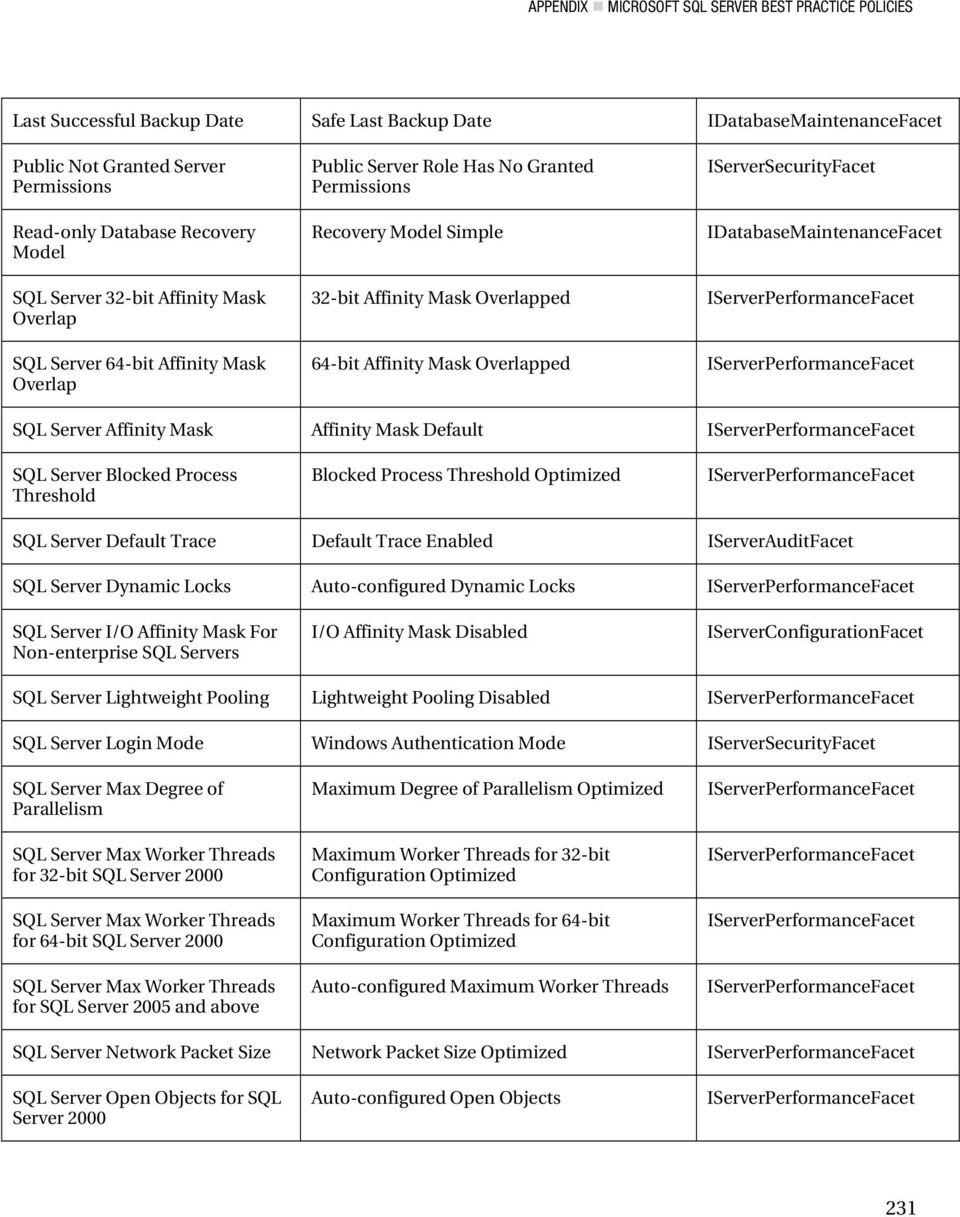
18 APPENDIX MICROSOFT SQL SERVER BEST PRACTICE POLICIES SQL Server Password Expiration Password Expiration Enabled ILoginOptions SQL Server Password Policy Password Policy Enforced ILoginOptions SQL Server System Tables Updatable Surface Area Configuration for Database Engine 2005 and 2000 Features Surface Area Configuration for Database Engine 2008 Features Surface Area Configuration for Service Broker Endpoints Surface Area Configuration for SOAP Endpoints Symmetric Key Encryption for User Databases Symmetric Key for master Database Symmetric Key for System Databases System Tables Do Not Allow Updates Surface Area Configuration for Database Engine 2005 and 2000 Features Surface Area Configuration for Database Engine 2008 Features Endpoint Stopped Endpoint Disabled Strongly Encrypted Microsoft Service Master Key Fail For Any Symmetric Key IServerConfigurationFacet ISurfaceAreaFacet ISurfaceAreaFacet Endpoint Endpoint SymmetricKey SymmetricKey SymmetricKey Trustworthy Database Database Owner Not sysadmin IDatabaseSecurityFacet Windows Event Log Cluster Disk Resource Corruption Error Windows Event Log Device Driver Control Error Windows Event Log Device Not Ready Error Windows Event Log Disk Defragmentation Windows Event Log Failed I/O Request Error Cluster Disk Resource Corruption Error Check Device Driver Control Error Check Device Not Ready Error Check Disk Defragmentation Resulting Data Corruption Failed I/O Request Check Server Server Server Server Server 232

19 APPENDIX MICROSOFT SQL SERVER BEST PRACTICE POLICIES Windows Event Log I/O Delay Warning I/O Delay Warning Check Server Windows Event Log I/O Error During Hard Page Fault Error Windows Event Log Read Retry Error Windows Event Log Storage System I/O Timeout Error Windows Event Log System Failure Error I/O Error During Hard Page Fault Error Check Read Retry Error Check Storage System I/O Timeout Error Check System Failure Error Check Server Server Server Server 233
20 Index Symbols #SQLHelp how #SQLHelp works, 210 A accessing database see database access Active Directory s Group Policy, 1 ActiveX script job steps CmdExec Rights Secured policy, 216 Address field, Description page Create New Policy dialog, 20 administrative accounts Builtin\Administrators login, 197 disabling sa login, 197 security access to, advanced conditions, creating, Advanced Edit dialog creating advanced conditions, 41, 42 creating conditions, 15 Data Purity Flag Check condition, 163 Database Free Space policy, 150 SQL Server Agent Is Running condition, 158, 159 Advisory Services, Microsoft, 213 affinity mask SQL Server policies, 222, 223 Against Targets field, General page Create New Policy dialog, 18 Alert System page SQL Server Agent Properties dialog, 118 alerts, 11 configuring SQL Server Agent alerts, creating for all policy violations, 125 ALTER DATABASE command enabling Service Broker, 110 Analyzer rules, best practice importing policies, 24, 27 architecture, PBM, Asymmetric Key Encryption Algorithm policy, 202, 215, 230 asynchronous processing On Change: Log Only evaluation mode, 135 auditing servers best practice audit policies, 206 compliance, default trace, login auditing, SQL Server Audit, 203 SQL Server Default Trace policy, 206 autoclose Database Auto Close policy, 167, 217 autogrow Database Free Space policy, 150 File Growth for SQL Server 2000 policy, 220 autoshrink Database Auto Shrink policy, 50, 167, 168, 217 evaluating single policy on demand, 50 B Backup and Data File Location policy, 167, 216, 230 backups Last Successful Backup Date policy, 167, 221 Successful Transaction Log Backup policy, Beauchemin, Bob, 208 behavior policy behavior, 7 8 Best Practice Analyzer rules importing policies, 24, 27 best practice policies, 2, 149, 167, Asymmetric Key Encryption Algorithm, 202, 215, 230 audit, 206 Backup and Data File Location, 216, 230 CmdExec Rights Secured, 198, 216,
21 INDEX best practice policies (cont.) Central Management Server groups conditions and facets, adding servers to, custom policies, creating, 150 creating, Data and Log File Location, 216, 230 evaluating policies against, Database Auto Close/Shrink, 217, 230 Database Collation, 218, 230 Database Page Status/Verification, 219, 230 importing registered servers and groups, registering server to group, default trace, 204 Central Management Servers, 9 10 descriptions and HTML links, 215 creating, encryption, 202 EPM Framework prerequisites, 169 File Growth for SQL Server 2000, 220, 230 evaluating policies using, Guest Permissions, 198, 220, 230 Last Successful Backup Date, 167, 221, 230 maintenance, 40, 99, 101, 173 PowerShell evaluating policies against, PowerShell script, EPM, 172 Microsoft SQL Server, registering, 77 Public Not Granted Server Permissions, 198, setup script, EPM, , 231 Change evaluation modes Read-only Database Recovery Model, 221, On Change: Log Only, 7, 49, On Change: Prevent, 7, 50, reviewing other policies, 168 chats security, 197, SQL Server Default Trace, 206, 223, 231 SQL Server Login Mode, 198, 224, 231 Microsoft Technical Communities web site, 212 Check Condition field, General page SQL Server Password Expiration, 199, 226, Create New Policy dialog, Check Number of Databases policy SQL Server Password Policy, 199, 226, 232 Create New Condition dialog, 43 SQL Server Xyz, , CHECKDB command, DBCC, 163 Surface Area Configuration Xyx, , checklist, DBA, checksum Symmetric Key Xyz, 202, 227, 232 Database Page Verification policy, 219 Trustworthy Database, 199, 227, 232 classes Windows Event Log Xyz, , see also objects BIDS (Business Intelligence Developer Studio), Policy.Name class, SMO, SQLStoreConnection class, 92 blocked process threshold SQL Server Blocked Process Threshold policy, 222 CmdExec Rights for sysadmins Only condition, 198 CmdExec Rights Secured policy, 198, 216, 230 blogs cmdlets DBA resources, 208 Get-Member, 93 Microsoft Technical Communities web site, Invoke-PolicyEvaluation, 95, CodePlex Builtin\Administrators login, 197 EPM download, 169 collation Database Collation policy, 218 C communities categories see policy categories Microsoft Technical, 212 Categories dialog, 40 SQL Server, 208, 210 Category field, Description page compliance, Create New Policy dialog, 19 auditing servers, encryption, security,
22 INDEX server configuration, syspolicy_configuration_internal table, 139 log retention, ConfigurationGroup parameter SQL Server service account, PowerShell script, EPM, 172 Surface Area Configuration facet, viewing EPM Framework reports, 180 Configure SQL Server Error Logs dialog, 191, 192 Connection Properties dialog, 178 Compliance Guide white paper, 209 context-sensitive help compliance regulations, SQL Server Books Online, 211 Gramm-Leach-Bliley Act (GLBA), 186 Create New Category dialog, 38 Health Insurance Portability and Create New Condition dialog, 13, 14, 15 Accountability Act (HIPAA), 187 creating advanced conditions, 41, 43 Payment Card Industry Data Security Create New Policy dialog Standard (PCI DSS), 187 Description page, 9, 18, 19 Sarbanes-Oxley Act (SOX), 187 General page, 16, 17, 20 components, PBM, 3 6 Credentials option conditions Shared Data Source Properties dialog, 178 All SQL Server Agent Jobs Have Notification credit card data on Failure, 162 PCI DSS, 187 Check Condition field, Create New Policy custom policies, dialog, 17 Data Purity Flag Enabled, creating, Database Free Space, advanced conditions, SQL Server Agent is running, Data Purity Flag Enabled, 163, 164, 165 Database Auto Shrink policy, 168 SQL Server Agent Jobs have notification on failure, Successful Transaction Log Backup, Database Free Space, 151 Database Has Less than 10 Pct Free Space, 150 Databases in Full or Bulk Logged, 154, 155, 156 D defining for system databases, Dashboard report, EPM, 179, 180 description, 5 Data and Log File Location policy, 216, 230 determining all policies using, 22 importing policies, 25 Log Backup More than 15 Minutes Old, 153, data encryption see encryption 154 data files Microsoft SQL Server best practice policies, Backup and Data File Location policy, 167, Open Condition dialog, 5 Data and Log File Location policy, 216 SQL Agent Jobs with No Notification on Data Purity Flag Enabled condition, 163 Failure, 161 DATA_PURITY check SQL Server Agent Is Running, DBCC CHECKDB command, 163 Successful Transaction Log Backup, 156 database access syspolicy_conditions view, 141 Guest Permissions policy, 220 syspolicy_conditions_internal table, 138 managing security permissions, 195 confidential information PCI DSS, 188 Sarbanes-Oxley Act (SOX), 187 Database Auto Close policy, 167, 217, 230 configuration Database Auto Shrink policy, 50, 167, 168, 217, protecting against unauthorized changes, 2 server configuration for compliance, Database Collation policy, 218, 230 Database Engine Eventing, 135 Surface Area Configuration facet, Database facet, properties of, 4 syspolicy_configuration view,
23 INDEX Database Free Space condition, 151 SQL Server web sites, 207, 212 Database Free Space policy, training events, 209 Database Mail user groups, 212 adding profile, 110 webcasts, 211, 212 associating account with profile, 110 white papers, 208 checking error logs, 112 DBA Support operator, 117 cleaning up history, DBAs configuring, reasons for using PBM, 1 deleting all Database Mail log entries, 113 DBCC CHECKDB command, 163 receiving alert notifications for policy violations, 109 setup script, 111 Declarative Management Framework (DMF), 33 see also Policy-Based Management testing Database Mail, Declarative Management white paper, 209 Database Maintenance default trace, creating conditions, 14 SQL Server Default Trace policy, 223 database owner (dbo) defragmentation subscribing to categories, 39 Database Page Status policy, 219, 230 Database Page Verification policy, 219, 230 Windows Event Log Disk Defragmentation policy, 228 Demand evaluation mode, On, 7, 49, databases evaluating multiple policies, Data Purity Flag Enabled, Database Free Space policy, DBA checklist, 149 evaluating policies against different instance, evaluating single policy, defining conditions for system databases, Dependent Conditions page Facet Properties - Database dialog, 4 evaluating policies against different dependent policies instance, deleting condition with, 22 Facet Properties - Database dialog, 4 viewing, SQL Server Agent Is Running condition, Dependent Policies page Facet Properties - Database dialog, 4 SQL Server Agent jobs have notification on Open Condition dialog, 5, 21 failure policy, Description field, Description page Successful Transaction Log Backup policy, Create New Policy dialog, Description page Surface Area Configuration Xyz policies, 226 Create New Condition dialog, 15 Symmetric Key Xyz policies, 202, 227 Create New Policy dialog, 18, 19 Trustworthy Database policy, 199, 227 Create Policy dialog, 9 Databases in Full or Bulk Logged condition, 156 Open Condition dialog, 5 Davidson, Tom, 101, 169 Open Policy dialog, 6, 27 DBA checklist, 149 creating policy categories, 38, 39 DBA Mail Account/Profile, 110 DFM namespace, 92 DBA resources, dialog boxes blogs, 208, 212 Advanced Edit, 15, 41, 42 forums, 212 Categories, 40 Microsoft paid support options, 212 Configure SQL Server Error Logs, 191, 192 Microsoft support, Connection Properties, 178 newsgroups, 212 Create New Category, 38 podcasts, 209 Create New Condition, 13 social networking, 210 Create New Policy, 16, 20 SQL Server Books Online, 211 Evaluate Policies, 51, 53, 54, 55, 85, 86, 87 SQL Server community,
24 INDEX evaluating multiple policies on demand, encryption 56 best practice policies, 202 evaluating policies against different compliance, instance, 58 transparent data encryption, evaluating single policy on demand, 51 encryption keys Export as Policy, 35 Export Policy, 28 Export Registered Servers, 82, 83 Asymmetric Key Encryption Algorithm policy, 202, 215 Extensible Key Management, Facet Properties - Database, 4 managing, 201 Import, 24 Symmetric Key policies, 202, 227 Import Registered Servers, 83, 84 Job Properties, 123 Job Step Properties, 113, 182 EncryptionEnabled property, Database facet, 199 Enterprise Policy Management see EPM Log File Viewer, 72 Enterprise Support web site, 213 Login Properties, 71 entity relationship diagram, PBM, 138 Manage Policy Categories, 9, 37, 38, 174 EPM (Enterprise Policy Management), New Alert, 122 EPM Framework, 10 New Job, 123 automating, New Job Schedule, 63, 64 downloading, 169 New Operator, 116 viewing reports, New Server Group Properties, 79, 80 white paper, 209 New Server Registration, 77, 78, 80, 81 EPM Framework, setting up, Open Condition, 5, 21 PowerShell script, 170, Open Policy, 6, 26 Reporting Services reports, 170, adding policies to existing schedule, 66 setup script, creating schedules, 61, 63, 64, 65 error logs Operator Properties, 123 Pick Schedule for Job, 66 Policy Management Properties, 131, 132 PolicyReports Property Pages, 175 Properties, 61 configuring log retention for SQL Server, script returning number retained by SQL Server, 192 error numbers Results Detailed View, 44, 51, 52 policy violations, 121 Select Policy, 24, 25 errors Select Source, 59, 85 checking error logs, Database Mail, 112 Send Test , 111 Server Properties, 203, 204 Shared Data Source Properties, 177, 179 deleting condition with dependent policies, 22, 23 EvalMode parameter SQL Server Agent Properties, 118 PowerShell script, EPM, 174 View Facets, 34, 199, 200, 201 Evaluate Policies dialog View Policies, 128, 129 evaluating policies dynamic locks SQL Server Dynamic Locks policy, 223 against Central Management Server group, 85, 86, 87 against different instance, 58 multiple policies on demand, 56 E single policy on demand, 51, 53, 55 deleting all messages, 113 Send Test dialog, 111 Enabled property Policy Management Properties dialog, 132 Evaluation Results page, 51, 56 Policy Selection page, 56, 58 script options in, 54 warning flag for policies containing scripts, 56 evaluating policies see under policies 239
25 INDEX Evaluation Mode field, General page Expression field, General page Create New Policy dialog, 18 Create New Condition dialog, 14 evaluation modes, 7 8, Extensible Key Management, availability of, 49 ExtensibleKeyManagementEnabled property On Change: Log Only, 7, 49, Server Configuration facet, 201 On Change: Prevent, 7, 50, On Demand, 7, 49, evaluating multiple policies, F evaluating against other instance, 57 Facet field, General page 60 Create New Condition dialog, 14 evaluating single policy, Facet Properties - Database dialog, 4 On Schedule, 7, 49, facets, 4 adding policies to schedule, best practice policies, creating schedules, creating advanced conditions, 41 Evaluation Results page, Evaluate Policies exporting current state as policy, dialog managing facets, 34 Policy Management Properties, 134 Server Configuration facet, 201 evaluating multiple policies on demand, 56 evaluating single policy on demand, 51 server-level facets, 33 Results section, 53 Surface Area Configuration facet, Target Details section, 51 syspolicy_facet_events table, 139 Event Alert Definition area syspolicy_management_facets table, 139 configuring SQL Server Agent alerts, 122 Failed Policy Xyz reports, 181 event logs fail-safe operator On Change: Log Only evaluation mode, 49, SQL Server Agent notifications, fiber mode policy violation shown in, 120, 121 SQL Server Lightweight Pooling policy, 223 Windows Event Log Xyz policies, 228, 229 File Growth for SQL Server 2000 policy, 220, 230 file system events configuring SQL Server Agent alerts, 120 adding policies to Invoke-PolicyEvaluation syspolicy_facet_events table, 139 cmdlet, 98 ExecuteSql function, 41, 44 searching for policy category on, 98, 99 check for Builtin\Administrators login, Files to Import field, Import dialog, filters configuring log retention for SQL Server, PolicyCategoryFilter parameter, reasons why policy not execute as expected, ensuring sa login disabled, PBM security, 136, 137 financial information compliance server configuration for compliance, Gramm-Leach-Bliley Act (GLBA), financial reporting compliance ExecuteWql function, 41 Sarbanes-Oxley Act (SOX), 187 execution modes fn_syspolicy_is_automation_enabled function, policy violation error numbers, Export as Policy dialog, 35 forums Export Policy dialog, 28 Microsoft Technical Communities, 212 Export Registered Servers dialog, 82, 83 frameworks exporting policies, Declarative Management, 33 existing policies, Enterprise Policy Management, 10 exporting current state of facet as policy, multiple policies, 28 free space Database Free Space policy,
26 INDEX Full Database Recovery Model policy HistoryRetentionInDays property creating policies, 17 Policy Management Properties dialog, 133 with T-SQL, 36 hyperlinks exporting existing policies, 28 Address field, Create New Policy dialog, 20 viewing dependent policies, 21, 22 Open Condition dialog, 21 full recovery model Last Successful Backup Date policy, 221 Full Recovery Model condition I creating conditions, 14 Import dialog, policies, 24 creating policies, 17 Import Registered Servers dialog, 83, 84 viewing dependent policies, 21 importing policies, functions instances, databases creating advanced conditions, 40 evaluating policies against other, fn_syspolicy_is_automation_enabled function, 136 viewing EPM Framework reports, 180 internals, PBM, Invoke-PolicyEvaluation cmdlet G adding file system policies to, 98 General page Create New Condition dialog, 14, 15 Create New Policy dialog, 16, 17, 20 Facet Properties - Database dialog, 4 New Alert dialog, 122 Open Policy dialog, 6, 26 Get-Member cmdlet, 93 Gramm-Leach-Bliley Act (GLBA), 186 GRC (governance, risk management, and compliance), 185 Group Policy, Active Directory, 1 Guest Permissions policy, 198, 220, 230 H OutputXML parameter, 96 Policy parameter, 98 running category of policies stored on server, 100 running policy against SQL Server instance, 95, 97 TargetServer parameter, 95, 96, 97, 98, 99, 100, 101 I/O Affinity Mask SQL Server I/O Affinity Mask For Nonenterprise SQL Servers policy, 223 IsSystemObject property defining conditions for system databases, 45 J help SQL Server Books Online, 211 Job Properties dialog, 123 HIPAA (Health Insurance Portability and Accountability Act), 187 Job Step Properties dialog automating EPM Framework, 182 history cleaning up Database Mail history, 113 cleaning up Database Mail history, jobs PowerShell script, EPM, 172 SQL Server Agent Is Running condition, 158 syspolicy_policy_execution_history view, 143 syspolicy_policy_execution_history_details K view, 144 syspolicy_policy_execution_history_details_ key encryption see encryption keys internal table, 139 syspolicy_policy_execution_history_interna L l table, 140 syspolicy_purge_history job, 133 Last Execution Status report, 181 viewing policy history, 126,
27 INDEX Last Successful Backup Date policy, 167, 221, Management node, Object Explorer, Management.DFM namespace, 92 lightweight pooling policy, SQL Server, 223 Management.sdk.sfc namespace, 91 live chats Mandate Database check box Microsoft Technical Communities, 212 Manage Policy Categories dialog, 37 LocalSystem account mandate_database_subscriptions column running SQL Server service, 189, 190 locks SQL Server Dynamic Locks policy, 223 syspolicy_policy_categories_internal table, 139 manually creating policies, Log File Viewer dialog creating conditions, testing On Change: Log Only evaluation creating policies, mode, 72 viewing dependent policies, viewing dependent policies, 21, 22 message boxes viewing history based on policy, 126 Policy Evaluation Warning, 54 viewing policy history, 126 Microsoft Advisory Services, 213 viewing policy history based on objects, 129 Microsoft best practice policies, 2, 167 Log Only mode, On Change:, 7, 49, Microsoft Enterprise Support web site, 213 log retention Microsoft Events podcast, 209 server configuration for compliance, 191 Microsoft Problem Resolution Services, Microsoft SQL Server best practice policies, login mode SQL Server Login Mode policy, 224 Asymmetric Key Encryption Algorithm, 215 Login Properties dialog, 71 Backup and Data File Location, 216 logins CmdExec Rights Secured, 216 Builtin\Administrators login, 197 conditions and facets, login auditing, Data and Log File Location, 216 sa login, disabling, 197 Database Auto Close/Shrink, 217 SQL Server Login Mode policy, 198 Database Collation, 218 LogOnSuccess property Database Page Status/Verification, 219 Policy Management Properties dialog, 133 descriptions and HTML links, 215 logs File Growth for SQL Server 2000, 220 checking error logs, Database Mail, 112 Guest Permissions, 220 Data and Log File Location policy, 216 Last Successful Backup Date, 221 default trace log file location, 205 Public Not Granted Server Permissions, 221 deleting all Database Mail log entries, 113 Read-only Database Recovery Model, 221 policy violation shown in Windows event SQL Server Xyz, log, 120, 121 Surface Area Configuration Xyz, SQL Server log entries, 65, 66 Symmetric Key Xyz, 227 Successful Transaction Log Backup policy, Trustworthy Database, Windows Event Log Xyz, Microsoft support DBA resources, M Microsoft Technical Communities, 212 Mail Session area SQL Server Books Online, 211 SQL Server Agent Properties dialog, 118 SQL Server Troubleshooting and Support, Maintenance best practice policies, 40, 99, 101, web site, 213 Manage Policy Categories dialog, 9, 37, 38, 174 webcasts, 211 Management Data Warehouse database, 170, Microsoft Technical Communities, Microsoft.SQLServer.Management.DFM namespace,
28 INDEX Microsoft.SQLServer.Management.sdk.sfc newsgroups namespace, 91 Microsoft Technical Communities, 212 SQLStoreConnection class, 92 notifications MidnightDBA podcast, 209 SQL Server Agent, mixed-mode authentication Is Running condition, disabling sa login, 197 modes jobs have notification on failure policy, Evaluation Mode field, Create New Policy dialog, 18 evaluation modes, 7 8, 49, 50 O On Change: Log Only, 49, Object Explorer Details window, 28, 57 On Change: Prevent, 50, Object Explorer window, 3, 191 On Demand, 49, objects On Schedule, 49, see also classes MS_PolicyEventProcessingLogin, 137 PolicyStore object, 92 MS_PolicyTsqlExecutionLogin, 136, 137 syspolicy_object_sets view, 142 msdb database syspolicy_object_sets_internal table, 139 checking for new tables, 141 viewing policy history based on, checking for new views, 146 On Change: Log Only evaluation mode, 7, 18, PBM tables, , MSSQLTips web site, 208 choosing for policy, 68, 69 PBM architecture, 135 N On Change: Prevent evaluation mode, 7, 18, 50, Name field, General page PBM architecture, 135 Create New Condition dialog, 14 On Demand evaluation mode, 7, 49, Create New Policy dialog, 17 evaluating multiple policies, network packets SQL Server Network Packet Size policy, 225 network security evaluating policies against other instance, evaluating single policy, PCI DSS, 188 PBM architecture, 134 New Alert dialog On Schedule evaluation mode, 7, 49, configuring SQL Server Agent alerts, 122 adding policies to existing schedule, General page, 122 Create New Policy dialog, 18 Options page, 123, 124 creating schedules, Response page, 123 PBM architecture, 135 New Category dialog Create New Category dialog, 38 New Condition dialog, 14 reasons why policy not execute as expected, 129 Open Condition dialog Create New Condition dialog, 15, 16 Data Purity Flag Enabled condition, 164 Database Free Space policy, 150 Database Auto Shrink policy, 168 transaction log backups, 153 Database Free Space policy, 151 New Job dialog, 123 New Job Schedule dialog, 63, 64 New Operator dialog, 116, 123 Databases in Full or Bulk Logged condition, 155 defining conditions for system databases, 45 New Policy dialog Dependent Policies page, 5, 21 Create New Policy dialog, 9, 16, 17, 18, 19, Description page, 5 20 General page, 5 New Server Group Properties dialog, 79, 80 notification on failure condition, 161 New Server Registration dialog, 77, 78, 80, 81 transaction log backups, 154,
29 INDEX Open Policy dialog, 6 Public Not Granted Server Permissions adding policies to existing schedule, 66 policy, 198, 221 creating schedules, 61, 63, 64, 65 personal financial information Description page, 6, 27 Gramm-Leach-Bliley Act (GLBA), 186 creating policy categories, 38, 39 Pick Schedule for Job dialog, 66 General page, 6, 26 podcasts, DBA resources, 209 importing policies, 26 policies On Change: Log Only mode, 68, 69 see also best practice policies; policy On Change: Prevent mode, 74, 75 categories targets and evaluation modes, 8 adding file system policies to Invoketransaction log backups, 155 PolicyEvaluation cmdlet, 98 Operator Properties dialog, 123 audit policies, 206 operators, 116 conditions, 5, fail-safe operator, 118 creating, SQL Server Agent, creating advanced, 41 Options page, New Alert dialog, 123, 124 determining all policies using, 22 OutputXML parameter creating, Invoke-PolicyEvaluation cmdlet, 95, 96 exporting policies, Ozar, Brent importing policies, how #SQLHelp works, 210 manually creating policies, with T-SQL, custom policies, P defining conditions for system databases, packets, SQL Server Network Packet Size policy, 225 dependent policies, viewing, pages description, 6 Database Page Status/Verification policies, displaying, encryption policies, 202 parallelism, SQL Server EPM Framework, 169 Max Degree of Parallelism policy, 224 viewing reports, 180 PASS (Professional Association for SQL Server), evaluating policies, evaluation modes, 7 8, passwords, SQL Server On Change: Log Only mode, 7, 49, Password Expiration policy, 199, 226 On Change: Prevent mode, 7, 50, Password Policy policy, 199, 226 On Demand mode, 7, 49, patient information On Schedule mode, 7, 49, HIPAA, 187 using Central Management Server, 76 PBM see Policy-Based Management 86 PCI DSS (Payment Card Industry Data Security warning flag for policies containing Standard), 187 scripts, 56 auditing for compliance, 202 evaluating policies on demand, white papers, 209 against different instance, performance multiple policies, SQL Server Performance, 208 single policy, permissions evaluating policies on schedule, disabling sa login, 197 adding policies to schedule, Guest Permissions policy, 198, 220 creating schedules, managing security permissions to control Export as Policy dialog, 35 access, 195 Export Policy dialog, 28 exporting policies, export multiple policies,
30 INDEX exporting current state of facet as policy, targets, troubleshooting policies, exporting existing policies, policies, list of facets, 4, File Growth for SQL Server 2000 policy, 220, 230 All SQL Server Agent Jobs Have Notification on Failure, 162 Asymmetric Key Encryption Algorithm, 202, importing policies, , 230 Invoke-PolicyEvaluation cmdlet, 95 Maintenance category, 40, 99, 101, 173 Open Policy dialog, 6 Backup and Data File Location, 167, 216, 230 Check Number of Databases, 43 policy behavior, 7 8 CmdExec Rights Secured, 198, 216, 230 policy history, viewing, 126 Data and Log File Location, 216, 230 based on objects, Data Purity Flag Enabled, 165 based on policy, 126 Database Auto Close, 167, 217, 230 policy management, 9 11 Database Auto Shrink, 50, 167, 168, 217, 230 alerts, 11 Database Collation, 218, 230 categories, 9 Database Free Space, Central Management Servers, 9 10 Database Page Status/Verification, 219, 230 EPM Framework, 10 descriptions and HTML links, 215 policy violations File Growth for SQL Server 2000, 220, 230 creating alerts for all, 125 Guest Permissions, 198, 220, 230 error numbers, 121 Last Successful Backup Date, 167, 221, 230 receiving alert notifications for, 109 shown in Windows event log, 120, 121 PowerShell querying and storing policy execution results, creating staging table, 102 loading policy evaluation history, Log Backups More than 15 Minutes Old for Non-Simple Recovery DBs, 155 Public Not Granted Server Permissions, 198, 221, 231 Read-only Database Recovery Model, 221, 231 SQL Server Agent Is Running, 160 querying history, SQL Server Default Trace, 206, 223, 231 PowerShell running multiple policies SQL Server Login Mode, 198, 224, 231 against SQL Server instance, SQL Server Password Expiration, 199, 226, invoking category of policies from file 231 system, SQL Server Password Policy, 199, 226, 232 invoking category of policies from SQL Server Xyz, , instance, Successful Transaction Log Backup, 153 invoking multiple policies from Cmdlet, Surface Area Configuration for Xyx, 226 PowerShell running policy against SQL 227, 232 Server instance, Symmetric Key Xyz, 202, 227, 232 invoking policy defined on server, Trustworthy Database, 199, 227, 232 invoking policy from file, Windows Event Log Xyz, , receiving alert notifications for policy policy categories violations, 109 creating, security policies, 197, server restrictions, 8 SQL Server log showing failed policies, 66 evaluating group of policies against group of SQL Server instances, 105 invoking from file system, syspolicy_policies view, 142 invoking from instance, syspolicy_policy_xyz tables, 139, 140 Manage Policy Categories dialog, 9 syspolicy_xyz tables, managing, syspolicy_xyz views,
31 INDEX policy categories (cont.) internals, mandating/not mandating subscriptions, MSDN Policy-Based Management blog, , 38 Open Condition dialog, 5 PolicyCategoryFilter parameter, 173 Open Policy dialog, 6 query to view policies by, 39 policies, 6 searching in SQL Server instance for, 98, 100 policy behavior, 7 8 searching on file system for, 98, 99 policy management, 9 11 subscribing to, properties, syspolicy_policy_categories view, 143 query listing stored procedures, 146 syspolicy_policy_categories_internal table, query listing tables, query listing views, 146 syspolicy_policy_category_subscriptions reasons for using, 1 view, 143 requirements, 2 syspolicy_policy_category_subscriptions_in security, ternal table, 139 server restrictions, 8 Policy Evaluation Warning message box, 54 SQL Server 2008, 2 Policy Event Handler stored procedures, On Change: Log Only mode, 135 Surface Area Configuration facet, 33 On Change: Prevent mode, 135 tables, Policy Health State icon targets, 3 viewing policy history based on objects, 128 using PowerShell, Policy Management node, SQL Server 2008, 3 views, Policy Management Properties dialog, 131, 132 web sites, 207 Enabled property, 132 webcasts, 211 HistoryRetentionInDays property, 133 white papers, 208 LogOnSuccess property, 133 PolicyCategoryFilter parameter Policy parameter PowerShell script, EPM, 173 Invoke-PolicyEvaluation cmdlet, 98 PolicyDashboard Policy Selection page, Evaluate Policies dialog, viewing EPM Framework reports, , 58 PolicyReports Property Pages dialog, 175 Policy.Name class, SMO, 92 PolicyStore object, 92 PolicyAdministratorRole pooling PBM security, 136, 137 SQL Server Lightweight Pooling policy, 223 querying system policy views, 141 PowerShell Policy-Based Management alerts, 11 architecture, blogs, 208 categories, 9 Central Management Servers, 9 10 checking for new views, 146 connecting to/querying SQL Server instance using SMO, 92 connecting to/querying SQL Server instance using T-SQL, 90 evaluating policies against Central Management Server, On Schedule evaluation mode, 135 combining views, 145 PBM using, components, 3 6 conditions, 5 description, 1 querying and storing policy execution results, creating staging table, 102 enabled/disabled states, 132 EPM Framework, 10 entity relationship diagram, 138 loading policy evaluation history, querying history, evaluation modes, 7 8 Facet Properties - Database dialog, 4 running multiple policies against SQL Server instance, facets, 4 246
32 INDEX invoking category from file system, 99 querying history, viewing policies by category, 39 invoking category from instance, invoking policies from Cmdlet, R running policy against SQL Server instance, Read-only Database Recovery Model policy, , 231 invoking policy defined on server, Rebbulke, Lara, 101 invoking policy from file, recovery saving results to XML file, 96 Last Successful Backup Date policy, 221 PowerShell script Read-only Database Recovery Model policy, automating EPM Framework, ConfigurationGroup parameter, 172 transaction log backups, 153 creating, Registered Servers window, 77, 82, 85 interrogating class for registry values members/properties, xp_regread extended stored procedure, 189 using SMO, regulations see compliance regulations using T-SQL, releases, upcoming, 207 EvalMode parameter, 174 Reporting Services PolicyCategoryFilter parameter, 173 EPM Framework prerequisites, 169 setting up EPM Framework, 170, setting up EPM Framework, 170, predefined policies, importing, reports Prevent mode, On Change:, 7, 50, viewing EPM Framework reports, principals resources for DBAs see DBA resources security, SQL Server, 196 Response page, New Alert dialog, 123 Problem Resolution Services, Microsoft, 213 restrictions, server, 8 procedures see stored procedures Results Detailed View dialog properties creating advanced conditions, 44 facets, 4 evaluating single policy on demand, 51, 52 PBM, Properties dialog, 61 Public Not Granted Server Permissions policy, 198, 221, 231 evaluation results for SQL Server instance, 191 results directory PowerShell script, EPM, 172 Results section, Evaluate Policies dialog, 53 Q Rubbelke, Lara, 169, 208 queries see also T-SQL scripts S check for Builtin\Administrators login, 197 sa login, disabling, 197 condition/facet information, best practice Sarbanes-Oxley Act (SOX), 187 policies, 230 schedules ensuring sa login disabled, 198 adding policies to, listing PBM stored procedures, 146 creating, listing PBM tables, 141 On Schedule mode, 7, 18, 49, listing PBM views, 146 Pick Schedule for Job dialog, 66 storing policy execution results, PowerShell, policy evaluation on, script options, Evaluate Policies dialog, 54 creating staging table, 102 loading policy evaluation history, scripts see also T-SQL scripts creating PowerShell script,
33 INDEX scripts (cont.) interrogating class, using SMO, Public Not Granted Server Permissions policy, 198 SQL Server Audit, 203 using T-SQL, SQL Server Default Trace policy, 206 enabling xp_cmdshell, 194 service account, SQL Server, returning number of error logs retained by Service Broker, 110 SQL Server, 192 On Change: Log Only evaluation mode, 135 returning SQL Server service account, 189 warning flag for policies containing scripts, 56 Surface Area Configuration for Service Broker Endpoints policy, 226 setup script sdk.sfc namespace, 91 Database Mail, 111 securables, SQL Server, 196 setting up EPM Framework, security Shared Data Source Properties dialog, 177 access to administrative accounts, Credentials option, 178 Builtin\Administrators login, 197 simple recovery mode disabling sa login, 197 transaction log backups, 153 best practice security policies, Simple-Talk web site, 208 compliance, single quotes, SQL features in SQL Server, 195 escaping single quotes, 42 managing permissions to control access, SL command 195 automating EPM Framework, 183 PCI DSS, 188 SMO (SQL Server Management Objects) PBM, creating PowerShell script using, principals and securables, SQL Server, 196 interrogating class, server configuration for compliance, 188 On Demand evaluation mode, Policy.Name class, 92 Security page, Server Properties dialog, 203, 204 SOAP Segarra, Jorge, 208 Select Policy dialog, 24, 25 Select Source dialog, 59, 85 Surface Area Configuration for SOAP Endpoints policy, 227 social networking, 210 Send Test dialog, 111 SOX (Sarbanes-Oxley Act), 187 Server Configuration facet, 201 sp_add_operator stored procedure, 117 server configuration for compliance, sp_configure stored procedure, 109, 194 LocalSystem account, 189, 190 sp_cycle_errorlog stored procedure, 193 log retention, space SQL Server service account, Database Free Space policy, Surface Area Configuration facet, SQL Server Management Objects, SQL see SMO escaping single quotes, 42 Server Properties dialog, 203, 204 Server Restriction field, General page Create New Policy dialog, 18 SQL Agent Jobs with No Notification on Failure condition, 161 SQL Down Under podcast, 209 server restrictions, 8 SQL Server server-level facets, 33 configuring log retention for, 191 serverprincipals catalog view connecting to/querying disabling sa login, 198 using SMO in PowerShell, 92 servers using T-SQL in PowerShell, 90 adding to Central Management Server Declarative Management white paper, 209 groups, disabling sa login, 197 auditing for compliance, evaluating group of policies, 105 Central Management Servers, 9 10 login auditing, DBA checklist,
34 INDEX PowerShell running multiple policies SQL Server Agent Properties dialog, 118 against, SQL Server Audit, 203 invoking category of policies from file system, invoking category of policies from SQL Server Blocked Process Threshold policy, 222, 231 SQL Server Books Online, 211 instance, SQL Server Central web site, 208 invoking multiple policies from Cmdlet, SQL Server Community, 208, SQL Server Connect web site, 207 PowerShell running policy against, SQL Server Default Trace policy, 206, 223, 231 invoking policy defined on server, SQL Server Dynamic Locks policy, 223, 231 invoking policy from file, SQL Server events script returning number of error logs configuring SQL Server Agent alerts, 120 retained by, 192 SQL Server I/O Affinity Mask For Nonenterprise searching for policy category, 98, 100 SQL Servers policy, 223, 231 security features in, 195 SQL Server Lightweight Pooling policy, 223, 231 viewing trace files, 204 SQL Server log entries, 65, 66 SQL Server 2000 SQL Server Login Mode policy, 198, 224, 231 File Growth for SQL Server 2000 policy, 220 SQL Server Management Objects see SMO, 91 SQL Server 2005 SQL Server Management Studio Builtin\Administrators login, 197 adding operators, 116 SQL Server 2008 Builtin\Administrators login, 197 Compliance Guide white paper, 209 EPM Framework white paper, 209 EPM Framework prerequisites, 169 enabling SQL Server Agent notifications, 118 evaluating policies against different instance, 57 Policy Management Properties dialog, 132 facets, 4 testing Database Mail, 111 Microsoft best practice policies, viewing policy history based on objects, 127 PCM white paper, 208 PCI DSS white paper, 209 Policy Management node, 3 Policy-Based Management, 1, 2 PowerShell, 89 SQL Server Max Degree of Parallelism policy, 224, 231 SQL Server Max Worker Threads Xyz policies, 224, 225, 231 SQL Server Network Packet Size policy, 225, 231 upcoming releases, 207 SQL Server 2008 Reporting Services EPM Framework prerequisites, 169 SQL Server 32-/64-bit Affinity Mask Overlap policies, 222, 231 SQL Server Open Objects for SQL Server 2000 policy, 225, 231 SQL Server Password Expiration/Policy policies, 199, 226, 231, 232 SQL Server Performance web site, 208 SQL Server Affinity Mask policy, 222, 231 SQL Server Profiler, 205 SQL Server Agent SQL Server service account, automating EPM Framework, 182, 183 configuring alerts, creating operators, 117 DBA checklist, 149 enabling notifications, SQL Server System Tables Updatable policy, 226, 232 SQL Server Troubleshooting and Support web site, 212 SQL Server web sites, 207 jobs have notification on failure policy, 160 SQLCMD mode 162 setup script, EPM, 170, 171 On Schedule evaluation mode, 135 SQLHelp SQL Server Agent Is Running condition, 158 how #SQLHelp works, SQLSaturday training event, 209 SQL Server Agent Is Running policy, 160 SQLServer.Management.DFM namespace, 92 SQL Server Agent operators, 116 SQLServer.Management.sdk.sfc namespace,
35 INDEX SQLServerPedia, 208, 209, 210 syspolicy_configuration view, 133, 136, 142 SQLStoreConnection class, 92 syspolicy_configuration_internal table, 139 SQLTeam web site, 208 syspolicy_execution_internal table, 139 SSWUG podcast, 209 syspolicy_facet_events table, 139 staging table syspolicy_management_facets table, 139 creating, 102 syspolicy_object_sets view, 142 loading policy evaluation history, syspolicy_object_sets_internal table, 139 standards, 2 syspolicy_policies view, 142 Stasiuk, Colin, 208 syspolicy_policies_internal table, 139, 168 stored procedures syspolicy_policy_categories view, 143 Policy-Based Management, syspolicy_policy_categories_internal table, 139 sp_add_operator, 117 sp_configure, 109 sp_cycle_errorlog, 193 sysmail_add_xyz, 110 sysmail_delete_xyz, 113 xp_cmdshell, 194 xp_regread, 189 Successful Transaction Log Backup condition, 156 syspolicy_policy_category_subscriptions view, 143 syspolicy_policy_category_subscriptions_inter nal table, 139 syspolicy_policy_execution_history view, 130, 143 syspolicy_policy_execution_history_details view, 130, 144 syspolicy_policy_execution_history_details_int Successful Transaction Log Backup policy, 153 ernal table, 133, syspolicy_policy_execution_history_internal support table, 140 Enterprise Support web site, 213 syspolicy_purge_history job, 133 Microsoft paid support options, 212 syspolicy_system_health_state view, 144 SQL Server Troubleshooting and Support web site, 212 Surface Area Configuration facet, 33 syspolicy_system_health_state_internal table, 140 syspolicy_target_set_levels view, 144 server configuration for compliance, 194 syspolicy_target_set_levels_internal table, syspolicy_target_sets view, 144 Surface Area Configuration tool, 24 syspolicy_target_sets_internal table, 140 Surface Area Configuration Xyz policies, 194, syspolicy_xyz tables 226, 227, 232 relationships between, 137 Symmetric Key Xyz policies, 202, 227, 232 system administrator (sa) syntax queries subscribing to categories, 39 SQL Server Books Online, 211 system databases sys.serverprincipals catalog view defining conditions for, disabling sa login, 198 system policy views, querying, 141 sysjobs table, 133 sysmail_add_account_sp stored procedure, 110 sysmail_add_profile_sp stored procedure, 110 T sysmail_add_profileaccount_sp stored tables procedure, 110 checking for new tables, 141 sysmail_allitems view, 112 creating staging table, 102 sysmail_delete_log_sp stored procedure, 113 Policy-Based Management, sysmail_delete_mailitems_sp stored procedure, relationships between syspolicy_xyz tables, sysmail_faileditems view, 113 SQL Server System Tables Updatable policy, sysmail_sentitems view, syspolicy_conditions view, 141 syspolicy_conditions_internal, 138 syspolicy_conditions_internal table,
36 INDEX syspolicy_configuration_internal, 139 T-SQL syspolicy_execution_internal, 139 creating policies with, syspolicy_facet_events, 139 creating PowerShell script using, syspolicy_management_facets, 139 defining conditions for system databases, syspolicy_object_sets_internal, syspolicy_policies_internal, 139, 168 testing Database Mail, 112 syspolicy_policy_categories_internal, 139 T-SQL scripts syspolicy_policy_category_subscriptions_in see also scripts ternal, 139 configuring Database Mail, 109 syspolicy_policy_execution_history_details_ connecting to/querying SQL Server internal, 139 instance, 90 syspolicy_policy_execution_history_interna creating alerts for all policy violations, 125 l, 140 creating Database Mail cleanup job, 114 syspolicy_system_health_state_internal, 140 enabling Database Mail in SQL Server syspolicy_target_set_levels_internal, 140 Agent, 119 syspolicy_target_sets_internal, 140 returning policies with exception message, Target Details section, Evaluate Policies dialog, sending message, 112 targets, 3 TweetDeck social networking, 210 Against Targets field, Create New Policy Twitter social networking, 210 dialog, 18 syspolicy_target_set_levels view, 144 syspolicy_target_sets view, 144 U TargetServer parameter, Invoke- user groups PolicyEvaluation cmdlet, 95, 96, 97, 98, 99, Microsoft Technical Communities web site, 100, TargetServerURL property training event, 210 PolicyReports, 175 Tchikatilov, Dmitri, 101, 169 testing V Database Mail, Text to Display field, Description page View Database Mail Log, 112 Create New Policy dialog, 19 View Facets dialog, 34, 199, 200, 201 The Voice of the DBA podcast, 209 View Policies dialog, 128, 129 threads views SQL Server Max Worker Xyz policies, 224, checking for new views, combining, 145 tracing creating vw_policyresults view, 104 default trace, Policy-Based Management, SQL Server Default Trace policy, 206, 223 querying system policy views, 141 viewing trace files, 204 sysmail_allitems, 112 training events, DBA, 209 sysmail_faileditems, 113 transactions sysmail_sentitems, 113 Successful Transaction Log Backup policy, syspolicy_conditions, syspolicy_configuration, 133, 142 transparent data encryption, syspolicy_object_sets, 142 troubleshooting syspolicy_policies, 142 policies, SQL Server Troubleshooting and Support web site, 212 Trustworthy Database policy, 199, 227, 232 syspolicy_policy_categories, 143 syspolicy_policy_category_subscriptions,
37 INDEX views (cont.) syspolicy_policy_execution_history, 130, 143 syspolicy_policy_execution_history_details, 130, 144 syspolicy_system_health_state, 144 syspolicy_target_set_levels, 144 syspolicy_target_sets, 144 virtual log files (VLFs) transaction log backups, 153 Voice of the DBA, The, 209 W web sites Enterprise Support, 213 Microsoft Technical Communities, 212 Policy-Based Management, 207 SQL Server, 207 SQL Server Connect, 207 SQL Server Troubleshooting and Support, 212 webcasts DBA resources, 211 Microsoft Technical Communities web site, 212 WeFollow directory, 210 white papers DBA resources, 208 windows Object Explorer Details window, 28 Registered Servers window, 77 Windows Authentication disabling sa login, 197 SQL Server Login Mode policy, 198, 224 Windows event log policy violation shown in, 120, 121 Windows Event Log Xyz policies, 228, 229, 232, 233 WMI (Windows Management Instrumentation), 41 WMI events configuring SQL Server Agent alerts, 120 WQL (WMI Query Language), 41 X XML files exporting existing policies, 28 invoking policy evaluation and saving results to, 96 XML output Full Database Recovery Model policy, 29 xp_cmdshell procedure, 194, 195, 206 xp_regread stored procedure,
SQL Server 2008 Designing, Optimizing, and Maintaining a Database Session 1
 SQL Server 2008 Designing, Optimizing, and Maintaining a Database Course The SQL Server 2008 Designing, Optimizing, and Maintaining a Database course will help you prepare for 70-450 exam from Microsoft.
Administering Microsoft SQL Server 2012 Databases
 Administering Microsoft SQL Server 2012 Databases Install and Configure (19%) Plan installation. May include but not limited to: evaluate installation requirements; design the installation of SQL Server
General DBA Best Practices
 General DBA Best Practices An Accelerated Technology Laboratories, Inc. White Paper 496 Holly Grove School Road West End, NC 27376 1 (800) 565-LIMS (5467) / 1 (910) 673-8165 1 (910) 673-8166 (FAX) E-mail:
MOC 20462C: Administering Microsoft SQL Server Databases
 MOC 20462C: Administering Microsoft SQL Server Databases Course Overview This course provides students with the knowledge and skills to administer Microsoft SQL Server databases. Course Introduction Course
6231B: Maintaining a Microsoft SQL Server 2008 R2 Database
 6231B: Maintaining a Microsoft SQL Server 2008 R2 Database Course Overview This instructor-led course provides students with the knowledge and skills to maintain a Microsoft SQL Server 2008 R2 database.
Microsoft SQL Server 2008 Administrator's Pocket Consultant
 Microsoft SQL Server 2008 Administrator's Pocket Consultant William R. Stanek To learn more about this book, visit Microsoft Learning at http://www.microsoft.com/mspress/books/12755.aspx 9780735625891
Author: Ryan J Adams. Overview. Policy Based Management. Terminology
 Author: Ryan J Adams Overview We will cover what Policy Based Management is and how you can leverage its power to better manage your environment. With PBM we'll see what it can and cannot do to help you
SQL Server 2008 Administration
 SQL Server 2008 Administration Real World Skills for ITP Certification and Beyond Tom Carpenter WILEY Wiley Publishing, Inc. Contents Introduction xxi Part i Introducing SQL Server 2008 1 Chapter 1 Understanding
Microsoft SQL Database Administrator Certification
 Microsoft SQL Database Administrator Certification Training for Exam 70-432 Course Modules and Objectives www.sqlsteps.com 2009 ViSteps Pty Ltd, SQLSteps Division 2 Table of Contents Module #1 Prerequisites
SQL Server Database Administrator s Guide
 SQL Server Database Administrator s Guide Copyright 2011 Sophos Limited. All rights reserved. No part of this publication may be reproduced, stored in retrieval system, or transmitted, in any form or by
Mind Q Systems Private Limited
 MS SQL Server 2012 Database Administration With AlwaysOn & Clustering Techniques Module 1: SQL Server Architecture Introduction to SQL Server 2012 Overview on RDBMS and Beyond Relational Big picture of
SQL Server 2012 Database Administration With AlwaysOn & Clustering Techniques
 SQL Server 2012 Database Administration With AlwaysOn & Clustering Techniques Module: 1 Module: 2 Module: 3 Module: 4 Module: 5 Module: 6 Module: 7 Architecture &Internals of SQL Server Engine Installing,
Microsoft SQL Server Security Best Practices
 Microsoft SQL Server Security Best Practices This white paper contains administrative and operational best practices that should be performed from a security perspective when using Microsoft SQL Server.
6231A - Maintaining a Microsoft SQL Server 2008 Database
 6231A - Maintaining a Microsoft SQL Server 2008 Database Course Number: 6231A Course Length: 5 Days Certification Exam This course will help you prepare for the following Microsoft Certified Professional
Automating Administration with SQL Agent
 Automating Administration with SQL Agent Automating Administration with SQL Agent Objectives Configure SQL Server Agent. Set SQL Server Agent properties. Configure a fail-safe operator. Create operators.
20462- Administering Microsoft SQL Server Databases
 Course Outline 20462- Administering Microsoft SQL Server Databases Duration: 5 days (30 hours) Target Audience: The primary audience for this course is individuals who administer and maintain SQL Server
Server 2008 SQL. Administration in Action ROD COLLEDGE MANNING. Greenwich. (74 w. long.)
 SQL Server 2008 Administration in Action ROD COLLEDGE 11 MANNING Greenwich (74 w. long.) contents foreword xiv preface xvii acknowledgments xix about this book xx about the cover illustration about the
$99.95 per user. SQL Server 2008/R2 Database Administration CourseId: 157 Skill level: 200-500 Run Time: 47+ hours (272 videos)
 Course Description This course is a soup-to-nuts course that will teach you everything you need to configure a server, maintain a SQL Server disaster recovery plan, and how to design and manage a secure
Manage Your Shop with Policy Based Management & Central Management Server
 Manage Your Shop with Policy Based Management & Central Management Server Ryan Adams Blog - http://ryanjadams.com Twitter - @ryanjadams Email [email protected] Objectives CMS Configuration CMS Import
MOC 20462 Administering Microsoft SQL Server 2014 Databases
 To register or for more information call our office (208) 898-9036 or email [email protected] MOC 20462 Administering Microsoft SQL Server 2014 Databases Class Duration 5 Days Class Overview
Administering Microsoft SQL Server Databases
 Course 20462C: Administering Microsoft SQL Server Databases Module 1: Introduction to SQL Server 2014 Database Administration This module introduces the Microsoft SQL Server 2014 platform. It describes
Administering Microsoft SQL Server Databases
 Course 20462C: Administering Microsoft SQL Server Databases Module 1: Introduction to SQL Server 2014 Database Administration This module introduces the Microsoft SQL Server 2014 platform. It describes
DBA 101: Best Practices All DBAs Should Follow
 The World s Largest Community of SQL Server Professionals DBA 101: Best Practices All DBAs Should Follow Brad M. McGehee Microsoft SQL Server MVP Director of DBA Education Red Gate Software www.bradmcgehee.com
Upon completion of the program, students are given a full support to take and pass Microsoft certification examinations.
 Upon completion of the program, students are given a full support to take and pass Microsoft certification examinations. After completing this course, students will be able to: Plan and install SQL Server
ADMINISTERING MICROSOFT SQL SERVER DATABASES
 Education and Support for SharePoint, Office 365 and Azure www.combined-knowledge.com COURSE OUTLINE ADMINISTERING MICROSOFT SQL SERVER DATABASES Microsoft Course Code 20462 About this course This five-day
Best Practices. Best Practices for Installing and Configuring SQL Server 2005 on an LSI CTS2600 System
 Best Practices Best Practices for Installing and Configuring SQL Server 2005 on an LSI CTS2600 System 2010 LSI Corporation August 12, 2010 Table of Contents _Toc269370599 Introduction...4 Configuring Volumes
MCTS 70-431 Microsoft SQL Server 2005 Implementation & Maintenance
 MCTS 70-431 Microsoft SQL Server 2005 Implementation & Maintenance Chapter 0 Introduction to RDBM & SQL Chapter 5 Introducing More Database Objects 0.1 Database Basics 5.1 Stored Procedures 0.2 SQL Basics
Administering Microsoft SQL Server Databases
 Course 20462C: Administering Microsoft SQL Server Databases Page 1 of 7 Administering Microsoft SQL Server Databases Course 20462C: 4 days; Instructor-Led Introduction This four-day instructor-led course
Microsoft SQL Server OLTP Best Practice
 Microsoft SQL Server OLTP Best Practice The document Introduction to Transactional (OLTP) Load Testing for all Databases provides a general overview on the HammerDB OLTP workload and the document Microsoft
SQL Server 2014
 Administering Microsoft SQL Server Databases vc Day(s): 5 Course Code: M20462 Version: C Overview This five-day instructor-led course provides students with the knowledge and skills to maintain a Microsoft
MS 20462 Administering Microsoft SQL Server Databases
 MS 20462 Administering Microsoft SQL Server Databases Description: Days: 5 Prerequisites: This five-day instructor-led course provides students with the knowledge and skills to maintain a Microsoft SQL
Dynamics NAV/SQL Server Configuration Recommendations
 Dynamics NAV/SQL Server Configuration Recommendations This document describes SQL Server configuration recommendations that were gathered from field experience with Microsoft Dynamics NAV and SQL Server.
NetWrix SQL Server Change Reporter
 NetWrix SQL Server Change Reporter Version 2.2 Administrator Guide Contents NetWrix SQL Server Change Reporter Administrator Guide 1. INTRODUCTION... 3 1.1 KEY FEATURES... 3 1.2 LICENSING... 4 1.3 HOW
Administering Microsoft SQL Server Databases 20462C; 5 days
 Lincoln Land Community College Capital City Training Center 130 West Mason Springfield, IL 62702 217-782-7436 www.llcc.edu/cctc Administering Microsoft SQL Server Databases 20462C; 5 days Course Description
BrightStor ARCserve Backup for Windows
 BrightStor ARCserve Backup for Windows Agent for Microsoft SQL Server r11.5 D01173-2E This documentation and related computer software program (hereinafter referred to as the "Documentation") is for the
Before attending this course, participants should have:
 Administering Microsoft SQL Server 2012 Databases ` T h i s f i v e - d a y i n s t r u c t o r - l e d c o u r s e p r o v i d e s s t u d e n t s w i t h t h e k n o w l e d g e a n d s k i l l s t o
Administering Microsoft SQL Server Databases MOC 20462
 Administering Microsoft SQL Server Databases MOC 20462 Course Outline Module 1: Installing SQL Server 2014 This module introduces the SQL Server 2014 platform. It describes the components, editions, and
50238: Introduction to SQL Server 2008 Administration
 50238: Introduction to SQL Server 2008 Administration 5 days Course Description This five-day instructor-led course provides students with the knowledge and skills to administer SQL Server 2008. The course
Support Document: Microsoft SQL Server - LiveVault 7.6X
 Contents Preparing to create a Microsoft SQL backup policy... 2 Adjusting the SQL max worker threads option... 2 Preparing for Log truncation... 3 Best Practices... 3 Microsoft SQL Server 2005, 2008, or
Course 20462C: Administering Microsoft SQL Server Databases
 Course 20462C: Administering Microsoft SQL Server Databases Duration: 35 hours About this Course The course focuses on teaching individuals how to use SQL Server 2014 product features and tools related
NUTECH COMPUTER TRAINING INSTITUTE 1682 E. GUDE DRIVE #102, ROCKVILLE, MD 20850 WEB: www.nutechtraining.com TEL: 301-610-9300
 NUTECH COMPUTER TRAINING INSTITUTE 1682 E. GUDE DRIVE #102, ROCKVILLE, MD 20850 WEB: www.nutechtraining.com TEL: 301-610-9300 MCTS SQL Server 2005 Developer Course Outlines Exam 70 431: TS: Microsoft SQL
Microsoft SQL Server Guide. Best Practices and Backup Procedures
 Microsoft SQL Server Guide Best Practices and Backup Procedures Constellation HomeBuilder Systems Inc. This document is copyrighted and all rights are reserved. This document may not, in whole or in part,
SysPatrol - Server Security Monitor
 SysPatrol Server Security Monitor User Manual Version 2.2 Sep 2013 www.flexense.com www.syspatrol.com 1 Product Overview SysPatrol is a server security monitoring solution allowing one to monitor one or
Module 14: Scalability and High Availability
 Module 14: Scalability and High Availability Overview Key high availability features available in Oracle and SQL Server Key scalability features available in Oracle and SQL Server High Availability High
Database Maintenance Guide
 Database Maintenance Guide Medtech Evolution - Document Version 5 Last Modified on: February 26th 2015 (February 2015) This documentation contains important information for all Medtech Evolution users
Course: 20462 Administering Microsoft SQL Server Databases Overview
 Course length: 5 Days Microsoft SATV Eligible Course: 20462 Administering Microsoft SQL Server Databases Overview About this Course This five-day instructor-led course provides students with the knowledge
NETWRIX FILE SERVER CHANGE REPORTER
 NETWRIX FILE SERVER CHANGE REPORTER ADMINISTRATOR S GUIDE Product Version: 3.3 April/2012. Legal Notice The information in this publication is furnished for information use only, and does not constitute
www.wardyit.com [email protected] Administering Microsoft SQL Server Databases
 Administering Microsoft SQL Server Databases This five-day instructor-led course provides students with the knowledge and skills to maintain a Microsoft SQL Server 2014 database. The course focuses on
Metalogix SharePoint Backup. Advanced Installation Guide. Publication Date: August 24, 2015
 Metalogix SharePoint Backup Publication Date: August 24, 2015 All Rights Reserved. This software is protected by copyright law and international treaties. Unauthorized reproduction or distribution of this
Below are the some of the new features of SQL Server that has been discussed in this course
 Course 10775A: Administering Microsoft SQL Server 2012 Databases OVERVIEW About this Course This five-day instructor-led course provides students with the knowledge and skills to maintain a Microsoft SQL
Microsoft SQL Server 2012 Administration. Real-World Skills for MCSA Certification and Beyond (Exams 70-461, 70-462, and 70-463)
 Brochure More information from http://www.researchandmarkets.com/reports/2330969/ Microsoft SQL Server 2012 Administration. Real-World Skills for MCSA Certification and Beyond (Exams 70-461, 70-462, and
ExecuTrain Course Outline MOC 6231B: Maintaining a Microsoft SQL Server 2008 R2 Database
 ExecuTrain Course Outline MOC 6231B: Maintaining a Microsoft SQL Server 2008 R2 Database 5 Days About this Course This five-day instructor-led course provides students with the knowledge and skills to
20462C: Administering Microsoft SQL Server Databases
 20462C: Administering Microsoft SQL Server Databases Course Details Course Code: Duration: Notes: 20462C 5 days This course syllabus should be used to determine whether the course is appropriate for the
Evaluate your Daily Checklist against 100+ instances of SQL Server while you get a cup of coffee
 Evaluate your Daily Checklist against 100+ instances of SQL Server while you get a cup of coffee John Sterrett (@JohnSterrett) http://johnsterrett.com/go/pbm 4/27/2011 About Me. I am not an expert but
Best Practices Every SQL Server DBA Must Know
 The World s Largest Community of SQL Server Professionals Best Practices Every SQL Server DBA Must Know Brad M McGehee SQL Server MVP Director of DBA Education Red Gate Software www.bradmcgehee.com My
10775 Administering Microsoft SQL Server Databases
 10775 Administering Microsoft SQL Server Databases Course Number: 10775 Category: Microsoft SQL Server 2012 Duration: 5 days Certification: Exam 70-462 Administering Microsoft SQL Server 2012 Databases
Administering Microsoft SQL Server Databases
 Administering Microsoft SQL Server Databases Course Details Duration: Course code: 5 Days M20462 Overview: This five-day instructor-led course provides delegates with the knowledge and skills to maintain
20462 Administering Microsoft SQL Server Databases
 20462 Administering Microsoft SQL Server Databases Audience Profile The primary audience for this course is individuals who administer and maintain SQL Server databases. These individuals perform database
SQL Backup and Restore using CDP
 CDP SQL Backup and Restore using CDP Table of Contents Table of Contents... 1 Introduction... 2 Supported Platforms... 2 SQL Server Connection... 2 Figure 1: CDP Interface with the SQL Server... 3 SQL
AV-005: Administering and Implementing a Data Warehouse with SQL Server 2014
 AV-005: Administering and Implementing a Data Warehouse with SQL Server 2014 Career Details Duration 105 hours Prerequisites This career requires that you meet the following prerequisites: Working knowledge
Course 20462: Administering Microsoft SQL Server Databases
 Course 20462: Administering Microsoft SQL Server Databases Type:Course Audience(s):IT Professionals Technology:Microsoft SQL Server Level:300 This Revision:C Delivery method: Instructor-led (classroom)
MS SQL Server 2014 New Features and Database Administration
 MS SQL Server 2014 New Features and Database Administration MS SQL Server 2014 Architecture Database Files and Transaction Log SQL Native Client System Databases Schemas Synonyms Dynamic Management Objects
Database Security SQL Server 2012
 Database Security SQL Server 2012 Russ McMahon Associate Prof of Information Technology CECH UC 1 of only 21 ABET accredited programs in the US Jasmine Hix Senior IT (Software Dev) Helped with the slides
MS-10775: Administering Microsoft SQL Server 2012 Databases. Course Objectives. Required Exam(s) Price. Duration. Methods of Delivery.
 MS-10775: Administering Microsoft SQL Server 2012 Databases This five-day instructor led course provides students with the knowledge and skills to maintain a Microsoft SQL Server 2012 database. The course
Administering Microsoft SQL Server 2012 Databases
 Course 10775 : Administering Microsoft SQL Server 2012 Databases Page 1 of 13 Administering Microsoft SQL Server 2012 Databases Course 10775: 4 days; Instructor-Led Introduction This four-day instructor-led
Online Transaction Processing in SQL Server 2008
 Online Transaction Processing in SQL Server 2008 White Paper Published: August 2007 Updated: July 2008 Summary: Microsoft SQL Server 2008 provides a database platform that is optimized for today s applications,
StreamServe Persuasion SP5 Microsoft SQL Server
 StreamServe Persuasion SP5 Microsoft SQL Server Database Guidelines Rev A StreamServe Persuasion SP5 Microsoft SQL Server Database Guidelines Rev A 2001-2011 STREAMSERVE, INC. ALL RIGHTS RESERVED United
Administering Microsoft SQL Server Databases
 3 Riverchase Office Plaza Hoover, Alabama 35244 Phone: 205.989.4944 Fax: 855.317.2187 E-Mail: [email protected] Web: www.discoveritt.com Administering Microsoft SQL Server Databases Course Length:
Working with SQL Server Agent Jobs
 Chapter 14 Working with SQL Server Agent Jobs Microsoft SQL Server features a powerful and flexible job-scheduling engine called SQL Server Agent. This chapter explains how you can use SQL Server Agent
MySQL Security: Best Practices
 MySQL Security: Best Practices Sastry Vedantam [email protected] Safe Harbor Statement The following is intended to outline our general product direction. It is intended for information purposes
VirtualCenter Database Maintenance VirtualCenter 2.0.x and Microsoft SQL Server
 Technical Note VirtualCenter Database Maintenance VirtualCenter 2.0.x and Microsoft SQL Server This document discusses ways to maintain the VirtualCenter database for increased performance and manageability.
Microsoft Official Courseware
 Microsoft Official Courseware Administering Microsoft SQL Server 2012 Databases Course 10775 This five-day instructor-led course provides students with the knowledge and skills to maintain a Microsoft
70-444 PRO: Optimizing and Maintaining a Database Administration Solution by Using Microsoft SQL Server 2005. Practice Test. Version 2.
 Microsoft 70-444 70-444 PRO: Optimizing and Maintaining a Database Administration Solution by Using Microsoft SQL Server 2005 Practice Test Version 2.7 QUESTION NO: 1 Microsoft 70-444: Practice Exam You
Beginning SQL Server. 2012 Administration. Apress. Rob Walters Grant Fritchey
 Beginning SQL Server 2012 Administration Rob Walters Grant Fritchey Apress Contents at a Glance About the Authors About the Technical Reviewer Acknowledgments Introduction xv xvi xvii xviii Chapter 1:
sql server best practice
 sql server best practice 1 MB file growth SQL Server comes with a standard configuration which autogrows data files in databases in 1 MB increments. By incrementing in such small chunks, you risk ending
NetWrix SQL Server Change Reporter
 NetWrix SQL Server Change Reporter Version 2.2 Enterprise Edition Quick Start Guide Contents NetWrix SQL Server Change Reporter Enterprise Edition Quick Start Guide 1. INTRODUCTION... 3 1.1 KEY FEATURES...
Administering Microsoft SQL Server Databases
 Course Code: M20462 Vendor: Microsoft Course Overview Duration: 5 RRP: 2,025 Administering Microsoft SQL Server Databases Overview This five-day instructor-led course provides delegates with the knowledge
10775A Administering Microsoft SQL Server 2012 Databases
 10775A Administering Microsoft SQL Server 2012 Databases Five days, instructor-led About this Course This five-day instructor-led course provides students with the knowledge and skills to maintain a Microsoft
Web Server (Step 1) Processes request and sends query to SQL server via ADO/OLEDB. Web Server (Step 2) Creates HTML page dynamically from record set
 Dawn CF Performance Considerations Dawn CF key processes Request (http) Web Server (Step 1) Processes request and sends query to SQL server via ADO/OLEDB. Query (SQL) SQL Server Queries Database & returns
SYSTEM SETUP FOR SPE PLATFORMS
 BEST PRACTICE SYSTEM SETUP FOR SPE PLATFORMS Product Snow License Manager Version 7.0 Content System requirements SQL Server configuration Maintenance Test environment Document date 2015-10-15 ABOUT THIS
Administering Microsoft SQL Server 2014 Databases
 Administering Microsoft SQL Server 2014 Databases MOC 20462 Duración: 25 horas Introducción This five-day instructor-led course provides students with the knowledge and skills to maintain a Microsoft SQL
SQL Server Training Course Content
 SQL Server Training Course Content SQL Server Training Objectives Installing Microsoft SQL Server Upgrading to SQL Server Management Studio Monitoring the Database Server Database and Index Maintenance
DMS Performance Tuning Guide for SQL Server
 DMS Performance Tuning Guide for SQL Server Rev: February 13, 2014 Sitecore CMS 6.5 DMS Performance Tuning Guide for SQL Server A system administrator's guide to optimizing the performance of Sitecore
Exam Number/Code : 070-450. Exam Name: Name: PRO:MS SQL Serv. 08,Design,Optimize, and Maintain DB Admin Solu. Version : Demo. http://cert24.
 Exam Number/Code : 070-450 Exam Name: Name: PRO:MS SQL Serv 08,Design,Optimize, and Maintain DB Admin Solu Version : Demo http://cert24.com/ QUESTION 1 A database is included by the instance, and a table
Microsoft SQL Server Beginner course content (3-day)
 http://www.multimediacentre.co.za Cape Town: 021 790 3684 Johannesburg: 011 083 8384 Microsoft SQL Server Beginner course content (3-day) Course Description This three-day Microsoft SQL Server Beginners
1 of 10 1/31/2014 4:08 PM
 1 of 10 1/31/2014 4:08 PM copyright 2014 How to backup Microsoft SQL Server with Nordic Backup Pro Before creating a SQL backup set within Nordic Backup Pro it is first necessary to verify that the settings
QUANTIFY INSTALLATION GUIDE
 QUANTIFY INSTALLATION GUIDE Thank you for putting your trust in Avontus! This guide reviews the process of installing Quantify software. For Quantify system requirement information, please refer to the
$99.95 per user. SQL Server 2005 Database Administration CourseId: 152 Skill level: 200-500 Run Time: 30+ hours (158 videos)
 Course Description This popular LearnItFirst.com course is a soup-to-nuts course that will teach you how to choose your edition, install, configure and manage any edition of. You ll learn the details of
Administering Microsoft SQL Server Databases
 CÔNG TY CỔ PHẦN TRƯỜNG CNTT TÂN ĐỨC TAN DUC INFORMATION TECHNOLOGY SCHOOL JSC LEARN MORE WITH LESS! Course 20462 Administering Microsoft SQL Server Databases Length: 5 Days Audience: IT Professionals Level:
WhatsUp Gold v16.3 Installation and Configuration Guide
 WhatsUp Gold v16.3 Installation and Configuration Guide Contents Installing and Configuring WhatsUp Gold using WhatsUp Setup Installation Overview... 1 Overview... 1 Security considerations... 2 Standard
20462 - Administering Microsoft SQL Server Databases
 20462 - Administering Microsoft SQL Server Databases Duration: 5 Days Course Price: $2,975 Software Assurance Eligible Course Description Note: This course is designed for customers who are interested
6231B: Maintaining a Microsoft SQL Server 2008 R2 Database
 6231B: Maintaining a Microsoft SQL Server Database Course Details Course Code: Duration: Notes: 6231B 5 days This course syllabus should be used to determine whether the course is appropriate for the students,
Microsoft SQL Server 2008 R2 Enterprise Edition and Microsoft SharePoint Server 2010
 Microsoft SQL Server 2008 R2 Enterprise Edition and Microsoft SharePoint Server 2010 Better Together Writer: Bill Baer, Technical Product Manager, SharePoint Product Group Technical Reviewers: Steve Peschka,
Administering Microsoft SQL Server 2012 Databases
 Administering Microsoft SQL Server 2012 Databases MOC 10775 About this Course This five-day instructor-led course provides students with the knowledge and skills to maintain a Microsoft SQL Server 2012
Table of Contents. CHAPTER 1 About This Guide... 9. CHAPTER 2 Introduction... 11. CHAPTER 3 Database Backup and Restoration... 15
 Table of Contents CHAPTER 1 About This Guide......................... 9 The Installation Guides....................................... 10 CHAPTER 2 Introduction............................ 11 Required
Course 6231B: Maintaining a Microsoft SQL Server 2008 R2 Database
 Course 6231B: Maintaining a Microsoft SQL Server Database Five days, instructor-led About this Course This five-day instructor-led course provides students with the knowledge and skills to maintain a Microsoft