
LOCAL GOVERNMENT EARLY CHILDHOOD EDUCATION EMPLOYEES AGREEMENT 2009
|
|
|
- Ralph Porter
- 10 years ago
- Views:
Transcription
1 LOCAL GOVERNMENT EARLY CHILDHOOD EDUCATION EMPLOYEES AGREEMENT 2009 Kindergarten Agreement

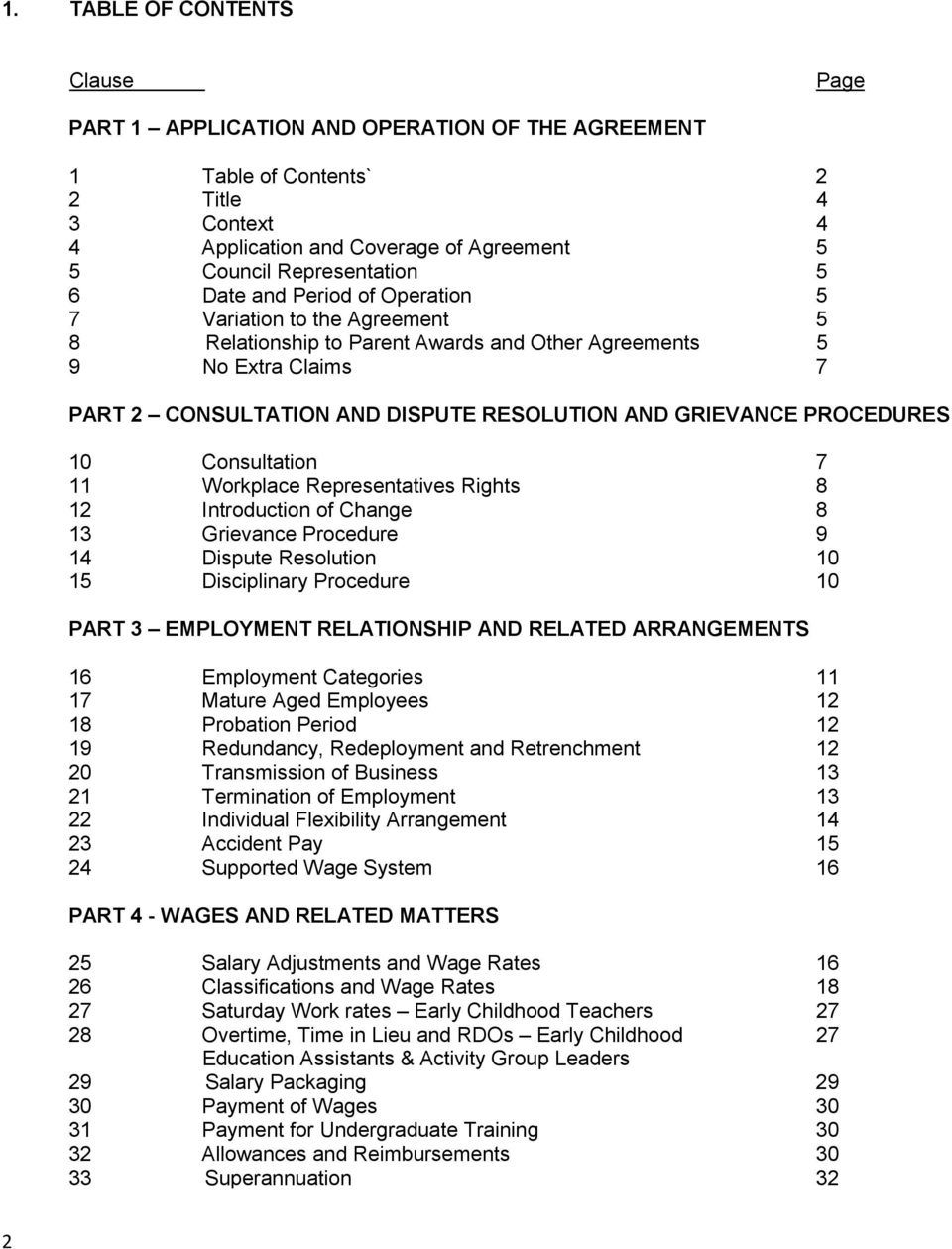
2 1. TABLE OF CONTENTS Clause Page PART 1 APPLICATION AND OPERATION OF THE AGREEMENT 1 Table of Contents` 2 2 Title 4 3 Context 4 4 Application and Coverage of Agreement 5 5 Council Representation 5 6 Date and Period of Operation 5 7 Variation to the Agreement 5 8 Relationship to Parent Awards and Other Agreements 5 9 No Extra Claims 7 PART 2 CONSULTATION AND DISPUTE RESOLUTION AND GRIEVANCE PROCEDURES 10 Consultation 7 11 Workplace Representatives Rights 8 12 Introduction of Change 8 13 Grievance Procedure 9 14 Dispute Resolution Disciplinary Procedure 10 PART 3 EMPLOYMENT RELATIONSHIP AND RELATED ARRANGEMENTS 16 Employment Categories Mature Aged Employees Probation Period Redundancy, Redeployment and Retrenchment Transmission of Business Termination of Employment Individual Flexibility Arrangement Accident Pay Supported Wage System 16 PART 4 - WAGES AND RELATED MATTERS 25 Salary Adjustments and Wage Rates Classifications and Wage Rates Saturday Work rates Early Childhood Teachers Overtime, Time in Lieu and RDOs Early Childhood 27 Education Assistants & Activity Group Leaders 29 Salary Packaging Payment of Wages Payment for Undergraduate Training Allowances and Reimbursements Superannuation 32 2
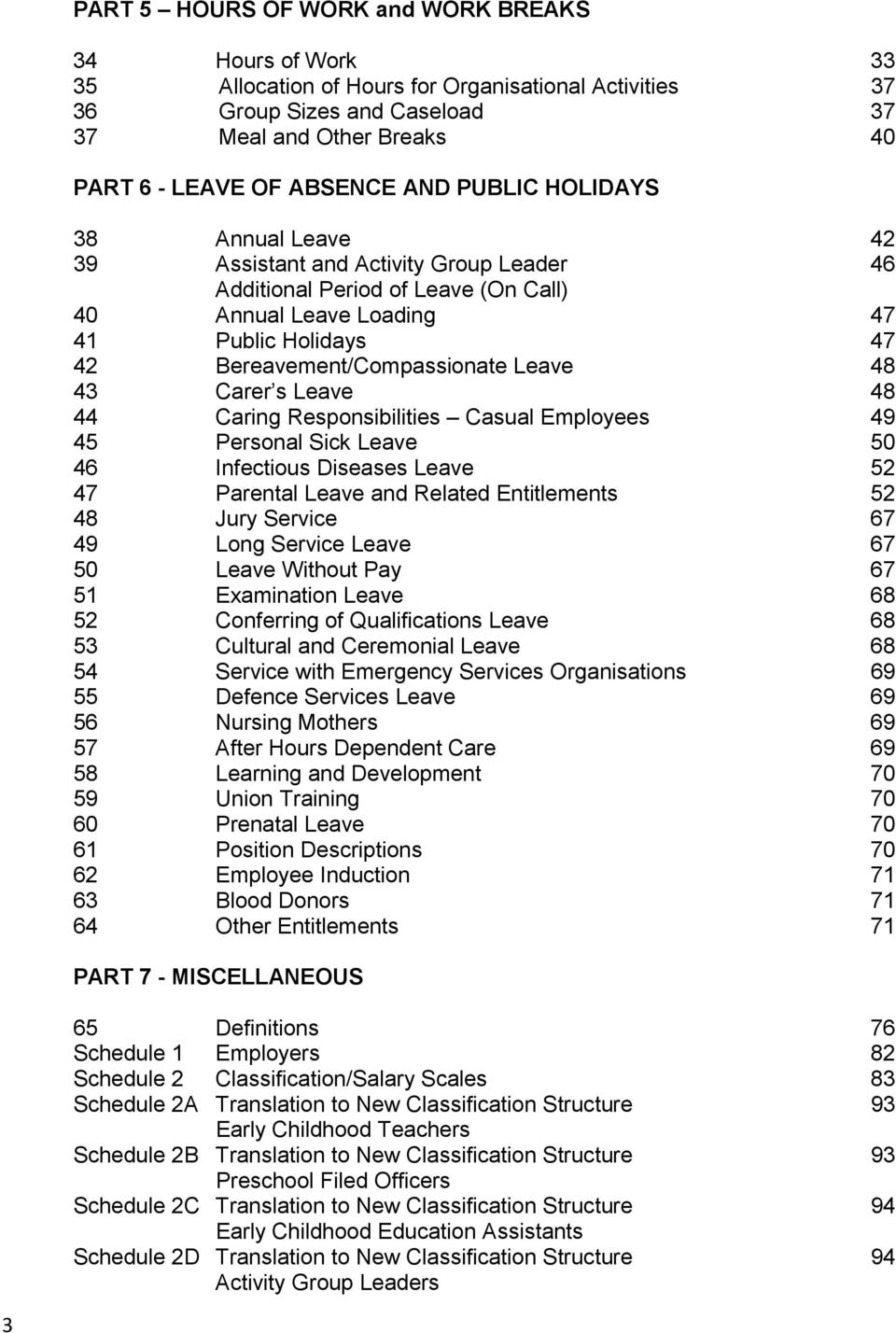
3 PART 5 HOURS OF WORK and WORK BREAKS 34 Hours of Work Allocation of Hours for Organisational Activities Group Sizes and Caseload Meal and Other Breaks 40 PART 6 - LEAVE OF ABSENCE AND PUBLIC HOLIDAYS 38 Annual Leave Assistant and Activity Group Leader 46 Additional Period of Leave (On Call) 40 Annual Leave Loading Public Holidays Bereavement/Compassionate Leave Carer s Leave Caring Responsibilities Casual Employees Personal Sick Leave Infectious Diseases Leave Parental Leave and Related Entitlements Jury Service Long Service Leave Leave Without Pay Examination Leave Conferring of Qualifications Leave Cultural and Ceremonial Leave Service with Emergency Services Organisations Defence Services Leave Nursing Mothers After Hours Dependent Care Learning and Development Union Training Prenatal Leave Position Descriptions Employee Induction Blood Donors Other Entitlements 71 PART 7 - MISCELLANEOUS 65 Definitions 76 Schedule 1 Employers 82 Schedule 2 Classification/Salary Scales 83 Schedule 2A Translation to New Classification Structure 93 Early Childhood Teachers Schedule 2B Translation to New Classification Structure 93 Preschool Filed Officers Schedule 2C Translation to New Classification Structure 94 Early Childhood Education Assistants Schedule 2D Translation to New Classification Structure 94 Activity Group Leaders 3
4 2. TITLE Schedule 3 Salary Packaging Agreement 95 Schedule 4 Roles and Responsibilities 97 Early Childhood Education Assistants and Activity Group Leaders Schedule 5 Roles and Responsibilities 100 Early Childhood Teachers Schedule 6 Teacher Standards 102 Schedule 7 Term Breaks 114 PART 1 APPLICATION AND OPERATION OF THE AGREEMENT This Agreement shall be known to as the Local Government Early Childhood Education Employees Agreement CONTEXT Providing the best possible start in life for all Victorian children requires a commitment to ensuring the best educational opportunities and providing concrete reforms to achieve this end. Fundamental to this is ensuring that early childhood services have skilled and committed staff who are supported to deliver their very best in the professional contexts in which they work. The commitments set our below acknowledge the centrality of teacher and assistant practice in improving system and service performance and most importantly, outcomes for children and families. The Parties to which this Agreement applies and covers are committed to the following: (a) (b) Ensuring the delivery of high quality early childhood education programs Implementing the Blueprint for Education and Early Childhood Development and early childhood COAG initiatives such as working towards provision of 15 hours of kindergarten per week in the year before school delivered by a qualified teacher and implement transition plans (kindergarten to school) within available resources. They recognize that (a) (b) (c) on-going professional development of early childhood employees is linked to high quality early childhood education and improved learning opportunities for children. early childhood employees have a responsibility to identify their own professional developmental needs and to undertake continuous learning in order to enhance their knowledge and skills and maintain the standards for the delivery of kindergarten programs. the importance of a commitment by employers to support and encourage professional development particularly in relation to the provision of high quality programs. 4

5 Further, they acknowledge that the delivery by employers of early childhood education services and programs must be in accordance with the Victorian Government s Children s Services Act 2008 and Regulations 2009 as amended from time to time and may be covered at some time in the future by quality standards and learning frameworks. 4. APPLICATION AND COVERAGE OF THE AGREEMENT This Agreement applies to and covers: the employers listed in Schedule 1; their employees who are engaged in the classifications of work provided by this Agreement the Australian Education Union; and the Liquor Hospitality and Miscellaneous Union. 5. COUNCIL REPRESENTATION The Municipal Association of Victoria shall have the right to represent employers with respect to any matter arising from this Agreement. 6. DATE AND PERIOD OF OPERATION 6.1 This Agreement shall take effect from the day of the day of the order of Fair Work Australia approving the Agreement with a nominal expiry date of 30 April The parties agree that a review of the terms of this Agreement will commence not later than six months prior to its nominal expiry date. 7. VARIATION TO THE AGREEMENT It is agreed between the parties that this Agreement may be varied in accordance with the provisions of the Fair Work Act RELATIONSHIP TO PARENT AWARDS AND OTHER AGREEMENTS This Agreement shall operate to the total exclusion of the following awards and agreements except as otherwise provided for in this Agreement: o Educational Services Early Childhood Assistants (Victoria) Award 1999 o Early Childhood Teachers Interim Award 1999 o Early Childhood Teachers Multi-Employer Certified Agreement 2005 or any successor thereto o Ballarat City Council Enterprise Agreement No 4, 2003 As extended and varied 11June 2009 AG Version2 o Banyule City Council Enterprise Agreement No As extended and varied 19 December 2008 AG Version 2 5

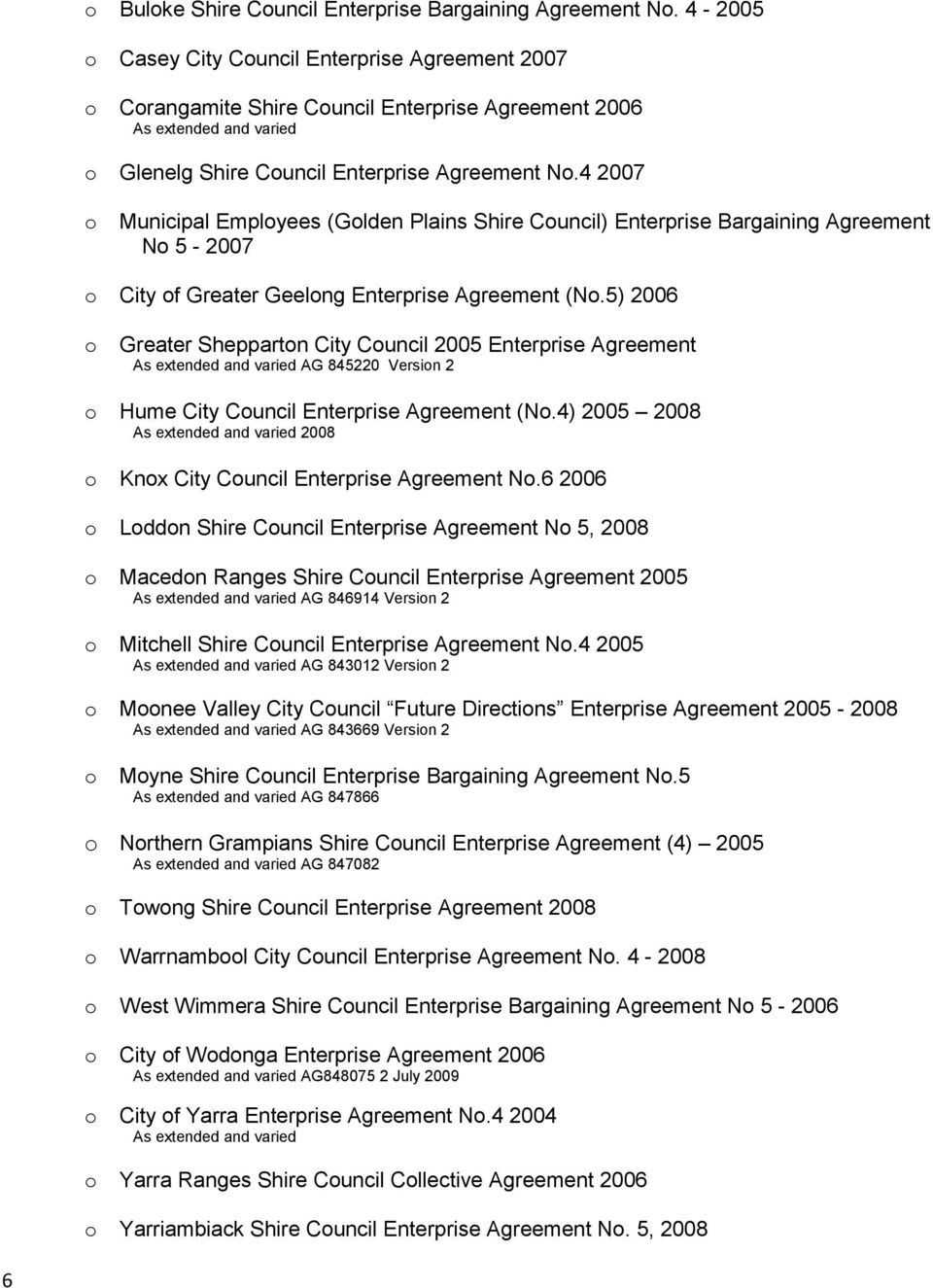
6 o Buloke Shire Council Enterprise Bargaining Agreement No o Casey City Council Enterprise Agreement 2007 o Corangamite Shire Council Enterprise Agreement 2006 As extended and varied o Glenelg Shire Council Enterprise Agreement No o Municipal Employees (Golden Plains Shire Council) Enterprise Bargaining Agreement No o City of Greater Geelong Enterprise Agreement (No.5) 2006 o Greater Shepparton City Council 2005 Enterprise Agreement As extended and varied AG Version 2 o Hume City Council Enterprise Agreement (No.4) As extended and varied 2008 o Knox City Council Enterprise Agreement No o Loddon Shire Council Enterprise Agreement No 5, 2008 o Macedon Ranges Shire Council Enterprise Agreement 2005 As extended and varied AG Version 2 o Mitchell Shire Council Enterprise Agreement No As extended and varied AG Version 2 o Moonee Valley City Council Future Directions Enterprise Agreement As extended and varied AG Version 2 o Moyne Shire Council Enterprise Bargaining Agreement No.5 As extended and varied AG o Northern Grampians Shire Council Enterprise Agreement (4) 2005 As extended and varied AG o Towong Shire Council Enterprise Agreement 2008 o Warrnambool City Council Enterprise Agreement No o West Wimmera Shire Council Enterprise Bargaining Agreement No o City of Wodonga Enterprise Agreement 2006 As extended and varied AG July 2009 o City of Yarra Enterprise Agreement No As extended and varied o Yarra Ranges Shire Council Collective Agreement 2006 o Yarriambiack Shire Council Enterprise Agreement No. 5,
7 9. NO EXTRA CLAIMS 9.1 This Agreement is made in settlement of all claims arising from the union s log of claims of March There shall be no further claims made or industrial action taken on any matter during the term of the Agreement. 9.2 Notwithstanding sub-clause 9.1 and provided that in the event a successor agreement is not agreed by 30 April 2013 there will be a guaranteed salary increase, consistent with the Department of Early Education and Childhood Development Funding Model at that time, effective as from the first pay period on or after 1 May PART 2 CONSULTATION, DISPUTE RESOLUTION AND GRIEVANCE PROCEDURES 10. CONSULTATION The parties commit themselves to the following principles: (a) (b) (c) (d) (e) Cooperative and consultative relationships between management, employees and the union; Management, employee and union relationships based on mutual respect, trust and preparedness to consider alternative viewpoints; Negotiations involving a mutual problem solving approach focusing on long term gains for all parties; To work within a progressive industrial relations culture to create a system of highly effective early childhood services with effective workplace practices; Recognition of an appropriate role for workplace representatives In order to facilitate this, where a Consultative Committee has been established under the provisions of the relevant employer s current enterprise bargaining agreement and that Committee is dealing with matters which may impact on the employees covered by this Agreement, the employer shall ensure that the representative/s of employees covered by this Agreement shall be consulted on those matters. In order to facilitate this, the representative/s shall be provided with a copy of the agenda for each meeting of the Consultative Committee. Where a Consultative Committee has not been established or a matter applies solely to the employees to whom this Agreement applies, the relevant employer shall ensure that the representative(s) of employees covered by this Agreement shall be consulted on those matters. (f) In support of these principles the following will apply: (i) Reasonable access will be granted to employees for the use of the employer s electronic communications systems such as internet and in a responsible manner for the purposes of effective communication to send and receive s to and from their nominated employee representative(s). 7

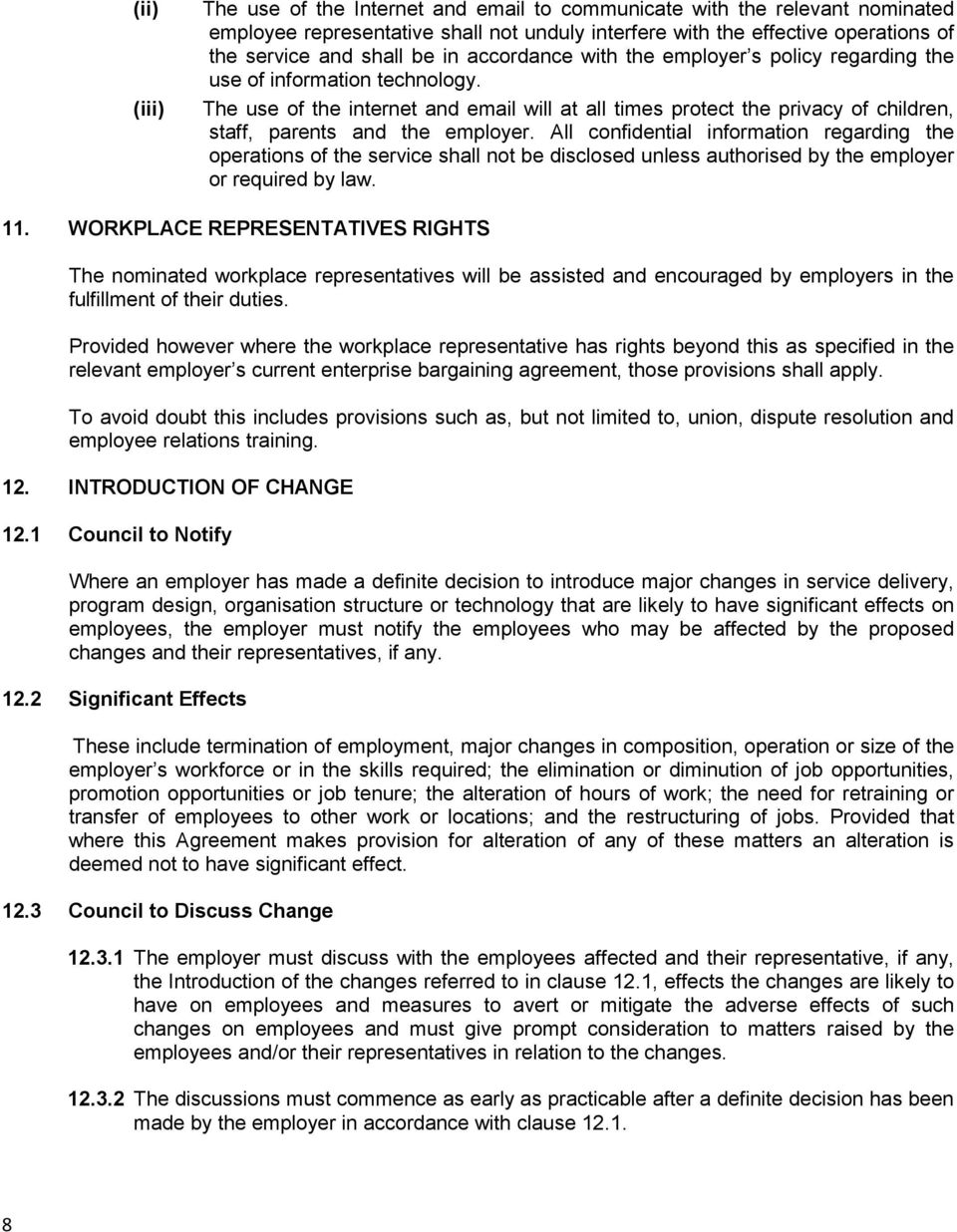
8 (ii) (iii) The use of the Internet and to communicate with the relevant nominated employee representative shall not unduly interfere with the effective operations of the service and shall be in accordance with the employer s policy regarding the use of information technology. The use of the internet and will at all times protect the privacy of children, staff, parents and the employer. All confidential information regarding the operations of the service shall not be disclosed unless authorised by the employer or required by law. 11. WORKPLACE REPRESENTATIVES RIGHTS The nominated workplace representatives will be assisted and encouraged by employers in the fulfillment of their duties. Provided however where the workplace representative has rights beyond this as specified in the relevant employer s current enterprise bargaining agreement, those provisions shall apply. To avoid doubt this includes provisions such as, but not limited to, union, dispute resolution and employee relations training. 12. INTRODUCTION OF CHANGE 12.1 Council to Notify Where an employer has made a definite decision to introduce major changes in service delivery, program design, organisation structure or technology that are likely to have significant effects on employees, the employer must notify the employees who may be affected by the proposed changes and their representatives, if any Significant Effects These include termination of employment, major changes in composition, operation or size of the employer s workforce or in the skills required; the elimination or diminution of job opportunities, promotion opportunities or job tenure; the alteration of hours of work; the need for retraining or transfer of employees to other work or locations; and the restructuring of jobs. Provided that where this Agreement makes provision for alteration of any of these matters an alteration is deemed not to have significant effect Council to Discuss Change The employer must discuss with the employees affected and their representative, if any, the Introduction of the changes referred to in clause 12.1, effects the changes are likely to have on employees and measures to avert or mitigate the adverse effects of such changes on employees and must give prompt consideration to matters raised by the employees and/or their representatives in relation to the changes The discussions must commence as early as practicable after a definite decision has been made by the employer in accordance with clause
9 For the purposes of such discussion, the employer must provide in writing to the employees concerned and their representatives, if any, all relevant information about the changes including the nature of the changes proposed, the expected effects of the changes on employees and any other matters likely to affect employees provided that no employer is required to disclose confidential information the disclosure of which would be contrary to the employer s interests. 13 GRIEVANCE PROCEDURE 13.1 The parties recognise that from time to time employees may have grievances which need to be resolved in the interest of good relationships It is the objective of this procedure to ensure that grievances are resolved by negotiation and discussion and without unnecessary delay The following procedure shall apply: (a) (b) (c) (d) (e) (f) (g) (h) The employee shall attempt in the first instance to resolve the matter with his/her immediate superior directly. A nominated employee representative shall be present if requested by the employee. If the employee still feels aggrieved then the matter shall be referred to his/her department head directly. A nominated employee representative shall be present if requested by the employee. If the grievance is still unresolved, the matter shall be referred to senior management directly. A nominated employee representative shall be present if requested by the employee. If the grievance is still unresolved a meeting of the parties, including the employer organization and a nominated employee representative, shall be arranged at the request of any party. It is agreed that the requirements of this clause shall be fulfilled within seven days unless it is agreed by the aggrieved employee that this period may be extended to a maximum of 14 days Until the grievance is determined, the employee shall continue normal work unless health and safety matters are involved. No party shall be prejudiced as to the final settlement by the continuance of work. If the grievance is not settled the matter may be referred by either party to Fair Work Australia (FWA) for decision. 9
10 14 DISPUTE RESOLUTION 14.1 In the event of a dispute about a matter under this Agreement, in the first instance the parties to the dispute must attempt to resolve the matter at the workplace by discussions between the employee or employees concerned and the relevant supervisor. If such discussions do not resolve the dispute, the parties to the dispute will endeavour to resolve the dispute in a timely manner by discussions between the employee or employees concerned and more senior levels of management as appropriate If a dispute about a matter arising under this Agreement is unable to be resolved at the workplace, and all appropriate steps under clause 14.1 have been taken, a party to the dispute may refer the dispute to Fair Work Australia (FWA) The parties agree that in the first instance Fair Work Australia (FWA) will seek to determine the matter by conciliation between the parties to the dispute Where the matter in dispute remains unresolved, the parties agree that Fair Work Australia (FWA) shall determine the matter by the use of its arbitral powers An employer or employee may appoint another person, organisation or association to accompany and/or represent them for the purposes of this clause While the dispute resolution procedure is being conducted, work must continue in accordance with this Agreement and the Act. Subject to applicable occupational health and safety legislation, an employee must not unreasonably fail to comply with a direction by the employer to perform work that is safe and appropriate for the employee to perform. 15 DISCIPLINARY PROCEDURE 15.1 The employer shall ensure that the principles of procedural fairness underpin any investigation into an employee s performance or conduct This clause shall not apply to casual assistants, emergency, relief and probationary employees Where the employer decides disciplinary action is necessary, the employer shall notify the employee in writing of the reasons why the disciplinary action is being taken in relation to the employee s conduct or performance The employer and employee/s shall meet to discuss the reasons why the employer is taking disciplinary action The employee shall be given an opportunity to respond to any allegations of unsatisfactory conduct or performance including the reasons why the employer is taking disciplinary action Unless the conduct is of a serious or willful nature that warrants immediate termination of employment, the first warning must be both verbal and written. It shall be recorded on the employee s personnel file and a copy shall be given to the employee. A nominated employee or employer representative shall be present if requested by any party 10
11 15.7 If the unsatisfactory conduct or performance continues a second and final warning must be both verbal and in writing A copy must be given to the employee. It shall be recorded on the employee s personnel file and a copy shall be given to the employee. A nominated employee or employer representative shall be present if requested by any party In the event of the matter recurring, the employment may be terminated in accordance with this Agreement 15.9 If a dispute should arise over the disciplinary action the matter may be referred by either party to Fair Work Australia (FWA) for conciliation in the first instance and if the matter remains unresolved Fair Work Australia (FWA) shall determine the matter by use of its arbitral powers If after a warning has been issued, and a period of twelve months elapses without any further warnings or action being required, all reports relating to the warning must be removed from the employee s personnel file and the employee must be advised of this action in writing In cases of serious and willful misconduct summary dismissal may only result after the conduct and/or performance has been investigated and the employee has had an opportunity to respond to the allegations. PART 3 EMPLOYMENT AND RELATED ARRANGEMENTS 16 EMPLOYMENT CATEGORIES Employees covered by this Agreement shall be employed in one of the following categories: 16.1 Full-time Employee A full time employee is ordinarily employed for (38) thirty-eight hours per week with the exception of Preschool Play Leaders who are ordinarily employed for a period of (35) thirty-five hours per week and Early Childhood Teachers who for the 2009 preschool year shall ordinarily be employed for (40) forty hours per week Part-time Employee A part time employee, other than an emergency and/or relief teacher, is ordinarily employed on a permanent basis for a constant number of hours less than 38 hours per week or in the case of an Early Childhood Teacher during the 2009 preschool year, a constant number of hours for less than 40 hours per week. A part time employee shall be entitled to pro rata conditions and benefits under this Agreement Casual, Emergency and Relief Employment An Emergency Early Childhood Teacher means an employee appointed to meet a sudden emergency, replacing an Early Childhood Teacher for periods up to and including 4 days. Where a permanent part time employee agrees to provide emergency relief this shall subject to clause
12 A Relief Early Childhood Teacher means an employee appointed on a temporary basis for a pre-arranged period of more than 4 days on a full-time or part-time basis, and shall receive the same entitlements specified in this Agreement as applied to the employee she/he is replacing A casual Assistant means an employee engaged on an ad hoc basis classified as an Early Childhood Education Assistant, Additional Assistant (Special Needs) or Activity Group Leader, engaged and paid as such but shall not include employees who are required to work a constant number of hours each week 17. MATURE AGED EMPLOYEES Employees under relevant anti-discrimination legislation cannot be discriminated against in their employment on the basis of their age Such employees shall continue to receive terms and conditions of employment in accordance with this Agreement and relevant legislation in relation to matters such as long service leave, superannuation and WorkCover. 18. PROBATION PERIOD 18.1 Where an employer elects to implement a probationary period, such probationary period shall be notified to the employee in writing by the employer on appointment and be of 12 weeks duration wholly within term time During the probationary period the employment may be terminated by at least one day's notice given in writing by either party or by the payment or forfeiture of, as the case may be, of the one day's wages in lieu of such notice. Such payment shall be in addition to payment for the time worked up to the actual date of termination of employment Where an employer proposes to terminate the employment of an employee pursuant to 18.2 for reasons related to the conduct and/or performance of the employee, the employer, if requested by the employee, shall advise the employee of these reasons Notwithstanding the provisions of 18.1, where within the period of probationary employment, the employee is absent from the workplace for periods greater than 5 consecutive working days, the period of probationary employment may be extended by the period of the employees absence Where the employer elects to extend the period of probationary employment under these provisions, the employer shall advise the employee in writing of this extension not later than 7 days after the period of absence provided notice occurs prior to the completion date of the initial notice period. 19 REDUNDANCY, REDEPLOYMENT AND RETRENCHMENT 19.1 In the event that a position held by an employee covered by this Agreement is made redundant the provisions of the relevant employer s enterprise bargaining agreement in force at the time shall apply in respect of redundancy, redeployment and retrenchment. 12

13 19.2 Notwithstanding 19.1 an employer shall not be required to provide any of the applicable severance entitlements to an employee in the circumstances where the Victorian State Government assumes direct responsibility for the delivery of early childhood services and the employee becomes an employee of the State Government under the process of transmission of business. 20 TRANSMISSION OF BUSINESS In the event that a body assumes direct responsibility for the delivery of early childhood services the provisions of the relevant employer s enterprise bargaining agreement in force at the time shall apply in respect of the transmission of business. 21 TERMINATION OF EMPLOYMENT 21.1 Notice of termination or payment in lieu by an employer An employer shall not terminate an employee s employment unless the employer has given the employee written notice of the day of the termination (which cannot be before the day the notice is given) Clause shall not apply to any of the following employees: (a) (b) (c) (d) (e) an employee employed for a specified period of time or for a specific task; an employee serving a period of probation in accordance with this Agreement; an employee serving a qualifying period in accordance with the Act; an employee whose employment is terminated because of serious or wilful misconduct; and a casual employee The notice of termination may be given to an employee by: (a) (b) (c) delivering it personally; or leaving it at the employee s last known address; or sending it by pre-paid post to the employee s last known address The employer must not terminate the employee s employment unless: (a) (b) the time between giving the notice and the day of termination is at least the required minimum period; or the employer has paid the employee payment in lieu of notice of at least the amount the employer would have been liable to pay at the full rate of pay for the hours he/she would have worked had the employment continued until the end of the minimum period of notice. That total must be calculated on the basis of: 13 (i) (ii) (iii) the employee s ordinary hours of work being the agreed hours or the average hours over a 12 month period; and the amounts ordinarily payable to the employee in respect of those hours, including (for example) allowances, loading and penalties; and any other amounts payable under the employee s contract of employment.
14 The minimum period of notice required to be given to an Early Childhood Education Assistant or Activity Group Leader is as follows unless such other period of notice is agreed between the employee and the employer: Continuous service Not more than 1 year More than 1 year but not more than 3 years More than 3 years but not more than 5 years More than 5 years Period of Notice 1 week 2 weeks 3 weeks 4 weeks The minimum period of notice required to be given to an Early Childhood Education Teacher, Preschool Field Officer, or an Adviser, is four weeks unless such other period of notice is agreed between the employee and the employer The period of notice shall be increased by 1 week if the employee is over 45 years old and has completed at least 2 years of continuous service with the employer at the end of the day the notice is given Where an employer has given notice of termination to an employee, an employee shall be allowed up to 1 day s time off without loss of pay for the purpose of seeking other employment. The time off shall be taken at times that are convenient to the employee after consultation with the employer The employment of a casual Assistant or Activity Group Leader shall be terminated by at least one hour s notice Notice of termination by an employee The notice of termination required to be given by an employee is the same as that required of an employer except that there is no requirement on the employee to give additional notice based on the age of the employee concerned If an employee fails to give the required notice the employer may withhold from any monies due to the employee on termination under this Agreement, an amount not exceeding the amount the employee would have been paid under this Agreement in respect of the period of notice required by this clause less any period of notice actually given by the employee. 22 INDIVIDUAL FLEXIBILITY ARRANGEMENT 22.1 An employer and an employee covered by this Agreement may agree to make an individual flexibility arrangement to vary the effect of terms of the Agreement if: (a) The Agreement deals with one or more of the following matters: (i) (ii) (iii) (iv) (v) arrangements for when work is performed; overtime rates; penalty rates; allowances; leave loading; and 14

15 (b) the arrangement meets the genuine needs of the employer and employee in relation to 1 or more of the matters mentioned in paragraph (a); and (c) the arrangement is genuinely agreed to by the employer and employee The employer must ensure that the terms of the individual flexibility arrangement: (a) (b) (c) are about permitted matters under section 172 of the Fair Work Act 2009; and are not unlawful terms under section 194 of the fair Work Act 2009; and result in the employee being better off overall than the employee would be if no arrangement was made The employer must ensure that the individual flexibility arrangement: (a) (b) (c) (d) is in writing; and includes the name of the employer and employee; and is signed by the employer and employee and if the employee is under 18 years of age, signed by a parent or guardian of the employee; and includes details of: (i) the terms of the Agreement that will be varied by the arrangement; and (ii) (iii) how the arrangement will vary the effect of the terms; and how the employee will be better off overall in relation to the terms and conditions of his or her employment as a result of the arrangement; and (e) states the day on which the arrangement commences The employer must give the employee a copy of the individual flexibility arrangement within 14 days after it is agreed to The employer or employee may terminate the individual flexibility arrangement: (a) by giving no more than 28 days written notice to the other party to the arrangement; or (b) if the employer and employee agree in writing at any time. 23. ACCIDENT PAY 23.1 Where an employee becomes entitled to weekly compensation payments pursuant to the Accident Compensation Act 1985 (the Act), the employer will pay to the employee an amount equivalent to the difference between: (a) the level of weekly compensation and any weekly wages earned or able to be earned if partially incapacitated, and 15
16 (b) the amount that would have been payable under this agreement for the classification of work if the employee had been performing their normal duties, provided that such rate shall exclude additional remuneration by way of shift premiums, overtime payments, special rates or other similar payments Accident pay shall not apply in respect of any injury during the first five working days of incapacity Accident pay shall not apply to any incapacity occurring during the first two weeks of employment, unless such incapacity continues beyond the first two weeks Industrial diseases contracted by a gradual process or injuries subject to recurrence, aggravation or acceleration shall not be subject to the accident pay unless the employee has been employed with the employer at the time of the incapacity for a minimum period of one month The maximum period or aggregate of periods of accident pay to be made by an employer shall be a total of 39 weeks for any one injury, or the number of weeks as prescribed in the relevant employer s current enterprise bargaining agreement, whichever is the greater Where an employee receives a weekly payment under this section and subsequently such payment is reduced pursuant to the Act, such reduction will not increase the liability of the employer to increase the amount of accident pay in respect of that injury 24 SUPPORTED WAGE SYSTEM This agreement incorporates in its entirety the model clause adopted by the Full Bench of the Commission in the Award Modernisation Program. PART 4 WAGES AND RELATED MATTERS 25. SALARY ADJUSTMENTS AND WAGE RATES 25.1 Employees whose terms and conditions of employment are subject to this Agreement shall have their salary adjusted in accordance with the following: On approval of this Agreement by Fair Work Australia (FWA) the following payments shall be made: Lump Sum Payments $1,500 Senior Advisers (excluding employees employed as PSFOs, Advisers and Level 1 Senior Advisers immediately prior to the commencement of this Agreement) $1,000 - Teachers (excluding employees employed as level 1-1A, 1-1B and 1-1 immediately prior to the commencement of this Agreement) $ 500 Assistants (excluding employees employed as level 1 immediately prior to the commencement of this Agreement) Pro rata payments shall be made to eligible part time employees Salary Increase 16 The increase set out in Schedule 2 effective as from the first payment period on or after 3 May 2009.

17 In addition to the salary increases provided for in sub-clause further salary increases as set out in Schedule 2 shall apply from the first pay period on or after, 25.2 Notwithstanding 25.1: o 27 January 2010 (Part time employees only) o 1 May 2010 o 1 May 2011 o 1 May 2012 Employees who are Early Childhood Education Assistants or Activity Group Leaders and who at the date of any of the salary increases specified above are paid a rate higher than the rates set in Schedule 2 shall continue to receive salary increases at the rate and time payable under the relevant employer s current enterprise bargaining agreement, as specified at clause 8 of this Agreement, for its term. Further increases at the rate of 2.71% shall be payable in accordance with where the current Council enterprise bargaining agreement reaches its nominal expiry date during the term of this Agreement 25.3 Where the salary rates for Early Childhood Teachers, Preschool Field Officers and Advisers payable under this Agreement are lower than the salary currently paid to the employee as at the date of approval of this Agreement, the employee shall continue to be paid at their current rate Where the provisions of 25.3 apply, future salary increases under this Agreement shall be absorbed within the employee s current salary rate until such time as the salary rate in this Agreement exceeds the existing salary payable to the employee At the date of approval of this Agreement, employees shall be translated to the new classification structure in accordance with Schedules 2A 2D as appropriate Junior employees must be paid the following percentage of the appropriate wage rate. Age % Under 16 years of age years of age years of age years of age years of age years of age 90 Effective as from 1 January 2012 the minimum age for an employee will be 18 years of age An Emergency Early Childhood Teacher shall receive a minimum payment of 3.5 hours on any one day based on level 1.2 plus a 25% loading. This loading shall be in lieu of entitlements to annual leave, annual leave loading, carer s leave, bereavement/compassionate leave, and personal sick leave. 17
18 26. CLASSIFICATIONS AND WAGE RATES Early Childhood Teachers, Preschool Field Officers, & Advisers 26.1 Application of Incremental Range Early Education Teachers An Early Childhood Teacher who holds one of the following qualifications may proceed under the rules of progression to Exemplary Level 3-4: (a) (b) (c) 3 year Early Childhood Teaching Degree or Diploma (employed on or before 17/2/2006) 4 year Early Childhood Teaching degree Relevant Graduate Diploma or equivalent as approved by the Victorian Branch of Early Childhood Australia Early Childhood Teachers as provided for in (b) and (c) employed on or after 1 July 2006 shall commence at the rate prescribed for Graduate Level An Early Childhood Teacher holding a 3 year Early Childhood Teaching Degree or Diploma, employed as an Early Education Teacher after 17/2/2006 may proceed under the rules of progression to a maximum of Accomplished Level 2-4. Where they are employed on or after 1 July 2006, they shall commence at the rate prescribed for Graduate Level 1-1A An Early Childhood Teacher holding a 3 or 4 year Primary Teaching Diploma or Degree, employed as an Early Education Teacher may proceed under the rules of progression to a maximum of Accomplished Level 2-2. Where they are employed on or after 1 July 2006, they shall commence at the rate prescribed for Graduate Level 1-1A Early Education Teachers (Primary) who obtain a minimum equivalent further one year of full-time tertiary early childhood studies shall be entitled to access the rates set out for Early Education Teachers and will translate in accordance with clause provided that the combined qualifications of the employee after obtaining the additional qualifications are equivalent to those noted in Application of Incremental Range - Preschool Field Officers, Advisers Preschool Field Officers and Adviser Preschool Field Officers and/or Advisers who hold a Diploma of Teaching (Early Childhood) or its equivalent approved by the Victorian Branch of Early Childhood Australia shall be paid at the rate applicable for PSFO/Advisers Level 1 on commencement and may proceed under the rules of progression as provided in clause 26.6.

19 26.3 Early Childhood Teacher Incremental Progression Within Each Classification Professional Development and Enhancement Program Progression through the levels within a classification range (Graduate, Accomplished or Exemplary) shall be on the basis of the completion of 12 months service and the required quantum of professional development as provided in From the date of certification of this Agreement, in determining the total time to qualify as service for the next increment in the case of an Early Childhood Relief Teacher as defined, including a Replacement Employee, periods of employment of less than four weeks in any one kindergarten shall not be taken into account Professional Development and Enhancement Program A shared contribution to professional development shall be consistent with the principles in Clause 3, and both employees and employers will contribute to the achievement of agreed professional development objectives It is acknowledged that teachers make a contribution of their own time and resources and that in addition to the provision of paid time for teachers to undertake professional development, as provided at and an employer may reimburse or meet part or all of the costs of professional development Full-time employees shall be required to complete 4 days of professional development activities in the 12 months immediately preceding their incremental anniversary date (pro-rata part-time employees). These obligations shall continue apply to employees who have reached the top of their respective classification The 4 professional development and enhancement program days shall include 2 child free days The determination of professional development activities undertaken on the 2 child free days shall be established within the context of the objectives contained within employees professional development and enhancement plans An employer may utilise one of the two childfree days for a formal professional development activity such as a staff conference the scheduling of which shall be determined in consultation with staff. Employees will be expected to attend the employer s professional development day if it is the employees allocated child free day. The employer when determining the program for that day shall consider the professional development objectives of their employees An employee, when determining the professional development activity for the second child free day, may choose to participate in additional employer provided professional development of the nature referred to on should this be available. However they are not obliged to do so and may participate in other professional development activities that meet their agreed professional development objectives in consultation with the employer As part of the PDEP, employees should identify professional development and enhancement activities to be undertaken which relate to their identified objectives determined in consultation with the employer support their learning and improve their capacity to undertake their role effectively.

20 In establishing their plan and identifying appropriate professional development and enhancement activities, the employee shall, where applicable, take into account: (a) their professional and work related goals (b) their professional learning and training need in the context of skill development and acquisition and the teacher standards (c) the particular needs of the children and families within the service. (d) the organisational needs of the employer The employee shall prepare their PDEP within three months of their incremental anniversary date each year, a copy of this plan shall be provided to the employer for approval, and the employer shall record their endorsement of the PDEP An employee, when scheduling one or more of the child free days, shall advise the employer of the professional development activity they seek to undertake and seek the employer s approval of the scheduling of that day(s) to ensure that the professional development does not interrupt the kindergarten program. Approval shall not unreasonably be withheld In scheduling the remaining professional development activities the employee may use unpaid time but may also use paid time by agreement with the employer Prior to the end of the PDEP cycle the employee shall provide evidence to the employer of the completion of the required professional development The employer shall confirm in writing to the employee their successful completion of requirements leading to an incremental progression Where an employee changes employment during the course of their incremental year, the employee shall provide to their new employer a copy of their PDEP plan approved by the former employer as well as details of all professional development and enhancement activities already undertaken. The new employer shall ensure that the PDEP plan of the teacher accommodates their organisational needs. The PDEP plan remains in force for the remainder of that incremental year. Provided further, that the new employer may request a revised PDEP plan be submitted within a three month period in which case the employee shall retain full credit for all professional development and enhancement activities completed under the PDEP plan with the former employer Where an employee fails to complete the required quantum of professional development within the relevant period, her/his incremental progression may be deferred for periods of up to three months at a time in order to provide the opportunity for the employee to complete the required professional development. Any deferral should be documented by the employer in writing and a copy provided to the employee. On the completion of the required professional development the increment shall proceed from that date after suitable documentary evidence is provided to the employer. This date becomes the employees new incremental anniversary date. 20
21 Situations may arise where the failure to undertake the required quantum of professional development may be for reasons beyond the control of the employee and which directly affect the capacity of the employee to undertake their professional development activities, such as, but not limited to, extended absences on paid sick leave. In such cases where requested by the employee in writing within three months of the end of the incremental year, the employer will provide the employee with an opportunity to undertake the quantum of professional development within a further period of three months from the date of the employer giving its approval. Provided the employer subsequently deems the employee to have met the requirements within the agreed extended time period, any increase in wage rates will be backdated to the employee s incremental anniversary date Situations may arise where employees are unable to undertake the required quantum of professional development due to continuous paid absences of illness or injury during the entire incremental year. In this case the employer will seek to ensure the employee is not disadvantaged in relation to an entitlement to increment Where an employee feels aggrieved about any decision undertaken throughout the process outlined in this clause, the employee may appeal that decision through the processes as provided within clause 13 - Grievance Procedure Provisions for Relief and Replacement Early Childhood Teachers Incremental Progression Within Each Classification Professional Development and Enhancement Program In order to determine the relevant quantum of professional development for a Relief Early Childhood Teacher the incremental year will be divided into two six month periods of service, 1 January 30 June and 1 July 31 December The quantum of professional development to be completed by a Relief Early Childhood Teacher in each six month period shall be based on the average weekly hours of service in the immediately preceding six month period In order to fulfil the provisions of this clause, a Relief Early Childhood Teacher shall maintain a log of service for each period of employment, including the name of the service, dates of commencement and cessation of employment and hours of employment Evidence of eligibility for increment entitlements shall be provided by Statutory Declaration by the teacher concerned Pre-school Field Officers Incremental Progression Within Each Classification Professional Development and Enhancement Program The provisions of Clause 26 shall apply except that in relation to pre-school field officers shall be required to complete 8 days of professional development per annum of which 4 days shall be child free days In order to progress to level 2 of the Adviser Classification Scale a pre-school field officer must have completed two years at level 1, in addition to the professional development as specified at
22 26.7 Early Childhood Teacher Incremental Progression - Progression Between Classification Levels Application Process No more than six months prior to their eligibility for reclassification, a teacher may submit a Notice of Intention to apply for validation. A copy of the notice shall be provided by the teacher to the employer The teacher will prepare all relevant evidentiary material and documentation pertinent to the standards for the classification into which they seek to be reclassified. This information shall be included with the Application for Validation to detail how the required standards The teacher shall complete and submit the Application for validation no less than three months prior to their incremental anniversary date The teacher may withdraw the application at any time and they shall advise the employer in writing of their decision A validator shall undertake a review of the material provided by the teacher in the context of the relevant standards. Once the application, including the supporting material, has been assessed the validator shall complete the Validators Section of the Application for Validation, indicating their recommendation and provide a copy to the employer The employer shall consider the teacher s Application for Validation and the validator s recommendation, and complete the Employer Section of the Application for Validation, indicating their view, and return it to the validator within 21 days of the date it was received by the employer Where the recommendations of the validator and the employer unanimously endorse the application for reclassification, the validator shall confirm reclassification in writing to both the teacher and the employer. The teacher s salary shall be adjusted from their incremental anniversary date Notwithstanding the provisions of where an Application for Validation is submitted less than 3 months prior to the teachers incremental anniversary date, reclassification and the associated salary adjustment shall be delayed by the same period. Extensions of time A once only extension of time of up to 4 weeks may be provided by a validator where, having considered the Application for Validation, the validator determines that particular requirement(s) have not been met by the teacher. Confirmation of the extension of time shall be provided in writing by the validator to both the teacher and the employer Where an extension of time is provided, the validator shall provide the teacher with specific information and reasons about the particular standard(s) that have not been met and the teacher shall address these specific issue(s) On or before the expiry of the extension period, the teacher shall provide to the validator a second submission of evidence to support their application for reclassification.
23 The validator shall undertake a review of the second submission provided by the teacher in the context of the particular standard(s) previously determined not to have been met Having determined whether, in their view, the teacher has now met the standards, the validator shall complete the Validators Section of the Application for Validation, indicating the validators recommendation and provide a copy to the employer The employer shall consider the teacher s Application for Validation and the recommendation of the validator, complete the Employer Section of the Application for Validation, indicating their view, and return it to the validator within 21 days of the date it was received by the employer Where the recommendations of the validator and the employer unanimously endorse the application for reclassification, the validator shall confirm reclassification in writing to both the teacher and the employer. The teacher s incremental anniversary date shall be adjusted by the period of the extension of time and the salary increased from that date. Non-unanimous Recommendations for Reclassification In the case where the recommendations of the validator and employer are not unanimous, a second validator shall undertake a site visit and determine whether, in the second validator s view, the requirements in dispute have been met Following the site visit, where in the view of the second validator the requirements for reclassification have been met, the second validator will endorse the Application for Validation and forward a copy to the employer The employer shall reconsider the teacher s Application for Validation and the second validator s endorsement, complete the Employer Section of the Application for Validation, indicating their view, and return it to the second validator within 21 days of the date it was received by the employer Where the recommendations of the second validator and the employer unanimously endorse the application for reclassification, the second validator shall confirm the successful reclassification in writing to both the teacher and the employer. The teacher s salary shall be adjusted and, provided the application was made by the teacher within the prescribed timeframes prior to the incremental anniversary date, backdated to the teacher s incremental anniversary Where in the view of the second validator the requirements for reclassification have not been met, the second validator will advise the teacher and employer in writing In the circumstances as provided by the teacher shall not be eligible to reapply for reclassification for 6 months from the date of the second validator s decision Where the recommendations of the validator and the employer are not unanimous the matter will be determined by the Validation Resolution Committee (VRC). 23
24 The VRC shall attempt to resolve disputes where an employer does not approve an application made by an early education teacher for validation to the next classification level but whose application is endorsed by the validator. In the absence of agreement, the Chair of the VRC will make a determination in the matter by way of recommendation which shall be accepted. In performing this function, the Chair will inform him/herself of the relevant matters in such manner as he/she considers just. No appeal under the Fair Work Act (Cth) or otherwise will be available against the determination of the Chair Where the recommendations of the validator and employer are not unanimous the matter will be determined by the Validation Resolution Committee (VRC) Early Childhood Teacher - Application of Incremental Range Following Re-employment From the date of approval of this Agreement, an Early Childhood Teacher who has been away from the teaching field shall return on the classification level at the time of resignation Proof of Qualification and Movement to Appropriate Increment Range Early Education Teachers who hold a 3 year qualification who are employed within the Early Education Teacher classification (Graduate or Accomplished Levels) and who produce proof of their successful completion of a course leading to a four year Early Childhood Teaching Degree or equivalent as approved by the Victorian Branch of Early Childhood Australia shall be entitled to move to the next level in the Early Education Teacher classification from the date upon which this proof was produced to the employer. Provided however that where movement to the next level in the Early Education Teacher classification would require reclassification to the next range, progression shall be subject to the successful completion of the validation process as provided for in clause Further they shall be eligible to progress to Exemplary Level Early Education Teachers (Primary), who hold a qualification described at and are employed within the Early Education Teacher classification (Graduate or Accomplished Level up a maximum 2-2), who produce proof of their successful completion of a course leading to an to a four year Early Childhood Teaching Degree or equivalent as approved by the Victorian Branch of Early Childhood Australia shall be entitled to move to the next level in the Early Education Teacher classification from the date upon which this proof was produced to the employer. Further they shall be eligible to progress under the provisions of clauses 26.4 and 26.7 to Exemplary Level For the purposes of this clause, official notification from a tertiary institution that the required subjects of the appropriate qualification have been completed shall be taken as proof of holding that qualification Emergency teachers Hours of duty shall be determined according to the following: time allocated as Teaching Time; plus 24 time allocation for Non-teaching Time this being 25% of Teaching Time to undertake Program Support functions.
25 25 At the expiration of a 4 day period, if the teacher is to remain in the same position he/she will be employed and paid as a Relief Early Childhood teacher Additional Hours Permanent Part-time Early Childhood Teachers A permanent part-time teacher is engaged in a permanent position to work less than full-time hours in accordance with this agreement A permanent part-time teacher may agree, but shall not be compelled, to work additional hours for the employer to provide emergency replacement up for a period of up to and including 4 days provided that in doing so their hours do not exceed the equivalent of a full-time employee Hours of duty shall be determined according to the following: time allocated as Teaching Time; plus time allocation for Non-teaching Time this being 25% of Teaching Time to undertake Program Support functions At the expiration of a 4 day period, if the Teacher is to remain in the same position, he/she shall be employed and paid as a Relief Early Childhood Teacher A teacher undertaking additional hours as an emergency teacher under the provisions of this clause shall be paid at their normal rate of pay (according to Schedule1) with a 25% loading. This loading shall be in lieu of entitlements to annual leave, annual leave loading, carers leave, bereavement/compassionate leave and personal sick leave whilst undertaking the position of an emergency teacher. Provided however any such payment shall not be at a rate lower than that applicable to an employee engaged under the provisions of clause and Relief Early Childhood Teacher and Replacement Employee A Relief Early Childhood Teacher, as defined at , including a Replacement Employee, shall be paid at the rate of her/his salary entitlement as specified in Schedule 1 and shall be entitled to pro-rata benefits to annual lave, annual leave loading, carers leave, bereavement/compassionate leave and personal sick leave, provided that the employer may pay the employee a 25 per cent loading on the employee's salary entitlement. Such loading shall be in lieu of the benefits aforementioned Early Childhood Education Assistants and Activity Group Leaders Incremental Progression Early Childhood Assistant These provisions shall be read in conjunction with the classification structure as provided for at Schedules 4 and 2C. Progression from one level to the next within a classification is subject to an Early Childhood Education Assistant meeting the following criteria: competency at the existing level; twelve months experience at that level and in-service training as required;
26 demonstrated ability to acquire the skills which are necessary for advancement to the next pay point level. Access to Level 2 is subject to the Assistant holding the Certificate III in Children s Services in addition to having met the above criteria. Entry level for Certificate III holders is at Level 1.3. Where an employee is deemed not to have met the requisite competency at their existing level at the time of appraisal, his/her incremental progression may be deferred for periods of three months at a time provided that: the employee is notified in writing as to the reasons for the deferral; the employee has, in the twelve months leading to the appraisal, been provided with inservice training required to attain a higher competency level; following any deferral, the employee is provided with the necessary training in order to advance to the next level. Where an appraisal has been deferred for operational reasons beyond the control of either party, and the appraisal subsequently deems the employee to have met the requirements, any increase in wage rates will be back paid to the twelve month anniversary date of the previous incremental progression. Incremental progression to the next pay point level may be accelerated if: an employee has achieved competency at his/her existing level, has demonstrated an ability to acquire the skills necessary to progress to the next pay point level prior to the completion of twelve months at his/her existing level. Either the employer or the employee may seek to implement accelerated advancement. It is the employer s responsibility to determine whether the accelerated advancement is appropriate Activity Group Leaders These provisions shall be read in conjunction with the classification structure as provided for at Schedules 4 and 2D. Progression from one level to the next within a classification is subject to a Activity Group Leader meeting the following criteria: competency at the existing level; twelve months experience at that level and professional development as agreed. The Activity Group Leader shall identify professional development activities to be undertaken which relate to their identified objectives determined in consultation with their employer. Where an employee has not completed the agreed professional development within the 12 months, her/his incremental progression may be deferred for periods of three months at a time to provide an opportunity to complete the agreed professional development. In these circumstances the employer shall notify the employee in writing as to the reasons for the deferral of incremental progression. 26 Where the completion of the agreed professional development has been deferred for operational reasons beyond the control of either party, and the employee subsequently is deemed to have met the requirements, any increase in wage rates will be back paid to the twelve month anniversary date of the previous incremental progression.
27 Casual Assistants and Activity Group Leaders The weekly rate for a casual employee shall be 1/38th of the appropriate weekly rate prescribed for an employee on commencement in the industry plus a loading of 25% of such hourly rate specified in Schedule 1 of this Agreement. 27. SATURDAY WORK RATES EARLY CHILDHOOD TEACHERS Work ordinarily performed on a Saturday by an Early Childhood Teacher shall be paid for at the rate of time and one half for the first three hours and double time thereafter, with a minimum payment of not less than three and one quarter hours at such rates. 28. OVERTIME, TIME IN LIEU, MAKE-UP TIME & RDOS EARLY CHILDHOOD EDUCATION ASSISTANTS & ACTIVITY GROUP LEADERS 28.1 Overtime Except as otherwise provided in this clause, for all work done outside the ordinary spread of hours, the rate shall be time and a half for the first two hours and double time thereafter. In computing overtime, each day's work shall stand alone Work performed on a Saturday shall be paid for at the rate of time and a half for the first two hours and double time thereafter, with a minimum payment of not less than three and one-quarter hours at such rate Work performed on Sundays shall be paid for at the rate of double time and work performed on a holiday shall be paid for at the rate of double time and a half, with a minimum payment of not less than three and one-quarter hours at such rate Where overtime or extra shifts are required to be worked in accordance with the requirements of the Early Childhood Teacher's program, the employer shall give preference for such work to Early Childhood Assistants covered by the terms of this Agreement where it is reasonably practicable to do so Where overtime is required to be worked in accordance with the requirements of the case management of a child for whom an Additional Assistant (Special Needs) has been employed the Additional Assistant (Special needs) shall have the additional hours paid at the appropriate overtime penalty Where an employee s additional hours are worked during the ordinary spread of hours or in an emergency replacement situation within the ordinary spread of hours the rate of pay shall be the ordinary rate plus a loading of 25% for each additional hour A part-time employee employed outside the ordinary spread of hours shall have the hourly rate increased by the appropriate overtime penalty. 27
28 28.2 Time In lieu system Notwithstanding provisions elsewhere in the Agreement, the employer and the majority of employees of the employer may agree to establish a system of time off in lieu of overtime provided that: (a) (b) An employee may elect, with the consent of the employer, to take time off in lieu of payment for overtime at a time or times agreed with the employer. Overtime taken as time off during ordinary time hours shall be taken at this ordinary time rate that is an hour for each hour worked An employer shall, if requested by an employee, provide payment at the rate provided for the payment of overtime as prescribed in clause 28 of this Agreement as appropriate, for any overtime worked under this clause where such time has not been taken within four weeks of accrual The employer shall inform the employee/s nominated representative, if requested, of its intention to introduce an enterprise system of time off in lieu of overtime flexibility, where requested by the employee/s provide a reasonable opportunity for the nominated employee representative s participation in negotiations Once a decision has been taken to introduce an enterprise system of time off in lieu, in accordance with this clause, its terms must be set out in the time and wages records Make-up Time system Notwithstanding provisions elsewhere in the Agreement, the employer and the majority of employees at an enterprise may agree to establish a system of make-up time provided that: An employee may elect, with the consent of the employer to work make-up time under which the employee takes time off during ordinary hours and works those hours at a later time, during the spread of ordinary hours provided in the Agreement An employee on shift work may elect, with the consent of the employer, to work make-up time under which the employee takes time off ordinary hours and works those hours at a later time at the shift work rate which would have been applicable to the hours taken off The employer shall inform the employee/s nominated representative if requested of its intention to introduce an enterprise system of make-up time flexibility, and where requested by the employee/s provide a reasonable opportunity for the nominated employee representative s participation in negotiations Once a decision has been taken to introduce an employer system of make-up time, a record of time accrued and taken must be maintained at all times RDO system Notwithstanding provisions elsewhere in the agreement, and providing that any proposals are consistent with relevant regulations and the operational needs of the business, the employer and the majority of employees may agree to establish a system of RDO to provide that: 28
29 An employee may elect, with the consent of the employer, to take a rostered day off at any time An employee may elect, with the consent of the employer, to take rostered days off in part day amounts An employee may elect, with the consent of the employer, to accrue some or all rostered days off for the purpose of creating a bank to be drawn upon by the employee at time mutually agreed by the employer or subject to reasonable notice by the employee or the employer The employer shall inform the employee/s nominated representative if requested of its intention to introduce an enterprise system of RDO flexibility, and where requested by the employee/s provide a reasonable opportunity for the nominated employee representative s participation in negotiations Once a decision has been taken to introduce an enterprise system of RDO flexibility, in accordance with this clause, its terms must be set out in a written statement a copy of which must be available at all work locations. 29. SALARY PACKAGING 29.1 All permanent employees covered under the terms of this Agreement are eligible to apply for salary packaging Notwithstanding any other provision of this Agreement, the salary that would otherwise be applicable to an employee under the Agreement shall be reduced by such amount as agreed between the employee and the employer to the extent necessary to provide a package for the employee The remuneration package for the employee will comprise the reduced salary and taxable and tax-exempt benefits as defined in the Fringe Benefits Tax Assessment Act 1986 (Cth)) The employer shall not make any purchases on behalf of the employee in respect of the Salary Packaging Agreement The employee shall pay for all reasonable administration and other costs, including set up and termination costs, associated with salary packaging The Salary Packaging Agreement in Schedule 3 must be used on all occasions to record salary packaging arrangements The terms and conditions applying to salary packaging arrangements shall be as specified the Salary Packaging Agreement The employer recommends that employees considering salary packaging should seek independent financial advice. The employer shall not be responsible in any way for the cost or outcome of any such advice. 29
30 29.9 In respect of an employee who enters into a salary packaging agreement, the salary rate that would otherwise be applicable to the employee under this Agreement shall be used to calculate entitlements in respect of: * Annual leave loading * Outstanding leave due upon termination of employment * Redundancy payments. * Employer superannuation contributions While an employee who has entered into a Salary Packaging Agreement is on any form of paid leave including annual leave, long service leave or special leave, the employee shall continue to be paid in accordance with the Salary Packaging Agreement. 30. PAYMENT OF WAGES At the employer s discretion, employees shall be paid weekly or fortnightly by electronic funds transfer into the employee s nominated bank account or other agreed method. Provided however where a public holiday falls on the normal pay day or the day following the normal pay day, the wages shall be paid on the ordinary working day preceding the normal pay day. 31. PAYMENT FOR UNDERGRADUATE TRAINING Where an Early Childhood Teacher, with the agreement of the employer undertakes on behalf of a higher education institution the training of an undergraduate on placement, any monies or fee payable by the institution pertaining to and as payment for the training and supervision of undergraduate student by the Early Childhood Teacher shall, if paid to the employer, be forwarded in full to the teacher. 32. ALLOWANCES AND REIMBURSEMENTS 32.1 Meal Allowance An employee required to work on Saturday for longer than four hours or in excess of nine continuous hours on any day or after 6.00 p.m. shall either be paid an amount equivalent to 1% of the weekly Graduate 1.1.A rate or supplied with a meal. The allowance will be as follows: As from date of certification of this Agreement $ 9-58 As from first pay period on or after 1 May 2010 $ 9-83 As from first pay period on or after 1 May 2011 $10-05 As from first pay period on or after 1 May 2012 $ Protective Clothing and Uniform Allowance Employees shall be paid an allowance of 83 cents per day or part day thereof, or such higher allowance as provided for in the relevant employer s enterprise bargaining agreement, or provided with suitable protective clothing or a uniform in lieu thereof. 30
31 Where the employer provides protective clothing or a uniform, such clothing shall be laundered at the expense of the employer. The allowance referred to in this clause shall be payable in respect to pre-school terms as determined by the Department of Education and Early Childhood Development, excluding periods of long service leave leave without pay, sick leave, carer s leave, compassionate leave or bereavement leave. Where protective clothing or a uniform is provided in lieu of payment by the employer such protective clothing or uniform shall remain the property of the employer and shall be replaced by the employer at no cost to the employee when it becomes unserviceable. Where an employer provides protective clothing or uniform, such protective clothing shall be returned to the employer on termination Police Checks Where an employer requires an existing employee to undergo a police check in order to comply with the provisions of any relevant legislation, government guidelines or funding criteria, the employer shall pay the full cost of the police check. The police check will, after the employer has noted the number and sighted the document, be the property of the relevant employee Travel Reimbursement An employee who is authorised by the employer to use his/her own motor vehicle in the course of his/her duties shall be reimbursed for such travel at the rates prescribed from time to time by the Australian Taxation Office. Where an employee is required to utilise their vehicle for work purposes they shall be reimbursed for all additional kilometres travelled in order to fulfil that duty including payment for the forward and return journey. The provisions of this clause shall not apply to journeys to and from work except where any of the authorised activities are conducted at the workplace and require an additional journey in order for the employee to undertake them. For the purpose of this clause the employer may authorise activities such as, but not limited to, the following to be regarded as in the course of his/her duties : attendance at committee meetings scheduled outside the employees normal rostered hours of employment; home visits; travel between various work locations with the same employer on the same day; authorised meetings, in-service, professional development during work time (which shall include rescheduled time); and for the purchase of materials and equipment Early Childhood Education Assistants - Additional Payments Where an Early Childhood Education Assistant works a complete session without a qualified teacher being present that Assistant is entitled to an additional payment for that session being 3.6% of the Assistant Level 1-1 for employees without a relevant appropriate Certificate III qualification and Assistant Level 1-3 for employees with a relevant appropriate Certificate III qualification. 31
32 32.6 Early Childhood Education Assistants - Toilet/Cleaning Allowance and provisions An employee required to do general cleaning work under the provisions of this agreement as part of their regular daily routine in cleaning toilets, closets or lavatories shall be paid an amount equivalent to 1.2% of the daily Assistant Level 1-3 rate extra per day. The allowance will be as follows: As from date of certification of this Agreement $1-54 As from the first pay period on or after 1 May 2010 $1-59 As from the first pay period on or after 1 May 2011 $1-63 As from the first pay period on or after 1 May 2012 $1-68 Cleaning duties do not include general cleaning work outside or any cleaning where the work cannot be performed from the ground or floor level. Where an employee is required to clean toilets or to use acid or other injurious substances or detergents, the employer must reimburse the employee for the cost of purchasing rubber gloves and for the cost of replacing such rubber gloves when they become unserviceable. The provisions of this sub clause do not apply where such rubber gloves are supplied to the employee at the employer s expense. Where such rubber gloves are supplied without cost to the employee, they will remain the property of the employer. If an employee is required by the employer to supply materials and equipment, the costs incurred by the employee shall be reimbursed by the employer without delay Early Childhood Education Assistant - First Aid Allowance An Early Childhood Education Assistant qualified to a St John Certificate standard or equivalent, appointed by the employer to be responsible for first-aid, shall be paid an additional amount of $1.10 per attendance period worked with children Early Education Teacher in Charge An Early Education Teacher in Charge shall receive an additional amount per week being 4 per cent of the rate of pay prescribed for a Early Childhood Teacher on Graduate Level 1-1a. This amount shall be payable while two or more units are operating, and for any period of 4 weeks prior to the commencement or resumption of any unit. 33. SUPERANNUATION 33.1 Nominated Fund All employers shall be a participating employer in Vision Super with respect to those employees covered by this Agreement Superannuation Legislation The employter shall contribute to the above-named superannuation funds in accordance with the Superannuation Guarantee (Administration) Act 1992 (Cth), on behalf of each employee. 32
33 33.3 Employee Fund Documentation The employer shall provide each employee upon commencement of employment with membership forms for Vision Super and shall forward the completed membership forms to the Fund within the prescribed period Employee Contributions Subject to the governing rules of the Fund, an employee may, in writing, authorise an employer to pay on their behalf an additional amount into the same superannuation fund as the employer makes the superannuation contributions provided for in clause PART 5 HOURS OF WORK, BREAKS, OVERTIME, SHIFTWORK, WEEKEND WORK 34 HOURS OF WORK 34.1 Early Childhood Teachers, Preschool Field Officers and Advisers Weekly Hours The weekly hours for a full time Preschool Field Officer or Adviser shall be 40 hours in 2009 except where provided as less in the relevant employer s current enterprise bargaining agreement and 38 hours on and from 27 January 2010 and pro-rata for part-time employees. For full time Early Childhood Teachers the hours of a week s work will be: 40 hours in 2009 (except where provided as less in the relevant employer s current enterprise bargaining agreement) and 38 hours on and from the commencement of term 1 in 2010 and pro-rata for part-time employees. For full time Early Childhood Assistants or Activity Group Leaders the hours of a week s work will be Total Hours of Employment (a) The total hours of employment for an Early Education Teacher consists of: Teaching time, and Non teaching time, and Management Support/Ancillary (where allocated). (b)the employer will determine the duties to be allocated to an employee and the time to perform the duties, including teaching and non-teaching duties. (c)the employer shall provide in writing to the employee a statement of the employee s total paid hours into Teaching time, Non-teaching time and, where allocated, Management Support/Ancillary time. 33
34 Implementation of Arrangement of Hours In implementing the Arrangement of Hours, the employer shall continue to give priority to increasing the teaching time of staff over any options available under this Agreement. However, the employer may elect to allocate identified Management Support/Ancillary functions in accordance with this clause. The effect of the changes to maximum contact hours for teachers, as provided for in this Agreement will not result in a reduction of the existing workforce, including no reduction in existing time fractions of teachers. To facilitate the changed maximum teaching hours per week for teachers, Assistants will undertake a wider range of duties effective from 2010 in accordance with the provisions of this Agreement. Whilst generally the provisions of the Arrangement of Hours will be applied across the 38 hour week, from 2010 it may be applied across a 76 hour fortnight provided that the specified proportions of Teaching and Non-Teaching time are maintained Early Childhood Teacher - Teaching and Non-teaching (a) (b) The employer shall recognise the professional responsibility of an employee to determine the specific functions and time management within these hours of working in order to provide a quality educational program for children. In order to undertake tasks related to teaching, an Early Education Teacher appointed by an employer to be responsible for the planning and implementation of the early childhood education program, will be entitled to: * for the preschool year 2009, 40 minutes non-teaching time in addition to each hour allocated to teaching time to a maximum of 24 hours teaching time per week; * for the preschool year 2010, 35 minutes non-teaching time in addition to each hour allocated to teaching time to a maximum of 24 hours teaching time per week; * for the preschool year 2011 and thereafter, 30 minutes non-teaching time to a maximum of 12.5 hours per week in addition to each hour allocated to teaching time to a maximum of 25.5 hours per week (c) Non-teaching time shall consist of at least one rostered 2 hour block of time per week for a full-time Early Education Teacher and pro-rata for a part-time Early Education Teacher Early Childhood Teacher - Management Support/Ancillary Where an employer decides to allocate Management Support/Ancillary functions, a written list of those functions shall be provided to the employee and an appropriate time allocation will be made. Where these functions or time allocations change, the employer will update this list of functions provided to the employee. Where required the necessary training shall be provided during paid time or in accordance with Clause
35 34.2 Early Childhood Education Assistants Spread of hours general The spread of ordinary hours will be between 7.00 a.m. and 6.00 p.m. on any day Monday to Friday inclusive in periods of not more than 8.5 hours provided that an employee may be rostered for nine hours work on any such day in which case the second rest pause on that day will be taken free of contact duties with children Arrangement of Hours Early Childhood Education Assistants and Activity Group Leaders An Early Childhood Education Assistant shall, in accordance with this clause, be allocated: Contact time Time for support duties Time for non-teaching duties carried out under the supervision of a teacher Effective as from 1 January 2010 Assistants will undertake a wider range of duties in accordance with Contact time An Early Childhood Education Assistant shall undertake duties with children under the direction of a qualified early childhood teacher in a preschool program or an Activity Group Leader in an Activity Program during the designated child attendance periods Time for support duties An employee performing the duties of an Early Childhood Education Assistant under the general direction of an Early Childhood Teacher in a preschool/kindergarten program is entitled, in addition to the period children attend the preschool/kindergarten program, to 45 minutes to undertake support duties (e.g. preparation, pack up or other duties relating to their work with children.) Time for non-teaching duties carried out under the supervision of a teacher (a) Commencing in the 2010 preschool year, with the introduction of an increase to the proportion of teaching hours building to a maximum 25.5 teaching hours for early childhood teachers in 2011, except in accordance with the provisions of sub-clause (f) Early Childhood Education Assistants, in addition to prescribed allocations of contact and preparation time, shall be allocated time to complete non-teaching duties under the direct supervision of the relevant early childhood teacher. (b) Time for non-teaching duties shall be allocated on the basis of 5 minutes for each hour or part thereof of contact time up to a maximum of 2 hours per week (or 4 hours per fortnight) in 2010 and a maximum of 2 hours and 10 minutes per week (or 4 hours and 20 minutes per fortnight) in
36 (c) The non-teaching tasks undertaken by the assistant under the direct supervision of the teacher may include: * Preparation of the learning environment including materials and equipment * Contributing to immediate planning and evaluation of teaching tasks * Participation in a review of preschool quality assurance * Preparation and production of communications with parents such as portfolios, displays, newsletters etc, * Preparation associated with and participation in transition plans; * Data collection and reports that do not require professional judgement * Dealing with visitors * Ordering and purchasing equipment * Travel (d) Any dispute between the relevant teacher/assistant and/or the employer concerning the allocation of tasks to the assistant shall be dealt with through the processes as provided within clause 10.2 Grievance Procedure. (e) Where possible, time for non-teaching duties shall be allocated in no more than one or two periods per week and shall be scheduled adjacent to rostered contact and/or preparation time. In scheduling the additional hours for an assistant employed at the date of approval of this Agreement consideration should be given to issues of health and safety, family responsibilities and other employment commitments. (f) An Early Childhood Education Assistant employed at the date of approval of this Agreement shall not be compelled to accept an increase of their hours of employment in accordance with the provisions of this sub-clause. Where an Assistant refuses the additional hours, those hours may be allocated to another Assistant member of staff (with their agreement (g) Any dispute in relation to the allocation of time for undertaking of non-teaching duties as provided for in this clause, including any failure of an employer to make such an allocation, shall be dealt with in accordance with the provisions of the Clause 13 Grievance Procedure. (h) These provisions do not apply to Activity Group Leaders Time for preparation and planning Activity Group Leaders An employee performing the duties of an Activity Group Leader is entitled to 30 minutes preparation time in addition to each period of contact time with children and an average of fifteen minutes per week allocated for planning Rosters The employer shall advise the employee in writing of the daily rostered hours of work, stating the hours of commencement and finishing including times of any breaks. Once notified these times shall not be changed except by the employer giving the employee seven calendar days clear notice during term. Alternatively, these times may be changed by mutual agreement between the employer and employee. 36
37 Where an employer regularly rosters an employee to work in two work locations on the same day, the employer shall allocate within the employee s roster, sufficient paid time to travel from the first work location to the subsequent work location. The roster shall ensure that there is sufficient time for the consumption of their meal prior to commencing non-teaching or teaching functions on arrival at the second work location. Each employer shall apply a noticeboard upon which an employee s hours of work, and other work-related information shall be posted. 35. ALLOCATION OF HOURS FOR ORGANISATIONAL ACTIVITIES Early Childhood Teachers, Assistants and Activity Group Leaders shall be entitled to a maximum of 2 child free days each preschool year for full-time employees and pro-rata for part-time without deduction of pay. These days form part of the employee's ordinary hours of work and are to be used for organisational activities as approved by the employer. These days will normally be allocated as: one day at the start of the preschool year one day at the end of the preschool year. The child free days may be rescheduled, by agreement between the employee and employer. 36. GROUP SIZES AND CASELOAD 36.1 Preamble The parties agree that parameters should be established regarding the maximum number of children for whom a teacher is responsible in a week or fortnight in kindergarten programs. They recognise that: * High quality programs are characterised by the quality and frequency of the teacher/child interactions and by the individualised planning by the teacher for those children, and * There can be an inequity of workload for teachers due to factors such as the length of child contact hours, expansion of three year old groups and the need for centres to ensure they offer a viable and affordable service. * An inequity of workload can exist for Early Education Teachers due to such factors. and have established maximum caseloads for Early Education Teachers Group Size The group size for an Early Education Teacher shall: (a) (b) (c) not exceed 30 four year old children in any one group; not exceed 23 three year old children in any one group consider registration limitations, the inclusion of children with additional/special needs and/or those of non English speaking background. 37
38 36.3 Caseloads for Full-time Early Childhood Teachers Employed in four year old kindergarten programs. The caseload for a full time an Early Education Teacher with responsibility solely for a four year old kindergarten program shall not exceed 60 children Employed in both four and three year old kindergarten programs. The caseload for a full time Early Education Teacher with responsibility for both four year old and three year old kindergarten program groups shall not exceed 75 children Caseloads for Part-time Early Childhood Teachers (a) (b) (c) The caseload for part time Early Education Teachers shall be determined in accordance with the caseload range taking into account the recommended ratios. The caseload for a part time Early Education Teacher with responsibility solely for one four year old kindergarten group shall not exceed 30 children and may be set within the range of children In establishing the caseload of an Early Education Teacher, within the caseload range the employer may take into account factors such as registration limitations, the inclusion of children with additional/special needs and/or those of non English speaking background. (d)caseload Range for 2009 Hours of Work Only Four Year Old Kindergarten Groups Both Four and Three Year Old Kindergarten Groups 30 to 39 hours 45 to 58 children 56 to 74 children 20 to 29 hours 30 to 44 children 38 to 56 children 10 to 19 hours 15 to 29 children 19 to 37 children 38
39 Caseload Range thereafter Hours of Work Only Four Year Old Kindergarten Groups Both Four and Three Year Old Kindergarten Groups 28.5 to 38 hours 19 to 28.5 hours 9.5 to 18.5 hours 45 to 58 children 56 to 74 children 30 to 44 children 38 to 56 children 15 to 29 children 19 to 37 children (e) (f) (g) The caseload for a part-time Early Education Teacher working solely with four year old kindergarten groups shall be determined in accordance with the table above and giving consideration to the recommended ratio of 40 minutes employment for each enrolled child in 2009 and 38 minutes for each enrolled child thereafter. The caseload for a part-time Early Education Teacher working both with four year old and three year old kindergarten groups shall be determined in accordance with the table above and giving consideration to the recommended ratio of 32 minutes of employment for each enrolled child in 2009 and 30.4 minutes thereafter Notwithstanding clause (f) above, where a part-time Early Education Teacher has responsibility for one four year old kindergarten group and one three year old kindergarten group attending once per week for less than 4 hours per week, the recommended ratio of 25 minutes employment per enrolled child may be utilised in 2009 and minutes thereafter Variations (a) Caseloads may be varied where there is agreement by the employer and employee or in circumstances such as isolated/rural centres and service viability. 39 (b) Where a variation occurs the details of the variation shall be documented and a copy provided to the employee(s) Rescheduling of Hours of Work Where an employer requires an early childhood teacher to attend one of the following professional meetings and this cannot occur during the employee's rostered hours of work, the employee may elect to reschedule hours other than Teaching time. This will normally occur within four weeks of the meetings listed below. Unless otherwise agreed by the employer and employee, approved meetings for the purposes of this clause are: professional consulting meetings with specialist children's services professionals relating to the needs of a particular child who attends the kindergarten program;
40 professional meetings with regional teachers; staff meetings organised by the employer The employee shall obtain the prior consent of the employer in the rescheduling of this noncontact time component of their ordinary hours of work which shall be taken as one hour of noncontact time for each hour required in attendance at the above meetings. Where the employer allocates Management Support/Ancillary functions which require training, rostered hours of work may be rescheduled in accordance with this clause Where an employee genuinely reaches agreement with an employer to vary the provisions of the break between attendance times or in relation to the break from teaching duties the balance of time referred to in these clauses shall be rescheduled within the week in which the variation occurs. 37. MEAL AND OTHER BREAKS 37.1 Early Education Teachers Between Attendance Periods (a) (b) (c) Where one teacher works two consecutive attendance periods with different groups of children in any one day, there shall be a break of not less than 60 minutes between the conclusion of one attendance period and the commencement of another attendance period. Where there are two teachers working consecutive attendance periods with different groups of children in any one day, there shall be a break of not less than 45 minutes between the conclusion of one attendance period and the commencement of another attendance period. Provided that where an employee genuinely agrees with the employer to a break of no less than 30 minutes between the conclusion of one attendance period and the commencement of another attendance period, the provisions of (a) or (b) above shall not apply and the balance of the time prescribed in (a) or (b) above shall be rescheduled in accordance with clause In order to allow for genuine agreement to occur, the employer shall give the employee no less than two weeks written notice outlining the details of the proposal for her/his consideration. Such agreements may not exceed a preschool year at any one time, and shall be subject to review by the parties Breaks from Teaching Duties (a) (b) No teacher shall work for longer than 5.5 hours from commencement of work, without a break from teaching duties of 45 minutes duration. Where a teacher genuinely agrees with the employer to a break from teaching duties of no less than 30 minutes duration, the balance of the time prescribed in (a) above shall be rescheduled in accordance with clause
41 In order to allow for genuine agreement to occur, the employer shall give the employee no less than two weeks written detailed notice of the proposal for her/his consideration. Such agreements may not exceed a preschool year at any one time, and shall be subject to review by the parties. (c) Provided further that where a teacher genuinely agrees with the employer to delay the break from teaching duties to no later than 6 hours from the commencement of work, the provisions of (a) above shall not apply. In order to allow for genuine agreement to occur, the employer shall give the employee no less than two weeks written notice outlining the details of the proposal for her/his consideration. Such agreements may not exceed a preschool year at any one time, and shall be subject to review by the parties. (d) During the break from teaching duties, employees will undertake non-teaching duties or management support functions as allocated by the employer and this break shall count as time worked. Provided that where non-teaching duties or management support functions are not undertaken, or the employee elects to have an unpaid break, then this break shall not count as time worked Documentation of agreed variations Where an employee genuinely agrees with the employer to a variation of the provisions governing breaks, details of such agreement including the period for which it shall apply, shall be documented and signed by the employer and the relevant employee who shall then be provided with a copy of the agreement Withdrawal Period During the seven calendar days following the signing of an agreement the employee shall have the opportunity to review the impact of the variation. At any time during this seven day period the employee may rescind their agreement to the variation by notifying the employer in writing and providing a copy to the relevant nominated employee representative At the conclusion of the seven day period and in the absence of such written notification by the employee rescinding their agreement, the agreed variation shall be implemented. This review period shall not apply to subsequent decisions by the employer and employee to extend the agreement for a further period Preschool Field Officers and Advisers No employee shall work for longer than 5 hours from commencement of work without a break from duties involving contact with children, parents, teachers, or other professionals of 45 minutes duration. The employee shall be given an unpaid break of 45 minutes duration, provided however that where the employer allocates duties to the employee during the break then the break shall be counted as time worked. 41
42 37.3 Early Childhood Assistants and Activity Group Meal breaks Assistants and Activity Group Leaders 42 An early childhood education assistant will not normally be required to work more than five hours without an unpaid break for a meal totally free from any duties, of not less than 30 minutes between the conclusion of the morning program time and the beginning of the afternoon program time. However: o where an assistant may be required to undertake preparation, pack up or other duties related to their work with children, or to undertake non-teaching duties under the direct supervision of a teacher, during a meal break, such break shall be counted as time worked and paid at ordinary rates. o where an assistant may be required to supervise children during a meal break, such a meal break shall be of 45 minutes duration and shall be counted as time worked and paid at ordinary rates. o where an assistant works 5.5 hours without a meal break, such a meal break must be of a minimum of 30 minutes and totally free from any duties and shall be counted as time worked and paid at ordinary rates. An Activity Group Leader will not normally be required to work more than five hours without a break for a meal totally free from any duties, of not less than 30 minutes. In this circumstance the break will not count as time worked. The same provisions shall apply to an Activity Group Leader with the exception of those relating to undertaking non-teaching duties under the supervision of a teacher Rest Pauses Assistants and Activity Group Leaders All employees shall be allowed a morning rest period of ten minutes daily between the second and third hour from starting time, and, if the day's work exceeds seven hours from starting time, the employee shall be allowed an afternoon rest pause of ten minutes to be taken during ordinary working hours at a time mutually convenient to the employer and the employee in the establishment concerned. Such rest pauses shall be counted as time worked provided that employees responsible for supervising children may be required to continue such supervision during the said rest pauses. PART 6 LEAVE OF ABSENCE AND PUBLIC HOLIDAYS 38 ANNUAL LEAVE Early Childhood Teachers 38.1 A full-time or part-time early childhood teacher, except those on leave without pay shall be entitled without deduction of pay, to term holidays as set by the Department of Education and Early Childhood Development in Schedule Where seasonal community needs require, term dates may be rescheduled provided that such rescheduling of holiday periods shall be by agreement between the employer and the employee. Nothing in this clause lessens the quantum of leave or the duration of the blocks of leave to be taken.
43 38.3 An Early Childhood Teacher employed in a long day care centre, shall be entitled to the same quantum of leave as provided in school holidays as gazetted by the Department of Education and Early Childhood Development Such leave, if not taken as specified in sub-clause 38.1 may be taken as follows: (a) (b) (c) One block of four weeks during the Christmas/New Year school holidays period (unless rescheduled by mutual agreement); and 11 Programmed Days Off being one in each four week period; and the balance to be taken by mutual agreement but in no less than single day periods. Provided that where mutual agreement cannot be reached on the scheduling of the balance of days they shall be taken during the school holidays as gazetted Provided further however that by mutual agreement, reviewed annually, an employee may agree to the buy out, all or in part, of the leave in excess of the four week period as at 38.1 above. Buyout shall mean that the teacher may work through the agreed period of the term break and shall be paid salary at double time for such period Payment for the holidays mentioned in clause 38.1 hereof shall be paid in advance on the last day of first, second, third and fourth terms provided that where payment is made by electronic funds transfer, payments in respect of holidays may be made throughout the period of leave in accordance with the normal pay arrangement. Provided further that where an employee requests payment in advance in accordance with the provisions of this clause, then such payment shall be made Notwithstanding anything elsewhere contained in this clause, when an early childhood teacher employee is employed for part only of the calendar year, on termination or at the conclusion of the calendar year that employee shall be paid at the current wage rate applicable to her/him and in addition to all other amounts due, an amount for accrued pro rata holiday entitlement The following formula shall be used to calculate the pro rata holiday entitlements: No. of weeks Weeks of worked by teacher term holidays teacher during term time x = entitlement No. of weeks in weeks of term time 1 per annum 38.7 This entitlement shall be reduced for any annual leave which has already been paid to the employee during the year Any outstanding balance remaining shall be the pro rata holiday entitlement expressed in weeks and paid at the current weekly wage rate applicable immediately prior to termination or commencement of leave. Pre-school Field Officers and Advisers 38.9 A Preschool Field Officer, or Adviser shall be entitled to four weeks annual leave.
44 38.10 Where a Preschool Field Officer or Adviser is authorized by the employer to perform duties outside normal working hours there shall be added to the annual leave entitlement an equivalent period in lieu of such extra time worked Payment for annual leave absences shall be made in accordance with the employer s standard practice for such payments On application by the employee and by agreement between the employee and the employer, annual leave may be taken in single day absences provided that the total number of single days taken cannot exceed four in any one calendar year Notwithstanding anything elsewhere contained in this clause, when a Preschool Field Officer or Adviser is employed for part only of the calendar year that employee shall be paid at the wage rate applicable to her/him and in addition to all other amounts due, an amount for accrued prorata holiday entitlement. The following formula shall be utilised to calculate the pro-rata holiday entitlement: No of weeks worked X 4 = Employee Entitlement in weeks 48 1 From this pro-rata entitlement shall be deducted any holiday entitlement already paid for during that year. Any outstanding balance remaining shall be the pro-rata holiday entitlement expressed in weeks and paid at the current weekly wage rate of the employee applicable immediately prior to termination of employment or commencement of leave. Early Childhood Education Assistants and Activity Group Leaders A full-time employee shall be entitled to twenty days' (being 152 hours) of annual leave exclusive of public holidays and a pro rata calculation shall apply for regular part-time employees, calculated by reference to the number of hours worked in a calendar pre-school year. The employer shall give each employee at least seven days' notice of the date from which the annual leave shall be taken An employer may pay each employee, either in advance before the commencement of the employee's annual leave or on the normal fortnightly pay days falling during the period of leave of the employee s pay for the leave period. 44
45 38.16 Annual leave shall be given by an employer and shall be taken by an employee as determined by the employer, provided that all accrued leave due must be taken within twelve months of accrual except with the agreement of the employer. Provided further that all employees with accrued entitlements will be deemed to have taken twenty days, being 152 hours or pro rata for part-time employees, leave during each Christmas shutdown. Annual leave shall be given and taken in four consecutive weeks or, if the employer and the employee so agree, in two separate periods and not otherwise To assist employees in balancing their work and family commitments: (a) an employee may elect, with the consent of the employer to accrue and carry forward any amount of annual leave for a maximum of two years from the date the employee becomes entitled to the leave. (b) an employee may elect, with the consent of the employer to take annual leave in single days, up to maximum of 10 single days in any year If public holidays fall within an employee's period of annual leave, one day shall be added for each such public holiday if the employee would normally have worked on that day If an employer and an employee so agree, the annual leave or either of such separate periods, may be taken wholly or partly in advance before the employee has become entitled to the annual leave. Provided that where annual leave or any part thereof has been taken before the right to the annual leave has accrued, the right to a further annual leave shall not commence to accrue until after the expiration of an equivalent period of employment in respect to which the annual leave or part has been so taken For the purposes of this Agreement a year of employment shall be deemed to be unbroken notwithstanding: (a) (b) (c) (d) (e) any annual leave or long service leave taken therein; any interruption or ending of the employment by the employer if such interruption or ending is made with the intention of avoiding obligations in respect of annual leave or long service leave; any absence from work of not more than fourteen days in the year of employment on account of sickness or accident; any absence on account of leave (other than annual leave or long service leave) granted imposed or agreed to by the employer; any absence on any other account not involving termination of employment. In calculating a year of employment any absence of a kind mentioned in (a), (b) or (c) hereof shall be counted as part of the year of employment but in respect of absences of a kind mentioned in (d) and (e) hereof it will be necessary for the employee as part of the qualification for annual leave to serve such additional period as equals the period of such absences. 45
46 38.21 After each month's continuous service in any qualifying twelve monthly period an employee whose employment terminates, shall be paid 1/12th of the ordinary pay for that period of service less any payment already made to the employee for annual leave during this period. Where the annual leave, or any part thereof, has been taken in advance by an employee or the employment of the employee is terminated before the employee has completed the year of employment in respect of which such annual holiday or part was taken and the sum paid by the employer to the employee as ordinary pay for the annual holiday or part so taken exceeds the sum which the employer is required to pay to the employee under this clause, then the employer shall not be liable to make any payment to the employee in respect of this clause and shall be entitled to deduct the amount of such excess from any remuneration payable to the employee upon the termination of the employment Where the employment of a weekly employee who has become entitled to one or more annual holidays provided by this Agreement is terminated, the employer shall be deemed to have given the holiday or holidays (except so much, if any, as has already been taken) to the employee as from the date of the termination of the employment, and shall forthwith pay to the employee, in addition to all other amounts due to the employee, the employee's ordinary pay for the period of the holiday or holidays. 39. ASSISTANT AND ACTIVITY GROUP LEADER ADDITIONAL PERIOD OF LEAVE (ON CALL) 39.1 In addition to the period of 42 weeks of the year during which children may attend preschool or play centre, and to the four weeks of annual leave prescribed in clause 38: (a) (b) (c) (d) Employees are required to work up to 4.25 hours per week additional during term time, thereby reducing or removing an obligation to be on call for a period of six weeks. Duties may include working with children, preparation of materials, administration and nonindustrial cleaning. The number of weekly additional hours shall be determined by multiplying the ordinary weekly hours of work by 11.5% and rounding to the nearest fifteen minutes; or Employees who will not be on call during the six weeks of school holidays will receive no payments for the period. However, pay can be annualised and paid over 52 weeks if requested by the employee; or Employees can be required to work their normal hours during the school holidays at their centre or, subject to the agreement of the employee, possibly at a nearby centre or in another program such as a school holiday program, and shall be entitled to four weeks annual leave; or Any other option which may be developed between an employer and an employee must be by mutual agreement between the parties and recorded in writing. A copy must be provided to the employee and placed on his/her personnel file. 46
47 39.2 For the purposes of this clause, when the employment of an employee is terminated, other than employees noted in 39.1(b) hereof, each employee shall only have a pro rata entitlement to payments made with respect to this additional period of on call leave. Where the sum paid by the employer to the employee during the term school holidays, with respect to the additional period of on call leave or part so taken, exceeds the sum which the employer is required to pay to the employee under this clause, then the employer shall not be liable to make any payment to the employee in respect to this clause and shall be entitled to deduct the amount of such excess from any remuneration payable to the employee upon the termination of the employment. Where the sum paid by the employer to the employee during the term school holidays, with respect to the additional period of on call leave or part so taken, is less than the sum which the employer is required to pay to the employee under this clause, then the employer shall pay to the employee upon termination the portion of the pro rata entitlement for which payment has not already been made. 40. ANNUAL LEAVE LOADING Early Childhood Teachers 40.1 In addition to the entitlements to annual leave prescribed in this Agreement, all full-time and parttime early childhood teachers shall be entitled to an annual leave loading of 17 1/2 per cent, calculated on the "years level" applicable to the individual employee Such loading shall be applied on a maximum of four weeks' annual leave or the entitlement calculated under clause 38.6, whichever is the lesser Annual leave loading shall be payable during December of each year and no later than the last pay day prior to the commencement of leave, or on termination of employment. Assistants and Pre-school Field Officers 40.4 In addition to the entitlements to annual leave prescribed in this Agreement, all full-time and parttime Assistants, Activity Group Leaders, Preschool Field Officers and Advisers shall be entitled to an annual leave loading of 17 1/2 per cent, calculated on the ordinary rate of pay applicable to the individual employee. 47 Annual leave loading shall be payable on a normal pay day during December of each year and no later than the last pay day prior to the commencement of annual leave, or on termination of employment. 41. PUBLIC HOLIDAYS 41.1 Any full-time or part-time employee shall be entitled to the following holidays as prescribed in Victoria without loss of pay: * New Year s Day, Good Friday, Easter Saturday, Easter Monday, Christmas Day and Boxing Day; Australia Day, Anzac Day, Queen s Birthday and Eight Hours Day or Labour Day; and * One other day to be specified according to State or locality or on some other basis When Christmas Day is a Saturday or a Sunday, a holiday in lieu thereof shall be observed on 27 December.
48 41.3 When Boxing Day is a Saturday or Sunday, a holiday in lieu thereof shall be observed on 28 December When New Year s Day or Australia Day is a Saturday or Sunday, a holiday in lieu thereof shall be observed on the next Monday Where Anzac Day is a Saturday or Sunday, a holiday in lieu thereof shall be observed on a substitute day if prescribed by the State Government Where the State or locality declares or prescribes public holidays on days other than those set out above, those days shall constitute additional holidays for the purpose of this Agreement An employer and the employees may agree to substitute another day for any prescribed in this clause. For this purpose, the consent of the majority of affected employees within the employer who are covered by this Agreement shall constitute agreement. Such agreement shall be recorded in writing and be made available to every affected employee. 42. BEREAVEMENT/COMPASSIONATE LEAVE 42.1 Immediate Family or Household The entitlement to use bereavement leave/compassionate leave in accordance with this clause is subject to the person being either: a member of the employee's immediate family; or a member of the employee's household; 42.2 An employee is entitled to three days paid leave on each occasion if a member of the employee's immediate family or household in Australia dies or is seriously ill Each day or part of a day used under this clause is deducted from the amount of bereavement/compassionate leave under clause In the case of the death of a family member such leave shall be up to and including the day of the funeral. If requested, proof of a death of a relative shall be furnished by the employee to the satisfaction of the employer. In the case of serious illness, the employee shall furnish the employer with a medical certificate stating that a serious illness is occurring within the family. Provided however that this clause shall have no operation while the period of entitlement to leave under it coincides with any other period of entitlement to leave By agreement with the employer, an employee may take unpaid bereavement leave in addition to the 3 days paid leave as provided at CARER'S LEAVE 43.1 An employee with responsibilities in relation to either members of their immediate family or household who need their care and support is entitled to use up to ten days per annum of their personal sick leave entitlement to provide care and support for such persons when they are ill. Leave may be taken for part of a single day The entitlement to use personal/carer's leave is subject to the employee being responsible for the care of the person concerned. 48
49 43.3 The employee must, if required by the employer, establish by production of a medical certificate or statutory declaration, the illness of the person concerned and that the illness is such as to require care by another In normal circumstances an employee must not take carer's leave under this clause where another person has taken leave to care for the same person The employee must, where practicable, give the employer notice prior to the absence of the intention to take leave, the name of the person requiring care and their relationship to the employee, the reasons for taking such leave and the estimated length of absence. If it is not practicable for the employee to give prior notice of absence, the employee must notify the employer by telephone of such absence at the first opportunity on the day of absence Each day or part of a day of carer's leave taken in accordance with this clause of this clause is to be deducted from the amount of personal sick leave provided in clause 45 of this Agreement By agreement between an employer and an individual employee, the employee may access an additional amount of their accrued personal sick leave for the purposes set out in this clause, beyond the limit set out in clause 43.1 In such circumstances, the employer and the employee shall agree upon the additional amount that may be accessed An employee may elect, with the consent of the employer, to take unpaid leave for the purpose of providing care to a family member who is ill. 44. CARING RESPONSIBILITIES CASUAL EMPLOYEES The entitlements of casual employees in relation to caring responsibilities are set out below Subject to the evidentiary and notice requirements in 42.4 and 43, casual employees are entitled to not be available to attend work, or to leave work: if they need to care for members of their immediate family or household who are sick and require care and support, or who require care due to an unexpected emergency, or the birth of a child; or upon the death in Australia of an immediate family or household member The employer and the employee shall agree on the period for which the employee will be entitled to not be available to attend work. In the absence of agreement, the employee is entitled to not be available to attend work for up to 48 hours (i.e. two days) per occasion. The casual employee is not entitled to any payment for the period of non-attendance An employer must not fail to re-engage a casual employee because the employee accessed the entitlements provided for in this clause. The rights of the employer to engage or not to engage a casual employee are otherwise not affected. 49
50 45. PERSONAL SICK LEAVE 50 Personal Sick Leave - Early Childhood Teacher, Preschool Field Officer and Adviser, 45.1 A full-time employee, unable because of personal sickness or accident including a dental disability, excluding admitted Workcover liability to perform duties shall normally be entitled to be absent from work for 228 hours in the first two years of employment with an employer and 114 hours in the third and subsequent years of employment with an employer without deduction of pay. Provided however that: where 2009 is the first year of employment it shall be 234 hours in the first two years and where 2009 is the second year it shall be 120 hours in 2009 and 114 hours in each year thereafter. Provided that, where an employee changes employers within the first two years, that no employee shall receive more than two years entitlement of sick leave in the first two years of employment, notwithstanding the number of employers. Provided further that where an employee changes employer within the third and subsequent years of employment, that no employee shall receive more than a years entitlement of sick leave in any one year, notwithstanding the number of employers. A part-time employee shall be entitled to a pro rata of the full-time entitlement based on the hours worked. That is, for each year of service, a total of three times the number of hours normally worked by the part-time employee in a week For each period of sick leave which exceeds 24 working hours (in 2009) or 22.8 working hours (in 2010 and thereafter), a satisfactory certificate by a duly qualified medical practitioner or dentist shall be required, stating the nature of the illness or injury or, at the discretion of the medical practitioner or dentist, the cause of the absence and the probable duration. Where the employer has reasonable grounds to suspect abuse of the sick leave provisions the employer may require the employee to establish by production of a medical certificate or statutory declaration that the employee was unable to work because of injury or personal illness Where an employee is absent due to personal illness or injury he/she shall notify the employer of such absence as soon as is practicable within the first part of what would have been his/her normal working day; stating the nature of the illness or injury and the estimated duration of such absence. If it is not reasonably practicable to inform the employer during the ordinary hours of the first part of such absence the employee shall inform the employer within 24 hours of the commencement of such absence Provided further that for any absences, either the working day before or the working day after a public holiday, an employee shall be required to provide a certificate of a duly qualified medical practitioner or dentist An employer shall not withhold payment of sick leave until all reasonable steps have been taken to investigate the employee s lack of advice regarding their absence from duty. Such an investigation must provide the employee with the opportunity to give reason as to why notification was not given.
51 46.6 The employer must provide and inform employees of the procedure for the notification by employees of their inability to attend work due to sickness or injury. All such notifications, as well as records of time taken by the employee, shall be kept by the employer If the full period of sick leave as prescribed is not taken in any one year, such portion as is not taken shall be fully cumulative. Personal sick leave - Early Childhood Education Assistants and Activity Group Leaders An employee, other than a casual employee, is entitled to the following amount of paid leave for absence due to personal illness or injury: 45.8 When an employee, other than casual assistant, who having had at least three months service with the same employer, is unable because of personal illness or injury, including a dental disability, excluding admitted Workers' Compensation liability, to perform the duties the employee shall be entitled to be absent from work for 10 days in each year of service without deduction of pay. A part-time employee shall be entitled to a pro rata of the full-time entitlement based on the hours worked The employer may request a satisfactory certificate by a duly qualified medical practitioner or dentist stating the nature of the illness or injury or, at the discretion of the medical practitioner or dentist, the cause of the absence and the probable duration or a statutory declaration confirming the aforementioned An employee shall not be eligible for payment of sick leave or part thereof, unless where the employee is in a position to do so, the employee takes all reasonable steps to advise the employer of the absence from duty as near as practicable to the normal commencement time Such advice shall, as far as is practicable, state the nature of the injury or illness, and the estimated duration of the absence Provided that, if it is not practicable to inform the employer before the normal commencement time, the employee shall inform the employer as soon as practicable thereafter Payment of sick leave shall not be withheld by the employer until all reasonable steps have been taken to investigate the employee's lack of advice regarding the absence from duty. Such an investigation must provide the employee with the opportunity to give reasons as to why notification was not given The employer must provide and inform the employee of the procedure for the notification by the employee of the employee s inability to attend work due to sickness or injury. All such notifications shall be registered, detailing the time and name of the employee Provided further that for any absence, either the working day before or the working day after a public holiday, an employee shall be required to provide a certificate of a duly qualified medical practitioner or dentist to be eligible for payment If the full period of sick leave as prescribed is not taken in any one year, such portion as is not taken shall be fully cumulative. 51
52 46. INFECTIOUS DISEASES LEAVE 46.1 An employee who contracts an infectious disease through a contact in the area of employment shall be entitled to infectious disease leave in accordance with the following scale. This leave shall not be debited against sick leave credits. Where a medical practitioner certifies that an employee carrying out duties as a early childhood teacher has contracted an illness as a direct result of exposure to a prescribed infectious disease during the course of the employee s duties, the employee shall be entitled to additional infectious disease leave with full pay as prescribed by the medical practitioner subject to the following conditions Prescribed infectious diseases and required periods of additional leave are: 5 Days Paid Leave German Measles (Rubella) Chicken Pox (Varicella) Influenza 10 Days Paid Leave Measles (Morbilli) Mumps (Parotitis Scarlet Fever Whooping Cough As decided by Medical Practitioner Rheumatic Fever Hepatitis 46.3 This leave shall not be debited against sick leave credits. A medical certificate must accompany the application for leave, specifying the name of the disease and the period of absence. 47. PARENTAL LEAVE & RELATED ENTITLEMENTS 47.1 Maternity Leave Unpaid and Paid Maternity Leave An employee will be entitled to payment of 14 weeks' salary, or any greater entitlement under the relevant employer s current enterprise bargaining agreement upon commencement of maternity leave. To avoid doubt, where the relevant employer s current enterprise bargaining agreement allows for the taking of leave at half pay for twice the period of time, this option shall also apply. Maternity leave shall be unpaid with the exception of 14 weeks payment (or greater) referred to above of the period upon commencement. The paid provision becomes available to employees on and from the date of approval of this Agreement. 52
53 Eligibility for Maternity Leave Subject to the provisions of this clause an employee, including an eligible casual employee, who becomes pregnant shall, upon production to the employer of a certificate from a duly qualified medical practitioner stating the presumed date of her confinement, be entitled to maternity leave provided that she has had not less than 12 months' continuous service with that employer immediately preceding the date upon which she proceeds upon such leave. An employer must not fail to re-engage a casual employee because: (a) (b) the employee or employee s partner is pregnant; or the employee is or has been immediately absent on parental leave. The rights of an employer in relation to engagement and re-engagement of casual employees are not affected, other than in accordance with this clause Period of Leave and Commencement of Leave (a) Subject to clause the period of maternity leave shall be for an unbroken period of 6 to 78 weeks and shall include a period of six weeks compulsory leave to be taken immediately following confinement. (b) (c) (d) (e) An employee shall, not less than 10 weeks prior to the presumed date of confinement give notice in writing to the employer stating the presumed date of confinement. An employee shall give not less than four weeks' notice (within the pre-school term) in writing to the employer of the date upon which she proposes to commence maternity leave, stating the period of leave to be taken. The employer by not less than 14 days notice in writing to the employee may require the employee to commence maternity leave at any time within the six weeks immediately prior to her presumed date of confinement. Unless agreed otherwise between the employer and employee, and employee may commence parental leave at any time within six weeks immediately prior to the expected date of birth. Where an employee continues to work within the six week period immediately prior to the expected date of birth, or where the employee elects to return to work within six weeks after the birth of the child, an employer may require the employee to provide a medical certificate stating that she is fit to work on her normal duties. (f) An employee shall not be in breach of this clause as a consequence of failure to give the stipulated period of notice if such failure is occasioned by the confinement occurring earlier than the presumed date. 53
54 Variation of Period of Maternity Leave (a) Extending period of leave to use more of available parental leave period Provided the addition does not extend the maternity leave beyond 78 weeks, the period may be lengthened once only, save with the agreement of the employer, by the employee giving not less than 4 weeks' notice in writing stating the period by which the leave is to be lengthened. (b) Extending period of leave for up to 6 months beyond available parental period An employee who takes unpaid parental leave for their available parental leave may request their employer to agree to an extension of unpaid parental leave for a further period of up to 6 months immediately following the end of the available parental leave period. The request must be in writing and must be given to the employer at least 4 weeks before the end of the available parental leave period. The employer must agree to the requested extension, unless the employer has reasonable business grounds for refusing. (c) Shortening a period of leave The period of leave may, with the consent of the employer, be shortened by the employee giving not less than 4 weeks' notice in writing stating the period by which the leave is to be shortened Cancellation of Maternity Leave (a) (b) Maternity leave, applied for but not commenced, shall be cancelled when the pregnancy of the employee terminates other than by the birth of a living child. Where the pregnancy of an employee then on maternity leave terminates other than by the birth of a living child, it shall be the right of the employee to resume work at a time nominated by the employer which shall not exceed four weeks from the date of notice in writing by the employee to the employer that she desires to resume work Special Maternity Leave and Sick Leave (a) Where the pregnancy of an employee not then on maternity leave terminates after 28 weeks other than by the birth of a living child then (i) she shall be entitled to such period of unpaid leave (to be known as special maternity leave) as a duly qualified medical practitioner certifies as necessary before her return to work, or 54
55 (ii) for illness other than the normal consequences of confinement she shall be entitled, either in lieu of or in addition to special maternity leave, to such paid sick leave as to which she is then entitled and which a duly qualified medical practitioner certifies as necessary before her return to work. (b) (c) (d) (e) Where an employee not then on maternity leave suffers illness related to her pregnancy, she may take such paid sick leave as to which she is then entitled and such further unpaid leave (to be known as special maternity leave) as a duly qualified medical practitioner certifies as necessary before her return to work, provided that the aggregate of paid sick leave, special maternity leave and maternity leave shall not exceed 78 weeks or 104 weeks if the leave is extended under (b). Where an employee, then not on maternity leave, is exposed to an infectious disease, which her doctor determines places her unborn child at risk, she may take such paid sick leave as to which she is then entitled and such further unpaid leave (to be known as special maternity leave) as a duly qualified medical practitioner certifies as necessary before her return to work, provided that the aggregate of paid sick leave, special maternity leave and maternity leave shall not exceed 78 weeks. Maternity leave shall include special maternity leave. An employee returning to work after the completion of a period of leave taken pursuant to this sub-clause shall be entitled to the position which she held immediately before proceeding on such leave. Where such position no longer exists but there are other positions available, for which the employee is qualified and the duties of which she is capable of performing, she shall be entitled to a position as nearly comparable in status and salary or wage to that of her former position Transfer to a safe job. Where an employee is pregnant and, in the opinion of a registered medical practitioner, illness or risks arising out of the pregnancy or hazards connected with the work assigned to the employee make it inadvisable for the employee to continue at her present work, the employee will, if the employer deems it practicable, be transferred to a safe job at the rate and on the conditions attaching to that job until the commencement of maternity leave Maternity Leave and Other Leave Entitlements Provided the aggregate of leave including leave taken pursuant to clause hereof does not exceed 78 weeks: (a) An employee may, in lieu of or in conjunction with maternity leave, take any pro rata annual leave or long service leave to which she is then entitled. 55
56 (b) Paid sick leave or other paid absences authorised by this agreement (excluding annual leave or long service leave), shall not be available to an employee during her absence on maternity leave Effect of Maternity Leave on Employment Any absence on maternity leave shall not break the continuity of service of an employee but shall not be taken into account in calculating the period of service for any purpose of this agreement Termination of Employment (a) (b) An employee on maternity leave may terminate her employment at any time during the period of leave by notice given in accordance with this agreement. An employer shall not terminate the employment of an employee on the ground of her pregnancy or of her absence on maternity leave, but otherwise the rights of the employer in relation to termination of employment are not affected Return to Work After Maternity Leave (a) (b) An employee shall confirm her intention of returning to her work by notice in writing to the employer given not less than four weeks during the pre-school term prior to the expiration of her period of maternity leave. An employee, upon the expiration of the notice required by paragraph (a) hereof, shall be entitled to the position which she held immediately before proceeding on maternity leave. Where such position no longer exists but there are other positions available, for which the employee is qualified and the duties of which she is capable of performing, she shall be entitled to a position as nearly comparable in status and salary or wage to that of her former position Replacement Employees (a) (b) (c) Before an employer engages a replacement employee under this clause, the employer shall inform the person of the temporary nature of the employment and of the rights of the employee who is being replaced. Provided that nothing in this clause shall be construed as requiring the employer to engage a replacement employee. A replacement employee shall not be entitled to any of the rights conferred by this clause except where his/her employment continues beyond an eighteen months qualifying period. 56
57 47.2 Partner Leave Paid and Unpaid Partner Leave An employee will be entitled to payment of one week s salary, or any greater entitlement under the relevant employer s current enterprise bargaining agreement, upon commencement of partner leave. Partner leave shall be unpaid with the exception of the aforesaid period, which shall be paid leave. An employee who submits satisfactory evidence that he or she has accepted responsibility for the care of a child (or children in respect of a multiple birth) shall be granted leave with pay, at the rate the employee would have received but for the absence on partner leave to care for such child (or children in respect of a multiple birth) and / or mother of the child. Partner leave must be taken in the period commencing one week before the expected date of birth of the child (or children in respect of a multiple birth) and concluding six weeks after the actual date of confinement Eligibility for Partner Leave (a) An employee, upon production to the employer of the certificate required by clause , shall be entitled to one or two periods of partner leave, the total of which shall not exceed 52 weeks, in the following circumstances: (i) an unbroken period of up to one week at the time of confinement of his/her partner, 57 (ii) a further unbroken period of up to 51 weeks provided that such leave shall not extend beyond the child's first birthday. This entitlement shall be reduced by any period of maternity leave taken by the employee's partner in relation to the same child and shall not be taken concurrently with that maternity leave. The employee must have had at least 12 months continuous service with that employer immediately preceding the date upon which he/she proceeds upon either period of leave Certification At the time specified in clause the employee must produce to his/her employer: (i) a certificate from a registered medical practitioner which names his/her partner states that she is pregnant and the expected date of confinement or states the date on which the birth took place; (ii) in relation to any period to be taken under clause (a) hereof, a statutory declaration stating: o he/she will take that period of partner leave to become the primary care-giver of a child;
58 o particulars of any period of maternity leave sought or taken by his/her partner; and o for the period of partner leave he/she will not engage in any conduct inconsistent with his/her contract of employment Notice Requirements (a) (b) The employee shall, not less than ten weeks prior to each proposed period of leave, give the employer notice in writing stating the dates on which he/she proposes to start and finish the period or periods of leave and produce the necessary certificate and statutory declaration. The employee shall not be in breach of this clause as a consequence of failure to give the notice required in clause (a) hereof if such failure is due to: (i) (ii) (iii) the birth occurring earlier than the expected date; or the death of the mother of the child; or other compelling circumstances. (c) The employee shall immediately notify his/her employer of any change in the information provided pursuant to clause hereof Variation of Period of Partner Leave (a) Provided the maximum period of partner leave does not exceed the period to which the ` employee is entitled under clause hereof: (i) (ii) the period of partner leave provided by clause (a)(ii) may be lengthened once only by the employee giving not less than 14 days notice in writing stating the period by which the leave is to be lengthened; the period may be further lengthened by agreement between the employer and the employee. (b) The period of partner leave taken under clause (a)(ii) hereof may, with the consent of the employer, be shortened by the employee giving not less than 14 days notice in writing stating the period by which the leave is to be shortened Cancellation of Partner Leave Partner leave, applied for under clause (a)(ii) hereof but not commenced, shall be cancelled when the pregnancy of the employee's partner terminates other than by the birth of a living child. 58
59 Partner Leave and Other Leave Entitlements (a) (b) Provided the aggregate of any leave, including leave taken under this clause, does not exceed the period to which the employee is entitled under clause an employee may, in lieu of or in conjunction with partner leave, take any annual leave or long service leave or any part thereof to which he/she is entitled. Paid sick leave or other paid absences authorised under this agreement (excluding annual leave or long service leave) shall not be available to an employee during his/her absence on partner leave Effect of Partner Leave on Employment Any absence on partner leave shall not break the continuity of service of an employee but shall not be taken into account in calculating the period of service for any purpose of the agreement Termination of Employment (a) (b) An employee on partner leave may terminate his/her employment at any time during the period of leave by notice given in accordance with this agreement. An employer shall not terminate the employment of an employee on the ground of his/her absence on partner leave, but otherwise the rights of an employer in relation to termination of employment are not hereby affected Return to Work after Partner Leave (a) (b) An employee shall confirm his/her intention of returning to work by notice in writing to the employer given not less than four weeks prior to the expiration of the period of partner leave provided by clause (a)(ii) hereof. An employee, upon returning to work after partner leave or the expiration of the notice required by clause (a) hereof, shall be entitled to the position which he/she held immediately before proceeding on partner leave, or in relation to an employee who has worked part-time under this clause to the position he/she held immediately before commencing such part-time work. Where such position no longer exists but there are other positions available which the employee is qualified for and is capable of performing, he/she shall be entitled to a position as nearly comparable in status and pay to that of his/her former position Replacement Employees (a) Before an employer engages a replacement employee the employer shall inform that person of the temporary nature of the employment and of the rights of the employee who is being replaced. 59
60 (b) (c) Before an employer engages a person to replace an employee temporarily promoted or transferred in order to replace an employee exercising his/her rights under this clause, the employer shall inform that person of the temporary nature of the promotion or transfer and of the rights of the employee who is being replaced. Nothing in this clause shall be construed as requiring an employer to engage a replacement employee Adoption Leave Eligibility for Adoption Leave An employee will be entitled to payment of 14 weeks' salary, or any greater entitlement under the relevant employer s current bargaining agreement, upon commencement of adoption leave. Adoption leave shall be unpaid with the exception of 14 weeks (or greater) of the period upon commencement, which shall be paid leave. An employee shall upon production to the employer of (a) (b) a statement from an adoption agency or other appropriate body of the presumed date of placement of the child with her/him for adoption purposes; or a statement from the appropriate government authority confirming that she/he is to have custody of the child pending application for an adoption order be entitled to adoption leave provided that she/he has had not less than 12 months continuous service with the employer immediately preceding the date upon which she/he proceeds upon such leave Period of Leave and Commencement of Leave (a) (b) Subject to clauses and hereof, the period of adoption leave shall be for an unbroken period of up to 78 weeks but ceasing in any event when the child attains the age of 5 years. Upon receiving notice of approval for adoption purposes, an employee will notify her/his employer that she/he has been so approved and within 2 months of such approval she/he will further notify her/his employer of the period of adoption leave which she/he proposes to take. In the case of a relative adoption the employee shall notify as aforesaid upon deciding to take a child into her/his custody pending an application for an adoption order. 60 (c) An employee who commences employment with the employer after the date of her/his approval for adoption purposes shall notify the employer thereof upon commencing employment and of the period of adoption leave which she/he proposes to take. Provided that such employee shall not be entitled to adoption leave unless she/he has not less than 12 months continuous service with the employer immediately preceding the date upon which she/he proceeds on such leave.
61 (d) (e) An employee shall, as soon a they are aware of the presumed date of placement of a child for adoption purposes but no later than 14 days before such placement, give notice in writing to her/his employer of such date, and of the date of the commencement of adoption leave and the period of adoption leave to be taken. An employee shall not be in breach of this clause, as a consequence of failure to give the stipulated period of notice in accordance with paragraph (d) of this clause if such failure is occasioned by the requirement of an adoption agency to accept earlier placement of a child Variation of Period of Adoption Leave (a) Extending period of leave to use more of available leave period Provided the addition does not extend the adoption leave beyond 78 weeks, the period may be lengthened once only, save with the agreement of the employer, by the employee giving not less than 14 days' notice in writing stating the period by which the leave is to be lengthened. (b) Extending period of leave for up to 6 months beyond available parental leave. An employee who takes unpaid parental leave for their available parental leave may request their employer to agree to an extension of unpaid parental leave for a further period of up to 6 months immediately following the end of the available parental leave period. The request must be in writing and must be given to the employer at least 4 weeks before the end of the available parental leave period. The employer must agree to the requested extension unless the employer has reasonable business grounds for refusing. (c) Shortening a period of leave The period of leave may, with the consent of the employer, be shortened by the employee giving not less than 14 days' notice in writing stating the period by which the leave is to be shortened Cancellation of Adoption Leave (a) (b) Adoption leave, applied for but not commenced, shall be cancelled should the placement of the child not proceed. Where the placement of a child for adoption purposes with an employee then on adoption leave does not proceed, or continue, the employee shall notify the employer forthwith and the employer shall nominate a time not exceeding 4 weeks from receipt of notification for the employee's resumption of work. 61
62 Special Leave The employer shall grant to an employee who is seeking to adopt a child, such unpaid leave not exceeding 2 days, as is required by the employee to attend any compulsory interviews or examinations as are necessary as part of the adoption procedure. Where paid leave is available to the employee the employer shall have the option of paying the employee out of such available leave Adoption Leave and Other Entitlements Provided the aggregate of leave including adoption leave does not exceed 78 weeks or as extended by clause (b) (a) (b) an employee may, in lieu of or in conjunction with adoption leave, take any annual leave or long service leave or any part thereof to which she/he is then entitled; paid sick leave or other paid absences authorised under this Agreement (excluding annual leave or long service leave), shall not be available to an employee during her/his absence on adoption leave Effect of Adoption Leave on Employment Any absence on adoption leave shall not break the continuity of service of an employee but shall not be taken into account in calculating the period of service for any purpose of any relevant award or agreement Termination of Employment (a) (b) An employee on adoption leave may terminate their employment at any time during the period of leave by notice given in accordance with this agreement. An employer shall not terminate the employment of an employee on the ground of their application to adopt a child or of their absence on adoption leave, but otherwise the rights of an employer in relation to termination of employment are not hereby affected Return to Work After Adoption Leave 62 (a) (b) An employee shall confirm her/his intention of returning to their work by notice in writing to the employer given not less than 4 weeks prior to the expiration of her/his period of adoption leave. An employee, upon the expiration of the notice required by paragraph (a) hereof, shall be entitled to the position which she/he held immediately before proceeding on adoption leave. Where such position no longer exists but there are other positions available for which the employee is qualified and the duties of which she/he is capable of performing, she/he shall be entitled to a position as nearly comparable in status and salary or wage to that of her/his former position.
63 Replacement Employees (a) (b) (c) (d) Before an employer engages a replacement employee under this clause, the employer shall inform that person of the temporary nature of the employment and of the rights of the employee who is being replaced. Before an employer engages a person to replace an employee temporarily promoted or transferred in order to replace an employee exercising their rights under this clause, the employer shall inform that person of the temporary nature of the promotion or transfer and of the rights of the employee who is being replaced. Provided that nothing in this clause shall be construed as requiring the employer to engage a replacement employee. A replacement employee shall not be entitled to any of the rights conferred by this clause except where their employment continues beyond the 12 months' qualifying period Part-time Work Entitlement (a) With the agreement of the employer: (i) (ii) (iii) (iv) A male employee may work part-time in one or more periods at any time from the date of birth of the child until it reaches school age or, in relation to adoption, from the date of placement of the child until it reaches school age. A female employee may work part-time in one or more periods while she is pregnant where part-time employment is, because of pregnancy necessary or desirable. A female employee may work part-time in one or more periods at any time from the seventh week after the date of birth of the child until it reaches school age. In relation to adoption a female employee may work part-time in one or more periods at any time from the date of the placement of the child until it reaches school age Where an employee wishes to make a request to work part-time in accordance with this clause such request must be in writing and be made as soon as possible but no less than seven weeks prior to the date upon which the employee is due to return to work from parental leave. A full time employee can request to return initially on a part-time basis, and then resume their full-time hours. The employer shall consider the request having regard to the employee s circumstances and, provided the request is genuinely based on the employee s parental responsibilities, may only refuse the request on reasonable grounds related to the effect on the workplace or the employer s business. Such grounds might include cost, lack of adequate replacement staff, loss of efficiency and the impact on customer service. 63
64 Return to former position (a) (b) An employee who has had at least 12 months continuous service with an employer immediately before commencing part-time employment after the birth or placement of a child has, at the expiration of the period of such part-time employment or the first period, if there is more than one, the right to return to his or her former position. Nothing in clause (a) hereof shall prevent the employer from permitting the employee to return to his or her former position after a second or subsequent period of part-time employment Effect of part-time employment on continuous service Commencement on part-time work under this clause, and return from part-time work to full-time work under this clause, shall not break the continuity of service or employment Pro rata entitlements Subject to the provisions of this clause and the matters agreed to in accordance with clause hereof, part-time employment shall be in accordance with the provisions of this agreement which shall apply pro rata Transitional arrangements annual leave (a) (b) (c) An employee working part-time under this clause shall be paid for and take any leave accrued in respect of a period of full-time employment, in such periods and manner as specified in the annual leave provisions of this agreement, as if the employee were working full-time in the class of work the employee was performing as a full-time employee immediately before commencing part-time work under this clause. a full time employee shall be paid for and take any annual leave accrued in respect of a period of part-time employment under this clause, in such periods and manner as specified in this agreement, as if the employee were working part-time in the class of work the employee was performing as a part-time employee immediately before resuming fulltime work. provided that, by agreement between the employer and the employee, the period over which the leave is taken may be shortened to the extent necessary for the employee to receive pay at the employee's current full-time rate Transitional arrangements - sick leave An employee working part-time under this clause shall have sick leave entitlements which have accrued under this agreement (in respect of previous full-time employment) converted into hours. When this entitlement is used, whether as a part-time employee or as a full-time employee, it shall be debited for the ordinary hours that the employee would have worked during the period of absence. 64
65 Part-time work agreement (a) Before commencing a period of part-time employment under this clause the employee and the employer shall agree: (i) (ii) (ii) (iv) that the employee may work part-time; upon the hours to be worked by the employee, the days upon which they will be worked and commencing times for the work; upon the classification applying to the work to be performed; and upon the period of part-time employment. (b) (c) (d) The terms of the agreement may be varied by agreement by the employer and employee. The terms of the agreement or any variation to it shall be reduced to writing and retained by the employer. A copy of the agreement and any variation to it shall be provided to the employee by the employer. The terms of the agreement shall apply to the part-time employment Termination of employment (a) (b) The employment of part-time employee under this clause, may be terminated in accordance with the provisions of this agreement but may not be terminated by the employer because the employee has exercised or proposed to exercise any rights arising under this clause or has enjoyed or proposes to enjoy any benefits arising under this clause. Any termination entitlements payable to an employee whose employment is terminated while working part-time under this clause, or while working full-time after transferring from part-time work under this clause, shall be calculated by reference to the full time rate of pay at the time of termination and by regarding all service as a full-time employee as qualifying for a termination entitlement based on the period of full-time employment and all service as a part-time employee on a pro rata basis Extension of hours of work An employer may request, but not require, an employee working part-time under this clause to work outside or in excess of the employee's ordinary hours of duty provided for in accordance with clause Nature of part-time work The work to be performed part-time need not be the work performed by the employee in his or her former position but shall be work otherwise performed under this agreement. 65
66 Inconsistent Agreement provisions An employee may work part-time under this clause notwithstanding any other provision of this agreement which limits or restricts the circumstances in which part-time employment may be worked or the terms upon which it may be worked including provisions: (a) (b) (c) (d) limiting the number of employees who may work part-time; establishing quotas as to the ratio of part-time to full-time employees; prescribing a minimum or maximum number of hours a part-time employee may work; or requiring consultation with, consent of, or monitoring by the nominated employee representative; and such provisions do not apply to part-time work under this clause Replacement employees (a) (b) (c) (d) A replacement employee may be employed part-time. Subject to this paragraph, clauses , , , and of this clause apply to the part-time employment of a replacement employee. Before an employer engages a replacement employee under this paragraph; the employer shall inform the person of the temporary nature of the employment and of the rights of the employee who is being replaced. Unbroken service as a replacement employee shall be treated as continuous service for the purposes of clause hereof. Nothing in this clause shall be construed as requiring an employer to engage a replacement employee Communication during parental leave Where an employee is on parental leave and a definite decision has been made to introduce significant change at the workplace, the employer shall take reasonable steps to: (a) (b) make information available in relation to any significant effect the change will have on the status or responsibility level of the position the employee held before commencing parental leave; and provide an opportunity for the employee to discuss any significant effect the change will have on the status or responsibility level of the position the employee held before commencing parental leave. The employee shall take reasonable steps to inform the employer about any significant matter that will affect the employee s decision regarding the duration of parental leave to be taken, whether the employee intends to return to work and whether the employee intends to request to return to work on a part-time basis. 66
67 48. JURY SERVICE The employee shall also notify the employer of changes of address or other contact details which might affect the employer s capacity to comply with the provisions of this clause Any employee, except for a casual or emergency employee engaged under this agreement who is required to appear and serve on jury service shall be entitled to leave for the period during which her/his attendance at court is required. The employee must give the employer notice of their absence The notice: (a) must be given to the employer as soon as reasonably practicable; and (b) must advise the employer of the period, or expected period, of the absence 49.3 An employee who has given the employer notice of an absence on jury service must, if required by the employer, give the employer evidence that will satisfy a reasonable person that the absence is for this purpose The employer shall pay the employee at the employee s base rate of pay for the employee s ordinary hours of work for the period of the absence The employer may require the employee to give the employer evidence that would satisfy a reasonable person: (a) that the employee has taken all steps to obtain any amount of jury service pay to which the employee is entitled; and (b) of the total amount (even if it is a nil amount) of jury service pay that has been paid, or is payable, to the employee for the period If, in accordance with 48.5, the employer requires the employee to give the employer the evidence referred to in 48.5: (a) the employee is not entitled to payment under 48.4 unless the employee provides the evidence; and (b) if the employee provides the evidence the amount payable to the employee is reduced by the total amount of jury service pay that has been paid, or is payable, to the employee, as disclosed by the evidence. 49. LONG SERVICE LEAVE The provisions of the Local Government (Long Service Leave) Regulations 2002 (Regulations), shall apply to employees covered by this Agreement, except that where an employer s current enterprise bargaining agreement provides additional benefits then these shall override the same provisions in the Regulations. 50. LEAVE WITHOUT PAY 50.1 Periods of Leave Without Pay (LWOP) for personal, family or agreed career development reasons will be considered on a case by case basis and approval will be at the discretion of the employer. 67
68 50.2 In determining the matter, the employer may have regard to the following: 68 o Any benefit to the service resulting from the granting of LWOP o Whether there is any form of paid leave available to the employee o Operational needs of the position o Impact on other employees Additional costs involved (excluding any costs directly associated with the employment of a replacement employee for the period of leave) o Ability to adequately source appropriately qualified relief staff 50.3 The employee must formally apply in writing for leave without pay at least two months prior to the proposed commencement of the period of leave. This period of notice shall not be necessary where exceptional circumstances prevail The notice shall include: o The reason for the request, including relevant supporting information o The proposed commencement and return to work dates Any period of approved leave without pay shall not break the continuity of service but will not be taken into account in calculating the period of service with the employer The employee shall be responsible for any superannuation contributions that are required to be made during the leave without pay period 50.7 An employee will be entitled to return to the position which she/he held immediately before commencing approved leave without pay. Where such position no longer exists but there are other positions available, for which the employee is qualified and the duties of which she/he is capable of performing, she/he shall be entitled to a position as nearly comparable in status and salary or wage to that of her/his former position. 51. EXAMINATION LEAVE Employees attending examinations appropriate to their profession shall be granted leave of absence, with pay, for the time required for this purpose. Where an employee is to attend an afternoon examination, leave will be granted for the whole of that day. 52. CONFERRING OF QUALIFICATIONS LEAVE Employees shall be granted leave of absence with pay for the conferring on them of a Degree or Diploma for a period of time deemed appropriate by the employer. 53. CULTURAL AND CEREMONIAL LEAVE The parties recognise and value the cultural diversity of employees and will support employees to enable them to meet the requirements of their cultural, ceremonial and/or lawful religious observance within the workplace Where participation or attendance at a religious or cultural event or activity requires time away from work, employees may access any accrued leave or time off in lieu or may apply for up to ten days leave without pay per annum, non-cumulative. Approval to take time for such purposes will not be unreasonably withheld, subject to sub-clauses 53.3 and 53.4.
69 53.3. Employees are required to advise their immediate supervisor in advance of any absence from the workplace and, if the observance requires time away from work, at least 48 hours notice must be provided to enable appropriate arrangements to be made within the work unit An employer may require proof of participation or of the requirement to participate in any lawful religious or cultural event or activity, including details of the name or nature of the ceremony or cultural activity and times and dates of all proposed absences. 54. SERVICE WITH EMERGENCY SERVICES ORGANISATIONS 69 Employers support employees involved in emergency services organisations within the community and will approve leave with pay, less any amount paid by the emergency services organisation, to allow active participation in these organisations, including involvement and participation in required training programs conducted by the organisation. An employer may require proof of participation or of the requirement to participate in any training or emergency event or activity, including details of the times and dates of all proposed activities. Employers accept that in circumstances where the required training or the emergency occurs to have a 10 hour break without loss of pay before continuing work. An employer may withdraw any approval for an employee to participate in emergency services activities at any time based on the operational requirements of the work unit, providing that a decision to withdraw approval shall not be unreasonable. 55. DEFENCE SERVICES LEAVE Upon the production of satisfactory documentary evidence from the Armed Services, employees who are members of the Defence Force Reserve may apply for leave to attend training camps or be released to actively serve during periods of national and overseas obligations. The employer will continue to pay the employee at their normal rate of pay whilst on Defence Forces leave. Reimbursement will be sought from the Defence Services up to and not exceeding the employee s normal rate of pay. 56 NURSING MOTHERS The employer commits to providing as far as is practicable an environment that is comfortable, private, clean and safe from hazardous chemicals for nursing mothers for the purposes of expressing and storing breast milk. The employer will negotiate with nursing mothers to have unpaid breaks to breats feed if the child is in nearby care. Arrangements between the employee and management will be made for those employees that work off site. 57 AFTER HOURS DEPENDENT CARE Employees with child or dependent care responsibilities may apply for financial support due to compulsory requirements to perform duties outside the normal hours, and where the only care options available are by means other than normal mechanisms (eg partners, family etc). Prior to engaging the services of a care provider that will incur costs to the employer, the employee is required to obtain prior approval to this course of action.
70 Applications for reimbursement will be made to the relevant Manager and must include one of the following supporting documents: A tax invoice which meets Australian Taxation Office requirements; An invoice documenting the providers Australian Business Number (ABN) for providers not registered for Goods and Services Tax GST; or Other documentary evidence of payments made to a provider for payments less than $ LEARNING AND DEVELOPMENT The provisions of the relevant employer s current enterprise bargaining agreement in relation to study assistance, training and other support provided to employees shall apply. 59 UNION TRAINING Employees shall be granted up to 5 days leave each calendar year or 10 days leave over 2 calendar years to attend Union approved or provided courses, seminars and conferences subject to: Reasonable notice being provided in writing stating the length, nature and location of the course, seminar or conference, and it is a mutually agreed time; The course, seminar or conference shall contribute to a better understanding of employeremployee relations; and Employees will be paid for actual hours of contact time at the course, seminar or conference up to a maximum of 8 hours on any one day. 60 PRENATAL LEAVE An employee who presents a medical certificate from a doctor stating that she is pregnant will have access to paid leave totaling 38 hours to enable the employee to attend the routine medical appointments associated with the pregnancy. The employee is required to provide appropriate notice of appointments to their Manager. 61 POSITION DESCRIPTIONS Employers will provide a position description to all employees. Provided an employee s duties at the time of approval of this Agreement are well reflected by the current position description, the position description shall not be altered by the employer except with the written consent of the employee. In those cases in which the position description does not reflect the current duties, the position description on file shall be altered to reflect current duties only by agreement between the employee and employer and there shall be no further alteration to the position description without the written consent of the employee The position description will clearly identify the accountability and extent of authority of the position; the level of judgement and decision making skills required; specialist skills and knowledge required to undertake the duties of the position; managerial skills; interpersonal skills; qualifications and experience required for the position. 70
71 The position description will be reviewed at least annually by the employer in consultation with the employee. 62 EMPLOYEE INDUCTION The provisions of the relevant employer s current enterprise bargaining agreement shall apply. 63 BLOOD DONORS An employee shall be granted paid time from work to donate blood when the Blood bank is in the local area. The time off will generally occur each three months as a maximum. 64 OTHER ENTITLEMENTS The following provisions of the relevant enterprise bargaining agreements specified below shall continue to apply to employees covered by this Agreement in respect of the Council by whom they are employed during the term of this Agreement. The provisions contained within this Schedule shall over-ride the provisions specified elsewhere in this Agreement to the extent of the inconsistency. Ballarat City Council Enterprise Agreement No 4, 2003 Cl.10 Cl.12 Cl.26 Cl.27 Appendix 4 Schedule 9 Cl.3 Cl.4 Temporary Engagement Bi-lingual Staff Allowance Rates Payments Boundary Changes Excess Travel Compensation Expenses Vaccinations Training Banyule City Council Agreement No Cl.17 Cl.26 Return to Work from Extended Leave Advertising of Positions Buloke Shire Council Enterprise Agreement Number Cl.17 Cl.31.5 Payment of Wages Personal Carers Leave Casey City Council Enterprise Agreement 2007 Cl.19 Cl.42 Appendix A Cl.4 Gratuity Scheme Former Cities of Berwick and Cranbourne EFT Transaction Fee Specific Provision 71
72 Glenelg Shire Council Enterprise Agreement No Cl.20 Cl.26 Return to Work Work Location Municipal Employees (Golden Plains Shire Council) Enterprise Bargaining Agreement No Cl.19.1 Employee Assistance Program (EAP) City of Greater Geelong Enterprise Agreement (No.5) 2006 Cl.6.4 Cl.6.5 Family Leave Bereavement Leave Greater Shepparton City Council 2005 Enterprise Agreement Cl.2.4 Cl.2.9 Cl.5.3 Cl.6.6 Appendix 2 Worksite Location Temporary Employment Arrangements Personal Leave Return to Work from Extended Leave Training Assistance Program Hume City Council Enterprise Agreement (No.4) Cl.15 Annual Review Staff Performance and Development Scheme Cl.16 Annual Performance Payment Cl.28.4 Temporary Employees Cl.36 Work Site Location Cl.41 Corporate Health and Wellbeing Cl.42 Stress in the Workplace Cl.47 Death During Childbirth Cl.50 Carer and Employee Support Facilities Cl.58 Employees on Extended Leave Cl.60 Funeral Leave Cl.61 Emergency Leave Cl.66 Car Parking for Employees Appendix 3 Section 8 Cl.8.3 Hours of Work Cl.8.6 Training and Staff Development 72 Knox City Council Enterprise Agreement No Cl.9.2 Health and Wellbeing Cl.10.1 Bereavement/Compassionate Leave Cl.10.4 Sick Leave Absences Cl Make-up Time Cl Special Leave Cl Secondment Cl Exceptional Circumstances Cl Long Absences from the Workplace Cl.19 Temporary Employment
73 Loddon Shire Council Enterprise Agreement No.5, 2008 Cl.13.3 Return to Work from Extended Leave Cl.15 Sick Leave Cl.18 Payment of Wages Part G Early Childhood Teachers & Early Childhood Education Assistants Cl.(c) Coordinator Planning Time Cl.(d) Additional responsibility Allowance Cl.(e) Professional Development Macedon Ranges Shire Council Enterprise Agreement 2005 Cl.13 Cl.14.2 Cl.24.3 Cl.24.4 Cl Appendix E3 Cl.E3.2 Cl.E3.3 Cl.E3.5 Cl.E3.6 Cl.E3.7 Cl.E3.8 Return to Work from Extended Leave Additional Family Leave membership of Professional Bodies First Aid Training First Aid Allowance Hours of Work Overtime and Time in Lieu Maintenance and Establishment of Environment Parent Interviews Emergency and Relief Staff Training Mitchell Shire Council Enterprise Agreement No Cl.31 Cl Cl.37.6 Appendix 2 Cl.5 Cl.13 Cl.16 Appendix 3.2 Cl.2.2 Cl.2.4 Cl.4 Cl.5 Cl.6 Cl.7 Employment Protection Union Meetings Temporary Employees Return to Work from Extended Leave Health and Wellbeing Promotion Program Employee Assistance Program Service Demands Preparation for the New School Year Quality Assurance Higher Duties Immunisations and Vaccinations Filling of Ongoing Vacancies 73
74 Moonee Valley City Council Future Directions Enterprise Agreement Cl.8.3 Cl.8.4 Cl.16 Cl.20.3 Cl.26 Cl.26A Cl.28 Cl.29 Cl.35 Appendix 9 Cl.4 Cl.5 Cl.6 Cl.7 Minimum Award Rate Multi Language Allowance Employee Assistance Program Health & Wellbeing Temporary Employees Primary Carers Leave Primary Carers Recreation Leave Return to Work from Extended Leave Communication with Employees on Extended Leave Bereavement/Compassionate Leave Maintenance and Establishment of the Environment Early Childhood Teachers Professional Development Early Childhood Teachers Hours of Work Early Childhood Education Assistants Multi-task Allowance Early Childhood Education Assistants Moyne Shire Council Enterprise Bargaining Agreement No.5 Cl Cl Cl Cl Cl Cl Hours Staff Meeting Maintenance and Establishment of Environment Parent Interviews Committee Meetings Family Care Leave Northern Grampians Shire Council Enterprise Agreement (4) Cl End of Band Performance Payments Towong Shire Council Enterprise Agreement 2005 Cl.10.3 Cl.10.6 Cl.11.8 Cl Return to Work from Extended Leave Family Leave and Pressing Necessity Sick Leave Worksite Location Warrnambool City Council Enterprise Agreement - No.4 Cl Cl Cl.3.6 Cl iii) Return to Work Volunteering Support and Flexibility for Working Families (Preamble) Health Care 74
75 West Wimmera Shire Council Enterprise Bargaining Agreement No Cl.9 Cl.19 Cl.21 Cl.33 Cl.37 Cl.45 Annual Leave Sick Leave End of Band Payment Family Care Leave Payment of Wages Return to Work from Extended Leave Worksite Location City of Wodonga Enterprise Agreement 2006 Cl.2.5 Cl.3.8 Cl.4.3 Cl.4.6 Cl.4.10 Appendix 5 Cl.6 Temporary Employment Support Fund 4/5 Model of Employment Grandparent Leave Volunteering Program Curriculum and Development Days Yarra City Council Cl.11 c) Cl.17 Cl.19 Transition Arrangement to 38 Hour Week Carers Leave Sick Leave Yarra Ranges Shire Council Collective Agreement 2006 Cl.4.10 Cl.5.4 Cl.5.8 Cl Cl Cl.7.3 Cl.7.5 Car Parking End of Band Payments Service Reward Program Family Leave Additional Family Leave Death During Child Birth Funeral Leave Yarriambiack Shire Council Enterprise Agreement No.4, 2005 Cl.18 Cl.20 Cl.31 (c) Cl.31 (d) Cl.31 (e) Cl.32 Cl.38 Cl.40 Family Leave Income Protection Co-ordinator Planning Time Additional Responsibility Allowance Professional Development Spread of Hours Time in Lieu Service Review Rate Deductions Sick Leave Gratuity Staff Counselling Program 75
76 PART 7 ` MISCELLANEOUS 65. DEFINITIONS Accomplished Teacher means an Early Childhood Teacher who has completed a minimum of three years experience; who as a Graduate teacher has successfully completed 3 Professional Development and Enhancement Program processes; who satisfies the Professional Standards for an Accomplished Teacher as set out in Schedule 6 and who undertakes the Roles and Responsibilities of an Accomplished Teacher as set out in Schedule 5. Act means the Fair Work Act 2009 or its successor Activity Group Leader means a suitably qualified employee appointed by the employer to be responsible for the planning and implementation of early childhood programs other than a preschool/kindergarten program. Additional Assistant (Special needs) means an employee employed to either partly or wholly facilitate the inclusion of children with special needs into the program. These assistants will not be required to undertake support duties as provided for in of this agreement nor receive this payment. Adviser means an Early Childhood Teacher holding a four year Early Childhood Teaching Degree, appointed by the employer to an Adviser position, who undertakes some or all of the responsibilities of: management, co-ordination, advice or support of practicing early childhood teachers and/or early childhood services. Provided however an Early Childhood Teacher holding a three year Early Childhood Teaching Degree or Diploma, employed in this classification as a the date of certification of this agreement, will continue to be eligible to be appointed as an Adviser. Attendance Period means timetabled child/group attendance periods. "Caseload" means the total number of children per week attending in both three and/or four year old kindergarten groups for which an Early Education. Teacher has teaching responsibility in a kindergarten program. Casual Assistant means an employee classified as an Early Childhood Education assistant, Additional Assistant (Special Needs) or Activity Group Leader, engaged and paid as such but shall not include employees who are required to work a constant number of hours each week. Child free day means a day on which an employee is ordinarily employed and which includes rostered teaching time or a combination of rostered teaching time and non-teaching time/management support ancillary time irrespective of proportion of teaching and non - teaching/management support time. A day on which an employee is ordinarily employed and which includes only rostered non-teaching time and/or management support/ancillary time shall not constitute a childfree day. "Commission" means Fair Work Australia (FWA) or its successor Continuous Service means service under an unbroken contract of employment and includes any period of leave, or period of part time employment worked in accordance with parental leave provisions or any period of leave or absence authorized by the employer or by this Agreement. 76
77 Current Enterprise Bargaining Agreement means the agreements, including any extensions and variations, specified in clause 8. Day for the purposes of professional development for an Early Childhood Education Teacher, Preschool Field Officer, Adviser or Adviser-In-Charge shall be of 8 hours duration in 2009 and 7.6 hours duration from the commencement of the 2010 preschool year. However in recognition of the manner in which formal activities are offered, for the purpose of recognising attendance at formal activities, time may be credited on the basis of half (4 hours in 2009 /3.8 hours thereafter) and full (8 hours in 2009 / 7.6 hours thereafter) day periods Double Unit consists of two Kindergarten or Play Centre rooms each of which is used solely by one or two groups of children in any one day. Early Childhood Education Assistant means an employee who performs general duties and duties with children, under the general direction of an Early Childhood qualified teacher in a preschool/kindergarten program and/or performs general duties and duties with children in an Activity Group and/or a care based program. Early Childhood Teacher is a person who holds a four year Early Childhood Teaching Degree* or, as a minimum, a three year Early Childhood Teaching Degree or Diploma*. (*Or equivalent as approved by the Secretary of the Department of Education and Early Childhood Development). Persons employed in occupations other than that of Early Childhood Teacher and for which occupations a necessary condition of employment is to be qualified as an Early Childhood Teacher and undertake related duties shall be deemed for the purposes of this Agreement to be Early Childhood Teachers employed as such. Early Childhood Teacher includes teachers who hold a Primary Teaching Degree or Diploma and who have been employed in the occupation of an Early Childhood Teacher, subject to this Agreement An Early Childhood Teacher may be employed in the following classifications: Early Education Teacher; Preschool Field Officer; Adviser; or Adviser in Charge. Early Education Teacher in Charge is one who is engaged as the senior teacher with overall responsibility for a centre comprising two or more units. Eligible Casual Employee means a casual employee: (a) (b) Employed by an employer on a regular and systematic basis for several periods of employment or on a regular and systematic basis for an ongoing period of employment during a period of at least 12 months; and Who has, but for the pregnancy or a decision to adopt, a reasonable expectation of ongoing employment. For the purposes of parental leave, continuous service is work for an employer on a regular and systematic basis (including any period of authorized leave or absence). "Emergency Early Childhood Teacher means an employee other than a permanent part-time employee of the employer appointed to meet a sudden emergency, replacing an Early Childhood Teacher for periods up to and including 4 days. "Employee" means an employee whose employment is governed by this Agreement. 77
78 Employer means the Councils specified in Schedule 1. Enterprise Bargaining Agreement in force at the time means the agreements listed in clause 8 including any extensions or variations or any successor agreements. Essential functions, those tasks designated as essential for an Early Education Teacher to perform. Exemplary Teacher means an Early Childhood Teacher who has completed a minimum of seven years experience ; who as an Accomplished teacher has successfully completed 4 Professional Development and Enhancement Program processes: who satisfies the Professional Standards for an Exemplary Teacher as set out in Schedule 6 and who undertakes the Roles and Responsibilities of an Exemplary Teacher as set out in Schedule 5. Experience for an Early Childhood Teacher means employment as an Early Childhood Teacher or employment in any occupation for which occupations a necessary condition of employment is to be qualified as an Early Childhood Teacher and undertake related duties and including experience credited under the Award and any previous Award shall continue to be credited with such experience at the equivalent level. Experience includes: relevant employment within Victoria, interstate and/or overseas. employment in a subsidised play centre if such teacher is directed by the employer to work in that position. time engaged in full-time studies in Early Childhood at an approved Tertiary Institution. time engaged in studies in Early Childhood at an approved Tertiary Institution together with part time teaching. time engaged in full or part-time employment in research, Advisory work or Lecturing in Early Childhood Education. Satisfactory evidence, of relevant employment interstate and/or overseas, shall be provided by an employee. Such evidence may include a Statutory Declaration. Any subsequent change to an employee s classification, resulting from their application for reclassification on the basis of interstate and overseas experience, shall be operative from the date of the employees application. Formal activities include, but are not limited to, training courses, seminars, conferences, workshops and formal courses of study. "Full-time Employee" is ordinarily employed for (38) thirty-eight hours per week with the exception of Early Childhood Teachers who for the 2009 preschool year shall ordinarily be employed for (40) hours per week. Graduate Teacher means an Early Childhood Teacher who is a recent entrant to the profession; who satisfies the Professional Standards for a Graduate Teacher as set out in Schedule 6 and who undertakes the Roles and Responsibilities of a Graduate Teacher as set out in Schedule 5. "Group size" means the number of children in a kindergarten program for whom an Early Education Teacher has teaching responsibility at any one time. 78
79 Immediate family includes spouse (including a former spouse, a de facto spouse and a former de facto spouse) of the employee, a child or an adult child (including an adopted child, a stepchild or an ex nuptial child), parent, grandparent, grandchild or sibling of the employee or spouse of the employee. Incremental anniversary date means the date on which 12 months service has been completed since the date of the Early Childhood Teachers last increment, provided that the required quantum of professional development, as specified within clause , has been completed. Informal activities include, but are not limited to, professional networking and professional reading or research where this relates to early childhood education and a report is prepared which summarises the reading/research covered. Provided that informal activities may comprise up to 25 percent of the activities undertaken in any year unless the employer agrees in writing to a greater alternate allocation. Kindergarten means a service in which an early childhood education programs is delivered under this Agreement. Kindergarten year means the period commencing as from the starting date of the first term and concluding on the last day of the fourth term. Management Support/Ancillary time means all time spent performing Management Support/Ancillary functions. Management Support/Ancillary functions are non-essential functions and are related to the management /administration of the service and include tasks such as: administration of the enrolment system, arrangement of multi-use of centre, administration of payroll system, purchasing of non-program consumables, supervision of maintenance staff, arrangement of relief staff, additional supervision of children outside designated child attendance periods, general administration of the service, tasks related to the organisation of an excursion. MAV means the Municipal Association of Victoria Non-essential functions, those tasks designated as not essential for an Early Education Teacher to perform. Non-teaching duties are essential functions and consists of the following components: Program Development which may consist of tasks such as program planning, individual records, evaluation of teaching program, training undergraduates. Program Support which may consist of tasks such as: preparation of the learning environment including materials and equipment, parent education and discussion, immediate planning and evaluation of teaching tasks. Administration of the kindergarten program which may consist of tasks such as: travel, dealing with visitors, ordering and purchasing program materials, supplies and equipment, data collection, and reports, performance reviews, submissions, participation in a review of preschool quality assurance. Non-teaching time means all time spent performing duties related to teaching whilst children are not in attendance. 79
80 Ordinary pay in relation to an employee means remuneration for the employee's normal weekly number of hours of work calculated at the ordinary time rate of pay. Where no ordinary time rate of pay is fixed for an employee's work under the terms of employment the ordinary time rate of pay shall be deemed to be the average weekly rate earned by the employee during the period in respect of which the right to the annual holiday accrues. Where no normal weekly number of hours is fixed for an employee under the terms of employment, the normal weekly number of hours of work shall be deemed to be the average weekly number of hours worked by the employee during the period in respect of which the right to the annual holiday accrues. Parties means Councils listed in Schedule 1 and their employees and the persons to whom the Agreement applies. Party has a corresponding meaning. "Part-time Employee", other than an emergency and/or relief Teacher, is ordinarily employed on a permanent basis for a period of a constant number of hours less than 38 hours per week or in the case of an Early Childhood Teacher during the 2009 preschool year, a constant number of hours less than 40 per week. PDEP means Professional Development and Enhancement Program activities that include both formal and informal activities that relate to early childhood education and the attainment of the teacher standards with the associated validation processes. Preschool Field Officer means an Early Childhood Teacher, holding a four year Early Childhood Teaching Degree, appointed by the employer to a Preschool Field Officer position, to support access and participation of children with additional needs in early childhood education and/or intervention programs. Provided however an Early Childhood Teacher holding a three year Early Childhood Teaching Degree or Diploma, employed in this classification as a the date of certification of this agreement, will continue to be eligible to be appointed as a Preschool Field Officer. Pre-school year means the period comprising term time and term holidays. Programmed Days Off (PDO) means a day of paid leave as provided for in clause For clarity it is not a day of leave accumulated by working additional hours in the three weeks prior to the week in which the PDO is to be taken. Redundancy means where the employer has made a definite decision that the employer no longer wishes the job the employee has been doing done by anyone Regulations means the Local Government (Long Service Leave) Regulations 2002 or its successor. "Relief Early Childhood Teacher" means an employee appointed on a temporary basis for a prearranged period of more than 4 days on a full-time or part-time basis, and shall receive the same entitlements specified under of this Agreement as applied to the employee she/he is replacing. "Service" includes all paid leave. Spouse or de facto spouse, in relation to an employee, means a person s partner in marriage or a person of the opposite or same sex to the employee who lives with the employee on a genuine domestic basis, although not legally married to the employee. 80
81 Suitably qualified for the purposes of the Activity Group Leader classification means a qualification that satisfies the requirements for a qualified staff member under the Children s Services Regulations 1998 (as amended). Teaching duties are essential functions and are the performance of duties whilst the teacher is in attendance with children in a kindergarten/preschool program and includes tasks such as: face to face teaching of children, routines, observations, supervision of other adults, maintenance of legal and health requirements, training undergraduates. Teaching time means all time spent performing teaching duties whilst children are in attendance. "Term Holidays" shall be calculated by deducting the number of weeks of Term Time from 52 weeks. "Term Time" shall be determined by the starting and finishing times for terms as set by the Education Department and shall include Sick Leave and Public Holidays occurring therein. Unit consists of a Kindergarten or Play Centre room used solely by one or two groups of children in any one day. Union means the Australian Education Union and/or Liquor Hospitality and Miscellaneous Union as appropriate. Validation Resolution Committee (VRC) means a committee consisting of representatives of DEECD, MAV and an equal number of AEU representatives; chaired by Commissioner Smith of Fair Work Australia (FWA) or in his absence, another member of FWA determined by the President of FWA. Validator means an experienced Early Childhood Teacher who has been appointed as such by the body contracted by DEECD to undertake the validation process. Week in relation to an employee means the employee's ordinary working week. Week s Pay means the ordinary time rate of pay for the employee 81
82 SCHEDULE 1 EMPLOYERS 1 Ballarat City Council 2 Banyule City Council 3 Buloke Shire Council 4 Casey City Council 5 Corangamite Shire Council 6 Glenelg Shire Council 7 Golden Plains Shire Council 8 Greater Geelong City Council 9 Greater Shepparton City Council 10 Hume City Council 11 Knox City Council 12 Loddon Shire Council 13 Macedon Ranges Shire Council 14 Mitchell Shire Council 15 Moonee Valley City Council 16 Moyne Shire Council 17 Northern Grampians Shire Council 18 Towong Shire Council 19 Warrnambool City Council 20 West Wimmera Shire Council 21 Wodonga City Council 22 Yarra City Council 23 Yarra Ranges Shire Council 24 Yarriambiack Shire Council 82
83 SCHEDULE 2 CLASSIFICATION/SALARY SCALES Weekly rates for the first pay period commencing on or after 3 May 2009 Early Childhood Teachers Classification Annual Salary Weekly Rate Hourly Rate PSFO/Adviser Level 2 $74,786 $1, $35.83 PSFO/Adviser Level 1 $71,016 $1, $34.03 Exemplary 3.4 $69,940 $1, $33.51 Exemplary 3.3 $66,073 $1, $31.66 Exemplary 3.2 $63,484 $1, $30.42 Exemplary 3.1 $61,848 $1, $29.63 Validation Accomplished 2.4 $60,212 $1, $28.85 Accomplished 2.3 $59,943 $1, $28.72 Accomplished 2.2 $58,030 $1, $27.80 Accomplished 2.1 $56,449 $1, $27.05 Validation Graduate 1.2 $54,911 $1, $26.31 Graduate 1.1 $52,571 $1, $25.19 Teachers with less than four year qualification classified below this point. Graduate 1B $51,233 $ $24.55 Graduate 1A $49,790 $ $23.86 Emergency teacher rate 3.5 hours $ Hourly $
84 Activity Group Leaders Classification Annual Salary Weekly Rate Hourly Rate Level 3 $42,650 $ $21.51 Level 2 $42,016 $ $21.19 Level 1 $41,361 $ $20.86 Early Childhood Assistants Classification Annual Salary Weekly Rate Hourly Rate Level 2.2 $35,276 $ $17.79 Level 2.1 $34,652 $ $17.48 Level 1.5 $34,049 $ $17.17 Level 1.4 $33,778 $ $17.04 Level 1.3 $33,529 $ $16.91 Level 1.2 $33,279 $ $16.78 Level 1.1 $33,009 $ $
85 Weekly rates for the first pay period commencing on or after 27 January 2010 Early Childhood Teachers Classification Annual Salary Weekly Rate Hourly Rate PSFO/Adviser Level 2 $74,786 $1, $37.72 PSFO/Adviser Level 1 $71,016 $1, $35.82 Exemplary 3.4 $69,940 $1, $35.27 Exemplary 3.3 $66,073 $1, $33.32 Exemplary 3.2 $63,484 $1, $32.02 Exemplary 3.1 $61,848 $1, $31.19 Validation Accomplished 2.4 $60,212 $1, $30.37 Accomplished 2.3 $59,943 $1, $30.23 Accomplished 2.2 $58,030 $1, $29.27 Accomplished 2.1 $56,449 $1, $28.47 Validation Graduate 1.2 $54,911 $1, $27.69 Graduate 1.1 $52,571 $1, $26.51 Teachers with less than four year qualification are classified below this point. Graduate 1B $51,233 $ $25.84 Graduate 1A $49,790 $ $25.11 Emergency teacher rate 3.5 hours $ Hourly $
86 Activity Group Leaders Classification Annual Salary Weekly Rate Hourly Rate Level 3 $42,650 $ $21.51 Level 2 $42,016 $ $21.19 Level 1 $41,361 $ $20.86 Early Childhood Assistants Classification Annual Salary Weekly Rate Hourly Rate Level 2.2 $35,276 $ $17.79 Level 2.1 $34,652 $ $17.48 Level 1.5 $34,049 $ $17.17 Level 1.4 $33,778 $ $17.04 Level 1.3 $33,529 $ $16.91 Level 1.2 $33,279 $ $16.78 Level 1.1 $33,009 $ $
87 Weekly rates for the first pay period commencing on or after 1 May 2010 Early Childhood Teachers Classification Annual Salary Weekly Rate Hourly Rate PSFO/Adviser Level 2 $77,542 $1, $39.11 PSFO/Adviser Level 1 $74,399 $1, $37.52 Exemplary 3.4 $73,272 $1, $36.95 Exemplary 3.3 $68,542 $1, $34.57 Exemplary 3.2 $65,205 $1, $32.89 Exemplary 3.1 $63,524 $1, $32.04 Validation Accomplished 2.4 $61,843 $1, $31.19 Accomplished 2.3 $61,567 $1, $31.05 Accomplished 2.2 $59,602 $1, $30.06 Accomplished 2.1 $57,979 $1, $29.24 Validation Graduate 1.2 $56,399 $1, $28.44 Graduate 1.1 $53,996 $1, $27.23 Teachers with less than four year qualification are classified below this point. Graduate 1B $51,233 $ $25.84 Graduate 1A $51,139 $ $25.79 Emergency teacher rate 3.5 hours $ Hourly $
88 Activity Group Leaders Classification Annual Salary Weekly Rate Hourly Rate Level 3 $43,800 $ $22.09 Level 2 $43,146 $ $21.76 Level 1 $42,491 $ $21.43 Early Childhood Assistants Classification Annual Salary Weekly Rate Hourly Rate Level 2.2 $36,232 $ $18.27 Level 2.1 $35,591 $ $17.95 Level 1.5 $34,971 $ $17.64 Level 1.4 $34,694 $ $17.50 Level 1.3 $34,437 $ $17.37 Level 1.2 $34,181 $ $17.24 Level 1.1 $33,903 $ $
89 Weekly rates for the first pay period commencing on or after 1 May 2011 Early Childhood Teachers Classification Annual Salary Weekly Rate Hourly Rate PSFO/Adviser Level 2 $80,408 $1, $40.55 PSFO/Adviser Level 1 $77,944 $1, $39.31 Exemplary 3.4 $76,763 $1, $38.71 Exemplary 3.3 $71,103 $1, $35.86 Exemplary 3.2 $66,972 $1, $33.78 Exemplary 3.1 $65,246 $1, $32.91 Validation Accomplished 2.4 $63,519 $1, $32.03 Accomplished 2.3 $63,236 $1, $31.89 Accomplished 2.2 $61,217 $1, $30.87 Accomplished 2.1 $59,550 $1, $30.03 Validation Graduate 1.2 $57,927 $1, $29.21 Graduate 1.1 $55,459 $1, $27.97 Teachers with less than four year qualification are classified below this point. Graduate 1B $54,048 $1, $27.26 Graduate 1A $52,525 $1, $26.49 Emergency teacher rate 3.5 hours $ Hourly $
90 Activity Group Leaders Classification Annual Salary Weekly Rate Hourly Rate Level 3 $44,990 $ $22.69 Level 2 $44,316 $ $22.35 Level 1 $43,661 $ $22.02 Early Childhood Assistants Classification Annual Salary Weekly Rate Hourly Rate Level 2.2 $37,214 $ $18.77 Level 2.1 $36,555 $ $18.44 Level 1.5 $35,919 $ $18.12 Level 1.4 $35,634 $ $17.97 Level 1.3 $35,371 $ $17.84 Level 1.2 $35,107 $ $17.71 Level 1.1 $34,822 $ $
91 Weekly rates for the first pay period commencing on or after 1 May 2012 Early Childhood Teachers Classification Annual Salary Weekly Rate Hourly Rate PSFO/Adviser Level 2 $84,517 $1, $42.63 PSFO/Adviser Level 1 $83,064 $1, $41.89 Exemplary 3.4 $81,806 $1, $41.26 Exemplary 3.3 $73,030 $1, $36.83 Exemplary 3.2 $68,787 $1, $34.69 Exemplary 3.1 $67,014 $1, $33.80 Validation Accomplished 2.4 $65,241 $1, $32.90 Accomplished 2.3 $64,950 $1, $32.76 Accomplished 2.2 $62,876 $1, $31.71 Accomplished 2.1 $61,164 $1, $30.85 Validation Graduate 1.2 $59,497 $1, $30.01 Graduate 1.1 $56,962 $1, $28.73 Teachers with less than four year qualification are classified below this point. Graduate 1B $55,512 $1, $28.00 Graduate 1A $53,948 $1, $27.21 Emergency teacher rate 3.5 hours $ Hourly $
92 Activity Group Leaders Classification Annual Salary Weekly Rate Hourly Rate Level 3 $46,199 $ $23.30 Level 2 $45,525 $ $22.96 Level 1 $44,851 $ $22.62 Early Childhood Assistants Classification Annual Salary Weekly Rate Hourly Rate Level 2.2 $38,222 $ $19.28 Level 2.1 $37,546 $ $18.94 Level 1.5 $36,893 $ $18.61 Level 1.4 $36,600 $ $18.46 Level 1.3 $36,329 $ $18.32 Level 1.2 $36,059 $ $18.19 Level 1.1 $35,766 $ $
93 SCHEDULE 2A TRANSLATION TO NEW CLASSIFICATION STRUCTURE EARLY CHILDHOOD TEACHERS CURRENT MECA 2005 CLASSIFICATION STRUCTURE Level 3.4 Level 3.3 NEW LEVEL AT 3 MAY 2009 Exemplary Level 3.3 Level 3.2 LEVEL 3 EXEMPLARY Exemplary Level 3.2 Level 3.1 Exemplary Level 3.1 Level 2.4 Accomplished level 2.4A Level 2.3 LEVEL 2 ACCOMPLISHED Accomplished Level 2.4 Level 2.2 Accomplished Level 2.3 Level 2.1 Accomplished Level 2.2 Level 1.2 Accomplished Level 2.1 Level 1.1 LEVEL 1 GRADUATE Graduate Level 1.3 Level 1.1 Graduate Level 1.2 Level 1.1 Graduate Level 1.1 Level 1.1 Graduate Level 1.1B Level 1.1B LEVEL 1 GRADUATE < 4 YEAR QUALIFIED Graduate Level 1.1A Level 1.1A SCHEDULE 2B TRANSLATION TO NEW CLASSIFICATION STRUCTURE PRESCHOOL FIELD OFFICERS CURRENT MECA NEW LEVEL as at 3 MAY 2009 PSFO/Adviser Level 2 SENIOR ADVISER LEVEL 2 PSFO/Adviser Level 1 SENIOR ADVISER LEVEL 1 PSFO/Adviser Level 1 ADVISER/PSFO LEVEL 2 PSFO/Adviser Level 1 ADVISER/PSFO LEVEL 1 PSFO/Adviser Level 1 93
94 SCHEDULE 2C TRANSLATION TO NEW CLASSIFICATION STRUCTURE EARLY CHILDHOOD EDUCATION ASSISTANTS CURRENT AWARD NEW LEVEL as at 3 MAY 2009 ASSISTANT Level 6 Level 5 Level 1-4 Level 4 Level 2-2 Top level with Cert III Level 2-1 LEVEL 2 Level 1-5 Top level without Cert III Level 1-3 Entry level with Cert III Level 3 Level 1-2 Level 2 Level 1-1 Entry level without Cert III Level 1 Level 1-1 Entry level without Cert III LEVEL 1 SCHEDULE 2D TRANSLATION TO NEW CLASSIFICATION STRUCTURE ACTIVITY GROUP LEADERS CURRENT AWARD NEW LEVEL as at 3 MAY COORDINATOR Level 2 Level 3 Level 1 Level 2 Level 1 Level 1 Level 1 ACTIVITY GROUP LEADER 94
95 SCHEDULE 3 SALARY PACKAGING AGREEMENT THIS SALARY PACKAGING AGREEMENT made the day of BETWEEN: The Council [insert Employer s name and address The Employee [insert employee s name and address] RECITALS: A. This salary packaging agreement is entered into pursuant to Clause 21 Salary Packaging of the Local Government Early Childhood Education Agreement 2009 ( the certified agreement ). B. The employee acknowledges that prior to entering into this agreement he/she has read and fully understood the provisions of clause 21 of the certified agreement including the Employer s recommendation that the employee seek independent advice as to whether or not he/she should enter into this agreement. C. The employee acknowledges that he/she has relied on their own independent advice and/or inquiries and not on any document or information provided by the Employer in relation to entering into this agreement. D. The employee shall pay for all reasonable administration and other costs, including set up and termination costs, associated with salary packaging. E. The Employer and the employee have agreed on the terms set out in this agreement in order to provide a benefit of greater flexibility and choice to the employee. 1. Operative Provisions (a) This agreement shall commence to operate from the day of until it is terminated by either party under the provisions of the Agreement. (b) The structure of the Salary Packaging Arrangement shall be as follows for the period of this Agreement: Salary of $ per annum $ Pre-tax superannuation $ Other benefits $ $ $ $ TOTAL $ 95 (c) If there is an increase or decrease for any reason in the salary that would otherwise be due to the employee under clause 25 (salary adjustments and wage rates) and SCHEDULE 2 (Classification/Salary Scales) of the approved agreement, the salary set out in this agreement shall be adjusted to reflect the variation in salary.
96 (d) Unless otherwise agreed with the Employer, the Employer shall not be obliged to vary this agreement at the request of the employee unless the employee has provided a notice of variation in writing to the Council of not less than one month prior to the date on which the variation is to take effect 2. Termination of this Agreement (a) The Employer and the employee may for any reason give written notice to the other to terminate this agreement in which case termination shall come into effect one month after receipt of the written notice or on some other agreed date; or (b) This salary packaging agreement terminates upon the termination of employment of the employee Provision of Information (a) The Employer shall provide the employee with a signed copy of this agreement and, upon request by the employee, any other information that can reasonably be provided in relation to this salary packaging agreement. 4. Suspension of Salary Packaging Arrangement (a) During the operation of this agreement, if the employee proceeds on leave without pay, then, during this period, the Employer shall not be obliged to comply with its obligations under this agreement. (b) However, from the date the employee again commences paid work for the Employer, the Employer shall act in accordance with this agreement unless the agreement is terminated in writing by the employee by the giving of one month s notice prior to the date of recommencing their duties. Signed by employee Name.. Date Signed on behalf of Employer` Name.. Date. 96
97 SCHEDULE 4 - ROLES AND RESPONSIBILITIES EARLY CHILDHOOD EDUCATION ASSISTANTS AND ACTIVITY GROUP LEADERS LEVEL 1 ASSISTANT LEVEL 1-1 To have a comprehensive knowledge of the Children s Services Regulations 2009 as amended and the Children s Services Act 1996 and adhere to its requirements at all times. To have a good understanding of the policies and procedures of the employer and assist in their implementation. To have the ability to take direction. Under general supervision and with guidance: Assist in the implementation of the daily routine completing tasks and activities without constant direction Have a good understanding of and participate when required in emergency procedures. Assist with the preparation, general cleanliness (non-industrial) and cleaning up and packing away of activities. Attend to the physical, social and emotional needs of children on an individual and group basis. Achieve a warm and friendly relationship with children that is supportive and responsive to their needs. Assist in developing good relations with families attending the service. Work positively and appropriately with all staff and parents, individual committee members and the employer in the provision of services. To develop an understanding of and contribute to the development and implementation of the program planned for the children To have undertaken appropriate professional development related to work which may include onthe-job and/or off-site support LEVEL 1-2 Under limited supervision, to undertake all tasks of preceding level as required plus: Undertake general observation of children, and report findings to the early childhood teacher as appropriate Assist in working with individuals and small groups of children, both spontaneous and organised Encourage parents to participate in the program and the service s activities To have undertaken appropriate professional development related to work which may include on-the-job and/or off-site support. LEVEL 1-3 Under limited supervision, to undertake all tasks of preceding levels as required plus: Foster play and cognitive development in children Work with individual children and with both small and large groups of children Assist in taking observations of children To have undertaken appropriate professional development related to work which may include on-the-job and/or off-site support. 97
98 LEVEL 1-4 Under occasional supervision, to undertake all tasks of preceding levels as required plus: Undertake written observations of children as required Liaise, under direction with parents around issues concerning their individual children and general kindergarten matters as required To have undertaken appropriate professional development related to work which may include on-the-job and/or off-site support. LEVEL 1-5 Under occasional supervision, to undertake all tasks of preceding levels as required plus: Undertake detailed written observations of children as required Use observations and records to actively assist in the development and implementation of aspects of the program as required To have undertaken appropriate professional development related to work which may include on-the-job and/or off-site support. LEVEL 2 ASSISTANT LEVEL 2-1 Under occasional supervision, to undertake all tasks of preceding levels as required plus Use observations, individual children s profiles/records, and following consultation with the teacher to plan designated activities for specific areas of the program To implement the specific program area for which they have been designated planning responsibility To take observations of the children participating in the activity for which they have responsibility To have undertaken appropriate professional development related to work which may include on-the-job and/or off-site support. LEVEL 2-2 Under occasional supervision and autonomously at times, to undertake all tasks of preceding levels as required plus In consultation with the teacher, to plan and supervise adjacent program areas and take observations of the children participating within them To work with half groups of children in planned group activities Assist with the supervision of volunteers, students on placement or undertaking work experience To have undertaken appropriate professional development related to work which may include on-the-job and/or off-site support. 98
99 ACTIVITY GROUP LEADERS An Activity Group Leader will; Have a comprehensive knowledge of the Children s Services Regulations 2009 as amended and the Children s Services Act 1996 and adhere to its requirements at all times. Be responsible for the preparation, implementation and evaluation of a developmentally appropriate program for individual children or groups of children in care; Be responsible for working in a team environment providing day-to-day supervision, direction and leadership to their co-worker/s Ensure a safe environment is maintained for both staff and children; Ensure that records are maintained accurately for each child in their care and in accordance with the requirements of the Children s Services Regulations 2009; Develop, implement and evaluate daily routines; Ensure the centre or service s policies and procedures are adhered to; Liaise with families, carers, community as appropriate. Contribute to the development of the centre or service s policies Undertake administrative functions as required To have undertaken appropriate professional development related to work which may include onthe-job and/or off-site support. 99
100 SCHEDULE 5 ROLES AND RESPONSIBILITIES EARLY CHILDHOOD TEACHERS GRADUATE TEACHERS Level 1 teachers are new entrants to the teaching profession who have been prepared in their preservice training to be competent teachers. The focus of a graduate teacher is on implementing an effective educational program that supports children s learning and development. They utilise their knowledge of pedagogy, child development and curriculum, teaching, learning and assessment theories. Graduate teachers also focus on the further development of their knowledge, skills and competences to refine their practice to become effective practitioners. They will actively seek support from colleagues to assist the development of their knowledge, skills and competencies. Graduate teachers are responsible for developing and maintaining positive relationships with parents that encourage their participation in and contribution to their child s education. Teachers provide meaningful information to parents about their child s progress and support parents to be involved in their child s early education. Teachers at this level also have responsibility for working positively with other staff and provide supervision and support, where required within the organisational structure. They also seek opportunities to work collaboratively with colleagues, other members of the profession and others in the community who contribute to the child s educational or developmental progress and wellbeing. They should also begin to identify the relevant local community linkages and resources and commence to form contact with these links. Graduate teachers also have organisational and administrative skills, including an understanding of the service s policies & procedures, in order to manage nonteaching duties and have responsibility for fulfilling their legal responsibilities and accountability requirements. They contribute appropriately to the effective management of the service. ACCOMPLISHED TEACHERS Level 2 teachers are skilled teachers who have established their teaching practice. Teachers at this level will demonstrate a high level of knowledge and practice to utilise a range of teaching, learning and assessment strategies to purposefully enhance the learning of individual children. Accomplished teachers consistently evaluate and reflect upon their practice and the educational outcomes of children with a view to improving their practice. Accomplished teachers maintain a contemporary knowledge of educational theories and issues and consistently seek out opportunities to enhance their skills through professional development, engagement with colleagues and more knowledgeable peers and other relevant professionals. Teachers at this level display a high level of professional behaviour by sharing with other teachers their knowledge and expertise in teaching approaches and child development via strategies such as mentoring. They will actively participate in discussions to promote better practices and outcomes with a range of audiences and groups. At this level, in order to enhance the learning and wellbeing of children and families, accomplished teachers extend their contribution by actively encouraging the involvement of parents and by seeking to establish positive relationships and links with other service providers and community groups. 100
101 EXEMPLARY TEACHERS The focus of the Level 3 teacher is on pedagogical excellence and demonstration of expert teaching skills. They will be able to demonstrate comprehensive knowledge and practice reflected by developing innovative programs of curriculum. They will be responsive to emerging trends and issues within early childhood education, their service and the community. Level 3 teachers are engaged in ongoing professional learning which informs and influences their practice. It is expected that teachers at the exemplary level will complete four days of professional development each year, at least half of which is related to the implementation of new statewide initiatives such as, but not limited to, the 0 8 years early childhood learning framework and kindergarten school transition plans. Level 3 teachers provide educational leadership within the centre/service and they contribute to the professional growth of others. They model outstanding professional behaviour and work consistently to strengthen and initiate improvements to the quality of programs and service provision. They will take a leading role in sharing knowledge of teaching approaches and child development to support peers. They will take a leading role in providing mentoring support for Level 1 teachers, either on site, or through network arrangements. They actively seek opportunities to promote and strengthen links with other relevant services. Level 3 teachers provide expert advice and support to parents and the broader community in the development and delivery of early childhood education. They also actively pursue opportunities to advocate on behalf of children and for the development and delivery of early childhood education by working collaboratively and effectively with appropriate groups in the broader community. At this level Level 3 teachers play a significant role in leading and supporting the achievement of the improved outcomes for kindergarten programs determined by statewide and federal priorities 101
102 SCHEDULE 6 TEACHER STANDARDS PROFESSIONAL KNOWLEDGE DOMAIN GRADUATE STANDARD 1 Knowledge of child development theory and research This may be demonstrated by indicators such as: G1.1 Teachers know and understand the theories and expected milestones across different areas of children's development including cognitive, emotional, motor, social and language and how these inform their work. G1.2 Teachers know and understand the impact of culture, family, genetic inheritance, birth order and life experience on development and how to apply this understanding to program planning, implementation and evaluation. G1.3 Teachers know and understand the influence on children s behaviour and draw on this knowledge when addressing challenging, unpredictable or unusual behaviour. STANDARD 2 Know the children they teach This may be demonstrated by indicators such as: G2.1 Teachers know and understand the learning strengths and interests of the children they teach and are aware of the factors that influence their learning. G2.2 Teachers develop an understanding and respect for the children they teach as individuals, and are sensitive to their needs and understand the role of reciprocal relationships in their development. G2.3 Teachers know the importance of working with and communicating regularly with children s families to support their learning. STANDARD 3 Know and understand the diversity of Australian society This may be demonstrated by indicators such as: G3.1 Teachers are aware of the social, cultural, and religious backgrounds of the children they teach, and treat children equitably. 102
103 STANDARD 4 A sound knowledge of curriculum approaches, how children learn and how to teach them effectively. This may be demonstrated by indicators such as: G4.1 Teachers draw on the body of knowledge about early childhood education pedagogy and on contemporary research into teaching and learning to support their practice. G4.2 Teachers know how to engage children in active learning. G4.3 Teachers know how learning environments and program design and methodologies, use of materials, resources and technologies, and the structure of activities impact on and support learning. STANDARD 5 Have a sound knowledge of current learning, teaching and assessment theories This may be demonstrated by indicators such as: G5.1 Teachers utilise current curriculum theory to underpin the teaching program. G5.2 Teachers understand and implement the cycle of teaching, learning and assessment processes. ACCOMPLISHED STANDARD 6 Demonstrate a high level of knowledge of relevant curriculum approaches and areas, children s learning processes and resources, and how to implement programs which enhance children s learning. This may be demonstrated by indicators such as: A6.1 Teachers reflect on the principles of teaching and learning and the current educational context and how to apply this understanding to program development and implementation. STANDARD 7 Are competent in the knowledge of current learning teaching and assessment theories This may be demonstrated by indicators such as: A7.1 Teachers can discuss developments in current learning, teaching and assessment theories. A7.2 Teachers can articulate to others how current learning, teaching and assessment theory relates to the preschool program and where it is being applied. A7.3 Teachers can fully understand the cycle of teaching, learning and assessment processes. 103
104 EXEMPLARY STANDARD 8 Demonstrate a comprehensive knowledge of exemplary practice in relevant curriculum approaches and areas. This may be demonstrated by indicators such as: E8.1 Teachers use this knowledge to reflect on the program being taught and how to adapt and refine their practice in light of this reflection. STANDARD 9 Demonstrate a high level of knowledge of current teaching, learning and assessment theories This may be demonstrated by indicators such as: E9.1 Teachers can articulate and discuss actual and emerging trends in the theoretical underpinnings of current learning and assessment theories and how this relates to their practice. GRADUATE STANDARD 10 PROFESSIONAL PRACTICE DOMAIN Plan for effective learning which is based on children s strengths and interests This may be demonstrated by indicators such as: G10.1 Teachers use their knowledge of child development theory, the children and their pedagogy to plan appropriate clear and achievable learning goals for the children they teach individually and collectively. G10.2 Teachers plan for all the children using a range of teaching and learning activities, environment, resources, materials and technologies to provide meaningful learning opportunities that are appropriate to the learning styles and interests of the children. G10.3 Teachers support individual children with additional needs by identifying and engaging additional resources, advice and support. G10.4 Teachers include concepts of diversity in the program, promote an inclusive environment and seek advice and support from appropriate sources. G10.5 Teachers are sensitive to the expectations of the community in which they teach. 104
105 STANDARD 11 Teachers monitor, assess and record children s learning and development to provide the basis for ongoing planning and reporting to parents This may be demonstrated by indicators such as: G11.1 Teachers monitor children s engagement in learning and maintain records of their learning progress. G11.2 Teachers, as learning occurs, provide feedback to children which is authentic, meaningful, specific and affirming. G11.3 Teachers provide feedback to parents/guardians about the developing knowledge and skills of children in ways which are meaningful and encourages the parents /guardians involvement in their child s learning. G11.4 Teachers select assessment strategies to evaluate children s learning, to provide feedback to students and their parents/guardians and to inform further planning of teaching and learning required. G11.5 Teachers develop an understanding of an integrated approach to planning which reflects the emergent strengths and interests of children. G11.6 Teachers have developing knowledge of different forms of assessment and their use in planning for children s learning and development. G11.7 Teachers gather assessment information that is a valid indicator of children s interests, strengths and achievements. STANDARD 12 Evaluate and reflect on teaching and learning with a view to improvement This may be demonstrated by indicators such as: A12.1 Teachers reflect on own teaching approaches and strategies and adapt these to support and enhance children s learning. STANDARD 13 Use a range of teaching practices and resources to engage children in effective learning. This may be demonstrated by indicators such as: G13.1 Teachers provide and manage opportunities for children to explore ideas and develop knowledge and skills, through discussion and appropriate learning experiences. G13.2 Teachers facilitate opportunities for children to be active participants in the learning process and to demonstrate enthusiasm and enjoyment in learning. 105
106 STANDARD 14 Create and maintain safe and challenging learning environments. This may be demonstrated by indicators such as: G14.1 Teachers provide a learning environment that engages and challenges the children they teach and encourages them to take responsibility for their own learning. G14.2 Teachers use and manage materials, resources and physical space to create a stimulating and safe environment for learning. G14.3 Teachers establish and maintain clear expectations for children as learners and utilise a positive approach when establishing limits for appropriate behaviour. G14.4 Teachers are consistent when implementing behaviour guidance strategies and seek professional support when necessary. STANDARD 15 Support children to take an increasing role in their own learning This may be demonstrated by indicators such as: G15.1 Teachers develop the ability to involve children in assessment of, and planning for, their own learning. G15.2 Teachers create a positive environment where children have the confidence to accept challenges with their learning. ACCOMPLISHED STANDARD 16 Fully apply their knowledge and demonstrate high-quality classroom teaching skills by successfully employing flexible and adaptive approaches and constructive strategies which allow children to reach their full potential. This may be demonstrated by indicators such as: A16.1 Teachers implement a range of teaching strategies which provide opportunities for each child to learn and experience success and which support the child s developing identity as a learner. A16.2 Teachers establish a teaching style which challenges and supports all children to do their best by engaging and motivating children and taking positive steps to improve the quality of children s learning. A16.3 Teachers provide targeted assistance to children requiring individual support. 106
107 A16.4 Teachers acknowledge and are responsive to the particular knowledge and experiences of children and families from diverse backgrounds and have an increasing ability to provide an inclusive program. A16.5 Teachers engage relevant professionals and others to assist in strengthening the inclusive practices in the program. STANDARD 17 Successfully apply assessment and reporting strategies that take account of relationships between teaching, learning and assessment. This may be demonstrated by indicators such as: A17.1 Teachers can identify where the cycle of teaching, learning and assessment processes have been applied. A17.2 Teachers develop an integrated approach to planning which reflects the emergent strengths and interests of children. A17.3 Teachers involve children in assessment of, and planning for, their own learning. A17.4 Teachers actively communicate with parent(s) in a variety of ways about the learning and developmental progress of their child. This information will highlight the achievement of the child and assist parents in supporting the child s success. STANDARD 18 Utilise specific assessment tools in a purposeful manner. This may be demonstrated by indicators such as: 18.1 Teachers use different forms of assessment as a basis for planning for children s learning and development. STANDARD 19 Evaluate and reflect upon the teaching and learning process in light of the most recent teaching and learning theories, with a particular emphasis on the use of recent literature and advice from more knowledgeable peers. This may be demonstrated by indicators such as: A19.1 Teachers consistently seek out new ways to facilitate learning and development. A19.2 Teachers use resources and technologies that are appropriate to the learning styles and interests of children and in such a way that supports children s further exploration and learning. 107
108 EXEMPLARY STANDARD 20 Demonstrate and model exemplary practice in their teaching and learning skills. This may be demonstrated by indicators such as: E20.1 Teachers use of their knowledge is reflected in their curriculum E20.2 Teachers implement consistent and highly effective programs plans which evidence sequences of extended learning relevant to children s individual needs. E20.3 Teachers consistently adapt their range of strategies to provide the opportunity for each child to learn and experience success. E20.4 Teachers consistently plan and provide for different learning styles and interests. E.20.5 Teachers provide programs which are responsive to emerging needs and which are adaptable to unexpected needs. E20.6 Teachers apply the knowledge of the particular life experiences and knowledge of children from diverse backgrounds and consistently provide an inclusive program that responds to emerging understandings. E20.7 Teachers consistently seek out new ways to facilitate learning and development through access to a range of resources including technology. E20.8 Teachers initiate the development of teaching resources. STANDARD 21 Demonstrate expertise and refined approaches in all aspects of assessment and evaluation practices This may be demonstrated by indicators such as E21.1 Teachers develop and regularly adapt assessment and evaluation tools. E21.2 Teachers have a comprehensive understanding of an integrated approach to planning which recognises the emergent strengths and interests of children. E21.3 Teachers involve children in assessment of, and planning for, their own learning. 108
109 STANDARD 22 Demonstrate a wide range of teaching strategies and assessment methods that support children s learning This may be demonstrated by indicators such as: E22.1 Teachers use the full range of teaching strategies and approaches to engage children in learning. E22.2 Teachers can demonstrate a fully integrated cycle of teaching, learning and assessment which is documented and easily conveyed. STANDARD 23 Teachers consistently adapt the teaching processes and learning strategies in recognition of recent research findings and action research This may be demonstrated by indicators such as: E23.1 Teachers continually reflect and adapt their teaching approaches and strategies to support and enhance children s learning. GRADUATE STANDARD PROFESSIONAL ENGAGEMENT & COMMITMENT DOMAIN Establish positive relationships with parents, colleagues and members of the community and respect their individuality. This may be demonstrated by indicators such as: G24.1 Teachers demonstrate respect for the right of parents, colleagues to have their own beliefs and values. STANDARD 25 Demonstrate skills for effective communication. This may be demonstrated by indicators such as: G25.1 Teachers use a range of communication strategies. G25.2 Teachers can adapt and select appropriate strategies for communicating effectively with a diverse range of people. G25.3 Teachers maintain confidentiality, respect and trust. G25.4 Teachers recognize, encourage and value the input of parents/guardians and families to the preschool.
110 STANDARD 26 Reflect on, evaluate and improve their professional knowledge and practice through engagement as an ongoing learner. This may be demonstrated by indicators such as: G26.1 Teachers regularly reflect on and critically evaluate their professional knowledge and the effectiveness of their teaching. G26.2 Teachers share knowledge and work collaboratively with colleagues and other members of the profession and engage in discussion of contemporary issues and research to improve professional practice. G26.3 Teachers share knowledge of effective teaching and learning practices and provide guidance in order to support other staff in providing a positive learning environment for children. G26.4 Teachers identify their own professional learning needs and plan for and engage in professional development activities. G26.5 Teachers seek support from colleagues when appropriate. G26.6 Teachers develop organisational and administrative skills to manage their non-teaching duties effectively. STANDARD 27 Are active members of their profession. This may be demonstrated by indicators such as: G27.1 Teachers contribute to the development of preschool communities that support the learning and wellbeing of both children and fellow teachers. STANDARD 28 Teachers promote learning and advocate the value of education and the profession of teaching in the wider community. This may be demonstrated by indicators such as: G28.1 Teachers understand and fulfill their legal responsibilities and share responsibility for the integrity of their profession. 110
111 ACCOMPLISHED STANDARD 29 Demonstrate high-level communication skills and professional behaviour when interacting with parents or guardians, children, colleagues, early childhood professionals and members of the community. This may be demonstrated by indicators such as: A29.1 Teachers consistently demonstrate high level communication skills when interacting with staff, children, parents and members of the broader preschool community. A29.2 Teachers adapt and select appropriate strategies for communicating effectively with a diverse range of people. A29.3 Teachers establish effective working relationships with other staff members. A29.4 Teachers share their knowledge of current learning, teaching and assessment theories with parents/guardians, colleagues and other staff. A29.5 Teachers share their knowledge of child development with parents/guardians and offer advice to parents/guardians as appropriate. A29.6 Teachers promote to parents/guardians the availability of services and programs in the community that support children and families. STANDARD 30 Demonstrate improved teaching and performance skills through critically evaluating professional practices. This may be demonstrated by indicators such as: A30.1 Teachers undertake centre-based and/or external professional development focused on improved teaching and learning strategies. A30.2 Teachers engage in critical reflection of their own teaching practice and utilise this selfassessment to improve the quality of their teaching and on-going learning. STANDARD 31 Provide high-level professional assistance to other staff. This may be demonstrated by indicators such as: A31.1 Teachers prove high level support to other staff to enable improvements in the quality of teaching and learning through collegial interaction, sharing of knowledge of current theories, mentoring and/or other appropriate action. 111
112 A31.2 Teachers work effectively with colleagues, other professionals, parents/guardians and members of the broader community to provide effective learning for children. STANDARD 32 Demonstrate a productive contribution to the preschool program and seeks to establish and maintain links to other service providers and relevant community groups. This may be demonstrated by indicators such as: A32.1 Teachers promote the values of the preschool A32.2 Teachers encourage and promote parental and community involvement in the preschool and work cooperatively with colleagues, parents and children to develop a supportive and inclusive preschool environment. A32.3 Teachers participate in and contribute to relevant networks and community groups in order to enhance the learning and wellbeing of both children and families. A32.4 Teachers are responsive to emerging educational needs and priorities at the preschool level. EXEMPLARY STANDARD 33 Demonstrate a strong commitment to ongoing professional learning. This may be demonstrated by indicators such as: E33.1 Teachers take responsibility for own on-going professional development, including the development of a structured program of sustainable professional development, and demonstrating outcomes which improve their teaching and learning. STANDARD 34 Teachers provide educational leadership both within the centre/service and more broadly within the community, including the local school community. This may be demonstrated by indicators such as: E34.1 Teachers display a high level of communication skills and modeling behaviour which leads to positive and constructive team work. E34.2 Teachers develop, maintain and strengthen effective teams where this is possible within the organisational structure. E34.3 Teachers articulate educational philosophy and beliefs, goals of learning programs and teaching practices to the preschool community. 112
113 E34.4 Teachers share knowledge, provide expert advice and support to other teachers to enable improvement in the quality of teaching and learning through collegial interaction, mentoring and/or other action where this is possible within the organisational structure. E34.5 Teachers support other staff and colleagues in utilising a range of contemporary teaching, assessment and reporting methods to improve learning outcomes for children. E34.6 Teachers provide educational leadership in addressing complex issues. E34.7 Teachers make a significant contribution to the development, implementation and evaluation of programs and policy, and respond to initiatives that enhance children s learning. E34.8 Teachers promote and strengthen relevant links with networks and other service providers and relevant community groups. 113
114 SCHEDULE 7 TERM BREAKS 2009 Start End Term Time Term Holidays Term 1 2 February 3 April 9.6 weeks Term 2 20 April 26 June 10 weeks Term 3 13 July 18 September 10 weeks Term 4 5 October 18 December 11 weeks 40.6 weeks 11.4 weeks 2010 Start End Term time Term Holidays Term 1 1 February 26 March 8.6 weeks Term 2 12 April 25 June 11 weeks Term 3 12 July 17 September 10 weeks Term 4 4 October 17 December 11 weeks 40.6 weeks 11.4 weeks 2011 Start End Term Time Term Holidays Term 1 1 February 8 April 9.8 weeks Term 2 26 April 1 July 9.8 weeks Term 3 18 July 23 September 10 weeks Term 4 10 October 22 December 10.8 weeks 40.4 weeks 11.6 weeks 2012 Start End Term time Term Holidays Term 1 1 February 30 March 8.6 weeks Term 2 16 April 29 June 11 weeks Term 3 16 July 21 September 10 weeks Term 4 8 October 21 December 11 weeks 40.6 weeks 11.4 weeks 2013 Start End Term Time Term Holidays Term 1 29 January 28 March 8.8 weeks Term 2 15 April 28 June 11 weeks Term 3 15 July 20 September 10 weeks Term 4 7 October 20 December 11 weeks 40.8 weeks 11.2 weeks 114
115 SIGNED WITNESSED Name: Mary Bluett Name: Title: Branch President Australian Education Union, Victorian Branch Signed: Signed: Date: For and on behalf of those employees who are its members and those employees who have appointed the Australian Education Union Victorian Branch to be their bargaining representative. Date: SIGNED WITNESSED Name: Jess Walsh Name: Title: Branch Secretary, Liquor Hospitality & Miscellaneous Union Victorian Branch Signed: Signed: Date: For and on behalf of those employees who are its members and those employees who have appointed the Liquor Hospitality & Miscellaneous Union to be their bargaining representative. Date: SIGNED WITNESSED Name: Rob Spence Name: Title: Chief Executive Officer, Municipal Association of Victoria Signed: Signed: Date: For and on behalf of Employers listed in Schedule 1 who have appointed the Municipal Association of Victoria to be their bargaining representative Date: 115
How To Work For A School In Victoria
 VECTAA 2009 PART A EARLY CHILDHOOD TEACHERS & ASSISTANTS VICTORIAN EARLY CHILDHOOD TEACHERS AND ASSISTANTS AGREEMENT 2009 1. TITLE This Agreement shall be referred to as the Victorian Early Childhood Teachers
TEACHERS' (NSW HEALTH EARLY CHILDHOOD SERVICE CENTRES) SALARIES AND MISCELLANEOUS CONDITIONS AWARD
 IRC784 of 2015 Commissioner Tabbaa - New Award effective 1 September 2015 TEACHERS' (NSW HEALTH EARLY CHILDHOOD SERVICE CENTRES) SALARIES AND MISCELLANEOUS CONDITIONS AWARD INDUSTRIAL RELATIONS COMMISSION
MCDONALD'S AUSTRALIA ENTERPRISE AGREEMENT 2013 COMMISSIONER BULL SYDNEY, 24 JULY 2013
 [2013] FWCA 5001 DECISION Fair Work Act 2009 s.185 - Application for approval of a single-enterprise agreement McDonald's Australia Limited (AG2013/7236) MCDONALD'S AUSTRALIA ENTERPRISE AGREEMENT 2013
WORKCOVER QUEENSLAND EMPLOYEES AWARD STATE 2014
 CITATION: WorkCover Queensland Employees Award - State 2014 - Modern Award WORKCOVER QUEENSLAND EMPLOYEES AWARD STATE 2014 Table of Contents PART 1 Title and Operation... 3
MISSION AUSTRALIA COMMUNITY SERVICES ENTERPRISE AGREEMENT 2011-2014 COMMISSIONER MCKENNA SYDNEY, 9 AUGUST 2011
 [2011] FWAA 5229 DECISION Fair Work Act 2009 s.185 Enterprise agreement Mission Australia (AG2011/10881) MISSION AUSTRALIA COMMUNITY SERVICES ENTERPRISE AGREEMENT 2011-2014 Social, community, home care
Dental Therapists, Dental Hygienists and Oral Health Therapists. Victorian Public Sector. Multi-Enterprise Agreement
 Dental Therapists, Dental Hygienists and Oral Health Therapists Victorian Public Sector Multi-Enterprise Agreement 2009-2013 DENTAL THERAPISTS, DENTAL HYGIENISTS AND ORAL HEALTH THERAPISTS VICTORIAN PUBLIC
VICTORIA LEGAL AID ENTERPRISE AGREEMENT 2013 2016 DEPUTY PRESIDENT SMITH MELBOURNE, 11 JUNE 2013
 [2013] FWCA 3728 DECISION Fair Work Act 2009 s.185 Application for approval of a single-enterprise agreement Victoria Legal Aid (AG2013/6865) VICTORIA LEGAL AID ENTERPRISE AGREEMENT 2013 2016 State and
1 APPLICATION AND OPERATION... 5 2 CONSULTATION AND DISPUTE RESOLUTION... 6 3 TYPES OF EMPLOYMENT AND TERMINATION OF EMPLOYMENT...
 ATTACHMENT A 1 APPLICATION AND OPERATION... 5 1.1 Title...5 1.2 Commencement date...5 1.3 Definitions and interpretation...5 1.4 Coverage...6 1.5 Access to the award and the National Employment Standards...6
Victorian Public Health Sector Maintenance Multi-Employer Agreement 2013-2016
 Victorian Public Health Sector Maintenance Multi-Employer Agreement 2013-2016 page 1 PART 1 APPLICATION AND OPERATION OF THE AGREEMENT 1 TITLE This Agreement shall be known as the Victorian Public Health
Title. 1 This agreement will be known as the Victorian Government Schools Agreement 2013. Arrangement 2 This agreement is arranged as follows:
 Title 1 This agreement will be known as the Victorian Government Schools Agreement 2013. Arrangement 2 This agreement is arranged as follows: Subject Clause Allowances 20 Arrangement 2 Attendance 24 Class
Retail Agreement 2003
 Retail Agreement 2003 PART 1 -APPLICATION & OPERATION OF AGREEMENT 1.1 Title 1.2 Arrangement This Agreement shall be known as the Target Retail Agreement 2003. PART 1 -APPLICATION & OPERATION OF AGREEMENT
Part B: Employment 9. Part C: Other conditions of service 17. Schedule 1: Salary Scales 32. Schedule 2: Casual staff 35
 Part A: Agreement formalities 3 1 Title 3 2 Operation of agreement 3 3 Definitions 3 4 Application 4 5 Access to Agreement 4 6 Entire Agreement 4 7 Savings Provision and Relationship with Other Awards
TABLE OF CONTENTS PART A.
 TABLE OF CONTENTS PART A. TECHNICAL MATTERS... 4 1. Objectives of the Agreement... 4 2. Title of this Agreement... 4 3. Coverage, parties and persons bound... 4 4. Categories of employment... 4 5. Commencement
CITATION: TAFE Teachers' Award - State 2012 2012 State Wage Case Reprint <http://www.qirc.qld.gov.au> QUEENSLAND INDUSTRIAL RELATIONS COMMISSION
 CITATION: TAFE Teachers' Award - State 2012 2012 State Wage Case Reprint QUEENSLAND INDUSTRIAL RELATIONS COMMISSION Industrial Relations Act 1999 - s. 698 - reprint of award
Telecommunications Services Award 2010
 The above award was first made on 3 April 2009 [PR986383] This consolidated version of the award includes variations made on 11 September 2009 [PR988405] NOTE: Transitional provisions may apply to certain
Independent Schools NSW. (Teachers) Multi-Enterprise Agreement 2015-2017
 AGREEMENT ISSUED WITH UNDERTAKINGS Independent Schools NSW (Teachers) Multi-Enterprise Agreement 2015-2017 page 1 PART A Application and Operation 1. Title This Agreement shall be known as the Independent
Award Maintenance. Agreement Maintenance. 1. Recruitment and retention initiatives
 ANF Medical Centres & Clinics Claim Part A Award Maintenance The new Agreement is to contain all conditions contained in the Nurses Award 2010 and the National Employment Standards (where these are beneficial)
Exposure Draft (Version 2.2-25 September 2015) HEALTH PRACTITIONERS AND DENTAL OFFICERS (QUEENSLAND HEALTH) AWARD - STATE 2015
 Exposure Draft (Version 2.2-25 September 2015) HEALTH PRACTITIONERS AND DENTAL OFFICERS (QUEENSLAND HEALTH) AWARD - STATE 2015 Table of Contents Page PART 1 - Title and Operation... 3 1. Title... 3 2.
NURSES AND MIDWIVES (VICTORIAN PUBLIC HEALTH SECTOR) (SINGLE INTEREST EMPLOYERS) ENTERPRISE AGREEMENT 2012-2016
 NURSES AND MIDWIVES (VICTORIAN PUBLIC HEALTH SECTOR) (SINGLE INTEREST EMPLOYERS) ENTERPRISE AGREEMENT 2012-2016 1 PART A PRELIMINARY 1 Title This Agreement shall be known as the Nurses and Midwives (Victorian
St John of God Health Care HSU Health Professionals, Administrative, Clerical and Technical Enterprise Agreement 2015
 St John of God Health Care HSU Health Professionals, Administrative, Clerical and Technical Enterprise Agreement 2015 Introduction St John of God Health Care is committed to the dignity and worth of each
VICTORIAN TAFE TEACHING STAFF MULTI-BUSINESS AGREEMENT
 VICTORIAN TAFE TEACHING STAFF MULTI-BUSINESS AGREEMENT 2009 TABLE OF CONTENTS 1. TITLE... 4 2. PARTIES BOUND... 4 3. APPLICATION AND SCOPE OF THE AGREEMENT... 4 4. DATE AND PERIOD OF OPERATION... 4 5.
Western Power and CEPU Enterprise Agreement 2013
 Western Power and CEPU Enterprise Agreement 2013 Page Number 1 Contents Page 1. Title... 3 2. Coverage... 3 3. No Extra Claims... 3 4. The Objectives of this Agreement... 3 5. Mutual Obligations... 4 6.
Monash College Pty. Ltd.
 Pty. Ltd. Enterprise Agreement - 2015 monashcollege.edu.au Contents Part 1 Conditions Applicable to all Employees... 6 A Introduction... 7 1. Title... 7 2. Definitions... 7 3. Intention of the Agreement...
Victorian Catholic Education Multi Enterprise Agreement 2013
 ACN 119 459 853 Victorian Catholic Education Multi Enterprise Agreement 2013 ACN 119 459 853 Victorian Catholic Education Multi Enterprise Agreement 2013 This document is distributed to Catholic Schools
Fitness Industry Award 2010
 Fitness ndustry Award 2010 NOTE: Transitional provisions may apply to certain clauses see clause 2 and Schedule A Table of Contents Part 1 Application and Operation... 3 1. Title... 3 2. Commencement and
NURSES (VICTORIAN PUBLIC HEALTH SECTOR) MULTIPLE BUSINESS AGREEMENT 2007-2011
 NURSES (VICTORIAN PUBLIC HEALTH SECTOR) MULTIPLE BUSINESS AGREEMENT 2007-2011 2 PART A PRELIMINARY 1 Title This Agreement shall be known as the Nurses (Victorian Public Sector) Multiple Employer Agreement
CITATION: Nurses' Aged Care Award - State 2005 Reprint of Award - 1 March 2012 <http://www.qirc.qld.gov.au> QUEENSLAND INDUSTRIAL RELATIONS COMMISSION
 CITATION: Nurses' Aged Care Award - State 2005 Reprint of Award - 1 March 2012 QUEENSLAND INDUSTRIAL RELATIONS COMMISSION Industrial Relations Act 1999 - s. 698 - reprint of
VICTORIAN PUBLIC HEALTH SECTOR (HEALTH AND ALLIED SERVICES, MANAGERS AND ADMINISTRATIVE OFFICERS) MULTIPLE ENTERPRISE AGREEMENT 2009-2011
 VICTORIAN PUBLIC HEALTH SECTOR (HEALTH AND ALLIED SERVICES, MANAGERS AND ADMINISTRATIVE OFFICERS) MULTIPLE ENTERPRISE AGREEMENT 2009-2011 Page 1 of 185 PART 1 APPLICATION AND OPERATION OF THE AGREEMENT
Westmead Rehabilitation Hospital Pty Ltd T/A Westmead Rehabilitation Hospital (AG2014/5818)
 [2014] FWCA 3308 DECISION Fair Work Act 2009 s.185 Enterprise agreement Westmead Rehabilitation Hospital Pty Ltd T/A Westmead Rehabilitation Hospital (AG2014/5818) WESTMEAD REHABILITATION HOSPITAL PTY
LOCAL DISCIPLINARY PROCEDURE
 LOCAL DISCIPLINARY PROCEDURE 1 2 LOCAL DISCIPLINARY PROCEDURE 1. Introduction... 4 2. Aims and objectives... 4 3. The procedure... 4 4. Officers responsible for taking disciplinary action are as follows...
NORTHERN TERRITORY PUBLIC SECTOR NURSES AND MIDWIVES 2014 2017 ENTERPRISE AGREEMENT
 NORTHERN TERRITORY PUBLIC SECTOR NURSES AND MIDWIVES 2014 2017 ENTERPRISE AGREEMENT 1. Title PART 1 APPLICATION AND OPERATION OF AGREEMENT This Agreement will be known as the Northern Territory Public
VICTORIAN PUBLIC SERVICE WORKPLACE DETERMINATION 2012 [AG895510
 AG895510 PR526534 DETERMINATION Fair Work Act 2009 s.266 - Industrial action related workplace determination State of Victoria v CPSU, the Community and Public Sector Union (B2012/452) VICTORIAN PUBLIC
MODERN AWARD NUMBER MA 000002 CLERKS PRIVATE SECTOR AWARD 2010 MODERN AWARD THIS AWARD APPLIES TO ALL EMPLOYERS FROM 01 JANUARY 2010
 MAKNG HUMAN RESOURCES AND NDUSTRAL RELATONS WORK FOR YOUR BUSNESS MODERN AWARD NUMBER MA 000002 CLERKS PRVATE SECTOR AWARD 2010 MODERN AWARD THS AWARD APPLES TO ALL EMPLOYERS FROM 01 JANUARY 2010 WAGE
VICTORIAN TAFE TEACHING STAFF MULTI-BUSINESS AGREEMENT
 VICTORIAN TAFE TEACHING STAFF MULTI-BUSINESS AGREEMENT 2009 TABLE OF CONTENTS 1. TITLE... 4 2. PARTIES BOUND... 4 3. APPLICATION AND SCOPE OF THE AGREEMENT... 4 4. DATE AND PERIOD OF OPERATION... 4 5.
CROWN EMPLOYEES (ROADS AND TRAFFIC AUTHORITY OF NEW SOUTH WALES - SALARIED STAFF SALARIES AND CONDITIONS OF EMPLOYMENT) AWARD 2008
 CROWN EMPLOYEES (ROADS AND TRAFFIC AUTHORITY OF NEW SOUTH WALES - SALARIED STAFF SALARIES AND CONDITIONS OF EMPLOYMENT) AWARD 2008 INDUSTRIAL RELATIONS COMMISSION OF NEW SOUTH WALES Applications by Public
CROWN EMPLOYEES (POLICE OFFICERS DEATH AND DISABILITY) AWARD 2005
 (1851) SERIAL C4235 CROWN EMPLOYEES (POLICE OFFICERS DEATH AND DISABILITY) AWARD 2005 INDUSTRIAL RELATIONS COMMISSION OF NEW SOUTH WALES Application by New South Wales Police. (No. IRC 6040 of 2005) Before
Unfair Dismissal Overview Definitions What is a dismissal? Constructive Dismissal not What is unfair dismissal? unfairly dismissed
 Unfair Dismissal Overview This module contains information on the new unfair dismissal laws and covers off the following matters: Definitions surrounding unfair dismissal The Small Business Fair Dismissal
General Retail Industry Award 2010
 Table of Contents Part 1 Application and Operation... 3 1. Title... 3 2. Commencement date... 3 3. Definitions and interpretation... 3 4. Coverage... 5 5. Access to the award and the National Employment
Management of Excess Teaching Service
 Management of Excess Teaching Service Last updated 6 August 2015 MANAGEMENT OF EXCESS TEACHING SERVICE CONTENTS PAGE OVERVIEW... 2 CONSULTATION... 3 IDENTIFICATION... 5 REDEPLOYMENT/CAREER TRANSITION SUPPORT...
DETERMINATION OF SALARY SCHEDULES
 CHAPTER XII: SALARIES, OVERTIME PAY, AND BENEFITS RULE 12.1 DETERMINATION OF SALARY SCHEDULES Section 12.1.1 Fixing Annual Salary Schedules 12.1.2 Factors in Salary Determination 12.1.3 Salary Studies
Educational Services (Schools) General Staff Award 2010
 The above award was first made on 4 September 2009 [PR988936] This consolidated version of the award includes variations made on 15 December 2009 [PR990818]; 16 December 2009 [PR991584] NOTE: Transitional
VICTORIAN PUBLIC HEALTH SECTOR (MEDICAL SCIENTISTS, PHARMACISTS & PSYCHOLOGISTS) ENTERPRISE AGREEMENT 2012-2016
 VICTORIAN PUBLIC HEALTH SECTOR (MEDICAL SCIENTISTS, PHARMACISTS & PSYCHOLOGISTS) ENTERPRISE AGREEMENT 2012-2016 1 TABLE OF CONTENTS PART 1 OPERATION OF AGREEMENT... 6 1. TITLE... 6 2. COVERAGE OF AGREEMENT...
Accident Compensation Amendment Act March 2010
 C Circulate to: A Assistance BIZassistInfoline: 1300 78 38 44 Or email: [email protected] Accident Compensation Amendment Act March 2010 Background On 10 December 2007, the Victorian Government
27 April 2015 2015 EA - Final 6-27Apr15. Tasmanian Catholic Education Single Enterprise Agreement 2015. Page 1
 Tasmanian Catholic Education Single Enterprise Agreement 2015 Page 1 TABLE OF CONTENTS OPERATION OF THE AGREEMENT 3 1 Title 3 2 Scope 5 3 Date of operation 6 4 Parties to the Agreement 6 5 Definitions
CITATION: Dental Assistants (Private Practice) Award - State 2006 Reprint of Award - 1 March 2011 <http://www.qirc.qld.gov.au>
 CITATION: Dental Assistants (Private Practice) Award - State 2006 Reprint of Award - 1 March 2011 QUEENSLAND INDUSTRIAL RELATIONS COMMISSION Industrial Relations Act 1999 -
PRE-SCHOOL (KINDERGARTEN) TEACHING STAFF AWARD
 PRE-SCHOOL (KINDERGARTEN) TEACHING STAFF AWARD This is a consolidated award of the Industrial Relations Commission of South Australia published pursuant to the provisions of the FAIR WORK ACT 1994. MEMBER:
TASMANIAN INDUSTRIAL COMMISSION. Industrial Relations Act 1984 s23 application for award or variation of award
 TASMANIAN INDUSTRIAL COMMISSION Industrial Relations Act 1984 s23 application for award or variation of award The Minister administering the State Service Act 2000 (T13841 of 2011) HEALTH AND HUMAN SERVICES
The University of Notre Dame Australia. Staff Enterprise Agreement 2011-2014
 The University of Notre Dame Australia Staff Enterprise Agreement 2011-2014 1 The University of Notre Dame Australia Staff Enterprise Agreement 2011 2014 ARRANGEMENT 1 Title of the Agreement... 3 2 Coverage
Trans Canada Trail Ontario
 TABLE OF CONTENTS Section PAGE 1.0 Purpose and Scope of Policy 1 2.0 Introduction and Regulations 1 3.0 Recruitment and Selection 1 4.0 Probation 2 5.0 Hours of Work 3 6.0 Performance Appraisal 3 7.0 Employee
Absence Management Policy and Procedures
 Absence Management Policy and Procedures Part 1 General Policy 1. Introduction 1.1 ARK Academies is committed to creating a positive working environment. Employees who are absent from work due to sickness
BIRMINGHAM CITY UNIVERSITY ACADEMIES TRUST SICK PAY AND ABSENCE MANAGEMENT SCHEME
 BIRMINGHAM CITY UNIVERSITY ACADEMIES TRUST SICK PAY AND ABSENCE MANAGEMENT SCHEME 1. Introduction 1.1. BCUAT wants to ensure that employees who are absent from work due to ill-health or injury receive
Managing Sickness Absence Policy HR022
 Managing Sickness Absence Policy HR022 To be read in conjunction with section 14 of the NHS Terms and Conditions of Service Handbook Date Drafted: Oct 2008 Review Date: Oct 2010 Version: V1.0 Author of
REGISTERED NURSES AND ENROLLED MENTAL HEALTH NURSES AUSTRALIAN NURSING FEDERATION DEPARTMENT OF HEALTH CERTIFIED AGREEMENT
 REGISTERED NURSES AND ENROLLED MENTAL HEALTH NURSES AUSTRALIAN NURSING FEDERATION DEPARTMENT OF HEALTH CERTIFIED AGREEMENT 2005 PART 1 - APPLICATION & OPERATION OF AGREEMENT 1. TITLE This Agreement shall
TERMS OF BUSINESS FOR THE INTRODUCTION OF PERMANENT OR CONTRACT STAFF TO BE DIRECTLY EMPLOYED BY THE CLIENT
 TERMS OF BUSINESS FOR THE INTRODUCTION OF PERMANENT OR CONTRACT STAFF TO BE DIRECTLY EMPLOYED BY THE CLIENT 1 DEFINITIONS 1.1 In these Terms of Business the following definitions apply: Applicant Client
CHANGE MANAGEMENT IN THE NTPS
 Office of the Commissioner for Public Employment www.ocpe.nt.gov.au CHANGE MANAGEMENT IN THE NTPS Industrial Obligations and Considerations under NTPS Enterprise Agreements A GUIDE FOR MANAGERS Edition
AUSTRALIAN FISHERIES MANAGEMENT AUTHORITY ENTERPRISE AGREEMENT
 AUSTRALIAN FISHERIES MANAGEMENT AUTHORITY ENTERPRISE AGREEMENT 2011 2 PART 1 - INTRODUCTION AND BACKGROUND... 7 1. APPLICATION... 7 2. PERIOD OF OPERATION... 7 3. PARTIES TO THE AGREEMENT... 7 4. CLOSED
S U P E R S E D E D DIRECTIVE. No: 29/99. 1. TITLE: Senior Executives and Senior Officers - Employment Conditions. Supersedes: 1/99 and 2/99
 QUEENSLAND GOVERNMENT DIRECTIVE (refer Section 34 of the Public Service Act 1996) No: 29/99 Supersedes: 1/99 and 2/99 1. TITLE: Senior Executives and Senior Officers - Employment Conditions 2. PURPOSE:
WELCOME ABOARD. Enterprise Agreement 2012-2015
 WELCOME ABOARD Enterprise Agreement 2012-2015 Contents PART 1 - INTRODUCTION TO THE AGREEMENT 1 1. TITLE...1 2. LIFE OF AGREEMENT...1 3. APPLICATION AND PARTIES COVERED...1 4. AGREEMENT OBJECTIVES...2
COMMISSIONER GREGORY MELBOURNE, 11 SEPTEMBER 2012
 [2012] FWAA 7760 DECISION Fair Work Act 2009 s.185 Enterprise agreement Victorian Hospitals Industrial Association (AG2012/7576) VICTORIAN PUBLIC HEALTH SECTOR (HEALTH PROFESSIONALS, HEALTH AND ALLIED
COMPARISON TABLE - CURRENT AWARDS/MODERN AWARD
 COMPARISON TABLE - CURRENT AWARDS/MODERN AWARD AWARD MATTER HEALTH AND ALLIED SERVICES - PRIVATE SECTOR - VICTORIA CONSOLIDATED AWARD 1998 HEALTH PROFESSIONALS and SUPPORT SERVICES AWARD 2010 Definitions
Woolworths Ltd (Trading as Woolworths / Safeway Supermarkets) and AUSTRALASIAN MEAT INDUSTRY EMPLOYEES UNION AGREEMENT 2008
 Woolworths Ltd (Trading as Woolworths / Safeway Supermarkets) and AUSTRALASIAN MEAT INDUSTRY EMPLOYEES UNION AGREEMENT 2008 Clause No. Subject Matter Page No. PART 1 APPLICATION OF THE AGREEMENT 1. GENERAL
VICTORIAN WORKCOVER AUTHORITY AGREEMENT 2005 2008 (known as WORKSAFE VICTORIA EBA 2012)
 VICTORIAN WORKCOVER AUTHORITY AGREEMENT 2005 2008 (known as WORKSAFE VICTORIA EBA 2012) 1 Arrangement 1 Arrangement 2 Title 3 Definitions 4 Scope & parties bound 5 Relationship to Award & other Agreements
CITATION: Ambulance Service Employees' Award - State 2012 Repeal and New Award (A/2010/82) <http://www.qirc.qld.gov.au>
 CITATION: Ambulance Service Employees' Award - State 2012 Repeal and New Award (A/2010/82) QUEENSLAND INDUSTRIAL RELATIONS COMMISSION Industrial Relations Act 1999 - s. 130
Essex Recruitment Services: Terms of Engagement of Limited Company Contractors to Supply Workers to Clients (Opted Out) 1. Definitions 1.
 Essex Recruitment Services: Terms of Engagement of Limited Company Contractors to Supply Workers to Clients (Opted Out) 1. Definitions 1.1 In these terms of engagement the following definitions apply:-
CITATION: Cerebral Palsy League of Queensland Award 2003 Reprint of Award - 1 November 2010 <http://www.qirc.qld.gov.au>
 CITATION: Cerebral Palsy League of Queensland Award 2003 Reprint of Award - 1 November 2010 QUEENSLAND INDUSTRIAL RELATIONS COMMISSION Industrial Relations Act 1999 - s. 698
Industrial Injury Allowance Policy
 Industrial Injury Allowance Policy 1. Aim The aim of this policy is to provide information to managers on the reporting of industrial injury related absence, and the mechanisms available to support employees
AXA Group Insurance. Group Income Continuance Insurance Policy. Fonterra Welfare Fund. Important Note
 AXA Group Insurance Group Income Continuance Insurance Policy Fonterra Welfare Fund Important Note Cover will not commence under this Policy until all of the following applies: 1. You accept our (the Insurer
[NAME OF EMPLOYER] CASUAL INDIVIDUAL EMPLOYMENT AGREEMENT
![[NAME OF EMPLOYER] CASUAL INDIVIDUAL EMPLOYMENT AGREEMENT](/thumbs/26/8539101.jpg "[NAME OF EMPLOYER] CASUAL INDIVIDUAL EMPLOYMENT AGREEMENT") [NAME OF EMPLOYER] CASUAL INDIVIDUAL EMPLOYMENT AGREEMENT AGREEMENT made this day of 20 PARTIES 1. [NAME OF EMPLOYER] ( Employer ) 2. ( Employee ) TERMS OF EMPLOYMENT The terms of employment are as follows:
[NAME OF EMPLOYER] CASUAL INDIVIDUAL EMPLOYMENT AGREEMENT AGREEMENT made this day of 20 PARTIES 1. [NAME OF EMPLOYER] ( Employer ) 2. ( Employee ) TERMS OF EMPLOYMENT The terms of employment are as follows:
POLICY FOR MANAGING SICKNESS ABSENCE
 Summary POLICY FOR MANAGING SICKNESS ABSENCE This policy sets out the standards for dealing with sickness absence in a fair, sensitive and supportive way, whilst at the same time recognising the needs
NURSES AND MIDWIVES (VICTORIAN PUBLIC SECTOR) (SINGLE INTEREST EMPLOYERS) ENTERPRISE AGREEMENT 2012-2016 COMMISSIONER GOOLEY MELBOURNE, 29 JUNE 2012
 [2012] FWAA 5560 DECISION Fair Work Act 2009 s.185 Enterprise agreement Victorian Hospitals Industrial Association (AG2012/9133) NURSES AND MIDWIVES (VICTORIAN PUBLIC SECTOR) (SINGLE INTEREST EMPLOYERS)
The organisation responsibilities of this position are outlined in the General Conditions of Employment (attached to this position description).
 HOLIDAY PARKS TRAINEE POSITION DESCRIPTION POSITION NO: 20141170 DIRECTORATE: BRANCH: UNIT: STATUS: CLASSIFICATION: OCCUPANT: LOCATION: City Growth Tourism Services Holiday Parks Temporary Full Time Trainee
RAMSAY HEALTH CARE WA LHMU Union COLLECTIVE AGREEMENT 2008. Clause CONTENTS Page No
 RAMSAY HEALTH CARE WA LHMU Union COLLECTIVE AGREEMENT 2008 Clause CONTENTS Page No 1. TITLE 2 2. PARTIES, AREA AND SCOPE 2 3. TERM 2 4. OPERATION 2 5. INTENT OF PARTIES 2 6. INTERPRETATION 3 7. DUTIES
Determination 2015/19: Principal Executive Office - Classification Structure and Terms and Conditions
 REMUNERATION TRIBUNAL Determination 2015/19: Principal Executive Office - Classification Structure and Terms and Conditions The Remuneration Tribunal has determined a Principal Executive Office (PEO) classification
SPI POWERNET & SPI ELECTRICITY ETU ENTERPRISE AGREEMENT 2010-2013
 SPI POWERNET & SPI ELECTRICITY ETU ENTERPRISE AGREEMENT 2010-2013 Final Table of Contents PART 1 FORMAL REQUIREMENTS... 4 1. TITLE... 4 2. ARRANGEMENT... 4 3. APPLICATION AND PARTIES COVERED... 4 4. RELATIONSHIP
DEECD Corporate WorkSafe policy guide January 2013
 DEECD Corporate WorkSafe policy guide January 2013 Published by the Communications Division for Human Resources Division Department of Education and Early Childhood Development Melbourne January 2013 State
SICK LEAVE AND SICK PAY SCHEME APPLICABLE TO ALL STAFF (INCLUDING HOURLY PAID STAFF)
 SICK LEAVE AND SICK PAY SCHEME APPLICABLE TO ALL STAFF (INCLUDING HOURLY PAID STAFF) 1. Introduction 1.1 This scheme sets out the rights, entitlements and obligations upon all members of staff irrespective
Tourism Australia Enterprise Agreement 2013-2016
 Tourism Australia Enterprise Agreement 2013-2016 SECTION A TITLE AND SCOPE OF AGREEMENT 5 1. TITLE 5 2. COVERED 5 3. COMMENCEMENT AND DURATION 5 4. RELATIONSHIP WITH OTHER AGREEMENTS, AWARDS, LEGISLATION
Enterprise Agreement 2011 2014. Australian Securities and Investments Commission
 Enterprise Agreement 2011 2014 Australian Securities and Investments Commission Contents Australian Securities and Investments Commission Enterprise Agreement 2011 2014 PAGE 2 CONTENTS DEFINITIONS... 4
HR Services. Employee Handbook. Conditions of Service for Support Staff. Working Week. (a) Support Staff
 HR Services Employee Handbook Conditions of Service for Support Staff Working Week (a) Support Staff (i) Full time staff are contractually required to work a 35 hour week, consisting of 9.00 a.m. -5.00
LIFE INSURANCE POLICY DOCUMENT. Participating Employer (Universities of NZ) (the employer)
 LIFE INSURANCE POLICY DOCUMENT For Employees (as Voluntary Insured Members) Participating Employer (Universities of NZ) (the employer) Administered by Marsh (the policy owner) Insured by Sovereign Assurance
WA HEALTH HEALTH SERVICES UNION PACTS INDUSTRIAL AGREEMENT 2011. Agreement No. PSAAG 18 of 2011
 WA HEALTH HEALTH SERVICES UNION PACTS INDUSTRIAL AGREEMENT 2011 Agreement No. PSAAG 18 of 2011 PART 1 APPLICATION OF AGREEMENT 1. TITLE This Agreement will be known as the WA Health Health Services Union
INDEPENDENT PRIVATE HOSPITALS OF AUSTRALIA AND NURSING STAFF ENTERPRISE AGREEMENT 2009-2010 DEPUTY PRESIDENT SAMS SYDNEY, 10 FEBRUARY 2010
 [2010] FWAA 1009 DECISION Fair Work Act 2009 s.185 Approval of enterprise agreement Independent Private Hospitals of Australia (AG2009/24336) INDEPENDENT PRIVATE HOSPITALS OF AUSTRALIA AND NURSING STAFF
DEPARTMENT OF HEALTH MEDICAL PRACTITIONERS (METROPOLITAN HEALTH SERVICES) AMA INDUSTRIAL AGREEMENT 2013
 DEPARTMENT OF HEALTH MEDICAL PRACTITIONERS (METROPOLITAN HEALTH SERVICES) AMA INDUSTRIAL AGREEMENT 2013 PSAAG 4 of 2013 - 1 - PART 1 - PRELIMINARIES 1. TITLE This Agreement shall be known as the Department
Senior Executive Employment Contract
 Senior Executive Employment Contract [Company Name] [Employee Name] Drafted by Solicitors Contents Clause 1. Interpretation... 1 2. Term of appointment... 2 3. Employee warranties... 2 4. Duties... 3 5.
Guidelines for Employers. Return-to-Work. April 2003. WorkCover. Watching out for you.
 Guidelines for Employers Return-to-Work Programs April 2003 WorkCover. Watching out for you. Published by WorkCover NSW First published November 1987 Revised November 1993, December 1994, May 1997, March
TERMS OF BUSINESS FOR KELLY SERVICES (AUSTRALIA) LTD. (ABN 45 010 806 523) Trading as Kelly Services, Kelly Scientific Resources or Kelly Executive
 1. When do these Terms & Conditions apply? 1.1. These Terms and Conditions apply in relation to the provision of a) permanent employees; and b) temporary employees and contractors; by any of Kelly Services,
Workers guide to workers compensation Guide
 Workers guide to workers compensation Guide www.worksafe.nt.gov.au Disclaimer This publication contains information regarding workers rehabilitation and compensation. It includes some of your obligations
CITATION: Early Childhood Education Award - State 2012 Repeal and New Award (A/2010/109) <http://www.qirc.qld.gov.au>
 CITATION: Early Childhood Education Award - State 2012 Repeal and New Award (A/2010/109) QUEENSLAND INDUSTRIAL RELATIONS COMMISSION Industrial Relations Act 1999 - s. 130 -