
Survey report June Focus on e-learning
|
|
|
- Marilynn Collins
- 10 years ago
- Views:
Transcription
1 Survey report June 2011 Focus on e-learning

2 The survey This survey was conducted as part of the 2011 Learning and Talent Development survey in January and February The questions were distributed to a sample of 11,562 L&TD practitioners in CIPD membership. We received 601 usable responses amounting to a response rate of 3.5% (see the Learning and Talent Development survey report 2011 for more details on sampling and response issues).

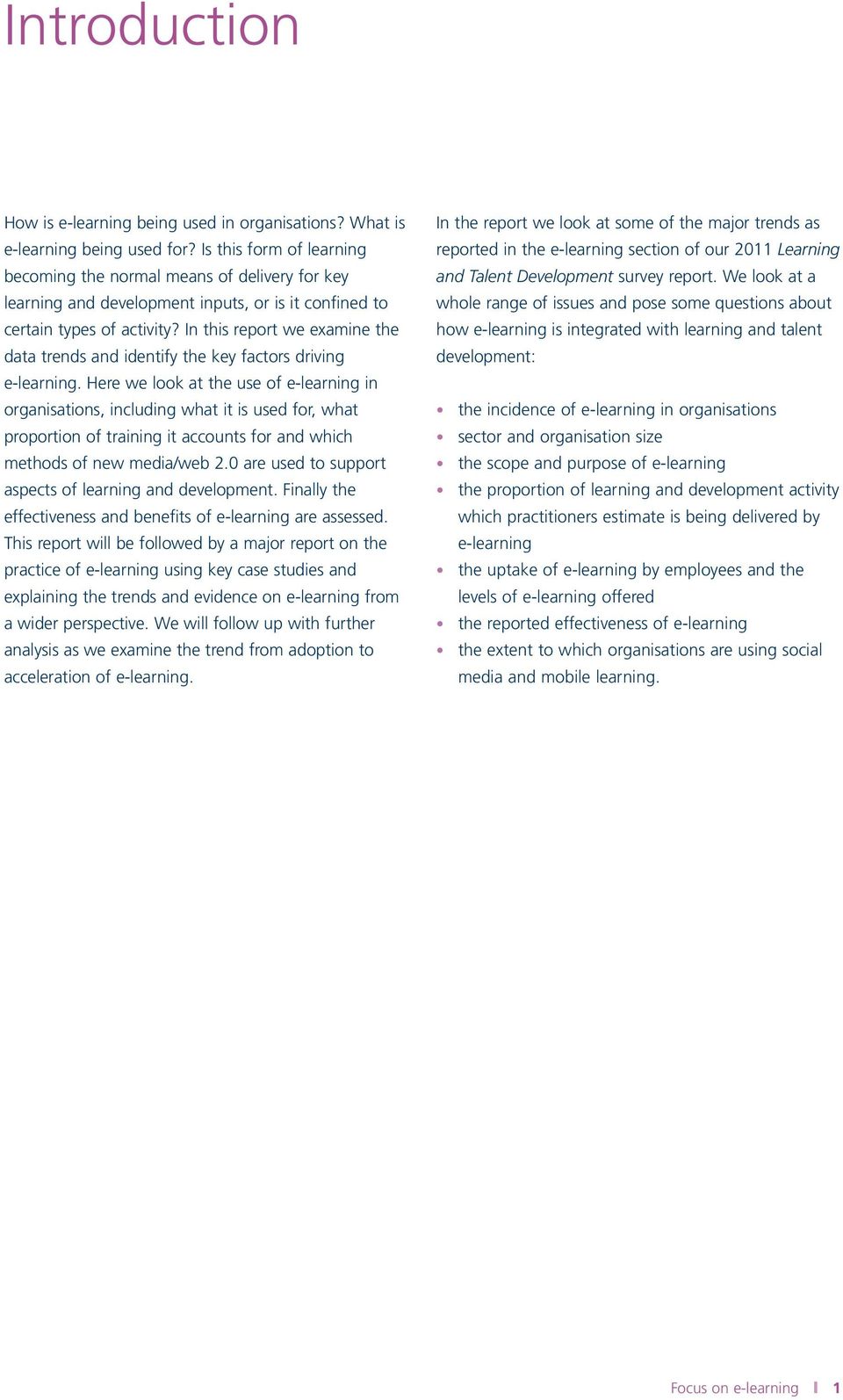
3 Introduction How is e-learning being used in organisations? What is e-learning being used for? Is this form of learning becoming the normal means of delivery for key learning and development inputs, or is it confined to certain types of activity? In this report we examine the data trends and identify the key factors driving e-learning. Here we look at the use of e-learning in organisations, including what it is used for, what proportion of training it accounts for and which methods of new media/web 2.0 are used to support aspects of learning and development. Finally the effectiveness and benefits of e-learning are assessed. This report will be followed by a major report on the practice of e-learning using key case studies and explaining the trends and evidence on e-learning from a wider perspective. We will follow up with further analysis as we examine the trend from adoption to acceleration of e-learning. In the report we look at some of the major trends as reported in the e-learning section of our 2011 Learning and Talent Development survey report. We look at a whole range of issues and pose some questions about how e-learning is integrated with learning and talent development: the incidence of e-learning in organisations sector and organisation size the scope and purpose of e-learning the proportion of learning and development activity which practitioners estimate is being delivered by e-learning the uptake of e-learning by employees and the levels of e-learning offered the reported effectiveness of e-learning the extent to which organisations are using social media and mobile learning. Focus on e-learning 1
4 Summary of key findings Growing and set to grow more: accelerating use of e-learning Overall, three-quarters (78%) of organisations use e-learning. It is particularly common in the public sector (93%) and its use increases with organisation size (Figure 1). 1 More than half of organisations (53%) report they have increased their use of e-learning over the past 12 months. This is part of a general trend whereby organisations are switching to what they perceive to be less costly development approaches. A slightly lower level of e-learning proliferation is evident in manufacturing and production (see CIPD Learning and Talent Development survey report 2011, section 1). Figure 1: Proportion of organisations using e-learning, by size and sector (%) More than 5,000 employees 93 1,000 4,999 employees employees employees 48 Fewer than 49 employees 63 Non-profit 69 Public sector 93 Private services 75 Manufacturing and production Base: Percentage Sector and use of e-learning: chi square = 42.4, df = 3, p < 0.001, n = 596; size and use of e-learning: chi square = 84.8, df = 4, p < 0.001, n = Focus on e-learning

5 Currently focused on compliance? The scope and purpose of e-learning Our findings suggest that e-learning tends to be focused on particular aspects of learning and development (Figure 2). It is most commonly used for compliance (for example, health and safety, hygiene and data protection), with one-fifth of organisations delivering all their compliance training in this way and a further third delivering more than 50%. E-learning is also commonly used for induction and on-boarding and technology training. It is less commonly used for language learning, coaching/mentoring and issues such as product development and business development. Here, the important don t use figure is well above 50%, indicating that these forms of learning are not seen as suitable for e-learning. That could change with the proliferation of mobile learning packages around areas such as leadership, creativity and innovation, an issue and trend which we will explore in detail in our forthcoming report. Figure 2: Purposes e-learning is used for and the proportion of content that is delivered in this way (%) Language learning E-coaching/mentoring Product development training Business development Advanced skills such as project management and finance Basic skills development such as time management Awareness-raising on workplace and social issues such as diversity, drug and alcohol abuse, etc Professional development Technology training Induction and on-boarding Compliance (for example health and safety, hygiene, data protection) Other Base: Percentage % content More than 50% of content 30 50% of content 10 30% of content Less than 10% of content Don't use Focus on e-learning 3

6 Accelerating towards a tipping point? The timeshare trend of e-learning Although it is commonly used, e-learning currently makes up only a small proportion of the share of total training time in organisations. Two-fifths (42%) of organisations report it makes up less than one-tenth of their total training time and just over a quarter (27%) that it accounts for up to a quarter (11 25%) of their total training time share. Nevertheless, this is about to change. The use of e-learning is expected to grow towards the 50% tipping point. Nearly one-fifth (19%) of organisations overall report it will account for more than 50% of total training time in one year s time. All sectors expect that e-learning will increase in use as a proportion of total training time, although, as now, it is predicted to become increasingly common in the private services and public sector (Figure 3). Figure 3: Proportion of total training time delivered by e-learning now and in one year s time (%) Manufacturing and production In a year s time Now Private services In a year s time Now Public sector In a year s time Now Voluntary, community and not-for-profit In a year s time Now All respondents In a year s time Now Base: 453 Percentage % 11 25% More than 50% Don t know 26 50% 4 Focus on e-learning

7 Growing uptake but completion and impact are concerns More than three-fifths (63%) of organisations offer e-learning to the majority (76 100%) of their employees. The figure is lower in the production and manufacturing sector (44%). It appears, however, that many employees either fail to take up the offer or fail to complete the course. This indicates a problem with the embedding and impact of e-learning experiences as opposed to the more traditional types of learning. Only a quarter of organisations report that the majority of employees (76 100%) who are offered e-learning actually complete it. More than a quarter (27%) report that a minority, fewer than 10%, complete e-learning courses. Take-up/completion is particularly poor in the manufacturing and production sector, where nearly half (46%) of organisations report that fewer than 10% of employees complete e-learning courses and fewer than one in ten (9%) of those offered e-learning complete courses. Given that many of these courses are likely to be in critical areas such as health and safety, hygiene and product regulations, better completion rates should be a priority. It is also important that we design better assessment processes, although the technology and interactivity often provide this. Nevertheless, it is important that e-learning is blended with some form of additional activity such as mentoring, project-based learning and other interventions to ensure that e-learning is properly embedded. Making social media productive: the use of new media/web 2.0 e-learning methods We explored the proliferation of social media in our 2009 report Web 2.0 and Human Resource Management: Groundswell or hype? However, that report was written before the advent of microblogging and mobile learning facilitated by smart phones and tablet computers. Nevertheless, it includes issues such as virtual learning environments, audio learning methods such as podcasts and methods such as e-learning. We asked in the survey about the impact of these trends. Organisations were asked which methods of new media/web 2.0 they have used to support aspects of learning and development. The findings in Figure 4 show that organisations are making use of these technologies, even if for many it is only occasionally. Online virtual learning management systems (23%) and webinars/virtual classrooms (21%) are used frequently or regularly by more than one-fifth of organisations. Blended learning programmes are most commonly used, with more than a third (37%) of organisations reporting they use them frequently or regularly. It s important that e-learning is enabled by a blend of approaches and, in our view, this seems the best way forward. Figure 4: Methods of new media/web 2.0 e-learning used to support aspects of learning and development (%) Mobile learning packages designed for smart phones such as the iphone and Android Windows Media such as Facebook, YouTube and Linkedin E-books Rapid authoring software The use of audio learning such as podcasts Use of learning libraries and wikis The use of webinars/virtual classrooms Online virtual learning management systems Blended learning programmes Base: 420 Percentage Use frequently Use regularly Use occasionally Seldom use Would consider using Not aware of Focus on e-learning 5

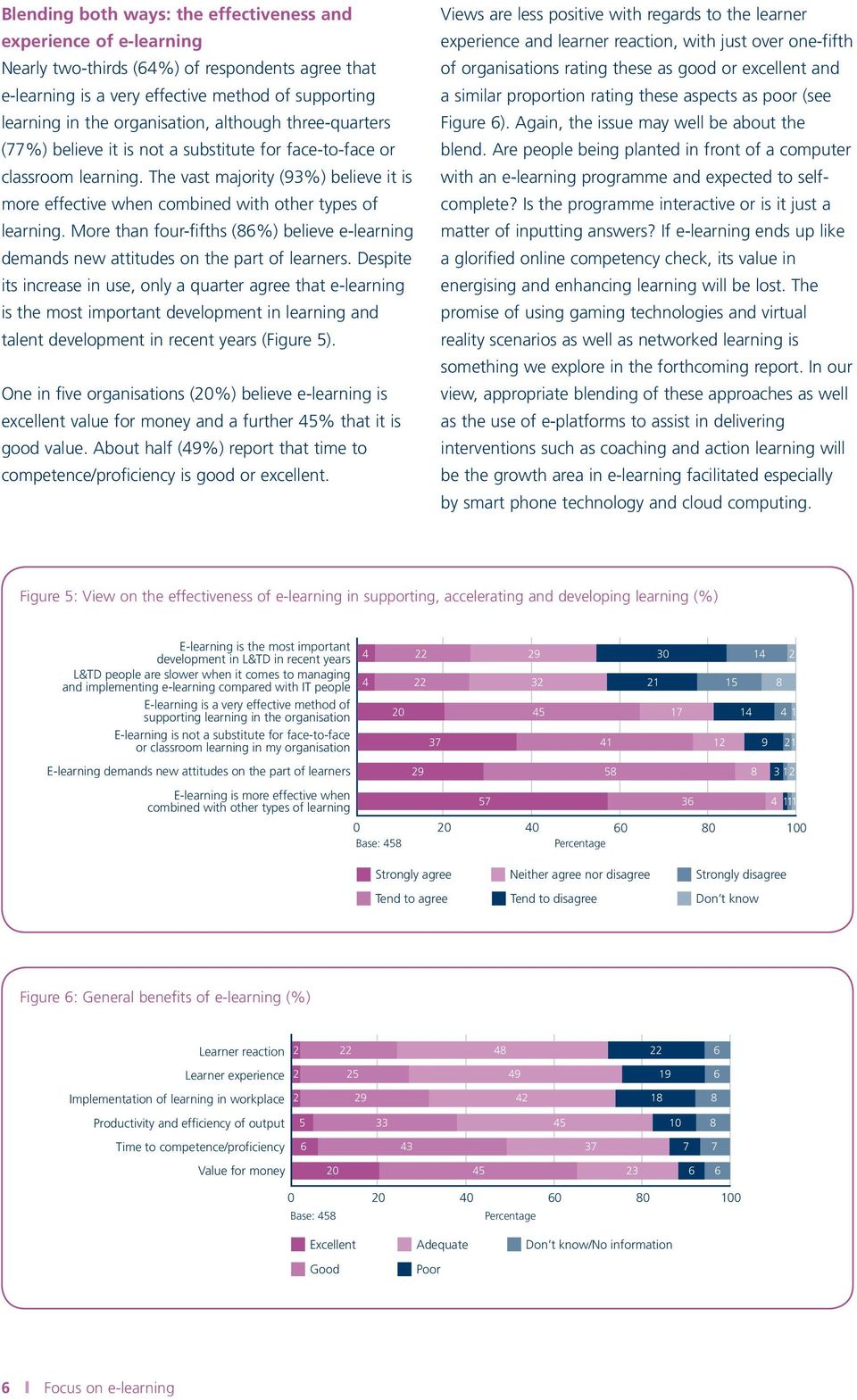
8 Blending both ways: the effectiveness and experience of e-learning Nearly two-thirds (64%) of respondents agree that e-learning is a very effective method of supporting learning in the organisation, although three-quarters (77%) believe it is not a substitute for face-to-face or classroom learning. The vast majority (93%) believe it is more effective when combined with other types of learning. More than four-fifths (86%) believe e-learning demands new attitudes on the part of learners. Despite its increase in use, only a quarter agree that e-learning is the most important development in learning and talent development in recent years (Figure 5). One in five organisations (20%) believe e-learning is excellent value for money and a further 45% that it is good value. About half (49%) report that time to competence/proficiency is good or excellent. Views are less positive with regards to the learner experience and learner reaction, with just over one-fifth of organisations rating these as good or excellent and a similar proportion rating these aspects as poor (see Figure 6). Again, the issue may well be about the blend. Are people being planted in front of a computer with an e-learning programme and expected to selfcomplete? Is the programme interactive or is it just a matter of inputting answers? If e-learning ends up like a glorified online competency check, its value in energising and enhancing learning will be lost. The promise of using gaming technologies and virtual reality scenarios as well as networked learning is something we explore in the forthcoming report. In our view, appropriate blending of these approaches as well as the use of e-platforms to assist in delivering interventions such as coaching and action learning will be the growth area in e-learning facilitated especially by smart phone technology and cloud computing. Figure 5: View on the effectiveness of e-learning in supporting, accelerating and developing learning (%) E-learning is the most important development in L&TD in recent years L&TD people are slower when it comes to managing and implementing e-learning compared with IT people E-learning is a very effective method of supporting learning in the organisation E-learning is not a substitute for face-to-face or classroom learning in my organisation E-learning demands new attitudes on the part of learners E-learning is more effective when combined with other types of learning Base: 458 Percentage Strongly agree Tend to agree Neither agree nor disagree Tend to disagree Strongly disagree Don t know Figure 6: General benefits of e-learning (%) Learner reaction Learner experience Implementation of learning in workplace Productivity and efficiency of output Time to competence/proficiency Value for money Base: 458 Percentage Excellent Good Adequate Poor Don t know/no information 6 Focus on e-learning
9 Conclusion and implications E-learning is clearly accelerating and set to grow further in organisations. Whether this is as a result of an economic focus on cost reduction is a moot point. It is here and it is staying. The future shape of the workforce and the demand for increased connectivity are all driving the trend towards e-learning. Furthermore, globalisation and the need to scale up impact across a long tail of employees are making e-learning and social media in particular a vital component of capability. The massive increase in global interactions simply cannot be facilitated face to face, and the networkability and connectedness of e-learning make it pivotal to the global future of business. E-learning s collaborative and facilitative potential means that it will be important in the continued transformation of learning and talent in the public sector, exposing people to new experiences and helping to drive issues such as employee engagement, customer service and communication. The effectiveness gap has to be addressed. E-learning needs to be completed, assessed and evaluated more than currently seems to be the case. The trend towards social media and mobile learning is already generating a stepchange in the organisational value of e-learning, and the exciting future landscapes of gaming and virtual worlds promise more. It s easy for advocates of e-learning to be carried away by hype and novelty, but e-learning is, as our surveys show, no longer novel practice. It is normal practice and its growth will enhance and energise learning and talent development across the board. It is no longer a question of whether we embrace or reject e-learning; it s how we leverage this critical medium to help people and organisations. Focus on e-learning 7

10 References CIPD. (2011) Learning and talent development [online]. Survey report. London: Chartered Institute of Personnel and Development. Available at: hr-resources/survey-reports/learning-talentdevelopment-2011.aspx [Accessed 15 June 2011]. MARTIN, G., REDDINGTON, M. and KNEAFSEY, M.B. (2009) Web 2.0 and human resource management: groundswell or hype? London: Chartered Institute of Personnel and Development. 8 Focus on e-learning
![uk/ hr-resources/survey-reports/learning-talentdevelopment-2011.aspx [Accessed 15 June 2011]. MARTIN, G.](/docs-images/51/14568747/images/page_10.jpg ", REDDINGTON, M. and KNEAFSEY, M.B. (2009) Web 2.0 and human resource management: groundswell or hype?")
11 Acknowledgements We would like to thank firstly our engaged practitioner community for finding the time to complete the survey and contribute to the CIPD s compelling evidence base. We thank our survey analyst Annette Sinclair for providing another compelling report and our digital marketing team for putting it into a compelling format. Focus on e-learning 9

12 We explore leading-edge people management and development issues through our research. Our aim is to share knowledge, increase learning and understanding, and help our members make informed decisions about improving practice in their organisations. We produce many resources on people management and development issues including guides, books, practical tools, surveys and research reports. We also organise a number of conferences, events and training courses. Please visit cipd.co.uk to find out more. Chartered Institute of Personnel and Development 151 The Broadway London SW19 1JQ Tel: Fax: [email protected] Website: cipd.co.uk Incorporated by Royal Charter Registered charity no Issued: June 2011 Reference: 5577 Chartered Institute of Personnel and Development 2011
Spring 2014. in partnership with. Employee Outlook
 Spring 2014 in partnership with Employee Outlook WORK WORKFORCE WORKPLACE Championing better work and working lives The CIPD s purpose is to champion better work and working lives by improving practices
Hot topics TAKING THE TEMPERATURE OF COACHING
 Hot topics TAKING THE TEMPERATURE OF COACHING Summer 2009 SUMMARY OF KEY FINDINGS 1 SUMMARY OF KEY FINDINGS 4 THE SURVEY 13 CONCLUSION Coaching and mentoring (in this report, the term coaching refers to
The Challenge with Innovative Learning. Recognising the Challenge. Partnership self directed learning communication learning support
 Learning Services Our Learning Services team works in close partnership with our clients. We combine our expertise in instructional design, learning technologies and project management to analyse learner
Harnessing Technology schools survey 2007
 Harnessing Technology schools survey 2007 Harnessing Technology schools survey 2007 July 2007 Sarah Kitchen, Steven Finch, Rupert Sinclair National Centre for Social Research (NatCen) July 2007 http://www.becta.org.uk
Current learning trends in Europe and the United States
 Current learning trends in Europe and the United States Addressing the challenges of the economic downturn and the development needs of today s learners A whitepaper by: Jeremy Blain Director of the Cegos
Academic Associate application form
 Academic Associate application form This application form is only valid from 1 July 31 December 2015. If you re joining after this time please visit cipd.co.uk/membership for the most up-to-date form or
in partnership with EMPLOYEE OUTLOOK EMPLOYEE VIEWS ON WORKING LIFE
 in partnership with EMPLOYEE OUTLOOK EMPLOYEE VIEWS ON WORKING LIFE Autumn 2015 The CIPD is the professional body for HR and people development. The not-for-profit organisation champions better work and
Corporate Profile. Helping you attain talent vantage. knowledge transformation innovation. www.rubieminstitute.com. Partners & Accreditors
 Corporate Profile www.rubieminstitute.com knowledge transformation innovation Helping you attain talent vantage Executive Brief I have the please of introducing rubiem Training Institute to you. rti is
What does good learning look like?
 What does good learning look like? The aim of workplace learning is to drive improved business outcomes. This paper sets out the evidence base for designing learning interventions that achieve this and
EMPLOYEE OUTLOOK. April 2016 EMPLOYEE VIEWS ON WORKING LIFE FOCUS. Commuting and flexible working
 EMPLOYEE OUTLOOK EMPLOYEE VIEWS ON WORKING LIFE April 2016 FOCUS Commuting and flexible working The CIPD is the professional body for HR and people development. The not-for-profit organisation champions
Predicting the future of predictive analytics. December 2013
 Predicting the future of predictive analytics December 2013 Executive Summary Organizations are now exploring the possibilities of using historical data to exploit growth opportunities The proliferation
THE UNIVERSITY OF EDINBURGH
 THE UNIVERSITY OF EDINBURGH PROGRAMME SPECIFICATION FOR Postgraduate Certificate in Managing Health and Social Care 1) Awarding Institution: University of Edinburgh 2) Teaching Institution: University
Mobile Learning: The Time is Now
 Mobile Learning: The Time is Now Intrepid Learning Solutions June 2010 Mobile Learning: The Time is Now The use of pocket-sized communications devices to enhance learning has tantalized training executives
CAPABILITIES BUDGET CONSTRAINTS 42% OF RESPONDENTS DEVELOPMENT PRIORITIES UNCERTAIN AND COMPLEX SENIOR MANAGEMENT ENGAGEMENT BUSINESS PERFORMANCE
 LEADERSHIP CAPABILITIES BUDGET CONSTRAINTS 42% OF RESPONDENTS DEVELOPMENT PRIORITIES UNCERTAIN AND COMPLEX SENIOR MANAGEMENT CUSTOMER ENGAGEMENT BUSINESS PERFORMANCE DRIVE FOR GROWTH COMMERCIAL ACUMEN
How To Know If Online Learning Is As Good As Face To Face Instruction
 Sizing the Opportunity The Quality and Extent of Online Education in the United States, 2002 and 2003 SLOAN CTM The Sloan Consortium A Consortium of Institutions and Organizations Committed to Quality
Managing drug and alcohol misuse at work
 Survey report September 2007 Managing drug and alcohol misuse at work Contents Summary of key findings 2 Policies and procedures 4 Testing 10 Managing and supporting employees with drug and/or alcohol
Bridging the Global Skills Gap
 Bridging the Global Skills Gap Teachers views on how to prepare a Global Generation for the challenges ahead. About the research This report represents the findings of a survey of teachers 1 conducted
Membership for those with an MBA qualification. Membership of the CIPD Application form
 Membership of the CIPD Application form Membership for those with an MBA qualification This application form is only valid from 1 July 31 December 2010. Please read these notes before completing the form.
Executive Education Futures:
 Executive Education Futures: An international report on the executive education market examining the views of participants and purchasers on current delivery and future developments. November 2012 :: Andrew
Career development in employing organisations: practices and challenges from a UK perspective
 Career development in employing organisations: practices and challenges from a UK perspective This paper is based on an input to the Guidance for Workforce Development Conference, held by CEDEFOP in Thessaloniki,
IT Executive and CEO Survey
 Mobile Consumerization Trends & Perceptions IT Executive and CEO Survey FINAL REPORT COMPARISONS: WAVES 1 AND 2 PREPARED FOR: TREND MICRO, INC. BY: DECISIVE ANALYTICS, LLC Cheryl Harris, Ph.D. Chief Research
Supporting People Client Records. Executive Summary Annual Report
 Centre for Housing Research (CHR) University of St Andrews Supporting People Client Records Executive Summary Annual Report 2005-2006 CHR SP Client Record Office The Observatory University of St Andrews
Discussion paper. Performance management
 Discussion paper Performance management History and foundations of performance management Since 1993 the CIPD has been regularly reviewing and publishing work on performance management. As one of the key
BYOD (Bring your own device)
 BYOD (Bring your own device) Chartered Institute for IT West London Branch Charles Brooks Principal Consultant 16 October 2012 Have you got one of these? Which one of these integrates with your work systems?
STRATEGIC POLICY FORUM ON DIGITAL ENTREPRENEURSHIP. Fuelling Digital Entrepreneurship in Europe. Background paper
 EUROPEAN COMMISSION ENTERPRISE AND INDUSTRY DIRECTORATE-GENERAL Service Industries Key Enabling Technologies and Digital Economy Introduction STRATEGIC POLICY FORUM ON DIGITAL ENTREPRENEURSHIP Fuelling
Building tomorrow s leaders today lessons from the National College for School Leadership
 Building tomorrow s leaders today lessons from the National College for School Leadership If you re looking for innovative ways to engage your would-be leaders through gaming and video role play, the National
cipd.co.uk/membership
 Membership of the CIPD Application form Postgraduate-level qualifications This application form is only valid from 1 January 31 March 2012, if you re joining after this time please visit cipd.co.uk/membership
In good health. Public health teams in local authorities Year 2. February 2015
 In good health Public health teams in local authorities Year 2 February 2015 Foreword The public health workforce is at the heart of both improving and protecting the public s health and as such the views
Seven Things Employees Want Most From Their Training
 RESEARCH REPORT Seven Things Employees Want Most From Their Training Executive Summary In 2013 we set out to discover what 1,001 office workers really think about training. Commissioning Opinion Matters,
ENHANCING PERFORMANCE MANAGEMENT: THE VALUE OF STAFF APPRAISALS A BUSINESS INSIGHT REPORT BY KAPLAN
 ENHANCING PERFORMANCE MANAGEMENT: THE VALUE OF STAFF APPRAISALS A BUSINESS INSIGHT REPORT BY KAPLAN 1 INTRODUCTION In 2014, leading global education and training provider Kaplan carried out a survey among
OUTLOOK VIEWS OF OUR PROFESSION. Winter 2014 15
 HR OUTLOOK VIEWS OF OUR PROFESSION Winter 2014 15 The CIPD is the professional body for HR and people development. The not-for-profit organisation champions better work and working lives and has been setting
Consultation on the Implementation of Direct Entry in the Police
 Consultation on the Implementation of Direct Entry in the Police Contents Consultation summary... 3 Current situation... 5 The future... 6 Independent Review of Police Officer and Staff Remuneration and
MSc in Human Resource Management
 MSc in Human Resource Management Distance learning degree qualification GLOBAL STUDY GLOBAL RECOGNITION 1 2 So many people have started these programmes and within just a few months they are almost different
Institute of Leadership & Management. Creating a coaching culture
 Institute of Leadership & Management Creating a coaching culture Contents Introduction 01 Executive summary 02 Research findings 03 Conclusion 07 Methodology 08 Introduction The world of work is complex
Membership for those who have completed a CIPD postgraduate-level qualification
 Membership of the CIPD Application form Membership for those who have completed a CIPD postgraduate-level qualification This application form is only valid from 1 July 31 December 2012, if you re joining
Age, Demographics and Employment
 Key Facts Age, Demographics and Employment This document summarises key facts about demographic change, age, employment, training, retirement, pensions and savings. 1 Demographic change The population
Inclusive. Education. Alliance for. The Case for Inclusive Education. What. Why. How. The What, the Why and the How. is inclusive education?
 Alliance for Inclusive Education The Case for Inclusive Education The What, the Why and the How What Why How is inclusive education? is it of benefit to all learners? can we transform the current education
Author: Lydia Cillie-Schmidt Page 1
 Talent Management: An integrated framework for implementation L Cillie-Schmidt: Talent Management: An integrated framework for implementation, Management Today, February 2009 Companies like to promote
Strategic plan. Outline
 Strategic plan Outline 1 Introduction Our vision Our role Our mandate 2 About us Our governance Our structure 3 Context Our development Camden 4 Resources Funding Partners 5 Operating model How we will
Retirement in Ireland 2014. A Survey Report
 Retirement in Ireland 2014 A Survey Report ii Retirement Planning Council of Ireland Contents Foreword 2 Methodology & Objectives 3 Summary 4 The 2014 Survey Section 1 People Surveyed 3 Section 2 Expected
Learning & Development Framework for the Civil Service
 Learning & Development Framework for the Civil Service 2011-2014 Table of Contents 1. Introduction & Background... 1 2. Key Objectives and Actions arising... 3 3. Framework Objectives... 4 3.1 Prioritise
HR Professionals Building Human Capital
 Human Resource WSQ 1 Marina Boulevard #16-01 One Marina Boulevard Singapore 018989 Tel: 6883 5885 Fax: 6512 1111 Email: http://portal.wda.gov.sg/feedback Website: www.wda.gov.sg Printed in Feb 2015 HR
Executive summary. Today s researchers require skills beyond their core competencies
 EXECUTIVE SUMMARY 9 Executive summary Today s researchers require skills beyond their core competencies The formation and careers of researchers are important policy issues and training for transferable
Learning in the Social Workplace
 Learning in the Social Workplace Jane Hart Social technologies are impacting the way we learn and work in the workplace. Here I want to take a look at three key areas: 1. How individuals are using social
HR outsourcing and the HR function Threat or opportunity?
 Survey report June 2009 HR outsourcing and the HR function Threat or opportunity? Contents Summary of key findings 2 Introduction and the backdrop to outsourcing activity 4 HR outsourcing and the HR function
Introduction 1 Key Findings 1 Recommendations 1 The Survey 2. 1. Retirement landscape in Canada 3. 2. Retirement aspirations and expectations 3
 Contents Introduction 1 Key Findings 1 Recommendations 1 The Survey 2 1. Retirement landscape in Canada 3 2. Retirement aspirations and expectations 3 3. Planning for retirement 5 4. Making it easy to
The term social web, or more specifically, Web 2.0 first appeared in 2005 and was characterised by a number of principles:
 5 practical ideas for Embedding learning into the workflow This report has been written by Towards Maturity, building on its extensive benchmark research since 2003 with over 2,200 2 organisations. Supported
Organisational Development Improvement Strategy 2009-2011 Delivering results through our people
 Organisational Development Improvement Strategy 2009-2011 Delivering results through our people 1 Index Page No Foreword 3 What is Organisational Development? 4 Organisational Development- Driving change
speexx empowering communication LT-Innovate Summit 2015 Buyers Challenge
 1 empowering communication LT-Innovate Summit 2015 Buyers Challenge Speexx is Language Training for a Global Workforce 2 Speexx is empowering communication at clients such as the Federal Authorities of
CIPD. Textbooks 2015-16. For Students STUDENTS SAVE 20% Order your books today: Visit cipd.co.uk/textbooks Or call +44 (0)844 800 3366
 CIPD Textbooks 2015-16 For Students STUDENTS SAVE 20% Order your books today: Visit cipd.co.uk/textbooks Or call +44 (0)844 800 3366 CIPD FOUNDATION LEVEL QUALIFICATIONS Human Resource Practice Human Resource
The Online Safety Landscape of Wales
 The Online Safety Landscape of Wales Prof Andy Phippen Plymouth University image May 2014 SWGfL 2014 1 Executive Summary This report presents top-level findings from data analysis carried out in April
The Coaching at Work Survey
 The Coaching at Work Survey 2002 Foreword Background Workplace learning is developing dramatically. What was delivered in a classroom is now experienced online. What once took a day now only lasts an hour.
Talent Management Framework
 Talent Management Framework A simple definition of Talent Management is: The systematic attraction, identification, development, engagement/retention and deployment of those individuals who are of particular
STRATEGIC WORKFORCE PLANNING LATEST TRENDS AND LEADING PRACTICE EXAMPLES
 STRATEGIC WORKFORCE PLANNING LATEST TRENDS AND LEADING PRACTICE EXAMPLES BERLIN, 21 MAY 2015 Julia Howes Mercer Workforce Analytics & Planning A WORKFORCE TSUNAMI IS APPROACHING COPYRIGHT MERCER 2015 STRATEGIC
Social Media and Digital Marketing (England)
 Social Media and Digital Marketing (England) Latest framework version? Please use this link to see if this is the latest issued version of this framework: afo.sscalliance.org/frameworkslibrary/index.cfm?id=fr01743
HOW TO USE VIDEO TO MOTIVATE LEARNING
 HOW TO USE VIDEO TO MOTIVATE LEARNING Catherine de Salvo Director, Scott Bradbury Ltd. trainingzone How do you use video to motivate learning? If you are considering using video as part of your online
Staff Learning & Development Adviser. Head of Staff Learning & Development
 NOTE: This job description does not form part of the employee s contract of employment but is provided for guidance. The precise duties and responsibilities of any job may be expected to change over time.
Criminal justice policy and the voluntary sector
 Criminal justice policy and the voluntary sector Criminal justice policy and the voluntary sector Involving the voluntary sector 5 Reducing re-offending 5 Listening and responding to people with lived
Diploma in Applied Business. Education Engagement Enterprise
 Diploma in Applied Business Diploma in Applied Business Business Development Services (Europe) Ltd. work in partnership with Putting education to work in your business... The Diploma is suitable for managers
Employer Perspectives on Social Networking A Manpower Survey
 Employer Perspectives on Social Networking A Manpower Survey Key Findings for Hong Kong A new generation, steeped in the rules and habits of the digital age, is entering the workforce in large numbers,
Your CV Your style Your job
 LEARNING TO WORK Today s young people, tomorrow s workforce Your CV Your style Your job Your CV guide This guide is designed to help you create your perfect CV, apply for a job and secure an interview.
E-Guide WHAT IT MANAGERS NEED TO KNOW ABOUT RISKY FILE-SHARING
 E-Guide WHAT IT MANAGERS NEED TO KNOW ABOUT RISKY FILE-SHARING E mployees are circumventing IT protocols and turning to unsanctioned tools such as file-sharing, messaging, collaboration and social media
CIM Professional Qualifications. CIM Level 4 Certificate in Professional Marketing
 CIM Professional Qualifications CIM Level 4 Certificate in Professional Marketing CIM Level 4 Certificate in Professional Marketing About CIM The Chartered Institute of Marketing (CIM) has been representing
CHANGE MANAGEMENT PLAN
 Appendix 10 Blaby District Council Housing Stock Transfer CHANGE MANAGEMENT PLAN 1 Change Management Plan Introduction As part of the decision making process to pursue transfer, the Blaby District Council
The Business Case for Online Performance Management
 The Business Case for Online Performance Management The Problem With Paper Based Performance Management Systems They are administratively difficult Cumbersome & administratively intensive Difficulty limits
IPD Level 7 Advanced LEVEL 7 CIPD ADVANCED CERTIFICATE/DIPLOMA IN HUMAN RESOURCE MANAGEMENT DEVELOPING TODAY FOR TOMORROW
 IPD Level 7 Advanced LEVEL 7 CIPD ADVANCED CERTIFICATE/DIPLOMA IN HUMAN RESOURCE MANAGEMENT DEVELOPING TODAY FOR TOMORROW CIPD Level 7 Advanced qualifications are the most widely-recognised professional