
CISSP Common Body of Knowledge Review: Security Architecture & Design Domain Version: 5.10
|
|
|
- Oscar French
- 10 years ago
- Views:
Transcription
1 CISSP Common Body of Knowledge Review: Security Architecture & Design Domain Version: 5.10 CISSP Common Body of Knowledge Review by Alfred Ouyang is licensed under the Creative Commons Attribution-NonCommercial-ShareAlike 3.0 Unported License. To view a copy of this license, visit creativecommons.org/licenses/by-nc-sa/3.0/ or send a letter to Creative Commons, 444 Castro Street, Suite 900, Mountain View, California, 94041, USA.

2 Learning Objectives Security Architecture and Design Domain The Security Architecture & Design domain contains the concepts, principles, structures, and standards used to design, implement, monitor, and secure, operating systems, equipment, network, applications, and those controls used to enforce various levels of confidentiality, integrity, and availability. Information security architecture and design covers the practice of applying a comprehensive and rigorous method for describing a current and/or future structure and behavior for an organization s security processes, information security systems, personnel and organizational sub-units, so that these practices and processes align with the organization s core goals and strategic direction. The candidate is expected to understand security models in terms of confidentiality, integrity, data flow diagrams; Common Criteria (CC) protection profiles; technical platforms in terms of hardware, firmware, and software; and system security techniques in terms of preventative, detective, and corrective controls. Reference: CISSP CIB, January 2012 ( Rev. 13) - 2 -

3 Topics Security Architecture & Models Domain Computing Platforms Security Models Information Security Models Evaluation & Certification Security Architecture Modes of Operation Architecture Concepts Implementation Models - 3 -

4 Computing Platforms Electro-mechanical Computational Machines In s, Dr. Alan Turing invented concept of Turing machine that given us the electro-mechanical computational machines (e.g., ACE and Bombe.) Bombe was used by British cryptologists to decrypt German Nazi s Enigma machine. Enigma Cipher Machine British Bombe machine in Bletchley Park Reference:

5 Computing Platforms Von Neumann Model In 1950s, Dr. John von Neumann wrote The Computer and the Brains that described a system architecture for the modern micro-processor computing machine. Memory Address Register (MAR) Memory Memory Data Register (MDR) Control Unit Arithmetic Logic Unit (ALU) Accumulator Input Output Reference: Daybreak of the Digital Age (

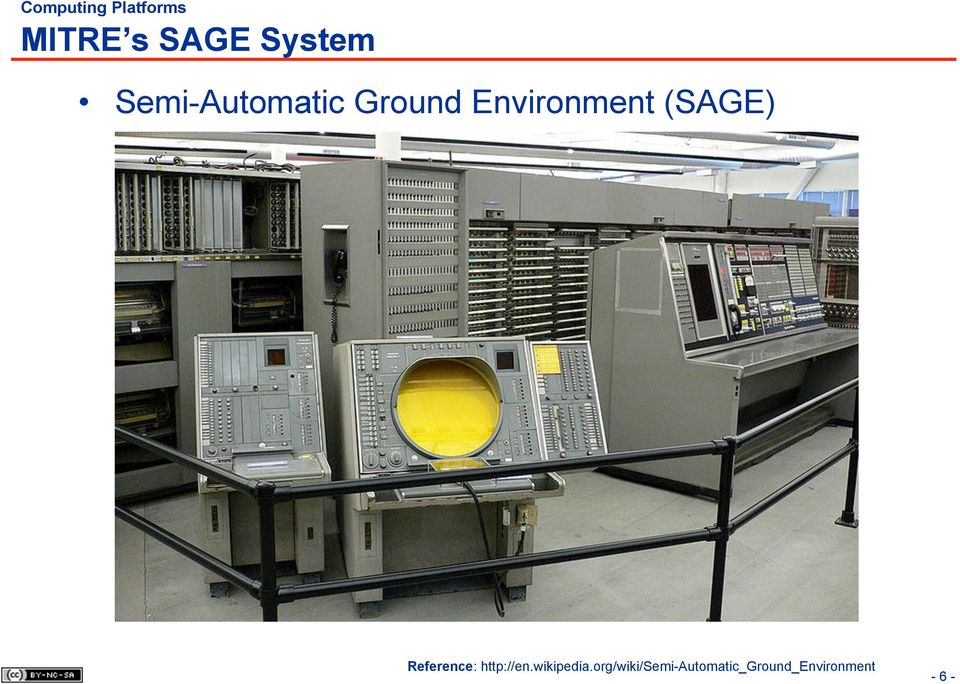
6 Computing Platforms MITRE s SAGE System Semi-Automatic Ground Environment (SAGE) Reference: -6-
7 Computing Platforms Transistorized Computers IBM 7000 Series, CDC

8 Computing Platforms Integrated Circuit (IC) / Micro-processor In late 1950s, the integrated circuit (IC) invented by: Jack Kilby of Texas Instruments, and Robert Noyce of Fairchild Semiconductor Electro-mechanical computing machines à Microprocessor computing machines Reference: Google image search. -8-

9 Computing Platforms Integrated Circuit (IC)/Large Scale Integration (LSI) Computers IBM System/360 and PDP-11 Reference: IBM Archives: System/360 Model 50 ( PDP-11 (

10 Computing Platforms Hardware Components Central Processing Unit (CPU) Registers (General-purpose, Dedicated) Arithmetic Logical Unit (ALU) Memory Primary + Secondary Cache Read Only Memory (ROM) Random Access Memory (RAM) Flash Memory Virtual Memory (via Storage) Input/Output (I/O) Devices System Bus & Channels Serial, Parallel, USB, SCSI, PCMCIA, etc. Network Interface Card (NIC) Storage Disk, Tape, Flash (USB Jump Drive + PCMCIA)

11 Computing Platforms Hardware Components Source: AppleInsider ( review_apples_new_11_6_inch_and_13_3_inch_macbook_air_late_2010/page/3)

12 Computing Platforms Software Components Operating System (OS) Firmware (stored in ROM/EPROM/EEPROM) BIOS Device Firmware Input/Output (I/O) Controllers Device Drivers System Programs & Applications File Management Systems Network Management Process Management Mobile Code Java Virtual Machine (JVM) Active X Application Macro Data / Memory Addressing Application A Register, Direct, Absolute, Indexed, Implied. Memory Protection Operating System Application B

13 Computing Platforms Software Components Source: Android Architecture (

14 Computing Platforms Operating System (OS) User identification and authentication. Discretionary access control (DAC). Mandatory access control (MAC). Mediate transactions. Object reuse protection. Prevent leakage. Accountability. Audit security events. Protection of audit logs. Subject Trusted path. Protection of critical operations. Intrusion detection. Patterns, analysis, and recognition. Reference Monitor: - Identification - Authentication - Authorization - Accountability Security Kernel Auditing of Transactions: - What, who, how and when Object 1 Object 2 Object

15 Computing Platforms OS Process Scheduling Multi-programming Managing and coordinating the process operations to multiple sets of programmed instructions e.g. VMS (Mainframe) Multi-tasking Allows user to run multiple programs (tasks) e.g. Windows 2000, LINUX Multi-threading Managing the process operations by work/execution threads (a series of tasks) using the same programmed instructions. Which allows multiple users and service requests e.g. Mach Kernel (BSD UNIX: Solaris, MacOS X, etc.) Multi-processing Managing and coordinating the process operations to multiple sets of programmed instructions and multiple user requests using multiple CPUs e.g. Windows 2000, LINUX, UNIX

16 Computing Platforms CPU Processing Threads Most of today s programs are comprised of many individual modules, programs or processes that are separately written and work together to fulfill the overall objective of the application These may be called modules or processing threads The security problems lie in the fact that these independent sections may be written by someone else then they may link dynamically and not be controlled by the Operating System (OS) Application A Application B Operating System

17 Computing Platforms Operating Modes and Processing States Modes of operation Kernel mode (privileged) Program can access entire system Both privileged and non-privileged instructions User mode (non-privileged) Only non-privileged instruction executed Intended for application programs Processing states Stopped vs. Run state Wait vs. Sleep state Masked/interruptible state E.g. if masked bit not set, interrupts are disabled (masked off) known as IRQs in systems

18 Computing Platforms Memory Management Functional Requirements There are five functional requirements for memory management: 1. Physical Organization (Physical) Provide management of data in physical memory space (e.g., CPU registers, cache, main memory (RAM), disk storage (secondary storage)) 2. Logical Organization (Logical) Provide management of data in logical segments (virtual memory) 3. Relocation (Relative) Provide pointers to the actual location in memory 4. Protection Provide access control to protect integrity of memory segments 5. Sharing Allowing access to memory segment

19 Computing Platforms Memory Management Type of memory addressing Three types of memory addresses: Physical the absolute address or actual location Logical reference to a memory location that is independent of the current assignment of data to memory. (Requires a translation to the physical address.) Relative address expressed as a location relative to a known point

20 Computing Platforms Memory Management Storage Types of memory: Real (A program or application defined storage location in memory and direct access to peripheral devices e.g. Comm. buffer) Virtual (Extended primary memory to secondary storage medium) Types of storage: Primary (Memory direct accessible to CPU e.g. Cache and RAM) Secondary (Non-volatile storage medium e.g. Disk Drives) Disk Storage CPU Registers Cache Main Memory Swap Space Fastest Highest Cost Lowest Capacity Slowest Lowest Cost Highest Capacity

21 Computing Platforms Memory Management Paging & Swapping Virtual Memory is a memory management technique that extends memory by using secondary storage for program pages not being executed. Paging involves: Splitting memory into equal sized small chunks that are called page frames. Splitting programs (processes) into equal sized small chunks are called pages. OS maintains a list of free frames Pages are fixed blocks of memory usually 4K or 8K bytes A page-fault is when a program accesses a page that is not mapped in physical memory. Swapping is the act of transferring pages between physical memory and the swap space on a disk
22 Computing Platforms Memory Management: Paging & Swapping Reference: ISSA-Alamo CISSP Training Course
23 Computing Platforms Input/Output Devices The I/O controller is responsible for moving data in and out of memory. An element of managing the I/O devices and thus managing memory is through swapping or paging files. I/O Controller I/O Controller Memory CPU
24 Computing Platforms Input/Output Devices Storage Storage devices for secondary memory: Hard disk drives Write-Once Read Memory (WORM) (Storage medium such as CD-ROM, DVD-ROM) USB flash drives SD, Micro-SD memory cards PCMCIA memory cards Floppy disk drives
25 Topics Security Architecture & Models Domain Computing Platforms Security Models Information Security Models Evaluation & Certification Security Architecture Modes of Operation Architecture Concepts Implementation Models
26 Security Models Information Security Models Security model specifies the operational and functional behavior of a system for security. There are many security models: Graham-Denning Model formal system of protection rules. Information-Flow Model demonstrates the data flows, communications channels, and security controls. State-Machine Model abstract math model where state variable represent the system state. The transition functions define system moves between states. Non-Interference Model a subset of information-flow model that prevents subjects operating in one domain from affecting each other in violation of security policy. (i.e. Compartmentalized.) Others are combination of above and generalized access control models
27 Security Models Terms and Definition (1/2) A subject requests service A subject can be user, program, process, device, etc. An object provides the requested service An object can be file, database, program, process, devices, etc. A security model specifies the rules of behavior for a system (/ system of systems) in meeting the security objectives, where: Security objective: confidentiality, integrity Implementation rules: least-privilege, separation-of-duties
28 Security Models Terms and Definition (2/2) Access is the flow of information between a subject and an object(s). Access capability is what a subject can do to an object(s). Access control governs the information flow. Discretionary access control (DAC) is where the information owner determines the access capabilities of a subject to what object(s). Mandatory access control (MAC) is where the access capabilities are pre-determined by the security classification of a subject and the sensitivity of an object(s)
29 Information Security Models Graham-Denning Security Model Graham-Denning is an information access model operates on a set of subjects, objects, rights. Levels of Protection 1. No sharing at all 2. Sharing copies of programs/ data files 3. Sharing originals of programs/ data files 4. Sharing programming systems/ subsystems 5. Permitting the cooperation of mutually suspicious subsystems, e.g., debugging/ proprietary subsystems 6. Providing memory-less subsystems 7. Providing certified subsystems Operations How to securely create an object/ subject. How to securely delete an object/ subject. How to securely provide the read access right. How to securely provide the grant access right. How to securely provide the delete access right. How to securely provide the transfer access right. References: G.S.Graham and P.J. Denning, Protection Principles and Practice, AFIPS Conf. Proc.,
30 Information Security Models Harrison-Ruzzo-Ullman (HRU) Security Model Access capability matrix specifying types of access Subject-object One row per subject. One column per object It is a version of Graham-Denning Objects S 1 S 2 S 3 S 4 S 5 O 1 O 2 O 3 O 4 O 5 S 1 Cntrl rwx rw Subjects S Cntrl x S Cntrl r-x S Cntrl --- r-x r-x S Cntrl --- r-x References: M. Harrison, W. Ruzzo, and J.D. Ullman, Protection in Operating Systems, Communications of the ACM, August
31 Information Security Models Information Flow Model Information flow model illustrates the direction of data flow between objects Based on object security levels Information flow is constrained in accordance with object s security attributes Covert channel analysis is simplified Note: Covert channel is moving of information to and from unauthorized transport A B C D A N/A X X B N/A X C X N/A X A B D N/A C D
32 Information Security Models Bell-LaPadula Security Model (1/3) Bell-LaPadula is a state-machine model for information flow and access control. Confidentiality only! Secure state-access is only permitted in accordance with specific security policy Secure state is when rules are security-preserving Fundamental modes of access: Read only, Write only, or Read & Write. Discretionary Security: Specific subject authorized for particular capability of access. Reference: D. Bell, L. LaPadula, MTR-2997, Secure Computer System: Unified Exposition and Multics Interpretation, March
33 Information Security Models Bell-LaPadula Security Model (2/3) Bell-LaPadula confidentiality policy: Simple security property Subject cannot read object of higher sensitivity. Star property (* property) Subject cannot write to object of lower sensitivity. Strong Star property (Strong * property) Subject cannot read/write to object of higher/lower sensitivity. Read Write Read/Write Top Secret Object: A Top Secret Object: A Top Secret Object: A Secret Subject: Alfred (Secret) Object: B Secret Subject: Alfred (Secret) Object: B Secret Subject: Alfred (Secret) Object: B Confidential Object: C Confidential Object: C Confidential Object: C Simple Security Property * Star Property Strong * Property
34 Information Security Models Bell-LaPadula Security Model (3/3) Bell-LaPadula security model has two major limitations: Confidentiality only No method for management of classifications It assumes all data are assigned with a classification It assumes the data classification will never change Hence the need for E.O (updates E.O , E.O ), Classified National Security Information, Dec. 29, 2009 E.O (updates E.O ), Reforming Process Related to Suitability for Government Employment, Fitness for Contractor Employees, and Eligibility for Access to Classified Information, July 2, 2008 DoD M, Information Security Program, Vol. 1-4, March 2012 Reference: Secrets & Lies Digital Security in a Networked World, Bruce Schneier,
35 Information Security Models Biba Security Model (1/2) Biba Security Model is a state-machine model for information flow and integrity control Addresses integrity in information systems. Based on hierarchical lattice of integrity levels Elements Set of subjects (Active, information processing) Set of objects (Passive, information repository) Integrity: Prevent unauthorized subjects from modifying objects. Mathematical dual of access control policy Access Tuple: subject & object. Reference: K. Biba, MTR-3153, Integrity Consideration for Secure Computing System,
36 Information Security Models Biba Security Model (2/2) Biba security policy: Simple integrity condition Subject cannot read objects of lesser integrity. Integrity star * property Subject cannot write to objects of higher integrity. Invocation property Subject cannot send messages (logical request for service) to object of higher integrity. Read Write High Object: A High Object: A Middle Subject: Alfred (Secret) Object: B Middle Subject: Alfred (Secret) Object: B Low Object: C Low Object: C Simple Integrity Property * Star Integrity Property
37 Information Security Models Clark-Wilson Security Model (1/3) Clark-Wilson is a state-machine security model addresses information flow and the integrity goals of: Preventing unauthorized subjects from modifying objects Preventing authorized subjects from making improper modification of objects Maintaining internal and external consistency Well-formed transaction Preserve/ensure internal consistency Subject can manipulate objects (i.e. data) only in ways that ensure internal consistency. Access Triple: Subject-Program-Object Subject-to-Program and Program-to-Object. Separation-of-Duties Objects Subject Program Reference: D. Clark, D. Wilson, A Comparison of Commercial and Military Computer Security Policies, IEEE Symposium on Security and Privacy,
38 Information Security Models Clark-Wilson Security Model (2/3) Certification rules: C1: When an integrity verification procedure (IVP) is run, it must ensure that all constrained data items (CDIs) are in a valid state. C2: For some associated set of CDIs, a transformation procedure (TP) must transform those CDIs in a valid stat into a (possibly different) valid state. C3: The allowed relations must meet the requirements imposed by separation-of-duties principle. C4: All TP must append sufficient information to reconstruct the operation to an append-only CDI. C5: Any TP that takes a un-constrained data item (UDI) as input may perform only valid transformations, or none at all, for all possible values of the UDI. The transformation either rejects the UDI or transforms it into a CDI. Enforcement rules: E1: The system must maintain the certified relations, and must ensure that only transformation processes (TPs) certified to run on a constrained data item (CDI) manipulate that CDI. E2: The system must associate a user with each TP and set of CDIs. The TP may access those CDIs on behalf of the associated user. E3: The system must authenticate each user attempting to execute a TP. E4: Only the certifier of a TP may change the list of entities associated with a TP. No certifier of a TP, or of an entity associated with that TP, may ever have execute permission with respect to that entity. Reference: D. Clark, D. Wilson, A Comparison of Commercial and Military Computer Security Policies, IEEE Symposium on Security and Privacy,
39 Information Security Models Clark-Wilson Security Model (3/3) Clark-Wilson security model is often implemented in modern database management systems (DBMS) such as: Oracle, DB2, MS SQL, and MySQL. Reference: Secure Database Development and the Clark-Wilson Security Model, X.Ge, F.Polack, R.Laleau, University of York, UK
40 Information Security Models Brewer-Nash Security Model (a.k.a. Chinese Wall) Brewer-Nash security model is an information flow model used to implement dynamically changing access permissions. A wall is defined by a set of rules that ensures no subject from one side of the wall can access objects on the other side of the wall. Client Alpha Client Beta Corporate Assets Corporate Assets Corporate Assets Corporate Assets Corporate Assets Corporate Assets Corporate Assets Corporate Assets Conflict of Interest Class Subject: Alfred Reference: The Chinese Wall Security Policy, D.F.C. Brewer, M. Nash, Gama Secure Systems, UK
41 Information Security Models Non-interference Model (1/2) Non-interference model (a.k.a. Goguen-Meseguer security model) is loosely based on the information flow model; however, it focuses on: How the actions of a subject at a higher sensitivity level affect the system state or actions of a subject at a lower sensitivity level. (i.e., interference) Users (subjects) are in their own compartments so information does not flow or contaminate other compartments With assertion of non-interference security policy, the noninterference model can express multi-level security (MLS), capability passing, confinement, compartmentation, discretionary access, multi-user/multi key access, automatic distribution and authorization chains, and downgrading. High Low Non-interference Policy Reference: Security Policies and Security Models, J.A. Goguen, J. Meseguer, IEEE,
42 Information Security Models Non-interference Model (2/2) Information flow is controlled by the security policy, where security policy is a set of non-interference assertions (i.e., capabilities.) For example: Subject A, B, C, and D are compartmentalized subjects. A1, A2, and A3 are non-interference assertions that defines the capabilities of what subjects can do. A1 A2 A B C A3 D Non-interference is to address covert channels and inference attacks. Note: Bell-LaPadula (BLP) is about information flow between objects. Reference: Security Policies and Security Models, J.A. Goguen, J. Meseguer, IEEE,
43 Information Security Models Rule-set Based Access Control Model Access is based on a set of rules that determines capabilities. The model consists of: Access enforcement function (AEF) Access decision function (ADF) Access control rules (ACR) Access control information (ACI) 1 Request access to the object 7 Access normally (if granted) Subject AEF 6 Grant or deny the access 5 Update 2 Activate the security policy 4 Send a reply with the new attribute value if necessary ADF Object ACI ACR 3 Refers to Reference: M.D. Abrams, K.W. Eggers, L.J. LaPadula, I.M. Olson, Generalized Framework for Access Control: An Informal Description, October,
44 Information Security Models Example of Rule-set Based Access Control: Role-based Access Control (RBAC) Limited hierarchical RBAC-based authorization for web services. User Assignment: Identity-to-roles. Permission Assignment: Roles-to-privileges. Roles Hierarchy User 123 User 456 User 789 USERS User Assignment (UA) Local Federal Investigator Investigator State Joint Task Investigator Force ROLES Permission Assignment (PA) OPERATIONS PRIVILEGES OBJECTS user_sessions session_roles SESSIONS Reference: Role Based Access Control (RBAC) and Role Based Security, NIST. ( csrc.nist.gov/groups/sns/rbac/)
45 Topics Security Architecture & Models Domain Computing Platforms Security Models Information Security Models Evaluation & Certification Security Architecture Modes of Operation Architecture Concepts Implementation Models
46 Evaluation Criteria Orange Book (TCSEC) 1985 Canadian Criteria (CTCPEC) 1993 Trusted Computer System Evaluation Criteria (TCSEC) Evaluates Confidentiality UK Confidence Levels 1989 German Criteria ITSEC 1991 Federal Criteria Draft 1993 ISO Common Criteria (CC) V V V Information Technology Security Evaluation Criteria (ITSEC) Evaluates Confidentiality, Integrity and Availability French Criteria Common Criteria (CC) Provided a common structure and language It s an International standard (ISO 15408)
47 Evaluation Criteria Trusted Computer Security Evaluation Criteria (TCSEC) (DoD STD) Based on meeting the following 6 requirements 1. Security policy DAC or MAC. 2. Marking of objects Sensitivity labels. 3. Identification of subjects Identification & authorization of users (subjects). 4. Accountability Audit logs 5. Assurance Operational security requirements. Assurance in meeting the policy, marking, identification, and accountability requirements Documentation Security features user s guide (SFUG), trusted facility manual (TFM), test & design document 6. Continuous protection Anti-tamper provision. Reference: DoD STD, Trusted Computer System Evaluation Criteria (TCSEC), December 26,
48 Evaluation Criteria TCSEC Divisions Division D: Minimal Protection Division C: Discretionary Protection (DAC) C1: Discretionary Security Protection C2: Controlled Access Protection Division B: Mandatory Protection (MAC) B1: Labeled Security Protection B2: Structured Protection B3: Security Domains Division A: Verified Protection A1: Verified Design Reference: DoD STD, Trusted Computer System Evaluation Criteria (TCSEC), December 26,
49 Evaluation Criteria TCSEC Division C: Discretionary Protection C1: Discretionary Security Protection. Security policy: discretionary access control Accountability: identification and authentication Assurance: Operational assurance: system architecture, system integrity Life-cycle assurance: security testing Documentation: security features user s guide (SFUG), trusted facility manual (TFM), test document, design document C2: Controlled Access Protection. C1 + Security policy: object reuse Accountability: audit Reference: DoD STD, Trusted Computer System Evaluation Criteria (TCSEC), December 26,
50 Evaluation Criteria TCSEC Division B: Mandatory Protection B1: Labeled Security Protection Security policy: DAC, object reuse, labels, MAC Accountability: identification and authentication, audit Assurance: Operational assurance: system architecture, system integrity Life-cycle assurance: security testing, design specification and verification Documentation: security feature user s guide (SFUG), trusted facility manual (TFM), test and design documentation Reference: DoD STD, Trusted Computer System Evaluation Criteria (TCSEC), December 26,
51 Evaluation Criteria TCSEC Division B: Mandatory Protection B2: Structured Protection Security policy: B1 + subject sensitivity labels, device labels Accountability: B1 + trusted path Assurance: Operational assurance: B1 + covert channel analysis, trusted facility management Life-cycle assurance: B1 + configuration management Documentation: B1 B3: Security Domains Security policy: B2 Accountability: B2 Assurance: Operational assurance: B2 + trusted recovery Life-cycle assurance: B2 Documentation: B2 Reference: DoD STD, Trusted Computer System Evaluation Criteria (TCSEC), December 26,
52 Evaluation Criteria TCSEC Division A: Verified Protection A1: Verified Design Functionally equivalent as class: B3 Requires design verification Security policy must be identified and documented (including a mathematical proof of the security model) Must provide a formal top-level specification (FTLS) that identifies all the components that constitutes trusted computing base (TCB) The FTLS of the TCB must be shown to be consistent with the documented security policy model (FTLS security policy) The TCB must be shown to be consistent with the documented FTLS (TCB FTLS) Formal analysis techniques must be used to identify and analyze covert channels Reference: DoD STD, Trusted Computer System Evaluation Criteria (TCSEC), December 26,
53 Evaluation Criteria Information Technology Security Evaluation Criteria (ITSEC) Security objectives: Why is the functionality wanted? Statements about the system environment. Assumption about the target of evaluation (TOE) environment. Security functions (F): What is actually done? Rational for security functions. Required security mechanisms. Required evaluation level. Security assurance (E): How is it done? The level of assurance required in the TOE. Reference: Information Technology Security Evaluation Criteria (ITSEC), version 1.2, June 28,
54 Evaluation Criteria ITSEC Functional + Assurance Ratings Functional (F) F-C1 F-B3 Mirror the functionality aspects of TCSEC (Orange Book) classes. F6 High integrity req. for data and programs. F7 High availability req. for system. F8 High integrity req. for data communications. F9 High confidentiality req. for data communications. F10 High confidentiality + integrity req. for data communications. Assurance (E) E0 Inadequate assurance. E1 System in development. E2 Informal system tests. E3 Informal system + unit tests. E4 Semi-formal system + unit tests. E5 Semi-formal system + unit tests and source code review. E6 Formal end-to-end security tests + source code reviews. Reference: Information Technology Security Evaluation Criteria (ITSEC), version 1.2, June 28,
55 Evaluation Criteria ITSEC vs. TCSEC E0 F-C1, E1 F-C2, E2 F-B1, E3 F-B2, E4 F-B3, E5 F-B3, E6 F6 - High integrity F7 - High availability ITSEC Rating F8 - Data integrity during communications F9 - High confidentiality (encryption) F10 - Networks w/high demands on confidentiality and integrity TCSEC Rating D - Minimal Security C1 - Discretionary Security Protection C2 - Controlled Access Protection B1 - Labeled Security B2 - Structured Protection B3 - Security Domains A1 - Verified Design N/A N/A N/A N/A N/A Reference: Information Technology Security Evaluation Criteria (ITSEC), version 1.2, June 28,
56 Evaluation Criteria Common Criteria (ISO 15408) Protection Profile (PP) Specific functional and assurance requirements Applies to a category of products, not just a single one Target of Evaluation (TOE) The specific product or system that is being evaluated Security Target (ST) Written by vendor or developer to explain functional and assurance specifications of product, and how they meet CC or PP requirements Evaluation Assurance Level (EAL) Combined rating of functional and assurance evaluation Reference: Common Criteria Evaluation & Validation Scheme (CCEVS), Version 2.3, August
57 Evaluation Criteria Common Criteria (ISO 15408) Part One: Introduction and General Model. Part Two: Security Functional Requirements. Part Three: Security Assurance Requirements (establishes a set of assurance components Evaluation Assurance Levels (EAL)). Security Functional Requirements Protection Profile (PP) Target of Evaluation (TOE) Security Target (ST) Evaluation EAL Assigned Security Assurance Requirements Reference: Common Criteria Evaluation & Validation Scheme (CCEVS), Version 2.3, August
58 Evaluation Criteria Common Criteria Security Requirements Information Security Requirements Assurance Requirements define the security attributes (or countermeasures) that in information system shall provide so the system owner can have a measurable level of assurance that the risks have been sufficiently addressed (or mitigated.) Functional Requirements For defining security behavior of the IT product or system. Assurance Requirements For establishing confidence that the security function will perform as intended. Functional Requirements explain the operational functions which an information system shall perform in support of subjects access the objects
59 Evaluation Criteria Common Criteria Protection Profile (PP) Protection Profile (PP) is an implementation-independent specification of information security requirements. Security objectives Security functional requirements Information assurance requirements Assumption and rationale Protection Profile PP Introduction Conformance claims Security problems definition Security objectives PP reference TOE overview CC conformance claim PP claim Package claim Threats Organizational security policies Assumptions Security objectives for the TOE Security objectives for the development environment Security objectives for the operational environment Security objectives rationale Extended components definition Extended components definition Security requirements Security functional requirements for the TOE Security assurance requirements for the TOE Security requirements rationale Reference: Common Criteria Evaluation & Validation Scheme (CCEVS), Version 2.3, August
60 Evaluation Criteria Common Criteria Security Target (ST) & Target of Evaluation (TOE) Security Target (ST) is similar to PP. It is a vendor response to PP that contains implementation-specific information to demonstrate how the Target of Evaluation (TOE) addresses PP. Target of Evaluation (TOE) is the specific product or system that is being evaluated. Security Target ST Introduction Conformance claims Security problems definition Security objectives Security requirements ST reference TOE reference TOE overview TOE description CC conformance claim PP claim Package claim Threats Organizational security policies Assumptions Security objectives for the TOE Security objectives for the development environment Security objectives for the operational environment Security objectives rationale Security functional requirements for the TOE Security assurance requirements for the TOE Security requirements rationale TOE summary specification TOE summary specification Reference: Common Criteria Evaluation & Validation Scheme (CCEVS), Version 2.3, August
61 National Information Assurance Partnership (NIAP) and Common Criteria (CC) Common Criteria (CC) (ISO 15408) Evaluation Assurance Level (EAL) is the combined rating of functional and assurance evaluation EAL 1: Functionally tested EAL 2: Structurally tested EAL 3: Methodically tested and checked EAL 4: Methodically designed, tested, and reviewed EAL 5: Semi formally designed and tested EAL 6: Semi formally verified, designed, and tested EAL 7: Formally verified, designed, and tested The U.S. recognizes products that have been evaluated under the sponsorship of other signatories and in accordance with the International Common Criteria for Information Technology Security Evaluation Recognition Arrangement (CCRA) for EALs 1-4 only. Reference: Common Criteria Evaluation & Validation Scheme (CCEVS), Version 2.3, August
62 Topics Security Architecture & Models Domain Computing Platforms Security Models Information Security Models Evaluation & Certification Security Architecture Modes of Operation Architecture Concepts Implementation Models
63 Modes of Operation (1/2) Dedicated System is specifically & exclusively dedicated to and controlled for the processing of one type or classification of information. System-high Entire system is operated at the highest security classification level, and trusted to provide need-to-know to a specific user or role (DAC) Multi-Level Security (MLS) A system which allows to operate and process information at multiple classification levels. Controlled mode. The mode of operation that is a type of MLS in which a more limited amount of trust is placed in the HW/SW base of the system, with resultant restrictions on the classification levels and clearance level that can be supported. Compartmentalized A system which allows to operate and process information at multiple compartmented information. Not all user have the needto-know on all information
64 Modes of Operation (2/2) Mode Clearance Level Access Approval Need-to-Know Dedicated Proper clearance for all information on the system Formal access approval for all information on the system A valid need-to-know for all information on the system System-High Proper clearance for all information on the system Formal access approval for all information on the system A valid need-to-know for some of the information on the system Compartmental Proper clearance for the highest level of data classification on the system Formal access approval for all information they will access on the system A valid need-to-know for some of the information on the system MLS Proper clearance for all information they will access on the system Formal access approval for all information they will access on the system A valid need-to-know for some of the information on the system Reference: DCID 6/3 Protecting Sensitive Compartmented Information Within Information Systems,
65 Security Architecture Reference Monitor A reference monitor is an abstract machine that mediates all accesses to objects by subjects Reference monitor is performed by a reference validation mechanism where it is a system composed of hardware, firmware, and software Security Policy Certification & Enforcement Rules Access Request Reference Monitor Validation Mechanism Access Permitted Objects Subject Access Log Log information Reference: DoD STD, Trusted Computer System Evaluation Criteria (TCSEC), December 26,
66 Security Architecture Reference Monitor Design requirements: The reference validation mechanism must always be invoked. The reference validation mechanism must be tamper proof. The reference validation mechanism must be small enough to be subject to analysis and tests to assure that it is correct. Reference monitor is policy neutral. TCSEC requires Bell-LaPadula But, can be implemented for database security, network security, and other applications, etc. Reference: DoD STD, Trusted Computer System Evaluation Criteria (TCSEC), December 26, The Reference Monitor Concept as a Unifying Principle in Computer Security Education, C.E. Irvine, Naval Postgraduate School
67 Security Architecture Trusted Computing Base (TCB) The Trusted Computing Base is the totality of protection mechanisms within a computing system hardware, firmware, software, processes, transports The TCB maintains the confidentiality and integrity of each domain and monitors four basic functions: Process activation Execution domain switching Memory protection Input/Output operation Reference: DoD STD, Trusted Computer System Evaluation Criteria (TCSEC), December 26,
68 Security Architecture TCB Rings of Protection Ring 0 Operating System (OS) Ring 3 Applications Ring number determines the access level. A program may access only data that resides on the same ring, or a less privileged ring. A program may call services residing on the same, or a more privileged ring. Ring 0 contains kernel functions of the OS. Ring 1 contains the OS. Ring 2 contains the OS utilities. Ring 3 contains the applications
69 Questions: Which information security model is for confidentiality only? Which information security model utilizes access triple (i.e. subject-program-object) to enforce wellformed transactions? Which information security model allows dynamic change of access permission? Which information security model defines the direction of the information flow?
70 Answers: Which information security model is for confidentiality only? Bell-LaPadula Which information security model utilizes access triple (i.e. subject-program-object) to enforce wellformed transactions? Clark-Wilson Which information security model allows dynamic change of access permission? Brewer-Nash Which information security model defines the direction of the information flow? Information Flow Model
71 Questions: What mediates all accesses to objects by subjects? What is the protection mechanism inside a computer that is responsible for enforcing the security policy? What is the system (e.g., hardware, firmware, OS, and software applications) that implements the reference monitor concept?
72 Answers: What mediates all accesses to objects by subjects? Reference monitor validation mechanism What is the protection mechanism inside a computer that is responsible for enforcing the security policy? Secure kernel (i.e., rings of protection) What is the system (e.g., hardware, firmware, OS, and software applications) that implements the reference monitor concept? Trusted computing base (TCB)
73 Topics Security Architecture & Models Domain Computing Platforms Security Models Information Security Models Evaluation & Certification Security Architecture Modes of Operation Architecture Concepts Implementation Models
74 Information Security Concepts Security Architecture & Construction Methodology Security Management Controls Operational View Security Operational Controls Technical Standards View Systems View Relationship between Enterprise System Architecture and Security Controls Security Architecture is an integrated view of System Architecture from a security perspective. Security Architecture describes how the system should be implemented to meet the security requirements. Operational View = A set of Enterprise Mission/Business Operational Processes Security Technical Controls References: DoD Architecture Framework (DoD AF) V1.0 FIPS 200, Minimum Security Controls for Federal Information Systems that influences the selection of Security Operational, Management and Technical Controls Systems View = The Enterprise-wide System of Systems that influences the selection of Security Management, Technical, Operational Controls Technical Standards View = The implemented technologies that influence the selection of Security Technical, Operational and Management Controls
75 Implementation Architecture Security Architecture Enterprise A collective of functional organizations / units that is composed of multiple domain and networks. Architecture The highest level concept of a system in its operating environment (Conceptual model) Security Architecture A integrated view of system architecture from a security perspective Enterprise Security Architecture An integrated view of enterprise system architecture from a perspective of meeting the organizational security policy, standards, and processes
76 Information Security Concepts Security Architecture & Construction Methodology Civil 5 FIPS 200 Minimum Security Requirements for Federal Information and Information Systems 6 NIST SP Recommended Security Controls for Federal Information Systems 7 Phase 1: Discover Information Protection Needs Define Mission/Business Needs System is designed to meet: Operational/Business needs, Using the available & cost-effective Technologies. Create Info. Mgmt. Model (IMM) Define the Security Categories of the information types. Define Info. Protection Policy (IPP). Perform Preliminary Risk Assessment Assemble Info. Mgmt. Plan (IMP) FIPS 199 Standards for Security Categorization of Federal Information and Information Systems Confidentiality Integrity Availability NIST SP Guide for Mapping Types of Information and Information Systems to Security Categories Security Management Controls 4 Business Operations Security Operational Controls System Technologies Security Technical Controls Phase 2: Define Security Requirements Based on the security category, define the minimum security requirements for the system. Phase 3: Define System Security Architecture Based on the minimum security requirements and the system architecture, select security controls to meet the security needs. Phase 4: Develop Detailed Security Design Define the Security Blueprint for all security implementation standards
77 Information Security Concepts Security Architecture & Construction Methodology DoD DoDD Information Assurance DoDD O Computer Network Defense (CND) DoDI Information Assurance (IA) Implementation DoDI O Support to Computer Network Defense (CND) Confidentiality Integrity Availability 5 Security Management Controls DoDI Information Assurance (IA) Implementation Mission Assurance Category (MAC) Level DoDI Information Assurance (IA) Implementation Security Controls 4 Operations System 6 7 Security Operational Controls Technologies NSA Information Assurance Technical Framework NSTISSP No. 11 National Information Assurance Acquisition Policy NIAP CC Validated Product List Security Technical Controls Phase 1: Discover Information Protection Needs Phase 2: Define Security Requirements Define Mission/Business Needs System is designed to meet: Operational/Business needs, Using the available & cost-effective Technologies. Create Info. Mgmt. Model (IMM) Define the Security Categories of the information types. Define Info. Protection Policy (IPP). Perform Preliminary Risk Assessment Assemble Info. Mgmt. Plan (IMP) Based on the security categories, select MAC Level and define minimum security requirements for the system. Phase 3: Define System Security Architecture Based on the minimum security requirements and the system architecture, select security controls to meet the security needs. Phase 4: Develop Detailed Security Design Define the Security Blueprint for all security implementation standards
78 Implementation Architecture System Architecture Framework The purpose of architecture framework is to provide a common standard of terminology, description, and models to facilitate communications between: Program Managers and System Designers (Contextual) System Designers and System Engineers (Conceptual) System Engineers and System Developers (Logical) System Developers and System Integrators (Physical) System Integrators and System Operators (Component) System Users to System Designers, Engineers, Developers, Integrators, and Operators (Concept of Operations)
79 Implementation Architecture System Architecture Historical Perspective Zachman Framework (1980s) C4ISR Architecture Framework (1990s) DoD Architecture Framework (DoD AF) (2000s) History of Architecture Framework for Information Systems The Open Group Architecture Framework (TOGAF) (mid-1990s) Zachman Architecture Framework Strategic planner s view System user s view System designer s view System developer s view Subcontractor s view System itself The Open Group Architecture Framework (TOGAF) Business Architecture Domain. Application Architecture Domain. Data Architecture Domain. Technology Architecture Domain. C4ISR Architecture Framework à DoD AF 1.0 à DoD AF 2.0 Operational View Systems View Technical Standards View Service View Capability View
80 Implementation Architecture System Architecture TOGAF Architecture Framework G. Implementation Governance H. Architecture Change Management F. Migration Planning A. Architecture Vision Requirements Management E. Opportunities and Solutions B. Business Architecture D. Technology Architecture C. Information Systems Architecture The Open Group Architecture Framework (TOGAF) has been developed by the Architecture Forum of The Open Group (TOG) since the mid-90s. Business architecture domain. Application architecture domain. Data architecture domain. Technology architecture domain
81 Implementation Architecture System Architecture Zachman Architecture Framework Source: The Zachman Framework for Enterprise Architecture
82 Implementation Architecture System Architecture Zachman Architecture Framework List of business entities (i.e. Entity Classes.) Description of relations between business entities (Entity =Business Entity, Relation=Business relations.) Description of logical data model (Entity=Data Entity, Relation=Data Relations.) Description of physical data model (Entity=Segment/ Tables/etc., Relation=Pointer/Key/etc.) Data definition (Entity=Field, Relation=Address.) Source: The Zachman Framework for Enterprise Architecture
83 Implementation Architecture System Architecture Zachman Architecture Framework List of business processes (Function=Class of Business Process.) Description of business process model (Process =Business Process, I/O=Business Resources.) Description of application functions (Process= Application Function, I/O = User Views.) Description of system design (Process=Computer Function, I/O=Data Elements/Sets.) Computer program (Process=Language Statement, I/ O=Control Block.) Source: The Zachman Framework for Enterprise Architecture
84 Implementation Architecture System Architecture Zachman Architecture Framework List of locations (Node=Major Business Location.) Description of business systems (Node=Business Location, Link=Internetworking Linkage.) Description of system architecture (Node=InfoSys. Function, Link=Internetworking Characteristics.) Description of technology architecture (Node=HWCI/ SWCI, Linkage=Internetworking Characteristics.) Network architecture (Node=Address, Link=Protocols.) Source: The Zachman Framework for Enterprise Architecture
85 Implementation Architecture System Architecture Zachman Architecture Framework List of organizations (i.e. Stakeholders) Description of work-flow model (People= Organization Unit, Work=Work Product.) Description of human interface architecture (People= Role, Work=Deliverable.) Description of presentation architecture (People= User, Work=Screen/User Interface.) Security architecture (People=Identity, Work=Job Function.) Source: The Zachman Framework for Enterprise Architecture
86 Implementation Architecture System Architecture Zachman Architecture Framework List of Events (that is significant to the business.) Description of master schedule (Time=Business Event, Cycle=Business Cycle.) Description of process structure (Time=System Event, Cycle=Processing Cycle.) Description of control structure (Time=Execute, Cycle=Component Cycle.) Timing definition (Time=Interrupt, Cycle=Machine Cycle.) Source: The Zachman Framework for Enterprise Architecture
87 Implementation Architecture System Architecture Zachman Architecture Framework List of business goals/strategy (Ends/Means=Major Business Goal/Success Factor.) Description of business plan (Ends=Business Objectives, Means=Business Strategy.) Description of business rule model (End=Structural Assertion, Means=Action Assertion.) Description of rules design (End=Condition, Means= Action.) Rule specification (End=Sub-condition, Means=Step.) Source: The Zachman Framework for Enterprise Architecture
88 Implementation Architecture System Architecture DoD Architecture Framework DoD Architecture Framework (DoDAF) is based on C4ISR Architecture Framework (C4ISR AF). DoDAF 1.0 focuses on SYSTEMS Reference: DoD Architecture Framework, Version 1.0, Volume I
89 Implementation Architecture System Architecture DoDAF 1.0 All View (AV) AV-1 Overview and Summary Information AV-2 Integrated Dictionary Operational View (OV) OV-1 High Level Operational Concept Graphic OV-2 Operational Node Connectivity Description OV-3 Operational Information Exchange Matrix OV-4 Organizational Relationships Chart OV-5 Operational Activity Model OV-6a Operational Rules Model OV-6b Operational State Transition Description OV-6c Operational Event-Trace Description OV-7 Logical Data Model Technical Standards View (TV) TV-1 Technical Standards Profile TV-2 Technical Standards Forecast Systems View (SV) SV-1 System Interface Description SV-2 System Communications Description SV-3 System-System Matrix SV-4 System Functional Description SV-5 Operational Activity to Systems Functionality Traceability Matrix SV-6 System Data Exchange Matrix SV-7 System Performance Parameters Matrix SV-8 System Evolution Description SV-9 System Technology Forecast SV-10a System Rules Model SV-10b System State Transition Description SV-10b System Event-Trace Description SV-11 Physical Schema Reference: DoD Architecture Framework, Version 1.0, Volume I
90 Implementation Architecture Enterprise System Architecture DoDAF 2.0 Reference: DoD Architecture Framework, Version 2.0, Volume I
91 Implementation Architecture Enterprise System Architecture DoDAF 2.0 Project View (PV) PV-1 Project Portfolio Relationships PV-2 Project Timelines PV-3 Project to Capability Mapping Capability View (CV) CV-1 Vision CV-2 Capability Taxonomy CV-3 Capability Phasing CV-4 Capability Dependencies CV-5 Capability to Organizational Development Mapping CV-6 Capability to Operational Activities Mapping CV-7 Capability to Services Mapping Data & Information View (DIV) DIV-1 Conceptual Data Model DIV-2 Logical Data Model DIV-3 Physical Data Model Service View (SvcV) SvcV-1 Services Context Description SvcV-2 Services Resource Flow Description SvcV-3a Systems-Services Matrix SvcV-3b Services-Services Matrix SvcV-4 Services Functionality Description SvcV-5 Operational Activity to Services Traceability Matrix SvcV-6 Services Resource Flow Matrix SvcV-7 Services Measures Matrix SvcV-8 Services Evolution Description SvcV-9 Services Technology & Skills Forecast SvcV-10a Services Rules Model SvcV-10b Service State Transition Description SvcV-10c Services Event-Trace Description Reference: DoD Architecture Framework, Version 2.0, Volume I
92 Implementation Architecture Enterprise System Architecture DoDAF 2.0 All View (AV) AV-1 Overview and Summary Information AV-2 Integrated Dictionary Operational View (OV) OV-1 High Level Operational Concept Graphic OV-2 Operational Resource Flow Description OV-3 Operational Resource Flow Matrix OV-4 Organizational Relationships Chart OV-5a Operational Activity Decomposition Tree OV-5b Operational Activity Model OV-6a Operational Rules Model OV-6b State Transition Description OV-6c Event-Trace Description Standards View (StdV) TV-1 Standards Profile TV-2 Standards Forecast Systems View (SV) SV-1 Systems Interface Description SV-2 Systems Resource Flow Description SV-3 Systems-Systems Matrix SV-4 Systems Functional Description SV-5a Operational Activity to Systems Function Traceability Matrix SV-5b Operational Activity to Systems Traceability Matrix SV-6 Systems Resource Flow Matrix SV-7 Systems Measures Matrix SV-8 Systems Evolution Description SV-9 Systems Technology & Skills Forecast SV-10a Systems Rules Model SV-10b System State Transition Description SV-10b System Event-Trace Description Reference: DoD Architecture Framework, Version 2.0, Volume I
93 Implementation Architecture Determining the Architecture Model Architecture is a high-level description of system. Intended use Scope Characteristics to be captured Organization of data for designing a system Contextual Security Architecture Conceptual Security Architecture Logical Security Architecture Physical Security Architecture Component Security Architecture Operational Security Architecture Reference: Enterprise Security Architecture A Business-Driven Approach, John Sherwood,
94 Implementation Architecture Security Architecture FEA Framework Federal Enterprise Architecture Framework (FEAF) focuses on BUSINESS Reference: FEA Consolidated Reference Model, Version 2.3, October
95 Implementation Architecture Security Architecture FEA Framework Performance Reference Model (PRM) Measurement Area Measurement Category Measurement Grouping Measurement Indicator Measurement Areas: Mission and Business Results, Customer Results, Processes and Activities, Human Capital, Technology, and Other Fixed Assets. Measurement Categories: Collections within each measurement area describing the attribute or characteristic to be measured. Measurement Groupings: Specific types of measurement indicators. Measurement Indicators: The specific measures, e.g. number and/or % of customers satisfied, tailored for a specific BRM LoB or Sub-function, agency, program, or IT initiative. Reference: FEA Consolidated Reference Model, Version 2.3, October
96 Implementation Architecture Security Architecture FEA Framework Business Reference Model (BRM) Business Area Line of Business Sub-function Business Area: Services for Citizens, Mode of Delivery, Support Delivery of Services, and Management of Government Resources. Line of Business (LoB): Each business area (i.e. agency) has a set of LoBs (/ functional organizations) (e.g. IT, Supply Chain, HR, Financial Management, etc.) Sub-function: Each LoB has sub-functional organization(s) (e.g. Lifecycle/Change Management, System Development, System Maintenance, Information Systems Security, Information Management, etc.) Reference: FEA Consolidated Reference Model, Version 2.3, October
97 Implementation Architecture Security Architecture FEA Framework Service Component Reference Model (SRM) Service Domain Service Type Component Service Domain: Customer Services, Process Automation, Business Management Services, Digital Asset Services, Business Analytical Services, Back Office Services, Support Services Service Type: Each service domain has a set of specified service types (e.g. Management of Process, Organizational Management, Investment Management, Supply Chain Management, etc.) Component: Each service type has a set of specified service components (e.g. Procurement. Reference: FEA Consolidated Reference Model, Version 2.3, October
98 Implementation Architecture Security Architecture FEA Framework Technical Reference Model (TRM) Service Area Service Category Service Standard Service Areas: Service Access and Delivery, Service Platform and Infrastructure, Component Framework, Service Interface and Integration. Service Category: Each service area has several identified service categories (e.g. Access Channels, Delivery Channels, Support Platforms, Delivery Servers, HW/ SW, Security, Data Interchange, Management, etc.) Service Standard: Technologies that are identified as the Agency standards (e.g. FIPS 140-2, IEEE n, HTTP, TLS v1.0, etc.) Reference: FEA Consolidated Reference Model, Version 2.3, October
99 Implementation Architecture Security Architecture FEA Framework Data Reference Model (DRM) Data Description Data Sharing Data Context Data Description: Provides a means to uniformly describe data, thereby supporting its discovery and sharing Data Context: Facilitates discovery of data through an approach to the categorization of data according to taxonomies. Data Sharing: Supports the access and exchange of data where access consists of ad-hoc requests, and exchange consists of fixed, reoccurring transactions between parties. Enabled by capabilities provided by both the Data Context and Data Description standardization areas. Reference: FEA Consolidated Reference Model, Version 2.3, October
100 Implementation Architecture Allocate Security Services Defense-in-Depth (1/2) Defending the Network & Infrastructure Successful Organization Functions Information Assurance Defense-In-Depth Strategy Operations Defending the Enclave Boundary People Technology Information Assurance Technical Framework (IATF) Overlapping Approaches & Layers of Protection Defending the Computing Environment People Executing Operations Supported by Technology Supporting the Infrastructure Certification and Accreditation Security Operations Technical Countermeasures Security CONOPs, Security Operations Process & Procedure Security mechanism, System Architecture, DEFENSE-IN-DEPTH OSI Reference Model Application Presentation Session Transport Network Data-Link TCP/IP Protocol Architecture Application Layer Host-to-Host Transport Layer Internet Layer Network Access Layer Information Assurance Technical Framework (IATF) Defending the Computing Environment Supporting the Infrastructure Defending the Enclave Defending the Network & Infrastructure Reference: IATF Release 3.1 Physical Sec. Facility Security, Protection of Critical Infrastructure Physical
101 Implementation Architecture Allocate Security Services Defense-in-Depth (2/2) A good Security Architecture should be able to explain security controls at: Operations Layer Contextual-level Conceptual-level Logical-level Physical-level Component-level Contextual-level (Architecture) Conceptual-level (Architecture) Logical-level (Design) Physical-level (Specification) Component-level (Configuration) Operational-level (CONOPS)
102 Information Security Concepts System Requirements System Requirements Functional Requirements Example: The information system shall support the FISMA reporting, mandated by OMB, in the following format : The number of information systems by FIPS 199 security categories. The number of systems for which security controls have been tested and evaluated in the past year. Functional Requirements For defining functions or behavior of the IT product or system. Performance Requirements For establishing confidence that the specified function will perform as intended. Performance Requirements Example: What extent the agency-wide security configuration policy (i.e., NIST Checklist Program [a.k.a. National Checklist Program]) has been implemented
103 Information Security Concepts Information Security Requirements Information Security Requirements Assurance Requirements Example: SC-3: Security Function Isolation. The information system isolates security functions from non-security functions. Functional Requirements For defining security behavior of the IT product or system. Assurance Requirements For establishing confidence that the security function will perform as intended. Functional Requirements Example: VLAN technology shall be created to partition the network into multiple mission-specific security domains. The integrity of the internetworking architecture shall be preserved by the access control list (ACL)
104 Implementation Architecture Security Controls Security controls are the management, operational, and technical safeguards/countermeasures prescribed for information systems or organizations that are designed to: 1. protect the confidentiality, integrity, and availability of information that is processed, stored, and transmitted by those systems/ organizations; and 2. Satisfy a set of defined security requirement. Key questions: What security controls are needed to satisfy the security requirements and to adequately mitigate risk incurred by using information and informaiton systems in the execution of organizational missions and business functions? Have the security controls been implemented, or is there an implementation plan in place? What is the desired or required level of assurance that the selected security controls, as implemented are effective in their application? Reference: NIST SP , Rev. 4, Security and Privacy Controls for Federal Information Systems and Organizations
105 Information Security Concepts Categories of Security Controls (1/4) Management (Administrative) Controls. Policies, Standards, Processes, Procedures, & Guidelines Administrative Entities: Executive-Level, Mid.-Level Management Operational (and Physical) Controls. Operational Security (Execution of Policies, Standards & Process, Education & Awareness) Service Providers: IA, Program Security, Personnel Security, Document Controls (or CM), HR, Finance, etc Physical Security (Facility or Infrastructure Protection) Locks, Doors, Walls, Fence, Curtain, etc. Service Providers: FSO, Guards, Dogs Technical (Logical) Controls. Access Controls, Identification & Authorization, Confidentiality, Integrity, Availability, Non-Repudiation. Service Providers: Enterprise Architect, Security Engineer, CERT, NOSC, Helpdesk
106 Information Security Concepts Categories of Security Controls (2/4) CLASS FAMILY IDENTIFIER Risk Assessment RA Planning PL Management System and Services Acquisition SA Certification, Accreditation, and Security Assessment CA Program Management PM Personnel Security PS Physical and Environmental Protection PE Contingency Planning CP Configuration Management CM Operational Maintenance MA System and Information Integrity SI Media Protection MP Incident Response IR Awareness and Training AT Identification and Authentication IA Technical Access Control AC Audit and Accountability AU System and Communications Protection SC Reference: NIST SP800-53, Rev 3, Recommended Security Controls for Federal Information Systems
107 Information Security Concepts Categories of Security Controls (3/4) ISO/IEC 27001:2005, Information Technology Security Techniques Security Management System Requirements CONTROL CATEGORY Security Policy Organization of Information Security Asset Management Human Resource Security Physical and Environmental Security Communications and Operations Management Access Control Information Systems Acquisition, Development, and Maintenance Information Security Incident Management Business Continuity Management Compliance SUB-CATEGORY OF CONTROLS Information security policy Internal organization; External parties Responsibility for assets; Information classification Prior to employment; During employment; Termination or change of employment Secure areas; Equipment security Operational procedures and responsibilities; Third party service delivery management; System planning and acceptance; Protection against malicious and mobile code; Back-up; Network security management; Media handling; Exchange of information; Electronic commerce services; Monitoring Business requirement for access control; User access management; User responsibilities; Network access control; Operating system access control; Application and information access control; Mobile computing and teleworking Security requirements of information systems; Correct processing in applications; Cryptographic controls; Security of system files; Security in development and support processes; Technical vulnerability management Reporting information security events and weaknesses; Management of information security incidents and improvements Information security aspects of business continuity management Compliance with legal requirements; Compliance with security policies and standards, and technical compliance; Information system audit considerations
108 Information Security Concepts Implementable & Testable Security Requirements (4/4) Assurance requirements are generic; they define information protection needs. For example: From SP : SC-6: Resource Priority. The information system limits the use of resources by priority. From ISO 27001: A : Capacity Management. The use of resources shall be monitored, tuned, and projections made of future capacity requirements to ensure the required system. Functional requirements defines what & how the system shall perform in meeting information Operational deficiencies protection needs. Generated through system engineering process Concept Development Stage System operational requirements Needs Analysis Phase Concept Exploration Phase System performance requirements System functional specifications Concept Definition Phase Reference: Systems Engineering Principles and Practice, A. Kossiakoff, W. Sweet, S. Seymour, S. Biemer, Operations analysis Technology assessment System studies System studies Concept synthesis Feasibility experiments Requirements definition Candidate system concepts Trade-off analysis Functional architecture Subsystem definition Technological opportunities Defined system concept
109 Questions: What architecture framework is best for defining the relationship between business investment and system components? What architecture framework is designed for defining the IT enterprise systems? What architecture framework is designed specifically for U.S. Department of Defense?
110 Answers: What architecture framework is best for defining the relationship between business investment and system components? Federal Enterprise Architecture (FEA) Framework What architecture framework is designed for defining the IT enterprise systems? Zachman Enterprise Architecture Framework What architecture framework is designed specifically for U.S. Department of Defense? DoD Architecture Framework
111 Validation Time J 1. Class Exercise 2. Review Answers
112 Exercise #1: Security Models 1. Discuss & provide example implementations for the Bell-LaPadula security model? How is a high assurance guard (HAG) related to the Bell-LaPadula security model? 2. Discuss & provide example implementations for the Clark-Wilson security model? How is an internet proxy server related to the Clark- Wilson security model?
113 Exercise #2: Security Requirements & System Architecture 1. Discuss how is NIST SP or ISO specified security controls are Related to system functional requirements? Related to system architecture & detailed design? 2. Discuss how are functional requirements relate to STIGs, CIS Benchmarks, or FDCC security settings? Contextual-level (Architecture) Conceptual-level (Architecture) Logical-level (Design) Physical-level (Specification) Component-level (Configuration) Operational-level (CONOPS)
Security Architecture and Design
 IT Networks and Security & CERIAS CISSP Luncheon Series Security Architecture and Design Presented by Rob Stanfield Domain Overview Identify key principles and concepts critical to securing the infrastructure
Domain 9 Security Architecture and Design
 Domain 9 Security Architecture and Design Common Architecture Frameworks An architecture framework is a structure that can be used to develop a broad range of architectures, which typically provides a
Integration of Information Assurance (IA) into DoDAF Architectures. Annual Computer Security Applications Conference (ACSAC 04) 8 December 2004
 Copyright (c) 2004 Booz Allen Hamilton. All rights reserved 1 Integration of Information Assurance (IA) into DoDAF Architectures Annual Computer Security Applications Conference (ACSAC 04) 8 December 2004
System Assurance C H A P T E R 12
 C H A P T E R 12 System Assurance 169 The aim of system assurance is to verify that a system enforces a desired set of security goals. For example, we would like to know that a new operating system that
CS 665: Computer System Security. Designing Trusted Operating Systems. Trusted? What Makes System Trusted. Information Assurance Module
 CS 665: Computer System Security Designing Trusted Operating Systems Bojan Cukic Lane Department of Computer Science and Electrical Engineering West Virginia University 1 Trusted? An operating system is
Constructing Trusted Code Base XIV
 Constructing Trusted Code Base XIV Certification Aleksy Schubert & Jacek Chrząszcz Today s news (on tvn24bis.pl) (June 6th on BBC) security vulnerability CVE-2014-0224 was discovered by Masashi Kikuchi
Information Security Information & Network Security Lecture 2
 1 Information Security Information & Network Security Lecture 2 David Weston Birkbeck, University of London Autumn Term 2 Security Policies 3 Introduction So you ve succeeded as SO in convincing people
Access Control Models Part I. Murat Kantarcioglu UT Dallas
 UT DALLAS Erik Jonsson School of Engineering & Computer Science Access Control Models Part I Murat Kantarcioglu UT Dallas Introduction Two main categories: Discretionary Access Control Models (DAC) Definition:
Computer Security. Evaluation Methodology CIS 5370. Value of Independent Analysis. Evaluating Systems Chapter 21
 Computer Security CIS 5370 Evaluating Systems Chapter 21 1 Evaluation Methodology 1. Set of security functionality requirements 2. Set of assurance a requirements e e 3. Methodology to determine if the
Developing the Corporate Security Architecture. www.avient.ca Alex Woda July 22, 2009
 Developing the Corporate Security Architecture www.avient.ca Alex Woda July 22, 2009 Avient Solutions Group Avient Solutions Group is based in Markham and is a professional services firm specializing in
ARCHITECTURE DESIGN OF SECURITY SYSTEM
 Trakia Journal of Sciences, Vol. 8, No. 3, pp 77-82, 2010 Copyright 2009 Trakia University Available online at: http://www.uni-sz.bg ISSN 1313-7050 (print) ISSN 1313-3551 (online) Review ARCHITECTURE DESIGN
Chapter 23. Database Security. Security Issues. Database Security
 Chapter 23 Database Security Security Issues Legal and ethical issues Policy issues System-related issues The need to identify multiple security levels 2 Database Security A DBMS typically includes a database
Federal Enterprise Architecture Using EA to Design Future-Ready Agencies and Implement Shared Services
 Federal Enterprise Architecture Using EA to Design Future-Ready Agencies and Implement Shared Services Scott A. Bernard, Ph.D. [email protected] Federal Chief Enterprise Architect Executive Office
Part III. Access Control Fundamentals
 Part III Access Control Fundamentals Sadeghi, Cubaleska @RUB, 2008-2009 Course Operating System Security Access Control Fundamentals 105 / 148 10 3.1 Authentication and Access Control 11 Examples for DAC
Common Criteria. Introduction 2014-02-24. Magnus Ahlbin. Emilie Barse 2014-02-25. Emilie Barse Magnus Ahlbin
 Common Criteria Introduction 2014-02-24 Emilie Barse Magnus Ahlbin 1 Magnus Ahlbin Head of EC/ITSEF Information and Security Combitech AB SE-351 80 Växjö Sweden [email protected] www.combitech.se
Reference Guide for Security in Networks
 Reference Guide for Security in Networks This reference guide is provided to aid in understanding security concepts and their application in various network architectures. It should not be used as a template
Access Control Intro, DAC and MAC. System Security
 Access Control Intro, DAC and MAC System Security System Security It is concerned with regulating how entities use resources in a system It consists of two main phases: Authentication: uniquely identifying
CSE543 - Introduction to Computer and Network Security. Module: Access Control
 CSE543 - Introduction to Computer and Network Security Module: Access Control Professor Trent Jaeger 1 Policy A policy specifies the rules of security Some statement of secure procedure or configuration
Security Models and Architecture
 Security Models and Architecture In this chapter, you will learn about the following topics: Computer architecture and the items that fall within it Trusted computing base and security mechanisms Components
What is a secret? Ruth Nelson
 What is a Secret - and - What does that have to do with Computer Security? Ruth Nelson Information System Security 48 Hardy Avenue, Watertown, MA 02172 Abstract This paper questions some of the basic assumptions
Architecting the Cloud: Enterprise Architecture Patterns for Cloud Computing
 Architecting the Cloud: Enterprise Architecture Patterns for Cloud Computing Prakash C. Rao VP/Chief Architect MMC Ltd Claudia Rose President/BBII Enterprises Faculty: FEAC Institute A tough place to be!
Role Based Access Control: Adoption and Implementation in the Developing World
 Role Based Access Control: Adoption and Implementation in the Developing World By Loy A.K. Muhwezi Master s Thesis in Computer Science Thesis number: Supervised By Dr. Martijn Oostdijk Radboud University
Plain English Guide To Common Criteria Requirements In The. Field Device Protection Profile Version 0.75
 Plain English Guide To Common Criteria Requirements In The Field Device Protection Profile Version 0.75 Prepared For: Process Control Security Requirements Forum (PCSRF) Prepared By: Digital Bond, Inc.
Computer security Lecture 3. Access control
 Computer security Lecture 3 Access control Access control, the basic problem: Efficient representation of access rights Simply listing, per subject and object, what access is allowed and/or denied is very
RT 24 - Architecture, Modeling & Simulation, and Software Design
 RT 24 - Architecture, Modeling & Simulation, and Software Design Dennis Barnabe, Department of Defense Michael zur Muehlen & Anne Carrigy, Stevens Institute of Technology Drew Hamilton, Auburn University
How To Model Access Control Models In Cse543
 CSE543 - Introduction to Computer and Network Security Module: Access Control Models Professor Patrick McDaniel Fall 2008 1 Access Control Models What language should I use to express policy? Access Control
Certification Report
 Certification Report EAL 4 Evaluation of SecureDoc Disk Encryption Version 4.3C Issued by: Communications Security Establishment Certification Body Canadian Common Criteria Evaluation and Certification
Implementation of Mandatory Access Control in Role-based Security System with Oracle Snapshot Skill
 Implementation of Mandatory Access Control in Role-based Security System with Oracle Snapshot Skill CSE 367 Independent Study Final Project Report Prof. Steve Demurjian December, 13 2001 Hui Wang Lisa
Chapter 23. Database Security. Security Issues. Database Security
 Chapter 23 Database Security Security Issues Legal and ethical issues Policy issues System-related issues The need to identify multiple security levels 2 Database Security A DBMS typically includes a database
Common Criteria Evaluation Challenges for SELinux. Doc Shankar IBM Linux Technology Center [email protected]
 Common Criteria Evaluation Challenges for SELinux Doc Shankar IBM Linux Technology Center [email protected] Agenda Common Criteria Roadmap/Achievements CAPP/LSPP Overview EAL4 Overview Open Sourcing
SecureDoc Disk Encryption Cryptographic Engine
 SecureDoc Disk Encryption Cryptographic Engine FIPS 140-2 Non-Proprietary Security Policy Abstract: This document specifies Security Policy enforced by SecureDoc Cryptographic Engine compliant with the
CAPP-Compliant Security Event Audit System for Mac OS X and FreeBSD
 CAPP-Compliant Security Event Audit System for Mac OS X and FreeBSD Robert N. M. Watson Security Research Computer Laboratory University of Cambridge March 23, 2006 Introduction Background Common Criteria,
Access Control. ITS335: IT Security. Sirindhorn International Institute of Technology Thammasat University ITS335. Access Control.
 ITS335: IT Security Sirindhorn International Institute of Technology Thammasat University Prepared by Steven Gordon on 10 October 2013 its335y13s2l04, Steve/Courses/2013/s2/its335/lectures/access.tex,
SELinux Policy Management Framework for HIS
 SELinux Policy Management Framework for HIS by Luis Franco Marin (05592763) BSc., MIT This thesis is presented in fulfilment of the requirements of the degree of Master of Information Technology (Research)
Certification Report
 Certification Report EAL 4+ Evaluation of Solaris 10 Release 11/06 Trusted Extensions Issued by: Communications Security Establishment Canada Certification Body Canadian Common Criteria Evaluation and
Weighted Total Mark. Weighted Exam Mark
 CMP4103 Computer Systems and Network Security Period per Week Contact Hour per Semester Weighted Total Mark Weighted Exam Mark Weighted Continuous Assessment Mark Credit Units LH PH TH CH WTM WEM WCM CU
Access Control Matrix
 Access Control Matrix List all proceses and files in a matrix Each row is a process ( subject ) Each column is a file ( object ) Each matrix entry is the access rights that subject has for that object
Security Architecture and Models
 CHAPTER 5 Security Architecture and Models The security architecture of an information system is fundamental to enforcing an organization s information security policy. The security architecture comprises
Mandatory Access Control
 CIS/CSE 643: Computer Security (Syracuse University) MAC: 1 1 Why need MAC DAC: Discretionary Access Control Mandatory Access Control Definition: An individual user can set an access control mechanism
Information Security Policy
 Essay 7 Information Security Policy Ingrid M. Olson and Marshall D. Abrams This essay discusses information security policy, focusing on information control and dissemination, for automated information
Network Security 網 路 安 全. Lecture 1 February 20, 2012 洪 國 寶
 Network Security 網 路 安 全 Lecture 1 February 20, 2012 洪 國 寶 1 Outline Course information Motivation Introduction to security Basic network concepts Network security models Outline of the course 2 Course
Operating Systems 4 th Class
 Operating Systems 4 th Class Lecture 1 Operating Systems Operating systems are essential part of any computer system. Therefore, a course in operating systems is an essential part of any computer science
Republic Polytechnic School of Information and Communications Technology C226 Operating System Concepts. Module Curriculum
 Republic Polytechnic School of Information and Communications Technology C6 Operating System Concepts Module Curriculum Module Description: This module examines the fundamental components of single computer
Chapter 12 File Management. Roadmap
 Operating Systems: Internals and Design Principles, 6/E William Stallings Chapter 12 File Management Dave Bremer Otago Polytechnic, N.Z. 2008, Prentice Hall Overview Roadmap File organisation and Access
Chapter 12 File Management
 Operating Systems: Internals and Design Principles, 6/E William Stallings Chapter 12 File Management Dave Bremer Otago Polytechnic, N.Z. 2008, Prentice Hall Roadmap Overview File organisation and Access
Operating Systems Overview
 Operating Systems Overview No single definition, but many perspectives: Role in an overall system: Intermediary between computer hardware and everything else User view: Provides an environment, preferably
Chapter 3 Operating-System Structures
 Contents 1. Introduction 2. Computer-System Structures 3. Operating-System Structures 4. Processes 5. Threads 6. CPU Scheduling 7. Process Synchronization 8. Deadlocks 9. Memory Management 10. Virtual
Lesson Objectives. To provide a grand tour of the major operating systems components To provide coverage of basic computer system organization
 Lesson Objectives To provide a grand tour of the major operating systems components To provide coverage of basic computer system organization AE3B33OSD Lesson 1 / Page 2 What is an Operating System? A
Background: Business Value of Enterprise Architecture TOGAF Architectures and the Business Services Architecture
 Business Business Services Services and Enterprise and Enterprise This Workshop Two parts Background: Business Value of Enterprise TOGAF s and the Business Services We will use the key steps, methods and
Topics. Introduction. Java History CS 146. Introduction to Programming and Algorithms Module 1. Module Objectives
 Introduction to Programming and Algorithms Module 1 CS 146 Sam Houston State University Dr. Tim McGuire Module Objectives To understand: the necessity of programming, differences between hardware and software,
Common Criteria Evaluations for the Biometrics Industry
 Common Criteria Evaluations for the Biometrics Industry Kathy Malnick Senior Manager Criterian Independent Labs An initiative of the WVHTC Foundation Presentation outline Common Criteria defined Common
Computer System: User s View. Computer System Components: High Level View. Input. Output. Computer. Computer System: Motherboard Level
 System: User s View System Components: High Level View Input Output 1 System: Motherboard Level 2 Components: Interconnection I/O MEMORY 3 4 Organization Registers ALU CU 5 6 1 Input/Output I/O MEMORY
Operating Systems CSE 410, Spring 2004. File Management. Stephen Wagner Michigan State University
 Operating Systems CSE 410, Spring 2004 File Management Stephen Wagner Michigan State University File Management File management system has traditionally been considered part of the operating system. Applications
A Security Domain Model for Static Analysis and Verification of Software Programs
 A Security Domain Model for Static Analysis and Verification of Software Programs Alan B. Shaffer Naval Postgraduate School Computer Science Dept Monterey, CA, USA [email protected] Abstract- Unauthorized
Improved Mapping and Modeling of Defense Domain Architectures Backup slides
 Improved Mapping and Modeling of Defense Domain Architectures Backup slides Benton Ben K Bovée Senior Enterprise Architect Principal, Patterndigm 26 Apr 2012, 11:15-12:00 DM2 on IDEF0 Slide 2 Reference:
Example of Standard API
 16 Example of Standard API System Call Implementation Typically, a number associated with each system call System call interface maintains a table indexed according to these numbers The system call interface
Role of Reference Architectures
 Role of Reference Architectures Steven J. Ring [email protected] Principal Information Engineer Enterprise Architecture Certificate, NDU Chief Information Officer Certificate, NDU March 5, 2015 MITRE Approved
Access Control. Dr George Danezis ([email protected])
 Access Control Dr George Danezis ([email protected]) Resources Key paper: Carl E. Landwehr: Formal Models for Computer Security. ACM Comput. Surv. 13(3): 247-278 (1981) See references to other optional
White Paper Levels of Linux Operating System Security
 White Paper Levels of Linux Operating System Security Owl Approach to the Hardening of Linux Abstract Cross Domain Solutions produced by Owl Computing Technologies, Inc., running on Security Enhanced (SE)
DoD Architecture Framework Version 1.5
 DoD Architecture Framework Version 1.5 Technical Standards View Systems/Services View Operational View All View Core Architecture Data Model Volume II: Product Descriptions 23 April 2007 SECTION TABLE
CSE543 - Introduction to Computer and Network Security. Module: Reference Monitor
 CSE543 - Introduction to Computer and Network Security Module: Reference Monitor Professor Trent Jaeger 1 Living with Vulnerabilities So, software is potentially vulnerable In a variety of ways So, how
ITM661 Database Systems. Database Security and Administration
 ITM661 Database Systems Database Security and Administration Outline Introduction to Database Security Issues Types of Security Threats to databases Database Security and DBA Access Protection, User Accounts,
? Resource. Outline. Access Control and Operating System Security. Access control. Access control matrix. Capabilities. Two implementation concepts
 Access Control and Operating System Security John Mitchell Outline Access Control Matrix, ACL, Capabilities Multilevel security (MLS) OS Policies Multics Ring structure Unix File system, Setuid Windows
SUSE Linux Enterprise 12 Security Certifications
 SUSE Linux Enterprise 12 Security Certifications Common Criteria, FIPS, PCI DSS, DISA STIG,... What's All This About? Thomas Biege Team Lead Maintenance/Security [email protected] 2 Evaluation Validation
Chapter 8 A secure virtual web database environment
 Chapter 8 Information security with special reference to database interconnectivity Page 146 8.1 Introduction The previous three chapters investigated current state-of-the-art database security services
An Oracle White Paper June 2009. Oracle Database 11g: Cost-Effective Solutions for Security and Compliance
 An Oracle White Paper June 2009 Oracle Database 11g: Cost-Effective Solutions for Security and Compliance Protecting Sensitive Information Information ranging from trade secrets to financial data to privacy
Trusted RUBIX TM. Version 6. Multilevel Security in Trusted RUBIX White Paper. Revision 2 RELATIONAL DATABASE MANAGEMENT SYSTEM TEL +1-202-412-0152
 Trusted RUBIX TM Version 6 Multilevel Security in Trusted RUBIX White Paper Revision 2 RELATIONAL DATABASE MANAGEMENT SYSTEM Infosystems Technology, Inc. 4 Professional Dr - Suite 118 Gaithersburg, MD
CIS 551 / TCOM 401 Computer and Network Security
 CIS 551 / TCOM 401 Computer and Network Security Spring 2008 Lecture 8 2/12/08 CIS/TCOM 551 1 Announcements Project 1 has been graded. Project 2: will be posted this week Due March 7th Network intrusion
Raid storage. Raid 0: Striping. Raid 1: Mirrored
 Raid storage Raid 0: Striping Good I/O performance if spread across disks (equivalent to n disk heads think of virtual disk RPM) Simple, easy to implement absolutely no resiliency failure of one disk is
CS377: Database Systems Data Security and Privacy. Li Xiong Department of Mathematics and Computer Science Emory University
 CS377: Database Systems Data Security and Privacy Li Xiong Department of Mathematics and Computer Science Emory University 1 Principles of Data Security CIA Confidentiality Triad Prevent the disclosure
? Resource. Access Control and Operating System Security. Access control matrix. Access control. Capabilities. Two implementation concepts.
 Access Control and Operating System Security John Mitchell Outline Access Control Concepts Matrix, ACL, Capabilities Multilevel security (MLS) OS Mechanisms Multics Ring structure Amoeba Distributed, capabilities
MICROPROCESSOR. Exclusive for IACE Students www.iace.co.in iacehyd.blogspot.in Ph: 9700077455/422 Page 1
 MICROPROCESSOR A microprocessor incorporates the functions of a computer s central processing unit (CPU) on a single Integrated (IC), or at most a few integrated circuit. It is a multipurpose, programmable
CHAPTER 15: Operating Systems: An Overview
 CHAPTER 15: Operating Systems: An Overview The Architecture of Computer Hardware, Systems Software & Networking: An Information Technology Approach 4th Edition, Irv Englander John Wiley and Sons 2010 PowerPoint
Management Challenge. Managing Hardware Assets. Central Processing Unit. What is a Computer System?
 Management Challenge Managing Hardware Assets What computer processing and storage capability does our organization need to handle its information and business transactions? What arrangement of computers
How To Understand The History Of An Operating System
 7 Operating Systems 7.1 Source: Foundations of Computer Science Cengage Learning Objectives After studying this chapter, the student should be able to: 7.2 Understand the role of the operating system.
Compliance and Industry Regulations
 Compliance and Industry Regulations Table of Contents Introduction...1 Executive Summary...1 General Federal Regulations and Oversight Agencies...1 Agency or Industry Specific Regulations...2 Hierarchy
EmulexSecure 8Gb/s HBA Architecture Frequently Asked Questions
 EmulexSecure 8Gb/s HBA Architecture Frequently Asked Questions Security and Encryption Overview... 2 1. What is encryption?... 2 2. What is the AES encryption standard?... 2 3. What is key management?...
Database Security Part 7
 Database Security Part 7 Discretionary Access Control vs Mandatory Access Control Elisa Bertino [email protected] Discretionary Access Control (DAC) No precise definition Widely used in modern operating
Secure cloud access system using JAR ABSTRACT:
 Secure cloud access system using JAR ABSTRACT: Cloud computing enables highly scalable services to be easily consumed over the Internet on an as-needed basis. A major feature of the cloud services is that
NAVAL POSTGRADUATE SCHOOL DISSERTATION
 NAVAL POSTGRADUATE SCHOOL MONTEREY, CALIFORNIA DISSERTATION AN APPLICATION OF ALLOY TO STATIC ANALYSIS FOR SECURE INFORMATION FLOW AND VERIFICATION OF SOFTWARE SYSTEMS by Alan B. Shaffer December 2008
Cryptographic Modules, Security Level Enhanced. Endorsed by the Bundesamt für Sicherheit in der Informationstechnik
 Common Criteria Protection Profile Cryptographic Modules, Security Level Enhanced BSI-CC-PP-0045 Endorsed by the Foreword This Protection Profile - Cryptographic Modules, Security Level Enhanced - is issued
Chapter 2 Logic Gates and Introduction to Computer Architecture
 Chapter 2 Logic Gates and Introduction to Computer Architecture 2.1 Introduction The basic components of an Integrated Circuit (IC) is logic gates which made of transistors, in digital system there are
3 - Introduction to Operating Systems
 3 - Introduction to Operating Systems Mark Handley What is an Operating System? An OS is a program that: manages the computer hardware. provides the basis on which application programs can be built and
Chapter 2 System Structures
 Chapter 2 System Structures Operating-System Structures Goals: Provide a way to understand an operating systems Services Interface System Components The type of system desired is the basis for choices
Information Technology Security Evaluation Criteria. ITSEC Joint Interpretation Library (ITSEC JIL)
 S Information Technology Security Evaluation Criteria ITSEC Joint Interpretation Library (ITSEC JIL) Version 2.0 November 1998 This document is paginated from i to vi and from 1 to 65 ITSEC Joint Interpretation
Security Policy for Oracle Advanced Security Option Cryptographic Module
 Security Policy for Oracle Advanced Security Option Cryptographic Module Version 1.0 September 1999 Prepared by Oracle Corporation A. Scope of Document This document describes the security policy for the
The Software Development Life Cycle: An Overview. Last Time. Session 8: Security and Evaluation. Information Systems Security Engineering
 The Software Development Life Cycle: An Overview Presented by Maxwell Drew and Dan Kaiser Southwest State University Computer Science Program Last Time Brief review of the testing process Dynamic Testing
Build (develop) and document Acceptance Transition to production (installation) Operations and maintenance support (postinstallation)
 It is a well-known fact in computer security that security problems are very often a direct result of software bugs. That leads security researches to pay lots of attention to software engineering. The
Secure Automated Document Delivery
 Secure Automated Document Delivery Tom Casey Michael Roe Bill Tuck Steve Wilbur Department of Computer Science University College London Abstract 1 Background A document retrieval system is a specific