
Empowering Our Diverse Learners
|
|
|
- Ernest Ward
- 10 years ago
- Views:
Transcription
1 English As A Second Language Manual of Procedures Empowering Our Diverse Learners Randy Fuller, Superintendent Leah Dobbs-Black, ESL Program Supervisor Revised Fall 2014

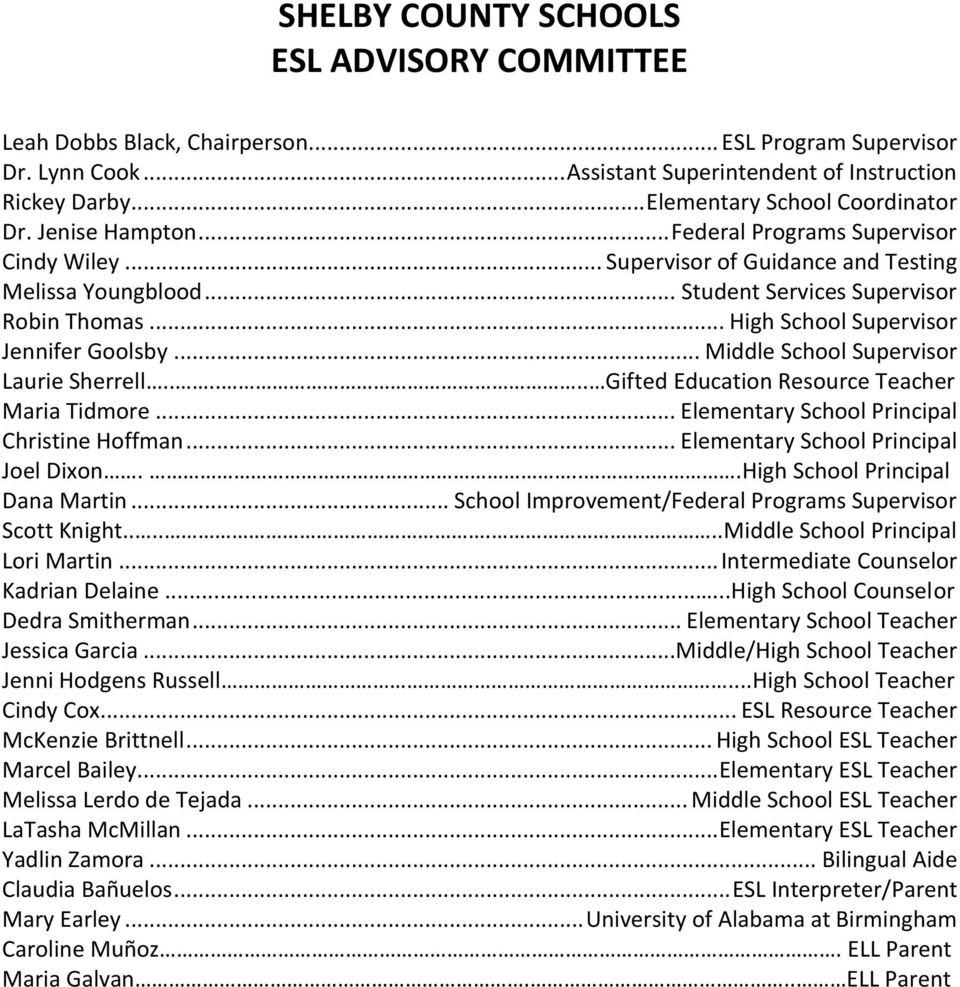
2 SHELBY COUNTY SCHOOLS ESL ADVISORY COMMITTEE Leah Dobbs Black, Chairperson... ESL Program Supervisor Dr. Lynn Cook... Assistant Superintendent of Instruction Rickey Darby... Elementary School Coordinator Dr. Jenise Hampton... Federal Programs Supervisor Cindy Wiley... Supervisor of Guidance and Testing Melissa Youngblood... Student Services Supervisor Robin Thomas... High School Supervisor Jennifer Goolsby... Middle School Supervisor Laurie Sherrell Gifted Education Resource Teacher Maria Tidmore... Elementary School Principal Christine Hoffman... Elementary School Principal Joel Dixon....High School Principal Dana Martin... School Improvement/Federal Programs Supervisor Scott Knight Middle School Principal Lori Martin... Intermediate Counselor Kadrian Delaine......High School Counselor Dedra Smitherman... Elementary School Teacher Jessica Garcia...Middle/High School Teacher Jenni Hodgens Russell...High School Teacher Cindy Cox... ESL Resource Teacher McKenzie Brittnell... High School ESL Teacher Marcel Bailey... Elementary ESL Teacher Melissa Lerdo de Tejada... Middle School ESL Teacher LaTasha McMillan... Elementary ESL Teacher Yadlin Zamora... Bilingual Aide Claudia Bañuelos... ESL Interpreter/Parent Mary Earley... University of Alabama at Birmingham Caroline Muñoz. ELL Parent Maria Galvan... ELL Parent
3 ESL Advisory Committee The ESL Advisory Committee of Shelby County Schools is comprised of a cross-representation of Central Office leaders, school administrators, ESL teachers, classroom teachers, parents, and community partners. Shelby County schools are diverse varying in size, socio-economics, suburban to rural, and in the number of ELLs and cultures represented in the schools. Therefore, the individuals invited to be a part of the Advisory Committee are representative of this diversity. The ESL Advisory Committee meets at least twice annually. The committee reviews assessment data, budgets, and plans in order to recommend and approve the necessary courses of action. The ESL Advisory Committee assists in developing the ESL goals, strategies, and action steps in the LEA Improvement Plan (LIP) when the LEA does not meet the Annual Measurable Achievement Objectives (AMAOs). Additional meetings may be called throughout the year to update and adjust plans, as the need arises.
4 1. INTRODUCTION SHELBY COUNTY SCHOOLS ESL PLAN SYNOPSIS Policy: The Shelby County Board of Education recognizes that within the district there are students who have a primary language other than English. The goal of the English as a Second Language (ESL) program is to have each student become proficient in the use of the English language, however, not to replace the student s primary language. Accordingly, the Board of Education authorizes the Superintendent or his designee to take affirmative steps to enable students to overcome language barriers in the classroom. These affirmative steps include identification, assessment, appropriate services, and monitoring. Purpose of Program: English as a Second Language (ESL) shall be taught to enable English language learners (ELL) to become competent in the comprehension, speaking, reading, and writing of the English language. The program shall emphasize mastery of English language skills and content area concepts and skills so students are able to participate effectively in the regular academic program and to reach their full potential. Home Language Survey: (Form A) The Home Language Survey shall be administered to the parents of all students at the time of initial registration and placed in the student's permanent record file. The survey shall be signed by the parent or guardian. Potential English Language Learners (ELL): Home Language Surveys which include any language other than English on any question must be referred to the school's ESL instructor and to the ESL office at within three (3) school days. The data manager/registrar should fax a copy of the Home Language Survey to the ESL office at and forward a copy of the Home Language Survey to the ESL instructor. The ESL instructor will gather information on the student and administer the MODEL (Measure of Developing English Language) to determine the level of English language proficiency and convene an ELL Committee Meeting including the student s parents within ten (10) school days. Interpreters may be available from the ESL office upon request. The information will be provided to the ELL Committee for review and possible placement of the student in the English language instruction educational program. (The English language instruction educational program will be referred to as the ESL program hereafter in this document.) Parental Notification: According to Title III, Part C, Section 3302(a), each Local Education Agency (LEA) shall, "not later than thirty (30) days after the beginning of the school year, inform a parent or the parents of a limited-english proficient child identified for participation in, or participating in" an English language instruction program, about the following: The reasons for the identification of the student as limited-english (LEP) proficient and in need of placement in an English language instruction educational program. The student's level of English proficiency, how such level was assessed, and the status of the student's academic achievement, to the extent known. The method of instruction to be used in the English language instruction educational program and how the program differs in content, instructional goals, and use of English from regular" programs in the school. How the program will meet the educational strengths and needs of the student
5 How the program will specifically help the student learn English and meet ageappropriate academic achievement standards for grade promotion and graduation. Specific exit requirements for the program, the expected rate of transition from the program into regular classrooms, and the expected rate of graduation from high school, if appropriate. If applicable, how the program meets objectives of the student's individualized education plan (IEP). Specifically, the following information pertaining to parental rights must be provided in writing: The right of parents to have their child immediately removed, upon their request, from the English language instruction educational program. The options that parents have to decline to enroll their child in an English language educational program or to choose another program or method of instruction if another program or method is available. The assistance that will be provided for parents in selecting from among various programs and methods of instruction if more than one program or method is offered by the LEA. If a student has not been identified for participation in an English language instruction educational program prior to the beginning of the school year, the ELL Committee must carry out the parent notification requirements within two (2) weeks of a student being placed in such a program. The notice to parents shall be printed in English and/or the parents' primary language when available. Parents are not required to respond affirmatively to the notification for the student to participate in the English language instruction educational program. Upon receipt of written instructions from the parent, however, the ELL Committee must withdraw the student from the formal English language instruction educational program. The teachers and school are still obligated to provide appropriate, informal strategies to ensure that the student s English language and academic needs are met. English Language Learner Committee: Each school shall form an ELL Committee consisting of a school administrator, a content area teacher, an ESL instructor, the school counselor, and others as designated by the principal. The ELL s parent will be invited to participate in ELL Committee decisions. The Committee shall review all relevant information and determine appropriate placement and exit from the ESL program for all ELLs. Program Exit: A student will be exited from the ESL program upon achieving a 4.8 or higher on the ACCESS for ELLs. Written notice shall be provided to the parents within five (5) school days of the ELL Committee Meeting informing them that their child will be exited from the ESL program. The notice shall be printed in English and the parents' primary language when possible. Upon exiting the ESL program the student will no longer be classified as LEP. The ESL instructor and the ELL Committee shall monitor the progress of the student for two (2) years. During the first year the student will be monitored at the conclusion of each grading period and will be classified as Former LEP (Monitor Year 1). The student will be monitored at the conclusion of each semester during the second year and will be classified as Former LEP (Monitor Year 2). After successfully completing the two (2) years of monitoring, the student will be classified as FLEP. If the student is - 2 -

6 not academically successful or does not pass coursework without accommodations while being monitored, the ELL/PST committee will reconvene to determine whether the student should be reevaluated for ESL services using the MODEL. The student may then be reclassified as LEP and reenrolled in the ESL program or other appropriate academic intervention programs. Assurances: The Shelby County English as a Second Language Manual of Procedures was designed by a committee of administrators, teachers (both ESL teachers and regular classroom teachers), bilingual instructional aides, school counselors, parents, community representatives, and university personnel representing the University of Alabama at Birmingham. All teachers and bilingual instructional aides in Shelby County s ESL Program have demonstrated English proficiency in written and oral communication skills
7 LEGAL GUIDANCE EFFECTING THE REGISTRATION AND INSTRUCTION OF ELLS The following is a synthesis of major legislation, court rulings and administrative regulations addressing language minority students. There is a substantial body of federal law established to ensure the rights of national origin minority students. Federal Laws 1868 Constitution of the United States Fourteenth Amendment "No state shall deny to any person within its jurisdiction the equal protection of the laws." 1964 Civil Rights Act, Title VI "No person in the United States shall, on the ground of race, color, or national origin be denied the benefits of, or be subjected to discrimination under any program or activity receiving Federal financial assistance." 1974 Equal Educational Opportunities Act (EEOA) "No state shall deny equal educational opportunity to an individual on account of his or her race, color, sex, or national origin, by the failure of an educational agency to take appropriate action to overcome language barriers that impede equal participation by its students in its instructional programs." 2001 No Child Left Behind Act ensure that all children have a fair, equal, and significant opportunity to obtain a high-quality education and reach, at a minimum, proficiency on challenging state academic achievement standards and state academic assessments. Supreme Court 1974 Lau V. Nichols: Equality of instruction denied to non-english speaking if special provisions are not made to aid them in learning English in schools Plyler V. Doe: States prohibited from denying free public education to children of undocumented immigrants, regardless of legal status. Schools are not agents for enforcing immigration law

8 Federal Courts 1974 Serna V. Portales: Court ordered schools to make a curriculum available to students who lack English skills Cintron V. Brentwood: ESL students not be segregated completely from other students, but included in art, PE, and non-language based classes Castañeda vs. Pickard: The 5 th Circuit Court established a three-pronged test for evaluating programs serving English language learners. According to the Castañeda standard, schools must: Base their program on educational theory recognized as sound or considered to be a legitimate experimental strategy; Implement the program with resources and personnel necessary to put the theory into practice; and Evaluate programs and make adjustments where necessary to ensure that adequate progress is being made. [648 F. 2d 989 (5 th Circuit, 1981)]. Memoranda May 25, 1970 Memorandum (Department of Health, Education, and Welfare) Where the inability to speak and understand the English language exclude national origin-minority group children from effective participation in the educational program offered by a school district, the district must take affirmative steps to rectify the language deficiency in order to open its instructional program to these students. *Memoranda were also posted by the Office of Civil Rights (U.S. Department of Education) with policy and policy updates in 1985, 1990, and

9 EDUCATIONAL APPROACH AND PROGRAM The instructional goals of the Shelby County Schools ESL Program are as follows: To increase the English language proficiency to the degree necessary to allow successful independent functioning in the regular school program. To provide the ELL the opportunity to reach his/her full potential. According to Cummins research (1979), it takes the average ELL from one to three years to acquire BICS (Basic Interpersonal Communication Skills) the social language which is needed to function on a daily basis; moreover, it takes approximately five to seven years to acquire CALP (Cognitive Academic Language Proficiency) the language skills necessary to function in an academic setting. Working with this premise in mind, the Shelby County School System has developed a plan to meet the needs of the ELLs. For all aspects of Shelby County s English language instruction educational program, teachers will use approaches based on scientifically based research that demonstrate effectiveness in increasing English proficiency and student academic achievement in core academic subjects. All teachers will include activities that focus on listening, speaking, reading, and writing to facilitate second language acquisition (Krashen 1982, Freeman and Freeman 1994, Freeman and Freeman, 2002). Methods of instruction include content-based instruction (Briton, Snow, and Wesche 1989, Crandall 1992, Met 1991, Anstrom 1997), CALLA-Cognitive Academic Language Learning Approach (Chamot and O Malley 1987, Freeman and Freeman 1994), the Natural Approach (Richards and Rodgers 1986, Rodgers 2001), Communicative Language Teaching (Freeman and Freeman 1994, Rodgers 2001), Sheltered Instruction Observation Protocol (SIOP) Model (Echevarria, Vogt, and Short 2004), Total Physical Response (Freeman and Freeman 1998, Rodgers 2001), and reading instruction methods supported by the Alabama Reading Initiative (see Closing the Gap available from the Alabama Department of Education, ). ESL and mainstream teachers will work together to provide the most appropriate instruction using best practices to meet the individual language and academic needs of students. The ESL curriculum is based on WIDA English Language Development Standards for English Language Learners in Kindergarten through grade 12 (2012) in correlation with College and Career Readiness Standards. In addition to assigning ELLs to a regular class in which the classroom teacher has received training in teaching ELLs, the ELLs receive regularly scheduled ESL instruction. The district ESL staff is available to provide training in support of effective instruction of ELLs. The students are placed in the ESL program based upon their performance on an English language proficiency test of listening, speaking, writing, reading, and comprehension. ESL instruction begins at the student's level of English proficiency which determines the time spent in the ESL class (Refer to Memo in Section 3). ESL classes are multilevel to enhance the secondlanguage learning process. A combination of strategies is used to teach language: whole language, phonics, oral language skills, cooperative learning, and integrated reading. Emphasis is placed upon the development of the four language domains: listening, speaking, reading, and writing. A variety of materials and equipment is used in instruction. These include textbooks, - 6 -

10 technology, videos, listening stations, games, purchased programs and materials, and language development activities. ESL instruction at all levels is a combination of pullout, sheltered instruction, content based ESL and inclusion. Students at the secondary level may receive elective credit for English Language Acquisition courses. Students in the ESL program receive from thirty minutes to four hours daily of English language instruction based upon their individual level of English proficiency and maturity level. All teachers providing instruction for ELLs should use a variety of approaches in organizing the classroom, designing a curriculum, and presenting lessons. There are several basic elements underlying all good language instruction: Versatility and flexibility. Interactive lessons with hands-on activities and cooperative learning. Encouragement and support of the mainstream or regular curriculum. Opportunities for all students to feel successful by providing appropriate modifications and accommodations for the needs of students different levels of ability. Integration of language skills, thinking skills, and content knowledge. The following methodologies are promoted as good teaching strategies for ELLs as well as all students: Total Physical Response (TPR) Cooperative Learning Language Experience Dialogue Journals Learning Centers Sheltered Instruction Interactive Peer to Peer Oral Techniques (IPOTs) ESL and regular classroom teachers should: Announce the lesson s objectives and activities Include both a language and content objective for each lesson Write legibly and grammatically correct Develop and maintain classroom routines List and review instructions step by step Present frequent summations of the main points of the lesson Use visual reviews with lists, charts, and other graphic organizers Have students provide oral summaries Present information in multiple and varied ways Build Background Control rate of speech Pre-teach academic vocabulary Utilize frequent checks for comprehension - 7 -

11 REGISTRATION PROCEDURES Conditions for Registration: 1. Proof of Age - a valid birth certificate, passport, or other official document listing date and place of birth. A Birth certificate is not required. Other documentation including but not limited to a family Bible (or other religious documentation) or notarized statement of birth date must be accepted in the absence of a valid birth certificate. Refer to ALSDE August 17, 2012 Memorandum. 2. Proof of Immunization - The State of Alabama Certificate of Immunization available at the County Health Department or a physician's office. If a student does not have a blue immunization form, a copy of their previous immunization record can be accepted (from another country or even from another school sending a copy). The school and/or ESL department then helps the family know where to go to receive an Alabama immunization record and time is allowed for the student to submit the immunization record. However, enrollment is not withheld due to not having a blue immunization form. These efforts should be documented for future reference as needed. If appropriate immunization documentation cannot be obtained within a reasonable period of time, the student case should be handled in accordance with approved state and local board of education procedures. 3. Registration Forms - School registration forms are to be completed and filed at the school. Registration forms will be available in several languages. No questions regarding immigration status are asked of the parents or students during registration because schools are not agents of the immigration agency (Plyler v. Doe, 1982) 4. Home Language Survey - System wide form to be completed and signed at initial enrollment by the parents or guardians of students. This form will be filed in the permanent record of each child in the system. 5. Proof of Residence Two proofs of residence are required for enrollment. In the event that families cannot produce these, Policy 6.1.2(e) authorizes the Superintendent and his designee(s) to make appropriate exceptions. Affidavits can be completed regarding residency and determinations made about homeless status in accordance with information shared regarding residential status and living arrangements at the time of registration. Alternatively, a home visit can be performed in the event appropriate documentation of residency within the zone is not presented. 6. Social Security Card - is NOT required for enrollment or for school lunch forms. If social security card is not presented at enrollment, Student Services will assign an identification number. Former school records, report cards, and/or transcripts are requested of the parents or guardians. If not available, information relating to the former school is needed to pursue the obtainment of these documents

12 2. IDENTIFICATION OF ENGLISH LANGUAGE LEARNERS The Home Language Survey (HLS) will be the identification tool for potential English Language Learners (ELLs). This survey will be administered to ALL new students as part of the registration process by the staff member responsible in each school for registering students (secretary, guidance counselor, teacher, or administrator). All HLSs shall be filed in students' Cumulative Record Folders. If a language other than English is identified in any of the HLS responses, the student should be identified as a potential ELL. 1. The school official (data manager/registrar, guidance counselor, teacher, or administrator) registering the student should fax a copy of the Home Language Survey to the ESL office at and forward a copy of the Home Language Survey to the ESL teacher within three (3) school days. 2. Any student answering with a language other than English to any of the HLS questions will be evaluated under the procedure and criteria developed for assessment of LEP status. 3. An ELL Committee meeting will be held to discuss the assessment results and placement considerations within ten (10) school days of enrollment. NOTE: The Ten Day Rule does not apply to students enrolled prior to or on the first day of school. They are on a thirty (30) day timeline. 4. The completed ELL Student Referral and Placement form will be filed in the student's yellow ESL folder, which is part of the student s Cumulative Record Folder. 5. In the event that a student transfers into Shelby County Schools and their cumulative record information includes information about ESL/language acquisition services, the information should be forwarded to the ESL teacher immediately. If parents or students need language assistance during the registration procedure, every effort will be made to provide an interpreter. See Section 13 for the Flowchart - 1 -

13 LEP Defined The Alabama definition of limited English proficient (LEP)/English language learner (ELL) is taken from the No Child Left Behind Act of 2001, S.9101, 25 of Title IX: (25) Limited English Proficient. The term limited English proficient, when used with respect to an individual, means an individual A. Who is aged three through 21; B. Who is enrolled or preparing to enroll in an elementary school or secondary school; C. (i) who was not born in the United States or whose native language is a language other than English; (ii) (I) who is a Native American or Alaska Native, or a native resident of the outlying areas; and (II) who comes from an environment where a language other than English has had a significant impact on the individual s level of English language proficiency; or (iii) who is migratory, whose native language is a language other than English, and who comes from an environment where a language other than English is dominant; and D. Whose difficulty is speaking, reading, writing, or understanding the English language may be sufficient to deny the individual - (i) the ability to meet the State s proficient level of achievement on State assessments described in Section 1111(b)(3); (ii) the ability to successfully achieve in classrooms where the language of instruction is English; or (iii) the opportunity to participate fully in society. The LEP/ELL definition includes students with a wide range of educational needs with respect to learning English as a second language (ESL). Examples include the following types of students: Children of recent immigrants who speak no English and who have had no formal training in written language. Children of highly-educated immigrants who have had formal training in English during formal schooling. United States-born children whose primary language is not English and who have had limited formal education through English language. Children recently adopted from foreign countries for which English is not the official or native language. Children reared in homes where the dominant language of communication is not spoken or written English. A student is considered Limited English Proficient until exited by the ELL committee. In order to exit a student must earn a 4.8 or higher composite score on the state English language proficiency test. For the first year after being exited, the student is classified as Former Limited English Proficient (Monitor Year 1). During the second year following exiting, the student is classified as Former Limited English Proficient (Monitor Year 2). At the end of the two years of monitoring, the student is classified as Former LEP. Students who re-enter the program based on poor academic performance during the monitoring period are required to receive ELL services. Any student who has reentered will not be classified as Former LEP until he/she has again scored proficient on the state English language proficiency test

14 All LEP students participate in the Alabama State Testing Program with or without accommodations according to state and federal guidelines. Limited English Proficient and Former Limited English Proficient students within the first two years of monitoring will be included in the LEP subgroup for the purpose of accountability reporting

15 3. LANGUAGE PROFICIENCY ASSESSMENT The ESL staff members who have completed the appropriate assessment training and certification will administer the MODEL (Measure of Developing English Language) to all potential ELLs and administer the ACCESS for ELLs to all LEP students each spring. The MODEL is the primary instrument utilized to determine the initial level of English language proficiency for program placement. The ACCESS for ELLs is an annual assessment that indicates the progress students have made from year to year and annual proficiency level. Both the MODEL and the ACCESS for ELLs measure speaking, listening, reading, and writing across the WIDA English Language Development Standards for English Language Learners in Kindergarten through Grade 12 (2012). The standards are: 1. English language learners communicate in English for SOCIAL AND INSTRUCTIONAL purposes within the school setting. 2. English language learners communicate information, ideas, and concepts necessary for academic success in the content area of LANGUAGE ARTS. 3. English language learners communicate information, ideas, and concepts necessary for academic success in the content area of MATHEMATICS. 4. English language learners communicate information, ideas, and concepts necessary for academic success in the content area of SCIENCE. 5. English language learners communicate information, ideas, and concepts necessary for academic success in the content area of SOCIAL STUDIES. The MODEL and ACCESS for ELLS will be administered in grade level clusters as follows: Kindergarten Grades 1-2 Grades 3-5 Grade 6-8 Grades 9-12 The MODEL is administered on an individual basis after a student has been initially identified as a potential ELL upon enrollment. The score from the MODEL facilitates the ELL committee s discussion and decision of whether a student receives ESL services because it indicates the student s language level. The result also facilitates the placement of a student into a Tier for the administration of the ACCESS for ELLs. The chart below demonstrates five of the six language levels and demonstrates how each level corresponds with a tier (Understanding the ACCESS for ELLs Test, 2). Level 6 is Reaching

16 The ACCESS for ELLs is administered each spring in accordance to the testing calendar set forth by the Alabama State Department of Education. All Kindergarten students are assessed individually. Students in grades 1-12 take the speaking portion of the test individually and the listening, reading, and writing portions in small group with students of the same grade level cluster and tier. Students scoring less than a 4.8 composite score will participate in the ESL program based on their level of proficiency and grade level in accordance with the decision of the ELL Committee. MODEL, ACCESS for ELLs, State Assessments, and any other available norm referenced test scores, in addition to prior academic record information will be noted on the ELL Student Referral and Placement Form by the ESL instructor. This form will be provided to the ELL Committee within ten (10) days of identification for a placement decision. The Committee will review all available information to make a recommendation for the most appropriate placement decision. All assessments, recommendations, and placements should be completed immediately after identification. According to Title III, Part C, Section 3302(a), each LEA shall, "not later than thirty (30) days after the beginning of the school year, inform a parent or the parents of a limited-english proficient child identified for participation in, or participating in" an English language instruction program, about the details of the program as instructed in the parental notification section of this document (see section XI). If a student has not been identified for participation in an English language instruction educational program prior to the beginning of the school year, the LEA must carry out the parent notification requirements within two (2) weeks of a student being placed in such a program. The most current test results and ELL Student Referral and Placement Form will be placed in the student's yellow ESL folder by the designated member of the ELL Committee. Copies can be made by the appropriate personnel as needed. All students (including all ELL students) will participate in all aspects of the State Assessment Program according to state and federal guidelines. LEP students in their first academic year of enrollment in U.S. schools receive special consideration regarding their participation in state assessments, as outlined in a memo from Dr. Thomas Bice, State Superintendent of Education. (Memo located in Section 13 with ELL Committee Documentation)

17 ENGLISH LANGUAGE INSTRUCTION EDUCATIONAL PROGRAM PLACEMENT English Language Learner (ELL) Committee: The ELL Committee shall consist: A school administrator A classroom teacher of the student ESL teacher(s) Counselor The student s parent(s) Others as designated by the principal The ELL Committee shall convene within ten (10) school days after identification to review the ELL Student Referral and Placement Form and any other pertinent information available on each ELL. Based upon this information, the Committee shall: Make recommendations concerning the placement of each student a. in the ESL program and/or other related services; and/or b. in the regular education program without accommodations if the composite score from the ACCESS for ELLs is 4.8 or higher or the MODEL score is 4.0. Suggest the best class schedule for the ELL Outline accommodations/modifications for use in regular content area classes Determine the best grading procedure for the ELL Determine, according to state guidelines, the accommodations necessary for the ELL to participate in the statewide assessment program. ALL students will participate in the State Assessment Program according to state and federal guidelines. Provide written notice to the parents of the Committee's recommendation for the child to participate in the ESL program. According to Title III, Part C, Section 3302(a), each LEA shall, "not later than thirty (30) days after the beginning of the school year, inform a parent or the parents of a limited-english proficient child identified for participation in, or participating in" an English language instruction program, about the details of the program as instructed in the parental notification section of this document (see section XI). If a student has not been identified for participation in an English language instruction educational program prior to the beginning of the school year, the LEA must carry out the parent notification requirements within two (2) weeks of a student being placed in such a program. Parents are not required to respond affirmatively to the notification for the student to participate in the English language instruction educational program. Upon receipt of written instructions from the parent, however, the ELL Committee must withdraw the student from the formal English language instruction educational program. The teachers and school are still obligated to provide appropriate accommodations and to utilize informal strategies to ensure that the student s English language and academic needs are met; the student will still be classified as LEP and will participate in the state English Language Proficiency assessments
18 Recommend and monitor the participation of eligible ELLs in any other applicable program; i.e., Title I, at-risk, homeless, migrant, etc. Determine that ELLs are eligible to participate in all academic and special programs on the same basis as the native English-speaking students. Review the English Language Learners progress in language acquisition and academic achievement on at least a quarterly basis. Encourage the ELL to meet his/her academic goals. Lend emotional support and encouragement to the ELL as he/she adjusts to life in the new school. Reclassify and recommend exiting the ESL program when ELLs become proficient in English and have met the exit criteria. Monitor the academic progress of students who exit the ESL program for a minimum of two (2) years. If the student is not academically successful or does not pass coursework without accommodations while being monitored, the ELL/PST committee will reconvene to determine whether the student should be reevaluated for ESL services using the MODEL. The student may then be reclassified as LEP and reenrolled in the ESL program or other appropriate academic intervention programs. If the student is reclassified as LEP and I- ELP should be completed documenting this change and demonstrating the reason for reclassification. Make recommendations to school decision makers on professional development for staff and parents regarding ELL success. Work with parents to ensure maximum benefit from the school program. The following documentation should be maintained in the individual ELL student profile/portfolio: YELLOW FOLDER I-ELP (aka ELL Referral and Placement Form/LEP Plan) Longitudinal Data Card Entry date into local school system Years of schooling in home language Educational history Classroom observations and anecdotal records of teachers Classroom monitoring forms CUMULATIVE FILE Assessment data (standardized tests taken, scores, and dates) ACCESS for ELLs Score Report Academic data (courses taken, grades, attendance, promotion/retention) Entry date into local school system Years of schooling in home language Educational history All members of the ELL Committee shall observe all rules and laws governing the confidentiality of information concerning individual students

19 SHELBY COUNTY SCHOOLS RECOMMENDATIONS FOR THE ELL COMMITTEE The ELL Committee should gather as much information as possible about the ELL s educational background. Based on his/her MODEL/ACCESS for ELLs scores and school records, the student should be placed in appropriate classes. Classroom accommodations are determined by the ELL committee. Every teacher of an ELL, including special area teachers, will receive a copy of the ELL s I-ELP that outlines the appropriate accommodations for that student. As a student gains English proficiency, the ELL committee will make changes to the accommodations. ALL Teachers should implement all accommodations and assessment alternatives recommended by the ELL Committee in order for LEP students to be successful in class. Classroom teachers will complete the Classroom Monitoring Form for ELL Students at each grading period to document/verify that the appropriate designated accommodations have been implemented. The ELL Committee should review each student s progress each grading period to determine if changes need to be made. In addition, meetings are called as needed throughout the year. Written documentation justifying failing grades at each grading period, including student work samples, must be presented to the ELL committee for review and maintained in the student s ELL portfolio. Verbal discussion with parents in a conference or by phone and appropriate documentation must be on file. It is highly recommended that ELLs are provided maximum opportunities for acquiring English as rapidly as possible and provided support in content classes in order to demonstrate proficiency on state assessments in English. ELLs should be encouraged to participate in extracurricular activities. It may be necessary to appeal to the State High School Athletic Association for special permission for participation of students who have recently arrived to the United States. The ELL committee should refer to the Recommendations page that addresses specific situations or contact the district ESL Program Supervisor for suggestions

20 Recommendations for High School ELL Students Scenario An ELL student comes to enroll with a transcript from another country. An ELL student comes to enroll in school and doesn t bring a transcript or report card. An ELL student enrolls in you school and needs additional instructional support. A non-english proficient student enrolls in your school. There is an ELL student, who has recently enrolled in school, and wishes to participate in one of the school s athletic programs. (There may/may not be transferring grades to establish eligibility). Committee Recommendation Counselor contacts ESL office for transcript evaluation. A+ software can be utilized to assess student s knowledge of core academic areas to assist in determining schedule and to award credit for courses when a transcript is not immediately available but the student has completed part of High School in his/her native country. Student must enroll in 9 th grade to begin to earn Carnegie units. Student s English proficiency must be assessed. A+ software can be utilized to assess student s knowledge of core academic areas to assist in determining schedule. Try to schedule classes with more than one certified instructor whenever possible. Try to schedule the student in an upper level course of the student s Heritage language as a foreign language elective. The ELL Committee should meet and make recommendations for participation in the athletic program. This ELL Committee recommendation should be submitted to the State Athletic Association for consideration

21 4. ENGLISH LANGUAGE INSTRUCTION EDUCATIONAL PROGRAM AND SERVICES An English as a Second Language Program is provided to all ELLs in grades K-12 by ESL instructors in each local school. These services are provided through various models determined by local school needs and the availability of resources. Shelby County s English language instruction educational program will use scientifically research based instructional strategies that demonstrate effectiveness in increasing English proficiency and student academic achievement in core academic subjects. Teachers will include activities that focus on listening, speaking, reading, and writing to facilitate second language acquisition (Krashen 1982, Freeman and Freeman 1994, Freeman and Freeman, 2002). Methods of instruction include but are not limited to: Content-based instruction (Briton, Snow, and Wesche 1989, Crandall 1992, Met 1991, Anstrom 1997) CALLA Cognitive Academic Language Learning Approach (Chamot and O Malley 1987, Freeman and Freeman 1994) The Natural Approach (Richards and Rodgers 1986, Rodgers 2001) Communicative Language Teaching (Freeman and Freeman 1994, Rodgers 2001) Sheltered Instruction Observation Protocol (SIOP) Model (Echevarria, Vogt, and Short 2004) Total Physical Response (Freeman and Freeman 1998, Rodgers 2001) Reading instruction methods supported by the Alabama Reading Initiative (see Closing the Gap available from A+ Education Foundation, ). ESL and mainstream teachers will work together to provide the most appropriate instruction using best practices to meet the individual language and academic needs of students. The ESL curriculum is based on WIDA English Language Development Standards for English Language Learners in Kindergarten through grade 12 (2012). ESL instruction enhances the student's acquisition and mastery of English as rapidly as possible. The amount of time of service is dependent upon the individual needs of the student, i.e., language proficiency and academic success. As the student's English proficiency increases, ESL instruction decreases. The decision concerning appropriate time spent in the ESL class will be made by the ELL Committee. ELLs participate the remainder of the school day in regular academic classes and/or special programs. Content area teachers differentiate instruction to meet individual ELL needs. Training will be provided to classroom teachers in strategies for appropriate accommodations. Some of these accommodations include oral rather than written assignments, oral testing, extra time to complete assignments, shortened assignments, alternative assignments, and tutoring. The ESL department will sponsor professional development activities to equip teachers with strategies for instructing and accommodating ELLs. ESL instruction at all levels is a combination of pullout, sheltered instruction, content based ESL and inclusion. ESL instruction does not take the place of physical education, art, music and 1
22 other such courses. ELLs should be considered for the gifted program and other special programs offered by the school system if academic performance indicates a possible need. The focus for elementary schools and middle schools for Entering and Emerging (Level I and II) students will be immersion into the English language (comprehension, speaking, and reading). The focus for elementary and middle schools for high Emerging, Developing and Expanding (Level II, III and IV) students will be reading comprehension and writing. These programs will also focus on the teaching of skills necessary for participation in the State Assessment Program. For Entering, Emerging, Developing, and Bridging (Level I, II, III and IV) students in high schools, the focus will be speaking, writing, and reading comprehension in the English language. New secondary ELLs are placed in less language dominant classes but not necessarily less challenging classes. A bilingual instructional aide may be used when available. Spanish speaking students may be placed in advanced Spanish classes to maintain or promote a high level of literacy in their first language and to provide additional support for the transition to second language acquisition. High school ELLs may acquire elective credit for ESL classes. ELLs are to be made aware of career-technical courses and extracurricular activities that are available. If parents refuse services, a Denial to Participate Form should be signed by the parents and placed in the student's ELL profile (yellow folder) by the ESL instructor. The school district is still required to make accommodations in instruction and monitor the student's academic performance. Although the parent has denied ESL services for the student, the student must continue to participate in the annual English Language Proficiency testing (ACCESS for ELLs) until attaining proficiency. School information is provided to parents in a language that they can understand through interpreters and/or forms and letters in the home language. ELLs are assessed annually by the ESL staff, using the MODEL and ACCESS for ELLs, to determine progress in English language acquisition. All ELLs will participate in the State Assessment Program. No student shall be excluded from participation in the state s required assessments. These scores are collected and reviewed by the ELL Committee and the ESL Program Supervisor. Title III law requires effective instruction that: (1) leads to the timely acquisition of proficiency in English and (2) provides teaching and learning opportunities so that each student can become proficient in the state s academic content and student academic achievement standards within the specified time frame that is expected for all students. The English language instruction educational program for ELLs may emphasize English temporarily over content subjects. The special instruction in English language development may be discontinued when the student becomes proficient. The school, however, is obligated to provide any assistance needed to remedy academic deficits that may have occurred in other subjects while the student was focusing on learning English. If a student is identified as English-proficient on a reliable and valid language proficiency test and scores below grade level in core academic subjects, the school system must assist the student in eliminating the deficiencies. If the student exits the English language instruction educational program, efforts to eliminate the deficiencies may continue through the regular program and any supplemental programs and/or services that are available to other students who are eligible for such services. 2
23 SHELBY COUNTY SCHOOLS GRADING PROCEDURES Standard Grading Procedures: Kindergarten and first grade students receive a standards based report card for all academic content areas. Second, third, fourth and fifth grade students receive a standards based report card for English Language Arts and numeric grades (A, B, C, D, and F) in math, science and social studies. Students receive a rating (grade) of 1, 2, or 3 according to meeting the grade level standard. Math ratings for Kinder and first: 3 = Meeting standard 2 = Working toward standard 1 = Working below grade level standard Math, Science and Social Studies ratings for grades 2-5: A = (90 100) B = (80 89) C = (70 79) D = (60 69) F = (59 0) English Language Arts and Behavior/Soft Skills ratings for K-5: 3 = Meeting standard 2 = Working toward standard 1 = Working below grade level standard Subject Area Kindergarten First Second Third Fourth Fifth English Language Arts 3,2,1 Grading Key/Rubric 3,2,1 Grading Key/Rubric 3,2,1 Grading Key/ Rubric 3,2,1 Grading Key/ Rubric 3,2,1 Grading Key/ Rubric 3,2,1 Grading Key/Rubric Math 3,2,1 Grading Key /Rubric 3,2,1 Grading Key /Rubric Numerical grades Numerical grades Numerical grades Numerical grades Science 3,2,1 Grading Key /Rubric Social Studies 3,2,1 Grading Key /Rubric Behaviors/ Soft Skills 3,2,1 Grading Key 3,2,1 Grading Key /Rubric 3,2,1 Grading Key /Rubric 3,2,1 Grading Key Numerical grades Numerical grades 3,2,1 Grading Key Numerical grades Numerical grades Numerical grades Numerical grades Numerical grades Numerical grades 3,2,1 Grading Key 3,2,1 Grading Key 3,2,1 Grading Key Sixth through twelfth grade students receive numerical grades in all subject areas. The English Language Learner Committee will consider and determine whether an alternate grading plan is appropriate for an ELL. This decision will be based upon a variety of criteria: the student s English language proficiency level, teacher observation, and other academic data. 3
24 Level Designation Based on the MODEL and ACCESS for ELLs Scores Grades K-12 Students Level 1 - Level 2 - Level 3 - Level 4 - Level 5 - Level 6 - Entering Emerging Developing Expanding Bridging Reaching/Attained 2012 WIDA Performance Definitions ( 4
25 WIDA Performance Definitions - Speaking and Writing Grades K-12 AT EACH GRADE, TOWARD THE END OF A GIVEN LEVEL OF ENGLISH LANGUAGE PROFICIENCY, AND WITH INSTRUCTIONAL SUPPORT, ENGLISH LANGUAGE LEARNERS WILL PRODUCE Discourse Level Sentence Level Word/Phrase Level Linguistic Complexity Language Forms and Conventions Vocabulary Usage Level 6 - Reaching Language that meets all criteria through Level 5, Bridging Level 5 Bridging Level 4 Expanding Multiple, complex sentences Organized, cohesive, and coherent expression of ideas Short, expanded, and some complex sentences Organized expression of ideas with emerging cohesion A variety of grammatical structures matched to purpose A broad range of sentence patterns characteristic of particular content areas A variety of grammatical structures Sentence patterns characteristic of particular content areas Technical and abstract content-area language, including content-specific collocations Words and expressions with shades of meaning across content areas Specific and some technical contentarea language Words and expressions with expressive meaning through use of collocations and idioms across content areas Level 3 Developing Short and some expanded sentences with emerging complexity Expanded expression of one idea or emerging expression of multiple related ideas Repetitive grammatical structures with occasional variation Sentence patterns across content areas Specific content language, including cognates and expressions Words or expressions with multiple meanings used across content areas Level 2 Emerging Level 1 Enterin g Phrases or short sentences Emerging expression of ideas Words, phrases, or chunks of language Single words used to represent ideas Formulaic grammatical structures Repetitive phrasal and sentence patterns across content areas Phrase-level grammatical structures Phrasal patterns associated with common social and instructional situations WITHIN SOCIOCULTURAL CONTEXTS FOR LANGUAGE USE. General content words and expressions Social and instructional words and expressions across content areas General content-related words Everyday social and instructional words and expressions 5

26 WIDA Performance Definitions - Listening and Reading Grades K-12 AT EACH GRADE, TOWARD THE END OF A GIVEN LEVEL OF ENGLISH LANGUAGE PROFICIENCY, AND WITH INSTRUCTIONAL SUPPORT, ENGLISH LANGUAGE LEARNERS WILL PROCESS Discourse Level Sentence Level Word/Phrase Level Linguistic Complexity Language Forms and Conventions Vocabulary Usage Level 6 - Reaching Language that meets all criteria through Level 5 - Bridging Level 5 Bridging Level 4 Expanding Level 3 Developing Level 2 Emerging Level 1 Enterin g Rich descriptive discourse with complex sentences Cohesive and organized related ideas Connected discourse with a variety of sentences Expanded related ideas Discourse with a series of extended sentences Related ideas Multiple related simple sentences An idea with details Single statements or questions An idea within words, phrases, or chunks of language Compound, complex grammatical constructions (e.g., multiple phrases and clauses) A broad range of sentence patterns characteristic of particular content areas A variety of complex grammatical constructions Sentence patterns characteristic of particular content areas Compound and some complex (e.g., noun phrase, verb phrase, prepositional phrase) grammatical constructions Sentence patterns across content areas Compound grammatical constructions Repetitive phrasal and sentence patterns across content areas Simple grammatical constructions (e.g., commands, Wh- questions, declaratives) Common social and instructional forms and patterns WITHIN SOCIOCULTURAL CONTEXTS FOR LANGUAGE USE. Technical and abstract content-area language, including contentspecific collocations Words and expressions with shades of meaning across content areas Specific and some technical contentarea language Words or expressions with multiple meanings across content areas Specific content language, including expressions Words and expressions with common collocations and idioms across content areas General content words and expressions, including cognates Social and instructional words and expressions across content areas General content-related words Everyday social and instructional words and expressions 6
27 ALTERNATE GRADING PROCEDURES FOR ENGLISH LANGUAGE LEARNERS Kindergarten thru 5th Grade ELL Students for English Language Arts ELL students will receive the same standards based rating (grading) as used for regular education students. Students with composite scores at Level 1 Entering, Level 2 Emerging, or Level 3 Developing may be graded as regular education students with accommodations. Teachers should mark Graded according to LEP plan (ELL) on the report card, as determined by the ELL Committee. Each teacher will receive a copy of the accommodations that each student should receive. As a child gains English proficiency, the ELL committee will make changes to the accommodations and grading system. An additional comment English Language Learner- Making Progress may also be used to indicate that the student is performing and progressing according to his/her English language proficiency level. Students with a composite score at Level 4 Expanding may or may not have accommodations made according to the ELL committee decision. Teachers should refer to the accommodations chart (or LEP plan) for each ELL student. Some students will not receive accommodations in every content area. The ESL Teacher will work with the classroom teachers to complete the LEP Classroom Monitoring Form at a minimum of each grading period to document/verify that the appropriate designated accommodations have been implemented. Written documentation justifying low ratings, including student work samples, must be presented to the ELL committee for review and maintained in the student s ELL portfolio at each grading period. The classroom teacher must have a verbal discussion with parents in a conference or by phone and appropriate documentation must be on file. Classroom accommodations are determined by the ELL committee. Each teacher will receive a copy of the accommodations that are appropriate for each student. As a student gains English proficiency, the ELL committee will make changes to the accommodations. The ELL committee will meet on a regular basis, preferably every grading period, to review the progress of each ELL student. In addition, meetings are called as needed throughout the year. 7
28 2 nd through 5 th Grade ELL students - All Other Academic Content Areas (2 nd through 5 th grades = math, science, and social studies) Level 1 Entering and Level 2 Emerging Students May receive S or P or N S=Satisfactory indicates that a child is regularly and independently producing evidence of mastery of the standard P=Partially Proficient which indicates that a child has a general understanding of the concept but is not regularly consistent or independent in producing evidence of the standard. N= Not Proficient indicates that a child has not demonstrated of the concept and/or has not produced evidence of the standard. Teachers should refer to the accommodations chart for each ELL student. Accommodations should be made in the classroom. Teachers should mark the comment Graded according to LEP plan (ELL) and other appropriate comments to indicate grading is based upon performance and accommodations outlined in the student s LEP plan. Level 3 Developing students Grading system (S/P/N or numeric grades) and accommodations will be determined by the ELL Committee. Each teacher will receive a copy of the accommodations that each student should receive. As a child gains English proficiency, the ELL committee will make changes to the accommodations and grading system. Teachers should include the comment Graded according to LEP plan (ELL) and other appropriate comments on the student s report card. Level 4 Expanding students These students may receive a letter or numeric grade that is an average of grades obtained from the classroom with accommodations made. For ALL 2 nd through 5 th grade ELLs: Teachers should refer to the accommodations chart (or LEP plan) for each ELL student. Some students will not receive accommodations in every content area. Classroom teachers will complete the Classroom Monitoring Form for ELL Students at a minimum of each grading period to document/verify that the appropriate designated accommodations have been implemented. Written documentation justifying failing grades, including student work samples, must be presented to the ELL committee for review and maintained in the student s ELL portfolio at each grading period. The classroom teacher must have a verbal discussion with parents in a conference or by phone and appropriate documentation must be on file. Classroom accommodations are determined by the ELL committee. Each teacher will receive a copy of the accommodations that are appropriate for each student. As a student gains English proficiency, the ELL committee will make changes to the accommodations. The ELL committee will meet on a regular basis, preferably every grading period, to review the progress of each ELL student. In addition, meetings are called as needed throughout the year. 8
29 6 th 8 th Grade ELL Students Level 1 (Entering), Level 2 (Emerging), and Level 3 (Developing) students in 6 th 8 th grades May receive a 70 or higher to reflect progressing toward classroom objectives May receive to reflect needs more time May receive to reflect unsatisfactory performance. Teacher documentation is required to justify this grade. Teachers should refer to the accommodations chart (LEP Plan) for each ELL student. Accommodations (modifications to instruction, not curriculum) should be made in the classroom. Classroom teachers will complete the Classroom Monitoring Form for ELL Students at a minimum of each grading period to document/verify that the appropriate designated accommodations have been implemented. Teachers should mark the comment Graded according to LEP plan (ELL) and other appropriate comments on the report card. Level 4 (Expanding) and Level 5 (Bridging) students in 6 th - 8 th grades These students will receive a numeric grade that is an average of grades obtained from the classroom with accommodations made. Teachers should refer to the accommodations chart (or LEP plan) for each ELL student. Some students will not receive accommodations in every content area. Classroom teachers will complete the Classroom Monitoring Form for ELL Students at a minimum of each grading period to document/verify that the appropriate designated accommodations have been implemented. For ALL 6 th 8 th Grade ELLs: Written documentation justifying failing grades, including student work samples, must be presented to the ELL committee for review and maintained in the student s ELL portfolio at each grading period. The classroom teacher must have a verbal discussion with parents in a conference or by phone and appropriate documentation must be on file. Classroom accommodations are determined by the ELL committee. Each teacher will receive a copy of the accommodations that are appropriate for each student. As a student gains English proficiency, the ELL committee will make changes to the accommodations. The ELL committee will meet on a regular basis, preferably every grading period, to review the progress of each ELL student. In addition, meetings are called as needed throughout the year. 9
30 9 th 12 th Grade ELL Students These students will receive a numeric grade obtained from mastery of the course objectives with accommodations made according to the LEP plan. Teachers should refer to the accommodations chart (or LEP plan) for each ELL student. Some students will not receive accommodations in every content area. Classroom teachers will complete the Classroom Monitoring Form for ELL Students at a minimum of each grading period to document/verify that the appropriate designated accommodations have been implemented. Written documentation justifying failing grades, including student work samples, must be presented to the ELL committee for review and maintained in the student s ELL portfolio at each grading period. The classroom teacher must have verbal discussion with parents in a conference or by phone and appropriate documentation must be on file. Classroom accommodations are determined by the ELL committee. Each teacher will receive a copy of the accommodations that are appropriate for each student. As a student gains English proficiency, the ELL committee will make changes to the accommodations. The ELL committee will meet on a regular basis, preferably every grading period, to review the progress of each ELL student. In addition, meetings are called as needed throughout the year. The ELL committee should refer to the Recommendations page that addresses specific situations or contact the district ESL Program Supervisor for suggestions. 10
31 ESL MATERIALS AND RESOURCES To reach the goal of English proficiency comparable to that of a native speaker of the same age and intellectual ability, ESL materials are used that stress the development of communication skills - comprehension, speaking, reading, and writing. Computers, websites, and relevant software, audio and video equipment, language masters, electronic dictionaries/translators, and numerous printed materials are utilized by ESL personnel and shared with regular program instructional staff. Some of the materials and resources utilized for the implementation of the ESL program include but are not limited to: High Point (6-10) Inside Edge New Oxford Picture Dictionary Bilingual Books and Tapes Oxford Content Picture Dictionary Series ACCESS Curriculum from Great Source On our Way to English! Pacemaker materials Saddleback Books Computer Programs: Rosetta Stone (K-12) READ 180 (4-8) Reading A-Z RAZ Kids Odyssey (ELL and Academic Components) V-Math A+ Fast Math Global Scholar Instructional resources for ELLs are selected utilizing knowledge of research based strategies for the effective instruction of ELLs. Particular emphasis is placed on the curriculum being written by ESL experts who have used their research and expertise in developing the materials. Any additional resources utilized that are not developed specifically for ELLs are selected based upon the recommendation of teachers and their ability to effectively utilize the selected materials to accommodate their instruction for ELLs. ESL materials and resources are high quality and support the district's goal for high academic achievement for all students. 11
32 5. ESL STAFF The number of staff employed in the district in the English as a Second Language program will be based on the following criteria: number of ELLs, the level of English proficiency of the ELLs, the achievement level of the students, the grade level of the students, the ESL instructional model of the school, and other programs in effect at the individual schools. Shelby County will strive to employ educational personnel who have formal training in teaching second language learners to implement the English language instruction educational program (ESL program). All teachers and bilingual instructional aides in the English language instruction educational program are fluent in English as verified in the interview process. Certified teachers in the area of ESL will be recruited. Non-ESL certified teachers will be encouraged to work toward the attainment of ESL certification and supported through professional development opportunities. ESL services are provided in thirty-one school sites for approximately 1,550 total students for the system. There are twenty-one full-time teachers, one part-time teacher, and three full-time bilingual instructional aides. Interpreters are available as needed. The system also provides one full-time ESL Resource teachers, to assist the ESL Program Supervisor in teacher supervision, training, parenting programs, and program expansion. The ESL Program Supervisor is responsible for the total program and conducts all aspects of the program in cooperation with local school administrators, the Federal Programs supervisor, the grade-level curriculum coordinators, the special education coordinator, and other appropriate personnel. Furthermore, the ESL Program Supervisor is assisted by a data manager and the district interpreter. ESL staff are responsible for the English language instruction of ELLs. In addition, they provide assessment, tutoring, and monitoring to LEP and FLEP students as needed. All ELLs will receive their primary instruction from certified teachers through the regular academic program. Professional Development: Professional development opportunities will be provided for all ESL personnel for a minimum of three (3) days per school year. Additional professional development opportunities and training will be provided to address specific areas of need as required. This will be accomplished by providing the opportunity to view relevant videos, attend related workshops, conferences, webinars, podcasts, and/or through contracted consultants. ESL staff meetings will occur at least quarterly to coordinate the implementation of the ESL program toward the attainment of the program's goals and objectives. Regular content area program teachers will receive training in the instruction of second language learners through workshops, conferences, and/or through contracted consultants. Individual assistance will be provided by the ESL Program Supervisor and ESL Resource Teachers
33 English language instruction educational program goals and activities are included in the district s ESL Goal Action Plan, LEA Improvement Plan (LIP) and each school's Continuous Improvement Plan (CIP). Professional development will be based on the principles of effective staff development. As always, professional development will be sustained, ongoing, and specific, rather than one-shot episodic in-service sessions: Designed to improve the instruction and assessment of limited-english proficient students. Designed to enhance the ability of teachers to understand and use curricula, assessment measures, and instruction strategies for English language learners. Based on scientifically based-research demonstrating the effectiveness of the professional development in increasing students English proficiency or substantially increasing the content knowledge, teaching knowledge, and teaching skills. Of sufficient intensity and duration to have a positive and lasting impact on the teachers performance in the classroom. ESL teachers and instructional paraprofessionals are required to earn a minimum of twenty (20) clock hours of training in ESL methodologies over a three-year period. This training can take the form of in-service training, formal college coursework, or a combination of the two. The LEA should ensure, through classroom observation, that teachers and paraprofessionals have mastered and implemented the skills necessary to teach and/or assist in the ESL program. MAINSTREAMING All ELLs will receive classroom instruction by certified teachers in the regular academic program and in the ESL program. Classroom teachers will be trained in strategies for accommodating ELLs in the regular content classroom. Students who are ELLs will receive accommodated content instruction. The ESL and the regular teacher will confer on a regular basis concerning the academic status of the students regarding instruction and materials
34 6. ESL EXIT PROCEDURES Students will be exited from the ESL program upon demonstrating overall proficiency on the ACCESS for ELLs (Composite score of 4.8 or higher). When a student exits the ESL program, the ESL teacher will monitor the student's progress for a period of two years. The student will not be monitored after the second year unless he/she is referred back to the ELL Committee. There is no time limit for participation in the ESL program. Criteria for Exiting: ACCESS for ELLs score indicating overall proficiency (Composite score of 4.8 or higher) Steps for Exiting: 1. The ELL Committee meets and exits a student from the ESL program based on the above stated criteria. 2. The I-ELP (ELL Student Referral and Placement Form) marked for exit will be completed and filed in the yellow folder. 3. Written notice shall be provided to the parents within five (5) school days by the ELL Committee that their child is exiting from the ESL Program. 4. After a student is exited from the ESL program, a follow-up review will be made within the first two weeks to verify that the student can compete academically and to check on the student s social and psychological adjustment. Further formal monitoring occurs at the end of each grading period for the first year exited. 5. If the student is not academically successful, or does not pass course work without accommodations after exiting from the ESL program, the student can be recommended for reclassification, reassessed using the MODEL, and reenrolled in the ESL program and/or other appropriate programs which meet the need for English language instruction upon recommendation by the ELL committee
35 Classification of Students Limited English Proficient students will be included in the LEP subgroup for the purpose of accountability until he/she has scored at the proficient level (composite score of 4.8 or higher) on the ACCESS for ELLs, English language proficiency assessment and has exited from ESL services. Upon exiting the ESL program the student will no longer be classified as LEP. The ESL instructor and the ELL Committee will monitor the progress of the student for two (2) years. During the first year the student will be monitored at the conclusion of each grading period and will be classified as Former LEP (Monitor Year 1). The student will be monitored at the conclusion of each semester during the second year and will be classified as Former LEP (Monitor Year 2). After successfully completing the two (2) years of monitoring, the student will be classified as FLEP. The ESL teachers will complete the appropriate documentation to change the student s status during this monitoring period. If the student is not academically successful or does not pass coursework without accommodations while being monitored, the ELL committee will reconvene to determine whether the student should be reassessed using the MODEL, reclassified as LEP, and/or reenrolled in the ESL program or other appropriate programs which meet the needs for English language instruction. The committee will base their decision on the following criteria: 1. If the student scores below a 4.0 on the MODEL he/she must be reclassified as ELL/LEP. 2. If the student scores between 4.0 and 4.8 on the MODEL the committee will use this score and other educational data pieces to make the determination for reclassification. 3. If the student scores above a 4.8 on the MODEL, he/she should remain exited and the committee will recommend other means of intervention. Students who re-enter the program based on poor academic performance and the ELL committee decision will not be classified as Former LEP until he/she has again scored proficient on the state English language proficiency test
36 7. ESL MONITORING PROCEDURES Monitoring of LEP Students The ESL teacher will work with the classroom teachers will complete the Classroom Monitoring Form for ELL Students at each grading period to document/verify that the appropriate designated accommodations have been implemented. The ELL Committee should review each student s progress each grading period to determine if changes need to be made to the I-ELP. In addition, meetings are called as needed throughout the year. ELL Students cannot fail or be retained on the basis of limited English proficiency. Written documentation justifying failing grades at each grading period, including student work samples with proof of accommodations being made, must be presented to the ELL committee for review and maintained in the student s ELL portfolio. Verbal discussion with parents in a conference or by phone and appropriate documentation must be on file. Documentation of monitoring shall be maintained by local school personnel as designated by the ELL Committee and presented as requested by LEA or state officials. Minutes from review meetings should be maintained. Documentation of LEP Student monitoring will be maintained in each ELLs yellow folder in the local school and does not need to be forwarded to the district ESL office. Classroom Monitoring Forms can be found in Section 13 and electronically on Share Point. Monitoring of Exited Students Exited students are monitored by the ELL Committee for a period of two years to determine if they are academically successful. The student will be monitored at grading periods coinciding with the issuance of report cards during the first year. The second year the student will be monitored at the end of each semester. Documentation of monitoring shall be maintained by local school personnel as designated by the ELL Committee and presented as requested by LEA or state officials. Minutes from review meetings should be maintained. Documentation of Exited Student monitoring will be maintained in each student s yellow folder in the local school and a copy should be forwarded to the district ESL office
37 The criteria used to determine success will be: 1. Subject area grades (stable at C or better or improving) 2. Review of formal and informal student assessment results (stable or improving) 3. Review of student work samples 4. Attendance 5. Teacher comments 6. Parent comments 7. Student comments If the student is not academically successful or does not pass coursework without accommodations while being monitored, the ELL committee will reconvene to determine whether the student should be reassessed using the MODEL, reclassified as LEP, and/or reenrolled in the ESL program or other appropriate programs which meet the needs for English language instruction. The committee will base their decision on the following criteria: 1. If the student scores below a 4.0 on the MODEL he/she must be reclassified as ELL/LEP. 2. If the student scores between 4.0 and 4.8 on the MODEL the committee will use this score and other educational data pieces to make the determination for reclassification. 3. If the student scores above a 4.8 on the MODEL, he/she should remain exited and the committee will recommend other means of intervention. If the lack of progress is not due to English proficiency, the Committee will make recommendations to meet the needs of the student. These recommendations may include tutoring, counseling, and/or a referral to the school s Problem Solving Team for behavioral or academic intervention
38 8. ESL PROGRAM EVALUATION The instructional goals of the Shelby County Schools ESL Program as stated at the beginning of this document are as follows: To increase the English language proficiency to the degree necessary to allow successful independent functioning in the regular school program. To provide the ELL the opportunity to reach his/her full potential. The system will utilize both formal and informal evaluations of the program in order to determine progress in meeting these goals. The evaluation will be an ongoing process. The progress of each ELL is assessed at the end of each grading period using the report card given by the regular program and monitoring forms. These reports are kept on file at the individual schools and will be used in the annual evaluation. A formal evaluation of the ESL program will be conducted at the end of each school year. This evaluation will consist of data collected from the individual schools concerning the following: General Information Number of limited-english proficient students at each school. ELL student enrollment by language and grade level. Identification and Assessment The individual, by position, who is responsible for ensuring that the Home Language Survey has been completed for each student registering for enrollment for the first time. A description of how this information is maintained, by whom, and where. The number of students identified as having a primary or home language other than English who are not receiving services (NOM PHLOTE). The number of parents/legal guardians who waived English language instruction educational program student services during the year. The number of newly identified students assessed for English proficiency during the year. The number of new students enrolled in the LEA s English language instruction educational program during the year. Reporting the Types of Language Instruction Education Programs Utilized by the LEA Program Exit Information The number of students who exited the program. The number of students who returned to the English language instruction educational program, by school and for the LEA. Number of ELLs who are in their first year of school in the United States. Number of ELLs who in their second or higher year of school in the United States. Number of students who are the first year of monitoring as a Former Limited English Proficient student. Number of students who are in the second year of monitoring as a Former Limited English Proficient student. Number of students who are considered Former Limited English Proficient
39 Participation in Other Programs The number of ELL and general education students referred for special education evaluation by school and for the LEA. The number of ELL and general education students who qualified for placement in special education programs and/or services by school and for the LEA. The total number of ELL and general education students currently enrolled in the LEA s special education program. The number of ELL and general education students referred for admission into the LEA s gifted and talented program. The total number of ELL and general education students currently enrolled in the LEA s gifted and talented program. The total number of ELL and general education students currently enrolled in the LEA s career-technical education program. The number of ELL and general education students participating in extracurricular activities, e.g., intramural sports, clubs. The number of ELL and general education students who received an honor or award during the school year. The number of ELL and general education students being served by Title I. State Assessment Reporting The percentage of Title III Served LEP students scoring proficient or above on the mathematics portion of the annual, state assessment. The percentage of Title III Served LEP students scoring proficient or above on the reading/language arts portion of the annual, state assessment. The percentage of Title III Served Former LEP (Monitor Year 1) and Former LEP (Monitor Year 2) students scoring proficient or above on the mathematics portion of the annual, state assessment. The percentage of Title III Served Former LEP (Monitor Year 1) and Former LEP (Monitor Year 2) students scoring proficient or above on the reading/language arts portion of the annual, state assessment. Number of Immigrant Children and Youth Number of LEP students in their first academic year in the United States with limited or no formal schooling English Language Proficiency The number of ELLs making progress in learning English according to the ACCESS for ELLs scores. The number of ELLs attaining English proficiency by the end of the school year. The number of ELLs exiting ESL
40 Staffing The number of ESL certified teachers in the school and LEA. The number of teachers highly-qualified to teach ESL (foreign language or elementary certified teachers), but not certified in ESL. The number of certified teachers teaching ESL (certified in a field other than ESL). The number of paraprofessionals working in the ESL program. The number of highly-qualified ESL paraprofessionals. Training A list and brief description of English language instruction educational program training provided for all personnel at each school and in the LEA; including the date, the intended audience and the number of participants. Communication The number and name of the different languages for which the LEA has written schoolrelated documents. A list of interpreters who are readily available to assist in parent/guardian communications and a description of how the list is maintained, by whom and where. A description of community activities conducted and resources in the community that are available to provide services. A description of efforts and activities to involve parents/guardians in the educational process. General Comparison Information The LEA s number of ELL and General Education dropouts. The total number of truancy petitions for ELL and general education students the LEA has issued during the school year. The number of ELL and general education seniors that graduated. The number of ELLs and general education students who participated in state assessment program. The number of ELL and general education students receiving supplemental services. The number of ELL and general education students prohibited or excluded from extracurricular activities based on grades. The number of high school ELLs using elective credit for ESL services. The number of ELL and general education students enrolled by grade level. The number of ELL and general education students retained by grade level
41 Progress Within the Program The beginning English proficiency level. The beginning academic level. The number of years in the English language instruction educational program (particularly using the Date First Identified LEP). The type of English language instruction educational program service received, e.g., English as a Second Language, one-on-one tutoring. The current English proficiency level. The current academic level. The current number of hours spent in the English language instruction educational program. Meeting Annual Measurable Achievement Objectives (AMAOs) Percent of ELLs making Adequate Progress in Language Acquisition Percent of ELLs attaining English language Proficiency Meeting AYP Requirements for the ELL Subgroup at the LEA Level School teams will participate in Data Training and Review of the ACCESS For ELLs results. Outcomes of this day will be to effectively analyze and plan for instruction and student learning both in the ESL classroom and the General Education classroom. Schools will write goals and identify action steps and strategies necessary to meet the established goal. The implementation of goals, action steps, and strategies will be monitored through monthly school walk-throughs and Continuous Improvement Plan reviews. Furthermore, in the event that AMAOs are not met, schools will send home notices to parents of ELL students describing the accountability measures, the annual goal, and the school performance. Each school will be held accountable for the following: Annual increases in the number or percentage of students making progress in learning English. Annual increases in the number or percentage of students attaining English proficiency by the end of each school year. Adequate yearly progress, as defined by the state, for limited-english proficient students consistent with Title I, Section IIII (b)(7). The percentage of limited-english proficient students who participate in the state's student assessment system. (Title I, Section IIII (b)(2)(i)(ii) states that not less than 95 percent of each school s limited-english proficient students are required to take the state s assessments, unless the number of such students is insufficient to yield statistically reliable information. All of this information will be compiled into a system report, which will be completed by the ESL Program Supervisor with input from the system-wide ESL Advisory Committee. Areas of deficiencies will be identified. The ESL Advisory Committee will then develop strategies to correct these deficiencies for the upcoming school year. Strategies used may include but are not limited to workshops, professional development activities for ESL staff or regular staff, purchasing updated and/or new materials and teaching supplies, employing additional staff, - 4 -
42 and research on specific areas that need to be addressed. The implementation of goals, action steps, and strategies will be monitored through monthly school walk-throughs and Continuous Improvement Plan reviews
43 Program Evaluation Cycle End of Year Data Compilation/ Comparative Data as Program Evaluation Summer Data Meetings to review previous year's CIP, LIP, ESL GAP, and Title III Plan as well as ACCESS for ELLs results Monitor CIP, LIP, ESL GAP, and Title III Plan with Walk-throughs, ESL staff meetings and PD, and situational concerns that arise Establish goals, strategies, and action steps for CIPs, LIP, ESL GAP, and Title III plan - 6 -
44 SHELBY COUNTY SCHOOLS SCHOOL COMPLIANCE CHECKLIST School Date Yes No Initials 1. Identification - Each student has a Home Language Survey completed and on file in the student's cumulative record. 2. Assessment - Each ESL student has been assessed to determine those who need English language instruction. 3. Placement - The school ensures age appropriate grade level placement and prohibits retention or failure based solely on lack of English skills. The school's regular program teachers modify instruction and testing to accommodate the language ability level of each English Language Learner (ELL). The campus evaluates each ELL individually to determine the quantity of ESL and academic support necessary for the student to succeed. 4. Services - The school maintains regularly scheduled language instruction for ELLs. 5. Transition The campus evaluates each former ELL individually to determine if academic support is necessary for the student to succeed in the mainstream classroom. 6. Communication - The school attempts to communicate with parents of ELLs about important school information in a language they can understand. Checklist Completed By ESL Liaison Signature Date - 7 -
45 SHELBY COUNTY SCHOOLS ESL PROGRAM EVALUATION & RESPONSIBILITIES PROCEDURE PERSONS RESPONSIBLE DOCUMENTATION A. Student Database 1. Number of students speaking "language other than English" on the Home Language Survey Principal, Registrar, Counselor, ESL Staff Home Language Surveys 2. Number of students identified as needing ESL services 3. Number of students served by ESL 4. Number of students to exit the program 5. Number of students to be retained or dropouts, compared to non-lep students 6. Achievement of ELLs (grades, annual ACCESS for ELLS, State Assessments) 7. Monitoring exited students (FLEPs) B. ESL Student Progress Measured By 1. ACCESS for ELLs 2. Student class grades 3. Collaborative review (by ESL & classroom teacher) 4. State Assessment scores when applicable 5. Grade Retention ESL Staff ESL Staff ESL Staff and ELL Committee Counselors, Teachers, ELL Committee, ESL Staff ESL Staff, Counselors, Teachers, and ELL Committee Regular Teachers, ESL Teachers, ELL Committee ESL Staff, Principals, Classroom Teachers, Counselors MODEL/ACCESS for ELLs ESL School Rosters, Student Records ELL Student Referral and Placement Form, Student Records Cumulative and Comparative Records Cumulative Records, State Assessment Scores, MODEL, ACCESS for ELLs, Consultations with Classroom Teachers Periodic Grade Reports - ESL Program Supervisor will compile Summary Report. Program revisions will be made as indicated by documented materials received. Data will be compared to non-lep students. MODEL/ACCESS for ELLs, Grade Records, Student Progress Forms, Progress Monitoring Results, State Assessment Scores (when applicable) Longitudinal Data Cards - 8 -
46 SHELBY COUNTY SCHOOLS ESL PROGRAM EVALUATION & RESPONSIBILITIES PROCEDURE PERSONS RESPONSIBLE DOCUMENTATION C. Student Assessment ACCESS for ELLs 1. Determining Student Tier ESL Teachers and ESL Departmental Staff Copies of training materials and spreadsheets where the tier has been identified for the student 2. Ordering the ACCESS for ELLs 3. Completing the purchasing of the test 4. Training of test administrators for the ACCESS for ELLs 5. Training of site coordinators and building administrators on testing protocols and procedures 6. Assuring all ELLs participate in ACCESS for ELLs 7. Shipping ACCESS for ELLs to Metritech 8. Receiving ACCESS Score Reports 9. Disbursement of Score Reports to Schools 10. Conducting data meetings/training on understanding the ACCESS for ELLs results 11. Receiving AMAO Reports 12. Distributing AMAO Reports ESL Program Supervisor and LEA Testing Coordinator ESL Program Supervisor ESL Program Supervisor LEA Testing Coordinator ESL Teachers, Site Testing Coordinators, ESL Program Supervisor, and LEA Testing Coordinator LEA Testing Coordinator LEA Testing Coordinator LEA Testing Coordinator ESL Program Supervisor LEA Testing Coordinator LEA Testing Coordinator Copy of Order From Copy of Purchase Order and verification of testing completion to accounting to insure payment of invoice Certificate of training from WIDA per ESL teacher/test administrator Sign In Sheets and copies of training materials Testing Schedules, Groups Rosters, Database checklist of all LEP students Shipping Receipts Copies of Testing Score Reports on File in Schools Copy of disbursement schedule Copies of Sign In Sheets and Agendas records, communication from Metritech records
47 SHELBY COUNTY SCHOOLS ESL PROGRAM EVALUATION & RESPONSIBILITIES PROCEDURE PERSONS RESPONSIBLE DOCUMENTATION D. Student Assessment All Other State Assessments 1. Training on Special Populations Bulletin 2. Determining necessary accommodations for ELLs for participation in testing 3. Training of site coordinators and building administrators on testing protocols and procedures 4. Training of test administrators 5. Assuring participation of ELLs in state assessments LEA Testing Coordinator and ESL Program Supervisor ELL Committee LEA Testing Coordinator School Testing Coordinators ESL Teachers, Site Testing Coordinators, ESL Program Supervisor, and LEA Testing Coordinator Sign-In Sheets, agendas and copies of training materials Individual ELL Plan Sign-In Sheets, agendas and copies of training materials Sign-In Sheets, agendas and copies of training materials Testing Schedules, Groups Rosters, Database checklist of all LEP students
48 9. SPECIAL EDUCATION SERVICES AND GIFTED PROGRAM ELL students can be referred for and placed into Special Education and Gifted Education programs by following the same procedures used for all students (Section 3116; Section 3213(2)(2)(G)); OCR Memorandum, September 1991, Lau v. Nichols. [See Section 1 pages 4 & 5 of this Manual of Procedures] SPECIAL EDUCATION SERVICES Students who are experiencing academic and behavioral difficulties, not related to their LEP status, are initially referred to the Problem Solving Team (PST) at their school. The ELL Committee reviews student s progress and performance on a regular basis. In the event that concerns beyond language acquisition arise, the ESL Committee can take the role of the PST for the ELL or can refer the student to the PST. If the strategies and interventions set forth by the PST are not successful, the student may be referred for special education services. As a general rule, ELLs who are following normal developmental patterns for learning a new language SHOULD NOT BE REFERRED. ELLs, because of their cultural and linguistic backgrounds, have special instructional needs. These needs should not be confused with disabilities nor should they serve as a basis for referral for a special education evaluation. Prior to a referral to PST or for a special education evaluation, efforts must be made to meet the student's needs within the context of the regular education program including English as a Second Language classes and documentation of assessments, accommodations, and interventions. Specific indicators, which validate the need for special education evaluation are: Poor communicative proficiency in the home as compared to siblings and age peers in bilingual environments, especially when this deficiency is noted by parents. English language development that appears to be significantly different than that of peers who are also learning English as a Second Language. Noted developmental delays or other at-risk conditions. Based on the review of the submitted documentation, the Problem Solving Team (PST) and the ESL teacher/specialist will recommend the referral of a student to special education for evaluation after all other avenues have been explored, and after a conclusion has been reached that the student's needs cannot be met by the regular education program. Referral information may indicate that a structured developmental history is needed to assist in the evaluation of a student s problem. The information gained from this history would be helpful in determining that a student s eligibility for special education services was not determined by the student s limited English proficiency or a lack of instruction in reading and math. The information recorded should remove all doubt that socio-cultural factors are the primary contributors to the student s learning or behavior problems. Essential factors needed to make this determination may be beyond the referral information required for non-lep students. (NOTE: Parents may need assistance in completing the developmental history ranging from translation to understanding the criteria being evaluated)
49 Additional pertinent information that should be addressed on the ELL referral form may include but not be limited to: Identification of a proficient use of native language (e.g., Home Language Survey/Identification, Oral Language Proficiency Assessment). The extent to which the ELL has received native language instruction and/or English language instruction prior to the referral. Experiential and/or enrichment services for students for diverse cultural and experiential backgrounds. The school s efforts to involve parents prior to referral. The amount of time and extent of services in an academic program for students who have had little or no formal schooling. Length of residency of the referred student in the United States and prior school experience in the native country and in an English language school system. Attempts to remediate the student s performance prior to referral, including any supplementary aids or support services provided for this purpose. Tests, which will be administered to the ELLs, will be determined by the REM (Referral Eligibility Meeting) Committee. The test may be presented in the native language of the student when such a test format is available and appropriate. An interpreter will be provided, if needed. Personnel who are trained in their administration will administer all tests. Upon completion of all evaluation material and information, the REM Committee will meet to determine if the student qualifies for special education services. ELLs are eligible for all special education services, including the Gifted and Talented Program, on the same basis as the native English-speaking students. The Special Education Specialist is the primary administrator responsible for the provision of services to all special education students. A. Procedures for a New Referral 1. Follow ESL procedures for identification. 2. Typically a student should have participated in an appropriate ESL program for a minimum of one year. 3. Documentation of assessments, accommodations, and interventions will be submitted to the Problem Solving Team (PST) along with the Longitudinal Data Card. 4. The ESL Program Supervisor or ESL Resource Teacher is available as needed to assist the PST in reviewing and recommending additional support or intervention strategies and programs. 5. The REM committee will review the referral with ESL staff providing input to the committee. 6. All IDEA-04 procedures will be followed for the referral and evaluation process
50 B. Criteria for assessment 1. The REM committee will determine, with input from the ESL staff, the evaluations to be administered and secure parental permission for evaluation. 2. The REM committee will discuss and determine the need for assessment in the student s native language. 3. The instruments of choice for intellectual functioning are the LEITER International Performance Scale-Revised (LIPS-R) or Universal Nonverbal Intelligence Test (UNIT). 4. Other evaluations will be presented in the native language of the student when such a test format is available and appropriate. Testing with the use of an interpreter is also an option. C. Eligibility for Special Education ESL staff will participate at the REM meeting to determine eligibility. D. Development of the Individual Education Program (IEP) ESL staff will participate in the initial development of the IEP and in subsequent IEPs until the student is exited from the ESL program. The Individualized Education Program (IEP) for a limited-english proficient student with a disability must include all of the components as listed in the Alabama Administrative Code. The IEP team shall consider the language needs of the student as those needs relate to the student s IEP. Parent participation is a required part of the special education process and to ensure active participation, accommodations must be made at all meetings and in written communications for the non-english speaking parent. These accommodations must include a translator for oral communication, and written communication must be in the parent s native language, when appropriate
51 GIFTED PROGRAM English Language Learners (ELLs) are eligible to be considered for participation in the Gifted and Talented Program, as are native English-speaking students. SCREENING/REFERRAL OF LEP STUDENTS BEFORE any screening test is administered and/or BEFORE submitting the referral to the GRST committee for a Limited English Proficient (LEP) student, the following steps must be taken: 1. The gifted education teacher needs to confer with the classroom teacher and check the student s cumulative file to determine the degree of English proficiency, as per MODEL or ACCESS for ELLs. 2. The gifted education teacher needs to make arrangements for the student s ELL Committee to meet to discuss: Factors that would need to be checked on the Aptitude Test Selection part of the Referral Form for Gifted Services Student s need for alternative assessments A plan to provide parents with interpretation of the Notification & Consent for Gifted Screening / Rights in Gifted Education and other forms needed in the referral/ eligibility/ placement process 3. The GRST/EDT (Gifted Referral Screening Team/ Eligibility Determination Team) Committee will: Review the information gathered Proceed with the screening/referral/eligibility in compliance with the guidelines listed in the Alabama Administrative Code Gifted - 4 -
52 10. PARTICIPATION IN OTHER PROGRAMS English Language Learners (ELLs) are entitled to the same facilities, programs and activities as all other students. ELLs have equal access to the full range of district programs and services, including special education, gifted and talented programs, career-technical education, Title I, homeless, and nonacademic and extracurricular activities. Every effort is made to notify students and parents of available programs and activities through newsletters, phone calls, and informational meetings for parents (with translations and interpreters available when possible). ESL and mainstream teachers encourage ELLs to participate in extracurricular and non-academic activities
53 11. PROGRAMS AND SERVICES FOR PARENTS Parents who speak a language other than English are invited and encouraged to participate in all programs and activities as native-english speaking parents in local schools as well as district offerings. These include parent-teacher conferences, parent workshops, Parent-Teacher Organization, and a wide range of other special activities. We will continue to offer annual workshops for ELL parents on ways to help their children achieve success in school. ELL parents will be notified of ESL classes in the community in which they may participate. Shelby County Schools ESL Department plans to provide Family literacy through LEAPS (Learning English and Parenting Skills), a Toyota Family Literacy Modeled Program; and, parental engagement activities at various schools throughout the district. Grant funds, including Title III, help support these classes. Furthermore, we will continue to work closely with various community organizations such as the YMCA of Greater Birmingham, the Hispanic Interest Coalition of Alabama, and area churches, to increase the opportunities for ESL classes for parents. Parents are encouraged to offer their input to the local school and to the ESL Program Supervisor for suggestions to improve the overall ESL program that will generate success for their children in school. The Shelby County School System will comply with Alabama Department of Education requirements to: Evaluate annually its educational programs to identify and eliminate barriers that may exist in preventing parents of limited-english proficient students from participating in school activities. Provide an interpreter to assist in the registration of a limited-english or non-english speaking student. Provide an interpreter for parent/teacher conferences. Ensure, to the extent possible, that information related to school and parent programs, meetings, and other activities is provided in the child s home language. Provide meaningful opportunities for the participation of parents with limited-english proficiency in the education of their children, including providing information and school profiles in a language and form parents can understand. Include parents of ELLs to the extent practicable and possible, in the development of system wide or individual school Parent Involvement Plans and Title I Schoolwide Plans, if possible. Following is a list of factors that may impact the degree and extent of parent involvement for ELLs: Length of residence in the United States. English language proficiency. Availability of support groups and bilingual staff. Prior experiences of parents. Economic need of parents
54 Whenever possible, the school must provide written communication that the parents can understand and/or provide a person who can speak the parent's native language to facilitate understanding. This provision greatly improves the quality and outcomes of the school-home working relationship. Parental Notification The LEA must ensure that appropriate notification is made to parents prior to placing a student in an English language educational program. According to Title III, Part C, Section 3302(a), each LEA shall, "not later than thirty (30) days after the beginning of the school year, inform a parent or the parents of a limited-english proficient child identified for participation in, or participating in" an English language instruction program, about the following: The reasons for the identification of the student as limited-english proficient and in need of placement in an English language instruction educational program. The student's level of English proficiency, how such level was assessed, and the status of the student's academic achievement, to the extent known. The method of instruction to be used in the English language instruction educational program and how the program differs in content, instructional goals, and use of English from regular" programs in the school. How the program will meet the educational strengths and needs of the student. How the program will specifically help the student learn English and meet ageappropriate academic achievement standards for grade promotion and graduation. Specific exit requirements for the program, the expected rate of transition from the program into regular classrooms, and the expected rate of graduation from high school, if appropriate. If applicable, how the program meets objectives of the student's individualized education plan (IEP). Specifically, the following information pertaining to parental rights must be provided in writing: The right of parents to have their child immediately removed, upon their request, from the English language instruction educational program. The options that parents have to decline to enroll their child in an English language educational program or to choose another program or method of instruction if another program or method is available. The assistance that will be provided for parents in selecting from among various programs and methods of instruction if more than one program or method is offered by the LEA. Each local school must implement "an effective means of outreach" so that parents of limited English proficient students can: Be involved in the education of their children. Be active participants in assisting their children to learn English, to achieve at high levels in core academic subjects, and to meet the same challenging state content and student achievement standards as all children are expected to meet
55 If a student has not been identified for participation in an English language instruction educational program prior to the beginning of the school year, the ELL Committee must carry out the parent notification requirements within ten school days of a student being placed in such a program. In addition to the information required above, the LEA shall separately inform the parents of LEP students of the LEA s or local school s failure to meet the Annual Measurable Achievement Objectives (AMAOs) within 30 days of receiving the final AMAO reports from the State Department of Education
56 COLLECTION AND SUBMISSION OF DATA Student Enrollment Completes Home Language Survey - indicates a language other than English in background School's Data Manager/Registrar faxes a copy of HLS to ESL office and gives copy to school's ESL teacher Data Entry School's Data Manager/School Registrar enters general student data into INOW OR Imports data from INOW clearinghouse if transferring within Alabama ELL Committee Committee meets within established time frames to determine student placement and services for newly enrolled and returning students Student's ELL Plan is forwarded to the ESL Data Manager/Registrar Data Entry ESL Data Manager/Registrar reviews student's INOW file and updates LEP, Immigrant status, etc. Student's file in ESL Database is created or revised according to ELL Plan Data Review ESL teachers review the ESL database at least three times per year Corrections are submitted to the ESL Data Manager/Registrar ESL Data Manager/Registrar updates/corrects STI and ESL database ESL Data Manager/Registrar and ESL Program Supervisor pull reports from STI to review and update student data prior to each data upload to the SDE - 1 -
DRAFT. Knox County R-I School District. LAU Plan
 Knox County R-I School District LAU Plan Table of Contents Legal Foundation.Section 1 Identification 3116(b)(1).Section 2 English Language Assessment 3116(b)(1)..Section 3 Placement 3116(b)(1)..Section
Monroe Public Schools English Language Learner Program Description and Guidelines Revised, Fall 2012
 Monroe Public Schools Language Learner Program Description and Guidelines Revised, Fall 2012 It is the policy of Monroe Public Schools not to discriminate on the basis of race, color, national origin,
English Language Learners
 English Language Learners English as a Second Language 2012-2013 Objectives: To identify LEP students and provide appropriate ESL services to students enrolled in ESL program Activities Person(s) Responsible
GUNTER ISD ENGLISH AS A SECOND LANGUAGE (ESL) PROCEDURES MANUAL
 GUNTER ISD ENGLISH AS A SECOND LANGUAGE (ESL) PROCEDURES MANUAL TABLE OF CONTENTS INTRODUCTION OBJECTIVES OF MANUAL PROGRAM DESCRIPTION FUNDING SOURCES LPAC ELIGIBILITY TESTING AND CLASSIFICATION MEETINGS
Tennessee State Board of Education August 5, 2011 First Reading Item: II. C. ESL Policy 3.207 Revision
 Tennessee State Board of Education Agenda August 5, 2011 First Reading Item: II. C. ESL Policy 3.207 Revision The Background: The current ESL policy was passed in August of 2008. Implementation began in
Brazos School for Inquiry and Creativity
 English as a Second Language (ESL) January 2013 It is the policy of the Brazos School for Inquiry and Creativity not to discriminate on the basis of race, color, national origin, sex or handicap in its
English Learner Program Description White Bear Lake Area Schools
 English Learner Program Description White Bear Lake Area Schools March, 2012 Please direct questions to: Kathleen Daniels Director of Special Services [email protected] 1 The purpose of this
Two steps are necessary to implement this process. 1. Administer the Home Language survey to all students enrolled in the school corporation.
 INDIANA DEPARTMENT OF EDUCATION Office of English Language Learning & Migrant Education Guidelines to Satisfy Legal Requirements of Title VI of the Civil Rights Act of 1964 (42 USCS, 2000d) Lau v. Nichols
GRANDVIEW INDEPENDENT SCHOOL DISTRICT ENGLISH AS A SECOND LANGUAGE POLICY AND PROCEDURES
 GRANDVIEW INDEPENDENT SCHOOL DISTRICT ENGLISH AS A SECOND LANGUAGE POLICY AND PROCEDURES ESL PROGRAM GOAL and MISSION The goal of the English as a Second Language (ESL) program in Grandview ISD is to enable
ESL HANDBOOK. CCISD ESL Handbook/01/11/2011/Curr/TBG
 ESL HANDBOOK State Goals Chapter 89.1201 Adaptations for Special Populations Subchapter BB. Commissioner's Rules Concerning State Plan for Educating Limited English Proficient Students The goal of English
Title III English Language Acquisition
 Title III English Language Acquisition Everything You Wanted to Know About Federal Programs But Were Afraid to Ask July 30, 2014 1 Topics for Today s Session ELL Demographics in Nebraska Historic court
REGULATIONSPEQUANNOCK TOWNSHIP
 A. Definitions 2423R BILINGUAL AND ESL EDUCATION PROGRAM 2423R / PAGE 1 0F 11 M 1. "Bilingual education program" means a full-time program of instruction in all those courses or subjects which a child
MILLINOCKET SCHOOL DEPARTMENT. English as a Second Language (ESL) LAU PLAN
 MILLINOCKET SCHOOL DEPARTMENT English as a Second Language (ESL) LAU PLAN NEPN/NSBA Code: IBEA In accordance with federal and state guidelines, the Millinocket School Department has adopted the following
MEIGS COUNTY S 2003 ESL / OCR COMPLIANCE REPORT. Descriptive Report on Services to English Language Learners (ELL)
 MEIGS COUNTY S 2003 ESL / OCR COMPLIANCE REPORT Descriptive Report on Services to English Language Learners (ELL) Student Identification Student Language Assessment ESL Program Participation Student Placement
Settlement Agreement. Between. The United States. And. The Clay County School District
 Settlement Agreement Between The United States And The Clay County School District SETTLEMENT AGREEMENT PURPOSE 1. The Clay County School District, by signature of its Superintendent, agrees to the terms
SPEAK UP! Rights of English Language Learners
 SPEAK UP! Rights of English Language Learners Presented by: Advocates for Justice and Education (AJE) The District of Columbia Parent Training and Information Center Between 1979 and 2008, the number of
Dumas ISD 12/03/2012 BILINGUAL/ESL RESOURCE HANDBOOK
 BILINGUAL/ESL RESOURCE HANDBOOK EHBE-R Policy A. It is the policy of the district that every student in the district who has a home language other than English and who is identified as Limited English
Oklahoma City Public Schools. Lau Plan
 Oklahoma City Public Schools Lau Plan Named after the landmark Lau vs Nichols U.S. Supreme Court Decision of 1974, this document describes how OKCPS ensures an equitable education for English Language
English Language Learners District Plan
 English Language Learners District Plan Jackson Public School District 2013-2014 Table of Contents Introduction 3 Demographics 3 Rights of English Language Learners and Their Families 4 Annual Measurable
Snyder ISD Implementation of Bilingual and English as a Second Language Programs
 Snyder ISD Implementation of Bilingual and English as a Second Language Programs Revised 2012 Snyder Independent School District 2901 37 th Street Snyder, TX 79549 325-573- 5401 This school district and
DEKALB COUNTY SCHOOLS ENGLISH LANGUAGE LEARNER PLAN AND GUIDE. English Language Learners
 DEKALB COUNTY SCHOOLS ENGLISH LANGUAGE LEARNER PLAN AND GUIDE A Manual for Identifying, Assessing, Placing, and Meeting the Educational Needs of English Language Learners AMENDMENT: February 2010 Jason
MASSACHUSETTS DEPARTMENT OF EDUCATION. QUESTIONS AND ANSWERS REGARDING Chapter 71A: ENGLISH LANGUAGE EDUCATION IN PUBLIC SCHOOLS TABLE OF CONTENTS
 MASSACHUSETTS DEPARTMENT OF EDUCATION QUESTIONS AND ANSWERS REGARDING Chapter 71A: ENGLISH LANGUAGE EDUCATION IN PUBLIC SCHOOLS TABLE OF CONTENTS Topic Page General Questions 2 Waivers 5 Two-way Bilingual
District Plan Policies, Procedures and Assessments for English Language Learners
 MADISON COUNTY SCHOOLS District Plan Policies, Procedures and Assessments for English Language Learners Guidelines for Identifying, Assessing, Placing, and Meeting the Educational Needs of English Language
IDENTIFICATION AND ASSESSMENT OF ENGLISH LANGUAGE LEARNERS
 IDENTIFICATION AND ASSESSMENT OF ENGLISH LANGUAGE LEARNERS CHAPTER 3 INDEX 3.1 PURPOSE AND SCOPE... 3 1 3.2 IDENTIFICATION AND REFERRAL OF ENGLISH LEARNERS SUSPECTED OF HAING A DISABILITY... 3 1 3.3 SPECIAL
Georgia Department of Education ESOL / Title III Resource Guide 2011-2012
 ESOL / Title III Resource Guide 2011-2012 Cori Alston, Program Manager Carol Johnson, Program Specialist Amy Lacher, Program Specialist, Title III Consortium Manager Dr. Mae Wlazlinski, Research & Evaluation
Medina Valley ISD Program for English Language Learners. Bilingual/ESL Program Procedures Guide
 Medina Valley ISD Program for English Language Learners Bilingual/ESL Program Procedures Guide i Table of Contents Annual Critical Events Calendar Page iii Rationale.. Page 1 Philosophy... Page 1 Mission
BILINGUAL/ESL EDUCATION PROGRAM
 GOOSE CREEK CONSOLIDATED INDEPENDENT SCHOOL DISTRICT BILINGUAL/ESL EDUCATION PROGRAM PK 12th Unity through Language Mission Statement The mission of the Goose Creek CISD Bilingual/ESL Education Program
La Joya ISD Office of Bilingual/ESL Education
 La Joya ISD Office of Bilingual/ESL Education Secondary-Content-Based ESL Program for Middle Schools 1 Frameworks for Successful English Language learning at La Joya ISD The Bilingual/ESL programs outline
Pennsylvania s ESL Requirements; Expectations Under Law. Presented by: Jamie McFadden ESL Teacher Saucon Valley School District
 Pennsylvania s ESL Requirements; Expectations Under Law Presented by: Jamie McFadden ESL Teacher Saucon Valley School District Pennsylvania State Law Title 22, Chapter 4, Section 4.26 of the Curriculum
PINE GROVE AREA SCHOOL DISTRICT ESL PROGRAM
 Pine Grove Area School District ESL Plan 2011-2012 (Revised 10/20/2011) 1 PINE GROVE AREA SCHOOL DISTRICT It is the mission of the Pine Grove Area School District board, faculty and staff to Promote Growth,
Caruthers Unified School District. Instructional Program For English Language Learners
 PO Box 127 Caruthers, California 9360 T: 559-495-6402 F: 559-864-4241 www.caruthers.k12.ca.us Caruthers Unified School District Instructional Program For English Language Learners District Office #1 Tiller
K-12 Lau (EL) Plan for Serving English Learners (ELs)
 Bondurant Farrar Community School District 300 Garfield SW Bondurant, IA 50035 K-12 Lau (EL) Plan for Serving English Learners (ELs) August, 2015 Required Lau Leadership Team Members: Central Office Administrator
Schuylkill Haven Area School District. August, 2011 ESL PROGRAM
 Schuylkill Haven Area School District 1 August, 2011 ESL PROGRAM I. Goals and Objectives The goal of the Schuylkill Haven Area School District is to provide English as a Second Language program for each
Georgia Department of Education ESOL / Title III Resource Guide 2012-2013
 ESOL / Title III Resource Guide 2012-2013 Cori Alston, Program Manager Carol Johnson, Manager of ESOL Professional Learning Amy Lacher, Statewide Title III Consortium Manager Dr. Mae Wlazlinski, Independent
English as a Second Language Program Guide: Planning for English Language Learner Success. Department of Defense Education Activity
 English as a Second Language Program Guide: Planning for English Language Learner Success Department of Defense Education Activity March 2007 This page intentionally left blank DEPARTMENT OF DEFENSE EDUCATION
ESL PLAN. Adopted: October 28, 2002 Revised: September 2, 2014. Minersville Area School District P.O. Box 787 Minersville, PA 17954
 1 ESL PLAN Adopted: October 28, 2002 Revised: September 2, 2014 Minersville Area School District P.O. Box 787 Minersville, PA 17954 Table of Contents I. Goals and Objectives... 3 II. Student/Parent Orientation...
English Language Learners Title III, Part A: Requirements and Allowability
 English Language Learners Title III, Part A: Requirements and Allowability Bethany Nickerson, State Director for English Language Learners Office of the State Superintendent of Education (OSSE) 1 Topics
MARSHALL INDEPENDENT SCHOOL DISTRICT BILINGUAL & ENGLISH AS A SECOND LANGUAGE EDUCATION PROGRAM
 MARSHALL INDEPENDENT SCHOOL DISTRICT BILINGUAL & ENGLISH AS A SECOND LANGUAGE EDUCATION PROGRAM Marshall ISD Bilingual/ESL Program Handbook Page 1 Table of Contents Page District Vision 3 Position Statement
STUDENT PROGRESSION PLAN
 STUDENT PROGRESSION PLAN 2015 2016 HILLSBOROUGH COUNTY PUBLIC SCHOOLS School Board Members Susan L. Valdes, Chair District 1 Doretha W. Edgecomb, Vice Chair District 5 April Griffin District 6 Sally A.
Upper Perkiomen School District Pennsylvania 3044 ESL Program Narrative
 Upper Perkiomen School District Pennsylvania 3044 ESL Program Narrative 1. Program Goals and Objectives Academic Goals Goal 1: Students will use English to communicate in social settings Standard 1. Students
Frequently Asked Questions Regarding ELL Programs
 1. What is the requirement to have a bilingual education program or a special language program in Texas? Each district with an enrollment of 20 or more students of limited English proficiency in any language
N.J.A.C. 6A:15, BILINGUAL EDUCATION TABLE OF CONTENTS
 N.J.A.C. 6A:15, BILINGUAL EDUCATION TABLE OF CONTENTS SUBCHAPTER 1. GENERAL PROVISIONS 6A:15-1.1 General requirements 6A:15-1.2 Definitions 6A:15-1.3 Identification of eligible limited English proficient
Ferndale Area School District. ESL Program and Guidelines
 Ferndale Area School District ESL Program and Guidelines Lynn Bennett ESL Coordinator Leonard Shurin ESL Curriculum and Staff Developer, IU08 Revised Summer 2010 ESL PROGRAM AND GUIDELINES 1. PROGRAM GOALS
NJTESOL/NJBE Spring Conference May 27 th and 28 th, 2015 Hot Topics in ESL Secondary Education
 NJTESOL/NJBE Spring Conference May 27 th and 28 th, 2015 Hot Topics in ESL Secondary Education Marcella Garavaglia NJTESOL/NJBE ESL Secondary SIG ESL Teacher, Colts Neck High School Freehold Regional High
Name: Phone Number: To be eligible for state funding, a student in the bilingual or ESL education program must meet the following requirements:
 Section 6 Bilingual/ as a Second Language (ESL) This section addresses unique provisions for bilingual and ESL education programs. These provisions must be applied in conjunction with the general rules
MISSISSIPPI Guidelines for English Language Learners
 MISSISSIPPI Guidelines for English Language Learners Policies, Procedures, and Assessments January 2011 Mississippi Department of Education Guidelines for English Language Learners Policies, Procedures,
Program Models. proficiency and content skills. After school tutoring and summer school available
 Holyoke English Language Learners Program Opportunities & Services Program Models ELL students ts participate i t in mixed groupings so they can learn with English-speaking peers. Certified ESL, ELL or
English Language Development Plan. Identify Plan - Serve
 DOUGLAS COUNTY SCHOOL DISTRICT English Language Development Plan Identify Plan - Serve Educational Programming and Services I 620 Wilcox Street Castle Rock, CO 80104 dcsdk12.org The Douglas County School
ACRONYMS & TERMS RELATED TO ENGLISH LANGUAGE LEARNERS
 ACRONYMS & TERMS RELATED TO ENGLISH LANGUAGE LEARNERS Academic Language ACCESS for ELLs Accommodations Additive Bilingualism Language used in the learning of academic subject matter in formal schooling
Questions and Answers Regarding English Language Learners (ELLs) with Disabilities. Volume 10
 Questions and Answers Regarding English Language Learners (ELLs) with Disabilities Volume 10 1) What factors should be considered prior to referral for evaluation? A: Local Education Agencies (LEAs) must
Help! My Student Doesn t Speak English. 10 Tips To Help Your English Language Learners Succeed Today
 Help! My Student Doesn t Speak English. 10 Tips To Help Your English Language Learners Succeed Today 1. Use your test data. Examine the teacher reports for each student who has been assessed with the Assessing
Van Meter Community Schools K-12 Lau Plan for Serving English Language Learners 2015-2016
 Van Meter Community Schools K-12 Lau Plan for Serving English Language Learners 2015-2016 Team Members: Jen Sigrist, Director of Teaching and Learning; Jenny Stephens, ESL endorsed teacher/4 th grade teacher;
ESOL Endorsement Program
 NORTHWEST GEORGIA REGIONAL EDUCATIONAL SERVICE AGENCY ESOL Endorsement Program Methods and Materials NWGA RESA 6/1/2007 Instructor: Lynn Lewis Office: Griffin RESA Conceptual Framework Endorsement and
Master Plan Evaluation Report for English Learner Programs
 Master Plan Evaluation Report (2002-03) for English Learner Programs Page i Los Angeles Unified School District Master Plan Evaluation Report for English Learner Programs 2002-03 Prepared by Jesús José
Presented by Erin Cathey FOED 6022
 Presented by Erin Cathey FOED 6022 Shifts in Language Policy Since the beginning of what is known as the United States of America, federal policies on serving English language learners (ELLs) in the public
Sweeny ISD. ESL Program Handbook
 Sweeny ISD ESL Program Handbook Randy Miksch, Superintendent Dr. Donna Thompson, Assistant Superintendent Christy Howell, Coordinator of School Improvement 1310 N. Elm Sweeny, TX 77480 979-491-8000 Sweeny
Bilingual/ESL Instructional Plan
 Bilingual/ESL Instructional Plan Approved by PISD Board of Trustees 2012-2013 I. District Mission/Beliefs/Goals... 3 II. Program Overview... 4 III. LEP Identification, Placement, and Exit... 4 IV. Program
ESOL Program Evaluation and Handbook
 ESOL Program Evaluation and Handbook 2010-2011 Dr. Lonnie Myers Superintendent Dr. Leigh Ann Gigliotti ESOL Program Coordinator Table of Contents Introduction... 4-6 District Goals and Objectives... 4
IDENTIFICATION, EVALUATION AND INTERVENTION FOR ELL STUDENTS WITH COMMUNICATION DISORDERS
 IDENTIFICATION, EVALUATION AND INTERVENTION FOR ELL STUDENTS WITH COMMUNICATION DISORDERS INTRODUCTION Public school systems in the United States have experienced a significant increase in the number of
Petersburg City Public Schools ESL Department 725 Wesley Street Petersburg, VA 23803
 Petersburg City Public Schools WIDA English Language Development (ELD) Standards Plan to Incorporate WIDA ELD Standards into the PCPS Instructional Frameworks Federal and state mandates: Section 1701 of
GOVERNMENT OF THE VIRGIN ISLANDS VIRGIN ISLANDS BOARD OF EDUCATION V I B E
 GOVERNMENT OF THE VIRGIN ISLANDS VIRGIN ISLANDS BOARD OF EDUCATION V I B E Home Education Policy Approved by the 13th Elected Board of Education May 14, 1998 Revised by the 17 th Elected Board of Education
ENGLISH FOR SPEAKERS OF OTHER
 ENGLISH FOR SPEAKERS OF OTHER LANGUAGES (ESOL) PROGRAM HANDBOOK PROVIDING AN INNOVATIVE, ENGAGING, INSPIRING AND CHALLENGING LEARNING ENVIRONMENT FOR ALL STUDENTS Manassas City Public Schools 9000 Tudor
Elementary and Secondary. Curriculum Extensions. Home Education
 Instruction 6173(a) Elementary and Secondary Curriculum Extensions Home Education In accordance with the requirements of Section 1327.1 of the Pennsylvania School Code, the Board of School Directors of
THE FLORIDA CONSENT DECREE: A SUMMARY
 THE FLORIDA CONSENT DECREE: A SUMMARY BACKGROUND In August, 1990, a judge of the United States District Court, Southern District of Florida, signed a Consent Decree giving the court power to enforce an
WEBINAR April 21, 2011. Student Achievement and School Accountability Programs Office of Elementary and Secondary Education
 Translation and Interpretation for English Learners Requirements under Title VI of the Civil Rights Act of 1964 Related to National Origin Discrimination and Use of Funds Under Title III, Part A and Title
High School Graduation Requirements
 High School Graduation Requirements Procedure No. 2410A A student graduating from a Longview high school shall receive a diploma indicating essential skills competency and exit outcomes proficiency. In
District 2854 Ada-Borup Public Schools. Reading Well By Third Grade Plan. For. Ada-Borup Public Schools. Drafted April 2012
 District 2854 Ada-Borup Public Schools Reading Well By Third Grade Plan For Ada-Borup Public Schools Drafted April 2012 Literacy Team: Alayna Wagner- RTI Leader, Second Grade Teacher Jordan Johnson- RTI
Bilingual /ESL Education
 South San Antonio Independent School District Bilingual / ESL / Title III Education Department 5622 Ray Ellison Drive, San Antonio, TX 78242 210-977-7080 Bilingual /ESL Education Program Overview Instructional
North Carolina Testing Program
 Guidelines for Testing Students Identified as Limited English Proficient Published August 2013 Public Schools of North Carolina www.ncpublicschools.org State Board of Education Department of Public Instruction
ESL Teacher: Policies, Guidelines, and Responsibilities
 ESL Teacher: Policies, Guidelines, and Responsibilities David Stephens Superintendent Bartlett City Schools offers educational and employment opportunities without regard to race, color, creed, national
CR PART 154 COMPREHENSIVE PLAN 2011-2012
 THE STATE EDUCATION DEPARTMENT / THE UNIVERSITY OF THE STATE OF NEW YORK / ALBANY, NY 12234 Office of Elementary, Middle, Secondary and Continuing Education, P - 12 Office of Bilingual Education and Foreign
Lincoln County School District Plan for English Language Learners
 Lincoln County School District Plan for English Language Learners September 2009 Superintendent Tom Rinearson Lincoln County School District P.O. Box 1110 Newport, OR 97365 District Office: (541) 265-9211
COATESVILLE AREA SCHOOL DISTRICT
 No. 137 SECTION: PROGRAMS COATESVILLE AREA SCHOOL DISTRICT TITLE: HOME-SCHOOLING PROGRAM ADOPTED: October 24, 2001 REVISED: 137. HOME-SCHOOLING PROGRAM 1. Purpose SC 1327, 1327.1 The Board shall approve
NJTESOL/NJBE Spring Conference May 28 th and 29 th, 2014 Hot Topics in Both Bilingual and ESL Secondary Education
 NJTESOL/NJBE Spring Conference May 28 th and 29 th, 2014 Hot Topics in Both Bilingual and ESL Secondary Education Yasmin Hernández Manno Bilingual Secondary SIG Newark Public Schools Central Office Supervisor
NEBO DISTRICT ALTERNATIVE LANGUAGE PLAN
 NEBO DISTRICT ALTERNATIVE LANGUAGE PLAN 1 TABLE OF CONTENTS: 4 District plan summary 6 District Mission Statement and Belief Statements 7 Federal and State laws 8 NABE Guiding Principles 9 Key Terminology
INSTRUCTIONAL POLICIES POLICY 307 STUDENT PROGRESSION PLAN
 INSTRUCTIONAL POLICIES POLICY 307 STUDENT PROGRESSION PLAN Public school students in the Volusia County School District shall progress from kindergarten through grade 12 according to the student progression
REGULATIONS of the BOARD OF REGENTS FOR ELEMENTARY AND SECONDARY EDUCATION
 REGULATIONS of the BOARD OF REGENTS FOR ELEMENTARY AND SECONDARY EDUCATION K-12 Literacy, Restructuring of the Learning environment at the middle and high school levels, and proficiency based graduation
Effective Programs for English Language Learners with Interrupted Formal Education
 Effective Programs for English Language Learners with Interrupted Formal Education By Olga Tuchman Reproduced with permission of Indiana Department of Education Office of English Language Learning & Migrant
Comal ISD 2013-2014 Bilingual & ESL Program Evaluation. Where Excellence is an Attitude!
 Comal ISD 2013-2014 Bilingual & ESL Program Evaluation Texas Administrative Code Chapter 89. Adaptations for Special Populations Subchapter BB. Commissioner's Rules Concerning State Plan for Educating
The IEP Process: Frequently Asked Questions
 The IEP Process: Frequently Asked Questions A. DEVELOPMENT OF THE IEP February 2010 Developed for Rhode Island Department of Elementary and Secondary Education Deborah A. Gist Commissioner Rhode Island
MASSACHUSETTS DEPARTMENT OF ELEMENTARY AND SECONDARY EDUCATION COORDINATED PROGRAM REVIEW
 MASSACHUSETTS DEPARTMENT OF ELEMENTARY AND SECONDARY EDUCATION District: Dudley-Charlton Regional School District Corrective Action Plan Forms Program Area: English Learner Education Prepared by: Barbara
English Language Learners AND Special Education
 1 English Language Learners AND Special Education Before Assessing a Child for Special Education, First Assess the Instructional Program A Summary of English Language Learners with Special Education Needs
PEIMS Coding 2013-2014
 BILINGUAL-PROGRAM-TYPE-CODE (E1042) indicates whether the student is participating in a stateapproved bilingual education program which is a full-time program of dual-language instruction through the TEKS
HOMESCHOOLING IN PENNSYLVANIA: A FACT SHEET
 HOMESCHOOLING IN PENNSYLVANIA: A FACT SHEET IMPORTANT: ELC's publications are intended to give you a general idea of the law. However, each situation is different. If, after reading our publications, you
Chapter 5 English Language Learners (ELLs) and the State of Texas Assessments of Academic Readiness (STAAR) Program
 Chapter 5 English Language Learners (ELLs) and the State of Texas Assessments of Academic Readiness (STAAR) Program Demographic projections indicate that the nation s English language learner (ELL) student
How To Teach English For Other People
 English for Speakers of Other Languages THE SCHOOL DISTRICT OF OSCEOLA COUNTY, FLORIDA Multicultural Education Department 2006-2007 THE LAW AND ESOL REQUIREMENTS This document is available at: http://www.med.osceola.k12.fl.us/
Legal Responsibilities When Serving Limited-English Proficient (LEP) Students in K-12 Public Schools
 EquityInformation UPDATE Bulletin No. 3 Legal Responsibilities When Serving Limited-English Proficient (LEP) Students in K-12 Public Schools By: Tim Boals, State Program Coordinator Bilingual/ESL Program
THE SCHOOL DISTRICT OF PALM BEACH COUNTY. Add on Certification Program English for Speakers of Other Languages (ESOL) Endorsement
 THE SCHOOL DISTRICT OF PALM BEACH COUNTY Add on Certification Program English for Speakers of Other Languages (ESOL) Endorsement 2011 2016 William F. Malone, Acting Superintendent Constance Tuman Rugg,