
Parliamentary Joint Committee on Corporations and Financial Services
|
|
|
- Sharyl Sophia Gaines
- 10 years ago
- Views:
Transcription
1 Parliamentary Joint Committee on Corporations and Financial Services Inquiry into proposals to lift the professional, ethical and education standards in the financial services industry December 2014
2 Commonwealth of Australia 2014 ISBN This work is licensed under the Creative Commons Attribution-NonCommercial- NoDerivs 3.0 Australia License. The details of this licence are available on the Creative Commons website: Printed by the Senate Printing Unit, Parliament House, Canberra.
3 Members of the committee Senator David Fawcett, Chair SA LP Senator Deborah O'Neill, Deputy Chair NSW ALP Mr David Coleman MP NSW LP Senator Chris Ketter QLD ALP Senator John Madigan VIC IND Ms Julie Owens MP NSW ALP The Hon Tony Smith MP VIC LP Mr Michael Sukkar MP VIC LP Mr Tim Watts MP VIC ALP Senator John Williams NSW NATS SECRETARIAT Ms Toni Matulick, Secretary Dr Jon Bell, Principal Research Officer Ms Erin Pynor, Senior Research Officer Ms Kimberley Balaga, Administrative Officer Mr Cale Woods, Administrative Officer PO Box 6100 Parliament House Canberra ACT 2600 T: F: E: [email protected] W: iii
4

5 Table of contents Members of the committee... iii Overview of the committee's recommended approach...vii Recommendations... xiii Abbreviations... xvii Chapter Introduction... 1 Duties of the committee... 1 Referral of the inquiry and terms of reference... 2 Conduct of the inquiry... 2 Report Structure... 2 Background... 3 Lifting adviser qualifications as part of a system to improve advice Chapter Financial product advice and financial advisers General advice Financial advisers, financial planners and a register of financial advisers Chapter Qualifications and competence Current regulatory requirements Proposals to lift standards of training Assessment of competence Continuing professional development (CPD) Finance Professionals' Education Council Chapter Professional and ethical standards Ethical conduct and codes of ethics Implications of adopting codes of ethics Recognition of professional associations v

6 Implementation of measures to raise professional, ethical and education standards in the financial advice industry Appendix Submissions Received Additional information received by the committee Answers to questions on notice Appendix Public hearings and witnesses Appendix Professions Australia's code of ethics vi

7 Overview of the committee's recommended approach This inquiry has been undertaken by the committee during a period of significant change and scrutiny of the financial advice industry. The committee wishes to emphasise that while increasing the professional, ethical and education standards applied to financial advisers is only one of a range of measures required to protect consumers, it is an important defence mechanism to help reduce the risk of failure in the broader system. The committee's recommended approach includes: clarifying who can provide financial advice by protecting the title and function; improving the qualifications and competence of financial advisers; enhancing professional standards and ethics; and implementing transitional arrangements. Clarifying who can provide financial advice As set out in Chapter 2 of this report, the committee is proposing to clarify who can provide financial advice, through measures such as protecting titles and clarifying what is financial advice and what is sales information. The committee is recommending in recommendations 1 to 4 that: the term 'general advice' would be replaced by the term 'product sales information' which more closely reflects the nature of the information that is currently given to the consumer under the term 'general advice'; the term 'personal advice' in the Corporations Act 2001 be replaced with 'financial advice'; an individual must be registered as a financial adviser in order to provide 'financial advice'; and the government should bring forward legislation to protect the titles 'financial adviser' and 'financial planner' and require that to be eligible to use the title 'financial adviser', an individual must be registered as a financial adviser. The committee considers that the government register of financial advisers is an important step forward. The committee supports the use of all the information fields detailed in the government's announcement of the register on 24 October In addition, the committee is recommending further enhancements to the register in recommendation 5 to ensure that only suitably qualified and competent financial advisers are allowed to provide financial advice. vii
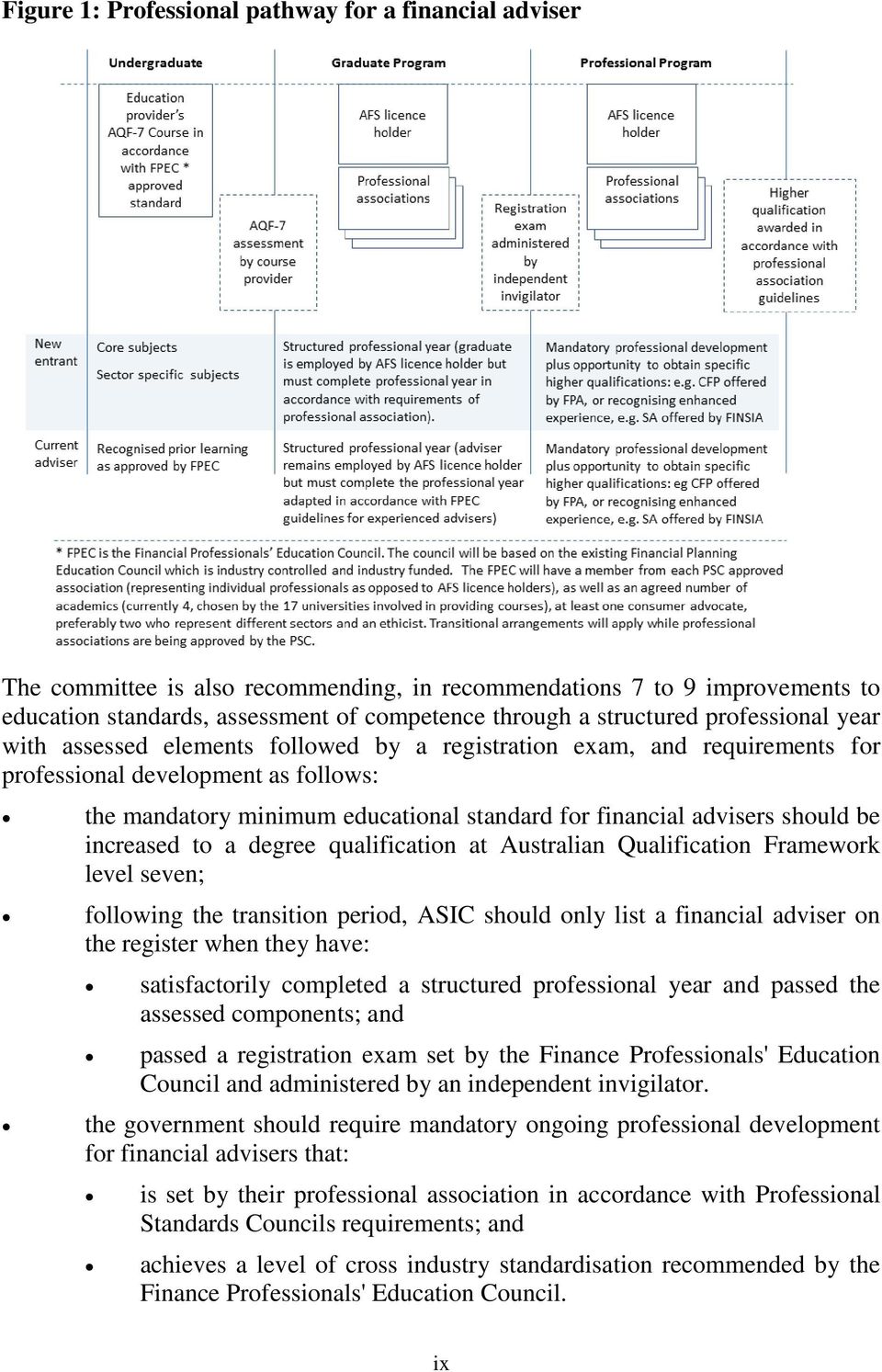
8 Improving the qualifications and competence of financial advisers In Chapter 3 of this report, the committee considers improvements to the qualifications and competence of financial advisers. The committee supports the findings of previous reviews that there should be an independent body established to set and monitor the educational framework that applies to financial advisers. The committee recommends in recommendation 10 that the professional associations establish an independent Finance Professionals' Education Council that: is controlled and funded by professional associations which have been approved by the Professional Standards Councils (PSC); comprises a representative from each professional association (which has been approved by the Professional Standards Councils), an agreed number of academics, at least one consumer advocate, preferably two who represent different sectors and an ethicist; receives advice from ASIC about local and international trends and best practices to inform ongoing curriculum review; sets curriculum requirements at the Australian Qualifications Framework level seven standard for core subjects and sector specific subjects (e.g. Self Managed Superannuation Fund services, financial advice, risk, insurance or markets); develops a standardised framework and standards for the graduate professional year to be administered by professional associations; develops and administers through an external, independent invigilator a registration exam at the end of the professional year; and establishes and maintains the professional pathway for financial advisers including recognised prior learning provisions and continuing professional development. Education is just one element of the wider system and should be considered across the whole of career of a financial adviser, with the professional pathway that spans undergraduate, graduate and professional stages as shown in Figure 1 below. Professional associations can elect to provide even higher levels of qualifications in the professional stage if they see fit. viii

9 Figure 1: Professional pathway for a financial adviser The committee is also recommending, in recommendations 7 to 9 improvements to education standards, assessment of competence through a structured professional year with assessed elements followed by a registration exam, and requirements for professional development as follows: the mandatory minimum educational standard for financial advisers should be increased to a degree qualification at Australian Qualification Framework level seven; following the transition period, ASIC should only list a financial adviser on the register when they have: satisfactorily completed a structured professional year and passed the assessed components; and passed a registration exam set by the Finance Professionals' Education Council and administered by an independent invigilator. the government should require mandatory ongoing professional development for financial advisers that: is set by their professional association in accordance with Professional Standards Councils requirements; and achieves a level of cross industry standardisation recommended by the Finance Professionals' Education Council. ix
10 Enhancing professional standards and ethics Professional standards and ethical conduct are also essential elements of the system as discussed in Chapter 4 of this report. The committee observes that requiring adherence to a code of ethics through membership of a professional association may put some cost pressure on industry bodies and industry participants. From the evidence received in this inquiry, industry participants and bodies generally acknowledge that those resulting cost and competition pressures are outweighed by the benefits of adopting codes of ethics to enhance professional and ethical standards. The committee therefore recommends in recommendation 11 that professional associations be required to established codes of ethics which are compliant with a Professional Standards Scheme under the Professional Standards Councils. In order to link professional and ethical standards to the register of financial advisers, the committee is also recommending in recommendations 12 and 13 that: professional associations that wish to have representation on the Finance Professionals' Education Council and to be able to make recommendations to ASIC regarding the registration of financial advisers should be required to establish Professional Standards Schemes under the Professional Standards Councils within three years: the committee suggests that ASIC would act to suspend or ban a financial adviser on the advice of the professional association that the individual concerned has not complied with ongoing professional development requirements or has breached the code of ethics; and any individual wishing to provide financial advice be required to be a member of a professional association that is operating under a Professional Standards Scheme approved by the Professional Standards Councils and to meet their educational, professional year and registration exam requirements. All parts of the system need to be operating effectively to provide appropriate safeguards for consumers and investors while allowing efficiency, innovation and growth within the industry. The committee is therefore proposing the approach set out in Figure 2 which brings together recommendations from this inquiry. The figure demonstrates: ASIC's role in establishing managing the register of financial advisers as already announced by the government with the changes recommended in Chapter 2; the role of education providers and the Financial Professionals' Education Council and its professional sub-sector panels as recommended in Chapter 3; the role of professional associations in delivering professional and ethical standards under the oversight of the Professional Standards Councils as recommended in Chapter 4; and the role of AFS licensees in managing licence obligations. x
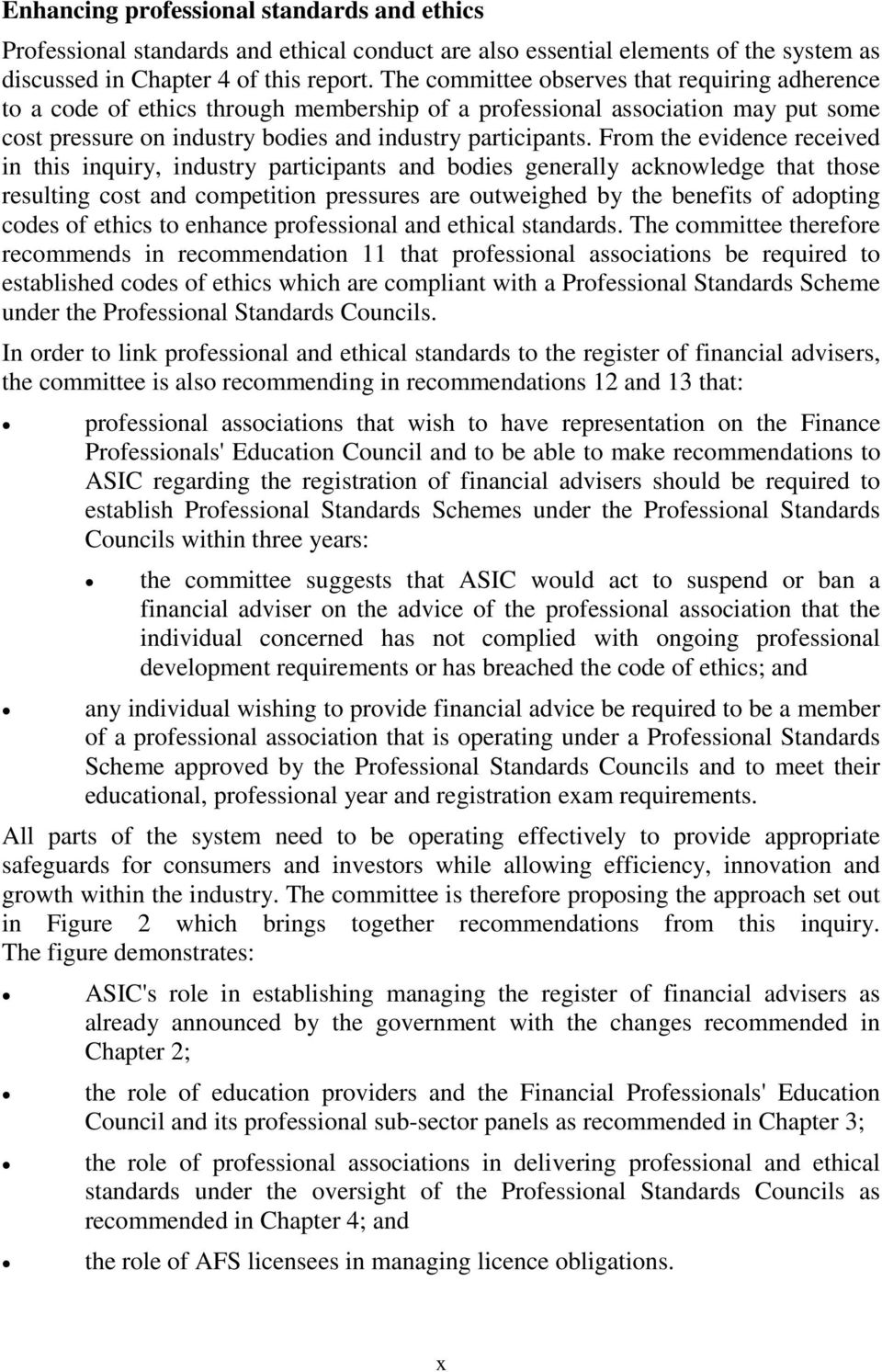
11 Figure 2: Financial advice education stakeholder relationships xi

12 Transitional arrangements The committee is firmly of the view that swift and decisive action is required in order to raise the professional, ethical and education standards of financial advisers. Bearing that in mind, the committee has proposed the transitional arrangements set out in the table below. Transitional arrangements and timeframes Provisional registration (available to existing financial advisers from the implementation of the proposed government register until 1 Jan 2019 to address the goal of transparency) Date Mar 2015 Finance Professionals Education Council (FPEC) established 1 Jul 2015 FPEC releases AQF-7 education standards for core and professional stream subjects Establishment of codes of ethics compliant with Professional Standards Scheme guidelines Jun 2016 Jul 2016 FPEC approved AQF-7 courses available to commence Jan 2017 FPEC releases recognised prior learning framework (dealing with existing advisers and undergraduates who commence AQF-7 courses prior to Feb 2017) FPEC releases professional year requirements including a recognised prior learning framework for existing advisers Professional associations operating under PSC Professional Standards Schemes Jul 2016 Jul Jan 2017 Target date for existing financial advisers to qualify for full registration 1 Jan 2018 Cut-off date for full registration provisional registration no longer available 1 Jan 2019 The committee notes that its recommended approach does not create new government or regulatory entities, but instead uses the existing functions of the Professional Standards Councils and expands the membership and function of an existing industry led and funded council that sets educational standards. The approach complements measures already announced by government, including the register of advisers and addresses the concerns identified by stakeholders during the inquiry. xii

13 Recommendations Recommendation The committee recommends that the term 'general advice' in the Corporations Act 2001 be replaced with the term 'product sales information' to better reflect the nature of that information. Recommendation The committee recommends that the term 'personal advice' in the Corporations Act 2001 be replaced with 'financial advice' to better reflect the nature of that advice. Recommendation The committee recommends that to provide 'financial advice' an individual must be registered as a financial adviser. Recommendation The committee recommends that the government should bring forward legislation to protect the titles 'financial adviser' and 'financial planner' and require that to be eligible to use the title 'financial adviser', an individual must be registered as a financial adviser. Recommendation The committee recommends that the register of financial advisers: include the information fields detailed in the government's announcement of the register on 24 October 2014; have a unique identifier that follows every individual adviser throughout their career; only list financial advisers on the register when a professional association (which has been approved by the Professional Standards Councils) advises that the adviser has completed the requirements of the Finance Professionals Education Council approved professional year and passed the registration exam; record any higher qualification awarded by a professional body to the adviser; annotate any censure or limitation placed on a financial adviser by a professional body, Australian Securities and Investments Commission or Australian Financial Service Licence holder; and xiii

14 highlight that an adviser is no longer authorised to provide financial advice if the adviser has their membership of the nominated professional body suspended or revoked. Recommendation The committee recommends that the government consider proposals to increase fees for organisational licensees to reflect the scale of their financial advice operations, in the context of a broader review of ASIC's fees and charges. Recommendation The committee recommends that: the mandatory minimum educational standard for financial advisers should be increased to a degree qualification at Australian Qualification Framework level seven; and a Finance Professionals' Education Council should set the core and sector specific requirements for Australian Qualifications Framework level seven courses. Recommendation The committee recommends that ASIC should only list a financial adviser on the register when they have: satisfactorily completed a structured professional year and passed the assessed components; and passed a registration exam set by the Finance Professionals' Education Council administered by an independent invigilator. Recommendation The committee recommends that the government require mandatory ongoing professional development for financial advisers that: is set by their professional association in accordance with Professional Standards Councils requirements; and achieves a level of cross industry standardisation recommended by the Finance Professionals' Education Council. xiv

15 Recommendation The committee recommends that the professional associations establish an independent Finance Professionals' Education Council that: is controlled and funded by professional associations which have been approved by the Professional Standards Councils; comprises a representative from each professional association (which has been approved by the Professional Standards Councils), an agreed number of academics, at least one consumer advocate, preferably two who represent different sectors and an ethicist; receives advice from ASIC about local and international trends and best practices to inform ongoing curriculum review; sets curriculum requirements at the Australian Qualifications Framework level seven standard for core subjects and sector specific subjects (e.g. Self-Managed Superannuation Fund services, financial advice, insurance/risk or markets); develops a standardised framework and standard for the graduate professional year to be administered by professional associations; develops and administers through an external, independent invigilator a registration exam at the end of the professional year; and establishes and maintains the professional pathway for financial advisers including recognised prior learning provisions and continuing professional development. Recommendation The committee recommends that professional associations representing individuals in the financial services industry be required to establish codes of ethics that are compliant with the requirements of a Professional Standards Scheme and that are approved by the Professional Standards Council. Recommendation The committee recommends that financial sector professional associations that wish to have representation on the Finance Professionals' Education Council and to be able to make recommendations to ASIC regarding the registration of financial advisers, should be required to establish Professional Standards Schemes under the Professional Standards Councils, within three years. xv
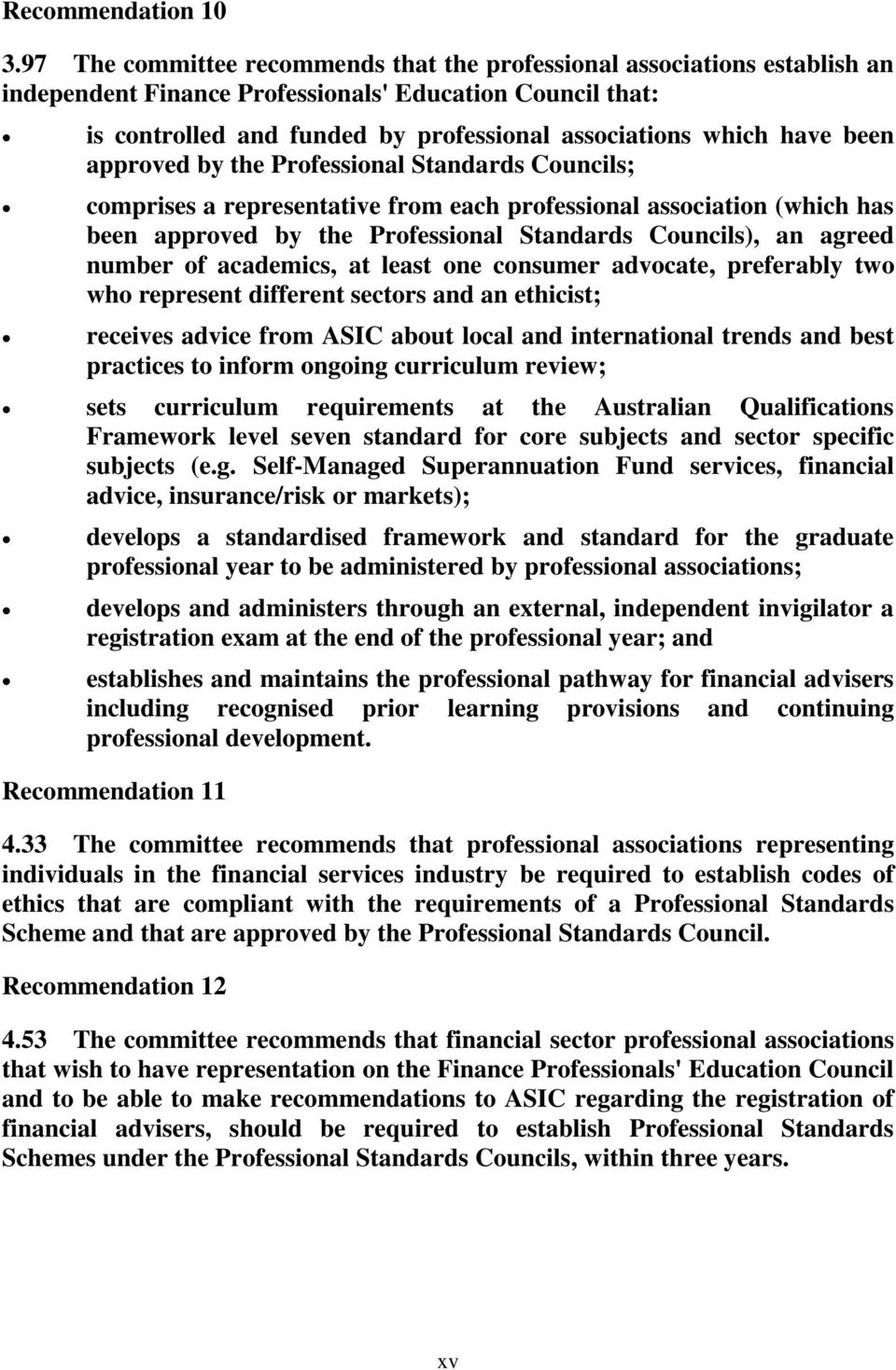
16 Recommendation The committee recommends that any individual wishing to provide financial advice be required to be a member of a professional body that is operating under a Professional Standards Scheme approved by the Professional Standards Councils and to meet their educational, professional year and registration exam requirements. Recommendation The committee recommends that government require implementation of the recommendations in accordance with the transitional schedule outlined in the table below. Transitional arrangement and timeframes Provisional registration (available to existing financial advisers from the implementation of the proposed government register until 1 Jan 2019 to address the goal of transparency) Date Mar 2015 Finance Professionals Education Council established 1 Jul 2015 FPEC releases AQF-7 education standards for core and professional stream subjects Establishment of codes of ethics compliant with Professional Standards Scheme guidelines Jun 2016 Jul 2016 FPEC approved AQF-7 Courses available to commence Jan 2017 FPEC releases recognised prior learning framework (dealing with existing advisers and undergraduates who commence AQF-7 courses prior to Feb 2017) FPEC releases professional year requirements including a recognised prior learning framework for existing advisers Professional associations operating under PSC Professional Standards Schemes Jul 2016 Jul Jan 2017 Target date for existing financial advisers to qualify for full registration 1 Jan 2018 Cut-off date for full registration - provisional registration no longer available 1 Jan 2019 xvi
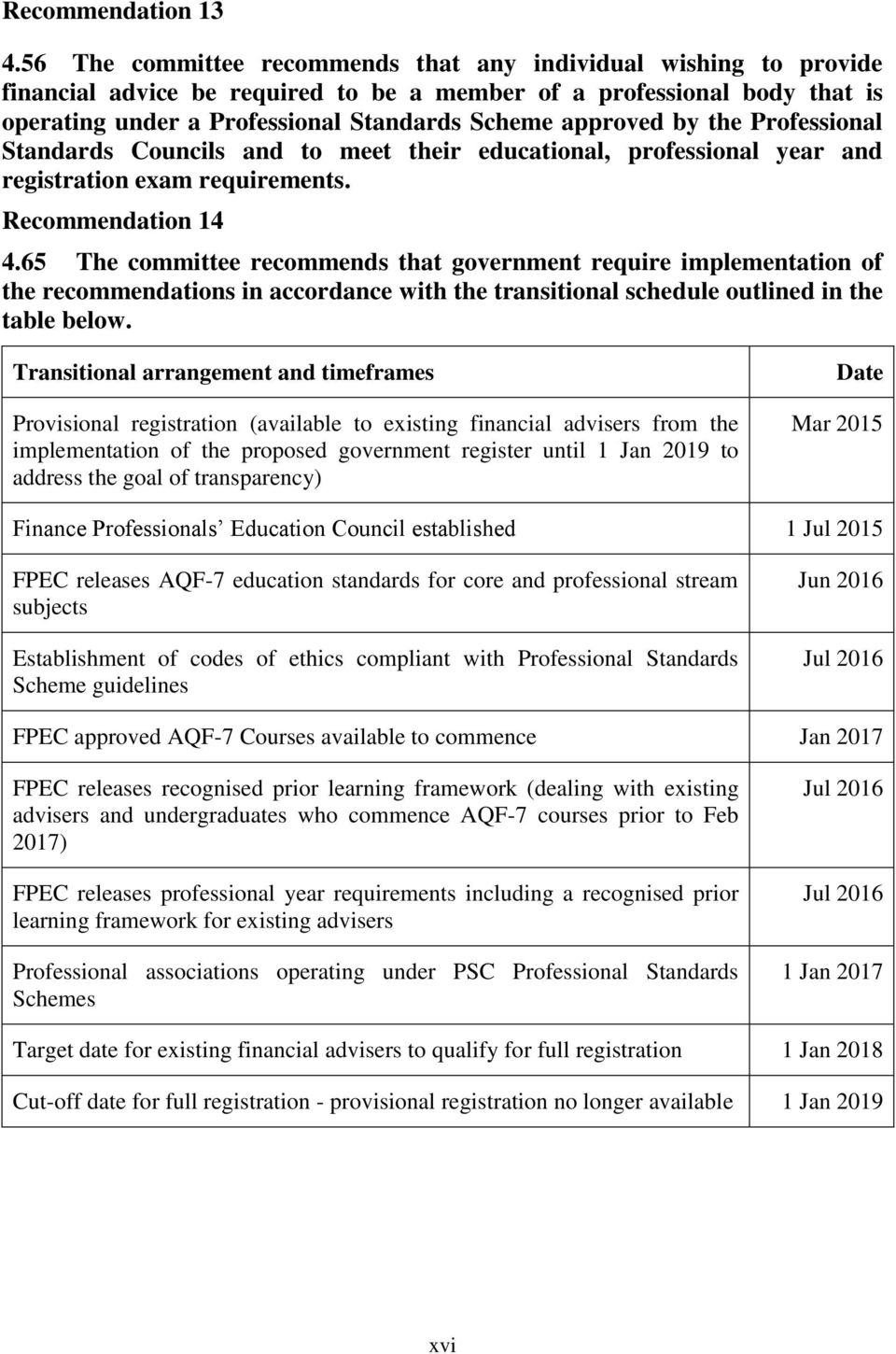
17 Abbreviations ABA ACSB Advisers Act AFA AFP AFS AIST AQF ASIC Australian Bankers Association Advice Competency Standards Board Investment Advisers Act of 1940 (US) Association of Financial Advisers Associate Financial Planner Australian Financial Services Australian Institute of Superannuation of Trustees Australian Qualifications Framework Australian Securities and Investments Commission ASIC Act Australian Securities and Investments Commission Act 2001 BT Bankers Trust Financial Group Campbell Inquiry Committee of Inquiry into the Australian Financial System, 1979 CASA CFP COBA Committee CP 153 CP 212 CPA CPD Civil Aviation Safety Authority Certified Financial Planner Customer Owned Banking Association Parliamentary Joint Committee on Corporations and Financial Services ASIC Consultation Paper 153: Licensing: Assessment and professional development framework for financial advisers ASIC Consultation Paper 212: Licensing: Training of financial product advisers Updates to RG 146 Certified Public Accountants Continuing Professional Development xvii

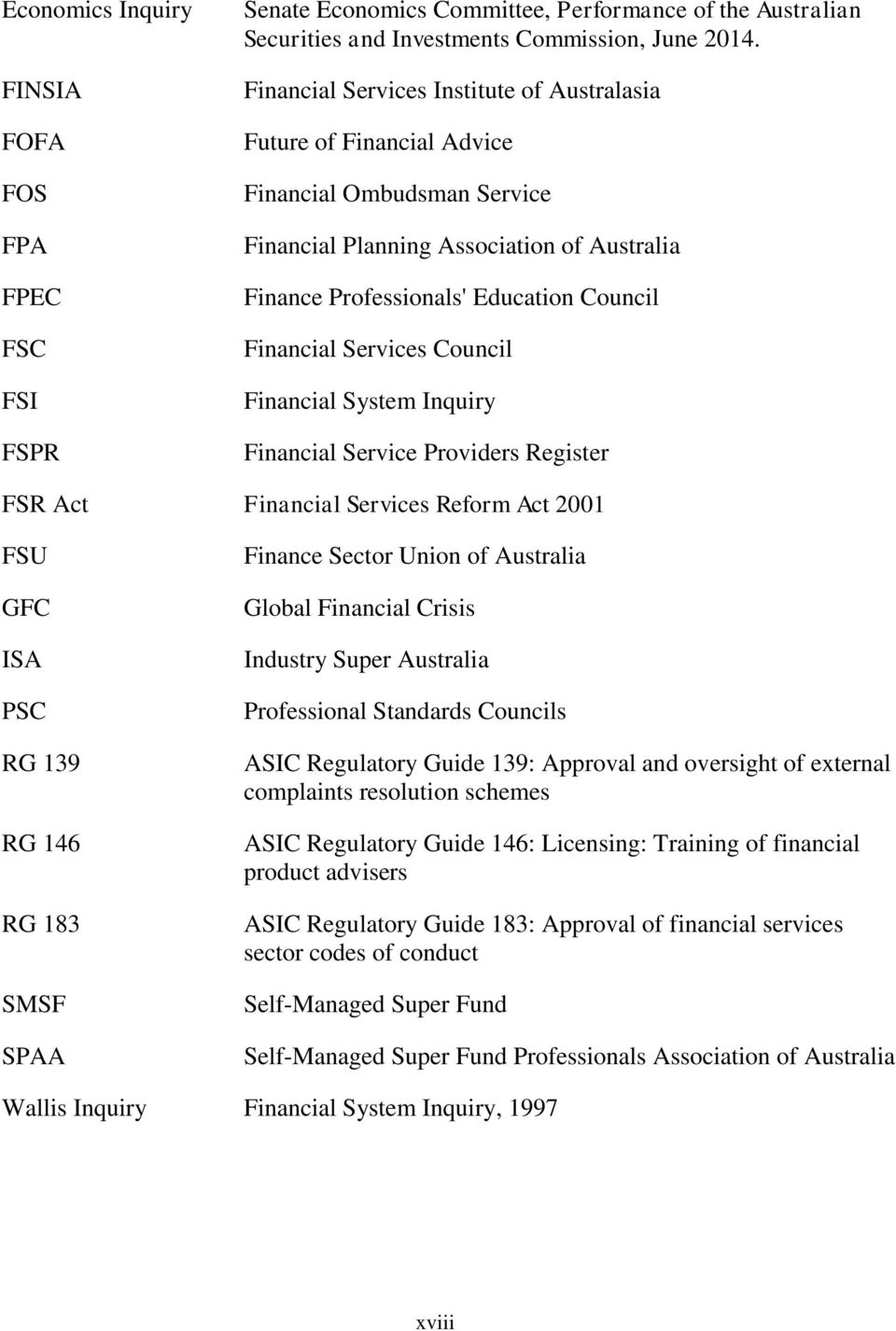
18 Economics Inquiry FINSIA FOFA FOS FPA FPEC FSC FSI FSPR Senate Economics Committee, Performance of the Australian Securities and Investments Commission, June Financial Services Institute of Australasia Future of Financial Advice Financial Ombudsman Service Financial Planning Association of Australia Finance Professionals' Education Council Financial Services Council Financial System Inquiry Financial Service Providers Register FSR Act Financial Services Reform Act 2001 FSU GFC ISA PSC RG 139 RG 146 RG 183 SMSF SPAA Finance Sector Union of Australia Global Financial Crisis Industry Super Australia Professional Standards Councils ASIC Regulatory Guide 139: Approval and oversight of external complaints resolution schemes ASIC Regulatory Guide 146: Licensing: Training of financial product advisers ASIC Regulatory Guide 183: Approval of financial services sector codes of conduct Self-Managed Super Fund Self-Managed Super Fund Professionals Association of Australia Wallis Inquiry Financial System Inquiry, 1997 xviii
19 Chapter 1 Introduction 1.1 This inquiry has been undertaken by the Parliamentary Joint Committee on Corporations and Financial Services during a period of significant change and scrutiny related to the provision of financial advice. Increasing the professional, ethical and education standards applied to financial advisers is not intended to be a silver bullet or a single solution to all of the issues that may arise in this policy area, but rather is seen by the committee as one of a range of measures intended to improve the quality of advice and outcomes for investors. Duties of the committee 1.2 The Parliamentary Joint Committee on Corporations and Financial Services (the committee) is established by Part 14 of the Australian Securities and Investments Commission Act 2001 (the ASIC Act). Section 243 of the ASIC Act sets out the committee's duties as follows: (a) to inquire into, and report to both Houses on: (i) (ii) (iii) (iv) activities of ASIC or the [Takeovers] Panel, or matters connected with such activities, to which, in the Parliamentary Committee s opinion, the Parliament s attention should be directed; or the operation of the corporations legislation (other than the excluded provisions); or the operation of any other law of the Commonwealth, or any law of a State or Territory, that appears to the Parliamentary Committee to affect significantly the operation of the corporations legislation (other than the excluded provisions); or the operation of any foreign business law, or of any other law of a foreign country, that appears to the Parliamentary Committee to affect significantly the operation of the corporations legislation (other than the excluded provisions); and (b) to examine each annual report that is prepared by a body established by this Act and of which a copy has been laid before a House, and to report to both Houses on matters that appear in, or arise out of, that annual report and to which, in the Parliamentary Committee s opinion, the Parliament s attention should be directed; and (c) to inquire into any question in connection with its duties that is referred to it by a House, and to report to that House on that question. 1 1 ASIC Act 2001, s. 243.

20 2 Referral of the inquiry and terms of reference 1.3 Following a recommendation by the Senate Economics References Committee inquiry into the performance of ASIC, the committee resolved on 14 July 2014, to inquire into proposals to lift the professional, ethical and education standards in the financial services industry with the terms of reference set out below. Pursuant to the committee's duties set out in section 243 of the Australian Securities and Investments Commission Act 2001, the committee will examine proposals to lift the professional, ethical and education standards in the financial services industry, including: 1. the adequacy of current qualifications required by financial advisers; 2. the implications, including implications for competition and the cost of regulation for industry participants of the financial advice sector being required to adopt: a. professional standards or rules of professional conduct which would govern the professional and ethical behaviour of financial advisers; and b. professional regulation of such standards or rules; and 3. the recognition of professional bodies by ASIC. Conduct of the inquiry 1.4 The committee advertised the inquiry on its webpage and invited submissions from a range of relevant stakeholders. The committee received 39 submissions which were published on the committee's website and are listed at Appendix 1. The committee held public hearings in Melbourne on 13 October 2014, in Sydney on 14 October 2014 and in Canberra on 26 November Appendix 2 lists the names and organisations of those who appeared at public hearings. Details of the inquiry and associated documents including the Hansard transcripts of evidence may be accessed through the committee webpage. 1.5 The committee thanks organisations and individuals who made submissions and gave evidence at public hearings. 1.6 References to the Committee Hansard include references to the proof Hansard. Page numbers may vary between the proof and the official Hansard. Report Structure 1.7 This report is structured as follows: the rest of Chapter 1 provides some background to the inquiry, and a discussion of other relevant inquiries; Chapter 2 discusses relevant terminology affecting the financial advice industry, including 'general advice' and who is able to use the terms 'financial adviser' and 'financial planner'; Chapter 3 discusses professionalism and co-regulation of financial advisers;

21 Background Chapter 4 discusses the first term of reference on the adequacy of qualification requirements for financial advisers; and Chapter 5 discusses the second and third terms of reference including professional standards, codes of conduct and recognition of professional bodies and codes of conduct. 1.8 The issues relating to financial advisers considered by this inquiry have been the subject of previous inquiries by parliamentary committees and the government. This section provides a summary of some of the relevant inquiries and the recommendations made by those inquiries. In addition to demonstrating that a number of the issues considered by this inquiry are long standing, the committee considers that it is useful to be aware of the way previous inquiries have shaped current regulatory arrangements. The Campbell inquiry 1.9 In 1979 the government established a Committee of Inquiry into the Australian Financial System (the Campbell Inquiry), which examined the structure and methods of operation of the Australian financial system. The inquiry, which was finalised in 1981, advocated substantial financial deregulation and was a catalyst for major economic reforms including financial deregulation in Australia In 1991 the impact of financial deregulation was reviewed by the House of Representatives Standing Committee on Finance and Public Administration (the Martin committee). The Martin committee concluded that: much of what was envisaged of deregulation has occurred Finance has become more widely available, though customers have had to pay a market price for it, including a component to reflect risk However deregulation has not delivered some of the benefits envisaged The failure of the market to deliver better information to consumers The relationship between banks and customers remains an area requiring major improvement. 3 The Wallis inquiry 1.11 The 1997 Financial System Inquiry, known as the Wallis inquiry, provided a stocktake of outcomes from financial deregulation of the Australian financial system from the early 1980s. The Wallis inquiry considered a broad range of reforms aimed at improving financial system efficiency and presented recommendations for financial regulation, including arrangements for market integrity, consumer protection, safety, stability and competition Financial System Inquiry, (accessed 7 November 2014). 3 House of Representatives Standing Committee on Finance and Public Administration, A Pocket Full of Change: Banking and Deregulation, 1991, p Financial System Inquiry, Final Report, March 1997, Overview pp 1 11,
22 The fundamental policy settings for financial services in Australia were developed following the principles set out in the Campbell and Wallis inquiries. Those principles were based on the efficient markets theory, a belief that markets drive efficiency and that regulatory intervention should be kept to a minimum to allow markets to achieve maximum efficiency. As a result, consecutive governments have established that ASIC's role is largely to 'oversee and enforce compliance' The Wallis inquiry considered the regulatory arrangements for financial advice and financial advisers. The inquiry concluded that consumers need information about fees, commissions (including trailing commissions) and the remuneration paid to their financial advisers or brokers so that they can determine whether a recommendation is skewed in favour of a particular product. Regulations at the time covered disclosure of fees and commissions by investment advisers, life agents and brokers, but not bank staff. The inquiry recommended enhancements to disclosure requirements and regular monitoring of those requirements. 6 The Wallis inquiry made a number of other significant recommendations relating to financial advisers and financial advice, as set out below In recommendation two the Wallis inquiry recommended that the body, which is now ASIC, should be responsible for a wide range of regulatory functions, including the following functions that relate to financial advice: regulating disclosure for securities and retail investment products; regulating investment and insurance sales and advice and financial market dealers and participants; regulating the conduct of dealings with consumers and the prevention of fraud; delegating accreditation and disciplinary functions to self-regulatory bodies where appropriate; and setting benchmarks for and monitoring the performance of those self-regulating bodies In recommendation 13 the Wallis inquiry recommended that a single licensing regime should be introduced for financial sales, advice and dealing, with separate categories for investment advice and product sales, general insurance brokers, financial market dealers, and financial market participants. 8 5 Parliamentary Joint Committee on Corporations and Financial Services, Inquiry into financial products and services in Australia, November 2009, p. 7; Senate Economics Reference Committee, Performance of the Australian Securities and Investments Commission, June 2014, p Recommendation 8, Financial System Inquiry, Final Report, March 1997, pp Financial System Inquiry, Final Report, March 1997, pp Financial System Inquiry, Final Report, March 1997, p. 6.
23 1.16 In recommendation 14 the Wallis inquiry recommended devolving responsibility for competency training and testing to industry bodies and giving the body that would become ASIC the option to require that licence holders commit to codes of conduct or dispute schemes that meet minimum standards In recommendation 15 the Wallis inquiry recommended that the body that would become ASIC should develop a single set of requirements for investment sales and advice including: minimum standards of competency and ethical behaviour; requirements for the disclosure of fees and adviser s capacity; rules on handling client property and money; financial resources or insurance available in cases of fraud or incompetence; and responsibilities for agents and employees In recommendation 16 the Wallis inquiry recommended that the existing regulation of real estate agents should be reviewed. It was recommended that real estate agents providing investment advice be required to hold a financial advisory licence unless the review clearly established the adequacy of existing regulation In recommendation 17 the Wallis inquiry recommended that professional advisers, such as lawyers and accountants, should not be required to hold a financial advisory licence if they provide investment advice that is only incidental to their other business and that they rebate any commissions to clients Many aspects of Wallis recommendations 2, 13, 14, 15, 16, and 17 were implemented in subsequent reforms. The Financial Services Reform Act 2001 (FSR Act) introduced a single licensing regime for financial products, a single regime for regulating financial services (investment advice), imposed requirements for disclosure of fees and introduced a national dispute resolution system. The FSR Act also required licensing of financial advisers. 13 The FSR Act allowed for authorised representatives of the licensee to give advice 14 consistent with the views put forward by the Wallis inquiry which suggested that licences should be issued to financial institutions (where the provider of sales and advice acts on behalf of an institution) or to independent advisers Financial System Inquiry, Final Report, March 1997, p Financial System Inquiry, Final Report, March 1997, p Financial System Inquiry, Final Report, March 1997, p Financial System Inquiry, Final Report, March 1997, p Kevin Davis, The Australian Financial System in the 2000s: Dodging the Bullet, in The Australian Economy in the 2000s, Reserve Bank Conference 2011, pp Financial Services Reform Act s. 911A. 15 Financial System Inquiry, Final Report, March 1997, p. 273.
24 In 2007 changes to the corporations legislation led to requirements for financial advisers to take out adequate professional indemnity insurance. In addition a single Financial Ombudsman Service (FOS) was created in 2008 out of a number of separate financial sector ombudsman schemes. 16 The FOS provides an independent dispute resolution process which covers financial services disputes, including banking, credit, loans, general insurance, life insurance, financial planning, investments, stock broking, managed funds and pooled superannuation trusts Towards the end of the 2000s, there was substantial disquiet about incentive structures within that industry and conflicts of interest. 18 Mr Kevin Davis noted that: While AFS (Australian Financial Services) license holders were required to be members of an external dispute resolution scheme the ability of individuals to afford to pursue legal action for claims above the $ cap involved in that scheme left investors exposed. Over the decade, the role of class actions and litigation funders of such actions also increased dramatically, including actions against financial advisers inquiry into financial products and services 1.23 In 2009, this committee conducted an Inquiry into financial products and services in Australia 20 to examine issues associated with collapse of financial products and services, such as those provided by Storm Financial and Opes Prime. The inquiry included a significant focus on the role and regulation of financial advisers, the role of commissions, and the adequacy of licensing arrangements. 21 In its report the committee found that the historical emergence of financial advisers as a sales force for product manufacturers was inconsistent with expectations that financial advisers provide a professional service that meets their clients' best interests Kevin Davis, The Australian Financial System in the 2000s: Dodging the Bullet, in The Australian Economy in the 2000s, Reserve Bank Conference 2011, pp Financial Ombudsman Service, What we do, (accessed 23 November 2014). 18 Kevin Davis, The Australian Financial System in the 2000s: Dodging the Bullet, in The Australian Economy in the 2000s, Reserve Bank Conference 2011, pp Kevin Davis, The Australian Financial System in the 2000s: Dodging the Bullet, in The Australian Economy in the 2000s, Reserve Bank Conference 2011, p Often referred to as the Ripoll inquiry 21 Parliamentary Joint Committee on Corporations and Financial Services, Inquiry into financial products and services in Australia, November 2009, p. vii. 22 Parliamentary Joint Committee on Corporations and Financial Services, Inquiry into financial products and services in Australia, November 2009, p. 69.
25 1.24 The following recommendations made by the inquiry are relevant to the committee's current inquiry: FOFA Recommendation 1 The committee recommends that the Corporations Act be amended to explicitly include a fiduciary duty for financial advisers operating under an AFSL, requiring them to place their clients' interests ahead of their own. Recommendation 2 The committee recommends that the government ensure ASIC is appropriately resourced to perform effective risk-based surveillance of the advice provided by licensees and their authorised representatives. ASIC should also conduct financial advice shadow shopping exercises annually. Recommendation 3 The committee recommends that the Corporations Act be amended to require advisers to disclose prominently in marketing material restrictions on the advice they are able to provide consumers and any potential conflicts of interest. Recommendation 4 The committee recommends that government consult with and support industry in developing the most appropriate mechanism by which to cease payments from financial product manufacturers to financial advisers. Recommendation 6 The committee recommends that section 920A of the Corporations Act be amended to provide extended powers for ASIC to ban individuals from the financial services industry. Recommendation 7 The committee recommends that, as part of their licence conditions, ASIC require agribusiness MIS licensees to demonstrate they have sufficient working capital to meet current obligations In April 2010 the government responded to the committee's report with a package of reforms called Future of Financial Advice (FOFA). The FOFA reforms were designed to tackle conflicts of interest that threatened the quality of financial advice provided to Australian investors, and the inappropriate selling of financial products that culminated in high profile corporate collapses such as Storm Financial, Opes Prime, and Westpoint Parliamentary Joint Committee on Corporations and Financial Services, Inquiry into financial products and services in Australia, November 2009, pp The Hon Chris Bowen MP, Minister for Financial Services, Superannuation and Corporate Law, Media Release No.036, Overhaul of Financial Advice, 26 April 2010.
26 In June 2012, FOFA reforms (which were voluntary from 1 July 2012 and mandatory from 1 July 2013)were passed by the Parliament that included: A prospective ban on conflicted remuneration structures including commissions and volume based payments, in relation to the distribution of and advice about a range of retail investment products. A duty for financial advisers to act in the best interests of their clients, subject to a 'reasonable steps' qualification, and place the best interests of their clients ahead of their own when providing personal advice to retail clients. There is a safe harbour which advice providers can rely on to show they have met the best interests duty. An opt-in obligation that requires advice providers to renew their clients' agreement to ongoing fees every two years. An annual fee disclosure statement requirement. Enhanced powers for ASIC Following a change in government, on 1 July 2014, new regulations commenced, which reduce compliance costs and regulatory burden on the financial services sector arising from the earlier FOFA reforms. The regulations changed fee disclosure, the best interests duty, grandfathering provisions and the 'opt-in' requirements for continuing adviser services. The new regulations also allowed for the provision of scaled advice and exempted general advice 26 from conflicted remuneration provisions The government's amendments were implemented through the Corporations Amendment (Streamlining Future of Financial Advice) Regulation The regulation commenced on 1 July The Government introduced the Corporations Amendment (Streamlining of Future of Financial Advice) Bill 2014, to bring some of the above amendments into legislation. The Bill including parliamentary amendments made by the government, was passed by the House of Representatives on 28 August The Bill is currently before the Senate. The government indicated that the interim regulations (those replicated in the Bill) will be repealed once the Bill passes the Parliament On 19 November 2014 the Senate disallowed the Corporations Amendment (Streamlining Future of Financial Advice) Regulation Following negotiations 25 ASIC, FOFA Background and Implementation, (accessed 18 December 2014). 26 General advice is defined and discussed at the beginning of Chapter Senator the Hon Arthur Sinodinos, Assistant Treasurer, Media Release, Delivering affordable and accessible financial advice, 20 December Treasury, Future of Financial Advice, (accessed 18 December 2014).
27 between the government and the opposition, on 27 November 2014 the Senate passed the following motion which re-instated five aspects of the regulations: That, for the purposes of paragraph 48(1)(a) of the Legislative Instruments Act 2003, the Senate: (a) (b) supports the making of regulations re-instating provisions the same in substance as the following provisions of Corporations Amendment (Streamlining Future of Financial Advice) Regulation 2014, as contained in Select Legislative Instrument 2014 No. 102: Schedule 1 Items 5 (Accountants certificate renewal period); 11 (Stamping fee provision); 12 to 17 (ASX24-related provisions); 27 (non-monetary education or training benefit not conflicted remuneration); and 28, 29 and 31 to 35 (Grandfathering arrangements); and rescinds its disallowance resolution of 19 November 2014 relating to the above regulation, to the extent necessary to permit the re-making of the aforementioned provisions in the regulations The government also made other changes to FOFA in the additional Corporations Amendment (Statements of Advice) Regulation 2014, which will commence on 1 January The changes include additional disclosure requirements in the Statement of Advice, requiring a financial adviser to disclose existing obligations. The amendments also provide requirements for the financial adviser and the client to sign the Statement of Advice. 30 The Trio inquiry 1.31 In May 2012, this committee concluded its Inquiry into the collapse of Trio Capital. The collapse of Trio Capital involved the largest superannuation fraud in Australian history. Roughly $176 million in Australians' superannuation funds were lost or missing from two fraudulently managed investment schemes. The committee considered that the Trio collapse raised distinct, and in some ways more troubling issues than those raised by the collapse of Storm Financial and Westpoint. Trio involved a fraud and therefore went beyond Australian investors being persuaded to put their money into inappropriate investment vehicles. The committee noted that: Some of the financial advice given to Trio clients may have been in contravention of the 'best interests' test and conflicted remuneration provisions of the FOFA legislation. However, these provisions would not protect against a circumstance where an adviser 'turns bad' and sets out to either defraud clients or at the very least to concentrate on enriching [them]self while wilfully disregarding the evidence that the investment scheme was fraudulent The Senate, Journals of the Senate, 27 November 2014, p Explanatory Statement, Corporations Amendment (Statements of Advice) Regulation 2014, 22 September Parliamentary Joint Committee on Corporations and Financial Services, Inquiry into the collapse of Trio Capital, May 2012, pp xvii, xxii.
28 In its report on the Trio inquiry, the committee made 14 recommendations aimed at protecting Australian's superannuation savings through better compensation schemes, enforcement, education of investors, investigations by ASIC, oversight of license holders, and disclosure by responsible entities. 32 The Economics committee inquiry 1.33 In June 2014 the Senate Economics References Committee tabled a report on its inquiry into the performance of ASIC (Economics committee inquiry). The inquiry ran over many months, received 474 submissions and examined many areas of ASIC's performance, including regulation of financial advisers. 33 The inquiry identified significant areas for ASIC's improvement, while also recognising the good work that ASIC has done in a challenging environment. 34 The report made 61 recommendations, including the following recommendation to the committee: Recommendation 54 The committee recommends that the Parliamentary Joint Committee on Corporations and Financial Services inquire into the various proposals which call for a lifting of professional, ethical and educational standards in the financial services industry On 14 July 2014, the committee accepted recommendation 54 and established an inquiry into proposals to lift the professional, ethical and education standards in the financial services industry The committee notes that the Economics committee made a number of other recommendations in relation to financial advisers which are not within the terms of reference for this inquiry. Some of these do however intersect with recommendations of this report: Recommendation 42 The committee recommends that financial advisers and planners be required to: successfully pass a national examination developed and conducted by relevant industry associations before being able to give personal advice on Tier 1 products; hold minimum education standards of a relevant university degree, and three years' experience over a five year period; and meet minimum continuing professional development requirements. 32 Parliamentary Joint Committee on Corporations and Financial Services, Inquiry into the collapse of Trio Capital, May 2012, pp xxvii xxix. 33 Senate Economics Committee, Performance of the Australian Securities and Investments Commission, June 2014, pp xvii xxii, Senate Economics Reference Committee, Media Release, 26 June Senate Economics Committee, Performance of the Australian Securities and Investments Commission, June 2014, p. xxxiii.
29 Recommendation 43 The committee recommends that a requirement for mandatory reference checking procedures in the financial advice/planning industry be introduced. Recommendation 44 The committee recommends that a register of employee representatives providing personal advice on Tier 1 products be established. Recommendation 45 The committee recommends that the Corporations Act 2001 be amended to require: that a person must not use the terms 'financial adviser', 'financial planner' or terms of like import, in relation to a financial services business or a financial service, unless the person is able under the licence regime to provide personal financial advice on designated financial products; and financial advisers and financial planners to adhere to professional obligations by requiring financial advisers and financial planners to be members of a regulator-prescribed professional association. Recommendation 47 The committee recommends that the government consider the banning provisions in the licence regimes with a view to ensuring that a banned person cannot be a director, manager or hold a position of influence in a company providing a financial service or credit business. Recommendation 48 The committee recommends that the government consider legislative amendments that would give ASIC the power to immediately suspend a financial adviser or planner when ASIC suspects that the adviser or planner has engaged in egregious misconduct causing widespread harm to clients, subject to the principles of natural justice. Recommendation 60 The committee recommends that the government consider measures that would ensure investors are informed of their assessment as a retail or wholesale investor and the consumer protections that accompany the classification. This would require financial advisers to ensure that such information is displayed prominently, initialled by the client and retained on file On 24 October 2014, the government responded to the Economics committee inquiry into the performance of ASIC. This response identified areas in which ASIC had already taken action to implement some of the recommendations, including an Senate Economics Committee, Performance of the Australian Securities and Investments Commission, June 2014, pp xxi xxxiv.
30 12 industry working group on standards, a register of financial advisers, use of the terms financial adviser and financial planner. The response also indicated that the recommendations relating to recommendations 47, 48 and 60 would be considered as part of its response to the Financial System Inquiry. 37 Progress on the register of financial advisers has been announced by the government and is discussed further in Chapter 2. A recent media article reported that the working group had failed to reach a consensus about how to move forward in the area of advisor education. 38 Committee view 1.37 The Economics committee inquiry considered a large volume of evidence on the hardship suffered by many people as a result of corporate collapses and problems in the financial advice industry. The Economics committee inquiry also undertook a detailed case study of the problems that occurred at Commonwealth Financial Planning Limited The committee recognises the significant hardship suffered by many individual investors that have been brought to light during the Economics committee inquiry. However, in order to focus on specific proposals to lift standards for financial advisers, the committee has chosen not to seek further evidence on consumer specific cases as part of this inquiry. The Financial System Inquiry 1.39 The Financial System Inquiry (FSI), announced by the Treasurer in December 2013 examined how the financial system could be positioned to best meet Australia's evolving needs and support Australia's economic growth. The FSI was required to submit a final report to the Treasurer in November The committee received private briefings on the FSI from an industry expert and the secretariat of the FSI. The committee considered the interim report of the Financial System Inquiry which noted that: Studies suggest there are significant issues with the quality of financial advice, due in part to varying standards of adviser competence and the impact of conflicted remuneration structures. Some submissions suggest aligned or vertically integrated structures may also reduce the quality of advice consumers receive. At times, consumers also lack access to affordable advice. In addition, some submissions question whether general advice is properly labelled and 37 Senator the Hon Mathias Cormann, Minister for Finance, Acting Assistant Treasurer, Government response to the Senate inquiry into the performance of ASIC, media release, 24 October 2014, pp xxv, xxviii, xxxi, Adele Fergusson, The Age, Planner education a new test for Cormann, 21 November Financial System Inquiry, (accessed 22 October 2014).
31 whether consumers understand its nature, given general advice often includes sales and advertising information The FSI interim report also noted evidence from the ASIC shadow shopping study on the quality of retirement advice, including that while 58 per cent of advice examples were adequate, 39 per cent of advice examples were poor in quality, and only 3 per cent of advice examples were good quality The FSI interim report sought views on the costs, benefits and trade-offs of the following policy options: No change to current arrangements. Raise minimum education and competency standards for personal advice (including particular standards for more complex products or structures such as Self-managed Superannuation Funds), and introduce a national examination for financial advisers providing personal advice. Introduce an enhanced public register of financial advisers (including employee advisers) which includes a record of each adviser s credentials and current status in the industry, managed either by Government or industry. Enhance the Australian Securities and Investments Commission s power to include banning individuals from managing a financial services business. Rename general advice as sales or product information and mandate that the term advice can only be used in relation to personal advice The Financial System Inquiry reported to government in November 2014 and the final report was publicly released on 7 December The report made 44 recommendations The final FSI Report identified two general themes designed to improve the financial system: 1. Funding the Australian economy; and 2. Competition It also reported under five more specific themes 1. Resilience; 2. Superannuation and Retirement Incomes; 3. Innovation; 4. Consumer Outcomes; and 5. Regulatory System Financial System Inquiry, Interim Report, July 2014, p. xxxii. 41 Financial System Inquiry, Interim Report, July 2014, p Financial System Inquiry, Interim Report, July 2014, p. xxxii. 43 Financial System Inquiry, Final Report, November 2014, p. 13.
32 The theme of 'consumer outcomes', discussed in Chapter 4 of the final FSI Report, focuses on the fair treatment of consumers. Relevantly, the report noted that issues related to the competence of financial advisers are unresolved: To build confidence and trust, and avoid over-regulation, the financial system should be characterised by fair treatment. In terms of fair treatment for consumers, the current framework is not sufficient. The GFC brought to light significant numbers of Australian consumers holding financial products that did not suit their needs and circumstances in some cases resulting in severe financial loss. The most significant problems related to shortcomings in disclosure and financial advice, and over-reliance on financial literacy. The changes introduced under the Future of Financial Advice (FOFA) reforms are likely to address some of these shortcomings; however, many products are directly distributed, and issues of adviser competency remain. 45 Relevant FSI recommendations 1.47 As noted above at paragraph 1.41, the Interim Report of the FSI considered a range of options to improve financial advice provided to consumers. The committee notes that the final FSI report has made a number of recommendations in relation to these issues The final FSI Report recommends, at Recommendation 25, 46 raising the competency of financial advice providers and the introduction of an enhanced register of advisers. It also recommends at Recommendation 22, 47 a proactive power for ASIC to intervene in relation to financial products, their marketing and disclosure materials, consumer warnings and distribution, and the power to ban products The final FSI report does not recommend a national exam for advisers although notes that ' this could be considered if issues in adviser competency persist.' Removing regulatory impediments to innovative product disclosure and communication with consumers is recommended at Recommendation 23 as a way of reducing the risk that consumers buy products unsuitable to their needs and to allow for more effective communication with consumers Recommendation 24 recommended better alignment of the interests of financial firms with those of consumers by raising industry standards, enhancing the 44 Financial System Inquiry, Final Report, November 2014, p Financial System Inquiry, Final Report, November 2014, p Financial System Inquiry, Final Report, November 2014, p Financial System Inquiry, Final Report, November 2014, p Financial System Inquiry, Final Report, November 2014, p Financial System Inquiry, Final Report, November 2014, p. 213.
33 power to ban individuals from management and ensuring remuneration structures in life insurance and stockbroking do not affect the quality of financial advice The FSI final report made a number of recommendations to address what it termed 'significant matters', including Recommendation 40: renaming 'general advice' and requiring advisers and mortgage brokers to disclose ownership structures. 51 The committee will consider these recommendations in more detail throughout this report. Lifting adviser qualifications as part of a system to improve advice 1.53 While the committee notes the important role that individual advisers can play in ensuring that consumers and investors receive good quality advice that is relevant to their individual circumstances, the committee recognises that lifting the qualifications of advisers and the standards they are required to meet is only one part of a more complex system. All parts of the system need to be operating effectively to provide appropriate safeguards for consumers and investors while allowing efficiency, innovation and growth within the industry The committee considers that Professor James Reason's model of accident causation in the aviation industry provides a useful frame of reference for understanding the role of individuals and organisations within a greater system; in this case the financial services industry. Reason argues that in order to provide appropriate risk management within a system, appropriate defences need to be created. Rarely can a system be appropriately protected by individual safeguards alone; there also needs to be appropriate organisational or system-wide defences to reduce risk. Many layers of defence provide protection against single failures but for an entire system to be adversely effected, it requires 'the unlikely combination of several different factors to penetrate the many protective layers...' Using this analogy, lifting the qualifications of financial advisers and the standards of advice provided to consumers and investors becomes just one important defence mechanism to help reduce the risk of failure in the broader system. Other defences must also be in place, such as the Register of Advisers, ASIC having banning powers over management as well as advisers, an enforceable code of professional ethics and professional conduct which detail ethical dispositions and behaviours that prioritise the best interests of clients. While outside of its current terms of reference, the committee notes that product design and the design of remuneration structures in both vertically integrated and independent settings has the potential to adversely affect the cultural realities of the respective workplace within the financial services industry Financial System Inquiry, Final Report, November 2014, p Financial System Inquiry, Final Report, November 2014, p Professor James Reason, 'Achieving a safe culture: theory and practice', Work and Stress, vol. 12, No. 3, , 1998, p. 295.
34
35 Chapter 2 Financial product advice and financial advisers 2.1 This chapter discusses the committee's consideration of: 'general advice' and 'personal advice' as currently defined in the Corporations Act 2001; the protection of titles such as 'financial adviser' and 'financial planner'; the register of financial advisers; and licensing of financial advisers. General advice 2.2 In this section, the committee discusses suggestions to change the definitions of 'general advice' and 'personal advice' which are categories of 'financial product advice' defined in the Corporations Act The section also covers current definitions, proposed changes and views from the banks and financial service providers. 2.3 ASIC's Moneysmart website describes 'general advice' and 'personal advice' in the following way: The type of financial advice you need depends on your life stage, the amount of money you have to invest and the complexity of your affairs You can get general advice about financial products or investing General advice does not take into account your particular circumstances, such as your objectives, financial situation and needs. For example, you may receive general advice when you attend a seminar about investing. If you want a recommendation that takes your personal situation into account, you need personal advice For this kind of advice, it's important that you only talk to someone who is a licensed adviser The cost of the advice will depend on the scope and kind of advice you receive. 2 Current definitions 2.4 'General advice' and 'personal advice' are types of financial product advice. Financial product advice is defined in the Corporations Act 2001 as: A recommendation or a statement of opinion, or a report of either of those things, that: 1 Corporations Act 2001, s. 766B. 2 ASIC's Moneysmart website, Types of financial advice, (accessed 23 November 2014).
36 18 (a) is intended to influence a person or persons in making a decision in relation to a particular financial product or class of financial products, or an interest in a particular financial product or class of financial products; or (b) could reasonably be regarded as being intended to have such an influence The Corporations Act 2001 defines 'personal advice' in section 766B(3) as financial product advice given or directed to a person (including by electronic means) in circumstances where: the person giving the advice has considered one or more of the client s objectives, financial situation and needs; or a reasonable person might expect the person giving the advice to have considered one or more of these matters 'General advice' is defined in section 766B(4) as financial product advice that is not 'personal advice'. 5 The sales-advice conflict 2.7 The committee's 2009 inquiry into financial products and services in Australia highlighted the sales-advice conflict arising from significant structural tensions that are central to the debate about conflicts of interest and their effect on the advice consumers receive. The committee noted that: On one hand, clients seek out financial advisers to obtain professional guidance on the investment decisions that will serve their interests, particularly with a view to maximising retirement income. On the other hand, financial advisers act as a critical distribution channel for financial product manufacturers, often through vertically integrated business models or the payment of commissions and other remuneration-based incentives The Financial Services Council (FSC) represents Australia's retail and wholesale funds management businesses, superannuation funds, life insurers, financial advisory networks, trustee companies and public trustees. The FSC submitted to the committee that it: supports a holistic framework which includes a revised advice framework, removing the ambiguity between personal advice and general advice (proposing the relabelling of general advice to general information ) and linking competency to the different advice segments. 7 3 Corporations Act 2001, s. 766B(1). 4 ASIC, Submission 25, p ASIC, Submission 25, p Parliamentary Joint Committee on Corporations and Financial Services, Inquiry into financial products and services in Australia, November 2009, pp Financial Services Council, Submission 26, p. 3.
37 2.9 Some submitters and witnesses to the current inquiry informed the committee that problems with the sales-advice conflict are still in existence and need addressing. The Financial Planning Association of Australia (FPA) informed the committee that some consumers mistake the use of the word advice to be a standard definition when in fact there is a significant legal and technical difference between general and personal advice. The FPA also suggested that the definition of 'financial product advice' makes it difficult for consumers to distinguish financial advice from marketing material or product sales ASIC's Report 384 Regulating Complex Products, identified similar issues to those described above: Our research has indicated that marketing information plays a particularly strong role in product distribution and may influence investors decision making more than other product disclosure. In particular, when investors approach product issuers or other intermediaries responsible for selling products directly, rather than going through advisers, the information contained or implied in product issuers marketing information is often the first, and may be the only, information that investors use to decide whether or not to invest in that product The FSI interim report also reported on issues related to definitions of 'advice', noting that: At times, consumers also lack access to affordable advice. In addition, some submissions question whether general advice is properly labelled and whether consumers understand its nature, given general advice often includes sales and advertising information In its final report, FSI confirmed that consumers may misinterpret or excessively rely on guidance, advertising, and promotional and sales material when it is described as general advice. Additionally the use of the word advice may lead consumers to believe the information is tailored to their needs. Often consumers do not understand their financial adviser s or mortgage broker s association with product issuers. This association might limit the product range an adviser or broker can recommend from. Of recently surveyed consumers, 55 per cent of those receiving financial advice from an entity owned by a large financial institution (but operating under a different brand name) thought the entity was independent Financial Planning Association of Australia, Submission 6, p ASIC, Report 384 Regulating Complex Products, January 2014, p Financial System inquiry, Interim Report, July 2014, p. xxxii. 11 Financial System Inquiry, Final Report, November 2014, p. 271.
38 20 Proposals for change 2.13 The Financial Systems Inquiry sought views on renaming 'general advice' as sales or product information and restricting use of the term advice so that it only be used in relation to 'personal advice'. In its final report the FSI recommended that general advice be renamed and that advisers and mortgage brokers be required to disclose ownership structures The Customer Owned Banking Association told the committee that in their view, the boundary between 'personal advice' and 'general advice' is clear legally but very context specific, and that distinguishing between them can be problematic in practice The Insurance Council of Australia supported a comprehensive review of the terminology, with the goal of separating out the disparate elements currently covered by the definition of 'general advice' The Self-Managed Super Fund (SMSF) Professionals' Association of Australia (SPAA) informed the committee that they had been advocating the removal of 'general advice' for some time and noted that: We believe, if you are a personal adviser, you are personally accountable and you should be able to provide professional advice. But we do not believe you should be able to be a provider of information sales product and be able to call yourself an adviser if that is all that you do; you must be a professional adviser in the first instance The committee heard that alternative terms for 'general advice' could include: 'general information' which could include product information; 16 'general or product information' which could be limited to the provision of factual information and/or explanations relating to financial products; 17 and 'general financial information' which would include factual information about a product or a service The Financial Planning Association of Australia (FPA) recommended that 'personal advice' be renamed 'financial advice' and suggested the following meaning for 'financial advice': 12 Financial System Inquiry, Final Report, November 2014, p Mr Luke Lawler, Acting Head of Public Affairs, Customer Owned Banking Association, Committee Hansard, 14 October 2014, p Insurance Council of Australia, Submission 18, p SMSF Professionals Association of Australia, Committee Hansard, 13 October 2014, p Financial Services Council, Submission 26, p Financial Planning Association of Australia, Submission 6, p BT Financial Group, Submission 23, p. 5.
39 Any recommendation made personally to a consumer on which that consumer could reasonably be expected to act in relation to an investment or financial decision, including but not limited to, any recommendations relating to shares, debentures, collective investments, futures or options contracts, life insurance, superannuation, property or other financial instruments, transactions or investments. 19 Views of banks and financial service providers 2.19 The FSC submitted to the committee that it supports removing the ambiguity between personal advice and general advice (proposing the relabelling of general advice to general information ) and linking competency to the different advice segments. The FSC also suggested a third category called 'factual information', which would be distinct from personal advice and general information The Australian Bankers Association (ABA) acknowledged that 'general advice' is not widely understood to be financial advice by many customers. The ABA submitted that 'there is merit in giving further consideration to different and more appropriate terminology and labels which more closely reflects the true nature of information that is legally termed "general advice".' 21 The ABA suggested that consumer testing and research be undertaken as part of the process to develop alternative terminology. 22 The committee notes that while the final report of the FSI recommended that 'general advice' be renamed, it did not suggest a specific term to replace it. Instead it recommended a non-specific 'consumer-tested term', suggesting that: Consumer testing will generate some costs for Government, and relabelling will generate transitional costs for industry although these are expected to be small. The Inquiry believes the benefits to consumers from clearer distinction and the reduced need for warnings outweigh these costs The Customer Owned Banking Association supported more clarity for customers, but raised some concerns about the proposed changes. Financial product advice is a recommendation, or something that the consumer perceives to be a recommendation, about a financial product. So the very legal definition of financial product advice is selling something. You could change that. We do not oppose the idea of making things a little clearer. But just how you do that and stick with the current architecture for the way the whole thing is put together is problematic Financial Planning Association of Australia, Submission 6, p Financial Services Council, Submission 26, pp 4, Australian Bankers Association, Submission 27, p Australian Bankers Association, Submission 27, p Financial System Inquiry, Final Report, November 2014, p Mr Luke Lawler, Acting Head of Public Affairs, Customer Owned Banking Association, Committee Hansard, 14 October 2014, pp
40 22 Committee view 2.22 The majority of the evidence received by the committee supports a change to the term 'general advice' to ensure that it more closely describes the nature of the information communicated which as the FSI report highlights, often contains sales and advertising information. The committee notes that industry associations including the FPA, FSC, ABA and SPAA have acknowledged the need for change. Increased consumer awareness of the fact that they are being sold a product may act as a defence against unwittingly accepting marketing as advice, thereby playing a valuable role in the system of defences The committee therefore recommends that there should be a change to the term 'general advice' to make the nature of the information communicated clearer to consumers and investors. The committee considers that the term 'product sales information' would more closely reflect the nature of the advice that is currently given under the term 'general advice'. Recommendation The committee recommends that the term 'general advice' in the Corporations Act 2001 be replaced with the term 'product sales information' to better reflect the nature of that information The committee also notes the suggestion by the FPA that 'personal advice' be renamed as 'financial advice' with the following meaning: Any recommendation made personally to a consumer on which that consumer could reasonably be expected to act in relation to an investment or financial decision, including but not limited to, any recommendations relating to shares, debentures, collective investments, futures or options contracts, life insurance, superannuation, property or other financial instruments, transactions or investments The committee has not received a significant body of evidence on the proposal to change 'personal advice' to 'financial advice'. However, the committee considers that the proposal is likely to provide a clearer system for consumers and therefore is worthy of further consideration by the government. Recommendation The committee recommends that the term 'personal advice' in the Corporations Act 2001 be replaced with 'financial advice' to better reflect the nature of that advice. Recommendation The committee recommends that to provide 'financial advice' an individual must be registered as a financial adviser. 25 Financial Planning Association of Australia, Submission 6, p. 53.
41 Financial advisers, financial planners and a register of financial advisers 2.29 This section discusses proposals to restrict the use of the terms 'financial adviser' and 'financial planner' as a way of signalling competence to consumers. Alternative defences are also discussed, including establishing a register of financial advisers. Proposal to protect the titles 'financial adviser' and 'financial planner' 2.30 Bankers Trust Financial Group (BT) advocate that the terms 'financial advice' and 'financial adviser' should be clearly linked to the provision of 'personal advice'. 26 BT supports limiting the use of the term 'financial adviser' to those who provide 'personal advice' and who meet the relevant training and competency standards to provide 'personal advice'. BT suggested that: Individuals who either do not provide Personal Advice, or who do not meet the relevant professional standards, would be unable to hold themselves out as Financial Advisers. This would strengthen the distinction drawn above by clearly labelling the title of the individual providing the information or advice, and ensuring only a qualified and authorised individual is able to hold themselves out as being a financial adviser The FPA submitted that it is common for individuals to interpret 'general advice' as 'personal advice' because it is relevant to their circumstances at the time it is provided. The FPA suggested that to ensure consumers can easily distinguish between the various roles and services in the financial services sector, providers of general or product information should be prevented from using the titles 'financial planner' or 'financial adviser' The Australian Bankers Association also supported consideration of the legal meaning of the terms 'financial planner' and 'financial adviser' and more clearly linking the term financial adviser with the provision of 'personal advice' Mr Paul Moran drew the committee's attention to the difference between stewards who act on behalf of their clients and agents who may serve a third party: There needs to be a recognition of the differences between those financial planners who act as stewards on behalf of their clients, and those financial advisers who act as conflicted agents serving both their client and a third party financial product provider and the public should know how to recognise these different players Mr Robert Brown submitted that statutory separation of product sales from 'personal advice' is flawed unless it ensures that legislatively endorsed financial BT Financial Group, Submission 23, p BT Financial Group, Submission 23, p Financial Planning Association of Australia, Submission 6, pp Australian Bankers Association, Submission 27, p Mr Paul Moran, Submission 1, p. 1.
42 24 planners/advisers cannot receive any form of ethically conflicted remuneration including commissions, asset fees and any other forms of product bonuses and incentives The Professional Standards Councils (PSC) undertook a survey on the current role of professionalism in the financial services industry and found that there was no common understanding of the terms 'financial adviser' and financial planner': certain interviewees differentiated between types of financial advisers those who had completed specific training requirements, and those who had not. Some respondents believed that financial advisers are professionals, but financial planners are not, whilst others saw the reverse. Still others believed both financial planners and financial advisers are professionals. Whilst a significant proportion of interviewees believed that neither financial planners or financial advisers constitute a profession The PSC informed the committee that as part of the regulation of professions, legislative protection of a title or term is often sought by those qualified to assist consumers in distinguishing between professionals and non-professionals. 33 The PSC also noted that there was an active campaign by some associations to encourage government to legislate for protection of title (financial planner and/or financial adviser), but that in their view, there is no agreement amongst the industry as to whether it is appropriate or warranted. 34 Alternatives to the protection of title 2.37 While the above discussion has focussed on protection of title for 'financial adviser' and 'financial planner', the PSC also drew the committee's attention to an alternative approach called 'protection of function'. The PSC argued that: In the spectrum of regulation governments typically prefer the protection of function approach because it does not confer titled benefit but does influence the individuals (through education and standards) that can be authorised to perform a function or service. It might be argued that [the] Corporations Act takes this approach with regard to financial advice by stipulating the education and oversighting requirements for the function of financial advice to be performed. It might also then be argued that the current concerns of the government and public indicate that this approach may have failed Mr Robert Brown, Submission 21, p Professional Standards Councils, Submission 35, Attachment 1, White Paper Professionalisation of Financial Services, p Professional Standards Councils, Submission 35, Attachment 1, White Paper Professionalisation of Financial Services, p Professional Standards Councils, Submission 35, Attachment 1, White Paper Professionalisation of Financial Services, p Professional Standards Councils, Submission 35, Attachment 1, White Paper Professionalisation of Financial Services, p. 22.
43 2.38 The committee was advised of industry led approaches designed to allow consumers to identify qualified financial advisers, including the use of the Certified Financial Planner (CFP) designation, an internationally recognised designation held by financial planners in 24 countries. The FPA submitted that: To gain CFP certification, a planner must have completed an undergraduate degree, masters degree or PhD and have successfully completed all of the units of study in the CFP Certification Program. To enter the CFP program, at least three years of financial planning experience is also required The Commonwealth Bank of Australia and AMP have announced that they will require some financial advisers to be Certified Financial Planners. 37 The committee noted that in New Zealand individuals who provide advice on high risk and/or long term investment products (including financial planning) have to be registered, and also separately 'authorised' by the Financial Markets Authority under the Financial Advisers Act Committee view 2.40 The committee notes that the PSC has recommended the clear separation of professional and non-professional roles, including differentiated titles (protection of title) and obligations for providing professional advice (protection of function) The committee considers that both approaches are complementary defences and would assist consumers better understand the nature of the information and advice that they are receiving, and that only suitably qualified people could legally provide financial (personal) advice The committee is concerned about problems that have occurred in the financial advice industry and the lack of progress in addressing the problems since the committee's previous inquiry in The committee considers that the government should bring forward legislation to protect the titles 'financial adviser' and 'financial planner'. The legislation should provide that 'financial adviser' is a recognised title and that in order for an individual to be eligible to use the title that individual must: be providing 'personal advice' (or 'financial advice' as recommended above) under the provisions of an AFS licence regulated by ASIC as set out currently in the Corporations Act 2001; and be a member of a professional body operating under a Professional Standards Scheme approved by the Professional Standards Councils. Advisers may choose to be a member of more than one professional association as is Financial Planning Association of Australia, Submission 6, p Superannuation Consumers' Centre, Submission 11, p. 9; AMP, Submission 12, p New Zealand Companies Office, Financial Service Providers Register, What is the FSPR?, (accessed 23 November 2014). 39 Professional Standards Councils, Submission 35, Attachment 1, White Paper Professionalisation of Financial Services, p. 26.
44 26 currently the case. Only one such body (to be nominated by the adviser) will have the role of providing oversight of professional obligations and associated advice to ASIC in respect to initial registration and ongoing compliance. An adviser sanctioned by that professional association having oversight should not be able to seek registration via a different professional association. ASIC decisions in relation to refusing registration or deregistering financial advisers should be subject to appropriate merits review by the Administrative Appeals Tribunal (refer to the report overview and Chapter 4 for the committee's recommendations to require membership of a body and approval by the PSC); and be registered as a financial adviser through listing on the register of financial advisers, and continue to meet all the requirements to be on the register as a professional adviser The committee also considers that the same legislative or regulatory power should be used to protect the title 'financial planner' through preventing its use. The committee is of the view that to prevent confusion for consumers, there should only be one term in used in Australia, and that is the term financial adviser. While the committee acknowledges that there are other terms in use in overseas jurisdictions, including the internationally recognised designation Certified Financial Planner (see earlier discussion at paragraph 2.37), clarifying and protecting the title 'financial adviser' will be another measure designed to protect consumers. Consequently, the committee view is that to provide financial advice in Australia a person must be registered as a 'financial adviser'. The committee notes that attaining certification as a Certified Financial Planner represents a level of education and experience and does not conflict with the requirement to use the title 'financial adviser' in the domestic context. Recommendation The committee recommends that the government should bring forward legislation to protect the titles 'financial adviser' and 'financial planner' and require that to be eligible to use the title 'financial adviser', an individual must be registered as a financial adviser. Register of financial advisers 2.45 This section discusses the development of a public register of financial advisers, and the role that such a register could play in ensuring that financial advice provided to consumers and investors is only provided by suitably qualified professionals. A register of financial advisers provides protection of function and would operate as a complementary defence to the protection of titles.
45 2.46 The committee has considered evidence to suggest that there is a high degree of support for the creation of a register of financial advisers. 40 Industry Super Australia and the Australian Institute of Superannuation Trustees suggested that: Such a register will provide ASIC and consumers with transparency about advisers qualifications and employment history. The register will not only enhance ASIC s capacity to monitor financial advisers (including employee advisers) but will enable the benchmarking of key metrics in financial planning in its progress towards professionalism The Finance Sector Union submitted that having a list of financial planners available to the general community which details all currently licenced to practice financial planners would assist consumers to make educated choices and would serve as a way of monitoring regulatory training expectations The FPA informed the committee that an adviser register would assist consumer awareness of the qualifications held by individual financial planners and financial advisers. 43 The FPA further submitted that: The development of the new Adviser Register (as per the Government s commitment) will deliver a superior outcome with more certainty than developing a list of advisers via a national exam. The Government has proposed its Adviser Register will be a legal requirement for all representatives, employed and authorised representatives, not just limited to those who sit an exam The development of the register of financial advisers is supported by banking institutions including BT Financial Group. 45 The Financial Services Council submitted that a national public register of personal advice providers could be leveraged to record competency and training. 46 The ABA informed the committee that: a new financial adviser register should enable consumers to be able to validate the details of a financial adviser. A register should also enable improved practices for industry and better oversight of financial advisers by ASIC Industry Super Australia and the Australian Institute of Superannuation Trustees, Submission 22, p. 2; Finance Sector Union, Submission 5, p. 8; Financial Planning Association of Australia, Submission 6, p Industry Super Australia and the Australian Institute of Superannuation Trustees, Submission 22, p Finance Sector Union, Submission 5, p Financial Planning Association of Australia, Submission 6, p Financial Planning Association of Australia, Submission 6, p BT Financial Group, Submission 23, p Financial Services Council, Submission 26, p Australian Bankers Association, Submission 27, p. 9.
46 The Financial Ombudsman Service (FOS) supported the concept of a register and noted that similar registers have been implemented in Asia On 27 November 2014, the government released an exposure draft of regulations to implement the register through the Corporations Amendment (Register of Relevant Providers) Regulation An associated consultation process invites feedback from stakeholders. The regulations amend the Corporations Regulation 2014 to enable ASIC to establish and maintain a public register of financial advisers and for Australian Financial Service licensees to collect and provide information to ASIC concerning financial advisers that operate under their licence. 49 Committee view 2.52 The evidence received by the committee is generally in favour of the establishment of a register of financial advisers, albeit predominantly in the context of increasing transparency as opposed to protecting function. The committee is of the view that a register can perform both functions. The committee notes the government announcement on 24 October 2014 that an enhanced register of financial advisers will be established by March The register will include: the adviser's name, registration number, status, and experience; the advisers' qualifications and professional association memberships; the adviser's licensee, previous licensees/authorised representatives and business name; what product areas the adviser can provide advice on; any bans, disqualifications or enforceable undertakings; and details around ownership of the financial services licensee and disclosure of the ultimate parent company where applicable The committee is suggesting that an adviser who has had their membership of a professional association withdrawn because of a failure to meet continuing professional development obligations would be listed on the register for the purposes of transparency as a suspended adviser. An adviser who has membership of the association withdrawn due to breaches of the code of conduct or who has been sanctioned by ASIC for breaches of the provisions of the AFS licence, would be listed as banned. The scope of an adviser's competence to provide financial advice may also be listed on the basis of advice from the professional association, the AFS licence holder or ASIC. 48 Financial Ombudsman Service, Submission 33, p The Treasury, Enhanced register of financial advisers, (accessed 27 November 2014). 50 Senator the Hon Mathias Cormann, Finance Minister and Acting Assistant Treasurer, media release, An Enhanced Public Register of Financial Advisers, 24 October 2014.
47 2.54 The committee considers that the register of financial advisers is another element in the systems approach to ensuring consumer protection, as discussed in Chapter 1 in relation to the James Reason model. The register of financial advisers will provide members of the public with access to information about financial advisers and public accountability, which will work in conjunction with other elements to help reduce the risk of adverse outcomes for consumers The committee considers that as the register is designed to be part of a broader system intended to strengthen the standard of advice to consumers, removing elements of the register, or not fully implementing it will reduce its effectiveness. In particular, the committee considers that for the register to deliver adequate public accountability, the register must include information about any bans, disqualifications or enforceable undertakings against a financial adviser. The status of an adviser (practising, suspended or banned) should also be clearly stated to provide transparency for members of the public and for legal clarity for the adviser and potential AFS licence holders who may be considering employing the individual The committee further considers that the register should act as part of the defence of function, in that being registered is a requirement to practice as a financial adviser. In order to maximise the effectiveness of the register and its operation with other parts of the system to protect consumers, the register should include all of the elements originally proposed in the government's announcement of the register on 24 October 2014, and discussed earlier in this chapter. The committee considers that ASIC should be responsive to advice received from a professional association in relation to their oversight of an individual adviser. ASIC should be provided with sufficient powers so that an adviser can only be added to the register on advice from the relevant professional association that the adviser has completed the Finance Professionals Education Council approved professional year and registration exam consistent with the information and criteria as set out in the recommendation below. Recommendation The committee recommends that the register of financial advisers: include the information fields detailed in the government's announcement of the register on 24 October 2014; have a unique identifier that follows every individual adviser throughout their career; only list financial advisers on the register when a professional association (which has been approved by the Professional Standards Councils) advises that the adviser has completed the requirements of the Finance Professionals Education Council approved professional year and passed the registration exam; record any higher qualification awarded by a professional body to the adviser; 29
48 30 annotate any censure or limitation placed on a financial adviser by a professional body, Australian Securities and Investments Commission or Australian Financial Service Licence holder; and highlight that an adviser is no longer authorised to provide financial advice if the adviser has their membership of the nominated professional body suspended or revoked. Licencing of financial advisers 2.58 This section discusses the committee's consideration of proposals to: change licensing arrangements for financial advisers so that each financial adviser has an individual license; and increase fees to organisational licensees to reflect the scale of their financial advice operations. Current licencing arrangements 2.59 To provide financial advice in Australia a financial adviser must hold an AFS licence or be authorised as a representative of another person who holds an AFS licence. The licensing process is a point-in-time assessment of the licensee, not of its owners or employees The committee has considered arrangements for licensing of financial advisers in a number of international jurisdictions. In most cases, organisations are required to hold licences. Requirements for every financial adviser to be individually licenced are less common. Some examples of the financial adviser licensing arrangements in overseas jurisdictions appear below In New Zealand, organisations or individuals who provide financial advice have to be registered on the Financial Service Providers Register: People who provide advice on high risk and/or long term investment products (including financial planning) will have to be registered on the FSPR, and also separately 'authorised' by the Financial Markets Authority under the Financial Advisers Act Authorisation ensures the individuals are suitably qualified and experienced. Advisers will apply for authorisation at the same time as they submit an application for registration online In most Canadian provinces, there is no legislated standard in place for financial advisers. With the exception of Quebec, people who call themselves financial planners are not required to obtain any credentials ASIC, AFS licensees, (accessed 16 December 2014). 52 New Zealand Companies Office, Financial Service Providers Register, What is the FSPR?, (accessed 23 November 2014).
49 2.63 Financial planners in the United States are regulated as 'investment advisers' under the Investment Advisers Act of 1940 ( Advisers Act ). Firms that are investments advisers for the purposes of the Advisers Act must be registered In Singapore, for a person to act as a financial adviser, they must be authorised to do under a financial adviser's licence. Employees who provide financial advice are required to be representatives of the licensed corporation. 55 Licensing individual advisers 2.65 The committee has considered the possibility of requiring that all individual advisers be licensed before they are able to provide financial advice Professor Justin O'Brien and Dr George Gilligan suggested that the framing of professional obligation must take into account empirical evidence concerning the failure of existing codes of conduct, and the dangers associated with the licensing regime limited to entities rather than attaching to individual advisers Dr George Gilligan informed the committee that in his view: there is a certain imbalance between the privileged position that participation in the financial sector allows through the mechanism of the licence which is a gift of the state and what might be termed the civic duties and obligations that potential carries with it. We think the balance has shifted too far towards an almost automatic expectation of assuming a licence. This has been compounded because of the organisational context many of the financial planners and advisers in Australia are employed by large organisations, so there is a diminution of accountability and transparency in relation to the activities of individuals who are selling products or recommending products to consumers Chartered Accountants Australia and New Zealand supported considering the possibility of individual licensing for financial advisers, but noted concerns that individual compliance costs may act as a disincentive for individual licensees. 58 CPA Australia expressed similar concerns Financial Planning Standards Council, About Financial Planning Standards Council, (accessed 23 November 2014). 54 U. S. Securities and Exchange Commission, Regulation of Investment Advisers, March 2013, pp 1, 8, Singapore, Financial Advisers Act, revised edition 2007, s. 6, 23C. 56 Professor Justin O'Brien and Dr George Gilligan, Submission 8, p Dr George Gilligan, Private capacity, Committee Hansard, 13 October 2014, p Mr Hugh Elvy, Financial Planning Leader, Chartered Accountants Australia and New Zealand, Committee Hansard, 13 October 2014, p Mr Paul Drum, Head of Policy, CPA Australia, Committee Hansard, 13 October 2014, p. 22; See also Ms Diane Tate, Policy Director, Retail Policy, Australian Bankers' Association, Committee Hansard, 14 October 2014, p. 10.
50 CPA Australia and Chartered Accountants Australia and New Zealand identified barriers to individual licensing including: the breadth of the AFS licence framework which limits the capacity to tailor obligation to particular types of financial services; complexity and cost of compliance; the length of product disclosure documents and statements of advice; the cost of professional indemnity insurance; and the overlap with other regulatory requirements such as tax and anti-money laundering CHOICE indicated that it was comfortable with retaining licensing at an organisational level, so long as a register of individual advisers is implemented The Association of Financial Advisers informed the committee that moving to individual licensing would be a fundamental change to the Corporations Act: With the best interest duty, there are now obligations at the adviser level. So we have seen some transition in that direction. But we are conscious that the benefits of the licensee model are a group that is held accountable for the conduct of advisers within that group and that then ensures that consumers have better access to a larger organisation to pursue complaints. So there are many arguments for and against it. Changing the whole construct of the Corporations Act at this point in time is probably not something that we are supportive of The Department of the Treasury informed the committee that there are some advantages to licensing entities, including that they have many more mechanisms to compel good behaviour and are closer to consumers, which reduces the compliance costs on the system. 63 Committee view 2.73 The committee has examined suggestions that each financial adviser be individually licensed rather than licensing organisations. The committee notes that the key objective of this suggestion is increased individual accountability. Whether the AFS licence holder is an individual or an organisation, the key issue is compliant and ethical conduct by both the individual and the management of the organisation. The committee is of the view that the dual oversight of an adviser by a professional 60 CPA Australia and Chartered Accountants Australia and New Zealand, Answers to questions on notice, 13 October 2014, (received 3 November 2014). 61 Mr Alan Kirkland, Chief Executive Officer, CHOICE, Committee Hansard, 14 October 2014, p Mr Philip Anderson, Chief Operating Officer, Association of Financial Advisers Ltd, Committee Hansard, 14 October 2014, p Mr Meghan Quinn, General Manager, Financial Systems and Services Division, Treasury, Committee Hansard, 13 October 2014, p. 40.
51 association (with the power to advise ASIC to suspend or ban the adviser for breaches of the code of professional conduct) and ASIC through the AFS licence provisions will provide accountability for individual conduct. The committee notes that implementation of FSI recommendation 24, providing ASIC with the power to ban management for not creating a culture of compliance with AFS licence provisions, 64 will provide additional defences in the system The committee also notes that licensing at the organisational level, with arrangements for individual advisers to act as representatives of the licensee, is a common approach in overseas jurisdictions The committee considers that the costs of moving to compulsory individual licensing at this time are not justified given the implementation of systemic defences such as the register of financial advisers and other recommendations made in this report have the potential to address relevant issues currently experienced in the industry The committee notes however, that should these measures fail to improve standards, future consideration should be given to individual licensing as a further defence of consumer outcomes from financial advice. Licence fees 2.77 The committee considered limited evidence in relation to the cost of fees associated with AFS licenses. ASIC provided information on the current AFS licence fees: The fees to apply for an AFS licence are set out in the Corporations (Fees) Regulations Effective from 1 July 2014, it costs $1567 for a body corporate, partnership or non-body corporate trustee to apply for an AFS licence. It costs $871 for a natural person to apply for an AFS licence Dr George Gilligan suggested to the committee that the costs of participating in the financial advice industry should reflect the scale within the market. He suggested that an individual practitioner in western New South Wales, for example, should not be expected to pay the same amount as a major bank or a major insurance company operating in an urban centre. 66 This view was supported by CHOICE. 67 Committee view 2.79 While the committee has not received a large body of evidence on proposals to alter fees associated with licenses, it considers that the idea is worthy of further consideration, as it would better reflect the cost of regulating those financial advice activities Financial System Inquiry, Final Report, November 2014, p ASIC, Answers to questions on notice, 14 October 2014, (received 7 November 2014). 66 Dr George Gilligan, Private capacity, Committee Hansard, 13 October 2014, p Mr Alan Kirkland, Chief Executive Officer, CHOICE, Committee Hansard, 14 October 2014, p. 5.
52 The committee notes that the FSI considered fees imposed by ASIC, as well as calls for a broader review of ASIC's fees to better reflect the cost of regulating parts of the financial service industry. The committee notes that the final report of the FSI recommended providing ASIC with stronger regulatory tools. 68 Recommendation The committee recommends that the government consider proposals to increase fees for organisational licensees to reflect the scale of their financial advice operations, in the context of a broader review of ASIC's fees and charges. 68 Financial System Inquiry, Final Report, November 2014, p. 250.
53 Chapter 3 Qualifications and competence 3.1 This chapter discusses current qualification requirements, proposals to lift the education standards and qualifications of financial advisers, assessment of knowledge and competence, and continuing professional development. In considering various proposals, the committee has focussed on personal advice for Tier 1 financial products. 1 Current regulatory requirements 3.2 The committee received significant evidence during the inquiry calling for the qualifications of financial advisers to be increased as a way of improving the standard of advice provided to consumers. Evidence was also received to indicate that strong consideration should be given to creating a framework to mandate ongoing professional development. 3.3 The committee has considered relevant recommendations from the final report of the FSI. The final report noted that: Consumers should have the freedom to take financial risks and bear the consequences of these risks. However, the Inquiry is concerned that consumers are taking risks they might not have taken if they were well informed or better advised As discussed in Chapter 1, the final report of the FSI recommended that standards of financial advice should be improved by lifting adviser competency (Recommendation 25) and better aligning the interests of firms and consumers and enhancing banning powers (Recommendation 24). 3.5 Through its submission, ASIC informed the committee about current regulatory requirements, which include: the overriding obligation in the law on Australian Financial Service (AFS) licensees to ensure they and their representatives are adequately trained and competent to provide financial advice; and that all advisers must, as a matter of law, comply with these training standards unless they fall within certain limited exceptions. 1 Financial products are divided into two categories, Tier 1 and Tier 2. Tier 2 products are usually simpler products and include general insurance products (except for personal sickness and accident), consumer credit insurance, basic deposit products, non-cash products and First Home Saver Accounts. Tier 1 products are more complex and include investment products for example, securities, superannuation, managed investment schemes and life insurance. ASIC Submission 25, p Financial System Inquiry, Final Report, November 2014, p. 28.
54 The Corporations Act 2001 requires AFS licensees to: comply with the conditions on their AFS licence (s912a(1)(b)); maintain competence to provide the financial services covered by their licence (s912a(1)(e)); and ensure that their representatives are adequately trained and competent to provide those financial services (s912a(1)(f)) Regulatory Guide 146 Licensing: Training of financial product advisers (RG 146) sets out ASIC s guidance on the minimum training standards for financial advisers and how advisers can meet these training standards The requirements in RG 146 include the following: Educational level requirements: to give advice in relation to Tier 1 products an individual must have the equivalent of a diploma under the Australian Qualifications Framework (AQF). The level of education currently required to provide advice on Tier 2 products is broadly equivalent to a Certificate III under the AQF. These requirements apply for both general and personal advice. 5 Knowledge requirements: All financial advisers providing financial product advice to clients must have specialist knowledge about the specific products they provide advice on and the markets in which they operate. Any financial adviser who advises on Tier 1 products must also satisfy a generic knowledge requirement, which includes training on the economic environment, operation of financial markets and financial products. 6 Skill requirements: If the financial adviser provides personal advice they must also meet the skill requirements. As the level and type of skill varies so much for general advice, RG 146 has not mandated the skill requirements for financial advisers who only provide general advice. 7 Monitoring, supervision and Continuing Professional Development (CPD): RG 146 does not prescribe any period during which new entrants to the industry must be supervised and there is no prescribed quantum of continuing professional development. Instead, AFS licensees are required to nominate an appropriate quantum for CPD, based on a financial adviser s activities and experience. 8 3 ASIC, Submission 25, pp ASIC, Submission 25, p ASIC, Submission 25, p ASIC, Submission 25, p ASIC, Submission 25, pp ASIC, Submission 25, p. 19.
55 3.9 The Department of the Treasury explained the relationship between the requirements in the Corporations Act 2001, the regulatory guides and the responsibilities of the AFS licensees: The regulatory regime in Australia requires licensees to fulfil certain obligations, including taking reasonable steps to ensure that its representatives comply with laws; that licensees provide efficient, honest and fair financial services; and that they also ensure that their representatives are adequately trained and competent to provide financial services ASIC in enforcing laws provides regulatory guidance to the industry to set out how it might view what is adequate training They provide additional information for licensees for them to be able to comply with the law. 9 Concerns about RG Evidence put to the committee during the inquiry indicates that there is a high degree of concern that RG 146 does not deliver appropriate standards. The committee received submissions and oral evidence during hearings that was critical of the RG 146 requirements 10 and the varying standards of compliance. 11 The potential for RG 146 requirements to be met through completion of a short training course, possibly only requiring a few hours of study, was a common concern. 12 The committee was informed that while the training requirements for financial advisers can be met in three days, the training requirements for professions such as engineers, lawyers, accountants, doctors and dentists range upwards from three years ASIC submitted that in its view, there are numerous and fragmented approaches to interpreting and implementing the requirements in RG 146, and that training courses vary significantly in terms of content and quality. ASIC also advised that there is no consistent measure of financial adviser competence The FPA submitted that the training obligations in RG 146 are based on the definition of financial product advice in the Corporations Act 2001 and therefore are focused on training on financial products, rather than building competencies in 37 9 Ms Meghan Quinn, General Manager, Financial Systems and Services Division, Treasury, Committee Hansard, 13 October 2014, p FINSIA, Submission 7, p. 4; Industry Super Australia and the Australian Institute of Superannuation Trustees, Submission 22, p ASIC, Submission 25, p. 19; Australian Bankers Association, Submission 27, p. 5; see also Industry Super Australia and the Australian Institute of Superannuation Trustees, Submission 22, p Mrs Andrea Elizabeth Slattery, Managing Director/CEO, SMSF Professionals' Association of Australia, Committee Hansard, 13 October 2014, p. 4; Mr Paul Moran, Private capacity Committee Hansard, 13 October 2014, p. 25; 13 Industry Super Australia and the Australian Institute of Superannuation Trustees, Submission 22, pp ASIC, Submission 25, p. 19.
56 38 providing financial advice. In addition, the FPA informed the committee that there are problems with how the training is delivered, and that the requirements of RG 146 may not be keeping up with changing markets FINSIA submitted that in its view, RG 146 lists topics that any training program should cover, yet it does not specify the volume or complexity of the coverage required. 16 The Finance Sector Union of Australia (FSU) conducted a survey of 29 financial planners, which found that 22 out of the 29 financial planners surveyed did not consider RG 146 to be a satisfactory qualification The FSU also submitted that: Currently RG 146 places the onus on licensees to implement policies and procedures to ensure they and their advisers undertake continuing training. These policies and procedures can vary from organisation to organisation and inherently create standards that are inconsistent across the nation. While there may be localised value in creating these at an organisational level, creating national requirements and expectations removes any localised interpretation and facilitates national enforceable standards consumers can refer to Dr Deen Sanders, Chief Executive Officer of the Professional Standards Councils informed the committee that: before the Corporations Act was introduced there were at the time six providers of qualifications in financial services. Six months after the Corporations Act and RG 146 was introduced there were 432 providers, including ex-hairdressing colleges, who saw the opportunity. This is the challenge that emerges in education: introducing wholesale, industrywide change just tends to lead to a massive flight to the bottom and increased competition in providers. 19 Proposals to lift standards of training 3.16 This section outlines proposals for improved training standards for financial advisers. The discussion notes proposals developed in response to the committee's 2009 inquiry into financial products and services, and proposals by ASIC and others to the current inquiry. 15 Mr Dante De Gori, General Manager, Policy and Conduct, Financial Planning Association of Australia, Committee Hansard, 14 October 2014, p FINSIA, Submission 7, p Finance Sector Union, Submission 5, p Finance Sector Union of Australia, Submission 5, p Dr Deen Sanders, Chief Executive Officer, Professional Standards Councils, Committee Hansard, 14 October 2014, p. 72.
57 Proposals prior to this inquiry 3.17 In 2009 the committee conducted an inquiry into financial products and services in Australia. During that inquiry, ASIC raised concerns about the training and competency of financial advisers. 20 The inquiry noted a considerable amount of evidence to suggest that improved training standards for financial advisers were required, 21 and recommended that: ASIC immediately begin consultation with the financial services industry on the establishment of an independent, industry-based professional standards board to oversee nomenclature, and competence and conduct standards for financial advisers The government response to the 2009 inquiry included a proposal to establish an expert advisory panel to review training standards and professional standards in the financial advice industry. In November 2010 an Advisory Panel on Standards and Ethics for Financial Advisers was established and in 2011 the advisory panel made recommendations for the introduction of a new governance framework for improving training, professional and ethical standards in the financial advice industry In 2011, ASIC published the findings of a consultation process in Consultation Paper 153 Licensing: Assessment and professional development framework for financial advisers (CP 153). CP 153 proposed introducing a mandatory examination for financial advisers, as well as a requirement for advisers to complete regular knowledge updates. The committee understands that work on the CP 153 proposals was put on hold to enable industry to implement the FOFA reforms In 2013, ASIC published findings of a separate consultation process in Consultation Paper 212 Licensing: Training of financial product advisers Update to RG 146 (CP 212). CP 212 proposed raising the level of the training standards for financial advisers, to the knowledge and skill requirements in RG 146 and increasing the educational levels for those providing financial advice on both Tier 1 and Tier 2 financial products The proposals in CP 153 and CP 212 were supported by broad-based advice AFS licensees, consumer bodies and training organisations, while industry bodies, insurance groups and stockbrokers raised concerns including: ASIC, Submission 25, p Parliamentary Joint committee on Corporations and Financial Service, Inquiry into Financial Products and Services in Australia, November 2009, p Parliamentary Joint committee on Corporations and Financial Service, Inquiry into Financial Products and Services in Australia, November 2009, p ASIC, Submission 25, pp ASIC, Submission 25, p ASIC, Submission 25, p. 20.
58 40 that an examination was not a sufficiently sophisticated mechanism for assessing competence; the level of educational requirements; the staged implementation process and grandfathering provisions; and costs to implement the proposed changes. 26 ASIC's proposal 3.22 In its submission to this inquiry ASIC indicated that it had revised its proposals for mandatory higher training standards for financial advisers in response to comments made in relation to CP 212 and market developments. ASIC's revised proposal for training standards is set out in Box 1 below and includes training standards, assessment of competence and continuing professional development. 27 Box 1: ASIC's proposals for training standards The educational level requirements for all financial advisers who provide personal advice on Tier 1 products to retail clients should be increased. This includes financial planners working in planning businesses and superannuation funds. It also includes stockbrokers. From 1 July 2016, when accountants are required to hold a limited AFS licence, it would also apply to accountants. The mandatory minimum training standard should increase to a minimum degree qualification in a relevant field. Relevant fields include financial planning, finance, business, accounting or commerce, and that any relevant degree should cover the knowledge and skills identified in CP 212. This is a greater increase than the proposals ASIC consulted on in CP 212, which supported an increase to degree-level qualifications (but not a full degree in a particular field) for personal advice on Tier 1 products to retail clients. This level of education better reflects the knowledge and skill requirements that financial advisers need to provide competent personal advice on Tier 1 products to retail clients. While a degree qualification would impose increased initial costs on financial advisers, this would be consistent with the expectations of the community that advisers are professionals. It should also, in combination with other efforts to increase ethics and professional standards for financial advisers, result in better quality advice. There would need to be an appropriate transition period for the introduction of increased educational level requirements to allow time for courses to be developed, although we note that there are a number of higher education courses already in the market. Consideration also needs to be given to whether existing financial advisers should be required to meet any increased minimum training standards. ASIC, Submission 25, p ASIC, Submission 25, p ASIC, Submission 25, pp
59 Other proposals and views 3.23 This section outlines other proposals and views on training standards for financial advisers. Many submitters supported proposals to require a degree qualification (AQF level seven) for financial advisers providing Tier 1 financial advice In 2010 the FPA announced a requirement that all new members hold an approved degree. The FPA also recommended that from January 2018 new financial planners and financial advisers hold an approved degree to be eligible to provide Tier 1 financial advice and have experience equivalent to one full year within the last three years. 29 The FPA set out proposals for curriculum requirements, including: a minimum degree program (AQF level seven); covering eight core knowledge areas each as discrete units of study; the equivalent of approximately 39 hours of contact time and 120 hours of non-contact time for each of at least the 8 core FPEC subjects; and assessment undertaken at a minimum AQF level seven CPA Australia and Chartered Accountants Australia and New Zealand agree that there are important benefits to increasing the requirements to degree level, including that advisers would: have broad, theoretical, technical and coherent knowledge as well as the skills for professional work, rather than paraprofessional; learn the skills to not only analyse but evaluate information; have the skills to analyse, generate and transmit solutions to unpredictable and sometimes complex problems; and be able to communicate their knowledge, skills and ideas to others CPA Australia and Chartered Accountants Australia and New Zealand suggested that in their view financial advice has a broader scope than financial product advice and recommended that 'a comprehensive review is undertaken to identify the knowledge and skills required to become a holistic financial adviser.' 32 They also called for findings from such a review to be a basis for a new curriculum CPA Australia and Chartered Accountants Australia and New Zealand, Submission 15, p. 6; Australian Bankers Association, Submission 27, p. 5; see also Dean Evans & Associates Pty. Limited, Submission 2, p. 2; FINSA, Submission 7, p. 2; Finance Sector Union of Australia, Submission 5, p. 12; Superannuation Consumers' Centre, Submission 11, p Financial Planning Association of Australia, Submission 6, pp 2, Financial Planning Association of Australia, Submission 6, pp CPA Australia and Chartered Accountants Australia and New Zealand, Submission 15, p CPA Australia and Chartered Accountants Australia and New Zealand, Submission 15, pp 8, CPA Australia and Chartered Accountants Australia and New Zealand, Submission 15, pp 8, 9.
60 Mr Robert Brown supported the introduction of a degree level qualification for financial advisers and noted that this had been implemented successfully in other professions such as the Chartered Accountants program, which requires an appropriate undergraduate degree (not necessarily in accounting), followed by an intensive diploma-style course in accounting related disciplines SPAA emphasised the difference between undertaking a complete degree and completing separate units taken from an AQF level seven course, and called for the introduction of a requirement that financial advisers have degree-level qualifications: SPAA believes it should be recognised that undertaking units of study at AQF Level [seven] Bachelor Degree level is different to undertaking an entire Bachelor degree. Undertaking a Bachelor degree is a cumulative, knowledge building process in a particular area that allows a student to build an in-depth understanding of a subject area as well as cumulatively improve their ability to analyse and explain a subject. This is quite different to the skills based training that the current RG 146 has embodied The FPA informed the committee that 17 universities already offer financial planning degrees, however the uptake of this degree is limited because some employers only require completion of RG 146 which is a diploma level qualification ASIC and the FPA noted announcements by large AFS licensees regarding changes to the training standards, including degree requirements and Certified Financial Planner designations for their financial advisers. 37 However, ASIC noted that the announcements, if implemented, will not completely address the inadequacy of financial adviser training standards because: the announced changes are voluntary; the proposed higher training standards differ from licensee to licensee; the higher training standards do not cover the whole financial advice industry; the new arrangements involve extensive grandfathering provisions; and it is not clear how compliance with the announced higher standards will be monitored and enforced The Association of Financial Advisers (AFA) supported the introduction of a degree level qualification for new financial advisers entering the profession from 34 Mr Robert Brown, Submission 21, p SMSF Professionals' Association of Australia, Submission 29, p Mr Dante De Gori, General Manager, Policy and Conduct, Financial Planning Association of Australia, Committee Hansard, 14 October 2014, p ASIC, Submission 25, p. 21; see also Financial Planning Association of Australia, Submission 6, p ASIC, Submission 25, p. 21.
61 December However, the AFA suggested that such a goal may be difficult to achieve in the short term The committee also notes evidence from submitters and witnesses that did not support the introduction of a degree level qualification. Axiom argued that a degree level qualification is theoretical and limited in relevance. Axiom did not support the introduction of a degree level qualification. 40 Mr Peter Corrie argued that existing educational requirements were adequate as, in his view, the percentage of advisers involved with complaints or malpractice was low FINSIA argued against a specific financial planning degree or vocational diploma as they consider these specific qualifications would exclude those wishing to move into the sector from other disciplines. 42 There are not many entry-level adviser positions existing it is largely a career change and postgraduate degree. Financial services providers, particularly the larger ones, will draw upon people who have pre-existing financial services knowledge. They may have worked in a contact centre at a bank or in a different sort of role. They may be progressed through a paraplanner type strategy before they move into a client-facing role Mr Paul Moran informed the committee that he had similar concerns: It should not be raised to a degree level People who come into financial planning tend to come in slightly older and one of the issues with the undergraduate program that has been started is that no-one is enrolling and a lot of the courses have been stopped. People are realising that if they do an undergraduate degree in financial planning at 21 years, what then? Where do I get a job as a financial planner? Instead of a degree level qualification, FINSIA proposed the following options, both of which could be tested by a national exam: A specific undergraduate degree (e.g. in finance, economics or financial planning) and adherence to an accreditation framework, the latter combined with two to five years of relevant experience; or A non-specific undergraduate degree and adherence to an accreditation framework, the latter combined with two to five years of supervised mentoring by an employer Association of Financial Advisers, Submission 14, pp 2, Axiom Wealth Pty Ltd, Submission 34, p Mr Peter Corrie, Submission 31, p FINSIA, Submission 7, p Ms Siobhan Brahe, Head of Accreditation and Development, FINSIA, Committee Hansard, 14 October 2014, pp Mr Paul Moran, Private capacity Committee Hansard, 13 October 2014, p FINSIA, Submission 7, p. 4.
62 44 Committee view 3.36 The committee considers that little progress has been made to improve the training standards of financial advisers since the committee's previous inquiry and report in The committee accepts the view expressed by a number of submitters and witnesses that increasing minimum training requirements are insufficient on their own to comprehensively improve consumer outcomes. However, the committee maintains that a suitable standard of education is an important element in the system of defences The majority of evidence received by the committee in the current inquiry supports raising the minimum training standard to a relevant AQF level seven degree for financial advisers providing personal advice on Tier 1 financial products. The committee supports the findings of previous reviews that there should be an independent body established to set and monitor the educational framework that applies to financial advisers (discussed in more detail in the section on the Finance Professionals' Education Council later in this chapter) The committee view is that this body should oversee not just the initial education requirement to an AQF level seven standard, but also the competence and theory requirements of a professional year. The professional year would be administered by a relevant professional association An exam, to be set by Finance Professionals' Education Council, or FPEC, would be the final threshold test prior to registration as a financial adviser. This view is discussed in more detail in the next section of this chapter The committee notes the work undertaken by ASIC identified in CP 212 and recognises that there will be relevant fields of study (such as financial planning, finance, business, accounting or commerce) that may be common across the various professional sectors involved in the financial services industry The committee's view is that the Finance Professionals' Education Council should set core subjects to be undertaken by all students, and on advice from the constituent professional associations, set sector specific subjects that a student can choose to complete if they wish to become a member of that particular professional group. As a minimum, the FPEC is likely to have sub-panels working on the educational requirements for professional streams including: financial planning, SMSF, insurance/risk and markets. The core and sector specific subjects set by FPEC should cover both AQF level seven education standards and the professional year to be administered by the professional associations.
63 Recommendation The committee recommends that: the mandatory minimum educational standard for financial advisers should be increased to a degree qualification at Australian Qualification Framework level seven; and a Finance Professionals' Education Council should set the core and sector specific requirements for Australian Qualifications Framework level seven courses. Assessment of competence 3.43 This section outlines proposals for assessing the competence of financial advisers. ASIC's proposal for a national exam, as well as other proposals and views put to the committee during the inquiry are considered. ASIC's proposal 3.44 A national exam to assess competence and deliver compliance with minimum standards was proposed by ASIC. In its submission to the inquiry, ASIC argued that in the past there have been significant issues with the consistency of training and assessment and that a national exam is the most objective and efficient way of assessing whether financial advisers can demonstrate competence and meet the standards required of them. ASIC advised that implementation of this proposal would require law reform and funding. 46 Other proposals and views 3.45 Many submitters and witnesses supported the implementation of a national exam. 47 FINSIA noted that a national exam would ensure all participants would have to meet the same technical knowledge benchmark. 48 It was also noted that the national exam could be implemented more quickly than other education requirements The Superannuation Consumers' Centre advocated minimum entry level standards in the form of a university degree combined with specialised learning which would be assessed through specialist accreditation standards ASIC, Submission 25, p FINSIA, Submission 7, p. 10; Association of Financial Advisers, Submission 14, pp 3, 4; Industry Super Australia and Australian Institute of Superannuation Trustees, Submission 22, p. 2; Finance Sector Union of Australia, Submission 5, p. 14; Superannuation Consumers' Centre, Submission 11, p. 9; CHOICE, Submission 20, p FINSIA, Submission 7, p. 3; Ms Siobhan Brahe, Head of Accreditation and Development, Financial Services Institute of Australasia, Committee Hansard, 14 October 2014, p Mrs Bianca Richardson, Senior Policy Manager, Advice, Financial Services Council, Committee Hansard, 14 October 2014, p Superannuation Consumers' Centre, Submission 11, p. 4.
64 CHOICE informed the committee of the advantages of requiring both the degree and national exam: We see an exam as a first step within a process. It is something that can be set up relatively quickly compared to a long phasing in of bachelor degree requirements and continuing professional development all of that infrastructure that needs to be developed to lift education and qualification standards Industry Super Australia and the Australian Institute of Superannuation Trustees informed the committee that a national exam for financial advisers is in place in the United States, the United Kingdom, Canada, Singapore and Hong Kong. 52 This was confirmed by ASIC's submission which noted that: in the United States, to be a general securities representative, a person must pass the Financial Regulatory Authority s Series 7 examination; in Canada, registered representatives dealing with retail customers must complete an examination that is administered by the Canadian Securities Institute; in Hong Kong, a representative must pass an examination that is administered by the Hong Kong Securities Institute Some submitters and witnesses did not support a national exam on the basis that it is not a suitable way of assessing practical competency in the workplace. 54 CPA Australia expressed concern that while exams might be an objective method to ensure that advisers can demonstrate a minimum level of knowledge, an exam will not ensure that a financial adviser has the combination of knowledge and skills required to provide quality financial advice Several submitters and witness raised concerns about the rigor of some exam formats and argued for independently assessed, well-structured exams with a mixture of multiple choice, long form answer and case study questions The FPA did not support a national exam and submitted that in its view, a national exam would not be required if a degree level qualification and an education framework were implemented Ms Erin Turner, CHOICE, Committee Hansard, 14 October 2014, p Industry Super Australia and the Australian Institute of Superannuation Trustees, Submission 22, p ASIC, Submission 25, pp Australian Financial Markets Association, Submission 13, p. 4; CPA Australia and Chartered Accountants Australia and New Zealand, Submission 15, p Mr Paul Drum, Head of Policy, CPA Australia, Committee Hansard, 13 October 2014, p Ms Siobhan Brahe & Mr Russell Thomas, FINSIA, Committee Hansard, 14 October 2014, p. 21; Superannuation Consumers' Centre, Submission 11, p. 7; Financial Planning Association of Australia, Submission 6, Supplementary submission, 'Australian Higher Education Curriculum and Accreditation Framework in Financial Planning', p. 18.
65 Committee view 3.52 The committee recognises the value of a national standard being set through the requirement that all financial advisers undertake a common exam. While a valid and useful defence in the system, the committee does not believe that an exam by itself is sufficient to drive ethical application of the knowledge obtained through study. The committee view supports the contention that competent and ethical application of knowledge and professional behaviours is best developed via a structured mentoring program. The need for FPEC to allow for current participants in the industry to have their knowledge and experience recognised through a process of Recognition of Prior Learning is discussed further in this report at paragraphs 3.94 and The committee supports the concept of a professional year administered by a recognised professional association in accordance with the requirements established by the FPEC and in cooperation with the AFS licence holder. The formal assessment of professional year outcomes undertaken by the professional association would be complemented by an exam set by the FPEC and then conducted at the end of the professional year The committee view is that the FPEC would be best placed to: set parameters for a structured professional year that enables professional associations to conduct both mentoring and assessment of competence in a range of specified areas; set an exam to assess theoretical and applied knowledge which must be passed prior to a professional association recommending to ASIC that an adviser be registered; and select and monitor the work of external invigilators to administer the exam The committee considers that FPEC would be best placed to establish a policy on the setting and conduct of the exam, including a policy on re-examination options available to an individual who fails to pass at their first attempt. The committee also notes that the proposal to assess financial adviser competence through a national exam was supported by many submissions and witnesses to the committee's inquiry. The committee also notes that the final report of the FSI did not recommend a national exam for advisers, however the FSI suggested an exam could be considered if issues of adviser competency persist. 58 The committee considers that issues with financial adviser competence and standards have been allowed to remain unresolved for too long and that a comprehensive system of defences, including an exam, are warranted. The committee has noted that an exam is part of the regulatory regime in a number of comparable jurisdictions and therefore offers a precedent in the Australian context Financial Planning Association of Australian, Submission 6, pp 4, Financial System Inquiry, Final Report, November 2014 p. 225.
66 Concerns were raised during the inquiry about the rigor of exams and the integrity of the process and conditions under which they are conducted. The committee observes that in other regulated sectors such as aviation and maritime licencing, as well as some universities, exam invigilators are used to ensure that exams are conducted in a rigorous way The Civil Aviation Safety Authority (CASA) has approved invigilators to oversee aviation exams. The exams are presented on the approved invigilator's computer that is stored in a secure examination room. The invigilator is restricted to the functions of examination administration and supervision of the examination sitting. The invigilator must not provide technical advice on the examination The Australian Maritime College also uses invigilators to supervise examinations. Their role does not include marking papers or providing advice to candidates about their performance. In addition, the invigilators do not have access to the examination answers and do not retain copies of the questions. This approach is designed to minimise the possibility of misconduct by invigilators and is intended to be consistent with current practices of most educational institutions in regard to invigilators The committee view is that successful completion of the exam should be a prerequisite for the professional association to make the recommendation to ASIC that a financial adviser be listed on the ASIC register of financial advisers. The committee therefore recommends that ASIC should only list a financial adviser on the register when the nominated professional association advises that a candidate has successfully completed the assessed components of the professional year and passed the registration exam administered by an independent invigilator. Recommendation The committee recommends that ASIC should only list a financial adviser on the register when they have: satisfactorily completed a structured professional year and passed the assessed components; and passed a registration exam set by the Finance Professionals' Education Council administered by an independent invigilator. 59 Civil Aviation Safety Authority, Application to conduct PEXO exams, (accessed 9 November 2014). 60 Australian Maritime College, Invigilators Marine Radio Operators Certificates, p. 1.
67 Continuing professional development (CPD) 3.61 This section discusses proposals for CPD for financial advisers. The FPA informed the committee about the importance of CPD: It is not possible for a university program to train students in all the attributes required for high quality financial planning practice. Rather, initial education needs to be supplemented by further vocational training and meaningful Continuing Professional Development (CPD) experiences enabling individuals to critically evaluate progressive changes in financial planning professional practice requirements, and to apply their knowledge appropriately throughout their professional career. 61 ASIC's proposal 3.62 In its submission, ASIC argued that initial and ongoing on-the-job training, monitoring and supervision, as well as CPD are important parts of competence. ASIC supported the introduction of: mandatory ongoing professional education requirements for financial advisers who give personal advice on Tier 1 products to retail clients; a minimum of 30 hours of relevant CPD each year, including at least 15 hours of structured training; and the introduction of mandatory supervision for one to two years of new entrants to the financial advice industry who provide personal advice on Tier 1 products to retail clients ASIC noted that these proposals are consistent with the ongoing requirements imposed on lawyers, accountants and tax agents. 63 Other proposals and views 3.64 A number of submitters and witnesses supported requirements for periods of work experience, mentoring for new advisers and CPD. 64 Dean Evans & Associates supported mentoring of new advisers: The real benefit for the adviser (and ultimately the client) comes from this practical experience, gleaned from the coal-face of financial planning and investment advice. That is why it is crucial to have new advisers under the wing of more experienced advisers, for a considerable time, so that (1) they Financial Planning Association of Australia, Submission 6, p ASIC, Submission 25, p ASIC, Submission 25, p FINSIA, Submission 7, p. 2; Financial Planning Association of Australia, Submission 6, pp 2, 4; Industry Super Australia and Australian Institute of Superannuation Trustees, Submission 22, p. 2; CPA Australia and Chartered Accountants Australia and New Zealand, Submission 15, p. 3; CHOICE, Submission 20, pp 1 2; Australian Bankers Association, Submission 27, p. 5; Mr Jock Kreitals, Real Estate Institute of Australia, Committee Hansard, 13 October 2014, p. 54.
68 50 may be trained emotionally to deal with clients throughout various market cycles, and (2) learn to devise practical strategies for clients and so nurture them through the worst of market cycles SPAA highlighted the need for experience in specialist areas such as SMSF advice and explained that it sets a minimum of two years relevant work experience for its SMSF Specialist Advisor program The FPA, Industry Super Australia (ISA) and the Australian Institute of Superannuation Trustees (AIST) submitted that there is currently no minimum experience requirement to be authorised to provide personal advice and that it is up to each licensee to determine the supervision and experience requirements. 67 The FPA advised that it requires one year of supervised experience before an adviser will be eligible to be a Financial Planner AFP member, and three years experience to be eligible for CFP Professional membership ISA and AIST recommended compulsory monitoring and supervision of new entrants into the industry by the licensee. Thye also suggested that there should be some limitation on specialised areas of practice during the period of supervision to ensure consistency of experience for new entrants into the industry FINSIA advocated for the supervision and mentoring framework first suggested in CP 153 and noted that a period of supervision and experience is already required by many employers as a way of managing risk The FPA noted the requirements of the Tax Practitioners Board for CPD, which include a minimum of 60 hours over three years with a minimum of seven hours in one year. The FPA recommended that all financial planners and financial advisers be required to meet minimum CPD requirements of 90 points or hours over a three year period Mr Paul Moran argued for a flexible approach suggesting an advanced formal examination every three years or a total of 120 hours of approved CPD each three years ISA and AIST supported independently set annual CPD requirements overseen by licensees covering professional and technical skills, regulatory updates, ethics and professional conduct, and practice management and business skills. ISA and AIST also submitted that: 65 Dean Evans & Associates Pty. Limited, Submission 2, p SMSF Professionals' Association of Australia, Submission 29, p Financial Planning Association of Australia, Submission 6, p. 19; Industry Super Australia and Australian Institute of Superannuation Trustees, Submission 22, p Financial Planning Association of Australia, Submission 6, p FINSIA, Submission 7, p Financial Planning Association of Australia, Submission 6, pp 4, Mr Paul Moran, Submission 1, p. 4.
69 In ensuring that advisers meet these requirements, there may be merit in adopting a similar approach to that in the UK, which requires each individual financial adviser who sells investment products, securities or derivatives to have a current Statement of Professional Standing. The Statement (which must be reviewed annually) indicates that they have completed at least 35 hours of professional training each year, signed up to a code of ethics and that they are up to date with changes in both industry and regulation The Australian Bankers Association offered the following suggestions: Continuing professional development (CPD) should provide a pathway for ongoing training and competency development and improvement. CPD attainment could be received through a variety of modes, including face-toface and online channels, however, should focus on relevant knowledge and skill learnings and mandatory ethics components. CPD should be completed to maintain accreditation achieved by the financial adviser SPAA advocated moving the CPD requirements out of RG 146 and tasking professional associations with setting specific CPD requirements for their own members. SPAA submitted that in its view, CPD would then be more targeted to improving and challenging advisers skills, rather than being viewed as a minimum compliance requirement by advisers and licensees. 74 Committee view 3.74 The committee found that there is wide support to enhance the work experience, supervision and CPD requirements for financial advisers as it provides yet another systemic defence of consumer outcomes. The committee heard a range of views about the level, number of hours and content of work experience, supervision and CPD requirements. While ASIC's proposal appears to provide a workable balance, the committee recognises that the professional associations will have a primary obligation to comply with the PSC requirements. The committee view is that while professional associations must administer an appropriate level of continuing professional development to meet the PSC requirements, each association should also work with the FPEC to achieve a level of cross-industry standardisation The committee recommends that the government require professionals in the industry to complete a mandatory program of professional development each year administered by their respective approved professional association. Beyond the professional year, if an AFS licence holder or the professional association assesses an adviser as requiring additional supervision in some areas of practice, this could be a recommendation made to ASIC for inclusion on the register. Such actions would represent best practice for both the AFS licence holder and professional association Industry Super Australia and Australian Institute of Superannuation Trustees, Submission 22, p Australian Bankers Association, Submission 27, p SMSF Professionals' Association of Australia, Submission 29, p. 11.
70 52 fulfilling their responsibilities under the Corporations Act and Professional Standards legislation. Recommendation The committee recommends that the government require mandatory ongoing professional development for financial advisers that: is set by their professional association in accordance with Professional Standards Councils requirements; and achieves a level of cross industry standardisation recommended by the Finance Professionals' Education Council. Finance Professionals' Education Council 3.77 This section discusses the committee's consideration of setting, maintaining and accrediting the qualifications and continuing professional development standards that should be applied to financial advisers FINSIA submitted that the regulation of qualifications and continuing education standards, as well as an exam, (if implemented) should be carried out by an independent industry-led body. Membership of the body would include ASIC, peak industry bodies with accreditation frameworks and educators, but no adviser training businesses or training arms, to avoid possible or perceived conflicts of interest The FPA submitted to the committee that in its view: The lack of an overarching framework to financial adviser and financial planner education has led to a piece-meal approach developed and added to over more than two decades, which contains unworkable, incompatible and inappropriate requirements, as well as gaps in the holistic system needed to ensure an increase in advice provider competency is achieved The FPA informed the committee that the training obligations in RG 146 are based on the definition of financial product advice in the Corporations Act 2001 and are therefore focused on training on financial products rather than building the competencies required to provide financial advice. 77 The FPA further submitted that in its view: RG146 was developed in 1997 prior to the introduction of both the Financial Services Reform (FSR) Act and the Future of Financial Advice (FOFA) reforms. The changes introduced under these two regimes were so substantial they have significantly changed the shape of the financial planning profession and financial services industry more generally. The FPA argues that basing any changes to financial adviser and financial 75 FINSIA, Submission 7, pp Financial Planning Association of Australia, Submission 6, p Financial Planning Association of Australia, Submission 6, p. 5.
71 planner education on the existing structure of the RG146 will significantly undermine the objectives of the change The FPA argued for an approach that provides a clear set of minimum education requirements, includes course requirements, course approval, CPD, experience and on the job training and an adviser register. 79 The FPA advised the committee that it has operated its own education council since 2011 as a way increasing the standards of advice provided by its members: In 2011, we established the Financial Planning Education Council an independent body chartered with the responsibility of raising the standard of financial planning education and setting the standards for accreditation of financial planning education programs The FPA proposed that the current RG 146 be replaced with a broader, more holistic industry wide framework for financial adviser and financial planner education The Superannuation Consumers' Centre proposed an option that included the establishment of an industry based, professional and competency standards body or board which would have: governance by an independent chair and equal numbers of consumer and industry representatives; three yearly independent reviews; adequate funding; and responsibility for both competency standards and professional and ethical standards The Financial Services Council suggested the development of an Advice Competency Standards Board (ACSB) that would oversee an adviser competency framework with the following components: education requirements (including ethics training); continuing education; and/or a national exam; professional standards or a code of conduct; experience requirements; an enhanced register of advisers including employee representatives; Financial Planning Association of Australia, Submission 6, p Financial Planning Association of Australia, Submission 6, p Financial Planning Association of Australia, Submission 6, p Financial Planning Association of Australia, Submission 6, p Superannuation Consumers' Centre, Submission 11, p. 16.
72 54 a training/course register to enable advisers, licensees and regulators to keep track of which courses meet ACSB requirements; and powers to recognise professional associations In contrast, the FPA argued for the administration of education standards to be separated from the administration of professional and ethical standards: The expertise and structures required to develop, implement and enforce professional and ethical standards, are fundamentally different to those required for identifying, developing and implementing appropriate education standards for financial advice providers. A co-regulatory model should be implemented via a dual holistic education and professional standards framework which includes: 1. An education framework - based on the existing Financial Planning Education Council s National Accreditation and Curriculum framework, and 2. A professional and ethical standards framework - which leverages the existing additional oversight of advice providers through membership of recognised professional bodies ASIC informed the committee that in its view the preferred approach would be a single, independent body to set educational standards: It should have the expertise to set the educational standards. It should have the resources it requires to set those standards. It should consult with all the relevant stakeholders and it should be independent of the key interested parties, which are the industry and the education providers. 85 Committee view 3.87 The committee considers that to have multiple bodies administering the educational requirements for financial advisers is not in the best interests of consumers. The committee notes that some submitters suggested that a single body should cover educational standards along with professional and ethical standards. However, such a body does not currently exist and would have to be established. In Chapter 4 the committee discusses options for bodies to oversee professional and ethical standards. In Chapter 4 the committee concludes that the PSC provides a suitable vehicle to regulate professional and ethical standards without the need to create a new body The committee notes that the PSC is not currently fulfilling the function of setting and maintaining educational standards, nor is it resourced to do so. The committee therefore considers that a separate body is needed to set and maintain educational standards for financial advisers. 83 Financial Services Council, Submission 26, p Financial Planning Association of Australia, Submission 6, supplementary submission, p Ms Joanna Bird, Senior Executive Leader, ASIC, Committee Hansard, 14 October 2014, p. 53.
73 3.89 The committee notes the existence of the Financial Planning Education Council established by the FPA and considers that it provides a useful model as it is controlled by a professional body and is industry funded. It operates efficiently and at no cost to government. The FPA submission to the inquiry indicated that the FPA would be willing to cede control of this council to a governance model that included equal representation of members from other professional associations. 86 The council currently has four academic members, drawn by mutual agreement from the 17 universities who provide courses for the financial services sector. Given the failure to assure good outcomes for consumers highlighted in recent inquiries, the committee considers that the council should also include a consumer association representative and an ethicist The committee recommends that an independent Finance Professionals' Education Council be established, and that it be controlled and funded by the industry professional associations. The committee does not support membership of the council being available to corporate AFS licence holders. The committee considers that the Council's membership should include: a member from each professional association that is operating under a professional standards scheme approved by the PSC; an agreed number of academics with relevant expertise; at least one consumer advocate, preferably two who represent different sectors; and an ethicist The committee notes that transitional arrangements would be required until the professional associations have established Professional Standards Schemes under the PSC. The committee view is that during the transition period, representation on the FPEC should be open to professional associations that have individual members (as opposed to corporate members) working in the financial services sector who intend to establish a Professional Standards Scheme under the PSC In framing its recommendations, the committee has been mindful of the need for transitional arrangements for individuals who are currently practicing in the industry. The committee has received some evidence in submissions and hearings about transitional arrangements for the recommendations in this report In respect to both educational standards and the assessment of competence through the professional year, the committee notes that a variety of transitional arrangements may be needed for financial advisers who are at different stages of their careers. The committee also accepts the arguments put forward by FINSIA that there is a case for allowing a transitional path for people changing careers. The integrity of the profession will only be maintained, however, if the extent of recognition of prior learning for both cases is assessed in a structured and consistent manner Financial Planning Association of Australia, Submission 6, Supplementary submission 2, p. 1.
74 The committee is aware that even if they do not hold formal tertiary qualifications, years of practice has equipped many existing advisers with the knowledge and experience to provide effective and ethical advice to consumers. The committee view is that such advisers require a pathway to transition to full registration. There may also be professionals seeking to transfer from related fields into financial advice who already possess satisfactory knowledge in relevant areas. A supplementary role for the FPEC should therefore be to determine the Recognition of Prior Learning (RPL) criteria for such pathways The committee view is that the FPEC should establish standard frameworks for RPL of both AQF level seven and professional year assessment requirements, as well as adjudicating on individual cases that fall outside of standard parameters. The committee view is that when considering RPL, the FPEC should take into account the length of time the adviser has been in the industry, the scope and nature of the advice that the adviser has been providing, the nature of the ASF licensee that the financial adviser is working under and any sanctions or complaints (or lack thereof) regarding the financial adviser s demonstrated knowledge or past conduct. To ensure the integrity of the profession, all advisers would still be required to complete the agreed RPL professional year requirements and pass the registration exam in order to be registered by ASIC. The committee suggests that the FPEC should be able to implement a modified professional year for existing financial advisers, that takes account of the experience of the financial adviser where competence in the assessed areas can be demonstrated The committee recommends that the Finance Professionals' Education Council establish and maintain the professional pathway for financial advisers as outlined in the report overview and in Figure 3.1. Recommendation The committee recommends that the professional associations establish an independent Finance Professionals' Education Council that: is controlled and funded by professional associations which have been approved by the Professional Standards Councils; comprises a representative from each professional association (which has been approved by the Professional Standards Councils), an agreed number of academics, at least one consumer advocate, preferably two who represent different sectors and an ethicist; receives advice from ASIC about local and international trends and best practices to inform ongoing curriculum review; sets curriculum requirements at the Australian Qualifications Framework level seven standard for core subjects and sector specific subjects (e.g. Self-Managed Superannuation Fund services, financial advice, insurance/risk or markets); develops a standardised framework and standard for the graduate professional year to be administered by professional associations;
75 57 develops and administers through an external, independent invigilator a registration exam at the end of the professional year; and establishes and maintains the professional pathway for financial advisers including recognised prior learning provisions and continuing professional development. Figure 3.1: Professional pathway for a financial adviser
76
77 Chapter 4 Professional and ethical standards 4.1 This chapter discusses the role of industry bodies in addressing the professional and ethical standards of financial advisers providing personal advice on Tier 1 financial products. The chapter covers: ethical conduct and codes of ethics; implications for competition and the costs of implementing professional standards and their regulation; recognition of professional bodies; and implementation of a systems approach and transitional arrangements. Ethical conduct and codes of ethics 4.2 During the inquiry the committee considered evidence which suggested that the financial advice industry should apply a more uniform approach to adopting codes of ethics. It is the committee's view that ethical conduct is best assured by a culture that is ethical. To this end, the committee has considered evidence about the efficacy of codes of ethics and in this section, discusses the function of codes of ethics, their current status, and proposals for change. 4.3 Codes of ethics and codes of conduct are different but can be complimentary to each other: Codes of conduct are designed to anticipate and prevent certain specific types of behavior; e.g. conflict of interest, self-dealing, bribery, and inappropriate actions ethics codes can focus on actions that result in doing the right things for the right reasons. Ethical behavior should become a habit and effective codes allow both bureaucrats and elected officials to test their actions against expected standards. Repeated over time this kind of habit becomes inculcated in the individual and ingrained in the organization Codes of ethics include both a set of requirements and the commitment of the members of the occupation or organisation to conform to, and uphold the rules and ideals. 2 Codes of ethics often include a set of guiding principles such as the 22 principles set out by Professions Australia who suggest that: 1 Dr Stuart Gilman, Ethical codes and codes of conduct as tools for promoting an ethical and professional public service, 2005, pp 8, 16, Professions Australia, Ethics Resource Centre, Codes of Ethics Code Principles, (accessed 18 December 2014).
78 60 A professional organisation s standards for entry should also include a requirement to adhere to an enforceable code of ethics, the requirement to commit to measurable ongoing professional development and sanctions for conduct that falls below the required standards The PSC identifies ethics as a core part of professionalism which in its view comprises the personally held beliefs about one s own behaviour as a professional. It s often linked to the upholding of the principles, laws, ethics and conventions of a profession as a way of practice Professions Australia's definition of a profession includes codes of ethics: It is inherent in the definition of a profession that a code of ethics governs the activities of each profession. Such codes require behaviour and practice beyond the personal moral obligations of an individual. They define and demand high standards of behaviour in respect to the services provided to the public and in dealing with professional colleagues. Further, these codes are enforced by the profession and are acknowledged and accepted by the community. 5 Current status of codes of ethics in the financial advice industry 4.7 Dr George Gilligan has argued that a focus on increasing the professionalisation can make an important contribution to restoring protection for consumers: There is an imbalance between the privileged participation and potential for rewards as licensed financial services actors that individuals and organisations receive, in comparison to the civic duties and obligations that could or should accompany that privileged status. Balance can only be restored through normative change at individual, organisational and industry levels. An emphasis on culture and increased professionalisation can be a fruitful pathway to reinvigorate the implied social contract between financial organisations and the financial citizenry, from whom increasing sophistication is expected by both the state and the industry, notwithstanding evidence that many citizens have substantial difficulty in understanding those risks. 6 3 Professions Australia, Ethics Resource Centre, Codes of Ethics Code Principles, (accessed 18 December 2014) listed at Appendix 3 of this report. 4 Professional Standards Councils, What is a Profession?, (accessed 18 December 2014). 5 Professions Australia, Definition of a Profession, (accessed 11 Nov 20014). 6 Dr George Gilligan, University of New South Wales, Benchmark Reform and the Future of Financial Regulation, 1 December 2014,
79 4.8 ASIC advised the committee that it considers that the financial advice industry has a significant amount of work to do to improve the culture of financial advisers, and to move from operating as a sales-based culture to a profession exercising independent judgement in the best interests of their clients. 7 The current regulatory framework imposes obligations on the AFS licensee or authorised representative, rather than the individual financial adviser ASIC suggested that the large number of industry associations operating in the financial advice industry presents some challenges to achieving a harmonised set of codes. They also noted that there is an increased system cost when multiple administration and compliance systems for multiple codes are operating across these industry associations The Superannuation Consumers' Centre submitted that codes of practice are one of the two main tools of self-regulation, the other being complaints schemes. They also submitted that while the complaints schemes have been more successful, this was because there was a requirement to belong to an ASIC approved complaint scheme unlike other codes that are not currently mandatory Some industry bodies with members operating in the financial advice industry have codes of ethics. The Accounting Professional & Ethical Standards Boards has published its Australian Professional & Ethical Standard 110 Code of Ethics for Professional Accountants. 11 The FPA has had a code of ethics since 1992 and proposed that a code of ethics should be required for the recognition of professional bodies ASIC advised the committee that while some financial advisers adhere to a code of ethics as part of membership of an industry association or as part of a professional designation, it is not compulsory to belong to an industry association, nor is it clear to what extent the codes are followed, investigated and enforced. 13 Implications of adopting codes of ethics 4.13 Some submitters supported the requirement for financial advisers to be members of an approved professional association and to adhere to professional codes of ethics. 14 The committee notes however that this is not a universally held view ASIC, Submission 25, p ASIC, Submission 25, p ASIC, Submission 25, p Superannuation Consumers' Centre, Submission 11, pp Accounting Professional & Ethical Standards Boards, Submission 4, p Financial Planning Association of Australia, Submission 6, pp 2, ASIC, Submission 25, p Mr Paul Moran, Submission 1, p. 4; Financial Planning Association of Australia, Submission 6, pp 29, 32.
80 62 Submitters who did not support a mandatory code of ethics did so on the basis that they considered codes to be unnecessary The FPA advised the committee that some evidence exists to show that financial advisers who operate under a professional association are less likely to be the subject of ASIC enforcement actions in relation to financial advice. 16 Implications for costs and competition 4.15 ASIC informed the committee that in its view, costs to industry may include: developing the code; complying with additional obligations that go beyond those imposed under the law; and funding independent code administration, including: implementing dispute resolution procedures, remedies and sanctions; monitoring and reporting on compliance; and regular independent reviews ASIC also advised that competition among industry bodies for members actually means that the existing industry bodies have a disincentive to levy their members for sufficient funds to investigate and regulate for compliance with codes, particularly when such codes are not mandatory The FPA informed the committee that the cost for membership of professional associations range from a few hundred dollars to $1000 annually. The FPA noted that professional bodies may incur costs associated with ensuring compliance with standards and these are generally included in membership fees. 19 Costs relative to benefits of professionalisation 4.18 Implementing codes of ethics can be seen as part of a broader approach to professionalisation of the financial advice industry. SPAA acknowledged that there are costs associated with professionalisation but suggested that the benefits far outweigh the costs involved. 20 The FPA argued that adherence to professional and ethical obligations must not be viewed as a cost burden: This is an essential business investment as the cost of not taking action to improve standards will be far greater. The cost of not acting to change the 15 Dean Glyn-Evans, Deans Evans & Association Pty. Limited, Submission 2, p Financial Planning Association of Australia, Submission 6, p ASIC, Submission 25, p ASIC, Submission 25, p Financial Planning Association of Australia, Submission 6, p SMSF Professionals' Association of Australian, Submission 29, p. 17; Financial Planning Association of Australia, Submission 6, p. 32.
81 status quo will be borne more heavily by consumers than the monetary investment industry must make to lift the bar From its survey of industry participants, the PSC found that there is industry support for professionalisation: Despite recognising that there are significant costs associated with professionalisation, all of the industry stakeholders interviewed were in favour of it. Indeed, all of the interview respondents were confident that the benefit of professionalisation outweighs the cost and transition effort required to achieve it. Of the stakeholders interviewed, association groups, who are aspiring to embark on professionalisation, were most concerned about the cost. Despite this they all agreed that the benefits outweighed the costs The PSC reported that results from its survey indicate that industry participants believe that the benefits of professionalisation outweigh the costs including increased community protection, less regulation, higher standards, increased trust in professionals and financial benefits to individual professionals. 23 The survey also indicated that there is a general expectation among the industry stakeholders that professionalisation will eventually lead to reduced regulation in the industry It was argued that the cost of regulation to industry participants should be balanced against the broader cost that a lack of professional regulation represents to consumers. 25 The committee notes that previous inquiries have heard that the cost of poor financial advice may be as high as $37 billion over the last decade 26 and so the cost of developing and regulating codes of ethics should be balanced against the risks associated with poor standards and inappropriate advice The ABA advised that the inevitable compliance costs associated with establishing and maintaining any new framework can be offset by productivity and efficiency gains such as the portability of qualifications, as well as deregulation projects, especially changes intended to reduce the compliance costs of disclosure standards In the FPA's view the associated costs would not be high and were in the interests of members of the industry as a way of maintaining a competitive advantage: Financial Planning Association of Australia, Submission 6, p Professional Standards Councils, Submission 35, Attachment 1, White Paper Professionalisation of Financial Services, p Professional Standards Councils, Submission 35, Attachment 1, White Paper Professionalisation of Financial Services, p Professional Standards Councils, Submission 35, Attachment 1, White Paper Professionalisation of Financial Services, pp Consumer Credit Legal Service WA, Submission 16, p Consumer Credit Legal Service WA, Submission 16, p Australian Bankers Association, Submission 27, p. 3.
82 64 It is also important to consider the impact of raising education standards and requiring the adoption of professional obligations on competition in the financial advice market. The FPA believes this will be negligible. This Inquiry is taking place in an environment where financial advice providers themselves are currently competing to lift standards within their own businesses The Consumer Credit Legal Service WA submitted that in their view regulating the professional and ethical behaviour of financial advisers should result in fairer competition in the industry over the longer term: It would potentially act as an additional disincentive for financial advisers who may engage in misconduct for their own financial benefit. This, in turn, may limit the participation of rogue financial advisers in the industry. Ultimately, financial advisers who already hold themselves to higher professional and ethical standards are likely to remain more competitive as the playing field is levelled The PSC informed the committee that the impact on competition can depend on whether the changes are industry wide or whether part of the industry is targeted: This is the challenge that emerges in education: introducing wholesale, industrywide change just tends to lead to a massive flight to the bottom and increased competition in providers. This is why our particular regime is about picking and nurturing the culture of professions. It is not necessarily about trying to professionalise an entire industry, but about picking communities that will benefit and respond to it more strongly, and I think our systems of regulation need to find a way to encourage that Other submitters suggested that the financial advice industry is already highly regulated with current requirements leading to a rising cost of advice. Some submitters suggested that this is leading to ongoing consolidation in the advice industry, where many independent licensees are finding they can no longer sustain the high cost of compliance. 31 Committee view 4.27 The committee observes that requiring adherence to a code of ethics through membership of a professional association may put some cost pressure on industry participants. From the evidence received in this inquiry, industry participants generally acknowledge that those resulting cost and competition pressures are outweighed by the benefits of adopting codes of ethics to enhance professional and ethical standards. 28 Financial Planning Association of Australia, Submission 6, p Consumer Credit Legal Service WA, Submission 16, p Dr Deen Sanders, Chief Executive Officer, Professional Standards Councils, Committee Hansard, 14 October 2014, p CPA Australia and Chartered Accountants Australia and New Zealand, Submission 15, p. 14.
83 4.28 As discussed at the beginning of this chapter, codes of ethics seek to bring about the desired behaviour for the right, self-motivated reasons (as opposed to behaviour motivated by fear of sanction). The committee considers that adoption and implementation of codes of ethics would help to move the financial advice industry towards a resilient professional culture that would lead to consistent ethical behaviour The PSC requires professional associations and their members to have certain processes, programs and practices in place before a Professional Standards Scheme can be approved. The requirements are discussed in more detail in the next section. However, the committee notes here that one of the requirements relates to ethics which are described as: The prescribed professional and ethical standards clients can rightfully expect your members to exhibit. This includes your specific expectations of practice and conduct, and should do more than just reiterate statutory expectations To assist professional associations the PSC has published a Model Code of Ethical Principles, that sets out the nature and role of codes of ethics, a description of the generic content of codes of ethics, and an outline of the processes for devising a code of ethics The committee's view is that there needs to be a change in the drivers of behaviour in the financial advice industry. While acknowledging that there are many financial advisers who operate to very high ethical standards, the committee considers that for far too long, there has been a significant minority of financial advisers being driven by self-interest. It is the committee's view that professional ethics should be a driver of the behaviour of financial advisers The committee therefore recommends a new benchmark, that professional associations be required to establish codes of ethics which are compliant with the requirements of a Professional Standards Scheme under the Professional Standards Council. Under the recommended model, every financial adviser will have to be a member of a professional association that is approved by the PSC, which means that they will be working under the auspices of at least one compliant code of ethics. Recommendation The committee recommends that professional associations representing individuals in the financial services industry be required to establish codes of ethics that are compliant with the requirements of a Professional Standards Scheme and that are approved by the Professional Standards Council Professional Standards Councils, Are you ready to apply for a Professional Standards Scheme?, (accessed 27 November 2014).
84 66 Recognition of professional associations 4.34 In this section, the committee discusses the recognition of industry associations, including options for approaches to recognition, such as the Professional Standards Schemes through the Professional Standards Councils. As in other chapters, the committee's discussion focusses on financial advisers providing personal advice on Tier 1 financial products. Options for recognition 4.35 Recognition of industry associations would be required if membership of an industry association is contingent on an individual being permitted to operate as a financial adviser. The AFA submitted that some vehicle to recognise professional associations has merit if membership of professional bodies is mandated ASIC informed the committee that in its view, a recognised professional body could perform the role of a professional standards body to increase professionalism in the financial advice industry. ASIC noted that options for recognising such a body include recognition by: ASIC; or the Australian Government in regulations; or Parliament through legislation; or a specially created advisory panel If the power to recognise professional bodies is given to ASIC, ASIC advises that there should be a clear statutory purpose for the power by reference to clear statutory criteria. ASIC also indicated that the criteria for recognition should depend on the purpose of the recognition The AFA was not convinced of the need for financial advice professional associations to be recognised by ASIC. However, should government consider it necessary, the AFA suggests that accreditation of professional associations and clear criteria would be required The FPA proposed that a co-regulatory framework for recognition of professional bodies should include legislative structure, professional body criteria, a practising certificate, and restricting the use of the titles 'financial planner' and 'financial adviser'. The FPA submitted that: We also considered the role of a profession and the link to the notion of serving the public interest, whereby professionals are considered public servants, whose duty to the public and the community takes precedence over deriving client or private benefit. This must be a key consideration in 33 Mr Philip Anderson, Chief Operating Officer, Association of Financial Advisers Ltd, Committee Hansard, 14 October 2014, p ASIC, Submission 25, p Association of Financial Advisers, Submission 14, p. 9.
85 the development of appropriate criteria for a Regulator or government body to recognise a professional body serving the public interest Many submitters did not support recognition of professional bodies being undertaken by ASIC. 37 In FINSIA's view, such a role would be outside ASIC's legislative objectives and scope. FINSIA suggested that an independent advisory board would be more appropriate. 38 The Financial Services Council also suggested recognition by a separate board or body The Superannuation Consumers' Centre strongly supported professional bodies as part of the pathway to professionalism, but had concerns about approval of industry bodies by ASIC: We think it would be very confusing for consumers, because industry associations have roles that go well beyond competency and professional standards. They are effectively a form of union for their members. They advocate for their members' interests and often vigorously and publicly oppose efforts of the regulator, including to raise standards, as we saw quite recently when ASIC tried to raise standards of RG Professional Standards Councils 4.42 In this section the committee considers whether the PSC would provide an appropriate body and process to recognise professional associations The PSC is the combined Australian Governments' statutory body responsible for the approval, monitoring and enforcing of Professional Standards Schemes. The PSC's goal is to protect consumers by demanding high levels of professional standards and practice from those professionals who participate in Professional Standards Schemes. 41 The PSC informed the committee that: The three essential goals of professional standards legislation are to protect consumers, improve professional standards, and thirdly, and perhaps most uniquely to encourage and, where appropriate, assist the self-regulatory capacity of professional communities so that they can take greater responsibility for consumer protection. We do this by working with associations to strengthen and improve professionalism, and provide selfregulation while protecting consumers. In return for these commitments to greater professional accountability, professionals that take part in approved Financial Planning Association of Australia, Submission 6, pp 38, Association of Financial Advisers, Submission 14, p. 9; Superannuation Consumers' Centre, Submission 11, p. 5; CPA Australia and Chartered Accountants Australia New Zealand, Submission 15, p. 17; Axiom Wealth Pty Ltd, Submission 34, p FINSIA, Submission 7, p Financial Services Council, Submission 26, p Ms Jennifer Mack, Chair, Superannuation Consumers' Centre, Committee Hansard, 14 October 2014, p Professional Standards Councils, Submission 35, p. 4.
86 68 Professional Standards Schemes have their civil liability limited under law Professional Standards Schemes are legal instruments that bind associations to monitor, enforce and improve the professional standards of their members, and protect consumers of professional services. Professional Standards Schemes also cap the civil liability or damages that professionals who take part in an association s scheme may be required to pay if a court upholds a claim against them Professional Standards Schemes aim to provide the following benefits to consumers: their service providers have formal professional standards they must uphold; creates a body of professionals to make sure their service provider upholds professional standards; and if anything does go wrong, there are insurance or assets available to pay damages awarded by the court For an industry association to participate in a Professional Standards Scheme, there is an intensive application process. The association must fall within the definition of an 'occupation association' as set out in the professional standards legislation and have programs and practices in place for each of the following areas: Education: Specific technical and professional requirements to practice in the professional area, including entry-level formal qualifications, certification, and ongoing continuing professional development and education. Ethics: The prescribed professional and ethical standards clients can rightfully expect members to exhibit. This includes specific expectations of practice and conduct, and should do more than just reiterate statutory expectations. Experience: The personal capabilities and experience required to practice as a professional in the professional area. Examination: The mechanism by which all of the elements above are assessed and assured to the community. This extends beyond qualification or certification requirements into expectations of regular assurance of practice, such as compliance programs and professional audits. 42 Dr Deen Sanders, Chief Executive Officer, Professional Standards Councils, Committee Hansard, 14 October 2014, p Professional Standards Councils, What are Professional Standards Schemes?, (accessed 27 November 2014). 44 Professional Standards Councils, Why apply for a Professional Standards Scheme?, (accessed 27 November 2014).
87 Entity: The association must be an entity capable of overseeing and administering professional entry, professional standards, and compliance expectations on behalf of the community The PSC informed the committee that at present the Institute of Public Accountants, the Institute of Chartered Accountants and CPA Australia are the only bodies that operate across financial services that are regulated through the PSC. Other organisations less directly connected to financial services such as the law societies in each state and territory are also regulated by the PSC The AFA informed the committee that in its view Professional Standards Schemes are broader than recognition, noting that approval of a Professional Standards Scheme also includes the establishment of a limit on civil liability. The AFA indicated that: This invariably involves a significant workload with respect to professional indemnity insurance, historical insurance claims and actuarial considerations. There are some significant implications with respect to the financial advice profession that would need to be addressed before this was considered, including the implications of such a scheme in the context of the Corporations Act and the role of licensees, who under the Corporations Act are liable for consumer claims The FPA submitted that professional bodies should be recognised by the PSC and noted that the PSC scheme is a successful cooperative federal and state government initiative for the public regulation of professions through individual professional membership The AFA indicated to the committee that it considered that: The Professional Standards Council presents a vehicle for the formal recognition of professional associations through regulatory means. The application process through the Professional Standards Council is rigorous and comprehensive. The Professional Standards Council identifies the key elements that would typically be expected of a profession. We believe that further consideration of the option and the criteria set out by the Professional Standards Council is appropriate Professional Standards Councils, Are you ready to apply for a Professional Standards Scheme?, (accessed 27 November 2014). 46 Dr Deen Sanders, Chief Executive Officer, Professional Standards Councils, Committee Hansard, 14 October 2014, p Association of Financial Advisers, Answers to questions on notice, taken on 14 October 2014, (received on 3 November 2014). 48 Financial Planning Association of Australia, Submission 6, supplementary submission, p Association of Financial Advisers, Answers to questions on notice, taken on 14 October 2014, (received on 3 November 2014).
88 70 Committee view 4.51 The committee considers that requiring professional associations to establish Professional Standards Schemes approved by the Professional Services Councils has a number of advantages including that: the PSC is an existing body, so no new body would be created; Professional Standards Schemes are an established process that has been implemented in other sectors; and three industry associations whose members provide financial advice are already covered by Professional Standards Schemes The committee therefore recommends that financial advice industry associations that wish to have representation on the Finance Professionals' Education Council and to be able to make recommendations to ASIC regarding the registration of financial advisers, should be required to establish Professional Standards Schemes under the Professional Standards Councils. In making this recommendation the committee notes that: additional resources may be required by the PSC in order to make appropriate arrangements for implementation and transitional considerations; and the government may need to consider the interactions between liability arrangements under Professional Standards Schemes and the Corporations Act Recommendation The committee recommends that financial sector professional associations that wish to have representation on the Finance Professionals' Education Council and to be able to make recommendations to ASIC regarding the registration of financial advisers, should be required to establish Professional Standards Schemes under the Professional Standards Councils, within three years As is currently the case, financial advisers should be free to choose to join multiple associations, including those industry bodies without a Professional Standards Scheme. The committee considers, however, that as outlined in earlier recommendations of this report, a person must be required to join a professional body that is operating under a Professional Standards Scheme approved by the Professional Standards Councils in order to be registered as a financial adviser. That professional association will then become the body that is authorised to advise ASIC regarding the fitness of the person to be registered, subject to completion of the professional year and registration exam. That professional association would also advise ASIC on the continuing fitness for registration of an individual based on achievement of mandatory CPD and compliance with the code of ethics If a financial adviser wishes to change professional sectors and have a different association as the nominated body to oversee professional and educational standards, they must meet the professional year (with recognised prior learning
89 provisions) and registration exam requirements for that body and not have any censures or limitations outstanding from the previous professional association or ASIC. Recommendation The committee recommends that any individual wishing to provide financial advice be required to be a member of a professional body that is operating under a Professional Standards Scheme approved by the Professional Standards Councils and to meet their educational, professional year and registration exam requirements. 71 Implementation of measures to raise professional, ethical and education standards in the financial advice industry 4.57 In this section the committee sets out its views on the implementation of the recommendations in this report. The section also discusses the need to take a systems approach and to address transitional arrangements. Committee view on a systems approach 4.58 While the committee notes the important role of high professional and ethical standards, the committee recognises that lifting professional and ethical standards is only part of a more complex system. All parts of the system need to be operating effectively to provide appropriate safeguards for consumers and investors while allowing efficiency, innovation and growth within the industry. As noted in Chapter 1, Professor Reason's model suggests that appropriate organisational or systems defences are required to reduce risk, which in the case of financial advice includes the measures outlined in para The committee is therefore proposing the approach set out in Figure 5.1, which brings together recommendations from this inquiry. The figure demonstrates: the role of professional associations; professional and ethical standards and their oversight by the PSC as recommended in this Chapter; ASIC's role in establishing and managing the register of financial advisers as already announced by the government with the changes recommended in Chapter 2; the role of AFS licensees in managing license obligations; the Financial Professionals' Education Council and its industry sub-sector panels as recommended in Chapter 3; education providers; and individual financial advisers.
90 72 Figure 5.1: Financial advice education stakeholder relationships
91 4.59 Figure 5.1 includes the following criteria and information for financial advisers to be on the register that the committee recommended in Chapter 2: a unique identifier that follows every individual adviser throughout their career; listing financial advisers on the register when a professional body advises that the adviser has completed the requirements of the professional year and passed the registration exam; a record of any higher qualification awarded by a professional body to the adviser; an annotation with any censure or limitation placed on a financial adviser by professional body; and highlighting on the register when an adviser is no longer authorised to provide financial advice if the adviser has their membership of the professional body is revoked The committee notes that its recommended approach: creates no new government or regulatory entities; expands the membership and function of an existing industry led and funded council that sets educational standards; should not increase the cost of advice to consumers as the cost of running the council (currently less than $50 000) will be spread across multiple associations; complements measures already announced by government, including the register of advisers; addresses the key concerns of most stakeholders identified during the inquiry; draws from existing practices in other professions such as law, health and accounting; and draws on the assessment concept adopted by regulators in other sectors, of having both a theory exam (centrally controlled but independently administered by approved invigilators) as well as an assessment of demonstrated competence including the potential for recognition of prior learning in some areas The approach recommended above would help address the PSC requirements that for an industry association to participate in a Professional Standards Scheme, they must have programs and practices in place related to education, ethics, recognition of professional experience and use practical assessments and examinations to test competence and knowledge. In addition, they must have the capacity to oversee and administer professional entry, professional standards, and compliance expectations on behalf of the community. 73
92 74 Committee view on transitional arrangements 4.62 The committee notes that with any significant policy or legislative change, appropriate time is required for industry and consumers to implement new requirements. While the committee has received evidence in submissions and hearings about transitional arrangements, the committee has not examined transitional issues and proposals in detail. The committee does note, however, that some of the recommended changes will require different transitional timeframes The establishment of the register of financial advisers may occur sooner than industry associations are able to establish approved Professional Standards Schemes under the Professional Standards Councils. The committee also notes that varied transitional arrangements may be needed for financial advisers who are at different stages of their career In framing its recommendations, the committee has been mindful of the need for transitional arrangements. The committee is however firmly of the view that swift and decisive action is required in order to raise the professional, ethical and education standards of financial advisers. On this basis, the committee is recommending that the government require implementation of these reforms within three years of response to this report. The Finance Professionals' Education Council should be established within six months, as it will have a key role as the body that will determine recognised prior learning requirements for existing advisors. The establishment of a code of ethics compliant with Professional Standards Scheme guidelines should be finalised within 18 months.
93 Recommendation The committee recommends that government require implementation of the recommendations in accordance with the transitional schedule outlined in the table below. 75 Transitional arrangement and timeframes Provisional registration (available to existing financial advisers from the implementation of the proposed government register until 1 Jan 2019 to address the goal of transparency) Date Mar 2015 Finance Professionals Education Council established 1 Jul 2015 FPEC releases AQF-7 education standards for core and professional stream subjects Establishment of codes of ethics compliant with Professional Standards Scheme guidelines Jun 2016 Jul 2016 FPEC approved AQF-7 Courses available to commence Jan 2017 FPEC releases recognised prior learning framework (dealing with existing advisers and undergraduates who commence AQF-7 courses prior to Feb 2017) FPEC releases professional year requirements including recognised prior learning framework for existing advisers Professional associations operating under PSC Professional Standards Schemes Jul 2016 Jul Jan 2017 Target date for existing financial advisers to qualify for full registration 1 Jan 2018 Cut-off date for full registration - provisional registration no longer available 1 Jan 2019 Senator David Fawcett Chair
94
95 Appendix 1 Submissions Received 1. Mr Paul Moran 2. Dean Evans & Associates Pty. Limited 3. Empirical Capital Pty Ltd 4. Accounting Professional & Ethical Standards Board 5. Finance Sector Union 6. Financial Planning Association of Australia Limited 6.1 Supplementary Submission 6.2 Supplementary Submission 7. FINSIA 8. Professor Justin O'Brien & Dr George Gilligan 9. National Insurance Brokers Association of Australia 10. Mr Keith Compton 11. Superannuation Consumers' Centre 12. AMP 13. Australian Financial Markets Association 14. Association of Financial Advisers Ltd 15. CPA Australia & Chartered Accountants Australia and New Zealand 16. Consumer Credit Legal Service WA 17. Deloitte Touche Tohmatsu 18. Insurance Council of Australia 19. National Seniors Australia 20. CHOICE 21. Mr Robert Brown 22. Industry Super Australia & Australian Institute of Superannuation Trustees 23. BT Financial Group 24. Association of Independently Owned Financial Professionals 25. Australian Securities and Investments Commission 26. Financial Services Council 27. Australian Bankers' Association 28. Customer Owned Banking Association
96 SMSF Professionals' Association of Australia 30. Professor Charles Sampford 31. Mr Peter Corrie 32. Mr Richard Bungey 33. Financial Ombudsman Service 34. Axiom Wealth 35. Professional Standards Authority 36. Challenger Ltd 37. Mortgage and Finance Association of Australia 38. Banking and Finance Consumers Association 39. Mr Anthony Burke Additional information received by the committee 1. Tabled Document: Proposed Education and Professional Standards Framework, received from the Financial Planning Association of Australia, received 14 October Answers to questions on notice 1. Answer to questions on notice asked at a public hearing on 13 October 2014, received from Mortgage and Finance Association of Australia on 14 October Answer to written questions on notice sent on 29 October 2014, received from Professor George Gilligan and Professor Justin O'Brien on 13 October Answer to questions on notice asked at a public hearing on 13 October 2014, received from Professor George Gilligan on 6 November Answers to questions on notice asked at a public hearing on 14 October 2014, received from the Australian Bankers Association on 4 November Answers to written questions on notice sent on 29 October 2014, received from the Australian Bankers Association on 13 November Answers to questions on notice asked at a public hearing on 14 October 2014, received from the Association of Financial Advisers on 3 November Answers to questions on notice asked at a public hearing on 14 October 2014, received from the Customer Owned Banking Association on 3 November Answers to questions on notice asked at a public hearing on 14 October 2014, received from the Financial Services Council on 3 November Answers to questions on notice asked at a public hearing on 13 October 2014, received from the Finance Sector Union on 3 November 2014.
97 Answers to questions on notice asked at a public hearing on 13 October 2014, received from the SMSF Professionals Association of Australia on 3 November Answers to questions on notice asked at a public hearing on 13 October 2014, received from Treasury on 3 November Answers to written questions on notice sent on 29 October 2014, received from Treasury on 14 November Answers to questions on notice asked at a public hearing on 14 October 2014, received from Australian Securities and Investments Commission on 7 November Answers to written questions on notice sent on 29 October 2014, received from Australian Securities and Investments Commission on 17 November Answers to written questions on notice sent on 29 October 2014, received from Financial Services Institute of Australasia on 11 November Answers to questions on notice asked at a public hearing on 13 October 2014, received from CPA Australia and Chartered Accountants Australia and New Zealand on 3 November Answers to questions on notice asked at a public hearing on 14 October 2014, received from the Financial Planning Association of Australia on 29 October 2014.
98
99 Appendix 2 Public hearings and witnesses Melbourne, 13 October 2014 COLLEY, Mr Graeme, Director, Technical and Professional Standards, SMSF Professionals' Association of Australia CORKE, Mr Kerry, Consultant, Real Estate Institute of Australia DRUM, Mr Paul Joseph, Head of Policy, CPA Australia ELVY, Mr Hugh, Financial Planning Leader, Chartered Accountants Australia and New Zealand ENGERT, Ms Lygia, Legal Policy Analyst, Industry Super Australia FOSTER, Mr Richard Graham, Campaign Services Coordinator, Finance Sector Union of Australia GEORGE, Mr Jordan, Senior Manager, Technical and Policy, SMSF Professionals' Association of Australia GEPP, Mr Mark, National Manager, Infrastructure and Political Relations, Finance Sector Union of Australia GILLIGAN, Dr George, Private capacity JORDAN, Ms Fiona Susan, National Secretary, Finance Sector Union of Australia KREITALS, Mr Jock, Manager, Policy, Real Estate Institute of Australia LINDEN, Mr Matthew, Director of Public Affairs, Industry Super Australia LYNCH, Ms Amanda, Chief Executive Officer, Real Estate Institute of Australia MORAN, Mr Paul, Private capacity NAYLOR, Mr Phil, Chief Executive Officer, Mortgage and Finance Association of Australia QUINN, Ms Meghan, General Manager, Financial Systems and Services Division, Treasury SLATTERY, Mrs Andrea Elizabeth, Managing Director/CEO, SMSF Professionals' Association of Australia TEE, Mr Kevin, Manager, Financial Services Unit, Treasury WALLER, Mrs Keddie Jo, Policy Advisor, Financial Planning, CPA Australia WARD, Mr Robert, Head of Leadership and Advocacy, Chartered Accountants Australia and New Zealand WEBB, Mr Richard Merrick, Policy and Regulatory Analyst, Australian Institute of Superannuation Trustees
100 82 Sydney, 14 October 2014 ANDERSON, Mr Philip Paul, Chief Operating Officer, Association of Financial Advisers Ltd BIRD, Ms Joanna, Senior Executive Leader, Australian Securities and Investments Commission BRAGG, Mr Andrew, Director of Policy and Global Markets, Financial Services Council BRAHE, Ms Siobhan, Head of Accreditation and Development, Financial Services Institute of Australasia BROWN, Mr Robert, Private Capacity CUPITT, Ms Christine, Policy Director, Retail Policy, Australian Bankers' Association DE GORI, Mr Dante, General Manager, Policy and Conduct, Financial Planning Association of Australia. FITZPATRICK, Miss Amber, Senior Policy Adviser, Customer Owned Banking Association HAKES, Mr Nick, General Manager, Member Services and Campus AFA, Association of Financial Advisers Ltd KIRKLAND, Mr Alan, Chief Executive Officer, CHOICE LAWLER, Mr Luke, Acting Head of Public Affairs, Customer Owned Banking Association MACK, Ms Jennifer, Chair, Superannuation Consumers' Centre NOWAK, Mr Michael James, National President, Association of Financial Advisers Ltd RANTALL, Mr Mark, Chief Executive Officer, Financial Planning Association of Australia RICHARDSON, Mrs Bianca, Senior Policy Manager, Advice, Financial Services Council ROBERTS, Dr Alex, Research Officer, Professional Standards Councils ROWE, Mr Matthew, Chair, Financial Planning Association of Australia SANDERS, Dr Deen, Chief Executive Officer, Professional Standards Councils TATE, Ms Diane, Executive Director, Retail Policy, Australian Bankers' Association THOMAS, Mr Russell, Chief Executive Officer and Managing Director, Financial Services Institute of Australasia TURNER, Ms Erin, Campaigns Manager, CHOICE
101 Appendix 3 Professions Australia's code of ethics 1 The most obvious way to recognise professional competencies is by a formal qualification together with peer recognition or references and membership of a professional organisation. A professional organisation s standards for entry should also include a requirement to adhere to an enforceable Code of Ethics, the requirement to commit to measurable ongoing professional development and sanctions for conduct that falls below the required standards. Dr Damian Grace defines ethics as 'a way of living one s life in pursuit of excellence. Ethics is not just a private matter. It has its public and private sides but it cannot be just personal.' Also, 'ethics is not mere conformity to rules.' Acting in a way which breaches the law of the land can certainly not be taken to be done in the name of ethics. Professionals have an ethical obligation to act in the best interest of their client/patient. Ethical duties also prohibit professionals from acting to promote their own self-interest. A Code of Ethics has two aspects: 1) The content comprising the requirements, the rules, principles, ideals etc 2) The commitment of the members of the occupation or organisation to conform to, and otherwise uphold, these rules and ideals. Codes of Ethics should ideally address the following principles: 1) Describe not only minimum standards, but also occupational ideals; in so doing they should include not only action guiding principles, but also virtues and desirable attitudes. 2) Contain a statement to the effect that minimum standards ought not to be compromised, even in the face of internal pressure from the occupation or organisation to which one belongs or external pressure from outside organisational groups. 1 Extracted from Professions Australia under the Ethics Resource Centre, Code of Ethics,
102 84 3) Contain a statement to the effect that members of the occupation or organisation ought to obey the just and reasonable laws of the community. 4) Contain a statement expressing a commitment to the principle of individual autonomy (comprising freedom of action, speech, to work etc.) the cornerstone of a free society. 5) Contain a statement expressing commitment to non-discrimination on the basis of gender, race etc. 6) Contain a statement to the effect that members of the occupation or organisation ought to obey the just and reasonable regulations governing the activity of the members of the occupation or organisation in question. 7) Contain an integrity statement to the effect that members of the occupation or organisation ought to avoid telling lies (tell the truth) and do what they say they will do (keep their promises.) 8) Set out the fundamental goals or ends of an occupation, as well as the constraints on the pursuit of those ends, for example, health, law and order, education, provision of housing. 9) Prioritise some of the principles, rights and ideals listed in the code. 10) Set out the principle rights of members of the occupation in relation to salient groups such as employers, peers and clients, for example, sphere of autonomy in relation to their employers. 11) Contain a statement or statements committing members to respect the relevant rights of consumers and clients, for example, informed consent in relation to the work to be undertaken and the fees and payments to be charged, privacy and confidentiality. 12) Contain a statement to the effect that complaints and disciplinary processes ought to conform to principles of independence, reasonableness and fairness. 13) Contain a statement to the effect that members ought to undertake work that they are competent to perform. 14) Contain a statement to the effect that members ought to undertake their work conscientiously, and with efficiency and effectiveness. 15) Contain a statement regarding adequate initial and ongoing education. 16) Contain a statement committing members to compete fairly in the market. 17) Contain a statement expressing the principle that one should build one s professional or occupational reputation on the basis of merit.
103 18) Address the issue of occupational or organisational culture, for example, secrecy and closing ranks in relation to wrongdoing or incompetence on the part of peers ) Address problematic ethical issues that their members confront, for example, the appropriate role of the market in relation to the provision of medical services, conflicts of interest that arise from various sources including role confusion. 20) Contain a statement in relation to the collective responsibility of members to report on any failure of their peers to meet minimum standards. 21) Contain a statement in relation to the need for loyalty and cooperation among members of an occupation in the service of the goals and ideals of the occupation. 22) The ethical issues raised by members of an occupation working in a multidisciplinary workplace, or working in an organisation which might have requirements that are in potential conflict with the requirements of their occupation, need to be addressed in their occupational code of ethics, and/or the codes of ethics of the organisations in question.
Future of Financial Advice: Best interests duty and related obligations
 REGULATION IMPACT STATEMENT Future of Financial Advice: Best interests duty and related obligations December 2012 About this Regulation Impact Statement This Regulation Impact Statement (RIS) addresses
Submission to lifting the professional, ethical and educational standards in the financial services industry.
 Submission to lifting the professional, ethical and educational standards in the financial services industry. May 2015 About National Seniors Australia National Seniors Australia is a not-for-profit organisation
Submission in response to the Life Insurance and Advice Working Group Interim Report on Retail Life Insurance
 30 January 2015 Mr John Trowbridge Chairman Life Insurance and Advice Working Group Email: [email protected] Dear Mr Trowbridge, Submission in response to the Life Insurance and Advice Working
15 April 2016 Committee Secretary Senate Economics References Committee PO Box 6100 Parliament House Canberra ACT 2600
 15 April 2016 Committee Secretary Senate Economics References Committee PO Box 6100 Parliament House Canberra ACT 2600 By email: [email protected] Dear Dr Dermody Re: Scrutiny of Advice Life Insurance
The general insurance industry in Australia
 2 The general insurance industry in Australia 2.1 This chapter provides first a description of the general insurance industry in Australia. It then details the complex regulatory framework within which
SUBMISSION TO THE INQUIRY INTO THE SCRUTINY OF FINANCIAL ADVICE
 SUBMISSION TO THE INQUIRY INTO THE SCRUTINY OF FINANCIAL ADVICE 1 Contents 1 Executive Summary... 3 2 Overview of ANZ... 5 3 Introduction... 5 4 Current level of consumer protection... 7 4.1 Key Regulatory
How To Get A Limited Accountants Exemption Licence
 Information guide: Accountants exemption reform This information guide has been developed for members of CPA Australia and Chartered Accountants Australia and New Zealand (Chartered Accountants ANZ). 1.
Financial Services Guide Part 1
 Financial Services Guide Part 1 Version 12, 30 JUNE 2014 This Financial Services Guide ( FSG ) has been authorised for distribution by the authorising licensee: Magnitude Group Pty Ltd ( Magnitude ) ABN
OANDA Australia Pty Ltd
 OANDA Australia Pty Ltd Australian Financial Services Licence No. 412981 ACN 152 088 349 FINANCIAL SERVICES GUIDE (FSG) PURPOSE AND CONTENT OF THIS FSG The financial services referred to in this Financial
FINANCIAL SERVICES GUIDE PART 1
 FINANCIAL SERVICES GUIDE PART 1 9 NOVEMBER 2015 This Financial Services Guide has been authorised for distribution by the authorising licensee: Magnitude Group Pty Ltd ( Magnitude ) ABN 54 086 266 202
Financial Services Guide
 Financial Services Guide You have the right to ask us about our charges, the type of advice we will give you, and what you can do if you have a complaint about our services. Important information is presented
Governance, Risk & Compliance Management. Julian Hunn, Operations Manager Professional Standards
 Governance, Risk & Compliance Management Julian Hunn, Operations Manager Professional Standards Session Plan GRC Governance, Risk & Compliance Management What is corporate governance? Directors duties
Compensation and insurance arrangements for AFS licensees
 REGULATORY GUIDE 126 Compensation and insurance arrangements for AFS licensees March 2008 About this guide This guide is for Australian financial services (AFS) licensees and representatives, their advisers
Foreign investment managers and other financial
 The Investment Lawyer Covering Legal and Regulatory Issues of Asset Management VOL. 22, NO. 8 AUGUST 2015 Investment Management Business in Australia By Jim Bulling, Daniel Knight, and Gabrielle Palmieri
Rules for SSA and SSAud members holding a SPAA Public Practice Certificate (SPAA PPC)
 SMSF Professionals Association of Australia Rules for SSA and SSAud members holding a SPAA Public Practice Certificate (SPAA PPC) Responsibilities of holding a SPAA PPC December 2012 2 Table of Contents
Lifting the professional, ethical and education standards in the financial services industry
 7 May 2015 Ms Meghan Quinn General Manager Financial System and Services Division The Treasury Langton Crescent PARKES ACT 2600 By email: [email protected] Dear Ms Quinn Lifting the
Governance Toolkit. Insurance Management Framework. Version 1: 1 March 2014 THIS TOOLKIT PROUDLY SUPPORTED BY
 Insurance Management Framework Version 1: 1 March 2014 THIS TOOLKIT PROUDLY SUPPORTED BY Purpose of the Governance Toolkits AIST has developed the Governance Toolkits to assist Trustees with maintaining
Council of Financial Regulators: Review of Financial Market Infrastructure Regulation
 1 December 2011 Manager, Financial Markets Unit Corporations and Capital Markets Division The Treasury Langton Crescent PARKES ACT 2600 By email: [email protected] Dear Treasury Council of
The General Manager Business Tax Division The Treasury Langton Crescent PARKES ACT 2600. Dear Sir/Madam. Tax Agent Services Bill
 The General Manager Business Tax Division The Treasury Langton Crescent PARKES ACT 2600 Financial Planning Association of Australia Limited ABN 62 054 174 453 Level 4, 75 Castlereagh Street Sydney NSW
APES 230 Financial Planning Services Issues for discussion CPA Australia and the Institute of Chartered Accountants Australia
 APES 230 Financial Planning Services Issues for discussion CPA Australia and the Institute of Chartered Accountants Australia April 2014 Since the release of APES 230 CPA Australia and the Institute of
Supplementary Financial Services Guide
 Supplementary Financial Services Guide Dated 27 July 2015 This Supplementary Financial Services Guide (SFSG) supplements Version. February 2015 of the Crowe Horwath Financial Advice Pty Ltd Financial Services
FINANCIAL ADVICE AND REGULATIONS
 FINANCIAL ADVICE AND REGULATIONS GUIDANCE FOR THE ACCOUNTING PROFESSION FINANCIAL ADVICE AND REGULATIONS 2 DEVELOPED EXCLUSIVELY FOR THE MEMBERS IN PUBLIC PRACTICE OF CPA AUSTRALIA AND CHARTERED ACCOUNTANTS
Approved Products List
 Financial Services Guide (FSG) of Liddell & Ko Pty Ltd atf StirlingTrust and Highgate Trust (Authorised Representative No: 343754 Version March 2014 1.8 (Issued 12 March 2014) This document must be accompanied
THE HON JOSH FRYDENBERG MP Assistant Treasurer SPEECH FINANCIAL SERVICES COUNCIL BT FINANCIAL GROUP BREAKFAST SYDNEY 15 APRIL 2015
 THE HON JOSH FRYDENBERG MP Assistant Treasurer SPEECH FINANCIAL SERVICES COUNCIL BT FINANCIAL GROUP BREAKFAST SYDNEY 15 APRIL 2015 **CHECK AGAINST DELIVERY** Introductory remarks Good morning. Thank you
Interim Policy Statement 161 Registered insurance brokers and their representatives
 ASIC POLICY STATEMENTS [PS 161.4] [PS 161] Interim Policy Statement 161 Registered insurance brokers and their representatives Insurance (Agents & Brokers) Act 1984: s9, 11, 16, 19, 32, 35 and 39. Issued
Financial ServiceS Guide
 Financial ServiceS Guide Your Service Provider is: Graham Financial Pty Ltd ABN 40 099 693 606 Australian Financial Services Licence Number: 327520 Membership: Financial Planning Association Pty Ltd Boutique
Defence Housing Australia
 Defence Housing Australia Australian Government Competitive Neutrality Complaints Office Investigation No. 13 COMMONWEALTH OF AUSTRALIA 2008 ISBN 978 1 74037 251 0 This work is subject to copyright. Apart
INSURANCE BROKERS CODE OF PRACTICE
 INSURANCE BROKERS CODE OF PRACTICE BUILDING PROFESSIONAL COMPETENCE AND CONSUMER CONFIDENCE The insurance broking profession is about helping you to navigate the unavoidable complexities of insurance products
FINANCIAL SERVICES GUIDE
 FINANCIAL SERVICES GUIDE VERSION 6.0 OCTOBER 2014 PATRON Financial Services Pty Ltd (ABN 13 122 381 908) atf the PATRON Financial Trust (ABN 32 307 788 137) trading as PATRON Financial Advice (PATRON)
A guide to our Financial services
 A guide to our Financial services Financial Services Guide Dated 1 July 2015 BT Funds Management Limited ABN 63 002 916 458 Australian Financial Services Licence No. 233724 RSE Licence No. L0001090 as
Compensation and insurance arrangements for AFS licensees
 REGULATORY GUIDE 126 Compensation and insurance arrangements for AFS licensees October 2009 About this guide This guide is for Australian financial services (AFS) licensees and representatives, their advisers
Glossary of Terms ASIC
 Glossary of Terms ASIC ABN application reference number A unique 13-digit identifying number issued by the Australian Business Register when applying for an Australian Business Number (ABN). Address in
Submission to the Review of the General Insurance Code of Practice
 Submission to the Review of the General Insurance Code of Practice 1 July 2009 Mr A.O. Libke Administrative Officer GPO Box 1705 Brisbane QLD 4001 Ph. 07 3229 6663 Email [email protected] Executive
APRA S FIT AND PROPER REQUIREMENTS
 APRA S FIT AND PROPER REQUIREMENTS Consultation Paper Australian Prudential Regulation Authority PREAMBLE APRA was created out of the Government s financial sector reforms that were implemented as a result
FINANCIAL PLANNERS PROFESSIONAL INDEMNITY INSURANCE PROPOSAL
 FINANCIAL PLANNERS PROFESSIONAL INDEMNITY INSURANCE PROPOSAL NOTICE TO THE APPLICANT FOR INSURANCE 1. YOUR DUTY OF DISCLOSURE Before you enter into a contract of general insurance with the insurers, you
FUTURE OF FINANCIAL ADVICE - BAN ON COMMISSIONS IMPACT ON STOCKBROKERS
 30 June 2011 Dr Richard Sandlant Manager, Future of Financial Advice Unit Department of the Treasury Langton Crescent Parkes ACT 2600 Dear Dr Sandlant FUTURE OF FINANCIAL ADVICE - BAN ON COMMISSIONS IMPACT
Financial Services and Credit Guide
 Financial Services and Credit Guide Aon Hewitt Limited ABN 13 091 225 642 Australian Financial Services Licence 239183 Australian Credit Licence 239183 Version 5 1 October 2014 Table of contents Introduction
Derivative transaction reporting
 REGULATORY GUIDE 251 Derivative transaction reporting February 2015 About this guide This guide is for reporting entities that are subject to the reporting obligations under the ASIC Derivative Transaction
Financial advice and Regulations: Guidance for the accounting profession
 Financial advice and Regulations: Guidance for the accounting profession Developed exclusively for the members in public practice of CPA Australia and the Institute of Chartered Accountants Australia DATE
Financial Services. Guide
 Financial Services Guide About us The Local Government Superannuation Scheme (Pool A ABN 74 925 979 278) (Pool B ABN 28 901 371 321) is managed and controlled by LGSS Pty Limited (ABN 68 078 003 497).
Diploma of Financial Planning: FNSFPL501A - Comply with financial planning practice ethical and operational guidelines and regulations
 The Obligations of an Authorised Representative It should be apparent to you that financial planning is a profession that continues to attract very close scrutiny from the government, the regulators and
ABOUT INSURANCE BROKERS
 Monday, 6 June 2011 NATIONAL INSURANCE BROKERS ASSOCIATION OF AUSTRALIA (NIBA) RESPONSE TO REVIEW OF COMPENSATION ARRANGEMENTS FOR CONSUMERS OF FINANCIAL SERVICES FUTURE OF FINANCIAL ADVICE ABOUT NIBA
Morony Financial Services Financial Services Guide
 Morony Financial Services Financial Services Guide Version 8 Date: 01/07/2014 The documents you will receive from us About our Licensee Financial Services Guide This Financial Services Guide is designed
FINANCIAL SERVICES GUIDE
 FINANCIAL SERVICES GUIDE This Financial Services Guide ( FSG ) explains Astute Advisory Services Pty Ltd ( AAS ) financial services offering. It is a legal requirement that you must be provided with an
NATIONAL INSURANCE BROKERS ASSOCIATION (NIBA) RESPONSE TO THE CORPORATIONS AMENDMENT (FUTURE OF FINANCIAL ADVICE) BILL 2011 (CTH)
 NATIONAL INSURANCE BROKERS ASSOCIATION (NIBA) RESPONSE TO THE CORPORATIONS AMENDMENT (FUTURE OF FINANCIAL ADVICE) BILL 2011 (CTH) About NIBA NIBA is the voice of the insurance broking industry in Australia.
Financial Services Guide
 Financial Services Guide Version: Version 19.0 Issue date: 22 October 2015 Important information I recommend you read this Financial Services Guide FSG because it contains important information designed
The performance of the Australian Securities and Investments Commission Submission 202
 28 October 2013 The Manager Senate Standing Committees on Economics PO Box 6100 Parliament House Canberra ACT 2600 [email protected] Dear Sir The performance of ASIC The Insolvency Practitioners
august09 tpp 09-05 Internal Audit and Risk Management Policy for the NSW Public Sector OFFICE OF FINANCIAL MANAGEMENT Policy & Guidelines Paper
 august09 09-05 Internal Audit and Risk Management Policy for the NSW Public Sector OFFICE OF FINANCIAL MANAGEMENT Policy & Guidelines Paper Preface Corporate governance - which refers broadly to the processes
Financial Services & Credit Guide
 Financial Services & Credit Guide 5 Wealth Management Pty Ltd Part of the 5 Financial Group ABN 50 003 640 097 AFSL No 314889 Suite 2C, Level 2 9 Blaxland Road RHODES NSW 2138 PO Box 3162 RHODES NSW 2138
Financial Services Guide
 Hyland Financial Planning Financial Services Guide Why this Guide is important to you This Guide explains the financial planning services we provide, as well as giving you important information that will
Implementation Plan: Development of an asset and financial planning management. Australian Capital Territory
 Implementation Plan: Development of an asset and financial planning management framework for TAMS Australian Capital Territory NATIONAL PARTNERSHIP AGREEMENT TO SUPPORT LOCAL GOVERNMENT AND REGIONAL DEVELOPMENT
Financial Services Guide
 Financial Services Guide Version 8 Date: 1 st July, 2014 The documents you will receive from us About our Licensee Financial Services Guide This Financial Services Guide is designed to clarify who we are
NowInfinity Specialist SMSF Adviser Course. and applying for a limited AFS licence
 NowInfinity Specialist SMSF Adviser Course and applying for a limited AFS licence 1 The Partnership Training: Grant Abbott Grant Abbott, Principal of NowInfinity, has been presenting and training on SMSFs
Financial Services Guide
 Financial Guide Professional A member of The purpose of this Financial Guide (FSG) is to help you make an informed decision about the services we offer and whether they are suited appropriately to meet
Financial services guide
 Financial services guide The Financial Services referred to in this guide are offered by: Dixon Advisory & Superannuation Services Ltd ABN 54 103 071 665 AFSL 231143 A hard copy of this document is available
Risk management systems of responsible entities: Further proposals
 CONSULTATION PAPER 263 Risk management systems of responsible entities: Further proposals July 2016 About this paper This paper sets out our proposals to provide guidance to responsible entities on our
Review into the governance, efficiency, structure and operation of Australia s superannuation system: Phase one governance
 19 October 2009 Mr Jeremy Cooper Chairman Super System Review GPO Box 9827 MELBOURNE VIC 3001 By email: [email protected] Dear Chairman and Commissioners Review into the governance, efficiency,
NATIONAL PARTNERSHIP AGREEMENT ON E-HEALTH
 NATIONAL PARTNERSHIP AGREEMENT ON E-HEALTH Council of Australian Governments An agreement between the Commonwealth of Australia and the States and Territories, being: The State of New South Wales The State
Financial Planner Remuneration
 Consultation Paper Financial Planner Remuneration April 2009 Submissions due Friday 29 May 2009 [email protected] Foreword In the last few years the FPA has undertaken a significant process
A Guide to the Financial Services Regulations
 A Guide to the Financial Services Regulations Contents Chapter 1 2 Introduction to the Financial Services Regulations Legislative Background Chapter 2 3 Overview of FSR Regulated Activities Authorisation
Financial Services Guide
 Level 7,34 Charles St Parramatta NSW 2150 PO Box 103 Parramatta NSW 2124 Phone: 02 9687 1966 Fax: 02 9635 3564 Web: www.carnegiefin.com.au Guide Build Protect Manage Wealth Financial Services Guide This
RITCHIE ADVICE PTY LTD
 RITCHIE ADVICE PTY LTD FINANCIAL SERVICES GUIDE Version 6 20 October 2015 Ritchie Advice Pty Ltd Corporate Authorised Representative Number 408050 336 Elizabeth Street, North Hobart TAS 7000 PO Box 730,
INSURANCE BROKERS CODE OF PRACTICE
 INSURANCE BROKERS CODE OF PRACTICE INSURANCE BROKERS CODE OF PRACTICE OVERVIEW 4-5 IMPORTANT BACKGROUND INFORMATION What does the Code do for you? (Code Objectives) How to navigate the Code How up to date
Australian Charities and Not-for-profits Commission: Regulatory Approach Statement
 Australian Charities and Not-for-profits Commission: Regulatory Approach Statement This statement sets out the regulatory approach of the Australian Charities and Not-for-profits Commission (ACNC). It
Plumbing and Drainage Regulation 2012
 Regulatory Impact Statement Subordinate Legislation Act 1989 Plumbing and Drainage Regulation 2012 A regulation under the Plumbing and Drainage Act 2011 April 2012 Enquiries to: NSW Fair Trading Policy
Licensing: Training of financial product advisers
 REGULATORY GUIDE 146 Licensing: Training of financial product advisers July 2012 About this guide This is a guide for: advisers (i.e. Australian financial services (AFS) licensees and representatives who
A VENDOR FINANCIER S GUIDE TO THE NEW NATIONAL CREDIT ACT
 A VENDOR FINANCIER S GUIDE TO THE NEW NATIONAL CREDIT ACT Anthony J Cordato* Overview The new National Credit Act - officially, the National Consumer Credit Protection Act - will commence on I July 2010
AGENCY MANAGEMENT FRAMEWORK FOR INSURANCE AGENT
 GENERAL INSURANCE ASSOCIATION OF SINGAPORE AGENCY MANAGEMENT FRAMEWORK FOR INSURANCE AGENT APPENDIX B1 OF GIARR General Insurance Association of Singapore 180 Cecil Street, #15-01 Bangkok Bank Building
4.2 The Scope Order is made under the power in s 4(2)(e) of the Act.
 EXPLANATORY MEMORANDUM TO THE COMPENSATION (REGULATED CLAIMS MANAGEMENT SERVICES) ORDER 2006 THE COMPENSATION (SPECIFICATION OF BENEFITS) ORDER 2006 THE COMPENSATION (CLAIMS MANAGEMENT SERVICES) REGULATIONS