
Financial advice and Regulations: Guidance for the accounting profession
|
|
|
- Bryan Fox
- 10 years ago
- Views:
Transcription
1 Financial advice and Regulations: Guidance for the accounting profession Developed exclusively for the members in public practice of CPA Australia and the Institute of Chartered Accountants Australia

2 DATE 1 May 2014 VERSION 1.0 DESCRIPTION Financial advice and Regulations: Guidance for the accounting profession Important Disclaimer HNLaw Pty Ltd (ACN ), trading as Compact - Compliance & Training, and Holley Nethercote Commercial & Financial Services Lawyers developed this document in collaboration with CPA Australia and the Institute of Chartered Accountants Australia (the accounting bodies). HNLaw Pty Ltd is the owner of copyright in this document, first published in Australia in September 2013, and licences the accounting bodies to use the material for the benefit of their members. This document is provided to members under a limited licence from CPA Australia and the Institute of Chartered Accountants Australia and should only be used in accordance with the terms of that licence. The contents of this document does not constitute legal, financial or commercial advice, or a recommendation of any services or products. You should consider obtaining independent advice before making any investment, financial or legal decision. To the extent permitted by law, HNLaw Pty Ltd and the accounting bodies disclaim any liability whatsoever in connection with, reliance upon or the use of this document. 2
3 INTRODUCTION 4 Key services provided by professional accountants 5 Your options 6 1 Purpose of the guide 7 2 When is a licence required? Items that are not financial products Direct property Credit facilities 10 3 When is a Licence not required? Factual information Taxation services Traditional accounting services Regulations and A Business planning Compliance advice Financing the acquisition of assets Insurance Share valuations and due diligence Superannuation Broad asset allocation advice Referrals Arranging and dealing Referrals and third party arrangements Referrals to consumer credit providers 19 4 Code of Ethics for professional accountants 20 5 Disclaimers Sample disclaimer factual information Sample disclaimer tax advice (Regulation (4)) Sample disclaimer referrals (Regulation (1)(e)) Sample disclaimer superannuation compliance 22 6 Q&As Business planning Debt management Financing the acquisition of assets Insurance Property and real estate Share valuations and due diligence Superannuation Taxation services Broad asset allocation advice Securities Basic deposit products Simple Managed Investment Schemes (MIS) Miscellaneous Issues 47 7 References When is a licence required? When is a licence not required? Regulations Explanatory Statements Other key concepts Sample Referral Agreement 63 Annexure A 69 Annexure B 70 Annexure C 71 3
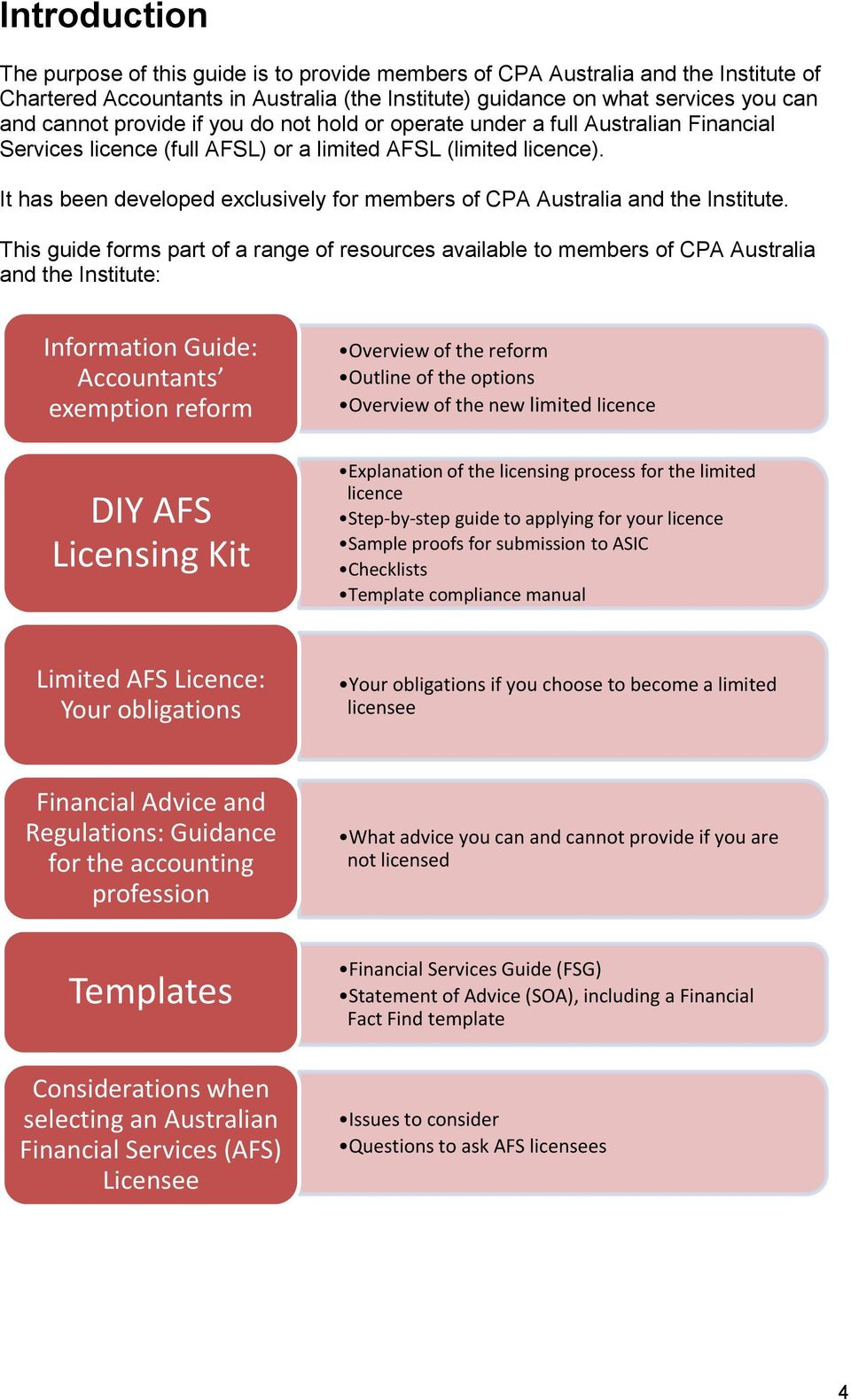
4 Introduction The purpose of this guide is to provide members of CPA Australia and the Institute of Chartered Accountants in Australia (the Institute) guidance on what services you can and cannot provide if you do not hold or operate under a full Australian Financial Services licence (full AFSL) or a limited AFSL (limited licence). It has been developed exclusively for members of CPA Australia and the Institute. This guide forms part of a range of resources available to members of CPA Australia and the Institute: Information Guide: Accountants exemption reform Overview of the reform Outline of the options Overview of the new limited licence DIY AFS Licensing Kit Explanation of the licensing process for the limited licence Step-by-step guide to applying for your licence Sample proofs for submission to ASIC Checklists Template compliance manual Limited AFS Licence: Your obligations Your obligations if you choose to become a limited licensee Financial Advice and Regulations: Guidance for the accounting profession What advice you can and cannot provide if you are not licensed Templates Financial Services Guide (FSG) Statement of Advice (SOA), including a Financial Fact Find template Considerations when selecting an Australian Financial Services (AFS) Licensee Issues to consider Questions to ask AFS licensees 4
5 Key services provided by professional accountants Three of the most critical areas for professional accountants covered by the Corporations Act 2001 (the Act) and the Corporations Regulations 2001 (the Regulations, or Reg) relate to business, superannuation and taxation advice. Business advice Reference - Reg (3)(c) Exemptions are provided for most activities relating to setting up, administering and selling a business, including advice on how to manage business risks. Taxation advice References - s766b(5), Reg (4) You can continue to provide tax advice to your clients, including the tax implications of certain investments. In meeting the requirements under the Act, you should be mindful that general anti-avoidance provisions under the Income Tax Assessment Act 1936 prevent taxpayers from entering into arrangements with the dominant purpose of obtaining a tax benefit. Superannuation References - Regulations (3)(f), (5) and A (until 30 June 2016) Factual information can be provided on the different superannuation options available for clients (e.g. self managed superannuation fund (SMSF) -v- industry -v- retail) without a limited licence or a full AFSL. Up until 30 June 2016 when Regulation A will be repealed, you are able to recommend, set up and administer a SMSF, provided no specific product recommendations are provided aside from the SMSF. Importantly, if you wish to continue being able to recommend the establishment or winding up of a SMSF after 30 June 2016, you will need to obtain or operate under a limited licence or a full AFSL. We strongly recommend that you familiarise yourself with the contents of this guide to ensure you make an informed decision about the advice and services you provide to your clients if you are not licensed. 5
6 Your options In preparation for the future removal of the accountants exemption, it is crucial that you are aware of ALL your options. Before making a decision, we encourage you to read Information Guide: Accountants Exemption reform and thoroughly consider the longterm implications of your choice. There are five options you can consider. 1. Refer Refer all SMSF, other superannuation and financial planning related queries to an appropriately licensed financial planner. You must disclose to the client any benefits you may receive from the referral. A referral agreement has been included as part of this guide. 2. Become an authorised representative of another entity s licence Enables you to provide financial product advice, while the licensee is responsible for ensuring compliance with the licence obligations. A separate table of considerations and key questions has been prepared to help you select the type of licensee that is appropriate for your practice. 3. Obtain your own limited licence Enables you to provide a range of SMSF advice and class of product advice and while you are responsible for ensuring compliance with the licence obligations, you also maintain your professional independence. Under this option you can select some or all of the available authorisations for the limited licence. We recommend you select all available authorisations. Further guidance on this is provided in the DIY AFS Licensing Kit. A comprehensive range of resources has been developed to assist members apply for their own limited licence. This includes a DIY AFS Licensing Kit and draft Compliance Manual. Further resources are also being developed to assist members with their ongoing obligations. 4. Obtain your own full AFSL This can enable you to provide financial product advice, including product recommendations, in a broad range of areas, not just SMSFs. Note: if you have not previously provided licensed financial product advice you will need to obtain or employ the assistance of at least one appropriately qualified and experienced responsible manager for the licence. 5. Recruit/ joint venture This option allows you to provide a complete financial planning solution to clients without personally providing financial product advice. Key to making this option successful will be committing to integrating financial planning within the practice and investing in resources to make it happen. You can access Information Guide: Accountants Exemption from CPA Australia or the Institute. 6

7 1. Purpose of the guide This guide is intended to provide a clear indication of when licensing is required for members and when accounting services are not considered to be financial services and thus not covered by the Act. This guide provides a Q & A format of practical examples. * Throughout this guide, reference to licensing means holding an Australian Financial Services licence issued the ASIC, a limited licence or being an authorised representative or representative of a licence holder. Key reference material It is important to remember that this is a guide for professional accountants and only provides guidance on the licensing provisions. For more detailed information, you should refer to the source materials. The Act The Corporations Act 2001 is the primary legislation. The key parts for members are Parts 7.1, 7.6, 7.7, 7.7A and 7.8 as they relate to licensing. Corporations Regulations The Regulations are one of the most important parts of the regime. Regulations are legally enforceable, but do not undergo the same process to be implemented by governments. Key regulations to review include regulations , A (until 30 June 2016), A, , BA, , A, A, (b), A, Schedule 2 and Schedule 3 of the Corporations Amendment Regulations 2013 (No.3). Explanatory Memoranda/Statements Explanatory Memoranda/Statements have been issued to provide additional guidance to the Act and the Regulations. Explanatory Memoranda/Statements provide an insight into the intention behind a particular section of the Act or regulation and how it is intended to operate. Despite their significance, it is important to note that Explanatory Memoranda/Statements are issued by the Government and are not legally enforceable. They are the Government s interpretation of the regime and how it should operate in practice. ASIC Regulatory Guides ASIC has issued a range of regulatory statements to assist in understanding how it is going to regulate licensing. ASIC s Regulatory Guides are not legally enforceable. Rather they are simply ASIC s interpretation of the legislation and a guide to how it intends to regulate. ASIC also has a number of Frequently Asked Questions (FAQ) and other related material, and where appropriate, this guide has taken into account ASIC pronouncements. 7

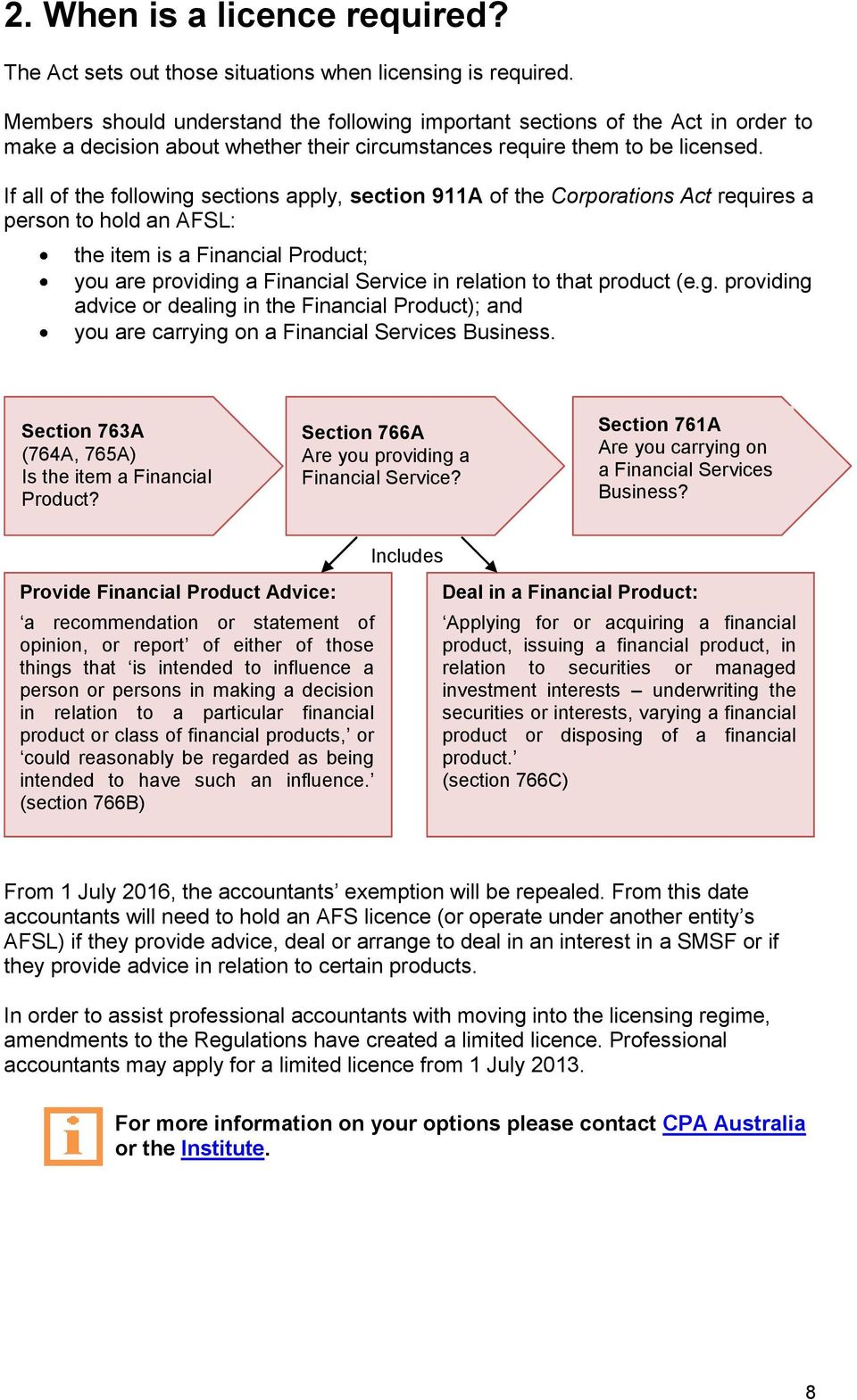
8 2. When is a licence required? The Act sets out those situations when licensing is required. Members should understand the following important sections of the Act in order to make a decision about whether their circumstances require them to be licensed. If all of the following sections apply, section 911A of the Corporations Act requires a person to hold an AFSL: the item is a Financial Product; you are providing a Financial Service in relation to that product (e.g. providing advice or dealing in the Financial Product); and you are carrying on a Financial Services Business. Section 763A (764A, 765A) Is the item a Financial Product? Section 766A Are you providing a Financial Service? Section 761A Are you carrying on a Financial Services Business? Includes Provide Financial Product Advice: a recommendation or statement of opinion, or report of either of those things that is intended to influence a person or persons in making a decision in relation to a particular financial product or class of financial products, or could reasonably be regarded as being intended to have such an influence. (section 766B) Deal in a Financial Product: Applying for or acquiring a financial product, issuing a financial product, in relation to securities or managed investment interests underwriting the securities or interests, varying a financial product or disposing of a financial product. (section 766C) From 1 July 2016, the accountants exemption will be repealed. From this date accountants will need to hold an AFS licence (or operate under another entity s AFSL) if they provide advice, deal or arrange to deal in an interest in a SMSF or if they provide advice in relation to certain products. In order to assist professional accountants with moving into the licensing regime, amendments to the Regulations have created a limited licence. Professional accountants may apply for a limited licence from 1 July For more information on your options please contact CPA Australia or the Institute. 8
9 2.1 Items that are not financial products The first test in assessing if an AFSL is required is whether or not the item involved is a financial product. Section 765A provides a list of specific things that are not financial products. Two of the most relevant things that are not financial products are direct property and credit facilities Direct property Accountants are called upon to give advice in relation to the purchase and sale of property and other forms of real estate. Such advice might relate to investment, taxation or business advice. Direct real estate is not a financial product under s.763a of the Act, so any advice given in relation to direct real estate (e.g. you should buy 1 ABC Street) will not be financial product advice. This is because it is a physical asset, not a facility. Other physical assets such as wine, art and stamp collections are also excluded. However, in ASIC Report 337: SMSFs: Improving the quality of advice given to investors, ASIC states: 173 A person provides a financial service (i.e. financial product advice) if they recommend that an existing or proposed trustee/member of an SMSF purchase real property through their SMSF. This is because the vehicle through which the underlying investment is made is an SMSF and an interest in an SMSF is a financial product. It does not matter for licensing purposes that the underlying investment (real property in this case) is not a financial product. A person who carries on a business of providing financial services in Australia is generally required to hold an AFS licence. For the avoidance of doubt, we note that this does not mean that a real estate agent will ordinarily require an AFS licence. A real estate agent who does not specifically market to SMSFs, or carry on a business of recommending that SMSFs be used to purchase real property, is not required to obtain an AFS licence. 174 A limited exemption to the requirement to hold an AFS licence currently applies to recognised accountants. The exemption enables a recognised accountant to recommend acquiring, or disposing of, an interest in an SMSF: see paragraphs It does not extend to making recommendations about the product or real property that an SMSF invests in nor does it extend to advice on switching or product replacement. This means that an accountant who recommends that an investor roll their existing APRA-regulated superannuation into an SMSF requires an AFS licence. Given ASIC s view, an accountant cannot recommend a person purchase a property through a SMSF unless they are appropriately licensed. For further guidance refer to the Q&As in section 6.5 Property and Real Estate of this guide. 9

10 2.1.2 Credit facilities Under s.765a(1)(h) of the Act, a credit facility (that satisfies the definition of a credit facility provided in Reg ) is not considered to be a financial product. This exemption means that products such as traditional home loans are not considered to be financial products and therefore do not require an AFSL. However, some facilities are still considered to be financial products, even though they have credit-like characteristics. Examples of facilities that are by the credit facility exemption are: margin lending facilities the debt securities of many securitisation vehicles; and any debt securities issued by a bank. Note: a margin lending facility (e.g. a lending facility that allows for the purchase of shares, using shares as collateral) is a financial product. For further guidance on this issue, refer to the Q&As in section 6.2 Debt Management of this guide. You will need an Australian credit licence (ACL) if you provide credit assistance to clients. For example, if you suggest that they apply for or remain in a particular credit contract or lease, or apply to increase their credit limit under a particular contract, or help them make an application for a particular credit contract, or increase their credit limit, or act as an intermediary between the client and the credit provider or lessor, you may need an ACL. See ASIC s Regulatory Guide 203 Do I need a credit licence? for further guidance. For more information on the regulation of consumer credit refer to the CPA Australia website or the Institute website. 10

11 3. When is a licence not required? A full AFSL or a limited licence is not required when a financial service is not provided, such as when factual information is being provided to a client. In addition, the Act and Regulations sets out activities that are deemed not to be financial product advice or a financial service. There are four key exemptions provided to accountants: 1. Taxation advice s.766b(5)(c) & Reg (4) 2. Traditional accounting activities Reg & Reg A (until 1 July 2016) 3. Broad asset allocation advice Reg A 4. Referrals Reg (1)(e) 3.1 Factual information ASIC has provided information clarifying when a licence is required. Regulatory Guide 36 Licensing: Financial product advice and dealing states that communications that consist only of factual information (i.e. objectively ascertainable information whose truth or accuracy cannot be reasonably questioned) will generally not involve the expression of opinion or recommendation and will not, therefore, constitute financial product advice (RG 36.23). In some circumstances, a communication that consists only of factual information may amount to financial product advice. For instance, where the information is presented in a manner that may reasonably be regarded as suggesting or implying a recommendation to buy, sell or hold a particular financial product or class of financial products, it will be financial product advice. If the accountant is remunerated for making the communication, an intention to influence may be more readily inferred. It is recommended that accountants relying on this exclusion from the requirement to hold a licence should accompany the information with a disclaimer. For more information and sample disclaimers refer to section 5. For further guidance on factual information refer to ASIC Regulatory Guide 36 Licensing: Financial product advice and dealing. 3.2 Taxation services The provision of tax advice is regulated under s251l of the Income Tax Assessment Act 1936 (ITAA 36) and sets out, amongst other things, who can charge for providing taxation advice on behalf of a taxpayer. Under this section, only registered tax agents and exempted persons (such as a legal practitioner) can provide advice about a tax law for a fee on behalf of taxpayers. Certain advice given by tax agents and lawyers has been specifically exempted from being financial product advice under the FSR regime. In relation to tax agents, s766b(5)(c) of the Act states that the following is not financial product advice: 11

12 advice given by a registered tax agent or BAS agent (within the meaning of the Tax Agent Services Act 2009) that is given in the ordinary course of activities as such an agent and that is reasonably regarded as a necessary part of those activities. Regulation (4) provides an additional exemption for when tax advice is being provided in relation to financial products. While this exemption applies to any person, this does not provide an exemption from a requirement to comply with any relevant tax legislation that may apply. Regulation (4) states that when giving advice about the taxation implications of financial products covered by the Act, this is permissible so long as the adviser does not receive a benefit (other than the fee charged for such advice) as a result of the client then investing in a financial product (and depending on the type of advice given, provided certain disclosures are made see below). Disclaimers Taxation advice It is important to note that if taxation advice constitutes financial product advice, under Reg (4), the person providing the advice must: advise the client that they are not licensed under the Act to provide financial product advice that taxation is only one consideration when deciding on a financial product; and the client should consider seeking advice from an Australian Financial Services licensee before making a decision on a financial product. For more information and sample disclaimers refer to section Traditional accounting activities Regulations & A The original Reg , issued in November 2001, applied only to Recognised Accountants, being members of CPA Australia, ICAA and the IPA. Changes made to the regulation in 2003 removed the application of the term Recognised Accountant for the main regulation and it applied to any person that might potentially be caught unintentionally by the Act. Regulations and A provided exemptions to the licensing requirements for certain activities which will be considered further below under the following broad headings: Business planning Compliance advice Financing the acquisition of assets Insurance Share valuations and due diligence Tax issues; and Superannuation. From 1 July 2016 Regulation A (also referred to as the accountants exemption) will be repealed. From this date you cannot recommend the establishment or winding up of a SMSF unless appropriately licensed. 12
13 Subregulation (1) of Reg states: 1 For paragraph 766A(2)(b) of the Act, a person who provides an eligible service is taken not to provide a financial service if: a) the person provides the eligible service in the course of conducting an exempt service; and b) it is reasonably necessary to provide the eligible service in order to conduct the exempt service; and c) the eligible service is provided as an integral part of the exempt service. This subregulation is a threshold test. This means that the activities that are listed in subregulations (3) to (5) can only be provided by accountants (and other advisers) as long as in doing so any financial product advice is given in the ordinary course of those activities and is reasonably necessary to and an integral part of that activity. In interpreting regulations and A the regulations list of activities needs to be considered in the overall context of the licensing regime. The Government, Parliament and Treasury have consistently advised that the regulations can only be a mechanism that provides a fairly wide-ranging exemption under the law and cannot specifically cover every practical instance raised. Common sense is therefore required, particularly in determining whether a specific financial product recommendation is made. The key issues covered by regulations and A, as well as the new regulations introduced on 1 July 2013, are detailed below. In applying the regulations to each of the activities referred to below, the threshold test referred to above needs to be met. For example, advice that is given as part of business planning activities must be given in the ordinary course of those activities and reasonably necessary to and an integral part of the business planning activities Business planning Business planning includes those activities when the client of an accountant seeks advice in relation to the establishment, running and sale of a business. Such business planning advice is a normal part of the activities of an accountant and other advisers. Accountants are able to advise on the most appropriate structure for setting up a business, e.g. as a sole trader, partnership, trust or company. Accountants are also able to assist their client in setting up those structures. They are then able to assist with the ongoing administration of these types of businesses. However, if the business planning activities include financial product advice, it must be confined to advice on a decision about: securities of a body corporate, or related body corporate, that carries on or may carry on the business of the entity; or interests in a trust (other than a superannuation fund or a managed investment scheme that is registered or required to be registered), the trustee of which carries on or may carry on the business of the entity in the capacity of trustee. 13

14 Also, that advice must be given to a person who is or is likely to become an officer (including a director), manager, associate or trustee of the business (an interested party ). However, accountants are not permitted to advise their client (whether they are an individual, body corporate or trustee) about any financial products or investments that a client may hold within that business. For further information on business planning, refer to section Compliance advice The Explanatory Statement to Regulation clarifies that the provision of compliance advice (e.g. compliance under any other acts) will not require a person to be licensed under FSR, except for: (a) advice about a body corporate or trust (other than a superannuation fund or managed investment scheme that is required to be registered) where the advice relates to financial products that the body corporate or trustee of the trust may acquire or dispose of; or (b) advice in relation to a superannuation fund that relates to compliance with s.52(2)(f) of the SIS Act and Reg.4.09 of the SIS Regulations. For example, compliance advice given under the Corporations Act (e.g. audit requirements under Chapter 2M), Family Law Act, in particular for superannuation, the Superannuation Industry (Supervision) (SIS) Act and Regulations and the Superannuation Guarantee Act, will not be a licensable activity e.g. these are your obligations under the ABC Act, this is the requirement you must meet under the XYZ Act Financing the acquisition of assets A necessary part of an accountant s duty when advising a client in relation to running their business will involve the accountant advising on the most effective means to acquire business assets. Section 765A of the Act specifically declares that certain credit facilities are not financial products for the purposes of the Act and Regulation defines credit facility broadly but does not cover all credit facilities. Regulation provides further clarification that providing advice about using existing financial products as security for purchasing assets, (other than financial products), is also not considered to be the provision of financial product advice Insurance Accountants are not insurance brokers and cannot advise their clients in relation to specific insurance products. Such advice is financial product advice and can only be provided by a properly licensed or authorised professional. However, accountants also have a professional and legal duty to provide their client with all necessary information on managing business risks. This will inevitably lead to the accountant informing the client of the need for various forms of insurance, such as director s and officer s insurance. Regulation (3)(b) allows accountants to provide generic risk management advice that is not restricted to merely business clients. This allows other clients, such as private individuals, to receive basic risk management advice, including taking out 14
15 insurance. The relief is restricted to the presence of a risk that a person may face and does not allow the recommendation of advice about specific financial products, for example, those provided by a particular issuer. From 1 July 2013 an accountant can obtain a limited licence if the accountant wishes to: advise a client in relation to the particular types of life risk insurance they should hold (e.g. life insurance) advise a client on how much insurance they should hold; or advise a client of the insurance risks associated with changing superannuation funds. Only holders of a full AFSL (with the appropriate authorisations) will be able to: provide advice in relation to individual insurance products; and provide assistance with completing application forms for insurance policies Share valuations and due diligence Accountants are regularly called upon by their clients to provide due diligence reports and to undertake share valuations in respect of an entity as part of their professional services to their clients. Where such activities are part of the range of services the accountant provides to their clients and does not involve advising the client as to their investment portfolio, such activities can be provided by accountants without the need for an AFSL provided the advice is given to a person who is, or is likely to become, an interested party in the entity and, to the extent that the advice is financial product advice, it is confined to advice on a decision about: securities of a body corporate, or a related body corporate that carries on or may carry on the business of the entity; or interests in a trust (other than a superannuation fund or a managed investment scheme that is registered or required to be registered), the trustee of which carries on or may carry on the business of the entity in the capacity of trustee Superannuation Regulation allows accountants to provide limited advice without the need to be licensed. However, accountants cannot provide advice about the acquisition or disposal by the superannuation fund of specific financial products or classes of financial product, or a person s existing holding in a superannuation product to modify an investment strategy or a contribution level. Also, in all cases, the client must be, or must be likely to become, a trustee, a director of a trustee, an employer sponsor or a person who controls the management of the superannuation fund. The following advice can be provided: Advise clients on the taxation implications for superannuation contributions (subject to complying with the conditions referred to in Reg (4), refer section 3.2). Compliance advice in respect of SMSFs and other superannuation funds (subject to complying with the conditions referred to in section 3.3.2). 15
16 Provide employers with advice on SG obligations (subject to complying with the conditions referred to in section 3.3.2). Provide audit work and advise the client in respect of legislative breaches and their resolution (subject to complying with the conditions referred to in section 3.3.2). Generally discuss investment issues including broad asset allocation about certain assets without providing specific asset allocation advice by recommending particular financial products or classes of financial products. Advise on deficiencies and otherwise of a trust deed. Advise an employer or employee client what choice of funds is and how it can be implemented. In some cases, the above information may only amount to the provision of factual information (refer section 3.1). Where the advice (except for taxation advice) provided in any of the above circumstances is financial product advice and is provided to a retail client, the advice must be accompanied by a written statement stating that: you are not licensed to provide financial product advice under the Act; and the client should consider taking advice from the holder of a licence before making a decision on a financial product. For more information on disclaimers refer to section 5. An unlicensed accountant can set up a SMSF on the instructions of a client. However, an accountant cannot recommend a SMSF over another superannuation structure or recommend that the client switch from another superannuation structure to a SMSF. Post 30 June 2016, unless appropriately licensed, an accountant cannot recommend a client establish, or not establish, a SMSF even if they believe it is in their client s interests. Further, ASIC is increasingly focusing on SMSF advice and services. It is highly likely that post 30 June 2016 ASIC will review and question practices that frequently establish SMSFs as an execution only service. Importantly, accountants should not be setting up a SMSF from scratch as this would constitute legal advice. Accountants can supply a trust deed prepared by lawyers to the clients and arrange to set up the SMSF, but they should not be drafting the documents themselves, unless also legally qualified. There are restrictions on a person who is not a lawyer engaging in legal work for reward. Generally, a person is engaged in legal work by doing something that is: usually done by a lawyer and by doing it in a way as to imply that the person is a lawyer prohibited to be done by someone unless done by a duly qualified lawyer; or required to be done only by those who have the necessary training and experience in law (such as providing legal advice). Regulation A (will be effective until 30 June 2016) Regulation A permits a Recognised Accountant to provide a recommendation to a client on whether the client should acquire or dispose of an interest in a SMSF without the requirement to be licensed. The client must be, or likely to become, a 16
17 trustee, a director of a trustee, an employer sponsor or a person who controls the management of the SMSF. The regulation does not permit accountants to provide advice about the acquisition or disposal by a superannuation fund of specific financial products or classes of financial product, or a person s existing holding in a superannuation product to modify an investment strategy or a contribution level. A recognised accountant for the purposes Regulation A means: a) a member of CPA Australia who: I. is entitled to use the letters CPA or FCPA ; and II. is subject to, and complies with, CPA Australia s continuing professional education requirements; or b) a member of the Institute of Chartered Accountants in Australia (ICAA) who: I. is entitled to use the letters ACA, CA or FCA ; and II. is subject to, and complies with, ICAA s continuing professional education requirements; or c) a member of the Institute of Public Accountants (IPA) who: I. is entitled to use the letters FIPA or MIPA ; and II. is subject to, and complies with, the IPA s continuing professional education requirements. From 1 July 2016, Regulation A will be repealed. Accountants who wish to continue to recommend to establish or wind up a SMSF will need to be appropriately licensed. From 1 July 2016 an accountant can still arrange for the increase or decrease of an interest in a financial product (such as a SMSF) by preparing a document of registration or transfer in order to complete administrative tasks on instructions from the person. ASIC is increasingly focusing on SMSF advice and services. It is highly likely that post 30 June 2016 ASIC will review and question practices that frequently establish SMSFs as an execution only service. As a matter of best practice, CPA Australia and the Institute recommend that where a member who is unlicensed is requested by a client to set up a SMSF, that is provide an execution only service, the member refers the client to external resources first in order to assist the client validate their decision. Appropriate resources would include: ATO published resources including Thinking about self-managed super; and Self Managed Superannuation Funds Trustee Education program. 17

18 3.4 Broad asset allocation advice Regulation A is a general exemption from the licensing requirements for what is commonly known as broad asset allocation advice, by stating that such advice is taken not to provide a financial service. The regulation provides relief where the advice relates to the allocation of funds that are available for investment between one or more of the following: shares debentures debentures, stocks or bonds issued, or proposed to be issued by a government deposit products managed investment products investment life insurance products; and superannuation products. However, care needs to be taken that no recommendation or statement of opinion is made that relates to specific financial products or classes of financial products (e.g. a specific class of equities such as mining shares). 3.5 Referrals Regulation (1)(e) exempts an accountant (or another person), who is not licensed to provide financial services, from being required to be licensed if they merely refer a client (e.g. informs the client of the financial services the licensee can provide and how the client can contact them) to a licensed third party or authorised representative of a licensee. In all circumstances the accountant must disclose any benefit (such as a commission) they or their associates receive for making the referral, in the same form as the referral. Regulation (1)(e) does not require a written disclosure if the referral was provided in another format (e.g. over the phone). However, the receipt of referral fees or commissions create self-interest threats that must be evaluated in accordance with the framework of APES 110 Code of Ethics for Professional Accountants (the Code). APES 110 requires written disclosure to be provided to the client (AUST ). Section 766B(1) of the Act provides that financial product advice is a recommendation or a statement of opinion that is intended to influence a person to make a decision in relation to a particular financial product or class of products, or could reasonably be regarded as being intended to have such an influence. Care must be taken as a referral may be deemed to be an endorsement of financial product advice or services or deemed to be the provision of advice itself where the person to whom the client is referred only advises on the products of one company Arranging and dealing It is important to be aware of the distinction between referring and arranging. Generally, arranging refers to negotiating or bringing into effect a dealing in a financial product. Significant involvement in the events leading up to the dealing often indicates that the person is arranging. Other indicators are where the person receives a benefit depending on the client s decision or where the dealing would not have taken place had it not been for the person s involvement. 18

19 Accountants need to take care to avoid arranging a dealing, such as the buying or selling of the financial product, as this would constitute providing financial product advice and requires the individual to be appropriately licensed. EXAMPLE An accountant discusses possible investment options with a client, such as a particular mix of managed funds, and then contacts a financial adviser and arranges for the financial adviser to acquire those funds for the client. This would be considered arranging and the accountant would be in breach of the Act if they are not appropriately licensed. If the accountant also received a fee, this is also indicative of arranging Referrals and third party arrangements Accountants also need to look closely at any referral arrangements that they have in place with third parties. Arrangements which are integral to an accountant s business run the risk of going beyond a mere referral and in fact involve providing financial services advice and, therefore, the accountant must be a licensed financial adviser. Accountants need to take care to review all referral arrangements, whether they are formal or informal Referrals to consumer credit providers There are specific rules for referring consumer credit related matters. Where the information given to the consumer constitutes a mere referral to a credit licensee or representative, the adviser may be able to rely on an exemption if they also disclose any benefits, such as commissions, they or their associate may receive for giving the referral. For further guidance refer to RG of ASIC Regulatory Guide 203 Do I need a credit licence? and Regulations 25(2), 25(2A) and 25(5) of the National Consumer Credit Protection Regulations

20 4. Code of Ethics for professional accountants While this guide focuses on the activities that can be undertaken without being licensed, all members of CPA Australia and the Institute must observe and comply with APES 110 Code of Ethics for Professional Accountants (the Code). The requirements stipulated in the Code must be complied with in addition to those set out under the current licensing regime. An activity may be permitted under the licensing regime but may not be permitted, or additional conditions may be required, by the Code. For example, Reg (1)(e) allows verbal disclosures of referral fees and commissions, whereas the Code requires all referral fees to be disclosed to the client in writing. The Code recognises that the objectives of the accountancy profession are to work to the highest standards of professionalism, to attain the highest levels of performance and, generally, to meet the public interest requirement. The Code is designed to provide members with authoritative guidance on minimum acceptable standards of professional conduct. Members should be guided not merely by the words but also by the spirit of the Code. The fact that particular conduct does not receive a mention does not prevent it from being unacceptable or discreditable conduct, thus making the member liable to disciplinary action. In addition to the requirements of the legislation, all members must be familiar with the fundamental principles of the Code, being: Integrity Objectivity Professional Competence and Due Care Confidentiality; and Professional Behaviour The Code is based on a conceptual framework that requires active consideration of issues based on the fundamental principles. The framework can be applied to differing circumstances and relies on professional judgement. The conceptual framework requires Members to use their professional judgement in order to: identify any threats to compliance with the fundamental principles; evaluate the significance of the identified threats; and apply safeguards to eliminate threats or reduce them to an acceptable level. Furthermore, members of both CPA Australia and the Institute are required to abide by all applicable standards issued by the APESB. 20
21 5. Disclaimers Whilst the use of a disclaimer is not a defence against breaching the licensing provisions, it is a useful reminder that financial product recommendations do require you to be licensed, and will help avoid misleading or confusing consumers about the purpose of the communication. When using a disclaimer the accountant must make it clear that they are not licensed pursuant to the Act to provide financial product advice and that if the client seeks such advice they must be referred to a licensed third party. ASIC encourages the use of disclaimers to help avoid misleading clients, and in Regulatory Guide 36 Licensing: Financial product advice and dealing states: RG If your communications include information about financial products, but do not constitute financial product advice, you should consider giving consumers a disclaimer to the effect that you are not providing financial product advice, and that consumers should consider obtaining independent advice before making any financial decisions. This will help avoid misleading or confusing consumers about the purpose of the communication. A disclaimer will not, of itself, determine whether a communication constitutes financial product advice. There are numerous instances where disclaimers will be needed by accountants in the legislation. Below are some sample disclaimers you may be able to use in written correspondence with your clients. 5.1 Sample disclaimer factual Information The following information is provided as an information service only and, therefore, does not constitute financial product advice and should not be relied upon as financial product advice. None of the information provided takes into account your personal objectives, financial situation or needs. You must determine whether the information is appropriate in terms of your particular circumstances. For financial product advice that takes account of your particular objectives, financial situation or needs, you should consider seeking financial advice from an Australian Financial Services licensee before making a financial decision. OR The information I have provided you is purely factual in nature and does not take account of your personal objectives, situation or needs. The information is objectively ascertainable and, therefore, does not constitute financial product advice. If you require personal advice you should consult an appropriately licensed or authorised financial adviser. 5.2 Sample disclaimer tax advice (Regulation (4)) The advice provided is not financial product advice as defined by the Corporations Act. I. am not licensed to provide financial product advice and taxation is only one of the matters that you need to consider when making a decision 21
22 on a financial product. You should consider seeking advice from an Australian Financial Services licensee before making any decisions in relation to a financial product. 5.3 Sample disclaimer referrals (Regulation (1)(e)) I. have not provided you (the client) with any financial product advice. I have informed you of the contact details of an Australian Financial Services licensee or their representative who is able to provide you with financial product advice and dealing services that are relevant to your particular objectives, situation and needs. I am not a representative of the Australian Financial Services licensee, nor a related body corporate, to whom I have referred you. However, I am obliged to disclose any benefits I obtained or am likely to obtain in respect of this referral. Accordingly, I disclose the following benefit (if any) that was/is likely to be received by me or any associates. Note 1: The disclosure of benefits must be provided in the same form as the referral information. This means that where you verbally refer a client, you will need to verbally disclose the benefits you will or may receive and, in accordance with the Code, provide the client with the above written statement. Note 2: Although you are not required by law to give a written statement of referral details, as a CPA Australia or ICAA member, the Codes by which you are bound require that such a statement is made in writing. 5.4 Sample disclaimer superannuation compliance The advice contained in this communication contains factual information and/or recommendations with regard to maintaining fund compliance. It is in this context that we have also commented on [describe the superannuation investment]. I. am not licensed to provide financial product advice under the Corporations Act You should consider obtaining advice from an appropriately licensed or authorised financial adviser before you make a decision on a financial product, including (include details on financial products or class of financial products discussed). I can provide you with a referral to (include contact details) who is licensed to provide such advice. Note 1: A disclaimer is not required by an accountant if the accountant is only providing factual information and/or recommendations with regard to maintaining fund compliance. Note 1: Refer to section 3.5 Referrals for information on the issues to consider when referring a client to a licensee or representative of a licensee. 22
23 6. Q&As The following series of questions and answers has been developed to provide professional accountants with guidance on what advice and services can and cannot be provided if they are not licensed to provide financial product advice. The following terms abbreviations have been used in this section: Abbreviation Reg. s the Act EM licensed ACL Term regulation section Corporations Act 2001 (Cth) Explanatory Statement / Explanatory Memorandum Holder of a full AFSL / limited licence; or representative / authorised representative of a licence holder Australian Credit Licence (or being licensed as a credit representative of an ACL) For additional information to the following Q & As, please refer to the respective section of the guide. For example, for an explanation of questions in section 6.1 refer to Business Planning. Individual circumstances should be tested against the actual regulation and professional legal advice obtained if necessary. 6.1 Business planning Q6.1.1 Can an accountant recommend to a client that they establish their business as either a company, trust, partnership or sole trader, or combination of these? YES. Such recommendations do not require an accountant to be licensed. Regulation (3)(c) permits advice on the acquisition or disposal establishment, structuring of an incorporated or unincorporated entity. Accountants can analyse the needs of the client (provided the client is, or is likely to become, an interested party in the entity), identify the pros and cons of different arrangements and advise which solution best fits the needs of that client. This includes recommendations as to the most appropriate entity structure (provided any financial product advice given is confined to advice on a decision about securities of a body corporate, or related body corporate that carries on or may carry on the business of the entity; or interests in a trust (other than a superannuation fund or a managed investment scheme that is registered or required to be registered), the trustee of which carries on or may carry on the business of the entity in the capacity of trustee), the work required to set up such a business structure and to help administer and operate the business structure. Regulation (3)(d) covers the recommendation of so-called shelf entities that have never carried on a business. 23
24 Q6.1.2 After advising the client which structures are appropriate, can an accountant then take such actions as are necessary to set up the structure, including the use of a shelf company? YES, but only where instructed by the client to do so. Regulation (3)(g) allows accountants to arrange for the issue or purchase by a client of a financial product, by preparing a document of registration or transfer in order to complete administrative tasks on instructions from the person. Q6.1.3 Can an accountant organise for the purchase/transfer of shares in a business on behalf of the client? YES, but only where instructed by the client to do so. Regulation (3)(g) allows accountants to arrange for the purchase of a financial product by preparing a document of registration or transfer in order to complete administrative tasks on instructions from the person. Any advice given prior to the transfer taking place must be given in accordance with Reg (3)(c). The Explanatory Statement to Reg (3)(c) refers to the fact that advice must not apply to any financial products that the company acquires or disposes of, such as investments that the company holds. Therefore, this exemption does not apply to the purchase or transfer of shares in any investments that the company may hold. Q6.1.4 Can an accountant set up a bank account for a client in order for them to run the business? POSSIBLY. Regulation (3)(g) will allow an accountant to arrange for the acquisition of a financial product by preparing a document of registration or transfer in order to complete administrative tasks on instructions from the person. This regulation clearly indicates that a document of registration or transfer can only be prepared if instructed by the client, not based on a recommendation given by the accountant. While Reg (3)(c) permits advice on the acquisition or disposal establishment, structuring of an incorporated or unincorporated entity and this could include general advice on the types of accounts that might be appropriate for the business (e.g. a cheque account or other payment mechanisms), no specific bank products can be recommended. The Explanatory Statement to Reg (3)(c) refers to the fact that advice must not apply to any financial products that the company acquires or disposes of, such as investments that the company holds. 24
25 Q6.1.5 Can an accountant provide analysis on the merits of having different classes of shares in the body corporate that will be carrying on the proposed business? YES. Such recommendations do not require an accountant to be licensed. Regulation (3)(c) permits advice on the acquisition or disposal establishment, structuring of an incorporated or unincorporated entity provided the advice is confined to advice about the securities in a body corporate that carries on or may carry on the business of the entity. The EM indicates that accountants can provide these services as they are concerned with the administration and operation of the business. Q6.1.6 Can an accountant provide advice, or comment on the assets and investments owned by a business? NO. The EM to Reg (3)(c) states that the advice must only be in relation to the actual entity or related entities such as subsidiaries. It will not apply to any financial products that the company acquires or disposes of, such as investments that the company holds. Therefore, advice must not be given in relation to the purchase or transfer of shares in any investments that the company may hold or to the purchase of shares in another entity, unless it is to a related entity (refer Reg (3)(e)). Q6.1.7 Can an accountant monitor their client s business performance, recommending improved systems and cash flow management? YES. Such recommendations do not require an accountant to be licensed. Regulation (3)(c) permits advice on the acquisition or disposal establishment, structuring of an incorporated or unincorporated entity. The EM indicates that accountants can provide these services as they are concerned with the administration and operation of the business. Q6.1.8 Can an accountant, at the request of their client, maintain the Company Share Registry? YES. Regulation (3)(g) allows accountants to arrange for the purchase, transfer or disposal of a financial product by preparing a document of registration or transfer in order to complete administrative tasks on instructions from the person. Q6.1.9 Can an accountant conduct ratio analysis and provide recommendations on the appropriate mix of current/ non-current assets? YES. Such recommendations do not require an accountant to be licensed. Regulation (3)(c) permits advice on the acquisition or disposal establishment, structuring of an incorporated or unincorporated entity. The EM indicates that accountants can provide these services as they are concerned with the administration and operation of the business. As stated in the EM, the analysis and recommendation must only be in relation to the actual entity or related entities such as subsidiaries. It will not apply to any financial products that the company acquires or disposes of, such as investments that the company holds and, therefore, you cannot advise which bank or banking product is the most suitable. 25
26 However, note that Reg A provides that a person is taken not to have provided a financial service if the service consists only of a recommendation or statement of opinion about the allocation of the person s funds among one or more of the assets specified in section 3.4 Broad Asset Allocation Advice. Q Can an accountant bring to the client s attention various options for holding cash reserves (e.g. interest-bearing vs non-interest-bearing accounts)? YES. But only where the information is purely factual in nature, i.e. if it is not financial product advice, the accountant is not required to be licensed. The Act only regulates the provision of financial product advice, not the provision of factual information (refer section 3.1). If an accountant provides more than factual information, e.g. a statement of opinion or recommendation that could reasonably be regarded as intending to influence (even if this was not the intention of the accountant) the client to make a decision about a financial product, a licence would be required to provide such advice. For example, if the accountant were to draw comparisons between the products which either expressly or impliedly recommended one product over another. Q Can an accountant retain custody of certain business documents, such as Share Certificates and accounting and tax records? YES. The mere holding of business documents is not the provision of a financial service and, as such, the accountant need not be licensed for this activity. Q Can an accountant, in compliance with a court order, arrange for the transfer of assets, including financial products, in the following circumstances: between spouses, defactos and other parties subject to a Family Court settlement? between litigants in a commercial dispute? YES. But only where instructed by the client to do so. Such activities do not require an accountant to be licensed. Regulation (3)(g) allows accountants to arrange for the purchase, transfer or disposal of a financial product by preparing a document of registration or transfer in order to complete administrative tasks on instructions from the person. Q Can an accountant, acting as an executor to an estate, provide advice that certain financial products be disposed of in order to maximise CGT gains/losses? YES. Such activities do not require a licence. Section 911A(2)(f)(viii) states that a person is exempt from the requirements to hold a licence if they are acting as a personal representative of a deceased person.. If the accountant is acting as a personal representative of the deceased (for example, acting as an executor), then a licence is not required. The accountant should investigate the professional indemnity insurance implications of acting as a personal representative it may be that these activities are not covered. 26
27 6.2 Debt management Q6.2.1 Can an accountant advise their client about their options in relation to debt/equity capital structure? YES. Advice relating to debt, at least where it is accessed via a credit facility (as defined in Reg ), does not involve a financial product and therefore would not be covered by FSR. When the advice relates to securities in a body corporate or a related body corporate that carries on or may carry on the business of the entity, Reg (3)(c) will also be applicable. It permits accountants to give limited advice on the acquisition, disposal, administration structuring of an entity. Regulation (3)(h) may also be applicable to this situation, which allows accountants to discuss using a business assets as security for raising additional funds. The EM states: For example, this could involve advice to a company that it should raise money by securing a floating charge over assets in the company, which could include shares held by the company. If the accountant provides credit assistance, they may require an ACL (refer section 2.1.2). Q6.2.2 Can an accountant provide an analysis of different loan packages from a range of lenders? YES. As long as the loan package meets the definition of credit facility in Reg Under s.765a(1)(h) of the Act, a credit facility is not considered to be a financial product. When a financing package has both a credit and an investing component, licensing would be required for any advice given in respect of the investment component or margin lending component. An ACL may also be required (refer section 2.1.2). Q6.2.3 Can an accountant provide an analysis of different borrowing facilities (e.g. lease vs mortgage vs unsecured finance)? YES. As long as the loan package meets the definition of credit facility in Reg Under s.765a(1)(h) of the Act, a credit facility is not considered to be a financial product, unless it is (or includes) a margin lending facility. An ACL may be required (refer section 2.1.2). Q6.2.4 Can an accountant provide an analysis on specific interest rate caps and collars? NO. This will be financial product advice as interest rate caps and collars are a form of derivative and, therefore, meet the definition of a financial product under the Act. 6.3 Financing the acquisition of assets Q6.3.1 Can an accountant advise clients on the most effective ways to acquire business assets such as equipment, cars, office furniture (e.g. gearing, leasing, hire purchase, loan facilities)? 27
28 YES. Provided the facility is a credit facility as defined in Reg , an accountant does not need to be licensed in this situation as credit facilities are not financial products in accordance with Reg and s.765a(1)(h) and business assets are also not included as financial products (s.765a). If the accountant refers to specific credit facilities, it may require an ACL (refer section 2.1.2). Q6.3.2 Can an accountant advise clients in relation to margin lending facilities? NO. An accountant cannot advise a client about a margin lending facility as this is a financial product. Also, a licence would be required to provide financial product advice about the securities that might be purchased with the borrowed funds. Q6.3.3 Can an accountant provide an analysis of different home loan packages from a range of lenders? NO. This activity may require an ACL (refer section 2.1.2). 6.4 Insurance Q6.4.1 Can an accountant advise a business client generally on risk management and possible strategies for managing the risks identified? YES. Regulation (3)(b) permits accountants to provide general advice on the risk associated with carrying on a business and to identify generic financial products or generic classes of financial products that will mitigate that risk. Furthermore, the Act allows the giving of factual information. Generic is defined in the regulations as meaning without reference to a particular brand or product issuer. Q6.4.2 Can an accountant advise a business client on the particular types of insurances that need to be considered? YES. Regulation (3)(b) permits accountants to identify generic financial products or generic classes of financial products that will mitigate risk. This allows an accountant to recommend types of insurance that might be appropriate (e.g. Public Liability Insurance). Specific product recommendations are not able to be provided without a full AFSL. Q6.4.3 Can an accountant advise a business client about the different reinsurance products by which client insurers can mitigate their own risks? YES. Reinsurance is specifically excluded from the definition of financial product (s.765a(1)(g)) and, therefore, a licence is not required to provide this type of advice. Q6.4.4 Can an accountant refer a business client to one or more insurance agents/brokers? YES. Mere referrals do not require a licence (Reg (1)(e)) as long as all the conditions of the mere referral exemption are met, including benefit disclosure (e.g. any commission or other payment received as a result of referral). For further information on referrals, refer to section
29 Q6.4.5 Can an accountant advise a business client on the best product available for a specific type of insurance? NO. Specific product recommendations meet the definition of financial product advice and therefore you would need a full AFSL to provide this type of advice. Q6.4.6 Can an accountant advise a business client pre- and post-loss to assist the client with insurance claims management? YES. But only in relation to pre-loss or in relation to post-loss, and so long as the information given is purely factual information. Regulation (3)(b) permits accountants to provide advice on the risks that a business might be subject to, and to identify generic financial products or generic classes of financial products that will mitigate those risks. Furthermore, the Act does not cover the giving of factual information. Q6.4.7 Can an accountant advise the client of the insurance risks associated with changing superannuation fund? YES. The licensing regime only regulates the provision of financial product advice, not the provision of purely factual information (refer section 3.1). If an accountant provides more than factual information, that is, information that could reasonably be regarded as intending to influence (even if this was not the intention of the accountant) a person in making a decision about a financial product, a licence would be required to provide such information. Example Where a client intends to change their superannuation fund as a result of a change of employment they may not be aware that the insurance in one fund may cease and cover with the new fund may not commence until contributions commence. The delay in contributions from the employer can leave the individual without life insurance cover. In this situation this information can be provided to the client, but it would also be advisable to refer the client to someone who is licensed to provide the client with advice about the insurance within their superannuation fund or any other superannuation fund. For further information on referrals, please see section 3.5. Q6.4.8 Can an accountant advise a personal client of their insurance needs, such as income protection insurance? YES. Regulation (3)(b) permits accountants to identify generic financial products or generic classes of financial products that will mitigate risk. This allows an accountant to recommend types of insurance that might be appropriate (e.g. audit insurance, income protection). Specific product recommendations are not able to be provided without being appropriately licensed. 29
30 Q6.4.9 Can an accountant advise of the opportunity to consider audit insurance to a client to cover the costs of the accountant s assistance in the event of an ATO audit of the client? YES. Regulation (3)(b) permits accountants to identify generic financial products or generic classes of financial products that will mitigate risk. This allows an accountant to recommend types of insurance that might be appropriate (e.g. audit Insurance).. Importantly, accountants cannot recommend that their clients take out the cover. They can only inform clients of its availability. Specific product recommendations are not able to be provided without being appropriately licensed. Note: Accountants can make clients aware of an insurance contract issued by Vero Insurance Ltd which provides cover for fees incurred by the client as a result of accounting services in relation to an audit or investigation by the ATO Q Can an accountant advise a client on the amount of life risk insurance they should hold? NO. Advice on the amount of insurance that a client should hold goes beyond the exemption in reg (3)(b). The accountant can provide such advice if they obtain a limited licence with the appropriate insurance authorisation, or a full AFSL. Q Can the accountant advise the client about the death and disability options in their existing superannuation product? YES. The licensing regime only regulates the provision of financial product advice, not the provision of purely factual information (refer section 3.1). If an accountant provides more than factual information, that is, information that could reasonably be regarded as intending to influence (even if this was not the intention of the accountant) a person in making a decision about a financial product, a licence would be required to provide such information. Q Can the accountant advise the client that they might want to get further advice from an expert about their life risk insurance product because it might not be right for them? YES. No licence is required. The accountant is simply advising the client to review the appropriateness of a product for the client s specific situation but the accountant cannot provide any financial product advice. If an accountant believes that a product may not necessarily fulfil the needs of the client, the accountant should: a) inform the client that they are not a licensed financial adviser, but that given their knowledge of the client s affairs, they would encourage the client to 30
31 ensure the suitability of the product without identifying any specific concerns; and b) inform the client that they may wish to consider seeking a second opinion from an licensed financial adviser. 6.5 Property and real estate Q6.5.1 Can an accountant recommend a direct investment in real property? YES. Under sections 763A and B, any direct real property, and other physical things purchased for investment purposes such as art, wine and gold bullion do not meet the definition of a financial product and are specifically excluded from the Act. Note 2 to s.763a states that while the property or bullion may generate a return for the person, it is not a return generated by the use of the purchase money by another person. An accountant must be mindful of other rules and legislation dealing with real estate, together with the requirements of APES 110 which state the accountant must possess the appropriate skills and knowledge to provide such advice (refer section 4). Further, ASIC has stated in Report 337 SMSFs: Improving the quality of advice given to investors that: A person provides a financial service (i.e. financial product advice) if they recommend that an existing or proposed trustee/member of an SMSF purchase real property through their SMSF. This is because the vehicle through which the underlying investment is made is an SMSF and an interest in an SMSF is a financial product. Given ASIC s view, an accountant cannot recommend a person purchase a property through an SMSF unless they are appropriately licensed (refer section 2.1.1). Q6.5.2 Can an accountant advise on a property syndicate for a client? NO. An accountant would need to be licensed to provide advice on a property syndicate or trust. Only direct real property advice is excluded from the licensing regime (unless you recommend that the client purchase a property through an SMSF). Relevant ASIC class orders that also exclude the need for a licence include CO 02/183 and CO 02/239. Q6.5.3 Can an accountant assist in the establishment of a syndicated structure for investment in real property? YES. But only on instructions from the client. Regulation (3)(c) allows for accountants to establish a syndicate structure as a company or trust (other than a superannuation fund or a trust that is required to register as a managed investment scheme) as long as the advice does not relate to other financial products the company or trust may acquire or dispose of. 31
32 Q6.5.4 Can an accountant provide advice about the taxation implications of investing in real property? YES. Real property is not a financial product (refer Q6.5.1) and the Act also does not cover tax advice (see s.766b(5)(c), Reg (4) and section 3.2). Q6.5.5 Can an accountant advise a client on whether to purchase retail or commercial real property? YES. Both these investments are a form of real property, which is not a financial product under the Act. An accountant must be mindful of other rules and legislation dealing with real property (refer section and Q 6.5.1). The obligations of APES 110 are also relevant. 6.6 Share valuations and due diligence Q6.6.1 Can an accountant provide share valuations of shares in a family business? YES. Such recommendations do not require an accountant to be licensed, provided the advice is given to a person who is an interested party in the family business and the advice is confined to advice on a decision about shares in the family business and does not, for instance, relate to other financial products that the business may acquire or dispose of. Regulation (3)(c) permits advice on the valuation.of an incorporated or unincorporated entity. The EM indicates that accountants can provide these services as they are concerned with the administration and operation of the business. Q6.6.2 Can an accountant provide a number of different valuations on, for example, the following bases: going concern, fire sale for equipment and stock? YES. Such recommendations do not require an accountant to be licensed. As detailed in Q6.6.1, Reg (3)(c) permits advice on the valuation of an incorporated or unincorporated entity. Nothing in the regulation, or the EM, dictates how the valuation should be determined. It is, therefore, assumed an accountant is able to undertake a number of different valuations, depending on the needs of the client. Q6.6.3 Can an accountant provide a comparison valuation based on publicly available information, between two listed companies that the client is considering adding to an investment portfolio? NO. This is not covered by Reg as it is financial product advice, for which a licence is required. Q6.6.4 Can an accountant sign an Investigating Accountant s Report as a Registered Company Auditor for a merger and acquisition or stock market float? YES. Regulation (3)(a) allows for the preparation or auditing of financial reports or audit reports and Reg (3)(c) allows for conducting a due diligence 32
33 on a business which in combination is what an Investigating Accountant s Report is required for to satisfy the requirements of the Corporations Act. The EM makes it clear that advice about a company s financial statements such as Investigating Accountant s Reports [can be] included in an exempt document (such as a PDS) without losing the benefit of the exemption. Q6.6.5 Can an accountant following a client s request, provide projected financial statements for them (whether for internal budgeting or other purposes)? YES. Regulation (3)(a) permits the preparation or auditing of financial reports or audit reports. Also, providing projected financial statements, by itself, is unlikely to be financial product advice. The EM indicates that accountants can provide these services as they are concerned with the administration and operation of the business. Therefore, an accountant can provide projected financial statements without being licensed, if the accounts are being prepared for internal purposes. Where the financial statements are prepared for the purposes of a merger, acquisition or a stock market float, and are connected to the valuation of a financial product such as shares, licensing may be required (refer Q6.6.7). Q6.6.6 Can an accountant, upon the request of the client, provide advice on the financial characteristics of two alternative businesses that the client is intending to purchase? YES. Provided the advice is purely factual information that the accountant is qualified to provide and is in the nature of due diligence (i.e. debt/equity, projected cash flow assumption and analysis, tax issues) then such advice does not require licensing as it is not providing a recommendation to buy or not buy one or other of the businesses. In such instances a suitable disclaimer should be attached to any such advice making it clear that a recommendation on a financial product is not being made and it is up to the client to make an appropriate decision. Regulation (3)(c) which allows due diligence advice to be given, may not be used as a pretext for providing a financial product recommendation which is a decision for the client taking into account any financial product advice that the client may obtain from a licensed financial adviser. Q6.6.7 Can an accountant provide a valuation of a business for sale without an AFSL? YES. Reg (3)(c) provides an exemption for a valuation of an entity, whether incorporated or unincorporated, where that valuation is given to a person who is, or is likely to become, an interested party in the entity. The advice must be limited to advice on a decision about the securities of the company or related company that carries on the business of the entity (or the interests in a trust where the trustee carries on the business of the entity in the capacity of trustee) and cannot relate to any other financial products that the entity may acquire or dispose of. 33
34 The valuation also cannot be included in an exempt document or statement, such as a Product Disclosure Statement or Financial Services Guide. There may be professional indemnity insurance implications. Some insurers do not cover this type of work, so the accountant must ensure that their insurance is adequate before providing business valuation services. 6.7 Superannuation Q6.7.1 Can an accountant inform a client about the characteristics of different superannuation choices (e.g. a SMSF vs a retail fund)? YES. An accountant can provide factual information about the differences between superannuation choices. Regulation (5)(a) allows the accountant to advise on establishing, structuring and operating a superannuation fund within the meaning of the SIS Act. The accountant can inform the client about the differences in the control of investments, in-house asset investment opportunities and other structural differences between superannuation choices. This enables accountants to assist clients in identifying the types of superannuation available, how they can be accessed and the advantages and disadvantages of each type without making a particular recommendation. The accountant cannot, without being licensed, provide advice about the performance of different types of superannuation choices or different superannuation funds or recommend one structure over another. Q6.7.2 Can a Recognised accountant recommend to a client that they should establish a SMSF over other superannuation structures? YES. Until 30 June 2016, a Recognised accountant pursuant to the exemption in Reg A is permitted to advise a client on the suitability of acquiring or disposing of an interest in a SMSF but only in the course of providing advice in relation to the establishment or structuring of a SMSF. The client must be, or is likely to become, a trustee, a director of a trustee, an employer sponsor or a person who controls the management of the SMSF. However, the Recognised Accountant can only refer to factual information about other superannuation structures. Until 30 June 2016, the Recognised accountant should be careful when recommending the acquisition or disposal of an SMSF, to not make any recommendations about existing superannuation arrangements. After 30 June 2016, licensing is required for a Recognised accountant to make any superannuationrelated recommendations. Q6.7.3: Can an accountant set up a SMSF on instruction from a client (ie execution only)? YES. Technically this does not require a licence as accountants are allowed to arrange for the increase or decrease of an interest in a financial product (such as a 34
35 SMSF) by preparing a document of registration or transfer in order to complete administrative tasks on instructions from the person. ASIC is increasingly focusing on SMSF advice and services. It is highly likely that post 30 June 2016 ASIC will review and question practices that frequently establish SMSFs as an execution only service. As a matter of best practice, CPA Australia and the Institute recommend that where a member who is unlicensed is requested by a client to set up a SMSF, that is provide an execution only service, the member refers the client to external resources first in order to assist the client validate their decision. Appropriate resources would include: ATO published resources including Thinking about self-managed super; and Self Managed Superannuation Funds Trustee Education program. Q6.7.4 Can an accountant assist a client to roll-over assets into a SMSF (realisation and acquisition of assets)? YES. Accountants are allowed to arrange for the application, variation or disposal of a financial product by preparing a document of registration or transfer in order to complete administrative tasks on instructions from the person without being licensed. Further, these services would be considered to be arranging for another person to engage in conduct referred to in subsection 766C(1) in relation to interests in a self managed superannuation fund, provided that the client is, or is likely to become, a trustee, a director of a trustee, an employer sponsor or a person who controls management of the superannuation fund and provided no recommendation is made to the client in respect of transferring the assets according to Reg (3)(f). ASIC is increasingly focusing on SMSF advice and services. It is highly likely that post 30 June 2016 ASIC will review and question practices that frequently establish SMSFs as an execution only or provide execution only SMSF services. Q6.7.5 Can an accountant advise a client about which assets can be contributed to a superannuation fund and used to establish a SMSF? YES. Provided it is only for the sole purpose, and only to the extent reasonably necessary for the purpose of ensuring compliance with the SIS Act (other than s.52(2)(f)) and the SIS Regulations (other than Reg.4.09). This is because this would be considered to be establishment, structuring and operation of a superannuation fund under Reg (5)(a). This information is also factual information about superannuation structures. Subject to meeting the purpose test described above, clients can be advised about the need to have an investment strategy, the restrictions on investments by the SIS Act and the benefits of diversification. In addition the client can be advised which investments of those held by the client can be contributed as in-specie contributions in compliance with section 66 of the SIS Act. The client can also be told about the inhouse assets limitations. Specific financial product recommendations cannot be provided without being licensed. 35
36 Q6.7.6 Can an accountant advise a client as to which assets in a SMSF to liquidate/transfer in relation to a divorce settlement? POSSIBLY. Examples of circumstances where an exemption will be available are as follows: (a) Section 766B(5)(c), which provides an exemption for tax agents when they provide advice in the ordinary course of their activities may also be applicable to this situation. (Refer Q6.8.2 for further guidance relating to the provision of taxation advice.) (b) The client can be advised on the assets that can be split and the tax consequences of roll-over or liquidation of assets in order to give effect to a split to the extent that the information reflects the taxation and compliance aspects of the decision. The accountant can assist the client to give effect to the split at the client s request and completing the paperwork. The recipient can be advised on rollover relief and tax advice related to receiving a benefit. (c) The accountant is advising on the acquisition, disposal etc. of real property, which is not considered a financial product under the Act (refer Q and section ) The accountant cannot make a recommendation as to the fund to accept the payment or how this should be invested. The accountant cannot make a recommendation as to which assets to split or a recommendation as to the designation of split assets. Q6.7.7 Can an accountant value the assets within a superannuation fund? YES. Such recommendations do not require an accountant to be licensed. Regulation (5)(a) permits advice on the valuation.of a superannuation fund provided the advice is given to a person who is, or is likely to become, a trustee, a director of a trustee, an employer sponsor or a person who controls management of the superannuation fund and provided that advice is not given in contravention of Reg (5)(c). This exemption recognises that trustees of reporting entities have an obligation to comply with AAS25 and value assets at net market value. This function is often outsourced to the accountant particularly in relation to related trusts and other entities that are not listed at market value. Q6.7.8 Can an accountant advise on the investment requirements/restrictions of the SIS Act (e.g. limitations on in-house assets)? YES. An accountant can provide these services as this would be considered to be establishment, operation and structuring of a superannuation fund under Reg (5)(a) provided the advice is given to a person who is, or is likely to become, a trustee, a director of a trustee, an employer sponsor or a person who controls management of the superannuation fund and provided that advice is not given in contravention of Reg (5)(c). The accountant can discuss broad asset allocation issues (refer section 3.4 of this guide) and investment limitations imposed by the SIS Act. 36
37 The accountant can also document the client s investment strategy based on the client s advice or the client s current investment holdings. The client would be responsible for establishing, revising and adjusting the strategy accordingly. An accountant cannot prepare detailed asset allocation recommendations or review an investment strategy unless they are licensed. Discussions must be limited to compliance or tax requirements. Q6.7.9 Can an accountant provide a pro forma generic investment strategy for a client with appropriate disclaimers? YES. An accountant can provide a generic investment strategy provided it falls within the broad asset allocation exemption in Reg A (refer section 3.4). Q Can an accountant advise a client to dispose of a particular asset based on the requirements of the SIS Act (e.g. limitations on in-house assets)? YES. Technically, this does not require a licence. An accountant can provide these services if they are given for the sole purpose, and only to the extent necessary, of ensuring compliance with the SIS Act under Reg (5)(c). Where the advice is financial product advice, the accountant must provide a written statement in accordance with Reg (5)(d). An example would be where, during the preparation of accounts, the accountant becomes aware that the trustee has acquired an in-house asset. The accountant can advise the client of the breach and the method of resolution, e.g. sale of the asset or increase other assets through contribution The accountant should be careful that they are not providing class of product advice or any other financial product advice unless they are appropriately licensed. Q Can an accountant recommend using ABC Master Trust? NO. IDPSs (e.g. Wraps) and Superannuation and Investment Master Trusts, nominee and custody services and IDPS-like services are considered financial products. Therefore, an accountant cannot advise or recommend that their client use a particular fund or superannuation product unless they are licensed. Q Can an accountant arrange off market transfers to ensure the assets are held in the appropriate entity as required by the regulators (ATO/APRA)? YES. An accountant can provide these services as this would be considered to be arranging for another person to engage in conduct referred to in subsection 766C(1) in relation to interests in a self managed superannuation fund provided the service is provided to a person who is, or is likely to become, a trustee, a director of a trustee, an employer sponsor or a person who controls management of the superannuation fund and provided the advice is not given in contravention of Reg (5)(c) according to Reg (3)(f). The regulators expect that assets are held in the name of the fund. This means that assets contributed as in-specie contributions need to have an ownership change. 37
38 Q Can an accountant provide factual information detailing the taxation of lump sum benefits and allocated pensions and, without recommending which to use, seek instructions from the client as to which they desire? YES. This activity does not require a licence as Reg (5)(a) allows for the operation of a superannuation fund and s.766b(5)(c) may apply where advice is given by a registered tax agent in the ordinary course of activities as such an agent typically undertakes and that is reasonably regarded as a necessary part of those activities. Regulation (4) may apply where advice relates only to taxation issues, the accountant does not receive a benefit (other than from the client) and an appropriate written statement is given where the advice is financial product advice (refer section 5). The accountant cannot recommend that a person take an allocated pension or other income stream over a lump sum without being licensed. Q Can an accountant recommend a Transition to Retirement (TTR) strategy with a SMSF or with any superannuation product? YES. An accountant can provide information about a member s eligibility to move into pension phase, including information about tax implications, and the operation of the superannuation fund, as allowed by Regs (4) and (5). The accountant cannot recommend one superannuation product over another, or recommend the acquisition, variation or disposal of an interest in a superannuation product that goes beyond taxation and operational aspects of the superannuation product. Q Where a licensed financial planner recommends a client commence a pension from a SMSF, can an accountant administratively set it up? YES, but only on instruction from the client (refer section 6.7.4). Such activities do not require an accountant to be licenced, as Reg (3)(g) allows accountants to apply for, vary or dispose of an interest in a financial product by preparing a document of registration or transfer in order to complete administrative tasks on instructions from the person. Q Can an accountant administratively set up a pension from a SMSF on request from a client? (Preparing all documentation that evidences the pension including correspondence from trustees, minutes etc.) YES, but only on instruction from the client (refer section 6.7.4). Such activities do not require an accountant to be licenced, as Reg (3)(g) allows accountants to apply for, vary or dispose of an interest in a financial product by preparing a document of registration or transfer in order to complete administrative tasks on instructions from the person. Q Can an accountant provide advice on a SMSF in relation to restructuring the composition of member accounts on retirement? YES. This activity does not require a licence as Reg (5)(a) allows for advice on the operation and structuring of a superannuation fund. 38
39 The client must be, or must be likely to become, a trustee, a director of a trustee, or a person who controls management of the superannuation fund. The advice must not be excluded by Reg (5)(c). Where the advice is financial product advice, an appropriate written statement must be provided in accordance with Reg (5)(d) (refer section 5). Section 766B(5)(c) may apply where advice is given by a registered tax agent in the ordinary course of activities as an agent, and that is reasonably regarded as a necessary part of those activities. This would include an analysis of the tax implications of segregated or unsegregated assets and an explanation of the tax and actuarial requirements associated with a pension. The accountant cannot provide advice in relation to the specific investments in the fund unless appropriately licenced. Q Does a superannuation trustee have to be licensed by ASIC? NO. Section 911A(2)(j) expressly removes the requirement for trustees of self managed superannuation funds to be licensed for services provided in their capacity as trustee of the SMSF. Regulation (1)(a)-(d) goes further, expressly removing the requirement for nonpublic offer fund and certain PST trustees to be licensed in respect of their dealing activities undertaken in their capacity as trustee. Such trustees will still need to be authorised to provide financial product advice. For public offer funds it is less clear. We recommend that you seek your own legal advice as to whether licensing is required in this situation. Q Can an accountant advise an employer on Superannuation Guarantee obligations? YES. This type of advice is exempted by Reg (5)(c). The accountant can advise an employer of the minimum contribution level, the employer s reporting obligations and interpretive decisions on the definition of employees. An accountant cannot recommend which superannuation fund an employer should use for their employees, as this would constitute specific financial product advice. Q Can an accountant recommend that a member increase their contributions to over the Superannuation guarantee (SG) minimum? NO. An accountant cannot recommend that a client increase their superannuation contributions unless they are appropriately licensed. An accountant can provide the client with factual information such as the relevant contribution caps or (when giving tax advice) explain the different tax treatment between income taken as cash and income contributed to superannuation. 39
40 Q Can an accountant provide information to their client on the ability of a fund to accept a roll-over? YES. This is factual information based on the terms of the fund s trust deed. An accountant cannot advise a client that they should rollover into a particular fund unless are appropriately licensed. Q Can an accountant assist a client with the rollover of a member s balance from one fund to a SMSF? YES, but only on instruction from the client. (Refer section 6.7.4). Such activities do not require an accountant to be licenced, as Reg (3)(g) allows accountants to arrange for the acquisition, variation or disposal of a financial product by preparing a document of registration or transfer in order to complete administrative tasks on instructions from the person. Q Can an accountant recommend to a client that they should establish a SMSF because it will provide better long-term returns compared to other superannuation structures? NO. Comparing a SMSF, including the performance of a SMSF, to other superannuation structures goes beyond providing factual information and is considered financial product advice that requires the provider to be appropriately licensed. Q Can an accountant recommend the type of investments the fund should acquire as part of the advice to set up a SMSF? NO. An accountant cannot advise the client which financial products the fund should acquire or advise on which financial products the fund should dispose of unless they are appropriately licensed. (Refer section 3.4). Q Can an accountant explain to a client how choice in superannuation works and what the implications are for the client? YES. This is factual information. The accountant can explain to the client what choice in superannuation means and how the legislation works. For a client who is an employer, the accountant can also explain what the employer s obligations are. Unless appropriately licensed, an accountant cannot advise a client that they should change to another fund as this is financial product advice. Even if a client is setting up a SMSF, the accountant cannot recommend that the funds be rolled over from their existing superannuation fund. However, an accountant can rollover the funds to the SMSF provided this it is at the client s request. (Refer Q6.7.4 and Q.6.7.5). Q Can an accountant assist a client in administration of implementing choice for their business? YES. An accountant can provide these services as this would be considered to be meeting the client s obligations under the Superannuation Guarantee Act. The sorts of activities an accountant could assist a client with include: 40
41 preparing the standard choice form ensuring that the default fund fulfils the requirements to be an eligible choice fund providing employees with the standard choice form as per the required timeline determining whether the employer is exempt from offering the employee a choice of fund; and keeping records of employees choices. An accountant cannot recommend a default fund unless it is factual information, i.e. contained in the award covering the class of employees. Q Can an accountant explain how portability works under the choice regime? YES. An accountant can provide information about portability and whether an existing superannuation account is eligible to be transferred at the end of the six month period. An accountant cannot make a recommendation that the member transfer their benefits unless they are appropriately licensed. Q Can an accountant explain the lost monies provisions and provide information on where to find lost monies? YES. This is factual information and therefore can be provided by an accountant. If a client finds money under the lost monies provisions the accountant cannot make a recommendation about how the client should invest those funds. Q Can an accountant advise a client to have a binding death benefit nomination? NO. An accountant can provide factual advice setting out the advantages and disadvantages of binding death benefit nominations. They can also advise a client that a nomination they have made is invalid or has expired and explain the tax consequences of paying a benefit to a nominee or proposed nominee. Unless the accountant is appropriately licensed they cannot recommend that their client have a binding nomination, nor can they advise the client whom the nomination should be made in favour of. Q Can an accountant set up a business that specifically promotes SMSFs to the public without being licensed? NO. A licence is required as SMSFs are a financial product. Q Can an accountant recommend that a client borrows funds to invest through their (already established) SMSF? POSSIBLY. The accountant does not require a licence if the borrowing arrangement is a limited recourse borrowing arrangement secured over property, and no recommendation is made about the property itself (refer section 2.2.1). Also an 41
42 accountant can provide factual information on the implications of such an arrangement. If the accountant recommends that clients borrow to invest in a specific class of product (e.g. mining or bank shares) the accountant will need to be appropriately licensed. If the accountant recommends that clients borrow to invest in a broad asset class (e.g. securities), the accountant may not need a licence (refer section 3.4). If the borrowing arrangements are a margin loan, the accountant would require a full AFSL. If the recommendation is related to a specific credit product, the accountant may require an ACL. Q Can an unlicensed accountant provide a client calculations on the minimum or maximum pension amounts for a superannuation fund? YES. Provided the accountant is only providing factual information and is not recommending that a client purchase a particular financial product or class of financial product. Q Can an accountant recommend a corporate trustee versus individual trustee for a SMSF? YES. Discussing the benefits of an individual trustee versus a corporate trustee is not discussing a financial product. From 1 July 2016, the accountant will need to be licensed to recommend that the client establish a SMSF. 6.8 Taxation services Q6.8.1 Can an accountant provide tax planning advice for a fee, including CGT advice on asset switching? YES. Provided the accountant is a registered tax agent (or employee of a tax agent). Only registered tax agents and lawyers are legally able to charge a fee for the provision of taxation advice when they are standing in the place of the taxpayer in their representation to the Commissioner. The law specifies that activities performed by registered tax agents in the ordinary course of their activities as a tax agent, and that is reasonably regarded as a necessary part of these activities, are exempt under s.766b(5)(c). Therefore, provided the accountant is a registered tax agent, or employee of a tax agent, they can continue to provide tax planning advice for a fee, including advice on the capital gains tax implications of switching assets on behalf of a taxpayer. Tax advice may not be used as a pretext for providing financial product advice. The advice must relate to the taxation consequences of financial products but should not be used to recommend particular financial products. Regulation (4) specifically requires a written disclaimer be provided if the tax advice is financial product advice, i.e. it is given in relation to a financial product (refer section 5). 42
43 Q6.8.2 Can an accountant, who is a registered tax agent, provide taxation advice for a fee in relation to different products that a client is considering? YES. Where the advice is given in the ordinary course of their activities as a registered tax agent and that is reasonably regarded as a necessary part of those activities, then the accountant can rely on s.766b(5)(c). To the extent that exemption is not available, the accountant can rely on Reg (4). For example, where a client is seeking advice on the taxation implications of different financial products they are considering purchasing, the accountant may provide advice about the tax implications of different products. Regulation (4) places a number of restrictions on this type of advice: the accountant cannot receive a benefit from a third party, other than their fee from the advice; and the accountant must provide a written statement in line with Reg (4)(c)(ii) (refer section 5). The advice must relate to the taxation consequences (and related issues) but should not be used to recommend particular financial product. Q6.8.3 Can an accountant, who is not a registered tax agent, provide taxation advice in relation to different financial products a client is considering if they do not charge a discrete fee? POSSIBLY. Regulation (4) permits anyone to provide advice to another person on taxation issues including advice in relation to the taxation implications of financial products provided a number of conditions are met. Conditions include that the accountant cannot receive a benefit, other than their fee, from the advice and a written statement must be provided in line with Reg (4)(c)(ii). Only registered tax agents and lawyers are legally able to charge a fee for the provision of taxation advice where they are effectively standing in the shoes of the taxpayer in their representation to the Commissioner. Provided the conditions in Reg (4) are met, an accountant would be able to provide taxation advice in relation to different financial products a client is considering. Q6.8.4 Regulation (4)(b) states the person will not receive a benefit (other than from the person advised..), what does this mean in practical terms? An accountant can provide taxation advice in relation to financial products where they receive a benefit only from the client or a client s associate (such as a fee for service). If, as a result of the advice, the accountant will receive a benefit (e.g. a commission, spotter s fee or a similar benefit) from a third party if the client acquires the financial product, the accountant will not be covered by the regulation. 43
44 Q6.8.5 Where a licence holder and an accountant, who is a registered tax agent, share a practice as partners can the accountant provide tax advice in relation to a range of financial products recommended to the client by the licence holder? YES. An accountant, who is a registered tax agent, can continue to provide taxation advice for a fee as detailed in Q If the accountant then refers the client on to another member of the practice for financial product advice, they must disclose any additional fees or commissions they may receive as a result of the referral. This will include any share in the business overall profits as a result of financial product recommendations. (refer section 3.5). Q6.8.6 Does the exemption for tax agents under s.766b(5)(c) cover corporate tax agents? POSSIBLY. The tax agents exemption under s.766b(5)(c) extends not just to individual tax agents but also the other nominees of the tax agents. That section states [t]he following advice is not financial product advice: advice given by a tax agent registered under Part VIIA of the Income Tax Assessment Act Division 3 of Part VIIA of the ITAA sets out the requirements for a tax agent to be registered. This allows for the registration of corporate tax agents and extends the notion of a tax agent to those nominees of the company. Therefore, while not every member of the company would be covered, those who are nominees of the company would be covered for the tax advice they provide. Q6.8.7 Where an accountant and a licence holder share a practice as partners, can the accountant pass on information and advice from the licence holder? POSSIBLY. An accountant can pass on information from a licence holder without the need to be licensed, provided they do not endorse the material and it is very clear that the accountant is not the one responsible for the information or advice. ASIC provides further guidance on this issue. It states that a person does not provide financial product advice if the person s conduct consists only of passing on, publishing, distributing or otherwise disseminating a document that contains financial product advice (RG 36.34(f)). Q6.8.8 Can an accountant advise a client to acquire a Farm Management Deposit account (FMD) with an Australian bank which allows primary producers to shift before-tax income from profitable years to less profitable years? YES. FMDs are only available to primary producers. The decision to use an FMD is primarily motivated by tax considerations and would form part of the activities performed by registered tax agents in the ordinary course of their activities, as a tax agent and that is reasonably regarded as a necessary part of these activities, are exempt under s.766b(5)(c). For accountants who are not tax agents, Reg (4) exempts tax advice including advice in relation to the tax implications of a financial product. Regulation (4) places a number of restrictions on this type of advice: the accountant cannot receive a benefit from a third party, other than their fee from the advice; and 44
45 the accountant must provide a written statement in line with Reg (4)(c)(ii) if the advice is given in relation to a financial product, such as FMDs (refer section 5). The advice must relate to the taxation consequences (and related issues) but should not be used to recommend a particular financial product. Q6.8.9 Can an accountant recommend that a client buys an investment property for negative gearing purposes? YES. Direct investment in property is not a licensed activity (refer section 2.1.1). It is ASIC s view, that unless appropriately licensed an accountant cannot recommend a person purchase a property through a SMSF. Q Can an accountant provide tax advice on the dividends related to the continued holding of certain securities? YES. No licence is required. Reg (4) exempts tax advice including advice in relation to the tax implications of a financial product provided specific conditions are met. Q Can an accountant provide tax advice on super contributions in writing and also suggest that the client takes out an amount of money from one bank account and deposit the funds in a specific superannuation account? NO. Suggesting that the client take money out of one known account and deposit it into another known account is financial product advice and would require the accountant to be appropriately licensed. The accountant can provide the tax component of the advice (refer Q6.8.2 and Q6.8.3). The accountant can recommend that available funds can be invested in banking products, but cannot recommend a specific product (refer section 3.4). 6.9 Broad asset allocation advice Q6.9.1 Can an accountant give general asset allocation advice? YES. The asset allocation exemption allows you to provide a recommendation or statement of opinion to a person about the allocation of the person s funds that are available for investment between one or more of certain types of investment. These include shares, deposit products, managed investments and superannuation (refer section 3.4). You will need to be licensed to provide more specific advice. Under the Act, financial product advice includes not only advice about particular products (e.g. ABC Imputation Fund, XYZ Ltd Shares), but also about classes of products (e.g. banking shares, mining shares). Q6.9.2 Can an unlicensed accountant provide advice on the split of an investment portfolio held by a SMSF? 45
46 YES. This advice can be provided under Reg A as long as the advice is restricted to broad asset allocation and does not recommend specific financial products or classes of financial products (refer section 3.4). The accountant may not be able to prepare the investment strategy for the SMSF (refer Q6.7.9 and Q6.7.10) Securities Q Can an accountant recommend a client hold direct shares through their SMSF? YES. This is permitted under broad asset allocation exemption (refer section 3.4). Q Can an accountant recommend the type of shares (e.g. bank or mining) a client should invest in? NO. Such advice would go beyond the exemption in Reg A and would require the accountant to be appropriately licenced. Q Can an accountant provide recommendations about specific equities due to bonus issues, restructuring or new floats? NO. An accountant cannot make recommendations about specific equities unless they are appropriately licensed. Section 766B(5)(c) and Reg (4) only permit an accountant to advise on the tax consequences of this issue (provided certain conditions are met (refer section 3.2) Basic deposit products Q Can an accountant recommend that a client invest a lump sum in a term deposit? NO. A term deposit is a type of deposit product, and therefore goes beyond the broad asset allocation exemption in Reg A. The accountant can only advise the client to invest a lump sum in a deposit product. This advice can be provided under as long as the advice does not involve the recommendation of a specific financial product or class of financial product (refer section 3.4). Also, an accountant cannot recommend that a client invests a lump sum into a term deposit, or into a deposit product with Bank A or Bank B. This advice would require the accountant to be appropriately licensed Simple Managed Investment Schemes (MIS) Q Can an accountant recommend that a client invest a lump sum in a simple MIS (eg. a cash management trust) for a period of six months? No. 46
47 An accountant cannot recommend that a client invests a lump sum into a simple MIS, for example with Product A or B, or a class of simple MIS, for example, an ASX200 simple MIS. This advice would require the accountant to be appropriately licensed Miscellaneous issues Q6.13.1: Can an accountant get their clients to sign an indemnity form stating they are aware that the advice is being provided without being licensed? NO. An accountant cannot override the licensing requirements under the Act. The use of disclaimers, waivers or other notices will be ineffective in changing the nature of any advice provided. Accountants who provide unlicensed financial product advice will face severe penalties. Q Can an accountant provide comments or give an opinion on product recommendations given in a financial plan that a client has brought to them for review? NO. By commenting on product recommendations, the accountant is effectively providing financial product advice themselves. An accountant can comment on the taxation implications of making the investments (refer section 3.2, Q6.8.1 and Q6.8.2). The accountant is simply advising the client to review the appropriateness of a product for the client s specific situation but the accountant cannot provide any financial product advice. If an accountant believes that a product may not necessarily fulfil the needs of the client, the accountant should: a) inform the client that they are not a licensed financial adviser, but that given their knowledge of the client s affairs, they would encourage the client to ensure the suitability of the product without identifying any specific concerns; and b) inform the client that they may wish to consider seeking a second opinion from an appropriately licensed financial adviser. Q Can an accountant, who holds a limited licence, provide comments or give an opinion on the product recommendations given in a financial plan their client has bought to them for review? YES. The accountant can provide comments and give an opinion on the financial plan under their limited licence. This constitutes giving financial product advice, so the accountant must ensure that all of their advice procedures (including disclosure documents such as a SoA or FSG) are met. The accountant must ensure that they confine their comments to the financial advice they are authorised to provide under their limited licence. They cannot give specific product advice (such as giving an opinion on a specific share investment) and they cannot provide advice on products which are not covered by their limited licence (such as derivatives). 47
48 If an accountant believes that a product may not necessarily fulfil the needs of the client, the accountant should: c) inform the client that they are not a licensed financial adviser, but that given their knowledge of the client s affairs, they would encourage the client to ensure the suitability of the product without identifying any specific concerns; and d) inform the client that they may wish to consider seeking a second opinion from an appropriately licensed financial adviser. Q6.13.4: Where an accountant refers a client to a licensed financial adviser, does it matter whether the benefit received from the licensee is merely a spotter s fee (i.e. a one-off payment) or a commission calculated by the amount of business referred? Is it critical that the benefit received for the referral is received whether the product is purchased or not? Regulation (1)(e) exempts a referee who makes mere referrals from requiring a licence as long as all benefits (regardless of whether they are a spotter s fee or commission-based and regardless of whether the benefit is received contingent on the client purchasing a financial product or not) that may be receivable are clearly disclosed to the client being referred in the some form as the referral. Members of CPA Australia and the Institute must abide by the obligations of APES 110, which requires a member in public practice who is undertaking an engagement in Australia and receives a referral fee or commission to inform the client in writing of: the existence of such arrangement; the identity of the other party or parties; and the method of calculation of the referral fee, commission or other benefit accruing directly or indirectly to the Member. Q Can an unlicensed accountant provide insolvency services? YES. Section 911A(2)(f) exempts any person who performs functions or activities of an official receiver, receiver, receiver and manager, liquidator, administrator, trustee administering a compromise or arrangement, personal representative of a deceased person and administrator of a bankrupt estate. Q Can an accountant provide financial services to his employer where instructed as part of his employment (for example, where asked to provide an analysis of different financial products such as business insurance or deposit products)? YES. As an employee providing financial services (such as advice or dealing services) to their employer, the accountant is unlikely to meet the business test of conducting a financial services business. Therefore, the accountant would not need to be licensed to undertake investment activities on behalf of your employer. The accountant can only provide these services to their employer. They cannot provide the same services to an unrelated party unless they are appropriately licensed. 48
49 7. References 7.1 When is a licence required? 911A Need for an Australian Financial Services Licence (1) Subject to this section, a person who carries on a financial services business in this jurisdiction must hold an Australian Financial Services Licence covering the provision of the financial services. (2) However, a person is exempt from the requirement to hold an Australian Financial Services Licence for a financial service they provide in any of the following circumstances: (a) the person provides the service as representative of a second person who carries on a financial services business and who: (i) holds an Australian Financial Services Licence that covers the provision of the service; 761A Definitions financial services business means a business of providing financial services. 766A When does a person provide a financial service? (1) For the purposes of this Chapter, subject to paragraph (2)(b), a person provides a financial service if they: (a) provide financial product advice (see section 766B); 766B Meaning of financial product advice (1) For the purposes of this Chapter, financial product advice means a recommendation or a statement of opinion, or a report of either of those things, that: (a) is intended to influence a person or persons in making a decision in relation to a particular financial product or class of financial products, or an interest in a particular financial product or class of financial products; or (b) could reasonably be regarded as being intended to have such an influence. However, the provision or giving of an exempt document or statement is not to be taken to be a provision of financial product advice. 7.2 When is a licence not required? Section 766B(5) The following advice is not financial product advice: (a) advice given by a lawyer in his or her professional capacity, about matters of law, legal interpretation or the application of the law to any facts; (b) except as may be prescribed by the regulations any other advice given by a lawyer in the ordinary course of activities as a lawyer that is reasonably regarded as a necessary part of those activities; 49
50 (c) except as may be prescribed by the regulations advice given by a tax agent registered under Part VIIA of the Income Tax Assessment Act 1936, that is given in the ordinary course of activities as such an agent and that is reasonably regarded as a necessary part of those activities. Section 766E: Meaning of provide a custodial or depository service (1) For the purposes of this Chapter, a person (the provider) provides a custodial or depository service to another person (the client) if, under an arrangement between the provider and the client, or between the provider and another person with whom the client has an arrangement (whether or not there are also other parties to any such arrangement), a financial product, or a beneficial interest in a financial product, is held by the provider in trust for, or on behalf of, the client or another person nominated by the client. (2) The following provisions apply in relation to a custodial or depository service: (a) subject to paragraph (b), for the purposes of this Chapter, the time at which a custodial or depository service is provided is the time when the financial product or beneficial interest concerned is first held by the provider as mentioned in subsection (1); (b) for the purposes of Part 7.6, and of any other provisions of this Act prescribed by regulations made for the purposes of this paragraph, the continued holding of the financial product or beneficial interest concerned by the provider as mentioned in subsection (1) also constitutes the provision of a custodial or depository service. Note: Because of paragraph (a) (subject to regulations made for the purposes of paragraph (b)), the requirements of Part 7.7 relating to financial services disclosure need only be complied with before the product or interest is first held by the provider. However, because of paragraph (b), the provider will be subject to the licensing and related requirements of Part 7.6 for so long as they continue to hold the product or interest. (3) However, the following conduct does not constitute providing a custodial or depository service: (a) the operation of a clearing and settlement facility; (b) the operation of a registered scheme, or the holding of the assets of a registered scheme; (c) the operation of a regulated superannuation fund, an approved deposit fund or a pooled superannuation trust (within the meaning of the Superannuation Industry (Supervision) Act 1993) by the trustees of that fund or trust; (ca) the operation of a statutory fund by a life company (within the meaning of the Life Insurance Act 1995); (d) the provision of services to a related body corporate; (e) any other conduct of a kind prescribed by regulations made for the purposes of this paragraph. 50
51 7.3 Regulations Circumstances in which a person is taken not to provide a financial service (1) For paragraph 766A(2)(b) of the Act, a person who provides an eligible service is taken not to provide a financial service if: (a) the person provides the eligible service in the course of conducting an exempt service; and (b) it is reasonably necessary to provide the eligible service in order to conduct the exempt service; and (c) the eligible service is provided as an integral part of the exempt service. (2) For this regulation, a person provides an eligible service if the person engages in conduct mentioned in paragraphs 766A(1)(a) to (f) of the Act. (3) For this regulation, a person who does any of the following provides an exempt service: (a) provides advice in relation to the preparation or auditing of financial reports or audit reports; (b) provides advice on a risk that another person might be subject to and identifies generic financial products or generic classes of financial product that will mitigate that risk, other than advice for inclusion in an exempt document or statement; (c) provides advice on the acquisition or disposal, administration, due diligence, establishment, structuring or valuation of an incorporated or unincorporated entity, if the advice: (i) is given to a person who is, or is likely to become, an interested party in the entity; and (ii) to the extent that it is financial product advice is confined to advice on a decision about: (A) securities of a body corporate, or related body corporate, that carries on or may carry on the business of the entity; or (B) interests in a trust (other than a superannuation fund or a managed investment scheme that is registered or required to be registered), the trustee of which carries on or may carry on the business of the entity in the capacity of trustee; and (iii) does not relate to other financial products that the body corporate or the trustee of the trust may acquire or dispose of; and (iv) is not advice for inclusion in an exempt document or statement; (d) provides advice on financial products that are: (i) securities in a company (other than securities that are to be offered under a disclosure document under Chapter 6D of the Act); or (ii) interests in a trust (other than a superannuation fund or a managed investment scheme that is registered or required to be registered); if the company or trust is not carrying on a business and has not, at any time, carried on a business; (e) provides advice in relation to the transfer of financial products between associates; 51
52 (f) arranges for another person to engage in conduct referred to in subsection 766C(1) in relation to interests in a self managed superannuation fund in the circumstances in paragraphs (5)(b) and (c); (g) arranges for another person to engage in conduct referred to in subsection 766C(1), by preparing a document of registration or transfer in order to complete administrative tasks on instructions from the person; (h) provides advice about the provision of financial products as security, other than where the security is provided for the acquisition of other financial products. (3A) For this regulation, a person also provides an exempt service if the person: (a) is registered as an auditor under Part 9.2 of the Act; and (b) performs any of the functions of a cover pool monitor mentioned in subsection 30(4) of the Banking Act (4) For this regulation, a person also provides an exempt service if: (a) the person provides advice to another person on taxation issues including advice in relation to the taxation implications of financial products; and (b) the person will not receive a benefit (other than from the person advised or an associate of the person advised) as a result of the person advised acquiring a financial product mentioned in the advice, or a financial product that falls within a class of financial products mentioned in the advice; and (c) either: (i) the advice does not constitute financial product advice to a retail client; or (ii) the advice constitutes financial product advice to a retail client and it includes, or is accompanied by, a written statement that: (A) the person providing the advice is not licensed to provide financial product advice under the Act; and (B) taxation is only one of the matters that must be considered when making a decision on a financial product; and (C) the client should consider taking advice from the holder of an Australian Financial Services Licence before making a decision on a financial product. (5) For this regulation, a person also provides an exempt service if: (a) the person provides advice in relation to the establishment, operation, structuring or valuation of a superannuation fund, other than advice for inclusion in an exempt document or statement; and (b) the person advised is, or is likely to become: (i) a trustee; or (ii) a director of a trustee; or (iii) an employer sponsor; or (iv) a person who controls the management; of the superannuation fund; and (c) except for advice that is given for the sole purpose, and only to the extent reasonably necessary for the purpose, of ensuring compliance by the person advised with the SIS Act (other than paragraph 52(2)(f)), the SIS Regulations 52
53 (other than regulation 4.09) or the Superannuation Guarantee (Administration) Act 1992 the advice: (i) does not relate to the acquisition or disposal by the superannuation fund of specific financial products or classes of financial products; and (ii) does not include a recommendation that a person acquire or dispose of a superannuation product; and (iii) does not include a recommendation in relation to a person s existing holding in a superannuation product to modify an investment strategy or a contribution level; and (d) if the advice constitutes financial product advice provided to a retail client the advice includes, or is accompanied by, a written statement that: (i) the person providing the advice is not licensed to provide financial product advice under the Act; and (ii) the client should consider taking advice from the holder of an Australian Financial Services Licence before making a decision on a financial product. (6) In this regulation: employer sponsor has the meaning given by subsection 16(1) of the SIS Act. exempt document or statement has the meaning given by subsection 766B(9) of the Act. generic means without reference to a particular brand or product issuer. interested party means: (a) an associate within the meaning of Division 2 of Part 1.2 of the Act; or (b) a manager; or (c) an officer; or (d) a trustee or director of a trustee. self managed superannuation fund has the meaning given by section 17A of the SIS Act. Regulation A Self managed superannuation funds (until 30 June 2016) (1) Subparagraph (5)(c)(ii) does not apply to a recommendation by a recognised accountant in relation to a self-managed superannuation fund. (2) In this regulation: recognised accountant means: (a) a member of CPA Australia who: (i) is entitled to use the letters CPA or FCPA ; and (ii) is subject to, and complies with, CPA Australia s continuing professional education requirements; or (b) a member of The Institute of Chartered Accountants in Australia (ICAA) who: (i) is entitled to use the letters ACA, CA or FCA ; and (ii) is subject to, and complies with, ICAA s continuing professional education requirements; or c) a member of the Institute of Public Accountants (IPA) who: (i) is entitled to use the letters MIPA or FIPA ; and 53
54 (ii) is subject to, and complies with, the IPA s continuing professional education requirements. Regulation A Allocation of funds available for investment For paragraph 766A(2)(b) of the Act, a circumstance in which a person is taken not to provide a financial service within the meaning of paragraph 766A(1)(a) of the Act is the provision of a service that consists only of a recommendation or statement of opinion provided to a person about the allocation of the person s funds that are available for investment among 1 or more of the following: (a) shares; (b) debentures; (c) debentures, stocks or bonds issued, or proposed to be issued, by a government; (d) deposit products; (e) managed investment products; (f) investment life insurance products; (g) superannuation products; (h) other types of asset. Note: This regulation does not apply to a recommendation or statement of opinion that relates to specific financial products or classes of financial products. Regulation (1)(e) Referrals (1) For paragraph 911A(2)(k) of the Act, the provision of the following services is covered by an exemption from the requirement to hold an Australian financial services licence: (e) a financial service provided by a person (person 1) in the following circumstances: (i) the service consists only of: (A) informing a person (person 2) that a financial services licensee, or a representative of the financial services licensee, is able to provide a particular financial service, or a class of financial services; and (B) giving person 2 information about how person 2 may contact the financial services licensee or representative; (ii) person 1 is not a representative of the financial service licensee, or of a related body corporate of the financial services licensee; (iii) person 1 discloses to person 2, when the service is provided: (A) any benefits (including commission) that person 1, or an associate of person 1, may receive in respect of the service; and (B) any benefits (including commission) that person 1, or an associate of person 1, may receive that are attributable to the service; (iv) the disclosure mentioned in subparagraph (iii) is provided in the same form as the information mentioned in subparagraph (i); 54
55 (ea) a financial service provided by a person (person 1) in the following circumstances: (i) the service consists only of: (A) informing a person (person 2) that a financial services licensee, or a representative of the financial services licensee, is able to provide a particular financial service, or a class of financial services; and (B) giving person 2 information about how person 2 may contact the financial services licensee or representative; (ii) person 1 is a representative of the financial service licensee, or of a related body corporate of the financial services licensee; 7.4 Explanatory Statements Circumstances in which a person is taken not to provide a financial service Substituted regulation [Note: the following explanatory statements do not take into account the limited licence providers, and with respect to Reg (5)(c)(11) and A, only apply until 30 June 2016.] Section 766A of the Act describes when a person provides a financial service. Paragraph 766A(2)(b) provides that the regulations may set out the circumstances in which persons are taken to provide, or taken not to provide, a financial service. The regulation is intended to clarify that when a person performs an activity (or an exempt service) listed in subregulations (3), (4) and (5), a person will not be providing a financial service (or eligible service), provided that person also meets the requirements of subregulation (1). Purposive approach in the regulation The activities listed in subregulations (3), (4) and (5) are considered to be activities that should not be regulated as a financial service under the Act and therefore not subject to the relevant licensing, disclosure and conduct obligations of the FSR regime. This approach is consistent with the functional regulatory basis that underpins the Act, which focuses on the nature of the activities performed. The regulation is not intended to be an exhaustive list of every task that a person can perform without licensing. Therefore, certain activities are described in broad terms using words such as administration, establishment and structuring. It is intended that reasonable tasks would be covered by this exemption from FSR licensing. For example providing advice on compliance with legislation is part of administration tasks. Exclusion from exemption where material is for inclusion in an exempt document The exemptions in (2)(b), (2)(c) and (5) are intended to exempt from licensing requirements where the advice is provided to those actually operating a business or superannuation fund. For consumer protection purposes, it is not intended that advice provided under an exemption from licensing will be republished in an exempt document to a wider audience. An example is if a person provides a valuation of a company to its directors and that valuation is reproduced in a prospectus. 55
56 That said, this restriction does not apply to advice about a company s financial statements or taxation that is included in an exempt document (such as Investigating Accountant s Reports). Specific Provisions (1) While this regulation does allow a financial service to be provided, the intention is that this financial service must be an integral and not merely incidental part of the specified activity to take advantage of this licensing exemption. For example, if relying on the tax advice limb, any financial service must be part of providing that taxation advice. Financial advice that is merely incidental to that tax advice would not fall within this exemption (2) An eligible service has the same definition as a financial service under subsection 766A(1) of the Act (3)(a) This activity concerns activities such as the preparation of financial reports and the conducting of audit functions as required by law (3)(b) The exemption in paragraph (3)(b) clarifies that a person may advise on the risk that a business faces and identify a financial product that could mitigate that risk. Therefore, a person could recommend that a particular business requires certain types of insurance in their circumstances, such as contents insurance and public liability insurance. However, that person would not receive the benefit of the exemption if they recommended products of, for example, ABC Ltd Insurance to meet those requirements. This information cannot be included in an exempt document for wider consumption. [Note: The regulation allows generic risk management advice to be provided to business clients or natural persons. The relief is restricted to the presence of a risk that a person may face and does not allow the recommendation of specific advice about financial products, for example, those provided by a particular issuer, or the level of insurance required.] (3)(c) This activity concerns advice to an incorporated entity or unincorporated entity on administrative and operational issues. The most common use of this provision is likely to be a person advising the management of a company. The advice must only be in relation to the actual entity carrying on the business or related entities such as subsidiaries. It will not apply to any financial products that the company acquires or disposes of, such as investments that the company holds. This exemption cannot be relied upon if the information is included in an exempt document (3)(d) Paragraph (3)(d) concerns advice to be provided in relation to a shelf company or shelf trust that has never carried on a business. 56
57 7.1.29(3)(e) In this activity, advice on transferring financial products among related bodies corporate could be provided without licensing. This is because there is largely limited or no change in beneficial ownership of the financial products involved, such as insurance (3)(f) This activity applies to arranging activities to assist trustees in operating a self managed superannuation fund (SMSF). This allows a person to undertake tasks such as rolling over funds into an SMSF, such as where the decision to roll over the funds has already been made. However, this arranging exemption will only apply to an SMSF given the need to assist member-trustees operate their own funds. Arranging can only be provided to persons mentioned in paragraph (5)(b) and must not be inconsistent with the limitation in paragraph (5)(c) (3)(g) This provision concerns the preparation of documents to complete administrative tasks such as share transfers, transferring superannuation funds and establishing structures without licensing. This exemption can only be used provided the administrative tasks are due to a direct instruction from the client. This activity will usually involve completing relevant documentation for signature of the client. The provision of arranging activities needs to be distinguished from the financial product advice that recommends the registration or transfer of a financial product. That advice must fall within an exemption (either under this regulation or elsewhere under the Act) or require licensing. Once the client makes a decision, then the provisions of this exemption may be used to bring effect to the client s instructions (3)(h) Paragraph (3)(h) clarifies that providers of advice on financial products that are used as security upon purchasing assets other than financial products do not require licensing. For example this could involve advice to a company that it should raise money by securing a floating charge over assets in the company, which could include shares held by the company. The exemption cannot be used as a means to provide unlicensed advice when the security is used to purchase other financial products, such as margin loans (4) This activity provides an exemption from licensing when providing taxation advice. It does not, however, provide an exemption from a requirement to comply with relevant tax legislation that may apply. For example, section 251L of the Income Tax Assessment Act 1936 makes it an offence for anyone other than a registered tax agent or an exempted person (such as a legal practitioner) to give advice about a tax law for a fee. [Note: Subdivision 50-5 of the Tax Agent Services Act 2009 prohibits anyone other than a registered tax agent (or in some instances a legal practitioner) from charging or receiving a fee or other reward for providing a tax agent service). Tax agent services include ascertaining or advising about liabilities, obligations or entitlements that arise or could arise under a taxation law where the entity could reasonably be expected to rely on the service to satisfy liabilities or obligations, or claim 57
58 entitlements, that arise or could arise under a taxation law (subdivision 90-5). Representatives of an AFSL can also provide tax (financial) advice services for a fee, as set out in the Tax Agents Services Act 2009.] A person that receives a benefit from the client or its associate (such as a fee for taxation advice) will be able to use this provision. However, this exemption cannot be used as a means to market or sell financial products without a licence on the basis that a person is promoting taxation advantages and providing taxation advice. Therefore, a person cannot use this exemption if they receive a benefit from a third party, such as a commission, following a client acquiring a financial product as a result of the advice. Taxation advice should not be the only consideration in making an investment decision. Therefore, if taxation advice includes financial product advice provided to a retail client, a written statement of disclosure must be provided to the client (5) This subregulation provides that unlicensed advice may be provided to the management or controllers of a superannuation fund in relation to running a superannuation fund. This would include advising a trustee on administration and operational issues. Therefore, a person can advise a superannuation trustee on operational issues such as: how to establish a fund after the trustee has made that decision; the addition of new trustees and members; and providing a valuation of the superannuation fund. A person is able to advise on compliance with legal requirements. This would include advice on what are the legal requirements and whether there has been a breach of these requirements. In limited circumstances, a person may also give advice that would normally contravene paragraph (5)(c) if the advice were for the sole purpose and only to the extent reasonably necessary to ensure compliance with specified legislation. This legislation is the Superannuation Industry (Supervision) Act 1993 (SIS Act), SIS Regulations and the Superannuation Guarantee (Administration) Act Note that while a person can advise on the need for an investment strategy that meets certain requirements under section 52(2)(f) of the SIS Act and regulation 4.09 of the SIS Regulations, no advice can be given that contravenes the requirements of paragraph (5)(c). Advice that may breach paragraph (5)(c) cannot go beyond what is required by the specified legislation. For example, recommending a trustee purchase a financial product to comply with the need to act in the best interests of the beneficiaries under section 52(2)(c) of the SIS Act would not satisfy the requirement that is for the sole purpose and only to the extent reasonably necessary. Only advice relating to certain legislation may breach paragraph (5)(c). This is due to certain provisions of the specified legislation virtually requiring advice being provided on how to remedy breaches of the legislation. This would include advice on: the sale of financial products to correct a breach under section 129 of SIS; meeting in-house asset rules; and modifying the contribution level due to changes in the superannuation guarantee level. It is not envisaged that a normal retail client holding employer-sponsored superannuation would require advice on issues such as establishment and 58
59 structuring. Superannuation is a financial product under section 764A(1)(g) of the Act and a financial service in relation to superannuation ordinarily requires licensing. Financial product advice (or a recommendation) that influences a client s investment or retirement planning decisions will have a significant impact upon that person s economic future. An example is a recommendation on which superannuation structure, vehicle or fund type the person advised should enter. In that light, advice a consumer receives in these circumstances should be subject to consumer protection offered by the FSR Act. Therefore, financial product advice on investment decisions cannot be given without licensing in circumstances such as: a person becoming a member of a superannuation fund other than a self managed superannuation fund; an existing member of the superannuation fund joining another sub plan in that same fund; a superannuation product changing from the growth phase to the pension phase; transferring benefits between investment options; making additional and voluntary contributions to a superannuation fund; and deciding what financial products should be held by a superannuation fund. This provision will not provide an exemption for advice recommending an SMSF structure in isolation or as a preferred structure to other alternative investment vehicles. Under the FSR, recommending a person establish an SMSF structure is a superannuation investment decision as it is equivalent to recommending a person becomes a member of an SMSF. Further, when a person accepts a recommendation to establish an SMSF, that client will probably not consider seeking further advice from a licensed person on what other investment alternatives may be suitable in their circumstances. Caution must be exercised to ensure that investment advice is not provided and that the client is directed to a licensee if they require investment advice. If unlicensed advice is provided under this provision, which includes financial product advice to retail clients, the person advised must also receive additional written disclosure. This exemption cannot be relied upon if the information is included in an exempt document. 59
60 7.5 Other key concepts Annual compliance certificate An annual certificate that will be required to be provided to ASIC by limited licensees who do not hold client monies under the licence, to show that they meet their financial and compliance obligations. Limited licensees that handle client funds will need to instead meet an annual audit requirement. Authorised representative A person, company or partnership that is authorised in writing under the Corporations Act 2001 to provide a financial service on behalf of the licensee. ASIC must be notified of the appointment of an authorised representative. Employees of a licensee are generally not authorised representatives. Class of product advice Financial product advice about a class of products that does not include a recommendation about a specific product in the class. The classes are: superannuation securities simple managed investment schemes general insurance life risk insurance basic deposit products An annual certificate that will be required to be provided to ASIC by limited licensees who do not hold client monies under the licence, to show that they meet their financial and compliance obligations. Limited licensees that handle client funds will need to instead meet an annual audit requirement. DIY Licensing Kit (kit) External Dispute Resolution (EDR) scheme A step by step guide of how to apply for a limited licence. It can be obtained from CPA Australia or the Institute. An independent dispute resolution service that assists retail clients if they have a complaint or dispute with a licensee. Licensees that provide financial services to retail clients must be a member of an ASIC approved EDR. Financial Services Advice and Regulations: Guidance for the accounting profession Financial product advice A guide that sets out key areas of what a limited licensee can and cannot do under their limited licence. It can be obtained from CPA Australia or the Institute. A recommendation or statement of opinion that is intended (or could reasonably be regarded as being intended) to influence a person (or persons) to make a decision about a financial product or class of products. 60
61 It can be verbal or in writing. Personal advice - financial product advice where you have considered one or more of a person s objectives, financial situation and needs (or a reasonable person might expect you to have considered one or more of those matters). General advice - financial product advice that does not consider one or more of a person s objectives, financial situation and needs. Financial Services Guide (FSG) A disclosure document that describes the financial services that you can provide, as well as other information including costs and complaints handling. It must normally be provided as soon as practicable after it becomes apparent that a financial service will be, or is likely to be, provided to the client, and must in any event be given to the client before the financial service is provided. Limited licensee The entity, or person, that holds a limited licence. Product Disclosure Statement (PDS) A disclosure document that sets out the key terms and conditions that applies to a particular financial product. A PDS is prepared by the product issuer and should usually be provided at the time, or before financial services advice is provided to a retail client. Recognised accountant A full member of either: CPA Australia Institute of Chartered Accountants Australia Institute of Public Accountants Regulatory Guides (RGs) Guides issued by ASIC that explain how ASIC interprets and regulates the financial services laws and other relevant laws. They can be found on the ASIC website. Representatives Includes: authorised representatives; employees or directors of the licensee; employees or directors of a related body corporate of the licensee; or any other person acting on behalf of the licensee. Representatives include all staff of the licensee, including support staff and other staff who do not provide financial services. Retail client A client that is not a wholesale client. Retail clients 61
62 must be provided with FSG, SoA, PDS and warnings depending on the circumstances. Responsible manager A nominated individual within a licensee that ASIC looks at to ensure that the licensee is competent to provide financial services. Statement of Advice (SoA) Wholesale client A disclosure document that sets out to the retail client information including the following: tailored financial services advice being provided; information about the basis on which the advice is given; and information about remuneration. A person or entity that can meet certain legislative requirements. The definitions are quite complex. Some criteria that apply to wholesale clients is as follows: for superannuation products (including SMSFs) the client must generally (except for some large superannuation funds) always be treated as a retail client, regardless of their eligibility to be a wholesale client; for most personal, motor vehicle and domestic types of general insurance products, clients who are individuals and small business clients must always be treated as retail clients regardless of their eligibility to be a wholesale client; or if a body corporate is a wholesale client, then any related body corporate is also a wholesale client. If you wish to treat a client as a wholesale client (this means you do not have to provide a PDS or SoA) it is recommended that you obtain further advice on this issue as it can be highly complex as there is often no clear answer. 62
63 7.6 Sample referral agreement This Agreement is dated on the date set out in Item 1 of the Schedule and made Between The party named in Item 2 of the Schedule ( the Referrer ) and The party named in Item 3 of the Schedule ( the Financial Services Provider ) Recitals A. The Referrer is a full member of either CPA Australia, the Institute of Chartered Accountants Australia or the Institute of Public Accountants (a Recognised Accountant ). B. The Financial Services Provider is the holder of an Australian Financial Services Licence or is the authorised representative of the holder of an Australian Financial Services Licence. The Financial Services Provider s authority to provide financial services ( Authorisation ) is set out in the copy Australian Financial Services Licence, certificate or similar document annexed as A. C. The Referrer may refer clients of the Referrer to the Financial Services Provider on the terms and conditions of this Agreement. Terms of this Agreement 1. Interpretation In this Agreement, unless the context otherwise requires, a reference to a word which is defined in the Corporations Act 2001 shall have the same meaning as in the Corporations Act Referral of Referrer s clients 2.1 The Referrer may refer clients of the Referrer to the Financial Services Provider on the terms of this Agreement and such other terms prescribed by the Referrer from time to time. 2.2 The Financial Services Provider shall only provide services to the Referrer s clients in accordance with the Authorisation and as reasonably directed by the Referrer from time to time. 3. Consideration The Financial Services Provider shall in respect of all of the Referrer s clients directly or indirectly referred by the Referrer to the Financial Services Provider pay to the Referrer fees and commissions in the amounts and the manner set out in Item 4 of the Schedule. 4. Financial Services Provider to comply with Financial Services Law and professional codes Despite anything else contained in this Agreement, the Financial Services Provider and the Referrer must at all times comply with the Financial Services Law, the Authorisation, any direction of the Referrer, any applicable professional codes or guides, including APES 110 and the law generally. 5. Financial Services Provider s warranties The Financial Services Provider warrants to the Referrer that: a) the Financial Services Provider is authorised to provide financial services in accordance with the Authorisation; b) the Financial Services Provider will notify the Referrer immediately upon the Authorisation changing in any way, including but not limited to a suspension or revocation of or amendment to the Authorisation; c) all information provided by the Financial Services Provider to the Referrer is true and correct and not misleading or deceptive in any particular and there has been no material omission in the information provided; 63
64 d) the Financial Services Provider has never been suspended or banned from holding an Australian Financial Services Licence, being authorised as a Representative or holding any similar licence or authority under the Corporations Act or any similar law; e) the Financial Services Provider has never been guilty of fraud; f) the Financial Services Provider has never been guilty of an indictable offence; g) the Financial Services Provider has never been declared bankrupt, entered into a formal scheme of arrangement with creditors under bankruptcy law, been declared insolvent or been declared an externally administered body corporate; h) the Financial Services Provider has the power and capacity to enter into this Agreement and to perform fully its obligations under this Agreement; and i) the Financial Services Provider will use the utmost skill and care in providing financial services to the Referrer s clients as contemplated in this Agreement. 6. Disclaimer The Referrer shall provide a disclaimer to any clients referred to the Financial Services Provider in the form annexed as B. 7. Consent and acknowledgement of client The Financial Services Provider shall obtain the consent and acknowledgment of any client of the Referrer directly or indirectly referred to the Financial Services Provider in the form annexed as C and provide a copy of such consent to the Referrer immediately upon receipt. 8. Indemnity The Financial Services Provider shall indemnify and keep indemnified the Referrer and all of its employees and agents against any claim, cost, expense, charge, loss or damage (including, without, limitation consequential loss or damage) suffered or incurred by the Referrer or any of its employees or agents as a result of the provision of financial services by the Financial Services Provider or any of its employees or agents or the non-performance or breach of this Agreement by the Financial Services Provider or any of its employees or agents except to the extent that such claim, cost, expense, loss or damage is caused by the negligence, wrongful act or omission of the Referrer or its employee or agent. 9. Termination 9.1 This Agreement may be terminated by the Referrer immediately upon the provision of written notice to the Financial Services Provider. 9.2 The obligations of the Financial Services Provider and provisions of this Agreement which are capable of being performed or taking effect after the termination of this Agreement shall remain in full force and effect and be binding on the Financial Services Provider notwithstanding termination. 9.3 Termination of this Agreement shall not affect, limit, reduce or bring to an end any liability of the Financial Services Provider to pay any amount that is or becomes due and payable to the Referrer prior or subsequent to termination and, without limiting the generality of the foregoing, the Financial Services Provider shall continue to be liable to pay the commissions as provided by clause Restraint 10.1 The Referrer s clients remain clients of the Referrer In consideration of the referral of the Referrer s clients to the Financial Services Provider pursuant to this Agreement and other valuable consideration and to reasonably protect the goodwill of the Referrer s business, the Financial Services Provider undertakes to the Referrer that the Financial Services Provider will not, without the prior written consent of the Referrer, during the term of this Agreement and for the restricted period after the termination of this Agreement directly or indirectly: a) approach, induce or attempt to induce any director, manager, employee or agent of the Referrer or any associated company to terminate his or her employment or agency with his or her employer; or b) approach, induce, solicit the custom of, or deal in trade with any person or entity who is or has been a client of the Referrer and with whom the Financial Services Provider has had contact of any business-related type For the purpose of this clause the restricted period means: 64
65 a) one month; b) three months; c) six months; and d) twelve months In the event any provision of this clause is void, unenforceable or illegal it shall be read down so as to be valid and enforceable or, if it cannot be so read down, the provisions (or, where possible, the off ending words) shall be severed from this clause without affecting the validity or enforceability of the remaining provisions (or parts of those provisions) of this clause which shall continue to have full force and effect. 11. Confidentiality 11.1 Subject to clause 11.2, the Financial Services Provider shall not, without the prior written consent of the Referrer, disclose to any person or use itself any confidential or client information of the Referrer The Financial Services Provider may disclose the confidential or client information of the Referrer to an employee, contractor or adviser of the Financial Services Provider only if: a) it is for the purposes of complying with this Agreement or the law; b) such person has a need to know; and c) the Financial Services Provider takes all necessary steps to ensure that the person receiving the information is bound by the same obligations of confidentiality in relation to the information as contained in this Agreement. 12. Privacy 12.1 each of the parties warrants to the other that in relation to any personal information (as defined in the Privacy Act 1988) that either of them collects, holds, discloses or uses in connection with this Agreement or otherwise that: a) the individual to whom the information relates has been notified of any matters of which they are required to be informed before or at the time of the collection of the personal information; b) that the disclosure and use of the information is authorised by or under the Privacy Act 1988; and c) each of the parties has a clearly expressed and up-to-date privacy policy about its management of personal information In relation to any personal information collected in connection with this Agreement, neither party may collect, hold, use or disclose the information except in accordance with the Privacy Act 1988 and any associated regulations and registered codes. 13. Dispute Resolution 13.1 If either party wishes to resolve a dispute in relation to this Agreement or any matter connected with this Agreement, it must use the mediation procedure in clause 13.2 and 13.3 before taking any action in a court of law The party who wishes to resolve the dispute must give notice to the other party and to the President of the professional organisation of which the Referrer is a member (CPA Australia, the Institute of Chartered Accountants Australia or the Institute of Public Accountants as appropriate). The notice of dispute must: a) state that a dispute has arisen; b) specify the matter in dispute; and c) request that a mediator be appointed by the President to mediate between the parties for resolution of the dispute The parties must use all reasonable endeavours to ensure that the mediation carried out under clause 13.2 takes place as soon as practicable and, in any event, within 30 days of the mediator receiving instructions to act in the matter The parties must bear the costs of the mediation equally and provide all assistance reasonably requested by the mediator. 14. GST 14.1 In this clause: a) GST means GST within the meaning of the GST Act; b) GST Act means A New Tax System (Goods and Services Tax) Act 1999 as amended; 65
66 c) Supply has the meaning given to it by the GST Act; and d) Taxable supply has the meaning given to it by the GST Act The Financial Services Provider and the Referrer agree that consideration payable by the Financial Services Provider for any Supply made by the Referrer to the Financial Services Provider under this Agreement is expressed as a GST exclusive amount If any Supply made by the Referrer to the Financial Services Provider under this agreement is a Taxable Supply, the Financial Services Provider must, in addition, pay to the Referrer the GST payable in respect of that Taxable Supply. 15. General 15.1 This Agreement constitutes the entire agreement between the parties with respect to its subject matter This Agreement shall not be varied except by a document in writing signed by the parties A party shall not assign or otherwise deal with any of its rights or obligations under this Agreement without the prior written consent of the other party This Agreement shall be governed by the laws of the state or territory listed in Item 5 of the Schedule and the parties agree to submit to the courts of that jurisdiction. Executed as an agreement [If the Referrer is a company] EXECUTED by the REFERRER in accordance with the Corporations Act 2001 by being signed by the following officer(s): Director Director/Company Secretary OR Sole Director and Sole Company Secretary OR [If the Referrer is an individual] EXECUTED by the REFERRER in the presence of: Individual Witness Print name of Witness 66
67 Print address of Witness [If the Financial Services Provider is a company] EXECUTED by THE FINANCIAL SERVICES PROVIDER in accordance with the Corporations Act 2001 by being signed by the following officer(s): Director Director/Company Secretary OR Sole Director and Sole Company Secretary OR [If the Financial Services Provider is an individual] EXECUTED by the FINANCIAL SERVICES PROVIDER in the presence of: Individual Witness Print name of Witness Print address of Witness 67
68 Schedule Item 1: Date of Agreement: # Item 2: Item 3: Item 4: Item 5: Details of Referrer: - Name: # - [ACN]: # - Address: # Details of Financial Services Provider: - Name: # - [ACN]: # - Address: # Consideration Product: # # Timing of payment: Commission/fee: [The commissions and fees payable by the Financial Services Provider to the Referrer must be paid within 7 days of receipt by the Financial Services Provider.] Governing law: # 68
69 Annexure A Australian Financial Services Licence/Authority 69
70 Annexure B Disclaimer 70
71 Annexure C Consent and acknowledgement 71
FINANCIAL ADVICE AND REGULATIONS
 FINANCIAL ADVICE AND REGULATIONS GUIDANCE FOR THE ACCOUNTING PROFESSION FINANCIAL ADVICE AND REGULATIONS 2 DEVELOPED EXCLUSIVELY FOR THE MEMBERS IN PUBLIC PRACTICE OF CPA AUSTRALIA AND CHARTERED ACCOUNTANTS
How To Get A Limited Accountants Exemption Licence
 Information guide: Accountants exemption reform This information guide has been developed for members of CPA Australia and Chartered Accountants Australia and New Zealand (Chartered Accountants ANZ). 1.
GUIDANCE NOTE FOR ADVISING ON SMSFS
 GUIDANCE NOTE FOR ADVISING ON SMSFS GUIDANCE FOR CPA AUSTRALIA PUBLIC PRACTITIONERS FINANCIAL ADVISORY SERVICES Continuing growth in the number of self-managed superannuation funds (SMSFs) illustrate the
Licensing: Financial product advice and dealing
 REGULATORY GUIDE 36 Licensing: Financial product advice and dealing August 2013 About this guide This guide is for persons who may provide financial product advice or deal in a financial product as defined
Self-Managed Superannuation Funds as wholesale clients Issues for accountants
 Self-Managed Superannuation Funds as wholesale clients One of the means of classifying a client as a wholesale client for the purposes of the financial services laws is to obtain a certificate from an
RG146 COMPLIANCE SOLUTION
 RG146 COMPLIANCE SOLUTION TRANSCRIPT OF ONLINE CHAT INTRODUCTION CPA Australia s RG146 Compliance Solution is your education pathway to apply for the limited AFS licence or to be licensed under another
GUIDANCE NOTE - SMSFS & PROPERTY
 GUIDANCE NOTE - SMSFS & PROPERTY GUIDANCE FOR CPA AUSTRALIA PUBLIC PRACTITIONERS FINANCIAL ADVISORY SERVICES The decision to establish a self-managed super fund (SMSF) requires careful consideration. While
CONSIDERATIONS WHEN SELECTING AN AUSTRALIAN FINANCIAL SERVICES (AFS) LICENSEE
 CONSIDERATIONS WHEN SELECTING AN AUSTRALIAN FINANCIAL SERVICES (AFS) LICENSEE FOR CPA AUSTRALIA PUBLIC PRACTITIONERS FINANCIAL ADVISORY SERVICES Many practices provide integrated accounting and financial
Licensing: Training of financial product advisers
 REGULATORY GUIDE 146 Licensing: Training of financial product advisers July 2012 About this guide This is a guide for: advisers (i.e. Australian financial services (AFS) licensees and representatives who
Doing financial services business in Australia
 REGULATORY GUIDE 121 Doing financial services business in Australia July 2013 About this guide This is a guide for people or companies from overseas who propose to conduct a financial services business
QUANTUM WARRANTS PTY LTD
 QUANTUM WARRANTS PTY LTD submission made to the Corporations and Financial Services Division The Treasury with respect to the proposed Corporations Amendment Regulations 2010 (No.) (proposed Regulations)
Guide to APES 230 Financial Planning Services
 cpaaustralia.com.au charteredaccountantsanz.com Table of Contents Preface...3 Introduction...4 1. Scope and application...5 Excluded activities...5 Referrals...5 Accounting Insurance...5 General Insurance...6
LICENCES AND REGISTRATIONS
 LICENCES AND REGISTRATIONS FOR PUBLIC PRACTITIONERS IN AUSTRALIA INTRODUCTION In addition to the CPA Australia By-Laws, a public practitioner may be required to satisfy a number of licensing requirements
NowInfinity Specialist SMSF Adviser Course. and applying for a limited AFS licence
 NowInfinity Specialist SMSF Adviser Course and applying for a limited AFS licence 1 The Partnership Training: Grant Abbott Grant Abbott, Principal of NowInfinity, has been presenting and training on SMSFs
Licensing: Financial product advisers Conduct and disclosure
 REGULATORY GUIDE 175 Licensing: Financial product advisers Conduct and disclosure May 2009 About this guide This is a guide for persons who provide financial product advice and their professional advisers
FINANCIAL SERVICES GUIDE PART 1
 FINANCIAL SERVICES GUIDE PART 1 9 NOVEMBER 2015 This Financial Services Guide has been authorised for distribution by the authorising licensee: Magnitude Group Pty Ltd ( Magnitude ) ABN 54 086 266 202
A Financial Planning Technical Guide
 Self Managed Superannuation Funds A Financial Planning Technical Guide Securitor Financial Group Limited ABN 48 009 189 495 AFSL 240687 Contents What is a self managed superannuation fund (SMSF)? 1 What
2. The audit of a self managed superannuation fund
 2. The audit of a self managed superannuation fund 2. The audit of a self managed superannuation fund 2:2 Introduction to this chapter 2:2 ASIC SMSF auditor registration 2:2 Overview of the audit of an
Foreign investment managers and other financial
 The Investment Lawyer Covering Legal and Regulatory Issues of Asset Management VOL. 22, NO. 8 AUGUST 2015 Investment Management Business in Australia By Jim Bulling, Daniel Knight, and Gabrielle Palmieri
APES 230 Financial Planning Services
 APES 230 Financial Planning Services Prepared and issued by Accounting Professional & Ethical Standards Board Limited ISSUED: April 2013 Copyright 2013 Accounting Professional & Ethical Standards Board
Interim Policy Statement 161 Registered insurance brokers and their representatives
 ASIC POLICY STATEMENTS [PS 161.4] [PS 161] Interim Policy Statement 161 Registered insurance brokers and their representatives Insurance (Agents & Brokers) Act 1984: s9, 11, 16, 19, 32, 35 and 39. Issued
How To Write A Financial Services Licence
 GS 003 (October 2007) Guidance Statement GS 003 Audit and Review Requirements for Australian Financial Services Licensees under the Corporations Act 2001 Issued by the Auditing and Assurance Standards
Self managed superannuation funds. A Financial Planning Technical Guide
 Self managed superannuation funds A Financial Planning Technical Guide 2 Self managed superannuation funds What is a self managed 4 superannuation fund (SMSF)? What are the benefits? 4 What are the risks?
Supplementary Financial Services Guide
 Supplementary Financial Services Guide Dated 27 July 2015 This Supplementary Financial Services Guide (SFSG) supplements Version. February 2015 of the Crowe Horwath Financial Advice Pty Ltd Financial Services
Financial Services Guide Part 1
 Financial Services Guide Part 1 Version 12, 30 JUNE 2014 This Financial Services Guide ( FSG ) has been authorised for distribution by the authorising licensee: Magnitude Group Pty Ltd ( Magnitude ) ABN
FINANCIAL SERVICES GUIDE
 FINANCIAL SERVICES GUIDE VERSION 3.1 15 th September 2015 1 of 10 Table of Contents 1. Issue Date... 3 2. Purpose and Contents of this FSG... 3 3. Name of Service Provider and Contact Details... 3 4. Australian
services system Reports Act 1988 (Cth) Australia has a sophisticated and stable banking and financial services system.
 FINANCIAL SERVICES Australia has a sophisticated and stable banking and financial services system Australia has a sophisticated and stable banking and financial services system. The banking system is prudentially
Credit licensing: Competence and training
 REGULATORY GUIDE 206 Credit licensing: Competence and training December 2009 About this guide This guide is for credit licensees and licence applicants. It provides guidance on how credit licensees can
Financial Services Guide
 Financial Guide Professional A member of The purpose of this Financial Guide (FSG) is to help you make an informed decision about the services we offer and whether they are suited appropriately to meet
Example Statement of Advice: Scaled advice for a new client
 REGULATORY GUIDE 90 Example Statement of Advice: Scaled advice for a new client August 2013 About this guide This guide is for Australian financial services (AFS) licensees, authorised representatives,
Compensation and insurance arrangements for AFS licensees
 REGULATORY GUIDE 126 Compensation and insurance arrangements for AFS licensees March 2008 About this guide This guide is for Australian financial services (AFS) licensees and representatives, their advisers
Financial services guide
 Financial services guide The Financial Services referred to in this guide are offered by: Dixon Advisory & Superannuation Services Ltd ABN 54 103 071 665 AFSL 231143 A hard copy of this document is available
AUSTRALIAN PRUDENTIAL REGULATION AUTHORITY SUPERANNUATION CIRCULAR NO. III.E.1 REGULATION OF SMALL APRA FUNDS
 AUSTRALIAN PRUDENTIAL REGULATION AUTHORITY SUPERANNUATION CIRCULAR NO. III.E.1 REGULATION OF SMALL APRA FUNDS DECEMBER 2000 2 DISCLAIMER AND COPYRIGHT NOTICE 1. The purpose of this Circular is to provide
Financial Services Guide
 1 July 2014 Financial Services Guide This Financial Services Guide (FSG) is an important document which provides you with information to help you decide whether to use our financial services. Your financial
ALL NATION FINANCE PTY LTD ATF THE ALL NATION UNIT TRUST TRADING AS ALL NATION FINANCE
 CREDIT GUIDE & QUOTE ALL NATION FINANCE PTY LTD ATF THE ALL NATION UNIT TRUST TRADING AS ALL NATION FINANCE ABN: 68 686 536 129 Address: 10 Lancaster Road, Wangara WA 6065 Australian Credit Licence No:
Alta Investment Management Financial Services Guide
 Financial Services Guide Version 2.2 Dated: December 2012 Alta Investment Management Pty Ltd ABN: 79 118 942 135 AFS Licence No.: 300692 Level 7, 66 Hunter Street Sydney NSW 2000 phone: 02 9235 0178 fax:
A guide to our Financial services
 A guide to our Financial services Financial Services Guide Dated 1 July 2015 BT Funds Management Limited ABN 63 002 916 458 Australian Financial Services Licence No. 233724 RSE Licence No. L0001090 as
Financial Services Guide and Fact Finder
 Financial Services Guide and Fact Finder July 2014 71 Tulip Street, Cheltenham, VIC 3192 PO Box 68, Sandringham, VIC 3191 www.mcmasters.com.au Tel 03 9583 6533 Fax 03 9583 6733 This document has been prepared
Disclosure: Product Disclosure Statements (and other disclosure obligations)
 REGULATORY GUIDE 168 Disclosure: Product Disclosure Statements (and other disclosure obligations) October 2011 About this guide This is a guide for persons responsible for Product Disclosure Statements
FINANCIAL SERVICES GUIDE 16 October 2015
 FINANCIAL SERVICES GUIDE 16 October 2015 This Financial Services Guide (FSG) is provided by: Walsh & Company Asset Management Pty Limited (ABN 89 159 902 708, AFSL 450257) (Walsh AM); and Walsh & Company
APES 230 Financial Planning Services Issues for discussion CPA Australia and the Institute of Chartered Accountants Australia
 APES 230 Financial Planning Services Issues for discussion CPA Australia and the Institute of Chartered Accountants Australia April 2014 Since the release of APES 230 CPA Australia and the Institute of
Approved auditors and self-managed super funds
 Guide for SMSF auditors Approved auditors and self-managed super funds Your role and responsibilities as an approved auditor We recommend that you read this guide and make sure you are familiar with your
Understanding Self Managed Superannuation Funds Version 5.0
 Understanding Self Managed Superannuation Funds Version 5.0 This document provides some additional information to help you understand the financial planning concepts discussed in the SOA in relation to
Financial Services & Credit Guide
 Financial Services & Credit Guide 5 Wealth Management Pty Ltd Part of the 5 Financial Group ABN 50 003 640 097 AFSL No 314889 Suite 2C, Level 2 9 Blaxland Road RHODES NSW 2138 PO Box 3162 RHODES NSW 2138
What is a tax (financial) advice service?
 What is a tax (financial) advice service? March 2014 If you provide personal advice you are likely to provide your client with advice which interprets and applies the tax laws, even though this may not
Competency Requirements
 Representatives of the Australian Accounting Profession CPA Australia Ltd, The Institute of Chartered Accountants in Australia & the National Institute of Accountants Competency Requirements For Auditors
Completing the identification form for Australian regulated trusts and trustees (including self-managed super funds) FAQS
 Instruction sheet Completing the identification form for Australian regulated trusts and trustees (including self-managed super funds) Identification and Verification All clients applying for a new policy
Financial Services Guide
 Financial Services Guide 1. The Purpose of This Financial Services Guide This Financial Services Guide ( FSG ) is an important document. Please read it carefully and ensure that you understand it. Azure
The purpose of this FSG is to assist you in deciding whether to use any of the financial services we offer. After reading this FSG, you will know:
 York Wealth Management Pty Ltd Financial Services Guide as of 1 May 2015 About this Financial Services Guide This Financial Services Guide (FSG) is issued by York Wealth Management Pty Ltd (ABN 46 605
Glossary of Terms ASIC
 Glossary of Terms ASIC ABN application reference number A unique 13-digit identifying number issued by the Australian Business Register when applying for an Australian Business Number (ABN). Address in
Thinking about self-managed super
 Introduction for people considering an SMSF Thinking about self-managed super Steps to work out if managing your own super is right for you NAT 72579-03.2013 NAT 71454 03.2013 NAT 71923-03.2013 COVER ICON
Company Policy. This document details Auckland Airport's policy on, and rules for dealing in the following securities ("Restricted Securities"):
 Insider Trading Policy and Guidelines Company Policy This policy applies to all Directors, officers and employees of Auckland International Airport Limited ("Auckland Airport") and its subsidiaries who
Compensation and insurance arrangements for AFS licensees
 REGULATORY GUIDE 126 Compensation and insurance arrangements for AFS licensees October 2009 About this guide This guide is for Australian financial services (AFS) licensees and representatives, their advisers
Rules for SSA and SSAud members holding a SPAA Public Practice Certificate (SPAA PPC)
 SMSF Professionals Association of Australia Rules for SSA and SSAud members holding a SPAA Public Practice Certificate (SPAA PPC) Responsibilities of holding a SPAA PPC December 2012 2 Table of Contents
EXPLANATORY MEMORANDUM. of 2012 - Minister for Financial Services and Superannuation. Subject - Superannuation Industry (Supervision) Act 1993
 EXPLANATORY MEMORANDUM Minute No. of 2012 - Minister for Financial Services and Superannuation Subject - Superannuation Industry (Supervision) Act 1993 Superannuation Industry (Supervision) Amendment Regulation
Identity Verification Form Australian Superannuation Funds and Trusts
 Identity Verification Form Australian Superannuation Funds and Trusts To comply with our obligations under the Anti-Money Laundering (AML) and Counter Terrorism Financing (CTF), all new investors are required
Submission to the Treasury of the Australian Government
 Submission to the Treasury of the Australian Government Exposure Draft - Managed Investment Trusts: Capital Account Treatment Karen Payne +61 2 9921 8719 [email protected] Peter Capodistrias
Share Trading Policy. Australian Careers Network Limited ACN 168 592 434. Doc ID 165479751/v2
 Share Trading Policy Australian Careers Network Limited ACN 168 592 434 Ref 304685 Level 14, Australia Square, 264-278 George Street, Sydney Telephone +61 2 9334 8555 NSW 2000 Australia GPO Box 5408, Sydney
Financial Services Guide
 Financial Services Guide You have the right to ask us about our charges, the type of advice we will give you, and what you can do if you have a complaint about our services. Important information is presented
FINANCIAL SERVICES GUIDE
 FINANCIAL SERVICES GUIDE This Financial Services Guide ( FSG ) explains Astute Advisory Services Pty Ltd ( AAS ) financial services offering. It is a legal requirement that you must be provided with an
Share Trading Policy. Ecosave Holdings Limited ACN 160 875 016. Revision 1: 4 July 2013. 94721781/v2
 Share Trading Policy Ecosave Holdings Limited ACN 160 875 016 Revision 1: 4 July 2013 94721781/v2 Table of Contents 1. Introduction...1 2. Definitions...1 3. Scope of transactions...2 4. Standards...2
APES 110 Code of Ethics for Professional Accountants
 APES 110 Code of Ethics for Professional Accountants [Supersedes APES 110 Code of Ethics for Professional Accountants (Issued in June 2006 and subsequently amended in February 2008)] ISSUED: December 2010
Financial Services Guide
 Financial Services Guide / 1 Commonwealth Private Financial Services Guide Date of issue: 22 June 2015 Issue 10 Commonwealth Private Limited ABN 30 125 238 039 AFSL 314018 Registered office: Ground Floor,
Financial Services Guide. A guide to our financial services
 Financial Services Guide A guide to our financial services Westpac Securities Administration Limited ABN 77 000 09 72 Australian Financial Services Licence Number: 233731 RSE Licence Number: L0001083 Dated
FINANCIAL SERVICES GUIDE
 FINANCIAL SERVICES GUIDE Version 2.0 Dated 23 April 2014 CAPITAL 19 GLOBAL INVESTMENTS R E A L I S E T H E G R O W T H P O T E N T I A L O F I N V E S T I N G I N G L O B A L M A R K E T S 1 FINANCIAL
Credit licensing: Responsible lending conduct
 REGULATORY GUIDE 209 Credit licensing: Responsible lending conduct November 2014 About this guide This is a guide for credit licensees, credit applicants and unlicensed carried over instrument lenders
MyState Wealth Management Investment Account Application Form
 MyState Wealth Management Investment Account Application Form Responsible Entity: Powerwrap Limited (ABN 67 129 756 850, Australian Financial Services Licence No. 329829 ARSN 137 053 073) Please complete
Financial Services & Credit Guide
 Financial Services & Credit Guide Dated: 1 June 2014 Version 10 This Financial Services and Credit Guide is issued by your Adviser with the authority of Easton Wealth Australia Ltd. Details of your Adviser
ASSET FINANCE APPLICATION.
 ASSET FINANCE APPLICATION. For all enquiries please contact us on 1300 658 108 Mon to Fri 9am-5pm (Melbourne time) or email us at [email protected] Visit mebank.com.au Please complete this form and
FINANCIAL SERVICES GUIDE
 FINANCIAL SERVICES GUIDE A GUIDE TO OUR RELATIONSHIP WITH YOU AND OTHERS This Financial Services Guide (FSG) is designed to assist you in deciding whether to use the services of Entrust Private Wealth
Effective from 1 January 2009. Code of Ethics for insolvency practitioners.
 INSOLVENCY PRACTITIONERS (PART D) Effective from 1 January 2009. Code of Ethics for insolvency practitioners. On 1 January 2014 a minor change was made to paragraph 400.3 of the code. The change clarifies
Financial Services and Credit Guide
 Issued on 27 April 2012 Helping you make the most of life Financial Services and Credit Guide RI Advice Group Pty Ltd ABN 23 001 774 125 Australian Financial Services Licence 238429 Australian Credit Licence
Financial Services and Credit Guide
 Financial Services and Credit Guide Aon Hewitt Limited ABN 13 091 225 642 Australian Financial Services Licence 239183 Australian Credit Licence 239183 Version 5 1 October 2014 Table of contents Introduction
Self Managed Super Fund (SMSF) Limited Recourse Loans
 Self Managed Super Fund (SMSF) Limited Recourse Loans Memorandum Have you been searching for someone you can trust to assist with arranging both the finance and legal structure that accompanies limited
Financial Services Guide
 Financial Services Guide 9 th July 2014 The provider of the services described in this Financial Services Guide is Sharelord Investor Pty Ltd ABN 36 162 669 883 as authorised representative (437618) of
FINANCIAL SERVICES GUIDE
 Avestra Capital Pty Ltd ACN: 114 266 698 Australian Financial Services Licence: 292464 http://www.avestra.com.au/capital Suite A Level 2 21 Lake Street Varsity Lakes QLD 4227 Phone: 07 5555 8500 Fax: 07
FINANCIAL SERVICES GUIDE
 FINANCIAL SERVICES GUIDE VERSION 6.0 OCTOBER 2014 PATRON Financial Services Pty Ltd (ABN 13 122 381 908) atf the PATRON Financial Trust (ABN 32 307 788 137) trading as PATRON Financial Advice (PATRON)
The ins and outs of self-managed super
 The ins and outs of self-managed super Everyone likes to be in control of their own destiny particularly when it comes to finances. Running your own super fund and therefore taking complete control over
FINANCIAL SERVICES GUIDE (FSG)
 FINANCIAL SERVICES GUIDE (FSG) This Financial Services Guide ( FSG ) must be read in conjunction with the Authorised Representative Profile or Adviser Profile. Together these two documents form the full
Letter of Engagement. Peter Vickers and Associates Pty Ltd Chartered Accountants ACN 003 466 813
 6 September 2013 Suite 2, 345 Pacific Highway Lindfield NSW 2070 t: (61-2) 9416 9266 f: (61-2) 9416 9149 e: [email protected] www.vickersgroup.com.au Ms M Client Sydney Street NSW 2086 Dear Michele,
Checklist for purchasing an accounting practice
 Checklist for purchasing an accounting practice Contents Introduction 2 Before you start 3 Preparing for public practice 4 Issues in purchasing a practice 5 Getting help after commencing practice 6 Financial
Financial Services Guide
 version 1 issued 17 february 2016 Financial Services Guide Morgan Stanley Wealth Management Australia Pty Ltd ABN 19 009 145 555 AFSL 240813 Level 26 Chifley Tower, 2 Chifley Square, Sydney NSW 2000 This
Foreign collective investment schemes
 REGULATORY GUIDE 178 Foreign collective investment schemes June 2012 About this guide This guide is for operators of foreign collective investment schemes (FCIS) that are authorised in other jurisdictions
Self Managed Super Funds
 a guide to Self Managed Super Funds a guide to Self Managed Super Funds 1 disclaimer This ebook has been prepared by EJM Financial Services in conjunction with AMP Financial Planning Pty Limited, ABN 89