
Student Nursing Handbook
|
|
|
- Nathan Austin
- 10 years ago
- Views:
Transcription
1 Student Nursing Handbook John Tyler Community College 111

2 TABLE OF CONTENTS I. Introduction 4 II. Administration, Faculty and Staff 5 III. General Nursing Program Information 6 A. Mission Statement 6 B. Philosophy (students prior to Fall 2015) 7 C. Conceptual Model 9 D. Core Competencies Definitions 10 E. Objectives 12 F. Philosophy (students beginning Fall 2015) 15 G. Core Competencies and Student Learning Outcomes 17 H. Program Purpose 26 I. Course Information 26 J. Course Descriptions 26 K. Costs 28 IV. Policies and Procedures 29 A. General 1. Requirement for Continued Enrollment in the Nursing 29 Program 2. Nursing Course Progression Procedure for Readmission to a Course Priority for Course Slots Transferring Between Tracks Professional Behavior Honor Code Parking Student ID Badges Smoking Children and Family Members Health Requirements and Background Checks 34 B. Classroom Policies and Procedures Attendance Written Assignments Grading Testing Policy American Disabilities Act (ADA) Pregnancy Classroom Outlines, Notes and PowerPoint 41 Presentations 8. Classroom Behavior 41 C. Clinical Policies and Procedures Orientation Dress Code 43 2
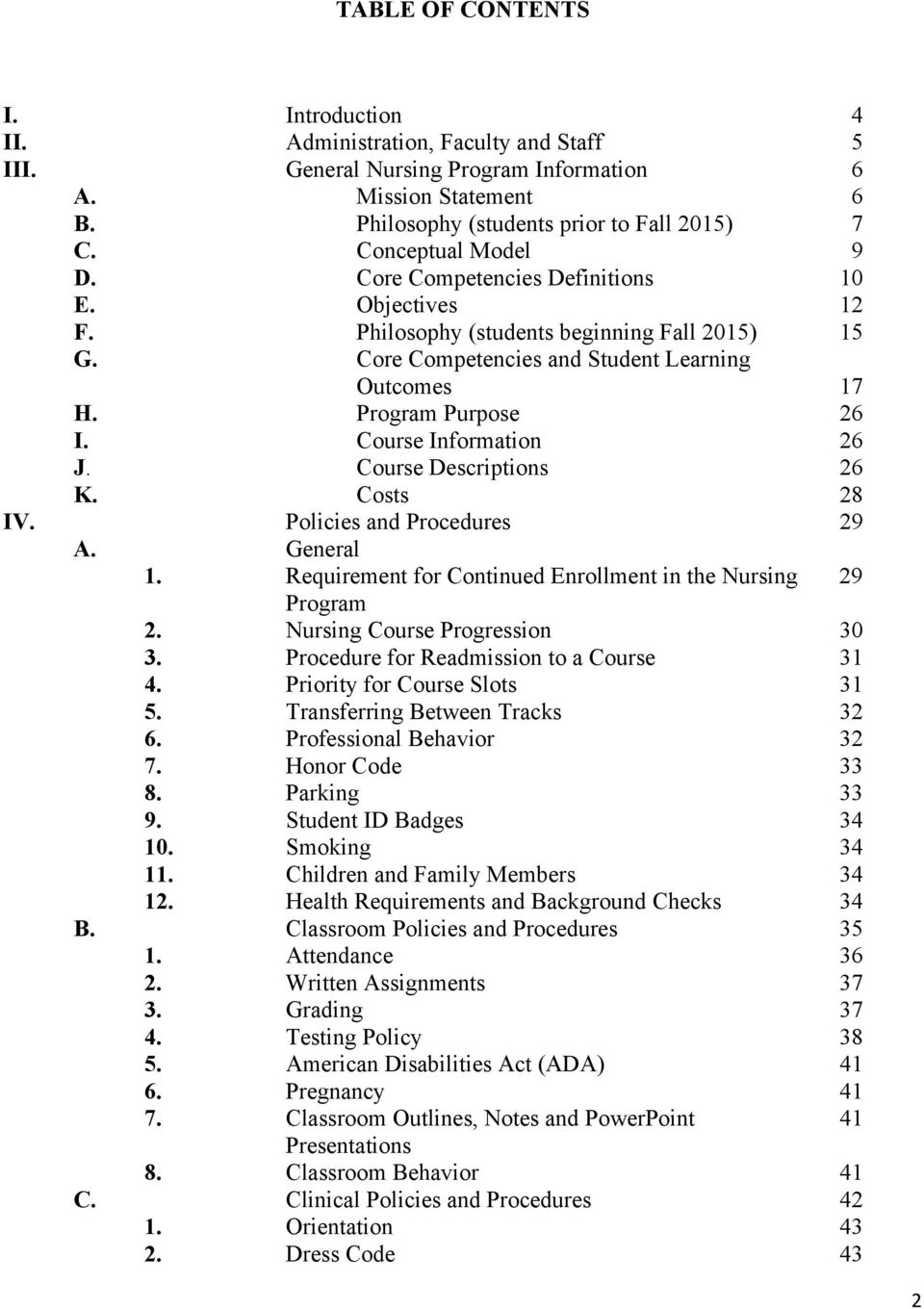
3 3. Assumption of Risk Administration of Medications in Clinical Practice Clinical Evaluation Laboratory and Clinical Rotations Essential Functional Abilities Nursing Skills and Simulation Labs Support Services Alcohol, Tobacco and Drugs Drug Screening Social Media 53 Closing and Emergency Procedures 53 V. Appendix 56 3
4 I. INTRODUCTION This handbook contains the policies and procedures specific to the John Tyler Community College Nursing Program. It is intended to be used by nursing faculty and students in conjunction with the John Tyler Community College Student Handbook and the John Tyler Community College Catalog. Nursing students may find additional information in the John Tyler Community College Student Handbook located at 4
5 II. ADMINISTRATION, FACULTY AND STAFF The Nursing Program is an associate degree program within the John Tyler Community College academic organization. The College is a member of the Virginia Community College System. A. The following describes the administrative structure for the Nursing Program: 1. Administration John Tyler Community College President Vice President Learning and Student Success Dean Division of Mathematics, Natural and Health Sciences 2. Nursing Director Full-Time Nursing Faculty Course Coordinator 3. Administrative Staff Nursing Administrative Assistant B. Chain of Command 1. Student chain-of-command for course-related issues Student Course Faculty Member (clinical faculty for clinical issue, course faculty for course issue) Course Coordinator Nursing Director Dean, Division of Mathematics, Natural and Health Sciences 2. Student chain-of-command for all other issues Student Course Faculty Member Course Coordinator Nursing Director Dean, Division of Mathematics, Natural and Health Sciences Vice President Academic Affairs 5

6 III. GENERAL NURSING PROGRAM INFORMATION A. Mission The nursing faculty accepts the mission of John Tyler Community College as a basis for the associate degree in Nursing Program. The faculty believes that nursing education should provide quality educational opportunities that inspire student success and community vitality. (JTCC Mission Statement). This is further affirmed in the vision of the college: A success story for every student. The nursing faculty fully supports this mission and vision based on a shared commitment to student success and community wellness. Faculty functions as nursing experts, facilitators of student learning, and role models in preparing students for the role of the professional registered nurse. Consistent with the College s mission and vision statements, the faculty embraces teaching/learning as the central focus of our program to prepare students to fulfill the competency outcomes for health care practitioners. These recommendations support: Care for community's health Expand access to effective care Provide evidence-based, clinically competent care Understand the role and emphasize primary care Ensure cost-effective and appropriate care Ensure care that balances individual, professional, system and societal needs Practice prevention and wellness care Involve patients and families in the decision-making processes Promote healthy lifestyles Assess and use communications and technology effectively and appropriately Improve the healthcare system operations and accountability Understand the role of physical environment Exhibit ethical behaviors in all professional activities Manage information Accommodate expanded accountability Participate in a racially and culturally diverse society Continue to learn and to help others to learn 6

7 B. Nursing Program Philosophy and Student Learning Outcomes (Current Philosophy for students prior to Fall 2015) The following statements are the faculty s beliefs regarding the nature of the client, health, nursing, the rationale for the teaching-learning process, nursing education, and the role of the associate degree nurse within the scope of nursing practice. We believe the client: may be an individual, family or a group of persons in the community who share a common need. should be active participants of the health care team. is influenced by his/her stage of development, life experiences, and interactions with others and within his/her environment. have physiologic, psychosocial, cultural and spiritual needs, the fulfillment of which is essential to maintain his/her sense of well-being. These physical, social, emotional, intellectual, cultural and spiritual needs can be described further by applying Maslow s Hierarchy of Needs within the context of the nursing process. We believe health: is the individual's state of being, relative to the ability to meet needs within the environment. exists as a response to wellness or illness that may co-exist for a client at any given point in time. may require intervention to promote wellness or to assist the client in satisfying needs throughout illness and rehabilitation. is encompassed by the following statement by Virginia Henderson: The unique function of the nurse is to assist the individual, sick or well, in the performance of those activities contributing to health or its recovery (or to a peaceful death) that the person would perform independently if he had the necessary strength, will or knowledge, and to do this in such a way as to help him gain independence as rapidly as possible (Virginia Henderson, 1966, p. 15). Wellness represents a dynamic state in which the individual is successful in meeting these needs. Illness occurs when the individual is unable to meet one or more of these needs. We believe nursing: is a humanistic art, which focuses on the interpersonal interactions between the nurse and the client. is a science based on a specific body of knowledge, derived from research in the biophysical and psychosocial sciences. is based on a body of knowledge that is the essence of nursing and does not change with the setting or role but rather serves as the foundation for each role and the care provided, regardless of educational preparation (Assumptions, NLN, 2000). is a professional discipline where the nursing process is used as a basis for decisions, where the nurse establishes and analyzes a data base, identifies health-care needs, elects 7
8 nursing diagnoses, sets client-centered goals, plans and implements care to achieve the goals and evaluates client outcomes to facilitate the individual's attainment of optimal health. (NLNCADNCTF, 2000). is a holistic discipline and that through the application of these principles and the nursing process, the nurse responds holistically in assisting the client in meeting needs throughout the lifespan. appreciates the influence of culture in the client s life and is committed to minimizing the negative responses of health-care providers to these differences. We believe teaching/learning: is a sequential process of acquiring knowledge leading to measurable changes in behavior. supports the learner s maximum potential when an effective teaching/learning environment is cultivated. is built upon preexisting knowledge and experiences to continually increase depth of understanding. occurs through interaction between peers, between student and faculty, and between student and preceptor. is built upon interactions between the student and the teacher who assists the student in acquiring the knowledge, the ability to think critically, and the skills necessary for beginning nursing practice. can be achieved successfully through multi-modal methods delivered in both synchronous and asynchronous environments. is the major focus of faculty efforts achieved by: the faculty serving as role models of professional behavior as well as creating an environment that addresses the individual learning needs of a diverse body of students. providing opportunities and resources to facilitate the acquisition and application of knowledge and skills. active student involvement in the learning process and acceptance of responsibility for learning and the attainment of identified goals. We believe associate degree nursing education: prepares an individual to provide cost-effective, direct nursing care for clients within an organized system of health care. takes place in an institution of higher learning where general education courses are offered along with nursing courses. incorporates concepts that allow the student to develop a base of understanding of the individual client and the relationship within the family, groups, and the community. 8

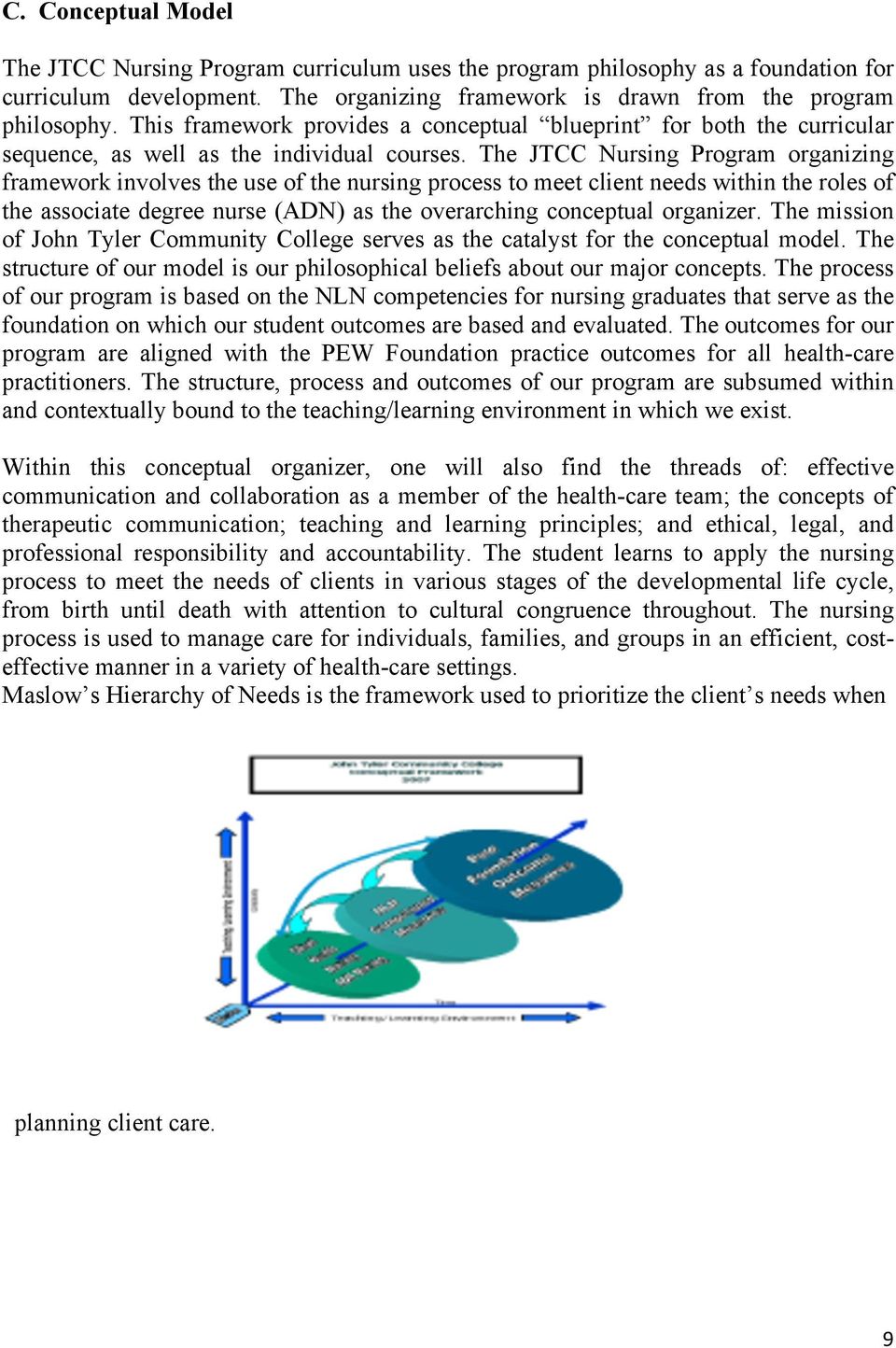
9 C. Conceptual Model The JTCC Nursing Program curriculum uses the program philosophy as a foundation for curriculum development. The organizing framework is drawn from the program philosophy. This framework provides a conceptual blueprint for both the curricular sequence, as well as the individual courses. The JTCC Nursing Program organizing framework involves the use of the nursing process to meet client needs within the roles of the associate degree nurse (ADN) as the overarching conceptual organizer. The mission of John Tyler Community College serves as the catalyst for the conceptual model. The structure of our model is our philosophical beliefs about our major concepts. The process of our program is based on the NLN competencies for nursing graduates that serve as the foundation on which our student outcomes are based and evaluated. The outcomes for our program are aligned with the PEW Foundation practice outcomes for all health-care practitioners. The structure, process and outcomes of our program are subsumed within and contextually bound to the teaching/learning environment in which we exist. Within this conceptual organizer, one will also find the threads of: effective communication and collaboration as a member of the health-care team; the concepts of therapeutic communication; teaching and learning principles; and ethical, legal, and professional responsibility and accountability. The student learns to apply the nursing process to meet the needs of clients in various stages of the developmental life cycle, from birth until death with attention to cultural congruence throughout. The nursing process is used to manage care for individuals, families, and groups in an efficient, costeffective manner in a variety of health-care settings. Maslow s Hierarchy of Needs is the framework used to prioritize the client s needs when planning client care. 9
10 D. Core Competencies Definitions 1. Professional Behavior Professional behaviors within nursing practice are characterized by a commitment to the profession of nursing. The graduate of an associate degree nursing program adheres to standards of professional practice; is accountable for her/his own actions and behaviors; and practices nursing within legal, ethical, and regulatory frameworks. Professional behaviors also include a concern for others, as demonstrated by caring, valuing the profession of nursing, and participating in ongoing professional development (NLN, 2000). 2. Communication Communication in nursing is an interactive process through which there is an exchange of information that may occur verbally, non-verbally, in writing or through information technology. Those who may be included in this process are the nurse, client, significant support person(s), and other members of the health-care team and community agencies. Effective communication demonstrates caring, compassion, and cultural awareness, and is directed toward promoting positive outcomes and establishing a trusting relationship. Therapeutic communication is an interactive verbal and non-verbal process between the nurse and client that assists the client to cope with change, develop more satisfying interpersonal relationships, and integrate new knowledge and skills (NLN, 2000). 3. Assessment Assessment is the collection, analysis and synthesis of relevant data for the purpose of appraising the client's health status. Comprehensive assessment provides a holistic view of the client, which includes dimensions of physical, developmental, emotional, psychosocial, cultural, spiritual, and functional status. Assessment involves the orderly collection of information from multiple sources to establish a foundation for provision of nursing care and includes identification of available resources to meet client needs. Initial assessment provides a baseline for future comparisons that can be made in order to individualize client care. Ongoing assessment and reassessment are required to meet the client's changing needs (NLN, 2000). 4. Clinical Decision Making Clinical decision making encompasses the performance of accurate assessments, the use of multiple methods to access information, and the analysis and integration of knowledge and information to formulate clinical judgments. Effective clinical decision making results in finding solutions, individualizing care and assuring the delivery of accurate, safe care that moves the client and support person(s) toward positive outcomes. Evidence -based practice and the use of critical thinking provide the foundation for appropriate clinical decision making (NLN, 2000). 10
11 5. Caring Interventions Caring interventions are those nursing behaviors and actions that assist clients in meeting their needs. These interventions are based on a knowledge and understanding of the natural sciences, behavioral sciences, nursing theory, nursing research and past nursing experiences. (Caring is the "being with" and "doing for" that assist clients to achieve the desired results.) Caring behaviors are nurturing, protective, compassionate and personcentered. Caring creates an environment of hope and trust, where client choices related to cultural values, beliefs and lifestyle are respected (NLN, 2000). 6. Teaching and Learning Teaching and learning processes are used to promote and maintain health and reduce risks and are implemented in collaboration with the client, significant support person(s) and other members of the health-care team. Teaching encompasses the provision of health education to promote and facilitate informed decision making, achieve positive outcomes, and support self- care activities. Integral components of the teaching process include the assessment of the level of readiness to learn, prior knowledge and how a client learns best, transmission of information, evaluation of the response to teaching, and modification of teaching based on identified responses. Learning involves the assimilation of information to expand knowledge base, which results in behavior change (NLN, 2000). 7. Collaboration Collaboration is the shared planning, decision making, problem solving, goal setting, and assumption of responsibilities by those who work together cooperatively, with open professional communication. Collaboration occurs with the client, significant support person(s), peers, other members of the health-care team, and community agencies. The nurse participates in the team approach to holistic, client-centered care across health-care settings. The nurse functions as advocate, liaison, coordinator and colleague as participants work together to meet client needs and move the client toward positive outcomes. Collaboration requires consideration of client needs, priorities and preferences, available resources and services, shared accountability, and mutual respect (NLN, 2000). 8. Managing Care Managing care is the efficient, effective use of human, physical, financial and technological resources to meet client needs and support organizational outcomes. Effective management is accomplished through the processes of planning, organizing, directing and controlling resources. The nurse, in collaboration with the health-care team, uses these processes to assist the client to move toward positive outcomes in a cost efficient manner, to transition within and across health-care settings, and to access resources (NLN, 2000). 11

12 E. Objectives Program (223) #1: Demonstrate use of the nursing process to meet multiple health needs for groups of adults and children in a variety of health care settings. 111: Demonstrate the use of the nursing process to meet selected health needs for an adult client in long term and acute care settings. 226: Demonstrate the use of the assessment step of the nursing process to assess health needs of clients in a variety of settings. 221: Demonstrate the use of the nursing process to meet selected health needs of adult clients in an acute care setting. 245: Demonstrate the use of the nursing process to meet the selected health needs of childbearing and childrearing individuals and families in a variety of health care settings. 246: Demonstrate the use of the nursing process to meet the selected health needs of children in a variety of health care settings. 247: Demonstrate the use of the nursing process to meet the selected psychiatric-mental health needs of individuals, families, and groups in a variety of health care settings. 254: Describe selected models used to provide care in a variety of health care settings. Program (223) #2: Integrate nursing skills when caring for a group of clients with multiple physiological and/or psychosocial needs. 111: Perform nursing skills to meet basic health needs of an adult client. 226: Perform guided health histories and physical examinations to assess health needs of normal adult clients. 221: Perform specific nursing skills to meet selected health needs of adult clients. 245: Perform specific nursing skills to meet the health needs of childbearing and childrearing individuals and families. 246: Perform specific nursing skills to meet the needs of children and families. 12

13 247: Perform specific nursing skills to meet the psychiatric-mental health needs of individuals, families, and groups. Program (223) #3: Communicate therapeutically with individuals, families, and groups. 111: Demonstrate the use of effective communication techniques in selected situations. 226: Demonstrate the use of interviewing communication skills when performing health assessment. 221: Distinguish between therapeutic and non-therapeutic communication with an adult client. 245: Communicate therapeutically with childbearing and childrearing individuals and families. 246: Communicate therapeutically with children and families. 247: Communicate therapeutically with clients in individual and group formats. Program (223) #4: Synthesize and communicate relevant data in a comprehensive and concise manner, orally, in writing, and through information technology. 111: Report selected data orally, in writing, and through information technology. 226: Record health histories and assessments of selected systems 221: Report relevant data orally, in writing, and through information technology. 245, 246: Report relevant data in a comprehensive and concise manner orally, in writing, and through information technology. 247: Report relevant information in a comprehensive and concise manner orally, and in writing. Program (223) #5: Integrate health teaching in the care of individuals, families, and/or groups in a variety of settings. 111: Recognize the role of the nurse as a teacher. 226: Identify the opportunities for health teaching while performing health assessments. 221: Identify the opportunities for health teaching while in the acute care setting. 13
14 245: Implement individualized health teaching in collaboration with other members of the heath care team to meet the needs of childbearing and childrearing individuals and families. 246: Implement individualized health teaching in collaboration with other members of the health care team to meet the needs of children and families. 247: Implement individualized health teaching in collaboration with other members of the health care team to meet the needs of clients with psychiatric-mental health needs. Program (223) #6: Integrate ethical values and legal principles into the delivery of nursing care. 111: Identify a personal value system and ethical/legal aspects involved in the practice of nursing. 226: Recognize the relationship of a personal value system to ethical/legal issues when performing health assessments. 221: Recognize the relationship of a personal value system to ethical/legal issues in nursing. 245, 246: Practice nursing in a legal and ethical manner. 247: Practice psychiatric-mental health nursing in a legal and ethical manner. Program (223) #7: Utilize management skills and concepts to plan and coordinate cost effective care for a group of clients in a variety of health care settings. 111: Organize selected aspects of nursing care for an adult client in long term and acute care settings. 226: Organize the skills of history taking and head to toe physical assessments. 221: Organize the nursing care for two adult clients with selected health needs in the acute care setting. 245: Organize nursing care for childbearing and childrearing individuals and families in a variety of health care settings. 246: Organize nursing care for children and families in a variety of health care settings. 247: Organize nursing care for clients with psychiatric-mental health needs in a variety of health care settings. 14
15 Program (223) #8: Assume the role of the Associate Degree nurse as a member of the health care team. 111: Identify roles and responsibilities of nurses. 226: Recognize the role of the Associate Degree nurse in health assessment. 221: Recognize differences in roles and responsibilities among nurses with varying educational preparation. 245, 246: Discuss the roles and responsibilities of nurses with varying educational preparations in a variety of health care settings. 247: Discuss the roles and responsibilities of nurses with varying educational preparations in a variety of health care settings. Program (223) #9: Assume accountability and responsibility for own actions as a contributing member of the health care team, the nursing profession, and society. 111: Assume accountability and responsibility for own actions. 226: Assume accountability and responsibility for own actions. 221: Assume accountability and responsibility for own actions as a member of the nursing team. 245, 246: Assume accountability and responsibility for own actions as a member of the health care team. 247: Assume accountability and responsibility for own actions as a member of the health care team. (To Begin Fall 2015) F. New John Tyler Community College Nursing Program Philosophy The mission of John Tyler Community College is to provide quality educational opportunities that inspire student success and community vitality. This is further affirmed in the vision of the college: A success story for every student. The nursing faculty fully supports this mission and vision based on a shared commitment to student success and community wellness. Faculty functions as nursing experts, facilitators of student learning and role models in preparing students for the role of the professional registered nurse. 15

16 The nursing faculty incorporates the principles of excellence, caring, diversity, integrity, and social responsibility as core values in the nursing program. A conceptual approach to learning has been adopted by faculty as they seek to foster active learning and an integration of concepts across developmental levels and clinical specialties as the basis for future nursing care. Teaching conceptually focuses on generalities (concepts) and then applying this information to specifics (exemplars). Definitions of Core Values Excellence Excellence is the continual quest for improvement in all aspects of teaching and learning. The quest for excellence requires continual and ongoing appraisal of practices in the teaching/learning environment to sustain safe, effective, and efficient outcomes at all stages of the curriculum. A culture of excellence reflects a commitment to clinical excellence, effective use of clinical reasoning, inter-professional collaboration, and evidence-based nursing practice. The faculty value life-long learning as a foundation for excellence in nursing practice. Excellence reflects a commitment to continuous growth, improvement and understanding (NLN, 2010). The learning environment should inspire a spirit of inquiry, curiosity, confidence, and learner accountability. Faculty strive to create a learning environment where faculty and learners collaborate to explore, critique, enhance and co-create new knowledge that supports safe, evidence-based, professional nursing practice. Caring Nursing is a caring profession that promotes health, healing and hope in response to the human condition (NLN, 2010). The discipline of nursing encompasses respect, dignity, and personal choice. The nursing professional provides holistic care that includes hope, humility, and spirituality to assist the individual, family and community in achieving an optimal level of functioning. Faculty provides support for students through mentoring, interactive learning, and recognition of various learning styles. Diversity Faculty values a culture of diversity that embraces acceptance and respect (NLN, 2010). Diversity builds on the foundation of holistic caring and recognition of the strengths of each individual based on their differences. Faculty respects the individuality of students by recognizing and supporting each student s unique qualities, varying backgrounds, skills, and learning styles. Faculty provides student-learning experiences in a wide variety of settings to foster positive attitudes and competencies needed to provide care for diverse populations in a changing world. Integrity A culture of personal, professional and academic integrity is evident when organizational principles of open communication, ethical decision-making, and humility are encouraged, expected, and demonstrated consistently (NLN, 2007). Integrity is demonstrated through 16

17 respectful interaction with peers and students, fairness and equity in decision-making, and accountability for personal actions. Accountability and advocacy in providing patient-centered care is emphasized throughout the curriculum. Social Responsibility The nursing program has a social responsibility to the college, community and the profession to graduate the highest caliber entry level professional to meet the healthcare needs of the community. Social responsibility also incorporates developing and sustaining partnerships that are critical to the program. It includes participation in organizational activities that benefit the college, community and the profession. The program seeks to foster a lifelong commitment of service to the profession and the community. G. Core Competencies and Student Learning Outcomes 1. Patient-Centered Care Outcome: Provide quality, safe, patient-centered nursing care through evidencebased practice to diverse populations across the lifespan. This outcome focuses on the many aspects of the nurse/patient relationship and integrates the work of the QSEN group derived from the IOM studies (Finkelman & Kenner, 2009). Safety is a major concept and is based on QSEN documentation as well as the NCSBN's Nursing Pathways for Patient Safety (Benner, Malloch & Sheets, 2010). The importance of patient-centered care is addressed by the lnstitute of Medicine (2010) stating that many systems are designed to meet the needs of providers. "True patient- and family-centered care will focus on the whole patient, putting the patient, family, and care team together as a system" (2010). This outcome also relates to two of NLN's Competencies for graduates (2010): "Advocate for patients and families in ways that promote their self-determination, integrity, and ongoing growth as human beings" (2010), and "implement one's role as a nurse in ways that reflect...a nurse committed to evidence-based practice, caring, and advocacy, and safe, quality care for diverse patients within a family and community context (2010). This outcome also embraces the major categories of content presented in the NCLEX-RN test plan. The ANA's (2010) Nursing: Scope and Standards of Practice are applied when planning quality, patient-centered nursing care. The Virginia Board of Nursing (VABON Regulations, 2011) requires that nursing curriculum incorporate concepts of client-centered care that include: respect for cultural differences, promotion of healthy lifestyle for clients and populations, promotion of a safe client environment and prevention and appropriate response to situations of bioterrorism and domestic violence. The National Council of State Boards of Nursing's Transition to Practice Model includes patient-centered care and evidence-based practice as necessary content to be learned for safe patient care for RN graduates (NCSBN.org, 2012). Major concepts for this learning outcome include: 17
18 The nursing process (assessment, diagnosis, goals/outcome criteria, interventions, and evaluation) Patient teaching Patient-centered care Evidence-based practice Quality measures Caring Safety categories and their subcategories: Safe and effective care environment Health promotion and maintenance Psychosocial integrity Physiological integrity Competencies 1. Perform holistic assessment of patient including eliciting patient values, preferences, expressed needs, and impact of developmental, emotional, cultural, religious, and spiritual influences on the patient's health status. 2. Plan nursing care strategies to provide psychosocial integrity, physiological integrity, and health promotion and maintenance within a variety of healthcare systems. 3. Provide patient-centered care with sensitivity and respect for the diversity of the human experience. 4. Safely and competently perform all nursing interventions within the healthcare microsystem. 5. Evaluate the effectiveness of care provided in meeting patient outcomes and modifying the plan of care. 6. Use quality measures when evaluating effects of nursing interventions. 7. Demonstrate caring behaviors towards the patient and the patient's support network. 8. Utilize therapeutic communication skills when interacting with patients and the patient's support network. 9. Evaluate own level of communication skills in encounters with patients, families, and other healthcare providers. 10. Communicate information about care provided and evaluation data including appropriate handoff at each transition in care. 11. Assess learning needs, develop teaching plans, implement necessary teaching, and evaluate effectiveness of teaching to achieve desired learning outcomes. 12. Plan, implement, and evaluate evidence-based care based on the components of research evidence, clinical expertise, and patient/family values. 2. Quality improvement and Safety Outcome: Participate in patient safety through understanding system effectiveness and individual performance. 18

19 This outcome focuses on the many variables which impact patient care, safety and outcomes. Quality improvement and patient safety are recognized as critical components of patient care (QSEN, IOM and NCSNB). According to the IOM (2011) report "the majority of medical errors result from faulty systems and processes, not individuals." It is critical to the safe practice of nursing for the student nurse to be able to recognize challenges and barriers to safe patient care and best practices by both facilities and health care providers to ensure positive client outcomes. This includes an understanding of the use of data which may be used as a foundation to improve change. Major concepts for this learning outcome include: Interdisciplinary patient care Communication skills Nurse/patient Nurse/family Nurse/disciplines System organization related to patient care Monitoring patient outcomes and impact of: individual Performance system effectiveness Safety enhancement in system Best/safe practices vs. shortcuts/risky practices Competencies: 1. Describe common quality measures available in healthcare settings. 2. Analyze strengths and limitations of common quality improvement methods 3. Identify and discuss sources of patient outcome data, which may be used as a foundation to implement change in Patient care. 4. Describe systems issues; human factors and environmental factors that may impact patient care outcomes. 5. Utilize evidence-based practices, best care practices and commonly accepted practices to improve Patient care outcomes. 6. Identify barriers to safe clinical practice. 3. Clinical Judgment Outcome: Implement effective clinical judgment based on evidence-based nursing practice that promotes the health of patients, families and the community. Clinical judgment refers to the process of observing, interpreting, responding and reflecting situated within and emerging from the nurse's knowledge and perspective (Tanner, 2006). The NLN Competencies (2010) include nursing judgment as one of the graduate competencies of educational programs in nursing. Nursing judgment 19

20 encompasses the three processes of: critical thinking, clinical judgment and the integration of best evidence into practice (NLN, 2010). Nurses use the nursing process as outlined in the ANA Scope and Standards of practice (2004) in the provision of care to patients, families and the community. This outcome also embraces several of the learning objectives included in the NCSBON Transition to Practice modules (2010). These objectives relate to making sound clinical decisions, recognizing changes in patient status, anticipating patient outcomes based on the analysis of responses to nursing interventions, prioritization of patient care and the evaluation of the effectiveness of patient-centered care. Clinical judgment is situated in a practice setting in which the nurse must utilize knowledge from nursing science and the basic sciences in the interpretation of data. Also included are specific patient concerns, sensitivities to patient care interventions and the context of the work environment (Benner et al, 2009). Major concepts for this learning outcome include: Critical thinking Clinical decision-making Priority setting Evidence-Based Practice Nursing Process Nurse Sensitive Quality Indicators Self-reflection Microsystems NCLEX-RN categories and subcategories: Health Promotion and Maintenance Competencies: 1. Incorporate the natural and social sciences as well as nursing science in the care of patients, families and the community. 2. Systematically gather, retrieve and analyze the relevance of data from a variety of sources. 3. Recognize changes in patient status and intervene appropriately. 4. Plan patient-centered nursing interventions that include patient preferences and consider the diversity and uniqueness of the individual. 5. Evaluate nursing care outcomes through data acquisition allowing for the revision of actions and goals. 6. Demonstrate sound clinical judgments when prioritizing patient care. 7. Engage in reflective thinking for the purpose of improving nursing practice. 8. Integrate evidence-based practices in the delivery of patient care. 4. Professionalism Outcome: Integrate management principles and legal\ethical standards of care into the professional nursing role. 20
21 The Virginia State Board of Nursing (2011) regulations, the American Nursing Association Code of Ethics (2001), and the National Councils of State Boards of Nursing Transition to Practice model (2010) were used to support multiple aspects of legal-ethical expectations of nurses to their patients, institutions, the community-at-large, and themselves. As defined by the American Nursing Association (2001), nurses have a duty to remain consistent with personal and professional values. Nurses must be clear on their own value system and how their personal values intersect their responsibilities with patient care, state standards, and institutional policies and procedures. According to the Virginia Board of Nursing (2011) nurses receive education regarding professional responsibility, concepts of ethics and the vocational and legal aspects of nursing, regulations and sections of the Code of Virginia related to nursing, patient rights, and legal responsibilities in preventing patient abuse, neglect and abandonment (2011). The National Councils of State Boards of Nursing (2012) launched the Transition to Practice study to explore a national model to identify critical elements of new nurses which including their scope of practice, the state practice acts, and guidelines for maintaining licensure for nurses entering the profession. Delegation is another important aspect of legal responsibilities executed daily by registered nurses. As described by the Virginia Board of Nursing (2011) nurses will retain legal responsibility of patients through appropriate decision making and action of delegating to unlicensed assistive personnel. The Transition to Practice study (NCSBN, 2012) identifies important concerns about new nurses having the appropriate legal knowledge of state and institutional guidelines on delegating. Major concepts of this outcome include: Professional responsibility Personal values Patient confidentiality (HIPAA) Moral Integrity Leadership Patient rights Prevention of patient abuse, neglet, and abandonment Prevention of errors due to negligence Social responsibility Delegation Workplace responsibilities (Scope of Practice) NCLEX Blueprint categories and sub-categories: Safe and Effective Care Environment Advocacy Client Rights Confidentiality/Information Security Continuity of care Delegation Error Prevention 21
22 Establishing Priorities Ethical Practice Information Practice Legal Rights and Responsibilities Performance Improvement (Quality Improvement) Reporting of Incident/Event/Irregular Occurrence/Variant Supervision Competencies: 1. Integrate legal and ethical standards, as mandated by regulating agencies, to provide safe, quality patient care. 2. Apply appropriate agency standards when delegating to appropriate personnel. 3. Recognize and prevent systems errors that could cause harm and negligence to patients. 4. Assume responsibility and accountability for delivering safe patient care. 5. Synthesize legal and ethical standards for improved patient advocacy. 5. Informatics and Technology Outcome: Incorporate data, technology and information management systems to communicate, decrease error and support clinical judgment. Technology is changing how patients manage their own care as well as how care is managed in the health care arena. Health informatics is one of the QSEN competencies that are defined as, "the use of information and technology to communicate, manage knowledge, mitigate error, and support decision making." Nurses need new skills to use and contribute to the development of electronic health records, to find and evaluate the relevance of evidence to support decisions and to use data to solve patient and system problems. The National League for Nursing (NLN, 2OO8) position paper supports the "reform of nursing education to promote quality education that prepares a workforce capable of practicing in a health care environment where technology continues to increase in amount and sophistication." The American Nurses Association (ANA, 2OO8) expands on this definition to say "Nursing informatics facilitates the integration of data, information, and knowledge to support patients, nurses, and other providers in their decision-making in all roles and settings. This support is accomplished through the use of information structures, information processes, and information technology. The goal of nursing informatics is to improve the health of populations, communities, families, and individuals by optimizing information management and communication (ANA, 2008). Furthermore, a focus of the Technology Informatics Guiding Education Reform (TIGER) initiative is on the development of a nursing workforce capable of using electronic health records to improve the delivery of health care (TIGER, 2009). With the federal mandate for the adoption of all electronic health records by 2014, the overall goals of the TIGER initiative are timely and important. Major concepts for this outcome include: 22
23 Communication Documentation Informatics Clinical decision making supports Competencies: 1. Use health information technologies according to legal /ethical standards. 2. Seek education about how information is managed in care settings before providing care. 3. Use health information technology to support safe nursing practice. 4. Respond appropriately to clinical decision-making supports and alerts. 5. Value the nurse's role in the use of information technologies to support patient care. 6. Teamwork and Collaboration 6. Teamwork and Collaboration Outcome: Collaborate effectively with members of the interprofessional team and the Patient\family to provide safe, effective and coordinated care. This outcome focuses on the importance of effective teamwork and collaboration as a means to ensure positive patient outcomes and better coordination of care. The lack of teamwork and poor communication processes has been identified as a barrier to safe practice. According to the IOM (2003), miscommunication and poor working relationships contribute to 70% of adverse events in health care settings and effective teamwork is cited as the most important of its health care competencies in ensuring quality and safety. Furthermore, the IHI asserts that better understanding of the individual roles of the health care team will foster improved coordination of care and the use of consistent processes will provide the foundation of more unified multidisciplinary work (Lee, Rutherford and Peck, 2008). The Joint Commission named improved effectiveness of communication among caregivers as one of its National Patient Safety Goals for 2014, by establishing the goal of improving staff communication (Joint Commission, 2O14). As a result of several studies conducted by the IOM, the Robert Woods Johnson Foundation (RWJF) funded the Quality and Safety Education for Nurses (QSEN) project, which began in 2008 to meet the challenge of preparing future nurses who will have the knowledge, skills and attitudes (KSAs) necessary to continuously improve the quality and safety of the healthcare systems within which they work. A national advisory board identified six competencies, including teamwork and collaboration as essential curricular approaches to assure that future nursing graduates develop necessary competencies. Teamwork is one of the 6 integrating concepts identified by the NLN (2010) that nursing students must master to in order to be prepared to work in the complex environments and uphold high standards of care. According to the landmark publication, Outcomes and Competencies For Graduates Of Practical/Vocational, Diploma, Associate Degree, Baccalaureate, Master s Practice Doctorate, And Research Doctorate Programs in Nursing, "...it is important for nurses to understand the roles of professionals in other 23
24 health disciplines so that interdisciplinary collaboration can be most effective and collegial (2010)." While seemingly simple, teamwork is crucial to each of the 5 other concepts in the NLN Education Module and includes Communication and Teamwork as essential to workforce orientation for new graduates (NCSBN, 2012). Major Concepts for the learning outcomes: Communication Leadership Delegation Scope of practice Quality measures Patient-centered care (the family and patient are members of the healthcare team) Authority gradients Competencies: 1. Demonstrate the ability to clearly communicate and collaborate with the interprofessional team to ensure quality care and patient safety. 2. Describe own strengths, limitations, and values in functioning as a member of a team. 3. Integrate contributions of other individuals and groups in helping the patient and/or family achieve health goals. 4. Value the perspectives and expertise of all health team members. 5. Examine strategies for improving systems to support team functioning. 6. Function competently within own scope of practice as a member of the health care team. References Benner, P. E., Malloch, K., & Sheets, V. (Eds.). (2010). Nursing pathways for patient safety. St. Louis: Mosby Elsevier. Institute of Medicine. (2011). The future of nursing: Leading change, advancing health. Washington, DC: National Academy of Sciences. National Councils of State Boards of Nursing (2012). Transition to practice. Retrieved from National League for Nursing. (2010). Outcomes and competencies for graduates of practical/vocational, diploma, associate degree, baccalaureate, master s practice doctorate and research doctorate programs in nursing. New York: Author. Virginia Board of Nursing. (2011). Regulations governing the practice of nursing; Title of Regulations: 18 VAC et seq. Retrieved from 24
25 The National Council of State Boards of Nursing s Transition to Practice Competencies Model Level 1 Level 2 Level 3 Level 4 Demonstrate patientcentered Incorporate patient- nursing care centered nursing with across developmental multiple patients in levels with individuals complex care and families. environments. Recognize an understanding of patient-centered nursing throughout provision of basic care in acute and community settings. Provide quality, safe, patient-centered nursing care through evidence-based practice to diverse populations across the lifespan. Describe both human factors and system related factors that lead to unsafe practice. Define the components of clinical judgment and evidence-based practice that promote the health of patients, families and the community. Define legal/ethical standards that are part of professional nursing. Utilize the electronic health care record in the documentation of basic nursing care. Identify how quality improvement strategies and national safety initiatives can impact patient safety. Describe how effective clinical judgment is based on evidence-based nursing that promotes the health of patients, families and the community. Identify how management principles and legal\ethical standards of care are incorporated into the professional role. Identify how technology and information management are related to the quality and safety of patient Engage in and evaluate local quality improvement initiatives and participate in root cause analysis. Demonstrate effective clinical judgment based on evidencebased nursing practice. Evaluate how management principles and legal\ethical standards are used by the professional nurse in care of the patient. Apply technology and information management tools to support safe processes of care. Participate in patient safety through understanding system effectiveness and individual performance. Implement effective clinical judgment based on evidencebased nursing practice that promotes the health of patients, families and the community. Integrate management principles and legal\ethical standards of care into the professional nursing role. Incorporate data, technology and information management systems to communicate, decrease error and 25
26 Identify the role of the nurse and other members of the healthcare team in the provision of safe, effective and coordinated care. care. Examine and differentiate the role of the nurse and other members of the healthcare team in the provision of safe, effective and coordinated care. Evaluate the effectiveness of collaboration with members of the interprofessional team and the patient/family in the provision safe, effective and coordinated care. support effective clinical decisionmaking. Collaborate effectively with members of the interprofessional team, and the patient/family to provide safe, effective and coordinated care. Leveled Student Learning Outcomes Across the Curriculum H. Program Purpose The purpose of the nursing curriculum is to prepare students to become registered nurses capable of providing care for groups of clients with multiple health needs as well as providing guidance for auxiliary nursing personnel. Upon completion of the curriculum, the graduate will be eligible to take the examination leading to licensure as a registered nurse. Additionally, John Tyler Community College has articulation agreements with nine area Universities that offer the baccalaureate in nursing and graduates from the John Tyler Nursing Program are eligible for application to these programs for a seamless transition to the BSN. I. Course Information The Nursing Program is designed as a five-semester program, with general education courses taken in the first semester and as co-requisite courses with the nursing classes during subsequent semesters. Nursing courses are sequential, build upon content from previous courses (including non-nursing prerequisite college courses), and begin after all prerequisites are completed and the student is admitted to the Nursing Program. The nursing curriculum (courses with a NUR prefix) is a four-semester sequence. The traditional and hybrid distance education tracks usually do not include a summer session although some general education courses are offered during this time. Elective nursing courses may be offered in the summer for student enrichment, but these courses are not substitutes for required courses in the nursing sequence. Clinical assignments in all tracks are contingent upon faculty availability and suitable clinical experiences. Clinical assignments may include day, evening and/or weekend rotations. Students are advised to plan accordingly. J. Course Descriptions 26
27 1. NUR Nursing I 7 credits Introduces nursing principles including concepts of health and wellness and the nursing process. Develops nursing skills to meet the bio psychosocial needs of individuals across the lifespan. Includes math computational skills, basic computer instruction related to the delivery of nursing care, communication skills, introduction to nursing, health, the healthcare system, legal aspects of nursing care, diagnostic testing, assessment, teaching and learning, asepsis, body mechanics and safety, personal care, activity/rest, wound care, nutrition, elimination, oxygenation, fluid and electrolytes, pain control, medication administration, aging populations and pre/postoperative care. Provides supervised learning experiences. 2. NUR Health Assessment 3 credits Introduces the systematic approach to obtaining a health history and performing a physical assessment. 3. NUR 221 Second-Level Nursing Principles and Concepts I 9 credits Focuses on nursing care of individuals, families, and/or groups with multidimensional needs in a variety of settings. Uses all components of the nursing process with increasing degrees of skill. Includes math computational skills, basic computer instruction related to the delivery of nursing care and nursing care related to infectious, immunological, oncological, hematological, gastrointestinal, vascular, sensory, genitourinary, musculoskeletal, regulatory, endocrine, and women s health disorders, and pre/intra/postoperative care. Provides supervised learning experiences in college nursing laboratories and/or cooperating agencies. 4. NUR Maternal/Newborn Nursing 3 credits Develops nursing skills in caring for families in the antepartum-, intrapartum-, and postpartum periods. 5. NUR Parent/Child Nursing 3 credits Develops nursing skills in caring for both well and ill children in a variety of settings. Emphasizes theories of growth and development and the family as a unit. 27
28 6. NUR Psychiatric/Mental Health Nursing 3 credits Develops nursing skills in caring for individuals, families, and/or groups with mental health needs. Explores various treatment models, diagnostic categories, and rehabilitative measures. Note: NUR 245, NUR 246 and NUR 247 are taken in the third semester of the nursing sequence, but the rotations may not be sequential. 7. NUR 223 Second-Level Nursing/Principles and Concepts III 9 credits Focuses on nursing care of individuals, families, and/or groups with multidimensional needs related to medical/surgical disorders in a variety of settings. Uses all components of the nursing process with increasing degrees of skill. Includes math computational skills, basic computer instruction related to the delivery of nursing care; nursing care related to organ procurement; emergency care; and cardiac, respiratory, endocrine, vascular, burn, immunological, neurological, and hematological disorders. Provides supervised learning experiences in college nursing laboratories and/or cooperating agencies. 8. NUR Dimensions of Professional Nursing 1 credit Explores the role of the professional nurse. Emphasizes nursing organizations, legal and ethical implications, and addresses trends in management and organizational skills. Explores group dynamics, relationships, conflicts, and leadership styles. I. Costs 1. Tuition rates and fees are established by the State Board for Community Colleges and are subject to change (visit for current rates). 2. Students must purchase e-books, e-resources, uniforms, and skills kits for lab, as well as a blood pressure cuff and stethoscope. Students are also required to have an IPAD or similar mobile device for use in class, lab and clinical. The E-book package contains all the books needed for nursing classes. Testing packages and skills kits are smaller expenses purchased separately each semester. 3. Students are required to purchase a standardized testing and remediation package, which includes a comprehensive NCLEX review course in the last semester of the program. The cost of the testing package varies with each semester and is purchased prior to the start of each semester. 4. Students enrolled in the hybrid distance education track are required to have the 28
29 following equipment: Windows compatible hardware with 600 MHz processor or faster and 128 MB of RAM or greater Internet Explorer and Mozilla Firefox required 1024 x 768 or greater screen resolution High Speed Internet is preferred and strongly suggested Macromedia Flash Player, QuickTime, Real Player and other media platforms that can be downloaded free from the Internet Logitech Comfort Set Clear Chat headphones with inline mute function is preferred and strongly suggested Web camera 5. The Nursing Program extensively incorporates technology to support teaching/learning outcomes across the curriculum. All students are required to have a personal computer with the above specifications OR have access to one (on-campus libraries and computer labs, for example). Students are required to have (at a minimum) a headset microphone for access to recorded lectures, study sessions and synchronous web-based activities. A. General Policies and Procedures IV. POLICIES AND PROCEDURES 1. Requirement for Continued Enrollment in the Nursing Program a. The Nursing Program is a full time commitment and once enrolled in the program students are expected to maintain a full time course load. Students must complete the Nursing Program within five years of starting NUR 111. b. Students may not step out of the program for longer than two consecutive academic semesters and upon return must be able to complete the remainder of the program within the five-year period as stated above. Summer session is not considered an academic semester in the nursing program. Documentation will be placed in student s file. Students returning to the program will be required to complete additional health requirements (drug screening/background check) at the time they reenter the program after an absence of one academic semester or more. c. NURSING 111. Students who earn a W, D or F in NUR 111 cannot continue in the JTCC Nursing Program. The student must reapply for admission. (Mitigating circumstances for this policy will be determined by the Director of Nursing). This is considered a reentry and the failure will count against the student as a course failure once the student is readmitted to the program. Students may reenter the program only one time in the first five (5) years. However, if a student has been 29
30 out of the program for five (5) years, they may reapply to reenter in NUR 111 and start the program from the beginning, regardless of where they had initially failed their second course. See the re-admission policy for withdrawal criteria and dates. 1. Students unsuccessful in NUR 111 have no priority for acceptance upon their reapplication to the Nursing Program. 2. The requirement for an overall GPA of 2.0 and a curricular GPA of 2.5 must be met and will be assessed by the Admissions Committee. The grade earned in NUR 111 and NUR 226 will be considered in calculating the overall GPA.. d. Students who fail two nursing courses in the nursing sequence (NUR 226, NUR111, NUR 221, NUR 245, NUR 246, NUR 247, NUR 223, NUR 254) or the same nursing course will be dismissed from the nursing program. Withdrawal of a course is not considered a failure. (Please note: this policy is more stringent than the College policy for Repeating a Course ) 2. Nursing Course Progression a. Each clinical course semester must be completed in its entirety in order to progress in the Nursing Program. 1. Students who withdraw from NUR 111 (Nursing I) are eligible to continue in NUR 226 (Health Assessment); however, students who withdraw from NUR 226 must also withdraw from NUR NUR 111 and NUR 226 must be completed successfully prior to beginning the second semester of the nursing sequence (NUR 221). 3. NUR 221 must be completed prior to beginning the third semester of the nursing sequence (NUR 245, NUR 246, and NUR 247). 4. All third semester nursing sequence courses (NUR 245, NUR 246 and NUR 247) must be completed prior to beginning NUR During the fourth semester of the nursing sequence, (NUR 223 and NUR 254), students that withdraw from NUR 223 are eligible to continue in NUR 254. b. Co-requisite courses not taken prior to admission into the nursing program must be completed as follows: 1. BIO 142 and/or BIO 232 must be completed either before or concurrently with NUR 111 and NUR 226. If a student fails BIO 142/BIO 232 or for any other reason does not complete the course successfully while in the first semester of the 30
31 nursing sequence, the student will be administratively withdrawn from the nursing sequence pending successful completion of the course. The student will make the appropriate course reapplication and will be readmitted contingent upon space availability as per the readmission policy (see below). 2. SOC 200 must be completed prior to the start of the specialty course sequence (NUR 245, NUR 256 and NUR 247). 3. HUM Elective must be taken before or concurrent with NUR ITE Elective must be completed prior to the start of NUR HLT Elective must be completed prior to the start of NUR Procedure for Readmission to a Course 2nd-4 th Semesters (following a withdrawal, inability to complete course requirements during the semester, stepping out for personal reasons with successful completion of prior courses, or a course failure). a. Students who withdraw within the published dates in the John Tyler schedule must complete the nursing readmission form prior to the semester they plan to return. The request for readmission will be logged in the Readmission book by the division administrative assistant. Readmission to the course will be on a space-available basis and per course readmission policy (see below). Students will be notified by the course faculty just prior to the start of the semester for which the student is reapplying. b. Students who are granted an academic incomplete will have until the end of the following semester to complete course requirements. At this point, they are considered active students and are placed in the next course sequence. Once the student completes course requirements, he/she will be eligible for graduation. c. Students failing a course must complete a readmission form, which will be logged in the Readmission book. Students will be admitted on a space-available basis according to the course readmission policy. d. Students who have been seated twice in the same nursing course and have not successfully completed the course are not eligible for a 3 rd attempt. A student is considered seated in a course if they remain in the course past the established add/drop period. After 2 seated attempts at a course, the student will be ineligible to progress and complete the program. 4. Priority for Consideration for Available Course Slots 2nd-4 th Semesters (actual numbers of available spaces for a course are dependent upon faculty and clinical site availability). The purpose of this policy is to provide a consistent, fair process to determine how students will be allowed to re-enter the program. This policy applies to all JTCC nursing students 31
32 regardless of the number of semesters they have been out of the program as long as the student meets readmission requirements and is within the timeframes specified above. a. If the number of spaces available for a course is equal to the number of students asking to re-enter, all students will be accepted to the course as long as they are eligible to do so. b. If the number of returning students exceeds spaces in a course, students will be allowed re-entry based on the following order: 1. Students who were successful in the previous course and have not attempted the course for which they are applying for re-entry. This includes students who have voluntarily delayed progression to the next course. 2. Students who have withdrawn after the drop period but before the deadline for withdrawal without academic penalty. 3. Students who have withdrawn with mitigating circumstances after the deadline for withdrawal without penalty. (Note that mitigating circumstances now require that the student be passing the course at the time of withdrawal.) 4. Students who earned a D on the previous course attempt. 5. Students who earned an F on the previous course attempt. If there are students who fall in the same priority category, preference will be given to the student with the least number of previous course failures. For students who are seeking to re-enter the 3 rd semester, preference will be given to students who need the least number of specialty courses to advance to the 4 th semester of the nursing sequence. c. For any other situation not specified above, the student will be considered last for any available space. d. Any student who re-enters a course after failure, withdrawal, or a delay in progression must meet with the Course Coordinator to discuss a formal plan for success upon re-entry. 5. Transferring Between Traditional and Hybrid Tracks Transfers between tracks are not permitted due to reporting and assessment requirements. Students who start a track are expected to complete the entire program in their chosen track. Students should think carefully about selecting the track in which they will be most successful. 32
33 6. Professional Behavior One s behavior reflects the qualities of the professional person, which include maturity, knowledge and skill, and a responsibility to self and others. John Tyler Community College Nursing Department aims to support nursing students in the development of professional abilities and attributes through experiences in clinical and academic settings. To provide a foundation for this development, students must adhere to approved standards of conduct/behavior and demonstrate patterns of clinical and academic performance which follow the legal and ethical codes of nursing; promote the actual or potential well-being of clients, other health care providers, and self; demonstrate accountability in preparation, documentation, and continuity of care; and show respect for the rights of individuals. In addition, students are expected to obey the law, to show respect for properly constituted authority, to perform contracted obligations, to maintain absolute integrity and high standards of individual honesty in academic work, and to observe a high standard of conduct within the academic environment. Commitment to the education process in the Nursing Program is a responsibility which is accepted by faculty and students. Accepting this responsibility means demonstrating fairness, honesty and dedication to truth. All members of the Nursing Program are obligated to adhere to the standards of ethical practice and conduct that are defined in the Code for Nurses by the American Nurses Association. The Code of Ethics for Nurses was developed as a guide for carrying out nursing responsibilities in a manner consistent with quality in nursing care and the ethical obligations of the profession. 7. Honor Code All nursing students are expected to follow the policy for Academic Dishonesty in the JTCC Student Handbook. The faculty of the nursing program mandate that a statement acknowledging the honor code be placed on assignments including tests, quizzes, and exams: On my honor, I pledge to do my work to the best of my ability without assistance from any external resources unless specifically permitted within the guidelines of the assignment or test/quiz/exam. With individual assignments and test/quiz/exams, I assert that no one else is completing this assignment or test/quiz/exam for me. I also pledge to report any breach of the honor code immediately. I pledge to uphold the ethical standards of the ANA Code for Nurses and the Professional Behaviors/Essential Functional Abilities required of all nursing students. Matters of integrity are considered very serious in the John Tyler Nursing Program. Due to the gravity of nursing practice regarding the care for patients and families and the potential harm that can result from breaches in moral conduct, the nursing program faculty reserve the right to consider immediate dismissal from the nursing program as an appropriate disciplinary action for students found guilty of academic dishonesty. 33
34 Please note: this interpretation and action is more stringent than the college policy as described in the JTCC College Catalogue, because of the serious consequences unethical conduct poses to patient safety and the public. In addition, students are expected to disclose any incidents of honor code violations, not doing so may also result in disciplinary action up to and including program dismissal. In the event of disciplinary action, the student has the right to file a grievance or to appeal the action. Grievance and appeal processes are described in the JTCC Student Handbook at 8. Parking Parking at the JTCC Nursing Education Center is in the parking spaces designated for JTCC only. All other spaces are owned by Surgical Associates and are not available for students during the hours of Monday Friday, 8:00 a.m. to 5:00 p.m. Students seen parking in non-designated spaces will be ticketed and asked to move their vehicles. Vehicles may be towed at the owner expense. Overflow parking is located in designated parking spots behind the office building on the JW Hospital campus. Students parking at the Nursing Education Center and in overflow parking spaces must have the current JTCC parking decal displayed in the rear window or bumper of the car. 9. Student ID Badges Student ID badges will be available after the first mandatory orientation. Student ID badges must be worn at all times in the Nursing Education Center and for every clinical session. If you do not have your ID badge, you will be sent home by your course instructor or the security officer. Students sent home for non-compliance may accrue a class or clinical absence. If students are sent home on a quiz day, the quiz may not be made up. If the student is sent home on a test day, the student will make up the test per syllabi requirements and will forfeit collaborative test points. 10. Smoking CJW Medical Center Campus, which includes the JTCC Nursing Education Center, is tobacco free. Students will need to leave campus to smoke. Students are not permitted to smoke anywhere on campus, including personal vehicles. Nursing students are not allowed to smoke while wearing the JTCC nursing student uniform. 11. Children and Family members 34
35 Children or family members are not permitted in the classrooms, computer labs, or clinical areas. Children under the age of 18 must be accompanied by an adult when in the Nursing Education Center. Family members are not allowed in the clinical area. 12. Health Requirements a. Students will maintain a certificate in American Heart Association CPR for health-care professionals. You may take the classroom portion of the certificate online, but the actual practice must take place in person on a manikin. The student must perform the skills with a certified instructor. The only approved card for CPR is the American Heart Association, Healthcare Provider CPR. There are many sites available in the Richmond area, use your search engine to locate one convenient for you. Sign your card before you submit it to Certified Background. b. Students must show evidence of a negative two-step PPD (tuberculosis) test. Students who test positive for PPD are required to have an initial chest x-ray that is negative for active TB. The student is required to have her/his primary care provider verify that no signs and symptoms of TB are present annually. The primary care provider must sign the form. If the student shows signs and symptoms of TB, the student is prohibited from attending class or clinical until the primary care provider verifies the absence of active TB disease. If the student is treated for active disease, the student will be withdrawn from the course and may return in the next semester in accordance with the return policy when the primary care provider verifies the absence of active disease. This will usually involve a chest-x-ray showing no evidence of the disease. While in the program you must have an annual one-step PPD or a TB Symptom Assessment Questionnaire completed. c. The CPR and TB requirements must be current and presented to course faculty at the beginning of each semester. If the annual TB requirement or CPR card expires during the clinical time frame for the semester, the student is required to show evidence of renewal prior to the expiration. Students will not be allowed to continue in the course if those requirements are not up-to-date. d. A negative urine drug screen and a successful background check are also required for admission into the program. The background check and urine drug screening is performed by an independent company not associated with JTCC and is part of the expense students are responsible for while in the program. Please note that students may be required at any time while in JTCC nursing program to complete another background check or urine drug screen if faculty deems necessary based on circumstances. Student must submit and continuation in the Nursing Program is contingent on successfully passing the background check and urine screen. Students who refuse may be dismissed from the JTCC Nursing Program and are ineligible to return to the program. Students are also responsible for notifying faculty of any change in their background check while attending the JTCC nursing program. Students who do not report changes are subject to 35
36 dismissal from the JTCC nursing program and may not be eligible to return to the program at any time. e. Students that opt out of the program for any duration must complete a criminal background check and drug screening before being allowed to re-enroll in the nursing program. This is a clinical agency requirement and must be successfully completed before the student may continue regardless of the academic semester the student entered the nursing program. f. Additional health requirements may be required as student s progress through the Nursing program including but not limited to: Physical examination: This must be completed within six months of starting classes. Immunizations: Mumps, measles, rubella, tetanus, diphtheria, varicella. Titers may be used to prove immunity. Caution *** this is often the most difficult item for students to complete. Begin early!! Hepatitis B: This is a series of three vaccinations. You must sign a declination form if you do not wish to have the series. You must sign a declination form if you are in the process of receiving the three vaccinations, but are not yet complete. Seasonal influenza vaccine: You must sign a declination form if you do not wish to receive the vaccine. You will be required to follow hospital policy when in clinical if you choose not to be vaccinated. This usually means you will be required to wear a mask when in close proximity to patients. This vaccine will not be available until September or October. Do not obtain the vaccine until that time, as you would be receiving the vaccine for the winter season. B. Classroom Policies and Procedures 1. Attendance a. Admission to the College requires that registration and the payment of tuition are accomplished within published timeframes. Failure to accomplish these activities may result in the student forfeiting their space in a class. b. Regular attendance of classes and laboratory sessions is required for all students registered in nursing courses. The Nursing Program adheres to the College s policy concerning class attendance. This states, When absence from a class becomes necessary, it is the responsibility of the student to inform the instructor prior to the absence whenever possible. The student is responsible for the subsequent completion of all study missed during an absence. JTCC attendance policy states the student may not miss more than 20 % of a course; each faculty member has the option of having a more rigorous attendance policy which is stated in the course syllabus. Frequent absences may result in administrative withdrawal from a class and the termination or reduction of veterans 36
37 benefits and other programs of financial assistance, (John Tyler Community College Catalog). It is the responsibility of the student to obtain missed content. Classroom and clinical absences are treated as separate occurrences; the percentage a student can miss is no more than 20 % of each component. For example, the student cannot miss 30 % of clinical and attend all classes to meet the attendance requirement. Course faculty may apply a more stringent attendance policy. Consult your syllabus at the beginning of each class for the attendance policy for that course. Participation and attendance for students in the hybrid distance education track and for all virtual/hybrid courses is defined in each course syllabus. Punctual attendance is required to class and clinical. Tardiness to class, lab and clinical is monitored, and the student will be counseled for consistent and/or repetitive tardiness. Students will accrue absences with excessive tardiness. See course syllabi for the absence and tardy policy specific to each nursing course. Hospitalization and subsequent discharge limitations may force the student to be unable to meet clinical requirements. These will be handled on a case-by-case basis. Students who are incarcerated are immediately withdrawn from the course. Following a resolution of the issue, the student will meet with the Nursing Director to discuss readmission. 2. Written Assignments Unless specified in the course syllabus, the following guidelines will apply: a. All written assignments are to be completed in current APA format and are due on the date specified unless prior arrangements have been made with the course coordinator. b. All written assignments should be on standard 8 ½ x 11 inch paper. Written assignments must be grammatically correct with no spelling errors. See assignment rubrics for penalties for poorly written work. c. Font size will be 12 if computer-generated, double spaced and only on one side of the page. New Times Roman, Arial or Calibri are appropriate fonts in black only. d. The source of paraphrased or quoted material must be within text citations. The undocumented use of another s work is considered plagiarism and constitutes grounds for unprofessional behavior and academic dishonesty. e. Written assignments are to be the student s original work and should be done independently without collaboration unless it is a group project. f. Printing and copying services are available at the Nursing Education Center in the student lounge. Services are available for students at the Chester and Midlothian campus libraries and are fee based. Consult the libraries on both campuses for appropriate costs. 3. Grading a. The grading scale for the nursing program is as follows: 37
38 A B C D F U S & below Unsatisfactory Satisfactory b. A point system is utilized to determine course grades. Points correspond to percentages for the award of the letter grade. The following guidelines apply in all nursing courses: 1. Students must earn a minimum grade of C in all nursing courses. 2. A clinical rating of satisfactory is required for all clinical courses and will result in a final grade that corresponds to the theory grade. 3. Students who are successful in both components of the course receive the letter grade earned in the theory portion. 4. Students who pass the theory component of the course but fail the clinical component of the course will earn a final course grade of D. 5. Students who fail the theory component of the course but pass the clinical component of the course will earn a final course grade of D if the theory grade is a D, or a final course grade of F if the theory grade is an F. 6. Students who fail both components of the course will earn a final course grade of F Students who stop attending the didactic course but may have completed the clinical component of the course will earn a final course grade of F. 8. Students who withdraw within the specified time will earn a grade of W. 9. Students who withdraw with mitigating circumstances must be passing the course at the time of withdrawal and will earn a grade of W. 10. Students who withdraw after the withdrawal period will earn the grade of F. 11. Students who fail a course must repeat both clinical and theory portions of the course if eligible to return. 4. Testing Policy All unit tests, midterms, and finals will be given in a proctored setting. Quizzes may be given either online or in the classroom (see section on quizzes for details). Students will not have access to their individual score until after all students have taken the test and test grades have been reviewed by faculty. Test results will be given to students through Blackboard or by course faculty. No test grades will be given over the phone or by e- mail. a. Test Taking 1. Missing a Test Students who must miss a test must contact the faculty member either by voice or prior to the start of the test. Failure to notify the faculty may result in a 38
39 grade of 0. Mitigating circumstances will be handled on a case-by-case basis and will be referred to the Course Coordinator. 2. Being Tardy for a Test Students who are late for a test will not be admitted to the classroom/testing center. The test make-up policy applies. 3. Make-Up Tests In the event that a make-up test is necessary, this test may be different from the initial test and may consist of multiple choice, fill in the blank, essay or any combination of testing strategies. Make-up tests must be completed within 7 calendar days of the missed test. Each course has the option of implementing a more rigorous make-up testing policy, see specific course syllabi for details. The student is responsible for contacting the course faculty and setting up a time to take the make-up test. In the case when collaborative testing is conducted, the student will forfeit the collaborative points for that test. See course syllabus for the number of make-up tests allowed in a specific course. 4. Quizzes Online or in-class quizzes may be given as noted in the course syllabus. These may be either scheduled or unannounced. Course syllabi will contain specific guidelines for quizzes. The student must notify the instructor if he/she has a problem accessing online quizzes. Students are responsible for acquiring a reliable computer before accessing an online quiz. If reliability is uncertain or if dial-up connections are used, it is strongly recommended that the student make arrangements to use on-campus computers. If the quiz for a student needs to be reset more than once, he/she will need to make an appointment with the instructor to take the quiz in a proctored setting. Faculty reserves the right to require proctored testing when students demonstrate a pattern of requesting quiz resets. Faculty also has the right to make a stricter policy. Failure to complete the online quiz within the timeline given may result in a grade of zero. b. Computer Testing Policy 1. Preparation Students are expected to be familiar with Blackboard testing. If time is needed for practice, this must be arranged with the instructor prior to testing. 2. Time Limit 39
40 NCLEX-style multiple choice and alternate format questions on test and quizzes in the Nursing Program are timed at 1.5 minutes per question. Short answer and essay questions will be timed at the discretion of the instructor. If a student goes over the time limit on a test, one point per minute will be deducted from the test grade. If the student is overtime by 20% or more of the allotted testing time, the test grade will be zero, without opportunity for make-up. See syllabus for specific timeframe of course tests. The specific timeframe for each test will be noted in the test instructions. Faculty reserve the right to use auto-submit. 3. Honesty Sharing of test content outside the testing room of any kind and the printing of any test material constitutes a violation of the honor code. Any consultation with another individual during the test is also a violation of the honor code. Violations will result in disciplinary action up to and including expulsion from the Nursing Program. Each test will contain an item in which the student verifies adherence to the honor policy. See the JTCC Student Handbook for Academic Honesty policies and review the ones contained in this document under Honor Code. Recognize that the nursing program actions regarding honor code violations are more rigorous than the college policy due to the high level of competence required for nursing practice and the danger to patient safety resulting from moral misconduct. 4. Test Availability Tests will be available only with instructor supervision during the scheduled time. Students should consult the course syllabus for the make-up policy if an absence is necessary. 5. Test Review Group reviews will be provided at the discretion of the instructor. While student attendance is optional, it is strongly recommended that students attend the review to obtain feedback. Students may make an appointment to review their individual test, quiz or final exam results. Students may make an appointment for up to two weeks following a test or one week following a quiz or final exam. 6. Test Submission If there is difficulty in submitting a question or submitting the test, students should notify the instructor immediately before exiting the test. Only the answers in the Blackboard test will be considered for grading. 7. Test Security 40
41 Test items will be presented one at a time. Returning to previously answered questions will not be allowed. Grade book access will be limited to the test score only and will be controlled by the course faculty. Simple, basic calculators will be provided for testing done at the Nursing Education Center. Students are not permitted to use personal calculators or cell phone calculators during testing. Students will not be allowed to leave the room or access the Internet while in the test room. Additional testing security procedures may be implemented at the discretion of the faculty. 8. Collaborative Testing After taking the individual proctored test the student must sign off the computer and remain in his/her seat until it is time for collaborative testing. The student may not leave the testing room or the computer. Students will be assigned to groups to re-take the test as a group. Students may discuss the questions within the group to arrive at and submit a group answer. No other resources are to be consulted. If the group grade is an A, two points will be given to each member of the group. If the group grade is a B, one point will be given. A grade of C or lower will earn no points. The lowest collaborative test grade will be dropped. See course syllabi or consult individual faculty for specific course policies. Please note that in certain circumstances, instructors reserve the right to give a paper test. In these testing situations, the above guidelines are applicable. 5. American with Disabilities Act (ADA) Students who have a documented disability need to register with Disability Support Services at the Midlothian Campus. This can be done by contacting Dr. Mark Miller at or by , [email protected]. Dr. Miller will determine required adjustments to meet the learning needs of the student. Only students who have completed the process may request adjustments in their classroom, testing and/or clinical environment. Students must meet the essential functional abilities with or without accommodation to be admitted to or continue in the Nursing Program. 6. Pregnancy While it is recognized that pregnancy is a normal condition, there are certain legitimate concerns regarding the pregnant student. Therefore, students who are pregnant are asked to complete a pregnancy waiver with their physician. If there are limitations, they must be documented. Pregnant students are required to meet all program objectives. (See Essential Functional Abilities). Should delivery occur while actively enrolled, the student must furnish a medical release provided by the physician prior to resuming classes and/or clinical. 7. Class Outlines, Notes and PowerPoint Presentations 41
42 Class outlines and notes may be available in specific courses. PowerPoint presentations are the intellectual property of individual faculty and may be available in narrated or un-narrated format. This is not a requirement of the faculty. Blackboard Collaborate sessions may be archived at the discretion of each faculty and available for student use. See course syllabi or consult individual faculty for specific course policies. 8. Classroom Behavior Only professional behavior will be accepted in the classroom. Disruptive behavior will result in the student being dismissed from the classroom. a. No children or family members are allowed in the class or clinical academic environment (see policy statements above). b. Students who are tardy will take the closest seat or wait for the break to enter the classroom to minimize disruption. c. No tape recorders are permitted in the classroom. Cell phones and pagers are to be muted and on vibrate only. The use of cell phones in classrooms or labs (including texting), unless in emergency situations is a violation of the student code of conduct. Students may be asked to leave the classroom if they are found to be in use during class. d. Personal computers or tablets can be used in the classroom for courserelated educational activities only. Electronic devices used in the classroom will be the sole responsibility of the student and must have the mute setting activated. No video or audio features on the personal computer or IPADS/mobile devices/cell phones may be turned on in classrooms or labs. Personal computers/ IPADS/ or cell phones will not be allowed in the classroom setting during testing. Students who are found in violation of this policy will forfeit the privilege of using the device and may be asked to leave the classroom. e. Students must meet the essential functional abilities requirements for admission to nursing classrooms. C. Clinical Policies and Procedures Students of nursing have a responsibility to society in learning the academic theory and clinical skills needed to provide nursing care. The clinical setting presents unique challenges and responsibilities while caring for human beings in a variety of health care environments. The Code for Nursing Students is based on an understanding that to practice nursing as a student is an agreement to uphold 42
43 the trust with which society has placed in us. The statements of the Code provide guidance for the nursing student in the personal development of an ethical foundation and need not be limited strictly to the academic or clinical environment but can assist in the holistic development of the person. A CODE FOR NURSING STUDENTS As students are involved in the clinical and academic environments we believe that ethical principles are a necessary guide to professional development. Therefore, within these environments we: 1. Advocate for the rights of clients 2. Maintain client confidentiality; 3. Take appropriate action to ensure the safety of clients, self, and others; 4. Provide care for the client in a timely, compassionate and professional manner; 5. Communicate client care in a truthful, timely and accurate manner; 6. Actively promote the highest level of moral and ethical principles and accept responsibility for our actions; 7. Promote excellence in nursing by encouraging lifelong learning and professional development; 8. Treat others with respect and promote an environment that respects human rights, values and choice of cultural and spiritual beliefs; 9. Collaborate in every reasonable manner with the academic faculty and clinical staff to ensure the highest quality of client care; 10. Use every opportunity to improve faculty and clinical staff understanding of the learning needs of nursing students; 11. Encourage faculty, clinical staff, and peers to mentor nursing students; 12. Refrain from performing any technique or procedure for which the student has not been adequately trained; 13. Refrain from any deliberate action or omission of care in the academic or clinical setting that creates unnecessary risk of injury to the client, self, or others; 14. Assist the staff nurse or preceptor in ensuring that there is full disclosure and that proper authorization is obtained from clients regarding any form of treatment or research; 15. Abstain from the use of alcoholic beverages or any substances in the academic and clinical setting that impair judgment; 16. Strive to achieve and maintain an optimal level of personal health; 17. Support access to treatment and rehabilitation for students who are experiencing impairments related to substance abuse and mental or physical health issues; 18. Uphold school policies and regulations related to academic and clinical performance, reserving the right to challenge and critique rules and regulations as per school grievance policy. 1. Orientation 43
44 Clinical faculty is responsible for orienting and coordinating the orientation of students to the facility. Students will complete required training and attestations prior to starting the clinical. Agencies may require initial orientation forms covering patient confidentiality, fire and safety, code of conduct and other facility specific policies. Students will provide proof of CPR certification, documentation of an annual flu shot, and current PPD/TST within one year on the first day of each clinical course as required by agencies. Students will not be allowed to enter the clinical area without this documentation. It is the student s responsibility to maintain annual testing and copies of these documents. All student health forms are maintained electronically by a third party provider. 2. Dress Code John Tyler nursing students are expected to conform to high standards of personal appearance and hygiene. Attire worn at the College should reflect a sense of dignity and professionalism. a. Students must be in full uniform, including their JTCC student ID badge, a watch with a second hand, bandage scissors, penlight and stethoscope during clinical hours in the affiliating agencies. Uniforms are required in the nursing skills lab unless otherwise specified by faculty. b. The student uniform consists of white uniform top with burgundy trim on the sleeves and burgundy pants or skirt. All uniforms should be clean and wrinkle free. Undergarments must be worn at all times, be of neutral color, and cannot be visible. The official John Tyler Community College Nursing Program patch should be sewn on the left upper sleeve of the top and lab coat. Lab coats are white and full length. c. Uniforms must be obtained from Meridy s Uniforms online at The pass code for JTCC students is JTCC429. Other supplies may be ordered, but only uniforms are required from this source. Assistance is provided at d. Uniforms should fit so that when the student bends forward, the bottom hem of the top covers the pants waistband in the back. Visible chest cleavage or tight clothing is not permitted. e. Students should wear white nurse s shoes or solid white or black leather athletic shoes with backs and no open holes. Shoes should be clean; canvas tennis shoes are not appropriate. Colors on the shoes are not acceptable. Sock colors must match shoe color. 44
45 Outside of the hospital clinical environment, uniforms should be covered by an appropriate white lab coat with the approved Nursing Program patches on the left sleeve. f. Hair must be natural for skin color (not red, blue, purple etc.), clean, neat and off the collar. All hair must be secured off the face and collar with an appropriate band or device and must be of a professional style (no Mohawks, shaved designs, etc.). g. Fingernails must be clean and kept short. Nail polish (including clear), gel, acrylic and or any other artificial nails are not permitted. h. Jewelry should be kept to a minimum. Wedding rings (band only) are acceptable. A single pair of small stud earrings worn in the lowest hole in the ear lobe(s) is acceptable. All other jewelry, including ear gauges, and spacers in any other pierced areas, is not permitted in the lab or clinical setting. i. Miscellaneous: 1. Perfumes, colognes, aftershave lotions, and other strong fragrances are not permitted while in uniform. Deodorant must be unscented or mild. 2. All visible tattoos must be kept covered. 3. Make-up must be discreet and natural in appearance. 4. All students must be clean, neat and free of odor. 5. Smoking in uniform is not permitted. 6. Drinking alcoholic beverages while in uniforms is forbidden. 7. Unprofessional language or actions while in uniform, class or clinical is unacceptable and can be grounds for dismissal from the program. 8. Gum is not permitted while in uniform. 9. Beards, mustaches and sideburns, if worn, must be neat, closely trimmed and meet facility policy for client safety. j. The dress code maybe modified during maternity, pediatrics, psychiatric, surgical or community rotations if instructed by the course faculty. k. When assigned to a clinical agency where the uniform is not required, the following guidelines apply: 1. Street clothes no jeans, tee shirts, tank tops, spaghetti straps, sweatshirts, provocative clothing, damaged or soiled clothing or stenciled writing. No sandals, flip flops or beach type foot wear. The same jewelry and tattoo regulations (above) apply. 2. Students will wear a lab coat with the approved Nursing Program patch on the left sleeve and display their John Tyler Community College Student ID badge. 3. Hair will be neat and simply styled. Long hair must be secured with an appropriate band or device. Clinical faculty reserve the right to dismiss students from the clinical area who are in violation of the dress code policy. If dismissed, the student accrues a clinical absence. 3. Assumption of Risk 45
46 Students are required to practice safely in the clinical and laboratory settings. Each student will read, understand and sign the Assumption of Risk form at the beginning of each semester denoting that the student assumes all of the risks inherent with clinical practice. This form will be maintained in the student file throughout the program. 4. Administration of Medications by Students in Clinical Practice a. In the clinical setting, all medications will be administered in accordance with the policies of the clinical facility. b. NUR 111 students will successfully complete the medication check off module(s) before administrating medications in the clinical setting. c. Students will be supervised by the clinical faculty or preceptor when preparing and administering medications. d. Students may not administer blood, blood products, or chemotherapy. Students may not obtain nor witness informed consent. Students may not take verbal or telephone orders except in NUR 223 during the preceptor experience where the student is directly supervised by the RN preceptor or faculty. 5. Clinical Evaluation a. Student performance in the clinical area will be formally evaluated each semester. See course syllabus or consult individual faculty for specific course policies. b. Students in NUR 111 must have a grade of 78 percent or better in the theory portion of the class to be allowed to enter the clinical area. Only course tests and quizzes will be used to determine eligibility to progress to clinical. c. In NUR 223, the student is required to be satisfactory in each clinical rotation phase prior to being eligible to progress to the next clinical rotation phase. d. Additionally, students are evaluated daily during clinical/lab. Students may receive an unsatisfactory for unacceptable professional behavior such as (but not limited to): being tardy, not pre-assessing (if required), not in correct uniform, not being prepared for clinical/lab. See specific course syllabus for details. e. A student may be denied continued enrollment in the course if, after reasonable accommodation, the clinical faculty concludes that he/she is unable to perform safe clinical practice. A final grade of satisfactory in the clinical area is required to pass the course. Further, students who are unable to perform the essential functions described below will be unable to attend clinical. If the student exceeds the absence policy for the course, the student will be withdrawn from the course. f. Being rested and well-prepared for clinical are essential to patient safety. Students are not allowed to work the prior 8 hours before the beginning of a clinical rotation. See specific course syllabus for details. 6. Laboratory and Clinical rotations 46
47 The student will receive clinical/lab experiences in a variety of settings. The hours and scheduling of clinical throughout the program may be adjusted according to faculty, clinical site, and preceptor availability. Clinical schedules may include day, evening, and nights. and/or weekend hours for any of the core nursing courses. Clinical courses may also include observational experiences and community service projects. Please refer to course syllabus for specific information regarding clinical hours, clinical preparation, and assignments and other important information. Exposure Guidelines a. Students must wear appropriate protective clothing/equipment when performing any task(s) that may involve exposure to body fluids. b. Any direct exposure to body fluids occurring while functioning as a nursing student must be reported immediately to the clinical instructor. Students exposed to body fluids shall follow this protocol: 1. Wash the area immediately with a disinfectant agent; for eye splashes rinse the area with clean water. 2. Report the incident to the clinical instructor. 3. The student should immediately go to an Emergency Department, Employee Health (if available), or Urgent Care to seek triage and treatment. The student is responsible for all costs related to exposure, triage, and treatment. 4. The clinical instructor and student will notify the agency department supervisor and Nursing Program Director and Dean. 5. The student, with faculty assistance, will complete an agency site occurrence report and the John Tyler Personal Injury Form. 6. Information from the U.S Department of Labor, Occupational Safety & Health Administration (OSHA) is available at: Please note students are responsible for any and all medical expenses related to any exposure or incident while in class, skills lab, simulation, or clinical. 7. Essential Functional Abilities All individuals who apply for and are students in the Nursing Program, including persons with disabilities, must be able to perform essential functions included in this document either with or without accommodations. These essential functions are congruent with the Virginia State Board of Nurse Examiners expectations of any individual seeking initial licensure as a registered nurse. Essential functions are the basic activities that a student must be able to perform. Any student applicant who has met the necessary prerequisites and who can perform the essential functions of the Nursing program, either with or without reasonable accommodations, will be considered for admission. A candidate must be able to perform the identified essential functions in a reasonably independent manner. The use of trained 47
48 intermediaries is not permissible, in that the candidate s judgment would be mediated by someone else s power of observation and selection. Essential function statements, which apply to students in the nursing program, are considered generic and applicable to all academic programs at JTCC, which are delineated by the nursing faculty of the Nursing Program reflecting the functional abilities essential for nursing practice identified by the National Council of State Boards of Nursing, Inc. (1996). The program objectives and essential functions of the Nursing Program are congruent with the following: The Criteria and Guidelines for the Evaluation of Baccalaureate and Higher Degree Programs in Nursing established by the National League for Nursing (NLN). The Nursing program is accredited by ACEN. The Standards of Clinical Nursing Practice established by the American Nurses Association and adopted by the faculty as standards for the Nursing program. The essential functions are the basic cognitive, psychomotor, and affective activities that are essential to successful completion of the nursing curriculum leading to initial licensure as a registered nurse. Essential functions are identified as gross motor skills, fine motor skills, physical endurance, physical strength, mobility, hearing, visual, tactile, smell, reading, arithmetic competence, emotional stability, analytic thinking, critical thinking, clinical reasoning, interpersonal skills, and communication. These functional abilities are identified as essential for a registered nurse, and they form the basis for the John Tyler Nursing Program essential functions. a. Critical-thinking ability sufficient for clinical judgment. b. Interpersonal abilities sufficient to interact professionally with individuals, families and groups from a variety of social, emotional, cultural and intellectual backgrounds. c. Communicate in English, orally and in writing. The use of an interpreter or translation device is not acceptable. d. Mobility to move from room to room and maneuver in small spaces. e. Motor skills, gross and fine, sufficient to provide safe and effective nursing care, administer medications and regulate intravenous devices. f. Hearing ability sufficient to monitor and converse with patients and families, and assess health needs and parameters. g. Visual ability sufficient for observation, assessment, reading and writing in relation to patient-care activities. h. Tactile ability sufficient for physical assessment activities. Essential Functional Abilities (representative examples) 48
49 Gross Motor Skills Move within confined spaces Sit and maintain balance Stand and maintain balance Reach above shoulders (e.g., IV poles) Reach below waist (e.g., plug electrical appliance into wall outlets) Fine Motor Skills Pick up objects with hands Grasp small objects with hands (e.g., IV tubing, pencil) Write with pen or pencil Key/type (e.g., use a computer) Pinch/pick or otherwise work with fingers (e.g., manipulate a syringe) Twist (e.g., turn objects/knobs using hands) Squeeze with finger (e.g., eye dropper) Physical Endurance Stand (e.g., at client side during surgical or therapeutic procedure) Sustain repetitive movements (e.g., CPR) Maintain physical tolerance (e.g., work entire shift) Physical strength Push and pull 25 pounds (e.g., position clients) Support 25 pounds of weight (e.g., ambulate client) Lift 25 pounds (e.g., pick up a child, transfer client) Move light objects weighing up to 10 pounds (e.g., IV poles) Move heavy objects weighing from 11 to 50 pounds Defend self against combative client Carry equipment/supplies Use upper body strength (e.g., perform CPR, physically restrain a client) Squeeze with hands (e.g., operate fire extinguisher) Mobility Hearing Twist, bend Stand Stoop/squat Move quickly (e.g., response to an emergency) Climb (e.g., ladders/stools/stairs) Walk Hear normal speaking level sounds (e.g., person-to-person report) Hear faint voices Hear faint body sounds (e.g., blood pressure sounds, assess placement of tubes) 49
50 Hear in situations when not able to see lips (e.g., when masks are used) Hear auditory alarms (e.g., monitors, fire alarms, call bells) Visual Reading Smell See objects up to 20 inches away (e.g., information on a computer screen, skin conditions) See objects up to 20 feet away (e.g.. client in a room) See objects more than 20 feet away (e.g., client at end of hall) Use depth perception Use peripheral vision Distinguish color (e.g., color codes on supplies, charts, bed) Distinguish color intensity (e.g., flushed skin, skin paleness) Read and understand written documents in English (e.g., policies, protocols) Detect odors from client (e.g., foul smelling drainage, alcohol breath) Detect smoke Detect gases or noxious smells Arithmetic Competence Read and understand columns of writing (e.g., flow sheet, charts) Read digital displays Read graphic printouts (e.g., EKG) Calibrate equipment Convert numbers to and/or from the Metric System Read graphs (e.g., vital sign sheets) Tell time Measure time (e.g., count duration of contractions, etc.) Count rates (e.g., drips/minute, pulse) Use measuring tools (e.g., thermometer) Read measurement marks (e.g., measurement tapes, scales, etc.) Add, subtract, multiply, and/or divide whole numbers Compute fractions (e.g., medication dosages) Use a calculator Write numbers in records Emotional Stability Establish therapeutic boundaries Provide client with emotional support Adapt to changing environment/stress Deal with the unexpected (e.g., client going bad, crisis) 50
51 Focus attention on task, including in distracting/chaotic environment Monitor own emotions Perform multiple responsibilities concurrently Handle strong emotions (e.g., grief) Analytical Thinking Transfer knowledge from one situation to another Process information Evaluate outcomes Problem solve Prioritize tasks Use long-term memory Use short-term memory Critical Thinking Identify cause-effect relationships Plan/control activities for others Synthesize knowledge and skills Sequence information Interpersonal Skills Negotiate interpersonal conflict Respect differences in clients Establish rapport with clients Establish rapport with coworkers Communication skills Teach (e.g., client/family about health care) Explain procedures Give oral reports in English (e.g., report on client s condition to others) Interact with others (e.g., health care workers) Speak on the telephone Influence people Direct activities of others in English Convey information through writing in English (e.g., progress notes) 8. Nursing Skills and Simulation Lab The nursing skills laboratory provides the student an opportunity to practice nursing skills before caring for a patient in the clinical setting. Students can make an appointment with their course instructor for individual needs that require the use of the lab. Students are not permitted in the labs without faculty or staff in attendance. No food or drink is permitted in any of the labs at the Nursing Education Center. 51
52 9. Support Services Computers are provided in the Student Resource Center for student use. Classroom space is available for study groups, if classrooms are not in use. Students must check with faculty to make arrangements prior to use. 10. Alcohol, Tobacco and Drugs Alcoholic beverages, unlawful drugs, or other illegal substances shall not be consumed, used, carried, or sold at the nursing education center and surrounding property or any affiliated clinical site. Students suspected of being impaired will be dismissed from the class/clinical site and required to provide a medical release prior to returning to the nursing program. If warranted, they may be required to arrange for safe transportation off site.students failing to comply may be dismissed from the nursing program. 11. Drug Screening Definitions: Drug Screen: A urine sample provided at a contracted facility that is tested for recognized drugs of abuse Impaired: Under the influence of alcohol, any drug, or the combined influence of alcohol and any drug or substance to a degree that renders the person incapable of safely operating a vehicle and/or performing the cognitive and physical functions of a student nurse resulting in risk to the safety of self or others. Expectations: 1. The John Tyler School of Nursing requires a 10 panel urine drug screen on all nursing students upon admission to the School of Nursing and any time a student has been out of the program for one semester. Then, randomly thereafter, if behavior warrants another screening during the student s tenure in the Department of Nursing. 2. Behavior that may warrant further drug screens includes but is not limited to: failure to comply with facility protocols while working in clinical settings Observable phenomena, such as direct observation of drug use and/or the physical symptoms or manifestations of being under the influence of a drug; such as, but not limited to, unusual slurred or rapid speech; noticeable change in appearance and hygiene; impaired physical coordination; inappropriate comments, behaviors or responses; trembling hands; persistent diarrhea; flushed face; red eyes; unsteady gait; declining health; irritability; mood swings; isolation; decreased alertness; and/or pupillary changes suspected of being impaired by clinical faculty and/or clinical staff suspicion of drug use during school and abnormal conduct or erratic behavior on the clinical unit or classroom setting to include absenteeism, tardiness or deterioration in performance; 52
53 Evidence of tampering with a drug test; Information that the individual has caused or contributed to an incident in the clinical agency; Evidence of involvement in the use, possession, sale, solicitation or transfer of drugs while enrolled in the nursing program. Odor of Alcohol 3. Admission and continuing status in the nursing program is contingent upon satisfactory results of initial and subsequent drug screens. Failure to submit to a requested drug screen may cause immediate dismissal from the nursing program. 4. If a faculty member or clinical agency staff member observes or suspects such behavior, the faculty member must dismiss the student from the educational or clinical setting immediately and contact the Director of Nursing. The Director of Nursing, will determine if there is reasonable suspicion to screen the student. 5. If the decision is made to screen the student, the Director of Nursing will direct the faculty member to make arrangements to have the screening performed immediately. The cost of the screening will be the responsibility of the program. The student will be responsible for obtaining transportation to the designated lab for screening; the student will not be allowed to drive to the designated lab. 12. Social Media The purpose of this policy is to provide guidelines for the appropriate use of, and conduct on, social media sites. Examples of social media include but are not limited to blogs, micro blogs, wikis, virtual worlds, Facebook, MySpace, YouTube, Twitter and Flickr. Once you become a student in a professional nursing program, your public visibility options on social media may change. You are subject to scrutiny by a wider audience, including future employers. Do not post confidential or sensitive information about John Tyler Community College or its community affiliates including patients, other students, faculty or staff. Do not post comments or use language that could reflect poorly on you, the College, or the Nursing Program. Students who participate in social networking represent not only themselves, but also John Tyler Community College and the Nursing Program. Think before you post. Conduct yourself professionally at all times in all social settings, virtual or otherwise. Use privacy settings when appropriate. You do not have college permission to use the John Tyler Community College name. You do not have permission to discuss faculty, clients or other students. You do not have permission to use images of the Nursing Program, the College or any faculty or staff. What you write, post or display is your responsibility, and so are any repercussions. The consequences of violating this policy may include disciplinary action up to and/or including nursing program dismissal. 53
54 CLOSING AND EMERGENCY PROCEDURES Tyler Alert: Tyler Alert is one of the many notification tools that the College will use to alert students, faculty and staff of an emergency situation and of closings and delays due to inclement weather. Tyler Alert allows the College to send urgent text messages and s to those who are registered in the system. This is a voluntary system, so if you would like to receive these messages, you must register. It is simple and easy to sign up, and you may register multiple devices such as cell phones, BlackBerrys, PDAs as well as addresses. There is no fee to register for Tyler Alert, but your carrier may charge fees for receiving messages on your wireless device. To learn more or to sign up, go to Closing and Emergency Procedures: Information about the College s Inclement Weather/Closing Policy, Threat Assessment Team and emergency procedures may be found online at On this page, you will find several informational links as well as the In Case of Emergency Quick Reference Guide, a downloadable and printable PDF that lists phone numbers and locations for Security Services, emergency notification methods, evacuation assembly areas, severe weather shelters and more. If the duration of the event is known and a delayed opening is required, classes scheduled to begin before the delayed opening time will not meet unless there is one hour or more remaining for the class when the College opens. Those classes will begin when the College opens and end at the regularly scheduled time. In some cases multiple notifications may be provided as an event unfolds. Emergency Evacuation Assembly Areas Chester Campus Bird Hall Parking Lot F Facilities Parking Lot H Godwin Hall Parking Lot C Goyne Hall Parking Lot A Moyar Hall Parking Lot F Nicholas Student Center Parking Lot A Trailers near Bird Parking Lot F Trailers near Nicholas Parking Lot A Midlothian Campus Administration Building Parking Lot C Eliades Hall Parking Lot A Facilities Parking lot next to Facilities building Hamel Hall Parking Lot D 54
55 Nursing Education Center (CJW) Front parking lot, assembling as close as possible to Johnston-Willis Drive CCWA Featherstone Parking lot in front of building toward Huguenot Road SEVERE WEATHER/TORNADO WARNING SHELTERS: Chester Campus Bird Hall B124, B132 Facilities Moyar Hall, M114 Godwin Hall G125, G128 Goyne Hall Bird Hall, B124, B132 Moyar Hall M122, M130, M134, M136 Nicholas Student Center N102, N102a Trailers near Bird Bird Hall, B102, B104, B116 Trailers near Nicholas Nicholas Student Center, N102, N102a Midlothian Campus Administration Building B115b, 1 st floor hallway next to Career Center Eliades Hall E113, E115, E117 Facilities Restrooms Hamel Hall H105, H107, H109 Nursing Education Center (CJW) J114, J129, Computer room behind receptionist desk CCWA Featherstone F101, F108b, restrooms in suite F116 Nondiscrimination Policy John Tyler Community College (JTCC) does not discriminate on the basis of race, color, national origin, age, gender, sexual orientation or disability in its programs or activities. Also, JTCC does not discriminate against pregnant and/or parenting students. Inquiries related to the College s nondiscrimination policy should be directed to Ms. Sandra Kirkland, dean of students, or Michelle Spencer, assistant dean of student development. Ms. Kirkland can be reached by mail at Jefferson Davis Highway, Chester, VA 23831, by at [email protected] or phone at / Ms. Spencer can be reached by mail at Jefferson Davis Highway, Chester, VA 23831, by at [email protected] or phone at / Please note that any gender based discrimination or sex based discrimination to include sexual misconduct should be directed to Sandra Kirkland, dean of students and Title IX Coordinator and/or Michelle Spencer, assistant dean of student development, and Deputy Title IX Coordinator. Please refer to the JTCC Title IX policy for policy and procedures related to Title IX. 55
56 Content Disclaimer John Tyler Community College provides its web site, catalog, handbooks and any other printed materials or electronic media for your general guidance. The College does not guarantee that the information contained within them, including, but not limited to, the contents of any page that resides under the DNS registration of and the associated social media sites of and is up-to-date, complete and accurate, and individuals assume any risks associated with relying upon such information without checking other credible sources, such as a student s academic program advisor or a member of the counseling office. In addition, a student s or prospective student s reliance upon information contained within these sources, or individual program catalogs or handbooks, when making academic decisions does not constitute, and should not be construed as, a contract with the College. Further, the College reserves the right to make changes to any provision or requirement within these sources, as well as changes to any curriculum or program, whether during a student s enrollment or otherwise. Links for references to other materials and web sites provided in the above-referenced sources are also for information purposes only and do not constitute the College s endorsement of products or services referenced. V. Appendix 56
57 Principles of professional behavior and integrity Responsibility is the foundation of integrity*. We hold ourselves and others responsible for acting with honesty, respect, and fairness. Honesty is fundamental in learning, teaching, and research. We act honestly and do not tolerate or justify dishonest conduct in any circumstance. Respect is the foundation of our academic community. We use appropriate speech and behaviors to demonstrate respect for one another and for the educational process. Fairness is essential for the evaluations that are part of the educational process. We strive to achieve fairness in our standards and procedures as well as in our evaluation of the work of others. Trust is achieved when all who are involved in the educational process adhere to the principles of integrity. *The American Heritage Dictionary defines integrity as the steadfast adherence to a strict moral or ethical code. Expectations for Professional Behavior 57
58 1. Standards of professional/safe conduct and academic honesty are based on the following: a. Virginia Nurse Practice Act; b. American Nurses Association (ANA) Code of Ethics; c. National Student Nurses Association (NSNA), Code of Academic and Clinical Conduct; d. JTCC Nursing Student Handbook; e. The JTCC Student Catalogue and Handbook f. JTCC College Appeals Policy. 2. Students have the responsibility to study, demonstrate understanding, and adhere to published guidelines. 3. Students have the right to challenge Department of Nursing policies, related regulations, and disciplinary actions according to the established grievance or related policies of the Department of Nursing, and the College as outlined in the College Catalogue and Student Handbook. 4. Department of Nursing faculty and administration have the responsibility and authority to enforce standards of conduct in clinical and academic settings; report and/or document substandard student performance or conduct, dishonesty, and be guided by a commitment to safeguard the well-being of those with whom the student comes in contact while performing student nurse functions. 5. Consequences of a student s failure to comply with professional standards will be based upon the offense or pattern of deficiencies and may range from a verbal warning to immediate dismissal from clinical or class as determined by the supervising faculty. Faculty may immediately place a student on a temporary suspension if there is reasonable cause to believe that the student is impaired, or is unable to practice nursing with reasonable skill and safety to clients because of illness, lack of preparation, suspected use of alcohol, drugs, narcotics, chemicals, or any other substances or as a result of any mental or physical condition. 6. Whenever a student s conduct or pattern of deficiency warrants interim suspension, the circumstances will be reported to and reviewed by the Director of Nursing as soon as possible. The Director will review the circumstances and determine by JTCC and nursing program Policies appropriate actions to take. If it is determined that a student should be suspended or removed from the nursing program, the action must be reviewed and confirmed by the Dean of Math and Natural Sciences, Dean of Students, and the Vice President of Learning and Student Success. A student who is on a temporary suspension from the nursing program will not be allowed to participate in remaining clinical or classroom experiences until the dismissal has been reviewed by appropriate personnel and it has been determined that the student may return to the clinical setting and/or classroom. This statement does not apply to students who cannot return to the program because of another policy such as failure of two classes, failure to meet physical 58
59 requirements, poor academic performance etc.; This refers to disciplinary suspensions or dismissals only. 7. Indicators of unprofessional or unsafe conduct: a. Failure to practice within the boundaries of the Virginia Nurse Practice Act, the guidelines of the Department of Nursing, and the rules and regulations of the health care agencies in which students practice. Examples of unprofessional/unsafe conduct include but are not limited to following: 1. Arriving for clinical under the influence of drugs and/or alcohol; 2. Failing to follow applicable policies and procedures of JTCC, the Department of Nursing and/or health care agencies; 3. Arriving for clinical too ill, tired, or unprepared to perform safely; 4. Leaving the assigned area without the express permission or knowledge of the instructor and/or nurse which the student is following. b. Failure to practice according to the American Nurses Association Code of Ethics, Virginia Nurse Practice Act, and National Student Nurses Association, Inc. Code of Academic and Clinical Conduct. Examples of unprofessional conduct include but are not limited to the following: 1. Refusing assignment based on client attributes such as gender, medical diagnosis, race, culture, or religious preference; 2. Misrepresenting one and/or practicing beyond student role expectations; 3. Failing to report unethical, unprofessional, or unsafe conduct of peers and other healthcare team members. c. Failure to meet safe standards of practice from a biological, psychological, sociological, and cultural standpoint. Examples of unprofessional practice include but are not limited to the following: 1. Failing to exhibit appropriate mental, physical, or emotional behavior(s); 2. Acts of omission or commission in the care of patients/clients, such as, but not limited to allowing or imposing physical, mental, emotional or sexual misconduct or abuse; exposing self or others to hazardous conditions, circumstances, or positions; intentionally or unintentionally causing or contributing to harming patients/clients; making grievous errors; 3. Failing to recognize and promote patients rights. d. Failure to demonstrate responsible preparation, documentation, and continuity in the care of patients/clients. Examples of unprofessional practice include but are not limited to the following: 59
60 1. Failing to respond appropriately to errors in the provision of care; 2. Failing to provide concise, inclusive, written and verbal communication; 3. Failing to report questionable practices by any healthcare worker; 4. Attempting activities without adequate orientation, theoretical preparation, and/or appropriate assistance; 5. Dishonesty and/or miscommunication which may disrupt care and/or unit functioning. e. Failure to show respect for patients/clients, health care team members, other students, faculty, and self. Examples of unprofessional practice include but are not limited to the following: 1. Failing to maintain confidentiality of interactions and/or protected client communications; 2. Failing to maintain confidentiality of records including adhering to HIPAA and facility regulations; 3. Dishonesty; 4. Using stereotypical assessments or derisive comments or terms; 5. Disruption of class, lab and/or clinical with audible use of cell phones or other electronic devices. f. For further clarification and definition of unsafe/unprofessional conduct, refer to the Virginia Nurse Practice Act. 8. A student whose performance endangers the safety of a client, peer, health care team member, or faculty, or whose conduct/behavior is determined to be unprofessional, will be removed from the situation and given verbal and written instructions by the instructor. Faculty may immediately institute interim suspension for unsafe or unprofessional conduct. When faculty first identifies indications or patterns of unsafe or unprofessional conduct/behavior, the faculty will: a. Discuss concerns with the student, precepting nurse, and/or charge nurse as applicable; b. Determine if the student may stay at the site for the day/rotation; c. Document concerns, circumstances, plan for remediation and/or disciplinary action. d. Determine if the student will be placed with a consulting clinical instructor/mentor for further evaluation; e. Discuss concerns with Course Coordinator and Director of Nursing, as appropriate. 9. Students are expected to: Attend all class sessions, arriving on time and remaining until dismissed. Notify the instructor in advance of anticipated absences, late arrivals, or early departures. Refrain from class disturbances. Turn off and store away cell phones and all electronic devices unless permission has been otherwise granted. Prepare fully for each class. Participate in all classes. 60
61 Respect fellow classmates and the instructor Complete all assignments and exams honestly, punctually, and to the best of their ability. Cite sources appropriately in accordance with the course requirements. Plagiarism is defined as...unacknowledged appropriation of another s work, words, or ideas in any themes, outlines, papers, reports, speeches, or other academic work. Refrain from giving or receiving inappropriate assistance. Conduct self ethically, honestly, and with integrity in all situations. Treat fellow students, faculty, staff, and administrators fairly and impartially. Dress appropriately, avoiding clothing that is revealing, provocative, or include offensive language or visuals. Make every effort to prevent discrimination and harassment. Behave and speak professionally, respectfully, and courteously at all times. Use the college s property, facilities, supplies, and other resources in the most effective and efficient manner. Be fair in evaluation of administrators, faculty, staff, and fellow students Make good use of time by engaging in appropriate activities, and, when possible, participating in worthwhile organizations and activities on campus and in the broader community. 10. Maintaining patient confidentiality is a critical performance behavior. a. No chart copies or computer- generated printouts with identifying information will be removed from the facility. b. No patient names are to appear on written work or on any papers carried by the student. Patient names and information are shared in the clinical setting for educational purposes only. This data should not be included in any conversation outside the educational environment or with those not involved in the clinical experience. c. Students are expected to use headsets for access to all narrated content. No course content should ever be available to the public, including your families. Specific clinical examples may be used during teaching sessions and these discussions are private and not for public exposure. 11. Professional communication is expected of all students. a. Students will identify themselves appropriately in all forms of communication: telephone messages, s, facsimiles, etc. b. Only the official JTCC account is to be used for communication with faculty. Students are advised to edit any written communication. c. Unprofessional communication of any kind will result in counseling at a minimum and may result in disciplinary action up to and including program dismissal. d. All unprofessional written content will be included in the student files. Students can be dismissed from the Nursing Program for unprofessional conduct or if prevented from participating in clinical activities by the affiliating clinical agency. Students in the John Tyler Community College Nursing Program are a reflection of the College in the community. 61
62 Nursing students are expected to represent JTCC with dignity and professionalism at all times. A respectful, professional demeanor is required in all activities to include the classroom and campus lab/clinical environments, as well as the online environment. Behavior that is respectful to faculty, patients, other students and staff is expected. Unprofessional conduct or unprofessional behaviors in any aspect of the program will result in disciplinary action up to and including dismissal from the Nursing Program. In the event of disciplinary action, the student has the right to file a grievance or to appeal the action. Grievance and appeal processes are described in the JTCC Student Handbook at The overall expectation is to be consistent with the ANA Code of Ethics for Nurses. Please refer to the link below for additional information. s/codeofethics.aspx Handbook Revised August
Westminster Campus Nursing Program Curriculum Organizing Framework
 Westminster Campus Nursing Program Curriculum Organizing Framework The curriculum organizing framework describes the concepts, beliefs and philosophy upon which the nursing curriculum is organized and
Nursing Programs Philosophical Concepts
 Nursing Programs Philosophical Concepts PHILOSOPHICAL CONCEPTS: DEFINITION OF TERMS CRITICAL ELEMENTS: The five critical elements (5 C s) are the essential attributes that the faculty believe all nursing
ORGANIZATIONAL FRAMEWORK
 ORGANIZATIONAL FRAMEWORK The organizing framework of the associate degree in nursing program is derived from the Philosophy of the Division of Nursing. It supports the Values of the College, which include
ASSOCIATE OF SCIENCE IN NURSING PROGRAM
 A LEADING AMERICAN UNIVERSITY WITH INTERNATIONAL REACH ASSOCIATE OF SCIENCE IN NURSING PROGRAM Dear Preceptor, The faculty members of the Associate of Science in Nursing Program of Western Kentucky University
OKLAHOMA BOARD OF NURSING 2915 North Classen Blvd., Suite 524 Oklahoma City, OK 73106 (405) 962-1800
 OKLAHOMA BOARD OF NURSING 2915 North Classen Blvd., Suite 524 Oklahoma City, OK 73106 (405) 962-1800 NURSING COMPETENCIES BY EDUCATIONAL LEVEL: GUIDELINES FOR NURSING PRACTICE AND EDUCATION IN OKLAHOMA
SALT LAKE COMMUNITY COLLEGE PHILOSOPHY OF THE NURSING PROGRAM
 SALT LAKE COMMUNITY COLLEGE PHILOSOPHY OF THE NURSING PROGRAM The philosophy of the nursing program is consistent with the mission statement and values of Salt Lake Community College. The mission of the
Purpose. Admission Requirements NURSING EDUCATION STUDENT LEARNING OUTCOMES RESIDENCY REQUIREMENTS. Clinical Requirements
 NURSING EDUCATION Purpose This program is designed for professional nurses who have earned a Master s or Doctoral Degree in Nursing and seek further education in advanced nursing practice. Concentrations
Master s Entry into Nursing. Academic Manual 2015-2016
 Master s Entry into Nursing Academic Manual 2015-2016 TABLE OF CONTENTS Overview of the Master s Entry into Nursing (MEN) Program 2 Outcomes 2 Plan of Study 3-4 Course Descriptions 5-11 Overview of the
Comparison of Tuning Competencies to U.S. National Accepted Competencies
 November, 2008 Comparison of Tuning Competencies to U.S. National Accepted Competencies How Tuning might benefit higher education in the U.S. We in the United States might learn a great deal from the Tuning
BS, MS, DNP and PhD in Nursing Competencies
 BS, MS, DNP and PhD in Nursing Competencies The competencies arise from the understanding of nursing as a theory-guided, evidenced -based discipline. Graduates from the curriculum are expected to possess
NLN Competencies for Graduates of Practical/Vocational Programs (2012) which LPN Programs shall meet.
 Added by ICN/INAC Education Subcommittee NLN Competencies for Graduates of Practical/Vocational Programs (2012) which LPN Programs shall meet. Competencies to Facilitate Seamless Nursing Educational Transition
Template 3: NLN and QSEN ADN Program Learner Outcomes
 Template 3: NLN and QSEN ADN Program Learner Outcomes National League for Nursing. (2010). Outcomes and competencies for graduates of practical/vocational, associate degree, baccalaureate, master s practice
St. Luke s Hospital and Health Network Philosophy of Nursing:
 St. Luke s Hospital and Health Network Philosophy of Nursing: Nursing, a healing profession, is an essential component of St. Luke's Hospital & Health Network's commitment to providing safe, compassionate,
Nursing Framework and Program Outcomes
 Nursing Framework and Program Outcomes The program's conceptual framework is based on the National League for Nursing (NLN) Educational Competencies Model and the components within it. The model consists
ESSENTIAL DUTIES AND RESPONSIBILITIES. Program Duties and Responsibilities:
 An Invitation to Apply: Simmons College School of Nursing and Health Sciences: Department of Nursing Director of the Doctor of Nursing Practice (DNP) Program THE SEARCH Simmons College School of Nursing
Running head: PROGRAM DESCRIPTION 1. Program Description. Bachelor of Science and Master of Science Degree Programs in Nursing
 Running head: PROGRAM DESCRIPTION 1 Program Description Bachelor of Science and Master of Science Degree Programs in Nursing Messiah College Department of Nursing Approved_11-3-15 PROGRAM DESCRIPTION 2
How To Be A Nurse
 University of Maine School of Nursing Program Outcome # 1, Key Concepts and Level Outcomes Program Outcome: The graduate will provide patient-centered which represents the patients preferences, values,
AACN SCOPE AND STANDARDS
 AACN SCOPE AND STANDARDS FOR ACUTE AND CRITICAL CARE NURSING PRACTICE AMERICAN ASSOCIATION of CRITICAL-CARE NURSES AACN SCOPE AND STANDARDS FOR ACUTE AND CRITICAL CARE NURSING PRACTICE Editor: Linda Bell,
Differentiated Essential Competencies (DECs) Of Graduates of Texas Nursing Programs Evidenced by Knowledge, Clinical Judgments, and Behaviors
 Differentiated Essential Competencies (DECs) Of Graduates of Texas Nursing Programs Evidenced by Knowledge, Clinical Judgments, and Behaviors Vocational (VN) Diploma/Associate Degree (Diploma/ADN) Baccalaureate
Post Graduate/APRN Certificate Programs
 POST-GRADUATE CERTIFICATE Post Graduate/APRN Certificate Programs Purpose This distance education program is designed for the experienced registered nurse who has earned a master s or doctoral degree in
Expected Competencies of graduates of the nursing program at Philadelphia University
 Expected Competencies of graduates of the nursing program at Philadelphia University Background Educational programs are prepared within the context of the countries they serve. They are expected to respond
WWCC NURSING STUDENT HANDBOOK 2015-16 ADDENDUM: SECOND-YEAR STUDENTS DURING 2015-16 ACADEMIC YEAR ONLY (Revised 9.16.15) PROGRAM OF LEARNING
 WWCC NURSING STUDENT HANDBOOK 2015-16 ADDENDUM: SECOND-YEAR STUDENTS DURING 2015-16 ACADEMIC YEAR ONLY (Revised 9.16.15) Second-year nursing students during the 2015-16 academic year will be completing
No one was ever able to teach who was not able to learn. Florence Nightingale. The Preceptor Role. Beth Tamplet Ulrich, EdD, RN, FACHE, FAAN
 No one was ever able to teach who was not able to learn. Florence Nightingale 1 The Preceptor Role Beth Tamplet Ulrich, EdD, RN, FACHE, FAAN 1 Precepting is an organized, evidence-based, outcome-driven
Standards for the School Nurse [23.120]
![Standards for the School Nurse [23.120]](/thumbs/25/4559478.jpg "Standards for the School Nurse [23.120]") Standards for the School Nurse [23.120] STANDARD 1 Content Knowledge The certificated school nurse understands and practices within a framework of professional nursing and education to provide a coordinated
Standards for the School Nurse [23.120] STANDARD 1 Content Knowledge The certificated school nurse understands and practices within a framework of professional nursing and education to provide a coordinated
Rubric for Evaluating Colorado s Specialized Service Professionals: School Nurses
 Rubric for Evaluating Colorado s Specialized Service Professionals: School Nurses Definition of an Effective School Nurse Effective school nurses are vital members of the education team. They are properly
DAYTONA STATE COLLEGE SCHOOL OF NURSING CURRICULUM FRAMEWORK/CONCEPTUAL MODEL
 CURRICULUM FRAMEWORK/CONCEPTUAL MODEL The Daytona State College associate degree nursing program \ curriculum framework was developed by faculty and guided by the Daytona State College and School of Nursing
Scope and Standards of Practice for The Acute Care Nurse Practitioner. American Association of Critical-Care Nurses
 Scope and Standards of Practice for The Acute Care Nurse Practitioner American Association of Critical-Care Nurses Editor: Linda Bell, RN MSN Copy Editor: Anne Bernard Designer: Derek Bennett An AACN Critical
RN-MS Program. Purpose. Admission Requirements. State Requirements for Online/Distance Education. Degree Requirements
 RN-MS PROGRAM RN-MS Program Purpose This accelerated program is designed for the experienced, practicing registered nurse who plans to continue nursing studies through the master's level and does not hold
Nurse Practitioner Student Learning Outcomes
 ADULT-GERONTOLOGY PRIMARY CARE NURSE PRACTITIONER Nurse Practitioner Student Learning Outcomes Students in the Nurse Practitioner Program at Wilkes University will: 1. Synthesize theoretical, scientific,
Nursing (BS) Health assessment Leadership and management Nursing research Care of culturally diverse populations Global Health and policy issues
 Nursing (BS) ACADEMIC DIRECTOR: Margaret Reilly CUNY School of Professional Studies 101 West 31 st Street, 7 th Floor New York, NY 10001 Email Contact: Margaret Reilly, [email protected] URL: http://sps.cuny.edu/programs/bs_nursing
Mount San Jacinto College Associate Degree Nursing Program
 1 Mount San Jacinto College Associate Degree Nursing Program NURS 248 Preceptor Handbook 2014-2015 2 Letter to Preceptor Preceptorship Agreement Preceptorship Self Learning Module Table of Contents Preceptor
Personal Assessment Form for RN(NP) Practice for the SRNA Continuing Competence Program (CCP)
 Personal Assessment Form for RN(NP) Practice for the SRNA Continuing Competence Program (CCP) Completing a personal assessment is a mandatory component of the SRNA CCP. It allows a RN and RN(NP) to strategically
NMNEC CURRICULUM BSN
 NMNEC CURRICULUM BSN 1 NMNEC Program Objectives 1. Engage in professional nursing practice that is patient-centered and culturally appropriate for individuals, families, and communities. 2. Integrate principles
Subdomain Weight (%)
 CLINICAL NURSE LEADER (CNL ) CERTIFICATION EXAM BLUEPRINT SUBDOMAIN WEIGHTS (Effective June 2014) Subdomain Weight (%) Nursing Leadership Horizontal Leadership 7 Interdisciplinary Communication and Collaboration
6/10/2010 DISCLOSURES - NONE INTEGRATING QSEN COMPETENCIES INTO NURSING EDUCATION
 INTEGRATING QSEN COMPETENCIES INTO NURSING EDUCATION Brenda Zierler, PhD, RN, RVT University of Washington School of Nursing DISCLOSURES - NONE Brenda Zierler, PhD, RN, RVT University of Washington School
Calendar. Program Mission and Outcomes
 Mercy College of Nursing and Health Sciences 31 Mercy College of Nursing and Health Sciences Master of Science in Nursing Dean: Kezia Lilly Faculty: Dana Hunt Office: 4431 S. Fremont St. Springfield, MO
Dear Colleagues, Best Regards, Pamela L. Quinones, RDH, BS
 A Letter from the 2011-2012 ADHA President Dear Colleagues, Partnering with ADEA to develop the Core Competencies for Graduate Dental Hygiene Education was a very positive and rewarding experience for
PN Program Conceptual Framework
 PN Program Conceptual Framework The conceptual framework for the Certified in Practical Nursing at Jackson Community College has been developed and organized by the nursing faculty relative to: The Four
Course Descriptions NUR 3805 Nursing Roles, Dimensions and Perspectives 3 credits NUR 3069 Advanced Health Assessment 2 credits
 Course Descriptions NUR 3805 Nursing Roles, Dimensions and Perspectives 3 credits The discipline of Nursing has been identified as having the potential for making a major impact on the transformation of
THE UNIVERSITY OF TEXAS AT TYLER COLLEGE OF NURSING & HEALTH SCIENCES. N4631 WEB - Nursing Leadership and Management Spring 2013
 THE UNIVERSITY OF TEXAS AT TYLER COLLEGE OF NURSING & HEALTH SCIENCES N4631 WEB - Nursing Leadership and Management Spring 2013 FACULTY: Cynthia Bain MSN, BC, RN 214 549 8269 [email protected] The content
Scope of Practice for the Acute Care CNS. Introduction
 Scope of Practice for the Acute Care CNS Introduction The historical conceptualization of nursing delineates clinical practice dimensions according to the practitioner s role, the practice environment,
National Student Nurses Association, Inc. Code of Ethics: Part II Code of Academic and Clinical Conduct and Interpretive Statements
 National Student Nurses Association, Inc. Code of Ethics: Part II Code of Academic and Clinical Conduct and Interpretive Statements Adopted by the NSNA Board of Directors, October 27, 2009 in Phoenix,
Navarro College Associate Degree Nursing Program Excerpt from ADN Student Handbook
 Navarro College Associate Degree Nursing Program Excerpt from ADN Student Handbook I. INTRODUCTION The following policies, guidelines, and statements are subject to on-going review and may change due to
Nursing s Social Policy Statement
 CHAPTER 1 Nursing s Social Policy Statement Catherine E. Neuman, MSN, RN, NEA-BC Overview Nursing is a part of the society from which it grew and continues to evolve. As a profession, nursing is valued
Calendar. Program Mission and Outcomes. Class Dates. Deadlines for Intent to Graduate Card Fall 2015... September 10 Spring 2016...
 43 Mercy College of Nursing and Health Sciences Master of Science in Nursing Dean: Kezia Lilly Director: Cozi Bagley Faculty: Dana Hunt Office: 4431 S. Fremont St. Springfield, MO 65804 (417) 820-2069
Department of Health Sciences Moss School of Nursing. Master of Science Degree in Nursing (MSN)
 Department of Health Sciences Moss School of Nursing Master of Science Degree in Nursing (MSN) MSN Program Information Packet The Master of Science in Nursing degree will provide graduates with a foundation
Nursing Student Handbook 2014-2015
 Revised 08/2005 Revised 01/27/06 Revised 02/03/09 Revised 08/11/09 Revised 10/08/09 Revised & Reviewed 04/07/10 Revised & Reviewed 05/20/10 Revised & Reviewed 01/16/12 Revised & Reviewed 06/04/12 Revised
EDYTH T. JAMES DEPARTMENT OF NURSING
 EDYTH T. JAMES DEPARTMENT OF NURSING Our nursing program has a rich 106-year history that includes being the first nursing school established in the state of Maryland. The Washington Missionary College
Master of Science in Nursing Program. Nurse Educator PRECEPTOR / FACULTY / STUDENT ORIENTATION HANDBOOK. Angelo State University
 Master of Science in Nursing Program Nurse Educator PRECEPTOR / FACULTY / STUDENT ORIENTATION HANDBOOK Angelo State University Revised Fall 2014 1 TABLE OF CONTENTS Master of Science in Nursing Program
MASTER OF SCIENCE IN NURSING Director: Jennifer Twaddell
 Nursing MASTER OF SCIENCE IN NURSING Director: Jennifer Twaddell Department of Nursing Mission and Purposes The Department of Nursing is dedicated to carrying out the mission of the College of Arts and
NUNAVUT. HEALTH & WELLNESS CAREERS Nursing PROGRAM REPORT. 198 Bachelor of Science in Arctic Nursing
 NUNAVUT HEALTH & WELLNESS CAREERS Nursing PROGRAM REPORT 198 Bachelor of Science in Arctic Nursing Start Term: No Specified Start Date End Term: No Specified End Date Program Status: Approved Action Type:
Information for Nursing Students
 Information for Nursing Students This section of the student handbook has been prepared to familiarize students with the philosophy and conceptual framework of the nursing program, and to provide other
Illinois Licensure Testing System
 Illinois Licensure Testing System FIELD 182: SCHOOL NURSE February 2004 Subarea Range of Objectives I. Foundations of Knowledge 01 04 II. The Coordinated School Health Program 05 09 III. Professional Roles
graduate programs School of Health Sciences
 graduate programs School of Health Sciences 86 Nursing Our graduate education program in nursing allows the learner to demonstrate leadership in health care settings, practice in advanced clinical roles
Master of Science in Nursing
 Curry College s Master of Science in Nursing is designed for nurses who want to enhance their practice with cutting-edge knowledge and skills. Among the program features are: Convenient campus locations
National Standards. Council for Standards in Human Service Education. http://www.cshse.org 2013 (2010, 1980, 2005, 2009)
 Council for Standards in Human Service Education National Standards ASSOCIATE DEGREE IN HUMAN SERVICES http://www.cshse.org 2013 (2010, 1980, 2005, 2009) I. GENERAL PROGRAM CHARACTERISTICS A. Institutional
SCHOOL NURSE COMPETENCIES SELF-EVALUATION TOOL
 Page 1 of 12 SCHOOL NURSE COMPETENCIES SELF-EVALUATION TOOL School Nurse School Date Completed School Nurse Supervisor Date Reviewed The school nurse competencies presume that some core knowledge has been
Clinical Evaluation Criteria Clinical Nursing II NUR 1242L
 Clinical Evaluation Criteria Clinical Nursing II NUR 1242L Student Name Semester Year Clinical Instructor(s) Rate the student on a 1-4 scale for each of the following items. 1 - Inadequate. does not meet
M.S.N. Graduate Program
 M.S.N. Graduate Program Graduate Program Mission The Saint Luke s College of Health Sciences is an educational leader serving exceptional students pursuing a graduate nursing degree. An institution of
Standards of Oncology Nursing Education: Generalist
 1 2 Standards of Oncology Nursing Education: Generalist and Advanced Practice Levels (4th Edition) 3 4 5 6 7 8 9 10 11 12 13 14 15 16 17 18 19 20 21 Introduction The scope of oncology nursing practice
RN-BS Nursing Program Handbook 2014-2015
 Academic Policies Professional Standards Program Curricula Student Resources RN-BS Nursing Program Handbook 2014-2015 www.canton.edu Table of Contents Purpose.p.4 About the Program...p.4 Mission of the
Council on Social Work Education. Curriculum Policy Statement for Baccalaureate Degree Programs in Social Work Education
 Council on Social Work Education Curriculum Policy Statement for Baccalaureate Degree Programs in Social Work Education B1.0 SCOPE AND INTENT OF THE CURRICULUM POLICY STATEMENT B1.1 This document sets
MASTER OF SCIENCE IN NURSING Director: Jennifer Twaddell
 Graduate Studies and Research 476 The University of North Carolina at Pembroke 2014-2015 Academic Catalog MASTER OF SCIENCE IN NURSING Director: Jennifer Twaddell Department of Nursing Mission and Purposes
National Standards. Council for Standards in Human Service Education. http://www.cshse.org 2013 (2010, 1980, 2005, 2009)
 Council for Standards in Human Service Education National Standards BACCALAUREATE DEGREE IN HUMAN SERVICES http://www.cshse.org 2013 (2010, 1980, 2005, 2009) I. GENERAL PROGRAM CHARACTERISTICS A. Institutional
collaboration/teamwork and clinical knowledge and decision-making (attachment 4.1.b). The Staff Nurse position description links position
 4.1 Describe the formal and informal performance appraisal processes used in the organization, including self-appraisal, peer review, and 360 o evaluation (as appropriate) for all levels in the organization.
(Revised Curriculum 2008)
 Master of Nursing Science Program in Community Nurse Practitioner (Revised Curriculum 2008) Curriculum Master of Nursing Science Program in Community Nurse Practitioner Academic Degree Master of Nursing
Crosswalk of the Master s Essentials with the Baccalaureate and DNP Essentials
 Crosswalk of the Master s Essentials with the Baccalaureate and DNP Essentials Essential 1: Background for Practice from Sciences and Humanities Baccalaureate: Liberal Education for Baccalaureate Generalist
Doctor of Nursing Practice (DNP)
 DOCTOR OF NURSING PRACTICE (DNP) Doctor of Nursing Practice (DNP) Purpose The distance education program leading to the Doctor of Nursing Practice degree at Wilkes University is linked to the mission statements
PHILOSOPHY, MISSION AND GOALS STATEMENT
 PHILOSOPHY, MISSION AND GOALS STATEMENT The associate degree nursing program is an integral part of Heartland Community College and derives its philosophy from the mission and goals of the college. The
Common Outcomes/Competencies for the CCN Nursing Web Page
 Common Outcomes/Competencies for the CCN Nursing Web Page NURS 120: Foundations of Nursing This course introduces concepts related to the practical nurse s roles and responsibilities in today s society.
Graduate. scholars to. developing. meet the. scholarly learning. The inten establish. curriculum 1. programs. There are concisely
 Note: This document was developed as a collaboration between ADEA and the American Dental Hygienists Association. Introduction ADEA Core Competencies for Graduate Dental Hygiene Education (As approved
Masters of Science in Nursing Curriculum Guide Course Descriptions
 Masters of Science in Nursing Curriculum Guide Course Descriptions Core Courses (26 credits total) N502 Theoretical Foundations of Nursing Practice (3 credits) Theoretical Foundations of Nursing Practice
Develop students abilities to serve as Christian leaders in professional nursing roles and to be contributing members of the profession of nursing.
 Mission, Goals and Outcomes for BSN Online Nursing Program Concordia University, Texas 2015 Mission of the School of Nursing Programs (BSN and MSN) The mission of the Concordia Nursing program is to develop
2015-16 Rubric for Evaluating Colorado s Specialized Service Professionals: School Nurses
 2015-16 Rubric for Evaluating Colorado s Specialized Service Professionals: School Nurses Definition of an Effective School Nurse Effective school nurses are vital members of the education team. They are
School of Nursing Program
 School of Nursing Program 18 School of Nursing Program The Duke University School of Nursing Program Mission The mission of the Duke University School of Nursing is to create a center of excellence for
[BEAUMONT HEALTH PHYSICIAN LEADERSHIP ACADEMY] Beaumont Health Physician Leadership Academy
![[BEAUMONT HEALTH PHYSICIAN LEADERSHIP ACADEMY] Beaumont Health Physician Leadership Academy](/thumbs/39/18358224.jpg "[BEAUMONT HEALTH PHYSICIAN LEADERSHIP ACADEMY] Beaumont Health Physician Leadership Academy") 2016 Beaumont Health Physician Leadership Academy [BEAUMONT HEALTH PHYSICIAN LEADERSHIP ACADEMY] Engagement. Entrepreneurialism. Effectiveness. Better Care. Improved Partnerships. Enhanced Organizational
2016 Beaumont Health Physician Leadership Academy [BEAUMONT HEALTH PHYSICIAN LEADERSHIP ACADEMY] Engagement. Entrepreneurialism. Effectiveness. Better Care. Improved Partnerships. Enhanced Organizational
How To Be A Successful Nurse Practitioner
 Nurse Practitioner Program Preceptor Handbook Beth- El College of Nursing and Health Sciences 1420 Austin Bluffs Parkway Colorado Springs, Co 80918 (719-255- 4434) Fax 255-4496 1 Table of Contents Welcome
RN - BSN Student Handbook
 Department of Nursing RN - BSN Student Handbook August 2015 Dear R.N. Student: Your enrollment in the nursing program at Wheeling Jesuit University Department of Nursing affirms your choice to participate
Integrating the Electronic Health Record in the Curriculum
 Integrating the Electronic Health Record in the Curriculum Judith J. Warren, PhD, RN, BC, FAAN, FACMI Christine A. Hartley Centennial Professor University of Kansas School of Nursing and Director of Nursing
Scope and Standards of Home Health Nursing Practice
 Scope and Standards of Home Health Nursing Practice Marilyn D. Harris, MSN, RN, NEA BC, FAAN Lisa Gorski, MS, RN, HHCNS BC, CRNI, FAAN Mary Curry Narayan, MSN, RN, HHCNS BC, CTN Why should you care? ANA
Nursing (M.S.N.) and Certificate Programs
 Seattle Pacific University 2005 2006 Graduate Catalog 83 SCHOOL OF HEALTH SCIENCES MARSTON HALL 206.281.2233 [email protected] WWW.SPU.EDU/DEPTS/HSC Nursing (M.S.N.) and Certificate Programs At a time of
UTHealth School of Nursing MSN Preceptor Handbook
 UTHealth School of Nursing MSN Preceptor Handbook Introduction A clinical preceptorship is a supervised clinical experience that allows students to apply knowledge and skills in a practice setting. Each
School of Nursing Program
 School of Nursing Program 18 Admisssion and Progression The Duke University School of Nursing Program MISSION The mission of the Duke University School of Nursing is to create a center of excellence for
Master of Science in Nursing
 Curry College s Master of Science in Nursing focuses on the timely and relevant Clinical Nurse Leader (CNL ) role. The program is designed for nurses who want to enhance their practice with cutting-edge
BSN PROGRAM OUTCOMES AND COMPETENCIES LEVELED TO SOPHOMORE AND JUNIOR YEARS
 BSN PROGRAM OUTCOMES AND COMPETENCIES LEVELED TO SOPHOMORE AND JUNIOR YEARS At the completion of the BSN program, the graduate 1 must demonstrate the following qualities: OUTCOME 1: A critical thinker
NLN VISION: TRANSFORMING RESEARCH IN NURSING EDUCATION A Living Document from the National League for Nursing. NLN Board of Governors November 2012
 NLN VISION: TRANSFORMING RESEARCH IN NURSING EDUCATION A Living Document from the National League for Nursing NLN Board of Governors November 2012 Purpose The health of the nation through improved patient
Professional Standards for Psychiatric Nursing
 Professional Standards for Psychiatric Nursing November 2012 College of Registered Psychiatric Nurses of B.C. Suite 307 2502 St. Johns Street Port Moody, British Columbia V3H 2B4 Phone 604 931 5200 Fax
APPROVAL PROCESS FOR NURSE PRACTITIONER EDUCATION PROGRAMS
 APPROVAL PROCESS FOR NURSE PRACTITIONER EDUCATION PROGRAMS 2015 This Regulatory Document was approved by ARNNL Council in 2015. Approval Process for Nurse Practitioner Education Programs Table of Contents
NURSING B257: COURSE ORIENTATION
 1 NURSING B257: COURSE ORIENTATION The instructional syllabus is an essential part of the learning process. It serves as a learning contract that clearly states the responsibilities of both the student
Illinois Professional Teaching Standards
 Illinois Professional Teaching Standards Preamble: We believe that all students have the potential to learn rigorous content and achieve high standards. A well-educated citizenry is essential for maintaining
Clinical Practicum From the second semester of the sophomore year, students will engage in clinical practice in various clinical settings.
 School of Nursing Elizabeth Simon, RN, PhD, CCRN, CEN, ANP, Director Nursing Major - B.S. Primary Faculty, Rockland: Inseon Hwang, DNSc, NP-C, RN, Assistant Professor Maureen Kroning, EdD, RN, Associate
To have a global reputation for transforming health care through innovative nursing practice, education, and research.
 The University of Alabama in Huntsville 1 Nursing 1610 Ben Graves Drive Telephone: 256.824.6345 Email: [email protected] Dean: Marsha Howell Adams, PhD, RN, CNE, ANEF, FAAN, Professor Mission Educate and
Texas A&M University Corpus Christi College of Nursing and Health Sciences Graduate Nursing Department
 Texas A&M University Corpus Christi College of Nursing and Health Sciences Graduate Nursing Department The Master of Science in Nursing (MSN) program prepares registered nurses for advanced clinical practice
SCHOOL OF NURSING Philosophy Statement
 SCHOOL OF NURSING Philosophy Statement Nursing is a discipline, a profession, and a service. The discipline of nursing is a body of knowledge, formalized in philosophical and scientific theory/theoretical