
PRUCO LIFE INSURANCE COMPANY PRUCO LIFE FLEXIBLE PREMIUM VARIABLE ANNUITY ACCOUNT
|
|
|
- Jonathan Banks
- 10 years ago
- Views:
Transcription
1 GENPRODSUP6 PRUCO LIFE INSURANCE COMPANY PRUCO LIFE FLEXIBLE PREMIUM VARIABLE ANNUITY ACCOUNT PRUCO LIFE INSURANCE COMPANY OF NEW JERSEY PRUCO LIFE OF NEW JERSEY FLEXIBLE PREMIUM VARIABLE ANNUITY ACCOUNT PRUDENTIAL PREMIER RETIREMENT VARIABLE ANNUITY Supplement, dated January 19, 2016 to Prospectuses dated April 27, 2015 (for Annuities offering Highest Daily Lifetime Income v2.1 Optional Benefits and Annuities offering Highest Daily Lifetime Income v3.0 issued prior to February ) and April 30, 2015 (for Annuities issued prior to February 25, 2013) This Supplement should be read and retained with the Prospectus for your Annuity. This supplement is intended to update certain information in the Prospectus for the variable annuity you own and is not intended to be a prospectus or offer for any other variable annuity listed here that you do not own. If you would like another copy of the current Prospectus, please call us at PRU-2888 or visit We are issuing this supplement to reflect additional variable investment options that invest in the Portfolios listed below. If your Annuity does not include an optional living benefit, these variable investment options will become available on February 1, These variable investment options are not available if you have an optional living benefit. I. PORTFOLIO LISTING AT THE FRONT OF YOUR PROSPECTUS A. For Prospectuses dated April 27, 2015 (for Annuities offering Highest Daily Lifetime Income v2.1 Optional Benefits and Annuities offering Highest Daily Lifetime Income v3.0 issued prior to February 1, 2016), the list of Portfolios at the front of your Prospectus is amended to include the names of the following Portfolios, which are only available if you do not purchase any optional living benefit. Advanced Series Trust AST AB Global Bond Portfolio AST BlackRock Multi-Asset Income Portfolio AST Columbia Adaptive Risk Allocation Portfolio AST Emerging Managers Diversified Portfolio AST FQ Absolute Return Currency Portfolio AST Franklin Templeton K2 Global Absolute Return Portfolio AST Goldman Sachs Global Growth Allocation Portfolio AST Goldman Sachs Global Income Portfolio AST Goldman Sachs Strategic Income Portfolio AST Ivy Asset Strategy Portfolio AST Jennison Global Infrastructure Portfolio AST Managed Alternatives Portfolio AST Managed Equity Portfolio AST Managed Fixed Income Portfolio AST Morgan Stanley Multi-Asset Portfolio AST Neuberger Berman Long/Short Portfolio AST Prudential Flexible Multi-Strategy Portfolio AST QMA International Core Equity Portfolio AST T. Rowe Price Diversified Real Growth Portfolio AST Wellington Management Global Bond Portfolio AST Wellington Management Real Total Return Portfolio BlackRock Variable Series Funds, Inc. BlackRock Global Allocation V.I. Fund (Class III) JPMorgan Insurance Trust JPMorgan Insurance Trust Income Builder Portfolio (Class 2) B. For Prospectuses dated April 30, 2015 (for Annuities issued prior to February 25, 2013), the list of Portfolios at the front of your Prospectus is amended to include the names of the following Portfolios, which are only available if you do not purchase any optional living benefit. Advanced Series Trust AST AB Global Bond Portfolio 4 AST BlackRock Multi-Asset Income Portfolio 4
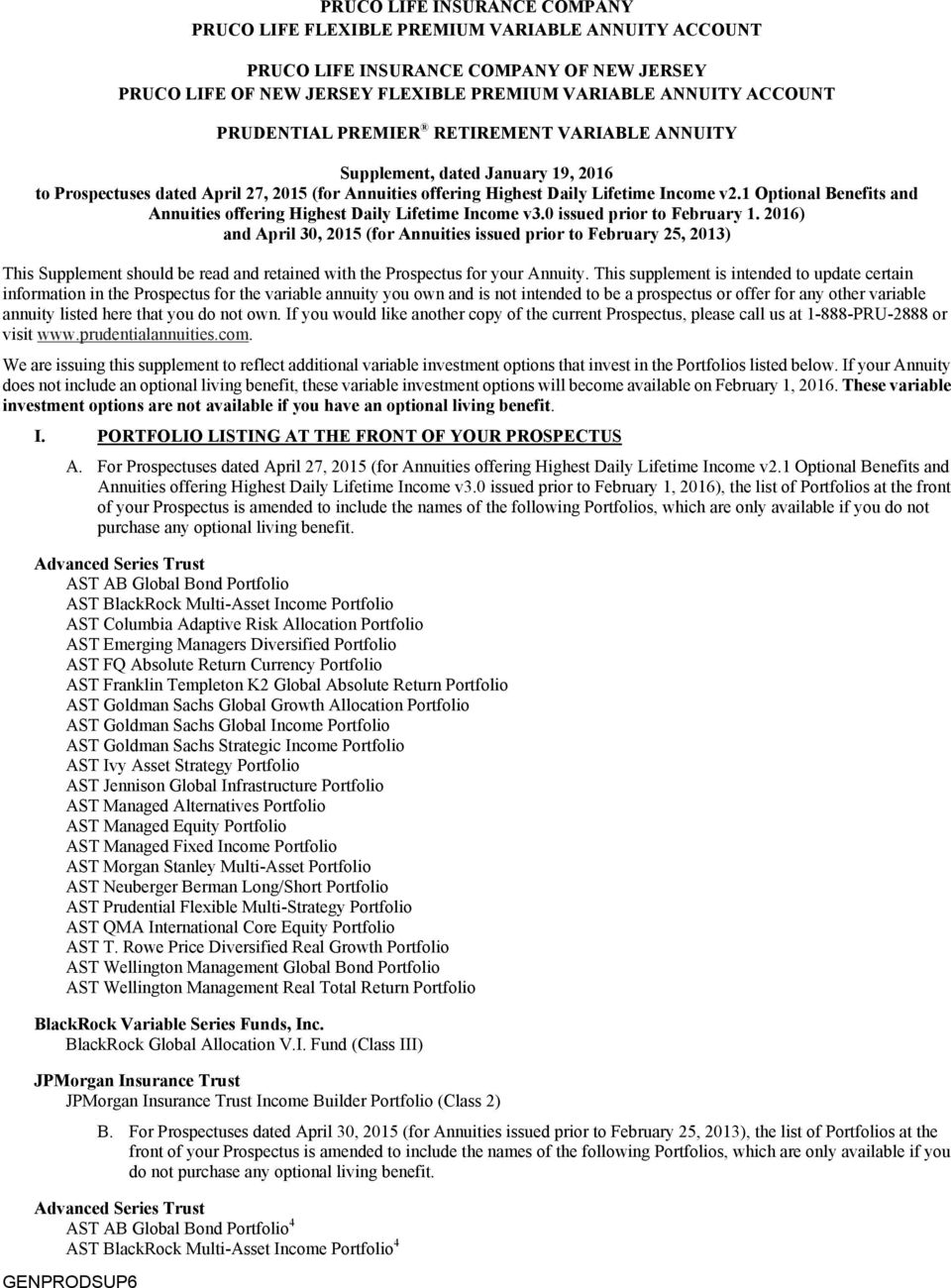
2 AST Columbia Adaptive Risk Allocation Portfolio 4 AST Emerging Managers Diversified Portfolio 4 AST FQ Absolute Return Currency Portfolio 4 AST Franklin Templeton K2 Global Absolute Return Portfolio 4 AST Goldman Sachs Global Growth Allocation Portfolio 4 AST Goldman Sachs Global Income Portfolio 4 AST Goldman Sachs Strategic Income Portfolio 4 AST Ivy Asset Strategy Portfolio 4 AST Jennison Global Infrastructure Portfolio 4 AST Managed Alternatives Portfolio 4 AST Managed Equity Portfolio 4 AST Managed Fixed Income Portfolio 4 AST Morgan Stanley Multi-Asset Portfolio 4 AST Neuberger Berman Long/Short Portfolio 4 AST Prudential Flexible Multi-Strategy Portfolio 4 AST QMA International Core Equity Portfolio 4 AST T. Rowe Price Diversified Real Growth Portfolio 4 AST Wellington Management Global Bond Portfolio 4 AST Wellington Management Real Total Return Portfolio 4 BlackRock Variable Series Funds, Inc. BlackRock Global Allocation V.I. Fund (Class III) 4 JPMorgan Insurance Trust JPMorgan Insurance Trust Income Builder Portfolio (Class 2) 4 (4) Not available if you purchase any optional living benefit. II. AMENDMENT OF THE UNDERLYING MUTUAL FUND PORTFOLIO ANNUAL EXPENSES TABLE We have amended the Underlying Mutual Fund Portfolio Annual Expenses table in Summary of Contract Fees and Charges to include the additional Portfolios, as detailed below. UNDERLYING MUTUAL FUND PORTFOLIO ANNUAL EXPENSES (as a percentage of the average net assets of the underlying Portfolios) For the year ended December 31, 2014 Total Broker Fees Acquired Annual Net Annual FUNDS Distribution Dividend and Expenses Portfolio Portfolio Fee Waiver Fund Management Other (12b-1) Expense on on Short Fees & Operating or Expense Operating Fees Expenses Fees Short Sales Sales Expenses Expenses Reimbursement Expenses AST AB Global Bond Portfolio* AST BlackRock Multi-Asset Income Portfolio* AST Columbia Adaptive Risk Allocation Portfolio* AST Emerging Managers Diversified Portfolio* AST FQ Absolute Return Currency Portfolio* AST Franklin Templeton K2 Global Absolute Return Portfolio* AST Goldman Sachs Global Growth Allocation Portfolio* 0.62% 0.03% 0.25% 0.00% 0.00% 0.00% 0.90% 0.00% 0.90% 0.78% 2.32% 0.25% 0.00% 0.00% 0.41% 3.76% 2.61% 1.15% 0.94% 0.06% 0.25% 0.00% 0.00% 0.03% 1.28% 0.00% 1.28% 0.74% 0.10% 0.25% 0.00% 0.00% 0.00% 1.09% 0.02% 1.07% 0.83% 2.67% 0.25% 0.00% 0.00% 0.00% 3.75% 2.53% 1.22% 0.78% 3.13% 0.25% 0.00% 0.00% 0.11% 4.27% 3.08% 1.19% 0.78% 2.80% 0.25% 0.00% 0.00% 0.40% 4.23% 3.04% 1.19% GENPRODSUP6

3 UNDERLYING MUTUAL FUND PORTFOLIO ANNUAL EXPENSES (as a percentage of the average net assets of the underlying Portfolios) For the year ended December 31, 2014 Total Broker Fees Acquired Annual Net Annual FUNDS AST Goldman Sachs Global Income Portfolio* AST Goldman Sachs Strategic Income Portfolio AST Ivy Asset Strategy Portfolio* AST Jennison Global Infrastructure Portfolio* AST Managed Alternatives Portfolio* AST Managed Equity Portfolio* AST Managed Fixed Income Portfolio* AST Morgan Stanley Multi-Asset Portfolio* AST Neuberger Berman Long/Short Portfolio* AST Prudential Flexible Multi-Strategy Portfolio* AST QMA International Core Equity Portfolio* AST T. Rowe Price Diversified Real Growth Portfolio* AST Wellington Management Global Bond Portfolio* AST Wellington Management Real Total Return Portfolio* BlackRock Global Allocation V.I. Fund (Class III)* JPMorgan Insurance Trust Income Builder Portfolio (Class 2)* Distribution Dividend and Expenses Portfolio Portfolio Fee Waiver Fund Management Other (12b-1) Expense on on Short Fees & Operating or Expense Operating Fees Expenses Fees Short Sales Sales Expenses Expenses Reimbursement Expenses 0.62% 0.05% 0.25% 0.00% 0.00% 0.00% 0.92% 0.00% 0.92% 0.70% 0.04% 0.25% 0.00% 0.00% 0.00% 0.99% 0.00% 0.99% 0.89% 0.07% 0.25% 0.00% 0.00% 0.00% 1.21% 0.00% 1.21% 0.83% 2.72% 0.25% 0.00% 0.00% 0.00% 3.80% 2.54% 1.26% 0.15% 0.06% 0.00% 0.00% 0.07% 1.31% 1.59% 0.05% 1.54% 0.15% 10.61% 0.00% 0.00% 0.00% 1.11% 11.87% 10.62% 1.25% 0.15% 5.45% 0.00% 0.00% 0.00% 0.81% 6.41% 5.16% 1.25% 1.04% 0.18% 0.25% 0.00% 0.00% 0.00% 1.47% 0.05% 1.42% 1.04% 0.13% 0.25% 0.00% 0.24% 0.00% 1.66% 0.00% 1.66% 0.98% 2.63% 0.25% 0.00% 0.00% 0.98% 4.84% 3.36% 1.48% 0.72% 0.05% 0.25% 0.00% 0.00% 0.00% 1.02% 0.03% 0.99% 0.73% 6.01% 0.25% 0.00% 0.00% 0.05% 7.04% 5.99% 1.05% 0.62% 0.05% 0.25% 0.00% 0.00% 0.00% 0.92% 0.00% 0.92% 1.04% 0.15% 0.25% 0.00% 0.00% 0.00% 1.44% 0.02% 1.42% 0.62% 0.24% 0.25% N/A N/A 0.00% 1.11% 0.13% 0.98% 0.45% 1.07% 0.25% N/A N/A 0.08% 1.85% 0.92% 0.93% *See notes immediately below for important information about this fund. AST AB Global Bond Portfolio The Portfolio will commence operations on or about July 13, Estimate based in part on assumed average daily net assets of $1.4 billion for the Portfolio for the fiscal period ending December 31, AST BlackRock Multi-Asset Income Portfolio The Manager has contractually agreed to waive a portion of its investment management fee and/or reimburse certain expenses of the Portfolio so that the Portfolio s investment management fees (after management fee waiver) and other expenses (including net distribution fees, acquired fund fees and expenses due to investments in underlying portfolios of the Trust and underlying portfolios managed or subadvised by the subadviser, and excluding taxes, interest, brokerage commissions and any other acquired fund fees and expenses not mentioned above) do not exceed 1.13% of the Portfolio s average daily net assets. This arrangement may not be terminated prior to June 30, 2016 without the prior approval of the Trust s Board of Trustees. GENPRODSUP6

4 AST Columbia Adaptive Risk Allocation Portfolio The Portfolio will commence operations on or about July 13, Estimate based in part on assumed average daily net assets of $250 million for the Portfolio for the fiscal period ending December 31, AST Emerging Managers Diversified Portfolio The Portfolio will commence operations on or about July 13, Estimate based in part on assumed average daily net assets of $250 million for the Portfolio for the fiscal period ending December 31, The Investment Manager has contractually agreed to waive a portion of its investment management fees and/or reimburse certain expenses for the Portfolio so that the Portfolio s investment management fees plus other expenses (exclusive in all cases of taxes, interest, brokerage commissions, acquired fund fees and expenses, and extraordinary expenses) do not exceed 1.07% of the Portfolio s average daily net assets through June 30, The expense limitation may not be terminated or modified prior to June 30, 2016 without the prior approval of the Trust s Board of Trustees. AST FQ Absolute Return Currency Portfolio The Manager has contractually agreed to waive a portion of its investment management fee and/or reimburse certain expenses of the Portfolio so that the Portfolio s investment management fees (after any fee waiver) and other expenses (including distribution fees, and excluding taxes, interest and brokerage commissions) do not exceed 1.22% of the Portfolio s average daily net assets. This arrangement may not be terminated prior to June 30, 2016 without the prior approval of the Trust s Board of Trustees. AST Franklin Templeton K2 Global Absolute Return Portfolio The Manager has contractually agreed to waive a portion of its investment management fee and/or reimburse certain expenses of the Portfolio so that the Portfolio s investment management fees (after management fee waiver) and other expenses (including net distribution fees, acquired fund fees and expenses due to investments in underlying portfolios of the Trust and underlying portfolios managed or subadvised by the subadviser, and excluding taxes, interest, brokerage commissions and any other acquired fund fees and expenses not mentioned above) do not exceed 1.17% of the Portfolio s average daily net assets. This arrangement may not be terminated prior to June 30, 2016 without the prior approval of the Trust s Board of Trustees. AST Goldman Sachs Global Growth Allocation Portfolio The Manager has contractually agreed to waive a portion of its investment management fee and/or reimburse certain expenses of the Portfolio so that the Portfolio s investment management fees (after management fee waiver) and other expenses (including net distribution fees, acquired fund fees and expenses due to investments in underlying portfolios of the Trust and underlying portfolios managed or subadvised by the subadviser, and excluding taxes, interest, brokerage commissions and any other acquired fund fees and expenses not mentioned above) do not exceed 1.19% of the Portfolio s average daily net assets. This arrangement may not be terminated prior to June 30, 2016 without the prior approval of the Trust s Board of Trustees. AST Goldman Sachs Global Income Portfolio The Portfolio will commence operations on or about July 13, Estimate based in part on assumed average daily net assets of $1.4 billion for the Portfolio for the fiscal period ending December 31, AST Ivy Asset Strategy Portfolio The Portfolio will commence operations on or about July 13, Estimate based in part on assumed average daily net assets of $250 million for the Portfolio for the fiscal period ending December 31, AST Jennison Global Infrastructure Portfolio The Manager has contractually agreed to waive a portion of its investment management fee and/or reimburse certain expenses of the portfolio so that the Portfolio s investment management fees (after any fee waiver) and other expenses (including distribution fees, and excluding taxes, interest and brokerage commissions) do not exceed 1.26% of the Portfolio s average daily net assets. This arrangement may not be terminated prior to June 30, 2016 without the prior approval of the Trust s Board of Trustees. AST Managed Alternatives Portfolio The Portfolio will commence operations on or about July 13, Estimate based in part on assumed average daily net assets of $250 million for the Portfolio for the fiscal period ending December 31, The Investment Manager has contractually agreed to waive a portion of its investment management fees and/or reimburse certain expenses for the Portfolio so that the Portfolio s investment management fee plus other expenses (exclusive in all cases of taxes, interest, brokerage commissions and extraordinary expenses) plus Underlying Portfolio (as defined below) fees and expenses (excluding dividends on securities sold short and brokers fees and expenses on short sales) does not exceed 1.47% of the Portfolio s average daily net assets through June 30, The waiver in the table above is 0.05%, rather than 0.12%, because the waiver does not apply to 0.07% of the acquired fund fees and expenses, which accounts for dividend expenses and broker fees and expenses on short sales at the Underlying Portfolio level. This arrangement may not be terminated or modified prior to June 30, 2016 without the prior approval of the Trust s Board of Trustees. AST Managed Equity Portfolio The Manager has contractually agreed to waive a portion of its investment management fee and/or reimburse certain expenses of the portfolio so that the Portfolio s investment management fees (after any fee waiver) and other expenses (including acquired fund fees and expenses due to investments in underlying portfolios of the Trust, and excluding taxes, interest and brokerage commissions) do not exceed 1.25% of the Portfolio s average daily net assets. This arrangement may not be terminated or modified prior to June 30, 2016, and may be discontinued or modified thereafter. The decision on whether to renew, modify or discontinue the arrangement after June 30, 2016 will be subject to review by the Manager and the Trust s Board of Trustees. AST Managed Fixed Income Portfolio The Manager has contractually agreed to waive a portion of its investment management fee and/or reimburse certain expenses of the Portfolio so that the Portfolio s investment management fees (after management fee waiver) and other expenses (including acquired fund fees and expenses due to investments in underlying portfolios of the Trust, and excluding taxes, interest and brokerage commissions) do not exceed 1.25% of the Portfolio s average daily net assets. This arrangement may not be terminated or modified prior to June 30, 2016 without the prior approval of the Trust s Board of Trustees. AST Morgan Stanley Multi-Asset Portfolio The Portfolio will commence operations on or about July 13, Estimate based in part on assumed average daily net assets of $100 million for the Portfolio for the fiscal period ending December 31, The Investment Manager has contractually agreed to waive a portion of its investment management fees and/or reimburse certain expenses for the Portfolio so that the Portfolio s investment management fees plus other expenses (exclusive in all cases of taxes, interest, brokerage commissions, acquired fund fees and expenses, and extraordinary expenses) do not exceed 1.42% of the Portfolio s average daily net assets through June 30, The expense limitation may not be terminated or modified prior to June 30, 2016 without the prior approval of the Trust s Board of Trustees. GENPRODSUP6

5 AST Neuberger Berman Long/Short Portfolio The Portfolio will commence operations on or about July 13, Estimate based in part on assumed average daily net assets of $100 million for the Portfolio for the fiscal period ending December 31, AST Prudential Flexible Multi-Strategy Portfolio The Manager has contractually agreed to waive a portion of its investment management fee and/or reimburse certain expenses of the portfolio so that the Portfolio s investment management fees (after management fee waiver) and other expenses (including net distribution fees, acquired fund fees and expenses due to investments in underlying portfolios of the Trust, and excluding taxes, interest and brokerage commissions) do not exceed 1.48% of the Portfolio s average daily net assets. This arrangement may not be terminated prior to June 30, 2016 without the prior approval of the Trust s Board of Trustees. AST QMA International Core Equity Portfolio The Manager has contractually agreed to waive a portion of its investment management fee and/or reimburse certain expenses of the Portfolio so that the Portfolio s investment management fees (after any fee waiver) and other expenses (including distribution fees, and excluding taxes, interest brokerage commissions, acquired fund fee and expenses, and extraordinary expenses) do not exceed 0.995% of the Portfolio s average daily net assets. This arrangement may not be terminated prior to June 30, 2016 without the prior approval of the Trust s Board of Trustees. AST T. Rowe Price Diversified Real Growth Portfolio The Manager has contractually agreed to waive a portion of its investment management fee and/or reimburse certain expenses of the Portfolio so that the Portfolio s investment management fees (after management fee waiver) and other expenses (including net distribution fees, acquired fund fees and expenses due to investments in underlying portfolios of the Trust and underlying portfolios managed or subadvised by the subadviser, and excluding taxes, interest, brokerage commissions and any other acquired fund fees and expenses not mentioned above) do not exceed 1.05% of the Portfolio s average daily net assets. This arrangement may not be terminated without the prior approval of the Trust s Board of Trustees. AST Wellington Management Global Bond Portfolio The Portfolio will commence operations on or about July 13, Estimate based in part on assumed average daily net assets of $1.4 billion for the Portfolio for the fiscal period ending December 31, AST Wellington Management Real Total Return Portfolio The Portfolio will commence operations on or about July 13, Estimate based in part on assumed average daily net assets of $100 million for the Portfolio for the fiscal period ending December 31, The investment manager has contractually agreed to waive a portion of its investment management fees and/or reimburse certain expenses for the Portfolio so that the Portfolio s investment management fees plus other expenses (exclusive in all cases of taxes, interest, brokerage commissions, acquired fund fees and expenses, and extraordinary expenses) do not exceed 1.42% of the Portfolio s average daily net assets through June 30, The expense limitation may not be terminated or modified prior to June 30, 2016 without the prior approval of the Trust s Board of Trustees. BlackRock Global Allocation V.I. Fund (Class III) As described in the Management of the Funds section of the Fund s prospectus, BlackRock has contractually agreed to waive and/or reimburse fees or expenses in order to limit Total Annual Fund Operating Expenses After Fee Waivers and/or Expense Reimbursements (excluding Dividend Expense, Interest Expense, Acquired Fund Fees and Expenses and certain other Fund expenses) to 1.25% (for Class I Shares), 1.40% (for Class II Shares), and 1.50% (for Class III Shares) of average daily net assets until May 1, BlackRock has also contractually agreed to reimburse fees in order to limit certain operational and recordkeeping fees to 0.07% (for Class I Shares), 0.07% (for Class II Shares), and 0.07% (for Class III Shares) of average daily net assets until May 1, Each of these contractual agreements may be terminated upon 90 days notice by a majority of the non-interested directors of the Fund or by a vote of a majority of the outstanding voting securities of the Fund. JPMorgan Insurance Trust Income Builder Portfolio (Class 2) Other Expenses and Acquired Fund Fees and Expenses are based on estimated amounts for the current fiscal year. The Portfolio s adviser, distributor and administrator (the Service Providers) have contractually agreed to waive fees and/or reimburse expenses to the extent Total Annual Fund Operating Expenses of Class 2 Shares (excluding Acquired Fund Fees and Expenses, dividend expenses related to short sales, interest, taxes, expenses related to litigation and potential litigation, extraordinary expenses and expenses related to the Board of Trustees deferred compensation plan) exceed 0.85% of their average daily net assets. This contract cannot be terminated prior to May 1, 2016, at which time the Service Providers will determine whether or not to renew or revise it. III. AMENDMENTS TO THE INVESTMENT OPTIONS SECTION A. For Annuities issued by Pruco Life Insurance Company of New Jersey and for Annuities issued by Pruco Life Insurance Company prior to February 25, 2013, the fourth, fifth and sixth paragraphs of the Variable Investment Option section are replaced by the following paragraph. For Annuities issued by Pruco Life Insurance Company offering Highest Daily Lifetime Income v2.1 Optional Benefits and Annuities offering Highest Daily Lifetime Income v3.0 issued prior to February 1, 2016, the fourth and fifth paragraphs of the Variable Investment Option section are replaced by the following paragraph. GENPRODSUP6 This Annuity offers Portfolios managed by AST Investment Services, Inc. and/or Prudential Investments LLC, both of which are affiliated companies of Pruco Life ( Affiliated Portfolios ) and Portfolios managed by companies not affiliated with Pruco Life ("Unaffiliated Portfolios"). Pruco Life and its affiliates ( Prudential Companies ) receive fees and payments from both the Affiliated Portfolios and the Unaffiliated Portfolios. Generally, Prudential Companies receive revenue sharing payments from the Unaffiliated Portfolios. We consider the amount of these fees and payments when determining which portfolios to offer through the Annuity. Affiliated Portfolios may provide Prudential Companies with greater fees and payments than Unaffiliated Portfolios. Because of the potential for greater profits earned by the Prudential Companies with respect to the Affiliated Portfolios, we have an incentive to offer Affiliated Portfolios over Unaffiliated Portfolios. As indicated next to each Portfolio's description in the table that

6 follows, each Portfolio has one or more subadvisers that conduct day to day management. We have an incentive to offer Portfolios with certain subadvisers, either because the subadviser is a Prudential Company or because the subadviser provides payments or support, including distribution and marketing support, to the Prudential Companies. We may consider those subadviser factors in determining which portfolios to offer under the Annuities. Also, in some cases, we offer Portfolios based on the recommendations made by selling broker-dealer firms. These firms may receive payments from the Portfolios they recommend and may benefit accordingly from allocations of Account Value to the sub-accounts that invest in these Portfolios. Please see "Other Information" under the heading concerning "Fees and Payments Received by Pruco Life" or Fees and Payments Received by Pruco Life of New Jersey for more information about fees and payments we may receive from underlying Portfolios and/or their affiliates. In addition, we may consider whether the Portfolio s objectives and investment strategies create additional risk to us in light of the guaranteed benefits provided by the Annuity. B. We have amended the Investment Objectives table in Investment Options to include the additional Portfolios, as detailed below. PORTFOLIO NAME AST AB Global Bond Portfolio AST BlackRock Multi-Asset Income Portfolio AST Columbia Adaptive Risk Allocation Portfolio AST Emerging Managers Diversified Portfolio AST FQ Absolute Return Currency Portfolio AST Franklin Templeton K2 Global Absolute Return Portfolio AST Goldman Sachs Global Growth Allocation Portfolio AST Goldman Sachs Global Income Portfolio AST Goldman Sachs Strategic Income Portfolio INVESTMENT OBJECTIVES Seeks to generate current income consistent with preservation of capital. Seeks to maximize current income with consideration for capital appreciation. Pursues consistent total returns by seeking to allocate risks across multiple asset classes. Seeks total return. Seeks absolute returns not highly correlated with any traditional asset class. Seeks capital appreciation with reduced market correlation. Seeks total return made up of capital appreciation and income. Seeks high total return, emphasizing current income and, to a lesser extent, providing opportunities for capital appreciation. Seeks total return. AllianceBernstein L.P. PORTFOLIO ADVISER/SUBADVISER(S) BlackRock Financial Management, Inc. Columbia Management Investment Advisers, LLC Dana Investment Advisors, Inc. Longfellow Investment Management Co. LLC. Prudential Investments LLC First Quadrant, L.P. K2/D&S Management Co., L.L.C. Franklin Advisers, Inc. Templeton Global Advisers Limited Goldman Sachs Asset Management, L.P. Goldman Sachs Asset Management International Goldman Sachs Asset Management, L.P. AST Ivy Asset Strategy Portfolio Seeks total return. Ivy Investment Management Company AST Jennison Global Infrastructure Portfolio AST Managed Alternatives Portfolio Seeks total return. Seeks long-term capital appreciation with a focus on downside protection. Jennison Associates LLC Prudential Investments LLC AST Managed Equity Portfolio Seeks to provide capital appreciation. Prudential Investments LLC Quantitative Management Associates, LLC AST Managed Fixed Income Portfolio Seeks total return. Prudential Investments LLC Quantitative Management Associates LLC AST Morgan Stanley Multi-Asset Portfolio AST Neuberger Berman Long/Short Portfolio AST Prudential Flexible Multi-Strategy Portfolio AST QMA International Core Equity Portfolio Seeks total return. Seeks long term capital appreciation with a secondary objective of principal preservation. Seeks to provide capital appreciation. Seeks long-term capital appreciation. Morgan Stanley Investment Management, Inc. Neuberger Berman Management LLC Jennison Associates LLC Prudential Investment Management, Inc. Quantitative Management Associates LLC Quantitative Management Associates LLC GENPRODSUP6

7 PORTFOLIO NAME AST T. Rowe Price Diversified Real Growth Portfolio AST Wellington Management Global Bond Portfolio AST Wellington Management Real Total Return Portfolio BlackRock Global Allocation V.I. Fund (Class III) JPMorgan Insurance Trust Income Builder Portfolio (Class 2) INVESTMENT OBJECTIVES Seeks long-term capital appreciation and secondarily, income. Seeks to provide consistent excess returns over the Barclays Global Aggregate Bond Index (USD Hedged). Seeks long-term real total return. Seeks high total investment return. Seeks to maximize income while maintaining prospects for capital appreciation. PORTFOLIO ADVISER/SUBADVISER(S) T. Rowe Price Associates, Inc. T. Rowe Price International Ltd T. Rowe Price International Ltd Tokyo T. Rowe Price Hong Kong Limited Wellington Management Company LLP Wellington Management Company LLP BlackRock Advisors, LLC J.P. Morgan Investment Management Inc. THIS SUPPLEMENT SHOULD BE READ AND RETAINED FOR FUTURE REFERENCE. GENPRODSUP6

8 PRUCO LIFE INSURANCE COMPANY PRUCO LIFE FLEXIBLE PREMIUM VARIABLE ANNUITY ACCOUNT PRUCO LIFE INSURANCE COMPANY OF NEW JERSEY PRUCO LIFE OF NEW JERSEY FLEXIBLE PREMIUM VARIABLE ANNUITY ACCOUNT PRUDENTIAL ANNUITIES LIFE ASSURANCE CORPORATION PRUDENTIAL ANNUITIES LIFE ASSURANCE CORPORATION VARIABLE ACCOUNT B Supplement, dated September 8, 2015, to Prospectuses dated April 27, 2015 and April 30, 2015 This supplement should be read in conjunction with your Annuity prospectus and should be retained for future reference. This supplement is intended to update certain information in your current Annuity prospectus. This supplement replaces and supersedes the supplement dated August 28, If you would like another copy of the current prospectus, please visit or call us at PRU From August 24, 2015 to August 28, 2015, Unit Prices for certain Sub-accounts that invest in Portfolios of Trusts managed by our affiliates may have reflected pricing as of a prior date and/or may not have been accurately reported due to issues with an external provider of Portfolio information. We have been advised that the external provider commenced timely and accurate processing on Monday, August 31, Current Portfolio pricing information from August 24, 2015 to August 28, 2015 has been received and account values and transactions will be updated, as needed. Please note that there is no action required of you in connection with your contract. GENPRODSUP4

9 PRUCO LIFE INSURANCE COMPANY PRUCO LIFE FLEXIBLE PREMIUM VARIABLE ANNUITY ACCOUNT PRUCO LIFE INSURANCE COMPANY OF NEW JERSEY PRUCO LIFE of NEW JERSEY FLEXIBLE PREMIUM VARIABLE ANNUITY ACCOUNT PRUDENTIAL ANNUITIES LIFE ASSURANCE CORPORATION PRUDENTIAL ANNUITIES LIFE ASSURANCE CORPORATION VARIABLE ACCOUNT B Supplement, dated August 21, 2015 to Prospectuses dated April 27, 2015 and April 30, 2015 This supplement should be read in conjunction with your Annuity Prospectus and should be retained for future reference. This supplement is intended to update certain information in the Annuity Prospectus you own and is not intended to be a prospectus or offer for any other Annuity that you do not own. Defined terms used herein and not otherwise defined herein shall have the meanings given to them in the Prospectuses and SAIs. We are issuing this supplement to reflect changes to the Advanced Series Trust Portfolios. Please check your Annuity Prospectus to determine which of the following Portfolio changes affect the Annuity that you own. If you would like another copy of the current Annuity Prospectus, please visit or call us at PRU Accordingly, we make the following changes to your Annuity Prospectus: I. Portfolio Mergers (effective October 19, 2015) On or about October 19, 2015 and subject to shareholder approval, the following Target Portfolios will be merged to the corresponding Acquiring Portfolios as noted below. All references to the Target Portfolios in your Annuity Prospectus should be disregarded. Target Portfolio AST FI Pyramis Asset Allocation Portfolio AST Franklin Templeton Founding Funds Allocation Portfolio AST Franklin Templeton Founding Funds Plus Portfolio AST Neuberger Berman Core Bond Portfolio AST Neuberger Berman Mid-Cap Growth Portfolio AST Schroders Multi-Asset World Strategies Portfolio AST T. Rowe Price Equity Income Portfolio Acquiring Portfolio AST T. Rowe Price Asset Allocation Portfolio AST Prudential Growth Allocation Portfolio AST RCM World Trends Portfolio AST Lord Abbett Core Fixed Income Portfolio AST Goldman Sachs Mid-Cap Growth Portfolio AST Schroders Global Tactical Portfolio AST Goldman Sachs Large-Cap Value Portfolio As a result of the above Portfolio mergers, there are no changes to the Investment Objectives section of your Annuity Prospectus. II. Fee Waivers (effective October 19, 2015) i. The Investment Managers have contractually agreed to extend the existing waivers on the above-referenced Target Portfolios and Acquiring Portfolios through October 31, These waivers may not be terminated prior to October 31, 2016 without the prior approval of the Trust s Board of Trustees. ii. AST Goldman Sachs Mid-Cap Growth Portfolio: Subject to shareholder approval, the Investment Managers have contractually agreed to waive 0.10% of their investment management fees through June 30, This waiver may not be terminated prior to June 30, 2017 without prior approval of the Trust s Board of Trustees. GENPRODSUP1 THIS SUPPLEMENT SHOULD BE READ AND RETAINED FOR FUTURE REFERENCE.

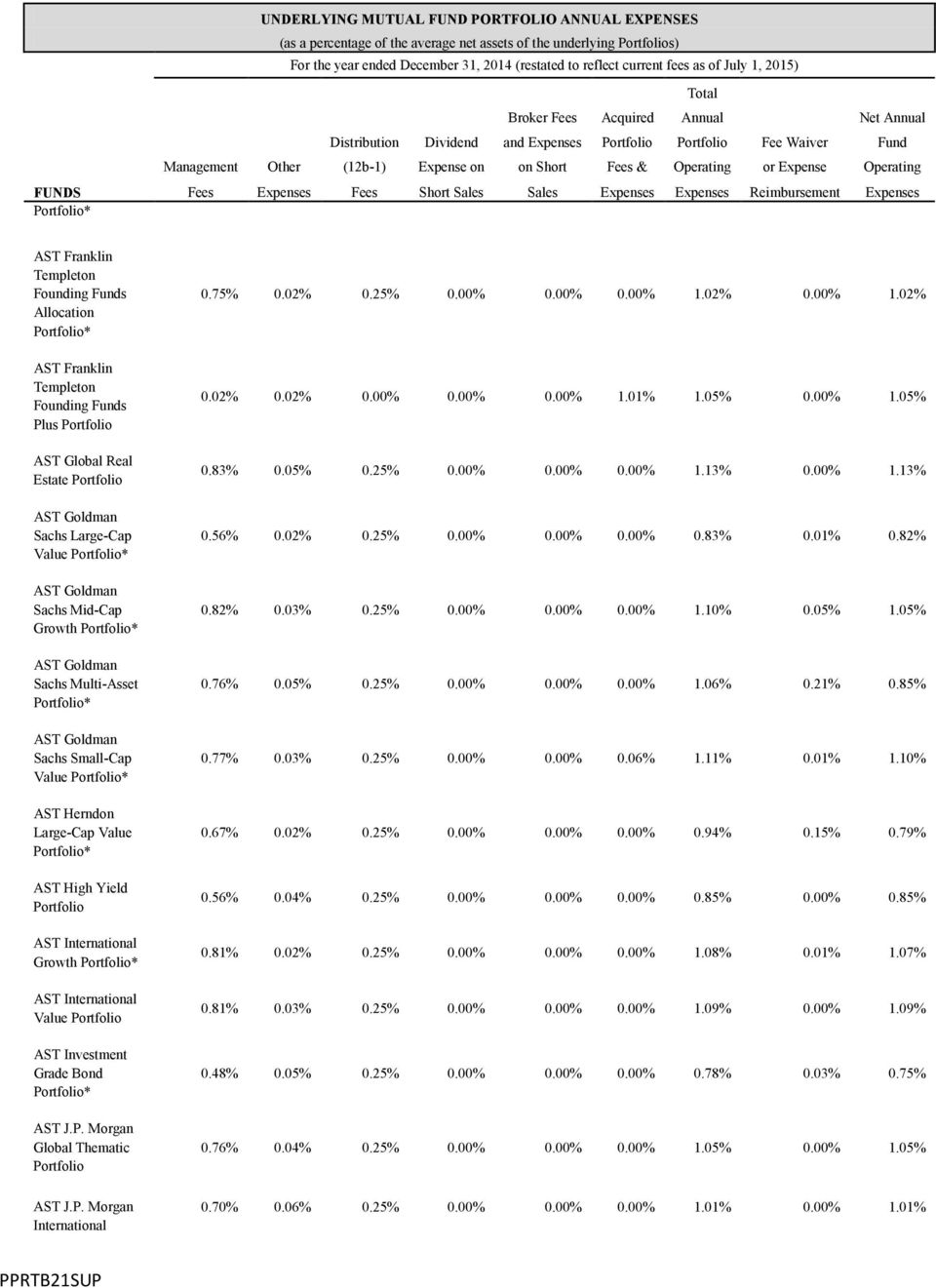
10 PRUCO LIFE INSURANCE COMPANY PRUCO LIFE FLEXIBLE PREMIUM VARIABLE ANNUITY ACCOUNT PRUCO LIFE INSURANCE COMPANY OF NEW JERSEY PRUCO LIFE OF NEW JERSEY FLEXIBLE PREMIUM VARIABLE ANNUITY ACCOUNT PRUDENTIAL PREMIER(R) RETIREMENT VARIABLE ANNUITY (offering Highest Daily Lifetime Income v2.1) Supplement, dated July 1, 2015, to Prospectus dated April 27, 2015 This Supplement should be read and retained with the Prospectus for your Annuity. This supplement is intended to update certain information in the Prospectus for the variable annuity you own and is not intended to be a prospectus or offer for any other variable annuity listed here that you do not own. If you would like another copy of the current Prospectus, please call us at PRU-2888 or visit We are issuing this supplement to reflect changes to the Advanced Series Trust ("AST") Portfolios that will become effective on July 1, 2015, and to describe certain other Portfolio changes effective July 13, 2015 and July 15, We are also issuing this supplement to add language in certain sections of your prospectus describing co-grantor trusts. I. APPROVAL AND EFFECTIVENESS OF THE CHANGES TO THE 12B-1 PLAN (Effective July 1, 2015) Shareholders of the AST Portfolios approved an increase of the fee rate paid under the 12b-1 Plan for shareholder services and distribution expenses. Currently, each AST Portfolio (including, indirectly, AST Portfolios structured as funds-of-funds) pays a 12b-1 fee at the annual rate of 0.10% of the average daily net assets of each Portfolio. The fee rate paid under the 12b-1 Plan increased by 0.15% to 0.25% (as an annual rate of the average daily net assets of each Portfolio) effective July 1, The 0.15% increase in the 12b-1 fee under the Plan is more than offset by a % decrease in the contractual investment management fee paid by each of the AST Portfolios. The net result is a small reduction in the combined 12b-1 and investment management fees. In addition, some of the AST Portfolios currently benefit from a fee waiver or expense limitation that reduces Portfolio operating expenses, and the investment managers have agreed to extend all existing contractual fee waivers and expense limitations that would otherwise expire on June 30, 2015 for an additional year that is through at least June 30, After that time, fee waivers and expense limitations are subject to change based on the 2016 annual review of advisory and distribution arrangements by the AST Board of Trustees. II. UNDERLYING MUTUAL FUND PORTFOLIO ANNUAL EXPENSES TABLE RESTATED We have restated the Underlying Mutual Fund Portfolio Annual Expenses table that appear in the Summary of Contract Fees and Charges section of your prospectus to reflect the change to the 12b-1 Plan as described in Section I above. FUNDS AST Academic Strategies Asset Allocation Portfolio AST Advanced Strategies Portfolio* UNDERLYING MUTUAL FUND PORTFOLIO ANNUAL EXPENSES (as a percentage of the average net assets of the underlying Portfolios) For the year ended December 31, 2014 (restated to reflect current fees as of July 1, 2015) Total Broker Fees Acquired Annual Net Annual Distribution Dividend and Expenses Portfolio Portfolio Fee Waiver Fund Management Other (12b-1) Expense on on Short Fees & Operating or Expense Operating Fees Expenses Fees Short Sales Sales Expenses Expenses Reimbursement Expenses 0.63% 0.03% 0.11% 0.05% 0.01% 0.63% 1.46% 0.00% 1.46% 0.64% 0.02% 0.25% 0.00% 0.00% 0.05% 0.96% 0.01% 0.95% PPRTB21SUP

11 UNDERLYING MUTUAL FUND PORTFOLIO ANNUAL EXPENSES (as a percentage of the average net assets of the underlying Portfolios) For the year ended December 31, 2014 (restated to reflect current fees as of July 1, 2015) FUNDS AST AQR Emerging Markets Equity Portfolio AST AQR Large-Cap Portfolio* AST Balanced Asset Allocation Portfolio AST BlackRock Global Strategies Portfolio AST BlackRock ishares ETF Portfolio* AST BlackRock Low Duration Bond Portfolio* AST BlackRock/Loomis Sayles Bond Portfolio* AST Boston Partners Large-Cap Value Portfolio AST Capital Growth Asset Allocation Portfolio AST ClearBridge Dividend Growth Portfolio* AST Cohen & Steers Realty Portfolio* AST Defensive Asset Allocation Portfolio AST FI Pyramis Asset Allocation Portfolio* Total Broker Fees Acquired Annual Net Annual Distribution Dividend and Expenses Portfolio Portfolio Fee Waiver Fund Management Other (12b-1) Expense on on Short Fees & Operating or Expense Operating Fees Expenses Fees Short Sales Sales Expenses Expenses Reimbursement Expenses 0.93% 0.16% 0.25% 0.00% 0.00% 0.00% 1.34% 0.00% 1.34% 0.56% 0.01% 0.25% 0.00% 0.00% 0.00% 0.82% 0.24% 0.58% 0.15% 0.01% 0.00% 0.00% 0.00% 0.75% 0.91% 0.00% 0.91% 0.81% 0.04% 0.25% 0.00% 0.00% 0.02% 1.12% 0.00% 1.12% 0.73% 0.07% 0.25% 0.00% 0.00% 0.21% 1.26% 0.24% 1.02% 0.47% 0.04% 0.25% 0.00% 0.00% 0.00% 0.76% 0.00% 0.76% 0.45% 0.02% 0.25% 0.00% 0.00% 0.00% 0.72% 0.03% 0.69% 0.58% 0.03% 0.25% 0.00% 0.00% 0.00% 0.86% 0.00% 0.86% 0.15% 0.01% 0.00% 0.00% 0.00% 0.76% 0.92% 0.00% 0.92% 0.66% 0.02% 0.25% 0.00% 0.00% 0.00% 0.93% 0.11% 0.82% 0.82% 0.03% 0.25% 0.00% 0.00% 0.00% 1.10% 0.07% 1.03% 0.15% 0.06% 0.00% 0.00% 0.00% 0.73% 0.94% 0.00% 0.94% 0.66% 0.03% 0.25% 0.00% 0.00% 0.00% 0.94% 0.02% 0.92% AST FI Pyramis Quantitative 0.65% 0.03% 0.25% 0.00% 0.00% 0.00% 0.93% 0.14% 0.79% PPRTB21SUP

12 UNDERLYING MUTUAL FUND PORTFOLIO ANNUAL EXPENSES (as a percentage of the average net assets of the underlying Portfolios) For the year ended December 31, 2014 (restated to reflect current fees as of July 1, 2015) FUNDS Portfolio* Total Broker Fees Acquired Annual Net Annual Distribution Dividend and Expenses Portfolio Portfolio Fee Waiver Fund Management Other (12b-1) Expense on on Short Fees & Operating or Expense Operating Fees Expenses Fees Short Sales Sales Expenses Expenses Reimbursement Expenses AST Franklin Templeton Founding Funds Allocation Portfolio* AST Franklin Templeton Founding Funds Plus Portfolio AST Global Real Estate Portfolio AST Goldman Sachs Large-Cap Value Portfolio* AST Goldman Sachs Mid-Cap Growth Portfolio* AST Goldman Sachs Multi-Asset Portfolio* AST Goldman Sachs Small-Cap Value Portfolio* AST Herndon Large-Cap Value Portfolio* AST High Yield Portfolio AST International Growth Portfolio* AST International Value Portfolio AST Investment Grade Bond Portfolio* AST J.P. Morgan Global Thematic Portfolio 0.75% 0.02% 0.25% 0.00% 0.00% 0.00% 1.02% 0.00% 1.02% 0.02% 0.02% 0.00% 0.00% 0.00% 1.01% 1.05% 0.00% 1.05% 0.83% 0.05% 0.25% 0.00% 0.00% 0.00% 1.13% 0.00% 1.13% 0.56% 0.02% 0.25% 0.00% 0.00% 0.00% 0.83% 0.01% 0.82% 0.82% 0.03% 0.25% 0.00% 0.00% 0.00% 1.10% 0.05% 1.05% 0.76% 0.05% 0.25% 0.00% 0.00% 0.00% 1.06% 0.21% 0.85% 0.77% 0.03% 0.25% 0.00% 0.00% 0.06% 1.11% 0.01% 1.10% 0.67% 0.02% 0.25% 0.00% 0.00% 0.00% 0.94% 0.15% 0.79% 0.56% 0.04% 0.25% 0.00% 0.00% 0.00% 0.85% 0.00% 0.85% 0.81% 0.02% 0.25% 0.00% 0.00% 0.00% 1.08% 0.01% 1.07% 0.81% 0.03% 0.25% 0.00% 0.00% 0.00% 1.09% 0.00% 1.09% 0.48% 0.05% 0.25% 0.00% 0.00% 0.00% 0.78% 0.03% 0.75% 0.76% 0.04% 0.25% 0.00% 0.00% 0.00% 1.05% 0.00% 1.05% AST J.P. Morgan International 0.70% 0.06% 0.25% 0.00% 0.00% 0.00% 1.01% 0.00% 1.01% PPRTB21SUP
13 UNDERLYING MUTUAL FUND PORTFOLIO ANNUAL EXPENSES (as a percentage of the average net assets of the underlying Portfolios) For the year ended December 31, 2014 (restated to reflect current fees as of July 1, 2015) FUNDS Equity Portfolio Total Broker Fees Acquired Annual Net Annual Distribution Dividend and Expenses Portfolio Portfolio Fee Waiver Fund Management Other (12b-1) Expense on on Short Fees & Operating or Expense Operating Fees Expenses Fees Short Sales Sales Expenses Expenses Reimbursement Expenses AST J.P. Morgan Strategic Opportunities Portfolio AST Jennison Large-Cap Growth Portfolio AST Large-Cap Value Portfolio AST Legg Mason Diversified Growth Portfolio* AST Loomis Sayles Large-Cap Growth Portfolio* AST Lord Abbett Core Fixed Income Portfolio* AST MFS Global Equity Portfolio AST MFS Growth Portfolio AST MFS Large-Cap Value Portfolio AST Mid-Cap Value Portfolio* AST Money Market Portfolio AST Neuberger Berman / LSV Mid-Cap Value Portfolio AST Neuberger Berman Core Bond Portfolio* AST Neuberger Berman Mid-Cap Growth Portfolio* 0.81% 0.05% 0.25% 0.10% 0.00% 0.00% 1.21% 0.00% 1.21% 0.73% 0.02% 0.25% 0.00% 0.00% 0.00% 1.00% 0.00% 1.00% 0.56% 0.02% 0.25% 0.00% 0.00% 0.00% 0.83% 0.00% 0.83% 0.73% 8.19% 0.25% 0.00% 0.00% 0.12% 9.29% 8.22% 1.07% 0.71% 0.01% 0.25% 0.00% 0.00% 0.00% 0.97% 0.06% 0.91% 0.61% 0.02% 0.25% 0.00% 0.00% 0.00% 0.88% 0.29% 0.59% 0.83% 0.05% 0.25% 0.00% 0.00% 0.00% 1.13% 0.00% 1.13% 0.71% 0.02% 0.25% 0.00% 0.00% 0.00% 0.98% 0.00% 0.98% 0.68% 0.04% 0.25% 0.00% 0.00% 0.00% 0.97% 0.00% 0.97% 0.78% 0.04% 0.25% 0.00% 0.00% 0.00% 1.07% 0.01% 1.06% 0.32% 0.03% 0.25% 0.00% 0.00% 0.00% 0.60% 0.00% 0.60% 0.72% 0.02% 0.25% 0.00% 0.00% 0.00% 0.99% 0.00% 0.99% 0.53% 0.04% 0.25% 0.00% 0.00% 0.00% 0.82% 0.15% 0.67% 0.72% 0.03% 0.25% 0.00% 0.00% 0.00% 1.00% 0.01% 0.99% PPRTB21SUP

14 UNDERLYING MUTUAL FUND PORTFOLIO ANNUAL EXPENSES (as a percentage of the average net assets of the underlying Portfolios) For the year ended December 31, 2014 (restated to reflect current fees as of July 1, 2015) FUNDS AST New Discovery Asset Allocation Portfolio* AST Parametric Emerging Markets Equity AST Preservation Asset Allocation Portfolio AST Prudential Core Bond Portfolio* AST Prudential Growth Allocation Portfolio AST QMA Emerging Markets Equity Portfolio AST QMA Large-Cap Portfolio AST QMA US Equity Alpha Portfolio AST RCM World Trends Portfolio AST Schroders Global Tactical Portfolio AST Schroders Multi-Asset World Strategies Portfolio AST Small Cap Growth Portfolio AST Small Cap Value Portfolio AST Small-Cap Growth Opportunities Portfolio Total Broker Fees Acquired Annual Net Annual Distribution Dividend and Expenses Portfolio Portfolio Fee Waiver Fund Management Other (12b-1) Expense on on Short Fees & Operating or Expense Operating Fees Expenses Fees Short Sales Sales Expenses Expenses Reimbursement Expenses 0.67% 0.08% 0.25% 0.00% 0.00% 0.00% 1.00% 0.01% 0.99% 0.92% 0.24% 0.25% 0.00% 0.00% 0.00% 1.41% 0.00% 1.41% 0.15% 0.01% 0.00% 0.00% 0.00% 0.71% 0.87% 0.00% 0.87% 0.51% 0.02% 0.25% 0.00% 0.00% 0.00% 0.78% 0.03% 0.75% 0.65% 0.03% 0.25% 0.00% 0.00% 0.01% 0.94% 0.00% 0.94% 0.93% 0.24% 0.25% 0.00% 0.00% 0.02% 1.44% 0.00% 1.44% 0.56% 0.01% 0.25% 0.00% 0.00% 0.00% 0.82% 0.00% 0.82% 0.83% 0.04% 0.25% 0.13% 0.25% 0.00% 1.50% 0.00% 1.50% 0.75% 0.03% 0.25% 0.00% 0.00% 0.00% 1.03% 0.00% 1.03% 0.75% 0.03% 0.25% 0.00% 0.00% 0.11% 1.14% 0.00% 1.14% 0.90% 0.04% 0.25% 0.00% 0.00% 0.09% 1.28% 0.00% 1.28% 0.72% 0.03% 0.25% 0.00% 0.00% 0.00% 1.00% 0.00% 1.00% 0.72% 0.03% 0.25% 0.00% 0.00% 0.02% 1.02% 0.00% 1.02% 0.77% 0.04% 0.25% 0.00% 0.00% 0.00% 1.06% 0.00% 1.06% PPRTB21SUP

15 UNDERLYING MUTUAL FUND PORTFOLIO ANNUAL EXPENSES (as a percentage of the average net assets of the underlying Portfolios) For the year ended December 31, 2014 (restated to reflect current fees as of July 1, 2015) FUNDS AST T. Rowe Price Asset Allocation Portfolio* AST T. Rowe Price Equity Income Portfolio AST T. Rowe Price Growth Opportunities Portfolio AST T. Rowe Price Large-Cap Growth Portfolio AST T. Rowe Price Natural Resources Portfolio AST Templeton Global Bond Portfolio AST Wellington Management Hedged Equity Portfolio AST Western Asset Core Plus Bond Portfolio* AST Western Asset Emerging Markets Debt* Total Broker Fees Acquired Annual Net Annual Distribution Dividend and Expenses Portfolio Portfolio Fee Waiver Fund Management Other (12b-1) Expense on on Short Fees & Operating or Expense Operating Fees Expenses Fees Short Sales Sales Expenses Expenses Reimbursement Expenses 0.63% 0.02% 0.25% 0.00% 0.00% 0.00% 0.90% 0.02% 0.88% 0.56% 0.02% 0.25% 0.00% 0.00% 0.00% 0.83% 0.00% 0.83% 0.73% 0.61% 0.25% 0.00% 0.00% 0.00% 1.59% 0.00% 1.59% 0.69% 0.02% 0.25% 0.00% 0.00% 0.00% 0.96% 0.00% 0.96% 0.72% 0.04% 0.25% 0.00% 0.00% 0.00% 1.01% 0.00% 1.01% 0.63% 0.09% 0.25% 0.00% 0.00% 0.00% 0.97% 0.00% 0.97% 0.81% 0.03% 0.25% 0.00% 0.00% 0.02% 1.11% 0.00% 1.11% 0.51% 0.03% 0.25% 0.00% 0.00% 0.00% 0.79% 0.20% 0.59% 0.68% 0.06% 0.25% 0.00% 0.00% 0.00% 0.99% 0.05% 0.94% *See notes immediately below for important information about this fund. AST Advanced Strategies Portfolio The Investment Managers have contractually agreed to waive 0.014% of their investment management fees through June 30, This waiver may not be terminated prior to June 30, 2016 without the prior approval of the Trust s Board of Trustees. AST AQR Large-Cap Portfolio The Investment Managers have contractually agreed to waive 0.24% of their investment management fees through June 30, This waiver may not be terminated prior to June 30, 2016 without the prior approval of the Trust s Board of Trustees. AST BlackRock ishares ETF Portfolio The Investment Managers have contractually agreed to waive a portion of their investment management fee equal to the acquired fund fees and expenses due to investments in ishares ETFs. In addition, the Investment Managers have contractually agreed to waive a portion of their investment management fee and/or reimburse certain expenses for the Portfolio so that the Portfolio s investment management fees (after the waiver described in the first sentence) and other expenses (including distribution fees, acquired fund fees and expenses due to investments in ishares ETFs, and other expenses excluding taxes, interest and brokerage commissions) do not exceed 1.02% of the Portfolio s average daily net assets through June 30, These waivers may not be terminated prior to June 30, 2016 without the prior approval of the Trust s Board of Trustees. AST BlackRock Low Duration Bond Portfolio Prior to July 13, 2015 this Portfolio is known as the AST PIMCO Limited Maturity Bond Portfolio. AST BlackRock/Loomis Sayles Bond Portfolio The Investment Managers have contractually agreed to waive 0.035% of their investment management fees through June 30, This waiver may not be terminated prior to June 30, 2016 without the prior approval of the Trust s Board of Trustees. AST ClearBridge Dividend Growth Portfolio The Investment Managers have contractually agreed to waive 0.11% of their investment management fees through June 30, This waiver may not be terminated prior to June 30, 2016 without the prior approval of the Trust s Board of Trustees. PPRTB21SUP

16 AST Cohen & Steers Realty Portfolio The Investment Managers have contractually agreed to waive 0.07% of their investment management fees through June 30, This waiver may not be terminated prior to June 30, 2016 without the prior approval of the Trust s Board of Trustees. AST FI Pyramis Asset Allocation Portfolio The Investment Managers have contractually agreed to waive 0.018% of their investment management fees through June 30, This waiver may not be terminated prior to June 30, 2016 without the prior approval of the Trust s Board of Trustees. AST FI Pyramis Quantitative Portfolio The Investment Managers have contractually agreed to waive 0.14% of their investment management fees through June 30, This waiver may not be terminated prior to June 30, 2016 without the prior approval of the Trust s Board of Trustees. AST Franklin Templeton Founding Funds Allocation Portfolio The Investment Managers have contractually agreed to waive a portion of their investment management fees and/or reimburse certain expenses so that the investment management fees plus other expenses (exclusive in all cases of taxes, interest, brokerage commissions, acquired fund fees and expenses and extraordinary expenses) for the Portfolio do not exceed 1.10% of the average daily net assets of the Portfolio through June 30, This expense limitation may not be terminated prior to June 30, 2016 without the prior approval of the Trust s Board of Trustees. AST Goldman Sachs Large-Cap Value Portfolio The Investment Managers have contractually agreed to waive 0.013% of their investment management fee through June 30, This waiver may not be terminated prior to June 30, 2016 without the prior approval of the Trust s Board of Trustees. AST Goldman Sachs Mid-Cap Growth Portfolio The Investment Managers have contractually agreed to waive 0.053% of their investment management fees through June 30, This waiver may not be terminated prior to June 30, 2016 without the prior approval of the Trust s Board of Trustees. AST Goldman Sachs Multi-Asset Portfolio The Investment Managers have contractually agreed to waive 0.213% of their investment management fee through June 30, This waiver may not be terminated prior to June 30, 2016 without the prior approval of the Trust s Board of Trustees. AST Goldman Sachs Small-Cap Value Portfolio The Investment Managers have contractually agreed to waive 0.013% of their investment management fee through June 30, This waiver may not be terminated prior to June 30, 2016 without the prior approval of the Trust s Board of Trustees. AST Herndon Large-Cap Value Portfolio The Investment Managers have contractually agreed to waive 0.15% of their investment management fees through June 30, This waiver may not be terminated prior to June 30, 2016 without the prior approval of the Trust s Board of Trustees. AST International Growth Portfolio The Investment Managers have contractually agreed to waive 0.013% of their investment management fees through June 30, This waiver may not be terminated prior to June 30, 2016 without the prior approval of the Trust s Board of Trustees. AST Investment Grade Bond Portfolio The Manager has contractually agreed to waive a portion of its investment management fees and/or reimburse certain expenses for the Portfolio so that the Portfolio s investment management fees plus other expenses (exclusive in all cases of taxes, interest, brokerage commissions, acquired fund fees and expenses and extraordinary expenses) do not exceed 0.99% of the Portfolio s average daily net assets through June 30, This arrangement may not be terminated prior to June 30, 2016 without the prior approval of the Trust s Board of Trustees. The Trust s distributor (Prudential Annuities Distributors, Inc.) has contractually agreed to reduce its distribution and service (12b-1) fees so that the effective distribution and service fee rate paid by the Portfolio is reduced as follows when the average daily net assets of the Portfolio exceed $300 million: over $300 million up to and including $500 million: 0.23%; over $500 million up to and including $750 million: 0.22%; over $750 million: 0.21%. AST Legg Mason Diversified Growth Portfolio The Manager has contractually agreed to waive a portion of its investment management fee and/or reimburse certain expenses of the portfolio so that the portfolio s investment management fees (after management fee waiver) and other expenses (including net distribution fees, acquired fund fees and expenses due to investments in underlying portfolios of the Trust and underlying portfolios managed or subadvised by the subadviser, and excluding taxes, interest, brokerage commissions and any other acquired fund fees and expenses not mentioned above) do not exceed 1.07% of the Portfolio s average daily net assets. This arrangement may not be terminated prior to June 30, 2016 without the prior approval of the Trust s Board of Trustees. AST Loomis Sayles Large-Cap Growth Portfolio The Investment Managers have contractually agreed to waive 0.06% of their investment management fees through June 30, This waiver may not be terminated prior to June 30, 2016 without the prior approval of the Trust s Board of Trustees. AST Lord Abbett Core Fixed Income Portfolio The Investment Managers have contractually agreed to waive 0.16% of their investment management fees through June 30, In addition, the Investment Managers have contractually agreed to waive a portion of their investment management fee, as follows: 0.10% on the first $500 million of average daily net assets; 0.125% of the Portfolio s average daily net assets between $500 million and $1 billion; and 0.15% of the Portfolio s average daily net assets in excess of $1 billion through June 30, These waivers may not be terminated prior to June 30, 2016 without the prior approval of the Trust s Board of Trustees. AST Mid-Cap Value Portfolio The Investment Managers have contractually agreed to waive 0.01% of their investment management fees through June 30, This waiver may not be terminated prior to June 30, 2016 without the prior approval of the Trust s Board of Trustees. AST Neuberger Berman Core Bond Portfolio The Investment Managers have contractually agreed to waive 0.14% of their investment management fee through June 30, In addition, the Investment Managers have contractually agreed to waive a portion of their investment management fees, as follows: 0.025% of the Portfolio s average daily net assets between $500 million and $1 billion, and 0.05% of the Portfolio s average daily net assets in excess of $1 billion through June 30, These waivers may not be terminated prior to June 30, 2016 without the prior approval of the Trust s Board of Trustees. AST Neuberger Berman Mid-Cap Growth Portfolio The Investment Managers have contractually agreed to waive 0.005% of their investment management fee through June 30, This waiver may not be terminated prior to June 30, 2016 without the prior approval of the Trust s Board of Trustees. AST New Discovery Asset Allocation Portfolio The Investment Managers have contractually agreed to waive 0.009% their investment management fees through June 30, In addition, the Investment Managers have contractually agreed to waive a portion of their investment management fees and/or reimburse certain expenses for the Portfolio so that the Portfolio s investment management fees plus other expenses (exclusive in all cases of taxes, short sale interest and dividend expenses, brokerage commissions, acquired fund fees and expenses, and extraordinary expenses) do not exceed 1.08% of the Portfolio s average daily net assets through June 30, These waivers may not be terminated prior to June 30, 2016 without the prior approval of the Trust s Board of Trustees. AST Prudential Core Bond Portfolio The Investment Managers have contractually agreed to waive a portion of their investment management fees as follows: 0.025% of the Portfolio s average daily net assets between $500 million and $1 billion, and 0.05% of the Portfolio s average daily net assets in excess of $1 billion through June 30, The waiver may not be terminated prior to June 30, 2016 without the prior approval of the Trust s Board of Trustees. AST T. Rowe Price Asset Allocation Portfolio The Investment Managers have contractually agreed to waive 0.022% of their investment management fee through June 30, This waiver may not be terminated prior to June 30, 2016 without the prior approval of the Trust s Board of Trustees. AST Western Asset Core Plus Bond Portfolio The Investment Managers have contractually agreed to waive 0.20% of their investment management fees through June 30, This waiver may not be terminated prior to June 30, 2016 without the prior approval of the Trust s Board of Trustees. AST Western Asset Emerging Markets Debt The Investment Managers have contractually agreed to waive 0.05% of their investment management fee through June 30, This waiver arrangement may not be terminated prior to June 30, 2016 without the prior approval of the Trust s Board of Trustees. PPRTB21SUP

17 III. OTHER PORTFOLIO CHANGES (Effective July 13, 2015 and July 15, 2015) (1) AST Mid-Cap Value Portfolio. EARNEST Partners, LLC has been removed from this Portfolio as a subadvisor effective July 15, (2) AST Small-Cap Value Portfolio. Clearbridge Investments, LLC has been removed from this Portfolio as a subadvisor effective July 13, (3) AST PIMCO Limited Maturity Bond Portfolio. Effective July 13, 2015, this Portfolio changed its name to the AST BlackRock Low Duration Bond Portfolio. In addition, BlackRock Financial Management, Inc. replaced Pacific Investment Management Company LLC (PIMCO) as a subadvisor to this Portfolio. Also, this Portfolio s Investment Objective in the table in the section of the prospectus entitled, Investment Options, was replaced with the following: Seeks to maximize total return, consistent with income generation and prudent investment management. IV. CO-GRANTOR TRUSTS The following sections of your prospectus are amended as follows: A. In the section Purchasing Your Annuity, the following replaces the second paragraph under Speculative Investing: Currently, we will not issue an Annuity, permit changes in ownership or allow assignments to certain ownership types, including but not limited to: corporations, partnerships and endowments. Further, we will only issue an Annuity, allow changes of ownership and/or permit assignments to certain ownership types if the Annuity is held exclusively for the benefit of the designated Annuitant. These rules are subject to state law. You may name as Owner of the Annuity a grantor trust with one grantor only if the grantor is designated as the Annuitant. You may name as Owner of the Annuity, subject to state availability, a grantor trust with two grantors only if the oldest grantor is designated as the Annuitant. We will not issue Annuities to grantor trusts with more than two grantors and we will not permit co-grantors to be designated as either Joint Annuitants during the Accumulation Period or Contingent Annuitants. Where the Annuity is owned by a grantor trust, the Annuity must be distributed within 5 years after the date of death of the first grantor s death under 72(s) of the Code. If a non-annuitant grantor predeceases the Annuitant, the Surrender Value will be payable. The Surrender Value will be payable to the trust and there is no Death Benefit provided under the Annuity except as otherwise described below. Between the date of death of the non-annuitant grantor and the date that we distribute the Surrender Value, the Account Value is reduced by the Total Insurance Charge and subject to market fluctuations If the Annuitant dies after the death of the first grantor, but prior to the distribution of the Surrender Value of the Annuity, then the Death Benefit amount will be payable as a lump sum to the Beneficiary (ies) as described in the Death Benefits section of this prospectus. See the Death Benefits section later in this prospectus for information on the amount payable if the Annuitant predeceases the non-annuitant grantor. B. In the section Managing Your Annuity, the following replaces the sixth and seventh bullets under Change of Owner, Annuitant and Beneficiary Designations: o o a new Owner or Annuitant that is a certain ownership type, including but not limited to corporations, partnerships, endowments, or grantor trusts with more than two grantors; and a new Annuitant for an Annuity issued to a grantor trust where the new Annuitant is not the oldest grantor of the trust. PPRTB21SUP C. In the section Death Benefit, under Triggers for Payment of the Death Benefit, the following replaces the first paragraph: Each Annuity provides a Death Benefit prior to Annuitization. If the Annuity is owned by one or more natural persons, the Death Benefit is payable upon the death of the Owner (or the first to die, if there are multiple Owners). If an Annuity is owned by an entity, the Death Benefit is payable upon the Annuitant's death if there is no Contingent Annuitant. Generally, if a Contingent Annuitant was designated before the Annuitant's death and the Annuitant dies, then the

18 Contingent Annuitant becomes the Annuitant and a Death Benefit will not be paid upon the Annuitant's death. The person upon whose death the Death Benefit is paid is referred to below as the decedent. Where an Annuity is issued to a trust and such trust is characterized as a grantor trust under the Code, such Annuity shall not be considered to be held by a non-natural person and will be subject to the tax reporting and withholding requirements generally applicable to a Nonqualified Annuity held by a natural person. At this time, we will not issue an Annuity to grantor trusts with more than two grantors. You may name as the Owner of the Annuity a grantor trust with one grantor only if the grantor is designated as the Annuitant. You may name as the Owner of the Annuity, subject to state availability, a grantor trust with two grantors only if the oldest grantor is designated as the Annuitant. We will not issue Annuities to grantor trusts with more than two grantors and we will not permit co-grantors to be designated as either joint Annuitants during the Accumulation Period or Contingent Annuitants. Where the Annuity is owned by a grantor trust, the Annuity must be distributed within 5 years after the date of death of the first grantor s death under 72(s) of the Code. If a non-annuitant grantor predeceases the Annuitant, the Surrender Value will be payable. The Surrender Value will be payable to the trust and there is no Death Benefit provided under the Annuity except as otherwise described below. Between the date of death of the non-annuitant grantor and the date that we distribute the Surrender Value, the Account Value is reduced by the Total Insurance Charge and subject to market fluctuations. If the Annuitant dies after the death of the first grantor, but prior to the distribution of the Surrender Value of the Annuity, then the Death Benefit amount will be payable as a lump sum to the Beneficiary or Beneficiaries as described in the Death Benefits section of this prospectus. See the Death Benefits section for information on the amount payable if the Annuitant predeceases the non-annuitant grantor. D. In the section Tax Considerations, under Entity Ownership, the following replaces the third and fourth paragraphs: Where an Annuity is issued to a trust and such trust is characterized as a grantor trust under the Code, such Annuity shall not be considered to be held by a non-natural person and will be subject to the tax reporting and withholding requirements generally applicable to a Nonqualified Annuity held by a natural person. At this time, we will not issue an Annuity to grantor trusts with more than two grantors. You may name as the Owner of the Annuity a grantor trust with one grantor only if the grantor is designated as the Annuitant. You may name as the Owner of the Annuity, subject to state availability, a grantor trust with two grantors only if the oldest grantor is designated as the Annuitant. We will not issue Annuities to grantor trusts with more than two grantors and we will not permit co-grantors to be designated as either joint Annuitants during the Accumulation Period or Contingent Annuitants. Where the Annuity is owned by a grantor trust, the Annuity must be distributed within 5 years after the date of death of the first grantor s death under 72(s) of the Code. If a non-annuitant grantor predeceases the Annuitant, the Surrender Value will be payable. The Surrender Value will be payable to the trust and there is no Death Benefit provided under the Annuity except as otherwise described below. Between the date of death of the non-annuitant grantor and the date that we distribute the Surrender Value, the Account Value is reduced by the Total Insurance Charge and subject to market fluctuations. If the Annuitant dies after the death of the first grantor, but prior to the distribution of the Surrender Value of the Annuity, then the Death Benefit amount will be payable as a lump sum to the Beneficiary or Beneficiaries as described in the Death Benefits section of this prospectus. See the Death Benefits section for information on the amount payable if the Annuitant predeceases the non-annuitant grantor. THIS SUPPLEMENT SHOULD BE READ AND RETAINED FOR FUTURE REFERENCE. PPRTB21SUP

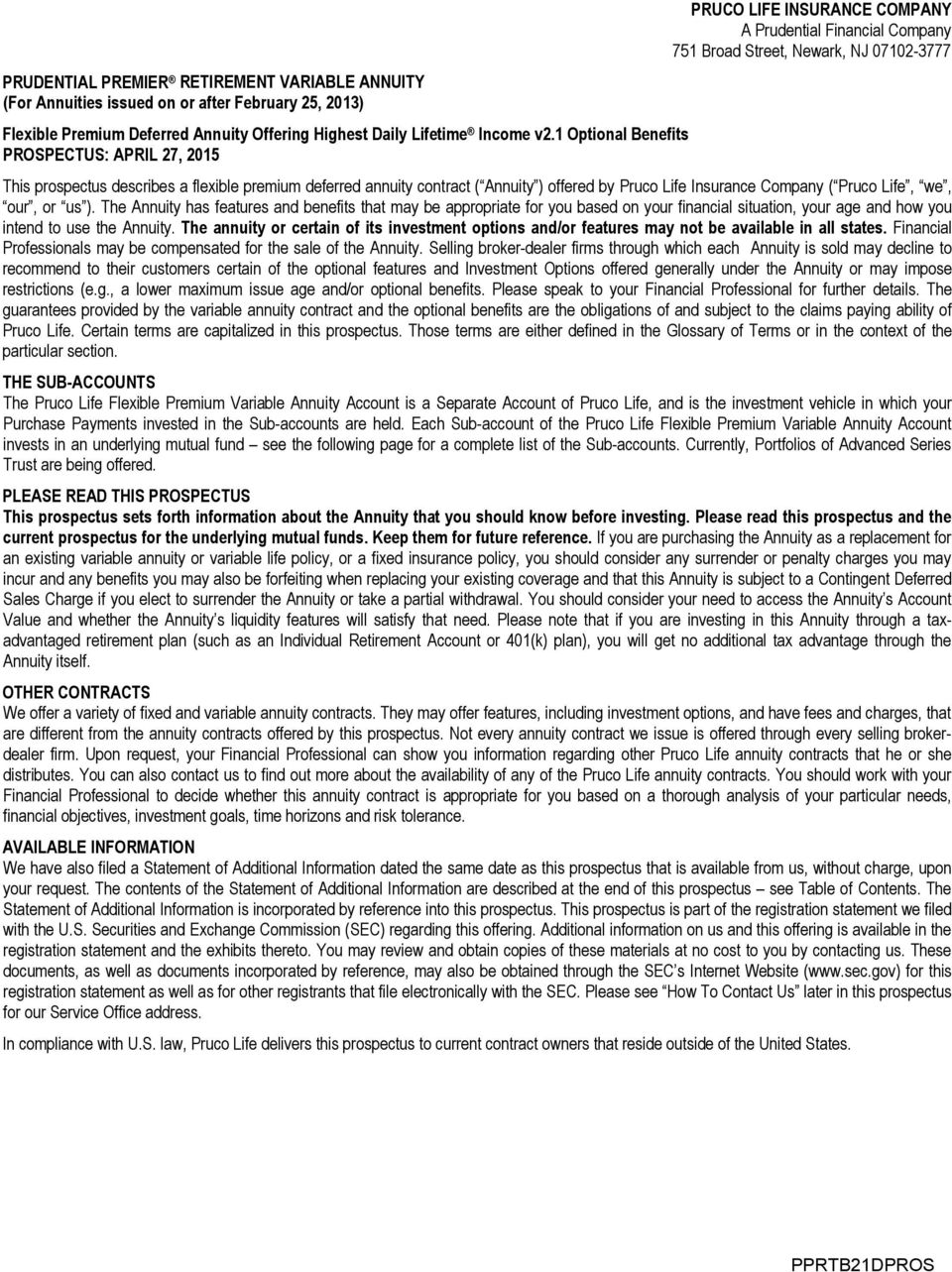
19 PRUDENTIAL PREMIER RETIREMENT VARIABLE ANNUITY (For Annuities issued on or after February 25, 2013) Flexible Premium Deferred Annuity Offering Highest Daily Lifetime Income v2.1 Optional Benefits PROSPECTUS: APRIL 27, 2015 PRUCO LIFE INSURANCE COMPANY A Prudential Financial Company 751 Broad Street, Newark, NJ This prospectus describes a flexible premium deferred annuity contract ( Annuity ) offered by Pruco Life Insurance Company ( Pruco Life, we, our, or us ). The Annuity has features and benefits that may be appropriate for you based on your financial situation, your age and how you intend to use the Annuity. The annuity or certain of its investment options and/or features may not be available in all states. Financial Professionals may be compensated for the sale of the Annuity. Selling broker-dealer firms through which each Annuity is sold may decline to recommend to their customers certain of the optional features and Investment Options offered generally under the Annuity or may impose restrictions (e.g., a lower maximum issue age and/or optional benefits. Please speak to your Financial Professional for further details. The guarantees provided by the variable annuity contract and the optional benefits are the obligations of and subject to the claims paying ability of Pruco Life. Certain terms are capitalized in this prospectus. Those terms are either defined in the Glossary of Terms or in the context of the particular section. THE SUB-ACCOUNTS The Pruco Life Flexible Premium Variable Annuity Account is a Separate Account of Pruco Life, and is the investment vehicle in which your Purchase Payments invested in the Sub-accounts are held. Each Sub-account of the Pruco Life Flexible Premium Variable Annuity Account invests in an underlying mutual fund see the following page for a complete list of the Sub-accounts. Currently, Portfolios of Advanced Series Trust are being offered. PLEASE READ THIS PROSPECTUS This prospectus sets forth information about the Annuity that you should know before investing. Please read this prospectus and the current prospectus for the underlying mutual funds. Keep them for future reference. If you are purchasing the Annuity as a replacement for an existing variable annuity or variable life policy, or a fixed insurance policy, you should consider any surrender or penalty charges you may incur and any benefits you may also be forfeiting when replacing your existing coverage and that this Annuity is subject to a Contingent Deferred Sales Charge if you elect to surrender the Annuity or take a partial withdrawal. You should consider your need to access the Annuity s Account Value and whether the Annuity s liquidity features will satisfy that need. Please note that if you are investing in this Annuity through a taxadvantaged retirement plan (such as an Individual Retirement Account or 401(k) plan), you will get no additional tax advantage through the Annuity itself. OTHER CONTRACTS We offer a variety of fixed and variable annuity contracts. They may offer features, including investment options, and have fees and charges, that are different from the annuity contracts offered by this prospectus. Not every annuity contract we issue is offered through every selling brokerdealer firm. Upon request, your Financial Professional can show you information regarding other Pruco Life annuity contracts that he or she distributes. You can also contact us to find out more about the availability of any of the Pruco Life annuity contracts. You should work with your Financial Professional to decide whether this annuity contract is appropriate for you based on a thorough analysis of your particular needs, financial objectives, investment goals, time horizons and risk tolerance. AVAILABLE INFORMATION We have also filed a Statement of Additional Information dated the same date as this prospectus that is available from us, without charge, upon your request. The contents of the Statement of Additional Information are described at the end of this prospectus see Table of Contents. The Statement of Additional Information is incorporated by reference into this prospectus. This prospectus is part of the registration statement we filed with the U.S. Securities and Exchange Commission (SEC) regarding this offering. Additional information on us and this offering is available in the registration statement and the exhibits thereto. You may review and obtain copies of these materials at no cost to you by contacting us. These documents, as well as documents incorporated by reference, may also be obtained through the SEC s Internet Website ( for this registration statement as well as for other registrants that file electronically with the SEC. Please see How To Contact Us later in this prospectus for our Service Office address. In compliance with U.S. law, Pruco Life delivers this prospectus to current contract owners that reside outside of the United States. PPRTB21DPROS
20 This Annuity is NOT a deposit or obligation of, or issued, guaranteed or endorsed by, any bank, is NOT insured or guaranteed by the U.S. government, the Federal Deposit Insurance Corporation (FDIC), the Federal Reserve Board or any other agency. An investment in an annuity involves investment risks, including possible loss of value, even with respect to amounts allocated to the AST Money Market Sub-account. THESE SECURITIES HAVE NOT BEEN APPROVED OR DISAPPROVED BY THE SECURITIES AND EXCHANGE COMMISSION OR ANY STATE SECURITIES COMMISSION NOR HAS THE COMMISSION OR ANY STATE SECURITIES COMMISSION PASSED UPON THE ACCURACY OR ADEQUACY OF THIS PROSPECTUS. ANY REPRESENTATION TO THE CONTRARY IS A CRIMINAL OFFENSE. PRUDENTIAL, PRUDENTIAL FINANCIAL, PRUDENTIAL ANNUITIES AND THE ROCK LOGO ARE SERVICEMARKS OF THE PRUDENTIAL INSURANCE COMPANY OF AMERICA AND ITS AFFILIATES. OTHER PROPRIETARY PRUDENTIAL MARKS MAY BE DESIGNATED AS SUCH THROUGH USE OF THE SM OR SYMBOLS. FOR FURTHER INFORMATION CALL: PRU-2888 OR GO TO OUR WEBSITE AT Prospectus Dated: April 27, 2015 Statement of Additional Information Dated: April 27, 2015

21 VARIABLE INVESTMENT OPTIONS Advanced Series Trust AST Academic Strategies Asset Allocation Portfolio 1 AST Advanced Strategies Portfolio 1 AST AQR Emerging Markets Equity Portfolio AST AQR Large-Cap Portfolio AST Balanced Asset Allocation Portfolio 1 AST BlackRock Global Strategies Portfolio 1 AST BlackRock ishares ETF Portfolio 1 AST BlackRock/Loomis Sayles Bond Portfolio AST Boston Partners Large-Cap Value Portfolio AST Capital Growth Asset Allocation Portfolio 1 AST ClearBridge Dividend Growth Portfolio AST Cohen & Steers Realty Portfolio AST Defensive Asset Allocation Portfolio 1 AST FI Pyramis Asset Allocation Portfolio 1,2 AST FI Pyramis Quantitative Portfolio 1,2 AST Franklin Templeton Founding Funds Allocation Portfolio*,1 AST Franklin Templeton Founding Funds Plus Portfolio 1 AST Global Real Estate Portfolio AST Goldman Sachs Large-Cap Value Portfolio AST Goldman Sachs Mid-Cap Growth Portfolio AST Goldman Sachs Multi-Asset Portfolio 1 AST Goldman Sachs Small-Cap Value Portfolio AST Herndon Large-Cap Value Portfolio AST High Yield Portfolio AST International Growth Portfolio AST International Value Portfolio AST Investment Grade Bond Portfolio 3 AST J.P. Morgan Global Thematic Portfolio 1 AST J.P. Morgan International Equity Portfolio AST J.P. Morgan Strategic Opportunities Portfolio 1 AST Jennison Large-Cap Growth Portfolio AST Large-Cap Value Portfolio AST Legg Mason Diversified Growth Portfolio AST Loomis Sayles Large-Cap Growth Portfolio AST Lord Abbett Core Fixed Income Portfolio AST MFS Global Equity Portfolio AST MFS Growth Portfolio AST MFS Large-Cap Value Portfolio AST Mid-Cap Value Portfolio AST Money Market Portfolio AST Neuberger Berman Core Bond Portfolio AST Neuberger Berman Mid-Cap Growth Portfolio AST Neuberger Berman/LSV Mid-Cap Value Portfolio AST New Discovery Asset Allocation Portfolio 1 AST Parametric Emerging Markets Equity Portfolio AST PIMCO Limited Maturity Bond Portfolio AST Preservation Asset Allocation Portfolio 1 AST Prudential Core Bond Portfolio AST Prudential Growth Allocation Portfolio 1 AST QMA Emerging Markets Equity Portfolio AST QMA Large-Cap Portfolio AST QMA US Equity Alpha Portfolio AST RCM World Trends Portfolio 1 AST Schroders Global Tactical Portfolio 1 AST Schroders Multi-Asset World Strategies Portfolio 1 AST Small-Cap Growth Portfolio AST Small-Cap Growth Opportunities Portfolio AST Small-Cap Value Portfolio AST T. Rowe Price Asset Allocation Portfolio 1 AST T. Rowe Price Equity Income Portfolio AST T. Rowe Price Growth Opportunities Portfolio AST T. Rowe Price Large-Cap Growth Portfolio AST T. Rowe Price Natural Resources Portfolio AST Templeton Global Bond Portfolio AST Wellington Management Hedged Equity Portfolio 1 AST Western Asset Core Plus Bond Portfolio AST Western Asset Emerging Markets Debt Portfolio * This variable investment option is no longer available for new investments, with limited exceptions. Please see Investment Options later in this prospectus for details. (1) These are the only variable investment options available to you if you select one of the optional benefits. (2) Pyramis is a registered service mark of FMR LLC. Used with permission. (3) The AST Investment Grade Bond variable investment option is not available for allocation of Purchase Payments or contract owner transfers.
22 CONTENTS GLOSSARY OF TERMS...1 SUMMARY OF CONTRACT FEES AND CHARGES...3 EXPENSE EXAMPLES...10 SUMMARY...11 INVESTMENT OPTIONS...13 VARIABLE INVESTMENT OPTIONS...13 MARKET VALUE ADJUSTMENT OPTION...18 GUARANTEE PERIOD TERMINATION...18 RATES FOR DCA MVA OPTIONS...18 MARKET VALUE ADJUSTMENT...19 FEES, CHARGES AND DEDUCTIONS...20 ANNUITY PAYMENT OPTION CHARGES...24 EXCEPTIONS/REDUCTIONS TO FEES AND CHARGES...24 PURCHASING YOUR ANNUITY...25 REQUIREMENTS FOR PURCHASING THE ANNUITY...25 DESIGNATION OF OWNER, ANNUITANT, AND BENEFICIARY...26 RIGHT TO CANCEL...27 SCHEDULED PAYMENTS DIRECTLY FROM A BANK ACCOUNT...27 SALARY REDUCTION PROGRAMS...27 MANAGING YOUR ANNUITY...28 CHANGE OF OWNER, ANNUITANT AND BENEFICIARY DESIGNATIONS...28 MANAGING YOUR ACCOUNT VALUE...30 DOLLAR COST AVERAGING PROGRAMS OR 12 MONTH DOLLAR COST AVERAGING PROGRAM (THE 6 OR 12 MONTH DCA PROGRAM)...30 AUTOMATIC REBALANCING PROGRAMS...31 FINANCIAL PROFESSIONAL PERMISSION TO FORWARD TRANSACTION INSTRUCTIONS...31 RESTRICTIONS ON TRANSFERS BETWEEN INVESTMENT OPTIONS...32 ACCESS TO ACCOUNT VALUE...34 TYPES OF DISTRIBUTIONS AVAILABLE TO YOU...34 TAX IMPLICATIONS FOR DISTRIBUTIONS FROM NONQUALIFIED ANNUITIES...34 FREE WITHDRAWAL AMOUNTS...34 SYSTEMATIC WITHDRAWALS FROM MY ANNUITY DURING THE ACCUMULATION PERIOD...35 SYSTEMATIC WITHDRAWALS UNDER SECTIONS 72(t)/72(q) OF THE INTERNAL REVENUE CODE...36 REQUIRED MINIMUM DISTRIBUTIONS...36 SURRENDERS...37 SURRENDER VALUE...37 MEDICALLY-RELATED SURRENDERS...37 ANNUITY OPTIONS...38 LIVING BENEFITS...40 HIGHEST DAILY LIFETIME INCOME v2.1 BENEFIT...41 SPOUSAL HIGHEST DAILY LIFETIME INCOME v2.1 BENEFIT...52 (i)
23 DEATH BENEFIT...60 TRIGGERS FOR PAYMENT OF THE DEATH BENEFIT...60 EXCEPTIONS TO AMOUNT OF DEATH BENEFIT...60 DEATH BENEFIT AMOUNT...60 SPOUSAL CONTINUATION OF ANNUITY...61 PAYMENT OF DEATH BENEFIT...61 BENEFICIARY CONTINUATION OPTION...62 VALUING YOUR INVESTMENT...64 VALUING THE SUB-ACCOUNTS...64 PROCESSING AND VALUING TRANSACTIONS...64 TAX CONSIDERATIONS...66 OTHER INFORMATION...75 PRUCO LIFE AND THE SEPARATE ACCOUNT...75 LEGAL STRUCTURE OF THE UNDERLYING PORTFOLIOS...77 DISTRIBUTION OF ANNUITIES OFFERED BY PRUCO LIFE...78 FINANCIAL STATEMENTS...80 INDEMNIFICATION...80 LEGAL PROCEEDINGS...80 CONTENTS OF THE STATEMENT OF ADDITIONAL INFORMATION...80 HOW TO CONTACT US...82 APPENDIX A - ACCUMULATION UNIT VALUES... A-1 APPENDIX B - FORMULA FOR HIGHEST DAILY LIFETIME INCOME v2.1 SUITE OF BENEFITS... B-1 APPENDIX C - SPECIAL CONTRACT PROVISIONS FOR ANNUITIES ISSUED IN CERTAIN STATES... C-1 APPENDIX D - MVA FORMULA... D-1 APPENDIX E - HYPOTHETICAL EXAMPLES OF OPERATION OF PREMIUM BASED CHARGE AND CONTINGENT DEFERRED SALES CHARGE... E-1 (ii)
24 GLOSSARY OF TERMS We set forth here definitions of some of the key terms used throughout this Prospectus. In addition to the definitions here, we also define certain terms in the section of the Prospectus that uses such terms. Account Value: The total value of all allocations to the Sub-accounts and the DCA MVA Options on any Valuation Day. The Account Value is determined separately for each Sub-account and for each DCA MVA Option, and then totaled to determine the Account Value for your entire Annuity. The Account Value of each DCA MVA Option will be calculated using any applicable MVA. Accumulation Period: The period of time from the Issue Date through the last Valuation Day immediately preceding the Annuity Date. Annual Income Amount: This is the annual amount of income for which you are eligible for life under the optional benefits. Annuitant: The natural person upon whose life annuity payments payable to the Owner are based. Annuitization: Annuitization is the process by which you direct us to apply the Unadjusted Account Value to one of the available annuity options to begin making periodic payments to the Owner. Annuity Date: The date on which we apply your Unadjusted Account Value to the applicable annuity option and begin the payout period. As discussed in the Annuity Options section, there is an age by which you must begin receiving annuity payments, which we call the Latest Annuity Date. Annuity Year: The first Annuity Year begins on the Issue Date and continues through and includes the day immediately preceding the first anniversary of the Issue Date. Subsequent Annuity Years begin on the anniversary of the Issue Date and continue through and include the day immediately preceding the next anniversary of the Issue Date. Beneficiary(ies): The natural person(s) or entity(ies) designated as the recipient(s) of the Death Benefit or to whom any remaining period certain payments may be paid in accordance with the annuity payout options section of the Annuity. Code: The Internal Revenue Code of 1986, as amended from time to time and the regulations promulgated thereunder. Contingent Deferred Sales Charge ( CDSC ): This is a sales charge that may be deducted when you make a surrender or take a partial withdrawal from your Annuity. We refer to this as a contingent charge because it is imposed only if you surrender or take a withdrawal from your Annuity. The charge is a percentage of each applicable Purchase Payment that is being surrendered or withdrawn. Dollar Cost Averaging ( DCA ) MVA Option: An Investment Option that offers a fixed rate of interest for a specified period. The DCA MVA Option is used only with our 6 or 12 Month Dollar Cost Averaging Program, under which the Purchase Payments that you have allocated to that DCA MVA Option are transferred to the designated Sub-accounts over a 6 month or 12 month period. Withdrawals or transfers from the DCA MVA Option generally will be subject to a Market Value Adjustment if made other than pursuant to the 6 or 12 Month DCA Program. Due Proof of Death: Due Proof of Death is satisfied when we receive all of the following in Good Order: (a) a death certificate or similar documentation acceptable to us; (b) all representations we require or which are mandated by applicable law or regulation in relation to the death claim and the payment of death proceeds; and (c) any applicable election of the method of payment of the death benefit, if not previously elected by the Owner, by at least one Beneficiary. Excess Income: All or a portion of a Lifetime Withdrawal that exceeds the Annual Income Amount for that benefit year is considered excess income ( Excess Income ). Each withdrawal of Excess Income proportionally reduces the Annual Income Amount for future benefit years. Free Look: The right to examine your Annuity, during a limited period of time, to decide if you want to keep it or cancel it. The length of this time period, and the amount of refund, depends on applicable law and thus may vary by state. In addition, there is a different Free Look period that applies if your Annuity is held within an IRA. In your Annuity contract, your Free Look right is referred to as your Right to Cancel. Good Order: Good Order is the standard that we apply when we determine whether an instruction is satisfactory. An instruction will be considered in Good Order if it is received at our Service Office: (a) in a manner that is satisfactory to us such that it is sufficiently complete and clear that we do not need to exercise any discretion to follow such instruction and complies with all relevant laws and regulations; (b) on specific forms, or by other means we then permit (such as via telephone or electronic submission); and/or (c) with any signatures and dates as we may require. We will notify you if an instruction is not in Good Order. Guarantee Period: The period of time during which we credit a fixed rate of interest to a DCA MVA Option. Investment Option: A Sub-account or DCA MVA Option available as of any given time to which Account Value may be allocated. Issue Date: The effective date of your Annuity. Key Life: Under the Beneficiary Continuation Option, the person whose life expectancy is used to determine the required distributions. 1
25 Market Value Adjustment ( MVA ): A positive or negative adjustment used to determine the Account Value of a DCA MVA Option. Owner: The Owner is either an eligible entity or person named as having ownership rights in relation to the Annuity. Payout Period: The period starting on the Annuity Date and during which annuity payments are made. Portfolio: An underlying mutual fund in which a Sub-Account of the Separate Account invests. Premium Based Charge: A charge that is deducted on each Quarterly Annuity Anniversary from your Account Value, during the first seven years after each Purchase Payment is made. Purchase Payment: A cash consideration (a premium ) in currency of the United States of America given to us in exchange for the rights, privileges, and benefits of the Annuity. Quarterly Annuity Anniversary: Each successive three-month anniversary of the Issue Date of the Annuity. Separate Account: Refers to the Pruco Life Flexible Premium Variable Annuity Account, which holds assets associated with annuities issued by Pruco Life Insurance Company. Separate Account assets that are held in support of the annuities are kept separate from all of our other assets and may not be charged with liabilities arising out of any other business we may conduct. Service Office: The place to which all requests and payments regarding the Annuity are to be sent. We may change the address of the Service Office at any time, and will notify you in advance of any such change of address. Please see How to Contact Us later in this Prospectus for the Service Office address. Sub-Account: A division of the Separate Account. Surrender Value: The Account Value (which includes the effect of any MVA) less any applicable CDSC, any applicable tax charges, any charges assessable as a deduction from the Account Value for any optional benefits provided by rider or endorsement, and any Annual Maintenance Fee. Unadjusted Account Value: The Unadjusted Account Value is equal to the Account Value prior to the application of any MVA. Unit: A share of participation in a Sub-account used to calculate your Account Value prior to the Annuity Date. Valuation Day: Every day the New York Stock Exchange is open for trading or any other day the Securities and Exchange Commission requires mutual funds or unit investment trusts to be valued. We, Us, Our: Pruco Life Insurance Company. You, Your: The Owner(s) shown in the Annuity. 2
26 SUMMARY OF CONTRACT FEES AND CHARGES The following tables describe the fees and expenses that you will pay when buying, owning, and surrendering the Annuity. The first table describes the fees and expenses that you will pay at the time you surrender the Annuity, take a partial withdrawal, or transfer Account Value between the Investment Options. State premium taxes also may be deducted. ANNUITY OWNER TRANSACTION EXPENSES CONTINGENT DEFERRED SALES CHARGE ( CDSC ) 1 The CDSC for each Purchase Payment is a percentage of the Purchase Payment being withdrawn. Thus, the appropriate percentage is multiplied by the Purchase Payment(s) being withdrawn to determine the amount of the CDSC. See Contingent Deferred Sales Charge ( CDSC ) under Fees, Charges and Deductions for more information about how the CDSC is calculated. Total Purchase Payment Amount 1 Year or more but less than 2 Years Age of Purchase Payment Being Withdrawn 2 Years or more but less than 3 Years 3 Years or more but less than 4 Years 4 Years or more but less than 5 Years 5 Years or more but less than 6 Years 6 Years or more but less than 7 Years Less than 1 Year Less than $50, % 5.0% 4.0% 4.0% 3.0% 3.0% 2.0% 0% $50,000 or more but less than $100, % 4.0% 4.0% 3.0% 3.0% 2.0% 2.0% 0% $100,000 or more but less than $250, % 3.0% 3.0% 2.0% 2.0% 2.0% 1.0% 0% $250,000 or more but less than $500, % 2.0% 2.0% 2.0% 1.0% 1.0% 1.0% 0% $500,000 or more but less than $1,000, % 2.0% 2.0% 1.0% 1.0% 1.0% 1.0% 0% $1,000,000 or more 2.0% 2.0% 1.0% 1.0% 1.0% 1.0% 1.0% 0% Transfer Fee 2 $10 Tax Charge (current) 3 0% to 3.5% 1 The different tiers of Contingent Deferred Sales Charges, separated by breakpoints, are shown in the table above. If a portion of a Purchase Payment results in total Purchase Payments crossing into a new Purchase Payment tier (as set forth in the table above), then the entire Purchase Payment will be subject to the Contingent Deferred Sales Charge applicable to that tier. Once a Purchase Payment is assigned to a particular tier for purposes of the CDSC, the CDSC schedule for that specific Purchase Payment will not change for the remainder of that CDSC period. Please see Appendix E for examples of the operation of the Contingent Deferred Sales Charge. 2 Currently, we deduct the fee after the 20 th transfer each Annuity Year. 3 Currently, we deduct the tax charge only upon annuitization and only in certain states we will give you further details in the maturity package that we will send to you prior to annuitization. We reserve the right to deduct the tax charge upon any of the following events: the time the Purchase Payment is allocated to the Annuity, upon a full surrender of the Annuity, or upon Annuitization. The following table provides a summary of the periodic fees and charges you will pay while you own your Annuity, excluding the underlying Portfolio annual expenses. These fees and charges are described in more detail within this Prospectus. PERIODIC FEES AND CHARGES Annual Maintenance Fee 4,5 : Lesser of $50 or 2% of the Unadjusted Account Value. Premium Based Charge 6,7. Premium Based Charge Percentage (deducted quarterly) 7 Years or more Annual Equivalent Of Premium Based Charge Percentage Total Purchase Payment Amount Less than $50, % 0.70% $50,000 or more, but less than $100, % 0.60% $100,000 or more, but less than $250, % 0.50% $250,000 or more, but less than $500, % 0.35% $500,000 or more, but less than $1,000, % 0.25% $1,000,000 or more % 0.15% 3
27 ANNUALIZED INSURANCE FEES/CHARGES (assessed daily as a percentage of the net assets of the Sub-accounts) FEE/CHARGE Mortality & Expense Risk Charge 0.70% Administration Charge 0.15% Total Annualized Insurance Fees/Charges % 4 Assessed annually on the Annuity s anniversary date or upon surrender. Only applicable if the total of all Purchase Payments at the time the fee is due is less than $50, For Beneficiaries who elect the Beneficiary Continuation Option, the Annual Maintenance Fee is the lesser of $30 or 2% of Unadjusted Account Value and is only applicable if Unadjusted Account Value is less than $25,000 at the time the fee is assessed. 6 The Premium Based Charge applicable to a Purchase Payment is determined by multiplying (1) the amount of that Purchase Payment by (2) its associated Premium Based Charge percentage, as shown in the table above. Each Purchase Payment is subject to a Premium Based Charge for a 7 year period following the date the Purchase Payment is allocated to the Annuity. The Premium Based Charge for each Purchase Payment is determined when it is allocated to the Annuity (except for those Purchase Payments that are allocated to the Annuity prior to the first Quarterly Annuity Anniversary) based on the total of all Purchase Payments received to date. For Purchase Payments allocated to the Annuity before the first Quarterly Annuity Anniversary, the Premium Based Charge for each Purchase Payment is based on the total of all such Purchase Payments received up to and including the Valuation Day before the first Quarterly Annuity Anniversary. Please see the Fees and Charges section for details and Appendix E for examples of the operation of the Premium Based Charge. Quarterly Annuity Anniversary refers to each successive three-month anniversary of the Issue Date of the Annuity. 7 The different tiers of Premium Based Charges separated by breakpoints, are shown in the table above. If a portion of a Purchase Payment results in total Purchase Payments crossing into a new Purchase Payment tier (as set forth in the table above), then the entire Purchase Payment will be subject to the Premium Based Charge applicable to that tier. With respect to those Purchase Payments allocated to the Annuity prior to the first Quarterly Annuity Anniversary, the Premium Based Charge percentage applicable to each of those Purchase Payments is based on the total of all such Purchase Payments (that is, we total all the Purchase Payments received before the first Quarterly Annuity Anniversary to determine the Premium Based Charge that applies to each). Purchase Payments received on or after the first Quarterly Annuity Anniversary that result in breakpoints being reached will result in lower charge percentages for only such Purchase Payments and those that follow. Once a Premium Based Charge percentage is established for any Purchase Payment, such percentage is fixed and will not be reduced even if additional Purchase Payments are made or partial withdrawals are taken. Please see Appendix E for examples of the operation of the Premium Based Charge. 8 The Insurance Charge is the combination of Mortality & Expense Risk Charge and the Administration Charge. For Beneficiaries who elect the Beneficiary Continuation Option, the Mortality and Expense and Administration Charges do not apply. However, a Settlement Service Charge equal to 1.00% is assessed as a percentage of the daily net assets of the Subaccounts as an annual charge. YOUR OPTIONAL BENEFIT FEES AND CHARGES The following table sets forth the charge for each optional benefit under the Annuity. These fees would be in addition to the periodic fees and transaction fees set forth in the tables above. The first column shows the charge for each optional benefit on a maximum and current basis. The next column shows the total expenses you would pay for the Annuity if you purchased the relevant optional benefit. More specifically, this column shows the total charge for the optional benefit plus the Total Annualized Insurance Fees/Charges applicable to the Annuity. Where the charges cannot actually be totaled (because they are assessed against different base values), we show both individual charges. OPTIONAL BENEFIT HIGHEST DAILY LIFETIME INCOME v2.1 Maximum Charge 11 (assessed against greater of Unadjusted Account Value and Protected Withdrawal Value) Current Charge (assessed against greater of Unadjusted Account Value and Protected Withdrawal Value) SPOUSAL HIGHEST DAILY LIFETIME INCOME v2.1 Maximum Charge 11 (assessed against greater of Unadjusted Account Value and Protected Withdrawal Value) Current Charge (assessed against greater of Unadjusted Account Value and Protected Withdrawal Value) ANNUALIZED OPTIONAL BENEFIT CHARGE 9 TOTAL ANNUALIZED CHARGE % 0.85% % 1.00% 0.85% % 2.00% 0.85% % 1.10% 0.85% % 9 The charge for each of the Highest Daily Lifetime Income v2.1 benefits listed above is assessed against the greater of Unadjusted Account Value and the Protected Withdrawal Value (PWV). Please see the Living Benefits section of this Prospectus for an explanation of PWV. 10 The charge is taken out of the Sub-accounts as described below: Highest Daily Lifetime Income v2.1: 1.00% current optional benefit charge is in addition to the current 0.85% Insurance charge of amounts invested in the Sub-accounts. Spousal Highest Daily Lifetime Income v2.1: 1.10% current optional benefit charge is in addition to the current 0.85% Insurance charge of amounts invested in the Sub-accounts. 11 We reserve the right to increase the charge to the maximum charge indicated, upon any step-up under the benefit. Also, if you decide to elect or cancel and later re-elect a benefit after your contract has been issued, the charge for the benefit under your contract will equal the current charge for then new contract owners up to the maximum indicated. 4
28 The following table provides the range (minimum and maximum) of the total annual expenses for the underlying Portfolios before any contractual waivers and expense reimbursements. Each figure is stated as a percentage of the underlying Portfolio's average daily net assets. TOTAL ANNUAL PORTFOLIO OPERATING EXPENSES MINIMUM MAXIMUM Total Portfolio Operating Expenses 0.60% 9.30% The following are the total annual expenses for each underlying Portfolio. The Total Annual Portfolio Operating Expenses reflect the combination of the underlying Portfolio s investment management fee, other expenses, any 12b-1 fees, and certain other expenses. Each figure is stated as a percentage of the underlying Portfolio s average daily net assets. For certain of the Portfolios, a portion of the management fee has been contractually waived and/or other expenses have been contractually partially reimbursed, which is shown in the table. The following expenses are deducted by the underlying Portfolio before it provides Pruco Life with the daily net asset value. The underlying Portfolio information was provided by the underlying mutual funds and has not been independently verified by us. See the Prospectuses or statements of additional information of the underlying Portfolios for further details. The current summary Prospectuses, Prospectuses and Statement of Additional Information for the underlying Portfolios can be obtained by calling PRU-2888 or at UNDERLYING MUTUAL FUND PORTFOLIO ANNUAL EXPENSES (as a percentage of the average net assets of the underlying Portfolios) For the year ended December 31, 2014 Total Broker Fees Acquired Annual Net Annual Distribution Dividend and Expenses Portfolio Portfolio Fee Waiver Fund Management Other (12b-1) Expense on on Short Fees & Operating or Expense Operating FUNDS Fees Expenses Fees Short Sales Sales Expenses Expenses Reimbursement Expenses AST Academic Strategies Asset Allocation Portfolio AST Advanced Strategies Portfolio* AST AQR Emerging Markets Equity Portfolio AST AQR Large-Cap Portfolio* AST Balanced Asset Allocation Portfolio 0.70% 0.03% 0.04% 0.05% 0.01% 0.63% 1.46% 0.00% 1.46% 0.80% 0.02% 0.10% 0.00% 0.00% 0.05% 0.97% 0.01% 0.96% 1.09% 0.16% 0.10% 0.00% 0.00% 0.00% 1.35% 0.00% 1.35% 0.72% 0.01% 0.10% 0.00% 0.00% 0.00% 0.83% 0.24% 0.59% 0.15% 0.01% 0.00% 0.00% 0.00% 0.75% 0.91% 0.00% 0.91% AST BlackRock Global Strategies Portfolio AST BlackRock ishares ETF Portfolio* AST BlackRock/Loomis Sayles Bond Portfolio* AST Boston Partners Large- Cap Value Portfolio AST Capital Growth Asset Allocation Portfolio AST ClearBridge Dividend Growth Portfolio* AST Cohen &Steers Reality Portfolio* AST Defensive Asset Allocation Portfolio AST FI Pyramis Asset Allocation Portfolio* AST FI Pyramis Quantitative Portfolio* AST Franklin Templeton Founding Funds Allocation Portfolio* 0.97% 0.04% 0.10% 0.00% 0.00% 0.02% 1.13% 0.00% 1.13% 0.89% 0.07% 0.10% 0.00% 0.00% 0.21% 1.27% 0.25% 1.02% 0.61% 0.02% 0.10% 0.00% 0.00% 0.00% 0.73% 0.03% 0.70% 0.73% 0.03% 0.10% 0.00% 0.00% 0.00% 0.86% 0.00% 0.86% 0.15% 0.01% 0.00% 0.00% 0.00% 0.76% 0.92% 0.00% 0.92% 0.82% 0.02% 0.10% 0.00% 0.00% 0.00% 0.94% 0.11% 0.83% 0.98% 0.03% 0.10% 0.00% 0.00% 0.00% 1.11% 0.07% 1.04% 0.15% 0.06% 0.00% 0.00% 0.00% 0.73% 0.94% 0.00% 0.94% 0.82% 0.03% 0.10% 0.00% 0.00% 0.00% 0.95% 0.02% 0.93% 0.81% 0.03% 0.10% 0.00% 0.00% 0.00% 0.94% 0.14% 0.80% 0.91% 0.02% 0.10% 0.00% 0.00% 0.00% 1.03% 0.00% 1.03% 5
29 UNDERLYING MUTUAL FUND PORTFOLIO ANNUAL EXPENSES (as a percentage of the average net assets of the underlying Portfolios) For the year ended December 31, 2014 Total Broker Fees Acquired Annual Net Annual Distribution Dividend and Expenses Portfolio Portfolio Fee Waiver Fund Management Other (12b-1) Expense on on Short Fees & Operating or Expense Operating FUNDS Fees Expenses Fees Short Sales Sales Expenses Expenses Reimbursement Expenses AST Franklin Templeton Founding Funds Plus 0.02% 0.02% 0.00% 0.00% 0.00% 1.01% 1.05% 0.00% 1.05% Portfolio AST Global Real Estate Portfolio 0.98% 0.05% 0.10% 0.00% 0.00% 0.00% 1.13% 0.00% 1.13% AST Goldman Sachs Large- Cap Value Portfolio* 0.72% 0.02% 0.10% 0.00% 0.00% 0.00% 0.84% 0.01% 0.83% AST Goldman Sachs Mid- Cap Growth Portfolio* AST Goldman Sachs Multi- Asset Portfolio* 0.98% 0.03% 0.10% 0.00% 0.00% 0.00% 1.11% 0.05% 1.06% 0.92% 0.05% 0.10% 0.00% 0.00% 0.00% 1.07% 0.21% 0.86% AST Goldman Sachs Small- Cap Value Portfolio* 0.93% 0.03% 0.10% 0.00% 0.00% 0.06% 1.12% 0.01% 1.11% AST Herndon Large-Cap Value Portfolio 0.83% 0.02% 0.10% 0.00% 0.00% 0.00% 0.95% 0.15% 0.80% AST High Yield Portfolio 0.72% 0.04% 0.10% 0.00% 0.00% 0.00% 0.86% 0.00% 0.86% AST International Growth Portfolio* 0.97% 0.02% 0.10% 0.00% 0.00% 0.00% 1.09% 0.01% 1.08% AST International Value Portfolio 0.97% 0.03% 0.10% 0.00% 0.00% 0.00% 1.10% 0.00% 1.10% AST Investment Grade Bond Portfolio* 0.63% 0.05% 0.10% 0.00% 0.00% 0.00% 0.78% 0.03% 0.75% AST J.P. Morgan Global Thematic Portfolio 0.92% 0.04% 0.10% 0.00% 0.00% 0.00% 1.06% 0.00% 1.06% AST J.P. Morgan International Equity 0.86% 0.06% 0.10% 0.00% 0.00% 0.00% 1.02% 0.00% 1.02% Portfolio AST J.P. Morgan Strategic Opportunities Portfolio 0.97% 0.05% 0.10% 0.10% 0.00% 0.00% 1.22% 0.00% 1.22% AST Jennison Large-Cap Growth Portfolio AST Large-Cap Value Portfolio AST Legg Mason Diversified Growth Portfolio* AST Loomis Sayles Large- Cap Growth Portfolio* 0.88% 0.02% 0.10% 0.00% 0.00% 0.00% 1.00% 0.00% 1.00% 0.72% 0.02% 0.10% 0.00% 0.00% 0.00% 0.84% 0.00% 0.84% 0.89% 8.19% 0.10% 0.00% 0.00% 0.12% 9.30% 8.23% 1.07% 0.87% 0.01% 0.10% 0.00% 0.00% 0.00% 0.98% 0.06% 0.92% AST Lord Abbett Core Fixed Income Portfolio* 0.77% 0.02% 0.10% 0.00% 0.00% 0.00% 0.89% 0.29% 0.60% AST MFS Global Equity Portfolio 0.98% 0.05% 0.10% 0.00% 0.00% 0.00% 1.13% 0.00% 1.13% AST MFS Growth Portfolio 0.87% 0.02% 0.10% 0.00% 0.00% 0.00% 0.99% 0.00% 0.99% AST MFS Large-Cap Value Portfolio 0.83% 0.04% 0.10% 0.00% 0.00% 0.00% 0.97% 0.00% 0.97% AST Mid-Cap Value Portfolio 0.94% 0.04% 0.10% 0.00% 0.00% 0.00% 1.08% 0.00% 1.08% AST Money Market Portfolio 0.47% 0.03% 0.10% 0.00% 0.00% 0.00% 0.60% 0.00% 0.60% AST Neuberger Berman / LSV Mid-Cap Value 0.88% 0.02% 0.10% 0.00% 0.00% 0.00% 1.00% 0.00% 1.00% Portfolio* AST Neuberger Berman Core Bond Portfolio* 0.68% 0.04% 0.10% 0.00% 0.00% 0.00% 0.82% 0.15% 0.67% 6
30 UNDERLYING MUTUAL FUND PORTFOLIO ANNUAL EXPENSES (as a percentage of the average net assets of the underlying Portfolios) For the year ended December 31, 2014 Total Broker Fees Acquired Annual Net Annual Distribution Dividend and Expenses Portfolio Portfolio Fee Waiver Fund Management Other (12b-1) Expense on on Short Fees & Operating or Expense Operating FUNDS Fees Expenses Fees Short Sales Sales Expenses Expenses Reimbursement Expenses AST Neuberger Berman Mid- Cap Growth Portfolio* 0.88% 0.03% 0.10% 0.00% 0.00% 0.00% 1.01% 0.01% 1.00% AST New Discovery Asset Allocation Portfolio* AST Parametric Emerging Markets Equity Portfolio AST PIMCO Limited Maturity Bond Portfolio AST Preservation Asset Allocation Portfolio AST Prudential Core Bond Portfolio* AST Prudential Growth Allocation Portfolio AST QMA Emerging Markets Equity Portfolio AST QMA Large-Cap Core Portfolio AST QMA US Equity Alpha Portfolio AST RCM World Trends Portfolio AST Schroders Global Tactical Portfolio AST Schroders Multi-Asset World Strategies Portfolio AST Small Cap Growth Portfolio AST Small Cap Value Portfolio AST Small-Cap Growth Opportunities Portfolio AST T. Rowe Price Asset Allocation Portfolio* AST T. Rowe Price Equity Income Portfolio AST T. Rowe Price Growth Opportunities Portfolio AST T. Rowe Price Large- Cap Growth Portfolio AST T. Rowe Price Natural Resources Portfolio AST Templeton Global Bond Portfolio AST Wellington Mgmt Hedged Equity Portfolio AST Western Asset Core Plus Bond Portfolio* 0.83% 0.08% 0.10% 0.00% 0.00% 0.00% 1.01% 0.01% 1.00% 1.08% 0.24% 0.10% 0.00% 0.00% 0.00% 1.42% 0.00% 1.42% 0.63% 0.04% 0.10% 0.00% 0.00% 0.00% 0.77% 0.00% 0.77% 0.15% 0.01% 0.00% 0.00% 0.00% 0.71% 0.87% 0.00% 0.87% 0.66% 0.02% 0.10% 0.00% 0.00% 0.00% 0.78% 0.03% 0.75% 0.80% 0.03% 0.10% 0.00% 0.00% 0.01% 0.94% 0.00% 0.94% 1.09% 0.24% 0.10% 0.00% 0.00% 0.02% 1.45% 0.00% 1.45% 0.72% 0.01% 0.10% 0.00% 0.00% 0.00% 0.83% 0.00% 0.83% 0.99% 0.04% 0.10% 0.13% 0.25% 0.00% 1.51% 0.00% 1.51% 0.91% 0.03% 0.10% 0.00% 0.00% 0.00% 1.04% 0.00% 1.04% 0.91% 0.03% 0.10% 0.00% 0.00% 0.11% 1.15% 0.00% 1.15% 1.06% 0.04% 0.10% 0.00% 0.00% 0.09% 1.29% 0.00% 1.29% 0.88% 0.03% 0.10% 0.00% 0.00% 0.00% 1.01% 0.00% 1.01% 0.87% 0.03% 0.10% 0.00% 0.00% 0.02% 1.02% 0.00% 1.02% 0.93% 0.04% 0.10% 0.00% 0.00% 0.00% 1.07% 0.00% 1.07% 0.79% 0.02% 0.10% 0.00% 0.00% 0.00% 0.91% 0.02% 0.89% 0.72% 0.02% 0.10% 0.00% 0.00% 0.00% 0.84% 0.00% 0.84% 0.89% 0.61% 0.10% 0.00% 0.00% 0.00% 1.60% 0.00% 1.60% 0.85% 0.02% 0.10% 0.00% 0.00% 0.00% 0.97% 0.00% 0.97% 0.88% 0.04% 0.10% 0.00% 0.00% 0.00% 1.02% 0.00% 1.02% 0.78% 0.09% 0.10% 0.00% 0.00% 0.00% 0.97% 0.00% 0.97% 0.97% 0.03% 0.10% 0.00% 0.00% 0.02% 1.12% 0.00% 1.12% 0.66% 0.03% 0.10% 0.00% 0.00% 0.00% 0.79% 0.20% 0.59% 7
31 UNDERLYING MUTUAL FUND PORTFOLIO ANNUAL EXPENSES (as a percentage of the average net assets of the underlying Portfolios) For the year ended December 31, 2014 Total Broker Fees Acquired Annual Net Annual Distribution Dividend and Expenses Portfolio Portfolio Fee Waiver Fund Management Other (12b-1) Expense on on Short Fees & Operating or Expense Operating FUNDS Fees Expenses Fees Short Sales Sales Expenses Expenses Reimbursement Expenses AST Western Asset Emerging Markets Debt Portfolio* *See notes immediately below for important information about this fund. 0.84% 0.06% 0.10% 0.00% 0.00% 0.00% 1.00% 0.05% 0.95% AST Advanced Strategies Portfolio The Investment Managers have contractually agreed to waive 0.014% of their investment management fees through June 30, This waiver may not be terminated prior to June 30, 2016 without the prior approval of the Trust s Board of Trustees. AST AQR Large-Cap Portfolio The Investment Managers have contractually agreed to waive 0.24% of their investment management fees through June 30, This waiver may not be terminated prior to June 30, 2016 without the prior approval of the Trust s Board of Trustees. AST Blackrock ishares ETF Portfolio The Investment Managers have contractually agreed to waive a portion of their investment management fee equal to the acquired fund fees and expenses due to investments in ishares ETFs. In addition, the Investment Managers have contractually agreed to waive a portion of their investment management fee and/or reimburse certain expenses for the Portfolio so that the Portfolio s investment management fees (after the waiver described in the first sentence) and other expenses (including distribution fees, acquired fund fees and expenses due to investments in ishares ETFs, and other expenses excluding taxes, interest and brokerage commissions) do not exceed 1.02% of the Portfolio s average daily net assets through June 30, These waivers may not be terminated prior to June 30, 2016 without the prior approval of the Trust s Board of Trustees. AST BlackRock/Loomis Sayles Bond Portfolio The Investment Managers have contractually agreed to waive 0.035% of their investment management fees through June 30, This waiver may not be terminated prior to June 30, 2016 without the prior approval of the Trust s Board of Trustees. AST ClearBridge Dividend Growth Portfolio The Investment Managers have contractually agreed to waive 0.11% of their investment management fees through June 30, This waiver may not be terminated prior to June 30, 2016 without the prior approval of the Trust s Board of Trustees. AST Cohen-Steers Reality Portfolio The Investment Managers have contractually agreed to waive 0.07% of their investment management fees through June 30, This waiver may not be terminated prior to June 30, 2016 without the prior approval of the Trust s Board of Trustees. AST FI Pyramis Asset Allocation Portfolio The Investment Managers have contractually agreed to waive 0.018% of their investment management fees through June 30, This waiver may not be terminated prior to June 30, 2016 without the prior approval of the Trust s Board of Trustees. AST FI Pyramis Quantitative Portfolio The Investment Managers have contractually agreed to waive 0.14% of their investment management fees through June 30, This waiver may not be terminated prior to June 30, 2016 without the prior approval of the Trust s Board of Trustees. AST Franklin Templeton Founding Funds Allocation Portfolio The Investment Managers have contractually agreed to waive a portion of their investment management fees and/or reimburse certain expenses so that the investment management fees plus other expenses (exclusive in all cases of taxes, short sale interest and dividend expenses, brokerage commissions, distribution fees, underlying fund fees and expenses, and extraordinary expenses) for the Portfolio do not exceed 1.10% of the average daily net assets of the Portfolio through June 30, This expense limitation may not be terminated prior to June 30, 2016 without the prior approval of the Trust s Board of Trustees. AST Goldman Sachs Large-Cap Value Portfolio The Investment Managers have contractually agreed to waive 0.013% of their investment management fees through June 30, This waiver may not be terminated prior to June 30, 2016 without the prior approval of the Trust s Board of Trustees. AST Goldman Sachs Mid-Cap Growth Portfolio The Investment Managers have contractually agreed to waive 0.053% of their investment management fees through June 30, This waiver may not be terminated prior to June 30, 2016 without the prior approval of the Trust s Board of Trustees. AST Goldman Sachs Multi-Asset Portfolio The Investment Managers have contractually agreed to waive 0.213% of their investment management fee through June 30, This waiver may not be terminated prior to June 30, 2016 without the prior approval of the Trust s Board of Trustees. AST Goldman Sachs Small-Cap Value Portfolio The Investment Managers have contractually agreed to waive 0.013% of their investment management fee through June 30, This waiver may not be terminated prior to June 30, 2016 without the prior approval of the Trust s Board of Trustees. AST Herndon Large-Cap Value Portfolio The Investment Managers have contractually agreed to waive 0.15% of their investment management fees through June 30, This waiver may not be terminated prior to June 30, 2016 without the prior approval of the Trust s Board of Trustees. AST International Growth Portfolio The Investment Managers have contractually agreed to waive 0.013% of their investment management fees through June 30, This waiver may not be terminated prior to June 30, 2016 without the prior approval of the Trust s Board of Trustees. AST Investment Grade Bond Portfolio The Investment Managers have contractually agreed to waive a portion of their investment management fees and/or reimburse certain expenses for each Portfolio so that each Portfolio's investment management fees plus other expenses (exclusive in all cases of taxes, interest, brokerage commissions, acquired fund fees and expenses, and extraordinary expenses) do not exceed 0.99% of each Portfolio's average daily net assets through June 30, This waiver may not be terminated prior to June 30, 2016 without the prior approval of the Trust s Board of Trustees. AST Legg Mason Diversified Growth Portfolio The Manager has contractually agreed to waive a portion of its investment management fee and/or reimburse certain expenses of the portfolio so that the portfolio s investment management fees (after management fee waiver) and other expenses (including net distribution fees, acquired fund fees and expenses due to investments in underlying portfolios of the Trust and underlying portfolios managed or subadvised by the subadviser, and excluding taxes, interest and brokerage commissions) do not exceed 1.07% of the Portfolio s average daily net assets. This arrangement may not be terminated or modified prior to June 30, 2016, and may be discontinued or modified thereafter. The decision on whether to renew, modify or discontinue the arrangement after June 30, 2016 will be subject to review by the Manager and the Trust s Board of Trustees. AST Loomis Sayles Large-Cap Growth Portfolio The Investment Managers have contractually agreed to waive 0.06% of their investment management fees through June 30, This waiver may not be terminated prior to June 30, 2016 without the prior approval of the Trust s Board of Trustees. AST Lord Abbett Core Fixed Income Portfolio The Investment Managers have contractually agreed to waive 0.16% of their investment management fees through June 30, In addition, the Investment Managers have contractually agreed to waive a portion of their investment management fee, as follows: 0.10% on the first $500 million of average daily net assets; 0.125% of the Portfolio s average daily net assets between $500 million and $1 billion; and 0.15% of the Portfolio s average daily net assets in excess of $1 billion through June 30, These waivers may not be terminated prior to June 30, 2016 without the prior approval of the Trust s Board of Trustees. 8
32 AST Neuberger Berman Core Bond Portfolio The Investment Managers have contractually agreed to waive 0.14% of their investment management fee through June 30, In addition, the Investment Managers have contractually agreed to waive a portion of their investment management fees, as follows: 0.025% of the Portfolio s average daily net assets between $500 million and $1 billion, and 0.05% of the Portfolio s average daily net assets in excess of $1 billion through June 30, These waivers may not be terminated prior to June 30, 2016 without the prior approval of the Trust s Board of Trustees. AST Neuberger Berman Mid-Cap Growth Portfolio The Investment Managers have contractually agreed to waive 0.005% of their investment management fee through June 30, This waiver may not be terminated prior to June 30, 2016 without the prior approval of the Trust s Board of Trustees. AST Neuberger Berman/LSV Mid-Cap Value Portfolio The Investment Managers have contractually agreed to waive 0.003% of their investment management fee through June 30, This waiver may not be terminated prior to June 30, 2016 without the prior approval of the Trust s Board of Trustees. AST New Discovery Asset Allocation Portfolio The Investment Managers have contractually agreed to waive 0.009% their investment management fees through June 30, In addition, the Investment Managers have contractually agreed to waive a portion of their investment management fees and/or reimburse certain expenses for the Portfolio so that the Portfolio's investment management fees plus other expenses (exclusive in all cases of taxes, interest, brokerage commissions, acquired fund fees and expenses, and extraordinary expenses) do not exceed 1.08% of the Portfolio's average daily net assets through June 30, These waivers may not be terminated prior to June 30, 2016 without the prior approval of the Trust s Board of Trustees. AST Prudential Core Bond Portfolio The Investment Managers have contractually agreed to waive a portion of their investment management fees as follows: 0.025% of the Portfolio s average daily net assets between $500 million and $1 billion, and 0.05% of the Portfolio s average daily net assets in excess of $1 billion through June 30, The waiver may not be terminated prior to June 30, 2016 without the prior approval of the Trust s Board of Trustees. AST T. Rowe Price Asset Allocation Portfolio The Investment Managers have contractually agreed to waive 0.022% of their investment management fee through June 30, This waiver may not be terminated prior to June 30, 2016 without the prior approval of the Trust s Board of Trustees. AST Western Asset Core Plus Bond Portfolio The Investment Managers have contractually agreed to waive 0.20% of their investment management fees through June 30, This waiver may not be terminated prior to June 30, 2016 without the prior approval of the Trust s Board of Trustees. AST Western Asset Emerging Markets Debt Portfolio The Investment Managers have contractually agreed to waive 0.05% of their investment management fee through June 30, This waiver arrangement may not be terminated prior to June 30, 2016 without the prior approval of the Trust s Board of Trustees. 9
33 EXPENSE EXAMPLES These examples are intended to help you compare the cost of investing in one Pruco Life Annuity with the cost of investing in other Pruco Life Annuities and/or other variable annuities. Below are examples for the Annuity showing what you would pay cumulatively in expenses at the end of the stated time periods had you invested $10,000 in the Annuity and assuming your investment has a 5% return each year. The examples reflect the fees and charges listed below for the Annuity as described in Summary of Contract Fees and Charges. Insurance Charge Premium Based Charge Contingent Deferred Sales Charge (when and if applicable) Annual Maintenance Fee Optional benefit fees The examples also assume the following for the period shown: You allocate all of your Account Value to the Sub-account with the maximum gross total operating expenses and the expenses remain the same each year* For each charge, we deduct the maximum charge rather than the current charge You make no withdrawals of Account Value You make no transfers, or other transactions for which we charge a fee No tax charge applies You elect the Spousal Highest Daily Lifetime Income v2.1, which has the maximum optional benefit charge. There is no other combination of optional benefits that would result in higher maximum charges than those shown in the examples. Amounts shown in the examples are rounded to the nearest dollar. * Note: Not all Portfolios offered as Sub-accounts may be available depending on optional benefit election. THE EXAMPLES ARE ILLUSTRATIVE ONLY THEY SHOULD NOT BE CONSIDERED A REPRESENTATION OF PAST OR FUTURE EXPENSES OF THE UNDERLYING PORTFOLIOS. ACTUAL EXPENSES WILL BE MORE OR LESS THAN THOSE SHOWN DEPENDING UPON WHICH OPTIONAL BENEFIT YOU ELECT OTHER THAN INDICATED IN THE EXAMPLES OR IF YOU ALLOCATE ACCOUNT VALUE TO ANY OTHER AVAILABLE SUB-ACCOUNTS. Expense Examples are provided as follows: If you surrender your Annuity at the end of the applicable time period: If you do not surrender your Annuity, or if you annuitize your Annuity: Please see Appendix A for a table of Accumulation Unit Values. 1 Year 3 Years 5 Years 10 Years $1,690 $3,824 $5,782 $9,651 1 Year 3 Years 5 Years 10 Years $1,190 $3,424 $5,482 $9,651 10
34 SUMMARY This Summary describes key features of the Annuity offered in this Prospectus. It is intended to give you an overview, and to point you to sections of the Prospectus that provide greater detail. You should not rely on the Summary alone for all the information you need to know before purchasing the Annuity. You should read the entire Prospectus for a complete description of the Annuity. Your Financial Professional can also help you if you have questions. The Annuity: The variable annuity contract issued by Pruco Life is a contract between you, the Owner, and Pruco Life, an insurance company. It is designed for retirement purposes, or other long-term investing, to help you save money for retirement, on a tax deferred basis, and provide income during your retirement. Although this Prospectus describes key features of the variable annuity contract, the Prospectus is a distinct document, and is not part of the contract. The Annuity offers various investment Portfolios. With the help of your Financial Professional, you choose how to invest your money within your Annuity (subject to certain restrictions; see Investment Options ). Investing in a variable annuity involves risk and you can lose your money. On the other hand, investing in a variable annuity can provide you with the opportunity to grow your money through participation in underlying mutual funds. GENERALLY SPEAKING, VARIABLE ANNUITIES ARE INVESTMENTS DESIGNED TO BE HELD FOR THE LONG TERM. WORKING WITH YOUR FINANCIAL PROFESSIONAL, YOU SHOULD CAREFULLY CONSIDER WHETHER A VARIABLE ANNUITY IS APPROPRIATE FOR YOU GIVEN YOUR LIFE EXPECTANCY, NEED FOR INCOME, AND OTHER PERTINENT FACTORS. Purchase: Your eligibility to purchase the Annuity is based on your age and the amount of your initial Purchase Payment. The Maximum Age for Initial Purchase applies to the oldest Owner and Annuitant as of the day we would issue the Annuity. If the Annuity is to be owned by an entity, the maximum age applies to the Annuitant as of the day we would issue the Annuity. For this Annuity the maximum age is 80. The minimum initial Purchase Payment is $10,000. See your Financial Professional to complete an application. After you purchase your Annuity, you will have a limited period of time during which you may cancel (or Free Look ) the purchase of your Annuity. Your request for a Free Look must be received in Good Order within the applicable time period. Good Order is the standard that we apply when we determine whether an instruction is satisfactory. An instruction will be considered in Good Order if it is received at our Service Office: (a) in a manner that is satisfactory to us such that it is sufficiently complete and clear that we do not need to exercise any discretion to follow such instruction and complies with all relevant laws and regulations; (b) on specific forms, or by other means we then permit (such as via telephone or electronic submission); and/or (c) with any signatures and dates as we may require. We will notify you if an instruction is not in Good Order. The Service Office is the place to which all requests and payments regarding the Annuity are to be sent. We may change the address of the Service Office at any time, and will notify you in advance of any such change of address. Please see the section of this Prospectus entitled How To Contact Us for the Service Office address. Please see Requirements for Purchasing the Annuity for additional information. Investment Options: You may choose from a variety of variable Investment Options ranging from conservative to aggressive. Our optional benefits limit your ability to invest in the variable Investment Options otherwise available to you under the Annuity. Each of the underlying Portfolios is described in its own Prospectus, which you should read before selecting your investment options. You can obtain the summary Prospectus and Prospectuses for the Portfolios by calling PRU-2888 or at There is no assurance that any variable Investment Option will meet its investment objective. You may also allocate Purchase Payments to the DCA MVA Option, an Investment Option that offers a fixed rate of interest for a specified period. The DCA MVA Option is used only with our 6 or 12 Month Dollar Cost Averaging Program, under which the Purchase Payments that you have allocated to that DCA MVA Option are transferred to the designated Sub-accounts over a 6 month or 12 month period. Withdrawals or transfers from the DCA MVA Option generally will be subject to a Market Value Adjustment if made other than pursuant to the 6 or 12 Month DCA Program. Please see Investment Options, and Managing Your Account Value for information. Access To Your Money: You can receive income by taking partial withdrawals or electing annuity payments. Please note that withdrawals may be subject to tax, and may be subject to a Contingent Deferred Sales Charge (discussed below). You may withdraw up to 10% of your Purchase Payments each Annuity Year without being subject to a Contingent Deferred Sales Charge. You may elect to receive income through annuity payments, also called Annuitization. If you elect to receive annuity payments, you convert your Unadjusted Account Value into a stream of future payments. This means you no longer have an Account Value and therefore cannot make withdrawals. We offer different types of annuity options to meet your needs. The Unadjusted Account Value refers to the Account Value prior to the application of any market value adjustment (i.e., MVA ). Please see Access to Account Value and Annuity Options for more information. 11
35 Optional Living Benefits Guaranteed Lifetime Withdrawal Benefits. We offer optional living benefits, for an additional charge, that guarantee your ability to take withdrawals for life as a percentage of Protected Withdrawal Value, even if your Account Value falls to zero (unless it does so due to a withdrawal of Excess Income). The Protected Withdrawal Value is not the same as your Account Value, and it is not available for a lump sum withdrawal. The Account Value has no guarantees, may fluctuate, and can lose value. Withdrawals in excess of the Annual Income Amount, called Excess Income, will impact the value of the benefit including a permanent reduction in future guaranteed amounts. In marketing and other materials, we may refer to Excess Income as Excess Withdrawals. You have the ability to elect an optional living benefit at the time of application only. Optional living benefits cannot be added after your Annuity has been issued. Highest Daily Lifetime Income v2.1 Spousal Highest Daily Lifetime Income v2.1 As a condition of electing an optional living benefit, we limit the Investment Options to which you may allocate your Account Value. Also, these benefits utilize a predetermined mathematical formula to help us manage your guarantee through all market cycles. Under the predetermined mathematical formula, your Account Value may be transferred between certain permitted Sub-accounts on the one hand and the AST Investment Grade Bond Sub-account on the other hand. Please see the applicable optional benefits section as well as Appendix B to this Prospectus for more information on the formula. In the Living Benefits section, we describe guaranteed minimum withdrawal benefits that allow you to withdraw a specified amount each year for life (or joint lives, for the spousal version of the benefit). Please be aware that if you withdraw more than that amount in a given Annuity Year (i.e., Excess Income ), that withdrawal may permanently reduce the guaranteed amount you can withdraw in future years. Please also note that if your Account Value is reduced to zero as a result of a withdrawal of Excess Income, both the optional benefit and the Annuity will terminate. Thus, you should think carefully before taking a withdrawal of Excess Income. Death Benefits: You may name a Beneficiary to receive the proceeds of your Annuity upon your death. Your death benefit must be distributed within the time period required by the tax laws. The Annuity offers a death benefit generally equal to the greater of Unadjusted Account Value and Purchase Payments (adjusted for partial withdrawals). The calculation of the death benefit may be different if you elect Highest Daily Lifetime Income v2.1 or Spousal Highest Daily Lifetime Income v2.1. Please see Death Benefit for more information. Fees and Charges: Each Annuity, and the optional living benefits, are subject to certain fees and charges, as discussed in the Summary of Contract Fees and Charges table earlier in this Prospectus. In addition, there are fees and expenses of the underlying Portfolios. What does it mean that my annuity is tax deferred? Variable annuities are tax deferred, meaning you pay no taxes on any earnings from your Annuity until you withdraw the money. You may also transfer among your Investment Options without paying a tax at the time of the transfer. When you take your money out of the Annuity, however, you will be taxed on the earnings at ordinary income tax rates. If you withdraw money before you reach age 59 1 /2, you also may be subject to a 10% federal tax penalty. You may also purchase the Annuity as a tax-qualified retirement investment such as an IRA, SEP-IRA, Roth IRA, 401(a) plan, or non-erisa 403(b) plan. Although there is no additional tax advantage to a variable annuity purchased through one of these plans, the Annuity has features and benefits other than tax deferral that may make it an important investment for a qualified plan. You should consult your tax adviser regarding these features and benefits prior to purchasing a contract for use with a tax-qualified plan. Market Timing: We have market timing policies and procedures that attempt to detect transfer activity that may adversely affect other Owners or Portfolio shareholders in situations where there is potential for pricing inefficiencies or that involve certain other types of disruptive trading activity (i.e., market timing). Our market timing policies and procedures are discussed in more detail later in this Prospectus, entitled Restrictions on Transfers Between Investment Options. Other Information: Please see the section entitled Other Information for more information about the Annuity, including legal information about Pruco Life, the Separate Account, and underlying Portfolios. The Separate Account is referred to as the Variable Separate Account in your Annuity. 12
36 INVESTMENT OPTIONS The Investment Options under each Annuity consist of the Sub-accounts and the DCA MVA Options. In this section, we describe the Portfolios. We then discuss the investment restrictions that apply if you elect certain optional benefits. Finally, we discuss the DCA MVA Options. Each Subaccount invests in an underlying Portfolio whose share price generally fluctuates each Valuation Day. The Portfolios that you select, among those that are permitted, are your choice we do not provide investment advice, nor do we recommend any particular Portfolio. You bear the investment risk for amounts allocated to the Portfolios. In contrast to the Sub-accounts, Account Value allocated to a DCA MVA Option earns a fixed rate of interest as long as you remain invested for the Guarantee Period. We guarantee both the stated amount of interest and the principal amount of your Account Value in a DCA MVA Option, so long as you remain invested in the DCA MVA Option for the duration of the Guarantee Period. In general, if you withdraw Account Value prior to the end of the DCA MVA Option s Guarantee Period, you will be subject to a Market Value Adjustment or MVA, which can be positive or negative. A Guarantee Period is the period of time during which we credit a fixed rate of interest to a DCA MVA Option. As a condition of electing an optional living benefit (e.g., Highest Daily Lifetime Income v2.1), you will be restricted from investing in certain Subaccounts. We describe those restrictions below. In addition, all of the optional living benefits employ a predetermined mathematical formula, all of under which money is transferred between your chosen Sub-accounts and the AST Investment Grade Bond Sub-account. Whether or not you elect an optional benefit subject to the predetermined mathematical formula, you should be aware that the operation of the formula may result in large-scale asset flows into and out of the Sub-accounts. These asset flows could adversely impact the Portfolios, including their risk profile, expenses and performance. These asset flows impact not only the Permitted Subaccounts used with the optional benefits but also the other Sub-accounts, because the Portfolios may be used as investments in certain Permitted Sub-accounts that are structured as funds-of-funds. Because transfers between the Sub-accounts and the AST Investment Grade Bond Sub-account can be frequent and the amount transferred can vary from day to day, any of the Portfolios could experience the following effects, among others: (a) a Portfolio s investment performance could be adversely affected by requiring a subadviser to purchase and sell securities at inopportune times or by otherwise limiting the subadviser s ability to fully implement the Portfolio s investment strategy; (b) the subadviser may be required to hold a larger portion of assets in highly liquid securities than it otherwise would hold, which could adversely affect performance if the highly liquid securities underperform other securities (e.g., equities) that otherwise would have been held; (c) a Portfolio may experience higher turnover than it would have experienced without the formula, which could result in higher operating expense ratios and higher transaction costs for the Portfolio compared to other similar funds. The asset flows caused by the formula may affect Owners in differing ways. In particular, because the formula is calculated on an individual basis for each contract, on any particular day, some Owners Account Value may be transferred to the AST Investment Grade Bond Sub-account and other Owners Account Value may not be transferred. To the extent that there is a large transfer of Account Value on a given trading day to the AST Investment Grade Bond Sub-account, and your Account Value is not so transferred, it is possible that the investment performance of the Sub-accounts in which your Account Value remains invested will be negatively affected. The efficient operation of the asset flows caused by the formula depends on active and liquid markets. If market liquidity is strained, the asset flows may not operate as intended. For example, it is possible that illiquid markets or other market stress could cause delays in the transfer of cash from one Portfolio to another Portfolio, which in turn could adversely impact performance. VARIABLE INVESTMENT OPTIONS Each Variable Investment Option is a Sub-account of the Pruco Life Flexible Premium Variable Annuity Account (see Pruco Life and the Separate Account for more detailed information). Each Sub-account invests exclusively in one Portfolio. The Investment Objectives Chart below provides a description of each Portfolio s investment objective to assist you in determining which Portfolios may be of interest to you. Please note, the AST Investment Grade Bond Sub-account is not available for allocation of Purchase Payments or owner-initiated transfers. Not all Portfolios offered as Sub-accounts may be available depending on whether you elect an optional benefit. Thus, if you elect an optional benefit, you would be precluded from investing in certain Portfolios and therefore would not receive investment appreciation (or depreciation) affecting those Portfolios. The Portfolios are not publicly traded mutual funds. They are only available as Investment Options in variable annuity contracts and variable life insurance policies issued by insurance companies, or in some cases, to participants in certain qualified retirement plans. However, some of the Portfolios available as Sub-accounts under the Annuities are managed by the same Portfolio adviser or subadviser as a retail mutual fund of the same or similar name that the Portfolio may have been modeled after at its inception. While the investment objective and policies of the retail mutual funds and the Portfolios may be substantially similar, the actual investments will differ to varying degrees. Differences in the performance of the funds and Portfolios can be expected, and in some cases could be substantial. You should not compare the performance of a publicly traded mutual fund with the performance of any similarly named Portfolio offered as a Sub-account. Details about the investment objectives, policies, risks, costs and management of the Portfolios are found in the prospectuses for the Portfolios. 13
37 In the table that follows, all Portfolio names include the prefix AST, which indicates that they are Portfolios of the Advanced Series Trust. In addition, for each Portfolio the subadviser(s), which has been engaged to conduct day-to-day management, is listed next to the description. This Annuity offers only Portfolios managed by AST Investment Services, Inc. and/or Prudential Investments LLC, both of which are affiliated companies of Pruco Life ( Affiliated Portfolios ). Pruco Life and its affiliates ( Prudential Companies ) receive fees and payments from the Affiliated Portfolios, which may be greater than the fees and payments Prudential Companies would receive if we offered unaffiliated portfolios. Because of the potential for greater profits earned by the Prudential Companies with respect to the Affiliated Portfolios, we have an incentive to offer Affiliated Portfolios over other portfolios sponsored and advised by companies not affiliated with Pruco Life. We have an incentive to offer Portfolios managed by certain subadvisers, either because the subadviser is a Prudential Company or because the subadviser provides payments or support, including distribution and marketing support, to the Prudential Companies. We may consider those subadviser factors in determining which Portfolios to offer under the Annuities. Also, in some cases, we offer Portfolios based on the recommendations made by selling broker-dealer firms. These firms may receive payments from the Portfolios they recommend and may benefit accordingly from allocations of Account Value to the subaccounts that invest in these Portfolios. Allocations made to all AST Portfolios benefit us financially. See "Other Information" under the heading concerning "Fees and Payments Received by Pruco Life" for more information about fees and payments we may receive from underlying Portfolios and/or their affiliates. In addition, we may consider the potential risk to us of offering a Portfolio in light of the benefits provided by the Annuity On APRIL 29, 2013, we stopped offering the AST FRANKLIN TEMPLETON FOUNDING FUNDS ALLOCATION PORTFOLIO as a Sub-account under the Annuities, except as follows: if at any time prior to April 29, 2013 you had any portion of your Account Value allocated to the AST Franklin Templeton Founding Funds Allocation Sub-account, you may continue to allocate Account Value and make transfers into and/or out of the AST Franklin Templeton Founding Funds Allocation Sub-account, including any electronic funds transfer, dollar cost averaging, asset allocation and rebalancing programs. If you never had a portion of your Account Value allocated to the AST Franklin Templeton Founding Funds Allocation Sub-account prior to April 29, 2013, you cannot allocate Account Value to the AST Franklin Templeton Founding Funds Allocation Subaccount. You may select Portfolios individually, create your own combination of Portfolios (certain limitations apply see Limitations with Optional Benefits later in this section), or select from among combinations of Portfolios that we have created called Prudential Portfolio Combinations. Under Prudential Portfolio Combinations, each Prudential Portfolio Combination consists of several asset allocation Portfolios, each of which represents a specified percentage of your allocations. If you elect to invest according to one of these Prudential Portfolio Combinations, we will allocate your initial Purchase Payment among the Sub-accounts within the Prudential Portfolio Combination according to the percentage allocations. You may elect to allocate additional Purchase Payments according to the composition of the Prudential Portfolio Combination, although if you do not make such an explicit election, we will allocate additional Purchase Payments as discussed below under Additional Purchase Payments. Once you have selected a Prudential Portfolio Combination, we will not rebalance your Account Value to take into account differences in performance among the Sub-accounts. This is a static, point of sale model allocation. Over time, the percentages in each asset allocation Portfolio may vary from the Prudential Portfolio Combination you selected when you purchased your Annuity based on the performance of each of the Portfolios within the Prudential Portfolio Combination. However, you may elect to participate in an automatic rebalancing program, under which we would transfer Account Value periodically so that your Account Value allocated to the Sub-accounts is brought back to the exact percentage allocations stipulated by the Prudential Portfolio Combination you elected. Please see Automatic Rebalancing Programs below for details about how such a program operates. If you are participating in an optional living benefit (such as Highest Daily Lifetime Income v2.1) that makes transfers under a predetermined mathematical formula, and you have elected automatic rebalancing in addition to Prudential Portfolio Combinations, you should be aware that: (a) the AST Investment Grade Bond Sub-account used as part of the predetermined mathematical formula will not be included as part of automatic rebalancing and (b) the operation of the formula may result in the rebalancing not conforming to the percentage allocations that existed originally as part of Prudential Portfolio Combinations. If you are interested in a Prudential Portfolio Combination, you should work with your Financial Professional to select the Prudential Portfolio Combination that is appropriate for you, in light of your investment time horizon, investment goals and expectations and market risk tolerance, and other relevant factors. Some selling firms may not offer Prudential Portfolio Combinations. In providing these Prudential Portfolio Combinations, we are not providing investment advice. You are responsible for determining which Prudential Portfolio Combination or Subaccount(s) is best for you. Asset allocation does not ensure a profit or protect against a loss. The following table contains limited information about the Portfolios. Before selecting an Investment Option or Portfolio Combination, you should carefully review the summary Prospectuses and/or Prospectuses for the Portfolios, which contain details about the investment objectives, policies, risks, costs and management of the Portfolios. You can obtain the summary Prospectuses and Prospectuses for the Portfolios by calling PRU-2888 or at 14
38 PORTFOLIO NAME INVESTMENT OBJECTIVES PORTFOLIO ADVISERS/ SUBADVISER(S) AST Academic Strategies Asset Allocation Portfolio Seeks long-term capital appreciation. AlphaSimplex Group, LLC AQR Capital Management, LLC and CNH Partners, LLC CoreCommodity Management, LLC First Quadrant, L.P. Jennison Associates LLC J.P. Morgan Investment Management, Inc. Pacific Investment Management Company LLC (PIMCO) Prudential Investments LLC Quantitative Management Associates LLC Western Asset Management Company/ Western Asset Management Company Limited AST Advanced Strategies Portfolio Seeks a high level of absolute return by using traditional and non-traditional investment strategies and by investing in domestic and foreign equity and fixed income securities, derivative instruments and other investment companies. Brown Advisory LLC Loomis, Sayles & Company, L.P. LSV Asset Management Prudential Investment Management, Inc. Quantitative Management Associates LLC T. Rowe Price Associates, Inc. William Blair & Company, LLC AST AQR Emerging Markets Equity Portfolio Seeks long-term capital appreciation. AQR Capital Management, LLC AST AQR Large-Cap Portfolio Seeks long-term capital appreciation. AQR Capital Management, LLC AST Balanced Asset Allocation Portfolio AST BlackRock Global Strategies Portfolio AST BlackRock ishares ETF Portfolio AST BlackRock/Loomis Sayles Bond Portfolio (formerly AST PIMCO Total Return Bond Portfolio) AST Boston Partners Large-Cap Value Portfolio (formerly AST Jennison Large-Cap Value Portfolio) AST Capital Growth Asset Allocation Portfolio AST ClearBridge Dividend Growth Portfolio AST Cohen & Steers Realty Portfolio AST Defensive Asset Allocation Portfolio Seeks to obtain the highest potential total return consistent with its specified level of risk tolerance. Seeks a high total return consistent with a moderate level of risk. Seeks to maximize total return with a moderate level of risk. Seek to maximize total return, consistent with preservation of capital and prudent investment management Seeks capital appreciation. Seeks to obtain the highest potential total return consistent with its specified level of risk tolerance. Seeks income, capital preservation, and capital appreciation. Seeks to maximize total return through investment in real estate securities. Seeks to obtain the highest potential total return consistent with its specified level of risk tolerance. Prudential Investments LLC Quantitative Management Associates LLC BlackRock Financial Management, Inc. BlackRock International Limited BlackRock Financial Management, Inc. BlackRock Financial Management, Inc.; BlackRock International Limited BlackRock (Singapore) Limited Loomis, Sayles & Company, L.P. Boston Partners Prudential Investments LLC Quantitative Management Associates LLC ClearBridge Investments, LLC Cohen & Steers Capital Management, Inc. Prudential Investments LLC Quantitative Management Associates LLC AST FI Pyramis Asset Allocation Portfolio Seeks to maximize total return. Pyramis Global Advisors, LLC a Fidelity Investments Company AST FI Pyramis Quantitative Portfolio AST Franklin Templeton Founding Funds Allocation Portfolio Seeks long-term capital growth balanced by current income. Seeks capital appreciation while its secondary investment objective is to seek income. Pyramis Global Advisors, LLC a Fidelity Investments Company Franklin Advisers, Inc. Franklin Mutual Advisers, LLC Templeton Global Advisors Limited AST Franklin Templeton Founding Funds Plus Portfolio Seeks capital appreciation. AST Investment Services, Inc. Prudential Investments LLC AST Global Real Estate Portfolio Seeks capital appreciation and income. Prudential Real Estate Investors AST Goldman Sachs Large-Cap Value Portfolio Seeks long-term growth of capital. Goldman Sachs Asset Management, L.P. AST Goldman Sachs Mid-Cap Growth Portfolio Seeks long-term growth of capital. Goldman Sachs Asset Management, L.P. AST Goldman Sachs Multi-Asset Portfolio Seeks to obtain a high level of total return consistent with its level of risk tolerance. Goldman Sachs Asset Management, L.P. AST Goldman Sachs Small-Cap Value Portfolio Seeks long-term capital appreciation. Goldman Sachs Asset Management, L.P. AST Herndon Large-Cap Value Portfolio Seeks maximum growth of capital by investing primarily in the value stocks of larger companies. Herndon Capital Management, LLC 15
39 PORTFOLIO NAME AST High Yield Portfolio INVESTMENT OBJECTIVES Seeks maximum total return, consistent with preservation of capital and prudent investment management. PORTFOLIO ADVISERS/ SUBADVISER(S) J.P. Morgan Investment Management, Inc. Prudential Investment Management, Inc. AST International Growth Portfolio Seeks long-term capital growth. Jennison Associates LLC Neuberger Berman Management LLC William Blair & Company, LLC AST International Value Portfolio Seeks capital growth. Lazard Asset Management LLC LSV Asset Management AST Investment Grade Bond Portfolio AST J.P. Morgan Global Thematic Portfolio Seeks to maximize total return, consistent with the preservation of capital and liquidity needs. Total return is comprisedof current income and capital appreciation. seeks capital appreciation consistent with its specified level of risk tolerance. Prudential Investment Management, Inc. J.P. Morgan Investment Management, Inc./ Security Capital Research & Management Incorporated AST J.P. Morgan International Equity Portfolio Seeks capital growth. J.P. Morgan Investment Management, Inc. AST J.P. Morgan Strategic Opportunities Portfolio Seeks to maximize return compared to the benchmark through security selection and tactical asset allocation. J.P. Morgan Investment Management, Inc. AST Jennison Large-Cap Growth Portfolio Seeks long-term growth of capital. Jennison Associates LLC AST Large-Cap Value Portfolio AST Legg Mason Diversified Growth Portfolio AST Loomis Sayles Large-Cap Growth Portfolio AST Lord Abbett Core Fixed Income Portfolio Seeks current income and long-term growth of income, as well as capital appreciation. Seek high risk-adjusted returns compared to its blended index. Seeks capital growth. Income realization is not an investment objective and any income realized on the Portfolio s investments, therefore, will be incidental to the Portfolio s objective. Seeks income and capital appreciation to produce a high total return. Hotchkis and Wiley Capital Management, LLC Brandywine Global Investment Management, LLC ClearBridge Investments, LLC QS Batterymarch Financial Management,Inc QS Legg Mason Global Asset Allocation, LLC Western Asset Management Company/ Western Asset Management Company Limited Loomis, Sayles & Company, L.P. Lord, Abbett & Co. LLC AST MFS Global Equity Portfolio Seeks capital growth. Massachusetts Financial Services Company AST MFS Growth Portfolio Seeks long-term capital growth and future, rather than current income. Massachusetts Financial Services Company AST MFS Large-Cap Value Portfolio Seeks capital appreciation. Massachusetts Financial Services Company AST Mid-Cap Value Portfolio AST Money Market Portfolio AST Neuberger Berman Core Bond Portfolio Seeks to provide capital growth by investing primarily in mid-capitalization stocks that appear to be undervalued. Seeks high current income and maintain high levels of liquidity. Seeks to maximize total return consistent with the preservation of capital. EARNEST Partners, LLC WEDGE Capital Management L.L.P. Prudential Investment Management, Inc. Neuberger Berman Fixed Income LLC AST Neuberger Berman Mid-Cap Growth Portfolio Seeks capital growth. Neuberger Berman Management LLC AST Neuberger Berman/LSV Mid-Cap Value Portfolio Seeks capital growth. LSV Asset Management Neuberger Berman Management LLC AST New Discovery Asset Allocation Portfolio Seeks total return. C.S. McKee, LP EARNEST Partners, LLC Epoch Investment Partners, Inc. Longfellow Investment Management Co. LLC Parametric Portfolio Associates LLC Security Investors, LLC Thompson, Siegel & Walmsley LLC Vision Capital Management, Inc. AST Parametric Emerging Markets Equity Portfolio Seeks long-term capital appreciation. Parametric Portfolio Associates LLC 16
40 PORTFOLIO NAME AST PIMCO Limited Maturity Bond Portfolio AST Preservation Asset Allocation Portfolio AST Prudential Core Bond Portfolio INVESTMENT OBJECTIVES Seeks to maximize total return consistent with preservation of capital and prudent investment management. Seeks to obtain the highest potential total return consistent with its specified level of risk tolerance. Seeks to maximize total return consistent with the long-term preservation of capital. 17 PORTFOLIO ADVISERS/ SUBADVISER(S) Pacific Investment Management Company LLC (PIMCO) Prudential Investments LLC Quantitative Management Associates LLC Prudential Investment Management, Inc. AST Prudential Growth Allocation Portfolio Seeks total return. Prudential Investment Management, Inc. Quantitative Management Associates LLC AST QMA Emerging Markets Equity Portfolio Seeks long-term capital appreciation. Quantitative Management Associates LLC AST QMA Large-Cap Portfolio Seeks long-term capital appreciation. Quantitative Management Associates LLC AST QMA US Equity Alpha Portfolio Seeks long term capital appreciation. Quantitative Management Associates LLC AST RCM World Trends Portfolio AST Schroders Global Tactical Portfolio Seeks highest potential total return consistent with its specified level of risk tolerance. Seeks to outperform its blended performance benchmark. Allianz Global Investors U.S. LLC Schroder Investment Management North America Inc./ Schroder Investment Management North America Ltd. AST Schroders Multi-Asset World Strategies Portfolio Seeks long-term capital appreciation. Schroder Investment Management North America Inc./ Schroder Investment Management North America Ltd. AST Small-Cap Growth Portfolio Seeks long-term capital growth. Eagle Asset Management, Inc. Emerald Mutual Fund Advisers Trust AST Small-Cap Growth Opportunities Portfolio (formerly AST Federated Aggressive Growth Portfolio): AST Small-Cap Value Portfolio AST T. Rowe Price Asset Allocation Portfolio AST T. Rowe Price Equity Income Portfolio AST T. Rowe Price Growth Opportunities Portfolio AST T. Rowe Price Large-Cap Growth Portfolio AST T. Rowe Price Natural Resources Portfolio AST Templeton Global Bond Portfolio Seeks capital growth. Seeks to provide long-term capital growth by investing primarily in small-capitalization stocks that appear to be undervalued. Seeks a high level of total return by investing primarily in a diversified portfolio of equity and fixed income securities. Seeks to provide substantial dividend income as well as long-term growth of capital through investments in the common stocks of established companies. Seeks a high level of total return by investing primarily in a diversified portfolio of equity and fixed income securities. Seeks long-term growth of capital by investing predominantly in the equity securities of a limited number of large, carefully selected, high-quality U.S. companies that are judged likely to achieve superior earnings growth. Seeks long-term capital growth primarily through investing in the common stocks of companies that own or develop natural resources (such as energy products, precious metals and forest products) and other basic commodities. Seeks to provide current income with capital appreciation and growth of income. AST Wellington Management Hedged Equity Portfolio Seeks to outperform a mix of 50% Russell 3000 Index, 20% MSCI EAFE Index, and 30% Treasury Bill Index over a full market cycle by preserving capital in adverse markets utilizing an options strategy while maintaining equity exposure to benefit from up markets through investments in Wellington Management s equity investment strategies. AST Western Asset Core Plus Bond Portfolio Seeks to maximize total return, consistent with prudent investment management and liquidity needs, by investing to obtain the average duration specified for the Portfolio. RS Investment Management Co. LLC Wellington Management Company, LLP ClearBridge Investments, LLC J.P. Morgan Investment Management, Inc. LMC Investments, LLC T. Rowe Price Associates, Inc. T. Rowe Price Associates, Inc. T. Rowe Price Associates, Inc. T. Rowe Price International, Ltd. T. Rowe Price International, Ltd. Tokyo branch and T. Rowe Price Hong Kong Limited T. Rowe Price Associates, Inc. T. Rowe Price Associates, Inc. Franklin Advisers, Inc. Wellington Management Company LLP Western Asset Management Company/ Western Asset Management Company Limited
41 PORTFOLIO NAME INVESTMENT OBJECTIVES PORTFOLIO ADVISERS/ SUBADVISER(S) AST Western Asset Emerging Markets Debt Portfolio Seeks to maximize total return. Western Asset Management Company/ Western Asset Management Company Limited Limitations with Optional Benefits As a condition of your electing in any Highest Daily Lifetime Income v2.1 benefit, we limit the Investment Options to which you may allocate your Account Value, as set forth in the Permitted Sub-accounts table below. Please note that the DCA Market Value Adjustment Options described later in this section are also available if you elect an optional benefit. Permitted Sub-accounts AST Academic Strategies Asset Allocation AST Advanced Strategies AST Balanced Asset Allocation AST BlackRock Global Strategies AST BlackRock ishares ETF AST Capital Growth Asset Allocation AST Defensive Asset Allocation AST FI Pyramis Asset Allocation AST FI Pyramis Quantitative AST Franklin Templeton Founding Funds Allocation* AST Franklin Templeton Founding Funds Plus * No longer offered for new investment. AST Goldman Sachs Multi-Asset AST J.P. Morgan Global Thematic AST J.P. Morgan Strategic Opportunities AST New Discovery Asset Allocation AST Preservation Asset Allocation AST Prudential Growth Allocation AST RCM World Trends AST Schroders Global Tactical AST Schroders Multi-Asset World Strategies AST T. Rowe Price Asset Allocation AST Wellington Management Hedged Equity MARKET VALUE ADJUSTMENT OPTION We currently offer DCA MVA Options. Amounts in MVA Options are supported by our general account and subject to our claims paying ability. Please see Other Information later in this Prospectus for additional information about our general account. The DCA MVA Options are used with our 6 or 12 Month DCA Program. Amounts allocated to the DCA MVA Options earn the declared rate of interest while the amount is transferred over a 6 or 12 month period into the Sub-accounts that you have designated. A dollar cost averaging program does not assure a profit, or protect against a loss. For a complete description of our 6 or 12 Month DCA Program, see the applicable section of this Prospectus within the section entitled Managing Your Account Value. We do not currently offer any long term MVA options. GUARANTEE PERIOD TERMINATION A DCA MVA Option ends on the earliest of: (a) the date the entire amount in the DCA MVA Option is withdrawn or transferred; (b) the Annuity Date; (c) the date the Annuity is surrendered; or (d) the date as of which a Death Benefit is determined, unless the Annuity is continued by a spousal Beneficiary. Annuity Date means the date on which we apply your Unadjusted Account Value to the applicable annuity option and begin the payout period. As discussed in the Annuity Options section, there is an age by which you must begin receiving annuity payments, which we call the Latest Annuity Date. The Payout Period is the period starting on the Annuity Date and during which annuity payments are made. RATES FOR DCA MVA OPTIONS We do not have a single method for determining the fixed interest rates for the DCA MVA Options. In general, the interest rates we offer for the DCA MVA Options will reflect the investment returns available on the types of investments we make to support our fixed rate guarantees. These investment types may include cash, debt securities guaranteed by the United States government and its agencies and instrumentalities, money market instruments, corporate debt obligations of different durations, private placements, asset-backed obligations and municipal bonds. In determining rates we also consider factors such as the length of the Guarantee Period for the DCA MVA Options, regulatory and tax requirements, liquidity of the markets for the type of investments we make, commissions, administrative and investment expenses, our insurance risks in relation to the DCA MVA Options, general economic trends and competition. We also take into consideration mortality, expense, administration, profit and other factors in determining the interest rates we credit to DCA MVA Options, and therefore, we credit lower interest rates due to the existence of these factors than we otherwise would. The interest rate credited to a DCA MVA Option is the rate in effect when the Guarantee Period begins and does not change during the Guarantee Period. The rates are an effective annual rate of interest. We determine, in our sole discretion, the interest rates for the DCA MVA Options. At the time that we confirm your DCA MVA Option, we will advise you of the interest rate in effect and the date your DCA MVA Option matures. We may change the rates we credit to new DCA MVA Options at any time. To inquire as to the current rates for the DCA MVA Options, please call PRU DCA MVA Options are not available in all States and are subject to a minimum rate. Currently, the DCA MVA 18
42 Options are not available in the States of Illinois, Oregon and Washington and are available in Iowa only for Annuities purchased on or after August 20, The interest under a DCA MVA Option is credited daily on a balance that declines as amounts are transferred, and therefore you do not earn interest on the full amount deposited to the DCA MVA Option for the 6 month or 12 month period. To the extent permitted by law, we may establish different interest rates for DCA MVA Options offered to a class of Owners who choose to participate in various optional investment programs we make available. For any DCA MVA Option, you will not be permitted to allocate to the DCA MVA Option if the Guarantee Period associated with that DCA MVA Option would end after your Annuity Date. MARKET VALUE ADJUSTMENT With certain exceptions, if you transfer or partially withdraw Account Value from a DCA MVA Option prior to the end of the applicable Guarantee Period, you will be subject to a Market Value Adjustment or MVA. We assess an MVA (whether positive or negative) upon: any surrender, partial withdrawal (including a systematic withdrawal, Medically-Related Surrender, or a withdrawal program under Sections 72(t) or 72(q) of the Code), or transfer out of a DCA MVA Option made outside the 30 days immediately preceding the maturity of the Guarantee Period; and your exercise of the Free Look right under your Annuity, unless prohibited by state law. We will NOT assess an MVA (whether positive or negative) in connection with any of the following: partial withdrawals made to meet Required Minimum Distribution rules under the Code in relation to your Annuity, but only if the Required Minimum Distribution is an amount that we calculate and is distributed through a program that we offer; transfers or partial withdrawals from a DCA MVA Option during the 30 days immediately prior to the maturity of the applicable Guarantee Period, including the Maturity Date of the MVA Option; transfers made in accordance with the 6 or 12 Month DCA Program; when a Death Benefit is determined; deduction of an Annual Maintenance Fee or the Premium Based Charge from the Annuity; Annuitization under the Annuity; and transfers made pursuant to a mathematical formula used with an optional benefit. The amount of the MVA is determined according to the formula set forth in Appendix D. In general, the amount of the MVA is dependent on the difference between interest rates at the time your DCA MVA Option was established and current interest rates for the remaining Guarantee Period of your DCA MVA Option. For purposes of determining the amount of an MVA, we make reference to an index interest rate that in turn is based on a Constant Maturity Treasury (CMT) rate for a maturity (in months) equal to the applicable duration of the DCA MVA Option. This CMT rate will be determined based on the weekly average of the CMT index of appropriate maturity as of two weeks prior to initiation of the DCA MVA Option. The CMT index will be based on certain U.S. Treasury interest rates, as published in a Federal Reserve Statistical Release. The Liquidity Factor is an element of the MVA formula currently equal to (or 0.25%). It is an adjustment that is applied when an MVA is assessed (regardless of whether the MVA is positive or negative) and, relative to when no Liquidity Factor is applied, will reduce the amount being surrendered or transferred from the DCA MVA Option. Please consult the DCA MVA formula in the appendices to this Prospectus for additional detail. 19
43 FEES, CHARGES AND DEDUCTIONS In this section, we provide detail about the charges you may incur if you own the Annuity. The charges under each Annuity are designed to cover, in the aggregate, our direct and indirect costs of selling, administering and providing benefits under the Annuity. They are also designed, in the aggregate, to compensate us for the risks of loss we assume. If, as we expect, the charges that we collect from the Annuity exceed our total costs in connection with the Annuity, we will earn a profit. Otherwise we will incur a loss. For example, Pruco Life may make a profit on the Insurance Charge if, over time, the actual costs of providing the guaranteed insurance obligations and other expenses under the Annuity are less than the amount we deduct for the Insurance Charge. To the extent we make a profit on the Insurance Charge, such profit may be used for any other corporate purpose. The rates of certain of our charges have been set with reference to estimates of the amount of specific types of expenses or risks that we will incur. In general, a given charge under the Annuity compensates us for our costs and risks related to that charge and may provide for a profit. However, it is possible that with respect to a particular obligation we have under this Annuity, we may be compensated not only by the charge specifically tied to that obligation, but also from one or more other charges we impose. With regard to charges that are assessed as a percentage of the value of the Sub-accounts, please note that such charges are assessed through a reduction to the Unit value of your investment in each Sub-account, and in that way reduce your Account Value. A Unit refers to a share of participation in a Sub-account used to calculate your Unadjusted Account Value prior to the Annuity Date. Contingent Deferred Sales Charge ( CDSC ): A CDSC reimburses us for expenses related to sales and distribution of the Annuity, including commissions, marketing materials, and other promotional expenses. We may deduct a CDSC if you surrender your Annuity or when you make a partial withdrawal. The CDSC for each Purchase Payment is calculated as a percentage of the Purchase Payment being withdrawn. The charge decreases as the Purchase Payment ages. The aging of a Purchase Payment is measured from the date it is allocated to your Annuity. If you make a partial withdrawal of a Purchase Payment on the day before an anniversary of the date that Purchase Payment was allocated to the Annuity, we will use the CDSC percentage that would apply if the withdrawal was made on the following day. The charge is deducted from the Investment Options in the same proportion as the partial withdrawal upon which it is assessed. The imposition of a CDSC on a withdrawal will not result in any additional CDSC being incurred as a result of the amount withdrawn from the Annuity being greater than the amount of the withdrawal request (i.e., no CDSC will be imposed on the withdrawal of a CDSC). Each Purchase Payment has its own schedule of CDSCs associated with it. The schedule of CDSCs associated with a Purchase Payment is determined when the Purchase Payment is allocated to the Annuity. The schedule of CDSCs applicable to a Purchase Payment is based on the total of all Purchase Payments allocated to the Annuity, including the full amount of the new Purchase Payment, when the Purchase Payment is allocated. Purchase Payments are not reduced by partial withdrawals for purposes of determining the applicable schedule of CDSCs. Thus, to determine which CDSC tier a given Purchase Payment being made currently is assigned, we consider only the sum of Purchase Payments and do not reduce that sum by the amount of any withdrawal. The combination of CDSC assessed and Premium Based Charge (see below) deducted with respect to any Purchase Payment will never be greater than 9%, as stipulated by Rule 6c-8 under the Investment Company Act of Purchase Payments are withdrawn on a first-in, first-out basis. All Purchase Payments allocated to the Annuity on the same day will be treated as one Purchase Payment for purposes of determining the applicable schedule of CDSCs. The table of CDSCs is as follows: Total Purchase Payment Amount 1 Year or more but less than 2 Years Age of Purchase Payment Being Withdrawn 2 Years or more but less than 3 Years 3 Years or more but less than 4 Years 4 Years or more but less than 5 Years 5 Years or more but less than 6 Years 6 Years or more but less than 7 Years Less than 1 Year 7 Years or more Less than $50, % 5.0% 4.0% 4.0% 3.0% 3.0% 2.0% 0% $50,000 or more but less than $100, % 4.0% 4.0% 3.0% 3.0% 2.0% 2.0% 0% $100,000 or more but less than $250, % 3.0% 3.0% 2.0% 2.0% 2.0% 1.0% 0% $250,000 or more but less than $500, % 2.0% 2.0% 2.0% 1.0% 1.0% 1.0% 0% $500,000 or more but less than $1,000, % 2.0% 2.0% 1.0% 1.0% 1.0% 1.0% 0% $1,000,000 or more 2.0% 2.0% 1.0% 1.0% 1.0% 1.0% 1.0% 0% With respect to a partial withdrawal, we calculate the CDSC by assuming that any available free withdrawal amount is taken out first (see Free Withdrawal Amounts later in this Prospectus). If the free withdrawal amount is not sufficient, we then assume that any remaining amount of a partial withdrawal is taken from Purchase Payments on a first-in, first-out basis, and subsequently from any other Account Value in the Annuity (including gains), as described in the examples below. 20
44 EXAMPLES These examples are designed to show you how the CDSC is calculated. They do not take into account any other fees and charges. The examples illustrate how the CDSC would apply to reduce your Account Value based on the timing and amount of your withdrawals. They also illustrate how a certain amount of your withdrawal, the Free Withdrawal Amount, is not subject to the CDSC. The Free Withdrawal Amount is equal to 10% of all Purchase Payments currently subject to a CDSC in each year and is described in more detail in Access to Account Value, later in this Prospectus. EXAMPLES Assume you purchase your B Series Annuity with a $75,000 initial Purchase Payment and you make no additional Purchase Payments for the life of your Annuity. Example 1 Assume the following: two years after the purchase, your Unadjusted Account Value is $85,000 (your Purchase Payment of $75,000 plus $10,000 of investment gain); the free withdrawal amount is $7,500 ($75,000 x 0.10); the applicable CDSC is 6%. If you request a withdrawal of $50,000, $7,500 is not subject to the CDSC because it is the free withdrawal amount. The remaining amount of your withdrawal is subject to the 6% CDSC. Gross Withdrawal or Net Withdrawal. Generally, you can request either a gross withdrawal or a net withdrawal. If, however, you are taking your Annual Income Amount through our systematic withdrawal program, you will only be permitted to take that withdrawal on a gross basis. In a gross withdrawal, you request a specific withdrawal amount with the understanding that the amount you actually receive is reduced by any applicable CDSC or tax withholding. In a net withdrawal, you request a withdrawal for an exact dollar amount with the understanding that any applicable deduction for CDSC or tax withholding is taken from your Unadjusted Account Value. This means that an amount greater than the amount of your requested withdrawal will be deducted from your Unadjusted Account Value. To make sure that you receive the full amount requested, we calculate the entire amount, including the amount generated due to the CDSC or tax withholding, that will need to be withdrawn. We then apply the CDSC or tax withholding to that entire amount. As a result, you will pay a greater CDSC or have more tax withheld if you elect a net withdrawal. If you request a gross withdrawal, the amount of the CDSC will reduce the amount of the withdrawal you receive. In this case, the CDSC would equal $2,550 (($50,000 the free withdrawal amount of $7,500 = $42,500) x 0.06 = $2,550). You would receive $47,450 ($50,000 $2,550). To determine your remaining Unadjusted Account Value after your withdrawal, we reduce your initial Unadjusted Account by the amount of your requested withdrawal. In this case, your Unadjusted Account Value would be $35,000 ($85,000 $50,000). If you request a net withdrawal, we first determine the entire amount that will need to be withdrawn in order to provide the requested payment. We do this by first subtracting the free withdrawal amount and dividing the resulting amount by the result of 1 minus the surrender charge. Here is the calculation: $42,500/(1 0.06) = $45, This is the total amount to which the CDSC will apply. The amount of the CDSC is $2, Therefore, in order to for you to receive the full $50,000, we will need to deduct $52, from your Unadjusted Account Value, resulting in remaining Unadjusted Account Value of $32, Example 2 Assume the following: you took the withdrawal described above as a gross withdrawal; two years after the withdrawal described above, the Unadjusted Account Value is $48,500 ($35,000 of remaining Unadjusted Account Value plus $13,500 of investment gain); the free withdrawal amount is still $7,500 because no additional Purchase Payments have been made and the Purchase Payment is still subject to a CDSC; and the applicable CDSC in Annuity Year 4 is now 5%. If you now take a second gross withdrawal of $10,000, $7,500 is not subject to the CDSC because it is the free withdrawal amount. The remaining $2,500 is subject to the 5% CDSC or $125 and you will receive $9,875. No matter how you specify the withdrawal, any market value adjustment resulting from withdrawals of amounts in the MVA options will not be applied to the amount you receive, but instead will be applied to your Unadjusted Account Value. See Free Withdrawal Amounts later in this Prospectus for a discussion as to how this might affect an optional living benefit you may have. Please be aware that under the Highest Daily Lifetime Income v2.1 suite of benefits: (a) for a gross withdrawal, if the amount requested exceeds the Annual Income Amount, the excess portion will be treated as Excess Income and (b) for a net withdrawal, if the amount you receive plus the amount of the CDSC deducted from your Unadjusted Account Value exceeds the Annual Income Amount, the excess portion will be treated as Excess Income (which has negative consequences under those benefits). 21
45 Upon surrender, we calculate a CDSC based on any Purchase Payments that remain in your Account Value on the date of the surrender (and after all other withdrawals have been taken). If you have made prior partial withdrawals or if your Account Value has declined in value due to negative market performance, the Purchase Payments being withdrawn may be greater than your remaining Account Value. Consequently, a higher CDSC may result than if we had calculated the CDSC as a percentage of remaining Account Value. We may waive any applicable CDSC under certain circumstances described below in Exceptions/Reductions to Fees and Charges. Premium Based Charge. The Premium Based Charge reimburses us for expenses related to sales and distribution of the Annuity, including commissions, marketing materials, and other promotional expenses. The Premium Based Charge applicable to the Annuity is the sum of such charges applicable to each Purchase Payment. The Premium Based Charge is calculated on each Quarterly Annuity Anniversary for those Purchase Payments subject to the charge as of the prior Valuation Day. Each Purchase Payment is subject to a Premium Based Charge on each of the 28 Quarterly Annuity Anniversaries (i.e., for seven years) that occurs after the Purchase Payment is allocated to the Annuity. Once that time period has expired, the Purchase Payment is no longer subject to the Premium Based Charge. For purposes of calculating the Premium Based Charge: (a) a Purchase Payment is the amount of the Purchase Payment before we deduct any applicable fees, charges or taxes; and (b) Purchase Payments are not reduced by partial withdrawals taken from the Annuity. The Premium Based Charge for each Purchase Payment is determined when it is allocated to the Annuity (except for those Purchase Payments that are allocated to the Annuity prior to the first Quarterly Annuity Anniversary) based on the total of all Purchase Payments received to date. With respect to those Purchase Payments allocated to the Annuity prior to the first Quarterly Annuity Anniversary, the associated Premium Based Charge percentage for each of those Purchase Payments is determined using the total of all Purchase Payments allocated to the Annuity prior to the first Quarterly Annuity Anniversary (that is, we total all the Purchase Payments received before the first Quarterly Annuity Anniversary to determine the Premium Based Charge that applies to each). For each Purchase Payment allocated to the Annuity on or after the first Quarterly Annuity Anniversary, the associated Premium Based Charge percentage during the seven year charge period is determined using the total of all Purchase Payments allocated to the Annuity through the date of the new Purchase Payment, including the full amount of that new Purchase Payment. That is, to determine which Premium Based Charge tier a given Purchase Payment being made currently (i.e., a new Purchase Payment) is assigned, we add that Purchase Payment amount to the sum of all prior Purchase Payments. A Purchase Payment received on a Quarterly Annuity Anniversary will be subject to its first Premium Based Charge on the next Quarterly Annuity Anniversary. Each tier of Premium Based Charge is separated by a breakpoint dollar amount, as shown in the table below. If a portion of a Purchase Payment results in total Purchase Payments crossing a new Purchase Payment breakpoint (as set forth in the table below), then the entire new Purchase Payment will be subject to the Premium Based Charge applicable to that tier. Purchase Payments received on or after the first Quarterly Annuity Anniversary that result in breakpoints being reached will result in lower charge percentages for only such Purchase Payments and those that follow. Once a Premium Based Charge percentage is established for any Purchase Payment, such percentage is fixed and will not be reduced even if additional Purchase Payments are made or partial withdrawals are taken. Please see Appendix E for examples of the operation of the Premium Based Charge. The Premium Based Charge is deducted pro rata from the Sub-accounts in which you maintain Account Value on the date the Premium Based Charge is due. To the extent that the Unadjusted Account Value in the Subaccounts at the time the Premium Based Charge is to be deducted is insufficient to pay the charge, we will deduct the remaining charge from the DCA MVA Options. If a Quarterly Annuity Anniversary falls on a day other than a Valuation Day, we will deduct the Premium Based Charge on the next following Valuation Day. If both a Premium Based Charge and a fee for an optional benefit are to be deducted on the same day, then the Premium Based Charge will be deducted first. A Premium Based Charge is not deducted: (a) when there are no Purchase Payments subject to the Premium Based Charge; (b) on or after the Annuity Date; (c) if a Death Benefit has been determined under the Annuity (unless Spousal Continuation occurs); or (d) in the event of a full surrender of the Annuity (unless the full surrender occurs on a Quarterly Annuity Anniversary, in which case we will deduct the charge prior to terminating the Annuity). As mentioned above, we will take the Premium Based Charge pro rata from each of the Sub-accounts (including an AST Investment Grade Bond Portfolio used as part of an optional living benefit). If the value of those Sub-accounts is not sufficient to cover the charge, we will take any remaining portion of the charge from the DCA MVA Options. For purposes of deducting the charge from the DCA MVA Options (a) with respect to DCA MVA Options with different amounts of time remaining until maturity, we will take the withdrawal from the DCA MVA Option with the shortest remaining duration, followed by the DCA MVA Option with the next-shortest remaining duration (if needed to pay the charge) and so forth (b) with respect to multiple DCA MVA Options that have the same duration remaining until maturity, we take the charge first from the DCA MVA Option with the shortest overall Guarantee Period and (c) with respect to multiple DCA MVA Options that have the same Guarantee Period length and duration remaining until the end of the Guarantee Period, we take the charge pro rata from each such DCA MVA Option. In this Prospectus, we refer to the preceding hierarchy as the DCA MVA Option Hierarchy. We will only deduct that portion of the Premium Based Charge that does not reduce the Unadjusted Account Value below the lesser of $500 or 5% of the sum of the Purchase Payments allocated to the Annuity (which we refer to here as the floor ). However, if a Premium Based Charge is deducted on the same day that a withdrawal is taken, it is possible that the deduction of the charge will cause the Unadjusted Account Value to fall below the immediately-referenced Account Value floor. The Premium Based Charge is not considered a withdrawal for any purpose, including determination of free withdrawals, CDSC, or calculation of values associated with the optional living benefits. 22
46 The table of Premium Based Charges is as follows: Total Purchase Payment Amount Premium Based Charge Percentage (deducted quarterly) Annual Equivalent of Premium Based Charge Percentage Less than $50, % 0.70% $50,000 or more, but less than $100, % 0.60% $100,000 or more, but less than $250, % 0.50% $250,000 or more, but less than $500, % 0.35% $500,000 or more, but less than $1,000, % 0.25% $1,000,000 or more % 0.15% Transfer Fee: Currently, you may make 20 free transfers between Investment Options each Annuity Year. We may charge $10 for each transfer after the 20 th in each Annuity Year. We do not consider transfers made as part of a Dollar Cost Averaging or Automatic Rebalancing Program when we count the 20 free transfers. All transfers made on the same day will be treated as one transfer. Transfers made under our 6 or 12 Month DCA Program and transfers made pursuant to a formula used with an optional benefit are not subject to the Transfer Fee and are not counted toward the 20 free transfers. Transfers made through any electronic method or program we specify are not counted toward the 20 free transfers. The transfer fee is deducted pro rata from all Sub-accounts in which you maintain Account Value immediately subsequent to the transfer. Annual Maintenance Fee: Prior to Annuitization, we deduct an Annual Maintenance Fee. The Annual Maintenance Fee is equal to $50 or 2% of your Unadjusted Account Value, whichever is less. This fee compensates us for administrative and operational costs in connection with the Annuity, such as maintaining our internal systems that support the Annuity. This fee will be deducted annually on the anniversary of the Issue Date of your Annuity or, if you surrender your Annuity during the Annuity Year, the fee is deducted at the time of surrender unless the surrender is taken within 30 days of the most recently assessed Annual Maintenance Fee. The fee is taken out first from the Sub-accounts on a pro rata basis, and then from the DCA MVA Options (if the amount in the Sub-accounts is insufficient to pay the fee). The Annual Maintenance Fee is only deducted if the sum of the Purchase Payments at the time the fee is deducted is less than $50,000. For purposes of determining the sum of the Purchase Payments at the time the fee is deducted, we do not reduce Purchase Payments by the amount of withdrawals. We do not impose the Annual Maintenance Fee upon Annuitization (unless Annuitization occurs on an Annuity anniversary), or the payment of a Death Benefit. For Beneficiaries that elect the Beneficiary Continuation Option, the Annual Maintenance Fee is the lesser of $30 or 2% of Unadjusted Account Value and is only assessed if the Unadjusted Account Value is less than $25,000 at the time the fee is due. Tax Charge: Some states and some municipalities charge premium taxes or similar taxes on annuities that we are required to pay. The amount of tax will vary from jurisdiction to jurisdiction and is subject to change. We reserve the right to deduct the tax either when Purchase Payments are received, upon surrender or upon Annuitization. If deducted upon Annuitization, we would deduct the tax from your Unadjusted Account Value. The Tax Charge is designed to approximate the taxes that we are required to pay and is assessed as a percentage of Purchase Payments, Surrender Value, or Account Value as applicable. The Tax Charge currently ranges up to 3.5%. We may assess a charge against the Sub-accounts and the DCA MVA Options equal to any taxes which may be imposed upon the Separate Accounts. Surrender Value refers to the Account Value (which includes the effect of any MVA) less any applicable CDSC, any applicable tax charges, any charges assessable as a deduction from the Account Value for any optional benefits provided by rider or endorsement, and any Annual Maintenance Fee. We will pay company income taxes on the taxable corporate earnings created by this Annuity. While we may consider company income taxes when pricing our products, we do not currently include such income taxes in the tax charges you pay under the Annuity. We will periodically review the issue of charging for these taxes, and may charge for these taxes in the future. We reserve the right to impose a charge for federal income taxes if we determine, in our sole discretion, that we will incur a tax as a result of the operation of the Separate Account. In calculating our corporate income tax liability, we may derive certain corporate income tax benefits associated with the investment of company assets, including Separate Account assets, which are treated as company assets under applicable income tax law. These benefits reduce our overall corporate income tax liability. We do not pass these tax benefits through to holders of the Separate Account annuity contracts because (i) the contract Owners are not the Owners of the assets generating these benefits under applicable income tax law and (ii) we do not currently include company income taxes in the tax charges you pay under the Annuity. Insurance Charge: We deduct an Insurance Charge daily based on the annualized rate shown in the Summary of Contract Fees and Charges. The charge, which is equal to 0.85% annually, is assessed against the assets allocated to the Sub-accounts. The Insurance Charge is the combination of the Mortality & Expense Risk Charge and the Administration Charge. The Insurance Charge is intended to compensate Pruco Life for providing the insurance benefits under the Annuity, including the Annuity s Death Benefit (as described in the Minimum Death Benefit subsection in Death Benefits later in this Prospectus that, subject to the Annuity s terms and conditions, provides guaranteed benefits to your Beneficiaries even if your Account Value declines, and the risk that persons we guarantee annuity payments to will live longer than our assumptions. The charge further compensates us for our administrative costs associated with providing the Annuity benefits, including preparation of the contract and Prospectus, confirmation statements, annual account statements and annual reports, legal and accounting fees as well as various related expenses. Finally, the charge compensates us for the risk that our assumptions about the mortality risks and expenses under the Annuity are incorrect and that we have agreed not to increase these charges over time despite our actual costs. 23
47 Charges for Optional Benefits: If you elect to purchase an optional benefit, we will deduct an additional charge. This charge compensates us for the guarantees provided by the living benefit (as described in "Living Benefits" later in this Prospectus) and the risk that persons we guarantee living benefit payments to will live longer than our assumptions. The charge is assessed against the greater of the Unadjusted Account Value and the Protected Withdrawal Value and is taken out of the Sub-accounts quarterly. Please refer to the section entitled Summary of Contract Fees and Charges for the list of charges for each optional benefit. Settlement Service Charge: If your Beneficiary takes the death benefit under a Beneficiary Continuation Option, the Insurance Charge no longer applies. However, we then begin to deduct a Settlement Service Charge which compensates us for the cost of providing administrative services in connection with the Beneficiary Continuation Option. This charge is assessed daily against the assets allocated to the Sub-accounts and is equal to an annualized charge of 1%. Fees And Expenses Incurred By The Portfolios: Each Portfolio incurs total annualized operating expenses comprised of an investment management fee, other expenses and any distribution and service (12b-1) fees or short sale expenses that may apply. These fees and expenses are assessed against each Portfolio s net assets, and reflected daily by each Portfolio before it provides Pruco Life with the net asset value as of the close of business each Valuation Day. More detailed information about fees and expenses can be found in the summary Prospectuses and Prospectuses for the Portfolios, which can be obtained by calling PRU-2888 or at DCA MVA Option Charges No specific fees or expenses are deducted when determining the rates we credit to a DCA MVA Option. However, for some of the same reasons that we deduct the Insurance Charge against the Account Value allocated to the Sub-accounts, we also take into consideration mortality, expense, administration, profit and other factors in determining the interest rates we credit to a DCA MVA Option. ANNUITY PAYMENT OPTION CHARGES There is no specific charge deducted from annuity payments; however, the amount of each annuity payment reflects assumptions about our insurance expenses. Also, a tax charge may apply. EXCEPTIONS/REDUCTIONS TO FEES AND CHARGES We may reduce or eliminate certain fees and charges or alter the manner in which the particular fee or charge is deducted. For example, we may reduce the amount of any CDSC or the length of time it applies, reduce or eliminate the amount of the Annual Maintenance Fee or reduce the portion of the total Insurance Charge that is deducted as an Administration Charge. We will not discriminate unfairly between Annuity purchasers if and when we reduce any fees and charges. 24
48 REQUIREMENTS FOR PURCHASING THE ANNUITY PURCHASING YOUR ANNUITY We may apply certain limitations, restrictions, and/or underwriting standards as a condition of our issuance of the annuity and/or acceptance of Purchase Payments. All such conditions are described below. Initial Purchase Payment: An initial Purchase Payment is considered the first Purchase Payment received by us in Good Order and in an amount sufficient to issue your Annuity. This is the payment that issues your Annuity. All subsequent Purchase Payments allocated to the Annuity will be considered additional Purchase Payments. Unless we agree otherwise and subject to our rules, you must make a minimum initial Purchase Payment of $10,000. However, if you decide to make payments under a systematic investment or an electronic funds transfer program, we may accept a lower initial Purchase Payment provided that, within the first Annuity Year, your subsequent Purchase Payments plus your initial Purchase Payment total the minimum initial Purchase Payment amount required for the Annuity purchased. We must approve any initial and additional Purchase Payments where the total amount of Purchase Payments equals $1,000,000 or more with respect to the aggregate of all annuities you are purchasing from us (or that you already own) and/or our affiliates. To the extent allowed by state law, that required approval also will apply to a proposed change of owner of the Annuity, if as a result of the ownership change, total Purchase Payments with respect to this Annuity and all other annuities owned by the new Owner would equal or exceed that $1 million threshold. We may limit additional Purchase Payments under other circumstances, as explained in Additional Purchase Payments, below. Applicable laws designed to counter terrorists and prevent money laundering might, in certain circumstances, require us to block an Annuity Owner s ability to make certain transactions, and thereby refuse to accept Purchase Payments or requests for transfers, partial withdrawals, total surrenders, death benefits, or income payments until instructions are received from the appropriate regulator. We also may be required to provide additional information about you and your Annuity to government regulators. Except as noted below, Purchase Payments must be submitted by check drawn on a U.S. bank, in U.S. dollars, and made payable to Pruco Life. Purchase Payments may also be submitted via 1035 exchange or direct transfer of funds. Under certain circumstances, Purchase Payments may be transmitted to Pruco Life via wiring funds through your Financial Professional s broker-dealer firm. Additional Purchase Payments may also be applied to your Annuity under an electronic funds transfer, an arrangement where you authorize us to deduct money directly from your bank account. We may reject any payment if it is received in an unacceptable form. Our acceptance of a check is subject to our ability to collect funds. Once we accept your application, we invest your Purchase Payment in your Annuity according to your instructions. You can allocate Purchase Payments to one or more available Investment Options. Investment restrictions will apply if you elect an optional benefit. Speculative Investing: Do not purchase this Annuity if you, anyone acting on your behalf, and/or anyone providing advice to you plan to use it, or any of its riders, for speculation, arbitrage, viatication or any other type of collective investment scheme now or at any time prior to termination of the Annuity. Your Annuity may not be traded on any stock exchange or secondary market. By purchasing this Annuity, you represent and warrant that you are not using this Annuity, or any of its riders, for speculation, arbitrage, viatication or any other type of collective investment scheme. Currently, we will not issue an Annuity, permit changes in ownership or allow assignments to certain ownership types, including but not limited to: corporations, partnerships, endowments, and grantor trusts with multiple grantors. Further, we will only issue an Annuity, allow changes of ownership of the Annuity and/or permit assignments of the Annuity to certain ownership types if the Annuity is held exclusively for the benefit of the designated annuitant. These rules are subject to state law. Additionally, we will not permit election or re-election of any optional living benefit by certain ownership types. We may issue an Annuity to ownership structures where the annuitant is also the participant in a Qualified or Nonqualified employer sponsored plan and the Annuity represents his or her segregated interest in such plan. We reserve the right to further limit, restrict and/or change to whom we will issue an Annuity in the future, to the extent permitted by state law. Further, please be aware that we do not provide administration for employer-sponsored plans and may also limit the number of plan participants that may elect to use our Annuity as a funding vehicle. Age Restrictions: Unless we agree otherwise and subject to our rules, in order to issue the Annuity we must receive the application, in good order, before the oldest of the Owner(s) and Annuitant(s) turns 81 years old. The availability of certain optional living benefits may vary based on the age of the Owners and Annuitant. In addition, the selling firm through which you are purchasing the Annuity may impose a younger maximum issue age than what is described above check with your selling firm for details. The Annuitant refers to the natural person upon whose life annuity payments payable to the Owner are based. Additional Purchase Payments: Currently, you may make additional Purchase Payments, provided that the payment is at least $100 (we impose a $50 minimum for electronic funds transfer ( EFT ) purchases). We may amend this Purchase Payment minimum, and/or limit the Investment Options to which you may direct Purchase Payments. Purchase Payments are not permitted after the Account Value is reduced to zero. 25
49 Each additional Purchase Payment will be allocated to the Investment Options according to the instructions you provide with such Purchase Payment. You may not provide allocation instructions that apply to more than one additional Purchase Payment. Thus, if you have not provided allocation instructions with a particular Purchase Payment, we will allocate the Purchase Payment on a pro rata basis to the Sub-accounts in which your Account Value is then allocated, excluding Sub-accounts to which you may not choose to allocate Account Value, such as the AST Investment Grade Bond Sub-account. We will accept additional Purchase Payments up to and including the day prior to the later of (a) the oldest Owner s 81st birthday (the Annuitant s 81 st birthday, if the Annuity is owned by an entity), or (b) the first anniversary of the Issue Date, unless otherwise required by applicable law or regulation to maintain the tax status of the Annuity. For Annuities that have one of the Highest Daily Lifetime Income v2.1 benefits, we may limit, suspend or reject any additional Purchase Payment at any time, but would do so only on a non-discriminatory basis. Circumstances where we may limit, restrict, suspend or reject additional Purchase Payments include, but are not limited to, the following: if we determine that, as a result of the timing and amounts of your additional Purchase Payments and withdrawals, the Annual Income Amount is being increased in an unintended fashion (among the factors we will use in making a determination as to whether an action is designed to increase the Annual Income Amount in an unintended fashion is the relative size of additional Purchase Payment(s)); if we are not then offering this benefit for new issues; or if we are offering a modified version of this benefit for new issues. If we exercise our right to suspend, reject and/or place limitations on the acceptance of additional Purchase Payments, you may no longer be able to fund the Highest Daily Lifetime Income v2.1 benefit that you selected to the level you originally intended. This means that you may no longer be able to increase the values associated with your Highest Daily Lifetime Income v2.1 benefit through additional Purchase Payments. This would also impact your ability to make annual contributions to certain qualified Annuities. When you purchase this Annuity and determine the amount of your initial Purchase Payment, you should consider the fact that we may suspend, reject or limit additional Purchase Payments at some point in the future. Please see the Living Benefits section later in this Prospectus for further information on additional Purchase Payments. Depending on the tax status of your Annuity (e.g, if you own the Annuity through an IRA), there may be annual contribution limits dictated by applicable law. Please see Tax Considerations for additional information on these contribution limits. If you have elected to participate in the 6 or 12 Month DCA Program, your initial Purchase Payment will be applied to your chosen program. Each time you make an additional Purchase Payment, you will need to elect a new 6 or 12 Month DCA Program for that additional Purchase Payment. If you do not provide such instructions, we will allocate that additional Purchase Payment on a pro rata basis to the Sub-accounts in which your Account Value is then allocated, excluding Sub-accounts to which you may not electively allocate Account Value. Additionally, if your initial Purchase Payment is funded from multiple sources (e.g., a transfer of assets/1035 exchange) then the total amount that you have designated to fund your Annuity will be treated as the initial Purchase Payment for purposes of your participation in the 6 or 12 Month DCA Program. Additional Purchase Payments may also be limited if the total Purchase Payments under this Annuity and other annuities equals or exceeds $1,000,000.00, as described in more detail in Initial Purchase Payment, above. DESIGNATION OF OWNER, ANNUITANT, AND BENEFICIARY: We will ask you to name the Owner(s), Annuitant and one or more Beneficiaries for your Annuity. Owner: Each Owner holds all rights under the Annuity. You may name up to two Owners in which case all ownership rights are held jointly. Generally, joint Owners are required to act jointly; however, if each Owner provides us with an instruction that we find acceptable, we will permit each Owner to act independently on behalf of both Owners. All information and documents that we are required to send you will be sent to the first named Owner. Co-ownership by entity Owners or an entity Owner and an individual is not permitted. Refer to the Glossary of Terms for a complete description of the term Owner. Prior to Annuitization, there is no right of survivorship (other than any spousal continuation right that may be available to a surviving spouse). Annuitant: The Annuitant is the person upon whose life we make annuity payments. You must name an Annuitant who is a natural person. We do not accept a designation of joint Annuitants during the Accumulation Period. In limited circumstances and where allowed by law, we may allow you to name one or more Contingent Annuitants with our prior approval. Generally, a Contingent Annuitant will become the Annuitant if the Annuitant dies before the Annuity Date. Please refer to the discussion of Considerations for Contingent Annuitants in the Tax Considerations section of the Prospectus. Beneficiary: The Beneficiary is the person(s) or entity you name to receive the Death Benefit. Your Beneficiary designation should be the exact name of your Beneficiary, not only a reference to the Beneficiary s relationship to you. If you use a class designation in lieu of designating individuals (e.g. surviving children ), we will pay the class of Beneficiaries as determined at the time of your death and not the class of Beneficiaries that existed at the time the designation was made. If no Beneficiary is named, the Death Benefit will be paid to you or your estate. For Annuities that designate a custodian or a plan as Owner, the custodian or plan must also be designated as the Beneficiary. If an Annuity is co-owned by spouses, we will assume that the sole primary Beneficiary is the surviving spouse that was named as the co-owner, unless you elect an alternative Beneficiary designation. 26
50 Your right to make certain designations may be limited if your Annuity is to be used as an IRA or other qualified investment that is given beneficial tax treatment under the Code. You should seek competent tax advice on the income, estate and gift tax implications of your designations. RIGHT TO CANCEL You may cancel (or Free Look ) your Annuity for a refund by notifying us in Good Order or by returning the Annuity to our Service Office or to the representative who sold it to you within 10 days after you receive it (or such other period as may be required by applicable law). The Annuity can be mailed or delivered either to us, at our Service Office, or to the representative who sold it to you. Return of the Annuity by mail is effective on being postmarked, properly addressed and postage prepaid. Subject to applicable state law, the amount of the refund will equal the Account Value as of the Valuation Day we receive the returned Annuity at our Service Office or the cancellation request in Good Order, plus any fees or tax charges deducted from the Purchase Payment upon allocation to the Annuity or imposed under the Annuity, less any applicable federal and state income tax withholding. However, where we are required by applicable law to return Purchase Payments, we will return the greater of Account Value and Purchase Payments. If you had Account Value allocated to any DCA MVA Option upon your exercise of the Free Look, we will calculate any applicable MVA with a zero Liquidity Factor. See the section of this Prospectus entitled Market Value Adjustment. SCHEDULED PAYMENTS DIRECTLY FROM A BANK ACCOUNT You can make additional Purchase Payments to your Annuity by authorizing us to deduct money directly from your bank account and applying it to your Annuity. We may suspend or cancel electronic funds transfer privileges if sufficient funds are not available from the applicable financial institution on any date that a transaction is scheduled to occur. We may also suspend or cancel electronic funds transfer privileges if we have limited, restricted, suspended or terminated the ability of Owners to submit additional Purchase Payments. SALARY REDUCTION PROGRAMS These types of programs are only available with certain types of qualified investments. If your employer sponsors such a program, we may agree to accept periodic Purchase Payments through a salary reduction program as long as the allocations are not directed to the DCA MVA Options. 27
51 MANAGING YOUR ANNUITY CHANGE OF OWNER, ANNUITANT AND BENEFICIARY DESIGNATIONS In general, you may change the Owner, Annuitant and Beneficiary designations by sending us a request in Good Order, which will be effective upon receipt at our Service Office. As of the Valuation Day we receive an ownership change, including an assignment, any automated investment or withdrawal programs will be canceled. The new Owner must submit the applicable program enrollment if they wish to participate in such a program. Where allowed by law, such changes will be subject to our acceptance. Any change we accept is subject to any transactions processed by us before we receive the notice of change at our Service Office. Some of the changes we will not accept include, but are not limited to: a new Owner subsequent to the death of the Owner or the first of any co-owners to die, except where a spouse-beneficiary has become the Owner as a result of an Owner s death; a new Annuitant subsequent to the Annuity Date if the annuity option includes a life contingency; a new Annuitant prior to the Annuity Date if the Owner is an entity; a new Owner such that the new Owner is older than the age for which we would then issue the Annuity as of the effective date of such change, unless the change of Owner is the result of spousal continuation; any permissible designation change if the change request is received at our Service Office after the Annuity Date; a new Owner or Annuitant that is a certain ownership type, including but not limited to corporations, partnerships, endowments, and grantor trusts with multiple grantors (if allowed by state law); and a new Annuitant for a contract issued to a grantor trust where the new Annuitant is not the grantor of the trust. In general, you may change the Owner, Annuitant, and Beneficiary designations as indicated above, and also may assign the Annuity. We will allow changes of ownership and/or assignments only if the Annuity is held exclusively for the benefit of the designated Annuitant. We accept assignments of nonqualified Annuities only. We reserve the right to reject any proposed change of Owner, Annuitant, or Beneficiary, as well as any proposed assignment of the Annuity. We will reject a proposed change where the proposed Owner, Annuitant, Beneficiary or assignee is any of the following: a company(ies) that issues or manages viatical or structured settlements; an institutional investment company; an Owner with no insurable relationship to the Annuitant or Contingent Annuitant (a Stranger-Owned Annuity or STOA ); or a change in designation(s) that does not comply with or that we cannot administer in compliance with federal and/or state law. We will implement this right on a non-discriminatory basis, and to the extent allowed by state law. We are not obligated to process your request within any particular timeframe. There are restrictions on designation changes when you have elected certain optional benefits. Death Benefit Suspension Upon Change of Owner or Annuitant. If there is a change of Owner or Annuitant, the change may affect the amount of the Death Benefit. See the Death Benefit section later in this Prospectus for additional details. Spousal Designations If an Annuity is co-owned by spouses, we will assume that the sole primary Beneficiary is the surviving spouse that was named as the co-owner unless you designate a different Beneficiary. Note that any Division of your Annuity due to divorce will be treated as a withdrawal and the nonowner spouse may then decide whether he or she would like to use the withdrawn funds to purchase a new Annuity that is then available to new contract owners. Note that any division of your Annuity due to divorce will be treated as a withdrawal and CDSC may apply. If CDSC is applicable, it cannot be divided between the owner and the non-owner ex-spouses. The non-owner ex-spouse may decide whether he or she would like to use the withdrawn funds to purchase a new Annuity that is then available to new contract owners. Depending upon the method used for division of the Annuity, the CDSC may be applied to the existing or new Annuity. Please consult with your tax advisor regarding your personal situation if you will be transferring or dividing your Annuity pursuant to a divorce. Prior to a recent Supreme Court decision, and consistent with Section 3 of the federal Defense of Marriage Act ( DOMA ), same sex marriages under state law were not recognized as same sex marriages for purposes of federal law. However, in United States v. Windsor, the U.S. Supreme Court struck down Section 3 of DOMA as unconstitutional, thereby recognizing for federal law purposes a valid same sex marriage. The Windsor decision means that the favorable tax benefits afforded by the federal tax law to an opposite sex spouse under the Internal Revenue Code (Code) are now available to a same sex spouse. On August 29, 2013, the Internal Revenue Service ( IRS ) issued guidance on its position regarding same sex marriages for federal tax purposes. If a couple is married in a jurisdiction (including a foreign country) that recognizes same sex marriages, that marriage will be recognized for all federal tax purposes regardless of the law in the jurisdiction where they reside. However, the IRS did not recognize civil unions and registered domestic partnerships as marriages for federal tax purposes. If a state does not recognize a civil union or a registered domestic partnership as a marriage, it is not a marriage for federal tax purposes. Please consult with your tax or legal adviser before electing the Spousal Benefit for a same sex spouse or civil union partner. Please see Tax Considerations later in this Prospectus for more information. 28
52 Contingent Annuitant Generally, if an Annuity is owned by an entity and the entity has named a Contingent Annuitant, the Contingent Annuitant will become the Annuitant upon the death of the Annuitant, and no Death Benefit is payable. Unless we agree otherwise, the Annuity is only eligible to have a Contingent Annuitant designation if the entity which owns the Annuity is (1) a plan described in Internal Revenue Code Section 72(s)(5)(A)(i) (or any successor Code section thereto); (2) an entity described in Code Section 72(u)(1) (or any successor Code section thereto); or (3) a Custodial Account established to hold retirement assets for the benefit of the natural person Annuitant pursuant to the provisions of Section 408(a) of the Internal Revenue Code (or any successor Code section thereto) ( Custodial Account ). Where the Annuity is held by a Custodial Account, the Contingent Annuitant will not automatically become the Annuitant upon the death of the Annuitant. Upon the death of the Annuitant, the Custodial Account will have the choice, subject to our rules, to either elect to receive the Death Benefit or elect to continue the Annuity. See Spousal Continuation of Annuity in Death Benefits later in this Prospectus for more information about how the Annuity can be continued by a Custodial Account, including the amount of the Death Benefit. 29
53 MANAGING YOUR ACCOUNT VALUE There are several programs we administer to help you manage your Account Value, we describe our current programs in this section. DOLLAR COST AVERAGING PROGRAMS We offer Dollar Cost Averaging Programs during the Accumulation Period. In general, Dollar Cost Averaging allows you to systematically transfer an amount periodically from one Sub-account to one or more other Sub-accounts. You can choose to transfer earnings only, principal plus earnings or a flat dollar amount. You may elect a Dollar Cost Averaging program that transfers amounts monthly, quarterly, semi-annually, or annually from Sub-accounts (if you make no selection, we will effect transfers on a monthly basis). In addition, you may elect the 6 or 12 Month DCA Program described below. There is no guarantee that Dollar Cost Averaging will result in a profit or protect against a loss in a declining market. 6 OR 12 MONTH DOLLAR COST AVERAGING PROGRAM (THE 6 OR 12 MONTH DCA PROGRAM ) The 6 or 12 Month DCA Program is subject to our rules at the time of election and may not be available in conjunction with other programs and benefits we make available. We may discontinue, modify or amend this program from time to time. The 6 or 12 Month DCA Program is not available in all states or with certain benefits or programs. Currently, the DCA MVA Options are not available in the States of Illinois, Oregon and Washington and are available in Iowa only for Annuities purchased on or after August 20, Criteria for Participating in the Program If you have elected to participate in the 6 or 12 Month DCA Program, your initial Purchase Payment will be applied to your chosen program. Each time you make an additional Purchase Payment, you will need to elect a new 6 or 12 Month DCA Program for that additional Purchase Payment. If you do not provide such instructions, we will allocate that additional Purchase Payment on a pro rata basis to the Sub-accounts in which your Account Value is then allocated, excluding Sub-accounts to which you may not electively allocate Account Value. Additionally, if your initial Purchase Payment is funded from multiple sources (e.g., a transfer of assets/1035 exchange) then the total amount that you have designated to fund your annuity will be treated as the initial Purchase Payment for purposes of your participation in the 6 or 12 Month DCA Program. You may only allocate Purchase Payments to the DCA MVA Options. You may not transfer Account Value into this program. To institute a program, you must allocate at least $2,000 to the DCA MVA Options. As part of your election to participate in the 6 or 12 Month DCA Program, you specify whether you want 6 or 12 monthly transfers under the program. We then set the monthly transfer amount, by dividing the Purchase Payment you have allocated to the DCA MVA Options by the number of months. For example, if you allocated $6,000, and selected a 6 month DCA Program, we would transfer $1,000 each month (with the interest earned added to the last payment). We will adjust the monthly transfer amount if, during the transfer period, the amount allocated to the DCA MVA Options is reduced. In that event, we will re-calculate the amount of each remaining transfer by dividing the amount in the DCA MVA Option (including any interest) by the number of remaining transfers. If the recalculated transfer amount is below the minimum transfer required by the program, we will transfer the remaining amount from the DCA MVA Option on the next scheduled transfer and terminate the program. We impose no fee for your participation in the 6 or 12 Month DCA Program. You may cancel the DCA Program at any time. If you do, we will transfer any remaining amount held within the DCA MVA Options according to your instructions, subject to any applicable MVA. If you do not provide any such instructions, we will transfer any remaining amount held in the DCA MVA Options on a pro rata basis to the Sub-accounts in which you are invested currently, excluding any Sub-accounts to which you are not permitted to choose to allocate or transfer Account Value. If any such Sub-account is no longer available, we may allocate the amount that would have been applied to that Sub-account to the AST Money Market Sub-account, unless restricted due to benefit election. We credit interest to amounts held within the DCA MVA Options at the applicable declared rates. We credit such interest until the earliest of the following (a) the date the entire amount in the DCA MVA Option has been transferred out; (b) the date the entire amount in the DCA MVA Option is withdrawn; (c) the date as of which any Death Benefit payable is determined, unless the Annuity is continued by a spouse Beneficiary (in which case we continue to credit interest under the program); or (d) the Annuity Date. The interest rate earned in a DCA MVA Option will be no less than the minimum guaranteed interest rate. We may, from time to time, declare new interest rates for new Purchase Payments that are higher than the minimum guaranteed interest rate. Please note that the interest rate that we apply under the 6 or 12 Month DCA Program is applied to a declining balance. Therefore, the dollar amount of interest you receive will decrease as amounts are systematically transferred from the DCA MVA Option to the Sub-accounts, and the effective interest rate earned will therefore be less than the declared interest rate. Details Regarding Program Transfers Transfers made under the Program are not subject to any MVA. Any partial withdrawals, transfers, or fees deducted from the DCA MVA Options will reduce the amount in the DCA MVA Options. If you have only one 6 or 12 Month DCA Program in operation, partial withdrawals, transfers, or fees may be deducted from the DCA MVA Options associated with that program. You may, however, have more than one 6 or 12 Month DCA Program operating at the same time (so long as any such additional 6 or 12 Month DCA Program is of the same duration). For example, you may have more than one 6 month DCA Program running, but may not have a 6 month Program running simultaneously with a 12 month Program. We will recalculate the monthly transfer amount to reflect the reduction of Account Value in the DCA MVA Option caused by a partial withdrawal, fees (including Annual Maintenance fee, Premium Based charge, or any other charges for optional benefits), or transfers of 30
54 Account Value from the DCA MVA Option made by us pursuant to a transfer calculation formula under any optional benefits made a part of your Annuity ( Optional Benefit Transfer ). This recalculation may include some or all of the interest credited to the date of the next scheduled transfer. Any interest that is not included in the recalculated transfer amount will be paid with the final transfer amount, unless there is another subsequent withdrawal or Optional Benefit Transfer. If a partial withdrawal or Optional Benefit Transfer reduces the monthly transfer amount below the Minimum Monthly Transfer Amount shown in the DCA Program Schedule Supplement, the remaining balance in the DCA MVA Option will be transferred on the next monthly transfer date to the most-recently selected Investment Options applicable to the DCA MVA Option. If there is no Account Value remaining in the DCA MVA Option following a partial withdrawal or Optional Benefit Transfer, the DCA MVA Option will terminate. 6 or 12 Month DCA transfers will begin on the date the DCA MVA Option is established (unless modified to comply with state law) and on each month following until the entire principal amount plus earnings is transferred. We do not count transfers under the 6 or 12 Month DCA Program against the number of free transfers allowed under your Annuity. The minimum transfer amount is $100, although we will not impose that requirement with respect to the final amount to be transferred under the program. If you are not participating in an optional benefit, we will make transfers under the 6 or 12 month DCA Program to the Sub-accounts that you specified upon your election of the Program. If you are participating in any optional benefit, we will allocate amounts transferred out of the DCA MVA Options to the Sub-accounts that you specified upon your election of the 6 or 12 Month DCA Program, provided those instructions comply with the allocation requirements for the optional benefit. No portion of our monthly transfer under the 6 or 12 Month DCA Program will be directed initially to the AST Investment Grade Bond Sub-account used with the optional benefit (although the DCA MVA Option is treated as a Permitted Sub-account for purposes of transfers made by any predetermined mathematical formula associated with the optional benefit). If you are participating in an optional benefit and also are participating in the 6 or 12 Month DCA Program, and the predetermined mathematical formula under the benefit dictates a transfer from the Permitted Sub-accounts to the AST Investment Grade Bond Subaccount, then the amount to be transferred will be taken entirely from the Sub-accounts, provided there is sufficient Account Value in those Sub-accounts to meet the required transfer amount. Only if there is insufficient Account Value in those Sub-accounts will an amount be transferred from the DCA MVA Options associated with the 6 or 12 Month DCA Program. Amounts transferred from the DCA MVA Options under the formula will be taken on a last-in, first-out basis, without the imposition of a market value adjustment. If you are participating in one of our automated withdrawal programs (e.g., systematic withdrawals), we may include within that withdrawal program amounts held within the DCA MVA Options. If you have elected any optional living benefit, any withdrawals will be taken on a pro rata basis from your Sub-accounts and the DCA MVA Options. Such withdrawals will be assessed any applicable MVA. AUTOMATIC REBALANCING PROGRAMS During the Accumulation Period, we offer Automatic Rebalancing among the Sub-accounts you choose. The Accumulation Period refers to the period of time from the Issue Date through the last Valuation Day immediately preceding the Annuity Date. You can choose to have your Account Value rebalanced monthly, quarterly, semi-annually, or annually. On the appropriate date, the Sub-accounts you choose are rebalanced to the allocation percentages you requested. With Automatic Rebalancing, we transfer the appropriate amount from the overweighted Sub-accounts to the underweighted Sub-accounts to return your allocations to the percentages you request. For example, over time the performance of the Subaccounts will differ, causing your percentage allocations to shift. You may make additional transfers; however, the Automatic Rebalancing program will not reflect such transfers unless we receive instructions from you indicating that you would like to adjust the Automatic Rebalancing program. There is no minimum Account Value required to enroll in Automatic Rebalancing. All rebalancing transfers as part of an Automatic Rebalancing program are not included when counting the number of transfers each year toward the maximum number of free transfers. We do not deduct a charge for participating in an Automatic Rebalancing program. Participation in the Automatic Rebalancing program may be restricted if you are enrolled in certain other optional programs. Sub-accounts that are part of a systematic withdrawal program or Dollar Cost Averaging program will be excluded from an Automatic Rebalancing program. If you are participating in an optional living benefit (such as Highest Daily Lifetime Income v2.1) that makes transfers under a predetermined mathematical formula, and you have elected Automatic Rebalancing, you should be aware that: (a) the AST Investment Grade Bond Sub-account used as part of the predetermined mathematical formula will not be included as part of Automatic Rebalancing and (b) the operation of the formula may result in the rebalancing not conforming to the percentage allocations that you specified originally as part of your Automatic Rebalancing program. FINANCIAL PROFESSIONAL PERMISSION TO FORWARD TRANSACTION INSTRUCTIONS Unless you direct us otherwise, your Financial Professional may forward instructions regarding the allocation of your Account Value, and request financial transactions involving Investment Options. If your Financial Professional has this authority, we deem that all such transactions that are directed by your Financial Professional with respect to your Annuity have been authorized by you. You will receive a confirmation of any financial transaction involving the purchase or sale of Units of your Annuity. You must contact us immediately if and when you revoke such authority. We will not be responsible for acting on instructions from your Financial Professional until we receive notification of the revocation of such person s authority. We may also suspend, cancel or limit these authorizations at any time. In addition, we may restrict the Investment Options available for transfers or allocation of Purchase Payments by such Financial Professional. We will notify you and your Financial Professional if we implement any such restrictions or prohibitions. PLEASE NOTE: Contracts managed by your Financial Professional also are subject to the restrictions on transfers between Investment Options that are discussed in the section below entitled Restrictions on Transfers Between Investment Options. We may also require that your Financial Professional transmit all financial transactions using the 31
55 electronic trading functionality available through our Internet website ( Limitations that we may impose on your Financial Professional under the terms of an administrative agreement (e.g., a custodial agreement) do not apply to financial transactions requested by an Owner on their own behalf, except as otherwise described in this Prospectus. RESTRICTIONS ON TRANSFERS BETWEEN INVESTMENT OPTIONS During the Accumulation Period you may transfer Account Value between Investment Options subject to the restrictions outlined below. Transfers are not subject to taxation on any gain. We do not currently require a minimum amount in each Sub-account you allocate Account Value to at the time of any allocation or transfer. Although we do not currently impose a minimum transfer amount, we reserve the right to require that any transfer be at least $50. Transfers under this Annuity consist of those you initiate or those made under a systematic program, such as the 6 or 12 Month DCA Program, another dollar cost averaging program, an asset rebalancing program, or pursuant to a mathematical formula as part of an optional benefit (e.g., Highest Daily Lifetime Income v2.1). The transfer restrictions discussed in this section apply only to transfers that you initiate, not any transfers under a program or the mathematical formula. Once you have made 20 transfers among the Sub-accounts during an Annuity Year, we will accept any additional transfer request during that year only if the request is submitted to us in writing with an original signature and otherwise is in Good Order. For purposes of this 20 transfer limit, we (i) do not view a facsimile transmission or other electronic transmission as a writing, and (ii) will treat multiple transfer requests submitted on the same Valuation Day as a single transfer, and (iii) do not count any transfer that involves one of our systematic programs, such as automated withdrawals. Frequent transfers among Sub-accounts in response to short-term fluctuations in markets, sometimes called market timing, can make it very difficult for a Portfolio manager to manage a Portfolio s investments. Frequent transfers may cause the Portfolio to hold more cash than otherwise necessary, disrupt management strategies, increase transaction costs, or affect performance. In light of the risks posed to Owners and other investors by frequent transfers, we reserve the right to limit the number of transfers in any Annuity Year for all existing or new Owners and to take the other actions discussed below. We also reserve the right to limit the number of transfers in any Annuity Year or to refuse any transfer request for an Owner or certain Owners if: (a) we believe that excessive transfer activity (as we define it) or a specific transfer request or group of transfer requests may have a detrimental effect on Unit Values or the share prices of the Portfolios; or (b) we are informed by a Portfolio (e.g., by its Portfolio manager) that the purchase or redemption of shares in the Portfolio must be restricted because the Portfolio believes the transfer activity to which such purchase and redemption relates would have a detrimental effect on the share prices of the affected Portfolio. Without limiting the above, the most likely scenario where either of the above could occur would be if the aggregate amount of a trade or trades represented a relatively large proportion of the total assets of a particular Portfolio. In furtherance of our general authority to restrict transfers as described above, and without limiting other actions we may take in the future, we have adopted the following specific restrictions: With respect to each Sub-account (other than the AST Money Market Sub-account), we track amounts exceeding a certain dollar threshold that were transferred into the Sub-account. If you transfer such amount into a particular Sub-account, and within 30 calendar days thereafter transfer (the Transfer Out ) all or a portion of that amount into another Sub-account, then upon the Transfer Out, the former Sub-account becomes restricted (the Restricted Sub-account ). Specifically, we will not permit subsequent transfers into the Restricted Sub-account for 90 calendar days after the Transfer Out if the Restricted Sub-account invests in a noninternational Portfolio, or 180 calendar days after the Transfer Out if the Restricted Sub-account invests in an international Portfolio. For purposes of this rule, we (i) do not count transfers made in connection with one of our systematic programs, such as autorebalancing or under a predetermined mathematical formula used with an optional living benefit; and (ii) do not categorize as a transfer the first transfer that you make after the Issue Date, if you make that transfer within 30 calendar days after the Issue Date. Even if an amount becomes restricted under the foregoing rules, you are still free to redeem the amount from your Annuity at any time. We reserve the right to effect transfers on a delayed basis in accordance with our rules regarding frequent transfers. That is, we may price a transfer involving the Sub-accounts on the Valuation Day subsequent to the Valuation Day on which the transfer request was received. Before implementing such a practice, we would issue a separate written notice to Owners that explains the practice in detail. If we deny one or more transfer requests under the foregoing rules, we will inform you or your Financial Professional promptly of the circumstances concerning the denial. There are owners of different variable annuity contracts that are funded through the same Separate Account that may not be subject to the above-referenced transfer restrictions and, therefore, might make more numerous and frequent transfers than Annuity Owners who are subject to such limitations. Finally, there are owners of other variable annuity contracts or variable life contracts that are issued by Pruco Life as well as other insurance companies that have the same underlying mutual fund Portfolios available to them. Since some contract owners are not subject to the same transfer restrictions, unfavorable consequences associated with such frequent trading within the underlying Portfolio (e.g., greater Portfolio turnover, higher transaction costs, or performance or tax issues) may affect all contract owners. Similarly, while contracts managed by a Financial Professional are subject to the restrictions on transfers between Investment Options that are discussed above, if the Financial Professional manages a number of contracts in the same fashion unfavorable consequences may be associated with management activity since it may involve the movement of a substantial portion of an underlying Portfolio s assets which may affect all contract owners invested in the 32
56 affected options. Apart from jurisdiction-specific and contract differences in transfer restrictions, we will apply these rules uniformly (including contracts managed by a Financial Professional) and will not waive a transfer restriction for any Owner. Although our transfer restrictions are designed to prevent excessive transfers, they are not capable of preventing every potential occurrence of excessive transfer activity. The Portfolios have adopted their own policies and procedures with respect to excessive trading of their respective shares, and we reserve the right to enforce any such current or future policies and procedures. The Prospectuses for the Portfolios describe any such policies and procedures, which may be more or less restrictive than the policies and procedures we have adopted. Under SEC rules, we are required to: (1) enter into a written agreement with each Portfolio or its principal underwriter or its transfer agent that obligates us to provide to the Portfolio promptly upon request certain information about the trading activity of individual contract Owners (including an Annuity Owner s TIN number), and (2) execute instructions from the Portfolio to restrict or prohibit further purchases or transfers by specific Owners who violate the excessive trading policies established by the Portfolio. In addition, you should be aware that some Portfolios may receive omnibus purchase and redemption orders from other insurance companies or intermediaries such as retirement plans. The omnibus orders reflect the aggregation and netting of multiple orders from individual owners of variable insurance contracts and/or individual retirement plan participants. The omnibus nature of these orders may limit the Portfolios in their ability to apply their excessive trading policies and procedures. In addition, the other insurance companies and/or retirement plans may have different policies and procedures or may not have any such policies and procedures because of contractual limitations. For these reasons, we cannot guarantee that the Portfolios (and thus Annuity Owners) will not be harmed by transfer activity relating to other insurance companies and/or retirement plans that may invest in the Portfolios. A Portfolio also may assess a short-term trading fee (also referred to as redemption fee ) in connection with a transfer out of the Sub-account investing in that Portfolio that occurs within a certain number of days following the date of allocation to the Sub-account. Each Portfolio determines the amount of the short-term trading fee and when the fee is imposed. The fee is retained by or paid to the Portfolio and is not retained by us. The fee will be deducted from your Account Value, to the extent allowed by law. At present, no Portfolio has adopted a short-term trading fee. 33
57 ACCESS TO ACCOUNT VALUE TYPES OF DISTRIBUTIONS AVAILABLE TO YOU During the Accumulation Period you can access your Account Value through partial withdrawals, systematic withdrawals, and where required for tax purposes, Required Minimum Distributions. You can also surrender your Annuity at any time. Depending on your instructions, we may deduct a portion of the Account Value being withdrawn or surrendered as a CDSC. If you surrender your Annuity, in addition to any CDSC, we may deduct the Annual Maintenance Fee, the Premium Based Charge if the surrender occurs on the Quarterly Anniversary that the charge is due, any Tax Charge that applies and the charge for any optional benefits and may impose an MVA. Certain amounts may be available to you each Annuity Year that are not subject to a CDSC. These are called Free Withdrawals. Unless you notify us differently as permitted, partial withdrawals are taken pro rata (i.e. pro rata meaning that the percentage of each Investment Option withdrawn is the same percentage that the Investment Option bears to the total Account Value). Each of these types of distributions is described more fully below. If you have an optional living benefit, and you take a withdrawal deemed to be Excess Income that brings your Unadjusted Account Value to zero, both the benefit and the Annuity itself will terminate. See Living Benefits later in this Prospectus for more information. TAX IMPLICATIONS FOR DISTRIBUTIONS FROM NONQUALIFIED ANNUITIES Prior to Annuitization For federal income tax purposes, a distribution prior to Annuitization is deemed to come first from any gain in your Annuity and second as a return of your cost basis, if any. Distributions from your Annuity are generally subject to ordinary income taxation on the amount of any investment gain unless the distribution qualifies as a non-taxable exchange or transfer. If you take a distribution prior to the taxpayer s age 59 1 /2, you may be subject to a 10% penalty in addition to ordinary income taxes on any gain. You may wish to consult a professional tax adviser for advice before requesting a distribution. During the Annuitization Period During the Annuitization period, a portion of each annuity payment is taxed as ordinary income at the tax rate you are subject to at the time of the payment. The Code and regulations have exclusionary rules that we use to determine what portion of each annuity payment should be treated as a return of any cost basis you have in your Annuity. Once the cost basis in your Annuity has been distributed, the remaining annuity payments are taxable as ordinary income. The cost basis in your Annuity may be based on the cost basis from a prior contract in the case of a 1035 exchange or other qualifying transfer. There may also be tax implications on distributions from qualified Annuities. See Tax Considerations for information about qualified Annuities and for additional information about nonqualified Annuities. FREE WITHDRAWAL AMOUNTS You can make a full or partial withdrawal from the Annuity during the Accumulation Period, although a CDSC, MVA, and tax consequences may apply. The Annuity offers a Free Withdrawal amount that applies only to partial withdrawals. The Free Withdrawal amount is the amount that can be withdrawn from your Annuity each Annuity Year without the application of any CDSC. The Free Withdrawal amount during each Annuity Year is equal to 10% of all Purchase Payments that are currently subject to a CDSC. Withdrawals made within an Annuity Year reduce the Free Withdrawal amount available for the remainder of the Annuity Year. If you do not make a withdrawal during an Annuity Year, you are not allowed to carry over the Free Withdrawal amount to the next Annuity Year. The Free Withdrawal amount is not available if you choose to surrender your Annuity. Amounts withdrawn as a Free Withdrawal do not reduce the amount of CDSC that may apply upon a subsequent partial withdrawal or surrender of your Annuity. You can also make partial withdrawals in excess of the Free Withdrawal amount. The minimum partial withdrawal you may request is $100. Example. This example assumes that no withdrawals have previously been taken. On January 3 rd, to purchase your Annuity, you make an initial Purchase Payment of $20,000. On January 3 rd of the following calendar year, you make a subsequent Purchase Payment to your Annuity of $10,000. Because in Annuity Year 1 your initial Purchase Payment of $20,000 is still within the CDSC schedule (see Annuity Owner Transaction Expenses ), your Free Withdrawal amount in Annuity Year 1 equals $20, , or $2,000. Because in Annuity Year 2 both your initial Purchase Payment of $20,000 and your subsequent Purchase Payment of $10,000 are still within the CDSC schedule (see Annuity Owner Transaction Expenses ), your Free Withdrawal amount in Annuity Year 2 equals $20, , plus $10, , or $2,000 + $1,000 for a total of $3,000. To determine if a CDSC applies to partial withdrawals, we first determine if you have previously withdrawn all Purchase Payments. If so, no CDSC applies. If you have not previously withdrawn all Purchase Payments, we: 1. First determine what, if any, amounts qualify as a Free Withdrawal. These amounts are not subject to the CDSC. 2. Next determine what, if any, remaining amounts are excess of the Free Withdrawal amount. These amounts will be treated as withdrawals of Purchase Payments, as described in Fees, Charges and Deductions Contingent Deferred Sales Charge ( CDSC ) earlier in this Prospectus. These amounts may be subject to the CDSC. Purchase Payments are withdrawn on a first-in, first-out basis. 3. Withdraw any remaining amounts from any other Account Value (including gains). These amounts are not subject to the CDSC. 34
58 Your withdrawal will include the amount of any applicable CDSC. Generally, you can request a partial withdrawal as either a gross or net withdrawal. In a gross withdrawal, you request a specific withdrawal amount, with the understanding that the amount you actually receive is reduced by any applicable CDSC or tax withholding. Therefore, you may receive less than the dollar amount you specify. In a net withdrawal, you request a withdrawal for an exact dollar amount, with the understanding that any applicable deduction for CDSC or tax withholding is taken from your remaining Unadjusted Account Value. Therefore, a larger amount may be deducted from your Unadjusted Account Value than the amount you specify. No matter how you specify the withdrawal, any MVA will not be applied to the amount you receive, but instead will be applied to your Unadjusted Account Value. We will deduct the partial withdrawal from your Unadjusted Account Value in accordance with your instructions, although if you have an optional living benefit, your withdrawal must be taken pro rata from each of your Investment Options. For purposes of calculating the applicable portion to deduct from the DCA MVA Options, the Unadjusted Account Value in all your DCA MVA Options is deemed to be in one Investment Option. If you provide no instructions, then we will take the withdrawal according to the DCA MVA Option Hierarchy defined above. Please be aware that although a given partial withdrawal may qualify as a free withdrawal for purposes of not incurring a CDSC, the amount of the withdrawal could exceed the Annual Income Amount under one of the Highest Daily Lifetime Income v2.1 benefits. In that scenario, the partial withdrawal would be deemed Excess Income thereby reducing your Annual Income Amount for future years. For example, if the Annual Income Amount under Highest Daily Lifetime Income v2.1 were $2000 and a $2500 withdrawal that qualified as a free withdrawal were made, the withdrawal would be deemed Excess Income, in the amount of $500. SYSTEMATIC WITHDRAWALS FROM MY ANNUITY DURING THE ACCUMULATION PERIOD Our systematic withdrawal program is an administrative program designed for you to withdraw a specified amount from your Annuity on an automated basis at the frequency you select. This program is available to you at no additional charge. We may cease offering this program or change the administrative rules related to the program at any time on a non-discriminatory basis. You may not have a systematic withdrawal program, as described in this section, if you are receiving substantially equal periodic payments under Sections 72(t) and 72(q) of the Internal Revenue Code or Required Minimum Distributions. You may terminate your systematic withdrawal program at any time. Ownership changes to, and assignment of, your Annuity will terminate any systematic withdrawal program on the Annuity as of the effective date of the change or assignment. Requesting partial withdrawals while you have a systematic withdrawal program may also terminate your systematic withdrawal program as described below. Please note that systematic withdrawals may be subject to any applicable CDSC and/or an MVA. We will determine whether a CDSC applies and the amount in the same way as we would for a partial withdrawal. The minimum amount for each systematic withdrawal is $100. If any scheduled systematic withdrawal is for less than $100 (which may occur under a program that provides payment of an amount equal to the earnings in your Annuity for the period requested), we may postpone the withdrawal and add the expected amount to the amount that is to be withdrawn on the next scheduled systematic withdrawal. If you have not elected an optional living benefit, we will withdraw systematic withdrawals from the Investment Options you have designated (your designated Investment Options ). If you do not designate Investment Options for systematic withdrawals, we will withdraw systematic withdrawals pro rata based on the Account Value in the Investment Options at the time we pay out your withdrawal. Pro rata means that the percentage of each Investment Option withdrawn is the same percentage that the Investment Option bears to the total Account Value. For any scheduled systematic withdrawal for which you have elected a specific dollar amount and have specified percentages to be withdrawn from your designated Investment Options, if the amounts in your designated Investment Options cannot satisfy such instructions, we will withdraw systematic withdrawals pro rata (as described above) based on the Account Value across all of your Investment Options. If you have certain optional living benefits that guarantee Lifetime Withdrawals (e.g., Highest Daily Lifetime Income v2.1) and elect, or have elected, to receive Lifetime Withdrawals using our systematic withdrawal program, please be advised of the current administrative rules associated with this program: Systematic withdrawals must be taken from your Account Value on a pro rata basis from the Investment Options at the time we process each withdrawal. If you either have an existing or establish a new systematic withdrawal program for an amount less than, or equal to, your Annual Income Amount and we receive a request for a partial withdrawal from your Annuity in Good Order, we will process your partial withdrawal request and may cancel your systematic withdrawal program. If you either have or establish a new systematic withdrawal program for an amount greater than your Annual Income Amount, it is important to note that these systematic withdrawals may result in Excess Income which will negatively impact your Annual Income Amount available in future Annuity Years. A combination of partial withdrawals and systematic withdrawals for an amount greater than your Annual Income Amount will further increase the impact on your future Annual Income Amount. For a discussion of how a withdrawal of Excess Income would impact your optional living benefits, see Living Benefits later in this Prospectus. If you are taking your entire Annual Income Amount through the systematic withdrawal program, you must take that withdrawal as a gross withdrawal, not a net withdrawal. 35
59 SYSTEMATIC WITHDRAWALS UNDER SECTIONS 72(t)/72(q) OF THE INTERNAL REVENUE CODE If your Annuity is used as a funding vehicle for certain retirement plans that receive special tax treatment under Sections 401, 403(b), 408 or 408A of the Code, Section 72(t) of the Code may provide an exception to the 10% penalty tax on distributions made prior to age 59 1 /2 if you elect to receive distributions as a series of substantially equal periodic payments. For Annuities issued as nonqualified annuities, the Code may provide a similar exemption from penalty under Section 72(q) of the Code. Systematic withdrawals under Sections 72(t)/72(q) may be subject to a CDSC and/or an MVA. To request a program that complies with Sections 72(t)/72(q), you must provide us with certain required information in writing on a form acceptable to us. We may require advance notice to allow us to calculate the amount of 72(t)/72(q) withdrawals. The minimum amount for any such withdrawal is $100 and payments may be made monthly, quarterly, semi-annually or annually. You may also annuitize your Annuity and begin receiving payments for the remainder of your life (or life expectancy) as a means of receiving income payments before age 59 1 /2 that are not subject to the 10% penalty. Please note that if a withdrawal under Sections 72(t) or 72(q) was scheduled to be effected between the last Valuation Day prior to December 25th and December 31st of a given year, then we will implement the withdrawal on the last Valuation Day prior to December 25 th of that year. REQUIRED MINIMUM DISTRIBUTIONS Required Minimum Distributions are a type of systematic withdrawal we allow to meet distribution requirements under Sections 401, 403(b) or 408 of the Code. Required Minimum Distribution rules do not apply to Roth IRAs during the Owner s lifetime. Under the Code, you may be required to begin receiving periodic amounts from your Annuity. In such case, we will allow you to make systematic withdrawals in amounts that satisfy the minimum distribution rules under the Code. We do not assess a CDSC (if applicable) or an MVA on Required Minimum Distributions from your Annuity if you are required by law to take such Required Minimum Distributions from your Annuity at the time it is taken, provided the amount withdrawn is the amount we calculate as the Required Minimum Distribution and is paid out through a program of systematic withdrawals that we make available. However, a CDSC (if applicable) or an MVA may be assessed on that portion of a systematic withdrawal that is taken to satisfy the Required Minimum Distribution rules in relation to other savings or investment plans under other qualified retirement plans. The amount of the Required Minimum Distribution may depend on other annuities, savings or investments. We will only calculate the amount of your Required Minimum Distribution based on the value of your Annuity. We require three (3) days advance written notice to calculate and process the amount of your payments. You may elect to have Required Minimum Distributions paid out monthly, quarterly, semi-annually or annually. The $100 minimum amount that applies to systematic withdrawals applies to monthly Required Minimum Distributions but does not apply to Required Minimum Distributions taken out on a quarterly, semi-annual or annual basis. You may also annuitize your Annuity and begin receiving payments for the remainder of your life (or life expectancy) as a means of receiving income payments and satisfying the Required Minimum Distribution rules under the Code. Please see Living Benefits for further information relating to Required Minimum Distributions if you own a living benefit. In any year in which the requirement to take Required Minimum Distributions is suspended by law, we reserve the right, in our sole discretion and regardless of any position taken on this issue in a prior year, to treat any amount that would have been considered as a Required Minimum Distribution if not for the suspension as eligible for treatment as described herein. Please note that if a Required Minimum Distribution was scheduled to be effected between the last Valuation Day prior to December 25th and December 31st of a given year, then we will implement the Required Minimum Distribution on the last Valuation Day prior to December 25 th of that year. See Tax Considerations for a further discussion of Required Minimum Distributions. For the impact of Required Minimum Distributions on optional benefits and Excess Income, see Living Benefits Highest Daily Lifetime Income v2.1 Benefit Required Minimum Distributions. 36
60 SURRENDERS SURRENDER VALUE During the Accumulation Period you can surrender your Annuity at any time, and will receive the Surrender Value. Upon surrender of your Annuity, you will no longer have any rights under the surrendered Annuity. Your Surrender Value is equal to the Account Value (which includes the effect of any MVA) less any applicable CDSC, any applicable tax charges, any applicable benefit charge, and any Annual Maintenance Fee. Please Note: Although the Premium Based Charge is not included in the surrender value calculation, if you surrender your Annuity on a Quarterly Annuity Anniversary, any applicable Premium Based Charges will apply. We apply as a threshold, in certain circumstances, a minimum Surrender Value of $2,000. If you purchase an Annuity without a lifetime guaranteed minimum withdrawal benefit, we will not allow you to take any withdrawals that would cause your Annuity s Account Value, after taking the withdrawal, to fall below the minimum Surrender Value. Likewise, if you purchase an Annuity with a lifetime guaranteed minimum withdrawal benefit, we will not allow you to take a Non-Lifetime Withdrawal (see Living Benefits Non-Lifetime Withdrawal Feature ) that would cause your Annuity s Account Value, after taking the withdrawal, to fall below the minimum Surrender Value. See Annuity Options later in this Prospectus for information on the impact of the minimum Surrender Value at annuitization. MEDICALLY-RELATED SURRENDERS Where permitted by law, you may request to surrender all or part of your Annuity prior to the Annuity Date without application of any otherwise applicable CDSC upon occurrence of a medically-related Contingency Event as described below (a Medically-Related Surrender ). The requirements of such surrender and waiver may vary by state. Although a CDSC will not apply to a qualifying Medically-Related Surrender, please be aware that a withdrawal from the Annuity before you have reached age 59 1 /2 may be subject to a 10% tax penalty and other tax consequences see Tax Considerations later in this Prospectus. If you request a full surrender, the amount payable will be your Account Value as of the date we receive, in Good Order, your request to surrender your Annuity. Any applicable MVA will apply to a medically-related surrender. This waiver of any applicable CDSC is subject to our rules in place at the time of your request, which currently include but are not limited to the following: If the Owner is an entity, the Annuitant must have been named or any change of Annuitant must have been accepted by us, prior to the Contingency Event described below in order to qualify for a Medically-Related Surrender; If the Owner is an entity, the Annuitant must be alive as of the date we pay the proceeds of such surrender request; If the Owner is one or more natural persons, all such Owners must also be alive at such time; We must receive satisfactory proof of the Owner s (or the Annuitant s if entity-owned) confinement in a Medical Care Facility or Fatal Illness in writing on a form satisfactory to us; and no additional Purchase Payments can be made to the Annuity. We reserve the right to impose a maximum amount of a Medically-Related Surrender (equal to $500,000), but we do not currently impose that maximum. That is, if the amount of a partial medically-related withdrawal request, when added to the aggregate amount of Medically-Related Surrenders you have taken previously under this Annuity and any other annuities we and/or our affiliates have issued to you exceeds that maximum amount, we reserve the right to treat the amount exceeding that maximum as not an eligible Medically-Related Surrender. A Contingency Event occurs if the Owner (or Annuitant if entity-owned) is: first confined in a Medical Care Facility after the Issue Date and while the Annuity is in force, remains confined for at least 90 consecutive days, and remains confined on the date we receive the Medically-Related Surrender request at our Service Office; or first diagnosed as having a Fatal Illness after the Issue Date and while the Annuity is in force. We may require a second or third opinion by a licensed physician chosen by us regarding a diagnosis of Fatal Illness. We will pay for any such second or third opinion. Fatal Illness means a condition (a) diagnosed by a licensed physician; and (b) that is expected to result in death within 24 months after the diagnosis in 80% of the cases diagnosed with the condition. Medical Care Facility means a facility operated and licensed pursuant to the laws of any United States jurisdiction providing medically necessary in-patient care, which is (a) prescribed by a licensed physician in writing; (b) recognized as a general hospital or long-term care facility by the proper authority of the United States jurisdiction in which it is located; (c) recognized as a general hospital by the Joint Commission on the Accreditation of Hospitals; and (d) certified as a hospital or long-term care facility; OR (e) a nursing home licensed by the United States jurisdiction in which it is located and offers the services of a Registered Nurse (RN) or Licensed Practical Nurse (LPN) 24 hours a day that maintains control of all prescribed medications dispensed and daily medical records. This waiver is not currently available in California and Massachusetts. 37
61 ANNUITY OPTIONS Annuitization involves converting your Unadjusted Account Value to an annuity payment stream, the length of which depends on the terms of the applicable annuity option. Thus, once annuity payments begin, your death benefit, if any, is determined solely under the terms of the applicable annuity payment option, and you no longer participate in any optional living benefit (unless you have annuitized under that benefit). We currently make annuity options available that provide fixed annuity payments. Fixed annuity payments provide the same amount with each payment. Please refer to the Living Benefits section in this Prospectus for a description of annuity options that are available when you elect one of the living benefits. You must annuitize your entire Unadjusted Account Value; partial annuitizations are not allowed. You have a right to choose your annuity start date, provided that it is no later than the first day of the calendar month next following the 95 th birthday of the oldest of any Owner and Annuitant whichever occurs first ( Latest Annuity Date ) and no earlier than the earliest permissible Annuity Date. If you do not request an earlier Annuity Date in writing, then your Annuity Date will be the Latest Annuity Date. You may choose one of the Annuity Options described below, and the frequency of annuity payments. Certain annuity options and/or periods certain may not be available, depending on the age of the Annuitant. If a CDSC is still remaining on your Annuity, any period certain must be at least 10 years (or the maximum period certain available, if life expectancy is less than 10 years). You may change your choices before the Annuity Date. If needed, we will require proof in Good Order of the Annuitant s age before commencing annuity payments. Likewise, we may require proof in Good Order that an Annuitant is still alive, as a condition of our making additional annuity payments while the Annuitant lives. We will seek to recover any life income annuity payments that we made after the death of the Annuitant. If the initial annuity payment would be less than $100, we will not allow you to annuitize (except as otherwise specified by applicable law). Instead, we will pay you your current Unadjusted Account Value in a lump sum and terminate your Annuity. Similarly, we reserve the right to pay your Unadjusted Account Value in a lump sum, rather than allow you to annuitize, if the Surrender Value of your Annuity is less than $2000 on the Annuity Date. Once annuity payments begin, you no longer receive benefits under any optional living benefit (unless you have annuitized under that benefit) or the Death Benefit described below. Certain of these annuity options may be available as settlement options to Beneficiaries who choose to receive the Death Benefit proceeds as a series of payments instead of a lump sum payment. Please note that you may not annuitize within the first three Annuity Years (except as otherwise specified by applicable law). Option 1 Annuity Payments for a Period Certain: Under this option, we will make equal payments for the period chosen (the period certain ), up to 25 years (but not to exceed the life expectancy of the Annuitant at the time the Annuity Option becomes effective, as computed under applicable IRS tables). The annuity payments may be made monthly, quarterly, semiannually, or annually, as you choose, for the fixed period. If the Owner dies during the income phase, payments will continue to any surviving Owner, or if there is no surviving Owner, the named Beneficiary, or your estate if no Beneficiary is named for the remainder of the period certain. Option 2 Life Income Annuity Option with a Period Certain: Under this option, income is payable monthly, quarterly, semiannually, or annually for the period certain, subject to our then current rules, and thereafter until the death of the Annuitant. Should the Owner or Annuitant die before the end of the period certain, the remaining period certain payments are paid to any surviving Owner, or if there is no surviving Owner, the named Beneficiary, or your estate if no Beneficiary is named, until the end of the period certain. If an annuity option is not selected by the Annuity Date, this is the option we will automatically select for you. We will use a period certain of 10 years, or a shorter duration if the Annuitant s life expectancy at the time the Annuity Option becomes effective, as computed under applicable IRS tables, is less than 10 years. If in this instance the duration of the period certain is prohibited by applicable law, then we will pay you a lump sum in lieu of this option. Other Annuity Options We May Make Available At the Annuity Date, we may make available other annuity options not described above. The additional options we currently offer are: Life Annuity Option. We currently make available an annuity option that makes payments for the life of the Annuitant. Under that option, income is payable monthly, quarterly, semiannually, or annually, as you choose, until the death of the Annuitant. No additional annuity payments are made after the death of the Annuitant. No minimum number of payments is guaranteed. It is possible that only one payment will be payable if the death of the Annuitant occurs before the date the second payment was due, and no other payments nor death benefits would be payable. 38
62 Joint Life Annuity Option. Under the joint lives option, income is payable monthly, quarterly, semiannually, or annually, as you choose, during the joint lifetime of two Annuitants, ceasing with the last payment prior to the death of the second Annuitant. No minimum number of payments is guaranteed under this option. It is possible that only one payment will be payable if the death of all the Annuitants occurs before the date the second payment was due, and no other payments or death benefits would be payable. Joint Life Annuity Option With a Period Certain. Under this option, income is payable monthly, quarterly, semiannually, or annually for the number of years selected (the period certain ), subject to our current rules, and thereafter during the joint lifetime of two Annuitants, ceasing with the last payment prior to the death of the second Annuitant. If the Annuitants joint life expectancy is less than the period certain, we will institute a shorter period certain, determined according to applicable IRS tables. Should the two Annuitants die before the end of the period certain, the remaining period certain payments are paid to any surviving Owner, or if there is no surviving Owner, the named Beneficiary, or to your estate if no Beneficiary is named, until the end of the period certain. We reserve the right to cease offering any of these Other Annuity Options. If we do so, we will amend this Prospectus to reflect the change. We reserve the right to make available other annuity or settlement options. 39
63 LIVING BENEFITS Pruco Life offers different optional living benefits, for an additional charge, that can provide retirement income protection for Owners while they are alive. Optional benefits are not available if your Annuity is held as a Beneficiary Annuity. Notwithstanding the additional protection provided under the optional living benefits, the additional cost has the impact of reducing net performance of the Investment Options. Each optional benefit offers a type of guarantee, regardless of the performance of the Sub-accounts, that may be appropriate for you depending on the manner in which you intend to make use of your Annuity while you are alive. We reserve the right to cease offering any of these optional living benefits for new elections at any time. Depending on which optional living benefit you choose, you can have substantial flexibility to invest in the Subaccounts while: guaranteeing a minimum amount of growth to be used as the basis for lifetime withdrawals; or guaranteeing a minimum amount of growth to be used as the basis for withdrawals over the life of two spouses We currently offer the following living benefits : Highest Daily Lifetime Income v2.1 Spousal Highest Daily Lifetime Income v2.1 Each living benefit requires your participation in a predetermined mathematical formula that may transfer your account value between the Subaccounts you have chosen from among those we permit with the benefit (i.e., the permitted Sub-accounts ) and the AST Investment Grade Bond Sub-account. See Investment Options for a list of permitted Sub-accounts available with the Highest Daily Lifetime Income v2.1 suite of benefits. The optional living benefit investment requirements and the applicable formula are designed to reduce the difference between your Account Value and our liability under the benefit. Minimizing such difference generally benefits us by decreasing the risk that we will use our own assets to make benefit payments to you. The investment requirements and the formula do not guarantee any reduction in risk or volatility or any increase in Account Value. In fact, the investment requirements could mean that you miss appreciation opportunities in other investment options. The formula could mean that you miss opportunities for investment gains in your selected Sub-accounts while Account Value is allocated to the AST Investment Grade Bond Sub-account, and there is no guarantee that the AST Investment Grade Bond Sub-account will not lose value. We are not providing you with investment advice through the use of the formula. In addition, the formula does not constitute an investment strategy that we are recommending to you. The Highest Daily Lifetime v2.1 benefits are Lifetime Guaranteed Minimum Withdrawal Benefits. These benefits are designed for someone who wants a guaranteed lifetime income stream through withdrawals over time, rather than by annuitizing. Please note that there is a Latest Annuity Date under your Annuity, by which date annuity payments must commence. Under any of the Guaranteed Lifetime Withdrawal Benefits, withdrawals in excess of the Annual Income Amount, called Excess Income, will impact the value of the benefit including a permanent reduction in future guaranteed amounts. Please refer to the benefit description that follows for a complete description of the terms, conditions and limitations of each optional benefit. See the chart in the Investment Options section of the Prospectus for a list of Investment Options available and permitted with each benefit. We reserve the right to terminate a benefit if you allocate funds into non-permitted Investment Options. Prior to terminating a benefit, we will send you written notice and provide you with an opportunity to reallocate to permitted Investment Options applicable to your benefit. You should consult with your Financial Professional to determine if any of these optional benefits may be appropriate for you based on your financial needs. As is the case with optional living benefits in general, the fulfillment of our guarantee under these benefits is dependent on our claims-paying ability. Termination of Existing Benefits and Election of New Benefits If you elect an optional living benefit, you may subsequently terminate the benefit and elect one of the then currently available benefits, subject to availability of the benefit at that time and our then current rules. Note that once you terminate an existing benefit, you lose the guarantees that you had accumulated under your existing benefit and will begin the new guarantees under the new benefit you elect based on your Unadjusted Account Value as of the date the new benefit becomes effective. There is currently no waiting period to make a new benefit election (you may elect a new benefit beginning on the next Valuation Day), provided that upon such an election, your Account Value must be allocated to the Investment Options permitted for the optional benefit. We reserve the right to waive, change and/or further limit availability and election frequencies in the future. Check with your Financial Professional regarding the availability of re-electing or electing a benefit and any waiting period. The benefit you re-elect or elect may not provide the same guarantees and/or may be more expensive than the benefit you are terminating. You should carefully consider whether terminating your existing benefit and electing a new benefit is appropriate for you. In purchasing the Annuity and selecting benefits, you should consider that there is no guarantee that any benefit will be available for election at a later date. Prior to a recent Supreme Court decision, and consistent with Section 3 of the federal Defense of Marriage Act ( DOMA ), same sex marriages under state law were not recognized as same sex marriages for purposes of federal law. However, in United States v. Windsor, the U.S. Supreme Court struck down Section 3 of DOMA as unconstitutional, thereby recognizing for federal law purposes a valid same sex marriage. The Windsor decision means that the favorable tax benefits afforded by the federal tax law to an opposite sex spouse under the Internal Revenue Code (the Code ) are now available to a same sex spouse. 40
64 On August 29, 2013, the Internal Revenue Service ( IRS ) issued guidance on its position regarding same sex marriages for federal tax purposes. If a couple is married in a jurisdiction (including a foreign country) that recognizes same sex marriages, that marriage will be recognized for all federal tax purposes regardless of the law in the jurisdiction where they reside. However, the IRS did not recognize civil unions and registered domestic partnerships as marriages for federal tax purposes. If a state does not recognize a civil union or a registered domestic partnership as a marriage, it is not a marriage for federal tax purposes. Please consult with your tax or legal adviser before electing the Spousal Benefit for a same sex spouse or civil union partner. Please see Tax Considerations for more information. HIGHEST DAILY LIFETIME INCOME v2.1 BENEFIT Highest Daily Lifetime Income v2.1 Benefit is a lifetime guaranteed minimum withdrawal benefit, under which, subject to the terms of the benefit, we guarantee your ability to take a certain annual withdrawal amount for life. We reserve the right, in our sole discretion, to cease offering this benefit for new elections, at any time. We offer a benefit that guarantees until the death of the single designated life (the Annuitant) the ability to withdraw an annual amount (the Annual Income Amount ) equal to a percentage of an initial value (the Protected Withdrawal Value ) regardless of the impact of Sub-account performance on the Unadjusted Account Value, subject to our rules regarding the timing and amount of withdrawals. You are guaranteed to be able to withdraw the Annual Income Amount for the rest of your life provided that you do not take withdrawals treated as Excess Income that result in your Unadjusted Account Value being reduced to zero. We also permit you to designate the first withdrawal from your Annuity as a onetime Non-Lifetime Withdrawal. You may wish to take a Non-Lifetime Withdrawal if you have an immediate need for access to your Account Value but do not wish to begin lifetime payments under the optional living benefit. All other partial withdrawals from your Annuity are considered a Lifetime Withdrawal under the benefit. Withdrawals are taken first from your own Unadjusted Account Value. We are only required to begin making lifetime income payments to you under our guarantee when and if your Unadjusted Account Value is reduced to zero (for any reason other than due to partial withdrawals of Excess Income). Highest Daily Lifetime Income v2.1 may be appropriate if you intend to make periodic withdrawals from your Annuity, and wish to ensure that Sub-account performance will not affect your ability to receive annual payments. You are not required to take withdrawals as part of the benefit the guarantees are not lost if you withdraw less than the maximum allowable amount each year under the rules of the benefit. An integral component of Highest Daily Lifetime Income v2.1 is the predetermined mathematical formula we employ that may periodically transfer your Unadjusted Account Value to and from the AST Investment Grade Bond Sub-account. See the section below entitled How Highest Daily Lifetime Income v2.1 Transfers Unadjusted Account Value Between Your Permitted Sub-accounts and the AST Investment Grade Bond Sub-account. The income benefit under Highest Daily Lifetime Income v2.1 currently is based on a single designated life who is at least 50 years old on the benefit effective date. Highest Daily Lifetime Income v2.1 is not available if you elect any other optional living benefit. As long as your Highest Daily Lifetime Income v2.1 is in effect, you must allocate your Unadjusted Account Value in accordance with the permitted Sub-accounts and other Investment Option(s) available with this benefit. For a more detailed description of the permitted Investment Options, see the Investment Options section. Although you are guaranteed the ability to withdraw your Annual Income Amount for life even if your Unadjusted Account Value falls to zero, if any particular withdrawal is a withdrawal of Excess Income (as described below) and brings your Unadjusted Account Value to zero, your Annual Income Amount also would fall to zero, and the benefit and the Annuity then would terminate. In that scenario, no further amount would be payable under Highest Daily Lifetime Income v2.1. As to the impact of such a scenario on any other optional benefit you may have, please see Spousal Highest Daily Lifetime Income v2.1 Benefit. You may also participate in the 6 or 12 Month DCA Program if you elect Highest Daily Lifetime Income v2.1, subject to the 6 or 12 Month DCA Program s rules. See 6 or 12 Month Dollar Cost Averaging Program for details. Key Feature Protected Withdrawal Value The Protected Withdrawal Value is only used to calculate the initial Annual Income Amount and the benefit fee. The Protected Withdrawal Value is separate from your Unadjusted Account Value and not available as cash or a lump sum withdrawal. On the effective date of the benefit, the Protected Withdrawal Value is equal to your Unadjusted Account Value. On each Valuation Day thereafter, until the date of your first Lifetime Withdrawal (excluding any Non-Lifetime Withdrawal discussed below), the Protected Withdrawal Value is equal to the Periodic Value described in the next paragraphs. The Periodic Value is initially equal to the Unadjusted Account Value on the effective date of the benefit. On each Valuation Day thereafter until the first Lifetime Withdrawal, we recalculate the Periodic Value. We stop determining the Periodic Value upon your first Lifetime Withdrawal after the effective date of the benefit. The Periodic Value is proportionally reduced for any Non-Lifetime Withdrawal. (See below for examples of proportional reductions.) The Periodic Value on or before the Roll-Up End Date: On any day we recalculate the Periodic Value (a Current Valuation Day ) that falls on or before the tenth (10 th ) anniversary of the benefit effective date (referred to as the Roll-Up End Date ), the Periodic Value is equal to the greater of: (1) the Periodic Value for the immediately preceding business day (the Prior Valuation Day ) appreciated at the daily equivalent of 5% annually during the calendar day(s) between the Prior Valuation Day and the Current Valuation Day (i.e., one day for successive Valuation 41
65 Days, but more than one calendar day for Valuation Days that are separated by weekends and/or holidays), plus the amount of any Purchase Payment made on the Current Valuation Day; and (2) the Unadjusted Account Value on the current Valuation Day. The Periodic Value after the Roll-Up End Date: On any Current Valuation Day that falls after the Roll-Up End Date, the Periodic Value is equal to the greater of: (1) the Periodic Value for the Prior Valuation Day, plus the amount of any Purchase Payment made on the Current Valuation Day; and (2) the Unadjusted Account Value on the current Valuation Day. Because the 5% daily appreciation ends after the 10 th anniversary of the benefit effective date, you should carefully consider when it is most appropriate for you to begin taking withdrawals under the benefit. If you begin taking Lifetime Withdrawals prior to your 10 th benefit anniversary, the 5% daily appreciation will no longer increase your Protected Withdrawal Value. Once the first Lifetime Withdrawal is made, the Protected Withdrawal Value at any time is equal to the greater of (i) the Protected Withdrawal Value on the date of the first Lifetime Withdrawal, increased for subsequent Purchase Payments and reduced for subsequent Lifetime Withdrawals, and (ii) the highest daily Unadjusted Account Value upon any step-up, increased for subsequent Purchase Payments reduced for subsequent Lifetime Withdrawals (see examples that begin immediately prior to the sub-heading below entitled Example of dollar-for-dollar reductions ). Please note that if you elect Highest Daily Lifetime Income v2.1, your Account Value is not guaranteed, can fluctuate and may lose value. Key Feature Annual Income Amount under Highest Daily Lifetime Income v2.1 The Annual Income Amount is equal to a specified percentage of the Protected Withdrawal Value at the first Lifetime Withdrawal and does not reduce in subsequent Annuity Years, as described below. The percentage initially depends on the age of the Annuitant on the date of the first Lifetime Withdrawal. The percentages are: 3% for ages 50 to 54; 3.5% for ages 55 to less than 59 1 /2; 4% for ages 59 1 /2 to 64; 4.5% for ages 65 to 69; 5% for ages 70 to 84; and 6% for ages 85 or older. Under Highest Daily Lifetime Income v2.1, if your cumulative Lifetime Withdrawals in an Annuity Year are less than or equal to the Annual Income Amount, they will not reduce your Annual Income Amount in subsequent Annuity Years, but any such withdrawals will reduce the Annual Income Amount on a dollar-for-dollar basis in that Annuity Year and also will reduce the Protected Withdrawal Value on a dollar-for-dollar basis. If your cumulative Lifetime Withdrawals in an Annuity Year are in excess of the Annual Income Amount ( Excess Income ), your Annual Income Amount in subsequent years will be reduced (except with regard to Required Minimum Distributions for this Annuity that comply with our rules) by the result of the ratio of the Excess Income to the Account Value immediately prior to such withdrawal (see examples of this calculation below). Excess Income also will reduce the Protected Withdrawal Value by the same ratio. The amount of any applicable CDSC and/or tax withholding will be included in your withdrawal amount to determine whether your withdrawal is a withdrawal of Excess Income. If you request a gross withdrawal, the amount of any CDSC and/or tax withholding will be deducted from the amount you actually receive. This means you will receive less than you requested. In this instance, in order to avoid a withdrawal of Excess Income, you cannot request an amount that would result in cumulative withdrawals in that Annuity Year exceeding your Annual Income Amount. If you request a net withdrawal, the amount of any CDSC and/or tax withholding will be deducted from your Unadjusted Account Value. This means that an amount greater than the amount you requested will be deducted from your Unadjusted Account Value. In this instance, in order to avoid a withdrawal of Excess Income, the amount you request plus the amount of any applicable CDSC and/or tax withholding cannot cause cumulative withdrawals in that Annuity Year to exceed your Annual Income Amount. If you request a net withdrawal, you are more likely to take a withdrawal of Excess Income than if you request a gross withdrawal. You may use the systematic withdrawal program to make withdrawals of the Annual Income Amount. Any systematic withdrawal will be deemed a Lifetime Withdrawal under this benefit and must be taken as a gross withdrawal. Any Purchase Payment that you make subsequent to the election of Highest Daily Lifetime Income v2.1 and subsequent to the first Lifetime Withdrawal will (i) immediately increase the then-existing Annual Income Amount by an amount equal to a percentage of the Purchase Payment based on the age of the Annuitant at the time of the first Lifetime Withdrawal (the percentages are: 3% for ages 50 to 54; 3.5% for ages 55 to less than 59 1 /2; 4% for ages 59 1 /2 to 64; 4.5% for ages 65 to 69; 5% for ages 70 to 84; and 6% for ages 85 or older) and (ii) increase the Protected Withdrawal Value by the amount of the Purchase Payment. While Highest Daily Lifetime Income v2.1 is in effect, we may limit, restrict, suspend or reject any additional Purchase Payment at any time, but would do so on a non-discriminatory basis. Circumstances where we may limit, restrict, suspend or reject additional Purchase Payments include, but are not limited to, the following: if we determine that, as a result of the timing and amounts of your additional Purchase Payments and withdrawals, the Annual Income Amount is being increased in an unintended fashion. Among the factors we will use in making a determination as to whether an action is designed to increase the Annual Income Amount in an unintended fashion is the relative size of additional Purchase Payment(s); if we are not then offering this benefit for new issues; or if we are offering a modified version of this benefit for new issues. 42
66 If we exercise our right to restrict, suspend, reject and/or place limitations on the acceptance of additional Purchase Payments, you may no longer be able to fund your Highest Daily Lifetime Income v2.1 benefit. This means that you may no longer be able to increase the values associated with your Highest Daily Lifetime Income v2.1 benefit through additional Purchase Payments. When you purchase this Annuity and determine the amount of your initial Purchase Payment, you should consider the fact that we may suspend, reject or limit additional Purchase Payments at some point in the future. We will exercise such reservation of right for all annuity purchasers in the same class of annuity in a non-discriminatory manner. Highest Daily Auto Step-Up An automatic step-up feature ( Highest Daily Auto Step-Up ) is part of Highest Daily Lifetime Income v2.1. As detailed in this paragraph, the Highest Daily Auto Step-Up feature can result in a larger Annual Income Amount subsequent to your first Lifetime Withdrawal. The Highest Daily Auto Step-Up starts with the anniversary of the Issue Date of the Annuity (the Annuity Anniversary ) immediately after your first Lifetime Withdrawal under the benefit. Specifically, upon the first such Annuity Anniversary, we identify the Unadjusted Account Value on each Valuation Day within the immediately preceding Annuity Year after your first Lifetime Withdrawal. Having identified the highest daily value (after all daily values have been adjusted for subsequent Purchase Payments and withdrawals), we then multiply that value by a percentage that varies based on the age of the Annuitant on the Annuity Anniversary as of which the step-up would occur. The percentages are: 3% for ages 50 to 54; 3.5% for ages 55 to less than 59 1 /2; 4% for ages 59 1 /2 to 64; 4.5% for ages 65 to 69; 5% for ages 70 to 84; and 6% for ages 85 or older. If that value exceeds the existing Annual Income Amount, we replace the existing amount with the new, higher amount. Otherwise, we leave the existing Annual Income Amount intact. We will not automatically increase your Annual Income Amount solely as a result of your attaining a new age that is associated with a new age-based percentage. The Unadjusted Account Value on the Annuity Anniversary is considered the last daily step-up value of the Annuity Year. All daily valuations and annual step-ups will only occur on a Valuation Day. In later years (i.e., after the first Annuity Anniversary after the first Lifetime Withdrawal), we determine whether an automatic step-up should occur on each Annuity Anniversary, by performing a similar examination of the Unadjusted Account Values that occurred on Valuation Days during the year. Taking Lifetime Withdrawals could produce a greater difference between your Protected Withdrawal Value and your Unadjusted Account Value, which may make a Highest Daily Auto Step-up less likely to occur. At the time that we increase your Annual Income Amount, we also increase your Protected Withdrawal Value to equal the highest daily value upon which your step-up was based only if that results in an increase to the Protected Withdrawal Value. Your Protected Withdrawal Value will never be decreased as a result of an income step-up. If, on the date that we implement a Highest Daily Auto Step-Up to your Annual Income Amount, the charge for Highest Daily Lifetime Income v2.1 has changed for new purchasers, you may be subject to the new charge at the time of such step-up. Prior to increasing your charge for Highest Daily Lifetime Income v2.1 upon a step-up, we would notify you, and give you the opportunity to cancel the automatic step-up feature. If you receive notice of a proposed step-up and accompanying fee increase, you should consult with your Financial Professional and carefully evaluate whether the amount of the step-up justifies the increased fee to which you will be subject. Any such increased charge will not be greater than the maximum charge set forth in the table entitled Your Optional Benefit Fees and Charges. If you are enrolled in a systematic withdrawal program, we will not automatically increase the withdrawal amount when there is an increase to the Annual Income Amount. You must notify us in order to increase the withdrawal amount of any systematic withdrawal program. Highest Daily Lifetime Income v2.1 does not affect your ability to take partial withdrawals under your Annuity, or limit your ability to take partial withdrawals that exceed the Annual Income Amount. Under Highest Daily Lifetime Income v2.1, if your cumulative Lifetime Withdrawals in an Annuity Year are less than or equal to the Annual Income Amount, they will not reduce your Annual Income Amount in subsequent Annuity Years, but any such withdrawals will reduce the Annual Income Amount on a dollar-for-dollar basis in that Annuity Year. If your cumulative Lifetime Withdrawals in any Annuity Year are less than the Annual Income Amount, you cannot carry over the unused portion of the Annual Income Amount to subsequent Annuity Years. If your cumulative (partial) Lifetime Withdrawals in an Annuity Year exceed the Annual Income Amount, your Annual Income Amount in subsequent years will be reduced (except with regard to Required Minimum Distributions for this Annuity that comply with our rules). Because both the Protected Withdrawal Value and Annual Income Amount are determined in a way that is not solely related to the Unadjusted Account Value, it is possible for the Unadjusted Account Value to fall to zero, even though the Annual Income Amount remains. Examples of dollar-for-dollar and proportional reductions, and the Highest Daily Auto Step-Up are set forth below. The values shown here are purely hypothetical, and do not reflect the charges for the Highest Daily Lifetime Income v2.1 or any other fees and charges under the Annuity. As a result, these examples may not reflect the probable results of the benefit. Assume the following for all three examples: The Issue Date is November 1 Highest Daily Lifetime Income v2.1 is elected on August 1 of the following calendar year The Annuitant was 70 years old when he/she elected Highest Daily Lifetime Income v2.1 The first withdrawal is a Lifetime Withdrawal Unless otherwise indicated, it is assumed that all dates referenced hereafter in these examples fall on consecutive business days. Example of dollar-for-dollar reductions On October 28, the Protected Withdrawal Value is $120,000, resulting in an Annual Income Amount of $6,000 (since the designated life is between the ages of 70 and 84 at the time of the first Lifetime Withdrawal, the Annual Income Amount is 5% of the Protected Withdrawal Value, 43
67 in this case 5% of $120,000). Assuming $2,500 is withdrawn from the Annuity on this date, the remaining Annual Income Amount for that Annuity Year (up to and including October 31) is $3,500. This is the result of a dollar-for-dollar reduction of the Annual Income Amount ($6,000 less $2,500 = $3,500). Example of proportional reductions Continuing the previous example, assume an additional withdrawal of $5,000 occurs on October 29 and the Account Value at the time and immediately prior to this withdrawal is $118,000. The first $3,500 of this withdrawal reduces the Annual Income Amount for that Annuity Year to $0. The remaining withdrawal amount of $1,500 reduces the Annual Income Amount in future Annuity Years on a proportional basis based on the ratio of the Excess Income to the Account Value immediately prior to the Excess Income. (Note that if there are other future withdrawals in that Annuity Year, each would result in another proportional reduction to the Annual Income Amount). Here is the calculation: Account Value before Lifetime withdrawal $ 118, Amount of non Excess Income $ 3, Account Value immediately before Excess Income of $1,500 $ 114, Excess Income amount $ 1, Ratio ($1,500 / $114,500 = 1.31%) 1.31% Annual Income Amount $ 6, % Reduction in Annual Income Amount $ Annual Income Amount for future Annuity Years $ 5, Example of highest daily auto step-up On each Annuity Anniversary date after the first Lifetime Withdrawal, the Annual Income Amount is stepped-up if the appropriate percentage (based on the Annuitant s age on that Annuity Anniversary) of the highest daily value since your first Lifetime Withdrawal (or last Annuity Anniversary in subsequent years), adjusted for withdrawals and additional Purchase Payments, is greater than the Annual Income Amount, adjusted for Excess Income and additional Purchase Payments. For this example assume the Annual Income Amount for this Annuity Year is $12,000. Also assume that a Lifetime Withdrawal of $6,000 was previously taken during the Annuity Year and a $10,000 withdrawal resulting in $4,000 of Excess Income on June 29 reduces the amount to $11, for future years. For the next Annuity Year, the Annual Income Amount will be stepped up if 5% of the highest daily Unadjusted Account Value, adjusted for withdrawals and Purchase Payments is greater than $11, Steps for determining the daily values are displayed below. Only the June 28 value is being adjusted for Excess Income; the June 30, July 1, and July 2 Valuation Dates occur after the Excess Income withdrawal on June 29. Date* Unadjusted Account Value Highest Daily Value (adjusted for withdrawal and purchase payments)** 44 Adjusted Annual Income Amount (5% of the Highest Daily Value) June 28 $ 238, $ 238, $ 11, June 29 $ 226, $ 228, $ 11, June 30 $ 226, $ 228, $ 11, July 1 $ 233, $ 233, $ 11, July 2 $ 231, $ 233, $ 11, * In this example, the Annuity Anniversary date is July 2. The Valuation Dates are every day following the first Lifetime Withdrawal. In subsequent Annuity Years Valuation Dates will be the Annuity Anniversary and every day following the Annuity Anniversary. The Annuity Anniversary Date of July 2 is considered the first Valuation Date in the Annuity Year. ** In this example, the first daily value after the first Lifetime Withdrawal is $238,000 on June 28, resulting in an adjusted Annual Income Amount of $11,900. This amount is adjusted on June 29 to reflect the $10,000 withdrawal. The adjustments are determined as follows: The Unadjusted Account Value of $238,000 on June 28 is first reduced dollar-for-dollar by $6,000 ($6,000 is the remaining Annual Income Amount for the Annuity Year), resulting in Unadjusted Account Value of $232,000 before the Excess Income. This amount ($232,000) is further reduced by 1.72%, which is the ratio of Excess Income of $4,000 ($10,000 withdrawal minus non-excess amount of $6,000) divided by the Account Value ($232,000) immediately preceding the Excess Income. This results in a Highest Daily Value of $228, after the adjustment. The adjusted June 29 Highest Daily Value, $228,009.60, is carried forward to the next Valuation Date of June 30. At this time, we compare this amount to the Unadjusted Account Value on June 30, $226,800. Since the June 29 adjusted Highest Daily Value of $228, is greater than the June 30 Unadjusted Account Value, we will continue to carry $228, forward to the next Valuation Date of July 1. The Unadjusted Account Value on July 1, $233,500, becomes the Highest Daily Value since it exceeds the $228, carried forward. The July 1 adjusted Highest Daily Value of $233,500 is also greater than the July 2 Unadjusted Account Value of $231,900, so the $233,500 will be carried forward to the first Valuation Date of July 2. In this example, the final Highest Daily Value of $233,500 is converted to an Annual Income Amount based on the applicable Withdrawal Percentage of 5%, generating an Annual Income Amount of $11,675. Since this amount is greater than the current year s Annual Income Amount of $11, (adjusted for Excess Income), the Annual Income Amount for the next Annuity Year, starting on July 2 and continuing through July 1 of the following calendar year, will be stepped-up to $11,675.
68 Non-Lifetime Withdrawal Feature You may take a one-time non-lifetime withdrawal ( Non-Lifetime Withdrawal ) under Highest Daily Lifetime Income v2.1. It is an optional feature of the benefit that you can only elect at the time of your first withdrawal. You cannot take a Non-Lifetime Withdrawal in an amount that would cause your Annuity s Account Value, after taking the withdrawal, to fall below the minimum Surrender Value (see Surrenders Surrender Value ). This Non-Lifetime Withdrawal will not establish your initial Annual Income Amount and the Periodic Value described earlier in this section will continue to be calculated. However, the total amount of the withdrawal will proportionally reduce all guarantees associated with Highest Daily Lifetime Income v2.1. You must tell us at the time you take the partial withdrawal if your withdrawal is intended to be the Non-Lifetime Withdrawal and not the first Lifetime Withdrawal under Highest Daily Lifetime Income v2.1. If you do not designate the withdrawal as a Non-Lifetime Withdrawal, the first withdrawal you make will be the first Lifetime Withdrawal that establishes your Annual Income Amount, which is based on your Protected Withdrawal Value. Once you elect to take the Non-Lifetime Withdrawal or Lifetime Withdrawals, no additional Non-Lifetime Withdrawals may be taken. If you do not take a Non-Lifetime Withdrawal before beginning Lifetime Withdrawals, you lose the ability to take it. The Non-Lifetime Withdrawal will proportionally reduce the Protected Withdrawal Value by the percentage the total withdrawal amount (including any applicable CDSC and MVA) represents of the then current Account Value immediately prior to the withdrawal. As such, you should carefully consider when it is most appropriate for you to begin taking withdrawals under the benefit. If you are participating in a systematic withdrawal program, the first withdrawal under the program cannot be classified as the Non-Lifetime Withdrawal. The first withdrawal under the program will be considered a Lifetime Withdrawal. Example Non-Lifetime Withdrawal (proportional reduction) This example is purely hypothetical and does not reflect the charges for the benefit or any other fees and charges under the Annuity. It is intended to illustrate the proportional reduction of the Non-Lifetime Withdrawal under this benefit. Assume the following: The Issue Date is December 3 Highest Daily Lifetime Income v2.1 is elected on September 4 of the following calendar year The Unadjusted Account Value at benefit election was $105,000 The Annuitant was 70 years old when he/she elected Highest Daily Lifetime Income v2.1 No previous withdrawals have been taken under Highest Daily Lifetime Income v2.1 On October 3 of the year the benefit is elected, the Protected Withdrawal Value is $125,000 and the Account Value is $120,000. Assuming $15,000 is withdrawn from the Annuity on that same October 3 and is designated as a Non-Lifetime Withdrawal, all guarantees associated with Highest Daily Lifetime Income v2.1 will be reduced by the ratio the total withdrawal amount represents of the Account Value just prior to the withdrawal being taken. Here is the calculation: Withdrawal amount $ 15,000 Divided by Account Value before withdrawal $ 120,000 Equals ratio ($15,000 / $120,000 = 12.50%) 12.50% 12.50% Reduction in Annual Income Amount Protected Withdrawal Value $ 109, Required Minimum Distributions Required Minimum Distributions ( RMD ) for this Annuity must be taken by April 1st in the year following the date you turn age 70 1 /2 and by December 31st for subsequent calendar years. If the annual RMD amount is greater than the Annual Income Amount, a withdrawal of the RMD amount will not be treated as a withdrawal of Excess Income, as long as the RMD amount is calculated by us for this Annuity and administered under a program we support each calendar year. If you are not participating in an RMD withdrawal program each calendar year, you can alternatively satisfy the RMD amount without it being treated as a withdrawal of Excess Income as long as the below rules are applied. A Calendar Year runs from January 1 to December 31 of that year. Withdrawals made from the Annuity during an Annuity Year to meet the RMD provisions of the Code will not be treated as withdrawals of Excess Income if they are taken during one Calendar Year. If Lifetime Withdrawals are taken over two Calendar Years, the amount that will not be treated as a withdrawal of Excess Income is: the remaining Annual Income Amount for that Annuity Year; plus the second Calendar Year s RMD amount minus the Annual Income Amount (the result of which cannot be less than zero). 45
69 Example The following example is purely hypothetical and intended to illustrate the scenario described above. Note that withdrawals must comply with all IRS guidelines in order to satisfy the RMD for the current calendar year. First Calendar Year Annuity Year Second Calendar Year 01/01/2014 to 12/31/ /01/2014 to 05/31/ /01/2015 to 12/31/2015 Assume the following: RMD Amount for Both Calendar Years = $6,000; Annual Income Amount = $5,000; and A withdrawal of $2,000 was taken on 07/01/2014 (during the First Calendar Year) resulting in a remaining Annual Income Amount for the Annuity Year of $3,000. The amount that can be taken between 01/03/2015 and 05/31/2015 without creating a withdrawal of Excess Income is $4,000. Here is the calculation: The remaining Annual Income for that Annuity Year ($3,000); plus The Second Calendar Year s RMD Amount minus the Annual Income Amount ($6,000 - $5,000 = $1,000). If the $4,000 is withdrawn during the Annuity Year, the remaining Annual Income Amount will be $0 and the remaining RMD amount for the Second Calendar Year ($2,000) may be taken in the next Annuity Year beginning on 06/01/2015. Other Important Information If, in any Annuity Year, your RMD amount is less than your Annual Income Amount, any withdrawals in excess of the Annual Income Amount will be treated as Excess Income. If you do not comply with the rules described above, any withdrawal that exceeds the Annual Income Amount will be treated as a withdrawal of Excess Income, which will reduce your Annual Income Amount in future Annuity Years. This may include a situation where you comply with the rules described above and then decide to take additional withdrawals after satisfying your RMD from the Annuity. If you take a partial withdrawal to satisfy RMD and designate that withdrawal as a Non-Lifetime Withdrawal, please note that all Non-Lifetime Withdrawal provisions will apply. Benefits Under Highest Daily Lifetime Income v2.1 To the extent that your Unadjusted Account Value was reduced to zero as a result of cumulative Lifetime Withdrawals in an Annuity Year that are less than or equal to the Annual Income Amount, and amounts are still payable under Highest Daily Lifetime Income v2.1, we will make an additional payment, if any, for that Annuity Year equal to the remaining Annual Income Amount for the Annuity Year. Thus, in that scenario, the remaining Annual Income Amount would be payable even though your Unadjusted Account Value was reduced to zero. In subsequent Annuity Years we make payments that equal the Annual Income Amount as described in this section. We will make payments until the death of the single designated life. After the Unadjusted Account Value is reduced to zero, you will not be permitted to make additional Purchase Payments to your Annuity. To the extent that cumulative partial withdrawals in an Annuity Year exceed the Annual Income Amount ( Excess Income ) and reduce your Unadjusted Account Value to zero, Highest Daily Lifetime Income v2.1 terminates, we will make no further payments of the Annual Income Amount and no additional Purchase Payments will be permitted. However, if a partial withdrawal in the latter scenario was taken to satisfy a Required Minimum Distribution (as described above) under the Annuity, then the benefit will not terminate, and we will continue to pay the Annual Income Amount in subsequent Annuity Years until the death of the designated life. Please note that if your Unadjusted Account Value is reduced to zero, all subsequent payments will be treated as annuity payments. Further, payments that we make under this benefit after the Latest Annuity Date will be treated as annuity payments. Also, any Death Benefit will terminate if withdrawals reduce your Unadjusted Account Value to zero. This means that any Death Benefit is terminated and no Death Benefit is payable if your Unadjusted Account Value is reduced to zero as the result of either a withdrawal in excess of your Annual Income Amount or less than or equal to, your Annual Income Amount. If annuity payments are to begin under the terms of your Annuity, or if you decide to begin receiving annuity payments and there is an Annual Income Amount due in subsequent Annuity Years, you can elect one of the following two options: (1) apply your Unadjusted Account Value, less any applicable tax charges, to any annuity option available; or (2) request that, as of the date annuity payments are to begin, we make annuity payments each year equal to the Annual Income Amount. If this option is elected, the Annual Income Amount will not increase after annuity payments have begun. We will make payments until the death of the single designated life. We must receive your request in a form acceptable to us at our Service Office. If applying your Unadjusted Account Value, less any applicable tax charges, to the life-only annuity payment rates results in a higher annual payment, we will give you the higher annual payment. 46
70 In the absence of an election when mandatory annuity payments are to begin we currently make annual annuity payments in the form of a single life fixed annuity with eight payments certain, by applying the greater of the annuity rates then currently available or the annuity rates guaranteed in your Annuity. We reserve the right at any time to increase or decrease the period certain in order to comply with the Code (e.g., to shorten the period certain to match life expectancy under applicable Internal Revenue Service tables). The amount that will be applied to provide such annuity payments will be the greater of: (1) the present value of the future Annual Income Amount payments (if no Lifetime Withdrawal was ever taken, we will calculate the Annual Income Amount as if you made your first Lifetime Withdrawal on the date the annuity payments are to begin). Such present value will be calculated using the greater of the single life fixed annuity rates then currently available or the single life fixed annuity rates guaranteed in your Annuity; and (2) the Unadjusted Account Value. Other Important Considerations Withdrawals under Highest Daily Lifetime Income v2.1 are subject to all of the terms and conditions of the Annuity, including any applicable CDSC for the Non-Lifetime Withdrawal as well as partial withdrawals that exceed the Annual Income Amount. If you have an active systematic withdrawal program running at the time you elect this benefit, the first systematic withdrawal that processes after your electioin of the benefit will be deemed a Lifetime Withdrawal. Withdrawals made while Highest Daily Lifetime Income v2.1 is in effect will be treated, for tax purposes, in the same way as any other withdrawals under the Annuity. Any partial withdrawals made under the benefit will be taken pro rata from the Sub-accounts (including the AST Investment Grade Bond Sub-account) and the DCA MVA Options. If you have an active systematic withdrawal program running at the time you elect this benefit, the program must withdraw funds pro rata. Any Lifetime Withdrawal that does not cause cumulative withdrawals in that Annuity Year to exceed your Annual Income Amount is not subject to a CDSC, even if the total amount of such withdrawals in any Annuity Year exceeds the maximum Free Withdrawal amount. For example, if your Free Withdrawal Amount is $10,000 and your Annual Income Amount is $11,000, withdrawals of your entire Annual Income Amount in any Annuity Year would not trigger a CDSC. If you withdrew $12,000, however, $1,000 would be subject to a CDSC. You should carefully consider when to begin taking Lifetime Withdrawals. If you begin taking withdrawals early, you may maximize the time during which you may take Lifetime Withdrawals due to longer life expectancy, and you will be using an optional benefit for which you are paying a charge. On the other hand, you could limit the value of the benefit if you begin taking withdrawals too soon. For example, withdrawals reduce your Unadjusted Account Value and may limit the potential for increasing your Protected Withdrawal Value. You should discuss with your Financial Professional when it may be appropriate for you to begin taking Lifetime Withdrawals. You cannot allocate Purchase Payments or transfer Unadjusted Account Value to or from the AST Investment Grade Bond Sub-account. A summary description of the AST Investment Grade Bond Portfolio appears within the section entitled Investment Options. You can find a copy of the AST Investment Grade Bond Portfolio Prospectus by going to Transfers to and from the Permitted Sub-accounts, the DCA MVA Options, and the AST Investment Grade Bond Sub-account triggered by the predetermined mathematical formula will not count toward the maximum number of free transfers allowable under an Annuity. Upon election of the benefit, 100% of your Unadjusted Account Value must be allocated to the Permitted Sub-accounts. We may amend the Permitted Sub-accounts from time to time. Changes to the Permitted Sub-accounts, or to the requirements as to how you may allocate your Account Value with this benefit, will apply to new elections of the benefit and may apply to current participants in the benefit. To the extent that changes apply to current participants in the benefit, they will only apply upon re-allocation of Account Value, or to any additional Purchase Payments that are made after the changes have gone into effect. That is, we will not require such current participants to reallocate Account Value to comply with any new requirements. If you elect or terminate and re-elect this benefit, you may be required to reallocate to different Sub-accounts if you are currently invested in non-permitted Sub-accounts. On the Valuation Day we receive your request in Good Order, we will (i) sell Units of the non-permitted Subaccounts and (ii) invest the proceeds of those sales in the Permitted Sub-accounts that you have designated. During this reallocation process, your Unadjusted Account Value allocated to the Sub-accounts will remain exposed to investment risk, as is the case generally. The newly-elected benefit will commence at the close of business on the following Valuation Day. Thus, the protection afforded by the newlyelected benefit will not begin until the close of business on the following Valuation Day. Any Death Benefit will terminate if withdrawals taken under Highest Daily Lifetime Income v2.1 reduce your Unadjusted Account Value to zero. This means that any Death Benefit is terminated and no Death Benefit is payable if your Unadjusted Account Value is reduced to zero as the result of either a withdrawal in excess of your Annual Income Amount or less than or equal to, your Annual Income Amount. (See Death Benefit for more information.) Charge for Highest Daily Lifetime Income v2.1 The current charge for Highest Daily Lifetime Income v2.1 is 1.00% annually of the greater of the Unadjusted Account Value and Protected Withdrawal Value. The maximum charge for Highest Daily Lifetime Income v2.1 is 2.00% annually of the greater of the Unadjusted Account Value and Protected Withdrawal Value. As discussed in Highest Daily Auto Step-Up above, we may increase the fee upon a step-up under this benefit. We deduct this charge on quarterly anniversaries of the benefit effective date, based on the values on the last Valuation Day prior to the quarterly anniversary. Thus, we deduct, on a quarterly basis, 0.25% of the greater of the prior Valuation Day s Unadjusted Account Value and the prior Valuation Day s Protected Withdrawal Value. We deduct the fee pro rata from each of your Sub-accounts, including the AST Investment Grade Bond Sub-account. You will begin paying this charge as of the effective date of the benefit even if you do not begin taking withdrawals for many years, or ever. We will not refund the charges you have paid if you choose never to take any withdrawals and/or if you never receive any lifetime income payments. 47
71 If the deduction of the charge would result in the Unadjusted Account Value falling below the lesser of $500 or 5% of the sum of the Unadjusted Account Value on the effective date of the benefit plus all Purchase Payments made subsequent thereto (we refer to this as the Account Value Floor ), we will only deduct that portion of the charge that would not cause the Unadjusted Account Value to fall below the Account Value Floor. If the Unadjusted Account Value on the date we would deduct a charge for the benefit is less than the Account Value Floor, then no charge will be assessed for that benefit quarter. Charges deducted upon termination of the benefit may cause the Unadjusted Account Value to fall below the Account Value Floor. If a charge for the Highest Daily Lifetime Income v2.1 would be deducted on the same day we process a withdrawal request, the charge will be deducted first, then the withdrawal will be processed. The withdrawal could cause the Unadjusted Account Value to fall below the Account Value Floor. While the deduction of the charge (other than the final charge) may not reduce the Unadjusted Account Value to zero, a partial withdrawal that is not a withdrawal of Excess Income may reduce the Unadjusted Account Value to zero. If the Unadjusted Account Value is reduced to zero as a result of a partial withdrawal that is not a withdrawal of Excess Income and the Annual Income Amount is greater than zero, we will make payments under the benefit. Election of and Designations under the Benefit For Highest Daily Lifetime Income v2.1, there must be either a single Owner who is the same as the Annuitant, or if the Annuity is entity-owned, there must be a single natural person Annuitant. In either case, the Annuitant must be at least 50 years old. Any change of the Annuitant under the Annuity will result in cancellation of Highest Daily Lifetime Income v2.1. Similarly, any change of Owner will result in cancellation of Highest Daily Lifetime Income v2.1, except if (a) the new Owner has the same taxpayer identification number as the previous Owner, (b) ownership is transferred from a custodian or other entity to the Annuitant, or vice versa or (c) ownership is transferred from one entity to another entity that satisfies our administrative ownership guidelines. Highest Daily Lifetime Income v2.1 can be elected at the time that you purchase your Annuity or after the Issue Date, subject to its availability, and our eligibility rules and restrictions. If you elect Highest Daily Lifetime Income v2.1 and terminate it, you can re-elect it, subject to our current rules and availability. See Termination of Existing Benefits and Election of New Benefits for information pertaining to elections, termination and re-election of benefits. Please note that if you terminate a living benefit and elect Highest Daily Lifetime Income v2.1, you lose the guarantees that you had accumulated under your existing benefit and your guarantees under Highest Daily Lifetime Income v2.1 will be based on your Unadjusted Account Value on the effective date of Highest Daily Lifetime Income v2.1. You and your Financial Professional should carefully consider whether terminating your existing benefit and electing Highest Daily Lifetime Income v2.1 is appropriate for you. We reserve the right to waive, change and/or further limit the election frequency in the future for new elections of this benefit. In purchasing the Annuity and selecting benefits, you should consider that there is no guarantee that any benefit will be available for election at a later date. If you wish to elect this benefit and you are currently participating in a systematic withdrawal program, amounts withdrawn under the program must be taken on a pro rata basis from your Annuity s Sub-accounts (i.e., in direct proportion to the proportion that each such Sub-account bears to your total Account Value) in order for you to be eligible for the benefit. Thus, you may not elect Highest Daily Lifetime Income v2.1 so long as you participate in a systematic withdrawal program in which withdrawals are not taken pro rata. Termination of the Benefit You may terminate Highest Daily Lifetime Income v2.1 at any time by notifying us. If you terminate the benefit, any guarantee provided by the benefit will terminate as of the date the termination is effective, and certain restrictions on re-election may apply. The benefit automatically terminates upon the first to occur of the following: (i) your termination of the benefit; (ii) your surrender of the annuity; (iii) your election to begin receiving annuity payments (although if you have elected to receive the Annual Income Amount in the form of annuity payments, we will continue to pay the Annual Income Amount); (iv) our receipt of Due Proof of Death of the Owner or Annuitant (for entity-owned Annuities); (v) both the Unadjusted Account Value and Annual Income Amount equal zero due to a withdrawal of Excess Income; (vi) you allocate or transfer any portion of your Account Value to any Sub-account(s) to which you are not permitted to electively allocate or transfer Account Value (subject to state law please see Appendix C for Special Contract Provisions for Annuities Issued in Certain States);* or (vii) you cease to meet our requirements as described in Election Of and Designations Under the Benefit above or if we process a requested change that is not consistent with our allowed owner, annuitant or beneficiary designations.* * Prior to terminating a benefit, we will send you written notice and provide you with an opportunity to reallocate amounts to the Permitted Sub-accounts or change your designations, as applicable. Due Proof of Death is satisfied when we receive all of the following in Good Order: (a) a death certificate or similar documentation acceptable to us; (b) all representations we require or which are mandated by applicable law or regulation in relation to the death claim and the payment of death proceeds (representations may include, but are not limited to, trust or estate paperwork (if needed); consent forms (if applicable); and claim forms from at least one beneficiary); and (c) any applicable election of the method of payment of the death benefit, if not previously elected by the Owner, by at least one Beneficiary. Upon termination of Highest Daily Lifetime Income v2.1 other than upon the death of the Annuitant or Annuitization, we impose any accrued fee for the benefit (i.e., the fee for the pro-rated portion of the year since the fee was last assessed), and thereafter we cease deducting the charge for the benefit. However, if the amount in the Sub-accounts is not enough to pay the charge, we will reduce the fee to no more than the amount in 48
72 the Sub-accounts. With regard to your investment allocations, upon termination we will: (i) leave intact amounts that are held in the Permitted Sub-accounts, and (ii) unless you are participating in an asset allocation program (i.e., Static Re-balancing Program, or 6 or 12 Month DCA Program for which we are providing administrative support), transfer all amounts held in the AST Investment Grade Bond Sub-account to your variable Investment Options, pro rata (i.e. in the same proportion as the current balances in your variable Investment Options). If, prior to the transfer from the AST Investment Grade Bond Sub-account, the Unadjusted Account Value in the variable Investment Options is zero, we will transfer such amounts to the AST Money Market Sub-account. If a surviving spouse elects to continue the Annuity, Highest Daily Lifetime Income v2.1 terminates upon Due Proof of Death. The spouse may newly elect the benefit subject to the restrictions discussed in Election of and Designations under the Benefit and Termination of Your Highest Daily Lifetime Income v2.1 earlier in this benefit description. How Highest Daily Lifetime Income v2.1 Benefit Transfers Unadjusted Account Value Between Your Permitted Sub-accounts and the AST Investment Grade Bond Sub-account Overview of the Predetermined Mathematical Formula Our goal is to seek a careful balance between providing value-added products, such as the Highest Daily Lifetime Income v2.1 suite of benefits, while managing the risk to Pruco Life associated with offering these products. One of the key features that helps us accomplish that balance and an integral part of the Highest Daily Lifetime Income v2.1 suite is the predetermined mathematical formula used to transfer Unadjusted Account Value between the Permitted Subaccounts and the AST Investment Grade Bond Sub-account, referred to in this section as the Bond Subaccount. The formula is designed primarily to mitigate some of the financial risks that we incur in providing the guarantee under the Highest Daily Lifetime Income v2.1 suite of benefits. The formula is not investment advice. The formula is set forth in Appendix B (and is described below). The predetermined mathematical formula ( formula ) monitors each individual contract each Valuation Day that the benefit is in effect on your Annuity, in order to help us manage guarantees through all market cycles. It helps manage the risk to us associated with these benefits, which is generally represented by the gap between your Unadjusted Account Value and the Protected Withdrawal Value. As the gap between these two values increases, the formula will determine if and how much money should be transferred into the Bond Sub-account. This movement is intended to reduce the equity risk we will bear in funding our obligation associated with these benefits. As the gap decreases (due to favorable performance of the Unadjusted Account Value), the formula then determines if and how much money should transfer back into the Permitted Subaccounts. The use of the formula, combined with restrictions on the Sub-accounts you are allowed to invest in, lessens the risk that your Unadjusted Account Value will be reduced to zero while you are still alive, thus reducing the likelihood that we will make any lifetime income payments under this benefit. The formula may also limit the potential for your Account Value to grow. The formula is not forward looking and contains no predictive or projective component with respect to the markets, the Unadjusted Account Value or the Protected Withdrawal Value. We are not providing you with investment advice through the use of the formula. The formula does not constitute an investment strategy that we are recommending to you. The formula may limit the potential for your Account Value to grow. Transfer Activity Under the Formula Prior to the first Lifetime Withdrawal, the primary driver of transfers to the Bond Sub-account is the difference between your Unadjusted Account Value and your Protected Withdrawal Value. If none of your Unadjusted Account Value is allocated to the Bond Sub-account, then over time the formula permits an increasing difference between the Unadjusted Account Value and the Protected Withdrawal Value before a transfer to the Bond Sub-account occurs. Therefore, over time, assuming none of the Unadjusted Account Value is allocated to the Bond Sub-account, the formula will allow for a greater decrease in the Unadjusted Account Value before a transfer to the Bond Sub-account is made. It is important to understand that transfers within your Annuity are specific to the performance of your chosen investment options, the performance of the Bond Sub-account while Account Value is allocated to it, as well as how long the benefit has been owned. For example, two contracts purchased on the same day, but invested differently, will likely have different results, as would two contracts purchased on different days with the same investment options. Each market cycle is unique, therefore the performance of your Sub-accounts, and its impact on your Unadjusted Account Value, will differ from market cycle to market cycle, therefore producing different transfer activity under the formula. The amount and timing of transfers to and from the Bond Sub-account depend on various factors unique to your Annuity and are not necessarily directly correlated with the securities markets, bond markets, interest rates or any other market or index. Some of the factors that determine the amount and timing of transfers (as applicable to your Annuity), include: The difference between your Unadjusted Account Value and your Protected Withdrawal Value; The amount of time the benefit has been in effect on your Annuity; The amount allocated to and the performance of the Permitted Sub-accounts and the Bond Sub-account; Any additional Purchase Payments you make to your Annuity (while the benefit is in effect); and Any withdrawals you take from your Annuity (while the benefit is in effect). Under the formula, investment performance of your Unadjusted Account Value that is negative, flat, or even moderately positive may result in a transfer of a portion of your Unadjusted Account Value in the Permitted Sub-accounts to the Bond Sub-account. At any given time, some, most or none of your Unadjusted Account Value will be allocated to the Bond Sub-account, as dictated by the formula. 49
73 The amount allocated to the Bond Sub-account and the amount allocated to the Permitted Sub-accounts each is a variable in the formula. Therefore, the investment performance of each affects whether a transfer occurs for your Annuity. As the amounts allocated to either the Bond Sub-account or the Permitted Sub-accounts increase, the performance of those sub-accounts will have a greater impact on your Unadjusted Account Value and hence a greater impact on if(and how much of) your Unadjusted Account Value is transferred to or from the Bond Subaccount. It is possible that if a significant portion of your Unadjusted Account Value is allocated to the Bond Sub-account and that Sub-account has positive performance, the formula might transfer a portion of your Unadjusted Account Value to the Permitted Sub-accounts, even if the performance of your Permitted Sub-accounts is negative. Conversely, if a significant portion of your Unadjusted Account Value is allocated to the Bond Sub-account and that Sub-account has negative performance, the formula may transfer additional amounts from your Permitted Subaccounts to the Bond Sub-account even if the performance of your Permitted Sub-accounts is positive. How the Formula Operates Generally, the formula, which is applied each Valuation Day, takes four steps in determining any applicable transfers within your Annuity. (1) First, the formula starts by identifying the value of future income payments we expect to pay. We refer to that value as the Target Value or L. (2) Second, we subtract any amounts invested in the Bond Sub-account ( B ) from the Target Value and divide that number by the amount invested in the Permitted Sub-Accounts ( VV + VF ) where VV is the current Account Value of the elected Sub-accounts of the Annuity, and VF is the current Account Value of the elected Fixed Rate Options of the Annuity. We refer to this resulting value as the Target Ratio or R. (3) Third, we compare the Target Ratio to designated thresholds and other rules described in greater detail below to determine if a transfer needs to occur. (4) If a transfer needs to occur, we use another calculation to determine the amount of the transfer. The Formula is: R = (L B)/ (VV + VF) More specifically, the formula operates as follows: (1) We calculate the Target Value (L) by multiplying the Income Basis (as defined in Appendix B) for that day by 5% and by the applicable Annuity Factor found in Appendix B. If you have already made a Lifetime Withdrawal, your Target Value would take into account any automatic step-up, any subsequent Purchase Payments and any withdrawals of Excess Income. Example (assume the Income Basis is $200,000, and the contract is 11 1 /2 months old, resulting in an annuity factor of 14.95) Target Value (L) = $200,000 x 5% x = $149,500 (2) Next, to calculate the Target Ratio (R), the Target Value is reduced by any amount held within the Bond Sub-account (B) on that day. The remaining amount is divided by the amount held within the Permitted Sub-accounts (VV + VF). Example (assume the amount in the Bond Sub-account is zero, and the amount held within the Permitted Sub-accounts is $179,500) Target Ratio (R) = ($149,500 0)/$179,500 = 83.3% (3) If, on each of three consecutive Valuation Days, the Target Ratio is greater than 83% but less than or equal to 84.5%, the formula will, on the third Valuation Day, make a transfer from your Permitted Sub-accounts to the Bond Sub-account (subject to the 90% cap discussed below). If, however, on any Valuation Day, the Target Ratio is above 84.5%, the formula will make a transfer from the Permitted Subaccounts to the Bond Sub-account (subject to the 90% cap). Once a transfer is made, the Target Ratio must again be greater than 83% but less than or equal to 84.5% for three consecutive Valuation Days before a subsequent transfer to the Bond Sub-account will occur. If the Target Ratio falls below 78% on any Valuation Day, then a transfer from the Bond Sub-account to the Permitted Sub-accounts (excluding the DCA MVA Options) will occur. Example: Assuming the Target Ratio is above 83% for a 3 rd consecutive Valuation Day, but less than or equal to 84.5% for three consecutive Valuation Days, a transfer into the Bond Portfolio occurred. (4) In deciding how much to transfer, we perform a calculation that essentially seeks to reallocate amounts held in the Permitted Sub-accounts and the Bond Sub-account so that the Target Ratio meets a target, which currently is equal to 80% (subject to the 90% Cap discussion below). The further the Target Ratio is from 80% when a transfer is occurring under the formula, the greater the transfer amount will be. The 90% Cap The formula will not execute a transfer to the Bond Sub-account that results in more than 90% of your Unadjusted Account Value being allocated to the Bond Sub-account ( 90% cap ) on that Valuation Day. Thus, on any Valuation Day, if the formula would require a transfer to the Bond Subaccount that would result in more than 90% of the Unadjusted Account Value being allocated to the Bond Sub-account, only the amount that results in exactly 90% of the Unadjusted Account Value being allocated to the Bond Sub-account will be transferred. Additionally, future transfers into the Bond Sub-account will not be made (regardless of the performance of the Bond Sub-account and the Permitted Sub-accounts) at least until there is first a transfer out of the Bond Sub-account. Once this transfer occurs out of the Bond Sub-account, future amounts may be transferred to or from the Bond Sub-account (subject to the 90% cap). 50
74 Under the operation of the formula, the 90% cap may come into and out of effect multiple times while you participate in the benefit. At no time will the formula make a transfer to the Bond Sub-account that results in greater than 90% of your Unadjusted Account Value being allocated to the Bond Sub-account. However, it is possible that, due to the investment performance of your allocations in the Bond Sub-account and your allocations in the Permitted Sub-accounts you have selected, your Unadjusted Account Value could be more than 90% invested in the Bond Subaccount. Monthly Transfers Additionally, on each monthly Annuity Anniversary (if the monthly Annuity Anniversary does not fall on a Valuation Day, the next Valuation Day will be used), following all of the above described daily calculations, if there is money allocated to the Bond Sub-account, the formula will perform an additional calculation to determine whether or not a transfer will be made from the Bond Sub-account to the Permitted Sub-accounts. This transfer will automatically occur provided that the Target Ratio, as described above, would be less than 83% after this transfer. The formula will not execute a transfer if the Target Ratio after this transfer would occur would be greater than or equal to 83%. The amount of the transfer will be equal to the lesser of: a) The total value of all your Unadjusted Account Value in the Bond Sub-account, or b) An amount equal to 5% of your total Unadjusted Account Value. Other Important Information The Bond sub-account is not a Permitted Sub-account. As such, only the formula can transfer Unadjusted Account Value to or from the Bond Sub-account. You may not allocate Purchase Payments or transfer any of your Unadjusted Account Value to or from the Bond Subaccount. While you are not notified before a transfer occurs to or from the Bond Sub-account, you will receive a confirmation statement indicating the transfer of a portion of your Unadjusted Account Value either to or from the Bond Sub-account. Your confirmation statements will be detailed to include the effective date of the transfer, the dollar amount of the transfer and the Permitted Sub-accounts the funds are being transferred to/from. Depending on the results of the calculations of the formula, we may, on any Valuation Day: Not make any transfer between the Permitted Sub-accounts and the Bond Sub-account; or If a portion of your Unadjusted Account Value was previously allocated to the Bond Sub-account, transfer all or a portion of those amounts to the Permitted Sub-accounts (as described above); or Transfer a portion of your Unadjusted Account Value in the Permitted Sub-accounts and the DCA MVA Options to the Bond Subaccount. If you make additional Purchase Payments to your Annuity, they will be allocated to the Permitted Sub-accounts and will be subject to the formula. Additional Purchase Payments to your Annuity do not increase B within the formula, and may result in an additional Account Value being transferred to the Permitted Sub-accounts, or a transfer to the Bond Sub-account due to the change in the ratio. If you make additional Purchase Payments to your Annuity while the 90% cap is in effect, the formula will not transfer any of such additional Purchase Payments to the Bond Sub-account at least until there is first a transfer out of the Bond Sub-account, regardless of how much of your Unadjusted Account Value is in the Permitted Sub-accounts. This means that there could be scenarios under which, because of the additional Purchase Payments you make, less than 90% of your entire Unadjusted Account Value is allocated to the Bond Sub-account, and the formula will still not transfer any of your Unadjusted Account Value to the Bond Sub-account (at least until there is first a transfer out of the Bond Sub-account). If you are participating in a Highest Daily Lifetime Income v2.1 benefit and you are also participating in the 6 or 12 Month DCA Program, the following rules apply: DCA MVA Options are considered Permitted Sub-accounts for purpose of the Target Ratio calculation ( L ) described above. The formula may transfer amounts out of the DCA MVA Options to the Bond Sub-account if the amount allocated to the other Permitted Sub-accounts is insufficient to cover the amount of the transfer. The transfer formula will not allocate amounts to the DCA MVA Options when there is a transfer out of the Bond Sub-account. Such transfers will be allocated pro-rata to the variable Sub-accounts, excluding the Bond Sub-account. A Market Value Adjustment is not assessed when amounts are transferred out of the DCA MVA Options under the transfer formula. Additional Tax Considerations If you purchase an annuity as an investment vehicle for qualified investments, including an IRA, SEP-IRA, Tax Sheltered Annuity (or 403(b)) or employer plan under Code Section 401(a), the Required Minimum Distribution rules under the Code provide that you begin receiving periodic amounts beginning after age 70 1 /2. For a Tax Sheltered Annuity or a 401(a) plan for which the participant is not a greater than five (5) percent Owner of the employer, this required beginning date can generally be deferred to retirement, if later. Roth IRAs are not subject to these rules during the Owner s lifetime. As indicated, withdrawals made while this benefit is in effect will be treated, for tax purposes, in the same way as any other withdrawals under the Annuity. Please see Tax Considerations for a detailed discussion of the tax treatment of withdrawals. We do not address each potential tax scenario that could arise with respect to this benefit here. However, we do note that if you participate in Highest Daily Lifetime Income v2.1 or Spousal Highest Daily Lifetime Income v2.1 through a nonqualified annuity, as with all withdrawals, once all Purchase Payments are returned under the Annuity, all subsequent withdrawal amounts will be taxed as ordinary income. 51
75 SPOUSAL HIGHEST DAILY LIFETIME INCOME v2.1 BENEFIT Spousal Highest Daily Lifetime Income v2.1 Benefit is a lifetime guaranteed minimum withdrawal benefit, under which, subject to the terms of the benefit, we guarantee your ability to take a certain annual withdrawal amount for the lives of two individuals who are spouses. We reserve the right, in our sole discretion, to cease offering this benefit for new elections, at any time. We offer a benefit that guarantees, until the later death of two natural persons who are each other s spouse at the time of election of the benefit and at the first death of one of them (the designated lives, and each, a designated life ), the ability to withdraw an annual amount (the Annual Income Amount ) equal to a percentage of an initial principal value (the Protected Withdrawal Value ) regardless of the impact of Sub-account performance on the Unadjusted Account Value, subject to our rules regarding the timing and amount of withdrawals. You are guaranteed to be able to withdraw the Annual Income Amount for the lives of the designated lives, provided you have not made withdrawals treated as Excess Income that result in your Unadjusted Account Value being reduced to zero. We also permit you to designate the first withdrawal from your Annuity as a one-time Non-Lifetime Withdrawal. You may wish to take a Non-Lifetime Withdrawal if you have an immediate need for access to your Account Value but do not wish to begin lifetime payments under the optional living benefit. All other partial withdrawals from your Annuity are considered a Lifetime Withdrawal under the benefit. Withdrawals are taken first from your own Unadjusted Account Value. We are only required to begin making lifetime income payments to you under our guarantee when and if your Unadjusted Account Value is reduced to zero (for any reason other than due to partial withdrawals of Excess Income). The benefit may be appropriate if you intend to make periodic withdrawals from your Annuity, wish to ensure that Sub-account performance will not affect your ability to receive annual payments, and wish either spouse to be able to continue Spousal Highest Daily Lifetime Income v2.1 after the death of the first spouse. You are not required to make withdrawals as part of the benefit the guarantees are not lost if you withdraw less than the maximum allowable amount each year under the rules of the benefit. An integral component of Spousal Highest Daily Lifetime Income v2.1 is the predetermined mathematical formula we employ that may periodically transfer your Unadjusted Account Value to and from the AST Investment Grade Bond Sub-account. See the section above entitled How Highest Daily Lifetime Income v2.1 Transfers Unadjusted Account Value Between Your Permitted Sub-accounts and the AST Investment Grade Bond Sub-account. Spousal Highest Daily Lifetime Income v2.1 is the spousal version of Highest Daily Lifetime Income v2.1. This version is only being offered in those jurisdictions where we have received regulatory approval and will be offered subsequently in other jurisdictions when we receive regulatory approval in those jurisdictions. Currently, if you elect Spousal Highest Daily Lifetime Income v2.1 and subsequently terminate the benefit, you may elect another living benefit, subject to our current rules. Please note that if you terminate Spousal Highest Daily Lifetime Income v2.1 Benefit and elect another benefit, you lose the guarantees that you had accumulated under your existing benefit and will begin the new guarantees under the new benefit you elect based on your Unadjusted Account Value as of the date the new benefit becomes active. See Terminating of Existing Benefits and Election of New Benefits for details. Spousal Highest Daily Lifetime Income v2.1 must be elected based on two designated lives, as described below. Each designated life must be at least 45 years old on the benefit effective date. We will not divide an Annuity or the Spousal Highest Daily Lifetime Income v2.1 benefit due to a divorce. See Election of and Designations under the Benefit below for details. Spousal Highest Daily Lifetime Income v2.1 is not available if you elect any other optional living benefit. As long as your Spousal Highest Daily Lifetime Income v2.1 is in effect, you must allocate your Unadjusted Account Value in accordance with the permitted Sub-accounts and other Investment Option(s) available with this benefit. For a more detailed description of the permitted Investment Options, see the Investment Options section. Although you are guaranteed the ability to withdraw your Annual Income Amount for life even if your Unadjusted Account Value falls to zero, if any particular withdrawal is a withdrawal of Excess Income (as described below) and brings your Unadjusted Account Value to zero, your Annual Income Amount also would fall to zero, and the benefit and the Annuity then would terminate. In that scenario, no further amount would be payable under Spousal Highest Daily Lifetime Income v2.1. As to the impact of such a scenario on any other optional benefit you may have, please see Highest Daily Lifetime Income v2.1 Benefit. You may also participate in the 6 or 12 Month Dollar Cost Averaging Program if you elect Spousal Highest Daily Lifetime Income v2.1, subject to the 6 or 12 Month DCA Program s rules. See 6 or 12 Month Dollar Cost Averaging Program for details. Key Feature Protected Withdrawal Value The Protected Withdrawal Value is only used to calculate the initial Annual Income Amount and the benefit fee. The Protected Withdrawal Value is separate from your Unadjusted Account Value and not available as cash or a lump sum withdrawal. On the effective date of the benefit, the Protected Withdrawal Value is equal to your Unadjusted Account Value. On each Valuation Day thereafter until the date of first Lifetime Withdrawal (excluding any Non-Lifetime Withdrawal discussed below), the Protected Withdrawal Value is equal to the Periodic Value described in the next paragraph. The Periodic Value is initially equal to the Unadjusted Account Value on the effective date of the benefit. On each Valuation Day thereafter until the first Lifetime Withdrawal, we recalculate the Periodic Value. We stop determining the Periodic Value upon your first Lifetime Withdrawal after the effective date of the benefit. The Periodic Value is proportionally reduced for any Non-Lifetime Withdrawal. (See below for examples of proportional reductions.) 52
76 The Periodic Value on or before the Roll-Up End Date: On any day we recalculate the Periodic Value (a Current Valuation Day ) that falls on or before the tenth (10 th ) anniversary of the benefit effective date (referred to as the Roll-Up End Date ), the Periodic Value is equal to the greater of: (1) the Periodic Value for the immediately preceding business day (the Prior Valuation Day ) appreciated at the daily equivalent of 5% annually during the calendar day(s) between the Prior Valuation Day and the Current Valuation Day (i.e., one day for successive Valuation Days, but more than one calendar day for Valuation Days that are separated by weekends and/or holidays), plus the amount of any Purchase Payment made on the Current Valuation Day; and (2) the Unadjusted Account Value on the current Valuation Day. The Periodic Value after the Roll-Up End Date: On any Current Valuation Day that falls after the Roll-Up End Date, the Periodic Value is equal to the greater of: (1) the Periodic Value for the Prior Valuation Day, plus the amount of any Purchase Payment made on the Current Valuation Day; and (2) the Unadjusted Account Value on the current Valuation Day. Because the 5% daily appreciation ends after the 10 th anniversary of the benefit effective date, you should carefully consider when it is most appropriate for you to begin taking withdrawals under the benefit. If you are taking Lifetime Withdrawals prior to your 10 th benefit anniversary, the 5% daily appreciation will no longer increase your Protected Withdrawal Value. Once the first Lifetime Withdrawal is made, the Protected Withdrawal Value at any time is equal to the greater of (i) the Protected Withdrawal Value on the date of the first Lifetime Withdrawal, increased for subsequent Purchase Payments and reduced for subsequent Lifetime Withdrawals, and (ii) the highest daily Unadjusted Account Value upon any step-up, increased for subsequent Purchase Payments and reduced for subsequent Lifetime Withdrawals (see the examples that begin immediately prior to the sub-heading below entitled Example of dollar-fordollar reductions ). Please note that if you elect Spousal Highest Daily Lifetime Income v2.1, your Account Value is not guaranteed, can fluctuate and may lose value. Key Feature Annual Income Amount under Spousal Highest Daily Lifetime Income v2.1 The Annual Income Amount is equal to a specified percentage of the Protected Withdrawal Value at the first Lifetime Withdrawal and does not reduce in subsequent Annuity Years, as described below. The percentage initially depends on the age of the younger designated life on the date of the first Lifetime Withdrawal after election of the benefit. The percentages are: 2.5% for ages 50 to 54; 3% for ages 55 to less than 59 1 /2; 3.5% for ages 59 1 /2 to 64; 4% for ages 65 to 69; 4.5% for ages 70 to 84; and 5.5% for ages 85 or older. We use the age of the younger designated life even if that designated life is no longer a participant under the Annuity due to death or divorce. Under Spousal Highest Daily Lifetime Income v2.1, if your cumulative Lifetime Withdrawals in an Annuity Year are less than or equal to the Annual Income Amount, they will not reduce your Annual Income Amount in subsequent Annuity Years, but any such withdrawals will reduce the Annual Income Amount on a dollar-for-dollar basis in that Annuity Year and also will reduce the Protected Withdrawal Value on a dollar-for-dollar basis. If your cumulative Lifetime Withdrawals in an Annuity Year are in excess of the Annual Income Amount for any Annuity Year ( Excess Income ), your Annual Income Amount in subsequent years will be reduced (except with regard to Required Minimum Distributions for this Annuity that comply with our rules) by the result of the ratio of the Excess Income to the Unadjusted Account Value immediately prior to such withdrawal (see examples of this calculation below). Excess Income also will reduce the Protected Withdrawal Value by the same ratio. The amount of any applicable CDSC and/or tax withholding will be included in your withdrawal amount to determine whether your withdrawal is a withdrawal of Excess Income. If you request a gross withdrawal, the amount of any CDSC and/or tax withholding will be deducted from the amount you actually receive. This means you will receive less than you requested. In this instance, in order to avoid a withdrawal of Excess Income, you cannot request an amount that would result in cumulative withdrawals in that Annuity Year exceeding your Annual Income Amount. If you request a net withdrawal, the amount of any CDSC and/or tax withholding will be deducted from your Unadjusted Account Value. This means that an amount greater than the amount you requested will be deducted from your Unadjusted Account Value. In this instance, in order to avoid a withdrawal of Excess Income, the amount you request plus the amount of any applicable CDSC and/or tax withholding cannot cause cumulative withdrawals in that Annuity Year to exceed your Annual Income Amount. If you request a net withdrawal, you are more likely to take a withdrawal of Excess Income than if you request a gross withdrawal. You may use the systematic withdrawal program to make withdrawals of the Annual Income Amount. Any systematic withdrawal will be deemed a Lifetime Withdrawal under this benefit and must be taken as a gross withdrawal. Any Purchase Payment that you make subsequent to the election of Spousal Highest Daily Lifetime Income v2.1 and subsequent to the first Lifetime Withdrawal will (i) immediately increase the then-existing Annual Income Amount by an amount equal to a percentage of the Purchase Payment based on the age of the younger designated life at the time of the first Lifetime Withdrawal (the percentages are: 2.5% for ages 50 to 54; 3% for ages 55 to less than 59 1 /2; 3.5% for ages 59 1 /2 to 64; 4% for ages 65 to 69; 4.5% for ages 70 to 84; and 5.5% for ages 85 or older), and (ii) increase the Protected Withdrawal Value by the amount of the Purchase Payment. 53
77 While Spousal Highest Daily Lifetime Income v2.1 is in effect, we may limit, restrict, suspend or reject any additional Purchase Payment at any time, but would do so on a non-discriminatory basis. Circumstances where we may limit, restrict, suspend or reject additional Purchase Payments include, but are not limited to, the following: if we determine that, as a result of the timing and amounts of your additional Purchase Payments and withdrawals, the Annual Income Amount is being increased in an unintended fashion. Among the factors we will use in making a determination as to whether an action is designed to increase the Annual Income Amount in an unintended fashion is the relative size of additional Purchase Payment(s); if we are not then offering this benefit for new issues; or if we are offering a modified version of this benefit for new issues. If we exercise our right to restrict, suspend, reject and/or place limitations on the acceptance of additional Purchase Payments, you may no longer be able to fund your Spousal Highest Daily Lifetime Income v2.1 benefit. This means that you may no longer be able to increase the values associated with your Spousal Highest Daily Lifetime Income v2.1 benefit through additional Purchase Payments. When you purchase this Annuity and determine the amount of your initial Purchase Payment, you should consider the fact that we may suspend, reject or limit additional Purchase Payments at some point in the future. We will exercise such reservation of right for all annuity purchasers in the same class of annuity in a non-discriminatory manner. Highest Daily Auto Step-Up An automatic step-up feature ( Highest Daily Auto Step-Up ) is part of this benefit. As detailed in this paragraph, the Highest Daily Auto Step-Up feature can result in a larger Annual Income Amount subsequent to your first Lifetime Withdrawal. The Highest Daily Step-Up starts with the anniversary of the Issue Date of the Annuity (the Annuity Anniversary ) immediately after your first Lifetime Withdrawal under the benefit. Specifically, upon the first such Annuity Anniversary, we identify the Unadjusted Account Value on each Valuation Day within the immediately preceding Annuity Year after your first Lifetime Withdrawal. Having identified the highest daily value (after all daily values have been adjusted for subsequent Purchase Payments and withdrawals), we then multiply that value by a percentage that varies based on the age of the younger designated life on the Annuity Anniversary as of which the step-up would occur. The percentages are 2.5% for ages 50 to 54; 3% for ages 55 to less than 59 1 /2; 3.5% for ages 59 1 /2 to 64; 4% for ages 65 to 69; 4.5% for ages 70 to 84; and 5.5% for ages 85 or older. If that value exceeds the existing Annual Income Amount, we replace the existing amount with the new, higher amount. Otherwise, we leave the existing Annual Income Amount intact. We will not automatically increase your Annual Income Amount solely as a result of your attaining a new age that is associated with a new age-based percentage. The Unadjusted Account Value on the Annuity Anniversary is considered the last daily step-up value of the Annuity Year. In later years (i.e., after the first Annuity Anniversary after the first Lifetime Withdrawal), we determine whether an automatic stepup should occur on each Annuity Anniversary by performing a similar examination of the Unadjusted Account Values that occurred on Valuation Days during the year. Taking Lifetime Withdrawals could produce a greater difference between your Protected Withdrawal Value and your Unadjusted Account Value, which may make a Highest Daily Auto Step-up less likely to occur. At the time that we increase your Annual Income Amount, we also increase your Protected Withdrawal Value to equal the highest daily value upon which your step-up was based only if that results in an increase to the Protected Withdrawal Value. Your Protected Withdrawal Value will never be decreased as a result of an income stepup. If, on the date that we implement a Highest Daily Auto Step-Up to your Annual Income Amount, the charge for Spousal Highest Daily Lifetime Income v2.1 has changed for new purchasers, you may be subject to the new charge at the time of such step-up. Prior to increasing your charge for Spousal Highest Daily Lifetime Income v2.1 Benefit upon a step-up, we would notify you, and give you the opportunity to cancel the automatic step-up feature. If you receive notice of a proposed step-up and accompanying fee increase, you should carefully evaluate whether the amount of the step-up justifies the increased fee to which you will be subject. Any such increased charge will not be greater than the maximum charge set forth in the table entitled Your Optional Benefit Fees and Charges. If you are enrolled in a systematic withdrawal program, we will not automatically increase the withdrawal amount when there is an increase to the Annual Income Amount. You must notify us in order to increase the withdrawal amount of any systematic withdrawal program. Spousal Highest Daily Lifetime Income v2.1 does not affect your ability to take partial withdrawals under your Annuity, or limit your ability to take partial withdrawals that exceed the Annual Income Amount. Under Spousal Highest Daily Lifetime Income v2.1, if your cumulative Lifetime Withdrawals in an Annuity Year are less than or equal to the Annual Income Amount, they will not reduce your Annual Income Amount in subsequent Annuity Years, but any such withdrawals will reduce the Annual Income Amount on a dollar-for-dollar basis in that Annuity Year. If, cumulatively, you withdraw an amount less than the Annual Income Amount in any Annuity Year, you cannot carry over the unused portion of the Annual Income Amount to subsequent Annuity Years. If your cumulative (partial) Lifetime Withdrawals in an Annuity Year exceed the Annual Income Amount, your Annual Income Amount in subsequent years will be reduced (except with regard to Required Minimum Distributions for this Annuity that comply with our rules). Because both the Protected Withdrawal Value and Annual Income Amount are determined in a way that is not solely related to the Unadjusted Account Value, it is possible for the Unadjusted Account Value to fall to zero, even though the Annual Income Amount remains. Examples of dollar-for-dollar and proportional reductions, and the Highest Daily Auto Step-Up are set forth below. The values shown here are purely hypothetical, and do not reflect the charges for Spousal Highest Daily Lifetime Income v2.1 or any other fees and charges under the Annuity. Assume the following for all three examples: The Issue Date is November 1 Spousal Highest Daily Lifetime Income v2.1 is elected on August 1 of the following calendar year 54
78 Both designated lives were 70 years old when they elected Spousal Highest Daily Lifetime Income v2.1 The first withdrawal is a Lifetime Withdrawal Unless otherwise indicated, it is assumed that all dates referenced hereafter in these examples fall on consecutive business days. Example of dollar-for-dollar reductions On October 28, the Protected Withdrawal Value is $120,000, resulting in an Annual Income Amount of $5,400 (since the younger designated life is between the ages of 70 and 84 at the time of the first Lifetime Withdrawal, the Annual Income Amount is 4.5% of the Protected Withdrawal Value, in this case 4.5% of $120,000). Assuming $2,500 is withdrawn from the Annuity on this date, the remaining Annual Income Amount for that Annuity Year (up to and including October 31) is $2,900. This is the result of a dollar-for-dollar reduction of the Annual Income Amount ($5,400 less $2,500 = $2,900). Example of proportional reductions Continuing the previous example, assume an additional withdrawal of $5,000 occurs on October 29 and the Account Value at the time and immediately prior to this withdrawal is $118,000. The first $2,900 of this withdrawal reduces the Annual Income Amount for that Annuity Year to $0. The remaining withdrawal amount of $2,100 reduces the Annual Income Amount in future Annuity Years on a proportional basis based on the ratio of the Excess Income to the Account Value immediately prior to the Excess Income. (Note that if there were other withdrawals in that Annuity Year, each would result in another proportional reduction to the Annual Income Amount). Here is the calculation: Account Value before Lifetime Withdrawal $ 118, Amount of non Excess Income $ 2, Account Value immediately before Excess Income of $2,100 $ 115, Excess Income amount $ 2, Ratio ($2,100 / $115,100 = 1.82%) 1.82% Annual Income Amount $ 5, % Reduction in Annual Income Amount $ Annual Income Amount for future Annuity Years $ 5, Example of highest daily auto step-up On each Annuity Anniversary date after the first Lifetime Withdrawal, the Annual Income Amount is stepped-up if the appropriate percentage (based on the younger designated life s age on that Annuity Anniversary) of the highest daily value since your first Lifetime Withdrawal (or last Annuity Anniversary in subsequent years), adjusted for withdrawals and additional Purchase Payments, is greater than the Annual Income Amount, adjusted for Excess Income and additional Purchase Payments. For this example assume the Annual Income Amount for this Annuity Year is $10,800. Also assume that a Lifetime Withdrawal of $5,400 was previously taken during the Annuity Year and a $10,000 withdrawal resulting in $4,600 of Excess Income on June 29 reduces the amount to $10, for future years. For the next Annuity Year, the Annual Income Amount will be stepped up if 4.5% of the highest daily Unadjusted Account Value, adjusted for withdrawals and Purchase Payments is greater than $10, Steps for determining the daily values are displayed below. Only the June 28 value is being adjusted for Excess Income; the June 30, July 1, and July 2 Valuation Dates occur after the Excess Income withdrawal on June 29. Date* Unadjusted Account Value Highest Daily Value (adjusted for withdrawal and purchase payments)** 55 Adjusted Annual Income Amount (5% of the Highest Daily Value) June 28 $ 238, $ 238, $ 10, June 29 $ 226, $ 227, $ 10, June 30 $ 226, $ 227, $ 10, July 1 $ 233, $ 233, $ 10, July 2 $ 231, $ 233, $ 10, * In this example, the Annuity Anniversary date is July 2. The Valuation Dates are every day following the first Lifetime Withdrawal. In subsequent Annuity Years Valuation Dates will be the Annuity Anniversary and every day following the Annuity Anniversary. The Annuity Anniversary Date of July 2 is considered the first Valuation Date in the Annuity Year. ** In this example, the first daily value after the first Lifetime Withdrawal is $238,000 on June 28, resulting in an adjusted Annual Income Amount of $10, This amount is adjusted on June 29 to reflect the $10,000 withdrawal. The adjustments are determined as follows: The Unadjusted Account Value of $238,000 on June 28 is first reduced dollar-for-dollar by $5,400 ($5,400 is the remaining Annual Income Amount for the Annuity Year), resulting in Unadjusted Account Value of $232,600 before the Excess Income. This amount ($232,600) is further reduced by 1.98% the ratio of Excess Income of $4,600 ($10,000 withdrawal minus non-excess amount of $5,400) divided by the Account Value ($232,600) immediately preceding the Excess Income. This results in a Highest Daily Value of $227, after the adjustment. The adjusted June 29 Highest Daily Value, $227,994.52, is carried forward to the next Valuation Date of June 30. At this time, we compare this amount to the Unadjusted Account Value on June 30, $226,800. Since the June 29 adjusted Highest Daily Value of $227, is greater than the June 30 Unadjusted Account
79 Value, we will continue to carry $227, forward to the next Valuation Date of July 1. The Unadjusted Account Value on July 1, $233,500, becomes the Highest Daily Value since it exceeds the $227, carried forward. The July 1 adjusted Highest Daily Value of $233,500 is also greater than the July 2 Unadjusted Account Value of $231,900, so the $233,500 will be carried forward to the first Valuation Date of July 2. In this example, the final Highest Daily Value of $233,500 is converted to an Annual Income Amount based on the applicable Withdrawal Percentage of 4.5%, generating an Annual Income Amount of $10, Since this amount is greater than the current year's Annual Income Amount of $10, (adjusted for Excess Income), the Annual Income Amount for the next Annuity Year, starting on July 2 and continuing through July 1 of the following calendar year, will be stepped-up to $10, Non-Lifetime Withdrawal Feature You may take a one-time non-lifetime withdrawal ( Non-Lifetime Withdrawal ) under Spousal Highest Daily Lifetime Income v2.1. It is an optional feature of the benefit that you can only elect at the time of your first withdrawal. You cannot take a Non-Lifetime Withdrawal in an amount that would cause your Annuity s Account Value, after taking the withdrawal, to fall below the minimum Surrender Value (see Surrenders Surrender Value ). This Non-Lifetime Withdrawal will not establish your initial Annual Income Amount and the Periodic Value described earlier in this section will continue to be calculated. However, the total amount of the withdrawal will proportionally reduce all guarantees associated with Spousal Highest Daily Lifetime Income v2.1. You must tell us at the time you take the partial withdrawal if your withdrawal is intended to be the Non- Lifetime Withdrawal and not the first Lifetime Withdrawal under Spousal Highest Daily Lifetime Income v2.1. If you do not designate the withdrawal as a Non-Lifetime Withdrawal, the first withdrawal you make will be the first Lifetime Withdrawal that establishes your Annual Income Amount, which is based on your Protected Withdrawal Value. Once you elect the Non-Lifetime Withdrawal or Lifetime Withdrawals, no additional Non-Lifetime Withdrawals may be taken. If you do not take a Non-Lifetime Withdrawal before beginning Lifetime Withdrawals, you lose the ability to take it. The Non-Lifetime Withdrawal will proportionally reduce the Protected Withdrawal Value by the percentage the total withdrawal amount (including any applicable CDSC and MVA) represents of the then current Account Value immediately prior to the withdrawal. As such, you should carefully consider when it is most appropriate for you to begin taking withdrawals under the benefit. If you are participating in a systematic withdrawal program, the first withdrawal under the program cannot be classified as the Non-Lifetime Withdrawal. The first withdrawal under the program will be considered a Lifetime Withdrawal. Example Non-Lifetime Withdrawal (proportional reduction) This example is purely hypothetical and does not reflect the charges for the benefit or any other fees and charges under the Annuity. It is intended to illustrate the proportional reduction of the Non-Lifetime Withdrawal under this benefit. Assume the following: The Issue Date is December 3 Spousal Highest Daily Lifetime Income v2.1 is elected on September 4 of the following calendar year The Unadjusted Account Value at benefit election was $105,000 Each designated life was 70 years old when he/she elected Spousal Highest Daily Lifetime Income v2.1 No previous withdrawals have been taken under Spousal Highest Daily Lifetime Income v2.1 On October 3 of the same year the benefit is elected, the Protected Withdrawal Value is $125,000 and the Account Value is $120,000. Assuming $15,000 is withdrawn from the Annuity on that same October 3 and is designated as a Non-Lifetime Withdrawal, all guarantees associated with Spousal Highest Daily Lifetime Income v2.1 will be reduced by the ratio the total withdrawal amount represents of the Account Value just prior to the withdrawal being taken. Here is the Calculation: Withdrawal amount $ 15,000 Divided by Account Value before withdrawal $ 120,000 Equals ratio 12.50% All guarantees will be reduced by the above ratio (12.50%) Protected Withdrawal Value $ 109,375 Required Minimum Distributions See Required Minimum Distributions sub-section, within the discussion above concerning Highest Daily Lifetime Income v2.1. Benefits Under Spousal Highest Daily Lifetime Income v2.1 To the extent that your Unadjusted Account Value was reduced to zero as a result of cumulative Lifetime Withdrawals in an Annuity Year that are less than or equal to the Annual Income Amount, and amounts are still payable under Spousal Highest Daily Lifetime Income v2.1, we will make an additional payment, if any, for that Annuity Year equal to the remaining Annual Income Amount for the Annuity Year. Thus, in that scenario, the remaining Annual Income Amount would be payable even though your Unadjusted Account Value was reduced to zero. In subsequent Annuity Years we make payments that equal the Annual Income Amount as described in this section. We will make payments until the death of the first of the designated lives to die, and will continue to make payments until the death of the second designated life as long as the designated lives were spouses at the time of the first death. After the Unadjusted Account Value is reduced to zero, you are not permitted to make additional Purchase Payments to your Annuity. To the extent that cumulative partial withdrawals in an Annuity Year 56
80 exceed the Annual Income Amount ( Excess Income ) and reduce your Unadjusted Account Value to zero, Spousal Highest Daily Lifetime Income v2.1 terminates, we will make no further payments of the Annual Income Amount and no additional Purchase Payments will be permitted. However, if a partial withdrawal in the latter scenario was taken to satisfy a Required Minimum Distribution (as described above) under the Annuity then the benefit will not terminate, and we will continue to pay the Annual Income Amount in subsequent Annuity Years until the death of the second designated life provided the designated lives were spouses at the death of the first designated life. Please note that if your Unadjusted Account Value is reduced to zero, all subsequent payments will be treated as annuity payments. Further, payments that we make under this benefit after the Latest Annuity Date will be treated as annuity payments. Also, any Death Benefit will terminate if withdrawals reduce your Unadjusted Account Value to zero. This means that any Death Benefit is terminated and no Death Benefit is payable if your Unadjusted Account Value is reduced to zero as the result of either a withdrawal in excess of your Annual Income Amount or less than or equal to, your Annual Income Amount. If annuity payments are to begin under the terms of your Annuity, or if you decide to begin receiving annuity payments and there is an Annual Income Amount due in subsequent Annuity Years, you can elect one of the following two options: (1) apply your Unadjusted Account Value, less any applicable state required premium tax, to any annuity option available; or (2) request that, as of the date annuity payments are to begin, we make annuity payments each year equal to the Annual Income Amount. We will make payments until the first of the designated lives to die, and will continue to make payments until the death of the second designated life as long as the designated lives were spouses at the time of the first death. If, due to death of a designated life or divorce prior to annuitization, only a single designated life remains, then annuity payments will be made as a life annuity for the lifetime of the designated life. We must receive your request in a form acceptable to us at our office. If applying your Unadjusted Account Value, less any applicable tax charges, to our current life only (or joint life, depending on the number of designated lives remaining) annuity payment rates results in a higher annual payment, we will give you the higher annual payment. In the absence of an election when mandatory annuity payments are to begin, we currently make annual annuity payments as a joint and survivor or single (as applicable) life fixed annuity with eight payments certain, by applying the greater of the annuity rates then currently available or the annuity rates guaranteed in your Annuity. We reserve the right at any time to increase or decrease the certain period in order to comply with the Code (e.g., to shorten the period certain to match life expectancy under applicable Internal Revenue Service tables). The amount that will be applied to provide such annuity payments will be the greater of: (1) the present value of the future Annual Income Amount payments (if no Lifetime Withdrawal was ever taken, we will calculate the Annual Income Amount as if you made your first Lifetime Withdrawal on the date the annuity payments are to begin). Such present value will be calculated using the greater of the joint and survivor or single (as applicable) life fixed annuity rates then currently available or the joint and survivor or single (as applicable) life fixed annuity rates guaranteed in your Annuity; and (2) the Unadjusted Account Value. Other Important Considerations Withdrawals under Spousal Highest Daily Lifetime Income v2.1 are subject to all of the terms and conditions of the Annuity, including any applicable CDSC for the Non-Lifetime Withdrawal as well as partial withdrawals that exceed the Annual Income Amount. If you have an active systematic withdrawal program running at the time you elect this benefit, the first systematic withdrawal that processes after your election of the benefit will be deemed a Lifetime Withdrawal. Withdrawals made while Spousal Highest Daily Lifetime Income v2.1 is in effect will be treated, for tax purposes, in the same way as any other withdrawals under the Annuity. Any withdrawals made under the benefit will be taken pro rata from the Sub-accounts (including the AST Investment Grade Bond Sub-account) and the DCA MVA Options. If you have an active systematic withdrawal program running at the time you elect this benefit, the program must withdraw funds pro rata. Any Lifetime Withdrawal that does not cause cumulative withdrawals in that Annuity Year to exceed your Annual Income Amount is not subject to a CDSC, even if the total amount of such withdrawals in any Annuity Year exceeds the maximum Free Withdrawal amount. For example, if your Free Withdrawal Amount is $10,000 and your Annual Income Amount is $11,000, withdrawals of your entire Annual Income Amount in any Annuity Year would not trigger a CDSC. If you withdrew $12,000, however, $1,000 would be subject to a CDSC. You should carefully consider when to begin taking Lifetime Withdrawals. If you begin taking withdrawals early, you may maximize the time during which you may take Lifetime Withdrawals due to longer life expectancy, and you will be using an optional benefit for which you are paying a charge. On the other hand, you could limit the value of the benefit if you begin taking withdrawals too soon. For example, withdrawals reduce your Unadjusted Account Value and may limit the potential for increasing your Protected Withdrawal Value. You should discuss with your Financial Professional when it may be appropriate for you to begin taking Lifetime Withdrawals. You cannot allocate Purchase Payments or transfer Unadjusted Account Value to or from the AST Investment Grade Bond Sub-account. A summary description of the AST Investment Grade Bond Portfolio appears in the Prospectus section entitled Investment Options. In addition, you can find a copy of the AST Investment Grade Bond Portfolio Prospectus by going to Transfers to and from the Permitted Sub-accounts, the DCA MVA Options, and the AST Investment Grade Bond Sub-account triggered by the predetermined mathematical formula will not count toward the maximum number of free transfers allowable under an Annuity. Upon election of the benefit, 100% of your Unadjusted Account Value must be allocated to the Permitted Sub-accounts. We may amend the Permitted Sub-accounts from time to time. Changes to Permitted Sub-accounts, or to the requirements as to how you may allocate your Unadjusted Account Value with this benefit, will apply to new elections of the benefit and may apply to current participants in the benefit. To 57
81 the extent that changes apply to current participants in the benefit, they will apply only upon re-allocation of Unadjusted Account Value, to any additional Purchase Payments that are made after the changes have gone into effect. That is, we will not require such current participants to re-allocate Unadjusted Account Value to comply with any new requirements. If you elect or terminate and re-elect this benefit, you may be required to reallocate to different Sub-accounts if you are currently invested in non-permitted Sub-accounts. On the Valuation Day we receive your request in Good Order, we will (i) sell Units of the non-permitted Subaccounts and (ii) invest the proceeds of those sales in the Permitted Sub-accounts that you have designated. During this reallocation process, your Unadjusted Account Value allocated to the Sub-accounts will remain exposed to investment risk, as is the case generally. The newly-elected benefit will commence at the close of business on the following Valuation Day. Thus, the protection afforded by the newlyelected benefit will not begin until the close of business on the following Valuation Day. Any Death Benefit will terminate if withdrawals taken under Spousal Highest Daily Lifetime Income v2.1 reduce your Unadjusted Account Value to zero. This means that any Death Benefit is terminated and no Death Benefit is payable if your Unadjusted Account Value is reduced to zero as the result of either a withdrawal in excess of your Annual Income Amount or less than or equal to, your Annual Income Amount. (See Death Benefit for more information.) Charge for Highest Daily Lifetime Income v2.1 The current charge for Spousal Highest Daily Lifetime Income v2.1 is 1.10% annually of the greater of Unadjusted Account Value and Protected Withdrawal Value. The maximum charge for Spousal Highest Daily Lifetime Income v2.1 is 2.00% annually of the greater of the Unadjusted Account Value and Protected Withdrawal Value. As discussed in Highest Daily Auto Step-Up above, we may increase the fee upon a step-up under this benefit. We deduct this charge on quarterly anniversaries of the benefit effective date, based on the values on the last Valuation Day prior to the quarterly anniversary. Thus, we deduct, on a quarterly basis, 0.275% of the greater of the prior Valuation Day s Unadjusted Account Value, or the prior Valuation Day s Protected Withdrawal Value. We deduct the fee pro rata from each of your Sub-accounts, including the AST Investment Grade Bond Sub-account. You will begin paying this charge as of the effective date of the benefit even if you do not begin taking withdrawals for many years, or ever. We will not refund the charges you have paid if you choose never to take any withdrawals and/or if you never receive any lifetime income payments. If the deduction of the charge would result in the Unadjusted Account Value falling below the lesser of $500 or 5% of the sum of the Unadjusted Account Value on the effective date of the benefit plus all Purchase Payments made subsequent thereto (we refer to this as the Account Value Floor ), we will only deduct that portion of the charge that would not cause the Unadjusted Account Value to fall below the Account Value Floor. If the Unadjusted Account Value on the date we would deduct a charge for the benefit is less than the Account Value Floor, then no charge will be assessed for that benefit quarter. Charges deducted upon termination of the benefit may cause the Unadjusted Account Value to fall below the Account Value Floor. If a charge for Spousal Highest Daily Lifetime Income v2.1 would be deducted on the same day we process a withdrawal request, the charge will be deducted first, then the withdrawal will be processed. The withdrawal could cause the Unadjusted Account Value to fall below the Account Value Floor. While the deduction of the charge (other than the final charge) may not reduce the Unadjusted Account Value to zero, a withdrawal that is not a withdrawal of Excess Income may reduce the Unadjusted Account Value to zero. If the Unadjusted Account Value is reduced to zero as a result of a partial withdrawal that is not a withdrawal of Excess Income and the Annual Income Amount is greater than zero, we will make payments under the benefit. Election of and Designations under the Benefit Spousal Highest Daily Lifetime Income v2.1 can only be elected based on two designated lives. Designated lives must be natural persons who are each other s spouses at the time of election of the benefit and at the death of the first of the designated lives to die. Currently, Spousal Highest Daily Lifetime Income v2.1 only may be elected if the Owner, Annuitant, and Beneficiary designations are as follows: One Annuity Owner, where the Annuitant and the Owner are the same person and the sole Beneficiary is the Owner s spouse. Each Owner/Annuitant and the Beneficiary must be at least 50 years old at the time of election; or Co-Annuity Owners, where the Owners are each other s spouses. The Beneficiary designation must be the surviving spouse, or the spouses named equally. One of the Owners must be the Annuitant. Each Owner must be at least 50 years old at the time of election; or One Annuity Owner, where the Owner is a custodial account established to hold retirement assets for the benefit of the Annuitant pursuant to the provisions of Section 408(a) of the Internal Revenue Code (or any successor Code section thereto) ( Custodial Account ), the Beneficiary is the Custodial Account, and the spouse of the Annuitant is the Contingent Annuitant. Each of the Annuitant and the Contingent Annuitant must be at least 50 years old at the time of election. We do not permit a change of Owner under this benefit, except as follows: (a) if one Owner dies and the surviving spousal Owner assumes the Annuity, or (b) if the Annuity initially is co-owned, but thereafter the Owner who is not the Annuitant is removed as Owner. We permit changes of Beneficiary designations under this benefit. However if the Beneficiary is changed, the benefit may not be eligible to be continued upon the death of the first designated life. A change in designated lives will result in cancellation of Spousal Highest Daily Lifetime Income v2.1. If the designated lives divorce, Spousal Highest Daily Lifetime Income v2.1 may not be divided as part of the divorce settlement or judgment. Nor may the divorcing spouse who retains ownership of the Annuity appoint a new designated life upon re-marriage. Our current administrative procedure is to treat the division of an Annuity as a withdrawal from the existing Annuity. Any applicable CDSC will apply to such a withdrawal. The non-owner spouse may then decide whether he or she wishes to use the withdrawn funds to purchase a new Annuity, subject to the rules that are current at the time of purchase. Spousal Highest Daily Lifetime Income v2.1 can be elected at the time that you purchase your Annuity or after the Issue Date, subject to its availability, and our eligibility rules and restrictions. If you elect Spousal Highest Daily Lifetime Income v2.1 and terminate it, you can re-elect it, subject to our current rules and availability. See Termination of Existing Benefits and Election of New Benefits for information pertaining to 58
82 elections, termination and re-election of benefits. Please note that if you terminate a living benefit and elect Spousal Highest Daily Lifetime Income v2.1, you lose the guarantees that you had accumulated under your existing benefit, and your guarantees under Spousal Highest Daily Lifetime Income v2.1 will be based on your Unadjusted Account Value on the effective date of Spousal Highest Daily Lifetime Income v2.1. You and your Financial Professional should carefully consider whether terminating your existing benefit and electing Spousal Highest Daily Lifetime Income v2.1 is appropriate for you. We reserve the right to waive, change and/or further limit the election frequency in the future for new elections of this benefit. In purchasing the Annuity and selecting benefits, you should consider that there is no guarantee that any benefit will be available for election at a later date. If you wish to elect this benefit and you are currently participating in a systematic withdrawal program, amounts withdrawn under the program must be taken on a pro rata basis from your Annuity s Sub-accounts (i.e., in direct proportion to the proportion that each such Sub-account bears to your total Account Value) in order for you to be eligible for the benefit. Thus, you may not elect Spousal Highest Daily Lifetime Income v2.1 so long as you participate in a systematic withdrawal program in which withdrawals are not taken pro rata. Termination of the Benefit You may terminate the benefit at any time by notifying us. If you terminate the benefit, any guarantee provided by the benefit will terminate as of the date the termination is effective, and certain restrictions on re-election may apply. The benefit automatically terminates upon the first to occur of the following: (i) upon our receipt of Due Proof of Death of the first designated life, if the surviving spouse opts to take the death benefit under the Annuity (rather than continue the Annuity) or if the surviving spouse is not an eligible designated life; (ii) upon the death of the second designated life; (iii) your termination of the benefit; (iv) your surrender of the Annuity; (v) your election to begin receiving annuity payments (although if you have elected to take annuity payments in the form of the Annual Income Amount, we will continue to pay the Annual Income Amount); (vi) both the Unadjusted Account Value and Annual Income Amount equal zero due to a withdrawal of Excess Income; (vii) you allocate or transfer any portion of your Account Value to any Sub-account(s) to which you are not permitted to electively allocate or transfer Account Value (subject to state law please see Appendix C for Special Contract Provisions for Annuities Issued in Certain States);* or (viii) you cease to meet our requirements as described in Election of and Designations under the Benefit above or if we process a requested change that is not consistent with our allowed owner, annuitant or beneficiary designations.* * Prior to terminating a benefit, we will send you written notice and provide you with an opportunity to reallocate amounts to the Permitted Sub-accounts or change your designations, if applicable. Due Proof of Death is satisfied when we receive all of the following in Good Order: (a) a death certificate or similar documentation acceptable to us; (b) all representations we require or which are mandated by applicable law or regulation in relation to the death claim and the payment of death proceeds (representations may include, but are not limited to, trust or estate paperwork (if needed); consent forms (if applicable); and claim forms from at least one beneficiary); and (c) any applicable election of the method of payment of the death benefit, if not previously elected by the Owner, by at least one Beneficiary. Upon termination of Spousal Highest Daily Lifetime Income v2.1 other than upon the death of the second Designated Life or Annuitization, we impose any accrued fee for the benefit (i.e., the fee for the pro-rated portion of the year since the fee was last assessed), and thereafter we cease deducting the charge for the benefit. This final charge will be deducted even if it results in the Unadjusted Account Value falling below the Account Value Floor. However, if the amount in the Sub-accounts is not enough to pay the charge, we will reduce the fee to no more than the amount in the Sub-accounts. With regard to your investment allocations, upon termination we will: (i) leave intact amounts that are held in the Permitted Sub-accounts, and (ii) unless you are participating in an asset allocation program (i.e., Static Re-balancing Program, or 6 or 12 Month DCA Program for which we are providing administrative support), transfer all amounts held in the AST Investment Grade Bond Sub-account to your variable Investment Options, pro rata (i.e. in the same proportion as the current balances in your variable Investment Options). If, prior to the transfer from the AST Investment Grade Bond Sub-account, the Unadjusted Account Value in the variable Investment Options is zero, we will transfer such amounts to the AST Money Market Sub-account. How Spousal Highest Daily Lifetime Income v2.1 Transfers Unadjusted Account Value Between Your Permitted Sub-Accounts and the AST Investment Grade Bond Sub-Account See How Highest Daily Lifetime Income v2.1 Transfers Unadjusted Account Value Between Your Permitted Sub-accounts and the AST Investment Grade Bond Sub-account in the discussion of Highest Daily Lifetime Income v2.1 above for information regarding this component of the benefit. Additional Tax Considerations Please see the Additional Tax Considerations section under Highest Daily Lifetime Income v2.1 above. 59
83 DEATH BENEFIT TRIGGERS FOR PAYMENT OF THE DEATH BENEFIT The Annuity provides a Death Benefit prior to Annuitization. If the Annuity is owned by one or more natural persons, the Death Benefit is payable upon the death of the Owner (or the first to die, if there are multiple Owners). If the Annuity is owned by an entity, the Death Benefit is payable upon the Annuitant s death if there is no Contingent Annuitant. If the Annuity is owned by a natural person Owner who is not also the Annuitant and the Annuitant dies, then no Death Benefit is payable because of the Annuitant s death. Generally, if a Contingent Annuitant was designated before the Annuitant s death and the Annuitant dies, then the Contingent Annuitant becomes the Annuitant and a Death Benefit will not be paid upon the Annuitant s death. The person upon whose death the Death Benefit is paid is referred to below as the decedent. Where an Annuity is structured so that it is owned by a grantor trust but the Annuitant is not the grantor, then the Annuity is required to terminate upon the death of the grantor if the grantor pre-deceases the Annuitant under Section 72(s) of the Code. Under this circumstance, the Surrender Value will be paid out to the trust and there is no Death Benefit provided under the Annuity. We determine the amount of the Death Benefit as of the date we receive Due Proof of Death. Due Proof of Death can be met only if each of the following is submitted to us in Good Order: (a) a death certificate or similar documentation acceptable to us (b) all representations we require or which are mandated by applicable law or regulation in relation to the death claim and the payment of death proceeds and (c) any applicable election of the method of payment of the death benefit by at least one Beneficiary (if not previously elected by the Owner). We must be made aware of all eligible Beneficiaries in order for us to have received Due Proof of Death. Any given Beneficiary must submit the written information we require in order to be paid his/her share of the Death Benefit. Once we have received Due Proof of Death, each eligible Beneficiary may take his/her portion of the Death Benefit in one of the forms described in this Prospectus (e.g., distribution of the entire interest in the Annuity within 5 years after the date of death, or as periodic payments over a period not extending beyond the life or life expectancy of the Beneficiary see Payment of Death Benefit below). After our receipt of Due Proof of Death, we automatically transfer any remaining Death Benefit to the AST Money Market Sub-account. However, between the date of death and the date that we transfer any remaining Death Benefit to the AST Money Market Sub-account, the amount of the Death Benefit is impacted by the Insurance Charge and subject to market fluctuations. No Death Benefit will be payable if the Annuity terminates because your Unadjusted Account Value reaches zero (which can happen if, for example, you are taking withdrawals under an optional living benefit). EXCEPTIONS TO AMOUNT OF DEATH BENEFIT There are certain exceptions to the amount of the Death Benefit: Submission of Due Proof of Death after One Year. If we receive Due Proof of Death more than one year after the date of death, we reserve the right to limit the Death Benefit to the Unadjusted Account Value on the date we receive Due Proof of Death (i.e., we would not pay the minimum Death Benefit or any Death Benefit in connection with an optional living benefit). Death Benefit Suspension Period. You also should be aware that there is a Death Benefit suspension period. If the decedent was not the Owner or Annuitant as of the Issue Date (or within 60 days thereafter), the Death Benefit will be suspended for a two year period starting from the date that person first became Owner or Annuitant. This suspension would not apply if the ownership or annuitant change was the result of Spousal Continuation or death of the prior Owner or Annuitant. While the two year suspension is in effect, the Death Benefit amount will equal the Unadjusted Account Value. After the two-year suspension period is completed, the Death Benefit is the same as if the suspension period had not been in force. See Change of Owner, Annuitant and Beneficiary Designations in Managing Your Annuity with regard to changes of Owner or Annuitant that are allowable. DEATH BENEFIT AMOUNT The Annuity provides a Death Benefit at no additional charge. The amount of the Death Benefit is equal to the greater of: The Return of Adjusted Purchase Payment amount, defined as the sum of all Purchase Payments you have made since the Issue Date of the Annuity until the date of Due Proof of Death, reduced by withdrawals as described below (currently, there are no charges that reduce Purchase Payments, for purposes of the Return of Adjusted Purchase Payment amount); AND Your Unadjusted Account Value on the date we receive Due Proof of Death. Impact of Withdrawals on Death Benefit Amount Partial withdrawals reduce the Return of Adjusted Purchase Payment amount. The calculation utilized to reduce the Return of Adjusted Purchase Payment amount is dependent upon whether or not either Highest Daily Lifetime Income v2.1 or Spousal Highest Daily Lifetime Income v2.1 is in effect on the date of the withdrawal. Initially, the Return of Adjusted Purchase Payment amount is equal to the sum of all adjusted Purchase Payments (i.e., the amount of Purchase Payments we receive, less any fees or tax charges deducted from Purchase Payments upon allocation to the Annuity) allocated to the Annuity on its Issue Date. Thereafter, the Return of Adjusted Purchase Payments Amount is: (1) Increased by any additional adjusted Purchase Payments allocated to the Annuity, and 60
84 (2) Reduced for any partial withdrawals. The method of reduction depends on whether or not any Highest Daily Lifetime Income v2.1 Benefit is in effect on the date the withdrawal is made and the amount of the withdrawal, as described below. (i) (ii) If either Highest Daily Lifetime Income v2.1 or Spousal Highest Daily Lifetime Income v2.1 is in effect on the date the partial withdrawal is made, a Non-Lifetime Withdrawal, as defined under the benefit, will proportionally reduce the Return of Adjusted Purchase Payments amount (i.e., by the ratio of the amount of the withdrawal to the Unadjusted Account Value immediately prior to the withdrawal). Any Lifetime Withdrawal that is not deemed Excess Income, as those terms are described in the benefit, will cause a dollar-for-dollar basis reduction to the Return of Adjusted Purchase Payments amount. All or any portion of a Lifetime Withdrawal in an Annuity Year that is deemed Excess Income, as defined in the benefit, will cause a proportional basis reduction to the Return of Adjusted Purchase Payments amount (i.e., by the ratio of the amount of the withdrawal to the Unadjusted Account Value immediately prior to the withdrawal). If neither Highest Daily Lifetime Income v2.1 nor Spousal Highest Daily Lifetime Income v2.1 is in effect on the date the partial withdrawal is made, the withdrawal will cause a proportional basis reduction to the Return of Adjusted Purchase Payments Amount (i.e., by the ratio of the amount of the withdrawal to the Unadjusted Account Value immediately prior to the withdrawal). Please be advised that a partial withdrawal that occurs on the same date as the effective date of Highest Daily Lifetime Income v2.1 or Spousal Highest Daily Lifetime Income v2.1 will be treated as if such benefit were in effect at the time of the withdrawal, for purposes of calculating the Return of Adjusted Purchase Payments amount. Further, if you terminate Highest Daily Lifetime Income v2.1 or Spousal Highest Daily Lifetime Income v2.1, and also take a withdrawal on that date, then the withdrawal will be treated as if such benefit were NOT in effect at the time of the withdrawal. SPOUSAL CONTINUATION OF ANNUITY Unless you designate a Beneficiary other than your spouse, upon the death of either spousal Owner, the surviving spouse may elect to continue ownership of the Annuity instead of taking the Death Benefit payment. The Unadjusted Account Value as of the date of Due Proof of Death will be equal to the Death Benefit that would have been payable. Any amount added to the Unadjusted Account Value will be allocated to the Subaccounts (if you participate in an optional living benefit, such amount will not be directly added to the AST Investment Grade Bond Sub-account used by the benefit, but may be reallocated by the predetermined mathematical formula on the same day). No CDSC will apply to Purchase Payments made prior to the effective date of a spousal continuation. However, any additional Purchase Payments made after the date the spousal continuation is effective will be subject to all provisions of the Annuity, including the CDSC when applicable. For purposes of calculating the CDSC to which Purchase Payments made after spousal continuation may be subject, we employ the same CDSC schedule in the same manner as for Purchase Payments made prior to spousal continuation. Moreover, to calculate the CDSC applicable to the withdrawal of a Purchase Payment made by the surviving spouse, we would consider cumulative Purchase Payments made both before, on and after the date of spousal continuation. We will impose the Premium Based Charge on all Purchase Payments (whether received before, on or after the date of spousal continuation) according to the same schedule used prior to spousal continuation. To calculate the Premium Based Charge applicable to Purchase Payments after the date of spousal continuation, we would consider cumulative Purchase Payments made both before, on and after the date of spousal continuation. Subsequent to spousal continuation, the Death Benefit will be equal to the greater of: The Unadjusted Account Value on Due Proof of Death of the surviving spouse; and The Return of Adjusted Purchase Payments amount (as described above). However, upon spousal continuation, we reset the Return of Adjusted Purchase Payments amount to equal the Unadjusted Account Value. Any subsequent additional Purchase Payments or partial withdrawals would affect the Return of Adjusted Purchase Payments amount as described above. Spousal continuation is also permitted, subject to our rules and regulatory approval, if the Annuity is held by a custodial account established to hold retirement assets for the benefit of the natural person Annuitant pursuant to the provisions of Section 408(a) of the Code ( Custodial Account ) and, on the date of the Annuitant s death, the spouse of the Annuitant is (1) the Contingent Annuitant under the Annuity and (2) the Beneficiary of the Custodial Account. The ability to continue the Annuity in this manner will result in the Annuity no longer qualifying for tax deferral under the Code. However, such tax deferral should result from the ownership of the Annuity by the Custodial Account. Please consult your tax or legal adviser. We allow a spouse to continue the Annuity even though he/she has reached or surpassed the Latest Annuity Date. However, upon such a spousal continuation, annuity payments would begin immediately. A surviving spouse s ability to continue ownership of the Annuity may be impacted by the Defense of Marriage Act (see Managing Your Annuity Spousal Designations ). Please consult your tax or legal adviser for more information about such impact in your state. PAYMENT OF DEATH BENEFIT Alternative Death Benefit Payment Options Annuities Owned By Individuals (Not Associated with Tax-favored Plans) Except in the case of a spousal continuation as described above, upon your death, certain distributions must be made under the Annuity. The required distributions depend on whether you die before you start taking annuity payments under the Annuity or after you start taking annuity payments under the Annuity. If you die on or after the Annuity Date, the remaining portion of the interest in the Annuity must be distributed at 61
85 least as rapidly as under the method of distribution being used as of the date of death. In the event of the decedent s death before the Annuity Date, the Death Benefit must be distributed: within five (5) years of the date of death (the 5 Year Deadline ); or as a series of payments not extending beyond the life expectancy of the Beneficiary or over the life of the Beneficiary. Payments under this option must begin within one year of the date of death. If the Beneficiary does not begin installments by such time, then we require that the Beneficiary take the Death Benefit as a lump sum within the 5 Year Deadline. Alternative Death Benefit Payment Options Annuities Held by Tax-Favored Plans The Code provides for alternative death benefit payment options when an Annuity is used as an IRA, 403(b) or other qualified investment that requires minimum distributions. Upon your death under an IRA, 403(b) or other qualified investment, the designated Beneficiary may generally elect to continue the Annuity and receive Required Minimum Distributions under the Annuity instead of receiving the Death Benefit in a single payment. The available payment options will depend on whether you die before the date Required Minimum Distributions under the Code were to begin, whether you have named a designated Beneficiary and whether the Beneficiary is your surviving spouse as defined for federal tax law purposes. If you die after a designated Beneficiary has been named, the death benefit must be distributed by December 31 st of the year including the five year anniversary of the date of death (the Qualified 5 Year Deadline ), or as periodic payments not extending beyond the life expectancy of the designated Beneficiary (provided such payments begin by December 31 st of the year following the year of death). If the Beneficiary does not begin installments by such time, then we require that the Beneficiary take the Death Benefit as a lump sum by the Qualified 5 Year Deadline. However, if your surviving spouse is the Beneficiary, the death benefit can be paid out over the life expectancy of your spouse with such payments beginning no later than December 31 st of the year following the year of death or December 31 st of the year in which you would have reached age 70 1 /2, whichever is later. Additionally, if the Death Benefit is payable to (or for the benefit of) your surviving spouse as sole primary beneficiary, the Annuity may be continued with your spouse as the Owner. If you die before a designated Beneficiary is named and before the date Required Minimum Distributions must begin under the Code, the Death Benefit must be paid out by the Qualified 5 Year Deadline. If the Beneficiary does not begin installments by December 31 st of the year following the year of death, we will require that the Beneficiary take the Death Benefit as a lump sum by the Qualified 5 Year Deadline. For Annuities where multiple Beneficiaries have been named and at least one of the Beneficiaries does not qualify as a designated Beneficiary and the account has not been divided into Separate Accounts by December 31 st of the year following the year of death, such Annuity is deemed to have no designated Beneficiary. If you die before a designated Beneficiary is named and after the date Required Minimum Distributions must begin under the Code, the Death Benefit must be paid out at least as rapidly as under the method then in effect. For Annuities where multiple Beneficiaries have been named and at least one of the Beneficiaries does not qualify as a designated Beneficiary and the account has not been divided into Separate Accounts by December 31 st of the year following the year of death, such Annuity is deemed to have no designated Beneficiary. A Beneficiary has the flexibility to take out more each year than mandated under the Required Minimum Distribution rules. Until withdrawn, amounts in an IRA, 403(b) or other qualified investment continue to be tax deferred. Amounts withdrawn each year, including amounts that are required to be withdrawn under the Required Minimum Distribution rules, are subject to tax. You may wish to consult a professional tax adviser for tax advice as to your particular situation. For a Roth IRA, if death occurs before the entire interest is distributed, the Death Benefit must be distributed under the same rules applied to IRAs where death occurs before the date Required Minimum Distributions must begin under the Code. The tax consequences to the Beneficiary may vary among the different Death Benefit payment options. See Tax Considerations and consult your tax adviser. BENEFICIARY CONTINUATION OPTION Instead of receiving the Death Benefit in a single payment, or under an Annuity Option, a Beneficiary may take the Death Benefit under an alternative Death Benefit payment option, as provided by the Code and described above under the sections entitled Payment of Death Benefits and Alternative Death Benefit Payment Options Annuities Held by Tax-Favored Plans. This Beneficiary Continuation Option is described below and is available for both qualified Annuities (i.e. annuities sold to an IRA, Roth IRA, SEP IRA, or 403(b)), Beneficiary Annuities and nonqualified Annuities. Under the Beneficiary Continuation Option: The Beneficiary must apply at least $15,000 to the Beneficiary Continuation Option (thus, the Death Benefit amount payable to each Beneficiary must be at least $15,000). The Annuity will be continued in the Owner s name, for the benefit of the Beneficiary. Beginning on the date we receive an election by the Beneficiary to take the Death Benefit in a form other than a lump sum, the Beneficiary will incur a Settlement Service Charge which is an annual charge assessed on a daily basis against the average assets allocated to the Subaccounts. The charge is 1.00% per year. Beginning on the date we receive an election by the Beneficiary to take the Death Benefit in a form other than a lump sum, the Beneficiary will incur an annual maintenance fee equal to the lesser of $30 or 2% of Unadjusted Account Value. The fee will only apply if the Unadjusted Account Value is less than $25,000 at the time the fee is assessed. The fee will not apply if it is assessed 30 days prior to a surrender request. 62
86 The initial Unadjusted Account Value will be equal to any Death Benefit (including any optional Death Benefit in connection with an optional living benefit) that would have been payable to the Beneficiary if the Beneficiary had taken a lump sum distribution. The available Sub-accounts will be among those available to the Owner at the time of death, however certain Sub-accounts may not be available. The Beneficiary may request transfers among Sub-accounts, subject to the same limitations and restrictions that applied to the Owner. Transfers in excess of 20 per year will incur a $10 transfer fee. No DCA MVA Options will be offered for Beneficiary Continuation Options. No additional Purchase Payments can be applied to the Annuity. Multiple death benefits cannot be combined in a single Beneficiary Continuation Option. Premium Based Charges will no longer apply. The Death Benefit and any optional benefits elected by the Owner will no longer apply to the Beneficiary. The Beneficiary can request a withdrawal of all or a portion of the Unadjusted Account Value at any time, unless the Beneficiary Continuation Option was the payout predetermined by the Owner and the Owner restricted the Beneficiary s withdrawal rights. Withdrawals are not subject to CDSC. Upon the death of the Beneficiary, any remaining Unadjusted Account Value will be paid in a lump sum to the person(s) named by the Beneficiary (successor), unless the successor chooses to continue receiving payments through a Beneficiary Continuation Option established for the successor. If the Beneficiary elects to receive the death benefit proceeds under the Beneficiary Continuation Option, we must receive the election in Good Order at least 14 days prior to the first required distribution. If, for any reason, the election impedes our ability to complete the first distribution by the required date, we will be unable to accept the election. We may pay compensation to the broker-dealer of record on the Annuity based on amounts held in the Beneficiary Continuation Option. Please contact us for additional information on the availability, restrictions and limitations that will apply to a Beneficiary under the Beneficiary Continuation Option. 63
87 VALUING YOUR INVESTMENT VALUING THE SUB-ACCOUNTS When you allocate Account Value to a Sub-account, you are purchasing Units of the Sub-account. Each Sub-account invests exclusively in shares of an underlying Portfolio. The value of the Units fluctuates with the market fluctuations of the Portfolios. The value of the Units also reflects the daily accrual for the Insurance Charge, and if you elected one or more optional benefits whose annualized charge is deducted daily, the additional charge for such benefits. Each Valuation Day, we determine the price for a Unit of each Sub-account, called the Unit Price. The Unit Price is used for determining the value of transactions involving Units of the Sub-accounts. We determine the number of Units involved in any transaction by dividing the dollar value of the transaction by the Unit Price of the Sub-account as of the Valuation Day. There may be several different Unit Prices for each Subaccount to reflect the Insurance Charge and the charges for any optional benefits. The Unit Price for the Units you purchase will be based on the total charges for the benefits that apply to your Annuity. See the section below entitled Termination of Optional Benefits for a detailed discussion of how Units are purchased and redeemed to reflect changes in the daily charges that apply to your Annuity. Example Assume you allocate $5,000 to a Sub-account. On the Valuation Day you make the allocation, the Unit Price is $ Your $5,000 buys Units of the Sub-account. Assume that later, you wish to transfer $3,000 of your Account Value out of that Sub-account and into another Sub-account. On the Valuation Day you request the transfer, the Unit Price of the original Sub-account has increased to $16.79 and the Unit Price of the new Sub-account is $ To transfer $3,000, we redeem Units at the current Unit Price, leaving you Units. We then buy $3,000 of Units of the new Sub-account at the Unit Price of $ You would then have Units of the new Sub-account. PROCESSING AND VALUING TRANSACTIONS Pruco Life is generally open to process financial transactions on those days that the New York Stock Exchange (NYSE) is open for trading. There may be circumstances where the NYSE does not open on a regularly scheduled date or time or closes at an earlier time than scheduled (normally 4:00 p.m. Eastern Time). Generally, financial transactions requested in Good Order before the close of regular trading on the NYSE will be processed according to the value next determined following the close of business. Financial transactions requested on a nonbusiness day or after the close of regular trading on the NYSE will be processed based on the value next computed on the next Valuation Day. There may be circumstances when the opening or closing time of regular trading on the NYSE is different than other major stock exchanges, such as NASDAQ or the American Stock Exchange. Under such circumstances, the closing time of regular trading on the NYSE will be used when valuing and processing transactions. We will not process any financial transactions involving purchase or redemption orders on days that the NYSE is closed. Pruco Life will also not process financial transactions involving purchase or redemption orders or transfers on any day that: trading on the NYSE is restricted; an emergency, as determined by the SEC, exists making redemption or valuation of securities held in the Separate Account impractical; or the SEC, by order, permits the suspension or postponement for the protection of security holders. In certain circumstances, we may need to correct the processing of an order. In such circumstances, we may incur a loss or receive a gain depending upon the price of the security when the order was executed and the price of the security when the order is corrected. With respect to any gain that may result from such order correction, we will retain any such gain as additional compensation for these correction services. If, pursuant to SEC rules, the AST Money Market Portfolio suspends payment of redemption proceeds in connection with a liquidation of the Portfolio, we will delay payment of any transfer, full or partial withdrawal, or death benefit from the AST Money Market Sub-account until the Portfolio is liquidated. Initial Purchase Payments: We are required to allocate your initial Purchase Payment to the Sub-accounts within two (2) Valuation Days after we receive the Purchase Payment in Good Order at our Service Office. If we do not have all the required information to allow us to issue your Annuity, we may retain the Purchase Payment while we try to reach you or your representative to obtain all of our requirements. If we are unable to obtain all of our required information within five (5) Valuation Days, we are required to return the Purchase Payment to you at that time, unless you specifically consent to our retaining the Purchase Payment while we gather the required information. Once we obtain the required information, we will invest the Purchase Payment and issue an Annuity within two (2) Valuation Days. With respect to your initial Purchase Payment that is pending investment in our Separate Account, we may hold the amount temporarily in a suspense account and we may earn interest on such amount. You will not be credited with interest during that period. The monies held in the suspense account may be subject to claims of our general creditors. Also, the Purchase Payment will not be reduced nor increased due to market fluctuations during that period. As permitted by applicable law, the broker-dealer firm through which you purchase your Annuity may forward your initial Purchase Payment to us prior to approval of your purchase by a registered principal of the firm. These arrangements are subject to a number of regulatory requirements, including that until such time that the insurer is notified of the firm s principal approval and is provided with the application, or is notified of the firm principal s rejection, customer funds will be held by the insurer in a segregated bank account. In addition, the insurer must promptly return the customer s funds at the customer s request prior to the firm s principal approval or upon the firm s rejection of the application. The monies held in 64
88 the bank account will be held in a suspense account within our general account and we may earn interest on amounts held in that suspense account. Contract owners will not be credited with any interest earned on amounts held in that suspense account. The monies in such suspense account may be subject to the claims of our general creditors. Moreover, because the FINRA rule authorizing the use of such accounts is new, there may be uncertainty as to the segregation and treatment of such insurance company general account assets under applicable federal and state laws. Additional Purchase Payments: We will apply any additional Purchase Payments as of the Valuation Day that we receive the Purchase Payment at our Service Office in Good Order. We may limit, restrict, suspend or reject any additional Purchase Payments at any time. See Additional Purchase Payments under Purchasing Your Annuity earlier in this Prospectus. Scheduled Transactions: Scheduled transactions include transfers under Dollar Cost Averaging, the Asset Allocation Program, Auto- Rebalancing, systematic withdrawals, Systematic Investments, Required Minimum Distributions, substantially equal periodic payments under section 72(t)/72(q) of the Code, and annuity payments. Scheduled transactions are processed and valued as of the date they are scheduled, unless the scheduled day is not a Valuation Day. In that case, the transaction will be processed and valued on the next Valuation Day, unless (with respect to Required Minimum Distributions, substantially equal periodic payments under Section 72(t)/72(q) of the Code, and annuity payments only), the next Valuation Day falls in the subsequent calendar year, in which case the transaction will be processed and valued on the prior Valuation Day. In addition, if: you are taking your Annual Income Amount through our systematic withdrawal program; and the scheduled day is not a Valuation Day; and the next Valuation Day will occur in a new contract year, the transaction will be processed and valued on the prior Valuation Day. Unscheduled Transactions: Unscheduled transactions include any other non-scheduled transfers and requests for partial withdrawals or Free Withdrawals or Surrenders. With respect to certain written requests to withdraw Account Value, we may seek to verify the requesting Owner s signature. Specifically, we reserve the right to perform a signature verification for (a) any withdrawal exceeding a certain dollar amount and (b) a withdrawal exceeding a certain dollar amount if the payee is someone other than the Owner. In addition, we will not honor a withdrawal request in which the requested payee is the Financial Professional or agent of record. We reserve the right to request a signature guarantee with respect to a written withdrawal request. If we do perform a signature verification, we will pay the withdrawal proceeds within 7 days after the withdrawal request was received by us in Good Order, and will process the transaction in accordance with the discussion in Processing And Valuing Transactions. Medically-related Surrenders & Death Benefits: Medically-Related Surrender requests and Death Benefit claims require our review and evaluation before processing. We price such transactions as of the date we receive at our Service Office in Good Order all supporting documentation we require for such transactions. We generally pay any surrender request or death benefit claims from the Separate Account within 7 days of our receipt of your request in Good Order at our Service Office. Termination of Optional Benefits: For the Highest Daily Lifetime Income v2.1 benefits, if the benefit terminates for any reason other than death or annuitization, we will deduct a final charge upon termination, based on the number of days since the charge for the benefit was most recently deducted. 65
89 TAX CONSIDERATIONS The tax considerations associated with an Annuity vary depending on whether the Annuity is (i) owned by an individual or non-natural person, and not associated with a tax-favored retirement plan, or (ii) held under a tax-favored retirement plan. We discuss the tax considerations for these categories of Annuities below. The discussion is general in nature and describes only federal income tax law (not state, local, foreign or other federal tax laws). It is based on current law and interpretations which may change. The information provided is not intended as tax advice. You should consult with a qualified tax adviser for complete information and advice. Generally, the cost basis in an Annuity not associated with a tax-favored retirement plan is the amount you pay into your Annuity, or into Annuities exchanged for your Annuity, on an after-tax basis less any withdrawals of such payments. Cost basis for a tax-favored retirement plan is provided only in limited circumstances, such as for contributions to a Roth IRA or nondeductible contributions to a traditional IRA. The discussion below generally assumes that the Annuity is issued to the Annuity Owner. For Annuities issued under the Beneficiary Continuation Option or as a Beneficiary Annuity, refer to the Taxes Payable by Beneficiaries for a Nonqualified Annuity and Required Distributions Upon Your Death for Qualified Annuities sections below. Same Sex Marriages, Civil Unions and Domestic Partnerships The summary that follows includes a description of certain spousal rights under the Annuity and our administration of such spousal rights and related tax reporting. Prior to a recent Supreme Court decision, and consistent with Section 3 of the federal Defense of Marriage Act ( DOMA ), same sex marriages under state law were not recognized as same sex marriages for purposes of federal law. However, in United States v. Windsor, the U.S. Supreme Court struck down Section 3 of DOMA as unconstitutional, thereby recognizing for federal law purposes a valid same sex marriage. The Windsor decision means that the favorable tax benefits afforded by the federal tax law to an opposite sex spouse under the Internal Revenue Code (the Code) are now available to a same sex spouse. On August 29, 2013, the Internal Revenue Service ( IRS ) issued guidance on its position regarding same sex marriages for federal tax purposes. If a couple is married in a jurisdiction (including a foreign country) that recognizes same sex marriages, that marriage will be recognized for all federal tax purposes regardless of the law in the jurisdiction where they reside. However, the IRS did not recognize civil unions and registered domestic partnerships as marriages for federal tax purposes. If a state does not recognize a civil union or a registered domestic partnership as a marriage, it is not a marriage for federal tax purposes. Currently, a case is pending with the U.S. Supreme Court that may address several unanswered questions regarding the application of federal and state tax law to same sex marriages, civil unions and domestic partnerships. Absent further guidance from a state to the contrary, we will tax report and withhold at the state level consistent with the characterization of a given transaction under federal tax law (for example, a tax free rollover). Please consult with your tax or legal adviser before electing the Spousal Benefit for a same sex spouse or civil union partner. NONQUALIFIED ANNUITIES In general, as used in this Prospectus, a Nonqualified Annuity is owned by an individual or non-natural person and is not associated with a tax-favored retirement plan. Taxes Payable by You We believe the Annuity is an Annuity for tax purposes. Accordingly, as a general rule, you should not pay any tax until you receive money under the Annuity. Generally, an Annuity issued by the same company (and affiliates) to you during the same calendar year must be treated as one Annuity for purposes of determining the amount subject to tax under the rules described below. Charges for investment advisory fees that are taken from the Annuity are treated as a partial withdrawal from the Annuity and will be reported as such to the Annuity Owner. It is possible that the IRS could assert that some or all of the charges for the optional living benefits under the Annuity should be treated for federal income tax purposes as a partial withdrawal from the Annuity. If this were the case, the charge for this benefit could be deemed a withdrawal and treated as taxable to the extent there are earnings in the Annuity. Additionally, for Owners under age 59½, the taxable income attributable to the charge for the benefit could be subject to a tax penalty. If the IRS determines that the charges for one or more benefits under the Annuity are taxable withdrawals, then the sole or surviving Owner will be provided with a notice from us describing available alternatives regarding these benefits. Taxes on Withdrawals and Surrender If you make a withdrawal from your Annuity or surrender it before annuity payments begin, the amount you receive will be taxed as ordinary income, rather than as return of cost basis, until all gain has been withdrawn. Once all gain has been withdrawn, payments will be treated as a nontaxable return of cost basis until all cost basis has been returned. After all cost basis is returned, all subsequent amounts will be taxed as ordinary income. You will generally be taxed on any withdrawals from the Annuity while you are alive even if the withdrawal is paid to someone else. Withdrawals under any of the optional living benefits or as a systematic payment are taxed under these rules. If you assign or pledge all or part of your Annuity as collateral for a loan, the part assigned generally will be treated as a withdrawal and subject to income tax to the extent of gain. If you transfer your Annuity for less than full consideration, such as by gift, you will also trigger tax on any gain in the Annuity. This rule does not apply if you transfer the Annuity to your spouse or under most circumstances if you transfer the Annuity incident to divorce. 66
90 If you choose to receive payments under an interest payment option, or a Beneficiary chooses to receive a death benefit under an interest payment option, that election will be treated, for tax purposes, as surrendering your Annuity and will immediately subject any gain in the Annuity to income tax. Taxes on Annuity Payments If you select an annuity payment option as described in the Access to Account Value section earlier in this Prospectus, a portion of each annuity payment you receive will be treated as a partial return of your cost basis and will not be taxed. The remaining portion will be taxed as ordinary income. Generally, the nontaxable portion is determined by multiplying the annuity payment you receive by a fraction, the numerator of which is your cost basis (less any amounts previously received tax-free) and the denominator of which is the total expected payments under the Annuity. After the full amount of your cost basis has been recovered tax-free, the full amount of the annuity payments will be taxable. If annuity payments stop due to the death of the Annuitant before the full amount of your cost basis has been recovered, a tax deduction may be allowed for the unrecovered amount. If your Account Value is reduced to zero but the Annuity remains in force due to a benefit provision, further distributions from the Annuity will be reported as annuity payments, using an exclusion ratio based upon the undistributed cost basis in the Annuity and the total value of the anticipated future payments until such time as all cost basis has been recovered. Maximum Annuity Date You must commence annuity payments or surrender your Annuity no later than the first day of the calendar month next following the maximum Annuity Date for your Annuity. For some of our Annuities, you are able to choose to defer the Annuity Date beyond the default Annuity Date described in your Annuity. However, the IRS may not then consider your Annuity to be an Annuity under the tax law. Please refer to your Annuity contract for the maximum Annuity Date. Partial Annuitization Individuals may partially annuitize their Nonqualified Annuity if the contract so permits. The tax law allows for a portion of a Nonqualified Annuity, endowment or life insurance contract to be annuitized while the balance is not annuitized. The annuitized portion must be paid out over 10 or more years or over the lives of one or more individuals. The annuitized portion of the Annuity is treated as a separate Annuity for purposes of determining taxability of the payments under section 72 of the Code. We do not currently permit partial annuitization. Medicare Tax on Net Investment Income The Patient Protection and Affordable Care Act, enacted in 2010, included a Medicare tax on investment income. This tax assesses a 3.8% surtax on the lesser of (1) net investment income or (2) the excess of modified adjusted gross income over a threshold amount. The threshold amount is $250,000 for married taxpayers filing jointly, $125,000 for married taxpayers filing separately, $200,000 for single taxpayers, and approximately $12,300 for trusts. The taxable portion of payments received as a withdrawal, surrender, annuity payment, death benefit payment or any other actual or deemed distribution under the Annuity will be considered investment income for purposes of this surtax. Tax Penalty for Early Withdrawal from a Nonqualified Annuity You may owe a 10% tax penalty on the taxable part of distributions received from your Nonqualified Annuity before you attain age 59½. Amounts are not subject to this tax penalty if: the amount is paid on or after you reach age 59½ or die; the amount received is attributable to your becoming disabled; generally the amount paid or received is in the form of substantially equal payments (as defined in the Code) not less frequently than annually (please note that substantially equal payments must continue until the later of reaching age 59½ or 5 years and modification of payments during that time period will result in retroactive application of the 10% tax penalty); or the amount received is paid under an immediate Annuity (in which annuity payments begin within one year of purchase). Other exceptions to this tax may apply. You should consult your tax adviser for further details. Special Rules in Relation to Tax-free Exchanges Under Section 1035 Section 1035 of the Code permits certain tax-free exchanges of a life insurance contract, Annuity or endowment contract for an Annuity, including tax-free exchanges of annuity death benefits for a Beneficiary Annuity. Partial exchanges may be treated in the same way as tax-free 1035 exchanges of entire contracts, therefore avoiding current taxation of the partially exchanged amount as well as the 10% tax penalty on pre-age 59½ withdrawals. In Revenue Procedure , the IRS has indicated that, for exchanges on or after October 24, 2011, where there is a surrender or distribution from either the initial Annuity or receiving Annuity within 180 days of the date on which the partial exchange was completed, the IRS will apply general tax rules to determine the substance and treatment of the original transfer. We strongly urge you to discuss any partial exchange transaction of this type with your tax adviser before proceeding with the transaction. If an Annuity is purchased through a tax-free exchange of a life insurance contract, Annuity or endowment contract that was purchased prior to August 14, 1982, then any Purchase Payments made to the original contract prior to August 14, 1982 will be treated as made to the new Annuity prior to that date. Generally, such pre-august 14, 1982 withdrawals are treated as a recovery of your investment in the Annuity first until Purchase Payments made before August 14, 1982 are withdrawn. Moreover, income allocable to Purchase Payments made before August 14, 1982, is not subject to the 10% tax penalty. 67
91 After you elect an annuity payment option, you are not eligible for a tax-free exchange under Section Taxes Payable by Beneficiaries for a Nonqualified Annuity The Death Benefit distributions are subject to ordinary income tax to the extent the distribution exceeds the cost basis in the Annuity. The value of the Death Benefit, as determined under federal law, is also included in the Owner s estate for federal estate tax purposes. Generally, the same tax rules described above would also apply to amounts received by your Beneficiary. Choosing an option other than a lump sum Death Benefit may defer taxes. Certain minimum distribution requirements apply upon your death, as discussed further below in the Annuity Qualification section. Tax consequences to the Beneficiary vary depending upon the Death Benefit payment option selected. Generally, for payment of the Death Benefit As a lump sum payment, the Beneficiary is taxed in the year of payment on gain in the Annuity. Within 5 years of death of Owner, the Beneficiary is taxed as amounts are withdrawn (with gain treated as being distributed first). Under an Annuity or Annuity settlement option where distributions begin within one year of the date of death of the Owner, the Beneficiary is taxed on each payment with part as gain and part as return of cost basis. Considerations for Contingent Annuitants: We may allow the naming of a contingent Annuitant when a Nonqualified Annuity is held by a pension plan or a tax favored retirement plan, or held by a Custodial Account (as defined earlier in this Prospectus). In such a situation, the Annuity may no longer qualify for tax deferral where the Annuity continues after the death of the Annuitant. However, tax deferral should be provided instead by the pension plan, tax favored retirement plan, or Custodial Account. We may also allow the naming of a contingent annuitant when a Nonqualified Annuity is held by an entity owner when such Annuities do not qualify for tax deferral under the current tax law. This does not supersede any benefit language which may restrict the use of the contingent annuitant. Reporting and Withholding on Distributions Taxable amounts distributed from an Annuity are subject to federal and state income tax reporting and withholding. In general, we will withhold federal income tax from the taxable portion of such distribution based on the type of distribution. In the case of an Annuity or similar periodic payment, we will withhold as if you are a married individual with three (3) exemptions unless you designate a different withholding status. If no U.S. taxpayer identification number is provided, we will automatically withhold using single with zero exemptions as the default. In the case of all other distributions, we will withhold at a 10% rate. You may generally elect not to have tax withheld from your payments. An election out of withholding must be made on forms that we provide. If you are a U.S. person (which includes a resident alien), and your address of record is a non-u.s. address, we are required to withhold income tax unless you provide us with a U.S. residential address. State income tax withholding rules vary and we will withhold based on the rules of your state of residence. Special tax rules apply to withholding for nonresident aliens, and we generally withhold income tax for nonresident aliens at a 30% rate. A different withholding rate may be applicable to a nonresident alien based on the terms of an existing income tax treaty between the United States and the nonresident alien s country. Please refer to the discussion below regarding withholding rules for a Qualified Annuity. Regardless of the amount withheld by us, you are liable for payment of federal and state income tax on the taxable portion of annuity distributions. You should consult with your tax adviser regarding the payment of the correct amount of these income taxes and potential liability if you fail to pay such taxes. Entity Owners Where an Annuity is held by a non-natural person (e.g. a corporation), other than as an agent or nominee for a natural person (or in other limited circumstances), the Annuity will not be taxed as an Annuity and increases in the value of the Annuity over its cost basis will be subject to tax annually. Where an Annuity is issued to a Charitable Remainder Trust (CRT), the Annuity will not be taxed as an Annuity and increases in the value of the Annuity over its cost basis will be subject to tax reporting annually. As there are charges for the optional living benefits described elsewhere in this Prospectus, and such charges reduce the contract value of the Annuity, trustees of the CRT should discuss with their legal advisers whether election of such optional living benefits violates their fiduciary duty to the remainder beneficiary. Where an Annuity is issued to a trust, and such trust is characterized as a grantor trust under the Code, such Annuity shall not be considered to be held by a non-natural person and will be subject to the tax reporting and withholding requirements generally applicable to a Nonqualified Annuity. At this time, we will not issue an Annuity to grantor trusts with multiple grantors. Also, we will not issue an Annuity to a grantor trust where the Grantor is not also the Annuitant. Where a previously issued Annuity was structured so that it is owned by a grantor trust but the Annuitant is not the grantor, then the Annuity is required to terminate upon the death of the grantor of the trust if the grantor pre-deceases the Annuitant under Section 72(s) of the Code. Under this circumstance, the contract value will be paid out to the trust and it is not eligible for the death benefit provided under the contract. Annuity Qualification Diversification And Investor Control. In order to qualify for the tax rules applicable to Annuities described above, the assets underlying the Subaccounts of an Annuity must be diversified, according to certain rules under the Code. Each Portfolio is required to diversify its investments each quarter so that no more than 55% of the value of its assets is represented by any one investment, no more than 70% is represented by any two 68
92 investments, no more than 80% is represented by any three investments, and no more than 90% is represented by any four investments. Generally, securities of a single issuer are treated as one investment and obligations of each U.S. Government agency and instrumentality (such as the Government National Mortgage Association) are treated as issued by separate issuers. In addition, any security issued, guaranteed or insured (to the extent so guaranteed or insured) by the United States or an instrumentality of the U.S. will be treated as a security issued by the U.S. Government or its instrumentality, where applicable. We believe the Portfolios underlying the variable Investment Options of the Annuity meet these diversification requirements. An additional requirement for qualification for the tax treatment described above is that we, and not you as the Annuity Owner, must have sufficient control over the underlying assets to be treated as the Owner of the underlying assets for tax purposes. While we also believe these investor control rules will be met, the Treasury Department may promulgate guidelines under which a variable annuity will not be treated as an Annuity for tax purposes if persons with ownership rights have excessive control over the investments underlying such variable Annuity. It is unclear whether such guidelines, if in fact promulgated, would have retroactive effect. It is also unclear what effect, if any, such guidelines might have on transfers between the Investment Options offered pursuant to this Prospectus. We reserve the right to take any action, including modifications to your Annuity or the Investment Options, required to comply with such guidelines if promulgated. Any such changes will apply uniformly to affected Owners and will be made with such notice to affected Owners as is feasible under the circumstances. Required Distributions Upon Your Death for a Nonqualified Annuity. Upon your death, certain distributions must be made under the Annuity. The required distributions depend on whether you die before you start taking annuity payments under the Annuity or after you start taking annuity payments under the Annuity. If you die on or after the Annuity Date, the remaining portion of the interest in the Annuity must be distributed at least as rapidly as under the method of distribution being used as of the date of death. If you die before the Annuity Date, the entire interest in the Annuity must be distributed within 5 years after the date of death, or as periodic payments over a period not extending beyond the life or life expectancy of the designated Beneficiary (provided such payments begin within one year of your death). Your designated Beneficiary is the person to whom benefit rights under the Annuity pass by reason of death, and must be a natural person in order to elect a periodic payment option based on life expectancy or a period exceeding five years. Additionally, if the Annuity is payable to (or for the benefit of) your surviving spouse, that portion of the Annuity may be continued with your spouse as the Owner. For Nonqualified Annuities owned by a non-natural person, the required distribution rules apply upon the death of the Annuitant. This means that for an Annuity held by a non-natural person (such as a trust) for which there is named a co-annuitant, then such required distributions will be triggered by the death of the first co-annuitants to die. Changes In Your Annuity. We reserve the right to make any changes we deem necessary to assure that your Annuity qualifies as an Annuity for tax purposes. Any such changes will apply to all Annuity Owners and you will be given notice to the extent feasible under the circumstances. QUALIFIED ANNUITIES In general, as used in this Prospectus, a Qualified Annuity is an Annuity with applicable endorsements for a tax-favored plan or a Nonqualified Annuity held by a tax-favored retirement plan. The following is a general discussion of the tax considerations for Qualified Annuites. This Annuity may or may not be available for all types of the tax-favored retirement plans discussed below. This discussion assumes that you have satisfied the eligibility requirements for any tax-favored retirement plan. Please consult your Financial Professional prior to purchase to confirm if this Annuity is available for a particular type of taxfavored retirement plan or whether we will accept the type of contribution you intend for this Annuity. A Qualified Annuity may typically be purchased for use in connection with: Individual retirement accounts and annuities (IRAs), including inherited IRAs (which we refer to as a Beneficiary IRA), which are subject to Sections 408(a) and 408(b) of the Code; Roth IRAs, including inherited Roth IRAs (which we refer to as a Beneficiary Roth IRA) under Section 408A of the Code; A corporate Pension or Profit-sharing plan (subject to 401(a) of the Code); H.R. 10 plans (also known as Keogh Plans, subject to 401(a) of the Code); Tax Sheltered Annuities (subject to 403(b) of the Code, also known as Tax Deferred Annuities or TDAs); Section 457 plans (subject to 457 of the Code). A Nonqualified Annuity may also be purchased by a 401(a) trust, a custodial IRA or a custodial Roth IRA account, or a Section 457 plan, which can hold other permissible assets. The terms and administration of the trust or custodial account or plan in accordance with the laws and regulations for 401(a) plans, IRAs or Roth IRAs, or a Section 457 plan, as applicable, are the responsibility of the applicable trustee or custodian. You should be aware that tax favored plans such as IRAs generally provide income tax deferral regardless of whether they invest in Annuities. This means that when a tax favored plan invests in an Annuity, it generally does not result in any additional tax benefits (such as income tax deferral and income tax free transfers). Types of Tax-favored Plans IRAs. If you buy an Annuity for use as an IRA, we will provide you a copy of the Prospectus and contract which summarize the material terms. The IRS requires that you have a Free Look after making an initial contribution to the Annuity. During this time, you can cancel the Annuity by notifying us in writing, and we will refund the greater of all purchase payments under the Annuity or the Account Value, less any applicable federal and state income tax withholding. 69
93 Contributions Limits/Rollovers. Subject to the minimum purchase payment requirements of an Annuity, you may purchase an Annuity for an IRA in connection with a rollover of amounts from a qualified retirement plan, as a transfer from another IRA, by making a contribution consisting of your IRA contributions and catch-up contributions, if applicable, attributable to the prior year during the period from January 1 to April 15 (or the later applicable due date of your federal income tax return, without extension), or as a current year contribution. In 2015 the contribution limit is $5,500. The contribution amount is indexed for inflation. The tax law also provides for a catch-up provision for individuals who are age 50 and above, allowing these individuals an additional $1,000 contribution each year. The catch-up amount is not indexed for inflation. The rollover rules under the Code are fairly technical; however, an individual (or his or her surviving spouse) may generally roll over certain distributions from tax favored retirement plans (either directly or within 60 days from the date of these distributions) if he or she meets the requirements for distribution. Once you buy an Annuity, you can make regular IRA contributions under the Annuity (to the extent permitted by law). However, if you make such regular IRA contributions, you should note that you will not be able to treat the contract as a conduit IRA, which means that you will not retain possible favorable tax treatment if you subsequently roll over the contract funds originally derived from a qualified retirement plan or TDA into another Section 401(a) plan or TDA. For IRA rollovers, an individual can only make an IRA to IRA rollover if the individual has not made a rollover involving any IRAs owned by the individual in the prior 12 months. An IRA transfer is a tax-free trustee-to-trustee transfer from one IRA account to another. IRA transfers are not subject to this 12 month rule. In some circumstances, non-spouse Beneficiaries may roll over to an IRA amounts due from qualified plans, 403(b) plans, and governmental 457(b) plans. However, the rollover rules applicable to non-spouse Beneficiaries under the Code are more restrictive than the rollover rules applicable to Owner/participants and spouse Beneficiaries. Generally, non-spouse Beneficiaries may roll over distributions from tax favored retirement plans only as a direct rollover, and if permitted by the plan. For plan years beginning after December 31, 2009, employer retirement plans are required to permit non-spouse Beneficiaries to roll over funds to an inherited IRA. An inherited IRA must be directly rolled over from the employer plan or transferred from an IRA and must be titled in the name of the deceased (i.e., John Doe deceased for the benefit of Jane Doe). No additional contributions can be made to an inherited IRA. In this Prospectus, an inherited IRA is also referred to as a Beneficiary Annuity. Required Provisions. Annuities that are IRAs (or endorsements that are part of the contract) must contain certain provisions: You, as Owner of the Annuity, must be the Annuitant under the contract (except in certain cases involving the division of property under a decree of divorce); Your rights as Owner are non-forfeitable; You cannot sell, assign or pledge the Annuity; The annual contribution you pay cannot be greater than the maximum amount allowed by law, including catch-up contributions if applicable (which does not include any rollover amounts); The date on which required minimum distributions must begin cannot be later than April 1 st of the calendar year after the calendar year you turn age 70½; and Death and annuity payments must meet Required Minimum Distribution rules described below. Usually, the full amount of any distribution from an IRA (including a distribution from this Annuity) which is not a transfer or rollover is taxable. As taxable income, these distributions are subject to the general tax withholding rules described earlier regarding an Annuity in the Nonqualified Annuity section. In addition to this normal tax liability, you may also be liable for the following, depending on your actions: A 10% early withdrawal penalty described below; Liability for prohibited transactions if you, for example, borrow against the value of an IRA; or Failure to take a Required Minimum Distribution, also described below. SEPs. SEPs are a variation on a standard IRA, and Annuities issued to a SEP must satisfy the same general requirements described under IRAs (above). There are, however, some differences: If you participate in a SEP, you generally do not include in income any employer contributions made to the SEP on your behalf up to the lesser of (a) $53,000 in 2015, or (b) 25% of your taxable compensation paid by the contributing employer (not including the employer s SEP contribution as compensation for these purposes). However, for these purposes, compensation in excess of certain limits established by the IRS will not be considered. In 2015, this limit is $265,000; SEPs must satisfy certain participation and nondiscrimination requirements not generally applicable to IRAs; and SEPs that contain a salary reduction or SARSEP provision prior to 1997 may permit salary deferrals up to $18,000 in 2015 with the employer making these contributions to the SEP. However, no new salary reduction or SARSEPs can be established after Individuals participating in a SARSEP who are age 50 or above by the end of the year will be permitted to contribute an additional $6,000 in These amounts are indexed for inflation. Not all Annuities issued by us are available for SARSEPs. You will also be provided the same information, and have the same Free Look period, as you would have if you purchased the Annuity for a standard IRA. ROTH IRAs. Like standard IRAs, income within a Roth IRA accumulates tax-free, and contributions are subject to specific limits. Roth IRAs have, however, the following differences: Contributions to a Roth IRA cannot be deducted from your gross income; Qualified distributions from a Roth IRA are excludable from gross income. A qualified distribution is a distribution that satisfies two requirements: (1) the distribution must be made (a) after the Owner of the IRA attains age 59½; (b) after the Owner s death; (c) due to the Owner s disability; or (d) for a qualified first time homebuyer distribution within the meaning of Section 72(t)(2)(F) of the Code; and (2) the distribution must be made in the year that is at least five tax years after the first year for which a contribution was made to any Roth IRA 70
94 established for the Owner or five years after a rollover, transfer, or conversion was made from a traditional IRA to a Roth IRA. Distributions from a Roth IRA that are not qualified distributions will be treated as made first from contributions and then from earnings and earnings will be taxed generally in the same manner as distributions from a traditional IRA. If eligible (including meeting income limitations and earnings requirements), you may make contributions to a Roth IRA after attaining age 70½, and distributions are not required to begin upon attaining such age or at any time thereafter. Subject to the minimum Purchase Payment requirements of an Annuity, you may purchase an Annuity for a Roth IRA in connection with a rollover of amounts of another traditional IRA, SEP, SIMPLE-IRA, employer sponsored retirement plan (under sections 401(a) or 403(b) of the Code) or Roth IRA; or, if you meet certain income limitations, by making a contribution consisting of your Roth IRA contributions and catch-up contributions, if applicable, attributable to the prior year during the period from January 1 to April 15 (or the applicable due date of your federal income tax return, without extension), or as a current year contribution. The Code permits persons who receive certain qualifying distributions from such non-roth IRAs, to directly rollover or make, within 60 days, a rollover of all or any part of the amount of such distribution to a Roth IRA which they establish. The conversion of non-roth accounts triggers current taxation (but is not subject to a 10% early distribution penalty). Once an Annuity has been purchased, regular Roth IRA contributions will be accepted to the extent permitted by law. In addition, an individual receiving an eligible rollover distribution from a designated Roth account under an employer plan may roll over the distribution to a Roth IRA even if the individual is not eligible to make regular contributions to a Roth IRA. Non-spouse Beneficiaries receiving a distribution from an employer sponsored retirement plan under sections 401(a) or 403(b) of the Code can also directly roll over contributions to a Roth IRA. However, it is our understanding of the Code that non-spouse Beneficiaries cannot rollover benefits from a traditional IRA to a Roth IRA. TDAs. In general, you may own a Tax Deferred Annuity (also known as a TDA, Tax Sheltered Annuity (TSA), 403(b) plan or 403(b) Annuity) if you are an employee of a tax-exempt organization (as defined under Code Section 501(c)(3)) or a public educational organization, and you may make contributions to a TDA so long as your employer maintains such a plan and your rights to the Annuity are non-forfeitable. Contributions to a TDA, and any earnings, are not taxable until distribution. You may also make contributions to a TDA under a salary reduction agreement, generally up to a maximum of $18,000 in Individuals participating in a TDA who are age 50 or above by the end of the year will be permitted to contribute an additional $6,000 in This amount is indexed for inflation. Further, you may roll over TDA amounts to another TDA or an IRA. You may also roll over TDA amounts to a qualified retirement plan, a SEP and a 457 government plan. An Annuity may generally only qualify as a TDA if distributions of salary deferrals (other than grandfathered amounts held as of December 31, 1988) may be made only on account of: Your attainment of age 59½; Your severance of employment; Your death; Your total and permanent disability; or Hardship (under limited circumstances, and only related to salary deferrals, not including earnings attributable to these amounts). In any event, you must begin receiving distributions from your TDA by April 1st of the calendar year after the calendar year you turn age 70½ or retire, whichever is later. These distribution limits do not apply either to transfers or exchanges of investments under the Annuity, or to any direct transfer of your interest in the Annuity to another employer s TDA plan or mutual fund custodial account described under Code Section 403(b)(7). Employer contributions to TDAs are subject to the same general contribution, nondiscrimination, and minimum participation rules applicable to qualified retirement plans. Caution: Under IRS regulations we can accept contributions, transfers and rollovers only if we have entered into an information-sharing agreement, or its functional equivalent, with the applicable employer or its agent. In addition, in order to comply with the regulations, we will only process certain transactions (e.g., transfers, withdrawals, hardship distributions and, if applicable, loans) with employer approval. This means that if you request one of these transactions we will not consider your request to be in Good Order, and will not therefore process the transaction, until we receive the employer s approval in written or electronic form. Required Minimum Distributions and Payment Options If you hold the Annuity under an IRA (or other tax-favored plan), Required Minimum Distribution rules must be satisfied. This means that generally payments must start by April 1 of the year after the year you reach age 70½ and must be made for each year thereafter. For a TDA or a 401(a) plan for which the participant is not a greater than 5% Owner of the employer, this required beginning date can generally be deferred to retirement, if later. Roth IRAs are not subject to these rules during the Owner s lifetime. The amount of the payment must at least equal the minimum required under the IRS rules. Several choices are available for calculating the minimum amount. More information on the mechanics of this calculation is available on request. Please contact us at a reasonable time before the IRS deadline so that a timely distribution is made. Please note that there is a 50% tax penalty on the amount of any required minimum distribution not made in a timely manner. Required Minimum Distributions are calculated based on the sum of the Account Value and the actuarial value of any additional living and death benefits from optional riders that you have purchased under the Annuity. As a result, the Required Minimum Distributions may be larger than if the calculation were based on the Account Value only, which may in turn result in an earlier (but not before the required beginning date) distribution of amounts under the Annuity and an increased amount of taxable income distributed to the Annuity Owner, and a reduction of payments under the living and death benefit optional riders. You can use the Minimum Distribution option to satisfy the Required Minimum Distribution rules for an Annuity without either beginning annuity payments or surrendering the Annuity. We will distribute to you the Required Minimum Distribution amount, less any other partial withdrawals that 71
95 you made during the year. Such amount will be based on the value of the Annuity as of December 31 of the prior year, but is determined without regard to other Annuities you may own. Although the IRS rules determine the required amount to be distributed from your IRA each year, certain payment alternatives are still available to you. If you own more than one IRA, you can choose to satisfy your minimum distribution requirement for each of your IRAs by withdrawing that amount from any of your IRAs. If you inherit more than one IRA or more than one Roth IRA from the same Owner, similar rules apply. Charitable IRA Distributions. Prior law provided a charitable giving incentive permitting tax-free IRA distributions for charitable purposes. As of the beginning of 2015, this provision has expired and has not been extended. It is possible that Congress will extend this provision retroactively to include some or all of For distributions in tax years beginning after 2005 and before 2015, these rules provided an exclusion from gross income, up to $100,000 for otherwise taxable IRA distributions from a traditional or Roth IRA that are qualified charitable distributions. To constitute a qualified charitable distribution, the distribution must be made (1) directly by the IRA trustee to certain qualified charitable organizations and (2) on or after the date the IRA owner attains age 70½. Distributions that are excluded from income under this provision are not taken into account in determining the individual s deductions, if any, for charitable contributions. The IRS has indicated that an IRA trustee is not responsible for determining whether a distribution to a charity is one that satisfies the requirements of the charitable giving incentive. Per IRS instructions, we report these distributions as normal IRA distributions on Form 1099-R. Individuals are responsible for reflecting the distributions as charitable IRA distributions on their personal tax returns. Required Distributions Upon Your Death for a Qualified Annuity Upon your death under an IRA, Roth IRA, 403(b) or other employer sponsored plan, the designated Beneficiary may generally elect to continue the Annuity and receive required minimum distributions under the Annuity instead of receiving the death benefit in a single payment. The available payment options will depend on whether you die before the date required minimum distributions under the Code were to begin, whether you have named a designated Beneficiary and whether that Beneficiary is your surviving spouse. If you die after a designated Beneficiary has been named, the death benefit must be distributed by December 31st of the year including the five year anniversary of the date of death, or as periodic payments not extending beyond the life or life expectancy of the designated Beneficiary (as long as payments begin by December 31st of the year following the year of death). However, if your surviving spouse is the Beneficiary, the death benefit can be paid out over the life or life expectancy of your spouse with such payments beginning no later than December 31st of the year following the year of death or December 31st of the year in which you would have reached age 70½, whichever is later. Additionally, if the Annuity is payable to (or for the benefit of) your surviving spouse as sole primary beneficiary, the Annuity may be continued with your spouse as the Owner. If you die before a designated Beneficiary is named and before the date required minimum distributions must begin under the Code, the death benefit must be paid out by December 31st of the year including the five year anniversary of the date of death. For Annuities where multiple Beneficiaries have been named and at least one of the Beneficiaries does not qualify as a designated Beneficiary and the account has not been divided into separate accounts by December 31st of the year following the year of death, such Annuity is deemed to have no designated Beneficiary. A designated Beneficiary may elect to apply the rules for no designated Beneficiary if those would provide a smaller payment requirement. If you die before a designated Beneficiary is named and after the date required minimum distributions must begin under the Code, the death benefit must be paid out at least as rapidly as under the method then in effect. For Annuities where multiple Beneficiaries have been named and at least one of the Beneficiaries does not qualify as a designated Beneficiary and the account has not been divided into separate accounts by December 31st of the year following the year of death, such Annuity is deemed to have no designated Beneficiary. A designated Beneficiary may elect to apply the rules for no designated Beneficiary if those would provide a smaller payment requirement. A Beneficiary has the flexibility to take out more each year than mandated under the required minimum distribution rules. Note that in 2014, the U.S. Supreme Court ruled that Inherited IRAs, other than IRAs inherited by the owner s spouse, do not qualify as retirement assets for purposes of protection under the federal bankruptcy laws. Until withdrawn, amounts in a Qualified Annuity continue to be tax deferred. Amounts withdrawn each year, including amounts that are required to be withdrawn under the required minimum distribution rules, are subject to tax. You may wish to consult a professional tax adviser for tax advice as to your particular situation. For a Roth IRA, if death occurs before the entire interest is distributed, the death benefit must be distributed under the same rules applied to IRAs where death occurs before the date required minimum distributions must begin under the Code. Tax Penalty for Early Withdrawals from a Qualified Annuity You may owe a 10% tax penalty on the taxable part of distributions received from an IRA, SEP, Roth IRA, TDA or qualified retirement plan before you attain age 59½. Amounts are not subject to this tax penalty if: the amount is paid on or after you reach age 59½ or die; the amount received is attributable to your becoming disabled; or 72
96 generally the amount paid or received is in the form of substantially equal payments (as defined in the Code) not less frequently than annually. (Please note that substantially equal payments must continue until the later of reaching age 59½ or 5 years. Modification of payments or additional contributions to the Annuity during that time period will result in retroactive application of the 10% tax penalty.) Other exceptions to this tax may apply. You should consult your tax adviser for further details. Withholding We will withhold federal income tax at the rate of 20% for any eligible rollover distribution paid by us to or for a plan participant, unless such distribution is directly rolled over into another qualified plan, IRA (including the IRA variations described above), SEP, 457 government plan or TDA. An eligible rollover distribution is defined under the tax law as a distribution from an employer plan under 401(a), a TDA or a 457 governmental plan, excluding any distribution that is part of a series of substantially equal payments (at least annually) made over the life expectancy of the employee or the joint life expectancies of the employee and his designated Beneficiary, any distribution made for a specified period of 10 years or more, any distribution that is a required minimum distribution and any hardship distribution. Regulations also specify certain other items which are not considered eligible rollover distributions. We will not withhold for payments made from trustee owned Annuities or for payments under a 457 plan. For all other distributions, unless you elect otherwise, we will withhold federal income tax from the taxable portion of such distribution at an appropriate percentage. The rate of withholding on annuity payments where no mandatory withholding is required is determined on the basis of the withholding certificate that you file with us. If you do not file a certificate, we will automatically withhold federal taxes on the following basis: For any annuity payments not subject to mandatory withholding, you will have taxes withheld by us as if you are a married individual, with 3 exemptions If no U.S. taxpayer identification number is provided, we will automatically withhold using single with zero exemptions as the default; and For all other distributions, we will withhold at a 10% rate. We will provide you with forms and instructions concerning the right to elect that no amount be withheld from payments in the ordinary course. However, you should know that, in any event, you are liable for payment of federal income taxes on the taxable portion of the distributions, and you should consult with your tax adviser to find out more information on your potential liability if you fail to pay such taxes. There may be additional state income tax withholding requirements. ERISA Requirements ERISA (the Employee Retirement Income Security Act of 1974 ) and the Code prevent a fiduciary and other parties in interest with respect to a plan (and, for these purposes, an IRA would also constitute a plan ) from receiving any benefit from any party dealing with the plan, as a result of the sale of the Annuity. Administrative exemptions under ERISA generally permit the sale of insurance/annuity products to plans, provided that certain information is disclosed to the person purchasing the Annuity. This information has to do primarily with the fees, charges, discounts and other costs related to the Annuity, as well as any commissions paid to any agent selling the Annuity. Information about any applicable fees, charges, discounts, penalties or adjustments may be found in the applicable sections of this Prospectus. Information about sales representatives and commissions may be found in the sections of this Prospectus addressing distribution of the Annuities. Other relevant information required by the exemptions is contained in the contract and accompanying documentation. Please consult with your tax adviser if you have any questions about ERISA and these disclosure requirements. Spousal Consent Rules for Retirement Plans Qualified Annuities If you are married at the time your payments commence, you may be required by federal law to choose an income option that provides survivor annuity income to your spouse, unless your spouse waives that right. Similarly, if you are married at the time of your death, federal law may require all or a portion of the Death Benefit to be paid to your spouse, even if you designated someone else as your Beneficiary. A brief explanation of the applicable rules follows. For more information, consult the terms of your retirement arrangement. Defined Benefit Plans and Money Purchase Pension Plans. If you are married at the time your payments commence, federal law requires that benefits be paid to you in the form of a qualified joint and survivor annuity (QJSA), unless you and your spouse waive that right, in writing. Generally, this means that you will receive a reduced payment during your life and, upon your death, your spouse will receive at least one-half of what you were receiving for life. You may elect to receive another income option if your spouse consents to the election and waives his or her right to receive the QJSA. If your spouse consents to the alternative form of payment, your spouse may not receive any benefits from the plan upon your death. Federal law also requires that the plan pay a Death Benefit to your spouse if you are married and die before you begin receiving your benefit. This benefit must be available in the form of an Annuity for your spouse s lifetime and is called a qualified pre-retirement survivor annuity (QPSA). If the plan pays Death Benefits to other Beneficiaries, you may elect to have a Beneficiary other than your spouse receive the Death Benefit, but only if your spouse consents to the election and waives his or her right to receive the QPSA. If your spouse consents to the alternate Beneficiary, your spouse will receive no benefits from the plan upon your death. Any QPSA waiver prior to your attaining age 35 will become null and void on the first day of the calendar year in which you attain age 35, if still employed. Defined Contribution Plans (including 401(k) Plans and ERISA 403(b) Annuities). Spousal consent to a distribution is generally not required. Upon your death, your spouse will receive the entire Death Benefit, even if you designated someone else as your Beneficiary, unless your spouse 73
97 consents in writing to waive this right. Also, if you are married and elect an Annuity as a periodic income option, federal law requires that you receive a QJSA (as described above), unless you and your spouse consent to waive this right. IRAs, non-erisa 403(b) Annuities, and 457 Plans. Spousal consent to a distribution usually is not required. Upon your death, any Death Benefit will be paid to your designated Beneficiary. Gifts and Generation-skipping Transfers If you transfer your Annuity to another person for less than adequate consideration, there may be gift tax consequences in addition to income tax consequences. Also, if you transfer your Annuity to a person two or more generations younger than you (such as a grandchild or grandniece) or to a person that is more than 37½ years younger than you, there may be generation-skipping transfer tax consequences. 74
98 OTHER INFORMATION PRUCO LIFE AND THE SEPARATE ACCOUNT Pruco Life. Pruco Life Insurance Company (Pruco Life) is a stock life insurance company organized in 1971 under the laws of the State of Arizona. It is licensed to sell life insurance and annuities in the District of Columbia, Guam and in all states except New York. Pruco Life is a wholly-owned subsidiary of The Prudential Insurance Company of America (Prudential), a New Jersey stock life insurance company that has been doing business since Prudential is an indirect wholly-owned subsidiary of Prudential Financial, Inc. (Prudential Financial), a New Jersey insurance holding company. No company other than Pruco Life has any legal responsibility to pay amounts that it owes under its annuity contracts. This means that where you participate in an optional living benefit and the value of that benefit (e.g., the Protected Withdrawal Value for Highest Daily Lifetime Income v2.1) exceeds your current Account Value, you would rely solely on the ability of Pruco Life to make payments under the benefit out of its own assets. As Pruco Life s ultimate parent, Prudential Financial, however, exercises significant influence over the operations and capital structure of Pruco Life. Pruco Life incorporates by reference into the Prospectus its latest annual report on Form 10-K filed pursuant to Section 13(a) or Section 15(d) of the Securities Exchange Act of 1934 (Exchange Act) since the end of the fiscal year covered by its latest annual report. In addition, all documents subsequently filed by Pruco Life pursuant to Sections 13(a), 13(c), 14 or 15(d) of the Exchange Act also are incorporated into the Prospectus by reference. Pruco Life will provide to each person, including any beneficial Owner, to whom a Prospectus is delivered, a copy of any or all of the information that has been incorporated by reference into the Prospectus but not delivered with the Prospectus. Such information will be provided upon written or oral request at no cost to the requester by writing to Pruco Life Insurance Company, One Corporate Drive, Shelton, CT or by calling Pruco Life files periodic reports as required under the Exchange Act. The public may read and copy any materials that Pruco Life files with the SEC at the SEC s Public Reference Room at 100 F Street, N.E., Washington, D.C The public may obtain information on the operation of the Public Reference Room by calling the SEC at The SEC maintains an Internet site that contains reports, proxy, and information statements, and other information regarding issuers that file electronically with the SEC (see Our internet address is Pursuant to the delivery obligations under Section 5 of the Securities Act of 1933 and Rule 159 thereunder, Pruco Life delivers this Prospectus to current contract owners that reside outside of the United States. Pruco Life conducts the bulk of its operations through staff employed by it or by affiliated companies within the Prudential Financial family. Certain discrete functions have been delegated to non-affiliates that could be deemed service providers under the Investment Company Act of The entities engaged by Pruco Life may change over time. As of December 31, 2014, non-affiliated entities that could be deemed service providers to Pruco Life and/or an affiliated insurer within the Pruco Life business unit consisted of those set forth in the table below. Name of Service Provider Services Provided Address Broadridge Investor Communication Solutions, Inc. Proxy services and regulatory mailings 51 Mercedes Way, Edgewood, NY CT Corporation System UCC filings, corporate filings and annual report filings 111 Eighth Avenue, New York, NY Depository Trust & Clearing Corporation Clearing and settlement services 55 Water Street, 26 th Floor, New York, NY EDM Americas Records management and administration of annuity contracts 301 Fayetteville Street, Suite 1500, Raleigh, NC ExlService Holdings, Inc. Administration of annuity contracts 350 Park Avenue, 10 th Floor, New York, NY National Financial Services Clearing and settlement services 82 Devonshire Street Boston, MA NEPS, LLC Composition, printing, and mailing of contracts and benefit documents 12 Manor Parkway, Salem, NH Pershing LLC Order-entry systems provider One Pershing Plaza, Jersey City, NJ Thomson Reuters Tax form printing 3 Times Square New York, NY Venio Claim related services 4031 University Drive, Suite 100, Fairfax, VA The Separate Account. We have established a Separate Account, the Pruco Life Flexible Premium Variable Annuity Account (Separate Account), to hold the assets that are associated with the Annuities. The Separate Account was established under Arizona law on June 16, 1995, and is registered with the SEC under the Investment Company Act of 1940 as a unit investment trust, which is a type of investment company. The assets of the Separate Account are held in the name of Pruco Life and legally belong to us. Pruco Life segregates the Separate Account assets from all of its other assets. Thus, Separate Account assets that are held in support of the contracts are not chargeable with liabilities 75
99 arising out of any other business we may conduct. Income, gains, and losses, whether or not realized, for assets allocated to the Separate Account are, in accordance with the Annuities, credited to or charged against the Separate Account without regard to other income, gains, or losses of Pruco Life. The obligations under the Annuities are those of Pruco Life, which is the issuer of the Annuities and the depositor of the Separate Account. More detailed information about Pruco Life, including its audited consolidated financial statements, is provided in the Statement of Additional Information. In addition to rights that we specifically reserve elsewhere in this Prospectus, we reserve the right to perform any or all of the following: offer new Sub-accounts, eliminate Sub-Accounts, substitute Sub-accounts or combine Sub-accounts; close Sub-accounts to additional Purchase Payments on existing Annuities or close Sub-accounts for Annuities purchased on or after specified dates; combine the Separate Account with other unitized separate accounts; deregister the Separate Account under the Investment Company Act of 1940; manage the Separate Account as a management investment company under the Investment Company Act of 1940 or in any other form permitted by law; make changes required by any change in the federal securities laws, including, but not limited to, the Securities Act of 1933, the Securities Act of 1934, the Investment Company Act of 1940, or any other changes to the Securities and Exchange Commission s interpretation thereof; establish a provision in the Annuity for federal income taxes if we determine, in our sole discretion, that we will incur a tax as the result of the operation of the Separate Account; make any changes required by federal or state laws with respect to annuity contracts; and to the extent dictated by any underlying Portfolio, impose a redemption fee or restrict transfers within any Sub-account. We will first notify you and receive any necessary SEC and/or state approval before making such a change. If an underlying mutual fund is liquidated, we will ask you to reallocate any amount in the liquidated fund. If you do not reallocate these amounts, we will reallocate such amounts only in accordance with guidance provided by the SEC or its staff (or after obtaining an order from the SEC, if required). We reserve the right to substitute underlying Portfolios, as allowed by applicable law. If we make a fund substitution or change, we may change the Annuity contract to reflect the substitution or change. We do not control the underlying mutual funds, so we cannot guarantee that any of those funds will always be available. If you are enrolled in a Dollar Cost Averaging, Automatic Rebalancing, or comparable programs while an underlying fund merger, substitution or liquidation takes place, unless otherwise noted in any communication from us, your Account Value invested in such underlying fund will be transferred automatically to the designated surviving fund in the case of mergers, the replacement fund in the case of substitutions, and an available Money Market Fund in the case of fund liquidations. Your enrollment instructions will be automatically updated to reflect the surviving fund, the replacement fund or a Money Market Fund for any continued and future investments. With the DCA MVA Options, we use a separate account of Pruco Life different from the Pruco Life Flexible Premium Variable Annuity Account discussed above. The separate account for the MVA Options is not registered under the Investment Company Act of Moreover, you do not participate in the appreciation or depreciation of the assets held by that separate account. The General Account. Our general obligations and any guaranteed benefits under the Annuity are supported by our general account and are subject to our claims paying ability. Assets in the general account, which includes amounts in the Secure Value Account, are not segregated for the exclusive benefit of any particular contract or obligation. General account assets are also available to our general creditors and for conducting routine business activities, such as the payment of salaries, rent and other ordinary business expenses. The general account is subject to regulation and supervision by the Arizona Department of Insurance and to the insurance laws and regulations of all jurisdictions where we are authorized to do business. Fees and Payments Received by Pruco Life As detailed below, Pruco Life and our affiliates receive substantial payments from the underlying Portfolios and/or related entities, such as the Portfolios advisers and subadvisers. Because these fees and payments are made to Pruco Life and our affiliates, allocations you make to the underlying Portfolios benefit us financially. In selecting Portfolios available under the Annuity, we consider the payments that will be made to us. For more information on factors we consider when selecting the Portfolios under the Annuity, see Variable Investment Options under Investment Options earlier in this prospectus. We receive Rule 12b-1 fees which compensate our affiliate, Prudential Annuities Distributors, Inc., for distribution and administrative services (including recordkeeping services and the mailing of prospectuses and reports to Owners invested in the Portfolios). These fees are paid by the underlying Portfolio out of each Portfolio s assets and are therefore borne by Owners. We also receive revenue sharing payments from the advisers of the underlying Portfolios or their affiliates (not the Portfolios), which compensate us for administrative services. The maximum combined 12b-1 fees and revenue sharing payments we receive with respect to a Portfolio are equal to an annual rate of 0.50% of the average assets allocated to the Portfolio under the Annuity. We expect to make a profit on these fees and payments and consider them when selecting the Portfolios available under the Annuity. In addition, an adviser or subadviser of a Portfolio or a distributor of the Annuity may also compensate us by providing reimbursement, defraying the costs of, or paying directly for, among other things, marketing and/or administrative services and/or other services they provide in connection 76
100 with the Annuity. These services may include, but are not limited to: sponsoring or co-sponsoring various promotional, educational or marketing meetings and seminars attended by distributors, wholesalers, and/or broker dealer firms registered representatives, and creating marketing material discussing the Annuity, available options, and underlying Portfolios. The amounts paid depend on the nature of the meetings, the number of meetings attended by the adviser, subadviser, or distributor, the number of participants and attendees at the meetings, the costs expected to be incurred, and the level of the adviser s, subadviser s or distributor s participation. These payments or reimbursements may not be offered by all advisers, subadvisers, or distributors and the amounts of such payments may vary between and among each adviser, subadviser, and distributor depending on their respective participation. We may also consider these payments and reimbursements when selecting the Portfolios available under the Annuity. During 2014, with regard to the total amounts that were paid under the kinds of arrangements described in this paragraph, the amounts for any particular adviser, subadviser or distributor ranged from approximately $ to approximately $354, These amounts relate to all individual variable annuity contracts issued by Pruco Life or its affiliates, not only the Annuity covered by this prospectus. Cyber Security Risks. We provide information about cyber security risks associated with this Annuity in the Statement of Additional Information. LEGAL STRUCTURE OF THE UNDERLYING PORTFOLIOS Each underlying Portfolio is registered as an open-end management investment company under the Investment Company Act of Shares of the underlying mutual fund Portfolios are sold to separate accounts of life insurance companies offering variable annuity and variable life insurance products. The shares may also be sold directly to qualified pension and retirement plans. Voting Rights We are the legal Owner of the shares of the underlying Portfolios in which the Sub-accounts invest. However, under current SEC rules, you have voting rights in relation to Account Value maintained in the Sub-accounts. If an underlying Portfolio requests a vote of shareholders, we will vote our shares based on instructions received from Owners with Account Value allocated to that Sub-account. Owners have the right to vote an amount equal to the number of shares attributable to their contracts. If we do not receive voting instructions in relation to certain shares, we will vote those shares in the same manner and proportion as the shares for which we have received instructions. This voting procedure is sometimes referred to as mirror voting because, as indicated in the immediately preceding sentence, we mirror the votes that are actually cast, rather than decide on our own how to vote. We will also mirror vote shares that are owned directly by us or an affiliate (excluding shares held in the separate account of an affiliated insurer). In addition, because all the shares of a given Portfolio held within our Separate Account are legally owned by us, we intend to vote all of such shares when that underlying Portfolio seeks a vote of its shareholders. As such, all such shares will be counted towards whether there is a quorum at the underlying Portfolio s shareholder meeting and towards the ultimate outcome of the vote. Thus, under mirror voting, it is possible that the votes of a small percentage of contract holders who actually vote will determine the ultimate outcome. We will furnish those Owners who have Account Value allocated to a Sub-account whose underlying Portfolio has requested a proxy vote with proxy materials and the necessary forms to provide us with their voting instructions. Generally, you will be asked to provide instructions for us to vote on matters such as changes in a fundamental investment strategy, adoption of a new investment advisory agreement, or matters relating to the structure of the underlying Portfolio that require a vote of shareholders. We reserve the right to change the voting procedures described above if applicable SEC rules change. Advanced Series Trust (the Trust ) has obtained an exemption from the Securities and Exchange Commission that permits its co-investment advisers, AST Investment Services, Inc. and Prudential Investments LLC, subject to approval by the Board of Trustees of the Trust, to change subadvisers for a Portfolio and to enter into new sub-advisory agreements, without obtaining shareholder approval of the changes. This exemption (which is similar to exemptions granted to other investment companies that are organized in a similar manner as the Trust) is intended to facilitate the efficient supervision and management of the subadvisers by AST Investment Services, Inc., Prudential Investments LLC and the Trustees. The exemption does not apply to the AST Franklin Templeton Founding Funds Allocation Portfolio; shareholder approval of new subadvisory agreements for this Portfolio only is required. The Trust is required, under the terms of the exemption, to provide certain information to shareholders following these types of changes. We may add new Sub-accounts that invest in a series of underlying funds other than the Trust. Such series of funds may have a similar order from the SEC. You also should review the Prospectuses for the other underlying funds in which various Sub-accounts invest as to whether they have obtained similar orders from the SEC. Material Conflicts It is possible that differences may occur between companies that offer shares of an underlying Portfolio to their respective separate accounts issuing variable annuities and/or variable life insurance products. Differences may also occur surrounding the offering of an underlying mutual fund Portfolio to variable life insurance policies and variable annuity contracts that we offer. Under certain circumstances, these differences could be considered material conflicts, in which case we would take necessary action to protect persons with voting rights under our variable annuity contracts and variable life insurance policies against persons with voting rights under other insurance companies variable insurance products. If a material conflict were to arise between owners of variable annuity contracts and variable life insurance policies issued by us we would take necessary action to treat such persons equitably in resolving the conflict. Material conflicts could arise due to differences in voting instructions between owners of variable life insurance and variable annuity contracts of the same or different companies. We monitor any potential conflicts that may exist. Confirmations, Statements, and Reports We send any statements and reports required by applicable law or regulation to you at your last known address of record. You should therefore give us prompt notice of any address change. We reserve the right, to the extent permitted by law and subject to your prior consent, to provide any Prospectus, Prospectus supplements, confirmations, statements and reports required by applicable law or regulation to you through our 77
101 Internet Website at or any other electronic means, including diskettes or CD ROMs. We generally send a confirmation statement to you each time a financial transaction is made affecting Account Value, such as making additional Purchase Payments, transfers, exchanges or withdrawals. We also send quarterly statements detailing the activity affecting your Annuity during the calendar quarter, if there have been transactions during the quarter. We may confirm certain regularly scheduled transactions, including, but not limited to the Annual Maintenance Fee, systematic withdrawals (including 72(t)/72(q) payments and Required Minimum Distributions), electronic funds transfer, Dollar Cost Averaging, auto rebalancing, and Premium Based Charges in quarterly statements instead of confirming them immediately. You should review the information in these statements carefully. You may request additional reports or copies of reports previously sent. We reserve the right to charge $50 for each such additional or previously sent report, but may waive that charge in the future. We will also send an annual report and a semi-annual report containing applicable financial statements for the Portfolios to Owners or, with your prior consent, make such documents available electronically through our Internet Website or other electronic means. DISTRIBUTION OF ANNUITIES OFFERED BY PRUCO LIFE Prudential Annuities Distributors, Inc. (PAD), a wholly-owned subsidiary of Prudential Annuities, Inc., is the distributor and principal underwriter of the annuities offered through this Prospectus. PAD acts as the distributor of a number of annuity and life insurance products and AST Portfolios. PAD s principal business address is One Corporate Drive, Shelton, Connecticut PAD is registered as a broker/dealer under the Securities Exchange Act of 1934 (Exchange Act), and is a member of the Financial Industry Regulatory Authority (FINRA). Each Annuity is offered on a continuous basis. PAD enters into distribution agreements with both affiliated and unaffiliated broker/dealers who are registered under the Exchange Act (collectively, Firms ). The affiliated broker/dealer, Pruco Securities, LLC is an indirect wholly-owned subsidiary of Prudential Financial that sells variable annuity and variable life insurance (among other products) through its registered representatives. Applications for each Annuity are solicited by registered representatives of the Firms. PAD utilizes a network of its own registered representatives to wholesale the Annuities to Firms. Because the Annuities offered through this Prospectus are insurance products as well as securities, all registered representatives who sell the Annuities are also appointed insurance agents of Pruco Life. Under the selling agreements, commissions are paid to firms on sales of the Annuity according to one or more schedules. The registered representative will receive all or a portion of the compensation, depending on the practice of his or her firm. Commissions are generally based on a percentage of Purchase Payments made, up to a maximum of 5%. In addition, we may pay trail commissions, equal to a percentage of the average account value or based on other criteria. We may also provide compensation to the distributing firm for providing ongoing service to you in relation to the Annuity. Commissions and other compensation paid in relation to the Annuity do not result in any additional charge to you or to the Separate Account. Compensation varies by annuity product, and such differing compensation could be a factor in which annuity a Financial Professional recommends to you. In addition, in an effort to promote the sale of our products (which may include the placement of Pruco Life and/or the Annuity on a preferred or recommended company or product list and/or access to the firm s registered representatives), we or PAD may enter into compensation arrangements with certain broker/dealers firms with respect to certain or all registered representatives of such firms under which such firms may receive separate compensation or reimbursement for, among other things, training of sales personnel and/or marketing and/or administrative services and/or other services they provide to us or our affiliates. These services may include, but are not limited to: educating customers of the firm on an annuity s features; conducting due diligence and analysis; providing office access, operations and systems support; holding seminars intended to educate registered representatives and make them more knowledgeable about our annuities; providing a dedicated marketing coordinator; providing priority sales desk support; and providing expedited marketing compliance approval and preferred programs to PAD. We, or PAD also may compensate third-party vendors, for services that such vendors render to broker-dealer firms. To the extent permitted by the FINRA rules and other applicable laws and regulations, PAD may pay or allow other promotional incentives or payments in the forms of cash or non-cash compensation. These arrangements may not be offered to all firms and the terms of such arrangements may differ between firms. In addition, we or our affiliates may provide such compensation, payments and/or incentives to firms arising out of the marketing, sale and/or servicing of variable annuities or life insurance offered by different Prudential business units. The list below identifies three general types of payments that PAD pays to registered broker/dealers and firms which are broadly defined as follows: Percentage Payments based upon Assets under Management or AUM : This type of payment is a percentage payment that is based upon the total assets, subject to certain criteria in certain Pruco Life products. Percentage Payments based upon sales: This type of payment is a percentage payment that is based upon the total amount of money received as Purchase Payments under Pruco Life annuity products sold through the firm. Fixed Payments: These types of payments are made directly to or in sponsorship of the firm. Examples of arrangements under which such payments may be made currently include, but are not limited to: sponsorships, conferences (national, regional and top producer), speaker fees, promotional items and reimbursements to firms for marketing activities or services paid by the firms and/or their registered representatives. The amount of these payments varies widely because some payments may encompass only a single event, such as a conference, and others have a much broader scope. In addition, we may make payments periodically during the relationship for systems, operational and other support. The list below includes the names of the firms that we are aware (as of December 31, 2014) received payment with respect to our annuity business generally during 2014 (or as to which a payment amount was accrued during 2014). Because this Annuity is new, the list below does 78
102 not reflect amounts paid with respect to the sale of this Annuity. The firms listed below include those receiving payments in connection with marketing of products issued by Pruco Life Insurance Company and Pruco Life Insurance Company of New Jersey. Your Financial Professional can provide you with more information about the compensation arrangements that apply upon request. During 2014, the least amount paid, and greatest amount paid, were $25.00 and $9,079,316.06, respectively. Name of Firm: 1st Global Capital Corp. Advisor Group Aegon Transamerica Afore Met Life AFS Brokerage, Inc. AIG Advisor Group AIG Financial Advisors Inc Alliance Alliant/Benefit Partners Allianz Allstate Financial Srvcs, LLC American Financial Associates AMERICAN PORTFOLIO FIN SVCS INC Ameritas Investment Corp. Ameritus Capital Group, Inc. Annuity Partners Annuity Services Appointment Resources AQR Capital Management ARETE WEALTH MANAGEMENT Arque Capital, Ltd. Arthur J. Gallagher ARVEST ASSET MANAGEMENT Astoria Federal Savings AXA Advisors, LLC BancWest Investment Services BBVA Compass Investment Solutions, Inc. Ballew Investments Bank of Oklahoma Bank of Texas BB&T Investment Services, Inc. BCG Securities, Inc. Berthel Fisher & Company BFT Financial Group, LLC BlackRock Financial Management Inc. Broadridge Brokers International Brookstone Financial Services Cadaret, Grant & Co., Inc. Cambridge Advisory Group Cambridge Investment Research, Inc. CAPE SECURITIES, INC. Capital Advisors Capital Analysts Capital Financial Services, Inc. Capital Growth Resources Capital Guardian Capital Investment Group, Inc. Capital One Investment Services, LLC Capital Securities Management CCF Investments, Inc. CCO Investment Services Corp Centaurus Financial, Inc. Cetera Advisor Network LLC Cetera Financial Group LLC Cetera Financial Specialists Cetera Investment Services CFD Investments, Inc. Charter One Bank (Cleveland) Chase Investment Services Citigroup Global Markets Inc. Cognizant COMERICA SECURITIES, INC. Commonwealth Financial Network Compass Bank Wealth Management Group Comprehensive Asset Management First Allied Securities Inc First Citizens Bank First Heartland Capital, Inc. First Merit Investments First Protective Insurance Group First Southeast Investor Services First Tennessee Brokerage, Inc FMS Financial Partners, Inc. Fortune Financial Services, Inc. Franklin Templeton FSC Securities Corp. Garden State Securities, Inc. GATX Southern Star Agency Gary Goldberg & Co., Inc. Geneos Wealth Management, Inc. Girard Securities, Inc. Goldman Sachs & Co. Great American Investors, Inc. GWN Securities, Inc. H. Beck, Inc. H.D. Vest Investment Hantz Financial Services,Inc. Harbor Financial Services, LLC Harbour Investments, Inc. Hazard & Siegel, Inc. HBW Securities, Inc. Hornor, Townsend & Kent, Inc. HSBC Huntington Investment Services Independent Financial Grp, LLC Infinex Investments, Inc. ING Financial Partners, LLC Institutional Securities Corp. INTERCAROLINA FINANCIAL SERVICES, INC. Invest Financial Corporation Investacorp Investment Centers of America Investment Planners, Inc. Investment Professionals Investors Capital Corporation ISC Group Inc. J.J.B. Hilliard Lyons, Inc. J.P. Morgan J.W. Cole Financial, Inc. Janney Montgomery Scott, LLC. Jennison Associates, LLC KCG Holdings, Inc. Key Bank KEY INVESTMENT SERVICES LLC KMS Financial Services, Inc. Kovack Securities, Inc. LaSalle St. Securities, LLC Lazard Leaders Group Inc. Legend Equities Corporation Legg Mason Leigh Baldwin & Company, LLC LIMRA (Life Insurance and Market Research Association) Lincoln Financial Advisors Lincoln Financial Securities Corporation Lincoln Investment Planning LPL Financial Corporation LPL Financial Corporation (PDI) M and T Bank Corporation M Holdings Securities, Inc 79 Pacific Life Park Avenue Securities, LLC Pensionmark Retirement Group People's Securities PIMCO PlanMember Securities Corp. PNC Investments, LLC PNC Bank Presidential Brokerage Princor Financial Services Corp. ProEquities Prospera Financial Services, Inc. Prudential Annuities Purshe Kaplan Sterling Investments Questar Capital Corporation Raymond James & Associates Raymond James Financial Svcs RBC CAPITAL MARKETS CORPORATION Regal Securities Resource Horizons Group Ridgeway & Conger, Inc. Robert W. Baird & Co., Inc. Royal Alliance Associates Russell Investments SAGEPOINT FINANCIAL, INC. Sage Rutty & Co., Inc. Sammons Securities Co., LLC Santander Schroders Investment Management Scott & Stringfellow, LLC Securian Financial Svcs, Inc. Securities America, Inc. Securities Service Network Sigma Financial Corporation Signator Investors, Inc. SII Investments, Inc. Sorrento Pacific Financial LLC Southeast Financial Group, Inc. Southern Bank Specialized Schedulers Sterne Agee Financial Services, Inc. Stifel Nicolaus & Co. STRATEGIC FIN ALLIANCE INC Summit Brokerage Services, Inc Summit Financial Sunset Financial Services, Inc SunTrust Investment Services, Inc. SWS Financial Services, Inc SYMETRA INVESTMENT SERVICES INC Syndicated T. Rowe Price Group, Inc. TFS Securities, Inc. The Investment Center The O.N. Equity Sales Co. The Prudential Insurance Company of America The PNC Financial Services Group, Inc. The Strategic Financial Alliance Inc. TransAmerica Financial Advisors, Inc. Triad Advisors, Inc. Trustmont Financial Group, Inc. UBS Financial Services, Inc. Umpqua Investments UNIONBANC INVESTMENT SERV, LLC United Brokerage Services, Inc. United Planners Fin. Serv. USA Financial Securities Corp.
103 Crown Capital Securities, L.P. CUNA Brokerage Svcs, Inc. CUSO Financial Services, L.P. David Lerner and Associates Dempsey Lord Smith, LLC DWS Investments Eaton Vance Edward Jones & Co. Epoch Investment Management Equity Services, Inc. Federated Investors Fidelity Institutional Wealth Services (FIWS) Fidelity Investments Fifth Third Securities, Inc. Financial Planning Consultants Financial Services Int'l Corp. (FSIC) Financial Telesis Financial West Group Mass Mutual Financial Group Merrill Lynch, P,F,S MetLife MFS MML Investors Services, Inc. Money Concepts Capital Corp. Morgan Stanley Smith Barney Morgan Stanley Smith Barney (PDI) MTL Equity Products, Inc. Mutual of Omaha Bank National Planning Corporation National Securities Corp. Natixis Funds Neuberger Berman Next Financial Group, Inc. NFP Securities, Inc. OneAmerica Securities, Inc. OPPENHEIMER & CO, INC. US Bank VALIC Financial Advisors, Inc Veritrust Financial LLC VSR Financial Services, Inc. WADDELL & REED INC. Wall Street Financial Group WAYNE HUMMER INVESTMENTS LLC Wells Fargo Advisors LLC WELLS FARGO ADVISORS LLC - WEALTH Wells Fargo Investments LLC Western Asset Management Company WFG Investments, Inc. Wintrust Financial Corporation Woodbury Financial Services World Equity Group, Inc. World Group Securities, Inc. WRP Investments, Inc Wunderlich Securities While compensation is generally taken into account as an expense in considering the charges applicable to a contract product, any such compensation will be paid by us or PAD and will not result in any additional charge to you. Your Financial Professional can provide you with more information about the compensation arrangements that apply upon request. FINANCIAL STATEMENTS The financial statements of the Separate Account and Pruco Life are included in the Statement of Additional Information. INDEMNIFICATION Insofar as indemnification for liabilities arising under the Securities Act of 1933 (the Securities Act ) may be permitted to directors, officers or persons controlling the registrant pursuant to the foregoing provisions, the registrant has been informed that in the opinion of the SEC such indemnification is against public policy as expressed in the Securities Act and is therefore unenforceable. LEGAL PROCEEDINGS Litigation and Regulatory Matters Pruco Life is subject to legal and regulatory actions in the ordinary course of our business. Pending legal and regulatory actions include proceedings specific to Pruco Life and proceedings generally applicable to business practices in the industry in which we operate. Pruco Life is subject to class action lawsuits and other litigation involving a variety of issues and allegations involving sales practices, claims payments and procedures, premium charges, policy servicing and breach of fiduciary duty to customers. Pruco Life is also subject to litigation arising out of its general business activities, such as its investments, contracts, leases and labor and employment relationships, including claims of discrimination and harassment, and could be exposed to claims or litigation concerning certain business or process patents. In some of the pending legal and regulatory actions, plaintiffs are seeking large and/or indeterminate amounts, including punitive or exemplary damages. In addition, Pruco Life, along with other participants in the businesses in which it engages, may be subject from time to time to investigations, examinations and inquiries, in some cases industry-wide, concerning issues or matters upon which such regulators have determined to focus. In some of Pruco Life s pending legal and regulatory actions, parties are seeking large and/or indeterminate amounts, including punitive or exemplary damages. The outcome of litigation or a regulatory matter, and the amount or range of potential loss at any particular time, is often inherently uncertain. Pruco Life establishes accruals for litigation and regulatory matters when it is probable that a loss has been incurred and the amount of that loss can be reasonably estimated. For litigation and regulatory matters where a loss may be reasonably possible, but not probable, or is probable but not reasonably estimable, no accrual is established, but the matter, if material, is disclosed. As of December 31, 2014, the aggregate range of reasonably possible losses in excess of accruals established is not currently estimable. Pruco Life reviews relevant information with respect to its litigation and regulatory matters on a quarterly and annual basis and updates its accruals, disclosures and estimates of reasonably possible loss based on such reviews. Pruco Life s litigation and regulatory matters are subject to many uncertainties, and given their complexity and scope, their outcome cannot be predicted. It is possible that Pruco Life s results of operations or cash flow in a particular quarterly or annual period could be materially affected by an ultimate unfavorable resolution of pending litigation and regulatory matters depending, in part, upon the results of operations or cash flow for such period. In light of the unpredictability of Pruco Life s litigation and regulatory matters, it is also possible that in certain cases an ultimate unfavorable resolution of one or more pending litigation or regulatory matters could have a material adverse effect on Pruco Life s financial position. Management believes, however, that, based on information currently known to it, the ultimate outcome of all pending litigation and regulatory matters, after consideration of applicable reserves and rights to indemnification, is not likely to have a material adverse effect on Pruco Life s financial position. CONTENTS OF THE STATEMENT OF ADDITIONAL INFORMATION The following are the contents of the Statement of Additional Information: Company Experts 80
104 Principal Underwriter Payments Made to Promote Sale of Our Products Cyber Security Risks Determination of Accumulation Unit Values Financial Statements 81
105 HOW TO CONTACT US HOW TO CONTACT US Please communicate with us using the telephone number and addresses below for the purposes described. Failure to send mail to the proper address may result in a delay in our receiving and processing your request. Prudential s Customer Service Team Call our Customer Service Team at PRU-2888 during normal business hours. Internet Access information about your Annuity through our website: Correspondence Sent by Regular Mail Prudential Annuity Service Center P.O. Box 7960 Philadelphia, PA Correspondence Sent by Overnight*, Certified or Registered Mail Prudential Annuity Service Center 2101 Welsh Road Dresher, PA *Please note that overnight correspondence sent through the United States Postal Service may be delivered to the P.O. Box listed above, which could delay receipt of your correspondence at our Service Center. Overnight mail sent through other methods (e.g., Federal Express, United Parcel Service) will be delivered to the address listed below. Correspondence sent by regular mail to our Service Center should be sent to the address shown above. Your correspondence will be picked up at this address and then delivered to our Service Center. Your correspondence is not considered received by us until it is received at our Service Center. Where this Prospectus refers to the day when we receive a purchase payment, request, election, notice, transfer or any other transaction request from you, we mean the day on which that item (or the last requirement needed for us to process that item) arrives in complete and proper form at our Service Center or via the appropriate telephone or fax number if the item is a type we accept by those means. There are two main exceptions: if the item arrives at our Service Center (1) on a day that is not a business day, or (2) after the close of a business day, then, in each case, we are deemed to have received that item on the next business day. You can obtain account information by calling our automated response system and at our Internet Website. Our Customer Service representatives are also available during business hours to provide you with information about your account. You can request certain transactions through our telephone voice response system, our Internet Website or through a customer service representative. You can provide authorization for a third party, including your attorney-in-fact acting pursuant to a power of attorney, to access your account information and perform certain transactions on your account. You will need to complete a form provided by us which identifies those transactions that you wish to authorize via telephonic and electronic means and whether you wish to authorize a third party to perform any such transactions. Please note that unless you tell us otherwise, we deem that all transactions that are directed by your Financial Professional with respect to your Annuity have been authorized by you. We require that you or your representative provide proper identification before performing transactions over the telephone or through our Internet Website. This may include a Personal Identification Number (PIN) that will be provided to you upon issue of your Annuity or you may establish or change your PIN by calling our automated response system and at our Internet Website. Any third party that you authorize to perform financial transactions on your account will be assigned a PIN for your account. Transactions requested via telephone are recorded. To the extent permitted by law, we will not be responsible for any claims, loss, liability or expense in connection with a transaction requested by telephone or other electronic means if we acted on such transaction instructions after following reasonable procedures to identify those persons authorized to perform transactions on your Annuity using verification methods which may include a request for your Social Security number, PIN or other form of electronic identification. We may be liable for losses due to unauthorized or fraudulent instructions if we did not follow such procedures. Pruco Life does not guarantee access to telephonic, facsimile, Internet or any other electronic information or that we will be able to accept transaction instructions via such means at all times. Nor, due to circumstances beyond our control, can we provide any assurances as to the delivery of transaction instructions submitted to us by regular and/or express mail. Regular and/or express mail (if operational) will be the only means by which we will accept transaction instructions when telephonic, facsimile, Internet or any other electronic means are unavailable or delayed. Pruco Life reserves the right to limit, restrict or terminate telephonic, facsimile, Internet or any other electronic transaction privileges at any time. 82
106 Here, we set forth historical Unit values. Sub-Accounts APPENDIX A ACCUMULATION UNIT VALUES PREMIER RETIREMENT VARIABLE ANNUITY (issued on or after ) Pruco Life Insurance Company Prospectus AST Academic Strategies Asset Allocation Portfolio ACCUMULATION UNIT VALUES: Basic Death Benefit Only (0.85%) Accumulation Unit Value at Beginning of Period Accumulation Unit Value at End of Period Number of Accumulation Units Outstanding at End of Period 02/25/2013 to 12/31/2013 $ $ ,153 01/01/2014 to 12/31/2014 $ $ ,465 AST Advanced Strategies Portfolio 02/25/2013 to 12/31/2013 $ $ ,876,922 01/01/2014 to 12/31/2014 $ $ ,242,147 AST AQR Emerging Markets Equity Portfolio 02/25/2013 to 12/31/2013 $ $ ,301 01/01/2014 to 12/31/2014 $ $ ,174 AST AQR Large-Cap Portfolio 04/29/2013* to 12/31/2013 $ $ /01/2014 to 12/31/2014 $ $ AST Balanced Asset Allocation Portfolio 02/25/2013 to 12/31/2013 $ $ ,224,661 01/01/2014 to 12/31/2014 $ $ ,297,809 AST BlackRock Global Strategies Portfolio 02/25/2013 to 12/31/2013 $ $ ,938,764 01/01/2014 to 12/31/2014 $ $ ,972,580 AST BlackRock ishares ETF Portfolio 04/29/2013* to 12/31/2013 $ $ ,548 01/01/2014 to 12/31/2014 $ $ ,241,994 AST Boston Partners Large-Cap Value Portfolio formerly, AST Jennison Large-Cap Value Portfolio 02/25/2013 to 12/31/2013 $ $ ,387 01/01/2014 to 12/31/2014 $ $ ,141 AST Capital Growth Asset Allocation Portfolio 02/25/2013 to 12/31/2013 $ $ ,437,912 01/01/2014 to 12/31/2014 $ $ ,449,882 AST ClearBridge Dividend Growth Portfolio 02/25/2013 to 12/31/2013 $ $ ,925 01/01/2014 to 12/31/2014 $ $ ,775 AST Cohen & Steers Realty Portfolio 02/25/2013 to 12/31/2013 $ $ ,564 01/01/2014 to 12/31/2014 $ $ ,925 AST Defensive Asset Allocation Portfolio 04/29/2013* to 12/31/2013 $ $ ,632 01/01/2014 to 12/31/2014 $ $ ,020,952 AST FI Pyramis Quantitative Portfolio formerly, AST First Trust Balanced Target Portfolio 02/25/2013 to 12/31/2013 $ $ ,753,482 01/01/2014 to 12/31/2014 $ $ ,397,703 AST FI Pyramis Asset Allocation Portfolio 02/25/2013 to 12/31/2013 $ $ ,453 01/01/2014 to 12/31/2014 $ $ ,586 AST Franklin Templeton Founding Funds Allocation Portfolio 02/25/2013 to 12/31/2013 $ $ ,619,077 01/01/2014 to 12/31/2014 $ $ ,509,270 A-1
107 Sub-Accounts AST Franklin Templeton Founding Funds Plus Portfolio Accumulation Unit Value at Beginning of Period Accumulation Unit Value at End of Period Number of Accumulation Units Outstanding at End of Period 04/29/2013* to 12/31/2013 $ $ ,072,993 01/01/2014 to 12/31/2014 $ $ ,552,867 AST Global Real Estate Portfolio 02/25/2013 to 12/31/2013 $ $ ,611 01/01/2014 to 12/31/2014 $ $ ,279 AST Goldman Sachs Concentrated Growth Portfolio 02/25/2013 to 12/31/2013 $ $ ,856 01/01/2014 to 02/07/2014 $ $ AST Goldman Sachs Large-Cap Value Portfolio 02/25/2013 to 12/31/2013 $ $ ,227,880 01/01/2014 to 12/31/2014 $ $ ,051,424 AST Goldman Sachs Mid-Cap Growth Portfolio 02/25/2013 to 12/31/2013 $ $ ,574 01/01/2014 to 12/31/2014 $ $ ,595 AST Goldman Sachs Multi-Asset Portfolio 02/25/2013 to 12/31/2013 $ $ ,124,095 01/01/2014 to 12/31/2014 $ $ ,637,081 AST Goldman Sachs Small-Cap Value Portfolio 02/25/2013 to 12/31/2013 $ $ ,135,100 01/01/2014 to 12/31/2014 $ $ ,116,140 AST Herndon Large-Cap Value Portfolio 02/25/2013 to 12/31/2013 $ $ ,381 01/01/2014 to 12/31/2014 $ $ ,936 AST High Yield Portfolio 02/25/2013 to 12/31/2013 $ $ ,124 01/01/2014 to 12/31/2014 $ $ ,754 AST International Growth Portfolio 02/25/2013 to 12/31/2013 $ $ ,282,368 01/01/2014 to 12/31/2014 $ $ ,857,975 AST International Value Portfolio 02/25/2013 to 12/31/2013 $ $ ,771 01/01/2014 to 12/31/2014 $ $ ,281 AST Investment Grade Bond Portfolio 02/25/2013 to 12/31/2013 $ $ ,485 01/01/2014 to 12/31/2014 $ $ ,323 AST J.P. Morgan Global Thematic Portfolio 02/25/2013 to 12/31/2013 $ $ ,408,280 01/01/2014 to 12/31/2014 $ $ ,363,072 AST J.P. Morgan International Equity Portfolio 02/25/2013 to 12/31/2013 $ $ ,167 01/01/2014 to 12/31/2014 $ $ ,668 AST J.P. Morgan Strategic Opportunities Portfolio 02/25/2013 to 12/31/2013 $ $ ,968 01/01/2014 to 12/31/2014 $ $ ,386 AST Jennison Large-Cap Growth Portfolio 02/25/2013 to 12/31/2013 $ $ ,768 01/01/2014 to 12/31/2014 $ $ ,085 AST Large-Cap Value Portfolio 02/25/2013 to 12/31/2013 $ $ ,686,351 01/01/2014 to 12/31/2014 $ $ ,586,141 AST Legg Mason Diversified Growth Portfolio 11/24/2014* to 12/31/2014 $ $ ,981 AST Loomis Sayles Large-Cap Growth Portfolio 02/25/2013 to 12/31/2013 $ $ ,561,750 01/01/2014 to 12/31/2014 $ $ ,436,087 A-2
108 Sub-Accounts AST Lord Abbett Core Fixed Income Portfolio Accumulation Unit Value at Beginning of Period Accumulation Unit Value at End of Period Number of Accumulation Units Outstanding at End of Period 02/25/2013 to 12/31/2013 $ $ ,894,516 01/01/2014 to 12/31/2014 $ $ ,814,245 AST MFS Global Equity Portfolio 02/25/2013 to 12/31/2013 $ $ ,112,598 01/01/2014 to 12/31/2014 $ $ ,256,525 AST MFS Growth Portfolio 02/25/2013 to 12/31/2013 $ $ ,595,257 01/01/2014 to 12/31/2014 $ $ ,606,282 AST MFS Large-Cap Value Portfolio 02/25/2013 to 12/31/2013 $ $ ,977 01/01/2014 to 12/31/2014 $ $ ,605 AST Mid-Cap Value Portfolio 02/25/2013 to 12/31/2013 $ $ ,553 01/01/2014 to 12/31/2014 $ $ ,407 AST Money Market Portfolio 02/25/2013 to 12/31/2013 $ $ ,314 01/01/2014 to 12/31/2014 $ $ ,854 AST Neuberger Berman / LSV Mid-Cap Value Portfolio 02/25/2013 to 12/31/2013 $ $ ,491 01/01/2014 to 12/31/2014 $ $ ,656 AST Neuberger Berman Core Bond Portfolio 02/25/2013 to 12/31/2013 $ $ ,200 01/01/2014 to 12/31/2014 $ $ ,420 AST Neuberger Berman Mid-Cap Growth Portfolio 02/25/2013 to 12/31/2013 $ $ ,895,993 01/01/2014 to 12/31/2014 $ $ ,801,745 AST New Discovery Asset Allocation Portfolio 02/25/2013 to 12/31/2013 $ $ ,960,722 01/01/2014 to 12/31/2014 $ $ ,981,472 AST Parametric Emerging Markets Equity Portfolio 02/25/2013 to 12/31/2013 $ $ ,266 01/01/2014 to 12/31/2014 $ $ ,772 AST PIMCO Limited Maturity Bond Portfolio 02/25/2013 to 12/31/2013 $ $ ,950 01/01/2014 to 12/31/2014 $ $ ,623 AST PIMCO Total Return Bond Portfolio 02/25/2013 to 12/31/2013 $ $ ,126,518 01/01/2014 to 12/31/2014 $ $ ,139,056 AST Preservation Asset Allocation Portfolio 02/25/2013 to 12/31/2013 $ $ ,889,885 01/01/2014 to 12/31/2014 $ $ ,791,373 AST Prudential Core Bond Portfolio 02/25/2013 to 12/31/2013 $ $ ,088,955 01/01/2014 to 12/31/2014 $ $ ,291,166 AST Prudential Growth Allocation Portfolio 02/25/2013 to 12/31/2013 $ $ ,211,888 01/01/2014 to 12/31/2014 $ $ ,918,872 AST QMA Emerging Markets Equity Portfolio 02/25/2013 to 12/31/2013 $ $ ,079 01/01/2014 to 12/31/2014 $ $ ,943 AST QMA Large-Cap Portfolio 04/29/2013* to 12/31/2013 $ $ /01/2014 to 12/31/2014 $ $ AST QMA US Equity Alpha Portfolio 02/25/2013 to 12/31/2013 $ $ ,287 01/01/2014 to 12/31/2014 $ $ ,409 A-3
109 Sub-Accounts AST RCM World Trends Portfolio Accumulation Unit Value at Beginning of Period Accumulation Unit Value at End of Period Number of Accumulation Units Outstanding at End of Period 02/25/2013 to 12/31/2013 $ $ ,657,007 01/01/2014 to 12/31/2014 $ $ ,295,949 AST Schroders Global Tactical Portfolio 02/25/2013 to 12/31/2013 $ $ ,514,423 01/01/2014 to 12/31/2014 $ $ ,370,874 AST Schroders Multi-Asset World Strategies Portfolio 02/25/2013 to 12/31/2013 $ $ /01/2014 to 12/31/2014 $ $ ,481 AST Small-Cap Growth Opportunities Portfolio formerly, AST Federated Aggressive Growth Portfolio 02/25/2013 to 12/31/2013 $ $ ,567 01/01/2014 to 12/31/2014 $ $ ,215 AST Small-Cap Growth Portfolio 02/25/2013 to 12/31/2013 $ $ ,699 01/01/2014 to 12/31/2014 $ $ ,844 AST Small-Cap Value Portfolio 02/25/2013 to 12/31/2013 $ $ ,260 01/01/2014 to 12/31/2014 $ $ ,753 AST T. Rowe Price Asset Allocation Portfolio 02/25/2013 to 12/31/2013 $ $ ,699,577 01/01/2014 to 12/31/2014 $ $ ,456,982 AST T. Rowe Price Equity Income Portfolio 02/25/2013 to 12/31/2013 $ $ ,581,724 01/01/2014 to 12/31/2014 $ $ ,366,158 AST T. Rowe Price Growth Opportunities Portfolio 02/10/2014* to 12/31/2014 $ $ ,053,819 AST T. Rowe Price Large-Cap Growth Portfolio 02/25/2013 to 12/31/2013 $ $ ,056 01/01/2014 to 12/31/2014 $ $ ,670 AST T. Rowe Price Natural Resources Portfolio 02/25/2013 to 12/31/2013 $ $ ,889 01/01/2014 to 12/31/2014 $ $ ,434 AST Templeton Global Bond Portfolio 02/25/2013 to 12/31/2013 $ $ ,153,128 01/01/2014 to 12/31/2014 $ $ ,332,967 AST Wellington Management Hedged Equity Portfolio 02/25/2013 to 12/31/2013 $ $ ,396 01/01/2014 to 12/31/2014 $ $ ,339 AST Western Asset Core Plus Bond Portfolio 02/25/2013 to 12/31/2013 $ $ ,661 01/01/2014 to 12/31/2014 $ $ ,104 AST Western Asset Emerging Markets Debt Portfolio 02/25/2013 to 12/31/2013 $ $ ,571 01/01/2014 to 12/31/2014 $ $ ,074 * Denotes the start date of these sub-accounts A-4
110 APPENDIX B FORMULA FOR HIGHEST DAILY LIFETIME INCOME V2.1 SUITE OF BENEFITS TRANSFERS OF ACCOUNT VALUE BETWEEN YOUR PERMITTED SUB-ACCOUNTS AND THE AST INVESTMENT GRADE BOND SUB-ACCOUNT TERMS AND DEFINITIONS REFERENCED IN THE CALCULATION FORMULAS: Cu the upper target is established on the effective date of the Highest Daily Lifetime Income v2.1 Suite of benefits (the Effective Date ) and is not changed for the life of the guarantee. Currently, it is 83%. Cus The secondary upper target is established on the Effective Date and is not changed for the life of the guarantee. Currently it is 84.5% Ct the target is established on the Effective Date and is not changed for the life of the guarantee. Currently, it is 80%. Cl the lower target is established on the Effective Date and is not changed for the life of the guarantee. Currently, it is 78%. L the target value as of the current Valuation Day. r the target ratio. a factors used in calculating the target value. These factors are established on the Effective Date and are not changed for the life of the guarantee. (See below for the table of a factors) Vv the total value of all Permitted Sub-accounts in the Annuity. VF the Unadjusted Account Value of all elected DCA MVA Options in the Annuity. B the total value of the AST Investment Grade Bond Sub-account. P Income Basis. Prior to the first Lifetime Withdrawal, the Income Basis is equal to the Protected Withdrawal Value calculated as if the first Lifetime Withdrawal were taken on the date of calculation. After the first Lifetime Withdrawal, the Income Basis is equal to the greater of (1) the Protected Withdrawal Value on the date of the first Lifetime Withdrawal, increased for additional Purchase Payments and adjusted proportionally for Excess Income*, and (2) the Protected Withdrawal Value on any Annuity Anniversary subsequent to the first Lifetime Withdrawal, increased for subsequent additional Purchase Payments and adjusted proportionately for Excess Income* and (3) any highest daily Unadjusted Account Value occurring on or after the later of the immediately preceding Annuity anniversary, or the date of the first Lifetime Withdrawal, and prior to or including the date of this calculation, increased for additional Purchase Payments and adjusted for withdrawals, as described herein. T the amount of a transfer into or out of the AST Investment Grade Bond Sub-account. TM the amount of a monthly transfer out of the AST Investment Grade Bond Portfolio. * Note: Lifetime Withdrawals of less than or equal to the Annual Income Amount do not reduce the Income Basis. DAILY TARGET VALUE CALCULATION: On each Valuation Day, a target value (L) is calculated, according to the following formula. If (VV + VF) is equal to zero, no calculation is necessary. Target Values are subject to change for new elections of this benefit on a going-forward basis. L = 0.05 * P * a DAILY TRANSFER CALCULATION: The following formula, which is set on the Benefit Effective Date and is not changed for the life of the guarantee, determines when a transfer is required: Target Ratio r = (L B)/(VV + VF). If on the third consecutive Valuation Day r (greater than) Cu and r (less or =) Cus or if on any day r (greater than) Cus, and transfers have not been suspended due to the 90% cap rule, assets in the Permitted Sub-accounts and the DCA MVA Options, if applicable, are transferred to the AST Investment Grade Bond Sub-account. If r (less than) Cl, and there are currently assets in the AST Investment Grade Bond Sub-account (B (greater than) 0), assets in the AST Investment Grade Bond Sub-account are transferred to the Permitted Sub-accounts as described above. B-1
111 90% Cap Rule: If, on any Valuation Day this benefit remains in effect, a transfer into the AST Investment Grade Bond Sub-account occurs that results in 90% of the Unadjusted Account Value being allocated to the AST Investment Grade Bond Sub-account, any transfers into the AST Investment Grade Bond Sub-account will be suspended, even if the formula would otherwise dictate that a transfer into the AST Investment Grade Bond Sub-account should occur. Transfers out of the AST Investment Grade Bond Sub-account and into the elected Sub-accounts will still be allowed. The suspension will be lifted once a transfer out of the AST Investment Grade Bond Sub-account occurs either due to a Daily or Monthly Transfer Calculation. Due to the performance of the AST Investment Grade Bond Sub-account and the elected Sub-accounts, the Unadjusted Account Value could be more than 90% invested in the AST Investment Grade Bond Sub-account. The following formula, which is set on the Benefit Effective Date and is not changed for the life of the guarantee, determines the transfer amount: T = Min (MAX (0, (0.90 * (VV + VF + B)) B), [L B (VV + VF) * Ct]/(1 - Ct)) Money is transferred from the Permitted Sub-accounts and the DCA MVA Options to the AST Investment Grade Bond Subaccount T = {Min (B, [L B (VV + VF) * Ct]/ (1 Ct))} Money is transferred from the AST Investment Grade Bond Subaccount to the Permitted Subaccounts MONTHLY TRANSFER CALCULATION On each monthly anniversary of the Annuity Issue Date and following the daily Transfer Calculation above, the following formula determines if a transfer from the AST Investment Grade Bond Sub-account to the Permitted Sub-accounts will occur: If, after the daily Transfer Calculation is performed, {Min (B,.05 * (VV + VF + B))} (less than) (Cu * (VV + VF) L + B) / (1 Cu), then TM = {Min (B,.05 * (VV + VF + B))} Money is transferred from the AST Investment Grade Bond Subaccount to the Permitted Subaccounts. B-2
112 Years A Factors for Liability Calculations (in Years and Months since Benefit Effective Date)* Months ** * The values set forth in this table are applied to all ages. ** In all subsequent years and months thereafter, the annuity factor is 4.06 B-3
113 APPENDIX C SPECIAL CONTRACT PROVISIONS FOR ANNUITIES ISSUED IN CERTAIN STATES Certain features of your Annuity may be different than the features described earlier in this prospectus, if your Annuity is issued in certain states described below. Further variations may arise in connection with additional state reviews. Jurisdiction Special Provision California For the California annuity forms, contingent deferred sales charges are referred to as surrender charges. Medically- Related Surrenders are not available. Connecticut The Liquidity Factor used in the MVA and DCA formulas equals zero (0). Florida The waiting period for annuitization is one year from the contract issue date. With respect to those who are 65 years or older on the date of purchase, in no event will the Contingent Deferred Sales Charge exceed 10% in accordance with Florida law. Illinois Market Value Adjustment Options are not available. 6 or 12 Month Dollar Cost Averaging Program not available. Massachusetts The annuity rates we use to calculate annuity payments are available only on a gender-neutral basis under any Annuity Option or any lifetime withdrawal option benefit. Medically-Related Surrenders are not available. Montana The annuity rates we use to calculate annuity payments are available only on a gender-neutral basis under any Annuity Option or any lifetime withdrawal option benefit. New Jersey There is no minimum Surrender Value at Annuitization or Minimum Annuity Payment Amount. Oregon Market Value Adjustment Options are not available. 6 or 12 Month Dollar Cost Averaging Program not available. Texas Minimum annuity payment of $20 Washington Market Value Adjustment Options are not available. 6 or 12 Month Dollar Cost Averaging Program not available. C-1
114 APPENDIX D MVA FORMULA MVA FORMULA FOR 6 OR 12 MONTH DCA MVA OPTIONS The MVA formula is applied separately to each DCA MVA Option to determine the Account Value of the DCA MVA Option on a particular date. The Market Value Adjustment Factor applicable to the DCA MVA Options we make available is as follows: MVA Factor = [(1+i)/(1+j+k)]^(n/12) where: i = the Index Rate established at inception of a DCA MVA Option. This Index Rate will be based on a Constant Maturity Treasury (CMT) rate for a maturity (in months) equal to the initial duration of the DCA MVA Option. This CMT rate will be determined based on the weekly average of the CMT Index of appropriate maturity as of two weeks prior to initiation of the DCA MVA Option. The CMT Index will be based on Treasury constant maturities nominal 12 rates as published in Federal Reserve Statistical Release H.15. If a CMT index for the number of months needed is not available, the applicable CMT index will be determined based on a linear interpolation of the published CMT indices; j = the Index Rate determined at the time the MVA calculation is needed, based on a CMT rate for the amount of time remaining in the DCA MVA Option. The amount of time will be based on the number of complete months remaining in the DCA MVA Option, rounded up to the nearest whole month. This CMT rate will be determined based on the weekly average of the CMT Index of appropriate maturity as of two weeks prior to the date for which the MVA calculation is needed. The CMT Index will be based on Treasury constant maturities nominal 12 rates as published in Federal Reserve Statistical Release H.15. If a CMT index for the number of months needed is not available, the applicable CMT index will be determined based on a linear interpolation of the published CMT indices; k = the Liquidity Factor, equal to ; and n = the number of complete months remaining in the DCA MVA Option, rounded up to the nearest whole month. If the Treasury constant maturities nominal 12 rates available through Federal Reserve Statistical Release H. 15 should become unavailable at any time, or if the rate for a 1-month maturity should become unavailable through this source, we will substitute rates which, in our opinion, are comparable. D-1
115 APPENDIX E HYPOTHETICAL EXAMPLES OF OPERATION OF PREMIUM BASED CHARGE AND CONTINGENT DEFERRED SALES CHARGE To demonstrate how the Contingent Deferred Sales Charge and the Premium Based Charge operate, set forth below are various hypothetical examples. These examples are illustrative only, and do not represent the values under any particular Annuity. A. CDSC EXAMPLES Purchase Payment Rec d Date Actual Purchase Payment CDSC Expiry Date CDSC Schedule 6/1/2011 $45, % 5% 4% 4% 3% 3% 2% 5/31/2018 7/15/2011 $55, % 3% 3% 2% 2% 2% 1% 7/14/2018 In this example, please note that the first Purchase Payment receives a CDSC schedule for total Purchase Payments less than $50, The second Purchase Payment results in a situation where the total Purchase Payments are $100, and the CDSC schedule reflects this. B. Premium Based Charge Examples Example 1: Assume that two Purchase Payments received prior to the first Quarterly Annuity Anniversary attain the Premium Based Charge tier indicated below. In this example, the Premium Based Charge rate for both Purchase Payments will be established based upon the total Purchase Payments received prior to the first Quarterly Annuity Anniversary, or 9/1/2011. Purchase Payment Rec d Date Purchase Payment Amount Premium Based Charge Rate Annualized Premium Based Charge Quarterly Premium Based Charge Premium Based Charge First Fee Premium Based Charge Last Fee 6/1/2011 $45, % $ $ /1/2011 6/1/2018 7/15/2011 $55, % $ $ /1/2011 6/1/2018 Example 2: In this example, the second Purchase Payment is not received prior to the first Quarterly Annuity Anniversary. The Premium Based Charge rate for the first payment will be established based upon the total Purchase Payments received prior to the first Quarterly Annuity Anniversary, or 9/1/2011. The Premium Based Charge rate for the second Purchase Payment will be established based upon the total Purchase Payments received as of the date it is received, or 9/15/2011. Purchase Payment Rec d Date Purchase Payment Amount Premium Based Charge Rate Annualized Premium Based Charge Quarterly Premium Based Charge Premium Based Charge First Fee Premium Based Charge Last Fee 6/1/2011 $45, % $ $ /1/2011 6/1/2018 9/15/2011 $55, % $ $ /1/2011 9/1/2018 Example 3: In this example, assume that two Purchase Payments received prior to the first Quarterly Annuity Anniversary attain the indicated Premium Based Charge tier. Assume the third Purchase Payment is received after the first Quarterly Annuity Anniversary. In this example, the Premium Based Charge rate for the first two Purchase Payments will be established based upon the total Purchase Payments received prior to the first Quarterly Annuity Anniversary, or 9/1/2011. The Premium Based Charge rate for the third Purchase Payment will be established based upon the total Purchase Payments received as of the date it is received, or 9/15/2011. Purchase Payment Rec d Date Purchase Payment Amount Premium Based Charge Rate Annualized Premium Based Charge Quarterly Premium Based Charge Premium Based Charge First Fee Premium Based Charge Last Fee 6/1/2011 $45, % $ $ /1/2011 6/1/2018 7/15/2011 $55, % $ $ /1/2011 6/1/2018 9/15/2011 $150, % $ $ /1/2011 9/1/2018 Example 4: In this example, assume that the second Purchase Payment is received the day before the quarter s end. In this example, the Premium Based Charge rate for both Purchase Payments will be established based upon the total Purchase Payments received on the first Quarterly Annuity Anniversary, or 9/1/2011. E-1
116 Purchase Payment Rec d Date Purchase Payment Amount Premium Based Charge Rate Annualized Premium Based Charge Quarterly Premium Based Charge Premium Based Charge First Fee Premium Based Charge Last Fee 6/1/2011 $45, % $ $ /1/2011 6/1/2018 8/30/2011 $55, % $ $ /1/2011 6/1/2018 Example 5: In this example, assume that the second Purchase Payment is received on the first Quarterly Annuity Anniversary. Since the second Purchase Payment is received on the first Quarterly Annuity Anniversary, it is not utilized for purposes of determining the Premium Based Charge rate for the first Purchase Payment. Purchase Payment Rec d Date Purchase Payment Amount Premium Based Charge Rate Annualized Premium Based Charge Quarterly Premium Based Charge Premium Based Charge First Fee Premium Based Charge Last Fee 6/1/2011 $45, % $ $ /1/2011 6/1/2018 9/1/2011 $55, % $ $ /1/2011 9/1/2018 E-2
117 PLEASE SEND ME A STATEMENT OF ADDITIONAL INFORMATION THAT CONTAINS FURTHER DETAILS ABOUT THE PRUCO LIFE PRUDENTIAL PREMIER RETIREMENT VARIABLE ANNUITY DESCRIBED IN PROSPECTUS (4/27/2015) (print your name) (address) (city/state/zip code) Please see the section of this prospectus entitled How To Contact Us for where to send your request for a Statement of Additional Information.
118 The Prudential Insurance Company of America 751 Broad Street Newark, NJ PPRTB21DPROS
Roll-up Rate: 5% Withdrawal Percentages
 PRUDENTIAL PREMIER RETIREMENT VARIABLE ANNUITY (Offering Highest Daily Lifetime Income v3.0) PRUCO LIFE INSURANCE COMPANY PRUCO LIFE FLEXIBLE PREMIUM VARIABLE ANNUITY ACCOUNT PRUCO LIFE INSURANCE COMPANY
Roll-up Rate: 5% Withdrawal Percentages
 PRUDENTIAL PREMIER RETIREMENT VARIABLE ANNUITIES PRUDENTIAL PREMIER ADVISOR VARIABLE ANNUITIES (Offering Highest Daily Lifetime Income v3.0) PRUCO LIFE INSURANCE COMPANY PRUCO LIFE FLEXIBLE PREMIUM VARIABLE
ADVANCED SERIES TRUST
 ADVANCED SERIES TRUST STATEMENT OF ADDITIONAL INFORMATION APRIL 27, 2015 This Statement of Additional Information (SAI) of Advanced Series Trust (the Trust) is not a prospectus and should be read in conjunction
Pruco Life Insurance Company Pruco Life Insurance Company of New Jersey
 Pruco Life Insurance Company Pruco Life Insurance Company of New Jersey PRUDENTIAL PREMIER RETIREMENT VARIABLE ANNUITY X SERIES SM ( X SERIES ) PRUDENTIAL PREMIER RETIREMENT VARIABLE ANNUITY B SERIES SM
ADVANCED SERIES TRUST Gateway Center Three 100 Mulberry Street 4 th Floor Newark, New Jersey 07102
 Gateway Center Three 100 Mulberry Street 4 th Floor Newark, New Jersey 07102 May 4, 2015 Dear Contract Owner: Enclosed is a notice and proxy statement relating to a Special Meeting of Shareholders (the
ING Life Insurance and Annuity Company and its Variable Annuity Account C ING express VARIABLE ANNUITY
 ING Life Insurance and Annuity Company and its Variable Annuity Account C ING express VARIABLE ANNUITY Supplement dated May 6, 2014 to the Contract Prospectus and Statement of Additional Information, each
19801NY 12/01/12 Exp. 01/15/13 '2012 Genworth Financial, Inc. All rights reserved. Page 1 of 13
 as of November 30, 2012 For contracts issued on or after May 1, 2003 RetireReady SM Choice NY 19801NY 12/01/12 Exp. 01/15/13 '2012 Genworth Financial, Inc. All rights reserved. Page 1 of 13 IMPORTANT INFORMATION
Prospectus. Retirement Advantage. May 1, 2015. Group Variable Annuity. Group Variable Annuity The Ohio National Life Insurance Company
 Group Variable Annuity Retirement Advantage Prospectus Group Variable Annuity The Ohio National Life Insurance Company May 1, 2015 This page is not part of the prospectus. Prospectus Retirement Advantage
RetireReady SM Selections NY a variable annuity issued by Genworth Life Insurance Company of New York
 as of November 30, 2012 RetireReady SM Selections NY 19807NY 12/01/12 Exp. 01/15/13 '2012 Genworth Financial, Inc. All rights reserved. Page 1 of 14 IMPORTANT INFORMATION The following information is designed
Lincoln ChoicePlus SM Design variable annuity
 FOR INCOME Prospectus Lincoln ChoicePlus SM Design variable annuity May 1, 2012 This document and many others can be read online by signing up for edelivery! Make a positive environmental impact by signing
RetireReady SM Variable Income Provider an immediate variable annuity issued by Genworth Life and Annuity Insurance Company
 as of November 30, 2012 RetireReady SM Variable Income Provider an immediate variable annuity issued by 41781 12/01/12 Exp. 01/15/13 '2012 Genworth Financial, Inc. All rights reserved. Page 1 of 10 IMPORTANT
MISSISSIPPI ORP. Net. Gross Fund. Fund. Fund. Inception. Stability of Principal
 P E R F O R M A N C E U P D A T E MISSISSIPPI ORP Average Annual Total Returns as of: 01/31/2016 (shown in percentages) Mutual funds offered through a retirement plan are investments designed for retirement
RiverSource Variable Universal Life Insurance III
 May 1, 2016 RiverSource Variable Universal Life Insurance III This wrapper contains a prospectus and a prospectus supplement dated May 1, 2016. S-6189 CA (5/16) Issued by: RiverSource Life Insurance Company
RetireReady SM Legacy - joint life and last survivor variable life insurance issued by Genworth Life and Annuity Insurance Company
 as of November 30, 2012 RetireReady SM Legacy - variable life insurance 17424 12/01/12 Exp. 01/15/13 '2012 Genworth Financial, Inc. All rights reserved. Page 1 of 10 IMPORTANT INFORMATION The following
Voya Insurance and Annuity Company and its Separate Account B. Voya Focus Variable Annuity
 Voya Insurance and Annuity Company and its Separate Account B Voya Focus Variable Annuity Supplement dated June 9, 2015 to the Contract Prospectus and Statement of Additional Information, each dated April
RiverSource RAVA 5 Advantage Variable Annuity RAVA 5 Select Variable Annuity RAVA 5 Access Variable Annuity
 May 1, 2015 RiverSource RAVA 5 Advantage Variable Annuity RAVA 5 Select Variable Annuity RAVA 5 Access Variable Annuity (Offered for contract applications signed on or after April 30, 2012 but prior to
RetireReady SM Accumulator NY joint life and last survivor variable life insurance issued by Genworth Life Insurance Company of New York
 as of November 30, 2012 RetireReady SM Accumulator NY variable life insurance 18427NY 12/01/12 Exp. 01/15/13 '2012 Genworth Financial, Inc. All rights reserved. Page 1 of 10 IMPORTANT INFORMATION The following
1. Online by visiting tiaa-cref.org 2. By phone at 800 842-2252 available Monday Friday, 8 a.m. to 10 p.m. and Saturday, 9 a.m. to 6 p.m.
 SWEET BRIAR COLLEGE DEFINED CONTRIBUTION RETIREMENT PLAN Summary of Plan Services and Costs This summary provides important information to assist you in making decisions related to your participation in
The rates below apply for applications signed between December 15, 2015 and January 14, 2016. Income Growth Rate: 6.00% Income Percentages
 PRUDENTIAL DEFINED INCOME ( PDI ) VARIABLE ANNUITY PRUCO LIFE INSURANCE COMPANY PRUCO LIFE FLEXIBLE PREMIUM VARIABLE ANNUITY ACCOUNT PRUCO LIFE INSURANCE COMPANY OF NEW JERSEY PRUCO LIFE of NEW JERSEY
Pacific Portfolios variable annuity for Chase
 Receive This Document Electronically (See Inside) This brochure contains: Prospectus dated May 1, 2015 for Pacific Portfolios variable annuity for Chase and the Privacy Notice (Inside back cover) Pacific
Transamerica Landmark SM ML Variable Annuity
 Transamerica Landmark SM ML Variable Annuity The performance quoted represents past performance and does not guarantee future results; and current performance may be lower or higher than the performance
Allianz Life Insurance Company of North America www.allianzlife.com. A flexible-payment deferred variable annuity: Allianz Life Variable Account B
 Allianz Life Insurance Company of North America www.allianzlife.com Allianz Vision Variable Annuity Allianz Vision SM Prospectus Variable Annuity A flexible-payment deferred variable annuity: Allianz Life
Allianz Vision SM Prospectus
 Allianz Life Insurance Company of New York www.allianzlife.com/newyork/ Allianz Vision New York Variable Annuity Allianz Vision SM Prospectus New York Variable Annuity Individual flexible-payment deferred
Investment Options Guide
 Allianz Life Insurance Company of North America Investment Options Guide A variety of options for today s retirement USA-1448 Page 1 of 16 Solutions for RETIREMENT REALITIES This brochure must be preceded
Intelligent Life Variable Universal Life Insurance Intelligent Life Survivorship Variable Universal Life Insurance
 TIAA-CREF Life Insurance Company (TIAA-CREF Life) Intelligent Life Variable Universal Life Insurance Intelligent Life Survivorship Variable Universal Life Insurance Current subaccount performance period
Investment options insights A look at Investment Choices for VUL III Variable Universal Life Insurance
 An Educational Guide for Consumers Investment options insights A look at Investment Choices for VUL III Variable Universal Life Insurance Investment Strategies This brochure must be preceded or accompanied
Security Life of Denver Insurance Company
 P E R F O R M A N C E U P D A T E Security Life of Denver Insurance Company Voya Variable Universal Life-ECV Average Annual Total Returns as of: 11/30/2015 (shown in percentages) Mutual funds offered through
BlackRock Allocation Target Shares BlackRock Balanced Capital Fund, Inc. BlackRock Basic Value Fund, Inc. BlackRock Bond Fund, Inc.
 BlackRock Allocation Target Shares BATS: Series A Portfolio BATS: Series C Portfolio BATS: Series E Portfolio BATS: Series M Portfolio BATS: Series P Portfolio BATS: Series S Portfolio BlackRock Balanced
Retirement Gateway Group Variable Annuity
 Retirement Gateway Group Variable Annuity investment options Portal I Allocation Portfolios Large Cap (Continued) Mid-Cap (Continued) Short-Term Bonds AXA Aggressive Allocation B DynaTech R Eaton Vance
Voya Retirement Insurance and Annuity Company
 P E R F O R M A N C E U P D A T E Voya Retirement Insurance and Annuity Company MONTGOMERY COUNTY PUBLIC SCHOOLS 403B Variable Annuity Account C, Non-Standardized Returns with and without a Deferred Sales
Lincoln ChoicePlus Assurance SM
 2015 Prospectus for Lincoln ChoicePlus Assurance SM variable annuity B share May 1, 2015 This document and many others can be read online by signing up for edelivery! Make a positive environmental impact
Michigan State University Mapping Schedule
 Michigan State University Mapping Schedule (This page left blank intentionally) Table of Contents 1 AXA Equitable 4 Fidelity 10 Lord Abbett 13 TIAA-CREF 15 VALIC 18 Vanguard (This page left blank intentionally)
Breakpoint (Volume) Discounts on Class A Share Purchases. What arrangement is best for you?
 Breakpoint (Volume) Discounts on Class A Share Purchases. What arrangement is best for you? Your financial representative should recommend only those arrangements that are suitable for you based on known
Voya Retirement Insurance and Annuity Company
 P E R F O R M A N C E U P D A T E Voya Retirement Insurance and Annuity Company THE OHIO STATE UNIVERSITY ARP Variable Annuity Account C, Non-Standardized Returns Average Annual Total Returns as of: 03/31/2015
Mutual. Fund Families. Premier Program. Premier Program Team. Mutual Funds. Companies. Asset Classes. & Subadvisers
 Premier Program Mutual Fund Families Your Adviser Premier Program Team Investment Committee Research & Strategy Operations & Support The Foresters Advisory Services, LLC ( FAS ) Premier Mutual Fund Advisory
Sentinel Advantage Variable Annuity P R O S P E C T U S Dated May 1, 2011
 Sentinel Advantage Variable Annuity P R O S P E C T U S Dated May 1, 2011 National Life Insurance Company Home Office: National Life Drive, Montpelier, Vermont 05604 1-800-732-8939 The Contracts described
Investment Expenses and Indirect Compensation
 Investment s and Indirect Compensation The chart below shows the components of the investment expenses for the non-fixed interest funds available under your plan as well as the revenue paid to Voya Financial,
Security Life of Denver Insurance Company
 P E R F O R M A N C E U P D A T E Security Life of Denver Insurance Company Asset Portfolio Manager VUL Average Annual Total Returns as of: 05/31/2013 (shown in percentages) The following variable investment
TOMORROW S SCHOLAR. Wisconsin s 529 Plan. ... connecting to the future. Program Description and Participation Agreement.
 TOMORROW S SCHOLAR Wisconsin s 529 Plan... connecting to the future Program Description and Participation Agreement May 1, 2014 Administrator: The Wisconsin College Savings Program Board Tomorrow s Scholar
Voya Retirement Insurance and Annuity Company
 P E R F O R M A N C E U P D A T E Voya Retirement Insurance and Annuity Company CLACKAMAS COUNTY 457(B) DC PLAN Separate Account D Average Annual Total Returns as of: 11/30/2015 (shown in percentages)
Commonwealth VL Flex - Single-Pay variable life insurance issued by Genworth Life and Annuity Insurance Company
 as of November 30, 2012 Commonwealth VL Flex - Single-Pay variable life insurance issued by 13874 12/01/12 Exp. 01/15/13 '2012 Genworth Financial, Inc. All rights reserved. Page 1 of 7 IMPORTANT INFORMATION
TIAA-CREF NOVA SOUTHEASTERN UNIVERSITY 401(K) PLAN. Summary of Plan Services and Costs
 NOVA SOUTHEASTERN UNIVERSITY 401(K) PLAN Summary of Plan Services and Costs July 11, 2013 This summary provides important information to assist you in making decisions related to your participation in
Commonwealth Variable Universal Life variable life insurance issued by Genworth Life and Annuity Insurance Company
 as of November 30, 2012 Commonwealth Variable Universal Life variable life insurance issued by 14609 12/01/12 Exp. 01/15/13 '2012 Genworth Financial, Inc. All rights reserved. Page 1 of 7 IMPORTANT INFORMATION
Variable Investment Option Performance Update
 Variable Investment Option Performance Update MetLife Insurance Company USA The performance data quoted represents past performance and does not guarantee future results. Current performance may be lower
YORK LIFE INSURANCE AND ANNUITY CORPORATION
 Statement of Additional Information dated May 1, 2013 for Corporate Executive Series VI Variable Universal Life Policies from NEW YORK LIFE INSURANCE AND ANNUITY CORPORATION This Statement of Additional
Merrill Lynch Investor Choice Annuity - IRA Series B Class
 Merrill Lynch Investor Choice Annuity - IRA Series B Class The performance quoted represents past performance and does not guarantee future results; and current performance may be lower or higher than
FLEXIBLE PAYMENT VARIABLE ANNUITY
 THE NORTHWESTERN MUTUAL LIFE INSURANCE COMPANY May 1, 2016 GO PAPERLESS! See back cover for details. FLEXIBLE PAYMENT VARIABLE ANNUITY Account B Individual flexible payment variable annuity contracts for:
EAGLE CAPITAL APPRECIATION FUND EAGLE SERIES TRUST Eagle Investment Grade Bond Fund
 EAGLE CAPITAL APPRECIATION FUND EAGLE SERIES TRUST Eagle Investment Grade Bond Fund SUPPLEMENT DATED JUNE 26, 2015, TO THE PROSPECTUS AND SUMMARY PROSPECTUS DATED MARCH 1, 2015, AS SUPPLEMENTED APRIL 9,
RELIASTAR LIFE INSURANCE COMPANY
 RELIASTAR LIFE INSURANCE COMPANY and its SELECT*LIFE SEPARATE ACCOUNT RELIASTAR SELECT VARIABLE ACCOUNT Supplement Dated June 14, 2010 This supplement updates and amends certain information contained in
Take a look at Horace Mann's Annuity Alternatives variable annuity program
 Take a look at Horace Mann's Annuity Alternatives variable annuity program An annuity offers some significant features and guarantees. As life expectancies increase, a key retirement concern is outliving
T. Rowe Price Target Retirement 2030 Fund Advisor Class
 T. Rowe Price Target Retirement 2030 Fund Advisor Class Supplement to Summary Prospectus Dated October 1, 2015 Effective February 1, 2016, the T. Rowe Price Mid-Cap Index Fund and the T. Rowe Price Small-Cap
RELIASTAR LIFE INSURANCE COMPANY
 RELIASTAR LIFE INSURANCE COMPANY and its SELECT*LIFE SEPARATE ACCOUNT RELIASTAR SELECT VARIABLE ACCOUNT Supplement Dated June 14, 2010 This supplement updates and amends certain information contained in
PORTFOLIO OPTIMIZATION FUNDS
 PORTFOLIO OPTIMIZATION FUNDS DIVERSIFIED ASSET ALLOCATION SOLUTIONS UPDATED AS OF 6/30/15 7/15 30382-15C PORTFOLIO OPTIMIZATION FUNDS With thousands of mutual funds on the market today, creating a portfolio
JPMORGAN VALUE OPPORTUNITIES FUND, INC. JPMORGAN TRUST II JPMorgan Large Cap Value Fund (All Share Classes)
 JPMORGAN VALUE OPPORTUNITIES FUND, INC. JPMORGAN TRUST II JPMorgan Large Cap Value Fund (All Share Classes) Supplement dated October 15, 2013 to the Summary Prospectuses dated November 1, 2012, as supplemented
May 1, 2015 as amended June 1, 2015
 INSTITUTIONAL INVESTOR May 1, 2015 as amended June 1, 2015 DATE TARGET FUNDS MyDestination 2005 Fund MyDestination 2015 Fund MyDestination 2025 Fund MyDestination 2035 Fund MyDestination 2045 Fund MyDestination
Delaware VIP International Value Equity Series Goldman Sachs Capital Growth Fund Goldman Sachs Core Fixed Income Fund
 ALLMERICA FINANCIAL LIFE INSURANCE AND ANNUITY COMPANY Worcester, Massachusetts This Prospectus provides important information about the Allmerica Advantage variable annuity contracts issued by Allmerica
Variable Annuity. Allianz High Five Prospectus. Sign up to view your prospectuses online. Go to www.allianzlife. com/paperless.
 Allianz Life Insurance Company of North America www.allianzlife.com Allianz High Five Variable Annuity Allianz High Five Prospectus Variable Annuity A flexible-payment variable annuity: Allianz Life Variable
ETF Basics: An Introduction to ishares Exchange Traded Funds
 ETF Basics: An Introduction to ishares Exchange Traded Funds Agenda Growth of ETFs and Barclays Global Investors The engine of ETFs Unique benefits of ETFs and ishares Low cost Tax efficiency Transparency
NEW CENTURY CAPITAL PORTFOLIO SCHEDULE OF INVESTMENTS January 31, 2014 (Unaudited)
 NEW CENTURY CAPITAL PORTFOLIO SCHEDULE OF INVESTMENTS January 31, 2014 (Unaudited) INVESTMENT COMPANIES - 99.2% Shares Value Large-Cap Funds - 62.3% American Funds AMCAP Fund - Class A 150,931 $ 4,070,619
All Canyon Resources Employees REMINDER ABOUT THE 4O1(K) PLAN AND SUMMARY OF RECENT CHANGES
 TO: RE: All Canyon Resources Employees REMINDER ABOUT THE 4O1(K) PLAN AND SUMMARY OF RECENT CHANGES WHAT IS THE 401(k) PLAN? The 401(k) plan is designed to help you save for your retirement. You decide
How To Choose A Gmwb Rider
 Principal Investment Plus Variable Annuity SM Prospectus Prospectus (FOR APPLICATIONS SIGNED ON OR AFTER AUGUST 1, 2013) May 1, 2013 2012 November August 1, 2, 2013 2015 Sign up for edelivery! principal.com,
County of Orange - 98984-01/02 Investment Performance as of 04/29/2016
 County of Orange - 98984-01/02 Investment Performance as of 04/29/2016 Current performance may be lower or higher than performance data shown. Performance data quoted represents past performance and is
Breakpoint (Volume) Discounts on Class A Share Purchases. What arrangement is best for you?
 Breakpoint (Volume) Discounts on Class A Share Purchases. What arrangement is best for you? Your financial representative should recommend only those arrangements that are suitable for you based on known
BBIF Government Securities Fund BBIF Tax-Exempt Fund. Shareholders should retain this Supplement for future reference.
 BBIF Government Securities Fund BBIF Tax-Exempt Fund Supplement dated April 22, 2016 to the Prospectus, Summary Prospectuses and Statement of Additional Information of the Funds, dated January 4, 2016
Variable Annuity Investment Options
 Variable Annuity Investment Options Commonwealth Annuity offers a comprehensive range of investment options to help you build a diversified portfolio. Our investment options at a glance. Commonwealth Annuity
Advisor s Edge Variable Annuity Product Guide
 Advisor s Edge Variable Annuity Product Guide Advisor s Edge Product Guide Annuities issued by: Monumental Life Insurance Company Cedar Rapids, IA Underwritten and distributed by Transamerica Capital,
Louisiana Optional Retirement Plan Louisiana Optional Retirement Plan
 TIAA-CREF Quarterly Performance Louisiana Optional Retirement Plan Louisiana Optional Retirement Plan Performance as of 03/31/2016 Before making your investment choices and completing your enrollment form,
Pioneer AnnuiStar Plus Variable Annuity
 PIONEER INVESTMENTS VARIABLE ANNUITIES April 29, 2013 PROSPECTUS SUPPLEMENT Pioneer AnnuiStar Plus Variable Annuity Your Privacy Notice and Business Continuity Plan Disclosure are included at the back
KANSAS CITY LIFE INSURANCE COMPANY. Kansas City Life Variable Life Separate Account
 KANSAS CITY LIFE INSURANCE COMPANY Kansas City Life Variable Life Separate Account Supplement dated May 1, 2015 to the Prospectus dated May 1, 2015 for the Century II Variable Universal Life Insurance
ForeRetirement II Variable Annuity. Supplement Dated June 5, 2015 to your Prospectus dated May 1, 2015
 ForeRetirement II Variable Annuity Supplement Dated June 5, 2015 to your Prospectus dated May 1, 2015 Effective July 13, 2015, the following changes are made to the PIMCO EqS Pathfinder Portfolio : Portfolio
CENTURY II VARIABLE UNIVERSAL LIFE PROSPECTUS INDIVIDUAL FLEXIBLE PREMIUM VARIABLE LIFE INSURANCE CONTRACT
 CENTURY II VARIABLE UNIVERSAL LIFE PROSPECTUS INDIVIDUAL FLEXIBLE PREMIUM VARIABLE LIFE INSURANCE CONTRACT KANSAS CITY LIFE VARIABLE LIFE SEPARATE ACCOUNT OF KANSAS CITY LIFE INSURANCE COMPANY Street Address:
VARIABLE PORTFOLIO - LOOMIS SAYLES GROWTH FUND II A SERIES OF COLUMBIA FUNDS VARIABLE INSURANCE TRUST I 225 Franklin Street Boston, MA 02110
 VARIABLE PORTFOLIO - LOOMIS SAYLES GROWTH FUND II A SERIES OF COLUMBIA FUNDS VARIABLE INSURANCE TRUST I 225 Franklin Street Boston, MA 02110 INFORMATION STATEMENT NOTICE REGARDING SUBADVISER An Important
JEFFERSON NATIONAL LIFE INSURANCE COMPANY JEFFERSON NATIONAL LIFE ANNUITY ACCOUNT H JEFFERSON NATIONAL LIFE ANNUITY ACCOUNT I
 JEFFERSON NATIONAL LIFE INSURANCE COMPANY JEFFERSON NATIONAL LIFE ANNUITY ACCOUNT H JEFFERSON NATIONAL LIFE ANNUITY ACCOUNT I Rule 497 (e) 333-90737, 333-53836 SUPPLEMENT DATED DECEMBER 16, 2008 TO PROSPECTUS
SUPPLEMENT TO CALVERT VP NATURAL RESOURCES PORTFOLIO. Calvert Variable Products Portfolios Prospectus (Calvert VP Index Portfolios) dated May 1, 2016
 SUPPLEMENT TO CALVERT VP NATURAL RESOURCES PORTFOLIO Calvert Variable Products Portfolios Prospectus (Calvert VP Index Portfolios) dated May 1, 2016 Calvert VP Natural Resources Portfolio Summary Prospectus
Allianz Retirement Pro Variable Annuity
 Allianz Life Insurance Company of North America Allianz Retirement Pro Variable Annuity Where lifetime income and flexible investing meet. RET-001 Page 1 of 24 Solutions for RETIREMENT REALITIES Planning
State of West Virginia Retirement Plus Deferred Compensation Plan - 98947-01 Investment Performance as of 01/29/2016
 State of West Virginia Retirement Plus Deferred Compensation Plan - 98947-0 Investment Performance as of 0/29/206 Current performance may be lower or higher than performance data shown. Performance data
John Hancock Alternative Asset Allocation Fund
 Click here for the prospectus. Click here for the Statement of Additional Information. John Hancock Alternative Asset Allocation Fund Summary prospectus 1/1/16 Before you invest, you may want to review
Single Premium Immediate Variable Annuity. How Do You Want to Hear From Us?
 Single Premium Immediate Variable Annuity Prospectuses April 30, 2015 Thrivent Variable Annuity Account II Thrivent Series Fund, Inc. How Do You Want to Hear From Us? Choose email, U.S. mail or some of
Product & Service Comparison Guide
 Product & Service Comparison Guide Polaris Platinum III Polaris Choice IV Polaris Advantage II Not FDIC or NCUA/NCUSIF Insured May Lose Value No Bank or Credit Union Guarantee Not a Deposit Not Insured
Excel Performance Variable Universal Life Prospectus May 1, 2016
 Excel Performance Variable Universal Life Prospectus May 1, 2016 Ameritas Life Insurance Corp. LI 1253 5-16 PROSPECTUS: May 1, 2016 Excel Performance VUL Individual Flexible Premium Variable Universal
Lincoln ChoicePlus SM Fusion Lincoln Life Variable Annuity Account N (Registrant) The Lincoln National Life Insurance Company (Depositor)
 Lincoln ChoicePlus SM Fusion Lincoln Life Variable Annuity Account N (Registrant) The Lincoln National Life Insurance Company (Depositor) Statement of Additional Information (SAI) This SAI should be read
Voya Retirement Insurance and Annuity Company
 P E R F O R M A N C E U P D A T E Voya Retirement Insurance and Annuity Company INDEPENDENT S D 197 403B PLAN Variable Annuity Account C, Non-Standardized Returns Average Annual Total Returns as of: 09/30/2015
August 26, 2015. Re: Important information about your retirement plan
 MANHATTANVILLE COLLEGE 2900 PURCHASE STREET PURCHASE, NY 105772131 August 26, 2015 SECTION1 Re: Important information about your retirement plan The enclosed information is being provided to help you make
RiverSource Variable Universal Life IV RiverSource Variable Universal Life IV Estate Series
 April 29, 2013 RiverSource Variable Universal Life IV RiverSource Variable Universal Life IV Estate Series This wrapper contains: Combined prospectus for RiverSource» Variable Universal Life IV and RiverSource»
JPMorgan U.S. Equity Fund
 Prospectus J.P. Morgan U.S. Equity Funds Institutional Class Shares November 1, 2009 JPMorgan Disciplined Equity Fund JPMorgan Diversified Fund JPMorgan Mid Cap Value Fund JPMorgan Small Cap Growth Fund
Annual Information Form dated October 23, 2015
 Offering securities of the Investor Series, unless otherwise indicated (and securities of the Advisor, F, Institutional, M, O, R, F5, T5, T, E, FT, N and NR Series where indicated). Annual Information