
Policy Name: Accessible Customer Service Plan. Form # Position Responsible: VP Accreditation & Professional Development
|
|
|
- Roland Gervais Patrick
- 10 years ago
- Views:
Transcription
1 Policy Name: Accessible Customer Service Plan Policy Statement This policy is intended to meet the requirements of the Accessibility Standards for Customer Service, Ontario Regulation 429/07 under the Accessibility for Ontarians with Disabilities Act, 2005 (AODA), and applies to the provision of goods and services to the public or other third parties, not to the goods themselves. Centric is committed to applying the principles and guidelines of the AODA and strives to provide goods and services in a way that respects the dignity and independence of persons with disabilities. Centric will use reasonable efforts to ensure its policies, practices and procedures are consistent with the spirit and requirements of the Customer Service Standard. It is the policy of Centric that every employee and customer has a right to equitable treatment with respect to employment, services, goods, facilities and accommodation without discrimination in accordance with the provisions of the Ontario Human Rights Code. Centric strives to provide a barrier-free environment for its customers. Goods and services will be provided in a manner that is based up on the principles of dignity, independence, integration and equal opportunity to all of its customers. The provision of goods and services to customers with disabilities will be integrated wherever possible. We will endeavor to ensure that customers with disabilities receive the same high standard of service that we strive to provide to all customers. Purpose The Accessibility for Ontarians with Disabilities Act, 2005 (AODA) is a Provincial act aimed at creating a more accessible Ontario by identifying. And to the extent possible, preventing and eliminating barriers experienced by persons with disabilities. A standard for customer service (the Customer Service Standard) has been established under the AODA to ensure that goods and services are, where at all possible equally accessible to every Ontarian. This policy deals with the Accessibility Standards for Customer Service in Ontario.
2 Policy Name: Accessible Customer Service Plan Scope a) This policy applies to the provision of goods and services at the premises owned and operated by Centric. b) This policy applies to employees, volunteers, agents and/or contractors who deal with the public or other third parties that act on behalf of Centric, including when the provision of goods and services occurs off the premises of Centric. c) The section of this policy that addresses the use of guide dogs, service animals and service dogs only applies to the provision of goods and services that take place at premises owned and operated by Centric. This policy shall also apply to all persons who participate in the development of Centric policies, practices and procedures governing the provision of goods and services to members of the public or third parties. Procedure Centric is committed to excellence in serving all customers including people with disabilities. Assistive Devices We will ensure that employees are trained and familiar with various assistive devices that may be used by customers with disabilities while accessing our goods or services. Communication We will communicate with people with disabilities in ways that take into account their disability. Service Animals We welcome people with disabilities and their service animals. Service animals are allowed on the parts of our premises that are open to the public. Support Persons
3 Policy Name: Accessible Customer Service Plan A person with a disability who is accompanied by a support person will be allowed to have that person accompany them on our premises. Fees will not be charged for support person. We will notify customers of this through a notice posted on our premises and posting it on Centric s Website, if any, or by such other method as is reasonable in the circumstances. Notice of Temporary Disruption In the event of a planned or unexpected disruption to services or facilities for customers with disabilities Centric will notify customers promptly. This clearly posted notice will include information about the reason for the disruption, its anticipated length of time and a description of alternative facilities or services, if available. The notice will be placed at a conspicuous place on premises owned or operated by Centric, by posting it on Centric s website, if any, or by such other method as is reasonable in the circumstances. Training Centric will provide training to all employees, volunteers and others who deal with the public or other third parties on their behalf. This training will be provided to staff as part of their Orientation to Centric (3 to 6 month period dependent on position). Training will include: An overview of the Accessibility for Ontarians with Disabilities Act, 2005 and the requirements of the customer service standard s plan. Centric s requirements related to the customer service standard. How to interact and communicate with people with various types of disabilities. How to interact with people with disabilities who use an assistive device or require the assistance of a service animal or a support person. How to use the assistive devices (TTY, wheelchair lifts, etc.), available on-site or otherwise that may help with providing goods or services to people with disabilities. What to do if a person with a disability is having difficulty in accessing Centric s services. Staff will also be trained when changes are made to your plan.

4 Policy Name: Accessible Customer Service Plan Feedback Process Customers who wish to provide feedback on the way Centric provides goods and services to people with disabilities can be made in person, by telephone, in writing or by delivering an electronic text by , diskette or other reasonable methods (suggestion box, feedback card). All feedback will be directed to: Gaye Sydenham, at Customers can expect to hear back in 5 days. Complaints will be addressed according to our organization s regular complaint management procedures. Modifications to this or other policies Any policy of Centric that does not respect and promote the dignity and independence of people with disabilities will be modified or removed. References Barrier Free Accessibility Checklist Appendix A Declaration of AODA Course Completion Form Appendix B Barrier Free Accessibility Documentation and Action Plan Form Appendix C Flow chart Accessibility Issues Appendix D
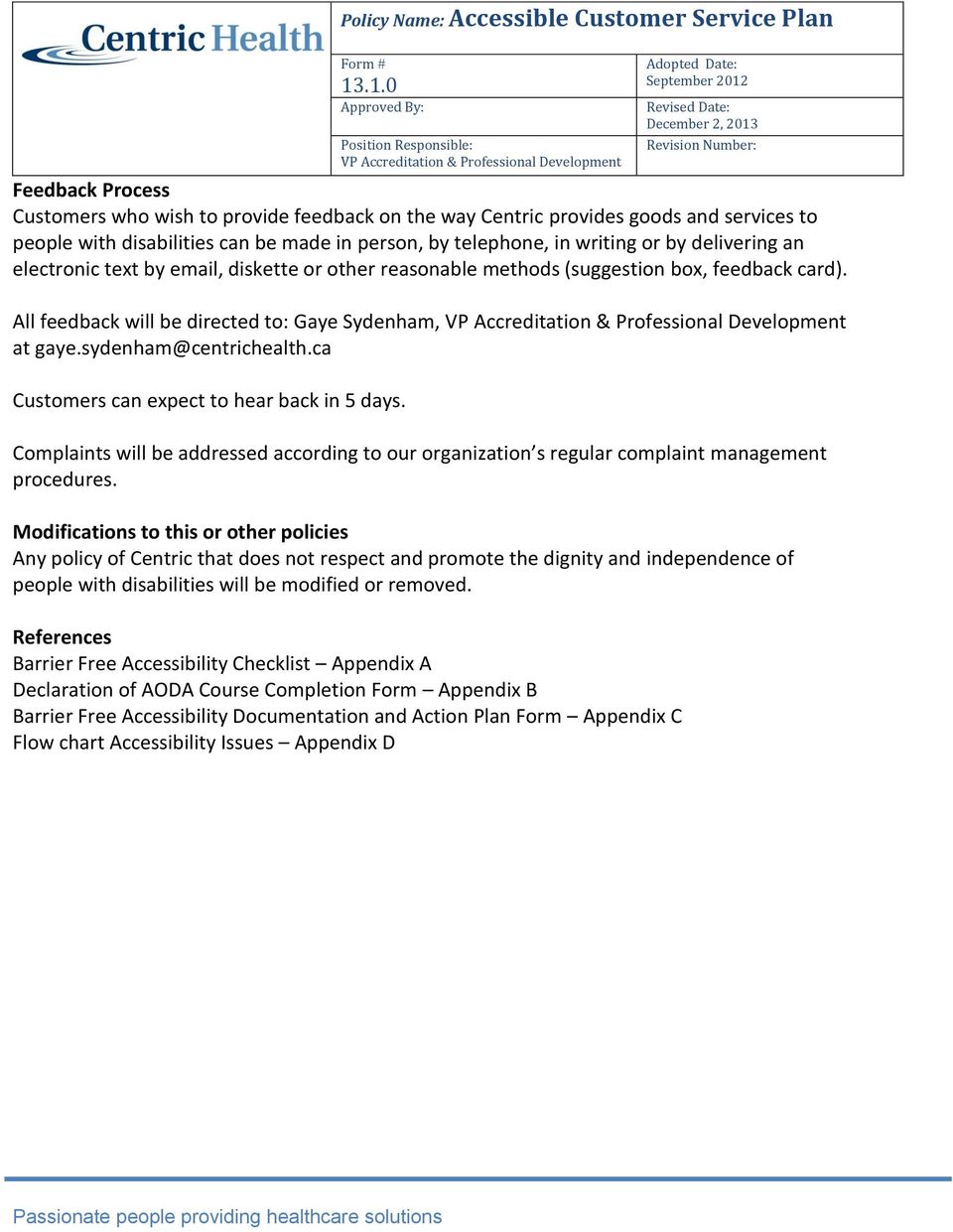
5 Policy Name: Accessible Customer Service Plan Appendix A Barrier Free Accessibility Checklist In cases if a non-compliant has been checked please indicate why and attach separate sheets if necessary. Any non-compliance issues will be brought to the attention of the Corporate Office. C= Compliant NC= Non-Compliant NA = Not Applicable Exterior Parking Area C NC NA Appropriate number of allocated accessible parking spaces Total Spaces Accessible Spaces Required 1 to to to to to to Parking spaces in a close convenient location to ensure that persons with disability have accessible barrier free entrance(s) without having to travel in between parked cars or other obstacles. Parking surface should be firm and fairly even. Surface drainage slopes should drain away from designated parking areas. The width of accessible parking spaces should be a minimum 95 inches wide with an adjacent accessible aisle a minimum 60 inch wide. The lighting level at accessible parking locations should be adequate to not cause any health and safety risk The parking spaces reserved for persons with disabilities shall be well marked bearing the international symbol of accessibility. Exterior Passenger Drop off Area C NC NA Passenger drop off zones should be located as close as possible and at the same level of the main barrier free accessible entrance. At least one passenger loading zone should be accessible. Where differences in paving level occur, suitable curb ramps should be provided. Signs mounted at each van accessible parking space. The area should be large enough to accommodate parking for a lift
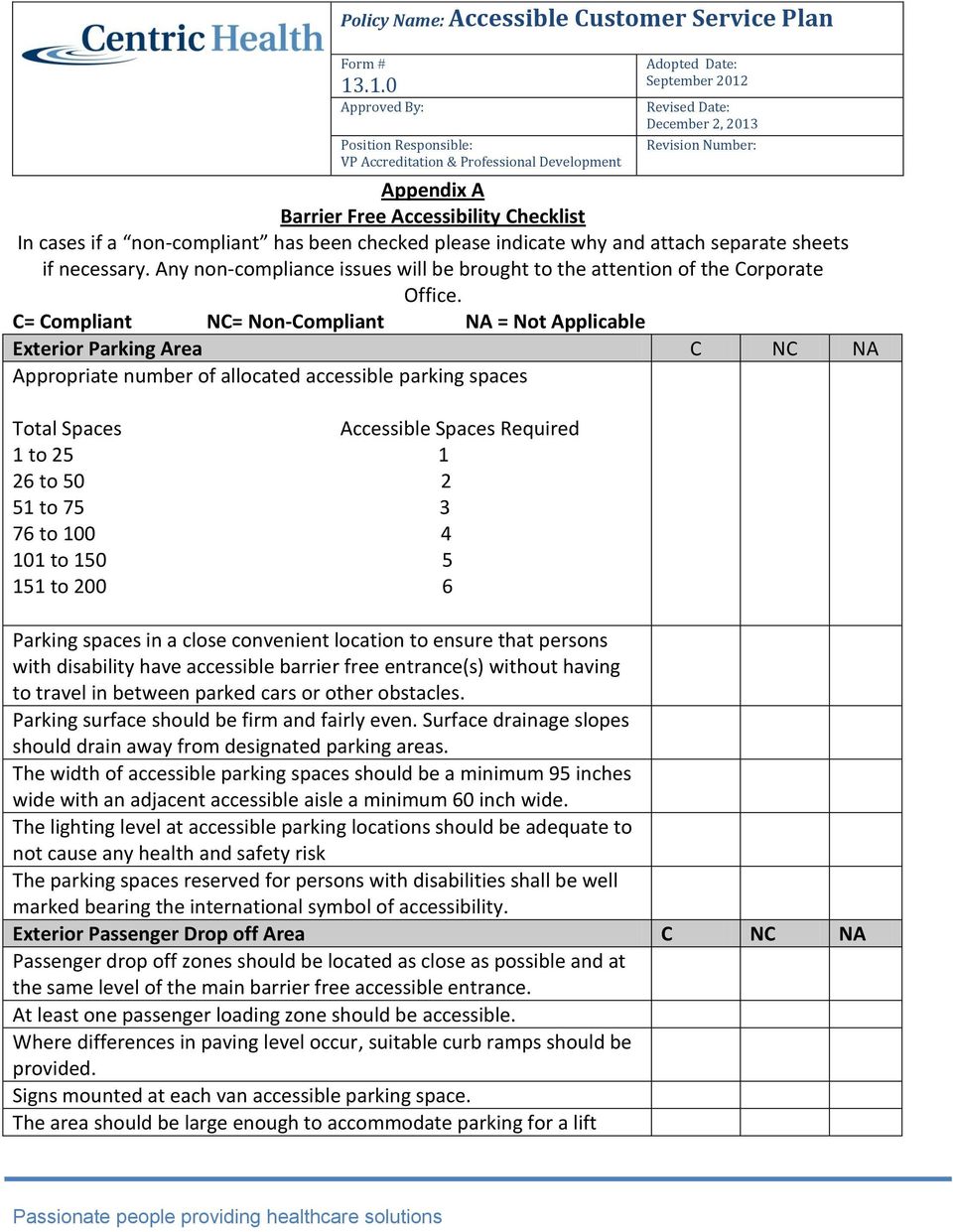
6 Policy Name: Accessible Customer Service Plan equipped bus/van as well as cars (ier. 96 inches wide for the van plus a 96 inch wide access aisle for the lift and at least one of every 8 available accessible parking spaces should be van accessible). An access aisle 5 feet wide and 20 feet long should be provided adjacent and parallel to the vehicle loading area. Exterior Pathways C NC NA There should be at least one path of travel free of steps and stairs Exterior pathways designated as accessible barrier free passageways should be a minimum width of 36 inches The surfaces shall be continuous, made of firm, even, non-slop material All door and gates along the pathway at least 36 inches wide The pathways must be clear of projecting objects/amenities such as planters, trash cans, trees/shrubs, signs that may present as an obstacle to people with visual and mobility impairment. When unavoidable to keep the pathway clear of such items, they should be located so that a person walking with long cane can detect them (i.e. objects that protrude at 27 inches or more should be marked by some detectable means at a lower level) Wheel stops should be provided in parking lot wherever car bumpers may extend over onto the pedestrian passageways The lighting level on exterior pathways should be adequate to not cause any health and safety risk Lighting standards or posts should be mounted to the side(s) of walkways so as not to present an obstacle to people in wheelchairs or with sight impairments Exterior pedestrian routes should have headroom clearance whenever possible of at least 80 inches across the entire width of the walkway Pathways should be maintained properly at all times (i.e. is snow removal enforced) Curb cuts located where they are needed and is each curb cut at least 36 inches wide Slope ratio of each curb cut no greater than 1:12 (i.e. for every 1 inch of height, the curb cut should extend 12 inches horizontally) Slope of each of the flared sides of each curb cut no greater than 1:10 If built up curb ramps are used instead of curb cuts they should avoid interfering with vehicular traffic

7 Policy Name: Accessible Customer Service Plan Exterior Ramps C NC NA Slope ratio of each ramp no greater than 1:12 When ramp rises more than 30 inches, are there 5 foot long level landing areas positioned so that the ramp does not rise more than 30 inches between landings Ramps are at least 36 inches wide Ramp surfaces and their approaches shall be designed so that water/ice will not accumulate. Whenever possible consideration should be given to protecting ramps from difficult weather conditions Handrails must be provided in accordance with Ontario Building Code please also refer to the below questions Ramps that rise higher than 6 inches have hand rails on both sides There is at least 36 inches between the hand railings The lighting level on exterior ramps should be adequate to not cause any health and safety risk Exterior Steps C NC NA Any landings situated on exterior stairs should be a minimum of 4 feet deep by the width of the stair A textured surface at the top and bottom landings of stairs should be provided as a tactile warning of an approaching change in level Exit doors that open onto exterior stair landings should be avoided wherever they could present a hazard to visually impaired people Stair treads should be of a non-slip material Building Entrance C NC NA The floor or ground area in front of the doorway should be clear and level Ideally the main entrance to the building should be the accessible entrance. If this is not possible, proper signage shall be provided to indicate the location of the accessible entrance. At least one entrance to the building shall be an accessible entrance The accessible barrier free entrance should be reached by and connected to accessible routes The accessible barrier free entrance shall display the international symbol for accessibility in a way that will be visible to users when approaching the entrance and positioned on the door latch side Ideally wheelchair users entrance should be protected from rain and

8 Policy Name: Accessible Customer Service Plan snow The doorway of the accessible entrance have at least a 32 inch clearance when open or if the entrance has double doors at least one door leaf has a 32 inch wide clearance When there are two doors in series, the doors should swing in the same direction When there are two doors in series, there is at least 48 inches plus the width of one door between the two doors There is a minimum of 18 inches of clearance beside the latch side of the door to provide an individual in a wheelchair the space to maneuver around the door when opening it Entrances should not be placed close or alongside of hazardous areas such as kitchens, mechanical or trash storage rooms etc. The lighting level in building entrances should be adequate to not cause any health and safety risk The threshold should be relatively level with the floor on either side (i.e. ¼ inch or less high) The door handle is easy to operate with one hand and no higher than 48 inches above the floor If the door has a closer (automatic) it should take at least three seconds to close Exterior Doors C NC NA When the main entrance door is a single door it must be 3 feet wide In cases where the front entrance consists of multiple doors, the doors farthest to the right should be the accessible entrance Doors should be glazed door maximum visibility to allow people to see into the building entrance. The amount of glazing shall be defined by Ontario Building Code Decals or other materials should be placed on the glass surface Interior Corridors/Pathways C NC NA The interior corridor system must be accessible. The interior corridor system shall branch out from the main accessible entrance and connect with all parts of a building The interior corridor pathway should be arranged in a consistent, logical pattern that is easy to follow.

9 Policy Name: Accessible Customer Service Plan There are areas accessible where an individual in a wheelchair can change directions The corridor floor should be of non-slip material (i.e. carpet well secured and low pile) Where possible the corridors should be at least 36 inches wide Objects in the path of travel that protrude more than 4 inches and are 27 inches or more above the floor should be marked so that a person walking with long cane can detect them (i.e. objects that protrude at 27 inches or more should be marked by some detectable means at a lower level) The lighting level in interior corridors should be adequate to not cause any health and safety risk Interior doors should be opened with five pounds or less of pressure All doorways along the accessible route have a minimum of 32 inches of clearance The threshold should be relatively level with the floor on either side (i.e. ¼ inch or less high) If any threshold is between ¼ and ½ inches high is it beveled There is a minimum of 18 inches of clearance beside the latch side of the door to provide an individual in a wheelchair the space to maneuver around the door when opening it Signs should adequately describe permanent rooms and spaces such as bathrooms and exits. Interior Stairs C NC NA Interior stairs should be located along the main pedestrian route Open risers should be avoided. Patterns on stair treads should be kept simple All stairs should have a color contrasting, tactile warning strip at the top and bottom of the stair run. Stair treads should be of non-slip material The lighting level on interior stairs should be adequate to not cause any health and safety risk Office/Classrooms C NC NA Doors opening into classrooms or offices must be 32 inches wide The lighting level in offices/classrooms should be adequate to not cause any health and safety risk

10 Policy Name: Accessible Customer Service Plan Offices should have adequate space for wheelchair to maneuver Workstations should allow for adequate knee and toe clearance for a person using a wheelchair (i.e. at least 27 inches from the bottom of a table to the floor, 30 inches wide and 19 inches deep) There should be 36 inches of clearance between all pieces of furniture, including tables and chairs There is sufficient space for wheelchair seating Table or counter tops inches high Washrooms C NC NA Accessible men s and women s washrooms must be located on the same level as the accessible entrance Accessible washrooms should be identified with the international symbol of accessibility Inaccessible restrooms should have signs posted to direct individuals to an accessible restroom Accessible washrooms may either be for single occupant, unisex use or part of a multi-occupant facility for men or women Doors of the main entrance of washrooms should 32 inches wide The door handle is easy to operate with one hand and no higher than 48 inches above the floor The door swing should be outside the floor space used to access restroom fixtures There is at least one accessible toilet between 17 and 19 inches high There is an unobstructed path of 36 inches to all restroom fixtures The lighting level in washrooms should be adequate to not cause any health and safety risk Accessible toilet stalls, washbasins, mirrors and accessories must be provided and installed according to Ontario Building Code If toilet stalls are used at least one stall is wheelchair accessible The door in toilet stalls should be easily opened with one hand The accessible stall door should swing away from the stall The accessible stall provides a clear floor space of at least 60 inches in diameter Locking devices on toilet stall doors should be easily operable with one hand Two grab bars should be accessible one behind the toilet and the

11 Policy Name: Accessible Customer Service Plan other on the wall closest beside the toilet Grab bars mounted between 33 and 36 inches high, with exactly 1 ½ inch of clearance between the wall and each grab bar Counter and sink heights should allow for adequate knee and toe clearance All controls should be located on fixtures (i.e. flush controls on transfer side on toilet) Wash Basins, Mirrors and Dispensers C NC NA All controls should be located on fixtures (i.e. flush controls on transfer side on toilet) The wash basin rim or countertop is no higher than 34 inches There is at least 29 inches of clearance between the floor and the bottom of the wash basin The hot water and drain pipes are insulated or covered to prevent burns The faucet can be operated easily with one hand If the faucet valve is self-closing it remains on for at least 10 seconds There is at least one mirror mounted so that the bottom edge of the reflecting surface is no higher than 40 inches At least one wash basin meets all the preceding requirements Accessible dispensers are on an accessible route If a forward reach is required the highest operable part should be no higher than 48 inches If a side reach is required the highest operable part is not higher than 54 inches The dispenser should be easily operated with only one hand Emergency Egress/alarms C NC NA There are accessible pathways for emergency egress Accessible egress pathways should be well lit Fire alarms are both visible and audible Signage C NC NA Accessibility signs/directories should be located in areas such as main entrances, elevator lobbies and doors where maximum visibility is assured. They should be placed in prominent, well lit locations free from obstructions such as plants and other signage etc. Accessibility signs should be placed at a level that can be comfortably

12 Policy Name: Accessible Customer Service Plan seen by persons in wheelchairs or scooters Signs should have large, bold characters and have a glare free finish Facility Director Signature Date d/mm/yy Joint Health and Safety Committee Member and or Health and Safety Representative Signature Date dd/mm/yy
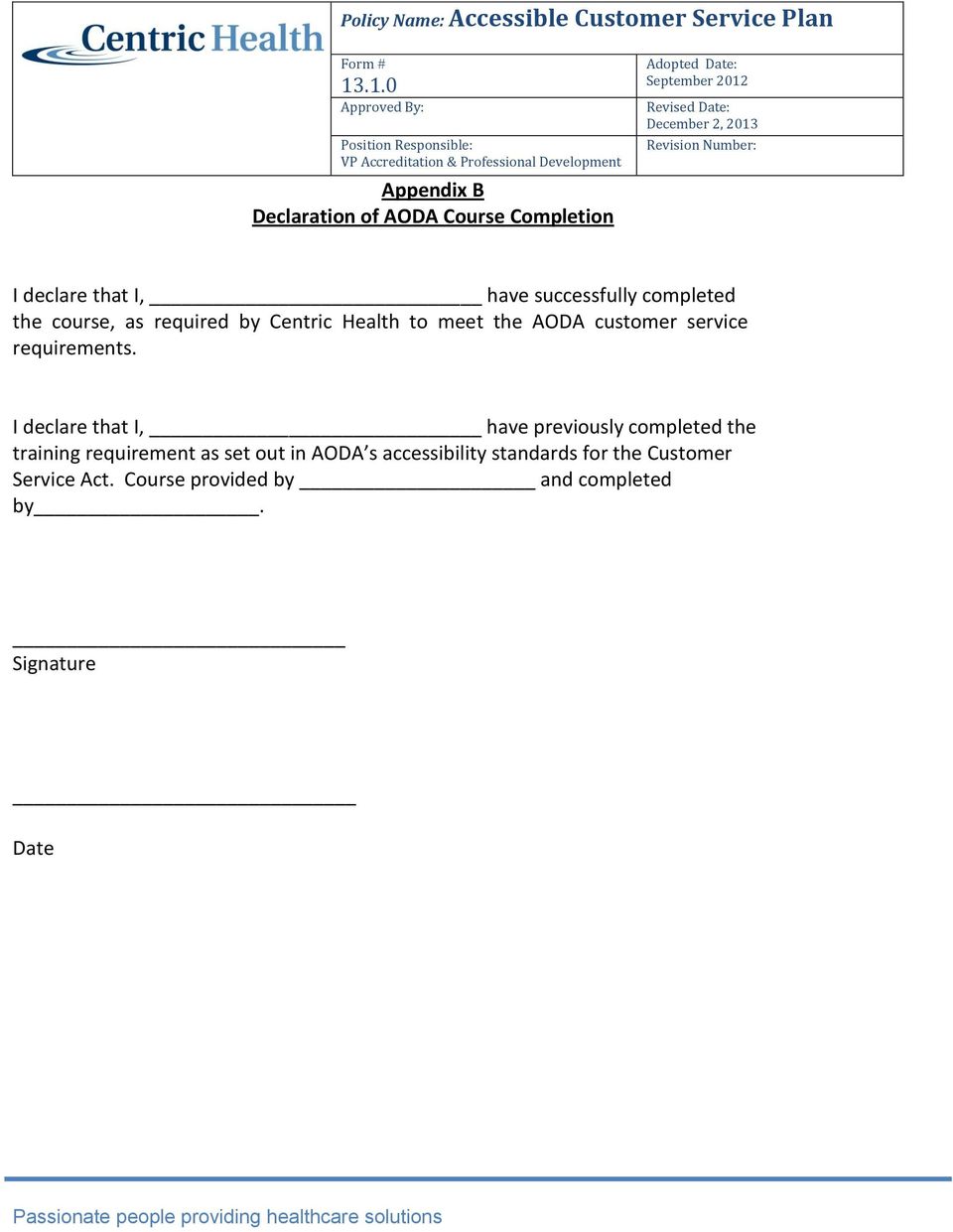
13 Policy Name: Accessible Customer Service Plan Appendix B Declaration of AODA Course Completion I declare that I, have successfully completed the course, as required by Centric Health to meet the AODA customer service requirements. I declare that I, have previously completed the training requirement as set out in AODA s accessibility standards for the Customer Service Act. Course provided by and completed by. Signature Date
14 Policy Name: Accessible Customer Service Plan Appendix C Barrier Free Accessibility Documentation and Action Plan Form This plan addresses needs and barriers identified by Facility Directors/Clinic Managers and staff at each Centric facility location. It is reviewed quarterly throughout the year to ensure barriers are removed and discussed and reviewed annually for trends. Barrier Type Barrier Action Plan Who Timeline Status Report Architecture Environment Attitudes Finances Employment Communication Transportation Community Integration

15 Policy Name: Accessible Customer Service Plan Appendix D Flow chart Accessibility Issues Computer communicated by person/group directly to Centric Facility Director or by to Corporate Office. Corporate Office records and documents concern concern forwarded to Facility Director with a copy to area manager and VP Accreditation & Professional Development Facility Director Addresses Concern Facility Director documents outcome of action. follows up with Facility Director to ensure that issue has been resolved.

16 Policy Name: Barrier Free Accessibility Notice of temporary Disruption of Service Policy In order to obtain, use or benefit from Centric s services, persons with disabilities may use particular facilities or services of Centric. If there is a temporary disruption in those facilities or services in whole or in part, Centric shall give notice of the disruption to the public. Purpose Centric is committed to fulfilling the requirements of the Accessibility Standards for Customer Service (AODA), (Ontario Regulation, 429/07). Procedure The Facility Director or his or her delegate will be responsible for notifying any person that uses Centric goods and services of any disruption in service, either planned or unexpected. 1. Procedures and Practices for Providing Notice of Planned and Unexpected Temporary Disruptions in Services and Facilities a) On occasion some services and facilities usually used by persons with disabilities to access Centric s goods and services may not be available due to temporary disruptions. For example, ramps escalators or elevators may be unavailable due to routine maintenance, ramps may be blocked because of construction, or accessible washrooms may be unavailable because of repairs. b) Centric understands that people with disabilities may go to considerable effort to access goods and services. In the event that a service or facility that is usually used by people with disabilities to access Centric goods and services is temporarily unavailable notice of the disruption will be provided.

17 Policy Name: Barrier Free Accessibility Notice of temporary Disruption of Service c) Centric will provide advanced notification of a planned disruption. When a disruption occurs unexpectedly notice will be provided as soon as reasonably possible. 2. Content of Notices The notice of the disruption will include information about the reason for the disruption, its anticipated duration and a description of alternative facilities or services, if any, that are available. 3. Posting, Clarity and Placement of Notices a) Centric may provide notice of the disruption by posting information in a conspicuous place on the premises owned or operated by Centric; on the Centric website or by other methods that are reasonable in the circumstances. b) Visual notices will be provided in large clear print using contrasting colors between the text and background. c) The format and placement of notices will consider the types of disabilities of persons who use the disrupted service or facility. Example - notices by elevators used by persons in wheelchairs will not be placed so high that they are above the line of vision of persons using wheelchairs but not so low that they are missed by others - approx. 4 ft. is good for most people. 4. Responsibilities for Providing Notice of Planned and Unexpected Temporary Disruptions Staff responsible for the facility or service experiencing the disruption or their delegate will: a. determine the reasons for the disruption; b. determine the expected duration of the disruption; c. identify alternative services or facilities, if any, that may be used to access Centric goods and services; d. provide notice of the disruption in an appropriate format and location; e. provide notice of unexpected disruptions as soon as reasonably possible; and f. determine when notice of planned disruptions will be provided.

18 Policy Name: Barrier Free Accessibility Notice of temporary Disruption of Service Agents and Others Providing Services on behalf of Centric Agents and others providing services on behalf of Centric will abide by these procedures and practices. 6. Review of these Procedures and Practices These procedures and practices will be reviewed annually and in accordance with legislation. 7. Modifications to these Procedures and Practices References No changes will be made to these procedures and practices before considering the affect on persons with disabilities and on consistency with legislation. Accessibility for Ontarians with Disabilities Act, 2005 (AODA) AODA- Notice of Temporary Disruption in Services and Facilities Procedure, 2009 (NECCAC). Ontario Regulation 429/07 - Accessibility Standards For Customer Service Ministry of Community and Social Services. (2009, April). Guide to the Accessibility Standards for Customer Service, Ontario Regulation 429/07.

19 Policy Name: Barrier Free Accessibility Provision of Goods and Services Including Assistive Devices Policy In order to obtain, use or benefit from Centric s services, persons with disabilities may require assistance in accessing the goods and services provided by and on behalf of the Centric. This may include the person's use of their own assistive device and the assistive devices or other reasonable forms of assistance provided by the Centric. Purpose Centric is committed to fulfilling the requirements of the Accessibility Standards for Customer Service (AODA), (Ontario Regulation, 429/07). It will make reasonable efforts to accommodate persons with disabilities in accordance with the following principles: dignity independence Integration, except when alternate measures are necessary to meet the needs of people with disabilities, and equal opportunity. (s.3 (2), Ontario Regulation 429/07). Procedure Centric recognizes the importance of assistive devices and welcomes them or be available to the person with disability where Centric provides goods and services on property it owns or operates if the public or other third parties have access to these areas. When communicating with a person with a disability Centric Health will do so in a manner that takes into account their disability and staff will demonstrate awareness of how to interact will persons who require the assistance of support persons, service animals and assistive devices. 1. Accommodating Clients with Disabilities a. In most situations, the customer should initiate a request for accommodation including the need for an assistive device to Centric staff. Staff will be pleased to work with the customer to provide a suitable form of assistance

20 Policy Name: Barrier Free Accessibility Provision of Goods and Services Including Assistive Devices b. Where staff is aware of a person's need for assistance in accessing goods and services, staff will inform persons with disabilities of the accommodations and/or the assistive devices the Centric Health makes available to persons with disabilities. 2. Accommodation Accommodation often involves simple or informal forms of assistance that staff can provide quickly and easily. For example, staff may offer to fill out a form for a person who finds it difficult to grip a pen. In some instances, more formal accommodation may be requested. Formal accommodation, such as a sign language interpreter, may require pre-planning. Some requests for accommodation will be uncertain and require assessment to determine the best accommodation to allow the client or customer to access services. Such accommodation may require pre-planning by staff and management and/or the approval of expenses. 3. Management Responsibilities Managers or their delegates will: a. either approve, deny, research and/or approve the accommodation request b. ensure the accommodation has been arranged for the client c. make certain the customer is kept informed of the status of their request in a timely manner. 4. The Use of Assistive Devices by Persons with Disabilities a. Persons who require the use of an assistive device will be permitted to keep their device with them while accessing Centric goods and services unless the health and safety of the client or others is at risk or where there is a risk of damage to any person or property. b. Persons using assistive devices are expected to operate the device in a controlled manner at all times.

21 Policy Name: Barrier Free Accessibility Provision of Goods and Services Including Assistive Devices c. If the device cannot stay with the person or if the person is not permitted to use the device, Centric will make certain that other means of accommodation are available to the customer. 5. Disagreements about the use of Assistive Devices and Accommodation Decisions a. In the event that staff and clients or customers disagree about the use of assistive devices or accommodation decisions, staff will follow the procedure set out in Customer Complaint Process for Addressing Accessibility Issues. 6. Storing and Releasing Accommodation Records a. Accommodation records containing information about a particular client or other customer will be subject to the confidentiality restrictions of the Personal Health Information Protection Act (PHIPA). 7. Service Providers and Others Providing Services on behalf of Centric a. Service Providers and Others Providing Services on behalf of Centric will adhere to these procedures and practices. b. 8. Review of these Procedures and Practices a. These procedures and practices will be reviewed annually and in accordance with legislation. 9. Modification of these Procedures and Practices a. No changes will be made to these procedures and practices before considering the effect on persons with disabilities and on consistency with legislation. References Accessibility for Ontarians with Disabilities Act, 2005 (AODA) AODA- Provision of Goods and Services Including the Use of Assistive Devices Procedure, 2009 (NECCAC) Ontario Regulation 429/07 - Accessibility Standards For Customer Service Ministry of Community and Social Services. (2009, April). Guide to the Accessibility Standards for Customer Service, Ontario Regulation 429/07.
22 Policy Name: Barrier Free Accessibility Service Animal Practices Policy In order to obtain, use or benefit from Centric s services, persons with disabilities may Centric recognizes the importance of service animals to persons with disabilities and welcomes them where Centric provides goods and services on property it owns or operates if the public or other third parties have access to these areas. Purpose Centric is committed to fulfilling the requirements of the Accessibility Standards for Customer Service (AODA), (Ontario Regulation, 429/07). It will make reasonable efforts to accommodate persons with disabilities in accordance with the following principle. Procedure 1. Identifying Service Animals Service animals may be any animal that assists a person with a disability. They provide a wide range of assistance including but not limited to, guiding a person who is blind, alerting a person who is deaf to certain sounds, opening doors and retrieving items for persons with mobility disabilities, emotional support for persons with mental illness, and many other forms of assistance. Service animals may be identified by any one of the following methods: the animal may be wearing a service animal vest, harness or saddle packs the animal may be observed providing assistance the person may have a letter from a physician or nurse stating that they require the animal for reasons related to a disability the person may show a valid identification card or training certificate from a recognized service animal training school. 2. Centric Responsibilities Persons with disabilities who are accompanied by a service animal will be permitted to enter
23 Policy Name: Barrier Free Accessibility Service Animal Practices Centric premises with the animal and keep the animal with them in areas where the public or other third parties are allowed, unless the animal is excluded by law. If the animal is excluded by law, Centric will provide another means of accommodating the person. For example, if the animal is not permitted into a certain area by law, Centric may suggest providing services in an area where the service animal is permitted. 3. Responsibilities of Persons with Service Animals It is the responsibility of the person with the disability to ensure that: a. their service animal is kept in control at all times and is well behaved; b. the service animal is not a threat to health and safety; and c. the service animal's immunizations are up-to-date. 4. Removal of Service Animals from the Centric Premises Centric is aware that service animals are usually well trained and well behaved. In the event that this is not the case, service animals may be removed for any one of the following reasons: disruptive or aggressive behavior, such as growling, barking or other signs of threatening or aggressive behavior; causing damage, including causing damage to any person or property; poor health, such as a contagious illness where the animal risks spreading the illness to others. 5. Areas Off Limits to Service Animals Service animals may be prohibited from entering certain areas for health and safety reasons or due to law. For example, Ontario Regulation 562 under the Health Protection and Promotion Act states that animals are not permitted in areas where food is prepared, handled, served, displayed, stored, sold, or offered for sale. It must be noted that service dogs are exempt from this restriction and are permitted to go where food is served, sold or offered for sale, such as restaurants including buffets. However all animals, including service dogs, are not permitted to enter areas where food is prepared, such as kitchens.
24 Policy Name: Barrier Free Accessibility Service Animal Practices Legislation and By-laws Governing the Exclusion of Animals Some municipalities exclude certain animals from their jurisdictions. Depending on the specifics of the by-law, this may give reason for Centric to exclude certain animals from their premises. 7. Persons Allergic to or Afraid of Service Animals Common allergies or fear of animals are not considered disabilities. As a courtesy, Centric may attempt to accommodate persons with common fears and allergies to animals. In rare circumstances, a person may have a severe and debilitating reaction to an animal, such as respiratory distress. In these situations Centric will suggest alternative means of another reasonable method. 8. Agents and Others Providing Goods and Services on Behalf of Centric Agents and others providing goods and services on behalf of Centric will adhere to these procedures and practices. 9. Review of these Procedures and Practices These procedures and practices will be reviewed annually and in accordance with legislation. 10. Modification to these Procedures and Practices: No changes will be made to these procedures and practices before considering the effect on persons with disabilities and on consistency with legislation. References Accessibility for Ontarians with Disabilities Act, 2005 (AODA) AODA- Service Animals Practices and Procedure, 2009 (NECCAC) Ontario Regulation 429/07 - Accessibility Standards For Customer Service
25 Policy Name: Barrier Free Accessibility Service Animal Practices Ministry of Community and Social Services. (2009, April). Guide to the Accessibility Standards for Customer Service, Ontario Regulation 429/07.
26 Policy Name: Barrier Free Accessibility Support Persons to Person with Disabilities Policy Centric recognizes the importance of support persons to persons with disabilities and welcomes them where Centric provides goods and services on property it owns or operates if the public or other third parties have access to these areas. Purpose Centric is committed to fulfilling the requirements of the Accessibility Standards for Customer Service (AODA), (Ontario Regulation, 429/07). Procedure Use of Support Persons a. Support persons may be a family member, friend or a trained professional. They provide a wide range of assistance to persons with disabilities including but not limited to assistance with communication, personal care and assistance accessing goods and services. b. If a person with a disability is accompanied by a support person, Centric shall ensure that both persons are permitted to enter the premises together and that the person with a disability is not prevented from having access to their support person while on the premises. c. Centric may require a person with a disability to be accompanied by a support person where Centric provides its goods and services on property that it owns and operates. Centric may require this if it is deemed necessary to protect the health and safety of the person with the disability or the health and safety of others on the premises. This would occur after consultation with the person with the disability. d. Centric will refer to its procedures for determining a person's need for a support person for health and safety reasons.
27 Policy Name: Barrier Free Accessibility Support Persons to Person with Disabilities e. Even though Centric typically does not charge fees in relation to a support person s presence on its premises, Centric will provide advanced notice in the event a fee is ever charged. Advanced notice will be given where information about fees are typically provided. 1. Dealing with Confidential Matters in the Presence of Support Persons In some cases, a support person may have to agree to rules or requirements that are specific to the kinds of goods or services that Centric provides. Where confidentiality is important because of the kinds of information discussed, Centric must obtain the consent of the client and may require the support person to sign a confidentiality agreement. As an option, in some situations it may be suitable for a support person to wait in a separate area while a client's confidential matters are addressed. The client's confidential information will be subject to the Personal Health Information Protection Act (PHIPA). 2. Service Providers and Others Providing Services on Behalf of the Active Health Management a. Service providers and others providing goods and services on behalf of Active Health Management will adhere to these procedures and practices. 3. Review of these Procedures and Practices a. These procedures and practices will be reviewed annually and in accordance with legislation. b. 4. Modification to these Procedures and Practices a. No changes will be made to these procedures and practices before considering the effect on persons with disabilities and on consistency with legislation. References Accessibility for Ontarians with Disabilities Act, 2005 (AODA) AODA- Use of Support Persons by Persons with Disabilities Procedure, 2009 (NECCAC) Ontario Regulation 429/07 - Accessibility Standards For Customer Service
28 Policy Name: Barrier Free Accessibility Support Persons to Person with Disabilities Ministry of Community and Social Services. (2009, April). Guide to the Accessibility Standards for Customer Service, Ontario Regulation 429/07.
29 Policy Name: Barrier Free Accessibility Customer Service Policy Centric s leadership and staff are committed to promoting fully accessible environments for Individuals who receive service from Centric, as well as their significant others and support personnel; Interdisciplinary team members- employed or contracted; and Stakeholders including third-party payers, employers, partners and other interested parties. As well, Centric s business and clinical practices must minimize actual or potential barriers for clients, staff and stakeholders; reflect and communicate comprehensive understanding of the rights of the client, staff and stakeholders; and demonstrate the organization s commitment to the resolution and prevention of accessibility issues/barriers. Purpose The Accessibility for Ontarians with Disabilities Act, 2005 (AODA) has as its stated purpose: To achieve accessibility for Ontarians with disabilities with respect to goods, services, facilities, accommodation, employment, buildings, structures and premises on or before January 1, 2025 a. Centric must meet the requirements of accessibility standards established by AODA regulations. Ontario Regulation 429/07 - Accessibility Standards for Customer Service - apply to every designated public sector organization and to every other person or organization that provides goods or services to members of the public or other third parties and that has at least one employee in Ontario. b. This policy establishes the accessibility standards for customer service for Centric, in accordance with the requirements of Ontario Regulation 429/07. The standards outlined in this policy will be implemented by Active Health Management by January 1, Definitions The AODA contain and refer to various definitions that are relevant to this policy. Please refer to Appendix B definitions
30 Policy Name: Barrier Free Accessibility Customer Service Procedure The following procedure/principles have been implemented to guide Centric Health during business planning, operational designing and procedural implementation, and business expansion and change to ensure and sustain an accessible, health service delivery environment: 1. A Barrier-Free Accessibility Checklist is to be completed on an annual basis by the facility director or his or her delegate to evaluate the physical layout of each location and accessibility for individuals with and without physical disabilities. 2. Centric must meet all federal and provincial legislation, regulatory requirements and contractual agreements relating to accessibility for clients, staff and stakeholders. 3. Centric s leadership works collaboratively with clients, staff and other stakeholders to ensure an accessible environment. 4. Centric design client service programs and processes to provide barrier free access for the typical individuals to whom we provide service. Potential barriers may include but are not limited to architectural structure, communication/language needs, cultural requirements, transportation, financial limitations and employment obstacles. 5. While Centric endeavors to address common barriers, staff and clients are empowered to raise questions or concerns about perceived barriers at any time and can do so without fear of reprisal. Centric is committed to finding individual solutions for significant barriers identified by clients or health professionals that are not met through the global plan. 6. Requests for reasonable accommodation are reviewed and a decision as to whether any action is warranted is communicated in an efficient manner. 7. Continuous improvement is supported through leadership activities and the activities of the Joint Health and Safety Committee, Human Resources and of individuals. An annual accessibility report is written which includes success in addressing the accessibility action plans from the previous year, trends in individual issues that came forward,
31 Policy Name: Barrier Free Accessibility Customer Service identification of current barriers, development of a new 12 month plan with timelines, and a definition of accountabilities. Accessibility Standards Architectural Standards Architectural barriers are physical features that limit or prevent people with disabilities from obtaining services, limit staff or consultants from working in the environment and/or limit any other visitors with disabilities from entering a Centric facility. The following goals have been established to guide Centric in the architectural design of its facilities, and ensure that clients, staff and other interested parties have ready access to, and use of, buildings and space used for the delivery of our rehabilitation programs and services: Easy access to and from transportation drop off and pick up areas. Accessible street entrance curb, stairs/ramp, rail, automated entry doors of appropriate width. When one entrance is not accessible and another entrance is accessible, a sign must provide direction to the accessible entrance. The alternative entrance must be open during business hours. When a ramp is added to provide an accessible entrance, the slope of the ramp should be as shallow as possible but not more than 1:12. Easy access regarding movement within the building elevator in situations where the Centre does not have ground floor access. Appropriate transitional flooring materials to ensure easy and safe access between areas in the Centre. Wheelchair accessibility including visibility from a wheelchair with doorways and hallways of appropriate width. Counters and workstations must have a surface height of no more than 34 and no less than 28 above the floor. At least 27 of knee clearance must be provided between the floor and the underside of the counter/workstation. An accessible route must be provided to ensure access to each counter/workstation and a clear floor area of 30 by 48 at each accessible seating location. This clear floor area should extend 19 under the counter/workstation to provide leg and knee clearance. Washroom accessibility on the premise. Appropriate hardware including door handles and faucets. A lever or loop-type handle is recommended because it can be used without grasping, pinching or twisting.
32 Policy Name: Barrier Free Accessibility Customer Service Safe and accessible Centre design including client examination and interview offices, and functional testing and treatment areas. Well marked and unobstructed emergency exits accessible to ground and designated evacuation areas. Notice of Temporary Disruptions in Services and Facilities In order to obtain, use or benefit from Centric Health s services, persons with disabilities may use particular facilities or services of Centric Health. If there is a temporary disruption in those facilities or services in whole or in part, Centric Health shall give notice of the disruption to the public. The notice of the disruption will include information about the reason for the disruption, its anticipated duration and a description of alternative facilities or services, if any, that are available. Notice may be given by posting the information at a conspicuous place on premises owned or operated by Centric, by posting it on Centric s website, if any, or by such other method as is reasonable in the circumstances. Parking Standards Centric must have dedicated accessible parking space available for clients, staff and/or other stakeholders. The accessible parking must have space for the vehicle and an additional space located either to the right or to the left of the space that serves as an access aisle. This aisle is needed to permit a person using a wheelchair, electric scooter, or other mobility device to get out of their car or van. A sign with the international symbol of accessibility must be located in front of the parking space and mounted high enough so it is not hidden by a vehicle parked in the space. Accessible parking spaces should be the spaces closest to the accessible entrance and be located on level ground. If it is not readily achievable to locate accessible parking in the closest spaces due to sloped pavement or other existing conditions, then the closest level area should be selected. An accessible route must be provided between the access aisle and the accessible building entrance. This route must have no steps or steeply sloped surfaces and it must have a firm, stable, slip-resistant surface.
33 Policy Name: Barrier Free Accessibility Customer Service Environmental Standards An environment that has an uplifting design expression contributes to healing and motivates patient recovery. The following goals guide Centric in creating a physical rehabilitation environment that is barrier free and promotes client outcomes and staff well-being: Ambience Air Quality Noise or sound Visibility - overhead and adequate natural lighting Way finding cuing Communication - auditory cuing intercom Safety ability of staff to supervise at appropriate level Privacy / confidentiality of information / distractions Ergonomic design of furniture Public Transportation Standards The following public transportation standards guide for Centric is used in the selection of facility locations: To ensure that the location of the Centre is visibly marked with signs (i.e., company signage is located on the face of the building, building directory and office door) To ensure that Centres are within a reasonable walking distance from public transportation on a direct service line that has service within every hour during normal business hours. Where possible, to provide the appropriate amount of cost free parking spaces for patients who drive to appointments or to ensure that there is free visitor parking nearby To provide an appropriate number of wheelchair accessible parking spaces based on the past history of the program and preferably spaces that can be reserved for patients meeting criteria.
34 Policy Name: Barrier Free Accessibility Customer Service Service Availability Standards Centric s hours of operation are from 8:00 a.m. to 5:00 p.m., Monday to Friday. Pending service needs and requirements, the Company adjusts its hours of operation to accommodate evening and weekend service requests. Centric has defined a number of standards for our communications systems to enhance accessibility during and outside of operating hours: Toll free number for central customer service line Voice mail system including mailboxes for all staff and consultants Cell phones for community staff and consultants Dedicated and confidential facsimiles access to all staff and consultants Cultural Competency & Communication Standards Centric ensures staff is able to recognize, respect and address the unique needs, communications, customs, beliefs and values that reflect an individual s racial, ethnic, religious and / or social group or sexual orientation. Centric supports accessibility where the independence and integration of those with disabilities is promoted. When communicating with a person with a disability, individuals working on behalf of Centric shall do so in a manner that takes into account the person s disability and will make reasonable efforts to have the person with a disability understand both the content and intent of its communications. Centric is committed to meeting the needs of a diverse client population by providing client services which are linguistically and culturally appropriate. To support effective communication, Centric use the following strategies: Full time reception staff Live telephone access with toll free numbers Voice mail system with designated mail boxes for all staff Interpreter and translation services; Assistance to meet vision, speech, hearing, language and cognitive impairment needs; Age appropriate information; and
35 Policy Name: Barrier Free Accessibility Customer Service Alternative modes of communication including written, verbal, video. The contents of material for clients and employer are written at a level that promotes understanding (grade six levels). Client Support Standards Related to Service Needs Centric supports clients in accessing required services available through their third party insurer. When there is insufficient funding for services requested by the client, Centric staff will provide information and support to facilitate access to other community resources in response to client needs. Attitudinal & Professional Conduct Standards Centric promotes staff and consultant awareness of personal biases and assumptions that might impact service decisions and a client s access to services. Centric is committed to the provision of neutral assessments and recommendations based wholly on objective findings and client performance. Centric reports are reviewed to ensure appropriate and neutral language and content. Staff meetings and in-services provide an ongoing vehicle for addressing staff and consultant biases and perceptions based on the client populations served. Use od Assistive Devices Centric is committed to serving people with disabilities who use assistive devices to obtain, use or benefit from our goods and services. Centric will ensure that staff are trained on or about the assistive devices that may be made available by Centric and realize that persons with disabilities may use their own assistive devices to access Centric goods and services. For example, if Centric provides a wheelchair for use by persons accessing our goods and services, the staff providing the wheelchair will be trained on how to set up and use the wheelchair. The above applies to accessing goods and services at facilities that Centric operates. It does not apply to the use of in-home assistive devices in the direct provision of therapy services. The training and use of assistive devices in-home is part of the care plan and provision of services provided by the therapist or rehabilitation assistant.
36 Policy Name: Barrier Free Accessibility Customer Service Use of Service Animals Centric is committed to welcoming people with disabilities and their service animals on the parts of our premises that are open to the public and other third parties and will permit the person to keep the service animal with them. Centric will also ensure that all persons to whom this policy applies have been trained on how to interact with people with disabilities who are accompanied by a service animal. If the service animal is excluded by law from Centric premises, Centric shall ensure that measures are available to permit persons with disabilities to access Centric goods and services through other means. Use of Support Persons Centric is committed to welcoming people with disabilities who are accompanied by a support person. Any person with a disability who is accompanied by a support person will be allowed to enter Centric s premises with his or her support person. At no time will a person with a disability who is accompanied by a support person be prevented from having access to his or her support person while on Centric premises. In the event that a fee is charged in relation to a support person s presence on Centric premises, advanced notice of the fee will be provided. On occasion persons with disabilities require the assistance of a support person to protect their health and safety or the health and safety of others. If necessary, Centric may require a person with a disability to be accompanied by a support person while on Centric premises for the purpose of protecting the health and safety of the person with the disability or others on the premises. Training Centric will ensure appropriate levels of training to all employees, volunteers, students, agents and others who deal with the public or other third parties on behalf of Centric as well as those who are involved in the development and approvals of policies, practices and procedures dealing with the provision of goods and services to the public or other third parties.
37 Policy Name: Barrier Free Accessibility Customer Service This training will be provided to all staff as soon as practicable and in keeping with the provincial legislative requirements. Records of training will be kept that include the dates on which training occurred and the number of persons trained. Please refer to the Compliance Status Report. This report will be submitted by December 31 of each year. Training will include the following topics: The purposes of the Accessibility for Ontarians with Disabilities Act, 2005 The requirements of the Accessibility Standards for Customer Service How to interact and communicate with people with various types of disabilities How to interact with people with disabilities who use an assistive device or require the assistance of a service animal or a support person How to use the assistive devices available at Centric s offices and otherwise made available by Centric for persons with disabilities What to do if a person with a disability is having difficulty in accessing Centric s goods and services Centric s policies, practices and procedures relating to the provision of goods and services to the public and other third parties. Staff will also be trained on an ongoing basis when changes are made to policies, practices and procedures dealing with the provision of goods and services to the public and other third parties. Feedback Process The ultimate goal of Centric is to meet and surpass customer expectations while serving customers with disabilities. Comments on Centric regarding how well those expectations are being met are welcome and appreciated. Feedback regarding the way Centric provides goods and services to people with disabilities can be made in person, by telephone, in writing or by delivering an electronic text by , diskette or other reasonable methods. Complaints will be addressed according to Centric s Complaint Policy and Procedure.
38 References Compliance Status Report Appendix A Definitions Appendix B Policy Name: Barrier Free Accessibility Customer Service
39 Policy Name: Barrier Free Accessibility Customer Service Appendix A Contract Service Provider AODA Compliance Status Report Accessibility for Ontarians with Disabilities Act (AODA) 2005 Accessibility Standards for Customer Service, Ontario Regulation 429/07 Training Requirements for CCAC Contracted Service Providers Date Requested: November 1, 20 Date Due: December 15, 20 Please return this report to: Name of Service Provider: Date Report Completed: Person Completing this Report: Name: Phone number: address: Number of staff who interact with Centric Health Clients: Indicate whether or not all staff that interacts with Centric Health Clients has been trained on these topics by checking the applicable box. If different training is completed at different times, please submit this status report after each training module is completed. If the topic is part of your organization s regular orientation, please state this fact in the NOTES section regarding date and indicate the number of staff who has completed the orientation. Service Provider: The purposes of the Accessibility for Ontarians with Disabilities Act, 2005 Number of staff trained: Date(s) of training: Notes:
40 Policy Name: Barrier Free Accessibility Customer Service The requirements of the Accessibility Standards for Customer Service: Ontario Regulation429/07 Number of staff trained: Date(s) of training: Notes: How to interact and communicate with people with various types of disabilities Number of staff trained: Date(s) of training: Notes: How to interact with people with disabilities who use an assistive device or require the assistance of a service animal or a support person Number of staff trained: Date(s) of training: Notes: How to use the assistive devices made available by the CCAC for persons with disabilities Number of staff trained: Date(s) of training: Notes: What to do if a person with a disability is having difficulty in accessing the CCAC s goods and services Number of staff trained: Date(s) of training: Notes:
41 Policy Name: Barrier Free Accessibility Customer Service Centric's policies, practices and procedures relating to the provision of goods and services to the public and other third parties. (Included with this letter) Number of staff trained: Date(s) of training: Notes:
42 Policy Name: Barrier Free Accessibility Customer Service Appendix B Definitions accessible: 1.) Describes a site, building, facility, or portion thereof that complies with American with Disabilities Act Accessibility Guidelines/ADAAG. 2.) Refers to programs and services which are available to and usable by persons with disabilities and/or ways of making programs and services available to and usable by persons with disabilities. This means proving access to, participate in, or participation in the benefits of the programs and services. There are five types of accessibility: 1. physical accessibility refers to what is commonly thought of as accessibility facilities that persons with disabilities can enter independently and use the building without assistance. Physical accessibility refers not only to wheelchair access, but also to access for persons with sensory, cognitive, and health-related disabilities. 2. programmatic accessibility refers to making adjustments in the ways services are provided in order to level the playing field and allow all people an equal opportunity to participate. See the more complete definition program accessibility. 3. electronic accessibility means not only computers and adaptive software and hardware, but also technological solutions to other issues of accessibility. 4. financial accessibility refers to the financial impact on persons with disabilities in all facets of everyday life. Transportation can cost two to several times more for a person with a significant mobility disability than it costs others. The discrepancy of cost can exist in all aspects of daily living. Financial accessibility should be taken into consideration by those who plan events and/or ask persons with disabilities to participate. 5. attitudinal accessibility is the key to all types of access; if the right attitude is not there, even the most accessible building or accessible program becomes inaccessible. accommodation: Describes making programs, services and facilities accessible to and usable by persons with disabilities. To accommodate a person with a disability may
43 Policy Name: Barrier Free Accessibility Customer Service mean making a modification in the regular program, adapting service delivery, and/or removing barriers in a facility. Accommodation allows separated programs when necessary to ensure equal opportunity; however, individuals with disabilities cannot be excluded from the regular program for which accommodations may be necessary, and they cannot be required to accept separate or special services or benefits. assistive device: Any device that is designed, made or adapted to assist a person perform a particular task and may include, but is not limited to, wheelchairs, reading machines, recording machines, hearing devices and devices for grasping. assistive technology: Commercial or custom-designed devices, modifications, and related technical services used to increase, maintain, or improve the functional capabilities of persons with disabilities. This also includes accommodation strategies that might assist an organization to accurately assess the persons served. Examples of assistive technology include Braille, video- or audio-recorded directions, translated materials, TDDs, computer boards, caption decoders, hearing aids, and other augmentive communication devise and technologies. barrier: Anything that prevents a person with a disability from fully participating in all aspects of society because of his or her disability, including a physical barrier, an architectural barrier, an information or communications barrier, an attitudinal barrier, a technological barrier, a policy or a practice ( obstacle ). consumer: The person or the family served. When the person served is legally unable to exercise self-representation at any point in the decision-making process, person served is interpreted to also refer to those authorized to make decisions on behalf of the primary consumer. These individuals may include family members, significant others, legal representatives, guardians, and advocates. An organization should have a means by which a legal representative of the primary consumer is invited to participate at appropriate points in the decision-making process. By the same token, a person who is legally able to represent his or her own interest should be granted the right to choose whether other members of the family, significant others, or advocates participate in that decision-making process. When dealing with infants, children or adolescents, the family may be referenced directly, as the family is a co-primary consumer in such situations. cultural sensitivity: An organization s ability to recognize, respect, and address the unique needs, worth, thoughts, communications, actions, customs, beliefs, and values that reflect an individual s racial, ethnic, religious, and social groups and sexual orientation.
44 Policy Name: Barrier Free Accessibility Customer Service culture: The integrated pattern of human behavior that includes the thoughts, communications, actions, customs, beliefs, values, and institutions of a racial, ethnic, religious, or social group. disability/disabilities: In reference to an individual, a physical or mental impairment that substantially limits one or more of the major life activities of such individuals; a record of such an impairment; or being regarded as having an impairment. a. any degree of physical disability, infirmity, malformation or disfigurement that is caused by bodily injury, birth defect or illness and, without limiting the generality of the foregoing, includes diabetes mellitus, epilepsy, a brain injury, any degree of paralysis, amputation, lack of physical co-ordination, blindness or visual impediment, deafness or hearing impediment, muteness or speech impediment, or physical reliance on a guide dog or other animal or on a wheelchair or other remedial appliance or device, b. a condition of mental impairment or a developmental disability, c. a learning disability, or a dysfunction in one or more of the processes involved in understanding or using symbols or spoken language, d. a mental disorder, or e. an injury or disability for which benefits were claimed or received under the insurance plan established under the Workplace Safety and Insurance Act, 1997 ( handicap ) Does not include transvestism, transsexualism, pedophilia, exhibitionism, voyeurism, gender identify disorders not resulting from physical impairments, or other sexual behavior disorders; compulsive gambling, kleptomania, pyromania, or psychoactive substance use disorders resulting from current illegal use of drugs. discrimination: Limiting, segregating, or classifying a qualified job applicant or employee in a way that adversely affects his or her opportunities or status; excluding or denying equal jobs or benefits to a qualified individual; and refusing to make accommodations that are reasonable and within the means of an employer for a person with a disability. diversity: Differences due to culture, ethnicity, religion, economic status, gender, or sexual orientation. functional limitations: Those characteristics of the persons served or those barriers to goal attainment that an organization s service programs have the capability to improve e.g.,
45 Policy Name: Barrier Free Accessibility Customer Service lack of job-seeking skills or inability to feed self. A disability per se is not an adequate definition of a person s problems in functioning. Functional limitations are behaviors or conditions exhibited by individuals and barriers presented by their environments that need to be eliminated or improved in order for the individuals to fulfill their potential or maximize their functioning. Therefore, a functional limitation is distinctly different from a diagnosis or a disability. For example, services will not eliminate a cerebrovascular accident or mental retardation; however, an organization may provide services designed to improve an individual s ability to engage in activities of daily living, work, and social situations. Therefore, the functional limitations of those served could be expressed as the lack of adequate activities of daily living skills, inadequate work sills, or inappropriate social behaviors. guide dog: a dog trained as a guide for a blind person and having the qualifications prescribed by the regulations (Blind Persons Rights Act 1990 s1 (1) impairment: Any loss or abnormality of psychological, physiological or anatomical structure or functioning. individual/person with a disability: A person who has a disability. Does not include an individual who is currently engaging in the illegal use of drugs when the public entity acts on the basis of such use. Referenced in ADA s Do Title II regulations. is regarded as having an impairment: Has a physical or mental impairment that does not substantially limit major life activities but that is treated by a public entity as constituting such a limitation; has a physical or mental impairment that substantially limits major life activities only as a result of the attitudes of others towards such impairment; has none of the impairments defined in physical or mental impairment, but is treated as having such an impairment. Referenced in EOC and Do Titles II and III regulations for the ADA. integration: Presence and participation in the mainstream of community life. Participation means that the persons served maintain social relationships with family members, peers, and others in the community who do not have disabilities. In addition, the persons served have equal access to and full participation in the community resources and activities available to the general public. interdisciplinary: Characterized by a variety of disciplines that participate in the assessment, planning, and implementation of a person s program. There must be close
46 Policy Name: Barrier Free Accessibility Customer Service interaction and integration among the disciplines to that all members of the team interact to achieve team goals. person served: The primary consumers of services, which may be defined as a client, participate, or resident. When this person is legally unable to exercise self-representation at any point in the decision-making process, person served is interpreted to also refer to any person authorized to make decision on behalf of the primary consumer. These individuals may include, as appropriate, the family members, significant others, legal representatives, guardians, and/or advocates. The organization should have a means by which a legal representative of the primary consumer is invited to participate at appropriate points in the decision-making process. By the same token, a person who is legally able to represent his or her own interests should be granted the right to choose whether other members of the family, significant others, or advocates participate in that decision-making process. physical or mental impairment: Any physiological disorder or condition, cosmetic disfigurement, or anatomical loss affecting one or more of the following body systems: Neurological, musculoskeletal, special sense organs, respiratory including speech organs, cardiovascular, reproductive, digestive, genitourinary, hemic and lymphatic, skin, and endocrine. Any mental or psychological disorder such as mental retardation, organic brain syndrome, emotional or mental illness, and specific learning disabilities. This term includes, but is not limited to, such contagious and non-contagious disease and conditions as orthopaedic, visual, speech and hearing impairments, cerebral palsy, epilepsy, muscular dystrophy, multiple sclerosis, cancer, heart disease, diabetes, tuberculosis, drug addition, and alcoholism. program accessibility: Refers to ensuring non-discrimination and equal opportunities for disabled persons to utilize and participate in programs and activities. Program accessibility is a flexible principle allowing recipients to comply based on individual response to their existing conditions and the needs of participates with disabilities. Steps to achieve program accessibility are indicated as a result of self-evaluation or in response to requests from participants. Program may provide access through modifications and adjustments to procedures, practices and/or policies. Barrier removal is required by the Rehabilitation Act only when program accessibility cannot be achieved through other means when undertaking building
47 Policy Name: Barrier Free Accessibility Customer Service renovation and/or new construction. The ADA has somewhat different rules for when barrier removal is required. Referenced in ADA s Do Title II regulations. reasonable accommodations: Modifications or adjustments that assist the persons served to access benefits and privileges that are equal to those that are enjoyed by others. Examples taken the for ADA include making existing facilities readily accessible to and usable by persons with disabilities; restructuring jobs; modifying work schedules; reassigning people to vacant positions; acquiring or modifying equipment or assistive devices; adjusting or modifying examinations, training materials, polices, and procedures; and providing qualified readers or interpreters. rehabilitation: The process of providing those comprehensive services deemed appropriate to the needs of persons with disabilities in a coordinated manner in a program designed to achieve objectives of improved health, welfare, and realization of a person s maximum physical, social psychological, and vocational potential for useful and productive activity. Rehabilitation services are necessary when a person with a disability is in need of assistance and it is beyond the person s personal capacities and resources to achieve his or her maximum potential for personal, social and economic adjustment and beyond the capabilities of the services available in the person s usual daily experience. Such assistance continues as long as the person makes significant and observable improvement. service animal: an animal acting as a service animal for a person with a disability, a) if it is readily apparent that the animal is used by the person for reasons relating to his or her disability; or b) if the person provides a letter from a physician or nurse confirming that the person requires the animal for reasons relating to the disability stakeholders: The persons and families served by an organization and the organization s governance or designated authority, leadership, personnel, and various publics, including purchasers of services, contributors, supporters, employers, landlords, and other community business interests. supports: Activities, materials, equipment, or other services designed and implemented to assist the persons served. Examples include instruction, training, assistive technology and the removal of architectural barriers. Natural supports are supports that occur ordinarily in the
48 Policy Name: Barrier Free Accessibility Customer Service community, at work, or in social situations and that enable the persons served to accomplish their goals in life. support person: in relation to a person with a disability, another person who accompanies him or her in order to help with communication, mobility, personal care or medical needs or with access to goods or services TDD/TTY: A telecommunications device for the deaf. TDD and TTY are often used interchangeably for any type of device that assists persons with impaired hearing or speech to communicate over the telephone. TTY, the older of the two terms, is derived from Teletype, a registered trademark of the Teletype Corporation. Mechanical teleprompters have been largely replaced by solid-state devices with light-emitting or liquid crystal displays (LEDs and LCDs), and some modern devices are the size of a picket calculator. A TDD has a keyboard, a display screen, and a modem that sends and receives TDD tones. Each TDD tone is distinct and represents a specific letter or character. (Credit is given to the Handicapped Educational Exchange, or HEX, on the Internet for this information.) undue hardship or undue burden: An action requiring significant difficulty or expense when considered in light of the nature and cost of the accommodation needed the overall financial resources of the facility, the number of employees, the effect of the action on expenses and resources, and the impact of the action on the operation of the facility.
ACCESS AUDIT OF WESTPORT HOUSE
 ACCESS AUDIT OF WESTPORT HOUSE Large sign on the highway to indicate the entrance to Purbeck District Council Large and wide entrance Entrance showing sign for opening times Entrance sign Main entrance
Common ADA Errors and Omissions in New Construction and Alterations
 Common ADA Errors and Omissions in New Construction and Alterations Learning Objectives Course Number: 6002 Credit Hours: 1 After completing this course you will have a better understanding of numerous
Common ADA Errors and Omissions in New Construction and Alterations
 U.S. Department of Justice Civil Rights Division Disability Rights Section Common ADA Errors and Omissions in New Construction and Alterations Introduction The ADA requires that new construction and alterations
ADA Checklist for Polling Places
 U.S. Department of Justice Civil Rights Division Disability Rights Section Americans with Disabilities Act ADA Checklist for Polling Places February 2004 Reproduction Reproduction of this document is encouraged.
City of Wichita, Kansas Americans with Disabilities Act Transition Plan Main Library Address
 City of Wichita, Kansas Americans with Disabilities Act Transition Plan Main Library Address July 005 Prepared by DMCG Disability Management Consulting Group L.L.C. 801 Jonquil Place Columbia, MO 650 In
Area of Rescue Assistance Communication System ADA Code Applicable excerpts:
 Area of Rescue Assistance Communication System ADA Code Applicable excerpts: CONTENTS (Guidelines and Definitions) Page 1 Area of Rescue Assistance Requirements Page 2 Emergency Communication Equipment
Walking and Working Surface Checklist:
 Walking and Working Surfaces Purpose: This information is presented to improve the level of safety in our operations, and to inform you that we will comply with the OSHA Standard 29 CFR 1910.23. Responsibility:
Expanding Your Market
 U.S. Department of Justice Civil Rights Division Disability Rights Section Expanding Your Market Maintaining Accessible Features in Retail Establishments Introduction More than 50 million Americans with
PEOPLE FIRST. How to Plan Events Everyone Can Attend. Braille Accessible Print Assistive Listening Systems
 PEOPLE FIRST How to Plan Events Everyone Can Attend Braille Accessible Print Assistive Listening Systems Closed Captioning Accessibility Sign Language Interpretation Information Telephone Typewriter (TTY
Customer Service Policy: Providing Goods and Services to People with Disabilities
 Customer Service Policy: Providing Goods and Services to People with Disabilities Purpose To ensure all Dufferin Mutual Insurance Company programs and services are accessible to everyone in the community
Adult Family Home (AFH) LOCAL BUILDING INSPECTION CHECKLIST Code References: 2012 IRC Section R325 (WAC 51-51) APPLICATION NUMBER:
 Adult Family Home (AFH) LOCAL BUILDING INSPECTION CHECKLIST Code References: 2012 IRC Section R325 (WAC 51-51) APPLICATION NUMBER: SECTIONS 1, 2, 3, AND 4 MUST BE COMPLETED BY APPLICANT BEFORE INSPECTION
St. Michael s Hospital Accessibility Plan 2013-2021
 St. Michael s Hospital Accessibility Plan 2013-2021 Page 1 of 36 Table of Contents Accessibility Plan for St. Michael s Hospital Affirmation Statement.....3 About St. Michael s Hospital....3 Accessibility
ADA ACCESSIBILITY CHECKLIST FOR EXISTING FACILITIES
 ADA ACCESSIBILITY CHECKLIST FOR EXISTING FACILITIES Purpose of Checklist Section 504 of the Rehabilitation Act of 1973 and Title II of the Americans with Disabilities Act of 1990 (ADA), which cover state
ADA Guide for Small Businesses
 U.S. Small Business Administration Office of Entrepreneurial Development U.S. Department of Justice Civil Rights Division Americans with Disabilities Act ADA Guide for Small Businesses The U.S. Small Business
Universal Design Recommendations for Accessible University Settings. Mauricio A. Lizama, Ph.D., ATP
 INFORME TÉCNICO Unidad de Diseño, Desarrollo y Evaluación de AT PRATP Septiembre, 2009 Universal Design Recommendations for Accessible University Settings Mauricio A. Lizama, Ph.D., ATP The features listed
Serving All: A Guide to Being Accessible for Your Customers and Community
 Serving All: A Guide to Being Accessible for Your Customers and Community About This Guidebook Did you know that over 70,000 people in Washington, DC have a disability? Making sure your restaurant is accessible
504/ADA SELF-EVALUATION AND ASSURANCE OF COMPLIANCE. 504/ADA General Information. Instructions
 504/ADA SELF-EVALUATION AND ASSURANCE OF COMPLIANCE 504/ADA General Information Federal and State laws prohibit discrimination based on disability. Section 504 of the Rehabilitation Act of 1973, as amended
AUSTRALIAN HUMAN RIGHTS COMMISSION NOTICE OF DECISION ON APPLICATION FOR TEMPORARY EXEMPTIONS: AUSTRALASIAN RAILWAY ASSOCIATION
 AUSTRALIAN HUMAN RIGHTS COMMISSION DISABILITY DISCRIMINATION ACT 1992 (Cth), Section 55 DISABILITY STANDARDS FOR ACCESSIBLE PUBLIC TRANSPORT 2002 (Cth), Section 33A.1 DISABILITY (ACCESS TO PREMISES BUILDINGS)
Accessibility Design Advice
 Accessibility Design Advice Quick Access Guide Improving the accessibility of the physical environment Websites It is good practise to provide written information on your web site for disabled visitors
What you have to do to comply with the Accessibility Standards for Customer Service
 What you have to do to comply with the Accessibility Standards for Customer Service Excellence in customer service is the goal of any successful business today. Ensuring you are accessible and open to
Building an Accessible and Inclusive School Community
 School Leadership Program Tool Kit Building an Accessible and Inclusive School Community Grades 6 to 12 School Leadership Program Tool Kit Table of Contents Welcome to Together We Rock!...4 Acknowledgements...6
ADA. Checklist for Readily Achievable Barrier Removal. The Americans with Disabilities Act. Checklist for Existing Facilities version 2.1.
 Checklist for Existing Facilities version 2.1 ADA T I IT L TE S L I EI & I I II I COMPLIANCE MATERIALS To obtain additional copies of this checklist, contact your Disability and Business Technical Assistance
Multi-Year Accessibility Plan
 Multi-Year Accessibility Plan General Motors of Canada Limited 1908 Col. Sam Drive Oshawa, ON Canada, L1H-8P7 http://www.gm.ca GENERAL MOTORS OF CANADA LIMITED ACCESSIBILITY POLICY AND COMMITMENT STATEMENT
Accessible Customer Service. Guide. Providing Services to People with Disabilities
 Accessible Customer Service Guide Providing Services to People with Disabilities January 1, 2012 As required by law under Section 6 of the Accessibility for Ontarians with Disabilities Act, Accessible
The Home Depot of Canada Inc. Accessibility Policies Ontario. Contents
 The Home Depot of Canada Inc. Accessibility Policies Ontario Contents Accessibility Standards for Customer Service Policy 2 Integrated Accessibility Standards Policy 9 Multi-Year Accessibility Plan 14
Bath Planning Guidelines With Access Standards
 Bath Planning Guidelines With s 1: Door/Entry The clear opening of a doorway should be at least 32. This would require a minimum 2-10 door. If the existing structure precludes changing the opening then
604 Water Closets and Toilet Compartments
 604 Water Closets and Toilet Compartments 604.1 General. Accessible water closets and toilet compartments shall comply with Section 604. 604.2 Location. The water closet shall be positioned with a wall
Accessible Customer Service Policy
 Accessible Customer Service Policy Intent This policy is intended to meet the requirements of Accessibility Standards for Customer Service, Ontario Regulation 429/07 under the Accessibility for Ontarians
APPENDIX B DESIGNING DISABILITY-FRIENDLY SPACES
 APPENDIX B DESIGNING DISABILITY-FRIENDLY SPACES DESIGNING DISABILITY-FRIENDLY SPACES GUIDELINES FOR DESIGNING DISABILITY-FRIENDLY SPACES FOR UNC CHARLOTTE 1.1 OVERVIEW A. These guidelines are intended
Ministry of the Environment Decree on accessible building
 F1 THE FINNISH BUILDING REGULATIONS 1 Barrier-free Building Regulations and 2005 Ministry of the Environment Decree on accessible building adopted in Helsinki on the 1 st of October 2004 In accordance
City of Auburn Americans with Disabilities Act (ADA) Transition Plan for Curb Ramps, Sidewalks, and Pedestrian Signals ADA TRANSITION PLAN
 Americans with Disabilities Act (ADA) Transition Plan for Curb Ramps, Sidewalks, and Pedestrian Signals ADA TRANSITION PLAN December 21, 2009 Public Works Department 171 N. Ross Street, Suite 200 Auburn,
ADA Design Guide Washrooms & Showers
 ADA Design Guide Washrooms & Showers Accessories Faucets Showers Toilets Lavatories interactive version available at bradleycorp.com/adaguide.pdf Accessible Stall Design There are many dimensions to consider
Welcome to the AccessibilityOnline Webinar Series. A collaborative program between the National Network of ADA Centers and the. U.S.
 Welcome to the AccessibilityOnline Webinar Series A collaborative program between the National Network of ADA Centers and the US Access Board The Session is Scheduled to begin at 2:30pm Eastern Time We
FINDLAY FOODS (KINGSTON) LTD. HEALTH AND SAFETY POLICY MANUAL TITLE: AODA ACCESSIBILITY STANDARDS FOR CUSTOMER SERVICE POLICY
 AODA Accessibility Standards for Customer Service Policy 41. POLICY 41.01 The mission of Findlay Foods (Kingston) Ltd. is to provide appropriate customer service to individuals with disabilities. 41.02
Customer Access 1 Checklist for Banks, Financial and Legal Services
 GOOD ACCESS IS GOOD BUSINESS Customer Access 1 Checklist for Banks, Financial and Legal Services The City of Melbourne has introduced the Good Access is Good Business publications and education program
Accessibility Guide for Small Businesses
 . Accessibility Guide for Small Businesses June 2015 Second Edition Preface This document is intended to provide explanation and technical guidance to assist owners of small businesses of the accessibility
REQUIREMENT 3. Usable Doors
 Chapter Three: REQUIREMENT 3 Usable Doors 3...covered multifamily dwellings with a building entrance on an accessible route shall be designed in such a manner that all the doors designed to allow passage
COMMERCIAL ACCESSIBILITY PLAN REVIEW CHECKLIST
 GEORGE CHAVEZ, City Building Official DAVID YELTON, Building Inspection Manager NESTOR OTAZU, Community Preservation Manager BUILDING & SAFETY DIVISION 455 North Rexford Drive, 1 st Floor Beverly Hills,
Accessible Toilets. A unisex facility should have its own entrance. It should not be entered from a single sex facility.
 Accessible Toilets This is an advisory statement reflecting current statutory and current best practice requirements. It offers guidance on best practice in designing environments not only to meet the
ADA POST INSPECTION CHECKLIST. Job No. Route County Location
 ADA POST INSPECTION CHECKLIST Job No. Route County Location SIDEWALKS All sidewalks constructed within the project limits are ADA compliant. Sidewalks are 5 or greater in width. Exception, existing sidewalks
ADA HOTEL SITE INSPECTION CHECKLIST
 ADA HOTEL SITE INSPECTION CHECKLIST Name of Property: Location/City: Anticipated dates(s) for event: Public Spaces Hotel Accessibility Front lobby registration desk accessible counter? Y/N If no, what
ACCESSIBLE CUSTOMER SERVICE POLICY
 ACCESSIBLE CUSTOMER SERVICE POLICY November 2011 1. Purpose and Background Information The Accessibility for Ontarians with Disabilities Act, 2005 ( the AODA ) is a Provincial Act with the purpose of developing,
AODA. Accessibility for Ontarians with Disabilities Act. Guide to Accessible Events
 AODA Accessibility for Ontarians with Disabilities Act Guide to Accessible Events Events That Are Accessible For All The Accessibility for Ontarians with Disabilities Act (AODA) promotes the principles
Section 7: Elevators and Lifts. Main Entry Floor Outside the Elevator
 Section 7: Elevators and Lifts Questions Yes No Data Main Entry Floor Outside the Elevator 1. If an elevator is required to arrive at the voting area, is it on an accessible path of travel? 2. Is there
City of Los Angeles Department of Building and Safety Disabled Access Section COMMERCIAL ACCESSIBILITY PLAN REVIEW LIST JOB ADDRESS CITY ZIP
 GENERAL PROJECT INFORMATION PLAN CHECK NO JOB ADDRESS CITY ZIP REVIEWED BY PHONE DATE Email NOTE: Code references are to the 2014 edition of the City of Los Angeles Building Code with July 1, 2015 Supplement
Minimum Housing and Health Standards
 APPENDIX M.O. 57/2012 Minimum Housing and Health Standards Original version July 20, 1999. Revisions to Part lll, Housing Premises, sections 3 and 4, June 30, 2012 (all revisions are bolded and underlined).
Florida Building Code 2004 SECTION 1009 STAIRWAYS AND HANDRAILS
 Florida Building Code 2004 SECTION 1009 STAIRWAYS AND HANDRAILS 1009.1 Stairway width. The width of stairways shall be determined as specified in Section 1005.1, but such width shall not be less than 44
Administrative Procedure
 Durham Catholic District School Board The Board Administrative Procedure Title: Use of Service Dogs by Students in Schools Procedure #: AP434-7 Administrative Area: Policy Reference: Operations Accessibility
The emergency provisions affect the following Building Code sections:
 On August 1, 2012 new emergency chapter 11B code provisions became effective. Attached are copies of the emergency express terms and the applicable figures. The new requirements are underlined and deleted
R432. Health, Health Systems Improvement, Licensing. R432-5. Nursing Facility Construction. R432-5-1. Legal Authority. R432-5-2. Purpose.
 R432. Health, Health Systems Improvement, Licensing. R432-5. Nursing Facility Construction. R432-5-1. Legal Authority. This rule is promulgated pursuant to Title 26, Chapter 21. R432-5-2. Purpose. The
Olsen-Sottile Insurance Brokers Inc. Human Resources Policy Manual
 Title: Customer Service Standard Last Updated: Dec. 2011 Section: 1 Policy Number: 22 Revision Number: 1 Approved by: Chris Sottile At Olsen-Sottile Insurance Brokers Inc., we are committed to meeting
De Beers Canada Inc. OP 050 SLIPS, TRIPS, FALLS AND PEDESTRIAN SAFETY - SURFACE
 1. Purpose And Scope To establish safe procedures for pedestrians travelling on sites, in plants, on roads in offices or the general area of the workplace. 2. Responsibilities Responsible Person All Personnel
Making Community Emergency Preparedness and Response Programs Accessible to People with Disabilities
 U.S. Department of Justice Civil Rights Division Disability Rights Section An ADA Guide for Local Governments Making Community Emergency Preparedness and Response Programs Accessible to People with Disabilities
EVACUATION OF DISABLED PEOPLE (Document under constant review)
 EVACUATION OF DISABLED PEOPLE (Document under constant review) HEALTH & SAFETY UNIT JANUARY 2008 CONTENTS PAGE 1. INTRODUCTION... 1 2. PLANNING AN EVACUATION PROCEDURE... 1 3. PERSONAL EMERGENCY EVACUATION
Slip, Trip & Fall Program Table of Contents
 Slip, Trip & Fall Program Table of Contents I. Introduction... 2 II. Scope... 2 III. Definitions... 2 IV. Responsibilities... 4 V. Practices... 5 VI. Slip-Fall Facility Checklist... 7 VII. References...
BUILDING REGULATIONS PART M 2004 ACCESS TO AND USE OF BUILDINGS. Designers Checklist of Provisions/Areas for Consideration.
 BUILDING REGULATIONS PART M 2004 ACCESS TO AND USE OF BUILDINGS Designers Checklist of Provisions/Areas for Consideration. NB. This list is not intended to be comprehensive; it merely acts as a quick reference
Building Codes Update: The 2009 International Fire Code and the Apartment Industry
 ! Building Codes Update: The 2009 International Fire Code and the Apartment Industry Apartment operators and developers should be aware of organizational changes in the 2009 edition of the International
Significant Changes to the 2013 California Building Code Chapter 11B accessibility standards
 Significant Changes to the 2013 California Building Code Chapter 11B accessibility standards Last updated: 4/8/13 The Division of State Architect s (DSA) office has recently posted the Final Approved Express
Rockhampton Office Brisbane Office Tarong Site. Barron Gorge Hydro PS Kareeya Hydro PS Mica Creek PS
 Business Procedure Traffic Management Document Number OHS-PROC-130 This document applies to the following sites: All Sites Rockhampton Office Brisbane Office Tarong Site Barron Gorge Hydro PS Kareeya Hydro
ADA Scoping: New Construction
 U. S. A CCESS B O A R D T E C H N I C A L G U I D E ADA Scoping: This guide provides an introduction to the scoping requirements that form the basis for the Department of Justice s 2010 ADA Standards and
MINIMUM STANDARDS OF OPERATION FOR ALZHEIMER S DISEASE/DEMENTIA CARE UNIT: GENERAL ALZHEIMER S DISEASE/DEMENTIA CARE UNIT
 MINIMUM STANDARDS OF OPERATION FOR ALZHEIMER S DISEASE/DEMENTIA CARE UNIT: GENERAL ALZHEIMER S DISEASE/DEMENTIA CARE UNIT Title 15: Mississippi State Department of Health Part 3: Office of Health Protection
Trenching and Excavation Safety
 1.0 ACTIVITY DESCRIPTION 1.1 This document provides basic safety guidelines related to excavation and trenching in pipeline construction activities. These guidelines are applicable to the locating, marking
ELECTRONIC HEALTH RECORDS AND WRITING SURFACES
 ELECTRONIC HEALTH RECORDS AND WRITING SURFACES Author: Bill Zellmer AIA, CASp Issue Date: January 9, 2015 Sutter Health - Physical Access Compliance Sutter PAC Group Revisions: May 8, 2015 Barrier Interpretation
Slip, Trip & Fall Program Table of Contents
 Slip, Trip & Fall Program Table of Contents I. Introduction...2 II. Scope...2 III. IV. Definitions...2 Responsibilities...4 V. Practices...5 VI. Slip-Fall Facility Checklist...7 VII. VIII. Training...8
Etobicoke Services for Seniors Policy and Procedure Policy No. HR 2.10 Page 1 of 5 Effective Date: 01/01/2014 Supersedes: 01/01/2012
 Page 1 of 5 SECTION: NUMBER/TOPIC: POLICY TITLE: HUMAN RESOURCES HR 2 EMPLOYMENT STANDARDS HR 2.10 ACCESSIBILITY STANDARDS FOR CUSTOMER SERVICE POLICY STATEMENT Etobicoke Services for Seniors (ESS) is
ORDINANCE NO. 4521 THE CITY COUNCIL OF ALEXANDRIA HEREBY ORDAINS:
 ORDINANCE NO. 4521 AN ORDINANCE to amend and reordain Section 6-800 (KING STREET OUTDOOR DINING OVERLAY ZONE), of Article VI (SPECIAL AND OVERLAY ZONES), of the City of Alexandria Zoning Ordinance, in
City of Brampton Accessibility Technical Standards
 City of Brampton Accessibility Technical Standards Brampton s Commitment to Accessibility The City of Brampton is committed to the vision of providing a vibrant, safe and attractive city of opportunity
Building Age-Friendly Communities
 AGE-FRIENDLY CHECKLIST This checklist incorporates information from the Checklist of Essential Features of Age-friendly Cities developed by the World Health Organization; and Age-Friendly Rural and Remote
MEANS OF EXIT / ESCAPE / EGRESS SELF INSPECTION CHECKLIST
 OPTIONAL INFORMATION Name of School: Date of Inspection: Vocational Program/Course/Room: Signature of Inspector: MEANS OF EXIT / ESCAPE / EGRESS Guidelines: This checklist covers some of the regulations
WORK RULES AND CONTRACTOR REQUIREMENTS FOR ALL UNIT OWNERS & UNIT OWNER CONTRACTORS PERFORMING WORK ON THE PREMISES AT HAWTHORNE PLACE CONDOMINIUMS
 WORK RULES AND CONTRACTOR REQUIREMENTS FOR ALL UNIT OWNERS & UNIT OWNER CONTRACTORS PERFORMING WORK ON THE PREMISES AT HAWTHORNE PLACE CONDOMINIUMS 1) GENERAL GUIDELINES a) The following rules, regulations,
This policy applies to all Ottawa Mould Craft employees, students, clients, contractors, subcontractors, suppliers or visitors to our workplace.
 Ottawa Mould Craft Accessibility Policy PURPOSE a) Ottawa Mould Craft is committed to providing accessible goods and services to its clients and employees with disabilities in a way that respects the dignity
PUBLIC RESTROOMS, DESIGN INTENT
 PUBLIC RESTROOMS, DESIGN INTENT 1.01 STRUCTURAL A. Where feasible, metal stud partitions will be constructed on a 6 high concrete curb. 1.02 MECHANICAL A. Restrooms will have a minimum of 15 air changes
9.8.1.1. General (1) This Section applies to the design and construction of interior and exterior stairs, steps, ramps, railings and guards.
 Section 9.8. Stairs, Ramps, Handrails and Guards 9.8.1. Application 9.8.1.1. General (1) This Section applies to the design and construction of interior and exterior stairs, steps, ramps, railings and
Access Statement Atlantic Tower Liverpool (10.2.10)
 Property: Atlantic Tower Chapel Street Liverpool, L3 9RE Pre-Arrival Access Statement Atlantic Tower Liverpool (10.2.10) Phone, fax & email: Phone: 0871 376 9025 / +44 845 305 8325 Fax: 0871 376 9125 /
The Commonwealth of Massachusetts Executive Office of Public Safety Department of Fire Services
 MITT ROMNEY GOVERNOR KERRY HEALEY LT. GOVERNOR EDWARD A. FLYNN SECRETARY The Commonwealth of Massachusetts Executive Office of Public Safety Department of Fire Services P.O. Box 1025 State Road Stow, Massachusetts
Disabled Access Guide
 Disabled Access Guide The Royal Hotel South Parade Weston-Super-Mare Somerset BS23 1JP Tel: 01934 423 100 Fax : 01934 415 135 Email: Web: [email protected] www.royalhotelweston.com Location
5-8.1.4* Any required illumination shall be arranged so that the failure of any single lighting unit shall not leave any area in darkness.
 NFPA 101 Life Safety Code Section 5-8 Illumination of Means of Egress 5-8.1 General. 5-8.1* Illumination of means of egress shall be provided in accordance with this section for every building and structure
A Self-Audit of Your Current Campus Security Systems
 A Self-Audit of Your Current Campus Security Systems Security Solutions for Education, Business & Public Safety Free Consultations on ID Card Systems, Access Control, Call Recording, Video Surveillance,
CHECKLIST C ACCESSIBLE TOILETS CHECKLIST
 CHECKLIST C ACCESSIBLE TOILETS CHECKLIST These guidelines relate to accessible toilets for use by visitors. Different considerations may apply where accessible toilets are to be used by employees. All