
Army Audit Readiness Strategy FY 2013
|
|
|
- Melinda Phelps
- 10 years ago
- Views:
Transcription
1 [Type the document title] [Year] Army Audit Readiness Strategy FY 2013 Office of the Assistant Secretary of the Army Financial Management & Comptroller Accountability & Audit Readiness Directorate Version 1.0 Accountability & Audit Readiness: Sustaining Army s Strength

2 Table of Contents 1.0 Executive Summary... iii Achievements in FY iv Major Milestones for FY vi The Framework for Audit Readiness... vii 2.0 Overview Background FIAR Guidance and OUSD(C) Priorities Army Achievements to Date SBR Accomplishments E&C Accomplishments FY 2013 Major Milestones Army Audit Readiness Framework Discovery and Gap Analysis Testing Corrective Action Sustainment Implementing the Audit Readiness FIP Framework Statement of Budgetary Resources SBR Exam 1 for GFEBS Wave 1 Sites SBR Exam 2 for GFEBS Wave 1 and 2 Sites Future SBR Exams Fund Balance with Treasury SBR Resources Existence and Completeness Military Equipment and General Equipment Operating Materials & Supplies Real Property Inventory Active Installations DERP Environmental Liabilities E&C Regulations and Policies E&C Resources Systems to Support Audit Readiness General Fund Enterprise Business System (GFEBS) Logistics Modernization Program (LMP) Global Supply System Army (GCSS-A) Integrated Personnel and Pay System Army (IPPS-A) Command Audit Readiness Full Financial Statement Assertion Leadership Engagement and Governance Army Audit Committee Meetings Army Senior Leader Steering Group (SLSG) Meetings Army FIP In-Process Review (IPR) Meetings Vice Chief of Staff of the Army Quarterly Meetings Sustainment Integration of Army Managers Internal Control Program (MICP) and Audit Readiness (Internal Control Over Financial Reporting (ICOFR)) Programs Communication Management AKO Army Audit Readiness Site Annual Army FIP Workshop Quarterly Newsletter, FIP Report Accountability & Audit Readiness: Sustaining Army s Strength i
3 6.2.4 Monthly Update Army Command Meetings Army Audit Document Repository (AADR) Personnel Development and Training Governance, Risk, & Compliance (GRC) Strategy Conclusion Accountability & Audit Readiness: Sustaining Army s Strength ii
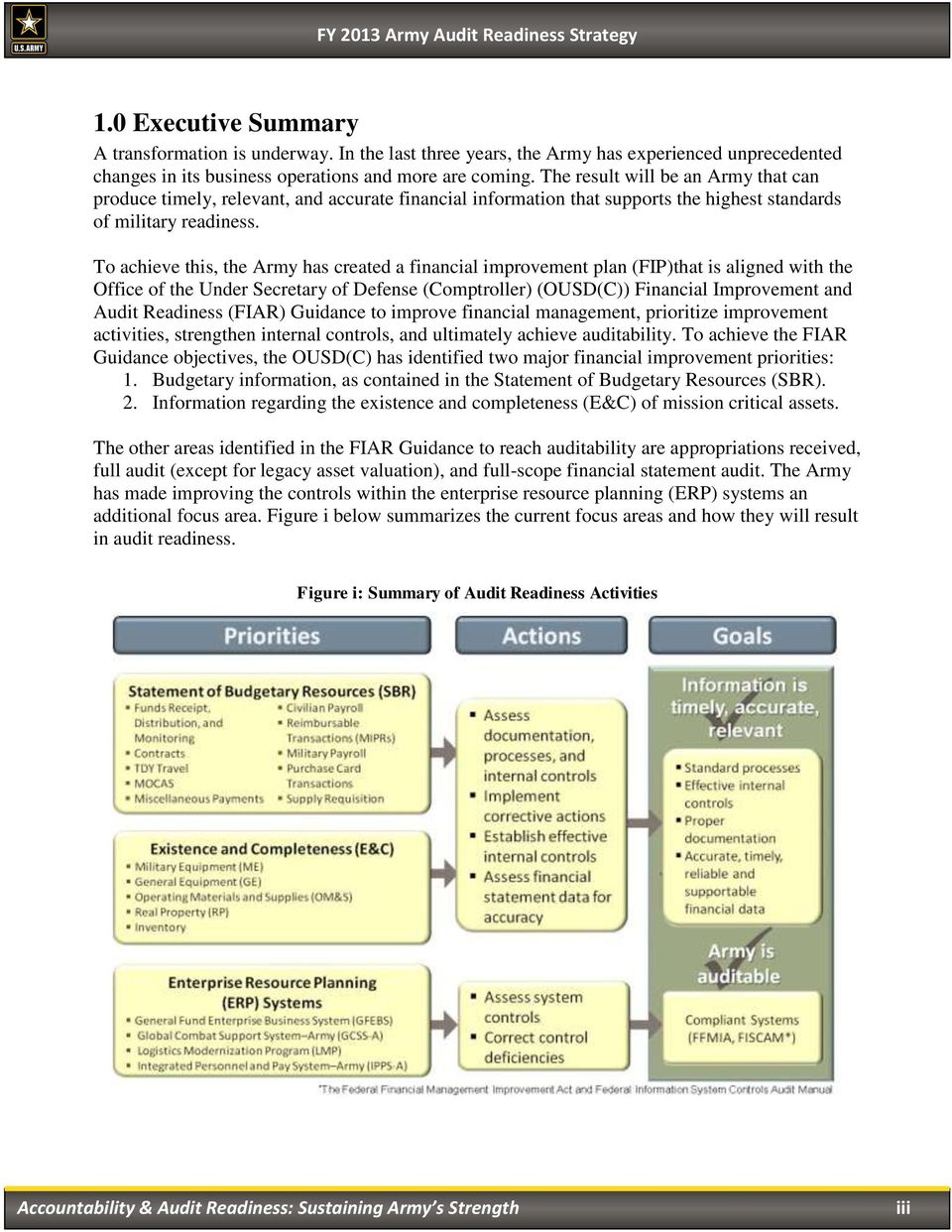
4 1.0 Executive Summary A transformation is underway. In the last three years, the Army has experienced unprecedented changes in its business operations and more are coming. The result will be an Army that can produce timely, relevant, and accurate financial information that supports the highest standards of military readiness. To achieve this, the Army has created a financial improvement plan (FIP)that is aligned with the Office of the Under Secretary of Defense (Comptroller) (OUSD(C)) Financial Improvement and Audit Readiness (FIAR) Guidance to improve financial management, prioritize improvement activities, strengthen internal controls, and ultimately achieve auditability. To achieve the FIAR Guidance objectives, the OUSD(C) has identified two major financial improvement priorities: 1. Budgetary information, as contained in the Statement of Budgetary Resources (SBR). 2. Information regarding the existence and completeness (E&C) of mission critical assets. The other areas identified in the FIAR Guidance to reach auditability are appropriations received, full audit (except for legacy asset valuation), and full-scope financial statement audit. The Army has made improving the controls within the enterprise resource planning (ERP) systems an additional focus area. Figure i below summarizes the current focus areas and how they will result in audit readiness. Figure i: Summary of Audit Readiness Activities Accountability & Audit Readiness: Sustaining Army s Strength iii
5 Achievements in FY 2012 The Army achieved the following in FY 2012: Completed final planned deployment wave of the General Fund Enterprise Business System (GFEBS) on July 1, GFEBS has more than 53,000 users at 227 locations in 71 countries and impacts nearly every Army organization and function. A web-enabled accounting, asset management, and financial reporting system, GFEBS is a standard general ledger compliant system that replaces numerous financial databases all of which were on different cycles. The real-time nature of GFEBS has reduced the need for data calls and gives the Army more accurate data on funds availability and execution. Received a qualified audit opinion in November 2011 on SBR Exam 1. The scope of the examination included manual controls for five business processes at three GFEBS Wave 1 locations: o Fort Benning: U.S. Army Installation Management Command (IMCOM) and U.S. Army Training and Doctrine Command (TRADOC). o Fort Jackson: IMCOM and TRADOC. o Fort Stewart: IMCOM and U.S. Army Forces Command (FORSCOM). Asserted audit readiness in June 2012 for SBR Exam 2. The scope of the examination includes 10 business processes at 10 GFEBS Wave 1 and 2 locations (for IMCOM, TRADOC, and FORSCOM only), GFEBS general and application controls, and Defense Finance and Accounting Service (DFAS) operations. The auditor began the audit in August 2012 and will issue the opinion and report in 3 rd Quarter, FY Asserted audit readiness of existence and completeness of OM&S Quick Win assets in June The Quick Wins scope encompassed three missile programs Hellfire, Javelin, and Tube-launched, Optically-tracked, Wire-guided (TOW) missiles. The Department of Defense Office of the Inspector General (DoD OIG) has begun an audit of the Army s assertion and will provide an opinion in the spring of Continued corrective actions across all Commands to support the SBR and E&C requirements. Established processes for executing centralized at monthly testing of internal controls across all SBR business processes and E&C assessable units. Began executing centralized monthly testing of SBR controls in July Completed internal audit readiness assessments of GFEBS and the Global Combat Support System Army (GCSS-A). Implemented, in partnership with DFAS, a new military pay process in October 2011 that includes a monthly reconciliation of all detailed military personnel pay statements to the summary financial reporting records. Developed a key supporting documentation (KSD) matrix of each military pay entitlement, the substantiating documents for each entitlement, and the point of retention of those documents. Completed, jointly with DFAS, a manual proof of concept reconciliation for three appropriations for the General Fund, Fund Balance with Treasury (FBWT). Began the development of the Army s automated reconciliation tool scheduled for implementation 2 nd Quarter, FY 2013, which will allow the Army to comply with the US Treasury requirement to reconcile its FBWT balance with the Treasury balance each month. Accountability & Audit Readiness: Sustaining Army s Strength iv

6 Began executing Real Property E&C audit readiness activities at 23 installations in advance of an assertion date of December 31, Conducted the third annual Army Financial Improvement Workshop in July 2012 for more than 200 attendees. For FY 2012, the Army updated its audit readiness plans based on Secretary of Defense Leon E. Panetta s Improving Financial Information and Achieving Audit Readiness Memorandum dated October 13, In it, all military services must achieve audit readiness for the SBR by the end of FY The Army plans to assert audit readiness for the SBR by June The milestone chart below (Figure ii) highlights the changes resulting from Secretary Panetta s directive. To achieve DoD s SBR audit readiness goal, the Army removed SBR Exam 4, previously scheduled to occur in FY 2014, in place of the full SBR assertion. Accountability & Audit Readiness: Sustaining Army s Strength v

7 Figure ii: Audit Readiness Milestones Overview The focus on accelerating SBR efforts came just as the Army received a qualified audit opinion on SBR Exam 1 in November 2011, which is a significant accomplishment for the Army and provided external validation that our plan is appropriate. The auditor found consistency of standardized business processes across all three GFEBS Wave 1 sites (for IMCOM, TRADOC, and FORSCOM only). The audit report listed one material weakness, one significant deficiency, and one material deviation. As a result of SBR Exam 1, the auditors identified best practices to improve the Army s business processes and audit readiness efforts. The area that stood out most was the lack of supporting documentation to support testing. Major Milestones for FY 2013 The Army is on track to achieve the following milestones for FY 2013: Assert audit readiness in December 2012 for Real Property (RP) Quick Wins assets at 23 installations. The Army selected these installations when these installations selfreported substantial progress in capturing key supporting documentation for RP assets. Remediate control gaps for GCSS-A by December 31, Assert audit readiness for SBR Exam 3 in June The scope of Exam 3 will encompass all general fund activity in GFEBS (excluding military pay, which will not be recorded in and reported from GFEBS until FY 2014), as well as a second audit readiness assessment of GFEBS and the first external assessment of GCSS-A. Accountability & Audit Readiness: Sustaining Army s Strength vi

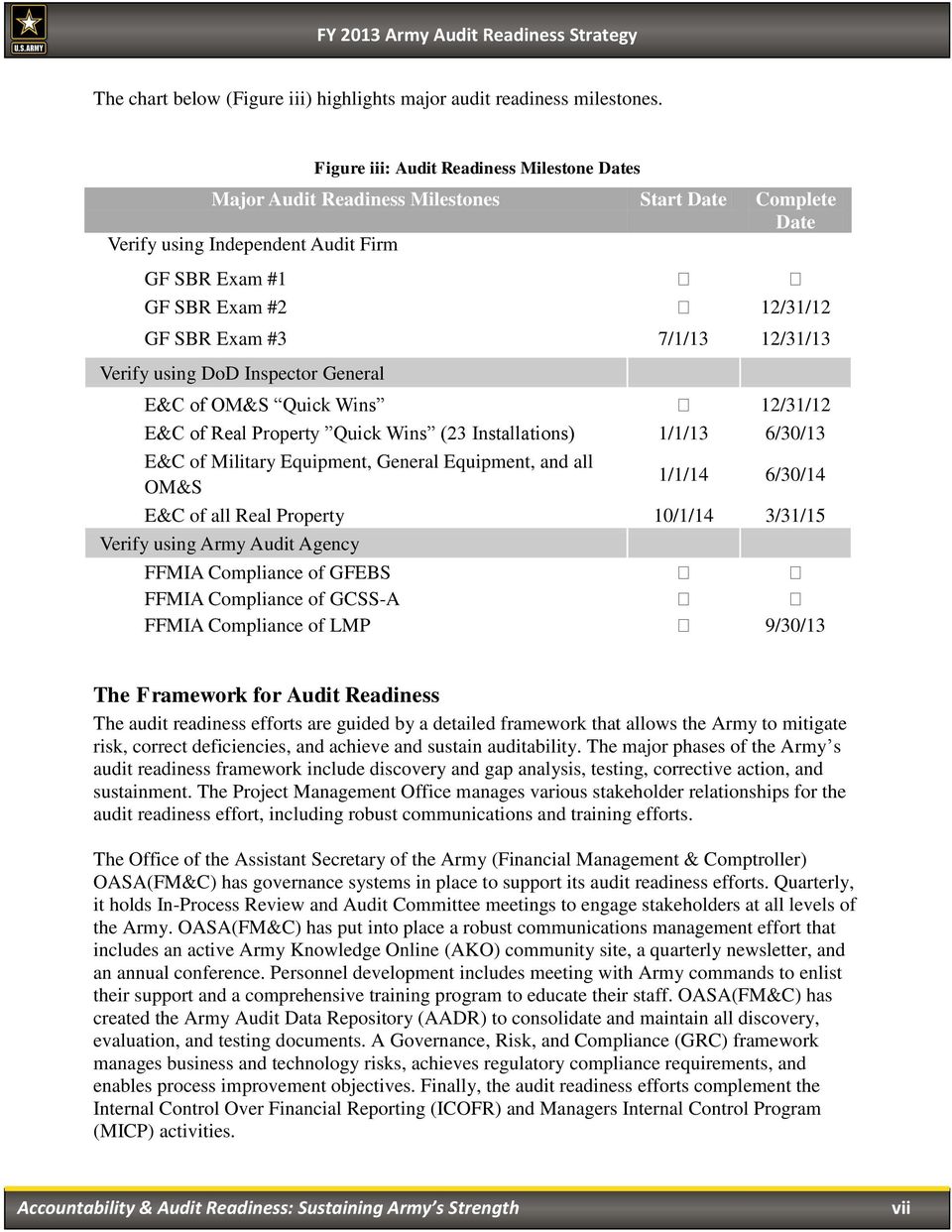
8 The chart below (Figure iii) highlights major audit readiness milestones. Figure iii: Audit Readiness Milestone Dates Major Audit Readiness Milestones Start Date Complete Date Verify using Independent Audit Firm GF SBR Exam #1 GF SBR Exam #2 12/31/12 GF SBR Exam #3 7/1/13 12/31/13 Verify using DoD Inspector General E&C of OM&S Quick Wins 12/31/12 E&C of Real Property Quick Wins (23 Installations) 1/1/13 6/30/13 E&C of Military Equipment, General Equipment, and all OM&S 1/1/14 6/30/14 E&C of all Real Property 10/1/14 3/31/15 Verify using Army Audit Agency FFMIA Compliance of GFEBS FFMIA Compliance of GCSS-A FFMIA Compliance of LMP 9/30/13 The Framework for Audit Readiness The audit readiness efforts are guided by a detailed framework that allows the Army to mitigate risk, correct deficiencies, and achieve and sustain auditability. The major phases of the Army s audit readiness framework include discovery and gap analysis, testing, corrective action, and sustainment. The Project Management Office manages various stakeholder relationships for the audit readiness effort, including robust communications and training efforts. The Office of the Assistant Secretary of the Army (Financial Management & Comptroller) OASA(FM&C) has governance systems in place to support its audit readiness efforts. Quarterly, it holds In-Process Review and Audit Committee meetings to engage stakeholders at all levels of the Army. OASA(FM&C) has put into place a robust communications management effort that includes an active Army Knowledge Online (AKO) community site, a quarterly newsletter, and an annual conference. Personnel development includes meeting with Army commands to enlist their support and a comprehensive training program to educate their staff. OASA(FM&C) has created the Army Audit Data Repository (AADR) to consolidate and maintain all discovery, evaluation, and testing documents. A Governance, Risk, and Compliance (GRC) framework manages business and technology risks, achieves regulatory compliance requirements, and enables process improvement objectives. Finally, the audit readiness efforts complement the Internal Control Over Financial Reporting (ICOFR) and Managers Internal Control Program (MICP) activities. Accountability & Audit Readiness: Sustaining Army s Strength vii
9 2.0 Overview The Army is transforming the way it does business. In the last three years, the Army has experienced unprecedented changes in its business operations. More changes are coming as the Army works toward standardizing its business practices and improving internal controls. The result will be an Army that can produce timely, relevant, and accurate business and financial information that supports the highest standards of military readiness. Congress requires the Department of Defense (DoD) to have audit ready financial statements by Secretary of Defense Leon E. Panetta assured Congress that all of the Services will have auditable Statements of Budgetary Resources (SBR) by 2014 and will achieve audit readiness for all financial statements by Army leadership is committed to these audit readiness goals. They have communicated that improved financial operations and strengthened fiscal stewardship are now top priorities throughout the Army in strategic documents such as the Secretary s Top Priorities list and the Army Campaign Plan. Responsible stewardship of taxpayer resources and operating business processes within an effective control environment are consistent with high standards of military readiness... Chief of Staff of the Army General Raymond T. Odierno in a message to General Officers on April Background Over the years, Congress has enacted legislation to define and shape the federal financial management landscape. These laws have initiated and guided Army financial improvement efforts. The most frequently referenced legislation and requirements are described in the table below. Federal Managers Financial Integrity Act (FMFIA) of 1982 Chief Financial Officers (CFO) Act of 1990 Government Performance and Results Act (GPRA) of 1993 Government Management Reform Act (GMRA) of 1994 Table 1: Financial Legislation and Requirements Authorizes GAO to prescribe standards of internal control. It also requires agency heads to establish a system of internal controls, annually evaluate the effectiveness of those controls, report identified weaknesses, and implement corrective action plans. Requires federal agencies to annually prepare auditable financial statements. Requires agencies to report on and measure progress towards established goals, including financial management goals. Extended the requirements of the CFO Act to include agency-wide reports from all major executive branch agencies and their components and for the government as a whole. Accountability & Audit Readiness: Sustaining Army s Strength 1

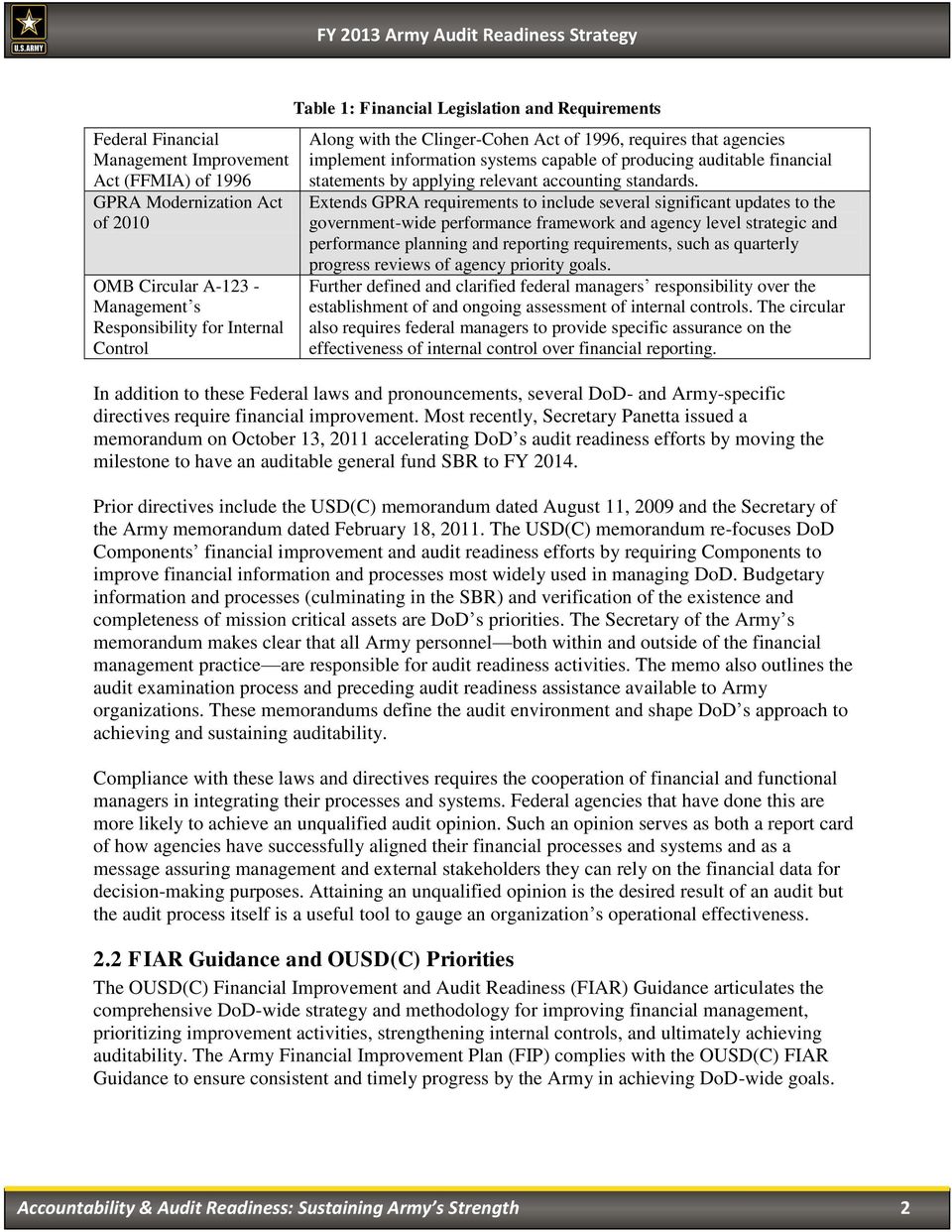
10 Federal Financial Management Improvement Act (FFMIA) of 1996 GPRA Modernization Act of 2010 OMB Circular A Management s Responsibility for Internal Control Table 1: Financial Legislation and Requirements Along with the Clinger-Cohen Act of 1996, requires that agencies implement information systems capable of producing auditable financial statements by applying relevant accounting standards. Extends GPRA requirements to include several significant updates to the government-wide performance framework and agency level strategic and performance planning and reporting requirements, such as quarterly progress reviews of agency priority goals. Further defined and clarified federal managers responsibility over the establishment of and ongoing assessment of internal controls. The circular also requires federal managers to provide specific assurance on the effectiveness of internal control over financial reporting. In addition to these Federal laws and pronouncements, several DoD- and Army-specific directives require financial improvement. Most recently, Secretary Panetta issued a memorandum on October 13, 2011 accelerating DoD s audit readiness efforts by moving the milestone to have an auditable general fund SBR to FY Prior directives include the USD(C) memorandum dated August 11, 2009 and the Secretary of the Army memorandum dated February 18, The USD(C) memorandum re-focuses DoD Components financial improvement and audit readiness efforts by requiring Components to improve financial information and processes most widely used in managing DoD. Budgetary information and processes (culminating in the SBR) and verification of the existence and completeness of mission critical assets are DoD s priorities. The Secretary of the Army s memorandum makes clear that all Army personnel both within and outside of the financial management practice are responsible for audit readiness activities. The memo also outlines the audit examination process and preceding audit readiness assistance available to Army organizations. These memorandums define the audit environment and shape DoD s approach to achieving and sustaining auditability. Compliance with these laws and directives requires the cooperation of financial and functional managers in integrating their processes and systems. Federal agencies that have done this are more likely to achieve an unqualified audit opinion. Such an opinion serves as both a report card of how agencies have successfully aligned their financial processes and systems and as a message assuring management and external stakeholders they can rely on the financial data for decision-making purposes. Attaining an unqualified opinion is the desired result of an audit but the audit process itself is a useful tool to gauge an organization s operational effectiveness. 2.2 FIAR Guidance and OUSD(C) Priorities The OUSD(C) Financial Improvement and Audit Readiness (FIAR) Guidance articulates the comprehensive DoD-wide strategy and methodology for improving financial management, prioritizing improvement activities, strengthening internal controls, and ultimately achieving auditability. The Army Financial Improvement Plan (FIP) complies with the OUSD(C) FIAR Guidance to ensure consistent and timely progress by the Army in achieving DoD-wide goals. Accountability & Audit Readiness: Sustaining Army s Strength 2
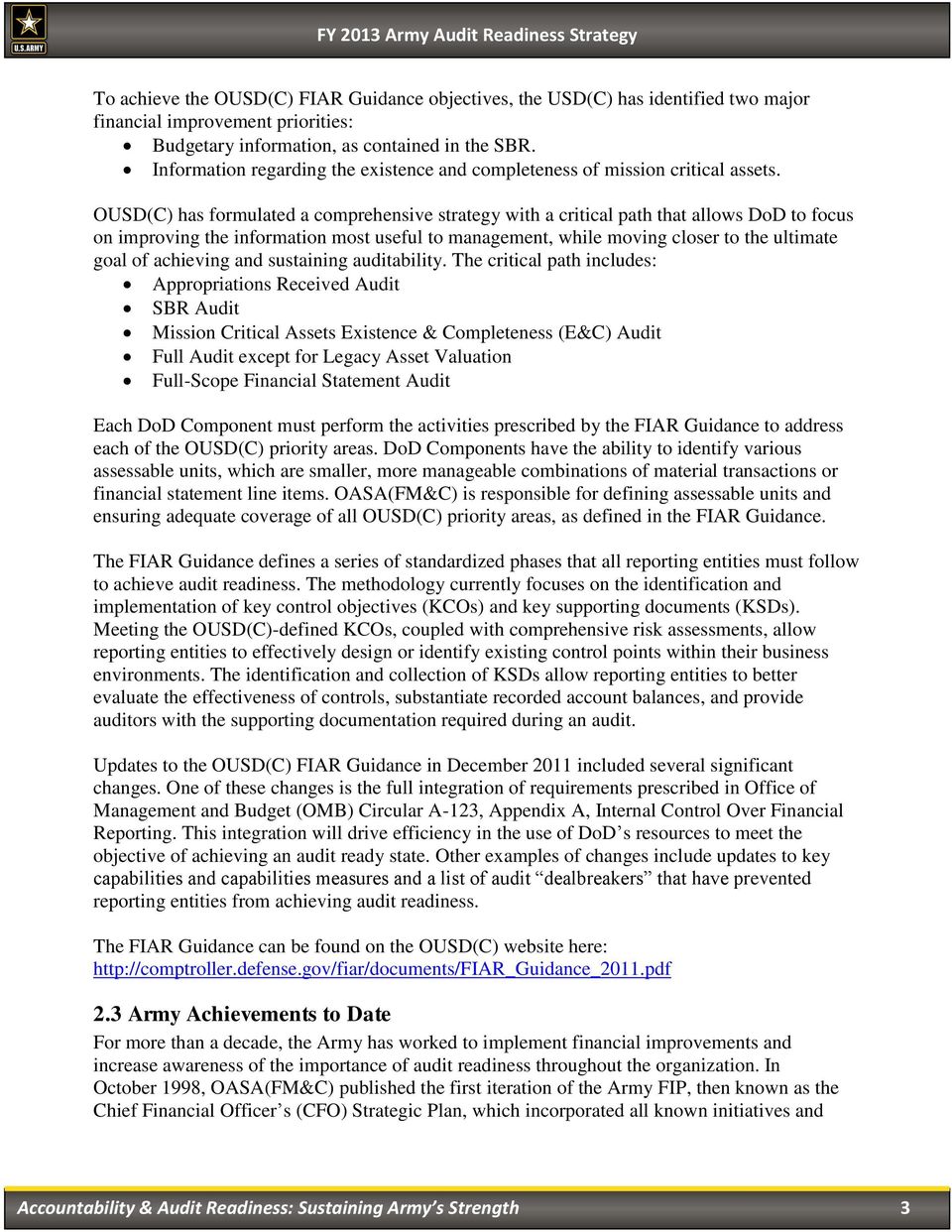
11 To achieve the OUSD(C) FIAR Guidance objectives, the USD(C) has identified two major financial improvement priorities: Budgetary information, as contained in the SBR. Information regarding the existence and completeness of mission critical assets. OUSD(C) has formulated a comprehensive strategy with a critical path that allows DoD to focus on improving the information most useful to management, while moving closer to the ultimate goal of achieving and sustaining auditability. The critical path includes: Appropriations Received Audit SBR Audit Mission Critical Assets Existence & Completeness (E&C) Audit Full Audit except for Legacy Asset Valuation Full-Scope Financial Statement Audit Each DoD Component must perform the activities prescribed by the FIAR Guidance to address each of the OUSD(C) priority areas. DoD Components have the ability to identify various assessable units, which are smaller, more manageable combinations of material transactions or financial statement line items. OASA(FM&C) is responsible for defining assessable units and ensuring adequate coverage of all OUSD(C) priority areas, as defined in the FIAR Guidance. The FIAR Guidance defines a series of standardized phases that all reporting entities must follow to achieve audit readiness. The methodology currently focuses on the identification and implementation of key control objectives (KCOs) and key supporting documents (KSDs). Meeting the OUSD(C)-defined KCOs, coupled with comprehensive risk assessments, allow reporting entities to effectively design or identify existing control points within their business environments. The identification and collection of KSDs allow reporting entities to better evaluate the effectiveness of controls, substantiate recorded account balances, and provide auditors with the supporting documentation required during an audit. Updates to the OUSD(C) FIAR Guidance in December 2011 included several significant changes. One of these changes is the full integration of requirements prescribed in Office of Management and Budget (OMB) Circular A-123, Appendix A, Internal Control Over Financial Reporting. This integration will drive efficiency in the use of DoD s resources to meet the objective of achieving an audit ready state. Other examples of changes include updates to key capabilities and capabilities measures and a list of audit dealbreakers that have prevented reporting entities from achieving audit readiness. The FIAR Guidance can be found on the OUSD(C) website here: Army Achievements to Date For more than a decade, the Army has worked to implement financial improvements and increase awareness of the importance of audit readiness throughout the organization. In October 1998, OASA(FM&C) published the first iteration of the Army FIP, then known as the Chief Financial Officer s (CFO) Strategic Plan, which incorporated all known initiatives and Accountability & Audit Readiness: Sustaining Army s Strength 3
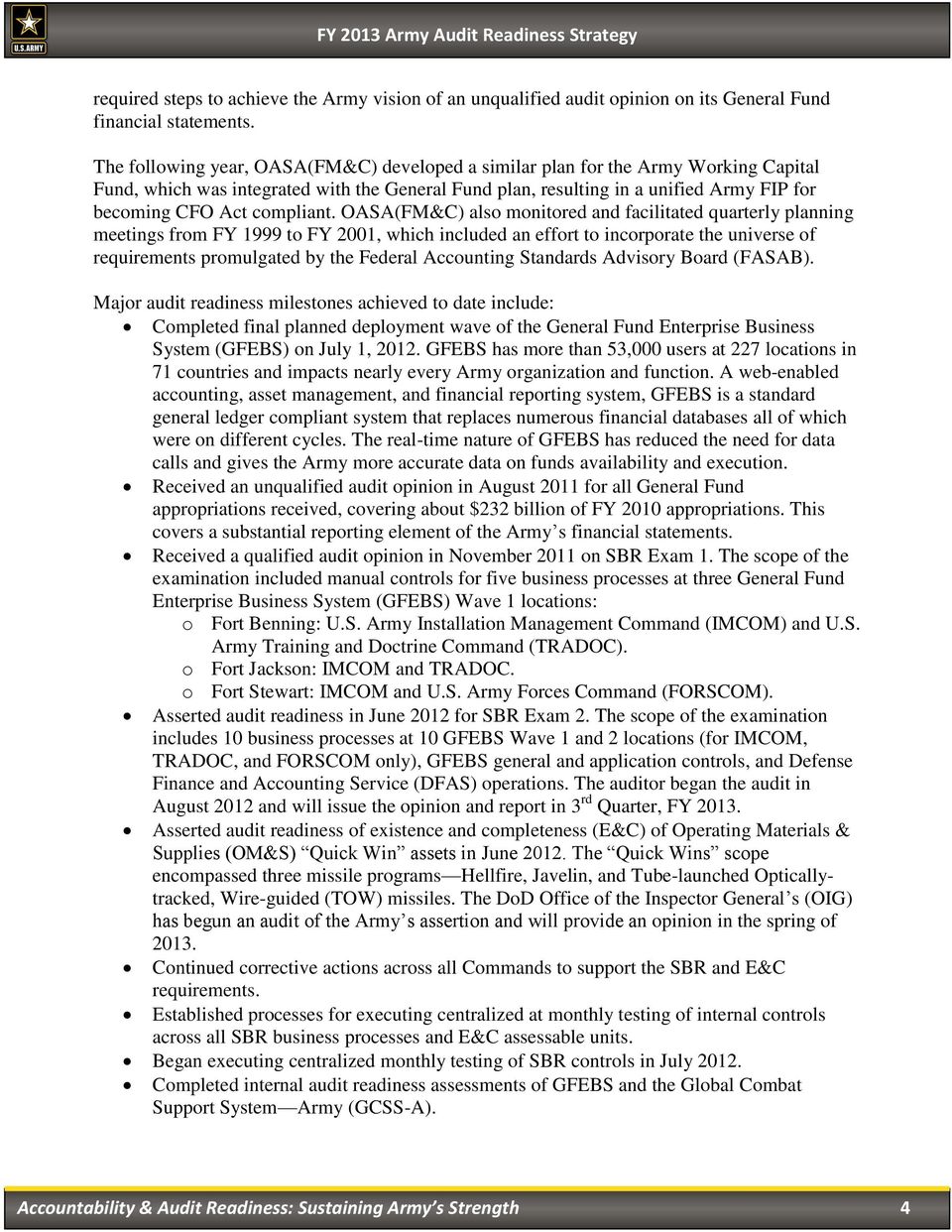
12 required steps to achieve the Army vision of an unqualified audit opinion on its General Fund financial statements. The following year, OASA(FM&C) developed a similar plan for the Army Working Capital Fund, which was integrated with the General Fund plan, resulting in a unified Army FIP for becoming CFO Act compliant. OASA(FM&C) also monitored and facilitated quarterly planning meetings from FY 1999 to FY 2001, which included an effort to incorporate the universe of requirements promulgated by the Federal Accounting Standards Advisory Board (FASAB). Major audit readiness milestones achieved to date include: Completed final planned deployment wave of the General Fund Enterprise Business System (GFEBS) on July 1, GFEBS has more than 53,000 users at 227 locations in 71 countries and impacts nearly every Army organization and function. A web-enabled accounting, asset management, and financial reporting system, GFEBS is a standard general ledger compliant system that replaces numerous financial databases all of which were on different cycles. The real-time nature of GFEBS has reduced the need for data calls and gives the Army more accurate data on funds availability and execution. Received an unqualified audit opinion in August 2011 for all General Fund appropriations received, covering about $232 billion of FY 2010 appropriations. This covers a substantial reporting element of the Army s financial statements. Received a qualified audit opinion in November 2011 on SBR Exam 1. The scope of the examination included manual controls for five business processes at three General Fund Enterprise Business System (GFEBS) Wave 1 locations: o Fort Benning: U.S. Army Installation Management Command (IMCOM) and U.S. Army Training and Doctrine Command (TRADOC). o Fort Jackson: IMCOM and TRADOC. o Fort Stewart: IMCOM and U.S. Army Forces Command (FORSCOM). Asserted audit readiness in June 2012 for SBR Exam 2. The scope of the examination includes 10 business processes at 10 GFEBS Wave 1 and 2 locations (for IMCOM, TRADOC, and FORSCOM only), GFEBS general and application controls, and Defense Finance and Accounting Service (DFAS) operations. The auditor began the audit in August 2012 and will issue the opinion and report in 3 rd Quarter, FY Asserted audit readiness of existence and completeness (E&C) of Operating Materials & Supplies (OM&S) Quick Win assets in June The Quick Wins scope encompassed three missile programs Hellfire, Javelin, and Tube-launched Opticallytracked, Wire-guided (TOW) missiles. The DoD Office of the Inspector General s (OIG) has begun an audit of the Army s assertion and will provide an opinion in the spring of Continued corrective actions across all Commands to support the SBR and E&C requirements. Established processes for executing centralized at monthly testing of internal controls across all SBR business processes and E&C assessable units. Began executing centralized monthly testing of SBR controls in July Completed internal audit readiness assessments of GFEBS and the Global Combat Support System Army (GCSS-A). Accountability & Audit Readiness: Sustaining Army s Strength 4
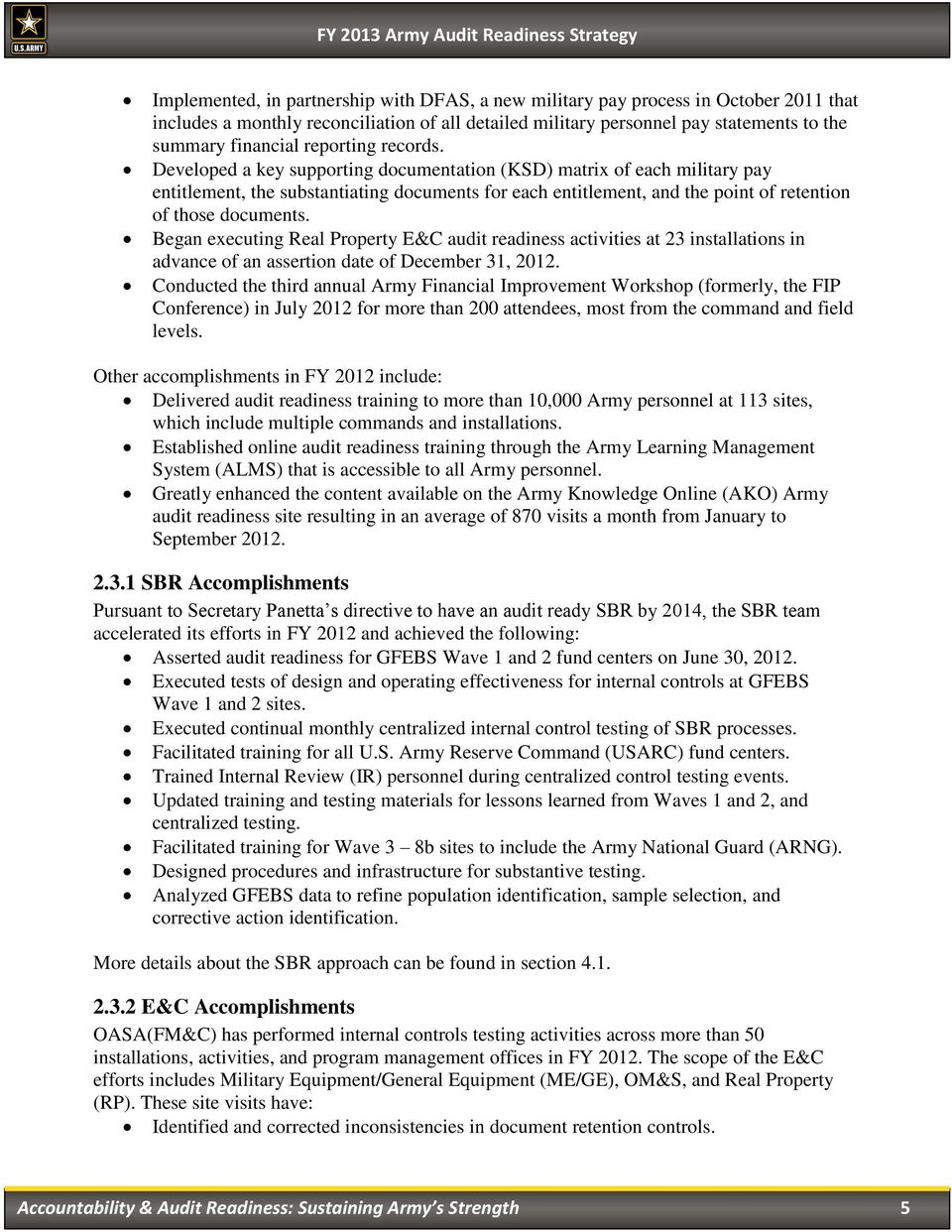
13 Implemented, in partnership with DFAS, a new military pay process in October 2011 that includes a monthly reconciliation of all detailed military personnel pay statements to the summary financial reporting records. Developed a key supporting documentation (KSD) matrix of each military pay entitlement, the substantiating documents for each entitlement, and the point of retention of those documents. Began executing Real Property E&C audit readiness activities at 23 installations in advance of an assertion date of December 31, Conducted the third annual Army Financial Improvement Workshop (formerly, the FIP Conference) in July 2012 for more than 200 attendees, most from the command and field levels. Other accomplishments in FY 2012 include: Delivered audit readiness training to more than 10,000 Army personnel at 113 sites, which include multiple commands and installations. Established online audit readiness training through the Army Learning Management System (ALMS) that is accessible to all Army personnel. Greatly enhanced the content available on the Army Knowledge Online (AKO) Army audit readiness site resulting in an average of 870 visits a month from January to September SBR Accomplishments Pursuant to Secretary Panetta s directive to have an audit ready SBR by 2014, the SBR team accelerated its efforts in FY 2012 and achieved the following: Asserted audit readiness for GFEBS Wave 1 and 2 fund centers on June 30, Executed tests of design and operating effectiveness for internal controls at GFEBS Wave 1 and 2 sites. Executed continual monthly centralized internal control testing of SBR processes. Facilitated training for all U.S. Army Reserve Command (USARC) fund centers. Trained Internal Review (IR) personnel during centralized control testing events. Updated training and testing materials for lessons learned from Waves 1 and 2, and centralized testing. Facilitated training for Wave 3 8b sites to include the Army National Guard (ARNG). Designed procedures and infrastructure for substantive testing. Analyzed GFEBS data to refine population identification, sample selection, and corrective action identification. More details about the SBR approach can be found in section E&C Accomplishments OASA(FM&C) has performed internal controls testing activities across more than 50 installations, activities, and program management offices in FY The scope of the E&C efforts includes Military Equipment/General Equipment (ME/GE), OM&S, and Real Property (RP). These site visits have: Identified and corrected inconsistencies in document retention controls. Accountability & Audit Readiness: Sustaining Army s Strength 5
14 Reviewed physical inventory controls. Enforced and implemented effective quality control review programs, such as the Command Supply Discipline Program (CSDP). Streamlined the financial reporting process to use ME accountable property system of record (APSR) data on financial statements. Other major E&C accomplishments in FY 2012 include: Asserted audit readiness of OM&S Quick Win assets in June Continued corrective actions across all Commands to support E&C requirements. Established processes for executing centralized at monthly testing of internal controls across E&C assessable units. Began executing centralized monthly testing of ME/GE controls in October Began executing Real Property E&C audit readiness activities at 23 installations in advance of an assertion date of December 31, Included in Army s E&C audit readiness efforts are Active Installations Defense Environmental Restoration Program (DERP) environmental liabilities (EL). Discovery efforts for EL internal control activities are underway. The Army intends to assert audit readiness of Army s Active Installations DERP EL in FY 2013 (for E&C, as well as valuation, obligations, and presentation and disclosure). More details about the E&C approach can be found in section FY 2013 Major Milestones The upcoming fiscal year has two major milestones: For SBR, the Army will assert audit readiness for Exam 3 in June The scope of Exam 3 covers all Army business processes within the GFEBS environment (excluding military pay, which will not be recorded in and reported from GFEBS until FY 2014). For E&C, the Army will assert audit readiness for RP Quick Wins assets (excluding land) at 23 installations that self-reported substantial progress in obtaining key supporting documentation. RP Quick Wins assets comprise approximately 20 percent of total RP assets. Accountability & Audit Readiness: Sustaining Army s Strength 6

15 3.0 Army Audit Readiness Framework The Army defines auditability as the capability to identify and mitigate risks, produce audit trails with appropriate source documentation, and identify populations to support line items on the financial statements. This risk-based audit readiness framework illustrated in Figure 3 assists Army organizations to mitigate risk, correct deficiencies, and achieve and sustain auditability. Figure 3: Army Audit Readiness Framework The Army s strategy leverages the Committee of Sponsoring Organizations (COSO) framework coupled with consideration of generally accepted accounting principles (GAAP), generally accepted government auditing standards (GAGAS), the Government Accountability Office / President s Council on Integrity and Efficiency (GAO/PCIE) Financial Audit Manual (FAM), and OMB Circular A-123. The framework helps the Army establish an effective internal control environment, create a reliable audit support infrastructure, and develop the corporate knowledge necessary to sustain an effective control and audit support environment. Through its execution, the framework generates business process documentation, risk assessments, and internal control activity evaluations including as is and to be systems control evaluations. It identifies corrective actions required to address impediments to auditability. The framework incorporates control assessments of business and feeder systems that will continue to be operational in FY The assessments include evaluating, documenting, and testing the design and operating effectiveness of key internal controls critical to financial Accountability & Audit Readiness: Sustaining Army s Strength 7

16 reporting. These assessments are based upon the following standards: Control Objectives for Information Technology (COBIT), COSO, International Organization for Standardization (ISO), Information Technology Infrastructure Library (ITIL), and the approach external auditors use to perform Federal Information System Controls Audit Manual (FISCAM) audits. The major phases of the Army s audit readiness framework include: Discovery and gap analysis Testing Corrective action Sustainment 3.1 Discovery and Gap Analysis The purpose of this phase is to perform risk assessments, define the current and audit ready state of business and financial operations, and perform initial evaluation of controls. OASA(FM&C) conducts discovery and evaluation activities to verify budgetary receipt, control, distribution, execution, and reporting business processes. Audit readiness preparation meetings assist Army personnel in preparing for an independent audit of their business and resource management processes. The focus of these meetings is to familiarize Army personnel with the audit readiness process and answer questions pertaining to milestones. OASA(FM&C) coordinates with the resource management community across the command, region, and installation levels to schedule visits and obtain concurrence on business process documentation. OASA(FM&C) identifies and documents risks and control points, focusing on interfacing systems, and application and general controls. OASA(FM&C) also conducts risk assessments and identifies corrective actions to improve the Army s budget execution and financial reporting processes. This evaluation is performed in a manner similar to an audit, where organizations responsible for business transactions provide supporting documentation at the request of OASA(FM&C). This phase makes OASA(FM&C) aware of weaknesses and deficiencies that must be remediated prior to the assessable unit becoming audit ready. 3.2 Testing The testing phase of the Army s audit readiness framework includes internal controls tests developed using an auditor s approach, including design of procedures performed, identification of populations, and sample selection pursuant to the DoD Financial Improvement and Audit Readiness (FIAR) Guidance (December 2011). The tests of controls include evaluating both manual and automated controls, including information technology general and application controls, and are limited to key internal controls designed to prevent and/or detect material misstatements or instances of non-compliance. The tests evaluate both the design and operating effectiveness of implemented controls. If the number of exceptions exceeds the acceptable number during sample controls testing based on the FIAR Guidance, OASA(FM&C) concludes that controls are not designed or operating effectively and identifies corrective actions to address the failure. Accountability & Audit Readiness: Sustaining Army s Strength 8
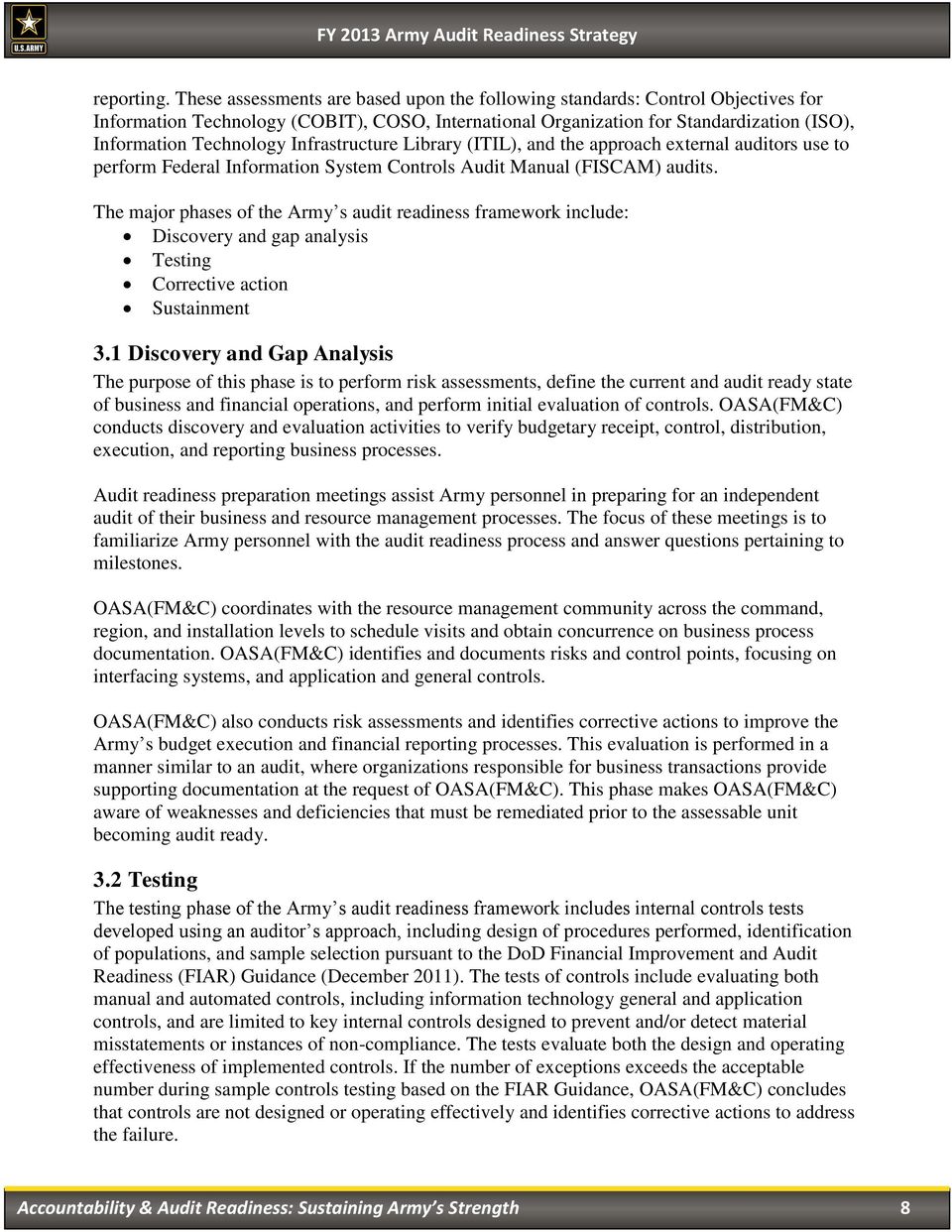
17 Included in this phase is centralized monthly internal controls and substantive testing for SBR and mission critical assets. These tests simulate a mock audit, much like what sites will experience during an actual financial statement audit. The SBR audit readiness team began monthly testing of internal controls and supporting documentation in June The team has expanded monthly testing in FY 2013 to include (1) on a revolving basis, those GFEBS Fund Centers that have participated in the Army s GF SBR manual control training events in the prior day testing period, and (2) tests of details of five key SBR line items: Recoveries of Prior Year Obligations, Spending Authority from Offsetting Collections, Obligations Incurred, Unpaid Obligations, and Net Outlays. Substantive testing will occur periodically throughout FYs 2013 and Monthly internal controls and substantive testing of the existence and completeness of mission critical assets began in October 2012 with ME/GE. The existence and completeness of assets are two of the five financial statement assertions that financial statement auditors test. The Army must ensure that assets recorded in an accountable property system of record (APSR) exist (existence) and assets located at installations and commands are recorded in an APSR (completeness). In 2 nd Quarter, FY 2013, monthly testing of the existence and completeness of mission critical assets will expand to include OM&S and Real Property. 3.3 Corrective Action The next phase involves developing and implementing solutions to rectify weaknesses and deficiencies identified during the discovery and testing phases. OASA(FM&C) creates FIP tasks that detail how Army personnel should address weaknesses identified in the discovery and testing phases. FIP tasks include specific action items, detailed timelines, and required or committed resources necessary to implement the audit ready environment. The implementation of corrective actions is an important aspect of audit readiness and everyone within the Army organization has a role to play. Headquarters, Department of the Army or OASA(FM&C) is responsible for communicating corrective actions to Commands. Management and business process owners are responsible for developing and implementing corrective actions plans, and Internal Review collaborates with Commands to monitor their implementation efforts. 3.4 Sustainment This phase involves maintenance of the audit readiness state. OASA(FM&C) performs periodic testing of internal controls as required by OMB Circular A-123, Appendix A. Any issues identified during sustainment are addressed in a timely fashion so the sustainment of the audit ready environment is not jeopardized. Ideally, corrective actions to address issues identified in the sustainment phase should be implemented prior to the next reporting or audit cycle. Throughout all audit readiness phases, the Army generates significant amounts of information and work products that serve as an important role in documenting and sustaining an audit-ready environment. SBR and E&C field teams submit site visit reports and comprehensive documentation of the business processes for each site. Field teams also submit control risk assessments, comprehensive test plans and results, in addition to any work papers used to identify work performed and summary trip reports of discovery, testing, and corrective action visits. Accountability & Audit Readiness: Sustaining Army s Strength 9
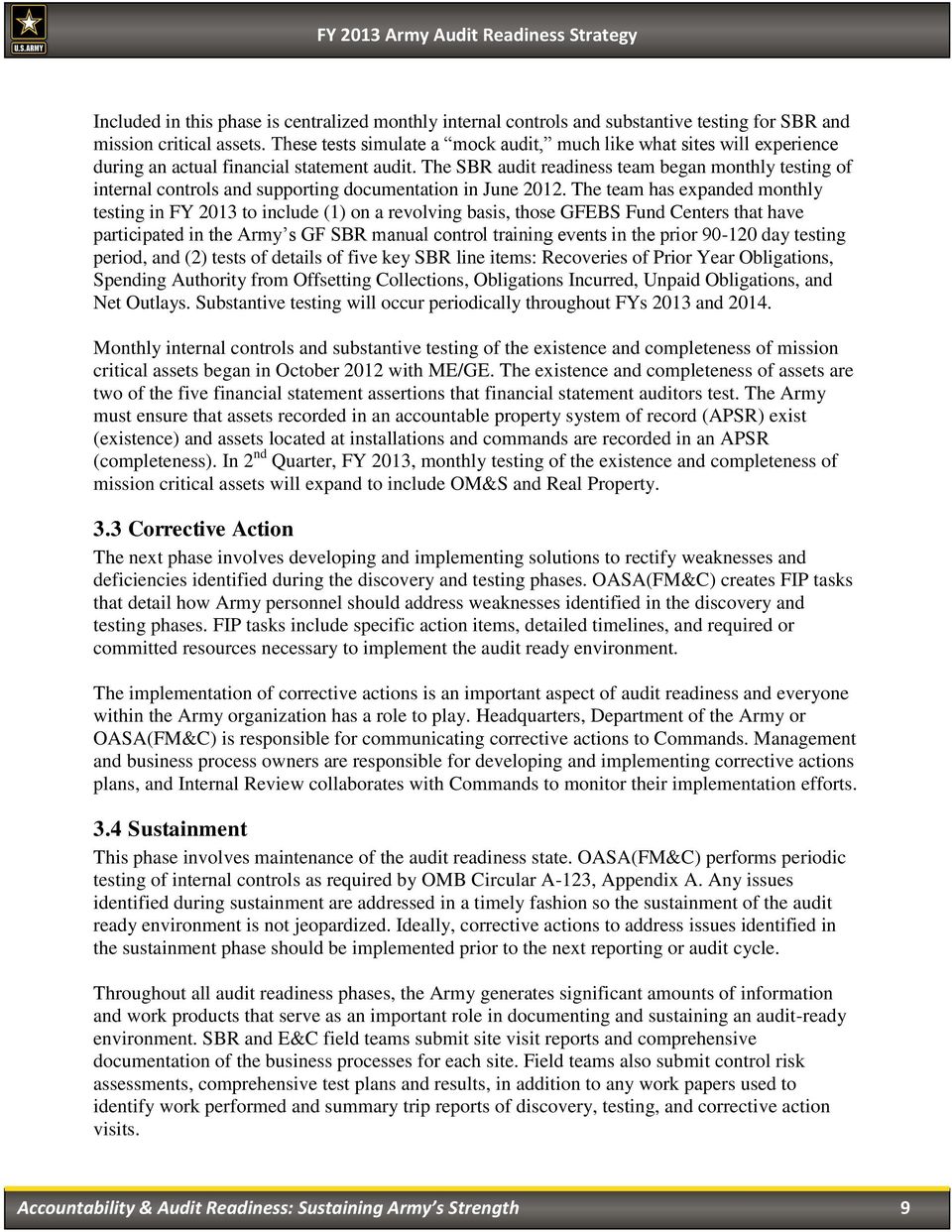
18 4.0 Implementing the Audit Readiness FIP Framework In FY 2012, the FIP team greatly expanded the resources available to the field to facilitate implementation and help them understand, at the most detailed level, how to ensure the internal controls are in place and operating effectively at their organization. See Table 2 below. Resource Audit Readiness Command and Installation Guide Commander s Checklist Control Catalogs Business Process Narratives and Flowcharts Process Training Table 2: Army Audit Readiness Resources for Implementation Description This guide is a starting point in audit readiness. The purpose of this guide is to assist Army commands and installations in becoming audit ready. It provides an overview of audit readiness and descriptions of key supporting resources available to commands and installations for becoming audit ready. Users can find summaries of key internal control activities identified for each command and installation, including authoritative guidance and/or policies related to the internal control activities and internal control deviations discovered by Army audit readiness teams during testing. This checklist is a guide detailing the basic actions every Commander must be aware of and their organizations must take to enable and sustain audit readiness. Control catalogs list all identified internal control activities for all Army business processes. Control activities mitigate risks in business processes and can be manual or automated. Business process narratives and flowcharts provide a description of how personnel perform a specific business process, the risks the process poses to the financial statements, and the controls required to mitigate the risks. This training covers specifically the purpose of and how to implement SBRand E&C internal control activities. Implementing the Framework covers more than just SBR and E&C. Audit readiness efforts also focus on improving the information technology systems that manage the resources related to the financial statements. The sections below provide the details on how each of these areas will be addressed and the milestones reached. 4.1 Statement of Budgetary Resources In accordance with the FIAR Directorate goals and objectives and the National Defense Authorization Act (NDAA) for FY 2010, the Army initiated a General Fund SBR discovery and evaluation effort in March The original plan for SBR was to undergo four examinations by an auditor and assert audit readiness by FY The first major SBR milestone the Army achieved was the assertion of General Fund Appropriations Received. The Army received an unqualified audit opinion from an IPA firm on August 19, 2011 for appropriations received, covering about $232 billion of FY 2010 appropriations. Accountability & Audit Readiness: Sustaining Army s Strength 10
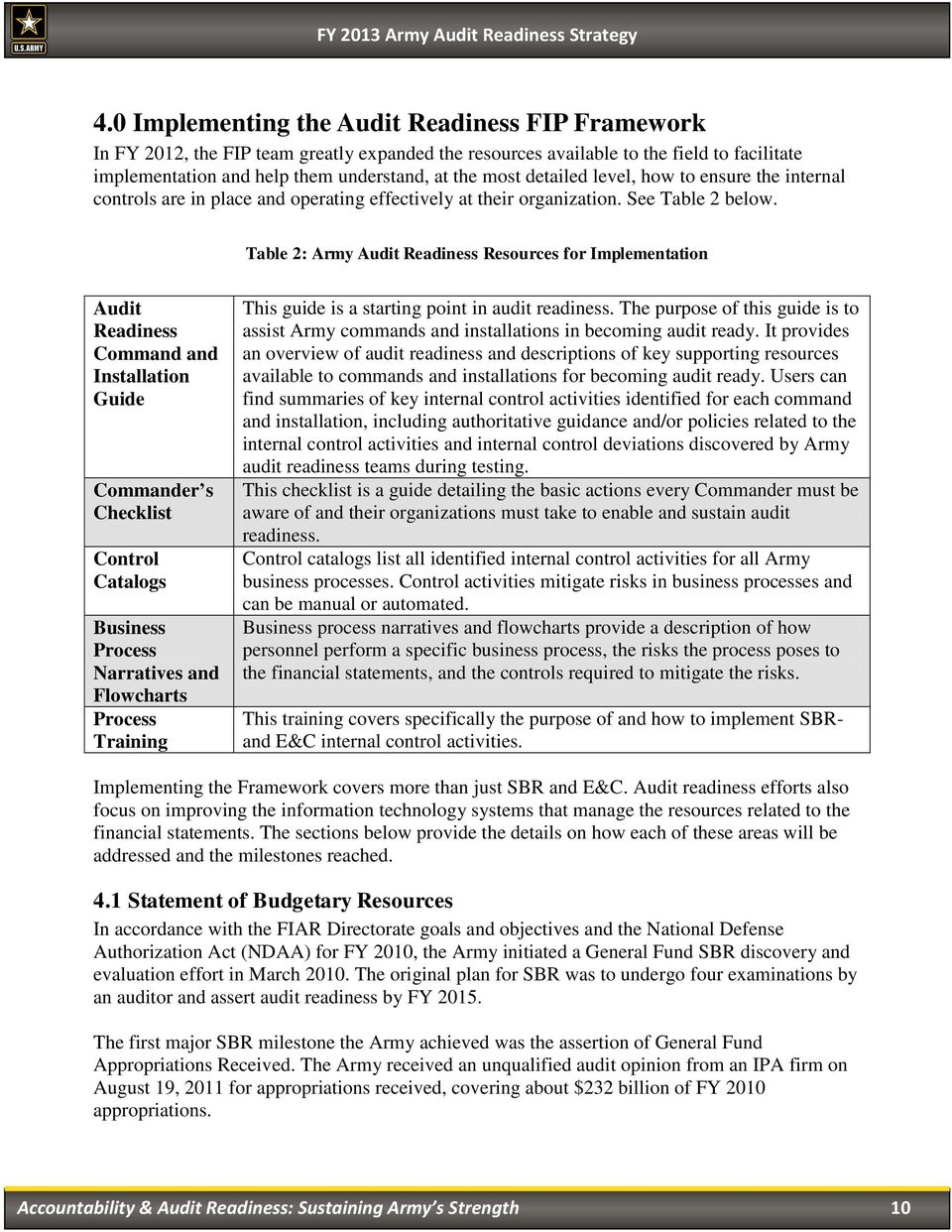
19 In FY 2012, the Army updated its audit readiness plans based on Secretary of Defense Leon E. Panetta s Improving Financial Information and Achieving Audit Readiness Memorandum dated October 13, In it, all Services must achieve audit readiness for the SBR by the end of FY As a result, the Army now has only three exams to prepare for the assertion in Table 3: SBR Milestones SBR Milestones Tested Corrected Validated Ready GF SBR Exam #2 - GFEBS Wave 1 & 2 Sites 12/31/12 GF SBR Exam #3 (All Army GF Business Processes at all GFEBS 12/31/12 6/30/13 12/31/13 locations) GF SBR Assertion / Audit (All Army GF Activity) 3/31/13 6/30/14 9/30/14 Fund Balance with Treasury 2/15/13 6/30/14 9/30/14 Tested = Completion of discovery efforts Corrected = Complete tests of corrective actions and assert audit ready Validated Ready = IG / IPA opinion on audit readiness assertion By integrating the GFEBS deployment with SBR discovery and gap analysis site visits, the Army validates its business processes and quickly discovers system or process deficiencies in the GFEBS environment. OASA(FM&C) has identified risks, controls, and potential weaknesses during their review of the Army budget execution processes, using past GAO, DoD OIG, and Army Audit Agency audit reports to guide their work. In addition, the Army developed test plans based on the key control objectives included in the OUSD(C) FIAR Guidance, as well as the key controls identified within the GFEBS environment. Along with performing discovery, gap analysis, and training site visits at GFEBS locations, the Army, jointly with DFAS, is conducting discovery, gap analysis, and testing for the Civilian Pay, Military Pay, Financial Reporting, and Fund Balance with Treasury, to include the Collections and Disbursements, business processes SBR Exam 1 for GFEBS Wave 1 Sites The Army asserted audit readiness for SBR Exam 1 in June The exam covered manual controls at three GFEBS Wave 1 sites Forts Benning, Jackson, and Stewart for the following five processes: Civilian Permanent Change of Station (PCS) Travel Funds Receipt, Distribution, and Monitoring Contracts executed in the Standard Procurement System Temporary Duty (TDY) Travel executed in the Defense Travel System Reimbursable Transactions Inbound & Outbound Accountability & Audit Readiness: Sustaining Army s Strength 11
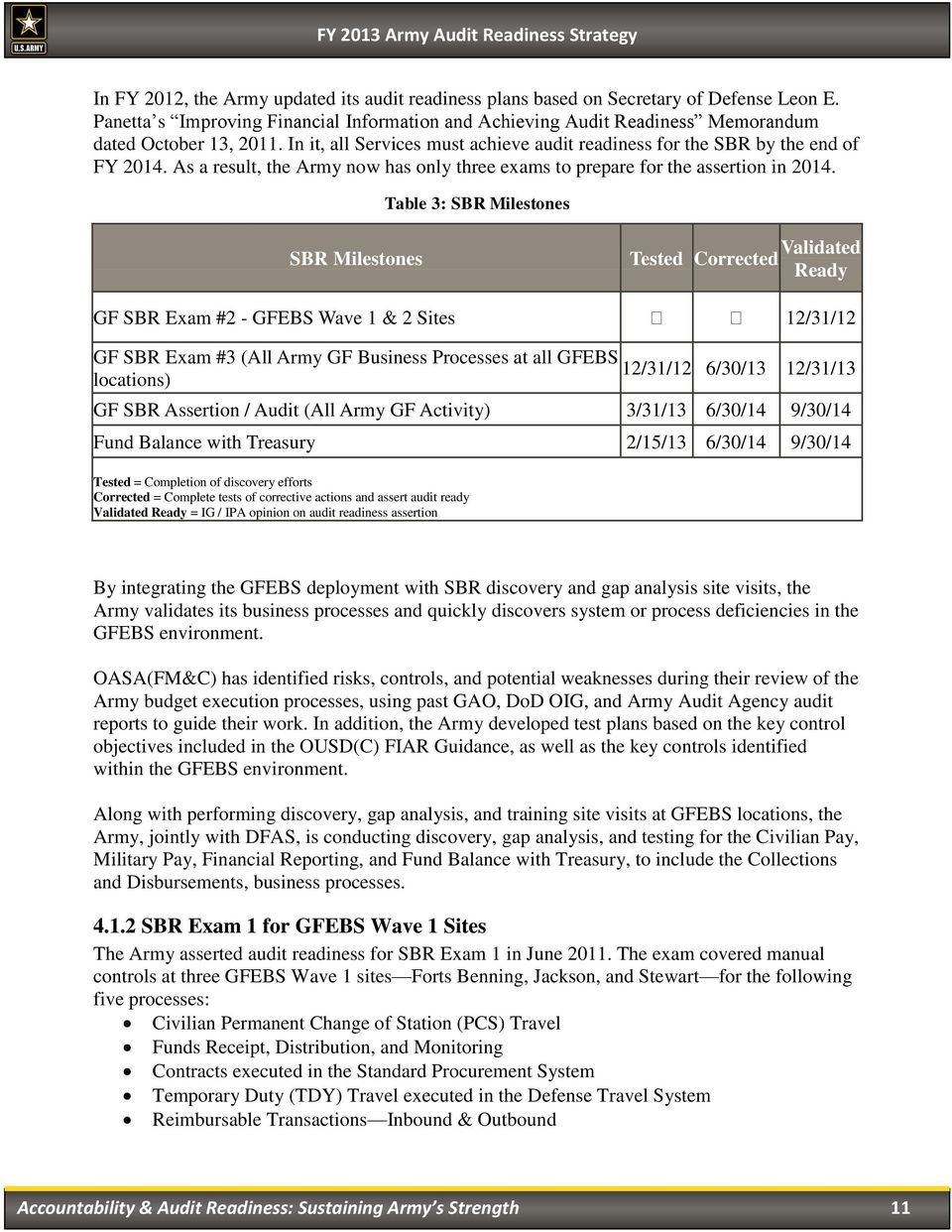
20 The auditor issued a qualified opinion in November 2011, which is a significant milestone for the Army. The scope of the examination included an assessment of the design and operating effectiveness of internal controls at the Wave 1 sites (for U.S. Army Installation Management Command (IMCOM), U.S. Army Training and Doctrine Command (TRADOC), and U.S. Army Forces Command (FORSCOM) only) among an assessment of other management assertions. The auditor recommended civilian PCS travel be removed as a process to evaluate because the funds associated with this process were not material; therefore, PCS is not included in future audit readiness activities or exams SBR Exam 2 for GFEBS Wave 1 and 2 Sites The Army asserted audit readiness for SBR Exam 2 in June The scope of the examination includes the following sites: Fort Benning: IMCOM and TRADOC Fort Jackson: IMCOM and TRADOC Fort Stewart: IMCOM and FORSCOM Fort Bragg: IMCOM and FORSCOM Fort Campbell: IMCOM and FORSCOM Fort Drum: IMCOM and FORSCOM Fort Gordon: IMCOM and TRADOC Fort Knox: IMCOM Fort Polk: IMCOM and FORSCOM Fort Rucker: IMCOM and TRADOC In addition to Exam 1 processes (excluding civilian PCS travel), the exam encompasses four additional processes: Civilian Payroll Miscellaneous Payments Purchase Card Transactions Supply Requisition Exam 2 also covers GFEBS general and application controls and DFAS operations. The audit report for Exam 2 is expected in the second quarter of FY Future SBR Exams The Army will assert audit readiness for Exam 3 in June The scope of Exam 3 covers all Exam 2 processes plus Mechanization of Contract Administration Services (MOCAS) and Global Combat Support System Army (GCSS-A) processes. The full 2014 SBR assertion will cover all Army general fund activity Fund Balance with Treasury As the Army continues its audit readiness Fund Balance with Treasury (FBWT) efforts, the approach for the FBWT assertion will focus on the GFEBS environment. In addition, it follows the approach successfully employed by the Air Force and DFAS-Columbus to identify requirements for the implementation of an automated tool to perform a monthly reconciliation of Accountability & Audit Readiness: Sustaining Army s Strength 12

21 the Army s and the Department of Treasury s records. In cooperation with DFAS-Indianapolis, OASA(FM&C) developed a FBWT FIP. The Army plans to leverage the completed FBWT work to address the Net Outlays section of the SBR. The Army expects to assert FBWT in June 2014 at the same time as the GF SBR assertion. The Army has partnered with DFAS to develop and implement the an automated reconciliation tool, modeled after the Air Force s Columbus Cash Accountability System (CCAS)-Air Force, within the Army, as well as develop a process for resolving identified reconciling items. Once the tool is operational, the Army and DFAS will be able to reconcile on a monthly basis the Army s FBWT, which stood at approximately $190B as of the end of FY This is a critical control activity that significantly advances the Army s audit readiness posture. Although the Army FBWT Tool is essential for an auditable FBWT line item, Army recognizes that this is only one piece of the puzzle. As such, Army and DFAS are working together to implement the appropriate internal controls within the appropriations received, disbursements, and collections processes that also affect the FBWT balance SBR Resources OASA(FM&C) continues to develop and refine resources available to Army field personnel to support their efforts to effectively implement internal controls. These resources are available to download on the Army audit readiness AKO site Audit Support Handbook The SBR Audit Support Handbook provides resources for commands and installations that are directly involved in Army SBR audit readiness efforts. This audit support handbook is organized by SBR business process and key controls. It includes standard operating procedures for retrieving information and documents from information management systems, such as GFEBS, to support audit readiness or auditors requests Office Hours OASA(FM&C) holds Office Hour calls every Tuesday and Thursday to answer questions regarding internal control requirements and documentation for sites filling out their pre-site questionnaire or addressing SBR corrective actions after a site visit. Notes from calls are available to share lessons learned and address frequently asked questions. Call times vary based on location (i.e., within or outside the continental United States). See the Army audit readiness AKO site for details Self-Assessment Internal Control Questionnaire Self-assessment internal control questionnaires are provided to commands and installations that have been selected for an on-site audit readiness visit. The purpose of this questionnaire is to assist commands and installations in identifying existing key controls and to enable the SBR team to identify key controls that should be in place (i.e., control gaps) Test Plans Test plans show how the SBR team is sampling and validating internal controls much like an auditor would for an actual financial statement audit. Accountability & Audit Readiness: Sustaining Army s Strength 13
22 4.2 Existence and Completeness The second priority established by the USD(C) in FY 2009 directed the DoD Components to focus on improving information that is essential to the effective management of DoD s mission critical assets. Mission critical asset categories include: Military Equipment (ME) (e.g., ships, aircraft, combat vehicles). General Equipment (GE) (e.g., material handling equipment, training equipment, special tooling and test equipment). Operating Materials & Supplies (OM&S) (e.g., ammunition, munitions, missiles). Real Property (RP) (e.g., land, buildings, structures). Inventory (e.g., supplies, spare parts, fuel). Table 4: E&C Milestones E&C Milestones Tested Corrected Validated Ready OM&S Quick Wins (Javelin, Hellfire, TOW missiles) 12/31/12 Real Property Quick Wins (23 Installations) 12/31/12 6/30/13 Military Equipment, General Equipment, OM&S (All assets) 12/31/13 6/30/14 Real Property (All installations) 3/31/13 9/30/14 3/31/15 Tested = Completion of discovery efforts Corrected = Complete tests of corrective actions and assert audit ready Validated Ready = IG / IPA opinion on audit readiness assertion Financial management information, as well as other management information for mission critical assets, is recorded in official systems of record, which are referred to as accountable property systems of record (APSRs). Ensuring that asset accountability and important management information relevant to mission critical assets is accurately recorded in each reporting entity s APSR is required to support future financial statement audits. The existence and completeness of assets are two of the five financial statement assertions that financial statement auditors test. Existence testing is accomplished through a book to floor inventory process, validating assets recorded in the APSR against assets maintained in the field. Completeness testing is accomplished through a floor to book inventory process, validating assets represented in the field against assets recorded in the APSR. DoD Components must ensure that all assets recorded in their APSR exist (existence) and all of the reporting entities assets are recorded in their APSR (completeness). Included in the Army s E&C audit readiness efforts is Active Installations Defense Environmental Restoration Program (DERP) environmental liabilities (EL). For each site on an installation that the Army identifies a need for an environmental clean up action, a restoration cost is developed. The restoration cost identifies the total estimated cost to restore the site to an environmentally sound condition. The liability associated with this cost is referred to as the Costto-Complete (CTC). The CTC Estimate is prepared by environmental cost estimators to identify Accountability & Audit Readiness: Sustaining Army s Strength 14
23 all requirements and/or costs to complete environmental cleanup actions for a particular site on an installation Military Equipment and General Equipment The Army s audit readiness approach for ME/GE (Class VII assets) follows the SBR approach, in that OASA(FM&C) performs internal controls and substantive testing (e.g., transaction completion testing, transaction authority testing, physical inventory re-performance, reverse testing of asset records). Due to the Army s large volume of capital assets, OASA(FM&C) conducts substantive tests on a sample of each asset category, using an internal statistician that follows standard audit sampling guidelines. In addition, the Army executes its control testing in accordance with the FIAR Guidance. As part of the installation-level work, OASA(FM&C) prepared process narratives, flowcharts, and control assessments for the asset life cycle processes and executes controls testing for ME/GE assets for control activities found to be appropriately designed. As Army identifies deficiencies in its asset management processes, OASA(FM&C) develops and includes corrective action tasks in the FIP and monitors the implementation of the appropriate control activities. To date, some of the deficiencies OASA(FM&C) teams have identified include: Property book offices unaware of capital asset procurements by organizations. Hand receipt holders unable to locate property for which they are custodians. Assets and transactions lacking key supporting documents, as defined by the FIAR Guidance. Incomplete or inaccurate supporting documentation. Inaccurate data elements recorded in the APSR for mission critical assets (e.g., acquisition date, serial number, location, condition). Property systems not fully compliant with federal systems requirements. Inconsistent control activity execution across installations, commands, and organizations. OASA(FM&C) is assisting the various business process owners with implementing corrective actions to address these deficiencies. In addition, the command and installation Internal Review offices are monitoring the implementation of corrective actions to ensure the Army can sustain an auditable environment after the initial OASA(FM&C) site visits. The Army plans to assert the E&C of ME/GE assets by December 31, OASA(FM&C) is working closely with OUSD(C) and the Office of the Under Secretary of Defense for Acquisition, Technology, & Logistics (OUSD(AT&L)) in advance of the assertion to meet the FIAR Guidance requirements. This interim milestone assertion supports the Army with preparing auditable financial statements by September 30, Operating Materials & Supplies The initial OM&S approach is focused on Class V assets (ammunition). OASA(FM&C) with Army G-4 identified three Quick Wins missile programs including the Hellfire, Javelin, and Tube-launched, Optically-tracked, Wire-guided (TOW) missiles. These programs have a high dollar value per capita and the Army G-4 expects stringent internal controls to already exist in the asset management processes. Accountability & Audit Readiness: Sustaining Army s Strength 15
24 The OM&S approach follows the FIAR Guidance and includes creating process flows, narratives, and conducting assessments of the internal control activities within the munitions life cycle business processes. The munitions life cycle business processes include: Production Issue/Turn-In Maintenance or Renovation Prepare Shipment Receive Shipment Disposal/Demilitarization Surveillance/Ammunition Stockpile Reliability Program (ASRP) Testing Account Management Physical Inventory The OM&S Quick Wins represent approximately 16 percent of the total value of Class V assets. The DoD OIG report is expected in the first quarter of FY OASA(FM&C) is evaluating internal controls at the corresponding OM&S locations and identifying control gaps that require remediation prior to asserting all OM&S classes on December 31, In addition, OASA(FM&C) is evaluating internal controls for entity level processes that impact the accountability and visibility of OM&S and the existence and completeness assertions Real Property The Office of the Assistant Chief of Staff Installation Management (OACSIM), with the assistance of OASA(FM&C), continued performing Real Property audit readiness site visits in preparation for the upcoming Quick Wins assertion in FY The Real Property Quick Wins assets represent approximately 20 percent of total RP assets, excluding land. The Quick Wins scope covers 23 installations that are at or near 100 percent complete with preparing key supporting documentation for each asset. In 2013, the Army will expand audit readiness activities to all RP assets at all installations. The Army s RP audit readiness efforts also align with the FIAR Guidance and include developing process narratives and flowcharts, risk analyses, and controls test plans. To date, OACSIM and OASA(FM&C) have visited sites to: Assess status against the Army s audit readiness objectives. Confirm the existence and accuracy of key supporting documentation that is required for RP assertion. The Army will assert the existence, completeness, rights, obligations, and valuation of all RP assets by September 30, Inventory OASA(FM&C) developed an approach for audit readiness activities that addresses the Inventory assets within the Army Working Capital Fund. The approach adheres to the FIAR Guidance, closely follows the OM&S approach, and is integrated with the Logistics Modernization Program (LMP), which is the Army s Working Capital Fund ERP system. OASA(FM&C) works closely with the Army Materiel Command (AMC) to finalize the Inventory audit readiness plans, including planning site visits and finalizing the broader Army Working Capital Fund audit readiness strategy. Accountability & Audit Readiness: Sustaining Army s Strength 16
25 4.2.5 Active Installations DERP Environmental Liabilities The Army executes the Environmental Liabilities (EL) audit readiness strategy by gaining an understanding of business processes, testing internal controls related to the Army Cost-to- Complete (CTC) Estimation and financial reporting processes, conducting substantive testing of CTC estimates and their associated elements, and completing a CTC Estimate supporting documentation review. The Army s EL approach incorporates field site visits to Army installations and organizations that have reported Environmental Restoration sites through the Army Environmental Database - Restoration (AEDB-R) system. The Army tests internal controls and traces estimate details from initial site identification through submission to the Army Environmental Command (AEC) for review and approval. In addition, the Army executes its control testing in accordance with the FIAR Guidance. The Army intends to assert audit readiness of Active Installations DERP EL in FY 2013 for existence, completeness, valuation, obligations, and presentation and disclosure E&C Regulations and Policies E&C audit readiness directly supports regulations and policies regarding improved accountability and financial reporting within DoD and the Army for mission critical assets and Active Installations DERP environmental liabilities: Table 5: E&C Regulations and Policies Regulation / Policy DoD FMR Volume 4, Chapter 6, Property, Plant, and Equipment AR 710-2, Supply Policy Below the National Level AR 735-5, Policies and Procedures for Property Accountability DoD FMR Volume 4, Chapter 4, Inventory and Related Property Army E&C Relevance Regulation which prescribes DoD accounting policy for Property, Plant, and Equipment. The DoD FMR defines the criteria for capitalizing, depreciating and financially reporting GE and ME assets. In addition, the DoD FMR addresses asset document retention that supports cost and accountability, enabling periodic, independent verification of the property records through physical inventories of DoD GE and ME. AR provides specific policy for the accountability and assignment of responsibility for property issued to a using unit. AR establishes the classes of supply; performance standards for supply effectiveness; property books under Modified Table of Organization & Equipment (MTOE), Table of Distribution Allowances (TDA), or Joint Table of Allowances (JTA); property book record data elements; and type and occurrence of asset inventories. AR provides the basic policies and procedures for accounting for U.S. Army property. The regulation defines accountability and responsibility, categorizes property, defines accounting procedures to be used and identifies basic procedures for operating a property account. AR outlines property book establishment for activities belonging to an assigned unit identification code (UIC); and establishes appointment criteria and duties of accountable officers and guidelines for establishing and maintaining the Command Supply Discipline Program (CSDP). Regulation which prescribes DoD accounting policy for Inventory, Operating Materials & Supplies (I/OM&S). The DoD FMR defines the recognition, valuation, and accounting treatment of reporting I/OM&S. The DoD FMR further discusses business rules for capitalizing costs of specific I/OM&S categories including government-furnished, war reserve, and stockpile materials. Accountability & Audit Readiness: Sustaining Army s Strength 17
26 Regulation / Policy AR 710-1, Centralized Inventory Management of the Army Supply System AR , Requisition and Issue of Supplies and Equipment AR 740-1, Storage and Supply Activity Operations Army E&C Relevance AR prescribes policy on management of materiel and stockage. AR establishes procedures for transfers of materiel within the Army environment, among DoD services, and with other federal entities. The regulation provides wholesale retention requirements, business rules for implementation of total asst visibility in line with DoD R, and financial reporting of inventory supply levels. AR describes procedures for requisitioning, receiving, storing, and issuing Army materiel between wholesale and retail supply systems. AR defines disposal transaction requirements, prescribes policy for physical inventory of material, including use of statistical sampling, and identifies methods of reconciling discrepancies between requisitioned materiel supporting documentation and supply system records. AR provides policy and procedures for the management of Army material storage and global supply operations. AR describes criteria for storage facility use, procedures for storing and transporting supply Class V materiel, and contains control provisions of prepositioned stock. AR , Physical Inventory Control DoD FMR Volume 4, Chapter 13, Environmental Liabilities AR provides policy on the physical inventory of materiel in the Army. The regulation requires accountability of fielded material, reconciliation of inventory counts, and reporting of adjustments made to the supply system. Specifically, AR mandates annual inventories for most categories of controlled inventory, lists methods of conducting inventories, and prescribes acceptable variance rates from sampled counts. Regulation which prescribes the DoD accounting policy for environmental liabilities. The DoD FMR defines the measurement, recognition, and disclosure of environmental liabilities and the procedures to record DoD environmental liabilities. DoD Manual , Defense Environmental Restoration Program (DERP) Management DoD Manual implements policy, assigns responsibilities, and provides guidance and procedures for managing DERP. The manual applies to environmental restoration when undertaken by a DoD component within the United States. Cost-to-Complete Guidance for U.S. Army Environmental Cleanup Programs This guidance presents the criteria and standards for developing, preparing, reviewing, and reporting CTC estimates. It assists Army environmental managers in all cleanup program areas understand how to develop cost estimates that will meet financial management requirements consistent with audit procedures for the Army environmental cleanup program E&C Resources OASA(FM&C) continues to develop and refine resources available to Army field personnel to support their efforts to effectively implement internal controls. These resources are available to download on the Army audit readiness AKO site. Examples include the Army Audit Readiness Command and Installation Guide and the Commander s Checklist, as presented previously in section 4.0. In addition, OASA(FM&C) holds Office Hour calls every Tuesday and Thursday to answer questions regarding internal control requirements and documentation for sites addressing E&C corrective actions after a site visit. Notes from calls are available to share lessons learned and Accountability & Audit Readiness: Sustaining Army s Strength 18
27 address frequently asked questions. Call times vary based on location (i.e., within or outside the continental United States). See the Army audit readiness AKO site for details. 4.3 Systems to Support Audit Readiness Army auditability is dependent on establishing an audit-ready systems environment that includes successfully deploying ERP systems that interface with other business and financial systems. Table 6: ERP System Milestones Systems Milestones Tested Corrected Validated Ready GFEBS (general ledger financial transaction detail) 12/31/12 GCSS-A (general ledger/logistics financial transaction detail) 12/31/12 12/31/13 LMP (general ledger/logistics financial transaction detail) 12/31/12 6/30/13 12/31/13 Tested = Completion of discovery efforts Corrected = Complete tests of corrective actions and assert audit ready Validated Ready = IG / IPA opinion on audit readiness assertion The Army has a federated approach to ERP systems implementation. The federated approach minimizes ERP to ERP transaction-level interfaces, yet incorporates a standard financial template in both GFEBS and GCSS-A. By leveraging the Army Enterprise Systems Integration Program (AESIP), which serves as a data hub for the Army s ERP systems, the Army is able to ensure data consistency across the major ERPs and minimize duplicate transaction postings. In addition, the Army is using GFEBS as the general fund system of record for financial reporting, and creating a consolidated trial balance in GFEBS that includes summary accounting data from GCSS-A, with the supporting details residing in GCSS-A. GFEBS submits to DFAS each month a consolidated trial balance that covers a significant majority of all Army general fund activity. In the coming years, Army will also incorporate Army accounting data from DJMS, the military pay system, and CEFMS, the USACE accounting system, so that the consolidated trial balance submitted by GFEBS covers all Army general fund activity. Army s reasoning for deploying ERPs is more expansive than audit readiness. While auditable financial statements are a vital output, the systems allow Army to more effectively manage the organization. The deployment of ERPs results in a more efficient and effective organization, as Army standardizes business processes and implements effective automated internal controls. The Army will focus on validating the existence of effective controls within each of the systems above. The Army audit readiness effort requires business system control assessments to evaluate, document, and test the design and operating effectiveness of the key internal controls relevant to financial reporting on these systems and other feeder systems that will exist in FY The business system control assessments include a comprehensive review to ensure the Army s systems will meet the requirements of a FISCAM audit. Specifically, the business system control assessment addresses the application security (access controls), business process controls (automated and manual), data integrity controls, and information technology general controls. Accountability & Audit Readiness: Sustaining Army s Strength 19
28 The Army is investing significant resources to ensure that these major enterprise-wide systems contribute to achieving audit readiness General Fund Enterprise Business System (GFEBS) GFEBS is the Army s general fund web-enabled accounting, asset management, and financial reporting system. It is used to standardize, streamline, and share critical data across the active Army, Army National Guard, and Army Reserve. The deployment schedule for GFEBS occurred in eight waves, culminating on July 1, GFEBS has more than 53,000 users at 227 locations in 71 countries, and subsumes more than 107 legacy systems. The real-time nature of GFEBS has reduced the need for data calls and gives the Army more accurate data on funds availability and execution, thereby improving capabilities for Army to achieve audit readiness. The audit readiness scope of SBR Exam 2 included, in part, GFEBS general and application controls and 10 business processes at 10 Army sites that were early adopters of GFEBS. The Army asserted audit readiness in June 2012 for SBR Exam 2. The audit report for Exam 2 is expected in the second quarter of FY GFEBS implementation began with a single organization at a single installation on October 1, 2008, followed by a slightly larger deployment wave on April 1, 2009, and subsequent deployment waves every few months. On June 24, 2011, GFEBS received a Full Deployment Decision from the DoD Deputy Chief Management Officer (DCMO), which affirmed the deployment readiness of the GFEBS solution and authorized system implementation Army-wide. GFEBS is a standard general ledger compliant system that replaces numerous financial databases all of which were on different cycles. In January 2011, OASA(FM&C) began a comprehensive review of GFEBS. GFEBS was implemented using the SAP Governance, Risk, and Compliance (GRC) Access Controls module allowing for a standardized access control framework. As a result of the GFEBS assessment, Army noted several control deficiencies that need to be addressed to support and sustain auditable business processes and data. The risks were remediated during the third quarter of FY 2012 and will be validated during the first quarter of FY 2013 by an IPA firm. In addition to the GFEBS assessment team, OASA(FM&C) has assembled a team to perform a root cause analysis of GFEBS issues identified by end users and field teams. The objective of the analysis is to ensure the system is appropriately configured to support implementation of application and manual controls Logistics Modernization Program (LMP) The LMP Army Working Capital Fund ERP delivers a fully integrated suite of software and business processes that streamline the maintenance, repair, overhaul and planning, finance, acquisition, and supply of weapon systems, spare parts, services, and material to the warfighter. Fundamental to the Army s transformation efforts, LMP replaces a stove-piped legacy systems environment and enables the Army to harness the power of precise, up-to-the-minute, enterprisewide data, and improved business processes. The Army is finalizing a plan to begin Army Accountability & Audit Readiness: Sustaining Army s Strength 20
29 Working Capital Fund and LMP discovery and gap analysis, testing, and corrective action audit readiness activities, similar to the Army General Fund and GFEBS activities, by mid-fy Global Supply System Army (GCSS-A) GCSS A integrates the Army supply chain, obtains accurate equipment readiness, supports split base operations, and receives up-to-date status on maintenance actions and supplies in support of the warfighter. On August 9, 2011, the GCSS-A program received its Milestone C approval from the Defense Acquisition Board. The granting of Milestone C moves the GCSS-A program from the Engineering Manufacturing and Deployment Phase into the Production and Deployment Phase. After a successful Initial Operational Test & Evaluation (IOT&E), the program will ask for a Full Deployment Decision, which allows the program to deploy to the entire Army. The Full Deployment Decision is expected in mid-december The GCSS-A controls assessment began in September 2011 with a focus on the status of key policies and procedures. Initial testing of controls began in FY 2012 and was completed by June 30, The Army will remediate control gaps by December 31, 2012 in advance of the SBR Exam 3, which will include an audit readiness assessment of GCSS-A Integrated Personnel and Pay System Army (IPPS-A) IPPS A will be the Army s integrated pay system, replacing the legacy systems, and serving as a critical piece of the Army s future systems environment. The Army is revising the system development strategy and is working toward establishing a Milestone B decision date. 4.4 Command Audit Readiness OASA(FM&C) will complement activities across Commands in support of the Army s audit readiness milestones. OASA(FM&C) will support ongoing audit preparation activities with a command level emphasis, including testing controls and balances for budgetary resources, property accountability, and information systems. In addition, OASA(FM&C) will facilitate command level audit readiness training across locations and monitor the implementation and completion of recommended corrective actions following testing. OASA(FM&C) will support the development of command audit readiness strategies to enhance the overall audit readiness strategy of the Army in accordance with existing audit readiness activities. 4.5 Full Financial Statement Assertion As the Army progresses toward meeting the SBR and E&C objectives, it must also keep in mind the Congressionally-mandated requirement of obtaining audit readiness of all financial statements, including the Balance Sheet, Statement of Net Cost, and Statement of Changes in Net Position, by FY Working toward meeting this major milestone cannot wait until after the Army has met its SBR and E&C objectives in FY 2014 and FY 2015, respectively. Some of the current SBR, E&C, and FBWT efforts enable the Army to meet the broader financial statement goals, including: Leveraging E&C supporting documentation to establish valuation for legacy assets. Taking advantage of the benefits of systems implementation to address long-standing balance sheet deficiencies, such as Accounts Receivable, Accounts Payable, and unsupported accounting adjustments. Accountability & Audit Readiness: Sustaining Army s Strength 21
30 Testing Army Environmental Restoration internal controls at Army installations, the Army Environmental Command, and OACSIM. This will allow the Army to assert audit readiness for a significant portion of Note 14, Environmental Liabilities and Disposal Liabilities. Accountability & Audit Readiness: Sustaining Army s Strength 22
31 5.0 Leadership Engagement and Governance The Army leadership has been actively involved in audit readiness and has shown strong and visible commitment to the efforts. The Army has proven this commitment, first and foremost, through sufficient resources, a sustainable infrastructure, and trained personnel to support soldiers, to ensure audit readiness. In February 2011, the Secretary of Army issued a memorandum entitled Army Audit Readiness Efforts that announced the start of audit readiness site visits and the need to support them. In April 2012, the Chief of Staff sent a message to General Officers on Army financial OASA(FM&C) Mission: Provide the resources to support Army missions. Control the distribution of funds, account for Army assets, and ensure the efficient and effective stewardship of the nation s resources entrusted to the Department of the Army. improvement and audit readiness. The Commanding Generals of FORSCOM and TRADOC issued memoranda stressing the importance of audit readiness efforts within their commands. OASA(FM&C) remains responsible for managing the Army s audit readiness activities with appropriate direction, guidance, and oversight. The Army Accountability and Audit Readiness Directorate is part of the Deputy Assistant Secretary of the Army for Financial Operations (DASA(FO)) team and is responsible for overseeing the execution of the Army FIP. In FY 2012, the ASA(FM&C) issued several memoranda regarding audit readiness: On March 30 a memorandum stating the importance of internal review (IR) to audit readiness efforts and urging commanders to discontinue disproportionate cuts to IR staff. On April 6 a memorandum with a checklist for commanders, detailing the basic actions every commander must be aware of and their organizations must take to enable and sustain audit readiness. Accountability & Audit Readiness: Sustaining Army s Strength 23
32 Figure 5: Army Governance Structure Accountability & Audit Readiness: Sustaining Army s Strength 24
33 5.1 Army Audit Committee Meetings Beginning in FY 2013, the ASA(FM&C) will chair the Army Audit Committee. Members represent leaders at the ASA and Deputy Chief of Staff (DCS) levels from Headquarters, Department of the Army (HQDA) and Army commands. Until August 2012, the Deputy Assistant Secretary (Financial Operations) chaired the committee with membership drawn from the senior leaders at the Deputy Assistant and Assistant DCS levels. This shift in the committee makeup represents a change in expectations from the Secretary of the Army (SA) and Chief of Staff (CSA) for top Army leaders to be actively involved and accountable for audit readiness goals. The Army Audit Committee s mission and its composition by senior levels make it the most important body driving the Army FIP. The Army Audit Committee is responsible for evaluating the Army s internal control program, chartering work groups to resolve control weaknesses and accounting issues, and tracking the status of individual corrective actions as documented in the FIP. In FY 2013, OASA(FM&C) will begin issuing testing results that demonstrate how effectively organizations are implementing internal controls across the Army; testing results will be reviewed at these meetings. The Army Audit Committee meets each quarter after the In- Process Review meetings (see next section), which are also held quarterly. 5.2 Army Senior Leader Steering Group (SLSG) Meetings SLSG meetings are chaired by the Deputy Assistant Secretary of the Army (Financial Management & Comptroller) for Financial Operations (DASA (FO)) and include General Officer and Senior Executive Service (SES) representatives from Army headquarters and secretariat organizations. The SLSG oversees operational execution of the Army Manager s Internal Control Program, and provides advice on internal control matters that merit reporting in the Secretary of the Army s annual statement of assurance. SLSG meetings are held quarterly. 5.3 Army FIP In-Process Review (IPR) Meetings OASA(FM&C) will continue to facilitate quarterly Army FIP IPR meetings that address action items due for completion in the current and upcoming fiscal quarters, as well as actions delayed or completed during the previous quarter. The Army Director of Accountability & Audit Readiness chairs the IPR meetings. The meetings ensure Army business process owners are aware of and support the FIP mission and goals. The meeting also allows the process owners to share their experiences, best practices, and other matters with each other and with OASA(FM&C). OASA(FM&C) prepares a standard briefing format and arranges for guest speakers to communicate current issues relevant to the Army s audit readiness efforts, (e.g., OUSD(C), GFEBS, LMP, GCSS-A). Past briefings are available on both the public ASA(FM&C) website and the AKO Army audit readiness site. Accountability & Audit Readiness: Sustaining Army s Strength 25
34 5.4 Vice Chief of Staff of the Army Quarterly Meetings In his memorandum of September 20, 2012, the Secretary of the Army directed the Vice Chief of Staff of the Army (VCSA) to oversee commanders progress toward financial improvement and audit readiness. The VCSA will hold quarterly meetings with commanders beginning in FY 2013 to discuss progress. Monthly scorecards will be a topic of discussion at these meetings. The scorecards depict results of monthly controls and substantive testing by organization and serve to drive accountability across the Army. Accountability & Audit Readiness: Sustaining Army s Strength 26
35 6.0 Sustainment The incremental achievement of audit readiness for assessable units over time must be sustained in order for the Army to meet its audit readiness goals. Critical activities in maintaining an audit ready state within the Army are an active communication management process, recurring personnel development in audit readiness initiatives, implementation of an enterprise risk and controls methodology, and execution of annual internal control over financial reporting (ICOFR) activities. 6.1 Integration of Army Managers Internal Control Program (MICP) and Audit Readiness (Internal Control Over Financial Reporting (ICOFR)) Programs OMB issued Circular A-123, Management s Responsibility for Internal Control, which provides guidance to Federal agencies on improving the accountability and effectiveness of their programs and operations by establishing, assessing, correcting, and reporting on internal controls. Following OMB Circular A-123 s guidance, the Army issued Regulation 11-2, Army Managers Internal Control Program. OASA(FM&C) manages the Army MICP. All Army commands and staff have a role in MICP. MICP covers three types of internal controls: financial, operational, and system controls. MICP monitors, implements, and corrects internal controls in all three areas. Army monitors its financial reporting internal controls through its ICOFR program. Effective internal controls in mission and operational areas help ensure mission success, and have a direct impact on the Army s audit readiness effort. The Army established the Senior Leader Steering Group (SLSG)/Senior Assessment Team (SAT) to monitor MICP. SLSG/SAT is chaired by the Deputy Assistant Secretary of the Army (Financial Operations) (DASA (FO)) and includes General Officer and Senior Executive Service (SES) representatives from Army headquarters and secretariat organizations. SLSG/SAT meets at least four times a year to resolve weaknesses in internal control. With the SLSG s oversight and Army s Senior Leadership s operational execution of MICP, the Army will be able to sustain the improvements gained through its audit readiness efforts. The evaluation and improvement of internal controls allows for synergies of effort between audit readiness activities and internal control reporting requirements. Several of the key audit readiness tasks can be used to meet the requirements of OMB Circular A-123. For example, documents created, such as process flowcharts and narratives, can be used in the discovery and evaluation phases of audit readiness. Once the Army achieves an auditable state, annual MICP and ICOFR activities will ensure continued sustainment by ensuring that deficiencies in internal control are identified in a timely fashion and corrective action plans are implemented to resolve those deficiencies. As part of MICP, OASA(FM&C) gathers the information included in the annual Army Statement of Assurance. The Secretary of the Army issues the Army s Statement of Assurance, which provides a status of outstanding weaknesses in internal control, to the Office of the Under Secretary of Defense (Comptroller). Accountability & Audit Readiness: Sustaining Army s Strength 27
36 Efforts to ensure strong internal controls are in place do not end when the Army achieves a clean audit opinion on its financial statements. MICP will indefinitely establish, monitor, correct, and sustain internal controls to sustain an auditable state. 6.2 Communication Management The Army s management approach ensures both top down and bottom up communication of financial improvement and audit readiness issues throughout the organization. The involvement of leaders at the highest level of the Army ensures the necessary resources and staffing are directed toward achieving audit readiness AKO Army Audit Readiness Site Members of the audit readiness community can go to the audit readiness site on Army Knowledge Online (AKO) for updates and resources. From AKO Audit Readiness page/auditready (Log into AKO first) January to September 2012, this site has averaged 870 visitors a month, and 3,236 total visits. Content on the site is updated each week. The site added several subpages to expand content and make navigation easier. The address is Annual Army FIP Workshop The Army held the third annual gathering to focus on audit readiness. This year s Financial Improvement Workshop (formerly, the FIP Conference) had more than 200 attendees. The event provides OASA(FM&C) with the opportunity to showcase Army audit readiness plans for the coming fiscal year and to demonstrate Army accomplishments toward the DoD s FIAR objectives. It also enables attendees to hear about best practices and lessons learned both from leaders and their peers Quarterly Newsletter, FIP Report To reach a broader audience and provide an opportunity to delve in-depth into audit readiness issues, Army publishes a quarterly FIP Report newsletter. The newsletters provide Army FIP status updates and promote audit readiness to all members of the Army community. The FIP Report is a vital component of the Army s audit readiness communication strategy Monthly Update This is a brief digest of audit readiness news posted on AKO, upcoming site visits, upcoming activities, and links to Congressional and media activity. Currently more than 7,000 people are on the mailing list, including anyone who has attended audit readiness training Army Command Meetings To continually engage the Army business process owners, including Army commands and DFAS, OASA(FM&C) will schedule semi-annual in-person meetings with the headquarter resource management offices from TRADOC, FORSCOM, IMCOM, U.S. Army Medical Command (MEDCOM), and Army Materiel Command (AMC), as well as the audit readiness staff at DFAS Indianapolis. Topics discussed will be relevant to each command and their Accountability & Audit Readiness: Sustaining Army s Strength 28
37 difficulties in completing FIP activities. This will allow the commands to better understand audit readiness, which they can pass to their regions and installations Army Audit Document Repository (AADR) The AADR is the Army s tool for consolidating and maintaining all discovery, evaluation, and testing documents relevant to the SBR and E&C endeavors. AADR allows authorized users to upload and access materials securely and directly over the Internet. AADR has specifically supported SBR Exams 1 and 2. Authorized Army personnel upload documents requested by auditors to AADR. Auditors can then access documents securely and directly over the Internet. 6.3 Personnel Development and Training OASA(FM&C) established a number of professional development initiatives to further enhance the Army s human capital and knowledge in federal financial management. Many of these efforts are focused on managers in the field, particularly resource management and property accountability personnel at the command and installation level. The audit readiness training curriculum introduced in 2011 ensures that personnel at all levels have the knowledge and skill sets they need to function effectively in the audit readiness environment. This training offers a comprehensive approach geared towards audit preparation and awareness, as well as improvements to business processes that support audit readiness. Classroom training is based on the following framework: Foundation (Army Audit Readiness and Army FIP courses). Readiness (Internal Controls, Testing, and Corrective Action courses). Sustainment (SBR and E&C Business Process courses). In June 2012, the Army began offering online training courses through the Army Learning Management System (ALMS) to reach broader audiences and to enable annual sustainment training. The training is designed to provide a consistent audit readiness message and understanding of SBR and E&C audit readiness activities, business process controls, testing, and corrective action implementation. This web-based training mirrors the content covered in the classroom, specifically: Army Audit Readiness and Army FIP (available now). Internal Controls, Testing, and Corrective Action (available now). E&C Business Processes (available now). SBR Business Processes (available Q3 FY2013) 6.4 Governance, Risk, & Compliance (GRC) Strategy The GRC methodology is a framework used by organizations to effectively guide their efforts to govern the organization (governance), manage their business and technology risks (risk), achieve regulatory compliance requirements (compliance), and enable process improvement objectives. An effective business system control assessment is based on the analysis of the internal controls configured within the system environment resulting in process improvements and internal control consolidation to increase daily operations and reduce audit costs. To reduce manual controls and increase automated controls. To apply an integrated internal controls approach. Accountability & Audit Readiness: Sustaining Army s Strength 29
38 To leverage IT tools for efficiency, documentation, testing and remediation. To document proof supporting the Annual Statement of Assurance and reduce dependence on manual data calls. Given the size and complexity of Army operations, an automated GRC is required. Accountability & Audit Readiness: Sustaining Army s Strength 30
39 7.0 Conclusion The Army has experienced dramatic changes in its business and financial operations in the last three years and more are coming. These changes are moving the Army in the right direction towards audit readiness. OASA(FM&C) has a sound, resourced plan, high levels of leadership engagement, and effective governance in place to meet its audit readiness goals. Changes to the business environment come at a time of great challenge to all of the military services. In addition to the strain of war, we are challenged by the reduction of defense budgets and spending caps established by the Budget Control Act of These constraints make improved financial operations and strengthened fiscal stewardship top priorities throughout the enterprise. In FY 2013, we will build on the momentum created through these financial improvement initiatives by demonstrating progress towards our audit readiness goals, strengthening asset accountability, and advancing a culture of accountability across the Army. We are implementing efficient and adaptive processes, while making the Army a more agile and cost-effective organization. Holding ourselves to the highest standards of accountability in our business operations is essential. We owe it to Congress, the American taxpayers, and our very own Soldiers to succeed. Accountability & Audit Readiness: Sustaining Army s Strength 31
40 The Army Accountability and Audit Readiness Directorate Visit Us on AKO (Log into AKO first)
VOLUME 1, CHAPTER 3: FEDERAL FINANCIAL MANAGEMENT IMPROVEMENT ACT OF 1996 COMPLIANCE, EVALUATION, AND REPORTING SUMMARY OF MAJOR CHANGES
 VOLUME 1, CHAPTER 3: FEDERAL FINANCIAL MANAGEMENT IMPROVEMENT ACT OF 1996 COMPLIANCE, EVALUATION, AND REPORTING SUMMARY OF MAJOR CHANGES All changes are denoted by blue font. Substantive revisions are
FINANCIAL IMPROVEMENT AND AUDIT READINESS (FIAR) GUIDANCE
 FINANCIAL IMPROVEMENT AND AUDIT READINESS (FIAR) GUIDANCE UNITED STATES DEPARTMENT OF DEFENSE November 2013 OFFICE OF THE UNDER SECRETARY OF DEFENSE (COMPTROLLER) / CHIEF FINANCIAL OFFICER TABLE OF CONTENTS
3.B METHODOLOGY SERVICE PROVIDER
 3.B METHODOLOGY SERVICE PROVIDER Approximately four years ago, the American Institute of Certified Public Accountants (AICPA) issued Statement on Standards for Attestation Engagements (SSAE) No. 16, Reporting
CHAPTER 3 FINANCIAL MANAGEMENT SYSTEMS: POLICY, ROLES AND RESPONSIBILITIES FOR CONFORMANCE, EVALUATION, AND REPORTING
 CHAPTER 3 FINANCIAL MANAGEMENT SYSTEMS: POLICY, ROLES AND RESPONSIBILITIES FOR CONFORMANCE, EVALUATION, AND REPORTING 0301. GENERAL. By statute the head of a Federal agency is responsible for establishing
Financial Improvement and Audit Readiness (FIAR) Guidance. April 2015
 Financial Improvement and Audit Readiness (FIAR) Guidance April 2015 OFFICE OF THE UNDER SECRETARY OF DEFENSE (COMPTROLLER) / CHIEF FINANCIAL OFFICER TABLE OF CONTENTS PREFACE... i SIGNIFICANT CHANGES...
How To Manage A Defense Department Budget
 DoD 7000.14 - R DEPARTMENT OF DEFENSE FINANCIAL MANAGEMENT REGULATION VOLUME 1: GENERAL FINANCIAL MANAGEMENT INFORMATION, SYSTEMS AND REQUIREMENTS UNDER SECRETARY OF DEFENSE (COMPTROLLER) 2BDoD 7000.14-R
FINANCIAL IMPROVEMENT AND AUDIT READINESS (FIAR) PLAN STATUS REPORT
 FINANCIAL IMPROVEMENT AND AUDIT READINESS (FIAR) PLAN STATUS REPORT MAY 2014 UNITED STATES DEPARTMENT OF DEFENSE OFFICE OF THE UNDER SECRETARY OF DEFENSE (COMPTROLLER)/CHIEF FINANCIAL OFFICER Table of
Summary of DoD Office of the Inspector General Audits of DoD Financial Management Challenges
 Inspector General U.S. Department of Defense Report No. DODIG-2015-144 JULY 7, 2015 Summary of DoD Office of the Inspector General Audits of DoD Financial Management Challenges INTEGRITY EFFICIENCY ACCOUNTABILITY
Audit Readiness Essentials
 Audit Readiness Essentials An Insider s Answers to Your Most Commonly Asked Questions www.pwc.com/publicsector Contents > 1 Introduction 2 Leadership Support 5 Audit Readiness Human Capital 9 Internal
Navy Enterprise Resource Planning System Does Not Comply With the Standard Financial Information Structure and U.S. Government Standard General Ledger
 DODIG-2012-051 February 13, 2012 Navy Enterprise Resource Planning System Does Not Comply With the Standard Financial Information Structure and U.S. Government Standard General Ledger Additional Copies
Status of Enterprise Resource Planning Systems Cost, Schedule, and Management Actions Taken to Address Prior Recommendations
 Report No. DODIG-2013-111 I nspec tor Ge ne ral Department of Defense AUGUST 1, 2013 Status of Enterprise Resource Planning Systems Cost, Schedule, and Management Actions Taken to Address Prior s I N T
Significant Revisions to OMB Circular A-127. Section Revision to A-127 Purpose of Revision Section 1. Purpose
 Significant Revisions to OMB Circular A-127 Section Revision to A-127 Purpose of Revision Section 1. Purpose Section 5. Definitions Section 6. Policy Section 7. Service Provider Requirements Section 8.
HOUSE ARMED SERVICES COMMITTEE PANEL ON DEFENSE FINANCIAL MANAGEMENT AND AUDITABILITY REFORM FINDINGS AND RECOMMENDATIONS.
 HOUSE ARMED SERVICES COMMITTEE PANEL ON DEFENSE FINANCIAL MANAGEMENT AND AUDITABILITY REFORM FINDINGS AND RECOMMENDATIONS January 24, 2012 Mr. K. Michael Conaway, Chairman Mr. Scott Rigell Mr. Steven Palazzo
Army Business Systems Information Technology Strategy Needs Improvement
 Report No. DoDIG-2013-045 February 7, 2013 Army Business Systems Information Technology Strategy Needs Improvement Additional Copies To obtain additional copies of this report, visit the Web site of the
Improvements Needed in the General Fund Enterprise Business System Budget-to-Report Business Process
 Inspector General U.S. Department of Defense Report No. DODIG-2014-090 JULY 2, 2014 Improvements Needed in the General Fund Enterprise Business System Budget-to-Report Business Process INTEGRITY EFFICIENCY
Report No. DODIG-2015-010. U.S. Department of Defense OCTOBER 28, 2014
 Inspector General U.S. Department of Defense Report No. DODIG-2015-010 OCTOBER 28, 2014 Defense Logistics Agency Did Not Fully Implement the Business Enterprise Architecture Procure to Pay Business Process
Department of Defense. Federal Managers Financial Integrity Act. Statement of Assurance. Fiscal Year 2014 Guidance
 Department of Defense Federal Managers Financial Integrity Act Statement of Assurance Fiscal Year 2014 Guidance Updated July 2014 Table of Contents Requirements for Annual Statement of Assurance... 3 Appendix
Enterprise Resource Planning Systems Schedule Delays and Reengineering Weaknesses Increase Risks to DoD's Auditability Goals
 Report No. DODIG-2012-111 July 13, 2012 Enterprise Resource Planning Systems Schedule Delays and Reengineering Weaknesses Increase Risks to DoD's Auditability Goals Additional Copies To obtain additional
FIAR Guidance April 2015. Outcomes Demonstrating Audit Readiness. Investments
 Outcomes Demonstrating Audit Readiness Investments IN.4 Investments included in the financial statements may be recorded at incorrect amounts, or are valued on an inappropriate basis (V) (Wave 4, ROMM
Navy s Contract/Vendor Pay Process Was Not Auditable
 Inspector General U.S. Department of Defense Report No. DODIG-2015-142 JULY 1, 2015 Navy s Contract/Vendor Pay Process Was Not Auditable INTEGRITY EFFICIENCY ACCOUNTABILITY EXCELLENCE INTEGRITY EFFICIENCY
DODIG-2013-105 July 18, 2013. Navy Did Not Develop Processes in the Navy Enterprise Resource Planning System to Account for Military Equipment Assets
 DODIG-2013-105 July 18, 2013 Navy Did Not Develop Processes in the Navy Enterprise Resource Planning System to Account for Military Equipment Assets Additional Copies To obtain additional copies of this
Report No. D-2009-097 July 30, 2009. Data Migration Strategy and Information Assurance for the Business Enterprise Information Services
 Report No. D-2009-097 July 30, 2009 Data Migration Strategy and Information Assurance for the Business Enterprise Information Services Additional Information and Copies To obtain additional copies of this
5.D.1.5.3 Internal Use Software
 5.D.1.5.3 is included as General Property, Plant & Equipment on the Balance Sheet and represents the costs of software, whether commercial off-the-shelf (COTS), internally developed or contractor developed,
IDEA PAPER 95-A %JANJO 5`1995' B TITLE. AUTHOR. :.a EFANIE B. DUNCAN PROFESSIONAL MILITARY COMPTROLLER SCHOOL DEFINING RESPONSIBILITY IN MAINTAINING
 PROFESSIONAL MILITARY COMPTROLLER SCHOOL IDEA PAPER TITLE DEFINING RESPONSIBILITY IN MAINTAINING FINANCIAL ACCOUNTING SYSTEMS AUTHOR. :.a EFANIE B. DUNCAN r Class T7 95-A %JANJO 5`1995' B COLLEGE FOR PROFESSIONAL
GAO FINANCIAL MANAGEMENT. USDA Continues to Face Major Financial Management Challenges. Testimony
 GAO United States General Accounting Office Testimony Before the Subcommittee on Research, Nutrition, and General Legislation, Committee on Agriculture, Nutrition, and Forestry, U.S. Senate For Release
DoD Base Realignment and Closure
 DoD Base Realignment and Closure BRAC Rounds (BRAC 1988, 1991, 1993, 1995 & 2005) Executive Summary Fiscal Year (FY) 2015 Budget Estimates Program Year 2015 Justification Data Submitted to Congress March
Statement. Mr. Paul A. Brinkley Deputy Under Secretary of Defense for Business Transformation. Before
 Statement of Mr. Paul A. Brinkley Deputy Under Secretary of Defense for Business Transformation Before THE UNITED STATES SENATE ARMED SERVICES COMMITTEE (SUBCOMMITTEE ON READINESS AND MANAGEMENT SUPPORT)
Table of Contents. Agencies are required to provide two reports on financial management and one on grants management:
 SECTION 52 INFORMATION ON FINANCIAL MANAGEMENT Table of Contents 52.1 What are the general reporting requirements? 52.2 What reporting requirements are addressed? 52.3 Who must report financial and grant
NAVAL POSTGRADUATE SCHOOL THESIS
 NAVAL POSTGRADUATE SCHOOL MONTEREY, CALIFORNIA THESIS INTERNAL USERS AND USES OF FINANCIAL STATEMENTS WITHIN THE FEDERAL GOVERNMENT by Rex T. Aman June 2012 Thesis Advisors: Douglas A. Brook Danny Matthews
Defense Financial Improvement and Audit Readiness Plan
 Defense Financial Improvement and Audit Readiness Plan SUPPORTING THE WARFIGHTER THROUGH TRUST AND CONFIDENCE IN FINANCIAL DATA PRODUCED BY: OFFICE OF UNDER SECRETARY OF DEFENSE COMPTROLLER IN COLLABORATION
GAO. FINANCIAL MANAGEMENT Training of DOD Financial Managers Could Be Enhanced. Report to the Secretary of Defense
 GAO United States General Accounting Office Report to the Secretary of Defense June 1998 FINANCIAL MANAGEMENT Training of DOD Financial Managers Could Be Enhanced GAO/AIMD-98-126 GAO United States General
Department of Defense INSTRUCTION
 Department of Defense INSTRUCTION NUMBER 5010.40 May 30, 2013 USD(C)/CFO SUBJECT: Managers Internal Control Program Procedures References: See Enclosure 1 1. PURPOSE. This instruction: a. Reissues DoD
AUDIT OF FINANCIAL STATEMENTS, EFFECTIVENESS OF INTERNAL CONTROL, AND COMPLIANCE WITH LAWS AND REGULATIONS
 AUDITOR S REPORTS The Honorable Carolyn W. Colvin Acting Commissioner November 10, 2014 The Chief Financial Officers Act of 1990 (CFO) (Pub. L. No. 101-576), as amended, requires that the Social Security
ODIG-AUD (ATTN: Audit Suggestions) Department of Defense Inspector General 400 Army Navy Drive (Room 801) Arlington, VA 22202-4704
 Additional Copies To obtain additional copies of this report, visit the Web site of the Department of Defense Inspector General at http://www.dodig.mil/audit/reports or contact the Secondary Reports Distribution
Office of the Inspector General Department of Defense
 ACCOUNTING ENTRIES MADE IN COMPILING THE FY 2000 FINANCIAL STATEMENTS FOR THE WORKING CAPITAL FUNDS OF THE AIR FORCE AND OTHER DEFENSE ORGANIZATIONS Report No. D-2001-163 July 26, 2001 Office of the Inspector
ort Office of the Inspector General Department of Defense YEAR 2000 COMPLIANCE OF THE STANDARD ARMY MAINTENANCE SYSTEM-REHOST Report Number 99-165
 it ort YEAR 2000 COMPLIANCE OF THE STANDARD ARMY MAINTENANCE SYSTEM-REHOST Report Number 99-165 May 24, 1999 Office of the Inspector General Department of Defense Additional Copies To obtain additional
VOLUME 1, CHAPTER 7: UNITED STATES STANDARD GENERAL LEDGER (USSGL) SUMMARY OF MAJOR CHANGES. All changes are denoted by blue font.
 VOLUME 1, CHAPTER 7: UNITED STATES STANDARD GENERAL LEDGER (USSGL) SUMMARY OF MAJOR CHANGES All changes are denoted by blue font. Substantive revisions are denoted by an * symbol preceding the section,
Internal Control Evaluations
 U.S. DEPARTMENT OF ENERGY Internal Control Evaluations Fiscal Year 2014 Guidance Issued February 10, 2014 Table of Contents I. Introduction... 4 A. Background... 4 B. Purpose... 4 C. Benefits of Performing
Records Retention Timeframes for Property, Plant, & Equipment Research Report
 Accounting and Auditing Policy Committee Records Retention Timeframes for Property, Plant, & Equipment Research Report NOTE: This research report was prepared by the Records Retention Subgroup of the AAPC
United States Chemical Safety and Hazard Investigation Board
 United States Chemical Safety and Hazard Investigation Board Audit of Financial Statements As of and for the Years Ended September 30, 2005 and 2004 Submitted By Leon Snead & Company, P.C. Certified Public
NASA Financial Management
 Before the Government Reform Subcommittee on Government Efficiency and Financial Management U.S. House of Representatives For Release on Delivery expected at 2:00 p.m. EDT Wednesday May 19, 2004 NASA Financial
Department of Defense DIRECTIVE
 Department of Defense DIRECTIVE NUMBER 5118.05 April 20, 2012 DA&M SUBJECT: Defense Finance and Accounting Service (DFAS) References: See Enclosure 1 1. PURPOSE. Pursuant to the authority vested in the
DEPARTMENT OF THE ARMY
 DEPARTMENT OF THE ARMY 2014 Annual Report on Business Transformation Providing Readiness at Best Value 13 JANUARY 2014 The estimated cost of report for the Department of Defense is approximately $4,060
Real Property Portfolio Optimization
 Real Property Portfolio Optimization Improving and Modernizing Management of the Federal Real Property Portfolio to Optimize Space, Financial Resources and Energy Impact www.pwc.com/publicsector Contents
An Unreliable Chart of Accounts Affected Auditability of Defense Enterprise Accounting and Management System Financial Data
 Report No. DODIG-2012-140 September 28, 2012 An Unreliable Chart of Accounts Affected Auditability of Defense Enterprise Accounting and Management System Financial Data Additional Copies To obtain additional
AUDIT REPORT. Federal Energy Regulatory Commission's Fiscal Year 2014 Financial Statement Audit
 U.S. Department of Energy Office of Inspector General Office of Audits and Inspections AUDIT REPORT Federal Energy Regulatory Commission's Fiscal Year 2014 Financial Statement Audit OAS-FS-15-05 December
Accountant (GS-510) Competency Model
 Accountant (GS-510) Competency Model [Note: This competency model framework allows for the development of a customized GS-0510 Accountant competency model using competencies suggested by the CFO Council.]
SYSTEMS AND CONTROLS. Management Assurances FEDERAL MANAGERS FINANCIAL INTEGRITY ACT (FMFIA) ASSURANCE STATEMENT FISCAL YEAR (FY) 2012
 SYSTEMS AND CONTROLS Management Assurances FEDERAL MANAGERS FINANCIAL INTEGRITY ACT (FMFIA) ASSURANCE STATEMENT FISCAL YEAR (FY) 2012 Management is responsible for establishing and maintaining effective
DoD Financial Management Regulation Volume 6A, Chapter 4 November 2006
 SUMMARY OF MAJOR CHANGES TO DOD 7000.14-R, VOLUME 6A, CHAPTER 4 APPROPRIATION AND FUND STATUS REPORTS Substantive revisions are denoted by a preceding the section, paragraph, table or figure that includes
GAO. The Chief Financial Officers Act A Mandate for Federal Financial Management Reform. Accounting and Financial Management Division
 GAO United States General Accounting Office Accounting and Financial Management Division September 1991 The Chief Financial Officers Act A Mandate for Federal Financial Management Reform GAO/AFMD-12.19.4
Department of Veterans Affairs July 2013 0201 OVERVIEW... 2 0202 POLICIES... 3 0203 AUTHORITY AND REFERENCES... 3 0204 ROLES AND RESPONSIBILITIES...
 VA Financial Policies and Procedures CHAPTER 2F 0201 OVERVIEW... 2 0202 POLICIES... 3 0203 AUTHORITY AND REFERENCES... 3 0204 ROLES AND RESPONSIBILITIES... 4 0205 PROCEDURES... 5 0206 DEFINITIONS... 6
DEPARTMENT-LEVEL ACCOUNTING ENTRIES FOR FY1999. Report No. D-2000-179 August 18, 2000. Office of the Inspector General Department of Defense
 DEPARTMENT-LEVEL ACCOUNTING ENTRIES FOR FY1999 Report No. D-2000-179 August 18, 2000 Office of the Inspector General Department of Defense Additional Copies To obtain additional copies of this audit report,
AUDIT REPORT. The Department of Energy's Management of Cloud Computing Activities
 U.S. Department of Energy Office of Inspector General Office of Audits and Inspections AUDIT REPORT The Department of Energy's Management of Cloud Computing Activities DOE/IG-0918 September 2014 Department
Complying with the Federal Information Security Management Act. Parallels with Sarbanes-Oxley Compliance
 WHITE paper Complying with the Federal Information Security Management Act How Tripwire Change Auditing Solutions Help page 2 page 3 page 3 page 3 page 4 page 4 page 5 page 5 page 6 page 6 page 7 Introduction
DoD Methodologies to Identify Improper Payments in the Military Health Benefits and Commercial Pay Programs Need Improvement
 Report No. DODIG-2015-068 I nspec tor Ge ne ral U.S. Department of Defense JA N UA RY 1 4, 2 0 1 5 DoD Methodologies to Identify Improper Payments in the Military Health Benefits and Commercial Pay Programs
AUDIT OF READINESS FOR THE IMPLEMENTATION OF THE POLICY ON INTERNAL CONTROL
 AUDIT OF READINESS FOR THE IMPLEMENTATION OF THE POLICY ON INTERNAL CONTROL AUDIT REPORT JUNE 2010 TABLE OF CONTENTS EXCUTIVE SUMMARY... 3 1 INTRODUCTION... 5 1.1 AUDIT OBJECTIVE. 5 1.2 SCOPE...5 1.3 SUMMARY
Mapping COBIT 5 with IT Governance, Risk and Compliance at Ecopetrol S.A. By Alberto León Lozano, CISA, CGEIT, CIA, CRMA
 Volume 3, July 2014 Come join the discussion! Alberto León Lozano will respond to questions in the discussion area of the COBIT 5 Use It Effectively topic beginning 21 July 2014. Mapping COBIT 5 with IT
DoD Business Process Reengineering CONSTRUCTION IN PROGRESS REQUIREMENTS DOCUMENT
 DoD Business Process Reengineering CONSTRUCTION IN PROGRESS REQUIREMENTS DOCUMENT Office of the Deputy Undersecretary of Defense (Installations & Environment) Business Enterprise Integration Directorate
STATEMENT OF CHARLES EDWARDS DEPUTY INSPECTOR GENERAL U.S. DEPARTMENT OF HOMELAND SECURITY BEFORE THE
 STATEMENT OF CHARLES EDWARDS DEPUTY INSPECTOR GENERAL U.S. DEPARTMENT OF HOMELAND SECURITY BEFORE THE COMMITTEE ON HOMELAND SECURITY SUBCOMMITTEE ON OVERSIGHT AND MANAGEMENT EFFICIENCY U.S. HOUSE OF REPRESENTATIVES
THE STATUS OF ENTERPRISE ARCHITECTURE AND INFORMATION TECHNOLOGY INVESTMENT MANAGEMENT IN THE DEPARTMENT OF JUSTICE
 THE STATUS OF ENTERPRISE ARCHITECTURE AND INFORMATION TECHNOLOGY INVESTMENT MANAGEMENT IN THE DEPARTMENT OF JUSTICE U.S. Department of Justice Office of the Inspector General Audit Division Audit Report
Audit Report. The Social Security Administration s Compliance with the Federal Information Security Management Act of 2002 for Fiscal Year 2013
 Audit Report The Social Security Administration s Compliance with the Federal Information Security Management Act of 2002 for Fiscal Year 2013 A-14-13-13086 November 2013 MEMORANDUM Date: November 26,
Audit of the Test of Design of Entity-Level Controls
 Audit of the Test of Design of Entity-Level Controls Canadian Grain Commission Audit & Evaluation Services Final Report March 2012 Canadian Grain Commission 0 Entity Level Controls 2011 Table of Contents
United States Secret Service's Management Letter for DHS' FY 2014 Financial Statements Audit
 United States Secret Service's Management Letter for DHS' FY 2014 Financial Statements Audit April 8, 2015 OIG-15-58 HIGHLIGHTS United States Secret Service s Management Letter for DHS FY 2014 Financial
Aboriginal Affairs and Northern Development Canada. Internal Audit Report. Audit of Internal Controls Over Financial Reporting.
 Aboriginal Affairs and Northern Development Canada Internal Audit Report Audit of Internal Controls Over Financial Reporting Prepared by: Audit and Assurance Services Branch Project #: 14-05 November 2014
TREASURY INSPECTOR GENERAL FOR TAX ADMINISTRATION
 TREASURY INSPECTOR GENERAL FOR TAX ADMINISTRATION Improvements Are Needed to the Information Security Program March 11, 2008 Reference Number: 2008-20-076 This report has cleared the Treasury Inspector
The Federal Financial Management Improvement Act (C)
 Omnibus Consolidated Appropriations Act, 1997. PUBLIC LAW 104 208 SEPT. 30, 1996 110 STAT. 3009 *Public Law 104 208 104th Congress An Act Making omnibus consolidated appropriations for the fiscal year
Master Document Audit Program. Version 1.5, dated September 2015 B-01 Planning Considerations
 Activity Code 11070 Version 1.5, dated September 2015 B-01 Planning Considerations Accounting System Audit Audit Specific Independence Determination Members of the audit team and internal specialists consulting
Department of Finance & Management Strategic Plan V.3.3
 Department of Finance & Management Strategic Plan V.3.3 Planning Period: 2012 2015 Table of Contents Message from the Commissioner... 3 Department Overview... 4 Department Strategic Planning Process...
DoD Cloud Computing Strategy Needs Implementation Plan and Detailed Waiver Process
 Inspector General U.S. Department of Defense Report No. DODIG-2015-045 DECEMBER 4, 2014 DoD Cloud Computing Strategy Needs Implementation Plan and Detailed Waiver Process INTEGRITY EFFICIENCY ACCOUNTABILITY
Table of Contents: Chapter 2 Internal Control
 Table of Contents: Chapter 2 Chapter 2... 2 2.1 Establishing an Effective System... 2 2.1.1 Sample Plan Elements... 5 2.1.2 Limitations of... 7 2.2 Approvals... 7 2.3 PCard... 7 2.4 Payroll... 7 2.5 Reconciliation
Army Commercial Vendor Services Offices in Iraq Noncompliant with Internal Revenue Service Reporting Requirements
 Report No. D-2011-059 April 8, 2011 Army Commercial Vendor Services Offices in Iraq Noncompliant with Internal Revenue Service Reporting Requirements Additional Information and Copies To obtain additional
Status Report of the Auditor General of Canada to the House of Commons
 2011 Status Report of the Auditor General of Canada to the House of Commons Chapter 1 Financial Management and Control and Risk Management Office of the Auditor General of Canada The 2011 Status Report
Overview of Key Performance Indicators, Goals and Results
 Overview of Key Performance Indicators, Goals and Results FY 2006 Overview of Performance In January 2006, the Social Security Administration () published its Agency Strategic Plan (ASP) for fiscal years
GAO MAJOR AUTOMATED INFORMATION SYSTEMS. Selected Defense Programs Need to Implement Key Acquisition Practices
 GAO United States Government Accountability Office Report to Congressional Addressees March 2013 MAJOR AUTOMATED INFORMATION SYSTEMS Selected Defense Programs Need to Implement Key Acquisition Practices
Table of Contents PERFORMANCE REVIEWS STRATEGIC REVIEWS
 SECTION 270 PERFORMANCE AND STRATEGIC REVIEWS Table of Contents 270.1 To which agencies does this section apply? 270.2 What is the purpose of this section? PERFORMANCE REVIEWS 270.3 What is the purpose