
AV Receiver. Owner s Manual. Read the supplied booklet Safety Brochure before using the unit. English
|
|
|
- Lewis Nash
- 10 years ago
- Views:
Transcription
1 AV Receiver Owner s Manual Read the supplied booklet Safety Brochure before using the unit. English

2 CONTENTS Accessories FEATURES 6 What you can do with the unit Part names and functions Front panel Front display (indicators) Rear panel Remote control PREPARATIONS 12 General setup procedure Placing speakers Connecting speakers channel system Connecting front speakers that support bi-amp connections Connecting Zone2 speakers Input/output jacks and cables Connecting a TV Connecting playback devices Connecting video devices (such as BD/DVD players) Connecting audio devices (such as CD players) Connecting to the jacks on the front panel Connecting the radio antennas Connecting to a network Connecting audio recording devices Connecting the power cable Selecting an on-screen menu language Optimizing the speaker settings automatically (YPAO) Error messages Warning messages PLAYBACK 36 Basic playback procedure Selecting the input source and favorite settings with one touch (SCENE) Configuring scene assignments Selecting the sound mode Enjoying sound field effects (CINEMA DSP) Enjoying unprocessed playback Enjoying pure high fidelity sound (direct playback) Enjoying compressed music with enhanced sound (Compressed Music Enhancer) Enjoying surround sound with headphones (SILENT CINEMA) Listening to FM/AM radio (RX-S600) Setting the frequency steps Selecting a frequency for reception Registering favorite radio stations (presets) Radio Data System tuning Listening to DAB radio (RX-S600D) Preparing the DAB tuning Selecting a DAB radio station for reception Registering favorite DAB radio stations (presets) Displaying the DAB information Checking reception strength of each DAB channel label Listening to FM radio (RX-S600D) En 2

3 Selecting a frequency for reception Registering favorite FM radio stations (presets) Radio Data System tuning Playing back ipod music Connecting an ipod Playback of ipod content Playing back music stored on a USB storage device Connecting a USB storage device Playback of USB storage device contents Playing back music stored on media servers (PCs/NAS) Media sharing setup Playback of PC music contents Listening to Internet radio Playing back itunes/ipod music via a network (AirPlay) Playback of itunes/ipod music contents Playing back music in multiple rooms (multi-zone) Preparing Zone Controlling Zone Viewing the current status Switching information on the front display Configuring playback settings for different playback sources (Option menu) Option menu items CONFIGURATIONS 78 Configuring various functions (Setup menu) Setup menu items Speaker Sound ECO Function Network Language Configuring the system settings (ADVANCED SETUP menu) ADVANCED SETUP menu items Changing the speaker impedance setting (SP IMP.) Selecting the remote control ID (REMOTE ID) Changing the FM/AM tuning frequency setting (TU) Switching the video signal type (TV FORMAT) Restoring the default settings (INIT) Updating the firmware (UPDATE) Checking the firmware version (VERSION) Controlling external devices with the remote control Registering the remote control code for a TV Registering the remote control codes for playback devices Resetting remote control codes Updating the unit s firmware via the network APPENDIX 99 Frequently asked questions Troubleshooting Power, system and remote control Audio Video FM/AM radio (AM radio feature is available only on RX-S600.) DAB radio (RX-S600D) USB and network Error indications on the front display Glossary Audio information and video information Yamaha technologies Video signal flow En 3
4 Information on Control signal compatibility Reference diagram (rear panel) Trademarks Specifications Index En 4
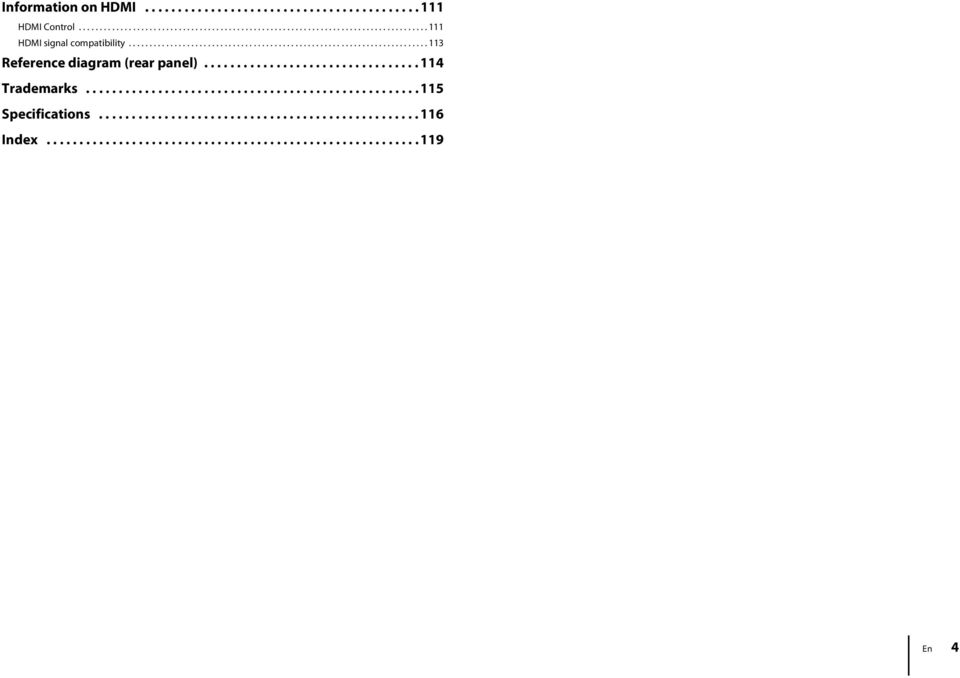
5 Accessories Check that the following accessories are supplied with the product. Operating range of the remote control Point the remote control at the remote control sensor on the unit and remain within the operating range shown below. Remote control Batteries (AAA, R03, UM-4) (x2) Within 6 m (20 ft) Insert the batteries the right way round. AM antenna (RX-S600) FM antenna (RX-S600) *One of the above is supplied depending on the region of purchase. DAB/FM antenna (RX-S600D) YPAO microphone The illustrations of the main unit and remote control used in this manual are of the RX-S600 (U.S.A. model), unless otherwise specified. CD-ROM (Owner s Manual) Easy Setup Guide Safety Brochure Some features are not available in certain regions. Due to product improvements, specifications and appearance are subject to change without notice. This manual explains operations using the supplied remote control. This manual describes all the ipod, iphone and ipad as the ipod. ipod refers to ipod, iphone and ipad, unless otherwise specified. indicates precautions for use of the unit and its feature limitations. indicates supplementary explanations for better use. Accessories En 5
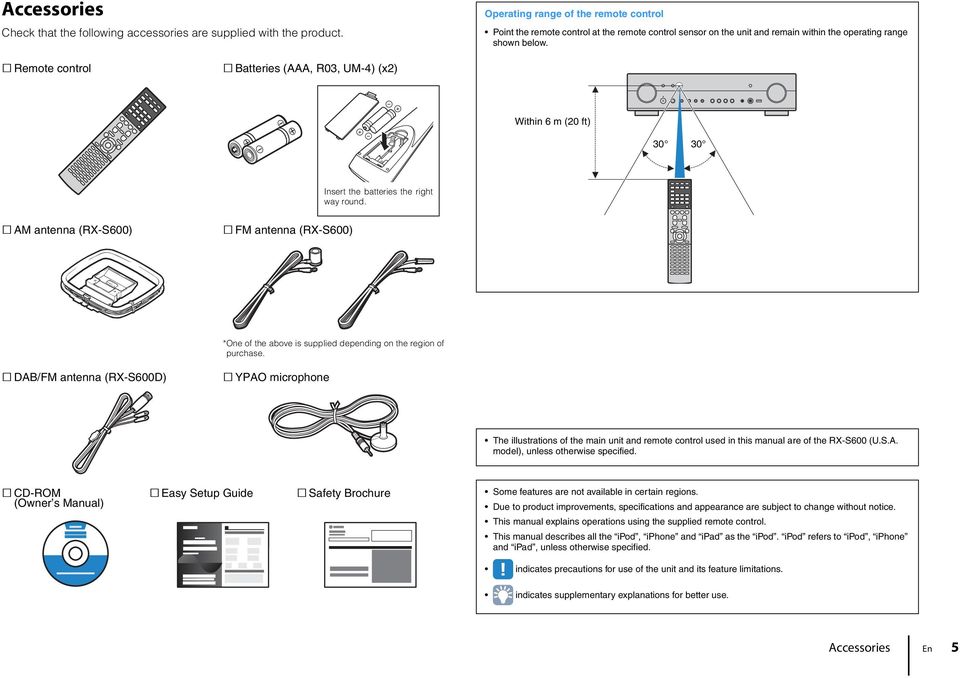
6 FEATURES What you can do with the unit Wide variety of supported content ipod/iphone/ipad. p.56 USB. p.60 Media server (PC/NAS). p.63 Internet radio. p.66 AirPlay. p.68 Supports 2- to 5.1-channel speaker system. Allows you to enjoy your favorite acoustic spaces in various styles. Automatically optimizing the speaker. p.32 settings to suit your room (YPAO) Reproducing stereo or multichannel. p.39 sounds with the sound fields like actual movie theaters and concert halls (CINEMA DSP) Enjoying compressed music with. p.43 enhanced sound (Compressed Music Enhancer) Playing back music in multiple rooms. p.70 (multi-zone) Network contents ipod/iphone/ipad Audio Speakers Audio USB device 3D and 4K Ultra HD signals supported Control Control Audio BD/DVD player Audio/Video Control AV receiver (the unit) Audio/Video TV Smartphone/Tablet Audio/Video (via or MHL) Change the input source and favorite settings with one touch (SCENE). p.37 TV remote control Sequential operation of a TV, AV receiver, and BD/DVD player ( Control). p.111 FEATURES What you can do with the unit En 6
7 Full of useful functions! Connecting various devices (p.24) A number of jacks and various input/output jacks on the unit allow you to connect video devices (such as BD/DVD players), audio devices (such as CD players), game consoles, camcorders, and other devices. Camcorder Game console BD/DVD player Set-top box Playing back TV audio in surround sound with a single cable connection (Audio Return Channel: ARC) (p.19) When using an ARC -compatible TV, you only need one cable to enable video output to the TV, audio input from the TV, and the transmission of Control signals. Control TV audio Video from external device Easy operation and wireless music playback from iphone or Android device By using the application for smartphone/tablet AV CONTROLLER, you can control the unit from an iphone, ipad, ipod touch or Android devices. Visit the Yamaha website for details. TV Creating 3-dimensional sound fields (p.39) The Virtual Presence Speaker (VPS) function allows you to create a 3-dimensional sound field in your own room (CINEMA DSP 3D). Enjoying pure high fidelity sound (p.42) When the direct playback mode is enabled, the unit plays back the selected source with the least circuitry, which lets you to enjoy Hi-Fi sound quality. Listening to FM/AM radio (p.44)(rx-s600) Listening to DAB radio (p.48) and FM radio (p.52) (RX-S600D) Easy operation with a TV screen You can operate the ipod or USB storage device, view information, or easily configure the settings using the on-screen menu. Low power consumption The ECO mode (power saving function) reduces the unit s power consumption and helps to create an eco-friendly home theater system (p.88). Useful tips The combination of video/audio input jacks does not match an external device... Use Audio In in the Option menu to change the combination of video/audio input jacks so that it matches the output jack(s) of your external device (p.26). Video and audio are not synchronized... Use Lipsync in the Setup menu to adjust the delay between video and audio output (p.86). I want to hear audio from the TV speakers... Use Audio Output in the Setup menu to select the output destination of signals input into the unit (p.84). Your TV speakers may be selected as an output destination. I want to use the supplied remote control to operate external devices Register the remote control codes of the external devices (such as a TV and BD/DVD players) (p.95). I want to change the on-screen menu language... Use Language in the Setup menu to select a language from English, Japanese, French, German, Spanish, Russian, Italian and Chinese (p.31). I want to update the firmware... Use Network Update (p.98) in the Setup menu or UPDATE (p.94) in the ADVANCED SETUP menu to update the unit s firmware. Many other settings are available that let you to customize the unit. For details, see the following pages. SCENE settings (p.37) Sound/video settings and signal information for each source (p.74) Various function settings (p.79) System settings (p.93) FEATURES What you can do with the unit En 7

8 Part names and functions Front panel INPUT ZONE INFO DIRECT VOLUME SCENE PHONES YPAO MIC STRAIGHT PROGRAM BD/DVD TV NET RADIO AUX SILENT CINEMA AUDIO 5V 2.1A : A B C D E F (RX-S600 U.S.A. model) 1 ZONE key Enables/disables the audio output to Zone2 (p.71). 2 INFO key Selects the information displayed on the front display (p.73). 3 Remote control sensor Receives remote control signals (p.5). 4 Front display Displays information (p.9). 5 DIRECT key Enables/disables the direct playback mode (p.42). 6 INPUT knob Select an input source. 7 z (power) key Turns on/off (standby) the unit. 8 Standby indicator Lights up when the unit is in standby mode under any of the following conditions. Control is enabled (p.84) Standby Through is enabled (p.84) Network Standby is enabled (p.91) An ipod is being charged (p.56) 9 PHONES jack For connecting headphones. 0 YPAO MIC jack For connecting the supplied YPAO microphone (p.32). A STRAIGHT key Enables/disables the straight decode mode (p.41). B PROGRAM keys Select a sound program or a surround decoder (p.38). C SCENE keys Select the registered input source and sound program with one touch. Also, turns on the unit when it is in standby mode (p.37). D AUX jacks For connecting devices, such as camcorders and game consoles (p.27). E USB jack For connecting a USB storage device (p.60) or an ipod (p.56). F VOLUME knob Adjusts the volume. FEATURES Part names and functions En 8

9 Front display (indicators) : OUT ENHANCER ADAPTIVE DRC SLEEP STEREO PARTY ZONE 3 TUNED 2 VOL. MUTE L SL SW C R SR A B A C 1 Lights up when signals are being input or output. OUT Lights up when signals are being output. 2 CINEMA DSP Lights up when CINEMA DSP (p.39) is working. CINEMA DSP n Lights up when CINEMA DSP 3D (p.41) is working. 3 ENHANCER Lights up when Compressed Music Enhancer (p.43) is working. 4 ADAPTIVE DRC Lights up when Adaptive DRC (p.75) is working. 5 STEREO Lights up when the unit is receiving a stereo FM radio signal. TUNED Lights up when the unit is receiving an FM/AM radio station (RX-S600) or FM radio station (RX-S600D) signal. 6 PARTY Lights up when the unit is in the party mode. (p.72) 7 SLEEP Lights up when the sleep timer is on. 8 ZONE2 Lights up when audio output to Zone2 is enabled (p.70). 9 MUTE Blinks when audio is muted. 0 Volume indicator Indicates the current volume. A Cursor indicators Indicate the remote control cursor keys currently operational. B Information display Displays the current status (such as input name and sound mode name). You can switch the information by pressing INFO (p.73). C Speaker indicators Indicate speaker terminals from which signals are output. L Subwoofer A Front speaker (L) S Front speaker (R) D Center speaker F Surround speaker (L) G Surround speaker (R) FEATURES Part names and functions En 9

10 Rear panel (RX-S600 U.S.A. model) OUT ARC (BD/DVD) MHL 5V 1A NETWORK (NET) OPTICAL CONPONENT Y PB PR AV 4 AV 5 ANTENNA (RADIO) AM FM DC OUT 5V 0.5A FRONT SPEAKERS C EXTRA SP SURROUND / ZONE 2 /BI-AMP AV 1 75 AV 2 COAXIAL AUDIO 2 AUDIO OUT SUBWOOFER PRE OUT COMPONENT MONITOR OUT COAXIAL AUDIO 1 AV 3 (TV) Y PB PR 8 9 : A B C D * The area around the video/audio output jacks is marked in white on the actual product to prevent improper connections. 1 OUT jack For connecting to an -compatible TV and outputting video/audio signals (p.19). When using ARC, TV audio signal can also be input through the OUT jack jacks For connecting to -compatible playback devices and inputting video/audio signals (p.24). 3 5/MHL jack For connecting to an - or MHL-compatible playback device and inputting video/audio signals (p.24). 4 ANTENNA jacks For connecting the radio antennas (p.28). 5 DC OUT jack For supplying power to a Yamaha AV accessory. For details on connections, refer to the instruction manual of the AV accessory. 6 NETWORK jack For connecting to a network (p.29). 7 Power cable For connecting to an AC wall outlet (p.30). 8 AV 1 5 jacks For connecting to video/audio playback devices and inputting video/audio signals (p.24). 9 AUDIO 1 2 jacks For connecting to an audio playback device and inputting audio signals (p.27). 0 AUDIO OUT jacks For outputting audio to a recording device (such as a tape deck) (p.30). A SUBWOOFER PRE OUT jack For connecting to a subwoofer (with built-in amplifier) (p.16). B MONITOR OUT jacks COMPONENT jacks: For connecting to a TV that supports component video and outputting video signals (p.23). jack: For connecting to a TV that supports composite video and outputting video signals (p.23). C SPEAKERS terminals For connecting to speakers (p.16). D VOLTAGE SELECTOR (General model only) Selects the switch position according to your local voltage (p.30). FEATURES Part names and functions En 10

11 Remote control PROGRAM MUTE VOLUME H : A B C D E F MAIN ZONE 2 BD DVD SETUP RETURN MODE TUNING MOVIE INFO TOP MENU SOURCE NET MUSIC SLEEP SCENE RECEIVER 5 AV 1 2 V-AUX USB 4 FM POP-UP/MENU ENHANCER PRESET AUDIO PARTY TV NET RADIO SUR. DECODE AM OPTION DISPLAY MEMORY STRAIGHT DIRECT ENT TV INPUT TV VOL TV CH MUTE CODE SET G I J K 1 Remote control signal transmitter Transmits infrared signals. 2 SOURCE z key Turns on/off an external device. SOURCE key Sets the remote control to operate external devices (p.96). This key lights up in green after pressed. RECEIVER key Sets the remote control to operate the unit (p.96). This key lights up in orange after pressed. RECEIVER z key Turns on/off (standby) the unit. 3 Input selection keys Select an input source for playback jacks 5 5/MHL jack AV 1 5 AV 1 5 jacks AUDIO 1 2 AUDIO 1 2 jacks V-AUX AUX jack (on the front panel) USB USB jack (on the front panel) NET NETWORK jack (press repeatedly to select a desired network source) FM FM radio AM AM radio (RX-S600) DAB DAB radio (RX-S600D) 4 MAIN/ZONE2 switch Changes the zone (main zone or Zone2) that is controlled by the remote control (p.71). 5 SCENE keys Select the registered input source, sound program, and various settings with one touch. Also, turns on the unit when it is in standby mode (p.37). 6 PROGRAM keys Select a sound program (p.38). 7 External device operation keys Select menus for external devices (p.96). 8 SETUP key Displays the setup menu (p.78). 9 Menu operation keys Cursor keys Select a menu or a parameter. Confirms a selected item. RETURN Returns to the previous screen. 0 MODE key Switchesd between Stereo and Mono for FM radio reception (p.44, p.52). Switches the ipod operation modes (p.58). A Radio keys Operate the FM/AM/DAB radio when TUNER is selected as the input source (p.44, p.48, p.52). MEMORY Registers radio stations as presets. PRESET Select a preset station. TUNING Select the radio frequency. External device operation keys Let you play back and perform other operations for external devices when an input source other than TUNER is selected (p.96). B Sound mode keys Select a sound mode (p.38). C INFO key Selects the information displayed on the front display (p.73). D SLEEP key Switches the unit to standby mode automatically after a specified period of time has elapsed (sleep timer). Press repeatedly to set the time (120 min, 90 min, 60 min, 30 min, off). E Numeric keys Let you enter numerical values, such as radio frequencies. F TV operation keys Let you select TV input and volume, and perform other TV operations (p.95). G PARTY key Turns on/off the party mode (p.72). H VOLUME keys Adjust the volume. I MUTE key Mutes the audio output. J OPTION key Displays the option menu (p.74). K CODE SET key Registers remote control codes of external devices on the remote control (p.95). To operate external devices with the remote control, register a remote control code for each device before using (p.95). (RX-S600) FEATURES Part names and functions En 11

12 PREPARATIONS General setup procedure 1 Placing speakers (p.13) Select the speaker layout for the number of speakers that you are using and place them in your room. 2 Connecting speakers (p.16) Connect the speakers to the unit. 3 Connecting a TV (p.19) Connect a TV to the unit. 4 Connecting playback devices (p.24) Connect video devices (such as BD/DVD players) and audio devices (such as CD players) to the unit. 5 Connecting the radio antennas (p.28) Connect the supplied FM/AM/DAB antennas to the unit. 6 Connecting to a network (p.29) Connect the unit to a network. 7 Connecting audio recording devices (p.30) Connect audio recording devices to the unit. 8 Connecting the power cable (p.30) After all the connections are complete, plug in the power cable Selecting an on-screen menu language (p.31) Optimizing the speaker settings automatically (YPAO) (p.32) Select the desired on-screen menu language (default: English). Optimize the speaker settings, such as volume balance and acoustic parameters, to suit your room (YPAO). This completes all the preparations. Enjoy playing movies, music, radio and other content with the unit! PREPARATIONS General setup procedure En 12

13 Placing speakers Select the speaker layout for the number of speakers that you are using and place the speakers and subwoofer in your room. This section describes the representative speaker layout examples. Caution Under its default settings, the unit is configured for 6-ohm speakers. When connecting speakers with impedance of 8 ohm or more, set the unit s speaker impedance to 8 MIN. For details, see Setting the speaker impedance (p.15). Speaker type Abbr. Function Speaker system (the number of channels) Front (L) 1 Produce front right/left channel sounds (stereo sounds). Front (R) 2 Center 3 Produces center channel sounds (such as movie dialogue and vocals). Surround (L) 4 Produce surround right/left channel sounds. Surround (R) 5 Subwoofer 9 Produces LFE (low-frequency effect) channel sounds and reinforces the bass parts of other channels. This channel is counted as 0.1. You can use the Zone2 function or bi-amp connections simultaneously with the 2.1- or 3.1-channel system. PREPARATIONS Placing speakers En 13

14 channel system 3.1-channel system to to channel system 2.1-channel system to to 30 PREPARATIONS Placing speakers En 14

15 Setting the speaker impedance Under its default settings, the unit is configured for 6-ohm speakers. When connecting speakers with impedance of 8 ohm or more, set the speaker impedance to 8 MIN. 1 Before connecting speakers, connect the power cable to an AC wall outlet. 2 While holding down STRAIGHT on the front panel, press z (power). z (power) STRAIGHT 3 Check that SP IMP. is displayed on the front display. SP IMP. 6 MIN 4 Press STRAIGHT to select 8 MIN. 5 Press z (power) to set the unit to standby mode and remove the power cable from the AC wall outlet. You are now ready to connect the speakers. PREPARATIONS Placing speakers En 15

16 Connecting speakers Connect the speakers placed in your room to the unit. The following diagrams provide connections for 5.1-channel system as examples. For other systems, connect speakers while referring to the connection diagram for the 5.1-channel system. Caution Remove the unit s power cable from an AC wall outlet and turn off the subwoofer before connecting the speakers. Ensure that the core wires of the speaker cable do not touch one another or come into contact with the unit s metal parts. Doing so may damage the unit or the speakers. If the speaker cables short circuit, Check SP Wires will appear on the front display when the unit is turned on. Cables required for connection (commercially available) Speaker cables (x the number of speakers) + Audio pin cable (x1: for connecting a subwoofer) channel system A AM SUBWOOFER PRE OUT FM 75 COMPONENT The unit (rear) DC OUT 5V 0.5A Y PB PR 9 MONITOR OUT FRONT SPEAKERS C EXTRA SP SURROUND / ZONE 2 /BI-AMP 4 5 Connecting speaker cables Speaker cables have two wires. One is for connecting the negative (-) terminal of the unit and the speaker, and the other is for the positive (+) terminal. If the wires are colored to prevent confusion, connect the black wire to the negative and the other wire to the positive terminal. a Remove approximately 10 mm (3/8 ) of insulation from the ends of the speaker cable and twist the bare wires of the cable firmly together. b Loosen the speaker terminal. c Insert the bare wires of the cable into the gap on the side (upper right or bottom left) of the terminal. d Tighten the terminal. + (red) - (black) - + b FRONT c d a Using a banana plug (U.S.A., Canada, China, Australia and General models only) a Tighten the speaker terminal. b Insert a banana plug into the end of the terminal. Banana plug a + FRONT b PREPARATIONS Connecting speakers En 16

17 Connecting the subwoofer (with built-in amplifier) Use an audio pin cable to connect the subwoofer. Audio pin cable AUDIO 2 AUDIO OUT SUBWOOFER PRE OUT Connecting front speakers that support bi-amp connections When using front speakers that support bi-amp connections, connect them to the FRONT jacks and SURROUND/ZONE 2/BI-AMP jacks. To enable the bi-amp function, set Power Amp Assign (p.81) in the Setup menu to BI-AMP after connecting the power cable to an AC wall outlet. The unit (rear) FRONT SPEAKERS C EXTRA SP SURROUND / ZONE 2 /BI-AMP Caution Before making bi-amp connections, remove any brackets or cables that connect a woofer with a tweeter. Refer to the instruction manual of the speakers for details. If you are not making bi-amp connections, make sure that the brackets or cables are connected before connecting the speaker cables. Surround speakers cannot be used during bi-amp connections. Connecting Zone2 speakers The Zone2 function allows you to playback an input source in the room where the unit is installed (main zone) and in another room (Zone2). To connect the Zone2 speakers, see Playing back music in multiple rooms (p.70) The FRONT jacks and SURROUND/ZONE 2/BI-AMP jacks output the same signals. PREPARATIONS Connecting speakers En 17

18 Input/output jacks and cables Video/audio jacks jacks Transmit digital video and digital sound through a single jack. Use an cable. cable Video jacks COMPONENT jacks Transmit video signals separated into three components: luminance (Y), chrominance blue (PB), and chrominance red (PR). Use a component video cable with three plugs. Component video cable Audio jacks OPTICAL jacks Transmit digital audio signals. Use a digital optical cable. Remove the tip protector (if available) before using the cable. AV 1 OPTICAL Digital optical cable Use a 19-pin cable with the logo. We recommend using a cable less than 5.0 m (16.4 ft) long to prevent signal quality degradation. The unit s jacks support the Control, Audio Return Channel (ARC), and 3D and 4K Ultra HD video transmission (through output) features. Use high speed cables to enjoy 3D or 4K Ultra HD videos. /MHL jack Transmit digital video and digital sound. Use an MHL cable. 5 MHL 1A 5V MHL cable jacks Transmit analog video signals. Use a video pin cable. Video pin cable COAXIAL jacks Transmit digital audio signals. Use a digital coaxial cable. AV 1 AUDIO jacks (Stereo L/R jacks) Transmit analog stereo audio signals. Use a stereo pin cable (RCA cable). AUDIO 2 Digital coaxial cable Stereo pin cable The 5/MHL jack of the unit supports both and MHL connections. Use a cable that matches the jack on your MHL-compatible mobile device. When connecting an -compatible playback device to the jack, use an cable. For details on an MHL connection, see MHL connection (p.24). (Stereo mini jack) Transmits analog stereo audio signals. Use a stereo mini-plug cable. Stereo mini-plug cable AUDIO PREPARATIONS Input/output jacks and cables En 18

19 OPTICAL COAXIAL COAXIAL ARC (BD/DVD) AUDIO 1 (TV) AUDIO Connecting a TV Connect a TV to the unit so that video input to the unit can be output to the TV. You can also enjoy playback of TV audio on the unit. The connection method varies depending on the functions and video input jacks available on your TV. Refer to the instruction manual of the TV and choose a connection method. Does your TV support Audio Return Channel (ARC)? No Does your TV support Control? No Does your TV have an input jack? No Connection Method 4 (p.23) Yes Yes Yes Connection Method 1 (p.19) Connection Method 2 (p.21) Connection Method 3 (p.22) When connecting a video device with an analog video output If you will connect any video device to the AV 1 2 (COMPONENT ) jacks of the unit, you also need to connect the TV to the MONITOR OUT (COMPONENT ) jacks (p.23). If you will connect any video device to the AV 3 5 () jacks or the AUX () of the unit, you also need to connect the TV to the MONITOR OUT () jack (p.23). About Control Control allows you to operate external devices via. If you connect a TV that supports Control to the unit with an cable, you can control the unit s power and volume with the TV s remote control. You can also control playback devices (such as an Control-compatible BD/DVD player) connected to the unit with an cable. For details, see Control (p.111). About Audio Return Channel (ARC) ARC allows audio signals to travel both ways under Control. If you connect a TV that supports Control and ARC to the unit with a single cable, you can output video/audio to the TV or input TV audio to the unit. Connection Method 1 ( Control/ARC-compatible TV) Connect the TV to the unit with an cable. The following explanation is based on the assumption that you have not changed the parameters (p.84) in the Setup menu. Use an cable that supports ARC. The unit (rear) AV 1 AV 2 AV 3 OUT CONPONENT Y PB PR OUT 1 AV 4 ARC 2 AV 5 H OUT jack input (ARC-compatible) ARC When using a set-top box to watch TV TV Connect the set-top box to the unit in the same way as playback devices (p.24). If you will receive TV broadcasts only from the set-top box, you do not need to make an audio cable connection between the TV and the unit or configure the ARC setting. By connecting a TV to the unit with an cable, you can navigate the ipod, USB storage device and network sources, or configure the settings of the unit with the menu displayed on the TV. PREPARATIONS Connecting a TV En 19
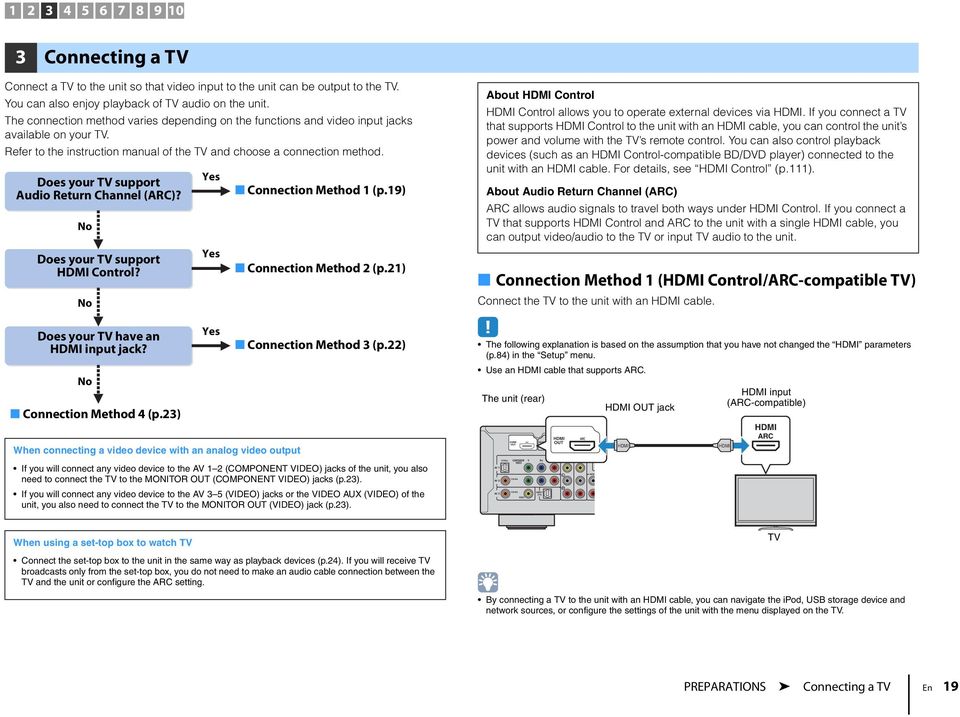
20 Necessary settings To use Control and ARC, you need to configure the following settings. For details on settings and operating your TV, refer to the instruction manual for the TV. 1 After connecting external devices (such as a TV and playback devices) and the power cable to the unit, turn on the unit, TV, and playback devices. 2 Configure the settings of the unit. a Check that ARC is enabled on the TV. b Switch the TV input to display video from the unit. c Press SETUP. SETUP RETURN TOP MENU POP-UP/MENU OPTION DISPLAY SETUP Cursor keys d Use the cursor keys to select and press. 3 Configure the settings for Control. a Enable Control on the TV and playback devices (such as Control-compatible BD/DVD player). b Turn off the TV s main power and then turn off the unit and playback devices. c Turn on the unit and playback devices and then turn on the TV s main power. d Switch the TV input to display video from the unit. e Check the following. On the unit: The input to which the playback device is connected is selected. If not, select the input source manually. On the TV: The video from the playback device is displayed. f Check that the unit is properly synchronized with the TV by turning off the TV or adjusting the TV volume with the TV remote control. This completes the necessary settings. If you select a TV program with the TV remote control, the input source of the unit will be automatically switched to AUDIO 1 and the TV audio will be played back on the unit. If you cannot hear the TV s audio, check that ARC (p.85) in the Setup menu is set to On. Setup Speaker Sound ECO Function Network Language Configuration If Control does not work properly, try turning off and on (or unplugging and then plugging in again) the devices. It may solve the problem. If the unit is not synchronized to the TV s power operations, check the priority of the audio output setting on the TV. If the audio is interrupted while using ARC, set ARC (p.85) in the Setup menu to Off and use a digital optical cable to input TV audio to the unit (p.21). e Press again. f Use the cursor keys (q/w) to select Control and the cursor keys (e/r) to select On as shown below. AUDIO 1 is set as TV audio input at the factory. If you have connected any external device to the AUDIO 1 jacks, use TV Audio Input (p.84) in the Setup menu to change the TV audio input assignment. To use the SCENE function (p.37), you also need to change the input assignment for SCENE(TV). Configuration Control On Audio Output Auto Standby Through Auto TV Audio Input AUDIO 1 Standby Sync Auto ARC On SCENE Back: RETURN g Press SETUP. PREPARATIONS Connecting a TV En 20
21 OPTICAL COAXIAL COAXIAL ARC (BD/DVD) AUDIO 1 (TV) AUDIO Connection Method 2 ( Control-compatible TV) Connect the TV to the unit with an cable and a digital optical cable. The following explanation is based on the assumption that you have not changed the parameters (p.84) in the Setup menu. The unit (rear) AV 1 AV 2 AV 3 OUT CONPONENT Y PB PR OUT 1 OUT jack AV 4 ARC 2 AV 5 AUDIO 1 (TV) H O O OPTICAL input Necessary settings To use Control, you need to configure the following settings. For details on settings and operating your TV, refer to the instruction manual for the TV. 1 After connecting external devices (such as a TV and playback devices) and power cable of the unit, turn on the unit, TV, and playback devices. 2 Configure the settings of the unit. a Switch the TV input to display video from the unit. b Press SETUP. TOP MENU POP-UP/MENU SETUP AUDIO 1 (OPTICAL) jack Audio output (digital optical) TV SETUP OPTION Cursor keys RETURN DISPLAY c Use the cursor keys to select and press. By connecting a TV to the unit with an cable, you can navigate the ipod, USB storage device and network sources, or configure the settings of the unit with the menu displayed on the TV. Setup Speaker Sound ECO Function Network Language Configuration d Press again. e Use the cursor keys (q/w) to select Control and the cursor keys (e/r) to select On as shown below. Configuration Control On Audio Output Auto Standby Through Auto TV Audio Input AUDIO 1 Standby Sync Auto ARC On SCENE Back: RETURN f Press SETUP. PREPARATIONS Connecting a TV En 21
22 OPTICAL COAXIAL COAXIAL ARC (BD/DVD) AUDIO 1 (TV) AUDIO Configure the settings for Control. a Enable Control on the TV and playback devices (such as a Control-compatible BD/DVD player). b Turn off the TV s main power and then turn off the unit and playback devices. c Turn on the unit and playback devices and then turn on the TV. d Switch the TV input to display video from the unit. e Check the following. On the unit: The input to which the playback device is connected is selected. If not, select the input source manually. On the TV: The video from the playback device is displayed. f Check that the unit is properly synchronized with the TV by turning off the TV or adjusting the TV volume with the TV remote control. This completes the necessary settings. If you select a TV program with the TV remote control, the input source of the unit will be automatically switched to AUDIO 1 and the TV audio will be played back on the unit. If Control does not work properly, try turning off and on (or unplugging and then plugging in again) the devices. It may solve the problem. If the unit is not synchronized to the TV s power operations, check the priority of the audio output setting on the TV. Connection Method 3 (TV with input jacks) Connect the TV to the unit with an cable and a digital optical cable. The unit (rear) AV 1 AV 2 AV 3 OUT CONPONENT Y PB PR OUT 1 OUT jack AV 4 ARC 2 AV 5 AUDIO 1 (TV) H AUDIO 1 (OPTICAL) jack O O If you switch the input source of the unit to AUDIO 1 using the AUDIO 1 or SCENE(TV) keys, the TV audio will be played back on the unit. By connecting a TV to the unit with an cable, you can navigate the ipod, USB storage device and network sources, or configure the settings of the unit with the menu displayed on the TV. If you have connected any external device to the AUDIO 1 jack or if you want to use another input jack (other than OPTICAL) for connecting the TV, connect the TV to one of the AV 1 5 and AUDIO 2 jacks. To use the SCENE function (p.37), you also need to change the input assignment for SCENE(TV). OPTICAL Audio output (digital optical) input TV AUDIO 1 is set as TV audio input at the factory. If you have connected any external device to the AUDIO 1 jacks or if you want to use another input jack (other than OPTICAL) for connecting the TV, use TV Audio Input (p.84) in the Setup menu to change the TV audio input assignment. To use the SCENE function (p.37), you also need to change the input assignment for SCENE(TV). PREPARATIONS Connecting a TV En 22
23 (BD/DVD) PB AUDIO 1 (TV) PR AUDIO 2 (RADIO) AM AUDIO OUT FM 75 Y PB PR (BD/DVD) PB AUDIO 1 (TV) PR AUDIO 2 (RADIO) AM AUDIO OUT FM Connection Method 4 (TV without input jacks) When connecting any video device to the AV 1 2 (COMPONENT ) jacks of the unit, connect the TV to the MONITOR OUT (COMPONENT ) jacks. When connecting any video device to the AV 3 5 () jacks or the AUX () jack of the unit, connect the TV to the MONITOR OUT () jack. If you select AUDIO 1 as the input source by pressing AUDIO 1 or SCENE(TV), the TV audio will be played back on the unit. (composite video) connection (with a video pin cable) The unit (rear) 1 AV 4 2 AV 5 3 ANTENNA 4 MONITOR OUT () jack 5 MHL 5V 1A DC OUT 5V 0.5A NE MONITOR OUT V V Video input (composite video) SUBWOOFER PRE OUT COMPONENT MONITOR OUT If you connect your TV to the unit with a cable other than, video input to the unit via cannot be output to the TV. Operations with TV screen are available only when your TV is connected to the unit via. If you have connected any external device to the AUDIO 1 jack or if you want to use another input jack (other than OPTICAL) for connecting the TV, connect the TV to one of the AV 1 5 and AUDIO 2 jacks. To use the SCENE function (p.37), you also need to change the input assignment for SCENE(TV). AUDIO 1 (TV) Y PB PR AUDIO 1 (OPTICAL) jack O O OPTICAL Audio output (digital optical) TV COMPONENT connection (with a component video cable) Video input (component video) The unit (rear) MONITOR OUT (COMPONENT ) jacks COMPONENT PR COMPONENT MONITOR OUT PR PR PB 1 2 Y Y PB PR MHL 5V 1A NE PB Y PB Y Y AV 4 AV 5 ANTENNA DC OUT 5V 0.5A SUBWOOFER PRE OUT COMPONENT MONITOR OUT OPTICAL AUDIO 1 (TV) AUDIO 1 (OPTICAL) jack O O Audio output (digital optical) TV PREPARATIONS Connecting a TV En 23
24 OPTICAL COAXIAL COAXIAL ARC (BD/DVD) AUDIO 1 (TV) AUDIO 2 (RADIO) AM AUDIO OUT FM 75 PB OPTICAL COAXIAL COAXIAL ARC (BD/DVD) AUDIO 1 (TV) AUDIO 2 (RADIO) AM AUDIO OUT FM 75 PB Connecting playback devices The unit is equipped with a variety of input jacks including input jacks to allow you to connect different types of playback devices. For information on how to connect an ipod or a USB storage device, see the following pages. Connecting an ipod (p.56) Connecting a USB storage device (p.60) Connecting video devices (such as BD/DVD players) Connect video devices such as BD/DVD players, set-top boxes (STBs) and game consoles to the unit. Depending on the video/audio output jacks available on your video device, choose one of the following connections. We recommend using an connection if the video device has an output jack. If the combination of video/audio input jacks available on the unit does not match your video device, change its combination according to the output jacks of your device (p.26). connection Connect a video device to the unit with an cable. 1 5 jacks MHL connection Connect an MHL-compatible mobile device (such as smartphones) to the unit with an MHL cable. You can enjoy full HD videos and multichannel audio sources stored on the mobile device. The 5/MHL jack of the unit enables you to input videos and audio directly from the mobile device to the unit. The unit (rear) AV 1 AV 2 AV 3 OUT 1 CONPONENT Y PB PR AV 4 2 AV 5 3 ANTENNA 4 SUBWOOFER PRE OUT COMPONENT Y 5/MHL jack 5 MHL 5V 1A MHL 5 MHL 5V 1A If you select the input source by pressing 5, the video/audio played back on the mobile device will be output from the unit. MHL MHL output Mobile device The unit (rear) OUT 1 2 (BD/DVD) MHL 5V 1A MHL 5V 1A output To watch videos input to the 5/MHL jack, you need to connect your TV to the OUT jack of the unit (p.19 to 22). You need to prepare an MHL cable that match the jack on your mobile device. AV 1 AV 2 AV 3 CONPONENT Y PB PR AV 4 AV 5 ANTENNA SUBWOOFER PRE OUT COMPONENT Y If you select the input source by pressing 1 5, the video/audio played back on the video device will be output from the unit. Video device You can operate the mobile device using the menu operation keys, external device operation keys and numeric keys on the remote control. However, some features may not be compatible, depending on the mobile device or its application. In this case, operate the mobile device itself. If Standby Through (p.84) in the Setup menu is set to On, you can output mobile device videos/audio to the TV or operate the mobile device using the remote control of the unit even when the unit is in standby mode. The unit supplies power to the mobile device in the following conditions. The unit is turned on. The unit is in standby mode while Standby Through (p.84) in the Setup menu is set to On. To watch videos input to the 1 5 jacks, you need to connect your TV to the OUT jack of the unit (p.19 to 22). PREPARATIONS Connecting playback devices En 24
25 OPTICAL COAXIAL COAXIAL ARC (BD/DVD) AUDIO 1 (TV) AUDIO OPTICAL COAXIAL COAXIAL ARC (BD/DVD) AUDIO 1 (TV) Component video connection Connect a video device to the unit with a component video cable and an audio cable (digital optical or digital coaxial). Choose a set of input jacks (on the unit) depending on the audio output jacks available on your video device. Composite video connection Connect a video device to the unit with a video pin cable and an audio cable (digital coaxial, or stereo pin cable). Choose a set of input jacks (on the unit) depending on the audio output jacks available on your video device. Output jacks on video device Video Audio Input jacks on the unit Output jacks on video device Video Audio Input jacks on the unit Component video Digital optical Digital coaxial AV 1 (COMPONENT + OPTICAL) AV 2 (COMPONENT + COAXIAL) Composite video Digital coaxial Analog stereo AV 3 ( + COAXIAL) AV 4 5 ( + AUDIO) AV 1 2 (COMPONENT ) jacks AV 1 AV 2 AV 3 CONPONENT OUT CONPONENT Y PB PR Y PB PR 1 AV 4 2 AV 5 H PR PB Y The unit (rear) PR PB Y Video output (component video) COMPONENT PR PB Y AV 1 AV 2 AV 3 OUT 1 2 AV 4 AV 5 CONPONENT Y PB PR AV 3 5 () jack V COAXIAL C C V Video output (composite video) Video device AV 1 AV 2 OPTICAL COAXIAL O C AV 1 (OPTICAL) jack or AV 2 (COAXIAL) jack If you select the input source by pressing AV 1 2, the video/audio played back on the video device will be output from the unit. O C OPTICAL COAXIAL Video device Audio output (digital optical or digital coaxial) The unit (rear) Any of AV 3 (COAXIAL) jack, AV 4 5 (AUDIO) jacks L R L R L R COAXIAL Audio output (either digital coaxial or analog stereo) To watch videos input to the AV 1 2 (COMPONENT ) jacks, you need to connect your TV to the MONITOR OUT (COMPONENT ) jacks of the unit (p.23). If you select the input source by pressing AV 3 5, the video/audio played back on the video device will be output from the unit. To watch videos input to the AV 3 5 () jacks, you need to connect your TV to the MONITOR OUT () jack of the unit (p.23). PREPARATIONS Connecting playback devices En 25
26 OPTICAL COAXIAL COAXIAL ARC (BD/DVD) AUDIO 1 (TV) AUDIO Changing the combination of video/audio input jacks If the combination of video/audio input jacks available on the unit does not match your video device, change its combination according to the output jacks of your device. You can connect a video device that has the following video/audio output jacks. Output jacks on video device Necessary setting Input jacks on the unit Video Audio Video Audio Component video Digital optical 1 5 AV 1 (OPTICAL) AUDIO 1 (OPTICAL) Digital coaxial 1 5 AV 2 3 (COAXIAL) Analog stereo 1 5 Analog stereo AV 1 2 (COMPONENT ) Composite video Digital optical AV 3 AV 4 5 (AUDIO) AUDIO 2 AV 4 5 (AUDIO) AUDIO 2 AV 1 (OPTICAL) AUDIO 1 (OPTICAL) For example, if you have connected a video device to AV 2 (COMPONENT ) and AV 5 (AUDIO) jacks of the unit, change the combination setting as follows. AV 2 (COMPONENT ) jacks Video output (component video) COMPONENT PR 1 After connecting external devices (such as a TV and playback devices) and power cable of the unit, turn on the unit. 2 Press AV 2 to select AV 2 (video input jack to be used) as the input source. 5 AV 1 2 V-AUX USB SETUP RETURN TOP MENU 4 NET AUDIO FM AM POP-UP/MENU OPTION DISPLAY 3 Press OPTION. 4 Use the cursor keys (q/w) to select Audio In and press. Audio In AV 2 OPTION Cursor keys VOL. 5 Use the cursor keys (e/r) to select AV 5 (audio input jack to be used). AV 1 OUT 1 2 AV 4 AV 5 CONPONENT Y PB PR H PR PB Y PR PB Y PB Y Audio AV5 VOL. AV 2 AV 3 The unit (rear) AV 5 (AUDIO) jacks L R L R AUDIO L R Video device 6 Press OPTION. This completes the necessary settings. If you select AV 2 as the input source by pressing AV 2, the video/audio played back on the video device will be output from the unit. Audio output (analog stereo) PREPARATIONS Connecting playback devices En 26
27 OPTICAL COAXIAL COAXIAL ARC (BD/DVD) AUDIO 1 (TV) AUDIO Connecting audio devices (such as CD players) Connect audio devices such as CD players and MD players to the unit. Depending on the audio output jacks available on your audio device, choose one of the following connections. Audio output jacks on audio device Digital optical Digital coaxial Analog stereo Audio output jacks on the unit AV 1 (OPTICAL) AUDIO 1 (OPTICAL) AV 2 3 (COAXIAL) AV 4 5 (AUDIO) AUDIO 2 Connecting to the jacks on the front panel Use the AUX jacks on the front panel to temporarily connect devices such as camcorders and portable audio players to the unit. Before making a connection, stop playback on the device and turn down the volume on the unit. INFO PHONES SILENT CINEMA The unit (front) SCENE YPAO MIC STRAIGHT PROGRAM BD/DVD TV NET RADIO AUX AUDIO DIRECT V 5V 2.1A The unit (rear) OPTICAL O O OUT 1 2 OPTICAL AV 1 AV 2 AV 4 CONPONENT Y PB PR AV 5 A COAXIAL C C L COAXIAL Audio device Portable audio player AV 3 L L R R R AV 1 5 jacks AUDIO 1 2 jacks Audio output (either digital optical, digital coaxial, or analog stereo) If you select the input source by pressing AV 1 5 or AUDIO 1 2, the audio played back on the audio device will be output from the unit. Camcorder If you select V-AUX as the input source by pressing V-AUX, the video/audio played back on the device will be output from the unit. To watch videos input to the AUX () jack, you need to connect your TV to the MONITOR OUT () jack of the unit (p.23). You need to prepare the video/audio cables that match the output jacks on your device. For details on how to connect an ipod or a USB storage device, see Connecting an ipod (p.56) or Connecting a USB storage device (p.60). When USB is selected as the input source, video signals input to the AUX () jack are output from the MONITOR OUT () jack. PREPARATIONS Connecting playback devices En 27
28 OPTICAL COAXIAL COAXIAL ARC (BD/DVD) AUDIO 1 (TV) AUDIO 2 (RADIO) AM AUDIO OUT FM 75 (NET) FRONT C EXTRA SP SURROUND / ZO /BI-AMP OPTICAL COAXIAL COAXIAL ARC (BD/DVD) AUDIO 1 (TV) AUDIO 2 AUDIO OUT (RADIO) DAB/FM 75 (NET) FRONT C EXTRA SP SURROUND / ZO /BI-AMP Connecting the radio antennas FM/AM antennas (RX-S600) Connect the supplied FM/AM antennas to the unit. Fix the end of the FM antenna to a wall, and place the AM antenna on a flat surface. AM antenna FM antenna DAB/FM antenna (RX-S600D) Connect the supplied DAB/FM antenna to the unit and fix the antenna ends to a wall. DAB/FM antenna The unit (rear) The unit (rear) OUT MHL 5V 1A NETWORK OUT MHL 5V 1A NETWORK AV 1 AV 4 CONPONENT Y PB PR AV 5 ANTENNA DC OUT 5V 0.5A SPEAKERS AV 1 AV 4 CONPONENT Y PB PR AV 5 ANTENNA DC OUT 5V 0.5A SPEAKERS AV 2 AV 3 SUBWOOFER PRE OUT COMPONENT MONITOR OUT Y PB PR AV 2 AV 3 SUBWOOFER PRE OUT COMPONENT MONITOR OUT Y PB PR Assembling and connecting the AM antenna The antenna should be stretched out horizontally. If you cannot obtain good reception on the radio, adjust the height, direction or placement of the DAB/FM antenna. Hold down Insert Release Unwind only the length of cable needed from the AM antenna unit. The wires of the AM antenna have no polarity. PREPARATIONS Connecting the radio antennas En 28
29 OPTICAL COAXIAL COAXIAL ARC (BD/DVD) AUDIO 1 (TV) AUDIO 2 (RADIO) AM AUDIO OUT FM 75 (NET) FRONT C EXTRA Connecting to a network Connect the unit to your router with a commercially-available STP network cable (CAT-5 or higher straight cable). You can enjoy Internet radio or music files stored on media servers, such as PCs and Network Attached Storage (NAS), on the unit. Internet Network Attached Storage (NAS) Some security software installed on your PC or the firewall settings of network devices (such as a router) may block the access of the unit to the network devices or the Internet. In these cases, configure the security software or firewall settings appropriately. Each server must be connected to the same subnet as the unit. To use the service via the Internet, broadband connection is strongly recommended. WAN Modem LAN PC Router Network cable OUT MHL 5V 1A NETWORK AV 4 CONPONENT Y PB PR AV 5 ANTENNA DC OUT 5V 0.5A SPEAKERS SURROUND /BI-A AV 1 AV 2 SUBWOOFER PRE OUT COMPONENT MONITOR OUT AV 3 Y PB PR The unit (rear) If you are using a router that supports DHCP, you do not need to configure any network settings for the unit, as the network parameters (such as the IP address) will be assigned automatically to it. You only need to configure the network settings if your router does not support DHCP or if you want to configure the network parameters manually (p.90). You can check whether the network parameters (such as IP address) are properly assigned to the unit in Information (p.90) in the Setup menu. PREPARATIONS Connecting to a network En 29
30 OPTICAL COAXIAL COAXIAL ARC (BD/DVD) AUDIO 1 (TV) AUDIO 2 (RADIO) A AUDIO OUT T C EXTRA SP SURROUND / ZONE 2 /BI-AMP T C EXTRA SP SURROUND / ZONE 2 /BI-AMP Connecting audio recording devices You can connect audio recording devices to the AUDIO OUT jacks. These jacks output analog audio signals selected as the input. To copy audio from an audio device, connect the audio device to the AV 4 5 jacks, AUDIO 2 jacks, or AUX (AUDIO) jacks of the unit. Be sure to use the AUDIO OUT jacks only for connecting recording devices. The unit (rear) AUDIO OUT jacks Audio input 8 Connecting the power cable Before connecting the power cable (General model only) Set the switch position of VOLTAGE SELECTOR according to your local voltage. Voltages are AC / V, 50/60 Hz. Make sure you set VOLTAGE SELECTOR of the unit BEFORE plugging the power cable into an AC wall outlet. Improper setting of VOLTAGE SELECTOR may cause damage to the unit and create a potential fire hazard. VOLTAGE SELECTOR AV 1 AV 2 AV 3 OUT AV 4 AV 5 CONPONENT Y PB PR ANTENNA AUDIO OUT L R L R L R AUDIO Audio recording device The unit (rear) SPEAKERS 110V 120V VOLTAGE SELECTEOR 220V 240V After all the connections are complete, plug in the power cable. The unit (rear) To an AC wall outlet SPEAKERS PREPARATIONS Connecting audio recording devices En 30
31 SOURCE RECEIVER 5 AV AUDIO V-AUX USB NET FM AM MAIN ZONE 2 PARTY SCENE BD TV NET RADIO DVD RECEIVER z 9 Selecting an on-screen menu language Select the desired on-screen menu language from English (default), Japanese, French, German, Spanish, Russian, Italian and Chinese. 1 Press RECEIVER z to turn on the unit. 2 Turn on the TV and switch the TV input to display video from the unit ( OUT jack). 6 To exit from the menu, press SETUP. The information on the front display is provided in English only. PROGRAM MUTE VOLUME TOP MENU POP-UP/MENU SETUP Operations with TV screen are available only when your TV is connected to the unit via. If not, carry out operations while viewing the front display. SETUP RETURN OPTION DISPLAY MEMORY Cursor keys 3 Press SETUP. 4 Use the cursor keys to select Language and press. MODE TUNING PRESET MOVIE MUSIC SUR. DECODE STRAIGHT Setup ENHANCER DIRECT INFO SLEEP ENT TV INPUT TV VOL TV CH MUTE CODE SET Speaker Sound ECO Function Network Language English 日 本 語 Français Deutsch Español Русский Italiano 中 文 5 Use the cursor keys to select the desired language. Setup Speaker Sound ECO Function Network Language English 日 本 語 Français Deutsch Español Русский Italiano 中 文 PREPARATIONS Selecting an on-screen menu language En 31
32 SOURCE RECEIVER 5 AV AUDIO V-AUX USB NET FM AM MAIN ZONE 2 PARTY RECEIVER z 10 Optimizing the speaker settings automatically (YPAO) The Yamaha Parametric room Acoustic Optimizer (YPAO) function detects speaker connections, measures the distances from them to your listening position(s), and then automatically optimizes the speaker settings, such as volume balance and acoustic parameters, to suit your room. 4 Place the YPAO microphone at your listening position (same height as your ears) and connect it to the YPAO MIC jack on the front panel. The unit (front) SCENE BD DVD TV NET RADIO PROGRAM MUTE VOLUME TOP MENU POP-UP/MENU SETUP OPTION RETURN DISPLAY MEMORY MODE TUNING PRESET MOVIE MUSIC SUR. DECODE STRAIGHT ENHANCER DIRECT INFO SLEEP ENT TV INPUT TV VOL TV CH MUTE CODE SET Please note the following when using YPAO. Use YPAO after connecting a TV and speakers to the unit. During the measuring process, test tones are output at high volume. Ensure that the test tones do not frighten small children. Also, refrain from using this function at night when it may be a nuisance to others. During the measuring process, you cannot adjust the volume. During the measuring process, keep the room as quiet as possible. Do not connect headphones. 1 Press RECEIVER z to turn on the unit. 2 Turn on the TV and switch the TV input to display video from the unit ( OUT jack). Operations with TV screen are available only when your TV is connected to the unit via. If not, carry out operations while viewing the front display. 3 Turn on the subwoofer and set the volume to half. If the crossover frequency is adjustable, set it to maximum. VOLUME CROSSOVER/ HIGH CUT YPAO microphone Listening 4 5 position Ear height Place the YPAO microphone at your listening position (same height as your ears). We recommend the use of a tripod as a microphone stand. You can use the tripod screws to stabilize the microphone. The following screen appears on the TV. MIN MAX MIN MAX Auto Setup Start Exit Press SETUP key to Start Power Amp Assign Basic PREPARATIONS Optimizing the speaker settings automatically (YPAO) En 32
33 SOURCE RECEIVER 5 AV AUDIO V-AUX USB NET FM AM MAIN ZONE 2 PARTY SCENE BD TV NET RADIO DVD PROGRAM MUTE VOLUME TOP MENU POP-UP/MENU SETUP OPTION RECEIVER SETUP To cancel the operation, disconnect the YPAO microphone, or use the cursor keys to select Exit and press, before starting the measurement. To change the internal amplifier assignment, use "Power Amp Assign" (p.81) in the "Setup" menu. Do not stand between the speakers and the YPAO microphone during the measurement process (about 3 minutes). Move to the corner of the room or leave the room. 5 To start the measurement, use the cursor keys to select Start and press SETUP. The measurement will start in 10 seconds. Press to start the measurement immediately. If any error message (such as E-1) or warning message (such as W-1) appears, see Error messages (p.34) or Warning messages (p.35). A speaker with a problem is indicated by blinking of the speaker indicators in the front display. If multiple warnings are given (when operating with the front display), use the cursor keys (q/w) to check the other warning messages. 6 To save the measurement results, use the cursor keys (e/r) to select SAVE and press. Auto Setup Start Exit SAVE Measurement Finished Result 3 / 2 / 0.1 ch RETURN DISPLAY MEMORY MODE TUNING PRESET MOVIE MUSIC SUR. DECODE STRAIGHT ENHANCER DIRECT INFO SLEEP Cursor keys RETURN To stop the measurement temporarily, press RETURN and follow the procedure in Error messages (p.34). If cursor keys do not work, the remote control may be set to the external device operation mode. In this case, press RECEIVER to set the remote control to the unit operation mode and then use the cursor keys. The following screen appears on the TV when the measurement finishes. 3.0 / 10.5 m -3.0 / db The adjusted speaker settings are applied. To finish the measurement without saving the result, select CANCEL ENT TV INPUT TV VOL TV CH MUTE CODE SET Auto Setup Start Exit Measurement Finished Result 3 / 2 / 0.1 ch 3.0 / 10.5 m -3.0 / db OK: 1 The number of speakers (front side/rear side/subwoofer) Disconnect the YPAO microphone from the unit. This completes optimization of the speaker settings. Caution The YPAO microphone is sensitive to heat, so should not be placed anywhere where it could be exposed to direct sunlight or high temperatures (such as on top of AV equipment). 2 Speaker distance (nearest/farthest) 3 Adjustment range of speaker output level 4 Warning message (if available) PREPARATIONS Optimizing the speaker settings automatically (YPAO) En 33
34 Error messages If any error message is displayed during the measurement, resolve the problem and perform YPAO again. Error message Cause Remedy Auto Setup Start Exit ERROR E-5:Noisy PROCEED Error message E-1:No Front SP (E-1:NO FRNT SP) E-2:No Sur. SP (E-2:NO SUR SP) Front speakers are not detected. One of the surround speakers cannot be detected. Exit YPAO, turn off the unit, and then check the speaker connections. 5% E-5:Noisy (E-5:NOISY) The noise is too loud. Keep the room quiet and retry YPAO. If you select PROCEED, YPAO takes the measurement again and ignores any noise detected. TV screen E-7:No MIC (E-7:NO MIC) The YPAO microphone has been removed. Connect the YPAO microphone to the YPAO MIC jack firmly and retry YPAO. E-5:NOISY VOL. L SL SW C R SR E-8:No Signal (E-8:NO SIGNAL) The YPAO microphone cannot detect test tones. Connect the YPAO microphone to the YPAO MIC jack firmly and retry YPAO. If this error occurs repeatedly, contact the nearest authorized Yamaha dealer or service center. Front display E-9:User Cancel (E-9:CANCEL) The measurement has been canceled. Retry or exit YPAO as necessary. Procedure to handle errors 1 Check the content of error message and press. 2 Use the cursor keys (e/r) to select the desired operation. To exit the YPAO measurement: a Select EXIT and press. b Use the cursor keys (q/w) to select Exit and press. c Disconnect the YPAO microphone from the unit. To retry the YPAO measurement from beginning: Select RETRY and press. To proceed with the current YPAO measurement (for E-5 and E-9 only): Select PROCEED and press. E-10:Internal Err. (E-10:INTERNAL) An internal error has occurred. Texts in parentheses denote indicators on the front display. Exit YPAO, and turn off and on the unit. If this error occurs repeatedly, contact the nearest authorized Yamaha dealer or service center. PREPARATIONS Optimizing the speaker settings automatically (YPAO) En 34
35 Warning messages If a warning message is displayed after the measurement, you can still save the measurement results by following on-screen instructions. However, we recommend you perform YPAO again in order to use the unit with the optimal speaker settings. Warning message Cause Remedy Auto Setup Start Exit Measurement Finished Result 3 / 2 / 0.1 ch 3.0 / 10.5 m -3.0 / db OK: W-1:Out of Phase Warning message W-1:Out of Phase (W-1:PHASE) W-2:Over Distance (W-2:DISTANCE) A speaker cable may be connected with the reverse polarity (+/-). A speaker is placed more than 24 m (80 ft) from the listening position. Check the cable connections (+/-) of the problem speaker. If the speaker is connected incorrectly, exit YPAO, turn off the unit, and then reconnect the speaker cable. Depending on the type of speakers or room environment, this message may appear even if the speakers are connected correctly. In this case, you can ignore the message. Exit YPAO, turn off the unit, and place the problem speaker within 24 m (80 ft) of the listening position. TV screen Problem speaker (blinks) W-1:PHASE VOL. SW L C R SL SR W-3:Level Error (W-3:LEVEL) There are significant volume differences between the speakers. Check the usage environment and cable connections (+/-) of each speaker, and the volume of the subwoofer. If there is any problem, exit YPAO, turn off the unit, and then reconnect speaker cable or correct the speaker positions. We recommend using the same speakers or speakers with specifications that are as similar as possible. Front display Texts in parentheses denote indicators on the front display. Procedure to handle warnings 1 Check the content of warning message and press. 2 Use the cursor keys (e/r) to select the desired operation. To save the measurement results: Select SAVE and press. To discard the measurement result: Select CANCEL and press. 3 Disconnect the YPAO microphone from the unit. PREPARATIONS Optimizing the speaker settings automatically (YPAO) En 35
36 SOURCE RECEIVER 5 AV AUDIO V-AUX USB NET FM AM MAIN ZONE 2 PARTY SCENE BD TV NET RADIO DVD PROGRAM MUTE VOLUME TOP MENU POP-UP/MENU SETUP OPTION RETURN DISPLAY MEMORY MODE TUNING PRESET MOVIE MUSIC SUR. DECODE STRAIGHT ENHANCER DIRECT INFO SLEEP ENT TV INPUT TV VOL TV CH MUTE CODE SET Input selection keys MUTE VOLUME PLAYBACK Basic playback procedure 1 Turn on the external devices (such as a TV or BD/DVD player) connected to the unit. 2 Use the input selection keys to select an input source. 3 Start playback on the external device or select a radio station. Refer to the instruction manual for the external device. For details on the following operations, see the corresponding pages. Listening to FM/AM radio (RX-S600) (p.44) Listening to DAB radio (RX-S600D) (p.48) Listening to FM radio (RX-S600D) (p.52) Playing back ipod music (p.56) Playing back music stored on a USB storage device (p.60) Playing back music stored on media servers (PCs/NAS) (p.63) Listening to Internet radio (p.66) Playing back itunes/ipod music via a network (AirPlay) (p.68) 4 Press VOLUME to adjust the volume. To mute the audio output, press MUTE. Press MUTE again to unmute. To adjust the treble/bass settings, use the Option menu (p.75). PLAYBACK Basic playback procedure En 36
37 SOURCE RECEIVER SOURCE Selecting the input source and favorite settings with one touch (SCENE) 5 MAIN ZONE 2 BD DVD SETUP PROGRAM TOP MENU AV 1 2 V-AUX USB 4 NET SCENE MUTE FM VOLUME AUDIO AM PARTY TV NET RADIO POP-UP/MENU OPTION Input selection keys SCENE The SCENE function allows you to select the assigned input source, sound program, and Compressed Music Enhancer on/off with just one touch. 1 Press SCENE. The input source and settings registered to the corresponding scene are selected. The unit turns on automatically when it is in standby mode. By default, the following settings are registered for each scene. SCENE Input Sound program Compressed Music Enhancer SCENE link playback Configuring scene assignments 1 Perform the following operations to prepare the settings you want to assign to a scene. Select an input source (p.36) Select a sound program (p.38) Enable/disable Compressed Music Enhancer (p.43) 2 Hold down the desired SCENE key until SET Complete appears on the front display. VOL. BD/DVD 1 MOVIE (Sci-Fi) Off On TV AUDIO 1 STRAIGHT On On SET Complete L SL SW C R SR RETURN DISPLAY MODE TUNING MOVIE INFO MUSIC SLEEP SUR. DECODE ENHANCER PRESET MEMORY STRAIGHT DIRECT NET NET RADIO MUSIC (5ch Stereo) On Off RADIO TUNER MUSIC (5ch Stereo) On Off 3 If you want to control the corresponding playback device after selecting the scene, hold down the corresponding SCENE key and input selection key together for more than 3 seconds ENT TV INPUT The SCENE link playback function allows you to automatically turn on the TV or start playback of an external device connected to the unit via, in conjunction with a scene selection. To enable SCENE link playback, set SCENE (p.85) in the Setup menu to On. Once the setting is completed successfully, SOURCE blinks twice. MUTE TV VOL TV CH CODE SET If you have not registered the remote control code of the playback device yet, see Registering the remote control codes for playback devices (p.96) to register it. You can also configure scene assignments for Zone2 playback (p.72). PLAYBACK Selecting the input source and favorite settings with one touch (SCENE) En 37
38 SOURCE RECEIVER 5 AV AUDIO V-AUX USB NET FM AM MAIN ZONE 2 PARTY SCENE BD DVD TV NET RADIO PROGRAM MUTE VOLUME TOP MENU POP-UP/MENU SETUP OPTION RETURN DISPLAY Selecting the sound mode The unit is equipped with a variety of sound programs and surround decoders that allow you to enjoy playback sources with your favorite sound mode (such as sound field effect or stereo playback). Selecting a sound program suitable for movies Press MOVIE repeatedly. This mode lets you enjoy sound field effects optimized for viewing video sources, such as movies, TV programs, and games (p.39). Selecting a sound program suitable for music or stereo playback Press MUSIC repeatedly. This mode lets you enjoy sound field effects optimized for listening music sources or stereo playback (p.40). You can also switch the sound programs and surround decoder by pressing PROGRAM on the front panel. The sound mode can be applied separately to each input source. When you play back audio signals with a sampling rate of higher than 96 khz or playing back DTS Express, the straight decode mode (p.41) is automatically selected. You can check which speakers are currently outputting sound by looking at the speaker indicators on the unit s front panel (p.9). MEMORY MODE TUNING PRESET MOVIE MUSIC SUR. DECODE STRAIGHT ENHANCER DIRECT INFO SLEEP ENT TV INPUT TV VOL TV CH MUTE CODE SET MOVIE MUSIC SUR.DECODE STRAIGHT ENHANCER DIRECT Selecting a surround decoder Press SUR.DECODE repeatedly. This mode lets you enjoy unprocessed multichannel playback from 2-channel sources (p.42). Switching to the straight decode mode Press STRAIGHT. This mode lets you enjoy unprocessed sounds in original channels (p.41). Switching to the direct playback mode Press DIRECT. This mode lets you enjoy pure high fidelity sound by reducing the electrical noise from other circuitry (p.42). Enabling Compressed Music Enhancer Press ENHANCER. This mode lets you enjoy compressed music with additional depth and breadth (p.43). PLAYBACK Selecting the sound mode En 38
39 Enjoying sound field effects (CINEMA DSP) The unit is equipped with a variety of sound programs that utilize Yamaha s original DSP technology (CINEMA DSP). It allows you to easily create sound fields like actual movie theaters or concert halls in your room. Sound program category CINEMA DSP lights up Sci-Fi Sound program When you play back DTS-HD sources, the DTS decoder is automatically selected. You can adjust the sound field effect level in DSP Level (p.75) in the Option menu. Sound programs suitable for movies (MOVIE) VOL. L SL The following sound programs are optimized for viewing video sources, such as movies, TV programs, and games. SW C R SR Drama Mono Movie Sports Action Game Roleplaying Game This program features stable reverberations that match a wide range of movie genres, from serious dramas to musicals and comedies. The reverberations are modest, but suitably stereophonic. The sound effects and background music are reproduced with a gentle echo that does not impinge on the articulation of the dialogue. You ll never get tired listening for long periods. This program reproduces monaural video sources, such as classic movies, in an atmosphere of a good old movie theater. The program creates a pleasant space with depth, by adding breadth and the appropriate reverberation to the original audio. This program allows listeners to enjoy the rich vividness of sport broadcasts and light entertainment programs. In sports broadcasts, the commentators voices are positioned clearly at the center, while the atmosphere inside the stadium is realistically conveyed by the peripheral delivery of the sounds of the fans in a suitable space. This program is suitable for action games, such as car racing and fighting games. The reality of, and emphasis on, various effects makes the player feel like they are right in the middle of the action, allowing for greater concentration. Use this program in combination with Compressed Music Enhancer for a more dynamic and strong sound field. This program is suitable for role-playing and adventure games. This program adds depth to the sound field for natural and realistic reproduction of background music, special effects, and dialogue from a wide variety of scenes. Use this program in combination with Compressed Music Enhancer for a clearer and more spatial sound field. Standard Spectacle Sci-Fi Adventure This program creates a sound field that emphasizes the surround feeling without disturbing the original acoustic positioning of multichannel audio, such as Dolby Digital and DTS. Its design is based on the concept of the ideal movie theater, in which the audience is surrounded by beautiful reverberations from the left, right, and rear. This program delivers the scale and grandeur of spectacular movie productions. It delivers an expansive sound space to match the cinemascope wide-screen, and boasts a broad dynamic range, providing everything from small delicate sounds to powerful loud booms. This program clearly reproduces the finely elaborated sound design of the latest Sci-Fi and SFX movies. You can enjoy a variety of cinematographically created virtual spaces reproduced with clear separation between dialogue, sound effects, and background music. This program is ideal for reproducing the sound design of action and adventure movies precisely. The sound field restrains reverberations, but puts emphasis on reproducing a sensation of expansiveness on both sides, powerful space expanded widely to the left and right. The restrained depth creates a clear and powerful space, while also maintaining the articulation of the sounds and the separation of the channels. PLAYBACK Selecting the sound mode En 39
40 Sound programs suitable for music/stereo playback (MUSIC) The following sound programs are optimized for listening to music sources. You can also select stereo playback. Hall in Munich Hall in Vienna Chamber Cellar Club The Roxy Theatre The Bottom Line Music Video 2ch Stereo 5ch Stereo This program simulates a Munich concert hall with approximately 2,500 seats that uses stylish wood for the interior finishing. Fine, beautiful reverberations spread richly, creating a calming atmosphere. The listener s virtual seat is at the center left of the arena. This program simulates a 1700-seat, middle-sized concert hall with a shoebox shape that is traditional in Vienna. Pillars and ornate carvings create extremely complex reverberations from all around the audience, producing a very full, rich sound. This program creates a relatively wide space with a high ceiling, like an audience hall in a palace. It offers pleasant reverberations that are suitable for courtly music and chamber music. This program simulates an intimate concert venue with a low ceiling and homey atmosphere. A realistic, live sound field delivers powerful sounds that make you feel as if you are sitting in the front row in front of a small stage. This program creates the sound field of a 460-seat rock music concert venue in Los Angeles. The listener s virtual seat is at the center left of the hall. This program creates the sound field at stage front in The Bottom Line, a famous New York jazz club once. The floor can seat 300 people to the left and right in a sound field offering real and vibrant sound. This program allows you to enjoy videos of pop, rock, and jazz concerts, as if you were there yourself. Immerse yourself in the hot concert atmosphere thanks to the vividness of the singers and solos on stage, a presence sound field that emphasizes the beat of rhythm instruments, and a surround sound field that reproduces the space of a big live hall. Use this program to mix down multichannel sources to 2 channels. When multichannel signals are input, they are down mixed to 2 channels and output from the front speakers (this program does not utilize CINEMA DSP). Use this program to output sound from all speakers. When you play back multichannel sources, the unit mixes down the source to 2 channels, and then outputs the sound from all speakers. This program creates a larger sound field and is ideal for background music at parties. PLAYBACK Selecting the sound mode En 40
41 SOURCE RECEIVER 5 Enjoying stereoscopic sound fields (CINEMA DSP 3D) Enjoying unprocessed playback You can play back input sources without any sound field effect processing. AV AUDIO V-AUX USB NET FM AM MAIN ZONE 2 PARTY SCENE BD DVD TV NET RADIO PROGRAM MUTE VOLUME TOP MENU POP-UP/MENU SETUP OPTION CINEMA DSP 3D creates a natural stereoscopic sound field in your room. CINEMA DSP 3D functions when both of the following conditions are met. One of the sound programs (except 2ch Stereo and 5ch Stereo) is selected (p.39). CINEMA DSP 3D Mode (p.85) in the Setup menu is set to On. CINEMA DSP n lights up VOL. Playing back in original channels (straight decode) When the straight decode mode is enabled, the unit produces stereo sound from the front speakers for 2-channel sources such as CDs, and produces unprocessed multichannel sounds for multichannel sources. 1 Press STRAIGHT. Each time you press the key, the straight decode mode is enabled or disabled. RETURN DISPLAY MEMORY MODE TUNING PRESET MOVIE MUSIC SUR. DECODE STRAIGHT ENHANCER DIRECT INFO SLEEP ENT TV INPUT STRAIGHT 3 Hall in Vienna Enjoying sound field effects without surround speakers (Virtual CINEMA DSP) If you select one of the sound programs (except 2ch Stereo and 5ch Stereo) when no surround speakers are connected, the unit automatically creates the surround sound field using the front-side speakers. L SL SW C R SR STRAIGHT VOL. L SL SW C R SR TV VOL TV CH MUTE CODE SET PLAYBACK Selecting the sound mode En 41
42 SOURCE RECEIVER 5 AV AUDIO V-AUX USB NET FM AM MAIN ZONE 2 PARTY SCENE BD TV NET RADIO DVD Playing back 2-channel sources in multichannel (surround decoder) The surround decoder enables unprocessed multichannel playback from 2-channel sources. When a multichannel source is input, it works the same way as the straight decode mode. For details on each decoder see Glossary (p.108). 1 Press SUR.DECODE to select a surround decoder. Each time you press the key, the surround decoder changes. Enjoying pure high fidelity sound (direct playback) When the direct playback mode is enabled, the unit plays back the selected source with the least circuitry in order to reduce the electrical noise from other circuitry (such as the front display). It allows you to enjoy Hi-Fi sound quality. 1 Press DIRECT. Each time you press the key, the direct playback mode is enabled or disabled. PROGRAM TOP MENU MUTE VOLUME POP-UP/MENU Pro Logic VOL. L SL SW C R SR DIRECT VOL. L SL SW C R SR SETUP OPTION RETURN DISPLAY MEMORY MODE TUNING PRESET MOVIE MUSIC SUR. DECODE STRAIGHT ENHANCER DIRECT INFO SLEEP SUR.DECODE DIRECT bpro Logic bplii Movie bplii Music bplii Game Neo: 6 Cinema Uses the Dolby Pro Logic decoder suitable for all sources. Use the Dolby Pro Logic II decoder suitable for movies. Use the Dolby Pro Logic II decoder suitable for music. Use the Dolby Pro Logic II decoder suitable for games. Uses the DTS Neo: 6 decoder suitable for movies. When the direct playback mode is enabled, the following functions are not available. Selecting sound programs Adjusting the tone control Operating the on-screen and Option menus Viewing information on the front display (when not in operation) Zone2 function Neo: 6 Music Uses the DTS Neo: 6 decoder suitable for music ENT TV INPUT TV VOL TV CH MUTE CODE SET You can adjust the surround decoder parameters in DSP Parameter (p.85) in the Setup menu. PLAYBACK Selecting the sound mode En 42
43 SOURCE RECEIVER Enjoying compressed music with enhanced sound (Compressed Music Enhancer) 5 AV 1 2 AUDIO 3 1 V-AUX USB NET FM AM MAIN ZONE 2 PARTY SCENE BD DVD TV NET RADIO PROGRAM MUTE VOLUME TOP MENU POP-UP/MENU Compressed Music Enhancer adds depth and breadth to the sound, allowing you to enjoy a dynamic sound close to the original sound before it was compressed. This function can be used along with any other sound modes. 1 Press ENHANCER. Each time you press the key, Compressed Music Enhancer is enabled or disabled. SETUP OPTION ENHANCER lights up ENHANCER VOL. RETURN DISPLAY MEMORY Enhancer On L SL SW C R SR MODE TUNING PRESET MOVIE MUSIC SUR. DECODE STRAIGHT ENHANCER DIRECT INFO SLEEP ENHANCER Compressed Music Enhancer does not work on the following audio sources. Signals whose sampling rate is over 48 khz High-definition streaming audio ENT TV INPUT TV VOL TV CH MUTE CODE SET You can also use Enhancer (p.75) in the Option menu to enable/disable Compressed Music Enhancer. Enjoying surround sound with headphones (SILENT CINEMA) You can enjoy surround or sound field effects, like a multichannel speaker system, with stereo headphones by connecting the headphones to the PHONES jack and selecting a sound program or a surround decoder. PLAYBACK Selecting the sound mode En 43
44 SOURCE RECEIVER Listening to FM/AM radio (RX-S600) 5 AV AUDIO You can tune into a radio station by specifying its frequency or selecting from registered radio stations. Selecting a frequency for reception V-AUX USB MAIN ZONE 2 BD DVD 4 NET SCENE 5 2 FM AM PARTY TV NET RADIO FM AM The radio frequencies differ depending on the country or region where the unit is being used. The explanation of this section uses a display with frequencies used in U.K. and Europe models. If you cannot obtain good reception on the radio, adjust the direction of the FM/AM antennas. 1 Press FM or AM to select a band. FM 87.50MHz VOL. SW L C R SL SR SBL SBR SETUP PROGRAM RETURN MODE TUNING MOVIE INFO TOP MENU MUSIC SLEEP MUTE ENHANCER VOLUME POP-UP/MENU SUR. DECODE PRESET OPTION DISPLAY MEMORY STRAIGHT DIRECT MODE TUNING Numeric keys Setting the frequency steps (Asia and General models only) At the factory, the frequency step setting is set to 50 khz for FM and 9 khz for AM. Depending on your country or region, set the frequency steps to 100 khz for FM and 10 khz for AM. 1 Set the unit to standby mode. 2 When holding down STRAIGHT on the front panel, press z (power). z (power) 2 Use the following keys to set a frequency. TUNING: Increase/decrease the frequency. Hold down the key for about a second to search stations automatically. Numeric keys: Enter a frequency directly. For example, to select MHz, press 9, 8, 5 and 0 (or ENT). STEREO TUNED FM 98.50MHz TUNED lights up when a signal is received from a radio station. STEREO also lights up when a stereo signal is received. VOL. L SL SW C R SR ENT INPUT MUTE TV TV VOL TV CH CODE SET Wrong Station! appears when you enter a frequency that is out of reception range. (RX-S600) STRAIGHT PROGRAM 3 Press PROGRAM repeatedly to select TU. TU FM50/AM9 4 Press STRAIGHT to select FM100/AM10. 5 Press z (power) to set the unit to standby mode and turn it on again. You can switch between Stereo (stereo) and Mono (monaural) for FM radio reception by pressing MODE. When the signal reception for an FM radio station is unstable, switching to monaural may improve it. You can watch videos input from external devices while listening to radio by selecting the video input jack in Video Out (p.77) in the Option menu. PLAYBACK Listening to FM/AM radio (RX-S600) En 44
45 SOURCE RECEIVER Registering favorite radio stations (presets) 5 AV AUDIO You can register up to 40 radio stations as presets. Once you have registered stations, you can easily tune into them by selecting their preset numbers. To specify the preset number from which to start the registration, press PRESET or cursor keys (q/w) to select a preset number within 5 seconds after step 4 (while READY is displayed) and then press (or just wait for 5 seconds). To cancel the Auto Preset process, press RETURN. V-AUX 4 USB NET MAIN ZONE 2 BD DVD 5 2 FM AM PARTY SCENE TV NET RADIO FM AM Registering radio stations automatically (Auto Preset) Automatically register FM radio stations with strong signals (up to 40 stations). When the Auto Preset process finishes, FINISH appears and the Option menu closes automatically. Auto Preset VOL. PROGRAM MUTE VOLUME TOP MENU POP-UP/MENU SETUP OPTION RETURN DISPLAY MEMORY MODE TUNING PRESET MOVIE MUSIC SUR. DECODE STRAIGHT ENHANCER DIRECT INFO SLEEP ENT TV INPUT TV VOL TV CH MUTE CODE SET (RX-S600) OPTION Cursor keys RETURN MEMORY PRESET To register AM radio stations, follow Registering a radio station manually. (U.K. and Europe models only) Only Radio Data System broadcasting stations are stored automatically by the Auto Preset function. 1 Press FM or AM to select TUNER as the input source. 2 Press OPTION. 3 Use the cursor keys to select Auto Preset. Auto Preset 4 To start the Auto Preset process, press. The registration will start in 5 seconds. Press again to start the registration immediately. VOL. Registering a radio station manually Select a radio station manually and register it to a preset number. 1 Follow Selecting a frequency for reception (p.44) to tune into the desired radio station. 2 Hold down MEMORY for more than 2 seconds. The first time that you do register a station, the selected radio station will be registered to the preset number 01. Thereafter, each radio station you select will be registered to the next empty (unused) preset number after the most recently registered number. STEREO TUNED 01:FM 98.50MHz Preset number VOL. L SL SW C R SR SEARCH appears during Auto Preset 01:FM 87.50MHz Preset number from which to start the registration VOL. To select a preset number for registering, press MEMORY once after tuning into the desired radio station, press PRESET to select a preset number, and then press MEMORY again. 02:Empty STEREO TUNED VOL. L SL SW C R SR Empty (not in use) or the frequency currently registered PLAYBACK Listening to FM/AM radio (RX-S600) En 45
46 MAIN ZONE 2 BD DVD SOURCE NET SCENE RECEIVER 5 AV 1 2 V-AUX USB 4 FM AUDIO AM PARTY TV NET RADIO FM AM Selecting a preset station Tune into a registered radio station by selecting its preset number. 1 Press FM or AM to select TUNER as the input source. 2 Press PRESET repeatedly to select the desired radio station. You can also enter a preset number (01 to 40) directly by using the numeric keys after pressing PRESET once. Clearing preset stations Clear radio stations registered to the preset numbers. 1 Press FM or AM to select TUNER as the input source. 2 Press OPTION. 3 Use the cursor keys to select Clear Preset and press. PROGRAM TOP MENU MUTE VOLUME POP-UP/MENU PRESET STEREO TUNED 01:FM 98.50MHz VOL. L SL SW C R SR Clear Preset VOL. SETUP RETURN MODE TUNING MOVIE MUSIC SUR. DECODE ENHANCER PRESET OPTION DISPLAY MEMORY STRAIGHT DIRECT OPTION Cursor keys PRESET No Presets appears when no radio stations are registered. Wrong Num. appears when an invalid number is entered. Empty appears when a preset number not in use is entered. 4 Use the cursor keys (q/w) to select a preset station to be cleared and press. STEREO TUNED 01:FM 98.50MHz Preset station to be cleared VOL. L SL SW C R SR INFO SLEEP Numeric keys If the preset station is cleared, Cleared appears and then the next in-use preset number is displayed ENT TV INPUT TV VOL TV CH MUTE CODE SET 01:Cleared VOL. L SL SW C R SR (RX-S600) 5 Repeat step 4 until all desired preset stations are cleared. 6 To exit from the menu, press OPTION. PLAYBACK Listening to FM/AM radio (RX-S600) En 46
47 SOURCE RECEIVER Radio Data System tuning 5 AV AUDIO V-AUX USB NET FM AM MAIN ZONE 2 PARTY SCENE BD TV NET RADIO DVD PROGRAM MUTE VOLUME TOP MENU POP-UP/MENU SETUP OPTION RETURN DISPLAY MEMORY MODE TUNING PRESET OPTION Cursor keys RETURN (U.K. and Europe models only) Radio Data System is a data transmission system used by FM stations in many countries. The unit can receive various types of Radio Data System data, such as Program Service, Program Type, Radio Text and Clock Time, when it is tuned into a Radio Data System broadcasting station. Displaying the Radio Data System information 1 Tune into the desired Radio Data System broadcasting station. We recommend using Auto Preset to tune into the Radio Data System broadcasting stations (p.45). 2 Press INFO. Each time you press the key, the displayed item changes. Program Service, Program Type, Radio Text, and Clock Time are not displayed if the radio station does not provide the Radio Data System service. Receiving traffic information automatically When TUNER is selected as the input source, the unit automatically receives traffic information. To enable this function, follow the procedure below to set the traffic information station. 1 When TUNER is selected as the input source, press OPTION. 2 Use the cursor keys to select Traffic Program (TrafficProgram) and press. The traffic information station search will start in 5 seconds. Press again to start the search immediately. MOVIE MUSIC SUR. DECODE STRAIGHT ENHANCER DIRECT INFO SLEEP ENT TV INPUT TV VOL TV CH MUTE CODE SET (RX-S600) INFO INFO STEREO TUNED Program Type Item name About 3 seconds later, the corresponding information for the displayed item appears STEREO TUNED CLASSICS Information VOL. VOL. L SL L SL SW C SW C R SR R SR To search upward/downward from the current frequency, press the cursor keys (q/w) while READY is displayed. To cancel the search, press RETURN. Texts in parentheses denote indicators on the front display. The following screen appears for about 3 seconds when the search finishes. FINISH STEREO TUNED TP FM101.30MHz VOL. Traffic information station (frequency) L SL SW C R SR Program Service Program Type Radio Text Clock Time DSP Program Audio Decoder Frequency Program service name Current program type Information on the current program Current time Sound mode name Decoder name Frequency TP Not Found appears for about 3 seconds when no traffic information stations are found. PLAYBACK Listening to FM/AM radio (RX-S600) En 47
48 SOURCE RECEIVER Listening to DAB radio (RX-S600D) 5 AV AUDIO 1 2 V-AUX 4 USB NET MAIN ZONE 2 BD DVD FM DAB PARTY SCENE TV NET RADIO PROGRAM MUTE VOLUME TOP MENU POP-UP/MENU SETUP OPTION RETURN DISPLAY MEMORY MODE TUNING PRESET MOVIE MUSIC SUR. DECODE STRAIGHT ENHANCER DIRECT INFO SLEEP ENT TV INPUT TV VOL TV CH MUTE CODE SET DAB TUNING DAB (Digital Audio Broadcasting) uses digital signals for clearer sound and more stable reception compared to analog signals. The unit can also receive DAB+ (an upgraded version of DAB) that allows for more stations using MPEG-4 audio codec (AAC+), which has a more efficient transmission method. The unit supports Band III (174 to 240 MHz) only. Be sure to check the DAB coverage in your area in that not all areas are currently being covered. For a list of nationwide DAB statuses and worldwide DAB frequencies, check WorldDMB online at For details on the antenna connection, see Connecting the DAB/FM antenna (p.28). Preparing the DAB tuning Before tuning into DAB radio stations, follow the procedure below to perform an initial scan. 1 Press DAB to select the DAB band. The following message appears on the front panel if you have not performed an initial scan yet. Press [] VOL. If no DAB radio stations are found by an initial scan, the message in Step 1 appears again. Press to start an initial scan again. You can check reception strength of each DAB channel label (p.51). To perform an initial scan again after some DAB radio stations are stored, select Init Scan (p.49) in the Option menu. If you perform an initial scan again, the DAB radio stations currently registered to the preset numbers will be cleared. Selecting a DAB radio station for reception You can select a DAB radio station from the stations stored by the initial scan. 1 Press DAB to select the DAB band. 2 Press TUNING repeatedly to select a DAB radio station. Daily Service Off Air appears when the selected DAB radio station is currently not available. When the unit is receiving a secondary station, 2 appears next to DAB. Secondary station VOL. L SL SW C R SR (RX-S600D) 2 Press to start an initial scan. >>> % When the initial scan finishes, the unit automatically tunes into the first DAB radio station as stored in station order. VOL. L SL SW C R SR BBC National You can watch videos input from external devices while listening to radio by selecting the video input jack in Video Out (p.77) in the Option menu. VOL. L SL SW C R SR VOL. BBC Radio 4 L SL SW C R SR PLAYBACK Listening to DAB radio (RX-S600D) En 48
49 SOURCE RECEIVER 5 AV AUDIO 1 2 V-AUX 4 USB NET MAIN ZONE 2 BD DVD FM DAB PARTY SCENE TV NET RADIO PROGRAM MUTE VOLUME TOP MENU POP-UP/MENU SETUP OPTION RETURN DISPLAY MEMORY MODE TUNING PRESET MOVIE MUSIC SUR. DECODE STRAIGHT ENHANCER DIRECT INFO SLEEP DAB MEMORY PRESET Registering favorite DAB radio stations (presets) You can register up to 40 DAB radio stations as presets. Once you have registered stations, you can easily tune into them by selecting their preset numbers. You can register up to 40 favorite radio stations each for DAB and FM bands. Registering a DAB radio station as presets Select a DAB radio station and register it to a preset number. 1 Follow Selecting a DAB radio station for reception (p.48) to tune into the desired DAB radio station. 2 Hold down MEMORY for more than 2 seconds. The first time that you do register a station, the selected radio station will be registered to the preset number 01. Thereafter, each radio station you select will be registered to the next empty (unused) preset number after the most recently registered number. Selecting a preset DAB radio station Tune into a registered DAB radio station by selecting its preset number. 1 Press DAB to select the DAB band. 2 Press PRESET repeatedly to select the desired DAB radio station. You can also enter a preset number (01 to 40) directly by using the numeric keys after pressing PRESET once. PRESET:01 No Presets appears when no DAB radio stations are registered. Wrong Num. appears when an invalid number is entered. Empty appears when a preset number not in use is entered. VOL. L SL SW C R SR VOL ENT TV INPUT TV VOL TV CH MUTE CODE SET 01:BBC Radio 4 Preset number L SL SW C R SR (RX-S600D) To select a preset number for registering, press MEMORY once after tuning into the desired DAB radio station, press PRESET to select a preset number, and then press MEMORY again. 02:Empty VOL. SW L C SL Empty (not in use) or Overwrite? (in use) R SR PLAYBACK Listening to DAB radio (RX-S600D) En 49
50 SOURCE RECEIVER 5 AV AUDIO 1 2 V-AUX 4 USB NET MAIN ZONE 2 BD DVD FM DAB PARTY SCENE TV NET RADIO DAB Clearing preset DAB radio stations Clear DAB radio stations registered to the preset numbers. 1 Press DAB to select the DAB band. 2 Press OPTION. 3 Use the cursor keys to select Clear Preset and press. Displaying the DAB information The unit can receive various types of DAB information when it is tuned into a DAB radio station. 1 Tune into the desired DAB radio station. 2 Press INFO. Each time you press the key, the displayed item changes. PROGRAM MUTE VOLUME TOP MENU POP-UP/MENU SETUP OPTION OPTION Cursor keys Clear Preset 4 Use the cursor keys (q/w) to select a preset station to be cleared and press. VOL. VOL. Program Type Item name About 3 seconds later, the corresponding information for the displayed item appears. VOL. VOL. L SL SW C R SR RETURN DISPLAY MEMORY MODE TUNING PRESET MOVIE MUSIC SUR. DECODE STRAIGHT 01:Clear? Preset station to be cleared L SL SW C R SR Classic Music Information L SL SW C R SR ENHANCER DIRECT INFO SLEEP ENT TV INPUT TV VOL TV CH MUTE CODE SET (RX-S600D) INFO If the preset station is cleared, Cleared appears and then the next in-use preset number is displayed. 01:Cleared 5 Repeat step 4 until all desired preset stations are cleared. 6 To exit from the menu, press OPTION. VOL. L SL SW C R SR Service Label DLS (Dynamic Label Segment) Ensemble Label Program Type Date And Time Audio Mode CH Label/Freq. Signal Quality Station name Information on the current station Ensemble name Station genre Current date and time Audio mode (monaural/stereo) and bit rate Channel label and frequency Signal reception quality (0 [none] to 100 [best]) DSP Program Sound mode name Audio Decoder Decoder name Some information may not be available depending on the selected DAB radio station. PLAYBACK Listening to DAB radio (RX-S600D) En 50
51 SOURCE RECEIVER Checking reception strength of each DAB channel label DAB frequency information The unit supports Band III (174 to 240 MHz) only. 5 AV AUDIO 1 2 V-AUX 4 USB NET MAIN ZONE 2 BD DVD FM DAB PARTY SCENE TV NET RADIO PROGRAM MUTE VOLUME TOP MENU POP-UP/MENU SETUP OPTION RETURN DISPLAY MEMORY MODE TUNING PRESET DAB OPTION Cursor keys You can check reception strength of each DAB channel label (0 [none] to 100 [best]). 1 Press DAB to select the DAB band. 2 Press OPTION. 3 Use the cursor keys to select Tune Aid and press. 4 Use the cursor keys (e/r) to select the desired DAB channel label. 5A Level: 80 DAB channel label VOL. L SL Reception strength SW C R SR Frequency Channel label Frequency Channel label MHz 5A MHz 9D MHz 5B MHz 10A MHz 5C MHz 10B MHz 5D MHz 10C MHz 6A MHz 10D MHz 6B MHz 11A MHz 6C MHz 11B MHz 6D MHz 11C MHz 7A MHz 11D MHz 7B MHz 12A MHz 7C MHz 12B MHz 7D MHz 12C MOVIE INFO MUSIC SUR. DECODE STRAIGHT ENHANCER DIRECT SLEEP 5 To exit from the menu, press OPTION MHz 8A MHz 12D MHz 8B MHz 13A MHz 8C MHz 13B ENT TV INPUT TV VOL TV CH MUTE CODE SET MHz 8D MHz 13C MHz 9A MHz 13D MHz 9B MHz 13E MHz 9C MHz 13F (RX-S600D) PLAYBACK Listening to DAB radio (RX-S600D) En 51
52 SOURCE RECEIVER Listening to FM radio (RX-S600D) 5 AV AUDIO V-AUX USB NET FM DAB FM You can tune into an FM radio station by specifying its frequency or selecting from registered radio stations. Selecting a frequency for reception Wrong Station! appears when you enter a frequency that is out of reception range. MAIN ZONE 2 PARTY SCENE BD DVD TV NET RADIO PROGRAM MUTE VOLUME 1 Press FM to select the FM band. FM 87.50MHz VOL. SW L C R SL SR SBL SBR You can switch between Stereo (stereo) and Mono (monaural) for FM radio reception by pressing MODE. When the signal reception for an FM radio station is unstable, switching to monaural may improve it. You can watch videos input from external devices while listening to radio by selecting the video input jack in Video Out (p.77) in the Option menu. SETUP OPTION 2 Use the following keys to set a frequency. TUNING: Increase/decrease the frequency. Hold down the key for about a second to search stations automatically. RETURN MODE MOVIE INFO ENT INPUT MUTE TUNING MUSIC SLEEP TV VOL TV SUR. DECODE ENHANCER TV CH PRESET DISPLAY MEMORY STRAIGHT DIRECT CODE SET MODE TUNING Numeric keys Numeric keys: Enter a frequency directly. For example, to select MHz, press 9, 8, 5 and 0 (or ENT). STEREO TUNED FM 98.50MHz TUNED lights up when a signal is received from an FM radio station. STEREO also lights up when a stereo signal is received. VOL. L SL SW C R SR TOP MENU POP-UP/MENU (RX-S600D) PLAYBACK Listening to FM radio (RX-S600D) En 52
53 SOURCE RECEIVER 5 AV AUDIO V-AUX USB NET FM DAB MAIN ZONE 2 PARTY SCENE BD TV NET RADIO DVD PROGRAM MUTE VOLUME TOP MENU POP-UP/MENU SETUP OPTION RETURN DISPLAY MEMORY MODE TUNING PRESET MOVIE MUSIC SUR. DECODE STRAIGHT ENHANCER DIRECT INFO SLEEP ENT TV INPUT TV VOL TV CH MUTE CODE SET (RX-S600D) FM OPTION Cursor keys RETURN MEMORY PRESET Registering favorite FM radio stations (presets) You can register up to 40 FM radio stations as presets. Once you have registered stations, you can easily tune into them by selecting their preset numbers. You can register up to 40 favorite radio stations each for DAB and FM bands. Registering FM radio stations automatically (Auto Preset) Automatically register FM radio stations with strong signals (up to 40 stations). (U.K. and Europe models only) Only Radio Data System broadcasting stations are stored automatically by the Auto Preset function. 1 Press FM to select the FM band. 2 Press OPTION. 3 Use the cursor keys to select Auto Preset. Auto Preset 4 To start the Auto Preset process, press. The registration will start in 5 seconds. Press again to start the registration immediately. SEARCH appears during Auto Preset VOL. To specify the preset number from which to start the registration, press PRESET or cursor keys (q/w) to select a preset number within 5 seconds after step 4 (while READY is displayed) and then press (or just wait for 5 seconds). To cancel the Auto Preset process, press RETURN. When the Auto Preset process finishes, FINISH appears and the Option menu closes automatically. Auto Preset Registering an FM radio station manually Select an FM radio station manually and register it to a preset number. 1 Follow Selecting a frequency for reception (p.44) to tune into the desired FM radio station. 2 Hold down MEMORY for more than 2 seconds. The first time that you do register an FM radio station, the selected radio station will be registered to the preset number 01. Thereafter, each radio station you select will be registered to the next empty (unused) preset number after the most recently registered number. STEREO TUNED VOL. 01:FM 98.50MHz Preset number To select a preset number for registering, press MEMORY once after tuning into the desired radio station, press PRESET to select a preset number, and then press MEMORY again. VOL. L SL SW C R SR VOL. 01:FM 87.50MHz Preset number from which to start the registration 02:Empty STEREO TUNED Empty (not in use) or the frequency currently registered VOL. L SL SW C R SR PLAYBACK Listening to FM radio (RX-S600D) En 53
54 MAIN 5 BD DVD SOURCE AV 4 NET SCENE RECEIVER 1 2 V-AUX USB ZONE 2 FM AUDIO DAB PARTY TV NET RADIO FM Selecting a preset FM radio station Tune into a registered FM radio station by selecting its preset number. 1 Press FM to select the FM band. 2 Press PRESET repeatedly to select the desired FM radio station. You can also enter a preset number (01 to 40) directly by using the numeric keys after pressing PRESET once. Clearing preset FM radio stations Clear FM radio stations registered to the preset numbers. 1 Press FM to select the FM band. 2 Press OPTION. 3 Use the cursor keys to select Clear Preset and press. VOL. SETUP PROGRAM RETURN MODE MOVIE TOP MENU TUNING MUSIC MUTE VOLUME POP-UP/MENU SUR. DECODE PRESET OPTION DISPLAY MEMORY STRAIGHT OPTION Cursor keys PRESET PRESET STEREO TUNED 01:FM 98.50MHz No Presets appears when no FM radio stations are registered. Wrong Num. appears when an invalid number is entered. Empty appears when a preset number not in use is entered. VOL. L SL SW C R SR Clear Preset 4 Use the cursor keys (q/w) to select a preset station to be cleared and press. STEREO TUNED 01:FM 98.50MHz Preset station to be cleared VOL. L SL SW C R SR INFO SLEEP ENHANCER DIRECT If the preset station is cleared, Cleared appears and then the next in-use preset number is displayed Numeric keys VOL ENT INPUT TV VOL TV TV CH 01:Cleared L SL SW C R SR MUTE CODE SET (RX-S600D) 5 Repeat step 4 until all desired preset stations are cleared. 6 To exit from the menu, press OPTION. PLAYBACK Listening to FM radio (RX-S600D) En 54
55 SOURCE RECEIVER 5 AV AUDIO V-AUX USB NET FM DAB MAIN ZONE 2 PARTY Radio Data System tuning (U.K. and Europe models only) Radio Data System is a data transmission system used by FM stations in many countries. The unit can receive various types of Radio Data System data, such as Program Service, Program Type, Radio Text and Clock Time, when it is tuned into a Radio Data System broadcasting station. Program Service, Program Type, Radio Text, and Clock Time are not displayed if the radio station does not provide the Radio Data System service. SCENE BD DVD TV NET RADIO PROGRAM MUTE VOLUME TOP MENU POP-UP/MENU Displaying the Radio Data System information 1 Tune into the desired Radio Data System broadcasting station. SETUP OPTION We recommend using Auto Preset to tune into the Radio Data System broadcasting stations (p.45). RETURN DISPLAY MEMORY MODE TUNING PRESET MOVIE MUSIC SUR. DECODE STRAIGHT ENHANCER DIRECT INFO SLEEP ENT TV INPUT TV VOL TV CH MUTE CODE SET (RX-S600D) INFO 2 Press INFO. Each time you press the key, the displayed item changes. INFO STEREO TUNED Program Type About 3 seconds later, the corresponding information for the displayed item appears Item name STEREO TUNED CLASSICS Information VOL. VOL. L SL L SL SW C SW C R SR R SR Program Service Program Type Radio Text Clock Time DSP Program Audio Decoder Frequency Program service name Current program type Information on the current program Current time Sound mode name Decoder name Frequency PLAYBACK Listening to FM radio (RX-S600D) En 55
56 Playing back ipod music You can play back ipod music on the unit using a USB cable supplied with the ipod. An ipod may not be detected by the unit or some features may not be compatible, depending on the model or software version of the ipod. To play back ipod videos on the unit, an Apple Composite AV Cable* (not supplied) is required. Connect the USB and composite video plugs of the Apple Composite AV Cable to the USB jack and AUX () jack of the unit, and connect your TV and the unit with a video pin cable (p.23). To select a video, operate the ipod itself in the simple play mode (p.58). * You cannot use the Apple Composite AV Cable with the ipod which has the Lightning connector, or the ipod which does not support the video playback. Connecting an ipod Connect your ipod to the unit with the USB cable supplied with the ipod. 1 Connect the USB cable to the ipod. 2 Connect the USB cable to the USB jack. The unit (front) Made for. ipod touch (1st, 2nd, 3rd, 4th and 5th generation) ipod nano (2nd, 3rd, 4th, 5th, 6th and 7th generation) iphone 5, iphone 4S, iphone 4, iphone 3GS, iphone 3G, iphone ipad (4th and 3rd generation), ipad 2, ipad, ipad mini (as of July 2013) RADIO AUX AUDIO 5V 2.1A USB Connected VOL. L SL SW C R SR The ipod charges while it is connected to the unit. If you set the unit to standby mode while the ipod is charging, the ipod continues to charge up to 4 hours. If Network Standby (p.91) in the Setup menu is set to On, it continues to change without limit. Disconnect the ipod from the USB jack when it is not in use. PLAYBACK Playing back ipod music En 56
57 SOURCE RECEIVER Playback of ipod content 5 AV AUDIO V-AUX Follow the procedure below to operate the ipod contents and start playback. You can control the ipod with the menu displayed on the TV screen. To return to the previous screen, press RETURN. To switch between the browse and playback screens during playback, press DISPLAY. To operate the ipod manually to select content or control playback, switch to the simple play mode (p.58). USB NET FM AM MAIN ZONE 2 PARTY SCENE BD DVD TV NET RADIO PROGRAM MUTE VOLUME TOP MENU POP-UP/MENU USB Operations with TV screen are available only when your TV is connected to the unit via. If not, carry out operations while viewing the front display, or directly operate the ipod itself in the simple play mode (p.58). _ (underscore) will be displayed for characters not supported by the unit. 1 Press USB to select USB as the input source. The browse screen is displayed on the TV. Browse screen ipod Music Playlists Artists Albums Songs Genres Composers 5 SETUP RETURN OPTION DISPLAY Cursor keys RETURN ipod Top Music Videos 3 1 List name 1/6 [DISPLAY] to Now Playing MEMORY MODE TUNING PRESET MOVIE MUSIC SUR. DECODE STRAIGHT DISPLAY 1/2 2 Contents list Displays the list of ipod content. Use the cursor keys to select an item and press to confirm the selection. INFO SLEEP ENHANCER DIRECT 3 Item number/total ENT TV INPUT TV VOL TV CH MUTE CODE SET If playback is ongoing on your ipod, the playback screen is displayed. 2 Use the cursor keys to select an item and press. If a song is selected, playback starts and the playback screen is displayed. 4 Status indicators Display the current repeat/shuffle settings (p.59) and playback status (such as play/pause). 5 Operation menu Press the cursor key (r) and then use the cursor keys (q/w) to select an item. Press to confirm the selection. Icon Function Moves 10 pages backward. ipod Now Playing Moves to the previous page of the list. Artist Name Album Name Song Title 2:30 [DISPLAY] to List Browse 5:10 Moves to the next page of the list. Moves 10 pages forward. Moves to the playback screen. PLAYBACK Playing back ipod music En 57
58 SOURCE RECEIVER 5 AV AUDIO V-AUX USB NET FM AM MAIN ZONE 2 PARTY SCENE BD TV NET RADIO DVD PROGRAM MUTE VOLUME TOP MENU POP-UP/MENU SETUP OPTION RETURN DISPLAY MEMORY MODE TUNING PRESET MOVIE MUSIC SUR. DECODE STRAIGHT ENHANCER DIRECT INFO SLEEP ENT TV INPUT TV VOL TV CH MUTE CODE SET Cursor keys RETURN External device operation keys MODE Playback screen 1 Status indicators Display the current repeat/shuffle settings (p.59) and playback status (such as play/pause). 2 Playback information Displays the artist name, album name, song title, and elapsed time/song length. Use the following remote control keys to control playback. External device operation keys a s d f g h j ipod Now Playing Artist Name Album Name Song Title 2:30 5:10 [DISPLAY] to List Browse Function Resumes playback from pause. Stops playback. Stops playback temporarily. Skips forward/backward. 1 2 Searches forward/backward (by holding down). Operating the ipod itself or remote control (simple play) 1 Press MODE to switch to the simple play mode. The TV menu screen turns off and ipod operations are enabled. To display the TV menu screen, press MODE again. 2 Operate your ipod itself or the remote control to start playback. Operational remote control keys Cursor keys RETURN External device operation keys a d s f g h j Function Select an item. Confirms the selection. Returns to the previous screen. Starts playback or stops playback temporarily. Stops playback. Skips forward/backward. Searches forward/backward (while holding down). PLAYBACK Playing back ipod music En 58
59 SOURCE RECEIVER 5 AV AUDIO V-AUX USB NET FM AM MAIN ZONE 2 PARTY SCENE BD TV NET RADIO DVD PROGRAM MUTE VOLUME Repeat/shuffle settings You can configure the repeat/shuffle settings of your ipod. During simple play, configure the repeat/shuffle settings directly on your ipod or press MODE to display the TV menu screen and then follow the procedure below. 1 When USB is selected as the input source, press OPTION. 2 Use the cursor keys to select Repeat (Repeat) or Shuffle (Shuffle) and press. TOP MENU POP-UP/MENU SETUP OPTION RETURN DISPLAY MEMORY MODE TUNING PRESET MOVIE MUSIC SUR. DECODE STRAIGHT ENHANCER DIRECT INFO SLEEP ENT TV INPUT TV VOL TV CH MUTE CODE SET OPTION Cursor keys RETURN MODE To return to the previous screen during menu operations, press RETURN. Texts in parentheses denote indicators on the front display. 3 Use the cursor keys (e/r) to select a setting. Item Setting Function Repeat (Repeat) Shuffle (Shuffle) Off (Off) One (One) All (All) Turns off the repeat function. Plays back the current song repeatedly. c appears in the TV screen. Plays back all songs repeatedly. v appears in the TV screen. Off (Off) Turns off the shuffle function. Songs (Songs) Plays back songs in random order. x appears in the TV screen. Albums (Albums) Plays back albums in random order. x appears in the TV screen. 4 To exit from the menu, press OPTION. PLAYBACK Playing back ipod music En 59
60 SOURCE RECEIVER 5 AV AUDIO V-AUX USB NET FM AM MAIN ZONE 2 PARTY SCENE BD TV NET RADIO DVD PROGRAM MUTE VOLUME TOP MENU POP-UP/MENU SETUP OPTION RETURN DISPLAY MEMORY MODE TUNING PRESET MOVIE MUSIC SUR. DECODE STRAIGHT ENHANCER DIRECT INFO SLEEP ENT TV INPUT TV VOL TV CH MUTE CODE SET USB Playing back music stored on a USB storage device You can play back music files stored on a USB storage device on the unit. Refer to the instruction manuals for the USB storage device for more information. The unit supports USB mass storage class devices (FAT16 or FAT32 format). The unit supports WAV (PCM format only), MP3, WMA, MPEG-4 AAC and FLAC files (1- or 2-channel audio only). The unit is compatible with sampling rate of up to 192 khz for WAV and FLAC files, and 48 khz for other files. Some features may not be compatible, depending on the model or manufacturer of the USB storage device. Digital Rights Management (DRM) contents cannot be played back. The unit does not support a USB hub. Connecting a USB storage device 1 Connect the USB storage device to the USB jack. The unit (front) RADIO AUX AUDIO 5V 2.1A If the USB storage device contains many files, it may take time to load the them. In this case, Loading... appears in the front display. Disconnect the USB storage device from the USB jack when it is not in use. Stop playback of the USB storage device before disconnect it from the USB jack. You cannot connect the PC to the USB jack of the unit. Playback of USB storage device contents Follow the procedure below to operate the USB storage device contents and start playback. You can control the USB memory device with the menu displayed on the TV screen. Operations with TV screen are available only when your TV is connected to the unit via. If not, carry out operations while viewing the front display. _ (underscore) will be displayed for characters not supported by the unit. 1 Press USB to select USB as the input source. The browse screen is displayed on the TV. USB Top Blues Classical Electronica Jazz Pop Rock Soundtrack Speaking 1/12 USB storage device USB Connected VOL. L SL SW C R SR If playback is ongoing on your USB storage device, the playback screen is displayed. PLAYBACK Playing back music stored on a USB storage device En 60
61 SOURCE RECEIVER 5 AV AUDIO V-AUX USB NET FM AM MAIN ZONE 2 PARTY SCENE BD TV NET RADIO DVD 2 Use the cursor keys to select an item and press. If a song is selected, playback starts and the playback screen is displayed. USB Now Playing Artist Name Album Name Browse screen USB Top Blues Classical Electronica Jazz Pop Rock Soundtrack Speaking 1/12 [DISPLAY] to Now Playing 5 PROGRAM TOP MENU MUTE VOLUME POP-UP/MENU Song Title 2:30 [DISPLAY] to List Browse 1 List name 2 Contents list Displays the list of USB storage device contents. Use the cursor keys to select an item and press to confirm the selection. SETUP OPTION RETURN DISPLAY MEMORY MODE TUNING PRESET MOVIE MUSIC SUR. DECODE STRAIGHT ENHANCER DIRECT Cursor keys RETURN DISPLAY To return to the previous screen, press RETURN. To switch between the browse and playback screens during playback, press DISPLAY. Files not supported by the unit cannot be selected. 3 Item number/total 4 Status indicators Display the current repeat/shuffle settings (p.62) and playback status (such as play/pause). 5 Operation menu Press the cursor key (r) and then use the cursor keys (q/w) to select an item. Press to confirm the selection. INFO SLEEP Icon Function Moves 10 pages backward ENT TV INPUT TV VOL TV CH Moves to the previous page of the list. MUTE CODE SET Moves to the next page of the list. Moves 10 pages forward. Moves to the playback screen. PLAYBACK Playing back music stored on a USB storage device En 61
62 SOURCE RECEIVER 5 AV AUDIO V-AUX USB NET FM AM MAIN ZONE 2 PARTY SCENE BD TV NET RADIO DVD Playback screen USB Now Playing Artist Name Album Name Song Title 2:30 [DISPLAY] to List Browse 1 2 Repeat/shuffle settings You can configure the repeat/shuffle settings for playback of USB storage device contents. 1 When USB is selected as the input source, press OPTION. 2 Use the cursor keys to select Repeat (Repeat) or Shuffle (Shuffle) and press. PROGRAM MUTE VOLUME 1 Status indicators Display the current repeat/shuffle settings (p.62) and playback status (such as play/pause). To return to the previous screen during menu operations, press RETURN. Texts in parentheses denote indicators on the front display. TOP MENU POP-UP/MENU SETUP OPTION RETURN DISPLAY MEMORY MODE TUNING PRESET MOVIE MUSIC SUR. DECODE STRAIGHT ENHANCER DIRECT INFO SLEEP ENT TV INPUT TV VOL TV CH MUTE CODE SET OPTION Cursor keys RETURN External device operation keys 2 Playback information Displays the artist name, album name, song title, and elapsed time. Use the following remote control keys to control playback. External device operation keys a s d f g Function Resumes playback from pause. Stops playback. Stops playback temporarily. Skips forward/backward. 3 Use the cursor keys (e/r) to select a setting. Item Setting Function Repeat (Repeat) Shuffle (Shuffle) Off (Off) One (One) All (All) Off (Off) On (On) Turns off the repeat function. Plays back the current song repeatedly. c appears on the TV screen. Plays back all songs in the current album (folder) repeatedly. v appears on the TV screen. Turns off the shuffle function. Plays back songs in the current album (folder) in random order. x appears on the TV screen. 4 To exit from the menu, press OPTION. PLAYBACK Playing back music stored on a USB storage device En 62
63 SOURCE RECEIVER 5 AV AUDIO V-AUX USB NET FM AM MAIN ZONE 2 PARTY SCENE BD DVD TV NET RADIO PROGRAM MUTE VOLUME TOP MENU POP-UP/MENU SETUP OPTION RETURN DISPLAY MEMORY MODE TUNING PRESET NET Cursor keys Playing back music stored on media servers (PCs/NAS) You can play back music files stored on your PC or DLNA-compatible NAS on the unit. To use this function, the unit and your PC must be connected to the same router (p.29). You can check whether the network parameters (such as the IP address) are properly assigned to the unit in Information (p.90) in the Setup menu. The unit supports playback of WAV (PCM format only), MP3, WMA, MPEG-4 AAC and FLAC files. The unit is compatible with sampling rates of up to 192 khz for WAV and FLAC files, and 48 khz for other files. To play back FLAC files, you need to install server software that supports sharing of FLAC files via DLNA on your PC or use a NAS that supports FLAC files. Media sharing setup To play back music files stored on your PC or DLNA-compatible NAS, first you need to configure the media sharing setting on each music server. Playback of PC music contents Follow the procedure below to operate the PC music contents and start playback. You can control the PC/NAS with the menu displayed on the TV screen. Operations with TV screen are available only when your TV is connected to the unit via. If not, carry out operations while viewing the front display. _ (underscore) will be displayed for characters not supported by the unit. 1 Press NET repeatedly to select SERVER as the input source. The browse screen is displayed on the TV. SERVER Top MOVIE MUSIC SUR. DECODE STRAIGHT ENHANCER DIRECT INFO SLEEP ENT TV INPUT TV VOL TV CH MUTE CODE SET For a PC with Windows Media Player installed 1 Check that Windows Media Player 11 or later is installed on your PC. 2 In the media sharing settings, enable media sharing and allow media to be shared with the device. For a PC or a NAS with other DLNA server software installed Refer to the instruction manual for the device or software and configure the media sharing settings. DESKTOP NAS A NAS B NOTE 1/4 If playback of a music file selected from the unit is ongoing on your PC, the playback screen is displayed. 2 Use the cursor keys to select a music server and press. PLAYBACK Playing back music stored on media servers (PCs/NAS) En 63
64 SOURCE RECEIVER 5 AV AUDIO V-AUX USB NET FM AM MAIN ZONE 2 PARTY SCENE BD TV NET RADIO DVD 3 Use the cursor keys to select an item and press. If a song is selected, playback starts and the playback screen is displayed. SERVER Now Playing Artist Name Album Name Browse screen SERVER NAS A Blues Classical Electronica Jazz Pop Rock Soundtrack Speaking 1/14 [DISPLAY] to Now Playing 5 Song Title 2:30 1 List name PROGRAM TOP MENU MUTE VOLUME POP-UP/MENU [DISPLAY] to List Browse 2 Contents list Displays the list of PC content. Use the cursor keys to select an item and press to confirm the selection. SETUP OPTION RETURN DISPLAY MEMORY MODE TUNING PRESET MOVIE MUSIC SUR. DECODE STRAIGHT ENHANCER DIRECT Cursor keys RETURN DISPLAY To return to the previous screen, press RETURN. To switch between the browse and playback screens during playback, press DISPLAY. Files not supported by the unit cannot be selected. 3 Item number/total 4 Status indicators Display the current repeat/shuffle settings (p.65) and playback status (such as play/pause). 5 Operation menu Press the cursor key (r) and then use the cursor keys (q/w) to select an item. Press to confirm the selection. INFO SLEEP Icon Function Moves 10 pages backward ENT TV INPUT Moves to the previous page of the list. TV VOL TV CH MUTE CODE SET Moves to the next page of the list. Moves 10 pages forward. Moves to the playback screen. PLAYBACK Playing back music stored on media servers (PCs/NAS) En 64
65 SOURCE RECEIVER 5 AV AUDIO V-AUX USB NET FM AM MAIN ZONE 2 PARTY SCENE BD TV NET RADIO DVD Playback screen SERVER Now Playing Artist Name Album Name Song Title 2:30 [DISPLAY] to List Browse 1 2 Repeat/shuffle settings You can configure the repeat/shuffle settings for the playback of PC music content. 1 When SERVER is selected as the input source, press OPTION. 2 Use the cursor keys to select Repeat (Repeat) or Shuffle (Shuffle) and press. PROGRAM MUTE VOLUME 1 Status indicators Display the current repeat/shuffle settings (p.65) and playback status (such as play/pause). To return to the previous screen during menu operations, press RETURN. Text in parentheses denotes indicators on the front display. TOP MENU SETUP POP-UP/MENU OPTION OPTION 2 Playback information Displays the artist name, album name, song title, and elapsed time. 3 Use the cursor keys (e/r) to select a setting. RETURN DISPLAY MEMORY MODE TUNING PRESET MOVIE MUSIC SUR. DECODE STRAIGHT ENHANCER DIRECT INFO SLEEP ENT TV INPUT TV VOL TV CH MUTE CODE SET Cursor keys RETURN External device operation keys Use the following remote control keys to control playback. External device operation keys a s d f g Function Resumes playback from pause. Stops playback. Stops playback temporarily. Skips forward/backward. Item Setting Function Repeat (Repeat) Shuffle (Shuffle) Off (Off) One (One) All (All) Off (Off) On (On) Turns off the repeat function. Plays back the current song repeatedly. c appears on the TV screen. Plays back all songs in the current album (folder) repeatedly. v appears on the TV screen. Turns off the shuffle function. Plays back songs in the current album (folder) in random order. x appears on the TV screen. You can also use a DLNA-compatible Digital Media Controller (DMC) to control playback. For details, see DMC Control (p.91). 4 To exit from the menu, press OPTION. PLAYBACK Playing back music stored on media servers (PCs/NAS) En 65
66 SOURCE RECEIVER Listening to Internet radio 5 AV AUDIO V-AUX USB NET FM AM NET You can listen to Internet radio stations from all over the world. You can control the Internet radio with the menu displayed on the TV screen. 1 Press NET repeatedly to select NET RADIO as the input source. The browse screen is displayed on the TV. MAIN ZONE 2 PARTY SCENE BD DVD TV NET RADIO PROGRAM MUTE VOLUME TOP MENU POP-UP/MENU Operations with TV screen are available only when your TV is connected to the unit via. If not, carry out operations while viewing the front display. To use this function, the unit must be connected to the Internet (p.29). You can check whether the network parameters (such as the IP address) are properly assigned to the unit in Information (p.90) in the Setup menu. You may not be able to receive some Internet radio stations. The unit uses the vtuner Internet radio station database service. This service may be discontinued without notice. NET RADIO Top Bookmarks Locations Genres New Stations Popular Stations Podcasts Help 1/7 SETUP OPTION RETURN DISPLAY MEMORY MODE TUNING PRESET MOVIE MUSIC SUR. DECODE STRAIGHT Cursor keys RETURN DISPLAY 2 Use the cursor keys to select an item and press. If an Internet radio station is selected, playback starts and the playback screen is displayed. ENHANCER DIRECT INFO SLEEP ENT TV INPUT TV VOL TV CH MUTE CODE SET NET RADIO Now Playing Station Name Album Name Song Title 2:30 [DISPLAY] to List Browse To return to the previous screen, press RETURN. To switch between the browse and playback screens during playback, press DISPLAY. You can register your favorite Internet radio stations to the Bookmarks folder by selecting NET RADIO as the input source on the unit and then accessing the following website with the web browser on your PC. To use this feature, you need the vtuner ID of the unit and your address to create your personal account. You can check the vtunerid (MAC address of the unit) in Information (p.90) in the Setup menu. PLAYBACK Listening to Internet radio En 66
67 SOURCE RECEIVER Browse screen Playback screen 5 AV AUDIO V-AUX USB NET FM AM MAIN ZONE 2 PARTY SCENE BD TV NET RADIO DVD NET RADIO NET RADIO Top Now Playing 1 Bookmarks Locations Genres New Stations Popular Stations Podcasts Help 1/7 [DISPLAY] to Now Playing 5 Station Name Album Name Song Title 2:30 [DISPLAY] to List Browse 2 1 List name 1 Playback indicator PROGRAM TOP MENU MUTE VOLUME POP-UP/MENU 2 Contents list Displays the list of Internet radio content. Use the cursor keys to select an item and press to confirm the selection. 2 Playback information Displays the station name, album name, song title, and elapsed time. SETUP RETURN MODE TUNING OPTION DISPLAY MEMORY PRESET Cursor keys External device operation key 3 Item number/total 4 Playback indicator 5 Operation menu Press the cursor key (r) and then use the cursor keys (q/w) to select an item. Press to confirm the selection. Use the external device operation key (s) to stop playback. Some information may not be available depending on the station. MOVIE MUSIC SUR. DECODE STRAIGHT ENHANCER DIRECT Icon Function INFO SLEEP Moves 10 pages backward Moves to the previous page of the list ENT TV INPUT TV VOL TV CH Moves to the next page of the list. MUTE CODE SET Moves 10 pages forward. Moves to the playback screen. PLAYBACK Listening to Internet radio En 67
68 Playing back itunes/ipod music via a network (AirPlay) The AirPlay function allows you to play back itunes/ipod music on the unit via network. PC itunes Starts playback on itunes or ipod Router The unit Playback starts Playback of itunes/ipod music contents Follow the procedure below to play back itunes/ipod music contents on the unit. 1 Turn on the unit, and start itunes on the PC or display the playback screen on the ipod. If the itunes/ipod recognizes the unit, the AirPlay icon ( ) appears. itunes (example) ipod (example) ipod To use this function, the unit and your PC or ipod must be connected to the same router (p.29). You can check whether the network parameters (such as the IP address) are properly assigned to the unit in Information (p.90) in the Setup menu. AirPlay works with iphone, ipad, and ipod touch with ios or later, Mac with OS X Mountain Lion, and Mac and PC with itunes or later. (as of July 2013) If the icon does not appear, check whether the unit and PC/iPod are connected to the router properly. 2 On the itunes/ipod, click (tap) the AirPlay icon and select the unit (network name of the unit) as the audio output device. itunes (example) ipod (example) Network name of the unit 3 Select a song and start playback. The unit automatically selects AirPlay as the input source and starts playback. The playback screen is displayed on the TV. The playback screen is available only when your TV is connected to the unit via. PLAYBACK Playing back itunes/ipod music via a network (AirPlay) En 68
69 SOURCE RECEIVER Use the following remote control keys to control playback. 5 AV AUDIO V-AUX USB NET FM AM MAIN ZONE 2 PARTY SCENE BD TV NET RADIO DVD PROGRAM MUTE VOLUME TOP MENU POP-UP/MENU You can turn on the unit automatically when starting playback on itunes or ipod by setting Network Standby (p.91) in the Setup menu to On. You can edit the network name (the unit s name on the network) displayed on itunes/ipod in Network Name (p.91) in the Setup menu. If you select the other input source on the unit during playback, playback on the itunes/ipod stops automatically. You can adjust the unit s volume from the itunes/ipod during playback. To disable volume controls from itunes/ipod, set Volume Interlock (p.77) in the Option menu to Off. Caution When you use itunes/ipod controls to adjust volume, the volume may be unexpectedly loud. This could result in damage to the unit or speakers. If the volume suddenly increases during playback, stop playback on the itunes/ipod immediately. External device operation keys a s d f g Function Resumes playback from pause. Stops playback. Stops playback temporarily. Skips forward/backward. To control itunes playback with the remote control of the unit, you need to configure the itunes preferences to enable itunes control from remote speakers in advance. SETUP OPTION Playback screen itunes (example of English version) RETURN DISPLAY MEMORY MODE TUNING PRESET MOVIE MUSIC SUR. DECODE STRAIGHT ENHANCER DIRECT INFO SLEEP External device operation keys AirPlay Now Playing Artist Name Album Name Song Title 1 2 2:30 5: ENT TV INPUT TV VOL TV CH MUTE CODE SET 1 Playback indicator 2 Playback information Displays the artist name, album name, song title, and elapsed time/song length. Check this box PLAYBACK Playing back itunes/ipod music via a network (AirPlay) En 69
70 FRONT C EXTRA SP SURROUND / ZONE 2 /BI-AMP Playing back music in multiple rooms (multi-zone) The multi-zone function allows you to play back different input sources in the room where the unit is installed (main zone) and in another room (Zone2). For example, while you are watching TV in the living room (main zone), another person can listen to radio in the study room (Zone2). Preparing Zone2 Connect the device that will be used in Zone2 to the unit. Caution Remove the unit s power cable from the AC wall outlet before connecting speakers or an external amplifier. Ensure that the core wires of the speaker cable do not touch one another or come into contact with the unit s metal parts. Doing so may damage the unit or the speakers. If the speaker cables short circuit, Check SP Wires will appear on the front display when the unit is turned on. Study room (Zone2) Connect the speakers placed in Zone2 to the unit with speaker cables. To utilize the EXTRA SP terminals for Zone2 speakers, set Power Amp Assign (p.81) in the Setup menu to Zone2 after connecting the power cable to an AC wall outlet. Living room (main zone) SPEAKERS Analog audio sources (including FM/AM or DAB/FM radio), and USB and network sources can be output to Zone2. To listen to the playback of an external device in Zone2, you need to connect the device to the AUDIO jacks (AV 4 5 or AUDIO 2 jacks) of the unit. The party mode (p.72) allows you to play back the same audio output in main zone as Zone2, whatever the input audio signal type. The unit (rear) Zone2 Main zone PLAYBACK Playing back music in multiple rooms (multi-zone) En 70
71 SOURCE RECEIVER 5 AV AUDIO V-AUX USB NET FM AM MAIN ZONE 2 PARTY SCENE BD TV NET RADIO DVD PROGRAM MUTE VOLUME TOP MENU POP-UP/MENU SETUP OPTION RETURN DISPLAY MEMORY MODE TUNING PRESET MOVIE MUSIC SUR. DECODE STRAIGHT ENHANCER DIRECT INFO SLEEP ENT TV INPUT TV VOL TV CH MUTE CODE SET (RX-S600) RECEIVER z Input selection keys MAIN/ZONE2 MUTE VOLUME SLEEP Controlling Zone2 1 Set MAIN/ZONE2 to ZONE2. 2 Press RECEIVER z. Each time you press the key, Zone2 output is enabled or disabled. When Zone2 output is enabled, ZONE2 lights up in the front display. You can enable/disable Zone2 output using the ZONE key on the front panel (p.8). 3 Use the following keys to select an input source. AV 4 5: AV 4 5 (AUDIO) jacks AUDIO 2: AUDIO 2 jacks V-AUX: AUX jack FM: FM radio AM: AM radio (RX-S600) DAB: DAB radio (RX-S600D) USB: USB jack (on the front panel) NET: NETWORK jack (press repeatedly to select a desired network source) You cannot select USB and network sources exclusively for each zone. For example, if you select SERVER for Zone2 when USB is selected for the main zone, the input source for the main zone also switches to SERVER. 4 Start playback on the external device or select a radio station. Refer to the instruction manual for the external device. For details on the following operations, see the corresponding pages. Listening to FM/AM radio (RX-S600) (p.44) Listening to DAB/FM radio (RX-S600D) (p.48) Playing back ipod music (p.56) Playing back music stored on a USB storage device (p.60) Playing back music stored on media servers (PCs/NAS) (p.63) Listening to Internet radio (p.66) Playing back itunes/ipod music via a network (AirPlay) (p.68) The on-screen operations are not available for Zone2. Use the front display to control Zone2. AirPlay is available in Zone2 only when AirPlay playback is ongoing in the main zone. To set the sleep timer (120 min, 90 min, 60 min, 30 min, off), press SLEEP repeatedly. The Zone2 output will be disabled after a specified period of time. To adjust the Zone2 volume, press VOLUME or MUTE. Use an infrared repeater commercially available to operate the unit and external devices from Zone2. You can also control Zone2 by using the application for smartphone/tablet AV CONTROLLER. Visit the Yamaha website for details. It is useful to assign the frequently-used input to the SCENE key (p.72). Caution To avoid unexpected noise, never play back DTS-CDs in Zone2. PLAYBACK Playing back music in multiple rooms (multi-zone) En 71
72 5 MAIN ZONE 2 BD DVD SETUP PROGRAM RETURN MODE TOP MENU TUNING SOURCE AV 4 NET SCENE MUTE RECEIVER FM VOLUME POP-UP/MENU PRESET AUDIO V-AUX USB 5 2 AM PARTY TV NET RADIO OPTION DISPLAY MEMORY Input selection keys PARTY SCENE MAIN/ZONE2 Selecting the input source with the SCENE function You can use the SCENE function to select the input source for Zone2 playback. To use the SCENE function in Zone2, you must configure scene assignments separately from the main zone settings. You can register only the input source to the SCENE key. By default, the following settings are registered for each scene. BD/DVD: AV 4 TV: AUDIO 2 NET: NET RADIO RADIO: TUNER 1 Set MAIN/ZONE2 to ZONE2. 2 Press SCENE. The input source registered to the corresponding scene is selected and Zone2 output is enabled. Enjoying the same source in multiple rooms (party mode) The party mode allows you to play back in Zone2 the same music that is being played back in the main zone. During the party mode, stereo playback is automatically selected for all zones. Utilize this function when you want to use main zone music as background music for a house party. 1 Press PARTY. Each time you press the key, the party mode is turned on or off. When the party mode is turned on, PARTY lights up in the front display. MOVIE MUSIC SUR. DECODE ENHANCER STRAIGHT DIRECT Configuring scene assignments INFO SLEEP ENT INPUT MUTE TV VOL TV TV CH CODE SET 1 Set MAIN/ZONE2 to ZONE2. 2 Select a Zone2 input source. 3 Hold down the desired SCENE key until SET Complete appears on the front display. PLAYBACK Playing back music in multiple rooms (multi-zone) En 72
73 SOURCE RECEIVER Viewing the current status 5 AV 1 2 V-AUX 4 USB NET MAIN ZONE 2 AUDIO FM AM PARTY Switching information on the front display 1 Press INFO. Each time you press the key, the displayed item changes. Input source group 1 5 AV 1 5 AUDIO 1 2 V-AUX Item Input (input source name), DSP Program (sound mode name), Audio Decoder (decoder name*) SCENE BD DVD TV NET RADIO PROGRAM MUTE VOLUME TOP MENU POP-UP/MENU SETUP OPTION RETURN DISPLAY MEMORY MODE TUNING PRESET MOVIE MUSIC SUR. DECODE STRAIGHT ENHANCER DIRECT INFO SLEEP INFO Audio Decoder Item name About 3 seconds later, the corresponding information for the displayed item appears. Pro Logic Information Available items vary depending on the selected input source. The displayed item can also be applied separately to each input source group. VOL. VOL. L SL L SL SW C SW C R SR R SR USB SERVER AirPlay NET RADIO TUNER (DAB) TUNER (FM) Song (song title), Artist (artist name), Album (album name), DSP Program (sound mode name), Audio Decoder (decoder name*) * During simple playback of ipod: Input (input source name), DSP Program (sound mode name), Audio Decoder (decoder name) Song (song title), Album (album name), Station (station name), DSP Program (sound mode name), Audio Decoder (decoder name*) See Displaying the DAB information (p.50) for details. Frequency (frequency), DSP Program (sound mode name), Audio Decoder (decoder name*) * (U.K. and Europe models only) Radio Data System data is also available when the unit is tuned into a Radio Data System broadcasting station (p.47). * The name of the audio decoder currently activated is displayed. If no audio decoder is activated, Decoder Off appears ENT TV INPUT TV VOL TV CH MUTE CODE SET PLAYBACK Viewing the current status En 73
74 Configuring playback settings for different playback sources (Option menu) You can configure separate playback settings for different playback sources. This menu is available on the front panel (or on the TV screen), allowing you to easily configure settings during playback. 1 Press OPTION. OPTION Tone Control Front display TV screen Option Tone Control DSP/Surround Volume Trim Lipsync Signal Info Audio In 2 Use the cursor keys to select an item and press. To return to the previous screen during menu operations, press RETURN. 3 Use the cursor keys (e/r) to select a setting. 4 To exit from the menu, press OPTION. VOL. L SL SW C R SR Option menu items Available items vary depending on the selected input source. Text in parentheses denotes indicators on the front display. Depending on the region of purchase, some menu items for audio streaming services are also available. For details, refer to each manual on the supplied CD-ROM. Item Function Page Tone Control (Tone Control) DSP/Surround (DSP/Surround) Volume Trim (Volume Trim) Lipsync (Lipsync) DSP Level (DSP Level) Adaptive DRC (A.DRC) Enhancer (Enhancer) Input Trim (In.Trim) Subwoofer Trim (SW.Trim) Adjusts the high-frequency range and low-frequency range of sounds. Adjusts the sound field effect level. 75 Sets whether the dynamic range (from maximum to minimum) is automatically adjusted when the volume is adjusted. Enables/disables Compressed Music Enhancer. 75 Corrects volume differences between input sources. 76 Fine-adjusts the subwoofer volume. 76 Enables/disables the Lipsync setting in the Setup menu. Signal Info (Signal Info) Displays information about the video/audio signal. 76 Audio In (Audio In) Combines the video jack of the selected input source with an audio jack of others. Video Out (Video Out) Selects a video to be output with radio sounds. 77 Auto Preset (Auto Preset) Clear Preset (Clear Preset) Automatically registers FM radio stations with strong signals as presets. (RX-S600) Clears FM/AM radio stations (p.46) registered to preset numbers. (RX-S600D) Clears DAB radio stations (p.50) or FM radio stations (p.54) registered to preset numbers , 53 PLAYBACK Configuring playback settings for different playback sources (Option menu) En 74
75 Item Function Page Traffic Program (TrafficProgram) Init Scan (Init Scan) Tune Aid (Tune Aid) Repeat (Repeat) Shuffle (Shuffle) Volume Interlock (Interlock) Tone Control (Tone Control) Adjusts the high-frequency range (Treble) and low-frequency range (Bass) of sounds. Choices Treble (Treble), Bass (Bass) Setting range -6.0 db to Bypass (Bypass) to +6.0 db, *0.5 db increments Default Bypass (Bypass) If you set an extreme value, sounds may not match those from other channels. DSP/Surround (DSP/Surround) Configures the sound field program and surround settings. DSP Level (DSP Level) Adjusts the sound field effect level. Setting range -6 db to +3 db (1 db increments) Default 0 db (RX-S600 U.K. and Europe models only) Automatically searches for a traffic information station. (RX-S600D only) Performs an initial scan for DAB radio reception. (RX-S600D only) Checks reception strength of each DAB channel label. Configures the repeat setting for the ipod (p.59), USB storage device (p.62), or media server (p.65). Configures the shuffle setting for the ipod (p.59), USB storage device (p.62), or media server (p.65). Enables/disables volume controls from itunes/ipod via AirPlay Adaptive DRC (A.DRC) Sets whether the dynamic range (from maximum to minimum) is automatically adjusted when the volume level is adjusted. When it is set to On, it is useful for listening to playback at a low volume at night. Settings If On is selected, the dynamic range becomes narrow at a low volume and wide at a high volume. Output level On (On) Off (Off) (default) Volume: low On Off Input level Enhancer (Enhancer) Enables/disables Compressed Music Enhancer (p.43). This setting is applied separately to each input source. You can also use ENHANCER on the remote control to enable/disable Compressed Music Enhancer (p.43). Settings Off (Off) On (On) Output level Default TUNER, USB, (network sources) : On (On) Others: Off (Off) Automatically adjusts the dynamic range. The dynamic range is not automatically adjusted. Volume: high On Off Input level Disables Compressed Music Enhancer. Enables Compressed Music Enhancer. PLAYBACK Configuring playback settings for different playback sources (Option menu) En 75
76 Volume Trim (Volume Trim) Fine-adjusts volume difference between input sources or subwoofer volume. Input Trim (In.Trim) Corrects volume differences between input sources. If you are bothered by volume differences when switching between input sources, use this function to correct it. This setting is applied separately to each input source. Setting range -6.0 db to +6.0 db (0.5 db increments) Default 0.0 db Subwoofer Trim (SW.Trim) Fine-adjusts the subwoofer volume. Setting range -6.0 db to +6.0 db (0.5 db increments) Default 0.0 db Signal Info (Signal Info) Displays information about the video/audio signal. Choices Format (FORMAT) Channel (CHAN) Sampling (SAMPL) Bitrate (B RATE) Input (V IN) Output (V OUT) Audio format of the input signal The number of source channels in the input signal (front/surround/lfe) For example, 3/2/0.1 means 3 front channels, 2 surround channels, and LFE. The number of samples per second of the input digital signal The amount of data per second of the input bitstream signal Type and resolution of input signal Type and resolution of output signal To switch the information on the front display, press the cursor keys (q/w) repeatedly. Lipsync (Lipsync) Enables/disables the adjustment configured in Lipsync (p.86) in the Setup menu. This setting is applied separately to each input source. Settings Off (Off) On (On) Disables the Lipsync adjustment. Enables the Lipsync adjustment. Default AirPlay: Off (Off) Others: On (On) PLAYBACK Configuring playback settings for different playback sources (Option menu) En 76
77 Audio In (Audio In) Combines the video jack of the selected input source ( 1 5 or AV 1 3) with an audio jack of others. For example, use this function in the following cases. Connecting a playback device that supports video output, but not audio output Connecting a playback device that has component video jacks and analog stereo jacks (such as game consoles) Input sources 1 5, AV 1 3 Volume Interlock (Interlock) Enables/disables volume controls from itunes/ipod via AirPlay. Settings Off (Off) Limited (Ltd) (default) Full (Full) Disables volume controls from itunes/ipod. Enables volume controls from itunes/ipod within the limited range (-80 db to 0 db and mute). Enables volume controls from itunes/ipod in the full range (-80 db to db and mute). Setup procedure (To input audio through a digital optical jack) Select AV 1 or AUDIO 1 and connect the device to the unit s corresponding audio jacks with a digital optical cable. (To input audio through a digital coaxial jack) Select AV 2 or AV 3 and connect the device to the unit s corresponding audio jacks with a digital coaxial cable. (To input audio through analog audio jacks) Select AV 4, AV 5, or AUDIO 2, and connect the device to the unit s corresponding audio jacks with a stereo pin cable. Video Out (Video Out) Selects a video to be output with radio sounds. Settings Off (Off) (default) 1 5, AV 1 5, V-AUX Does not output video. Outputs video input through the corresponding video input jacks. PLAYBACK Configuring playback settings for different playback sources (Option menu) En 77
78 CONFIGURATIONS Configuring various functions (Setup menu) You can configure the unit s various function with the menu displayed on the TV screen. Operations with TV screen are available only when your TV is connected to the unit via. If not, carry out operations while viewing the front display. 4 Use the cursor keys (e/r) to select a setting and press. 5 To exit from the menu, press SETUP. If new firmware is available, the envelope icon (p) appears in the screen (p.98). 1 Press SETUP. 2 Use the cursor keys to select a menu and press. Setup Speaker Sound ECO Function Network Language Configuration Distance Level Equalizer Test Tone 3 Use the cursor keys to select an item and press. Setup Speaker Sound ECO Function Network Language Configuration Distance Level Equalizer Test Tone To return to the previous screen during menu operations, press RETURN. CONFIGURATIONS Configuring various functions (Setup menu) En 78
79 Setup menu items Menu Item Function Page Power Amp Assign Selects a speaker system. 81 Subwoofer Selects whether or not a subwoofer is connected. 81 Front Selects the size of the front speakers. 81 Speaker Center Selects whether or not a center speaker is connected and its size. 81 Configuration Surround Selects whether or not surround speakers are connected and their size. 82 Crossover Sets the lower limit of the low-frequency component that can be output from speakers whose size is set to Small. 82 Subwoofer Phase Sets the phase of the subwoofer. 82 Extra Bass Sets the speakers to produce the front channel low-frequency components. 82 Distance Sets the distance between each speaker and listening position. 82 Level Adjusts the volume of each speaker. 82 Equalizer Adjusts the tone with an equalizer. 83 Test Tone Enables/disables the test tone output. 83 Control Enables/disables Control. 84 Audio Output Selects a device to output audio. 84 Standby Through Selects whether to output videos/audio (input through jacks) to the TV when the unit is in standby mode. 84 Configuration TV Audio Input Selects an audio input jack of the unit to be used for TV audio input. 84 Standby Sync Selects whether to use control to link the standby behavior of the TV and the unit. 85 ARC Enables/disables ARC. 85 SCENE Enables/disables SCENE link playback. 85 CONFIGURATIONS Configuring various functions (Setup menu) En 79
80 Menu Item Function Page CINEMA DSP 3D Mode Enables/disables CINEMA DSP 3D. 85 Panorama Enables/disables the broadening effect of the front sound field. 85 DSP Parameter Center Width Adjusts the broadening effect of the center sound field. 86 Dimension Adjusts the difference in level between the front and surround sound fields. 86 Center Image Adjusts the center orientation level (broadening effect) of the front sound field. 86 Select Selects the method to adjust the delay between video and audio output. 86 Sound Lipsync Adjustment Adjusts the delay between video and audio output manually. 86 Dynamic Range Selects the dynamic range adjustment method for bitstream audio (Dolby Digital and DTS signals) playback. 87 Main Zone Max Volume Sets the main zone maximum volume to prevent excessive loudness. 87 Volume Main Zone Initial Volume Sets the main zone initial volume for when this receiver is turned on. 87 Zone2 Max Volume Sets the Zone2 maximum volume to prevent excessive loudness. 87 Zone2 Initial Volume Sets the Zone2 initial volume for when the Zone2 is turned on. 87 Auto Power Standby Sets the amount of time for the auto-standby function. 88 ECO ECO Mode Enables/disables the eco mode (power saving mode). 88 Input Rename Changes the input source name displayed on the front display. 88 Dimmer Adjusts the brightness of the front display. 89 Function Memory Guard Prevents accidental changes to the settings. 89 DC OUT Power Mode Selects how to supply power through the DC OUT jack. 89 Party Mode Set Enables/disables switching to the party mode. 89 Information Displays the network information on the unit. 90 IP Address Configures the network parameters (such as IP address). 90 MAC Address Filter Sets the MAC address filter to limit access to the unit from other network devices. 91 Network DMC Control Selects whether to allow a DLNA-compatible Digital Media Controller (DMC) to control playback. 91 Network Standby Selects whether to enable/disable the function that turns on the unit from other network devices. 91 Network Name Edits the network name (the unit s name on the network) displayed on other network devices. 91 Network Update Updates the firmware via the network. 92 Language Select an on-screen menu language. 92 CONFIGURATIONS Configuring various functions (Setup menu) En 80
81 Speaker Configures the speaker settings manually. Setup Speaker Sound ECO Function Network Language Configuration Configures the output characteristics of the speakers. When you configure the speaker size, select Large if the woofer diameter of your speaker is 16 cm (6-1/4 ) or larger or Small if it is smaller than 16 cm (6-1/4 ). Power Amp Assign Selects a speaker system. In addition to the 5.1-channel speaker system, various speaker configurations are possible using the Zone2 speakers or bi-amp connection. Settings Basic (default) BI-AMP Zone2 Configuration Distance Level Equalizer Test Tone Select this option when you use a normal speaker system (not using Zone2 speakers or a bi-amp connection). Select this option when you connect front speakers that support bi-amp connections (p.17). Select this option when you use Zone2 speakers (p.70) in addition to the speaker system in the main zone. Subwoofer Selects whether or not a subwoofer is connected. Settings Use (default) None Front Selects the size of the front speakers. Settings Small (default) Large Front is automatically set to Large when Subwoofer is set to None. Center Selects whether or not a center speaker is connected and its size. Settings Small (default) Large None Select this option when a subwoofer is connected. The subwoofer will produce LFE (low-frequency effect) channel audio and low-frequency components from other channels. Select this option when no subwoofer is connected. The front speakers will produce LFE (low-frequency effect) channel audio and low-frequency components from other channels. Select this option for small speakers. The subwoofer will produce front channel low-frequency components (configurable in Crossover ). Select this option for large speakers. The front speakers will produce all of the front channel frequency components. Select this option for small speakers. The subwoofer or front speakers will produce center channel low-frequency components (configurable in Crossover ). Select this option for large speakers. The center speaker will produce all of the center channel frequency components. Select this option when no center speaker is connected. The front speakers will produce center channel audio. CONFIGURATIONS Configuring various functions (Setup menu) En 81
82 Surround Selects whether or not surround speakers are connected and their sizes. Settings Small (default) Large None Surround is automatically set to None when Power Amp Assign is set to BI-AMP or Zone2. Crossover Sets the lower limit of the low-frequency components that can be output from a speaker whose size is set to Small. A frequency sound lower than the specified value will be produced from the subwoofer or front speakers. Settings 40 Hz, 60 Hz, 80 Hz (default), 90 Hz, 100 Hz, 110 Hz, 120 Hz, 160 Hz, 200 Hz If the volume and crossover frequency are adjustable on your subwoofer, set the volume to half and crossover frequency to maximum. Subwoofer Phase Sets the phase of the subwoofer. When the bass sound is lacking or unclear, switch the subwoofer phase. Settings Normal (default) Reverse Select this option for small speakers. The subwoofer or front speakers will produce surround channel low-frequency components (configurable in Crossover ). Select this option for large speakers. The surround speakers will produce all of the surround channel frequency components. Select this option when no surround speakers are connected. The front speakers will produce surround channel audio. Virtual CINEMA DSP works when you select a sound program. Does not reverse the subwoofer phase. Reverses the subwoofer phase. Extra Bass Sets the speakers to produce the front channel low-frequency components. Settings Off (default) On This setting is not available when Subwoofer is set to None, or when Front is set to Small. Distance Sets the distance between each speaker and listening position so that sounds from the speakers reach the listening position at the same time. First, select the unit of distance from Meter or Feet. Choices Front L, Front R, Center, Surround L, Surround R, Subwoofer Setting range 0.30 m to m (1.0 ft to 80.0 ft), 0.05 m (0.2 ft) increments Default Front L, Front R, Subwoofer: 3.00 m (10.0 ft) Center: 2.60 m (8.6 ft) Others: 2.40 m (8.0 ft) Level Adjusts the volume of each speaker. Depending on the size of the front speakers, either the subwoofer or front speakers produce the front channel low-frequency components. Both the front speakers and subwoofer produce the front channel low-frequency components. Choices Front L, Front R, Center, Surround L, Surround R, Subwoofer Setting range db to db (0.5 db increments) Default Front L, Front R, Subwoofer: 0.0 db Others: -1.0 db By using test tones, you can make an adjustment while confirming its effect. CONFIGURATIONS Configuring various functions (Setup menu) En 82
83 Equalizer Adjusts the tone with an equalizer. EQ Select Selects the type of equalizer to be used. Settings PEQ GEQ (default) Off Applies the parametric equalizer values obtained by the YPAO measurement (p.32). Select this option when you want to adjust the equalizer manually. For details, see Manual equalizer adjustment. Does not use the equalizer. Test Tone Enables/disables the test tone output. Test tone output helps you to adjust the speaker balance or equalizer while confirming its effect. Settings Off (default) On Does not output test tones. Outputs test tones automatically when you adjust the speaker balance or equalizer. PEQ is available only when the YPAO has been performed (p.32). By using test tones, you can make an adjustment while confirming its effect. Manual equalizer adjustment 1 Set EQ Select to GEQ. 2 Use the cursor keys (q/w) to select Channel and the cursor keys (e/r) to select the desired speaker channel. 3 Use the cursor keys (q/w) to select the desired band (frequency) and the cursor keys (e/r) to adjust the gain. Setting range -6.0 db to +6.0 db Equalizer EQ Select GEQ Edit Channel 63Hz 160Hz 400Hz 1kHz 2.5kHz 6.3kHz 16kHz GEQ Front L Back: RETURN 4 To exit from the menu, press SETUP. CONFIGURATIONS Configuring various functions (Setup menu) En 83
84 Configures the settings. OUT (TV) Enables/disables the audio output from a TV connected to the OUT jack. Settings Setup Speaker Sound ECO Function Network Language Configuration Off (default) On Disables the audio output from the TV. Enables the audio output from the TV. Standby Through Select whether to output videos/audio (input through jacks) to the TV when the unit is in standby mode. If this function is set to On, you can use the input selection keys ( 1 5) to select an input even when the unit is in standby mode (the standby indicator on the unit blinks). Configuration Control Enables/disables Control (p.111). Settings Settings Off (default) On Does not output videos/audio to the TV. Outputs videos/audio to the TV. (The unit consumes more power than when Off is selected.) Off (default) On Disables Control. Enables Control. Configure the settings in TV Audio Input, Standby Sync, ARC, and SCENE. This setting is available only when Control is set to Off. TV Audio Input Selects an audio input jack of the unit to be used for TV audio input when Control is set to On. The unit s input source automatically switches to TV audio when the TV input is switched to its built-in tuner. To use control, you need to perform the Control link setup (p.111) after connecting Control-compatible devices. Audio Output Selects a device to output audio. Settings AV 1 5, AUDIO 1 2 Default AUDIO 1 This setting is available only when Control is set to Off. Amp Enables/disables the audio output from the speakers connected to the unit. When using ARC to input TV audio to the unit, you cannot use the input jacks selected here for connecting an external device because the input will be used for TV audio input. Settings Off On (default) Disables the audio output from the speakers. Enables the audio output from the speakers. CONFIGURATIONS Configuring various functions (Setup menu) En 84
85 Standby Sync Select whether to use control to link the standby behavior of the TV and the unit when Control is set to On. Sound Configures the audio output settings. ARC Settings Off On Auto (default) Does not set the unit to standby mode when the TV is turned off. Sets the unit to standby mode when the TV is turned off. Sets the unit to standby mode when the TV is turned off only when the unit is receiving TV audio or signals. Enables/disables ARC (p.19) when Control is set to On. Setup Speaker Sound ECO Function Network Language DSP Parameter Lipsync Volume Settings Off On (default) You do not need to change this setting normally. In case noises are produced from the speakers connected to the unit because TV audio signals input to the unit via ARC are not supported by the unit, set ARC to Off and use the TV s speakers. SCENE Enables/disable SCENE link playback when Control is set to On. When SCENE link playback is enabled, Control-compatible devices connected to the unit via automatically works as follows, with a scene selection. TV: turning on and displaying video from the playback device Playback device: starting playback Choices (SCENE keys) BD/DVD, TV, NET, RADIO Settings Off On Disables ARC. Enables ARC. Disables SCENE link playback for the selected SCENE key. Enables SCENE link playback for the selected SCENE key. DSP Parameter Configures the surround decoder settings. CINEMA DSP 3D Mode Enables/disables CINEMA DSP 3D (p.41). If this function is set to On, CINEMA DSP 3D functions with the selected sound programs (except 2ch Stereo and 5ch Stereo). Settings Off Disables CINEMA DSP 3D. On (default) Enables CINEMA DSP 3D. Panorama Enables/disables the broadening effect of the front sound field. When this function is enabled, you can wrap front right/left channel sounds around the field and generate a spacious sound field in combination with the surround sound field. This setting is effective when bplii Music is selected. Settings Off (default) On Disables the broadening effect of the front sound field. Enables the broadening effect of the front sound field. Default BD/DVD, TV: On NET, RADIO: Off SCENE link playback may not work properly due to the compatibility between devices. We recommend using TV and playback devices from the same manufacturer so that Control works more effectively. CONFIGURATIONS Configuring various functions (Setup menu) En 85
86 Center Width Adjusts the broadening effect of the center sound field. Higher to enhance the broadening effect, and lower to reduce it (closer to center). This setting is effective when bplii Music is selected. Setting range 0 to 7 Default 3 Dimension Adjusts the difference in level between the front and surround sound fields. Higher to strengthen the front sound field and lower to strengthen the surround sound field. This setting is effective when bplii Music is selected. Setting range -3 to +3 Default 0 Center Image Adjusts the center orientation level (broadening effect) of the front sound field. Higher to strengthen the center orientation level (less broadening effect) and lower to weaken (more broadening effect). This setting is effective when Neo:6 Music is selected. Setting range 0.0 to 1.0 Default 0.3 Lipsync Adjusts the delay between video and audio output. You can enable/disable the Lipsync function by input sources in Lipsync (p.76) in the Option menu. Select Selects the method to adjust the delay between video and audio output. Setting range Manual Auto (default) Select is automatically set to Manual depending on the TV connected to the unit. Adjustment Adjusts the delay between video and audio output manually when Select is set to Manual. You can fine-adjust the audio output timing when Select is set to Auto. Setting range 0 ms to 250 ms (1 ms increments) Default 0 ms Select this option when you want to adjust the delay between video and audio output manually. Adjust the audio output timing in Adjustment. Adjusts the delay between video and audio output automatically when a TV that supports an automatic lipsync function is connected to the unit via. If necessary, you can fine-adjust the audio output timing in Adjustment. CONFIGURATIONS Configuring various functions (Setup menu) En 86
87 Volume Configures the volume settings. Dynamic Range Selects the dynamic range adjustment method for bitstream audio (Dolby Digital and DTS signals) playback. Settings Maximum (default) Standard Min/Auto Produces audio without adjusting the dynamic range. Optimizes the dynamic range for regular home use. Sets the dynamic range for clear sound even at night or at low volumes. When playing back Dolby TrueHD signals, the dynamic range is automatically adjusted based on the input signal information. Main Zone Max Volume Sets the main zone maximum volume to prevent excessive loudness. Setting range db to db (5.0 db increments), db Default db Main Zone Initial Volume Sets the main zone initial volume when the receiver is turned on. Zone2 Max Volume Sets the Zone2 maximum volume to prevent excessive loudness. Setting range db to db (5.0 db increments), db Default db This setting is available only when Power Amp Assign (p.81) is set to Zone2. Zone2 Initial Volume Sets the Zone2 initial volume for when the Zone2 is turned on. Settings Off (default) Mute db to db (0.5 db increments) Sets the level at the volume level of the unit when it last entered standby mode. Sets the unit to mute the audio output. Sets the level to the specified volume level. This setting is available only when Power Amp Assign (p.81) is set to Zone2. Settings Off (default) Mute db to db (0.5 db increments) Sets the level to the volume level of the unit when it last entered standby mode. Sets the unit to mute the audio output. Sets the level to the specified volume level. CONFIGURATIONS Configuring various functions (Setup menu) En 87
88 ECO Configures the power supply settings. ECO Mode Enables/disables the eco (power saving) mode. When the eco mode is enabled, you can reduce the unit s power consumption. Settings Setup Speaker Sound ECO Function Network Language Auto Power Standby Sets the amount of time for the auto-standby function. If you do not operate the unit for the specified time, the unit will automatically go into standby mode. Settings Auto Power Standby ECO Mode Off (default) On Be sure to press to restart the unit after selecting a setting. The new setting will take effect after the unit is restarted. When ECO Mode is set to On, the front panel display may become dark. If you want to play audio at high volume, set ECO Mode to Off. Function Disables the eco mode. Enables the eco mode. Configures the functions that make the unit easier to use. Off 2 hours, 4 hours, 8 hours, 12 hours Default U.K. and Europe models: 8 hours Other models: Off Does not set the unit to standby mode automatically. Sets the unit to standby mode when you have not operated the unit for the specified time. For example, when 2 hours is selected, the unit will switch to standby mode if you do not operate it for 2 hours. Setup Speaker Sound ECO Function Network Language Input Rename Dimmer Memory Guard DC OUT Party Mode Set Just before the unit enters standby mode, AutoPowerStdby appears and then countdown starts in the front display. Input Rename Changes the input source name displayed on the front display. Input sources 1 5, AV 1 5, AUDIO 1 2, USB, V-AUX Procedure 1 Use the cursor keys (q/w) to select an input source to be renamed and press. To select a name from the presets, use the cursor keys (q/w) to select an input source and the cursor keys (e/r) to select a preset name. CONFIGURATIONS Configuring various functions (Setup menu) En 88
89 2 Use the cursor keys (e/r) to move the edit position and the cursor keys (q/w) to select a character. Memory Guard Prevents accidental changes to the settings. Settings Input Rename 1 B l u - r a y OK: CANCEL:RETURN Off (default) On Does not protect the settings. Protects the settings until Off is selected. When Memory Guard is set to On, the lock icon (o) is displayed on the menu screen. 3 To confirm the new name, press. Memory Guard Memory Guard On o Icon To cancel the entry, press RETURN. 4 To change another input source name, repeat steps 1 to 3. 5 To exit from the menu, press SETUP. Dimmer Adjusts the brightness of the front display. Setting range -4 to 0 (higher to brighten) Default 0 DC OUT Configures the DC OUT jack setting. Power Mode Selects how to supply power to the Yamaha AV accessory connected to the DC OUT jack. Settings Back:RETURN The front display may become dark when ECO Mode (p.88) is set to On. Continuous (default) Power Sync. Supplies power through the DC OUT jack continuously regardless of the power state (on/standby) of the unit. Supplies power through the DC OUT jack only when the unit is turned on. Party Mode Set Enables/disables switching to the party mode (p.72). Settings Disable Enable (default) Disables switching to the party mode. Enables switching to the party mode. You can turn on/off the party mode by pressing PARTY on the remote control. CONFIGURATIONS Configuring various functions (Setup menu) En 89
90 Network Configures the network settings. Setup Speaker Information IP Address Sound MAC Address Filter ECO DMC Control Function Network Standby Network Network Name Language Network Update Information Displays the network information on the unit. Status The connection status of the NETWORK jack MAC Address MAC address IP Address IP address Subnet Mask Subnet mask Default Gateway The IP address of the default gateway DNS Server (P) The IP address of the primary DNS server DNS Server (S) The IP address of the secondary DNS server vtuner ID The ID of the Internet radio (vtuner) IP Address Configures the network parameters (such as IP address). DHCP Select whether to use a DHCP server. Settings Off On (default) Manual network settings Does not use a DHCP server. Configure the network parameters manually. For details, see Manual network settings. Uses a DHCP server to automatically obtain the unit s network parameters (such as IP address). 1 Set DHCP to Off. 2 Use the cursor keys (q/w) to select a parameter type. IP Address Subnet Mask Default Gateway DNS Server (P) DNS Server (S) Specifies an IP address. Specifies a subnet mask. Specifies the IP address of the default gateway. Specifies the IP address of the primary DNS server. Specifies the IP address of the secondary DNS server. 3 Use the cursor keys (e/r) to move the edit position and the cursor keys (q/w) to select a value. 4 To exit from the menu, press SETUP. CONFIGURATIONS Configuring various functions (Setup menu) En 90
91 MAC Address Filter Sets the MAC address filter to limit access to the unit from other network devices. Filter Enables/disables the MAC address filter. Settings Off (default) On MAC Address 1 10 Specifies the MAC addresses (up to 10) of the network devices that will be permitted access to the unit when Filter is set to On. Procedure 1 Use the cursor keys (q/w) to select an MAC address number (1 to 10). 2 Use the cursor keys (e/r) to move the edit position and the cursor keys (q/w) to select a value. 3 To exit from the menu, press SETUP. DMC Control Selects whether to allow DLNA-compatible Digital Media Controller (DMC) to control playback. Settings Disable Enable (default) Disables the MAC address filter. Enables the MAC address filter. In MAC Address 1 10, specify the MAC addresses of the network devices that will be permitted access to the unit. Does not allow DMCs to control playback. Allows DMCs to control playback. Network Standby Selects whether the unit can be turned on from other network devices (network standby). Settings Off (default) On Network Name Edits the network name (the unit s name on the network) displayed on other network devices. Procedure 1 Press to enter the name edit screen. 2 Use the cursor keys (e/r) to move the edit position and the cursor keys (q/w) to select a character. Network Name Yamaha xxxxxx 3 To confirm the new name, press. 4 To exit from the menu, press SETUP. Disables the network standby function. Enables the network standby function. (The unit consumes more power than when Off is selected.) Back:RETURN A Digital Media Controller (DMC) is a device that can control other network devices through the network. When this function is enabled, you can control playback of the unit from DMCs (such as Windows Media Player 12) on the same network. CONFIGURATIONS Configuring various functions (Setup menu) En 91
92 Network Update Updates the firmware via the network. Perform Update Starts the process to update the unit s firmware. For details, see Updating the unit s firmware via the network (p.98). Firmware Version Displays the version of the firmware installed on the unit. System ID Displays the system ID number. Language Select an on-screen menu language. Setup Speaker English 日 本 語 Sound Français ECO Deutsch Español Function Русский Network Italiano Language 中 文 Settings English (default) Français Deutsch Español English Japanese French German Spanish Russian Italiano Italian Chinese Japanese and Chinese characters used in content information (such as song titles) cannot be displayed. The information on the front display is provided in English only. CONFIGURATIONS Configuring various functions (Setup menu) En 92
93 Configuring the system settings (ADVANCED SETUP menu) Configure the system settings of the unit while viewing the front display. 1 Set the unit to standby mode. 2 While holding down STRAIGHT on the front panel, press z (power). z (power) Changing the speaker impedance setting (SP IMP.) SP IMP. 6 MIN Change the unit s speaker impedance settings depending on the impedance of the speakers connected. Settings 6 MIN (default) Select this option when you connect 6-ohm speakers to the unit. 8 MIN Select this option when you connect 8-ohm or higher speakers to the unit. STRAIGHT PROGRAM Selecting the remote control ID (REMOTE ID) 3 Press PROGRAM to select an item. 4 Press STRAIGHT to select a setting. 5 Press z (power) to set the unit to standby mode and turn it on again. The new settings take effect. ADVANCED SETUP menu items Item Function Page SP IMP. Changes the speaker impedance setting. 93 REMOTE ID Selects the unit s remote control ID. 93 TU (Asia and General models only) Changes the FM/AM tuning frequency setting. 94 TV FORMAT Switches the video signal type of output. 94 INIT Restores the default settings. 94 UPDATE Updates the firmware. 94 VERSION Checks the version of firmware currently installed on the unit. 94 REMOTE ID ID1 Change the unit s remote control ID so that it matches the remote control s ID (default: ID1). When using multiple Yamaha AV receivers, you can set each remote control with a unique remote control ID for its corresponding receiver. Settings ID1 (default), ID2 Changing the remote control ID of the remote control 1 To select ID1, while holding down the cursor key (e), hold down SCENE (BD/DVD) for more than 3 seconds. To select ID2, while holding down the cursor key (e), hold down SCENE (TV) for more than 3 seconds. The registered remote control codes (p.95) are not cleared even if you change the remote control ID. CONFIGURATIONS Configuring the system settings (ADVANCED SETUP menu) En 93
94 Changing the FM/AM tuning frequency setting (TU) Updating the firmware (UPDATE) (Asia and General models only) TU FM50/AM9 Change the FM/AM tuning frequency setting of the unit depending on your country or region. Settings FM100/AM10 FM50/AM9 (default) Select this when you want to adjust the FM frequency by 100-kHz steps and AM by 10-kHz steps. Select this when you want to adjust the FM frequency by 50-kHz steps and AM by 9-kHz steps. Switching the video signal type (TV FORMAT) UPDATE USB New firmware that provides additional features or product improvements will be released as needed. Updates can be downloaded from our website. If the unit is connected to the Internet, you can download the firmware via the network. For details, refer to the information supplied with updates. Firmware update procedure Do not perform this procedure unless firmware update is necessary. Also, make sure you read the information supplied with updates before updating the firmware. 1 Press STRAIGHT repeatedly to select USB or NETWORK and press INFO to start firmware update. Choices TV FORMAT NTSC USB NETWORK Update the firmware using a USB memory device. Update the firmware via the network. Switch the video signal type of output so that it matches to the format of your TV. Since the unit automatically selects the video signal type so that it matches to the TV, it is unnecessary to change the setting normally. Change the setting only when images on the TV screen do not appear correctly. Settings NTSC, PAL Default U.S.A., Canada, Korea and General models: NTSC Other models: PAL Restoring the default settings (INIT) If the unit detects newer firmware over the network, the envelope icon (p) will appear in the screen. In this case, you can also update the unit s firmware by following the procedure in Updating the unit s firmware via the network (p.98). Checking the firmware version (VERSION) VERSION xx.xx Check the version of firmware currently installed on the unit. INIT CANCEL Restores the default settings for the unit. Choices You can also check the firmware version in Network Update (p.92) in the Setup menu. It may take a while until the firmware version is displayed. ALL CANCEL Restores the default settings for the unit. Does not perform an initialization. CONFIGURATIONS Configuring the system settings (ADVANCED SETUP menu) En 94
95 SOURCE RECEIVER 5 AV AUDIO V-AUX USB NET FM AM MAIN ZONE 2 PARTY SCENE BD TV NET RADIO DVD PROGRAM MUTE VOLUME TOP MENU POP-UP/MENU SETUP OPTION SOURCE Controlling external devices with the remote control You can use the unit s remote control to operate external devices (such as BD/DVD players) if you have registered the remote control code of the external device. You cannot control an external device that does not have a remote control sensor. Ensure that the remote control ID of the external device is set to ID1. If any other ID is selected, the remote control operations may not work properly. If the unit s remote control is without batteries for more than 2 minutes, the registered codes may be cleared. If this happens, insert new batteries and register the codes again. Under the unit s default settings, the amplifier code (Yamaha: 5098) is set for all the input selection keys. With this setting, you can control Control-compatible devices connected to the unit with the remote control. (This function may not work depending on the specification of the external device.) 3 Press TV z. 4 Use the numeric keys to enter the 4-digit remote control code. Once the remote control code is successfully registered, SOURCE blinks twice. If it blinks six times, registration has failed. Repeat from Step 2. TV operations Once you have registered the remote control code for your TV, you can control it using the TV operation keys, regardless of the input source selected on the unit. RETURN DISPLAY MEMORY MODE TUNING PRESET MOVIE MUSIC SUR. DECODE STRAIGHT ENHANCER DIRECT INFO SLEEP Registering the remote control code for a TV You can use the unit s remote control to operate a TV if you have registered its remote control code. TV operation keys INPUT MUTE TV VOL TV CH TV z Switches the video inputs of the TV. Mutes the audio output of the TV. Adjust the volume of the TV. Switch the channels of the TV Turns on/off the TV ENT TV INPUT TV VOL TV CH MUTE CODE SET Numeric keys TV operation keys TV z CODE SET You can also register your TV s remote control code to the unit s input selection keys (p.96). This would allow you to use the cursor keys or numeric keys to operate the TV (this function may not be available on some TV models). 1 Use Remote Control Code Search in the CD-ROM to find your TV s remote control code. If there are multiple remote control codes, register the first code in the list. If that does not work, try the other codes. 2 Press CODE SET. SOURCE blinks twice. Perform each of the following steps within 1 minute. Otherwise, the setting will be canceled. If this happens, repeat from Step 2. CONFIGURATIONS Controlling external devices with the remote control En 95
96 MAIN ZONE 2 BD DVD SOURCE NET PROGRAM MUTE RECEIVER 5 AV 1 2 V-AUX USB 4 FM VOLUME AUDIO AM PARTY SCENE TV NET RADIO SOURCE z SOURCE RECEIVER Input selection keys Registering the remote control codes for playback devices You can use the unit s remote control to operate playback devices if you have registered their remote control codes. You can also use the input selection keys to change the playback devices that are controlled by the remote control, because their remote control codes are assigned to the input selection keys. 1 Use Remote Control Code Search in the CD-ROM to find the remote control code for your playback device. Playback device operations Once you have registered the remote control code for your playback device, you can control it using the following keys after selecting the input source or scene. By pressing SOURCE or RECEIVER, you can switch the devices (the unit or external device) that are operated by the menu operation keys, DISPLAY and numeric keys. You can operate the unit after pressing RECEIVER (lights up in orange), and an external device after pressing SOURCE (lights up in green). For example, if you register the remote control code of your BD/DVD player on 1, you can operate the unit after pressing RECEIVER, and the BD/DVD player after pressing SOURCE. SOURCE z Turns on/off the playback device. SETUP RETURN MODE TUNING MOVIE INFO TOP MENU MUSIC SLEEP POP-UP/MENU SUR. DECODE ENHANCER PRESET OPTION DISPLAY MEMORY STRAIGHT DIRECT ENT TV INPUT TV VOL TV CH MUTE CODE SET External device operation keys Menu operation keys DISPLAY External device operation keys Numeric keys TV operation keys CODE SET If there are multiple remote control codes, register the first code in the list. If that does not work, try the other codes. 2 Press CODE SET. SOURCE blinks twice. Perform each of the following steps within 1 minute. Otherwise, the setting will be canceled. If this happens, repeat from Step 2. 3 Press the input selection key. For example, press 1 to set the remote control code for the playback device connected to the 1 jack. 4 Use the numeric keys to enter the 4-digit remote control code. Once the remote control code is registered successfully, SOURCE blinks twice. If it blinks six times, registration has failed. Repeat from Step 2. Menu operation keys DISPLAY External device operation keys Numeric keys TV operation keys Cursor keys RETURN TOP MENU POP-UP MENU s d a h j f g Select an item. Confirms a selected item. Returns to the previous screen. Switches information on the display. Displays the top menu. Displays the pop-up menu. Stops playback. Stops playback temporarily. Starts playback of the selected song/video. Searches forward/backward (by holding down). Skips forward/backward. Enter numerical values. Control the TV (p.95). For details on how to register a remote control code to a SCENE key, refer to Configuring scene assignments (p.37). These keys work only if the corresponding function is available on your playback device and if the device can be operated with an infrared remote control. CONFIGURATIONS Controlling external devices with the remote control En 96
97 MAIN ZONE 2 BD DVD SETUP PROGRAM RETURN MODE TUNING MOVIE INFO TOP MENU SOURCE NET MUSIC SLEEP MUTE RECEIVER 5 AV 1 2 V-AUX USB 4 FM ENHANCER VOLUME POP-UP/MENU PRESET AUDIO PARTY SCENE TV NET RADIO SUR. DECODE AM OPTION DISPLAY MEMORY STRAIGHT DIRECT SOURCE RECEIVER Input selection keys Numeric keys Resetting remote control codes You can reset a remote control code registered to each input selection key. 1 Press CODE SET. SOURCE blinks twice. Perform each of the following steps within 1 minute. Otherwise, the setting will be canceled. If this happens, repeat from Step 1. 2 Press the input selection key. 3 Use the numeric keys to enter Once the remote control code is reset successfully, SOURCE blinks twice. If it blinks six times, resetting has failed. Repeat from Step 1. To reset the remote control to factory default settings a Press CODE SET. b Press RECEIVER. c Use the numeric keys to enter ENT INPUT MUTE TV TV VOL TV CH CODE SET CODE SET CONFIGURATIONS Controlling external devices with the remote control En 97
98 SOURCE RECEIVER 5 AV AUDIO V-AUX USB NET FM AM MAIN ZONE 2 PARTY SCENE BD TV NET RADIO DVD PROGRAM MUTE VOLUME TOP MENU POP-UP/MENU SETUP OPTION SETUP Cursor keys Updating the unit s firmware via the network New firmware that provides additional features or product improvements will be released as needed. If the unit is connected to the Internet, you can download the firmware via the network and update it. Note Do not operate the unit or disconnect the power cable or network cable during firmware update. Firmware update takes about 20 minutes or more (depending on your Internet connection speed). If the Internet connection speed is slow or if the unit is connected to the wireless network via a wireless network adapter, network update may not be possible depending on the condition of the wireless connection. In this case, try the firmware update later or use the USB memory device (p.60). To perform the following procedure, your TV must be connected to the unit via. If not, perform the update from the ADVANCED SETUP menu (p.94). For details on update, visit the Yamaha website. To cancel the operation without updating the firmware, press SETUP. 4 Use the cursor keys to select Perform Update and press. The on-screen display turns off and the firmware update starts. 5 If UPDATE SUCCESS PLEASE POWER OFF! appears on the front display, press z (power) on the front panel. The firmware update is complete. RETURN DISPLAY MEMORY MODE TUNING PRESET MOVIE MUSIC SUR. DECODE STRAIGHT ENHANCER DIRECT INFO SLEEP ENT TV INPUT TV VOL TV CH MUTE CODE SET You can also update the firmware using the USB memory device from the ADVANCED SETUP menu (p.94). 1 Press SETUP. 2 Use the cursor keys to select Network and press. 3 Use the cursor keys to select Network Update and press. If new firmware is available, the envelope icon (p) appears in the screen. Network Update Perform Update Firmware Version System ID p x.xx xxxxxxxx Icon Update: Back: RETURN CONFIGURATIONS Updating the unit s firmware via the network En 98
99 APPENDIX Frequently asked questions The new speaker system does not provide an ideal sound balance... If you have changed speakers or have a new speaker system, use YPAO to optimize the speaker settings again (p.32). If you want to adjust the speaker settings manually, use Speaker in the Setup menu (p.81). Since we have small children, we want to set limitations on the volume control... If a small child accidentally operates the controls on the main unit or remote control, the volume may suddenly increase. This may also cause injury or damage the unit or speakers. We recommend using Max Volume in the Setup menu to set the maximum volume level for the unit in advance (p.87). I am occasionally startled by a sudden loud sound when turning on the unit... By default, the volume level when the unit last entered standby mode is automatically applied. If you want to fix the volume, use Initial Volume in the Setup menu to set the volume to be applied when the receiver is turned on (p.87). We are bothered by volume differences when switching between input sources You can correct volume differences between input sources by utilizing Input Trim in the Option menu (p.76). I made connections but Control does not work at all... To use Control, you need to perform the Control link setup (p.111). After connecting Control-compatible devices (such as BD/DVD players) to the unit, enable Control on each device and perform the Control link setup. This setup is required every time you add a new Control-compatible device to your system. For information on how Control works between your TV and playback devices, refer to the instruction manuals for each device. I want to display a device name or a manufacture name on the front display when selecting an input source... By default, input source names (such as 1 and AV 1 ) are displayed on the front display when an input source is selected. If you want to rename them as you like, use Input Rename (p.88) in the Setup menu. You can also select a name from the presets (such as Blu-ray and DVD ). I want to prevent accidental changes to the settings... You can protect the settings configured on the unit (such as speaker settings) by utilizing Memory Guard in the Setup menu (p.89). The unit s remote control is simultaneously controlling another Yamaha product as well as the unit... When using multiple Yamaha products, the remote control may work on another Yamaha product or another remote control may work on the unit. If this happens, register different remote control IDs for the devices that you want to control with each remote control (p.93). I want to enjoy videos/audio played back on the video device even when the unit is in standby mode If you have connected a video device to the unit with, you can output videos/audio played back on the video device to the TV even when the unit is in standby mode. To use this function, set Standby Through (p.84) in the Setup menu to On. You can also switch the input source using the remote control of the unit when this function is enabled. APPENDIX Frequently asked questions En 99
100 Troubleshooting Refer to the table below when the unit does not function properly. If the problem you are experiencing is not listed below or if the instructions below do not help, turn off the unit, disconnect the power cable, and contact the nearest authorized Yamaha dealer or service center. First, check the following: a The power cables of the unit, TV and playback devices (such as BD/DVD players) are connected to AC wall outlets securely. b The unit, subwoofer, TV and playback devices (such as BD/DVD players) are turned on. c The connectors of each cable are securely inserted in to jacks on each device. Power, system and remote control Problem Cause Remedy The power does not turn on. The protection circuitry has been activated three times consecutively. If the unit is in this condition, the standby indicator on the unit blinks when you try to turn on the power. As a safety precaution, capability to turn on the power is disabled. Contact your nearest Yamaha dealer or service center to request repair. The power does not turn off. The power turns off (standby mode) immediately. The unit enters standby mode automatically. The unit is not reacting. The internal microcomputer has frozen, due to an external electric shock (such as lightning or excessive static electricity) or to a drop in the power supply voltage. The unit was turned on while a speaker cable was shorted. The sleep timer worked. The auto-standby function kicked in because the unit was not used for the specified time. The speaker impedance setting is incorrect. The protection circuitry has been activated because of a short circuit. The internal microcomputer is frozen, due to an external electric shock (such as lightning or excessive static electricity) or to a drop in the power supply voltage. Hold down z (power) on the front panel for more than 10 seconds to initialize and reboot the unit. (If the problem persists, disconnect the power cable from the AC wall outlet and plug it again.) Twist the bare wires of each speaker cable firmly and reconnect to the unit and speakers (p.16). Turn on the unit and start playback again. To disable the auto-standby function, set Auto Power Standby in the Setup menu to Off (p.88). Set the speaker impedance to match your speakers (p.93). Twist the bare wires of each speaker cable firmly and reconnect to the unit and speakers (p.16). Hold down z (power) on the front panel for more than 10 seconds to initialize and reboot the unit. (If the problem persists, disconnect the power cable from the AC wall outlet and plug it again.) APPENDIX Troubleshooting En 100
101 Problem Cause Remedy The unit cannot be controlled using the remote control. External devices cannot be controlled using the remote control. The MHL-compatible mobile device cannot be controlled using the remote control. The unit is out of the operating range. The batteries are weak. The unit s remote control sensor is exposed to direct sunlight or strong lighting. The remote control is set to control external devices. The remote control IDs of the unit and the remote control are not identical. The remote control is set to operate the other zone. The remote control is set to control the unit. The corresponding remote control code is not set properly. A remote control code for another playback device is assigned to 5. The mobile device or its application is not externally controllable. Use the remote control within the operating range (p.5). Replace with new batteries. Adjust the lighting angle, or reposition the unit. Press RECEIVER to set the remote control to control the unit (the key lights up in orange). Change the remote control ID of the unit or the remote control (p.93). Set the remote control to operate the desired zone (p.71). Press SOURCE to set the remote control to control external devices (the key lights up in green). Set the remote control code again (p.95). Even if the remote control code is registered properly, some products may not respond to the remote control. Reset the remote control code registered to 5 (p.97). Directly operate the mobile device itself. APPENDIX Troubleshooting En 101
102 Audio Problem Cause Remedy No sound. The volume cannot be increased. No sound is coming from a specific speaker. Unintended sound is coming from the surround speaker. No sound is coming from the subwoofer. No sound from the playback device (connected to the unit with ). Another input source is selected. Signals that the unit cannot reproduce are being input. The cable connecting the unit and playback device is defective. The maximum volume is set. A device connected to the output jacks of the unit is not turned on. (This may happen due to the nature of AV receivers.) The playback source does not contain a signal for the channel. The currently selected sound program/decoder does not use the speaker. Audio output of the speaker is disabled. The volume of the speaker is set too low. The speaker cable connecting the unit and the speaker is defective. The speaker is malfunctioning. Power Amp Assign is set to BI-AMP or Zone2. The playback source does not contain LFE or low-frequency signals. Subwoofer output is disabled. The volume of the subwoofer is too low. The subwoofer has been turned off by its auto-standby function. The TV does not support HDCP (High-bandwidth Digital Content Protection). The unit is set not to output audio input through jacks from the SPEAKERS terminals. The number of devices connected to the OUT jack exceeds the limit. Select an appropriate input source with the input selection keys. Some digital audio formats cannot be played back on the unit. To check the audio format of the input signal, use Signal Info in the Option menu (p.76). If there is no problem with the connection, replace with another cable. Use Max Volume in the Setup menu to adjust the maximum volume (p.87). Turn on all devices connected to the output jacks of the unit. To check it, use Signal Info in the Option menu (p.76). To check it, use Test Tone in the Setup menu (p.83). Perform YPAO (p.32) or use Configuration in the Setup menu to change the speaker settings (p.81). Perform YPAO (p.32) or use Level in the Setup menu to adjust the speaker volume (p.82). If there is no problem with the connection, replace with another speaker cable. To check it, replace with another speaker. If the problem persists, the unit may be malfunctioning. When Power Amp Assign in the Setup menu is set to BI-AMP or Zone2, you cannot use the surround speakers. To use the surround speakers, set Power Amp Assign to Basic (p.81). To check it, set Extra Bass in the Setup menu to On, in order to output the front channel low-frequency components from the subwoofer (p.82). Perform YPAO (p.32) or set Subwoofer in the Setup menu to Use (p.81). Adjust the volume on the subwoofer. Disable the auto-standby function of the subwoofer or adjust its sensitivity level. Refer to the instruction manuals for the TV and check the TV s specifications. In Audio Output in the Setup menu, set Amp to On (p.84). Disconnect some of the devices. APPENDIX Troubleshooting En 102
103 Problem Cause Remedy No sound from the TV (when Control is used). Only the front speakers work on multichannel audio. Noise/hum is heard. The sound is distorted. The TV is set to output audio from the TV speakers. A TV that does not support ARC is connected to the unit only with an cable. (If the TV is connected to the unit with an audio cable) The TV audio input setting does not match the actual connection. (If you are trying to use ARC) ARC is disabled on the unit or TV. The playback device is set to output 2-channel audio (such as PCM) only. The unit is too close to another digital or radio frequency device. The cable connecting the unit and playback device is defective. The volume of the unit is too high. A device connected to the unit s output jacks is not turned on. Change the audio output setting on your TV so that the TV audio is output from the speakers connected to the unit. Use a digital optical cable to make an audio connection (p.21). Use TV Audio Input in the Setup menu to select the correct audio input jack (p.84). Set ARC in the Setup menu to On (p.85). Also, enable ARC on the TV. To check it, use Signal Info in the Option menu (p.76). If necessary, change the digital audio output setting on the playback device. Move the unit further away from the device. If there is no problem with the connection, replace with another cable. Turn down the volume. If ECO Mode is set to On, set it to Off (p.88). Turn on all devices connected to the unit s output jacks. APPENDIX Troubleshooting En 103
104 Video Problem Cause Remedy No video. No video from the playback device (connected to the unit with ). The menu of the unit is not displayed on the TV. Another input source is selected on the unit. Another input source is selected on the TV. The video signal output from the unit is not supported by the TV. The cable connecting the unit and TV (or playback device) is defective. The input video signal (resolution) is not supported by the unit. The TV does not support HDCP (High-bandwidth Digital Content Protection). The number of devices connected to the OUT jack is over the limit. The TV is not connected to the unit via. Another input source is selected on the TV. Select an appropriate input source with the input selection keys. Switch the TV input to display the video from the unit. Check the video output setting of the playback device. For information about video signals supported by the TV, refer to the instruction manuals for the TV. If there is no problem with the connection, replace with another cable. To check the information about the current video signal (resolution), use Signal Info in the Option menu (p.76). For information about video signals supported by the unit, see signal compatibility (p.113). Refer to the instruction manuals for the TV and check the TV s specifications. Disconnect some of the devices. You can display the menu of the unit on the TV only when they are connected with an cable. If necessary, use an cable to connect them (p.19 to 22). Switch the TV input to display the video from the unit ( OUT jack). FM/AM radio (AM radio feature is available only on RX-S600.) Problem Cause Remedy FM radio reception is weak or noisy. AM radio reception is weak or noisy. Radio stations cannot be selected automatically. AM radio stations cannot be registered as presets. There is multi-path interference. Your area is too far from the FM station transmitter. The noises may be caused by fluorescent lamps, motors, thermostats, or other electrical equipment. Your area is too far from the FM station transmitter. The AM radio signal is weak. Auto Preset has been used. Adjust the FM antenna height or orientation, or place it in a different location. Press MODE to select monaural FM radio reception (p.44). Use an outdoor FM antenna. We recommend using a sensitive multi-element antenna. It is difficult to completely eliminate noise. It may be reduced by using an outdoor AM antenna. Select the station manually (p.44). Use an outdoor antenna. We recommend using a sensitive multi-element antenna. Adjust the AM antenna orientation. Select the station manually (p.44). Use an outdoor AM antenna. Connect it to the ANTENNA (AM) jack together with the supplied AM antenna. Auto Preset is for registering FM radio stations only. Register AM radio stations manually (p.45). APPENDIX Troubleshooting En 104
105 DAB radio (RX-S600D) Problem Cause Remedy No DAB radio reception. An initial scan has not been performed. Perform an initial scan to receive DAB radio (p.48). No DAB radio reception even after performing an initial scan. DAB radio reception is weak or noisy. DAB information is not available or is inaccurate. Reception strength of DAB radio is poor. There is no DAB coverage in your area. There is multi-path interference. Your area is too far from the DAB station transmitter. The selected DAB radio station may be temporarily out of service or may not provide information. Check reception strength in Tune Aid in the Option menu (p.51), and adjust the antenna height or orientation, or place it in a different location. Check with your dealer or WorldDMB online at for a listing of the DAB coverage in your area. Check reception strength in Tune Aid in the Option menu (p.51), and adjust the antenna height or orientation, or place it in a different location. Use an outdoor antenna. We recommend using a sensitive multi-element antenna. Contact the DAB broadcaster. No DAB radio sound. The selected DAB radio station may be temporarily out of service. Try the station later or select another station. APPENDIX Troubleshooting En 105
106 USB and network Problem Cause Remedy The unit does not detect the USB device. Folders and files in the USB device cannot be viewed. The network feature does not function. The unit does not detect the PC. The files in the PC cannot be viewed or played back. The Internet radio cannot be played. The application for smartphone/tablet AV Controller does not detect the unit. The USB device is not connected to the USB jack securely. The file system of the USB device is not FAT16 or FAT32. The data in the USB device is protected by the encryption. The network parameters (IP address) have not been obtained properly. The media sharing setting is not correct. Some security software installed on your PC is blocking the access of the unit to your PC. The unit and PC are not in the same network. The MAC address filter is enabled on the unit. The files are not supported by the unit or the media server. The selected Internet radio station is currently not available. The selected Internet radio station is currently broadcasting silence. Access to the network is restricted by the firewall settings of your network devices (such as the router). The unit and smartphone/tablet are not in the same network. The MAC address filter is enabled on the unit. Turn off the unit, reconnect your USB device, and turn the unit on again. Use a USB device with FAT16 or FAT32 format. Use a USB device without an encryption function. Enable the DHCP server function on your router and set DHCP in the Setup menu to On on the unit (p.90). If you want to configure the network parameters manually, check that you are using an IP address which is not used by other network devices in your network (p.90). Configure the sharing setting and select the unit as a device to which music contents are shared (p.63). Check the settings of security software installed on your PC. Check the network connections and your router settings, and then connect the unit and the PC to the same network. In MAC Address Filter in the Setup menu, disable the MAC address filter or specify the MAC address of your PC to allow it to access to the unit (p.91). Use the file format supported by both the unit and the media server. For information about the file formats supported by the unit, see Playing back music stored on media servers (PCs/NAS) (p.63). There may be a network problem at the radio station, or the service may have been stopped. Try the station later or select another station. Some Internet radio stations broadcast silence at certain of times of the day. Try the station later or select another station. Check the firewall settings of your network devices. The Internet radio can be played only when it passes through the port designated by each radio station. The port number varies depending on the radio station. Check the network connections and your router settings, and then connect the unit and smartphone/tablet to the same network. In MAC Address Filter in the Setup menu, disable the MAC address filter or specify the MAC address of your smartphone/tablet to allow it to access to the unit (p.91). Firmware update via the network is failed. It may not be possible depending on the condition of the network. Update the firmware via the network again or use a USB memory device (p.60). APPENDIX Troubleshooting En 106
107 Error indications on the front display Message Cause Remedy Access denied Access to the PC is denied. The unit cannot access the USB device. Configure the sharing settings and select the unit as a device to which music contents are shared (p.63). Turn off the unit and reconnect your USB device. If the problem persists, try another USB device. The unit cannot access the ipod. Turn off the ipod and turn it on again. Access error The connected ipod is not supported by the unit. Use an ipod supported by the unit (p.56). Make sure your router and modem are turned on. There is a problem with the signal path from the network to the unit. Check the connection between the unit and your router (or hub) (p.29). Check SP Wires The speaker cables short circuit. Twist the bare wires of the cables firmly and connect to the unit and speakers properly. Internal Error An internal error has occurred. Contact the nearest authorized Yamaha dealer or service center. MHL Overloaded An overcurrent is flowing through the MHL-compatible mobile device. Turn off the unit and check the connection between the unit and mobile device. No content There are no playable files in the selected folder. Select a folder that contains files supported by the unit. No device Please wait RemID Mismatch Unable to play The unit cannot detect the USB device. The unit cannot detect the ipod. The unit is preparing for connecting to the network. The remote control IDs of the unit and the remote control are not identical. The unit cannot play back the songs stored on the ipod for some reason. The unit cannot play back the songs stored on the PC for some reason. Turn off the unit and reconnect your USB device. If the problem persists, try another USB device. Turn off the ipod and then turn it on again. Version error Firmware update is failed. Update the firmware again. Wait until the message disappears. If the message stays more than 3 minutes, turn off the unit and turn it on again. Change the remote control ID of the unit or the remote control (p.93). Check the song data. If it cannot be played on the ipod itself, the song data or storage area may be defective. Check if the format of files you are trying to play is supported by the unit. For information about the formats supported by the unit, see Playing back music stored on media servers (PCs/NAS) (p.63). If the unit supports the file format, but still cannot play back any files, the network may be overloaded with heavy traffic. APPENDIX Error indications on the front display En 107
108 Glossary Audio information Audio decoding format Dolby Digital Dolby Digital is a compressed digital audio format developed by Dolby Laboratories, Inc. that supports 5.1-channel audio. This technology is used for audio on most DVD discs. Dolby Digital Plus Dolby Digital Plus is a compressed digital audio format developed by Dolby Laboratories, Inc. that supports 7.1-channel audio. Dolby Digital Plus remains fully compatible with the existing multichannel audio systems that support Dolby Digital. This technology is used for audio on BD (Blu-ray discs). Dolby Pro Logic II Dolby Pro Logic II enables 5-channel playback from 2-channel sources. There are three modes available: Music mode for music sources, Movie mode for movie sources, and Game mode for game sources. Dolby TrueHD Dolby TrueHD is an advanced lossless audio format developed by Dolby Laboratories, Inc. to offer a high-definition home theater experience with the quality of the studio master. Dolby TrueHD can carry up to eight channels of 96 khz/24-bit audio (up to six channels of 192 khz/24-bit audio) simultaneously. This technology is used for audio on BD (Blu-ray discs). DTS 96/24 DTS 96/24 is a compressed digital audio format that supports 5.1-channel and 96 khz/24-bit audio. This format remains fully compatible with the existing multichannel audio systems that support DTS Digital Surround. This technology is used for music DVDs, etc. DTS Digital Surround DTS Digital Surround is a compressed digital audio format developed by DTS, Inc. that supports 5.1-channel audio. This technology is used for audio on most DVD discs. DTS-ES DTS-ES creates total 6.1-channel audio from 5.1-channel sources that are recorded with DTS-ES. This decoder adds a surround back sound to the original 5.1-channel sound. In the DTS-ES Matrix 6.1 format, a surround back sound is recorded in the surround channels, and in the DTS-ES Discrete 6.1 format, a discrete surround back channel is recorded. DTS Express DTS Express is a compressed digital audio format that supports 5.1-channel audio and allows a higher compression rate than the DTS Digital Surround format developed by DTS, Inc. This technology is developed for audio streaming services on the Internet and secondary audio on BD (Blu-ray discs). DTS-HD High Resolution Audio DTS-HD High Resolution Audio is a compressed digital audio format developed by DTS, Inc. that supports 7.1-channel and 96 khz/24-bit audio. DTS-HD High Resolution Audio remains fully compatible with the existing multichannel audio systems that support DTS Digital Surround. This technology is used for audio on BD (Blu-ray discs). DTS-HD Master Audio DTS-HD Master Audio is an advanced lossless audio format developed to offer a high-definition home theater experience with the quality of the studio master by DTS, Inc. DTS-HD Master Audio can carry up to eight channels of 96 khz/24-bit audio (up to six channels of 192 khz/24-bit audio) simultaneously. This technology is used for audio on BD (Blu-ray discs). DTS Neo:6 DTS Neo:6 enables 6-channel playback from 2-channel sources. There are two modes available: Music mode for music sources and Cinema mode for movie sources. This technology provides discrete full-bandwidth matrix channels of surround sound. DSD (Direct Stream Digital) DSD (Direct Stream Digital) technology stores audio signals on digital storage media, such as SACD (Super Audio CDs). The signals are stored at a high-frequency sampling rate of MHz. The highest frequency response is equal to or higher than 100 khz, with a dynamic range of 120 db. This technology offers better audio quality than that used for CDs. FLAC FLAC is a file format for lossless audio data compression. FLAC is inferior to lossy compressed audio formats in compression rate but provides higher audio quality. MP3 One of the compressed digital audio format used by MPEG. With psychoacoustic technologies, this compression method achieves a high compression rate. Reportedly, it is capable of compressing data quantity by about 1/10 maintaining a certain level of audio quality. MPEG-4 AAC An MPEG-4 audio standard. It is used for mobile telephones, portable audio players, and audio streaming services on Internet because it allows a high compression rate of data while maintaining better audio quality than MP3. PCM (Pulse Code Modulation) PCM is a signal format under which an analog audio signal is digitized, recorded, and transmitted. This technology is the basis of all other audio format. This technology is used as a lossless audio format called Linear PCM for audio on a variety of media, including CDs and BD (Blu-ray discs). APPENDIX Glossary En 108
109 Sampling frequency/quantization bit Sampling frequency and quantization bits indicate the quantity of information when an analog audio signal is digitized. These values are noted as in the following example: 48 khz/24-bit. Sampling frequency Sampling frequency (the number of times the signal is sampled per second) is called the sampling rate. When the sampling frequency is higher, the range of frequencies that can be played back are wider. Quantization bit The number of quantization bits indicate the degree of accuracy when converting the sound level into a numeric value. When the number of quantized bits is higher, the expression of the sound level is more accurate. WAV Windows standard audio file format, which defines the method of recording the digital data obtained by converting audio signals. By default, the PCM method (no compression) is used, but you can also use other compression methods. WMA (Windows Media Audio) One of the compressed digital audio formats developed by Microsoft Corporation. With psychoacoustic technologies, this compression method achieves a high compression rate. Reportedly, it is capable of compressing data quantity by about 1/20 maintaining a certain level of audio quality. Others Bi-amplification connection (Bi-amp) A bi-amplification connection uses two amplifiers for a speaker. When you use the bi-amplification connection, the unit drives the tweeter and woofer in a speaker with the discrete amplifiers. As a consequence, the tweeter and woofer provide clear audio signal without the interference. LFE (Low Frequency Effects) 0.1 channel This channel reproduces low-frequency bass signals and has a frequency range from 20 Hz to 120 Hz. This channel is added to the channels for all bands with Dolby Digital or DTS to enhance low frequency audio effects. This channel is labeled 0.1 because it is limited to only low frequency audio. Lip sync Video output sometimes lags behind audio output due to the complexity of signal processing caused by an increase in video signal capacity. Lip sync is a technique for automatically correcting the timing lag between audio and video output. and video information Component video signal With the component video signal system, the video signal is separated into the Y signal for luminance and the Pb and Pr signals for chrominance. Color can be reproduced more faithfully with this system because each of these signals is independent. Composite video signal With the composite video signal system, color, brightness, and synchronization data signals are combined and transmitted with a single cable. Deep Color Deep Color is a technology that specification supports. Deep Color increases the number of available colors within the boundaries defined by the RGB or YCbCr color space. Conventional color systems process the color using 8 bits. Deep Color processes the color with 10, 12, or 16 bits. This technology allows HDTVs and other displays to increase from millions of colors to billions of colors and eliminate on-screen color banding for smooth tonal transitions and subtle gradations between colors. (High-Definition Multimedia Interface) is the world-wide standard interface for digital audio/video signal transmission. This interface transmits both digital audio and digital video signals using a single cable without any loss. complies with HDCP (High-bandwidth Digital Content Protection) and provides a secure audio/video interface. For further information on, visit the website at MHL MHL (Mobile High-definition Link) is the interface standard for high-speed digital video signal transmission that is developed for mobile devices. This interface transmits both digital audio and digital video signals from mobile devices (such as smartphones) using a single cable with any loss. As with, MHL complies with HDCP (High-bandwidth Digital Content Protection). x.v.color x.v.color is a technology that the specification supports. It is a more extensive color space than srgb and allows the expression of colors that were not hitherto possible. While remaining compatible with the color gamut of srgb standards, x.v.color expands the color space, and thus can produce more vivid, natural images. APPENDIX Glossary En 109
110 Yamaha technologies CINEMA DSP (Digital Sound Field Processor) Since the Dolby Surround and DTS systems were originally designed for use in movie theaters, their effect is best experienced in a theater that has many speakers designed for acoustic effects. Since home conditions (such as room size, wall material, and number of speakers) can differ so widely, it is inevitable that there are differences in the sound that you hear. Based on a wealth of actually measured data, CINEMA DSP, Yamaha s original DSP technology provides the audiovisual experience of a movie theater in your own home. CINEMA DSP 3D The actually measured sound field data contain the information of the height of the sound images. CINEMA DSP 3D mode achieves the reproduction of the accurate height of the sound images so that it creates the accurate and intensive 3D sound fields in a listening room. Compressed Music Enhancer The Compressed Music Enhancer feature compensates for missing harmonics in compression music formats (such as MP3). As a result, this technology provides improved performance for the overall sound system. SILENT CINEMA Yamaha has developed a natural, realistic sound effect DSP algorithm for headphones. Parameters for headphones have been set for each sound program, so that accurate representations of all the sound programs can be enjoyed on headphones. Virtual CINEMA DSP Virtual CINEMA DSP allows the system to virtually reproduce the sound field of the surround speakers with front left and right speakers. Even if the surround speakers are not connected, the unit creates the realistic sound field in a listening room. Virtual Presence Speaker (VPS) Virtual Presence Speaker allows the system to virtually reproduce the height of the 3D sound field without front presence speakers. Even if the front presence speakers are not connected, the unit creates the 3D sound field in your room. APPENDIX Glossary En 110
111 Video signal flow Video signals input from a video device to the unit are output to a TV as shown below. Video device The unit TV Information on Control Control allows you to operate external devices via. If you connect a TV that supports Control to the unit with an cable, you can control the unit (such as power and volume) with TV remote control operations. You can also control playback devices (such as Control-compatible BD/DVD players) connected to the unit with an cable. For details on connections, see Connecting a TV (p.19) and Connecting video devices (such as BD/DVD players) (p.24). Operations available from the TV s remote control in out Standby synchronization Volume control including mute Switching to input audio from the TV when the TV input is switched to its built-in tuner Switching to input video/audio from the selected playback device Switching between audio output devices (the unit or TV speaker) (Example) COMPONENT in COMPONENT out Control Control COMPONENT PR COMPONENT PR COMPONENT PR COMPONENT PR Playback device also turns off The unit turns off (standby) Turn off the TV PB PB PB PB Y Y Y Y in out Operations available from the unit s remote control Starting playback on the playback device and turning on the TV with a scene selection (p.37) Switching the TV input to display the Setup menu (when SETUP is pressed) Controlling the playback device (playback and menu operations) without registering remote control codes (p.96) APPENDIX Information on En 111
112 (Example) Control Control 7 Check that the unit is properly synchronized with the TV by turning off the TV or adjusting the TV volume with the TV remote control. Playback starts Press SCENE (BD/DVD) Turns on and displays video from the playback device To use Control, you need to perform the following Control link setup after connecting the TV and playback devices. If Control does not work properly, try unplugging the TV in Step 2 and plugging in the TV again in Step 3. It may solve the problem. Also, Control may not work if the number of connected devices exceeds the limit. In this case, disable Control on the devices not in use. If the unit is not synchronized to the TV s power operations, check the priority of the audio output setting on the TV. We recommend using TV and playback devices from the same manufacturer so that Control works more effectively. This setup is required every time you add a new Control-compatible device to your system. 1 Turn on the unit, TV, and playback devices. 2 Enable Control on the unit, TV, and playback devices (such as Control-compatible BD/DVD players). To enable Control on the unit, set Control (p.84) in the Setup menu to On and configure the related items ( TV Audio Input, Standby Sync, ARC, and SCENE ). 3 Turn off the main power of the TV and then turn off the unit and playback devices. 4 Turn on the unit and playback devices and then turn on the TV. 5 Switch the TV input to display the video from the unit. 6 Check the followings. On the unit: The input to which the playback device is connected is selected. If not, select the input source manually. On the TV: The video from the playback device is displayed. APPENDIX Information on En 112
113 signal compatibility Audio signals Audio signal type Audio signal format Compatible media (example) 2ch Linear PCM 2ch, 32 to 192 khz, 16/20/24 bit CD, DVD-Video, DVD-Audio Multichannel Linear PCM 8ch, 32 to 192 khz, 16/20/24 bit DVD-Audio, BD (Blu-ray disc), HD DVD DSD 2 to 5.1ch, MHz, 1 bit SACD Bitstream Dolby Digital, DTS DVD-Video Bitstream (High definition audio) Dolby TrueHD, Dolby Digital Plus, DTS-HD Master Audio, DTS-HD High Resolution Audio, DTS Express BD (Blu-ray disc), HD DVD Video signals The unit is compatible with the video signals of the following resolutions: VGA 720p/60 Hz, 50 Hz 480i/60 Hz 1080i/60 Hz, 50 Hz 576i/50 Hz 1080p/60 Hz, 50 Hz, 30 Hz, 25 Hz, 24 Hz 480p/60 Hz 4K/30 Hz, 25 Hz, 24 Hz 576p/50 Hz When CPPM copy-protected DVD-Audio is played back, video/audio signals may not be output, depending on the type of the DVD player. The unit is not compatible with HDCP-incompatible or DVI devices. For details, refer to the instruction manual for each device. To decode audio bitstream signals on the unit, set the input source device appropriately so that the device outputs the bitstream audio signals directly (does not decode the bitstream signals on the playback device). For details, refer to the instruction manual for the playback device. APPENDIX Information on En 113
114 Reference diagram (rear panel) OUT ARC (BD/DVD) MHL 5V 1A NETWORK (NET) OPTICAL CONPONENT Y PB PR AV 4 AV 5 ANTENNA (RADIO) AM FM DC OUT 5V 0.5A FRONT SPEAKERS C EXTRA SP SURROUND / ZONE 2 /BI-AMP AV 1 75 AV 2 COAXIAL AUDIO 2 AUDIO OUT SUBWOOFER PRE OUT COMPONENT MONITOR OUT AV 3 COAXIAL AUDIO 1 (TV) Y PB PR (RX-S600 U.S.A. model) The area around the video/audio output jacks is marked in white on the actual product to prevent improper connections. APPENDIX Reference diagram (rear panel) En 114
115 Trademarks Manufactured under license from Dolby Laboratories. Dolby, Pro Logic and the double-d symbol are trademarks of Dolby Laboratories. This receiver supports network connections. (For RX-S600D) The unit supports DAB/DAB+ tuning. Manufactured under license under U.S. Patent Nos: 5,956,674; 5,974,380; 6,226,616; 6,487,535; 7,212,872; 7,333,929; 7,392,195; 7,272,567 & other U.S. and worldwide patents issued & pending. DTS-HD, the Symbol, & DTS-HD and the Symbol together are registered trademarks of DTS, Inc. Product includes software. DTS, Inc. All Rights Reserved., the Logo, and High-Definition Multimedia Interface are trademarks or registered trademarks of Licensing LLC in the United States and other countries. SILENT CINEMA is a trademark of Yamaha Corporation. MHL and the MHL logo are a trademark, registered trademark or service mark of MHL, LLC in the United States and/or other countries. Made for ipod, Made for iphone, and Made for ipad mean that an electronic accessory has been designed to connect specifically to ipod, iphone, or ipad, respectively, and has been certified by the developer to meet Apple performance standards. Apple is not responsible for the operation of this device or its compliance with safety and regulatory standards. Please note that the use of this accessory with ipod, iphone, or ipad may affect wireless performance. AirPlay, ipad, iphone, ipod, ipod nano, and ipod touch are trademarks of Apple Inc., registered in the U.S. and other countries. x.v.color x.v.color is a trademark of Sony Corporation. DLNA and DLNA CERTIFIED are trademarks or registered trademarks of Digital Living Network Alliance. All rights reserved. Unauthorized use is strictly prohibited. Windows Windows is a registered trademark of Microsoft Corporation in the United States and other countries. MPEG Layer-3 audio coding technology licensed from Fraunhofer IIS and Thomson. Internet Explorer, Windows Media Audio and Windows Media Player are either registered trademarks or trademarks of Microsoft Corporation in the United States and/or other countries. Android Android is a trademark of Google Inc. APPENDIX Trademarks En 115
116 Specifications Input jacks Analog Audio Audio x 4 (AV 4 5, AUDIO 2, V-AUX [Mini Jack]) Digital Audio (Supported frequencies: 32 khz to 96 khz) Optical x 2 (AV 1, AUDIO 1) Coaxial x 2 (AV 2 3) Video Composite x 4 (AV 3 5, V-AUX) Component x 2 (AV 1 2) Input x 5 ( 1 5*) * 5: MHL input compatible Other jacks USB x 1 (USB2.0) NETWORK x 1 (100Base-TX/10Base-T) Output jacks Analog Audio - Speaker Out x 5 (FRONT L/R, C, SURROUND L/R*) * Note: assignment is possible. [SURROUND, BI-AMP (FRONT L/R), ZONE2] - Subwoofer Out x 1 - AUDIO OUT x 1 - Headphone x 1 Video MONITOR OUT - Component x 1 - Composite x 1 Output OUT x 1 Other jacks YPAO MIC x 1 DC OUT x 1 features: Deep Color, x.v.color, Auto Lip Sync, ARC (Audio Return Channel), 3D, 4K Ultra HD Video Format (Repeater Mode) -VGA - 480i/60 Hz - 576i/50 Hz - 480p/60 Hz - 576p/50 Hz - 720p/60 Hz, 50 Hz i/60 Hz, 50 Hz p/60 Hz, 50 Hz, 30 Hz, 25 Hz, 24 Hz - 4K/30 Hz, 25 Hz, 24 Hz Audio Format -Dolby TrueHD - Dolby Digital Plus - Dolby Digital - DTS-HD Master Audio - DTS-HD High Resolution Audio - DTS Express -DTS - DSD 2-ch to 6-ch - PCM 2-ch to 8-ch (Max. 192 khz/24-bit) Content Protection: HDCP compatible Link Function: CEC supported MHL Video Format (Repeater Mode) -VGA - 480i/60 Hz - 576i/50 Hz - 480p/60 Hz - 576p/50 Hz - 720p/60 Hz, 50 Hz i/60 Hz, 50 Hz p/30 Hz, 25 Hz, 24 Hz Audio Format - PCM 2-ch to 8-ch (Max. 192 khz/24-bit) Current Supply Capacity: 1.0 A TUNER Analog Tuner [RX-S600 U.K. model] FM/AM with Radio Data System x 1 (TUNER) [RX-S600 Other models] FM/AM x 1 (TUNER) [RX-S600D U.K. and Europe models] DAB/FM with Radio Data System x 1 (TUNER) [RX-S600D Australia model] DAB/FM x 1 (TUNER) USB Capable of ipod, Mass Storage Class USB Memory Current Supply Capacity: 2.1 A Network PC Client Function Compatible with DLNA ver. 1.5 AirPlay supported Internet Radio APPENDIX Specifications En 116
117 Compatible Decoding Formats Decoding Format - Dolby TrueHD, Dolby Digital Plus - Dolby Digital - DTS-HD Master Audio, DTS-HD High Resolution Audio, DTS Express - DTS 96/24, DTS-ES Matrix 6.1, DTS-ES Discrete DTS Digital Surround Post Decoding Format - Dolby Pro Logic - Dolby Pro Logic II Music, Dolby Pro Logic II Movie, Dolby Pro Logic II Game - DTS Neo:6 Music, DTS Neo:6 Cinema Audio Section Rated Output Power (2-channel driven) (20 Hz to 20 khz, 0.09% THD, 8 ) Front L/R...55 W+55 W (20 Hz to 20 khz, 0.09% THD, 6 ) Front L/R...60 W+60 W (1 khz, 0.9% THD, 8 ) Front L/R...65 W+65 W Center W Surround L/R...65 W+65 W (1 khz, 0.9% THD, 6 ) Front L/R...80 W+80 W Center W Surround L/R...80 W+80 W Rated Output Power (1-channel driven) (1 khz, 0.9% THD, 8 ) Front L/R W/ch Center W/ch Surround W/ch (1 khz, 0.9% THD, 6 ) Front L/R W/ch Center W/ch Surround L/R W/ch Maximum Effective Output Power (JEITA, 1 khz, 10% THD, 6 ) [China, Korea, Asia and General models] Front L/R W/ch Center W/ch Surround L/R W/ch Dynamic Power (IHF) Front L/R (8/6/4/2 )...90/110/140/160 W Input Sensitivity / Input Impedance AV 5 etc. (1 khz, 100 W/6 ) mv/47 k Maximum Input Signal AV 5 etc. (1 khz, 0.5% THD, Effect On) V Output Level / Output Impedance AUDIO OUT mv/1.2 k SUBWOOFER... 1 V/1.2 k Headphone Jack Rated Output / Impedance AV 5 etc. (1 khz, 50 mv, 8 ) mv/470 Frequency Response AV 5 etc. to Front (10 Hz to 100 khz)...+0/-3 db Signal to Noise Ratio (IHF-A Network) AV 5 etc. (Input Shorted 2 V, Speaker Out) db or more Residual Noise (IHF-A Network) Front L/R (Speaker Out) µv or less Channel Separation AV 5 etc. (Input 5.1 k Shorted, 1 khz/10 khz) db/45 db or more Volume Control Range... MUTE, -80 db to db Step db Tone Control Characteristics Bass Boost/Cut... ±6 db/0.5 db Step at 50 Hz Bass Turnover Hz Treble Boost/Cut...±6 db/0.5 db Step at 20 khz Treble Turnover khz Filter Characteristics (fc=40/60/80/90/100/110/120/160/200 Hz) H.P.F. (Front, Center, Surround)...12 db/oct. L.P.F. (Subwoofer)...24 db/oct. Video Section Video Signal Type [U.S.A., Canada, Korea and General models]...ntsc [Other models]...pal Video Signal Level Composite...1 Vp-p/75 Component Y...1 Vp-p/75 Pb/Pr Vp-p/75 Video Maximum Input Level Vp-p or more Video Signal to Noise Ratio db or more Monitor Out Frequency Response Component...5 Hz to 60 MHz, -3 db FM Section Tuning Range [U.S.A. and Canada models] MHz to MHz [Asia and General models] /87.50 MHz to 108.0/ MHz [Other models] MHz to MHz 50 db Quiet Sensitivity (IHF, 1 khz, 100% MOD.) Mono...3 µv (20.8 dbf) Signal to Noise Ratio (IHF) Mono...70 db Stereo...69 db Harmonic Distortion (IHF, 1 khz) Mono...0.3% Stereo...0.5% Antenna Input unbalanced APPENDIX Specifications En 117
118 AM Section (RX-S600) Tuning Range [U.S.A. and Canada models] khz to 1710 khz [Asia and General models] /531 khz to 1710/1611 khz [Other models] khz to 1611 khz DAB Section (RX-S600D) Tuning Range MHz to 240 MHz (Band III) Support Audio Format... MPEG 1 Layer II/MPEG 4 HE AAC v2 (AAC+) Antenna...75 unbalanced General Power Supply [U.S.A. and Canada models]... AC 120 V, 60 Hz [General model]... AC110 to 120/220 to 240 V, 50/60 Hz [China model]... AC 220 V, 50 Hz [Korea model]... AC 220 V, 60 Hz [Australia model]... AC 240 V, 50 Hz [U.K. and Europe models]... AC 230 V, 50 Hz [Asia model]... AC 220 to 240 V, 50/60 Hz Power Consumption [U.S.A. and Canada models] W/300 VA [Other models] W Standby Power Consumption Control Off, Standby Through Off W or less Control On, Standby Through On (No Signals) W (Typical) Network Standby On W (Typical) Maximum Power Consumption [Asia and General models] W Dimensions (W x H x D) x 111 x 320 mm (17-1/8 x 4-3/8 x 12-5/8 ) * Including legs and protrusions Weight kg (17.2 lbs) * Specifications are subject to change without notice. APPENDIX Specifications En 118
119 Index Symbols Envelope icon (p) 98 Lock icon (o) 89 Numerics 2.1-channel system 14 2ch Stereo (sound program) channel system channel system 14 4K Ultra HD channel system 14 5ch Stereo (sound program) 40 A A.DRC (DSP/Surround, Option menu) 75 Access denied (error indication) 107 Access error (error indication) 107 Action Game (sound program) 39 Adaptive DRC (DSP/Surround, Option menu) 75 Adjustment (Lipsync, Setup menu) 86 ADVANCED SETUP menu 93 Adventure (sound program) 39 AirPlay 68 AM antenna connection 28 AM radio listening 44 Amp (Audio Output, Setup menu) 84 ARC (Audio Return Channel) 19 ARC (, Setup menu) 85 Audio Decoder (front display information) 73 Audio device connection 27 Audio file format (PC/NAS) 63 Audio file format (USB storage device) 60 Audio In (Option menu) 77 AUDIO jack 18 Audio Mode (DAB) 50 AUDIO OUT jack 10 Audio Output (, Setup menu) 84 Audio recording device connection 30 Audio Return Channel (ARC) 19 Auto Power Standby (ECO, Setup menu) 88 Auto Preset (FM radio, Option menu) 45 Automatic speaker setting optimization 32 Automatic station preset (FM radio) 45 AutoPowerStdby (ECO, Setup menu) 88 B B RATE (Signal Info, Option menu) 76 Banana plug 16 Basic playback operation 36 Bass (Tone Control, Option menu) 75 BI-AMP (Power Amp Assign, Setup menu) 81 Bi-amp speaker connection 17 Bitrate (Signal Info, Option menu) 76 Bitstream 113 C CAT-5 cable 29 Cellar Club (sound program) 40 Center (Speaker, Setup menu) 81 Center Image (DSP Parameter, Setup menu) 86 Center Width (DSP Parameter, Setup menu) 86 CH Label/Freq. (DAB) 50 Chamber (sound program) 40 CHAN (Signal Info, Option menu) 76 Channel (Signal Info, Option menu) 76 Check SP Wires (error indication) 107 CINEMA DSP 39 CINEMA DSP 3D 41 CINEMA DSP 3D Mode (DSP Parameter, Setup menu) 85 Clear Preset (DAB radio, Option menu) 50 Clear Preset (FM radio, Option menu) 54 Clear Preset (FM/AM radio, Option menu) 46 Clock Time (Radio Data System) 47 COAXIAL jack 18 Component video cable 18 Component video connection (video device) 25 COMPONENT jack 18 Composite video connection (video device) 25 Compressed Music Enhancer 43 Configuration (, Setup menu) 84 Configuration (Speaker, Setup menu) 81 Crossover (Speaker, Setup menu) 82 Crossover frequency setting 82 Crossover frequency setting (subwoofer) 32 D DAB (Digital Audio Broadcasting) 48 DAB information 50 DAB radio listening 48 DAB radio tuning 48 DAB/FM antenna connection 28 DAB+ 48 Date And Time (DAB) 50 DC OUT (Function, Setup menu) 89 DC OUT jack 10 Decoder Off (front display information) 73 Default Gateway (Information, Setup menu) 90 Default Gateway (IP Address, Setup menu) 90 Default setting restoration 94 DHCP (IP Address, Setup menu) 90 Digital Audio Broadcasting (DAB) 48 Digital coaxial cable 18 Digital Media Controller (DMC) 91 Digital optical cable 18 Dimension (DSP Parameter, Setup menu) 86 Dimmer (Function, Setup menu) 89 DIRECT (sound mode) 42 Direct playback 42 Direct Stream Digital (DSD) 108 Distance (Speaker, Setup menu) 82 DLNA 63 DLS (Dynamic Label Segment) (DAB) 50 DMC (Digital Media Controller) 91 APPENDIX Index En 119
120 DMC Control (Network, Setup menu) 91 DNS Server (Information, Setup menu) 90 DNS Server (IP Address, Setup menu) 90 Dolby Pro Logic (surround decoder) 42 Dolby Pro Logic II Game (surround decoder) 42 Dolby Pro Logic II Movie (surround decoder) 42 Dolby Pro Logic II Music (surround decoder) 42 Drama (sound program) 39 DSD (Direct Stream Digital) 108 DSP Level (DSP/Surround, Option menu) 75 DSP Parameter (Sound, Setup menu) 85 DSP Program (front display information) 73 DSP/Surround (Option menu) 75 DTS Neo:6 Cinema (surround decoder) 42 DTS Neo:6 Music (surround decoder) 42 Dynamic Range (Volume, Setup menu) 87 E ECO (Setup menu) 88 ECO Mode (Setup menu) 88 Enhancer (DSP/Surround, Option menu) 75 ENHANCER (sound mode) 43 Ensemble Label (DAB) 50 EQ Select (Equalizer, Setup menu) 83 Equalizer (Speaker, Setup menu) 83 Error indication (front display) 107 External device control (remote control) 95 External device operation key (remote control) 11 Extra Bass (Speaker, Setup menu) 82 F Filter (MAC Address Filter, Setup menu) 91 Firmware update 94 Firmware update (network) 94, 98 Firmware update (USB) 94 Firmware Version (Network Update, Setup menu) 92 Firmware version check 94 FM antenna connection 28 FM radio listening 44 FM radio tuning 52 FM/AM radio tuning 44 FORMAT (Signal Info, Option menu) 76 Format (Signal Info, Option menu) 76 Frequency (FM radio) 52 Frequency (FM/AM radio) 44 Frequency step setting 44, 94 Front (Speaker, Setup menu) 81 Front display (part names and functions) 9 Front display brightness 89 Front display information 73 Front panel (part names and functions) 8 Front panel jack connection 27 Function (Setup menu) 88 G GEQ (Equalizer, Setup menu) 83 H Hall in Munich (sound program) 40 Hall in Vienna (sound program) 40 (Setup menu) 84 cable 18 connection (video device) 24 Control (, Setup menu) 84 jack 18 OUT (TV) (Audio Output, Setup menu) 84 signal compatibility 113 Headphones 43 High definition audio 113 High speed cable 18 I In.Trim (Volume Trim, Option menu) 76 Indicator (part names and functions) 9 INFO key 8, 11 Information (Network, Setup menu) 90 Information display (front display) 9 Information switching (front display) 73 INIT (ADVANCED SETUP menu) 94 Init Scan (DAB radio, Option menu) 48 Initial scan (DAB radio) 48 Input (front display information) 73 Input (Signal Info, Option menu) 76 Input Rename (Function, Setup menu) 88 Input selection key (remote control) 11 Input Trim (Volume Trim, Option menu) 76 Interlock (Option menu) 77 Internal Err. (YPAO error message) 34 Internal Error (error indication) 107 Internet radio listening 66 IP Address (Information, Setup menu) 90 IP Address (Network, Setup menu) 90 ipod charge 56 ipod connection 56 ipod content playback 57 ipod content playback (AirPlay) 68 itunes content playback (AirPlay) 68 L Language (Setup menu) 92 Level (Speaker, Setup menu) 82 Level Error (YPAO warning message) 35 LFE (Low Frequency Effects) 109 Lipsync 109 Lipsync (Option menu) 76 Lipsync (Sound, Setup menu) 86 Low Frequency Effects (LFE) 109 M MAC Address (Information, Setup menu) 90 MAC Address (MAC Address Filter, Setup menu) 91 MAC Address Filter (Network, Setup menu) 91 Main Zone Initial Volume (Volume, Setup menu) 87 Main Zone Max Volume (Volume, Setup menu) 87 Manual station preset (FM radio) 53 Manual station preset (FM/AM radio) 45 Media sharing setup 63 Memory Guard (Function, Setup menu) 89 Menu language selection 31 Menu operation key (remote control) 11 MHL cable 18 MHL connection 24 MHL jack 18 APPENDIX Index En 120
121 MHL Overloaded (error indication) 107 MHL-compatible device 24 MODE key 11 Monaural reception (FM radio) 44 Mono Movie (sound program) 39 MOVIE (sound program category) 39 Multiple room playback 70 Multi-zone 70 MUSIC (sound program category) 40 Music Video (sound program) 40 MUTE key 11 Muting 36 N NAS (Network Attached Storage) 29 NAS connection 29 NAS content playback 63 Network (Setup menu) 90 Network Attached Storage (NAS) 29 Network cable 29 Network connection 29 Network information 90 Network Name (Network, Setup menu) 91 Network Standby (Network, Setup menu) 91 Network Update (Network, Setup menu) 92 No content (error indication) 107 No device (error indication) 107 No Front SP (YPAO error message) 34 No MIC (YPAO error message) 34 No Signal (YPAO error message) 34 No Sur. SP (YPAO error message) 34 Noisy (YPAO error message) 34 NTSC (TV FORMAT, ADVANCED SETUP menu) 94 Numeric key (remote control) 11 O OPTICAL jack 18 OPTION key 11 Option menu 74 Out of Phase (YPAO warning message) 35 Output (Signal Info, Option menu) 76 Over Distance (YPAO warning message) 35 P PAL (TV FORMAT, ADVANCED SETUP menu) 94 Panorama (DSP Parameter, Setup menu) 85 PARTY key 11 Party mode 72 Party Mode Set (Multi Zone, Setup menu) 89 PC connection 29 PC content playback 63 PEQ (Equalizer, Setup menu) 83 Perform Update (Network Update, Setup menu) 92 PHONES jack 8 Playback device connection 24 Playback device operation (remote control) 96 Please wait (error indication) 107 Power Amp Assign (Speaker, Setup menu) 81 Power cable connection 30 Power management 88 Power Mode (DC OUT, Setup menu) 89 Preset station selection (DAB radio) 49 Preset station selection (FM radio) 54 Preset station selection (FM/AM radio) 46 Program Service (Radio Data System) 47 Program Type (DAB) 50 Program Type (Radio Data System) 47 R Radio Data System (FM radio) 47 Radio Data System information 47 Radio Data System tuning 47 Radio Text (Radio Data System) 47 Rear panel (part names and functions) 10 RemID Mismatch (error indication) 107 Remote control (part names and functions) 11 Remote control code registration (playback device) 96 Remote control code registration (TV) 95 Remote Control Code Search 95, 96 Remote control ID setting 93 Remote control ID setting (remote control) 93 Remote control sensor 8 Remote control signal transmitter (remote control) 11 REMOTE ID (ADVANCED SETUP menu) 93 Rename (input name) 88 Rename (network name) 91 Repeat (ipod, Option menu) 59 Repeat (PC/NAS, Option menu) 65 Repeat (USB storage device, Option menu) 62 Reset (remote control) 97 Roleplaying Game (sound program) 39 Router connection 29 S SAMPL (Signal Info, Option menu) 76 Sampling (Signal Info, Option menu) 76 SCENE (, Setup menu) 85 Scene configuration 37 SCENE function 37 SCENE link playback 37 Sci-Fi (sound program) 39 Select (Lipsync, Setup menu) 86 Service Label (DAB) 50 SETUP key 11 Setup menu 78 Shuffle (ipod, Option menu) 59 Shuffle (PC/NAS. Option menu) 65 Shuffle (USB storage device, Option menu) 62 Signal Info (Option menu) 76 Signal information 76 Signal Quality (DAB) 50 SILENT CINEMA 43 Simple play (ipod) 58 SLEEP key 11 Sleep timer 11 Sleep timer (Zone2) 71 Sound (Setup menu) 85 Sound field effect 39 Sound mode selection 38 Sound program 39, 40 SP IMP. (ADVANCED SETUP menu) 93 APPENDIX Index En 121
122 Speaker (Setup menu) 81 Speaker cable connection 16 Speaker connection 16 Speaker impedance 13 Speaker impedance setting 15, 93 Speaker indicator (front display) 9 Speaker placement 13 Spectacle (sound program) 39 Sports (sound program) 39 Standard (sound program) 39 Standby indicator (front panel) 8 Standby Sync (, Setup menu) 85 Standby Through (, Setup menu) 84 Station preset (DAB radio) 49 Station preset (FM radio) 53 Station preset (FM/AM radio) 45 Status (Information, Setup menu) 90 Stereo mini jack 18 Stereo mini-plug cable 18 Stereo pin cable (RCA cable) 18 Stereo reception (FM radio) 44 STP network cable 29 STRAIGHT (sound mode) 41 Straight decode 41 Subnet Mask (Information, Setup menu) 90 Subnet Mask (IP Address, Setup menu) 90 Subwoofer (Speaker, Setup menu) 81 Subwoofer connection 17 Subwoofer Phase (Speaker, Setup menu) 82 Subwoofer Trim (Volume Trim, Option menu) 76 SUR.DECODE (sound mode) 42 Surround (Speaker, Setup menu) 82 Surround decoder 42 SW.Trim (Volume Trim, Option menu) 76 System ID (Network Update, Setup menu) 92 T Test Tone (Speaker, Setup menu) 83 The Bottom Line (sound program) 40 The Roxy Theatre (sound program) 40 Tone Control (Option menu) 75 TP (Traffic Program) 47 Traffic information (Radio Data System) 47 Traffic Program (FM radio, Option menu) 47 Treble (Tone Control, Option menu) 75 TU (ADVANCED SETUP menu) 94 Tune Aid (DAB radio, Option menu) 51 TV Audio Input (, Setup menu) 84 TV connection 19 TV connection (ARC-compatible TV) 19 TV connection ( Control-compatible TV) 21 TV connection (TV with input jacks) 22 TV connection (TV without input jacks) 23 TV FORMAT (ADVANCED SETUP menu) 94 TV operation (remote control) 95 TV operation key (remote control) 11 U Unable to play (error indication) 107 UPDATE (ADVANCED SETUP menu) 94 USB jack 8 USB mass storage class device 60 USB storage device connection 60 USB storage device content playback 60 User Cancel (YPAO error message) 34 V V IN (Signal Info, Option menu) 76 V OUT (Signal Info, Option menu) 76 VERSION (ADVANCED SETUP menu) 94 Version error (error indication) 107 AUX jack 8 Video device connection 24 jack 18 Video Out (Option menu) 77 Video pin cable 18 Video signal flow 111 Video signal type setting 94 Video/audio input jack combination 26 Virtual CINEMA DSP 41 Virtual Presence Speaker (VPS) 7 Voltage selection 30 VOLTAGE SELECTOR 10 Volume (Sound, Setup menu) 87 Volume Interlock (Option menu) 77 Volume Trim (Option menu) 76 VPS (Virtual Presence Speaker) 7 vtuner ID (Information, Setup menu) 90 Y Yamaha Parametric room Acoustic Optimizer (YPAO) 32 YPAO (Yamaha Parametric room Acoustic Optimizer 32 YPAO error message 34 YPAO MIC jack 8 YPAO microphone 32 YPAO warning message 35 Z Zone2 (Power Amp Assign, Setup menu) 81 Zone2 Initial Volume (Volume, Setup menu) 87 Zone2 Max Volume (Volume, Setup menu) 87 Zone2 speaker connection 17, 70 APPENDIX Index En 122
123 2013 Yamaha Corporation YF616A0/EN
AV Receiver. Owner s Manual. Read the supplied booklet Safety Brochure before using the unit. English
 AV Receiver Owner s Manual Read the supplied booklet Safety Brochure before using the unit. English CONTENTS Accessories...................................................... 4 FEATURES 5 What you can
AV Receiver. Owner s Manual. Read the supplied booklet Safety Brochure before using the unit. English
 AV Receiver Owner s Manual Read the supplied booklet Safety Brochure before using the unit. English CONTENTS Accessories...................................................... FEATURES 6 What you can do
AV Receiver. Owner s Manual. Read the supplied booklet Safety Brochure before using the unit. English
 AV Receiver Owner s Manual Read the supplied booklet Safety Brochure before using the unit. English CONTENTS Accessories...................................................... 4 FEATURES 5 What you can
AV Receiver. Owner's Manual. Read the supplied booklet Safety Brochure before using the unit.
 AV Receiver Owner's Manual Read the supplied booklet Safety Brochure before using the unit. EN CONTENTS BEFORE USING THE UNIT 5 Accessories... 5 How to use this manual... 5 Remote control... 5 Insert the
Easy Setup Guide. 1 Preparation. English. AV Receiver. Accessories. Cables required for connections
 UAB 1 Preparation AV eceiver Accessories heck that the following accessories are supplied with the product. emote control Batteries (AAA, 0, UM-4) (x2) Easy Setup Guide English Insert the batteries the
AVR 158. Audio/video receiver. Quick-Start Guide ENGLISH
 158 Audio/video receiver ENGLISH Quick-Start Guide 158 Introduction, Speaker Placement and Connection Introduction Thank you for choosing a harman kardon product! This quick-start guide contains all the
Contents Connections Playback Settings Tips Appendix AVR-S510BT AV SURROUND RECEIVER. Owner s Manual. Front panel Display Rear panel Remote Index
 . Contents Connections Playback Settings Tips Appendix AVR-S510BT AV SURROUND RECEIVER Owner s Manual 1 Accessories 5 Inserting the batteries 6 Operating range of the remote control unit 6 Features 7 High
Owner s Manual AVR-X1200W INTEGRATED NETWORK AV RECEIVER. Contents Connections Playback Settings Tips Appendix
 . Contents Connections Playback Settings Tips Appendix AVR-X1200W INTEGRATED NETWORK AV RECEIVER Owner s Manual You can print more than one page of a PDF onto a single sheet of paper. 1 Accessories 7 Inserting
Owner s Manual AVR-X2200W INTEGRATED NETWORK AV RECEIVER. Contents Connections Playback Settings Tips Appendix
 . Contents Connections Playback Settings Tips Appendix AVR-X2200W INTEGRATED NETWORK AV RECEIVER Owner s Manual You can print more than one page of a PDF onto a single sheet of paper. 1 Accessories 7 Inserting
Owner s Manual AVR-X1100W INTEGRATED NETWORK AV RECEIVER. Contents Connections Playback Settings Tips Appendix
 . Contents Connections Playback Settings Tips Appendix AVR-X1100W INTEGRATED NETWORK AV RECEIVER Owner s Manual You can print more than one page of a PDF onto a single sheet of paper. 1 Accessories 7 Inserting
Contents Connections Playback Settings Tips Appendix AVR-S500BT AV SURROUND RECEIVER. Owner s Manual. Front panel Display Rear panel Remote Index
 . Contents Connections Playback Settings Tips Appendix AVR-S500BT AV SURROUND RECEIVER Owner s Manual 1 Accessories 5 Inserting the batteries 6 Operating range of the remote control unit 6 Features 7 High
TX-NR3030. Basic Manual AV RECEIVER. Advanced Manual found here. http://www.onkyo.com/manual/txnr3030/adv/en.html
 TX-NR3030 AV RECEIVER Basic Manual Advanced Manual found here http://www.onkyo.com/manual/txnr3030/adv/en.html En 1 2 3 Speaker CableColor Before Start About the Basic Manual The Basic Manual leads you
AV Surround Receiver SR7008
 AV Surround Receiver SR7008 You can print more than one page of a PDF onto a single sheet of paper. Front panel Display Rear panel Remote Owner s Manual Contents Accessories 7 Inserting the batteries 8
VideoMate V200/V200F Analog Standalone TV Box Start Up Guide
 VideoMate V200/V200F Analog Standalone TV Box Start Up Guide Compro Technology, Inc. www.comprousa.com 1 Table of Contents About This Guide... 3 VideoMate V200/V200F TV Box Contents... 4 Install V200/V200F
Troubleshooting Guide
 Poor or Distorted Picture Troubleshooting Guide Poor picture quality compared to what was seen in the store. Picture is distorted. (Macroblock, small block, dots, pixelization.) Wrong or missing color
Frequently Asked Questions about the Sound Blaster X7
 Frequently Asked Questions about the Sound Blaster X7 General 1. Why is the Sound Blaster X7 so light? The Sound Blaster X7 was designed with an external power adapter, as opposed to regular amplifiers
Quick Connection and Setup Guide
 3-300-262-13(1) Read this first Quick Connection and Setup Guide Quick start guide to main features GB HDD Network Audio System NAS-SC55PKE 2008 Sony Corporation Printed in Malaysia Table of Contents Checking
AUDIO/VIDEO MULTI-CHANNEL RECEIVER VSX-D411 VSX-D511
 AUDIO/VIDEO MULTI-CHANNEL RECEIVER VSX-D411 VSX-D511 Operating Instructions Thank you for buying this Pioneer product. Please read through these operating instructions so you will know how to operate your
HANTZ + PARTNER The Upgrade Company! www.hantz.com
 Quick Start Guide X3000 HD Network Media Player X3000 HD NETWORK MEDIA PLAYER POWER HANTZ + PARTNER The Upgrade Company! www.hantz.com A Get to know your HELIOS X3000 Thank you for purchasing the HELIOS
RX-6010RBK / RX-6012RSL
 SLEEP TEST SUBWOOFER + MODE EFFECT CENTER + SOUND TV/VIDEO CD-DISC DVD CD TV VOL TV CH TV VCR AUDIO VCR CH + TV SOUND TAPE/CDR VOLUME REMOTE REAR L + MENU REAR R + ENTER VCR /DIGITAL FM/AM MUTING STANDBY
Step 2: Initial Setup...12 1 AccuEQ Room Calibration...12 2 Source Connection...13 3 Remote Mode Setup...14 4 Network Connection...
 The Basic Manual includes information needed when starting up and also instructions for frequently used operations. The Advanced Manual has more detailed information and advanced settings. TX-RZ900/TX-RZ800
46 FHD LED TV USER MANUAL 46GSR3000. www.polaroidhdtv.com. www.polaroidhdtv.com USA:1-888-636-8599 USA:1-888-636-8599
 46 FHD LED TV 46GSR3000 USER MANUAL USA:1-888-636-8599 www.polaroidhdtv.com USA:1-888-636-8599 www.polaroidhdtv.com 2013 Empire Electronic Corporation. www.polaroidhdtv.com www.polaroidhdtv.com User Warranty
DSB-100 Portable Premium Bluetooth Speaker Owner s Manual
 . DSB-100 Portable Premium Bluetooth Speaker Owner s Manual You can print more than one page of a PDF onto a single sheet of paper. 1 Index Preparation Unpacking 3 Overview 4 Sound Quality 4 Design 4 Operation
ABOUT YOUR SATELLITE RECEIVER
 2 Satellite Receiver ABOUT YOUR SATELLITE RECEIVER This chapter gives you an overview and a description of your satellite receiver. SATELLITE RECEIVER OVERVIEW SINGLE AND DUAL MODES REMOTE CONTROL SATELLITE
JBL CINEMA BASE. Home Cinema 2.2 all-in-one soundbase for television OWNER S MANUAL
 JBL CINEMA BASE Home Cinema 2.2 all-in-one soundbase for television OWNER S MANUAL JBL CINEMA BASE TABLE OF CONTENTS INTRODUCTION 1 DESCRIPTION AND FEATURES 1 JBL CINEMA BASE TOP PANEL CONTROLS 2 JBL CINEMA
CINEMATE 1 SR DIGITAL HOME THEATER SPEAKER SYSTEM. Operating Guide Guía del usuario Guide d utilisation
 CINEMATE 1 SR DIGITAL HOME THEATER SPEAKER SYSTEM Operating Guide Guía del usuario Guide d utilisation Notice This equipment has been tested and found to comply with the limits for a Class B digital device,
QUALITY AV PRODUCTS INMATE/INMATE USB PROFESSIONAL 19" MIXER. User Guide and Reference Manual
 INMATE/INMATE USB PROFESSIONAL " MIXER User Guide and Reference Manual INTRODUCTION Welcome to the NEWHANK INMATE and INMATE USB professional " mixers series user manual. INMATE and INMATE USB both offer
DVB-T 730. User s Manual
 EPG Program Reservation There are 10 program timers to bring up reminder for a reserved program. 20 seconds before the start of the reserved program, a pop-up window will remind viewer. If no further instruction,
Home Theater System HT-DDW650. Operating Instructions. Owner s Record 4-244-183-71(1) 2003 Sony Corporation
 4-244-183-71(1) Home Theater System Operating Instructions Owner s Record The model and serial numbers are located at the rear of the unit. Record the serial number in the space provided below. Refer to
Time Warner Cable TV. Easy Connect Guide. Enjoy endless ways to watch your favorite shows.
 Time Warner Cable TV Easy Connect Guide Enjoy endless ways to watch your favorite shows. You name the show. You choose the screen. Enjoy watching exactly what you want on the device you want. Your service
Controls (front) 1. Loudspeaker 2. Light button 3. Band button 4. Auto tune button 5. Alarm button 6. LCD display
 GB Contents Controls... 2-4 Mains operation... 5 Operating your radio... 6 Selecting a station DAB... 7 Display modes DAB... 8 Finding new stations - DAB... 9 Secondary services DAB... 9 Manual tuning
CINEMA SB100 powered soundbar speaker
 CINEMA SB100 powered soundbar speaker quick-start guide Thank You For Choosing This JBL Product The JBL Cinema SB100 powered soundbar speaker is a complete, integrated sound system that will dramatically
PDP TV. quick start guide. imagine the possibilities
 PDP TV quick start guide imagine the possibilities Thank you for purchasing a Samsung product. To receive a more complete service, please register your product at www.samsung.com/global/register 02134A_CMS.indd
Evolution Digital HD Set-Top Box Important Safety Instructions
 Evolution Digital HD Set-Top Box Important Safety Instructions 1. Read these instructions. 2. Keep these instructions. 3. Heed all warnings. 4. Follow all instructions. 5. Do not use this apparatus near
CAUTION RISK OF ELECTRIC SHOCK NO NOT OPEN
 Evolution Digital HD Set-Top Box Important Safety Instructions 1. Read these instructions. 2. Keep these instructions. 3. Heed all warnings. 4. Follow all instructions. 5. Do not use this apparatus near
Setting up your Gateway Media Center
 Setting up your Gateway Media Center Notices 2003 Gateway, Inc. All rights reserved. Gateway, Gateway Country, the Gateway stylized logo, and the black-and-white spot design are trademarks or registered
4-132-320-13(1) Home Theatre System. Operating Instructions HT-DDW5500. 2009 Sony Corporation
 4-132-320-13(1) Home Theatre System Operating Instructions HT-DDW5500 2009 Sony Corporation WARNG To reduce the risk of fire or electric shock, do not expose this apparatus to rain or moisture. To reduce
(2012 10 24) manual_tocomsat duo LITE.indd 20-1 2012-10-24 7:44:57
 (2012 10 24) manual_tocomsat duo LITE.indd 20-1 2012-10-24 7:44:57 TABLE OF CONTENTS Table of Contents Table of Contents Safety Warning General Information Package Contents & Features Front Panel Rear
HP USB Digital/Analog TV Tuner. User Guide
 HP USB Digital/Analog TV Tuner User Guide Copyright 2008 Hewlett-Packard Development Company, L.P. Windows and Windows Vista are U.S. registered trademarks of Microsoft Corporation. The information contained
Operating Instructions VSX-1122-K VSX-922-K/-S. AV Receiver
 Operating Instructions VSX--K AV Receiver VSX-9-K/-S IMPORTANT The lightning flash with arrowhead symbol, within an equilateral triangle, is intended to alert the user to the presence of uninsulated dangerous
CLASSROOM TECHNOLOGY GUIDE
 Media Services/Instructional Technology Support Services Waymon L. Hickman Building, Room 131 1665 Hampshire Pike Columbia, TN 38401 CLASSROOM TECHNOLOGY GUIDE Bob Trybalski, Coordinator [email protected]
DTA100. Digital Transport Adapter. Quick Start Guide. Downloaded from www.manualslib.com manuals search engine
 DTA100 Digital Transport Adapter Quick Start Guide Before You Begin READ THIS FIRST Connecting Your DTA100 1. Connect the DTA100 to your cable service. Connect the coaxial cable from your wall outlet to
DVB-T2 DIGITAL TV BOX
 DVB-T2 DIGITAL TV BOX QUALITY OF DIGITAL TELEVISION MT4159 User Manual EN 2 Index Index...2 Introduction...3 Front panel...3 Rear panel...3 Remote control...4 Hardware configuration...5 Connecting tuner
MANUAL PC1000R [email protected]
 MANUAL PC1000R [email protected] Features The APart PC1000R is a professional multisource CD/USB/SD card music player, equipped with balanced and unbalanced analog outputs, coaxial and optical digital
Hi! Let s get started.
 Hi! Let s get started. What s in the box Roku 2 player Roku 2 enhanced remote Headphones 2 x AA batteries for remote A/V cable (RCA) Power adapter Get to know your Roku 2 A Front view B E C Back view
Charter Digital Cable and Charter HD Easy Install Guide
 Charter Digital and Charter HD Easy Install Guide Your guide to installing and setting up your Charter HD and Digital Charter Digital and Charter HD Easy Install Guide -888-GET CHARTER (-888-8-7) charter.com
HyperSound System (HSS) Demo and Evaluation Systems Set-Up and Operation Guide
 HyperSound System (HSS) Demo and Evaluation Systems Set-Up and Operation Guide Follow this step-by-step guide for an optimal installation. Included: ü 2 HSS Emitters (Speakers) ü 2 Sets of Red & Black
Hooking Up Home Theater
 Home Support Technical Articles Hooking Up Home Theatre What is Home Theater? Hooking Up Home Theater Since the mid- to late-1990s, home theater systems have rapidly grown in popularity, as consumers have
LINE IN, LINE OUT AUDIO IN, AUDIO OUT FIXED, VARIABLE TO TV, VIDEO IN, VIDEO OUT. 2010 Sony Electronics Inc. All rights reserved.
 Based on the information you provided we are unable to match you with a specific hookup recommendation. For your convenience this document provides the four most common hookup configurations for the devices
FM Stereo FM-AM Receiver
 Getting Started 3-866-247-12 (1) FM Stereo FM-AM Receiver Operating Instructions STR-DE535 STR-DE435 STR-SE491 1999 by Sony Corporation 1 Getting Started 2 WARNING To prevent fire or shock hazard, do not
Safety Warnings and Guidelines
 Safety Warnings and Guidelines Thank you for purchasing this Wireless Speaker Amplifier! For best results, please thoroughly read this manual and carefully follow the instructions. Please pay extra attention
Enjoy Music over Your Wi-Fi Network
 Personal Audio System Enjoy Music over Your Wi-Fi Network Read this document first. Enjoy Music over Your Wi-Fi Network GB SRS-X7 This manual introduces how to play music connecting this unit to your Wi-Fi
Hi, let s get started. Sound Rise Wireless Speaker & Alarm Clock
 Hi, let s get started. Sound Rise Wireless Speaker & Alarm Clock Welcome to your new Sound Rise! We created Sound Rise for music lovers like you. Start the day with your favorite tunes, rock out while
JBL CINEMA SB350. Home Cinema 2.1 soundbar with wireless subwoofer
 JBL CINEMA SB350 Home Cinema 2.1 soundbar with wireless subwoofer Owner s Manual BASS English JBL CINEMA SB350 JBL CINEMA SB350 Optical cable Table of Contents INTRODUCTION 5 ITEMS INCLUDED 5 JBL CINEMA
User Guide. VT1708A VIA HD Audio Adeck For Windows 2000, Windows XP & Server 2003. Jun 13 2007 Revision 1.1e
 VT1708A VIA HD Audio Adeck For Windows 2000, Windows XP & Server 2003 Jun 13 2007 Revision 1.1e VT1708A VIA HD Audio Adeck For Windows 2000, Windows XP & Server 2003 Revision History Rev Date Initial Note
DAB DIGITAL RADIO MODEL: CANVAS USER MANUAL
 DAB DIGITAL RADIO MODEL: CANVAS USER MANUAL 1 Welcome 2 Your DAB Digital Radio 2.1 In The Box 2.2 Front View 2.3 Top View 2.4 Rear View 3 Quick Setup 4 Features POWER button 4.5 FM mode choosing menu options
DAB+ / FM Tuner Model: TU-201
 DAB+ / FM Tuner Model: TU-201 Instruction Manual www.pulse-audio.co.uk 1 Safety Information The lightning bolt within a triangle is intended to alert the user to the presence of dangerous voltage levels
Zeppelin Air Connectivity Guide
 Zeppelin Air Connectivity Guide Zeppelin Air s rear panel connections This guide explains how to connect your Zeppelin Air to other devices and the appropriate cables required. Zeppelin Air s input and
LINE IN, LINE OUT TO TV, VIDEO IN, VIDEO OUT
 1 Based on the information you provided we are unable to match you with a specific hookup recommendation. For your convenience this document provides the four most common hookup configurations for the
Tiny Audio C3. English TINY AUDIO C3. Please read carefully before using this product
 English TINY AUDIO C3 Please read carefully before using this product 1 Safety Instructions: 1. Do not use this radio near water. 2. Clean with dry cloth. 3. Do not block any ventilation openings. 4. Do
Movie Cube N150H. User s Manual
 Movie Cube N150H User s Manual (v1.0) TABLE OF CONTENTS 1. Main Features... 4 1.1 Front panel... 4 1.2 Back panel... 4 2. Remote Control... 5 3. Welcome Page... 6 4. Installation Guide... 6 5. Program...
Your Digital Adapter Easy Setup Guide
 Your Digital Adapter Easy Setup Guide Connect with the future of TV You re about to step up to a world of even better picture and sound, and this Easy Setup Guide is here to help every step of the way.
H203D 中文 GB Version 1
 H203D 中 GB文 Version 1 Contents Installing batteries... 4 Using the AC adapter (not supplied)... 5 Setting the clock... 6-7 Updating your radio - DAB... 8 Selecting a station - DAB... 9 Secondary services
ALARM CLOCK RADIO FOR ipod/iphone
 ALARM CLOCK RADIO FOR ipod/iphone Owner's Manual PLEASE READ BEFORE OPERATING THIS EQUIPMENT. Model: CMB3215 1 Meijer.com 2 Meijer.com 3 Meijer.com 4 Meijer.com instructions. Adjust qualified service.
DAB1001. Wireless Digital Radio Interface. Installation & User Guide
 DAB1001 Wireless Digital Radio Interface Installation & User Guide Contents Contents... 2 Introduction... 3 Contents of Package... 4 Installation... 5 Product Overview... 5 Installation Procedure... 5
Operation Manual for Users
 Operation Manual for Users Model No.: FLTAMFMRCD!!!!!!!!!! ATTENTION!!!!!!!!!! THE RESET BUTTON MUST BE PRESSED TO ENSURE PROPER OPERATION. SEE INSTRUCTION MANUAL Table of Contents Table of Contents ---------------------------------------------------------------------------------------------
SP1790JK 900MHz Wireless Indoor/Outdoor Speakers. User Manual INTRODUCTION FEATURES IMPORTANT SAFETY INFORMATION
 SP1790JK 900MHz Wireless Indoor/Outdoor Speakers INTRODUCTION This 900 MHz digital hybrid wireless speaker system uses the latest wireless technology that enables you to enjoy music and TV sound anywhere
Important HP Media Center PC Updates
 Important HP Media Center PC Updates Your system uses Microsoft Windows XP Media Center Edition 2005. Before starting the system and using the Media Center setup wizard, please read this updated information
9A10505400 AG-D8850. AV Digital Home Theater Receiver OWNER S MANUAL
 Z 9A10505400 AG-D8850 AV Digital Home Theater Receiver OWNER S MANUAL CAUTION: TO REDUCE THE RISK OF ELECTRIC SHOCK, DO NOT REMOVE COVER (OR BACK). NO USER- SERVICEABLE PARTS INSIDE. REFER SERVICING TO
BeoVision 7. Supplement
 BeoVision 7 Supplement On-screen menus This supplement contains corrections to the Guide and Reference book. The main corrections refer to the Onscreen menus, the CONNECTIONS menu and the socket panels.
Controls. LCD Display. Tuning Up Time Set and Station Scan
 PR-D8 GB Revision 3 1 1 2 4 5 7 9 10 12 14 16 18 20 22 24 25 26 27 29 31 33 35 36 37 38 Controls Stereo Built-in Microphone (Left Channel) LCD Display Stereo Built-in Microphone (Right channel) Power/Auto
Thank you for purchasing the ButtKicker Gamer. This guide will help you to quickly set up your new ButtKicker system with your PC or gaming console.
 BK-GR2 ButtKicker Gamer Thank you for purchasing the ButtKicker Gamer. This guide will help you to quickly set up your new ButtKicker system with your PC or gaming console. Contents: a. ButtKicker Gamer
i399 2.1 Channel HiFi Audio System w/ BluePin Technology
 i399 2.1 Channel HiFi Audio System w/ BluePin Technology It is 2.1 channel ipod docking audio system with built-in woofer. It comes with a detachable BluePin. BluePin is a combination of Bluetooth TX and
Easy Connect Guide Digital Adapter. Say hello to your TV s new best friend.
 Easy Connect Guide Digital Adapter Say hello to your TV s new best friend. Connect with the future of TV You re about to step up to a world of even better picture and sound, and this Easy Connect Guide
EVOline Multimedia Modules
 243 EVOline VGA cable EVOline DVI-A cable EVOline DVI-D cable EVOline HDMI cable Cable properties Flame retardant self extinguishing VW-1 Halogen free yes yes yes Colour Black Black Outer diameter 7,2
Home Theater. Diagram 1:
 Home Theater What is Home Theater? Since the mid- to late-1990s, home theater systems have rapidly grown in popularity, as consumers have looked for ways to enjoy movies at home the same way they do in
SPH-DA120. English. Operation Manual. Smartphone Receiver
 Operation Manual Smartphone Receiver SPH-DA120 Notice to all users: This software requires that the product is properly connected to your vehicle s parking brake and depending on your vehicle, additional
HTP-073 VSX-324-K-P. Home Cinema Package. Operating Instructions
 HTP-073 VSX-324-K-P AV Receiver Home Cinema Package Discover the benefits of registering your product online at http://www.pioneer.co.uk (or http://www.pioneer.eu). Operating Instructions Anki XXX CAUTION
DAB2+ Dear Customer, Congratulations with your new Argon DAB2+
 Dear Customer, Quality has always been our driving force and founding Argon Audio is a natural extension of this philosophy. We have 20 years' experience in creating and specifying high quality products,
Owner s Manual AWM910 JENSEN AWM910 COMPACT DISC PLAYER RADIO CD COMPACT MUSIC SYSTEM MUTE AUX BAND AUX IN PUSH PUSH PWR VOL ALARM T/F AUD SPK A SPK B
 AWM910 Owner s Manual COMPACT DISC PLAYER PUSH 1 2 3 4 5 6 RPT SCAN RDM H M PUSH PWR VOL ALARM SET ON/OFF EQ T/F AUD RADIO CD COMPACT MUSIC SYSTEM MUTE AUX BAND CD AUX IN A B A+B JENSEN AWM910 Thank You!
CABLE ONE ALL DIGITAL
 CABLE ONE ALL DIGITAL The world is going All Digital and so is Cable ONE. With the switch from analog to digital technology, Cable ONE will be able to add new channels, especially more HD channels, and
VSX-1022-K VSX-822-K. AV Receiver. Operating Instructions
 AV Receiver VSX-0-K VSX-8-K Register your product on http://www.pioneerelectronics.com (US) http://www.pioneerelectronics.ca (Canada) Protect your new investment The details of your purchase will be on
Contents of the Guide
 BeoCenter 1 Guide Contents of the Guide 3 The following is an index to the contents of the separate Reference book with page references: How to set up BeoCenter 1, 4 Connect your TV cables, 5 Connect
Kiva Technology User s Manual
 2009 Kiva Technology User s Manual For Support Contact Call Center (816) 235-2000: Monday Friday 7:00 am 7:00 pm ILE Support E-Mail: [email protected] URL: http://www.umkc.edu/is/cts/ilesupport/ctssupporttext.asp
AVR 3650, AVR 365 AVR 2650, AVR 265 Audio/video receiver
 3650, AVR 365 AVR 2650, AVR 265 Audio/video receiver ENGLISH Owner s Manual Introduction 3 Supplied Accessories 3 Important Safety Information 3 Place the Receiver 3 Front-pAnel Controls 4 Rear-pAnel Connectors
Auditorium Audiovisual System User s Guide
 Auditorium Audiovisual System User s Guide Page Page Contents Introduction...4 Facilities 7 Auditorium floor plan...8 Stage floor boxes and wall plates...9 Other floor boxes and wall plates...10 System
QUICK REFERENCE MANUAL
 PIONEER PLASMA DISPLAY SYSTEM QUICK REFERENCE MANUAL PDP-501HD: PLASMA DISPLAY PANEL PDP-501R: MEDIA RECEIVER PDP-501S-LR: SPEAKERS TABLE OF CONTENTS 1.0 CHOOSE THE INSTALLATION SITE...2 2.0 SET UP THE
Allows you to play & control music and video content stored on your iphone, and charge it while it s docked
 CMT-MX700NI Sony CMT-MX700Ni Music System and Wi-Fi Internet Radio Get everything you need to enjoy your music with this compact, user-friendly micro shelf system with built-in Wi-Fi. Stream internet music,
LIBRATONE LIVE LOUNGE OWNER S MANUAL
 LIBRATONE LIVE 1 LOUNGE OWNER S MANUAL 2 3 For manuals in other languages please visit www.libratone.com/manual CONGRATULATIONS! 4 FullRoom 5 AirPlay / PlayDirect 6 Placement 8 Button Functions 9 Status
COLOR TFT LCD MONITOR. User Manual
 COLOR TFT LCD MONITOR User Manual GENERAL INFORMATION Thank you for choosing our TFT LCD(liquid crystal display) monitor. This product employs integrate circuits, low power consumption, and no radiation
Notice. Reverse engineering and disassembly are prohibited.
 Notice The information in this document is subject to change without notice. Every effort has been made in the preparation of this document to ensure accuracy of the contents, but all statements, information,
LOXONE 12 Channel Amplifier
 LOXONE 12 Channel Amplifier Item no.: 200110 Thank you for purchasing the Loxone Twelve Channel Amplifier. The versatility of the Amplifier makes it the perfect choice for almost every type of custom multi-room
Breathe. Relax. Here Are the Most Commonly Asked Questions and Concerns About Setting Up and Programming the SurroundBar 3000.
 Breathe. Relax. Here Are the Most Commonly Asked Questions and Concerns About Setting Up and Programming the SurroundBar 3000. Our Customer Service Department has compiled the most commonly asked questions
DVB-T VERTO. User Manual HD TERRESTRIAL DIGITAL TV STB & PLAYER MT4162
 DVB-T VERTO HD TERRESTRIAL DIGITAL TV STB & PLAYER MT4162 User Manual EN 2 Index Index...2 Overview...2 Remote Control...3 Battery installation in remote control...4 Using remote control...4 Connections...4
User Manual. Please read this manual carefully before using the Phoenix Octopus
 User Manual Please read this manual carefully before using the Phoenix Octopus For additional help and updates, refer to our website To contact Phoenix Audio for support, please send a detailed e-mail
ZA Smart TV Series QUICK START GUIDE
 ZA Smart TV Series QUICK START GUIDE GETTING STARTED Unpacking your Television Ensure the following accessories are included in the box with your TV. Remote control and batteries (2 x AAA) Quick Start
Installation & Operation Manual HANDS-FREE BLUETOOTH MEDIA INTEGRATION KIT. Perfect for ANDROID TM
 GET CONNECTED Installation & Operation Manual HANDS-FREE BLUETOOTH MEDIA INTEGRATION KIT TranzIt BLU HF ISFM2351 Perfect for ANDROID TM Note to Readers, The information contained within the following documentation
IMPORTANT SAFETY INSTRUCTIONS. When using this electronic device, basic precautions should always be taken, including the following:
 IMPORTANT SAFETY INSTRUCTIONS When using this electronic device, basic precautions should always be taken, including the following: 1. Read all instructions before using the product. 2. Do not use this
Hi! Let s get started.
 Hi! Let s get started. What s in the Box Roku player Remote control 2 x AAA batteries for remote A/V cable RCA Power adapter Get to know your roku A Front view B C F Back view D E A B C D E F Status light