
A Review of Agent-Oriented Development Methodologies and Programming Languages/Frameworks
|
|
|
- Wilfred Marsh
- 10 years ago
- Views:
Transcription
1 A Review of Agent-Oriented Development Methodologies and Programming Languages/Frameworks Khalil Salah Advanced Informatics School Universiti Teknologi Malaysia Kuala Lumpur, 54100, Malaysia Ardavan Ashabi Advanced Informatics School Universiti Teknologi Malaysia Kuala Lumpur, 54100, Malaysia Abstract Agents are software systems and can be associated with an entity, framework, architecture and even languages. They are piece of program codes that are able to autonomously complete tasks. Before developing an agent, methodology to be used in development should be clarified and based on the methodology, suitable programming language and framework should be selected. This paper reviews three agent development methodologies (Prometheus, Tropos, and MaSE) and six agent-oriented programming languages/frameworks (MetateM, IndiGolog, Brahms, GOAL, JIAC, and Agent Factory). Keywords: Computer Agents, Agent-Oriented Programming, Agent-Oriented Methodologies. 1. INTRODUCTION Agents are entities with mental modules. They can have beliefs and capabilities also they are able to choose, and commit [1]. They are piece of program codes that are able to autonomously complete tasks. Autonomy is one of the properties that each agent has. It means the agent shall operate without direct human interference. Moreover, agents should be able to interact with each other or with humans. This characteristic is the social ability of an agent. Reactivity and proactiveness are also two important property of each agent. Reactivity is to feel the environment and respond to environment changes in timely manner; and pro-activeness means exhibiting goal-directed behavior [2, 3]. Instantiated from Object Oriented Programming (OOP) paradigm, Agent-Oriented Programming (AOP) views the system as modules that communicate with each other by handling incomingoutgoing messages and by fixing the mental state of agents to consist components such as beliefs, capabilities, and decisions, AOP make a special framework. There are different limitations on the mental condition of an agent and they approximately match to constraints on their intellectual state [1]. When implementing agents as a system, they have to be capable of achieving sophisticated goals autonomously until they find a solution to complete the goal [2]. Capabilities of systems based on agents are large and it is a potential to exploit this technology. The successful future of agent-based systems depends on a complete and accurate analysis of its conceptual basis, structuring principles, and methods used for the design and development of agent systems. Therefore, having a methodology to support changes in requirements and new components is highly encouraged [4]. This paper reviews some methodologies and programming languages/frameworks which are used in developing agents. International Journal of Software Engineering (IJSE), Volume (5) : Issue (3) :

2 2. DEVELOPING AGENTS Before developing an agent we need to understand the concepts, current methodologies and programming languages of agents. As mentioned earlier, agents are software systems which can be associated with an entity, framework, architecture and languages. They are programs able to autonomously complete assigned tasks. They may be required to adapt, learn or collaborate with stimuli, sensors and actuators or data flows [2]. Methodologies are needed in all aspects of software development. In [5] the author mentions that having a methodology and following it while developing a software system, is a key factor for successful development process. Especially when software applications are complex, and difficult to develop a well-defined development process will reduce the risk of failure. In the same way, while developing agents, regarding suitable methodology should be selected regarding the type, size and purpose of the development. 2.1 Methodology Regardless of advances in agent-oriented methods and technologies, due to lack of systematic methodologies to guide the development process, they have a limited rate of adoption in largescale systems. So, agent-oriented methodologies play a significant role in this area. Current accepted methodologies provide different modelling concepts and analysis techniques together with some part for supporting tools. Maturity and scope of coverage are different in these methodologies [6]. Below three famous methodologies are reviewed: Prometheus Prometheus methodology is an Agent-Oriented Software Engineering methodology (AOSE) with focus on the development of intelligent agents rather than black boxes [7]. It has three phases of: (1) System Specification, (2) Architectural Design, and (3) Detailed Design [3]. All software engineering activities are included in Prometheus, from requirements specification to detailed design and implementation [7]. Each phase has several models with focus on dynamics of the system and whole system structure or structure of system components. Textual descriptor forms that provide the details for individual entities are also included in each phase [3]. During system specification, functionalities are defined and by using goals as scenarios the system will be specified; its interface with specified environment is described in terms of actions, percepts and external data. In architectural design, the types of agent will be identified and the system structure will be captured. In detailed design, internal development of each agent will be developed and defined in detail [3]. Tropos Tropos is a methodology with focus on analysis of requirements at its early stage. It supports all software development process activities, from system analysis to the system design and system implementation [4]. This methodology provides a general interface to different development process activities, documentation and evolution of the software rather than an incremental refined and extended model. This analysis process allows the reason for developing the software to be captured. Development process in Tropos consists of five phases: (1) Early Requirements, (2) Late Requirements, (3) Architectural Design, (4) Detailed Design and (5) Implementation [4]. Requirements analysis in Tropos is split in two main phases of Early Requirements and Late Requirements analysis. In the Architectural Design and the Detailed Design phases the focus is on the system specification, regarding the requirements results from phase 1 and phase 2. And finally in Implementation the detailed design specification will be followed [4]. MaSE MaSE is Multi-agent Systems Engineering that provides a methodology covering all aspects of systems lifecycle and assists developers in designing and developing multi-agent systems. It is a large-scale methodology being used in the analysis of multi-agent systems. In MaSE a strong framework for design and development of multi-agent systems is provided by taking advantages of goal-driven development, and using the power of multi-agent systems in defining roles, protocols and tasks. Another advantage of this methodology is that the steps are defined one by International Journal of Software Engineering (IJSE), Volume (5) : Issue (3) :
![They may be required to adapt, learn or collaborate with stimuli, sensors and actuators or data flows [2]. Methodologies are needed in all aspects of software development.](/docs-images/51/14181459/images/page_2.jpg "In [5] the author mentions that having a methodology and following it while developing a software system, is a key factor for successful development process.")
3 one which results a simple transition between models [8]. In MaSE the processes are described from an initial system specification to system implementation which will provide a road map for the system developer. These process consist of seven steps, which are grouped into two phases [9]: (1) Analysis phase which consists of three steps: (1-1) Capturing Goals, (1-2) Applying Use Cases, and (1-3) Refining Roles. The (2) Design phase has four steps: (2-1) Creating Agent Classes, (2-2)Constructing Conversations, (2-3) Assembling Agent Classes, and (2-4) System Design [8]. 2.2 Agent Programming Languages/Frameworks Agents are entities with intelligent behavior and developing them needs to satisfy their basic characteristics. They should be able to think and have relationship between each other. To satisfy these required characteristics, researchers have drawn heavily on formal models of agents and on agent logics, including epistemic logics, logics of action, dynamic logic, coalition logics, etc. [10]. Below some of the agent programming languages/frameworks are reviewed. MetateM MetateM is an agent-oriented programming language which is developed as part of research into formal methods for developing software systems[11]. It is strongly based on the theory of temporal logic and methods of formal software development are used in it. MetateM is using temporal logic as a tool to specify and model reactive systems by directly applying the logic and meta level reasoning, since identifying meta language and language as one and the same, provides a highly reflective system [12]. MetateM can be grouped in declarative languages, which allows describing the behavior of the agents by logical rules and Meta statements. It is the only specification language that is able to be executed directly which based on agent s specification, will ensure the execution of a multi-agent system is correct. IndiGolog The IndiGolog agent-oriented programming language targets agents which sense the environment and plan for their goals. A high-level execution is supported in IndiGolog. The developer develops a high-level non-deterministic program with domain specific actions and the IndiGolog thinks about the conditions and outcomes of the actions in the program to find a legal terminating execution. To achieve this, the developer declares the specifications of the domain (primitive actions, preconditions and effects, what is known about the initial state) in the situation calculus. The amount of non-determinism in the program can be controlled by the developer and IndiGolog supports concurrent programming [13]. Programs in IndiGolog can be intelligent enough to get required information during execution and react to external actions. The language can be used in development of robot control applications that combine planning, thinking, and reactivity. Complex agents are supported in IndiGolog which are able to think, plan, react, monitor execution and sense the environment. Specification of domain dynamics and specification of behaviors are included in IndiGolog agent. Because implementation of IndiGolog is in Prolog, the initial state must be a closed theory [14]. Brahms Brahms is a multi-agent modeling tool to develop models of human and machine behavior. The original purpose of Brahms was to be used in analysis and design of organizations and defining work processes. It is programming language based on rules and is similar to Belief-Desire- Intention (BDI) architecture and other agent-oriented languages, but is based on a theory of work practice and situated cognition. Brahms supports representation of activities which are happen in context of a specific situation in a geographical model of the world [15]. This allows the development of an intelligent agent which is possible to act and react to a specific situation that occurs during its execution [16]. The objective of Brahms is to represent of people s teamwork, off-task behaviors, multi-tasking, interrupted and resumed activities, informal interactions and knowledge, which are all work practice of an organization [15]. International Journal of Software Engineering (IJSE), Volume (5) : Issue (3) :
![These process consist of seven steps, which are grouped into two phases [9]: (1) Analysis phase which consists of three steps: (1-1) Capturing Goals, (1-2) Applying Use Cases, and (1-3) Refining](/docs-images/51/14181459/images/page_3.jpg "Roles. The (2) Design phase has four steps: (2-1) Creating Agent Classes, (2-2)Constructing Conversations, (2-3) Assembling Agent Classes, and (2-4) System Design [8]. 2.")
4 GOAL Goal-Oriented Agent Language (GOAL) is a high-level agent programming language for development of rational agents capable of decision making to satisfy their beliefs and goals. GOAL agents are called rational because they fulfill various fundamental rationality constraints and because they choose to perform activities to further their objectives based upon a thinking plan determined from practical reasoning [17]. The most important characteristic of the GOAL is its concept of declarative objectives and the way agents determine their decision from such objectives. Furthermore, GOAL gives intends to agents to focus on particular goals and to convey at the learning level. The fundamental features of GOAL are: declarative beliefs, declarative goals, blind commitment strategy, rule-based action selection, policy-based intention modules, and communication at the knowledge level [17]. JIAC Agent Platform JIAC (Java-based Intelligent Agent Component ware) is a Java-based framework suitable for developing distributed large-scale applications which supports design, implementation and deployment of agent programs. The whole development process, from initial phases of requirement analysis to deployment of the application is supported by JIAC; with reusability and run-time modification of applications and services support. Distribution, scalability, adaptability, and autonomy are the most important part of JIAC [18]. Service Oriented Architecture and agent technology are combined together by JIAC [19] and applications can be developed using a prepared library which consists components, services and agents that can be integrated to develop an application capable of performing standard tasks. Other functionalities which are specified by the developer can also be interactively integrated [18]. In this framework, the emphasis is on industrial business requirements such as software standards, security, management, and scalability and it has been developed within industry- and government-funded projects [19]. Agent Factory The Agent Factory Framework is an open source collection of tools, platforms, and languages that support the development and deployment of multi-agent systems. It is divided into two sections: (1) support for deployment of agents on servers and desktop systems which is realized through Agent Factory Standard Edition (AFSE); and (2) support for deployment agents on devices such as sensors and mobile phones which is realized using Agent Factory Micro Edition (AFME) [20]. Agent Factory will not force the developers to use pre-existing agent architectures and they are free to either use them or develop custom solutions which are suitable for their goal. Agent Factory uses Agent Factory Agent Programming Language (AFAPL), which is a programming language for developing agents with support of agents with intelligent architecture which are able to think about how to play their role. [21]. 3. DISCUSSION All the methodologies reviewed in this paper support basic agent-oriented concepts (Reactivity, Proactivity, and Autonomy). The development process is clarified in all of them and they cover all phases of development from requirement gathering and analysis to detailed design. However Tropos have also an attention to the implementation phase as well, but agent-oriented methodologies still need to cover quality assurance and system management in order to be adopted by industry. Moreover, comparison of languages/frameworks reviewed in the paper shows that all of them supports concepts such as reactivity, environment awareness, social interaction, mental attitudes, and etc. While one-to-one messaging between agents is supported by MetateM, and Brahms, GOAL, JIAC, and Agent Factory provide facilities to broadcast messages to multiple agents. Since the languages are mostly near to concepts used every day by humans, they are easy to learn and understand. Only in JIAC the programmer needs to be familiar with C, because the syntax style is similar to C programming language. All the languages/framework come with suitable documents which makes the deployment process easier, however languages based on Java (GOAL, JIAC, and Agent Factory) provides more portability. Mobility framework is not built in International Journal of Software Engineering (IJSE), Volume (5) : Issue (3) :
![determined from practical reasoning [17]. The most important characteristic of the GOAL is its concept of declarative objectives and the way agents determine their decision from such objectives.](/docs-images/51/14181459/images/page_4.jpg "Furthermore, GOAL gives intends to agents to focus on particular goals and to convey at the learning level.")
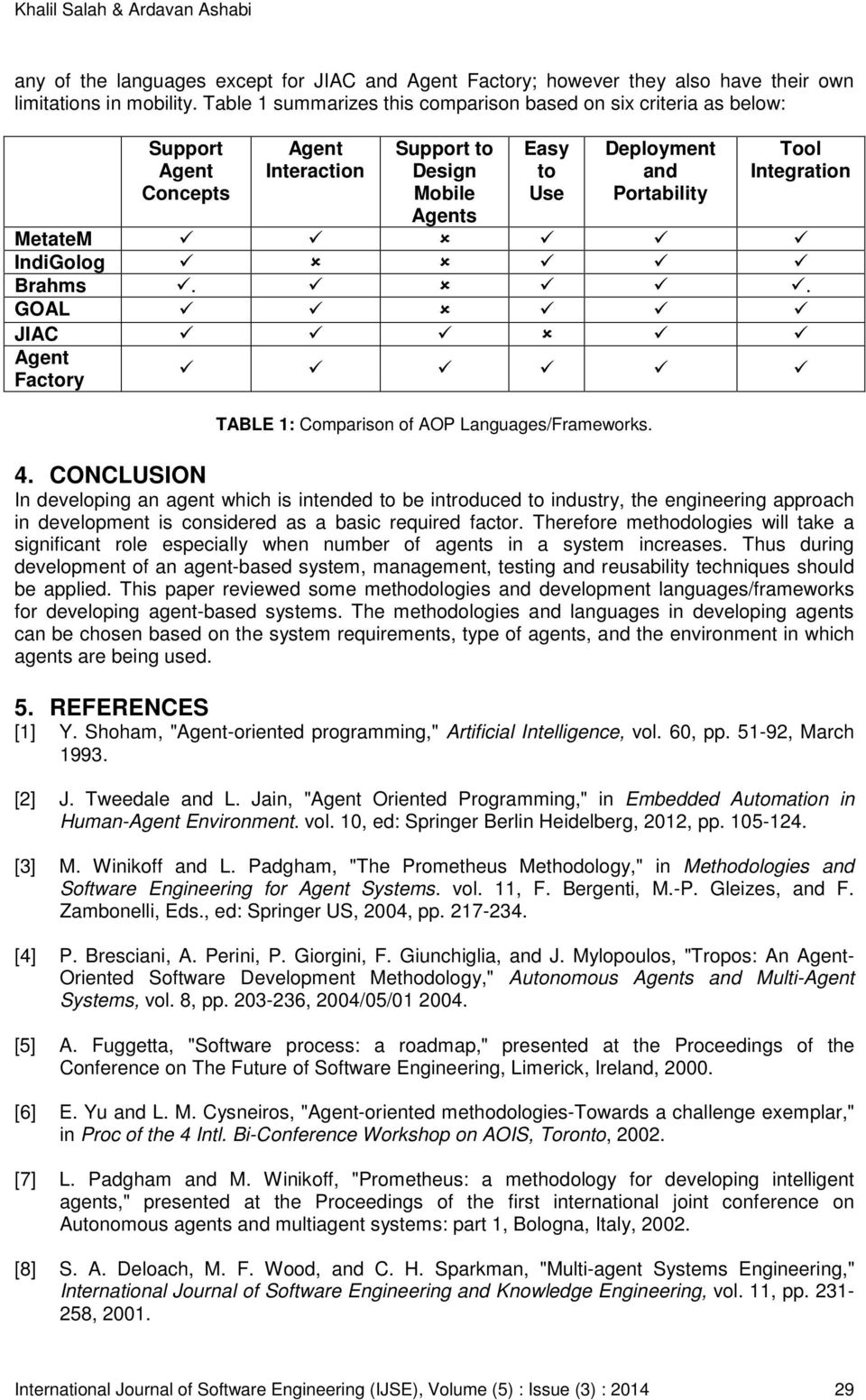
5 any of the languages except for JIAC and Agent Factory; however they also have their own limitations in mobility. Table 1 summarizes this comparison based on six criteria as below: Support Agent Concepts Agent Interaction Support to Design Mobile Agents Easy to Use Deployment and Portability Tool Integration MetateM IndiGolog Brahms.. GOAL JIAC Agent Factory TABLE 1: Comparison of AOP Languages/Frameworks. 4. CONCLUSION In developing an agent which is intended to be introduced to industry, the engineering approach in development is considered as a basic required factor. Therefore methodologies will take a significant role especially when number of agents in a system increases. Thus during development of an agent-based system, management, testing and reusability techniques should be applied. This paper reviewed some methodologies and development languages/frameworks for developing agent-based systems. The methodologies and languages in developing agents can be chosen based on the system requirements, type of agents, and the environment in which agents are being used. 5. REFERENCES [1] Y. Shoham, "Agent-oriented programming," Artificial Intelligence, vol. 60, pp , March [2] J. Tweedale and L. Jain, "Agent Oriented Programming," in Embedded Automation in Human-Agent Environment. vol. 10, ed: Springer Berlin Heidelberg, 2012, pp [3] M. Winikoff and L. Padgham, "The Prometheus Methodology," in Methodologies and Software Engineering for Agent Systems. vol. 11, F. Bergenti, M.-P. Gleizes, and F. Zambonelli, Eds., ed: Springer US, 2004, pp [4] P. Bresciani, A. Perini, P. Giorgini, F. Giunchiglia, and J. Mylopoulos, "Tropos: An Agent- Oriented Software Development Methodology," Autonomous Agents and Multi-Agent Systems, vol. 8, pp , 2004/05/ [5] A. Fuggetta, "Software process: a roadmap," presented at the Proceedings of the Conference on The Future of Software Engineering, Limerick, Ireland, [6] E. Yu and L. M. Cysneiros, "Agent-oriented methodologies-towards a challenge exemplar," in Proc of the 4 Intl. Bi-Conference Workshop on AOIS, Toronto, [7] L. Padgham and M. Winikoff, "Prometheus: a methodology for developing intelligent agents," presented at the Proceedings of the first international joint conference on Autonomous agents and multiagent systems: part 1, Bologna, Italy, [8] S. A. Deloach, M. F. Wood, and C. H. Sparkman, "Multi-agent Systems Engineering," International Journal of Software Engineering and Knowledge Engineering, vol. 11, pp , International Journal of Software Engineering (IJSE), Volume (5) : Issue (3) :
6 [9] K. Dam and M. Winikoff, "Comparing Agent-Oriented Methodologies," in Agent-Oriented Information Systems. vol. 3030, P. Giorgini, B. Henderson-Sellers, and M. Winikoff, Eds., ed: Springer Berlin Heidelberg, 2004, pp [10] N. Alechina, N. Bulling, M. Dastani, and B. Logan. (2012, May 20). Logics and Multi-Agent Programming Languages. Available: [11] M. Fisher and A. Hepple, "Executing Logical Agent Specifications," in Multi-Agent Programming:, A. El Fallah Seghrouchni, J. Dix, M. Dastani, and R. H. Bordini, Eds., ed: Springer US, 2009, pp [12] H. Barringer, M. Fisher, D. Gabbay, G. Gough, and R. Owens, "MetateM: An introduction," Formal Aspects of Computing, vol. 7, pp , 1995/09/ [13] G. Giacomo, Y. Lespérance, H. Levesque, and S. Sardina, "IndiGolog: A High-Level Programming Language for Embedded Reasoning Agents," in Multi-Agent Programming:, A. El Fallah Seghrouchni, J. Dix, M. Dastani, and R. H. Bordini, Eds., ed: Springer US, 2009, pp [14] G. D. Giacomo, Y. Lesperance, H. Levesque, and R. Reiter. (2001, May 25). IndiGolog Overview Available: [15] M. Sierhuis, W. Clancey, and R. J. Hoof, "Brahms An Agent-Oriented Language for Work Practice Simulation and Multi-Agent Systems Development," in Multi-Agent Programming:, A. El Fallah Seghrouchni, J. Dix, M. Dastani, and R. H. Bordini, Eds., ed: Springer US, 2009, pp [16] W. J. Clancey, M. Sierhuis, R. v. Hoof, and M. Scott. (2012, May 25). What is Brahms? Available: [17] K. Hindriks, "ProgrammingRationalAgents in GOAL," in Multi-Agent Programming:, A. El Fallah Seghrouchni, J. Dix, M. Dastani, and R. H. Bordini, Eds., ed: Springer US, 2009, pp [18] J. Community. (2014, May 25). JIAC V. Available: [19] B. Hirsch, T. Konnerth, and A. Heßler, "Merging Agents and Services the JIAC Agent Platform," in Multi-Agent Programming:, A. El Fallah Seghrouchni, J. Dix, M. Dastani, and R. H. Bordini, Eds., ed: Springer US, 2009, pp [20] R. Collier. (2014, May 29). Agent Factory. Available: [21] C. Muldoon, G. P. O Hare, R. Collier, and M. O Grady, "Towards Pervasive Intelligence: Reflections on the Evolution of the Agent Factory Framework," in Multi-Agent Programming:, A. El Fallah Seghrouchni, J. Dix, M. Dastani, and R. H. Bordini, Eds., ed: Springer US, 2009, pp International Journal of Software Engineering (IJSE), Volume (5) : Issue (3) :
![cs.nott.ac.uk/events/lmapl-12. [11] M. Fisher and A. Hepple, "Executing Logical Agent Specifications," in Multi-Agent Programming:, A. El Fallah Seghrouchni, J. Dix, M. Dastani, and R. H. Bordini, Eds.](/docs-images/51/14181459/images/page_6.jpg ", ed: Springer US, 2009, pp. 1-27. [12] H. Barringer, M. Fisher, D. Gabbay, G. Gough, and R. Owens, \"MetateM: An introduction,\" Formal Aspects of Computing, vol. 7, pp. 533-549, 1995/09/01 1995.")
An Investigation of Agent Oriented Software Engineering Methodologies to Provide an Extended Methodology
 An Investigation of Agent Oriented Software Engineering Methodologies to Provide an Extended Methodology A.Fatemi 1, N.NematBakhsh 2,B. Tork Ladani 3 Department of Computer Science, Isfahan University,
Agent-Oriented Software Engineering PORTO Methodology AIAD 2013/2014. António Castro and Eugénio Oliveira
 Agent-Oriented Software Engineering PORTO Methodology AIAD 2013/2014 António Castro and Eugénio Oliveira NIAD&R Distributed Artificial Intelligence and Robotics Group 1 Contents What is AOSE? Main Existing
Towards an Agent Oriented approach to Software Engineering
 Towards an Agent Oriented approach to Software Engineering Anna Perini and Paolo Bresciani ITC-IRST Via Sommarive 18, 38055 Povo, Trento, Italy perini,bresciani @irst.itc.it John Mylopoulos Department
4. Multiagent Sys stems Design. Part 2: The PROMETHEUS methodology.
 4. Multiagent Systems Design Part 2: Multiagent Syste ems (SMA-UPC) https://kemlg.upc.edu The PROMETHEUS methodology. Javier Vázquez-Salceda SMA-UPC Methodological Extensions to Object-Oriented Approaches
The Agent Modeling Language (AMOLA)
 The Agent Modeling Language (AMOLA) Nikolaos Spanoudakis 1,2 and Pavlos Moraitis 2 1 Technical University of Crete, Department of Sciences, University Campus, 73100, Kounoupidiana, Greece [email protected]
The Tropos and MaSE Agent-Oriented Software Engineering Methodologies. Msury Mahunnah, Tallinn University of Technology
 The Tropos and MaSE Agent-Oriented Software Engineering Methodologies Msury Mahunnah, Tallinn University of Technology Mailing list for the course [email protected] You can join at http://lists.ttu.ee/mailman/listinfo/aine.aom
Evaluating Agent-Oriented Software Engineering Methodologies
 Evaluating Agent-Oriented Software Engineering Methodologies Abdulsalam Alarabeyyat Information Technology Department (IT) Faculty of Prince Abdullah Bin Ghazi of Science and Information Technology Al-Balqa
Building Service-oriented User Agents using a Software Product Line Approach. Ingrid Oliveira de Nunes [email protected]
 Building Service-oriented User Agents using a Software Product Line Approach Ingrid Oliveira de Nunes [email protected] 2 Summary Introduction Objectives Integration of SOA, MAS and SPL Related Work
Tropos: An Agent-Oriented Software Development Methodology
 Autonomous Agents and Multi-Agent Sytems, 8, 203 236, 2004 Ó 2004 Kluwer Academic Publishers. Manufactured in The Netherlands. Tropos: An Agent-Oriented Software Development Methodology PAOLO BRESCIANI
Tool-supported Development with Tropos: The Conference Management System Case Study.
 Tool-supported Development with Tropos: The Conference Management System Case Study. M. Morandini, D. C. Nguyen, A. Perini, A. Siena, and A. Susi Fondazione Bruno Kessler - IRST Via Sommarive, 18 38050
An Intelligent Assistant for Computer-Aided Design Extended Abstract
 From: AAAI Technical Report SS-00-04. Compilation copyright 2000, AAAI (www.aaai.org). All rights reserved. An Intelligent Assistant for Computer-Aided Design Extended Abstract Olivier St-Cyr, Yves Lespérance,
Goal-Based Self-Contextualization
 Goal-Based Self-Contextualization Raian Ali, Fabiano Dalpiaz Paolo Giorgini University of Trento - DISI, 38100, Povo, Trento, Italy {raian.ali, fabiano.dalpiaz, paolo.giorgini}@disi.unitn.it Abstract.
On the Adequacy of i* Models for Representing and Analyzing Software Architectures
 On the Adequacy of i* Models for Representing and Analyzing Software Architectures Gemma Grau and Xavier Franch Universitat Politècnica de Catalunya c/ Jordi Girona 1-3, Barcelona E-08034, Spain {ggrau,
An Agent-Based Concept for Problem Management Systems to Enhance Reliability
 An Agent-Based Concept for Problem Management Systems to Enhance Reliability H. Wang, N. Jazdi, P. Goehner A defective component in an industrial automation system affects only a limited number of sub
Mastem: A Mathematics Tutoring Multi-Agent System
 Mastem: A Mathematics Tutoring Multi-Agent System Jéssyka Vilela 1, Ricardo Ramos 2, Jaelson Castro 1 1 Universidade Federal de Pernambuco Centro de Informática Av. Jornalista Anibal Fernandes, S/N, Cidade
Exploiting Agent-Oriented Programming for Building Advanced Web 2.0 Applications
 Exploiting Agent-Oriented Programming for Building Advanced Web 2.0 Applications Mattia Minotti University of Bologna Cesena, Italy Email: [email protected] Andrea Santi DEIS, University of
How To Develop A Multiagent System
 Towards a Comprehensive Agent-Oriented Software Engineering Methodology Dissertation vorgelegt dem Fachbereich Wirtschaftswissenschaften, der Universität Duisburg-Essen (Campus Essen) von Tawfig M. Abdelaziz,
The multi agent paradigm and organizational abstractions in construction e-business
 icccbe 2010 Nottingham University Press Proceedings of the International Conference on Computing in Civil and Building Engineering W Tizani (Editor) The multi agent paradigm and organizational abstractions
Telecommunication (120 ЕCTS)
 Study program Faculty Cycle Software Engineering and Telecommunication (120 ЕCTS) Contemporary Sciences and Technologies Postgraduate ECTS 120 Offered in Tetovo Description of the program This master study
Comparing the Testing Approaches of Traditional, Object-Oriented and Agent- Oriented Software System
 Comparing the Testing Approaches of Traditional, Object-Oriented and Agent- Oriented Software System N.Sivakumar 1 and K.Vivekanandan 2 Department of computer Science and Engineering Pondicherry Engineering
Agent-Oriented Software Development
 Agent-Oriented Software Development John Mylopoulos University of Toronto SETN 2002, Thessaloniki, April 11-12, 2002 2002 John Mylopoulos Thessaloniki -- 1 What is Software? An engineering artifact, designed,
How To Develop A Multi Agent System (Mma)
 S-Tropos: An Iterative SPEM-Centric Software Project Management Process Yves Wautelet, Manuel Kolp, Youssef Achbany IAG Institut d Administration et de Gestion, ISYS Unité de Systèmes d Information, Université
Software Agents: Languages, Tools, Platforms
 DOI:10.2298/CSIS110214013B Software Agents: Languages, Tools, Platforms Costin Bădică 1, Zoran Budimac 2, Hans-Dieter Burkhard 3, and Mirjana Ivanović 2 1 Software Engineering Department, Faculty of Automatics,
Characteristics of Computational Intelligence (Quantitative Approach)
 Characteristics of Computational Intelligence (Quantitative Approach) Shiva Vafadar, Ahmad Abdollahzadeh Barfourosh Intelligent Systems Lab Computer Engineering and Information Faculty Amirkabir University
CASSANDRA: Version: 1.1.0 / 1. November 2001
 CASSANDRA: An Automated Software Engineering Coach Markus Schacher KnowGravity Inc. Badenerstrasse 808 8048 Zürich Switzerland Phone: ++41-(0)1/434'20'00 Fax: ++41-(0)1/434'20'09 Email: [email protected]
A Multi-Agent Approach to a Distributed Schedule Management System
 UDC 001.81: 681.3 A Multi-Agent Approach to a Distributed Schedule Management System VYuji Wada VMasatoshi Shiouchi VYuji Takada (Manuscript received June 11,1997) More and more people are engaging in
Ubiquitous, Pervasive and Mobile Computing: A Reusable-Models-based Non-Functional Catalogue
 Ubiquitous, Pervasive and Mobile Computing: A Reusable-Models-based Non-Functional Catalogue Milene Serrano 1 and Maurício Serrano 1 1 Universidade de Brasília (UnB/FGA), Curso de Engenharia de Software,
The Role of Computers in Synchronous Collaborative Design
 The Role of Computers in Synchronous Collaborative Design Wassim M. Jabi, The University of Michigan Theodore W. Hall, Chinese University of Hong Kong Abstract In this paper we discuss the role of computers
Using Model Driven Architecture to Develop Multi-Agent Systems
 The International Arab Journal of Information Technology, Vol. 10, No. 4, July 2013 349 Using Model Driven Architecture to Develop Multi-Agent Systems Mohamed Elammari and Zeinab Issa Faculty of Information
Multi-Agent Model for Automation of Business Process Management System Based on Service Oriented Architecture
 Multi-Agent Model for Automation of Business Process Management System Based on Service Oriented Architecture Soe Winn, May Thwe Oo Abstract Business process automation is an important task in an enterprise
Cloud Computing and Software Agents: Towards Cloud Intelligent Services
 Cloud Computing and Software Agents: Towards Cloud Intelligent Services Domenico Talia ICAR-CNR & University of Calabria Rende, Italy [email protected] Abstract Cloud computing systems provide large-scale
Prometheus: A Methodology for Developing Intelligent Agents
 Prometheus: A Methodology for Developing Intelligent Agents Lin Padgham and Michael Winikoff RMIT University, GPO Box 2476V, Melbourne, AUSTRALIA Phone: +61 3 9925 2348 {linpa,winikoff}@cs.rmit.edu.au
Integration of Application Business Logic and Business Rules with DSL and AOP
 Integration of Application Business Logic and Business Rules with DSL and AOP Bogumiła Hnatkowska and Krzysztof Kasprzyk Wroclaw University of Technology, Wyb. Wyspianskiego 27 50-370 Wroclaw, Poland [email protected]
CS 565 Business Process & Workflow Management Systems
 CS 565 Business Process & Workflow Management Systems Professor & Researcher Department of Computer Science, University of Crete & ICS-FORTH E-mail: [email protected], [email protected] Office: K.307,
Progress Report Aspect Oriented Programming meets Design Patterns. Academic Programme MSc in Advanced Computer Science. Guillermo Antonio Toro Bayona
 Progress Report Aspect Oriented Programming meets Design Patterns Academic Programme MSc in Advanced Computer Science Guillermo Antonio Toro Bayona Supervisor Dr. John Sargeant The University of Manchester
ENACTED SOFTWARE DEVELOPMENT PROCESS BASED ON AGILE AND AGENT METHODOLOGIES
 ENACTED SOFTWARE DEVELOPMENT PROCESS BASED ON AGILE AND AGENT METHODOLOGIES 1.DR. NACHAMAI. M * Department of Computer Science, Christ University, Bangalore, India [email protected] 2. M.
Autonomy for SOHO Ground Operations
 From: FLAIRS-01 Proceedings. Copyright 2001, AAAI (www.aaai.org). All rights reserved. Autonomy for SOHO Ground Operations Walt Truszkowski, NASA Goddard Space Flight Center (GSFC) [email protected]
FUTURE RESEARCH DIRECTIONS OF SOFTWARE ENGINEERING AND KNOWLEDGE ENGINEERING *
 International Journal of Software Engineering and Knowledge Engineering World Scientific Publishing Company FUTURE RESEARCH DIRECTIONS OF SOFTWARE ENGINEERING AND KNOWLEDGE ENGINEERING * HAIPING XU Computer
Personalized e-learning a Goal Oriented Approach
 Proceedings of the 7th WSEAS International Conference on Distance Learning and Web Engineering, Beijing, China, September 15-17, 2007 304 Personalized e-learning a Goal Oriented Approach ZHIQI SHEN 1,
Enterprise Architecture: Practical Guide to Logical Architecture
 Objecteering Practical Guides Enterprise Architecture: Practical Guide to Logical Architecture Author: Version: 1.0 Copyright: Softeam Softeam Consulting Team Supervised by Philippe Desfray Softeam 21
Agent-Based Software and Practical Case of Agent-Based Software Development
 Agent-Based Software and Practical Case of Agent-Based Software Development Course 2008/2009 SUBJECTS: AGENT-BASED SOFTWARE and PRACTICAL CASE OF AGENT-BASED SOFTWARE DEVELOPMENT EUROPEAN MASTER on SOFTWARE
Autonomic IoT Systems Realizing Self-* Properties in IoT Systems
 Autonomic IoT Systems Realizing Self-* Properties in IoT Systems Noor Bajunaid [email protected] CS 788 Fall 2015 1 IoT and CPS The internet of things is known as giving any object the ability
Fall 2012 Q530. Programming for Cognitive Science
 Fall 2012 Q530 Programming for Cognitive Science Aimed at little or no programming experience. Improve your confidence and skills at: Writing code. Reading code. Understand the abilities and limitations
Elite: A New Component-Based Software Development Model
 Elite: A New Component-Based Software Development Model Lata Nautiyal Umesh Kumar Tiwari Sushil Chandra Dimri Shivani Bahuguna Assistant Professor- Assistant Professor- Professor- Assistant Professor-
Environment Programming in Multi-Agent Systems An Artifact-Based Perspective
 Noname manuscript No. (will be inserted by the editor) Environment Programming in Multi-Agent Systems An Artifact-Based Perspective Alessandro Ricci Michele Piunti Mirko Viroli Received: date / Accepted:
SERENITY Pattern-based Software Development Life-Cycle
 SERENITY Pattern-based Software Development Life-Cycle Francisco Sanchez-Cid, Antonio Maña Computer Science Department University of Malaga. Spain {cid, amg}@lcc.uma.es Abstract Most of current methodologies
MAGPIE: An Agent Platform for the Development of Mobile Applications for Pervasive Healthcare
 MAGPIE: An Agent Platform for the Development of Mobile Applications for Pervasive Healthcare Albert Brugués 1,2, Stefano Bromuri 1, Josep Pegueroles 2, and Michael Schumacher 1 1 University of Applied
Goal-Driven Adaptable Software Architecture for UAVs
 SEAS DTC Annual Technical Conference 2008 Goal-Driven Adaptable Software Architecture for UAVs William Heaven, Daniel Sykes, Jeff Magee, Jeff Kramer SER001 Imperial College London The Challenge Autonomous
A Framework of Context-Sensitive Visualization for User-Centered Interactive Systems
 Proceedings of 10 th International Conference on User Modeling, pp423-427 Edinburgh, UK, July 24-29, 2005. Springer-Verlag Berlin Heidelberg 2005 A Framework of Context-Sensitive Visualization for User-Centered
STANDARDS FOR AGENTS AND AGENT BASED SYSTEMS (FIPA)
 Course Number: SENG 609.22 Session: Fall, 2003 Course Name: Agent-based Software Engineering Department: Electrical and Computer Engineering Document Type: Tutorial Report STANDARDS FOR AGENTS AND AGENT
A Contribution to Expert Decision-based Virtual Product Development
 A Contribution to Expert Decision-based Virtual Product Development László Horváth, Imre J. Rudas Institute of Intelligent Engineering Systems, John von Neumann Faculty of Informatics, Óbuda University,
The Role of the Software Architect
 IBM Software Group The Role of the Software Architect Peter Eeles [email protected] 2004 IBM Corporation Agenda Architecture Architect Architecting Requirements Analysis and design Implementation
EL Program: Smart Manufacturing Systems Design and Analysis
 EL Program: Smart Manufacturing Systems Design and Analysis Program Manager: Dr. Sudarsan Rachuri Associate Program Manager: K C Morris Strategic Goal: Smart Manufacturing, Construction, and Cyber-Physical
INFORMATION INTEGRATION ARCHITECTURE DEVELOPMENT: A MULTI-AGENT APPROACH
 INFORMATION INTEGRATION ARCHITECTURE DEVELOPMENT: A MULTI-AGENT APPROACH Stéphane Faulkner, Manuel Kolp, Tai Nguyen, Adrien Coyette, Tung Do Information Systems Research Unit, University of Louvain, 1
Expert System and Knowledge Management for Software Developer in Software Companies
 Expert System and Knowledge Management for Software Developer in Software Companies 1 M.S.Josephine, 2 V.Jeyabalaraja 1 Dept. of MCA, Dr.MGR University, Chennai. 2 Dept.of MCA, Velammal Engg.College,Chennai.
Extend the value of your core business systems.
 Legacy systems renovation to SOA September 2006 Extend the value of your core business systems. Transforming legacy applications into an SOA framework Page 2 Contents 2 Unshackling your core business systems
School of Computer Science
 School of Computer Science Computer Science - Honours Level - 2014/15 October 2014 General degree students wishing to enter 3000- level modules and non- graduating students wishing to enter 3000- level
Knowledge-based Approach in Information Systems Life Cycle and Information Systems Architecture
 5 th Slovakian-Hungarian Joint Symposium on Applied Machine Intelligence and Informatics January 25-26, 2007 Poprad, Slovakia Knowledge-based Approach in Information Systems Life Cycle and Information
Agent-Oriented Computing: Agents as a Paradigm for Computer Programming and Software Development
 Agent-Oriented Computing: Agents as a Paradigm for Computer Programming and Software Development Alessandro Ricci DEIS, Alma Mater Studiorum Università di Bologna Via Venezia 52, 47521 Cesena (FC), Italy
APPLICATION OF MULTI-AGENT SYSTEMS FOR NETWORK AND INFORMATION PROTECTION
 18-19 September 2014, BULGARIA 137 Proceedings of the International Conference on Information Technologies (InfoTech-2014) 18-19 September 2014, Bulgaria APPLICATION OF MULTI-AGENT SYSTEMS FOR NETWORK
Reusable Knowledge-based Components for Building Software. Applications: A Knowledge Modelling Approach
 Reusable Knowledge-based Components for Building Software Applications: A Knowledge Modelling Approach Martin Molina, Jose L. Sierra, Jose Cuena Department of Artificial Intelligence, Technical University
Implementation of hybrid software architecture for Artificial Intelligence System
 IJCSNS International Journal of Computer Science and Network Security, VOL.7 No.1, January 2007 35 Implementation of hybrid software architecture for Artificial Intelligence System B.Vinayagasundaram and
Doctor of Philosophy in Computer Science
 Doctor of Philosophy in Computer Science Background/Rationale The program aims to develop computer scientists who are armed with methods, tools and techniques from both theoretical and systems aspects
Using artificial intelligence methods and 3D graphics for implementation a computer simulator for ophthalmology
 Using artificial intelligence methods and 3D graphics for implementation a computer simulator for ophthalmology V. V. Gribova, M. V. Petryaeva, L. A. Fedorischev Intelligent System Laboratory, Institute