
1. INTRODUCTION GENDER DIFFERENCES IN RECOUNTS WRITTEN IN ENGLISH BY SPANISH PRE-UNIVERSITY STUDENTS 1
|
|
|
- Prudence McLaughlin
- 10 years ago
- Views:
Transcription
1 GENDER DIFFERENCES IN RECOUNTS WRITTEN IN ENGLISH BY SPANISH PRE-UNIVERSITY STUDENTS 1 ANA MARTÍN ÚRIZ LAURA HIDALGO SUSANA MURCIA LUIS ORDÓÑEZ KARINA VIDAL RACHEL WHITTAKER Universidad Autónoma de Madrid ABSTRACT. In this paper we present an analysis of the representation of gender roles in texts written by Spanish Secondary School (Bachillerato) students of EFL. This work is part of a larger research project on the relationship between knowledge of genre and writing quality in the UAM corpus of interlanguage writing. Here, we examine a sub-corpus of recounts from the point of view of the presentation of the writers in the texts, their centrality, and the roles they assign themselves and others. We work in the framework of systemic functional grammar (Halliday and Matthiessen 2004) and genre theory (Martin and Rothery ; Martin 1992; Rothery 1994; Martin 1997; Rothery and Stenglin 1997; Martin and Rose 2003). We use the Systemic Coder (O Donnell 2005) to record and quantify the features we analyse. The analyses show how, despite the limitations of their language, these young EFL writers reproduce dominant cultural patterns in their representations of gender. KEYWORDS: EFL writing, secondary school, representation of gender, differences, recount. RESUMEN. En el presente artículo se examina la representación de género en textos escritos por alumnos de ILE en Bachillerato. El trabajo forma parte de un proyecto de investigación más amplio en el que el objetivo final es analizar la relación entre conocimiento de género textual y calidad de la escritura en el corpus de la UAM de escritura en interlengua. En este trabajo analizamos los relatos en el corpus desde el punto de vista de la representación de los escritores en los textos, a través de los papeles semánticos que eligen y que asignan al otro. El trabajo se desarrolla en el marco de la gramática sistémica funcional (Halliday & Matthiessen 2004) y la teoría de los géneros textuales (Martin and Rothery ; Martin 1992; Rothery 1994; Rothery and Stenglin 1997; Martin and Rose 2003). Se ha utilizado el Systemic Coder (O Donnell 2005) para el análisis de los rasgos de los textos. En el estudio, se muestra como, a pesar de la falta de recursos lingüísticos, los estudiantes reproducen los patrones culturales dominantes en su representación de género. PALABRAS CLAVE: Composición en ILE, bachillerato, representación de género, diferencias, relato. 1. INTRODUCTION In this paper we analyse gender differences in the representation of experience in compositions written in English by Spanish pre-university students. In a writing task designed to produce a personal recount genre, we examine the linguistic resources these young nonnative writers of English use to describe the events and to present themselves and others in their texts. By studying the students use of the stages of the generic structure of the text, and the types of processes and semantic roles in the texts, we find significant gender differences in the way male and female students in their late teens represent the event, and their actions and feelings, as they describe them to their readers. 123
2 2. THE STUDY 2.1. Participants and task This study is part of a larger research project on writing in EFL in Spanish schools, focusing on students ability to produce written texts in different genres at the end of the school system 2. One of the tasks we designed elicits a recount on the topic of the writer s first date, in the form of a letter to a friend. This gave us the sub-corpus we analyse here. It consists of 81 texts, 43 written by females and 38 by males Theoretical background. Our linguistic model is that of Systemic-Functional grammar (Halliday and Matthiessen 2004), a model which allows us to relate an analysis of the students use of the lexis and grammar of English to the functions and meanings in the different parts of the text. Linguists working in this model have produced a detailed description of the features of a number of genres for English, and this provides the background to our study of the generic structure and register features of the recount, and, in particular, its social function of sharing experience and reinforcing social values (Martin and Rothery ; Rothery 1994; Martin 1992; Rothery and Stenglin 1997; Martin and Rose 2003; see Martín et al. in press for a brief summary). The interpretation of gender differences is based on work dealing with identity and voice, gender and language (Tannen 1990; Cameron 1997; Ivanic and Camps 2001; Baxter 2003; Coates 2003; Eckert 2003; Ehrilich 2004) Data preparation and methodology The texts were divided into the generic stages of the recount -orientation, events and reorientation-, which had been separated from the letter framework made up of the stages greeting, preparation for closure and farewell (Martin and Whittaker 2003). Each recount was then divided into clauses using the Systemic Coder 3 (O Donnell 2005), a flexible, semiautomatic coding tool which allows users to design a systems network (Halliday and Matthiessen 2004) to structure and record an analysis of the linguistic choices the writer has made in a text, and to perform statistical operations. For the purpose of this study, the network of systems we designed included generic structure, process-type, writer-type, date-type and writer-gender. This allowed us to examine each clause in the different generic stages of the recount for the following categories: presence or absence of the writer and/or date (writersolo, writer-with-date, writer-with-other, date-solo, date-with-writer, date-with-other); their position (central or peripheral); the type of process which formed the pivot of the clause; the role of writer and/or date in that process. We can also relate this representation of the event the date- to the gender of the writer. The statistical analysis of the use of different features by male and female writers is given at significance level p<0.01, represented in the tables by +++, or p<0.05 represented by RESULTS We present the results focusing on the presence of the writer in the clauses of the text and the way the writer presents her or himself and the date. The total production of clauses in the recount section of the letters was 2183, of which 1030 were written by males, and 1153 by females. The recounts written by females were slightly shorter in number of clauses (mean 124
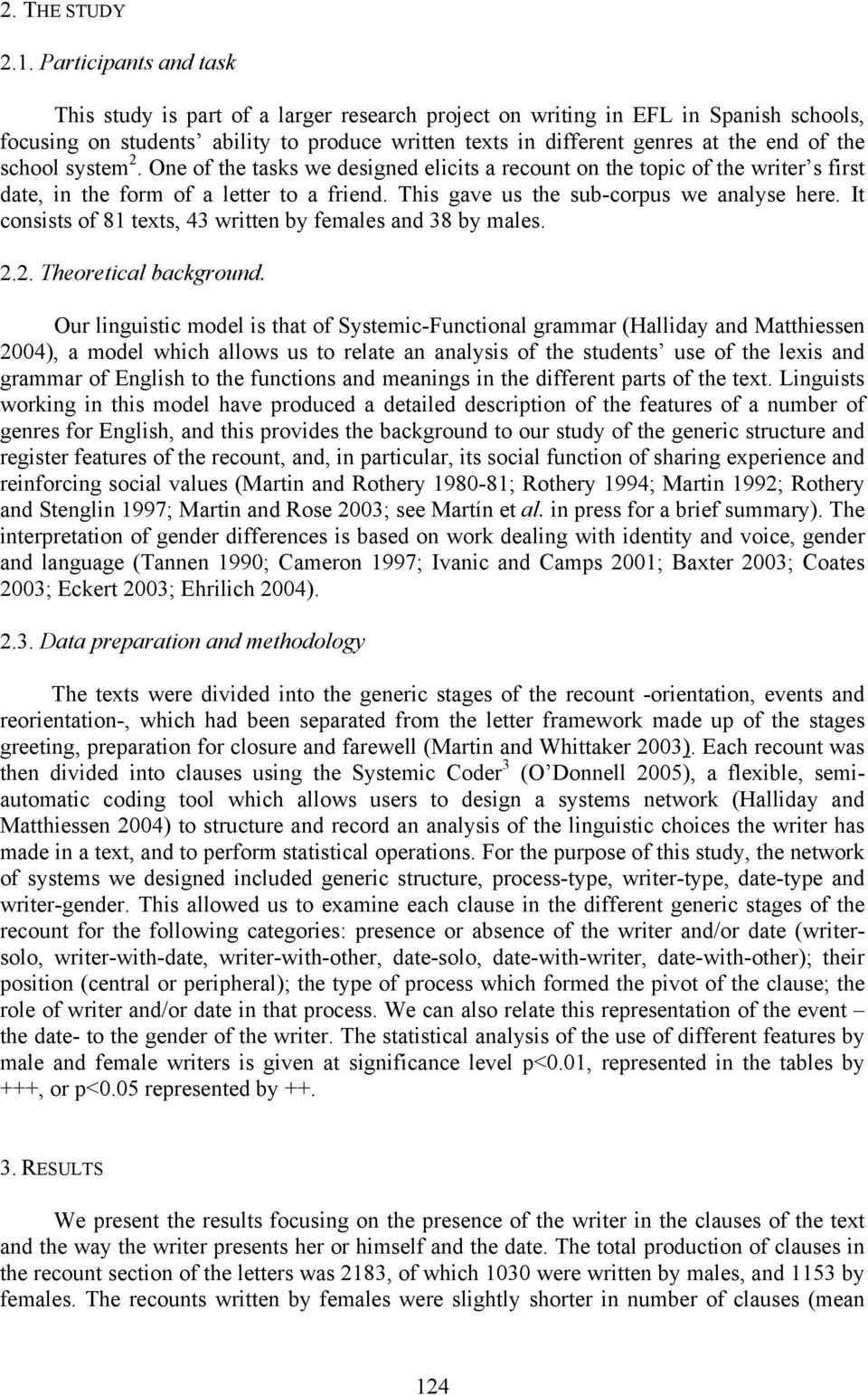
3 length: 26.8 clauses) than those written by males (mean length: 27.1 clauses) though the difference is not significant Presence of writer In the recounts as a whole, the writer is present in 65.6% of clauses; that is, the text is focused to a considerable extent on the writer, as to be expected given the topic of the compositions. Table 1 gives the data. writer-solo 46.9% % writer-withdate (we) 19.4% % writer-withother 1.2% % TOTAL 67.5% % 761 Table 1. Writer company There is no significant difference by gender with respect to the number of clauses in which the writer appears. As regards the company in which the writer represents him or herself, of all the clauses in the recounts, the writer is on his/her own that is not involved in actions or descriptions together with the date or a third party- in almost half of the clauses in the recount. The rest of the clauses in the recounts exclude both writer and date. Selecting only the clauses in the category writer-solo we found a number of significant differences between texts written by male and female students. The rest of the data presented, then, correspond to clauses with the feature writer-solo Presence of writer across generic stages: gender differences Each stage in the recount has a different function, and we find that our writers distribute the clauses in which they appear alone among the stages differently, as Table 2 shows. GENERIC- STRUCTURE orientation 31.7% % events 52.4% % reorientation 15.9% % Table 2. Generic Structure (writer solo) Male and female teenagers, then, give a different amount of importance to themselves at different moments of the recount. Males appear in more clauses in the orientation (31.7% vs. 25.1% for females); and in fewer clauses in events (52.4% vs. 59% for females). Males appear, then, in the preparation for describing the date, while females appear more in the elaboration of events in their representation. In the reorientation, no difference was found. 125
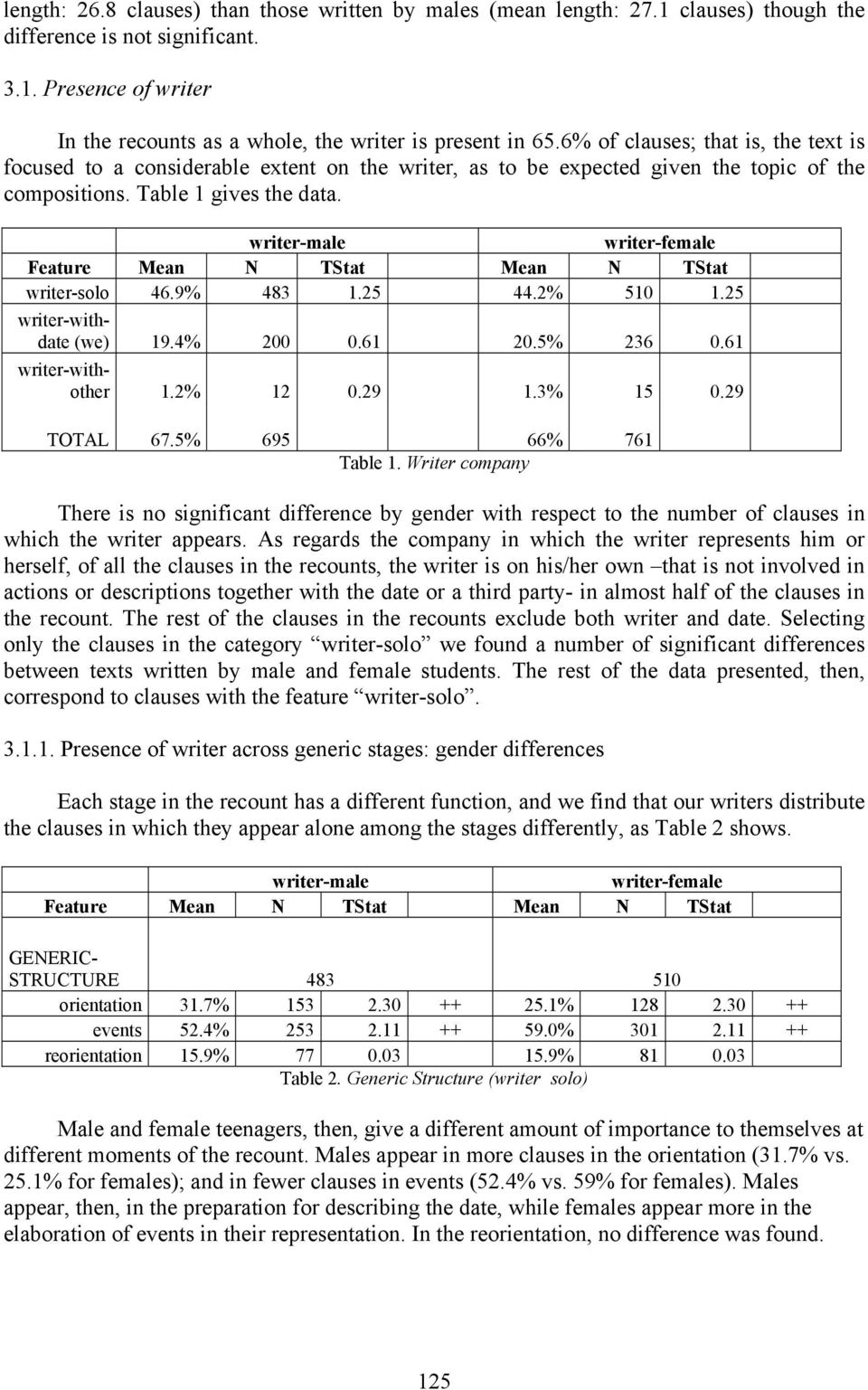
4 Presence of writer in process types: mental processes In order to discover whether there was any difference in the type of actions or states our writers presented themselves as being involved in, we examined the process types they used when alone. In our corpus, we find no significant difference in the use of process types by male and female writers except in the case of the subtypes of mental processes. These subtypes are cognition, perception and affection. Table 3. Mental processes As Table 3 shows, female writers produce a significantly higher number of clauses based on processes of affection (eg. and I love him, that this boy loved me, I enjoyed very much that day ) Presence of writer in process types: verbal processes A comparison of the production of verbal processes in clauses in which the writer appears alone also produced a significant difference, with males producing more verbal processes than females (eg. I asked Lisa last Thursday, she answered me with a loud yes ). MENTAL- 510 = all processes 483 = all processes TYPE affection 8.1% % perception 2.9% % cognition 12.0% % VERBAL TYPE Writer-solo 81% % Table 4. Verbal processes 3.2. Writer type: central or peripheral As well as the types of processes male and female teenagers use in their representation of the event, the date, we were interested in the general conception of the centrality of the writer in the text; grammatically, whether the writer presents him or herself as grammatical subject or in a less central role. Table 5 gives the results of the analysis. writercentral 85.7% % writerperipheral 14.3% % Table 5. Writer-type- central or peripheral 126

5 We find that the writer is central significantly more often in clauses written by males. In the females texts, though they also write a large number of clauses in which they are central, they place themselves in a peripheral role significantly more often. In general, the compositions show an egocentric focus, which can be put down, at least partly, to the task and topic Writer type: central- material processes As regards the process-types in which the writers are involved, and the roles they take on when central, we find that males present themselves significantly more often as Actors (eg. I paid she an other beer ) than females do- in 34,2% of their clauses, as opposed to 26,5% for females. No gender differences were found in other writer-central roles, except in one subtype of mental process Writer type: central- mental processes of affection We saw a difference in the use of sub-types of mental processes, in general, and this is confirmed when we select only those in which the writer is central. As table 6 shows, females represent themselves as Sensor (eg. because I need you ) in processes of affection more often than males. MENTAL- 510 = all processes 483 = all processes TYPE affection 8.1% % perception 2.9% % cognition 12.0% % Writer type: peripheral Table 6. Mental-type In contrast to writer-central roles, writers can also present themselves in different types of non-subject positions in the clause. Females present themselves in the peripheral roles of Phenomenon in mental processes, often of perception or affection, ( He likes me a lot ), and Circumstance ( he came to me ) significantly more than males (p<0,05) Date-type: central or peripheral Turning to the way male and female writers present their date, we now complete the picture as regards representation of centrality. Not only do males appear more often in the central position, as Actor, in their recounts, but they also place the date in non-subject, or peripheral, position in the clause significantly more frequently than females do. 127
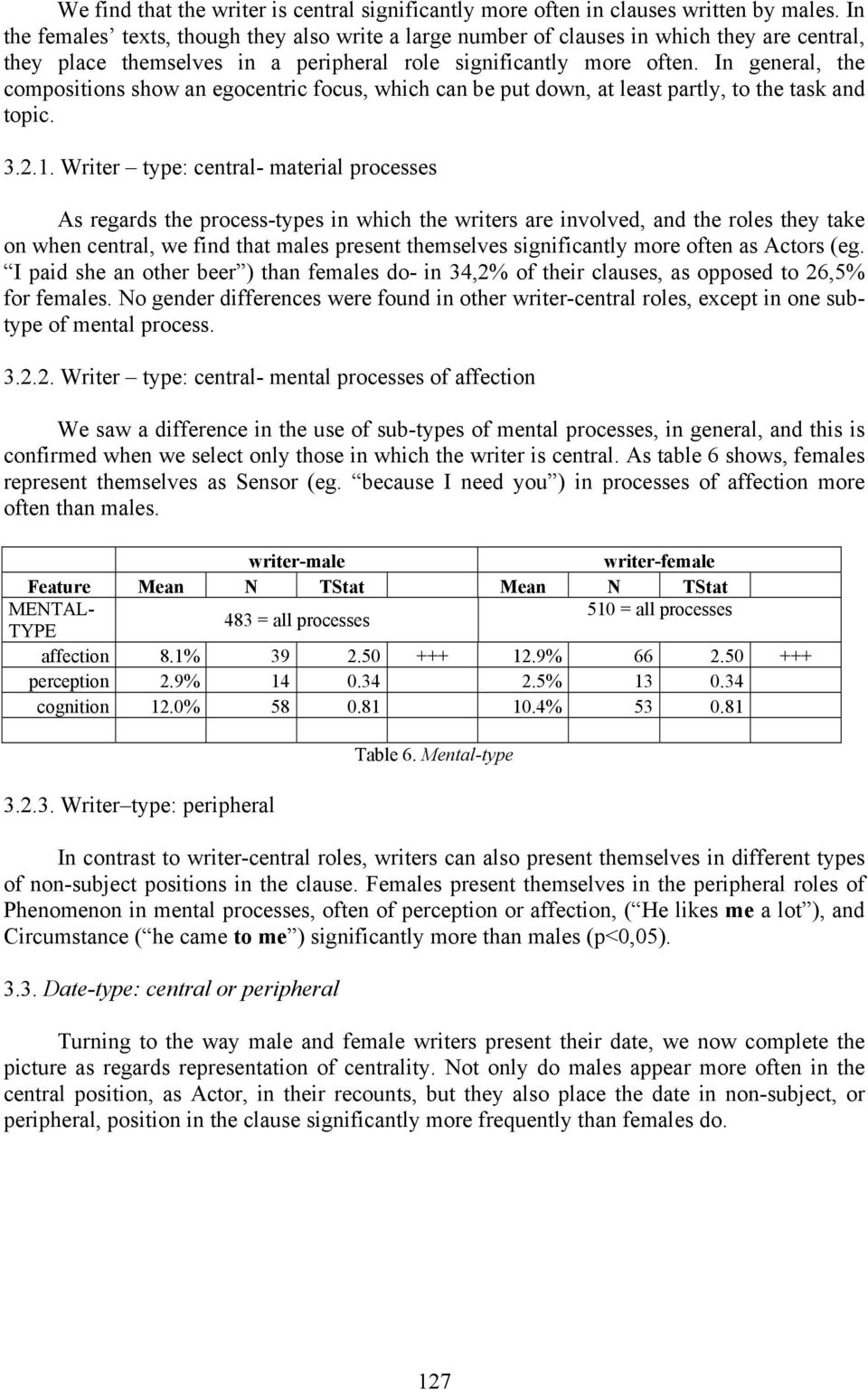
6 date-central 15% % dateperipheral 37% % Table 7. Date-type: central or peripheral As regards the specific roles male and female writers give to their date when noncentral in the clause, we found significant differences in the three most frequent roles: Goal, Receiver and Circumstance. DATE- PERIPHERAL - TYPE date-as-goal 11.0% % date-as-receiver 5.0% % date-ascircumstance 12.8% % Table 8. Date-peripheral roles In each case, male writers present their dates as Goal ( I take her hand ), as Receiver ( I said her my name ) and as Circumstance ( I have stayed with her 6 months ) in a significantly higher number of clauses. 4. INTERPRETATIONS AND CONCLUSIONS From our analysis of the representation of the self and of the other in the clauses which make up the texts of male and female writers, we propose the following interpretation Presence f writer By analysing their appearance in the generic stages of the recount, we find that male writers seem to focus more on themselves in the orientation stage, which suggests their role as planners. Female writers, on the other hand, present themselves more often in the events stage, where they participate in more clauses than males. This can be seen as representing their role as experiencers. As regards the different process types in the texts, we found that females recounts have a higher number of clauses with processes of affection, and females appear centrally as Sensors more than in texts written by males. When females present themselves they seem to take on a more emotional role. Both males and females use a large number of verbal processes in the recount -a generic feature, since speaking and what is said is an important part of a recount- but there is a difference in the representation of the activity: male writers include speaking and what is said more frequently and also assign the role of Receiver to their date to a significant extent, thus representing the date as listening to what they say. 128
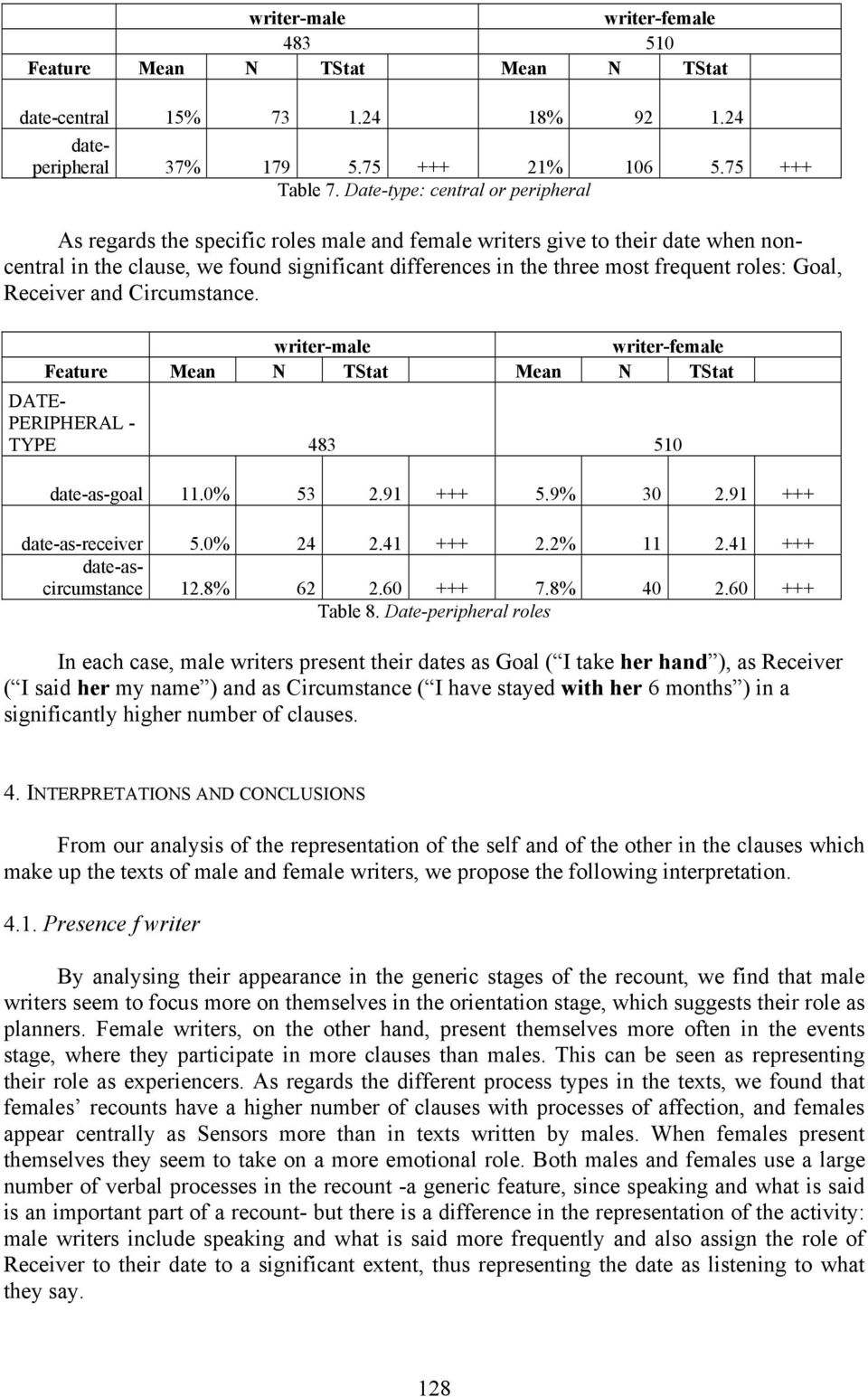
7 4.2. Writer centrality As regards the position in the clause these young writers give themselves, it is evident that both males and females see themselves as playing a central role. However, males give themselves the role of Actor significantly more often than females, reproducing the accepted cultural pattern. At the same time, when females write, they present themselves in peripheral roles significantly more than males, specifically in the roles of Phenomenon and Circumstance. Here again, we are led to interpret their representation as the internalisation of a cultural pattern of male centrality. When representing the opposite sex, the roles males assign to women are: Goal, Receiver and Circumstance, which appear in the texts as complementary to their own role as Actor Construction of gender In our texts, then, we see how gender is constructed through social interaction. The recount in which we find the students representations of gender roles formed part of a letter, in which the writers were free to choose their interlocutor. Interestingly, in this task, writers invariably chose to communicate with a representative of the peer group of the same sex: females shared the experience with females, males with males. We see in this interaction with a member of the same sex how writers are negotiating their identities. Especially clear is the male representation of their dominance in the situation. Communicating as they are with other males, this seems to show their aim of gaining prestige and the approval of the male group, as studies of masculinity have shown. Interestingly, then, despite the limitations of their language, these EFL writers reproduce cultural patterns in their representation of gender. NOTES 1. This project is funded by the Ministry of Education: Escribir en inglés en bachillerato: géneros y registros como base cognitiva del desarrollo del texto, y su relación con la calidad de la redacción. HUM ; an earlier stage of which has recently been published (Martín Úriz and Whittaker 2005). 2. A foreign language is obligatory in the Spanish educational system from primary school. Most of the subjects in this study will probably have had English at school for eight years. 3. The Systemic Coder is available free of charge from the website REFERENCES Baxter, J Positioning Gender. New York, N.Y.: Palgrave Macmillan. Cameron, D Performing gender identity: young men s talk and the construction of heterosexual masculinity. Language and Masculinity. Eds. S. Johnson and U. Meinhof. Oxford: Blackwell Eckert, P Language and gender in adolescence. J. Holmes and M. Meyerhoff Eds. The Handbook of Language and Gender. Ehrilich, S Gender as social practice: implications for second language acquisition. Studies in Second Language Acquisition 19: Ehrilich, S Language and gender. A. Davies and C. Elder Eds. The Handbook of Applied Linguistics. Oxford: Blackwell Halliday, M.A.K. & C. Matthiessen, An Introduction to Functional Grammar. London: Hodder Arnold. 129
8 Ivanic, R. and D Camps I am how I sound: voice as self-representation in L2 writing. Journal of Second Language Writing, 10: 3-33 Martin, J.R English Text. Amsterdam: Benjamins. Martin J. R. and D. Rose Working with Discourse: Meaning beyond the Clause. London: Continuum. Martin J. R. and J. Rothery Writing project report 1& 2. Working Papers in Linguistics 1&2. Sydney: University of Sidney Linguistics Department. Martín Úriz, A and R. Whittaker "Composition in EFL in Spanish schools: linguistic features of different genres in writing". Presentation. XV EISFL Workshop. Leeds, July. Martín Úriz, A and R. Whittaker eds La Composición como Comunicación: una Experiencia en las Aulas de Bachillerato. Madrid: Ediciones UAM. Martín Úriz, R. Whittaker, M. Barrio, L. Hidalgo, S. Murcia, K. Vidal, The expression of experiential meaning in EFL students texts: an analysis of secondary school recounts. Presentation 19 th EISFL Conference. London, July. Martín Úriz, A, L. Hidalgo, S. Murcia, L. Ordóñez, K. Vidal,R. Whittaker. In press. Generic competence in EFL students texts in Bachillerato : the recount. Actas del XXIV Congreso de AESLA, Madrid: UNED. O Donnell, M The Systemic Coder Version 4.68, July. Available at Rothery, J Exploring Literacy in School English. Write it Right Project. Erskineville: Disadvantaged Schools Program, Department of School Education. Rothery, J. and M. Stenglin Entertaining and instructing: exploring experience through story. Christie and J. R. Martin eds. Genre and Institutions: Social processes in the workplace and school. London: Continuum Tannen, D You just don t Understand: Women and Men in Conversation. New York: William Morrow. 130

2. AIM OF THE PRESENT STUDY
 VOLUMEN MONOGRÁFICO (2007), 83-91 TALKING AND WRITING IN A FOREIGN LANGUAGE IN CLIL CONTEXTS: A LINGUISTIC ANALYSIS OF SECONDARY SCHOOL LEARNERS OF GEOGRAPHY AND HISTORY 1 ANA LLINARES AND RACHEL WHITTAKER
ANGLOGERMANICA ONLINE 2005. Llinares García, Ana: The effect of teacher feedback on EFL learners functional production in classroom discourse
 The effect of teacher feedback on EFL learners functional production in classroom discourse Ana Llinares García, Universidad Autónoma de Madrid (Spain) Index 1 Introduction 2 Methodology of the study 3
Susana Sanduvete-Chaves, Salvador Chacón-Moscoso, Milagrosa Sánchez- Martín y José Antonio Pérez-Gil ( )
 ACCIÓN PSICOLÓGICA, junio 2014, vol. 10, n. o 2, 3-20. ISSN: 1578-908X 19 THE REVISED OSTERLIND INDEX. A COMPARATIVE ANALYSIS IN CONTENT VALIDITY STUDIES 1 EL ÍNDICE DE OSTERLIND REVISADO. UN ANÁLISIS
GRAMATICA INGLESA I GUÍA DOCENTE
 GRAMATICA INGLESA I GUÍA DOCENTE 1. DATOS GENERALES DE LA ASIGNATURA ASIGNATURA: GRAMÁTICA INGLESA I CÓDIGO: CARÁCTER (señalar con una X la modalidad correspondiente): X Asignatura de Formación Básica
This section looks at useful on-line resources for foreign language
 Entre Lenguas. Vol. 13 Enero - Diciembre 2008 111 Pozzobon, Claudia * La Prof. Pozzobon es Profesora - Investigadora de la Escuela de Idiomas Modernos, Facultad de Humanidades y Educación, Universidad
Adaptación de MoProSoft para la producción de software en instituciones académicas
 Adaptación de MoProSoft para la producción de software en instituciones académicas Adaptation of MoProSoft for software production in academic institutions Gabriela Alejandra Martínez Cárdenas Instituto
Spanish GCSE Student Guide
 Spanish GCSE Student Guide Is this the right subject for me? If you enjoy meeting and talking to people from other countries, finding out about their cultures and learning how language works, then studying
L2 SKILLS AND THE USE OF COMPENSATION STRATEGIES: THE CASE OF ADULT LEARNERS
 L2 SKILLS AND THE USE OF COMPENSATION STRATEGIES: THE CASE OF ADULT LEARNERS Beatriz López Medina Universidad Antonio de Nebrija Resumen El siguiente artículo se basa en el análisis de las estrategias
Level 2 Spanish, 2012
 91148 911480 2SUPERVISOR S Level 2 Spanish, 2012 91148 Demonstrate understanding of a variety of spoken Spanish texts on familiar matters 2.00 pm Tuesday 20 November 2012 Credits: Five Achievement Achievement
Analysis of ESP university students reading strategy awareness
 Analysis of ESP university students reading strategy awareness Ana Cristina Lahuerta Martínez Universidad de Oviedo (Spain) [email protected] Abstract The research literature on metacognitive awareness
CONSERVATORIO DE MÚSICA DE PUERTO RICO DECANATO DE ASUNTOS ACADÉMICOS DEPARTAMENTO DE ESTUDIOS GENERALES
 CONSERVATORIO DE MÚSICA DE PUERTO RICO DECANATO DE ASUNTOS ACADÉMICOS DEPARTAMENTO DE ESTUDIOS GENERALES Título del curso: English Composition Código: INGL 3001 3002 Horas Crédito: Tres (3) créditos por
Cambridge IGCSE. www.cie.org.uk
 Cambridge IGCSE About University of Cambridge International Examinations (CIE) Acerca de la Universidad de Cambridge Exámenes Internacionales. CIE examinations are taken in over 150 different countries
EVALUATING A FOREIGN LANGUAGE IN PRIMARY EDUCATION
 REVISTTA ELLECTTRÓNI ICA INTTERNACI I IONALL ISSN I 11557766- -77880099 EVALUATING A FOREIGN LANGUAGE IN PRIMARY EDUCATION Plácido Bazo University of La Laguna [email protected] Marcos Peñate University
La educación virtual como herramienta en la orientación educativa
 La educación virtual como herramienta en la orientación educativa Virtual education as a tool in educational guidance Ma. Guadalupe Medina Zúñiga Colegio de Bachilleres del Estado de Querétaro. [email protected]
ISC Spain. Enjoy a unique experience.
 ISC Spain Enjoy a unique experience. PROGRAMA / PROGRAM - Alojamiento y pensión completa en residencia / Full board at the University Residence - 20 horas/ semana de clases de Español / 20 hours per
ENVIRONMENT: Collaborative Learning Environment
 Guía Integrada de Actividades Contexto de la estrategia de aprendizaje a desarrollar en el curso: The activity focuses on the Task Based Language Learning (TBLL). The task is used by the student in order
How To Assess A Very Young Learner
 Argentinian Journal of Applied Linguistics Vol. 1, No. 1, May 2013, 45-55 Informal assessment tools in kindergarten (Received 18/01/13; final version received 22/02/13) Sarah Hillyard* Colegio San Martín
How to enable students to become more independent essay writers
 How to enable students to become more independent essay writers Ilene Ann Smalec Malloy UEM Lab - Universidad Europea de Madrid Abstract This paper has resulted after examining the poor results of academic
Discover Natural Science for ESO 1 and 2
 Get to know Natural Science Introduction to the unit Each unit opens with dynamic images that illustrate the key themes of the unit. Presentation of contents The unit follows an easy-to-use format with
Using Social Networking Sites to Support Online Individual Health Behavior Change Projects
 Using Social Networking Sites to Support Online Individual Health Behavior Change Projects Utilizando Sitios de Red Social para Apoyar los Proyectos de Cambio en el Comportamiento de Salud Individual Joshua
LA HOMOLOGACIÓN DE ESTUDIOS EN LA COMUNIDAD EUROPEA: PERSPECTIVAS DESDE EL PUNTO DE VISTA DEL TRABAJO SOCIAL
 THE HISTORY OF SOCIAL WORK EDUCATION IN SPAIN: DOES HARMONISATION MAKE SENSE? LA HOMOLOGACIÓN DE ESTUDIOS EN LA COMUNIDAD EUROPEA: PERSPECTIVAS DESDE EL PUNTO DE VISTA DEL TRABAJO SOCIAL PAZ MÉNDEZ-BONITO
GUÍA DOCENTE Inglés III. Código Asignatura Créditos Idioma P NP Total 29123 Inglés III 2.4 3.6 6 Inglés
 Pág.: 1 de 11 1.- Subject details Código Asignatura Créditos Idioma P NP Total 29123 2.4 3.6 6 Inglés Titulación Carácter Curso Semestre Estudios Grado en Turismo Obligatoria 3º 1º Grado Profesor Sra.
PROCEDIMIENTOPARALAGENERACIÓNDEMODELOS3DPARAMÉTRICOSA PARTIRDEMALLASOBTENIDASPORRELEVAMIENTOCONLÁSERESCÁNER
 PROCEDIMIENTOPARALAGENERACIÓNDEMODELOS3DPARAMÉTRICOSA PARTIRDEMALLASOBTENIDASPORRELEVAMIENTOCONLÁSERESCÁNER Lopresti,LauraA.;Lara, Marianela;Gavino,Sergio;Fuertes,LauraL.;Defranco,GabrielH. UnidaddeInvestigación,DesaroloyTransferencia-GrupodeIngenieríaGráficaAplicada
Entry to Year 7 - Information for Parents
 Entry to Year 7 - Information for Parents Key Names: Mrs Elizabeth Batchelor - Head of the Secondary School Mr Darren Roth - Head of Key Stage Three Miss Karen Britcliffe - Head of Pastoral Care Groupings
Ranking de Universidades de Grupo of Eight (Go8)
 En consecuencia con el objetivo del programa Becas Chile el cual busca a través de la excelencia de las instituciones y programas académicos de destino cerciorar que los becarios estudien en las mejores
Curso académico 2015/2016 INFORMACIÓN GENERAL ESTRUCTURA Y CONTENIDOS HABILIDADES: INGLÉS
 Curso académico 2015/2016 INFORMACIÓN GENERAL ESTRUCTURA Y CONTENIDOS HABILIDADES: INGLÉS Objetivos de Habilidades: inglés El objetivo de la prueba es comprobar que el alumno ha adquirido un nivel B1 (dentro
Spanish Grammar II. Tierra Encantada Charter School. Contact Number: (505) 983-3337
 Spanish Grammar II Tierra Encantada Charter School Mr. Arruga Contact Number: (505) 983-3337 Course Description/Objectives / Descripcion del curso / Objetivos: La asignatura de Gramatica espanola pretende
Foreign language teaching in Primary Education in Hungary
 Foreign language teaching in Primary Education in Hungary Ildikó Szabó Kecskemét Teacher Training College, Hungary Resumen El artículo aborda el sistema educativo en Hungría, mencionando los últimos cambios
Pedro Arriagada S. Ph.D. Professor Business Economics Universidad del Desarrollo. Case Study. October 2010
 7.08. Experiential Learning, Its importance in Business Education Pedro Arriagada S. Ph.D. Professor Business Economics Universidad del Desarrollo Case Study October 2010 1501 Abstract The main objective
Reading comprehension through group work activities in an EFL classroom: An action research report
 Reading comprehension through group work activities in an EFL classroom: An action research report Arafat Rahaman ISSN 1699-437X Year 2014, Volume 10, Number 2 (September) Abstract: This classroom action
COURSES IN ENGLISH AND OTHER LANGUAGES AT THE UNIVERSITY OF HUELVA 2014-15 (update: 24 th July 2014)
 COURSES IN ENGLISH AND OTHER LANGUAGES AT THE UNIVERSITY OF HUELVA 2014-15 (update: 24 th July 2014) (*Max. Erasmus students 10/15 per class) To be updated with more courses. Other specific Subjects-Specially
Guidelines for Designing Web Maps - An Academic Experience
 Guidelines for Designing Web Maps - An Academic Experience Luz Angela ROCHA SALAMANCA, Colombia Key words: web map, map production, GIS on line, visualization, web cartography SUMMARY Nowadays Internet
Prepárate. BT 030 - Computer ABCs for Women in Transition
 Prepárate Lane Community College offers classes for students to establish a foundation for a successful transition to college. The classes below are recommended for students as resources for a successful
Fecha: 04/12/2010. New standard treatment for breast cancer at early stages established
 New standard treatment for breast cancer at early stages established London December 04, 2010 12:01:13 AM IST Spanish Oncology has established a new standard treatment for breast cancer at early stages,
VaughanTown. Newsletter 5:...Last Words. Last Words and Recommendations Last Reminder Meeting point map. www.vaughantown.com
 VaughanTown Newsletter 5:...Last Words Last Words and Recommendations Last Reminder Meeting point map www.vaughantown.com 00 / 01 Años / VaughanTown Escolares en el Extranjero E.S.O & Bachillerato Last
Chapter 12 Intellectual Development from One One to Three to Three
 Chapter 12 Chapter 12 Intellectual Development from One One to Three to Three Contents Section 12.1 Brain Development from One to Three Section 12.2 Encouraging Learning from One to Three 1 Section 12.1
The Effect of Pre-Task and Online Planning Conditions on Complexity, Accuracy, and Fluency on EFL Learners Written Production
 Po r t a Li n g u a r u m 20, junio 2013 pp. 31-43 The Effect of Pre-Task and Online Planning Conditions on Complexity, Accuracy, and Fluency on EFL Learners Written Production Mae d e h Gh a v a m n i
Knowledge Engineering (Ingeniería del Conocimiento)
 Knowledge Engineering (Ingeniería del Conocimiento) Escuela Politécnica Superior, UAM Course 2007-2008 Topic 1: Introduction to Knowledge-Based Systems (KBSs) 1 Topic 1: Introduction to Knowledge- Based
Guide 1. Entering into the business world
 UNIVERSIDAD EAN FACULTAD DE ESTUDIOS EN AMBIENTES VIRTUALES INGLÉS DE NEGOCIOS BÁSICO La versión imprimible considera solo una parte del módulo; por lo tanto, es indispensable revisar cuidadosamente el
GENERAL OVERVIEW STATEMENT OF THE PROBLEM LITERATURE REVIEW METHODOLOGY FINDINGS RESEARCH AND PEDAGOGICAL IMPLICATIONS LIMITATIONS CONCLUSIONS
 GENERAL OVERVIEW STATEMENT OF THE PROBLEM 1 LITERATURE REVIEW 2 METHODOLOGY 3 FINDINGS 4 RESEARCH AND PEDAGOGICAL IMPLICATIONS 5 LIMITATIONS 6 CONCLUSIONS 7 STATEMENT OF THE PROBLEM United Nations Development
Variations in Business English letters written by Spanish learners
 BIBLID 1133-1127 (2008) p. 39-56 Received 15 April 2010 Accepted 4 May 2010 Variations in Business English letters written by Spanish learners María Luisa Carrió Pastor Universidad Politécnica de Valencia
The Eastern Suffolk BOCES English as a New Language Programs HB WARD TECHNICAL CENTER RIVERHEAD, NY ISLIP CAREER CENTER OAKDALE, NY
 The Eastern Suffolk BOCES English as a New Language Programs HB WARD TECHNICAL CENTER RIVERHEAD, NY ISLIP CAREER CENTER OAKDALE, NY Participating Districts: HB Ward Riverhead Westhampton Beach Southold
Psychology of Friendship
 ICEI 2013 4th International Congress on Emotional Intelligence September 8-10, 2013 New York City Zaccagnini, J.L. Ruiz Aranda, D. Laboratorio de Emociones Facultad de Psicología University of Málaga 29071
Visión general de la integración con asanetwork
 Visión general de la integración con asanetwork Este documento se ha preparado parar dar una visión general del flujo de trabajo de asanetwork y de las tareas a realizar por los programadores del Sistema
YASAR UNIVERSITY SCHOOL OF FOREIGN LANGUAGES COURSE SYLLABUS SPANISH I
 YASAR UNIVERSITY SCHOOL OF FOREIGN LANGUAGES COURSE SYLLABUS SPANISH I Course Code : SOFL 041 Course Title : Spanish I Academic Year : 2010-2011 Semester : Winter Course Language : Spanish Course Material
THREE FRAMEWORKS FOR DEVELOPING CLIL MATERIALS IN INFANT AND PRIMARY EDUCATION Soraya García Universidad de Alcalá
 THREE FRAMEWORKS FOR DEVELOPING CLIL MATERIALS IN INFANT AND PRIMARY EDUCATION Soraya García Universidad de Alcalá Abstract This paper proposes three illustrated frameworks made by remarkable researchers
M. Luz Celaya Universidad de Barcelona [email protected]
 María del Pilar García Mayo and María Luisa García Lecumberri, eds. 2003: Age and the Acquisition of English as a Foreign Language. Clevedon: Multilingual Matters. M. Luz Celaya Universidad de Barcelona
Hacia dónde nos está llevando el CLIL?
 2010, 33. 227-233 ISSN: 1577-0338 Where is CLIL taking us?? Hacia dónde nos está llevando el CLIL? Wendy Arnold* Abstract CLIL is a chameleon which means different things to different contexts. It is generating
PROGRAMME. 04:30-05:45pm (Bilingual) Presentation on Effective Bilingual Programs.
 PROGRAMME THURSDAY, 19 th MARCH. International Conference for Educational Leaders 04:00 pm Registration 04:30-05:45pm (Bilingual) Presentation on Effective Bilingual Programs. 04:30-05:00 Introduction
Desde la División de Advanced Solutions de Ingram Micro, queremos agradecerle su asistencia al evento Technology Day organizado por Symantec.
 Apreciado colaborador, Desde la División de Advanced Solutions de Ingram Micro, queremos agradecerle su asistencia al evento Technology Day organizado por Symantec. A su vez, esperamos que su asistencia
SUMMER WORK AP SPANISH LANGUAGE & CULTURE Bienvenidos a la clase de Español AP!
 SUMMER WORK AP SPANISH LANGUAGE & CULTURE Bienvenidos a la clase de Español AP! To truly learn a language you have to use it as much as possible. The AP Exam focuses on the four communication skills: speaking,
A story-based approach to teaching English. - A classroom experience -
 - A classroom experience - Begoña Illán Martínez Primary bilingual school teacher Abstract To learn a second language using stories can be one more tool to reach the curriculum goals. Stories can be used
CATEGORÍA #2 (3 CRÉDITOS) CATEGORÍA #3 (6 CRÉDITOS)
 Lista de los cursos de los Programas de Literatura (INGL) del Departamento de Ingles, Facultad de Humanidades UPR-RP/ Course List for Programs in Literature (INGL) REQUISITOS DE LA CONCENTRACIÓN EN INGLÉS-LITERATURA
Estudios de lingüística inglesa aplicada
 Estudios de lingüística inglesa aplicada STORYBOOKS IN THE YOUNG LEARNERS EFL CLASSROOM AS A RESOURCE FOR TEACHING VOCABULARY 1 Aoife Ahern and Mª Luisa García Bermejo Universidad Complutense, Madrid,
INFORMATION DOSSIER WORK EXPERIENCE EUROPEAN SCHOOL ALICANTE
 INFORMATION DOSSIER WORK EXPERIENCE EUROPEAN SCHOOL ALICANTE YEAR 2015-2016 INDEX 1. GENERAL 2. INTRODUCTORY LETTER 3. GUIDE FOR BUSINESSES / GUÍA PARA LAS EMPRESAS. 4. CONFIRMATION FORM / CARTA DE CONFIRMACIÓN.
Curriculum Vitae: Maria-Jose Vieira
 León (Spain), June 2010 Curriculum Vitae: Maria-Jose Vieira Personal details First Name: Maria-Jose Family Name: Vieira Nationality: Spanish Current Position: Associate Professor in Educational Sciences
Semester Homework Assignments* P A S A P O R T E (1 st ed.)
 SPANISH 103 Fall 2011 Semester Homework Assignments* P A S A P O R T E (1 st ed.) Tareas are due on the day they are listed. Para empezar: Su pasaporte al mundo hispano Wednesday, August 24 Vamos al mundo
Preschool English Education in the Spanish Curriculum. Analysis of the Region of Murcia
 Al Po r e t j a nli d r n o g ugó a r m u e m z 20, Ca mjunio a c h o 2013 El aprendizaje integrado de la lengua española y los contenidos... pp. 117-133 Preschool English Education in the Spanish Curriculum.
1 Objetivos didácticos_unit 1 2 Objetivos didácticos_unit 2
 1 Objetivos didácticos_unit 1 1.1 Listado de fórmulas de saludo y de presentación 1.2 Formar sustantivos para hablar de profesiones 1.3 Hablar de profesiones 1.4 Formar adjetivos de nacionalidad 1.5 Adjetivos
Ask your child what he or she is learning to say in Spanish at school. Encourage your child to act as if he or she is your teacher.
 Welcome to Descubre el español con Santillana! This year, your child will be learning Spanish by exploring the culture of eight Spanish-speaking countries. Please join us as we travel through each of the
Código Asignatura Créditos Idioma P NP Total 29107 Inglés I 2.4 3.6 6 Inglés
 Pág.: 1 de 11 1.-Subject details Código Asignatura Créditos Idioma P NP Total 29107 2.4 3.6 6 Inglés Titulación Carácter Curso Semestre Estudios Grado en Turismo FB 1º 1º Grado FB: Formación básica FOb:Formación
Verbos modales. In this class we look at modal verbs, which can be a tricky feature of English grammar.
 Verbos modales In this class we look at modal verbs, which can be a tricky feature of English grammar. We use Modal verbs in English to show: Probability,Possibility, Capability, Permission, ObligaCon,
Inglés nivel pre-intermedio (II)
 Inglés nivel pre-intermedio (II) 1 Objetivos didácticos_unit 1 1.1 Time, tense y weather 1.2 El adjetivo_ forma comparativa 1.3 El adjetivo_ forma superlativa 1.4 Watch de video and then read the script
Telling and asking for the time.
 Lesson: : telling and asking for the time General: : Objectives: Structures: Target Vocab: 40 mins - 1 hour Telling and asking for the time. " Qué hora es?" "Por favor Podrías decirme la hora?" "Es la
56h NIVEL LOWER INTERMEDIATE INGLÉS OBJETIVOS DEL CURSO. ÍNDICE 1 Objetivos didácticos_unit 1
 56h INGLÉS OBJETIVOS DEL CURSO Consta de 9 unidades que gramaticalmente comienzan con un refuerzo del nivel 1, llegando hasta el uso de los condicionales y el estilo indirecto. Continuamos introduciendo
VISA REQUIREMENTS FOR SPAIN LANGUAGE ASSISTANTS PROGRAM
 Last update: 12-07-2011 VISA REQUIREMENTS FOR SPAIN LANGUAGE ASSISTANTS PROGRAM Each visa application must include: 1. Passport with a validity of at least 3 months subsequent to the foreseen date of departure
Effect of TeenSTAR, an abstinence-only sexual education program on adolescent sexual behaviour.
 Effect of TeenSTAR, an abstinence-only sexual education program on adolescent sexual behaviour. Pilar Vigil, MD., PhD. 1, Rosa Riquelme 1, Rosario Rivadeneira, MD 1, Hanna Klaus, MD 2 1 TeenSTAR Program
DEPT. OF MODERN LANGUAGES: MMC (305)348 2851 OFFICE: 486 A
 Department of Modern Languages SYLLABUS COURSE: SPN 1130, SPANISH I FOR NON HERITAGE LEARNERS MODALITY: Homework based TERM: Spring 2015 DAYS: Monday, Wednesday, Friday CREDIT: 5 semester hours PREREQUISITE:
SHOULD TEACHERS FOCUS ON PHATIC UTTERANCES IN THE ESL CLASS? A PRAGMATIC REFLECTION. University of Seville
 SHOULD TEACHERS FOCUS ON PHATIC UTTERANCES IN THE ESL CLASS? A PRAGMATIC REFLECTION MANUEL PADILLA CRUZ University of Seville Many teachers neglect phatic utterances in the ESL class and only explain the
Special Programs. Extended Day/Week Tutorial Program Guidelines
 2013 2014 Special Programs Extended Day/Week Tutorial Program Guidelines In Brownsville ISD, every opportunity is extended to help our lowest achieving students become academically successful. In support
CHAPTER THREE: METHODOLOGY. This research is guided by a qualitative tradition. It is a descriptive inquiry based on
 CHAPTER THREE: METHODOLOGY This research is guided by a qualitative tradition. It is a descriptive inquiry based on four case studies regarding writers identity by means of voice analysis and gender differences
Sales Management Main Features
 Sales Management Main Features Optional Subject (4 th Businesss Administration) Second Semester 4,5 ECTS Language: English Professor: Noelia Sánchez Casado e-mail: [email protected] Objectives Description
DOCUMENT RESUME ED 318 301 FL 800 119 AUTHOR EDRS PRICE DESCRIPTORS
 DOCUMENT RESUME ED 318 301 FL 800 119 AUTHOR Spener, David TITLE Setting an Agenda for Study in Home-Based ESL r.lasses with Native Speakers of Spanish. PUB DATE 90 NOTE 7p. PUB TYPE Guides - Classroom
Peer-assessment in the ESL classroom: a practical project
 Mª PORTA PILAR LINGUARUM NÚÑEZ, EDUARDO 9, enero 2008 FERNÁNDEZ, ANTONIO ROMERO Research in language pp. didactics 127-138... Peer-assessment in the ESL classroom: a practical project CARMEN MAÍZ ARÉVALO
SPAN 295 SPANISH IN THE WORKPLACE Spring 2016
 SPAN 295 SPANISH IN THE WORKPLACE Spring 2016 Instructor Information: Instructor: Dr. Rafael Cabañas Alamán Email: [email protected] Phone: 91-533-5935 Ext. 134 Office: Humanities & Social Sciences /
FAMILY INDEPENDENCE ADMINISTRATION Seth W. Diamond, Executive Deputy Commissioner
 FAMILY INDEPENDENCE ADMINISTRATION Seth W. Diamond, Executive Deputy Commissioner James K. Whelan, Deputy Commissioner Policy, Procedures and Training Lisa C. Fitzpatrick, Assistant Deputy Commissioner
How To Teach Project Management
 Leadership and Negotiation Skills for Project Managers Course designed to enhance and develop the personal skills required for effective management of the project team as well as management and involvement