
U.S. Equal Employment Opportunity Commission FEDERAL AGENCY ANNUAL EEO PROGRAM STATUS REPORT
|
|
|
- Coral Green
- 10 years ago
- Views:
Transcription
1 EEOC FORM PART A - D U.S. Equal Employment Opportunity Commission FEDERAL AGENCY ANNUAL EEO PROGRAM STATUS REPORT For period covering October 1, 2013, to September 30, PART A Department or Agency Identifying Information 1. Agency 1. U.S. Department Of Energy 1.a. 2 nd level reporting component Bonneville Power Administration 1.b. 3 rd level reporting component 1.c. 4 th level reporting component 2. Address NE 11 th Avenue 3. City, State, Zip Code 3. Portland, OR CPDF Code 5. FIPS code(s) 4. DN82 5. PART B Total Employment 1. Enter total number of permanent full-time and part-time employees 1. 2, Enter total number of temporary employees Enter total number employees paid from non-appropriated funds TOTAL EMPLOYMENT [add lines B 1 through 3] 4. 2,888 PART C Agency Official(s) Responsible For Oversight of EEO Program(s) 1. Head of Agency Official Title 1. Elliot E. Mainzer Administrator and Chief Eecutive Officer 2. Agency Head Designee 2. Godfrey C. Beckett, Manager Civil Rights and Equal Employment Opportunity, GM Principal EEO Director/Official Official Title/series/grade 3. Godfrey C. Beckett, Manager Civil Rights and Equal Employment Opportunity, GM Title VII Affirmative EEO Program Official 5. Section 501 Affirmative Action Program Official 6. Complaint Processing Program Manager 4. Godfrey C. Beckett, Manager Civil Rights and Equal Employment Opportunity, GM Godfrey C. Beckett, Manager Civil Rights and Equal Employment Opportunity, GM Judy L. Rush EEO Specialist, GS Other Responsible EEO Staff Anthony Jackson, EEO Specialist, Lead EEO Counselor and Alternative Dispute Resolution Coordinator, GS Lidia R. Somilleda, EEO Specialist, Hispanic Employment and People with Disabilities Program Manager, GS Judy L. Rush, EEO Specialist and Federal Women s Program Manager, GS

2 EEOC FORM PART A - D U.S. Equal Employment Opportunity Commission FEDERAL AGENCY ANNUAL EEO PROGRAM STATUS REPORT PART D List of Subordinate Components Covered in This Report N/A N/A Subordinate Component and Location (City/State) CPDF and FIPS codes EEOC FORMS and Documents included with this Report *Eecutive Summary [FORM PART E], that includes: X *Optional Annual Self-Assessment Checklist Against Essential Elements [FORM PART G] X Brief paragraph describing the agency's mission and mission-related functions X *EEO Plan To Attain the Essential Elements of a Model EEO Program [FORM PART H] for each programmatic essential element requiring improvement X Summary of results of agency's annual selfassessment against MD-715 "Essential Elements" X *EEO Plan To Eliminate Identified Barrier [FORM PART I] for each identified barrier X Summary of Analysis of Work Force Profiles including net change analysis and comparison to RCLF X *Special Program Plan for the Recruitment, Hiring, and Advancement of Individuals with Targeted Disabilities for agencies with 1,000 or more employees [FORM PART J] X Summary of EEO Plan objectives planned to eliminate identified barriers or correct program deficiencies X *Copy of Workforce Data Tables as necessary to support Eecutive Summary and/or EEO Plans X Summary of EEO Plan action items implemented or accomplished X *Copy of data from 462 Report as necessary to support action items related to Complaint Processing Program deficiencies, ADR effectiveness, or other compliance issues X *Statement of Establishment of Continuing Equal Employment Opportunity Programs [FORM PART F] X *Copy of Facility Accessibility Survey results as necessary to support EEO Action Plan for building renovation projects N/ A *Copies of relevant EEO Policy Statement(s) and/or ecerpts from revisions made to EEO Policy Statements X *Organizational Chart X 2
![(City/State) CPDF and FIPS codes EEOC FORMS and Documents included with this Report *Eecutive Summary [FORM 715-01 PART E], that includes: X *Optional Annual Self-Assessment Checklist Against](/docs-images/42/14150606/images/page_2.jpg "Essential Elements [FORM 715-01 PART G] X Brief paragraph describing the agency's mission and mission-related functions X *EEO Plan To Attain the Essential Elements of a Model EEO Program [FORM")
3 EEOC FORM PART E U.S. Department of Energy, Bonneville Power Administration U.S. Equal Employment Opportunity Commission FEDERAL AGENCY ANNUAL EEO PROGRAM STATUS REPORT For period covering October 1, 2013, to September 30, EXECUTIVE SUMMARY About BPA The Bonneville Power Administration (BPA) is a federal nonprofit agency based in the Pacific Northwest. Although BPA is part of the U.S. Department of Energy, it is self-funded and covers its costs by selling its products and services. BPA markets wholesale electrical power from 31 federal hydro projects in the Columbia River Basin, one nonfederal nuclear plant and several other small nonfederal power plants. The dams are operated by the U.S. Army Corps of Engineers and the Bureau of Reclamation. About one-third of the electric power used in the Northwest comes from BPA. BPA also operates and maintains about three-fourths of the high-voltage transmission in its service territory. BPA s service territory includes: Idaho, Oregon, Washington, western Montana and small parts of eastern Montana, California, Nevada, Utah, and Wyoming. BPA promotes energy efficiency, renewable resources and new technologies that improve its ability to deliver on its mission. BPA also funds regional efforts to protect and enhance fish and wildlife populations affected by hydropower development in the Columbia River Basin. BPA is committed to public service and seeks to make its decisions in a manner that provides opportunities for input from stakeholders. In its vision statement, BPA dedicates itself to providing high system reliability, low rates consistent with sound business principles, environmental stewardship and accountability. Mission BPA s mission as a public service organization is to create and deliver the best value for our customers and constituents as we act in concert with others to assure the Pacific Northwest: An adequate, efficient, economical and reliable power supply; A transmission system that is adequate to the task of integrating and transmitting power from federal and non-federal generating units, providing service to BPA's customers, providing interregional interconnections, and maintaining electrical reliability and stability; and Mitigation of the Federal Columbia River Power System's impacts on fish and wildlife. BPA is committed to cost-based rates, and public and regional preference in its marketing of power. BPA will set its rates as low as possible, consistent with sound business principles and the full recovery of all of its costs, including timely repayment of the federal investment in the system. Vision BPA will be an engine of the Northwest's economic prosperity and environmental sustainability. BPA's actions advance a Northwest power system that is a national leader in providing: High reliability; Low rates consistent with sound business principles; Responsible environmental stewardship; and Accountability to the region. We deliver on these public responsibilities through a commercially successful business. Core Values 3

4 Safety We value safety in everything we do. Together, our actions result in people being safe each day, every day. At work, at home and at play, we all contribute to a safe community for ourselves and others. Together and individually, we demonstrate our commitment by: Taking the time to do our work safely Taking actions to prevent and eliminate hazards Speaking up when we see an unsafe situation and Incorporating safety into everything we do, including how we define success Trustworthy Stewardship As stewards of the Federal Columbia River Power System (FCRPS), we are entrusted with the responsibility to manage resources of great value for the benefit of others. We are trusted when others believe in and are willing to rely upon our integrity and ability. To be worthy of trust we must: Consistently adhere to the highest ethical and professional standards Obtain the greatest value from the FCRPS for the people of the region Collaborate with those we serve as we make our decisions Communicate clearly, forthrightly and fully Hold ourselves accountable for performance on our commitments by aligning our words and actions Collaborative Relationships Trustworthiness grows out of a collaborative approach to relationships. Internally we must collaborate across organizational lines to maimize the value we bring to the region. Eternally we work with many stakeholders who have conflicting needs and interests. Through collaboration we discover and implement the best possible long-term solutions. This approach of creating together requires: Taking time to listen and understand each other's viewpoints, issues, and concerns Searching respectfully for mutually beneficial solutions Sharing and eplaining decisions in a timely fashion Operational Ecellence Operational ecellence is a cornerstone of delivering on the four pillars of our strategic objectives (system reliability, low rates, environmental stewardship and regional accountability) and will place us among the best electric utilities in the nation. Operational ecellence requires: Continual review and improvement of standardized systems, processes and controls Measurement of our accomplishments against clearly-defined and benchmarked performance standards Investment in our people Focus on ease of doing business with customers and with each other Vision: BPA s Equal Employment Opportunity and Civil Rights Vision and Mission Support Bonneville Power Administration s business success by promoting diverse, productive and professional relationships within BPA s workforce. Mission: Maintain a continuing affirmative program to promote equal opportunity and to identify and eliminate discriminatory practices and policies. 4

5 BPA s Strategic Objectives Strategic objectives are the major, long-term outcomes we pursue across our entire business to fulfill BPA s mission and vision. The overall purpose of our strategic objectives is to uphold the four pillars of our vision for the Northwest power and transmission system: System reliability, low rates, environmental stewardship and regional accountability. Our objectives are organized into four interdependent dimensions or balanced scorecard perspectives: Stakeholder, Financial, Internal Operations and People & Culture. These four perspectives are used to help gauge our health and progress across all dimensions of our business and organization in a balanced way. BPA s FY People and Culture Strategic Business Objectives: 1. High Performance (P1) We ecel with clear performance and epectations to deliver the mission. 2. Right Composition and Size (P2) Our workforce is diverse and of the right composition to fleibly adjust to evolving business needs. 3. Right Skills & Competencies (P3) We develop skills and competencies needed to meet current and future business challenges. 4. Positive Work Environment (P4) We demonstrate safety, accountability and high engagement while modeling the agency core values. BPA s Diversity Strategy consists of three Diversity Strategic Objectives which align with BPA s business objectives noted above: 1. Demonstrate Diversity Leadership BPA s Leadership models the diversity vision and are held accountable for achieving results against agency diversity goals and objectives (DSO1; P1) 2. Acquire, Retain and Sustain a talented, diverse workforce BPA will have a workforce that is representative of the diverse community it serves (DSO2, P2, P3) 3. Create a Positive Work Environment (SDO #3) that fosters collaboration and diverse perspectives BPA will have an intercultural competent workforce and a work environment that is respectful, inclusive and welcoming (SDO3, P1, P2, P3, P4) 5

6 Bonneville Power Administration s Annual Self-Assessment Federal agencies have an ongoing obligation to eliminate barriers that impede free and open competition in the workplace and prevent individuals of any racial or national origin group or either se from realizing their full potential. As part of this on-going obligation, agencies must conduct a self-assessment on at least an annual basis to monitor progress and identify areas where barriers may operate to eclude certain groups. Essential elements of model Title VII and Rehabilitation Act programs Demonstrated commitment from agency leadership Integration of EEO into the agency's strategic mission Management and program accountability Proactive prevention of unlawful discrimination Efficiency Responsiveness and legal compliance Results of BPA s Self-Assessment against MD-715 Essential Elements Essential Element A: Demonstrated Commitment from Agency Leadership Requires the Agency leadership to issue written policy statements epressing commitment to Equal Employment Opportunity (EEO) and a workplace free of discriminatory harassment. BPA s Essential Element A Results: EEO Policy statements are up-to-date EEO Policy statements have been communicated to all employees BPA s EEO and Non-Discrimination Policy is vigorously enforced by Management On February 20, 2014, at 9 a.m., Elliot Mainzer took the oath of office as the 15 th Administrator and Chief Eecutive Office of the Bonneville Power Administration (BPA). On April 6, 2014, he issued the Equal Employment Opportunity (EEO), Harassment and Retaliation Policy to all employees. All of the Secretary of Energy s EEO policy statements apply to BPA employees as well. The policies are distributed directly to all BPA employees by from DOE and are also placed on the BPA Civil Rights and EEO internal and eternal EEO websites for future reference. Mr. Mainzer has continued to issue weekly updates to all employees to inform employees of important issues and reminders that discrimination, harassment and retaliation will not be tolerated at BPA. Available upon request. In January 2014, the Acting Deputy Administrator tasked the Ombudsman to create a team to address workplace concerns. That team is named the Positive Work Environment Team and was chartered in April A third quarter Report was provided to the front office in August 2014 providing trends, hot spots and recommendations. In February 2014, the CEO/Administrator tasked BPA s Acting Chief Compliance Officer to conduct an audit of BPA s Employee Concerns Channels. The channels and processes reviewed were Ombudsman, EAP, Informal EEO Counseling, Formal EEO Complaints, BPA Hotline and Employee Relations (management resource). A fourth quarter Report was developed and delivered to the Front Office. Essential Element B: Integration of EEO into the Agency s Strategic Mission Requires BPA s EEO and Civil Rights programs to be organized and structured to maintain a workplace that is free from discrimination in any of the agency s policies, procedures or practices, and support the agency s strategic mission. BPA s Essential Element B Results: The reporting structure for the EEO Program provides the Civil Rights and EEO Manager with appropriate authority and resources to effectively carry out a successful EEO program. The Civil Rights and EEO Manager and other EEO Specialists responsible for EEO programs have regular and effective means of informing the Administrator and senior management offices of the status of the EEO Programs and are involved in, and consulted on, management/personnel actions. BPA has committed sufficient staff, resources, and budget allocations to its EEO programs to ensure successful operation. There are five EEO Specialists: one specialist is the People with Disabilities and Hispanic Employment Programs Coordinator, one specialist is the Federal Women s and Formal Complaint Programs Manager and team lead for completion of the Annual EEO Program Status Report, one specialist is the Lead EEO Counselor and Alternative Dispute Resolution Coordinator for BPA; one specialist is assigned to conduct the Intake for individuals contacting the EEO Office, one specialist is a part-time EEO Counselor and responsible for maintaining the Civil Rights and EEO internal and eternal website. During FY 2014, an Office Manager was hired which reduced the amount of administrative work the EEO Specialists were doing and frees them up for their assignments. Essential Element C: Management and Program Accountability Requires the Agency Leadership to hold all managers, supervisors, and EEO Officials responsible for the effective implementation of the agency s EEO Program. BPA s Essential Element C Results: 6

7 The Civil Rights and EEO Manager advises and provides appropriate assistance to managers/supervisors about the status of EEO Programs within their area of responsibility. The Civil Rights and EEO Manager and the Human Capital Management Director meet regularly to assess whether personnel programs, policies, and procedures are in conformity with BPA s Model EEO Program, as well as Equal Employment Opportunity Commission regulations and management directives. [See 29 CFR (b)(3).] When findings of discrimination are made, the agency determines the appropriateness of taking disciplinary action. The Civil Rights and EEO Manager discussed EEO Programs with the Senior Vice President for Transmission Services, the Vice President and Chief Information Officer and has held numerous informational discussions with other managers and supervisors during the year. During FY 2014, the Options to Address Workplace Issues for Federal Employees was reviewed by the Department of Energy and updated. It is available on the Civil Rights and EEO Office website along with all of the policies issued during FY The Human Capital Management Officer and the EEO Director meet regularly to assess whether personnel programs, policies, and procedures are in conformity with instructions contained in EEOC management directives. BPA did not have any findings of discrimination in FY Essential Element D: Proactive Prevention Requires the Agency Leadership to make early efforts to prevent discrimination actions and eliminate barriers to equal employment opportunity in the workplace. BPA s Essential Element D Results: Analyses to identify and remove unnecessary barriers to employment are conducted throughout the year. The use of Alternative Dispute Resolution (ADR) is encouraged by senior management. BPA s Civil Rights and EEO Office continues to work closely with the Human Capital Management (HCM) HR Director and managers to identify and remove unnecessary barriers to employment throughout the year. EEO workforce demographic profiles are provided to hiring management on a quarterly basis through the HCM s Strategic Business Partners. The profiles include race, national origin, se and disability information. BPA s Talent Management Strategy remained the same in FY With collaboration across HCM, eecutives, and leaders throughout the Agency, the Talent Management Strategy has been updated for It outlines the approach BPA will take to achieve its workforce objectives of Right Size and Composition, Right Skills and Competencies, and Positive Work Environment. The strategy provides an updated overview of these three workforce objectives in the contet of BPA s current strategic environment, an outline of the risks the Agency faces in achieving those objectives, and an approach to mitigating the top risks over the net 5 to 7 years. Through this strategy, the Agency will focus on implementing initiatives in three priority areas for : Drive High Performance Acquire Ready Talent Strengthen Internal Talent Bench Essential Element E: Efficiency Requires Agency Leadership to have an efficient and fair dispute resolution process and effective systems for evaluating the impact and effectiveness of its EEO Programs. BPA s Essential Element E Results: BPA has sufficient staffing, funding, and authority to achieve the elimination of identified barriers. BPA has an effective complaint tracking and monitoring system in place to increase the effectiveness of the agency s EEO Programs. BPA has sufficient staffing, funding, and authority to comply with the time frames in accordance with the EEOC (29 CFR 1614) regulations for processing EEO complaints of employment discrimination. There is an efficient and fair dispute resolution process and effective systems for evaluating the impact and effectiveness of the agency s EEO complaint processing program. Essential Element F: Responsiveness and Legal Compliance Requires Agency to be in full compliance with EEO statutes and EEOC regulations, policy guidance and other written instructions. BPA s Essential Element F Results: BPA has a system of management control to ensure that the agency timely completes all ordered corrective actions and submits its compliance report to EEOC within 30 days of completion. BPA has a system of management control to ensure that agency officials timely comply with any orders or directives issued by EEOC Administrative Judges. BPA personnel are accountable for the timely completion of actions required to comply with orders of EEOC. BPA manages its system of management controls to ensure that the agency timely completes all ordered corrective actions and submits its compliance report to EEOC within 30 days of such completion. The Civil Rights and EEO Manager participated with the DOE Civil Rights Office in a Civil Rights Act Title IX review of university programs. Half of the staff has now earned certifications from the Society for Corporate Compliance & Ethics. The agency saw a high compliance rate of 98.4% for the annual required EEO Rights and Responsibilities training which included No FEAR Act training and Harassment Free workplace training. 7

8 Equal Employment Opportunity Commission -Technical Assistance (TA) recommendations and Actions Taken The Equal Employment Opportunity Commission, Office of Federal Operations, Federal Sector Programs conducted a technical assistance (TA) with BPA via teleconference on April 18, 2013, to review the FY 2011 MD-715 report which was the latest report that had been submitted to EEOC. The purpose of the TA telecom was to discuss BPA s progress in developing a model EEO program in accordance with each of the Management Directive 715 s si essential elements. The following are the TA recommendations and the actions BPA has made in response. TA Recommendation: EEOC-OFO stated, According to its FY 2011, Form 462, BPA did not offer ADR during the pre-complaint stage; however, in FY 2012, the pre-complaint offer and participation rates were 14.29%. During our meeting, we learned that BPA strongly encourages its managers/supervisors to participate when the agency offers ADR, but does not require them to do so. We epect BPA to develop a plan addressing this deficiency in Part H of its net MD-715 Report. Action Taken: In Fiscal Year 2014 there were over 120 informal contacts received by the EEO Staff. Information was provided to these contacts about their rights, responsibilities and options to resolve their situation which included providing information about using ADR resources available to them to resolve their situations. Of those informal contacts, 22 opted to resolve their issues through the EEO Counseling process and all of them who were counseled were offered the option to use an ADR process. BPA inputs data into DOE s IComplaints Data Base for monitoring and tracking their EEO complaints. Reports are also pulled from this system such as the quarterly No-FEAR Act information and the Annual Federal Equal Employment Opportunity Statistical Report of Discrimination Complaints (aka 462 Report). TA recommendation: In FY 2012, BPA timely completed only 25% of its EEO Counseling cases. We epect BPA to establish a plan in Part H of its net MD-715 Report, outlining its actions to ensure timely completion of EEO Counselings. Action Taken: In FY 2013, a new group of Collateral-duty EEO Counselors were selected and received the 32-hours of requisite Equal Employment Opportunity Commission (EEOC) Certified EEO Counselor Training. Although not a requirement of EEOC, BPA also requires its EEO Counselors to complete 32-hours of Mediation Training and to have up to one-year of co-counseling eperience before they may take cases by themselves. In FY 2014, four of the EEO Counselors recruited and trained were approved to process EEO Informal Cases on their own in addition to the Lead EEO Counselor. This new group of EEO Counselors was hired to address both the need for more trained counselors and to address the timely completion of the EEO Counseling cases. Therefore, as a result of the increase in trained and eperienced EEO Counselors, in FY 2014, 63 percent of the EEO Counseling cases were completed within the day time frame. Only four cases in consultation with the EEO informal process eceeded the 90-day informal counseling period. FY2014 Formal Complaints Number Total Formal Complaints Filed in FY Total Formal Complaints Processed in FY FY 2013 Comparison Total Formal Complaints Filed in FY Total Formal Complaints Processed in FY Closures FY FY EEO Investigation Total Completed EEO Investigation Completed in FY EEO Investigations Completed in FY TA Recommendation: EEOC regulations in 29 C.F.R. Part 1614 set forth mandatory time lists for processing complaints. In FY 2012, BPA timely completed only 17% of its investigations. As such, we epect BPA to establish a plan to correct this deficiency in Part H of its net MD-715 Report. Action Taken: BPA completed a review of its current investigation process to identify gaps and areas of improvements outlined from the review of EEOC s report. This review identified the need for timely submittal of the EEO Counselor s Report (within 15 business days of the date of the formal complaint) in order to facilitate a timely analysis in order to issue timely acceptance decisions. In FY 2014, the majority of the EEO Counselor Reports were submitted timely. Also, it was noted that the EEO Specialist assigned to process formal complaints was also doing all of the administrative duties of copying and mailing all correspondence. In FY 2014, an EEO and Civil Rights Office Manager was selected and now is responsible for those administrative duties helping to reduce this part of the workload for the EEO Specialists. Eight investigations were conducted in FY Of these investigations 13 percent were completed within the 180-day time frame, 63 percent of the cases which were amended (this adds an additional 180 calendar days for the investigation to be completed) were completed within an average of 284 days, and 24 percent were completed in an average of 407 days. TA Recommendation: We commend BPA for complying with EEOC s regulations, directives, and orders by timely submitting its FY 2011, MD-715 Report and its FY 2012, Form 462. We are also pleased to note that BPA posted all information required by the No FEAR Act of 2002, 5 U.S.C. 2301, et seq., on its eternal website. However, the agency failed to timely submit its FY 2011 No FEAR Act report. The EEO Director informed us that the timely submission of its No FEAR Act report rests with the DOE s Office of Civil Rights. Nevertheless, in Part H of the net MD-715 report, we epect BPA to coordinate with DOE in creating a plan to submit this report in a timely manner. Action Taken: A review of EEOC s website at Department or Agency List with Second Level Reporting Components, indicates: Under the Instructions to Federal Agencies for MD-715, Second Level Reporting Components with 1,000 or more employees must submit EEOC FORM to their headquarters for inclusion in the agency-wide report and must also file a copy of the EEOC FORM with the Commission. We noted that the FY 2011, Report was certified on November 2, 2011, by DOE and BPA and missed the deadline by only two days. 8

9 In FY 2012, BPA submitted its MD-715 and annual No FEAR Act (462) reports directly into the EEOC s FEDSEP Portal. BPA s FY 2012 MD-715 Report was timely submitted with some of the data tables sent in hard-copy to EEOC-OFO after the fact as well. BPA s FY 2013 Report was also timely submitted with some of the data missing because of the inability of the new recruitment system to run the necessary reports. Also, in FY 2013, the Civil Rights and EEO Office had learned that HCM had created a new process by which the MD-715 Reports are generated and published when we began gathering information for the FY 2013 MD-715 report. However, this process did not deliver the required MD-715 reports and it did not provide other requested HCM reports. The contract with this vendor was terminated. BPA moved to using USA Jobs in late 2014 for its remaining limited recruiting efforts for that fiscal year since BPA was focusing on actions to regain its hiring authorities while simultaneously completing a reconstruction of 1,259 past hiring actions by May 31, We are hopeful that in FY 2015, USA Jobs will be able to create the required MD-715 reports. 9

10 Workforce Analysis In FY 2014, BPA s full-time federal workforce decreased by 123 from 3,011; in FY 2013 to 2,888; in FY 2014 with the majority taking voluntary separations. In addition to its federal workforce, BPA relies on approimately 1,548 contractors (i.e., eperts/consultants, outsourced services, and supplemental labor) to support short-term project needs, fill skills gaps or meet peaks in workload. BPA purchases supplemental labor, currently 1,514 workers, for functions that can be considered fungible (e.g., administrative work) or require specialized skills not readily available (e.g., engineering), with Information Technology (IT) typically purchasing the largest amount. BPA Total Workforce Distribution by Race/Ethnicity and Se (Table A1) The following groups have participation rates above or equal to the Civilian Labor Force (CLF): White Males Asian Males American Indian or Alaska Native Males American Indian or Alaska Native Females Two or More Races Males Two or More Races Females BPA Total Workforce Distribution by Race/Ethnicity and Se (Table A1) The following groups have lower participation rates than the epected Civilian Labor Force (CLF) rates: Hispanic Males Hispanic Females White Females Black Males Black Females BPA Total Workforce compared to the Civilian Labor Force (CLF) (Table A1) Males BPA: FY 2014 = 67.59% (1,952) an increase in percentage, but a decrease in total number from FY 2013 = 66.22% (1,994) FY 2010 CLF = 51.86%. Females BPA: FY 2014 = 32.41% (936) a decrease from FY 2013 = 33.78% (1,017) FY 2010 CLF = 48.14%. Hispanic Males BPA: FY 2014 = 2.22% (64) an increase in percentages from FY 2013 = 2.19%, but a decrease in total number (66) FY 2010 CLF = 5.17%. White Males BPA: FY 2014 = 57.41% (1658) an increase from FY 2013 = 56.39%, but a decrease in total number (1,698) FY 2010 CLF = 38.33%. White Females BPA: FY 2014 = 26.21% (757) a decrease from FY 2013 = 27.43% and a decrease in the total number (826) FY 2010 CLF = 34.03% Black Males BPA: FY 2014 = 2.15% (62) a slight increase from FY 2013 = 2.09%, but a decrease in total number (63) FY 2010 CLF = 5.49%. Black Females BPA: FY 2014 = 1.39% (40) which is no change in percentage from FY 2013, but a decrease in total number (42) FY 2010 CLF = 6.53%. Asian Males BPA: FY 2014= 3.29% (95) an increase from FY 2013 both in percentage and number = 3.12% (94) FY 2010 CLF = 1.97%. Native Hawaiian or other Pacific Islander Males BPA: FY 2014 = 0.28% (8) an increase from FY 2013 = 0.2% (6) FY 2010 CLF = 0.07%. Native Hawaiian or other Pacific Islander Females BPA: FY 2014 = 0.10% (3) which was no change from FY % (3) 10

11 FY 2010 CLF = 0.07%. American Indian or Alaska Native Males BPA FY 2014 = 0.93% (27) a slight decrease from FY % (29) CLF: FY 2010 CLF = 0.55%. American Indian or Alaska Native Females BPA: FY 2014 = 0.55% (16) a slight decrease from FY % (20) FY 2010 CLF = 0.53%. Two or More Races Males BPA: FY 2014 = 1.32% (38) an increase from FY %, although the actual number of employees remained constant (38) FY 2010 CLF = 0.26%. Two or More Races Females BPA: FY 2014 = 0.73% (21) a decrease from FY % (24) FY 2010 CLF = 0.28% Black or African American Males Black or African American males have a lower participation rate in the Agency of 2.15% compared to the FY10 CLF of 5.49%. The percentage of new hires of permanent African American males in FY 2014 of 1.15% is lower than the percentage of African American males in the FY10 CLF of 5.49%. The percentage of separations for African American males is 1.6% of the total population of employee separations for FY That separation rate compares favorably to the percentage of African American males in the permanent workforce, which is of 2.15% for FY % of African American males participate in the work force as Eecutive/Senior Level Officials and Managers. This percentage compares favorably to the percentage of African American males in the permanent workforce, which is of 2.15% for FY African American males participate in the BPA workforce mainly as Professionals and Officials or Managers. While working as Professionals, primarily in the Program Management occupation, the rate of participation is 3.08%. This percentage compares favorably to the percentage of African American males in the permanent workforce, which is of 2.15% for FY African American males work as Officials or Managers at a level of 1.77% of the BPA workforce. White males on the other hand, participate as Officials and Managers at 61.1% of the time, although they comprise only 57.75% of the workforce. Awards There are disparities regarding the granting of awards to some groups: Time-Off Awards In both time-off award categories (1-9 hrs. and 9+ hrs.), the participation rates for Hispanic and African Americans were below their participation rates in the Agency. Cash Awards ($100 - $500) Hispanic, African Americans, Asians, and American Indian/Alaska Native men received awards at rates below their participation rates in the Agency workforce. Cash Awards ($501+) no data available to make comparison Hispanic, African Americans, Asians, and American Indian/Alaska Natives received awards at rates below their participation rates in the Agency workforce. Quality Step Increases Two or more races, Native Hawaiian females, and American Indian/Alaska Native males were the only groups that did not receive quality step increases. Targeted Disabilities Employees with Targeted Disabilities had participation rates below their participation rates in the Agency workforce in the Cash Awards ($100 - $500) category. Employees with Targeted Disabilities had participation rates below their participation rates in the Agency workforce in the Cash Awards ($501+) category. Employees with Targeted Disabilities did not receive Quality Step Increases or Time- Off Awards (1-9 hrs.). Hispanics The Hispanic BPA workforce is at 3.74% and remains well below the CLF Hispanic workforce participation rate of 9.96%. Hispanic Women are not represented in the following General Schedule Grades: GS-01 GS-04, GS-06, GS-07 and GS-10. Hispanic Men are not represented in the following General Schedule Grades: GS-01 GS-03, GS-05 GS-06, GS-08 and GS-15. Hispanic Men are not represented in the Senior Eecutive Service. The percentage of Hispanic permanent new hires of 5.82% is lower than the percentage of Hispanics in the CLF of 9.96%. Women BPA participation rate for all women overall decreased slightly from 2013 of 33.78% to 32.41% which is still below the CLF of 48.16%. 11

12 In the Eecutive/Senior Level (Grade 15 and Above). Hispanic women represent 2.04% of the workforce. White women represent 27.55%. Black or African American women increased representation 2.04%. Asian women represent 1.02%. Native American or Alaska Native women 1.02%. Native Hawaiian or Other Pacific Islanders and Women of two or more races are not represented in this category. In Mid-level (Grade 13-14), Women represent 29.49% of the workforce. Hispanic women represent 0.92%. White women represent 23.96%. Black or African American women represent 0.92%. Asian women represent 3.23%. Native Hawaiian or Other Pacific Islander and American Indian or Alaska Native women are not represented in this category. Women of Two or more races represent 0.46%. Table A3, Occupational Categories. Hispanic women are not represented in GS-01 GS04, GS-06 GS07 and GS-10 White women are not represented in GS-01 GS-03 Black or African American women are not represented in GS-01 GS-03 and GS-05 GS-07 Asian women are not represented in GS-01 GS-06, GS-08, GS-10 and Senior Eecutive Service Native Hawaiian or other Pacific Islander Women are not represented in GS-01 GS-10, GS-13, GS-15 and Senior Eecutive Service American Indian or Alaska Native women are not represented in GS-01 GS-06, GS-08, GS-10, GS -14 and Senior Eecutive Service Women of two or more races are not represented in GS-01 GS-08, GS-10 and Senior Eecutive Service 12

13 EEOC FORM PART F U.S. Equal Employment Opportunity Commission FEDERAL AGENCY ANNUAL EEO PROGRAM STATUS REPORT CERTIFICATION of ESTABLISHMENT of CONTINUING EQUAL EMPLOYMENT OPPORTUNITY PROGRAMS I, Godfrey C. Beckett, Manager, Civil Rights and EEO, GM am the Principal EEO Director/Official for U.S Department of Energy/ Bonneville Power Administration The agency has conducted an annual self-assessment of Section 717 and Section 501 programs against the essential elements as prescribed by EEO MD-715. If an essential element was not fully compliant with the standards of EEO MD-715, a further evaluation was conducted and, as appropriate, EEO Plans for attaining the Essential Elements of a Model EEO Program, are included with this Federal Agency Annual EEO Program Status Report. The agency has also analyzed its work force profiles and conducted barrier analyses aimed at detecting whether any management or personnel policy, procedure or practice is operating to disadvantage any group based on race, national origin, gender or disability. EEO Plans to Eliminate Identified Barriers, as appropriate, are included with this Federal Agency Annual EEO Program Status Report. I certify that proper documentation of this assessment is in place and is being maintained for EEOC review upon request. Signature of Principal EEO Director/Official Certifies that this Federal Agency Annual EEO Program Status Report is in compliance with EEO MD-715. Date Signature of Agency Head or Agency Head Designee Date 13

14 EEOC FORM PART G U.S. Equal Employment Opportunity Commission FEDERAL AGENCY ANNUAL EEO PROGRAM STATUS REPORT Essential Element A: DEMONSTRATED COMMITMENT FROM AGENCY LEADERSHIP Requires the agency head to issue written policy statements ensuring a workplace free of discriminatory harassment and a commitment to equal employment opportunity. Compliance Indicator Measures EEO policy statements are up-to-date. Measure has been met Yes No For all unmet measures, provide a brief eplanation in the space below or complete and attach an EEOC FORM PART H to the agency's status report The Agency Head was installed on 2/20/14. The EEO policy statement was issued on 4/06/14. Was the EEO policy Statement issued within 6-9 months of the installation of the Agency Head? If no, provide an eplanation. During the current Agency Head's tenure, has the EEO policy Statement been reissued annually? If no, provide an eplanation. Are new employees provided a copy of the EEO policy statement during orientation? When an employee is promoted into the supervisory ranks, is s/he provided a copy of the EEO policy statement? Compliance Indicator Measures EEO policy statements have been communicated to all employees. Measure has been met Yes No For all unmet measures, provide a brief eplanation in the space below or complete and attach an EEOC FORM PART H to the agency's status report Have the heads of subordinate reporting components communicated support of all agency EEO policies through the ranks? Has the agency made written materials available to all employees and applicants, informing them of the variety of EEO programs and administrative and judicial remedial procedures available to them? Has the agency prominently posted such written materials in all personnel offices, EEO offices, and on the agency's internal website? [see 29 CFR (b)(5)] N/A 14

15 Compliance Indicator Measures Agency EEO policy is vigorously enforced by agency management. Measure has been met Yes No For all unmet measures, provide a brief eplanation in the space below or complete and attach an EEOC FORM PART H to the agency's status report Are managers and supervisors evaluated on their commitment to agency EEO policies and principles, including their efforts to: resolve problems/disagreements and other conflicts in their respective work environments as they arise? address concerns, whether perceived or real, raised by employees and following-up with appropriate action to correct or eliminate tension in the workplace? support the agency's EEO program through allocation of mission personnel to participate in community out-reach and recruitment programs with private employers, public schools and universities? ensure full cooperation of employees under his/her supervision with EEO office officials such as EEO Counselors, EEO Investigators, etc.? ensure a workplace that is free from all forms of discrimination, harassment and retaliation? ensure that subordinate supervisors have effective managerial, communication and interpersonal skills in order to supervise most effectively in a workplace with diverse employees and avoid disputes arising from ineffective communications? ensure the provision of requested religious accommodations when such accommodations do not cause an undue hardship? ensure the provision of requested disability accommodations to qualified individuals with disabilities when such accommodations do not cause an undue hardship? Have all employees been informed about what behaviors are inappropriate in the workplace and that this behavior may result in disciplinary actions? Describe what means were utilized by the agency to inform its workforce about the penalties for unacceptable behavior. Have the procedures for reasonable accommodation for individuals with disabilities been made readily available/accessible to all employees by disseminating such procedures during orientation of new employees and by making such procedures available on the World Wide Web or Internet? Have managers and supervisor been trained on their responsibilities under the procedures for reasonable accommodation? 15

16 Essential Element B: INTEGRATION OF EEO INTO THE AGENCY'S STRATEGIC MISSION Requires that the agency's EEO programs be organized and structured to maintain a workplace that is free from discrimination in any of the agency's policies, procedures or practices and supports the agency's strategic mission. Compliance Indicator Measures The reporting structure for the EEO Program provides the Principal EEO Official with appropriate authority and resources to effectively carry out a successful EEO Program. Measure has been met Yes No For all unmet measures, provide a brief eplanation in the space below or complete and attach an EEOC FORM PART H to the agency's status report Is the EEO Director under the direct supervision of the agency head? [see 29 CFR (b)(4)] For subordinate level reporting components, is the EEO Director/Officer under the immediate supervision of the lower level component's head official? (For eample, does the Regional EEO Officer report to the Regional Administrator?) The EEO Director reports to the Deputy Administrator Are the duties and responsibilities of EEO officials clearly defined? Do the EEO officials have the knowledge, skills, and abilities to carry out the duties and responsibilities of their positions? If the agency has 2 nd level reporting components, are there organizational charts that clearly define the reporting structure for EEO programs? If the agency has 2 nd level reporting components, does the agency-wide EEO Director have authority for the EEO programs within the subordinate reporting components? N/A N/A If not, please describe how EEO program authority is delegated to subordinate reporting components. Compliance Indicator Measures The EEO Director and other EEO professional staff responsible for EEO programs have regular and effective means of informing the agency head and senior management officials of the status of EEO programs and are involved in, and consulted on, management/personnel actions. Measure has been met Yes No For all unmet measures, provide a brief eplanation in the space below or complete and attach an EEOC FORM PART H to the agency's status report Does the EEO Director/Officer have a regular and effective means of informing the agency head and other top management officials of the effectiveness, efficiency and legal compliance of the agency's EEO program? Following the submission of the immediately preceding FORM , did the EEO Director/Officer present to the head of the agency and other senior officials the "State of the Agency" briefing covering all components of the EEO report, including an assessment of the performance of the agency in each of the si elements of the Model EEO Program and a report on the progress of the agency in completing its barrier analysis including any barriers it identified and/or eliminated or reduced the impact of? Are EEO program officials present during agency deliberations prior to decisions regarding recruitment strategies, vacancy projections, succession planning, selections for training/career development opportunities, and other workforce changes? Does the agency consider whether any group of employees or applicants might be negatively impacted prior to making human resource decisions such as re-organizations and re-alignments? Are management/personnel policies, procedures and practices eamined at regular 16
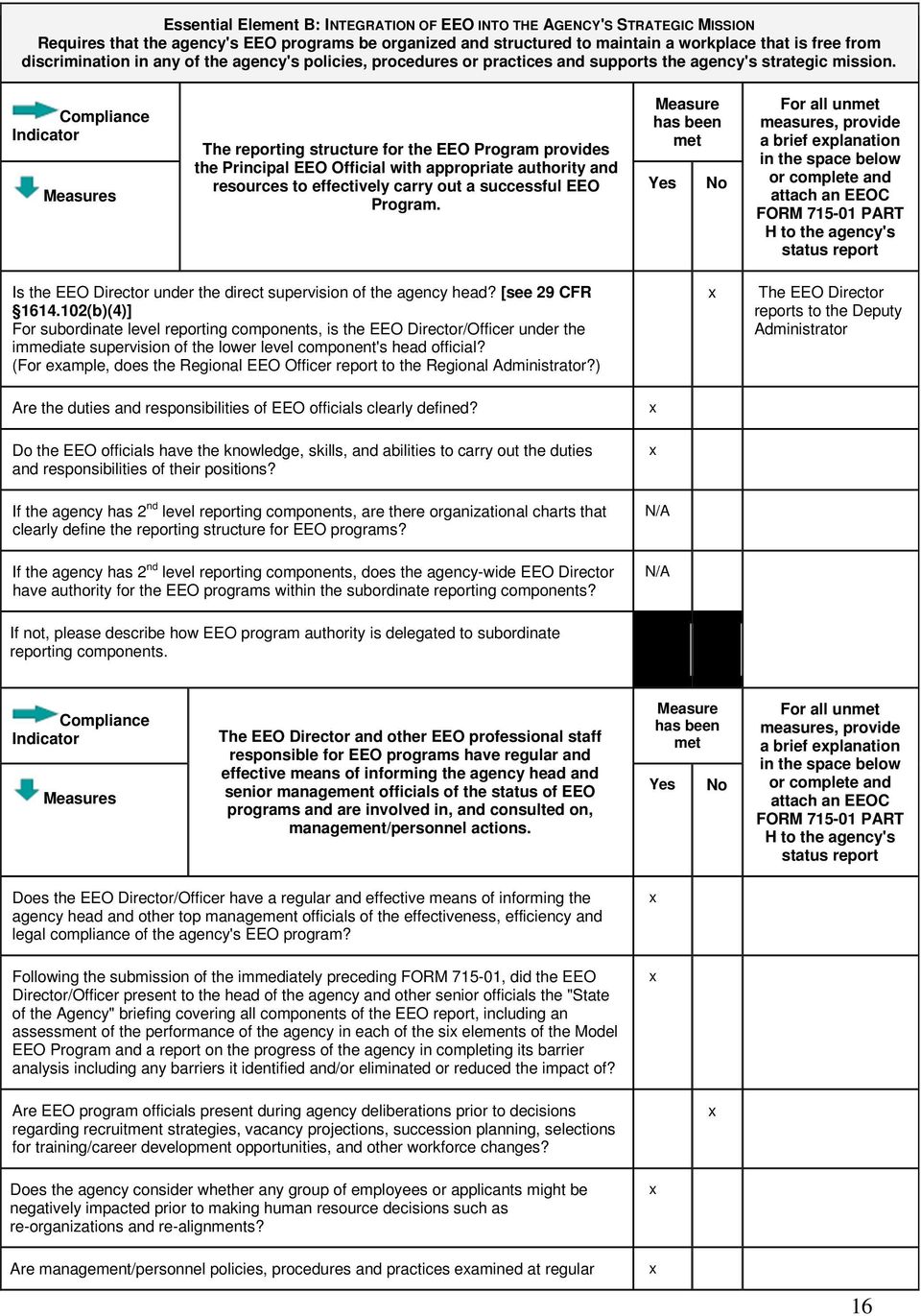
17 intervals to assess whether there are hidden impediments to the realization of equality of opportunity for any group(s) of employees or applicants? [see 29 C.F.R (b)(3)] Is the EEO Director included in the agency's strategic planning, especially the agency's human capital plan, regarding succession planning, training, etc., to ensure that EEO concerns are integrated into the agency's strategic mission? Compliance Indicator Measures The agency has committed sufficient human resources and budget allocations to its EEO programs to ensure successful operation. Measure has been met Yes No For all unmet measures, provide a brief eplanation in the space below or complete and attach an EEOC FORM PART H to the agency's status report Does the EEO Director have the authority and funding to ensure implementation of agency EEO action plans to improve EEO program efficiency and/or eliminate identified barriers to the realization of equality of opportunity? Are sufficient personnel resources allocated to the EEO Program to ensure that agency self-assessments and self-analyses prescribed by EEO MD-715 are conducted annually and to maintain an effective complaint processing system? Are statutory/regulatory EEO related Special Emphasis Programs sufficiently staffed? Federal Women's Program - 5 U.S.C. 7201; 38 U.S.C. 4214; Title 5 CFR, Subpart B, Hispanic Employment Program - Title 5 CFR, Subpart B, People with Disabilities Program Manager; Selective Placement Program for Individuals with Disabilities - Section 501 of the Rehabilitation Act; Title 5 U.S.C. Subpart B, Chapter 31, Subchapter I-3102; 5 CFR (t) and (u); 5 CFR Are other agency special emphasis programs monitored by the EEO Office for coordination and compliance with EEO guidelines and principles, such as FEORP - 5 CFR 720; Veterans Employment Programs; and Black/African American; American Indian/Alaska Native, Asian American/Pacific Islander programs? X Compliance Indicator Measures The agency has committed sufficient budget to support the success of its EEO Programs. Measure has been met Yes No For all unmet measures, provide a brief eplanation in the space below or complete and attach an EEOC FORM PART H to the agency's status report Are there sufficient resources to enable the agency to conduct a thorough barrier analysis of its workforce, including the provision of adequate data collection and tracking systems? 17

18 Is there sufficient budget allocated to all employees to utilize, when desired, all EEO programs, including the complaint processing program and ADR, and to make a request for reasonable accommodation? (Including subordinate level reporting components)? Has funding been secured for publication and distribution of EEO materials (e.g. harassment policies, EEO posters, reasonable accommodations procedures, etc.)? Is there a central fund or other mechanism for funding supplies, equipment and services necessary to provide disability accommodations? Does the agency fund major renovation projects to ensure timely compliance with Uniform Federal Accessibility Standards? Is the EEO Program allocated sufficient resources to train all employees on EEO Programs, including administrative and judicial remedial procedures available to employees? Is there sufficient funding to ensure the prominent posting of written materials in all personnel and EEO offices? [see 29 C.F.R (b)(5)] Is there sufficient funding to ensure that all employees have access to this training and information? Is there sufficient funding to provide all managers and supervisors with training and periodic up-dates on their EEO responsibilities: for ensuring a workplace that is free from all forms of discrimination, including harassment and retaliation? to provide religious accommodations? to provide disability accommodations in accordance with the agency's written procedures? in the EEO discrimination complaint process? to participate in ADR? Essential Element C: MANAGEMENT AND PROGRAM ACCOUNTABILITY This element requires the Agency Head to hold all managers, supervisors, and EEO Officials responsible for the effective implementation of the agency's EEO Program and Plan. Compliance Indicator Measures EEO program officials advise and provide appropriate assistance to managers/supervisors about the status of EEO programs within each manager's or supervisor's area or responsibility. Measure has been met Yes No For all unmet measures, provide a brief eplanation in the space below or complete and attach an EEOC FORM PART H to the agency's status report Are regular (monthly/quarterly/semi-annually) EEO updates provided to management/supervisory officials by EEO program officials? Do EEO program officials coordinate the development and implementation of EEO Plans with all appropriate agency managers to include Agency Counsel, Human Resource Officials, Finance, and the Chief Information Officer? 18
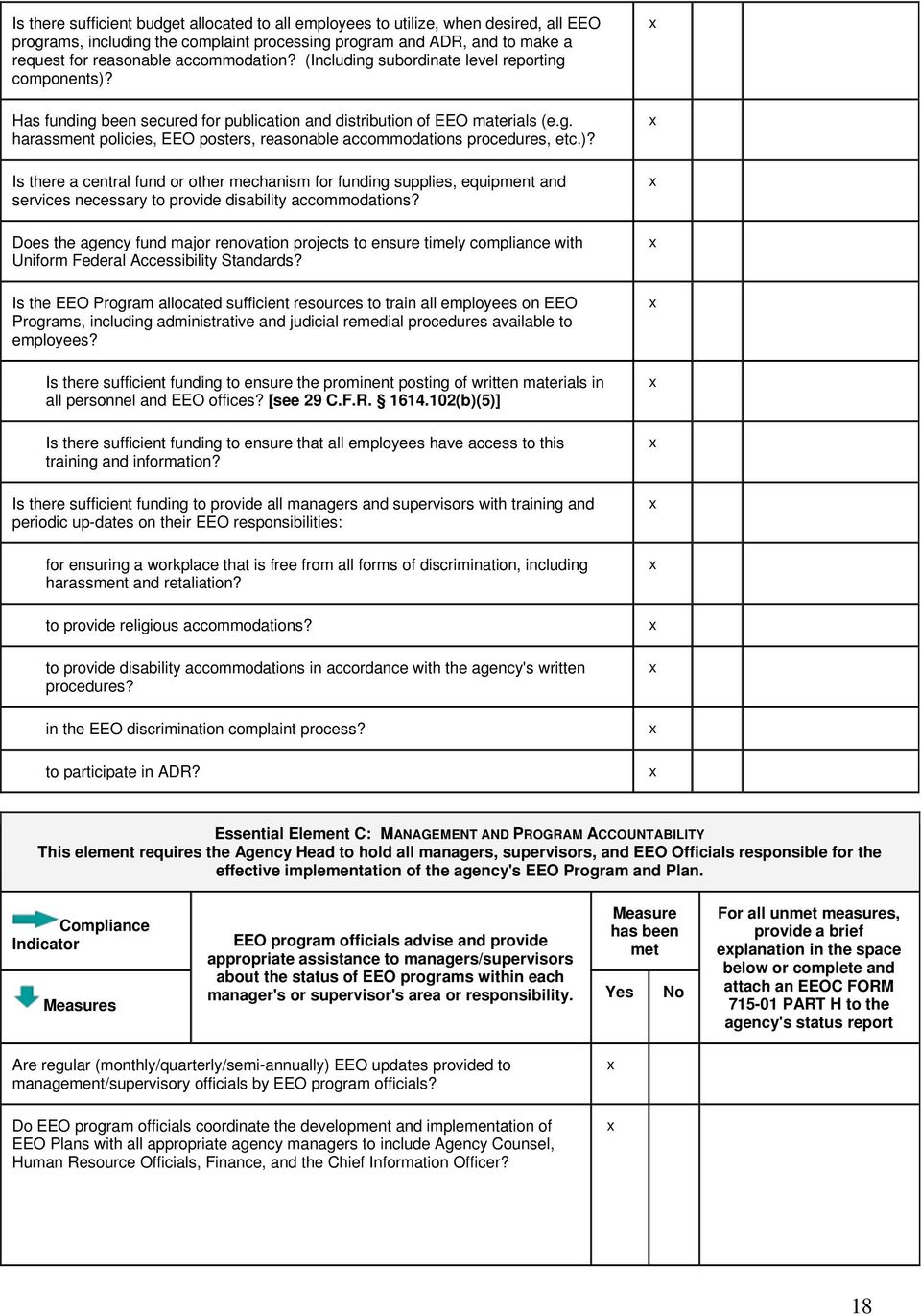
19 Compliance Indicator Measures The Human Resources Director and the EEO Director meet regularly to assess whether personnel programs, policies, and procedures are in conformity with instructions contained in EEOC management directives. [see 29 CFR (b)(3)] Measure has been met Yes No For all unmet measures, provide a brief eplanation in the space below or complete and attach an EEOC FORM PART H to the agency's status report Have time-tables or schedules been established for the agency to review its Merit Promotion Program Policy and Procedures for systemic barriers that may be impeding full participation in promotion opportunities by all groups? Have time-tables or schedules been established for the agency to review its Employee Recognition Awards Program and Procedures for systemic barriers that may be impeding full participation in the program by all groups? Have time-tables or schedules been established for the agency to review its Employee Development/Training Programs for systemic barriers that may be impeding full participation in training opportunities by all groups? Compliance Indicator Measures When findings of discrimination are made, the agency eplores whether or not disciplinary actions should be taken. Measure has been met Yes No For all unmet measures, provide a brief eplanation in the space below or complete and attach an EEOC FORM PART H to the agency's status report Does the agency have a disciplinary policy and/or a table of penalties that covers employees found to have committed discrimination? Have all employees, supervisors, and managers been informed as to the penalties for being found to perpetrate discriminatory behavior or for taking personnel actions based upon a prohibited basis? Has the agency, when appropriate, disciplined or sanctioned managers/supervisors or employees found to have discriminated over the past two years? No findings of discrimination have been made in the past two years. If so, cite number found to have discriminated and list penalty /disciplinary action for each type of violation. Does the agency promptly (within the established time frame) comply with EEOC, Merit Systems Protection Board, Federal Labor Relations Authority, labor arbitrators, and District Court orders? Does the agency review disability accommodation decisions/actions to ensure compliance with its written procedures and analyze the information tracked for trends, problems, etc.? Essential Element D: PROACTIVE PREVENTION Requires that the agency head makes early efforts to prevent discriminatory actions and eliminate barriers to equal employment opportunity in the workplace. Compliance Indicator Measures Analyses to identify and remove unnecessary barriers to employment are conducted throughout the year. Measure has been met Yes No For all unmet measures, provide a brief eplanation in the space below or complete and attach an EEOC FORM PART H to the agency's status report Do senior managers meet with and assist the EEO Director and/or other EEO 19
![102(b)(3)] Measure has been met Yes No For all unmet measures, provide a brief eplanation in the space below or complete and attach an EEOC FORM 715-01 PART H to the agency's status report Have](/docs-images/42/14150606/images/page_19.jpg "time-tables or schedules been established for the agency to review its Merit Promotion Program Policy and Procedures for systemic barriers that may be impeding full participation in promotion")
20 Program Officials in the identification of barriers that may be impeding the realization of equal employment opportunity? When barriers are identified, do senior managers develop and implement, with the assistance of the agency EEO office, agency EEO Action Plans to eliminate said barriers? Do senior managers successfully implement EEO Action Plans and incorporate the EEO Action Plan Objectives into agency strategic plans? Are trend analyses of workforce profiles conducted by race, national origin, se and disability? Are trend analyses of the workforce's major occupations conducted by race, national origin, se and disability? Are trends analyses of the workforce's grade level distribution conducted by race, national origin, se and disability? Are trend analyses of the workforce's compensation and reward system conducted by race, national origin, se and disability? Are trend analyses of the effects of management/personnel policies, procedures and practices conducted by race, national origin, se and disability? Compliance Indicator Measures The use of Alternative Dispute Resolution (ADR) is encouraged by senior management. Measure has been met Yes No For all unmet measures, provide a brief eplanation in the space below or complete and attach an EEOC FORM PART H to the agency's status report Are all employees encouraged to use ADR? Is the participation of supervisors and managers in the ADR process required? ADR is a voluntary process with strong encouragement to participate. Essential Element E: EFFICIENCY Requires that the agency head ensure that there are effective systems in place for evaluating the impact and effectiveness of the agency's EEO Programs as well as an efficient and fair dispute resolution process. Compliance Indicator Measures The agency has sufficient staffing, funding, and authority to achieve the elimination of identified barriers. Measure has been met Yes No For all unmet measures, provide a brief eplanation in the space below or complete and attach an EEOC FORM PART H to the agency's status report Does the EEO Office employ personnel with adequate training and eperience to conduct the analyses required by MD-715 and these instructions? Has the agency implemented an adequate data collection and analysis systems that permit tracking of the information required by MD-715 and these instructions? Applicant flow data and Schedule A appointments are not adequately tracked. New systems are planned for FY Have sufficient resources been provided to conduct effective audits of field 20
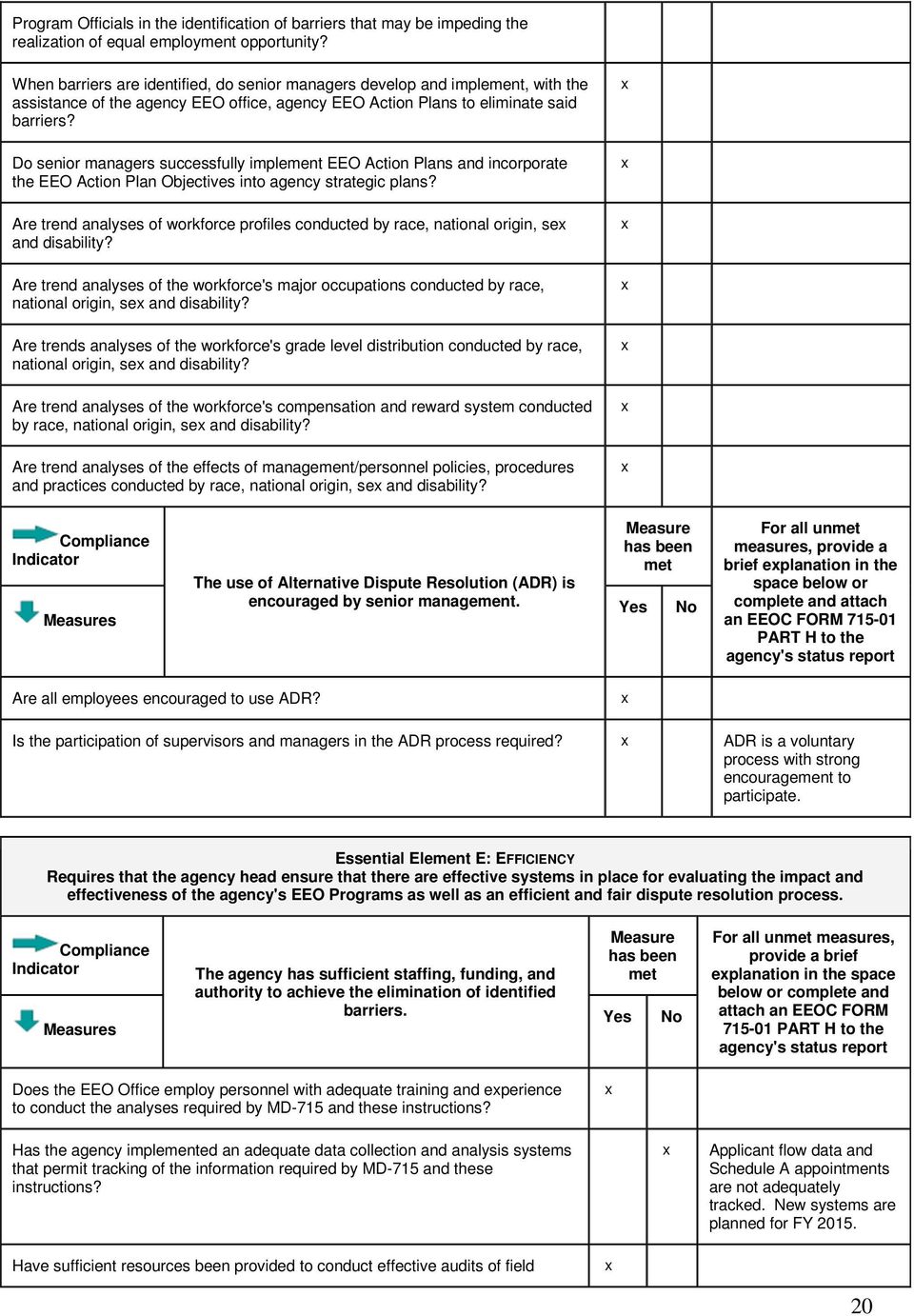
21 facilities' efforts to achieve a model EEO program and eliminate discrimination under Title VII and the Rehabilitation Act? Is there a designated agency official or other mechanism in place to coordinate or assist with processing requests for disability accommodations in all major components of the agency? Are 90% of accommodation requests processed within the time frame set forth in the agency procedures for reasonable accommodation? No, due to personnel changes. Compliance Indicator Measures The agency has an effective complaint tracking and monitoring system in place to increase the effectiveness of the agency's EEO Programs. Measure has been met Yes No For all unmet measures, provide a brief eplanation in the space below or complete and attach an EEOC FORM PART H to the agency's status report Does the agency use a complaint tracking and monitoring system that allows identification of the location and status of complaints and length of time elapsed at each stage of the agency's complaint resolution process? Does the agency's tracking system identify the issues and bases of the complaints, the aggrieved individuals/complainants, the involved management officials and other information to analyze complaint activity and trends? Does the agency hold contractors accountable for delay in counseling and investigation processing times? If yes, briefly describe how: Monitoring time frames and working with investigator to provide timely information and provide assistance when needed. Does the agency monitor and ensure that new investigators, counselors, including contract and collateral duty investigators, receive the 32 hours of training required in accordance with EEO Management Directive MD-110? Does the agency monitor and ensure that eperienced counselors, investigators, including contract and collateral duty investigators, receive the 8 hours of refresher training required on an annual basis in accordance with EEO Management Directive MD-110? Compliance Indicator Measures The agency has sufficient staffing, funding and authority to comply with the time frames in accordance with the EEOC (29 C.F.R. Part 1614) regulations for processing EEO complaints of employment discrimination. Measure has been met Yes No For all unmet measures, provide a brief eplanation in the space below or complete and attach an EEOC FORM PART H to the agency's status report Are benchmarks in place that compares the agency's discrimination complaint processes with 29 C.F.R. Part 1614? Does the agency provide timely EEO counseling within 30 days of the initial request or within an agreed upon etension in writing, up to 60 days? Does the agency provide an aggrieved person with written notification of his/her rights and responsibilities in the EEO process in a timely fashion? Does the agency complete the investigations within the applicable prescribed time frame? When a complainant requests a final agency decision, does the agency issue the decision within 60 days of the request? 21
22 When a complainant requests a hearing, does the agency immediately upon receipt of the request from the EEOC AJ forward the investigative file to the EEOC Hearing Office? When a settlement agreement is entered into, does the agency timely complete any obligations provided for in such agreements? Does the agency ensure timely compliance with EEOC AJ decisions which are not the subject of an appeal by the agency? Compliance Indicator Measures There is an efficient and fair dispute resolution process and effective systems for evaluating the impact and effectiveness of the agency's EEO complaint processing program. Measure has been met Yes No For all unmet measures, provide a brief eplanation in the space below or complete and attach an EEOC FORM PART H to the agency's status report In accordance with 29 C.F.R (b), has the agency established an ADR Program during the pre-complaint and formal complaint stages of the EEO process? Does the agency require all managers and supervisors to receive ADR training in accordance with EEOC (29 C.F.R. Part 1614) regulations, with emphasis on the federal government's interest in encouraging mutual resolution of disputes and the benefits associated with utilizing ADR? After the agency has offered ADR and the complainant has elected to participate in ADR, are the managers required to participate? Managers are strongly encouraged to participate. Does the responsible management official directly involved in the dispute have settlement authority? Compliance Indicator Measures The agency has effective systems in place for maintaining and evaluating the impact and effectiveness of its EEO programs. Measure has been met Yes No For all unmet measures, provide a brief eplanation in the space below or complete and attach an EEOC FORM PART H to the agency's status report Does the agency have a system of management controls in place to ensure the timely, accurate, complete and consistent reporting of EEO complaint data to the EEOC? Does the agency provide reasonable resources for the EEO complaint process to ensure efficient and successful operation in accordance with 29 C.F.R (a)(1)? Does the agency EEO office have management controls in place to monitor and ensure that the data received from Human Resources is accurate, timely received, and contains all the required data elements for submitting annual reports to the EEOC? Do the agency's EEO programs address all of the laws enforced by the EEOC? Does the agency identify and monitor significant trends in complaint processing to determine whether the agency is meeting its obligations under Title VII and the Rehabilitation Act? Does the agency track recruitment efforts and analyze efforts to identify potential barriers in accordance with MD-715 standards? 22
23 Does the agency consult with other agencies of similar size on the effectiveness of their EEO programs to identify best practices and share ideas? Compliance Indicator Measures The agency ensures that the investigation and adjudication function of its complaint resolution process are separate from its legal defense arm of agency or other offices with conflicting or competing interests. Measure has been met Yes No For all unmet measures, provide a brief eplanation in the space below or complete and attach an EEOC FORM PART H to the agency's status report Are legal sufficiency reviews of EEO matters handled by a functional unit that is separate and apart from the unit which handles agency representation in EEO complaints? Does the agency discrimination complaint process ensure a neutral adjudication function? If applicable, are processing time frames incorporated for the legal counsel's sufficiency review for timely processing of complaints? Essential Element F: RESPONSIVENESS AND LEGAL COMPLIANCE This element requires that federal agencies are in full compliance with EEO statutes and EEOC regulations, policy guidance, and other written instructions. Compliance Indicator Measures Agency personnel are accountable for timely compliance with orders issued by EEOC Administrative Judges. Measure has been met Yes No For all unmet measures, provide a brief eplanation in the space below or complete and attach an EEOC FORM PART H to the agency's status report Does the agency have a system of management control to ensure that agency officials timely comply with any orders or directives issued by EEOC Administrative Judges? Compliance Indicator Measures The agency's system of management controls ensures that the agency timely completes all ordered corrective action and submits its compliance report to EEOC within 30 days of such completion. Measure has been met Yes No For all unmet measures, provide a brief eplanation in the space below or complete and attach an EEOC FORM PART H to the agency's status report Does the agency have control over the payroll processing function of the agency? If Yes, answer the two questions below. Are there steps in place to guarantee responsive, timely, and predictable processing of ordered monetary relief? Are procedures in place to promptly process other forms of ordered relief? Compliance Indicator Measures Agency personnel are accountable for the timely completion of actions required to comply with orders of EEOC. Measure has been met Yes No For all unmet measures, provide a brief eplanation in the space below or complete and attach an EEOC FORM PART H to the agency's status report 23
24 Is compliance with EEOC orders encompassed in the performance standards of any agency employees? If so, please identify the employees by title in the comments section, and state how performance is measured. Is the unit charged with the responsibility for compliance with EEOC orders located in the EEO office? Applicable EEOC Orders along with other Orders applicable to the federal workforce are encompassed in the performance standards of federal employees and is pertinent, to anyone on or in our federal work place/s. If not, please identify the unit in which it is located, the number of employees in the unit, and their grade levels in the comments section. Have the involved employees received any formal training in EEO compliance? Does the agency promptly provide to the EEOC the following documentation for completing compliance: Attorney Fees: Copy of check issued for attorney fees and /or a narrative statement by an appropriate agency official, or agency payment order dating the dollar amount of attorney fees paid? Awards: A narrative statement by an appropriate agency official stating the dollar amount and the criteria used to calculate the award? Back Pay and Interest: Computer print-outs or payroll documents outlining gross back pay and interest, copy of any checks issued, narrative statement by an appropriate agency official of total monies paid? Compensatory Damages: The final agency decision and evidence of payment, if made? Training: Attendance roster at training session(s) or a narrative statement by an appropriate agency official confirming that specific persons or groups of persons attended training on a date certain? Personnel Actions (e.g., Reinstatement, Promotion, Hiring, Reassignment): Copies of SF-50s. Posting of Notice of Violation: Original signed and dated notice reflecting the dates that the notice was posted. A copy of the notice will suffice if the original is not available. Supplemental Investigation: 1. Copy of letter to complainant acknowledging receipt from EEOC of remanded case. 2. Copy of letter to complainant transmitting the Report of Investigation (not the ROI itself unless specified). 3. Copy of request for a hearing (complainant's request or agency's transmittal letter). Final Agency Decision (FAD): FAD or copy of the complainant's request for a hearing. Restoration of Leave: Print-out or statement identifying the amount of leave restored, if applicable. If not, an eplanation or statement. Civil Actions: A complete copy of the civil action complaint demonstrating same issues raised as in compliance matter. Settlement Agreements: Signed and dated agreement with specific dollar amounts, if applicable. Also, appropriate documentation of relief is 24
25 provided. Footnotes: 1. See 29 C.F.R When an agency makes modifications to its procedures, the procedures must be resubmitted to the Commission. See EEOC Policy Guidance on Eecutive Order 13164: Establishing Procedures to Facilitate the Provision of Reasonable Accommodation (10/20/00), Question
26 EEOC FORM PART H U.S. Equal Employment Opportunity Commission FEDERAL AGENCY ANNUAL EEO PROGRAM STATUS REPORT U.S. Department of Energy, Bonneville Power Administration FY 2014 STATEMENT of MODEL PROGRAM ESSENTIAL ELEMENT DEFICIENCY: Essential Element A: Demonstrated Commitment from Agency Leadership Requires the Agency leadership to issue written policy statements epressing commitment to Equal Employment Opportunity (EEO) and a workplace free of discriminatory harassment. Compliance indicators: EEO Policy statements are up-to-date EEO Policy statements have been communicated to all employees BPA s EEO and Non-Discrimination Policy is vigorously enforced by Management OBJECTIVE: Technical Assistance Visit (TAV) Recommendations letter issued September 19, 2013, after review BPA s FY 2011 MD-715 Report and in response to OIG Report in August 2013: The Equal Employment Opportunity Commission, Office of Federal Operations, Federal Sector Programs conducted a technical assistance (TA) with BPA via teleconference on April 18, 2013, on the FY 2011 MD-715 Report which was the latest report that had been submitted to the EEOC. The purpose of the TA telecom was to discuss BPA s progress in developing a model EEO Program in accordance with each of the Management Directive 715 s si essential elements. On September 19, 2013, BPA received a letter summarizing the issues raised during that meeting and referenced the OIG Management Alert which was issued in July One of the recommendations under this element is to address and issue policies and procedures for addressing all forms of harassment and must create a work environment that is free from seual and non-seual harassment. A copy of BPA s Harassment-Free Workplace Policy and Guidance was included as an appendi to the FY 2011 MD-715 Report. The September 19, 2013, TA Letter required BPA to provide an update to its recommendation. Below is BPA s response to this request: RESPONSIBLE OFFICIAL: Administrator/Chief Eecutive Officer, Deputy Administrator, Civil Rights and EEO Manager DATE OBJECTIVE INITIATED: 09/19/2013 TARGET DATE FOR COMPLETION OF OBJECTIVE: 09/30/2015 PLANNED ACTIVITIES TOWARD COMPLETION OF OBJECTIVE: October 1, 2015 TARGET DATE (Must be specific) As a result of the DOE-IG Audit in FY 2013, the Deputy Administrator ordered a review of all of BPA s Compliance Programs including the Harassment-Free Workplace Policy (HFWP). The results of the Compliance Review will be provided in FY 2014 REPORT OF ACCOMPLISHMENTS and MODIFICATIONS TO OBJECTIVE The Deputy Administrator requested a Compliance Review of all BPA services where-in employees report concerns. A review of the BPA s internal Harassment-Free Workplace Policy was slated to begin in FY 2014 and was moved to FY A team has been formed and will begin reviewing the original purpose of the policy and may include revising the policy. Full details will be provided in the FY 2015 EEO Program Status Report. All forms of harassment are covered by BPA s EEO and Non-Discrimination Policy and are located in BPA Manual Chapter 400/713C. This policy is posted on BPA s internal and eternal websites. 26
27 In January 2014, at the Deputy Administrator s direction, the Ombuds, who reports directly to the Deputy Administrator, was tasked with putting together a team of BPA service providers who handle concerns from both employees and contract workers. In January 2014, the Positive Work Environment Team was created. The BPA team consists of the Ombudsman, Employee Assistance Program Staff Psychologist (EAP), the lead EEO Counselor and the Formal Complaints Manager all neutral parties whose job is to resolve concerns at the lowest level. Additional members include a representative from the BPA Hotline and from Employee Relations (a management resource). A charter was developed and provided to BPA Deputy Administrator, CEO/Administrator and to the Chief Operating Officer in April The purpose/role of the Positive Work Environment Team is to: Support Elliot Mainzer s (CEO/Administrator) goal of a workplace free from harassment, retaliation and intimidation. Raise issues to the appropriate level; notification of hot spots, coordinate services, support each other; share lessons learned; track progress; provide education to the workforce; and market our programs. In February 2014, the CEO/Administrator tasked BPA s Acting Chief Compliance Officer to conduct an audit of BPA s Employee Concerns Channels (ECC). The channels and processes reviewed were Ombudsman, EAP, Informal EEO Counseling, Formal EEO Complaints, BPA Hotline and Employee Relations (management resource). An ECC written report was provided to the Administrator on August 26, 2014, and a PowerPoint briefing was conducted in September 2014 to the CEO/Administrator, Deputy Administrator, Chief Operating Officer, Civil Rights and EEO, Human Capital Management, the service providers from the si channels. A FY 2014 Fourth Quarter Report from the Employee Concerns Channels was provided to the CEO/Administrator, Deputy Administrator and Chief Operating Officer. Talent Management Strategy The Talent Management Strategy is fully identified under Element A. Element B will discuss the Get-Well Plan and the accomplishments made in FY With collaboration across HCM, eecutives, and leaders throughout the Agency, the Talent Management Strategy was updated for It outlines the approach BPA will take to achieve its workforce objectives of Right Size and Composition, Right Skills and Competencies, and Positive Work Environment. The Strategy provides an updated overview of these three workforce objectives in the contet of BPA s current strategic environment, an outline of the risks the Agency faces in achieving those objectives, and an approach to mitigating the top risks over the net 5 to 7 years. Through this Strategy, the Agency will focus on implementing initiatives in three priority areas for the foreseeable future: Drive High Performance Acquire Ready Talent Strengthen Internal Talent Bench In April 2014, a report was issued to BPA Managers titled Briefing Material and BPA Connection Reference Mission Critical Occupations. Overview The objective of this effort was to identify the Mission Critical Occupations (MCOs) that serve BPA for the purpose of developing an enterprise-wide Strategic Workforce Plan by the end of FY An important step in this effort was to decide how to conceptualize mission criticality. Per the Office of Personnel Management (OPM), mission critical occupations are defined as: Occupations agencies consider core to carrying out their missions. Such occupations usually reflect the primary mission of the organization without which mission-critical work cannot be completed 1. Therefore, BPA s MCO is defined as an occupation which carries out work activities most closely connected to the core functions that fulfill BPA s mission. In alignment with this definition, we sought to identify those positions within BPA that were most closely connected to the core functions that fulfill BPA s mission. This method includes both a short-term business continuity and long-term strategic perspective. In addition, we sought to define the impact MCOs had on each of BPA s core functions, as well as the role that each position played in helping deliver core functions. As part of this process, BPA has: Developed a critical function framework Developed a rating scale used to assess the impact of occupations on critical functions Developed a methodology for collecting the occupational data Used these tools to define the Mission Critical Occupations for BPA in FY A copy of this document is included in the appendi. In September 2014, a Mission Critical Occupations and Workforce Treatment Plans for FY 2015 were issued. In FY 2014, BPA has had limited delegated hiring authority and Human Capital resources were focused on meeting required milestones in the BPA and DOE Get Well Plan to regaining hiring authority. Given those constraints, the workforce planning approach this year was to identify Mission Critical Occupations (MCO) at BPA. The first phase of the MCO identification was intensifying BPA s core functions. This plan provides an overview of how BPA will work towards mitigating risks to the workforce specifically around occupations that have been identified as the most critical to BPA s mission. The goal of this installment of the BPA Workforce Plan is to provide Human Capital Management (HCM), the eecutive leadership team, managers and supervisors with recommendations that will ensure BPA had the workforce it needs to deliver on BPA s strategic business objectives. See appendi for a full copy of the FY 2015 Mission Critical Occupations and Workforce Treatment Plans and a list of MCO s which are unique and identified by organization
28 EEOC FORM PART H U.S. Equal Employment Opportunity Commission FEDERAL AGENCY ANNUAL EEO PROGRAM STATUS REPORT U.S. Department of Energy, Bonneville Power Administration FY 2014 STATEMENT of MODEL PROGRAM ESSENTIAL ELEMENT DEFICIENCY: OBJECTIVE: Essential Element B: Integration of EEO into the Agency s Strategic Mission Requires BPA s EEO and Civil Rights programs to be organized and structured to maintain a workplace that is free from discrimination in any of the agency s policies, procedures or practices, and support the agency s strategic mission. Compliance Indicators: The reporting structure for the EEO Program provides the EEO and Civil Rights Manager with appropriate authority and resources to effectively carry out a successful EEO program. The EEO and Civil Rights Manager and other EEO Specialists responsible for EEO programs have regular and effective means of informing the Administrator and senior management offices of the status of the EEO Programs and are involved in, and consulted on, management/personnel actions. BPA has committed sufficient staff, resources, and budget allocations to its EEO programs to ensure successful operation. BPA reported on this objective in the MD-715 FY 2013 Eecutive Summary and it was stated that future reporting would be placed in Part H in future reports starting with FY EEOC s Technical Assistant Visit Recommendations Letter issued September 19, 2013, after review BPA s FY 2011 MD-715 and in response to Office of Inspector General (OIG) Report in August 2013: EEO Manager reports directly to the Head of the Agency In the EEOC s September 19, 2013, Technical Assistant Visit letter it emphasized that the role of the EEO Office is to serve as a resource to agency managers by providing direction, guidance and monitoring of key activities to achieve a diverse workplace free from barriers to equal employment opportunity. EEOC regulations establish that the EEO Manager shall be under the immediate supervision of the agency head. See 29 CFR (b) (4). EEOC s MD-110 eplains that by placing the EEO Manager in a direct reporting relationship to the head of the agency, the agency underscores the importance of EEO to the mission of each federal agency and ensures that the EEO Mangers is able to act with the greatest degree of independence. BPA s Get-Well Plan In 2012, the U.S. Department of Energy s (DOE) OIG received an anonymous complaint alleging prohibited personnel practices at BPA. The OIG informed DOE that it had also received a similar complaint. On April 2, 2013, DOE Human Capital (DOE-HC) took a series of actions which required BPA to submit all cases involving delegated eamining hiring for review and concurrence. On April 22 through 26, 2013, DOE HC participated in an Office of Personnel Management (OPM) independent audit of BPA s hiring practices. RESPONSIBLE OFFICIAL: Godfrey C. Beckett, Manager, Civil Rights and Equal Employment Opportunity Brian Carter, Human Resources Director DATE OBJECTIVE INITIATED: September 19, 2013 TARGET DATE FOR COMPLETION OF OBJECTIVE: FY PLANNED ACTIVITIES TOWARD COMPLETION OF OBJECTIVE: TARGET DATE (Must be specific) October 1, 2014 The reporting structure for the EEO Program is to the Agency Head and provides the Principal EEO Official with appropriate authority and resources to effectively carry out a successful EEO Program. October 1, 2014 Develop a plan to ensure the Civil Rights and EEO Manager will deliver future briefings directly to the Administrator and to include the dates of such briefings in future MD-715 Reports. October 1, 2014 Report out on BPA s Get-Well Project Plan developed in May
29 REPORT OF ACCOMPLISHMENTS and MODIFICATIONS TO OBJECTIVE The reporting structure for the EEO Program is to the Agency Head and provides the Principal EEO Official with appropriate authority and resources to effectively carry out a successful EEO Program. Although, BPA s Civil Rights and EEO Manager did not report directly to the agency head (BPA s Administrator and CEO), he does have complete access to the agency head and agency eecutive leadership. In FY 2014, the Civil Rights and EEO Manager continued to report to the Chief Compliance Officer. In FY 2015, the Civil Rights and EEO Manager will report to the Deputy Administrator and will also be a member of BPA s Eecutive Team. He has full access to the Chief Eecutive Officer and to the Chief Operating Officer. Together with the direct reporting structure, the presentation of the state-of-the agency briefing directly to the CEO is a key component of ensuring integration of EEO into the agency s strategic mission. The Civil Rights and EEO Manager will provide a briefing to the current Administrator and CEO (Elliot Mainzer) when the FY 2014 MD-715 Report is submitted for signature. BPA s Get-Well Plan Update: On May 24, 2013, BPA s hiring authority was temporarily suspended as a result of the DOE OIG and OPM Audits. BPA developed a Get-Well Project Plan identifying the audits completed, the results of those audits, and an action plan to bring the HCM Office to full compliance with all applicable laws and regulations, as well as DOE policies. All authorities have been regained as of September 30, In FY 2013, due to the OIG and OPM audits, the contract for a new Talent Acquisition system was suspended. In FY 2014, BPA moved to using USA Jobs for all of its recruitment efforts. 29
30 EEOC FORM PART H U.S. Equal Employment Opportunity Commission FEDERAL AGENCY ANNUAL EEO PROGRAM STATUS REPORT U.S. Department of Energy, Bonneville Power Administration FY 2014 STATEMENT of MODEL PROGRAM ESSENTIAL ELEMENT DEFICIENCY: Essential Element C: Management and Program Accountability Requires the Agency Leadership to hold all managers, supervisors and EEO Officials responsible for the effective implementation of the agency s EEO Program. Compliance Indicators: EEO and Civil Rights Manager advises and provides appropriate assistance to managers/supervisors about the status of EEO Programs within their area of responsibility. The EEO and Civil Rights Manager and the Human Capital Management Director meets regularly to assess whether personnel programs, policies, and procedures are in conformity with BPA s Model EEO Program, as well as Equal Employment Opportunity Commission regulations and management directives. [See 29 CFR (b)(3)]. When findings of discrimination are made, the agency determines the appropriateness of taking disciplinary action. OBJECTIVE: TAV Recommendations Letter issued September 19, 2013, after review of BPA s FY 2011 MD-715 and in response to OIG Report in August 2013: In EEOC s TAV letter they made the following recommendation: The Office of Inspector General also found practices that appeared to have effectively disadvantaged veterans and other applicants. We therefore recommend that BPA review its recruitment and hiring policies, practices, and procedures to ensure they do not hinder any EEO groups from obtaining employment or impeded their career opportunities. In the Eecutive Summary or in Part I of its net MD-715 Report, we epect BPA to provide the status of its efforts to address the Office of Inspector General s (OIG) findings. TAV Recommendations Letter issued September 19, 2013, after review BPA s FY 2011 MD-715 and in response to OIG Report in August 2013: In EEOC s TAV letter they made the following recommendation: Provide a copy of BPA s updated Reasonable Accommodation Policy and Procedures to EEOC for review. EEOC will review the Policy and Procedures to ensure that they reflect current law. In particular, the procedures should reflect the change in the definition of individual with a disability contained in the Americans with Disabilities Amendment Act of 2008 and ensure that requests for medical documentation are not so broad as to constitute requests for genetic information in violation of the Genetic Information Nondiscrimination Act of Once BPA issues the revised procedures, the agency should provide refresher training to its managers and supervisors and ensure that its procedures are available to employees and applicants. To the etent that it has not already done so, we urge BPA to post the revised procedures on its eternal website. RESPONSIBLE OFFICIAL: Godfrey Beckett, Civil Rights and EEO Manager Brian Carter, Human Resources Director DATE OBJECTIVE INITIATED: September 2013 TARGET DATE FOR COMPLETION OF OBJECTIVE: October 1, 2014 PLANNED ACTIVITIES TOWARD COMPLETION OF OBJECTIVE: October 1, 2014 BPA to provide the status of its efforts to address the Office of Inspector General s (OIG) findings. BPA Civil Rights and EEO Office will coordinate with the Talent Sustainment Manager to post the RA Policy and Procedures on the eternal website and report on this in the net MD-715 Report. REPORT OF ACCOMPLISHMENTS and MODIFICATIONS TO OBJECTIVE Reasonable Accommodation Program Internally: Information about the Reasonable Accommodation Program is posted on BPA s Be Well Program internal webpage as well as on the Civil rights and EEO website. Updates to the Wellness Program are provided to BPA Managers and Supervisors through BPA on- 30
31 line Manager s Resources Internal Webpage. There is a dedicated Outlook mailbo at [email protected] to submit the forms and/or to ask questions. The telephone number for the RA Coordinator was also provided (503) A copy of BPA s Reasonable Accommodation Policy and Procedures was included in the FY 2013 Report. A copy of the policy and flow chart were also provided to Karen Page, EEOC, prior to a teleconference held on December 2, 2014, to respond to EEOC-Federal Complement Plan RFI and Meeting Invitation. BPA has not received any comments or recommendations from EEOC for this policy as of the writing of the FY 2014 Report. As soon as those comments and recommendations are received from EEOC, BPA will look to incorporate as appropriate those comments and recommendations into BPA s RA Policy and Procedures and will distribute and provide training as needed. Eternally: The following information is posted on BPA s eternal website: Accessibility The Bonneville Power Administration is committed to providing access to our Web pages for individuals with disabilities. To meet this commitment, this site is built to comply with the requirements of Section 508 of the Rehabilitation Act. Section 508 requires that individuals with disabilities, who are members of the public seeking information or services from us, have access to and use of information and data that is comparable to that provided to the public who are not individuals with disabilities, unless an undue burden would be imposed on us. Section 508 also requires us to ensure that Federal employees with disabilities have access to and use of information and data that is comparable to the access to and use of information and data by Federal employees who are not individuals with disabilities, unless an undue burden would be imposed on us. In FY 2014, in addition to the on-line information, Talent Sustainment under the Be Well Program continues to provide a series of forums and seminars on various topics: retirement, stress management, healthy eating and eercise, Office of Workers Compensation, Reasonable Accommodation, stress relief and many others. In FY 2014, BPA completed creation of a lactation room for new mothers to use during their working hours at the Portland headquarters office. Because BPA has shift workers, access is allowed 24/7. The room is located in BPA s health Unit. All of the behind the scenes requirements of security and other issues have been completed. Future plans include a lactation room at other BPA facilities. BPA to provide the status of its efforts to address the Office of Inspector General s (OIG) findings. Human Resource Director Brain Carter released two updates in FY 2014 regarding the accomplishments BPA has done to address the OIG Findings. The July 21, 2014, Eecutive Corner Article (copy in the appendi), states HCM had made significant progress in our recovery efforts that will allow us to increasingly refocus our energy and attention toward having the right people, in the right places, and at the right time. On May 31, 2014, HCM completed the reconstruction of 1,259 hiring cases through a team effort with BPA HCM Staff, DOE s Human Capital Office staff and contracted support from the Office of Personnel Management. 22,000 job applications were reviewed during this process. BPA s HCM Staff had the primary responsibility for reconstructing 856 internal cases, while DOE and OPM reconstructed the 403 eternal cases. All cases went through an additional quality review at DOE before final dispositions were determined. Note: only 9 percent of the eternal cases (and less than 3 percent of the total cases) resulted in priority placement offers being made. On July 7, 2014, BPA went live with the use of the DOE Hiring Management System. HCM staff have received training using this system and operated in a test environment with test scenarios for few weeks before they went to the live system. BPA s strategic business partners will be working with the organization leaders to prioritize the recruit requests to fill the most critical positions first. All jobs will be posted to USAJOBS.gov. The eception to this rule is internal temporary actions, i.e., temporary promotions and detail assignments. BPA transitioned to using DOE s eperformance management system and began using this system in early FY Succession planning is another key topic; a succession planning toolkit for managers was developed and rolled out to managers in August A pilot eecutive succession planning program was also rolled out and results will be identified in the FY 2015 MD-715 Report. On September 3, 2014, the net step in HCM s Get-Well Plan was released. As a result of the reconstruction process, BPA etended priority placement to 135 applicants and have hired approimately 70 new employees almost all of whom are military veterans. The reconstruction process identified both military veterans and non-veterans who were due priority consideration. The priority consideration process is a part of the hiring process. Both the July 21, 2014, and the September 3, 2014, Get-Well Plan articles are included in the appendi. DOE HC determined that the personnel processing, retirements and benefits, work/life programs, staffing and classification functions, employee development and training programs, performance management review programs, and employee and labor relations were deficient in some way. All of these issues have been resolved through the process of returning authorities. All authorities were returned as of September 30,
32 EEOC FORM PART H U.S. Equal Employment Opportunity Commission FEDERAL AGENCY ANNUAL EEO PROGRAM STATUS REPORT U.S. Department of Energy, Bonneville Power Administration FY 2014 STATEMENT of MODEL PROGRAM ESSENTIAL ELEMENT DEFICIENCY: Essential Element D: Proactive Prevention Requires the Agency Leadership to make early efforts to prevent discrimination actions and eliminate barriers to equal employment opportunity in the workplace. Compliance Indicators: Analyses to identify and remove unnecessary barriers to employment are conducted throughout the year. The use of Alternative Dispute Resolution (ADR) is encouraged by senior management. OBJECTIVE: Conduct barrier analysis and identify barriers to employment. All management officials including senior management to utilize Alternative Dispute Resolution. RESPONSIBLE OFFICIAL Godfrey Beckett, Civil Rights and EEO Manager Brian Carter, Human Resources Director DATE OBJECTIVE INITIATED: 09/13/2013 TARGET DATE FOR COMPLETION OF OBJECTIVE FY PLANNED ACTIVITIES TOWARD COMPLETION OF OBJECTIVE 10/1/2015 EEOC-OFO stated, According to BPA s FY 2011 Form 462, BPA did not offer ADR during the precomplaint stage; however, in FY 2012, the pre-complaint offer and participation rates were 14.29%. During our meeting, we learned that BPA strongly encourages its managers/supervisors to participate when the agency offers ADR, but does not require them to do so. We epect BPA to develop a plan addressing this deficiency in Part H of its net MD-715 Report. 10/1/2016 Barrier Analysis: We also noted that BPA has not established a hiring goal of 2% for people with targeted disabilities (PWTD) in Part J of its FY 2011 MD-715 Report. We suggest BPA create a plan to hire 38 additional PWTD in order to achieve 2% of its total workforce [3121 FY 2011 total]. BPA will also consider implementing the following proactive measures: (1) include the goal to increase representation of employees with targeted disabilities in performance standards of managers and supervisors; (2) hold managers and supervisors accountable for meeting the hiring goal. Progress on conducting further barrier analysis and implementing its plan shall be included in Parts I and J of its net MD-715 Report. 10/1/2015 Include in data tables A and B12, and in tables A/B 7, 9, and 11, the titles of the major occupations for which it was hiring. 10/1/2016 BPA shall conduct an in-depth barrier analysis of the policies, procedures, or practices pertaining to its recruitment and hiring of White women as well as the workforce conditions that encourage white women to leave the agency. In Part I of its net MD-715 report, we look forward to reviewing BPA s progress in conducting barrier analysis to identify potential barriers for women in its workplace. 32
33 EEOC FORM PART H U.S. Equal Employment Opportunity Commission FEDERAL AGENCY ANNUAL EEO PROGRAM STATUS REPORT U.S. Department of Energy, Bonneville Power Administration FY 2014 STATEMENT of MODEL PROGRAM ESSENTIAL ELEMENT DEFICIENCY: Essential Element E: Efficiency Requires Agency Leadership to have an efficient and fair dispute resolution process and effective systems for evaluating the impact and effectiveness of its EEO Programs. Compliance Indicators: BPA has sufficient staffing, funding, and authority to achieve the elimination of identified barriers. BPA has an effective complaint tracking and monitoring system in place to increase the effectiveness of the agency s EEO Programs. BPA has sufficient staffing, funding, and authority to comply with the time frames in accordance with the EEOC (29 CFR 1614) regulations for processing EEO complaints of employment discrimination. There is an efficient and fair dispute resolution process and effective systems for evaluating the impact and effectiveness of the agency s EEO complaint processing program. OBJECTIVE: Timely submittal of Agency s 462 Report; timely completion of No FEAR Act Training RESPONSIBLE OFFICIAL: Godfrey Becket, Civil Rights and Equal Employment Opportunity Manager DATE OBJECTIVE INITIATED: TARGET DATE FOR COMPLETION OF OBJECTIVE: September 19, 2013 October 1, 2015 PLANNED ACTIVITIES TOWARD COMPLETION OF OBJECTIVE: October 1, 2015 The agency failed to timely submit its FY 2011 No FEAR Act report. The EEO Director informed us that the timely submission of its No FEAR Act report rests with the DOE s Office of Civil Rights. Nevertheless, in Part H of the net MD-715 report, we epect BPA to coordinate with DOE in creating a plan to submit this report in a timely manner. REPORT OF ACCOMPLISHMENTS and MODIFICATIONS TO OBJECTIVE BPA s EEO program met all Compliance Indicators and Measures for Essential Element F which requires that federal agencies are in full compliance with EEO statutes and EEOC regulations, policy guidance and other written instructions. BPA now takes the No FEAR Act Training through the Department of Energy s On-line Training Center. The Civil Rights and EEO office has a system in place to ensure timely compliance with any orders or directives issued by Equal Employment Opportunity Commission s (EEOC) Administrative Judges. BPA manages its system of management controls to ensure that the agency timely completes all ordered corrective actions and submits its compliance report to EEOC within 30 days of such completion. The Civil Rights and EEO Manager participated with the DOE Civil Rights Office in a Civil Rights Act Title IX review of university programs. Half of the staff has now earned certifications from the Society for Corporate Compliance & Ethics. DOE has now required that BPA take the No FEAR Act and Seual Harassment Prevention annual courses through DOE s Online Learning Center. In FY 2014, the agency saw a high compliance rate of 98.6% for the annual required EEO Rights & Responsibilities Training which includes Anti-Harassment and No Fear Act training. BPA continues to enter its No FEAR Act Report through EEOC s FEDSEP Portal. This Portal allows BPA s report to be uploaded into the 33
34 Department of Energy s overall report for timely reporting purposes. EEOC FORM PART H U.S. Equal Employment Opportunity Commission FEDERAL AGENCY ANNUAL EEO PROGRAM STATUS REPORT U.S. Department of Energy, Bonneville Power Administration FY
35 STATEMENT of MODEL PROGRAM ESSENTIAL ELEMENT DEFICIENCY: Essential Element F: Responsiveness and Legal Compliance Requires that BPA is in full compliance with EEO statutes and EEOC regulations, policy guidance, and other written instructions. Compliance Indicators: BPA personnel are accountable for timely compliance with orders issued by EEOC Administrative Judges. BPA s system of management controls ensures that the agency timely completes all ordered corrective actions and submits its compliance report to EEOC within 30 days of completion. OBJECTIVE: Timely compliance with EEOC Orders and submittal of compliance report with 30 days of completion. RESPONSIBLE OFFICIAL: Judy Rush, Formal Complaint Manager DATE OBJECTIVE INITIATED September 19, 2013 TARGET DATE FOR COMPLETION OF OBJECTIVE: October 1, 2015 PLANNED ACTIVITIES TOWARD COMPLETION OF OBJECTIVE: Weekly Monitor and track incoming EEOC orders to complete by identified timeframes REPORT OF ACCOMPLISHMENTS and MODIFICATIONS TO OBJECTIVE BPA s Formal Complaint Manager tracks and monitors all EEOC Orders and completes them within the established timeframes. The U.S. Department of Energy Civil Rights Office is responsible for issuing the Final Agency Decisions; however these are also tracked by BPA s Formal Complaint s Manager to ensure they are timely completed. In FY 2014, BPA issued one compliance report for DOE Case BPA which was completed within the requested 30-day timeframe. EEOC FORM PART I U.S. Equal Employment Opportunity Commission FEDERAL AGENCY ANNUAL EEO PROGRAM STATUS REPORT U.S. Department of Energy, Bonneville Power Administration FY 2014 STATEMENT OF CONDITION THAT WAS A TRIGGER September 19, 2013, EEOC Technical Assistance Visit Women in BPA Permanent Workforce: When analyzing its workforce, the category of women overall should be 35
36 FOR A POTENTIAL BARRIER: Provide a brief narrative describing the condition at issue. broken out into subgroups of Hispanic Women, White Women, African American or Black Women, Asian Women, Native Hawaiian or Other Pacific Islander Women, American Indian or Alaska Native Women, and Women of two or More Races. How was the condition recognized as a potential barrier? BARRIER ANALYSIS: Provide a description of the steps taken and data analyzed to determine cause of the condition. STATEMENT OF IDENTIFIED BARRIER: Review current statistical reports to identify possible triggers. Take, review and refine compulsory snapshots; take additional snapshots if needed. Review all other information sources and analyze all employment processes. Investigate barriers to pinpoint root causes of observed triggers through requests for information that flows from the identified triggers, review pertinent documents and consult with knowledgeable individuals. Create a plan to address barrier causes; determine whether barriers are job-related and consistent with business necessity. If not, plan to eliminate those barriers. Consider modifications even where barriers are non-job-related and consistent with business necessity. Assess results and success of the plan. Track progress; should be measurable. Hold agency officials accountable. Conduct periodic reassessments to adjust plan as necessary. In the category of women, are the subgroups of Hispanic Women, White Women, African American or Black Women, Asian Women, Native Hawaiian or other Pacific Islander Women, American Indian or Alaska Native Women, and Women of two or more Races adequately represented? Provide a succinct statement of the agency policy, procedure or practice that has been determined to be the barrier of the undesired condition. OBJECTIVE: Complete an independent barrier analysis for each subgroup of Women in Tables A1. State the alternative or revised agency policy, procedure or practice to be implemented to correct the undesired condition. RESPONSIBLE OFFICIAL: DATE OBJECTIVE INITIATED: TARGET DATE FOR COMPLETION OF OBJECTIVE: Federal Women s Program Manager September 19, 2013 October 1, 2015 EEOC FORM PART I EEO Plan To Eliminate Identified Barrier PLANNED ACTIVITIES TOWARD COMPLETION OF OBJECTIVE: TARGET DATE (Must be specific) Breakout subgroups of Table A1 for FY /1/
37 Identify Triggers for potential barriers by selecting a random sampling of selections made in FY 2015 and analyze all of the employment processes involved with these selections 10/1/2015 Investigate all barriers and pinpoint root causes of observed triggers develop requests for information which flow from triggers; review pertinent documents, consult knowledgeable individuals Create Action Plans to address barrier causes, determined if barriers are job-related and consistent with business necessity, if not, develop plan to eliminate barrier. Consider modifications where barriers are job-related and report plan and progress to EEOC annually 10/1/ /1/2015 Assess success of the plan, track progress, hold agency officials accountable, conduct periodic re-assessments to discover if plan needs adjusting 12/1/2015 Report Of Accomplishments and Modifications To Objective: The MD-715 Reports FY 2013 Eecutive Summary contained break outs of Women in the Permanent Workforce by subgroups and identifies representation levels relating to BPA Total Workforce compared to Civilian Labor Force (CLF) Table A1. The Eecutive Summary also included a break out by Participation Rates for Major Occupations (Table A6) for all EEO groups further broken out by men and women in the subgroup categories in Participation Rate for Major Occupations Table A6. Due to the Get-Well Plan Reconstruction in FY 2014 this was not accomplished as hires were limited to those of priority consideration. 37
38 EEOC FORM PART I U.S. Equal Employment Opportunity Commission FEDERAL AGENCY ANNUAL EEO PROGRAM STATUS REPORT U.S. Department of Energy, Bonneville Power Administration FY 2014 STATEMENT OF CONDITION THAT WAS A TRIGGER FOR A POTENTIAL BARRIER: Provide a brief narrative describing the condition at issue. How was the condition recognized as a potential barrier? Barrier Analysis: To prevent discriminatory conduct, MD-715 epects agencies to conduct a barrier analysis, which is the process of identifying and modifying policies, procedures, and practices that may operate to eclude certain groups from career opportunities. BPA shall initially review information from a number of areas, such as hiring and separation rates, recruitment efforts, eit interviews, disciplinary actions, complaints data, and employee viewpoint surveys. Once BPA has enough information to identify a possible barrier, the agency should devise an action plan to remove that barrier and include it is Part I of its net MD- 715 Report. BARRIER ANALYSIS: Provide a description of the steps taken and data analyzed to determine cause of the condition. Review current statistical reports to identify possible triggers. Take, review and refine compulsory snapshots; take additional snapshots if needed. Review all other information sources and analyze all employment processes. Investigate barriers to pinpoint root causes of observed triggers through requests for information that flows from the identified triggers, review pertinent documents and consult with knowledgeable individuals. Devise a plan to address barrier causes; determine whether barriers are job-related and consistent with business necessity. If not, plan to eliminate those barriers. Consider modifications even where barriers are non-job-related and consistent with business necessity. Assess results and success of the plan, Track progress; should be measurable. Hold agency officials accountable. Conduct Periodic reassessments to adjust plan as necessary. STATEMENT OF IDENTIFIED BARRIER: Provide a succinct statement of the agency policy, procedure or practice that has been determined to be the barrier of the undesired condition. OBJECTIVE: State the alternative or revised agency policy, procedure or practice to be implemented to correct the undesired condition. RESPONSIBLE OFFICIAL: Review current statistical reports to identify possible triggers. Develop a plan to final to pinpoint possible barriers. Create a plan to determine if job-related, business necessity and devise a plan to address barrier causes. Godfrey Beckett, Manager, Civil Rights and Equal Employment Opportunity Brian Carter, Director, Human Capital Management DATE OBJECTIVE INITIATED: September 13, 2013 TARGET DATE FOR COMPLETION OF OBJECTIVE: October 1,
39 EEOC FORM PART I EEO Plan To Eliminate Identified Barrier PLANNED ACTIVITIES TOWARD COMPLETION OF OBJECTIVE: TARGET DATE (Must be specific) Identify tables for which to conduct analysis 6/1/2015 Identify Triggers for potential barriers by selecting a random sampling of selections made in FY 2015 and analyze all of the employment processes involved with these selections 10/1/2015 Investigate all barriers and pinpoint root causes of observed triggers develop requests for information which flow from triggers; review pertinent documents, consult knowledgeable individuals 10/1/2015 Devise Action Plans to address barrier causes, determine if barriers are job-related and consistent with business necessity, if not, develop plan to eliminate barrier. Consider modifications where barriers are job-related and report plan and progress to EEOC annually 10/1/2015 Assess success of the plan, track progress, hold agency officials accountable, conduct periodic re-assessments to discover if plan needs adjusting 12/1/2015 Report Of Accomplishments and Modifications To Objective Due to the Get-Well Plan Reconstruction in FY 2014 this was not accomplished as hires were limited to those of priority consideration. 39
40 BONNEVILLE POWER ADMINISTRATION FY 2014 MD-715 PART I AWARDS EEOC FORM PART I U.S. Equal Employment Opportunity Commission FEDERAL AGENCY ANNUAL EEO PROGRAM STATUS REPORT 40
41 U.S. Department of Energy, Bonneville Power Administration FY 2014 STATEMENT OF CONDITION THAT WAS A TRIGGER FOR A POTENTIAL BARRIER: Provide a brief narrative describing the condition at issue. How was the condition recognized as a potential barrier? There are disparities regarding the granting of awards to some groups: Time-Off Awards In both time-off award categories (1-9 hrs. and 9+ hrs.), the participation rates for Hispanics and African Americans were below their participation rates in the Agency. Cash Awards ($100 - $500) Hispanics, African Americans, Asians, and American Indian/Alaska Native men received awards at rates below their participation rates in the Agency workforce. Cash Awards ($501+) (prior year data not available for comparison due to this being a new category) Hispanics, African Americans, Asians, and American Indian/Alaska Natives received awards at rates below their participation rates in the Agency workforce. Quality Step Increases Two or more races, Native Hawaiian females, and American Indian/Alaska Native males were the only groups that did not receive quality step increases. Targeted Disabilities Employees with Targeted Disabilities had participation rates below their participation rates in the Agency workforce in the Cash Awards ($100-$500) category. Employees with Targeted Disabilities had participation rates below their participation rates in the Agency workforce in the Cash Awards ($501+) category. Employees with Targeted Disabilities did not receive Quality Step Increases or Time-Off Awards (1-9 hrs.). The above conditions were recognized by reviewing Tables A13 and B13 regarding award receipt and comparing participation rates of employee groups with appropriate benchmarks. BARRIER ANALYSIS: Provide a description of the steps taken and data analyzed to determine cause of the condition. STATEMENT OF IDENTIFIED BARRIER: Provide a succinct statement of the agency policy, procedure, or practice that has been determined to be the barrier of the undesired condition. OBJECTIVE: State the alternative or revised agency policy, procedure, or practice to be implemented to correct the undesired condition. RESPONSIBLE OFFICIAL: The Agency does not formally or consistently administer an oversight program to identify and rectify award disparities. The inter-agency team will formulate an action plan to address the establishment of timetables to review the employee recognition and awards program and procedures to identify systemic barriers to full participation. N/A at this time. TBD by Inter-Agency Recognition Team Chief Human Capital Officer, Recognition Team. DATE OBJECTIVE INITIATED: October 1, 2011 TARGET DATE FOR COMPLETION OF OBJECTIVE: October 2, 2015 EEOC FORM PART I EEO Plan To Eliminate Identified Barrier 41
42 PLANNED ACTIVITIES TOWARD COMPLETION OF OBJECTIVE: TARGET DATE September 30, 2015 Planned activities will be developed by an inter-agency team. REPORT OF ACCOMPLISHMENTS and MODIFICATIONS TO OBJECTIVE A modified objective will be developed and a target date established by the inter-agency team for FY
43 BONNEVILLE POWER ADMINISTRATION FY 2014 MD-715 PART I BLACK OR AFRICAN AMERICAN MALES 43
44 EEOC FORM PART I U.S. Equal Employment Opportunity Commission FEDERAL AGENCY ANNUAL EEO PROGRAM STATUS REPORT U.S. Department of Energy, Bonneville Power Administration FY 2014 STATEMENT OF CONDITION THAT WAS A TRIGGER FOR A POTENTIAL BARRIER: Provide a brief narrative describing the condition at issue. How was the condition recognized as a potential barrier? Black or African American males have a lower participation rate in the Agency of 2.15% compared to the FY 2010 CLF of 5.49%. The percentage of new hires of permanent African American males in FY 2014 of 1.15% is lower than the percentage of African American males in the FY 2010 CLF of 5.49%. The percentage of separations for African American males is 1.6% of the total population of employee separations for FY That separation rate compares favorably to the percentage of African American males in the permanent workforce, which is of 2.15% for FY % of African American males participate in the work force as Eecutive/Senior Level Officials and Managers. This percentage compares favorably to the percentage of African American males in the permanent workforce, which is of 2.15% for FY African American males participate in the BPA workforce mainly as Professionals and Officials or Managers. While working as Professionals, primarily in the Program Management occupation, the rate of participation is 3.08%. This percentage compares favorably to the percentage of African American males in the permanent workforce, which is of 2.15% for FY African- American males work as Officials or Managers at a level of 1.77% of the BPA workforce. White males on the other hand, participate as Officials and Managers 61.1 % of the time, although they comprise only 57.75% of the workforce. The above conditions were recognized as a result of analyzing Agency statistical data (Tables A1, A3, A8, and A14,) and comparing participation rates of African American males with the appropriate benchmarks. BARRIER ANALYSIS: Provide a description of the steps taken and data analyzed to determine cause of the condition. STATEMENT OF IDENTIFIED BARRIER: Provide a succinct statement of the agency policy, procedure, or practice that has been determined to be the barrier of the undesired condition. Tables A8 and A14 addressing hires and separations were analyzed. Tables A7 and A9 addressing applicants and hires in major occupations and internal selections in major occupations were analyzed and data from prior year MD-715. Information was obtained from appropriate Agency Staff. After reviewing the above information, it appears that the Agency s recruitment and hiring/selection practices have resulted in lower than epected improvements in the participation rates of African-American males. The barrier seems to eist in the recruitment and hiring efforts. OBJECTIVE: State the alternative or revised agency policy, procedure, or practice to be implemented to correct the undesired condition. RESPONSIBLE OFFICIAL: BPA will review and epand its recruitment efforts with minorityserving institutions and other organizations involved in the hiring and placing of African American males, and will encourage management to work towards having a workforce that mirrors the diversity in the CLF. The Agency will continue to periodically review statistical data regarding African-American male employees. Human Capital Management s Talent Acquisition and selecting officials. DATE OBJECTIVE INITIATED: September 13, 2007 TARGET DATE FOR COMPLETION OF OBJECTIVE: September 30,
45 EEOC FORM PART I EEO Plan To Eliminate Identified Barrier PLANNED ACTIVITIES TOWARD COMPLETION OF OBJECTIVE: TARGET DATE (Must be specific) BPA will continue its partnership with Diversity Careers and Equal Opportunity Publications (EOP) by identifying interviewees for future issues. We will also leverage other BPA business units to support our efforts such as: Providing recruitment materials for events that a recruiter is unable to attend. Partnering with Special Emphasis Program Managers to assist in increasing minority applicants by identifying sources and providing community and outreach services, networking with various eternal organizations, and assisting with recruitment efforts. September 30, 2015 and ongoing Continue partnering with websites that target diverse populations in order to epand awareness of the BPA brand through the following: American Association of Blacks in Energy National Association of African Americans in Human Resources September 30, 2015 and ongoing The recruitment staff will continue promoting BPA as an employer of choice in a wide range of national publications, trade journals, professional associations, etc. Diversity Careers Equal Opportunity Employer publication Women in Trades Publication American Association of Blacks in Energy Conference publication NW Youth Epo Conference Program September 30, 2015 and ongoing REPORT OF ACCOMPLISHMENTS and MODIFICATIONS TO OBJECTIVE Accomplishment: BPA advertised and/or attended in the following publications/career fairs: Diversity Careers advertised in this publication Equal Opportunity Employer-advertised in this publication Black EOE Journal publication-advertised in this publication Women in Trades Publication-advertised in this publication and co-sponsored women in trades event/had a career booth/had demonstration booths as well. American Association of Blacks in Energy Conference publication. Northwest Youth Epo Conference Program-advertised in their brochure and had a career booth at this event Portland Observer publication- advertised in MLK edition The Skanner - local Portland publication - advertised Hispanic Employment and Business Fair advertised in event brochure and sponsored a career booth at event Tapping Fresh Talent Event Disabled Workers career fair African American Leadership Development Program at UCLA - BPA employees participated in this program See appendi for FY 2014 Recruitment Schedule BPA also participated in the UCLA Leadership Program with three employees participating in that program. 45
46 BONNEVILLE POWER ADMINISTRATION FY 2014 MD-715 PART I HISPANICS 46
47 EEOC FORM PART I U.S. Equal Employment Opportunity Commission FEDERAL AGENCY ANNUAL EEO PROGRAM STATUS REPORT US Department of Energy, Bonneville Power Administration FY 2014 STATEMENT OF CONDITION THAT WAS A TRIGGER FOR A POTENTIAL BARRIER: Provide a brief narrative describing the condition at issue. How was the condition recognized as a potential barrier? BARRIER ANALYSIS: Provide a description of the steps taken and data analyzed to determine cause of the condition. STATEMENT OF IDENTIFIED BARRIER: Provide a succinct statement of the agency policy, procedure or practice that has been determined to be the barrier of the undesired condition. OBJECTIVE: State the alternative or revised agency policy, procedure or practice to be implemented to correct the undesired condition. The Hispanic BPA workforce is at 3.74% and remains well below the CLF Hispanic workforce participation rate of 9.96%. Hispanic Women are not represented in the following General Schedule Grades: GS-01 GS-04, GS-06 GS- 07 and GS-10. Hispanic Men are not represented in the following General Schedule Grades: GS-01 GS-03, GS-05 GS- 06, GS-08 and GS-15. Hispanic Men are not represented in the Senior Eecutive Service. The percentage of Hispanic permanent new hires of 5.82% is lower than the percentage of Hispanics in the CLF of 9.96%. Table A1 was analyzed regarding total Hispanic BPA workforce. Table A4-1 was analyzed regarding underrepresentation of BPA Hispanic employees in lower General Schedule Grades. Table A8 was analyzed regarding the underrepresentation of BPA Hispanic new hires. After reviewing the above information, it appears that BPA s recruitment and hiring/selection practices have not resulted in substantial improvements in the participation rates of Hispanics. BPA will review and epand, as appropriate, its recruitment efforts with minority-serving institutions and other organizations involved in the hiring and placement of Hispanics, and will encourage BPA management to work towards having a workforce that mirrors the diversity in the CLF. BPA will continue to review statistical data regarding the BPA Hispanic workforce for improvements. RESPONSIBLE OFFICIAL: Chief Human Capital Officer; Civil Rights & EEO Manager DATE OBJECTIVE INITIATED: October 2009 TARGET DATE FOR COMPLETION OF OBJECTIVE: September 30,
48 EEOC FORM PART I EEO Plan To Eliminate Identified Barrier PLANNED ACTIVITIES TOWARD COMPLETION OF OBJECTIVE: TARGET DATE (Must be specific) Increase recruitment visits at Hispanic career fairs and conferences. September 30, 2015 and ongoing Make contact with the Hispanic Association of Colleges and Universities (HACU) and other professional organizations to assist in obtaining an increased number of Hispanic referrals. September 30, 2015 and ongoing Continue partnership with Portland s Hispanic Metropolitan Chamber of Commerce and continue to sponsor BPA employee participation in the Hispanic Chamber s Latino Leadership Development Program. September 30, 2015 and ongoing REPORT OF ACCOMPLISHMENTS and MODIFICATIONS TO OBJECTIVE Accomplishment: Since 2008, BPA has supported and sponsored the participation of 14 Hispanic BPA employees in an eternal leadership development program lead by the Portland Hispanic Metropolitan Chamber of Commerce. The Latino Leadership Development Program allows BPA employees to participate in leadership development curriculums and bring their learning eperiences back to BPA. Participation also states that BPA graduates will mentor other BPA employees who compete and are selected to participate in the program in the future. Latino Leadership Program Curriculum: Leadership Through Emotional Intelligence Leadership Practices Ethical Leadership Leadership in Government and Public Policy Leadership Through Communication/ Problem-Solving Skills Developing an Effective Leadership Team Presentation Skills Strategic Planning Project Implementation Working with the Media Negotiation Skills Change Acceleration Process (CAP) The Brand Called You What is Upper Management Looking For? Accomplishments: Continued partnership with Portland s Metropolitan Hispanic Chamber by sponsoring BPA employee participation in the Hispanic Chamber s Latino Leadership Development Program. BPA sponsored two employees in FY BPA sponsored two scholarships through the Oregon Latino Scholarship Fund. The purpose of sponsoring these scholarships is to support aspiring Latino students to complete their higher education and promote BPA as an employer of choice. Planned Activity: Due to the BPA s hiring authority suspension, recruitment efforts were limited in FY BPA will review and epand, as appropriate, its recruitment efforts with minority-serving institutions and other organizations involved in the hiring and placement of Hispanics. See appendi for FY 2014 Recruitment Schedule. 48
49 BONNEVILLE POWER ADMINISTRATION FY 2014 MD-715 PART I WOMEN 49
50 EEOC FORM PART I U.S. Equal Employment Opportunity Commission FEDERAL AGENCY ANNUAL EEO PROGRAM STATUS REPORT U.S. Department of Energy, Bonneville Power Administration FY 2014 STATEMENT OF CONDITION THAT WAS A TRIGGER FOR A POTENTIAL BARRIER: Provide a brief narrative describing the condition at issue. How was the condition recognized as a potential barrier? BPA participation rate for all women overall decreased slightly from FY 2013 of 33.78% to 32.41% which is still below the CLF of 48.16%. Table A1, Total Workforce Hispanic women are not represented in GS-01 GS04, GS-06 GS-07 and GS-10 White women are not represented in GS-01 GS-03 Black or African American women are not represented in GS-01 GS-03 and GS-05 GS-07 Asian women are not represented in GS-01 GS-06, GS-08, GS- 10 and Senior Eecutive Service Native Hawaiian or Other Pacific Islander Women are not represented in GS-01 GS-10, GS-13, GS-15 and Senior Eecutive Service American Indian or Alaska Native women are not represented in GS-01 GS-06, GS-08, GS-10, GS-14 and Senior Eecutive Service Women of Two or more races are not represented in GS-01 GS-08, GS-10 and Senior Eecutive Service Major Occupations: The three lowest participation rates for women overall are PSC Craftsmen (series 2604), SPC Craftsmen (series 2606) and Mechanical Engineers (series 0830). Women overall have zero representation in the PSC Craftsmen (series 2604) Table A6 Workforce Participation rates for Major Occupations. White women have zero representation in PSC Craftsmen (series 2604). White Women have low representation rates in Mechanical Engineers (series 0830) and SPC Craftsmen (series 2606). Table A6 Hispanic or Latino women have zero representation in the major occupations of Electrical Worker (series 2810), Mechanical Engineers (series 0830), and SPC Craftsman (Series 2606) and PSC Craftsmen (series 2604). Black or African American women have zero representation in the major occupations of Electrical Worker (series 2810), Substation Operators & Dispatchers (series 5407), Mechanical Engineers (series 0830), SPC Craftsman (series 2606) and PSC Craftsmen (series 2604). Table A6 Asian women have zero representation in the major occupations of Electrical Worker (series 2810), Substation Operators & Dispatchers (series 5407), Mechanical Engineers (series 0830), SPC Craftsman (series 2606) and PSC Craftsmen (series 2604). Table A6 Native Hawaiian or Other Pacific Islander women have zero representation in all of the major occupations ecept for Public Utilities Specialist (series 1130). Table A6 American Indian or Alaska Native Women have zero in all of the major occupations ecept for Public Utilities Specialist (series 1130) and General Business (series 1101). Table A6 Women with two or more races have zero representation in the major occupations of Electrical Worker (series 2810), Substation Operators & Dispatchers (series 5407)SPC Craftsman (series 2606) and PSC Craftsmen (series 2604) Table A6 New Hires by Type of Appointment Permanent and 50
51 Temporary: A total of 16 (18.39%) women were New Hires. 15 (17.44%) women are permanent new hires and one woman was hired in a temporary position. In the permanent new hires positions there was zero representation of Black or African American women, Native Hawaiian or other Pacific Islander, American Indian or Alaska Native and Women of two or more races. There were no minority women hired in the temporary appointment category. Table A8, New Hires by Type of Appointment. Time Off Awards 1-9 hours: Women overall received 58.26% of time off awards in the 1-9 hours category. Native Hawaiian or other Pacific Islander, American Indian or Alaska Native women did not receive time off awards. Table A13 Employee Recognition and Awards Time Off Awards 9+ hours: No women received awards in the 9+ hours in the time off category. Cash Awards ($100 - $500): Women received 36.39% of the cash awards ($100 - $500) and received an average of $238 compared to males who received 63.61% of cash awards ($100 - $500). White women received 29.11% and averaged $238. Hispanic women received 1.58% and averaged $241. Black or African American women received 1.57% and averaged $245. Asian women received 2.19% and averaged $225. Native Hawaiian or other Pacific American women received 0.15% and averaged $191. American Indian and Alaska Native women received 0.81% and averaged $270. Women of two or more races received 0.98% and averaged $247. Cash Awards ($501+): Women received 32.34% of the monetary cash awards compared to men who received 67.66%. Hispanic women received 1.31% and averaged $1027. White women received 27.15% and averaged $1209. Black or African American women received 1.03% and averaged $1501. Asian women received 1.77% and averaged $1084. Native Hawaiian or other Pacific American women received 0.17% and averaged $921. American Indian or Alaska Native women received 0.40% and averaged $1253. Women of two or more races received 0.51% and averaged $1343. Quality Step Increases: Women received % of the quality step increases compared to men who received 49.57% of the quality step increases. Hispanic women received 2.61%, White women received 42.61%, Black or African American women received 0.87%, Asian women received 1.74% and American Indian or Alaska Native women received 2.61%. Native Hawaiian or other Pacific Islander women of two or more races did not receive Quality Step Increases. Table A13, Employee Recognition and Awards. Separations: Voluntary separations of women overall represented 32.70% of the total, while men represented 67.48%. Involuntary separations of women represented 40%, while men represented 60%, White women had the highest voluntary separation rate at 28.64% and the highest involuntary separation rate at 40%. Table A14, Separations by type of separation. BARRIER ANALYSIS: Provide a description of the steps taken and data analyzed to determine cause of the condition. STATEMENT OF IDENTIFIED BARRIER: Provide a succinct statement of the agency policy, procedure or practice that has been determined to be the barrier of the undesired condition. Tables A1, Total Workforce and A6 Participation Rates for Major Occupations and A8 New Hires by Type of Appointment, Table A13 Awards and Table A14, Separations were analyzed. After reviewing the above information, it appears that BPA s recruitment and hiring/selection practices have not resulted in significant changes to the participation rates of Women, through the applicant flow analysis and as identified in the FEORP, work still needs to be done to have a more focused recruitment strategy in reaching all female applicants, both internally and eternally. 51
52 OBJECTIVE: State the alternative or revised agency policy, procedure or practice to be implemented to correct the undesired condition. RESPONSIBLE OFFICIAL: BPA will continue to strengthen its recruitment efforts locally, through community partnerships, outreach efforts, apprentice and Pathways Programs and other organizations involved with the hiring and placement of women. BPA will continue to encourage its management to work towards a diverse workforce that mirrors the community that we serve and the civilian labor force. BPA will review statistical data quarterly regarding female employees to ascertain improvement. Chief Human Capital Officer; Talent Acquisition Manager; Recruitment and Staffing; Strategic Business Partners; and BPA Hiring Officials. DATE OBJECTIVE INITIATED: October 1, 2009 TARGET DATE FOR COMPLETION OF OBJECTIVE: September 30,
53 EEOC FORM PART I EEO Plan To Eliminate Identified Barrier PLANNED ACTIVITIES TOWARD COMPLETION OF OBJECTIVE: TARGET DATE (Must be specific) BPA will obtain a process to gather Applicant Flow data collection and analysis regarding the zero and low participation rates of Women in the various applicant pools. Modification: A new hiring system in FY 2015 is being put into place to produce applicant flow data. September 30, 2015 and ongoing BPA will continue its use of Ambassadors to provide outreach to colleges and universities, veterans outreach, and trade organizations, etc., to improve recruitment efforts resulting in placement of Women. Modification: BPA conducted a survey in FY 2014 to identify needs when eecutives attend outreach events. The Cross Agency Diversity Team then assembled and piloted an ambassador toolkit. Eecutives will be using the toolkit at outreach events in FY It is available to non-eecutives attending outreach events. FY 2014 Continue to participate in the Women in the Trades Fair to continue to outreach for tradeswomen; the fair reaches out to 1,500+ women and girls each year. Ongoing BPA s Strategic Business Partners will continue to work with BPA Management and selecting officials about recruitment and hiring strategies for increasing the employment of Women with conspicuous absence and low participation rates. September 30, 2012 and ongoing Continue with internal and eternal Leadership development programs with emphasis on mid-management and non-managerial leadership development. September 30, 2012 and continuing Assess the opportunity to leverage recruitment firms with diversity epertise and track record for delivering diverse candidates when necessary to recruit for hard-to-fill and Senior Management opportunities, and for positions where diversity has low representation. September 30, 2012 and ongoing 53
54 REPORT OF ACCOMPLISHMENTS and MODIFICATIONS TO OBJECTIVE Objective: BPA will continue to work with HCM to obtain Applicant Flow data collection and analysis regarding the zero and low participation rates of Women in the various applicant pools. Accomplishment: Implementing a new hiring system in FY Objective: BPA will continue its use of Ambassadors to provide outreach to colleges and universities, veterans outreach, and trade organizations, etc., to improve recruitment efforts resulting in placement of Women. Accomplishment: While not specifically targeted as Recruitment of Women events, with the eception of the Women In Trades event, BPA participated in the following recruitment efforts in FY 2014 concentrating on Veterans. A survey will be conducted in FY 2015 to assess the current ambassador s toolkit. The results of the survey will determine if the Ambassador toolkit needs to be updated and provided to eecutives and senior managers and by staff who attend outreach events in the future. Will report on this objective in the net MD-715. See appendi for FY 2014 Recruitment Schedule. Objective: BPA Human Capital Management function will continue to work with Management and selecting officials regarding recruitment and hiring strategies aimed at increasing the employment of Women in fields with low participation rates. Accomplishment: The Women in the Trades Fair is the main outreach we participate in for tradeswomen - it reaches 1,500+ women and girls each year. Objective: Create training opportunities focused on educating BPA employees on how to navigate the career network with emphasis on mid-management and non-managerial leadership development. Accomplishment: Implemented the Emerging Leaders Training in FY
55 BONNEVILLE POWER ADMINISTRATION FY 2014 MD-715 PART I PERSONS WITH TARGETED DISABILITIES AND PERSONS WITH DISABILITIES 55
56 EEOC FORM PART I U.S. Equal Employment Opportunity Commission FEDERAL AGENCY ANNUAL EEO PROGRAM STATUS REPORT US Department of Energy Bonneville Power Administration FY 2014 STATEMENT OF CONDITION THAT WAS A TRIGGER FOR A POTENTIAL BARRIER: Provide a brief narrative describing the condition at issue. How was the condition recognized as a potential barrier? BARRIER ANALYSIS: Provide a description of the steps taken and data analyzed to determine cause of the condition. The BPA Persons With Targeted Disabilities permanent workforce participation rate is at 0.52%, which is significantly below the federal high of 2.0%. The BPA Persons With Disabilities permanent workforce participation rate is at 8.74%. Table B1 was analyzed regarding the permanent BPA workforce of Persons With Targeted Disabilities and Persons with Disabilities. STATEMENT OF IDENTIFIED BARRIER: Provide a succinct statement of the agency policy, procedure or practice that has been determined to be the barrier of the undesired condition. OBJECTIVE: State the alternative or revised agency policy, procedure or practice to be implemented to correct the undesired condition. RESPONSIBLE OFFICIAL: In analyzing the tables it appears that limited hiring resources may be affecting the low participation rate of the permanent BPA workforce of Persons with Targeted Disabilities and Persons with Disabilities. Increase representation rates of Persons with Targeted Disabilities and Persons with Disabilities. Chief Human Capital Officer; Talent Acquisition, People with Disabilities Program Manager, Hiring Officials. DATE OBJECTIVE INITIATED: January 2008 TARGET DATE FOR COMPLETION OF OBJECTIVE: September
57 EEOC FORM PART I EEO Plan To Eliminate Identified Barrier PLANNED ACTIVITIES TOWARD COMPLETION OF OBJECTIVE: TARGET DATE (Must be specific) Implement BPA s Targeted Recruitment Plan for Individuals with Disabilities which will provide information on special hiring authorities, resources, and outreach/recruitment methods. September 30, 2020 Increase the education and awareness levels of managers and supervisors regarding the Schedule A Hiring Authority. September 30, 2020 Continue to train managers, supervisors, and employees annually regarding diversity, EEO, accessibility, and reasonable accommodation. September 30, 2020 REPORT OF ACCOMPLISHMENTS and MODIFICATIONS TO OBJECTIVE FY 2013 Goals and Status Goal 1: Create and implement the Persons with Targeted Disabilities (PWTDs) Recruitment and Retention Plan Modification: The office of Performance Enhancement plans to increase representation of PWTD in the performance standards of managers and supervisors. The goal will hold managers accountable for attaining a 2% hiring goal for PWTDs by including that goal as an element of the managers contracts. Goal 2: Improve Career Development Opportunities for PWTDs BPA encourages all employees to complete an Individual Development Plan with their manager, which is used to identify training needs necessary to be successful in their current position, and in possible future advancement opportunities. Accomplishment: A standard component of instructions is issued to managers and supervisors as they work with employees on their Performance Plans. Goal 3: Training for all employees Managers and Supervisors on Individuals with Targeted Disabilities Modification: In FY 2015 BPA will research possible training classes that can be made available to all employees, managers and supervisors. Goal 4: Promote the Individuals With Targeted Disabilities Special Emphasis Program Modification: Information about the Schedule A Hiring Authority is available for managers on BPA s internal Manager s Resource page. Modification: BPA will create an eternal webpage on BPA Jobs website to promote Schedule A Hiring Authority once there is a Person s with Targeted Disabilities Recruitment plan in place. BPA will incorporate the following measures for FY 2015 and beyond as suggested by the Equal Employment Opportunity Commission: 1. Collect and review applicant flow data to access the recruitment of qualified individuals with targeted disabilities. 2. Conduct focus groups with employees and targeted disabilities to discuss their recruitment, hiring and career growth eperiences with the agency. Action Taken: BPA s Office of Performance Enhancement to partner with internal agency resources to conduct surveys to discern the workforce s overall feelings about PWTDs and calculate the number of employees in that category. 3. Meet with disability organizations and universities Disabled Student Services offices to eplore the perceptions of the agency within the disability community. 4. Evaluate the career advancement opportunities for employees with targeted disabilities to and through the mission critical occupations. 5. Review all occupations and identify series having occupational requirements that may preclude employment of People with Targeted Disabilities. 6. Conduct climate assessment (surveys) to obtain feedback from the workforce. Action Taken: See number 2. 57
58 7. Resurvey the workforce to ensure accurate disability status information. Action Taken: On October 30, 2014, Robert Gibbs, Department of Energy s Chief Human Capital Officer sent a memo to Department of Energy employees, of which BPA is a part of, and asked employees to consider updating their disability status information. In FY 2015 BPA will also send out a memo to personally ask employees to consider updating their disability status. 58
59 EEOC FORM PART J PART I Department or Agency Information U.S. Equal Employment Opportunity Commission FEDERAL AGENCY ANNUAL EEO PROGRAM STATUS REPORT Special Program Plan for the Recruitment, Hiring, and Advancement of Individuals With Targeted Disabilities 1. Agency 1. U.S. Department of Energy 1.a. 2 nd Level Component 1.a. Bonneville Power Administration PART II Employment Trend and Special Recruitment for Individuals With Targeted Disabilities 1.b. 3 rd Level or lower Enter Actual Number at the... Total Work Force Reportable Disability Targeted Disability* 1.b.... beginning of FY.... end of FY. Net Change Number % Number % Number Rate of Change % % % % % % * If the rate of change for persons with targeted disabilities is not equal to or greater than the rate of change for the total workforce, a barrier analysis should be conducted (see below). 1. Total Number of Applications Received From Persons With Targeted Disabilities during the reporting period. 2. Total Number of Selections of Individuals With Targeted Disabilities during the reporting period. 0 0 PART III Participation Rates In Agency Employment Programs Other Employment/Personnel Programs 3. Competitive Promotions TOTAL Reportable Disability Targeted Disability Not Identified No Disability # % # % # % # % 4. Non-Competitive Promotions Employee Career Development Programs 5.a. Grades b. Grades c. Grade 15/SES Employee Recognition and Awards 59
60 6.a. Time-Off Awards (Total hrs awarded) 6.b. Cash Awards (total $$$ awarded) $ $ $15268 $89638 $ c. Quality-Step Increase
61 EEOC FORM Part J Part IV Identification and Elimination of Barriers Part V Goals for Targeted Disabilities Special Program Plan for the Recruitment, Hiring, and Advancement of Individuals with Targeted Disabilities Agencies with 1,000 or more permanent employees MUST conduct a barrier analysis to address any barriers to increasing employment opportunities for employees and applicants with targeted disabilities using FORM PART I. Agencies should review their recruitment, hiring, career development, promotion, and retention of individuals with targeted disabilities in order to determine whether there are any barriers. Agencies with 1,000 or more permanent employees are to use the space provided below to describe the strategies and activities that will be undertaken during the coming fiscal year to maintain a special recruitment program for individuals with targeted disabilities and to establish specific goals for the employment and advancement of such individuals. For these purposes, targeted disabilities may be considered as a group. Agency goals should be set and accomplished in such a manner as will effect measurable progress from the preceding fiscal year. Agencies are encouraged to set a goal for the hiring of individuals with targeted disabilities that is at least as high as the anticipated losses from this group during the net reporting period, with the objective of avoiding a decrease in the total participation rate of employees with disabilities. Goals, objectives and strategies described below should focus on internal as well as eternal sources of candidates and include discussions of activities undertaken to identify individuals with targeted disabilities who can be (1) hired; (2) placed in such a way as to improve possibilities for career development; and (3) advanced to a position at a higher level or with greater potential than the position currently occupied. All goals are addressed in part I of this report under the Report of accomplishments and modifications section. 61
62 U.S.DEPARMENT OF ENERGY BONNEVILLE POWER ADMINSITRATION FY 2014 FEDERAL AGENCY ANNUAL EEO PROGRAM STATUS REPORT APPENDICES 1. BPA Workforce Data Tables 2014 a. A Tables for Distribution by Race/Ethnicity and Se b. B Tables for Distribution by Disability Status and Targeted Disabilities 2. FY Annual Federal EEO Statistical Report of Discrimination Complaints (includes Informal EEO Counseling, Formal Complaints of Discrimination, and Alternative Dispute Resolution) (EEOC 462 Report) 3. BPA Organizational Chart December Harassment-Free Workplace Policy (Internal Policy) PL Memorandum from DOE and Bonneville Power Administration, Update regarding Bonneville Power Administration 6. BPA Manual Chapter C titled: BPA Equal Employment Opportunity and Non- Discrimination Policy updated and issued November 30, FY 2014 Training 8. Diversity Cross Agency Team 9. Talent Management Strategy FY Reasonable Accommodation, (PL): BPA s Strategic Direction and Targets Disabled Veterans Affirmative Action Program (DVAAP), FY 14 Accomplishment Report 13. Bonneville Power Administration FY 2014 People with Disabilities Strategies 14. Positive Work Environment Team Charter, April Bonneville Power Administration Mission Critical Occupations and Workforce Treatment Plans, FY Get Well Plan Updates 07/21/14 and 09/03/ FY 2014 Recruitment Schedule 62
U.S. Equal Employment Opportunity Commission FEDERAL AGENCY ANNUAL EEO PROGRAM STATUS REPORT
 PART A - D For period covering October 1,_2004, to September 30,_2005. PART A Department or Agency Identifying Information 1. Agency National Aeronautics & Space Administration 1.a. 2 nd level reporting
U.S. Department of Agriculture EEOC FORM 715-01 PART E
 U.S. Department of Agriculture EEOC FORM 715-01 PART E U.S. Equal Employment Opportunity Commission FEDERAL AGENCY ANNUAL EEO PROGRAM STATUS REPORT Department of Agriculture For Period Covering October
For period covering October 1, 2008 to September 30, 2009. 1. Agency 1. Department of Defense
 EEOC FORM 715-1 PART A D U.S. Equal Employment Opportunity Commission FEDERAL AGENCY ANNUAL EEO PROGRAM STATUS REPORT For period covering October 1, 28 to September 3, 29 PART A Department or Agency Identifying
DEPARTMENT OF HOUSING AND URBAN DEVELOPMENT SALARIES AND EXPENSES, HOUSING AND URBAN DEVELOPMENT
 DEPARTMENT OF HOUSING AND URBAN DEVELOPMENT SALARIES AND EXPENSES, HOUSING AND URBAN DEVELOPMENT BUDGET ACTIVITY 14: DEPARTMENTAL EQUAL EMPLOYMENT OPPORTUNITY SCOPE OF ACTIVITY The Office of Departmental
UNITED STATES DEPARTMENT OF AGRICULTURE AGRICULTURAL MARKETING SERVICE DIRECTIVE 4300.5 4/6/04 EQUAL EMPLOYMENT OPPORTUNITY PROGRAM
 UNITED STATES DEPARTMENT OF AGRICULTURE AGRICULTURAL MARKETING SERVICE DIRECTIVE 4300.5 EQUAL EMPLOYMENT OPPORTUNITY PROGRAM I. PURPOSE This Directive establishes policy, procedures and responsibilities
ANNUAL EQUAL EMPLOYMENT OPPORTUNITY PROGRAM STATUS REPORT
 U.S. SECURITIES AND EXCHANGE COMMISSION FISCAL YEAR 2014 ANNUAL EQUAL EMPLOYMENT OPPORTUNITY PROGRAM STATUS REPORT MANAGEMENT DIRECTIVE 715 U.S. SECURITIES AND EXCHANGE COMMISSION ANNUAL EQUAL EMPLOYMENT
The IIA Global Internal Audit Competency Framework
 About The IIA Global Internal Audit Competency Framework The IIA Global Internal Audit Competency Framework (the Framework) is a tool that defines the competencies needed to meet the requirements of the
U.S. Department of Justice Justice Management Division Equal Employment Opportunity Staff
 U.S. Department of Justice Justice Management Division Equal Employment Opportunity Staff Executive Stewardship for Hispanic Employment Presented to LULAC Federal Training Institute Isabel Flores Kaufman,
ADMINISTRATIVE INSTRUCTION
 Director of Administration and Management ADMINISTRATIVE INSTRUCTION SUBJECT: Equal Employment Opportunity (EEO) and Diversity Programs References: See Enclosure 1 NUMBER 31 August 19, 2013 EEOD, WHS 1.
Federal Energy Regulatory Commission
 Federal Energy Regulatory Commission Diversity and Inclusion Strategic Plan Fiscal Year 2012 2015 Table of Contents Overview 3 FERC Diversity and Inclusion Mission Statement 6 Diversity and Inclusion Goals
2015 CFPB annual employee survey
 2015 CFPB annual employee survey December 2015 Introduction Interpretation of results More than 79 percent of the CFPB employee population responded to the fourth annual employee survey conducted by the
2014 CFPB annual employee survey
 2014 CFPB annual employee survey December 2014 Introduction Interpretation of results More than 83 percent of the CFPB employee population responded to the third annual employee survey conducted by the
Diversity in the Senior Executive Service A 2009 Excel Workshop
 Diversity in the Senior Executive Service A 2009 Excel Workshop PRESENTED BY: William L. Bransford Shaw, Bransford, Veilleux & Roth, PC General Counsel Senior Executives Association 1 The Problem 2003
Notification and Federal Employee Antidiscrimination and Retaliation Act Report. Fiscal Years 2004-2006. United States Nuclear Regulatory Commission
 Notification and Federal Employee Antidiscrimination and Retaliation Act Report Fiscal Years 2004-2006 United States Nuclear Regulatory Commission March 2007 -2- TABLE OF CONTENTS I. Executive Summary...
AFFIRMATIVE ACTION PLAN
 AFFIRMATIVE ACTION PLAN FOR MINORITIES & WOMEN University of Virginia Academic January 1, 2014 through December 31, 2014 Darlene Scott Scurry Director, Office of Equal Opportunity Programs & Title IX Coordinator
U.S. Department of Homeland Security MANAGEMENT DIRECTIVE 715
 U.S. Department of Homeland Security MANAGEMENT DIRECTIVE 715 Equal Employment Opportunity Program Status Report Fiscal Year 201 Table of Contents Parts A-D Part E Part F Part G Part H Part I Part J Agency
NUCLEAR REGULATORY COMMISSION COMPREHENSIVE. Diversity Management Plan
 U.S. NUCLEAR REGULATORY COMMISSION COMPREHENSIVE Diversity Management Plan Vision Statement: NRC is an agency where all employees are valued and have an equal chance to succeed, thereby increasing organizational
National Transportation Safety Board Strategic Human Capital Plan FY 2011-2016
 National Transportation Safety Board Strategic Human Capital Plan FY 2011-2016 September 30, 2011 Strategic Human Capital Plan National Transportation Safety Board Fiscal Years 2011 through 2016 Prepared
NATIONAL AERONAUTICS AND SPACE ADMINISTRATION. 2015 Annual Employee Survey Results
 2015 Annual Employee Survey Results Public Law requires Federal agencies to administer an Annual Employee Survey (AES) every year and post the results for public access. NASA expands upon these requirements
3 FAM 1500 EQUAL EMPLOYMENT OPPORTUNITY
 3 FAM 1500 EQUAL EMPLOYMENT OPPORTUNITY 3 FAM 1511 POLICY 3 FAM 1511.1 State 3 FAM 1510 EEO GENERAL (CT:PER-780; 08-04-2015) (Office of Origin: S/OCR) a. The Department of State provides equal opportunity
Directive CIVIL RIGHTS MRP 4713.1 11/1/96. This Directive:
 United States Department of Agriculture Marketing and Regulatory Programs Animal and Plant Health Inspection Service Grain Inspection, Packers and Stockyards Administration Directive CIVIL RIGHTS MRP 4713.1
Department of Homeland Security Management Directives System MD Number: 3181 Issue Date: 3/23/2006 PERFORMANCE MANAGEMENT
 Department of Homeland Security Management Directives System MD Number: 3181 Issue Date: 3/23/2006 PERFORMANCE MANAGEMENT I. Purpose This Management Directive (MD) is an implementing directive as defined
STATE OF CONNECTICUT JUDICIAL BRANCH EQUAL EMPLOYMENT OPPORTUNITY PLAN. 2015-2016 (Period Ending 12/31/2016)
 STATE OF CONNECTICUT JUDICIAL BRANCH EQUAL EMPLOYMENT OPPORTUNITY PLAN 2015-2016 (Period Ending 12/31/2016) STATE OF CONNECTICUT ~ JUDICIAL BRANCH EQUAL EMPLOYMENT OPPORTUNITY PLAN EFFECTIVE JANUARY 1,
CLASS TITLE: EQUAL EMPLOYMENT OPPORTUNITY SPECIALIST 1
 OCCUPATIONAL GROUP: Human Resources CLASS FAMILY: Agency Human Resources CLASS FAMILY DESCRIPTION: These positions are located in State Agencies and provide leadership roles in the management and implementation
GAO EQUAL EMPLOYMENT OPPORTUNITY. The Policy Framework in the Federal Workplace and the Roles of EEOC and OPM
 GAO United States Government Accountability Office Report to the Ranking Minority Member, Committee on Homeland Security and Governmental Affairs, U.S. Senate April 2005 EQUAL EMPLOYMENT OPPORTUNITY The
TABLE OF CONTENTS. A. Equal Employment Opportunity Policy 41 C.F.R. 60-741.44(a), -250.1 3
 TABLE OF CONTENTS A. Equal Employment Opportunity Policy 41 C.F.R. 60-741.44(a), -250.1 3 B. Review of Personnel Processes 41 C.F.R. 60-741.44(b);-250.6(b). 4 C. Physical and Mental Qualifications 41 C.F.R.
U.S. DEPARTMENT OF TRANSPORTATION
 U.S. DEPARTMENT OF TRANSPORTATION HISPANIC EMPLOYMENT INITIATIVES (HEIs) 5-POINT PLAN Departmental Office of Civil Rights Internal Policy, Program Development and Support Division, S-32 Washington, DC
National Institutes of Health Competency Model. Equal Employment Opportunity Specialist GS - 260. Occupation Competency Model
 National Institutes of Health Equal Employment Opportunity Specialist GS - 260 Occupation Researches current EEO laws, policies and procedures, utilizing all available resources EEO Laws, Regulations,
USDA New Supervisor Training Standard
 USDA Virtual University, College of Leadership and Professional Development United States Department of Agriculture Office of Human Resources Management Virtual University 1400 independence Avenue, SW
Comprehensive Diversity Plan for the Research Division
 Comprehensive Diversity Plan for the Research Division Introduction In 1999, Cornell University developed its vision for a diverse and inclusive community, Open Doors, Open Hearts, and Open Minds: Cornell
SAMPLE AFFIRMATIVE ACTION PROGRAM (AAP)
 SAMPLE AFFIRMATIVE ACTION PROGRAM (AAP) The following sample AAP is for illustrative purposes only and does not represent the only styles and formats that meet regulatory requirements. While this sample
ANNUAL EQUAL EMPLOYMENT OPPORTUNITY PROGRAM STATUS REPORT
 U.S. SECURITIES AND EXCHANGE COMMISSION FISCAL YEAR 2015 ANNUAL EQUAL EMPLOYMENT OPPORTUNITY PROGRAM STATUS REPORT MANAGEMENT DIRECTIVE 715 U.S. SECURITIES AND EXCHANGE COMMISSION ANNUAL EQUAL EMPLOYMENT
U.S. DEPARTMENT OF TRANSPORTATION FEDERAL AVIATION ADMINISTRATION National Policy
 U.S. DEPARTMENT OF TRANSPORTATION FEDERAL AVIATION ADMINISTRATION National Policy ORDER 1400.8A Effective Date 05/16/12 SUBJ: Federal Aviation Administration (FAA) Equal Employment Opportunity (EEO) Program
Civil Rights Compliance
 Civil Rights Compliance Agenda Civil Rights Laws Types of Discrimination The 113: 6 Big Issues Questions & Answers 2 Goals Of Civil Rights Compliance Equal treatment for all FDPIR applicants and beneficiaries
Performance Factors and Campuswide Standards Guidelines. With Behavioral Indicators
 Performance Factors and Campuswide Standards Guidelines With Behavioral Indicators Rev. 05/06/2014 Contents PERFORMANCE FACTOR GUIDELINES... 1 Position Expertise... 1 Approach to Work... 2 Quality of Work...
REASONABLE ACCOMMODATIONS PROGRAM
 United States Department of Agriculture Marketing and Regulatory Programs Agricultural Marketing Service Animal and Plant Health Inspection Service Grain Inspection, Packers and Stockyards Administration
SOCIAL SECURITY Office of Human Resources March 28, 2014
 The Honorable Joseph R. Biden President of the Senate S-212 Capitol Building Washington, DC 20510 SOCIAL SECURITY Office of Human Resources March 28, 2014 Enclosed is the Social Security Administration
EEO Database System - icomplaints
 PRIVACY IMPACT ASSESSMENT OCTOBER 13, 2015 EEO Database System - icomplaints Does the CFPB use the information to benefit or make a determination about an individual? Yes. What is the purpose? Manage and
Roane State Community College. Affirmative Action Plan For Protected Veterans
 Roane State Community College Affirmative Action Plan For Protected Veterans 2015 1 TABLE OF CONTENTS SECTION PAGE Definitions 3 A. Policy Statement 4 B. Review of Personnel Processes 6 C. Review of Physical
Guide to the Basic EEO Requirements under Executive Order 11246 for Small Businesses with Federal Contracts
 under Executive Order 11246 for INTRODUCTION TABLE OF CONTENTS I. BASIC EEO REQUIREMENTS UNDER EXECUTIVE ORDER 11246 WHAT IS OFCCP? HOW DO I KNOW IF I AM A FEDERAL CONTRACTOR OR SUBCONTRACTOR SUBJECT TO
EQUAL EMPLOYMENT ADVISORY COUNCIL
 EQUAL EMPLOYMENT ADVISORY COUNCIL SUITE 400 1501 M STREET, NW WASHINGTON, DC 20005 TEL 202/629-5650 FAX 202/629-5651 VIA ELECTRONIC MAIL Chandana Achanta Desk Officer Office of Information and Regulatory
U.S. Equal Employment Opportunity Commission Program Evaluation Report. Social Security Administration Baltimore, MD
 U.S. Equal Employment Opportunity Commission Program Evaluation Report Social Security Administration Baltimore, MD May 14, 2014 TABLE OF CONTENTS INTRODUCTION... 3 BACKGROUND... 4 OBJECTIVES, SCOPE AND
THE LAW. Equal Employment Opportunity is
 Equal Employment Opportunity is THE LAW Private Employers, State and Local Governments, Educational Institutions, Employment Agencies and Labor Organizations Applicants to and employees of most private
Voluntary Form of Equal Employment Opportunity Plan
 Voluntary Form of Equal Employment Opportunity Plan Approved by the Board of Directors On August 26, 2015 1 TAMC Voluntary Equal Employment Opportunity Plan The Transportation Agency for Monterey County
U.S. Department of Labor Code of Federal Regulations Equal Employment Opportunity In Apprenticeship and Training. Title 29 - Part 30
 U.S. Department of Labor Code of Federal Regulations Equal Employment Opportunity In Apprenticeship and Training Title 29 - Part 30 APPRENTICESHIP SECTION SPECIALITY COMPLIANCE SERVICES DIVISION DEPARTMENT
Tri-State Transit Authority EEOC Program Tri-State Transit Authority (TTA) P.O. Box 7965 Huntington, WV 25779
 Tri-State Transit Authority EEOC Program Tri-State Transit Authority (TTA) P.O. Box 7965 Huntington, WV 25779 EEO Contact Paul E. Davis General Manager 304-529-6094 June 2008 Tri-State Transit Authority
CALIFORNIA DEPARTMENT OF REHABILITATION 2015 STATE PLAN. October 1, 2014 September 30, 2015
 CALIFORNIA DEPARTMENT OF REHABILITATION 2015 STATE PLAN October 1, 2014 September 30, 2015 For the Vocational Rehabilitation Services Program and Supplement for the Supported Employment Services Program
RHODE ISLAND DEPARTMENT OF ENVIRONMENTAL MANAGEMENT. Office of Human Resources. 2000-2001 Program Work Plan Draft - August 1999
 RHODE ISLAND DEPARTMENT OF ENVIRONMENTAL MANAGEMENT Office of Human Resources 2000-2001 Program Work Plan Draft - August 1999 I. Program Description: The Office of Human Resources performs all support
GUIDE to the BASIC EEO Requirements Under Executive Order 11246 for SMALL BUSINESSES WITH FEDERAL CONTRACTS
 TABLE OF CONTENTS INTRODUCTION I. BASIC EEO REQUIREMENTS UNDER EXECUTIVE ORDER 11246 WHAT IS OFCCP? HOW DO I KNOW IF I AM A FEDERAL CONTRACTOR OR SUBCONTRACTOR SUBJECT TO EXECUTIVE ORDER 11246? WHAT ARE
ALLAN HANCOCK JOINT COMMUNITY COLLEGE DISTRICT
 ALLAN HANCOCK JOINT COMMUNITY COLLEGE DISTRICT Equal Employment Opportunity Plan ADOPTED BY THE ALLAN HANCOCK COLLEGE BOARD OF TRUSTEES ON May 19, 2015 Table of Contents Purpose of EEO Plan Objectives
Wendy Musell Stewart & Musell, LLP
 Wendy Musell Stewart & Musell, LLP In 2011, the federal government is the Nation's largest employer with about 2.0 million civilian employees. 600,000 employees approximately in the US Postal Service Laws
WHAT YOU NEED TO KNOW ABOUT. EEO Publication 133 October 2012
 WHAT YOU NEED TO KNOW ABOUT EEO Publication 133 October 2012 WHAT YOU NEED TO KNOW ABOUT EEO Publication 133 October 2012 Contents Introduction 3 EEO Laws 4 Administrative Process for Complaints of Illegal
The Federal EEO Process
 The Federal EEO Process LULAC National Convention and Exposition Cincinnati, Ohio June 27- July 2, 2011 Overview of EEO Laws Identifying Discrimination 1 Laws Enforced by the EEOC Title VII of the Civil
Equal Employment Opportunity (EEO) Complaint & Investigation Guideline Number 200-002b-AOG Responsible Office Human Resources Date Revised 01/30/2014
 Title Equal Employment Opportunity (EEO) Complaint & Investigation Guideline Number 200-002b-AOG Responsible Office Human Resources Date Revised 01/30/2014 1. Purpose The SCA is committed to providing
ARTICLE I: GENERAL ADMINISTRATION
 ARTICLE I: GENERAL ADMINISTRATION Table of Contents 5-1.1 Personnel Policies-Goals 5-1.2 Equal Employment Opportunity/Sexual Harassment 5-1.3 Board-Staff Communications 5-1.4 Definitions 5-1.5 Personnel
Non-Discrimination and Anti-Harassment Policy OP 03.03
 Non-Discrimination and Anti-Harassment Policy OP 03.03 Policy Mississippi State University is committed to assuring that the University and its programs are free from discrimination and harassment based
CITY OF DAYTON HUMAN RELATIONS COUNCIL AFFIRMATIVE ACTION ASSURANCE (AAA) FORM
 CITY OF DAYTON HUMAN RELATIONS COUNCIL AFFIRMATIVE ACTION ASSURANCE (AAA) FORM The City of Dayton requires an Affirmative Action Assurance form approved by the Human Relations Council for all entities
Human Resources FY 2014-16 Performance Plan
 Contents I. Mission Statement... 1 II. Department Overview... 1 III. Program Description and Responsibilities... 2 Administration... 2 Organization Development and Training... 2 Staffing and Recruitment...
Human Resources Training
 Pierce County s training program is comparable to that in other local jurisdictions. Direct cost comparisons are difficult without more detailed discussions with providers, but it appears that outsourcing
Chapter 07300 and 07400 SUPERSEDES MANAGEMENT BULLETIN 99-09
 STATE OF CALIFORNIA DATE: 07/23/03 NO. 03-07 EXPIRES: Indefinite DEPARTMENT OF JUSTICE JUS 400 (REVISED 7/85) DISTRIBUTION: A - MANAGEMENT MANAGEMENT BULLETIN B - MGMT & SUPERVISORY X C - ALL EMPLOYEES
You have received this survey because you are a Vocational Rehabilitation administrator or senior management personnel.
 You are being invited to participate in a survey to gather information on the rehabilitation and assistive technology (RT/AT) service delivery models that have generated successful employment outcomes.
Revised 18 January 2013. The University of Texas at Austin University Compliance Services
 The University of Texas at Austin University Hello and welcome. This portion of the Compliance Program will introduce you to the topic of Employment Discrimination, and the University's policies and procedures
2013 Demographics PROFILE OF THE MILITARY COMMUNITY
 2013 Demographics PROFILE OF THE MILITARY COMMUNITY Acknowledgements ACKNOWLEDGEMENTS This report is published by the Office of the Deputy Assistant Secretary of Defense (Military Community and Family
US Department of Health and Human Services. Assistant Secretary for Administration and Management (ASAM) Office of Diversity Management and EEO (ODME)
 US Department of Health and Human Services Assistant Secretary for Administration and Management (ASAM) Office of Diversity Management and EEO (ODME) EEO and Diversity Policy and Procedures Manual [Version
Policy Statement Number: PS-01 Title/Topic: Equal Opportunity Policy Effective Date: 2/5/2013 Revision Number: PS0001.R06 I.
 Policy Statement Number: PS-01 Title/Topic: Equal Opportunity Policy Effective Date: 2/5/2013 Revision Number: PS0001.R06 I. PURPOSE The purpose of this policy statement is to assert Louisiana State University
2012 Demographics PROFILE OF THE MILITARY COMMUNITY
 2012 Demographics PROFILE OF THE MILITARY COMMUNITY Acknowledgements ACKNOWLEDGEMENTS This report is published by the Office of the Deputy Assistant Secretary of Defense (Military Community and Family
U.S. Securities and Exchange Commission Annual Equal Employment Opportunity Program Status Report
 U.S. Securities and Exchange Commission Annual Equal Employment Opportunity Program Status Report Fiscal Year 2013 Filed with the U.S. Equal Employment Opportunity Commission Pursuant to EEOC Management
Would I Follow Me? An Introduction to Management Leadership in the Workplace
 Would I Follow Me? An Introduction to Management Leadership in the Workplace This dynamic program clearly shows the right and wrong ways to deal with the very important human dimension of team performance.
Re: Concurrence of EEO Program, Lee County Transit / LeeTran (TEAM ID 1083)
 U.S. Department Of Transportation Federal Transit Administration March 10, 2015 Region IV 230 Peachtree Street, NW Suite 1400 Atlanta, GA 30303 Steven L. Myers Director - Lee County Transit / LeeTran 6035
Wisconsin Human Resources Handbook
 Wisconsin Human Resources Handbook Chapter 800 Equal Employment Opportunity (EEO) Programs and Affirmative Action (AA) Planning Standards Sec. 800.010 Sec. 800.020 Sec. 800.030 Sec. 800.040 Sec. 800.050
BUFFALO FISCAL STABILITY AUTHORITY REQUEST FOR PROPOSALS FOR INVESTMENT ADVISOR. August 6, 2015
 BFSA Investment Advisor RFP BUFFALO FISCAL STABILITY AUTHORITY REQUEST FOR PROPOSALS FOR INVESTMENT ADVISOR Introduction and Project Description The Buffalo Fiscal Stability Authority ( BFSA or the Authority
Metropolitan Community College (MCC) recognizes
 We Pride Ourselves The institution is committed to excellence in hiring, staffing, retaining, and training for all staff. MCC celebrates diversity as reflected in college policies, practices, and employee
Policy Directive 830-1 September 22, 2008. Equal Employment Opportunity (EEO) Policy and Procedures
 Policy Directive 830-1 September 22, 2008 Equal Employment Opportunity (EEO) Policy and Procedures Purpose: The OIG is fully committed to EEO without regard to race, color, religion, sex, national origin,
Human Resources Annual Report
 CHARLOTTE COUNTY BOARD OF COUNTY COMMISSIONERS Human Resources Annual Report FY 2012-2013 The mission of the Human Resources Department is to provide the Charlotte County Board of County Commissioners,
Baker University s Professional and Graduate Programs
 Baker University s Professional and Graduate Programs Application Packet Application Procedures: In order to be considered for admission to Baker University, you must complete each of the following steps:
Arkansas Department of Career Education Arkansas Rehabilitation Services Division
 Agency # 172.00 Arkansas Department of Career Education Arkansas Rehabilitation Services Division Fiscal Year 2015 State Plan For the Vocational Rehabilitation Services and Supported Employment Services
3 FAM 2820 PERFORMANCE APPRAISAL SYSTEM FOR GENERAL SCHEDULE AND PREVAILING RATE EMPLOYEES
 3 FAM 2820 PERFORMANCE APPRAISAL SYSTEM FOR GENERAL SCHEDULE AND PREVAILING RATE EMPLOYEES 3 FAM 2821 GENERAL 3 FAM 2821.1 Authorities (Office of Origin: HR/CSHRM) The authorities cited for this subchapter
Five-Year Strategic Plan
 U.S. Department of Education Office of Inspector General Five-Year Strategic Plan Fiscal Years 2014 2018 Promoting the efficiency, effectiveness, and integrity of the Department s programs and operations
U.S. Nuclear Regulatory Commission
 ADAMS ML081410105 U.S. Nuclear Regulatory Commission Privacy Impact Assessment (Designed to collect the information necessary to make relevant determinations regarding the applicability of the Privacy
DEPARTMENT OF PUBLIC WORKS MANAGEMENT MANUAL
 DEPARTMENT OF PUBLIC WORKS MANAGEMENT MANUAL Personnel Directive Subject: PROCEDURE FOR PREVENTING AND/OR RESOLVING PROBLEMS RELATED TO SEXUAL HARASSMENT ADOPTED BY THE BOARD OF PUBLIC WORKS, CITY OF LOS