
Virginia GAP Program for the Seriously Mentally Ill 1115 Demonstration Application
|
|
|
- Kerrie Jefferson
- 10 years ago
- Views:
Transcription

1 Virginia GAP Program for the Seriously Mentally Ill 1115 Demonstration Application October

2 Table of Contents Contents EXECUTIVE SUMMARY... 3 PROGRAM DESCRIPTION... 4 Table 1 Hypothesis DEMONSTRATION ELIGIBILITY... 7 Table GAP Waiver Demonstration Eligibility Groups... 8 Table 3 Eligibility and Enrollment Overview... 9 Chart 1: GAP Application Process DEMONSTRATION BENEFITS AND COST SHARING REQUIREMENTS Table 4 Benefits Table 5 Benefits Differing from State Plan Table 6 Premium Amount Table 7 Cost Sharing DELIVERY SYSTEM AND PAYMENT RATES FOR SERVICES Table 8 Delivery Systems and Authorities Table 9 Non-Covered Services IMPLEMENTATION OF DEMONSTRATION DEMONSTRATION FINANCING AND BUDGET NEUTRALITY LIST OF PROPOSED WAIVERS AND EXPENDITURE AUTHORITIES PUBLIC COMMENT AND STAKEHOLDER INPUT Table 10 Stakeholder Communications DEMONSTRATION ADMINISTRATION

3 EXECUTIVE SUMMARY On June 20, 2014, Governor Terry McAuliffe declared, I am moving forward to get Virginians healthcare. To that end, he charged Secretary of Health and Human Resources, Dr. Bill Hazel, to create a detailed plan, outlining opportunities and implementation targets to provide Virginians greater access to physical and behavioral health care. A Healthy Virginia, was the outcome of the work of the secretariat, and is a 10-step plan to expand healthcare services to over 200,000 Virginians. The Governor s Access Plan for the seriously mentally ill (GAP) is the first step, aiming to offer a targeted benefit package to 20,000 Virginians who have income less than 100% of the federal poverty level and suffer from serious mental illness. Based on national prevalence rates, it is estimated that approximately 308,000 Virginia adults have experienced serious mental illness (SMI) during the past year. This means that more than 6 percent of Virginians suffered a severe functional impairment as a result of SMI. Approximately 54,000 individuals with SMI in Virginia are uninsured and face profound difficulty in finding treatment. Without access to treatment, individuals with SMI are often unnecessarily hospitalized, may be unable to find and sustain employment, struggle with affordable and available housing, become involved with the criminal justice system, and suffer with social and interpersonal isolation. The opportunities provided through the GAP demonstration will enable persons with SMI to access both behavioral health and primary health services, enhancing the treatment they can receive, allowing their care to be coordinated among providers, therefore addressing the severity of their condition. With treatment, individuals with SMI and co-occurring or co-morbid conditions can recover and live, work, parent, learn and participate fully in their community. The three key goals of the GAP Demonstration are to: 1. Improve access to health care for a segment of the uninsured population in Virginia who have significant behavioral and medical needs; 2. Improve health and behavioral health outcomes of demonstration participants; and, 3. Serve as a bridge to closing the insurance coverage gap for Virginians. The application that follows has been carefully and thoughtfully crafted through the public comment process, working with stakeholders and community mental health providers, primary health care providers, the Behavioral Health Services Administrator, and the Department of Behavioral Health and Developmental Services. Significant portions of the uninsured across the Commonwealth not only lack basic health care, but also suffer from conditions that lead to complex behavioral health needs. These health and behavioral health needs cannot continue to go unmet. Therefore Virginia proposes this 1115 demonstration waiver to create a targeted benefit package of services that builds on a successful model of using existing partnerships to provide and integrate basic medical and behavioral health care services. 3

4 PROGRAM DESCRIPTION 1) Provide a summary of the proposed Demonstration program, and how it will further the objectives of title XIX and/or title XXI of the Social Security Act (the Act). All Virginians should have access to healthcare, and individuals with medical and behavioral health care needs should no longer go untreated. The Commonwealth is committed to providing services and supports to qualifying individuals, creating opportunities for individuals to recover, and live work, parent, learn, and participate fully in their communities. These opportunities will help to engage individuals in their own health care. Therefore, the Department of Medical Assistance Services (DMAS) (the Commonwealth s, single state Medicaid agency), proposes a 1115 demonstration waiver, the Virginia Governor s Access Plan for the Seriously Mentally Ill (GAP). With approval, Virginia will offer a targeted package of benefits for individuals who have a serious mental illness (SMI) and incomes below 100% of the Federal Poverty Limit (95% plus 5% income disregard). The model builds on successful existing partnerships to provide and integrate basic medical and behavioral health care services. Enabling persons with SMI to access behavioral and primary health care services under a coordinated model will enhance treatment and increase the potential to significantly impact the severity of their symptoms. The three key goals of this Demonstration are to: 1. Improve access to health care for a segment of the uninsured population in Virginia who have significant behavioral and medical needs; 2. Improve health and behavioral health outcomes of demonstration participants; and, 3. Serve as a bridge to closing the insurance coverage gap for Virginians. Increasing Access to Coverage Virginia is working diligently to strengthen existing partnerships and prepare for near immediate implementation upon receiving CMS approval for this demonstration. Virginia can accomplish these achievable and important goals in order to appropriately care for some of the Commonwealth s most underserved and uncared for populations. One goal of this demonstration is to enable program eligible individuals with SMI to gain access to both coordinated behavioral and primary health care services. Virginians who meet the program eligibility criteria (outlined below) will be able to utilize a system of care designed to overcome the unique access limitations they often encounter. Virginia worked closely with existing partnerships ((e.g., with Community Services Boards (CSB), Federally Qualified Health Centers (FQHC), the Department of Behavioral and Intellectual Disabilities and academic health centers)) to develop the proposed model for the demonstration. This proposed model is sustainable and will inform how Virginia s Medicaid program provides services and supports for this population once a full Medicaid expansion is ultimately achieved. Individuals will enter the program through a process of referral, screening and eligibility determination. Referrals for this demonstration will come from a variety of sources, including, but not limited to: selfreferral, community mental health providers, health care providers, community organizations, law enforcement (upon release), and hospitals. Some of these referring partners are also committed to serve as screeners of SMI, a required component of demonstration eligibility. Once referred, individuals must be screened to determine that they meet the criteria for SMI. DMAS current eligibility contractor, XEROX, will implement the eligibility rules and through determine ultimate program eligibility through the central 4

5 processing unit. This key piece of Virginia s operational design will facilitate quick access into the program connecting individuals with desperately needed services in a timely manner. Services will be provided through existing Medicaid provider networks, and DMAS will use the service authorization processes currently used for the Medicaid and CHIP programs. DMAS already maintains a strong partnership with Magellan Behavioral Health of Virginia (Magellan of Virginia) which serves as the Behavioral Health Services Administrator (BHSA) that performs service authorization, claims payment and provider credentialing and enrollment for behavioral health services. With expertise with this population, Magellan of Virginia will be the leading partner for behavioral health service network management, service authorization and claims payment. Medical services will be billed using the existing Medicaid fee-for-service process and paid at the current Medicaid/CHIP reimbursement rates. Some medical services will require authorization which will be performed by the current prior authorization contractor, (KePRO). All benefits and terms of payment (as described in later sections) will be specified in a contract document that will be executed with existing partners. 2) Include the rationale for the 1115 Demonstration Until Virginia chooses to close the coverage gap, the only way to provide any coverage for uninsured Virginians is to utilize administrative authority and existing resources. Confined by financial restraints, Virginia must target the most critical population in attempting to bridge the coverage gap. Based on national prevalence rates, it is estimated that approximately 308,000 Virginia adults have a SMI. This means that more than 6 percent of Virginians suffered a severe functional impairment in major life activities as a result of SMI. Approximately 54,000 individuals with SMI in Virginia are uninsured and face profound difficulty in finding treatment unless in crisis or an emergency. Without treatment, SMI impacts every aspect of an individual s life; those with SMI are often unnecessarily hospitalized or jailed, are unable to find and sustain employment, struggle with housing, and suffer from social isolation. The physical health implications for those with SMI are alarming. Nearly half of individuals with SMI also have a co-occurring substance use disorder and face increased risk for medical conditions such as diabetes, heart disease and obesity. As a result, individuals with SMI die an average of 25 years earlier than those without SMI. The tragedy is that mental health disorders, substance use disorders, and the most common related medical conditions are all highly treatable. Effective treatment is available, accessible with the appropriate supports, and when used, people can get better. While not a total solution, Virginia believes the GAP Program will be life-changing. Enabling an individual with SMI to access both behavioral health and primary medical services will provide a synergy that can serve to initiate the treatment of both conditions, allow care to be coordinated among all treating providers, and can significantly decrease an individual s level of impairment. The GAP Program is being carefully designed to serve as a bridge to full coverage through a Medicaid expansion when that occurs. 3) Describe the hypotheses that will be tested/evaluated during the Demonstration s approval period and the plan by which the State will use to test them Virginia recognizes that while only one component to the health care reimbursement paradigm, publically funded payment sources are the most significant contributor in the overall health care system. Therefore, the central hypothesis of the Virginia GAP program is situated around a belief that managing care for the 5

6 chronically uninsured population diagnosed with SMI and other comorbid conditions will improve health outcomes and lower costs to the overall health care delivery system. Through this demonstration, Virginia will seek to test the hypothesis that coordinating and integrating primary care, specialty care, pharmacy, and behavioral health care for uninsured individuals with SMI, is associated with better health and sustained living for participants who experience improved health outcomes at lower costs to the overall health care system. It is further believed that participants will have fewer improper emergency department (ED) visits, less inpatient hospital utilization, less interaction with the criminal justice system, and a reduction in other often uncompensated health care costs. Research illustrates that SMI and affiliated conditions are often treatable with proper benefits and services. Therefore, the Virginia GAP Program will investigate the following hypotheses: Table 1 Hypothesis Hypothesis Anticipated Measure(s) Anticipated Data Sources Integrating care coordination, Documented annual visit with a Claims/ primary care, specialty care, Primary Care Practitioner encounter data pharmacy, and behavioral health Adherence to Medication MHSIP care for individuals with SMI, who management plan Survey or are otherwise uninsured, will result Self-reported better health similar peer in better health for participants administered survey Integrating care coordination, primary care, specialty care, pharmacy, and behavioral health care for individuals with SMI who are otherwise uninsured will result in fewer Social Security Disability Determinations which often leads to an individual qualifying for Medicaid Providing care coordination services to GAP participants will improve appropriate utilization of emergency department services and reduce admission to state mental health hospitals when compared to utilization when having no coverage at all. Percent of individuals in GAP Program who do not seek disability determination for program related diagnosis, compared to comparable existing Medicaid population with SMI conditions as primary diagnosis for Social Security Disability Determinations yielding Medicaid eligibility Percent of individuals already in GAP Program who have pending disability determinations, and withdraw them due successful program participation Review of claims for ED Visits Claims/ encounter data MMIS DDS data Claims/ encounter data National trend data on the uninsured State association data Anticipated Evaluation Approach Comparison and trending of measures. This will include setting a baseline (when available) and analyzing trends in measures over the length of the Demonstration. Comparison and trending of measures. This will include setting a baseline (when available) and analyzing trends in measures over the length of the Demonstration. Comparison and trending of measures. This will include setting a baseline (when available) and analyzing trends in measures over the length of the Demonstration. 6

7 Hypothesis Anticipated Measure(s) Anticipated Data Sources Incarcerations TDO Integrating care coordination, primary care, specialty care, pharmacy, and behavioral health care for individuals with SMI who are otherwise uninsured will prevent or reduce the number of documented interactions with the criminal justice system. DOC Incarceration Records TDO claims Anticipated Evaluation Approach Comparison and trending of measures. This will include setting a baseline (when available) and analyzing trends in measures over the length of the Demonstration. DMAS staff includes several individuals who are PhD s and have expertise in evaluation design and testing with the support of subject matter experts from the Department of Behavioral Health and Developmental Services and Magellan of Virginia. Additionally, the department has a sophisticated data analytics unit who has contributed to the design functionality of this program in order to ensure appropriate data elements are captured for reporting purposes. To that end, the Commonwealth is planning to closely monitor this program from a beneficiary and aggregate data standpoint. The information will not only ensure that demonstration participants are benefiting from their enrollment in GAP, but will also ensure that demonstration expenditures are within the forecasted range. 4. Describe where the 1115 Demonstration will operate, i.e., statewide, or in specific regions within the State. If the 1115 Demonstration will not operate statewide, please indicate the geographic areas/regions of the State where the 1115 Demonstration will operate. The Demonstration will operate statewide. 5. Include the proposed timeframe for the 1115 Demonstration Upon approval, the GAP demonstration will be a two year demonstration which will be implemented January 2015 through January 2017 or until Virginia implements a plan to provide health coverage for individuals up to 138% of the Federal Poverty Level. 6. Describe whether the 1115 Demonstration will affect and/or modify other components of the State s current Medicaid and CHIP programs outside of eligibility, benefits, cost sharing or delivery systems The GAP Program will not affect and/or modify other components of the State s current Medicaid and CHIP programs outside of eligibility, benefits, cost sharing or delivery systems DEMONSTRATION ELIGIBILITY This demonstration will target individuals who meet eligibility parameters resulting from a diagnosis related to SMI. In addition to having been screened as meeting the criteria for SMI (later explained), individuals must meet ALL of the requirements outlined below to be eligible for the demonstration: Adult ages 19 through 64 years old; U. S. Citizen or lawfully residing immigrant; 7

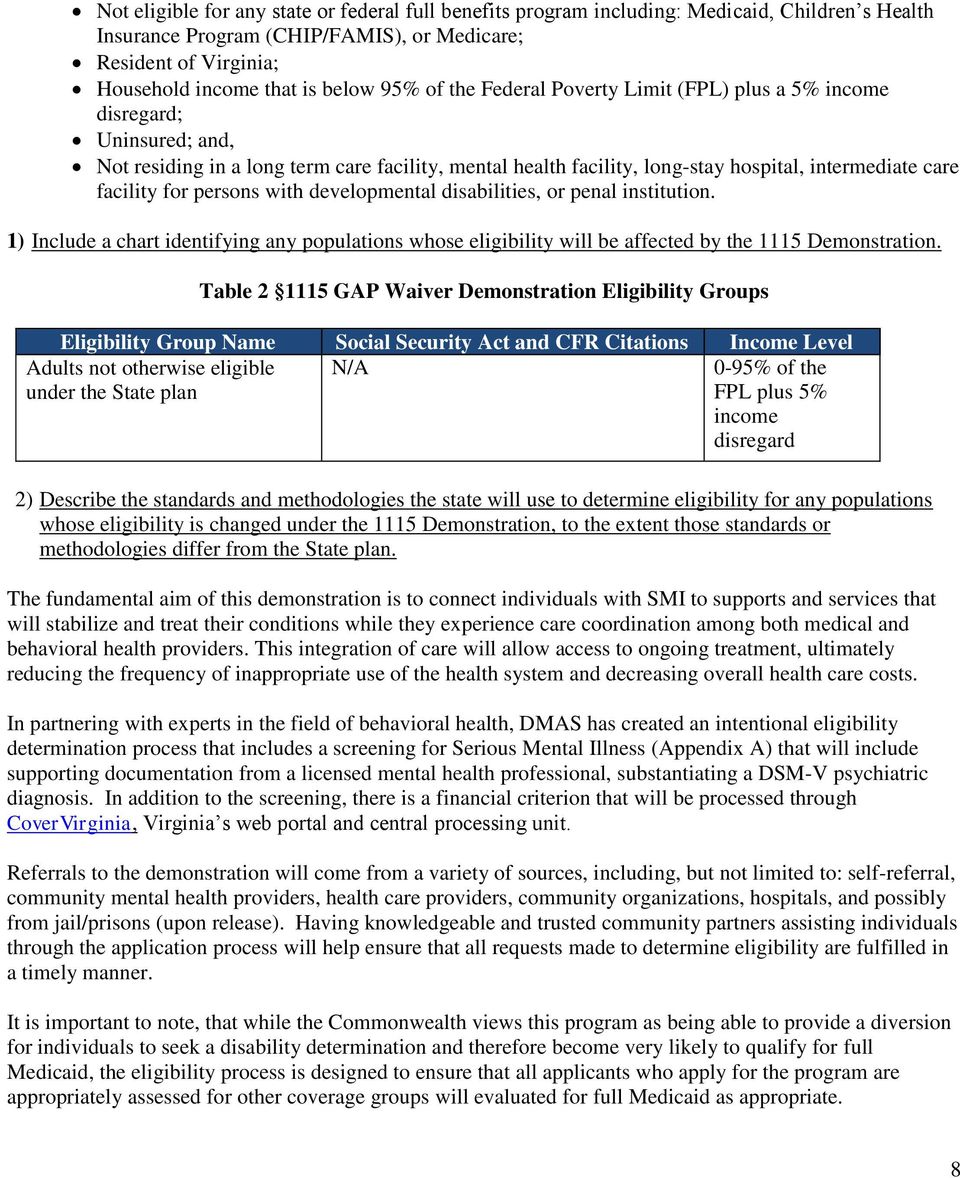
8 Not eligible for any state or federal full benefits program including: Medicaid, Children s Health Insurance Program (CHIP/FAMIS), or Medicare; Resident of Virginia; Household income that is below 95% of the Federal Poverty Limit (FPL) plus a 5% income disregard; Uninsured; and, Not residing in a long term care facility, mental health facility, long-stay hospital, intermediate care facility for persons with developmental disabilities, or penal institution. 1) Include a chart identifying any populations whose eligibility will be affected by the 1115 Demonstration. Table GAP Waiver Demonstration Eligibility Groups Eligibility Group Name Social Security Act and CFR Citations Income Level Adults not otherwise eligible under the State plan N/A 0-95% of the FPL plus 5% income disregard 2) Describe the standards and methodologies the state will use to determine eligibility for any populations whose eligibility is changed under the 1115 Demonstration, to the extent those standards or methodologies differ from the State plan. The fundamental aim of this demonstration is to connect individuals with SMI to supports and services that will stabilize and treat their conditions while they experience care coordination among both medical and behavioral health providers. This integration of care will allow access to ongoing treatment, ultimately reducing the frequency of inappropriate use of the health system and decreasing overall health care costs. In partnering with experts in the field of behavioral health, DMAS has created an intentional eligibility determination process that includes a screening for Serious Mental Illness (Appendix A) that will include supporting documentation from a licensed mental health professional, substantiating a DSM-V psychiatric diagnosis. In addition to the screening, there is a financial criterion that will be processed through CoverVirginia, Virginia s web portal and central processing unit. Referrals to the demonstration will come from a variety of sources, including, but not limited to: self-referral, community mental health providers, health care providers, community organizations, hospitals, and possibly from jail/prisons (upon release). Having knowledgeable and trusted community partners assisting individuals through the application process will help ensure that all requests made to determine eligibility are fulfilled in a timely manner. It is important to note, that while the Commonwealth views this program as being able to provide a diversion for individuals to seek a disability determination and therefore become very likely to qualify for full Medicaid, the eligibility process is designed to ensure that all applicants who apply for the program are appropriately assessed for other coverage groups will evaluated for full Medicaid as appropriate. 8
9 The table below outlines the GAP demonstration s eligibility and enrollment processes. While thorough, Virginia believes these steps to be necessary in facilitating a fair evaluation and eligibility determination. Table 3 Eligibility and Enrollment Overview Governor s Access Plan (GAP) program DRAFT Eligibility & Enrollment Overview Application Doors Eligibility Criteria/Methodology Telephonic application with telephonic signature through Cover Virginia, toll free call center open 8-7 M-F & 9-noon on Saturdays, with TDD line and Interpretation services On-line application with electronic signature accessed by CSBs, Inpatient Psychiatric Facilities and Hospitals With Inpatient Psych Units, and participating FQHCs Must meet SMI criteria SMI screening results (Y/N) provided by BHSA (Magellan) in daily file. Applicants without the SMI screening will be referred to their local CSB for the screening. Adults Must be a citizen or a legally residing alien Must be a resident of Virginia (statewide enrollment) Must be uninsured Use non-filer MAGI like rules via modifications to former CHIP rules engine in CHAMPS system (will not collect tax filing & tax household information) Household income: 95% gross income plus 5% disregard (may decrease FPL limit to manage cost of program) Expect average monthly enrollment of 20,000 enrollees, but no enrollment cap or waiting list. Will not verify application information through the federal HUB. Income verified by electronic data sources whenever possible (i.e. Virginia Employment Commission, TALX, and any other available sources) Citizenship & Identity will be done via the existing 9

10 Governor s Access Plan (GAP) program DRAFT Eligibility & Enrollment Overview Eligibility System monthly file exchange with SSA through MMIS and/or SAVES. Age, residency, and insurance status can all be verified via selfattestation. Enrollees are then given 90 days to resolve any discrepancies. Paper verifications will be requested when electronic data sources are not available to the worker. Automatically screened for LIFC, Parent/Caretaker Relative, and Pregnant Women s MAGI Medicaid coverage groups eligibility & facilitate full Cover Virginia single streamlined application for full Medicaid benefits, to include ABD where necessary. State owned CHAMPS system separate CHIP program s web-based application tracking and eligibility determination system with rules engine that makes eligibility decision. Modifications will be made to accept and process applications and determine eligibility for this population. Cases can be converted into VaCMS (state s MAGI E&E system) through already developed case conversion process after 2 years or earlier with appropriate changes to VaCMS. Eligibility Staff Will utilize contracted staff to take the applications, process the applications, initiate the running of the rules engine and enroll based on those results State eligibility staff are co-located with contracted staff if issues requiring personbased decision arise. Eligibility Period Program Effective Date: January 1, 2015 Begin date of coverage: 1st of month based on signed application received date No retro coverage no coverage prior to the 1st of month of the signed application received date 12 months continuous coverage (unless turn 10

11 Governor s Access Plan (GAP) program DRAFT Eligibility & Enrollment Overview Enrollment process Appeals 65, cannot locate, move out of Virginia). Individual would maintain enrollment in GAP during inpatient hospitalization even though this is not a covered service. Renewal: eligibility will be re-determined prior to end of 12 month coverage period for ongoing coverage (process TBD) Application confirmations with referral information to CSB for SMI screening (if needed) will be sent out the next business day after application received. Applications will be reviewed for completeness/eligibility with eight (8) days of receipt. Applications will be determined no later than 45 days from the date of application. However, because most applications will be facilitated by the referring entity and will be telephonic or online, we anticipate significantly shorter processing times for many applications. Approval/Denial/Deficiency notices will be sent out the next business day after the review for completeness/eligibility. Appeal rights information will be included on notice. Eligible applicants will be enrolled in MMIS immediately. Approval notice will be mailed out with ID number, enrollment period, and member handbook. Member ID cards will be mailed out by state s BHSA For appeals relating to determinations of eligibility and services decisions, GAP Program applicants must use the DMAS existing appeal process. 11

12 Chart 1: GAP Application Process Chart 1 displays the applicant s process from initiating an application to an eligibility determination. GAP FLOW CHART Application to GAP begins via Cover Virginia Applicant Decides to Apply for GAP Application to GAP begins via *Hospital, CSB, or FQHC Cover VA checks for full Medicaid eligibility; if not eligible conducts GAP financial/nonfinancial review Person meets GAP financial/nonfinancial eligibility - referred to CSB Screening conducted to determine if the applicant meets the SMI Criteria Applicant does not meet Financial/Non-Financial Criteria, ineligible for GAP program Person meets SMI Criteria-referred to Cover VA for Financial determination if not yet completed Applicant does not meet SMI Criteria, ineligible for GAP program Denial letter w/ appeal rights provided to person by Cover VA Individual referred to CoverVA.org and other resources to explore other healhcare options Applicants who meet both SMI and Financial criteria are provided w/care coordination through CSB and Magellan and begin service initiation. Initial eligibility letter & handbook sent to member by Cover VA; Magellan sends ID Card Screening entity submits info to Magellan for review of SMI eligibility and payment Denial letter w/ appeal rights provided to person by Cover VA Individual referred to CoverVA.org and other resources to explore other healhcare options *hospital means inpatient psychiatric hospitals and acute care hospitals with designated psychiatric floors 12

13 3) Specify any enrollment limits that apply for expansion populations under the 1115 Demonstration. Virginia expects that up to 20,000 individuals will be eligible for the GAP demonstration on a monthly basis. 4) Provide the projected number of individuals who would be eligible for the 1115 Demonstration, and indicate if the projections are based on current state programs (i.e., Medicaid State plan, or populations covered using other waiver authority, such as 1915(c)). If applicable, please specify the size of the populations currently served in those programs. Projections for the Virginia GAP demonstration are based off of an algorithm that includes funding available, coupled with an analysis of services currently used by individuals with SMI who receive State Plan Medicaid services. 5) To the extent that long term services and supports are furnished (either in institutions or the community), describe how the 1115 Demonstration will address post-eligibility treatment of income, if applicable. In addition, indicate whether the 1115 Demonstration will utilize spousal impoverishment rules under section 1924, or will utilize regular post-eligibility rules under 42 CFR (SSI State and section 1634) or under 42 CFR (209b State) (if additional space is needed, please supplement your answer with a Word attachment). Not Applicable 6) Describe any changes in eligibility procedures the state will use for populations under the 1115 Demonstration, including any eligibility simplifications that require 1115 authority (such as continuous eligibility or express lane eligibility for adults or express lane eligibility for children after 2013) (if additional space is needed, please supplement your answer with a Word attachment). As displayed in the GAP flow chart above, eligibility procedures will differ from application processes for the traditional Medicaid program. The eligibility procedures are restated below: Must meet SMI criteria SMI screening results (Y/N) provided by BHSA (Magellan) in daily file to CoverVirginia. Applicants in the community without the SMI screening will be referred to their local CSB for the screening to be conducted. SMI screenings can also be performed for hospitalized applicants by the Inpatient Psychiatric Facility, a Hospital with an Inpatient Psych Unit, and participating FQHC s Adults must be between years of age Must be a citizen or a legally residing alien Must be a resident of Virginia (statewide enrollment) Must be uninsured Use non-filer MAGI like rules via modifications to former CHIP rules engine in CHAMPS system (will not collect tax filing & tax household information) Household income: 95% gross income plus 5% disregard (may decrease FPL limit to manage cost of program) Will not verify application information through the federal HUB. Income and other non-financial criteria verified by electronic data sources whenever possible 13

14 Automatically screened for LIFC Parent/Caretaker Relative and Pregnant Women s MAGI Medicaid coverage groups eligibility & facilitate full Cover Virginia single streamlined application for full Medicaid benefits, to include ABD where necessary. Further changes in the demonstration that will require approval from CMS include; No retroactive coverage; no coverage prior to the 1st of month of the signed application received date. Coverage will begin on the 1 st of the month based on signed application received date. 12 months continuous coverage (unless turn 65, cannot locate, or move out of Virginia). This would include an individual maintaining enrollment in the GAP demonstration during an inpatient hospitalization, even though inpatient services are not covered. Eligibility will be re-determined prior to the end of the 12 month coverage period. 7) If applicable, describe any eligibility changes that the state is seeking to undertake for the purposes of transitioning Medicaid or CHIP eligibility standards to the methodologies or standards applicable in 2014 (such as financial methodologies for determining eligibility based on modified adjusted gross income), or in light of other changes in 2014 (if additional space is needed, please supplement your answer with a Word attachment). There are many reasons why Virginia is choosing not to utilize full Modified Adjusted Gross Income (MAGI) standards. The systems and processes being utilized are extremely comparable to the MAGI methodology and there will be a mitigation plan whereby cases can be converted into VaCMS (Virginia s MAGI and Eligibility and Enrollment system) through an established case conversion process. There are many competing priorities necessitated by other CMS requirements for the existing Medicaid population; however, with appropriate changes to VaCMS, the conversion could happen prior to the estimated two year time frame DEMONSTRATION BENEFITS AND COST SHARING REQUIREMENTS 1) Indicate whether the benefits provided under the 1115 Demonstration differ from those provided under the Medicaid and/or CHIP State plan: X Yes No 2) Indicate whether the cost sharing requirements under the 1115 Demonstration differ from those provided under the Medicaid and/or CHIP State plan: X_ Yes No There is no cost sharing requirement for the GAP demonstration. 3) If changes are proposed, or if different benefit packages will apply to different eligibility groups affected by the 1115 Demonstration, please include a chart specifying the benefit package that each eligibility group will receive under the 1115 Demonstration: 14

15 The GAP demonstration will utilize one benefit package for all eligible beneficiaries. DMAS has taken great care and consulted with knowledgeable experts in crafting a very intentional and appropriate targeted benefit package that includes services most needed by individuals with SMI. Included are both traditional medical services as well as behavioral health services. Coupled together and with the support of community partners, enrolled Virginians will obtain access to crucial health and behavioral health care, which will go a long way in reducing the barriers towards health. DMAS recognizes that the targeted benefit package does not support comprehensive coverage. To help ameliorate this limit, an informal network is being defined and will consist of community providers that are willing to provide services that are not part of the GAP benefit package. This voluntary network is called Preferred Pathways and will be based on the region in which the beneficiary lives. Willing community partners, in addition to CSBs, FQHCs, Hospitals, and other providers are being identified. Table 4 Benefits Eligibility Group Name Adults not otherwise eligible under the State plan Benefit Package Demonstration Only Benefit Package 4) If electing benchmark-equivalent coverage for a population, please indicate which standard is being used: Federal Employees Health Benefit Package State Employee Coverage Commercial Health Maintenance Organization Secretary Approved As previously discussed, Virginia will be offering a targeted benefit package of both medical and behavioral health services. The GAP demonstration will not include benchmark-equivalent coverage. 5) In addition to the Benefit Specifications and Qualifications form: CHIP-Program-Information/By- Topics/Waivers/1115/Downloads/Interim1115-Benefit-Specificationsand-Provider- Qualifications.pdf, please complete the following chart if the 1115 Demonstration will provide benefits that differ from the Medicaid or CHIP State plan. Please refer to Appendix B to review the GAP benefits chart and the required and corresponding Benefit/Specifications and Provider Qualifications documents for the benefits described in Table 5. Table 5 Benefits Differing from State Plan Proposed Benefits Differing from the State Plan 1) Outpatient hospital coverage 2) Outpatient Medical/Home Health 3) GAP Mental Health Case Management 4) Crisis Stabilization 15

16 Proposed Benefits Differing from the State Plan 5) Psychiatric evaluation and 6) Peer Supports outpatient individual, family, and group therapies (mental health and substance abuse treatment). 6) Indicate whether Long Term Services and Supports will be provided. Yes (if yes, please check the services that are being offered) _X_ No No long term services and supports will be provided through the GAP demonstration. In addition, please complete the: Information/By- Topics/Waivers/1115/Downloads/List-of-LTSS-Benefits.pdf, and the: Topics/Waivers/1115/Downloads/Long-Term-Services-Benefit-Specifications-and- Provider- Qualifications.pdf No long term services and supports will be provided; therefore, this is not applicable. Homemaker Case Management Adult Day Health Services Habilitation Supported Employment Habilitation Day Habilitation Habilitation Other Habilitative Respite Psychosocial Rehabilitation Environmental Modifications (Home Accessibility Adaptations) Non-Medical Transportation Home Delivered Meals Personal Emergency Response Community Transition Services Day Supports (non-habilitative) Supported Living Arrangements Assisted Living Home Health Aide Personal Care Services Habilitation Residential Habilitation Habilitation Pre-Vocational Habilitation Education (non-idea Services) Day Treatment (mental health service) Clinic Services Vehicle Modifications Special Medical Equipment (minor assistive devices) 16

17 Assistive Technology Nursing Services Adult Foster Care Supported Employment Private Duty Nursing Adult Companion Services Supports for Consumer Direction/Participant Directed Goods and Services Other (please describe) 7) Indicate whether premium assistance for employer-sponsored coverage will be available through the 1115 Demonstration. Yes (if yes, please address the questions below) _X_No (if no, please skip this question) a) Describe whether the state currently operates a premium assistance program and under which authority, and whether the state is modifying its existing program or creating a new program. b) Include the minimum employer contribution amount. c) Describe whether the Demonstration will provide wrap-around benefits and cost- sharing. d) Indicate how the cost effectiveness test will be met. 8) If different from the State plan, provide the premium amounts by eligibility group and income level. Table 6 Premium Amount Eligibility Group Name Adults not otherwise eligible under the State plan Premium Amounts No Premium 9) Include a table if the Demonstration will require copayments, coinsurance and/or deductibles that differ from the Medicaid State plan (an example is provided). Table 7 Cost Sharing Eligibility Group Name Adults not otherwise eligible under the State plan Copayments, Coinsurance, Deductible No Copayments, Coinsurance, Deductible 10) Indicate if there are any exemptions from the proposed cost sharing. Cost sharing is not a component of the GAP Program design. 17

18 DELIVERY SYSTEM AND PAYMENT RATES FOR SERVICES 1) Indicate whether the delivery system used to provide benefits to Demonstration participants will differ from the Medicaid and/or CHIP State plan: X Yes No 2) Describe the delivery system reforms that will occur as a result of the Demonstration, and if applicable, how they will support the broader goals for improving quality and value in the health care system. Specifically, include information on the proposed Demonstration s expected impact on quality, access, cost of care and potential to improve the health status of the populations covered by the Demonstration. Also include information on which populations and geographic areas will be affected by the reforms. The Demonstration is expected to have a positive impact on access to health care by providing payment for the types of services most needed by individuals with SMI who are currently uninsured and therefore receive fragmented care. Access to health care services for individuals with SMI who are uninsured typically occurs on an urgent or crisis basis in hospitals and emergency rooms with symptoms attributed to co-morbid conditions, or from SMI related diagnosis. Treatment is costly, uncoordinated, and often only addresses the presenting symptoms, not the root of the condition. The Demonstration will improve the quality of care enrollees receive by providing care coordination, primary care, prescription drugs, and other services to help stabilize enrollees, maintain them on an ongoing basis, and avert crises. Value will be realized by moving care from more costly emergency/urgent settings to ambulatory settings. The GAP demonstration is designed to not only cover medical services and provide access to care and treatment but it also creates an avenue for these individuals to be supported through services such as care coordination and peer supports. Enabling individuals with SMI to access both behavioral health and primary medical services through a supportive and coordinated delivery system will be pivotal to these individuals receiving appropriate treatment and gaining stability in their lives. Reform will be achieved by integrating behavioral and medical health care systems through a combination of care coordination and local case management so they are working in a coordinated fashion, in order to fully support both the individuals behavioral health needs, as well as any co-occurring, co-morbid conditions. The healthcare system of today is bifurcated and difficult to navigate, even if one has access to healthcare coverage. From a systems perspective, this program has been designed to leverage the common interest of both behavioral health and medical health care providers, allowing care to be coordinated across the continuum and with shared information, where appropriate. One of the leading contributors to the continued growth in the cost of health care is the inappropriate use of the delivery system. Lack of access to the appropriate services and providers yields behavior that encourages individuals to seek care from emergency departments and other urgent care facilitates. Value is achieved when GAP demonstration participants are able to receive appropriate care, in the right setting, supported, stabilized, and taught how to appropriately engage the health system. It is fully expected that demonstration participants will benefit from a coordinated care approach, resulting in better physical and behavioral health outcomes, therefore engaging in critical and emergent health care services only when appropriate. It is further 18

19 expected that once stabilized, individuals with SMI will no longer need to seek a disability determination but will rather be able to integrate and contribute to their families and communities. Populations affected by the reforms are reflected in Section II where eligibility is described. The GAP demonstration will be operated statewide. 3) Indicate the delivery system that will be used in the Demonstration by checking one or more of the following boxes: Managed care Managed Care Organization (MCO) Prepaid Inpatient Health Plans (PIHP) Prepaid Ambulatory Health Plans (PAHP) X Fee-for-service (including Integrated Care Models) Primary Care Case Management (PCCM) Health Homes X Other (please describe) Administrative Service Organization (ASO) 4) If multiple delivery systems will be used, please include a table that depicts the delivery system that will be utilized in the Demonstration for each eligibility group that participates in the Demonstration (an example is provided). Please also include the appropriate authority if the Demonstration will use a delivery system (or is currently seeking one) that is currently authorized under the State plan, section 1915(a) option, section 1915(b) or section 1932 option Table 8 Delivery Systems and Authorities Eligibility Group Name Delivery System Authority Adults not otherwise eligible under the State plan Fee-For-Service (Medical) Administrative Services Organization (Behavioral) State Plan 2011 Virginia Acts of Assembly Item 29, MMMM 5) If the Demonstration will utilize a managed care delivery system: The GAP Demonstration will not utilize a managed care delivery system. 6) Indicate whether any services will not be included under the proposed delivery system and the rationale for the exclusion. As described in earlier sections, the GAP Demonstration provides a targeted, benefit package, aiming to provide the most critical behavioral health and physical health services to a population that otherwise has no coverage. Working under a restricted financial arrangement, some services, such as inpatient care, were cost prohibitive and therefore not included in the benefit package. Benefits were selected through deliberation and in consultation with the Department of Behavioral Health and Developmental Services, the Virginia Association of Community Services Boards, private physicians, behavioral health specialists, advocacy and self-advocacy organizations (NAMI and VOCAL) stakeholders, and through the public comment process. 19

20 Understanding the importance of some services that are not covered, Preferred Pathways, as earlier described, will be a tool used to provide specific guidance to participants on how care can best be accessed. Further, individuals who have already been deemed eligible and through medical treatment are identified as having conditions that necessitate a disability determination will be supported in that process. Table 9 Non-Covered Services Note: Traditional benefits are considered behavioral health services that are typically included in commercial health insurance plans. Non-traditional, refers to behavioral health services that are covered by Virginia s Medicaid program, but not through commercial insurance. Non-Covered Medical Services Any medical service not otherwise defined as covered in Virginia s State Plan for Medical Assistance Services Chemotherapy Colonoscopy Cosmetic procedures Dental Dialysis Durable medical equipment (DME) and supply items (other than those required to treat diabetes) Early and Periodic Screening Diagnosis and Treatment (EPSDT) services Emergency room treatment Hearing aids Home health (including home IV therapy Hospice Inpatient treatment Long-term care (institutional care and home and community-based services) Nutritional supplements OB/maternity care (gynecology services are covered) Orthotics and prosthetics Outpatient hospital procedures (other than the following diagnostic procedures) o Diagnostic ultrasound procedures o EKG/ECG, including stress o Radiology procedures (excludes PET and Radiation Treatment procedures) PT, OT, and speech therapies Private duty nursing Radiation therapy Routine eye exams (to include contact lenses and eyeglasses) Services from non-enrolled Medicaid providers Services not deemed medically necessary Services that are considered experimental or investigational Sterilization (vasectomy or tubal ligation) Transportation Non-Covered Traditional Behavioral Health Services Any behavioral health or substance abuse Inpatient hospital or partial hospital treatment services not otherwise defined services as covered in Virginia s State Plan for Smoking and tobacco cessation and Medical Assistance Services counseling Electroconvulsive therapy and related Services specifically excluded under the services (anesthesia, hospital charges, State Plan for Medical Assistance etc.) Services not deemed medically necessary Emergency room services, Services that are considered experimental 20

21 Hospital observation services, Psychological and neuropsychological testing Residential treatment services (Levels A, B and C) or investigational Services from non-enrolled Medicaid providers Non-Covered Non-Traditional Behavioral Health Services Any behavioral health or substance abuse Services not deemed medically necessary treatment services not otherwise defined Services that are considered experimental as covered in Virginia s State Plan for or investigational Medical Assistance Services Services from non-enrolled Medicaid Day treatment partial hospitalization providers EPSDT services including multi-systemic Substance abuse crisis intervention ABA treatment, substance abuse day treatment for Intensive in home services pregnant women Intensive community treatment (PACT) substance abuse residential treatment for Levels A, B, or C residential treatment pregnant women services for individuals up to 21 years of substance abuse day treatment age Substance abuse targeted case Mental health skill building services management services Therapeutic day treatment Transportation Treatment foster care case management, 7) If the Demonstration will provide personal care and/or long term services and supports, please indicate whether self-direction opportunities are available under the Demonstration. If yes, please describe the opportunities that will be available, and also provide additional information with respect to the personcentered services in the Demonstration and any financial management services that will be provided under the Demonstration Yes _X_ No 8) If fee-for-service payment will be made for any services, specify any deviation from State plan provider payment rates. If the services are not otherwise covered under the State plan, please specify the rate methodology. Out of the services and benefits included under GAP demonstration coverage, only two benefits will deviate from State plan provider payment rates. GAP SMI Determination Screenings Screening will be performed in the community (by a CSB or participating FQHC) or by an inpatient psychiatric hospital or hospital with an inpatient psychiatric unit. The screening will be conducted by a qualified provider for the evaluation of an applicant s mental health 21
22 condition specifically for the purpose of determining eligibility for participation in the SMI demonstration. There will be two rates established for this administrative service: Straight forward (individual already has documented SMI diagnosis) - $37 per screen Complex (screening and diagnosis conducted by a licensed mental health professional (LMHP) or LMHP supervisee or resident- $75 per screen GAP Case Management: CSBs will provide assistance to the GAP participant with finding providers for services, applying for needed community services, and face to face interactions to ensure that participants remain engaged in the program. There will be two levels: Regular Intensity: $ providing assistance via collateral contacts and phone calls; face to face interactions in the CSB office. High Intensity: $ providing the same assistance as Regular Intensity; in addition, at least one face to face interaction in the community with the participant is required. 9) If payment is being made through managed care entities on a capitated basis, specify the methodology for setting capitation rates, and any deviations from the payment and contracting requirements under 42 CFR Part 438. The BHSA (which is an Administrative Service Organization and is not paid on an at risk basis) will be paid on a per member per month basis as established in existing contracts with the state. 10) If quality-based supplemental payments are being made to any providers or class of providers, please describe the methodologies, including the quality markers that will be measured and the data that will be collected. Medicaid providers are expected to treat their patients through evidence based practices. There will be no quality based supplemental payments through the GAP Demonstration. IMPLEMENTATION OF DEMONSTRATION 1) Describe the implementation schedule. If implementation is a phase-in approach, please specify the phases, including starting and completion dates by major component/milestone. Upon submission and in anticipating approval of the GAP Demonstration waiver application, DMAS has started modifying systems, contracts, regulations, and all other necessary components of operation, in order to implement the GAP Demonstration. Contingent upon federal approval, the GAP Demonstration will begin enrolling individuals on January 12, 2015 with coverage beginning January 1, ) Describe how potential Demonstration participants will be notified/enrolled into the Demonstration. DMAS recognizes the importance of outreach and application assistance for the GAP Program. An outreach plan will be developed and implemented to ensure that individuals throughout the Commonwealth are aware 22
23 of the demonstration and how to apply. Virginia will utilize existing outreach plans and partners as used for CHIP programs and our dual eligible demonstration project (Commonwealth Coordinated Care) through the use of townhalls, trainings, and newsletters. There is a desire to partner with the homelessness coalition, to ensure procedures and outreach plans include targeted outreach to individuals who are experiencing homelessness and precarious housing. Additionally, referrals for the demonstration will come from a variety of sources, including, but not limited to: self-referral, community mental health providers, health care providers, community organizations, hospitals, and possibly from jail/prisons (upon release). As mentioned before, having knowledgeable and trusted community partners assisting individuals through the application process will provide applicants with assurances and supports in order to ensure complete applications are submitted and all requests made in order to determine eligibility are fulfilled. Once determined eligible by the process described in Section II, GAP participants will be enrolled into the program and will be sent a letter explaining their benefits, as well as their benefit card. Understanding the possibility of the SMI population not having stable housing, DMAS has determined that the returned mail for these beneficiaries will be sent to the Central Processing Unit for further investigation and in an attempt to locate the eligible individual. 3) If applicable, describe how the state will contract with managed care organizations to provide Demonstration benefits, including whether the state needs to conduct a procurement action. As previously stated, the GAP Demonstration will not utilize Managed Care Organizations; therefore there will be no procurement action needed. DEMONSTRATION FINANCING AND BUDGET NEUTRALITY This section reflects the Commonwealth s approach for showing budget neutrality, including the data and assumptions used in the development of the cost estimates supporting this 1115 waiver request. The ability to show budget neutrality is important to Virginia. Providing integrated quality health and behavioral health care in the appropriate setting will benefit not only the program participants, but also the health care delivery system as a whole. As a large financer of health care in Virginia, DMAS is committed to designing and implementing programs that meet the triple aim of: better health, better care, and lower costs. Virginia will assume risk through the Per Capita Method. Required financing and budget neutrality documentation can be found in Appendix C. LIST OF PROPOSED WAIVERS AND EXPENDITURE AUTHORITIES 1) Provide a list of proposed waivers and expenditure authorities. 2) Describe why the state is requesting the waiver or expenditure authority, and how it will be used. To the extent necessary to implement the proposal, the Demonstration application requests that CMS, under the authority of section 1115(a)(1) of the Social Security Act (42 U.S.C. 1315), waive the following 23
24 requirements of Title XIX of the Social Security Act (42 U.S.C. 1396) to enable the Commonwealth of Virginia to implement the GAP Demonstration for the seriously mentally ill. 1) Amount Duration and Scope of Services Section 1902(a) (10) (B) Allowing Virginia to offer program participants a benefit package that differs from State Plan Services 2) Freedom of Choice Section 1902(a) (23) (A) Allowing Virginia the flexibility to assign program participants to the most appropriate program partner. 3) Reasonable Promptness Section 1902(a)(8) Allowing Virginia to limit enrollment via modification to eligibility thresholds. 4) Methods of Administration Transportation Section 1902(a)(4) insofar as it incorporates 42 CFR Allowing Virginia, to the extent necessary, to not provide non-emergency transportation to and from providers for participants 5) Retroactive Eligibility Section 1902(a) (34) Allowing Virginia to not offer participants retroactive eligibility for demonstration participation 6) Early Periodic Screening, Diagnoses, and Testing (EPSDT) Section 1904(a) (4) Allowing Virginia to be exempt from the requirement to offer EPSDT services to 19 and 20 year olds PUBLIC COMMENT AND STAKEHOLDER INPUT 1) Start and end dates of the state s public comment period. On September 8 th, 2014, DMAS posted the waiver proposal immediately following the Governor s A Healthy Virginia press conference. The public comment period ended on October 7 th, DMAS has received input from the following organizations throughout the design phase of this program and will continue to seek input from stakeholders during implementation: DBHDS, Virginia Association of Community Services Boards, NAMI of Virginia, VOCAL Virginia, private community physicians, and Magellan of Virginia. 2) Certification that the state provided public notice of the application, along with a link to the state s web site and a notice in the state s Administrative Record or newspaper of widest circulation 30 days prior to submitting the application to CMS. GAP Demonstration Website launched September 8 th, 2014: Notice in the State s Administrative Record both posted on September 11, 2014 : September 16, 2014: September 17, 2014: Newspaper: (example) 24
25 3) Certification that the state convened at least 2 public hearings, of which one hearing included teleconferencing and/or web capability, 20 days prior to submitting the application to CMS, including dates and a brief description of the hearings conducted. DMAS conducted two public hearings both with teleconferencing capability. Both hearings were attended by stakeholders and community partners and 2 public comments were presented over the 2 days. In the absence of individuals with prepared comments, Medicaid Director, Cindi Jones, transitioned both meetings into a town hall. Here, she solicited feedback and input regarding the program and answered questions as they were asked. The presentation used during the public meetings can be found here: pdf September 16 th from 1:00-3:00pm Location: the Fairfax County Government Center Board of Supervisors Auditorium 1200 Government Center Parkway Fairfax, VA September 17 th from 1:00-3:00pm Location: the Department of Motor Vehicles (DMV) Richmond Central Office Conference Room West Broad Street Richmond, VA ) Certification that the state used an electronic mailing list or similar mechanism to notify the public. (If not an electronic mailing list, please describe the mechanism that was used. Table 10 Stakeholder Communications 1 Governor s Speech covered by statewide media outlets 2 Virginia Town Hall State Administrative Register DMAS webpage highly visible off of main page: 4 Distribution to DMAS Legislative Stakeholder List 5 Distribution to Network Providers 3,700 and approximately 290 Stakeholders and additional contacts including NAMI, VOCAL, SAARA, CSBs, etc. 6 Distribution to General Behavioral Health Stakeholders (not 25
26 unduplicated) Distribution by Behavioral Health Commissioner to broad network The DBHDS State Board 9 people DBHDS Central Office Staff 300+people CSB Executive Directors 40 people Commissioner Ferguson s ALL IN! List A broad variety of BHDS system stakeholders including legislators, advocates and staff 125 people 5) Comments received by the state during the 30-day public notice period. Please view Appendix D 6) Summary of the state s responses to submitted comments, and whether or how the state incorporated them into the final application. Please view Appendix E 7) Certification that the state conducted tribal consultation in accordance with the consultation process outlined in the state s approved Medicaid State plan, or at least 60 days prior to submitting this Demonstration application if the Demonstration has or would have a direct effect on Indians, tribes, on Indian health programs, or on urban Indian health organizations, including dates and method of consultation. Virginia has no federally recognized tribes. DEMONSTRATION ADMINISTRATION Please provide the contact information for the state s point of contact for the Demonstration application. Name and Title: Cynthia B. Jones, Director, Department of Medical Assistance Services Telephone Number: Address: [email protected] 26
27 APPENDIX A Governor s Access Plan (GAP) SMI Screening Tool This form must be uploaded through the Magellan Website (Magellanofvirginia.com) in the Registration and Authorization Application. No other types of submissions will be accepted. Please note that all of the fields on this form are required; any incomplete requests will be rejected. Providers must file a claim separately for screening reimbursement. Procedure Code: H0032 UB (*assessment completed by an LMHP prior to GAP Screening) H UC (*assessment completed by an LMHP at the time of GAP screening) Name of Applicant: Social Security #: Applicant s Date of Birth: Name of Screening Site: Contact Name for Screening Facility: Screening Site Phone #: Screening Site Fax #: Screener Credentials/Licensure Screener Fax # MIS # *Date of: Screening Name of Screener: Screener Phone# Screening Site NPI Screener Signature *Date of LMHP Assessment Yes No SMI Criteria 1. Age: The person is years of age or older. 2. Diagnosis: The person has a serious mental illness diagnosed under Axis I in the DSM. At least one of the following diagnoses must be present. Adjustment Disorder or V Code diagnoses do not meet this criterion. Schizophrenia spectrum disorders & other psychotic disorders Exception: substance/medication induced psychotic disorder Major depressive disorder Bipolar and related disorders Exception: cyclothymic disorder Post-Traumatic Stress Disorder Other: OCD, Panic Disorder, Agoraphobia, Anorexia nervosa, Bulimia nervosa 3. Duration of Illness: The person must meet at least one of these criteria: Is expected to require services of an extended duration. 1
28 Has undergone psychiatric treatment more intensive than outpatient care, such as crisis response services, alternative home care, partial hospitalization, or inpatient hospitalization, more than once in his or her lifetime. Has experienced an episode of continuous, supportive residential care, other than hospitalization, for a period long enough to have significantly disrupted the normal living situation. 4. Level of Disability: The person must meet at least two of these criteria on a continuing or intermittent basis. There must be evidence of severe and recurrent disability resulting from mental illness. The disability must result in functional limitation in major life activities. Due to the person s mental illness: Is unemployed; employed in a sheltered setting or a supportive work situation; has markedly limited or reduced employment skills; or has a poor employment history. Requires public and family financial assistance to remain in the community and may be unable to procure such assistance without help. Has difficulty establishing or maintaining a personal social support system. Requires assistance in basic living skills such as personal hygiene, food preparation, or money management. Exhibits inappropriate behavior that often results in intervention by the mental health or judicial system. 5. Due to mental illness, the person requires assistance to consistently access and to utilize needed medical and/or behavioral health services/supports. (required) If YES is checked for criterion #1, for at least one response in criterion #2, for at least one response in criterion #3, for at least two responses in criterion #4, and YES is checked for criterion #5, then check YES here to indicate the SMI criteria has been met. *Clinical documentation supporting the above checked criteria must be submitted with this form to Magellan for GAP eligibility review. Psychiatric assessments must be performed by a LMHP within the last year or during the GAP screening. In addition to the SMI screening, GAP applicants must submit a separate eligibility application to Cover Virginia either telephonically at xxx-xxx-xxxx or on line at: coverva.org. 2
29 APPENDIX B GAP Demonstration Waiver Benefits Chart and Benefit Specifications and Provider Qualifications Documentation Outpatient Hospital Coverage OUTPATIENT Hospital Benefit Specifications and Provider Qualifications.docx Outpatient Medical/Home Health (Diabetic Supplies Only) HOME HEALTH OUTPATIENT MEDICAL Benefit Specifications and Provider Qualifications Form.docx Mental Health Case Management MENTAL HEALTH CASE MANAGEMENT Benefits Specifications and Provider Qualifications.docx Crisis Stabilization CRISIS STABILIZATION Benefit Specification and Provider Qualifications.docx Psychiatric evaluation and outpatient individual, family, and group therapies (mental health and substance abuse treatment) OUTPATIENT PSYCH and SUBSTANCE ABUSE Benefit Specifications and Provider Qualifications.docx Peer Supports PEER SUPPORTBenefit Specificaitions and Qualifications.docx 1
30 GAP Benefits, Scope of Service, and Provider Qualifications Benefit Provider Qualifications Scope and Limitations Differences from current VA Medicaid Program GAP Services to be provided through the Department s Behavioral Health Services Administrator (BHSA) Administrative Costs Care Coordination Same as the current VA Medicaid Program; services will be provided through the Department s BHSA, Magellan. Magellan care managers are all licensed mental health professionals. Care managers will provide information regarding covered benefits, provider selection, and how to access all services including behavioral health and medical and using preferred pathways. Magellan care managers will work closely with CSB providers of mental health case management services to assist GAP members in accessing needed medical, psychiatric, social, educational, vocational, and other supports as appropriate None Crisis Line Same as the current VA Medicaid Program (BHSA) The crisis line will be available to GAP members within the same manner as currently provided to the Medicaid and CHIP populations through Magellan. The crisis line is available 24 hours per-day, 7 days per-week and includes access to a licensed care manager during a crisis. None Peer Supports Initially peer support services will be provided through the Department s BHSA; however, the Department may transition these to allow coverage and reimbursement through trained peer support providers as certified by the Department of Behavioral Health and Developmental Services (DBHDS). Magellan Peer Support services are provided by trained peer support navigators (PSNs), who self-disclose as living with or having lived with a behavioral health condition. The goal of Peer Support services is to make the transition back into the community a successful one and avoid future inpatient stays. It is expected that there will be more frequent face-to-face engagement via the Peer Support team compared to clinical team members. These voluntary services are designed to facilitate connections with local peer-run organizations, self-help groups, other natural supports, and to engage them in treatment with the appropriate community-based resources to prevent member readmissions, improve community tenure and meaningful participation in communities of their choice. Not currently a service provided under the current VA Medicaid program. 2
31 GAP Benefits, Scope of Service, and Provider Qualifications Benefit Provider Qualifications Scope and Limitations Differences from current VA Medicaid Program The scope of services provided through Peer Supports will include services in the home, community, or provider setting including but not limited to: Visiting members in inpatient settings to develop the peer relationship that is built upon mutual respect, unique shared experiential knowledge, and facilitates a foundation of hope and self-determination to develop, or enhance, a recoveryoriented lifestyle. Exploring peer and natural community support resources from the perspective of a person who has utilized these resources and navigated multi-level systems of care. These linkages will expand to educating members about organizations and resources beyond the health care systems. Initiating dialogue and modeling positive communication skills with members to help them self-advocate for an individualized discharge plan and coordination of services that promotes successful community integration upon discharge from adult inpatient settings. Assisting in decreasing the need for future hospitalizations by offering social and emotional support and an array of individualized services. Developing rapport and driving engagement in a personal and positive supportive relationship, demonstrating and inspiring hope, trust, and a positive outlook, both by in-person interactions on the inpatient unit and a combination of faceto-face and virtual engagement for GAP participants in the community. 3
32 GAP Benefits, Scope of Service, and Provider Qualifications Benefit Provider Qualifications Scope and Limitations Differences from current VA Medicaid Program Providing social, emotional and other supports framed around the 8 dimensions of wellness. Brainstorming to identify strengths and needs post-discharge, assisting member to be better self-advocates, and ensure that the discharge plan is comprehensive and complete. Brainstorming with the member to identify the triggers and/or stressors that led to the psychiatric hospitalization. Direct face-to-face as well as toll-free warm-line services to eligible GAP members 7 days per week. The warm-line is a telephonic peer support resource staffed by as needed PSNs, trained specifically in warm-line operations and resource referrals. The warm-line associated with the PSN GAP services program would offer extended hours, toll-free access, and dedicated data collection capabilities. GAP Services to be provided through the Department s Medicaid provider network Outpatient physician, clinic, specialty care, consultation, and treatment; includes evaluation, diagnostic and treatment procedures performed in the physician s office; includes therapeutic or diagnostic injections. Same as the current VA Medicaid Program No exclusions where the place of treatment is the physician s office except as shown in Table 9; otherwise, the scope of coverage is within the current Virginia Medicaid coverage guidelines. No emergency room or inpatient coverage; no coverage for excluded services per Table 9. Outpatient hospital coverage, including Same as the current VA Medicaid Program No exclusions where the place of service is the physician s office except as shown in Table 9; otherwise, the scope of coverage is No emergency room or inpatient coverage. 4
33 GAP Benefits, Scope of Service, and Provider Qualifications Benefit Provider Qualifications Scope and Limitations Differences from current VA Medicaid Program diagnostic and radiology services electrocardiogram, authorized CAT and MRI scans. within current Virginia Medicaid coverage guidelines. Outpatient hospital treatment coverage is limited; see exclusions in Table 9. Outpatient laboratory Same as the current VA Medicaid Program No exclusions where the place of service is the physician s office except as shown in Table 9; otherwise, the scope of coverage is within current Virginia Medicaid coverage guidelines. Outpatient pharmacy Same as the current VA Medicaid Program Coverage is within the current Virginia Medicaid coverage guidelines. None None Telemedicine Same as the current VA Medicaid Program No exclusions where the place of service is the physician s office except as shown in Table 9; otherwise, the scope of coverage is within current Virginia Medicaid coverage guidelines. None Outpatient medical equipment and supplies Same as the current VA Medicaid Program Coverage is limited to certain diabetic equipment and supply services, where the scope of coverage is shown in Appendix A. Limited to certain diabetic equipment and supply services. GAP Mental Health Case Management Same as the current VA Medicaid Program for targeted mental health case management for individuals with serious mental illness. GAP Case Management (GCM) will be provided statewide and does not include the provision of direct services. GCM will have two tiers of service, regular and high intensity. Regardless of the level of service, GCM will work with Magellan care managers to assist GAP members in accessing needed medical, behavioral health (psychiatric and substance abuse treatment), social, educational, vocational, and other support services. Individuals who need a higher intensity of service will receive face to face Primary differences between GCM and Mental Health Targeted Case Management : GCM (regular intensity) does not 5
34 GAP Benefits, Scope of Service, and Provider Qualifications Benefit Provider Qualifications Scope and Limitations Differences from current VA Medicaid Program GCM provided in the community. Higher intensity GCM will be paid at the high intensity rate. GAP case managers will work closely with Magellan care coordinators. GCM service registration will be required with Magellan. Crisis Intervention Same as the current VA Medicaid Program Scope of coverage is within current Virginia Medicaid coverage guidelines. require face to face visits. GCM requires monthly collaboration with Magellan care management. GCM reimbursement rates are different: $ Regular $ High Intensity None Crisis Stabilization Same as the current VA Medicaid Program Scope of coverage is within current Virginia Medicaid coverage guidelines. Service authorization will be required to enable effective coordination. Psychosocial Rehab Assessment and Psychosocial Rehab Services Same as the current VA Medicaid Program Scope of coverage is within current Virginia Medicaid coverage and reimbursement guidelines and limitations. None Substance Abuse Intensive Outpatient (IOP) Treatment Same as the current VA Medicaid Program Scope of coverage is within current Virginia Medicaid coverage and reimbursement guidelines and limitations. None 6
35 GAP Benefits, Scope of Service, and Provider Qualifications Benefit Provider Qualifications Scope and Limitations Differences from current VA Medicaid Program Methadone Same as the current VA Medicaid Program Scope of coverage is within current Virginia Medicaid coverage and reimbursement guidelines and limitations. None Opioid Treatment administration Same as the current VA Medicaid Program Scope of coverage is within current Virginia Medicaid coverage and reimbursement guidelines and limitations. None Psychiatric evaluation and outpatient individual, family, and group therapies (mental health and substance abuse treatment). Same as the current VA Medicaid Program No exclusions except as shown in Table 9. Under GAP, there are no maximum benefit limitations on traditional behavioral health psycho-therapy services. Under GAP, there are no maximum benefit limitations on traditional behavioral health psycho-therapy services. (Current Medicaid program limits for psychotherapy services are 26 visits per year with an additional 26 in the first year of treatment.) 7
36 Covered Outpatient Medical Equipment and Supplies Diabetic Products HCPCS Description Billing Unit SA Fee Limit Code Type Supplies A4250 Urine test or reagent strips or tablet Tablets or Strips - N $ /2 Months 100 A4253 Blood glucose test or reagent strips for Strips - 50 N $ /Month home blood glucose monitor, A4256 Normal, low, and high calibrator Pkg.(5 ml vials) N $4.00 1/Month solution/chips A4258 Spring-powered device for lancet Each N $2.52 1/month A4259 Lancets Box (of 100) N $ /2 Months S8490 Insulin Syringes 100/box N $ /Month A4245 Alcohol wipes Box of 100 N $4.08 1/Month Glucose Monitors Home blood glucose monitor Each N $ /36 Months E0607 Blood glucose monitor with integrated Each Y $ E2100 voice synthesizer E2101 Blood glucose monitor with integrated lancing/blood sample Each N $ E0607 RR E2100 RR Home blood glucose monitor Day N $ Months Blood glucose monitor with integrated voice synthesizer Day N $1.83 E2101 RR Blood glucose monitor with integrated lancing/blood sample Day N $0.60 Replacement Batteries A4233 Replacement battery, alkaline (other than J cell), for use with medically necessary home blood glucose monitor owned by patient, each Each N $0.58 1/6 Months 8
37 APPENDIX C Budget Neutrality Form BUDGET NEUTRALITY FORM.docx Financing Form Interim1115-Demo-Fi nancing-form.docx Budget Neutrality Spreadsheet Virginia Section 1115 BN Template.xlsx 1
38 APPENDIX D GAP Plan Administrator 600 E. Broad Street Richmond, VA Dear GAP Plan Administrator: As a concerned citizen and mental health advocate, I am pleased to learn about the GAP proposal that Virginia will be submitting as a way to cover approximately 20,000 uninsured adults with mental illness. Many adults experiencing mental illness who do not have access to mental health and other health care services often find themselves with no option for care other than crisis-based care. Yet we know from research and experience that if services and treatments are provided in a timely manner and as early as possible upon the onset of mental illness, there is a much better chance that the person will regain stability in his or her life and have a fighting chance at longterm recovery. Regarding eligibility, the target population for the GAP plan should include adults with mental illness with incomes between % of the Federal Poverty Level, including those with serious mental illness who are not considered disabled and thus not eligible for Medicaid in Virginia. Eligibility should include those with a mental, behavioral, or emotional disorder, or a cooccurring substance use disorder that is diagnosable currently or within the past year and of sufficient duration to meet with diagnostic criteria specified within the 5th edition of the Diagnostic and Statistical Manual of Mental Disorders (DSM-V). Further, eligibility priority should be prioritized to: - Transition-age young adults who often fall through the cracks of multiple service systems as they experience a first episode of mental illness, or age out of the foster care system and leave the structure of high school and their parents' homes. - Those at-risk of institutionalization (including state and private hospitals or jail) - Those who are homeless, at risk of homelessness, or precariously housed Regarding benefits, given that the benefits package must be limited in scope, as the announcement has stated, it must focus on providing evidence-based, promising practice, and recovery-oriented treatment and supports including but not limited to: - Care coordination and the integration of primary care, including a range of medical services - A range of psychiatric services (assessment, medication management, an ongoing treatment and access to psychiatric services) - Medications for mental health and substance use disorders - Crisis services for mental health and substance use including crisis intervention and crisis stabilization - Outpatient therapy and counseling 1
39 - Community-based mental health services that are delivered in the client's home - Assertive community treatment (PACT) - Peer specialist services - Non-emergency transportation Thank you for the opportunity to submit comments on the proposal. Sincerely, (See listing below as this was a form letter received by the following 61 individuals.) 1. Mary Farrish 2. Virginia Quinn 3. Jennifer Penberthy 4. Michelle Windey 5. Judith Hodges 6. Cindy Toomey 7. Christy Cacciapaglia 8. Wanda Bishop 9. Denise Dempsey 10. Pearl Green 11. Demetrios Peratsakis 12. Ida Powell 13. Clenise White 14. Stephany Melton 15. Ava Chapman 16. Debra Riggs 17. Martha Skinker, LCSW 18. Deborah Tipton 19. Denise Dempsey 20. Marylin Copeland 21. LaSaun Forrest 22. Olga Simonova 23. Jessica Hart 24. Frances Tulloss 25. Monica Larkin 26. Beverly Koerin 27. Loreen Paiva 28. Matthew Spence 29. Denise Dobrolski 30. Cheryl Gale 31. William Habeeb 32. Betty Schnellenberger 33. Thomas Wolfsohn 34. Michael Knez 35. Katherine Sendall 36. Karen Kallay 37. Judith Dent 38. Jennifer Little 39. Grace Marshall 40. Carol Ann Guido 41. Cnde' Graff 42. Linda Erdman-Cline 43. Dell Erwin 44. Suzan Bistrup 45. Gloria Scott 46. Michael Kelley 47. Janie Harris 48. Diana Ruchelman 49. Susan Maiello 50. Donald Scott 51. Linda Johnson 52. Nan Warren 53. Charlotte Cate 54. Deborah Brinkley 55. Irene Lovewell 56. Cristy Gallagher 57. David Lofgren 58. Marylin Copeland 59. Judith Hodges 60. Lisa Chandler 61. Kat Katz 2
40 MY STORY OF RECOVERY I have lived for more than 25 years with significant mental illness. I suffered from so much stress and abuse that it fractured me into pieces. This has given me a great deal of trouble. I have had many dark times, periods of fluctuating moods and loneliness, as well as, feelings of being jumpy and scared. During much of the time my life has felt chaotic with feelings of helplessness and hopelessness. I am learning and growing by educating myself and by being enthusiastic about each day. Of all of the key concepts of WRAP, the greatest of these for me is hope. I had been lead to believe that I would not and could not recover. I was lead to WRAP through influence from mentors. I believe my breakthrough came when I began to trust my instincts and realized that I am my own best expert of my life. Now I regularly contribute to my community. I know that my life now has meaning and significance. CO I am writing to ask for your support for the 1115 waiver. Many folks who are severely mentally ill are my personal friends. I am a living testimony to how people can and do recover. I just passed a homeless person on the way here to send this to you. It is very important that our state improve access to health care the people who are falling through the cracks. We desperately need to improve access to health care for a segment of the uninsured population in Virginia who have significant behavioral and medical needs. We need to improve health and behavioral health outcomes for these demonstration participants. We need to a bridge to Closing the Coverage Gap for uninsured Virginians. In the present climate of budget cuts in all areas, please do not cut programs such as Wellness Recovery Action Plans, Pathways to Wellness, Certified Peer Specialist Training, Whole Health Action Management Training, Emotional CPR training and post hospitalization support programs. These are all essential tools to those who have significant mental illness. These programs are scientifically shown to reduce usage of high cost mental health services. Like with many long term health care issues each dollar spent on prevention, saves many dollars which would have been spent to treatments. I am willing to speak to one of your staff regarding my experience. I am willing to give a public testimony of the same. Respectfully Submitted, Cindy Orth (received electronically) 3
41 I work with many people who are living on streets and in homeless shelters. Hypothermia shelters will be opening soon, and from forecasts, it looks like we will have a busy season. In my experience, shelter staff often street or evict people who have mental health issues that staff is not trained to handle. Many people frequenting homeless and hypothermia shelters also have open wounds, and incredible unaddressed medical needs. The most efficient way to deal with homeless people who experience SMI and medical issues is to "disappear" them by eviction, threatening to call police because they're self-medicating, or trespassing. Many are unable to follow rules and are often confused. Would these funds help my peers receive help instead of being streeted again? Virginia's state mental hospitals feel that a homeless shelter placement is appropriate for someone who has received 7/24 hour care. The abrupt change of environment is not tolerated by all persons leaving in-patient facilities. Would these funds be able to assist a person with more immediate help in overcoming this trauma and adjustment? By the time many people who live on the streets realize that they need help they are near crisis, and there may or may not be any available place to receive care. Would this be covered by these funds? Would a person be able to qualify for Money Follows the Person if the person is hospitalized, and move into more stable housing and care more quickly? If these funds do become available, I would heartily suggest a campaign to educate the providers who daily meet with people about this availability of services. Thank you, Violet Taylor (received electronically) Also received as a follow up electronic submission from the same individual: Will this funding cut wait times for full services at public mental health clinics? Currently, new consumers get "services lite" when entering a public mental health system in Virginia. Usually, if they are homeless and without income, they get a bottle of pills and an emergency number to call until their CSB gets assurances of Medicaid/SSDI or other funding. Since many people wait until their mental health is extremely problematic, would this "hurry up" the services they need, or just keep them in a tenuous holding pattern on the streets or in shelters? 4
42 Jonathan Arries 2769 Linden Lane Williamsburg VA September Ms. Molly Huffstetler, Dept of Medical Assistance Services 600 E. Broad Street, Ste 1300 Richmond, VA Dear Ms. Huffstetler, I am writing in support of the proposed Virginia GAP Program for the Seriously Mentally Ill, about which I read in the September 13 th issue of The Daily Press. It is a personal experience which has inspired me to reach out to the Dept of Medical Assistance Services and register my support. I have a 25 year-old son who in 2013 was finally diagnosed with major depressive disorder and also an addictive disorder by a psychiatrist. His disorders began to manifest themselves when he was 15 - meaning that it took approximately ten years and $100,000 for multiple treatments in rehab centers for what we assumed was only addiction before we obtained a complete diagnosis. Almost none of that amount was covered by Anthem, our insurer, nor does it include money spent uselessly on his intermittent attempts to goto college in order to become productive, nor of the course the years of his life that he spent in a futile struggle to overcome disorders without knowing what they were. There has to be a better way. I hope the GAP Program will at least be a step in the right direction so that other families don t have to endure the same sacrifice. Sincerely, Jonathan F. Arries (received electronically) 5
43 To: DMAS Re: NAMI Virginia s Comments on the Proposed GAP Plan Date: September 29, 2014 Concerns about lack of access to health care and mental health care is one of the primary reasons people contact our organization. People have questions about how to obtain even the most basic health and mental health care services if they are uninsured. There is never an easy answer and it usually involves constructing a hodge-podge of solutions involving periodic free clinic services, getting on a waiting list at a CSB, securing medications that are difficult to obtain and maintain because of the expense, calling crisis services or 911 out of desperation, and trying in vain to access mental health services that, frankly, are inaccessible to the uninsured person. While our original hope was for the coverage gap to be closed through the proposed Marketplace Virginia or Medicaid expansion, we understand that those proposals face an uphill battle at this moment in time. Therefore, the GAP plan presents an opportunity that needs to be seized, and we look forward to an ongoing dialogue with DMAS and the Administration as the GAP plan moves forward. Comments about eligibility, benefits, and enrollment Eligibility Criteria The target population and eligibility for the demonstration should include adults with mental illness with incomes between % of FPL, including those with SMI who are not considered disabled and thus not eligible for Medicaid in Virginia. Eligibility should include those with a mental, behavioral, or emotional disorder, or a cooccurring substance use disorder that is diagnosable currently or within the past year and of sufficient duration to meet with diagnostic criteria specified within the 5th edition of the Diagnostic and Statistical Manual of Mental Disorders (DSM-V). Further, eligibility priority should be prioritized to: Transition-age young adults who often fall through the cracks of multiple service systems as they experience a first episode of mental illness, or age out of the foster care system and leave the structure of high school and their parents homes. Those at-risk of institutionalization (including state and private hospitals or jail). Those who are homeless, at risk of homelessness, or precariously housed Benefits Many individuals are admitted to Virginia s hospitals because they have not been able to access sufficient services in a timely manner (a front door problem ) and remain there, unable to be discharged, because of a lack of viable community-based alternatives (a back-door problem). 6
44 Nearly every report that has been published in Virginia and nationally in the past 50 years states the importance of providing comprehensive community-based services so that mental health problems can identified as early as possible and treated as effectively as possible. If the benefits package must be limited in scope, as the announcement has stated, then it must focus clearly on providing evidence-based, promising practice, and recovery-oriented treatments and supports including but not limited to: Care coordination and the integration of primary care, including a range of medical services A range of psychiatric services (assessment, medication management, an ongoing treatment and access to psychiatric services) Medications for mental health and substance use disorders Crisis services for mental health and substance use including crisis intervention and crisis stabilization Outpatient therapy and counseling Community-based mental health services that are delivered in the client s home or community setting Assertive community treatment (PACT) Peer specialist services Non-emergency transportation Enrollment There are a number of community agencies already serving the target population. These agencies should be enlisted to help outreach to and enroll the target population, as they are already serving and familiar with those who will benefit from coverage. We ask that you communicate with stakeholders as openly as possible about plans moving forward. Families and people needing services often feel completely in the dark, especially when navigating a complex system, and communication and information often mitigates the confusion and isolation that is felt. Thank you for the opportunity to comment. We look forward to providing our input as the process moves forward. Submitted on behalf of NAMI Virginia by Mira Signer, Executive Director (received electronically) 7
45 Mental Health Association of Fauquier County (MHAFC) September 26, 2014 Cindi Jones, Director Department of Medical Assistance Services 600 East Broad Street, Suite 1300 Richmond, VA Re: GAP Program for Seriously Mentally Ill The Mental Health Association of Fauquier County (MHAFC) hereby endorses DMAS plans to submit a 1115 Waiver Application to establish the Virginia GAP Program for the Seriously Mentally Ill. MHAFC supports full expansion of the Medicaid program in Virginia, and while that has not been approved by the General Assembly, we view the GAP Program as an interim step to improve health care for uninsured Virginians who have behavioral and medical needs. Among the advocacy and service programs MHAFC offers is information and assistance in finding appropriate mental health resources in our area. It has been our experience over the past three years that more than 50% of the individuals who contact us for help do not have Medicaid and do not have personal financial resources to pay for treatment. We have also had feedback from primary care physicians in the region about the significant number of individuals they are seeing for physical health services who also need mental health care. We agree that enabling persons with Serious Mental Illness to access both primary health care and behavioral services will improve the treatment they receive and their overall health outcomes, will facilitate coordination among providers, and will promote their recovery process. The proposed eligibility criteria, while restrictive, seem reasonable for the demonstration project. If possible to include dental care under the benefit package that would be desirable insofar as poor dental care can lead to many serious health complications. Broad knowledge of the program and an easy enrollment process will be critical to assure maximum coverage of eligible individuals. Thank you for your efforts to improve health care for individuals with Serious Mental Illness. Sallie Morgan, Executive Director 8
46 Comment on Virginia GAP Program for the Seriously Mentally Ill Waiver Proposal Concerned Fairfax is a group of citizens who advocate for improved access to mental health services within the county. In our discussions we identified a potential initiative to address a gap in these services. Specifically, there are many young adults suffering from SMI who are residing with their parents and are not taking advantage of mental health services. We thought that one way to bridge this gap would be to employ trained peer support specialists to provide individualized peer support. Goals would include establishing lines of communication, and encouraging the individual to get out into the community and access appropriate services and treatment. Trained peer supporters live with SMI themselves and have achieved a level of wellness that allows them to provide support to others. Because of their own experience with mental illness, they are better able to establish the necessary rapport. Another way that trained peer supporters could assist individuals who are currently isolated and who lack access to community supports and treatment would be to increase the number of Program for Assertive Community Treatment (PACT) and Intensive Community Treatment (ICT) teams available and ensure that a peer supporter is a member of each team. Funding to provide paid peer support specialists in the community could go a long way toward providing support to individuals who live with SMI and who are not currently accessing services, community supports, and treatments. Respectfully submitted, William Taylor, on behalf of Concerned Fairfax October 7,
47 September 15, Wind Forest Lane Yorktown, VA Ms Molly Huffstetler Department of Medical Assistance Services 600 E Broad St. Suite 1300 Richmond, VA Dear Ms Huffstetler, I am writing in support of the Virginia GAP Program for the Seriously Mentally Ill. From my experience with family members who have serious mental conditions, I know how important it is to have medical care a part of the overall treatment plan. It is time for Virginia to move forward in providing adequate care for all mentally ill residents and this grant will be a step in the right direction. Respectfully yours, Mary Louise Thompson 10
48 APPENDIX E 1115 GAP Waiver Application Demonstration State - Public Comment Response Document Comment: Regarding eligibility, the target population for the GAP plan should include adults with mental illness with incomes between % of the Federal Poverty Level, including those with serious mental illness who are not considered disabled and thus not eligible for Medicaid in Virginia. Response: The GAP Program eligibility criteria specifies that the program is for individuals age with income up to 100% of the Federal Poverty Level (95% FPL plus a 5% income disregard) who have a serious mental illness and have not been determined as being disabled by the Social Security Administration. Comment: Eligibility should include those with a mental, behavioral, or emotional disorder, or a cooccurring substance use disorder that is diagnosable currently or within the past year and of sufficient duration to meet with diagnostic criteria specified within the 5th edition of the Diagnostic and Statistical Manual of Mental Disorders (DSM-V). Further, eligibility priority should be prioritized to: - Transition-age young adults who often fall through the cracks of multiple service systems as they experience a first episode of mental illness, or age out of the foster care system and leave the structure of high school and their parents' homes. - Those at-risk of institutionalization (including state and private hospitals or jail) - Those who are homeless, at risk of homelessness, or precariously housed Response: The GAP Program eligibility criteria will include a screening to be administered by licensed mental health professionals as determined by the Department of Medical Assistance Services and verified by the existing Virginia Behavioral Health Services Administrator (BHSA). The screening has been crafted with an understanding of the diagnostic criteria specified within the 5 th edition of the Diagnostic and Statistical Manual of Mental Disorders (DSM-V) as well as consideration of risk factors and levels of disability. Eligibility will be determined on a, first come first served basis therefore there will not be prioritization given to transition age young adults, those at risk of institutionalization, those who are homeless, at risk of homelessness, or precariously housed. The program has been designed to work hand in hand with community based providers and has an outreach component that will be designed in the coming weeks/months. To that end, outreach efforts can be targeted to ensure that these vulnerable individuals have avenues to learn about the program and the services offered through it. Having this information will assist individuals in making an informed decision on whether to apply and do so if they so choose. 1
49 Comment: Regarding benefits, given that the benefits package must be limited in scope, as the announcement has stated, it must focus on providing evidence-based, promising practice, and recovery-oriented treatment and supports including but not limited to: - Care coordination and the integration of primary care, including a range of medical services - A range of psychiatric services (assessment, medication management, an ongoing treatment and access to psychiatric services) - Medications for mental health and substance use disorders - Crisis services for mental health and substance use including crisis intervention and crisis stabilization - Outpatient therapy and counseling - Community-based mental health services that are delivered in the client's home - Assertive community treatment (PACT) - Peer specialist services - Non-emergency transportation Response: With the exception of Assertive Community Treatment (PACT) and Non-emergency transportation, the targeted benefit package will include all of the suggested benefits. PACT is an intensive and high cost service that is already being provided by many of the local Community Services Boards (CSB s) throughout the Commonwealth to both Medicaid and non-medicaid eligible beneficiaries. The GAP Program will build upon this existing community service, and will not deter the local providers from offering it in addition to services provided through the GAP Program. Since the GAP Program has a limited benefit, non-emergency transportation is not covered. Comment: Please do not cut programs such as Wellness Recovery Action Plans, Pathways to Wellness, Certified Peer Specialist Training, Whole Health Action Management Training, Emotional CPR training and post hospitalization support programs. Response: The GAP Program benefit package is intended to enhance services already available to qualifying individuals. Comment (summarized): Will those eligible for this waiver receive assistance that will help homeless individuals with SMI? Response: 2
50 Yes, while not final, the communications and outreach planning will aim to educate and support community organizations that support individuals who are homeless, at risk of homelessness, or live in precarious housing. Comment: I would heartily suggest a campaign to educate the providers who daily meet with people about this availability of services. Response: The GAP Program will have a targeted outreach plan that will inform community providers and partners about the program; including eligibility criteria, application processes and covered services. Comment: Will this funding cut wait times for full services at public mental health clinics? Response: It is important to note that the GAP Program funds are tied specifically to the GAP Program and will not be lump sums of funding that will be provided to community providers. While the department is not able to comment on wait times at local public mental health clinics, we envision that individuals eligible for the GAP Program will have consistent access to services and supports needed to ensure their physical health and mental health conditions are attended to and treated appropriately. Comment: There are a number of community agencies already serving the target population. These agencies should be enlisted to help outreach to and enroll the target population, as they are already serving and familiar with those who will benefit from coverage. Response: The Department has not created the full outreach and education plan; however, when designing it, DMAS will rely heavily on enlisting the entities which already serve the target population in the community. Comment: The proposed eligibility criteria, while restrictive, seem reasonable for the demonstration project. If possible to include dental care under the benefit package that would be desirable insofar as poor dental care can lead to many serious health complications. Response: Unfortunately, not all services are able to be provided due to budget restrictions. Dental care will not be a covered service through the GAP demonstration. Comment: Broad knowledge of the program and an easy enrollment process will be critical to assure maximum coverage of eligible individuals. 3
51 Response: The Department has not created the full outreach and education plan; however, when designing it, DMAS will rely heavily on enlisting the entities which already serve the target population in the community. The application process is designed to ensure individuals are supported through the application process and assistance is provided as needed. Comment: One way to bridge this gap would be to employ trained peer support specialists to provide individualized peer support. Trained peer supporters live with SMI themselves and have achieved a level of wellness that allows them to provide support to others. Response: The Department has received significant encouragement to include peer supports in the benefit package. Peer support services will be included in the GAP Program. The service model has not yet been determined but it will be part of the Department s outreach and education plan. 4
Governor s Access Plan for the Seriously Mentally Ill (GAP)
 Department of of Medical Medical Assistance Assistance Services Services Governor s Access Plan for the Seriously Mentally Ill (GAP) Sherry Confer, Special Projects Manager Virginia Department Of Medical
General GAP Questions
 General GAP Questions 1. What is GAP? The Governor s Access Plan, known as GAP, is a demonstration program offering a targeted benefit package for up to 20,000 Virginians who have income less than 100%
Mental Health and Substance Abuse Services in Medicaid and SCHIP in Colorado
 Mental Health and Substance Abuse Services in Medicaid and SCHIP in Colorado As of July 2003, 377,123 people were covered under Colorado s Medicaid and SCHIP programs. There were 330,499 enrolled in the
Maryland Data as of July 2003. Mental Health and Substance Abuse Services in Medicaid and SCHIP in Maryland
 Mental Health and Substance Abuse Services in Medicaid and SCHIP in Maryland As of July 2003, 638,662 people were covered under Maryland's Medicaid/SCHIP programs. There were 525,080 enrolled in the Medicaid
Oregon Data as of July 2003. Mental Health and Substance Abuse Services in Medicaid and SCHIP in Oregon
 Mental Health and Substance Abuse Services in Medicaid and SCHIP in Oregon As of July 2003, 398,874 people were covered under Oregon s Medicaid/SCHIP programs. There were 380,546 enrolled in the Medicaid
Maryland Medicaid Program. Aaron Larrimore Medicaid Department of Health and Mental Hygiene May 15, 2012
 Maryland Medicaid Program Aaron Larrimore Medicaid Department of Health and Mental Hygiene May 15, 2012 1 Maryland Medicaid In Maryland, Medicaid is also called Medical Assistance or MA. MA is a joint
How Health Reform Will Help Children with Mental Health Needs
 How Health Reform Will Help Children with Mental Health Needs The new health care reform law, called the Affordable Care Act (or ACA), will give children who have mental health needs better access to the
National Training Program
 National Training Program Module 12 Medicaid and the Children s Health Insurance Program Session Objectives This session will help you Describe eligibility, benefits, and administration of Medicaid Define
Utah Data as of July 2003. Mental Health and Substance Abuse Services in Medicaid and SCHIP in Utah
 Mental Health and Substance Abuse Services in Medicaid and SCHIP in Utah As of July 2003, 196,600 people were covered under Utah s Medicaid/SCHIP programs. There were 157,322 enrolled in the Medicaid program,
Appendix 4: SPA and Waiver Options to Enhance Concurrent Care Programs
 Appendix 4: SPA and Waiver Options to Enhance Concurrent Care Programs Medicaid State Plan Options Each state describes its Medicaid program in the Medicaid State Plan. The State Plan specifies how the
NJ FamilyCare ABP. Covered by Horizon NJ Health for spontaneous abortions/miscarriages. Abortions & Related Services
 NJ FamilyCare ABP BENEFIT Abortions & Related Services COVERAGE by Horizon NJ Health for spontaneous abortions/miscarriages. by Fee-for-Service for elective/induced abortions. Acupuncture Audiology (see
Healthy PA: Medicaid Expansion. Ann Bacharach PA Health Law Project February 20, 2014
 Healthy PA: Medicaid Expansion 1 Ann Bacharach PA Health Law Project February 20, 2014 Healthy PA Medicaid Proposal A waiver proposal to: 2 Make substantial changes PA s existing Medical Assistance program
Florida Data as of July 2003. Mental Health and Substance Abuse Services in Medicaid and SCHIP in Florida
 Mental Health and Substance Abuse Services in Medicaid and SCHIP in Florida As of July 2003 2,441,266 people were covered under Florida's Medicaid and SCHIP programs. There were 2,113,820 enrolled in the
Kansas Data as of July 2003. Mental Health and Substance Abuse Services in Medicaid and SCHIP in Kansas
 Mental Health and Substance Abuse Services in Medicaid and SCHIP in Kansas As of July 2003, 262,791 people were covered under Kansas's Medicaid and SCHIP programs. There were 233,481 enrolled in the Medicaid
NJ FamilyCare A. Covered by Horizon NJ Health for spontaneous abortions/miscarriages. Abortions & Related Services
 NJ FamilyCare A BENEFIT Abortions & Related Services COVERAGE by Horizon NJ Health for spontaneous abortions/miscarriages. by Fee-for-Service for elective/induced abortions. Acupuncture Audiology (see
Greater Tompkins County Municipal Health Insurance Consortium
 WHO IS COVERED Requires Covered Member to be Enrolled in Both Medicare Parts A & B Type of Coverage Offered Single only Single only MEDICAL NECESSITY Pre-Certification Requirement Not Applicable Not Applicable
Public notice. No changes are proposed for the FAMIS Select program. Background -- FAMIS MOMS
 Public notice Virginia s Title XXI Child Health Insurance Plan (CHIP) covers children with family income from 143% to 200% federal poverty level (FPL) under a separate child health plan known as the Family
Division of Member Services
 2014 Division of Member Services Table of Contents This booklet provides a brief overview of the Arizona Health Care Cost Containment System (AHCCCS); Arizona s Medicaid Agency and State Children s Health
Summary of Services and Cost Shares
 Summary of Services and Cost Shares This summary does not describe benefits. For the description of a benefit, including any limitations or exclusions, please refer to the identical heading in the Benefits
NJ FamilyCare B. Covered by Horizon NJ Health for spontaneous abortions/miscarriages. Abortions & Related Services
 NJ FamilyCare B BENEFIT Abortions & Related Services COVERAGE by Horizon NJ Health for spontaneous abortions/miscarriages. by Fee-for-Service for elective/induced abortions. Acupuncture Audiology (see
The Healthy Michigan Plan Handbook
 The Healthy Michigan Plan Handbook Introduction The Healthy Michigan Plan is a health care program through the Michigan Department of Community Health (MDCH). The Healthy Michigan Plan provides health
Health Partners Plans Provider Manual Health Partners Plans Medicare Benefits Summary
 5 Health Partners Plans Provider Manual Health Partners Plans Medicare Benefits Summary Purpose: This chapter provides a benefit summary for Health Partners Plans Medicare members, by plan. Topics: Health
If you have a question about whether MedStar Family Choice covers certain health care, call MedStar Family Choice Member Services at 888-404-3549.
 Your Health Benefits Health services covered by MedStar Family Choice The list below shows the healthcare services and benefits for all MedStar Family Choice members. For some benefits, you have to be
MENTAL HEALTH PARITY AND ADDICTION EQUITY ACT RESOURCE GUIDE
 MENTAL HEALTH PARITY AND ADDICTION EQUITY ACT RESOURCE GUIDE May 2014 THE UNIVERSITY OF MARYLAND CAREY SCHOOL OF LAW DRUG POLICY AND PUBLIC HEALTH STRATEGIES CLINIC 2 PARITY ACT RESOURCE GUIDE TABLE OF
HNE Premier 1 (HMO) and HNE Premier 2 (HMO)
 2016 Medicare Advantage Summary of Benefits HNE Premier 1 (HMO) and HNE Premier 2 (HMO) January 1, 2016 - December 31, 2016 H8578_2016_429 Accepted HNE MEDICARE ADVANTAGE ENROLLMENT KIT 2016 SECTION I
2015 Medicare Advantage Summary of Benefits
 2015 Medicare Advantage Summary of Benefits HNE Medicare Premium No Rx and HNE Medicare Basic No Rx January 1, 2015 - December 31, 2015 H8578_2015_034 Accepted HNE MEDICARE ADVANTAGE ENROLLMENT KIT 2015
8.200.400.1 ISSUING AGENCY: New Mexico Human Services Department (HSD). [8.200.400.1 NMAC - Rp, 8.200.400.1 NMAC, 1-1-14]
![8.200.400.1 ISSUING AGENCY: New Mexico Human Services Department (HSD). [8.200.400.1 NMAC - Rp, 8.200.400.1 NMAC, 1-1-14]](/thumbs/30/14461020.jpg "8.200.400.1 ISSUING AGENCY: New Mexico Human Services Department (HSD). [8.200.400.1 NMAC - Rp, 8.200.400.1 NMAC, 1-1-14]") TITLE 8 SOCIAL SERVICES CHAPTER 200 MEDICAID ELIGIBILITY - GENERAL RECIPIENT RULES PART 400 GENERAL MEDICAID ELIGIBILITY 8.200.400.1 ISSUING AGENCY: New Mexico Human Services Department (HSD). [8.200.400.1
TITLE 8 SOCIAL SERVICES CHAPTER 200 MEDICAID ELIGIBILITY - GENERAL RECIPIENT RULES PART 400 GENERAL MEDICAID ELIGIBILITY 8.200.400.1 ISSUING AGENCY: New Mexico Human Services Department (HSD). [8.200.400.1
The Healthy Michigan Plan Handbook
 The Healthy Michigan Plan Handbook Introduction The Healthy Michigan Plan is a health care program through the Michigan Department of Community Health (MDCH). Eligibility for this program will be determined
APPENDIX C Description of CHIP Benefits
 Inpatient General Acute and Inpatient Rehabilitation Hospital Unlimited. Includes: Hospital-provided physician services Semi-private room and board (or private if medically necessary as certified by attending)
MCPHS University Health Insurance Program Information
 MCPHS University Health Insurance Program Information Beginning September 1, 2014 Health Services MCPHS University students on the Boston campus have access to the Massachusetts College of Art and Design
How To Pay For Health Care With Bluecrossma
 PPO Student/Affiliate Plan MIT Student/Affiliate Extended Insurance Plan Coverage Period: 2014-2015 Summary of Benefits and Coverage: What this Plan Covers & What it Costs Coverage for: Individual, Couple,
What is the overall deductible? Are there other deductibles for specific services? Is there an out-ofpocket
 Regence BlueCross BlueShield of Oregon: Preferred Coverage Period: 08/15/2015-08/14/2016 Summary of Benefits and Coverage: What this Plan Covers & What it Costs Coverage for: Individual & Eligible Family
Coverage for: Individual, Family Plan Type: PPO. Important Questions Answers Why this Matters:
 This is only a summary. If you want more detail about your coverage and costs, you can get the complete terms in the policy or plan document at www.bbsionline.com or by calling 1-866-927-2200. Important
Boston College Student Blue PPO Plan Coverage Period: 2015-2016
 Boston College Student Blue PPO Plan Coverage Period: 2015-2016 Summary of Benefits and Coverage: What this Plan Covers & What it Costs Coverage for: Individual and Family Plan Type: PPO This is only a
BridgeSpan Health Company: BridgeSpan Oregon Standard Gold Plan MyChoice Northwest
 BridgeSpan Health Company: BridgeSpan Oregon Standard Gold Plan MyChoice Northwest Summary of Benefits and Coverage: What this Plan Covers & What it Costs Questions: Call 1 (855) 857-9943 or visit us at
NJ FamilyCare D. Medicaid, NJ FamilyCare A and Alternative Benefit Plan (ABP) NJ FamilyCare B NJ FamilyCare C
 Service Medicaid, NJ FamilyCare A and Alternative Benefit Plan (ABP) NJ Division of Developmental Disabilities (DDD) NJ FamilyCare B NJ FamilyCare C NJ FamilyCare D Abortions and related services (covered
8.310.12.1 ISSUING AGENCY: New Mexico Human Services Department (HSD). [8.310.12.1 NMAC - N, 11-1-14]
![8.310.12.1 ISSUING AGENCY: New Mexico Human Services Department (HSD). [8.310.12.1 NMAC - N, 11-1-14]](/thumbs/27/12237818.jpg "8.310.12.1 ISSUING AGENCY: New Mexico Human Services Department (HSD). [8.310.12.1 NMAC - N, 11-1-14]") TITLE 8 SOCIAL SERVICES CHAPTER 310 HEALTH CARE PROFESSIONAL SERVICES PART 12 INDIAN HEALTH SERVICE AND TRIBAL 638 FACILITIES 8.310.12.1 ISSUING AGENCY: New Mexico Human Services Department (HSD). [8.310.12.1
TITLE 8 SOCIAL SERVICES CHAPTER 310 HEALTH CARE PROFESSIONAL SERVICES PART 12 INDIAN HEALTH SERVICE AND TRIBAL 638 FACILITIES 8.310.12.1 ISSUING AGENCY: New Mexico Human Services Department (HSD). [8.310.12.1
Greater Tompkins County Municipal Health Insurance Consortium
 WHO IS COVERED Requires both Medicare A & B enrollment. Type of Coverage Offered Single only Single only MEDICAL NECESSITY Pre-Certification Requirement None None Medical Benefit Management Program Not
Statewide Medicaid Managed Care Managed Medical Assistance Program Update
 Statewide Medicaid Managed Care Managed Medical Assistance Program Update Beth Kidder Assistant Deputy Secretary for Medicaid Operations Agency for Health Care Administration Presented to the KidCare Coordinating
ADDENDUM to. Commonwealth of Massachusetts Executive Office of Health and Human Services Office of Medicaid
 ADDENDUM to Commonwealth of Massachusetts Executive Office of Health and Human Services Office of Medicaid Proposal to the Center for Medicare and Medicaid Innovation State Demonstration to Integrate Care
What is the overall deductible? Are there other deductibles for specific services?
 : MyPriority POS RxPlus Silver 1800 Coverage Period: Beginning on or after 01/01/2015 Summary of Benefits and Coverage: What this Plan Covers & What it Costs Coverage for: Subscriber/Dependent Plan Type:
Blue Care Elect Saver with Coinsurance Northeastern University HDHP Coverage Period: on or after 01/01/2016
 Blue Care Elect Saver with Coinsurance Northeastern University HDHP Coverage Period: on or after 01/01/2016 Summary of Benefits and Coverage: What this Plan Covers & What it Costs Coverage for: Individual
HUMANA HEALTH PLAN, INC:
 HUMANA HEALTH PLAN, INC: Humana Silver 4600/Lexington UK Healthcare HMOx Coverage Period: Beginning on or after 01/01/2015 Summary of Benefits and Coverage: What this Plan Covers & What it Costs Coverage
Important Questions Answers Why this Matters: What is the overall deductible?
 Important Questions Answers Why this Matters: What is the overall deductible? Are there other deductibles for specific services? Is there an out of pocket limit on my expenses? What is not included in
NC HEALTH CHOICE FOR CHILDREN
 CHAPTER 13 NC HEALTH CHOICE FOR CHILDREN What is it? Who is it for? NC Health Choice is a free or reduced-cost health insurance program for uninsured children from birth through age 18. NC Health Choice
Important Questions Answers Why this Matters: In-network: $2,000 Single / $4,000 Family Out-of-network: $3,000 Single / $6,000 Family
 This is only a summary. If you want more detail about your coverage and costs, you can get the complete terms in the policy or plan document at www.independenthealth.com or by calling 1-800-501-3439. Important
Regence BlueCross BlueShield of Oregon: Regence Oregon Standard Bronze Plan Coverage Period: Beginning on or after 01/01/2014
 Regence BlueCross BlueShield of Oregon: Regence Oregon Standard Bronze Plan Summary of Benefits and Coverage: What this Plan Covers & What it Costs Coverage Period: Beginning on or after 01/01/2014 Coverage
Ryan White Program Services Definitions
 Ryan White Program Services Definitions CORE SERVICES Service categories: a. Outpatient/Ambulatory medical care (health services) is the provision of professional diagnostic and therapeutic services rendered
Trillium Community Health Plan: Oregon Standard Bronze Plan Vital Coverage Period: 01/01/2015-12/31/2015
 This is only a summary. If you want more detail about your coverage and costs, you can get the complete terms in the policy or plan document at www.trilliumchp.com or by calling 1-800-910-3906. Important
FIRSTCAROLINACARE INSURANCE COMPANY 2015 Summary of Benefits. FirstMedicare Direct PPO Plus (PPO)
 FIRSTCAROLINACARE INSURANCE COMPANY 2015 Summary of Benefits FirstMedicare Direct PPO Plus (PPO) Chatham, Hoke, Lee, Montgomery, Moore, Richmond, Scotland Counties 1 P age SECTION I - INTRODUCTION TO SUMMARY
Medicaid Basics and Indiana Health Coverage Programs (IHCPs) Module #2 Training Resource for Indiana Navigators
 Medicaid Basics and Indiana Health Coverage Programs (IHCPs) Module #2 Training Resource for Indiana Navigators 2 Module #2 Objectives After reviewing this module, you will be able to: Assess whether someone
MedStar Family Choice Benefits Summary District of Columbia- Healthy Families WHAT YOU GET WHO CAN GET THIS BENEFIT BENEFIT
 Primary Care Services Specialist Services Laboratory & X-ray Services Hospital Services Pharmacy Services (prescription drugs) Emergency Services Preventive, acute, and chronic health care Services generally
National Guardian Life Insurance Company Maine College of Art Student Health Insurance Plan Coverage Period: 09/01/2015-08/31/2016
 J3A59 National Guardian Life Insurance Company This is only a summary. If you want more detail about your coverage and costs, you can get the complete terms in the policy or plan document at www.studentplanscenter.com
Independent Health s Medicare Passport Advantage (PPO)
 Independent Health s Medicare Passport Advantage (PPO) (a Medicare Advantage Preferred Provider Organization Option (PPO) offered by INDEPENDENT HEALTH BENEFITS CORPORATION with a Medicare contract) Summary
Covered Benefits. Covered. Must meet current federal and state guidelines. Abortions. Covered. Allergy Testing. Covered. Audiology. Covered.
 Covered Benefits Services Abortions Allergy Testing Audiology Birth Control Services Blood & Blood Plasma Bone Mass Measurement (bone density) Case Management Chemotherapy Chiropractor Services (manipulation/subluxation)
Summary of the Major Provisions in the Patient Protection and Affordable Health Care Act
 Summary of the Major Provisions in the Patient Protection and Affordable Care Act Updated 10/22/10 On March 23, 2010, President Barack Obama signed into law comprehensive health care reform legislation,
Student Health Insurance Plan Insurance Company Coverage Period: 07/01/2015-06/30/2016
 This is only a summary. If you want more detail about your coverage and costs, you can get the complete terms in the policy or plan document at www.studentplanscenter.com or by calling 1-800-756-3702.
National PPO 1000. PPO Schedule of Payments (Maryland Small Group)
 PPO Schedule of Payments (Maryland Small Group) National PPO 1000 The benefits outlined in this Schedule are in addition to the benefits offered under Coventry Health & Life Insurance Company Small Employer
$500 member / $1,000 family Self- Referred. Does not apply to emergency room, emergency transportation, or acupuncture services.
 Blue Choice New England Plan 2 MIT Choice Coverage Period: on or after 01/01/2015 Summary of Benefits and Coverage: What this Plan Covers & What it Costs Coverage for: Individual, Ind.+Spouse, Ind.+Child(ren)
SUMMARY OF BADGERCARE PLUS BENEFITS
 SUMMARY OF BADGERCARE PLUS BENEFITS Medical, mental health and substance abuse services Dental emergency NOT Pharmacy, chiropractic and dental services NOT 13 Ambulatory surgery centers Coverage of certain
CHAPTER 535 HEALTH HOMES. Background... 2. Policy... 2. 535.1 Member Eligibility and Enrollment... 2. 535.2 Health Home Required Functions...
 TABLE OF CONTENTS SECTION PAGE NUMBER Background... 2 Policy... 2 535.1 Member Eligibility and Enrollment... 2 535.2 Health Home Required Functions... 3 535.3 Health Home Coordination Role... 4 535.4 Health
HMO Blue Basic Coinsurance Coverage Period: on or after 01/01/2015
 HMO Blue Basic Coinsurance Coverage Period: on or after 01/01/2015 Summary of Benefits and Coverage: What this Plan Covers & What it Costs Coverage for: Individual and Family Plan Type: HMO This is only
Summary of Benefits January 1, 2016 December 31, 2016. FirstMedicare Direct PPO Plus (PPO)
 Summary of Benefits January 1, 2016 December 31, 2016 FIRSTCAROLINACARE INSURANCE COMPANY FirstMedicare Direct PPO Plus (PPO) Chatham, Hoke, Lee, Montgomery, Moore, Richmond, Scotland Counties This booklet
2016 Summary of Benefits
 2016 Summary of Benefits Health Net Violet Option 3 (PPO) Douglas and Josephine counties, OR Benefits effective January 1, 2016 H5520 Health Net Life Insurance Company H5520_2016_0202 CMS Accepted 09162015
PREFERRED CARE. All covered expenses, including prescription drugs, accumulate toward both the preferred and non-preferred Payment Limit.
 PLAN FEATURES Deductible (per plan year) $300 Individual $300 Individual None Family None Family All covered expenses, excluding prescription drugs, accumulate toward both the preferred and non-preferred
Medical Plan - Healthfund
 18 Medical Plan - Healthfund Oklahoma City Community College Effective Date: 07-01-2010 Aetna HealthFund Open Choice (PPO) - Oklahoma PLAN DESIGN AND BENEFITS PROVIDED BY AETNA LIFE INSURANCE COMPANY -
page 2 for other costs for services this plan covers. Is there an out-of-pocket limit
 Coverage Period: Beginning 01/01/2014 1199SEIU National Benefit Fund Coverage for: Medicare-Eligible Retirees Living Outside of the Fund s Medicare Advantage Plan Area Summary of Benefits and Coverage:
Summary of Benefits Community Advantage (HMO)
 Summary of Benefits Community Advantage (HMO) January 1, 2015 - December 31, 2015 This booklet gives you a summary of what we cover and what you pay. It doesn't list every service that we cover or list
Medical Management. G.2 At a Glance. G.3 Procedures Requiring Prior Authorization. G.5 How to Contact or Notify Medical Management
 Page1 G.2 At a Glance G.3 Procedures Requiring Prior Authorization G.5 How to Contact or Notify G.6 When to Notify G.11 Case Management Services G.14 Special Needs Services G.16 Health Management Programs
Health First Health Plans : HF Silver HMO Select 85 5248 Coverage Period: On or after 01/01/2015
 Health First Health Plans : HF Silver HMO Select 85 5248 Coverage Period: On or after 01/01/2015 Summary of Benefits and Coverage: What this Plan Covers & What it Costs Coverage for: Members Only Plan
Blue Care Elect Preferred 90 Copay Coverage Period: on or after 09/01/2015
 Blue Care Elect Preferred 90 Copay Coverage Period: on or after 09/01/2015 Summary of Benefits and Coverage: What this Plan Covers & What it Costs Coverage for: Individual Only Plan Type: PPO This is only
Clarification of Medicaid Coverage of Services to Children with Autism
 DEPARTMENT OF HEALTH & HUMAN SERVICES Centers for Medicare & Medicaid Services 7500 Security Boulevard, Mail Stop S2-26-12 Baltimore, Maryland 21244-1850 CMCS Informational Bulletin DATE: July 7, 2014
January 1, 2015 December 31, 2015 Summary of Benefits. Advantra (HMO) H3928-001 80.06.360.1-LA1
 January, 205 December 3, 205 Summary of Benefits H3928-00 80.06.360.-LA Y0022_205_H3928_00_LA Accepted 9/204 Summary of Benefits January, 205 December 3, 205 This booklet gives you a summary of what we
Affordable Care Act: Health Coverage for Criminal Justice Populations. Colorado Center on Law and Policy Colorado Criminal Justice Reform Coalition
 Affordable Care Act: Health Coverage for Criminal Justice Populations Colorado Center on Law and Policy Colorado Criminal Justice Reform Coalition Who we are CCJRC and CCLP have partnered to help Colorado
VA Innovation Health Silver $10 Copay
 This is only a summary. If you want more detail about your coverage and costs, you can get the complete terms in the policy or plan document at www.innovation-health.com/summary-benefits-and-coverage or
What is Medicare / Medicaid?
 Your MNT login register home opinions forum contact us news categories: a - b c - d e - g h - l m - o p - r s - z home» medicare / medicaid / schip» all about medicare» what is medicare / medicaid? What
Strategies For Improving Access To Mental Health Services In SCHIP Programs
 May 2006 Strategies For Improving Access To Mental Health Services In SCHIP Programs Prepared by: Jennifer May Children and adolescents experience substantial barriers to obtaining needed mental health